Introduction
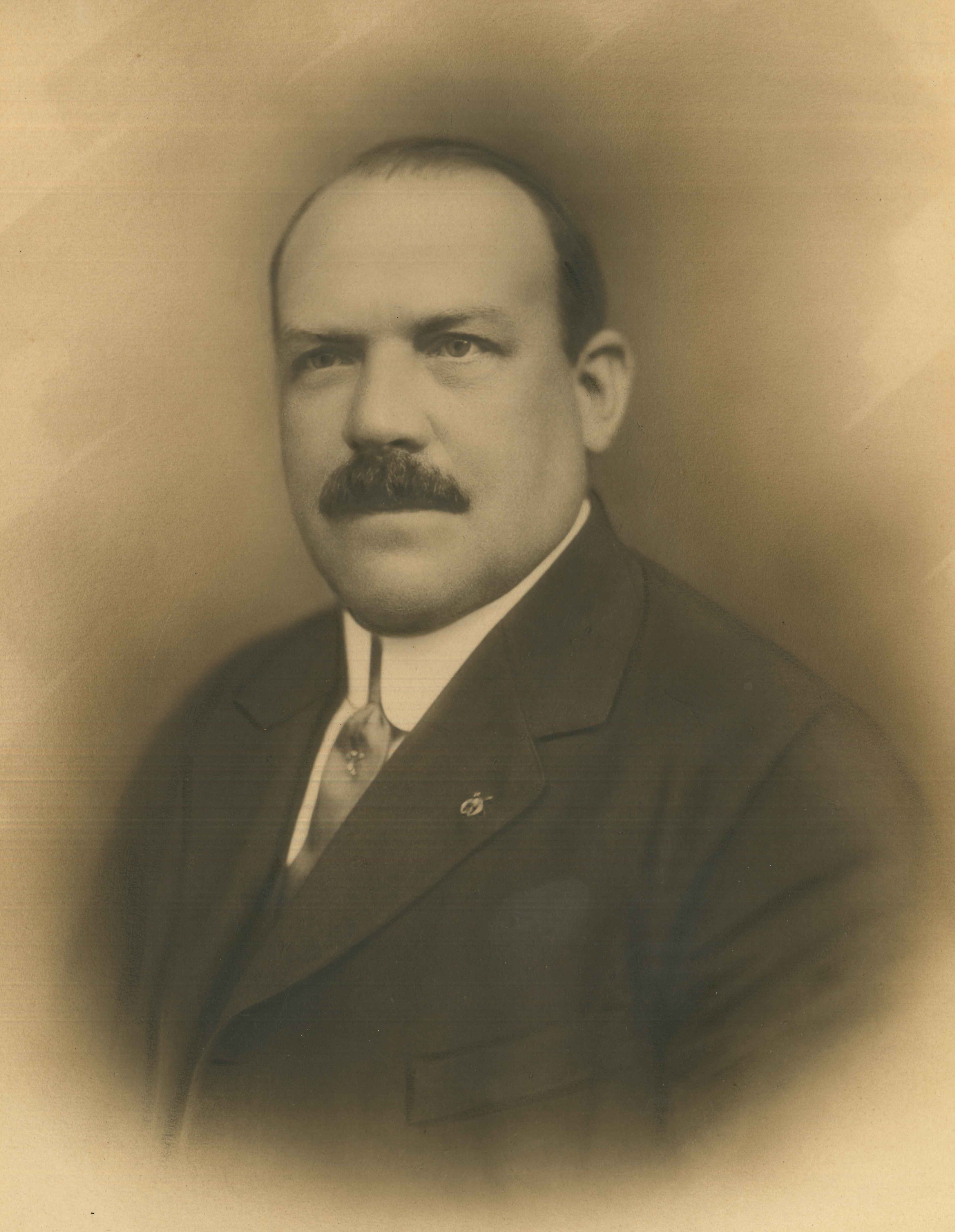
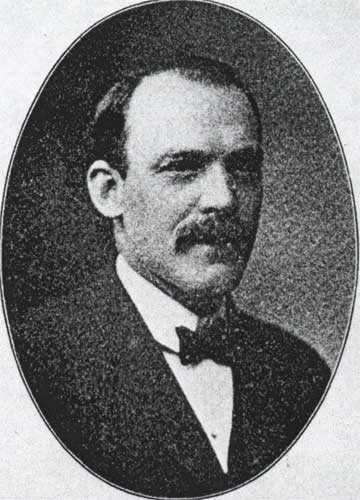
Charles H. Ellis Jr. — Mayor of Camden, NJ
CHARLES H. ELLIS JR. served as mayor of Camden NJ from 1905 through 1922. He was born in Camden on April 22, 1862. His grandfather was Samuel Ellis, the first City Clerk of Camden, who also published the first newspaper to appear in Camden. His father was a successful grocer, who had come to Camden around 1862 and established a grocery store at 5th and Berkeley Street. The family lived at 510 Berkeley Street in the 1870s through the 1890s. Besides Charles Jr., the family also included siblings Frank, Laura, Emma, Walter, and Wilbur Ellis. Both Walter Ellis and Wilbur Ellis became prominent in different aspects of Camden’s civic affairs.
Charles H. Ellis married Emma Taylor, daughter of another Camden grocer, in 1885. He appears in the city directories from 1887 through 1891 as a clerk, living at 931 South 5th Street. In March of 1891 he succeeded his father in the grocery business. In 1890 he was elected to the Board of Education, and served there until his election in the mid 1890s to the City Council. Charles H. Ellis was made President of City Council after serving for one year. At the time, he was the youngest man ever having filled that post.
Charles Ellis and family were still residing at 931 South 5th Street as late as 1895. The 1896 City Directory shows that he and his family had moved to 915 South 5th Street. Sadly, Emma Taylor Ellis died in October of 1897 at the age of 32, leaving Charles Ellis to raise his four children, Ella, Frank, Laura, and Elizabeth “Lizzie” Ellis, alone. Charles Ellis hired a widow from the neighborhood, Mrs. Amanda Alloway, to work as a live-in housekeeper and help with the children. She remained with the Ellis family into the mid-1910s. Charles Ellis remarried on April 30, 1909.
Charles H. Ellis also served, beginning in late 1890s as a tax collector for the City of Camden. A Republican, he recaptured the Mayor’s office for his party, succeeding Joseph A. Nowrey as mayor.
A popular Mayor, Charles Ellis was re-elected five times, the elections then being held every three years. He left office mid-term, in 1922, to take the position of Postmaster for the city of Camden. During his time in office countless civic improvements were made, many of which have lasted into the present century. Camden High School was built during his tenure, the public playground system was inaugurated, and the park system greatly expanded. The Fire Department switched from horse-drawn apparatus to fire trucks, and the Police Department acquired patrol cars and motorcycles during these years. As the city grew, the importance of its Streets Department grew with it, and Mayor Ellis appointed Alfred L. Sayres to head that department. Sayres would serve until 1923. Later in his career, Mayor Ellis would guide the city through the trials and tribulations of World War I. Perhaps the greatest challenge he faced during his time in office was the influenza epidemic of 1918, a worldwide health crisis of proportions theretofore never seen.
At the time of the 1920 census, Charles Ellis is shown as living with his wife Hattie and son Frank M. Ellis at 913 S. 5th Street in South Camden. His neighbors included Fire Chief George B. Wade, stationary store owner Charles Devaull, and City Clerk William D. Brown, who lived at 920 S. 5th Street. Daughter Laura Ellis Miller passed in 1924, and was buried at Harleigh Cemetery in Camden.
After leaving the Mayor’s Office in 1922, Charles H. Ellis served as the Postmaster in Camden through 1934, when he retired shortly after the May elections. President Franklin D. Roosevelt appointed Democratic activist Emma Hyland to the position. By 1929 and at the time of the April 1930 Federal Census, he was living at 915 S. 5th Street, with his wife Hattie, daughter Elizabeth Watson and her husband Byron, an auto mechanic for the U.S. Postal Service. Charles H. Ellis had been a political ally of David Baird Sr., and he was loyal to David Baird Jr. during the struggle for control of the Republican party in Camden in the 1930s.
Charles H. Ellis was a member of several fraternal organizations, including Trimble Lodge, No. 117 Free and Accepted Masons, the Improved Order of Red Men, the Odd Fellows, and the Junior Order of American Mechanics in Camden. In the 1880s he had been a member of Joseph Jennings’ Sixth Regiment Band.
Last a resident of Pennsauken, New Jersey, where he lived at 2137 43rd Street, Charles Ellis passed away on May 4, 1940, and was buried at Harleigh Cemetery in Camden NJ, near his first wife. Daughter Elizabeth and son-in-law Byron Watson survived into the early 1970s, and are also buried there.
Photographs
CHARLES H. ELLIS JR. served as mayor of Camden NJ from 1905 through 1922. He was born in Camden on April 22, 1862. His grandfather was Samuel Ellis, the first City Clerk of Camden, who also published the first newspaper to appear in Camden. His father was a successful grocer, who had come to Camden around 1862 and established a grocery store at 5th and Berkeley Street. The family lived at 510 Berkeley Street in the 1870s through the 1890s. Besides Charles Jr., the family also included siblings Frank, Laura, Emma, Walter, and Wilbur Ellis. Both Walter Ellis and Wilbur Ellis became prominent in different aspects of Camden's civic affairs.
Charles H. Ellis married Emma Taylor, daughter of another Camden grocer, in 1885. He appears in the city directories from 1887 through 1891 as a clerk, living at 931 South 5th Street. In March of 1891 he succeeded his father in the grocery business. In 1890 he was elected to the Board of Education, and served there until his election in the mid 1890s the City Council. Charles H. Ellis was made President of City Council after serving for one year. At the time, he was the youngest man ever having filled that post.
Charles Ellis and family were still residing at 931 South 5th Street as late as 1895. The 1896 City Directory shows that he and his family had moved to 915 South 5th Street. Sadly, Emma Taylor Ellis died in October of 1897 at the age of 32, leaving Charles Ellis to raise his four children, Ella, Frank, Laura, and Elizabeth “Lizzie” Ellis, alone. Charles Ellis hired a widow from the neighborhood, Mrs. Amanda Alloway, to work as a live-in housekeeper and help with the children. She remained with the Ellis family into the mid-1910s. Charles Ellis remarried on April 30, 1909.
Charles H. Ellis also served, beginning in late 1890s as a tax collector for the City of Camden. A Republican, he recaptured the Mayor's office for his party, succeeding Joseph A. Nowrey as mayor.
A popular Mayor, Charles Ellis was re-elected five times, the elections then being held every three years. He left office mid-term, in 1922, to take the position of Postmaster for the city of Camden. During his time in office countless civic improvements were made, many of which have lasted into the resent century. Camden High School was built during his tenure, the public playground system was inaugurated, and the park system greatly expanded. The Fire Department switched from horse-drawn apparatus to fire trucks, and the Police Department acquired patrol cars and motorcycles during these years. As the city grew, the importance of its Streets Department grew with it, and Mayor Ellis appointed Alfred L. Sayres to the head that department. Sayres would serve until 1923. Later in his career, Mayor Ellis would guide the city through the trials and tribulations of World War I. Perhaps the greatest challenge he faced during his time in office was the influenza epidemic of 1918, a worldwide health crisis of proportions theretofore never seen.
At the time of the 1920 census, Charles Ellis is shown as living with his wife Hattie and son Frank M. Ellis at 913 S. 5th Street in South Camden. His neighbors included Fire Chief George B. Wade, stationary store owner Charles Devaull, and City Clerk William D. Brown, who lived at 920 S. 5th Street. Daughter Laura Ellis Miller passed in 1924, and was buried at Harleigh Cemetery in Camden.
After leaving the Mayor's Office in 1922, Charles H. Ellis served as the Postmaster in Camden through 1934, when he retired shortly after the May elections. President Franklin D. Roosevelt appointed Democratic activist Emma Hyland to the position. By 1929 and at the time of the April 1930 Federal Census, he was living at 915 S. 5th Street, with his wife Hattie, daughter Elizabeth Watson and her husband Byron, an auto mechanic for the U.S. Postal Service. Charles H. Ellis had been a political ally of David Baird Sr., and he was loyal to David Baird Jr. during the struggle for control of the Republican party in Camden in the 1930s.
Charles H. Ellis was a member of several fraternal organizations, including Trimble Lodge, No. 117 Free and Accepted Masons, the Improved Order of Red Men, the Odd Fellows, and the Junior Order of American Mechanics in Camden. In the 1880s he had been a member of Joseph Jennings' Sixth Regiment Band.
Last a resident of Pennsauken, New Jersey, where he lived at 2137 43rd Street, Charles Ellis passed away on May 4, 1940, and was buried at Harleigh Cemetery in Camden NJ, near his first wife. Daughter Elizabeth and son-in-law Byron Watson survived into the early 1970s, and are also buried there.
County Clerk Receives Commissions for Elected Justices of the Peace
Philadelphia Inquirer —
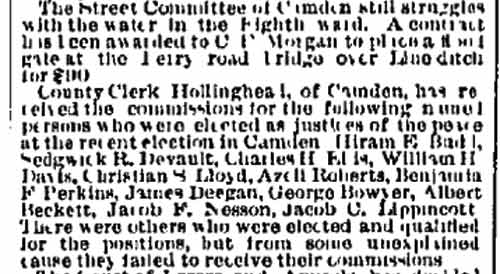
The Street Committee of Camden still struggles with the water in the Eighth ward. A contract has been awarded to C. F. Morgan to place a foot gate at the Ferry road bridge over Lino ditch for $110.
County Clerk Hollingshead, of Camden, has received the commissions for the following named persons who were elected as justices of the peace at the recent election in Camden: Hiram E. Budd, Sedgwick R. Devault, Charles H. Ellis, William H. Davis, Christian S. Lloyd, Azell Roberts, Benjamin F. Perkins, James Deegan, George Bowyer, Albert Beckett, Jacob F. Nesson, Jacob C. Lippincott. There were others who were elected and qualified for the positions, but from some unexplained cause they failed to receive their commissions.
County Clerk Hollingshead - Hiram E. Budd Sedgwick R. Devault Charles H. Ellis
William H. Davis - Christian S. Lloyd
Azell Roberts - Benjamin F. Perkins - James Deegan
George Bowyer - Albert Beckett
Jacob C. Lippincott - Jacob Nessen
Camden Election Boards
Philadelphia Inquirer —
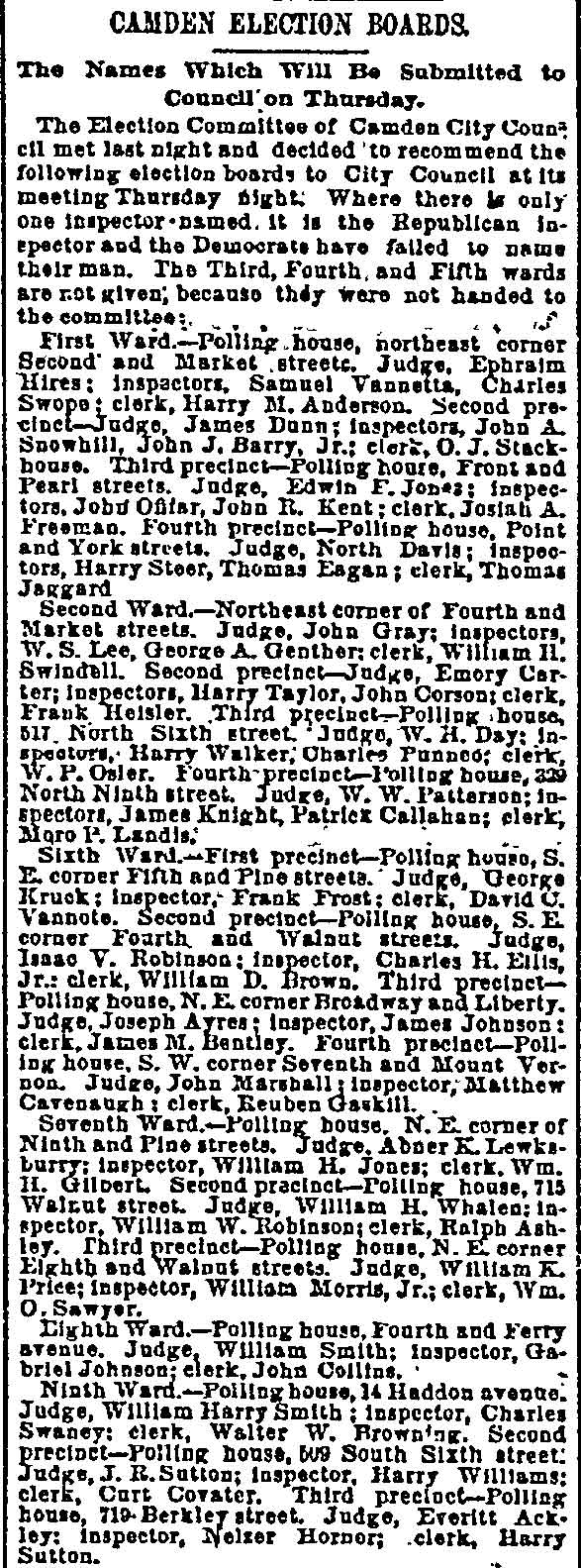
CAMDEN ELECTION BOARDS.
The Names Which Will Be Submitted to Council on Thursday.
The Election Committee of Camden City Council met last night and decided to recommend the following election boards to City Council at its meeting Thursday night. Where there is only one inspector named, it is the Republican inspector and the Democrats have failed to name their man. The Third, Fourth, and Fifth wards are not given, because they were not handed to the committee:
First Ward—Polling house, northeast corner Second and Market streets. Judge, Ephraim Hires; inspectors, Samuel Vannetta, Charles Swope; clerk, Harry M. Anderson. Second precinct—Judge, James Dunn; inspectors, John A. Snowhill, John J. Barry, Jr.; clerk, O. J. Stackhouse. Third precinct—Polling house, Front and Pearl streets. Judge, Edwin F. Jones; inspectors, John Oilsar, John R. Kent; clerk, Josiah A. Freeman. Fourth precinct—Polling house, Point and York streets. Judge, North Davis; inspectors, Harry Steer, Thomas Eagan; clerk, Thomas Jaggard.
Second Ward—Northeast corner of Fourth and Market streets. Judge, John Gray; inspectors, W. S. Lee, George A. Genther; clerk, William H. Swindell. Second precinct—Judge, Emory Carter; inspectors, Harry Taylor, John Corson; clerk, Frank Heisler. Third precinct—Polling house, 517 North Sixth street. Judge, W. H. Day; inspectors, Harry Walker, Charles Punneo; clerk, W. P. Osler. Fourth precinct—Polling house, 329 North Ninth street. Judge, W. W. Patterson; inspectors, James Knight, Patrick Callahan; clerk, Moro P. Landis.
Sixth Ward—First precinct—Polling house, S. E. corner Fifth and Pine streets. Judge, George Kruck; inspector, Frank Frost; clerk, David C. Yannotte. Second precinct—Polling house, S. E. corner Fourth and Walnut streets. Judge, Isaac V. Robinson; inspector, Charles H. Ellis, Jr.; clerk, William D. Brown. Third precinct—Polling house, N. E. corner Broadway and Liberty. Judge, Joseph Ayres; inspector, James Johnson; clerk, James M. Bentley. Fourth precinct—Polling house, S. W. corner Seventh and Mount Vernon. Judge, John Marshall; inspector, Matthew Cavenaugh; clerk, Reuben Gaskill.
Seventh Ward—Polling house, N. E. corner of Ninth and Pine streets. Judge, Abner K. Lewksburry; inspector, William H. Jones; clerk, Wm. H. Gilbert. Second precinct—Polling house, 715 Walnut street. Judge, William H. Whalen; inspector, William W. Robinson; clerk, Ralph Ashley. Third precinct—Polling house, N. E. corner of Eighth and Walnut streets. Judge, William K. Price; inspector, William Morris, Jr.; clerk, Wm. O. Sawyer.
Eighth Ward—Polling house, Fourth and Ferry avenue. Judge, William Smith; inspector, Gabriel Johnson; clerk, John Collins.
Ninth Ward—First precinct—Polling house, 14 Haddon Avenue. Judge, William Harry Smith; inspectors, Charles Swaney; clerk, Walter W. Browning. Second precinct—Polling house, 909 South Sixth street. Judge, J. K. Sutton; inspector, Harry Williams; clerk, Curt Covater. Third precinct—Polling house, 719 Berkeley street. Judge, Everitt Ackley; inspector, Nelzer Hornor; clerk, Harry Sutton.
A Dark Democratic Scheme
Philadelphia Inquirer —
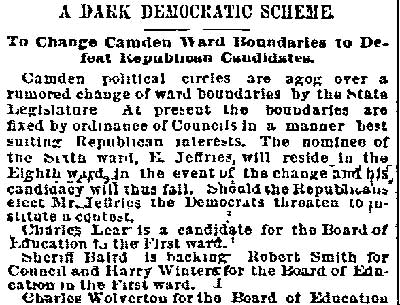
To Change Camden Ward Boundaries to Defeat Republican Candidates.
Camden political circles are agog over a rumored change of ward boundaries by the State Legislature. At present the boundaries are fixed by ordinance of Councils in a manner best suiting Republican interests. The nominee of the Sixth ward, E. Jeffries, will reside in the Eighth ward, in the event of the change and his candidacy will thus fail. Should the Republicans elect Mr. Jeffries the Democrats threaten to institute a contest.
Charles Lear is a candidate for the Board of Education to [sic] the First ward.
Sheriff Baird is backing Robert Smith for Council and Harry Winters for the Board of Education in the First ward.
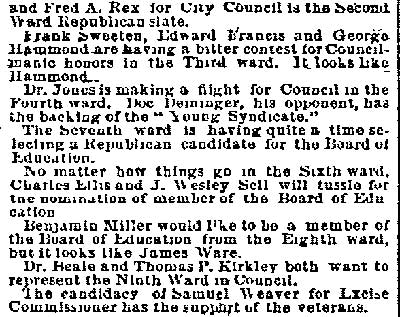
Charles Wolverton for the Board of Education and Fred A. Rex for City Council is the Second Ward Republican slate.
Frank Sweeten, Edward Francis and George Hammond are having a bitter contest for Councilmanic honors in the Third ward. It looks like Hammond.
Dr. Jones is making a fight for Council in the Fourth ward. Doc Deminger, his opponent, has the backing of the “Young Syndicate.”
The Seventh ward is having quite a time selecting a Republican candidate for the Board of Education.
No matter how things go in the Sixth ward, Charles Ellis and J. Wesley Sell will tussle for the nomination of member of the Board of Education.
Benjamin Miller would like to be a member of the Board of Education from the Eighth ward, but it looks like James Ware.
Dr. Heale and Thomas P. Kirkley both want to represent the Ninth Ward in Council.
The candidacy of Samuel Weaver for Excise Commissioner has the support of the veterans.
The Mayor Names
Camden Post —
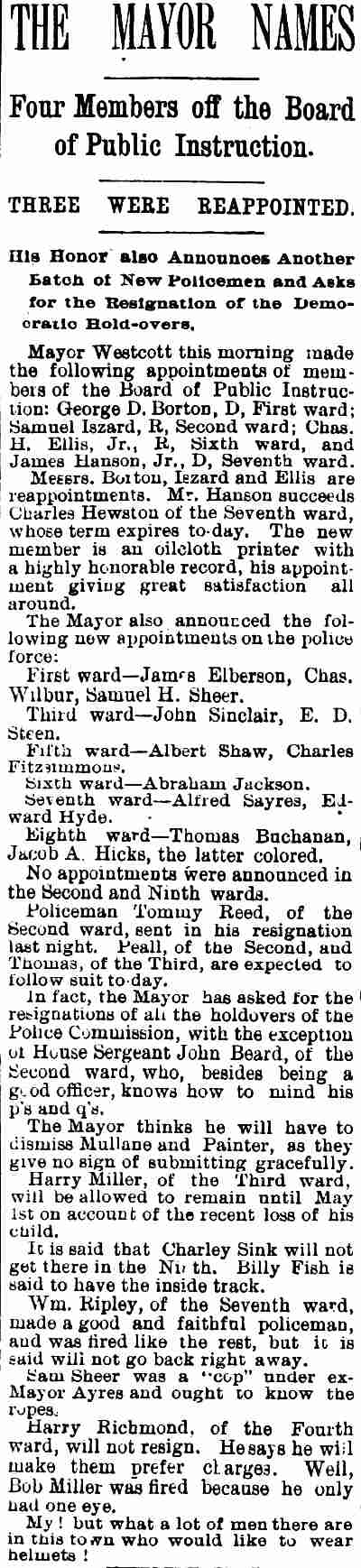
Four Members off the Board of Public Instruction.
THREE WERE REAPPOINTED.
His Honor also Announces Another Batch of New Policemen and Asks for the Resignation of the Democratic Hold-overs.
Mayor Westcott this morning made the following appointments of members of the Board of Public Instruction: George D. Borton, D, First ward; Samuel Iszard, R, Second ward; Chas. H. Ellis, Jr., R, Sixth ward, and James Hanson, Jr., D, Seventh ward. Messrs. Borton, Iezard [sic] and Ellis are reappointments. Mr. Hanson succeeds Charles Hewston of the Seventh ward, whose term expires to-day. The new member is an oilcloth printer with a highly honorable record, his appointment giving great satisfaction all around.
The Mayor also announced the following new appointments on the police force:
First ward—James Elberson, Chas. Wilbur, Samuel H. Sheer. Third ward—John Sinclair, E. D. Steen. Fifth ward—Albert Shaw, Charles Fitzsimmons. Sixth ward—Abraham Jackson. Seventh ward—Alfred Sayres, Edward Hyde. Eighth ward—Thomas Buchanan, Jacob A. Hicks, the latter colored.
No appointments were announced in the Second and Ninth wards.
Policeman Tommy Reed, of the Second ward, sent in his resignation last night. Peall, of the Second, and Thomas, of the Third, are expected to follow suit to-day.
In fact, the Mayor has asked for the resignations of all the holdovers of the Police Commission, with the exception of House Sergeant John Beard, of the Second ward, who, besides being a good officer, knows how to mind his p’s and q’s.
The Mayor thinks he will have to dismiss Mullane and Painter, as they give no sign of submitting gracefully.
Harry Miller, of the Third ward, will be allowed to remain until May 1st on account of the recent loss of his child.
It is said that Charley Sink will not get there in the Ninth. Billy Fish is said to have the inside track.
Wm. Ripley, of the Seventh ward, made a good and faithful policeman, and was fired like the rest, but it is said will not go back right away.
Sam Sheer was a “cop” under ex-Mayor Ayres and ought to know the ropes.
Harry Richmond, of the Fourth ward, will not resign. He says he will make them prefer charges. Well, Bob Miller was fired because he only had one eye.
My! but what a lot of men there are in this town who would like to wear helmets!
The Mayor’s Appointments
Camden Daily Telegram —

He Announced Several This Noon.
COMMISSIONERS OF INSTRUCTION.
The Old Members Re-named With the Exception of the Member From the Seventh Ward—Police Appointments and Resignations.
Mayor Westcott this noon made the following appointments as Commissioners of Public instruction:
Messrs. George D. Borton, of the First ward; Samuel Iszard, of the Second ward; Charles H. Ellis, Jr., of the Sixth ward, and James Hanson, to succeed Charles Hewston, of the Seventh ward.
The officers of the Commission hold over another year.
The following appointments were made on the police force:
First Ward—James Elberson, Charles Wilbur, Samuel H. Sheer.
Second Ward—No appointments.
Third Ward—John Sinclair, E. D. Stein.
Fourth Ward—No appointments.
Fifth Ward—Albert Shaw, Charles Fitzsimmons.
Sixth Ward—Abraham Jackson.
Seventh Ward—Alfred Sayres, Edward Hyde.
Eighth Ward—Thomas Buchanan, Jacob A. Hicks (colored).
Ninth Ward—No appointments.
Mayor Westcott has requested the resignation of all the members of the police force who served under the Police Commission, to take effect May 1. They are Policemen Peall, Horner, Painter, Mullane, Miller and Reed.
POLITICAL POINTERS.
Who will be the postmaster?
Who will be the next prosecutor?
Many of the ward workers are suffering from election colds.
The name of Harry Moffitt was left out of the columns of honorable mention with the other hustlers of election day.
Senator Rogers and Messrs. Stafford and Watson, of the House are fully coming up to the expectations of their constituents.
If the Mayor could arrange it to hold his hearings a trifle earlier it would be a great source of satisfaction to the Camden afternoon papers.
There is still great anxiety on the part of the public as to the outcome of the present session of the legislature. Thus far their public acts have been highly commendable.
The abolishment of the Police Justice act restores to office the City Recorder, Benjamin M. Braker, who would be qualified to act in place of the Mayor should the Chief Executive be taken sick.
Jos. Potter, the new member of Council from the First ward is a man of wide business experience and will prove much advantage to the many large financial interests that will come under his care.
Owing to the satisfactory working of the present school commission in the two second-class counties up the State, the legislature made no change in the mode of placing the members as was anticipated.
Jos. B. Fox, of the Fourth ward, is what might be termed an old reliable, having had a long and varied experience in public affairs. He is always conservative in the expenditure of city money. He is always safe to trust.
Charles Sayrs, of the Seventh ward, who had a short experience in the present Council, but enough to make him feel at home among public affairs, is neck and ears in work between his real estate business and Councilmanic duties.
The colored people of the lower section of the city are anxious to see Squire Drake, the ex-Republican and ex-member of the School Board, come out of the Court House, where he holds a position under the Thompson Freeholders.
“Father” Figner is a proud sire. He was a member and president of Council in his days, and now sees his son treading in his footsteps. Mr. Figner, Jr., having been sent to Council from the Sixth ward on Tuesday by a large majority.
A special election will not be necessary for the new Board of Freeholders, as the City Council and Township Committees will appoint Freeholders who will serve until the Spring of 1895. The appointments will be made about the middle of May.
Arthur Bedell is spoken of as a candidate for the presidency of the new City Council. He is a stalwart and is never afraid to define his position on all public questions. He is one of those men who makes strong, warm friends and also creates an opposition of like force.
William D. Brown, the Secretary of the Board of Education, and Fred A. Rex, Treasurer, are quite pleased over the report of the committee on accounts and Expert O’Shaughnessy, they having examined the books of Messrs. Rex and Brown and found them correctly kept.
The library of the Camden public schools is one to be highly appreciated and much is due to the care with Miss Blowe the librarian has attended to her duties. She will hold over another year and should be allowed to retain the office as long as she merits it, and she surely does now.
J. R. Carson, the retiring member of Council from the First ward, is highly spoken of by his associates on committees and by Clerk Varney for the mature judgment displayed in the management of city affairs. It is with a general expression of regret that the city is to lose his service.
The reform in the Board of Freeholders can’t come too soon. If the public is to judge of the care of property given by the Democrats in the county, by the “hog combine” in this city, an inventory of the public property when turned over will make interesting reading. Ex-officials guarantee to save enough in the Board, if returned to their offices, to pay the expense of a special election, if one was necessary.
W. J. Bradley has been asked if he was a candidate for president of the new City Council. His reply was that he had not sought it in the first place, and would not seek it now, but whether he became president or remained merely a member on the floor, he would endeavor to discharge his duties in the interests of the city. He is commended by all who came in contact with him during the past year as one who had a new Camden at heart.
Camden Political Notes
Philadelphia Inquirer —
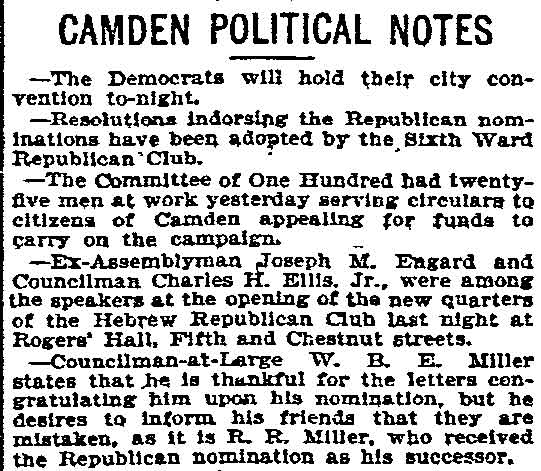
—The Democrats will hold their city convention to-night.
—Resolutions indorsing the Republican nominations have been adopted by the Sixth Ward Republican Club.
—The Committee of One Hundred had twenty-five men at work yesterday serving circulars to citizens of Camden appealing for funds to carry on the campaign.
—Ex-Assemblyman Joseph M. Engard and Councilman Charles H. Ellis, Jr., were among the speakers at the opening of the new quarters of the Hebrew Republican Club last night at Rogers’ Hall, Fifth and Chestnut streets.
—Councilman-at-Large W. R. E. Miller states that he is thankful for the letters congratulating him upon his nomination, but he desires to inform his friends that they are mistaken, as it is R. R. Miller, who received the Republican nomination as his successor.
—War Veterans’ Association, No. 1, last night adopted resolutions indorsing the Republican candidates and proposing Under Sheriff H. L. Hartsnorn as a candidate for Sheriff next fall. George E. Martin presided. Addresses were made by City Treasurer Felton, Mayor Westcott, Councilmen Potter and Hillman, Recorder Braker and Candidates R. R. Miller, E. E. Reed, Jr., Arthur Bedell and A. F. Shultz. A collation was served.
Over in Camden
Philadelphia Inquirer —
Over in Camden
Frank Bantam, colored, and Thomas McDermott were arrested last night on a charge of highway robbery.
William Johnson, Sr., of Broadway and Division street, was kicked out of his bakery wagon by a balky mule and had an arm broken.
While coupling cars at Delair, John Hammond, a Pennsylvania Railroad brakeman, of Bordentown, had his hand crushed yesterday. He was taken to the Cooper Hospital.
A 175-fathom gill net was captured by Fish Warden Guthridge Saturday night in the Delaware, off Bulson street wharf. The owners were fishing for shad in violation of the law.
Camden county Prohibitionists met last night and elected thirty-five delegates and a similar number of alternates to the State Convention to select delegates to the National Convention.
Bertha Hack, the 5-year-old daughter of Louis Hack, a saloonkeeper of Eleventh and Federal streets, fell from a second-story window yesterday. Her face was cut and one foot was broken.
H. F. Ackley, Charles H. Ellis, Jr., Samuel Dodd, John D. Courter, W. H. Collins and George G. Paul will attend the annual session of the Supreme Council, Legion of the Red Cross, which opens to-day in Baltimore, Md.
Saloonkeepers Thomas Feahrion and James A. Vansciver, who were arrested charged with selling liquor on Sunday, pleaded not guilty before Mayor Westcott yesterday, and their cases were set down for trial on Thursday.
With a capital stock of $15,000, of which $10,000 is paid in, the Broad Street Station Pharmacy Company filed articles of incorporation yesterday in the County Clerk's office. The Frohsinn Singing Society also recorded incorporation articles.
President Wilson, of the Commission of Public Instruction, last night announced the committee for the year. May 4 was fixed as the date for the annual commencement. Each member of the Commission is to name a census enumerator from his ward. The enumerators will be paid 5 cents for each name on his census list.
Water Contract and Loan
Philadelphia Inquirer —
Camden City Council Providing for Public Improvements.
Camden City Council last night ratified the action of the Water Committee in awarding the contract for a new artesian water plant to George Pfeiffer, Jr., for $525,000. The contract must be signed by the Mayor. He stated last night that he had not decided whether to approve or veto the contract.
The vote on the water contract was as follows. Ayes—Dease, Figner, George, Hillman, Lawton, Miller, Mills, Roberts, Sayrs, Sharp, Smith, Tice, Potter, President, 13. Nays—Helms, Humphreys, Southard, Weaver, 4. Absent—Hatch, Ellis.
Those who voted nay are Committee of One Hundred representatives.
An ordinance was introduced providing for a $600,000 water loan at 4 per cent., to run for 30 years, and a 4 per cent. $75,000 public park loan.
The new City Council will be organized next Monday afternoon.
Over in Camden
Philadelphia Inquirer —
President of City Councils Charles H. Ellis, Jr., is suffering with symptoms of typhoid fever.
George E. King, Gloucester City’s defaulting treasurer, is said to have been located at Charlotte, N. C.
After an illness of two weeks from the grip, Chief of Police Dodd was able to return to duty yesterday.
Owing to Commissioner Beldon being engaged in the courts the investigation of the affairs of Camden county, which was to have been begun yesterday, has been again postponed until later in the week.
Mrs. Mina Geist, whose place at Second and Arch streets, was raided Saturday night, pleaded guilty before Mayor Westcott yesterday of selling liquor without a license and paid a fine of $50 and costs.
Charles H. Ellis, Jr.
Biographical Review — 1897
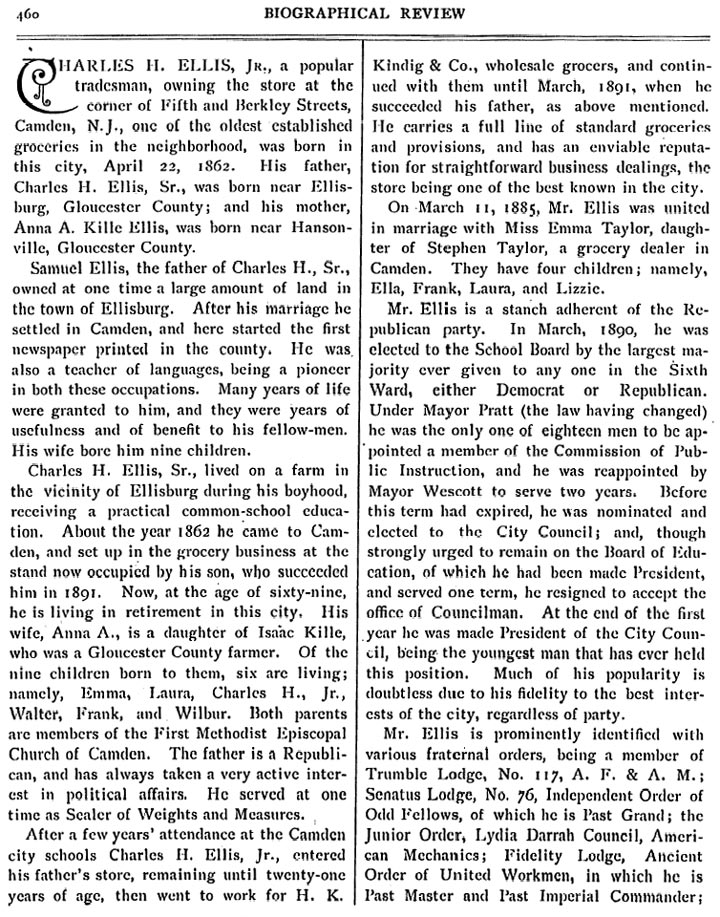
CHARLES H. ELLIS, JR., a popular tradesman, owning the store at the corner of Fifth and Berkley Streets, Camden, N. J., one of the oldest established groceries in the neighborhood, was born in this city, April 22, 1862. His father, Charles H. Ellis, Sr., was born near Ellisburg, Gloucester County; and his mother, Anna A. Kille Ellis, was born near Hansonville, Gloucester County.
Samuel Ellis, the father of Charles H., Sr., owned at one time a large amount of land in the town of Ellisburg. After his marriage he settled in Camden, and here started the first newspaper printed in the county. He was also a teacher of languages, being a pioneer in both these occupations. Many years of life were granted to him, and they were years of usefulness and of benefit to his fellow-men. His wife bore him nine children.
Charles H. Ellis, Sr., lived on a farm in the vicinity of Ellisburg during his boyhood, receiving a practical common-school education. About the year 1862 he came to Camden, and set up in the grocery business at the stand now occupied by his son, who succeeded him in 1891. Now, at the age of sixty-nine, he is living in retirement in this city. His wife, Anna A., is a daughter of Isaac Kille, who was a Gloucester County farmer. Of the nine children born to them, six are living; namely, Emma, Laura, Charles H., Jr., Walter, Frank, and Wilbur. Both parents are members of the First Methodist Episcopal Church of Camden. The father is a Republican, and has always taken a very active interest in political affairs. He served at one time as Sealer of Weights and Measures.
After a few years’ attendance at the Camden city schools Charles H. Ellis, Jr., entered his father’s store, remaining until twenty-one years of age, then went to work for H. K. Kindig & Co., wholesale grocers, and continued with them until March, 1891, when he succeeded his father, as above mentioned. He carries a full line of standard groceries and provisions, and has an enviable reputation for straightforward business dealings, the store being one of the best known in the city.
On March 11, 1885, Mr. Ellis was united in marriage with Miss Emma Taylor, daughter of Stephen Taylor, a grocery dealer in Camden. They have four children; namely, Ella, Frank, Laura, and Lizzie.
Mr. Ellis is a stanch adherent of the Republican party. In March, 1890, he was elected to the School Board by the largest majority ever given to any one in the Sixth Ward, either Democrat or Republican. Under Mayor Pratt (the law having changed) he was the only one of eighteen men to be appointed a member of the Commission of Public Instruction, and he was reappointed by Mayor Wescott to serve two years. Before this term had expired, he was nominated and elected to the City Council; and, though strongly urged to remain on the Board of Education, of which he had been made President, and served one term, he resigned to accept the office of Councilman. At the end of the first year he was made President of the City Council, being the youngest man that has ever held this position. Much of his popularity is doubtless due to his fidelity to the best interests of the city, regardless of party.
Mr. Ellis is prominently identified with various fraternal orders, being a member of Trumble [sic] Lodge, No. 117, A. F. & A. M.; Senatus Lodge, No. 76, Independent Order of Odd Fellows, of which he is Past Grand; the Junior Order, Lydia Darrah Council, American Mechanics; Fidelity Lodge, Ancient Order of United Workmen, in which he is Past Master and Past Imperial Commander; the Red Cross Legion; the I. O. R. M.; Witherspoon Circle, No. 1, Brotherhood Union, and Liberty Home, the ladies’ organization of the same order; and he was formerly connected with the Knights of the Golden Eagle. He is a Director of the Fraternal Mutual Benefit Association, also of South Ward Benefit and Labor Association, and of the New Jersey Typewriter Manufacturing Company. He and Mrs. Ellis are members of the Methodist Episcopal church and Sunday-school, and he has been a teacher in the school for some years.
East Camden Firehouse Cornerstone Plaque
1899
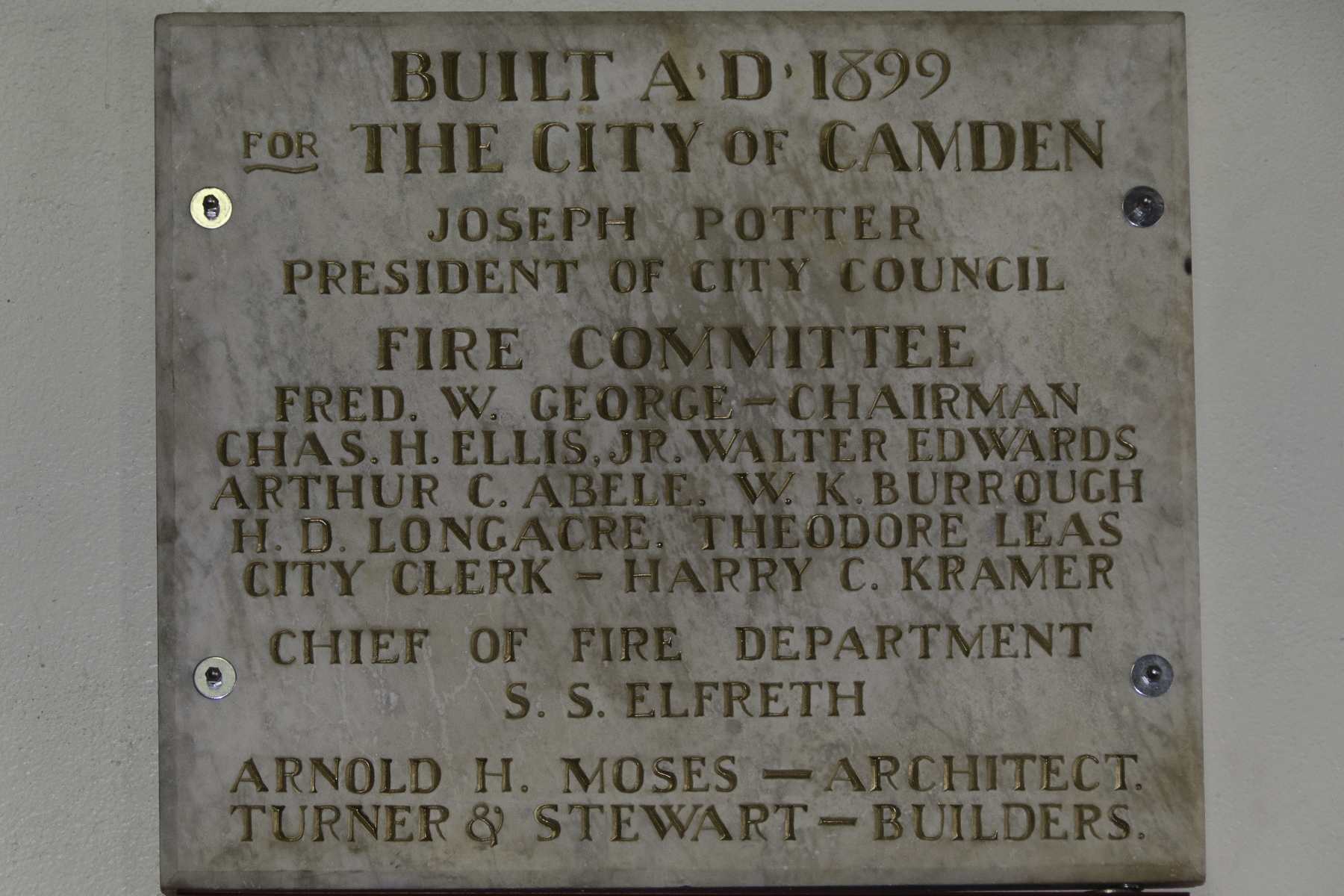
Built A.D. 1899 for the City of Camden
Joseph Potter
President of City Council
Fire Committee
Fred. W. George—Chairman
Chas. H. Ellis, Jr. Walter Edwards
Arthur C. Abele W. K. Burrough
H. D. Longacre Theodore Leas
City Clerk—Harry C. Kramer
Chief of Fire Department
Arnold H. Moses—Architect. Turner & Stewart—Builders.
Police Committee Sustained; Matlack and Miller Discharged
Camden Post-Telegram —
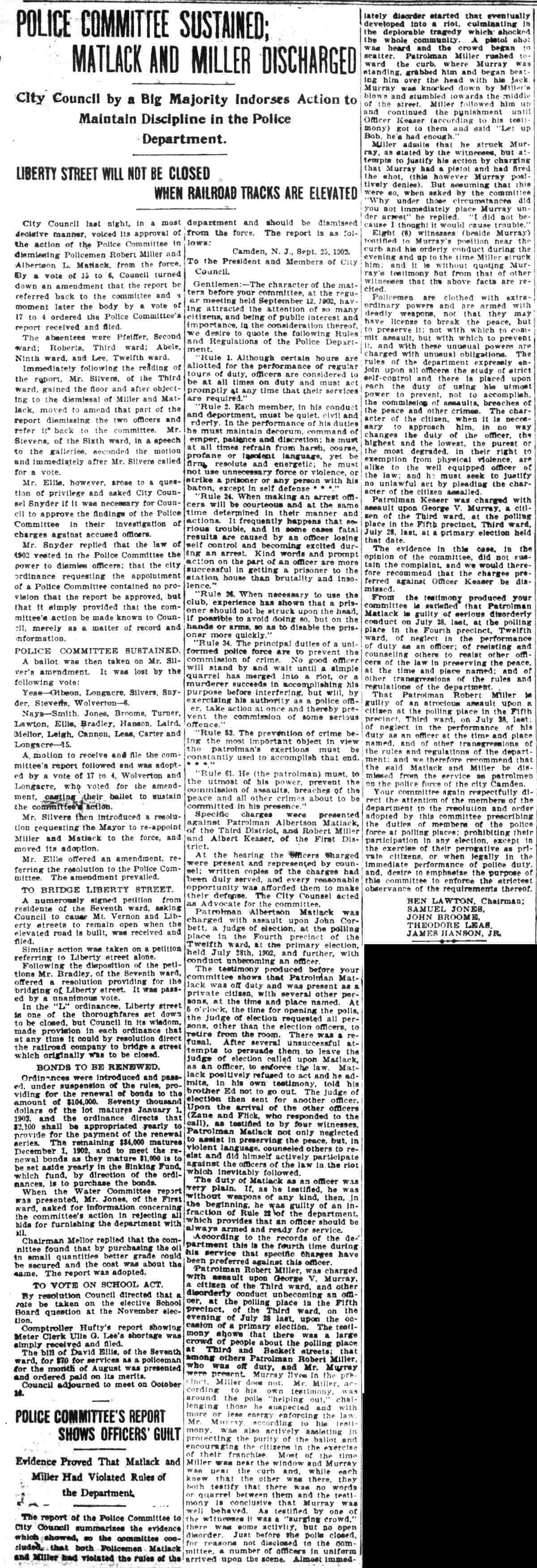
City Council by a Big Majority Indorses Action to Maintain Discipline in the Police Department.
LIBERTY STREET WILL NOT BE CLOSED WHEN RAILROAD TRACKS ARE ELEVATED
City Council last night, in a most decisive manner, voiced its approval of the action of the Police Committee in dismissing Policemen Robert Miller and Albertson L. Matlack, from the force. By a vote of 15 to 6, Council turned down an amendment that the report be referred back to the committee and a moment later the body by a vote of 17 to 4 ordered the Police Committee’s report received and filed.
The absentees were Pfeiffer, Second ward; Roberts, Third ward; Abele, Ninth ward, and Lee, Twelfth ward.
Immediately following the reading of the report, Mr. Silvers, of the Third ward, gained the floor and after objecting to the dismissal of Miller and Matlack, moved to amend that part of the report dismissing the two officers and refer it back to the committee. Mr. Stevens, of the Sixth ward, in a speech to the galleries, seconded the motion and immediately after Mr. Silvers called for a vote.
Mr. Ellis, however, arose to a question of privilege and asked City Counsel Snyder if it was necessary for Council to approve the findings of the Police Committee in their investigation of charges against accused officers.
Mr. Snyder replied that the law of 1902 vested in the Police Committee the power to dismiss officers; that the city ordinance requesting the appointment of a Police Committee contained no provision that the report be approved, but that it simply provided that the committee’s action be made known to Council, merely as a matter of record and information.
POLICE COMMITTEE SUSTAINED.
A ballot was then taken on Mr. Silver’s amendment. It was lost by the following vote:
Yeas—Gibson, Longacre, Silvers, Snyder, Stevens, Wolverton—6.
Nays—Smith, Jones, Broome, Turner, Lawton, Ellis, Bradley, Hanson, Laird, Mellor, Leigh, Cannon, Leas, Carter and Longacre—15.
A motion to receive and file the committee’s report followed and was adopted by a vote of 17 to 4, Wolverton and Longacre, who voted for the amendment, casting their ballot to sustain the committee’s action.
Mr. Silvers then introduced a resolution requesting the Mayor to re-appoint Miller and Matlack to the force, and moved its adoption.
Mr. Ellis offered an amendment, referring the resolution to the Police Committee. The amendment prevailed.
TO BRIDGE LIBERTY STREET.
A numerously signed petition from residents of the Seventh ward, asking Council to cause Mt. Vernon and Liberty streets to remain open when the elevated road is built, was received and filed.
Similar action was taken on a petition referring to Liberty street alone.
Following the disposition of the petitions Mr. Bradley, of the Seventh ward, offered a resolution providing for the bridging of Liberty street. It was passed by a unanimous vote.
In the “L” ordinances, Liberty street is one of the thoroughfares set down to be closed, but Council in its wisdom, made provision in each ordinance that at any time it could by resolution direct the railroad company to bridge a street which originally was to be closed.
BONDS TO BE RENEWED.
Ordinances were introduced and passed, under suspension of the rules, providing for the renewal of bonds to the amount of $104,000. Seventy thousand dollars of the lot matures January 1, 1903, and the ordinance directs that $2,100 shall be appropriated yearly to provide for the payment of the renewal series. The remaining $34,000 matures December 1, 1902, and to meet the renewal bonds as they mature $1,000 is to be set aside yearly in the Sinking Fund, which fund, by direction of the ordinances, is to purchase the bonds.
When the Water Committee report was presented, Mr. Jones, of the First ward, asked for information concerning the committee’s action in rejecting all bids for furnishing the department with oil.
Chairman Mellor replied that the committee found that by purchasing the oil in small quantities better grade could be secured and the cost was about the same. The report was adopted.
TO VOTE ON SCHOOL ACT.
By resolution Council directed that a vote be taken on the elective School Board question at the November election.
Comptroller Hufty’s report showing Meter Clerk Ulie G. Lee’s shortage was simply received and filed.
The bill of David Ellis, of the Seventh ward, for $70 for services as a policeman for the month of August was presented and ordered paid on its merits.
Council adjourned to meet on October 16.
POLICE COMMITTEE’S REPORT SHOWS OFFICERS’ GUILT
Evidence Proved That Matlack and Miller Had Violated Rules of the Department.
The report of the Police Committee to City Council summarizes the evidence which showed, so the committee concluded, that both Policemen Matlack and Miller had violated the rules of the department and should be dismissed from the force. The report is as follows:
Camden, N. J., Sept. 25, 1902.
To the President and Members of City Council.
Gentlemen:—The character of the matters before your committee, at the regular meeting held September 12, 1902, having attracted the attention of so many citizens, and being of public interest and importance, in the consideration thereof, we desire to quote the following Rules and Regulations of the Police Department.
“Rule 1. Although certain hours are allotted for the performance of regular tours of duty, officers are considered to be at all times on duty and must act promptly at any time that their services are required.”
“Rule 2. Each member, in his conduct and deportment, must be quiet, civil and orderly. In the performance of his duties he must maintain decorum, command of temper, patience and discretion; he must at all times refrain from harsh, coarse, profane or insolent language, yet be firm, resolute and energetic; he must not use unnecessary force or violence, or strike a prisoner or any person with his baton, except in self defense * * *.”
“Rule 24. When making an arrest officers will be courteous and at the same time determined in their manner and actions. It frequently happens that serious trouble, and in some cases fatal results are caused by an officer losing self control and becoming excited during an arrest. Kind words and prompt action on the part of an officer are more successful in getting a prisoner to the station house than brutality and insolence.”
“Rule 26. When necessary to use the club, experience has shown that a prisoner should not be struck upon the head, if possible to avoid doing so, but on the hands or arms, so as to disable the prisoner more quickly.”
“Rule 34. The principal duties of a uniformed police force are to prevent the commission of crime. No good officer will stand by and wait until a simple quarrel has merged into a riot, or a murderer succeeds in accomplishing his purpose before interfering, but will, by exercising his authority as a police officer, take action at once and thereby prevent the commission of some serious offence.”
“Rule 53. The prevention of crime being the most important object in view the patrolman’s exertions must be constantly used to accomplish that end. * * *”
“Rule 61. He (the patrolman) must, to the utmost of his power, prevent the commission of assaults, breaches of the peace and all other crimes about to be committed in his presence.”
Specific charges were presented against Patrolman Albertson Matlack, of the Third District, and Robert Miller and Albert Keaser, of the First District.
At the hearing the officers charged were present and represented by counsel; written copies of the charges had been duly served, and every reasonable opportunity was afforded them to make their defense. The City Counsel acted as Advocate for the committee.
Patrolman Albertson Matlack was charged with assault upon John Corbett, a judge of election, at the polling place in the Fourth precinct of the Twelfth ward, at the primary election held July 28th, 1902, and further, with conduct unbecoming an officer.
The testimony produced before your committee shows that Patrolman Matlack was off duty and was present as a private citizen, with several other persons, at the time and place named. At 5 o’clock, the time for opening the polls, the judge of election requested all persons, other than the election officers, to retire from the room. There was a refusal. After several unsuccessful attempts to persuade them to leave the judge of election called upon Matlack as an officer, to enforce the law. Matlack positively refused to act and he admits, in his own testimony, told his brother Ed not to go out. The judge of election then sent for another officer. Upon the arrival of the other officers (Zane and Flick, who responded to the call), as testified to by four witnesses, Patrolman Matlack not only neglected to assist in preserving the peace, but, in violent language, counseled others to resist and did himself actively participate against the officers of the law in the riot which inevitably followed.
The duty of Matlack as an officer was very plain. If, as he testified, he was without weapons of any kind, then, in the beginning, he was guilty of an infraction of Rule 22 of the department, which provides that an officer should be always armed and ready for service.
According to the records of the department this is the fourth time during his service that specific charges have been preferred against this officer.
Patrolman Robert Miller, was charged with assault upon George V. Murray, a citizen of the Third ward, and other disorderly conduct unbecoming an officer, at the polling place in the Fifth precinct, of the Third ward, on the evening of July 28 last, upon the occasion of a primary election. The testimony shows that there was a large crowd of people about the polling place at Third and Beckett streets; that among others Patrolman Robert Miller, who was off duty, and Mr. Murray were present. Murray lives in the precinct, Miller does not. Mr. Miller, according to his own testimony, was around the polls “helping out,” challenging those he suspected and with more or less energy enforcing the law. Mr. Murray according to his testimony, was also actively assisting in protecting the purity of the ballot and encouraging the citizens in the exercise of their franchise. Most of the time Miller was near the window and Murray was near the curb and, while each knew that the other was there, they both testify that there was no words or quarrel between them and the testimony is conclusive that Murray was well behaved. As testified by one of the witnesses it was a “surging crowd,” there was some activity, but no open disorder. Just before the polls closed, for reasons not disclosed to the committee, a number of officers in uniform arrived upon the scene. Almost immediately disorder started that eventually developed into a riot, culminating in the deplorable tragedy which shocked the whole community. A pistol shot was heard and the crowd began to scatter. Patrolman Miller rushed toward the curb, where Murray was standing, grabbed him and began beating him over the head with his jack. Murray was knocked down by Miller’s blows and stumbled towards the middle of the street. Miller followed him up and continued the punishment until Officer Keaser (according to his testimony) got to them and said “Let up Bob, he’s had enough.”
Miller admits that he struck Murray, as stated by the witnesses, but attempts to justify his action by charging that Murray had a pistol and had fired the shot, (this however Murray positively denies). But assuming that this were so, when asked by the committee “Why under those circumstances did you not immediately place Murray under arrest” he replied, “I did not because I thought it would cause trouble.”
Eight (8) witnesses (beside Murray) testified to Murray’s position near the curb and his orderly conduct during the evening and up to the time Miller struck him; and it is without quoting Murray’s testimony but from that of other witnesses that the above facts are recited.
Policemen are clothed with extraordinary powers and are armed with deadly weapons, not that they may have license to break the peace, but to preserve it; not with which to commit assault, but with which to prevent it, and with these unusual powers are charged with unusual obligations. The rules of the department expressly enjoin upon all officers the study of strict self-control and there is placed upon each the duty of using his utmost power to prevent, not to accomplish, the commission of assaults, breaches of the peace and other crimes. The character of the citizen, when it is necessary to approach him, in no way changes the duty of the officer, the highest and the lowest, the purest or the most degraded, in their right to exemption from physical violence, are alike to the well equipped officer of the law; and he must seek to justify no unlawful act by pleading the character of the citizen assailed.
Patrolman Keaser was charged with assault upon George V. Murray, a citizen of the Third ward, at the polling place in the Fifth precinct, Third ward, July 28, last, at a primary election held that date.
The evidence in this case, in the opinion of the committee, did not sustain the complaint, and we would therefore recommend that the charges preferred against Officer Keaser be dismissed.
From the testimony produced your committee is satisfied that Patrolman Matlack is guilty of serious disorderly conduct on July 28, last, at the polling place in the Fourth precinct, Twelfth ward, of neglect in the performance of duty as an officer; of resisting and counseling others to resist other officers of the law in preserving the peace, at the time and place named; and of other transgressions of the rules and regulations of the department.
That Patrolman Robert Miller be guilty of an atrocious assault upon a citizen at the polling place in the Fifth precinct, Third ward, on July 28, last; of neglect in the performance of his duty as an officer at the time and place named, and of other transgressions of the rules and regulations of the department; and we therefore recommend that the said Matlack and Miller be dismissed from the service as patrolmen on the police force of the city Camden.
Your committee again respectfully direct the attention of the members of the department to the resolution and order adopted by this committee prescribing the duties of members of the police force at polling places; prohibiting their participation in any election, except in the exercise of their perogative [sic] as private citizens, or when legally in the immediate performance of police duty, and desire to emphasize the purpose of this committee to enforce the strictest observance of the requirements thereof.
BEN LAWTON, Chairman; SAMUEL JONES, JOHN BROOME, THEODORE LEAS, JAMES HANSON, JR.
Royal Welcome for Ex-Sheriff Baird
Philadelphia Inquirer —
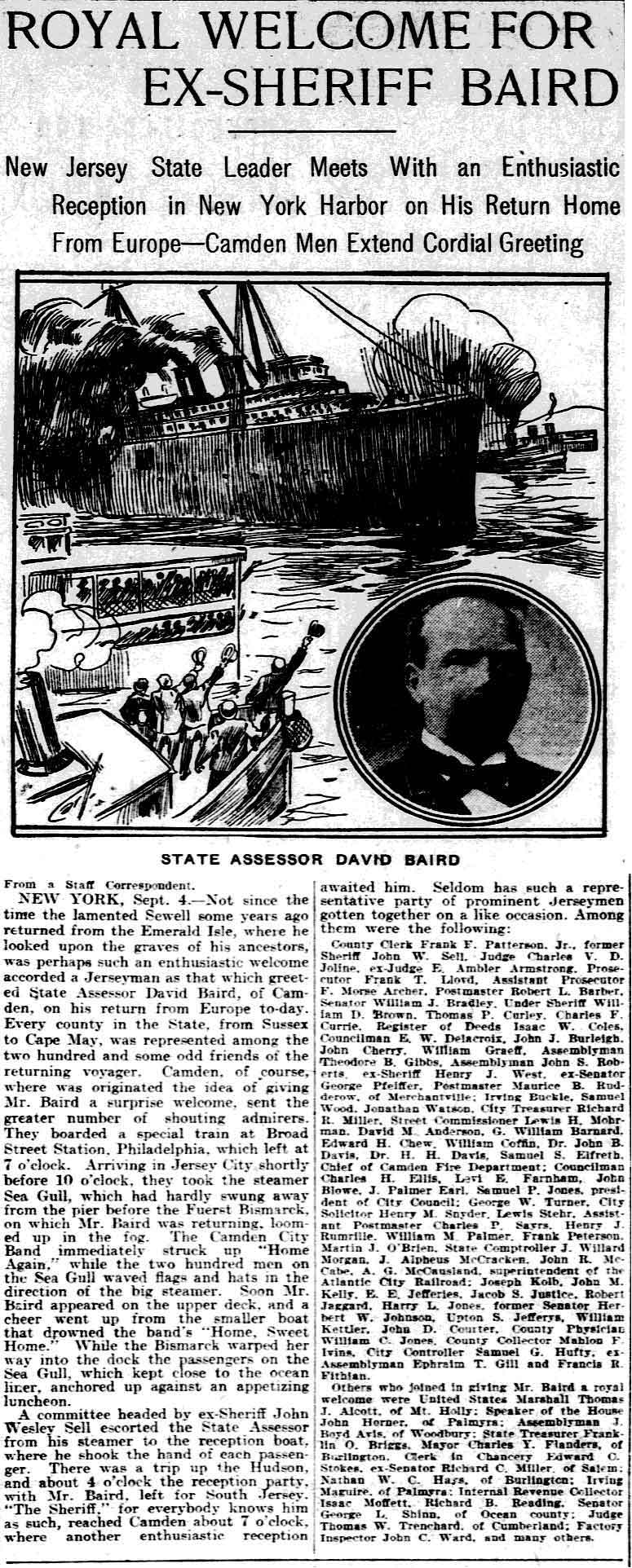
New Jersey State Leader Meets With an Enthusiastic Reception in New York Harbor on His Return Home From Europe—Camden Men Extend Cordial Greeting
STATE ASSESSOR DAVID BAIRD
From a Staff Correspondent.
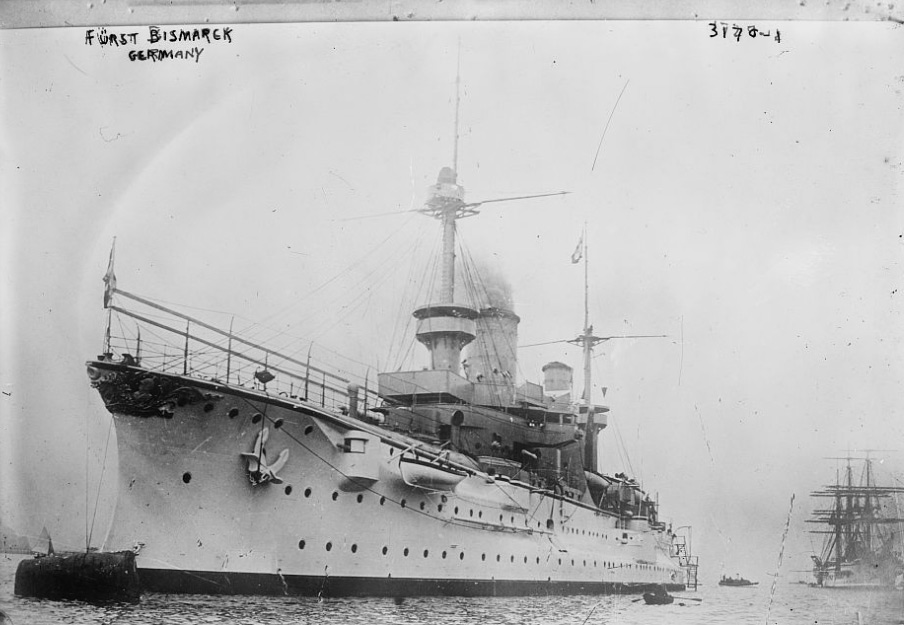
NEW YORK, Sept. 4.—Not since the time the lamented Sewell some years ago returned from the Emerald Isle, where he looked upon the graves of his ancestors, was perhaps such an enthusiastic welcome accorded a Jerseyman as that which greeted State Assessor David Baird, of Camden, on his return from Europe to-day. Every county in the State, from Sussex to Cape May, was represented among the two hundred and some odd friends of the returning voyager. Camden, of course, where was originated the idea of giving Mr. Baird a surprise welcome, sent the greater number of shouting admirers. They boarded a special train at Broad Street Station, Philadelphia, which left at 7 o’clock. Arriving in Jersey City shortly before 10 o’clock, they took the steamer Sea Gull, which had hardly swung away from the pier before the Fuerst Bismarck, on which Mr. Baird was returning, loomed up in the fog. The Camden City Band immediately struck up “Home Again,” while the two hundred men on the Sea Gull waved flags and hats in the direction of the big steamer. Soon Mr. Baird appeared on the upper deck, and a cheer went up from the smaller boat that drowned the band’s “Home, Sweet Home.” While the Bismarck warped her way into the dock the passengers on the Sea Gull, which kept close to the ocean liner, anchored up against an appetizing luncheon.
A committee headed by ex-Sheriff John Wesley Sell escorted the State Assessor from his steamer to the reception boat, where he shook the hand of each passenger. There was a trip up the Hudson, and about 4 o’clock the reception party, with Mr. Baird, left for South Jersey. “The Sheriff,” for everybody knows him as such, reached Camden about 7 o’clock, where another enthusiastic reception awaited him. Seldom has such a representative party of prominent Jerseymen gotten together on a like occasion. Among them were the following:
County Clerk Frank F. Patterson, Jr., former Sheriff John W. Sell, Judge Charles V. D. Joline, ex-Judge E. Ambler Armstrong, Prosecutor Frank T. Lloyd, Assistant Prosecutor F. Morse Archer, Postmaster Robert L. Barber, Senator William J. Bradley, Under Sheriff William D. Brown, Thomas P. Curley, Charles F. Currie, Register of Deeds Isaac W. Coles, Councilman E. W. Delacroix, John J. Burleigh, John Cherry, William Graeff, Assemblyman Theodore B. Gibbs, Assemblyman John S. Roberts, ex-Sheriff Henry J. West, ex-Senator George Pfeiffer, Postmaster Maurice B. Rudderow, of Merchantville; Irving Buckle, Samuel Wood, Jonathan Watson, City Treasurer Richard R. Miller, Street Commissioner Lewis H. Mohrman, David M. Anderson, G. William Barnard, Edward H. Chew, William Coffin, Dr. John B. Davis, Dr. H. H. Davis, Samuel S. Elfreth, Chief of Camden Fire Department; Councilman Charles H. Ellis, Levi E. Farnham, John Blowe, J. Palmer Earl, Samuel P. Jones, president of City Council; George W. Turner, City Solicitor Henry M. Snyder, Lewis Stehr, Assistant Postmaster Charles P. Sayrs, Henry J. Rumrille, William M. Palmer, Frank Peterson, Martin J. O’Brien, State Comptroller J. Willard Morgan, J. Alpheus McCracken, John R. McCabe, A. G. McCausland, superintendent of the Atlantic City Railroad; Joseph Kolb, John M. Kelly, E. E. Jefferies, Jacob S. Justice, Robert Jaggard, Harry L. Jones, former Senator Herbert W. Johnson, Upton S. Jefferys, William Kettler, John D. Courter, County Physician William C. Jones, County Collector Mahlon F. Ivins, City Controller Samuel G. Hufty, ex-Assemblyman Ephraim T. Gill and Francis R. Fithian.
Others who joined in giving Mr. Baird a royal welcome were United States Marshall Thomas J. Alcott, of Mt. Holly; Speaker of the House John Herner, of Palmyra; Assemblyman J. Boyd Avis, of Woodbury; State Treasurer Franklin O. Briggs, Mayor Charles Y. Flanders, of Burlington, Clerk in Chancery Edward C. Stokes, ex-Senator Richard C. Miller, of Salem; Nathan W. C. Hays, of Burlington; Irving Maguire, of Palmyra; Internal Revenue Collector Isaac Moffett, Richard B. Reading, Senator George L. Shinn, of Ocean county; Judge Thomas W. Trenchard, of Cumberland; Factory Inspector John C. Ward, and many others.
Fürst Bismarck
1903
Ellis Named for Mayor of Camden
Philadelphia Inquirer —
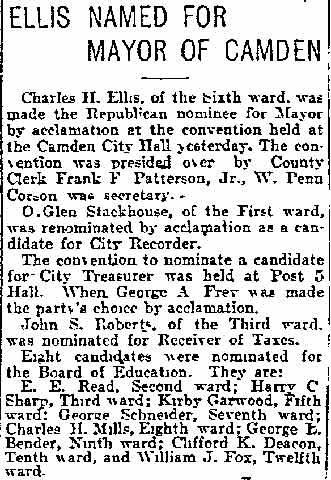
Charles H. Ellis, of the Sixth ward, was made the Republican nominee for Mayor by acclamation at the convention held at the Camden City Hall yesterday. The convention was presided over by County Clerk Frank F Patterson, Jr., W. Penn Corson was secretary.
O. Glen Stackhouse, of the First ward, was renominated by acclamation as a candidate for City Recorder.
The convention to nominate a candidate for City Treasurer was held at Post 5 Hall. When George A Frey was made the party’s choice by acclamation.
John S. Roberts, of the Third ward, was nominated for Receiver of Taxes.
Eight candidates were nominated for the Board of Education. They are:
E. E. Read, Second ward; Harry C Sharp, Third ward; Kirby Garwood, Fifth ward; George Schneider, Seventh ward; Charles H. Mills, Eighth ward; George E. Bender, Ninth ward; Clifford K. Deacon, Tenth ward, and William J. Fox, Twelfth ward.
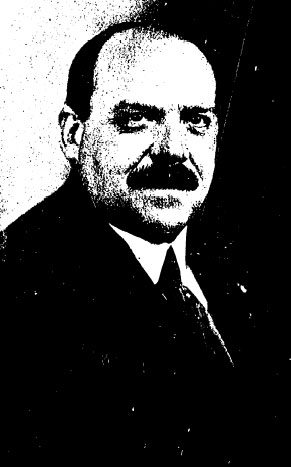
The Honorable Charles Ellis
Park Commission Organized
Philadelphia Inquirer —
The Camden Park Commission recently appointed by Mayor Ellis met last night and organized by electing Harry Humphreys chairman and Morris Odell secretary.
(news brief)
Philadelphia Inquirer —
• Since Mayor Charles H. Ellis, of Camden, was inducted into the office he has been deluged with letters from all sorts and conditions of men who aspire to be policemen. In fact, there have been enough applications to provide for a dozen forces the size of that of Camden. The most unique of the lot, however, was received yesterday from a North Camden man, who said he and his seven sons have always been stalwarts and on this score asks to be appointed an officer. If he does not get the coveted position he avers he and his seven sons will support the Democrats.
Camden Police Make Raids
Philadelphia Inquirer —
John R. Laws
John Deal
Joseph Palese
O. Glen Stackhouse
south 3rd street - South 4th Street
Pine StreetJoint AlleySpruce StreetCharles H. EllisArthur Stanley
Democratic Policemen Resign
Philadelphia Inquirer —
William Stanton and John Wagner, Democratic members of the Camden police, who had been summoned by Mayor Ellis to answer to the charge of drinking liquor while on duty, tendered their resignations to the Mayor yesterday.
Want Stanley Retained
Philadelphia Inquirer —
Want Stanley Retained
Movement to Oust Police Captain May Be Checked
The fact that there are influences at work looking to the removal of Arthur Stanley, captain of the Second Police district, Camden, has aroused the business men of the southern section of the city. Already a movement is being crystallized toward having Captain Stanley retained. It is pointed out that since his appointment by Mayor Hatch the Second district has been better morally than for many years past. An old soldier and a strict disciplinarian, he has incurred the enmity of some who are seeking his removal.
Mayor Ellis, who controls the situation, is said to be unfavorable to removing Captain Stanley. In the event of the latter getting out Sergeant Edward Hyde will fill the vacancy.
cooper b. hatch
Arthur StanleyCharles H. EllisEdward Hyde
Camden Cop’s First Night on the Force
Philadelphia Inquirer —
Given an Ovation and Squire Headed a Crowd That Thought Murder Had Been Committed
Philip Knauf, appointed a policeman by Mayor Ellis, in Camden, yesterday, will not likely forget his appearance as an officer. Incidentally South Camden will also remember the incident. When Knauf went to make his first “pull” at 7 o’clock last night he was escorted to the box by a score of brother officers. Before he reached the box at Broadway and Spruce streets he was presented with a big bouquet by Adam T. Davis. He had only proceeded a square when George Horneff saluted him with a revolver shot and fireworks.
Just about this time ‘Squire Charles Baldwin appeared with a crowd, who thought someone had been murdered. The doughty ‘squire was armed, and the new officer was lost in the rapidly increasing crowd before matters were explained.
Will Be Mayor’s Private Secretary
Philadelphia Inquirer —
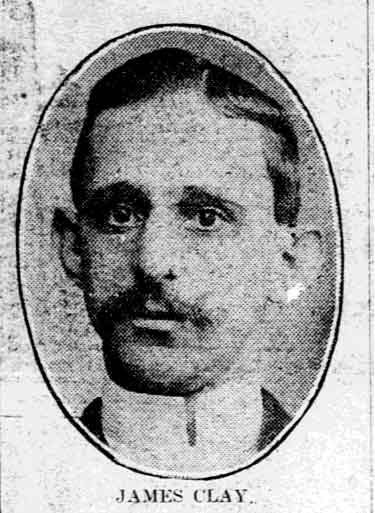
James Clay.
Mayor Ellis, of Camden, to-day will announce the appointment of five additional members of the police force.
James Clay, of the Fourth ward, will act as the Mayor’s private secretary and house sergeant. Henry Moffett, of the Fifth ward, will be made a detective, and the others to be appointed patrolmen are: Virginia [sic] Troncone, First ward; Lewis Stehr, Jr., Fifth ward, and John Brothers, Sixth ward.
New Officers Sworn In
Philadelphia Inquirer —
Henry C. Moffett, of the Fifth ward, Camden, was appointed a city detective by Mayor Charles H. Ellis yesterday. Moffett was immediately detailed for duty by Chief Foster. John Brothers, James Clay, Lewis Stehr and Virginia Troncone were sworn in as patrolmen. Brothers was deputy keeper at the State Prison, Trenton, for a number of years.
Testimonial Dinner to Dr. Fishburn
Philadelphia Inquirer —
Rev. Dr. William H. Fishburn, pastor of the First Presbyterian Church, Camden, was given a testimonial dinner by the Ushers’ Union last night. Assemblyman Harry Scovel acted as toastmaster and addresses were made as follows: “Our Guest,” Prosecutor Frank T. Lloyd; “The Bench,” Supreme Court Justice Garrison; “Our City,” Mayor Charles H. Ellis; “The Relation of Other Denominations to Dr. Fishburn,” Judge Joseph H. Gaskill; “The Ushers,” Ralph Kellum; “Our Absent Guardian,” Hon. Joseph M. Engard. [cut off at the crop edge]
Victims of Raids Locate in Camden
Philadelphia Inquirer —
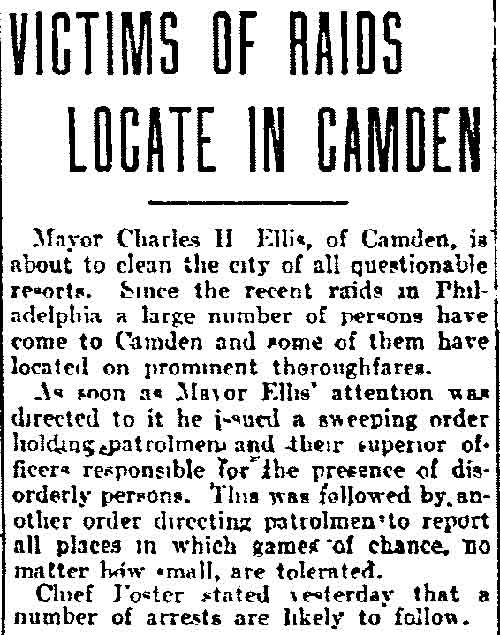
Mayor Charles H. Ellis, of Camden, is about to clean the city of all questionable resorts. Since the recent raids in Philadelphia a large number of persons have come to Camden and some of them have located on prominent thoroughfares.
As soon as Mayor Ellis’ attention was directed to it he issued a sweeping order holding patrolmen and their superior officers responsible for the presence of disorderly persons. This was followed by another order directing patrolmen to report all places in which games of chance, no matter how small, are tolerated.
Chief Foster stated yesterday that a number of arrests are likely to follow.
(news brief)
Philadelphia Inquirer —
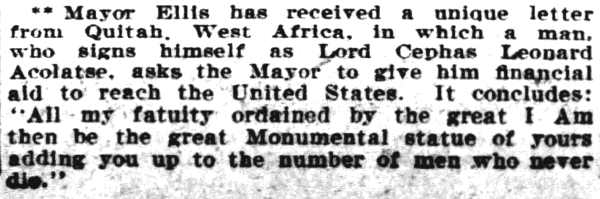
•• Mayor Ellis has received a unique letter from Quitah, West Africa, in which a man, who signs himself as Lord Cephas Leonard Acolatse, asks the Mayor to give him financial aid to reach the United States. It concludes: “All my fatuity ordained by the great I Am then be the great Monumental statue of yours adding you up to the number of men who never die.”
(news briefs)
Philadelphia Inquirer —
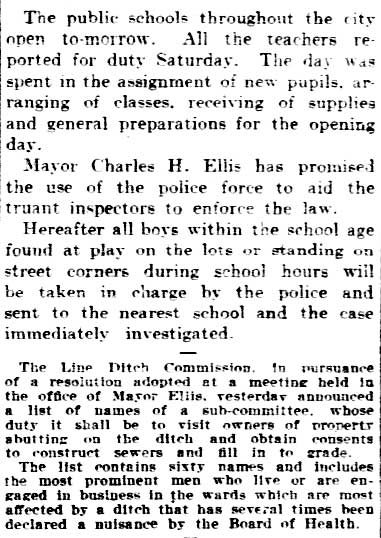
The public schools throughout the city open to-morrow. All the teachers reported for duty Saturday. The day was spent in the assignment of new pupils, arranging of classes, receiving of supplies and general preparations for the opening day.
Mayor Charles H. Ellis has promised the use of the police force to aid the truant inspectors to enforce the law. Hereafter all boys within the school age found at play on the lots or standing on street corners during school hours will be taken in charge by the police and sent to the nearest school and the case immediately investigated.
The Line Ditch Commission, in pursuance of a resolution adopted at a meeting held in the office of Mayor Ellis, yesterday announced a list of names of a sub-committee, whose duty it shall be to visit owners of property abutting on the ditch and obtain consents to construct sewers and fill in to grade. The list contains sixty names and includes the most prominent men who live or are engaged in business in the wards which are most affected by a ditch that has several times been declared a nuisance by the Board of Health.
Some Changes When Ellis Takes Office
Philadelphia Inquirer —
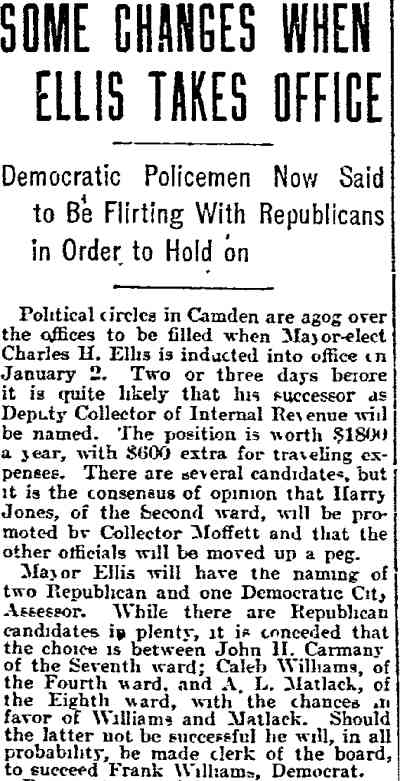
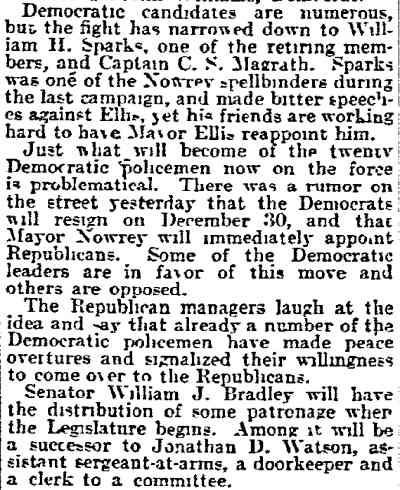
Democratic Policemen Now Said to Be Flirting With Republicans in Order to Hold on
Political circles in Camden are agog over the offices to be filled when Mayor-elect Charles H. Ellis is inducted into office on January 2. Two or three days before it is quite likely that his successor as Deputy Collector of Internal Revenue will be named. The position is worth $1800 a year, with $600 extra for traveling expenses. There are several candidates, but it is the consensus of opinion that Harry Jones, of the Second ward, will be promoted by Collector Moffett and that the other officials will be moved up a peg.
Mayor Ellis will have the naming of two Republican and one Democratic City Assessor. While there are Republican candidates in plenty, it is conceded that the choice is between John H. Carmany, of the Seventh ward; Caleb Williams, of the Fourth ward, and A. L. Matlack, of the Eighth ward, with the chances in favor of Williams and Matlack. Should the latter not be successful he will, in all probability, be made clerk of the board, to succeed Frank Williams, Democrat.
Democratic candidates are numerous, but the fight has narrowed down to William H. Sparks, one of the retiring members, and Captain C. S. Magrath. Sparks was one of the Nowrey spellbinders during the last campaign, and made bitter speeches against Ellis, yet his friends are working hard to have Mayor Ellis reappoint him.
Just what will become of the twenty Democratic policemen now on the force is problematical. There was a rumor on the street yesterday that the Democrats will resign on December 30, and that Mayor Nowrey will immediately appoint Republicans. Some of the Democratic leaders are in favor of this move and others are opposed.
The Republican managers laugh at the idea and say that already a number of the Democratic policemen have made peace overtures and signalized their willingness to come over to the Republicans.
Senator William J. Bradley will have the distribution of some patronage when the Legislature begins. Among it will be a successor to Jonathan D. Watson, assistant sergeant-at-arms, a doorkeeper and a clerk to a committee.
News of a Day in the City of Camden
Philadelphia Inquirer —
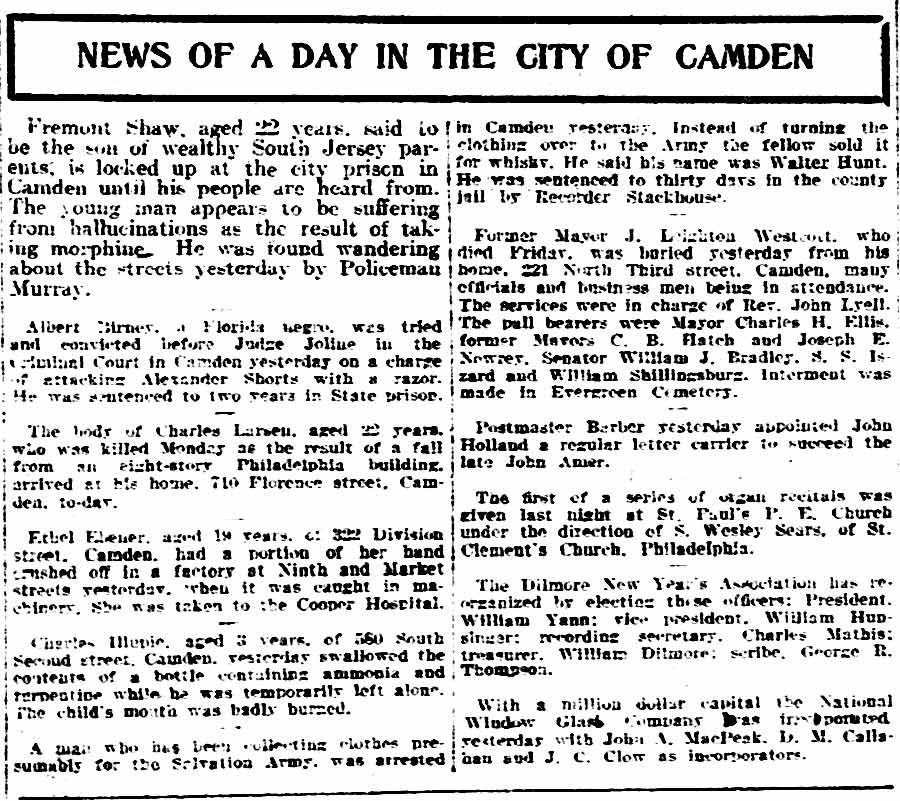
Fremont Shaw, aged 22 years, said to be the son of wealthy South Jersey parents, is locked up at the city prison in Camden until his people are heard from. The young man appears to be suffering from hallucinations as the result of taking morphine. He was found wandering about the streets yesterday by Policeman Murray.
Albert Birney, a Florida negro, was tried and convicted before Judge Joline in the criminal court in Camden yesterday on a charge of attacking Alexander Shorts with a razor. He was sentenced to two years in State prison.
The body of Charles Larsen, aged 22 years, who was killed Monday as the result of a fall from an eight-story Philadelphia building, arrived at his home, 710 Florence street, Camden, to-day.
Ethel Elzener, aged 1[?] years, of 322 Division street, Camden, had a portion of her hand crushed off in a factory at Ninth and Market streets yesterday, when it was caught in machinery. She was taken to the Cooper Hospital.
Charles Illupie, aged 3 years, of 560 South Second street, Camden, yesterday swallowed the contents of a bottle containing ammonia and turpentine while he was temporarily left alone. The child’s mouth was badly burned.
A man who has been collecting clothes presumably for the Salvation Army, was arrested in Camden yesterday. Instead of turning the clothing over to the Army the fellow sold it for whisky. He said his name was Walter Hunt. He was sentenced to thirty days in the county jail by Recorder Stackhouse.
Former Mayor J. Leighton Westcott, who died Friday, was buried yesterday from his home, 221 North Third street, Camden, many officials and business men being in attendance. The services were in charge of Rev. John Lyell. The pall bearers were Mayor Charles H. Ellis, former Mayors C. B. Hatch and Joseph E. Newrey, Senator William J. Bradley, S. S. Iszard and William Shillingsburg. Interment was made in Evergreen Cemetery.
Postmaster Berber yesterday appointed John Holland a regular letter carrier to succeed the late John Amer.
The first of a series of organ recitals was given last night at St. Paul’s P. E. Church under the direction of S. Wesley Sears, of St. Clement’s Church, Philadelphia.
The Dilmore New Year’s Association has reorganized by electing these officers: President, William Yann; vice president, William Hunsinger; recording secretary, Charles Mathis; treasurer, William Dilmore; scribe, George R. Thompson.
With a million dollar capital the National Window Glass Company was incorporated yesterday with John A. MacPeak, D. M. Callahan and J. C. Clow as incorporators.
Great Throngs at the Funeral of Chief Foster
Philadelphia Inquirer —

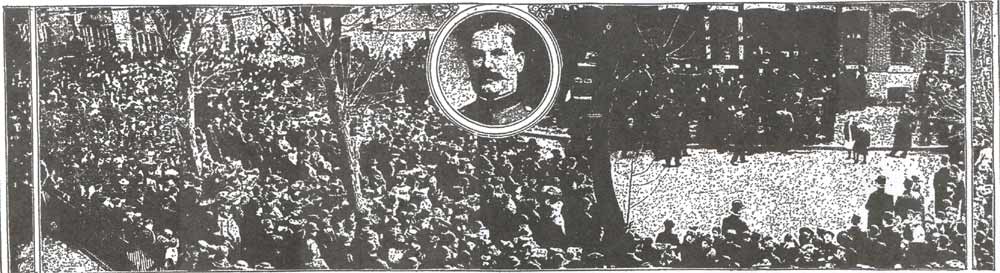
Camden Witnessed Greatest Demonstration of Its Kind Since Gen. Sewell’s Burial
THOUSANDS PAID TRIBUTE TO DEAD
CROWD ABOUT THE FOSTER HOME AND PICTURE OF THE DEAD CHIEF
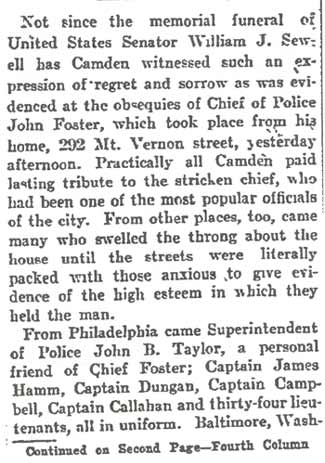
Not since the memorial funeral of United States Senator William J. Sewell has Camden witnessed such an expression of regret and sorrow as was evidenced at the obsequies of Chief of Police John Foster, which took place from his home, 292 Mt. Vernon street, yesterday afternoon. Practically all Camden paid lasting tribute to the stricken chief, who had been one of the most popular officials of the city. From other places, too, came many who swelled the throng about the house until the streets were literally packed with those anxious to give evidence of the high esteem in which they held the man.
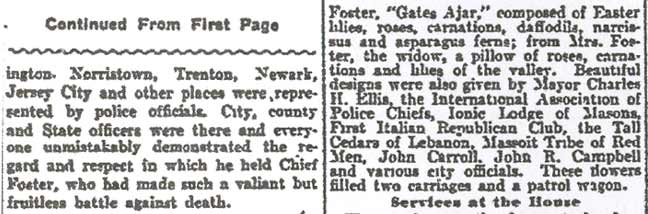
From Philadelphia came Superintendent of Police John B. Taylor, a personal friend of Chief Foster; Captain James Hamm, Captain Dungan, Captain Campbell, Captain Callahan and thirty-four lieutenants, all in uniform. Baltimore, Washington, Norristown, Trenton, Newark, Jersey City and other places were represented by police officials. City, county and State officers were there and everyone unmistakably demonstrated the regard and respect in which he held Chief Foster, who had made such a valiant but fruitless battle against death.
Thousands Viewed Remains
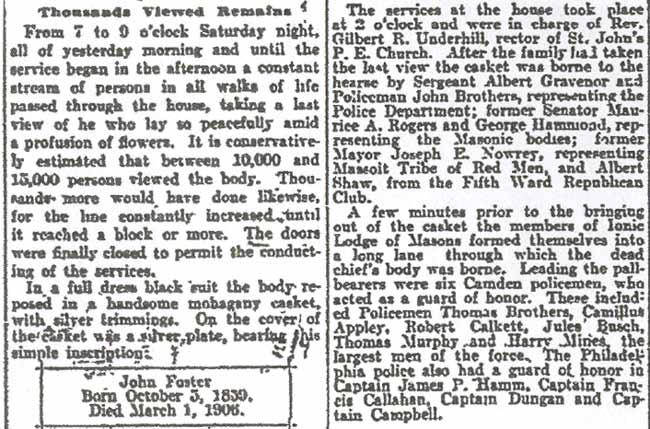
From 7 to 9 o’clock Saturday night, all of yesterday morning and until the service began in the afternoon a constant stream of persons in all walks of life passed through the house, taking a last view of he who lay so peacefully amid a profusion of flowers. It is conservatively estimated that between 10,000 and 15,000 persons viewed the body. Thousands more would have done likewise, for the line constantly increased, until it reached a block or more. The doors were finally closed to permit the conducting of the services.
In a full dress black suit the body reposed in a handsome mahogany casket, with silver trimmings. On the cover of the casket was a silver plate, bearing this simple inscription:
John Foster
Born October 5, 1839.
Died March 1, 1906.
The features were life-like and gave little evidence of the weeks of intense suffering through which Chief Foster passed before the end came. At the head of the casket stood Policeman Albert Shaw, while at the foot was Policeman Camillus Appley. At the doors on guard were Policemen George Kappel, George Kleaver, Albert Snow and Casper Hart. Captain Arthur Stanley had charge of the detail of officers.
Wealth of Flowers
Surrounding the casket and extending around the walls of the room were beautiful floral emblems, roses, carnations, lillies, and in fact every variety. Some of the designs and those who contributed them follow: The patrolmen, “Gates Ajar,” six feet tall and composed of American Beauty roses, lilies of the valley, and surmounted by four white doves; Fifth Ward Republican Club, an immense urn of galax leaves and assorted flowers; Fireside New Years’ Association, a banner piece of roses, carnations, lilies of the valley and narcissus blooms; the Camden reporters of the local and Philadelphia newspapers, a four-foot scroll of galax leaves, in the centre of which was a shield of violets with a band of white carnations, on which was inscribed, “Our Friend;” from the daughters of Chief Foster, “Gates Ajar,” composed of Easter lilies, roses, carnations, daffodils, narcissus and asparagus ferns; from Mrs. Foster, the widow, a pillow of roses, carnations and lilies of the valley. Beautiful designs were also given by Mayor Charles H. Ellis, the International Association of Police Chiefs, Ionic Lodge of Masons, First Italian Republican Club, the Tall Cedars of Lebanon, Massoit Tribe of Red Men, John Carroll, John R. Campbell and various city officials. These flowers filled two carriages and a patrol wagon.
Services at the House
The services at the house took place at 2 o’clock and were in charge of Rev. Gilbert R. Underhill, rector of St. John’s P. E. Church. After the family had taken the last view the casket was borne to the hearse by Sergeant Albert Gravenor and Policeman John Brothers, representing the Police Department; former Senator Maurice A. Rogers and George Hammond, representing the Masonic bodies; former Mayor Joseph E. Nowrey, representing Massoit Tribe of Red Men, and Albert Shaw, from the Fifth Ward Republican Club.
A few minutes prior to the bringing out of the casket the members of Ionic Lodge of Masons formed themselves into a long lane through which the dead chief’s body was borne. Leading the pallbearers were six Camden policemen, who acted as a guard of honor. These included Policemen Thomas Brothers, Camillus Appley, Robert Calkett, Jules Busch, Thomas Murphy and Harry Mines, the largest men of the force. The Philadelphia police also had a guard of honor in Captain James P. Hamm, Captain Francis Callahan, Captain Dungan and Captain Campbell.
Funeral Cortege
The funeral cortege was composed of the following: Sergeant William Horner and a detail of thirty-four men from the three districts; members of the Fifth Ward Republican Club, cabs containing Mayor Ellis, Councilmen and city officials, Ionic Lodge of Masons and the hearse followed by the cabs containing the mourners. The route gone over was from the house to Third street, to Walnut street, to Broadway, to Benson street, to Haddon avenue and to Harleigh Cemetery. All along the route hundreds of persons lined the curbs, while many followed the cortege to the grave. As the procession passed the City Hall the bell in the tower was tolled at minute intervals.
At Harleigh Cemetery the casket was lowered in a cavity on a sunny slope to the southward. There the Masons held their services over their departed brother, Worshipful Master Aaron G. Matlack having charge of the beautiful ceremony.
It was a funeral that Camden will remember for many a day. And Chief Foster’s memory will be kept green for the next month by many political, and social organizations as well as private citizens, who will display black draped flags at half mast.
Three Firemen Met Death in Camden Blaze
Philadelphia Inquirer —
Trapped in Fire at the Old Sixth Regiment Armory They Perished in Flames
NINE OTHER PERSONS RECEIVED INJURIES
Three firemen were killed and nine persons injured at a fire last night which destroyed the old armory building at Bridge avenue, West and Mickle streets, Camden, causing a loss estimated at $50,000.
The dead firemen are: GEORGE SHIELDS, 525 Kaighn avenue, member of the Kaighn avenue chemical company. WILLIAM HILLMAN, 229 Beckett street, of the Kaighn avenue chemical company. WILLIAM JOBES, 57[?] Line street, member of Engine Company No. 2.
The Injured
The injured, all of whom will recover, are: Josiah Sage, 917 South Eighth street, Kaighn avenue company, cut head and face; Seth Monnell, 744 Mt. Vernon street, Kaighn avenue company, scalp wounds; George Quinn, 516 Line street, Kaighn avenue company, cut face; Martin Carrigan, 516 Clinton street, Engine Company No. 1, lacerated face and hands; J. W. Simpson, 551 Cedar street, Engine Company No. 2, lacerations of scalp and face; James Elberson, 628 North Fourth street, Engine Company No. 4, contused wounds of the legs; William Elberson, 231 Taylor avenue, Engine Company No. 2, injured about the back; Charles Worthington, 1017 Penn street, Engine Company No. 3, internally injured; Harry Dease, a citizen, cut about the face.
The six o’clock whistles were blowing when smoke was seen issuing from the northeast corner of the building. A moment later two boys ran out of a door, one of whom notified Policeman Isaac Toy that the structure was on fire. The officers immediately turned in an alarm. In rapid succession other alarms were given, until the entire department was on the scene.
One of the first companies to arrive was the Kaighn avenue truck. As the men drove up to the scene great tongues of flame were fast eating their way through the yellow pine timbers of which the interior was constructed. The main doors at the entrance on Mickle street were burst open and the firemen entered amid a perfect shower of sparks and falling debris. In this party were the three ill-fated firemen, Dease, and Firemen Harry Haines, Joseph Ernest, George Quinn, Seth Mounell and Joseph Gail.
After great difficulty the men worked their way into the blazing building about twenty feet. Dense volumes of smoke almost suffocated them and several dropped to the floor.
Dash for the Doors
While the firemen were waiting for the water a false ceiling thirty feet above them and composed of floor boards began cracking and bending. A shout of warning was given by Dease, and he and his companions made a dash for the doors. It was impossible to see a foot before them, and all blindly groped their way to the open doors but Jobes, Shields and Hillman. That they did not come out of the building was not known for several minutes later. Then reports were circulated that they had been taken to nearby houses, but these were found to be false. Their companions then tried to work their way back to their assistance, but by this time the interior was a seething furnace.
Subsequently, when the blaze had been somewhat subdued, firemen and policemen instituted a search for the missing men. Where the latter had been there was a great pile of blackened timbers and twisted iron. After vigorous efforts this was removed.
Finding the Bodies
First there came to light Shield’s helmet, and a few feet distant his body and those of Hillman and Jobes, scorched and blackened almost beyond recognition, were found. It was then learned how they had met their deaths. Instead of going toward the open doorway they had evidently become bewildered and, turning, ran into a toilet room to which there was no outlet. There they were quickly cut off from their comrades and, becoming unconscious from the smoke, all three dropped to the floor, where death overtook them.
The bodies were carried out and taken to the Morgue.
In the meantime every portion of the structure became a mass of flames. Fed by the pine, great tongues of fire sprang into the air, across Mickle and West streets, where the dwellings were badly scorched. The families residing in these in several instances became panic-stricken and began removing their household effects. Men, women and children ran excitedly about. It is owing to the excellent work of the firemen that these structures were not destroyed.
Spectacular Blaze
Chief Elfieth quickly concluded there was no hope of saving the armory and he directed a dozen lines of hose toward the dwellings, many of which became so hot that the streams of water fairly sizzled.
The fire was a spectacular one, lighting up the heavens for miles around. Thousands of persons crowded the thoroughfares leading to the blaze, but excellent order was preserved under the direction of Acting Chief of Police Schregler, who quickly had the streets roped off and guarded by the officers.
There was considerable danger at first from falling electric wires, which spluttered among the firemen and ofttimes amidst the onlookers. These wires also fell across the Pennsylvania Railroad Company’s tracks on Bridge avenue and suburban trains were stalled for over an hour. At one time the flames approached so near the passenger coaches that they had to be taken back into the yard.
Stubborn Blaze
For three hours the firemen fought the flames before they got them under control and it was not until an early hour this morning that they left the smouldering ruins.
The building was occupied by several concerns, including the Camden Bowling Alleys Company; whose loss amounted to $6000; F. G. Hitchener, wall paper; loss $1000; Sperry & Hutchinson, household articles, loss $2000; William Morgenweck, lumber, loss $500, and M. W. Taylor, theatrical scenery, loss $500.
The houses badly scorched and their occupants follow; 102 West street, John Sharwood; 104, vacant; 106, John Ackerman; Lewis Certain; 110, Richard Carpenter; 112, and 114. Daniel Mehlin; 120, Mrs. Ida Paul; 122, Mrs. Farley; 124, John Campbell; 126, Harry Chase. 416 Mickle street, John Widden; 418, Nelson Hart; 420, H.-W. Wilson; 422, Jules Bosch; 424, Gardner Corson; 426, Mrs. Borquin.
The stable immediately adjoining on the west side of the armory, and belonging to C. M. Alcott, was flooded with water. At this place there were forty horses, all of which were rescued.
Formerly a Market
The destroyed building was erected in 1873, by a number of well-known Camden men, as the Farmers’ and Merchants’ Market. From the first it was not a success, and subsequently became known as the Camden Opera House. After a more or less successful season the promoters of this scheme closed the doors. In 1886 the building was purchased by the State as an armory for the old Sixth Regiment, N. G. N. J. For ten years Camden’s citizen soldiers drilled and gave balls and receptions in the building. When the regiment moved to the new armory on Haddon avenue the old structure was cut up into several rooms and had been used by many different concerns. Recently it was purchased by the Pennsylvania Railroad Company to make way for the elevated railroad. All the tenants had been ordered to vacate.
The origin of the fire is unknown. Incendiarism is hinted at and Mayor Ellis declared he will detail the detectives on the case to-day to make a rigid investigation.
Speaking of the matter, he said it is very peculiar that most of Camden’s fires occur about the time the firemen are at their meals. This has been the case in most every blaze if [sic] any importance in the city. The Mayor also highly commended the excellent work of the men in preventing a spread of the flames.
Camden’s New Police Chief
Philadelphia Inquirer —
Mayor Promotes Sergeant Gravenor to Vacant Post.
Camden, March 21.—In appointing Elisha A. Gravenor chief of police of Camden yesterday, Mayor Ellis, addressing him, said: “I will not say that the department is not up-to-date, but I want you to exert your every energy to improve the service and make it thoroughly up-to-date to the satisfaction of the people and myself.”
The new chief is from the Tenth ward and was house sergeant. He succeeds the late Chief of Police John Foster. Patrolman Jacob Woodside, of the Second district, was appointed sergeant. He is from the Sixth ward, Mayor Ellis’s bailiwick.
In Memory of Dead Heroes
Philadelphia Inquirer —
Mayor of Camden Calls for Services in Two Churches
Mayor Ellis, in Camden, yesterday issued a proclamation calling on the citizens to assemble at the First Baptist and the Broadway M. E. Churches on Sunday to participate in the services to be held in memory of Firemen George Shield [sic], William Jones and William Hillman, who were killed at the Armory fire last Friday night. The first service will be held at the Baptist Church, at three o’clock, while the one at the Methodist Church will be held at quarter after four o’clock. The subscription fund being raised for the families of the firemen had reached nearly $2000 last night.
The funeral of Fireman Shields took place yesterday from his home, 525 Kaikhn [sic] avenue. Hundreds of persons viewed the body, both Tuesday night and yesterday morning. hTe [sic] services were in charge of Rev. John S. Heisler, of the M. E. Church. The body reposed in a handsome oak casket and was surrounded by numerous floral tributes. The services were attended by forty firemen under Chief Elfreth, while the pall-bearers included Firemen Samuel Price, William Deno, Charles Robinson, Peter Carter, Joseph Ernest and George Quinn. Interment was made at the Evergreen Cemetery.
News of a Day in the City of Camden
Philadelphia Inquirer —
Camden is to have another daily newspaper. The stockholders met yesterday and elected these officers: President, George M. Beringer; vice president, William E. Anthony; secretary, Newton B. T. Roney; treasurer, John Danenhower. It will be called the Daily News, and while it is to be a business proposition, it will be established mainly for the advocacy of the Colby-Record movement in New Jersey. It will be opposed to present local political conditions.
Albert Reese, 27 years old, of 834 Jersey avenue, Gloucester City, fell eighty feet from a scaffold at the New York Ship Yard last night. He was taken to the Cooper Hospital apparently fatally injured. An examination revealed the fact that he had escaped with slight bruises.
James McDonald, who was struck by a train at Fish House Monday, died at the Cooper Hospital, Camden, yesterday, without regaining consciousness. His address is unknown and the body was removed to the Morgue awaiting a claimant.
According to the report of Health Physician Leavitt, of the Camden Board of Health, the health of the city is exceedingly good. In all there were but thirty-nine contagious diseases reported for the past month. There was but one case of typhoid fever. This disease has almost entirely disappeared from Camden, there having been less than a score of cases the past year.
A number of Camden’s officials enjoyed a planked shad dinner at Chew’s Landing last night. In the party were City Comptroller Samuel Hufty, City Engineer Levi Farnham, Assistant Tax Receivers Charles Elfreth, J. F. Newton and Frank Heisler, Assistant Engineer William Osler, License Clerk John McCabe, Building Inspector William Steinmetz, Plumbing Inspector Harry Francis and Mayor Charles H. Ellis.
Robert Floyd, a colored stevedore, of Mt. Ephraim avenue, Camden, is building a thirty-five-foot boat in his back yard with the object of using it to seek a treasure island in the West Indies. Although his home is nearly two miles from the river, Floyd declares he will have no difficulty in launching the rather unwieldy craft. A sailor on board a vessel which Floyd was unloading told him the tale of hidden gold and as a result the Camden man decided to seek out the spot on his own hook.
There was an exciting incident in Recorder Stackhouse’s court, in Camden, yesterday, when a young woman yelled a denial in a high voice as a witness was testifying in the case of Herbert M. Denny against Chauncey Bell and Frederick Bock, the latter two being charged with assault and battery. Silence was restored by the court officers and the case was concluded by the defendants being held in $200 bail each.
Mr. and Mrs. Frank Nace in the Circuit Court, in Camden, yesterday were given a verdict for $25 against the West Jersey and Seashore Railroad Company. The plaintiffs sued for $2500, they claiming a conductor of the company roughly handled the woman on March 16 of last year when she was put off a train. In the case of Charles Smith against the Public Service Corporation a verdict was given for the plaintiff in the sum of $600.
William H. Cox, 18 years old, of 903 Haddon avenue, had his right foot crushed at the Camden Iron Works yesterday. He was taken to the Cooper Hospital.
William Walsh, 17 years old, of 524 Borton street, who had been missing several days, returned yesterday. He had gone to Atlantic City to see the sights.
The Germantown Wood Working Company was incorporated yesterday with a capital of $10,000.
Ida Jackson, a negress, was convicted of dealing in lottery policy before Judge Joline yesterday. William Derry, also a negro, was convicted on a similar charge.
John Cowan, 53 years old, of 1024 Sycamore street, died suddenly yesterday from hemorrhages of the stomach. He was a life-long resident of Camden.
At great personal risk, Dr. Ernest Ramsdell, of 425 Linden street, Camden, last night saved Arthur Grant, 11 years old, of 501 State street, from being crushed beneath a team of horses. Arthur, who was riding a bicycle, attempted to get out of the way of a dog. In doing so he wheeled directly into the horses. The latter reared and were about to fall on the boy when Dr. Ramsdell rushed over to him and dragged him from beneath the horses.
(news brief)
Philadelphia Inquirer —
A petition signed by residents of Haddon avenue and Line street was presented to Mayor Ellis yesterday, asking him to use the police to stop the night work in the boiler shop of the Camden Iron Works. The petitioners claim it is impossible to sleep because of the noise.
(news brief — Sweet Potato Hill sewer)
Philadelphia Inquirer —
After a conference with several city officials Mayor Ellis, in Camden, yesterday refused to sign the contract for the construction of the sewer that will drain Sweet Potato Hill. The Street Committee of City Council awarded the contract to Aaron Ward “for the best interests of the city,” although B. F. Sweeten & Son were the lowest bidders. The latter protested and as a result Mayor Ellis refused to append his signature to the contract. The sewer has been sought after by residents in the extreme southern section of the city for years and it will cost in the neighborhood of $15,000. Work will now probably be delayed until next spring.
(news brief)
Philadelphia Inquirer —
Two more special policemen, making fourteen in all, were sworn in by Mayor Ellis yesterday, to protect the property of a telephone company whose linemen are on a strike. Sub-Policeman George Hill was made a regular yesterday, to succeed Harry Christy, who resigned. Tomorrow Mayor Ellis will swear in Fred Leichleder, of the Twelfth ward, to succeed Hill.
(news brief)
Philadelphia Inquirer —

•• Mayor Ellis has not yet signed the contract for the new chemical and hose wagon, about which there was so much discussion in City Council.
Groundbreaking for New Camden Theatre
Philadelphia Inquirer —
With a golden spade Mayor Charles Ellis, in the presence of several hundred persons, yesterday dug the first earth from the ground at Broadway and Sycamore streets, Camden, where a large theatre is to be erected. The building when completed will have cost in the neighborhood of $100,000.
Phil Kearney Brigade Reunion Committee
Philadelphia Inquirer —

Mayor Ellis in Camden yesterday appointed the following committee of citizens to act in conjunction with the veterans in making a success of the annual reunion of the comrades of General Phil Kearney’s Brigade, which will be held by September 14: William Hurley, Walter Tushingham, M. W. Taylor, William Fox, Colonel John Mather, Frank W. Tussey, Charles Laird, George Blake, Dr. Wallace McGeorge, Dr. William Martindale, Henry C. Dole and William Sangtinette.
Telephone Conduit Work Halted on Broadway
Philadelphia Inquirer —
After tearing up a part of Broadway near the Newton Creek, Camden, preparatory to laying the underground conduits for the Bell Telephone Company, the contractors were called off yesterday. This was the result of opposition on the part of Street Commissioner Mohrman, who claimed that the company has not the right to go on with the improvement until City Council finally approves the action of the Street Committee which recently adopted a resolution providing for the burying of the wires. While City Engineer Farnham has approved the plans and specifications of the company’s proposed conduits, Street Commissioner Mohrman has thus far refused.
When it was learned that the work of opening the street had been proceeded with, Mayor Ellis, City Solicitor Bleakly and Commissioner Mohrman held a conference. Before any line of action could be decided upon the Bell Company, by telephone, imparted the information that the work had been stopped. In the meantime the rights of the city will be safeguarded, even if it is necessary to call on the police to do so. Mayor Ellis says he will be guided solely by the advice of Solicitor Bleakly.
(news brief — municipal lighting plant)
Philadelphia Inquirer —
•• Since Camden voted favorably to having established a municipal lighting plant Mayor Ellis has been in receipt of communications from all parts of the country from persons desirous of helping the city in locating a suitable site, preparing plans, building the plant, procuring experts, and, in fact, constructing the proposed plant from start to finish.
Policeman Lovett Resigns
Philadelphia Inquirer —
Deciding not to face the police committee on several charges, Policeman Isaac Lovett, in Camden, yesterday tendered his resignation to Mayor Ellis. Lovett was to have been given a hearing tonight.
Funeral of “Ike” Toy
Bridgeton Evening News —
One of the largest funerals witnessed in Camden for many months was that of Policeman Isaac Toy, which took place yesterday from his home, 604 South Third street. One of the most popular officers of the force and known throughout South Jersey as a base ball player, hundreds of persons viewed the body, which reposed in a quartered oak casket, almost hidden amid beautiful floral emblems.
Rev. Alfonso Dare, pastor of the Wiley M. E. Church, had charge of the services at the house. Mayor Charles H. Ellis, Chief of Police Elisha A. Gravenor and a squad of fifty officers attended in a body. There were also delegations from Massascit Tribe of Red Men, Camden Aerie of Eagles, the Third ward Republican Club and other organizations.
The pall-bearers were Policemen Harry Mines, Albert Shaw, Robert Colkett, Albert Keaser, William Todd and William Lyons. Interment was made in Harleigh Cemetery.
As the squad of officers were marching in the funeral procession Policeman Alonzo Dyer fell to the asphalted pavement at Broadway and Berkley street. A physician found the officer’s heart had been affected through an overdose of medicine he had taken for rheumatism. Dyer was taken to his home on Elm street.
Sensation Sprung in Camden’s Council
Philadelphia Inquirer —
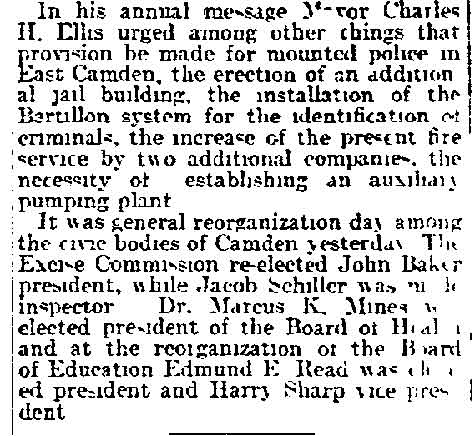
Attempt Made to Have Committee Appointed to Investigate Affairs of Street Commissioner’s Office
Something of a sensation was occasioned at the reorganization of Camden City Council yesterday when Councilman Frederick Finkeldey endeavored to have adopted a resolution providing for the appointment of a committee of five to investigate the affairs of the office of Street Commissioner Louis Mohrman. He offered the resolution when the latter came up for reappointment. In seconding Councilman Finkeldey’s motion Councilman Wilson declared he had data in his possession which showed there were irregularities. The resolution was defeated by a vote of 19 to 2. Mohrman was reappointed.
Aside from this the reorganization was the usual cut and dried affair. All the old officers were reappointed with the exception of City Clerk Harry C. Kramer, who was succeeded by Isaac Bradley, the retiring Councilman from the Seventh ward. William H. Day was made building inspector to fill the vacancy caused by the suicide of William Steinmetz.
In his annual message Mayor Charles H. Ellis urged among other things that provision be made for mounted police in East Camden, the erection of an additional jail building, the installation of the Bertillon system for the identification of criminals, the increase of the present fire service by two additional companies, the necessity of establishing an auxiliary pumping plant.
It was general reorganization day among the civic bodies of Camden yesterday. The Excise Commission re-elected John Baker president, while Jacob Schiller was made inspector. Dr. Marcus K. Mines was elected president of the Board of Health, and at the reorganization of the Board of Education Edmund E. Read was elected president and Harry Sharp vice president.
Camden News Notes
Philadelphia Inquirer —
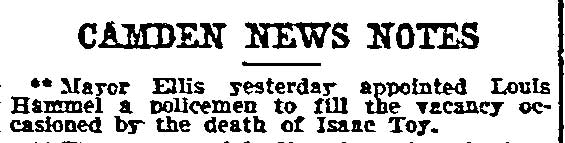
•• Mayor Ellis yesterday appointed Louis Hammel a policeman to fill the vacancy occasioned by the death of Isaac Toy.
Tatem Made House Sergeant
Philadelphia Inquirer —
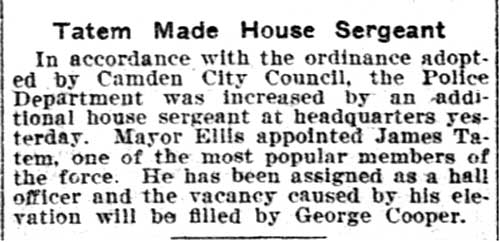
In accordance with the ordinance adopted by Camden City Council, the Police Department was increased by an additional house sergeant at headquarters yesterday. Mayor Ellis appointed James Tatem, one of the most popular members of the force. He has been assigned as a hall officer and the vacancy caused by his elevation will be filled by George Cooper.
Blue Jackets Fight Flames in Lumber Yard
Philadelphia Inquirer —
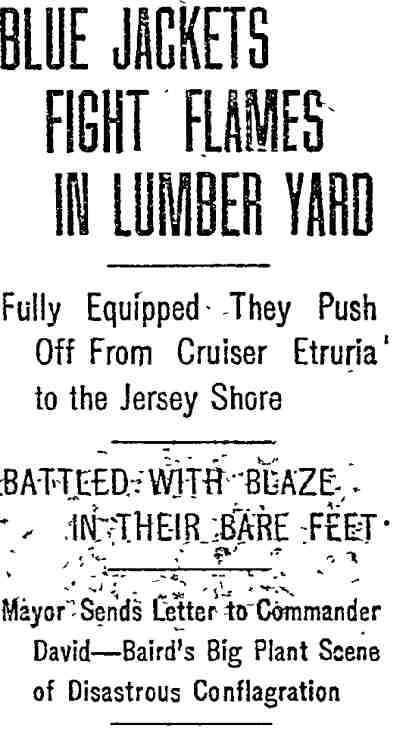
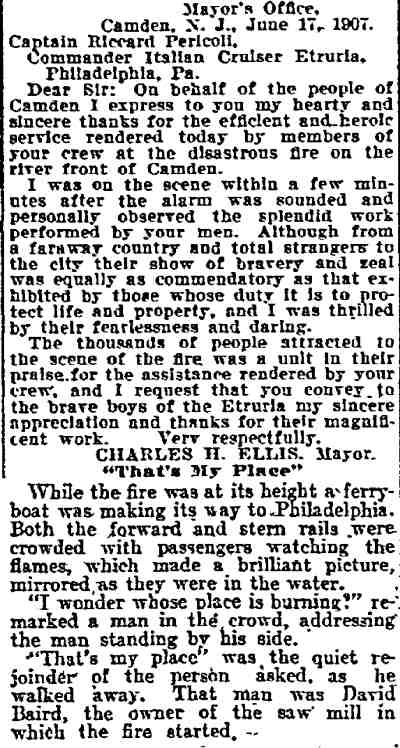
Fully Equipped They Push Off From Cruiser Etruria to the Jersey Shore
Battled With Blaze in Their Bare Feet
Mayor Sends Letter to Commander David—Baird’s Big Plant Scene of Disastrous Conflagration
One hundred sailors from the Italian cruiser Etruria, now lying in the Delaware river, off Race street, materially assisted the Camden firemen yesterday afternoon in preventing a fire from destroying the plant of David Baird & Co., foot of Pearl street. While the flames did damage to the extent of $50,000, there would have been a much heavier loss but for the excellent work of the bluejackets.
It was shortly after 1 o’clock when the flames were discovered in the engine room by Howard Mulford. His efforts to extinguish the tiny blaze proved futile. In a few minutes the fire had eaten its way through the inflammable wooden structure and the long, red tongues had communicated with the spar shed. From this they leaped about twenty feet into the saw and planing mill. All these structures were blazing fiercely when the Camden firemen responded to a general alarm.
Italian Jackies Busy
It was at this juncture that a hundred white-capped sailors in command of Lieutenant Alyigina Guardsumarsina made their landing at the Pearl street wharf in Camden. They were assembled by a bugler and with hand axes, hose and other apparatus they sallied forth to combat the flames which were fast eating their way through the extensive yard of the plant.
Many of the bluejackets were barefooted, but none of these stopped when burning timbers were encountered. They rushed through flame and smoke with all the vim and ardor that characterize the sailor when in action.
Attacked Blazing Planks
There was a huge lumber pile that stood near a shed that contained several hundred thousand feet of valuable timber. When the flames communicated with this the sailors, summoned by the bugler, made an attack on the great long blazing planks. Like veritable trojans they worked, running up to the flames with their axes and knocking the timbers in all directions.
The smoke was dense enough to make even the professional fire fighters seek cover, but the men from the Etruria stood their ground and managed to save much of the timber.
Hands and Feet Scorched
For over two hours they continued in service. Surgeon De Silvestor, with an assistant, had a busy time attending the burned feet and hands and scorched faces of his compatriots. They had a typical Red Cross outfit with them and when they had ended their work there was little left of the tape and liniments.
It was only after the fire was practically extinguished that Lieutenant Guardsumarsina gathered his men about him and returned to the Etruria. There were several thousand persons on the surrounding wharves and buildings and these gave three lusty cheers when the valiant sons of Italy left for the cruiser.
Fire a Scorcher
The fire was an extremely fierce one, fed as it was by thousands of feet of choice timber. Firemen Harry Green and Rollo Jones, of No. 1 Truck Company, were overcome by the intense heat, but they were quickly revived, the former by the Italian surgeon. Fireman John Lutz and Policeman George Kappel had severely burned hands treated by Surgeon De Silvestor also.
David Baird, Jr., a member of the firm, said he approximated the damage done at about $50,000. All the buildings and machinery were insured. The structures burned included a spar shed, 60 by 100 feet; planing mill, 40x100 feet, and a large lumber shed. About 4,000,000 feet of timber was in the yard, but much of this was saved through the good work of the sailors and the Camden firemen.
The Philadelphia tugboat Stokley also rendered excellent service when the fire was at its height.
It is not definitely known how the fire originated, but it is believed to have been caused by a spark generated by the engine.
Mayor Charles H. Ellis and many city and county officials were interested witnesses of the fire and the manner in which the Italian sailors and the firemen fought the flames. Mayor Ellis said the bluejackets were deserving of much praise for their aid, which came unsolicited but nevertheless at an opportune moment.
Mayor Thanks Sailors
Directly after the fire Mayor Ellis sent the following letter of appreciation to Captain Pericoli, of the Etruria:
Mayor’s Office,
Camden, N. J., June 17, 1907.
Captain Riccard Pericoli,
Commander Italian Cruiser Etruria,
Philadelphia, Pa.
Dear Sir: On behalf of the people of Camden I express to you my hearty and sincere thanks for the efficient and heroic service rendered today by members of your crew at the disastrous fire on the river front of Camden.
I was on the scene within a few minutes after the alarm was sounded and personally observed the splendid work performed by your men. Although from a faraway country and total strangers to the city their show of bravery and zeal was equally as commendatory as that exhibited by those whose duty it is to protect life and property, and I was thrilled by their fearlessness and daring.
The thousands of people attracted to the scene of the fire was a unit in their praise for the assistance rendered by your crew, and I request that you convey to the brave boys of the Etruria my sincere appreciation and thanks for their magnificent work.
Very respectfully, CHARLES H. ELLIS, Mayor.
“That’s My Place”
While the fire was at its height a ferryboat was making its way to Philadelphia. Both the forward and stern rails were crowded with passengers watching the flames, which made a brilliant picture, mirrored as they were in the water.
“I wonder whose place is burning?” remarked a man in the crowd, addressing the man standing by his side.
“That’s my place” was the quiet rejoinder of the person asked, as he walked away. That man was David Baird, the owner of the saw mill in which the fire started.
Camden News Notes
Philadelphia Inquirer —
•• In a runaway accident at Haddon and Kaighn avenues, yesterday, Benjamin Stant, of 1153 Haddon avenue, was hurled across the street. He struck his head on the curbstone, resulting in him receiving a number of severe gashes.
•• The Camden Heating, Ventilating and Power Company was incorporated yesterday, with a capital of $1,000, the incorporators being Policeman George Kappel, George W. A. Kappel and G. Edward Bull.
•• M. W. Brommer, of Landingville, Pa., who was injured in the auto crash of a week ago last Friday, was discharged from the Cooper Hospital yesterday.
•• During the past month there were only two cases of typhoid fever in Camden.
•• On Thursday afternoon, at 1 o’clock, a delegation of Camden and Philadelphia Elks will leave Broad Street Station for Newark, where they will participate in the dedication of the $60,000 building at that city.
•• With the object of having trolley service resumed on South Fifth and Second streets, Mayor Ellis, in Camden, yesterday conferred with the officials of the Public Service Corporation and the West Jersey and Seashore Railroad. Another conference will be held this morning, when it is declared that steps will be taken looking to the early resumption of traffic over those two lines.
Fire and Police Forces Increased
Philadelphia Inquirer —
New Men to Be Added to Each Department in Camden—Move Against the “Pennsy”
At last night’s meeting of Camden City Council the police force was increased to 130 men, as follows: 1 chief, 3 captains, 2 house captains, 9 sergeants, 4 detectives, 10 patrol crew, 101 policemen, an increase of 25 men. By ordinance the following new firemen were appointed: Ephraim T. Hires, First ward; Charles Schultz, Second ward; Gardner Corson, Fourth ward; Gilbert Hibbs, Seventh ward; John H. Lennox, Ninth ward; Newton Ash, Tenth ward. Dr. A. Haines Lippincott was appointed police surgeon by Mayor Charles H. Ellis.
Resolutions of sympathy on the illness of Councilman Besser were expressed in a rising vote. The ordinance which provided for an increase of salary of every city official was not introduced. The highest increase was $1000 for the Mayor and the lowest $300 for a clerkship.
A resolution was adopted that a committee of five be appointed to appear before the State Railroad Commission in company with City Counsel Bleakly, when argument is heard relative to the re-establishment of Haddon Avenue Station; ordering City Counsel Bleakly to report on the ownership of the foot of Arch street, and if the Pennsylvania Railroad Company is unlawfully occupying the street ends to take steps to collect rentals, both current and in arrears; inviting the officials of the new Terminal Company to appear and present the plans for the new Camden terminal.
Camden Increases Its Police Force
Philadelphia Inquirer —
Mayor Ellis Adds Twenty-five New Officers to Growing City’s Department
Camden’s police force was increased by the appointment of twenty-five additional officers by Mayor Ellis yesterday. There were also several promotions, two new captains, two sergeants and one detective being made as follows: Captains, Edward Hyde and A. Lincoln James, advanced from sergeants; sergeants, E. B. McClong and Edward Hartman, advanced from patrolmen; detective, John Brothers, advanced from patrolman: new patrolmen. Fred Schweizer, William Briant, Charles Hume, Charles Wilbur, Wright Cox, Walter Stanton, John Barnett, Tabor Quinn, John Gilbert, Joseph Palese, William Haines, Frederick Watson, Charles Whaland, William Kiker, James Hutt, George Krown, Ube Andrews, Daniel Stanton, Albert Archer, Harry Bakley, John Shuman, Oscar Till, Albertson Matlack, John Devlin, George Hollins, Frank Koplain, Edward King and George Beasley, substitutes.
For the past several weeks there has been much pulling and hauling of the political wires and the various ward leaders have had their own troubles in making selections. Each appointee was subjected to a regulation army examination by Dr. A. H. Lappincott [sic] before he was pronounced fit for the service. When the horses are procured, which may be by next June, six of the men will compose a mounted squad.
Greater Camden the Slogan at Board of Trade Banquet
Philadelphia Inquirer —
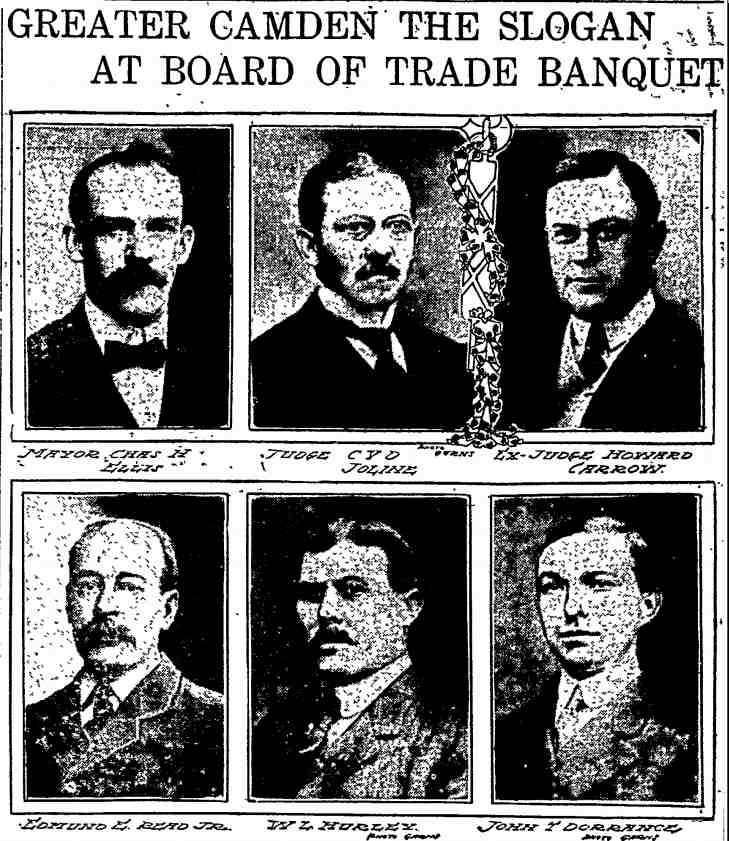
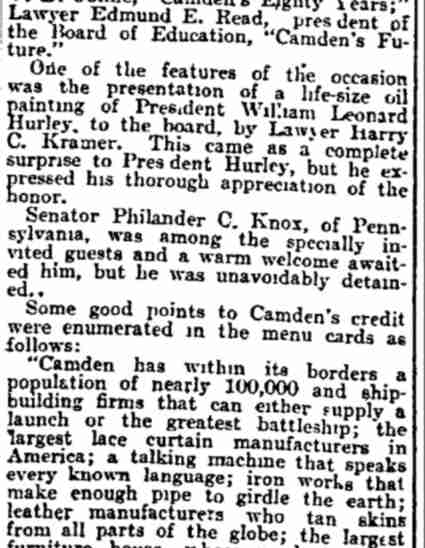
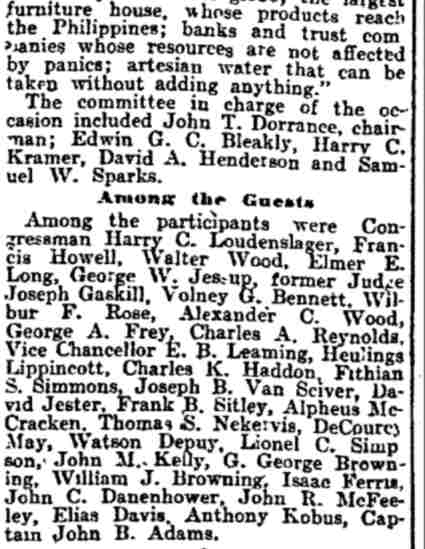
MAYOR CHAS H. ELLIS
JUDGE C V D JOLINE
EX-JUDGE HOWARD CARROW
EDMUND E. READ JR.
Men Prominent in Business Affairs Sound Praises of Growing City at Annual Feast
A greater, more progressive Camden was the watchword at he [sic] annual banquet given by Camden’s Board of Trade last night. And that this means something is evident from the fact that it came from the city’s “Captains of Industry” to the number of two hundred.
It was Camden’s rejuvenated Board of Trade that gave the banquet and the interest taken was manifested by the presence of representatives from every business concern of any prominence in the city.
All Represented
There were bankers besides just ordinary business men, professional men of every character, and all were imbued with the spirit to make of Camden a place that will be known on the map throughout the country. William L. Hurley, president of the board, presided at the banquet.
“Generally speaking, we are satisfied with our city,” said Mayor Charles H. Ellis in responding to the toast, “Camden as it is,” “but, of course, there is room for improvement in many respects, and it rests with you gentlemen, you members of the Board of Trade to largely aid in solving our municipal problems.”
Former Judge Howard Carrow acted as toastmaster and, beside Mayor Ellis, those who responded to toasts were Congressman James H. Davidson, of Wisconsin, who spoke on “Boards of Trades;” Judge of the Court of Common Pleas C. V. D. Joline, “Camden’s Eighty Years;” Lawyer Edmund E. Read, president of the Board of Education, “Camden’s Future.”
One of the features of the occasion was the presentation of a life-size oil painting of President William Leonard Hurley. [sic] to the board, by Lawyer Harry C. Kramer. This came as a complete surprise to President Hurley, but he expressed his thorough appreciation of the honor.
Senator Philander C. Knox, of Pennsylvania, was among the specially invited guests and a warm welcome awaited him, but he was unavoidably detained.. [sic]
Some good points to Camden’s credit were enumerated in the menu cards as follows:
“Camden has within its borders a population of nearly 100,000 and shipbuilding firms that can either supply a launch or the greatest battleship; the largest lace curtain manufacturers in America; a talking machine that speaks every known language; iron works that make enough pipe to girdle the earth; leather manufacturers who tan skins from all parts of the globe; the largest furniture house, whose products reach the Philippines; banks and trust companies whose resources are not affected by panics; artesian water that can be taken without adding anything.”
The committee in charge of the occasion included John T. Dorrance, chairman; Edwin G. C. Bleakly, Harry C. Kramer, David A. Henderson and Samuel W. Sparks.
Among the Guests
Among the participants were Congressman Harry C. Loudenslager, Francis Howell, Walter Wood, Elmer E. Long, George W. Jessup, former Judge Joseph Gaskill, Volney G. Bennett, Wilbur F. Rose, Alexander C. Wood, George A. Frey, Charles A. Reynolds, Vice Chancellor E. B. Leaming, Heulings Lippincott, Charles K. Haddon, Fithian S. Simmons, Joseph B. Van Sciver, David Jester, Frank B. Sitley, Alpheus McCracken, Thomas S. Nekervis, DeCourcy May, Watson Depuy, Lionel C. Simpson, John M. Kelly, G. George Browning, William J. Browning, Isaac Ferris, John C. Danenhower, John R. McFeeley, Elias Davis, Anthony Kobus, Captain John B. Adams.
Camden Authorities Condemned by Hill
Trenton Evening Times —
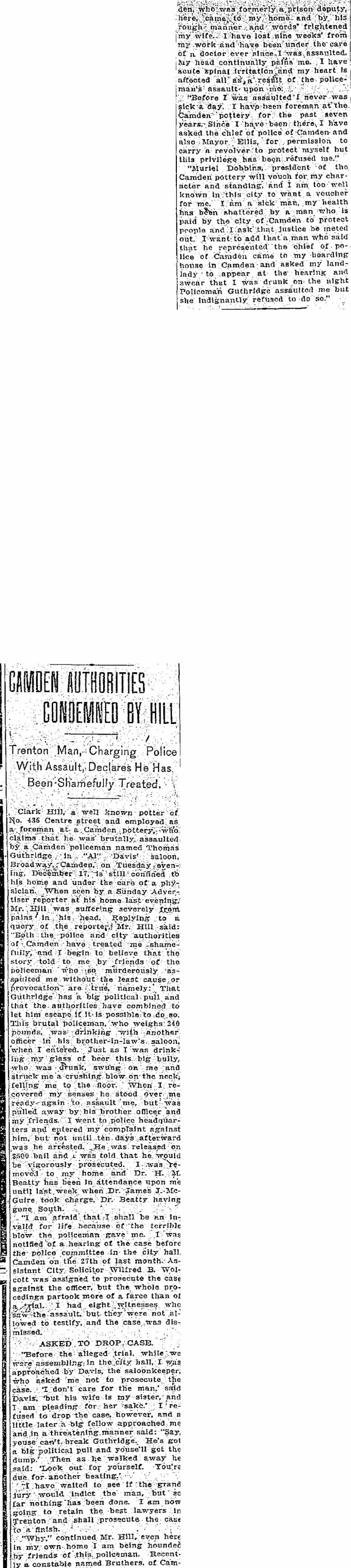
Trenton Evening Times
February 16, 1908
Al Davis' Saloon
Broadway
Clark Hill
Wilfred B. Wolcott
Charles H. Ellis
Murrell Dobbins
Thomas Brothers
Click on Image for Complete Article
Mayor Ellis at Improvement Association Banquet
Philadelphia Inquirer —
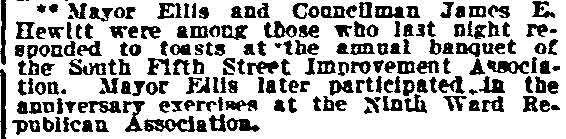
•• Mayor Ellis and Councilman James E. Hewitt were among those who last night responded to toasts at the annual banquet of the South Fifth Street Improvement Association. Mayor Ellis later participated in the anniversary exercises at the Ninth Ward Republican Association.
Charles H. Ellis - James E. Hewitt
Mayor Ellis Orders Fireworks Arrests
Philadelphia Inquirer —
•• In order that there may not be any accidents [sic]. Mayor Ellis, in Camden, yesterday issued an order directing the police to arrest all persons discharging fire arms or fireworks of any kind in the streets before the Fourth of July.
Italian Republican League
Philadelphia Inquirer —
Dedication of New Club House Attracts Many Officials
Many officials and hundreds of persons participated in the dedication and reception given last night in the new building of the First Italian Republican League, at 813 South Fourth street, Camden, last night. Recorder’s Clerk William Knight acted as toastmaster at a banquet, at which the following toasts were responded to: “Our City,” Mayor Charles H. Ellis; “Our Judiciary,” Prosecutor Harry S. Scovel; “Citizenship,” Antonio Mecca; “Our Club,” Lawrence La Maina; “The Growth of Italians as Good Americans,” Rev. Michael Di Ielsi, pastor of the Church of Our Lady of Mount Carmel.
The new building is of brick, 32 by 46 feet, and cost $8000. The club has 260 members.
Mayor Ellis Names Memorial Day Committee
Philadelphia Inquirer —
Philadelphia Inquirer - January 28, 1909
In order that Camden veterans may have an elaborate celebration on Memorial Day, Mayor Ellis yesterday appointed the following committee of citizens to act in conjunction with them: William D. Vanaman, William Sangtinette, Frank W. Tussey, William Fox, Dr. J.W. Martindale, Walter L Tushingham, Ira E. Lutte,Harry C. Kramer, John W. Coleman, Bernhard Schroeder, Edward H. Nieland, Daniel M. Stevens, W.F. Powell, Abe Fuhrman, Jacob Neutze, Francis B. Wallen, Charles A. Ackley, Louis T. Derousse, James M. Bentley, John K. Newkirk, William Schmid, John Larsen, Sigismund Schoenagle, Charles M. Baldwin, and Harry A. Whaland.
Camden News Notes
Philadelphia Inquirer —
•• Mayor Ellis yesterday appointed David Hunt as a jailor at the new city prison.
•• Judge Joline yesterday refused the application of Mrs. Sarah Herbert for a license to sell liquor at Fish House, against which a vigorous remonstrance has been made.
•• Falling twenty feet down the hold of a boat at Mathis’ shipyard, Edward Dyer, aged 22 years, of 205 Byron street, received internal injuries and many lacerations of the body.
•• Camden police are looking for a man who got $21 worth of paints from W. C. Powelson, of 219 Federal street, by means of a bogus check.
Camden’s Mayor Takes a Bride
Philadelphia Inquirer —
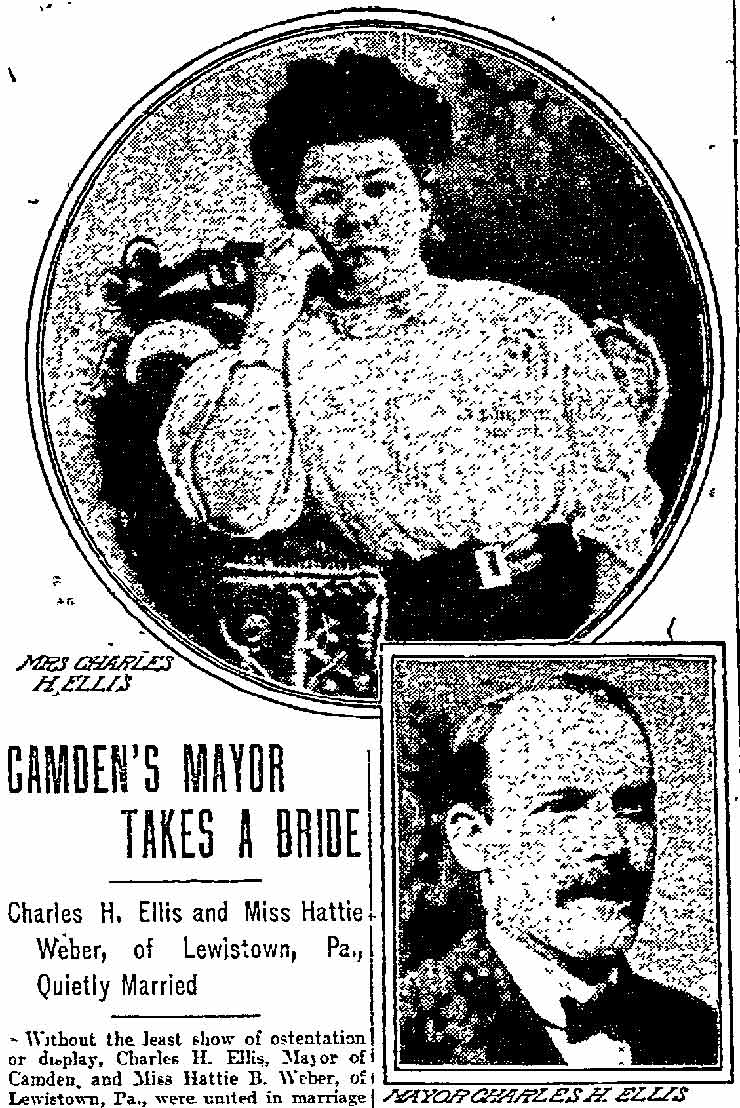
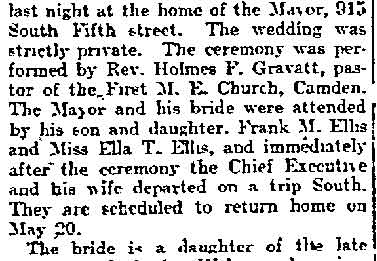
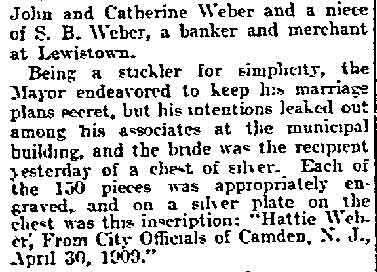
Charles H. Ellis and Miss Hattie Weber, of Lewistown, Pa., Quietly Married
Without the least show of ostentation or display, Charles H. Ellis, Mayor of Camden, and Miss Hattie B. Weber, of Lewistown, Pa., were united in marriage
Mayor Ellis to Address Young Men’s Republican Club
Philadelphia Inquirer —
•• On the evening of August 12 Mayor Ellis will address the Young Men’s Republican Club of the Eighth ward on “The responsibilities of Young Men.” The club is supporting Councilman Besser and Freeholder Leeson for renomination.
Want to Know What Election Law Means
Philadelphia Inquirer —
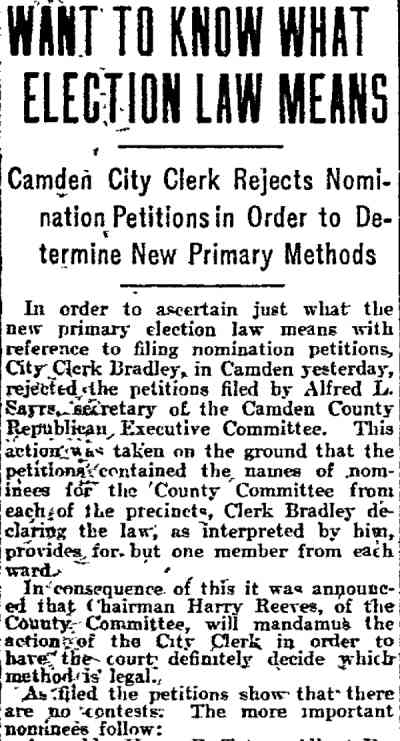
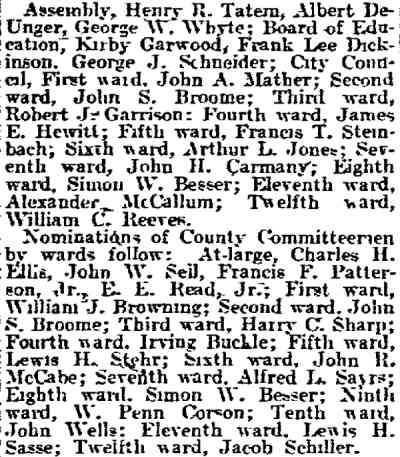
Camden City Clerk Rejects Nomination Petitions in Order to Determine New Primary Methods
In order to ascertain just what the new primary election law means with reference to filing nomination petitions, City Clerk Bradley, in Camden yesterday, rejected the petitions filed by Alfred L. Sayrs, secretary of the Camden County Republican Executive Committee. This action was taken on the ground that the petitions contained the names of nominees for the County Committee from each of the precincts, Clerk Bradley declaring the law, as interpreted by him, provides for. but one member from each ward.
In consequence of this it was announced that Chairman Harry Reeves, of the County Committee, will mandamus the action of the City Clerk in order to have the court definitely decide which method is legal.
As filed the petitions show that there are no contests. The more important nominees follow:
Assembly, Henry R. Tatem, Albert De Unger, George W. Whyte; Board of Education, Kirby Garwood, Frank Lee Dickinson, George J. Schneider; City Council, First ward, John A. Mather; Second ward, John S. Broome; Third ward, Robert J. Garrison; Fourth ward, James E. Hewitt; Fifth ward, Francis T. Steinbach; Sixth ward, Arthur L. Jones; Seventh ward, John H. Carmany; Eighth ward, Simon W. Besser; Eleventh ward, Alexander McCallum; Twelfth ward, William C. Reeves.
Nominations of County Committeemen by wards follow: At-large, Charles H. Ellis, John W. Sell, Francis F. Patterson, Jr., E. E. Read, Jr.; First ward, William J. Browning; Second ward, John S. Broome; Third ward, Harry C. Sharp; Fourth ward, Irving Buckle; Fifth ward, Lewis H. Stehr; Sixth ward, John R. McCabe; Seventh ward, Alfred L. Sayrs; Eighth ward, Simon W. Besser; Ninth ward, W. Penn Corson; Tenth ward, John Wells; Eleventh ward, Lewis H. Sasse; Twelfth ward, Jacob Schiller.
Mayor Ellis Appoints Sub-Policeman
Philadelphia Inquirer —

Mayor Ellis has appointed Clarence Boyer, of the Sixth ward, a sub-policeman. Sub-Policeman Thornton, of the Eighth ward, has been made a regular, to succeed Joseph Koplan, resigned.
Charles H. Ellis - Nathan Thornton - Clarence Boyer - Joseph Koplan
Baird Holds a Christmas Party
Philadelphia Inquirer —
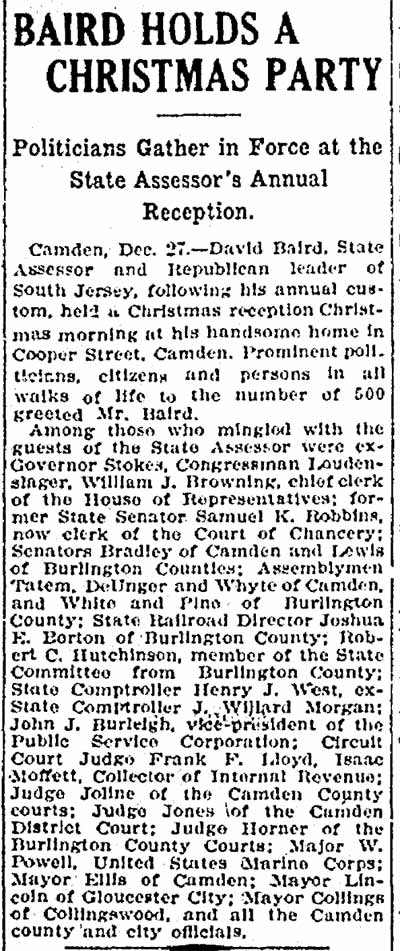
Politicians Gather in Force at the State Assessor’s Annual Reception.
Camden, Dec. 27.—David Baird, State Assessor and Republican leader of South Jersey, following his annual custom, held a Christmas reception Christmas morning at his handsome home in Cooper Street, Camden. Prominent politicians, citizens and persons in all walks of life to the number of 500 greeted Mr. Baird.
Among those who mingled with the guests of the State Assessor were ex-Governor Stokes, Congressman Loudenslager, William J. Browning, chief clerk of the House of Representatives; former State Senator Samuel K. Robbins, now clerk of the Court of Chancery; Senators Bradley of Camden and Lewis of Burlington Counties; Assemblymen Tatem, DeUnger and Whyte of Camden, and White and Pino of Burlington County; State Railroad Director Joshua E. Borton of Burlington County; Robert C. Hutchinson, member of the State Committee from Burlington County; State Comptroller Henry J. West, ex-State Comptroller J. Willard Morgan; John J. Burleigh, vice-president of the Public Service Corporation; Circuit Court Judge Frank F. [sic] Lloyd, Isaac Moffett, Collector of Internal Revenue; Judge Joline of the Camden County courts; Judge Jones of the Camden District Court; Judge Horner of the Burlington County Courts; Major W. Powell, United States Marine Corps; Mayor Ellis of Camden; Mayor Lincoln of Gloucester City; Mayor Collings of Collingswood, and all the Camden county and city officials.
(news brief)
Philadelphia Inquirer —
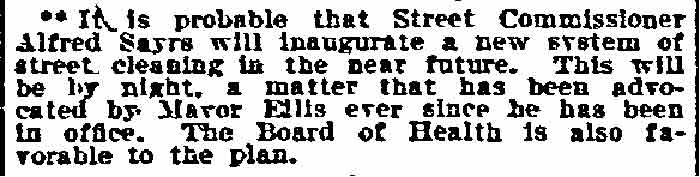
•• It is probable that Street Commissioner Alfred Sayrs will inaugurate a new system of street cleaning in the near future. This will be by night, a matter that has been advocated by Mayor Ellis ever since he has been in office. The Board of Health is also favorable to the plan.
Camden News Notes
Philadelphia Inquirer —
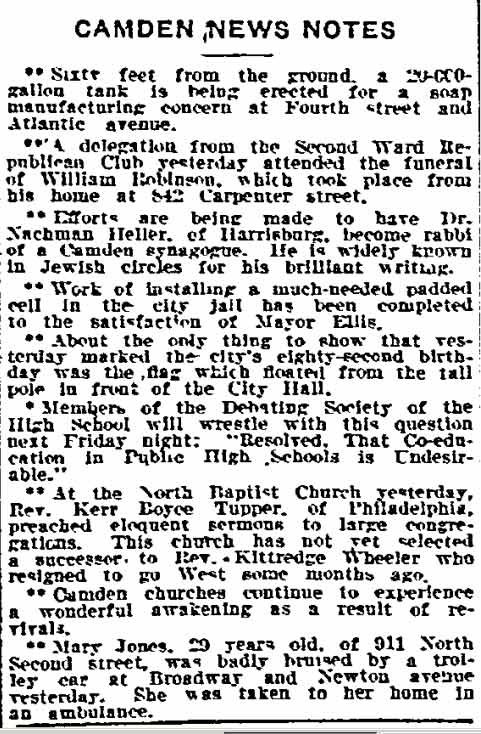
Sixty feet from the ground, a 20,000-gallon tank is being erected for a soap manufacturing concern at Fourth street and Atlantic avenue.
A delegation from the Second Ward Republican Club yesterday attended the funeral of William Robinson, which took place from his home at 842 Carpenter street.
Efforts are being made to have Dr. Nachman Heller, of Harrisburg, become rabbi of a Camden synagogue. He is widely known in Jewish circles for his brilliant writing.
Work of installing a much-needed padded cell in the city jail has been completed to the satisfaction of Mayor Ellis.
About the only thing to show that yesterday marked the city’s eighty-second birthday was the flag which floated from the tall pole in front of the City Hall.
Members of the Debating Society of the High School will wrestle with this question next Friday night: “Resolved, That Co-education in Public High Schools is Undesirable.”
At the North Baptist Church yesterday, Rev. Kerr Boyce Tupper, of Philadelphia, preached eloquent sermons to large congregations. This church has not yet selected a successor to Rev. Kittredge Wheeler who resigned to go West some months ago.
Camden churches continue to experience a wonderful awakening as a result of revivals.
Mary Jones, 29 years old, of 911 North Second street, was badly bruised by a trolley car at Broadway and Newton avenue yesterday. She was taken to her home in an ambulance.
(news brief)
Philadelphia Inquirer —

•• The German-American Alliance is making extensive preparations for a big celebration of Whitsuntide Monday on May 16 at Riverview Park. Mayor Ellis has accepted a part in the exercises of the day.
(news brief)
Philadelphia Inquirer —

•• Mayor Ellis has announced the appointment of James Lewis, of the Fifth ward, as a sub-policeman, who fills the vacancy occasioned by the death of Policeman T. Casper Hart.
Camden News Notes
Philadelphia Inquirer —
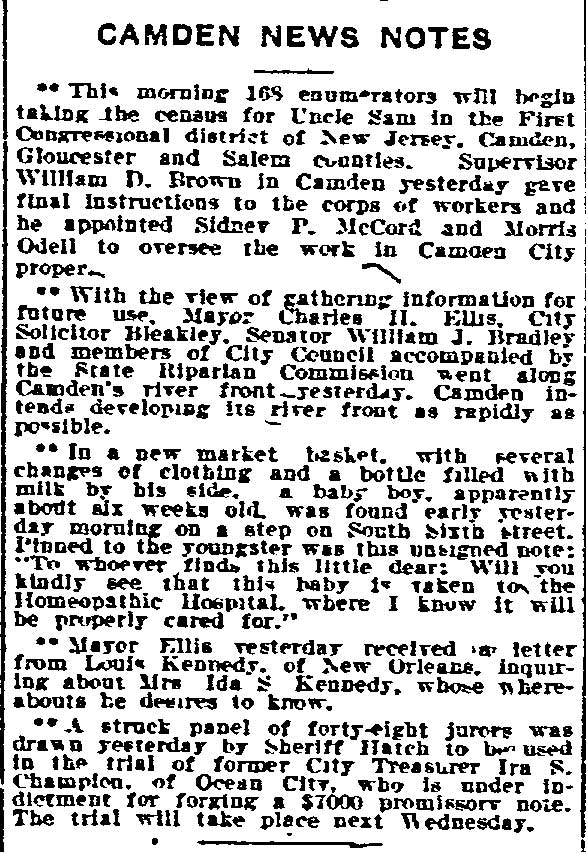
This morning 168 enumerators will begin taking the census for Uncle Sam in the First Congressional district of New Jersey, Camden, Gloucester and Salem counties. Supervisor William D. Brown in Camden yesterday gave final instructions to the corps of workers and he appointed Sidney P. McCord and Morris Odell to oversee the work in Camden City proper.
With the view of gathering information for future use, Mayor Charles H. Ellis, City Solicitor Bleakley, Senator William J. Bradley and members of City Council accompanied by the State Riparian Commission went along Camden’s river front yesterday. Camden intends developing its river front as rapidly as possible.
In a new market basket, with several changes of clothing and a bottle filled with milk by his side, a baby boy, apparently about six weeks old, was found early yesterday morning on a step on South Sixth street. Pinned to the youngster was this unsigned note: “To whoever finds this little dear: Will you kindly see that this baby is taken to the Homeopathic Hospital, where I know it will be properly cared for.”
Mayor Ellis yesterday received a letter from Louis Kennedy, of New Orleans, inquiring about Mrs. Ida S. Kennedy, whose whereabouts he desires to know.
A struck panel of forty-eight jurors was drawn yesterday by Sheriff Hatch to be used in the trial of former City Treasurer Ira S. Champion, of Ocean City, who is under indictment for forging a $7000 promissory note. The trial will take place next Wednesday.
(news brief)
Philadelphia Inquirer —
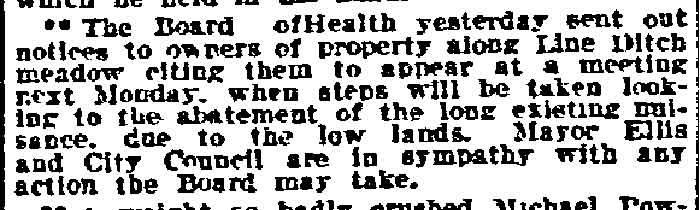
•• The Board of Health yesterday sent out notices to owners of property along Line Ditch meadow citing them to appear at a meeting next Monday, when steps will be taken looking to the abatement of the long existing nuisance, due to the low lands. Mayor Ellis and City Council are in sympathy with any action the Board may take.
Veteran Camden Policeman Quits
Philadelphia Inquirer —
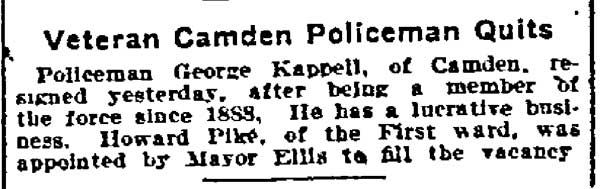
Policeman George Kappell, of Camden, resigned yesterday, after being a member of the force since 1888. He has a lucrative business. Howard Pike, of the First ward, was appointed by Mayor Ellis to fill the vacancy.
Camden’s Mayor Has Field to Himself
Philadelphia Inquirer —
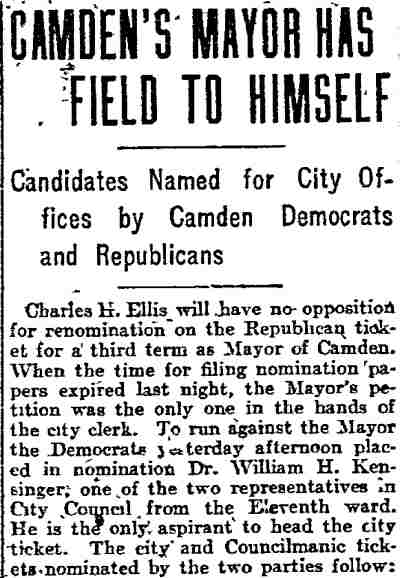
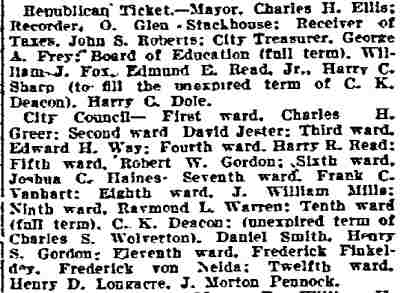
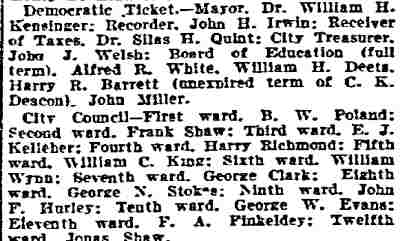
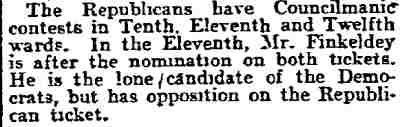
Candidates Named for City Offices by Camden Democrats and Republicans
Charles H. Ellis will have no opposition for renomination on the Republican ticket for a third term as Mayor of Camden. When the time for filing nomination papers expired last night, the Mayor’s petition was the only one in the hands of the city clerk. To run against the Mayor the Democrats yesterday afternoon placed in nomination Dr. William H. Kensinger; one of the two representatives in City Council from the Eleventh ward. He is the only aspirant to head the city ticket. The city and Councilmanic tickets nominated by the two parties follow:
Republican Ticket.—Mayor, Charles H. Ellis; Recorder, O. Glen Stackhouse; Receiver of Taxes, John S. Roberts; City Treasurer, George A. Frey; Board of Education (full term), William J. Fox, Edmund E. Read, Jr., Harry C. Sharp (to fill the unexpired term of C. K. Deacon), Harry C. Dole.
City Council—First ward, Charles H. Greer; Second ward David Jester; Third ward, Edward H. Way; Fourth ward, Harry R. Read; Fifth ward, Robert W. Gordon; Sixth ward, Joshua C. Haines; Seventh ward, Frank C. Vanhart; Eighth ward, J. William Mills; Ninth ward, Raymond L. Warren; Tenth ward (full term), C. K. Deacon; (unexpired term of Charles S. Wolverton), Daniel Smith, Henry S. Gordon; Eleventh ward, Frederick Finkeldey; Frederick von Neida; Twelfth ward, Henry D. Longacre, J. Morton Pennock.
Democratic Ticket.—Mayor, Dr. William H. Kensinger; Recorder, John H. Irwin; Receiver of Taxes, Dr. Silas H. Quint; City Treasurer, John J. Welsh; Board of Education (full term), Alfred R. White, William H. Deets, Harry R. Barrett (unexpired term of C. K. Deacon), John Miller.
City Council—First ward, B. W. Poland; Second ward, Frank Shaw; Third ward, E. J. Kelleher; Fourth ward, Harry Richmond; Fifth ward, William C. King; Sixth ward, William Wynn; Seventh ward, George Clark; Eighth ward, George N. Stokes; Ninth ward, John F. Hurley; Tenth ward, George W. Evans; Eleventh ward, F. A. Finkeldey; Twelfth ward, Jonas Shaw.
The Republicans have Councilmanic contests in Tenth, Eleventh and Twelfth wards. In the Eleventh, Mr. Finkeldey is after the nomination on both tickets. He is the lone candidate of the Democrats, but has opposition on the Republican ticket.
Camden News Notes
Philadelphia Inquirer —
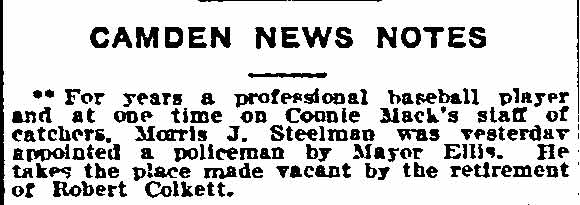
For years a professional baseball player and at one time on Connie Mack’s staff of catchers, Morris J. Steelman was yesterday appointed a policeman by Mayor Ellis. He takes the place made vacant by the retirement of Robert Colkett.
Camden News Notes
Philadelphia Inquirer —
Camden News Notes
•• The Board of Education has appointed Drs. Marcus K. Mines, Frederick Jones Jr., W. P. Wingender and W. K. Browning as assistant medical inspectors at salaries of $400 each. This is in compliance with a recent law of the State.
•• In a fall from a scaffold at the New York Shipbuilding plant yesterday, John Wagner, 24 years old, of 1038 Mechanic street, received a bad shaking up beside a sprained back. He was taken to the Cooper Hospital.
•• It is reported that a number of industrial concerns where girls are employed are not adequately protected by fire escapes, a subject that will probably be investigated.
•• Members of the class of 1908 have been given the privilege of placing a memorial marble in the High School, a custom that is likely to be followed by other classes.
•• The fact that Supreme Court Justice Garrison has taken such a decided stand in the election fraud probe has caused considerable uneasiness in certain quarters.
•• Policeman Lewis Hamel, who was suspended from the force pending a trial on charges of dereliction of duty, yesterday resigned. Policeman George West, who is accused of conduct unbecoming an officer, was suspended by Mayor Ellis yesterday.
•• Because he knocked out several of his wife’s teeth in a domestic row, Clarence Governs, of 817 Clare street, was committed to jail by the Recorder yesterday for action by the grand jury.
•• After a lingering illness, Michael Kirby, father of Mrs. W. Leonard Burley [sic], died yesterday at his son-in-law’s country home, “Dungarven,” West Collingswood. He was 70 years old and a native of Woodstown.
•• The funeral of Mrs. Amelia C. Roub, who died suddenly last Friday from acute indigestion, took place yesterday from her home, at Broadway and Ferry avenue. Interment was made in Evergreen Cemetery.
•• At the annual meeting of the Tammany Club, a well known South Camden social organization, these officers were elected: President, William Black; vice presidents, Redmond Pierson and Charles Redmond; secretary, Joseph Byrie; treasurer, James Croker.
•• Under the direction of the Women’s Home Missionary Society an all-day meeting will be held tomorrow in the State Street M. E. Church.
•• Children playing with matches is supposed to have been the cause of a fire that partly burned the home of Archer D. Norris, at 930 Elm street, Monday night.
Camden Will Observe Decoration Day
Philadelphia Inquirer —
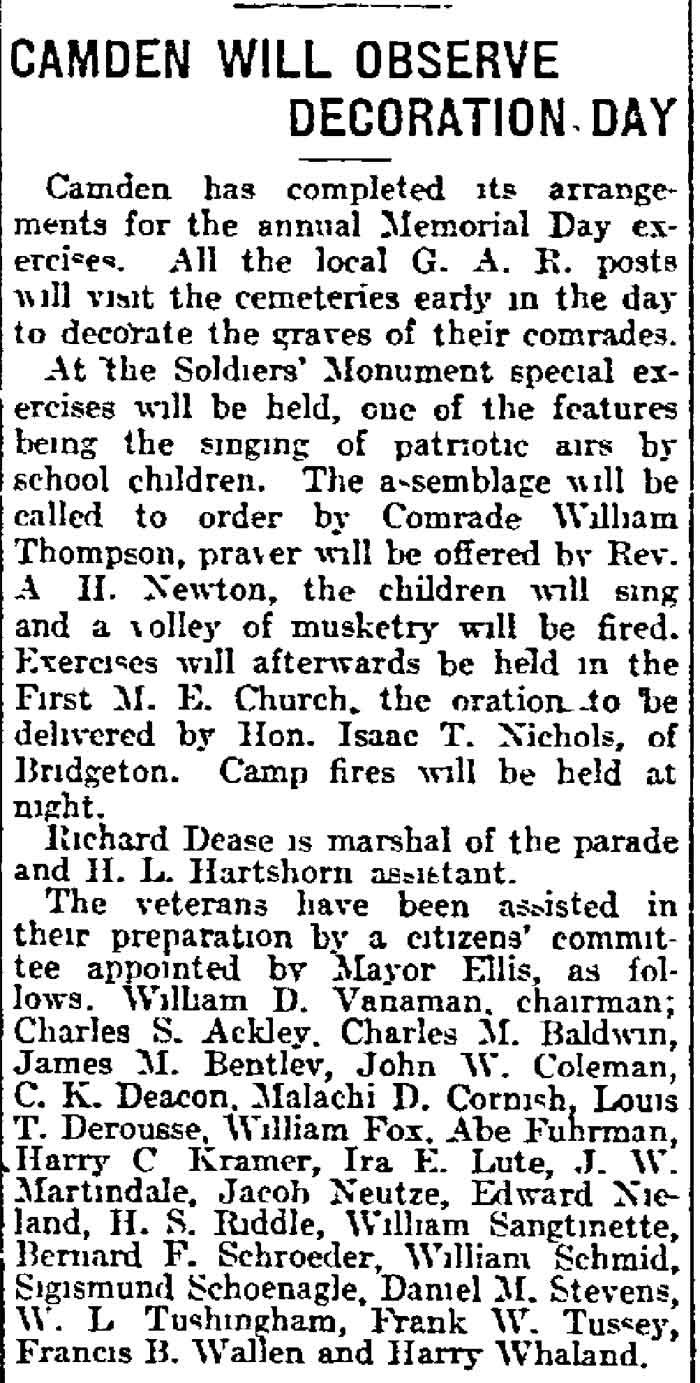
Camden has completed its arrangements for the annual Memorial Day exercises. All the local G. A. R. posts will visit the cemeteries early in the day to decorate the graves of their comrades.
At the Soldiers’ Monument special exercises will be held, one of the features being the singing of patriotic airs by school children. The assemblage will be called to order by Comrade William Thompson, prayer will be offered by Rev. A. H. Newton, the children will sing and a volley of musketry will be fired. Exercises will afterwards be held in the First M. E. Church, the oration to be delivered by Hon. Isaac T. Nichols, of Bridgeton. Camp fires will be held at night.
Richard Dease is marshal of the parade and H. L. Hartshorn assistant.
The veterans have been assisted in their preparation by a citizens’ committee appointed by Mayor Ellis, as follows. William D. Vanaman, chairman; Charles S. Ackley, Charles M. Baldwin, James M. Bentley, John W. Coleman, C. K. Deacon, Malachi D. Cornish, Louis T. Derousse, William Fox, Abe Fuhrman, Harry C. Kramer, Ira E. Lute, J. W. Martindale, Jacob Neutze, Edward Nieland, H. S. Riddle, William Sangtinette, Bernard F. Schroeder, William Schmid, Sigismund Schoenagle, Daniel M. Stevens, W. L. Tushingham, Frank W. Tussey, Francis B. Wallen and Harry Whaland.
Names Cattle Inspector
Philadelphia Inquirer —
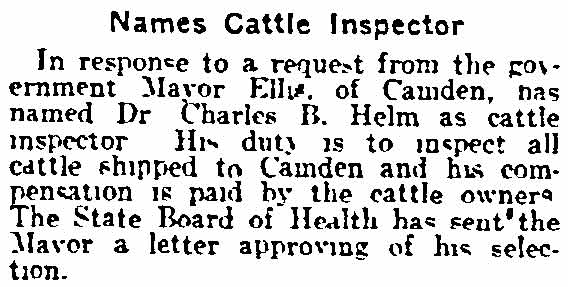
In response to a request from the government Mayor Ellis, of Camden, has named Dr. Charles B. Helm as cattle inspector. His duty is to inspect all cattle shipped to Camden and his compensation is paid by the cattle owners. The State Board of Health has sent the Mayor a letter approving of his selection.
(news brief)
Philadelphia Inquirer —
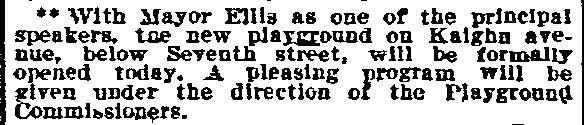
•• With Mayor Ellis as one of the principal speakers, the new playground on Kaighn avenue, below Seventh street, will be formally opened today. A pleasing program will be given under the direction of the Playground Commissioners.
Speakeasy Raided on Cherry Street
Philadelphia Inquirer —
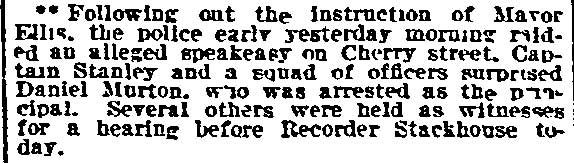
Following out the instruction of Mayor Ellis, the police early yesterday morning raided an alleged speakeasy on Cherry street. Captain Stanley and a squad of officers surprised Daniel Murton, who was arrested as the principal. Several others were held as witnesses for a hearing before Recorder Stackhouse today.
Columbus Day in Camden
Philadelphia Inquirer —
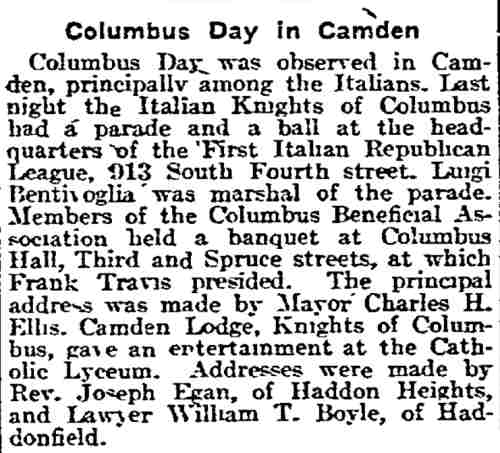
Columbus Day was observed in Camden, principally among the Italians. Last night the Italian Knights of Columbus had a parade and a ball at the headquarters of the First Italian Republican League, 913 South Fourth street. Luigi Bentivoglia was marshal of the parade. Members of the Columbus Beneficial Association held a banquet at Columbus Hall, Third and Spruce streets, at which Frank Travis presided. The principal address was made by Mayor Charles H. Ellis. Camden Lodge, Knights of Columbus, gave an entertainment at the Catholic Lyceum. Addresses were made by Rev. Joseph Egan, of Haddon Heights, and Lawyer William T. Boyle, of Haddonfield.
Camden’s Bodies Begin New Year
Philadelphia Inquirer —
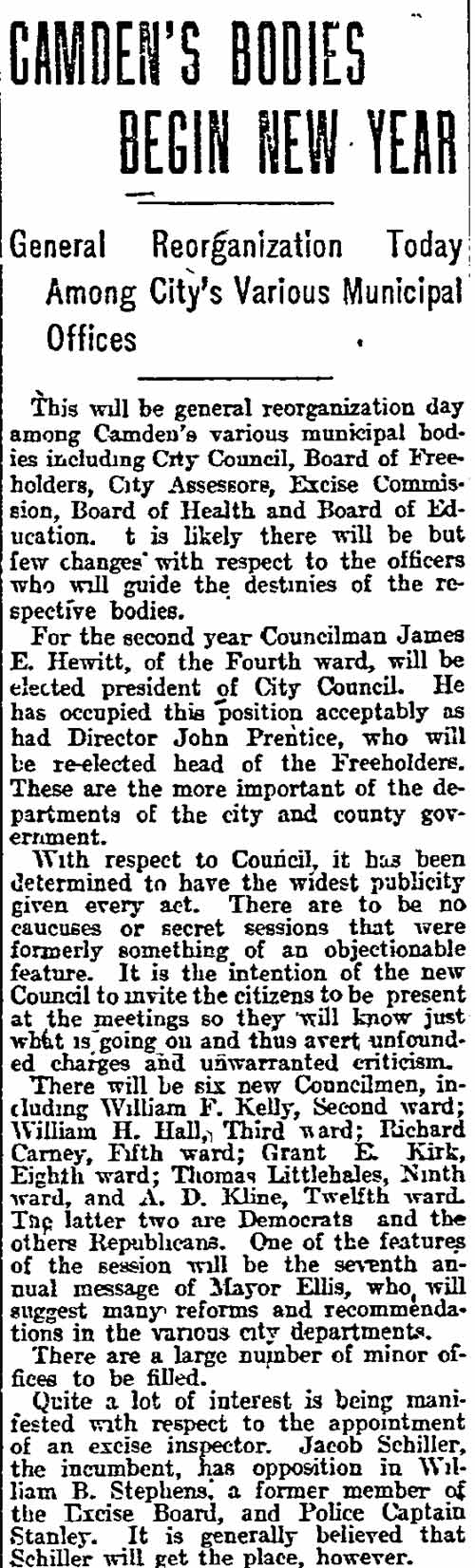
General Reorganization Today Among City’s Various Municipal Offices
This will be general reorganization day among Camden’s various municipal bodies including City Council, Board of Freeholders, City Assessors, Excise Commission, Board of Health and Board of Education. It is likely there will be but few changes with respect to the officers who will guide the destinies of the respective bodies.
For the second year Councilman James E. Hewitt, of the Fourth ward, will be elected president of City Council. He has occupied this position acceptably as had Director John Prentice, who will be re-elected head of the Freeholders. These are the more important of the departments of the city and county government.
With respect to Council, it has been determined to have the widest publicity given every act. There are to be no caucuses or secret sessions that were formerly something of an objectionable feature. It is the intention of the new Council to invite the citizens to be present at the meetings so they will know just what is going on and thus avert unfounded charges and unwarranted criticism.
There will be six new Councilmen, including William F. Kelly, Second ward; William H. Hall, Third ward; Richard Carney, Fifth ward; Grant E. Kirk, Eighth ward; Thomas Littlehales, Ninth ward, and A. D. Kline, Twelfth ward. The latter two are Democrats and the others Republicans. One of the features of the session will be the seventh annual message of Mayor Ellis, who will suggest many reforms and recommendations in the various city departments.
There are a large number of minor offices to be filled.
Quite a lot of interest is being manifested with respect to the appointment of an excise inspector. Jacob Schiller, the incumbent, has opposition in William B. Stephens, a former member of the Excise Board, and Police Captain Stanley. It is generally believed that Schiller will get the place, however.
Mayor Ellis Appoints New Policemen
Philadelphia Inquirer —
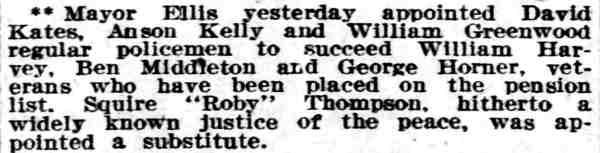
Mayor Ellis yesterday appointed David Kates, Anson Kelly and William Greenwood regular policemen to succeed William Harvey, Ben Middleton and George Horner, veterans who have been placed on the pension list. Squire “Roby” Thompson, hitherto a widely known justice of the peace, was appointed a substitute.
Cleaning Up Time Is on in Camden
Philadelphia Inquirer —
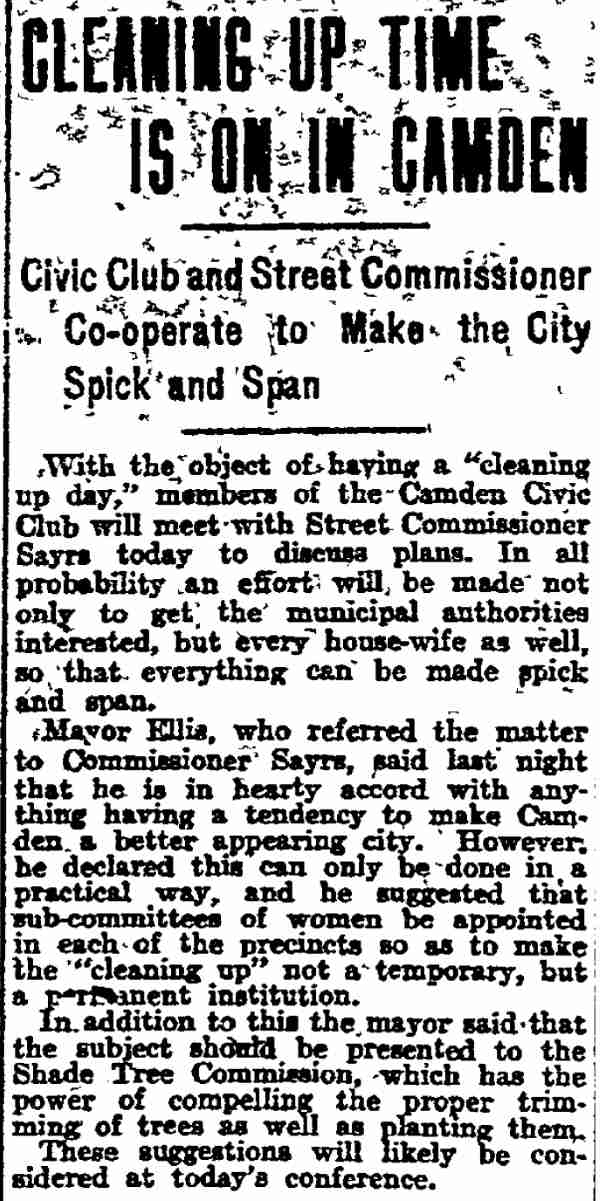
Civic Club and Street Commissioner Co-operate to Make the City Spick and Span
With the object of having a “cleaning up day,” members of the Camden Civic Club will meet with Street Commissioner Sayrs today to discuss plans. In all probability an effort will be made not only to get the municipal authorities interested, but every house-wife as well, so that everything can be made spick and span.
Mayor Ellis, who referred the matter to Commissioner Sayrs, said last night that he is in hearty accord with anything having a tendency to make Camden a better appearing city. However, he declared this can only be done in a practical way, and he suggested that sub-committees of women be appointed in each of the precincts so as to make the “cleaning up” not a temporary, but a permanent institution.
In addition to this the mayor said that the subject should be presented to the Shade Tree Commission, which has the power of compelling the proper trimming of trees as well as planting them.
These suggestions will likely be considered at today’s conference.
Mayor Ellis Appoints John Potter
Camden Daily Courier —
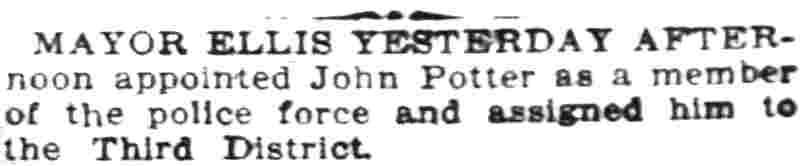
Mayor Ellis yesterday afternoon appointed John Potter as a member of the police force and assigned him to the Third District.
Wield Trowel at Mason’s Home Site
Philadelphia Inquirer —
Members of the Craft From Several States Participate at Corner-Stone Laying in Camden
Masons from all parts of New Jersey, Pennsylvania and Delaware yesterday participated in the festivities incident to the laying of the corner-stone of the $100,000 temple erected by Camden’s various Masonic bodies. In addition, there were forty members of the Grand Lodge in attendance.
Prior to the exercises the guests, including Grand Master Richard C. Woodward, of Burlington, were welcomed by Mayor Ellis at a banquet held at the Ridgway House. This was followed by a street parade in which participated Trimble, Ionic, Camden and Mozart Lodges together with Cyrene Commandery, Knights Templar. The latter was in charge of Eminent Sir Joseph Shackelford.
Worshipful Grand Master Woodward laid the stone while the Masonic bodies massed themselves in a semicircle. The oration was delivered by John Lloyd Thomas, 33d degree, commander-in-chief of the New York Consistory, Ancient and Accepted Scottish Rite. The music was given by the Excelsior Consistory Quartet.
The new building, which will take the place of the present Masonic Temple, will be of granite and brick. Its actual cost will be close to $70,000, which with the furnishings and other incidentals, will make a total of $100,000. It is being built under the direction of the Masonic Association of New Jersey, of which William P. Weiser, is president; Joseph L. Shackelford, secretary; Frank W. Tussey, treasurer; Adam R. Sloan, solicitor, and Reuben Croxton, William Osler, George Boyer, William Schmid, George F. Hammond, John W. Johnson, Albert Fortiner and J. Blair Cuthbert, building committee.
Praise Motion Picture Censorship
Philadelphia Inquirer —
Camden men of prominence are sending letters commending Prosecutor Boyle and Mayor Ellis in their expressed intention of exercising some censorship over the moving pictures which came about as a result of Frederick Coursey, recently convicted of the murder of Karl Kellman, declaring a Wild West picture was the incentive for his crime. Yesterday Rev. Samuel D. Price, pastor of the Calvary Presbyterian Church, and one of the most prominent of that denomination in South Jersey, sent a letter to the Mayor expressing his gratification over the proposed censorship. He urges that City Council adopt an ordinance prohibiting the showing of such pictures as show crime in any way.
Moving Picture Hold-Up Gave Idea for Real Crime
Idaho Statesman —
CAMDEN, N. J.—“We’d never have thought of holding up and killing Kellman if it hadn’t been for the movies, would we, Harry?”
“No, it was the movies that put it in our heads; Kellman would be alive today if we hadn’t seen a couple of reels of hold-up in a moving picture place the night the killing took place.”
That is what Prosecutor Boyle was told today by Fred Coursey and Harry Duffield, under sentence of death for the murder of Karl Kellman, 18 years old. At noon the men sent for Mr. Boyle to come to their cells, as they wanted to tell him something about the reasons for the crime.
Both men insisted that they had not the slightest intention of committing a crime when they entered the moving picture house. The realistic films, showing the ease with which a hold-up might be done, worked on their minds. When they left the movies the hold-up idea was virtually an obsession, and when they met Kellman they proceeded to give an imitation of the pictures they had just seen.
Kellman was returning home from an entertainment at Grace Presbyterian church when Coursey and Duffield attacked him. He showed fight. Coursey then drew a revolver and killed him, according to Coursey’s own confession. Robbery was the sole motive. Both prisoners have been sentenced to die the week of December 29.
Mr. Boyle was so much shocked by his talk with the condemned men that he at once made an appointment with Mayor Ellis for this afternoon. The officials conferred at length about the revelations of the murderers and came to the conclusion that moving pictures of crimes must be stopped in Camden.
Mayor Ellis advised the city solicitor that he was to draft an ordinance at once providing for a heavy penalty in the form of both fine and imprisonment for the exhibition of a moving picture depicting a crime. The law will be passed by the city council within a few days and is to become effective December 1.
Camden Democrats Cast Eyes at Jobs
Philadelphia Inquirer —
Many Seeking the Motor Vehicle Agency Which Pays Salary of $1400 a Year
Numerous Camden Democrats want Sheriff Nowrey to act the role of Kris and place something in their stockings in the way of a job. Especially is this true in connection with the soon-to-be-vacant motor vehicle agency, which pays $1400 a year, and which is now held by Joseph Forsyth, a Republican.
During last week Sheriff Nowrey, who is Democratic county chairman, and thus pretty well able to dictate what shall be done, has been importuned by several factional camps to indicate just what he desires. The situation has centred down to Frederick Triplett, Hubert Pfeil and A. C. Kraft, although these are by no means all who would like to have the plum. Sheriff Nowrey said yesterday he would not indicate his preference, but allow the matter to go to the county committee. In this event Triplett has a good chance.
By far a more important job, but which is not ready for the Democrats to wrangle over, is that of the Collector of Internal Revenue, now held by Isaac Moffett. He hails from Gloucester county and has had the position since McKinley’s administration. It will likely not be until after President-elect Wilson is inaugurated that this position will be open. Councilman Thomas Littlehales and Harry M. Knight, who was recently defeated for surrogate, are being mentioned for the place. The latter is said to have the county committee back of him.
Although Mayor Ellis’ term does not expire until the end of next year, there is already much talk regarding what the Republicans intend doing. The fact that he has had three terms does not mitigate against his chances for renomination, for it is generally conceded he has been successful as the city’s chief executive.
Plan Sewer Rearrangement
Philadelphia Inquirer —
Once more the State Board of Health has communicated with Mayor Ellis in Camden relative to orders in which, it is stated, the pollution of the Delaware by the city’s sewage must cease. The first order was issued in 1907, and the city is given until September of next year to rearrange its system so the river will receive none of the city sewage. According to the local authorities this will cost several hundred thousand dollars, because all the sewer ends will have to be changed and a disposal plant will have to be installed. Plans are being prepared.
Royal Welcome for G. A. R.
Philadelphia Inquirer —
Camden is planning to give a royal welcome to the members of the State G. A. R., who will hold their convention in that city on May 15 and 16. It will be the first time that an encampment of this kind has been held in Camden and to make the necessary arrangements Mayor Ellis yesterday appointed the following committee of citizens to act in conjunction with the veterans: John A. Mather, Frank W. Tussey, Dr. H. S. Riddle, William H. Cox and Councilman C. K. Deacon. The function will take place at the Y. M. C. A. Building.
(news brief)
Philadelphia Inquirer —

Mayor Ellis and Councilman Deacon have been commended by the New Jersey Police Protective Association for their activity in trying to get the local police a raise in salary.
Camden Hebrews Desire Building
Philadelphia Inquirer —
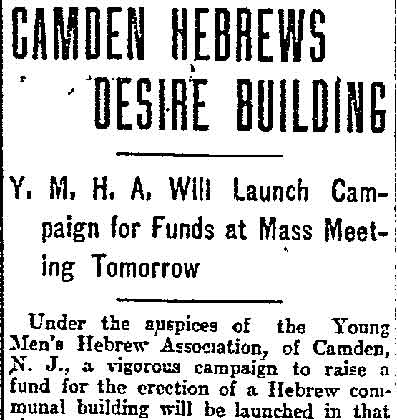
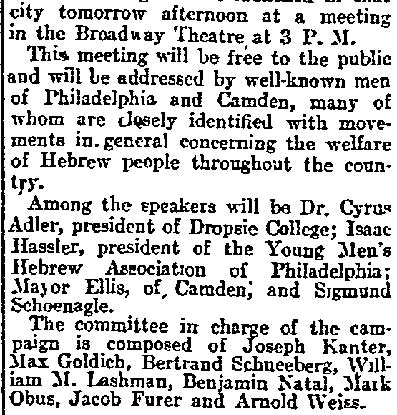
Y. M. H. A. Will Launch Campaign for Funds at Mass Meeting Tomorrow
Under the auspices of the Young Men’s Hebrew Association, of Camden, N. J., a vigorous campaign to raise a fund for the erection of a Hebrew communal building will be launched in that city tomorrow afternoon at a meeting in the Broadway Theatre at 3 P. M. This meeting will be free to the public and will be addressed by well-known men of Philadelphia and Camden, many of whom are closely identified with movements in general concerning the welfare of Hebrew people throughout the country.
Among the speakers will be Dr. Cyrus Adler, president of Dropsie College; Isaac Hassler, president of the Young Men’s Hebrew Association of Philadelphia; Mayor Ellis, of Camden; and Sigmund Schoenagle.
The committee in charge of the campaign is composed of Joseph Kanter, Max Goldich, Bertrand Schneeberg, William M. Lashman, Benjamin Natal, Mark Obus, Jacob Furer and Arnold Weiss.
Planning Memorial Day Program
Philadelphia Inquirer —
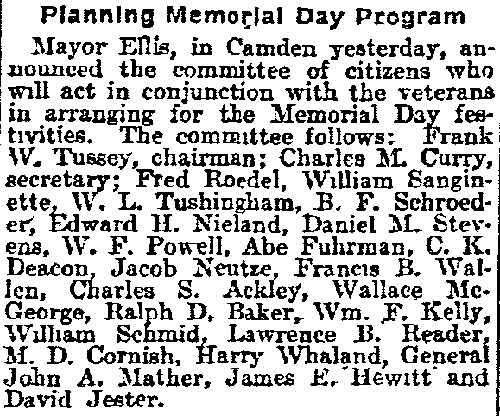
Mayor Ellis, in Camden yesterday, announced the committee of citizens who will act in conjunction with the veterans in arranging for the Memorial Day festivities. The committee follows: Frank W. Tussey, chairman; Charles M. Curry, secretary; Fred Roedel, William Sanginette, W. L. Tushingham, B. F. Schroeder, Edward H. Nieland, Daniel M. Stevens, W. F. Powell, Abe Fuhrman, C. K. Deacon, Jacob Neutze, Francis B. Wallen, Charles S. Ackley, Wallace McGeorge, Ralph D. Baker, Wm. F. Kelly, William Schmid, Lawrence B. Reader, M. D. Cornish, Harry Whaland, General John A. Mather, James E. Hewitt and David Jester.
Camden at a Glance
Philadelphia Inquirer —
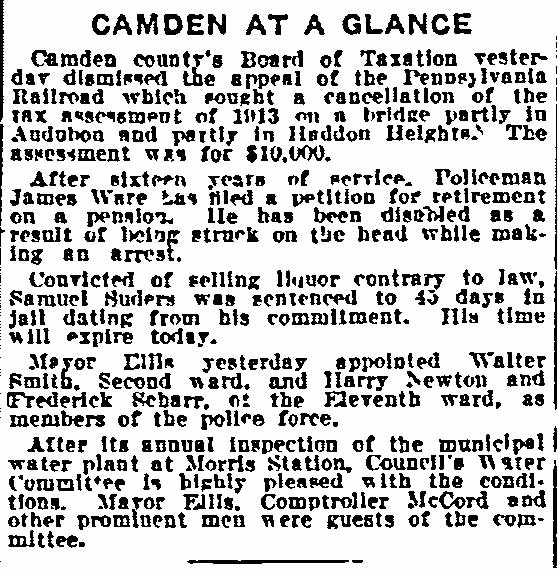
Camden county’s Board of Taxation yesterday dismissed the appeal of the Pennsylvania Railroad which sought a cancellation of the tax assessment of 1913 on a bridge partly in Audubon and partly in Haddon Heights. The assessment was for $10,000.
After sixteen years of service, Policeman James Ware has filed a petition for retirement on a pension. He has been disabled as a result of being struck on the head while making an arrest.
Convicted of selling liquor contrary to law, Samuel Suders was sentenced to 45 days in jail dating from his commitment. His time will expire today.
Mayor Ellis yesterday appointed Walter Smith, Second ward, and Harry Newton and Frederick Scharr, of the Eleventh ward, as members of the police force.
After its annual inspection of the municipal water plant at Morris Station, Council’s Water Committee is highly pleased with the conditions. Mayor Ellis, Comptroller McCord and other prominent men were guests of the committee.
Firemen to Parade in Gloucester City
Philadelphia Inquirer —
Fifteen Companies to Participate in Pageant Saturday When New Engine Is Housed
Special to The Inquirer. GLOUCESTER CITY, N. J., May 6.—At a meeting of the Board of Fire Commissioners and Fire Department today arrangements were completed for the firemen’s parade to be held on Saturday in connection with the housing of the new fire engine. About fifteen fire companies will participate, and Mayor Mealey, who is chief of the fire department, will be marshal, with William Known and Thomas Cozan as his aides.
The parade will start from the hose house on Bergen street. At the reviewing stand, in front of the City Hall, the judges will decide the winners. The judges will be Sheriff Joseph E. Nowrey, Mayor Charles Ellis, of Camden; Mayor Milliard F. Cattell, of Woodbury; Chief Worthington, of the Camden Fire Department, and Chief Baxter, of Philadelphia. Jennings’ Band will head the line, followed by the city officials in automobiles.
The Boy Scouts will assist in patrolling the route, along with a number of Camden police. Prizes will be awarded for the company having the largest number of men in line; the company coming the furthest distance; the company having the best band, and the best equipped company.
THOUSANDS VIEW CHIEF'S REMAINS
CAMDEN POST-TELEGRAM - May 10, 1914
THOUSANDS VIEW CHIEF'S REMAINS
Throngs Jam Court House While Body Lies in State for Two Hours.
Not since the memorable funeral of Chief of Police Foster ten years ago, has there been such a genuine public tribute paid an official of Camden as was in evidence last night at the bier of the lamented Fire Chief Worthington, and today at his funeral. It is hard to estimate the number of persons in a crowd, but from 7 until 9 o'clock last night there was a steady stream of men, women and children, two abreast, who passed from the main entrance, through the center corridor and beneath the illuminated rotunda, where the body lay, and thence out by the west corridor. There was never a stop, and it is estimated that at least 10,000 persons were there, perhaps more.
There could not have been a more ideal location for the repose of the casket containing the honored dead, and the great array of beautiful flowers than beneath the rotunda. It seemed to be a sacred shrine in itself where the citizenry dropped a tear for the lamented departed. The effulgence of the soft lights from above specially installed by Electrical Chief Kelly but lent to the scene and as the dark garbed escort of firemen, the active pall bearers, stood, on guard, the scene was unusually impressive.
Chief Worthington, aside from the pallor that comes to the dead, looked as he did in life, for the thread had been snapped so quickly that it was while he was in his full vigor that the vital spark had taken its flight. There were some marks on his face that indicated the intense though momentary suffering through which he passed on his fateful plunge from the roof of the burning building to his quick death, and the passing crowd remarked this. But withal there was that calmness and repose feature which seemed to indicate that the gallant leader of Camden's fire fighters but lay sleeping rather than that his soul had taken its eternal flight.
Public grief may be a mere ephemeral emotion, born of the moment and only to be succeeded by the acclaim of the newly arisen public idol, but last night's encomiums seemed to come from hearts that overflowed with genuine and permanent sorrow over the untimely passing of so excellent a public servant. Many tear-suffused eyes indicated this, many expressions of grief, of sorrow, of condolence of those left showed this. The sentiment in evidence everywhere can only be likened to the sweetness of the wonderful flowers whose odor spread thorough all the corridors and in all the rooms of the great marble building.
High in the clock tower of the City Hall the bell began tolling at 6:30 o'clock. At half-minute intervals its doleful strains went forth on the cold blustery east wind which had succeeded at day of spring sunshine. The bell and the screeching wind seemed to combine as a knell indicating the passing grief of the city. It was the preliminaries to the marching of the funeral cortege from the stricken Chief's home on Penn Street to the resting place at the Court House.
There were forty policemen in dress uniform with Chief Gravenor at their head. There were twenty-six fire heads from Philadelphia, with Chief William Murphy in the van, a tribute in itself of more than passing moment. There was the caisson on which was the black draped casket containing the body of he who all honored. There was the little red car in which Chief Worthington was wont to speed through the city at every alarm and there was his helmet and coat. There was Acting Chief Stockton and forty of the men who fought flames under the direction of he who lay so still. There as the family in cabs with curtains drawn, the members of City Council and the active pall bearers- Daniel Leach, Peter B. Carter, james white, William Patterson, Elmer Burkett, Samuel Harring.
When the cortege reached the Court House the Camden boys took up their position on the inside beneath rotunda while the Philadelphia visitors made an imposing array on the granite steps outside. And then came the public in its steady and unending stream.
Later the Philadelphia delegation was escorted to the Board of Freeholders room where tribute was paid to the dead and where a mingling of the two cities took place. Besides Chief Murphy the visitors included Battalion Chiefs William T. Barrett and George P. McConaghy, Captains L. F. Bunting, William Lindsey; H. Dinlocker, J. Higginson, J. E. Talbot, D. Campbell, T. O'Brien, F. Hughes, E. Basenfelder; H. Hutt, William McCusker, G. Rheim, R. Wilsey, J. Webb, H. Goers, H. Haines, Insurance Patrol Captain Joseph H. Shermer William Hickman, William Rodgers, John Wyatt, David Phillip, John Clyde, H. Wilkinson.
President of City Council James E. Hewitt spoke of the work Chief Worthington had already accomplished, of his plans, of his value and worth to Camden. Chief Murphy responded in a fitting way and this incident in itself was one to be remembered.
An affecting sight was witnessed by the handful of spectators, among them being other firemen, city and county officials and policemen who remained after the big doors on Sixth Street had been closed. The last to view the Chief's remains were a delegation of about twenty firemen. Solemnly the men passed by the bier and gazed upon the features of their departed brother.
As the last of the line approached Deputy Chief John A. Stockton was seen. He stopped and with his cap laid across his breast be looked down into the casket. For almost a minute Chief Stockton stood as though glued to the spot. Then he glanced about him and the sympathetic look upon his face thrilled all.
He heaved a sigh and perhaps the teardrops refused to come, but Chief Stockton, as the lines upon his face showed, was struggling with the inner man. His emotions were tugging at his heart, but a fire laddie cannot give way to his feelings although his brother superior officer and dear friend had answered his last alarm.
The floral pieces surrounding the bier bespoke the love, admiration and respect the donors held for the dead chief. One design particularly beautiful was a mammoth loving cup made of blossoms, f1owers and roses. This was the token sent by members of City Council and other city officials.
Another was the design sent by the Electrical Bureau through Chief Kelly. The original fire box, No. 134, which was pulled on the night of the fire by Chief Worthington was enshrouded by roses, carnations and lilies.

A maltese cross standing several feet high and bearing the initials of the organization was the tribute sent by the Firemen's Mutual Benevolent Association. Chief Worthington was president of this association.
The Camden police sent a large shield of flowers and Council members offered a vacant chair of roses. The New Jersey Auto Supply Company, No. 2 Engine Company and No. 1 Truck sent beautiful broken circles and a wreath was the offering from the employees of the Victor Talking Machine Company.
A broken circle from member of the Sixth Ward Republican Club and a wreath from his friends in the sixth precinct of the Second Ward were other beautiful pieces. West Collingswood and Collingswood firemen sent two beautiful floral circles and from the Loyal Order Legion a wreath was received.
Other offerings were from the Camden Liquor Dealers league, a beautiful circle from No. 6 Engine Company, in which house Chief Worthington was captain previous to his elevation to the office of chief; sprays from the Bethany M.E. Church, Ladies Auxiliary of the Loyal Order of Moose; a wreath from the pupils of the eighth grade Sewell school, and a spray from North Baptist Church. There also were designs from members of the family and friends, all of which bespoke the great love held for the departed fire chief.
The impressive services of the P.E. Church marked the last sad rites this afternoon at St. Paul's Church. The guard of honor and city officials left Fire Headquarters at 1:20 and proceeded to the Worthington home and escorted the remains to the church, where services were conducted by the rector, Rev. R.E. Brestell, and Rev. H.O. Jones, rector of St. Stephen's P.E. Church. Interment was made at Arlington.
The honorary pallbearers were mayor ellis, Hon. David Baird, Frank F. Patterson, John W. Bell, General John A. Mather, Melbourne F. Middleton Jr., Harry R. Reed, Arthur L. Jones, Robert Gordon, David Jester, George Schneider, William Mills, J.O. Grear, William Hall, George L. Bender, and James E. Hewitt.
Camden Pays Honor to Dead Fire Chief
Philadelphia Inquirer —
Body of Department Head Who Lost Life While on Duty to Lie in State
Camden is to pay fitting honor to its martyred Chief of the Fire Department, Charles Worthington, who was killed Friday night at the fire in North Delaware avenue when he fell from a roof while directing his men. Council’s Fire Commisioners [sic] met yesterday in special session and decided to have the body of Chief Worthington lie in state in the main corridor of the City Hall on Tuesday night from 7 to 9 o’clock. A special guard of twenty-six of the city firemen will be announced. Mayor Ellis, members of Council and others prominent in the municipality’s official life will pay their tribute to the fallen chief. The funeral will take place on Wednesday from Chief Worthington’s late home, at 101[?] Cooper street.
Chief Worthington had been at the head of the department less than a year, having succeeded Chief Elfreth, who had held that position for many years. A young man and filled with modern methods and ideas, Chief Worthington was bringing the department up to a high state of efficiency, which was recognized by the insurance and business people as well.
Until the appointment of Chief Worthington’s successor, Assistant Chief Stockton will have charge of the men.
Formal Opening of Recreation Centre
Philadelphia Inquirer —
Addresses by Mayor and Commissioners at Flag-raising---Twelve Playgrounds in Use
Under the direction of the Camden Board of Playground Commissioners the new recreation centre at Seventh and Jefferson streets, Camden, was formally opened for employed boys and girls last night. Mayor Ellis and Commissioners Finkeldey and Covely made addresses. There was a flag-raising, Florence Brogan, the little daughter of Frank Brogan, pulling Old Glory to the top of the new pole, while hundreds of miniature flags dropped out to be retained as souvenirs. There was a large attendance of those for whom the ground was opened
Camden’s twelve play centres were opened for the season yesterday with Miss Ida M. Schwartz, of Philadelphia, as supervisor in charge. The ideal weather brought out large attendances throughout the city.
Wants More Interest in Commuters’ Fight
Philadelphia Inquirer —
Mayor Ellis Deplores Attitude of Commuters Who Do Not Realize What Rise Means
While many of the towns in South Jersey failed to send representatives to the meeting of the Commuters’ Association in Camden yesterday afternoon, those who did attend planned for an energetic prosecution of the campaign against the Pennsylvania and Reading Railway companies in relation to the proposed increase in passenger rates. Efforts will be made to have the communities vitally affected send representatives before the Public Utility Commission when it has its meeting Thursday at the Camden Court House.
Mayor Ellis, who presided at the meeting, deplored the apparent attitude of some communities which do not appear to realize what the raise in rates will mean.
George M. Richardson, representing Clayton, and a member of the Executive Committee, stated that several places showed absolutely no interest in the matter.
(news brief)
Philadelphia Inquirer —

Mayor Ellis last night formally opened the third annual carnival and industrial show of the Camden Police Beneficial Association at the Third Regiment Armory. It will continue for a week.
Four Attacked by Dogs
Philadelphia Inquirer —
Four persons were attacked by dogs in various parts of Camden yesterday. Edna Chew, aged 4 years, of 572 Division street, received severe lacerations of the face, while Elwood Davis, aged 51 years, of New Brunswick, was bitten on the hand. They were treated at Cooper Hospital. Thomas Sullivan, aged 12 years, of 1238 Locust street, and George Cowgill, aged 4 years, of 203 Mechanic street, were bitten on the hand and leg, respectively, by a dog in South Camden. They had their injuries dressed at the Homeopathic Hospital. Mayor Ellis has given strict orders to have every unmuzzled dog off the street.
Names Cattle Inspector
Philadelphia Inquirer —
In response to a request from the government Mayor Ellis, of Camden, has named Dr. Charles B. Helm as cattle inspector. His duty is to inspect all cattle shipped to Camden and his compensation is paid by the cattle owners. The State Board of Health has sent the Mayor a letter approving of his selection.
(news brief)
Philadelphia Inquirer —

By ordinance of City Council Camden had joined the State League of Municipalities. Mayor Ellis has been made a member of the Committee on Organization.
Camden at a Glance
Philadelphia Inquirer —
Before Referee in Bankruptcy Ott yesterday a dividend of 5 per cent was declared to the creditors of John H. Dialogue, whose shipyard on the Delaware was at one time among the most thriving along the river.
Miss Lucy Becker, of 1160 Jackson street, and William Durham, a real estate operator of 1837 Broadway, were married yesterday by Rev. William Crum [sic], of the Trinity M. E. Church.
Although but ten years old, Frank Mazhaccio was taken to the State Home for Boys yesterday as an incorrigible.
A meeting of the jitney men has been called for tomorrow morning at 10 o’clock at the Hotel Ridgway for organization. The call was made by Assemblyman Garfield Pancoast. Mayor Ellis will address the drivers of the jits.
Jitney Drivers Organize
Philadelphia Inquirer —
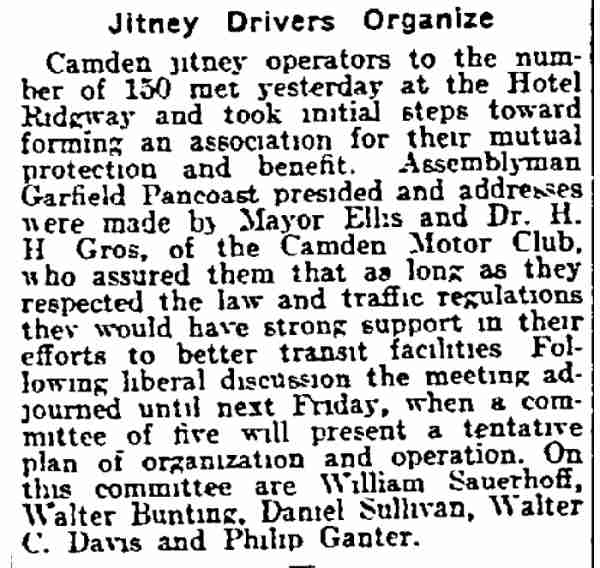
Camden jitney operators to the number of 150 met yesterday at the Hotel Ridgway and took initial steps toward forming an association for their mutual protection and benefit. Assemblyman Garfield Pancoast presided and addresses were made by Mayor Ellis and Dr. H. H. Gros, of the Camden Motor Club, who assured them that as long as they respected the law and traffic regulations they would have strong support in their efforts to better transit facilities. Following liberal discussion the meeting adjourned until next Friday, when a committee of five will present a tentative plan of organization and operation. On this committee are William Sauerhoff, Walter Bunting, Daniel Sullivan, Walter C. Davis and Philip Ganter.
Camden Playgrounds to Be Opened Today
Philadelphia Inquirer —
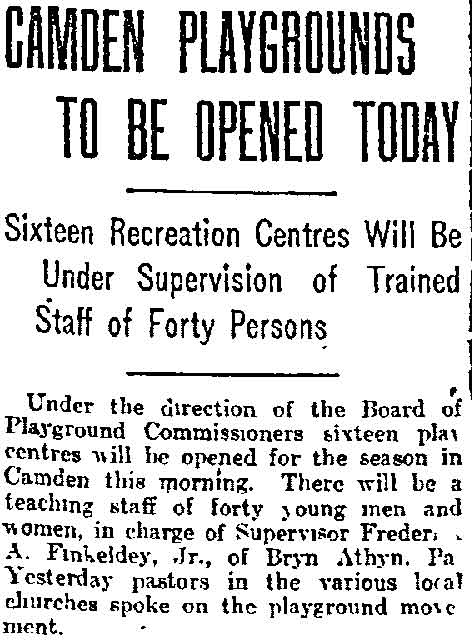
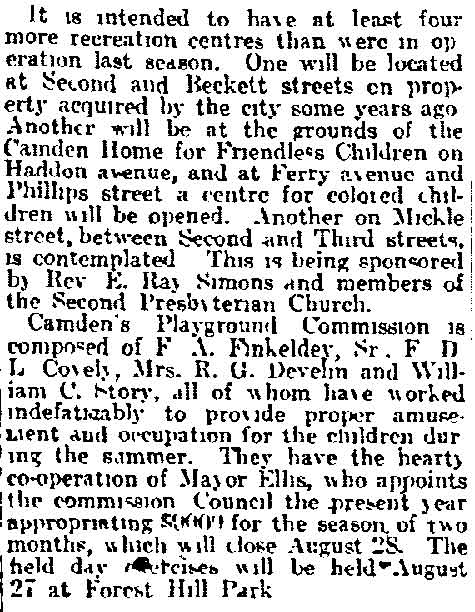
Sixteen Recreation Centres Will Be Under Supervision of Trained Staff of Forty Persons
Under the direction of the Board of Playground Commissioners sixteen play centres will be opened for the season in Camden this morning. There will be a teaching staff of forty young men and women, in charge of Supervisor Frederick A. Finkeldey, Jr., of Bryn Athyn, Pa. Yesterday pastors in the various local churches spoke on the playground movement.
Frederick A. Finkeldey Jr. — Frederick A. Finkeldey Sr. — Rev. E. Ray Simons — Charles H. Ellis — F.D.L. Covely — Mrs. R.G. Develin — William C. Story — Camden Home for Friendless Children — South 2nd Street — South 3rd Street — Beckett Street — Haddon Avenue — Ferry Avenue — Phillips Street
Frederick A. Finkeldey Jr. - Frederick A. Finkeldey Sr. - Rev. E. Ray Simons
Charles H. Ellis - F.D.L. Covely - Mrs. R.G. Develin - William C. Story
Camden Home for Friendless Children - Second Presbyterian Church
South 2nd Street - South 3rd Street - Beckett Street - Haddon Avenue
Ferry Avenue - Phillips Street - Mickle Street
Camden at a Glance
Philadelphia Inquirer —
Mayor Ellis yesterday received word of the ratification of his election to the vice presidency of the Deerer Waterways Association as well as his appointment as the representative from New Jersey.
Camden Aims to End Overhead Wire Danger
Philadelphia Inquirer —
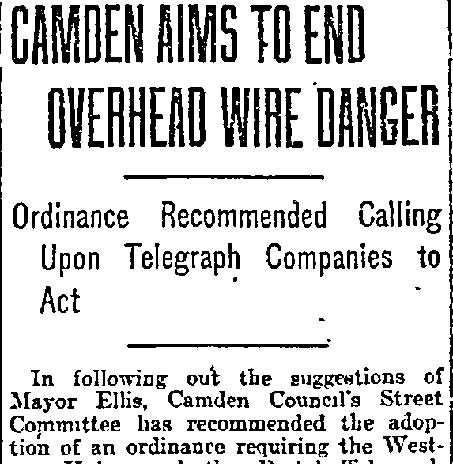
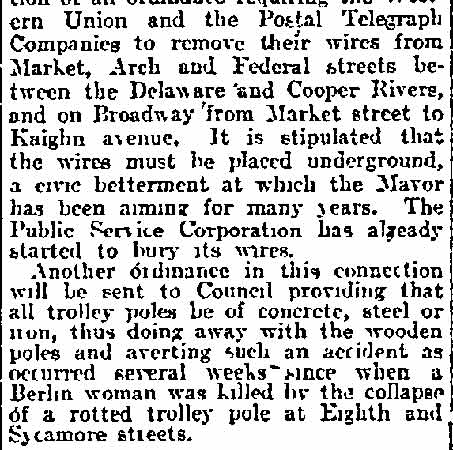
Ordinance Recommended Calling Upon Telegraph Companies to Act
In following out the suggestions of Mayor Ellis, Camden Council’s Street Committee has recommended the adoption of an ordinance requiring the Western Union and the Postal Telegraph Companies to remove their wires from Market, Arch and Federal streets between the Delaware and Cooper Rivers, and on Broadway from Market street to Kaighn avenue. It is stipulated that the wires must be placed underground, a civic betterment at which the Mayor has been aiming for many years. The Public Service Corporation has already started to bury its wires.
Another ordinance in this connection will be sent to Council providing that all trolley poles be of concrete, steel or iron, thus doing away with the wooden poles and averting such an accident as occurred several weeks since when a Berlin woman was killed by the collapse of a rotted trolley pole at Eighth and Sycamore streets.
Camden at a Glance
Philadelphia Inquirer —
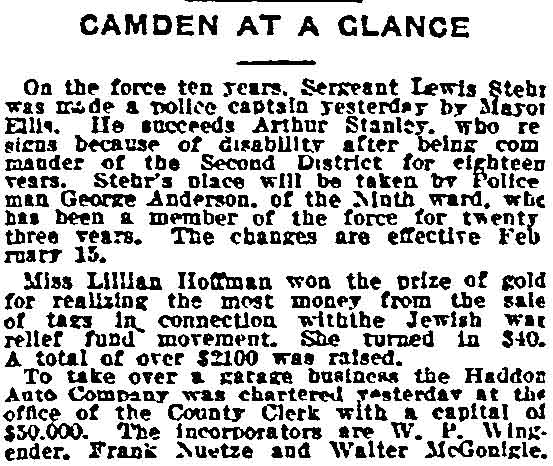
On the force ten years, Sergeant Lewis Stehr was made a police captain yesterday by Mayor Ellis. He succeeds Arthur Stanley, who resigns because of disability after being commander of the Second District for eighteen years. Stehr’s place will be taken by Policeman George Anderson, of the Ninth ward, who has been a member of the force for twenty three years. The changes are effective February 15.
Miss Lillian Hoffman won the prize of gold for realizing the most money from the sale of tags in connection with the Jewish war relief fund movement. She turned in $40. A total of over $2100 was raised.
To take over a garage business the Haddon Auto Company was chartered yesterday at the office of the County Clerk with a capital of $50,000. The incorporators are W. P. Wingender, Frank Nuetze and Walter McGonigle.
Police Shake-up in Camden
Philadelphia Inquirer —
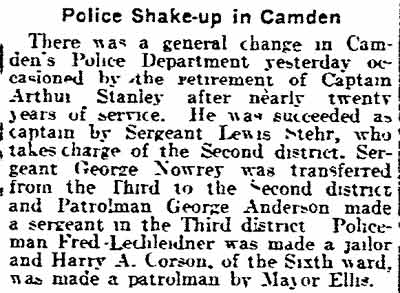
There was a general change in Camden’s Police Department yesterday occasioned by the retirement of Captain Arthur Stanley after nearly twenty years of service. He was succeeded as captain by Sergeant Lewis Stehr, who takes charge of the Second district. Sergeant George Nowrey was transferred from the Third to the Second district and Patrolman George Anderson made a sergeant in the Third district. Policeman Fred Lechleidner was made a jailor and Harry A. Corson, of the Sixth ward, was made a patrolman by Mayor Ellis.
Moose Band Concert Raises Funds for Soldiers
Philadelphia Inquirer —
A liberal offering for the fund being raised for the relief of the families of soldiers at the front was made last night by a crowd of several thousand persons who heard the free concert given by the Moose Band on the Court House plaza. After an eloquent plea by Mayor Ellis coins fairly rained into the hats passed by members of the Moose lodge.
Camden May Entertain Waterways Delegates
Philadelphia Inquirer —
Mayor Asks That Visitors Be Given Part of a Day to Inspect New Jersey City’s Industries
It is being planned by Mayor Ellis, of Camden, and committees of Council, the Board of Freeholders, the Board of Trade and a Citizens’ Committee to contribute a share toward the entertainment of the delegates to the Atlantic Deeper Waterways Association, to be held in Philadelphia from September 12 to 15.
Mayor Ellis stated yesterday that to his surprise he learned that the Philadelphia members in charge of the arrangements had made no provision for Camden to entertain the 600 or more delegates. He told the committee that Camden expended over $600 to send delegates to the association’s convention, held last year in Savannah, Ga., and demanded that Camden be given at least a half day to entertain the delegates.
It is planned by Mayor Ellis and the committees to have the delegates come to Camden and inspect the industries for which the city is noted. The climax to the day’s entertainment is expected to be a clam bake, or an open-air banquet.
Hebrews to Build House
Philadelphia Inquirer —
Under the direction of the Young Men’s Hebrew Association, a community meeting is to be held Sunday night to begin a week’s campaign to raise $15,000 for a communal house. Among the speakers will be Mayor Charles H. Ellis, Rev. B. L. Levinthal, Rev. Henry Berkowitz, Isaac Hassler, former president of the Philadelphia Y. M. H. A., and Louis Brenner, field secretary of the National Association.
Camden Men Deny Plan to Gobble Small Towns
Philadelphia Inquirer —
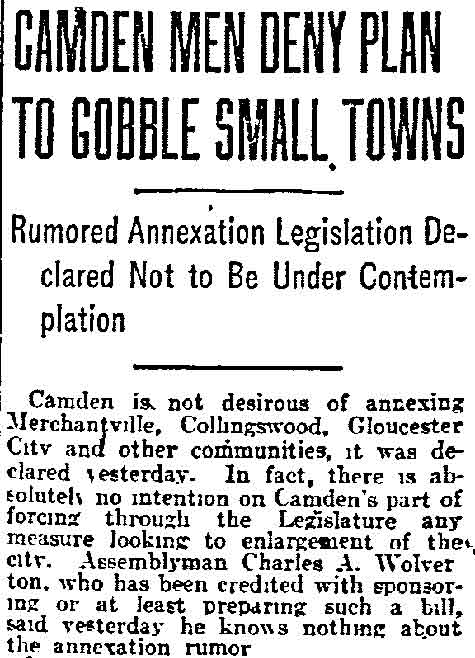
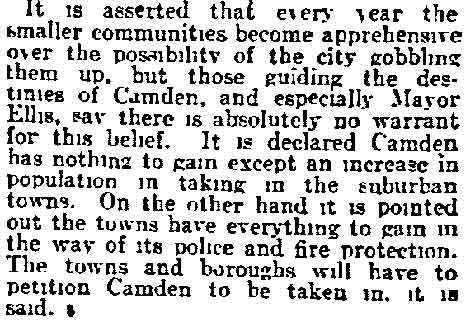
Rumored Annexation Legislation Declared Not to Be Under Contemplation
Camden is not desirous of annexing Merchantville, Collingswood, Gloucester City and other communities, it was declared yesterday. In fact, there is absolutely no intention on Camden’s part of forcing through the Legislature any measure looking to enlargement of the city. Assemblyman Charles A. Wolverton, who has been credited with sponsoring or at least preparing such a bill, said yesterday he knows nothing about the annexation rumor
It is asserted that every year the smaller communities become apprehensive over the possibility of the city gobbling them up, but those guiding the destinies of Camden, and especially Mayor Ellis, say there is absolutely no warrant for this belief. It is declared Camden has nothing to gain except an increase in population in taking in the suburban towns. On the other hand it is pointed out the towns have everything to gain in the way of its police and fire protection. The towns and boroughs will have to petition Camden to be taken in, it is said.
Camden Police Courtesy Card — 1917
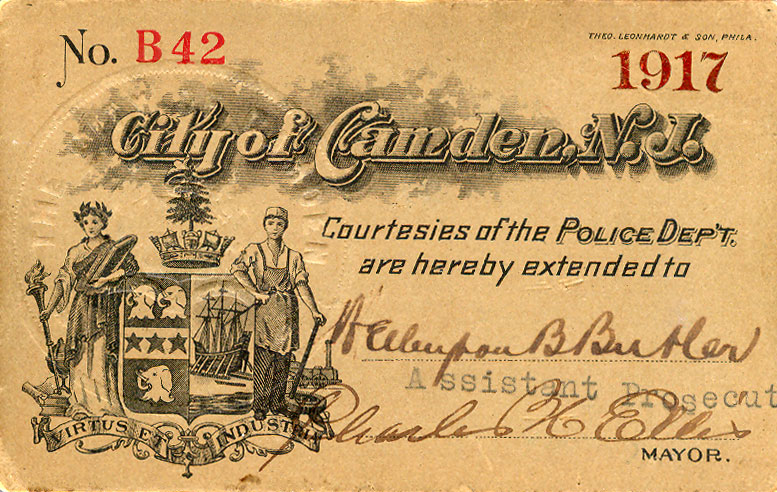
THEO. LEONHARDT & SON, PHILA.
City of Camden, N.J.
No. B42 — 1917
Courtesies of the Police Dep’t. are hereby extended to
Wellington B. Butler
Assistant Prosecutor
[Signed] Charles H. Ellis
Mayor
Camden Police Courtesy Card – 1917 Signed by Mayor Ellis
Camden Police Courtesy Card - 1917
Signed by Mayor Ellis
Mayor to Open Police Carnival
Philadelphia Inquirer —
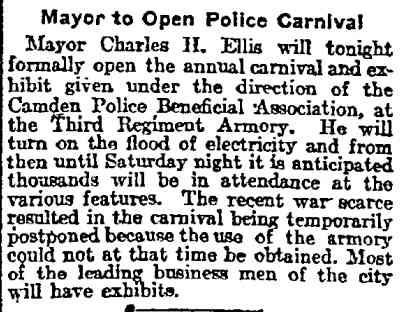
Mayor Charles H. Ellis will tonight formally open the annual carnival and exhibit given under the direction of the Camden Police Beneficial Association, at the Third Regiment Armory. He will turn on the flood of electricity and from then until Saturday night it is anticipated thousands will be in attendance at the various features. The recent war scare resulted in the carnival being temporarily postponed because the use of the armory could not at that time be obtained. Most of the leading business men of the city will have exhibits.
Mayor Celebrates Birthday
Philadelphia Inquirer —
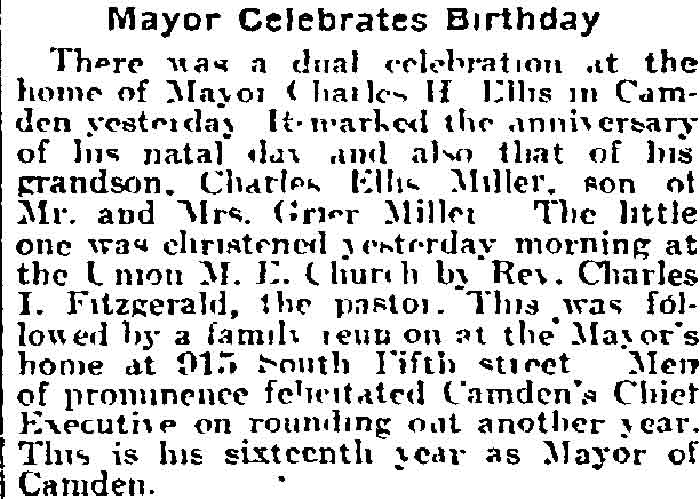
There was a dual celebration at the home of Mayor Charles H. Ellis in Camden yesterday. It marked the anniversary of his natal day and also that of his grandson, Charles Ellis Miller, son of Mr. and Mrs. Grier Miller. The little one was christened yesterday morning at the Union M. E. Church by Rev. Charles I. Fitzgerald, the pastor. This was followed by a family reunion at the Mayor’s home at 915 South Fifth street. Men of prominence felicitated Camden’s Chief Executive on rounding out another year. This is his sixteenth year as Mayor of Camden.
Here and There in Camden
Philadelphia Inquirer —
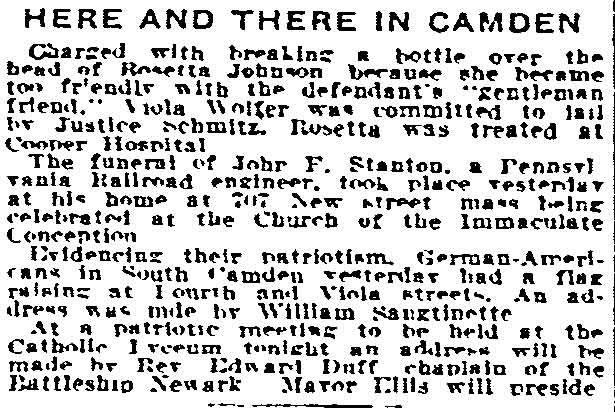
Charged with breaking a bottle over the head of Rosetta Johnson because she became too friendly with the defendant’s “gentleman friend,” Viola Wolfer was committed to jail by Justice Schmitz. Rosetta was treated at Cooper Hospital.
The funeral of John F. Stanton, a Pennsylvania Railroad engineer, took place yesterday at his home at 707 New street, mass being celebrated at the Church of the Immaculate Conception.
Evidencing their patriotism, German-Americans in South Camden yesterday had a flag raising at Fourth and Viola streets. An address was made by William Sangtinette.
At a patriotic meeting to be held at the Catholic Lyceum tonight an address will be made by Rev. Edward Duff, chaplain of the Battleship Newark. Mayor Ellis will preside.
Registry List Filed
Philadelphia Inquirer —
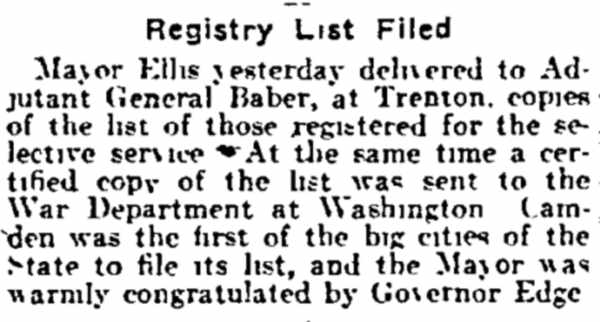
Mayor Ellis yesterday delivered to Adjutant General Baber, at Trenton, copies of the list of those registered for the selective service. At the same time a certified copy of the list was sent to the War Department at Washington. Camden was the first of the big cities of the State to file its list, and the Mayor was warmly congratulated by Governor Edge.
Will Notify Camden Registered Men Tuesday
Philadelphia Inquirer —
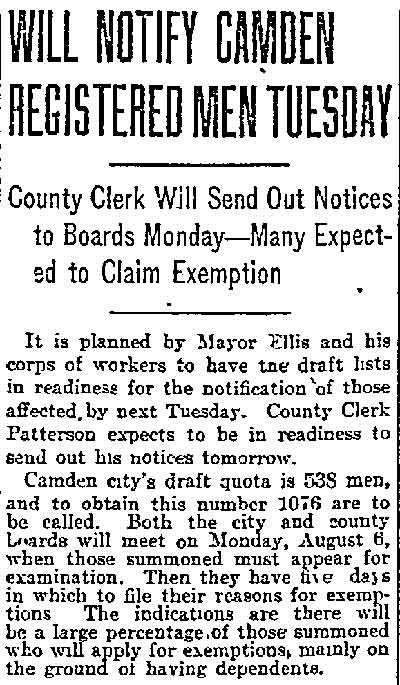
County Clerk Will Send Out Notices to Boards Monday—Many Expected to Claim Exemption
It is planned by Mayor Ellis and his corps of workers to have the draft lists in readiness for the notification of those affected, by next Tuesday. County Clerk Patterson expects to be in readiness to send out his notices tomorrow.
Camden city’s draft quota is 538 men, and to obtain this number 1076 are to be called. Both the city and county boards will meet on Monday, August 6, when those summoned must appear for examination. Then they have five days in which to file their reasons for exemptions. The indications are there will be a large percentage of those summoned who will apply for exemptions, mainly on the ground of having dependents.
Red Cross Kits Presented to Mayor Ellis
Philadelphia Inquirer —

On behalf of the Red Cross Dr. Daniel Strock, the president, yesterday presented Mayor Ellis for the city two complete Red Cross kits. One will be located at the City Hall and the other at No. 3 engine house.
Dr. Daniel Strock - charles h. ellis - Engine Company 3
Police Department Changes
Philadelphia Inquirer —
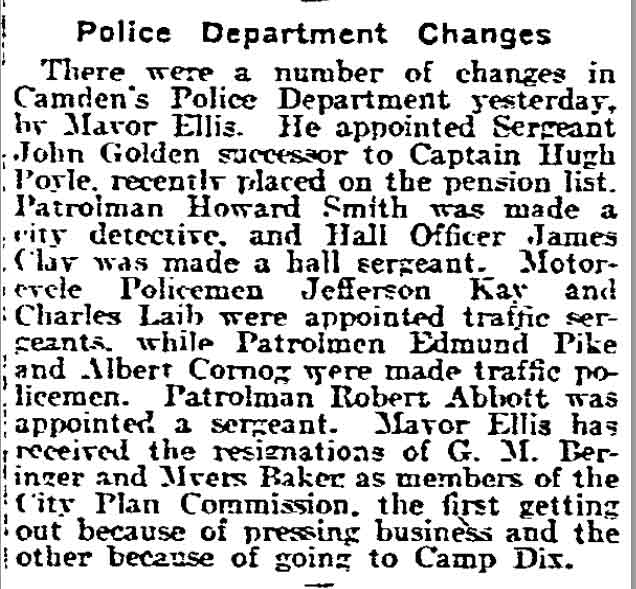
There were a number of changes in Camden’s Police Department yesterday, by Mayor Ellis. He appointed Sergeant John Golden successor to Captain Hugh Boyle, recently placed on the pension list. Patrolman Howard Smith was made a city detective, and Hall Officer James Clay was made a hall sergeant. Motorcycle Policemen Jefferson Kay and Charles Laib were appointed traffic sergeants, while Patrolmen Edmund Pike and Albert Cornog were made traffic policemen. Patrolman Robert Abbott was appointed a sergeant. Mayor Ellis has received the resignations of G. M. Beringer and Myers Baker as members of the City Plan Commission, the first getting out because of pressing business and the other because of going to Camp Dix.
Speakeasies Raided
Philadelphia Inquirer —
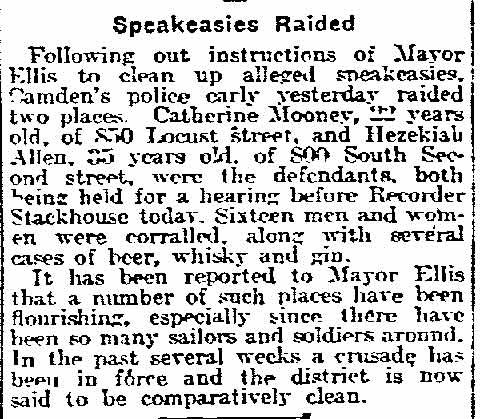
Following out instructions of Mayor Ellis to clean up alleged speakeasies, Camden’s police early yesterday raided two places. Catherine Mooney, 22 years old, of 850 Locust street, and Hezekiah Allen, 35 years old, of 800 South Second street, were the defendants, both being held for a hearing before Recorder Stackhouse today. Sixteen men and women were corralled, along with several cases of beer, whisky and gin.
It has been reported to Mayor Ellis that a number of such places have been flourishing, especially since there have been so many sailors and soldiers around. In the past several weeks a crusade has been in force and the district is now said to be comparatively clean.
Shipyards Call Policeman and Three Firemen
Camden Post-Telegram —
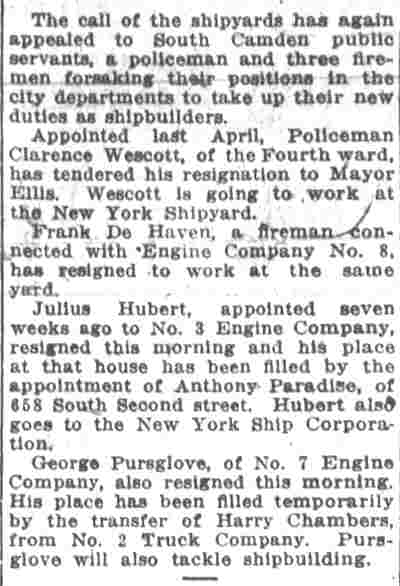
The call of the shipyards has again appealed to South Camden public servants, a policeman and three firemen forsaking their positions in the city departments to take up their new duties as shipbuilders.
Appointed last April, Policeman Clarence Wescott, of the Fourth ward, has tendered his resignation to Mayor Ellis. Wescott is going to work at the New York Shipyard.
Frank De Haven, a fireman connected with Engine Company No. 8, has resigned to work at the same yard.
Julius Hubert, appointed seven weeks ago to No. 3 Engine Company, resigned this morning and his place at that house has been filled by the appointment of Anthony Paradise, of 658 South Second street. Hubert also goes to the New York Ship Corporation.
George Pursglove, of No. 7 Engine Company, also resigned this morning. His place has been filled temporarily by the transfer of Harry Chambers, from No. 2 Truck Company. Pursglove will also tackle shipbuilding.
Camden Cars to Run on Skip-Stop System
Philadelphia Inquirer —
Council Gives Assent to Company to Start New Schedule On Wednesday
Click on Image for PDF File of Complete Article
Banquet to Jewish Soldiers
Philadelphia Inquirer —
Working in conjunction with the Jewish Board of Welfare Work the Young Men’s Hebrew Association of Camden will on the evening of April 28, tender a dinner to all young men of their race already drafted and who are about to be sent to Camp Dix. Governor Edge and Senators Baird and Frelinghuysen along with others of prominence will be invited. Mayor Ellis will welcome the visitors on behalf of the city. Lawyer Benjamin Natal is chairman of the committee in charge. Associated with him are Abe Fuhrman, Samuel Mackler, Morris Berman and Mark Obus.
Jewish Draftees Given Send-Off at Camden
Philadelphia Inquirer —
State Treasurer Read Lauds Patriotism of Hebrews All Over the Country
One of the features of a dinner given at the Towers, Broadway and Pine street, Camden, last night, to the Jewish draftees, was the appearnce [sic] of forty boys who came from Camp Dix at a special order issued by General Scott, the commandant. The dinner was given under the direction of the Young Men’s Hebrew Association and the Jewish Board of Welfare Work, which does the same character of work in the cantonments as the Y. M. C. A. and the Knights of Columbus.
On account of a previous engagement, Governor Edge was unable to be present and he was represented by State Treasurer William T. Read. Treasurer Read delivered a short address, in which he predicted that the Allies would win the war and praised the work being done by the Jewish boys throughout the country. Mayor Charles E. Ellis also lauded the patriotism of the Camden boys and declared that the war would be won by the Allies through the work of the United States.
Cyrus J. Janover, representative of the Jewish welfare at Camp Dix, and Chaplain Henry S. Davidson, also of Dix; Joseph Hagendorn, a Philadelphia Jewish orator; State Senator Haines, Judges Kates and Pancoast and Assemblyman Kellum also spoke. Benjamin Natal, a Camden attorney, conceived the idea of giving the boys a reception and he had associated with him on the committee Abe Fuhrman, Samuel Mackler, Morris Berman and Mark Obus.
Camden Mayor Advises Saving in City Budget
Philadelphia Inquirer —
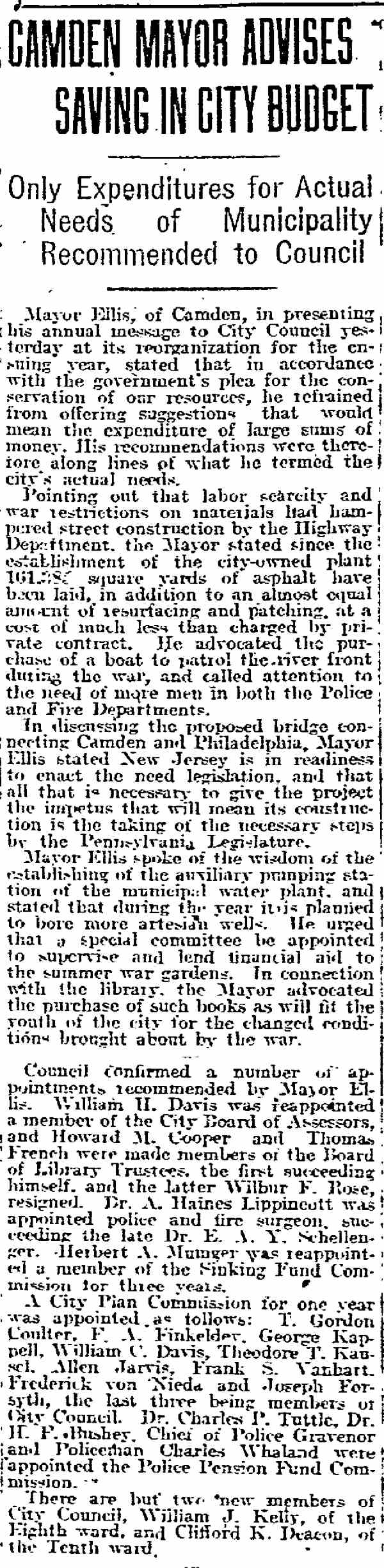
Only Expenditures for Actual Needs of Municipality Recommended to Council
Mayor Ellis, of Camden, in presenting his annual message to City Council yesterday at its reorganization for the ensuing year, stated that in accordance with the government’s plea for the conservation of our resources, he refrained from offering suggestions that would mean the expenditure of large sums of money. His recommendations were therefore along lines of what he termed the city’s actual needs.
Pointing out that labor scarcity and war restrictions on materials had hampered street construction by the Highway Department, the Mayor stated since the establishment of the city-owned plant 161,[?] square yards of asphalt have been laid, in addition to an almost equal amount of resurfacing and patching, at a cost of much less than charged by private contract. He advocated the purchase of a boat to patrol the river front during the war, and called attention to the need of more men in both the Police and Fire Departments.
In discussing the proposed bridge connecting Camden and Philadelphia, Mayor Ellis stated New Jersey is in readiness to enact the need [sic] legislation, and that all that is necessary to give the project the impetus that will mean its construction is the taking of the necessary steps by the Pennsylvania Legislature.
Mayor Ellis spoke of the wisdom of the establishing of the auxiliary pumping station of the municipal water plant, and stated that during the year it is planned to bore more artesian wells. He urged that a special committee be appointed to supervise and lend financial aid to the summer war gardens. In connection with the library, the Mayor advocated the purchase of such books as will fit the youth of the city for the changed conditions brought about by the war.
Council confirmed a number of appointments recommended by Mayor Ellis. William H. Davis was reappointed a member of the City Board of Assessors, and Howard M. Cooper and Thomas French were made members of the Board of Library Trustees, the first succeeding himself, and the latter Wilbur F. Rose, resigned. Dr. A. Haines Lippincott was appointed police and fire surgeon, succeeding the late Dr. E. A. Y. Schellenger. Herbert A. Munger was reappointed a member of the Sinking Fund Commission for three years.
A City Plan Commission for one year was appointed as follows: T. Gordon Coulter, F. A. Finkeldey, George Kappell, William C. Davis, Theodore T. Kausel, Allen Jarvis, Frank S. Vanhart, Frederick von Nieda and Joseph Forsyth, the last three being members of City Council. Dr. Charles P. Tuttle, Dr. H. F. Bushey, Chief of Police Gravenor and Policeman Charles Whaland were appointed the Police Pension Fund Commission.
There are but two new members of City Council, William J. Kelly, of the Eighth ward, and Clifford K. Deacon, of the Tenth ward.
Raised to Detective Bureau
Philadelphia Inquirer —
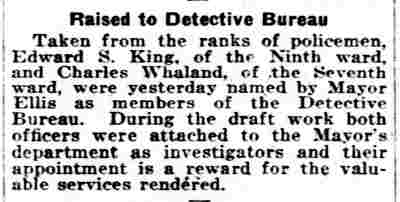
Taken from the ranks of policemen, Edward S. King, of the Ninth ward, and Charles Whaland, of the Seventh ward, were yesterday named by Mayor Ellis as members of the Detective Bureau. During the draft work both officers were attached to the Mayor’s department as investigators and their appointment is a reward for the valuable services rendered.
CAMDEN COUNTY IN THE GREAT WAR
Another weapon to defeat the enemy was the establishment of City Farm Gardens in the country. They were urged by the Government and not only provided food for city residents, but abolished unsightly vacant lots. Mayor Ellis named the first City Gardens Committee on April 19, 1917, as follows: e. g. c. bleakly, Judge Frank T. Lloyd, Zed H. Copp, William Derham, L. E. Farnham, B. M. Hedrick, David Jester, O. B. Kern, M. F. Middleton, Dr. H. L. Rose, Asa L. Roberts, W. D. Sayrs, Jr., Charles A. Wolverton, Earl T. Jackson, H. R. Kuehner, Herbert N. Moffett and Hubert H. Pfeil. At the initial meeting of the above date B. M. Hedrick was elected chairman; Zed H. Copp secretary and M. F. Middleton treasurer. Brandin W. Wright, a farming expert, was employed as general superintendent on May 3, 1917. At a meeting on May 18, 1918, the names of Frank Sheridan and Daniel P. McConnell were added to the publicity committee in the place of
Messrs. Pfeil and Jackson.
In his annual report to City Council on January 1, 1918, Mayor Ellis urged the appointment of a committee by City Council on City Gardens and Councilman Frederick Von Neida was named as chairman. This committee with a committee of representative citizens met in the City Hall in February, 19 18, to organize for the ensuing summer. The members of the Councilmanic committee were: Frederick Von Neida, frank s. van hart, William J. Kelly and John J. Robinson.
The committee planned an exposition of farm garden products for the fall of 1918, but this plan was frustrated by the Spanish influenza epidemic.
The war gardens became victory gardens in the year 1919 when the committee met on January 29, 1919. Meyers Baker was elected secretary and William D. Sayrs, Jr., treasurer. At the meeting on March 25 committees were appointed for the Victory War Gardens
Exposition held in Third Regiment Armory from September 15 to 20. Benjamin Abrams was elected general manager and Frank Sheridan publicity agent.
Camden Does Honor to Heroes’ Memory
Philadelphia Inquirer —
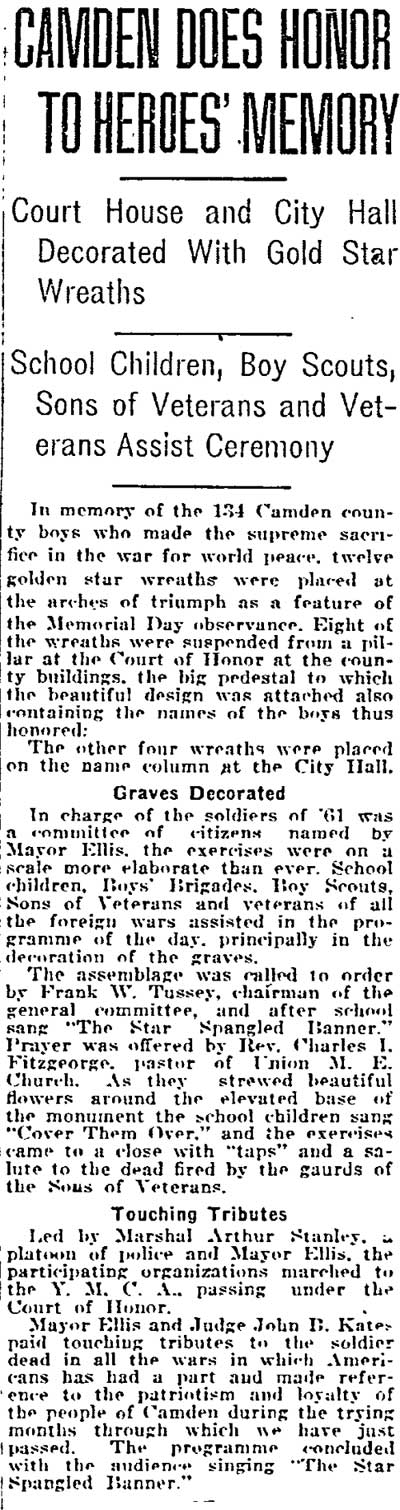
Court House and City Hall Decorated With Gold Star Wreaths
School Children, Boy Scouts, Sons of Veterans and Veterans Assist Ceremony
In memory of the 134 Camden county boys who made the supreme sacrifice in the war for world peace, twelve golden star wreaths were placed at the arches of triumph as a feature of the Memorial Day observance. Eight of the wreaths were suspended from a pillar at the Court of Honor at the county buildings, the big pedestal to which the beautiful design was attached also containing the names of the boys thus honored:
The other four wreaths were placed on the name column at the City Hall.
Graves Decorated
In charge of the soldiers of ‘61 was a committee of citizens named by Mayor Ellis, the exercises were on a scale more elaborate than ever. School children, Boys’ Brigades, Boy Scouts, Sons of Veterans and veterans of all the foreign wars assisted in the programme of the day, principally in the decoration of the graves.
The assemblage was called to order by Frank W. Tussey, chairman of the general committee, and after school sang “The Star Spangled Banner.” Prayer was offered by Rev. Charles I. Fitzgeorge, pastor of Union M. E. Church. As they strewed beautiful flowers around the elevated base of the monument the school children sang “Cover Them Over,” and the exercises came to a close with “taps” and a salute to the dead fired by the gaurds [sic] of the Sons of Veterans.
Touching Tributes
Led by Marshal Arthur Stanley, a platoon of police and Mayor Ellis, the participating organizations marched to the Y. M. C. A., passing under the Court of Honor.
Mayor Ellis and Judge John B. Kates paid touching tributes to the soldier dead in all the wars in which Americans has [sic] had a part and made reference to the patriotism and loyalty of the people of Camden during the trying months through which we have just passed. The programme concluded with the audience singing “The Star Spangled Banner.”
Camden Hails Her Sons, Conquerors, at Victory Jubilee
Philadelphia Inquirer —
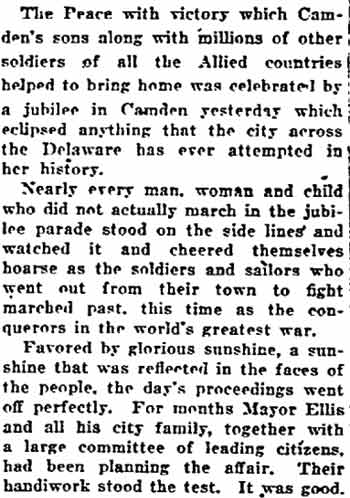
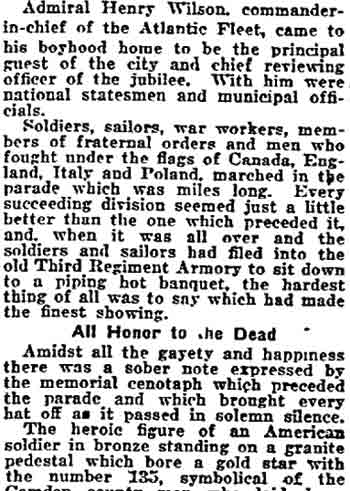
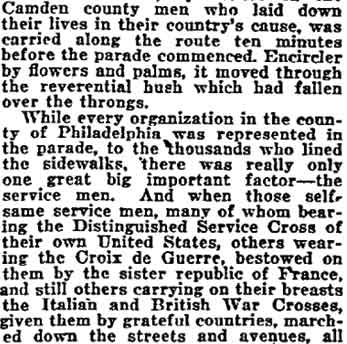
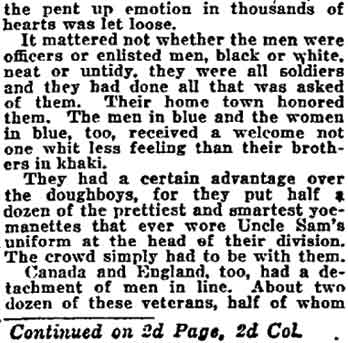
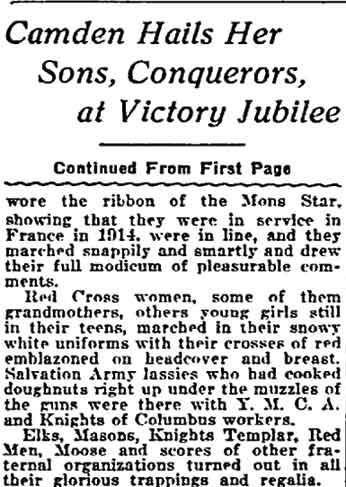
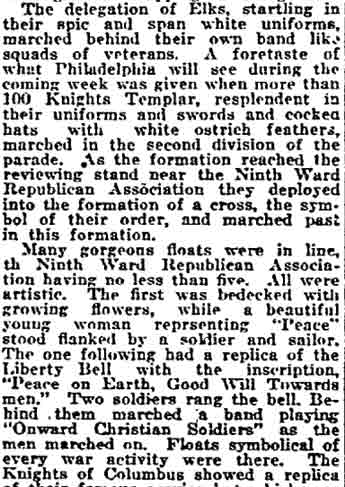
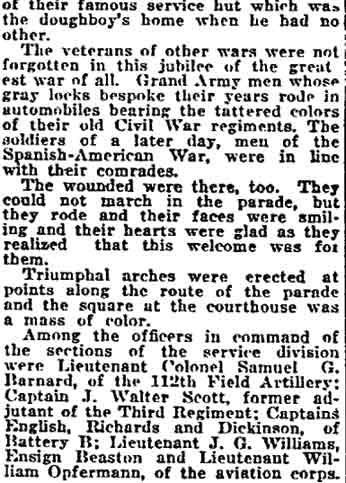
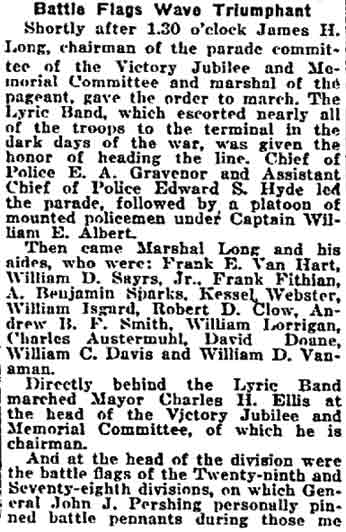
Battle Flags Wave in Triumph O’er Parade Reviewed by Admiral
Gray Veterans of G. A. R. and Wounded Ride; Centopath Passes in Reverential Hush
The Peace with victory which Camden’s sons along with millions of other soldiers of all the Allied countries helped to bring home was celebrated by a jubilee in Camden yesterday which eclipsed anything that the city across the Delaware has ever attempted in her history.
Nearly every man, woman and child who did not actually march in the jubilee parade stood on the side lines and watched it and cheered themselves hoarse as the soldiers and sailors who went out from their town to fight marched past, this time as the conquerors in the world’s greatest war.
Favored by glorious sunshine, a sunshine that was reflected in the faces of the people, the day’s proceedings went off perfectly. For months Mayor Ellis and all his city family, together with a large committee of leading citizens, had been planning the affair. Their handiwork stood the test. It was good.
Admiral Henry Wilson, commander-in-chief of the Atlantic Fleet, came to his boyhood home to be the principal guest of the city and chief reviewing officer of the jubilee. With him were national statesmen and municipal officials.
Soldiers, sailors, war workers, members of fraternal orders and men who fought under the flags of Canada, England, Italy and Poland, marched in the parade which was miles long. Every succeeding division seemed just a little better than the one which preceded it, and, when it was all over and the soldiers and sailors had filed into the old Third Regiment Armory to sit down to a piping hot banquet, the hardest thing of all was to say which had made the finest showing.
All Honor to the Dead
Amidst all the gayety and happiness there was a sober note expressed by the memorial cenotaph which preceded the parade and which brought every hat off as it passed in solemn silence.
The heroic figure of an American soldier in bronze standing on a granite pedestal which bore a gold star with the number 135, symbolical of the Camden county men who laid down their lives in their country’s cause, was carried along the route ten minutes before the parade commenced. Encircler [sic] by flowers and palms, it moved through the reverential hush which had fallen over the throngs.
While every organization in the county of Philadelphia was represented in the parade, to the thousands who lined the sidewalks, there was really only one great big important factor—the service men. And when those self-same service men, many of whom bearing the Distinguished Service Cross of their own United States, others wearing the Croix de Guerre, bestowed on them by the sister republic of France, and still others carrying on their breasts the Italian and British War Crosses, given them by grateful countries, marched down the streets and avenues, all the pent up emotion in thousands of hearts was let loose.
It mattered not whether the men were officers or enlisted men, black or white, neat or untidy, they were all soldiers and they had done all that was asked of them. Their home town honored them. The men in blue and the women in blue, too, received a welcome not one whit less feeling than their brothers in khaki.
They had a certain advantage over the doughboys, for they put half a dozen of the prettiest and smartest yoemanettes that ever wore Uncle Sam’s uniform at the head of their division. The crowd simply had to be with them.
Canada and England, too, had a detachment of men in line. About two dozen of these veterans, half of whom wore the ribbon of the Mons Star, showing that they were in service in France in 1914, were in line, and they marched snappily and smartly and drew their full modicum of pleasurable comments.
Red Cross women, some of them grandmothers, others young girls still in their teens, marched in their snowy white uniforms with their crosses of red emblazoned on headcover and breast. Salvation Army lassies who had cooked doughnuts right up under the muzzles of the guns were there with Y. M. C. A. and Knights of Columbus workers.
Elks, Masons, Knights Templar, Red Men, Moose and scores of other fraternal organizations turned out in all their glorious trappings and regalia.
The delegation of Elks, startling in their spic and span white uniforms, marched behind their own band like squads of veterans. A foretaste of what Philadelphia will see during the coming week was given when more than 100 Knights Templar, resplendent in their uniforms and swords and cocked hats with white ostrich feathers, marched in the second division of the parade. As the formation reached the reviewing stand near the Ninth Ward Republican Association they deployed into the formation of a cross, the symbol of their order, and marched past in this formation.
Many gorgeous floats were in line, th Ninth Ward Republican Association having no less than five. All were artistic. The first was bedecked with growing flowers, while a beautiful young woman reprsenting “Peace” stood flanked by a soldier and sailor. The one following had a replica of the Liberty Bell with the inscription, “Peace on Earth, Good Will Towards men.” Two soldiers rang the bell. Behind them marched a band playing “Onward Christian Soldiers” as the men marched on. Floats symbolical of every war activity were there. The Knights of Columbus showed a replica of their famous service hut which was the doughboy’s home when he had no other.
The veterans of other wars were not forgotten in this jubilee of the greatest war of all. Grand Army men whose gray locks bespoke their years rode in automobiles bearing the tattered colors of their old Civil War regiments. The soldiers of a later day, men of the Spanish-American War, were in line with their comrades.
The wounded were there, too. They could not march in the parade, but they rode and their faces were smiling and their hearts were glad as they realized that this welcome was for them.
Triumphal arches were erected at points along the route of the parade and the square at the courthouse was a mass of color.
Among the officers in command of the sections of the service division were Lieutenant Colonel Samuel G. Barnard, of the 112th Field Artillery; Captain J. Walter Scott, former adjutant of the Third Regiment; Captains English, Richards and Dickinson, of Battery B; Lieutenant J. G. Williams, Ensign Beaston and Lieutenant William Opfermann, of the aviation corps.
Battle Flags Wave Triumphant
Shortly after 1.30 o’clock James H. Long, chairman of the parade committee of the Victory Jubilee and Memorial Committee and marshal of the pageant, gave the order to march. The Lyric Band, which escorted nearly all of the troops to the terminal in the dark days of the war, was given the honor of heading the line. Chief of Police E. A. Gravenor and Assistant Chief of Police Edward S. Hyde led the parade, followed by a platoon of mounted policemen under Captain William E. Albert.
Then came Marshal Long and his aides, who were: Frank E. Van Hart, William D. Sayrs, Jr., Frank Fithian, A. Benjamin Sparks, Kessel Webster, William Isgard, Robert D. Clow, Andrew B. F. Smith, William Lorrigan, Charles Austermuhl, David Doane, William C. Davis and William D. Vanaman.
Directly behind the Lyric Band marched Mayor Charles H. Ellis at the head of the Victory Jubilee and Memorial Committee, of which he is chairman.
And at the head of the division were the battle flags of the Twenty-ninth and Seventy-eighth divisions, on which General John J. Pershing personally pinned battle pennants during those memorable days back in October in the Argonne forest. Behind the 4th marched the famous engineers, headed by Captain Keasby and Captain Beals Smuck. Three battle pennants were pinned to their flags, which never touched the ground while they were bridging the rivers in the Argonne under hellish shell fire for the doughboys to advance. Then came the 112th Field Artillery, Battery B’s heroes of the border and of France, headed by Captain Charles Richards and Captain Dickinson. In the same section marched the Eleventh Machine Gun Battalion with its battle flags and pennants fluttering.
There was another great cheer as the Seventy-eighth Division, New Jersey’s Lightning boys, loomed into view. The heroes of the 311th Infantry, 303d Engineers, 307th, 308th and 309th Field Artillery and other regiments of that famous command were given a mighty ovation behind their battle flags, which led them in their assault on St. Mihiel and the day they attacked and captured Grand-Pre in the terrible conflict in the Argonne.
Behind them marched the Marines, headed by Lieutenant Monitor Watchman, of the Fifth Regiment, Second Division. With the Marines marched the regular army units, men who had served in as many as five battles and wore three and four gold service stripes on their sleeves.
Then followed the naval contingent. They were commanded by Commander Francis W. Hoffman and Commander W. G. Hodgson.
The order “eyes left” flashed along the line as each platoon drew near the reviewing stand and Admiral Wilson with his band to his cap returned the salute. With the admiral on the stand were former United States Senator David Baird, Congressman William J. Browning, County Collector John S. Well, City Clerk W. D. Brown and others.
At the armory a splendid banquet was served to the soldiers and sailors. For days past corps Red Cross workers had been preparing the good things to eat and the men did full justice to them. They marched in the armory where the food was spread on the tables and enjoyed themselves while bands played. After dinner there were speeches. Mayor Ellis in welcoming the men said:
“This is one of the happiest moments of my life. I have waited patiently through months of trial for the glad day when I could bid you welcome to the City of Camden once again.
“We are planning to erect a lasting memorial in memory of those heroes who gave their lives and in memory of the valiant deeds you performed on land and sea.
“Camden will always cherish the memory of this day, rever the memory of your dead comrades and will inscribe your valiant deeds on that memorial. I bid you welcome in the name of the most patriotic little city in America. I thank you.”
Prosecutor Charles A. Wolverton welcomed the men on behalf of the county and paid a tribute to their valor recalling their wonderful victories of the Argonne and other battlefields of France.
Negro on Camden Education Board
Trenton Evening Times —
Trenton Evening Times
January 23, 1920
Dr. Clement T. Branch
Charles H. Ellis
E.E. Read
Harry C. Dole
Dr. Charles P. Tuttle
William J. Fox
Events at the Church of the Immaculate Conception
Camden Courier-Post —
Camden last night gave a splendid welcome to the Very Rev. Dean William J.
Fitzgerald, J. c. D., M. R. V. F., the new pastor of the Church of the Immaculate Conception and Dean of the South Jersey Catholic parishes.
Citizens of other faiths, judges, doctors, lawyers and those in more humble stations of life, rubbed elbows in the vast audience that packed to capacity the Catholic Lyceum. All were present for a common purpose- to honor the new prelate, who comes to Camden with a splendid reputation as a Christian gentleman, patriot and ambassador of the Catholic Church.
At the reception in the Lyceum, former Judge William T. Boyle presided. He in turn introduced Rev. Francis J. McCallion, who was acting pastor of the parish. Father McCallion was given a wonderful reception after Judge Boyle extolled his oratorical and executive ability. In a splendid speech Father McCallion paid a glowing tribute to Dean Fitzgerald, the subject of the evening's testimonial.
James F. Lennon was the principal speaker for the occasion. Already famed for his ability as an orator, Mr. Lennon probably gave his best talk last night. It was a tribute to the new Dean and the members of the Catholic clergy and Sisters of Mercy.
In his remarks Mr. Lennon told of the duties of a priest, of his mission and his value to the community. To the good sisters a glowing tribute was also paid by the speaker. Mr. Lennon also lauded the public school system and explained the principles of the parochial school. His reference to the 312 Immaculate Conception members who fought in the war for Democracy evoked a storm of applause. To the late and lamented Monsignor Mulligan Mr. Lennon offered a deserved tribute. In the course of his address the
speaker told of the early struggles of the founders of the Immaculate parish. His description of the good old Irish mothers and fathers who erected a monument to Catholicism at Broadway and Market street struck a happy chord.
Turning to Dean Fitzgerald Mr. Lennon extended to him a warm welcome after which he presented the pastor with a large basket of beautiful flowers, a gift of the ladies of the parish.
Mayor Charles H. Ellis was warmly received and in a splendid talk the city's chief executive turned over the keys of the city. The Mayor's talk was punctuated with witty remarks concerning the “suburb of Philadelphia.”
The Mayor said that the great day had arrived when religious strife was no more and creeds were united for one common cause.
With much feeling Dean Fitzgerald told of his appreciation of the great honor. He was visibly affected by the testimonial, but modestly stated that he considered it not only a reception to him, but to the members of the Catholic clergy.
Dean Fitzgerald assured all that he was glad to come to Camden and he asked the hearty co-operation of his parishioners. He turned and gazed over the members of the reception committee seated on the stage and told how happy he was that men like former Senator Baird, County Clerk Patterson, Mayor Ellis and other big men of the city and county were present to do him honor.
After the reception in the Lyceum Dean Fitzgerald adjourned to the parlor of the Lyceum where he met members of the parish and other friends. He stood under a canopy of flowers and colored electric lights.
The guard of honor was comprised of fifty-fourth degree Knights of Columbus.
Three hundred members of the parish formed the honorary escort from the train terminal to the rectory.
Unable to be present, because of previous engagements, Rev. Leon K. Willman, pastor of the Broadway M. E. Church, and Rev. Edwin F. Hann, of First M. E. Church, sent letters of regret in which they wished the new pastor success in his new fields of labor.
Success of last night's eventful occasion can be attributed to Rev. Francis J.
McCallion, who directed the affair. He was ably assisted by Edward Clare, George Slake, George Burke, Cornelius J. Healy, James McGowan, Hugh Pattie, Michael Quinn, Robert A. Stack and James Wren.
This morning the church reception was held with a solemn high mass, which was sung by Dean Fitzgerald. F ather Whelan was deacon, Father Hennig, sub-deacon, and Father Shay, master of ceremonies. Father McCallion delivered a splendid sermon for the occasion and the singing of the altar boys was very fine. William H. Lorigan presided at the organ.
Children of the parish this afternoon tendered a reception to the new pastor. The altar boys will present Dean Fitzgerald with an enlarged and framed likeness of himself.
Policemen Retire on Pension Fund
Camden Daily Courier —
George Johnson Has Unique Record Of Not Having An Arrest In 20 Years
PENSION SERGEANT REED
Thomas S. Reed, police sergeant at headquarters, went on the pension list today after 21 years’ continuous service. Policeman George Johnson, of the Third District, will be pensioned on May 15. Johnson had the record of never having made an arrest in 20 years.
It was announced at headquarters today that some general changes will be made as a result of the retirement of the two bluecoats. Traffic Policeman Edmund Pike has been promoted to sergeant by Mayor Ellis and placed at headquarters to succeed Sergeant Reed. Mounted Policeman Walter Welsh has been promoted sergeant.
Reed Appointed Twice.
Sergeant Reed was first appointed on the force by Mayor Pratt on January 6, 189[?]. He resigned and was a special officer for the Camden, Gloucester and Woodbury Railway. Later he was in the revenue service. He was appointed again on the force by Mayor Hatch in 1899. On January 6, 1914, he was promoted street sergeant by Mayor Ellis. Two years later he was placed at police headquarters.
Johnson Without an Arrest.
Patrolman Johnson has always had a beat in the North and South Rosedale sections, where he was held in the highest esteem. He was always on the job, residents of that section say. The fact he never made an arrest failed to mar his record. He was appointed on the force by Mayor Hatch.
In announcing his plans for the future Johnson said today he will make his home in the future with his brother Samuel, a contractor, at Rio Grande Bridge.
Blames Chauffeur for Death of Ten
Philadelphia Inquirer —
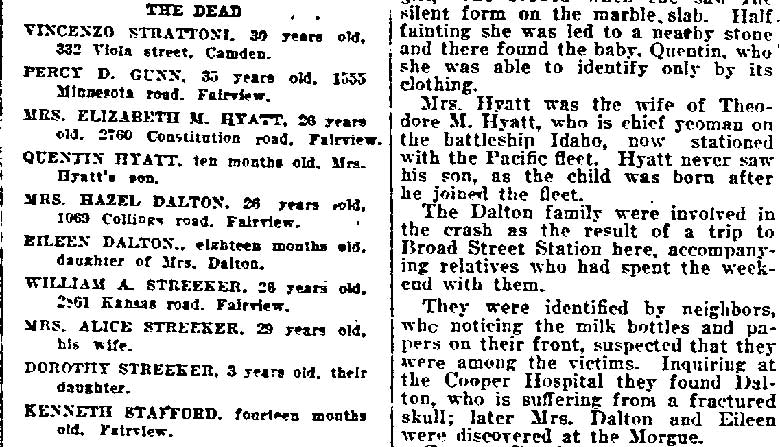
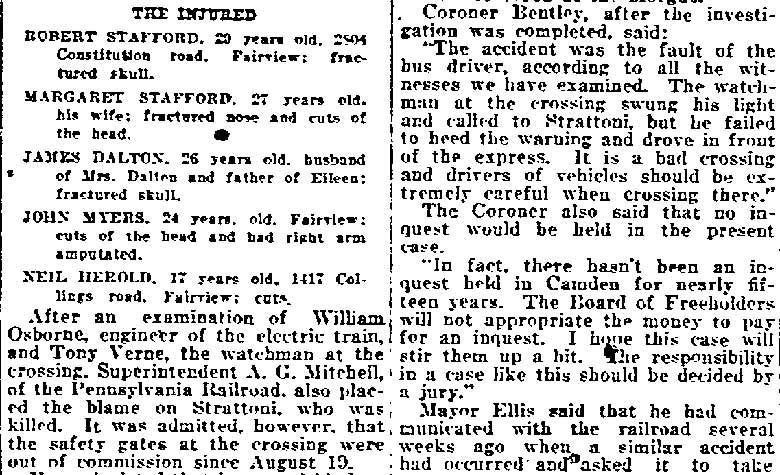
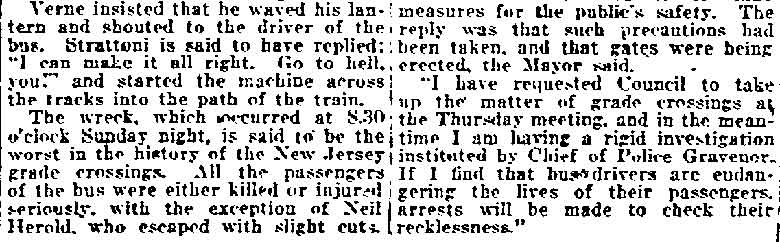
Driver of Auto-bus Failed to Heed Signal at “Death Crossing”—Three Mothers and Babies Are Among Victims.
Inquiry Begun by Officials
Responsibility for the accident which resulted in the death of ten persons and the injury of five others in Camden Sunday night when a motor ‘bus was struck by a Pennsylvania Railroad electric express, was placed yesterday on Vincenzo Strattoni, driver of the ‘bus, by Coroner David Bentley, of Camden.
A rigid investigation of the accident has been ordered by Mayor Ellis, of Camden. Council will be asked to probe the grade-crossing situation in Camden and to take steps to prevent further accidents. Measures also will be taken to curb recklessness on the part of “jitney” ‘bus drivers.
Identification of the bodies of the victims, many of which were mangled almost beyond recognition, was not made until late yesterday afternoon. A constant stream of anxious persons arrived at the Morgue, at Fifth and Federal streets, and one by one the bodies were picked out.
The complete list of the fifteen passengers of the motorbus are as follows:
THE DEAD
VINCENZO STRATTONI, 30 years old, 332 Viola street, Camden.
PERCY D. GUNN, 35 years old, 1555 Minnesota road, Fairview.
MRS. ELIZABETH M. HYATT, 28 years old, 2760 Constitution road, Fairview.
QUENTIN HYATT, ten months old, Mrs. Hyatt’s son.
MRS. HAZEL DALTON, 26 years old, 1069 Collings road, Fairview.
EILEEN DALTON, eighteen months old, daughter of Mrs. Dalton.
WILLIAM A. STREEKER, 28 years old, 2561 Kansas road, Fairview.
MRS. ALICE STREEKER, 29 years old, his wife.
DOROTHY STREEKER, 3 years old, their daughter.
KENNETH STAFFORD, fourteen months old, Fairview.
THE INJURED
ROBERT STAFFORD, 20 years old, 25[?]4 Constitution road, Fairview; fractured skull.
MARGARET STAFFORD, 27 years old, his wife; fractured nose and cuts of the head.
JAMES DALTON, 26 years old, husband of Mrs. Dalton and father of Eileen; fractured skull.
JOHN MYERS, 24 years old, Fairview; cuts of the head and had right arm amputated.
NEIL HEROLD, 17 years old, 1417 Collings road, Fairview; cuts.
After an examination of William Osborne, engineer of the electric train, and Tony Verne, the watchman at the crossing, Superintendent A. G. Mitchell, of the Pennsylvania Railroad, also placed the blame on Strattoni, who was killed. It was admitted, however, that the safety gates at the crossing were out of commission since August 19.
Verne insisted that he waved his lantern and shouted to the driver of the bus. Strattoni is said to have replied: “I can make it all right. Go to hell, you!” and started the machine across the tracks into the path of the train.
The wreck, which occurred at 8.30 o’clock Sunday night, is said to be the worst in the history of the New Jersey grade crossings. All the passengers of the bus were either killed or injured seriously, with the exception of Neil Herold, who escaped with slight cuts.
Two of the victims at the Cooper Hospital are expected to die.
The bodies of William A. Strecker [sic], his wife and daughter were the last to be identified. Alfred Bath, of 3076 Sumter road, Fairview, a brother-in-law of Streeker, broke down and wept when he found them in the morgue.
Bath said the Streekers had attended services in the Blockley Baptist Church, Fifty-third and Wyalusing streets, to hear a pastor whom they had known when they lived in Asbury Park, N. J. With Miss Violet Ettinger, of Hamilton Square, near Trenton, they crossed on the ferry. Miss Ettinger bade them good night and the Streekers entered the bus.
The bodies of Mrs. Hyatt and her son were identified by her mother, Mrs. Ida Wadsworth, who lived with her at Fairview. She said that Mrs. Hyatt and her son had been visiting friends in Wilmington. When they did not return, Mrs. Wadsworth became worried and, hearing of the tragedy, hurried to the morgue.
“It’s my daughter, my poor little girl,” she sobbed when she saw the silent form on the marble slab. Half fainting she was led to a nearby stone and there found the baby, Quentin, who she was able to identify only by its clothing.
Mrs. Hyatt was the wife of Theodore M. Hyatt, who is chief yeoman on the battleship Idaho, now stationed with the Pacific fleet. Hyatt never saw his son, as the child was born after he joined the fleet.
The Dalton family were involved in the crash as the result of a trip to Broad Street Station here, accompanying relatives who had spent the weekend with them.
They were identified by neighbors, who noticing the milk bottles and papers on their front, suspected that they were among the victims. Inquiring at the Cooper Hospital they found Dalton, who is suffering from a fractured skull; later Mrs. Dalton and Eileen were discovered at the Morgue.
Coroner Bentley, after the investigation was completed, said:
“The accident was the fault of the bus driver, according to all the witnesses we have examined. The watchman at the crossing swung his light and called to Strattoni, but he failed to heed the warning and drove in front of the express. It is a bad crossing and drivers of vehicles should be extremely careful when crossing there.”
The Coroner also said that no inquest would be held in the present case.
“In fact, there hasn’t been an inquest held in Camden for nearly fifteen years. The Board of Freeholders will not appropriate the money to pay for an inquest. I hope this case will stir them up a bit. The responsibility in a case like this should be decided by a jury.”
Mayor Ellis said that he had communicated with the railroad several weeks ago when a similar accident had occurred and asked it to take measures for the public’s safety. The reply was that such precautions had been taken, and that gates were being erected, the Mayor said.
“I have requested Council to take up the matter of grade crossings at the Thursday meeting, and in the meantime I am having a rigid investigation instituted by Chief of Police Gravenor. If I find that bus-drivers are endangering the lives of their passengers, arrests will be made to check their recklessness.”
New Firemen Assigned for Two Platoons
Camden Post-Telegram —
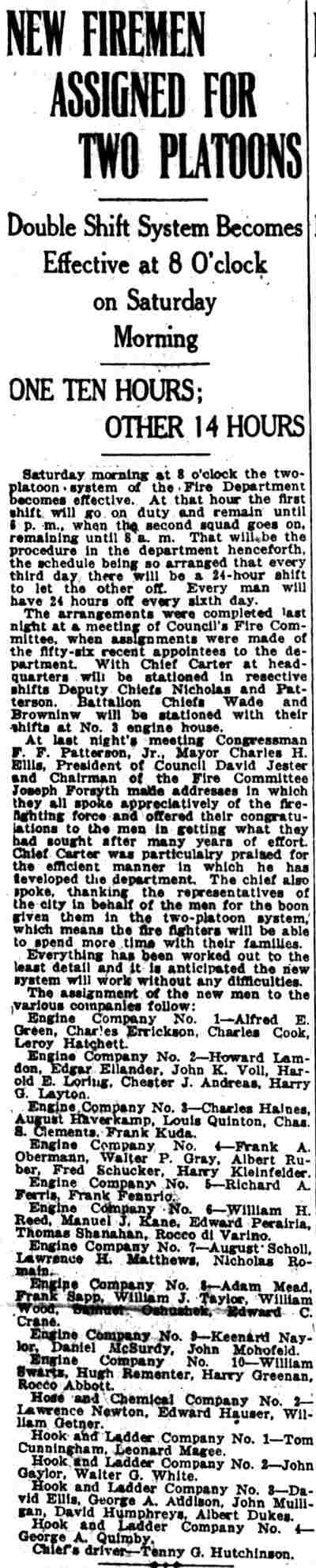
Double Shift System Becomes Effective at 8 O’clock on Saturday Morning
ONE TEN HOURS; OTHER 14 HOURS
Saturday morning at 8 o’clock the two-platoon system of the Fire Department becomes effective. At that hour the first shift will go on duty and remain until 8 p. m., when the second squad goes on, remaining until 8 a. m. That will be the procedure in the department henceforth, the schedule being so arranged that every third day there will be a 24-hour shift to let the other off. Every man will have 24 hours off every sixth day.
The arrangements were completed last night at a meeting of Council’s Fire Committee, when assignments were made of the fifty-six recent appointees to the department. With Chief Carter at headquarters will be stationed in resective [sic] shifts Deputy Chiefs Nicholas and Patterson. Battalion Chiefs Wade and Browninw [sic] will be stationed with their shifts at No. 3 engine house.
At last night’s meeting Congressman F. F. Patterson, Jr., Mayor Charles H. Ellis, President of Council David Jester and Chairman of the Fire Committee Joseph Forsyth made addresses in which they all spoke appreciatively of the fire-fighting force and offered their congratulations to the men in getting what they had sought after many years of effort. Chief Carter was particularly praised for the efficient manner in which he has developed the department. The chief also spoke, thanking the representatives of the city in behalf of the men for the boon given them in the two-platoon system, which means the fire fighters will be able to spend more time with their families.
Everything has been worked out to the least detail and it is anticipated the new system will work without any difficulties.
The assignment of the new men to the various companies follow:
Engine Company No. 1—Alfred E. Green, Charles Errickson, Charles Cook, Leroy Hatchett.
Engine Company No. 2—Howard Lamdon, Edgar Ellander, John K. Voll, Harold E. Loring, Chester J. Andreas, Harry G. Layton.
Engine Company No. 3—Charles Haines, August Haverkamp, Louis Quinton, Chas. S. Clements, Frank Kuda.
Engine Company No. 4—Frank A. Obermann, Walter P. Gray, Albert Ruber, Fred Schucker, Harry Kleinfelder.
Engine Company No. 5—Richard A. Ferris, Frank Fennrio.
Engine Company No. 6—William H. Reed, Manuel J. Kane, Edward Perairia, Thomas Shanahan, Rocco di Varino.
Engine Company No. 7—August Scholl, Lawrence H. Matthews, Nicholas Romain.
Engine Company No. 8—Adam Mead, Frank Sapp, William J. Taylor, William Wood, Samuel Oshushek, Edward C. Crane.
Engine Company No. 9—Keenard Naylor, Daniel McSurdy, John Mohofeld.
Engine Company No. 10—William Swarts, Hugh Rementer, Harry Greenan, Rocco Abbott.
Hose and Chemical Company No. 2—Lawrence Newton, Edward Hauser, William Getner.
Hook and Ladder Company No. 1—Tom Cunningham, Leonard Magee.
Hook and Ladder Company No. 2—John Gaylor, Walter G. White.
Hook and Ladder Company No. 3—David Ellis, George A. Addison, John Mulligan, David Humphreys, Albert Dukes.
Hook and Ladder Company No. 4—George A. Quimby.
Chief’s driver—Tenny G. Hutchinson.
Woman Among Citizenship Recipients
Philadelphia Inquirer —
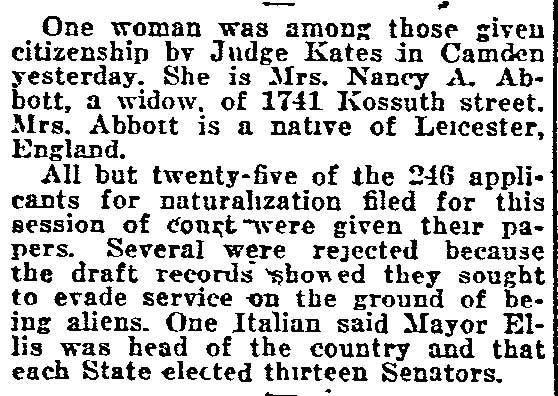
One woman was among those given citizenship by Judge Kates in Camden yesterday. She is Mrs. Nancy A. Abbott, a widow, of 1741 Kossuth street. Mrs. Abbott is a native of Leicester, England.
All but twenty-five of the 246 applicants for naturalization filed for this session of court were given their papers. Several were rejected because the draft records showed they sought to evade service on the ground of being aliens. One Italian said Mayor Ellis was head of the country and that each State elected thirteen Senators.
Development Body for Camden Named
Philadelphia Inquirer —

DEVELOPMENT BODY FOR CAMDEN NAMED
Mayor Ellis’ Commission to Study Changes New Bridge Will Bring
Citizens’ Papers Granted 221; Ashes of Sailor Suicide to Be Sent West
To plan for the future development of the city and to study the changes that will come with the building of the Delaware River bridge, a commission was appointed for Camden yesterday by Mayor Ellis. The Mayor’s action was in compliance with a resolution of City Council passed after a careful study of the benefits of zoning had been made.
Councilman Joseph Forsyth, of the Second ward, is chairman of the commission and will serve for three years. The other members of the commission are City Engineer Levis Farnham, Martin Schreiber, three years; Councilmen Wellington Barto, J. J. Blanchfield, two years; Councilmen William H. Roberts, E. H. Sapp, one year.
One of the aims of the commission is to establish zones to which certain characters of buildings will be restricted in order to prevent industries from encroaching on residential sections. This plan, it is argued, will stabilize realty values and is strongly advocated by the Real Estate Board and Chamber of Commerce.
Circuit Court Judge Frank T. Lloyd Accepts Chairmanship of Unemployment Committee
Philadelphia Inquirer —
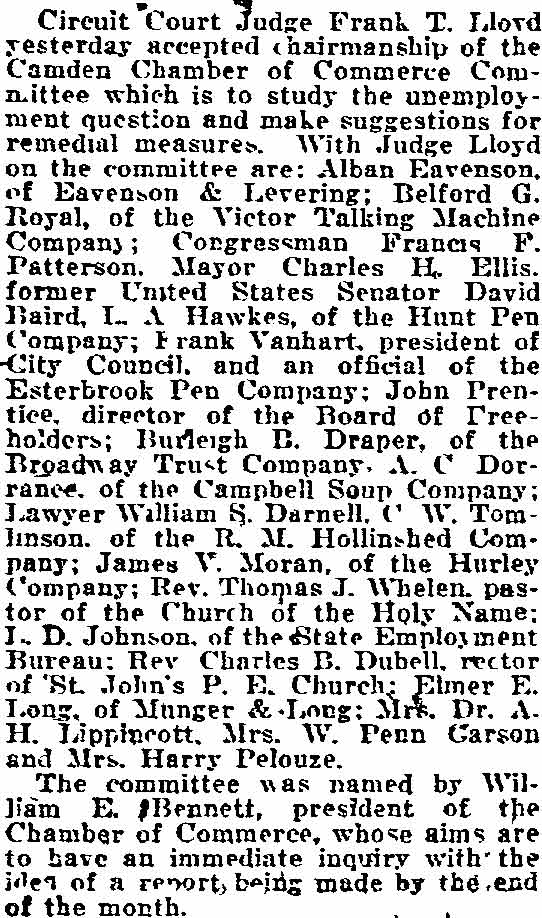
Circuit Court Judge Frank T. Lloyd yesterday accepted chairmanship of the Camden Chamber of Commerce Committee which is to study the unemployment question and make suggestions for remedial measures. With Judge Lloyd on the committee are: Alban Eavenson, of Eavenson & Levering; Belford G. Royal, of the Victor Talking Machine Company; Congressman Francis F. Patterson; Mayor Charles H. Ellis; former United States Senator David Baird; L. A. Hawkes, of the Hunt Pen Company; Frank Vanhart, president of City Council, and an official of the Esterbrook Pen Company; John Prentice, director of the Board of Freeholders; Burleigh B. Draper, of the Broadway Trust Company; A. C. Dorrance, of the Campbell Soup Company; Lawyer William S. Darnell; C. W. Tomlinson, of the R. M. Hollinshed Company; James V. Moran, of the Hurley Company; Rev. Thomas J. Whelen, pastor of the Church of the Holy Name; L. D. Johnson, of the State Employment Bureau; Rev. Charles B. Dubell, rector of St. John’s P. E. Church; Elmer E. Long, of Munger & Long; Mrs. Dr. A. H. Lippincott, Mrs. W. Penn Carson [sic] and Mrs. Harry Pelouze.
The committee was named by William E. Bennett, president of the Chamber of Commerce, whose aims are to have an immediate inquiry with the idea of a report, being made by the end of the month.
Two More Policemen Resign Under Fire in Downtown Vice Probe
Camden Courier —
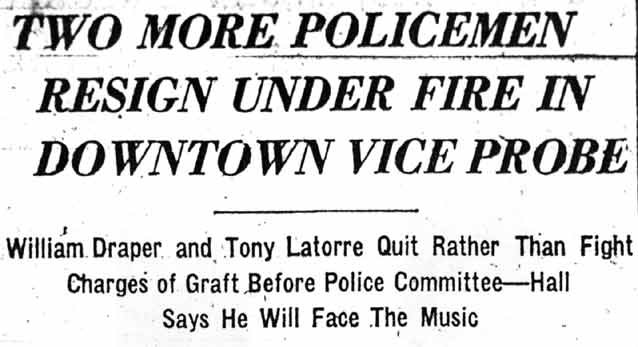
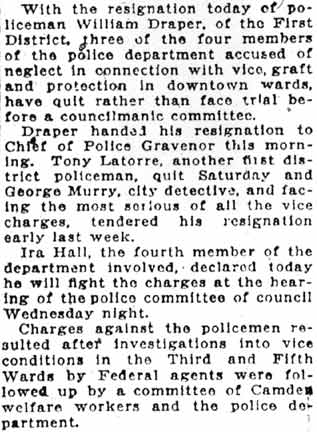
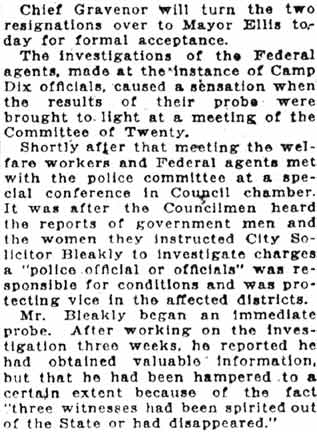
William Draper and Tony Latorre Quit Rather Than Fight Charges of Graft Before Police Committee—Hall Says He Will Face The Music
With the resignation today of policeman William Draper, of the First District, three of the four members of the police department accused of neglect in connection with vice, graft and protection in downtown wards, have quit rather than face trial before a councilmanic committee.
Draper handed his resignation to Chief of Police Gravenor this morning. Tony Latorre, another first district policeman, quit Saturday and George Murry, city detective, and facing the most serious of all the vice charges, tendered his resignation early last week.
Ira Hall, the fourth member of the department involved, declared today he will fight the charges at the hearing of the police committee of council Wednesday night.
Charges against the policemen resulted after investigations into vice conditions in the Third and Fifth Wards by Federal agents were followed up by a committee of Camden welfare workers and the police department.
Chief Gravenor will turn the two resignations over to Mayor Ellis today for formal acceptance.
The investigations of the Federal agents, made at the instance of Camp Dix officials, caused a sensation when the results of their probe were brought to light at a meeting of the Committee of Twenty.
Shortly after that meeting the welfare workers and Federal agents met with the police committee at a special conference in Council chamber. It was after the Councilmen heard the reports of government men and the women they instructed City Solicitor Bleakly to investigate charges a “police official or officials” was responsible for conditions and was protecting vice in the affected districts.
Mr. Bleakly began an immediate probe. After working on the investigation three weeks, he reported he had obtained valuable information, but that he had been hampered to a certain extent because of the fact “three witnesses had been spirited out of the State or had disappeared.”
New City Police Must Be ‘Clean’ Is Order of Mayor
Camden Courier —
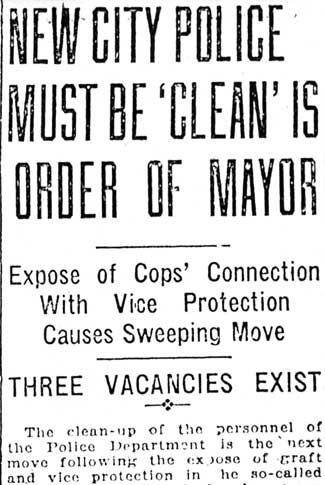
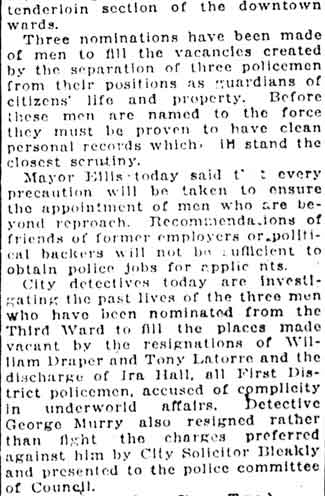
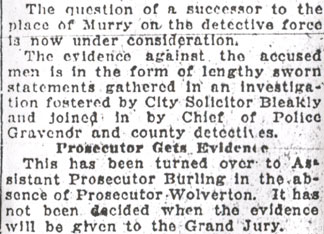
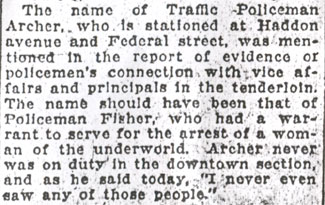
Expose of Cops’ Connection With Vice Protection Causes Sweeping Move
THREE VACANCIES EXIST
The clean-up of the personnel of the Police Department is the next move following the expose of graft and vice protection in the so-called tenderloin section of the downtown wards.
Three nominations have been made of men to fill the vacancies created by the separation of three policemen from their positions as guardians of citizens’ life and property. Before these men are named to the force they must be proven to have clean personal records which will stand the closest scrutiny.
Mayor Ellis today said that every precaution will be taken to ensure the appointment of men who are beyond reproach. Recommendations of friends of former employers or political backers will not be sufficient to obtain police jobs for applicants.
City detectives today are investigating the past lives of the three men who have been nominated from the Third Ward to fill the places made vacant by the resignations of William Draper and Tony Latorre and the discharge of Ira Hall, all First District policemen, accused of complicity in underworld affairs. Detective George Murry also resigned rather than fight the charges preferred against him by City Solicitor Bleakly and presented to the police committee of Council.
The question of a successor to the place of Murry on the detective force is now under consideration.
The evidence against the accused men is in the form of lengthy sworn statements gathered in an investigation fostered by City Solicitor Bleakly and joined in by Chief of Police Gravenor and county detectives.
Prosecutor Gets Evidence
This has been turned over to Assistant Prosecutor Burling in the absence of Prosecutor Wolverton. It has not been decided when the evidence will be given to the Grand Jury.
The name of Traffic Policeman Archer, who is stationed at Haddon avenue and Federal street, was mentioned in the report of evidence or policemen’s connection with vice affairs and principals in the tenderloin. The name should have been that of Policeman Fisher, who had a warrant to serve for the arrest of a woman of the underworld. Archer never was on duty in the downtown section, and as he said today, “I never even saw any of those people.”
Board of Education Appointments
Philadelphia Inquirer —
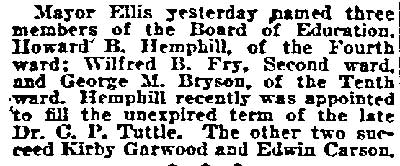
Mayor Ellis yesterday named three members of the Board of Education. Howard B. Hemphill, of the Fourth ward; Wilfred B. Fry, Second ward, and George M. Bryson, of the Tenth ward. Hemphill recently was appointed to fill the unexpired term of the late Dr. G. P. Tuttle. The other two succeed Kirby Garwood and Edwin Carson.
Residents Asked to Give Evidence of Police Graft
Camden Courier —
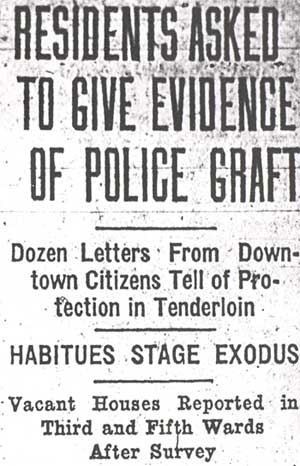
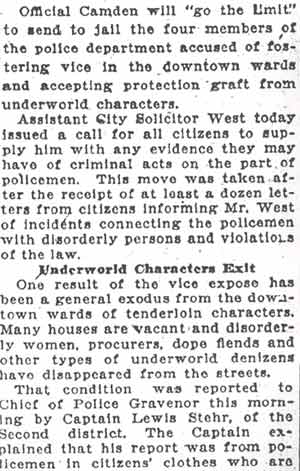
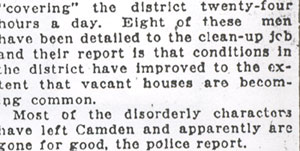
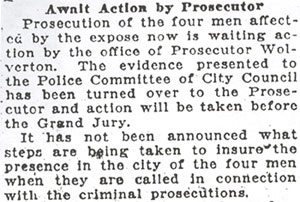
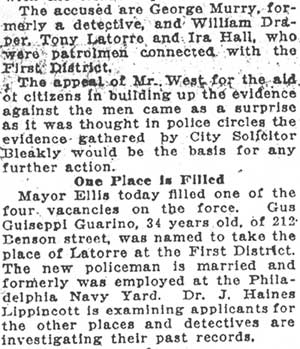
Dozen Letters From Downtown Citizens Tell of Protection in Tenderloin
HABITUES STAGE EXODUS
Vacant Houses Reported in Third and Fifth Wards After Survey
Official Camden will “go the limit” to send to jail the four members of the police department accused of fostering vice in the downtown wards and accepting protection graft from underworld characters.
Assistant City Solicitor West today issued a call for all citizens to supply him with any evidence they may have of criminal acts on the part of policemen. This move was taken after the receipt of at least a dozen letters from citizens informing Mr. West of incidents connecting the policemen with disorderly persons and violations of the law.
Underworld Characters Exit
One result of the vice expose has been a general exodus from the downtown wards of tenderloin characters. Many houses are vacant and disorderly women, procurers, dope fiends and other types of underworld denizens have disappeared from the streets. That condition was reported to Chief of Police Gravenor this morning by Captain Lewis Stehr, of the Second district. The Captain explained that his report was from policemen in citizens’ clothes who are “covering” the district twenty-four hours a day. Eight of these men have been detailed to the clean-up job and their report is that conditions in the district have improved to the extent that vacant houses are becoming common. Most of the disorderly charactors [sic] have left Camden and apparently are gone for good, the police report.
Await Action by Prosecutor
Prosecution of the four men affected by the expose now is waiting action by the office of Prosecutor Wolverton. The evidence presented to the Police Committee of City Council has been turned over to the Prosecutor and action will be taken before the Grand Jury. It has not been announced what steps are being taken to insure the presence in the city of the four men when they are called in connection with the criminal prosecutions.
The accused are George Murry, formerly a detective, and William Draper, Tony Latorre and Ira Hall, who were patrolmen connected with the First District.
The appeal of Mr. West for the aid of citizens in building up the evidence against the men came as a surprise as it was thought in police circles the evidence gathered by City Solicitor Bleakly would be the basis for any further action.
One Place Is Filled
Mayor Ellis today filled one of the four vacancies on the force. Gus Guiseppi Guarino, 34 years old, of 212 Benson street, was named to take the place of Latorre at the First District. The new policeman is married and formerly was employed at the Philadelphia Navy Yard. Dr. J. Haines Lippincott is examining applicants for the other places and detectives are investigating their past records.
POLICE TO PROBE $200,000 KAIGHN AVE. FIRE
Camden Courier-Post * January 18, 1922
Mayor Ellis has ordered an investigation to determine the cause of the $2000,000 fire which swept the properties at 427 and 429 Kaighn Avenue and caused injury to five firemen, one of whom may be fatally hurt.
The fire centered about the property occupied by the Economy Store, formerly Handle's, and quickly spread to four adjoining buildings.
The fireman whose recovery is despaired of is Captain Martin B. Carrigan, of Engine Company No. 2, Fifth and Arch Streets. Carrigan, who lives at 618 West Street, is suffering from a fractured skull and severe burns and cuts of the face, legs, and body. He is unconscious at Cooper Hospital.
The firemen were injured when a wall, weakened by the intense heat, crumbled and crashed through a roof upon which they were standing, dragging them through the floor below, and into a cellar. Sensational rescues followed as police, firemen, and citizens with bare hands tore at the hot debris. The men were quickly extricated and carried to the street.
“We certainly shall investigate this fire,” the Mayor declared today. “Just what was the cause and who is to blame has not been determined but there will be a thorough investigation.”
“There have been too many of these fires during the past few weeks” continued the mayor. “Surely all of them did not just happen and I am sure there has been someone responsible in one or two of the fires.”
The conflagration was one of the most spectacular of a series of large fires that have visited the city in the past six weeks. The block in which it occurred- Kaighn Avenue between Broadway and Fourth Street is one of the most prominent business squares in Camden.
Flames shot 200 feet in the air, giving the sky a fiery hue and attracted attention for miles before the firemen brought it under control. The flame-lit sky was clearly seen in Philadelphia, Merchantville, East Camden, Gloucester and other communities.
More than a score of families living in the vicinity were forced to flee from their homes in scant attire when the fire threatened them. They were cared for by neighbors.
Fireman George Boone, 46 years old, of Engine Company No. 2, also is in a serious condition. He is suffering from burns of the right hand, right thigh and foot and probable internal injuries. Boone lives at 607 Mount Vernon Street.
John Voll, 22 years old, 509 Royden Street: both hands badly burned.
C.J. Andrus, aged 31 years, 570 Mount Vernon Street: burns of hands and legs.
Harold Lorang, 29 years old, 19 Hudson Street: burns of right hand and legs and sprained ankle.
Carrigan and Boone are in the hospital. The other firemen were discharged after their wounds were dressed. After being released from the hospital they returned to the scene of the fire and insisted upon continuing their duties. Chief Peter B. Carter, however, ordered them home.
Most of the loss was suffered by the Economy Store. A few charred walls remain of the large building. The interior was completely gutted. It was estimated today that the damage to that property will total $60,000 At least $50,000 damage, it was said, was done to the stock.
Morris Handle, local theatrical man, who owns the building, declared today that the property was insured for $30,000. “My loss will be quite heavy,” said Mr. Handle. “The insurance will not pay one-half the property damage.”
The adjoining building at 431 Kaighn Avenue is occupied by Dr. S.I. Yubas, optometrist, and L.R. Yubas, his father, a jeweler.
The rear and upper floors of the Yubas property were gutted and the stock sustained a heavy loss, due to water and smoke. The damage will total $40,000, Mr. Yubas estimated today.
Five persons who were asleep on the upper floors of the Yubas dwelling had narrow escapes. They were awakened by Samuel Goldstein, haberdasher, 417 Kaighn Avenue, who discovered the fire in the Economy Store and turned in the alarm. Mrs. L.R. Yubas, an invalid, was rescued with difficulty.
The property occupied by Mrs. Sadie Bodner, a widow, at 433 Kaighn Avenue, as a house furnishings store, was scorched and also damaged by water and smoke.
Adjoining the Economy Store on the west at 425 Kaighn Avenue is a vacant one-story structure, formerly occupy by the United Beef Company. Firemen were on the roof of that building when the west wall of the Economy Store collapsed. The wall tumbled down on the small roof and hurled the firemen through a hole in the roof, through the floor and then into the cellar.
Three policemen, Joseph Sparks, Thomas Cheeseman, and George Hill- and several spectators braved the fire and smoke to rescue the trapped firemen.
The property at 423 Kaighn Avenue, occupied by the Charles Jamison Department Store, was damaged in the rear and the stock ruined by water and smoke. The Kresge Five-and-Ten-Cent Store, at 519-531 Kaighn Avenue, was also damaged by water.
Louis Richelson, who owns the properties from 519 to 525 Kaighn Avenue, was unable to estimate his loss today.
Hundreds of spectators, who were watching the fire from the opposite side of the street, shuddered as they saw a brick wall, weakened by the intense heat, totter and sway. Before the firemen on the smaller roof below could scurry to safety, it collapsed.
A groan escaped the crowd as they heard the cries of the entrapped firemen and the deafening thud of the brocks as they landed on the roof where the firemen were at work.
As the full weight of the brocks struck the roof, it caved in forming a gaping hole. The firemen were literally swept into the opening.
The bricks tumbled down, causing another hole in the floor between the firs story and the cellar and dragging the imperiled firemen into the cellar with them.
Mayor Charles H. Ellis was among the spectators who witnessed the collapse of the wall. Other officials were Chief James H. Long, of the Water Department; Fire Chief Carter, Assistant Police Chief Edward S. Hyde, Captain Lewis Stehr of the Second Police District, and Street Commissioner Alfred L. Sayers.
Observing the peril of the trapped firemen, Policemen Sparks, Cheeseman and Hill, together with a dozen other spectators, rushed across the street to the vacant store. They rushed through the smoke and fire, leaped into the cellar and 5reached the struggling firemen.
Sparks, the first to leap into the cellar, reached Voll, who had been pinned beneath a pile of debris and was pleading to be rescued. The policeman feverishly extricated Voll from his precarious position and carried him out into the street to safety.
Policeman Cheeseman had accidentally fallen into the cellar and, though himself injured, groped about in the dark until he found Boone, whom he dragged outside.
Policeman Hill carried Carrigan out of the cellar in his arms.
The five firemen were carried to a waiting police ambulance and rushed to Cooper Hospital. Carrigan was unconscious. He haws a slim fighting chance to recover.
Carrigan was promoted to a captaincy the first of the year. He is popular among his comrades and has the reputation of being a fearless fireman.
Mayor Ellis praised the work of the firemen and the bravery of the policemen who had risked their lives to effect the rescue.
“Never did I see such remarkable work” said the Mayor. “When I arrived at the scene, it looked as if the whole block was doomed. The flames were shooting upward and the whole sky seemed lit up. The firemen tackled their job with dispatch and courage. I was proud of them. They knew their business and showed it by confining it to a comparatively small area. The work of the police also was commendable.
Mr. Goldstein discovered the fire shortly before midnight.
“I had just left my home at 417 Kaighn Avenue,” explained Mr. Goldstein, “intending to get a soda. As I passed the Economy Store I noticed strong odor of smoke. I peered into the glass doorway of the store. I immediately saw the place was afire.”
“Then I ran back to my store” continued Mr. Goldstein, “and I telephoned police headquarters. I went out again and returned to the scene. I remembered that the Yubas family were asleep on the second and third floors and rapped on the doors. Mr. Yubas came down in a bathrobe. He was not aware of the fire.”
The six persons asleep in the Yubas home were Dr. Yubas, Mr. And Mrs. L.R. Yubas, Bernard Helfand, Miss Bertha Cuden and Anna Recowitz, a domestic.
Mrs. Yubas, who is recovering from an illness, was too weak to make her way outside through the smoke. Assisted by her husband, Policemen Becker and Cheeseman and Constable John Cunningham, Mrs. Yubas was half carried downstairs, and out through the rear of the building to safety.
“The fire had gained such rapid headway,” said Sergeant Thomas Cunningham, “that when the firemen arrived, smoke was actually issuing from cracks in the sidewalks and between the cobbles near the trolley tracks.”
The second and third floors of 419 to 423 Kaighn Avenue are occupied by private families as apartments. In the rear were number of frame dwellings. More than a score of families were obliged to leave their homes in scant attire when the firemen began playing hose upon their properties as a precaution against the fire spreading.
Mrs. Catherine Fox, 410 Sycamore Street, and Mrs. E. Chambers, 412 Sycamore Street, whose homes are in the rear of the Economy Store property, had removed part of the furniture to the street. Even after firemen assured them the danger of their homes catching on fire was over, the women and children could hardly be persuaded to return.
Crumbling walls and cracking of glass hampered the foremen in their work and made their task hazardous. The firemen were further handicapped by the big start the fire had gained. Despite this, they stuck dangerously close to the flames.
To play hose upon the fire to advantage, several firemen scaled the outside walls of adjoining properties and reached cornices, from which they directed streams of water.
A high wind gave them great difficulty. A number of times, when the firemen seemed to have the fire under control, the flames burst out afresh and compelled them to retreat. Then the reflection would light up the sky overhead.
Water Chief Long gave the firemen great service in maintaining the water at a high pressure to ensure facility in getting the streams to play upon the flames.
Kaighn Avenue, between Broadway and Fourth Street, was literally alive with residents and passers-by attracted by the flames. Included among the spectators were scores of persons who came from Philadelphia and distant points, in the belief the blaze was much more serious.
According to the estimate of the loss made today, the insurance on the property and stock damaged by the fore will not pay for one-half the loss sustained.
Chief Carter was determined to take no chances with the fire because of the high wind and the fire was attacked on all sides. While firemen were fighting the flames from Kaighn Avenue several companies of firemen had worked their way into the yard in the rear, from whence they played streams of hose.
An effort is being made today to determine the origin of the blaze.
Thomas Shanahan, Engine Company 6, was a spectator when the wall crashed in. Hearing the cries of the buried men, he immediately dashed into the dirt. Six men, including Harry Seeley, formed a human chain and pulled four of the men from the heap of rubbish.
Someone had the presence of min to turn off the nozzle of a hose, which was playing directly on the mound. When found, the water was trickling through to the pinned men.
Fire Bells Toll as Capt. Carrigan Is Laid to Rest
Camden Daily Courier —
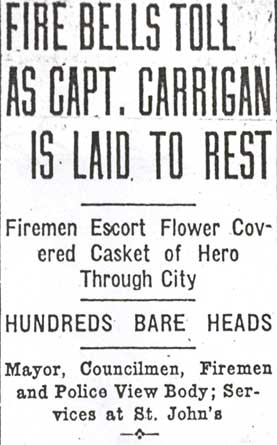
Firemen Escort Flower Covered Casket of Hero Through City
HUNDREDS BARE HEADS
Mayor, Councilmen, Firemen and Police View Body; Services at St. John’s
Hundreds lined the streets and bared their heads and bells in fire houses solemnly tolled a tribute this morning as the cortege of Captain Martin B. Carrigan, who lost his life in the Economy store fire, slowly wended its way through the city to Arlington Cemetery.
Chief Peter B. Carter headed the escort of ninety-two firemen. He was accompanied by Deputy Chief William W. Patterson and Battalion Chief George B. Wade.
Body Rests on Apparatus
The body of the fire hero rested on a fire apparatus, draped in mourning. The casket was flanked with large floral tributes, sent by various organizations, friends and the city. A guard of honor of eight firemen walked beside the apparatus. The procession left the late fire captain’s home at 612 West street at 10.30 o’clock this morning and proceeded to St. John’s Episcopal Church, where services were conducted by the rector, Rev. Charles Bratten DuBell.
Fire Bells Toll
Following the services in the church the cortege proceeded to Twenty-seventh and Federal streets. As the procession passed the house of Engine Company, No. 5, on Federal street, near Cooper River, and the East Camden fire house, firemen on duty stood at attention. Doors of the fire houses were open and bells on the apparatus were tolled.
At Twenty-seventh and Federal streets the firemen escort on foot, withdrew from the line. They stood at attention as the procession filed by. The firemen returned to their stations as the cortege continued to the cemetery.
Mayor Views Body
The tribute to the fireman was almost continuous since yesterday afternoon. Mayor Charles H. Ellis headed a large delegation that marched from fire headquarters, where Carrigan commanded Engine Company, No. 2, to his late home at 612 West street. Members of the fire committee of City Council and Frank S. Van Hart, president of City Council, marched directly behind the mayor. They were followed by firemen of both platoons, Chief Carter, Deputy Chief Patterson, Battalion Chiefs Wade, Nicholas and Browning.
The Police Department, a delegation from the Gloucester fire department, the Salvation Army, members of the detective bureau and the Fourth Ward Republican Club viewed the body yesterday afternoon and last night, as did hundreds of individuals.
Many Floral Tributes
Among the floral offerings were a huge cross from the Firemen’s Mutual Beneficial Association and a large crescent and star from the Camden Police Beneficial Association. There were a number of floral pieces from friends. Interment was made in Arlington Cemetery.
Carrigan is survived by a widow, Mrs. Anna Carrigan, and a stepson. He was 49 years old and one of thirteen children. Four brothers, Louis, William, Samuel and Joseph, are among the surviving children.
Mayor Ellis Names New Policemen
Philadelphia Inquirer —
Succeeding Edward Rapp, who died suddenly, James H. Biddle, of East Camden, yesterday was appointed a policeman by Mayor Ellis. The Mayor also named Clarence Arthur, of the Third ward, a member of the police force. He fills one of the vacancies caused by the resignations of three men following the vice probe.
(news brief)
Philadelphia Inquirer —
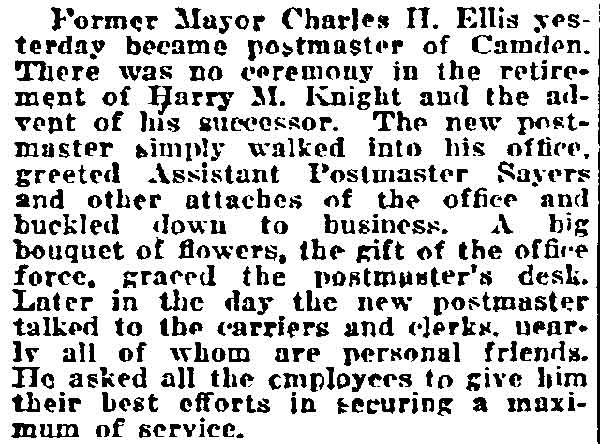
Former Mayor Charles H. Ellis yesterday became postmaster of Camden. There was no ceremony in the retirement of Harry M. Knight and the advent of his successor. The new postmaster simply walked into his office, greeted Assistant Postmaster Sayers and other attaches of the office and buckled down to business. A big bouquet of flowers, the gift of the office force, graced the postmaster’s desk. Later in the day the new postmaster talked to the carriers and clerks, nearly all of whom are personal friends. He asked all the employees to give him their best efforts in securing a maximum of service.
LEAGUE BASEBALL PLAN FOR CAMDEN
Camden Courier-Post * January 23, 1928
LEAGUE BASEBALL PLAN FOR CAMDEN
Promoter of Club Here Given Support of Mayor and Councilman
Edward M. Higgins, a real estate operator of Camden, conferred today with Mayor Ellis regarding the forming of a professional baseball club in this city. At the conclusion of the conference it was announced that the Mayor would support the movement and so would Dr. Henry S. Riddle, City Councilman from the Sixth Ward.
Mr. Higgins hopes to obtain a franchise in the Tri-State League for the team. Failing in that he: proposes to form a league with teams in North and South Jersey. He plans to lease the “old line ditch” property from the city for baseball grounds and will erect a modern plant on that site.
The real estate man has written the mayors of the following New Jersey cities regarding the formation of the league; Bridgeton, Perth Amboy, Trenton, Paterson, Passaic, Atlantic City, New Brunswick, Elizabeth and Phillipsburg..
SPANISH WAR VETERANS INSTALL 1928 OFFICERS
Camden Courier-Post * January 11, 1928
SPANISH WAR VETERANS INSTALL 1928 OFFICERS
Mayor Price was among the speakers last night at the annual installation of officers of General John A Mather Camp, No. 39, United Spanish War Veterans, held at 114th Regiment Armory, Haddon Avenue and Mickle Street.
Other speakers were Colonel George L. Selby, in charge of the permanent registration bureau, Senator Clifford R. Powell, Burlington County, and Postmaster Charles H. Ellis.
Mayor Price said plans will be made for the erection of an All-Wars Memorial building, similar to that in Atlantic City.
Officers installed were: Robert Riley, commander; Harry Rose, senior vice commander; Harry Todd, junior vice commander; Edward Bearint, adjutant; John J. Doyle, quartermaster; John Buel, guard; Lenny B. Orr, chaplain; Edward Daves, instructor; Edward Phifer, color bearer; PO.C. McCormack and Frank Tomlin, trustees; John Pierce, sergeant major.
Wright Cox Dies in His 66th Year
Camden Courier-Post —
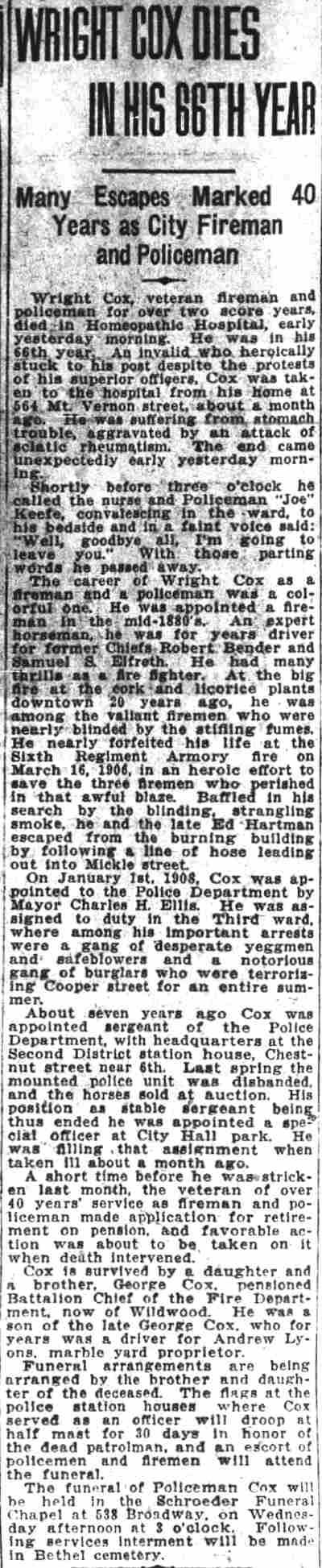
Many Escapes Marked 40 Years as City Fireman and Policeman
Wright Cox, veteran fireman and policeman for over two score years, died in Homeopathic Hospital, early yesterday morning. He was in his 66th year. An invalid who heroically stuck to his post despite the protests of his superior officers, Cox was taken to the hospital from his home at 564 Mt. Vernon street, about a month ago. He was suffering from stomach trouble, aggravated by an attack of sciatic rheumatism. The end came unexpectedly early yesterday morning.
Shortly before three o’clock he called the nurse and Policeman “Joe” Keefe, convalescing in the ward, to his bedside and in a faint voice said: “Well, goodbye all, I’m going to leave you.” With those parting words he passed away.
The career of Wright Cox as a fireman and a policeman was a colorful one. He was appointed a fireman in the mid-1880’s. An expert horseman, he was for years driver for former Chiefs Robert Bender and Samuel S. Elfreth. He had many thrills as a fire fighter. At the big fire at the cork and licorice plants downtown 20 years ago, he was among the valiant firemen who were nearly blinded by the stifling fumes. He nearly forfeited his life at the Sixth Regiment Armory fire on March 16, 1906, in an heroic effort to save the three firemen who perished in that awful blaze. Baffled in his search by the blinding, strangling smoke, he and the late Ed Hartman escaped from the burning building by following a line of hose leading out into Mickle street.
On January 1st, 1908, Cox was appointed to the Police Department by Mayor Charles H. Ellis. He was assigned to duty in the Third ward, where among his important arrests were a gang of desperate yeggmen and safeblowers and a notorious gang of burglars who were terrorising Cooper street for an entire summer.
About seven years ago Cox was appointed sergeant of the Police Department, with headquarters at the Second District station house, Chestnut street near 6th. Last spring the mounted police unit was disbanded, and the horses sold at auction. His position as stable sergeant being thus ended he was appointed a special officer at City Hall park. He was filling that assignment when taken ill about a month ago.
A short time before he was stricken last month, the veteran of over 40 years’ service as fireman and policeman made application for retirement on pension, and favorable action was about to be taken on it when death intervened.
Cox is survived by a daughter and a brother, George Cox, pensioned Battalion Chief of the Fire Department, now of Wildwood. He was a son of the late George Cox, who for years was a driver for Andrew Lyons, marble yard proprietor.
Funeral arrangements are being arranged by the brother and daughter of the deceased. The flags at the police station houses where Cox served as an officer will droop at half mast for 30 days in honor of the dead patrolman, and an escort of policemen and firemen will attend the funeral.
The funeral of Policeman Cox will be held in the Schroeder Funeral Chapel at 538 Broadway, on Wednesday afternoon at 3 o’clock. Following services interment will be made in Bethel cemetery.
Italian Women Republicans Stage Second Annual Ball
Camden Courier-Post —
Camden Courier-Post - October 20, 1931
Italian Women Republicans Stage Second Annual Ball
Prominent Republicans gathered last night at the First Italian Republican League hall, 813 South Fourth Street, for the second annual ball of the Camden County Italian Women's Republican Club.
The grand march was led by Mr. and Mrs. Antonio Mecca, followed by Mr. and Mrs. Anthony Laviano, Mr. and Mrs. Cascini, Mrs. Mamie Piraine, president of the club, with Anthony Di Marino, and Mrs. Anna Larusso with Harry Larusso.
Mrs. Mecca was chairman of the ball, assisted by Mrs. Laviano, secretary; Mrs. John Gargano, treasurer; Mrs. Frank Valeriano and Miss Mary Lario.
In addition to Mrs. Piraine, officers of the club are Mrs. Larusso, secretary; Mrs. Margaret Viggiano, secretary; Mrs. Josephine Tamru, financial secretary, and Mrs. Madeline Salvatore, treasurer.
Among the guests were Walter S. Keown, chairman of the Republican county committee; Assemblymen Frank M. Traveline, Jr., and George D. Rothermel, Postmaster Charles H. Ellis, County Detective Fiore Troncone, Miss Marie Doyle and Mrs. Pauline Caperoon, of Republican headquarters, and Walter Sekula, candidate for freeholder from the Eighth Ward.
Mail Thefts Bared by Arrest of Man
Camden Courier-Post —
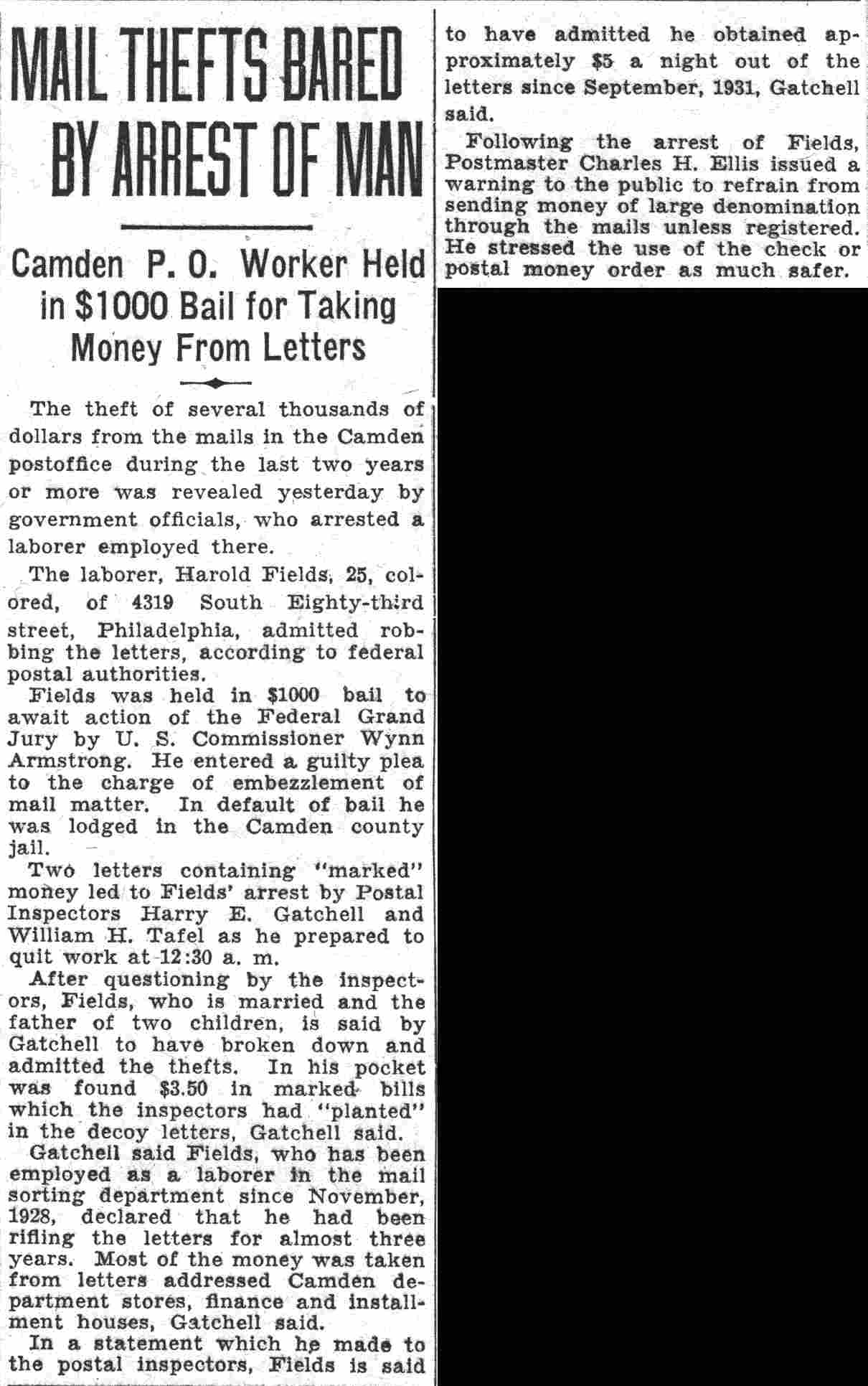
Camden P. O. Worker Held in $1000 Bail for Taking Money From Letters
The theft of several thousands of dollars from the mails in the Camden postoffice during the last two years or more was revealed yesterday by government officials, who arrested a laborer employed there.
The laborer, Harold Fields, 25, colored, of 4319 South Eighty-third street, Philadelphia, admitted robbing the letters, according to federal postal authorities.
Fields was held in $1000 bail to await action of the Federal Grand Jury by U. S. Commissioner Wynn Armstrong. He entered a guilty plea to the charge of embezzlement of mail matter. In default of bail he was lodged in the Camden county jail.
Two letters containing “marked” money led to Fields’ arrest by Postal Inspectors Harry E. Gatchell and William H. Tafel as he prepared to quit work at 12:30 a. m.
After questioning by the inspectors, Fields, who is married and the father of two children, is said by Gatchell to have broken down and admitted the thefts. In his pocket was found $3.50 in marked bills which the inspectors had “planted” in the decoy letters, Gatchell said.
Gatchell said Fields, who has been employed as a laborer in the mail sorting department since November, 1928, declared that he had been rifling the letters for almost three years. Most of the money was taken from letters addressed Camden department stores, finance and installment houses, Gatchell said.
In a statement which he made to the postal inspectors, Fields is said to have admitted he obtained approximately $5 a night out of the letters since September, 1931, Gatchell said.
Following the arrest of Fields, Postmaster Charles H. Ellis issued a warning to the public to refrain from sending money of large denomination through the mails unless registered. He stressed the use of the check or postal money order as much safer.
FRANK TRUAX DIES; POLICE SERGEANT
Camden Courier-Post —
Second District Officer Had Been in Service Since 1917
Police Sergeant Frank Truax of the Second Police District died at last night in Cooper Hospital of a complication of diseases. He was 50 and resided at 1129 Kenwood Avenue.
Sergeant Truax was admitted to the institution at 8:55 PM. Five minutes later he was dead.
He was considered one of the most efficient officers of the police department by his superiors, and his death was a shock to his friends and acquaintances.
He had been a member of the police department since April 12, 1917, having been appointed by former Mayor Charles H. Ellis. After 13 years of “pounding a beat” he was promoted to sergeant on April 9, 1930, by former Director of Public Safety David S. Rhone.
Shortly after dinner last night, Sergeant Truax complained of feeling ill. He had been in ill health for the past few weeks.
His wife, Mrs. Linda Truax summoned Dr. H. G. Stimus and Dr. Rhone. They ordered him removed to the hospital at once.
Besides his wife, Sergeant Truax is survived by a sister, Mrs. Viola Wilkinson of 701 Royden Street. Funeral arrangements have not been completed.
12 Firemen, 4 Policemen Apply for City Pensions
Camden Courier-Post —


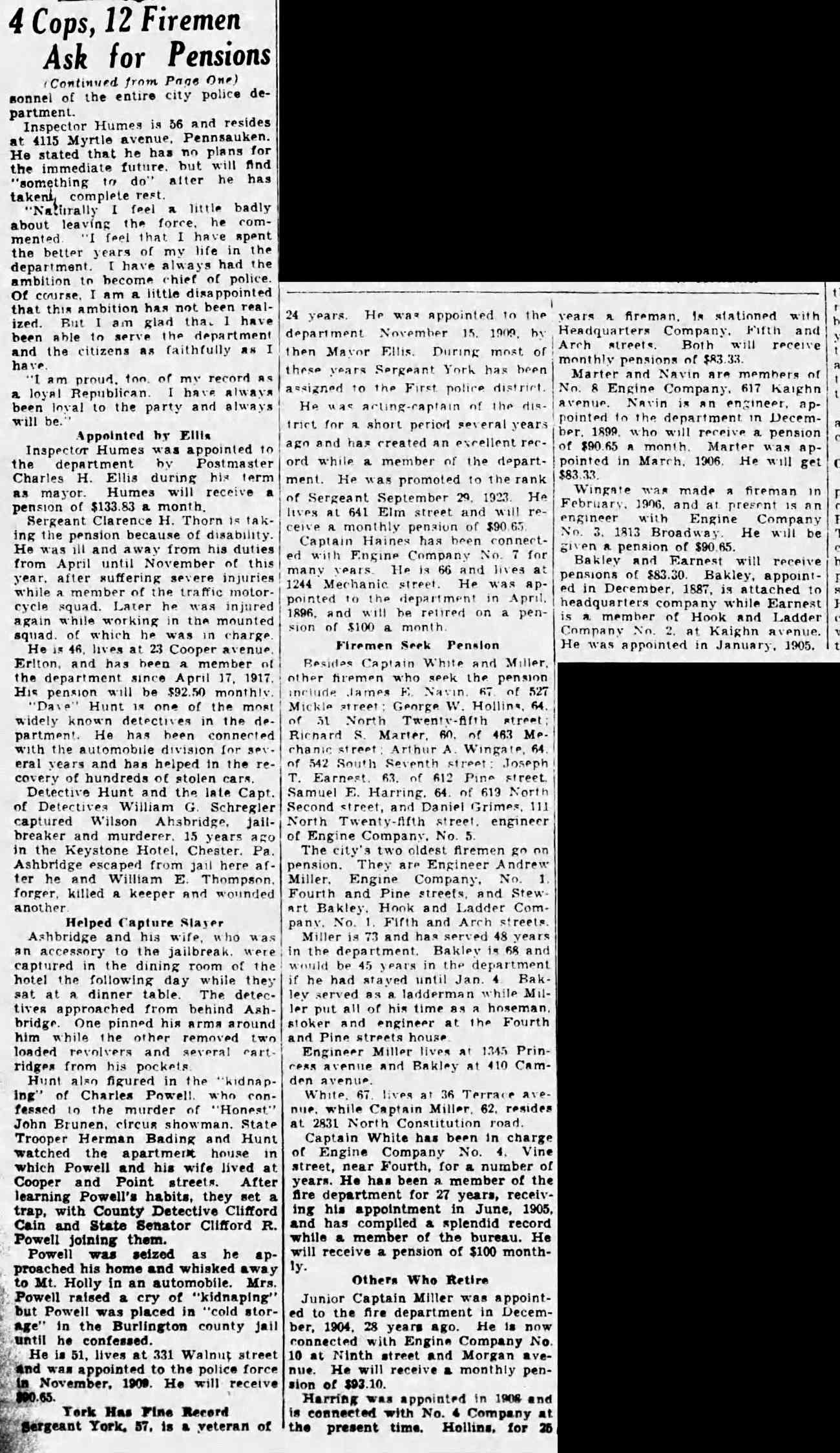
HEAVY PAY CUT FEAR CAUSE OF RUSH TO RETIRE
Inspector Humes Highest Officer on List; Three Captains Are Included
PROTECTIVE FORCES LOSE THEIR OLDEST VETERANS
Sixteen Vacant Places Will Be Filled Without New Appointments
Four policemen and 12 city firemen yesterday applied for pensions effective at midnight tonight. In the interests of economy, no successors will be named by the city commission.
Sudden decision of the applicants was inspired by the fact that city employes may be given a 30 percent reduction in pay equal to that of county employes. Police and firemen accepted a 10 percent reduction this year. If given an additional 20 percent their salaries would be on a pre-war basis.
They also face a possibility of further reductions in pensions if existing mandatory legislation is repealed by the Legislature, which fixes salaries of police and firemen according to the class of cities and towns. By applying now they will receive pensions on basic 1931 salaries.
The big surprise was announcement that Inspector Charles T. Humes, in charge of personnel of the police department, had applied for a pension. Inspector Humes receives a salary of $3000 yearly. By applying at this time he is eligible to a pension of one-half that amount. The $1500 yearly would be within a few hundred dollars of what he would receive if he remained on the force and accepted a 30 percent reduction in salary.
Consider Requests Today
Other policemen to ask for pensions are Sergeants Albert York and Clarence Thorn and Detective David Hunt.
Three fire captains applying for pensions are James R. White, Harry Haines and William H. Miller, Jr.
The applications were filed with Mrs. Louise F. Walsh, secretary of the Police and Firemen’s Pension Fund. The pension fund commission will act on the applications today.
Inspector Humes’ retirement comes at the conclusion of a quarter century of service in the police department. He was appointed as a patrolman on Jan. 1, 1908, and six years later, on Jan. 1, 1914, was elevated to a sergeancy. He was promoted to captaincy on July 1, 1918. Then, by act of the city commission, he was made an inspector on June 23, 1927.
Recognized as Authority
While a captain, he was in command of the First District and later of the Third. As an inspector, he was head of the traffic bureau for several years. He was a nationally recognized authority on traffic problems, having been requested for advice by various automobile clubs and traffic commissions. He played a leading role in a traffic convention at Chicago and once was called in by the federal traffic commission at Washington for advice. At the present time, he is in charge of the personnel of the entire city police department.
Inspector Humes is 56 and resides at 4115 Myrtle avenue, Pennsauken. He stated that he has no plans for the immediate future, but will find “something to do” after he has taken complete rest.
“Naturally I feel a little badly about leaving the force,” he commented. “I feel that I have spent the better years of my life in the department. I have always had the ambition to become chief of police. Of course, I am a little disappointed that this ambition has not been realized. But I am glad that I have been able to serve the department and the citizens as faithfully as I have.
“I am proud, too, of my record as a loyal Republican. I have always been loyal to the party and always will be.”
Appointed by Ellis
Inspector Humes was appointed to the department by Postmaster Charles H. Ellis during his term as mayor. Humes will receive a pension of $133.83 a month.
Sergeant Clarence H. Thorn is taking the pension because of disability. He was ill and away from his duties from April until November of this year, after suffering severe injuries while a member of the traffic motorcycle squad. Later he was injured again while working in the mounted squad, of which he was in charge.
He is 46, lives at 23 Cooper avenue, Erlton, and has been a member of the department since April 17, 1917. His pension will be $92.50 monthly.
“Dave” Hunt is one of the most widely known detectives in the department. He has been connected with the automobile division for several years and has helped in the recovery of hundreds of stolen cars.
Detective Hunt and the late Capt. of Detectives William G. Schregler captured Wilson Ahsbridge [sic], jailbreaker and murderer, 15 years ago in the Keystone Hotel, Chester, Pa. Ashbridge escaped from jail here after he and William E. Thompson, forger, killed a keeper and wounded another.
Helped Capture Slayer
Ashbridge and his wife, who was an accessory to the jailbreak, were captured in the dining room of the hotel the following day while they sat at a dinner table. The detectives approached from behind Ashbridge. One pinned his arms around him while the other removed two loaded revolvers and several cartridges from his pockets.
Hunt also figured in the “kidnaping” of Charles Powell, who confessed to the murder of “Honest” John Brunen, circus showman. State Trooper Herman Bading and Hunt watched the apartment house in which Powell and his wife lived at Cooper and Point streets. After learning Powell’s habits, they set a trap, with County Detective Clifford Cain and State Senator Clifford R. Powell joining them.
Powell was seized as he approached his home and whisked away to Mt. Holly in an automobile. Mrs. Powell raised a cry of “kidnaping” but Powell was placed in “cold storage” in the Burlington county jail until he confessed.
He is 51, lives at 331 Walnut street and was appointed to the police force in November, 1909. He will receive $90.65.
York Has Fine Record
Sergeant York, 57, is a veteran of 24 years. He was appointed to the department November 15, 1909, by then Mayor Ellis. During most of these years Sergeant York has been assigned to the First police district.
He was acting-captain of the district for a short period several years ago and has created an excellent record while a member of the department. He was promoted to the rank of Sergeant September 29, 1923. He lives at 641 Elm street and will receive a monthly pension of $90.65.
Captain Haines has been connected with Engine Company No. 7 for many years. He is 66 and lives at 1244 Mechanic street. He was appointed to the department in April, 1896, and will be retired on a pension of $100 a month.
Firemen Seek Pension
Besides Captain White and Miller, other firemen who seek the pension include James E. Navin, 67, of 527 Mickle street; George W. Hollins, 64, of 51 North Twenty-fifth street; Richard S. Marter, 60, of 463 Mechanic street; Arthur A. Wingate, 64, of 542 South Seventh street; Joseph T. Earnest, 63, of 612 Pine street; Samuel E. Harring, 64, of 613 North Second street, and Daniel Grimes, 111 North Twenty-fifth street, engineer of Engine Company, No. 5.
The city’s two oldest firemen go on pension. They are Engineer Andrew Miller, Engine Company, No. 1, Fourth and Pine streets, and Stewart Bakley, Hook and Ladder Company, No. 1, Fifth and Arch streets.
Miller is 73 and has served 48 years in the department. Bakley is 68 and would be 45 years in the department if he had stayed until Jan. 4. Bakley served as a ladderman while Miller put all of his time as a hoseman, stoker and engineer at the Fourth and Pine streets house.
Engineer Miller lives at 1345 Princess avenue and Bakley at 410 Camden avenue.
White, 67, lives at 36 Terrace avenue, while Captain Miller, 62, resides at 2831 North Constitution road.
Captain White has been in charge of Engine Company No. 4, Vine street, near Fourth, for a number of years. He has been a member of the fire department for 27 years, receiving his appointment in June, 1905, and has compiled a splendid record while a member of the bureau. He will receive a pension of $100 monthly.
Others Who Retire
Junior Captain Miller was appointed to the fire department in December, 1904, 28 years ago. He is now connected with Engine Company No. 10 at Ninth street and Morgan avenue. He will receive a monthly pension of $93.10.
Harring was appointed in 1908 and is connected with No. 4 Company at the present time. Hollins, for 25 years a fireman, is stationed with Headquarters Company, Fifth and Arch streets. Both will receive monthly pensions of $83.33.
Marter and Navin are members of No. 8 Engine Company, 617 Kaighn avenue. Navin is an engineer, appointed to the department in December, 1899, who will receive a pension of $90.65 a month. Marter was appointed in March, 1906. He will get $83.33.
Wingate was made a fireman in February, 1906, and at present is an engineer with Engine Company No. 3, 1813 Broadway. He will be given a pension of $90.65.
Bakley and Earnest will receive pensions of $83.30. Bakley, appointed in December, 1887, is attached to headquarters company while Earnest is a member of Hook and Ladder Company No. 2, at Kaighn avenue. He was appointed in January, 1905.
5 Camden Police Granted Pensions
Camden Courier-Post —
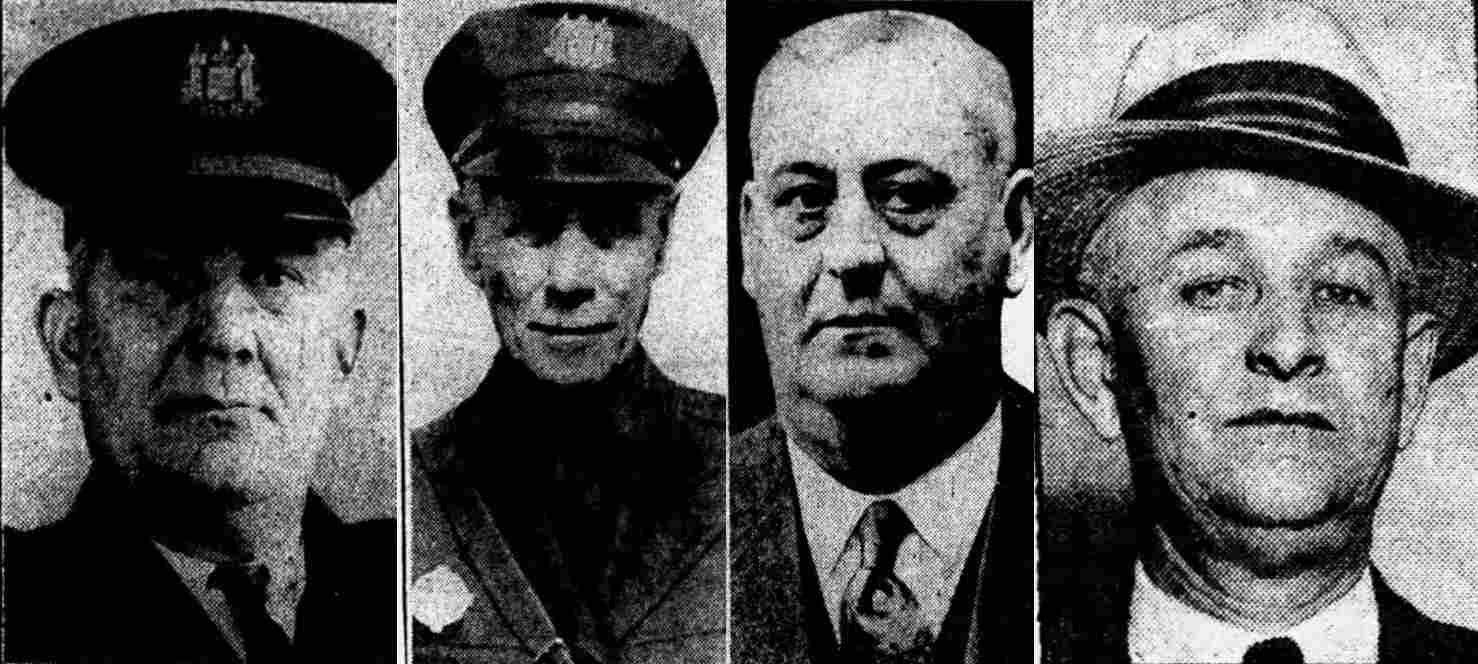

Laib, Kay, Guthrie, Smith and Till to Be Retired Next Month
Petitions for pensions were granted yesterday to five members of the Camden police department.
The retiring men are: Lieutenant Charles Laib, in charge of the traffic bureau; Sergeant Charles J. “Jeff”. Kay, City Detectives Theodore “Dory” Guthrie and Howard Smith, and Patrolman J. Oscar Till.
The retirements are to become effective Jan. 1, it was announced after a special meeting of the pension committee in city hall. Mrs. Louise F. Walsh, secretary of the board, presented the five applications.
Eventual retirement of Lieut. Laib has been rumored in the department for several months, but it was not until recently that the report was regarded seriously. It is understood that his associates as late as yesterday had requested him to remain on duty. He is recognized as one of the most competent officers in the department. Failing health, however, is said to have prompted the pension committee to approve his application.
Successor Not Named
No announcement as to Lieut. Laib’s successor was made by Acting Chief John W. Golden.
Lieutenant Laib was appointed to the police force January 12, 1912, by former Mayor Charles H. Ellis. He was promoted to sergeant in 1916 and became a lieutenant in 1929. He has been in charge of the traffic department for a year, succeeding Captain Charles L. Humes, who has been named inspector of personnel.
Laib is but 51 years of age and is one of the youngest men in the department to apply for pension. If his pension is approved he will receive a monthly salary of $102.08. His home is with his wife at 76 South Twenty-fourth street.
For many years, Laib has been conducting a “one-man” relief organization and is recognized by charitable organizations throughout the city for his generosity among the destitute.
Each Thanksgiving and Christmas, he personally collects funds for dinners for the children of the Sheltering Arms Home, Seventeenth street and River avenue, and has also been responsible for the home getting a daily supply of bread from a Camden bakery for several years.
Kay Served 38 Years
Sergeant Kay is a veteran member of the police department and has been an officer for 38 years. He is 72 and lives at 606 North Fourth street. He will receive $90.65 monthly. He has been on the sick list for several months, recovering from injuries received in an accident.
Detective Smith is 58 and lives at 933 Penn street. For several years he was loaned to the county as a detective and helped in solving a number of Camden county murders. He was recently returned to the police department and Detective Fiore Troncone turned over to the county in his place. He will receive $90.65 a month. He was appointed March 20, 1906.
Detective Guthrie served 19 years as a policeman and two as a fireman. He resides at 570 Chestnut street. He will receive $92.50 per month, the additional $2 being added because he will not have the usual two per cent deducted for the pension fund.
Patrolman Till, who is 56, resides at 1002 North Twenty-fifth street. He served 25 years as a policeman and two and one-half years as a fireman. He is attached to the Second district. Till will receive $83.60 monthly.
The members of the pension committee who passed on the applications is headed by Mayor Roy R. Stewart and includes, Newton W. Ash, fire department representative; William Michalk [sic], police department representative; John J. Robinson, citizen member, and Mrs. Walsh.
Dickinson to Get Holloway’s Place
Camden Courier-Post —
Camden Courier-Post - June 14, 1933
DICKINSON TO GET HOLLOWAY'S PLACE
Late Custodian's Aide at Courthouse is Freeholders Choice
The Board of Freeholders will appoint Thomas Dickinson Jr. as acting custodian of the courthouse and the city hall-courthouse annex at its meeting this afternoon.
Mrs. Elizabeth C. Verga will be appointed to a new term of five years on the Board for the Supervision of Old Age Relief, of which she has been secretary-treasurer for one year. The post carries no salary.
Dr. Leslie H. Ewing, director of the freeholders, revealed the pending appointments. In the case of the custodianship, his announcement came as rumors spread that one of the bigger politicians would be named to the job left vacant since the death of Edward Holloway, the incumbent, last month.
“Dickinson, who was assistant to Holloway, will be named acting custodian to serve tor the balance of the year,” Dr. Ewing said. “The freeholders will make the appointment tomorrow.”
Prior to Dr. Ewing's announcement, rumors circulated at the city hall and courthouse mentioning postmaster Charles H. Ellis, City Commissioner Clay W. Reesman, Assembly- man F. Stanley Bleakly and former Sheriff Walter T. Gross among possibilities for the custodianship, which pays $2520 a year under the general county cut of 30 percent.
Reports that the aforementioned were candidates for the job could not be confirmed, and in certain quarters they were considered without foundation, mainly because the pay would be smaller in most instances than what those mentioned all possible candidates are now receiving in their other posts.
Other possibilities mentioned include Robert Brennan, First Ward Republican county committeeman, and Freeholders William P. Cotter and C. Leonard Brehm. Brennan had been employed for some time at the city hall and courthouse in maintenance of the building. Dickinson also is reported to be a candidate for the custodianship.
Acting custodian Dickinson will continue at the same salary he has been receiving as assistant, Dr. Ewing said. The director added that the freeholders may consider the custodianship vacancy again early next year, but whether the post will be filled is problematical because of the economic situation in the county.
Wiley Mission to Hold Colorful International Service Tonight
Camden Courier-Post - June 16, 1933
Wiley Mission to Hold Colorful International Service Tonight
'All-Nation Revue' To Be Presented as Part of 'Indoor Camp Meetings'
in Old Federal Building; Program Will Be Broadcast
An evangelistic “League of Nations” will be held in Camden to night. The international gathering will take place in the old mail sorting room of the former federal building at Third and Arch streets, and will be sponsored by Wiley Mission.
Speakers and singers of ten nationalities will participate in the program arranged by C. Harold Lowden, organist, composed and music publisher, for the “All-Nations Revue” to be presented as part of the “indoor camp meetings” now in progress at the mission.
The nationalities will include German, Italian, Scotch, Greek, Chinese, African, Ukrainian, Polish, Slav and English. Some of the singers will appear in native costumes, and hymns will be sung in several languages. Brief addresses will be made by representatives of the various countries.
The program will he broadcast by WCAM over the new radio equipment installed in the mission yesterday.
Rev. John S. Hackett, superintendent of the mission, and pastor of Wiley M. E. Church, last night said arrangements had been completed for broadcasting portions of the “indoor camp meetings” on Monday and Friday nights.
Mrs. Amy Ungrae, known as “Amy of Chinatown,” started the broadcasting service yesterday at the all-day meeting held in the mission. She spoke on “Faith.” Mrs. Ungrae will speak each afternoon at the mission during the “indoor camp meetings.”
Arthur N. Morris, paper box manufacturer of Philadelphia, who spoke Tuesday night, spoke at the meeting last night. Morris teacher of the Wanamaker Bible class of Bethany Presbyterian Church, one of the largest men's Bible classes in Philadelphia. He was accompanied by a delegation from the Bible class.
Tomorrow night's program will be in charge of a delegation from the Philadelphia Highway Mission and Jail Workers. Rev. Hackett will preach Sunday night on “Open Sunday. vs. the Workingman.”
The program for next week includes a “Welcome Back” night for postal workers of Camden, when they will be honored in the room where they handled thousands of letters daily before the federal offices were moved. Postmaster Charles Ellis has been invited to speak, and several quartets composed of clerks and carriers will sing. The oldest clerk and the oldest carrier will be honored.
Donald Redding, musical director of Bethany Presbyterian Church, and Bernard Poland, member of the National Male Quartet, are leading in the singing at the “camp meetings.” Lowden is chief instrumentalist.
N.R.A. Drive Here Opens Tomorrow; Committee Named
Camden Courier-Post —
N.R.A. DRIVE HERE OPENS TOMORROW; COMMITTEE NAMED
168 Shoemakers in Three Counties Form Code; Big Firms Sign Pacts
HONOR ROLL LISTS 1749
The personnel of the National Recovery Act campaign committee for Camden city and county was announced yesterday by Chairman Clinton L. Bardo.
The committee members and their assignments follow:
James V. Moran, department stores; Leonard R. Baker, department stores; S. Lester, retail stores; Francis B. Wallen, miscellaneous business; A. D. Ambruster, banks; Clinton L. Bardo, shipbuilding; A. C. Held, industry; J. W. Burnison, industry; Harry A. Kelleher, industry; Warren Webster, Jr., industry; William H. Chew, Sr., printing; J. Alex Crothers, maritime interest.; Carl R. Evered, real estate and building trades; Fred T. Gates, chain stores; B. H. Hudson, transportation; Harry C. Stevenson, public utilities; Watson Shallcross, automotive; Elwood S. Thompson, insurance of all types; Robert C. Perina, all professional lines, and J. David Stern, publicity.
The committee will hold its first organization meeting tomorrow afternoon in the offices of the Camden County Chamber of Commerce in Broadway-Stevens Building. A plan of action will be mapped out at this session, Chairman Bardo said.
Meanwhile, Postmaster Charles H. Ellis and his staff at Camden post office were still able to supply the “Blue Eagle” Insignia in limited numbers white waiting for an additional 1500 copies from Washington. Several hundred Insignias were obtained yesterday from the Philadelphia post office, Ellis disclosed, to meet the demand of Camden employers, but this supply was quickly exhausted when 190 additional employers signed the blanket code, raising the total N.R.A. employers in this area to 1749.
One hundred and sixty-eight shoemakers of Camden, Burlington and Gloucester counties have prepared a code to be forwarded to Brigadier General Hugh S. Johnson, National Recovery Administrator in Washington immediately.
The shoemakers who are organized under the name of the Shoe Rebuilders of Camden, Burlington and Gloucester counties, also entered into, a “gentleman's agreement” as to operating hours.
Under the agreement, the stores will be opened from 8 a. m. to 6 p. m. on Mondays, Wednesdays and Thursdays and from 8 a.m.to 9 p. m. on Fridays and Saturdays.
Under provisions of the adopted code, no shoe repair shop owner shall employ his labor for more than 48hours per week, no repair shop shall remain open less than 52 hours each week and no shops will be opened on Sundays or legal holidays,
The code also sets up a list of minimum wages.
Under its provisions, manager or journeymen would receive $25 a week; bench men would be paid $21 a week; finishers would get $18 a week and unskilled apprentices would be paid $12 weekly.
A list of minimum prices are included in the code.
Among local firms signing the President's agreement yesterday are the PrudentialLife Insurance Company, with 30 employees in its Camden office; the American Oil Company, 30 local employees; the Hajoca Corporation, 15, and the Sinclair Refining Company; 12.
It was announced by C. R. Moore, manager of the Household Finance Corporation, 130 North Broadway, that the concern had signed the President's agreement and already placed it in effect.
Postmaster Ellis Declares for Baird
Camden Courier-Post —
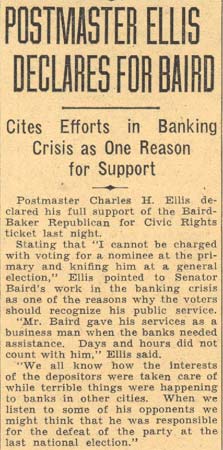
Cites Efforts in Banking Crisis as One Reason for Support
Postmaster Charles H. Ellis declared his full support of the Baird-Black Republican for Civic Rights ticket last night.
Stating that “I cannot be charged with voting for a nominee at the primary and knifing him at a general election,” Ellis pointed to Senator Baird’s work in the banking crisis as one of the reasons why the voters should recognize his public service.
“Mr. Baird gave his services as a business man when the banks needed assistance. Days and hours did not count with him,” Ellis said.
“We all know how the interests of the debtors were taken care of while terrible things were happening to banks in other cities. When we listen to some of his opponents we might think that he was responsible for the defeat of the party at the last national election.”
Photographs
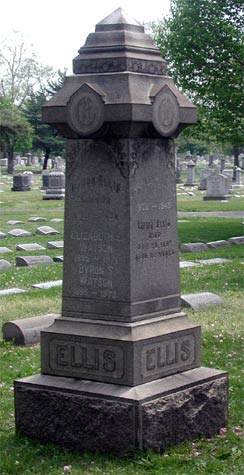
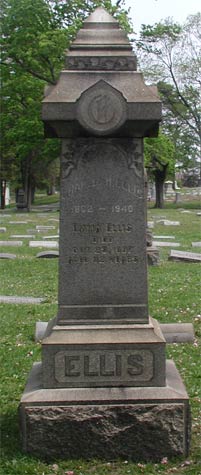
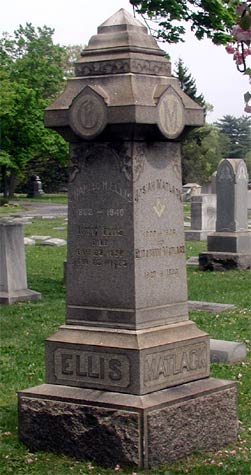
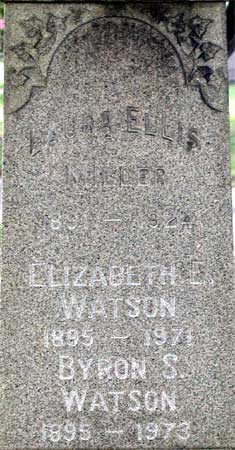
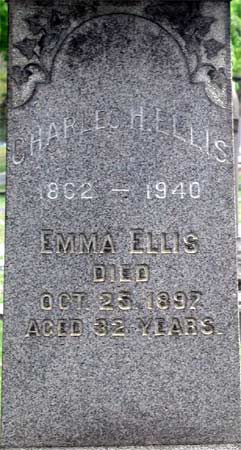
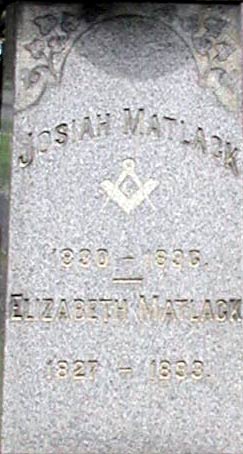
Click on Images to Enlarge
Stern the maverick publisher cuts in
Camden Courier-Post —
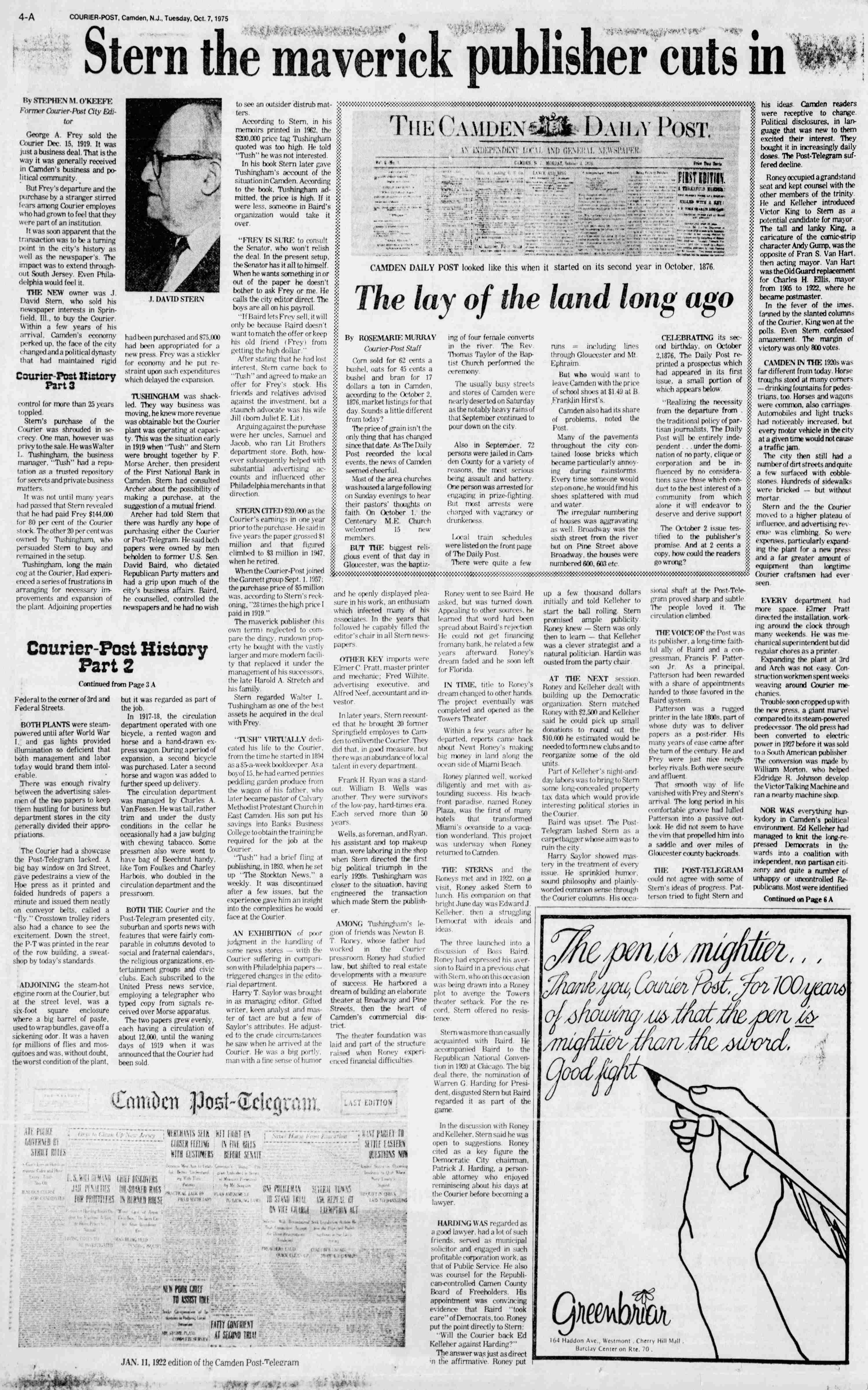

By STEPHEN M. O’KEEFE
Former Courier-Post City Editor
George A. Frey sold the Courier Dec. 15, 1919. It was just a business deal. That is the way it was generally received in Camden’s business and political community.
But Frey’s departure and the purchase by a stranger stirred fears among Courier employes who had grown to feel that they were part of an institution.
It was soon apparent that the transaction was to be a turning point in the city’s history as well as the newspaper’s. The impact was to extend throughout South Jersey. Even Philadelphia would feel it.
THE NEW owner was J. David Stern, who sold his newspaper interests in Springfield, Ill., to buy the Courier. Within a few years of his arrival, Camden’s economy perked up, the face of the city changed and a political dynasty that had maintained rigid control for more than 25 years toppled.
Stern’s purchase of the Courier was shrouded in secrecy. One man, however was privy to the sale. He was Walter L. Tushingham, the business manager. “Tush” had a reputation as a trusted repository for secrets and private business matters.
It was not until many years had passed that Stern revealed that he had paid Frey $144,000 for 80 per cent of the Courier stock. The other 20 per cent was owned by Tushingham, who persuaded Stern to buy and remained in the setup.
Tushingham, long the main cog at the Courier, had experienced a series of frustrations in arranging for necessary improvements and expansion of the plant. Adjoining properties had been purchased and $75,000 had been appropriated for a new press. Frey was a stickler for economy and he put restraint upon such expenditures which delayed the expansion.
TUSHINGHAM was shackled. They [sic] way business was moving, he knew more revenue was obtainable but the Courier plant was operating at capacity. This was the situation early in 1919 when “Tush” and Stern were brought together by F. Morse Archer, then president of the First National Bank in Camden. Stern had consulted Archer about the possibility of making a purchase, at the suggestion of a mutual friend.
Archer had told Stern that there was hardly any hope of purchasing either the Courier or Post-Telegram. He said both papers were owned by men beholden to former U.S. Sen. David Baird, who dictated Republican Party matters and had a grip upon much of the city’s business affairs. Baird, he counselled, controlled the newspapers and he had no wish to see an outsider distrub [sic] matters.
According to Stern, in his memoirs printed in 1962, the $200,000 price tag Tushingham quoted was too high. He told “Tush” he was not interested.
In his book Stern later gave Tushingham’s account of the situation in Camden. According to the book, Tushingham admitted, the price is high. If it were less, someone in Baird’s organization would take it over.
“FREY IS SURE to consult the Senator, who won’t relish the deal. In the present setup, the Senator has it all to himself. When he wants something in or out of the paper he doesn’t bother to ask Frey or me. He calls the city editor direct. The boys are all on his payroll.
“If Baird lets Frey sell, it will only be because Baird doesn’t want to match the offer or keep his old friend (Frey) from getting the high dollar.”
After stating that he had lost interest, Stern came back to “Tush” and agreed to make an offer for Frey’s stock. His friends and relatives advised against the investment, but a staunch advocate was his wife Jill (born Juliet E. Lit).
Arguing against the purchase were her uncles, Samuel and Jacob, who ran Lit Brothers department store. Both, however subsequently helped with substantial advertising accounts and influenced other Philadelphia merchants in that direction.
STERN CITED $20,000 as the Courier’s earnings in one year prior to the purchase. He said in five years the paper grossed $1 million and that figured climbed to $3 million in 1947, when he retired.
When the Courier-Post joined the Gannett group Sept. 1, 1957; the purchase price of $5 million was, according to Stern’s reckoning, “28 times the high price I paid in 1919.”
The maverick publisher (his own term) neglected to compare the dingy, rundown property he bought with the vastly larger and more modern facility that replaced it under the management of his successors, the late Harold A. Stretch and his family.
Stern regarded Walter L. Tushingham as one of the best assets he acquired in the deal with Frey.
“TUSH” VIRTUALLY dedicated his life to the Courier, from the time he started in 1894 as a $5-a-week bookkeeper. As a boy of 15, he had earned pennies peddling garden produce from the wagon of his father, who later became pastor of Calvary Methodist Protestant Church in East Camden. His son put his savings into Banks Business College to obtain the training he required for the job at the Courier.
“Tush” had a brief fling at publishing, in 1893, when he set up “The Stockton News,” a weekly. It was discontinued after a few issues, but the experience gave him an insight into the complexities he would face at the Courier.
AN EXHIBITION of poor judgment in the handling of some news stories — with the Courier suffering in comparison with Philadelphia papers — triggered changes in the editorial department.
Harry T. Saylor was brought in as managing editor. Gifted writer, keen analyst and master of tact are but a few of Saylor’s attributes. He adjusted to the crude circumstances he saw when he arrived at the Courier. He was a big portly man with a fine sense of humor and he openly displayed pleasure in his work, an enthusiam [sic] which infected many of his associates. In the years that followed he capably filled the editor’s chair in all Stern newspapers.
OTHER KEY imports were Elmer C. Pratt, master printer and mechanic; Fred Wilhite, advertising executive, and Alfred Neef, accountant and investor.
In later years, Stern recounted that he brought 20 former Springfield employes to Camden to enliven the Courier. They did that, in good measure, but there was an abundance of local talent in every department.
Frank H. Ryan was a standout. William B. Wells was another. They were survivors of the low-pay, hard-times era. Each served more than 50 years.
Wells, as foreman, and Ryan, his assistant and top makeup man, were laboring in the shop when Stern directed the first big political triumph in the early 1920s. Tushingham was closer to the situation, having engineered the transaction which made Stern the publisher.
AMONG Tushingham’s legion of friends was Newton B. T. Roney, whose father had worked in the Courier pressroom. Roney had studied law, but shifted to real estate developments with a measure of success. He harbored a dream of building an elaborate theater at Broadway and Pine Streets, then the heart of Camden’s commercial district.
The theater foundation was laid and part of the structure raised when Roney experienced financial difficulties.
Roney went to see Baird. He asked, but was turned down. Appealing to other sources, he learned that word had been spread about Baird’s rejection. He could not get financing from any bank, he related a few years afterward. Roney’s dream faded and he soon left for Florida.
IN TIME, title to Roney’s dream changed to other hands. The project eventually was completed and opened as the Towers Theater.
Within a few years after he departed, reports came back about Newt Roney’s making big money in land along the ocean side of Miami Beach.
Roney planned well, worked diligently and met with astounding success. His beachfront paradise, named Roney Plaza, was the first of many hotels that transformed Miami’s oceanside to a vacation wonderland. This project was underway when Roney returned to Camden.
THE STERNS and the Roneys met and in 1922, on a visit, Roney asked Stern to lunch. His companion on that bright June day was Edward J. Kelleher, then a struggling Democrat with ideals and ideas.
The three launched into a discussion of Boss Baird. Roney had expressed his aversion to Baird in a previous chat with Stern, who on this occasion was being drawn into a Roney plot to avenge the Towers theater setback. For the record, Stern offered no resistence [sic].
Stern was more than casually acquainted with Baird. He accompanied Baird to the Republican National Convention in 1920 at Chicago. The big deal there, the nomination of Warren G. Harding for President, disgusted Stern but Baird regarded it as part of the game.
In the discussion with Roney and Kelleher, Stern said he was open to suggestions. Roney cited as a key figure the Democratic City chairman, Patrick J. Harding, a personable attorney who enjoyed reminiscing about his days at the Courier before becoming a lawyer.
HARDING WAS regarded as a good lawyer, had a lot of such friends, served as municipal solicitor and engaged in such profitable corporation work, as that of Public Service. He also was counsel for the Republican-controlled Camen [sic] County Board of Freeholders. His appointment was convincing evidence that Baird “took care” of Democrats, too. Roney put the point directly to Stern:
“Will the Courier back Ed Kelleher against Harding?”
The answer was just as direct in the affirmative. Roney put up a few thousand dollars initially and told Kelleher to start the ball rolling. Stern promised ample publicity. Roney knew — Stern was only then to learn — that Kelleher was a clever strategist and a natural politician. Hardin [sic] was ousted from the party chair.
AT THE NEXT session, Roney and Kelleher dealt with building up the Democratic organization. Stern matched Roney with $2,500 and Kelleher said he could pick up small donations to round out the $10,000 he estimated would be needed to form new clubs and to reorganize some of the old units.
Part of Kelleher’s night-and-day labors was to bring to Stern some long-concealed property tax data which would provide interesting political stories in the Courier.
Baird was upset. The Post-Telegram lashed Stern as a carpetbagger whose aim was to ruin the city.
Harry Saylor showed mastery in the treatment of every issue. He sprinkled humor, sound philosophy and plainly-worded common sense through the Courier columns. His occasional shaft at the Post-Telegram proved sharp and subtle. The people loved it. The circulation climbed.
THE VOICE OF the Post was its publisher, a long-time faithful ally of Baird and a congressman, Francis F. Patterson Jr. As a principal, Patterson had been rewarded with a share of appointments handed to those favored in the Baird system.
Patterson was a rugged printer in the late 1800s, part of whose duty was to deliver papers as a post-rider. His many years of ease came after the turn of the century. He and Frey were just nice neighborley [sic] rivals. Both were secure and affluent.
That smooth way of life vanished with Frey and Stern’s arrival. The long period in his comfortable groove had lulled Patterson into a passive outlook. He did not seem to have the vim that propelled him into a saddle and over miles of Gloucester county backroads.
THE POST-TELEGRAM could not agree with some of Stern’s ideas of progress. Patterson tried to fight Stern and his ideas. Camden readers were receptive to change. Political disclosures, in language that was new to them excited their interest. They bought it in increasingly daily doses. The Post-Telegram suffered decline.
Roney occupied a grandstand seat and kept counsel with the other members of the trinity. He and Kelleher introduced Victor King to Stern as a potential candidate for mayor. The tall and lanky King, a caricature of the comic-strip character Andy Gump, was the opposite of Fran [sic] S. Van Hart, then acting mayor. Van Hart was the Old Guard replacement for Charles H. Ellis, mayor from 1905 to 1922, where he became postmaster.
In the fever of the imes [sic], fanned by the slanted columns of the Courier, King won at the polls. Even Stern confessed amazement. The margin of victory was only 800 votes.
CAMDEN IN THE 1920s was far different from today. Horse troughs stood at many corners — drinking fountains for pedestrians, too. Horses and wagons were common, also carriages. Automobiles and light trucks had noticeably increased, but every motor vehicle in the city at a given time would not cause a traffic jam.
The city then still had a number of dirt streets and quite a few surfaced with cobblestones. Hundreds of sidewalks were bricked — but without mortar.
Stern and the the [sic] Courier moved to a higher plateau of influence, and advertising revenue was climbing. So were expenses, particularly expanding the plant for a new press and a far greater amount of equipment than longtime Courier craftsmen had ever seen.
EVERY department had more space. Elmer Pratt directed the installation, working around the clock through many weekends. He was mechanical superintendent but did regular chores as a printer.
Expanding the plant at 3rd and Arch was not easy. Construction workmen spent weeks weaving around Courier mechanics.
Trouble soon cropped up with the new press, a giant marvel compared to its steam-powered predecessor. The old press had been converted to electric power in 1927 before it was sold to a South American publisher. The conversion was made by William Morton, who helped Eldridge R. Johnson develop the Victor Talking Machine and ran a nearby machine shop.
NOR WAS everything hunkydory in Camden’s political environment. Ed Kelleher had managed to knit the long-repressed Democrats in the wards into a coalition with independent, non partisan citizenry and quite a number of unhappy or uncontrolled Republicans. Most were identified with the Non-Partisan League and they were feeling their oats. The practical Roney and Kelleher, however, knew they had merely reached first base.
The two men huddled with Stern and came up with an idea — campaign for a new form of government for the city. The plan was worked out expertly, emphasizing the advantages of a compact, five-man governing group, each member accountable to voters all over the city.
The new plan was kept secret for a while. It was embodied in an exhaustive survey for the council by Mayor King. The new mayor startled the Old Guard and the city at large by calling for a referendum on a City Commission form of government. The speech prompted an abundance of favorable copy in the Courier; not so favorable comment in the Post-Telegram.
IN MARCH, 1923, the change was approved. In May, the voters elected the entire Non-Partisan League ticket. This put Baird and his organization out of business for the first time in 25 years.
Stern and the Courier were the chief beneficiaries of the change. The publisher — and now politician — was to know the stress of carrying water on both shoulders.
Patterson and the Post-Telegram were to feel the worst effect. With the downward turn of fortune, a frustrating decline in advertising and circulation revenues, the P-T was a loser each day.
STERN CALCULATED the advantages in buy [sic] the Post-Telegram, but Patterson wouldn’t consider a deal with Stern. He approached Baird and asked for a loan needed to fight Stern. Baird said he wanted Patterson to keep the competition and suggested a smaller loan. The Post publisher wouldn’t agree.
“The full amount or nothing,” Patterson declared.
Baird matched his stubbornness. Back in the office Patterson shared his misery with Upton S. Jefferys, the editor, and Frank S. Albright, city editor. Upton owned five shares of P-T stock. He and Albright had given their best efforts for many years, but the outlook was bleak.
THIS WAS the situation when Patterson saw Ed Kelleher enter the office. The two were not strangers, but Patterson had little reason to regard him warmly.
Kelleher came right out with an offer to buy the Post-Telegram. Patterson replied with equal candor:
“You know that I know, Ed, that you don’t have anough [sic] money to buy this paper.”
Kelleher put a hand in a coat pocket and was about to inform Patterson that he had come prepared to negotiate.
“I’m sure I know who you represent,” Patterson stated. “My answer is no.”
KELLEHER DREW a check from his pocket and placed it before Patterson. The publisher took a quick glance at the amount. It was $75,000. He then summoned his son, Frank F. Patterson 3d.
“Here, Frank, you’re the treasurer here; this is your department.”
Kelleher thought he was hearing a change of attitude by Patterson. The younger Patterson stared at both men. He glanced at both sides of the check as would an accountant, then turned to his parent.
“What am I supposed to do with this, Father?” he asked.
THE REPLY was intended for Kelleher:
“You are supposed to tear it up and throw the pieces in the waste basket, Son.”
Young Patterson obeyed.
Keleher [sic] accepted the gestured [sic] as finale. One minute later he was walking along Federal Street to the Courier building to report to Stern.
J. DAVID STERN
JAN. 11, 1922 edition of the Camden Post-Telegram
The lay of the land long ago
By ROSEMARIE MURRAY
Courier-Post Staff
Corn sold for 62 cents a bushel, oats for 45 cents a bushel and bran for 17 dollars a ton in Camden, according to the October 2, 1876, market listings for that day. Sounds a little different from today?
The price of grain isn’t the only thing that has changed since that date. As The Daily Post recorded the local events, the news of Camden seemed cheerful.
Most of the area churches was [sic] housed a large following on Sunday evenings to hear their pastors’ thoughts on faith. On October 1, the Centenary M.E. Church welcomed 15 new members.
BUT THE biggest religious event of that day in Gloucester, was the baptizing of four female converts in the river. The Rev. Thomas Taylor of the Baptist Church performed the ceremony.
The usually busy streets and stores of Camden were nearly deserted on Saturday as the notably heavy rains of that September continued to pour down on the city.
Also in September, 72 persons were jailed in Camden County for a variety of reasons, the most serious being assault and battery. One person was arrested for engaging in prize-fighting. But most arrests were charged with vagrancy or drunkeness [sic].
Local train schedules were listed on the front page of The Daily Post.
There were quite a few runs — including lines through Gloucester and Mt. Ephraim.
But who would want to leave Camden with the price of school shoes at $1.49 at B. Franklin Hirst’s.
Camden also had its share of problems, noted the Post.
Many of the pavements throughout the city contained loose bricks which became particularly annoying during rainstorms. Every time someone would step on one, he would find his shoes splattered with mud and water.
The irregular numbering of houses was aggravating as well. Broadway was the sixth street from the river but on Pine Street above Broadway, the houses were numbered 600, 603 etc.
CELEBRATING its second birthday, on October 2, 1876, The Daily Post reprinted a prospectus which had appeared in its first issue, a small portion of which appears below:
“Realizing the necessity from the departure from the traditional policy of partisan journalists, The Daily Post will be entirely independent . . . under the domination of no party, clique or corporation and be influenced by no considerations save those which conduct to the best interest of a community from which alone it will endeavor to deserve and derive support.”
The October 2 issue testified to the publisher’s promise. And at 2 cents a copy, how could the readers go wrong?
CAMDEN DAILY POST looked like this when it started on its second year in October, 1876.
Courier-Post History Part 2
Federal to the corner of 3rd and Federal Streets.
BOTH PLANTS were steam-powered until after World War I, and gas lights provided illumination so deficient that both management and labor today would brand them intolerable.
There was enough rivalry between the advertising salesmen of the two papers to keep them hustling for business but department stores in the city generally divided their appropriations.
The Courier had a showcase the Post-Telegram lacked. A big bay window on 3rd Street, gave pedestrains [sic] a view of the Hoe press as it printed and folded hundreds of papers a minute and issued them neatly on conveyor belts, called a “fly.” Crosstown trolley riders also had a chance to see the excitement. Down the street, the P-T was printed in the rear of the row building, a sweatshop by today’s standards.
ADJOINING the steam-hot engine room at the Courier, but at the street level, was a six-foot square enclosure where a big barrel of paste, used to wrap bundles, gave off a sickening odor. It was a haven for millions of flies and mosquitoes and was, without doubt, the worst condition of the plant, but it was regarded as part of the job.
In 1917-18, the circulation department operated with one bicycle, a rented wagon and horse and a hand-drawn express wagon. During a period of expansion, a second bicycle was purchased. Later a second horse and wagon was added to further speed up delivery.
The circulation department was managed by Charles A. Van Fossen. He was tall, rather trim and under the dusty conditions in the cellar he occasionally had a jaw bulging with chewing tabacco [sic]. Some pressmen also were wont to have bag of Beechnut handy, like Tom Foulkes and Charley Harbois, who doubled in the circulation department and the pressroom.
BOTH THE Courier and the Post-Telegram presented city, suburban and sports news with features that were fairly comparable in columns devoted to social and fraternal calendars, the religious organizations, entertainment groups and civic clubs. Each subscribed to the United Press news service, employing a telegrapher who typed copy from signals received over Morse apparatus.
The two papers grew evenly, each having a circulation of about 12,000, until the waning days of 1919 when it was announced that the Courier had been sold.
Clayton Promoted to Chief Clerk in Police Department
Camden Courier-Post —

Commissioner Kobus Continues Move for Elimination of ‘Acting’ Officers
In line with her plans to eliminate acting offices in the police department, Commissioner Mary W. Kobus last night announced the promotion of Patrolman George Clayton to chief clerk of the department.
Clayton, whose promotion has been rumored since last December, has been acting chief clerk for two years and was named chief clerk, August 16. The promotion carries an increase in salary of $360, the position paying $2400 annually less the 15 percent economy reduction now in effect. As a patrolman Clayton received $2040 a year.
The city commission is expected in the near future to pass a resolution giving the title of captain, as outlined in a city ordinance, and he then receives an additional increase of $180 in salary bringing the total to $2580. Clayton will act as chief of police in the absence of Chief Arthur Colsey.
Clayton Record Lauded
Commenting on Clayton’s promotion, Commissioner Kobus said: “This is another step toward the elimination of acting officers in the police department and more are to follow in the future. It is my purpose to replace all acting jobs wherever and whenever it is possible. Clayton is a fine officer with a splendid record and his promotion will increase the efficiency and uphold the morale of the department.”
Clayton, who is 49 and lives at 912 Mt. Ephraim avenue, was appointed to the department on February 2, 1918, while Charles H. Ellis was mayor. He has served in nearly every capacity in the department, having been a motorcycle patrolman, mounted policeman, jailor, acting desk sergeant and acting detective.
Clayton has been cited for bravery on several occasions.
Capturing a fugitive bandit single handed at the Camden postoffice on December 20, 1932, was one of Clayton’s most sensational exploits. The bandit, Robert I. Mears, was wanted in Delaware for more than a score of robberies and was spotted in Camden.
Floors Irate Interferer
Police were notified and Clayton was assigned to the postoffice to grab Mears when he appeared for mail. Clayton waited for several days before he was rewarded with the appearance of Mears. Not knowing whether the bandit was armed or not, Clayton pulled his gun.
A bystander thought a holdup was in progress and Clayton was the culprit. Clayton was assaulted by the bystander, making the chances of the capture look slim, but he promptly “floored” the would-be rescuer with a punch and then took Mears to headquarters where he was held for Delaware authorities.
Walter Smith Gets Pension From City
Camden Courier-Post —
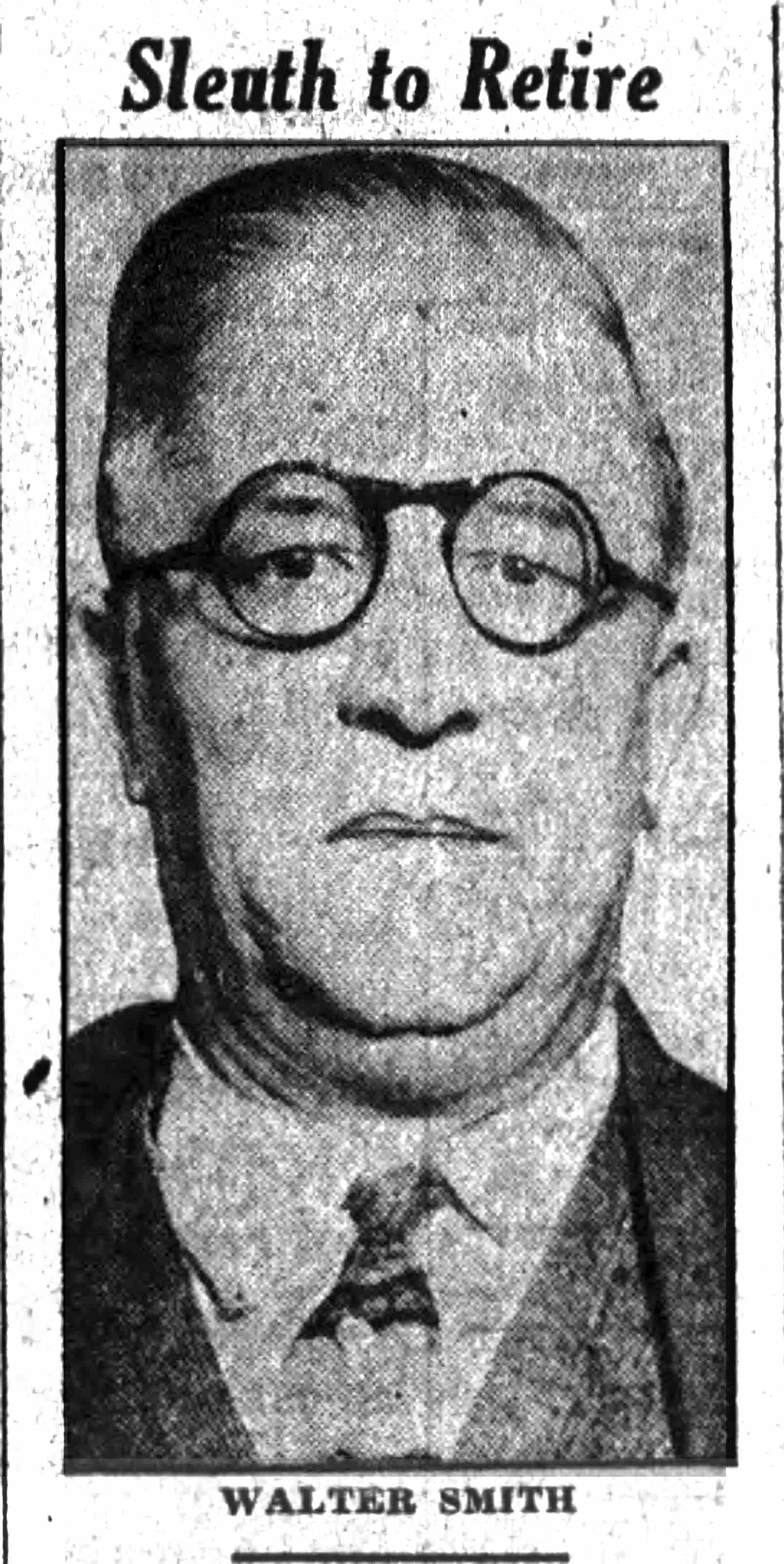
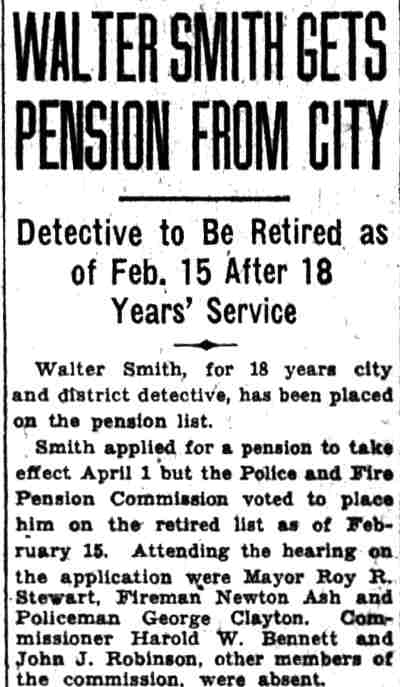
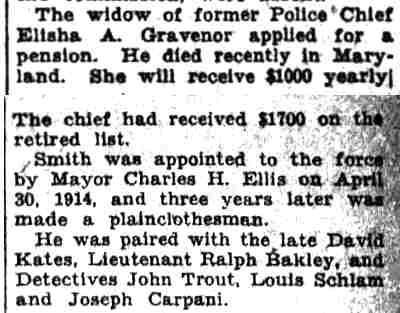
Detective to Be Retired as of Feb. 15 After 18 Years’ Service
Walter Smith, for 18 years city and district detective, has been placed on the pension list.
Smith applied for a pension to take effect April 1 but the Police and Fire Pension Commission voted to place him on the retired list as of February 15. Attending the hearing on the application were Mayor Roy R. Stewart, Fireman Newton Ash and Policeman George Clayton. Commissioner Harold W. Bennett and John J. Robinson, other members of the commission, were absent.
The widow of former Police Chief Elisha A. Gravenor applied for a pension. He died recently in Maryland. She will receive $1000 yearly.
The chief had received $1700 on the retired list.
Smith was appointed to the force by Mayor Charles H. Ellis on April 30, 1914, and three years later was made a plainclothesman.
He was paired with the late David Kates, Lieutenant Ralph Bakley, and Detectives John Trout, Louis Schlam and Joseph Carpani.
Sleuth to Retire
WALTER SMITH
Exciting Scenes Feature Big Fire
Philadelphia Inquirer —

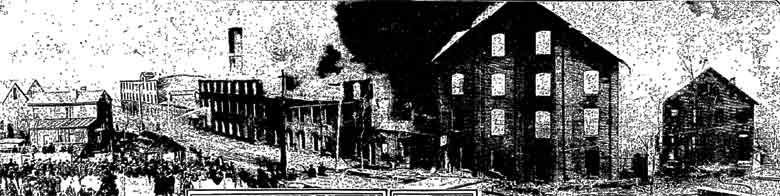
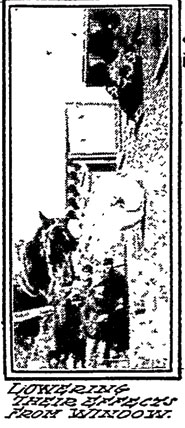
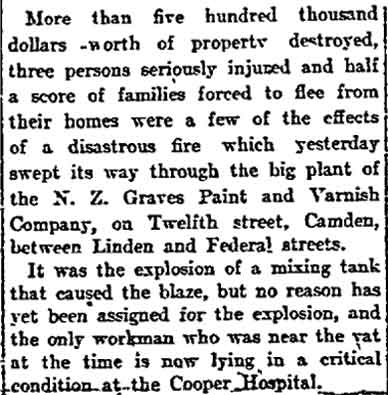
Camden’s Spectacular Fire and Incidents Attending the Conflagration Which Licked Up Valuable Property
Conflagration in Paint and Varnish Works, in Camden, Resulted in Destruction of Much Valuable Property
Panoramic Scene of the Fire.
Moved Out as a Precaution.
Lowering Their Effects from Window.
More than five hundred thousand dollars-worth of property destroyed, three persons seriously injured and half a score of families forced to flee from their homes were a few of the effects of a disastrous fire which yesterday swept its way through the big plant of the N. Z. Graves Paint and Varnish Company, on Twelfth street, Camden, between Linden and Federal streets.
It was the explosion of a mixing tank that caused the blaze, but no reason has yet been assigned for the explosion, and the only workman who was near the vat at the time is now lying in a critical condition at the Cooper Hospital.
Explosion followed explosion with the same deafening roar as that made by opposing batteries in a battle, and during the three hours when the fire raged its fiercest more than two hundred tanks blew up.
Spectacular Blaze
From the spectacular viewpoint the blaze was one of the greatest in years, owing to the chemical nature of the varnishes and paints which were destroyed. Flames mounted as high as two hundred feet in the air and could be plainly seen from Twenty-first and Market streets in this city.
Often as a vat exploded a dense mass of black smoke would mount high towards the heavens and then suddenly burst open like a huge pyrotechnic and out would come a large ball of flame. Then suddenly the whole building would seem to send up a solid square of flame that, after becoming lost in the clouds of smoke which hid the sky, would suddenly veer to the east or west and set fire to some small building.
Not the least of the curious sights was the throwing by the sun of a beautiful rainbow whose arch was easily one hundred feet long across a background of smoke. The sun had caught the spray from a fire hose and reflected it across the smoke. Another time, from one of the small buildings which had caught fire, but from which no flames came, there issued a dense cloud of red smoke which gradually changed to purple, then became white and finally black.
Tanks Intact
While all these explosions occurred and while the heat of the flames was so great that it singed the hair of persons on the opposite side of the street, thirty large tanks containing from five to ten thousand gallons of gasoline and benzine and located almost directly in the rear of the blazing buildings, remained unharmed, although it was momentarily feared that they, too, would explode.
All but one of the eight buildings of the Graves Company were either totally destroyed or so badly damaged that they will have to be rebuilt. Three houses were badly damaged and half a score of other houses scorched.
The persons injured were Joseph Pease, of 941 Kimball street, this city; George Ward, foreman of Fire Company No. 2, and Peter Gray, a fireman.
Pease was the workman who was near the vat at the time the first explosion occurred, and he was thrown high in the air and had his face, arms and body burned by the flames.
Ward was injured while leading his men in an attack upon the flames. He was mounting a ladder leading to the room of a dwelling at 316 Twelfth street when the cornice of the roof came off, fell and struck him on the head and caused an ugly wound of the scalp. Ward kept his hold upon the ladder and managed to descend. He was immediately hurried to the hospital.
Fireman Peter Gray was burned by the flaming benzine from a small tank which exploded.
Attacked Flames With Vim
Although one of the largest buildings resembled an enormous cauldron when they arrived upon the scene the Camden firemen, nothing discouraged, attacked the fire with vim, and while they could not confine it to the one building, they did splendid work in saving a number of small houses of workmen which surround the plant. They also saved one of the large buildings of the plant.
The police boats Ashbridge and Visitor, from this city, were sent to the fire, but were unable to get up Cooper Creek, which is in the rear of the plant, owing to the ice and mud. The Pennsylvania Railroad’s fire tug Jamestown, however, got to the plant and did effectual service.
Mayor Ellis was early upon the scene and had his hair singed while directing the firemen.
In Philadelphia great interest was taken in the fire, and at one time it looked as though all Camden were ablaze.
It was about half-past eleven yesterday morning that Pease, while working in what is known as building No. 1, at the Greaves plant, a large three-story brick structure, fifty by one hundred and twenty-five feet, was suddenly hurled from his feet by the explosion in a vat. Accounts differ as to what really occurred, but it is certain that there was an explosion. This building is used partly as an office building and partly to mix paints and varnishes.
General Alarm Sounded
For a minute the flames did not spread rapidly and a call was sent to the police headquarters for a chemical engine. By the time this apparatus arrived the whole building was on fire and a general alarm was sent in.
In the few moments elapsing between the call for the chemical engine and its arrival upon the scene several other explosions occurred and caused the employes to flee for their lives. There were only about fifty men, or one-third the regular force, working yesterday.
As soon as the firemen all arrived they tried to save building No. 3, which is of the same size and structure as the No. 1 building, but in which were stored one hundred and eight large vats of various kinds of varnish and paint, and all of them combustible.
Between the two buildings was a narrow archway, and over this the flames crept and defeated the efforts of the fire fighters. Then began the series of explosions that not only lit up the skies, but carried the fire to half a dozen dwelling houses.
These buildings are double houses and are two and one-half stories high. When the house at 306 Twelfth street caught fire all the other occupants of the row started to throw their household goods in the street, and in several cases the sparks set fire to bed clothing. Later in the day the residents, still fearful of their homes, secured wagons and carted their belongings away.
Thought of His Hens’ Eggs
One man, James Demsey, when he found his house afire, thought only for a dozen of Plymouth Rock hens’ eggs which he had secured for the purpose of raising some chickens. Regardless of his danger he dashed into the burning building, secured the eggs, and then made his escape.
Prompt work by the firemen soon put an end to the flames which had attacked the dwellings, but against the blaze which raged in the two buildings of the paint works the fire fighters were helpless. It seemed that the more water was poured upon the buildings the wickeder the flames arose. Not until all the floors had fallen and everything burnable had been consumed did the flames cease their work of destruction, and the walls had been so scorched that half of them fell crashing into the interior of the buildings.
Besides the two large buildings the stable of the works caught fire, but the employes of the plant were able to get all the horses and wagons out safely.
A. Graves, a son of the proprietor of the plant, stated that he did not know how great the loss would be nor could he tell exactly how the fire started. There is about $265,000 insurance upon the plant.
Bucket Brigade at Work
Later the residence at 1194 Linden street, where lives George Brown, was ignited. A bucket brigade did yeoman service there. To add to the excitement word reached the firemen that the plant of the R. F. South Lumber Company, Federal street and Cooper Creek, had been fired by sparks. An engine company was withdrawn and sent to the scene of the new blaze, which was extinguished with a trifling loss.
When the walls of No. 3 building fell, forcing the firemen to abandon their post, one of the recently purchased engines was left under the ruins. It wasn’t there long, however, a rope being attached and the steamer being pulled out by a hundred or so volunteers.
The first two dwellings to take fire were those of C. W. Sleighs, 306, and John Taylor, 304 North Twelfth street. The other houses in the row are tenanted as folows [sic]:
In 302 is Harry Smith; 300, vacant; 224, Frank Pullinger; 222, Mary Rass; 220, Joseph Eccles; 218, Charles Sibert; 216, Fred Exler; 214, Henry Palmer; 212, Charles Mills; 210, Samuel Ivins.
Succeeds Dad As Policeman.
Camden Post-Telegram —
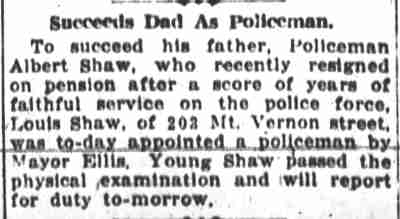
To succeed his father, Policeman Albert Shaw, who recently resigned on pension after a score of years of faithful service on the police force, Louis Shaw, of 203 Mt. Vernon street, was to-day appointed a policeman by Mayor Ellis. Young Shaw passed the physical examination and will report for duty to-morrow.
Building Committee and Board Members
1913
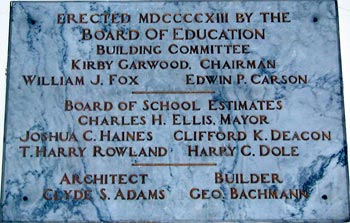
ERECTED MDCCCCXIII BY THE
BOARD OF EDUCATION
BUILDING COMMITTEE
KIRBY GARWOOD, CHAIRMAN
WILLIAM J. FOX EDWIN P. CARSON
BOARD OF SCHOOL ESTIMATES
CHARLES H. ELLIS, MAYOR
JOSHUA C. HAINES CLIFFORD K. DEACON
T. HARRY ROWLAND HARRY C. DOLE
ARCHITECT BUILDER
CLYDE S. ADAMS GEO. BACHMANN
Charles T. Humes Dies of Pneumonia
Philadelphia Inquirer —
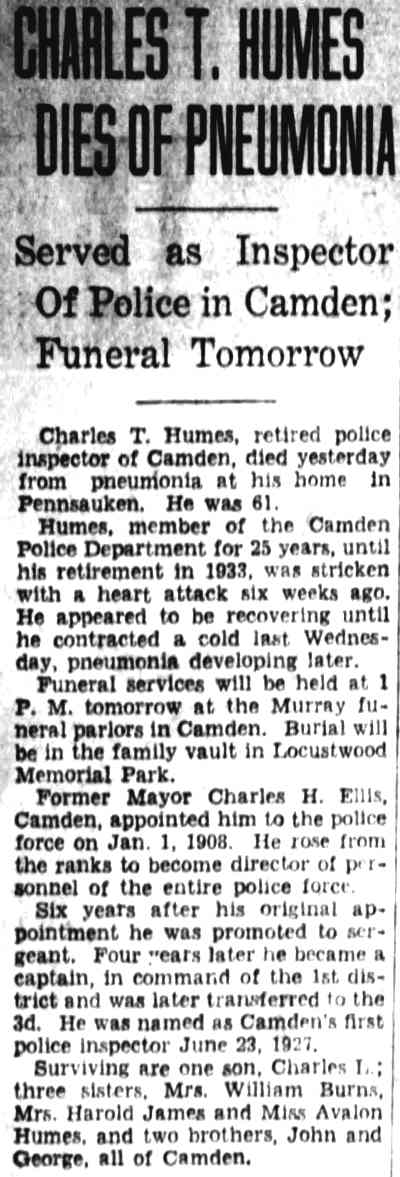
Served as Inspector Of Police in Camden; Funeral Tomorrow
Charles T. Humes, retired police inspector of Camden, died yesterday from pneumonia at his home in Pennsauken. He was 61.
Humes, member of the Camden Police Department for 25 years, until his retirement in 1933, was stricken with a heart attack six weeks ago. He appeared to be recovering until he contracted a cold last Wednesday, pneumonia developing later.
Funeral services will be held at 1 P. M. tomorrow at the Murray funeral parlors in Camden. Burial will be in the family vault in Locustwood Memorial Park.
Former Mayor Charles H. Ellis, Camden, appointed him to the police force on Jan. 1, 1908. He rose from the ranks to become director of personnel of the entire police force.
Six years after his original appointment he was promoted to sergeant. Four years later he became a captain, in command of the 1st district and was later transferred to the 3d. He was named as Camden’s first police inspector June 23, 1927.
Surviving are one son, Charles L.; three sisters, Mrs. William Burns, Mrs. Harold James and Miss Avalon Humes, and two brothers, John and George, all of Camden.
Chief Colsey Dies at 67 of Heart Attack
Camden Courier-Post —
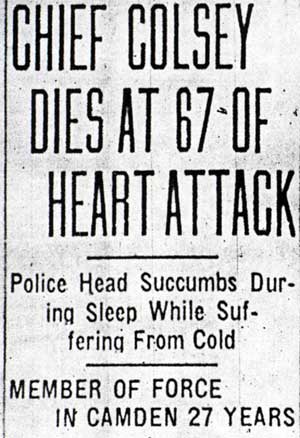
Police Head Succumbs During Sleep While Suffering From Cold
MEMBER OF FORCE IN CAMDEN 27 YEARS
Chief of Police Arthur Colsey, veteran of 27 years in the department, died of a heart attack in his sleep at his home, 2937 Stevens street, last night. He was 67.
Apparently in good health except for a slight cold, Chief Colsey left his office in City Hall at noon yesterday, telling his assistants he was going home “to nurse the cold.”
Shortly after 5 p. m., Chief Colsey asked his son, Arthur, Jr., to take Mrs. Colsey on a shopping trip. When they returned two hours later, they found him dead on a couch. The son said his father told him he was going to take a nap before he went to a doctor’s office to receive treatment for the cold.
Chief Colsey was a Camden merchant before entering the police department. For years he was active in the Republican party. He was highly respected by all men in the department. The chief was quiet in manner and the excitement pertaining to strikes in the city a few years ago found him calm in the most delicate situations.
Born in Kidderminster, England, in December, 1872, he came to this country when 17. He was in the department store business with his brothers at Ninth and Market streets for years. He served in the old City Council from 1907 to 1911 from the Second ward. At that time he lived at Eighth and Linden streets.
Joined Force in 1912
Colsey was appointed a patrolman by former Mayor Charles H. Ellis on March 13, 1912, while Elisha A. Gravenor was chief. After several months as a street patrolman he was assigned to the First District patrol wagon. Then he was made a district detective. Next he was promoted to a full ranking detective under Detective Chief William Schregler.
After being appointed a detective he was assigned as a plainclothesman and secretary to Mayor Ellis. He served in this capacity seven years. In 1923 he was appointed chief clerk of the police department with the rank of captain.
In 1924 he was made chief of the vice squad, which made 380 raids for prohibition law violations. The squad also assisted the federal authorities in 180 more liquor raids and participated in 54 raids on disorderly houses and 38 gambling places.
In 1927 the City Commission abolished the rank of captain in the department and Colsey remained as chief clerk without the title. The rank of captain was restored to him by the City Commission in 1932 by motion of Commissioner David S. Rhone.
When former Chief John W. Golden retired on a pension on June 11, 1934, Colsey was named acting chief by Mayor Roy R. Stewart. He was named permanent chief on August 30, 1934, by Mayor Stewart. At the same time John H. Lennox was named permanent chief of the fire department.
During the absence of City Commissioner Mary W. Kobus, director of public safety, Chief Colsey was acting director.
Colsey was one of the most popular men who served as chief, both in his department and in civic and political circles. After he was made a full ranking captain in 1932 a series of testimonial dinners were given by the East End Republican League, Twelfth Ward Republican Club and Eleventh Ward Republican Clubs. He was boomed for chief at each of the dinners. Another testimonial was given when he was acting chief by the Camden Police and Firemen’s Association.
In February, 1931, his appointment as chief was urged to succeed Chief Lewis H. Stehr but Golden was named.
While a resident of North Camden he served as president of the Second Ward Republican Club. He was president of the Twelfth Ward Republican Club in 1932.
Prominent Lodgeman
Chief Colsey was a thirty-second degree Mason, being a member of Trimble Lodge, No. 117, Free and Accepted Masons; Crescent Temple, Nobles of the Mystic Shrine, and Camden Forest, No. 5, Tall Cedars of Lebanon. He also was a member Camden Lodge, No. 293, Benevolent and Protective Order of Elks; Camden Lodge, No. 111, Loyal Order of Moose; Camden Aerie, No. 65, Fraternal Order of Eagles; Sons of St. George, Foresters of America, Improved Order of Red Men, Camden Local, Patrolmen’s Benevolent Association; International Police Chiefs’ Association, New Jersey State Police Chiefs’ Association, Camden Police and Fire Association, and the Camden County Republican Association.
Coroner Ernest Larossa issued the death certificate due to a heart ailment.
The funeral will be held at 2 p. m., Wednesday with burial in Arlington Cemetery. Other arrangements have not been completed. The body will be on view from 7 to 9 p. m., Tuesday at the home.
The chief is survived by his widow, Lillie; a brother, Thomas Colsey, a merchant and ranking officer of the Loyal Order of Moose; and two grandchildren, Arthur Colsey, 3rd., and Lillian Colsey. The grandson, a student at Western Maryland College, was notified last night of his grandfather’s death and left immediately for Camden.
Camden, Now Eighty Years Old, Is Proud of Its Wonderful Growth
Philadelphia Inquirer —
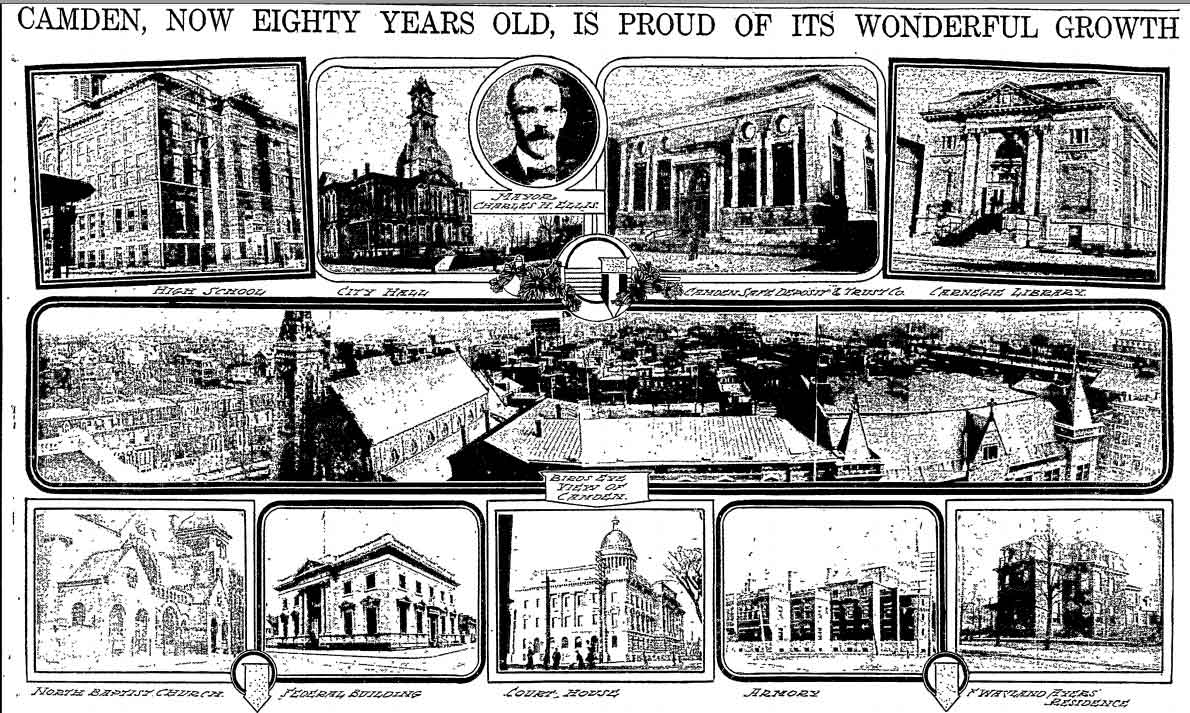
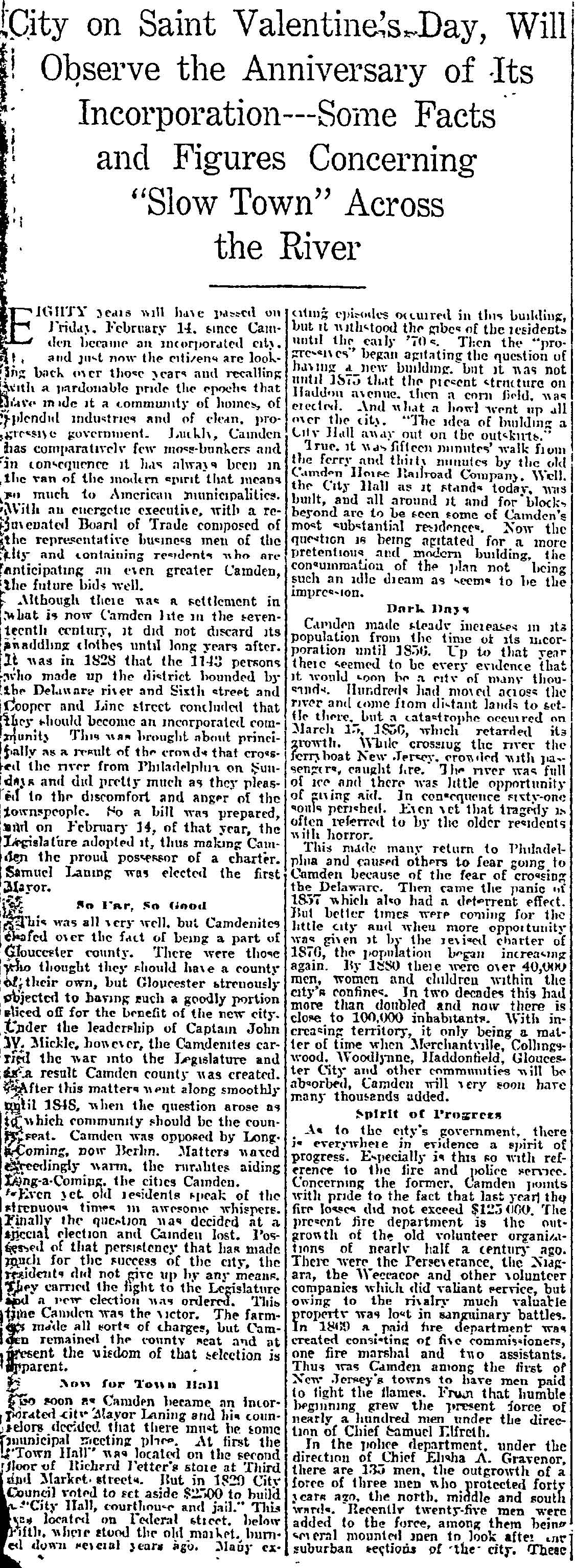
City on Saint Valentine’s Day, Will Observe the Anniversary of Its Incorporation—Some Facts and Figures Concerning “Slow Town” Across the River
High School. City Hall. Mayor Charles H. Ellis. Camden Safe Deposit & Trust Co. Carnegie Library. Birds Eye View of Camden. North Baptist Church. Federal Building. Court House. Armory. N. Wayland Ayers’ Residence.
EIGHTY years will have passed on Friday, February 14, since Camden became an incorporated city, and just now the citizens are looking back over those years and recalling with a pardonable pride the epochs that have made it a community of homes, of splendid industries and of clean, progressive government. Luckily, Camden has comparatively few moss-bunkers and in consequence it has always been in the van of the modern spirit that means so much to American municipalities. With an energetic executive, with a rejuvenated Board of Trade composed of the representative business men of the city and containing residents who are anticipating an even greater Camden, the future bids well.
Although there was a settlement in what is now Camden late in the seventeenth century, it did not discard its swaddling clothes until long years after. It was in 1828 that the 1143 persons who made up the district bounded by the Delaware river and Sixth street and Cooper and Line street concluded that they should become an incorporated community. This was brought about principally as a result of the crowds that crossed the river from Philadelphia on Sundays and did pretty much as they pleased to the discomfort and anger of the townspeople. So a bill was prepared, and on February 14, of that year, the Legislature adopted it, thus making Camden the proud possessor of a charter. Samuel Laning was elected the first Mayor.
So Far, So Good
This was all very well, but Camdenites chafed over the fact of being a part of Gloucester county. There were those who thought they should have a county of their own, but Gloucester strenuously objected to having such a goodly portion sliced off for the benefit of the new city. Under the leadership of Captain John W. Mickle, however, the Camdenites carried the war into the Legislature and as a result Camden county was created. After this matters went along smoothly until 1848, when the question arose as to which community should be the county seat. Camden was opposed by Long-a-Coming, now Berlin. Matters waxed exceedingly warm, the ruralites aiding Long-a-Coming, the cities Camden.
Even yet old residents speak of the strenuous times in awesome whispers. Finally the question was decided at a special election and Camden lost. Possessed of that persistency that has made much for the success of the city, the residents did not give up by any means. They carried the fight to the Legislature and a new election was ordered. This time Camden was the victor. The farmers made all sorts of charges, but Camden remained the county seat and at present the wisdom of that selection is apparent.
Now for Town Hall
So soon as Camden became an incorporated city Mayor Laning and his counselors decided that there must be some municipal meeting place. At first the “Town Hall” was located on the second floor of Richard Fetter’s store at Third and Market streets. But in 1829 City Council voted to set aside $2500 to build a “City Hall, courthouse and jail.” This was located on Federal street, below Fifth, where stood the old market, burned down several years ago. Many exciting episodes occurred in this building, but it withstood the gibes of the residents until the early ‘70s. Then the “progressives” began agitating the question of having a new building, but it was not until 1875 that the present structure on Haddon avenue, then a corn field, was erected. And what a howl went up all over the city. “The idea of building a City Hall away out on the outskirts.”
True, it was fifteen minutes’ walk from the ferry and thirty minutes by the old Camden House Railroad Company. Well, the City Hall as it stands today, was built, and all around it and for blocks beyond are to be seen some of Camden’s most substantial residences. Now the question is being agitated for a more pretentious and modern building, the consummation of the plan not being such an idle dream as seems to be the impression.
Dark Days
Camden made steady increases in its population from the time of its incorporation until 1856. Up to that year there seemed to be every evidence that it would soon be a city of many thousands. Hundreds had moved across the river and come from distant lands to settle there, but a catastrophe occurred on March 15, 1856, which retarded its growth. While crossing the river the ferryboat New Jersey, crowded with passengers, caught fire. The river was full of ice and there was little opportunity of giving aid. In consequence sixty-one souls perished. Even yet that tragedy is often referred to by the older residents with horror.
This made many return to Philadelphia and caused others to fear going to Camden because of the fear of crossing the Delaware. Then came the panic of 1857 which also had a deterrent effect. But better times were coming for the little city and when more opportunity was given it by the revised charter of 1870, the population began increasing again. By 1880 there were over 40,000 men, women and children within the city’s confines. In two decades this had more than doubled and now there is close to 100,000 inhabitants. With increasing territory, it only being a matter of time when Merchantville, Collingswood, Woodlynne, Haddonfield, Gloucester City and other communities will be absorbed, Camden will very soon have many thousands added.
Spirit of Progress
As to the city’s government, there is everywhere in evidence a spirit of progress. Especially is this so with reference to the fire and police service. Concerning the former, Camden points with pride to the fact that last year the fire losses did not exceed $125,000. The present fire department is the outgrowth of the old volunteer organizations of nearly half a century ago. There were the Perseverance, the Niagara, the Weecacoe and other volunteer companies which did valiant service, but owing to the rivalry much valuable property was lost in sanguinary battles. In 1869 a paid fire department was created consisting of five commissioners, one fire marshal and two assistants. Thus was Camden among the first of New Jersey’s towns to have men paid to fight the flames. From that humble beginning grew the present force of nearly a hundred men under the direction of Chief Samuel Elfreth.
In the police department, under the direction of Chief Elisha A. Gravenor, there are 135 men, the outgrowth of a force of three men who protected forty years ago, the north, middle and south wards. Recently twenty-five men were added to the force, among them being several mounted men to look after the suburban sections of the city. These have already proved their value. As to crime there is little of it except of a petty nature and when the occasion arises the majesty of the law is upheld in such a manner as to give the impression that nowhere in the State is there a better exemplification of the declaration that “Jersey justice moves swiftly” than in Camden.
And Camden Water
Camden’s water is admittedly without a peer. It is drawn from artesian wells and every day over 15,000,000 gallons of it is sent through the mains. This comes from a $600,000 plant at Morris Station, which is always hailed as “Camden’s greatest asset.” Plans are under way now to augment this plant. The city’s first water plant was established after considerable controversy in 1854 at Pavonia. The Delaware River water was pumped through the mains for years. In consequence the harvest of death from typhoid fever was great. In the nineties the contagion manifested itself in such an alarming manner that the artesian plant was proposed. It was not put in operation until 1898, but the change in the water supply was at once apparent in the better health of the city. While a hundred new cases of typhoid fever within a month prior to that time was by no means unusual, subsequent to the installation of the new supply, less than half a dozen were reported within a like period. Last year there were but 38 cases of this disease and most of them were traced to other cities.
Camden has many miles of paved streets. All the principal thoroughfares are asphalted as a result of an agitation that began over a decade ago. Only lately the principal outlets of the city were ordered paved with that material—Federal street from Cooper Creek to Twenty-fifth street, Haddon avenue from Line street to Ferry avenue, and Broadway from Emerald street to Newton Creek.
The Public Schools
Then there are the schools, which are educating an army of nearly 12,000 children. Four additional modern school buildings were recently completed, making in all thirty-four, with a commodious high school. As has already been shown by The Inquirer in a previous article, Camden’s educational system is of the highest order, which has been demonstrated repeatedly by the pupils winning first prizes at contests in exhibitions of national prominence.
Camden is a city of churches. Within its confines there are close to a hundred churches and missions of all denominations. In consequence of this comparatively great church-going host, the city is peculiarly strict on Sabbatarian questions. This was evidenced a year or so ago when certain dealers sought to sell on Sunday as on other days of the week. In consequence the laws were enforced to such an extent that the Sundays, for several months, savored of the Simon Pure New England Sabbaths of Puritan days.
When Andrew Carnegie was ridding himself of his wealth some years ago, establishing libraries in many cities of the country, it was suggested that he be asked to contribute something for the benefit of the book-loving public of Camden. For months this matter hung fire, but Dr. Dowling Benjamin finally brought the subject to an issue by appealing to the Scotch ironmaster. As a result it was not long before $100,000 was sent to Camden with which to build a library with the proviso that the city expend $10,000 annually for its maintenance. This was agreed upon and a structure was erected at Broadway and Line streets that is not only pleasing to the eye because of architectural embellishments, but also on account of the thousands of volumes that are circulated to over 18,000 men, women and children.
City of Homes
Camden has approximately over 20,000 homes. These are of all kinds, from the more pretentious structures in which the wealthy reside to the humble but homelike dwellings in which the great bulk of the inhabitants live. And with the coming spring hundreds of additional dwellings will be erected in the outlying districts.
There is also a public park which is being slowly but surely developed, and if Mayor Charles H. Ellis has his way there will be several squares, a recreation pier or two and beautiful shade trees throughout the city. He proposes to have one day each year set aside to be known as the “Day of the City Beautiful” devoted to making Camden better from an artistic and orderly standpoint.
As to Camden’s business interests, they are legion. With a river front of several miles backed by the Cooper creek there is ample natural provision for industrial concerns of a varied character. A new era is heralded from the fact that the creek is to be deepened by the government so that craft of fairly deep draught may use it. Already a number of industrial manufacturing plants have signified their intention of locating along the banks of the stream and before many years there promises to be one complete chain of industries.
Just a Review
At the annual gathering of the Board of Trade last week the value of some of the city’s manufactories was expressed something in this wise: “Camden has within its border a population of nearly 100,000, and shipbuilding firms that can either supply a launch or the greatest battleship; the largest lace curtain manufactory in America; a talking machine that speaks every known language; iron works that make enough pipe to girdle the earth; leather manufactories that tan skins from all parts of the globe; the largest furniture house, whose products reach to the Philippines; banks and trust companies whose resources are not affected by panics; linoleum works, which manufacture one-half the country’s whole product; a plant whose kitchens annually make enough soup to float all the vessels built in our shipyards, a pickle works, which furnishes Uncle Sam with material for slot machines; a department store, whose experiment has proved a decided success; pen works, which produce two-thirds of the pens used in the world; an expanded metal works—the material produced there will stretch from Maine to Texas and its mills rival the largest.”
So, with the thousands of homes, its scores of industries, its charitable institutions and the manifold creations of a modern civilization, Camden is a city which is not slow, which is always in the van of progress and municipal improvement in all lines of endeavor.
Motorization of Camden Fire Department Completed Under Chief P. B. Carter in 1915
Camden Courier-Post —


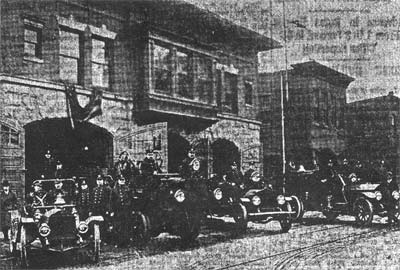
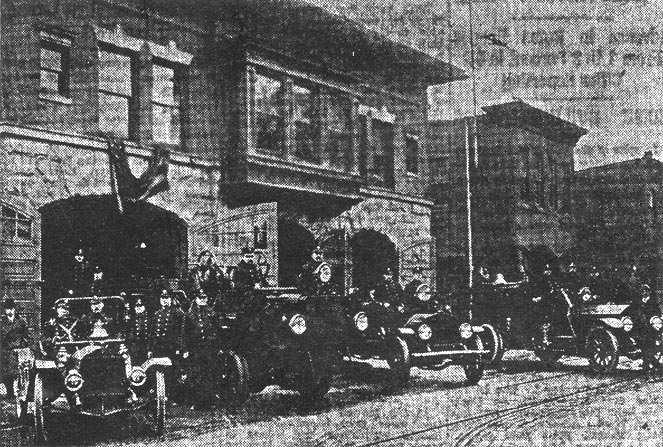
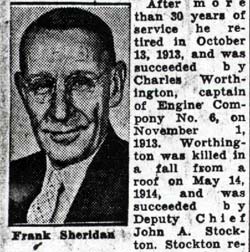
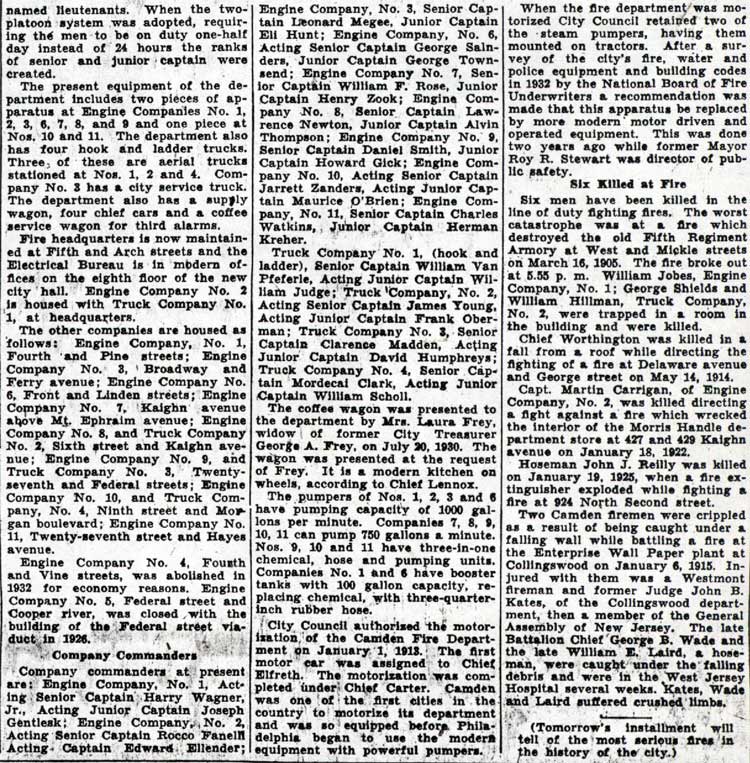
Above is shown a photo of part of the Camden Fire Department after it was motorized. The above companies are stationed at Fire Headquarters, Fifth and Arch streets.
This is the fifth installment of a history of fire fighting in Camden from the time of the formation of the first volunteer company in 1810 to 1936. It is the first complete history of the fire department written since 1886 and links the old volunteers with the new paid motorized department. It is being published in the interest [sic] with Fire Prevention Week, which was sponsored last week by the Camden County Fire Chiefs Association and the Camden Fire Department. Saturday’s installment told of the formation of the paid fire department.
Samuel S. Elfreth was reappointed for several terms as chief by the fire committee of city council before he was made permanent head of the department.
After more than 30 years of service he retired in October 13, 1913, and was succeeded by Charles Worthington, captain of Engine Compony [sic] No. 6, on November 1, 1913. Worthington was killed in a fall from a roof on May 14, 1914, and was succeeded by Deputy Chief John A. Stockton. Stockton retired the following year and was succeeded by Peter B. Carter on October 1, 1915.
Under Carter the motorization of the department was completed. Carter was injured in a fall from a roof when fire destroyed the interior of State Street Methodist Episcopal Church. He retired on a pension on March 31, 1926, to become chief of the Collingswood Fire Department. He remained as Collingswood’s chief until August 29, 1927, when he resigned. He was succeeded as chief of the Camden department by the late Thomas J. Nicholas. Nicholas retired in November, 1932, and was succeeded by John H. Lennox, who was named acting chief by former Mayor Roy R. Stewart on December 1, 1932. He was sworn in as a full-fledged chief on October 1, 1934.
Lennox Heads Department
Lennox is now chief. The deputy chiefs are William R. Harring and Walter A. Mertz and the battalion chiefs, Charles Erickson and Rollo R. Jones. Bernard J. Gallagher is fire marshal, James A. Howell, chief of the electrical bureau, and James H. Long, chief of the water department.
Deputy chiefs were known as assistant chiefs until the two-platoon system was inaugurated in Camden on January 1, 1921, under fromer [sic] Mayor Charles H. Ellis.
Company commanders were at first called foremen. Later they were named lieutenants. When the two-platoon system was adopted, requiring the men to be on duty one-half day instead of 24 hours the ranks of senior and junior captain were created.
The present equipment of the department includes two pieces of apparatus at Engine Companies No. 1, 2, 3, 6, 7, 8, and 9 and one piece at Nos. 10 and 11. The department also has four hook and ladder trucks. Three of these are aerial trucks stationed at Nos. 1, 2 and 4. Company No. 3 has a city service truck. The department also has a supply wagon, four chief cars and a coffee service wagon for third alarms.
Fire headquarters is now maintained at Fifth and Arch streets and the Electrical Bureau is in modern offices on the eighth floor of the new city hall. Engine Company No. 2 is housed with Truck Company No. 1, at headquarters.
The other companies are housed as follows: Engine Company, No. 1, Fourth and Pine streets; Engine Company No. 3, Broadway and Ferry avenue; Engine Company No. 6, Front and Linden streets; Engine Company No. 7, Kaighn avenue above Mt. Ephraim avenue; Engine Company No. 8, and Truck Company No. 2, Sixth street and Kaighn avenue; Engine Company No. 9, and Truck Company No. 3, Twenty-seventh and Federal streets; Engine Company No. 10, and Truck Company, No. 4, Ninth street and Morgan boulevard; Engine Company No. 11, Twenty-seventh street and Hayes avenue.
Engine Company No. 4, Fourth and Vine streets, was abolished in 1932 for economy reasons. Engine Company No. 5, Federal street and Cooper river, was closed with the building of the Federal street viaduct in 1926.
Company Commanders
Company commanders at present are: Engine Company, No. 1, Acting Senior Captain Harry Wagner, Jr., Acting Junior Captain Joseph Gentlesk; Engine Company, No. 2, Acting Senior Captain Rocco Fanelli Acting Captain Edward Ellender; Engine Company, No. 3, Senior Captain Leonard Megee, Junior Captain Eli Hunt; Engine Company, No. 6, Acting Senior Captain George Salnders, Junior Captain George Townsend; Engine Company No. 7, Senior Captain William F. Rose, Junior Captain Henry Zook; Engine Company No. 8, Senior Captain Lawrence Newton, Junior Captain Alvin Thompson; Engine Company No. 9, Senior Captain Daniel Smith, Junior Captain Howard Glick; Engine Company No. 10, Acting Senior Captain Jarrett Zanders, Acting Junior Captain Maurice O’Brien; Engine Company, No. 11, Senior Captain Charles Watkins, Junior Captain Herman Kreher.
Truck Company No. 1, (hook and ladder), Senior Captain William Van Pfeferle, Acting Junior Captain William Judge; Truck Company, No. 2, Acting Senior Captain James Young, Acting Junior Captain Frank Oberman; Truck Company No. 3, Senior Captain Clarence Madden, Acting Junior Captain David Humphreys; Truck Company No. 4, Senior Captain Mordecai Clark, Acting Junior Captain William Scholl.
The coffee wagon was presented to the department by Mrs. Laura Frey, widow of former City Treasurer George A. Frey, on July 20, 1930. The wagon was presented at the request of Frey. It is a modern kitchen on wheels, according to Chief Lennox.
The pumpers of Nos. 1, 2, 3 and 6 have pumping capacity of 1000 gallons per minute. Companies 7, 8, 9, 10, 11 can pump 750 gallons a minute. Nos. 9, 10 and 11 have three-in-one chemical, hose and pumping units. Companies No. 1 and 6 have booster tanks with 100 gallon capacity, replacing chemical, with three-quarter-inch rubber hose.
City Council authorized the motorization of the Camden Fire Department on January 1, 1913. The first motor car was assigned to Chief Elfreth. The motorization was completed under Chief Carter. Camden was one of the first cities in the country to motorize its department and was so equipped before Philadelphia began to use the modern equipment with powerful pumpers.
When the fire department was motorized City Council retained two of the steam pumpers, having them mounted on tractors. After a survey of the city’s fire, water and police equipment and building codes in 1932 by the National Board of Fire Underwriters a recommendation was made that this apparatus be replaced by more modern motor driven and operated equipment. This was done two years ago while former Mayor Roy R. Stewart was director of public safety.
Six Killed at Fire
Six men have been killed in the line of duty fighting fires. The worst catastrophe was at a fire which destroyed the old Fifth Regiment Armory at West and Mickle streets on March 16, 1905. The fire broke out at 5.55 p. m. William Jobes, Engine Company, No. 1; George Shields and William Hillman, Truck Company, No. 2, were trapped in a room in the building and were killed.
Chief Worthington was killed in a fall from a roof while directing the fighting of a fire at Delaware avenue and George street on May 14, 1914.
Capt. Martin Carrigan, of Engine Company, No. 2, was killed directing a fight against a fire which wrecked the interior of the Morris Handle department store at 427 and 429 Kaighn avenue on January 18, 1922.
Hoseman John J. Reilly was killed on January 19, 1925, when a fire extinguisher exploded while fighting a fire at 924 North Second street.
Two Camden firemen were crippled as a result of being caught under a falling wall while battling a fire at the Enterprise Wall Paper plant at Collingswood on January 6, 1915. Injured with them was a Westmont fireman and former Judge John B. Kates, of the Collingswood department, then a member of the General Assembly of New Jersey. The late Battalion Chief George B. Wade and the late William E. Laird, a hoseman, were caught under the falling debris and were in the West Jersey Hospital several weeks. Kates, Wade and Laird suffered crushed limbs.
(Tomorrow’s installment will tell of the most serious fires in the history of the city.)