Introduction
EDWARD HARTMAN was born in June of 1865. He served as a member of the Camden Fire Department in the 1890s.
When Engine Company 4 was organized on June 1, 1890 at 320 Vine Street in North Camden, with a two-hitch, second class Button steam engine and a one-hitch Button hose carriage, he was the new unit’s first driver. The charter members were as follows: Company Foreman, Amedee S. Middleton; engineer, Francis Turner; stoker C. Barney Harvey; driver, Edward Hartman; and hosemen Walter W. Browning and Charles Berry.
The Philadelphia Inquirer published an article stating that Edward Hartman was appointed to the Fire Department with Edward Weston in August of 1891. This appears to be in Hartman’s case an error, as he had been already serving for a year.
By 1897 Edward Hartman had been appointed to the Police Department. That year’s City Directory gives an address of 310 Mickle Street. The 1900 Census shows Edward Hartman living at 321 Mickle Street with his wife of fourteen years, Catherine, and their 10 year-old daughter Jennie. The 1906 City Directory states that Edward Hartman then resided at 47 Cooper Street.
Edward Hartman was still with the police department as late as June of 1909. By December 1910, however, he had left the department. He testified before the grand jury in December of 1910 during the election fraud investigations that culminated in sending John Golden, Martin Carrigan, and Daniel Woods to jail for four months in 1911.
Edward Hartman is not listed in the 1910 City Directory or the 1914 Camden City Directory.
OVER IN CAMDEN
Philadelphia Inquirer —
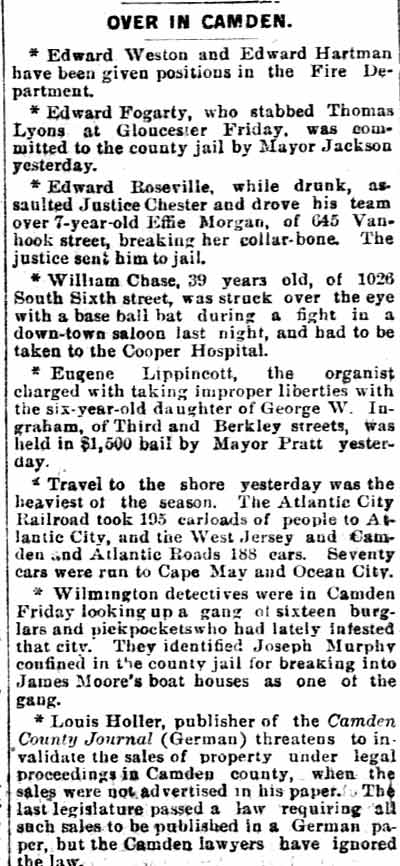
Edward Weston and Edward Hartman have been given positions in the Fire Department.
Edward Fogarty, who stabbed Thomas Lyons at Gloucester Friday, was committed to the county jail by Mayor Jackson yesterday.
Edward Roseville, while drunk, assaulted Justice Chester and drove his team over 7-year-old Effie Morgan, of 645 Vanhook street, breaking her collar-bone. The justice sent him to jail.
William Chase, 39 years old, of 1026 South Sixth street, was struck over the eye with a base ball bat during a fight in a down-town saloon last night, and had to be taken to the Cooper Hospital.
Eugene Lippincott, the organist charged with taking improper liberties with the six-year-old daughter of George W. Ingraham, of Third and Berkley streets, was held in $1,500 bail by Mayor Pratt yesterday.
Travel to the shore yesterday was the heaviest of the season. The Atlantic City Railroad took 195 carloads of people to Atlantic City, and the West Jersey and Camden and Atlantic Roads 188 cars. Seventy cars were run to Cape May and Ocean City.
Wilmington detectives were in Camden Friday looking up a gang of sixteen burglars and pickpockets who had lately infested that city. They identified Joseph Murphy confined in the county jail for breaking into James Moore’s boat houses as one of the gang.
Louis Holler, publisher of the Camden County Journal (German) threatens to invalidate the sales of property under legal proceedings in Camden county, when the sales were not advertised in his paper. The last legislature passed a law requiring all such sales to be published in a German paper, but the Camden lawyers have ignored the law.
A Plucky Fireman
Philadelphia Inquirer —
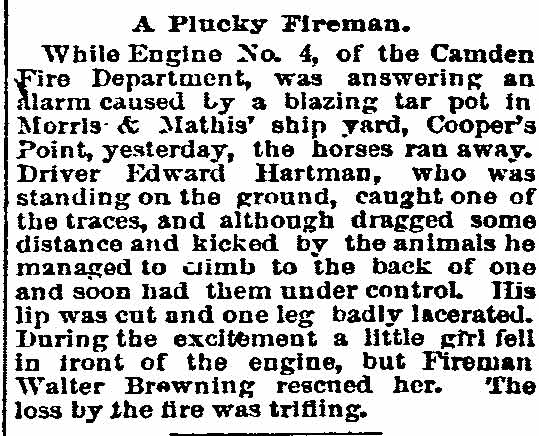
While Engine No. 4, of the Camden Fire Department, was answering an alarm caused by a blazing tar pot in Morris & Mathis’ ship yard, Cooper’s Point, yesterday, the horses ran away. Driver Edward Hartman, who was standing on the ground, caught one of the traces, and although dragged some distance and kicked by the animals he managed to climb to the back of one and soon had them under control. His lip was cut and one leg badly lacerated. During the excitement a little girl fell in front of the engine, but Fireman Walter Browning rescued her. The loss by the fire was trifling.
Camden Cops of 32 Years Ago Valiant Crew Under ‘Sam’ Dodd
Camden Courier-Post —
By BEN COURTER
(Another of a series of articles on Camden municipal matters and personalities of yesteryear.)
One night some 40 years ago there was great ado in police headquarters. Chief Sam Dodd was talking to Patrolman John Dall in something after this wise:
“See here, John, why didn’t you make your 10 o’clock pull last night?”
“I did,” returned Dall.
“No, you didn’t,” asserted the chief.
“See here, whiskers, I tell you I did,” retorted Dall with rising umbrage.
“The tape don’t say so,” insisted Dodd.
“I tell you I did make that pull, and furthermore, whiskers, I’m not going to let any iron man make a liar of me,” said Dall with finality.
And that was the end of it with the chief stalking away yanking at his long black whiskers out there in the room where City Clerk Billie Brown now holds sway. It might be said it was a case of red whiskers talking down black whiskers, for since Chief Sam sported those of ebon hue, so did Dall chin “nannies” of somewhat sandy-reddish coloring and both wagged threateningly in the hot colloquy.
It was not long after the call system had been installed in the department and the veterans on the city beats didn’t take kindly to it. It didn’t always operate with precision and under such circumstances there was usually a tiff with Dodd. But cops like Dall didn’t give a hang for their superior then and usually told him what was on their minds.
Sometimes the sentiments were like tobasco, hot and burning. But with all his puffing and snorting and yanking of whiskers, Dodd was a pretty good sort after all, not vindictive and disinclined to cause any trouble.
Age Of Whiskers
We are printing today a somewhat ancient picture of the Camden police force, not all, but most of it as it appeared some 32 years ago. And it may readily be seen it was an age of whiskers and mustaches, for only two of those valiant members of Camden’s “finest” of the period are smooth shaven. The balance run all the way from Dodd’s famed chin adornment to dragoons, soup strainers and what today would pass for Charlie Chaplins. It was something of an anomaly for not only a cop but likewise the average man of the street to sport a smooth shaven phiz. Girls of the period put their shapely tootsies right down on any swain who didn’t have whiskers by way of full sweeping beards, burnsides, goatees, mutton chops or, at the very least, something that would pass for a mustache. So it may be seen from the very early period of adolescence it was the aim of every member of the sterner sex to coax ‘em out—that is, the blonde, black, red or whatever hue nature had colored the facial spinach-to-be.
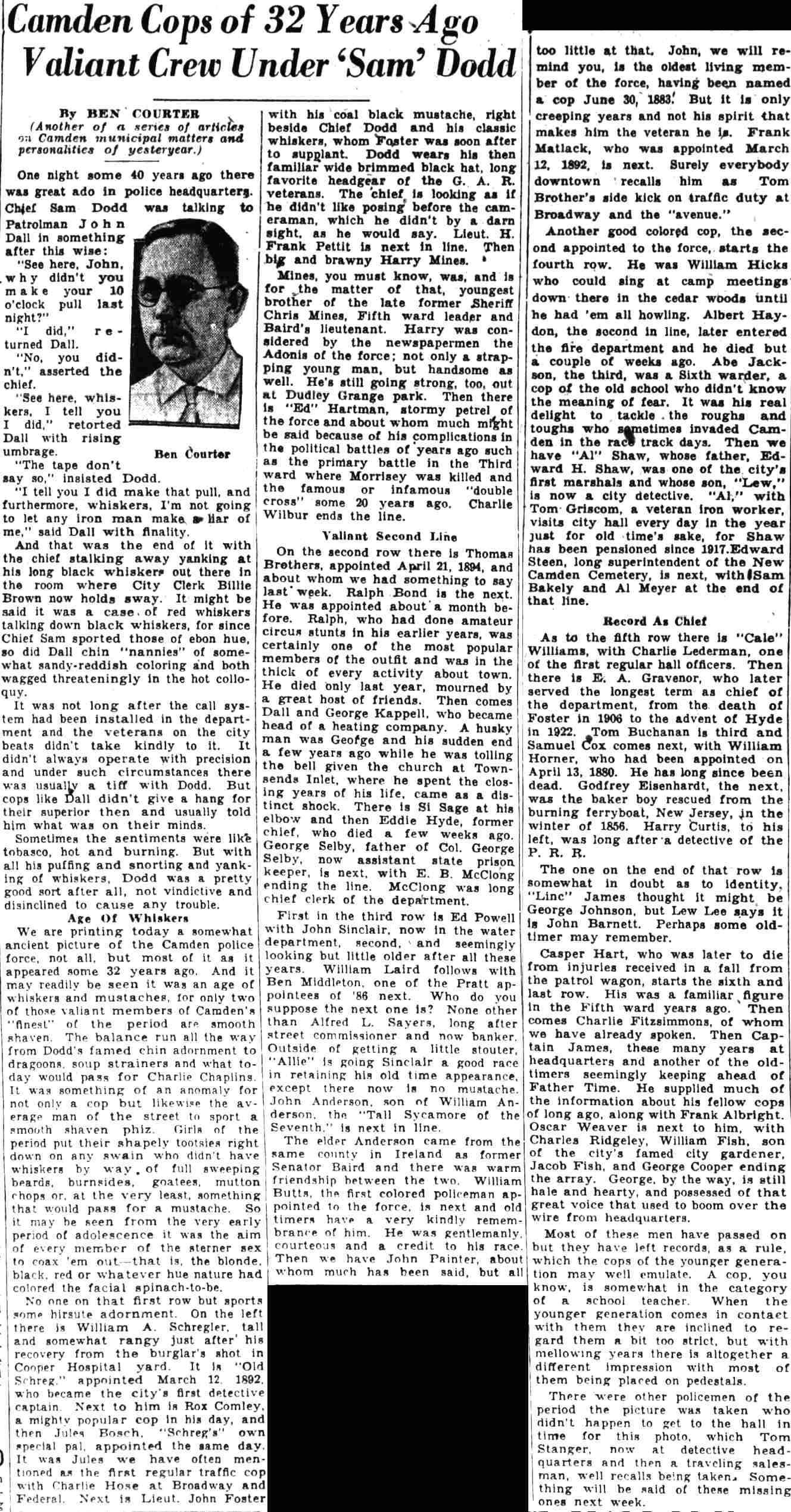
No one on that first row but sports some hirsute adornment. On the left there is William A. Schregler, tall and somewhat rangy just after his recovery from the burglar’s shot in Cooper Hospital yard. It is “Old Schreg,” appointed March 12, 1892, who became the city’s first detective captain. Next to him is Rox Comley, a mighty popular cop in his day, and then Jules Bosch, “Schreg’s” own special pal, appointed the same day. It was Jules we have often mentioned as the first regular traffic cop with Charlie Hose at Broadway and Federal. Next is Lieut. John Foster with his coal black mustache, right beside Chief Dodd and his classic whiskers, whom Foster was soon after to supplant. Dodd wears his then familiar wide brimmed black hat, long favorite headgear of the G. A. R. veterans. The chief is looking as if he didn’t like posing before the cameraman, which he didn’t by a darn sight, as he would say. Lieut. H. Frank Pettit is next in line. Then big and brawny Harry Mines.
Mines, you must know, was, and is for the matter of that, youngest brother of the late former Sheriff Chris Mines, Fifth ward leader and Baird’s lieutenant. Harry was considered by the newspapermen the Adonis of the force; not only a strapping young man, but handsome as well. He’s still going strong, too, out at Dudley Grange park. Then there is “Ed” Hartman, stormy petrel of the force and about whom much might be said because of his complications in the political battles of years ago such as the primary battle in the Third ward where Morrisey was killed and the famous or infamous “double cross” some 20 years ago. Charlie Wilbur ends the line.
Valiant Second Line
On the second row there is Thomas Brothers, appointed April 21, 1894, and about whom we had something to say last week. Ralph Bond is the next. He was appointed about a month before. Ralph, who had done amateur circus stunts in his earlier years, was certainly one of the most popular members of the outfit and was in the thick of every activity about town. He died only last year, mourned by a great host of friends. Then comes Dall and George Kappell, who became head of a heating company. A husky man was George and his sudden end a few years ago while he was tolling the bell given the church at Townsends Inlet, where he spent the closing years of his life, came as a distinct shock. There is Si Sage at his elbow and then Eddie Hyde, former chief, who died a few weeks ago. George Selby, father of Col. George Selby, now assistant state prison keeper, is next, with E. B. McClong ending the line. McClong was long chief clerk of the department.
First in the third row is Ed Powell with John Sinclair, now in the water department, second, and seemingly looking but little older after all these years. William Laird follows with Ben Middleton, one of the Pratt appointees of ‘86 next. Who do you suppose the next one is? None other than Alfred L. Sayers, long after street commissioner and now banker. Outside of getting a little stouter, “Allie” is going Sinclair a good race in retaining his old time appearance, except there now is no mustache. John Anderson, son of William Anderson, the “Tall Sycamore of the Seventh,” is next in line.
The elder Anderson came from the same county in Ireland as former Senator Baird and there was warm friendship between the two. William Butts, the first colored policeman appointed to the force, is next and old timers have a very kindly remembrance of him. He was gentlemanly, courteous and a credit to his race. Then we have John Painter, about whom much has been said, but all too little at that. John, we will remind you, is the oldest living member of the force, having been named a cop June 30, 1883. But it is only creeping years and not his spirit that makes him the veteran he is. Frank Matlack, who was appointed March 12, 1892, is next. Surely everybody downtown recalls him as Tom Brother’s side kick on traffic duty at Broadway and the “avenue.”
Another good colored cop, the second appointed to the force, starts the fourth row. He was William Hicks who could sing at camp meetings down there in the cedar woods until he had ‘em all howling. Albert Haydon, the second in line, later entered the fire department and he died but a couple of weeks ago. Abe Jackson, the third, was a Sixth warder, a cop of the old school who didn’t know the meaning of fear. It was his real delight to tackle the roughs and toughs who sometimes invaded Camden in the race track days. Then we have “Al” Shaw, whose father, Edward H. Shaw, was one of the city’s first marshals and whose son, “Lew,” is now a city detective. “Al,” with Tom Griscom, a veteran iron worker, visits city hall every day in the year just for old time’s sake, for Shaw has been pensioned since 1917. Edward Steen, long superintendent of the New Camden Cemetery, is next, with Sam Bakely and Al Meyer at the end of that line.
Record As Chief
As to the fifth row there is “Cale” Williams, with Charlie Lederman, one of the first regular hall officers. Then there is E. A. Gravenor, who later served the longest term as chief of the department, from the death of Foster in 1906 to the advent of Hyde in 1922. Tom Buchanan is third and Samuel Cox comes next, with William Horner, who had been appointed on April 13, 1880. He has long since been dead. Godfrey Eisenhardt, the next, was the baker boy rescued from the burning ferryboat, New Jersey, in the winter of 1856. Harry Curtis, to his left, was long after a detective of the P. R. R.
The one on the end of that row is somewhat in doubt as to identity. “Linc” James thought it might be George Johnson, but Lew Lee says it is John Barnett. Perhaps some old-timer may remember.
Casper Hart, who was later to die from injuries received in a fall from the patrol wagon, starts the sixth and last row. His was a familiar figure in the Fifth ward years ago. Then comes Charlie Fitzsimmons, of whom we have already spoken. Then Captain James, these many years at headquarters and another of the old-timers seemingly keeping ahead of Father Time. He supplied much of the information about his fellow cops of long ago, along with Frank Albright. Oscar Weaver is next to him, with Charles Ridgeley, William Fish, son of the city’s famed city gardener, Jacob Fish, and George Cooper ending the array. George, by the way, is still hale and hearty, and possessed of that great voice that used to boom over the wire from headquarters.
Most of these men have passed on but they have left records, as a rule, which the cops of the younger generation may well emulate. A cop, you know, is somewhat in the category of a school teacher. When the younger generation comes in contact with them they are inclined to regard them a bit too strict, but with mellowing years there is altogether a different impression with most of them being placed on pedestals.
There were other policemen of the period the picture was taken who didn’t happen to get to the hall in time for this photo, which Tom Stanger, now at detective headquarters and then a traveling salesman, well recalls being taken. Something will be said of these missing ones next week.
Charles Berry’s Funeral.
Camden Daily Courier —
The funeral of Charles G. Berry, one of the bravest and most popular firemen in this city, took place at 2 o’clock this afternoon from his late residence at 226 Point street.
The firemen attended the funeral in a body, and the members of the First Ward Republican Club were represented in a large body, while Mayor Westcott, Councilman Robert Smith, George Barrett, and many other prominent men of this city viewed the body.
Rev. A. G. Lawson of the North Baptist Church preached the funeral sermon, after which the body was taken to Philadelphia where it was interred in Glenwood Cemetery. The body lay in a black cloth covered casket and was dressed in his fireman’s uniform with the cap lying on the breast.
A profusion of floral offerings lay around the coffin. Among these were a pillow with the words “Comrades of No. 4,” a fireman’s hat from No. 4 Company, cut flowers from Jesse Conley, a design of white roses from James Dunn and Joseph Love, two of his closest friends, a pillow from his family a handsome design from the Republican League and lilies from Councilman Smith.
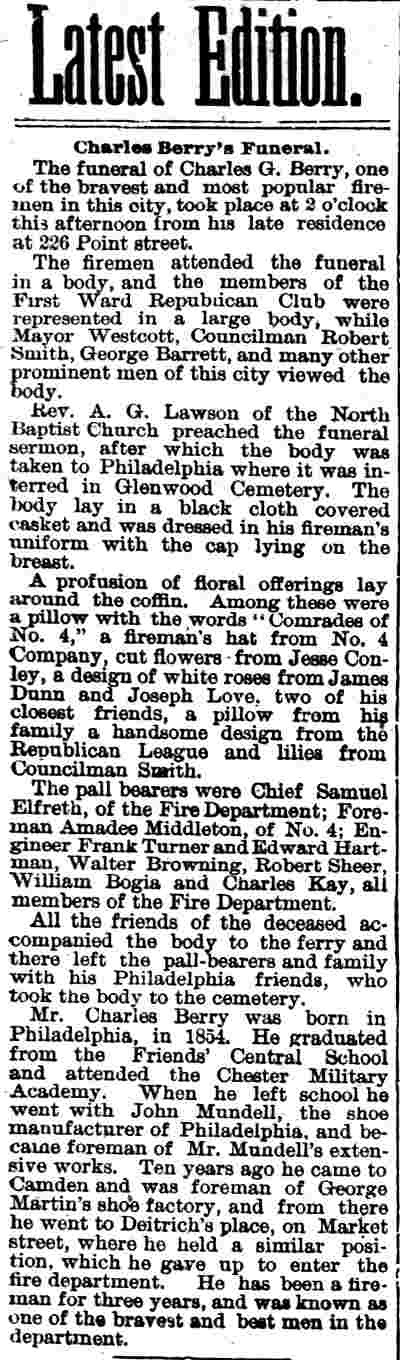
The pall bearers were Chief Samuel Elfreth, of the Fire Department; Foreman Amadee Middleton, of No. 4; Engineer Frank Turner and Edward Hartman, Walter Browning, Robert Sheer, William Bogia and Charles Kay, all members of the Fire Department.
All the friends of the deceased accompanied the body to the ferry and there left the pall-bearers and family with his Philadelphia friends, who took the body to the cemetery.
Mr. Charles Berry was born in Philadelphia, in 1854. He graduated from the Friends’ Central School and attended the Chester Military Academy. When he left school he went with John Mundell, the shoe manufacturer of Philadelphia, and became foreman of Mr. Mundell’s extensive works. Ten years ago he came to Camden and was foreman of George Martin’s shoe factory, and from there he went to Deitrich’s place, on Market street, where he held a similar position, which he gave up to enter the fire department. He has been a fireman for three years, and was known as one of the bravest and best men in the department.
He Announces the Names
Camden Daily Telegram —
The Mayor Appoints the New Force To-day.
MANY OLD OFFICERS TAKEN BACK.
Some Surprise Manifested at the Mayor’s Appointment of Dodd Instead of Jones—This Afternoon All the Names Will be Announced.
The Mayor stated this morning to the newspaper fraternity that he would not announce his nominations for the police department until four o’clock this afternoon. It was expected that these would be announced this morning and in consequence there were a number of applicants for appointment on the force early this morning at the City Hall, hoping that the lightning would strike them.
Yesterday afternoon the mayor in addition to his nomination of Chief Dodd and Lieutenants Foster and Pettit appointed Frank Matlack, Jacob Woodsides, Alfred Hayden and John Dall, all of the Sixth Ward. The above were policemen under Mayor Westcott, before the Democratic Police Commission took charge of the Department.
Patrolman Griffin, Democrat, tendered his resignation yesterday to Mayor Westcott, to take effect to-day.
The appointment of Chief Dodd was quite a surprise to the public in general, as it was thought that Captain Jones would be named for the position. Many believed such an appointment would be in very good form, as Captain Jones’ knowledge of men and his military training would have made him a chief par excellence. The Mayor, however, probably thought that as Mr. Dodd had been so unceremoniously kicked out by the Democrats, it was nothing more than justice to again offer him the position which he had filled in a creditable manner for a number of years.
APPOINTED ON THE FORCE.
Mayor Westcott this afternoon made the following appointments:
First Ward—William E Cromly, George Cable, Henry R. Curtis, O. Glen Stackhouse.
Second Ward—Lincoln James, John Pratt, Samuel Bakley, Benj Middleton.
Third Ward—William Selby, Albert Myers, Edward Hartman.
Fourth Ward—Caleb Williams, Richard Golden, William Schregler, Ralph Bond.
Fifth Ward—William Harvey, Harry Mines and Oscar Weaver.
Sixth Ward—Jacob Woodsides, Frank Matlack, Albert Hayden and John Dall.
Seventh Ward—Josiah Sage, Henry Peters, Charles Lederman, Wm. Butts.
Eighth Ward—Alexander Alcorn, Chas. Leightenberg, Ferdinand Laird
There was no appointments made for the Ninth ward.
Camden
Philadelphia Inquirer —
Henry D. Moore, son and daughter, of Haddonfield, in company with Rev. F. R. Brace, D. D., of Blackwood, will sail from New York on the steamer Friesland, on Wednesday, February 6, for a two months’ tour of the Mediterranean, which will include visits to Italy, Greece, Egypt, Turkey, Northern Africa and Southern Spain.
Miss Boyer, of 524 Linden street, will give a tea next Wednesday from 3 until 5.
Miss Campbell, of Fifth and Cooper streets, gave a progressive euchre party on Monday evening in honor of Miss Richardson.
Voorhees Anderson entertained a number of young people at a progressive euchre party Wednesday evening.
Friends of Isaac W. Cole, of Delaware township, intend to present his name as a candidate for one of the county offices to be filled at the coming fall election.
On Monday Mr. and Mrs. William Parry, of Parry, started for California to attend the annual meeting of the American Pomological Society. They will be gone about a month, and will take in all the sights of the Golden State.
“Speaker” Ed Hartman, the popular Third ward policeman, was presented with a handsome and costly cane the other day by his admirers at No. 2 Engine House. David Logue presented the cane in an eloquent speech.
At the meeting of the Commercial Club Wednesday night the following officers were elected for the ensuing year: President, H. Land; Vice-President, S. C. Childs; Treasurer, J. H. Knerr; Financial Secretary, Philip Wilson; Recording Secretary, George W. Anthony; Directors, Geo. Leathwhite, L. W. Fernan, Jacob Ferris, H. G. Bonwill, Thomas J. Peterson, James M. Bentley, H. L. Merrick, John W. Croft, Daniel S. Garwood.
The stockholders of the Masonic Temple Association have elected the following directors: George Pfeiffer, Jr., Cooper B. Hatch, William H. Fredericks, Thomas McDowell, J. R. Eastlack, Alfred Cramer, D. H. Gomersall, E. A. Austermuhl, Isaac Ferris, Jr., Isaac Doughton, H. B. Anthony, W. S. Casselman, Joseph P. Weatherby, W. F. Rose and George W. Jessup.
Wright Cox Dies in His 66th Year
Camden Courier-Post —
Many Escapes Marked 40 Years as City Fireman and Policeman
Wright Cox, veteran fireman and policeman for over two score years, died in Homeopathic Hospital, early yesterday morning. He was in his 66th year. An invalid who heroically stuck to his post despite the protests of his superior officers, Cox was taken to the hospital from his home at 564 Mt. Vernon street, about a month ago. He was suffering from stomach trouble, aggravated by an attack of sciatic rheumatism. The end came unexpectedly early yesterday morning.
Shortly before three o’clock he called the nurse and Policeman “Joe” Keefe, convalescing in the ward, to his bedside and in a faint voice said: “Well, goodbye all, I’m going to leave you.” With those parting words he passed away.
The career of Wright Cox as a fireman and a policeman was a colorful one. He was appointed a fireman in the mid-1880’s. An expert horseman, he was for years driver for former Chiefs Robert Bender and Samuel S. Elfreth. He had many thrills as a fire fighter. At the big fire at the cork and licorice plants downtown 20 years ago, he was among the valiant firemen who were nearly blinded by the stifling fumes. He nearly forfeited his life at the Sixth Regiment Armory fire on March 16, 1906, in an heroic effort to save the three firemen who perished in that awful blaze. Baffled in his search by the blinding, strangling smoke, he and the late Ed Hartman escaped from the burning building by following a line of hose leading out into Mickle street.
On January 1st, 1908, Cox was appointed to the Police Department by Mayor Charles H. Ellis. He was assigned to duty in the Third ward, where among his important arrests were a gang of desperate yeggmen and safeblowers and a notorious gang of burglars who were terrorising Cooper street for an entire summer.
About seven years ago Cox was appointed sergeant of the Police Department, with headquarters at the Second District station house, Chestnut street near 6th. Last spring the mounted police unit was disbanded, and the horses sold at auction. His position as stable sergeant being thus ended he was appointed a special officer at City Hall park. He was filling that assignment when taken ill about a month ago.
A short time before he was stricken last month, the veteran of over 40 years’ service as fireman and policeman made application for retirement on pension, and favorable action was about to be taken on it when death intervened.
Cox is survived by a daughter and a brother, George Cox, pensioned Battalion Chief of the Fire Department, now of Wildwood. He was a son of the late George Cox, who for years was a driver for Andrew Lyons, marble yard proprietor.
Funeral arrangements are being arranged by the brother and daughter of the deceased. The flags at the police station houses where Cox served as an officer will droop at half mast for 30 days in honor of the dead patrolman, and an escort of policemen and firemen will attend the funeral.
The funeral of Policeman Cox will be held in the Schroeder Funeral Chapel at 538 Broadway, on Wednesday afternoon at 3 o’clock. Following services interment will be made in Bethel cemetery.
Here’s Camden’s Finest, With Whiskers, in 1898
Camden Courier-Post —
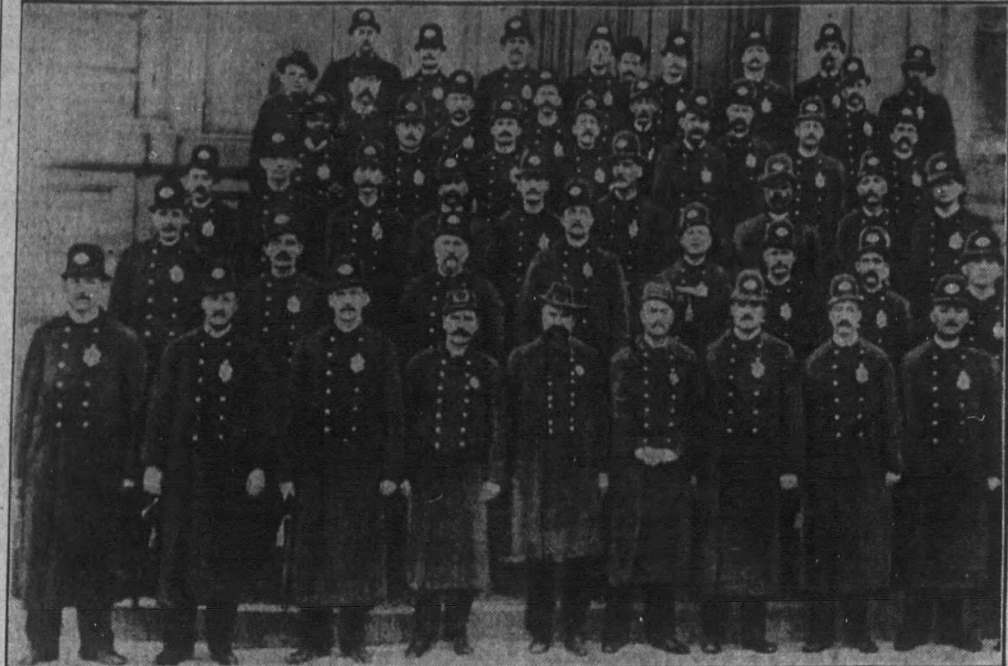
Reading from left to right, those in the picture are: First row, William A. Schregler, Rox Comley, Jules Bosch, Lieutenant John Foster, Chief Samuel Dodd, Lieutenant H. Frank Pettit, Edward Hartman and Charles Wilbur. Second row, Thomas Brothers, Ralph Bond, John Dall, George Kappell, Silas Sage, Edward S. Hyde, George Selby and E. B. McClong. Third row, Edward Powell, John Sinclair, William Laird, Benjamin Middleton, Alfred L. Sayers, John Anderson, William Butts, John Painter and Frank Matlack. Fourth row, Thomas Hicks, Alfred Haydon, Abe Jackson, Albert Shaw, Edward Steen and Samuel Bakely. Fifth row, Caleb Williams, E. A. Gravenor, Thomas Buchanan, Samuel Cox, George Horner, Godfrey Eisenhardt, Harry Curtis and John Barnett. Sixth row, Casper Hart, Charles Fitzsimmons, A. Lincoln James, Oscar Weaver, Charles Ridgely, William Fish and George Cooper.
Swinging the Ax on Camden Police
Philadelphia Inquirer —
Charges Preferred Against Chief Dodd and Fifteen of His Men
REFORMERS AGRESSIVE [sic]
Experts to Be Put on Accounts of Commission of Public Instruction
The official heads of Camden policemen will begin to fall in a few days. Charges have been made against sixteen members of the force, including Chief Dodd. The accused officers will be given hearings this evening and to-morrow afternoon.
A copy of the charges against Chief Dodd was served on that official last night. It is charged that he neglected to raid a “speak-easy” at 108 South Second street. Michael Flemming makes the charge.
The officers accused are William Comley, First ward; Edward Powell and Richard Golden, Second ward; John Sinclair, William Selby, Edward Hartman and Albert Meyers, Third ward; Ralph Bond, Jules Bosch and Caleb Williams, Fourth ward; Alfred Shaw, Fifth ward, and Jacob A. Hicks, Eighth ward.
Sinclair and Bosch are charged with working for the Republican ticket on last election day, Hartman and Meyers are accused of assaulting a man named Shears, and Caleb Williams is charged with insubordination.
The charges against Bond are brought by ex-Policeman Isaac Shreve, who accuses him of deserting his beat and sleeping in the postoffice. Selby is accused of using profane language.
The hearings of Chief Dodd and Policeman Hartman will be held to-morrow afternoon. The others will be given a hearing this evening.
The policemen cannot be discharged without a vote of a majority of City Council.
Over in Camden.
Philadelphia Inquirer —
Articles of incorporation were filed yesterday by the American Metal Edge Box Company.
The police were notified yesterday that William Ilgenfritz, 14 years old, of 1121 Mickle street, was missing.
Jacob N. Wise, 65 years old, fell from a step at Delaware and Market streets yesterday and broke his hip. He was taken to the Cooper Hospital.
A number of church people have filed a remonstrance with the excise Commission against granting a liquor license to Charles Gorden, of Ninth street and Ferry avenue.
Mrs. Victor Kline, of 526 Vine street, discovered a burglar in the house early Tuesday morning, but the thief fled at her approach, leaving a lot of clothing and silverware which he had bundled up, ready to take away.
Charles E. Wilson was committed by Recorder Mowrey [sic] last night, charged with stealing two overcoats from the Camden Turning Mill, at Front and Arch streets. He was captured at the Federal Street Ferry by Policemen [sic] Hartman.
Bessie Hughes was held by Justice Schmitz yesterday for a further hearing on a charge of stealing household goods from the boarding house of Mrs. Marshall, at 121 Market street. Some of the missing goods were found at the defendant’s home.
Among the latest victims of the grip in Camden are Mayor Hatch, Chief of Police Foster, City Clerk Harry Kramer, former City Counsel J. Willard Morgan, Charles R. Baron, New Jersey editor of the Philadelphia Record, and Policemen George Cooper, Harry Miller, James Ware and George Anderson.
Murder and Bloodshed in Camden Primary Elections
Philadelphia Inquirer —

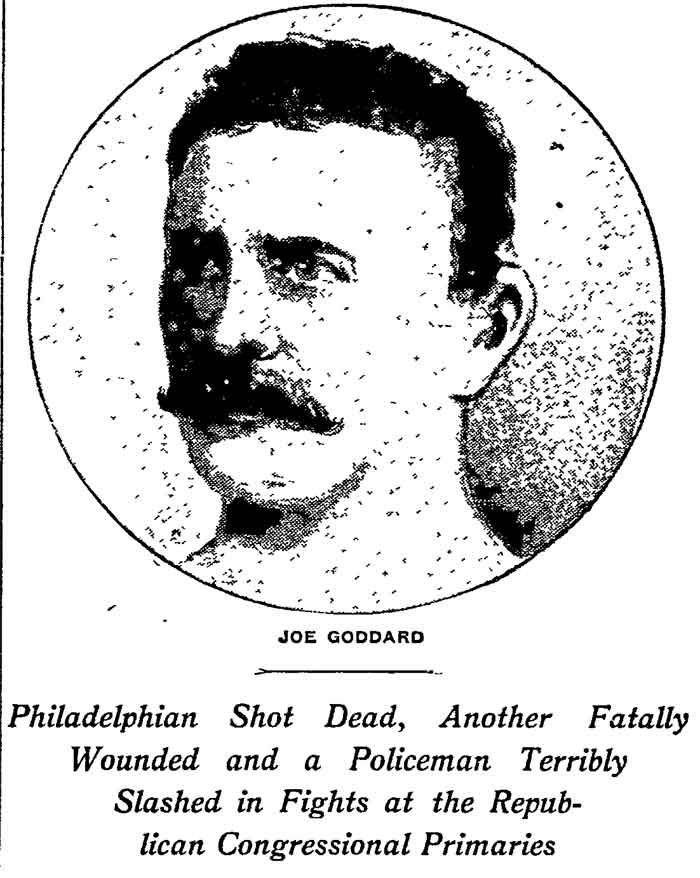
Philadelphian Shot Dead, Another Fatally Wounded and a Policeman Terribly Slashed in Fights at the Republican Congressional Primaries
JOE GODDARD
Blood was shed in Camden city and county last night, the result of the fiercest political battle that was ever fought in the First Congressional district of New Jersey, and the sum total of the casualties is one man dead, another lying at the point of death in the Cooper Hospital, another, a policeman, on a cot near by, suffering from stab wounds, from which he is not likely to recover, and numerous cracked skulls.
So vigorously were the Republican primaries contested that numerous fights developed. Crowds of repeaters went from Philadelphia to Camden, and these were the cause of the numerous riots, for such they were, at the polling places.
With it all no one can yet positively tell who will receive the Congressional nomination at Woodbury to morrow. At midnight both the adherents of Congressman Loudenslager and the supporters of J. Alpheus Vansant were claiming the victory.
Shot and Killed
A few minutes before the closing of the polls at the Fifth precinct of the Third Ward, Camden, last night, John Morrisy, of Manayunk, wearing a Vansant badge, was shot and killed. During the melee Policeman Harry Miller, aged 40 years, of 321 Beckett street, was cut in the abdomen. Both were taken to Cooper Hospital.
Surgeon Stewart pronounced Morrisy dead on his arrival. Policeman Miller was operated on, and the surgeons say he has a fighting chance for his life.
The police have under arrest George Murray, colored, aged 35 years, of 649 Locust street, and Henrietta V. Bland, of 639 Locust street, who are said to be eye-witnesses to the shooting. The arrest of the man who it is claimed fired the fatal shot is, the police say, a question of a few hours.
Joe Goddard Shot
Joseph J. Goddard, aged 35 years, of Phoenixville, Pa., a once noted pugilist, was shot by Constable Robert Washington at “Dog Corner” during the primary election. The bullet, a thirty-two caliber, entered the left temple about an inch and a half above his eye and imbedded itself in his brain.
He was taken to Merchantville and treated by Dr. Lawrence and afterwards removed to Cooper Hospital. Surgeons there say he will die.
Washington immediately surrendered to Chief of Police Linderman, of Merchantville, was given a preliminary hearing before Justice Longstreth, and committed to the county jail.
Been Living at Matchtown
Goddard of late had been living with Benjamin Forrest, a saloonkeeper at Matchtown, a settlement just outside of Merchantville, and in Pensauken [sic] township. It is said he led a gang of repeaters to the “Dog Corner” primaries. Soon after their arrival a row was started and Washington felled to the ground by a blow from a base ball bat. While lying on the ground Goddard attempted to beat him and he fired the shot which will likely prove fatal.
During the melee Constable Isaac Fowler was stabbed in two places by an unknown man. The wounds are not considered serious. Fighting continued from the opening to the closing of the polls.
Ed. Matlack, of Dudley, was badly cut in a fight on the Camden line. He went to Merchantville and Dr. Jennings sewed six stitches in his wounds.
Morrisy’s Appearance
Morrisy, the dead man, was about 35 years old. He was in the company of several Philadelphians and spent nearly all the afternoon in the Third ward in the company of a policeman, by whom he and his companions were introduced as members of the Washington, D. C., police force on a short vacation.
The Third ward was the battleground of the Loudenslager-Vansant contest yesterday. A large majority of the city officials live there. From the minute of the opening of the polls in the various precincts there were outbreaks on either side that were only quelled by cooler heads.
It became noised about shortly after the polls opened that repeaters under the guidance of three Philadelphians, one of whom was colored, were at work in the ward.
Help Summoned
Shortly before 8 o’clock word was sent to the Second precinct of the Third ward by a police officer working in the interest of Vansant in the Fifth precinct that unless help arrived Loudenslager would carry the precinct.
In less than five minutes Policeman Edward Hartman, in citizen’s clothes, and several other men, one of whom was deceased, came on the scene. At that time there were at least 500 persons around the polls, many of whom were women.
What followed is told by John G. Helm, a butcher, of 600 South Third street, and Eli Hunt, son of Deputy Game Warden Hunt. Both agree that Morrisy attempted to vote. As he did so Policeman Robert Miller, a Loudenslager worker, took him by the arm and told him he could not vote. At that instant the policeman was struck by a blackjack and knocked towards the gutter. Policeman Albert Keaser, a Loudenslager worker, pushed his way into the crowd and tried to prevent trouble. Policeman Harry Miller, a Vansant worker, struck Keaser with a blackjack, knocking him to his knees. As Keaser fell he grappled with Harry Miller and they rolled on the pavement.
Took the Blackjack
Keaser took the blackjack away from his brother officer. In the meantime Policeman Robert Miller went into the thick of the fight and struck George Murray, now under arrest, over the eye with a blackjack. The man who was killed worked his way into the centre of Beckett street, and as he stood facing the crowd half a dozen pistols were drawn and five shots rang out in quick succession.
Morrisy staggered across Beckett street to an alley in the rear of the houses on the east side of Third street, reeled and fell to the ground. He was carried into the yard of one of the adjoining houses and the patrol wagon summoned.
Murderer Escaped
According to Mr. Helm, the colored man who fired the fatal shot ran down Beckett street to Locust street.
With the shooting of Morrisy the fight did not end. Help came to Policeman Keaser and during his rescue Policeman Harry Miller was cut across the abdomen a distance of about four inches.
Coroner F. Neall Robinson held a view on Morrisy’s body. He stated that the bullet pierced Morrisy’s thumb of his right hand and entered his body near the centre of his heart.
In the dead man’s clothes were found a 48-calibre centre fire revolver with the chambers filled, a note book with a number of addresses in Philadelphia, and a small photograph of two girls, one of whom is evidently his sister.
Mayor Investigates
Besides the investigation being conducted by the county authorities one is being made by order of Mayor Nowrey. According to a statement made by the latter official last night, all kinds of propositions had been made to him looking to the relieving from duty of a number of policemen, that they might take part in the primaries. He instructed the captains of police to see that all policemen should do duty on their respective shifts.
During the progress of the primaries a reporter of The Inquirer saw Morrisy and several others standing around the polls in the Second precinct of the Third ward. The reporter asked a prominent city official what the men were doing there. The official replied: “They are not here to vote. We heard an attempt was to be made to take these polls by force, and we’ve got them here to fight and hold our end up.”
When Assistant Prosecutor Archer asked Policeman Harry Miller in Cooper Hospital if he knew who the dead man was, he replied that he only knew him as Reddy, and that he came over from Philadelphia to help out in the Third ward.
Joe Goddard’s Career
Joe Goddard, who was born in Pyramid, N. S. W., November 25, 1861, came to this country in 1892. He claimed the Barrier championship, and under the direction of Billy Madden was touted as a world beater. He was present at the fight between Sullivan and Corbett at New Orleans, and subsequently challenged Corbett, but the latter would not accept. At that time there were many good judges of pugilism who really thought that Goddard would have a chance against the then champion, and the latter (Corbett) was severely criticised for not taking up Goddard’s defi, particularly as it was accompanied by a good sized forfeit. Later on it became apparent that Goddard was nothing but a big, strong fellow, willing to take a punching for the purpose of getting the coin. His most important fight, and the one that gave some prominence for a while, was with Peter Maher at Coney Island on December 8, 1892. Peter was knocked out in the third round after having Goddard at his mercy in the second. For the last five years or so Goddard has lived in Philadelphia or Phoenixville.
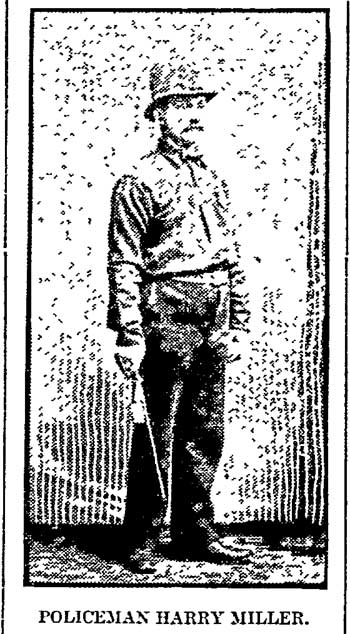
POLICEMAN HARRY MILLER.
Wagner’s Trial for Stabbing Miller
Camden Daily Courier —


Witnesses Say Policeman Keaser Held Fellow Officer When He Was Knifed.
CUT DURING THIRD WARD RIOT
The main court room was crowded with interested Third warders this morning, when the first of the criminal complaints growing out of the riots at Third and Beckett streets, on the night of July 28, last, during the Congressional primary, was taken up. It charged Charles Wagner with assault and battery on Policeman Harry Miller. Judge Joline was on the bench. Prosecutor Lloyd appeared for the State and the defendant was represented by Lawyers Fred A. and William F. Rex. Some little trouble was experienced in getting a jury.
After Prosecutor Lloyd outlined the case, Policeman Miller was called to the stand. He said that on the night in question just before the close of the polls, a fight ensued between ex-Policeman “Bob” Miller and John Morrisey, the man who was killed. A general racket followed and “Bob” Miller, Policeman Keaser and others were brutally assaulting George Murray with a blackjack, when witness went to Murray’s aid. Keaser, he said, turned on him and grappled.
MILLER STABBED.
“He had a hold of me and I of him,” said Miller, “and while we were standing in that position, this man Wagner came up in front of me, jabbed his knife in my stomach, turned it like that (giving his hand a twist) and pulled it out. Keaser still had a hold of me and I could not help myself. Wagner ran away after stabbing me.”
Miller said he was taken to Cooper Hospital and was there four weeks.
On cross-examination by Mr. Rex, Miller said he was positive that Wagner was his assailant and denied saying in the hospital the morning after the stabbing, that he did not know who cut him. He also denied hitting Keaser with his blackjack.
When questioned concerning Morrisey, the man who was killed, Miller said he only met him that day and did not know whether he was a voter or not.
DIDN’T WANT DETAILS.
Mr. Rex tried to get the witness to detail a talk he had with Morrisey, but Mr. Lloyd objected. Mr. Rex seemed so anxious to carry the point that Mr. Lloyd said he was willing to withdraw the objection, provided Mr. Rex would not object to detailed conversation responses to his questions. Mr. Rex promptly vetoed the proposition and withdrew his questions.
Harry Selby, son of former Policeman Selby, followed on the stand. He said he did not see the stabbing, but that a few moments before the polls closed he saw Wagner try to stab Miller at the window of the polling place. The two, it appears, had had some words.
Dr. Grimes, of the Cooper Hospital staff, said that he helped dress Miller’s wound and that it was a dangerous one.
SAW WAGNER KNIFE MILLER.
William Laws, colored, corroborated Miller’s testimony. He said he saw Policeman Keaser hold Policeman Miller while Wagner stabbed him. This hapepned [sic] he said about four minutes of 8 o’clock.
Policeman Edward Hartman told of seeing Wagner having an open knife in his hand, of seeing him jab at several people and that he grabbed at him.
“You saw all of that did you?” asked Mr. Rex.
“I certainly did,” replied the officer.
“Then why didn’t you as a policeman arrest him?”
“I tried to, but his brother interfered.”
Mr. Rex had no more questions to ask.
George Murray, also told of seeing defendant have a knife in his hand.
Detectives Smith and Cherry told of making an unsuccessful search in this city for Wagner and finally locating him at Waterford living with a woman.
Detective Cherry said that Wagner told him that he had been at Hammonton.
“Hammonton is in Camden county, isn’t it?” asked Mr. Rex.
“No, sir, Atlantic county.”
“My geography is twisted somewhat commented Mr. Rex.” With these witnesses the State rested.
WAGNER DENIES CHARGE.
Addressing the jury Mr. Rex said the defense would be an alibi. Wagner then took the stand. He said he lived at 666 South Second street and that on the night of July 28, left the polling place about quarter of eight o’clock.
“Did you have a penknife in your hands at all?”
“No, sir.”
“Did you cut Harry Miller?”
“No, sir.”
In answer to questions by Mr. Rex, Wagner said he was with Constable “Bo” Bates nearly every day while in Waterford.
Cross-questioned by Mr. Lloyd Wagner said he went to Waterford on July 30—two days after the stabbing. He went down, he said, to visit a Mrs. Fox. His visit lasted until the middle of September, the time of his arrest. Previous visits he said never extended over a week. He said he had no knowledge that he was wanted for any crime until two weeks later when he read in the papers that he was charged with stabbing Miller. He told Mr. Bates about it. He further said that no trouble had occurred at all while he was at the polls.
Charles Cahill, a clerk at the Reading terminal, said he was at the polls and that at about quarter of eight o’clock he went up Beckett street in company with Wagner and another man. About fifty feet away, he said he went into an alley and Wagner proceeded up the street. Witness said he returned to the polling place just as the trouble began. He did not see Wagner.
Questioned by the Prosecutor Cahill said he was present as a challenger.
“Are you of the same political party that was holding the election?”
“I vote for the best man,” snapped Cahill in reply.
DIDN’T HAVE ANY POLITICS.
The Prosecutor repeated the question several times only to receive evasive answers such as “I was a Republican for that night,” and “I’m for the best man,” until Judge Joline was compelled to sharply admonish the witness to answer the question. Even then the spectators were in doubt as to Cahill’s politics, as he said he guessed he didn’t have any politics.
Owen McDonald testified to seeing Wagner and two other men pass up the street and despite the general excitement, Mr. McDonald said he watched Wagner until he got to Fourth street.
With the testimony of Butcher John Heim to the effect that he did not see Wagner at all around the polls until after the trouble was over court took a recess.
Policeman Albert Keaser was the first witness called this afternoon. He said he was present when the row started, that he took a blackjack from George Murray and also took a similar weapon from Policeman Harry Miller. The latter, he said, had hit him with the weapon. Witness said he saw Wagner leave the polling place and at that time Miller was not cut.
“Did Mr. Archer, the Assistant Prosecutor, tell you that he had a talk with Miller and that Miller said he didn’t know who cut him?”
Mr. Lloyd objected to the question, but expressed a willingness to allow it, provided Mr. Rex would let him call Mr. Archer to the stand.
Mr. Rex would not do so and the Prosecutor pressed his objection. It was sustained.
On cross examination Keaser denied saying to a man named Ogden that Wagner was “the fellow who did Miller.”
BEAT FELLOW POLICEMAN.
Policeman John Wagner, another of the defendants, said his brother went away before the fight started. In detailing the fracas Wagner voluntarily said he hit Harry Miller in the head with his jack and that he also hit Policeman Hartman.
Policeman Truitt also said he saw Wagner leave the polling place just before the fight started. While Mr. Lloyd was cross examining the witness Mr. Rex objected to the form of a question and remarked the “Court has ruled on that several times and I suppose I’ll get the same ruling.”
Judge Joline rebuked Mr. Rex for making such a statement. Mr. Rex begged the Court’s pardon, made the objection in regular form and it was sustained.
Mrs. Anna Hutner, a sister of the defendant, said she saw him go away about quarter of 8 o’clock and that he did not come back during the trouble. She explained her presence there by saying she had gone to prevent George Murray from shooting her brother.
William Ridgway said he was present during the trouble but did not see Wagner.
Constable “Bo” Bates said that Wagner was in his company nearly every day while he was visiting Waterford and that he made no attempt to escape.
SHIELDED WAGNER.
Prosecutor Lloyd’s only question was:
“You as an officer of this court knew that this man was accused of stabbing Harry Miller and you did not report it to the authorities, is that right?”
“Yes, sir; it is.”
When asked why, by Mr. Rex, the witness said the authorities could have got him at any time.
The defense rested and Mr. Lloyd called Mr. Ogden to the stand in rebuttal. He testified that Keaser told him that Wagner did Miller. Before the question was answered Judge Joline again rebuked Mr. Rex for his manner.
Argument commenced at 2.45 o’clock.
Another Case in Third Ward Riot
Camden Daily Courier —

Policeman Keaser and Ex-Policeman “Bob” Miller on Trial for Assault.
WAGNER JURY COULD NOT AGREE
In the Criminal Court this morning George V. Tucker, who was convicted of a charge of assault and battery, was sentenced by Judge Joline to pay a fine of $50 and costs and stand committed until the money is paid.
Henry J. Shuster pleaded guilty to a charge of embezzling $260.16 from King David Lodge, I. O. O. F., of which he was treasurer. Shuster served three months in the County Jail last spring on a similar charge. At that time he said he used the money to care for his wife, who was ill. It appears that he did use part of the money for this purpose, but that he squandered a large sum in poker playing.
Rev. Q. C. Davis, pastor of the Emmanuel Baptist church, testified that since Shuster has been out of jail he has led a correct life, and at the present time has a good position.
Prosecutor Lloyd made an appeal for clemency.
Judge Joline announced that he was not ready to decide the case and it went over.
POLICEMEN ON TRIAL.
The indictment against Policeman Albert Keaser and ex-Policeman Robert Miller, on charges of assault and battery on George Murray, was then moved. This is the second case to be tried as the outcome of the election riot, in the Third ward during the primary election last July. Considerable time was occopued [sic] in securing a jury.
After the jury was sworn Assistant Prosecutor Archer outlined the case, in which he said the two defendants at that time were policemen and the alleged assault took place at the polling place at Third and Beckett streets, and during the row, Robert Miller, struck George Murray several times with a blackjack. Keaser, it is alleged, assisted Miller in the assault.
The first witness called was George Murray, the complainant, who testified that while standing near the polling booth with some tickets “Bob” Miller, without any provocation, beat him with a blackjack. He said that Policeman Keaser and John Wagner came to Miller’s assistance. During the row, Policemen Hartman and Harry Miller came to his aid.
BEATEN WITH A BLACKJACK.
On cross-examination witness said he had no pistol or blackjack, but that Miller came up to him and deliberately struck witness with a blackjack. He denied that he said on the steps of the Third Ward Republican Club, in the presence of John Rodan, that if a certain —— would come along he would kill him.
William Laws, who testified in yesterday’s trial, gave corroborative testimony as to the blackjacking. He said that Murray did nothing to provoke the assault.
Spencer Moore, also gave corroborative testimony.
Policeman Harry Miller testified to seeing “Bob” Miller beating Murray with a blackjack while out in the middle of Beckett street. The witness said he surged in the crowd and struck at Keaser at the same time exclaiming:
“What are you trying to do, kill this man?”
The witness said he was thrown down, and was pulled up on his feet by Keaser, who grappled with him. He heard thre [sic] or four pistol shots.
The witness identified a blackjack, in the possession of Lawyer Rex, which he used on the night of the primaries.
Howard Roberts, a son of Assemblyman Roberts, also gave corroborative testimony.
DEFENSE OPENS.
At the afternoon session of the court the defense opened. Counsel said that the defendants were justified in using force to put Murray into subjection.
Policeman Toy testified that he saw the occurrence and thought that “Bob” Miller, was acting as a peacemaker. He saw Murray shoot off a revolver.
Daniel Ayres testified to seeing the riot and heard Murray say that he would get some one before the night was over. He saw Murray shoot off a revolver under a tree.
Ex-Policeman “Bob” Miller admitted that he struck Murray while attempting to arrest him. He also testified that he was knocked down and beaten and that some person had attempted to stab him. He exhibited his clothing which was soiled and cut.
Policeman Shaw testified that on July 28 he went to Third and Beckett streets and found George Murray in his home, where he was under arrest by Detective Hart. Witness recovered a revolver from the wife of Murray.
Mrs. Widener, who was a witness in the trial yesterday, gave the same line of evidence in this case.
CHEESEMAN SENTENCED.
At the noon recess Judge Joline imposed sentence on Thomas J. Cheeseman, the former secretary of Thomas Jefferson Council, No. 138, Jr. O. U. A. M., who was convicted of a charge of false pretenses on Thursday last. Before sentence was imposed Rev. J. R. Mason, pastor of the Kaighn Avenue M. E. church, and Rev. Robert Wesley Peach, pastor of the Second Presbyterian church, made appeals to the court for clemency in his case. Judge Joline sentenced Cheeseman to three months in the County Jail and a fine of $150 and costs.
After being out for seven hours without being able to agree on a verdict the jury in the case of Charles Wagner, tried yesterday on a charge of stabbing Policeman Harry Miller, at the time of the same election riot, were discharged at 10 o’clock last night.
Camden Increases Its Police Force
Philadelphia Inquirer —
Mayor Ellis Adds Twenty-five New Officers to Growing City’s Department
Camden’s police force was increased by the appointment of twenty-five additional officers by Mayor Ellis yesterday. There were also several promotions, two new captains, two sergeants and one detective being made as follows: Captains, Edward Hyde and A. Lincoln James, advanced from sergeants; sergeants, E. B. McClong and Edward Hartman, advanced from patrolmen; detective, John Brothers, advanced from patrolman: new patrolmen. Fred Schweizer, William Briant, Charles Hume, Charles Wilbur, Wright Cox, Walter Stanton, John Barnett, Tabor Quinn, John Gilbert, Joseph Palese, William Haines, Frederick Watson, Charles Whaland, William Kiker, James Hutt, George Krown, Ube Andrews, Daniel Stanton, Albert Archer, Harry Bakley, John Shuman, Oscar Till, Albertson Matlack, John Devlin, George Hollins, Frank Koplain, Edward King and George Beasley, substitutes.
For the past several weeks there has been much pulling and hauling of the political wires and the various ward leaders have had their own troubles in making selections. Each appointee was subjected to a regulation army examination by Dr. A. H. Lappincott [sic] before he was pronounced fit for the service. When the horses are procured, which may be by next June, six of the men will compose a mounted squad.
Handing Out Gunning Licenses in Camden
Philadelphia Inquirer —
County Clerk Patterson and His Office Force Work Overtime to Meet Gunners’ Demands
From the time County Clerk Frank Patterson opened his office in Camden yesterday until last night there was a constant coming and going of sportsmen anxious to get gunning licenses for the opening of the season tomorrow. The entire clerical force was kept busy, and, while usually the office closes at noon on Saturday, it was kept open until 5 o’clock to accommodate the sportsmen. Ofttimes they had their dogs with them and the occasional baying made the office sound like a field where cotton tails are skurrying to secure cover.
In all, it is estimated that at least three thousand licenses have been issued by Clerk Patterson, and it seems likely that the fields in and about Camden county will have a small army of gunners by the peep of day tomorrow morning. Not only have resident but non-resident licenses as well have been issued by the score, mostly to Philadelphians. While there has been some grumbling over the fact that it is necessary for the gunners to put up $1.50 for the privilege of hunting rabbits, as a rule, they look upon the matter as being beneficial to real sportsmen, as it has a tendency to eliminate the small pot hunters.
Those who have been over the haunts of the rabbits say they are exceedingly plentiful, especially in the lower end of Camden county, and farther south in Gloucester and Cumberland counties.
That the cotton tails will have to keep on the move is evident from the fact that Camden’s Police Department is to send to the woods such a squad of able sportsmen as Policemen James Clay, George Cooper, Fiore Troncone, Edward Pike, Walter Stanton, Oscar Weaver, Albert Shaw and Sergeants William Schregler, James Tatem and Edward Hartman.
“DAVID BAIRD TO FACE GRAND JURY”
Philadelphia Inquirer —
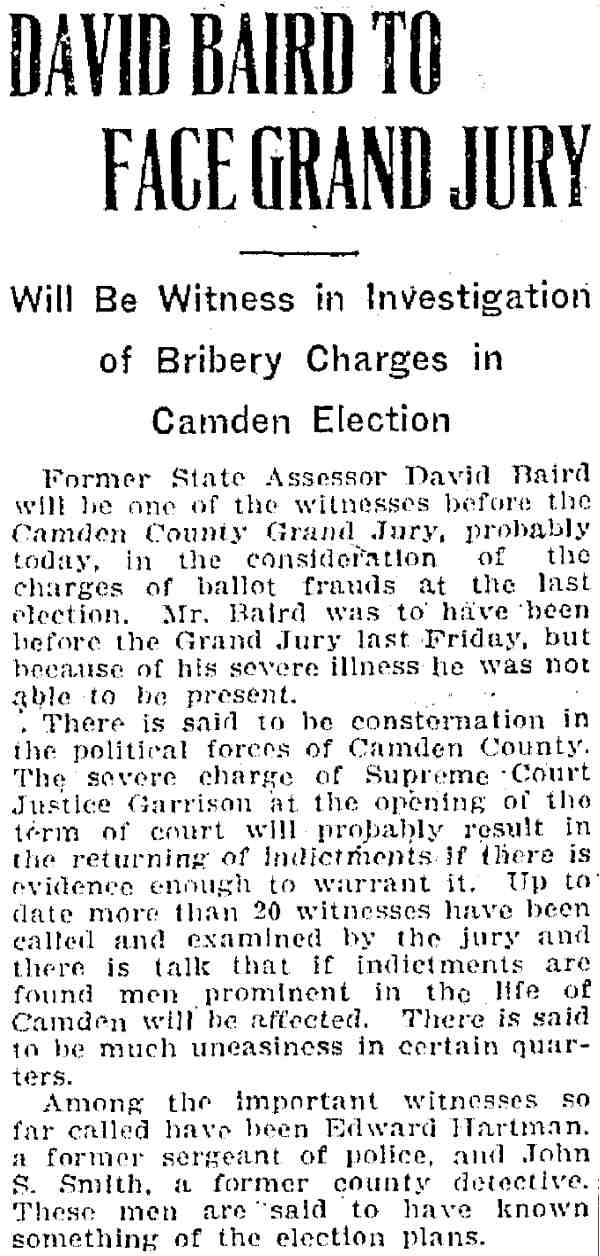
Will Be Witness in Investigation of Bribery Charges in Camden Election
Former State Assessor David Baird will be one of the witnesses before the Camden County Grand Jury, probably today, in the consideration of the charges of ballot frauds at the last election. Mr. Baird was to have been before the Grand Jury last Friday, but because of his severe illness he was not able to be present.
There is said to be consternation in the political forces of Camden County. The severe charge of Supreme Court Justice Garrison at the opening of the term of court will probably result in the returning of indictments if there is evidence enough to warrant it. Up to date more than 20 witnesses have been called and examined by the jury and there is talk that if indictments are found men prominent in the life of Camden will be affected. There is said to be much uneasiness in certain quarters.
Among the important witnesses so far called have been Edward Hartman, a former sergeant of police, and John S. Smith, a former county detective. These men are said to have known something of the election plans.