Introduction
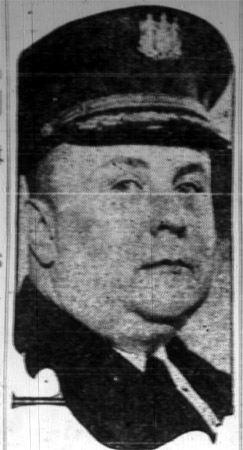
John W. Golden, September 1928
John W. Golden was born in New Jersey on January 29, 1884 to Richard and Annie Golden. The 1900 Census shows the family at 313 Bridge Avenue. Richard Golden was then a Camden police officer.
The family lived at 8 Hudson Street as early as 1906. John W. Golden was then working as a machinist. By 1910 John W. Golden and his neighbor, Edward S. King Jr., who lived at 18 Hudson Street, had both been appointed to the Camden Police Department.
John Golden got caught up in the prosecutions that took place after the 1910 election in Camden. Along with Daniel Woods and Martin Carrigan, he served a four month sentence in the Camden County jail, then returned to his job with the police department.
By the end of 1910 John W. Golden had been promoted to Sergeant and by September of 1918 he had been made a captain. He was still living with his parents at 8 Hudson Street when the census was taken in January of 1920.
He married at the age of 37 and by 1922 was living with his wife Huldah at 123 North 28th Street in East Camden. A son, John W. Golden Jr. and a daughter, Huldah Golden were born in the mid 1920s.
John W. Golden had been named Captain of Detectives on October 18, 1927, the day after Captain William Schregler suddenly died of a heart attack. John W. Golden succeeded Chief Lewis H. Stehr Jr. as Camden's Chief of Police, and was succeeded in that post after his retirement in June of 1934 by Arthur Colsey.
John W. Golden passed away after an illness of three years on December 25, 1952. Mrs. Golden passed away in November of 1980.
Many Accused of Election Frauds
Philadelphia Inquirer —
Camden County Grand Jury Returns Fifty-five True Bills of Indictment
Most of Them Are Impounded by Order of Court, While Constables Get Busy
In a partial presentment made before Supreme Court Justice Garrison, in Camden, yesterday, the grand jury returned fifty-five true bills as a result of its probe into alleged election irregularities. Judge Garrison at once ordered County Clerk Patterson to impound most of the true bills until the defendants are apprehended and held in sufficient security to guarantee their appearance at court for trial. Bench warrants were issued and the force of constables was busy last night trying to locate those indicted.
As an evidence of how grave the accusations are in the eyes of the law, Common Pleas Court Judge Joline demanded $6000 bail when Policeman Samuel Flick, of the Twelfth ward, was arrested by County Detective Doran in the court room. Flick is under six indictments, two for perjury and four for false registration. He was at once taken before Judge Joline when security was furnished by Isaac Shreeve, a fellow policeman of the accused officer.
Other Indictments
Among those indicted was Francis J. McAdams, a Democrat and secretary of the County Board of Elections. He is specifically accused of larceny. His offense involved the removal from the county clerk’s office of the poll book of the Sixth precinct, Fifth ward, over which there was more or less trouble. Its whereabouts was not known until McAdams was summoned before the jurors.
Most of the others are indicted under the general offense of “violating the election law.” The most important of those whose names were made public is John Broome, a Republican Councilman from the Second ward. With James Smith, Thomas Noland and A. L. James, the latter a police captain. Councilman Broome is supposed to know something about a missing bail bond which was given for Noland’s appearance at court. He was charged with repeating, and Broome went his bail.
Indicted on Five Counts
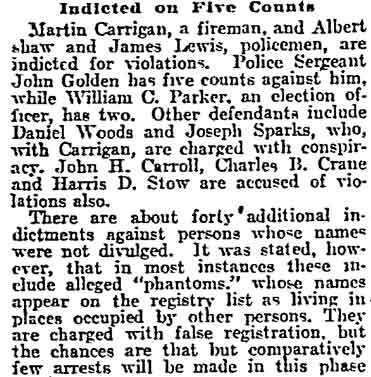
Martin Carrigan, a fireman, and Albert Shaw and James Lewis, policemen, are indicted for violations. Police Sergeant John Golden has five counts against him, while William C. Parker, an election officer, has two. Other defendants include Daniel Woods and Joseph Sparks, who, with Carrigan, are charged with conspiracy. John H. Carroll, Charles B. Crane and Harris D. Stow are accused of violations also.
There are about forty additional indictments against persons whose names were not divulged. It was stated, however, that in most instances these include alleged “phantoms,” whose names appear on the registry list as living in places occupied by other persons. They are charged with false registration, but the chances are that but comparatively few arrests will be made in this phase of the matter.
Probe Still Deeper
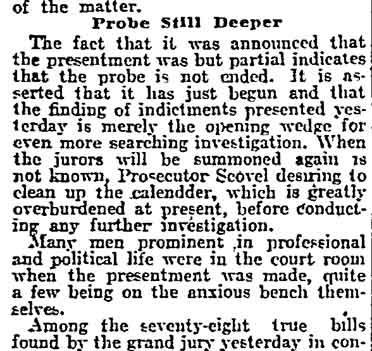
The fact that it was announced that the presentment was but partial indicates that the probe is not ended. It is asserted that it has just begun and that the finding of indictments presented yesterday is merely the opening wedge for even more searching investigation. When the jurors will be summoned again is not known, Prosecutor Scovel desiring to clean up the calendder [sic], which is greatly overburdened at present, before conducting any further investigation.
Many men prominent in professional and political life were in the court room when the presentment was made, quite a few being on the anxious bench themselves.
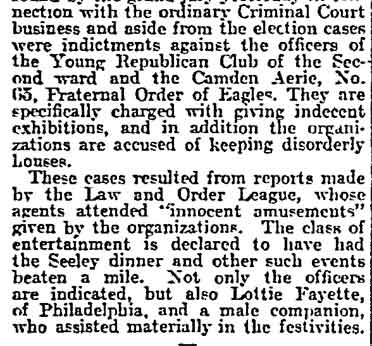
Among the seventy-eight true bills found by the grand jury yesterday in connection with the ordinary Criminal Court business and aside from the election cases were indictments against the officers of the Young Republican Club of the Second ward and the Camden Aerie, No. 65, Fraternal Order of Eagles. They are specifically charged with giving indecent exhibitions, and in addition the organizations are accused of keeping disorderly houses.
These cases resulted from reports made by the Law and Order League, whose agents attended “innocent amusements” given by the organizations. The class of entertainment is declared to have had the Seeley dinner and other such events beaten a mile. Not only the officers are indicated [sic], but also Lottie Fayette, of Philadelphia, and a male companion, who assisted materially in the festivities.
3000 Ask Mercy in Camden Election Frauds
Philadelphia Inquirer —
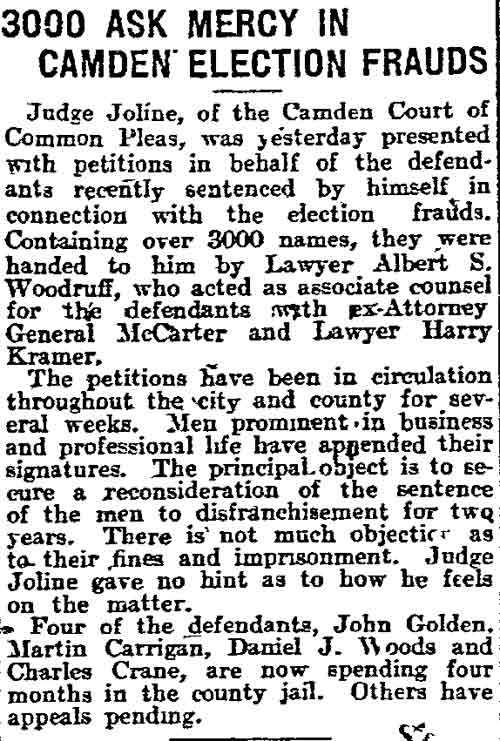
Judge Joline, of the Camden Court of Common Pleas, was yesterday presented with petitions in behalf of the defendants recently sentenced by himself in connection with the election frauds. Containing over 3000 names, they were handed to him by Lawyer Albert S. Woodruff, who acted as associate counsel for the defendants with ex-Attorney General McCarter and Lawyer Harry Kramer.
The petitions have been in circulation throughout the city and county for several weeks. Men prominent in business and professional life have appended their signatures. The principal object is to secure a reconsideration of the sentence of the men to disfranchisement for two years. There is not much objection as to their fines and imprisonment. Judge Joline gave no hint as to how he feels on the matter.
Four of the defendants, John Golden, Martin Carrigan, Daniel J. Woods and Charles Crane, are now spending four months in the county jail. Others have appeals pending.
3 Policemen Hurt as Car Hits Ambulance
Philadelphia Inquirer —
Collision Occurs as Machine Speeds to Home of Man Who Attempted Suicide
Three Camden policemen were injured, one of them seriously, last night, when the First district auto ambulance was struck by a trolley car while responding to a call from 2310 Carman street, where Bodine Stratton, 59 years old, had shot himself over the heart. All were taken to Cooper Hospital.
Policeman Harry Newton, of Twenty-sixth and Sherman avenue, received a probable fracture of the skull; Policeman George R. Thompson, of 251 Mt. Vernon street, had his face and head badly lacerated, while Policeman Robert Abbott, of 110 North Twenty-third street, was cut and bruised. Stratton was seriously hurt by his self-inflicted wound.
When the call for aid came the ambulance, in charge of Patrolmen J. Oscar Weaver and Thompson, was sent to the Stratton house. It was crossing Westfield avenue at Thirtieth when a trolley car crashed into the rear. The three injured men were thrown against the side of the machine, although it was not wrecked. Weaver and Sergeant Golden took them to the hospital.
Stratton had been despondent, according to his wife, and it was while she was in the yard that she heard the shot, finding her husband lying on the floor with a bullet wound over his heart.
Police Department Changes
Philadelphia Inquirer —
There were a number of changes in Camden’s Police Department yesterday, by Mayor Ellis. He appointed Sergeant John Golden successor to Captain Hugh Boyle, recently placed on the pension list. Patrolman Howard Smith was made a city detective, and Hall Officer James Clay was made a hall sergeant. Motorcycle Policemen Jefferson Kay and Charles Laib were appointed traffic sergeants, while Patrolmen Edmund Pike and Albert Cornog were made traffic policemen. Patrolman Robert Abbott was appointed a sergeant. Mayor Ellis has received the resignations of G. M. Beringer and Myers Baker as members of the City Plan Commission, the first getting out because of pressing business and the other because of going to Camp Dix.
Former Captain Boyle Recovering
Camden Post-Telegram —
The many friends of former Police Captain Hugh Boyle are pleased to see him looking so well. Captain Boyle has been ill for many weeks. But he is now well on the road to recovery. He has gained weight rapidly and is feeling much better. Yesterday he spent part of the time as the guest of his capable young successor, Captain John Golden, of the First district.
Hugh Boyle – John W. Golden
Note: This story erred in reporting, as retirement at age 65 was NOT mandatory at the time. William E. Albert, Richard Golden, Frank Matlack, and Edwin Thomas did retire. John Golden, John Painter, Charles Fitzsimmons, Thomas Brothers, and William Lyons continued to work in the Police Department. John Golden was eventually promoted to Chief of Police.
Changes Ordered in Camden Police
Philadelphia Inquirer —
Council Body Directs Solicitor Bleakly to Plan Re-organization of Department
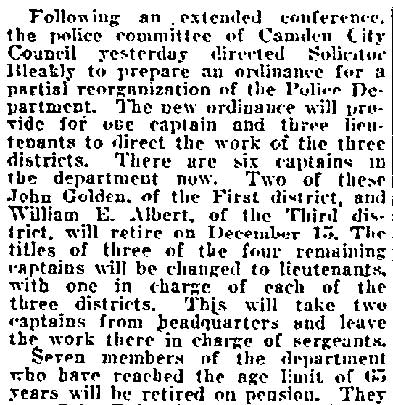
Following an extended conference, the police committee of Camden City Council yesterday directed Solicitor Bleakly to prepare an ordinance for a partial reorganization of the Police Department. The new ordinance will provide for one captain and three lieutenants to direct the work of the three districts. There are six captains in the department now. Two of these John Golden, of the First district, and William E. Albert, of the Third district, will retire on December 15. The titles of three of the four remaining captains will be changed to lieutenants, with one in charge of each of the three districts. This will take two captains from headquarters and leave the work there in charge of sergeants.
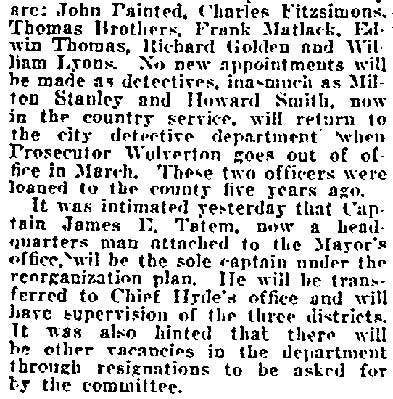
Seven members of the department who have reached the age limit of 65 years will be retired on pension. They are: John Painted [sic], Charles Fitzsimons, Thomas Brothers, Frank Matlack, Edwin Thomas, Richard Golden and William Lyons. No new appointments will be made as detectives, inasmuch as Milton Stanley and Howard Smith, now in the country [sic] service, will return to the city detective department when Prosecutor Wolverton goes out of office in March. These two officers were loaned to the county five years ago.
It was intimated yesterday that Captain James E. Tatem, now a headquarters man attached to the Mayor’s office, will be the sole captain under the reorganization plan. He will be transferred to Chief Hyde’s office and will have supervision of the three districts. It was also hinted that there will be other vacancies in the department through resignations to be asked for by the committee.
Cops Discover Secret Vault, Baby Skeleton
Camden Courier —
Voodoo Man Confesses Bigamy
Driven Back From Top of Dank Well by Noxious Odors
Hyghcock Says He Had 5 Wives, 37 Children
Tempest Orders Maze of Caverns Torn Up for Murder Clues
Grill Doctor for Hour
Camden Courier — An Independent Republican Newspaper — Final — Vol. 41, No. 267 — Camden, N. J., Friday, April 10, 1925 — 32 Pages—Two Cents
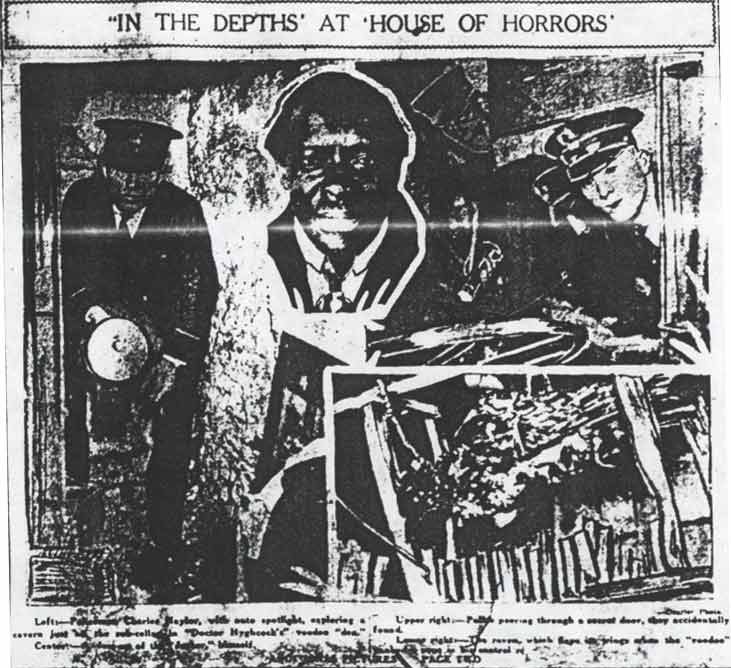
“In the Depths” at “House of Horrors”
Left:—Policeman Charles Naylor, with auto spotlight, exploring a cavern just [illegible] the sub-cellar in “Doctor Hyghcock’s” voodoo “den.” Center:—[illegible] of the “doctor” himself.
Upper right:—Police peering through a secret door, they accidentally found.
Lower right:—The room, which [illegible] the “voodoo” [illegible].
—Courier Photo
Additional Pictures Page Two
Police investigating the “voodoo den” of H.H. Hyghcock, 413–15 Liberty Street, whose arrest on suspicion of murder made several important discoveries today.
They are:
1 — The finding of a bloodstained hatchet buried under the floor of one of the underground rooms.
2 — Discovery of a hidden vault, the entrance freshly cemented and covered with wall-papered boards.
3 — Discovery of what is believed to be a well under the “sacrifice room.” When the police tore off the lid of the well today, they were driven from the underground passage by the odor that emanated from the large hole.
4 — A blood-stained mattress cover, hidden in a second story rear room, was found.
5 — Police digging in the underground den this afternoon unearthed the skeleton of a baby, the fourth infant’s body found in the “voodoo den.”
6 — Lastly, police say Hyghcock is the biggest liar they have ever seen.
When informed of the finding of the supposed vault Director Tempest instructed Captain Gordon to “tear it out if you have to tear down the house.”
The police questioned the “voodoo medicine man” for an hour this morning during which he admitted he is a bigamist. He confessed that he had five wives and is the father of 37 children.
Hyghcock Questioned For Hour
After spending the night in a prison cell, Hyghcock was taken before Deputy Director Tempest. In the room at the same time was Chief Tatem, Captains Colsey, Golden, Humes, and Sieh.
Hyghcock was visibly serious as he sat in a chair facing the police officials. He clasped and unclasped his hands and stroked his goatee as his eyes shifted around the room.
Director Tempest started the first shot of a barrage of questions that swept over the voodoo man before he was allowed to leave the room.
For nearly an hour the medicine man matched his wits with those of the police. Several times he seemed about to crack and reveal something startling but caught himself just as he was to fall into a trap.
As each question was asked him Hyghcock repeated it slowly and after thinking a few seconds made answer.
“Hyghcock,” Director Tempest began, “how many children have you?”
“Newspaper reporters printed stories that I have thirty-two children” the prisoner answered. “That is all wrong. I have thirty-seven children.”
Five Wives, Says Hyghcock
“How many wives have you had?”
“Five” he answered.
“All living?”
“Two are living.”
“Are you a bigamist?”
“Yes, I guess you would call me that. I don’t know where my fourth wife is now.”
“How long have you been married to this wife?”
“Thirty-two years.”
“All your children living?”
“All but two.”
“Where are the other thirty five?”
“Scattered all over.”
“How many women have you killed in your time?”
During the questioning of his married life Hyghcock smiled continuously as he answered the questions.
The last question had the effect of an electric shock upon the prisoner.
“Come on, come on,” Director Tempest said. “How many women have you killed?” This was one question that Hyghcock did not repeat.
Says He Bought Dead Bodies
“I never killed any women” he answered as he looked at the faces of those gathered around him.
“How many operations have you performed in that den of yours?”
“I didn’t perform any operations.”
“How do you account for the finding of those bodies of these infants in the cellar?”
“I bought those babies from Dr. White on South Street in Philadelphia.”
“You are lying, aren’t you?”
“No sir” Hyghcock said, as he toyed with his hat.
“Tell the truth now. How many women died in that house of yours?”
“Who said I killed anybody?”
“We have the goods on you, so you might as well come clean. Your daughter has told us she saw you kill that light skinned colored woman when your wife was away. What did you kill that woman for?”
“My daughter say that? She must be wrong.”
“Why should your daughter say you killed a woman if you did not? We know you shot that woman and your daughter saw you do it. Why should your daughter say such a thing if it were not true?”
Stumped by Daughter’s Tale
Beads of perspiration broke out on the prisoner’s face.
“I don’t know” he answered.
“Didn’t you take a woman’s body out of that house not so long ago?”
“No.”
“How many women have died in that house?”
“Only my daughter.”
“Are you a physician?”
“Sorta of a physician.”
“Why do you have the stethoscope in your home?”
“What kind of thing is that?”
“Are you a physician and well acquainted with surgical instruments?”
“Yes, sorta,” Hyghcock said. The stress was beginning to tell on him.
“And you don’t know what a stethoscope is? You are not a doctor, Hyghcock. You are a liar.”
“Yes sir” he answered.
“Are you a regular minister?”
“Sorta. I’m an evangelist.”
“Ordained?”
“What do you mean? I’ve been an evangelist since I was a child.”
“Ever been arrested before?”
“Yes, in Philadelphia. Man I was with shot a woman with a baby in her arms.”
“You did the shooting, didn’t you?”
“No sir.”
“But you shot the woman in your house on Liberty Street, didn’t you?”
“No sir.”
Women Boarders
“How many women do you keep at your house at one time?”
“Four or Five.”
“What for?”
“Boarders.”
“You are lying now, aren’t you?”
“No sir.”
“How many women have you killed?”
“None.”
“What do you know about the bloody hatchet we found in your cellar?”
“I don’t know anything about it. Where did you find it?”
“We are asking the questions, you just answer them.”
“Did you ever have a hatchet?”
“Yes, I lost it six months ago.”
“How did the blood get on it?”
“I don’t know.”
“Why did you cement that vault?”
“What vault?”
“The vault in your cellar that you just cemented a short time ago. You might as well come clean and tell us about what is hidden behind that cement wall because we are going to find it out.”
Hyghcock shifted in his chair and the perspiration flowed in a stream from his forehead. He bit his lips.
“There is nothing much there” he said after thinking for fully a minute.
Walls Against Water
“What did you build it for?”
“To keep the water out.”
“Why didn’t you cement up the rest of the cellar?”
“I don’t know.”
“You know that we know you are lying, don’t you?”
Hyghcock did not answer that question.
“Why did you dig out all those rooms in the cellar?”
“For church services.”
“Did you use about 65 small rooms underground for church services?”
“Yes.”
[TEXT illegible]
[TEXT illegible]
[TEXT illegible]
[TEXT illegible]
“In the room way back under the yard. That was the main church?”
“How can you take nine people and put them in 35 rooms?”
“I don’t know.”
“Then why did you have so many rooms?”
“The people wanted them.”
“What people?”
“My congregation.”
“Are you a regular minister?”
“Mr. Johnson in Newport News told me I could be a minister.”
“What was that room where the crow was swinging on the board supposed to be?”
Noah’s Ark Room
“That was the Noah’s ark room. The bird was on the ark.”
“What was the idea of having ropes to make the stuffed bird flap his wings?”
“That was part of the church service.”
“How many women are you in love with?”
“I don’t know. A lot are in love with me.”
“Hyghcock, you have been performing illegal operations in that house of yours, and we have more than 100 letters from women that were sent to you. Those letters contain evidence that will be used against you. What have you to say about them? You read the letters, because they were open when we found them.”
“Just what particular letters are you talking about?”
Director Tempest then went through some letters and mentioned the names and addresses of the senders. Many of them were from white women. To each letter called to his attention Hyghcock said:
“I just can’t recall reading that letter.”
“How about this letter from Ann Miller of Philadelphia telling you that she was thorough with you because you killed the man next door?”
“I don’t remember seeing that letter.”
“You are lying Hyghcock, and you had better come clean and tell the truth.”
“Women Stuck on Me”
Then letters containing endearing terms were read to him. Asked what he had to say about them, he answered:
“They are some of the women who are stuck on me.”
“How many women are stuck on you? Are there as many as 100?”
“I don’t think there are that many. I know women all over the country and they write to me.”
“What do women all over the country write to you for?”
“I guess they like me.”
“I guess they do,” Director Tempest said as he gazed at the prisoner, who averted his glances.
“Ever perform any operations on any of these women?”
“No sir.”
“Then what do they write to you about?”
“I don’t know.”
“What is in that well under the board in the cellar?”
“What well?”
“Did you throw any bodies down there?”
“No sir, I ain’t hid no bodies.”
“Where did you bury the women who died in your house?”
“Nobody died there.”
“Why did you go out late at night in your automobile with a shovel?”
“Who said so?”
“You did, didn’t you?”
“I can’t recall.”
Says He Took Women Into Tunnels
“Just think for a minute.”
“Nope, I can’t recall.”
“Did you take women into those underground rooms?”
“Yes, I took them down to church services.”
“Didn’t take any men down there, did you?”
“No sir.”
“How did you come to dig all those rooms?”
“I was looking for money.”
“What do you mean?”
“When I first moved into the house I dug in the cellar one day and found $25.00.”
“What has that got to do with the rooms?”
“Well, I kept on digging and found $300.00 more.”
“Yes, go on.”
“Go on where?”
“What gave you the idea for all of the rooms?”
“Well, when I moved into the house there were rooms directly under the [XXXXX] and I dug [XXXX] the back yard [XXXXX XXXX XXXXXXXX].”
“For how long have you been live there?”
“Eight or ten years.”
“Who dug that cellar with you?”
“A man by the name of ______ (Name withheld at the request of the police).”
“What did he do?”
Becomes Badly Mixed
“He helped me to make the room — the chapel.”
“Did he help you get rid of the bodies?”
“No sir.”
“Who did help you get rid of them?”
“Nobody.”
“Did it all yourself?”
“Did I do it all myself — yes, sir — no, sir.”
“Well, what do you mean?”
“I mean I didn’t do anything. I hid no bodies.”
“What did you bury the hatchet for?”
“I didn’t bury any hatchet.”
“How did it happen the hatchet was covered with blood?”
“I don’t know.”
“What did you have those shovels and picks down in the cellar for?”
“To dig with.”
“Dig what?”
“What is this religious college you have up by Willow Grove?”
“Who told you about that?”
“You tell me about it now.”
“I started a church up there.”
“You built shacks and rented them to colored people for $30.00 a month and then charged them $10.00 a month extra. What was the extra $10.00 for?”
“It was for the Lord.”
“What do you mean Lord Hyghcock?”
“No, for the church.”
Sold Willow Grove Settlement
“Do you still have the church settlement?”
“No, I sold it.”
“Sold the church too?”
“Yes.”
“Why did you tell your wife you would kill her if she went into the cellar of the house where all those rooms were?”
“Who said so?”
“You did, didn’t you?”
“I can’t recall.”
“When you would have a crowd of women in the rooms you would send your wife away, wouldn’t you?”
“Not exactly.”
“Speaking of illegal operations, do you know Miss…”
“Who ain’t one of the women I operated on.”
“Who are some of these women, then?”
“I ain’t operated on any women.”
“Did you tell women to keep away from you?”
“Yes.”
“Tell us about how you shot that woman and buried her body.”
“I ain’t shot nobody.”
“How did you kill her, with that hatchet?”
“No sir.”
“Come on, tell us how you killed her.”
“I didn’t kill any women.”
“The woman just died in the house, oh?”
“No sir.”
“How about the man who lived next door whom you said you killed?”
“I didn’t kill anybody.”
When Tempest finished, each of the police captains fired a barrage of questions at Hyghcock.
Several times under severe questioning by Captain Golden, Hyghcock became confused and gave evasive answers.
Turning to Captain Schregler, Director Tempest said:
“He’s a liar, take him upstairs.”
Mrs. Hyghcock Quizzed
Hyghcock was then taken up to the bureau for further questioning by detectives. His wife was quizzed in an adjoining room and when she was taken back to her cell, their seven year-old daughter, who told the police her father killed a woman in the house when she was questioned again repeated her version of the killing.
During the questioning of Hyghcock in the Detective Bureau, Commissioner Middleton came into the room. He sat with the detectives as they questioned the 71 year-old medicine man.
Where the Ropes Came From
A Broadway hardware merchant called at police headquarters today and told the police that he had been selling rope to Hyghcock for the past two years.
“He would come into the store and buy the rope in six foot lengths. He would also buy barn lanterns by the dozen. I often wondered what he intended to use them for but I never asked him.”
The ceiling of the underground den was a cobweb of ropes, which operated through pulling and rang bells, opened doors, and made the raven in “Noah’s Ark” flap his wings.
That Hyghcock contemplated more cement work, when discovered, was evident yesterday when the police found a load of sand in the front part of the cellar. In the afternoon a truck with fifteen bags of cement came to the Hyghcock house.
The driver, seeing the crowd, drove away, taking the cement with him.
Director Tempest sent a detail of police and firemen to destroy the maze of underground tunnels and “torture chambers” under the “voodoo” houses. The entire cellar of the two houses will be dug up to a depth of six feet in an effort to learn if any human bodies are buried there.
The “voodoo palace” was raided early yesterday morning by a detail of police who arrested “Dr.” H.H. Hyghcock, a 71 year-old “medicine man.” When the police searched the house yesterday they discovered the bodies of two small infants hidden in one of the underground rooms.
County detectives who went on the case yesterday and city police are endeavoring to learn if any women were murdered in the house. The decision to tear out the thirty-five underground rooms came at a conference at police headquarters last night between Prosecutor Wescott, City Prosecutor Bernard Bertman, Director Tempest, and Chief Tatem.
Each of the officials declared that he believed a digging up of the cellar would reveal the finding of human bodies.
Will Do It Monday
“I am going to order a detail of firemen and policemen to the cellar of the two houses” Director Tempest said, “with instructions to tear out every one of those rooms in the cellar. After the cellar is cleared the policemen and firemen will dig up every foot of the cellar. I have some information which I cannot divulge that leads one to believe that our search will not be unsuccessful. It is not probable, however, that the work of clearing up that underground ‘hotel’ will be started before Monday.”
“In my police experience I have never seen anything that compares with that underground voodoo den.”
Hyghcock was questioned for several hours last night by detectives. He refused to make any statements, even when he was shown incriminating letters that were found in his home. The police seized more than 100 of the letters which were mailed from every state in the Union. Many will be used against the “physician” when he is placed on trial as they reveal he practiced medicine without a license.
The police place great stress upon the statement of Hyghcock’s seven year-old daughter who told them that her father killed a woman in the house a week ago and buried her body. The child is being held in custody as a material witness as is the wife of the “medicine man.”
Last night more than 5,000 morbid curious people gathered at the Hyghcock house and stormed the doors seeking admittance to the underground passages. A detail of police inside the house fought back the crowd. A riot call was sounded at 9:00 o’clock and two details of police were rushed to the scene. The crowd was driven back and the street roped off. During the excitement the front door was smashed in by the crowd.
Today detectives are reading the large bale of letters found in the house. They also seized the prisoner’s set of books, which show he received large sums of money from superstitious persons for “love and enemy” charms. The books contain the names and addresses of more than 1,000 of Hyghcock’s customers.
Police said that although Hyghcock has only been a resident of this city for three years, he has amassed a small fortune and owns considerable property here and in Pennsylvania. They said that several years ago Hyghcock built a small chapel near Willow Grove. Around this chapel he erected 20 small frame houses. He rented them to colored folks who joined his religious sect and in addition to the rent paid him an assessment of $10 a month which he said he turned over to the Lord.
Three Years of Work
When Hyghcock was taken from his cell in police headquarters last night to be questioned he smiled as the cell doors clanged open. He was taken to detective headquarters and questioned, but refused to make any statement. He will be questioned again today.
The police said he must have spent nearly three years building the underground “chamber of horrors.” So quietly did he work that none of his neighbors knew the spooky subway rooms existed. Most of the excavating was done between midnight and 3 o’clock in the morning.
Entering the house at 413 Liberty Street, a visitor sees a small counter and a candy show case. Arrayed on shelves behind the counter are bottles of pop and packages of cigarettes. Three feet away from the counter toward the kitchen is a door leading into a hallway three feet square. A winding flight of steps lead to the upper floors and a door in the hallway opens onto a narrow winding stairway into the cellar.
Secret Winding Passages
Once in the cellar the visitor finds himself in a small alley running toward the front of the house. In this alley are shelves filled with roots and herbs. The aisle turns at right angles to the right and one sees a large door upon which is printed “Noxvill.” A heavy spring slams the door to. The visitor is then in complete darkness. In front of him is a winding, twisting passageway, barely three feet wide. Directly over his head are ropes running along the ceiling which control the opening and closing of doors and the ringing of bells.
To the right is a dark room. The rays of a flashlight thrown into the room reveals a stuffed bird resting on a swinging shelf. A pull on one of the many ropes causes the crow to flap his wings. Just ahead in the passageway, and to the right and left are three doors. Sleigh bells are fastened to each of the doors. The door to the right leads to a tunnel connecting with the house at 415 Liberty Street, next door. The other doors lead into other rooms and in the rooms are other doors leading into still other rooms.
Rooms Poorly Furnished
And so on down the entire length of the cellar.
In the rooms which are not more than four feet square there is very little furniture. The walls and partitions are made of packing box lumber covered with various pieces of wall paper, one shade bordering on the other. In each “den” a kerosene lantern, or lamp hung on a hook. The air is stifling.
In the room known to the police as the “Graveyard” are three lanterns and several spades and picks lying on the dirt floor. The soil shows that it has recently been dug up.
Still following the dark passages the visitor finds himself confronted with a door, with a glass panel in the bottom. A heavy spring makes the door hard to open, but a pull on one of the many strands of rope running along the ceiling and the door swings slowly open without the least effort. It is controlled in some mysterious manner by weights.
Hyghcock has undermined his entire back yard. Back under the yard runs the passageway with the dens turning off to the right or left. In one of the underground rooms a large clock instead of being placed high on the wall is fastened down near the ground. The clock was functioning yesterday but was four hours fast.
Tunnels Become Confusing
Now the passageways get narrower and darker and the odor is sickening. Towards the extreme rear of the room is the “Sacrifice Chapel.” This contains a baptismal bath, a large Bible, a [XXXXX] and a carriage wheel with various colored spokes. The wheel spins from an iron peg driven into the wall. Everywhere is seen patchwork carpenter work. A birds-eye view of the underground rooms reminds one of the futurist, or cubist, paintings. In one of the rooms the floors are covered with freshly laid cement. The police will endeavor to find if anything is buried underneath the flooring.
Just ahead is daylight. One finds a small hole in the roof where a chimney or an uphill coal stove extrudes into the yard. This follows another maze of doors. In several parts of the tunnel thick doors can be opened at the same time to form a triangle. Not twenty more feet down this dark passageway and a ladder leading upward is seen. It is a hastily constructed affair and the top rungs are covered with grips made of automobile tires.
A walk through the upper story of the two houses show that bedrooms have been partitioned off to make three rooms.
He Doted On Bells
Overhead is the network of ropes operating on pulleys the [XXXXX XX XXXX XXXX]. In the underground rooms and tunnels, [XXXX XXXXX] and a door [XXXX XXXX. XXXX XXXX] will open or a bell will ring. Hyghcock just doted on bells. The largest bell is fastened to a door on the third floor. This one can be sounded from the rear room in the tunnel by means of the rope. Bells are everywhere. They range from baby bell rattles to large cow bells.
The rooms on the upper floors each contain beds. Yesterday they were in disorder. The bed clothing was scattered on the floor and the floors were strewn with papers, letters, books, and clothing. In a closet in a third story room was found two new dolls in a basin, glassware, phonograph records — everything imaginable. The rooms resembled “junk shops.”
Yesterday the police spent most of their time searching for bloodstains on the floors and walls of the buildings. Trunks were forced open and those were found to contain soiled linens. The police questioned Hyghcock’s seven year-old daughter.
“How many men did your father kill in here?” Patrolman Charley Naylor asked the girl.
Says “Pop” Killed Woman
“My Pop did not kill any men” the child answered, “but when my mother was in Washington to see my sister not long ago, a woman came to the house and started to fight with Pop. It was late at night. They fought terrible and they were in the big room in the front of the house. I saw them fighting and my Pop got a gun and shot the woman. Pop took her out in the automobile and buried her. He told me to keep quiet and said the woman was sick and died and he buried her in a cemetery.”
The child was taken to police headquarters when she was again questioned by Director Tempest and Chief Tatem. The police tried to get her to change her story but she refused to do so and stuck to the narrative she first told in her home. Her mother was then arrested and detained as a material witness.
Persons living in the neighborhood said today that on two occasions they had seen Hyghcock place large bundles in the back of his car at night, place a shovel in the rear of the car and drive away.
The police have been unable to learn much so far about Hyghcock prior to coming to this city. They do know that he came here from Norfolk, VA where he still claims to be in the undertaking business.
Strange Powders Sold
Hyghcock, the police said, manufactured powders and sold them to colored people as good luck charms. If a woman was unfriendly with another woman she went to Hyghcock and for $12 she received a small bottle of powder. This she sprinkled in front of her enemy and from then on “everything will suffer for the enemy because she would be pursued by evil spirits and her luck would be something terrible.”
If a superstitious young man who “rolled the bones” as a pastime wanted to stage a winning streak, he would visit the medicine man. For $40.00 he would give the man with the gambling instinct a blue powder that he was supposed to rub on his hands just before it was his time to “roll.” Powder to keep another woman from stealing one’s husband went for $30.09, Hyghcock’s records show. What the 9 cents was for is not known. In one day, the police said, Hyghcock sold more than $190 worth of powder that originally cost about twenty cents.
The more serious charge against the prisoner is that he used the building for immoral purposes and for performing illegal operations.
Cops and Firemen in First Practice
Camden Courier —

Bluecoats and Ladder Climbers Get Ready for Field Day
MR. YOUNGER IN CHARGE
Firefighters Have Large Team of Athletes
Charles Younger, physical director of the Camden Y. M. C. A. and in charge of the candidates for the police and firemen teams which will compete in the first annual police and fire field day on September 19 at Forest Hill Park, sent his proteges through their stiffest workout of the season yesterday morning with several of the committee in attendance.
Plans were arranged between Younger and Captain Stehr, of the First district, to build a temporary track around the local high school’s gridiron. Meanwhile both the police and fire candidates will do their stuff under the watchful eye of Professor Younger on the the Forest Hill track, outside of the enclosed athletic field.
In a confab over the arrangement of the cinder track, Stehr suggested that a 100 and 220-yard straightaway be constructed on the west side of the field.
Joe Connell, of the Highway Department, also gave the field a once-over, as did Captains Golden and Humes. After the members of the committee had inspected the grounds, they witnessed the candidates going through the paces.
Archie Riess, who is in full charge of the “cops,” declared that but nineteen men would be candidates for his team, while Walter A. Merts [sic], of Engine Company No. 1, acting as manager of the ladder-climbers, counted up twenty-nine candidates on his list. These men will compete next Tuesday, the first three in each event to qualify for field day. The events will be run off separately, that is, the “cops” in one division and the firemen in the other. The bluecoats who will compete this Tuesday are as follows: Everett Joslin, Joseph McDonald, Vernon Jones, Frank Nelson, Bill Rogers, Harold Dunnit, John Bright, Edyard Callahan, Walter Larson, Gus Pfliderer, Clarence Phifer, Thomas Welch, Stanley Wirts, Charles Naylor, George Rothwell, Richard Donnelly, Lester Gleason and Joe Keefe.
The firemen who will also attempt to qualify on Tuesday include Fred Schucker, Harry Wagner, Chris Moll, Harry Layton, Edgar Ellender, August Havercamp, Frank Huda, Harry Kleinfelder, William Foehle, Tom Shanahan, Harrison Pike, William Rudd, Lester Anderson, William Wood, George Townsend, Allen Palmer, William Swartz, Nelson Fill, William Mourtvey, John Strauss, Frank Oberman, Edward Menzies, John Mulligan, Frank Kates, Clifford Hare, Nelson Andrews and Harry Leigh. From the present outlook the “Cops” seem to be coming out second best. The firemen are confident of finishing once more in front of the bluecoats, they having beaten Stehr’s cohorts at the last Armory meet.
The tug-of- team of eight men will also be selected by the firemens’ leader. Mertz will choose his varsity from Layton, Smith, Lennox, Walker, Pike, Palmer, Moll, Greenan, Laird, Mulligan, Haver, Merigan and Camp.
The Camden Motorcycle Club may stage a free exhibition of a motorcycle polo game during the meet. Stehr favors this performance, as but forty minutes of actual time is taken up. The local club is willing to donate their services free of charge. Nelson Hubbs, local manager, has dates at the Trenton, Egg Harbor, Allentown and Bridgeton fairs, while his teams have already performed in many eastern states. The “Camden Blue Devils,” as they are known, will furnish more thrills in the forty minutes than sport lovers have ever seen in this locality, according to Hubbs. If they are on the bill at the games, they will also give an exhibition of trick and expert riding stunts. Those on his teams, there being four on each, are well known in riding circles, some of the best hill climbers and polo players being included in the personnel of the teams are as follows:
Blue Devils No. 1—Joseph Bernurt, captain; Frank De Vivey, Carl Preisandanz, Edward Paul.
Blue Devils No. 2—Charles Ellis, captain; George Gummel, Bennett Arnold, Clayton Alberson.
Captains Shifted
Camden Courier-Post —
Sergeant William Horner, First District, North Camden, to become captain of the Third District, where he lives.
Captain Arthur Colsey, now deputy to Chief Tatem, to go to Second District as captain in command.
Captain William Schregler, captain of detectives until two years ago, to return to that post;
Captain of Detectives Edward King, who replaced Schregler, to return to his former rating as a detective;
Chief Tatem to remain as chief;
Captain John Golden, remaining in command at First District.
Other developments at City Hall today were:
5 Policemen Added to Detective Detail
Camden Courier-Post —
Dolan, Sapanore, Truax, Kelly and Smith Assigned
Pleas by Captain Golden of the Detective Bureau that the department was undermanned and overworked has resulted in the assigning of five policemen as acting detectives.
They are William Dolan, acting sergeant of the First District; Rox Sapanore, Frank Truax, Edward Smith and Anson Kelly.
Dolans’ place is being taken by Sergeant Ralph Bakely, transferred from the Third District. Sergeant John Potter goes from the Second District to the Third to replace Bakely, and Patrolman John Skolski becomes acting sergeant to replace Potter.
Patrolman William Whaland becomes acting sergeant to take over the duties of Sergeant James Clay, who is seriously ill in West Jersey Homeopathic Hospital of pneumonia.
Camden Courier-Post – January 2, 1928
Babe Paradise Admits He Is Narcotic King
3 Others Held by Camden Police as Leaders in Dope Peddling Gang — Operations Covered All of South Jersey
Captured after a lengthy investigation, Anthony “Babe” Paradise, of Camden has confessed to being the head of a narcotic ring operating throughout South Jersey, it was declared yesterday by Captain John Golden, head of the city detective bureau.
Paradise also admitted that he is a drug addict, Golden said, making the fact known when he became ill in his cell at the city jail and calling for Dr. W.G. Bailey, who has been treating him for the drug habit.
With three other men, who are accused as accomplices, Paradise is being held for a preliminary hearing in Police Court tomorrow morning. The four men, Golden said, will probably be held without bail pending grand jury action and be committed to the Camden County Jail. At the jail, detainers will be lodged against the quartette by Federal narcotics agents, who co-operated with city and county authorities in the investigation, which resulted in the arrests.
Golden declared that city detectives had purchased more than $500 worth of drugs from Paradise and his agents, in obtaining evidence against the ring, which authorities said reaches into Atlantic City and other South Jersey communities as well as Camden.
The three men arrested with Paradise are James Mucci, 18 years old, of 324 Stevens Street, Rocco DeCord, 21 years old, of 221 Spruce Street, and Andrew Hill, of Locust Street, near Kaighn Avenue. According to the detectives, the base of operations of the “ring” was in the Third Ward. Mucci and DeCord were arrested in a barbershop at Third and Locust Streets, three blocks from the Wiley M. E. Church where the pastor, Rev. John S. Hackett, recently exposed vice conditions existing in the Third ward and assailed the Department Public Safety for laxity. The arrest of Paradise and the others is believed to be a result of the clergyman’s scathing sermons.
Paradise and Hill were arrested several hours before the other two men. Fearing that they get word to other members of the “ring” police took the two men to Merchantville police headquarters, where Assistant Prosecutor Joseph Varbalow and Chief County Detective Lawrence T. Doran were waiting. Statements were obtained from the two, and meanwhile Mucci and DeCord were taken into custody. Paradise, who is 34 years old, served a year in State Prison five years ago for selling narcotics.
Detectives George Ward, Louis Shaw, and Thomas Cheeseman, of the city, and M.H. Shapiro and J.H. McFadden, of the federal office in Philadelphia, arranged the purchase of a “deck” of heroin from Paradise, and “caught him with the goods” when he met them at Nineteenth Street and River Road, near his home at 927 North Nineteenth Street.
Paradise was in his expensive automobile when arrested. It was the machine he had used to distribute narcotics to his agents and addicts during the past few years, the detectives said.
Peddling Scheme Bared
At a stated hour an agent or addict would approach the machine, take the “dope” inside, and leave money as payment. Paradise would return and collect the money received, it was said.
That the ring extended to Philadelphia, New York, and other large Eastern cities was indicated by the many times the automobile was parked at Camden bridge plaza for hours, when exchanges would be made, the detectives said.
Gangster Shot During Melee in Sixth Ward
Camden Courier-Post —
Joseph Deven Held On Murder Charge After Death Boxer’s Brother; ‘Mose’ Flannery and 4 Others Held as Witnesses; Was Craps Game Says County Police
HOLDUP ATTEMPTED CITY COPS DECLARE
Victim of a shot fired in a melee, the exact cause of which remain undetermined, Joseph Cimini, 31 years old, was killed in the Sixth Ward Republican Club, 908 Broadway.
Cimini, declared by police to be a Philadelphia gangster, was killed before the eyes of two district detectives, Clarence Arthur and Clarence Bunker, who had been summoned to the club by warning that a fight was in progress.
Joseph Deven, 28 years old, known to his associates as “Polack Joe” and a colorful figure in Third Ward politics, fired the shot that killed Cimini.
Declaring that he had fired in self-defense, after Cimini struck him with the butt of a revolver, Deven was locked up without bail on a charge of murder.
Joseph ‘Mose’ Flannery, 26 years old, picturesque Eighth ward political worker, was held as a material witness. Detectives had seized Flannery who was to have precipitated the battle by brandishing a revolver just before Cimini was shot. The officers say that Flannery fled –after the shooting and was captured afterward at Broadway and Federal Street.
The name of the dead man was given as Joseph Gannon, but shortly before one o’clock this afternoon, he was identified as Joseph Cimini, 1301 Ellsworth Street, Philadelphia. The identification was made by a brother, William Cimini, a pugilist who has boxed in this city several times under the name of “Billy” Gannon.
Six Others Quizzed
Six other men who were present at the time of the shooting, or when the argument began, were questioned by city and county detectives.
They are Newton Blanchard, 30, 923 St. John Street, former Camden boxing referee and declared by some of the witnesses as the man who conducted the crap game at the club; Michael Dandrea, 26, 1067 Norris Street; Russell Sage, 26 years old, of 1102 Marion Street a taxicab driver who is said to have driven Gannon and Flannery to the club in his car; Maurice O’Brien, 27 years old, of 1429 Bradley Avenue, a former New Jersey State Trooper, Harry Trooper, Harry Waterhouse, 28 years old, whose address was given as the same as Sage’s; and Charles “Chick” Hunt, 27 years old, of 1218 Broadway, a former Camden boxer.
Blanchard and Dandrea were released after questioning and after each had made a statement to Chief of County Detective Lawrence T. Doran. The others were held with Flannery as material witness.
Differences of opinion between county and city detectives investigating the shooting were heightened during the afternoon. The county sleuths insisted upon the theory that the shooting had resulted from a feud between Flannery and Hunt, with Cimini taking the former’s side and Deven the latter and said that the heat of the argument had possibly been heightened by disagreement over a crap game.
The city police, on the other hand, declared that the entire affair was the result of an attempt by Flannery to hold up the other men. Deven’s statement to Chief Doran made no mention of a hold-up.
Building up a case against Flannery, the officers this afternoon lodged charges of attempted hold-up, carrying concealed deadly weapons, atrocious assault and battery and assault to kill against him. The two latter charges were made as the result of identification of Flannery as a participant in two recent robbery attempts. J.E. Feinstein, café proprietor of 508 Kaighn Avenue, declared that Flannery, Cimini, and Sage were thereof four men who held him up on New Year’s Day. He defied them and they left when he said, “Go ahead and shoot,” he asserted. Flannery was also identified, according to police, as the man who had beaten and attempted to rob Henry Mehrer, an Audubon policeman, and his two companions outside the Ringside Inn, on the Black Horse Pike, a fortnight ago. Mehrer and Feinstein were taken to police headquarters by County Detective Howard Smith, who is authority for the statement that they identified Flannery.
Cimini was shot shortly after 3:00 this morning and died almost instantly. Doctors at Cooper Hospital pronounced him dead on arrival. He had been shot just above the heart by a bullet from Deven’s gun.
Events preceding the shooting remain, to some extent clouded today. Chief Doran said he learned of an enmity existing between Flannery and Hunt. Deven appeared to have attempted to quiet “Mose,” the county detectives said. Cimini struck Deven and Deven fired.
Chief John Golden of the Camden city detective bureau stated, on the other hand, that the shooting had apparently followed an attempt to hold up the other men in the room. Golden based his view on the statements of Clarence Arthur, a city sleuth. According to Arthur, when he and Bunker appeared at the door of the room, Flannery and Cimini held revolvers and the other men in the room were standing with their hands upraised.
According to the story pieced together by county detectives from the statements of witnesses, a group of men had apparently gathered at the club for a crap game. Blanchard, it was stated, acts as the “stick man,” the term used in gambling parlance to designate the man who conducts a crap game.
City and County agree that Flannery and Cimini arrived together in Sage’s taxicab. Whether there was an argument, the result of an enmity between Flannery and Hunt, or whether the attempted hold-up theory is correct, remains to be learned by additional official investigation.
Chief Doran stated the witnesses had told him that words passed between Flannery and Hunt and that the former had gone downstairs. Returning he brandished a revolver.
Two Flee Place
It was at this point that Blanchard and Dandrea left the room and fled down the stairs. On the street, they encountered Detectives Arthur and Bunker, who were patrolling Broadway in a police automobile.
In describing the subsequent events today, Arthur declared that Blanchard had informed him that “two Philadelphia gunmen are up in the Sixth Ward Club holding up a bunch of fellows.”
The detectives did not immediately go to the club, but found Patrolman Frank Del Rossi and followed him up the stairs of the building.
“There were about fifteen men in the room,” Arthur asserted. “When we got to the door Flannery and Cimini had their guns out and apparently were about to search the others. The other men had their hands in the air.”
“When they saw us Flannery and Cimini threw their guns down and the others lowered their hands. I went up to Flannery and started to frisk him. Bunker went to another man, whom I don’t know, and started to frisk him.”
It was then he said that he heard the shot. Believing that it was Bunker who was shot, he released his hold on Flannery and swung around. As he did Flannery turned and fled downstairs, Arthur declared.
Bunker said he believed that it was Arthur who had been shot and he too released his grasp on the man he had been searching. The detectives turned in time to see Cimini fall.
“I did it! I shot him!” Deven is declared to have shouted, throwing his revolver on the table.
According to the story told by witnesses to the county detectives, however, Deven had stepped up to Flannery just before the shot was fired and had said “Mose, you can’t get away with this here.”
Flannery is said to have had a gun in his hand at the time.
As Deven spoke, the witnesses say, Cimini stepped behind him and struck him with the butt of a revolver. Just then detectives entered. Devin whirled and, drawing his gun, fired.
Cimini was placed in a police ambulance and taken to the hospital. After he had been pronounced dead his body was taken to the morgue, where it was awaiting identification today. Neatly dressed, Cimini is of Italian extraction. He has coal-black hair, brown eyes and a dark complexion. Coroner Charles T. Murray will perform a post-mortem examination, he said.
Flannery Captured
When he fled from the club, according to Arthur, Flannery jumped on a Public Service bus driven by David Smith, of 423 Haddon Avenue, which was passing at the time.
“Faster! Faster” he is declared to have urged Smith as the latter drove along Broadway in the direction of Federal Street.
At Federal Street and Broadway, Arthur and Bunker caught up to the bus and arrested Flannery as he descended from the vehicle.
“Why don’t you give me a chance to get to Philadelphia?” Arthur declares Flannery asked him. “I can get bail over there.”
Seek Written Statement
Chief Doran stated this afternoon that he was attempting to obtain a written statement from Flannery and would also seek to have Deven sign a statement regarding the shooting. During the morning, Flannery refused to talk while Devin, although admitting that he fired the shot, declared that he shot in self-defense. He made no reference to the hold-up attempt, according to the county detectives.
Cimini has a Philadelphia police record but, according to his pugilist brother, “was not bad but just wild.” He was recently arrested in Philadelphia after a fight with policemen.
“But he never held up or robbed anybody,” his brother declared this afternoon after identifying the body. “He got into a jam now and then. Yes, I know that he knew ‘Mose’ Flannery, but I never mixed with that crowd.”
It was reported at City Hall this afternoon that Samuel Orlando had been retained as attorney for Flannery and that Walter Keown, Camden county solicitor, would represent all the other men. The presence of Keown at detective headquarters, during which he had a conference with Captain Golden, seemed to lend credence to the latter report but neither rumor could be confirmed.
Flannery for years has figured in police cases and in political warfare in the Eighth Ward, where he was sometimes a lieutenant and sometimes an opponent of “Mikey” Brown, the Republican leader of the ward. Last March he was arrested and indicted on charges of atrocious assault and battery on his wife and her mother. At one time he was held as a suspect is a Philadelphia shooting but later was released.
The accused man, Deven, is a short, slim little man with an air of meek complaisance. He has been a taxicab driver and was last arrested on a charge of drunken driving. In May of 1926 he attempted suicide by shooting himself after he had failed to effect a reconciliation with his estranged wife. At that time, he shot himself but the bullet only grazed his chest.
Joe Deven, long a political power in the Third Ward, first flashed into citywide prominence in 1925, when he was employed by federal authorities as a deputy U.S. Marshal to guard the padlocked Poth brewery at Bulson Street, just off Broadway. At the time Deven was thus maintaining the sanctity of the Eighteenth Amendment, he was also operating a bootlegging establishment downtown and had been arrested once or twice for violating the Volstead Act.
The Courier at that time exposed this paradoxical situation, with the result that the U.S. Marshal summarily dismissed Deven. He keenly resented the political chicanery that had been used to put Deven in office. In explaining how Deven was appointed, the Marshal said that he had been recommended by “prominent Republican leaders” in Camden, chief among whom was William D. Sayrs, now a city commissioner but then a field agent in the office of the Internal Revenue Department.
Sought City Job
Not long after Deven’s dismissal as brewery guard, Sayrs and other Republican leaders made strenuous efforts to secure a city job for him under the Non-Partisan administration. They sought to exact a promise from The Courier that this newspaper would remain silent in the event Deven was appointed to a city position. No such promise was made and Deven remained jobless, politically at least.
Then came a humorous twist to the situation. Sayrs disagreed with some of the Organization leaders and, for a time, walked his own political footpath. Some of the leaders, fearful of what Sayrs might attempt politically, killed two birds with one stone by hiring Joe Deven to shadow Sayrs and to report to them the number of times he conferred with Non-Partisans. Thus, Joe had a job and Billy was watched.
Sayrs knew he was being shadowed by his old friend, and apparently he knew who had hired Deven to do the work, but he refused to take the situation seriously and chortled, frequently, when he would see his “Shadow” trailing about town.
In the last year, however, Deven has again been the particular political protégé of Commissioner Sayrs and also has won the friendship of many other political leaders. Nevertheless, he has not been, so far as can be determined, the recipient of any particular political patronage, though his political influence in the Third and Fifth Wards is said to have expanded rapidly under the new administration.
Camden Courier-Post – January 16, 1928
Murder Motive at G.O.P. Club Splits Sleuths
County Detectives Contend Philadelphia Gangster Was Slain in Quarrel Over Woman — Police Claim Hold-Up Attempt Caused Fight
With city and county authorities definitely divided on the motive and circumstance of the Sixth Ward Republican Club slaying, Joseph “Polack Joe” Deven was arraigned in Camden police court today and held without bail on a murder charge.
Through County Solicitor Walter Keown, retained as his attorney, Deven waived a police court hearing and was held to await grand jury action in the slaying of Joseph Cimini, Philadelphia gangster, at the political club early Saturday morning.
At the same time County Prosecutor Ethan P. Wescott announced his operatives had abandoned the theory Cimini was killed as the aftermath of an attempted hold-up, and were concentrating their investigation in the case on an effort to “find the woman.”
On the other hand, Captain John Golden, chief of the city detective bureau, declared he was unable to recall any mention of a girl in the statements obtained from witnesses, and added emphatically that his department still held the shooting had followed an attempted holdup of the club by Cimini and Joseph “Mose” Flannery.
Flannery and Hunt were both witnesses to the shooting by Deven, picturesque figure in Third Ward politics, which occurred at the Sixth Ward Club’s headquarters, 908 Broadway.
After Deven had appeared in Police Court today, Flannery was arraigned as a material witness and as an accessory to the crime, with an additional charge accusing him of carrying concealed deadly weapons. Similar charges were made against Russell Sage, a taxicab driver, who arrived at the club with Flannery and Cimini early Saturday morning. These two were committed to the county jail without any bail by Judge Bernard Bertman.
Hunt, however, was released under $1,000 bail as was Martin O’Brien, 27 years old, a former New Jersey State Trooper, and Harry Waterhouse, 28 years old, 1102 Marion Street.
Three Others Arrested
During the day the police continued to build up their case against Flannery by arraigning him on the charges made by Milton Feinstein and Henry Mehrer. The also arrested Joseph Genther, 29 years old, 414 Atlantic Avenue; Robert Wolfe, 21 years old, 1106 Mechanic Street, and Eli Conaghy, 27 years old, 814 South 6th Street. Wolfe, who is Flannery’s brother-in-law, and Genther were held “on suspicion” of having been with “Mose” at the time the latter is declared to have attacked and attempted to rob Mehrer, an Audubon policeman, outside the Ringside Inn, on the Black Horse Pike.
Conaghy, Flannery and Sage were arraigned and held without bail on charges of threatening to kill Feinstein and of carrying concealed deadly weapons. Feinstein declares these three with Cimini, the slain man, entered his cafe on January 2 and attempted to hold him up, threatening to kill him if he refused to “come across.” When he defied them by telling them to “go ahead and shoot,” Feinstein says, they departed.
Wolfe, Genther, and Conaghy were arrested by City Detectives George Ward and Thomas Cheeseman. It was Cheeseman who lodged the formal complaint of murder against Deven.
Two Others Released
Two other men who were questioned in connection with the murder case were in court this man but neither was held. They are Newton Blanchard, 923 St. John Street, a former boxing referee and alleged “stick man” at the crap game declared to have been in progress at the club before the shooting, and Michael Dandrea, 26 years old, of 1657 Norris Street. Both men had been released after questioning on Saturday. Police say they are the men who told police that trouble was imminent at the club and that “Flannery and another fellow are trying to stick up a bunch of other fellows.”
The city police hold-up theory was further attacked today by Francis J. McCarthy, a Philadelphian, who arrived before noon at the county prosecutor’s office and said he would co-operate with the authorities. He wishes to clear the dead man, he said, of the stigma of suspicion that he was slain while engaged in an attempted robbery.
Gamble Over Affections
Like actors in a carefully-rehearsed drama, the various witnesses to the shooting made their statements nearly twelve hours after the shooting and, both city and county detectives say they agreed in all important aspects. Prosecutor Wescott declared, however, that no mention of an attempted hold-up was made despite the fact that City Detectives Clarence Arthur and Clarence Bunker—before whose eyes Cimini was shot down—stated Flannery and Cimini were holding the other men at bay when the detectives entered the room.
Instead, the statements of the witnesses described the scene as a dramatic gamble, with death as the stake, over the affections of a woman beloved by both Cimini and Hunt. This woman, who is married and estranged from her husband, is being sought today, Prosecutor Wescott said. According to detectives, Hunt was severely beaten last Wednesday night in a downtown gambling place by members of Cimini’s gang. Cimini, known also as Joseph Gannon, was a brother of William Cimini, a pugilist known in the ring as Billy Gannon.
The stories told by the witnesses place Hunt as one of the players in the crap game which was in progress at the club on Saturday morning. Deven was at the window, looking out, according to the witnesses, when he saw a taxicab draw up in front of the building. Flannery, Cimini and Sage descended and entered the club, it was declared.
“Here comes Mose, Chick, with that guy what’s gunnin’ for you” Deven is declared to have shouted.
A dozen gamesters fled from the room. “Chick” and a few of his friends held their ground and were waiting when the trio entered. Cimini, it is stated, walked over to Hunt.
“I told you,” he said with a sneer, “to stay away from that dame. She’s my girl. You were warned and now you gotta take your medicine.”
Hunt said nothing.
Flannery drew from his pockets two automatics and flung them on the green-topped table, the stories go.
“C’mon, Chick,” he said. “Don’t be yella. He toldja about the broad and he toldja what he’d do. Take your gun and shoot it out.”
“Chick” demurred.
“I don’t want none of that stuff, Mose,” he pleaded. He eyed Cimini carefully as the latter held one hand on the butt of a pistol which protruded from his belt.
Deven Interferes
Hunt made no careless movements toward the pistols on the table. Then Deven is declared to have interfered.
“None of that stuff, Mose,” he said warningly. “Who’s this guy to come here making trouble? He’s no member, is he?”
Cimini moved quickly, the witnesses say. With an upward flip of his hand he brought the barrel of the automatic sharply against Deven’s chin. The latter lurched forward snatching one of the pistols from the table.
The weapon was discharged, the bullet tearing through Cimini’s heart. He died instantly.
The next moment, Arthur and Bunker, district detectives summoned by one of the players who had fled, burst through the door and lined up the men against the wall.
A short time later police arrested Blanchard and Dandrea. Blanchard, police say, was the man who gave them warning of the impending battle. Both men were released after questioning.
Released from Lakeland
The detectives found Deven cringing with fear under the table, the weapon still in his hand. Four other pistols were picked up in different parts of the room.
Deven was identified as a lovesick husband who appeared in the prosecutor’s office several months ago and asked to be “put away.” His wife had left him, he said, and he was afraid he might harm someone.
He was committed to the asylum at Lakeland. When or how he was released is a mystery. Lakeland officials said they had no record of him. Deven once shot himself in a suicide attempt police say, in grief over estrangement from his wife.
Gangdom’s prevailing opinion is that Flannery is “in” for it. Attempts and threats against the blond gangster’s life have furnished many lurid tales for the habitús of downtown hangouts.
Further, Flannery has made many bitter enemies through his political activities. In the last election he worked as a Democrat against “Mikey” Brown in the Eighth Ward. His overbearing tactics and bravado among the other downtown characters has increased the feeling against him, it is said.
Thus far, he has succeeded in keeping out of the toils for any length of time. His police record includes arrests for rum-running, carrying concealed weapons, alleged ballot frauds and attempted murder. His most recent arrest came in Philadelphia when he figured in a pistol battle in which a man was slain.
Camden Courier-Post – January 28, 1928
Robs Hen Roosts to Get Payments on Coveted Auto
He had a good job, but it didn’t pay him money enough to keep up payments on a new automobile.
So he decided to steal chickens and sell them.
This was the story Harry Williams, of 604 Liberty Street, told Captain John Golden, chief of city detectives, the latter said today.
Williams was arrested two days ago and charged with the theft of thirty birds from the flock of James Kirchner, of Westmont.
Last night he was turned over to the police of Delaware Township.
Questioned by Captain Golden, Williams is alleged to have admitted robbing various other hen pens. Williams said he had been pressed hard by an automobile agent when he got behind in his payments, and he took the easiest way out, the detective head declared.
Camden Courier-Post – January 28, 1928
‘Ghost Sniper’ Fires on 2 Girls, Bullet Is Found
See Man Fleeing After Missile Crashes Through Window of Home — “It’s All Right Louie” He Cries on Street
Camden’s “phantom sniper” has been seen.
The man who had terrorized occupants of motorbuses, drivers of automobiles and residents of homes upon which he has fired during the last two months is no ghost, but a man of flesh and blood.
He is tall, fleet of foot, and he knows a man named “Louie.”
This at least is the description given to Camden police today by two young girls, who escaped the “ghost gunner’s” latest bullets this morning.
The girls were asleep in their bedroom, in the Centerville section, when the “sniper’s” shot sped through their window.
A short time before a bullet-like missile had crashed through the window of a Public Service trolley car, bringing the total number of occasions on which the “phantom” has appeared to 11.
The girls, through the window whose bedroom a bullet sped at 4:45 o’clock this morning are the Misses Redempta and Jean Napier, 25 and 20 years old respectively, daughters of Peter Napier, former Camden Prohibition agent, who is now in the south.
City Detective Frank Truax was assigned by Camden police to investigate the latest appearance of the “phantom sniper.” The leaden bullet found on the floor of the girl’s bedroom was turned over to him.
Captain of Detectives John Golden said police would start a campaign to capture the fiend who is endangering the lives of citizens.
“We have received no report so far from the Public Service about the sniper’s activities this morning,” Captain Golden said, “but I will detail several plain clothes men immediately to run down this half-wit and take him into custody before he kills somebody.”
‘Ghost Sniper’ Fires on Auto by Cop’s Home
Camden Courier-Post —
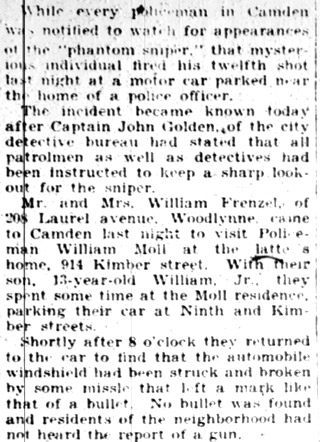
While every policeman in Camden was notified to watch for appearances of the “phantom sniper,” that mysterious individual fired his twelfth shot last night at a motor car parked near the home of a police officer.
The incident became known today after Captain John Golden, of the city detective bureau had stated that all patrolmen as well as detectives had been instructed to keep a sharp lookout for the sniper.
Mr. and Mrs. William Frenzel, of 208 Laurel avenue, Woodlynne, came to Camden last night to visit Policeman William Moll at the latter’s home, 914 Kimber street. With their son, 13-year-old William, Jr., they spent some time at the Moll residence, parking their car at Ninth and Kimber streets.
Shortly after 8 o’clock they returned to the car to find that the automobile windshield had been struck and broken by some missile that left a mark like that of a bullet. No bullet was found and residents of the neighborhood had not heard the report of a gun.
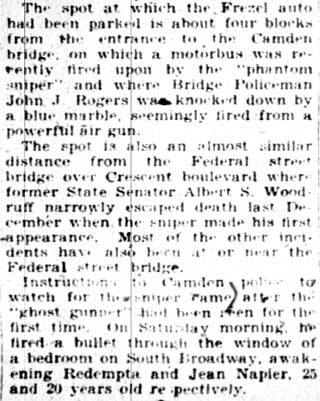
The spot at which the Frezel [sic] auto had been parked is about four blocks from the entrance to the Camden bridge, on which a motorbus was recently fired upon by the “phantom sniper” and where Bridge Policeman John J. Rogers was knocked down by a blue marble, seemingly fired from a powerful air gun.
The spot is also an almost similar distance from the Federal street bridge over Crescent boulevard where former State Senator Albert S. Woodruff narrowly escaped death last December when the sniper made his first appearance. Most of the other incidents have also been at or near the Federal street bridge.
Instructions to Camden police to watch for the sniper came after the “ghost gunner” had been seen for the first time. On Saturday morning, he fired a bullet through the window of a bedroom on South Broadway, awakening Redempta and Jean Napier, 25 and 20 years old respectively.
Camden Courier-Post – February 4, 1928
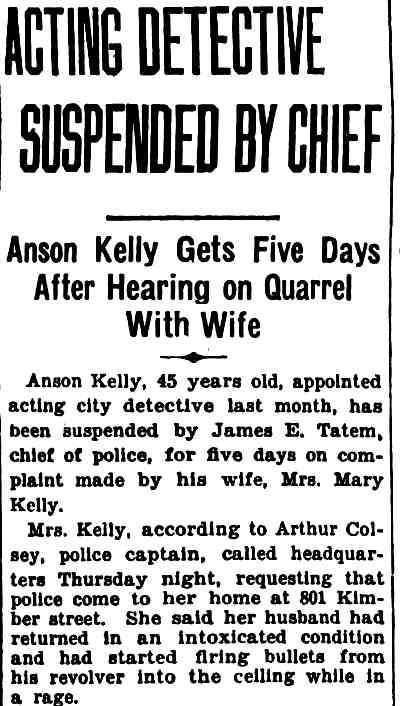
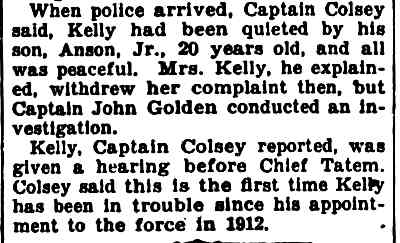
Named: Anson Kelley, James E. Tatem, Arthur Colsey, Mary Kelley, Anson J. Kelley, and John Golden.
Suspected Sniper Charges Frameup by ‘Real Phantom’
Camden Courier-Post —
Police Letter Written by His Enemy, Downtown Youth Insists
NEW SHOTS HIT AUTO AND FIRE ALARM BOX
Courier Reporter Locates Most Sought By Police At Jasper Street Home
Admitting that he is the man for whom Camden police searched for four days after receipt of an anonymous letter declaring him to be South Jersey’s “phantom sniper,” Eugene Marshall, 21 years old, of 404 Jasper street, today charged that he was the victim of a plot by an enemy he suspects as being the real “ghost gunner.”
Young Marshall, a former taxicab driver, was found by an Evening Courier reporter to whom he voiced his suspicions regarding the writer of the “tip-off note” now in possession of Detective Captain John Golden.
“I want to see that letter,” Marshall declared. “I understand that it’s printed, but just the same I think I’d recognize who did it. If it’s the man I think it is, I’ll tell his name and they can question him.”
Thinks Enemy Is Sniper
The letter, which Captain Golden received ten days ago, was signed “A Gunman.”
“That’s just what this fellow is,” was Marshall’s assertion. “and I think he’s the sniper and is trying to put the blame on me.”
It was after Captain Golden received the anonymous letter, purporting to be a “tip” on the identity of the sniper, that city detectives watched vainly for four days in the vicinity of Fourth and Jasper streets.
“If you want to catch him,” the letter stated, “follow this letter and see the sniper come out of a house on Jasper street at 7 o’clock Wednesday night near a saloon corner. He will have on a dark coat and light pants and is about 5 feet 11 inches tall with a cap pulled over his eyes.”
The description exactly fits Marshall.
“Sure, I’m the fellow that letter meant,” Marshall said. “But I’m no more the sniper than you are. I’m pretty sure I know who wrote the letter, though, and I think he’s the sniper. According to the paper, the letter ended up with the words ‘Till we meet again.’ Well, those are the same words this fellow used to me when I left him the last time we were together.”
Shot Hits Fire-Alarm Box
Perhaps the “sniper” or perhaps some imitator of his activities today fired a bullet or some similar missile through the glass key-window of a fire-alarm box at Kaighn avenue and Hyde Park. It was the twenty-seventh incident of the sort since Thanksgiving Day, bullets and other missiles having been flung previously through auto windshields, and windows of doors of stores and dwellings in Camden, Collingswood, Audubon, Gloucester and Delair.
Police Sergeant Walter Mattison was notified of the drilling of the fire alarm box glass at 11:30 o’clock this morning. The hole in the glass was described by police as being one which appeared to have been caused by a .22 calibre bullet. No bullet or other missile was found and no one in the neighborhood, among those questioned had heard the report of a gun.
If the “sniper” or other mischief maker fired at the box with the intention of setting off the alarm, he failed. No alarm sounded and the incident was not discovered until a patrolman passed and happened to notice that the box had been damaged.
Hits Battered Sedan
Meanwhile, the twenty-sixth shot attributed to the “phantom sniper” was added to the long list of similar incidents during the weekend. Forsaking the main thoroughfares, the mysterious marksman—if, indeed, the same person is responsible—stalked his game through side streets of South Camden, where two other silent shots were fired last week.
A battered old sedan was the twenty-sixth target of the “sniper” or snipers. A bullet-like missile, which vanished just as have most of the others, drilled a hole in a rear window of the ancient car, narrowly missing Joseph Carone, 20 years old, of 30 Morris street, Gloucester.
Carone had sold the car to Donato Aceto, 32 years old, of 681 Van Hook street, a watchman at the Reading railroad crossing at Broadway and Salem street, Gloucester. The young man was steering the old machine which was being towed by Aceto’s car. At Seventh street and Woodland avenue the mysterious missile tore through the rear window of the sedan, whistled past Carone’s head and vanished.
Too startled at first to realize what had happened. Carone waited until the two cars had crawled along for a hundred yards before he thought of the “phantom sniper.” Then, a search for the missile began but to no avail. He reported the incident to William Booth, a florist, of 692 Van Hook street, who notified police. Detective Samuel Johnson investigated and heard Carone’s story.
Camden Courier-Post – February 17, 1928
Clothing Stolen From Store, Teacher’s Desk Looted; Bell-Ringer Arrested
City detectives today were questioning three youths arrested in different sections of Camden, who are believed to be responsible for a series of robberies. At the same time police were investigating the theft of clothing from a store at Ann and Sycamore Streets, and the pilfering of $1.50 from the desk of a teacher of the Broadway School.
Francis Smith, 19 years old, of 1120 Locust Street, and Raymond Walker, 19 years old, of 747 Woodland Avenue, were arrested by Policeman James McTaggart, in the rear of a house at Broadway and Atlantic Avenue. The boys said they were “waiting for somebody.” McTaggart took them to police headquarters at 1.50 o’clock this morning. There, screw drivers were found when their clothing was searched. Captain of Detectives John Golden today declared that he believed Thomas Vanor, 21 years old, of 1242 Daley Street, Philadelphia, was the man who has been breaking into houses in North Camden, after ringing doorbells and not getting an answer.
Vanor was caught by Policeman Frank Evans near Front and Erie Street. When first questioned at police headquarters, Vanor was unable to explain what he was doing in that neighborhood. A telephone call that “a man is breaking into a store at Ann and Sycamore Streets” was received at police headquarters at 11.30 last night. Motorcycle Policeman Gus Koerner investigated and found that the store window had been broken by a bottle. Neighbors who were questioned reported that a man jumped from the window and ran up Sycamore Street, carrying some clothing.
Police believe boys broke into the Broadway School. Although several school rooms were ransacked, a check-up revealed that only $1.50 had been stolen.
Camden Courier-Post – February 20, 1928
Pa. Girl Is Nabbed Here on Way to Get Married
Because she wanted to get married and have a home of her own, 16 year-old Ida Underwood, of Johnstown PA, ran away from home.
Today she is waiting in the detention home at police headquarters for her father, who has told police he would come to Camden to take the girl home.
Ida and her “boy friend,” Charles Morris, 23 years old and also from Johnstown, were arrested Saturday night by District Detectives Walter Smith and Joseph Carpani. The couple had stopped officers to ask directions to Atlantic City. The sleuths recognized Ida as a girl for whom they had been told to search.
After being questioned Morris was released. Ida, however, was held at police headquarters while her parents were notified.
She told Captain John Golden she had left home because she wanted to get married. She had been on her way to the shore with Morris, she said, to carry out her plans.
Ask Route to New York, 2 Held as Car Thieves
Camden Courier-Post —
Arrested last night for the larceny of an automobile when they asked two plain-clothes policemen how to get to New York, two 20-year-old boys were taken back to Pennsgrove this morning by Robert W. Kidd, chief of police.
They gave their names as Francis Riley and Joseph Nelsen, both of 70 Poplar street, Pennsgrove. They admitted to Captain John Golden they had stolen the car of John S. Taylor, Pennsgrove, yesterday afternoon.
The youths were arrested by Policemen Guthrie and Paradise. The two officers had been standing at Broadway and Spruce street when the young men pulled up to them and asked directions to New York. Suspecting the car to be stolen, Guthrie asked for their owner’s card. As he did the car started up but Paradise jumped on the running board and succeeded in bringing the car to a halt.
Man Held on Charge of Stealing Plumbing
Camden Courier-Post —
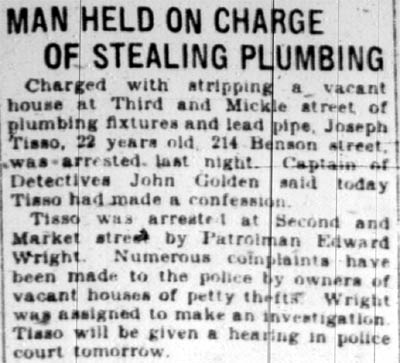
Charged with stripping a vacant house at Third and Mickle street of plumbing fixtures and lead pipe, Joseph Tisso [sic], 22 years old, 214 Benson street, was arrested last night. Captain of Detectives John Golden said today Tisso had made a confession.
Tisso was arrested at Second and Market street by Patrolman Edward Wright. Numerous complaints have been made to the police by owners of vacant houses of petty thefts. Wright was assigned to make an investigation. Tisso will be given a hearing in police court tomorrow.
Found Wounded on Sidewalk at Kaighn Point
Camden Evening Courier —
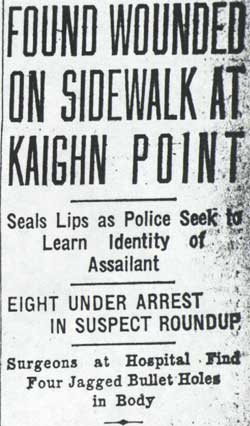
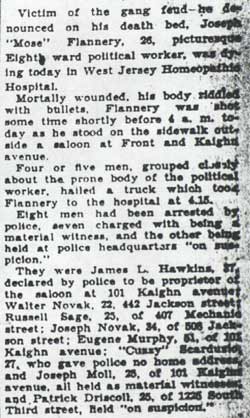
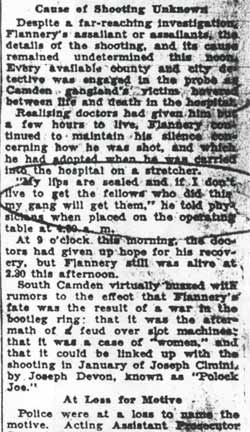
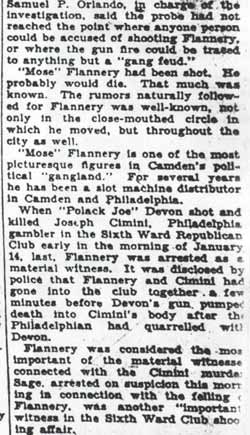
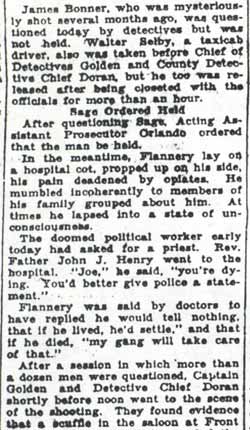
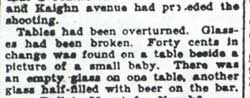
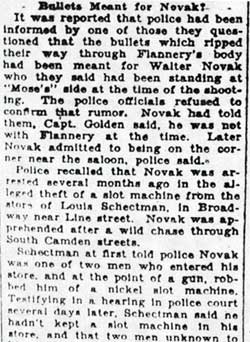
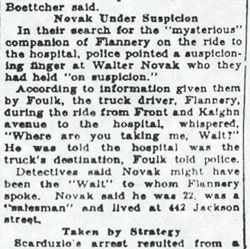
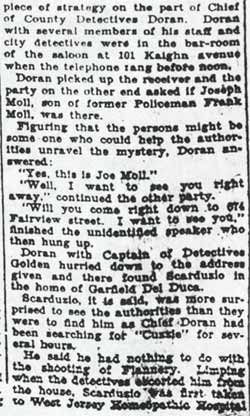
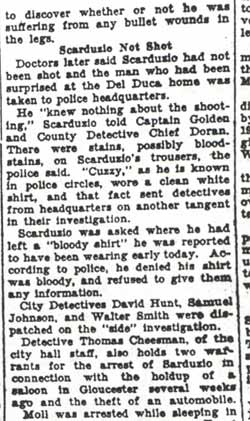
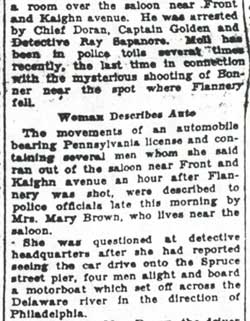
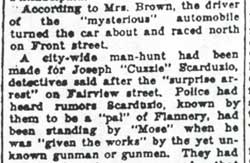
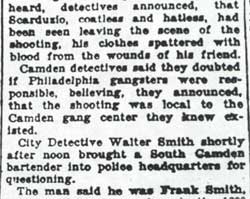
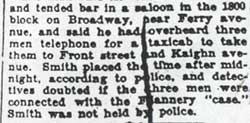
Seals Lips as Police Seek to Learn Identity of Assailant
EIGHT UNDER ARREST IN SUSPECT ROUNDUP
Surgeons at Hospital Find Four Jagged Bullet Holes in Body
Victim of the gang feud—he denounced on his death bed, Joseph “Mose” Flannery, 26, picturesque Eighth ward political worker, was dying today in West Jersey Homeopathic Hospital.
Mortally wounded, his body riddled with bullets, Flannery was shot some time shortly before 4 a. m. today as he stood on the sidewalk outside a saloon at Front and Kaighn avenue.
Four or five men, grouped closely about the prone body of the political worker, hailed a truck which took Flannery to the hospital at 4.15.
Eight men had been arrested by police, seven charged with being a material witness, and the other being held at police headquarters “on suspicion.”
They were James L. Hawkins, 37, declared by police to be proprietor of the saloon at 101 Kaighn avenue; Walter Novak, 22, 442 Jackson street; Russell Sage, 25, of 407 Mechanic street; Joseph Novak, 34, of 508 Jackson street; Eugene Murphy, 51, of 101 Kaighn avenue; “Cuzzy” Scarduzio, 27, who gave police no home address, and Joseph Moll, 25, of 101 Kaighn avenue, all held as material witnesses; and Patrick Driscoll, 25, of 1225 South Third street, held “on suspicion.”
Cause of Shooting Unknown
Despite a far-reaching investigation, Flannery’s assailant or assailants, the details of the shooting, and its cause remained undetermined this noon. Every available county and city detective was engaged in the probe as Camden gangland’s victim hovered between life and death in the hospital.
Realizing doctors had given him but a few hours to live, Flannery continued to maintain his silence concerning how he was shot, and which he had adopted when he was carried into the hospital on a stretcher.
“My lips are sealed and if I don’t live to get the fellows who did this my gang will get them,” he told physicians when placed on the operating table at 4:30 a. m.
At 9 o’clock this morning, the doctors had given up hope for his recovery, but Flannery still was alive at 2.30 this afternoon.
South Camden virtually buzzed with rumors to the effect that Flannery’s fate was the result of a war in the bootleg ring; that it was the aftermath of a feud over slot machines; that it was a case of “women,” and that it could be linked up with the shooting in January of Joseph Cimini, by Joseph Devon, known as “Polack Joe.”
At Loss for Motive
Police were at a loss to name the motive. Acting Assistant Prosecutor Samuel P. Orlando, in charge of the investigation, said the probe had not reached the point where anyone person could be accused of shooting Flannery, or where the gun fire could be traced to anything but a “gang feud.”
“Mose” Flannery had been shot. He probably would die. That much was known. The rumors naturally followed for Flannery was well-known, not only in the close-mouthed circle in which he moved, but throughout the city as well.
“Mose” Flannery is one of the most picturesque figures in Camden’s political “gangland.” For several years he has been a slot machine distributor in Camden and Philadelphia.
When “Polack Joe” Devon shot and killed Joseph Cimini, Philadelphia gambler in the Sixth Ward Republican Club early in the morning of January 14, last, Flannery was arrested as a material witness. It was disclosed by police that Flannery and Cimini had gone into the club together a few minutes before Devon’s gun pumped death into Cimini’s body after the Philadelphian had quarrelled with Devon.
Flannery was considered the most important of the material witnesses connected with the Cimini murder. Sage, arrested on suspicion this morning in connection with the felling of Flannery, was another “important” witness in the Sixth Ward Club shooting affair.
James Bonner, who was mysteriously shot several months ago, was questioned today by detectives but was not held. Walter Selby, a taxicab driver, also was taken before Chief of Detectives Golden and County Detective Chief Doran, but he too was released after being closeted with the officials for more than an hour.
Sage Ordered Held
After questioning Sage, Acting Assistant Prosecutor Orlando ordered that the man be held.
In the meantime, Flannery lay on a hospital cot, propped up on his side, his pain deadened by opiates. He mumbled incoherently to members of his family grouped about him. At times he lapsed into a state of unconsciousness.
The doomed political worker early today had asked for a priest. Rev. Father John J. Henry went to the hospital. “Joe,” he said, “you’re dying. You’d better give police a statement.”
Flannery was said by doctors to have replied he would tell nothing, that if he lived, “he’d settle,” and that if he died, “my gang will take care of that.”
After a session in which more than a dozen men were questioned, Captain Golden and Detective Chief Doran shortly before noon went to the scene of the shooting. They found evidence that a scuffle in the saloon at Front and Kaighn avenue had preceded the shooting.
Tables had been overturned. Glasses had been broken. Forty cents in change was found on a table beside a picture of a small baby. There was an empty glass on one table, another glass half-filled with beer on the bar.
Bullets Meant for Novak?
It was reported that police had been informed by one of those they questioned that the bullets which ripped their way through Flannery’s body had been meant for Walter Novak who they said had been standing at “Mose’s” side at the time of the shooting. The police officials refused to confirm that rumor. Novak had told them, Capt. Golden said, he was not with Flannery at the time. Later Novak admitted to being on the corner near the saloon, police said.
Police recalled that Novak was arrested several months ago in the alleged theft of a slot machine from the store of Louis Schectman, in Broadway near Line street. Novak was apprehended after a wild chase through South Camden streets.
Schectman at first told police Novak was one of two men who entered his store, and at the point of a gun, robbed him of a nickel slot machine. Testifying in a hearing in police court several days later, Schectman said he hadn’t kept a slot machine in his store, and that two men unknown to him stole a box of cigars and escaped in an automobile.
As far as could be learned by an Evening Courier representative, the case against Novak never was settled.
The bullets were fired from a “pump” gun and were of .32 calibre. According to Detective Thomas Cheeseman, they could have been fired only from a gun of the type common to gangsters who “shoot to kill.” Cheeseman said a “pump” gun was designed to hold nine shells or “wads,” as they are commonly known. The leaden bullet is surrounded by a coating of asbestos, which breaks from the lead upon the firing of the gun and allows the lead to enter its target.
Police were following every clue which developed, no matter how scanty. Detectives combed the Front street and Kaighn avenue neighborhood, it was learned, in an effort to discover the haunts of the gang known by police to center in that part of the city.
Chief of Police Lewis W. Stehr was asked if police would act against the owners of the habitats of the “Front and Kaighn avenue” gang or if a routine investigation into the shooting of Flannery would be conducted. Chief Stehr said the usual investigation was being made and would continue.
While members of the political worker’s family talked with Flannery, and while investigation of the shooting by county detectives and police was under way, doctors said the man who lives at 346 Jackson street, couldn’t “live out the day.”
Flannery had a bullet wound two inches in diameter in his back. Another bullet had pierced his abdomen, and he had been shot in both elbows, physicians said. Doctors said the bullets were two inches long and three-quarters of an inch in diameter.
It was shortly after 4 a. m. when Charles Foulk, of 219 Point street, driver of The Courier-Post delivery truck, was hailed by a group of men standing on a corner at Front street and Kaighn avenue.
“Have you got time to take a man to the hospital?” one of the group asked Foulk, according to the story he told Captain John Golden, chief of city detectives.
Flannery was lifted into the rear of the truck, two men jumped on the running board and the run for West Jersey Hospital began.
Walter Wartman, of 315 North Second street, another Courier-Post employe, who had assisted in the delivery of Morning Posts at the Reading Ferries, was with Foulk.
Foulk said one of the men jumped from the truck when it reached Mt. Ephraim and Atlantic avenues. The other went into the hospital, whispered a few words to Flannery, and then raced out the main entrance.
Mose’s Companion Escapes
Mrs. Edward McGrath, supervisor of nurses, called Policeman Frank Malec who for several days has been guarding a man known as “Two-Gun” Kelly, and Malec gave chase to the unknown companion of Flannery. Malec saw the man disappear on Mt. Ephraim avenue, but couldn’t find him in a search of the neighborhood.
In the meantime, City Detective William Boettcher, who had been working the morning shift, had notified Assistant Prosecutor Samuel P. Orlando; Lawrence T. Doran, chief of Camden county detectives; Capt. Golden, and had called City Detectives George Ward, Louis Shaw, Thomas Cheesman [sic] and Howard Pike to investigate the shooting.
Boettcher said Flannery refused to “talk.” “You are a policeman and I’m no friend of the police. I’ll never tell,” Flannery told the officer, Boettcher declared.
Later Flannery told physicians, “I have learned my lesson and hope this will be an example to other young men.”
Witness in Cimini Shooting
Flannery was held as a material witness in the fatal shooting of Joseph Cimini, 31, in the Sixth Ward Republican Club, early in the morning of January 14.—Joseph Devon, known as “Polack Joe” fired the shot that killed Cimini. Devon was arrested but the case never came to trial.
Devon now is at liberty on bail and is under indictment for manslaughter in connection with Cimini’s death. Flannery also was released under bail.
While police continued their investigation, Flannery, still determined to refuse information to detectives and doctors, was surrounded by his wife, his 4-year-old son, his mother and father, and his 19-year-old brother James. Calling “Jim” to his side, Flannery, according to physicians, said, “I want you to promise me you’ll never get mixed up in these gang wars.” “Jim” promised, Detective Boettcher said.
Novak Under Suspicion
In their search for the “mysterious” companion of Flannery on the ride to the hospital, police pointed a suspicioning finger at Walter Novak who they had held “on suspicion.”
According to information given them by Foulk, the truck driver, Flannery, during the ride from Front and Kaighn avenue to the hospital, whispered, “Where are you taking me, Walt?” He was told the hospital was the truck’s destination, Foulk told police.
Detectives said Novak might have been the “Walt” to whom Flannery spoke. Novak said he was 22, was a “salesman” and lived at 442 Jackson street.
Taken by Strategy
Scarduzio’s arrest resulted from a piece of strategy on the part of Chief of County Detectives Doran. Doran with several members of his staff and city detectives were in the bar-room of the saloon at 101 Kaighn avenue when the telephone rang before noon.
Doran picked up the receiver and the party on the other end asked if Joseph Moll, son of former Policeman Frank Moll, was there.
Figuring that the persons might be some one who could help the authorities unravel the mystery, Doran answered:
“Yes, this is Joe Moll.”
“Well, I want to see you right away,” continued the other party.
“Will you come right down to 674 Fairview street. I want to see you,” finished the unidentified speaker who then hung up.
Doran with Captain of Detectives Golden hurried down to the address given and there found Scarduzio in the home of Garfield Del Duca.
Scarduzio, it is said, was more surprised to see the authorities than they were to find him as Chief Doran had been searching for “Cuzzie” for several hours.
He said he had nothing to do with the shooting of Flannery. Limping when the detectives escorted him from the house, Scarduzio was first taken to West Jersey Homeopathic Hospital to discover whether or not he was suffering from any bullet wounds in the legs.
Scarduzio Not Shot
Doctors later said Scarduzio had not been shot and the man who had been surprised at the Del Duca home was taken to police headquarters.
He “knew nothing about the shooting,” Scarduzio told Captain Golden and County Detective Chief Doran. There were stains, possibly bloodstains, on Scarduzio’s trousers, the police said. “Cuzzy,” as he is known in police circles, wore a clean white shirt, and that fact sent detectives from headquarters on another tangent in their investigation.
Scarduzio was asked where he had left a “bloody shirt” he was reported to have been wearing early today. According to police, he denied his shirt was bloody, and refused to give them any information.
City Detectives David Hunt, Samuel Johnson, and Walter Smith were dispatched on the “side” investigation.
Detective Thomas Cheesman [sic], of the city hall staff, also holds two warrants for the arrest of Scarduzio in connection with the holdup of a saloon in Gloucester several weeks ago and the theft of an automobile.
Moll was arrested while sleeping in a room over the saloon near Front and Kaighn avenue. He was arrested by Chief Doran, Captain Golden and Detective Ray Sapanore. Moll has been in police toils several times recently, the last time in connection with the mysterious shooting of Bonner near the spot where Flannery fell.
Woman Describes Auto
The movements of an automobile bearing Pennsylvania license and containing several men whom she said ran out of the saloon near Front and Kaighn avenue an hour after Flannery was shot, were described to police officials late this morning by Mrs. Mary Brown, who lives near the saloon.
She was questioned at detective headquarters after she had reported seeing the car drive onto the Spruce street pier, four men alight and board a motorboat which set off across the Delaware river in the direction of Philadelphia.
According to Mrs. Brown, the driver of the “mysterious” automobile turned the car about and raced north on Front street.
A city-wide man-hunt had been made for Joseph “Cuzzie” Scarduzio, detectives said after the “surprise arrest” on Fairview street. Police had heard rumors Scarduzio, known by them to be a “pal” of Flannery, had been standing by “Mose” when he was “given the works” by the yet unknown gunman or gunmen. They had heard, detectives announced, that Scarduzio, coatless and hatless, had been seen leaving the scene of the shooting, his clothes spattered with blood from the wounds of his friend.
Camden detectives said they doubted if Philadelphia gangsters were responsible, believing, they announced, that the shooting was local to the Camden gang center they knew existed.
City Detective Walter Smith shortly after noon brought a South Camden bartender into police headquarters for questioning.
The man said he was Frank Smith, and tended bar in a saloon in the 1800 block on Broadway, near Ferry avenue, and said he had overheard three men telephone for a taxicab to take them to Front street and Kaighn avenue. Smith placed the time after midnight, according to police, and detectives doubted if the three men were connected with the Flannery “case.” Smith was not held by police.
18 Persons Are Nabbed, 3 Released by Police
Camden Evening Courier —
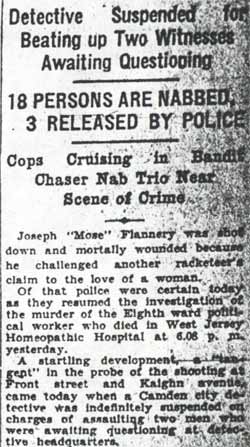
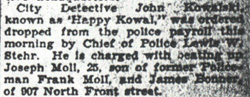
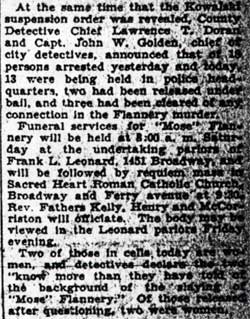

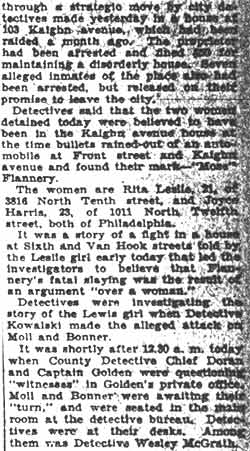
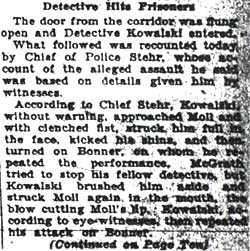
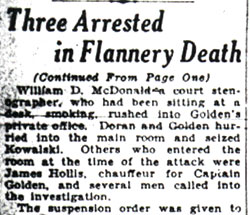

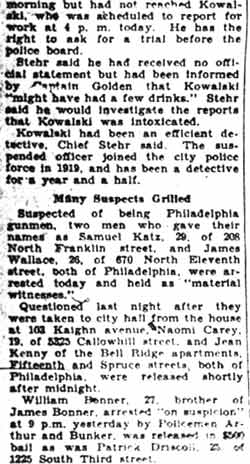

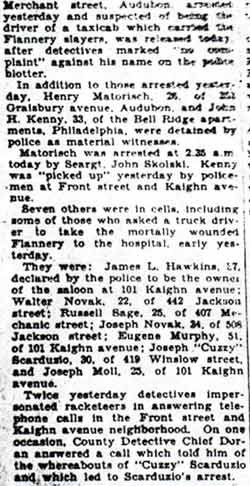
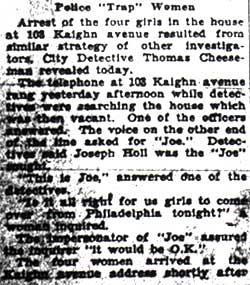
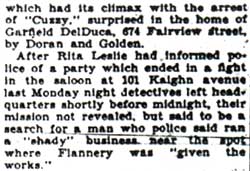
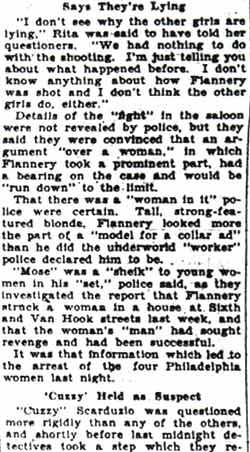
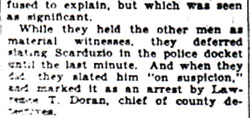
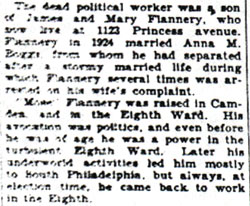
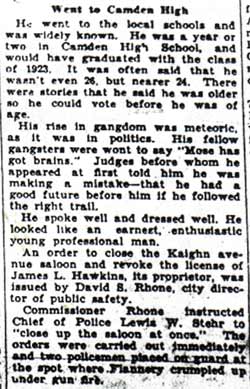
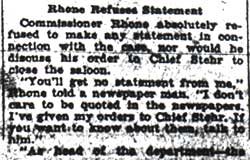
Detective Suspended for Beating up Two Witnesses Awaiting Questioning
18 PERSONS ARE NABBED, 3 RELEASED BY POLICE
Cops Cruising in Bandit Chaser Nab Trio Near Scene of Crime
Joseph “Mose” Flannery was shot down and mortally wounded because he challenged another racketeer’s claim to the love of a woman.
Of that police were certain today as they resumed the investigation of the murder of the Eighth ward political worker who died in West Jersey Homeopathic Hospital at 6:08 p.m. yesterday.
A startling development, a “tangent” in the probe of the shooting at Front street and Kaighn avenue, came today when a Camden city detective was indefinitely suspended on charges of assaulting two men who were awaiting questioning at detective headquarters.
City Detective John Kowalski, known as “Happy Kowal,” was ordered dropped from the police payroll this morning by Chief of Police Lewis W. Stehr. He is charged with beating up Joseph Moll, 25, son of former Policeman Frank Moll, and James Bonner, of 907 North Front street.
At the same time that the Kowalski suspension order was revealed, County Detective Chief Lawrence T. Doran and Capt. John W. Golden, chief of city detectives, announced that of 18 persons arrested yesterday and today, 13 were being held in police headquarters, two had been released under bail, and three had been cleared of any connection in the Flannery murder.
Funeral services for “Mose” Flannery will be held at 8:00 a. m. Saturday at the undertaking parlors of Frank L. Leonard, 1451 Broadway, and will be followed by requiem mass in Sacred Heart Roman Catholic Church, Broadway and Ferry avenue at 9:30. Rev. Fathers Kelly, Henry and McCorriston will officiate. The body may be viewed in the Leonard parlors Friday evening.
Two of those in cells today are women, and detectives declare the two “know more than they have told of the background of the slaying of “Mose” Flannery.” Of those released after questioning, two were women.
Woman Tells of Fight
The four women were arrested through a strategic move by city detectives made yesterday in a house at 103 Kaighn avenue, which had been raided a month ago. The proprietor had been arrested and fined [illegible] for maintaining a disorderly house. Seven alleged inmates of the place also had been arrested, but released on their promise to leave the city.
Detectives said that the two women detained today were believed to have been in the Kaighn avenue house at the time bullets rained out of an automobile at Front street and Kaighn avenue and found their mark—“Mose” Flannery.
The women are Rita Leslie, 21, of 3816 North Tenth street, and Joyce Harris, 23, of 1011 North Twelfth street, both of Philadelphia.
It was a story of a fight in a house at Sixth and Van Hook streets told by the Leslie girl early today that led the investigators to believe that Flannery’s fatal slaying was the result of an argument “over a woman.”
Detectives were investigating the story of the Lewis [sic] girl when Detective Kowalski made the alleged attack on Moll and Bonner.
It was shortly after 12:30 a. m. today when County Detective Chief Doran and Captain Golden were questioning “witnesses” in Golden’s private office. Moll and Bonner were awaiting their “turn,” and were seated in the main room at the detective bureau. Detectives were at their desks. Among them was Detective Wesley McGrath.
Detective Hits Prisoners
The door from the corridor was flung open and Detective Kowalski entered.
What followed was recounted today by Chief of Police Stehr, whose account of the alleged assault he said was based on details given him by witnesses.
According to Chief Stehr, Kowalski, without warning, approached Moll and with clenched fist, struck him full in the face, kicked his shins, and then turned on Bonner, on whom he repeated the performance. McGrath tried to stop his fellow detective, but Kowalski brushed him aside and struck Moll again in the mouth, the blow cutting Moll’s lip. Kowalski, according to eye-witnesses, then repeated his attack on Bonner.
(Continued on Page Ten)
Three Arrested in Flannery Death
(Continued From Page One)
William D. McDonald, a court stenographer, who had been sitting at a desk, smoking, rushed into Golden’s private office. Doran and Golden hurried into the main room and seized Kowalski. Others who entered the room at the time of the attack were James Hollis, chauffeur for Captain Golden, and several men called into the investigation.
The suspension order was given to Captain Golden by Chief Stehr this morning but had not reached Kowalski, who was scheduled to report for work at 4 p. m. today. He has the right to ask for a trial before the police board.
Stehr said he had received no official statement but had been informed by Captain Golden that Kowalski “might have had a few drinks.” Stehr said he would investigate the reports that Kowalski was intoxicated.
Kowalski had been an efficient detective, Chief Stehr said. The suspended officer joined the city police force in 1919, and has been a detective for a year and a half.
Many Suspects Grilled
Suspected of being Philadelphia gunmen, two men who gave their names as Samuel Katz, 29, of 208 North Franklin street, and James Wallace, 26, of 670 North Eleventh street, both of Philadelphia, were arrested today and held as “material witnesses.”
Questioned last night after they were taken to city hall from the house at 103 Kaighn avenue, Naomi Carey, 19, of 5325 Callowhill street, and Jean Kenny of the Bell Ridge apartments, Fifteenth and Spruce streets, both of Philadelphia, were released shortly after midnight.
William Bonner, 27, brother of James Bonner, arrested “on suspicion” at 9 p.m. yesterday by Policemen Arthur and Bunker, was released in $500 bail as was Patrick Driscoll, 25, of 1225 South Third street.
Theodore Baker, 22, of 222 West Merchant street, Audubon, arrested yesterday and suspected of being the driver of a taxicab which carried the Flannery slayers, was released today after detectives marked “no complaint” against his name on the police blotter.
In addition to those arrested yesterday, Henry Matorisch, 26, of 232 Graisbury avenue, Audubon, and John H. Kenny, 33, of the Bell Ridge apartments, Philadelphia, were detained by police as material witnesses.
Matorisch was arrested at 2:35 a. m. today by Sergt. John Skolski. Kenny was “picked up” yesterday by policemen at Front street and Kaighn avenue.
Seven others were in cells, including some of those who asked a truck driver to take the mortally wounded Flannery to the hospital early yesterday.
They were: James L. Hawkins, 37, declared by the police to be the owner of the saloon at 101 Kaighn avenue; Walter Novak, 22, of 442 Jackson street; Russell Sage, 25, of 407 Mechanic street; Joseph Novak, 34, of 508 Jackson street; Eugene Murphy, 51, of 101 Kaighn avenue; Joseph “Cuzzy” Scarduzio, 30, of 419 Winslow street, and Joseph Moll, 25, of 101 Kaighn avenue.
Twice yesterday detectives impersonated racketeers in answering telephone calls in the Front street and Kaighn avenue neighborhood. On one occasion, County Detective Chief Doran answered a call which told him of the whereabouts of “Cuzzy” Scarduzio and which led to Scarduzio’s arrest.
Police “Trap” Women
Arrest of the four girls in the house at 103 Kaighn avenue resulted from similar strategy of other investigators, City Detective Thomas Cheeseman revealed today.
The telephone at 103 Kaighn avenue rang yesterday afternoon while detectives were searching the house which was then vacant. One of the officers answered. The voice on the other end of the line asked for “Joe.” Detectives said Joseph Moll was the “Joe” sought.
“This is Joe,” answered one of the detectives.
“Is it all right for us girls to come over from Philadelphia tonight?” a woman inquired.
The impersonator of “Joe” assured the inquirer “it would be O.K.”
The four women arrived at the Kaighn avenue address shortly after [text missing between crops] which had its climax with the arrest of “Cuzzy,” surprised in the home of Garfield DelDuca, 674 Fairview street, by Doran and Golden.
After Rita Leslie had informed police of a party which ended in a fight in the saloon at 101 Kaighn avenue last Monday night detectives left headquarters shortly before midnight, their mission not revealed, but said to be a search for a man who police said ran a “shady” business near the spot where Flannery was “given the works.”
Says They’re Lying
“I don’t see why the other girls are lying,” Rita was said to have told her questioners. “We had nothing to do with the shooting. I’m just telling you about what happened before. I don’t know anything about how Flannery was shot and I don’t think the other girls do, either.”
Details of the “fight” in the saloon were not revealed by police, but they said they were convinced that an argument “over a woman,” in which Flannery took a prominent part, had a bearing on the case and would be “run down” to the limit.
That there was a “woman in it” police were certain. Tall, strong-featured blonde, Flannery looked more the part of a “model for a collar ad” than he did the underworld “worker” police declared him to be.
“Mose” was a “sheik” to young women in his “set,” police said, as they investigated the report that Flannery struck a woman in a house at Sixth and Van Hook streets last week, and that the woman’s “man” had sought revenge and had been successful.
It was that information which led to the arrest of the four Philadelphia women last night.
‘Cuzzy’ Held as Suspect
“Cuzzy” Scarduzio was questioned more rigidly than any of the others, and shortly before last midnight detectives took a step which they refused to explain, but which was seen as significant.
While they held the other men as material witnesses, they deferred slating Scarduzio in the police docket until the last minute. And when they did, they slated him “on suspicion,” and marked it as an arrest by Lawrence T. Doran, chief of county detectives.
The dead political worker was a son of James and Mary Flannery, who now live at 1123 Princess avenue. Flannery in 1924 married Anna M. Bogga, from whom he had separated after a stormy married life during which Flannery several times was arrested on his wife’s complaint.
“Mose” Flannery was raised in Camden, and in the Eighth Ward. His avocation was politics, and even before he was of age he was a power in the turbulent Eighth Ward. Later his underworld activities led him mostly to South Philadelphia, but always, at election time, he came back to work in the Eighth.
Went to Camden High
He went to the local schools and was widely known. He was a year or two in Camden High School, and would have graduated with the class of 1923. It was often said that he wasn’t even 26, but nearer 24. There were stories that he said he was older so he could vote before he was of age.
His rise in gangdom was meteoric, as it was in politics. His fellow gangsters were wont to say “Mose has got brains.” Judges before whom he appeared at first told him he was making a mistake—that he had a good future before him if he followed the right trail.
He spoke well and dressed well. He looked like an earnest, enthusiastic young professional man.
An order to close the Kaighn avenue saloon and revoke the license of James L. Hawkins, its proprietor, was issued by David S. Rhone, city director of public safety.
Commissioner Rhone instructed Chief of Police Lewis W. Stehr to “close up the saloon at once.” The orders were carried out immediately and two policemen placed on guard at the spot where Flannery crumpled up under gun fire.
Rhone Refuses Statement
Commissioner Rhone absolutely refused to make any statement in connection with the case, nor would he discuss his order to Chief Stehr to close the saloon.
“You’ll get no statement from me,” Rhone told a newspaper man. “I don’t care to be quoted in the newspapers. I’ve given my orders to Chief Stehr. If you want to know about them, talk to him.”
“As head of the department—the
Warrant Out for Slayer of Mose Flannery
Camden Evening Courier —
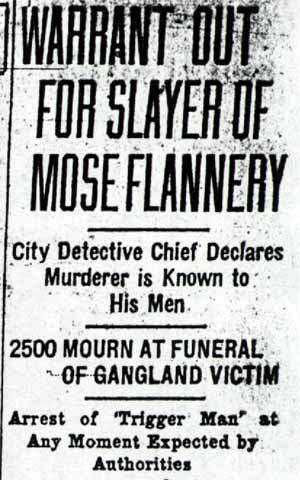
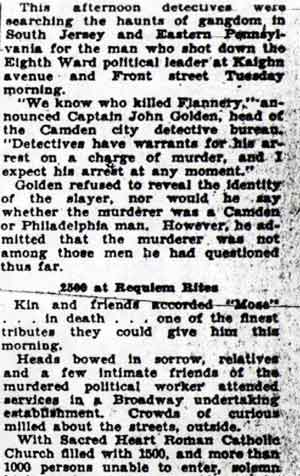
City Detective Chief Declares Murderer is Known to His Men
2500 MOURN AT FUNERAL OF GANGLAND VICTIM
Arrest of ‘Trigger Man’ at Any Moment Expected by Authorities
This afternoon detectives were searching the haunts of gangdom in South Jersey and Eastern Pennsylvania for the man who shot down the Eighth Ward political leader at Kaighn avenue and Front street Tuesday morning.
“We know who killed Flannery,” announced Captain John Golden, head of the Camden city detective bureau. “Detectives have warrants for his arrest on a charge of murder, and I expect his arrest at any moment.”
Golden refused to reveal the identity of the slayer, nor would he say whether the murderer was a Camden or Philadelphia man. However, he admitted that the murderer was not among those men he had questioned thus far.
2500 at Requiem Rites
Kin and friends accorded “Mose” . . . in death . . . one of the finest tributes they could give him this morning.
Heads bowed in sorrow, relatives and a few intimate friends of the murdered political worker attended services in a Broadway undertaking establishment. Crowds of curious milled about the streets, outside.
With Sacred Heart Roman Catholic Church filled with 1500, and more than 1000 persons unable to enter, solemn high requiem mass was said over the body.
All that remained of “Mose” Flannery reposed on a white bier in front of the altar on which he served as a boy for three years.
In the church vestibule, and outside on the streets, detectives and patrolmen sauntered through the crowds. They were there to preserve order. They had dropped their work, temporarily, in the search for Flannery’s slayer, they said. They were there to see the murder victim respected by those who mourned his death.
The black walnut casket which contained the body and which was heaped high with flowers, was carried from the undertaking establishment of Frank J. Leonard, 1451 Broadway, at 9.15.
Buddies As Pallbearers
The pall-bearers, all “buddies” of the “Mose” they admired and respected, were Fred Corbett, Raymond Kirk, Martin Murray, Thomas Murray, Walter Quinton, and Joseph Derr.
As she walked from the undertaking establishment to the automobile which was to take her to the church, Mrs. Joseph Flannery (nee Anna M. Boggs), from whom “Mose” had separated, was prostrated with grief. It was necessary for Francis, one of “Mose’s” older brothers, to assist her across the sidewalk and into one of the family cars.
The first automobile in the funeral procession to the church at Broadway and Ferry avenue carried the floral tributes which had been sent from relatives, “pals,” and former political associates of the victim of last Tuesday’s murder.
Then followed the hearse, the casket almost covered by sprays of blooms, wreaths and other floral pieces.
The father and mother, James and Joseph Flannery were in the first “family” car with their daughter-in-law and the four-year-old, blonde-haired son of the dead man.
A younger brother, James—it was he who promised “Mose” never to enter gang feuds—sat beside his elder brother John, and his sisters Elizabeth... (Continued on Page Eight)
Camden Courier-Post – March 25, 1930
Three Women Claim Body of ‘Gimp’ Thomas
One Is ‘Daughter,’ Others Say They’re Wives; Badge Mystery Unexplained
Who is the legal wife of Howard “Gimp” Thomas, under cover man for Camden police, whose death in an automobile upset early Saturday morning near Ellisburg is being investigated by county authorities?
Three women have attempted to claim the body but it still remained in the morgue of Coroner Melvin Cain last night.
A mystery woman in black appeared at the coroner’s office Sunday and attempted to claim it. She declared she was Thomas’ wife.
“The body has already been claimed by Miss Marie Olive Thomas, 18, Harrisburg, Pa., daughter of Thomas,” said Cain.
“Well he is my husband,” replied the woman.
“I’m not going to get into any controversy over the legal claimant of the body,” Cain told her. “You will have to settle that argument with Miss Thomas.”
Threatens to See Lawyers
The woman left in an angry mood and threatened to “see a lawyer.”
Mrs. Harold Thomas, 6534 Sixth Avenue, Philadelphia, told the Delaware township police yesterday she believes the dead man is her husband, who deserted her two years ago. She said she was coming to Camden to identify the body.
How did “Gimp” Thomas come into possession of badge No. 188 of the Camden Police Department? The badge, taken from Thomas’ pocket when his body was found, has been the subject of numerous theories. The police, unable to arrive at a satisfactory explanation, are continuing their efforts to learn under what auspices Thomas came into possession of the badge.
Captain Arthur Colsey admitted the man had done some work for the Camden police but not often. He has been unable to account for the badge’s having the same number as one issued James Hollis, Detective Captain John Golden’s chauffeur.
Prosecutor Clifford A. Baldwin said he has asked the state police for a report on the death of Thomas and plans to check up reports that four men were with him instead of two on the fatal ride.
Harry McClain, 726 Kaighn Avenue, and William Hernisy, 1146 Liberty Street, who were with Thomas when he was killed, are in the county jail. Two other men, who were reported seated in the rear have escaped.
Hernisy was driving the car when Thomas was killed and is being held on a charge of manslaughter and larceny of the automobile. McClain is charged with being an accessory.
Both men claim Thomas met accidental death although McClain said the dead man was taking him “for a ride” and he “beat him to it.” The pair fled from the scene of the accident because they knew Thomas had stolen the car, they told police.
Wife Plunges Knife in Heart of Husband as He Strikes Her
Camden Courier-Post —

Man Dies and Woman Confesses to Police She Killed Him During Quarrel
INSISTS SHE LOVED HIM, AFTER NEWS OF DEATH
Says Spouse Had Been in Habit of Punching Her Over 11-Year Period
Stabbed through the heart with a bread knife wielded by his wife last night after a quarrel over the way she was preparing a meal, John W. Edwards, manager of a gasoline station at 904 Newton avenue, died 20 minutes later in Cooper Hospital.
A formal charge of murder will be lodged against the woman, Mrs. Helen Edwards, 36, today.
Arrested within 20 minutes after the death of her husband she confessed at police headquarters.
Two men who witnessed the stabbing are being held as material witnesses. They are Fred Crozier, of 19 Union avenue, Mt. Holly, and Eugene Moreslander, 25, of 905 Newton avenue.
The fatal feud came as the result of objections raised over the manner in which Mrs. Edwards was preparing a meal.
Says He Struck Her
Mrs. Edwards told police her husband struck with his fist. Enraged, she picked up a carving knife in an effort to protect herself, and as Edwards rushed to hit her again, she stabbed him through the heart.
Crozier ran to the street and hailed an automobile, which took the victim to the hospital.
First information of the stabbing reached police headquarters after Detective Anson Kelly entered the hospital to investigate an automobile accident case.
Officials notified him a man had been stabbed and was in a critical condition. As Kelly entered the operating room, Edwards had died.
Crozier who was still in the hospital was arrested. Mrs. Edwards and Moreslander also were arrested shortly after by Detectives William Boettcher and Kelly.
Confession by Mrs. Edwards was made before William McDonald, court stenographer; Lawrence Doran, chief of county detectives and Captain John Golden of the detective bureau.
She Loved Him
Through it all Mrs. Edwards, who weighs but 110 pounds, was calm. She told a story of how her husband, who weighed 225 pounds, had made a habit of striking her at frequent intervals over a period of 11 years.
She could not stand it any longer, she said, so she reached for a knife to scare him off.
Then notified that her husband was dead, she was led away to her cell crying:
“Don’t tell me that he is dead. I loved that man.”
The Edwards lived over the gasoline station the victim operated for William D. Crozier of Mt. Holly, father of one of the witnesses.
The junior Crozier was released in custody of his father after questioning at police headquarters and will be required to appear at the arraignment today.
Moreslander was held overnight without bail.
Camden Morning Post – November 26, 1930
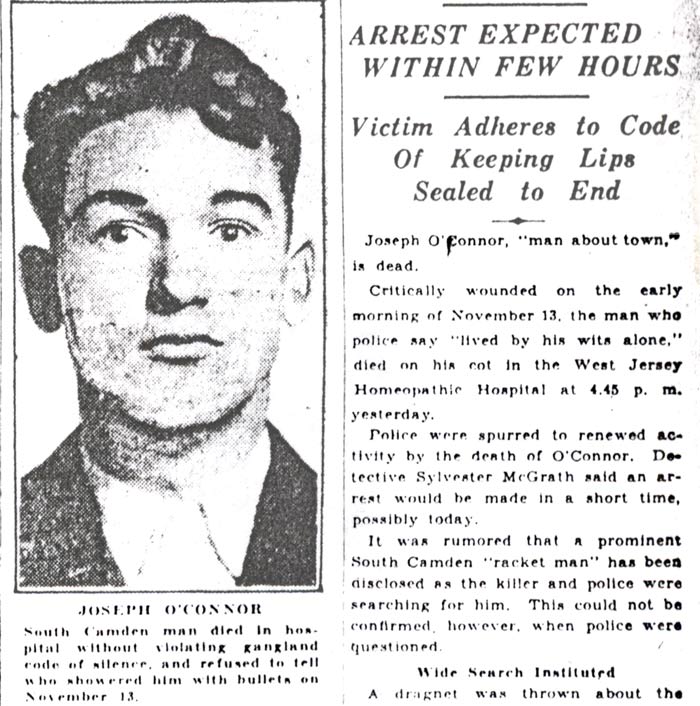
GANG BULLETS ARE FATAL TO ‘JOE’ O’CONNOR
Another Dead
South Camden Man Dies From Shooting on Street, Nov. 13
ARREST EXPECTED WITHIN FEW HOURS
Victim Adheres to Code Of Keeping Lips Sealed to End
Joseph O’Connor, “man about town,” is dead.
Critically wounded on the early morning of November 13, the man who police say “lived by his wits alone,” died on his cot in the West Jersey Homeopathic Hospital at 4.45 p. m. yesterday.
Police were spurred to renewed activity by the death of O’Connor. Detective Sylvester McGrath said an arrest would be made in a short time, possibly today.
It was rumored that a prominent South Camden “racket man” has been disclosed as the killer and police were searching for him. This could not be confirmed, however, when police were questioned.
Wide Search Instituted
A dragnet was thrown about the city and all district stations were notified to pick up anyone known to have been friendly with O’Connor with the idea of gaining additional information.
A search was also being made for the two men who took O’Connor to the hospital. It was learned police know the identity of one of these men.
Surrounded by his closest relatives and constantly watched by a police guard. O’Connor breathed his last abiding by the gangland code by which he is alleged to have lived.
He would not “squeal” on those who shot him down at Fifth and Walnut streets while he was on his way to his home “from somewhere.” In moments of consciousness he steadfastly refused to name his assailants.
O’Connor was in a delirious condition for more than 24 hours before his death and police would not disclose whether he had unwittingly divulged the names of his slayers. They admitted that several promising clues have been unearthed.
The shooting was the second time in 18 months that O’Connor had been put “on the spot.” He was seriously wounded April 28, 1929, at Broadway and Kaighn avenue by John Doris, notorious gangster. Doris was sentenced to ten years for that crime and subsequently was stabbed to death by a fellow convict at Trenton.
3 Cars in on Kill
As in the previous shooting affray O’Connor refused to tell police the names of those who ambushed him, thus abiding by the code of silence which fear of reprisal inspires.
O’Connor, who resides at 520 Walnut street, was enroute to his home on the morning of November 13 and was walking in Walnut street, near Fifth, at 3.30 a. m., when a volley of shots rang out. He was struck in the leg and stomach and lost a great amount of blood before his wounds were treated.
Witnesses saw three cars leave the vicinity immediately after the shots were heard. One of the machines bore a Pennsylvania license plate. One man was seen runing [sic] west on Walnut street and was picked up by one of the cars after he had traversed about a block. A short time later a stranger appeared at the hospital with O’Connor.
Delivers the Victim
“Take this man and fix him up,” the stranger told attendants. “I’m going and don’t try to stop me.”
Hospital attaches claim the stranger was a tall, thin man, apparently young. He wore a tan overcoat and light cap. When he left the hospital he entered an expensive sedan and was driven away by a second man who had remained at the wheel.
Police scouted the theory that O’Connor may have been slain by friends of Doris, seeking revenge.
Detective Sylvester McGrath asked O’Connor if the shooting had been done by any of Doris’ friends to which O’Connor replied:
“I didn’t squeal on Doris. I never said he shot me.”
Was Known to Police
O’Connor was the brother-in-law of Albert Saunders, who was recently acquitted on a charge of murdering Angelo Solury, a U. S. sailor, at the “Little Club,” a South Camden speakeasy, last June. O’Connor was in court during the first day of the trial.
“I don’t know if O’Connor was a racketeer,” said Detective Captain John Golden, “however, I do know that he didn’t work, so he must have lived by his wits.”
O’Connor had been arrested twice previous to being shot by Doris. He was arrested in Gloucester on a disorderly conduct charge, and in 1924 he was arrested on a grand larceny charge but acquitted.
O’Connor’s wife, Louise, his parents and a brother, Raymond, were at his bedside when he died.
Patrolman Russell Young who was on guard at the bedside said O’Connor was unconscious for an hour before death.
JOSEPH O’CONNOR
South Camden man died in hospital without violating gangland code of silence, and refused to tell who showered him with bullets on November 13.
Camden Father Dies in Fight With His Son; Both Jobless
Camden Courier-Post —

Quarrel Over Youth Getting Work Is Blamed for Street Battle
ACCUSED WILL MAKE SELF-DEFENSE PLEA
Victim’s Head Hits Curb, Physicians Believe He Died Instantly
A quarrel over his son’s failure to obtain work ended fatally last night for the father of five children who was killed when he struck his head on a curb after the son had hit him on the jaw.
The father is Frederick Alanko Thompson, also known as Elanko, 45, of 805 Linden street. His son, Reino Alanko Thompson, who will be 18 in July, will be arraigned today on a charge of murder.
The fight occurred at the southeast corner of Ninth and Kimber streets.
The story of the alleged murder as told by the boy to Prosecutor Clifford A. Baldwin differed from that told by two young witnesses. The boy claimed self-defense while the witnesses said he had struck his father first.
Both Out of Work
Reino said he had been out of work for five months and his father had been unemployed for eight. The boy had worked for Todd Rooney, trucker, of Fern street near Eighth street.
Shortly before 7 p. m. last night, the boy said, his father criticised him for not obtaining work. To end the constant nagging of the father, his mother, Mrs. Rose Thompson, 45, gave her son a quarter and he left the house.
Reino was on his way to Tenth and Market streets to meet friends, he said, when his father followed him.
“He kept cursing me and when we got to Ninth and Kimber streets, my father struck at me. I sidestepped and hit him in the jaw. He fell to the curb and lay there. I shouted to him to get up if he wanted me to hit him again.”
When father failed to get up, Reino became frightened and ran home.
Francis Zoll, 15, of 912 Kimber street, and Herbert Townsend, 16, of 934 Linden street, who saw the fight, told the authorities the father made no effort to hit his son but that the boy hit him “six or seven times.”
Victim Dies Instantly
They notified Detective William Moll, who had the father taken to Cooper Hospital where he was pronounced dead. Coroner Melvin Cain will perform an autopsy today.
Detectives Clifford Carr and Anson Kelly went to the Thompson home where they found the boy hiding in a kitchen alcove. They told the mother that he was wanted for questioning about a fight with his father but did not reveal that the father had been killed until they reached police headquarters. The son himself did not know his blow had proved fatal until later.
Mrs. Thompson and her two older daughters, Rose, 16, and May, 14, accompanied Reino and the detectives to police headquarters. Two other twin daughters, Diamond and Irene, 10, remained at home.
The boy was questioned by Baldwin, Capt. John Golden, of the city detectives, and Maj. Charles V. Dickinson, deputy director of public safety.
The boy broke down when he was charged with murder and was led weeping to a cell. Mrs. Thompson, who had remained calm during the questioning, collapsed after her son was taken away.
Another son, Esel, 22, was arrested eight months ago by Detective Carr and turned over to immigration officials at Gloucester for deportation. He was said to have illegally entered this country from Finland six years ago. The other members of the family came to America some years before. The father was naturalized.
Camden Burglar Slain; Cop Wounded in Gun Duel
Camden Courier-Post —

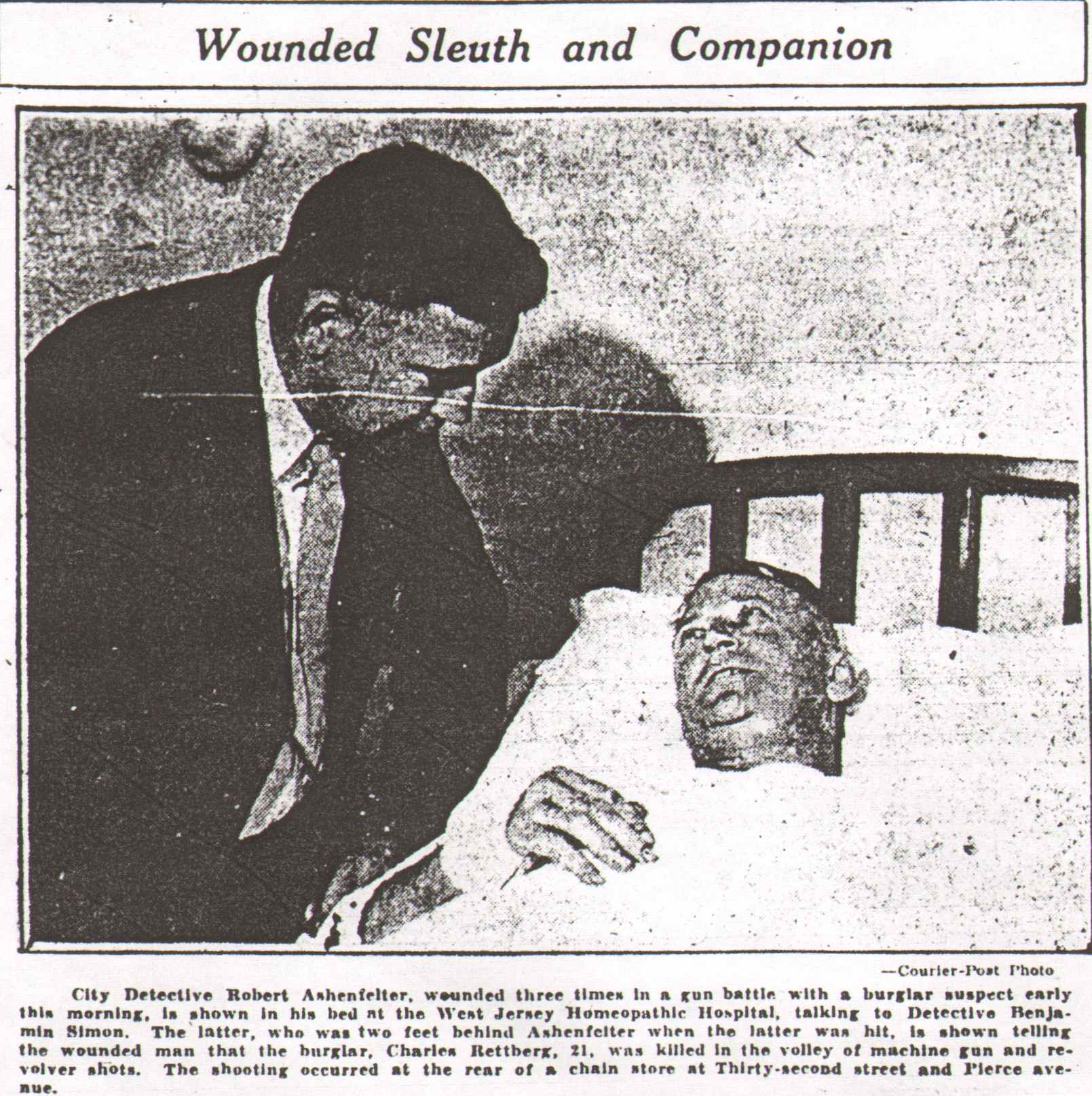
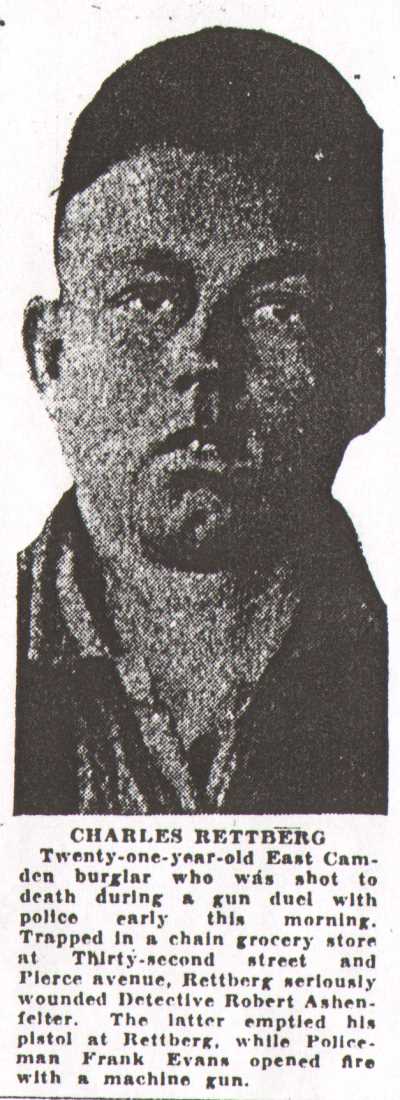
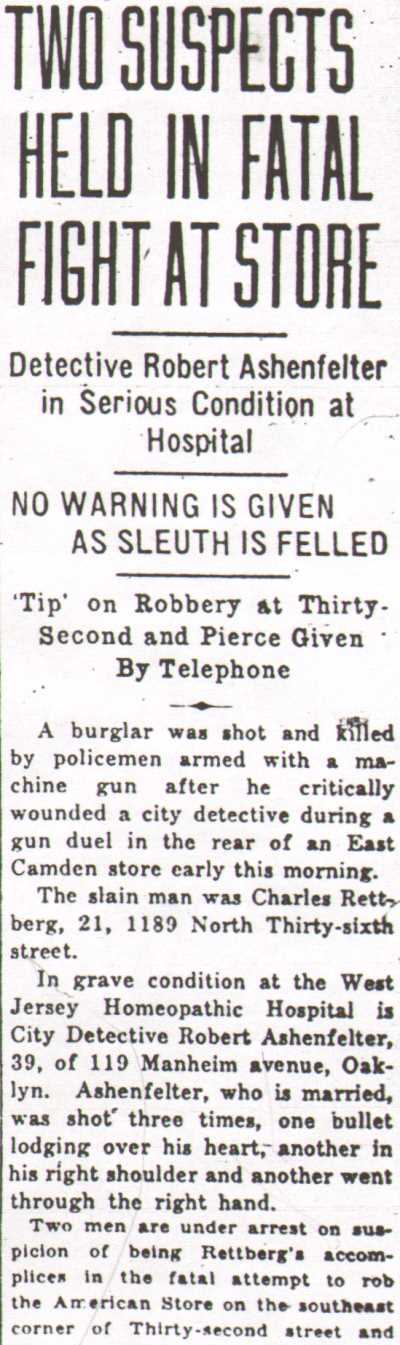
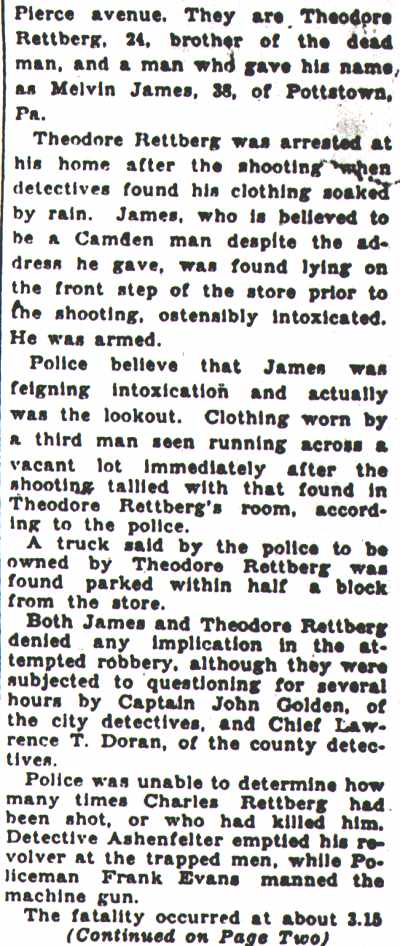

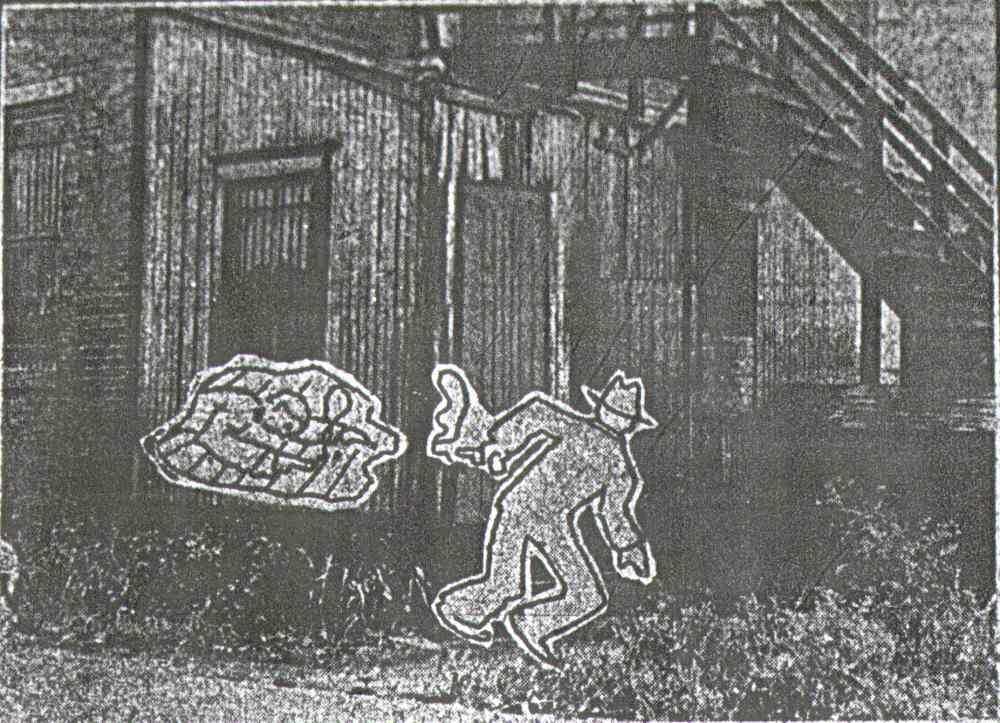

TWO SUSPECTS HELD IN FATAL FIGHT AT STORE
Detective Robert Ashenfelter in Serious Condition at Hospital
NO WARNING IS GIVEN AS SLEUTH IS FELLED
‘Tip’ on Robbery at Thirty-Second and Pierce Given By Telephone
Wounded Sleuth and Companion
—Courier-Post Photo
City Detective Robert Ashenfelter, wounded three times in a gun battle with a burglar suspect early this morning, is shown in his bed at the West Jersey Homeopathic Hospital, talking to Detective Benjamin Simon. The latter, who was two feet behind Ashenfelter when the latter was hit, is shown telling the wounded man that the burglar, Charles Rettberg, 21, was killed in the volley of machine gun and revolver shots. The shooting occurred at the rear of a chain store at Thirty-second street and Pierce avenue.
CHARLES RETTBERG
Twenty-one-year-old East Camden burglar who was shot to death during a gun duel with police early this morning. Trapped in a chain grocery store at Thirty-second street and Pierce avenue, Rettberg seriously wounded Detective Robert Ashenfelter. The latter emptied his pistol at Rettberg, while Policeman Frank Evans opened fire with a machine gun.
A burglar was shot and killed by policemen armed with a machine gun after he critically wounded a city detective during a gun duel in the rear of an East Camden store early this morning. The slain man was Charles Rettberg, 21, 1189 North Thirty-sixth street.
In grave condition at the West Jersey Homeopathic Hospital is City Detective Robert Ashenfelter, 39, of 119 Manheim avenue, Oaklyn. Ashenfelter, who is married, was shot three times, one bullet lodging over his heart, another in his right shoulder and another went through the right hand.
Two men are under arrest on suspicion of being Rettberg’s accomplices in the fatal attempt to rob the American Store on the southeast corner of Thirty-second street and Pierce avenue. They are Theodore Rettberg, 24, brother of the dead man, and a man who gave his name as Melvin James, 38, of Pottstown, Pa.
Theodore Rettberg was arrested at his home after the shooting when detectives found his clothing soaked by rain. James, who is believed to be a Camden man despite the address he gave, was found lying on the front step of the store prior to the shooting, ostensibly intoxicated. He was armed.
Police believe that James was feigning intoxication and actually was the lookout. Clothing worn by a third man seen running across a vacant lot immediately after the shooting tallied with that found in Theodore Rettberg’s room, according to the police.
A truck said by the police to be owned by Theodore Rettberg was found parked within half a block from the store.
Both James and Theodore Rettberg denied any implication in the attempted robbery, although they were subjected to questioning for several hours by Captain John Golden, of the city detectives, and Chief Lawrence T. Doran, of the county detectives.
Police was unable to determine how many times Charles Rettberg had been shot, or who had killed him. Detective Ashenfelter emptied his revolver at the trapped men, while Policeman Frank Evans manned the machine gun.
The fatality occurred at about 3.15 a. m. Desk Sergeant Gus Koerner received an anonymous telephone call at police headquarters shortly after 3 a. m. The caller declared that burglars were breaking into the American Store at “Thirty-second Bergen avenue.”
“You meaned Thirty-second and Pierce?” quizzed Koerner.
The caller mumbled something and hung up without giving his name. His mistake in the address — Thirty-second street and Bergen avenue run parallel to each other—led police to believe the caller was a stranger in that section of the city, if not in the city itself.
Koerner dispatched Policemen Evans and Charles Wainwright to the scene in a bandit chaser, which is equipped with a portable machine gun. Koerner also notified the detective bureau, and Ashenfelter and Benjamin Simon started out in another car. A third call was made to the Third district police station by Koerner, and the patrol crew, Joseph Shreeves and Elwood Humphreys, hastened to the store.
Evans and Wainwright arrived first, parking their car when they saw James sprawled on the front step. They questioned him, but he talked incoherently. Ashenfelter and Simon arrived in their car. Believing James was a lookout and that the burglar or burglars might still be in the place, the two detectives ran toward the rear to cut off escape from that exit.
Ashenfelter was about two feet ahead of Simon. With his gun in hand, Ashenfelter reached the rear of the building and started to turn the corner.
Burglar Opens Fire
Without warning a shot rang out from the interior of the shed at the rear. The bullet struck Ashenfelter in the right hand, tearing the butt off his revolver and then entering his chest. The revolver dropped from his hand.
Ashenfelter sank to his knees, crying, “They got me!” Nevertheless, he grasped his revolver in his uninjured left hand and emptied it into the shed, as four more bullets ripped through the door from the inside at the already wounded detective. One bullet struck Ashenfelter in the right shoulder, but the other three missed him.
Unable to reload, Ashenfelter drew himself to his feet and staggered out of line of fire. He fell into the arms of Simon, who pulled him out of danger.
Meanwhile Evans, hearing the shots, left Wainwright in front of the building with their prisoners, James. Seizing the machine gun, Evan’s [sic] ran to the rear. He pointed it at the door and shouted.
“Come out or I’ll shoot.”
There was no answer. Evans waited a moment, again shouted his warning, and then fired a burst from the machine gun. Seven bullets crashed through the door and wall of the shed.
The Third district patrol arrived and Ashenfelter was placed in it. He had attempted to rise three times, but on each occasion he slumped to the ground.
Hearing no sound from inside, police tore the door off its remaining hinge. They found Rettberg lying on the floor in a line with the door. He was dead. In his right hand was a 25-calibre pistol. All its cartridges had been discharged. Near his body also were a brace, bit and jimmy.
Policeman Wainwright then saw a man running east across the vacant lots in the rear of the store. Humphreys shouted to him to stop but when his command was not heeded, fired a shot at the fleeing figure. The fugitive disappeared on Bergen avenue, but not before Humphreys ascertained that he wore a yellow shirt.
Gun Found on Suspect
James was searched, and a .38-calibre revolver was found in his possession. He denied knowledge of the attempted robbery, and was taken to police headquarters.
A short time later, District Detectives Louis Schlam and Richard Donnelly, and Policemen Charles Johnson and Lewis Smith, all of the Third District, went to Rettberg’s home. There they found Theodore Rettberg clad only in underwear. He denied he had been at the store or with his brother, but the officers declared they found a bright yellow shirt and a pair of duck trousers in his room. The two articles of clothing were wet. As it had been raining at the time of the robbery, Theodore Rettberg was arrested on suspicion.
The manager of the store, Charles Schultz, 1618 Pierce avenue, stated it was the second time burglars had visited the establishment. About a month ago robbers stole $100 worth of goods, entering the place by forcing the shed door and then drilling a number of holes around the lock of the inner rear door.
This leads police to believe that Rettberg was implicated in the first robbery, as the same method of entrance was tried this morning. The thieves took off one hinge of the rear shed door and in that manner, opened that door this morning. Then the thieves attacked the door leading from the shed to the rear room of the store. A number of holes had been drilled around the bolt and a hole large enough to admit a man’s hand had been punched through the door.
However, Schultz had barricaded the inside door to prevent a second burglary. He had braced a heavy timber against the door, nailing the other end to the floor.
Hospital physicians at first feared that Ashenfelter had no chance for recovery. This forenoon, they said his condition had become fair, although it was too serious to permit them to remove the bullets.
The wounded detective was conscious this afternoon, and when Simon visited him, asked,
“Did they get him?”
“Yes, he’s dead,” Simon informed him.
“That makes me feel better,” sighed Ashenfelter. “That does me more good than medicine, and now I’ll get better quick. I’m glad they got him, for he tried to kill me and almost did.”
Where Burglar Was Killed and Cop Wounded
Here is the scene of this morning’s gun battle between a burglar suspect and police, as reconstructed by photographer and artist. The photo shows the rear of the American Store at Thirty-second street and Pierce avenue, in which Charles Rettberg was shot to death as he opened fire on police who trapped him. Rettberg is pictured lying in the shed, a small revolver, discharged, grasped in his hand. Outside the shed is the figure of City Detective Robert Ashenfelter, wounded three times. Detective Benjamin Simon is shown pulling Ashenfelter out of the line of fire, not knowing whether the trapped man was dead or alive.
3 Men Quizzed in Gun Fight of Cops and Thief
Camden Courier-Post —
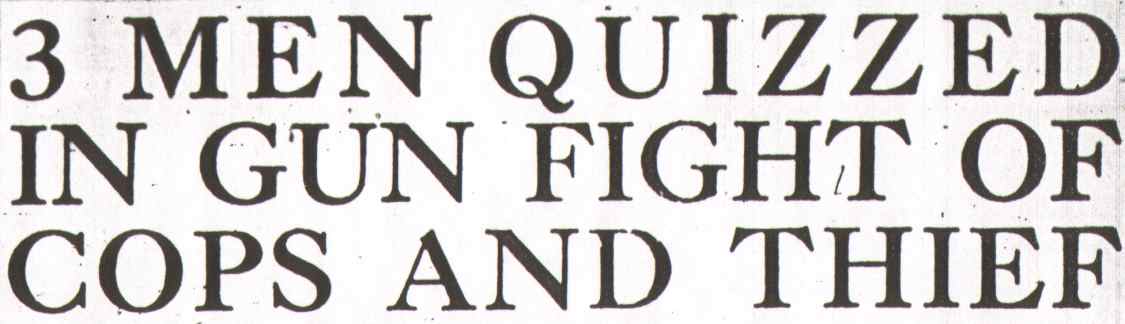
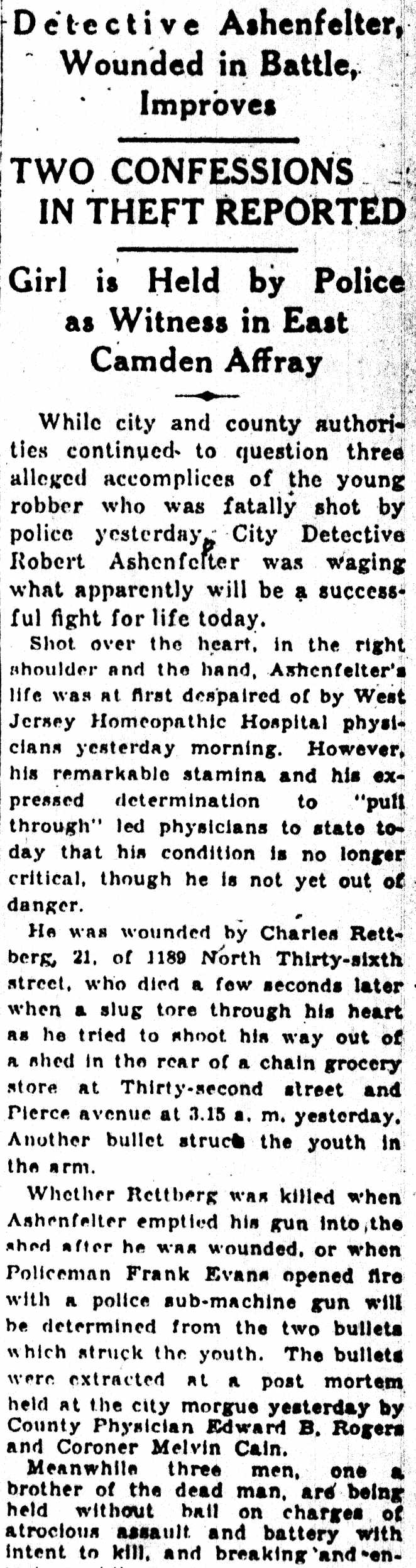
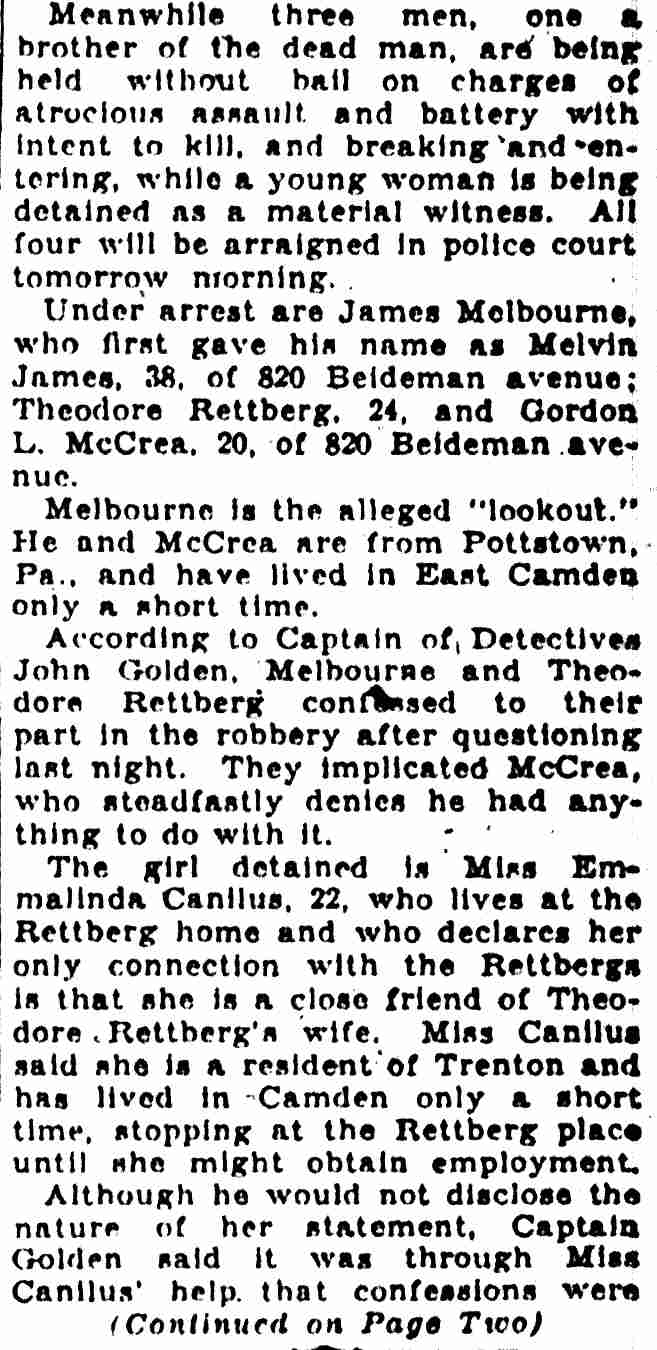
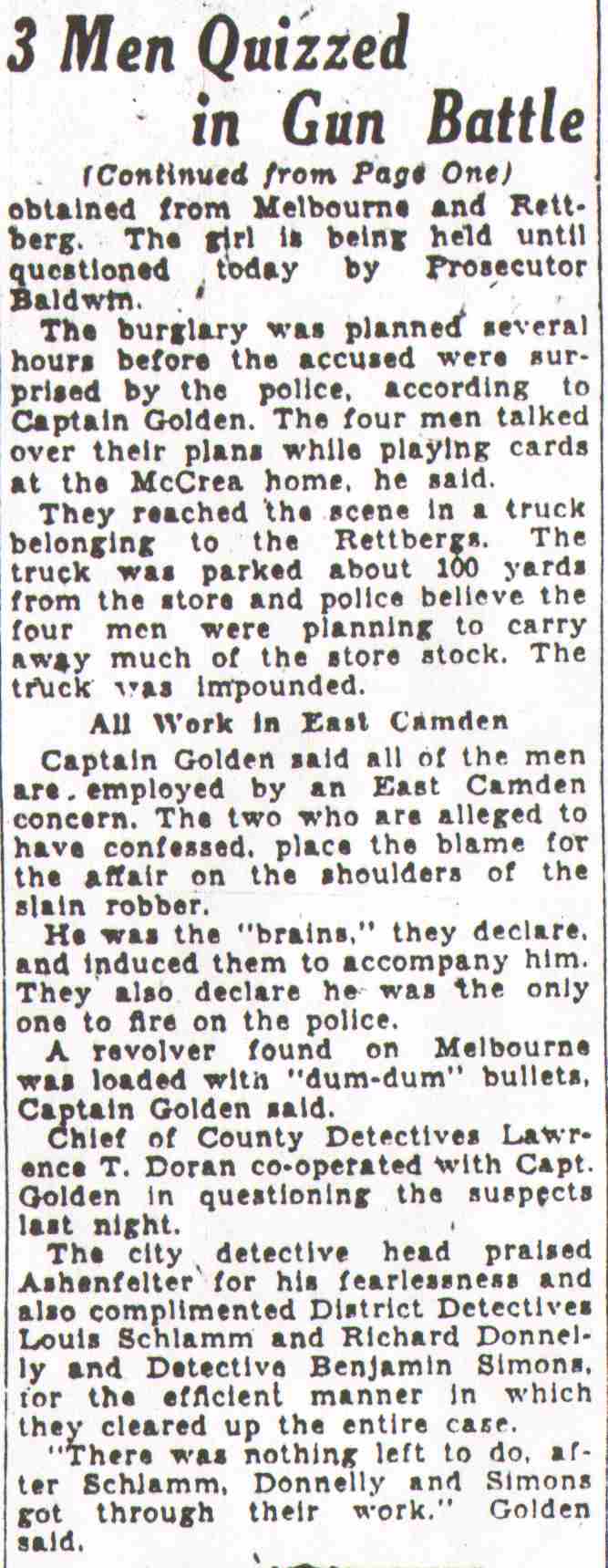
Detective Ashenfelter, Wounded in Battle, Improves
TWO CONFESSIONS IN THEFT REPORTED
Girl is Held by Police as Witness in East Camden Affray
While city and county authorities continued to question three alleged accomplices of the young robber who was fatally shot by police yesterday, City Detective Robert Ashenfelter was waging what apparently will be a successful fight for life today.
Shot over the heart, in the right shoulder and the hand, Ashenfelter’s life was at first despaired of by West Jersey Homeopathic Hospital physicians yesterday morning. However, his remarkable stamina and his expressed determination to “pull through” led physicians to state today that his condition is no longer critical, though he is not yet out of danger.
He was wounded by Charles Rettberg, 21, of 1189 North Thirty-sixth street, who died a few seconds later when a slug tore through his heart as he tried to shoot his way out of a shed in the rear of a chain grocery store at Thirty-second street and Pierce avenue at 3.15 a. m. yesterday. Another bullet struck the youth in the arm.
Whether Rettberg was killed when Ashenfelter emptied his gun into the shed after he was wounded, or when Policeman Frank Evans opened fire with a police sub-machine gun will be determined from the two bullets which struck the youth. The bullets were extracted at a post mortem held at the city morgue yesterday by County Physician Edward B. Rogers and Coroner Melvin Cain.
Meanwhile three men, one a brother of the dead man, are being held without bail on charges of atrocious assault and battery with intent to kill, and breaking and entering, while a young woman is being detained as a material witness. All four will be arraigned in police court tomorrow morning.
Under arrest are James Melbourne, who first gave his name as Melvin James, 38, of 820 Beideman avenue; Theodore Rettberg, 24, and Gordon L. McCrea, 20, of 820 Beideman avenue.
Melbourne is the alleged “lookout.” He and McCrea are from Pottstown, Pa., and have lived in East Camden only a short time.
According to Captain of Detectives John Golden, Melbourne and Theodore Rettberg confessed to their part in the robbery after questioning last night. They implicated McCrea, who steadfastly denies he had anything to do with it.
The girl detained is Miss Emmalinda Canilus, 22, who lives at the Rettberg home and who declares her only connection with the Rettbergs is that she is a close friend of Theodore Rettberg’s wife. Miss Canilus said she is a resident of Trenton and has lived in Camden only a short time, stopping at the Rettberg place until she might obtain employment.
Although he would not disclose the nature of her statement, Captain Golden said it was through Miss Canilus’ help that confessions were obtained from Melbourne and Rettberg. The girl is being held until questioned today by Prosecutor Baldwin.
The burglary was planned several hours before the accused were surprised by the police, according to Captain Golden. The four men talked over their plans while playing cards at the McCrea home, he said.
They reached the scene in a truck belonging to the Rettbergs. The truck was parked about 100 yards from the store and police believe the four men were planning to carry away much of the store stock. The truck was impounded.
All Work in East Camden
Captain Golden said all of the men are employed by an East Camden concern. The two who are alleged to have confessed place the blame for the affair on the shoulders of the slain robber.
He was the “brains,” they declare, and induced them to accompany him. They also declare he was the only one to fire on the police.
A revolver found on Melbourne was loaded with “dum-dum” bullets, Captain Golden said.
Chief of County Detectives Lawrence T. Doran co-operated with Capt. Golden in questioning the suspects last night.
The city detective head praised Ashenfelter for his fearlessness and also complimented District Detectives Louis Schlamm and Richard Donnelly and Detective Benjamin Simons, for the efficient manner in which they cleared up the entire case.
“There was nothing left to do, after Schlamm, Donnelly and Simons got through their work,” Golden said.
Mayor Orders Cops to Drive All Gangsters From Camden
Camden Courier-Post —
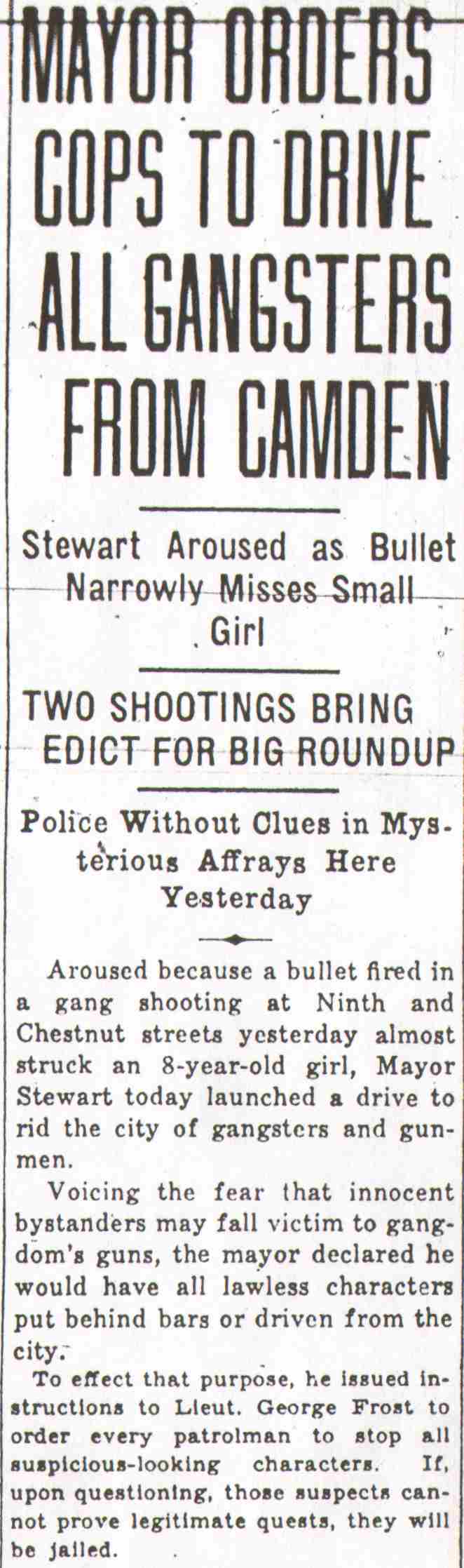
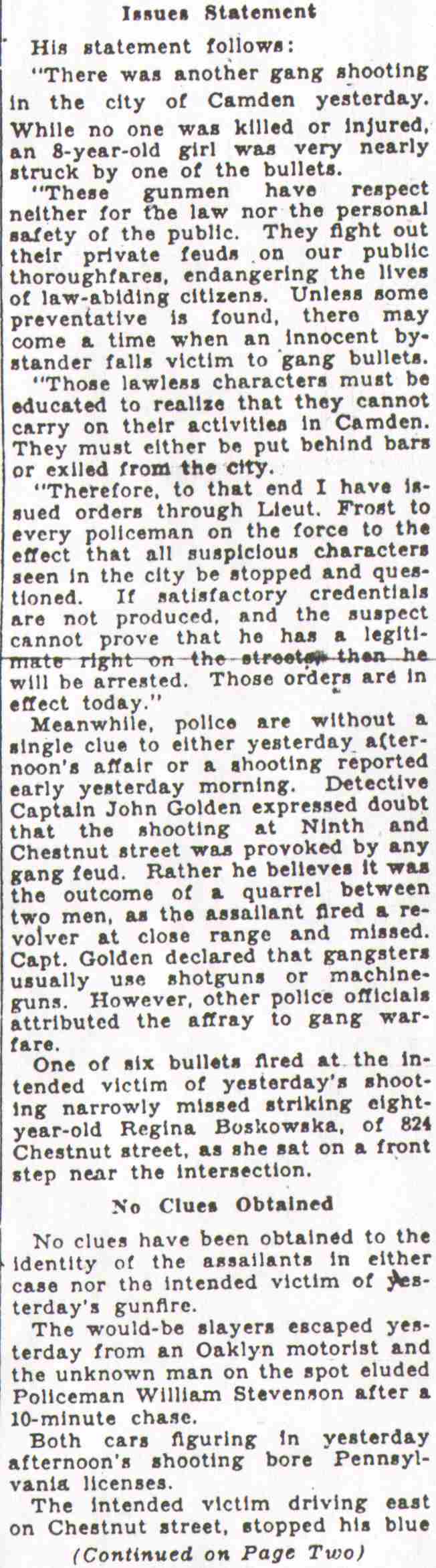
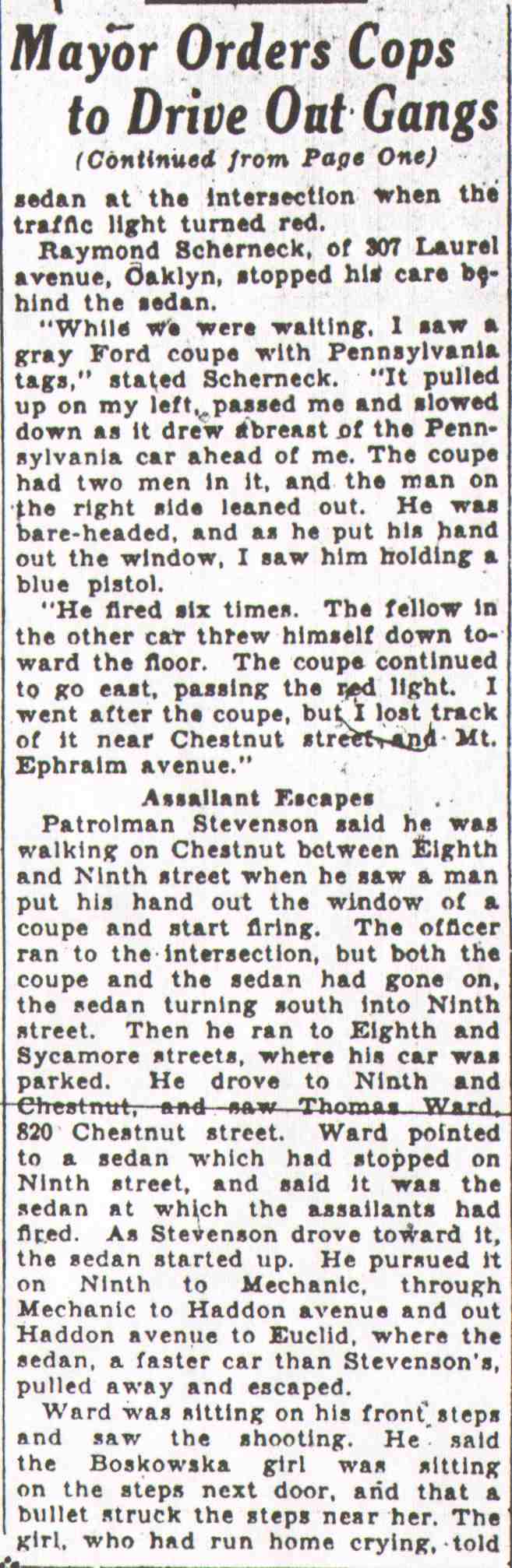
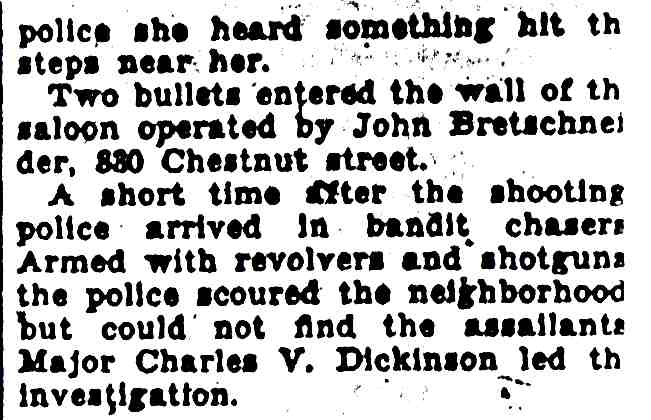
Stewart Aroused as Bullet Narrowly Misses Small Girl
TWO SHOOTINGS BRING EDICT FOR BIG ROUNDUP
Police Without Clues in Mysterious Affrays Here Yesterday
Aroused because a bullet fired in a gang shooting at Ninth and Chestnut streets yesterday almost struck an 8-year-old girl, Mayor Stewart today launched a drive to rid the city of gangsters and gunmen.
Voicing the fear that innocent bystanders may fall victim to gangdom’s guns, the mayor declared he would have all lawless characters put behind bars or driven from the city.
To effect that purpose, he issued instructions to Lieut. George Frost to order every patrolman to stop all suspicious-looking characters. If, upon questioning, those suspects cannot prove legitimate quests, they will be jailed.
Issues Statement
His statement follows:
“There was another gang shooting in the city of Camden yesterday. While no one was killed or injured, an 8-year-old girl was very nearly struck by one of the bullets.
“These gunmen have respect neither for the law nor the personal safety of the public. They fight out their private feuds on our public thoroughfares, endangering the lives of law-abiding citizens. Unless some preventative is found, there may come a time when an innocent bystander falls victim to gang bullets.
“Those lawless characters must be educated to realize that they cannot carry on their activities in Camden. They must either be put behind bars or exiled from the city.
“Therefore, to that end I have issued orders through Lieut. Frost to every policeman on the force to the effect that all suspicious characters seen in the city be stopped and questioned. If satisfactory credentials are not produced, and the suspect cannot prove that he has a legitimate right on the streets, then he will be arrested. Those orders are in effect today.”
Meanwhile, police are without a single clue to either yesterday afternoon’s affair or a shooting reported early yesterday morning. Detective Captain John Golden expressed doubt that the shooting at Ninth and Chestnut street was provoked by any gang feud. Rather he believes it was the outcome of a quarrel between two men, as the assailant fired a revolver at close range and missed. Capt. Golden declared that gangsters usually use shotguns or machine-guns. However, other police officials attributed the affray to gang warfare.
One of six bullets fired at the intended victim of yesterday’s shooting narrowly missed striking eight-year-old Regina Boskowska, of 824 Chestnut street, as she sat on a front step near the intersection.
No Clues Obtained
No clues have been obtained to the identity of the assailants in either case nor the intended victim of yesterday’s gunfire.
The would-be slayers escaped yesterday from an Oaklyn motorist and the unknown man on the spot eluded Policeman William Stevenson after a 10-minute chase.
Both cars figuring in yesterday afternoon’s shooting bore Pennsylvania licenses.
The intended victim driving east on Chestnut street, stopped his blue sedan at the intersection when the traffic light turned red.
Raymond Scherneck, of 307 Laurel avenue, Oaklyn, stopped his care [sic] behind the sedan.
“While we were waiting, I saw a gray Ford coupe with Pennsylvania tags,” stated Scherneck. “It pulled up on my left, passed me and slowed down as it drew abreast of the Pennsylvania car ahead of me. The coupe had two men in it, and the man on the right side leaned out. He was bare-headed, and as he put his hand out the window, I saw him holding a blue pistol.
“He fired six times. The fellow in the other car threw himself down toward the floor. The coupe continued to go east, passing the red light. I went after the coupe, but I lost track of it near Chestnut street and Mt. Ephraim avenue.”
Assailant Escapes
Patrolman Stevenson said he was walking on Chestnut between Eighth and Ninth street when he saw a man put his hand out the window of a coupe and start firing. The officer ran to the intersection, but both the coupe and the sedan had gone on, the sedan turning south into Ninth street. Then he ran to Eighth and Sycamore streets, where his car was parked. He drove to Ninth and Chestnut, and saw Thomas Ward, 820 Chestnut street. Ward pointed to a sedan which had stopped on Ninth street, and said it was the sedan at which the assailants had fired. As Stevenson drove toward it, the sedan started up. He pursued it on Ninth to Mechanic, through Mechanic to Haddon avenue and out Haddon avenue to Euclid, where the sedan, a faster car than Stevenson’s, pulled away and escaped.
Ward was sitting on his front steps and saw the shooting. He said the Boskowska girl was sitting on the steps next door, and that a bullet struck the steps near her. The girl, who had run home crying, told police she heard something hit the steps near her.
Two bullets entered the wall of the saloon operated by John Bretschneider, 880 Chestnut street.
A short time after the shooting police arrived in bandit chasers. Armed with revolvers and shotguns, the police scoured the neighborhood but could not find the assailants. Major Charles V. Dickinson led the investigation.
Burglar Is Killed
Cleveland Plain Dealer —
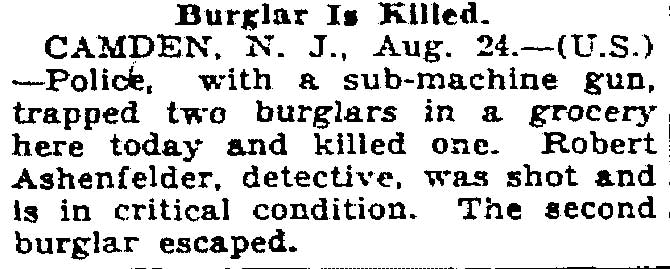
Burglar Is Killed. CAMDEN, N. J., Aug. 24—(U.S.) Police, with a sub-machine gun, trapped two burglars in a grocery here today and killed one. Robert Ashenfelter, detective, was shot and is in critical condition. The second burglar escaped.
Alleged Pals of Slain Burglar
Camden Courier-Post —

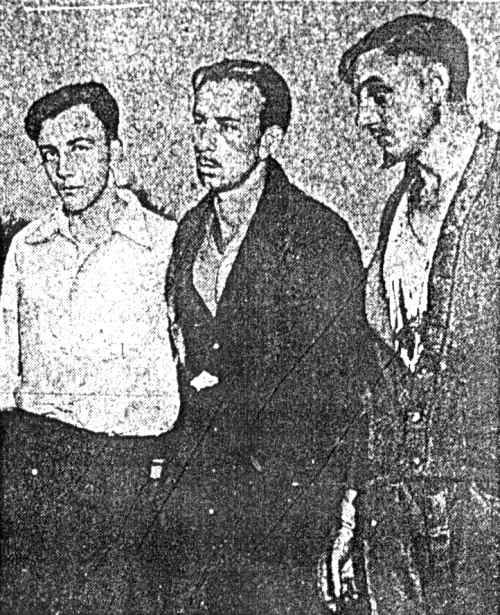
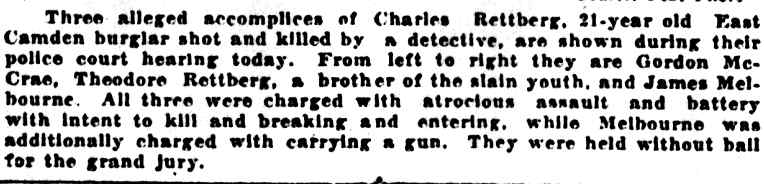
Three alleged accomplices of Charles Rettberg, 21-year old East Camden burglar shot and killed by a detective, are shown during their police court hearing today. From left to right they are Gordon McCrae, Theodore Rettberg, a brother of the slain youth, and James Melbourne. All three were charged with atrocious assault and battery with intent to kill and breaking and entering, while Melbourne was additionally charged with carrying a gun. They were held without bail for the grand jury.
Bullet Upsets Theory Thief Shot Detective
Camden Courier-Post —
[Bu]llet Found in Ashenfelter Declared From Gun of Slain Burglar’s Pal
[O]PERATING SURGEON TAKES OPPOSITE VIEW
[W]ounded Cop ‘Got His Man’ With Left Hand, Police Reveal
[I]nvestigation of the attempted [rob]bery which ended with the [dea]th of a young burglar veered [off] on a new tangent today when [it w]as reported that City Detective [Rob]ert Ashenfelter may not have [bee]n wounded by the slain youth [but] by an accomplice.
[A] ballistic expert may have to be [calle]d in to examine the bullet which [was] removed from above the detective’s heart in a delicate operation at [the] West Jersey Homeopathic Hos[pital] yesterday afternoon. It was [offi]cially reported at the hospital [this] morning that the bullet was of […]alibre, whereas Charles Rettberg, [… ] North Thirty-sixth street, the [slain] burglar, had a .25-calibre Luger [auto]matic. However, Dr. H. Wesley [… ], who performed the operation, [sai]d that in his opinion the bullet [is a] smaller calibre than a .32, and [possi]bly is a .22 or .25.
Probe Ordered
[Bo]th County Detective Chief [Law]rence T. Doran and Captain of [Dete]ctives John Golden, stated that [they] would obtain determination of [the b]ullet’s calibre. It was pointed [out t]hat the bullet struck and sev[ered] the butt of Ashenfelter’s gun [befor]e it entered the detective’s [body], so that it might have flattened [b]efore hitting the sleuth. There [is al]so the possibility that the dead [ma]n’s revolver, empty when he was [foun]d dead, might have contained [dum-]dum bullets, which also were [use]d in the gun of an accomplice. [Dum-]dum bullets flatten out when [they] hit a target, making a much [large]r wound than the original size [of th]e bullet.
[Ca]ptain Golden also announced to-[day t]hat the shot which was fatal to
(Continued on Page Two)
Bullet Casts Doubt in Shooting of Cop
(Continued from Page One)
Rettberg when he was trapped robbing a chain store at Thirty-second street and Pierce avenue Monday was fired by Ashenfelter.
It was first thought that Policeman Frank Evans, who fired into the store with a machine gun after Ashenfelter fell wounded, had slain Rettberg. But Captain Golden said the calibre of the bullet taken from the dead youth’s heart proved to be 38, the size fired by Ashenfelter’s gun. The detective’s gun was shot from his hand, but, though wounded in the chest and shoulder, the game detective picked up the weapon with his uninjured left hand and emptied it at the shed from whence the robber bullets came.
Three Arraigned
Three alleged accomplices of the slain robber and a girl witness were arraigned before Judge Pancoast in police court this morning and held without bail for the grand jury. They are Theodore Rettberg, 24-year-old brother of the dead robber; Gordon McCrea, 20, of 820 Beideman avenue; James Melbourne, 38, of the Beideman avenue address, and Miss Emmalinda Canilus, 20, who lives at the Rettberg home.
Theodore Rettberg and Melbourne are alleged to have confessed to taking part in the attempted robbery; but McCrea has denied any connection with it. However, when stolen goods worth about $500 were found in his room yesterday, he confessed to three other robberies, implicating two men.
McCrea, Rettberg and Melbourne were arraigned first on charges of atrocious assault and battery with intent to kill. Rettberg pleaded not guilty, McCrea asserted that he had nothing to say, while Melbourne pleaded “guilty to what I confessed.” That was that he helped plan the robbery and acted as lookout. Then they were charged with breaking and entering, to which all three pleaded not guilty. Melbourne was further charged with carrying a concealed deadly weapon, as he had a 38-calibre revolver loaded with dum-dum bullets when nabbed. He pleaded guilty to that complaint. All of the complaints were signed by Detective Benjamin Simon, who was two feet behind Ashenfelter when the former was wounded.
Girl Hysterical
Miss Canilus was arraigned as a material witness. Judge Pancoast said he would have to hold her without bail but that the prosecutor’s office could fix bail for her release. After being taken back to her cell, the young woman became hysterical, attracting a crowd to the corridor outside the city jail cells. She repeatedly cried out:
“I have nothing to do with this. I told them all I know. Why are they keeping me here?”
McCrea and Melbourne are newcomers to this city, having recently moved here from Royersford, Pa. They boarded with Mrs. Anna Bowden, an aunt of McCrea’s, at 820 Beideman avenue. Mrs. Bowden was taken to city hall for questioning yesterday after the loot was found in her house but satisfied Chief Doran and Captain Golden, chief of the city detective force, that she knew nothing of the robberies.
The loot was located by District Detectives Louis Schlamm and Richard Donnelly and Detective Benjamin Simon. With Chief Doran and Captain Golden they moved the stolen merchandise to city hall.
Last night, McCrea admitted that some of the loot came from three robberies, but he said he knew nothing about the rest of the merchandise. He confessed to robbing the store of Jacob J. Friedman, 18 King street, Gloucester, on Aug. 13, of shoes, hats and other articles of clothing worth $123. Friedman identified some of the loot at headquarters today.
Tells of Tire Theft
McCrea also said he stole two tires from the S. M. Brothers on Crescent boulevard in Pennsauken, and five boxes of cigars and a sprinkler from a road stand owned by Ida Carver on Burlington pike in Burlington county.
He implicated two companions, giving the police the name of one and saying that the other was a close friend of the one he had named.
Chief of Police Jesse Neiman, of Royersford, Pa., identified McCrea and Melbourne yesterday as two youths wanted in Pennsylvania for questioning in several recent robberies there. He declared the two were “well known hoodlums who were always in trouble.” According to Chief Neiman a brother of McCrea’s is serving a long prison term in the Eastern Penitentiary for highway robbery.
Police Censured in Pickpocket Case
Camden Courier-Post —
Stewart Reprimands Pancoast for Freeing 4—Grand Jury Refuses to Indict
Mayor Roy R. Stewart has reprimanded Police Judge Garfield Pancoast, former Acting City Detective Benjamin Simon and Captain of Detectives John W. Golden for laxity in handling the case of four alleged pickpockets and their unwilling accuser.
Meanwhile, the Camden County Grand Jury has exonerated the four accused men and also the complainant, who had been held by Pancoast as a material witness after failing to appear against the quartet in court.
The pickpocket suspects were released in their own recognizance by Pancoast and only one was rearrested after the police judge ordered the case reopened after a conference with the mayor.
Stewart acted after criticism had been made concerning progress of the case. He insisted that the defendants be brought to trial.
The men exonerated gave their names to the police at the time of their arrest as Thomas Anthony, 30, of 1112 Federal street; Harry Smith, 44, of 1338 Oxford street; Harry Miller, 29, of 629 North Tenth street, and Sam Berman, 46, of 606 West Girard avenue, all of Philadelphia.
Their attorneys at the police court hearing were Walter S. Keown and L. Scott Cherchesky.
Accused by Theatregoer
Their accuser was Charles Wilder, of 567 Liberty street, who had charged the men with taking $22 from his pocket in March as he was leaving a theatre at Broadway and Newton avenue.
The mayor said Wilder informed him, in a formal statement, that the reason he did not appear against the defendants at the original hearing was because he was more interested in getting his money back than in pressing the charges. Wilder is said to have given police the name of the man who gave him back his money.
“Wilder said he felt that if his money was returned to him there was no more to the case,” the mayor said.
“Will contempt proceedings be instituted against Wilder?” the mayor was asked.
Warrants Out for Four
“No,” he replied. “I don’t think so because we are still waiting to get the other fellows. Warrants are out to pick up the four defendants at any time.”
“Can they still be rearrested, even though they have been exonerated by the grand jury?” the mayor was asked.
“Well, that’s something you will have to ask Police Judge Pancoast,” he replied.
The quartet cleared of pocketpicking have long police records in Philadelphia.
In his formal decision yesterday, after reviewing the case, the mayor censured Simon for “failure to properly handle the case and dispose of same before the police judge”; Pancoast, for his “overzealousness in calling this case as the first of the morning” and for releasing defendants with criminal records in their own recognizance, and Golden for “not seeing that each and every member of the detective bureau was familiar with the rules, regulations, responsibilities and duties of their positions.”
“After reading all the evidence submitted in the case, I do not believe that Officer Simon has the qualifications to be assigned to the detective bureau,” the mayor said at the conclusion of his decision.
Simon, according to the mayor, failed to press the charge against the defendants in the absence of Wilder at the hearing. He also accused Simon of permitting release of the accused and with failing to rearrest them.
Notes Witness’ Absence
The mayor, other than to comment on the absence of the witness at the police court hearing, does not go further into failure of Wilder to appear after receiving back the money that had been stolen from him. The mayor said, in answer to a question, that he was concerned mainly with laxity in the case.
Mayor Stewart’s formal decision is dated May 27. He handed Judge Pancoast, Simon and Golden a copy of it the next day after conferring with each man separately.
Simon, he said, regarded the reprimand as “rather severe,” but did not attempt to shift responsibility; Pancoast explained that he heard the pickpocket case first because it is his custom to do so when defendants are represented by counsel, and Golden received the censure “graciously.” Pancoast freed the men, it was reported, after Simon testified the police “have nothing against them” and when Wilder failed to appear in court.
The exoneration of the four men charged with being pickpockets was voted Thursday when Wilder testified before the grand jury that he would not be able to identify them, Prosecutor Clifford A. Baldwin said.
The prosecutor said that although the four have long criminal records, the grand jury could not indict them on their records. Wilder, he added, had “testified fairly” that he could not identify them; therefore the no-bill was returned.
Of the men who had been arrested on Wilder’s complaint, only Miller, alias Harry Cohen, was rearrested after Judge Pancoast had reopened the case. He was held in $1000 bail in Philadelphia pending extradition after a hearing before Magistrate Edward F. Roberts.
Pancoast postponed hearings in the case several times to permit Simon and other detectives to rearrest the defendants. He also postponed the case of Wilder, whom he had held in $1000 bail as a material witness when he did not appear at the original police court hearing. The bail was fixed to assure Wilder’s appearance against the men in the event of their reapprehension.
On April 1, Judge Pancoast severely rebuked Simon for his inability to rearrest the four Philadelphians sought as pickpockets. The police judge said: “There has been a lot of criticism in this case and yet nothing has been done to apprehend the men.” Simon said he was doing all within his power in the case.
At a continued hearing before Judge Pancoast May 6, the court informed Wilder that he would be sent for by the grand jury.
“This case has been going on since March 15 and is now in the hands of Prosecutor Baldwin,” Pancoast said at that time. “He has complaints against all four of these men and they will be indicted. I shall continue your bail so that you will be sure to appear before that body when wanted.”
Text of Statement
The text of the mayor’s conclusions, after reviewing the case, follows:
“On March 15, 1932, Harry Miller, Sam Berman, Harry Smith and Thomas Anthony, all of Philadelphia, known as pickpockets, were apprehended after picking the pocket of Charles Wilder by a motorcycle policeman, William Taylor. After the arrest was made, Acting Detective Benjamin Simon was assigned to the case.
“I feel that Officer Simon should be reprimanded for his failure to properly handle the case and dispose of same before the police judge.
“The latter recommendation is based on the following facts: First, for Simon’s failure to press the charge in the absence of the witness. Second, inasmuch as he was familiar with the records of the four men, and, according to his own statement that Acting Detective George Zeitz telephoned from the Philadelphia detective bureau and gave the information that the prisoners had long records and that it would require from two to two and one-half hours to prepare a copy of the same. Third, for permitting the court to try this case as the first case in the morning, realizing the record of the men, and not requesting the judge to lay it over until he could furnish the information being furnished by the Philadelphia bureau. Fourth, that Officer Simon carried in his pocket for several days the necessary warrants to arrest these men after they had been released in their own recognizance and the very weak statement from him that he hoped to have the men surrender without extradition being necessary. I feel that it was preposterous to believe that criminals of this type would be lured into any such scheme. Fifth, that Officer Simon should have made the charges against these men instead of leaving the matter to Judge Pancoast. Sixth, for Simon’s unwillingness to sign the statement which he gave to the detective bureau.
Censures Pancoast
“Judge Pancoast should be reprimanded for his overzealousness in calling this case as the first of the morning. Certainly, four men arrested as pickpockets should not be swept aside and released without holding them until their complete record could be obtained. Judge Pancoast realizes that we are not inviting criminals of this type to our community, and the rougher we treat them the fewer we will have in our midst. He certainly should not release men with criminal records, such as these, in their own recognizance.
“Captain Golden should be reprimanded for not seeing that each and every member of the detective bureau was familiar with the rules, regulations, responsibilities and duties of their positions, as in this case it was very evident that Detective Simon did not show any of the aforesaid qualifications. I also believe that in cases of this nature that Captain Golden should make sure that the complaining witness would appear in court and that the court be instructed to hold the men until they had a complete record of them. To my mind, the laxity in any department is and should be placed directly on the man in charge, in this instance, the captain of detectives.
“After reading all the evidence submitted in this case, I do not believe that Officer Simon has the qualifications to be assigned to the detective bureau.”
Commenting on the no-bill exonerating the men accused by Wilder, Prosecutor Baldwin said:
“The man who had his pocket picked (Wilder) appeared before the grand jury Thursday. He was very fair about it and he said he could not identify the men who were arrested as the ones who picked his pocket because the moving picture theatre, where he said he was jostled, was dark. When the grand jury heard this testimony, it returned a no-bill.
Jostled in Theatre
“It is true that these four men who were accused have criminal records, but we cannot indict them on that. Wilder said he was brushed against in the aisle of the theatre as he was putting on his overcoat. When he reached the sidewalk, he said he saw an automobile pulling away. He testified that he did not know how long the men had been in it when they started off, but that he automatically jotted down the license number of the car. However, when we questioned him as to whether there was any possible way he could identify them as the men who picked his pocket, he said ‘No, because it was dark in the theatre’.”
Wilder, on March 23, was reported as having identified Miller as the man who picked his pocket and said the others jostled him as he was leaving the motion picture theatre. He saw the four men leave in a car, he told Policeman Taylor. The policeman chased the car to Broadway and Federal streets and arrested the occupants.
‘Buck’ Sage Held as ‘Hit-Runner’
Camden Courier-Post —
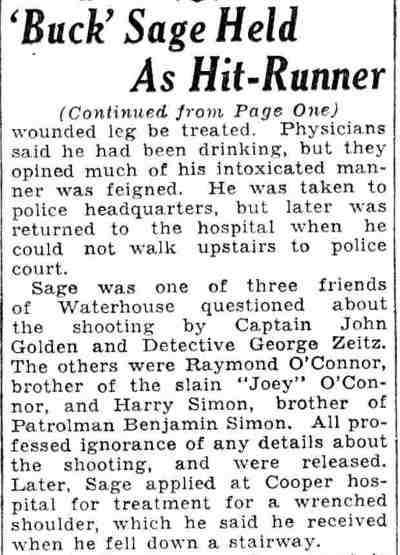
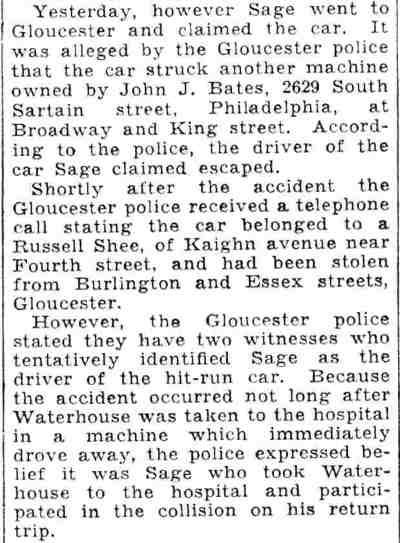
Detainer Lodged Against Sportsman in Shooting of Waterhouse
A detainer against Russell “Buck” Sage, held in Gloucester on a hit-run charge, was lodged last night by Camden police, who claim the South Camden sportsman “knows more than he has told” of the shooting of Harry “Gyp” Waterhouse.
Sage was arrested shortly after noon yesterday by Detective George Zeitz on a warrant issued by Police Recorder Oliver J. Stetser charging him with being the driver of an automobile which struck another machine in Gloucester early Thursday.
He will be given a hearing today. His arrest came a short time after he had appeared at Gloucester city hall and claimed ownership of an automobile which had been in a collision at 7 a. m. Thursday. Blood found in the car led the police to believe Waterhouse was taken to the hospital in it a short time before the accident.
Waterhouse staggered into the West Jersey Homeopathic Hospital Thursday morning and asked that his wounded leg be treated. Physicians said he had been drinking, but they opined much of his intoxicated manner was feigned. He was taken to police headquarters, but later was returned to the hospital when he could not walk upstairs to police court.
Sage was one of three friends of Waterhouse questioned about the shooting by Captain John Golden and Detective George Zeitz. The others were Raymond O’Connor, brother of the slain “Joey” O’Connor, and Harry Simon, brother of Patrolman Benjamin Simon. All professed ignorance of any details about the shooting, and were released. Later, Sage applied at Cooper hospital for treatment for a wrenched shoulder, which he said he received when he fell down a stairway.
Yesterday, however Sage went to Gloucester and claimed the car. It was alleged by the Gloucester police that the car struck another machine owned by John J. Bates, 2629 South Sartain street, Philadelphia, at Broadway and King street. According to the police, the driver of the car Sage claimed escaped.
Shortly after the accident the Gloucester police received a telephone call stating the car belonged to a Russell Shee, of Kaighn avenue near Fourth street, and had been stolen from Burlington and Essex streets, Gloucester.
However, the Gloucester police stated they have two witnesses who tentatively identified Sage as the driver of the hit-run car. Because the accident occurred not long after Waterhouse was taken to the hospital in a machine which immediately drove away, the police expressed belief it was Sage who took Waterhouse to the hospital and participated in the collision on his return trip.
Murphy and Pedigree To End Long Service With Camden Police
Camden Courier-Post —
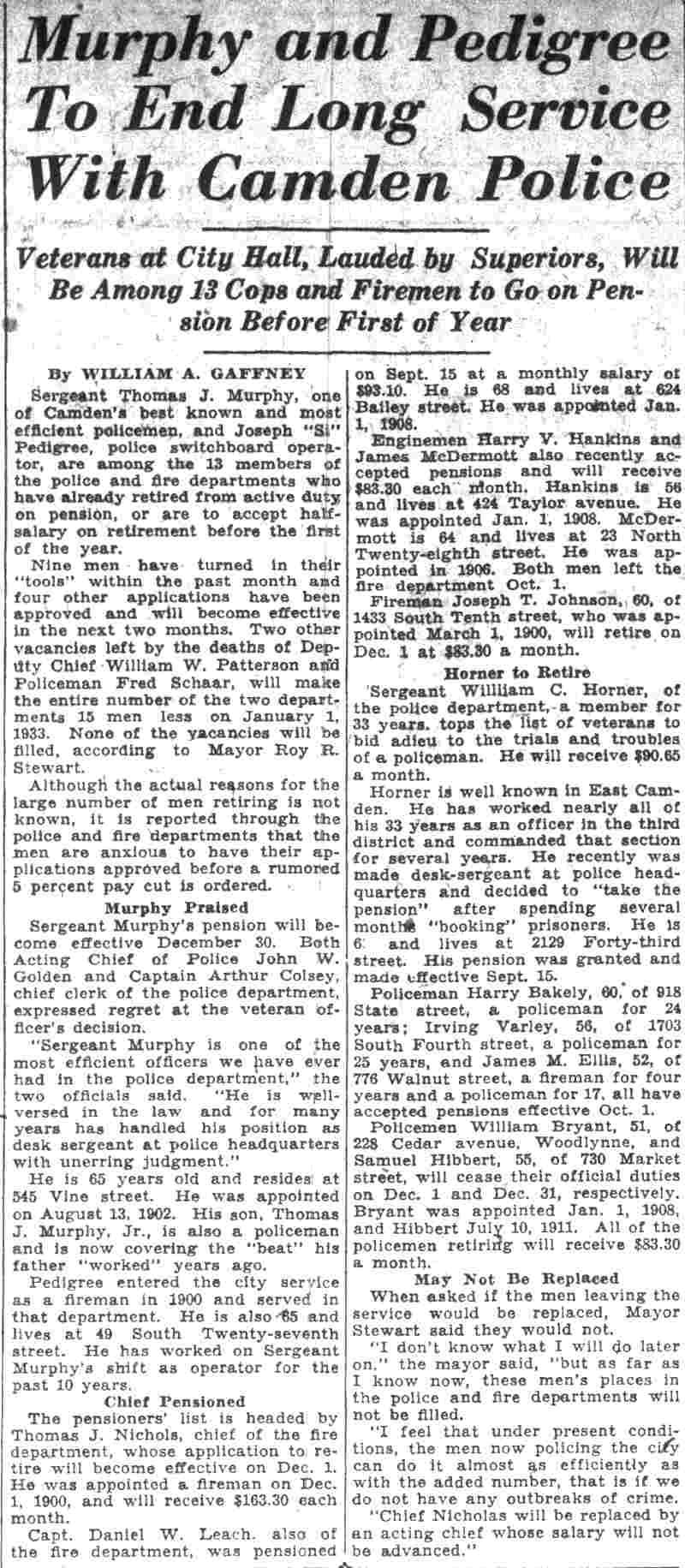
Veterans at City Hall, Lauded by Superiors, Will Be Among 13 Cops and Firemen to Go on Pension Before First of Year
By William A. Gaffney
Sergeant Thomas J. Murphy, one of Camden’s best known and most efficient policemen, and Joseph “Si” Pedigree, police switchboard operator, are among the 13 members of the police and fire departments who have already retired from active duty on pension, or are to accept half-salary on retirement before the first of the year.
Nine men have turned in their “tools” within the past month and four other applications have been approved and will become effective in the next two months. Two other vacancies left by the deaths of Deputy Chief William W. Patterson and Policeman Fred Schaar, will make the entire number of the two departments 15 men less on January 1, 1933. None of the vacancies will be filled, according to Mayor Roy R. Stewart.
Although the actual reasons for the large number of men retiring is not known, it is reported through the police and fire departments that the men are anxious to have their applications approved before a rumored 5 percent pay cut is ordered.
Murphy Praised
Sergeant Murphy’s pension will become effective December 30. Both Acting Chief of Police John W. Golden and Captain Arthur Colsey, chief clerk of the police department, expressed regret at the veteran officer’s decision.
“Sergeant Murphy is one of the most efficient officers we have ever had in the police department,” the two officials said. “He is well-versed in the law and for many years has handled his position as desk sergeant at police headquarters with unerring judgment.”
He is 65 years old and resides at 545 Vine street. He was appointed on August 13, 1902. His son, Thomas J. Murphy, Jr., is also a policeman and is now covering the “beat” his father “worked” years ago.
Pedigree entered the city service as a fireman in 1900 and served in that department. He is also 65 and lives at 49 South Twenty-seventh street. He has worked on Sergeant Murphy’s shift as operator for the past 10 years.
Chief Pensioned
The pensioners’ list is headed by Thomas J. Nichols, chief of the fire department, whose application to retire will become effective on Dec. 1. He was appointed a fireman on Dec. 1, 1900, and will receive $163.30 each month.
Capt. Daniel W. Leach, also of the fire department, was pensioned on Sept. 15 at a monthly salary of $93.10. He is 68 and lives at 624 Bailey street. He was appointed Jan. 1, 1908.
Enginemen Harry V. Hankins and James McDermott also recently accepted pensions and will receive $83.30 each month. Hankins is 56 and lives at 424 Taylor avenue. He was appointed Jan. 1, 1908. McDermott is 64 and lives at 23 North Twenty-eighth street. He was appointed in 1906. Both men left the fire department Oct. 1.
Fireman Joseph T. Johnson, 60, of 1433 South Tenth street, who was appointed March 1, 1900, will retire on Dec. 1 at $83.30 a month.
Horner to Retire
Sergeant William C. Horner, of the police department, a member for 33 years, tops the list of veterans to bid adieu to the trials and troubles of a policeman. He will receive $90.65 a month.
Horner is well known in East Camden. He has worked nearly all of his 33 years as an officer in the third district and commanded that section for several years. He recently was made desk-sergeant at police headquarters and decided to “take the pension” after spending several months “booking” prisoners. He is 6[?] and lives at 2129 Forty-third street. His pension was granted and made effective Sept. 15.
Policeman Harry Bakely, 60, of 918 State street, a policeman for 24 years; Irving Varley, 56, of 1703 South Fourth street, a policeman for 25 years, and James M. Ellis, 52, of 776 Walnut street, a fireman for four years and a policeman for 17, all have accepted pensions effective Oct. 1.
Policemen William Bryant, 51, of 228 Cedar avenue, Woodlynne, and Samuel Hibbert, 55, of 730 Market street, will cease their official duties on Dec. 1 and Dec. 31, respectively. Bryant was appointed Jan. 1, 1908, and Hibbert July 10, 1911. All of the policemen retiring will receive $83.30 a month.
May Not Be Replaced
When asked if the men leaving the service would be replaced, Mayor Stewart said they would not.
“I don’t know what I will do later on,” the mayor said, “but as far as I know now, these men’s places in the police and fire departments will not be filled.
“I feel that under present conditions, the men now policing the city can do it almost as efficiently as with the added number, that is if we do not have any outbreaks of crime.
“Chief Nicholas will be replaced by an acting chief whose salary will not be advanced.”
5 Camden Police Granted Pensions
Camden Courier-Post —
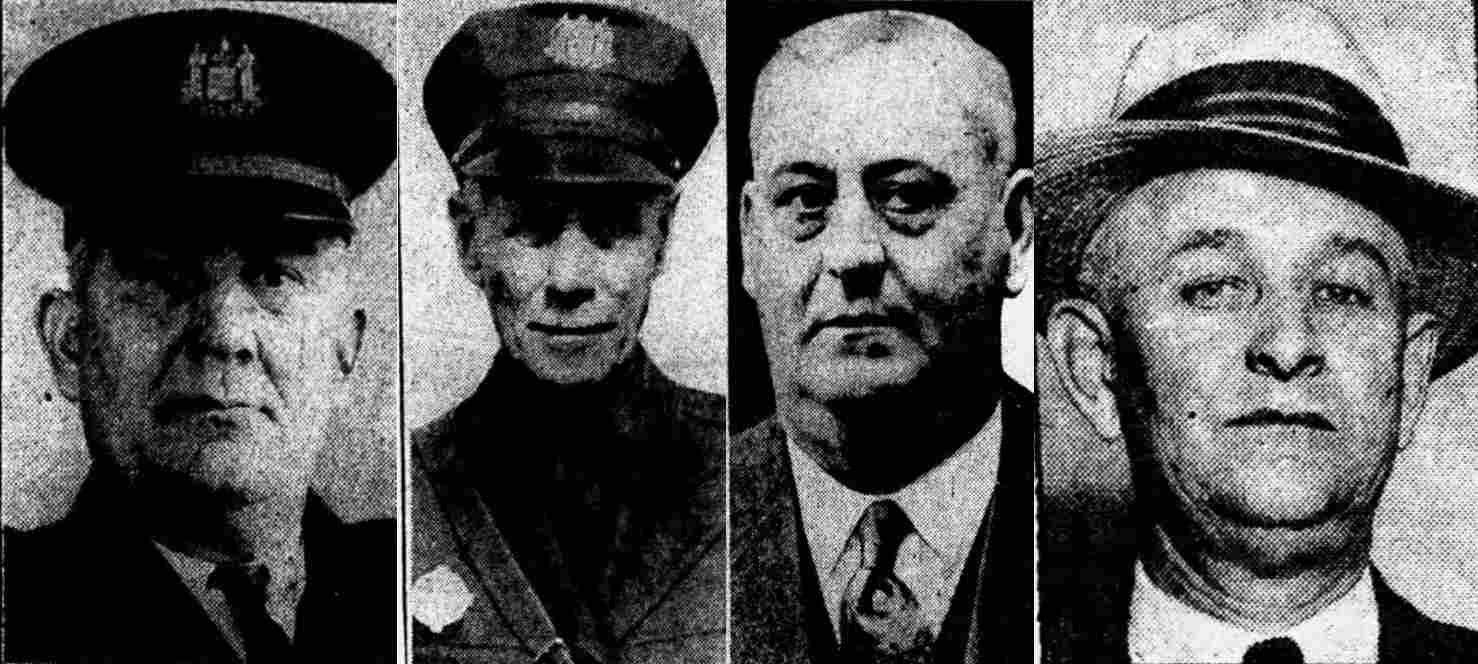

Laib, Kay, Guthrie, Smith and Till to Be Retired Next Month
Petitions for pensions were granted yesterday to five members of the Camden police department.
The retiring men are: Lieutenant Charles Laib, in charge of the traffic bureau; Sergeant Charles J. “Jeff”. Kay, City Detectives Theodore “Dory” Guthrie and Howard Smith, and Patrolman J. Oscar Till.
The retirements are to become effective Jan. 1, it was announced after a special meeting of the pension committee in city hall. Mrs. Louise F. Walsh, secretary of the board, presented the five applications.
Eventual retirement of Lieut. Laib has been rumored in the department for several months, but it was not until recently that the report was regarded seriously. It is understood that his associates as late as yesterday had requested him to remain on duty. He is recognized as one of the most competent officers in the department. Failing health, however, is said to have prompted the pension committee to approve his application.
Successor Not Named
No announcement as to Lieut. Laib’s successor was made by Acting Chief John W. Golden.
Lieutenant Laib was appointed to the police force January 12, 1912, by former Mayor Charles H. Ellis. He was promoted to sergeant in 1916 and became a lieutenant in 1929. He has been in charge of the traffic department for a year, succeeding Captain Charles L. Humes, who has been named inspector of personnel.
Laib is but 51 years of age and is one of the youngest men in the department to apply for pension. If his pension is approved he will receive a monthly salary of $102.08. His home is with his wife at 76 South Twenty-fourth street.
For many years, Laib has been conducting a “one-man” relief organization and is recognized by charitable organizations throughout the city for his generosity among the destitute.
Each Thanksgiving and Christmas, he personally collects funds for dinners for the children of the Sheltering Arms Home, Seventeenth street and River avenue, and has also been responsible for the home getting a daily supply of bread from a Camden bakery for several years.
Kay Served 38 Years
Sergeant Kay is a veteran member of the police department and has been an officer for 38 years. He is 72 and lives at 606 North Fourth street. He will receive $90.65 monthly. He has been on the sick list for several months, recovering from injuries received in an accident.
Detective Smith is 58 and lives at 933 Penn street. For several years he was loaned to the county as a detective and helped in solving a number of Camden county murders. He was recently returned to the police department and Detective Fiore Troncone turned over to the county in his place. He will receive $90.65 a month. He was appointed March 20, 1906.
Detective Guthrie served 19 years as a policeman and two as a fireman. He resides at 570 Chestnut street. He will receive $92.50 per month, the additional $2 being added because he will not have the usual two per cent deducted for the pension fund.
Patrolman Till, who is 56, resides at 1002 North Twenty-fifth street. He served 25 years as a policeman and two and one-half years as a fireman. He is attached to the Second district. Till will receive $83.60 monthly.
The members of the pension committee who passed on the applications is headed by Mayor Roy R. Stewart and includes, Newton W. Ash, fire department representative; William Michalk [sic], police department representative; John J. Robinson, citizen member, and Mrs. Walsh.
Camden Courier-Post – February 1, 1933
Bandits Identified in G.O.P. Club Job
Three bandits who robbed a Republican Club in the Fourteenth Ward, escaping with three slot machines and other loot obtained from attendants, have been identified from rogues gallery photographs.
Acting Chief of Police John W. Golden said yesterday that the county detectives were handling the case, but that he has ordered his own men to take the suspects into custody, for questioning. One of those identified by three victims who were in the club when it was held up is “a well known police character,” Golden said.
The holdup occurred 2:30 p.m. Saturday at the club, which is on Mt. Ephraim Avenue, near Collings Road.
It was not disclosed until Monday when reported to county detectives by the officers of the club, giving their names as Thomas McGarrity, 30, of 919 Magill Avenue, West Collingswood; Thomas J. Davis, 31, of 2993 Mt. Ephraim Avenue, Camden, and David Caffery, 34, of the same address.
Camden Courier-Post – February 4, 1933
Cop Fined 30 Days Pay on Misconduct Charge
Policeman William Turner, of the Third district, was fined 30 days’ pay by order of Acting Police Chief John W. Golden yesterday following a trial by a board of lieutenants. Turner was charged with conduct unbecoming an officer. Turner will be continued on the roster, Chief Golden said, but will receive no pay for the next month’s work. The specific charges on which the patrolman was summoned were not revealed.
Joe Montana Wed to Miss Palladino
Camden Courier-Post —
Camden Wrestler and Bride Are Given Dinner Attended by Notables
Miss Emma Palladino, one of the fairest daughters of Camden’s “Little Italy” yesterday became the bride of Joseph Montana, heavyweight wrestler, at Our Lady of Mt. Carmel Church, Fourth and Division streets.
Idol of Italian youth in this city Montana was hailed by hundreds of them outside the church. A number of relatives and friends, including prominent figures in the legal and professional life of the city, attended a dinner in honor of the couple at Overbrook Villa, Lindenwold, following the ceremony.
The bride, 20, is the daughter of Joseph Palladino, commercial photographer of 1115 South Fourth street. She graduated from Camden High school in 1928. Montana is 26 and a contender for the world’s heavy-weight wrestling diadem. Following a wedding tour through the West the couple plan to reside in Camden.
Miss Emenia D’Alesio, of Audubon, and Miss Rose Marini and Miss Cecelia Szymanski, of Camden, served as bridesmaids. Attending the groom were Gene Mariano, Michel D’Ilesia and William Palladino. The bride carried a bouquet of lillies of the valley and white roses while her attendants held tulips and roses. The church was beautifully decorated with varied floral designs, gold ribbons, silks and satins.
The guest list at the bridal dinner included: Assemblyman Frank M. Travaline, Jr., City Commissioner Clay W. Reesman, director of parks and public property; Acting Chief of Police of John W. Golden, former Prosecutor and Mrs. Ethan P. Wescott, Samuel P. Orlando, Guido Laurini, Detective Fiore Troncone, Antonio Mecca, Mr. and Mrs. William Denof, Mr. and Mrs. Pasquale Ianuzzi, Frank H. Ryan, Thomas H. Ryan, Dr. and Mrs. Robert Principato, Mr. and Mrs. William Averall, Luke McKenna, Mr. and Mrs. Gene Mariani, Mr. and Mrs. Frank Abbott, Frank P. Cocchiaraley and Miss Regina Cocchiaraley, all of Camden; Miss Mary Montana, and Mr. and Mrs. Ettore Montana, of Columbus OH., and Aristadino D’Guilia and sons, Albert and Peter, of Buffalo, NY.
Camden Courier-Post – June 1, 1933
Payroll Theft Is Re-Enacted; Two Men Held
Camden Suspects, Brought Back From Penna., Viewed by Victims — Man Admits Loan of Machine to One
The $11,790 payroll holdup staged last Friday at the Radio Condenser Co., Thorne and Copewood Streets, was re-enacted yesterday.
Two suspects nabbed late Monday, at Lykens in Dauphin County, Pa., played the “heavy” roles. Also in the cast were eight women and two men, employees of the firm. For an hour and 20 minutes the spectacular robbery was “rehearsed” under the direction of three Camden detectives.
When the curtain was rung down LeRoy Jenkins, 23, who police say has addresses at 1161 Mechanic Street and 1220 Princess Avenue, and Joseph Putek, 23, said to reside at 1462 Louis Street, were held on suspicion. They will be questioned further today.
Has Nothing Definite
Acting Chief of Police John W. Golden admitted he “has nothing on the boys.” Detectives Benjamin Simon, Clarence Arthur and Clifford Del Rossi, however, were pressing pursuit of “hunches” and meager clues in attempts to solve the crime. There were several lines of information they obtained regarding the two suspects which will bear further study, Simon said.
Putak, who has a police record although never convicted according to police, was questioned previously in connection with the Radio Condenser “job.” He was released at midnight last Saturday. After that the detectives centered attention upon Jenkins. They learned Jenkins borrowed an automobile from a man who operates a garage in the 1200 block on Atlantic Avenue. The garageman was reluctant to talk but under threat of arrest as an accessory he admitted lending a car to Jenkins.
Fliers were dispatched to police throughout Pennsylvania, New York, Delaware and New Jersey. The car was halted at Williamsport, Pa. and when Camden police were identified they were surprised that Putak was Jenkins’ companion. This stirred detectives to renewed vigor in the probe. They learned the men were planning to visit relatives, of Jenkins in Williamsport and Pottsville. According to Simon, police of both cities say Jenkins is well known to them.
While at Williamsport the three detectives learned Putak and Jenkins visited a vice den and quarreled with a woman over money. They quoted Jenkins as declaring that he “could buy and sell the joint!”
Had Little Money
Putak had but $3 when released Saturday and $11 when arrested, Simon revealed. He told the detectives he had won money in a poker game here.
The two men were returned with the detectives as far as Philadelphia but refused to cross the river. They were turned over to police there on suspicion and brought to this city yesterday afternoon. Taken to the Radio Condenser plant they were confronted with the ten employees who were herded in a vault during the holdup last Friday.
According to Simon, several of the employees felt there were certain mannerisms of the suspects which corresponded with actions of the bandits but confessed they were unable to definitely identify Putak or Jenkins as the heavily masked pair who threatened their lives with a revolver and shotgun.
The detectives propose an inquiry to all banks in this area in an effort to learn whether safe deposit boxes were leased by anyone answering the description of the suspects. The money obtained in the robbery was in bills and change of small denomination, numbers of the bills were not available.
Although never convicted Jenkins has a police record. Putak has never been formally under arrest, but has been questioned by the police in connection with various cases.
Jenkins was arrested December 18, 1931, charged with larceny of gasoline, and on last July 9 was charged with several robberies. On April 2, 1931, he was held for the grand jury, charged with manslaughter after his automobile killed Mrs. Mary Cavanaugh, 70, a cook in the service of City Solicitor E.G.C. Bleakly.
Camden Courier-Post – June 10, 1933
Stewart Gives Permission to Use Daylight Time Loophole
Saloon Men’s Protest at 1 A.M. Closing Wins Quick Action — Screens Are Scrapped as Word Is Passed
Most of Camden’s saloons started selling beer over the bar last night. No arrests were made.
Proprietors of “soft drink” parlors are said to have received an “O.K.” to sell over the bar with the understanding they would not be molested.
At the same time it was learned that Mayor Roy R. Stewart had issued an official order at 5 p.m. to Acting Chief of Police John W. Golden permitting all beer dispensaries, cafes, etc., to remain open until 2 a.m., daylight saving time, except on Saturday when they must close at midnight.
Saloonkeepers Protest
Through their own organization saloonkeepers are known to have put up a vigorous protest on closing at 1 a.m., while in Philadelphia the same closing hour is enforced in standard time, permitting places there to do business until 2 a.m. daylight time. It was said a close check-up failed to reveal anything in the state or city ordinances differentiating between daylight and standard time.
News Spreads Rapidly
Word is understood to have been passed to the saloon men by high authority that the existing state law “will be changed Monday, sure” when the legislature meets at Trenton, and would knock out the clauses requiring screens and forbidding sale of beer over the bar.
As if by some mysterious communication system, all saloons seemed to receive the advice at the same time. About 6 o’clock they started removing tables and screens. From official sources in Trenton there was firm denial that the beer law even would be taken up Monday.
Camden Courier-Post – June 13, 1933
Policeman Suspended on Drunken Charge
A Camden policeman was suspended indefinitely and relieved of his badge yesterday on a charge of drunkenness on duty.
The patrolman is Alfred Trusty, colored, of 1858 South Ninth Street. He is attached to the Second police district.
Chief of Police John W. Golden ordered the suspension after he had received telephone calls informing him there was “a drunken policeman raising cain downtown.”
Golden ordered Lieutenant Ralph Bakely, commander of the district, to investigate. Trusty was brought into the station house by Sergeant Mattison. He has been ordered to appear before Golden today.
Camden Courier-Post – June 13, 1933
Sleuth Back on Duty
After an enforced idleness of several weeks due to the amputation of one of his fingers, Detective Robert Ashenfelter returned to duty last night at detective headquarters.
Patrolman John Opfer, assigned to the detective division to fill Ashenfelter’s place during his absence, has been transferred back to uniform duty, Acting Police Chief John W. Golden announced the change last night.
Camden Courier-Post – June 15, 1933
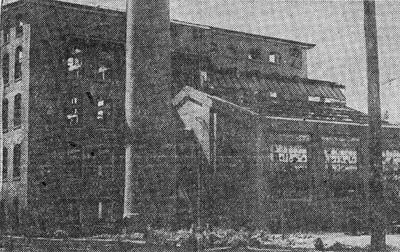
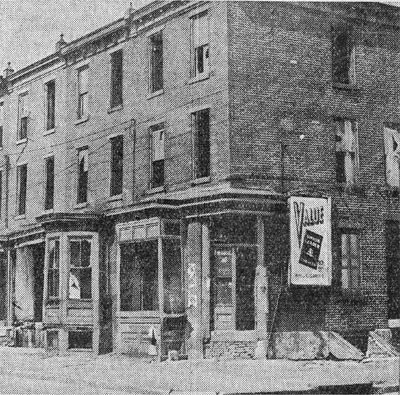
The upper photo shows hundreds of windows broken by boys in the old Camden Iron foundry at Front and Pearl streets. The lower picture emphasizes destruction to properties at Second and Benson Streets.
$500,000 Damage to Vacant Property Laid to Vandals
North Camden Civic Group Wants Boys Forced to Use Soft Rubber Balls — Police Help Enlisted
A campaign to end vandalism in Camden has been launched by the North Camden Civic Association.
After making an investigation, a committee including Mrs. Stephen Pfeil, Miss E. A. Stein and William Coghlan reported that $500,000 damage had been inflicted on vacant properties.
The committee conferred with Acting Police Chief John W. Golden one week ago and reported he promised to co-operate.
“Destruction of taxpayers’ properties, as well as city property, MUST BE STOPPED. Many windows are broken by boys and young men playing ball on our streets. If they must play ball, then why not restrict them to soft rubber balls instead of hard balls? Properties not only are damaged, but anyone walking along the street is liable to be hit.”
“Not only windows are broken, but properties are literally torn down and plumbing ripped out. Just take a glance at the thousands of properties, homes, stores, factories, city bath houses and city parks destroyed beyond the means of owners to have them repaired so that they may get rents. This destruction of property is over our entire city and is not encouraging to outsiders to come to our city to live.”
“This menace must be curbed and it is up to our police to take more interest in their city and make it their business to look into these matters which occur on their beat. If the parents were held responsible for their children’s acts they would take a little more interest in molding the characters of their children and eventually we would have better citizens.”
“The worst crimes are committed by the younger element from 16 to 26 years. Whether it is the fault of the police or their superior officers, or whether it be the fault of ward leaders or other politicians interceding, Chief of Police John Golden has taken a firm stand and has promised to give his utmost support to this committee.”
Camden Courier-Post – June 23, 1933
Cops Nab 14 Nudists After Criticism for Vandalism, Bathing
Citizens Complain to City Commission and Give ‘Hot Tips’ — $500,000 Damage to Homes Charged — Police Act Quickly on Objection to ‘Buck’ Swimming
The Camden police were criticized yesterday at a meeting of the City Commission for relaxing their vigilance in halting damage by vandals in vacant properties which have caused total losses of $500,000 in the city.
A committee representing the North Camden Civic Association appeared before the City Commission and urged an intensive campaign to halt destruction of unoccupied buildings. Among the committee’s recommendations for the drive were greater activity by the police, co-operation by citizens with the police in reporting vandalism, appointment of special officers to watch the buildings and a general educational campaign in the city schools.
Given Hot Clue
Mayor Roy R. Stewart estimated that $500,000 damage had been done to vacant properties, and agreed to give full support to the drive to halt vandalism.
With characteristic suddenness, Frank J. Hartmann, secretary of the civic association, arose in the meeting and told the mayor that if policemen were sent immediately to Tenth and State Streets they would find young men engaged in tearing down an unoccupied factory.
As another evidence of “police negligence,” he said, young men and boys could be found bathing nude at that moment in Cooper River in that vicinity. Acting immediately, Mayor Stewart instructed Capt. John W. Golden, acting police chief, to send policemen to the neighborhood.
14 Nude Bathers Nabbed
A few minutes later, 14 boys and young men, ranging in age from 12 to 26, were arrested for bathing without clothes.
All bathers over 14 were held in cash security of $10 and those under 14 were released in custody of their parents on charges of disorderly conduct. They are: Leslie Bayne, 26, of 503 Royden Street; Harvey Howell, 16, of 529 Washington Street; John Grady, 19, of 578 Benson Street; Roscoe Davis, 15, of 253 North Eleventh Street; James Evans, 15, of 601 North Second Street; William Dempsey, 12, of 1030 Lawrence Street; Robert Farland, 13, of 1112 Federal Street; Roland Garber, 15, of 537 Birch Street; Edgar Grundlock, 15, of 318 North Tenth Street; Frank Garwood, 13, of 717 Bailey Street; Eugene Dodelin, 13, of 309 Cole Street; Ralph Skill, 13, of 512 North Seventh Street; Robert Rudd, 15, of 642 Linwood Street, and Richard Evans, 14, of 601 North Second Street.
Acting Chief Golden received a letter from a woman who complained about young men bathing in Cooper River.
“If the police performed the duties they are paid to perform, this vandalism could be stopped,” Miss Stein said.
Hartmann urged that politicians and public officeholders refrain from using their influence to obtain leniency for children guilty of damaging vacant houses.
Camden Courier-Post – June 24, 1933
Pancoast Frees Nude Bathers, Scores Those Causing Arrest
Boys and Young Men, However, Are Asked to Carry Bathing Suits on Next Visit to Cooper River
Fourteen boys and young men arrested as nude bathers Thursday as the sequel to a city commission meeting, were freed yesterday by Judge Garfield Pancoast with the advice that they wear bathing suits when swimming.
The nude bathers were apprehended in Cooper River in the vicinity of Tenth and Pearl streets after Frank J. Hartmann Jr., secretary of, the New Jersey Congress of Civic Associations and of the North Camden Civic Association, complained at the commission meeting Thursday that shocking conditions exist among the male bathers in the river, causing women in the neighborhood to protest.
With two of the youthful bathers excused because they had to attend the final classes of the term in school, Police Judge Garfield Pancoast suspended sentence on the others at a hearing yesterday after advising them to wear bathing suits when swimming again. The boys had been released in their own recognizance after their arrest late Thursday by John Taylor, a policeman, who was sent to the bathing spot by Acting Chief Golden.
Pancoast Sarcastic
Taylor, under questioning of the court, testified that the nearest house to where the youths swam was a block away, and that while there were boathouses across the creek, he did not know whether they are occupied. The boys themselves testified that no women pass the “swimming hole,” which, they said, is three blocks from State Street and almost two squares from Tenth Street.
After Taylor informed the court he did not know who made the complaint to Mayor Stewart, Pancoast said the complainant “is probably the same man who, at the age of these boys, did nothing in the Summer but read the New Testament.”
“He probably is the same man who never went swimming when the temperature went up to 92 degrees,” the court commented, “and is probably the same man who does not know that the cost to the taxpayers for every arrest in the city averages $3.87.”
Appeals to Boys
“I have nothing to say to you boys, but appeal to you to take a bathing suit with you the next time you go swimming, because someone might be passing who does not like to see your nude figure.”
Camden Courier-Post – June 26, 1933
Wife Slain by Jagged Glass, Husband Held
Accident Hoax Broken by Cops After Grilling Family; Friend — On Deathbed, She Orders 4 Children to Say She Fell on Stairs
A death-bed command of a South Camden mother to her four children to stick to their story failed of its motive last night and the woman’s husband was arrested on suspicion of murder.
“Say only what I say, that I fell down the steps.”
Mrs. Philomena Marcozzi, 41, died in West Jersey Homeopathic Hospital shortly after she made that remark; at 4 p.m. yesterday. She bled to death from a severe cut on her left arm.
At her bedside were her children, Josephine, 15; Ida, 13; Louise, 17, and David, 19.
Cops’ Suspicions Aroused Nearby
Out of sight of the dying woman, stood Detectives Clifford Del Rossi and Fiore Troncone.
Their suspicions aroused, the sleuths renewed their investigation. As a result the woman’s husband, Guilio Marcozzi, 55, of 321 Pine Street was put in the city jail last night, charged with the death of his wife.
Mrs. Marcozzi was cut with the jagged edge of a broken wine decanter, during an argument with her husband over the cleaning of some hardshelled crabs.
Cut by Jagged Glass
The decanter broke. Grasping the long neck of the bottle, Marcozzi continued to attack his wife. He swung the jagged edge towards her breast, and to protect herself she raised her arm.
The broken bottle cut deeply into her skin. An artery was severed.
Then the children rushed the mother to West Jersey Homeopathic Hospital.
Wife Dying — Man at Work
The father failed to appear at the hospital. Police were forced to get him at his work yesterday, according to Detective Joseph Carpani, when his wife was dying.
Last night he denied the crime. He said he was not at home when his wife suffered the fatal injury.
But his children, confronted with Mrs. Lupini’s tale, broke down and confessed, according to police.
Eighteen hours of almost constant questioning of the Lupini woman by Detectives Carpani, Del Rossi and Troncone solved the tragedy. All three were complimented last night by Acting Police Chief John W. Golden.
Johnson Gets Ward’s Job as Kobus Orders Cop Shakeup
Camden Courier-Post —
Shaw Made Assistant in Place of Koerner
In a shakeup of Camden police officials yesterday afternoon Lieutenant Samuel E. Johnson was named acting chief of detectives by Commissioner Mary W. Kobus, director of public safety.
Lieutenant George A. Ward, who has been in charge of the detective bureau for a year, was transferred to take Johnson’s place in charge of headquarters.
Detective Louis Shaw was made assistant to Johnson, replacing Detective Sergeant Gus Koerner. Koerner was transferred to the Second District, for radio car and street duty. The new order became effective at 4:00 PM yesterday.
Police Chief Arthur Colsey announced the changes in the bureau after a two-hour conference with Commissioner Kobus yesterday afternoon.
Maurice Di Nicuolo, who has been an acting detective, was transferred to the First Police District, with former Acting Detective Clifford Del Rossi returning to his old post in the detective bureau.
In the only other transfer announced, Sergeant Harry Newton was switched from the First Police District to the Third, with Sergeant Edward Carroll going from the Third to the First.
Although no other changes were made public, it is believed yesterday’s are a forerunner of numerous shifts to be made today or early next week.
“These changes are being made for the good of the service,” Commissioner Kobus declared. “There will be other transfers of officers and men so that all the police may familiarize themselves with all the branches of the department.”
Lieutenant Johnson was appointed a policeman on January 1, 1910. After 10 years as a patrolman, he was promoted to a detective, where he made a splendid record. On November 28, 1928 he was made a sergeant, and again promoted on April 8, 1930, when he became a lieutenant.
Ward was appointed a policeman on August 2, 1917, promoted to detective January 1, 1927, sergeant November 14, 1928 and lieutenant on January 24, 1930.
Johnson was a detective sergeant when former Police Chief John W. Golden was head of that bureau, but later was transferred to police headquarters.
Ward has been in and out of the detective bureau several times. He served for a time as the commander of the First District and later was in charge of the police headquarters on the 12:00 midnight to 8:00 AM shift. He was a political lieutenant of former Public Safety Director David S. Rhone.
George Clayton Made Chief Police Clerk
Camden Courier-Post —
George “Babe” Clayton yesterday afternoon was named acting chief clerk of the Camden police department by Chief Arthur Colsey, who held the post under former Chief John W. Golden.
Clayton has been functioning in the post for the last four months, but had not formally received the title of acting chief clerk.
Colsey said Clayton will receive the same salary he has been getting as a patrolman, $2040 a year minus 15 percent. He had been discussed recently for an acting captaincy, but decision was reached to appoint him to the clerkship instead.
4 Cops, 4 Firemen, Widow of One Win City Pensions
Camden Courier-Post —
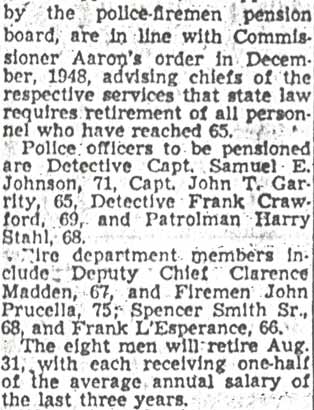
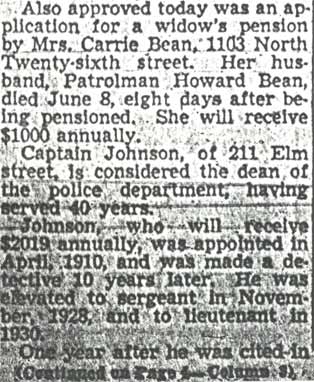
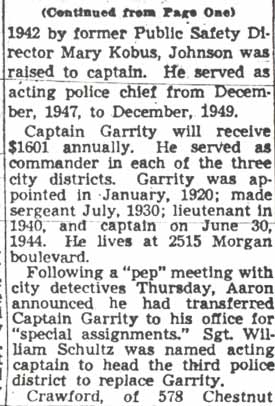
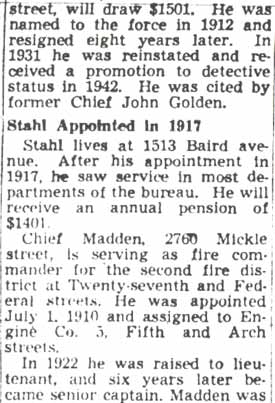
Johnson, Garrity, Crawford, Stahl Retire Aug. 31
Four police officers and four firemen applied for pensions under the mandatory 65-year-old retirement law today.
The applications, all approved by the police-firemen pension board, are in line with Commissioner Aaron’s order in December, 1948, advising chiefs of the respective services that state law requires retirement of all personnel who have reached 65.
Police officers to be pensioned are Detective Capt. Samuel E. Johnson, 71, Capt. John T. Garrity, 65, Detective Frank Crawford, 69, and Patrolman Harry Stahl, 68.
Fire department members include Deputy Chief Clarence Madden, 67, and Firemen John Prucella, 75; Spencer Smith Sr., 68, and Frank L’Esperance, 66.
The eight men will retire Aug. 31, with each receiving one-half of the average annual salary of the last three years.
Also approved today was an application for a widow’s pension by Mrs. Carrie Bean, 1103 North Twenty-sixth street. Her husband, Patrolman Howard Bean, died June 8, eight days after being pensioned. She will receive $1000 annually.
Captain Johnson, of 211 Elm street, is considered the dean of the police department, having served 40 years.
Johnson, who will receive $2019 annually, was appointed in April, 1910, and was made a detective 10 years later. He was elevated to sergeant in November, 1928, and to lieutenant in 1930. One year after he was cited in 1942 by former Public Safety Director Mary Kobus, Johnson was raised to captain. He served as acting police chief from December, 1947, to December, 1949.
Captain Garrity will receive $1601 annually. He served as commander in each of the three city districts. Garrity was appointed in January, 1920; made sergeant July, 1930; lieutenant in 1940, and captain on June 30, 1944. He lives at 2515 Morgan boulevard.
Following a “pep” meeting with city detectives Thursday, Aaron announced he had transferred Captain Garrity to his office for “special assignments.” Sgt. William Schultz was named acting captain to head the third police district to replace Garrity.
Crawford, of 578 Chestnut street, will draw $1501. He was named to the force in 1912 and resigned eight years later. In 1931 he was reinstated and received a promotion to detective status in 1942. He was cited by former Chief John Golden.
Stahl Appointed in 1917
Stahl lives at 1513 Baird avenue. After his appointment in 1917, he saw service in most departments of the bureau. He will receive an annual pension of $1401.
Chief Madden, 2760 Mickle street, is serving as fire commander for the second fire district at Twenty-seventh and Federal streets. He was appointed July 1, 1910 and assigned to Engine Co. 5, Fifth and Arch streets.
In 1922 he was raised to lieutenant, and six years later became senior captain. Madden was named battalion chief Nov. 21, 1944 and deputy chief on Dec. 16, 1949.
Madden will receive about $2000, with the others drawing approximately $1358 annually.
Prucella, 919 Penn street, was sworn in on Nov. 1, 1911 and joined Engine Co. 5. Since 1933 he has been serving at No. 6 Engine Co., Front and Linden streets.
Smith was appointed May 1, 1914 and assigned to No. 1 Engine Co., Fourth and Pine streets. He has been attached to No. 10 Engine Co., Ninth street and Morgan boulevard, since 1920.
Frank L’Esperance, 604 Clinton street, is also a member of No. 10 Engine Co., where he has been attached since 1938. He was appointed June 6, 1918 and served with No. 5 and No. 3 engine companies.
Chief Colsey Dies at 67 of Heart Attack
Camden Courier-Post —
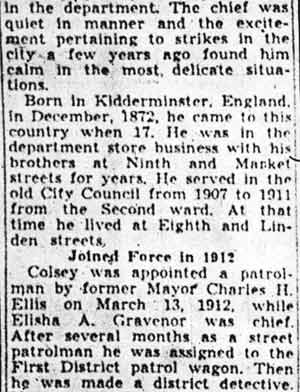
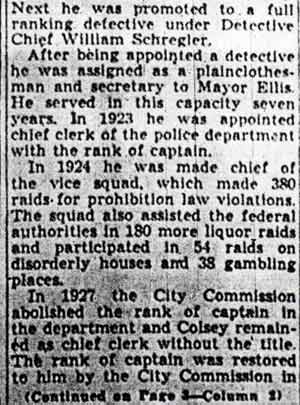
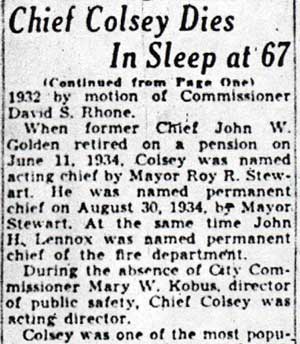
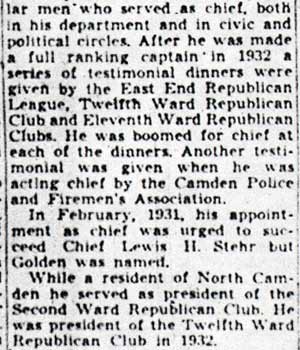
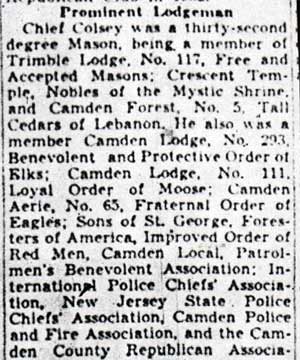
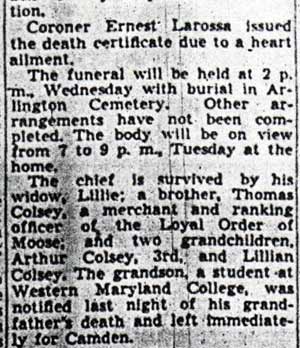
Police Head Succumbs During Sleep While Suffering From Cold
MEMBER OF FORCE IN CAMDEN 27 YEARS
Chief of Police Arthur Colsey, veteran of 27 years in the department, died of a heart attack in his sleep at his home, 2937 Stevens street, last night. He was 67.
Apparently in good health except for a slight cold, Chief Colsey left his office in City Hall at noon yesterday, telling his assistants he was going home “to nurse the cold.”
Shortly after 5 p. m., Chief Colsey asked his son, Arthur, Jr., to take Mrs. Colsey on a shopping trip. When they returned two hours later, they found him dead on a couch. The son said his father told him he was going to take a nap before he went to a doctor’s office to receive treatment for the cold.
Chief Colsey was a Camden merchant before entering the police department. For years he was active in the Republican party. He was highly respected by all men in the department. The chief was quiet in manner and the excitement pertaining to strikes in the city a few years ago found him calm in the most delicate situations.
Born in Kidderminster, England, in December, 1872, he came to this country when 17. He was in the department store business with his brothers at Ninth and Market streets for years. He served in the old City Council from 1907 to 1911 from the Second ward. At that time he lived at Eighth and Linden streets.
Joined Force in 1912
Colsey was appointed a patrolman by former Mayor Charles H. Ellis on March 13, 1912, while Elisha A. Gravenor was chief. After several months as a street patrolman he was assigned to the First District patrol wagon. Then he was made a district detective. Next he was promoted to a full ranking detective under Detective Chief William Schregler.
After being appointed a detective he was assigned as a plainclothesman and secretary to Mayor Ellis. He served in this capacity seven years. In 1923 he was appointed chief clerk of the police department with the rank of captain.
In 1924 he was made chief of the vice squad, which made 380 raids for prohibition law violations. The squad also assisted the federal authorities in 180 more liquor raids and participated in 54 raids on disorderly houses and 38 gambling places.
In 1927 the City Commission abolished the rank of captain in the department and Colsey remained as chief clerk without the title. The rank of captain was restored to him by the City Commission in 1932 by motion of Commissioner David S. Rhone.
When former Chief John W. Golden retired on a pension on June 11, 1934, Colsey was named acting chief by Mayor Roy R. Stewart. He was named permanent chief on August 30, 1934, by Mayor Stewart. At the same time John H. Lennox was named permanent chief of the fire department.
During the absence of City Commissioner Mary W. Kobus, director of public safety, Chief Colsey was acting director.
Colsey was one of the most popular men who served as chief, both in his department and in civic and political circles. After he was made a full ranking captain in 1932 a series of testimonial dinners were given by the East End Republican League, Twelfth Ward Republican Club and Eleventh Ward Republican Clubs. He was boomed for chief at each of the dinners. Another testimonial was given when he was acting chief by the Camden Police and Firemen’s Association.
In February, 1931, his appointment as chief was urged to succeed Chief Lewis H. Stehr but Golden was named.
While a resident of North Camden he served as president of the Second Ward Republican Club. He was president of the Twelfth Ward Republican Club in 1932.
Prominent Lodgeman
Chief Colsey was a thirty-second degree Mason, being a member of Trimble Lodge, No. 117, Free and Accepted Masons; Crescent Temple, Nobles of the Mystic Shrine, and Camden Forest, No. 5, Tall Cedars of Lebanon. He also was a member Camden Lodge, No. 293, Benevolent and Protective Order of Elks; Camden Lodge, No. 111, Loyal Order of Moose; Camden Aerie, No. 65, Fraternal Order of Eagles; Sons of St. George, Foresters of America, Improved Order of Red Men, Camden Local, Patrolmen’s Benevolent Association; International Police Chiefs’ Association, New Jersey State Police Chiefs’ Association, Camden Police and Fire Association, and the Camden County Republican Association.
Coroner Ernest Larossa issued the death certificate due to a heart ailment.
The funeral will be held at 2 p. m., Wednesday with burial in Arlington Cemetery. Other arrangements have not been completed. The body will be on view from 7 to 9 p. m., Tuesday at the home.
The chief is survived by his widow, Lillie; a brother, Thomas Colsey, a merchant and ranking officer of the Loyal Order of Moose; and two grandchildren, Arthur Colsey, 3rd., and Lillian Colsey. The grandson, a student at Western Maryland College, was notified last night of his grandfather’s death and left immediately for Camden.