Introduction
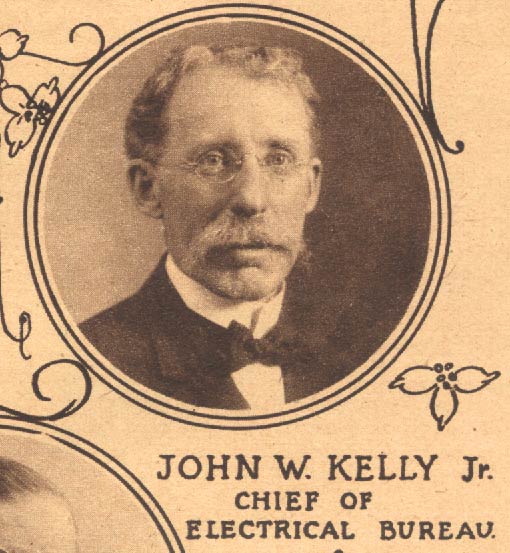
John W. Kelly Jr., circa 1926
JOHN W. KELLY JR. was chief of Camden’s Electrical Bureau in the 1910s and 1920s. He came to Camden in the 1890s, and was in the city’s employ as Chief by 1914, remaining in that position through at least the summer of 1926.
As Chief of the Electrical Bureau, his duties included installation and maintenance of the fire alarm call boxes throughout the city, a critically important task in a time where telephones were an expensive luxury for many homeowners and small businesses. He also had the task of installing and maintaining traffic signals.
By January of 1928, John W. Kelly Jr. was succeeded by James A. Howell, who held the post as late as 1947.
Police Commissioners Impressed by Electrical Bureau
Philadelphia Inquirer —

Police Commissioners William H. C. Whitner and William J. Bonner, of Hartford, Conn., were greatly impressed yesterday on being shown the electrical bureau and outfit by Chief Kelly.
Celebrations by 3 Fire Companies
Camden Post-Telegram —
CELEBRATIONS BY 3 FIRE COMPANIES
No. 7, Headquarters and No. 1 Truck Make Merry at Respective Homes.
CHIEF ELFRETH MAKES ADDRESS
Engine Company No. 7 is the baby company of the fire department, that is, in years of service, but in up-to-date completeness in every respect, harmony and quick response to duty, the men in blue out Kaighn avenue, under Captain Charles Todd, are right there on the tap of the gong. Captain Todd is a stickler for good feeling among his men for the good of the service, and at a New Year’s Eve banquet this unanimity of good fellowship was strongly manifested.
It was the first New Year’s blowout given by Company 7 and the guests had as grand a time as if they were gathered about their own firesides at home. From door to roof, the firehouse was ablaze with a glow of the holiday and patriotic spirit. Flags, festoons of green, Christmas bells, and lights gladdened all hearts and a Christmas tree glistening with tinsel and topped with an electric bulb gave the banquet hall a homelike air. Over the tree was the gladsome greeting, “Merry Christmas and Happy New Year.”
Fifteen guests sat down to the festive board. In the centre of the table glowed in a big fireman’s horn a big bunch of electric lit American Beauties and from one end of the board to the other it was one sweep of delicacies, turkey, raw and fried oysters, stuffing chicken salad, cake, pie and a lot of other luxuries that make life happier as far as the inner man is concerned.
Chief Kelly presided at the head of the table and made a genial toastmaster. Chief Kelly supplied the electrical effects with his usual aptness. “Brother” Lutz said a short and timely prayer and then the guests sat down and for two hours were regaled with all the palatable good things of the season of good cheer. Cigars of pungent aroma being passed around, “Jim” Nevins and George Boone entertained delightfully with graphophone selections, including “Has Anyone Here Seen Kelly?” He was there.
With the midnight hour came the blowing of factory whistles and the tolling of bells. And from below in the firehouse came a terrific clangor and clash and gongs and bells. The firemen instinctively made for the sliding pole, but soon came back a-laughing. It was only Chief Kelly and Chief Chef Lutz ringing in the first alarm of the New Year, No. 1-9-1-3.
Those who had the great pleasure to participate in this most happy affair are as follows:
City Electrician John W. Kelly, Jr., Captain Charles Todd, Lieutenant John Lutz, Engineer William Busine, Stoker James Nevins, Drivers Richard Marter and Joseph Sparks, Hoseman George Boone, Roy Smith and Edward Simpson, and as welcome guests, Richard Saeur, John Watson, Albert Glanders, William Robinson and Harry Knowles, the faithful houseman of No. 7.
Chief Elfreth and Assistant Chiefs Cox, Stockton, Wade and Browning, were to have been there, but business on a holiday kept them at Headquarters awaiting alarms.
AT HEADQUARTERS.
Under the auspices of the Wishbone Club, firemen at headquarters, Fifth and Arch streets, held their annual dinner on Tuesday evening. Cheer and good-fellowship was the by word and the fire laddies and their friends made the evening one long to be remembered.
A short address was given by Chief Elfreth and Assistant Chief Stockton. John Dold offered prayer before the guests partook of the tasty dishes as prepared by Arthur Wingate and William Laud. The table presented an attractive appearance and the laddies and guests greatly enjoyed the fine spread. The menu follows:
Roast Sweet Potatoes, Peas, Cranberry Sauce, Mince Pie, Coffee, Cigars, Aqua De Lair, Olives, Beets, Celery, Roast Turkey, Oyster Filling, Giblet Sauce, Mashed White Potatoes.
Those participating were as follows: S. S. Elfreth, John S. Stockton, Captain George B. Wade, Lieutenant Jos. Ernest, John A. Dold, Josiah Sage, Daniel Smith, Arthur Wingate, Joseph Johnson, Harry Hankins, William Laird, William Elberson, John Lennox, Martin Carrigan, Charles Cook, Harry Belby, Harry Khrier, Charles Menke, Edward S. Gahan, D. P. McConnell.
With a fine feed, a grand graphophone concert, songs and speeches of a happy and humorous order, “the Jolly Nine” saw the old year out and the New Year in, at the house of Hook and Ladder Truck No. 1, on Fifth street above Arch street. Accoutred in their uniforms of blue, ready at a second’s tap of the gong to jump on the truck, the brave laddies and friends formed a happy picture of congeniality. The menu was most appetizing. Beginning with oysters on the shell and winding up with a delicious dish designated “Creme-a-la-Truck,” the guests were kept busy munching their molars, as the sedate and genial waiters, togged out in linen of spotless white. William Howell Tatem and “Chief” Harry Anderson did the elegant. Stewart Bakely, a slick Cooper river boat house cook from away back, was the popular chef of the feast, and that grand old fire hero, Captain “Joe” Maxwell, the Commander-in-Chief of festivities, who saw to it that no one got left as the plates passed around.
The floral and holiday decorations of the banquet hall were munificent and in happy accord with the gracious and good-natured gathering.
Kelly Elected President of International Association of Municipal Electricians
Philadelphia Inquirer —

John W. Kelly, chief of the Electrical Bureau, was elected president of the International Association of Municipal Electricians at the annual convention in Watertown, N. Y., this week.
Thousands View Chief’s Remains
Camden Post-Telegram —
Throngs Jam Court House While Body Lies in State for Two Hours.
LAST SAD RITES THIS AFTERNOON
Not since the memorable funeral of Chief of Police Foster ten years ago, has there been such a genuine public tribute paid an official of Camden as was in evidence last night at the bier of the lamented Fire Chief Worthington, and today at his funeral. It is hard to estimate the number of persons in a crowd, but from 7 until 9 o’clock last night there was a steady stream of men, women and children, two abreast, who passed from the main entrance, through the center corridor and beneath the illuminated rotunda, where the body lay, and thence out by the west corridor. There was never a stop, and it is estimated that at least 10,000 persons were there, perhaps more.
There could not have been a more ideal location for the repose of the casket containing the honored dead, and the great array of beautiful flowers than beneath the rotunda. It seemed to be a sacred shrine in itself where the citizenry dropped a tear for the lamented departed. The effulgence of the soft lights from above specially installed by Electrical Chief Kelly but lent to the scene and as the dark garbed escort of firemen, the active pall bearers, stood on guard, the scene was unusually impressive.
Chief Worthington, aside from the pallor that comes to the dead, looked as he did in life, for the thread had been snapped so quickly that it was while he was in his full vigor that the vital spark had taken its flight. There were some marks on his face that indicated the intense though momentary suffering through which he passed on his fateful plunge from the roof of the burning building to his quick death, and the passing crowd remarked this. But withal there was that calmness and repose feature which seemed to indicate that the gallant leader of Camden’s fire fighters but lay sleeping rather than that his soul had taken its eternal flight.
Public grief may be a mere ephemeral emotion, born of the moment and only to be succeeded by the acclaim of the newly arisen public idol, but last night’s encomiums seemed to come from hearts that overflowed with genuine and permanent sorrow over the untimely passing of so excellent a public servant. Many tear-suffused eyes indicated this, many expressions of grief, of sorrow, of condolence of those left showed this. The sentiment in evidence everywhere can only be likened to the sweetness of the wonderful flowers whose odor spread through all the corridors and in all the rooms of the great marble building.
High in the clock tower of the City Hall the bell began tolling at 6:30 o’clock. At half-minute intervals its doleful strains went forth on the cold blustery east wind which had succeeded at day of spring sunshine. The bell and the screeching wind seemed to combine as a knell indicating the passing grief of the city. It was the preliminaries to the marching of the funeral cortege from the stricken Chief’s home on Penn Street to the resting place at the Court House.
There were forty policemen in dress uniform with Chief Gravenor at their head. There were twenty-six fire heads from Philadelphia, with Chief William Murphy in the van, a tribute in itself of more than passing moment. There was the caisson on which was the black draped casket containing the body of he who all honored. There was the little red car in which Chief Worthington was wont to speed through the city at every alarm and there was his helmet and coat. There was Acting Chief Stockton and forty of the men who fought flames under the direction of he who lay so still. There was the family in cabs with curtains drawn, the members of City Council and the active pall bearers— Daniel Leach, Peter B. Carter, James White, William Patterson, Elmer Burkett, Samuel Harring.
When the cortege reached the Court House the Camden boys took up their position on the inside beneath rotunda while the Philadelphia visitors made an imposing array on the granite steps outside. And then came the public in its steady and unending stream.
Later the Philadelphia delegation was escorted to the Board of Freeholders room where tribute was paid to the dead and where a mingling of the two cities took place. Besides Chief Murphy the visitors included Battalion Chiefs William T. Barrett and George P. McConaghy, Captains L. F. Bunting, William Lindsey; H. Dinlocker, J. Higginson, J. E. Talbot, D. Campbell, T. O’Brien, F. Hughes, E. Basenfelder; H. Hutt, William McCusker, G. Rheim, R. Wilsey, J. Webb, H. Goers, H. Haines, Insurance Patrol Captain Joseph H. Shermer William Hickman, William Rodgers, John Wyatt, David Phillip, John Clyde, H. Wilkinson.
President of City Council James E. Hewitt spoke of the work Chief Worthington had already accomplished, of his plans, of his value and worth to Camden. Chief Murphy responded in a fitting way and this incident in itself was one to be remembered.
An affecting sight was witnessed by the handful of spectators, among them being other firemen, city and county officials and policemen who remained after the big doors on Sixth Street had been closed. The last to view the Chief’s remains were a delegation of about twenty firemen. Solemnly the men passed by the bier and gazed upon the features of their departed brother.
As the last of the line approached Deputy Chief John A. Stockton was seen. He stopped and with his cap laid across his breast he looked down into the casket. For almost a minute Chief Stockton stood as though glued to the spot. Then he glanced about him and the sympathetic look upon his face thrilled all.
He heaved a sigh and perhaps the teardrops refused to come, but Chief Stockton, as the lines upon his face showed, was struggling with the inner man. His emotions were tugging at his heart, but a fire laddie cannot give way to his feelings although his brother superior officer and dear friend had answered his last alarm.
The floral pieces surrounding the bier bespoke the love, admiration and respect the donors held for the dead chief. One design particularly beautiful was a mammoth loving cup made of blossoms, flowers and roses. This was the token sent by members of City Council and other city officials.
Another was the design sent by the Electrical Bureau through Chief Kelly. The original fire box, No. 134, which was pulled on the night of the fire by Chief Worthington was enshrouded by roses, carnations and lilies.
A maltese cross standing several feet high and bearing the initials of the organization was the tribute sent by the Firemen’s Mutual Benevolent Association. Chief Worthington was president of this association.
The Camden police sent a large shield of flowers and Council members offered a vacant chair of roses. The New Jersey Auto Supply Company, No. 2 Engine Company and No. 1 Truck sent beautiful broken circles and a wreath was the offering from the employees of the Victor Talking Machine Company.
A broken circle from members of the Sixth Ward Republican Club and a wreath from his friends in the sixth precinct of the Second Ward were other beautiful pieces. West Collingswood and Collingswood firemen sent two beautiful floral circles and from the Loyal Order Legion a wreath was received.
Other offerings were from the Camden Liquor Dealers league, a beautiful circle from No. 6 Engine Company, in which house Chief Worthington was captain previous to his elevation to the office of chief; sprays from the Bethany M.E. Church, Ladies Auxiliary of the Loyal Order of Moose; a wreath from the pupils of the eighth grade Sewell school, and a spray from North Baptist Church. There also were designs from members of the family and friends, all of which bespoke the great love held for the departed fire chief.
The impressive services of the P.E. Church marked the last sad rites this afternoon at St. Paul’s Church. The guard of honor and city officials left Fire Headquarters at 1:20 and proceeded to the Worthington home and escorted the remains to the church, where services were conducted by the rector, Rev. R.E. Brestell, and Rev. H.O. Jones, rector of St. Stephen’s P.E. Church. Interment was made at Arlington.
The honorary pallbearers were Mayor Ellis, Hon. David Baird, Frank F. Patterson, John W. Bell, General John A. Mather, Melbourne F. Middleton Jr., Harry R. Reed, Arthur L. Jones, Robert Gordon, David Jester, George Schneider, William Mills, J.O. Grear, William Hall, George L. Bender, and James E. Hewitt.
Urges Fire Precautions
Philadelphia Inquirer —
Electrical Chief Kelly, of Camden, yesterday issued a warning to all manufacturers to exercise more than ordinary fire precautions during the five days of being closed. They have been asked to keep their sprinkler systems from freezing. Everything is in shape at the bureau for any emergency, it was announced.
Fireman Is Suspended for Being Intoxicated
Camden Daily Courier —
Roscoe Tribbett, a hoseman attached to Engine company No. one, Fourth and Pine streets, was suspended this morning following a charge of being drunk and disorderly while on duty, preferred by Captain W. Scott Franklin.
Tribbett, who lives at 1190 Penn street, was summoned to appear at Commissioner Hitchner’s office, City Hall, this morning, for a hearing. A committee composed of John W. Kelly, Chief of Electrical Bureau, acting in Commissioner Hitchner’s absence, Chief Marshall, Captain Franklin, and Assistant City Councillor Frank Neutze.
Tribbett was ordered suspended to await action upon the return of Commissioner Hitchner, who is ill.
Philadelphia–Camden Police Baseball Game
Camden Courier-Post —
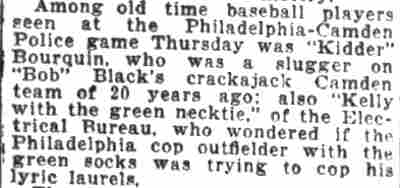
Among old time baseball players seen at the Philadelphia-Camden Police game Thursday was “Kidder” Bourquin, who was a slugger on “Bob” Black’s crackajack Camden team of 20 years ago; also “Kelly with the green necktie,” of the Electrical Bureau, who wondered if the Philadelphia cop outfielder with the green socks was trying to cop his lyric laurels.
A False Alarm of Long Ago
Camden Courier-Post —
Spectacular Run of Firemen and Steeds in ‘79 When First Alarm System Was Given Try-out
THERE were two alarms of fire Saturday evening, one at Fourth and Hamilton streets at 8:29 o’clock, and another at the West Jersey Ferry, an hour later. People in the vicinity of the first-named place turned out to look at the machines propelled at lightning speed by snorting equines, and wondered what it was all about; and some of them thought the wide-awake fire boys were beside themselves, as they asked, for the particular house, in the neighborhood of box 24 upon which, with steam up, their apparatus was able to put on, the water. The firemen and people were quietly informed by a party that drove away in a barouche that it was a designed deception.
Under date of October 6, 1879, that was the introduction to a two-column story under a display headline. But, it was, a single line—“False Alarms.” Readers of the period must have been as much mystified as were the firemen and citizens mentioned in the article, for it was not until more than half a column had been devoted to that incident that the public was let into the great secret. It was a test of the first fire alarm system introduced into Camden.
Interest in that incident is revived by the city commissioners last week entering into a contract with that same concern to install in the new City Hall a system for somewhat more than $51,000. That first “system” cost the city $2000 but it was a big sum then and just about 10 times more space was devoted to it in the old Post than in the Courier-Post last Thursday week.
Paid Department 10 Years Old
Camden’s paid fire department in 1879 was just 10 years old. It already was winning approval of even the recalcitrants, who had asserted back in 1869, that the old volunteer companies would certainly be missed; that the “professionals” would not have as much interest in putting out a fire as the boys who ran with the Perseverance, the Weccacoe and other organizations, usually bitter rivals. Not infrequently the volunteers battled over hooking up their hose while the fire burned, a event by no means outgrown since that occasionally happens even now, as files of the newspapers prove.
But on that Saturday night 54 years ago, it developed that those who drove away in the mysterious barouche were J. W. Morgan, Crawford Miller and F. P. Pfeiffer; fire commissioners of city council, along with R. S. Bender and Thomas Beatty. They were but carrying out orders to see that the system worked and it was John T. Bottomley who issued those orders. He was Camden’s big mill owner but more to the purpose in that particular incident, president of city Council. He had approved the fire alarm system but did not intend putting his O. K. on that $2000 bill until he had seen it in practical operation.
So unknown to the firemen, and the citizens as well, it was determined to test that system by way of turning in the alarms. So an alarm was pulled at 8:29 and “Bart” Bonsall, son of Henry L. Bonsall, publisher of the Post, narrates, in just 15 seconds flat the bell was sounded at No. 1 Engine House at Fourth and Pine Street. In two minutes hose cart No. 1 went bounding out with Driver George Hunt at the reins, followed by Ben Cavanaugh and his faithful nag “Jim” with cart No. 2. Then came Jake Kellum and William Davies with the engine No. 2 drawn by “Dolly” in 2.45. After that was engine No. 1 driven by Edmund Shaw and the horse “Alec,” coming along in 3 minutes and 5 seconds. It was explained Shaw was held up by the sandy roadway at Fourth and Line.
Spectacular Sight
Anyhow, it must have been a great sight for the old-time families who then resided along the Middle Ward Streets as the racing steeds bounded over Fourth Street, then into Third over a mighty bumpy roadway.
But they arrived and vainly sought the blaze. It was while they were hunting that the barouche came along and the commissioners let them into the great secret. “Bart” doesn’t relate what the firemen said about the false alarm, but, like as not the heat of their expressions was a good substitution for the fire they failed to find.
The system was one of those nine-day wonders that had the town on its toes. Everybody listened for the alarms in those days, for when they were sent in the bells in the fire houses pealed the number of the box. The strokes could be heard surprisingly far. Since there were but 11 boxes it was not long before many knew just where the fire was located and made a bee line for the scene. Old volunteers, particularly, never quite lost their interest in fires and, whenever they heard the alarm, hot footed it to the scene of excitement.
That was all right when Camden was little more than a village, but as the community grew it became a serious proposition, since the racing citizens often interfered with the firemen. Thus about 30 years ago the fire bells were silenced. Now none know of an alarm coming in save the various houses and the Courier-Post which has a wire attached from headquarters bringing in the alarms so that reporters and cameramen may get on the scene quickly as possible.
Ordinarily, little thought is given to the need for instant and accurate sounding of an alarm made possible through the expert work of City Electrician Jim Howell and his aides. If it were not for that perfection and the speed with which friends reach the scene the losses would be large. And the insurance companies would be around with a “pink slip” as they were some 20 years ago. That meant a 25 percent addition to fire rates. Camden’s motorized department plus the work of City Electrician John W. Kelly soon rid the city of that “slip.”
That system of long ago didn’t include the cops. Now it takes in both departments, as it has done since the days of Chief Samuel Dodd, back in the early 90’s.
John W. Kelly Rites to Be Held Today
Camden Courier-Post —
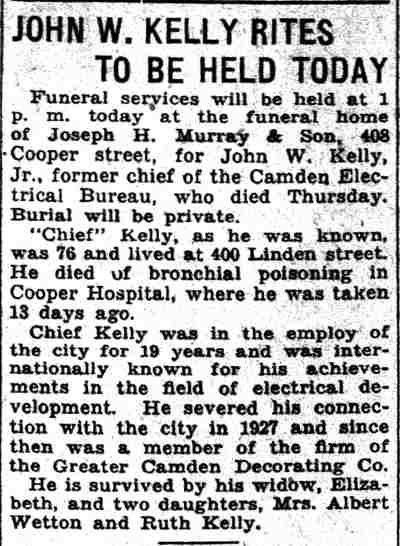
Funeral services will be held at 1 p. m. today at the funeral home of Joseph H. Murray & Son, 408 Cooper street, for John W. Kelly, Jr., former chief of the Camden Electrical Bureau, who died Thursday. Burial will be private.
“Chief” Kelly, as he was known, was 76 and lived at 400 Linden street. He died of bronchial poisoning in Cooper Hospital, where he was taken 13 days ago.
Chief Kelly was in the employ of the city for 19 years and was internationally known for his achievements in the field of electrical development. He severed his connection with the city in 1927 and since then was a member of the firm of the Greater Camden Decorating Co.
He is survived by his widow, Elizabeth, and two daughters, Mrs. Albert Wetton and Ruth Kelly.