Introduction
Sitley & Son was founded by Arthur M. Sitley and his son Frank Budd Sitley. The Sitleys were farmers who saw opportunity in Camden, selling grain, feed and farm equipment. In 1886 they bought the business of Elias Kaighn, located at 128 Kaighn Avenue.
In 1894 the Sitleys built a grain elevator and warehouse on the south side of Chelton Avenue between Fillmore Street and South 6th Street. The plant burned in 1905, was rebuilt. The Sitleys also owned a sister company, Gloucester Grain and Dairy Feed Company, which had a grain elevator and warehouse in Gloucester City in the mid-1900s.
Arthur M. Sitley in time left the running of the business to his son. He passed away on May 12, 1911 at the age of 76. Sadly, longevity was not granted to his son. Frank Budd Sitley died in 1915 of pneumonia in his 53rd year. His wife, the former Ada Smith, and eventually his sons, took over the business, and ran it successfully for over forty years.
The Sitley & Son grain elevator and warehouse was again destroyed by fire in 1920. After this fire the Sitleys rebuilt their warehouse once again. They did not rebuild the grain elevator, and in time they branched into the roofing supplies business. Once again fire struck, in April of 1930, causing an estimated $45,000 worth of damage.
Sitley & Son went out of business in 1959. By 1962 the building had been razed.
Sitley & Son Postcard
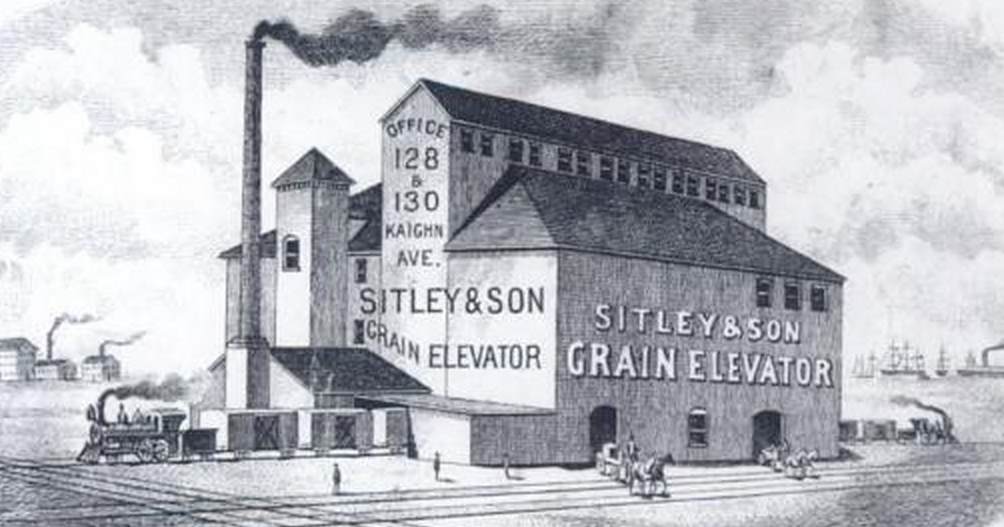
Sitley & Son — Camden, N.J.
Historical & Industrial Review of Camden, N.J. — 1890
Sitley & Son, Flour, Feed, Seeds and Grain, 128 Kaighn’s Avenue
The City of Camden has for a period past, been identified with the flour and grain trade, as a distributing point to the consumer of these products, and her merchants in this branch of commercial pursuit, enjoy a widespread reputation for the facilities they have introduced as a means of supplying the trade with fresh and choice goods.
One of the oldest establishments in this section is that founded by E.B. Kaighn in 1879, and succeeded by the present firm in 1886.
The office and warehouse occupied for business purposes, stands on a plot 40 x 125 feet in area. Every facility is here enjoyed for the prompt handling of grain and feed.
The various apartments are supplied with bins, shutes, elevators, scales etc., and all the modern accessories known to the trade are here enjoyed, Telephone No. 48, being in use.
A heavy stock embracing fine family and bakers’ flour in bag or barrel, meal, mill feed, oats, corn, rye, barley, wheat, and farm seeds of every description, as well as implements. Oats are a specialty.
The trade is wide-spread and growing, and all the transactions are characterized by liberality and equity. In the successful prosecution of the business eleven assistants are employed, and two double and one single team, utilized for hauling and delivery purposes.
A. M. & F. B. Sitley, are the individual members of the firm, both gentlemen are natives of New Jersey, and prior to engaging in their mercantile venture, pursued the avocation of agriculturists.
Since establishing here, they are regarded high in commercial circles, as responsible dealers, progressive, enterprising citizens, who enjoy the confidence of all with whom they have business relations, and well merit the success attending their efforts.
Business Men in Line
Philadelphia Inquirer —
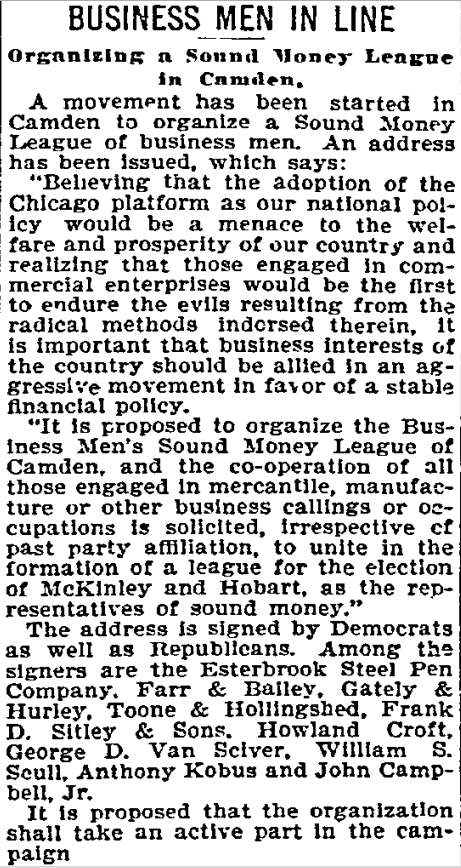
Organizing a Sound Money League in Camden.
A movement has been started in Camden to organize a Sound Money League of business men. An address has been issued, which says:
“Believing that the adoption of the Chicago platform as our national policy would be a menace to the welfare and prosperity of our country and realizing that those engaged in commercial enterprises would be the first to endure the evils resulting from the radical methods indorsed therein, it is important that business interests of the country should be allied in an aggressive movement in favor of a stable financial policy.
“It is proposed to organize the Business Men’s Sound Money League of Camden, and the co-operation of all those engaged in mercantile, manufacture or other business callings or occupations is solicited, irrespective of past party affiliation, to unite in the formation of a league for the election of McKinley and Hobart, as the representatives of sound money.”
The address is signed by Democrats as well as Republicans. Among the signers are the Esterbrook Steel Pen Company, Farr & Bailey, Gately & Hurley, Toone & Hollingshed, Frank D. Sitley & Sons, Howland Croft, George D. Van Sciver, William S. Scull, Anthony Kobus and John Campbell, Jr.
It is proposed that the organization shall take an active part in the campaign
Philadelphia Inquirer — April 21, 1900
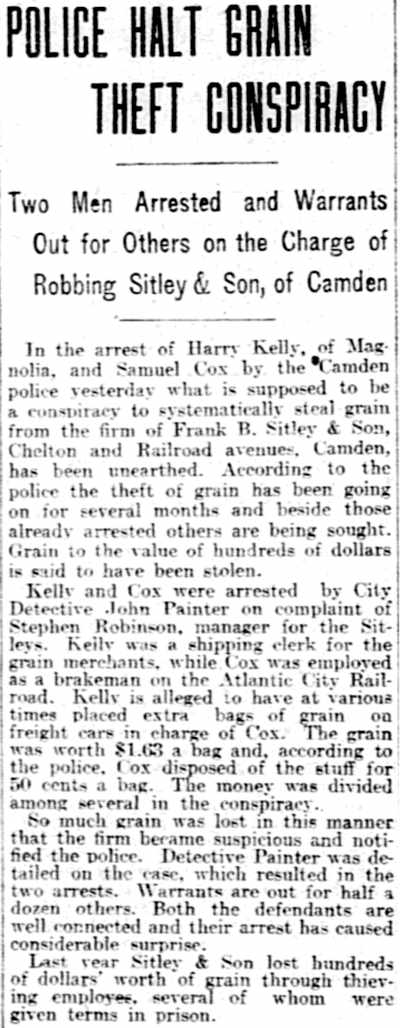
Police Halt Grain Theft Conspiracy
Two Men Arrested and Warrants Out for Others on the Charge of Robbing Sitley & Son, of Camden
In the arrest of Harry Kelly, of Magnolia, and Samuel Cox by the Camden police, an attempt to suppress a ring to systematically steal grain from the firm of Frank B. Sitley & Son, of Chelton Avenue and Railroad Avenue, Camden, has been unearthed. According to the police the theft of grain has been going on for several months and beside those already arrested others are being sought. Grain to the value of hundreds of dollars is said to have been stolen.
Kelly and Cox were arrested by City Detective John Painter on complaint of Stephen Roberts, foreman for the Sitleys. Kelly was a shipping clerk for the firm on four occasions. Cox was employed as a brakeman on the Atlantic City Railroad.
Sitley & Son lost hundreds of dollars' worth of goods in the conspiracy.
Philadelphia Inquirer — February 21, 1905
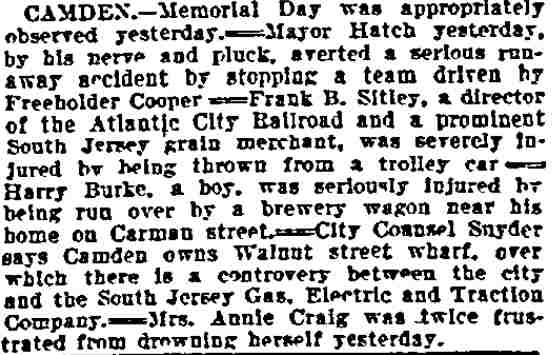
Camden. — Memorial Day was appropriately observed yesterday. — Mayor Hatch yesterday, by his nerve and pluck, averted a serious runaway accident by stopping a team driven by Freeholder Cooper — Frank B. Sitley, a director of the Atlantic City Railroad and a prominent South Jersey grain merchant, was severely injured by being thrown from a trolley car — Harry Burke, a boy, was seriously injured by being run over by a brewery wagon near his home on Carman Street — City Counsel Snyder says Camden owns Walnut street wharf, over which there is a controversy between the city and the South Jersey Gas, Electric and Traction Company. — Mrs. Annie Craig was twice frustrated from drowning herself yesterday.
Philadelphia Inquirer — September 21, 1902
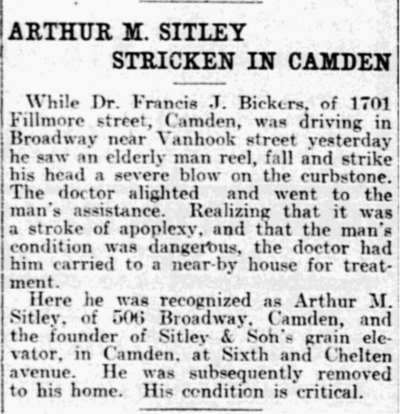
Arthur M. Sitley Stricken in Camden
While Dr. Francis J. Bickers, of 1701 Fillmore Street, Camden, was driving in Broadway near Vanhook Street yesterday he saw an elderly man reel, fall and strike his head a severe blow on the curbstone. The doctor alighted and went to the man’s assistance. Realizing that it was a stroke of apoplexy, and that the man’s condition was dangerous, the doctor had him carried to a nearby house for treatment. Here he was recognized as Arthur M. Sitley, of 506 Broadway, Camden, and the founder of Sitley & Son’s grain elevator, in Camden, at Sixth and Chelton avenue. He was subsequently removed to his home. His condition is critical.
Philadelphia Inquirer — April 25, 1903
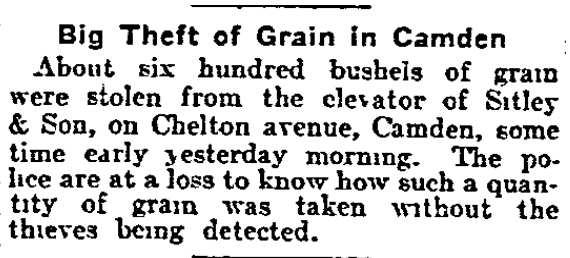
Big Theft of Grain in Camden
About six hundred bushels of grain were stolen from the elevator of Sitley & Son, on Chelton Avenue, Camden, some time early yesterday morning. The police are at a loss to know how such a quantity of grain was taken without the thieves being detected.
Philadelphia Inquirer — April 24, 1905
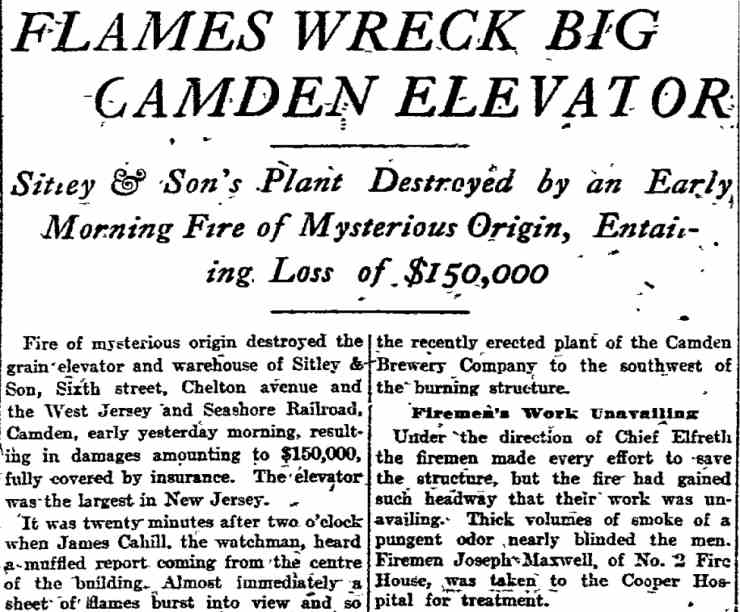
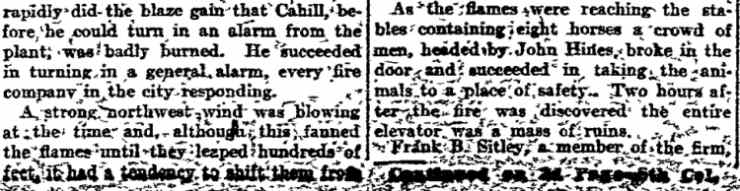
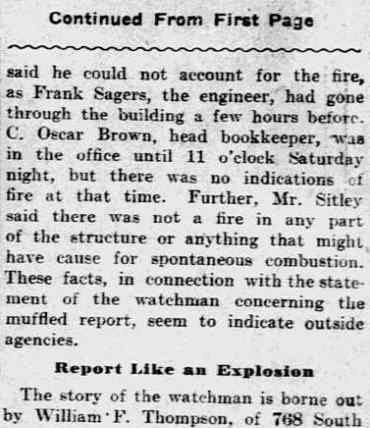
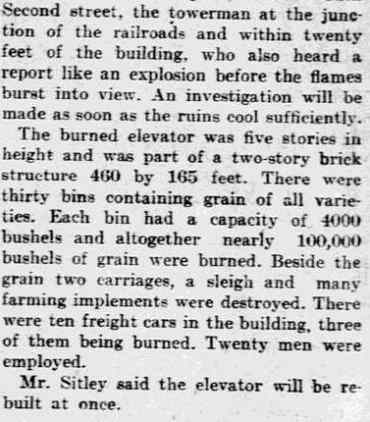
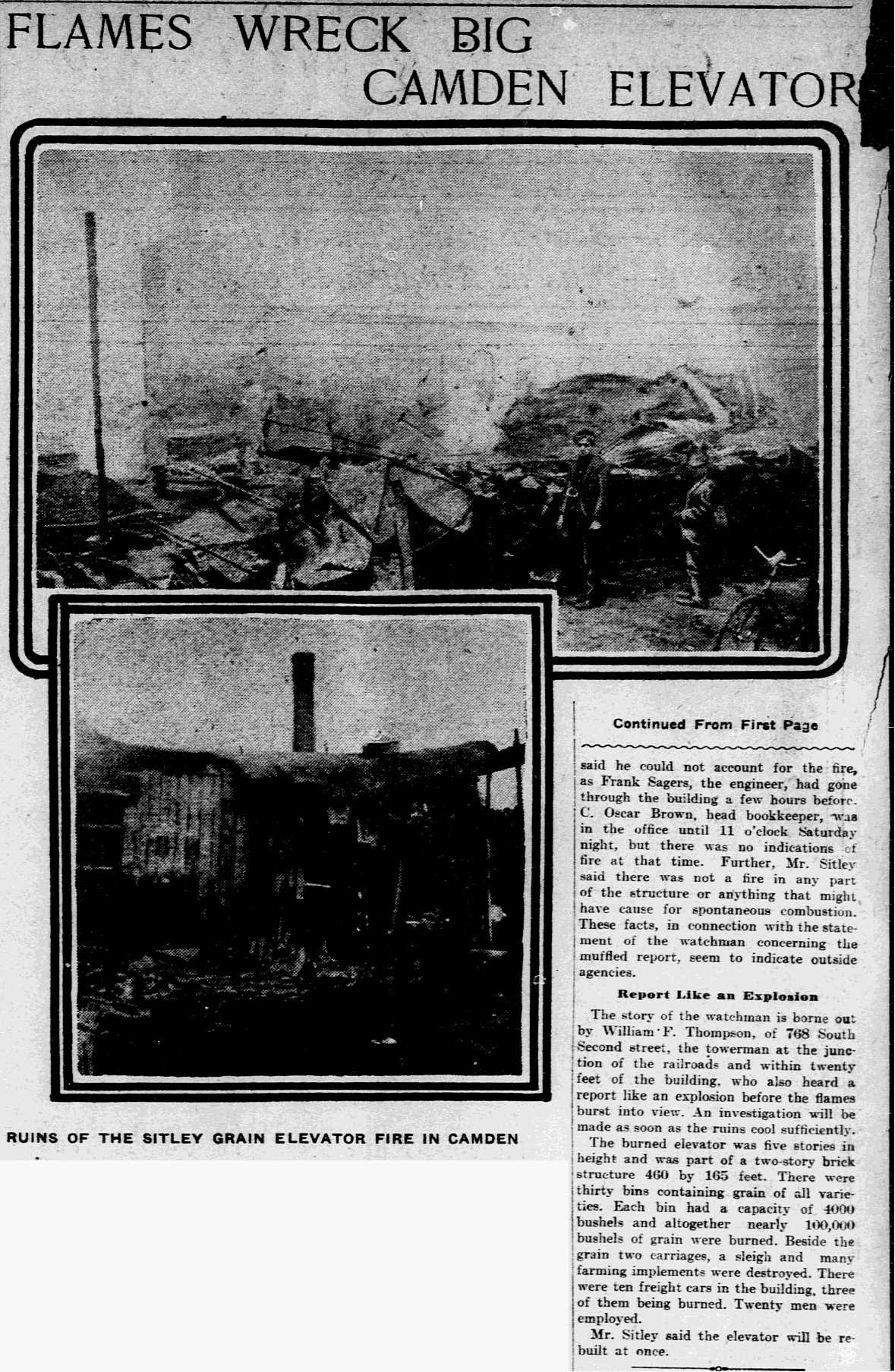
Flames Wreck Big Camden Elevator
[Continued From First Page — photo of ruins with caption "RUINS OF THE SITLEY GRAIN ELEVATOR FIRE IN CAMDEN"]
said he could not account for the fire, as Frank Sagers, the engineer, had gone through the building a few hours before. Oscar Brown, head bookkeeper, was in his office until 11 o'clock and [had passed] the scene of the fire at that time. Further, Mr. Sitley said there was not a fire in any part of the building [at that time]. These facts, in connection with the vagueness of the watchman concerning the muffled report [strongly indicated an explosion].
Report Like an Explosion
The report of the watchman is borne out by William F. Thompson, of 700 South Second street, who lives near the location of the railroad and within twenty feet of the building, who also heard a report like an explosion before the flames broke into view. An investigation will be made at once by the proper authorities.
The burned elevator was five stories in height and was part of a two-story brick building... thirty bins containing grain of all varieties. Each bin had a capacity of 2,000 bushels and altogether nearly 100,000 bushels of grain were burned. Beside the grain, which was heavily insured, much farming implements were destroyed. There were ten freight cars in the building, three of them being burned. Twenty men were employed...
The owners of the elevator will rebuild at once.
Philadelphia Inquirer — February 21, 1905
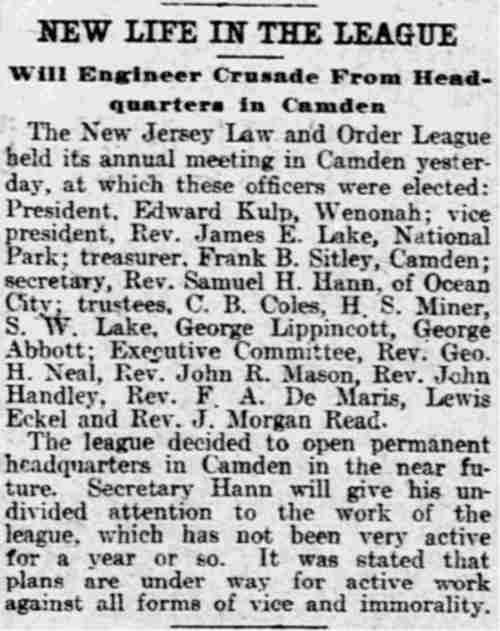
New Life in the League
Will Engineer Crusade From Headquarters in Camden
The New Jersey Law and Order League held its annual meeting in Camden yesterday, at which these officers were elected: President, Edward Kulp, Wenonah; vice president, Rev. James E. Lake, National Park; treasurer, Frank B. Sitley, Camden; secretary, Rev. Samuel H. Hann, of Ocean City; trustees, C. B. Coles, H. S. Miner, S. W. Lake, George Lippincott, George Abbott; Executive Committee, Rev. Geo. H. Neal, Rev. John R. Mason, Rev. John Handley, Rev. F. A. De Maris, Lewis Eckel and Rev. J. Morgan Read.
The league decided to open permanent headquarters in Camden in the near future. Secretary Hann will give his undivided attention to the work of the league, which has not been very active for a year or so. It was stated that plans are under way for active work against all forms of vice and immorality.
Philadelphia Inquirer — April 26, 1905
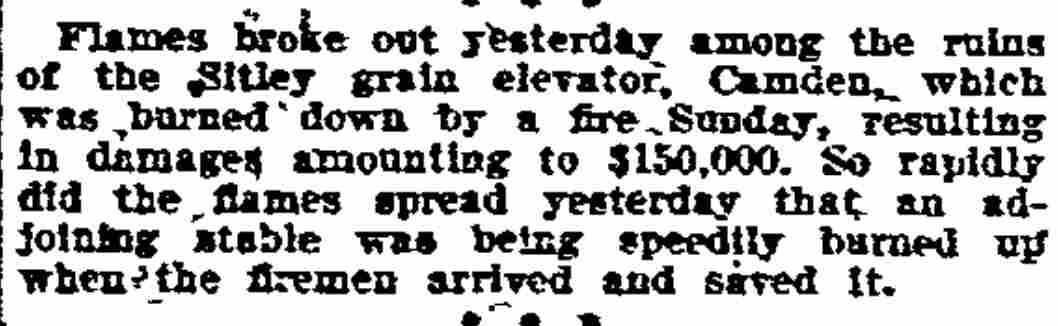
Flames broke out yesterday among the ruins of the Sitley grain elevator, Camden, which was burned down by a fire Sunday, resulting in damages amounting to $150,000. So rapidly did the flames spread yesterday that an adjoining stable was being speedily burned up when the firemen arrived and saved it.
1906 Sanborn Maps
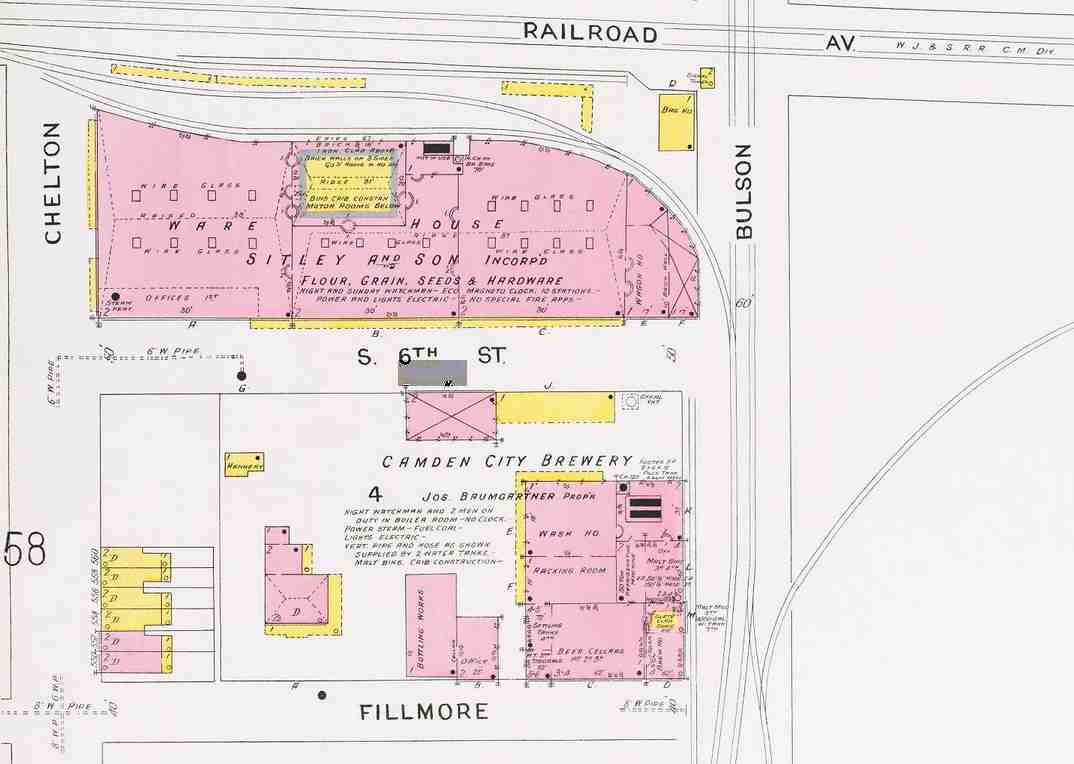
1906 Sanborn Maps — 550 block of Chelton Avenue
Philadelphia Inquirer — January 17, 1905
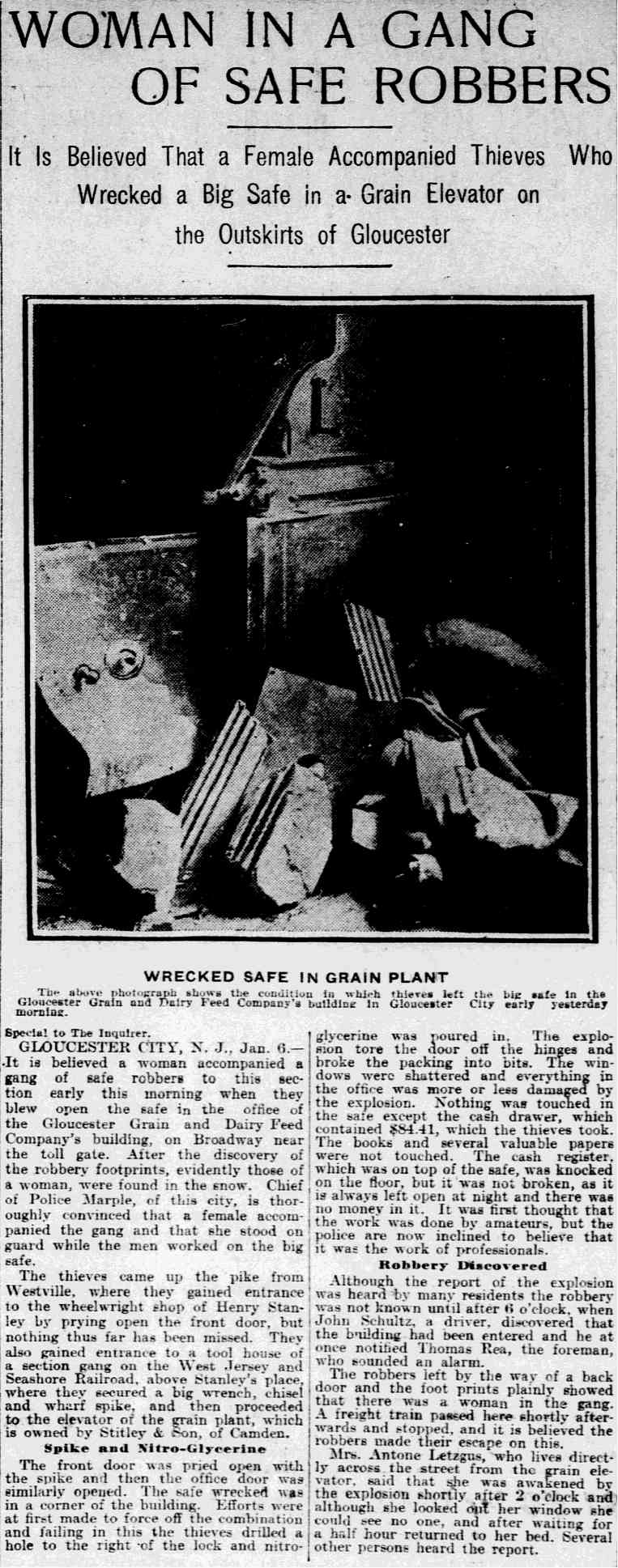
Woman in a Gang of Safe Robbers
It Is Believed That a Female Accompanied Thieves Who Wrecked a Big Safe in a Grain Elevator on the Outskirts of Gloucester
Philadelphia Inquirer — January 28, 1908
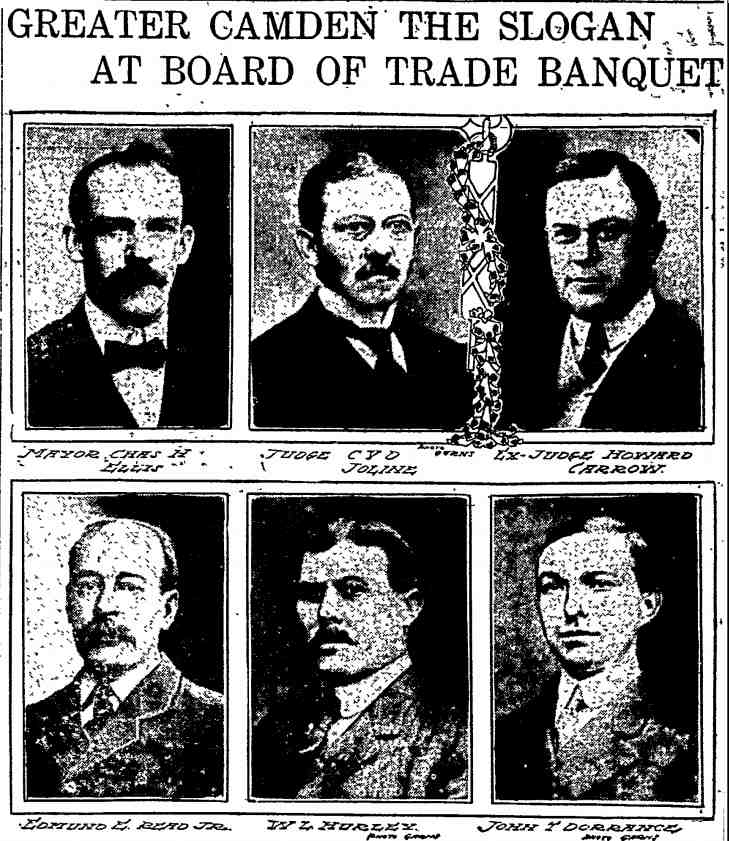
GREATER CAMDEN THE SLOGAN AT BOARD OF TRADE BANQUET
(Group photo: Mayor Chas H. Ellis, Judge C.V.D. Joline, Ex-Judge Howard Carrow, Edmund E. Read Jr., W.L. Hurley, John T. Dorrance)
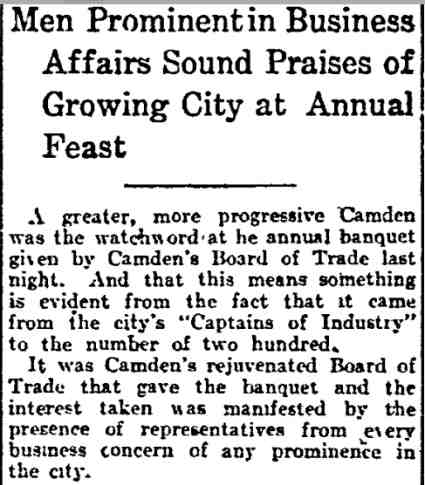
Men Prominent in Business Affairs Sound Praises of Growing City at Annual Feast
A greater, more progressive Camden was the watchword at he [sic] annual banquet given by Camden’s Board of Trade last night. And that this means something is evident from the fact that it came from the city’s “Captains of Industry” to the number of two hundred.
It was Camden’s rejuvenated Board of Trade that gave the banquet and the interest taken was manifested by the presence of representatives from every business concern of any prominence in the city.
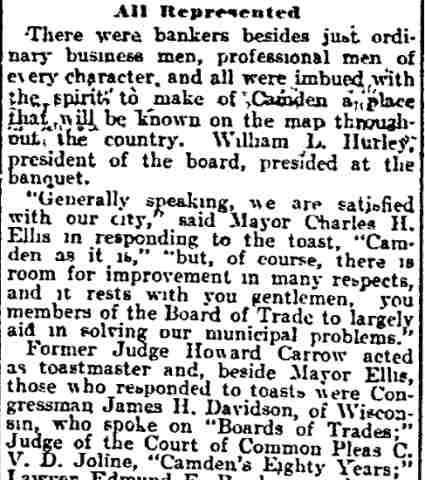
All Represented
There were bankers besides just ordinary business men, professional men of every character, and all were imbued with the spirit to make of Camden a place that will be known on the map throughout the country. William L. Hurley, president of the board, presided at the banquet.
“Generally speaking, we are satisfied with our city,” said Mayor Charles H. Ellis in responding to the toast, “Camden as it is,” “but, of course, there is room for improvement in many respects, and it rests with you gentlemen, you members of the Board of Trade to largely aid in solving our municipal problems.”
Former Judge Howard Carrow acted as toastmaster and, beside Mayor Ellis, those who responded to toasts were Congressman James H. Davidson, of Wisconsin, who spoke on “Boards of Trades;” Judge of the Court of Common Pleas C. V. D. Joline, “Camden’s Eighty Years;” Lawyer Edmund E. Read, president of the Board of Education, “Camden’s Future.”
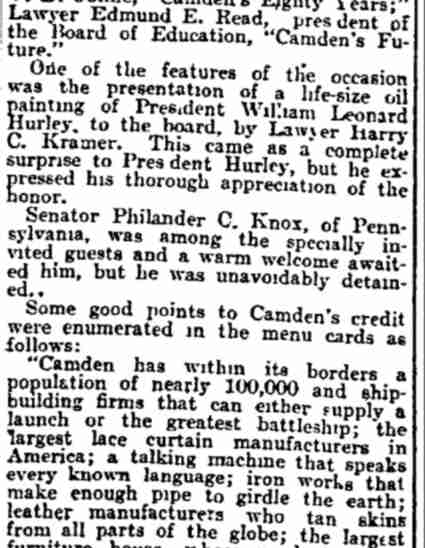
One of the features of the occasion was the presentation of a life-size oil painting of President William Leonard Hurley, to the board, by Lawyer Harry C. Kramer. This came as a complete surprise to President Hurley, but he expressed his thorough appreciation of the honor.
Senator Philander C. Knox, of Pennsylvania, was among the specially invited guests and a warm welcome awaited him, but he was unavoidably detained.. [sic]
Some good points to Camden’s credit were enumerated in the menu cards as follows:
“Camden has within its borders a population of nearly 100,000 and shipbuilding firms that can either supply a launch or the greatest battleship; the largest lace curtain manufacturers in America; a talking machine that speaks every known language; iron works that make enough pipe to girdle the earth; leather manufacturers who tan skins from all parts of the globe; the largest furniture house, whose products reach the Philippines; banks and trust companies whose resources are not affected by panics; artesian water that can be taken without adding anything.”
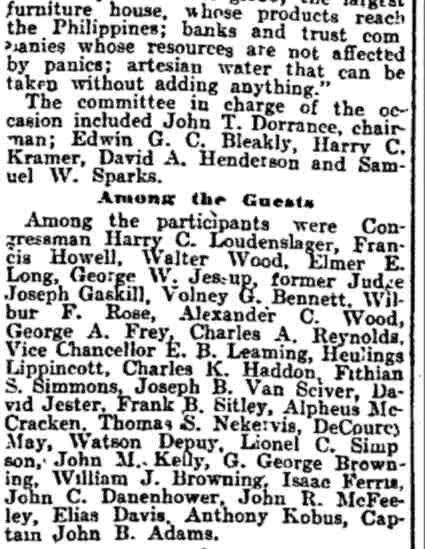
The committee in charge of the occasion included John T. Dorrance, chairman; Edwin G. C. Bleakly, Harry C. Kramer, David A. Henderson and Samuel W. Sparks.
Among the Guests
Among the participants were Congressman Harry C. Loudenslager, Francis Howell, Walter Wood, Elmer E. Long, George W. Jessup, former Judge Joseph Gaskill, Volney G. Bennett, Wilbur F. Rose, Alexander C. Wood, George A. Frey, Charles A. Reynolds, Vice Chancellor E. B. Leaming, Heulings Lippincott, Charles K. Haddon, Fithian S. Simmons, Joseph B. Van Sciver, David Jester, Frank B. Sitley, Alpheus McCracken, Thomas S. Nekervis, DeCourcy May, Watson Depuy, Lionel C. Simpson, John M. Kelly, G. George Browning, William J. Browning, Isaac Ferris, John C. Danenhower, John R. McFeeley, Elias Davis, Anthony Kobus, Captain John B. Adams.
[Continuation of article — see anthonykobus-012808-inq-2.md for full text]
All Represented
There were bankers besides just ordinary business men, professional men of every character, and all were imbued with the spirit to make of Camden a place that will be known on the map throughout the country. William L. Hurley, president of the board, presided at the banquet.
“Generally speaking, we are satisfied with our city,” said Mayor Charles H. Ellis in responding to the toast, “Camden as it is,” “but, of course, there is room for improvement in many respects, and it rests with you gentlemen, you members of the Board of Trade to largely aid in solving our municipal problems.”
Former Judge Howard Carrow acted as toastmaster and, beside Mayor Ellis, those who responded to toasts were Congressman James H. Davidson, of Wisconsin, who spoke on “Boards of Trades;” Judge of the Court of Common Pleas C. V. D. Joline, “Camden’s Eighty Years;” Lawyer Edmund E. Read, president of the Board of Education, “Camden’s Future.”
[Continuation of article — see anthonykobus-012808-inq-2.md for full text]
One of the features of the occasion was the presentation of a life-size oil painting of President William Leonard Hurley. [sic] to the board, by Lawyer Harry C. Kramer. This came as a complete surprise to President Hurley, but he expressed his thorough appreciation of the honor.
Senator Philander C. Knox, of Pennsylvania, was among the specially invited guests and a warm welcome awaited him, but he was unavoidably detained.. [sic]
Some good points to Camden’s credit were enumerated in the menu cards as follows:
“Camden has within its borders a population of nearly 100,000 and shipbuilding firms that can either supply a launch or the greatest battleship; the largest lace curtain manufacturers in America; a talking machine that speaks every known language; iron works that make enough pipe to girdle the earth; leather manufacturers who tan skins from all parts of the globe; the largest [furniture house...]”
[Continuation of article — see anthonykobus-012808-inq-2.md for full text]
...furniture house, whose products reach the Philippines; banks and trust companies whose resources are not affected by panics; artesian water that can be taken without adding anything.“
The committee in charge of the occasion included John T. Dorrance, chairman; Edwin G. C. Bleakly, Harry C. Kramer, David A. Henderson and Samuel W. Sparks.
Among the Guests
Among the participants were Congressman Harry C. Loudenslager, Francis Howell, Walter Wood, Elmer E. Long, George W. Jessup, former Judge Joseph Gaskill, Volney G. Bennett, Wilbur F. Rose, Alexander C. Wood, George A. Frey, Charles A. Reynolds, Vice Chancellor E. B. Leaming, Heulings Lippincott, Charles K. Haddon, Fithian S. Simmons, Joseph B. Van Sciver, David Jester, Frank B. Sitley, Alpheus McCracken, Thomas S. Nekervis, DeCourcy May, Watson Depuy, Lionel C. Simpson, John M. Kelly, G. George Browning, William J. Browning, Isaac Ferris, John C. Danenhower, John R. McFeeley, Elias Davis, Anthony Kobus, Captain John B. Adams.
Philadelphia Public Ledger — February 12, 1920
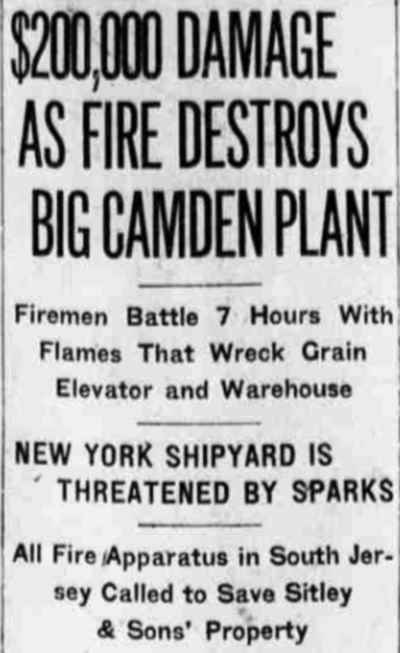
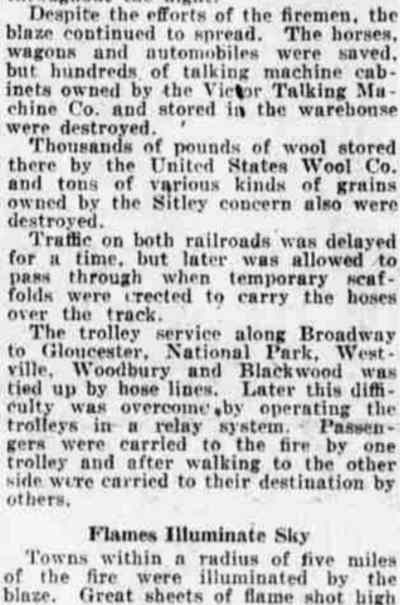
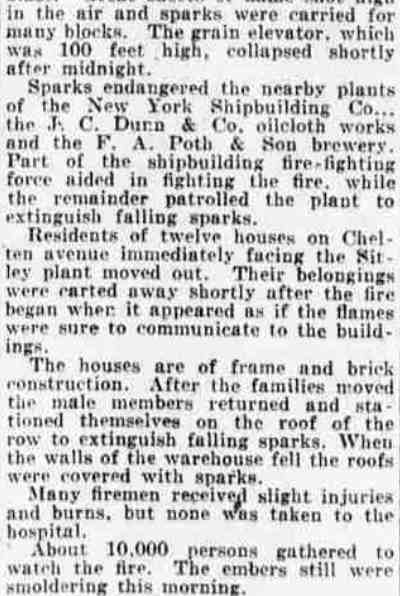
$200,000 Damage as Fire Destroys Big Camden Plant
Firemen Battle 7 Hours With Flames That Wreck Grain Elevator and Warehouse
New York Shipyard Is Threatened by Sparks
All Fire Apparatus in South Jersey Called to Save Sitley & Sons’ Property
Philadelphia Inquirer — February 12, 1920
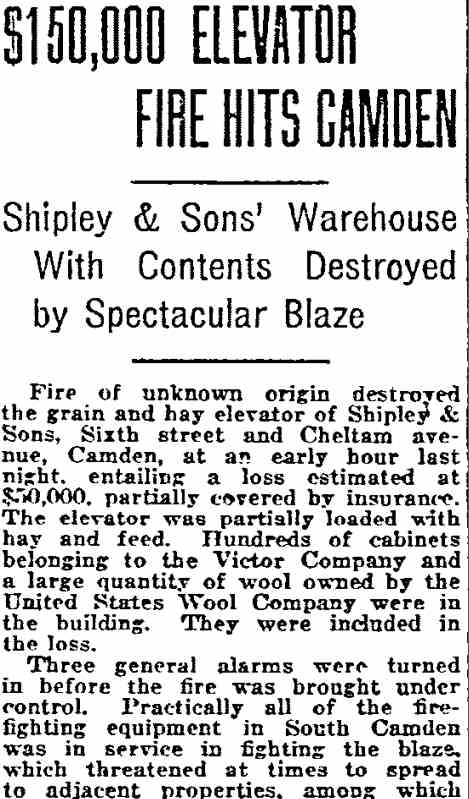
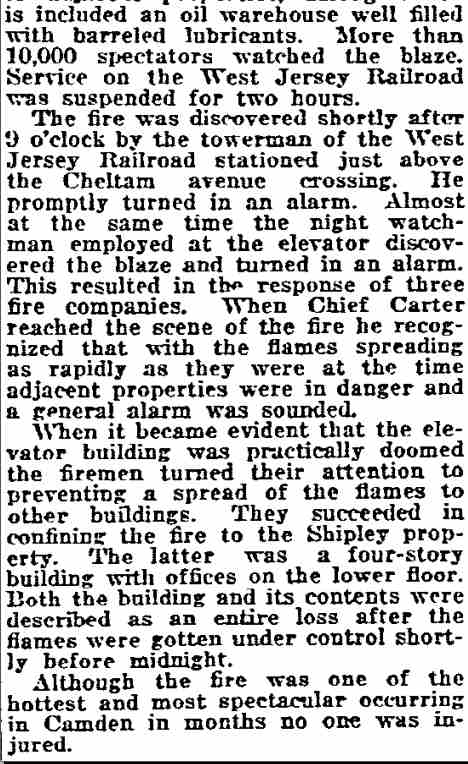
$150,000 Elevator Fire Hits Camden
Sitley & Sons’ Warehouse With Contents Destroyed by Spectacular Blaze
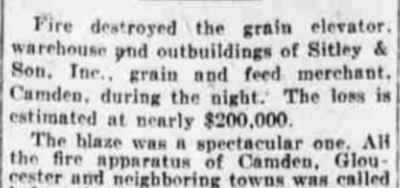
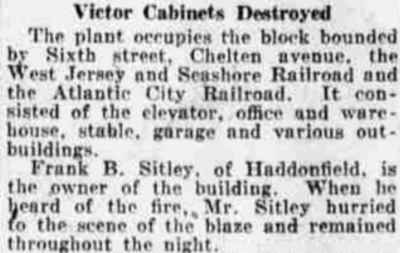
Fire of unknown origin destroyed the grain and hay elevator of Sitley & Sons, Sixth Street and Chelton Avenue, Camden, at an early hour last night, entailing a loss estimated at $150,000, partially covered by insurance. The elevator was partially loaded with hay and feed. Hundreds of cabinets belonging to the Victor Company and a large quantity of wool owned by the United States Wool Company were in the building. They were included in the loss.
Three general alarms were turned in before the fire was brought under control. Practically all of the fire-fighting equipment in South Camden was in service in fighting the blaze, which threatened at times to spread to adjacent properties.
Philadelphia Inquirer — February 13, 1920
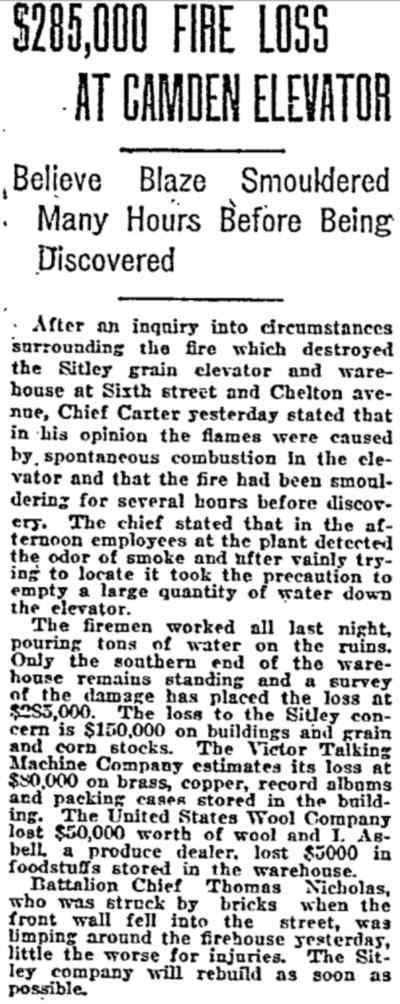
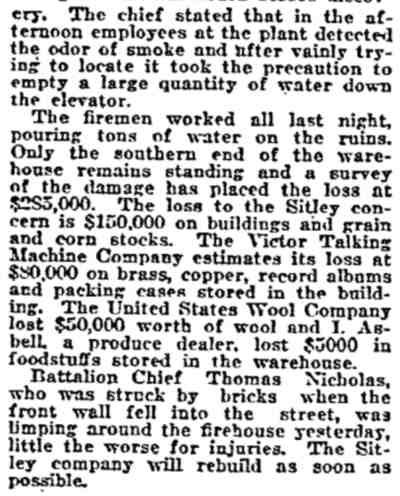
$285,000 Fire Loss at Camden Elevator
Believe Blaze Smouldered Many Hours Before Being Discovered
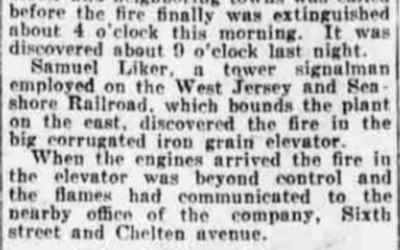
After an inquiry into circumstances surrounding the fire which destroyed the Sitley grain elevator and warehouse at Sixth Street and Chelton Avenue, Camden, Fire Chief Thomas Nicholas yesterday stated that in his opinion the flames were caused by spontaneous combustion in the elevator and that the fire had been smouldering for several hours before discovery.
The firemen worked all last night, pouring tons of water on the fire. Only the southern end of the warehouse remains standing. An estimate of the damage has placed the loss at $285,000. The loss to the Sitley concern is $150,000. Peter B. Carter, who was struck by bricks when the front wall fell into the street, was taken to a hospital but was reported little the worse for injuries.
Philadelphia Inquirer — May 15, 1911
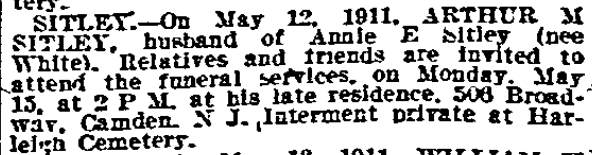
SITLEY. — On May 12, 1911, ARTHUR M. SITLEY, husband of Annie E. Sitley (nee White). Relatives and friends are invited to attend the funeral services, on Monday, May 15, at 2 P. M. at his late residence, 506 Broadway, Camden, N. J. Interment private at Harleigh Cemetery.
Philadelphia Inquirer — April 21, 1915
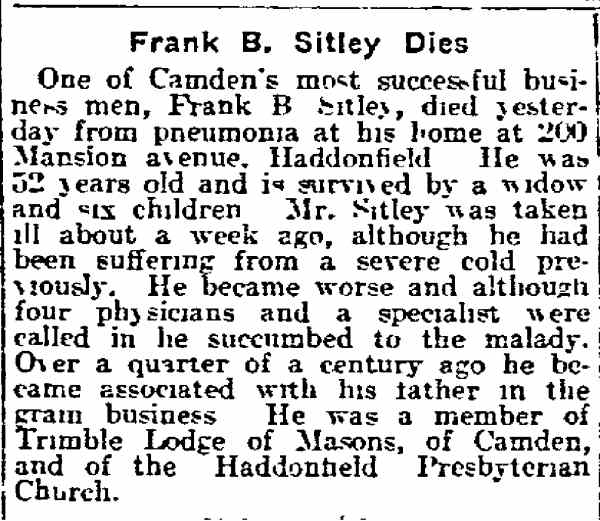
Frank B. Sitley Dies
One of Camden’s most successful business men, Frank B. Sitley, died yesterday from pneumonia at his home at 200 Mansion avenue, Haddonfield. He was 52 years old and is survived by a widow and six children. Mr. Sitley was taken ill about a week ago, although he had been suffering from a severe cold previously. He became worse and although four physicians and a specialist were called in he succumbed to the malady. Over a quarter of a century ago he became associated with his father in the grain business. He was a member of Trimble Lodge of Masons, of Camden, and of the Haddonfield Presbyterian Church.
3 Youths Held as Blaze Razes Grain Plant of Sitley and Son
Camden Courier-Post —
Damage in Fire at Sixth and Bulson Streets Estimated at $45,000
Four Men Risk Lives to Save Two Horses
Three boys are being held and two others are sought in the investigation of the $45,000 fire which today destroyed the warehouse of Sitley & Son, wholesale hardware, roofing material and grain dealers at Sixth and Bulson Streets.
The three boys were ordered held by Police Judge Pancoast after authorities expressed belief that the three alarm fire was caused either by thieves or boys smoking cigarettes on the premises.
Two of the youths admitted they stole coal from the plant’s siding last night, while the third confessed that he, and two other boys were in the plant last evening. He said his two companions, who are expected to be arrested this afternoon, were smoking.
One fireman was slightly hurt when he ran a nail into his foot, while other firefighters narrowly escaped injury when the roof of the blazing building collapsed.
A dense fog, rain, great clouds of thick smoke and intense heat all hampered the firemen, and rendered them practically helpless for more than three hours. When the blaze was finally under control at 8:00 a.m., only the blackened and buckled walls remained standing.
Practically the entire stock was lost, but through the courage of four men including two policemen, a team of terrified horses and three trucks were saved from the blazing stable.
Twenty employees were temporarily deprived of work.
Discovery of three rolls of wire fencing on nearby railroad tracks and the presence of two men near the premises when the blaze was discovered led Fire Chief Thomas Nicholas to believe thieves had thrown a cigarette near some flammable material.
The arrested boy is John Brodzik, 1927 Fillmore Street.
Two other youths, John Hadyniak, 16, of 685 Ferry Avenue, and Anthony Parraine [Piraino—PMC], 11, of 2026 South Seventh Street, arrested on a charge of stealing coal from the Sitley siding last night are also being held. They declare they were not in the plant.
In addition to the smoke and heat firemen were further hampered by the fact that two railroads pass the building. Many of the hose lines had to be stretched over the tracks, so that in order to prevent passing trains, from which thousands of commuters saw the fire, from cutting the lines, holes were dug under the tracks and the lines run through the excavations.
Horses Rescued
The four rushed into the stable, broke down the door, and led out the two horses, which several times attempted to run back into the flames. The men also drove three trucks out of the place before they were driven away by the dense smoke.
The building occupies a plot about 300 feet square and comprises several one and two-story sections. There was formerly a grain elevator on the site belonging to the Sitleys, but it was destroyed by fire more than a decade ago and never rebuilt. On the south side of the plant are the Atlantic City Railroad tracks, and on the east side the West Jersey and Seashore Railroad lines.
Flames Spread Rapidly
Believed to have started either in the stable or at the extreme northern end of the plant, the fire quickly swept through the entire building. Rolls of tarred paper and bins of grain were quickly consumed, throwing out huge clouds of smoke.
Two more alarms were sounded for additional apparatus, but it was not until 7:30 a.m. that firemen could enter the building. Meanwhile, about 50 hose lines were stretched to the building and water continually played on the fire. Commissioner Frank B. Hanna arrived and increased the water pressure five points at the pumping stations to keep a water supply to feed the hose lines. Chief of Police Lewis H. Stehr also sped to the fire.
A touch of tragedy was added when Thomas Mills, 70, of 431 Viola Street, employed by the Sitleys for 40 years as a packer, arrived. The elderly workman burst into tears when he saw the flames, and sobbed that he was now out of work and had a family to support.
Finally, about 8 a.m., firemen had the blaze under control, after the roof had caved in. Only the walls stood, but several times they threatened to collapse.
The owners, Frank L. Sitley, Sr., of Woodbury, and his son, Frank L. Sitley, Jr., arrived, but declined to estimate their loss. However, police and firemen fixed an approximate damage of $25,000 to the building and $20,000 to the stock.
Lieutenant Frost found three rolls of wire fencing which had been taken from the building. They were lying on the Reading Railroad tracks, apparently dropped by thieves when police arrived.
Young Brodzik was arrested at 8:00 p.m. yesterday by Special Officer John Stevenson, who turned him over to Patrolmen Smith and Riehm. The youth was charged with suspicion of having broken into the place, and is alleged to have first denied being in the building, but later admitted that he and two other boys crawled through a basement window.
The boy declared that he neither smoked nor stole anything, but said that other boys had smoked. He refused to divulge their names.
Hadyniak and Perraine were arrested last night and charged with theft of coal from the siding. Brodzik declared those two were not the boys who were with him last night.
All three were arraigned before Judge Pancoast in police court this morning and held without bail pending investigation.
Trenton Evening Times — July 20, 1959
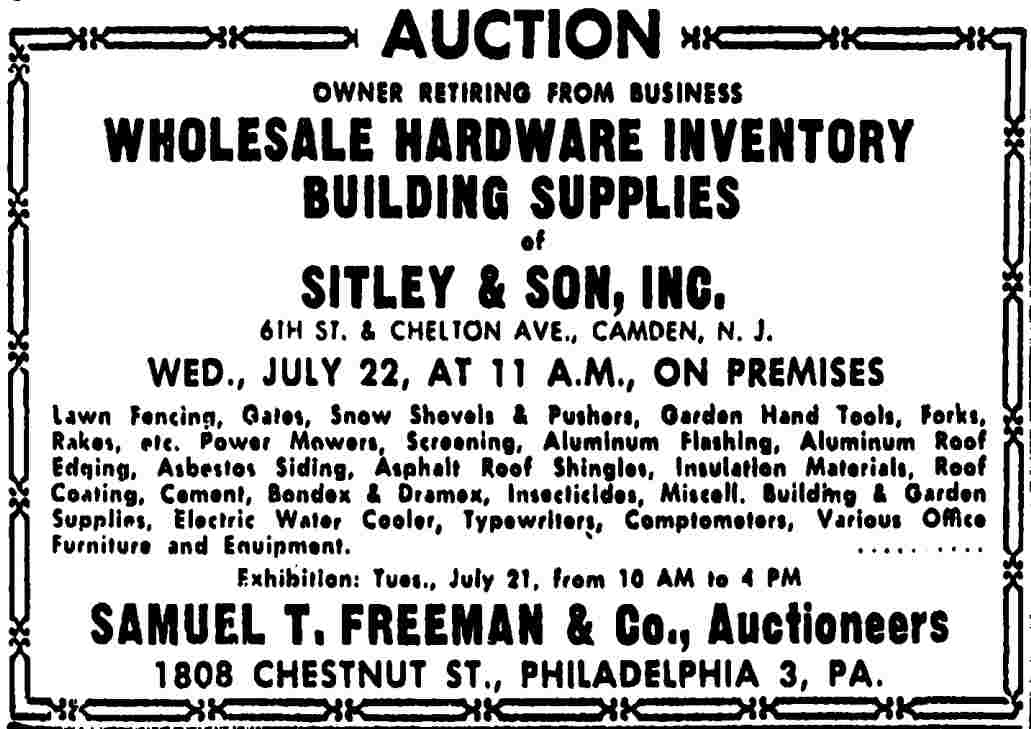
Auction
Owner Retiring from Business — Wholesale Hardware Inventory, Building Supplies of Sitley & Son, Inc., 6th St. & Chelton Ave., Camden, N. J.
Wed., July 22, at 11 A. M., on Premises
Lawn Fencing, Gates, Snow Shovels & Pushers, Garden Hand Tools, Forks, Rakes, etc. Power Mowers, Screening, Aluminum Flashing, Aluminum Roof Edging, Asbestos Siding, Asphalt Roof Shingles, Insulation Materials, Roof Coating, Cement, Bondex & Dramex, Insecticides, Miscell. Building & Garden Supplies, Electric Water Cooler, Typewriters, Comptometers, Various Office Furniture and Equipment.
Exhibition: Tues., July 21, from 10 AM to 4 PM. Samuel T. Freeman & Co., Auctioneers, 1808 Chestnut St., Philadelphia 3, Pa.