Introduction
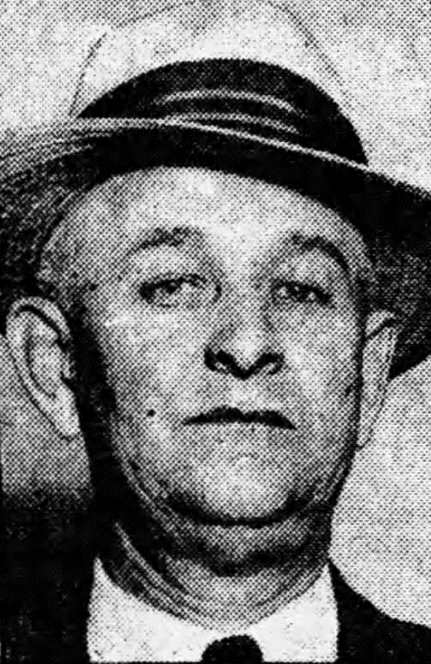
Howard M. Smith
HOWARD MASON SMITH had a long and honorable career in law enforcement with both the Camden Police department and the Camden County Prosecutor’s office.
Howard Mason Smith was born in Camden, New Jersey on August 20, 1874 to William Henry Smith and his wife the former Harriet C. Stewart. He was the seventh of eleven children. The Smiths had come to Camden, with their five living children, shortly after the April 1873 birth of daughter Sue. Two more sons were born after Howard Smith and the 1880 Census enumeration, Clarence Smith and Walter H. Smith. The 1880 Census shows the family at 726 Federal Street, with children William H. Jr., Virginia C., Augustus D., Sue G., Howard M., Clarence S., and Walter H. Smith. Two more sons came in the early 1880s, Crawford M. Smith and Roy A. Smith. William H. Smith died in 1886.
Known in Camden as “Policy Bill,” William H. Smith had become notorious for running a “policy game”—an illegal lottery, in modern times called the “numbers racket.” His widow, Mrs. Harriet Smith, with five children at home under the age of 12, kept the “family business” going. She had a number of brushes with the law between 1886 and 1898, and at one time or another the Smith brothers and sister Sue did as well.
The Smith family was living at 14 South 8th Street by 1890. By that summer they had moved to 741 Carman Street. The oldest son, W. Harry Smith, was already working, and by 1890 second son Augustus D. Smith found work as a blacksmith. W. Harry Smith began involving himself in local politics in Camden’s 9th Ward as a Republican, and over the years this served him and the Smith family well.
The 1894 Directory has the family at 758 Federal Street, the 1895 edition has them at 750 Federal Street. On July 15, 1895 Howard Smith married Helen Goldy Penn. A son, Howard K. Smith, was born in June of 1896, another son, George, in April of 1899. The Smiths and the Penns were living at 822 Kimber Street by the middle of 1896, where they would stay in to 1916. A daughter, Laura V. Smith, was born in 1902, another, Elsie Janice Smith, would arrive in 1908. There was another daughter, Dorothy Smith, who died at the age of seven months in February of 1906.
Howard Smith’s sister, Sue, was married to Harry J. Wagner Sr., who was politically active. Possibly due to his influence and possibly due to the fact that the Camden Police Department’s baseball team needed a pitcher, Howard Smith was appointed to the Camden Police Department on March 20, 1906. He was a very active policeman from the beginning. His courage and skills were recognized and he was promoted to detective on January 1, 1918. He served in this capacity until his retirement on January 1, 1933, much of the time spent being on loan to the Camden County Prosecutor’s Office where he investigated and solved many homicide cases.
Howard Smith’s brother, Walter Smith, was appointed to the Camden Police Department on April 30, 1914. By 1925 he too had been promoted to Detective, and was still serving in that capacity as late as 1933. The youngest brother, Roy A. Smith, served as a member of the Camden Fire Department from 1910 to 1933, before retiring on disability. Howard Smith’s older sister, Sue Smith, married Harry J. Wagner Sr., who served with the Camden Fire Department from November 24, 1899 through January 1, 1900 and then for many years worked for Camden’s Water Department. Their son, Harry J. Wagner Jr., served as a member of the Camden Fire Department for 39 years and 8 months, reaching the rank of Acting Chief of Department.
By the time the 1917 City Directory was compiled, Howard Smith and family, which by now included two daughters, Laura and Elsie, had moved to 933 Penn Street. Howard K. Smith married Anna Duffy and was working at the Penn Shipbuilding shipyard in Gloucester City when he registered for the draft on September 12, 1918. The young couple lived at the Penn Street address. Sadly, three weeks later he fell victim to the influenza pandemic took so many lives in the fall of 1918, dying at home on October 3, 1918.
Howard M. Smith died at his home on Penn Street on November 30, 1953. He was survived by his wife, daughters, son George, and six grandchildren. Howard M. Smith was buried at Harleigh Cemetery on December 3, 1953. Mrs. Smith died in 1975 at the age of 98, her last years a resident of Wildwood, New Jersey.
Laura Smith married Harry A. Crane in the 1920s. Her son, J. Kenneth Crane went on to become the Chief of Police in Collingswood, New Jersey. Elsie Smith was briefly married to William Howell Tatem Jr., the son of Camden Fire Department member William Howell Tatem, and the nephew of Camden’s Chief of Police, James E. Tatem. She eventually remarried and lived out her days in Wildwood with her second husband, Magnus Ekstrom.
Howard Smith’s nephew, Edward Baker Smith, the son of Crawford M. Smith, retired in 1981 as an investigator with the Camden County Prosecutor’s office.
The Tenth Street Gang
Camden Daily Telegram –
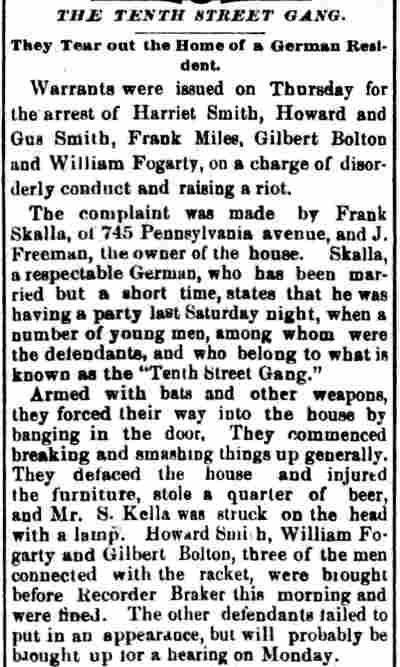
THE TENTH STREET GANG.
They Tear out the Home of a German Resident.
Warrants were issued on Thursday for the arrest of Harriet Smith, Howard and Gus Smith, Frank Miles, Gilbert Bolton and William Fogarty, on a charge of disorderly conduct and raising a riot.
The complaint was made by Frank Skalla, of 745 Pennsylvania avenue, and J. Freeman, the owner of the house. Skalla, a respectable German, who has been married but a short time, states that he was having a party last Saturday night, when a number of young men, among whom were the defendants, and who belong to what is known as the “Tenth Street Gang.”
Armed with bats and other weapons, they forced their way into the house by banging in the door. They commenced breaking and smashing things up generally. They defaced the house and injured the furniture, stole a quarter of beer, and Mr. S. Kella was struck on the head with a lamp. Howard Smith, William Fogarty and Gilbert Bolton, three of the men connected with the racket, were brought before Recorder Braker this morning and were fined. The other defendants failed to put in an appearance, but will probably be brought up for a hearing on Monday.
The Policy Indictments
Camden Post –
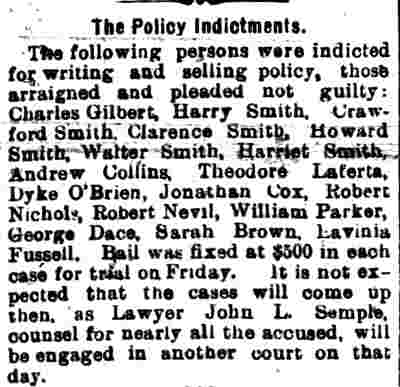
The following persons were indicted for writing and selling policy, those arraigned and pleaded not guilty: Charles Gilbert, Harry Smith, Crawford Smith, Clarence Smith, Howard Smith, Walter Smith, Harriet Smith, Andrew Collins, Theodore Laferta, Dyke O’Brien, Jonathan Cox, Robert Nichols, Robert Nevil, William Parker, George Dace, Sarah Brown, Lavinia Fussell. Bail was fixed at $500 in each case for trial on Friday. It is not expected that the cases will come up then, as Lawyer John L. Semple, counsel for nearly all the accused, will be engaged in another court on that day.
Deaths
Camden Evening Courier –
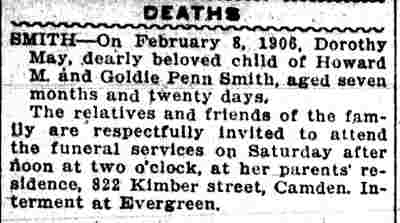
SMITH—On February 8, 1906, Dorothy May, dearly beloved child of Howard M. and Goldie Penn Smith, aged seven months and twenty days.
The relatives and friends of the family are respectfully invited to attend the funeral services on Saturday afternoon at two o’clock, at her parents’ residence, 822 Kimber street, Camden. Interment at Evergreen.
Penny Caused Lively Set-To
Camden Post-Telegram –
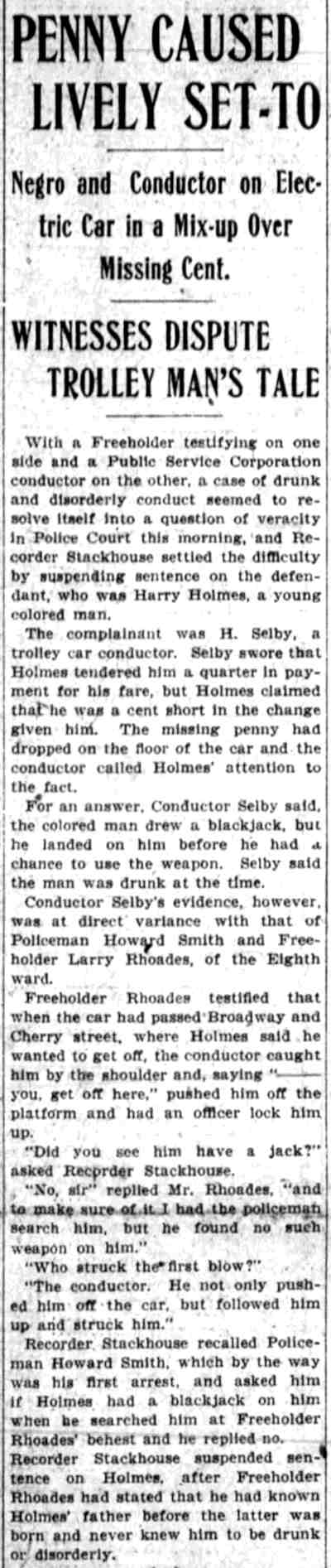
PENNY CAUSED LIVELY SET-TO
Negro and Conductor on Electric Car in a Mix-up Over Missing Cent.
WITNESSES DISPUTE TROLLEY MAN’S TALE
With a Freeholder testifying on one side and a Public Service Corporation conductor on the other, a case of drunk and disorderly conduct seemed to resolve itself into a question of veracity in Police Court this morning, and Recorder Stackhouse settled the difficulty by suspending sentence on the defendant, who was Harry Holmes, a young colored man.
The complainant was H. Selby, a trolley car conductor. Selby swore that Holmes tendered him a quarter in payment for his fare, but Holmes claimed that he was a cent short in the change given him. The missing penny had dropped on the floor of the car and the conductor called Holmes’ attention to the fact.
For an answer, Conductor Selby said, the colored man drew a blackjack, but he landed on him before he had a chance to use the weapon. Selby said the man was drunk at the time.
Conductor Selby’s evidence, however, was at direct variance with that of Policeman Howard Smith and Freeholder Larry Rhoades, of the Eighth ward.
Freeholder Rhoades testified that when the car had passed Broadway and Cherry street, where Holmes said he wanted to get off, the conductor caught him by the shoulder and, saying “—you, get off here,” pushed him off the platform and had an officer lock him up.
“Did you see him have a jack?” asked Recorder Stackhouse.
“No, sir” replied Mr. Rhoades, “and to make sure of it I had the policeman search him, but he found no such weapon on him.”
“Who struck the first blow?”
“The conductor. He not only pushed him off the car, but followed him up and struck him.”
Recorder Stackhouse recalled Policeman Howard Smith, which by the way was his first arrest, and asked him if Holmes had a blackjack on him when he searched him at Freeholder Rhoades’ behest and he replied no.
Recorder Stackhouse suspended sentence on Holmes, after Freeholder Rhoades had stated that he had known Holmes’ father before the latter was born and never knew him to be drunk or disorderly.
Camden Police Team Ready
Camden Daily Courier –
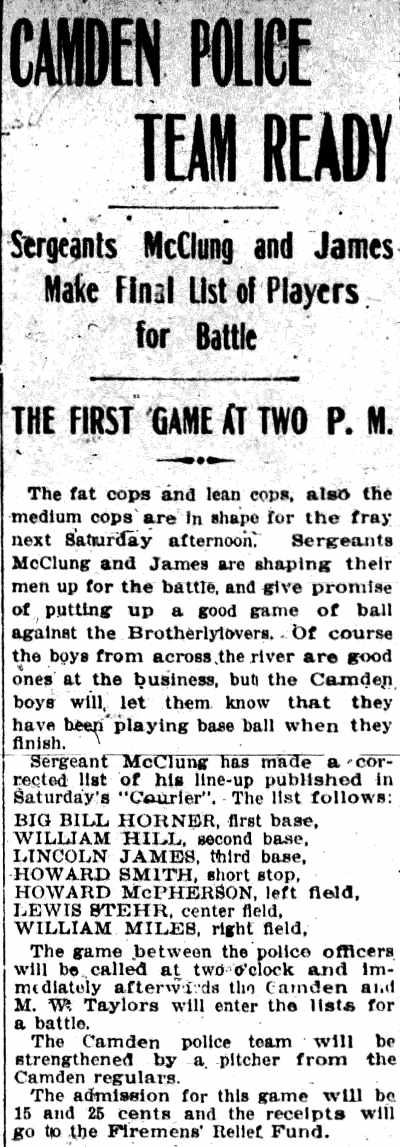
Camden Police Team Ready
Sergeants McClung and James Make Final List of Players for Battle
THE FIRST GAME AT TWO P. M.
The fat cops and lean cops, also the medium cops are in shape for the fray next Saturday afternoon. Sergeants McClung and James are shaping their men up for the battle, and give promise of putting up a good game of ball against the Brotherlylovers. Of course the boys from across the river are good ones at the business, but the Camden boys will let them know that they have been playing base ball when they finish.
Sergeant McClung has made a corrected list of his line-up published in Saturday’s “Courier.” The list follows:
BIG BILL HORNER, first base,
WILLIAM HILL, second base,
LINCOLN JAMES, third base,
HOWARD SMITH, short stop,
HOWARD McPHERSON, left field,
LEWIS STEHR, center field,
WILLIAM MILES, right field,
The game between the police officers will be called at two o’clock and immediately afterwards the Camden and M. W. Taylors will enter the lists for a battle.
The Camden police team will be strengthened by a pitcher from the Camden regulars.
The admission for this game will be 15 and 25 cents and the receipts will go to the Firemens’ Relief Fund.
Base Ball — Opening the Season at Camden’s Grounds
Camden Daily Courier –
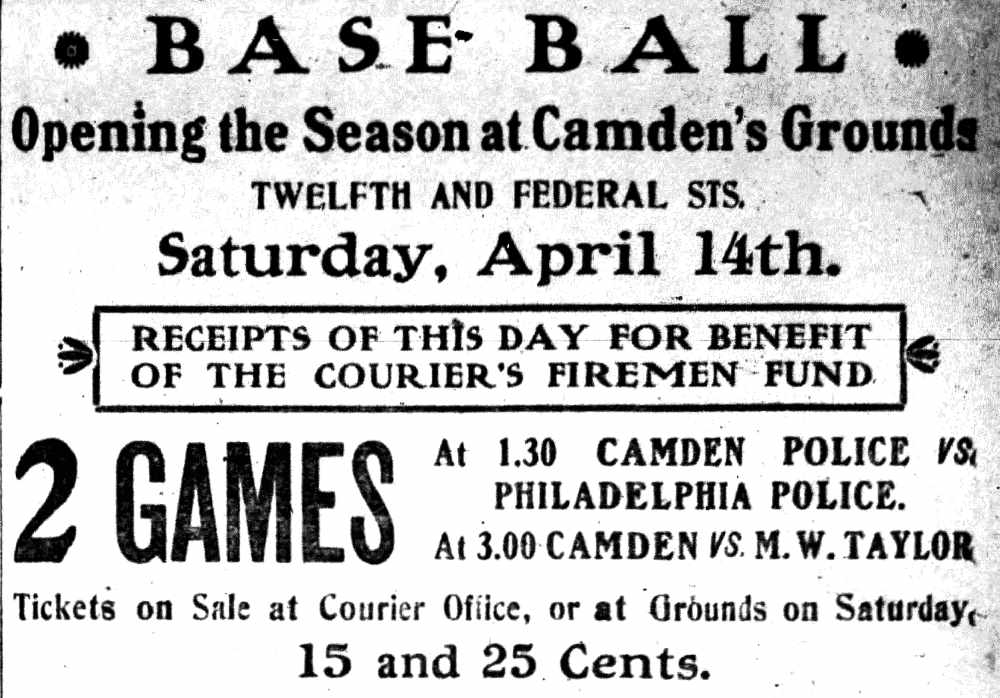
BASE BALL
Opening the Season at Camden’s Grounds
TWELFTH AND FEDERAL STS.
Saturday, April 14th.
RECEIPTS OF THIS DAY FOR BENEFIT OF THE COURIER’S FIREMEN FUND
2 GAMES
At 1.30 Camden Police vs. Philadelphia Police.
At 3.00 Camden vs. M.W. Taylor.
Tickets on Sale at Courier Office, or at Grounds on Saturday, 15 and 25 Cents.
Howard Smith Will Be Pitcher
Camden Post-Telegram –
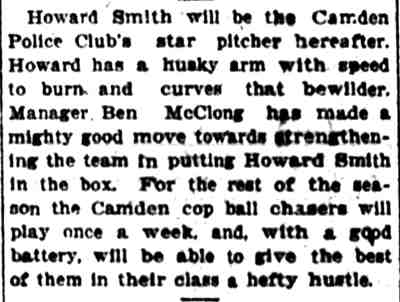
Howard Smith will be the Camden Police Club’s star pitcher hereafter. Howard has a husky arm with speed to burn and curves that bewilder. Manager Ben McClong has made a mighty good move towards strengthening the team in putting Howard Smith in the box. For the rest of the season the Camden cop ball chasers will play once a week, and, with a good battery, will be able to give the best of them in their class a hefty hustle.
Philadelphia Inquirer – August 28, 1908
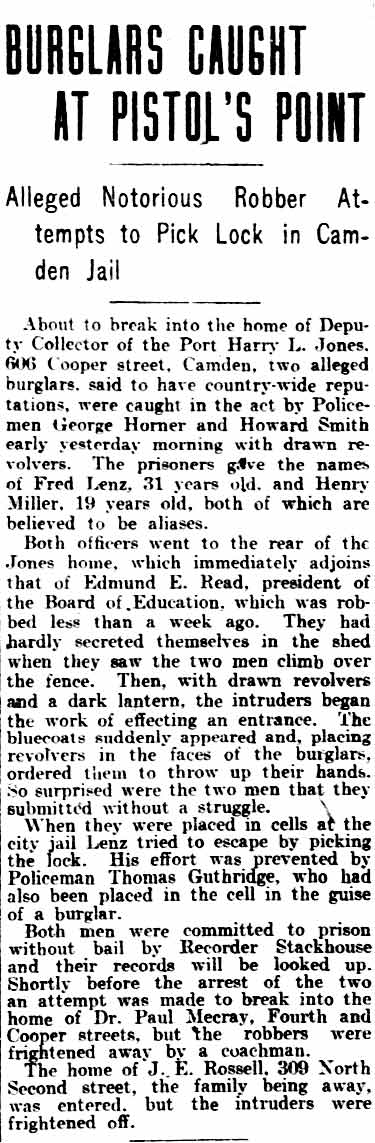
BURGLARS CAUGHT AT PISTOL’S POINT
Alleged Notorious Robber Attempts to Pick Lock in Camden Jail
About to break into the home of Deputy Collector of the Port Harry L. Jones, 606 Cooper street, Camden, two alleged burglars, said to have country-wide reputations, were caught in the act by Policemen George Horner and Howard Smith early yesterday morning with drawn revolvers. The prisoners gave the names of Fred Lenz, 31 years old, and Henry Miller, 19 years old, both of which are believed to be aliases.
Both officers went to the rear of the Jones home, which immediately adjoins that of Edmund E. Read, president of the Board of Education, which was robbed less than a week ago. They had hardly secreted themselves in the shed when they saw the two men climb over the fence. Then, with drawn revolvers and a dark lantern, the intruders began the work of effecting an entrance. The bluecoats suddenly appeared and, placing revolvers in the faces of the burglars, ordered them to throw up their hands. So surprised were the two men that they submitted without a struggle.
When they were placed in cells at the city jail Lenz tried to escape by picking the lock. His effort was prevented by Policeman Thomas Guthridge, who had also been placed in the cell in the guise of a burglar.
Both men were committed to prison without bail by Recorder Stackhouse and their records will be looked up. Shortly before the arrest of the two an attempt was made to break into the home of Dr. Paul Mecray, Fourth and Cooper streets, but the robbers were frightened away by a coachman.
The home of J. E. Rossell, 309 North Second street, the family being away, was entered, but the intruders were frightened off.
Philadelphia Inquirer – January 14, 1910
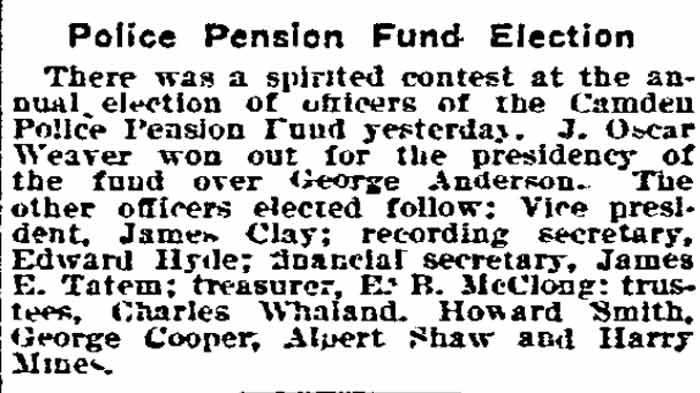
Police Pension Fund Election
There was a spirited contest at the annual election of officers of the Camden Police Pension Fund yesterday. J. Oscar Weaver won out for the presidency of the fund over George Anderson. The other officers elected follow: Vice president, James Clay; recording secretary, Edward Hyde; financial secretary, James E. Tatem; treasurer, E. B. McClong; trustees, Charles Whaland, Howard Smith, George Cooper, Albert Shaw and Harry Mines.
Philadelphia Inquirer – August 28, 1910

Many Robberies Keep Police Busy
MANY ROBBERIES KEEP POLICE BUSY
Transom Burglar Loots Another Saloon at Twentieth and Market
Men Arrested in Crowded Department Store Are Held for Trial, as Is Also Alleged Pickpocket
The "transom burglar," who has been robbing saloons recently, gained entrance early yesterday morning to the saloon of Andrew Breslin, Twentieth and Market streets, and carried away several bottles of liquor and cigars valued at $3.50. The rubber climbed in through a transom in the usual way, and escaped with his plunder without being detected.
The residence of Peter Arne, rear of 812 North Third street, was invaded by a man who also stole a watch and $7 in cash.
A gold locket and chain, a gold bracelet and silver handbag were stolen from the residence of Sarah Miller, 555 North 4th street.
Daniel Hickey and James Brown, of Balfour avenue, were arrested on Friday on the charge of stealing raincoats from a Market street department store. They were arraigned before Magistrate Scott yesterday. At the store when discovered by an employee, who detained them until Detective Cramer arrived. Hickey, according to the detective, had a raincoat concealed beneath his clothing.
He was shopping nearby and, suspecting him of being a thief, ordered the employee to hold him. Balbirnie again felt some one at his pocket, and while detaining him, he was struck in the face by the prisoner. He seized Lacey and he was held until a warrant was sworn out. He had nothing to say in his defense.
In trying to escape arrest on Friday evening Frank Eldridge, a negro, suspected of robbery near Eighteenth and Market streets, fled to the roof of a house on Goncha street. Since the police climbed to the roof he struggled with Policemen Smith and Guthridge, of the Eighth ward, and the struggle lasted fifteen minutes, during which one of the policemen narrowly escaped falling from the housetop. He was captured in the front room on the second floor, which is occupied by Mr. Morrison and his wife. Adjoining is the store. The front room on the first floor is occupied by the renter, Mary, Celia and Maggie, and in two back rooms live his two sons and Walter Weeks, a barber, a relative. Balbirnie again felt some one at his pocket, and while detaining him, he was struck in the face.
Fred Speise, of Seventy-eighth and Lel-man streets, charged on the complaint of Dr. McLearen of stealing a horse belonging to Dr. McLearen. He was held in $500 bail by Magistrate Harris for a further hearing yesterday.
Murderer and Forger Escape Jail After Shooting Keepers, Killing One
Camden Post-Telegram –
Wilson Ashbridge, Who Shot and Killed Mrs. Elizabeth Dunbar and George E. Thompson, Check Swindler, Trap Jailor Hibbs by a Ruse and After Slaying Him Shoot Joe Ellis Who Intercepted Them in Flight. Used Revolver Smuggled Into Prison by Confederates and Leave Jail Wide Open in Their Flight, a General Delivery Being Averted by Police Who Were Summoned by the Wounded Men.
Murdering one jailor and wounding another with a revolver that had been smuggled into them by outside confederates, Wilson T. Ashbridge, slayer of Mrs. Elizabeth Dunbar, and Francis Murphy, alias George E. Thompson, a check forger, made their escape from the county jail a few minutes before seven o’clock last night.
Ashbridge with his wife was caught at noon in the Keystone Hotel in Chester PA where they registered at one o’clock this morning.
Thompson is still at liberty but from the confident manner of Prosecutor Kraft his early arrest seems assured.
The murdered jailor was Isaac Hibbs, aged 65 years of 913 South 8th Street. The wounded keeper is Joseph Ellis, aged 45 years, of 416 Carteret Street. Shot twice, he is in Cooper Hospital. His condition today is very satisfactory.
Thompson, who is 41 years old, forged a check for $650 which he gave to V.M. Fulton as part of the purchase price of an automobile. The forgery was discovered before the deal was completed and his arrest followed on June 8. He also passed a forged check for $15 on State Motor Vehicle Agent Kraft. He, too, was awaiting trial. In spite of the positive evidence against him Thompson had spurned all efforts to have him plead guilty and it is now believed that he was sparring for time while hatching a plan to escape. He is no doubt the master mind.
R.L. Hunter, a farmer of Bensalem Township, Bucks County PA, about four miles above Torresdale, reported to the Philadelphia police the morning that he had seen a man answering Ashbridge’s description on the Bucks Road at daylight. The man asked the way to Riegelsville.
According to Hunter, the man was dressed in a dark suit, and had no hat. His clothing was wet. Hunter did not see anything suspicious in his actions, and after giving him directions, they parted.
Upon seeing the paper with a picture of Ashbridge, the farmer was struck by its resemblance to the man with whom he had talked. He hurried to Tacony and notified the police.
The State police, who patrol that section of the county, and who have an office at Langhorne, were immediately notified as were the surrounding towns.
The shootings took place in different parts of the jail. Hibbs was murdered in the exercise room just outside the cell room on the Sixth and Arch corner of the building. Ellis was shot down in the corridor just outside the Market Street end of the building when he heroically grappled with Ashbridge after the latter had pointed a gun at his head. In spite of his wounds Ellis dragged himself to a telephone and after notifying Police Headquarters of what had happened he collapsed.
Only one of the two bullets is still in Ellis. It entered the groin on the right side and is buried in the muscles of the leg, having taken a downward course for seven or eight inches. The other bullet struck Ellis in the right breast and came out in the left breast, traversing the upper fleshy parts of the body.
Hibbs was almost instantaneously killed by a bullet that went within an inch of his heart, producing a hemorrhage. The bullet was extracted this morning from the body early this morning in an autopsy performed at the morgue by County Physician Stem. In spite of the fact that it is pretty well established that three shots were fired in the attack on Hibbs, only one of the bullets took effect.
“But it makes little difference which of the two men handled the gun” said Prosecutor Kraft this morning. “Both are equally guilty of this murder and what we are concerned about now is the recapture of the gunmen.” Mr. Kraft added that it his purpose to examine all of the prisoners in that part of the jail where Hibbs was murdered to determine fully who fired the fatal shot.
The escape had been carefully planned and timed to the minute. Of course the desperate prisoners were aided by confederates on the outside and it is the general belief that a high powered motor car was in waiting for them not far from the jail. They are known to have been in possession of money and openly boasted yesterday that it was their intention to leave the prison last night. These boasts were made to two young ladies connected with a religious organization who called on the two men yesterday to offer spiritual reconciliation. The girls are frequent visitors to the jail and naturally their efforts at evangelization were directed in the main toward Ashbridge, because of the fact that he was accused of murder. These girls, whose identity officials will not disclose, were closeted with Prosecutor Kraft until one o’clock this morning. Both declared that on their visit yesterday they were told by Ashbridge and Thompson that it was the last day they expected to spend in jail.
“We are going to get away from here tonight and we’ve got money to help us after we are out” said Ashbridge, who further told the girls he had considerable cash sewed up in the waistband of his trousers. The girls begged the prisoners not to do anything that would cause them more trouble and they told the Prosecutor that Ashbridge and Thompson promised them that they would not make any effort to escape. In their talks with the girls neither of the prisoners said a word that would indicate that they would kill if necessary to escape. The full force of their boast did not dawn on the religious workers and for this reason it never occurred to them to inform the Sheriff of what the prisoners had said.
A general jail delivery of at least all the men confined in what is known as the untried department, where the two were held, was only averted by the prompt arrival of the police on their beat, which was made easy by means of the keys taken from the prostrate body of Hibbs. Ashbridge and Thompson left all of the doors open and the vanguard of the inrushing police found the prisoners swarming all over the corridors on the east side of the prison. In the wild excitement following the double shooting and escape none else thought of freedom and a checking up of the inmates after they had been herded in the exercise room of the untried department accounted for all but the fugitive slayers.
The department, in which the two men were confined is the same one which William Brown and Charles Berger made their sensational escape several years ago by sawing away the bars on the Federal Street front of the jail. Thrilling as it was, the former escape was insignificant in comparison with last night’s tragic event.
With the full force of the keepers out of the way—one dead and the other suffering from gunshot wounds at first supposed to have been fatal—Ashbridge and Thompson had nothing between them and freedom but the door entering from the spiral stairway leading to the narrow entrance of the Sixth and Market Streets end of the Court House. With the keys taken from Hibbs they opened the door and in a few seconds were breathing the free air. It was still daylight when the daring murderers walked from the building and although they were no doubt seen by some of the scores of persons passing it is certain that they managed to control themselves to such an extent as not to arouse any undue suspicion. The exit they used to escape is that used by the general public and therefore persons passing calmly in and out of the door would not in any manner be thought to have been connected with a jail delivery. However the shots which had laid low the keepers had been plainly heard on all four sides of the building and it is strange that no one has yet been found who can give positive information as to what course the fleeing men took and whether they were aided in their flight by an automobile.
While the police and detectives of Camden and all other cities in the East are watching railroad terminals, steamship lines, and all other avenues of travel in response to the general alarm sent out last night, Prosecutor Kraft is bending all his energies to learn who smuggled in the revolver which the fugitives used. Thus far this feature of the case is as complete a mystery as it was last night. Mr. Kraft and Sheriff Haines are satisfied, however, that only one gun was used for both shootings. It was at first thought that each man had a pistol when they left the jail; that one of them armed himself with the gun that Hibbs was supposed to have carried, but it was determined that Hibbs was not armed when he went into the jail last night. There was no occasion for him to come in contact with any of the prisoners and for that reason he left his revolver in his desk in the office. Even had he carried it he would have little chance to use it, so cold-bloodedly was he slain as he unsuspectingly fell into the trap laid for him by the desperate gunmen. There is also some conflict as to how at least one of the fugitives was dressed. Alfred Williams, who witnessed the murder of Hibbs, said that Ashbridge was without coat or hat when he dashed out of the cell-room, and that Thompson carried his coat and hat under his arm. However in a description of the two men given at the Prosecutor’s office it was set forth that Ashbridge wore a blue serge suit and a checkered cap. The coat that he is supposed to have taken bore the mark of “Tull—the Tailor,” of Jacksonville, Florida, and had been borrowed by him from another prisoner. He wore tan shoes. Ashbridge is 27 years old, 5 feet 7‑1/2 inches in height and weighs 137 pounds. He has brown hair, smooth face and is of light complexion.
Thompson wore a brown suit and a Panama hat. He is 41 years old, 5 feet seven inches in height, and weighs 175 pounds. He has brown bushy hair, is minus one of the fingers on his left hand, and is light complexioned.
The tan shoes worn by Ashbridge were also borrowed from one of the prisoners. He got them on Saturday and remarked that he wanted to look neat.
Keepers Ellis and Hibbs were reading in the prison office last evening when Hibbs glanced up at the clock and noticed that it was a few minutes of seven. “Joe, I’m going back and put the boys in their cells,” he said to Ellis and with his keys in his hand he started for the cell room in the untried department. A thirty foot long corridor runs from the office to the barred and grated door opening into the department in which the cells are situated. This department is about the size of three ordinary school rooms and in the southeastern corner of the jail are the cells, in two tiers.
Around the cells is a three foot corridor into which all the cell doors open and in which all the prisoners are permitted to walk when they are not allowed out in the main room. When the inmates are ordered into their cells and their doors closed the doors are locked from the outside of the steel cage by means of a lever worked by the jailor. Thus every cell door can be made secure without the keepers coming into actual contact with the prisoners. In addition to the bars around the corridor fronting on the double tier of cells there is a fine mesh heavy wire screening.
As Hibbs approached the lever which is operated to shut the cell doors after the prisoners have retired from the corridors, Ashbridge was leaning against the grating of his cell, Number 18. Thompson was lounging a few feet away.
“Daddy, open the door, I want you to see this note,” said Ashbridge to the keeper, at the same time displaying a piece of paper which he had in his hand. Never giving a thought that he was about to perform an act that was absolutely necessary for the carrying-out of the well laid plot, or that he was going to his doom, or was even in danger, “Daddy,” as the aged keeper was known to all the prisoners, opened the door without hesitation.
As he swung wide the big steel frame, Ashbridge quickly stepped out and the next instant was pressing a gun against the abdomen of the jailor.
“Throw up your hands, you ___ ___ ___” he commanded.
“What are you up to, what’s this mean,” asked the keeper, apparently not realizing he had been trapped.
For reply Thompson jumped out the door, wrenched the gun from Ashbridge’s grasp and with an oath began firing at Hibbs, who sank to the floor at the first shot. Only a few feet away and the only other person in the exercise room, although the shooting could have been seen by any other prisoners who had not retired to their cells, Alfred Williams, trusty, is emphatic in his assertion that Thompson fired the shot that killed Hibbs and that he fired three times.
“It’s a wonder they did not get me,” said Williams. “Ashbridge and I could not hit it and in his desperate mood I am surprised he didn’t kill me, too.” Williams, who has just completed a six months’ sentence for obtaining money from Italian grocers by falsely representing himself as an agent for a wholesale house in Chicago and who is wanted in the Windy City for the same offense, says the whole transaction took less than a minute and that the moves came so fast he and the other prisoners were powerless to aid.
“It was like a flash of lightning,” said Williams, “and before I could fully understand what had happened Ashbridge had grabbed Daddy’s keys, which had fallen to the floor, and was off like a deer for the barred door. Ashbridge had taken the smoking gun from Thompson, who had his hat and coat under his arm and who was right behind the other one.”
“As they hurried through the door after Ashbridge had opened it with Daddy’s keys Daddy called to me to raise him. I put my arm under his head and lifted him slightly from the floor. ‘Hold my hands’ he said to me. I took hold of his hands and the next minute he died in my arms. Then I heard two more shots and I knew they got Joe Ellis.”
Startled by the shots, and he is emphatic there were three in rapid succession, Ellis leaped to his feet and without taking the time to arm himself ran from the office and turned into the corridor just as Ashbridge, wild-eyed and gun in his hand, came running toward him. Halting three yards away Ashbridge pointed the revolver at Ellis’ head and ordered him to throw up his hands.
For reply and without fear of himself the keeper dashed at the murderer and the next instant they were locked in each others’ embrace. Working loose the hand which held the gun, Ashbridge pulled the trigger. The bullet struck Ellis in the breast, but the wound was not sufficient to render him helpless. However, before he could grip the pistol arm, Ashbridge fired again and the keeper fell back with a bullet in his groin.
“The second shot got me,” said Ellis to Prosecutor Kraft and Assistant Prosecutor Butler at the hospital. “The first one wasn’t bad but my strength left me when the second bullet struck. Ashbridge was the only one I saw. I did not see Thompson.”
Dragging himself to the office Ellis managed to reach a telephone and called up the police.
“This is Ellis at the county jail; come quick. Ashbridge has shot me” he weakly said over the phone to Captain Hyde. Then the receiver fell from his hand and he dropped to the floor, but after a minute or two managed to climb into a chair.
While patrol loads of policemen were being hurried to the Court House from the First and Second District station houses, Reserve Officer Charles Hose, on duty at Broadway and Federal Street, who had heard the shots, ran to the Court House and from the office of Assistant Custodian John Lack phoned up to the jail. Ellis managed to answer and in a few words told what had happened. They ran up to the jail and were admitted by Ellis, who was rapidly growing weaker from loss of blood, the trail of which plainly showed just where the injured keeper had moved.
“I guess Ashbridge got away and the jail is all open, you had better take care of the rest of the prisoners,” said Ellis to Hose and Lack. The fugitive-murderers had left all doors open and the other occupants of the untried department were swarming through the corridors. Their curses and yells and the shrieks and cries of the female prisoners had turned the place into a perfect bedlam. With the aid of other policemen who swarmed into the Court House like bees, the prisoners were soon herded into the exercise room, where Trusty Williams checked them up and accounted for all but Ashbridge and Thompson.
With the faint hope that the missing pair had not risked leaving the building but had secreted themselves in the structure, the courthouse was searched from pit to dome, but no trace of the men were found.
Detective Doran was the first of the Prosecutor’s staff to reach the scene. Mr. Kraft and the balance of the staff soon followed. In the lower end of the county, on official business, Sheriff Haines was reached by phone and Under Sheriff Hewitt was summoned from Pitman and until an early hour this morning the officials were in conference and examining numerous prisoners.
State Detective Walter LeTorneau furnished Prosecutor Kraft with a promising “tip” this morning when he learned that Thompson gave a letter to Freeholder Howard Marshall, of the Eighth Ward, to mail on Sunday. Mr. Marshall states that the letter was addressed to a woman by the name of Mrs. Shelton, in Baltimore MD.
Marshall was attending religious service in the jail when Thompson approached him.
“Put this in your pocket and mail it for me when you go out,” said Thompson to Mr. Marshall, who agreed to carry out the request. Dropping the letter in the mail box Marshall allowed the incident to pass without further notice.
Detective LeTorneau learned this morning that Marshall had spoken of the incident to a friend and the sleuth notified the Prosecutor. The tip will be run down the Prosecutor stated.
Funeral services for Hibbs will be held on Thursday from his late residence. The body will be taken to Langhorne PA where interment will be made in the Friends’ Cemetery under the direction of the Schroeder-Kephart Company. Services will be conducted Wednesday evening by Reverend Henry Bradway, pastor of the Eighth Street Methodist Episcopal Church.
POLICE QUICKLY AT WORK
Although the murderous prisoners made their escape, it was no fault of the local police department, which threw out a “dragnet system” that covered practically every outlet from the city. As soon as the call reached headquarters the red lights were flashing and every officer and detective who could be reached was sent out on the “man hunt” which was pursued with vigor.
Passing automobiles were pressed into service by the detectives and officers and all haste was made for the ferries, railroad yards, terminals, and trolley points. Citizens cooperated with the police in their efforts to run down the escaping prisoners.
Assistant Chief Hyde received the call from Jailor Ellis, who though wounded himself summoned strength enough to reach the phone.
“This is Jailor Ellis. Hibbs and me have been shot by that man Ashbridge and help quick!” was the startling message which came over the phone to Chief Hyde about one minute past seven.
It was just at the time the shifts were going on and off at the local station houses. Chief Hyde lost no time. He called to machine operator “Eddie” King to send the message to the station houses and flash the red lights. This was done and as fast as the men could run they covered the various points.
The auto patrols were dispatched with all hands to the Court House and the wounded men hurried to the hospital. Coroner Robert G. Schroeder reached the hospital as Hibbs and Ellis were being admitted and he took charge of the situation and got in touch with Prosecutor Kraft and County Physician Stem.
Detective Captain Schregler was hurriedly summoned, and his men were sent in all directions. Detective Brothers boarded a waiting automobile and a record run was made for the Federal Street ferry. Sergeant Humes was picked up and in four minutes after the call was received from Ellis, Detective Brothers had the ferry covered.
Detectives Troncone, Painter and Murry and Captain Schregler covered the Kaighn Avenue, Vine Street, and Cramer Hill ferry lines.
Detective Brothers got in touch with the Pennsylvania Railroad officials who put their detective force to work searching freight and passenger cars. The orders were sent out from the railroad office to stop and search every freight train. Dispatches were also sent to Trenton, Mount Holly, and Burlington and it was not long before the news of the atrocious deed had spread throughout the country and many distant places.
Trolley cars were stopped and searched by the police, but not the slightest trace could be found of the escaped prisoners. The police left nothing undone in the “man-hunt.”
When news of the affair spread through the city phone calls began to come in to headquarters. Over fifty persons called up to tell the police that they had seen the two men at various places. The “tips” were all run down but none materialized.
Officers Arthur Colsey and Theodore Guthrie, who were on their vacations, lent their aid to Chief Hyde. Policeman Colsey pressed his automobile into service and carried the police to various parts of the city.
Co-operating closely with Prosecutor Kraft’s detectives the city officials formed a combination which in nine times out of ten would have been successful, but the escaped men cleverly eluded their pursuers.
Assisted by Coroner Schroeder, County Physician Stem held a post mortem examination on Hibbs’ body. The bullet which caused the death was located in the region of the heart. It passed through the victim’s lung, causing a hemorrhage, which resulted in death. Following the examination the body was taken by the Schroeder-Kephart Company at the family’s orders to be prepared for burial.
ASHBRIDGE’S FIRST CRIME
The brutal crime for which Ashbridge stood indicted but untried was committed on the night of January 22 at Ninth and Market Streets. It developed that the murderer had followed his intended victim from the morning hours. He trailed her to the home of her sister, a Mrs. Meredith, of 911 Market Street, and laid in wait in the darkness of a building that fatal Saturday night.
Mrs. Dunbar came out of the house and stood on the northeast corner while waiting for a ferry-bound trolley car. She intended going to Sicklerville that night to visit her relatives. With her at the time was her 7-year-old daughter, Eleanor, and her father, Charles Dunbar. Ashbridge advanced toward the woman, who was startled when she saw him. She called to her father that she “didn’t want anything to do with Ashbridge.”
Before the father could interfere the young murderer whipped out a revolver and covered the father and the woman. He then struck the woman violently in the face with his fist and as she was reeling under the force of the brutal blow Ashbridge fired, the first bullet taking effect in the woman’s chest. The brutal murderer then stood over his prostrate victim and holding the revolver less than five inches from his victim’s body he pumped four more shots into her.
Policeman Howard Smith and Policeman Taylor were a square distant. Smith saw the entire proceedings and screamed at Ashbridge to stop shooting. A crowd quickly gathered and Dr. Maldeis, who lives nearby, came running to the scene to aid the stricken woman.
Officer Taylor espied Ashbridge in the crowd. The murderer made no effort to run, but stood his ground. Detecting the murderer trying to slip something up his sleeve, Taylor pounced upon him and bore him to the ground, at the same time taking the gun away from him and slipping the handcuffs over the murderer’s wrists. Policeman Taylor had to draw his revolver to keep back the large crowd that was threatening. Showing no concern whatever, Ashbridge calmly waited until the police auto arrived. In the meantime the murdered woman’s still warm body was placed in a “jitney” and with Officer Smith and Dr. Maldeis a hurry run was made for Cooper Hospital but when the institution was reached, Mrs. Dunbar was pronounced dead.
Ashbridge was taken to the hospital by Policeman Taylor in the police auto. He asked “how she is.” Informed that he had accomplished his purpose, the young murderer asked to see the woman. When the white sheet covering the still form of the murdered woman was drawn from the face Ashbridge leaned over and kissed the forehead of the woman. He was then taken to the County jail and locked up. Before Recorder Stackhouse on the following Monday Ashbridge pleaded guilty.
Ashbridge was infatuated with the woman, who was a member of the Temple Theater chorus. Because of Ashbridge’s persistent attentions she was compelled to give up her position. Mrs. Dunbar had previously accepted Ashbridge’s attentions, thinking that he was unmarried, but upon learning that he had a wife and child she informed him that it would be best for them not to see each other, but the young man refused to discontinue his attentions.
On the day of the shooting Ashbridge was seen in various places. He is said to have followed the woman to the Federal Street ferry, but lost track of her. Around noon he was seen at Front and Pearl Streets by Policeman Boyd, who ordered him to move on. Boyd was about to arrest him as a suspicious character, but Ashbridge pleaded that he was looking for a friend. All that day Ashbridge followed the woman until night, when he cruelly murdered her.
The murderer came from a respectable family. Dissipation is thought to have caused the young man to lose his sense of reasoning. Rather good-looking, Ashbridge had tender baby-like eyes and his case excited sympathy among the more tender-hearted people.
Sweetmeats, tasty sandwiches, and other small luxuries were said to have been given the young murderer while he languished in his cell. He had many visitors. Recently Ashbridge was taken violently ill after eating some crabs which were given him by a friend. He and Jailor Hibbs were very friendly.
THOMPSON A CLEVER FORGER
Thompson, or Murphy, was a self-styled lawyer and was committed by Recorder Stackhouse in June for forging checks to the amount of $1,055. The worthless checks were “worked” on the McClelland-Fulton Auto Company and Motor Vehicle Agent A.C. Kraft.
When a check for $150 presented to the automobile company by Thompson and drawn to the order of “G.E. Thompson” on the Harrisonburg, Virginia National Bank came back from the home office of the Studebaker Company as worthless, Mr. Fulton called in the police.
Thompson had previously presented a check for $890 as payment on an automobile. This check was drawn on Thompson’s favor on the Coatesville National Bank and was purported to have been signed by Louis L. Gibney, a hotel man of Downington PA. This check was still in the possession of Mr. Fulton when Thompson was arrested after the first check was returned marked “no funds.”
The clever swindler also presented a bad check to Agent Kraft for $15 for which he received the license to operate the automobile which he proposed buying.
Detective Troncone arrested Thompson at Fifth and Market Streets on June 2. The defendant had been living in a room at 220 North Fifth Street.
Giving his home address as Daytona, Florida, Thompson represented himself as a lawyer. Well dressed and wearing nose glasses, Thompson was an intelligent appearing man, he had a bushy pompadour which was streaked with gray and talked in a persuasive manner. His forgeries on Mr. Gibney’s signature were so clever that Gibney himself could not tell the difference.
After Thompson’s arrest Detective Captain Schregler sent out notices to several southern cities. He received responses from Harrisonburg, Norfolk, and Petersburg Virginia and that Thompson was wanted in all three cities for check forgeries.
Bert Hibbs, a city foreman and a son of the slain jailor, was murdered early Sunday morning, December 25, 1910 when his throat was cut by Charles Ridgway, a negro, aged 22 years, of Seventh and Sycamore Streets. It was about 12:20 on Christmas morning that Hibbs while crossing the lots at Seventh and Sycamore was accosted by Ridgeway, who wanted to shake hands with Hibbs. The latter refused, a quarrel ensued and Ridgeway whipped out a razor and slashed Hibbs across the throat with such violence that his head was nearly severed. Hibbs died while on the way to the hospital. Ridgway was arrested after a battle by Detectives Schregler, Painter and Brothers and several officers at his home, 1207 Lily Row.
Indicted for murder Ridgway pleaded non vult. On April 24, 1911, to a charge of murder in the second degree, he was sentenced to 25 years in state Prison at hard labor.
SECOND MURDER IN JAIL
This is the second murder and second escape from the present jail. The first murder took place in November, 1907, when George Stewart, a young negro, stabbed to death John Snell, who was awaiting trial for carrying on the business of fortune telling. Stewart was in jail on a charge of dealing in opium and cocaine. He had a complete opium layout in his cell. He and Snell had a quarrel and he stabbed Snell to death in his cell. He was tried and convicted and sentenced to be electrocuted during the week of February 8, 1908. He was electrocuted on February 4, being the first man to suffer the death penalty by electrocution.
On July 13, 1910 William T. Brown, alias Gillespie, who had been sentenced to seven years on a charge of forgery, and Charles Berger, who was under sentence for picking pockets, made their escape from jail after sawing the bars on the Federal Street front. They climbed over the balustrade to the roof, descended through a trapdoor, climbed down stairs and walked leisurely through the Court House building and out into the street unnoticed. They entered an automobile and were driven away. They crossed to Philadelphia on a North Cramer Hill Ferry boat.
Several weeks later Brown was arrested in New York City and was sentenced to Auburn Prison on an old charge. His term will expire shortly and he has also applied to the Court of Pardons of this State for a parole. A detainer has been lodged against him at the State prison where he is located and he will be brought back and re-sentenced. Berger was captured in Chicago and was brought back and served a term at Trenton.
Philadelphia Inquirer – December 4, 1917
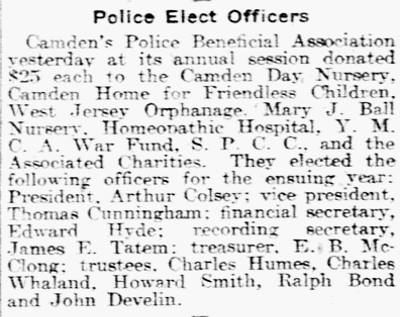
Police Elect Officers
Camden’s Police Beneficial Association yesterday at its annual session donated $25 each to the Camden Day Nursery, Camden Home for Friendless Children, West Jersey Orphanage, Mary J. Ball Nursery, Homeopathic Hospital, Y. M. C. A. War Fund, S. P. C. C., and the Associated Charities. They elected the following officers for the ensuing year: President, Arthur Colsey; vice president, Thomas Cunningham; financial secretary, Edward Hyde; recording secretary, James E. Tatem; treasurer, E. B. McClong; trustees, Charles Humes, Charles Whaland, Howard Smith, Ralph Bond and John Develin.
Philadelphia Inquirer – January 1, 1918
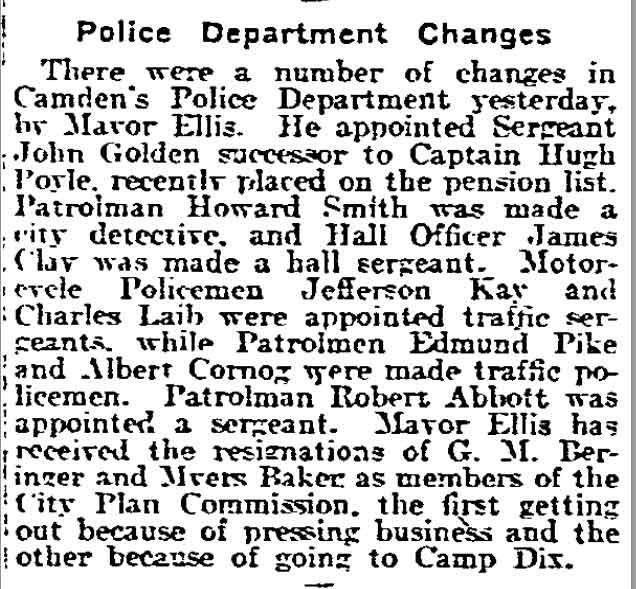
Police Department Changes
There were a number of changes in Camden’s Police Department yesterday, by Mayor Ellis. He appointed Sergeant John Golden successor to Captain Hugh Boyle, recently placed on the pension list. Patrolman Howard Smith was made a city detective, and Hall Officer James Clay was made a hall sergeant. Motorcycle Policemen Jefferson Kay and Charles Laib were appointed traffic sergeants, while Patrolmen Edmund Pike and Albert Cornog were made traffic policemen. Patrolman Robert Abbott was appointed a sergeant. Mayor Ellis has received the resignations of G. M. Beringer and Myers Baker as members of the City Plan Commission, the first getting out because of pressing business and the other because of going to Camp Dix.
Howard M. Smith — World War I Draft Card
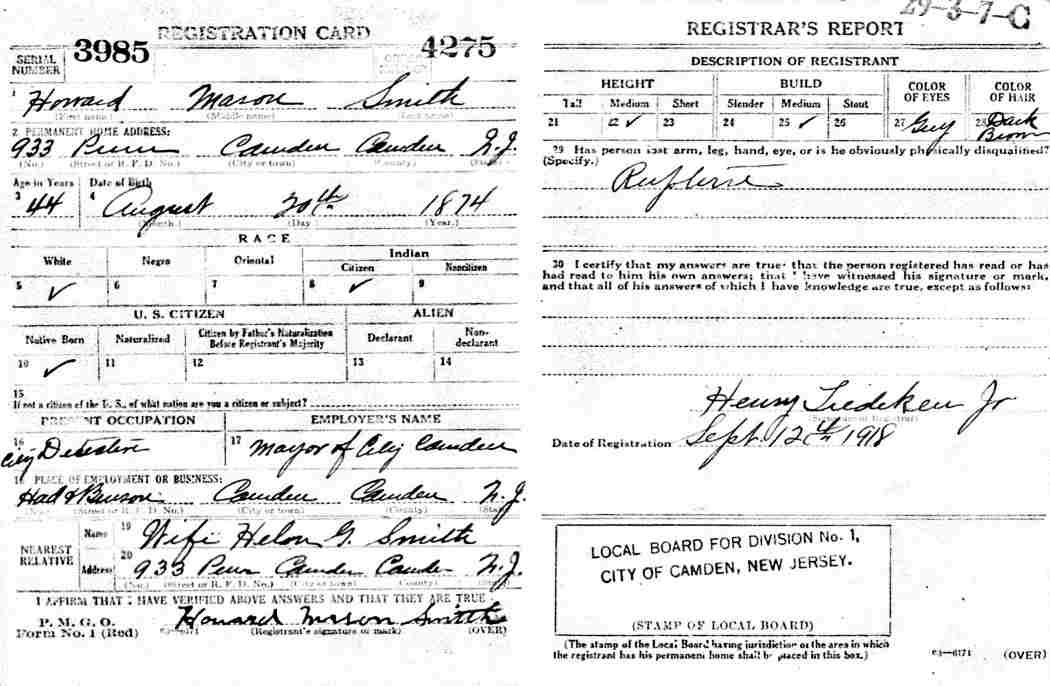
Howard M. Smith — World War I Draft Registration Card, September 12, 1918. Address: 933 Penn Street, Camden, Camden, N.J. Age: 44. Date of Birth: August 20th, 1874. Occupation: City Detective. Employer: Mayor of City Camden. Nearest Relative: Wife Helen G. Smith, 933 Penn Street, Camden.
Death of Howard K. Smith
Camden Post-Telegram –
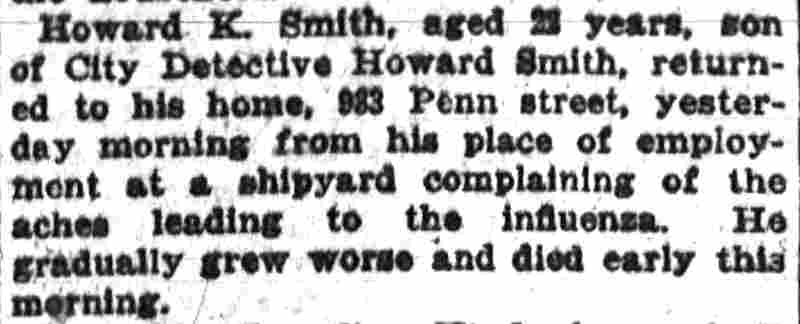
Howard K. Smith, aged 23 years, son of City Detective Howard Smith, returned to his home, 933 Penn street, yesterday morning from his place of employment at a shipyard complaining of the aches leading to the influenza. He gradually grew worse and died early this morning.
Philadelphia Inquirer – November 26, 1922
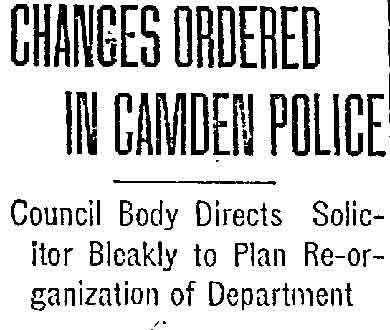
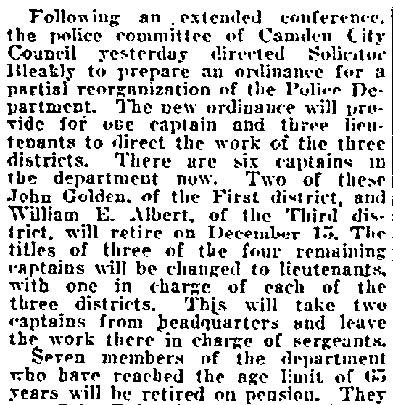
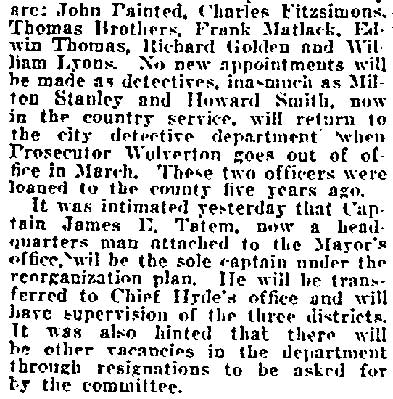
Philadelphia Inquirer, November 26, 1922. Featuring: E.G.C. Bleakly — John Golden — William E. Albert — John Painter — Charles Fitzsimmons — Thomas Brothers — Edwin Thomas — Richard Golden — William Lyons — Milton Stanley — Howard Smith — Charles A. Wolverton — James E. Tatem — Edward Hyde. Note: This story erred in reporting, as retirement at age 65 was NOT mandatory at the time. William E. Albert, Richard Golden, Frank Matlack, and Edwin Thomas did retire. John Golden, John Painter, Charles Fitzsimmons, Thomas Brothers, and William Lyons continued to work in the Police Department. John Golden was eventually promoted to Chief of Police.
Camden Daily Courier – November 9, 1925
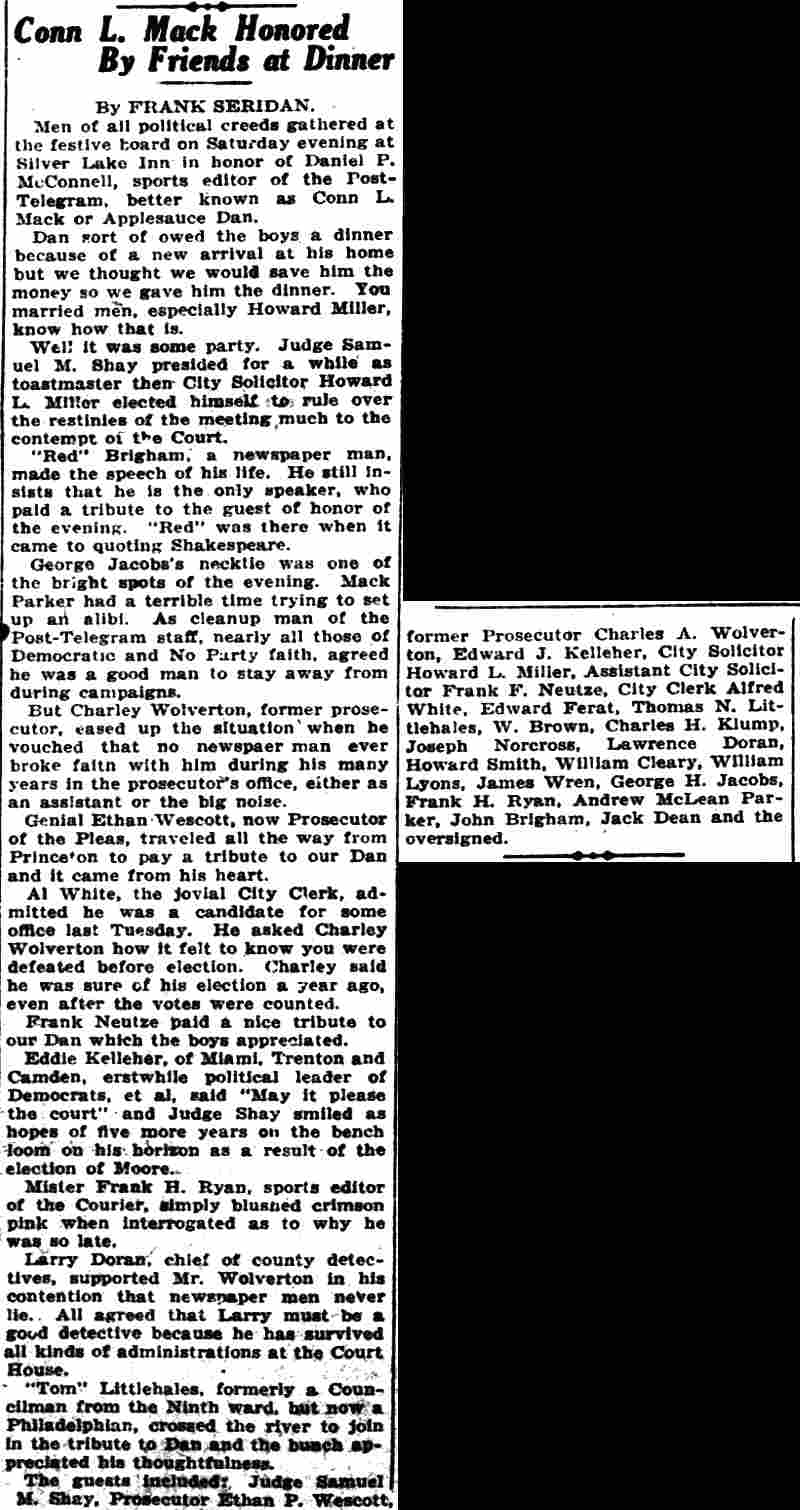
By FRANK SERIDAN.
Men of all political creeds gathered at the festive board on Saturday evening at Silver Lake Inn in honor of Daniel P. McConnell, sports editor of the Post-Telegram, better known as Conn L. Mack or Applesauce Dan.
Dan sort of owed the boys a dinner because of a new arrival at his home but we thought we would save him the money so we gave him the dinner. You married men, especially Howard Miller, know how that is.
Well it was some party. Judge Samuel M. Shay presided for a while as toastmaster then City Solicitor Howard L. Miller elected himself to rule over the destinies of the meeting much to the contempt of the Court.
“Red” Brigham, a newspaper man, made the speech of his life. He still insists that he is the only speaker, who paid a tribute to the guest of honor of the evening. “Red” was there when it came to quoting Shakespeare.
George Jacobs’s necktie was one of the bright spots of the evening. Mack Parker had a terrible time trying to set up an alibi. As cleanup man of the Post-Telegram staff, nearly all those of Democratic and No Party faith, agreed he was a good man to stay away from during campaigns.
But Charley Wolverton, former prosecutor, eased up the situation when he vouched that no newspaper man ever broke faith with him during his many years in the prosecutor’s office, either as an assistant or the big noise.
Genial Ethan Wescott, now Prosecutor of the Pleas, traveled all the way from Princeton to pay a tribute to our Dan and it came from his heart.
Al White, the jovial City Clerk, admitted he was a candidate for some office last Tuesday. He asked Charley Wolverton how it felt to know you were defeated before election. Charley said he was sure of his election a year ago, even after the votes were counted.
Frank Neutze paid a nice tribute to our Dan which the boys appreciated.
Eddie Kelleher, of Miami, Trenton and Camden, erstwhile political leader of Democrats, et al, said “May it please the court” and Judge Shay smiled as hopes of five more years on the bench loom on his horizon as a result of the election of Moore.
Mister Frank H. Ryan, sports editor of the Courier, simply blushed crimson pink when interrogated as to why he was so late.
Larry Doran, chief of county detectives, supported Mr. Wolverton in his contention that newspaper men never lie. All agreed that Larry must be a good detective because he has survived all kinds of administrations at the Court House.
“Tom” Littlehales, formerly a Councilman from the Ninth ward, but now a Philadelphian, crossed the river to join in the tribute to Dan and the bunch appreciated his thoughtfulness.
The guests included: Judge Samuel M. Shay, Prosecutor Ethan P. Wescott, former Prosecutor Charles A. Wolverton, Edward J. Kelleher, City Solicitor Howard L. Miller, Assistant City Solicitor Frank F. Neutze, City Clerk Alfred White, Edward Ferat, Thomas N. Littlehales, W. Brown, Charles H. Klump, Joseph Norcross, Lawrence Doran, Howard Smith, William Cleary, William Lyons, James Wren, George H. Jacobs, Frank H. Ryan, Andrew McLean Parker, John Brigham, Jack Dean and the oversigned.
Gangster Shot During Melee in Sixth Ward
Camden Courier-Post –
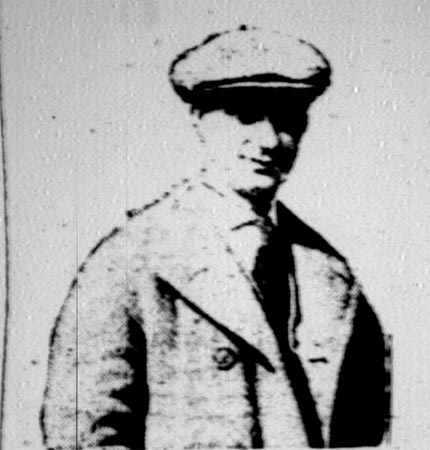
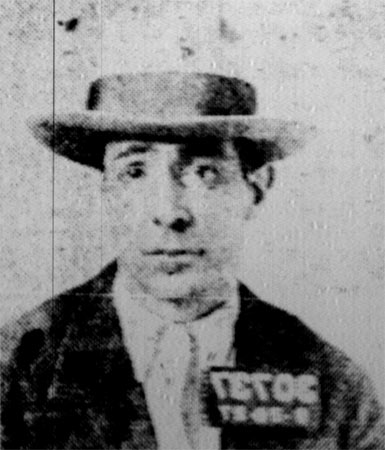
Top: Joseph Deven — Bottom: Joseph Cimini
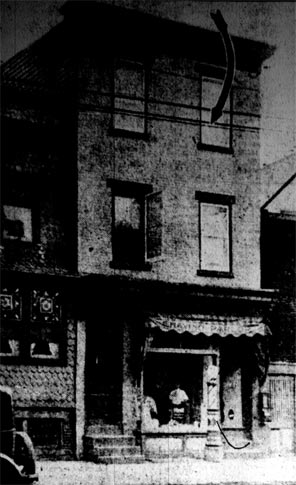
Headquarters of the Sixth Ward Republican Club on Broadway below Spruce Street. The entrance is to the left, the first floor front being occupied by a barber shop. The arrow indicates the room where the shooting occurred.
Gangster Shot During Melee in Sixth Ward
Joseph Deven Held On Murder Charge After Death of Boxer’s Brother; ‘Mose’ Flannery and 4 Others Held as Witnesses; Was Craps Game Says County Police. Holdup Attempted City Cops Declare.
Victim of a shot fired in a melee, the exact cause of which remain undetermined, Joseph Cimini, 31 years old, was killed in the Sixth Ward Republican Club, 908 Broadway.
Cimini, declared by police to be a Philadelphia gangster, was killed before the eyes of two district detectives, Clarence Arthur and Clarence Bunker, who had been summoned to the club by warning that a fight was in progress.
Joseph Deven, 28 years old, known to his associates as “Polack Joe” and a colorful figure in Third Ward politics, fired the shot that killed Cimini.
Declaring that he had fired in self-defense, after Cimini struck him with the butt of a revolver, Deven was locked up without bail on a charge of murder.
Joseph ‘Mose’ Flannery, 26 years old, picturesque Eighth ward political worker, was held as a material witness. Detectives had seized Flannery who was to have precipitated the battle by brandishing a revolver just before Cimini was shot. The officers say that Flannery fled after the shooting and was captured afterward at Broadway and Federal Street.
The name of the dead man was given as Joseph Gannon, but shortly before one o’clock this afternoon, he was identified as Joseph Cimini, 1301 Ellsworth Street, Philadelphia. The identification was made by a brother, William Cimini, a pugilist who has boxed in this city several times under the name of “Billy” Gannon.
Six other men who were present at the time of the shooting, or when the argument began, were questioned by city and county detectives. They are Newton Blanchard, 30, 923 St. John Street, former Camden boxing referee and declared by some of the witnesses as the man who conducted the crap game at the club; Michael Dandrea, 26, 1067 Norris Street; Russell Sage, 26 years old, of 1102 Marion Street a taxicab driver who is said to have driven Gannon and Flannery to the club in his car; Maurice O’Brien, 27 years old, of 1429 Bradley Avenue, a former New Jersey State Trooper, Harry Waterhouse, 28 years old, whose address was given as the same as Sage’s; and Charles “Chick” Hunt, 27 years old, of 1218 Broadway, a former Camden boxer.
Blanchard and Dandrea were released after questioning and after each had made a statement to Chief of County Detective Lawrence T. Doran. The others were held with Flannery as material witness.
Differences of opinion between county and city detectives investigating the shooting were heightened during the afternoon. The county sleuths insisted upon the theory that the shooting had resulted from a feud between Flannery and Hunt, with Cimini taking the former’s side and Deven the latter and said that the heat of the argument had possibly been heightened by disagreement over a crap game.
The city police, on the other hand, declared that the entire affair was the result of an attempt by Flannery to hold up the other men. Deven’s statement to Chief Doran made no mention of a hold-up.
Building up a case against Flannery, the officers this afternoon lodged charges of attempted hold-up, carrying concealed deadly weapons, atrocious assault and battery and assault to kill against him. The two latter charges were made as the result of identification of Flannery as a participant in two recent robbery attempts. J.E. Feinstein, café proprietor of 508 Kaighn Avenue, declared that Flannery, Cimini, and Sage were three of four men who held him up on New Year’s Day. He defied them and they left when he said, “Go ahead and shoot,” he asserted. Flannery was also identified, according to police, as the man who had beaten and attempted to rob Henry Mehrer, an Audubon policeman, and his two companions outside the Ringside Inn, on the Black Horse Pike, a fortnight ago. Mehrer and Feinstein were taken to police headquarters by County Detective Howard Smith, who is authority for the statement that they identified Flannery.
Cimini was shot shortly after 3:00 this morning and died almost instantly. Doctors at Cooper Hospital pronounced him dead on arrival. He had been shot just above the heart by a bullet from Deven’s gun.
Events preceding the shooting remain, to some extent clouded today. Chief Doran said he learned of an enmity existing between Flannery and Hunt. Deven appeared to have attempted to quiet “Mose,” the county detectives said. Cimini struck Deven and Deven fired.
Chief John Golden of the Camden city detective bureau stated, on the other hand, that the shooting had apparently followed an attempt to hold up the other men in the room. Golden based his view on the statements of Clarence Arthur, a city sleuth. According to Arthur, when he and Bunker appeared at the door of the room, Flannery and Cimini held revolvers and the other men in the room were standing with their hands upraised.
According to the story pieced together by county detectives from the statements of witnesses, a group of men had apparently gathered at the club for a crap game. Blanchard, it was stated, acts as the “stick man,” the term used in gambling parlance to designate the man who conducts a crap game.
City and County agree that Flannery and Cimini arrived together in Sage’s taxicab. Whether there was an argument, the result of an enmity between Flannery and Hunt, or whether the attempted hold-up theory is correct, remains to be learned by additional official investigation.
Chief Doran stated the witnesses had told him that words passed between Flannery and Hunt and that the former had gone downstairs. Returning he brandished a revolver.
Two Flee Place
It was at this point that Blanchard and Dandrea left the room and fled down the stairs. On the street, they encountered Detectives Arthur and Bunker, who were patrolling Broadway in a police automobile.
In describing the subsequent events today, Arthur declared that Blanchard had informed him that “two Philadelphia gunmen are up in the Sixth Ward Club holding up a bunch of fellows.”
The detectives did not immediately go to the club, but found Patrolman Frank Del Rossi and followed him up the stairs of the building.
“There were about fifteen men in the room,” Arthur asserted. “When we got to the door Flannery and Cimini had their guns out and apparently were about to search the others. The other men had their hands in the air.
“When they saw us Flannery and Cimini threw their guns down and the others lowered their hands. I went up to Flannery and started to frisk him. Bunker went to another man, whom I don’t know, and started to frisk him.”
It was then he said that he heard the shot. Believing that it was Bunker who was shot, he released his hold on Flannery and swung around. As he did Flannery turned and fled downstairs, Arthur declared.
Bunker said he believed that it was Arthur who had been shot and he too released his grasp on the man he had been searching. The detectives turned in time to see Cimini fall.
“I did it! I shot him!” Deven is declared to have shouted, throwing his revolver on the table.
According to the story told by witnesses to the county detectives, however, Deven had stepped up to Flannery just before the shot was fired and had said: “Mose, you can’t get away with this here.”
Flannery is said to have had a gun in his hand at the time.
As Deven spoke, the witnesses say, Cimini stepped behind him and struck him with the butt of a revolver. Just then detectives entered. Devin whirled and, drawing his gun, fired.
Cimini was placed in a police ambulance and taken to the hospital. After he had been pronounced dead his body was taken to the morgue, where it was awaiting identification today. Neatly dressed, Cimini is of Italian extraction. He has coal-black hair, brown eyes and a dark complexion. Coroner Charles T. Murray will perform a post-mortem examination, he said.
Flannery Captured
When he fled from the club, according to Arthur, Flannery jumped on a Public Service bus driven by David Smith, of 423 Haddon Avenue, which was passing at the time.
“Faster! Faster” he is declared to have urged Smith as the latter drove along Broadway in the direction of Federal Street.
At Federal Street and Broadway, Arthur and Bunker caught up to the bus and arrested Flannery as he descended from the vehicle.
“Why don’t you give me a chance to get to Philadelphia?” Arthur declares Flannery asked him. “I can get bail over there.”
Seek Written Statement
Chief Doran stated this afternoon that he was attempting to obtain a written statement from Flannery and would also seek to have Deven sign a statement regarding the shooting. During the morning, Flannery refused to talk while Devin, although admitting that he fired the shot, declared that he shot in self-defense. He made no reference to the hold-up attempt, according to the county detectives.
Cimini has a Philadelphia police record but, according to his pugilist brother, “was not bad but just wild.” He was recently arrested in Philadelphia after a fight with policemen.
“But he never held up or robbed anybody,” his brother declared this afternoon after identifying the body. “He got into a jam now and then. Yes, I know that he knew ‘Mose’ Flannery, but I never mixed with that crowd.”
It was reported at City Hall this afternoon that Samuel Orlando had been retained as attorney for Flannery and that Walter Keown, Camden county solicitor, would represent all the other men. The presence of Keown at detective headquarters, during which he had a conference with Captain Golden, seemed to lend credence to the latter report but neither rumor could be confirmed.
Flannery for years has figured in police cases and in political warfare in the Eighth Ward, where he was sometimes a lieutenant and sometimes an opponent of “Mikey” Brown, the Republican leader of the ward. Last March he was arrested and indicted on charges of atrocious assault and battery on his wife and her mother. At one time he was held as a suspect in a Philadelphia shooting but later was released.
The accused man, Deven, is a short, slim little man with an air of meek complaisance. He has been a taxicab driver and was last arrested on a charge of drunken driving. In May of 1926 he attempted suicide by shooting himself after he had failed to effect a reconciliation with his estranged wife. At that time, he shot himself but the bullet only grazed his chest.
Joe Deven, long a political power in the Third Ward, first flashed into citywide prominence in 1925, when he was employed by federal authorities as a deputy U.S. Marshal to guard the padlocked Poth brewery at Bulson Street, just off Broadway. At the time Deven was thus maintaining the sanctity of the Eighteenth Amendment, he was also operating a bootlegging establishment downtown and had been arrested once or twice for violating the Volstead Act.
The Courier at that time exposed this paradoxical situation, with the result that the U.S. Marshal summarily dismissed Deven. He keenly resented the political chicanery that had been used to put Deven in office. In explaining how Deven was appointed, the Marshal said that he had been recommended by “prominent Republican leaders” in Camden, chief among whom was William D. Sayrs, now a city commissioner but then a field agent in the office of the Internal Revenue Department.
Sought City Job
Not long after Deven’s dismissal as brewery guard, Sayrs and other Republican leaders made strenuous efforts to secure a city job for him under the Non-Partisan administration. They sought to exact a promise from The Courier that this newspaper would remain silent in the event Deven was appointed to a city position. No such promise was made and Deven remained jobless, politically at least.
Then came a humorous twist to the situation. Sayrs disagreed with some of the Organization leaders and, for a time, walked his own political footpath. Some of the leaders, fearful of what Sayrs might attempt politically, killed two birds with one stone by hiring Joe Deven to shadow Sayrs and to report to them the number of times he conferred with Non-Partisans. Thus, Joe had a job and Billy was watched.
Sayrs knew he was being shadowed by his old friend, and apparently he knew who had hired Deven to do the work, but he refused to take the situation seriously and chortled, frequently, when he would see his “Shadow” trailing about town.
In the last year, however, Deven has again been the particular political protégé of Commissioner Sayrs and also has won the friendship of many other political leaders. Nevertheless, he has not been, so far as can be determined, the recipient of any particular political patronage, though his political influence in the Third and Fifth Wards is said to have expanded rapidly under the new administration.
Murder Motive at G.O.P. Club Splits Sleuths
Camden Evening Courier –
Murder Motive at G.O.P. Club Splits Sleuths
County Detectives Contend Philadelphia Gangster Was Slain in Quarrel Over Woman. Police Claim Hold-Up Attempt Caused Fight. Deven Charged With Crime, Flannery and Taxi Driver Held Without Bail.
With city and county authorities definitely divided on the motive and circumstance of the Sixth Ward Republican Club slaying, Joseph “Polack Joe” Deven was arraigned in Camden police court today and held without bail on a murder charge.
Through County Solicitor Walter Keown, retained as his attorney, Deven waived a police court hearing and was held to await grand jury action in the slaying of Joseph Cimini, Philadelphia gangster, at the political club early Saturday morning.
At the same time County Prosecutor Ethan P. Wescott announced his operatives had abandoned the theory Cimini was killed as the aftermath of an attempted hold-up, and were concentrating their investigation in the case on an effort to “find the woman.”
Statements of witnesses to the fatal shooting, the prosecutor added, made no mention of a hold-up, but contained the declaration that Cimini had been shot as a result of a feud with Charles “Chick” Hunt, former South Camden pugilist, concerning the affection of “Chick’s girl.”
Police Claim Holdup
On the other hand, Captain John Golden, chief of the city detective bureau, declared he was unable to recall any mention of a girl in the statements obtained from witnesses, and added emphatically that his department still held the shooting had followed an attempted holdup of the club by Cimini and Joseph ‘Mose’ Flannery.
Flannery and Hunt were both witnesses to the shooting by Deven, picturesque figure in Third Ward politics, which occurred at the Sixth Ward Club’s headquarters, 908 Broadway.
After Deven had appeared in Police Court today, Flannery was arraigned as a material witness and as an accessory to the crime, with an additional charge accusing him of carrying concealed deadly weapons. Similar charges were made against Russell Sage, a taxicab driver, who arrived at the club with Flannery and Cimini early Saturday morning. These two were committed to the county jail without any bail by Judge Bernard Bertman.
Hunt, however, was released under $1,000 bail as was Martin O’Brien, 27 years old, a former New Jersey State Trooper, and Harry Waterhouse, 28 years old, 1102 Marion street.
Three Others Arrested
During the day the police continued to build up their case against Flannery by arraigning him on the charges made by Milton Feinstein and Henry Mehrer. They also arrested Joseph Genther, 29 years old, 414 Atlantic Avenue; Robert Wolfe, 21 years old, 1106 Mechanic Street, and Eli Conaghy, 27 years old, 814 South 6th Street. Wolfe, who is Flannery’s brother-in-law, and Genther were held “on suspicion” of having been with “Mose” at the time the latter is declared to have attacked and attempted to rob Mehrer, an Audubon policeman, outside the Ringside Inn, on the Black Horse Pike.
Conaghy, Flannery and Sage were arraigned and held without bail on charges of threatening to kill Feinstein and of carrying concealed deadly weapons. Feinstein declares these three with Cimini, the slain man, entered his cafe on January 2 and attempted to hold him up, threatening to kill him if he refused to “come across.” When he defied them by telling them to “go ahead and shoot,” Feinstein says, they departed.
Wolfe, Genther, and Conaghy were arrested by City Detectives George Ward and Thomas Cheeseman. It was Cheeseman who lodged the formal complaint of murder against Deven.
Two Others Released
Two other men who were questioned in connection with the murder case were in court this morning but neither was held. They are Newton Blanchard, 923 St. John Street, a former boxing referee and alleged “stick man” at the crap game declared to have been in progress at the club before the shooting, and Michael Dandrea, 26 years old, of 1657 Norris Street. Both men had been released after questioning on Saturday. Police say they are the men who told police that trouble was imminent at the club and that “Flannery and another fellow are trying to stick up a bunch of other fellows.”
The city police hold-up theory was further attacked today by Francis J. McCarthy, a Philadelphian, who arrived before noon at the county prosecutor’s office and said he would co-operate with the authorities. He wishes to clear the dead man, he said, of the stigma of suspicion that he was slain while engaged in an attempted robbery.
Hearing in Police Court was brief. There was no testimony and Keown merely announced Deven would waive a hearing. Appearing also as attorney for Hunt, O’Brien, and Waterhouse, he said the other three men were “present at the unfortunate shooting” and thus should be held as material witnesses. He added the prosecutor’s office had permitted the release of the three under $1,000 bail each and requested Judge Bertman follow suit. The court acceded to this request but stipulated that new bail must be provided. The three men were freed shortly afterward when the bond was furnished by James Louis, 603 Kaighn Avenue, who had provided the bail yesterday in the prosecutor’s office.
Despite the declaration by two Camden district detectives who were present at the time and who said there was no evidence that gambling was in progress at the club, county detectives disclosed today that statements of the shooting contained the assertion that the men had gathered for a crap game.
These witnesses also declared the fatal shooting resulted from an argument over a woman for whose attention Cimini and Hunt were rivals.
In circles where the leading figures in the shooting move, it was freely predicted things would be fixed up for Deven and that Flannery, political worker and supposed gangster, was to be “made the goat.”
Flannery is blamed by the city police for precipitating the battle. He has also been identified, according to County Detective Howard Smith, as one of the men who beat and robbed Henry Mehrer, an Audubon policeman, outside the Ringside Inn on the Black Horse Pike a fortnight ago. In addition, he is charged with attempting to hold up Milton Feinstein, café proprietor, 508 Kaighn Avenue. Cimini and Sage were also identified by Feinstein, according to Detective Smith.
According to the version of Cimini’s death given in statements by witnesses to county detectives, “Chick” Hunt might have been the victim of the slaying had it not been for Deven’s interference.
Gamble Over Affections
Like actors in a carefully-rehearsed drama, the various witnesses to the shooting made their statements nearly twelve hours after the shooting and, both city and county detectives say they agreed in all important aspects. Prosecutor Wescott declared, however, that no mention of an attempted hold-up was made despite the fact that City Detectives Clarence Arthur and Clarence Bunker—before whose eyes Cimini was shot down—stated Flannery and Cimini were holding the other men at bay when the detectives entered the room.
Instead, the statements of the witnesses described the scene as a dramatic gamble, with death as the stake, over the affections of a woman beloved by both Cimini and Hunt. This woman, who is married and estranged from her husband, is being sought today, Prosecutor Wescott said. According to detectives, Hunt was severely beaten last Wednesday night in a downtown gambling place by members of Cimini’s gang. Cimini, known also as Joseph Gannon, was a brother of William Cimini, a pugilist known in the ring as Billy Gannon.
The stories told by the witnesses place Hunt as one of the players in the crap game which was in progress at the club on Saturday morning. Deven was at the window, looking out, according to the witnesses, when he saw a taxicab draw up in front of the building. Flannery, Cimini and Sage descended and entered the club, it was declared.
“Here comes Mose, Chick, with that guy what’s gunnin’ for you” Deven is declared to have shouted.
A dozen gamesters fled from the room. “Chick” and a few of his friends held their ground and were waiting when the trio entered. Cimini, it is stated, walked over to Hunt.
“I told you,” he said with a sneer, “to stay away from that dame. She’s my girl. You were warned and now you gotta take your medicine.”
Hunt said nothing.
Flannery drew from his pockets two automatics and flung them on the green-topped table, the stories go.
“C’mon, Chick,” he said. “Don’t be yella. He toldja about the broad and he toldja what he’d do. Take your gun and shoot it out.”
“Chick” demurred.
“I don’t want none of that stuff, Mose,” he pleaded. He eyed Cimini carefully as the latter held one hand on the butt of a pistol which protruded from his belt.
Deven Interferes
Hunt made no careless movements toward the pistols on the table. Then Deven is declared to have interfered.
“None of that stuff, Mose,” he said warningly. “Who’s this guy to come here making trouble? He’s no member, is he?”
Cimini moved quickly, the witnesses say. With an upward flip of his hand he brought the barrel of the automatic sharply against Deven’s chin. The latter lurched forward snatching one of the pistols from the table.
The weapon was discharged, the bullet tearing through Cimini’s heart. He died instantly.
The next moment, Arthur and Bunker, district detectives summoned by one of the players who had fled, burst through the door and lined up the men against the wall.
A short time later police arrested Blanchard and Dandrea. Blanchard, police say, was the man who gave them warning of the impending battle. Both men were released after questioning.
Released from Lakeland
The detectives found Deven cringing with fear under the table, the weapon still in his hand. Four other pistols were picked up in different parts of the room.
Deven was identified as a lovesick husband who appeared in the prosecutor’s office several months ago and asked to be “put away.” His wife had left him, he said, and he was afraid he might harm someone.
He was committed to the asylum at Lakeland. When or how he was released is a mystery. Lakeland officials said they had no record of him. Deven once shot himself in a suicide attempt police say, in grief over estrangement from his wife.
Gangdom’s prevailing opinion is that Flannery is “in” for it. Attempts and threats against the blond gangster’s life have furnished many lurid tales for the habitúes of downtown hangouts.
Further, Flannery has made many bitter enemies through his political activities. In the last election he worked as a Democrat against “Mikey” Brown in the Eighth Ward. His overbearing tactics and bravado among the other downtown characters has increased the feeling against him, it is said.
Thus far, he has succeeded in keeping out of the toils for any length of time. His police record includes arrests for rum-running, carrying concealed weapons, alleged ballot frauds and attempted murder. His most recent arrest came in Philadelphia when he figured in a pistol battle in which a man was slain.
Flannery Promises to Explain Slaying
Camden Evening Courier –
Flannery Promises to Explain Slaying
Statement Will Set Forth Facts of G.O.P. Club Murder, Attorney Says.
With Joseph “Mose” Flannery at liberty under $3000 bail, a statement setting forth his part in the Sixth Ward Republican Club affray which resulted in the slaying of Joseph Cimini last Saturday, was promised today by his attorney, Samuel Orlando.
Orlando said he had not discussed the case fully with Flannery, but expected to do so today. Flannery had no statement to county detectives or to County Prosecutor Ethan P. Wescott, although he is generally regarded as holding the key to certain mysterious circumstances surrounding the fatal shooting.
Meanwhile, the text of statements made by other witnesses to the slaying were still being awaited at the Camden courthouse. Copies of these statements were promised to newspapermen early this week and on each day since. Today, however, it was declared by William McDonald, court stenographer, that transcription of the statements had “little more than begun.”
Release of Flannery and of Russell Sage, another witness to the shooting, leaves only Joseph “Polack Joe” Deven in jail. He is awaiting grand jury action on a charge of murdering Cimini, otherwise Joe Gannon. He has admitted the shooting, according to Prosecutor Wescott, but claims that he fired in self defense after Cimini struck him with the butt of a revolver.
Flannery, in addition to being held as a material witness, was charged with being an accessory to the crime, carrying concealed deadly weapons, attempted robbery, threats to kill and assault and battery. The three latter accusations were made in connection with other cases in which County Detective Howard Smith brought in an Audubon policeman and a Kaighn Avenue cafe proprietor who identified Flannery as the man who had attempted to hold them up.
Sage was similarly accused. Statements from witnesses of the Sixth Ward Republican Club slaying are said to agree that Sage, a taxicab driver, accompanied Flannery and Cimini to the clubhouse on the morning of the fatal shooting. Bail for Sage was set at $2,000 and was furnished by John Adam Schlorer, a Camden meat packer.
Flannery’s $5,000 bail bond was furnished by his brother, James, who lives at 1123 Princess Avenue. Other material witnesses, including Charles “Chick” Hunt, who is declared by detectives to have been the intended victim of Flannery and Cimini when they entered the clubhouse, were at liberty under bail of $1,000 each.
Prosecutor Wescott fixed the bail bonds yesterday afternoon after Orlando had made application. Judge Samuel M. Shay signed the orders for bail and the two prisoners were immediately released.
“The $5000 bond was set because of the charge of carrying concealed deadly weapons,” Wescott said later. “There exists no right to hold a material witness without bail, nor does sufficient evidence exist against Flannery in connection with this case to warrant refusing him bail. So far as Sage is concerned, he plays a very minor part in the case.”
Sheik Swindles Her, Woman Claims Here
Camden Courier-Post –
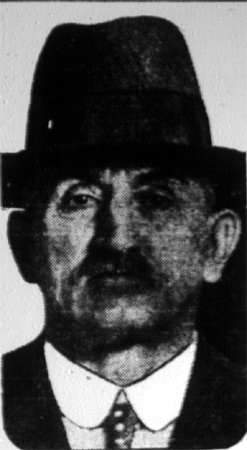
SHEIK SWINDLES HER, WOMAN CLAIMS HERE
Camden Victim Says Jailed Lothario, 60, Took $4200, Vanished.
“He got my money, I got the air.”
That was the grim cry of a Camden woman who accused a suitor of mulcting her of $4200.
The gay Lothario, some 60-odd years, is John H. Lesser, of 712 South 29th Street, Harrisburg PA, who today starts a three-year term in the Moyamensing Prison, Philadelphia. He is also known as Victor Reichel, Charles H. Lesser, and Alfred May.
Lesser was sentenced to three years and fined $500 and the cost of prosecution by Judge Walter Davidson, of Franklin County, who substituted in Philadelphia Quarter Sessions Court, on the charges of two Philadelphia women.
The ‘sheik” has also been identified by Mrs. Anna Wenghofler, 48 years old of 1281 Mechanic Street, as the man who secured her savings from her on a promise of marriage, and then disappeared.
Mrs. Wengholfer, the mother of three grown children, swore out a warrant four years ago for the arrest of Lesser, or Reichel, as he was known in Camden, on a charge of larceny as bailee. He was later indicted by the Camden county grand jury, but was never found until yesterday.
Today, Camden County authorities are arranging for the extradition of Reichel to this state upon the completion of his sentence to face trial on the Camden widow’s charges.
Lesser, or Reichel, was arrested in Pittsburg when he was recognized in a hotel lobby by Mrs. Helen Meier, an actress and married daughter of Mrs. Marie Gottschild, a widow of 2320 Bouvier Street, Philadelphia. Mrs. Gottschild had previously sworn out a warrant charging Lesser with obtaining money under false pretences.
He was placed on trial yesterday before Judge Davidson on complaint of both Mrs. Gottschild and another Philadelphia woman, Mrs. Ida Hoelke, 3001 North 5th Street. Both women allege that he interested them in a restaurant business after courting them during June of 1926.
He obtained $1500 from Mrs. Gottschild and $600 from Mrs. Hoelke, it was alleged. He was found guilty and sentence was imposed.
While he was being led back to the sheriff’s cellroom, Lesser came face to face with Mrs. Wenghofler, who had been taken to Philadelphia by Camden County Detective Howard Smith.
“I know him,” grimly asserted the Camden widow. “I would know him anywhere. I recognized him in the courtroom when he was with a number of other prisoners.”
Lesser turned to a guard, and exclaimed.
“I don’t know this woman. I never saw her before.”
“Well, I know you,” replied Mrs. Wenghofler.
The alleged love-making swindler was then arraigned before Magistrate Pennock and held without bail for extradition to New Jersey.
Police declare that Lesser has mulcted numerous women throughout the East by promises of marriage. Another Philadelphia woman, Mrs. Anna Graffe, of Park Avenue near Master Street, claims she gave him $3,000 for their “future home.” She told police she accepted him as husband-to-be, and he afterward took her to Baltimore and showed her a house which he said he wanted to buy for them. He finally prevailed upon her to “advance” him the money for its purchase, she said.
About five years ago an advertisement appeared in local newspapers. It was worded as follows:
“Bachelor, in business; good character, considerable savings, 48, wants to marry maiden or widow fond of home, should likewise have something saved. Reply with full particulars.”
Mrs. Wenghofler told police that she replied out of curiosity, and Lesser went to her home. He represented himself to be Victor Reichel, and said he was a Philadelphia real estate broker.
He ardently wooed her, finally proposed, and she finally agreed to marry him. He then went with her to the City Hall, procured a marriage license, and they made plans for the wedding.
Then, according to the widow, he told her he found a house which would make an ideal home, but that he was unable to finance its purchase at that moment. He finally wheedled $4,200 from her, she said. He then disappeared.
Chief of Detectives Lawrence T. Doran recognized the description of Lesser when he was captured in Pittsburgh PA, and sent Detectives Cleary and Smith to identify the man. Fingerprints were taken and found to conform with those taken from articles belonging to Reichel and held by the Camden woman. Detectives also declare that three Baltimore women have made complaints in that city of Lesser’s activities, declaring that he swindled them on promises of marriage. The ‘sheik’ also worked in Boston MA and other cities, it is alleged.
Camden Courier-Post – June 3, 1930
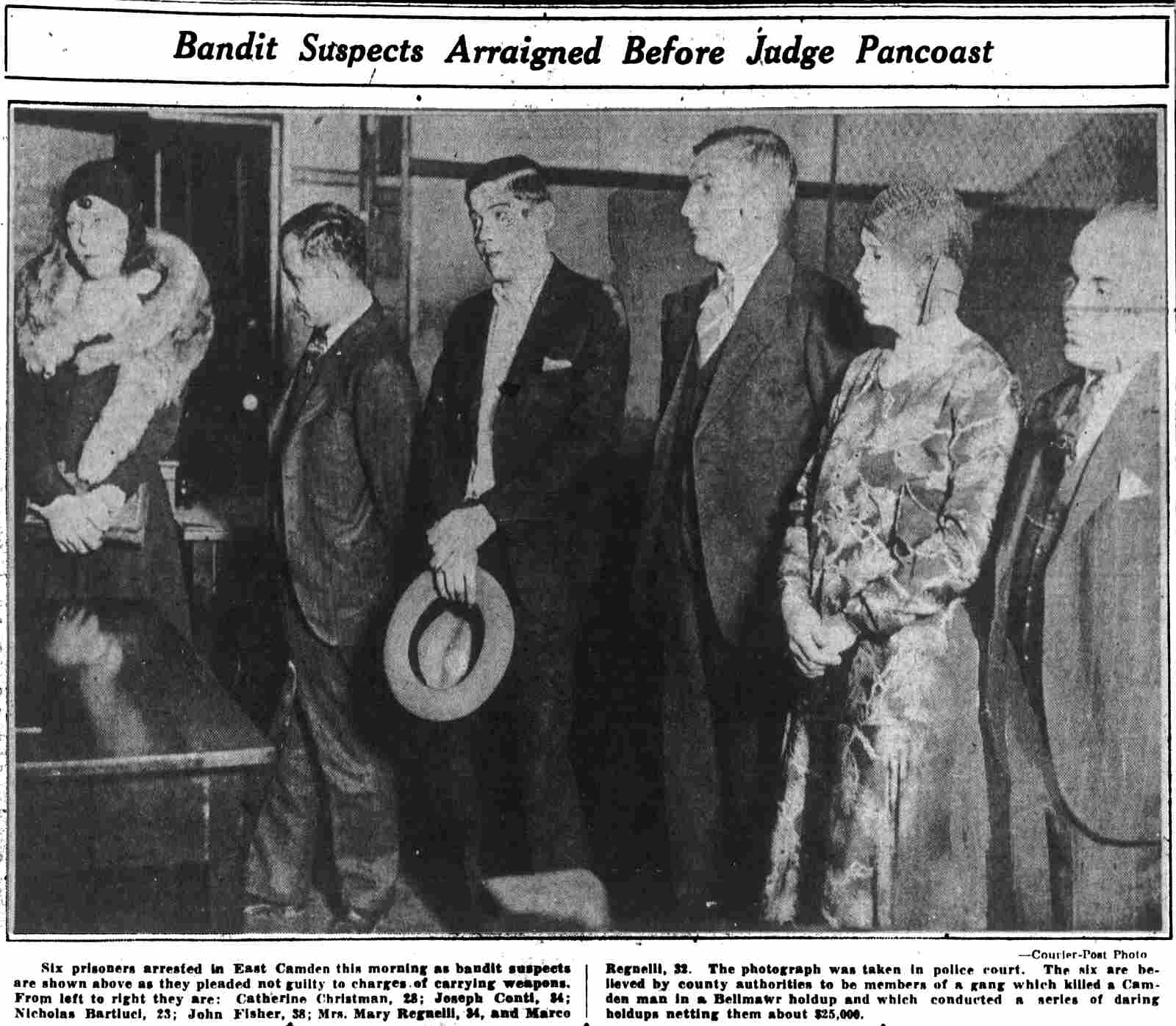

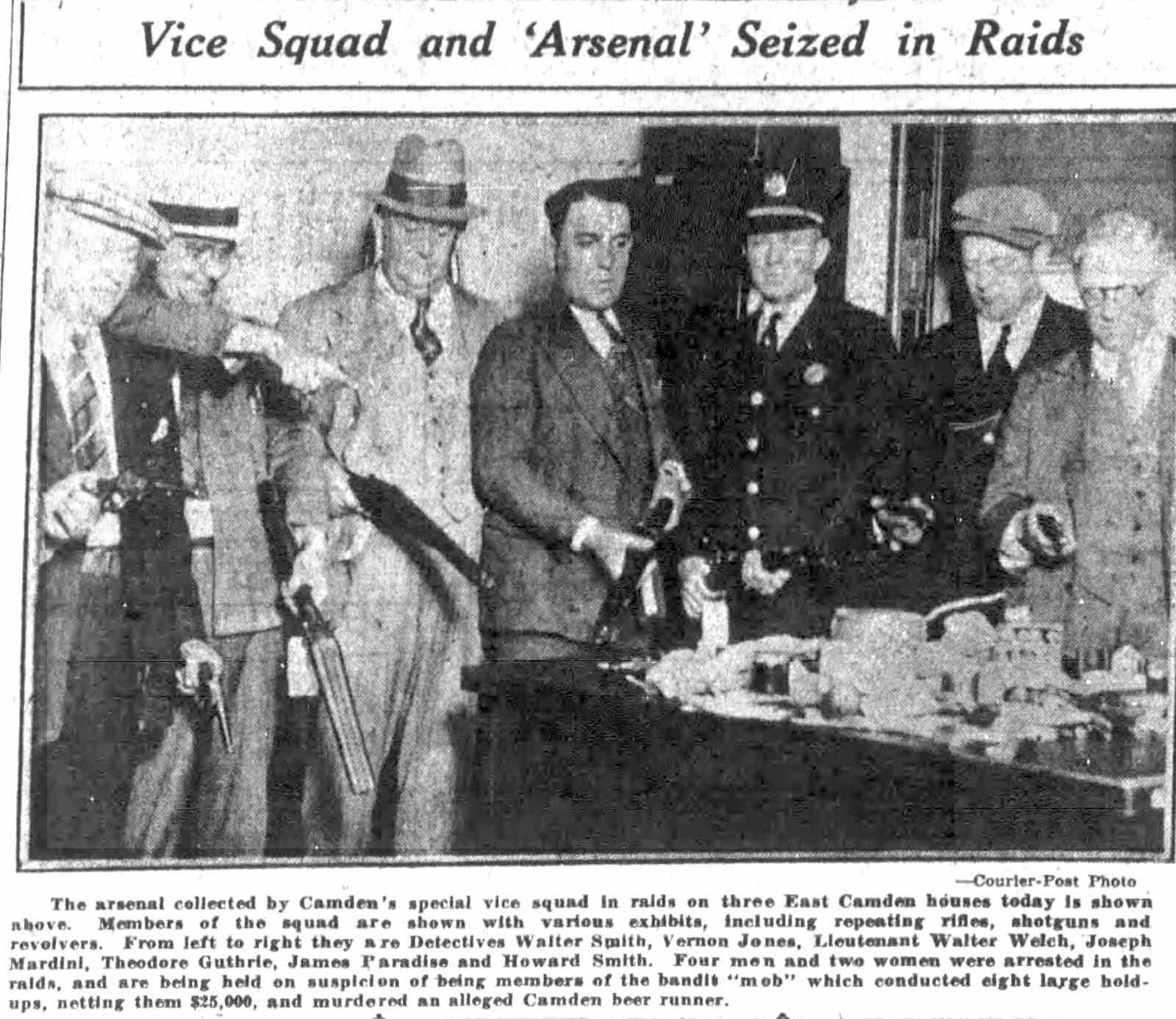
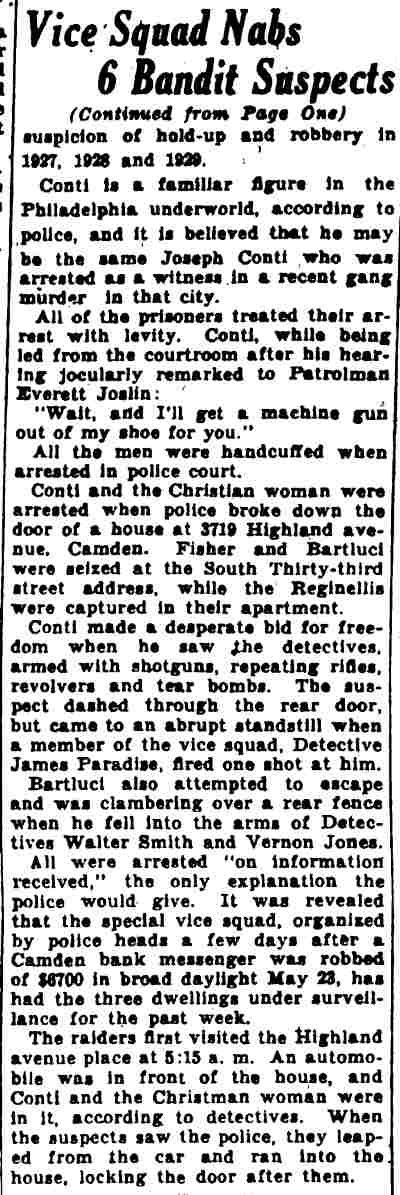
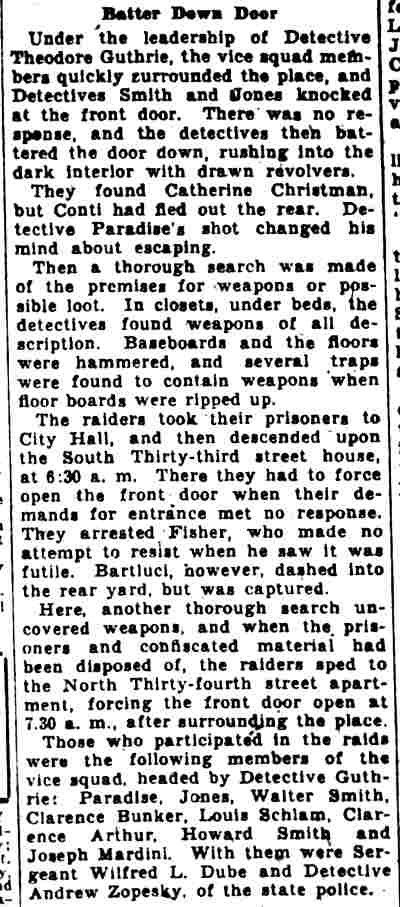
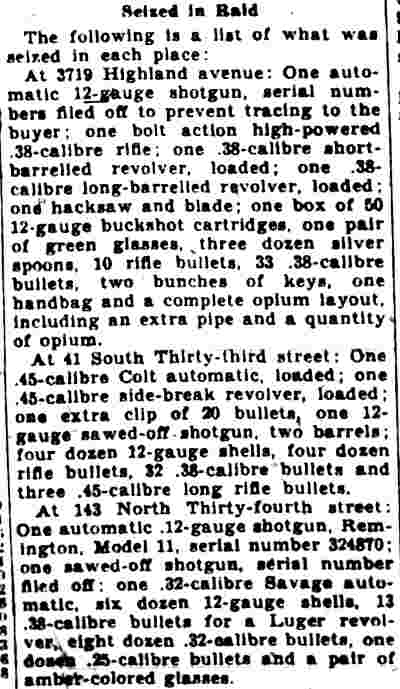
Six prisoners arrested in East Camden this morning as bandit suspects are shown above as they pleaded not guilty to charges of carrying weapons. From left to right they are: Catherine Christman, 28; Joseph Conti, 34; Nicholas Bartluci, 23; John Fisher, 38; Mrs. Mary Reginelli, 34, and Marco Reginelli, 32. The photograph was taken in police court. The six are believed by county authorities to be members of a gang which killed a Camden man in a Bellmawr holdup and which conducted a series of daring holdups netting them about $25,000.
NEW VICE SQUAD IN 3 RAIDS NABS 6 AS SUSPECTS IN BANDIT GANG
Police Believe Prisoners Know Something of Wierman Murder
PROSECUTOR BALDWIN SEEKS SPEEDY TRIAL
Indications Point to Sextet Staging Recent Holdups Netting $25,000
Arrested by the new Camden police squad today in three East Camden dwellings, four men and two women are believed by county authorities to be members of a bandit gang which collected $25,000 and murdered a Camden man in a series of eight holdups during the past two months.
Prosecutor Baldwin expressed belief that the suspects were either implicated in, or know who executed the shooting of William “Bel” Wierman, alleged Camden beer runner, during a holdup April 28 at the Bellmawr County Club. He announced he would ask the grand jury this afternoon to indict them on charges made against them this morning made by the city police, and would probably place them on trial here next week.
Meanwhile, all victims and witnesses to the daring holdups in and near the city will be summoned to the courthouse to attempt to identify the prisoners.
He highly complimented the newly created vice squad on its efficient raids made after a week of painstaking investigation.
Firearms Seized
In each residence police seized a sizable arsenal of revolvers, sawed-off shotguns, repeating rifles, and hundreds of ammunition, all hidden in walls or secreted under floors. An opium “layout,” hacksaw, pairs of colored eyeglasses and tear-ware were also confiscated. The discovery of the tinted eyeglasses in the residence was of significance to Police Lieutenant Ralph Bakley, who pointed out that one of the armed bandits who held up a man at Front and Kaighn avenue two nights before the Wierman slaying wore glasses to escape identification.
Detectives aided by state troopers raided the three residences, which prevented any of the suspects from resisting or escaping. Two attempted to slip through the ring, but one surrendered after a single shot was fired at him, and one was captured while trying to scale a rear fence.
The suspects gave their names as: John Fisher, 38, of 41 South Thirty-third street, Camden; Nicholas Bartluci, 23, of 784 South Wick street, Philadelphia; Joseph Conti, 34 of 708 South Eighth st., Philadelphia; Catherine Christman, 28, of 2202 Perth street, Philadelphia; Mary Reginelli, 32, of Apartment 2, at 143 North Thirty-fourth street, Camden; Marco Reginelli, 24, his wife’s address.
Committed Without Bail
Six were arraigned before Judge in the city police court this morning. As they were arraigned in a joint session, a blanket charge with carrying concealed deadly weapons was lodged against them by Detective Leonard Pancoast of the vice squad. An additional complaint charging possession of narcotics placed against Conti and Catherine Christman.
All of the suspects pleaded not guilty. They were immediately committed to the county jail without bail. Prosecutor Baldwin stated he would hold them for further investigation. They will be finger-printed and “mugged” so that county authorities can obtain their police records.
Each suspect has been arrested from one to four times since 1926. Each was released or exonerated. The most recent cases were inciting a riot in 1925.
Continued on Page Two
Vice Squad and ’Arsenal’ Seized in Raids
The arsenal collected by Camden’s special vice squad in raids on three East Camden houses today is shown above. Members of the squad are shown with various exhibits, including repeating rifles, shotguns and revolvers. From left to right they are Detectives Walter Smith, Vernon Jones, Lieutenant Walter Welch, Joseph Mardini, Theodore Guthrie, James Paradise and Howard Smith. Four men and two women were arrested in the raids, and are being held on suspicion of being members of the bandit “mob” which conducted eight large holdups, netting them $25,000, and murdered an alleged Camden beer runner.
Vice Squad Nabs 6 Bandit Suspects
(Continued from Page One)
suspicion of hold-up and robbery in 1927, 1928 and 1929.
Conti is a familiar figure in the Philadelphia underworld, according to police, and it is believed that he may be the same Joseph Conti who was arrested as a witness in a recent gang murder in that city.
All of the prisoners treated their arrest with levity. Conti, while being led from the courtroom after his hearing jocularly remarked to Patrolman Everett Joslin:
“Wait, and I’ll get a machine gun out of my shoe for you.”
All the men were handcuffed when arrested in police court.
Conti and the Christman woman were arrested when police broke down the door of a house at 3719 Highland avenue, Camden. Fisher and Bartluci were seized at the South Thirty-third street address, while the Reginellis were captured in their apartment.
Conti made a desperate bid for freedom when he saw the detectives, armed with shotguns, repeating rifles, revolvers and tear bombs. The suspect dashed through the rear door, but came to an abrupt standstill when a member of the vice squad, Detective James Paradise, fired one shot at him.
Bartluci also attempted to escape and was clambering over a rear fence when he fell into the arms of Detectives Walter Smith and Vernon Jones.
All were arrested “on information received,” the only explanation the police would give. It was revealed that the special vice squad, organized by police heads a few days after a Camden bank messenger was robbed of $6700 in broad daylight May 23, has had the three dwellings under surveillance for the past week.
The raiders first visited the Highland avenue place at 5:15 a. m. An automobile was in front of the house, and Conti and the Christman woman were in it, according to detectives. When the suspects saw the police, they leaped from the car and ran into the house, locking the door after them.
Batter Down Door
Under the leadership of Detective Theodore Guthrie, the vice squad members quickly surrounded the place, and Detectives Smith and Jones knocked at the front door. There was no response, and the detectives then battered the door down, rushing into the dark interior with drawn revolvers.
They found Catherine Christman, but Conti had fled out the rear. Detective Paradise’s shot changed his mind about escaping.
Then a thorough search was made of the premises for weapons or possible loot. In closets, under beds, the detectives found weapons of all description. Baseboards and the floors were hammered, and several traps were found to contain weapons when floor boards were ripped up.
The raiders took their prisoners to City Hall, and then descended upon the South Thirty-third street house, at 6:30 a. m. There they had to force open the front door when their demands for entrance met no response. They arrested Fisher, who made no attempt to resist when he saw it was futile. Bartluci, however, dashed into the rear yard, but was captured.
Here, another thorough search uncovered weapons, and when the prisoners and confiscated material had been disposed of, the raiders sped to the North Thirty-fourth street apartment, forcing the front door open at 7:30 a. m. after surrounding the place.
Those who participated in the raids were the following members of the vice squad, headed by Detective Guthrie: Paradise, Jones, Walter Smith, Clarence Bunker, Louis Schlam, Clarence Arthur, Howard Smith and Joseph Mardini. With them were Sergeant Wilfred L. Dube and Detective Andrew Zopesky, of the state police.
Seized in Raid
The following is a list of what was seized in each place:
At 3719 Highland avenue: One automatic 12-gauge shotgun, serial numbers filed off to prevent tracing to the buyer; one bolt action high-powered .38-calibre rifle; one .38-calibre short-barrelled revolver, loaded; one .38-calibre long-barrelled ravolver, loaded; one hacksaw and blade; one box of 50 12-gauge buckshot cartridges, one pair of green glasses, three dozen silver spoons, 10 rifle bullets, 33 .38-calibre bullets, two bunches of keys, one handbag and a complete opium layout, including an extra pipe and a quantity of opium.
At 41 South Thirty-third street: One .45-calibre Colt automatic, loaded; one .45-calibre side-break revolver, loaded; one extra clip of 20 bullets, one 12-gauge sawed-off shotgun, two barrels; four dozen 12-gauge shells, four dozen rifle bullets, 32 .38-calibre bullets and three .45-calibre long rifle bullets.
At 143 North Thirty-fourth street: One automatic .12-gauge shotgun, Remington, Model 11, serial number 324870; one sawed-off shotgun, serial number filed off; one .32-calibre Savage automatic, six dozen 12-gauge shells, 13 .38-calibre bullets for a Luger revolver, eight dozen .32-calibre bullets, one dozen .25-calibre bullets and a pair of amber-colored glasses.
Camden Evening Courier – December 6, 1930
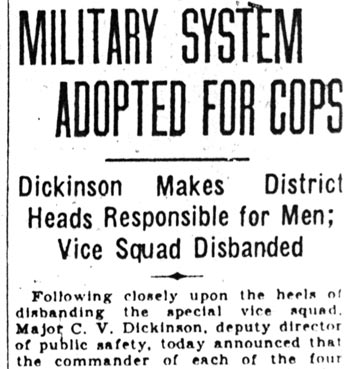
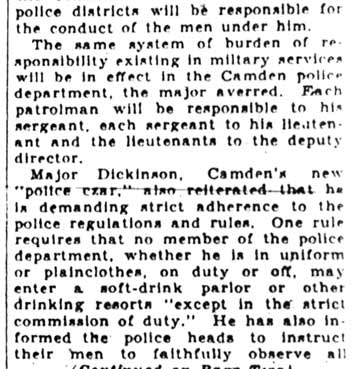
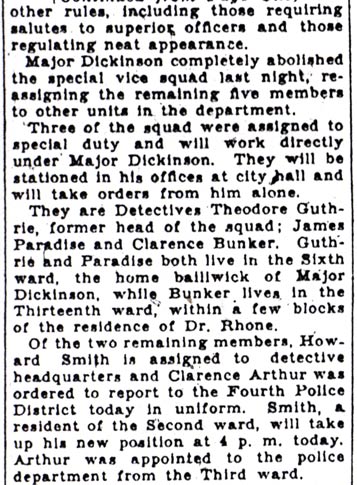
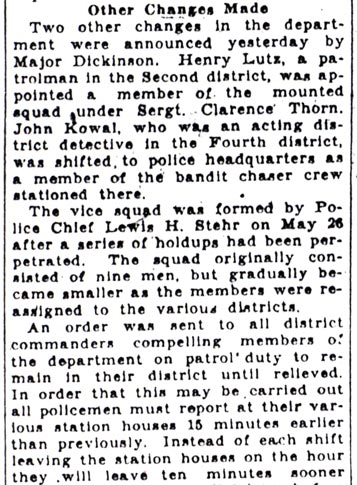
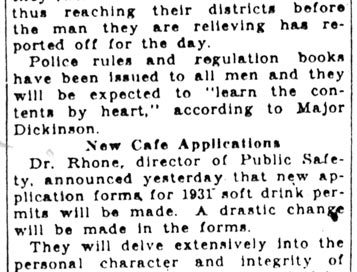
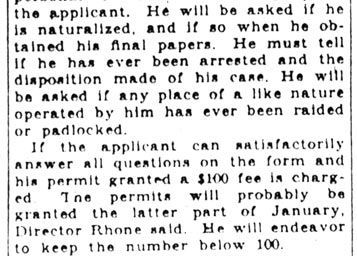
Named: Camden Evening Courier, December 6, 1930. Featuring: Dr. David S. Rhone, Charles V. Dickinson, Theodore Guthrie, James Paradise, Clarence Bunker, Howard Smith, Clarence Arthur, Henry Lutz, Clarence Thorn, John Kowal, and Lewis H. Stehr.
Suspect Is Nabbed at Fairview Home in Shooting of Cop
Camden Evening Courier —
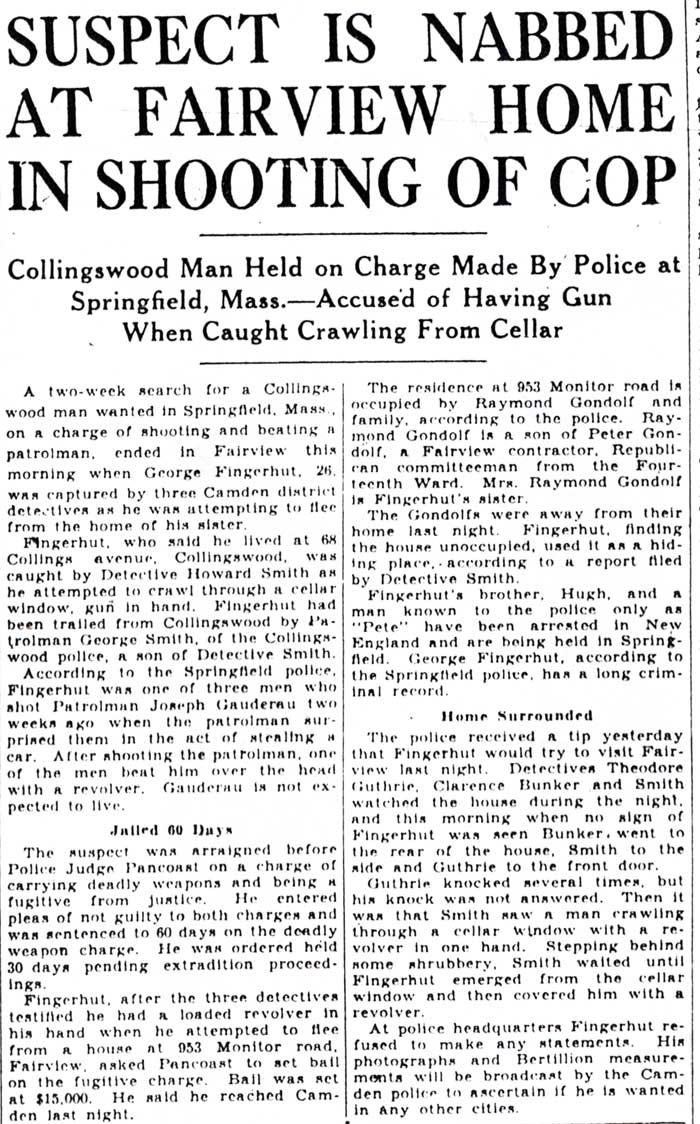
Collingswood Man Held on Charge Made By Police at Springfield, Mass.—Accused of Having Gun When Caught Crawling From Cellar
A two-week search for a Collingswood man wanted in Springfield, Mass., on a charge of shooting and beating a patrolman, ended in Fairview this morning when George Fingerhut, 26, was captured by three Camden district detectives as he was attempting to flee from the home of his sister.
Fingerhut, who said he lived at 68 Collings avenue, Collingswood, was caught by Detective Howard Smith as he attempted to crawl through a cellar window, gun in hand. Fingerhut had been trailed from Collingswood by Patrolman George Smith, of the Collingswood police, a son of Detective Smith.
According to the Springfield police, Fingerhut was one of three men who shot Patrolman Joseph Gauderau two weeks ago when the patrolman surprised them in the act of stealing a car. After shooting the patrolman, one of the men beat him over the head with a revolver. Gauderau is not expected to live.
Jailed 60 Days
The suspect was arraigned before Police Judge Pancoast on a charge of carrying deadly weapons and being a fugitive from justice. He entered pleas of not guilty to both charges and was sentenced to 60 days on the deadly weapon charge. He was ordered held 30 days pending extradition proceedings.
Fingerhut, after the three detectives testified he had a loaded revolver in his hand when he attempted to flee from a house at 953 Monitor road, Fairview, asked Pancoast to set bail on the fugitive charge. Bail was set at $15,000. He said he reached Camden last night.
The residence at 953 Monitor road is occupied by Raymond Gondolf and family, according to the police. Raymond Gondolf is a son of Peter Gondolf, a Fairview contractor, Republican committeeman from the Fourteenth Ward. Mrs. Raymond Gondolf is Fingerhut's sister.
The Gondolfs were away from their home last night. Fingerhut, finding the house unoccupied, used it as a hiding place, according to a report filed by Detective Smith.
Fingerhut's brother, Hugh, and a man known to the police only as "Pete" have been arrested in New England and are being held in Springfield. George Fingerhut, according to the Springfield police, has a long criminal record.
Home Surrounded
The police received a tip yesterday that Fingerhut would try to visit Fairview last night. Detectives Theodore Guthrie, Clarence Bunker and Smith watched the house during the night, and this morning when no sign of Fingerhut was seen Bunker, [sic] went to the rear of the house, Smith to the side and Guthrie to the front door.
Guthrie knocked several times, but his knock was not answered. Then it was that Smith saw a man crawling through a cellar window with a revolver in one hand. Stepping behind some shrubbery, Smith waited until Fingerhut emerged from the cellar window and then covered him with a revolver.
At police headquarters Fingerhut refused to make any statements. His photographs and Bertillion measurements will be broadcast by the Camden police to ascertain if he is wanted in any other cities.
Camden Evening Courier – December 13, 1930
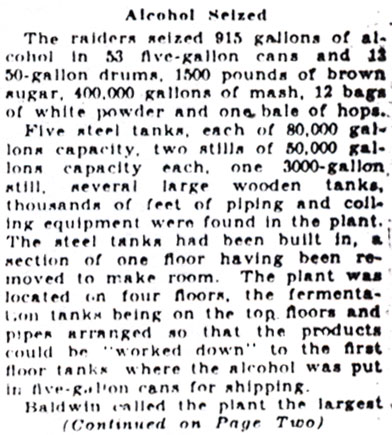
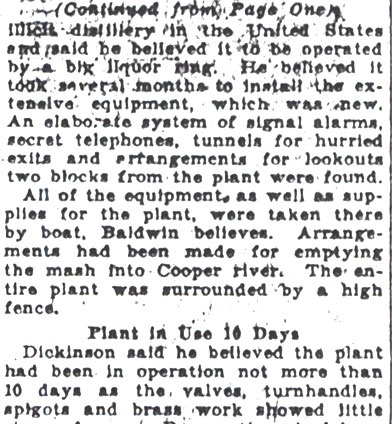
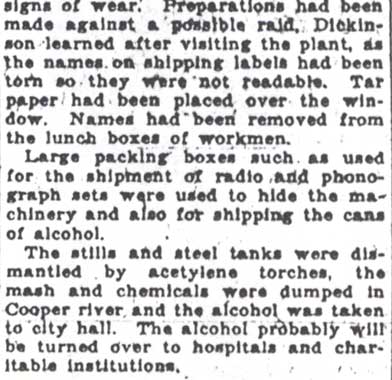
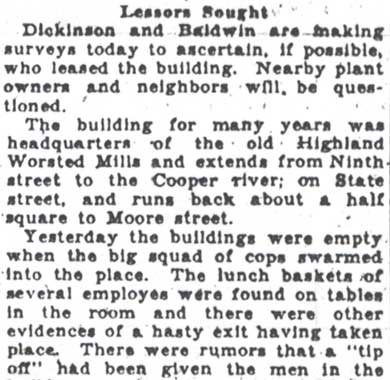
Named: Camden Evening Courier, December 13, 1930. Featuring: Lawrence T. Doran, Charles V. Dickinson, Clifford A. Baldwin, Walter Mattison, Howard Smith, George A. Ward, Jeff Kay, Alfred Shires, Harry Kyler, Archie Riess, Walter Smith, Harry Cattell, Earl Rider, Charles F. Smith, Charles H. Smith, John Toal, John Taylor, Frank Carle, Oscar Thompson, Highland Worsted Mills, North Camden, State Street, Moore Street, and Chestnut Street.
Camden Courier-Post – April 2, 1931
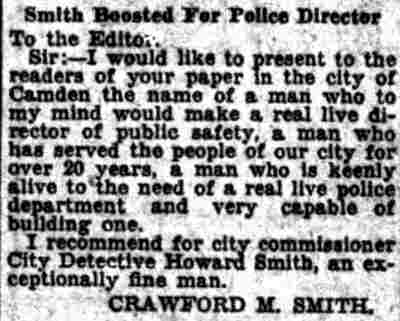
Smith Boosted for Police Director
Smith Boosted For Police Director
To the Editor:
Sir:—I would like to present to the readers of your paper in the city of Camden the name of a man who to my mind would make a real live director of public safety, a man who has served the people of our city for over 20 years, a man who is keenly alive to the need of a real live police department and very capable of building one.
I recommend for city commissioner City Detective Howard Smith, an exceptionally fine man.
Crawford M. Smith.
Camden Courier-Post – April 3, 1931

30 Cops Shifted Today in Opening of New District
Shake-Up in Camden Force is Most Drastic in History
SMITH AT CITY HALL
Drastic shifts in the Camden police department, affecting more than 30 members of the force became effective at 8 a.m. today.
The shake-up, announced yesterday by Commissioner David S. Rhone, director of public safety, is the result of creation of a fourth police district.
The outstanding changes are the promotion of Sergeant of Detectives George Ward to acting lieutenant in the First district, supplanting Sergeant Samuel Nayler, who is sent to headquarters, and the return to the city detective bureau of Acting County Detective Howard Smith.
Smith was detailed to the second district today and was assigned to a robbery investigation in the thirteenth ward.
District Captaincies Abolished
With the shifts, the rank of district captain is abolished. Instead, lieutenants will be in charge of the districts. Captains will be in charge only of the traffic and detective bureaus and headquarters, Commissioner Rhone said.
The removal of Sergeant Nayler from the First District was not unexpected, since he had been “on the carpet” last October as a result of a speakeasy shooting in his district. Nayler, though holding the rank of sergeant, was acting captain of the district.
He was threatened with dismissal by Chief Stehr and Commissioner Rhone if the vice conditions in the First District were not cleaned up. The situation came to a climax with the wounding of Charles Arini in Louis Del Duca in a speakeasy at Third and Mickle streets in October. It was reported Naylor was to be removed from the district several times since.
Ward Again Promoted
Ward was promoted to sergeant of detectives two months ago. Under the transfer, he is promoted again, remaining as acting lieutenant for a year, until he takes an examination for a lieutenancy.
Other police officers now acting-lieutenants will become lieutenants after examination.
Nayler, who was in charge of the First district for several years, will serve as desk sergeant under Capt. A. Lincoln James.
The return of Smith to the city detective bureau is required by Prosecutor Clifford A. Baldwin, it is understood. Smith has been a county detective for more than eleven years. He first was transferred to the prosecutor’s office at the request of Prosecutor Charles A. Wolverton. Although a Republican, he was retained there under Prosecutor Ethan P. Wescott. Although some surprise was occasioned by the announcement of Smith’s return to the city force, inasmuch as the new prosecutor is a Republican, it was said that Baldwin wished to begin his term with an entire new force.
Worked For City Also
Although Smith acted for the county and was paid by the county, he received a salary of $1 a year to retain him in the city so that he could be recalled at any time.
Through the shift, Sergeant Charles Laib, serving under Traffic Inspector Charles T. Humes, is elevated to acting captain of the traffic department. In the future all motorcycle men will report direct to Humes and Laib instead of to headquarters.
Ralph Bakley, who has been acting lieutenant of the First District, has been named acting lieutenant of the Second District, and Thomas Cunningham, who was acting captain of the Second District, becomes acting lieutenant of the Third. William Horner, who has been acting captain of the Third District, is elevated to the rank of acting lieutenant and remains in charge of that.
5 Camden Police Granted Pensions
Camden Courier-Post –
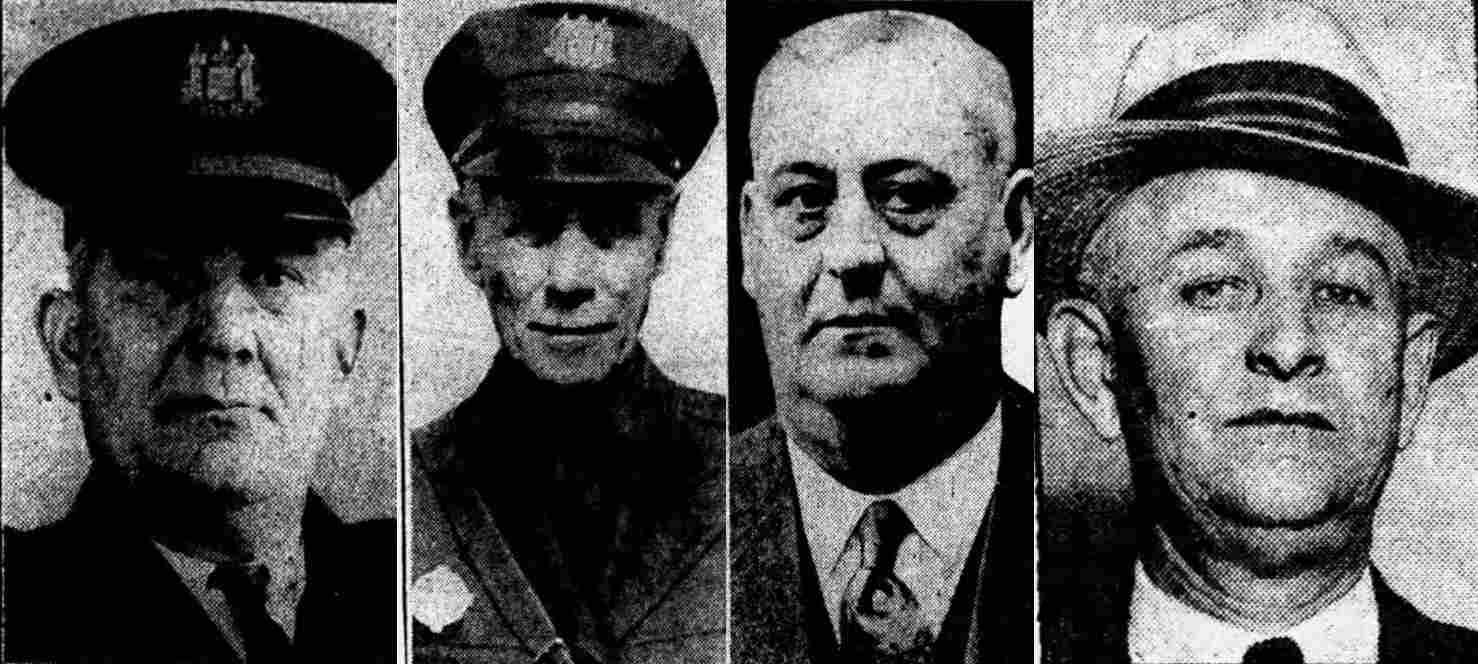

5 CAMDEN POLICE GRANTED PENSIONS
Laib, Kay, Guthrie, Smith and Till to Be Retired Next Month
Petitions for pensions were granted yesterday to five members of the Camden police department.
The retiring men are: Lieutenant Charles Laib, in charge of the traffic bureau; Sergeant Charles J. “Jeff” Kay, City Detectives Theodore “Dory” Guthrie and Howard Smith, and Patrolman J. Oscar Till.
The retirements are to become effective Jan. 1, it was announced after a special meeting of the pension committee in city hall. Mrs. Louise F. Walsh, secretary of the board, presented the five applications.
Eventual retirement of Lieut. Laib has been rumored in the department for several months, but it was not until recently that the report was regarded seriously. It is understood that his associates as late as yesterday had requested him to remain on duty. He is recognized as one of the most competent officers in the department. Failing health, however, is said to have prompted the pension committee to approve his application.
No announcement as to Lieut. Laib’s successor was made by Acting Chief John W. Golden.
Lieutenant Laib was appointed to the police force on January 12, 1912, by former Mayor Charles H. Ellis. He was promoted to sergeant in 1916 and became a lieutenant in 1929. He has been in charge of the traffic detail for a year, succeeding Captain Charles L. Humes, who has been named inspector of personnel.
Laib is but 51 years of age and is one of the youngest men in the department to apply for pension. If his pension is approved he will receive a monthly salary of $102.05. His home is with his wife at 76 South Twenty-fourth street.
For many years, Laib has been conducting a “one-man” relief organization and is recognized by charitable organizations throughout the city for his generosity among the destitute. At Thanksgiving and Christmas, he personally collects funds for dinners for the children of the Sheltering Arms Home, Seventeenth street and River avenue, and has also been responsible for the home getting a daily supply of bread from a Camden bakery for several years.
Sergeant Kay is a veteran member of the police department and has been an officer for 38 years. He is 72 and lives at 606 North Fourth street. He will receive $90.65 monthly. He has been on the sick list for several months, recovering from injuries received in an accident.
Detective Smith is 58 and lives at 933 Penn street. For several years he was loaned to the county as a detective and helped in the discovery of Camden county murders. He was recently returned to the police department and Detective Fiore Troncone turned over to the county in his place. He will receive $90.65 a month. He was appointed June 20, 1905.
Detective Guthrie served 19 years as a policeman and two as a fireman. He resides at 570 Chestnut street. He will receive $92.50 per month, the additional $2 being added because he will not have the usual two per cent deducted for the pension fund.
Patrolman Till, who is 56, resides at North Twenty-fifth street. He served 19 years as a policeman and two and one-half years as a fireman. He is attached to the Second district. Till will receive $83.60 monthly.
The members of the pension committee who passed on the applications is headed by Mayor Roy R. Stewart and includes, Newton W. Ash, fire department representative; William Michalak, police department representative; John J. Robinson, a citizen member, and Mrs. Walsh.
Craps Player Pleads Guilty in Slaying
Camden Courier-Post –
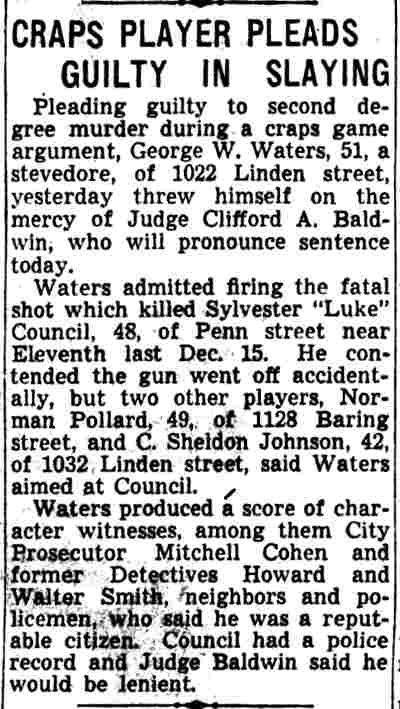
CRAPS PLAYER PLEADS GUILTY IN SLAYING
Pleading guilty to second degree murder during a craps game argument, George W. Waters, 51, a stevedore, of 1022 Linden street, yesterday threw himself on the mercy of Judge Clifford A. Baldwin, who will pronounce sentence today.
Waters admitted firing the fatal shot which killed Sylvester “Luke” Council, 48, of Penn street near Eleventh last Dec. 15. He contended the gun went off accidentally, but two other players, Norman Pollard, 49, of 1128 Baring street, and C. Sheldon Johnson, 42, of 1032 Linden street, said Waters aimed at Council.
Waters produced a score of character witnesses, among them City Prosecutor Mitchell Cohen and former Detectives Howard and Walter Smith, neighbors and policemen, who said he was a reputable citizen. Council had a police record and Judge Baldwin said he would be lenient.
Howard M. Smith, Ex-Sleuth, Dies
Camden Courier-Post –
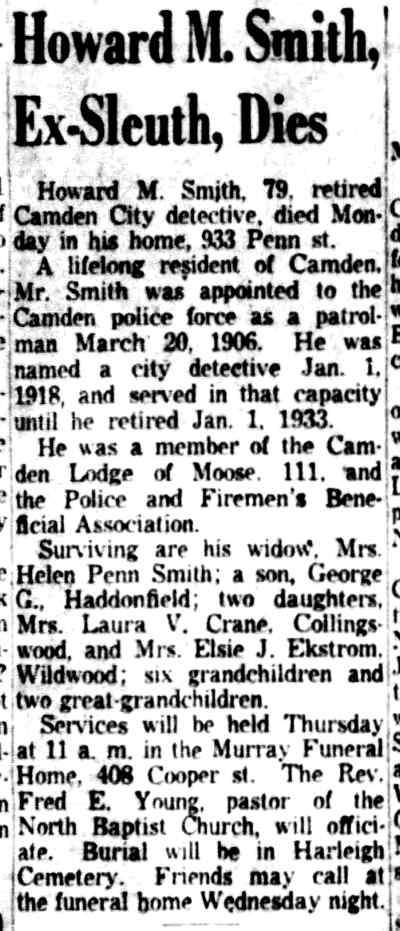
Howard M. Smith, Ex-Sleuth, Dies
Howard M. Smith, 79, retired Camden City detective, died Monday in his home, 933 Penn st.
A lifelong resident of Camden, Mr. Smith was appointed to the Camden police force as a patrolman March 20, 1906. He was named a city detective Jan. 1, 1918, and served in that capacity until he retired Jan. 1, 1933.
He was a member of the Camden Lodge of Moose, 111, and the Police and Firemen’s Beneficial Association.
Surviving are his widow, Mrs. Helen Penn Smith; a son, George G., Haddonfield; two daughters, Mrs. Laura V. Crane, Collingswood, and Mrs. Elsie J. Ekstrom, Wildwood; six grandchildren and two great-grandchildren.
Services will be held Thursday at 11 a. m. in the Murray Funeral Home, 408 Cooper st. The Rev. Fred E. Young, pastor of the North Baptist Church, will officiate. Burial will be in Harleigh Cemetery. Friends may call at the funeral home Wednesday night.
Funeral Services Held For Howard M. Smith
Camden Courier-Post –
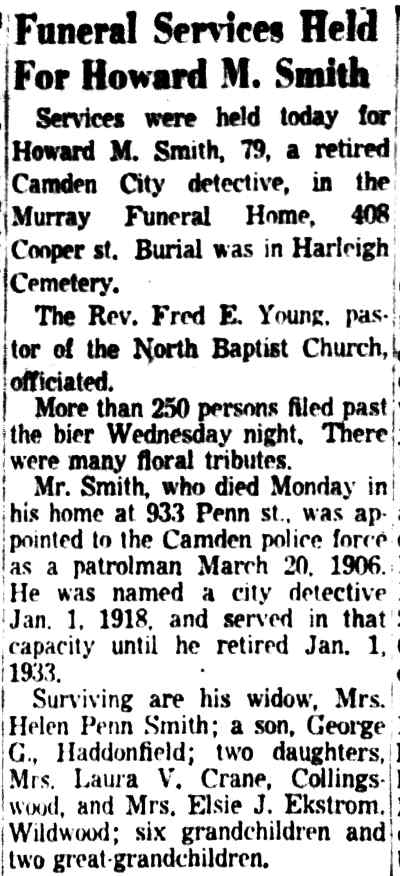
Funeral Services Held For Howard M. Smith
Services were held today for Howard M. Smith, 79, a retired Camden City detective, in the Murray Funeral Home, 408 Cooper st. Burial was in Harleigh Cemetery.
The Rev. Fred E. Young, pastor of the North Baptist Church, officiated.
More than 250 persons filed past the bier Wednesday night. There were many floral tributes.
Mr. Smith, who died Monday in his home at 933 Penn st., was appointed to the Camden police force as a patrolman March 20, 1906. He was named a city detective Jan. 1, 1918, and served in that capacity until he retired Jan. 1, 1933.
Surviving are his widow, Mrs. Helen Penn Smith; a son, George G., Haddonfield; two daughters, Mrs. Laura V. Crane, Collingswood, and Mrs. Elsie J. Ekstrom, Wildwood; six grandchildren and two great-grandchildren.
Howard M. Smith
Camden Courier-Post –
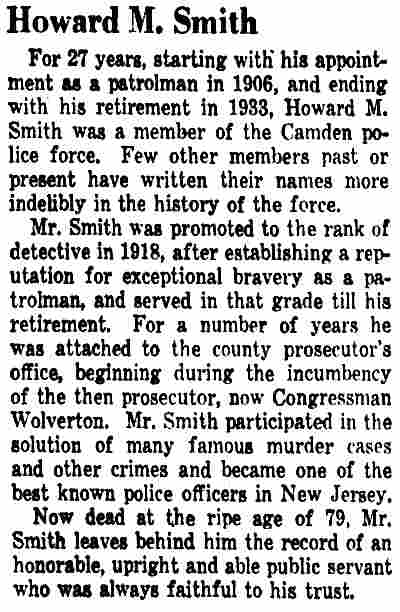
Howard M. Smith
For 27 years, starting with his appointment as a patrolman in 1906, and ending with his retirement in 1933, Howard M. Smith was a member of the Camden police force. Few other members past or present have written their names more indelibly in the history of the force.
Mr. Smith was promoted to the rank of detective in 1918, after establishing a reputation for exceptional bravery as a patrolman, and served in that grade till his retirement. For a number of years he was attached to the county prosecutor’s office, beginning during the incumbency of the then prosecutor, now Congressman Wolverton. Mr. Smith participated in the solution of many famous murder cases and other crimes and became one of the best known police officers in New Jersey.
Now dead at the ripe age of 79, Mr. Smith leaves behind him the record of an honorable, upright and able public servant who was always faithful to his trust.
Laura V. Crane, Mother of Chief
Camden Courier-Post –
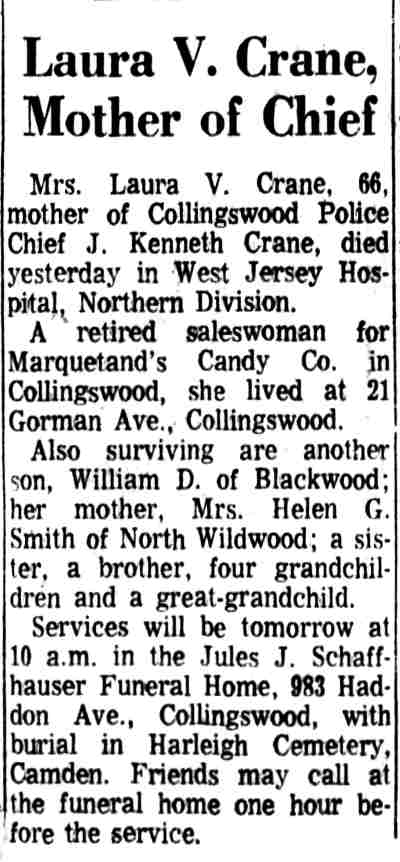
Laura V. Crane, Mother of Chief
Mrs. Laura V. Crane, 66, mother of Collingswood Police Chief J. Kenneth Crane, died yesterday in West Jersey Hospital, Northern Division.
A retired saleswoman for Marquetand’s Candy Co. in Collingswood, she lived at 21 Gorman Ave., Collingswood.
Also surviving are another son, William D. of Blackwood; her mother, Mrs. Helen G. Smith of North Wildwood; a sister, a brother, four grandchildren and a great-grandchild.
Services will be tomorrow at 10 a.m. in the Jules J. Schaffhauser Funeral Home, 983 Haddon Ave., Collingswood, with burial in Harleigh Cemetery, Camden. Friends may call at the funeral home one hour before the service.