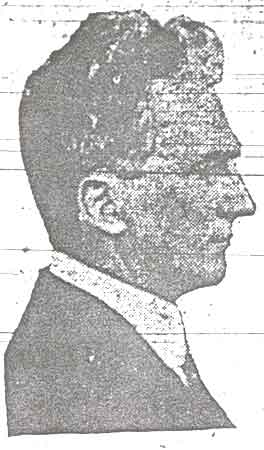
Edward S. Hyde
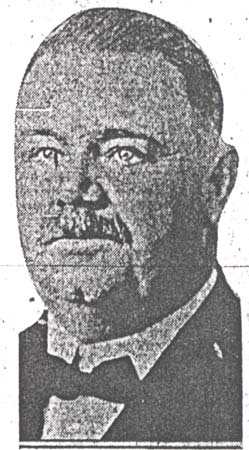
Edward S. Hyde
EDWARD S. HYDE was born around 1868. He was appointed to the Camden Fire Department on March 28, 1893 and served as an extra man for one year, until accepting an appointment to the Camden Police Department, which came on April 14, 1894. He was promoted to sergeant five years later, and on January 1, 1908 was elevated to Captain, serving at police headquarters under Chief Elisha A. Gravenor. He was promoted to assistant chief in 1915 and upon Chief Gravenor’s retirement was named acting chief of police, effective August 1, 1922. When the political winds shifted after the May 1923 election, Chief Hyde found himself serving under a new Public Safety Director, Commissioner Frank Hitchner. On July 15, 1923 he was let go on pension, replaced as Chief of Police by James E. Tatem.
Edward Hyde was politically active as a member of the Seventh Ward Republican Club and remained so after leaving the Police Department. He was elected to the Camden County Board of Freeholders from the Seventh Ward in 1928. He took ill the following year, and on April 13, 1930 passed away.
Edward Hyde married Minna Buzine. Her father, Samuel Buzine, was a charter member of the Camden Fire Department and served for many years as assistant chief under Samuel S. Elfreth. Minna Buzine’s brother William Buzine and her uncle Lewis Buzine also served with the fire department, as did her brother-in-law, Joseph F. Ernst. Another brother-in-law, James Roach, married to Minna Buzine Hyde’s sister Clara, served with both the Fire and Police Departments, and as bridge tender at the State Street Bridge.
The Mayor Names
Camden Post —
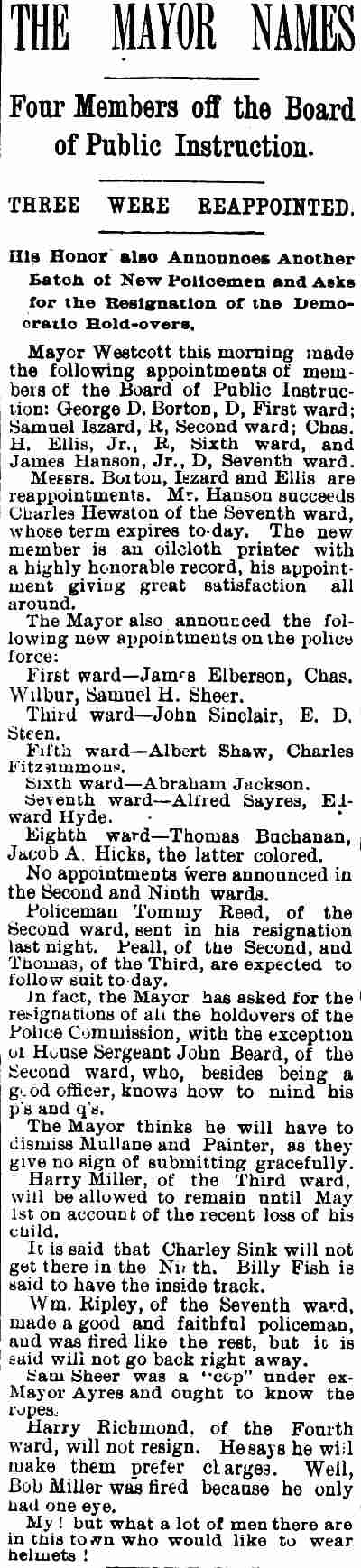
THE MAYOR NAMES
Four Members off the Board of Public Instruction.
THREE WERE REAPPOINTED.
His Honor also Announces Another Batch of New Policemen and Asks for the Resignation of the Democratic Hold-overs.
Mayor Westcott this morning made the following appointments of members of the Board of Public Instruction: George D. Borton, D, First ward; Samuel Iszard, R, Second ward; Chas. H. Ellis, Jr., R, Sixth ward, and James Hanson, Jr., D, Seventh ward. Messrs. Borton, Iezard and Ellis are reappointments. Mr. Hanson succeeds Charles Hewston of the Seventh ward, whose term expires to-day. The new member is an oilcloth printer with a highly honorable record, his appointment giving great satisfaction all around.
The Mayor also announced the following new appointments on the police force:
First ward—James Elberson, Chas. Wilbur, Samuel H. Sheer.
Third ward—John Sinclair, E. D. Steen.
Fifth ward—Albert Shaw, Charles Fitzsimmons.
Sixth ward—Abraham Jackson.
Seventh ward—Alfred Sayres, Edward Hyde.
Eighth ward—Thomas Buchanan, Jacob A. Hicks, the latter colored.
No appointments were announced in the Second and Ninth wards.
Policeman Tommy Reed, of the Second ward, sent in his resignation last night. Peall, of the Second, and Thomas, of the Third, are expected to follow suit to-day.
In fact, the Mayor has asked for the resignations of all the holdovers of the Police Commission, with the exception of House Sergeant John Beard, of the Second ward, who, besides being a good officer, knows how to mind his p’s and q’s.
The Mayor thinks he will have to dismiss Mullane and Painter, as they give no sign of submitting gracefully.
Harry Miller, of the Third ward, will be allowed to remain until May 1st on account of the recent loss of his child.
It is said that Charley Sink will not get there in the Ninth. Billy Fish is said to have the inside track.
Wm. Ripley, of the Seventh ward, made a good and faithful policeman, and was fired like the rest, but it is said will not go back right away.
Sam Sheer was a “cop” under ex-Mayor Ayres and ought to know the ropes.
Harry Richmond, of the Fourth ward, will not resign. He says he will make them prefer charges. Well, Bob Miller was fired because he only had one eye.
My! but what a lot of men there are in this town who would like to wear helmets!
The Mayor’s Appointments
Camden Daily Telegram —

THE MAYOR’S APPOINTMENTS
He Announced Several This Week.
COMMISSIONERS OF INSTRUCTION.
The Old Members Re-Instated With the Exception of the Member From the Seventh Ward—Police Appointments and Resignations.
Mayor Wood made the following appointments as Commissioners of Instruction:
The following appointments were made: First Ward—George D. Borton, of the First Ward; Charles H. Ellis, Jr., of the Sixth ward, and John L. Westcott, of the Third ward.
The following appointments were made on the police force:
First Ward—James Elberson, Charles Wilbur, Samuel H. Sheer.
Second Ward—No appointments.
Third Ward—John Sinclair, E. D. Stein.
Fourth Ward—No appointments.
Fifth Ward—Albert Shaw, Charles Fitzsimmons.
Sixth Ward—Abraham Jackson.
Seventh Ward—Alfred Sayres, Edward Hyde.
Eighth Ward—Thomas Buchanan, Jacob A. Hicks (colored).
Ninth Ward—No appointments.
Mayor Westcott has requested the resignation of all the members of the police force who served under the Police Commission, to take effect May 1. They are Policemen Peall, Horner, Painter, Mullane, Miller and Reed.
POLITICAL POINTERS.
Who will be the postmaster?
Who will be the next prosecutor?
Many of the ward workers are suffering from election colds.
The name of Harry Moffitt was left out of the columns of honorable mention with the other hustlers of election day.
Senator Rogers and Messrs. Stafford and Watson, of the House are fully coming up to the expectations of their constituents.
If the Mayor could arrange it to hold his hearings a trifle earlier it would be a great source of satisfaction to the Camden afternoon papers.
There is still great anxiety on the part of the public as to the outcome of the present session of the legislature. Thus far their public acts have been highly commendable.
The abolishment of the Police Justice act restores to office the City Recorder, Benjamin M. Braker, who would be qualified to act in place of the Mayor should the Chief Executive be taken sick.
Jos. Potter, the new member of Council from the First ward is a man of wide business experience and will prove much advantage to the many large financial interests that will come under his care.
Owing to the satisfactory working of the present school commission in the two second-class counties up the State, the legislature made no change in the mode of placing the members as was anticipated.
Jos. B. Fox, of the Fourth ward, is what might be termed an old reliable, having had a long and varied experience in public affairs. He is always conservative in the expenditure of city money. He is always safe to trust.
Charles Sayrs, of the Seventh ward, who had a short experience in the present Council, but enough to make him feel at home among public affairs, is neck and ears in work between his real estate business and Councilmanic duties.
The colored people of the lower section of the city are anxious to see Squire Drake, the ex-Republican and ex-member of the School Board, come out of the Court House, where he holds a position under the Thompson Freeholders.
“Father” Figner is a proud sire. He was a member and president of Council in his days, and now sees his son treading in his footsteps. Mr. Figner, Jr., having been sent to Council from the Sixth ward on Tuesday by a large majority.
A special election will not be necessary for the new Board of Freeholders, as the City Council and Township Committees will appoint Freeholders who will serve until the Spring of 1895. The appointments will be made about the middle of May.
Arthur Bedell is spoken of as a candidate for the presidency of the new City Council. He is a stalwart and is never afraid to define his position on all public questions. He is one of those men who makes strong, warm friends and also creates an opposition of like force.
William D. Brown, the Secretary of the Board of Education, and Fred A. Rex, Treasurer, are quite pleased over the report of the committee on accounts and Expert O’Shaughnessy, they having examined the books of Messrs. Rex and Brown and found them correctly kept.
The library of the Camden public schools is one to be highly appreciated and much is due to the care with Miss Blowe the librarian has attended to her duties. She will hold over another year and should be allowed to retain the office as long as she merits it, and she surely does now.
J. R. Carson, the retiring member of Council from the First ward, is highly spoken of by his associates on committees and by Clerk Varney for the mature judgment displayed in the management of city affairs. It is with a general expression of regret that the city is to lose his service.
The reform in the Board of Freeholders can’t come too soon. If the public is to judge of the care of property given by the Democrats in the county, by the “hog combine” in this city, an inventory of the public property when turned over will make interesting reading. Ex-officials guarantee to save enough in the Board, if returned to their offices, to pay the expense of a special election, if one was necessary.
W. J. Bradley has been asked if he was a candidate for president of the new City Council. His reply was that he had not sought it in the first place, and would not seek it now, but whether he became president or remained merely a member on the floor, he would endeavor to discharge his duties in the interests of the city. He is commended by all who came in contact with him during the past year as one who had a new Camden at heart.
Crisp Camden News.
Philadelphia Inquirer —
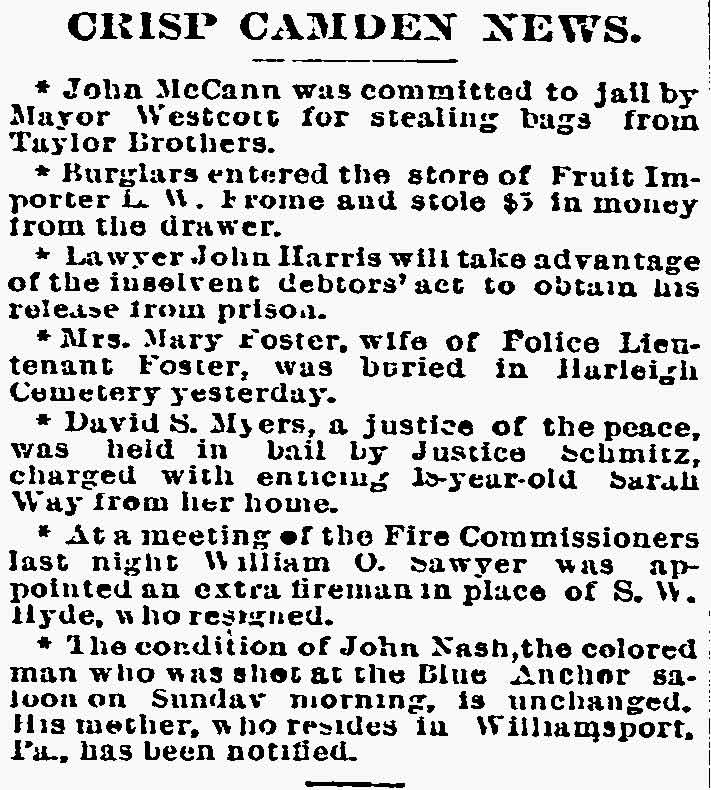
CRISP CAMDEN NEWS.
John McCann was committed to jail by Mayor Westcott for stealing bugs from Taylor Brothers.
Burglars entered the store of Fruit Importer L. V. Frye and stole $5 in money from the drawer.
Lawyer John Harris will take advantage of the insolvent debtors’ act to obtain his release from prison.
Mrs. Mary Foster, wife of Police Lieutenant Foster, was buried at Hadfield Cemetery yesterday.
David S. Syers, a Justice of the peace, was held in bail by Justice Schmiltz, charged with amusing lewd lad Sarah Way from her home.
At a meeting of the Fire Commissioners last night William O. Sawyer was appointed an extra fireman in place of S. N. Hyde, who resigned.
The condition of John Nash, the colored man who was shot at the Blue Anchor, on Sunday morning, is unchanged. His mother, who resides in Williamport, Pa., has been notified.
Two Men Shot in a Race Riot in Camden
Philadelphia Inquirer —
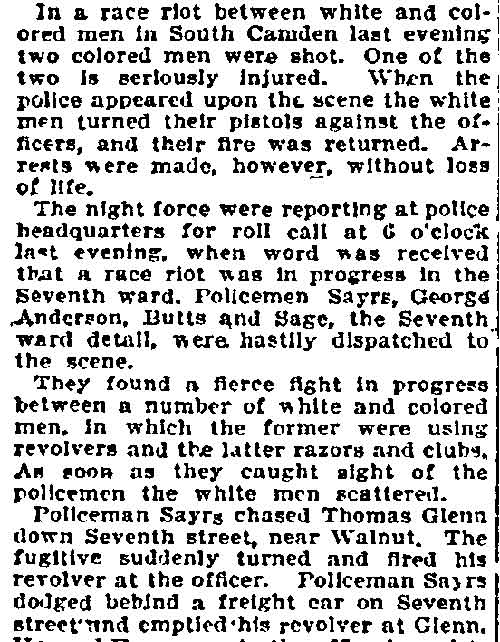
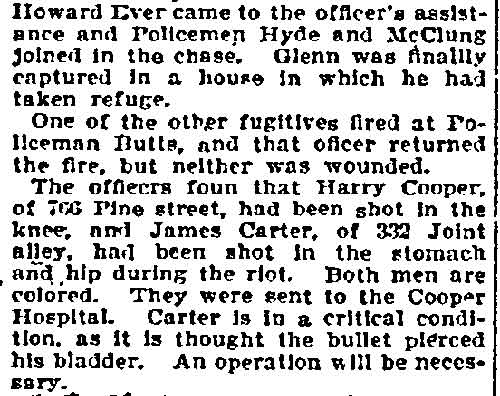
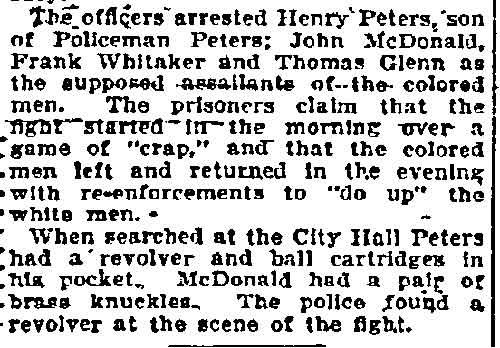
Named: Elbridge B. McClong, Alfred L. Sayers, George W. Anderson, William H. Butts, Josiah Sage, Edward S. Hyde, C. Henry Peters, Henry Peters, Howard Ever, Thomas Glenn, James Carter, Henry Cooper, John McDonald, Frank Whitaker, South 7th Street, Walnut Street, Joint Alley, and Pine Street.
Here's Camden's Finest, With Whiskers, in 1898
Camden Courier-Post —
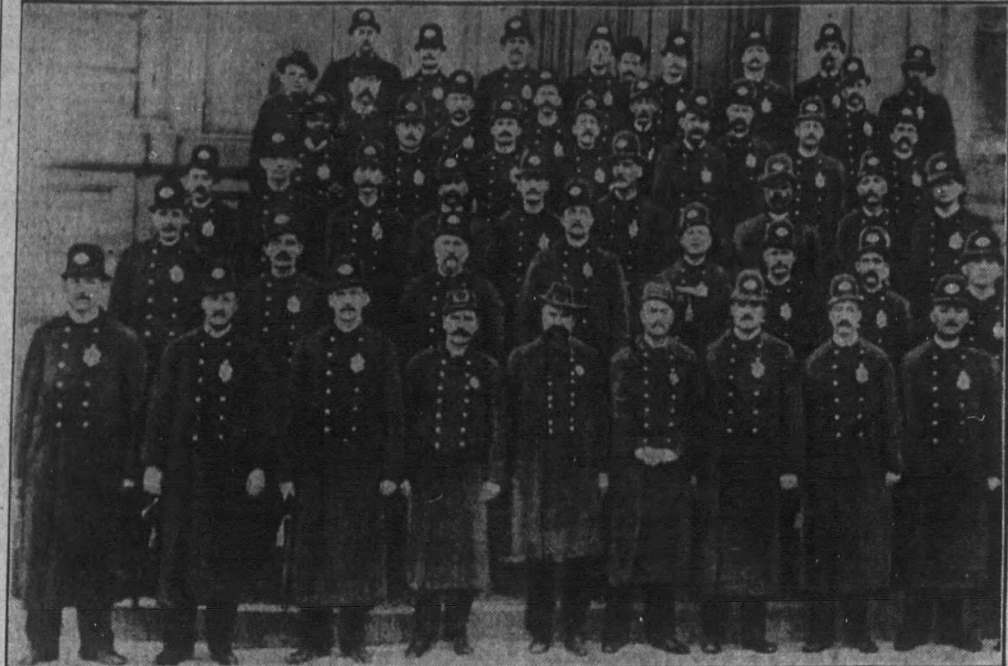
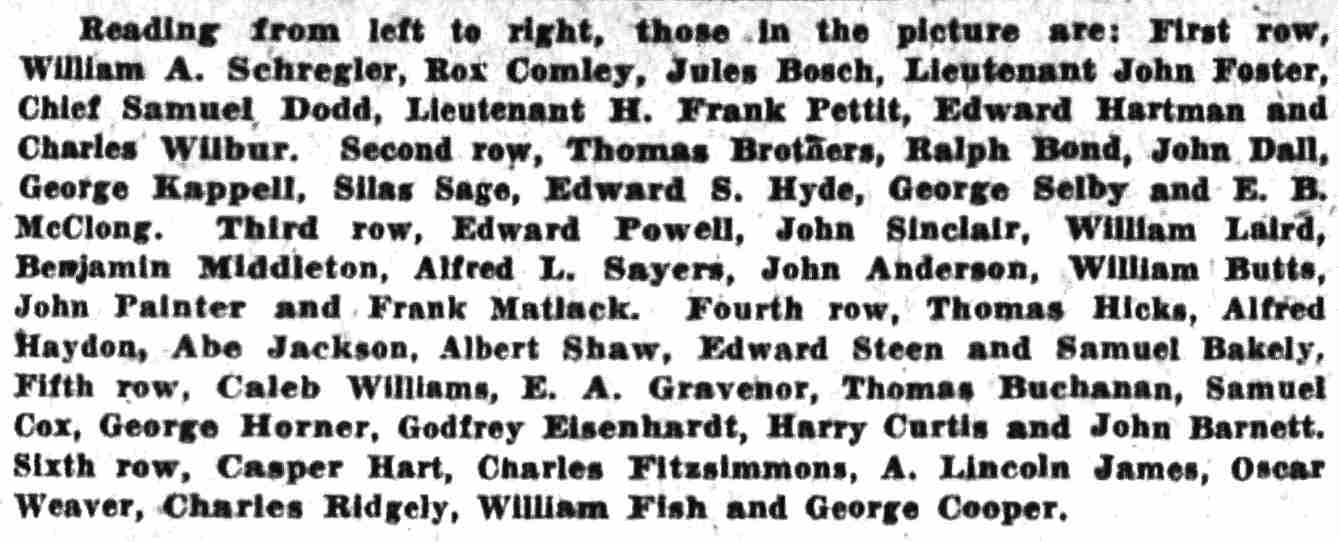
Harry Mines, not named above, is in the first row between H. Frank Pettit and Edward Hartman. In the fifth row, at the far right, “John Barnett” was a guess on the part of A. Lincoln James. Another person guessed George Johnson. Both were wrong and it is not known who that policeman is.
His Wife Must Suffer
Camden Daily Telegram —
His Wife Must Suffer
While After Medicine McNeil Fell by the Wayside
With one kid glove on, hair parted in the middle and the remnants of a good sized skate still clinging to his feet, Harry McNeil, a frequent visitor at the Police Court, with Hugh Boyle as his guardian, was before Recorder Nowrey, this morning, to answer to a charge of drunkenness. “Mac,” with his wife, has been picking cranberries up in Burlington county and exposure caused her to contract heart disease, so “Mac” says. She became rapidly worse, according to his statement, and yesterday friends advised him to come to this city and purchase some medicine. He accepted the advise and after laying in a stock of castor oil, liver pads and other cures, “Mac” proceeded to get loaded and right royally did he do it. Not a saloon in the Fifth and Eighth wards escaped his attention. He became exceedingly boisterous in two of the saloons and was thrown out and was finally arrested by Officer Hyde. He was given a hearing this morning by Recorder Nowrey, and pleaded to be discharged, saying his wife demanded his attention, but he will hold a ten days’ reunion with his friends at the County Jail.
Evil Doers Quake
Philadelphia Inquirer —

EVIL DOERS QUAKE
Mayor Hatch, of Camden, Starts in to Wipe Out Speak-Easies
FIRST RAID A SUCCESS
Fines Imposed by Recorder Nowrey for Operating Gambling Machines. Sunday Sellers Hope to Escape
Mayor Cooper B. Hatch is making life miserable for evil doers in Camden. After waging relentless warfare on Sunday liquor sellers and seizing all the gambling machines in saloons and cigar stores, he is now clearing out speak-easies. The first raid was made yesterday afternoon, when Captain Stanley, Sergeant Hyde, Detective Painter and Policeman Shaw swooped down on Mrs. Mary Mahan’s house, at 1062 South Front street. They found nearly enough liquor there to stock a saloon. There were two cases of bottled beer, five gallons of whisky, a large quantity of California wines, and other “wet” goods. This was all confiscated and was sent to the City Hall, together with Mrs. Mahan and a young girl.
For some time past Mayor Hatch’s private detectives have been gathering evidence against speak-easies and disorderly houses in different parts of the city, and several more arrests will be made.
The saloonkeepers arrested about ten days ago for operating slot machines in their places were arraigned yesterday before Recorder Nowrey. Maurice Hertz, of Locust street and Kaighn avenue, was the first to be tried. He was represented by former Judge Howard Carrow. The complaints against Hertz charged him with operating nickel-in-the-slot gambling machines on July 2 and 9.
Harry Williams, one of Secretary Gibboney’s detectives, who was employed in the recent Sunday liquor crusade, testified that he played “The Owl” in Hertz’s saloon on July 9. He lost five cents on the red but hit the black and quit even. On cross-examination Williams refused to tell by whom he was employed, and Recorder Nowrey would not compel him to answer. Detective Fields swore that he was with Williams in Hertz’s place, and also played the slot machine. Police Captain Stanley said he found four of the slot machines in Hertz’s place when he made the raid.
At this point Judge Carrow moved to dismiss the complaint, as it was dated in the year “189.” Decision was reserved, and the other complaint was taken up. Judge Carrow wanted this set aside on the ground that it did not specify the premises where the law was alleged to have been violated. Recorder Nowrey overruled the motion.
Detective Graper said he played the slot machine at Hertz’s saloon on Sunday, July 2. On cross-examination he refused to give his address, but said he worked for Mayor Hatch. He didn’t know, he said, whether he was on the city pay roll.
David B. Kaighn and other Kaighn avenue residents testified that they never saw slot machines in operation in Hertz’s place, but had seen them standing in the office.
Hertz, in his own defense, said he was agent for the slot machines, and those found in his office were samples to be examined by prospective purchasers.
Recorder Nowrey sentenced Hertz to pay a fine of $50 and costs. Judge Carrow gave notice that he would appeal the case, but the Recorder refused to permit Hertz to depart without paying the fine.
Peter Kelly, of Eighth street and Ferry avenue, was also convicted and paid his fine.
John Keefe, of Haddon avenue and Carman street, and Marshall Hutchinson, of Ninth and Walnut streets, pleaded guilty and were fined $50 and costs each. There were about seven more cases, which Recorder Nowrey adjourned until next Wednesday.
The 130 saloonkeepers rounded up in the recent crusade against Sunday liquor selling were in high glee yesterday over the discovery of a law that they hoped would save them from punishment for their alleged misdoings. This law was passed in 1874, and makes it unlawful to prosecute any person by indictment for violations of the liquor laws in municipalities where city ordinances provide punishment for such offenses. As the Supreme Court has set aside the Camden excise ordinance, the saloonkeepers hoped to escape further prosecution.
City Counsel Bleakly, after looking up the matter yesterday, said: “A house in which the unlawful sale of liquors is habitually made is an indictable nuisance, although there is a city ordinance prescribing penalty for such sales. Such traffic is not only a breach of the city law, but is also forbidden by the State law.” This decision was made by Judge Van Syckel in 1880, in the Court of Errors and Appeals, and was reaffirmed in 1888. It is now a State law.
The Excise Commission, at its regular meeting next Wednesday evening, will probably adopt a substitute ordinance against Sunday liquor selling to conform to the city charter, under the Supreme Court’s decision setting aside the old ordinance.
Camden Mystery More Involved
Philadelphia Inquirer —
Bones Found in the House in Which Mrs. Lillian Chambers Died
AUTHORITIES AROUSED
Wilkins, the Vocdoo Doctor, Under Arrest, and Investigation Being Made
CARSON’S LAST WORK
The Murdered Prosecuting Attorney Visited the House Just Before Leaving Camden
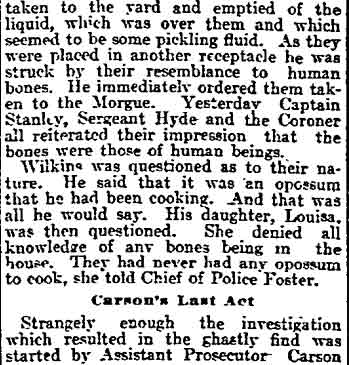
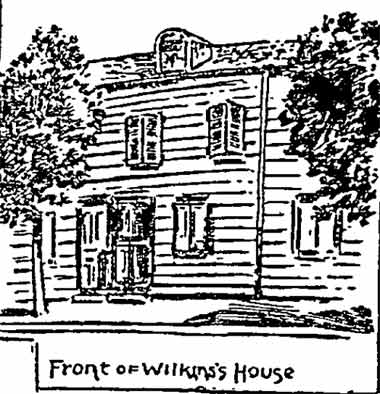
The investigation following the death of Mrs. Lillian Chambers, of 706 North Eleventh street, Philadelphia, at the house of William H. Wilkins, colored fortune teller, planet reader, voodoo doctor and astrologist, at 825 Locust street, Camden, on Friday afternoon, has revealed what may be a clue to one of the most ghastly and horrible crimes known. Hidden within a concealed fireplace in the room where the “voodoo” received his dupes was found a great boiler filled with what Coroner and police think are human bones and flesh. Beneath it were the embers of a fire, in which other bones had been placed. The stench when the fireplace when opened was overpowering.
On Friday afternoon the body of Mrs. Chambers was found in the rocking chair at Wilkins’ house. The woman had left her home in the early morning, and when her husband, Henry Chambers, returned for his dinner he found his wife missing and the house locked up. A Chinaman, who occupies the store portion of the Chambers house, gave him the key, stating that Mrs. Chambers had left early in the morning, not stating where she was going.
The Woman’s Death
Considerably worried, Chambers ate his dinner and hurried back to Baldwin’s Locomotive Works, where he is employed as a laborer. On his way, however, he was met by his sister-in-law, Annie Stewart, and Wilkins, the fortune teller. Wilkins, in great excitement, told Chambers that Mrs. Chambers had been taken ill at his house and that he must at once go back with them. Chambers and the others immediately hurried across to Camden and to the Wilkins house, on Locust street. Wilkins entered first, being closely followed by Chambers.
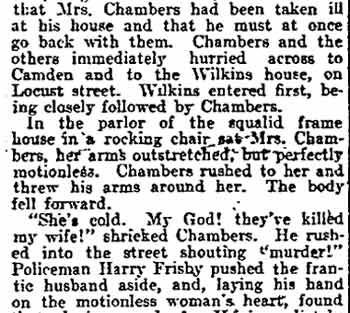
In the parlor of the squalid frame house in a rocking chair sat Mrs. Chambers, her arms outstretched, but perfectly motionless. Chambers rushed to her and threw his arms around her. The body fell forward.
“She’s cold. My God! they’ve killed my wife!” shrieked Chambers. He rushed into the street shouting “murder!” Policeman Harry Frisby pushed the frantic husband aside, and, laying his hand on the motionless woman’s heart, found that she was dead. He immediately placed all in the house under arrest.
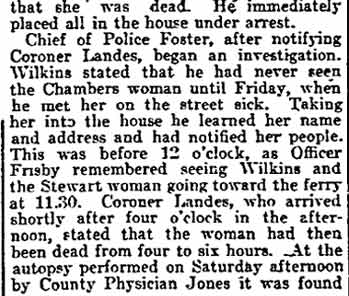
Chief of Police Foster, after notifying Coroner Landes, began an investigation. Wilkins stated that he had never seen the Chambers woman until Friday, when he met her on the street sick. Taking her into the house he learned her name and address and had notified her people. This was before 12 o’clock, as Officer Frisby remembered seeing Wilkins and the Stewart woman going toward the ferry at 11.30. Coroner Landes, who arrived shortly after four o’clock in the afternoon, stated that the woman had then been dead from four to six hours. At the autopsy performed on Saturday afternoon by County Physician Jones it was found that death was due to a criminal operation.
A Ghastly Find
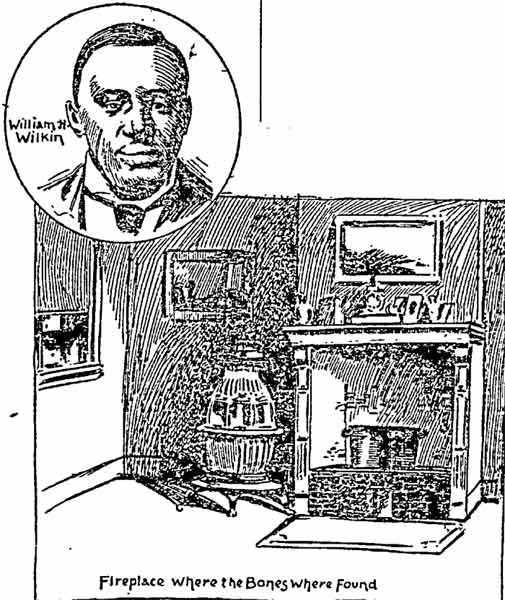
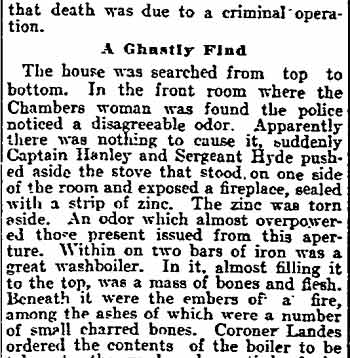
The house was searched from top to bottom. In the front room where the Chambers woman was found the police noticed a disagreeable odor. Apparently there was nothing to cause it, suddenly Captain Hanley and Sergeant Hyde pushed aside the stove that stood on one side of the room and exposed a fireplace, sealed with a strip of zinc. The zinc was torn aside. An odor which almost overpowered those present issued from this aperture. Within on two bars of iron was a great washboiler. In it, almost filling it to the top, was a mass of bones and flesh. Beneath it were the embers of a fire, among the ashes of which were a number of small charred bones. Coroner Landes ordered the contents of the boiler to be taken to the yard and emptied of the liquid, which was over them and which seemed to be some pickling fluid. As they were placed in another receptacle he was struck by their resemblance to human bones. He immediately ordered them taken to the Morgue. Yesterday Captain Stanley, Sergeant Hyde and the Coroner all reiterated their impression that the bones were those of human beings.
Wilkins was questioned as to their nature. He said that it was an opossum that he had been cooking. And that was all he would say. His daughter, Louisa, was then questioned. She denied all knowledge of any bones being in the house. They had never had any opossum to cook, she told Chief of Police Foster.
Carson’s Last Act
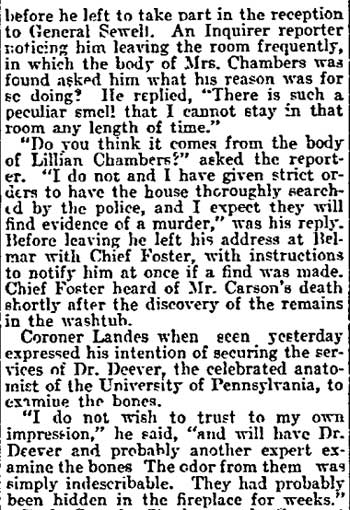
Strangely enough the investigation which resulted in the ghastly find was started by Assistant Prosecutor Carson before he left to take part in the reception to General Sewell. An Inquirer reporter noticing him leaving the room frequently, in which the body of Mrs. Chambers was found asked him what his reason was for so doing? He replied, “There is such a peculiar smell that I cannot stay in that room any length of time.”
“Do you think it comes from the body of Lillian Chambers?” asked the reporter. “I do not and I have given strict orders to have the house thoroughly searched by the police, and I expect they will find evidence of a murder,” was his reply. Before leaving he left his address at Belmar with Chief Foster, with instructions to notify him at once if a find was made. Chief Foster heard of Mr. Carson’s death shortly after the discovery of the remains in the washtub.
Coroner Landes when seen yesterday expressed his intention of securing the services of Dr. Deever, the celebrated anatomist of the University of Pennsylvania, to examine the bones.
“I do not wish to trust to my own impression,” he said, “and will have Dr. Deever and probably another expert examine the bones The odor from them was simply indescribable. They had probably been hidden in the fireplace for weeks.”
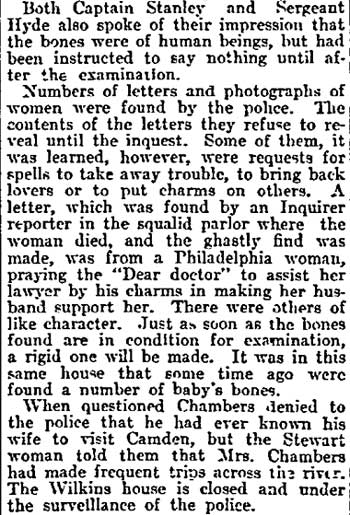
Both Captain Stanley and Sergeant Hyde also spoke of their impression that the bones were of human beings, but had been instructed to say nothing until after the examination.
Numbers of letters and photographs of women were found by the police. The contents of the letters they refuse to reveal until the inquest. Some of them, it was learned, however, were requests for spells to take away trouble, to bring back lovers or to put charms on others. A letter, which was found by an Inquirer reporter in the squalid parlor where the woman died, and the ghastly find was made, was from a Philadelphia woman, praying the “Dear doctor” to assist her lawyer by his charms in making her husband support her. There were others of like character. Just as soon as the bones found are in condition for examination, a rigid one will be made. It was in this same house that some time ago were found a number of baby’s bones.
When questioned Chambers denied to the police that he had ever known his wife to visit Camden, but the Stewart woman told them that Mrs. Chambers had made frequent trips across the river. The Wilkins house is closed and under the surveillance of the police.
[Illustration, captioned:] Front of Wilkins’s House
[Illustration, captioned:] William H. Wilkin
[Illustration, captioned:] Fireplace where the Bones where Found
Raid Over in Camden
Philadelphia Inquirer —
Raid Over in Camden
Police Captain Stanley and Sergeant Hyde, with a squad of officers, arrested two alleged disorderly houses on Pine street above Tenth, Camden, last night. The reputed proprietors, Charles Smith and Mary Bennett, together with thirteen inmates, were taken into custody and locked up for a hearing to-day.
Camden Policemen Raid a Sunday Liquor Seller
Philadelphia Inquirer —
CAMDEN POLICEMEN RAID A SUNDAY LIQUOR SELLER
Swoop Down on a Saloon Where Three Men Were About to Quench Their Thirst With Foaming Lager Beer. Other Violations Reported
Despite the vigorous crusade of the Camden County Law and Order League and the heavy penalty imposed by Judge Armstrong last week, when he sentenced several Camden saloonkeepers to State prison and the county jail for Sunday liquor selling, some liquor dealers continued to violate the law and defy the authorities yesterday. The police were on the alert, and swooped down on one saloon, where they said they found several men about to quench their thirst with beer. The place raided was the saloon of Henry Hayes, at 824 South Third street.
The raid was made by Captain Stanley, Sergeant Hyde and Policemen Cunningham, Nowrey, Weaver and Harvey, on a warrant issued by Justice Stackhouse, on complaint of Mrs. Ida Buckingham, of 25 North Second street, a member of the Salvation Army. The proprietor, Robert Forbes, John McKenna and William Ivins, who were in the barroom at the time, were taken in custody. Hayes was given a hearing at once by Justice Stackhouse. It was testified that on July 8 James Buckingham, husband of the complainant, went into Hayes’ saloon and bought several glasses of beer. When he got ready to leave Hayes declined to let him go, saying the police were watching on the outside. Buckingham swore he was kept a prisoner for over two hours.
“Judge, can’t I sue Hayes for falsely imprisoning my husband?” asked Mrs. Buckingham, at this point.
Captain Stanley was then sworn, and testified that he saw six colored men come out of Hayes’ gate while he was waiting for an opportunity to make the raid, and then McKenna, Forbes and Ivins went in and he followed them. This was a signal to the policemen in waiting, who jumped an adjoining fence, and, pushing their way by the person tending the back door. When they entered Hayes was back of the bar. Captain Stanley said Hayes had three glasses of beer in his hand, and placed them in front of the men just as the policemen came in.
“I got between the men and the beer and the officers took charge of the barroom,” said Captain Stanley. “I know it was beer because I tasted it. That is something I have not done for over twenty years.”
Sergeant Hyde and the policemen corroborated Captain Stanley as to the facts of the raid and two of the policemen testified that it was beer which Hayes placed on the counter.
When McKenna, Forbes and Ivins were asked if they had anything to say Mrs. Hayes tried to stop them from testifying. Chief of Police Foster threatened her with arrest and as she would not desist he put her out of the hearing room. McKenna was the only one of the three to testify. He said he ordered the beer, but did not have time to pay for it before the policemen came in. Hayes denied selling beer to Buckingham on July 8.
Captain Stanley then made a charge against Hayes of selling liquor yesterday and he pleaded not guilty. He was committed in default of $500 bail. The other three prisoners were held in their own recognizance to appear when wanted as witnesses.
Camden’s Pride Parades Before City’s People
Philadelphia Inquirer —
CAMDEN’S PRIDE PARADES BEFORE CITY’S PEOPLE
Policemen and Firemen Make Their Initial Turnout and Present a Creditable Appearance—Reviewed by Officials—How the Departments Have Grown
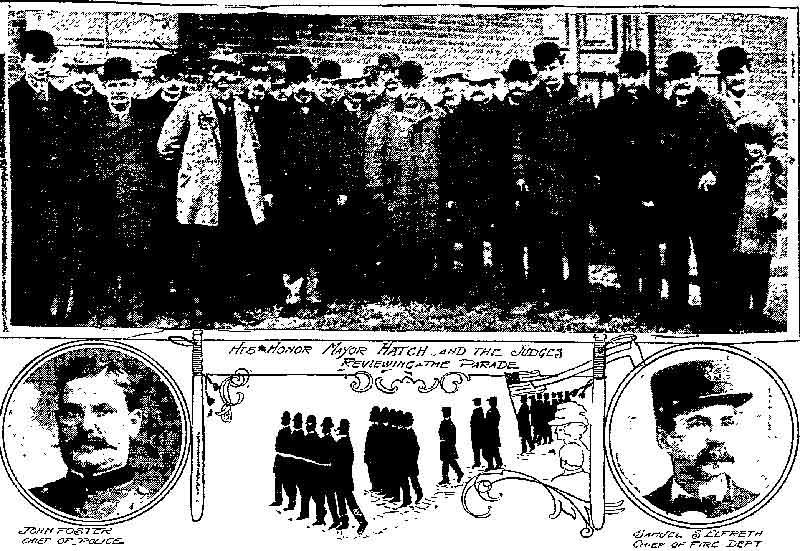
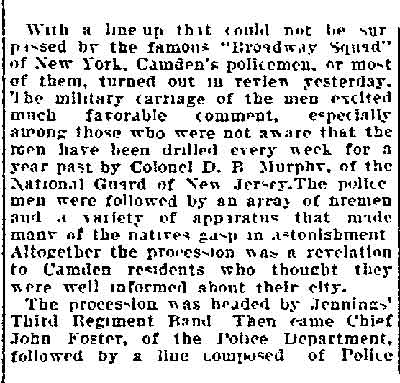
With a line up that could not be surpassed by the famous “Broadway Squad” of New York, Camden’s policemen, or most of them, turned out in review yesterday. The military carriage of the men excited much favorable comment, especially among those who were not aware that the men have been drilled every week for a year past by Colonel D. B. Murphy, of the National Guard of New Jersey. The policemen were followed by an array of firemen and a variety of apparatus that made many of the natives gasp in astonishment. Altogether the procession was a revelation to Camden residents who thought they were well informed about their city.
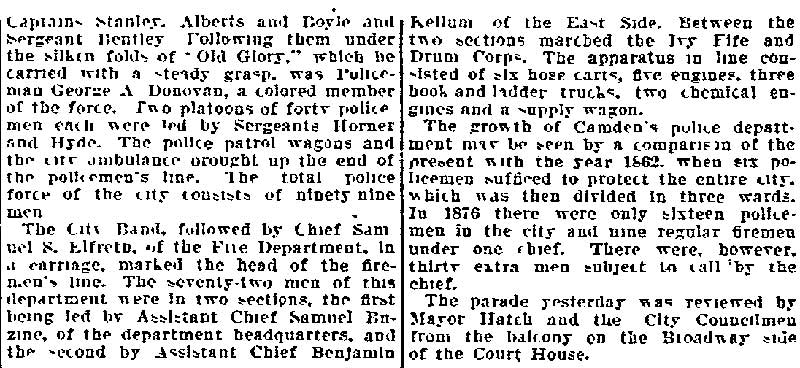
The procession was headed by Jennings’ Third Regiment Band. Then came Chief John Foster, of the Police Department, followed by a line composed of Police Captains Stanley, Alberts and Doyle and Sergeant Bentley. Following them under the silken folds of “Old Glory,” which he carried with a steady grasp, was Policeman George A. Donovan, a colored member of the force. Two platoons of forty policemen each were led by Sergeants Horner and Hyde. The police patrol wagons and the city ambulance brought up the end of the policemen’s line. The total police force of the city consists of ninety nine men.
The City Band, followed by Chief Samuel S. Elfreth, of the Fire Department, in a carriage, marked the head of the firemen’s line. The seventy-two men of this department were in two sections, the first being led by Assistant Chief Samuel Buzine, of the department headquarters, and the second by Assistant Chief Benjamin Kellum of the East Side. Between the two sections marched the Ivy Fife and Drum Corps. The apparatus in line consisted of six hose carts, five engines, three hook and ladder trucks, two chemical engines and a supply wagon.
The growth of Camden’s police department may be seen by a comparison of the present with the year 1862, when six policemen sufficed to protect the entire city, which was then divided in three wards. In 1876 there were only sixteen policemen in the city and nine regular firemen under one chief. There were, however, thirty extra men subject to call by the chief.
The parade yesterday was reviewed by Mayor Hatch and the City Councilmen from the balcony on the Broadway side of the Court House.
CAMDEN’S PRIDE PARADES BEFORE CITY’S PEOPLE
Policemen and Firemen Make Their Initial Turnout and Present a Creditable Appearance—Reviewed by Officials—How the Departments Have Grown
With a line up that could not be surpassed by the famous “Broadway Squad” of New York, Camden’s policemen, or most of them, turned out in review yesterday. The military carriage of the men excited much favorable comment, especially among those who were not aware that the men have been drilled every week for a year past by Colonel D. B. Murphy, of the National Guard of New Jersey. The policemen were followed by an array of firemen and a variety of apparatus that made many of the natives gasp in astonishment. Altogether the procession was a revelation to Camden residents who thought they were well informed about their city.
The procession was headed by Jennings’ Third Regiment Band. Then came Chief John Foster, of the Police Department, followed by a line composed of Police Captains Stanley, Alberts and Doyle and Sergeant Bentley.
Captains Stanley, Alberts and Doyle and Sergeant Bentley. Following them under the silken folds of “Old Glory,” which he carried with a steady grasp, was Policeman George A. Donovan, a colored member of the force. Two platoons of forty policemen each were led by Sergeants Horner and Hyde. The police patrol wagons and the city ambulance brought up the end of the policemen’s line. The total police force of the city consists of ninety nine men.
The City Band, followed by Chief Samuel S. Elfreth, of the Fire Department, in a carriage, marked the head of the firemen’s line. The seventy-two men of this department were in two sections, the first being led by Assistant Chief Samuel Buzine, of the department headquarters, and the second by Assistant Chief Benjamin Kellum of the East Side. Between the two sections marched the Ivy Fife and Drum Corps. The apparatus in line consisted of six hose carts, five engines, three hook and ladder trucks, two chemical engines and a supply wagon.
The growth of Camden’s police department may be seen by a comparison of the present with the year 1862, when six policemen sufficed to protect the entire city, which was then divided in three wards. In 1876 there were only sixteen policemen in the city and nine regular firemen under one chief. There were, however, thirty extra men subject to call by the chief.
The parade yesterday was reviewed by Mayor Hatch and the City Councilmen from the balcony on the Broadway side of the Court House.
Alleged Policy People Arrested
Philadelphia Inquirer —
Alleged Policy People Arrested
One of the Most Fruitful Raids in Years Was Made in Camden Yesterday
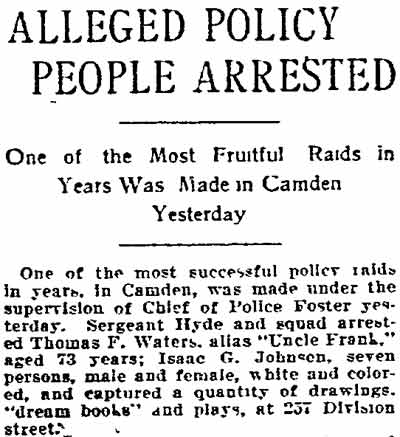
One of the most successful policy raids in years, in Camden, was made under the supervision of Chief of Police Foster yesterday. Sergeant Hyde and squad arrested Thomas F. Waters, alias “Uncle Frank,” aged 73 years; Isaac G. Johnson, seven persons, male and female, white and colored, and captured a quantity of drawings, “dream books” and plays, at 257 Division street.
[Continued from arthurstanley-061601-inq-1a.jpg]
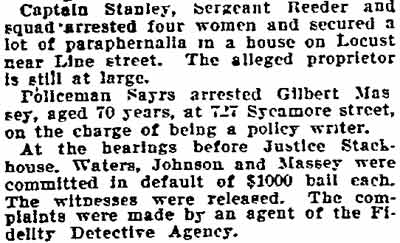
Captain Stanley, Sergeant Reeder [sic] and squad arrested four women and secured a lot of paraphernalia in a house on Locust near Line street. The alleged proprietor is still at large.
Policeman Sayrs arrested Gilbert Massey, aged 70 years, at 727 Sycamore street, on the charge of being a policy writer.
At the hearings before Justice Stackhouse, Waters, Johnson and Massey were committed in default of $1000 bail each. The witnesses were released. The complaints were made by an agent of the Fidelity Detective Agency.
Thieves Took to the Swamp
Philadelphia Inquirer —
THIEVES TOOK TO THE SWAMP
Early yesterday morning four colored men were discovered trying to rob the bottling place of William Rudolph, at Van Buren and Vanhook streets, Camden. Neighbors awakened the proprietor and he notified the police. The men fled in the direction of Lane Ditch Swamp. Policemen Harvey, Snow, Pooley, Fitzsimmons, Cornog and Sergeant Hyde surrounded the swamp, but after an hour’s fruitless search the policemen gave up the hunt.
No Clue to Bandits, But Suspects Spotted
Philadelphia Inquirer —
No Clue to Bandits, But Suspects Spotted
The Camden police have not the slightest clue as to the identity of the five men who early Saturday morning created a furor on the outskirts of the city by holding up a bridge tender, blowing up a safe and doing other acts that marked them as being desperadoes. The entire police force was at work yesterday, but the description given by Till and the officers who had the encounter with the emulators of the wild and woolly West was so meagre that there was practically nothing to work on.
Chief of Police John Foster said last night to an Inquirer reporter: “We have not learned anything that might lead to
the arrest of the desperadoes. In the event of suspects being arrested it would be a difficult matter to connect them with the case, because no one seems to be in position to give a description. I am of the opinion that they are professionals from the manner in which they did their work.
Acquainted With Locality
“Another thing seems evident, and that is the robbers were acquainted with the locality in which they operated. They either were personally acquainted with East Camden or made it a point to get acquainted.
“This William Thallman, who is wanted in Burlington county, where the police believe him to be the head of a gang of thieves, may possibly know something about the Pavonia affair. From what I have learned he appears to be a desperate character, just one who would have the nerve to lead a gang of men to do the
work of Saturday morning. Of course this is mere supposition, and it is impossible to say he is one of the men we are looking for. Another thing that might possibly connect him with the case would be his knowledge of East Camden, which is an important factor.”
Early yesterday morning a dispatch was received from Elizabeth in which it was stated that three suspicious characters had been arrested. According to the dispatch the trio were found in a box car that came from Camden. City Detectives John Painter and William Hart were at once sent to Elizabeth to take a look at the suspects. When they arrived they found the prisoners were boys and a brief line of questioning soon disposed of the theory that they had anything to do with the Camden affair. The detectives, who returned last night, said the boys were Philadelphians and had jumped a freight for a ride.
Special Officer Hare, of the Pennsylvania Railroad, noticed a group of men loitering about the Pavonia Station. Their actions were suspicious, and he took one into custody. The police were of the
opinion that the prisoner might know something about the bandits, but he convinced them that he was in total ignorance of the thieves. He gave the name of D. Donovan, no home. He is still held by the police, but with no expectation of throwing any light on the identity of the men wanted so badly.
Perhaps no one had a better opportunity of giving a description of the men than Oscar Till, the bridgetender at the State street bridge, who, at the points of pistols held by two men, tied a mask over the face of a third. But even he cannot recall his midnight visitors sufficiently to furnish the police with anything to work on.
“I was too badly scared to know what they looked like,” he said. “When a couple of men are pressing cold steel to your temples, with a command to do a certain thing or die, you generally do the thing asked. I had no time to think about descriptions or anything else. The business I had to attend to was to tie the mask on the bandit, and I attended strictly to that business.”
Ralph Haines, the night operator at the tower, who was shot at repeatedly as
he poked his head out of the window inquiring as to the cause of the explosion at the Pavonia station, was commended yesterday for his cool-headedness. After dodging bullets repeatedly, one of which came within an inch of his head, he dropped to the floor, crawled over to the “ticker” and asked the main office for help. Haines could see the men in silhouette but was too distant to recognize any characteristics that might lead to identifying them.
Last night numerous reports were received at Camden police headquarters of suspicious characters being seen in various parts of the city. A trolley car conductor reported at 10 o’clock that several men with dark lanterns were observed loitering about Haddon and Kaighn avenues. Sergeant Hyde, with a squad of officers, was sent to the locality, but the men had disappeared. Another report came from Fairview street near the ship yard at the lower end of the Eighth ward that suspicious-looking persons were hanging about the neighborhood, but no one could be found there when the officers arrived.
Four Killed When Fireworks Blew Up
Philadelphia Inquirer —
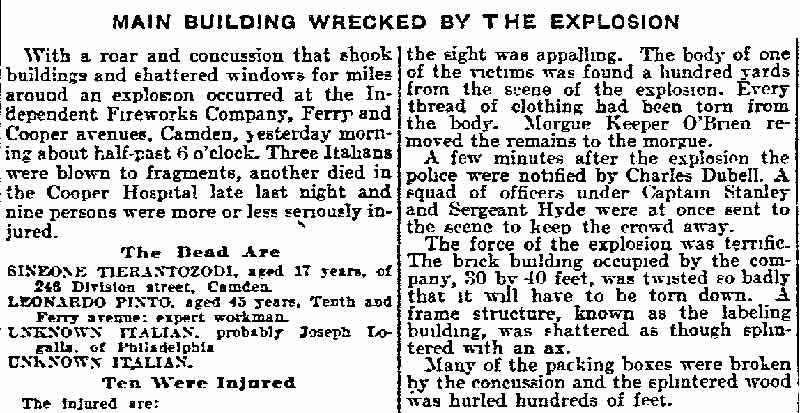
Factory on the Outskirts of Camden Wrecked by an Explosion of Mysterious Origin---Ten Received Injuries---Officers of the Company Placed Under Arrest
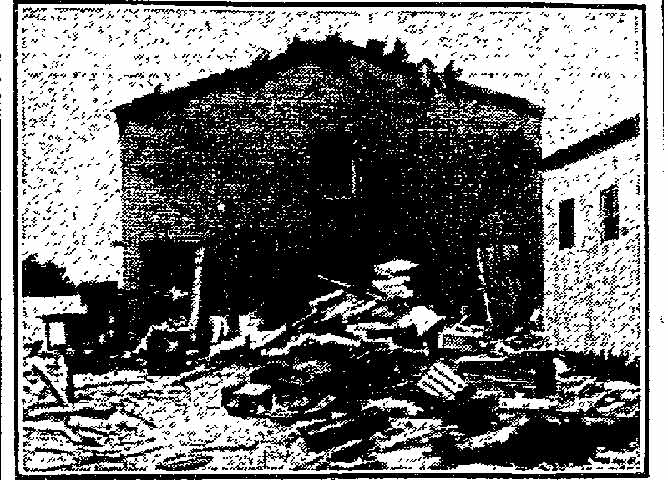
[Photograph, captioned:] MAIN BUILDING WRECKED BY THE EXPLOSION
With a roar and concussion that shook buildings and shattered windows for miles around an explosion occurred at the Independent Fireworks Company, Ferry and Cooper avenues, Camden, yesterday morning about half-past 6 o’clock. Three Italians were blown to fragments, another died in the Cooper Hospital late last night and nine persons were more or less seriously injured.
The Dead Are
SINEONE TIERANTOZODI, aged 17 years, of 248 Division street, Camden. LEONARDO PINTO, aged 45 years, Tenth and Ferry avenue; expert workman. UNKNOWN ITALIAN, probably Joseph Logalla, of Philadelphia. UNKNOWN ITALIAN.
Ten Were Injured
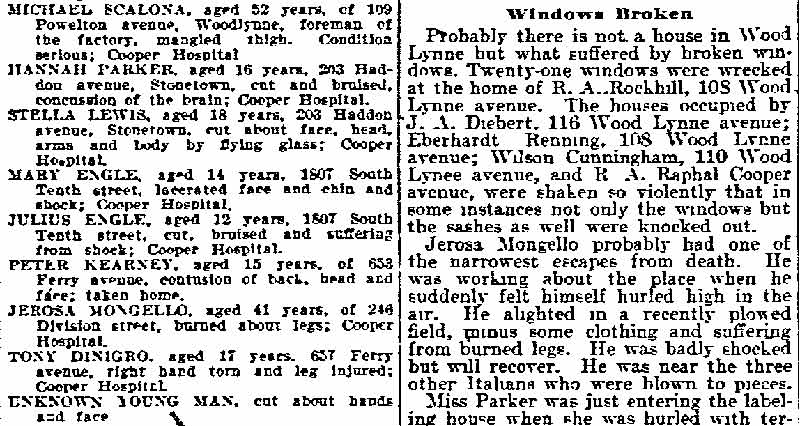
The injured are:
MICHAEL SCALONA, aged 52 years, of 109 Powelton avenue, Woodlynne, foreman of the factory, mangled thigh. Condition serious; Cooper Hospital. HANNAH PARKER, aged 16 years, 203 Haddon avenue, Stonetown, cut and bruised, concussion of the brain; Cooper Hospital. STELLA LEWIS, aged 18 years, 203 Haddon avenue, Stonetown, cut about face, head, arms and body by flying glass; Cooper Hospital. MARY ENGLE, aged 14 years, 1807 South Tenth street, lacerated face and chin and shock; Cooper Hospital. JULIUS ENGLE, aged 12 years, 1807 South Tenth street, cut, bruised and suffering from shock; Cooper Hospital. PETER KEARNEY, aged 15 years, of 653 Ferry avenue, contusion of back, head and face; taken home. JEROSA MONGELLO, aged 41 years, of 246 Division street, burned about legs; Cooper Hospital. TONY DINIGRO, aged 17 years, 657 Ferry avenue, right hand torn and leg injured; Cooper Hospital. UNKNOWN YOUNG MAN, cut about hands and face.
The sight was appalling. The body of one of the victims was found a hundred yards from the scene of the explosion. Every thread of clothing had been torn from the body. Morgue Keeper O’Brien removed the remains to the morgue.
A few minutes after the explosion the police were notified by Charles Dubell. A squad of officers under Captain Stanley and Sergeant Hyde were at once sent to the scene to keep the crowd away.
The force of the explosion was terrific. The brick building occupied by the company, 30 by 40 feet, was twisted so badly that it will have to be torn down. A frame structure, known as the labeling building, was shattered as though splintered with an ax.
Many of the packing boxes were broken by the concussion and the splintered wood was hurled hundreds of feet.
Windows Broken
Probably there is not a house in Wood Lynne but what suffered by broken windows. Twenty-one windows were wrecked at the home of R. A. Rockhill, 108 Wood Lynne avenue. The houses occupied by J. A. Diebert, 116 Wood Lynne avenue; Eberhardt Renning, 108 Wood Lynne avenue; Wilson Cunningham, 110 Wood Lynee avenue, and R. A. Raphal Cooper avenue, were shaken so violently that in some instances not only the windows but the sashes as well were knocked out.
Jerosa Mongello probably had one of the narrowest escapes from death. He was working about the place when he suddenly felt himself hurled high in the air. He alighted in a recently plowed field, minus some clothing and suffering from burned legs. He was badly shocked but will recover. He was near the three other Italians who were blown to pieces.
Miss Parker was just entering the labeling house when she was hurled with terrific force a dozen feet away. When found, she was sitting on the ground with a large wooden box resting on her head. She was delirious from fright and severe injuries when discovered.
Hurled Through Doorway
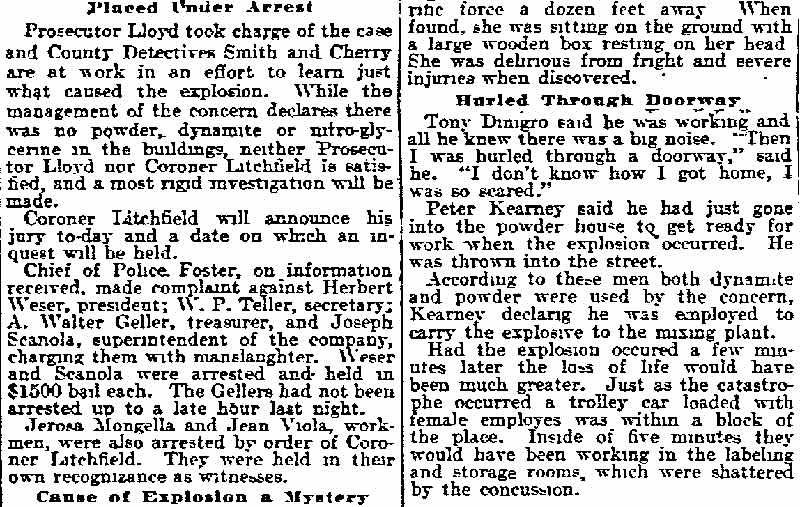
Tony Dinigro said he was working and all he knew there was a big noise. “Then I was hurled through a doorway,” said he. “I don’t know how I got home, I was so scared.”
Peter Kearney said he had just gone into the powder house to get ready for work when the explosion occurred. He was thrown into the street.
According to these men both dynamite and powder were used by the concern, Kearney declaring he was employed to carry the explosive to the mixing plant.
Had the explosion occured a few minutes later the loss of life would have been much greater. Just as the catastrophe occurred a trolley car loaded with female employes was within a block of the place. Inside of five minutes they would have been working in the labeling and storage rooms, which were shattered by the concussion.
Placed Under Arrest
Prosecutor Lloyd took charge of the case and County Detectives Smith and Cherry are at work in an effort to learn just what caused the explosion. While the management of the concern declares there was no powder, dynamite or nitro-glycerine in the buildings, neither Prosecutor Lloyd nor Coroner Litchfield is satisfied, and a most rigid investigation will be made.
Coroner Litchfield will announce his jury to-day and a date on which an inquest will be held.
Chief of Police Foster, on information received, made complaint against Herbert Weser, president; W. P. Teller, secretary; A. Walter Geller, treasurer, and Joseph Scanola, superintendent of the company, charging them with manslaughter. Weser and Scanola were arrested and held in $1500 bail each. The Gellers had not been arrested up to a late hour last night.
Jerosa Mongella and Jean Viola, workmen, were also arrested by order of Coroner Litchfield. They were held in their own recognizance as witnesses.
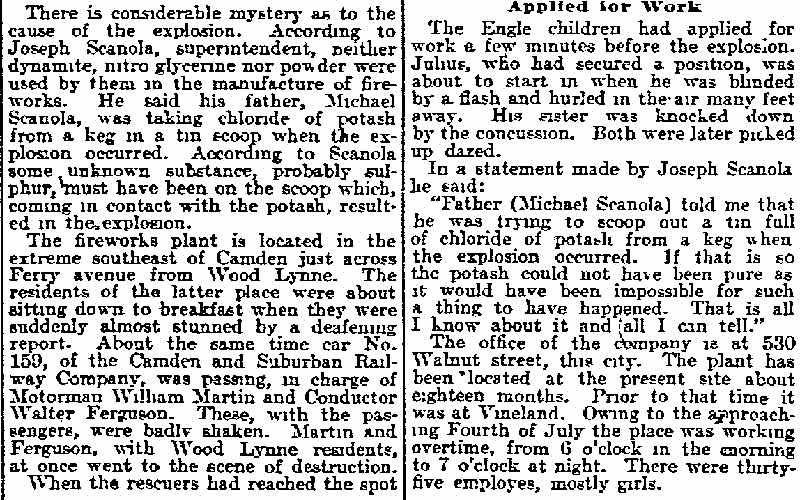
Cause of Explosion a Mystery
There is considerable mystery as to the cause of the explosion. According to Joseph Scanola, superintendent, neither dynamite, nitro glycerine nor powder were used by them in the manufacture of fireworks. He said his father, Michael Scanola, was taking chloride of potash from a keg in a tin scoop when the explosion occurred. According to Scanola some unknown substance, probably sulphur, must have been on the scoop which, coming in contact with the potash, resulted in the explosion.
The fireworks plant is located in the extreme southeast of Camden just across Ferry avenue from Wood Lynne. The residents of the latter place were about sitting down to breakfast when they were suddenly almost stunned by a deafening report. About the same time car No. 159, of the Camden and Suburban Railway Company, was passing, in charge of Motorman William Martin and Conductor Walter Ferguson. These, with the passengers, were badly shaken. Martin and Ferguson, with Wood Lynne residents, at once went to the scene of destruction.
Applied for Work
The Engle children had applied for work a few minutes before the explosion. Julius, who had secured a position, was about to start in when he was blinded by a flash and hurled in the air many feet away. His sister was knocked down by the concussion. Both were later picked up dazed.
In a statement made by Joseph Scanola he said:
“Father (Michael Scanola) told me that he was trying to scoop out a tin full of chloride of potash from a keg when the explosion occurred. If that is so the potash could not have been pure as it would have been impossible for such a thing to have happened. That is all I know about it and all I can tell.”
The office of the company is at 530 Walnut street, this city. The plant has been located at the present site about eighteen months. Prior to that time it was at Vineland. Owing to the approaching Fourth of July the place was working overtime, from 6 o’clock in the morning to 7 o’clock at night. There were thirty-five employes, mostly girls.
Six Hurt by Falling Walls
Philadelphia Inquirer —
SIX HURT BY FALLING WALLS
Caught Under a Shower of Bricks and Taken to Hospital
Six workmen were hurt by falling walls at Park’s storage warehouse, Haddon avenue, near Pine street, Camden, yesterday. The walls were weakened by the severe storm of the night before, and the contractor ordered the men to pull them down. They were at work on the third story when the walls collapsed, and all were precipitated to the ground floor.
Those injured were Austin Foster, 22 years, 1100 Pine street; Lee Sears, 39 years, 602 Cherry street; William Chambers, 22 years, 919 South Ninth street; Thomas Sherman, 28 years, 1119 Pine street; George Beach, 1062 Pine street; Thomas Melton, 1100 Pine street.
Sergeant of Police Hyde, who lives nearby, sent in an emergency call, and the men were sent to Cooper Hospital. After examinations it was found that with the exception of slight cuts and bruises all escaped serious injury. After their wounds were dressed all were sent home.
Camden Police Form Organization
Philadelphia Inquirer —
Camden Police Form Organization
A branch of the State Police Beneficial Association was formed in Camden yesterday by the election of Sergeant Edward Hyde president; Sergeant C. O. Pedrick, vice president; Sergeant Albert Gravenor, financial secretary; Sergeant David Bentley, recording secretary; Sergeant John Reeder, treasurer, and Chief John Foster, Sergeant William Schregler and Sergeant George Nowrey, trustees.
Want Stanley Retained
Philadelphia Inquirer —
Want Stanley Retained
Movement to Oust Police Captain May Be Checked
The fact that there are influences at work looking to the removal of Arthur Stanley, captain of the Second Police district, Camden, has aroused the business men of the southern section of the city. Already a movement is being crystallized toward having Captain Stanley retained. It is pointed out that since his appointment by Mayor Hatch the Second district has been better morally than for many years past. An old soldier and a strict disciplinarian, he has incurred the enmity of some who are seeking his removal.
Mayor Ellis, who controls the situation, is said to be unfavorable to removing Captain Stanley. In the event of the latter getting out Sergeant Edward Hyde will fill the vacancy.
Feltze Arrested as Navy Deserter
Philadelphia Inquirer —
John M. Feltze, aged 22 years, was arrested at the home of his parents, at 904 Carbon Street, Camden, yesterday as a deserter from the United States Navy. Feltze was asleep when he was surprised by Sergeants Schregler and Hyde. He submitted to arrest and was later taken to Newport by a detective. He is alleged to have taken French leave from the gunboat Constellation, now lying at Newport.
Camden Police Made Two Raids
Philadelphia Inquirer —
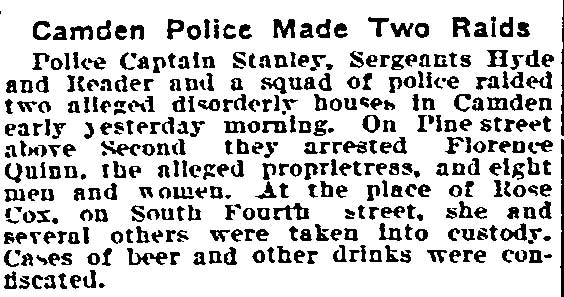
Police Captain Stanley, Sergeants Hyde and Reader and a squad of police raided two alleged disorderly houses in Camden early yesterday morning. On Pine street above Second they arrested Florence Quinn, the alleged proprietress, and eight men and women. At the place of Rose Cox, on South Fourth street, she and several others were taken into custody. Cases of beer and other drinks were confiscated.
Benson and Pinken Arrested for Disorderly House
Philadelphia Inquirer —
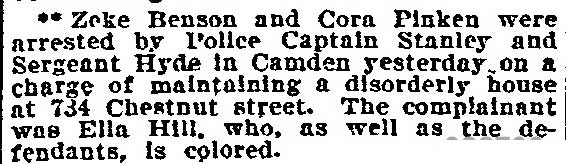
•• Zeke Benson and Cora Pinken were arrested by Police Captain Stanley and Sergeant Hyde in Camden yesterday on a charge of maintaining a disorderly house at 734 Chestnut street. The complainant was Ella Hill, who, as well as the defendants, is colored.
Camden Increases Its Police Force
Philadelphia Inquirer —
Mayor Ellis Adds Twenty-five New Officers to Growing City’s Department
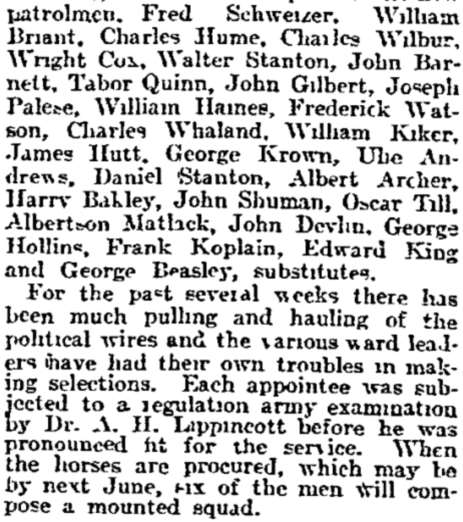
Camden’s police force was increased by the appointment of twenty-five additional officers by Mayor Ellis yesterday. There were also several promotions, two new captains, two sergeants and one detective being made as follows: Captains, Edward Hyde and A. Lincoln James, advanced from sergeants; sergeants, E. B. McClong and Edward Hartman, advanced from patrolmen; detective, John Brothers, advanced from patrolman; new patrolmen, Fred Schweizer, William Briant, Charles Hume, Charles Wilbur, Wright Cox, Walter Stanton, John Barnett, Tabor Quinn, John Gilbert, Joseph Palese, William Haines, Frederick Watson, Charles Whaland, William Kiker, James Hutt, George Krown, Ube Andrews, Daniel Stanton, Albert Archer, Harry Bakley, John Shuman, Oscar Till, Albertson Matlock, John Devlin, George Hollins, Frank Koplain, Edward King and George Beasley, substitutes.
For the past several weeks there has been much pulling and hauling of the political wires and the various ward leaders have had their own troubles in making selections. Each appointee was subjected to a regulation army examination by Dr. A. H. Lappincott before he was pronounced fit for the service. When the horses are procured, which may be by next June, six of the men will compose a mounted squad.
Camden News Notes
Philadelphia Inquirer —
Camden News Notes
** The annual sham battle and dance under the auspices of Battery B, N. G. N. J., will be held in the Camden Armory tomorrow evening.
** Dr. H. H. Sherk will give an illustrated lecture on the Yellowstone Park in the East Camden Library tomorrow night.
** One of the largest funerals that has taken place in Camden for some time was that of George Bird, who was buried from his home, 801 Haddon avenue. The services were in charge of Rev. Isaac Bagley and interment was made in the Evergreen Cemetery.
** These officers have been nominated by the Camden Police Pension Fund: President, Robert Colkett; vice president, Albert Snow; financial secretary, James Tatem; recording secretary, Edward Hyde; treasurer, E. B. McClong; trustees, James Ware, George Anderson, George Cooper, Allan Palmer and Thomas Reed.
** Daniel Clifford, a Civil War veteran, 70 years old, of New York, reported to the police yesterday that after he had drawn his pension he had been decoyed to Camden, where he was relieved of $69.
** In a twenty five foot fall at Mathis’ Shipyard yesterday, Lysander Burton, of 904 North Second street, was seriously injured internally besides having many lacerations and bruises.
** Attacked with asthma, William Baldwin, 77 years old, of 510 Kaighn avenue, died yesterday before a physician could be summoned.
** From shock due to a broken leg, John Spiegel, 45 years old, died in the Cooper Hospital last night. At one time Spiegel was a transcribing clerk in the Register of Deeds office.
Four Generations in the Buzine Family
Philadelphia Inquirer —
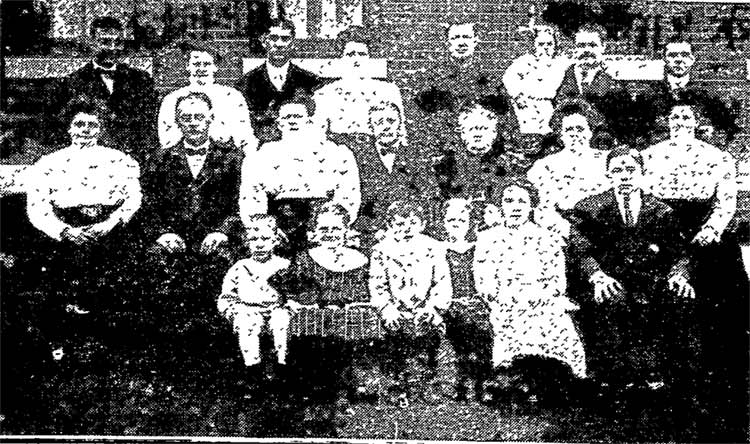

Named: Harry Prevost, William Sofield, William Buzine, Edward Hyde, Joseph Ernst, James Roach, and Samuel Buzine.
Police Pension Fund Election
Philadelphia Inquirer —
Police Pension Fund Election
There was a spirited contest at the annual election of officers of the Camden Police Pension Fund yesterday. J. Oscar Weaver won out for the presidency of the fund over George Anderson. The other officers elected follow: Vice president, James Clay; recording secretary, Edward Hyde; financial secretary, James E. Tatem; treasurer, E. B. McClong; trustees, Charles Whaland, Howard Smith, George Cooper, Albert Shaw and Harry Mines.
Two Prisoners Attempt Suicide in Their Cells
Philadelphia Inquirer —
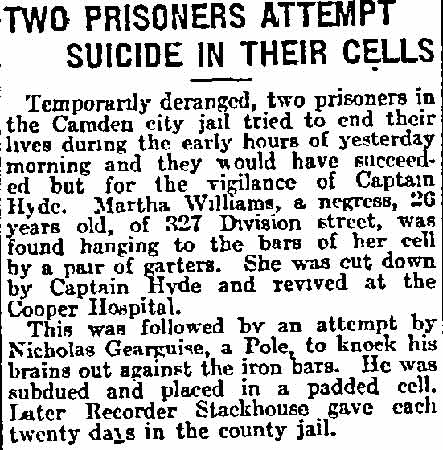
Two Prisoners Attempt Suicide in Their Cells
Temporarily deranged, two prisoners in the Camden city jail tried to end their lives during the early hours of yesterday morning and they would have succeeded but for the vigilance of Captain Hyde. Martha Williams, a negress, 26 years old, of 327 Division street, was found hanging to the bars of her cell by a pair of garters. She was cut down by Captain Hyde and revived at the Cooper Hospital.
This was followed by an attempt by Nicholas Gearguise, a Pole, to knock his brains out against the iron bars. He was subdued and placed in a padded cell. Later Recorder Stackhouse gave each twenty days in the county jail.
Police Pallbearers at Charlotte Guthridge Funeral
Philadelphia Inquirer —
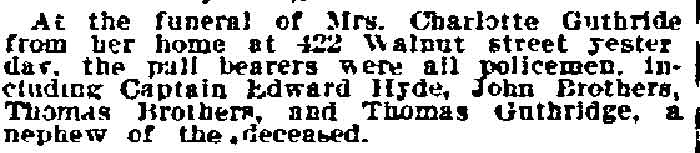
At the funeral of Mrs. Charlotte Guthride from her home at 422 Walnut street yesterday, the pull [sic] bearers were all policemen, including Captain Edward Hyde, John Brothers, Thomas Brothers, and Thomas Guthridge, a nephew of the deceased.
Police Carnival Was a Gigantic Success
Philadelphia Inquirer —
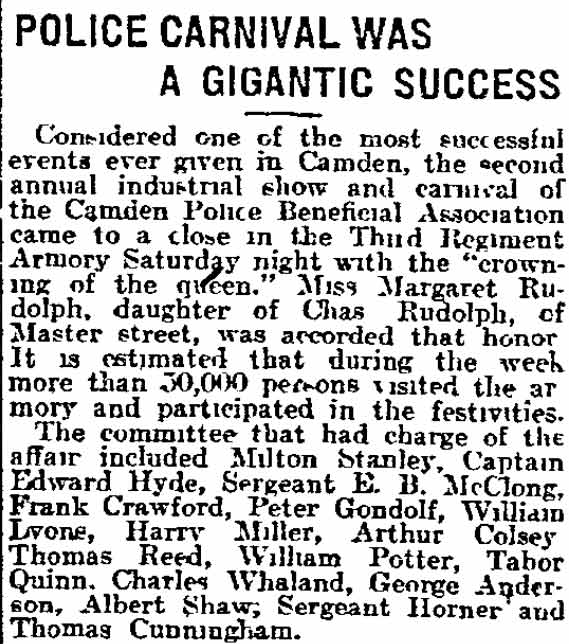
POLICE CARNIVAL WAS A GIGANTIC SUCCESS
Considered one of the most successful events ever given in Camden, the second annual industrial show and carnival of the Camden Police Beneficial Association came to a close in the Third Regiment Armory Saturday night with the “crowning of the queen.” Miss Margaret Rudolph, daughter of Chas. Rudolph, of Master street, was accorded that honor. It is estimated that during the week more than 50,000 persons visited the armory and participated in the festivities.
The committee that had charge of the affair included Milton Stanley, Captain Edward Hyde, Sergeant E. B. McClong, Frank Crawford, Peter Gondolf, William Lvone, Harry Miller, Arthur Colsey, Thomas Reed, William Potter, Tabor Quinn, Charles Whaland, George Anderson, Albert Shaw, Sergeant Horner and Thomas Cunningham.
$600,000 Will Be Spent on Camden
Philadelphia Inquirer —
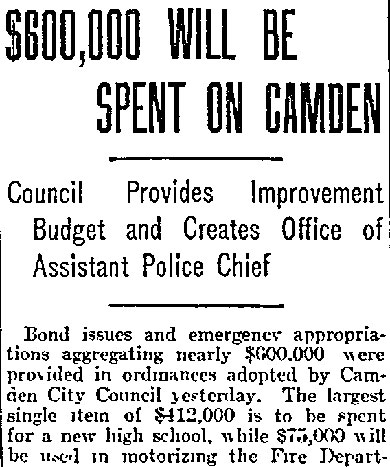
Council Provides Improvement Budget and Creates Office of Assistant Police Chief
Bond issues and emergency appropriations aggregating nearly $600,000 were provided in ordinances adopted by Camden City Council yesterday. The largest single item of $412,000 is to be spent for a new high school, while $75,000 will be used in motorizing the Fire Department’s apparatus. To increase the water supply $50,000 is to be spent and $25,000 for park purposes. For reconstructing the fire buildings $10,000 will be spent and $5000 for improving fire and police alarm boxes. The Board of Health was given $5000 and an additional $5000 was appropriated to mend the City Hall clock tower damaged by the big storm of several weeks ago. An emergency budget of $3000 was voted for the poor of the city.
By resolution from Councilman Gemberling it was decided to treat with the owners of the Dudley Grange, in East Camden, with the likelihood of converting it into a public park.
The office of Assistant Chief of Police was created and Captain Edward Hyde will fill that position. He has been in the service since April 14, 1894, and a captain at headquarters since January 1, 1908.
Murder Mystery at Third and Chestnut Streets
Philadelphia Inquirer —
Named: Edward S. Hyde, Chestnut Street, and South 3rd Street.
Negro With Smallpox Discovered in Camden
Philadelphia Inquirer —
Negro With Smallpox Discovered in Camden
Alarms Police Department When He Surrenders—Came From Baltimore Prior to Christmas
Camden’s Police Department was thrown into consternation last night when a negro entered and nonchalantly announced to Deputy Chief Hyde that he understood the health authorities were looking for him. “I’ve got the smallpox,” said he.
Within two seconds the visitor had been hustled to a small room where he was kept confined until Inspector Munion, of the Board of Health, was summoned and found the man had a genuine case of the malady. The department and all the occupants were thoroughly disinfected, while the victim was taken to the Municipal Hospital, where he will be kept under strict quarantine. He was found to be Harry Savoy, 32, of Baltimore, Md.
Since before Christmas Savoy has been in Camden visiting relatives on Silver street. A search had been made for the negro in this city.
Murderer and Forger Escape Jail After Shooting Keepers, Killing One
Camden Post-Telegram —
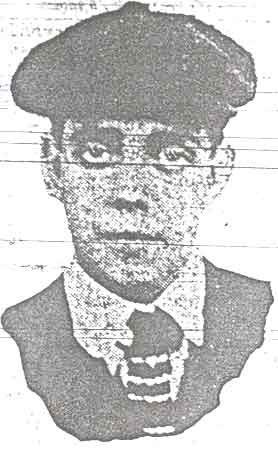
Wilson Ashbridge, Who Shot and Killed Mrs. Elizabeth Dunbar and George E. Thompson, Check Swindler, Trap Jailor Hibbs by a Ruse and After Slaying Him Shoot Joe Ellis Who Intercepted Them in Flight.
Used Revolver Smuggled Into Prison by Confederates and Leave Jail Wide Open in Their Flight, a General Delivery Being Averted by Police Who Were Summoned by the Wounded Men.
Murdering one jailor and wounding another with a revolver that had been smuggled into them by outside confederates, Wilson T. Ashbridge, slayer of Mrs. Elizabeth Dunbar, and Francis Murphy, alias George E. Thompson, a check forger, made their escape from the county jail a few minutes before seven o’clock last night.
Ashbridge with his wife was caught at noon in the Keystone Hotel in Chester PA where they registered at one o’clock this morning.
Thompson is still at liberty but from the confident manner of Prosecutor Kraft his early arrest seems assured.
The murdered jailor was Isaac Hibbs, aged 65 years of 913 South 8th Street. The wounded keeper is Joseph Ellis, aged 45 years, of 416 Carteret Street. Shot twice, he is in Cooper Hospital. His condition today is very satisfactory.
Thompson, who is 41 years old, forged a check for $650 which he gave to V.M. Fulton as part of the purchase price of an automobile. The forgery was discovered before the deal was completed and his arrest followed on June 8. he also passed a forged check for $15 on State Motor Vehicle Agent Kraft. He, too, was awaiting trial. In spite of the positive evidence against him Thompson had spurned all efforts to have him plead guilty and it is now believed that he was sparring for time while hatching a plan to escape. He s no doubt the master mind.
R.L. Hunter, a farmer of Bensalem Township, Bucks County PA, about four miles above Torres dale, reported to the Philadelphia police the morning that he had seen a man answering Ashbridge’s description on the Bucks Road at daylight. The man asked the way to Riegelsville.
According to Hunter, the man was dressed in a dark suit, and had no hat. His clothing was wet. Hunter did not see anything suspicious in his actions, and after giving him directions, they parted.
Upon seeing the paper with a picture of Ashbridge, the farmer was struck by its resemblance to the man with whom he had talked. He hurried to Tacony and notified the police.
The State police, who patrol that section of the county, and who have an office at Langhorne, were immediately notified as were the surrounding towns.
The shootings took place in different parts of the jail. Hibbs was murdered in the exercise room just outside the cell room on the Sixth and Arch corner of the building. Ellis was shot down in the corridor just outside the Market Street end of the building when he heroically grappled with Ashbridge after the latter had pointed a gun at his head. In spite of his wounds Ellis dragged himself to a telephone and after notifying Police Headquarters of what had happened he collapsed.
Only one of the two bullets is still in Ellis. It entered the groin on the right side and is buried in the muscles of the leg, having taken a downward course for seven or eight inches. The other bullet struck Ellis in the right breast and came out in the left breast, traversing the upper fleshy parts of the body.
Hibbs was almost instantaneously killed by a bullet that went within an inch of his heart, producing a hemorrhage. The bullet was extracted this morning from the body early this morning in an autopsy performed at the morgue by County Physician Stem. In spite of the fact that it is pretty well established that three shots were fires in the attack on Hibbs, only one of the bullets took effect.
“But it makes little difference which of the two men handled the gun” said Prosecutor Kraft this morning. “Both are equally guilty of this murder and what we are concerned about now is the recapture of the gunmen.” Mr. Kraft added that it his purpose to examine all of the prisoners in that part of the jail where Hibbs was murdered to determine fully who fired the fatal shot.
The escape had been carefully planned and timed to the minute. Of course the desperate prisoners were aided by confederates on the outside and it is the general belief that a high powered motor car was in waiting for them not far from the jail. They are known to have been in possession of money and openly boasted yesterday that it was their intention to leave the prison last night. These boasts were made to two young ladies connected with a religious organization who called on the tom men yesterday to offer spiritual reconciliation. The girls are frequent visitors to the jail and naturally their efforts at evangelization were directed in the main toward Ashbridge, because of the fact that he was accused of murder. These girls, whose identity officials will not disclose, were closeted with Prosecutor Kraft until one o’clock this morning. Both declared that on their visit yesterday they were told by Ashbridge and Thompson that it was the last day they expected to spend in jail.
“We are going to get away from here tonight and we’ve got money to help us after we are out ” said Ashbridge, who further told the girls he had considerable cash sewed up in the waistband of his trousers. The girls begged the prisoners not to do anything that would cause them more trouble and they told the Prosecutor that Ashbridge and Thompson promised them that they would not make any effort to escape. In their talks with the girls neither of the prisoners said a word that would indicate that they would kill if necessary to escape. The full force of their boast did not dawn on the religious workers and for this reason it never occurred tot hem to inform the Sheriff of what the prisoners had in said.
A general jail delivery of at least all the men confined in hat is known as the untried department, where the two were held, was only averted by the prompt arrival of the police on their beat, which was made easy by means of the keys taken from the prostrate body of Hibbs. Ashbridge and Thompson left all of the doors open and the vanguard of the inrushing police found the prisoners swarming all over the corridors on the east side of the prison. In the wild excitement following the double shooting and escape none else thought of freedom and a checking up of the inmates after they had been herded in the exercise room of the untried department accounted accounted for all but the fugitive slayers.
The department, in which the two men were confined is the same one which William Brown and Charles Berger made their sensational escape several years ago by sawing away the bars on the Federal Street front of the jail. Thrilling as it was, the former escape was insignificant in comparison with last night’s tragic event.
With the full force of the keepers out of the way— one dead and the other suffering from gunshot wounds at first supposed to have been fatal— Ashbridge and Thompson had nothing between them and freedom but the door entering from the spiral stairway leading to the narrow entrance of the Sixth and Market Streets end of the Court House, With the keys taken from Hibbs they opened the door and in a few seconds were breathing the free air. It was still daylight when the daring murderers walked from the building and although they were no doubt seen by some of the scores of persons passing it is certain that they managed to control themselves to such an extent as not to arouse any undue suspicion. The exit they used to escape is that used by the general public and therefore persons passing calmly in and out of the door would not in any manner be thought to have been connected with a jail delivery. However the shots which had laid low the keepers had been plainly heard on all four sides of the building and it is strange that no one has yet been found who can give positive information as to what course the fleeing men took and whether they were aided in their flight by an automobile.
While the police and detectives of Camden and all other cities in the East are watching railroad terminals, steamship lines, and all other avenues of travel in response t the general alarm sent out last night, Prosecutor Kraft is bending all his energies to learn who smuggled in the revolver which the fugitives used. Thus far this feature of the case is as complete a mystery as it was last night. Mr. Kraft and Sheriff Haines are satisfied, however, that only one gun was used for both shootings. It was at first thought that each man had a pistol when they left the jail; that one of them armed himself with the gun that Hibbs was supposed to have carried, but it was determined that Hibbs was not armed when he went into the jail last night. There was no occasion for him to come in contact with any of the prisoners and for that reason he left his revolver in his desk in the office. even had he carried it he would have little chance to use it, so cold-bloodedly was he slain as he unsuspectingly fell into the trap laid for him by the desperate gunmen. There is also some conflict as to how at least on of the fugitives was dressed. Alfred Williams, who witnessed the murder of Hibbs, said that Ashbridge was without coat or ha when he dashed out of the cell-room, and that Thompson carried his coat and hat under his arm. However in a description of the two men given at the Prosecutor’s office it was set forth that Ashbridge wore a bue serge suit and a checkered cap. The coat that he is supposed to have taken bore the mark of “Tull— the Tailor,” of Jacksonville, Florida. ad had been borrowed by him from another prisoner. He wore tan shoes. Ashbridge is 27 years old, 5 feet 7-1/2 inches in height and weighs 137 pounds. He has brown hair, smooth face and is of light complexion.
Thompson wore a brown suit and a Panama hat. He is 41 years old 5 feet seven inches in height, and weighs 175 pounds. He has brown bushy hair, is minus one of the fingers on his left hand, and is light complexioned.
The tan shoes worn by Ashbridge were also borrowed from one of the prisoners. He got them on Saturday and remarked that he wanted to look neat.
Keepers Ellis and Hibbs were reading in the prison office last evening when Hibbs glanced up at the clock and noticed that it was a few minutes of seven. “Joe, I’m going back and out the boys in their cells,” he said to Ellis and with his keys in his hand he started for the cell room in the untried department. A thirty foot long corridor runs from the office to the barred and grated door opening into the department in which the cells are situated. This department is about the size of three ordinary school rooms and in the southeastern corner of the jail are the cells, in two tiers.
Around the cells is a three foot corridor into which all the cells doors open and in which all the prisoners are permitted to walk when they are not allowed out in the main room. When the inmates are ordered into their cells and their doors closed the doors are locked from the outside of the steel cage by means of a lever worked by the jailor. Thus every cell door can be made secure without the keepers coming into actual contact with the prisoners. In addition to the bars around the corridor fronting on the double tier of cells there is a fine mesh heavy wire screening.
As Hibbs approached the lever which is operated to shut the cell doors after the prisoners have retired from the corridors, Ashbridge was leaning against the grating of his cell, Number 18. Thompson was lounging a few feet away.
“Daddy, open the door, I want you to see this note,” said Ashbridge to the keeper, at the same time displaying a piece of paper which he had in his hand. Never giving a thought that he was about to perform an act that which was absolutely necessary for the carrying-out of the well laid plot, or that he was going to his doom, or was even in danger, “Daddy,” as the aged keeper was known to all the prisoners, opened the door without hesitation.
As he swung wide the big steel frame, Ashbridge quickly stepped out and the next instant was pressing a gun against the abdomen of the jailor.
“Throw up your hands, you ___ ___ ___” he commanded.
“What are you up to, what’s this mean, asked the keeper, apparently not realizing he had been trapped.
For reply Thompson jumped out the door, wrenched the gun from Ashbridge’s grasp and with an oath began firing at Hibbs, who sank to the floor at the first shot. Only a few feet away and the only other person in the exercise room, although the shooting could have been seen by any other prisoners who had not retired to their cells, Alfred Williams, trusty, is emphatic in his assertion that Thompson fired the shot that killed Hibbs and that he fired three times.
“It’s a wonder they did not get me,” said Williams. “Ashbridge and I could not hit it and in his desperate mood I am surprised he didn’t kill me, too.” Williams, who has just completed a six months’ sentence for obtaining money from Italian grocers by falsely representing himself as an agent for a wholesale house in Chicago and who is wanted in the Windy City for the same offense, says the whole transaction took less than a minute and that the moves came so fast he and the other prisoners were powerless to aid.
“It was like a flash of lightning” said Williams, “and before I could fully understand what had happened Ashbridge had grabbed Daddy’s keys’ which had fallen to the floor, and was off like a deer for the barred door. Ashbridge had taken the smoking gun from Thompson, who had his hat and coat under his arm and who was right behind the other one.
“As they hurried through the door after Ashbridge had opened it with Daddy’s keys Daddy called to me to raise him. I put my arm under his head and lifted him slightly from the floor. ‘Hold my hands’ he sad to me. I took hold of his hands and the next minute he died in my arms. Then I heard two more shots and I knew they got Joe Ellis.”
Startled by the shots, and he is emphatic there were three in rapid succession, Ellis leaped to his feet and without taking the time to arm himself ran from the office and turned into the corridor just as Ashbridge, wild-eyed and gun in his hand, came running toward him. Halting three yards away Ashbridge pointed the revolver at Ellis’ head and ordered him to throw up his hands.
For reply and without fear of himself the keeper dashed at the murderer and the next instant they wee locked in each others embrace. Working loose the hand which held the gun, Ashbridge pulled the trigger. The bullet struck Ellis in the breast, but the wound was not sufficient to render him helpless. However, before he could grip the pistol arm, Ashbridge fired again and the keeper fell back with a bullet in his groin.
“The second shot got me,” said Ellis to Prosecutor Kraft and Assistant Prosecutor Butler at the hospital. “The first one wasn’t bad but my strength left me when the second bullet struck. Ashbridge was the only one I saw. I did not see Thompson.”
“Dragging himself to the office Ellis managed to reach a telephone and called up the police.
“This is Ellis at the county jail; come quick. Ashbridge has shot me” he weakly said over the phone to Captain Hyde. Then the receiver fell from his hand and he dropped to the floor, but after a minute or two managed to climb into chair.
While patrol loads of policemen where being hurried to the Court House from the First and Second District station houses, Reserve Officer Charles Hose, on duty at Broadway and Federal Street, who had heard the shots, ran to the Court House and from the office of Assistant Custodian John Lack phoned up to the jail. Ellis managed to answer and in a few word told what had happened. They ran up to the jail and were admitted by Ellis, who was rapidly growing weaker from loss of blood, the trail of which plainly showed just where the injured keeper had moved.
“I guess Ashbridge got away and the jail is all open, you had better take care of the rest of the prisoners,” said Ellis to Hose and Lack. The fugitive-murderers had left all doors open and the other occupants of the untried department were swarming through the corridors. Their curses and yells and the shrieks and cries of the female prisoners had turned the place into a perfect bedlam. With the aid of other policemen who swarmed into the Court House like bees, the prisoners were soon herded into the exercise room, where Trusty Williams checked the up and accounted for all but Ashbridge and Thompson.
With the faint hope that the missing pair had not risked leaving the building but had secreted themselves in the structure, the courthouse was searched from pit to dome, but no trace of the men were found.
Detective Doran was the first of the Prosecutor’s staff to reach the scene. Mr. Kraft and the balance of the staff soon followed. In the lower end of the county, on official business, Sheriff Haines was reached by phone and Under Sheriff Hewitt was summoned from Pitman and until an early hour this morning the officials were is conference and examining numerous prisoners.
State Detective Walter Le Torneau furnished Prosecutor Kraft with a promising “tip” this morning when he learned that Thompson gave a letter to Freeholder Howard Marshall, of the Eighth Ward, to mail on Sunday. Mr. Marshall states that the letter was addressed to a woman by the name or Mrs. Shelton, in Baltimore MD.
Marshall was attending religious service in the jail when Thompson approached him.
“Put this is your pocket and mail it it for me when you go out,” said Thompson to Mr. Marshall, who agreed to carry out the request. Dropping the letter in the mail box Marshall allowed the incident to pass without further notice.
Detective Le Torneau learned this morning that Marshall had spoken to the incident to a friend and the sleuth notified the Prosecutor, The tip will be run down the Prosecutor stated.
Funeral services for Hibbs will be held on Thursday from his late residence. The body will be taken to Langhorne PA where interment will be made in the Friends’ Cemetery under the direction of the Schroeder-Kephart Company. Services will be conducted Wednesday evening by Reverend Henry Bradway, pastor of the Eighth Street Methodist Episcopal Church.
POLICE QUICKLY AT WORK
Although the murderous prisoners made their escape, it was no fault of the local police department, which threw out a “dragnet system” that covered practically every outlet fropm the city. as soon as the call reached headquarters the red lights were flashing and every officer and detective who could be reached was sent out on the “man hunt” which was pursued with vigor.
Passing automobiles were pressed into service by the detectives and officers and all haste was made for the ferries, railroad yards, terminals, and trolley points. Citizens cooperated with the police in their efforts to run down the escaping prisoners.
Assistant Chief Hyde received the call from Jailor Ellis, who though wounded himself summoned strength enough to reach the phone.
“This is Jailor Ellis. Hibbs and me have been shot by that man Ashbridge and help quick!” was the startling message which came over the phone to Chief Hyde about one minute past seven.
It was just at the time the shifts were going on and off at the local station houses. Chief Hyde lost no time. He called to Machine Operator “Eddie” King to send the message to the station houses and flash the red lights. This was done and as fast as the men could run they covered the various points.
The auto patrols were dispatched with all hands to the Court House and the wounded men hurried to the hospital. Coroner Robert G. Schroeder reached the hospital as Hibbs and Ellis were being admitted and he tool charge of the situation and got in touch with Prosecutor Kraft and County Physician Stem.
Detective Captain Schregler was hurriedly summoned, and his men were sent in all directions. Detective Brothers boarded a waiting automobile and a record run was made for the Federal Street ferry. Sergeant Humes was picked up and in four minutes after the call was received from Ellis Detective Brothers had the ferry covered.
Detectives Troncone, painter and Murray and Captain Schregler covered the Kaighn Avenue, Vine Street, and Cramer Hill ferry lines.
Detective Brothers got in touch with the Pennsylvania Railroad officials who put their detective force to work searching freight and passenger cars. The orders were sent out from the railroad office to stop and search every fright train. Dispatches were also sent to Trenton, Mount Holly, and Burlington and it was not long before the news of the atrocious deed had spread throughout the country and many distant places.
Trolley cars were stopped and searched by the police, but not the slightest trace could be found of the escaped prisoners. The police left nothing undone in the “man-hunt.”
When news of the affair spread through the city phone calls began to come in to headquarters. Over fifty persons called up to tell the police that they had seen the two men at various places. The “tips” were all run down but none materialized.
Officers Arthur Colsey and Theodore Guthrie, who were on their vacations. lent their aid to Chief Hyde. Policeman Colsey pressed his automobile into service and carried the police to various parts of the city.
Co-operating closely with Prosecutor Kraft’s detectives the city officials formed a combination which in nine times out of ten would have been successful, but the escaped men cleverly eluded their pursuers.
Assisted by Coroner Schroeder, County Physician Stem held a post mortem examination on Hibbs’ body. The bullet which caused the death was located in the region of the heart, It passed through the victim’s lung, causing a hemorrhage, which resulted in death. Following the examination the body was taken by the Schroeder-Kephart Company at the family’s orders to be prepared for burial.
ASHBRIDGE’S FIRST CRIME
The brutal crime for which Ashbridge stood indicted but untried was committed on the night of January 22 at Ninth and Market Streets. It developed that the murderer had followed his intended victim from the morning hours. He trailed her to the home of her sister, a Mrs. Meredith, of 911 Market Street, and laid in wait in the darkness of a building that fatal Saturday night.
Mrs. Dunbar came out of the house and stood on the northeast corner while waiting for a ferry-bound trolley car. She intended going to Sicklerville that night to visit her relatives. With her at the time was her 7-year-old daughter, Eleanor, and her father, Charles Dunbar. Ashbridge advanced toward the woman, who was startled when she saw him. She called to her father that she “didn’t want anything to do with Ashbridge.”
Before the father could interfere the young murderer whipped out a revolver and covered the father and the woman. He then struck the woman violently in the face with his fist and as she was reeling under the force of the brutal blow Ashbridge fired, the first bullet taking effect in the woman’s chest. The brutal murderer then stood over his prostrate victim and holding the revolver less than five inched from his victim’s body he pumped four more shots into her.
Policeman Howard Smith and Policeman Taylor were a square distant. Smith saw the entire proceedings and screamed at Ashbridge to stop shooting. A crowd quickly gathered and Dr. Maldeis, who lives nearby, came running to the scene to aid the stricken woman.
Officer Taylor espied Ashbridge in the crowd, The murderer made no effort to run, but stood his ground. Detecting the murderer trying to slip something up his sleeve, Taylor pounced upon him and bore him to the ground, at the same time taking the gun away from him and slipping the handcuffs over the murderer’s wrists. Policeman Taylor had to draw his revolver to keep back the large crowd that was threatening. Showing no concern whatever, Ashbridge calmly waited until the police auto arrived. In the meantime the murdered woman’s still warm body was placed in a “jitney” and with Officer Smith and Dr. Maldeis a hurry run was made for Cooper Hospital but when the institution was reached, Mrs. Dunbar was pronounced dead.
Ashbridge was taken to the hospital by Policeman Taylor in the police auto. He asked “how she is.” Informed that he had accomplished his purpose, the young murderer asked to see the woman. When the white sheet covering the still form of the murdered woman was drawn from the face Ashbridge leaned over and kissed the forehead of the woman. He was then taken to the County jail and locked up. Before Recorder Stackhouse on the following Monday Ashbridge pleaded guilty.
Ashbridge was infatuated with the woman, who was a member of the Temple Theater chorus. Because of Ashbridge’s persistent attentions she was compelled to give up her position. Mrs. Dunbar had previously accepted Ashbridge’s attentions, thinking that he was unmarried, but upon learning that he had a wife and child she informed him that it would be best for them not to see each other, but the young man refused to discontinue his attentions.
On the day of the shooting Ashbridge was seen in various places. He is said to have followed the woman to the Federal Street ferry, but lost track of her. Around noon he was seen at Front and Pearl Streets by Policeman Boyd, who ordered him to move on. Boyd was about to arrest him as a suspicious character, but Ashbridge pleaded that he was looking for a friend. All that day Ashbridge followed the woman until night, when he cruelly murdered her.
The murderer came from a respectable family. Dissipation is thought to have caused the young man to lose his sense of reasoning. Rather good-looking, Ashbridge had tender baby-like eyes and his case excited sympathy among the more tender-hearted people.
Sweetmeats, tasty sandwiches, and other small luxuries were said to have been given the young murderer while he languished in his cell. He had many visitors. Recently Ashbridge was taken violently ill after eating some crabs which were given him by a friend. He and Jailor Hibbs were very friendly.
THOMPSON A CLEVER FORGER
Thompson, or Murphy, was a self-styled lawyer and was committed by Recorder Stackhouse in June 3 for forging checks to the amount of $1,055. The worthless checks were “worked” on the McClelland-Fulton Auto Company and Motor Vehicle Agent A.C. Kraft.
When a check for $150 presented to the automobile company by Thompson and drawn to the order of “G.E. Thompson” on the Harrisonburg, Virginia National Bank came back from the home office of the Studebaker Company as worthless, Mr. Fulton called in the police.
Thompson had previously presented a check for $890 as payment on an automobile. This check was drawn on Thompson’s favor on the Coatesville National Bank and was purported to have been signed by Louis L. Gibney, a hotel man of Downington PA. This check was still in the possession of Mr. Fulton when Thompson was arrested after the first check was returned marked “no funds.”
The clever swindler also presented a bad check to Agent Kraft for $15 for which he received the license to operate the automobile which he proposed buying.
Detective Troncone arrested Thompson at Fifth and Market Streets on June 2. The defendant had been living in a room at 220 North Fifth Street.
Giving his home address as Daytona, Florida, Thompson represented himself as a lawyer. well dressed and wearing nose glasses, Thompson was an intelligent appearing man, he had a bushy pompadour which was streaked with gray and talked in a persuasive manner. His forgeries on Mr. Gibney’s signature were so clever that Gibney himself could not tell the difference.
After Thompson’s arrest Detective Captain Schregler sent out notices to several southern cities. He received responses from Harrisonburg, Norfolk, and Petersburg Virginia and that Thompson was wanted in all three cities for check forgeries.
Bert Hibbs, a city foreman and a son of the slain jailor, was murdered early Sunday morning, December 25, 1910 when his throat was cut by Charles Ridgway, a negro, aged 22 years, of Seventh and Sycamore Streets. It was about 12:20 on Christmas morning that Hibbs while crossing the lots at Seventh and Sycamore was accosted by Ridgeway, who wanted to shake hands with Hibbs. The latter refused, a quarrel ensued and Ridgeway whipped out a razor and slashed Hibbs across the throat with such violence that his head was nearly severed. Hibbs died while on the way to the hospital. Ridgway was arrested after a battle by Detectives Schregler, Painter and Brothers and several officers at his home, 1207 Lilly Row.
Indicted for murder Ridgway pleaded non vult. On April 24, 1911, to a charge of murder in the second degree, he was sentenced to 25 years in state Prison at hard labor.
SECOND MURDER IN JAIL
This is the second murder and second escape from the present jail. The first murder took place in November, 1907, when George Stewart, a young negro, stabbed to death John Snell, who was awaiting trial for carrying in the business of fortune telling. Stewart was in jail on a charge of dealing in opium and cocaine. He had a complete opium layout in his cell. He and Snell had a quarrel and he stabbed Snell to death in his cell. He was tried and convicted and sentenced to be electrocuted during the week of February 8, 1908. He was electrocuted on February 4, being the first man to suffer the death penalty by electrocution.
On July 13, 1910 William T. Brown, alias Gillespie, who had been sentenced to seven years on a charge of forgery, and Charles Berger, who was under sentence for picking pockets, made their escape from jail after sawing the bars on the Federal Street front. They climbed over the balustrade to the roof, descended through a trapdoor, climbed down stairs and walked leisurely through the Court House building and out into the street unnoticed. They entered an automobile and were driven away. They crossed to Philadelphia on a North Cramer Hill Ferry boat.
Several weeks later Brown was arrested in New York City and was sentenced to Auburn Prison on an old charge. His term will expire shortly and he has also applied to the Court of Pardons of this State for a parole. A detainer has been lodged against him at the State prison where he his located and he will; be brought back and resentenced. Berger was captured in Chicago and was brought back and served a term at Trenton.
Murderer's Wife Supplied Revolver, Smuggling It In Covered by Fruit
Camden Post-Telegram —
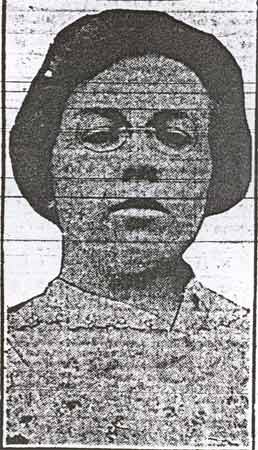
Confessing Supplying Pistol, in Spite of Husband’s Denial That She Was Guiltless, Mrs. Ashbridge Is Held Without Bail on Charge of Conspiracy in Aiding and Abetting Escape From Jail
With Wilson T. Ashbridge under guard in a cell in what was formerly known as Murderer’s Row, the police and county detectives today redoubled their energies towards the capture of George E. Thompson, the forger who escaped with Ashbridge from the County Jail on Monday night after murdering one keeper and wounding another. Stirring the police of all cities in the East to renewed activity, another circular was sent out today by the authorities giving notice of the reward of $500 offered for Thompson’s capture. Attention was strongly directed in the circular due to the fact that one of the fingers of Thompson’s left hand is missing.
The gun with which Ashbridge murdered jailor Isaac Hibbs and wounded Jailor Ellis was smuggled into the jail by Mrs. Ashbridge on Saturday morning. With it went a box of cartridges. The weapon and bullets were passed to Ashbridge in a basket of fruit, being at the bottom of the basket. The jailors were busy at the time she called and as she frequently had brought her husband fruit they did not take precaution to search the basket. Mrs. Ashbridge bought the gun and cartridges on the written request of her husband.
Her confession as to the very grave part she played in the escape and murder was made to the Prosecutor late yesterday afternoon after she had first insisted she had no knowledge if how the gun got into the jail and after her husband had repeatedly declared that the revolver was supplied by Thompson. The revolver, fully loaded, was still carried by Ashbridge when he was captured in the Keystone Hotel…
… by Recorder Stackhouse without bail for conspiracy in aiding and abetting the escape of her husband and George E. Thompson from the County Jail on Monday night.
The court room was packed to suffocation by a morbidly curious crowd, composed primarily of women. A strange silence spread through the court room when the little woman was led into the court room by Captain Schregler. The regular formality of placing prisoners in the dock was dispensed with the woman’s case.
Prosecutor De Unger pointed to the high witness chair and Mrs. Ashbridge sat in it. She evaded the gaze of the crowd, looking intently at the floor and through a window on the Washington Street side. She wore a blue skirt and a white waist. She was without her hat. her hair was carefully arranged and she wore nose glasses.
Resting her chin on her right hand her arm and hand were seen to tremble slightly. So quiet was the room that a pin dropping could have been heard.
“Mrs. Marian Ashbridge,” called the Recorder.
“Yes, Sir” was the faint reply of the woman, who did not even look up at the call of her name.
“This complaint charges you with delivering to Wilson Ashbridge and George E. Thompson a pistol and aiding and abetting them in escaping from the County Jail, where they had been lawfully committed. Do you plead guilty or not guilty,” said the Recorder as he read the complaint.
“The woman said nothing. Detective Schregler was then called as the complainant. He told of the confession made by the woman and produced the revolver which the woman purchased and which Ashbridge used in his daring escape. The gun, Captain Schregler said, was purchased in a pawnshop at Eleventh and Arch Streets, Philadelphia, on Friday of last week and was delivered to Ashbridge on Saturday morning along with a box of cartridges. “Marian, I will hold you without bail,”: said the Recorder.
As the woman was being led from the court room by Captain Schregler and Sergeant Reed the crowd made a rush for the door leading from the court room, whereupon orders were given by the police to the crowd and many were prevented from rushing out. Everybody seemed anxious to secure a closer look at the unfortunate woman.
Visitors were denied Mrs. Ashbridge. Not even her children were permitted to be brought before her, although the broken-hearted mother asked for them.
“Oh, God, I don’t know why I did this; why I left the little ones to go with Wilson,” tearfully expostulated Mrs. Ashbridge to the kind-hearted matron, who spent the best part of last night with the distraught woman.
“If I could only see little Marian,” sobbed the woman in the arms of Mrs. Kirkpatrick, who informed her that perhaps she could see them today.
Last eveneing the only support Mrs. Ashbridge had was a cup of tea. The morning she sipped a portion of a cup of coffee. She told Matron Kirkpatrick that she was not hungry.
:Everybody hounded me, I had no friends, and that’s why I went with my husband, becasue he was the only friend I had left,” said Mrs. Ashbridge. “He was a good boy, but was easily led.” The wife said even before her marriage that Ashbridge would run around with other girls, but he always returned to her and she forgave him. She said he seemed to have a spell over her and she couldn’t leave him.
“I love my husband, still and will stand by him to the end,” sobbed the little woman to Mrs. Kirkpatrick. She told how her relatives disowned her and how after her father’s death she went to live with strangers. When her husband fostered the plan to escape she willingly consented to aid him. She drew $100 out of the bank and purchased clothes and the gun and bullets. She never faltered in her plan.
“My heart aches for that woman,” said Matron Kirkpatrick this morning to a Post-Telegram reporter. “She’s a good girl, but was easily led into her present predicament. It only goes to show what a woman will do for the man she loves, no matter how base a wretch he may be. Mrs. Ashbridge is more to be pitied than scorned.
Recorder Stackhouse this morning produced a copy of the marriage of the couple, performed by him on July 28, 1914. The marriage was performed at the instance of Assistant Prosecutor Butler after Ashbridge wronged the girl. Constable William E. Headley and William C. Ashbridge, the latter father of the murderer, were witnesses.
As told in yesterday’s Post-Telegram, Ashbridge and his wife and their captors arrived at the City Hall from Chester shortly after 2:00 o’clock. After a brief stay they were taken to the Court House and turned over to Prosecutor Kraft, Ashbridge being taken into the Prosecutor’s private office and Mrs. Ashbridge being placed under guard in the ante room.
Taking full blame for the murder of Hibbs and the wounding of Ellis, Ashbridge declared that none of the shots were fired by Thompson.
“I shot both men,” he declared, “but Thompson gave me the gun. He had it since Saturday.” He repeated this assertion several times in the course of his examination, adding each time that his wife had no part in supplying the firearm. His voluntary insistence in…
… exercise corridor of their cells in response to his request that he wanted to show him a note that had been left for him, he asked the aged keeper to step inside the corridor. Evidently suspecting something was wrong Hibbs refuse to enter the corridor. When Ashbridge repeated his request that Hibbs step inside, Thompson, why was immediately behind Ashbridge, said something to the murderer. Ashbridge could not exactly recall what the expression was. At any rate it was then that he fired and Hibbs fell to the floor with his death wound. To take Hibbs keys and open the door leading from the exercise room to the corridor was the work of but an instant. It was then that Ellis confronted Ashbridge at the other end of the corridor. He refused to throw up his hands when the murderer so ordered. Instead, the plucky jailor grappled with the slayer, who again brought the gun into play, twice wounding the remaining jailor.
Ashbridge did not say why he wanted Hibbs to step inside the corridor. One surmise is that the pair had planned to get the old man into the corridor, overpower him, take his keys and after gagging him place him in a cell, depending ion the gun to awe any prisoners who might make an outcry. But whatever their plan was in this respect it miscarried. Hibbs would not enter the corridor and was shot down where he stood.
Thompson carried both his own and Ashbridge’s coats when they fled,. As Ashbridge had decided to do the talking with Hibbs when the jailor came to lock them in their cells it was agreed that it would not be wise for the murderer to be wearing a coat. This might look suspicious to Hibbs and in all likelihood he would refuse to open the door. Hence it was decided that Thompson should take both coats. He also carried Ashbridge’s cap and his own Panama.
The coats and harts were adjusted as they ran down the spiral stairway leading to the street. They walked slowly into Sixth Street; increasing their pace up Sixth Street after crossing Market and after turning into Cooper walked very rapidly. They turned north on Third Street to Main and thence to the Vine Street ferry, where they caught the boat leaving at 7:15 for Philadelphia. Landing on the other side the fugitives exchanged hats. They walked rapidly to Broad Street Station, where Mrs. Ashbridge was in waiting, this arrangement having been made when she smuggled the gun in to her husband on Saturday morning.
Accompanied by Thompson the Ashbridges walked out Market Street to Thirty-second Street. Here Thompson left them and after walking the street for a brief while longer the slayer and his wife boarded a trolley car for Chester, where a few hours later the murderer’s short-lived liberty was so dramatically terminated.
Although jailor Ellis still insists that three shots were fired before he was attacked and in spite of the positive declaration of Alfred Williams, the trusty, that three shots were fired at Hibbs, Ashbridge claims that Hibbs was shot only once and that two bullets were used on Ellis. He said that the three empty shells which the detectives found in his pocket contained the only bullets fired in the jail. The post mortem examination made yesterday by County Physician Stem bears out his contention as to the number of shots fired. Only one bullet was found and that had penetrated the jailor’s heart.
“That’s the truth about the shooting,” declared Ashbridge. “I fired the shots— three of them in all— and the gun was given me by Thompson. My wife had nothing to do with it. Don’t blame her.”
Enroute back to the prison from which he had made his tragic getaway on Monday night, Ashbridge passed through the ante room where his wife was under guard. He stopped, kissed her, gently caressed her cheek, told her not to worry and passed on to the jail, from whence his next exit will be to the electric chair.
Haggard and very weak Mrs. Ashbridge was at once taken before the Prosecutor. With due regard for her condition Mrs. Ashbridge was handled very gently. At first she insisted that she had no part in getting the gun, but under skillful handling she finally broke down and confessed that she had supplied the revolver.
She stated that on Friday night she received a letter from her husband telling her that he planned to escape from the jail on Monday night and that he needed a revolver to make certain that his scheme would not fail. He requested that she procure the pistol and cartridges and personally deliver them on Saturday. being anxious to aid her husband in every way possible she readily decided to do as he requested.
Accordingly she purchased the needed articles in a Philadelphia pawnshop on Friday afternoon, paying $3.00 for the pistol and 67 cents for the cartridges. She kept them over night and on Saturday safely delivered the weapon and bullets to her husband in the bottom of a basket of fruit. At the same time Ashbridge asked her to go with him and when she agreed to share his fate he told her to meet him in Broad Street Station, Philadelphia, shortly after seven o’clock on Monday night. He further told her that he had carefully studied the situation and did not see how it was possible for his plan to miscarry. On Monday morning she sent her children to the home of Mrs. Anna Dick and later in the day sent the letter to Mrs. Dick telling of her “rash deed” and enclosing $10 for the children.
As Mrs. Ashbridge told her story she spoke in a very low tone. Most of the time her eyes were cast down and as she concluded her brief narrative she sobbed convulsively and was in a state of utter collapse. Reviving somewhat when given cold water Mrs. Ashbridge was turned over to the police and taken back to City Hall to await her hearing this morning.
The prison key stolen by Ashbridge from Hibbs’ murdered body was recovered this morning by Detective Doran in the yard of Dr. Frank, 2025 Chestnut Street, Philadelphia. The recovery of the key was sue to information given by Ashbridge, after he had been locked up in jail yesterday afternoon. Ashbridge, when questioned as to the whereabouts of the key, said that Thompson had it and that he had seen him toss it over a wall of a residence near Twenty-third and Chestnut Streets on Monday night while he and his wife and Thompson were walking to Thirty-second Street.
Detective Doran and Constable Voight went to Philadelphia late yesterday afternoon and searched in vain for the key in the vicinity of Twenty-third and Chestnut Streets until darkness came on. Detective Doran renewed the search early this morning. There is a high wall fronting the yard at the home of Dr. Frank, and a search of the grounds resulted in the finding of the key, which was returned to Sheriff Haines.
Ashbridge is confined in a large cell in what is known as Section E. As cellmates he has two persons who are being held as witnesses to the crime. Sheriff Haines has assigned three constables, Gardner, Ford, and Addison. They will work on eight-hour shifts and will see that Ashbridge does not attempt any further escape or try to end his life.
Sergeant Detective Kane of the Chicago Police Department today took to Chicago Alfred Williams, who was an eyewitness to the murder of Hibbs. Williams, an Italian, served six months here on a charge of false pretence in obtaining money from a number of Italian grocers under the pretence that he represented the Roma Grocery Company. After his arrest and sentence here the police of Chicago lodged a detainer against Williams who is wanted in the West for a like crime.
The body of Jailor Hibbs will be exposed to view tonight at his home, 913 South 8th Street. Services will be conducted by Reverend Harry Bradway, pastor of Eighth Street Methodist Episcopal Church. Members of the Seventh Ward Republican Club, Mutual Aid and the Liberty Beneficial Society will attend in a body.
Tomorrow morning the body will be taken to Langhorne, where services will be held in the Friends Meeting House, after which interment will be made in the burial ground by the Schroeder-Kephart Company. Friends may call this evening to pay their respects.
Ashbridge will not be tried until December. On the day he was listed for trial of murdering Mrs. Dunbar his lawyer, Assemblyman Wolverton, was ill. In the interim the entire panel of jurors for the April term of court was discharged following a case of alleged tampering. This makes it necessary that he be held until September for trial unless the Court should otherwise decree, which is hardly likely.
Ashbridge is 22 years old and not 27, as previously stated. His real age was disclosed by the certificate of his marriage. He was 20 when he wedded two years ago,
The Howard Marshall who mailed a letter to a woman in Baltimore is not Freeholder Howard Marshall of the Eighth Ward, as was reported to the Prosecutor yesterday. Mr. Kraft’s investigation disclosed that Freeholder Marshall does not know either Ashbridge or Thompson and that as a matter of fact the Marshall in question is an East Sider and to relative to the freeholder, who was naturally much upset at being mistakenly dragged into the case.
E.S. Fry, proprietor of the Keystone Hotel, Chester, where the couple were caught, told the story of the capture both to the city police and Prosecutor Kraft.
“Late on Monday night I received a call from another hotel, requesting that I take care of a man and his wife for the evening,” said Mr. Fry. “I waited until a little before midnight when the couple arrived. He seemed nervous and registered in a shaky hand, and I was suspicious that there was something wrong.”
“I did not pay much attention to the way he registered until the next morning when I examined the register and saw that he had neglected to register his wife. He signed ‘Mr. Smythe, Washington, D.C.’ I communicated my suspicions to my wife and told her to go observe the couple, too. Then I went out on the porch and picked up a morning newspaper. On the front page were the pictures of the two men who escaped.”
“I instantly recognized Ashbridge, but was not just sure of my identity of the man, so I decided to get a better look at him. At the breakfast table I observed him more closely and feeling sure of my ground I called Captain Schregler, afterward securing the service of two negro policemen, whom I placed on guard outside the hotel, giving them orders not to allow the couple to leave. The officers, William Padgett and William Robinson, took their positions outside the hotel, ready for the signal to enter when I gave it.”
“Ashbridge arose.”
“What’s the matter,” he exclaimed. “You know what’s the matter,” replied Mr. Fry, who brought in Captain Schregler and Detective Hunt. Schregler and Hunt instantly recognized the fugitive.
Before Ashbridge had a chance to move his arms were pinioned by his sides and Policeman Hunt had extracted the murder gun from his right hip pocket. It was fully loaded. In the same pocket were seventeen additional cartridges and in a suitcase in his room, Number 9, was a fresh box of cartridges.
“The little wife was crying bitterly,” said Mr. Fry. “She leaned her head upon his shoulder and the husband tried to console her.”
Captain Schregler sent a telegram to Chiefs Gravenor and Hyde with the startling news that Ashbridge had been caught.
On the way back to Camden Mrs. Ashbridge began to cry. She was sitting beside Captain Schregler, and he tried to console her. Her sobs increased, and Ashbridge called to her to “take it easy.”
This seemed to quiet her a bit, and Schregler spoke to her kindly, saying that she would not be blamed very much for her part in the escape. “That’s nopt worrying me” she answered. “I am worried about ‘Wil’.”
“well you women beat me” was Schregler’s comment. “What did you want to help him escape for, anyhow? He had beaten you, deserted you for another woman and when she turned him down, he killed her. Yet you make up with him, leave your kids and risk everything to help him escape. Seems to me the worse men treat you women, the more you will do for them.”
“Lots of truth in what you say’” remarked Mrs. Ashbridge, with a sigh.
Mr. Fry was the center of attention. Everybody seemed anxious to hear his story.
“I’m not going back until I collect that $500 either,” he was heard to say. The capturer was formerly coroner of Delaware County.
Scenes of excitement were prevalent when the automobile of Chief Gravenor with Detective-chauffer David Hunt at the wheel, Captain Schregler and the prisoners in the rear and Chief Dodd, of the Pennsylvania Railroad police force in the front seat came from the Federal Street Ferry. E.S Fry, the hotel proprietor who caught the Ashbridges, was also in the car.
Ashbridge and his wife were instantly recognized. The news spread like wildfire and was passed along the route of the machine to police headquarters.
Thinking that the prisoners would be brought to the Prosecutors office, a battery of newspapermen and photographers were camped on the Court House plaza. When someone cried in bellowed tones “There they go,” the scribes and photographers started in hot pursuit behind the automobile.
The officers upon reaching the City Hall had to fight their way through the dense crowd which had gathered outside Police Headquarters. Many stood tiptoed to get a good glance at the prisoners who were abashed at their predicament.
Pulling her black straw hat over her face, Mrs. Ashbridge leaned on her husband’s arm. To hide his face the murderer pulled the Panama hat, which he had secured from Thompson, over his countenance.
Preliminary questioning was done by Captain A.L. James, after which the officers and prisoners were escorted upstairs to the office of Chief Gravenor.
Still clenching the stump of a cheap cigarette in the corner of his mouth, Ashbridge had a pitiful look on his face. He was much thinner than he was when he was arrested for the murder of the Dunbar girl. On his upper lip was a small mustache, which he raised during the last week.
His beautiful and baby-like eyes still retained their piercing stare. The murderer looked wild-eyed at persons in the room. He seemed to take delight in singling out persons in the room and “staring them out.” None seemed courageous enough to return Ashbridge’s strange stare. He looked distressed but the only betraying sign of nervousness was his incessant twitching of his fingers. Sweated on the couch in the chief’s room, Ashbridge talked freely.
His wife dried away the tears as they trickled down her reddened face but after regaining her composure she seemed quite calm. She intently watched Captain Schregler and Detective Hunt as they searched through her husband’s clothes.
When the trip for the Court House was being arranged the two prisoners, still handcuffed together, walked in the outer room of the chief’s office. It was then that the wife broke down slightly. She choked back a sob and leaned her head on her husband’s shoulder. Ashbridge did likewise and patted her on the back, at the same time, saying something in a suppressed tone of voice. The only persons in the room at the time were Assistant Chief Hyde and a Post-Telegram reporter. Neither was able to catch the words uttered. Captain Schregler, chief Gravenor, and Detective Hunt later entered the room and the start for the Court House was made.
The crowd below which was camped about the entrance to the building awaited with patient expectancy, when the news was spread that the prisoners were leaving the building.
Camera men took their positions, ready to snap the couple, but the Ashbridges fooled them. Before the door leading to the street was opened Ashbridge drew his wife to him and with their free hands pulled their hats over their faces, thus eluding the photographers, who resorted top every means to secure a photograph.
Once inside the automobile the prisoners seemed content until the Court House was reached when another large crowd was on hand to great them. Both repeated the trick of hiding their faces.
After Ashbridge was taken to his cell his wife was ordered taken to the detention department in the City Hall. Captain Schregler and Detective Hunt half-carrying the sobbing and broken-hearted woman, who has aroused some sympathy for her courageousness in taking such a desperate chance for the man she loved, the father of her children and a cruel murderer.
“What other woman would do as much as she has for her husband,” was the query advanced by one of the spectators in the Court House corridor as Mrs. Ashbridge passed through on her way to the waiting automobile.
Police Elect Officers
Philadelphia Inquirer —
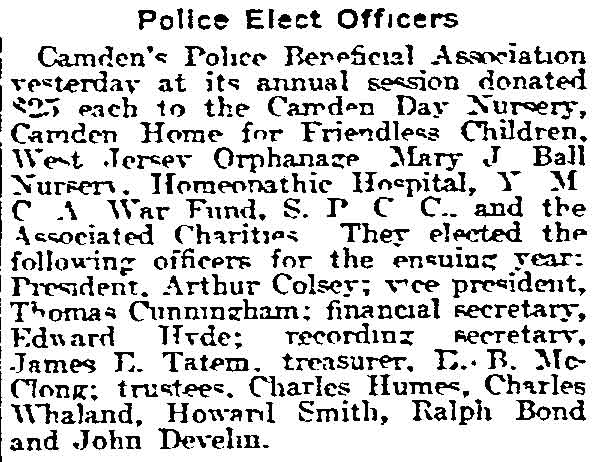
Police Elect Officers
Camden’s Police Beneficial Association yesterday at its annual session donated $25 each to the Camden Day Nursery, Camden Home for Friendless Children, West Jersey Orphanage, Mary J. Ball Nursery, Homeopathic Hospital, Y. M. C. A. War Fund, S. P. C. C., and the Associated Charities. They elected the following officers for the ensuing year: President, Arthur Colsey; vice president, Thomas Cunningham; financial secretary, Edward Hyde; recording secretary, James E. Tatem; treasurer, E. B. McClong; trustees, Charles Humes, Charles Whaland, Howard Smith, Ralph Bond and John Develin.
Camden Hails Her Sons, Conquerors, at Victory Jubilee
Philadelphia Inquirer —
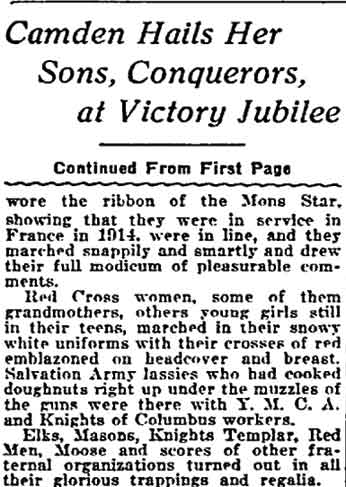
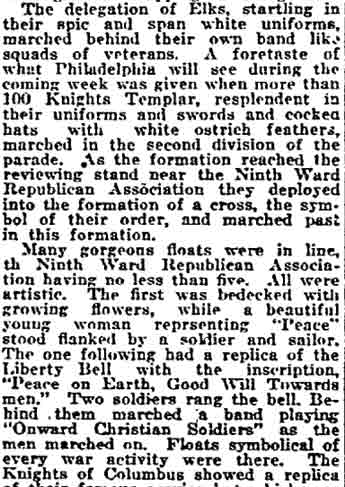
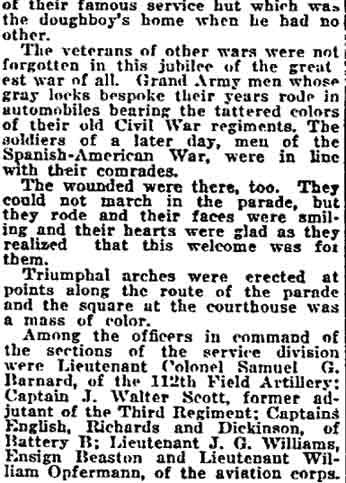
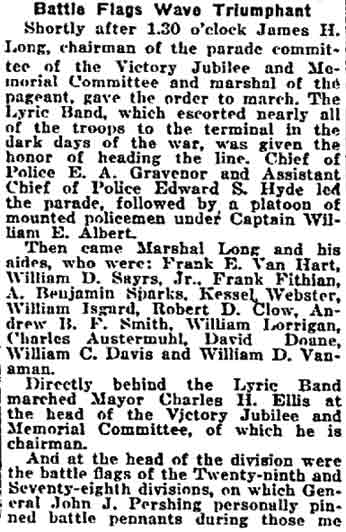
Battle Flags Wave in Triumph O’er Parade Reviewed by Admiral
Gray Veterans of G. A. R. and Wounded Ride; Centopath Passes in Reverential Hush
The Peace with victory which Camden’s sons along with millions of other soldiers of all the Allied countries helped to bring home was celebrated by a jubilee in Camden yesterday which eclipsed anything that the city across the Delaware has ever attempted in her history.
Nearly every man, woman and child who did not actually march in the jubilee parade stood on the side lines and watched it and cheered themselves hoarse as the soldiers and sailors who went out from their town to fight marched past, this time as the conquerors in the world’s greatest war.
Favored by glorious sunshine, a sunshine that was reflected in the faces of the people, the day’s proceedings went off perfectly. For months Mayor Ellis and all his city family, together with a large committee of leading citizens, had been planning the affair. Their handiwork stood the test. It was good.
Admiral Henry Wilson, commander-in-chief of the Atlantic Fleet, came to his boyhood home to be the principal guest of the city and chief reviewing officer of the jubilee. With him were national statesmen and municipal officials.
Soldiers, sailors, war workers, members of fraternal orders and men who fought under the flags of Canada, England, Italy and Poland, marched in the parade which was miles long. Every succeeding division seemed just a little better than the one which preceded it, and, when it was all over and the soldiers and sailors had filed into the old Third Regiment Armory to sit down to a piping hot banquet, the hardest thing of all was to say which had made the finest showing.
All Honor to the Dead
Amidst all the gayety and happiness there was a sober note expressed by the memorial cenotaph which preceded the parade and which brought every hat off as it passed in solemn silence.
The heroic figure of an American soldier in bronze standing on a granite pedestal which bore a gold star with the number 135, symbolical of the Camden county men who laid down their lives in their country’s cause, was carried along the route ten minutes before the parade commenced. Encircler [sic] by flowers and palms, it moved through the reverential hush which had fallen over the throngs.
While every organization in the county of Philadelphia was represented in the parade, to the thousands who lined the sidewalks, there was really only one great big important factor—the service men. And when those self-same service men, many of whom bearing the Distinguished Service Cross of their own United States, others wearing the Croix de Guerre, bestowed on them by the sister republic of France, and still others carrying on their breasts the Italian and British War Crosses, given them by grateful countries, marched down the streets and avenues, all the pent up emotion in thousands of hearts was let loose.
It mattered not whether the men were officers or enlisted men, black or white, neat or untidy, they were all soldiers and they had done all that was asked of them. Their home town honored them. The men in blue and the women in blue, too, received a welcome not one whit less feeling than their brothers in khaki.
They had a certain advantage over the doughboys, for they put half a dozen of the prettiest and smartest yoemanettes that ever wore Uncle Sam’s uniform at the head of their division. The crowd simply had to be with them.
Canada and England, too, had a detachment of men in line. About two dozen of these veterans, half of whom wore the ribbon of the Mons Star, showing that they were in service in France in 1914, were in line, and they marched snappily and smartly and drew their full modicum of pleasurable comments.
Red Cross women, some of them grandmothers, others young girls still in their teens, marched in their snowy white uniforms with their crosses of red emblazoned on headcover and breast. Salvation Army lassies who had cooked doughnuts right up under the muzzles of the guns were there with Y. M. C. A. and Knights of Columbus workers.
Elks, Masons, Knights Templar, Red Men, Moose and scores of other fraternal organizations turned out in all their glorious trappings and regalia.
The delegation of Elks, startling in their spic and span white uniforms, marched behind their own band like squads of veterans. A foretaste of what Philadelphia will see during the coming week was given when more than 100 Knights Templar, resplendent in their uniforms and swords and cocked hats with white ostrich feathers, marched in the second division of the parade. As the formation reached the reviewing stand near the Ninth Ward Republican Association they deployed into the formation of a cross, the symbol of their order, and marched past in this formation.
Many gorgeous floats were in line, th Ninth Ward Republican Association having no less than five. All were artistic. The first was bedecked with growing flowers, while a beautiful young woman reprsenting “Peace” stood flanked by a soldier and sailor. The one following had a replica of the Liberty Bell with the inscription, “Peace on Earth, Good Will Towards men.” Two soldiers rang the bell. Behind them marched a band playing “Onward Christian Soldiers” as the men marched on. Floats symbolical of every war activity were there. The Knights of Columbus showed a replica of their famous service hut which was the doughboy’s home when he had no other.
The veterans of other wars were not forgotten in this jubilee of the greatest war of all. Grand Army men whose gray locks bespoke their years rode in automobiles bearing the tattered colors of their old Civil War regiments. The soldiers of a later day, men of the Spanish-American War, were in line with their comrades.
The wounded were there, too. They could not march in the parade, but they rode and their faces were smiling and their hearts were glad as they realized that this welcome was for them.
Triumphal arches were erected at points along the route of the parade and the square at the courthouse was a mass of color.
Among the officers in command of the sections of the service division were Lieutenant Colonel Samuel G. Barnard, of the 112th Field Artillery; Captain J. Walter Scott, former adjutant of the Third Regiment; Captains English, Richards and Dickinson, of Battery B; Lieutenant J. G. Williams, Ensign Beaston and Lieutenant William Opfermann, of the aviation corps.
Battle Flags Wave Triumphant
Shortly after 1.30 o’clock James H. Long, chairman of the parade committee of the Victory Jubilee and Memorial Committee and marshal of the pageant, gave the order to march. The Lyric Band, which escorted nearly all of the troops to the terminal in the dark days of the war, was given the honor of heading the line. Chief of Police E. A. Gravenor and Assistant Chief of Police Edward S. Hyde led the parade, followed by a platoon of mounted policemen under Captain William E. Albert.
Then came Marshal Long and his aides, who were: Frank E. Van Hart, William D. Sayrs, Jr., Frank Fithian, A. Benjamin Sparks, Kessel Webster, William Isgard, Robert D. Clow, Andrew B. F. Smith, William Lorrigan, Charles Austermuhl, David Doane, William C. Davis and William D. Vanaman.
Directly behind the Lyric Band marched Mayor Charles H. Ellis at the head of the Victory Jubilee and Memorial Committee, of which he is chairman.
And at the head of the division were the battle flags of the Twenty-ninth and Seventy-eighth divisions, on which General John J. Pershing personally pinned battle pennants during those memorable days back in October in the Argonne forest. Behind the 4th marched the famous engineers, headed by Captain Keasby and Captain Beals Smuck. Three battle pennants were pinned to their flags, which never touched the ground while they were bridging the rivers in the Argonne under hellish shell fire for the doughboys to advance. Then came the 112th Field Artillery, Battery B’s heroes of the border and of France, headed by Captain Charles Richards and Captain Dickinson. In the same section marched the Eleventh Machine Gun Battalion with its battle flags and pennants fluttering.
There was another great cheer as the Seventy-eighth Division, New Jersey’s Lightning boys, loomed into view. The heroes of the 311th Infantry, 303d Engineers, 307th, 308th and 309th Field Artillery and other regiments of that famous command were given a mighty ovation behind their battle flags, which led them in their assault on St. Mihiel and the day they attacked and captured Grand-Pre in the terrible conflict in the Argonne.
Behind them marched the Marines, headed by Lieutenant Monitor Watchman, of the Fifth Regiment, Second Division. With the Marines marched the regular army units, men who had served in as many as five battles and wore three and four gold service stripes on their sleeves.
Then followed the naval contingent. They were commanded by Commander Francis W. Hoffman and Commander W. G. Hodgson.
The order “eyes left” flashed along the line as each platoon drew near the reviewing stand and Admiral Wilson with his band to his cap returned the salute. With the admiral on the stand were former United States Senator David Baird, Congressman William J. Browning, County Collector John S. Well, City Clerk W. D. Brown and others.
At the armory a splendid banquet was served to the soldiers and sailors. For days past corps Red Cross workers had been preparing the good things to eat and the men did full justice to them. They marched in the armory where the food was spread on the tables and enjoyed themselves while bands played. After dinner there were speeches. Mayor Ellis in welcoming the men said:
“This is one of the happiest moments of my life. I have waited patiently through months of trial for the glad day when I could bid you welcome to the City of Camden once again.
“We are planning to erect a lasting memorial in memory of those heroes who gave their lives and in memory of the valiant deeds you performed on land and sea.
“Camden will always cherish the memory of this day, rever the memory of your dead comrades and will inscribe your valiant deeds on that memorial. I bid you welcome in the name of the most patriotic little city in America. I thank you.”
Prosecutor Charles A. Wolverton welcomed the men on behalf of the county and paid a tribute to their valor recalling their wonderful victories of the Argonne and other battlefields of France.
‘Booze’ Mystery Soon Cleared Up
Camden Post-Telegram —
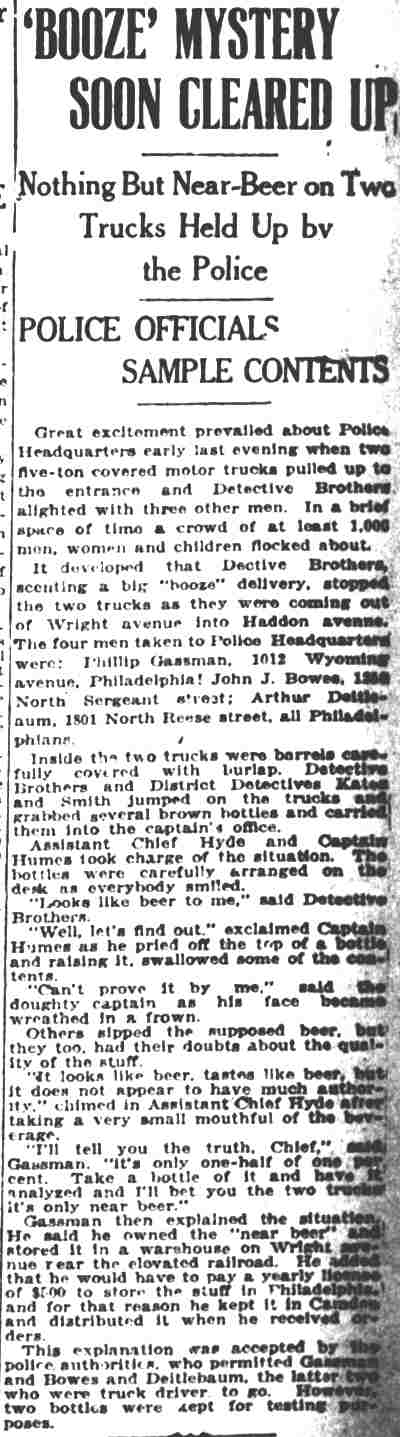
’Booze’ Mystery Soon Cleared Up
Nothing But Near-Beer on Two Trucks Held Up by the Police
Police Officials Sample Contents
Great excitement prevailed about Police Headquarters early last evening when two five-ton covered motor trucks pulled up to the entrance and Detective Brothers alighted with three other men. In a brief space of time a crowd of at least 1,000 men, women and children flocked about.
It developed that Detective Brothers, scenting a big “booze” delivery, stopped the two trucks as they were coming out of Wright avenue into Haddon avenue. The four men taken to Police Headquarters were: Phillip Gassman, 1012 Wyoming avenue, Philadelphia; John J. Bowes, 1360 North Sergeant street; Arthur Deitlbaum, 1801 North Reese street, all Philadelphians.
Inside the two trucks were barrels carefully covered with burlap. Detective Brothers and District Detectives Kates and Smith jumped on the trucks and grabbed several brown bottles and carried them into the captain’s office.
Assistant Chief Hyde and Captain Humes took charge of the situation. The bottles were carefully arranged on the desk as everybody smiled.
“Looks like beer to me,” said Detective Brothers.
“Well, let’s find out,” exclaimed Captain Humes as he pried off the top of a bottle and raising it, swallowed some of the contents.
“Can’t prove it by me,” said the doughty captain as his face became wreathed in a frown.
Police to Probe $200,000 Kaighn Ave. Fire
Camden Courier —
Fire Captain May Die, Four Others Injured; Damage Is $200,000
Economy Store and Other Buildings Near Broadway Swept by Flames Early This Morning— Falling Debris Carries Men Through Roof And Into Cellar— Sleeping Inmates of Apartments Roused and Invalid Carried to Safety— Mayor Sees Rescues
Mayor Ellis has ordered an investigation to determine the cause of the $2000,000 fire which swept the properties at 427 and 429 Kaighn Avenue and caused injury to five firemen, one of whom may be fatally hurt.
The fire centered about the property occupied by the Economy Store, formerly Handle’s, and quickly spread to four adjoining buildings.
The fireman whose recovery is despaired of is Captain Martin B. Carrigan, of Engine Company No. 2, Fifth and Arch Streets. Carrigan, who lives at 618 West Street, is suffering from a fractured skull and severe burns and cuts of the face, legs, and body. He is unconscious at Cooper Hospital.
The firemen were injured when a wall, weakened by the intense heat, crumbled and crashed through a roof upon which they were standing, dragging them through the floor below, and into a cellar. Sensational rescues followed as police, firemen, and citizens with bare hands tore at the hot debris. The men were quickly extricated and carried to the street.
“We certainly shall investigate this fire,” the Mayor declared today. “Just what was the cause and who is to blame has not been determined but there will be a thorough investigation.”
“There have been too many of these fires during the past few weeks” continued the mayor. “Surely all of them did not just happen and I am sure there has been someone responsible in one or two of the fires.”
The conflagration was one of the most spectacular of a series of large fires that have visited the city in the past six weeks. The block in which it occurred— Kaighn Avenue between Broadway and Fourth Street is one of the most prominent business squares in Camden.
Flames shot 200 feet in the air, giving the sky a fiery hue and attracted attention for miles before the firemen brought it under control. The flame-lit sky was clearly seen in Philadelphia, Merchantville, East Camden, Gloucester and other communities.
More than a score of families living in the vicinity were forced to flee from their homes in scant attire when the fire threatened them. They were cared for by neighbors.
Fireman George Boone, 46 years old, of Engine Company No. 2, also is in a serious condition. He is suffering from burns of the right hand, right thigh and foot and probable internal injuries. Boone lives at 607 Mount Vernon Street.
The other injured foremen are:
John Voll, 22 years old, 509 Royden Street: both hands badly burned.
C.J. Andrus, aged 31 years, 570 Mount Vernon Street: burns of hands and legs.
Harold Lorang, 29 years old, 19 Hudson Street: burns of right hand and legs and sprained ankle.
Firemen Prove Heroes
Carrigan and Boone are in the hospital. The other firemen were discharged after their wounds were dressed. After being released from the hospital they returned to the scene of the fire and insisted upon continuing their duties. Chief Peter B. Carter, however, ordered them home.
Most of the loss was suffered by the Economy Store. A few charred walls remain of the large building. The interior was completely gutted. It was estimated today that the damage to that property will total $60,000 At least $50,000 damage, it was said, was done to the stock.
Morris Handle, local theatrical man, who owns the building, declared today that the property was insured for $30,000. “My loss will be quite heavy,” said Mr. Handle. “The insurance will not pay one-half the property damage.”
The adjoining building at 431 Kaighn Avenue is occupied by Dr. S.I. Yubas, optometrist, and L.R. Yubas, his father, a jeweler.
Invalid is Rescued
The rear and upper floors of the Yubas property were gutted and the stock sustained a heavy loss, due to water and smoke. The damage will total $40,000, Mr. Yubas estimated today.
Five persons who were asleep on the upper floors of the Yubas dwelling had narrow escapes. They were awakened by Samuel Goldstein, haberdasher, 417 Kaighn Avenue, who discovered the fire in the Economy Store and turned in the alarm. Mrs. L.R. Yubas, an invalid, was rescued with difficulty.
The property occupied by Mrs. Sadie Bodner, a widow, at 433 Kaighn Avenue, as a house furnishings store, was scorched and also damaged by water and smoke.
Adjoining the Economy Store on the west at 425 Kaighn Avenue is a vacant one-story structure, formerly occupy by the United Beef Company. Firemen were on the roof of that building when the west wall of the Economy Store collapsed. The wall tumbled down on the small roof and hurled the firemen through a hole in the roof, through the floor and then into the cellar.
Several Stores Damaged
Three policemen, Joseph Sparks, Thomas Cheeseman, and George Hill— and several spectators braved the fire and smoke to rescue the trapped firemen.
The property at 423 Kaighn Avenue, occupied by the Charles Jamison Department Store, was damaged in the rear and the stock ruined by water and smoke. The Kresge Five-and-Ten-Cent Store, at 519-531 Kaighn Avenue, was also damaged by water.
Louis Richelson, who owns the properties from 519 to 525 Kaighn Avenue, was unable to estimate his loss today.
Collapse of Wall
Hundreds of spectators, who were watching the fire from the opposite side of the street, shuddered as they saw a brick wall, weakened by the intense heat, totter and sway. Before the firemen on the smaller roof below could scurry to safety, it collapsed.
A groan escaped the crowd as they heard the cries of the entrapped firemen and the deafening thud of the brocks as they landed on the roof where the firemen were at work.
As the full weight of the brocks struck the roof, it caved in forming a gaping hole. The firemen were literally swept into the opening.
The bricks tumbled down, causing another hole in the floor between the firs story and the cellar and dragging the imperiled firemen into the cellar with them.
Mayor Charles H. Ellis was among the spectators who witnessed the collapse of the wall. Other officials were Chief James H. Long, of the Water Department; Fire Chief Carter, Assistant Police Chief Edward S. Hyde, Captain Lewis Stehr of the Second Police District, and Street Commissioner Alfred L. Sayers.
Firemen Under Debris
Observing the peril of the trapped firemen, Policemen Sparks, Cheeseman and Hill, together with a dozen other spectators, rushed across the street to the vacant store. They rushed through the smoke and fire, leaped into the cellar and reached the struggling firemen.
Sparks, the first to leap into the cellar, reached Voll, who had been pinned beneath a pile of debris and was pleading to be rescued. The policeman feverishly extricated Voll from his precarious position and carried him out into the street to safety.
Policeman Cheeseman had accidentally fallen into the cellar and, though himself injured, groped about in the dark until he found Boone, whom he dragged outside.
Policeman Hill carried Carrigan out of the cellar in his arms.
The five firemen were carried to a waiting police ambulance and rushed to Cooper Hospital. Carrigan was unconscious. He haws a slim fighting chance to recover.
Carrigan was promoted to a captaincy the first of the year. He is popular among his comrades and has the reputation of being a fearless fireman.
Mayor Praises Firemen
Mayor Ellis praised the work of the firemen and the bravery of the policemen who had risked their lives to effect the rescue.
“Never did I see such remarkable work” said the Mayor. “When I arrived at the scene, it looked as if the whole block was doomed. The flames were shooting upward and the whole sky seemed lit up. The firemen tackled their job with dispatch and courage. I was proud of them. They knew their business and showed it by confining it to a comparatively small area. The work of the police also was commendable.
Mr. Goldstein discovered the fire shortly before midnight.
“I had just left my home at 417 Kaighn Avenue,” explained Mr. Goldstein, “intending to get a soda. As I passed the Economy Store I noticed strong odor of smoke. I peered into the glass doorway of the store. I immediately saw the place was afire.”
Rescues Sleeping Family
“Then I ran back to my store” continued Mr. Goldstein, “and I telephoned police headquarters. I went out again and returned to the scene. I remembered that the Yubas family were asleep on the second and third floors and rapped on the doors. Mr. Yubas came down in a bathrobe. He was not aware of the fire.”
The six persons asleep in the Yubas home were Dr. Yubas, Mr. And Mrs. L.R. Yubas, Bernard Helfand, Miss Bertha Cuden and Anna Recowitz, a domestic.
Mrs. Yubas, who is recovering from an illness, was too weak to make her way outside through the smoke. Assisted by her husband, Policemen Becker and Cheeseman and Constable John Cunningham, Mrs. Yubas was half carried downstairs, and out through the rear of the building to safety.
Blaze Had Big Start
“The fire had gained such rapid headway,” said Sergeant Thomas Cunningham, “that when the firemen arrived, smoke was actually issuing from cracks in the sidewalks and between the cobbles near the trolley tracks.”
The second and third floors of 419 to 423 Kaighn Avenue are occupied by private families as apartments. In the rear were number of frame dwellings. More than a score of families were obliged to leave their homes in scant attire when the firemen began playing hose upon their properties as a precaution against the fire spreading.
Mrs. Catherine Fox, 410 Sycamore Street, and Mrs. E. Chambers, 412 Sycamore Street, whose homes are in the rear of the Economy Store property, had removed part of the furniture to the street. Even after firemen assured them the danger of their homes catching on fire was over, the women and children could hardly be persuaded to return.
Crumbling walls and cracking of glass hampered the foremen in their work and made their task hazardous. The firemen were further handicapped by the big start the fire had gained. Despite this, they stuck dangerously close to the flames.
To play hose upon the fire to advantage, several firemen scaled the outside walls of adjoining properties and reached cornices, from which they directed streams of water.
High Wind Fanned Flames
A high wind gave them great difficulty. A number of times, when the firemen seemed to have the fire under control, the flames burst out afresh and compelled them to retreat. Then the reflection would light up the sky overhead.
Water Chief Long gave the firemen great service in maintaining the water at a high pressure to ensure facility in getting the streams to play upon the flames.
Kaighn Avenue, between Broadway and Fourth Street, was literally alive with residents and passers-by attracted by the flames. Included among the spectators were scores of persons who came from Philadelphia and distant points, in the belief the blaze was much more serious.
According to the estimate of the loss made today, the insurance on the property and stock damaged by the fore will not pay for one-half the loss sustained.
Chief Carter was determined to take no chances with the fire because of the high wind and the fire was attacked on all sides. While firemen were fighting the flames from Kaighn Avenue several companies of firemen had worked their way into the yard in the rear, from whence they played streams of hose.
An effort is being made today to determine the origin of the blaze.
Thomas Shanahan, Engine Company 6, was a spectator when the wall crashed in. Hearing the cries of the buried men, he immediately dashed into the dirt. Six men, including Harry Seeley, formed a human chain and pulled four of the men from the heap of rubbish.
Someone had the presence of mind to turn off the nozzle of a hose, which was playing directly o the mound. When found, the water was trickling through to the pinned men.
Action on Camden Saloons Denied
Philadelphia Public-Ledger —
Camden Police Chief Says Patrolmen Listing Visitors Are Without Orders
End Espionage Hast Night
Assistant Chief Edward S. Hyde who is temporarily head of the Camden police department, denied today that patrolmen are acting under any orders of police officials or have received any instructions in the matter of standing in front of saloons and taking the names and addresses of persons who enter.
Patrolmen acting on orders of the Federal prohibition enforcement authorities yesterday stood at the entrances of drinking places and inquired the name and address of every patron who entered. The patrons thus made themselves liable to be summoned as witnesses against themselves or against the saloonkeepers before the Federal Grand Jury in case the liquor sold is found to contain more alcohol than the Volstead law allows.
Assistant Chief Hyde said he is very much in the dark as to the strange procedure. He said the patrolman engaged in making the canvas arc acting as individual citizens and not as patrolmen.
In most instances the names were given freely. Only in one instance was any untoward incident reported. That happened in the shipyard district when about 200 workmen, quitting for lunch at noon, flocked to the South Camden bar. Jeers and hoots greeted a patrolman who attempted to poll them as they entered, and he gave up the attempt.
At most of the saloons the patrolmen entered and asked the proprietors for the names and addressed of ten patrons. If the information was given he departed immediately, and if he refused he left just as promptly. The same tactics applied to the inquiries outside the saloons. The espionage on the saloons was maintained until last night.
Mr. Hyde said if the patrolmen knew liquor is sold or the law is being violated in any way it is their duty to make arrests, but he denied that any orders had been issued.
Camden Merchant on Trial for Arson
Philadelphia Inquirer —
Store Found Soaked in Oil; Man Tells Judge He Was Away From Home
Gas House Emplpyee Tells Court “Fumes” Not Whisky Made Him Drunk
Accused of being responsible for a fire which damaged his shoe store on the night of July 23 last, Charles Morris, 50 years old, a merchant at 1203 Haddon avenue, was placed on trial in the Camden Criminal Court yesterday on three indictments. One charges arson, another conspiracy to commit the crime and the third with aiding in the crime. Morris pledged not guilty to all three charges.
When fire was discovered in the store a few minutes before midnight on July 23 the firemen found a heavy shoe rack against the front door and on the floors were rags, stockings and a carpet runner soaked in oil. The flames were checked before making much headway. None of the members of the Morris family was at home when the fire broke out. They were at the seashore and did not return until the following morning when Morris was placed under arrest. He states that he went away early on the morning of the day of the fire and that he has no knowledge of the cause of the blaze. He also denies the presence of the oil-soaked rags in the store. The rags and other articles which had been bathed in kerosene were shown to the jury, on which there are five women. Fire Chief Carter, Police Chief Hyde and several firemen testified to the oil fumes in the store. The State also contended that Morris carried $10,000 insurance on a $7000 stock.
Changes Ordered in Camden Police
Philadelphia Inquirer —
This story erred in reporting, as retirement at age 65 was NOT mandatory at the time. William E. Albert, Richard Golden, Frank Matlack, and Edwin Thomas did retire. John Golden, John Painter, Charles Fitzsimmons, Thomas Brothes, and William Lyons continued to work in the Police Department. John Golden was eventually promoted to Chief of Police.
Chief of Camden Police Is Retired
Trenton Evening Times —
CHIEF OF CAMDEN POLICE IS RETIRED
CAMDEN, June 27.—The authorities shook up the Police Department yesterday by retiring Police Chief Edward S. Hyde and Eldridge Benjamin McClong, chief clerk of the department, on pensions. Announcement of the proposed changes came following a conference at City Hall attended by Mayor King, Commissioners Middleton and Sherwood, City Counsel Miller, and Assistant City Counsel Neutze. Commissioner Hitchner was unable to attend on account of the death of his father, but it is said he has acquiesced in the action of the other commissioners.
Captain James E. Tatem, who has been stationed at City Hall headquarters, was asked to become acting chief. Chief Hyde was eligible to a pension both from the standpoint of years of service and age.
Speaking for the commissioners, Mr. Miller said: “Chief Hyde and Captain McClong have signed applications for pensions and have been relieved from further duty. It was regarded as a move for the best interests of the police department and the city government that these two men retire at this time.”
Edward S. Hyde Dies; Former Police Chief
Camden Courier-Post —
Member of Board of Freeholders—Ill More Than a Year
Edward S. Hyde, former chief of police and member of the Camden County Board of Freeholders, who died yesterday after an illness of more than a year, will be buried Wednesday. Services will take place at the home, 832 Haddon avenue, at 2 p. m., and burial will be in Harleigh Cemetery. Hyde was 62.
A detail of police, to be named by Chief Stehr, will participate in the funeral exercises.
His appointment to the latter office came following the resignation of Chief Gravener in the latter part of 1922. Hyde had served under Gravener as assistant chief and when the latter relinquished the office, Hyde took his place, holding the position for about nine months. With the ascension of the Non-Partisan party to control, Hyde was ousted.
For many years Hyde took an active interest in Seventh ward Republican politics and was a member of many of the Seventh Ward Republican Club committees. Two years ago he was elected as the wards’ representative to the Board of Chosen Freeholders.
Surviving are his widow, Mrs. Mina B. Hyde, and three daughters, Mrs. Marion Garlan, of Haddonfield; Mrs. Mary Van Hart, of Wilmington, and Miss Emma Hyde, of Camden.
Hyde was appointed to the police force April 14, 1894, and was made a sergeant five years later.
On January 1, 1908, he was named a captain, coming in from the Second District to headquarters. In 1915 he was made assistant chief, and on August 1, 1922, appointed chief. He was pensioned July 15, 1923.
Police Escort Funeral of Former Chief Hyde
Camden Courier-Post —
A police motorcycle squad under the command of Inspector Humes acted as escort today at the funeral service of Edward S. Hyde, former police chief and a. member of the board of freeholders, who died Sunday.
Services took place at the home, 832 Haddon Avenue, and burial was in Harleigh Cemetery. Members of the police detail were Sergeant Jefferson Kay, patrolmen Thomas Kauffman, William Moll, John Stanton, Thomas Welch and James Wilson.
Hyde was appointed to the police force in April, 1894, and pensioned July, 1923. He succeeded Chief Gravenor when the latter resigned in 1922. Long interested in politics, he was elected freeholder two years ago. He is survived by his widow, Mina B. Hyde, and three daughters, Mrs. Marion Garlan, Mrs. Mary Van Hart and Emma Hyde.