Samuel M. Price
SAMUEL MONTGOMERY PRICE was born on March 20, 1858 in Camden, New Jersey.
Samuel M. Price married Clara B. Bozarth around 1875. Three children came of this marriage—Blanche in 1876, Clara in 1880, and Samuel M. Price Jr. in 1887.
Samuel M. Price appears in Camden City Directories in 1878 and 1881 as a laborer living at 904 Chestnut Street. From 1883 to 1888 he and his family lived at 908 Chestnut Street. By 1890 they had moved to 906 Chestnut Street.
Samuel M. Price was appointed to the Camden Fire Department in 1899. He began service on March 1, 1900. His highest rank was Acting Battalion Chief.
Samuel M. Price and family were still residing at 906 Chestnut Street according to City Directories in 1922.
By 1924 Samuel M. Price had moved to 1452 Mount Ephraim Avenue, with his daughter Clara and son-in-law Harry M. Chambers, who was also a Camden Fire Department member.
Samuel Montgomery Price retired on January 1, 1932. He died suddenly on January 16, 1932 and was buried at Harleigh Cemetery.
Could Not Agree on New Fireman
Philadelphia Inquirer —
Camden Councilmen From East Side Split on Selecting Appointees
There Is Also Trouble in the Second Ward — Benjamin Kellum Made Assistant Chief — Other Promotions
The Camden Fire Commissioners last evening selected firemen for the five new fire companies from all the wards except the Second, Eleventh and Twelfth, as the Councilmen in these wards could not agree on the candidates the appointments were laid over until Monday evening next.
In the Second ward the Councilmen have agreed on John W. Vanhart. The other candidates are W. Scott Franklin, backed by Freeholder Whyte, and Edgar Bolton, who is the choice of Mayor Hatch and Councilman McGill. Bolton will probably be selected.
In the Eleventh ward a meeting was held by the Councilmen and the candidates agreed upon. Councilman Arnold has since repudiated the agreement, and last evening presented a new set of names to the conference of the commissioners. Councilman Longacre presented those previously agreed upon.
In the Twelfth ward Councilman Lee submitted names in opposition to those of Councilman Leas. It is quite probable that the choice of Councilmen Leas and Longacre, who are members of the Fire Committee, will be selected.
Benjamin Kellum, foreman of Truck No. 1, was appointed assistant chief. He will have charge of the East Side companies.
Charles Robinson, of the Seventh ward; George B. Wade, of the Sixth ward; Albert Jones, of the Ninth ward; George Cox, of the Third ward; Edward Weston, of the Ninth ward, and Samuel Peoples, of the Fifth ward, were elected foremen. They will be assigned to their posts of duty on Monday.
The selection of new firemen was as follows: First ward, Harry B. Middleton, Harry Burrough; Third ward, Robert W. Colkett, William G. Hillman; Fourth ward, James E. Navin, Charles Todd; Fifth ward, Daniel Smith, Peter B. Carter; Sixth ward, Alfred Hayden, Henry Elliott; Seventh ward, Josiah Sage, Samuel Price; Eighth ward, William Rose, Charles Sturgis; Ninth ward, Daniel Grimes, Harry Wagner; Tenth ward, Augustus Kester, William Simpson.
The commissioners presented the bell now in the William Penn hose house, East Side, to the First Baptist Church.
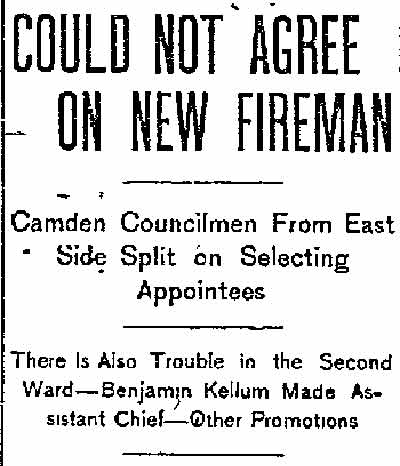
Could Not Agree on New Fireman
Camden Councilmen From East Side Split on Selecting Appointees
There Is Also Trouble in the Second Ward — Benjamin Kellum Made Assistant Chief — Other Promotions
The Camden Fire Commissioners last evening selected firemen for the five new fire companies from all the wards except the Second, Eleventh and Twelfth, as the Councilmen in these wards could not agree on the candidates the appointments were laid over until Monday evening next.
In the Second ward the Councilmen have agreed on John W. Vanhart. The other candidates are W. Scott Franklin, backed by Freeholder Whyte, and Edgar Bolton, who is the choice of Mayor Hatch and Councilman McGill. Bolton will probably be selected.
In the Eleventh ward a meeting was held by the Councilmen and the candidates agreed upon. Councilman Arnold has since repudiated the agreement, and last evening presented a new set of names to the conference of the commissioners. Councilman Longacre presented those previously agreed upon.
In the Twelfth ward Councilman Lee submitted names in opposition to those of Councilman Leas. It is quite probable that the choice of Councilmen Leas and Longacre, who are members of the Fire Committee, will be selected.
Benjamin Kellum, foreman of Truck No. 1, was appointed assistant chief. He will have charge of the East Side companies.
Charles Robinson, of the Seventh ward; George B. Wade, of the Sixth ward; Albert Jones, of the Ninth ward; George Cox, of the Third ward; Edward Weston, of the Ninth ward, and Samuel Peoples, of the Fifth ward, were elected foremen. They will be assigned to their posts of duty on Monday.
The selection of new firemen was as follows: First ward, Harry B. Middleton, Harry Burroughs; Third ward, Robert W. Colkett, William G. Hillman; Fourth ward, James E. Navins, Charles Todd; Fifth ward, Daniel Smith, Peter B. Carter; Sixth ward, Alfred Hayden, Henry Elliott; Seventh ward, Josiah Sage, Samuel Price; Eighth ward, William Rose, Charles Sturgis; Ninth ward, Daniel Grimes, Harry Wagner; Tenth ward, Augustus Kester, William Simpson.
The commissioners presented the bell now in the William Penn hose house, East Side, to the First Baptist Church.
Fire Engine Wrecked; Four Firemen Hurt
Philadelphia Inquirer —
Chemical Apparatus Overturned While Answering an Alarm in Camden
Four Camden firemen were injured yesterday by the overturning of chemical engine No. 2 while responding to an alarm of fire at Front street and Kaighn avenue. The victims are:
Foreman Charles H. Robinson, breast bone broken, severely bruised about the head, shoulders and hips.
William Rose, right wrist and elbow sprained, and cut over the eye.
Samuel Price, severely bruised about the body.
Peter Carter, driver, bruised about the head and arms.
Smoke issuing from the ruins of Wisson, Harbison & Co.’s stables, at 1135 South Front street, which were burned several days ago, caused the alarm to be turned in. Chemical Engine Company No. 2 was dashing down Kaighn avenue when the front wheels of the engine caught in a switch of the trolley car tracks at Second street. The switch twisted the engine around so that it was overturned on its side. All four firemen were thrown violently to the asphalt pavement, but fortunately escaped falling beneath the three-ton engine, or they would have been crushed to death.
Fireman Rose was hurried to Cooper Hospital, and, after having his injuries dressed, was taken home. It was not until he returned to the engine house that Foreman Robinson found he was injured internally. He also went to Cooper Hospital, but is now confined to his home. The engine was so badly damaged that it had to be sent to the repair shop. The fire did no damage.
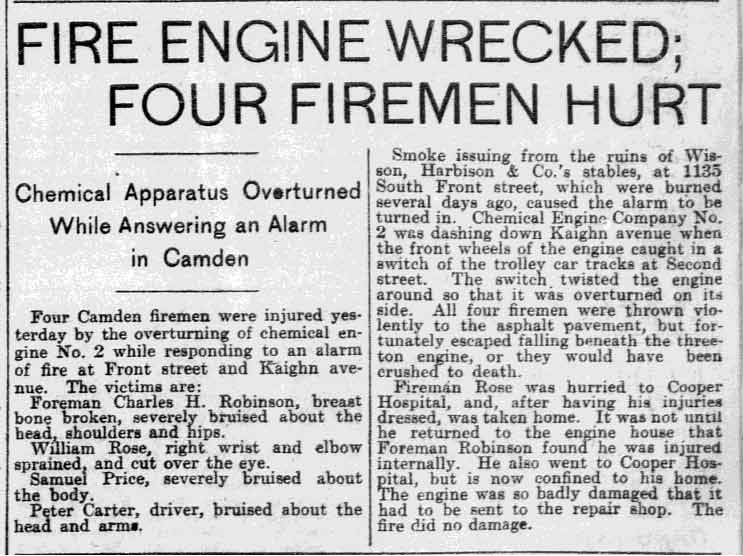
FIRE ENGINE WRECKED; FOUR FIREMEN HURT
Chemical Apparatus Overturned While Answering an Alarm in Camden
Four Camden firemen were injured yesterday by the overturning of chemical engine No. 2 while responding to an alarm of fire at Front street and Kaighn avenue. The victims are: Foreman Charles H. Robinson, breast bone broken, severely bruised about the head, shoulders and hips. William Rose, right wrist and elbow sprained, and cut over the eye. Samuel Price, severely bruised about the body. Peter Carter, driver, bruised about the head and arms.
Smoke issuing from the ruins of Wisson, Harbison & Co.’s stables, at 1135 South Front street, which were burned several days ago, caused the alarm to be turned in. Chemical Engine Company No. 2 was dashing down Kaighn avenue when the front wheels of the engine caught in a switch of the trolley car tracks at Second street. The switch twisted the engine around so that it was overturned on its side. All four firemen were thrown violently to the asphalt pavement, but fortunately escaped falling beneath the three-ton engine, or they would have been crushed to death.
Fireman Rose was hurried to Cooper Hospital, and, after having his injuries dressed, was taken home. It was not until he returned to the engine house that Foreman Robinson found he was injured internally. He also went to Cooper Hospital, but is now confined to his home. The engine was so badly damaged that it had to be sent to the repair shop. The fire did no damage.
In Memory of Dead Heroes
Philadelphia Inquirer —
Mayor of Camden Calls for Services in Two Churches
Mayor Ellis, in Camden, yesterday issued a proclamation calling on the citizens to assemble at the First Baptist and the Broadway M. E. Churches on Sunday to participate in the services to be held in memory of Firemen George Shields, William Jones and William Hillman, who were killed at the Armory fire last Friday night. The first service will be held at the Baptist Church, at three o’clock, while the one at the Methodist Church will be held at quarter after four o’clock. The subscription fund being raised for the families of the firemen had reached nearly $2000 last night.
The funeral of Fireman Shields took place yesterday from his home, 525 Kaikhn [sic] avenue. Hundreds of persons viewed the body, both Tuesday night and yesterday morning. hTe [sic] services were in charge of Rev. John S. Heisler, of the M. E. Church. The body reposed in a handsome oak casket and was surrounded by numerous floral tributes. The services were attended by forty firemen under Chief Elfreth, while the pall-bearers included Firemen Samuel Price, William Deno, Charles Robinson, Peter Carter, Joseph Ernest and George Quinn. Interment was made at the Evergreen Cemetery.
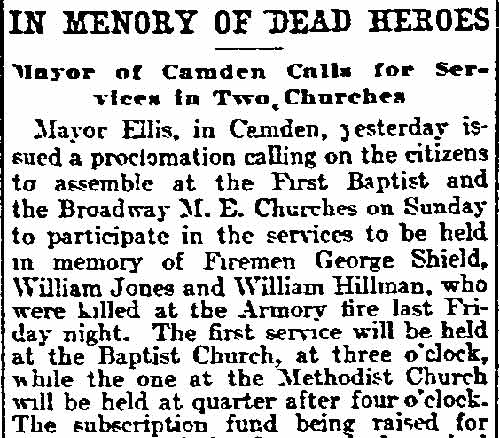
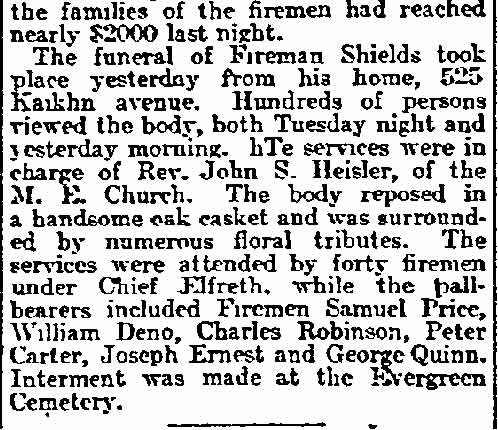
In Memory of Dead Heroes
IN MEMORY OF DEAD HEROES
Mayor of Camden Calls for Services in Two Churches
Mayor Ellis, in Camden, yesterday issued a proclamation calling on the citizens to assemble at the First Baptist and the Broadway M. E. Churches on Sunday to participate in the services to be held in memory of Firemen George Shields, William Jones and William Hillman, who were killed at the Armory fire last Friday night. The first service will be held at the Baptist Church, at three o’clock, while the one at the Methodist Church will be held at quarter after four o’clock. The subscription fund being raised for the families of the firemen had reached nearly $2000 last night.
The funeral of Fireman Shields took place yesterday from his home, 525 Kaikhn [sic] avenue. Hundreds of persons viewed the body, both Tuesday night and yesterday morning. hTe [sic] services were in charge of Rev. John S. Heisler, of the M. E. Church. The body reposed in a handsome oak casket and was surrounded by numerous floral tributes. The services were attended by forty firemen under Chief Elfreth, while the pall-bearers included Firemen Samuel Price, William Deno, Charles Robinson, Peter Carter, Joseph Ernest and George Quinn. Interment was made at the Evergreen Cemetery.
Firemen Trapped in Burning Store
Camden Post-Telegram —
Seven Fight Their Way Out After Being Surrounded by Flames.
Blazing Children Peril Whole Block
Caught like rats in a trap in a fire that threatened the entire business block on the east side of Broadway between Chestnut street and Kaighn avenue, yesterday morning, seven firemen, back to back, fought their way through flames and smoke escaping with singed hair and eyebrows and slight burns of the face, head and hands.
And while these brave men were battling against great odds, the father and mother of two pretty little girls, aged eighteen and thirty months, were alternately laughing and crying, or praising a plucky little woman who saved their tots from being burned to death.
Six of the firemen—Captain Charles Robinson, Captain Samuel Price, Lieutenant Harry Haines, Morton Clark, James McDermott, John McTaggart—were from the Kaighn avenue house. The other was Roy Smith, of the Chemical Company from House No. 7.
The children who were saved from an awful fate are: Florence Erlick and Martha Erlick, and their rescuer is Mrs. Tillie Sackett, of 1122 Broadway.
Three stores, 1118, 1120, 1122 Broadway, were practically gutted and the upper stories in the rear badly damaged, the whole entailing a loss estimated at $6,500 of which the major portion is covered by insurance. The police arrangements were perfect, the entire block being roped off within a few minutes after the fire alarm was turned in at Broadway and Kaighn avenue by Reserve Policeman Matlack.
Harry Erlick conducts a dry goods, notion and gents’ furnishing store at 1120 Broadway. About 10.45 o’clock he left the front of the store to go to the kitchen, leaving the little girls, Florence, aged 30 months, and Martha, aged 18 months, at play in the store, his wife being out on an errand. Only a short time elapsed when he was startled by the screams of Florence and rushing into the kitchen saw her standing near the coal stove trying to beat out the fire in a paper belt that she had around her body.
As Mr. Erlick entered she ran towards him, the blaze from the belt setting fire to some of the goods on the counter. Thinking only of his children, Mr. Erlick beat out the fire on the little one’s clothing but by this time the flames were rapidly spreading over the rear of the store.
(Continued on Eighth Page.)
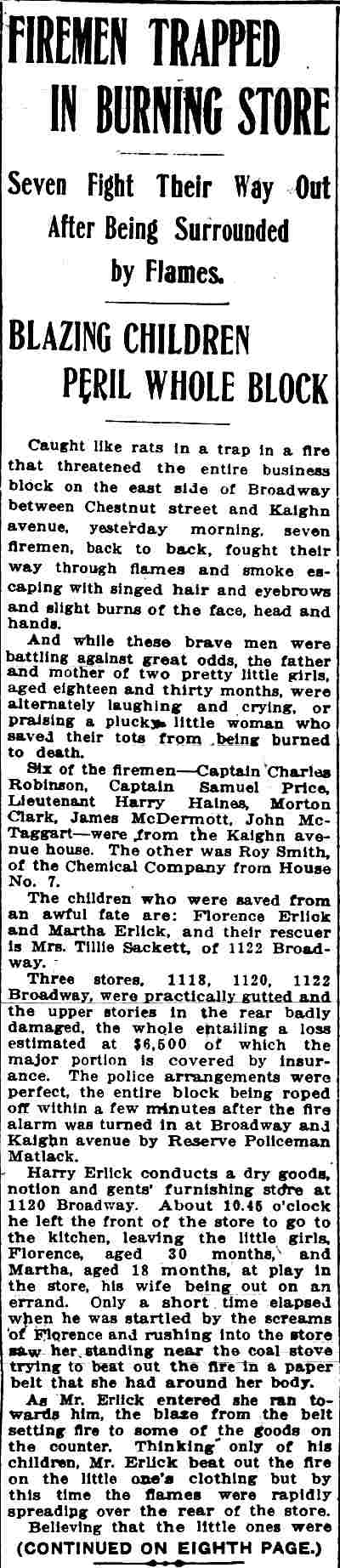
Believing that the little ones were all right he took them into the store 1122 occupied by Edward T. Sackett, manager of a branch office of the Singer Sewing Machine Co. Calling to Mrs. Sackett to care for them, he started for the door to turn in an alarm. As Mrs. Sackett rose to go to the little ones she discovered that Martha’s dress was on fire and before she reached the child the dress of Martha was ablaze.
With great presence of mind Mrs. Sackett threw both children to the floor and covered them with a big rug, instantly smothering the flames, and she then tore off the children’s garments to be sure that there was no further danger. In the meantime the firemen had been summoned and by the time the companies from Kaighn Avenue arrived the flames were blazing above the roof of 1120. The children were then taken to the home of friends where it was found they were only slightly burned.
Assistant Chief Cox, of the southern district, immediately ordered a general alarm and it was undoubtedly due to this that the block was saved, for the frame buildings were rapidly going in the rear when powerful streams from nearly every engine in the Camden district checked the rapid spread of the flames and in less than thirty minutes the fire was out.
The seven firemen who had a close call went into the front of Mr. Erlick’s store with hose from two chemical engines to hold the blaze in check until water could be forced by the engines, and although they were fighting fiercely they were making but little progress owing to the inflammable nature of the stock and the fact that the building was frame and very old.
They were there only a few minutes when they were startled by the crashing of glass and in turning they saw the backs of the store ablaze on fire and that a sheet of flame was extending across the front of the building.
“Back to back and fight both ways” shouted Captain Robinson and the men obeyed, two streams being directed against the front of the store and two in the rear. In what seemed like an age, according to a statement made by Captain Robinson, after returning to the house, but in reality only a short space of time, the men had quenched the fire in the front part of the store and then attacked the rear body.
The flames rapidly communicated to the provision store of Mrs. Mary Palosky, 1118 Broadway. Two frame buildings on the north, by this time several of the engines were in service and lines of hose were run to the backs of the three houses where the fire could be fought to better advantage. When it looked as if H. Nurock’s store at 1124 Broadway, would be licked up, ladders were brought into play and extra streams were run in from the upper stories from Broadway, and from that instant all danger of a big conflagration was over.
The insurance on the Palosky’s household goods expired less than a month ago and they decided that they would not take out any more policies until after the first of the year, although a great many of their household goods were saved, their loss on stock and other goods is estimated at $1,000. The property is owned by Samuel Shane. The estimated loss is $500, covered by insurance.
Mr. Erlick places his loss at $2,000, with insurance. The property is probably damaged to the extent of $1,000. It is owned by Joseph Hermann and is fully insured.
No. 1122 is owned by the estate of Harry Pinsky. The property is damaged to the amount of $500. The loss of the Singer Sewing Machine Co. may amount to $1,000, and that of the tenant, Edward T. Sackett, $500, all covered by insurance.
Peter Gray and Harvey Watts, stationed at headquarters, were off duty at the time, but hearing of the fire returned to the house and went to the scene with the supply wagon.
After the fire a chorus of praise went their way though Gray had a rib cracked he remained on duty until the fire was out and when Chief Elfreth wanted to send him to a hospital Gray drove the team back and then went home.
And during the fire Jeweler Nurock’s store was heavily guarded by policemen and when everything was over he not only congratulated the officers but the heads of the Fire Department, stating that too much praise could not be given for the excellent service rendered. This view was shared by many other business men of the neighborhood.

Firemen Trapped in Burning Store. (continued)
FIREMEN TRAPPED
(CONTINUED FROM FIRST PAGE.)
Believing that the little ones were all right he took them into the store 1122 occupied by Edward T. Sackett, manager of a branch office of the Singer Sewing Machine Co. Calling to Mrs. Sackett to care for them, he started for the door to turn in an alarm. As Mrs. Sackett rose to go to the little ones she discovered that Martha’s dress was on fire and before she reached the child the dress of Martha was ablaze.
With great presence of mind Mrs. Sackett threw both children to the floor and covered them with a big rug, instantly smothering the flames, and she then tore off the children’s garments to be sure that there was no further danger. In the meantime the firemen had been summoned and by the time the companies from Kaighn Avenue arrived the flames were blazing above the roof of 1120. The children were then taken to the home of friends where it was found they were only slightly burned.
Assistant Chief Cox, of the southern district, immediately ordered a general alarm and it was undoubtedly due to this that the block was saved, for the frame buildings were rapidly going in the rear when powerful streams from nearly every engine in the Camden district checked the rapid spread of the flames and in less than thirty minutes the fire was out.
The seven firemen who had a close call went into the front of Mr. Erlick’s store with hose from two chemical engines to hold the blaze in check until water could be forced by the engines, and although they were fighting fiercely they were making but little progress owing to the inflammable nature of the stock and the fact that the building was frame and very old.
They were there only a few minutes when they were startled by the crashing of glass and in turning they saw the backs of the store ablaze on fire and that a sheet of flame was extending across the front of the building.
“Back to back and fight both ways” shouted Captain Robinson and the men obeyed, two streams being directed against the front of the store and two in the rear. In what seemed like an age, according to a statement made by Captain Robinson, after returning to the house, but in reality only a short space of time, the men had quenched the fire in the front part of the store and then attacked the rear body.
The flames rapidly communicated to the provision store of Mrs. Mary Palosky, 1118 Broadway. Two frame buildings on the north, by this time several of the engines were in service and lines of hose were run to the backs of the three houses where the fire could be fought to better advantage. When it looked as if H. Nurock’s store at 1124 Broadway, would be licked up, ladders were brought into play and extra streams were run in from the upper stories from Broadway, and from that instant all danger of a big conflagration was over.
The insurance on the Palosky’s household goods expired less than a month ago and they decided that they would not take out any more policies until after the first of the year, although a great many of their household goods were saved, their loss on stock and other goods is estimated at $1,000. The property is owned by Samuel Shane. The estimated loss is $500, covered by insurance.
Mr. Erlick places his loss at $2,000, with insurance. The property is probably damaged to the extent of $1,000. It is owned by Joseph Hermann and is fully insured.
No. 1122 is owned by the estate of Harry Pinsky. The property is damaged to the amount of $500. The loss of the Singer Sewing Machine Co. may amount to $1,000, and that of the tenant, Edward T. Sackett, $500, all covered by insurance.
Peter Gray and Harvey Watts, stationed at headquarters, were off duty at the time, but hearing of the fire returned to the house and went to the scene with the supply wagon.
After the fire a chorus of praise went their way though Gray had a rib cracked he remained on duty until the fire was out and when Chief Elfreth wanted to send him to a hospital Gray drove the team back and then went home.
And during the fire Jeweler Nurock’s store was heavily guarded by policemen and when everything was over he not only congratulated the officers but the heads of the Fire Department, stating that too much praise could not be given for the excellent service rendered. This view was shared by many other business men of the neighborhood.
Firemen as Pallbearers
Camden Post-Telegram —
Samuel Price, Charles H. Fitzsimmons Jr., Morton Clark and John McTaggart, of the Kaighn avenue fire house, were pallbearers at the funeral of Bert Hibbs, who was killed by a negro at Seventh and Sycamore streets, early Sunday morning. Interment was made in the Friends Cemetery, Langhorne, Pa.
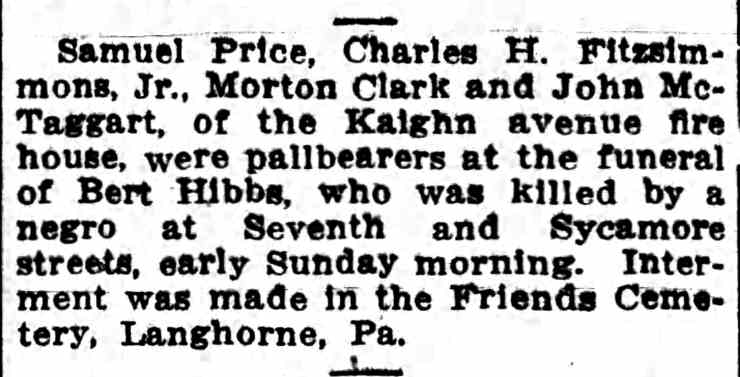
Pallbearers at funeral of Bert Hibbs
Samuel Price, Charles H. Fitzsimmons, Jr., Morton Clark and John McTaggart, of the Kaighn avenue fire house, were pallbearers at the funeral of Bert Hibbs, who was killed by a negro at Seventh and Sycamore streets, early Sunday morning. Interment was made in the Friends Cemetery, Langhorne, Pa.
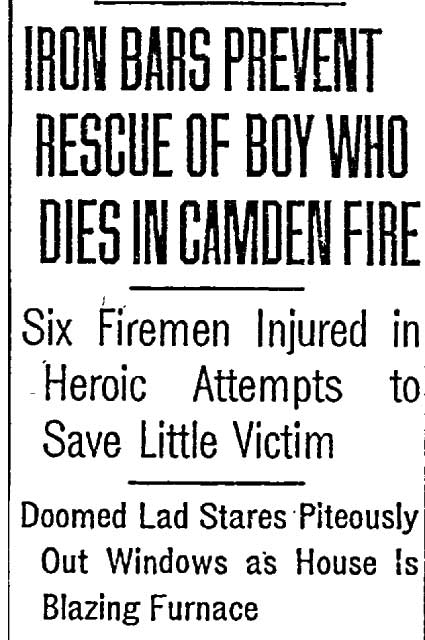
Iron Bars Prevent Rescue of Boy Who Dies in Camden Fire
Philadelphia Inquirer —
Six Firemen Injured in Heroic Attempts to Save Little Victim
Doomed Lad Stares Piteously Out Windows as House Is Blazing Furnace
Iron bars built into the window sills when the place was used as a bank prevented the rescue of a boy who perished in a blaze at 1009 Broadway, Camden, last night.
In desperate endeavor to rescue the boy, Harry Armbruster, Jr., 11 years old, six firemen were seriously injured. All are in the Cooper Hospital with various injuries.
The firemen on their ladders could see the boy through the window in his little sleeping room at the rear of the second floor. They tried to wrench out the bars, but, built to resist burglars, the staunch pieces of iron resisted all their efforts.
The front of the house was an inferno of flame and smoke, and entrance to the doomed boy in that way was impossible. No one could have lived in the furnace a moment.
The frenzied firemen, stung to deeds of super-heroism by the sight of the little chap staring white-faced through the iron bars that were to cost him his life, broke into the building on the ground floor and groped their way through the smoke to his room.
But it was too late. The flames and smoke had licked their way to him, and when the firemen fought their way through he was unconscious. He died on the way to the hospital.
The names of the fire heroes who are in the hospital are:
CAPTAIN WILLIAM PRICE, No. 2 Truck.
FIREMAN JOHN HUNT, No. 8 Engine Company.
FIREMAN IRWIN BISHOP, No. 2 Truck Company.
CAPTAIN CHARLES WATKINS, No. 7 Engine Company.
FIREMAN WILLIAM MERRIGAN, No. 7 Engine Company.
FIREMAN WILLIAM REYNOLDS, No. 2 Truck Company.
The two firemen who carried the boy out were Captain Price and Hoseman Reynolds.
Replete with dramatic details, the story of the rescue will go down in the annals of New Jersey’s fire-fighters’ heroism in golden letters, for the firemen who tried distinguished themselves in their brave attempts.
The building where the fire occurred is owned by Harry Ambruster, the boy’s father. It was formerly occupied by the Broadway Trust Company, but is now a store building.
Ambruster maintains a cleaning establishment in the basement of the building and lives above the store. He is a widower and his son was motherless. Shortly before 11 o’clock, Ambruster, preparatory to closing his cleaning establishment, went into the yard behind the store, and smelling smoke, investigated. He found that the smoke came from the cellar and he knew that his son was asleep in the front room of the second-story.
Because the building was formerly occupied by the banking company, all the windows are protected with heavy iron barrings. Ambruster was torn between two duties. He wanted to run upstairs to get his son safely out of the burning structure and he wanted to turn in an alarm. Shouting “Fire! Fire!” he ran to the front part of the building, and tried to go upstairs.
The staircase was in the midst of a roaring mass of flames, however, and he could not get upstairs. Distraught, the father frantically ran hither and thither outside. The fire engines had been summoned and firemen had raised ladders to the second story window, having been told of the presence of the sleeping boy.
The bars were immovable. Captain Price pried with an iron crowbar, but in vain. In the meantime Firemen Hunt, Bishop and Merrigan and Captain Watkins had tried to make their way through the burning first floor to the staircase and the sleeping boy.
Bishop and Merrigan were overcome and lay inside the burning building unknown to the firemen on the outside. It looked as though the floor would collapse at any minute.
Captain Price and Reynolds, staggering through the hall with the almost dead boy, passed the unconscious Bishop and Merrigan on the way.
At the foot of the stairs, Reynolds, overcome by the dense smoke, collapsed. Captain Price continued alone, carrying the boy over his shoulder.
The lad’s father was by this time frantic with excitement. When Price appeared in the doorway framed against a background of rolling flames, he ran forward and seized his son. They were placed in an ambulance and rushed to the Cooper Hospital. There doctors pronounced the boy dead.
Captain Price in the meantime had told of the three unconscious firemen inside the burning building who were in imminent danger of death should the floor fall in.
Rescuers immediately dashed into the burning structure and brought out their comrades and all were rushed to the hospital.
The building, a two-story brick edifice, was directly behind the Lyric Theatre, where a crowded audience was witnessing a motion picture performance. Realizing the proximity of the fire, and fearing a panicky stampede, the orchestra continued to play, and the operator was given orders to continue the picture then showing for ten minutes. Then the smoke became noticeable within the theatre, and the performance was ended. The audience left the theatre quietly, without any sign of fear or panic.
Three alarms were turned in during the fire, and the building was practically destroyed.
Iron Bars Prevent Rescue of Boy Who Dies in Camden Fire
Six Firemen Injured in Heroic Attempts to Save Little Victim
Doomed Lad Stares Piteously Out Windows as House Is Blazing Furnace
Iron bars built into the window sills when the place was used as a bank prevented the rescue of a boy who perished in a blaze at 1009 Broadway, Camden, last night.
In desperate endeavor to rescue the boy, Harry Armbruster, Jr., 11 years old, six firemen were seriously injured. All are in the Cooper Hospital with various injuries.
The firemen on their ladders could see the boy through the window in his little sleeping room at the rear of the second floor. They tried to wrench out the bars, but, built to resist burglars, the staunch pieces of iron resisted all their efforts.
The front of the house was an inferno of flame and smoke, and entrance to the doomed boy in that way was impossible. No one could have lived in the furnace a moment.
The frenzied firemen, stung to deeds of super-heroism by the sight of the little chap staring white-faced through the iron bars that were to cost him his life, broke into the building on the ground floor and groped their way through the smoke to his room.
Help Comes Too Late
But it was too late. The flames and smoke had licked their way to him, and when the firemen fought their way through he was unconscious. He died on the way to the hospital.
The names of the fire heroes who are in the hospital are:
CAPTAIN WILLIAM PRICE, No. 2 Truck.
FIREMAN JOHN HUNT, No. 8 Engine Company.
FIREMAN IRWIN BISHOP, No. 2 Truck Company.
CAPTAIN CHARLES WATKINS, No. 7 Engine Company.
FIREMAN WILLIAM MERRIGAN, No. 7 Engine Company.
FIREMAN WILLIAM REYNOLDS, No. 2 Truck Company.
The two firemen who carried the boy out were Captain Price and Hoseman Reynolds.
Replete with dramatic details, the story of the rescue will go down in the annals of New Jersey’s fire-fighters’ heroism in golden letters, for the firemen who tried distinguished themselves in their brave attempts.
The building where the fire occurred is owned by Harry Ambruster, the boy’s father. It was formerly occupied by the Broadway Trust Company, but is now a store building.
Ambruster maintains a cleaning establishment in the basement of the building and lives above the store. He is a widower and his son was motherless. Shortly before 11 o’clock, Ambruster, preparatory to closing his cleaning establishment, went into the yard behind the store, and smelling smoke, investigated. He found that the smoke came from the cellar and he knew that his son was asleep in the front room of the second-story.
Because the building was formerly occupied by the banking company, all the windows are protected with heavy iron barrings. Ambruster was torn between two duties. He wanted to run upstairs to get his son safely out of the burning structure and he wanted to turn in an alarm. Shouting “Fire! Fire!” he ran to the front part of the building, and tried to go upstairs.
Staircase Mass of Flames
The staircase was in the midst of a roaring mass of flames, however, and he could not get upstairs. Distraught, the father frantically ran hither and thither outside. The fire engines had been summoned and firemen had raised ladders to the second story window, having been told of the presence of the sleeping boy.
The bars were immovable. Captain Price pried with an iron crowbar, but in vain. In the meantime Firemen Hunt, Bishop and Merrigan and Captain Watkins had tried to make their way through the burning first floor to the staircase and the sleeping boy.
Two Overcome in Building
Bishop and Merrigan were overcome and lay inside the burning building unknown to the firemen on the outside. It looked as though the floor would collapse at any minute.
Captain Price and Reynolds, staggering through the hall with the almost dead boy, passed the unconscious Bishop and Merrigan on the way.
Price Goes It Alone
At the foot of the stairs, Reynolds, overcome by the dense smoke, collapsed. Captain Price continued alone, carrying the boy over his shoulder.
The lad’s father was by this time frantic with excitement. When Price appeared in the doorway framed against a background of rolling flames, he ran forward and seized his son. They were placed in an ambulance and rushed to the Cooper Hospital. There doctors pronounced the boy dead.
Captain Price in the meantime had told of the three unconscious firemen inside the burning building who were in imminent danger of death should the floor fall in.
Rescuers immediately dashed into the burning structure and brought out their comrades and all were rushed to the hospital.
The building, a two-story brick edifice, was directly behind the Lyric Theatre, where a crowded audience was witnessing a motion picture performance. Realizing the proximity of the fire, and fearing a panicky stampede, the orchestra continued to play, and the operator was given orders to continue the picture then showing for ten minutes. Then the smoke became noticeable within the theatre, and the performance was ended. The audience left the theatre quietly, without any sign of fear or panic.
Three alarms were turned in during the fire, and the building was practically destroyed.