Introduction
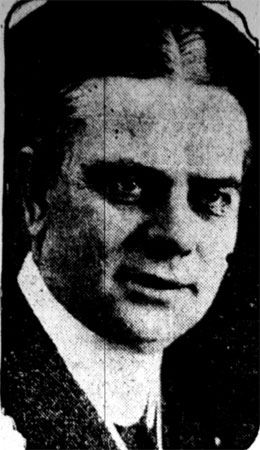
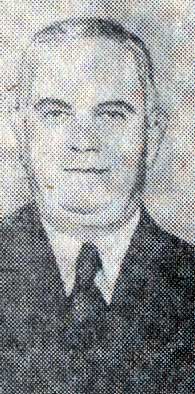
William D. Sayrs Jr.
WILLIAM D. SAYRS JR. had a long career in Camden's civic and political life. He was born in Camden in 1874 to William D. and Sarah Sayers. At the time of the 1880 census the family lived at 626 Chestnut Street, and the elder Sayers was working as a coremaker at Wood's Foundry. There were two other sons at home at that time, Charles P., 17, and Frank, aged 3. The elder Sayrs later moved to 633 Walnut Street.
William D. Sayrs was working at the age of 16 as a clerk for the charles h. felton & co. at 203 Federal Street, which engaged in real estate and insurance.
1920 found William D. Sayrs married, and living at 620 Spruce Street with his wife Jennie, and two daughters, Ethel, 10, and Sarah, 3. He was then working as an architect for the city of Camden. Once women's suffrage passed, Jennie Sayrs also involved herself in politics, and was a member of the Sixth Ward Women's Republican Club.
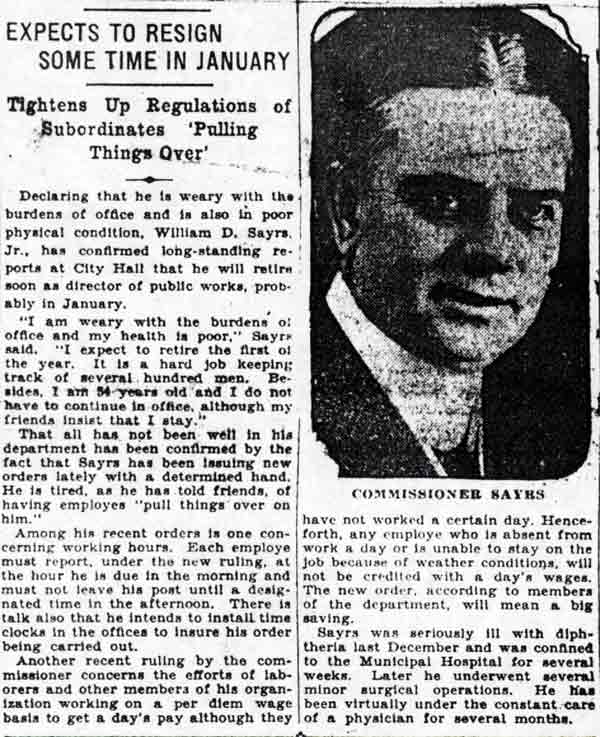
In 1927, William D. Sayrs was elected to Camden's city commission, serving a four year term coinciding with the administration of Mayor Winfield S. Price. In January of 1928 he fell ill with diphtheria, spending several weeks at Camden's Municipal Hospital. He continued to have medical problems throughout 1928. William D. Sayrs was administering Camden's public works and streets departments, but his medical problems caused him to announce his retirement effective January 1, 1929. While serving on Camden's City Commission, many public improvements were made in the city. William Sayrs later succeeded Colonel George L. Selby as Republican registrar at the County Board of Elections.
Retirement, however, was not in the cards for William D. Sayrs. At the time of the 1930 Census, William D. Sayrs, then 56, was living in an apartment at 808 Broadway. He was then working as a civil engineer for Camden County. By 1934 he had found a position as the director of the real estate division of the State Highway Commission.
When the 1947 Camden City Directory was published, William D. Sayrs was renting an apartment at 932 Broadway, and was working as Camden's Deputy City Clerk. By this time Bayard Avenue, a street in the Whitman Park section of Camden that runs between Mount Ephraim Avenue and Pershing Street, was renamed Sayrs Avenue, apparently in recognition of his service to the city.
William D. Sayrs died in his sleep on November 7, 1947. He was buried at Harleigh Cemetery.
Philadelphia Inquirer
Philadelphia Inquirer —
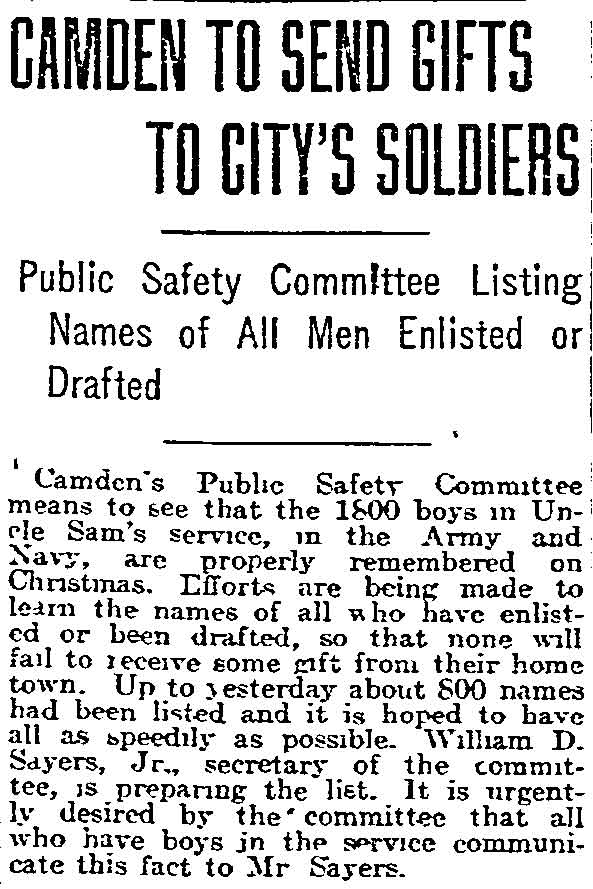
Camden County in the Great War
City Farm Gardens
Another weapon to defeat the enemy was the establishment of City Farm Gardens in the country. They were urged by the Government and not only provided food for city residents, but abolished unsightly vacant lots. Mayor Ellis named the first City Gardens Committee on April 19, 1917, as follows: E. G. C. Bleakly, Judge Frank T. Lloyd, Zed H. Copp, William Derham, L. E. Farnham, B. M. Hedrick, David Jester, O. B. Kern, M. F. Middleton, Dr. H. L. Rose, Asa L. Roberts, W. D. Sayrs, Jr., Charles A. Wolverton, Earl T. Jackson, H. R. Kuehner, Herbert N. Moffett and Hubert H. Pfeil. At the initial meeting of the above date B. M. Hedrick was elected chairman; Zed H. Copp secretary and M. F. Middleton treasurer. Brandin W. Wright, a farming expert, was employed as general superintendent on May 3, 1917. At a meeting on May 18, 1918, the names of frank sheridan and Daniel P. McConnell were added to the publicity committee in the place of Messrs. Pfeil and Jackson.
In his annual report to City Council on January 1, 1918, Mayor Ellis urged the appointment of a committee by City Council on City Gardens and Councilman Frederick Von Neida was named as chairman. This committee with a committee of representative citizens met in the City Hall in February, 19 18, to organize for the ensuing summer. The members of the Councilmanic committee were: Frederick Von Neida, Frank S. Van Hart, William J. Kelly and John J. Robinson.
The committee planned an exposition of farm garden products for the fall of 1918, but this plan was frustrated by the Spanish influenza epidemic.
The war gardens became victory gardens in the year 1919 when the committee met on January 29, 1919. Meyers Baker was elected secretary and William D. Sayrs, Jr., treasurer. At the meeting on March 25 committees were appointed for the Victory War Gardens Exposition held in Third Regiment Armory from September 15 to 20. Benjamin Abrams was elected general manager and Frank Sheridan publicity agent.
Philadelphia Inquirer
Philadelphia Inquirer —
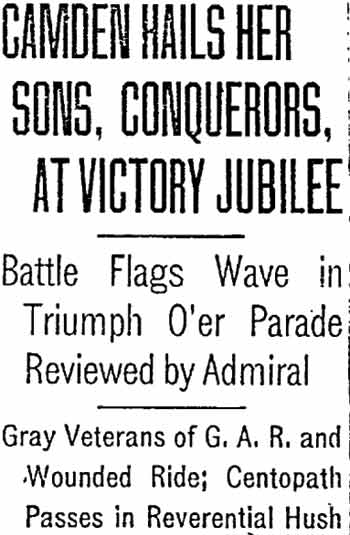
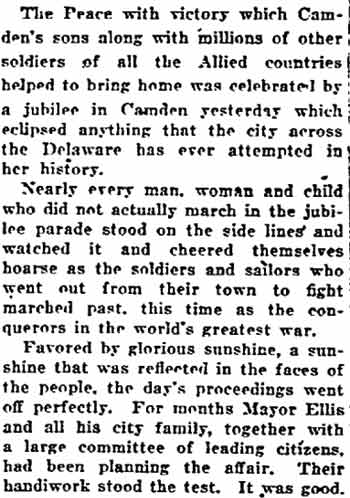
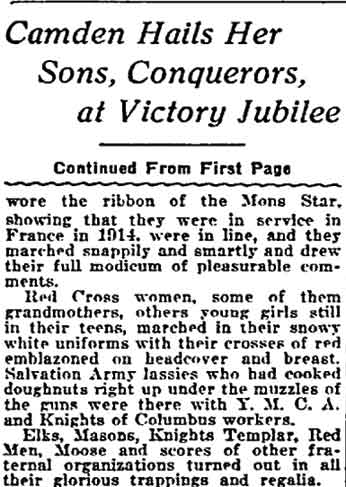
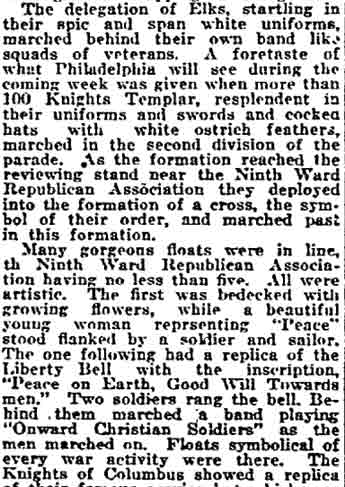
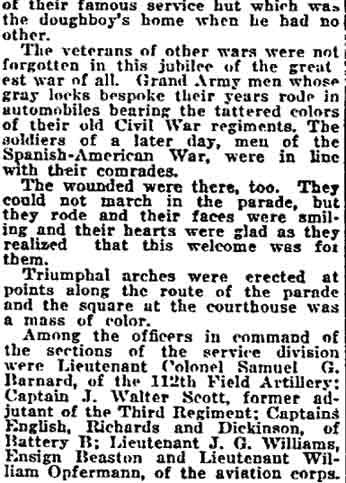
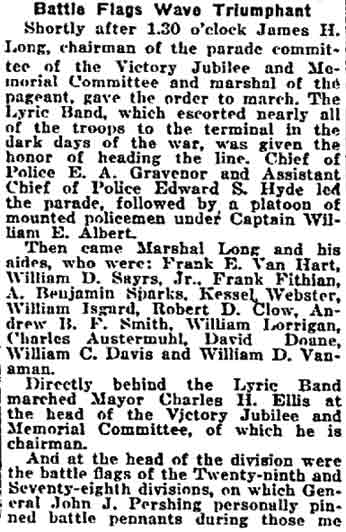
Battle Flags Wave in Triumph O’er Parade Reviewed by Admiral
Gray Veterans of G. A. R. and Wounded Ride; Centopath Passes in Reverential Hush
The Peace with victory which Camden’s sons along with millions of other soldiers of all the Allied countries helped to bring home was celebrated by a jubilee in Camden yesterday which eclipsed anything that the city across the Delaware has ever attempted in her history.
Nearly every man, woman and child who did not actually march in the jubilee parade stood on the side lines and watched it and cheered themselves hoarse as the soldiers and sailors who went out from their town to fight marched past, this time as the conquerors in the world’s greatest war.
Favored by glorious sunshine, a sunshine that was reflected in the faces of the people, the day’s proceedings went off perfectly. For months Mayor Ellis and all his city family, together with a large committee of leading citizens, had been planning the affair. Their handiwork stood the test. It was good.
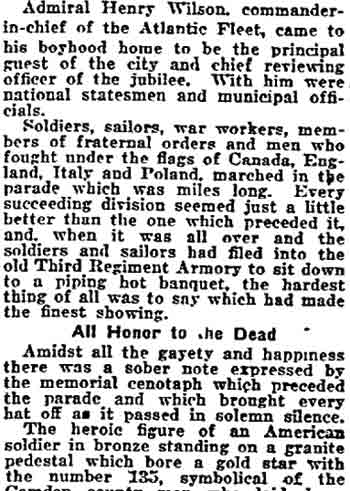
Admiral Henry Wilson, commander-in-chief of the Atlantic Fleet, came to his boyhood home to be the principal guest of the city and chief reviewing officer of the jubilee. With him were national statesmen and municipal officials.
Soldiers, sailors, war workers, members of fraternal orders and men who fought under the flags of Canada, England, Italy and Poland, marched in the parade which was miles long. Every succeeding division seemed just a little better than the one which preceded it, and, when it was all over and the soldiers and sailors had filed into the old Third Regiment Armory to sit down to a piping hot banquet, the hardest thing of all was to say which had made the finest showing.
All Honor to the Dead
Amidst all the gayety and happiness there was a sober note expressed by the memorial cenotaph which preceded the parade and which brought every hat off as it passed in solemn silence.
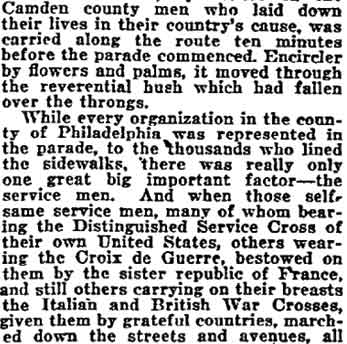
The heroic figure of an American soldier in bronze standing on a granite pedestal which bore a gold star with the number 135, symbolical of the Camden county men who laid down their lives in their country’s cause, was carried along the route ten minutes before the parade commenced. Encircler [sic] by flowers and palms, it moved through the reverential hush which had fallen over the throngs.
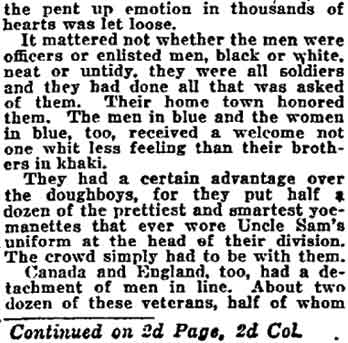
While every organization in the county of Philadelphia was represented in the parade, to the thousands who lined the sidewalks, there was really only one great big important factor—the service men. And when those self-same service men, many of whom bearing the Distinguished Service Cross of their own United States, others wearing the Croix de Guerre, bestowed on them by the sister republic of France, and still others carrying on their breasts the Italian and British War Crosses, given them by grateful countries, marched down the streets and avenues, all the pent up emotion in thousands of hearts was let loose.
It mattered not whether the men were officers or enlisted men, black or white, neat or untidy, they were all soldiers and they had done all that was asked of them. Their home town honored them. The men in blue and the women in blue, too, received a welcome not one whit less feeling than their brothers in khaki.
They had a certain advantage over the doughboys, for they put half a dozen of the prettiest and smartest yoemanettes that ever wore Uncle Sam’s uniform at the head of their division. The crowd simply had to be with them.
Canada and England, too, had a detachment of men in line. About two dozen of these veterans, half of whom wore the ribbon of the Mons Star, showing that they were in service in France in 1914, were in line, and they marched snappily and smartly and drew their full modicum of pleasurable comments.
Red Cross women, some of them grandmothers, others young girls still in their teens, marched in their snowy white uniforms with their crosses of red emblazoned on headcover and breast. Salvation Army lassies who had cooked doughnuts right up under the muzzles of the guns were there with Y. M. C. A. and Knights of Columbus workers.
Elks, Masons, Knights Templar, Red Men, Moose and scores of other fraternal organizations turned out in all their glorious trappings and regalia.
The delegation of Elks, startling in their spic and span white uniforms, marched behind their own band like squads of veterans. A foretaste of what Philadelphia will see during the coming week was given when more than 100 Knights Templar, resplendent in their uniforms and swords and cocked hats with white ostrich feathers, marched in the second division of the parade. As the formation reached the reviewing stand near the Ninth Ward Republican Association they deployed into the formation of a cross, the symbol of their order, and marched past in this formation.
Many gorgeous floats were in line, th Ninth Ward Republican Association having no less than five. All were artistic. The first was bedecked with growing flowers, while a beautiful young woman reprsenting “Peace” stood flanked by a soldier and sailor. The one following had a replica of the Liberty Bell with the inscription, “Peace on Earth, Good Will Towards men.” Two soldiers rang the bell. Behind them marched a band playing “Onward Christian Soldiers” as the men marched on. Floats symbolical of every war activity were there. The Knights of Columbus showed a replica of their famous service hut which was the doughboy’s home when he had no other.
The veterans of other wars were not forgotten in this jubilee of the greatest war of all. Grand Army men whose gray locks bespoke their years rode in automobiles bearing the tattered colors of their old Civil War regiments. The soldiers of a later day, men of the Spanish-American War, were in line with their comrades.
The wounded were there, too. They could not march in the parade, but they rode and their faces were smiling and their hearts were glad as they realized that this welcome was for them.
Triumphal arches were erected at points along the route of the parade and the square at the courthouse was a mass of color.
Among the officers in command of the sections of the service division were Lieutenant Colonel Samuel G. Barnard, of the 112th Field Artillery; Captain J. Walter Scott, former adjutant of the Third Regiment; Captains English, Richards and Dickinson, of Battery B; Lieutenant J. G. Williams, Ensign Beaston and Lieutenant William Opfermann, of the aviation corps.
Battle Flags Wave Triumphant
Shortly after 1.30 o’clock James H. Long, chairman of the parade committee of the Victory Jubilee and Memorial Committee and marshal of the pageant, gave the order to march. The Lyric Band, which escorted nearly all of the troops to the terminal in the dark days of the war, was given the honor of heading the line. Chief of Police E. A. Gravenor and Assistant Chief of Police Edward S. Hyde led the parade, followed by a platoon of mounted policemen under Captain William E. Albert.
Then came Marshal Long and his aides, who were: Frank E. Van Hart, William D. Sayrs, Jr., Frank Fithian, A. Benjamin Sparks, Kessel Webster, William Isgard, Robert D. Clow, Andrew B. F. Smith, William Lorrigan, Charles Austermuhl, David Doane, William C. Davis and William D. Vanaman.
Directly behind the Lyric Band marched Mayor Charles H. Ellis at the head of the Victory Jubilee and Memorial Committee, of which he is chairman.
And at the head of the division were the battle flags of the Twenty-ninth and Seventy-eighth divisions, on which General John J. Pershing personally pinned battle pennants during those memorable days back in October in the Argonne forest. Behind the 4th marched the famous engineers, headed by Captain Keasby and Captain Beals Smuck. Three battle pennants were pinned to their flags, which never touched the ground while they were bridging the rivers in the Argonne under hellish shell fire for the doughboys to advance. Then came the 112th Field Artillery, Battery B’s heroes of the border and of France, headed by Captain Charles Richards and Captain Dickinson. In the same section marched the Eleventh Machine Gun Battalion with its battle flags and pennants fluttering.
There was another great cheer as the Seventy-eighth Division, New Jersey’s Lightning boys, loomed into view. The heroes of the 311th Infantry, 303d Engineers, 307th, 308th and 309th Field Artillery and other regiments of that famous command were given a mighty ovation behind their battle flags, which led them in their assault on St. Mihiel and the day they attacked and captured Grand-Pre in the terrible conflict in the Argonne.
Behind them marched the Marines, headed by Lieutenant Monitor Watchman, of the Fifth Regiment, Second Division. With the Marines marched the regular army units, men who had served in as many as five battles and wore three and four gold service stripes on their sleeves.
Then followed the naval contingent. They were commanded by Commander Francis W. Hoffman and Commander W. G. Hodgson.
The order “eyes left” flashed along the line as each platoon drew near the reviewing stand and Admiral Wilson with his band to his cap returned the salute. With the admiral on the stand were former United States Senator David Baird, Congressman William J. Browning, County Collector John S. Well, City Clerk W. D. Brown and others.
At the armory a splendid banquet was served to the soldiers and sailors. For days past corps Red Cross workers had been preparing the good things to eat and the men did full justice to them. They marched in the armory where the food was spread on the tables and enjoyed themselves while bands played. After dinner there were speeches. Mayor Ellis in welcoming the men said:
“This is one of the happiest moments of my life. I have waited patiently through months of trial for the glad day when I could bid you welcome to the City of Camden once again.
“We are planning to erect a lasting memorial in memory of those heroes who gave their lives and in memory of the valiant deeds you performed on land and sea.
“Camden will always cherish the memory of this day, rever the memory of your dead comrades and will inscribe your valiant deeds on that memorial. I bid you welcome in the name of the most patriotic little city in America. I thank you.”
Prosecutor Charles A. Wolverton welcomed the men on behalf of the county and paid a tribute to their valor recalling their wonderful victories of the Argonne and other battlefields of France.
Boxer, Sayrs' Aide Nabbed in Tipsy Row
Camden Courier-Post —
Bertman Frees Both After Police Tell of Fuss at Brewer’s Cafe
Mickey Blair Camden pugilist, and Thomas Schneider, secretary to Commissioner William D. Sayrs. Jr., started the New Year by getting drunk and becoming both abusive and pugnacious when ordered away from Horace Brewer’s restaurant on Market street, it was testified by three policemen in Police Court today.
But Blair and Schneider as well as James Borini, who was arrested with them, won their freedom when Judge Bernard Bertman suspended sentence.
“There is no doubt but that you were all drunk” was Bertman’s comment. ‘Surely, if you had been sober, this would never have happened. I know you are respectable men of the community and I regret to see you here. I will suspend sentence.”
According to the three policemen, however, the trio of defendants acted like anything but respectable men of the community yesterday morning when the New Year was little more than three hours old.
Patrolmen Frank Evans, Charles Bowen and August Fortune testified that Blair, Schneider and Borini had been ordered away from the restaurant by Brewer and that they had become abusive, threatening the policemen and calling them names.
Schneider insisted that he entered the argument only because Evans was “beating up Blair,” but Evans and the other officers retorted that Blair had warned the policemen that they would be sorry if they arrested him and Schneider had boasted that “no cop can pinch me.”
All were charged with being drunk and disorderly. Blair, whose real name is Michael Tenerelli, is 19 years old and lives at 833 South Fourth Street. Schneider gave his address as 414 Spruce Street. He is acting secretary to Commissioner Sayrs as a temporary appointee. Borini, 22 years old, gave his address as 324 Pine street.
Mickey Blair Denies Charge of Police
Camden Courier-Post —
Mickey Blair Denies Charge of Police
Mickey Blair Denies Charge of Police
Says He Wasn't in Cafe; Blames 'Mistaken Identity' for Fuss
'Mickey' Blair, widely known Camden pugilist, today issued a complete denial of charges made against him and two companions by police before Judge Bertman Tuesday. Blair, Thomas Schneider, secretary to Commissioner Sayrs, and Joseph Bardini were arrested Sunday morning in front of Brewer's Restaurant by Patrolman Frank Evans, Charles Bowen and August Fortune.
Blair declared that he was not inside the restaurant and that he was the victim of mistaken identity. Horace Brewer, proprietor of the restaurant, also denied that Blair or his companions were inside his establishment at any time that evening.
Kausel Is Given $4000 Job Over Hot Protest by ‘Rebel’ in G.O.P.
Camden Courier-Post —
‘Not Fitted for Job and 20 of You Admitted it’ Declares Van Meter
Collingswood Man’s Insurgency Punished
Vocational School Incident is Recalled as Democrats Join in Battle
Joseph H. Van Meter, insurgent Republican freeholder from Collingswood, today declared that David Baird Jr., Republican leader, had admitted that Theodore Kausel was “not the man for the job” to which he was appointed by the Board of Freeholders yesterday.
Baird told him, however, said Van Meter, that a promise had been made “to take care of” Kausel because of the latter’s aid to the Republican Organization at the last municipal election.
Van Meter quotes Baird as follows:
“I’ll admit that Kausel is not the man for the job. But you have to help me out because we promised to take care of Kausel when he came over to us in the city election. And it was through Kausel that we got Hitchner and a lot of his crowd.”
“We’ve got ourselves tied up with him. We’ve got to take him, and I want you to go along, and help me out.”
“I know his business record and I know his political record. I know the freeholders don’t want him and our conference don’t want him, but we’ve got to eat crow, and I want you to help me out”
Under the watchful eyes of organization leaders, Republican members of the Camden County Board of Freeholders yesterday took care of Theodore “Teddy” Kausel.
With David Baird Jr. and other chieftains of the party occupying front row seats, the board created the post of “general manager of county institutions and promptly named Kausel for the job at an annual salary of $4,000.
Like ghosts at a feast, Baird and the other party leaders sat silently at the freeholders reorganization meeting. Like actors in a carefully pre-arranged play, a little uncertain of their cues, 20 Republican freeholders cast furtive eyes at the group of spectators.
They said no word, these freeholders. They made no reply when Joseph H. Van Meter, of Collingswood, breaking from their ranks, declared that 20 of them had told him that Kausel was unfit for the position to which he was being appointed. They listened in uncomfortable silence while Van Meter gave voice to a scathing denunciation of their “lack of backbone” and while a running fire of sarcasm from Democratic members fell upon their ears.
Scene Was Drama
The scene was drama. It might have been a revised performance of “Uncle Tom’s Cabin” with 28 furtive-eyed Uncle Toms and an impregnable line of Simon Legrees, cracking invisible whips in threatening gestures.
And the scene was also comedy. For of that score of men who, according to Van Meter, had agreed that Kausel was unfit for the job but “had to be taken care of,” none arose to protest against the action. Within their Hearts the chorus of Uncle Toms may have been saying.
The county may own out bodies, but our souls belong to the Republican Organization.”
But if they thought this, they said no word.
Today it was pointed out that it will not be long before freeholders come up for renomination at the primaries. Today, it was also predicted that Van Meter has signed his political death warrant so far as the Republican organization was concerned. But at least he received the ungrudging tribute of the Democratic minority on the board, who joyfully proclaimed that they had found “at last a Republican with guts.”
Van Meter Fights Hard
Van Meter spared no words, took no half-measures. He accused his fellow Republican members of coercion, double-dealing and weakness. He fought the appointment bitterly. He raked up the vocational school matter, in which $85,000 had been paid for the school site on Kausel’s recommendation, a price later declared to be exorbitant.
Democratic members joined the Collingswood insurgent. They charges that the $4,000 appointment was the price of Kausel’s allegiance to the Republican party. They declared that he wasn’t worth it. They recalled, later, that Kausel had shifted from the Republican Organization to the Non-Partisan movement and then back again after being one of the loudest to criticize the Organization. They asserted that after his removal as chairman of the vocational school board, he had sought the appointment as city purchasing agent. They avowed that the Republican City Commissioners had ‘refused to handle Kausel” and had “wished him off on the county.”
The 26 other Republican freeholders— all of those present, excepting only Van Meter— continued to listen in silence. And when the vote came, every one of the 26 voted for the creation of the position of “general manager of county institutions” and for the appointment of Kausel.
A little later the reprisals upon Van Meter began. He was removed from the central plant and county farm committees of the board, shifted to the elections committee and allowed to remain on the printing and agricultural committees, regarded as unimportant groups.
Reprisals Were Threatened.
“It doesn’t surprise me,” he said. “I was threatened with it. They told me they’d ruin me. But I couldn’t go back to Collingswood and ask the people to vote for me again if I hadn’t fought against this appointment.”
The defection of Van Meter came apparently as a surprise. The meeting had opened with the passage of the county budget on the first reading, the selection of Leslie H. Ewing, of Berlin, as director of the board, the calling of Frank P. Moles, of the Third Ward to be sworn in and his failure to respond or to appear for the gathering.
Minor matters had been attended to and then Fred W. George, clerk of the board, rose to his feet and began the task of reading a long list of proposed amendments to the rules. Buried far down in the list of revisions was that which, “for purposes of economy,” sought to place all county institutions under a central head to be known as general manager.
George lost his breath before he had more than half completed the lost of amendments, and George Rothermel, pinch-hitting for Walter Keown as counsel for the board, took his place. Then Director Ewing called for a vote.
Schorpp Speaks
Frederick W. Schorpp, Eighth Ward Democrat, was the first to speak.
“I want to congratulate you gentlemen,” he said, “on the wonderful way you have camouflaged these changes.
“We have heard a long list of amendments to the rules read. But what the whole thing is can easily be seen. You gentlemen of the majority have a lame duck to take care of, and so you create this job. But I can’t see, really I can’t see why it is necessary to create a $4,000 plum for your lame duck and saddle it on the taxpayers.”
There was silence in the room. In the seat of the absent Freeholder William A. Robinson sat Baird. At the press table were Sheriff Walter Gross and City Commissioner William D. Sayrs, Jr. Ranged along the front row of the spectators’ section were Mayor Winfield Price and Commissioner Clay W. Reesman. They said nothing.
Louis C. Parker, Gloucester City Democrat, was next to speak.
“All these changes in the rules accomplish is to create a new job,” he declared, agreeing with Schorpp.
S. Raymond Dobbs, Fourteenth Ward Democrat, objected and moved that the resolution changing the rules be laid over until the regular January meeting. He was overruled by Director Ewing. Schorpp sought to have the rules voted upon separately, but James Davis, chairman of the committee, refused to accept the suggestion.
The roll call began. In alphabetical order the names were called and the freeholders voted. Republicans voted in favor of adoption of the changes. The three Democrats voted against the resolution. Van Meter’s name was the last to be called.
“No,” he said calmly, and there was a gasp of surprise in the room. The clerk recorded the vote on the resolution as 26 to 4 and then began reading again. This was a new resolution. It named theodore t. kausel to the position just created and explained that he was to report to the “Lakeland Central Committee.”
Van Meter Protests
Van Meter rose slowly. He obtained recognition from the director and began, quietly but decisively.
“Gentlemen,” he said calmly. “I have studied this proposition. I have known about it for three days and three nights. I have talked to 20 Republicans member of this board and I have done all I could to get then to agree with me.
And they did agree with me. They agreed, every one, that Kausel was not the man for this job. After what happened on the vocational school project, when Kausel was president of the school board, he is not the man. On his recommendation, the vocational school site was purchased for $85,000. And now you want to send him where he will handle about a million dollars of the taxpayers’ money.”
Van Meter’s tone was serious as he turned to his fellow members. Most of the latter sat silently in the seats. They did not glance at the Collingswood insurgent. Baird, gross, Price, Sayrs and Reesman listened intently. A few of the freeholders craned their necks towards the windows as the Camden mummers, returning from the New Years Day parade in Philadelphia, marched past the courthouse. But Van Meter went on.
“There is not one of you that has backbone enough to come here and fight this thing.” Van Meter continued.
I can’t see it go through. I couldn’t ask the people of Collingswood to vote for me again if I let it go through without a fight.
“You agreed with me that Kausel was not the man for the job. Haven’t you any backbone with which to fight his appointment now?”
Slowly, in complete silence that followed, he turned till he faced Horace G. Githens, the majority floor leader.
“Mr. Githens,” he said quietly and in a measured tone, “ if you will throw away your messenger’s cap and wear a leader’s hat, I will follow you.”
He sat down and the silence continued.
Schorpp Lauds Van Meter
Schorpp rose again.
“I’m glad to see one Republican who has backbone,” he said. “I told you there was a lame duck in this and here is the lame duck.
“Woods (Samuel Woods, Republican freeholder from Haddonfield) and you others criticized Kausel and other members of the vocational school board for their purchasing of the land for the school, claiming that it was an exorbitant price to pay for the land.
“And now these same men who criticized Kausel are putting him in a position where he will handle millions of the taxpayers money.
Dobbs followed on the floor.
“I don’t want to stand here and talk until 10 o’clock tonight just to give you reasons why Kausel shouldn’t get the job,” he said.
“In the first place, I couldn’t give all the reasons in that time, and in the second place, they wouldn’t register with this bunch.
“This is entirely unfair. It’s too high a price to pay Kausel to come back into the Republican ranks. The Republican leaders should pay it, however, and not saddle the price on the taxpayers.
“Personally, I don’t think he’s worth much politically. We had him for awhile and have had some experience as to the value of his services. I thought he could be bought for less than $4000 anyway.”
The resolution came to a vote. The Republicans, with the exception of Van Meter, again voted solidly. Twenty-six votes were cast for the appointment of Kausel. Van Meter and the three Democrats did not vote.
Van Meter issued a statement after the meeting, explaining his stand. He said:
“The reason I opposed Kausel’s appointment is because the man is extravagant. Director Ewing was one of the 20 Republicans I talked to who were opposed to hum, but were afraid on the floor. I didn’t talk to the Democrats.
“Ewing and the other Republicans said, ‘What can we do. We must take care of him. We promised to.’
Charges Unfair Tactics
“I knew when I went ahead with this that I’d be an outcast, but I was determined to do the right thing. This appointment is not the right thing.
“They told me I’d be ruined if I opposed them. Even up to the last minute before the meeting they came to my desk in the freeholder’s room and tried to throw a scare into me.
“I knew I’d be thrown out of committees and barred from the caucuses. They’ve let me remain on the printing committee. I’ve been on it a year, and it hasn’t met yet. Nevertheless, there is a $50,000 appropriation for printing.
“I’ve always tried to be on the level on this job. Why they had the workhouse slated for $120,000 but I fought and fought, and finally— well look at the budget— it’s cut down to $50,000.
“It’s not the first time I’ve saved them money. I don’t know Kausel personally, but I do know his record. It was because of his extravagance that he was fired from the Castle Kid Company.
And when I say he is extravagant, I can prove every word of it.”
The new Lakeland central committee, authorized in the resolution appointing Kausel, was announced by Director Ewing at the close of the meeting. Ewing is to be a member, ex-officio, and Horace G. Githens becomes a member by virtue of being chairman of the finance committee.
The chairman of the asylum committee, of the County Hospital committee, of the Almshouse committee, of the Detention Home committee, and the Tuberculosis Hospital committee all will become members.”
Name ‘Official’ Papers
An earlier vote had been taken in which the Democrats moved to designate The Evening Courier as the newspaper in which the budget was to be officially printed. The Republican majority had designated two weekly papers, the Camden Argus and the Berlin Breeze.
“It’s obvious,” said Dobbs, “why these designations have been made.”
Parker, Gloucester City Republican, agreed with this view and declared that the newspaper with the largest circulation in the county should be given the official county notices for publication as advertising.
Schorpp ironically suggested that the Christian Science Monitor be substituted for one of the two weeklies designated and the roll was called. The Argus and the Breeze were officially designated.
The appointment of Kausel bought the meeting to a conclusion. Of all the Republican freeholders, Davis was the only one to speak. He merely declared that he was one not one of the 20 men who Van Meter had said agreed that Kausel was not the man for the job.
Camden Courier-Post
Camden Courier-Post —
Sayrs in Hospital, Diptheria Victim
Camden Courier-Post —
Commissioner Stricken After Attending Opening of Legislature
Commissioner william d. sayrs. jr, director of public works, has been stricken with diphtheria and is a patient at the Municipal Hospital, it was learned today.
Hospital authorities this morning said Commissioner Sayrs was admitted to the institution yesterday. He is suffering from a “mild case of diphtheria,” they said, and is under the care of Dr. Joseph C. Lovett.
Unless complications should arise, the public works director will leave the hospital in two weeks physicians report. His condition today was termed “good.”
Sayrs entered the hospital after he had consulted with his physician, Dr. Levi Hirst, according to Frank S. Albright, city publicity agent. The commissioner began feeling ill Tuesday, Albright said, when he attended the opening session of the legislature at Trenton.
Albright said Sayrs is directing the work of his department from his bedside at the institution. A phone has been installed at the bedside and the commissioner, Albright explained, is able to keep in touch with the various members of his department throughout the day.
Fellow commissioners remarked on the absence of Commissioner Sayrs from the city commission meeting yesterday, but could give no reason for it, they said.
At the office of Commissioner Sayrs this morning, It was reported that the director was ‘merely suffering from a slight cold.”
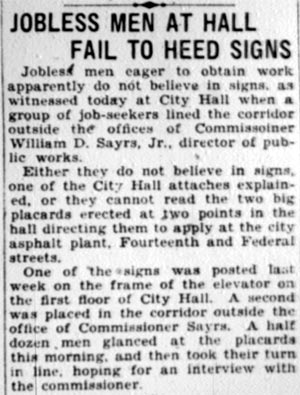
City Will Begin Big Projects to Help Jobless
Camden Courier-Post —
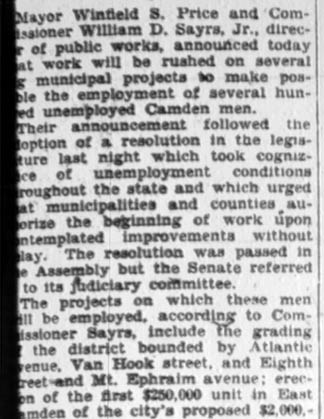
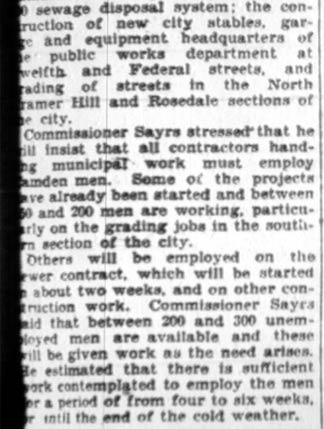
Camden Courier-Post, February 29, 1928 — Winfield S. Price — William D. Sayrs — atlantic avenue — Van Hook Street — Mount Ephraim Avenue — Twelfth Street — federal street — Eighth Street — cramer hill — north camden — Rosedale
Mayor and Sayrs Announce Speeding Up of Municipal Improvements
Will Provide Work for Several Hundred
Sewage Plant, New Garage to be Built— Follow Move in Legislature
Slayer and Slain
Camden Courier-Post —
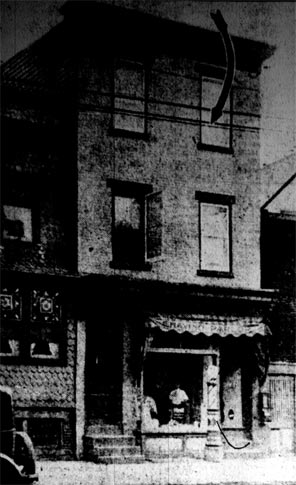
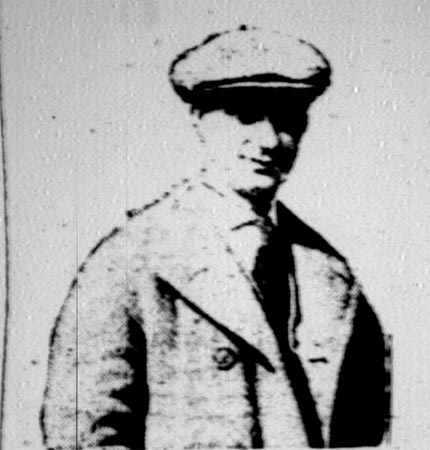
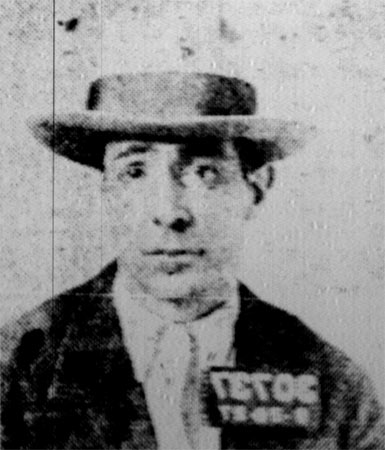
Camden Courier-Post, January 14, 1928 — Joseph Devon — Joseph Cimini. Headquarters of the Sixth Ward Republican Club on Broadway below Spruce Street is shown in the picture. The entrance is to the left, the first floor front being occupied by a barber shop. The arrow indicates the room where the shooting occurred.
Gangster Shot During Melee in Sixth Ward
Camden Courier-Post —
Joseph Devon Held On Murder Charge After Death Boxer’s Brother; ‘Mose’ Flannery and 4 Others Held as Witnesses; Was Craps Game Says County Police
Holdup Attempted City Cops Declare
Victim of a shot fired in a melee, the exact cause of which remain undetermined, Joseph Cimini, 31 years old, ‘was killed in the Sixth Ward Republican Club, 908 Broadway.
Cimini, declared by police to be a Philadelphia gangster, was killed before the eyes of two district detectives, Clarence Arthur and Clarence Bunker, who had been summoned to the club by warning that a fight was in progress.
Joseph Devon, 28 years old, known to his associates as “Polack Joe’” and a colorful figure in Third Ward politics, fired the shot that killed Cimini.
Declaring that he had fired in self-defense, after Cimini struck him with the butt of a revolver, Devon was locked up without bail on a charge of murder.
Joseph ‘Mose’ Flannery, 26 years old, picturesque Eighth ward political worker, was held as a material witness. Detectives had seized Flannery who was to have precipitated the battle by brandishing a revolver just before Cimini was shot. The officers say that Flannery fled –after the shooting and was captured afterward at Broadway and Federal Street.
The name of the dead man was given as Joseph Gannon, but shortly before one o’clock this afternoon, he was identified as Joseph Cimini, 1301 Ellsworth Street, Philadelphia. The identification was made by a brother, William Cimini, a pugilist who has boxed in this city several times under the name of “Billy” Gannon.
Six Others Quizzed
Six other men who were present at the time of the shooting, or when the argument began, were questioned by city and county detectives.
They are Newton Blanchard, 30, 923 St. John Street, former Camden boxing referee and declared by some of the witnesses as the man who conducted the crap game at the club; Michael Dandrea, 26, 1067 Norris Street; Russell Sage, 26 years old, of 1102 Marion Street a taxicab driver who is said to have driven Gannon and Flannery to the club in his car; Maurice O’Brien, 27 years old, of 1429 Bradley Avenue, a former New Jersey State Trooper, Harry Waterhouse, 28 years old, whose address was given as the same as Sage’s; and Charles “Chick” Hunt, 27 years old, of 1218 Broadway, a former Camden boxer.
Blanchard and Dandrea were released after questioning and after each had made a statement to Chief of County Detective Lawrence T. Doran. The others were held with Flannery as material witness.
Differences of opinion between county and city detectives investigating the shooting were heightened during the afternoon. The county sleuths insisted upon the theory that the shooting had resulted from a feud between Flannery and Hunt, with Cimini taking the former’s side and Devon the latter and said that the heat of the argument had possibly been heightened by disagreement over a crap game.
The city police, on the other hand, declared that the entire affair was the result of an attempt by Flannery to hold up the other men. Devon’s statement to Chief Doran made no mention of a hold-up.
Building up a case against Flannery, the officers this afternoon lodged charges of attempted hold-up, carrying concealed deadly weapons, atrocious assault and battery and assault to kill against him. The two latter charges were made as the result of identification of Flannery as a participant in two recent robbery attempts. J.E. Feinstein, café proprietor of 508 Kaighn Avenue, declared that Flannery, Cimini, and Sage were thereof four men who held him up on New Year’s Day. He defied them and they left when he said, “Go ahead and shoot,” he asserted. Flannery was also identified, according to police, as the man who had beaten and attempted to rob Henry Mehrer, an Audubon policeman, and his two companions outside the Ringside Inn, on the Black Horse Pike, a fortnight ago. Mehrer and Feinstein were taken to police headquarters by County Detective Howard Smith, who is authority for the statement that they identified Flannery.
Cimini was shot shortly after 3:00 this morning and died almost instantly. Doctors at Cooper Hospital pronounced him dead on arrival. He had been shot just above the heart by a bullet from Devon’s gun.
Events preceding the shooting remain, to some extent clouded today. Chief Doran said he learned of an enmity existing between Flannery and Hunt. Devon appeared to have attempted to quiet “Mose,” the county detectives said. Cimini struck Devon and Devon fired.
Chief John Golden of the Camden city detective bureau stated, on the other hand, that the shooting had apparently followed an attempt to hold up the other men in the room. Golden based his view on the statements of clarence arthur, a city sleuth. according to Arthur, when he and Bunker appeared at the door of the room, Flannery and Cimini held revolvers and the other men in the room were standing with their hands upraised.
According to the story pieced together by county detectives from the statements of witnesses, a group of men had apparently gathered at the club for a crap game. Blanchard, it was stated, acts as the “stick man,” the term used in gambling parlance to designate the man who conducts a crap game.
City and County agree that Flannery and Cimini arrived together in Sage’s taxicab. Whether there was an argument, the result of an enmity between Flannery and Hunt, or whether the attempted hold-up theory is correct, remains to be learned by additional official investigation.
Chief Doran stated the witnesses had told him that words passed between Flannery and Hunt and that the former had gone downstairs. Returning he brandished a revolver.
Two Flee Place
It was at this point that Blanchard and Dandrea left the room and fled down the stairs. On the street, they encountered Detectives Arthur and bunker, who were patrolling Broadway in a police automobile.
In describing the subsequent events today, Arthur declared that Blanchard had informed him that “two Philadelphia gunmen are up in the Sixth Ward Club holding up a bunch of fellows.”
The detectives did not immediately go to the club, but found Patrolman Frank Del Rossi and followed him up the stairs of the building.
“There were about fifteen men in the room,” Arthur asserted. “When we got to the door Flannery and Cimini had their guns out and apparently were about to search the others. The other men had their hands in the air.
“When they saw us Flannery and Cimini threw their guns down and the others lowered their hands. I went up to Flannery and started to frisk him. Bunker went to another man, whom I don’t know, and started to frisk him.”
It was then he said that he heard the shot. Believing that it was Bunker who was shot, he released his hold on Flannery and swung around. as he did Flannery turned and fled downstairs, Arthur declared.
Bunker said he believed that it was Arthur who had been shot and he too released his grasp on the man he had been searching. The detectives turned in time to see Cimini fall.
“I did it! I shot him!” Devon is declared to have shouted, throwing his revolver on the table.
According to the story told by witnesses to the county detectives, however, Devon had stepped up to Flannery just before the shot was fired and had said “Mose, you can’t get away with this here.”
Flannery is said to have had a gun in his hand at the time.
As Devon spoke, the witnesses say, Cimini stepped behind him and struck him with the butt of a revolver. Just then detectives entered. Devin whirled and, drawing his gun, fired.
Cimini was placed in a police ambulance and taken to the hospital. After he had been pronounced dead his body was taken to the morgue, where it was awaiting identification today. Neatly dressed, Cimini is of Italian extraction. He has coal-black hair, brown eyes and a dark complexion. Coroner Charles T. Murray will perform a post-mortem examination, he said.
Flannery Captured
When he fled from the club, according to Arthur, Flannery jumped on a Public Service bus driven by David Smith, of 423 Haddon Avenue, which was passing at the time.
“Faster! Faster” he is declared to have urged Smith as the latter drove along Broadway in the direction of Federal Street.
At Federal Street and Broadway, Arthur and Bunker caught up to the bus and arrested Flannery as he descended from the vehicle.
“Why don’t you give me a chance to get to Philadelphia?” Arthur declares Flannery asked him. “I can get bail over there.”
Seek Written Statement
Chief Doran stated this afternoon that he was attempting to obtain a written statement from Flannery and would also seek to have Devon sign a statement regarding the shooting. During the morning, Flannery refused to talk while Devin, although admitting that he fired the shot, declared that he shot in self-defense. He made no reference to the hold-up attempt, according to the county detectives.
Cimini has a Philadelphia police record but, according to his pugilist brother, “was not bad but just wild.” He was recently arrested in Philadelphia after a fight with policemen.
“But he never held up or robbed anybody,” his brother declared this afternoon after identifying the body. “He got into a jam now and then. Yes, I know that he knew ‘mose’ flannery, but I never mixed with that crowd.”
It was reported at City Hall this afternoon that Samuel Orlando had been retained as attorney for Flannery and that Walter Keown, Camden county solicitor, would represent all the other men. The presence of Keown at detective headquarters, during which he had a conference with Captain Golden, seemed to lend credence to the latter report but neither rumor could be confirmed.
Flannery for years has figured in police cases and in political warfare in the Eighth Ward, where he was sometimes a lieutenant and sometimes an opponent of “Mikey” Brown, the Republican leader of the ward. Last March he was arrested and indicted on charges of atrocious assault and battery on is wife and her mother. At one time he was held as a suspect is a Philadelphia shooting but later was released.
The accused man, Devon, is a short, slim little man with an air of meek complaisance. He has been a taxicab driver and was last arrested on a charge of drunken driving. In May of 1926 he attempted suicide by shooting himself after he had failed to effect a reconciliation with his estranged wife. At that time, he shot himself but the bullet only grazed his chest.
Joe Devon, long a political power in the Third Ward, first flashed into citywide prominence in 1925, when he was employed by federal authorities as a deputy U.S. Marshal to guard the padlocked Poth brewery at Bulson Street, just off Broadway. At the time Devon was thus maintaining the sanctity of the Eighteenth Amendment, he was also operating a bootlegging establishment downtown and had been arrested once or twice for violating the Volstead Act.
The Courtier at that time exposed this paradoxical situation, with the result that the U.S. Marshal summarily dismissed Devon. He keenly resented the political chicanery that had been used to put Devon in office. In explaining how Devon was appointed, the Marshal said that he had been recommended by “prominent Republican leaders” in Camden, chief among whom was William D. Sayrs, no a city commissioner but then a field agent in the office of the Internal Revenue Department.
Sought City Job
Not long after Devon’s dismissal as brewery guard, Sayrs and other Republican leaders made strenuous efforts to secure a city job for him under the Non-Partisan administration. They sought to exact a promise from The Courier that this newspaper would remain silent in the event Devon was appointed to a city position. No such promise was made and Devon remained jobless, politically at least.
Then came a humorous twist to the situation. Sayrs disagreed with some of the Organization leaders and, for a time, walked his own political footpath. Some of the leaders, fearful of what Sayrs might attempt politically, killed two birds with one stone by hiring Joe Devon to shadow Sayrs and to report to them the number of times he conferred with Non-Partisans. Thus, Joe had a job and Billy was watched.
Sayrs knew he was being shadowed by his old friend, and apparently he knew who had hired Devon to do the work, but he refused to take the situation seriously and chortled, frequently, when he would see his “Shadow” trailing about town.
In the last year, however, Devon has again been the particular political protégé of Commissioner Sayrs and also has won the friendship of many other political leaders. Nevertheless, he has not been, so far as can be determined, the recipient of any particular political patronage, though his political influence in the Third and Fifth Wards is said to have expanded rapidly under the new administration.
Condition of Sayrs Is Reported Improved
Camden Courier-Post —
The condition of Commissioner william d. sayrs. jr, director of public works, continued “good” over the weekend, authorities at Municipal Hospital reported today.
Sayrs was admitted to the hospital last week after his personal physician, Dr. Levi Hirst, informed him that he was suffering from a “mild case of diphtheria.”
City Engineer Clerk Is Again Discharged
Camden Courier-Post —
City Engineer Clerk Is Again Discharged
E. Allan Weinstein, chief clerk in the office of Thomas J. Daley, city engineer, received notice today from Frank B. Hanna, superintendent of streets, that he has been discharged. Dismissal papers, Weinstein said, were served by Hanna personally at Weinstein's home, 441 Kaighn avenue.
Weinstein said he has filed an appeal with the Civil Service Commission asking that he be granted a hearing. The discharged clerk reported that he had been suspended December 29, by Daley, followed by another notice of suspension December 30 signed by Commissioner Sayrs. He said the charges made against him included inefficiency, insubordination, absence without leave, failure to obey orders and neglect of duty.
Weinstein declared that he denied all the charges in the appeal he has filed with the Civil Service Commission. He said he was previously suspended last September on charges of "loitering in the City Hall offices" and "reading a newspaper."
Commissioner Sayrs Takes Walk in Garden
Camden Courier-Post —
william d. sayrs. jr, director of public safety, who left his bed for the first time yesterday at Municipal Hospital. Since he was admitted there as a diphtheria patient last week was permitted to stroll the about the grounds of the institution.
The director, hospital authorities report is showing marked improvement, but will probably remain there another week.
Veteran Traded Out of Job As Foreman Gets Pay Boost
Camden Courier-Post —
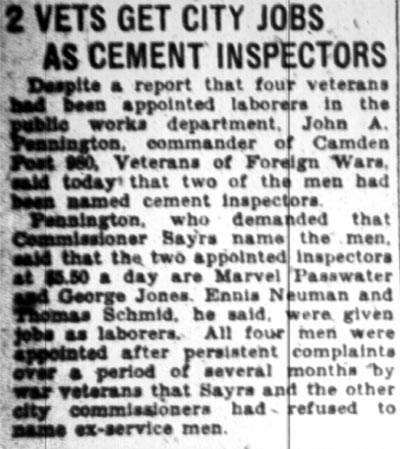
A Camden war veteran, denied a $6.3S a day city job for which he was civil service eligible, but given, instead, a $4 a day job as a laborer, has been “rewarded” with a raise of 50 cents a day it was learned today.
Patrick McVeigh, the veteran, named a laborer when he withdrew as an eligible for appointment as foreman of grading in the department of Commissioner william d. sayrs, now is receiving $4.50 a day. Until this work, his job as laborer paid $4 a day.
McVeigh was one of the civil service eligibles for the post of foreman and as a veteran was entitled to preference. Commissioner Sayrs, however, appointed Harry F. Redding, former sealer of weights and measures, to the job, and McVeigh, promised the job as laborer at $4 a day, withdrew without formal protest.
Increase of McVeigh’s pay to $4.50 a day was reported to the civil service commission today by officials in sayrs’ deportment.
McVeigh is one of three veterans who have withdrawn within the past month as eligibles for city posts to which they were entitled. Two of the other veterans— John A. Pennington and John R. Michaelson— withdrew after conferences with city commissioners. Michaelson was entitled as a veteran to preference for appointment as city purchasing agent. Pennington was slated for appointment as custodian of Convention Hall. Neither was appointed.
The status of a fourth veteran, John W. Powell, who has neither accepted or withdrawn appointment by Sayrs as foreman of ash and garbage collection, had not been determined. Powell has until Monday to answer a letter from the Civil Service Commission answering if he is interested in the appointment.
Camden Courier-Post
Camden Courier-Post —
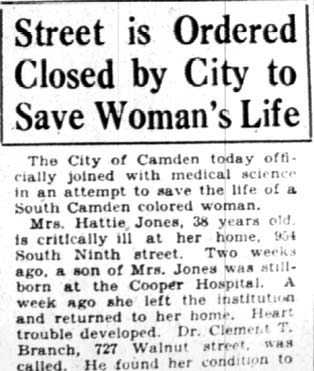
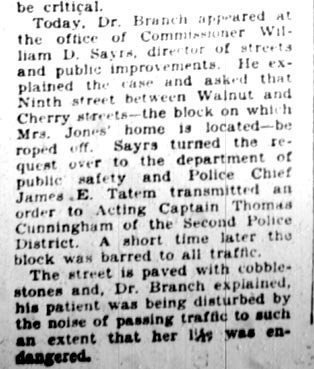
Street is Ordered Closed by City to Save Woman's Life
The City of Camden today officially joined with medical science in an attempt to save the life of a South Camden colored woman.
Mrs. Hattie Jones, 38 years old, is critically ill at her home, 954 South Ninth street. Two weeks ago, a son of Mrs. Jones was stillborn at the Cooper Hospital. A week ago she left the institution and returned to her home. Heart trouble developed. Dr. Clement T. Branch, 727 Walnut street, was called. He found her condition to [be critical]. (Continued on page 2)
Camden Courier-Post
Camden Courier-Post —
Camden Courier-Post
Camden Courier-Post —
Camden Courier-Post, April 2, 1928 — John A. Pennington — George Jones — Ennis Neuman — Marvel Passwater — Thomas Schmid
Camden Courier-Post
Camden Courier-Post —
Camden Courier-Post
Camden Courier-Post —
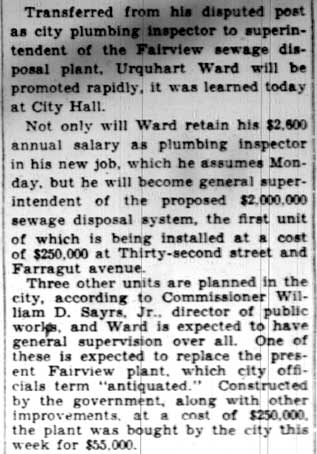
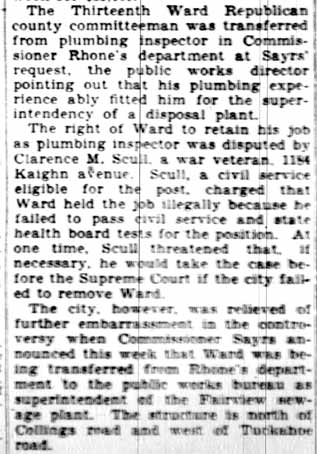
Camden Courier-Post, June 30, 1928 — dr. david rhone — William D. Sayrs — Clarence M. Scull — Urquhart Ward — Kaighn Avenue — North 32nd Street — Farragut Avenue — Collings Road — Tuckahoe Road
Camden Courier-Post
Camden Courier-Post —
Camden Courier-Post
Camden Courier-Post —

KEOWN NAMED HEAD OF COUNTY G.O.P. AS WALLWORTH RESIGNS
Mrs. Verga Re-elected Vice Chairman at Reorganization Meeting of Committee
OTHER OFFICERS CHOSEN
When the Camden County Republican Executive Committee reorganized last night Walter S. Keown was elected chairman without opposition.
He succeeds former State Senator Joseph F. Wallworth, who was Republican county chairman six years, and a member 12 years. At a dinner preceding the executive session a silver set and a vase were presented to Wallworth by the committee. The retiring members of the committee received bronze elephants as emblems of the party.
At the executive session Mrs. Elizabeth Grotty Verga was re-elected vice chairman; Harry C. Sharp, treasurer; William D. Sayrs, assistant treasurer; Howard B. Dyer, secretary, and Mrs. Laura Silbers and Mrs. Lottie Stinson, assistant secretaries. Harold W. Bennett, Edward R. Diebert, Bernard Bertman, L. Scott Chercesky, Carl Kisselman and Frank Voigt were chosen solicitors.
Wallworth Reviews Work
Upon retiring as chairman Senator Wallworth said:
“During the six years I acted as your chairman considerable political history has been made in our county. The Republican party was on the rocks and loyalty seemed to have drifted away when Frank Patterson, Al Matthews, Penn Corson and Senator Baird begged me to take the chairmanship. In doing so I quickly discovered I had undertaken one of the hardest up hill battles of my life.”
When Keown took over the gavel he pointed out to the committee members they were political leaders of their districts. He said it was their duty to find out the cause of unrest.
“In some of your districts the trouble is your tax rates are too high,” said the chairman. “High taxe rates are an evil and it is your duty to find the cause and remedy the situation. When there is a spirit of satisfaction in your district there is satisfaction throughout the county.”
Wolverton Favors Plan
Congressman Charles A. Wolverton complimented the new chairman on his advice. Sharp and Sayrs, who have been identified with the committee more than 20 years, were also speakers.
Keown then turned the gavel over to Mrs. Verga, who thanked the committee for her re-election. She introduced Mrs. Silbers and Mrs. Stinson, who urged loyalty and work on the part of the women members of the committee.
Keown was nominated by Daniel Silbers, Pennsauken township. Colonel George L. Selby nominated Sharp and Dyer. All of the officers received a unanimous vote.
Ten new members took seats from the five boroughs recently created out of Clementon township. Among them was Clinton L. Bardo, president of New York Shipbuilding Corp., who was elected from the new borough of Pine Valley last Tuesday. Twelve members of last year’s committee retired either as a result of the primary election or not being candidates.
Camden Courier-Post
Camden Courier-Post —
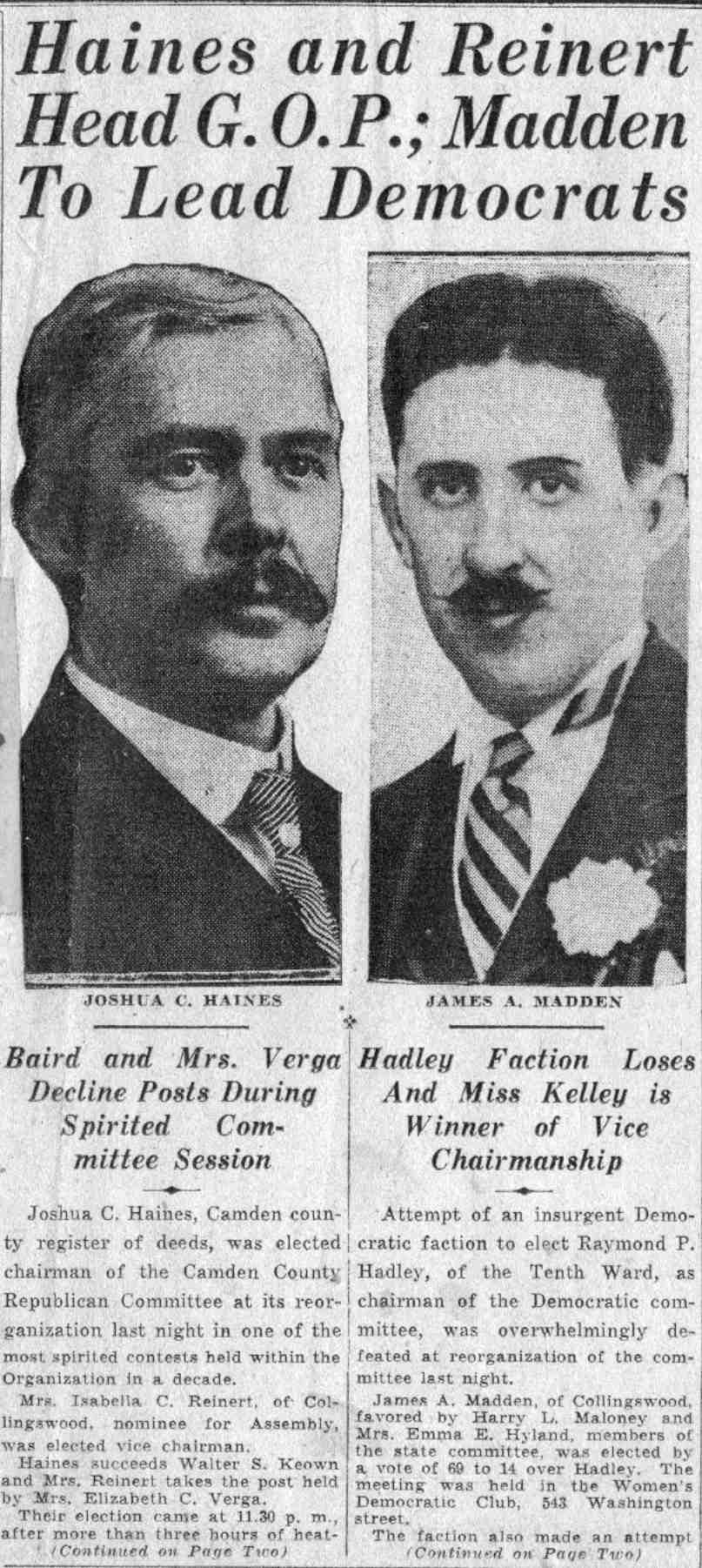
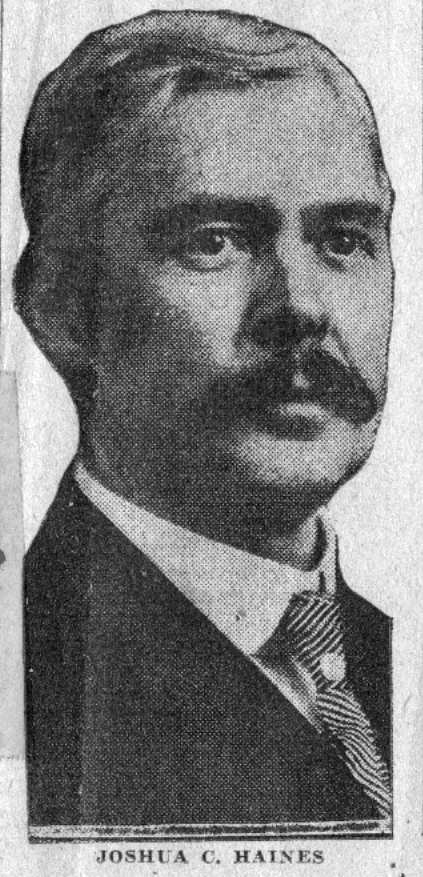
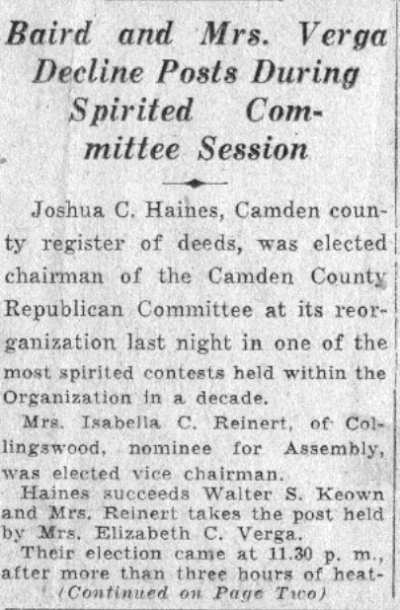
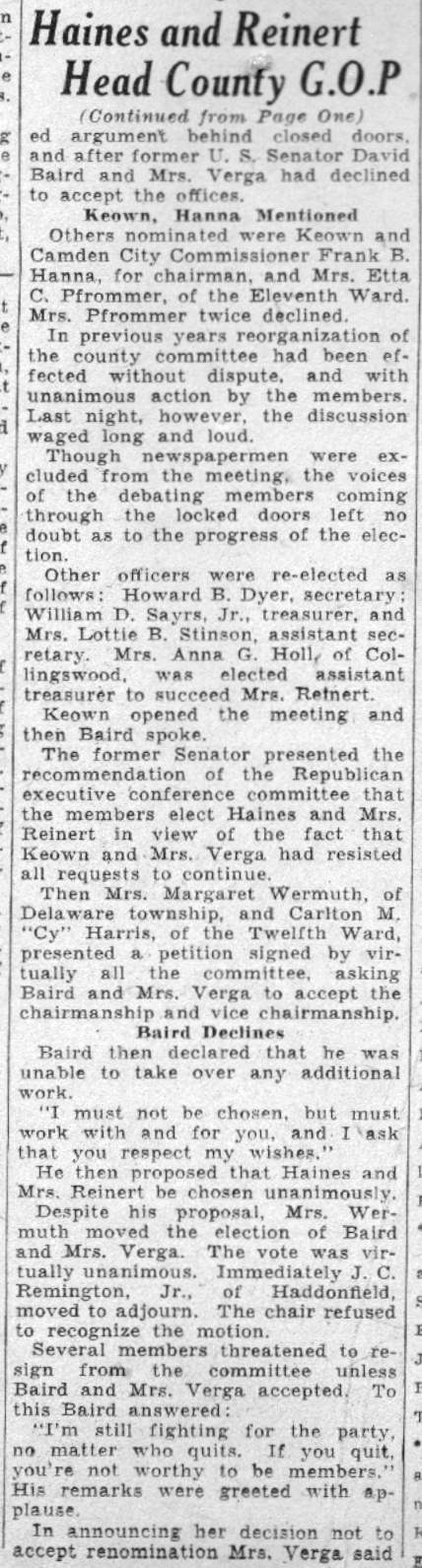
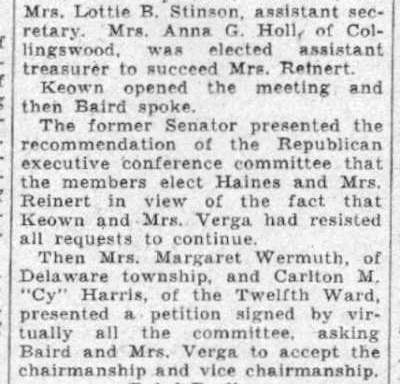
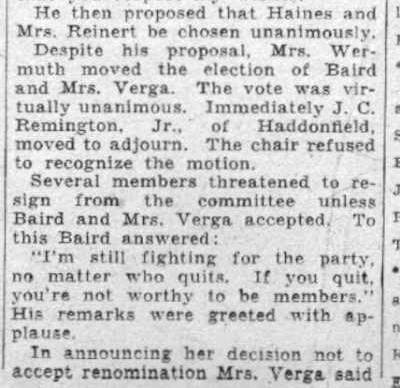

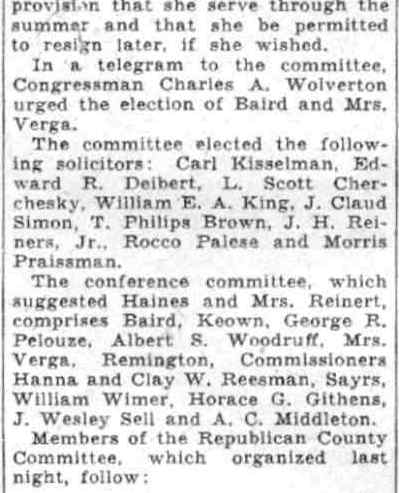
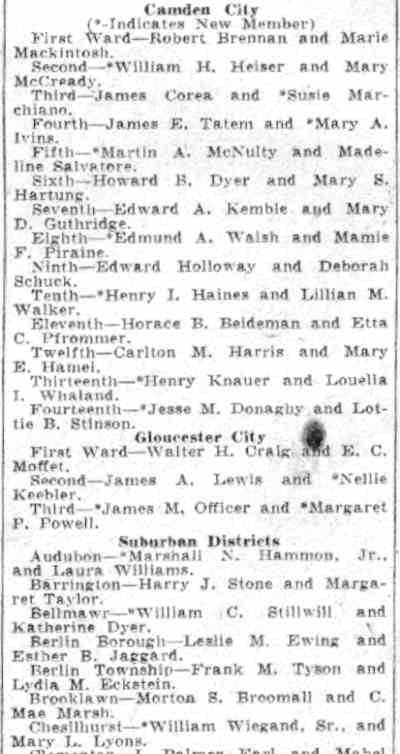
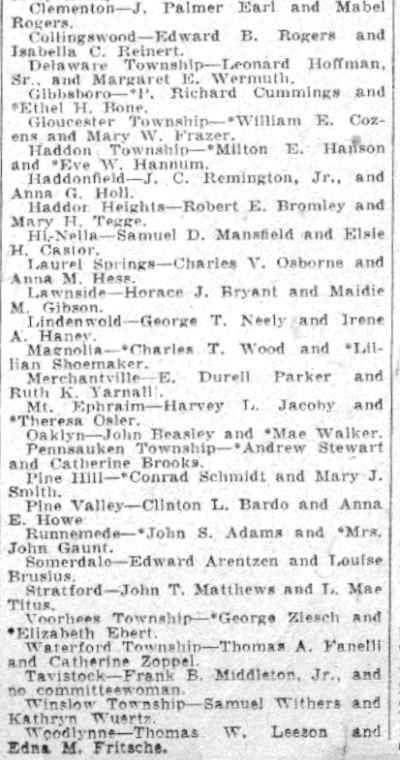
Camden Courier-Post, June 1, 1932 — joshua c. haines — Isabella C. Reinert — Elizabeth C. Verga — david baird jr. — Walter Keown — frank b. hanna — Etta C. Pfrommer — Howard B. Dyer — william d. sayrs jr. — lottie b. stinson — anna g. holl — Mrgaret Wermuth — Carlton M. “Cy” Harris — J.C. Remington — charles a. wolverton — carl kisselman — edward deibert — l. scott cherchesky — William E.A. King — J. Claud Simon — T. Phillips Brown — J.H. Reiners — rocco palese — Morris Praissman — George R. Pelouze — albert s. woodruff — Clay W. Reesman — William Wimer — horace g. githens — j. wesley sell — a.c. middleton — Robert Brennan — Marie Mackintosh — William H. Heiser — Mary McCready — James Corea — Susie Marchiano — James E. Tatem — Mary A. Ivins — martin a. mcnulty — Madeline Salvatore — Howard B. Dyer — Mary S. Hartung — Edward A. Kemble — mary d. guthridge — Edmund A. Walsh — Mamie F. Piraine — Edward Holloway — Deborah Schuck — Henry I. Haines — Lillian M. Walker — horace b. beideman — Etta C. Pfrommer — Carlton M. Harris — Mary E. Hamel — Henry Knauer — Louella I. Whaland — Jesse M. Donaghy — Lottie B. Stinson
Campaign Planned by Salvation Army
Camden Courier-Post —
Executives of Organization Discuss Budget for Camden and Propose Drives
Plans for a campaign to raise funds to cover the budget of the Salvation Army Corps here were discussed yesterday at a meeting of members of the executive board at hotel walt whitman.
William D. Sayrs, chairman of the committee presided and requested that a successor be appointed. The nominating committee selected Earl Lippincott, chairman; Mrs. Arthur Casselman and John J. Robinson, vice chairmen.
Brigadier James A. Harvey, commanding the Philadelphia region of the Army reviewed the Work accomplished at the Camden headquarters, under direction of Captain Charles W. Schafter.
An itemized report of receipts and expenditures together with a budget outline were submitted by Captain Schaffer.
Included among the members at the meeting were Reverend John Pemberton, Mrs. Charles A. Wolverton, Mrs. Casselman, Mrs. Mary W. Kobus, Herman Hensgen, Joseph Tweedy, Frank C. Propert, and Robinson.
Other members of the committee include Howard Hemphill, George C. Baker, Patrick Harding, Dr. James Rodgers, Dr. F. William Schafer and Dr. Albert Pancoast.
Salvation Army Names Lippincott
Camden Courier-Post —
Camden Unit Makes Real Estate Broker Chairman of Advisory Boards
Earl R. Lippincott, real estate broker, has been named chairman of the advisory board of the Camden unit of the Salvation Army, succeeding william d. sayrs.
Elections of officers for the group were held yesterday following a luncheon meeting at hotel walt whitman. Vice chairmen of the organization include John J. Robinson and Mrs. Arthur J. Casselman.
Other officers include Mrs. Charles A. Wolverton, treasurer, and Miss Elizabeth Magill, secretary.
Members of the executive committee selected the following committees: Woman’s committee, Mrs. Arthur H. Holl and Mrs. Wilfred W. Fry; finance committee, Dr. F. William Shafer, william d. sayrs, Frank C. Propert, Mrs. Wolverton and Mrs. Holl; property committee, Howard Hemphill, John J. Robin son, Herman E. Hensgen, Arthur J. Casselman and George C. Baker; public relations and publicity, Rev. John Pemberton, Joseph G. Tweedy, Mrs. Mary W. Kobus, Dr. Albert B. Pancoast and Patrick H. Harding; program committee, Dr. James Rodger, Propert, Robinson, Tweedy and John L. Shannon.
State G.O.P. Chiefs Speak Here Tonight
Camden Courier-Post —
Stokes, Kean, Barbour Listed for Fete to Reesman and Mrs. Verga
A testimonial dinner will be given tonight by the Camden County Republican Committee in honor of party leaders with former Governor Edward C. Stokes as principal speaker.
Those to be honored are Mrs. Elizabeth C. Verga, vice chairman of the county committee and state committeewoman; Assemblyman Isabella C. Reinert, former vice chairman; Commissioner clay w. reesman, new chairman of the county committee, and joshua c. haines, register of deeds, the retiring chairman.
Other speakers will include Mrs. Edna B. Conklin, national committeewoman from Bergen county; Congressman Charles A. Wolverton; former U. S. Senator David Baird, Jr., U. S. Senators Hamilton F. Kean and W. Warren Barbour and E. Bertram Mott, state chairman.
State Senator Albert S. Woodruff will be toastmaster. Carlton M. Harris, chairman of the dinner committee, said last night that reservations have been made at the Hotel Walt Whitman for 500 guests and the committee is swamped with applications.
Other members of the committee in charge of the dinner are William D. Sayrs, Jr., treasurer, and Mrs. Pauline Caperoon, secretary.
Baird, Stokes Lash Richards Ambitions And ‘Horse Trading’
Camden Courier-Post —
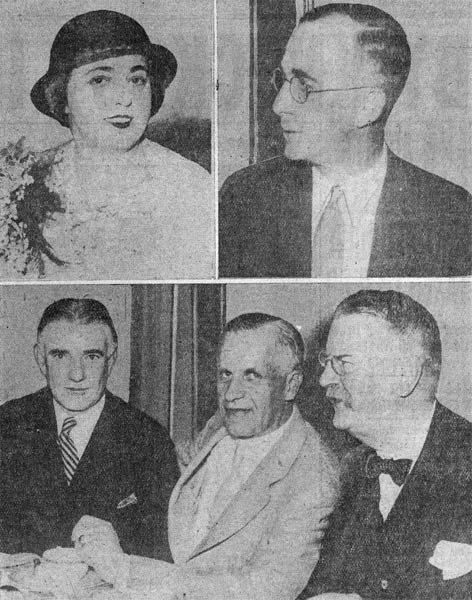
Upper left: Mrs. Elizabeth C. Verga, vice chairman of both the Republican State and Camden County committees; and City Commissioner Clay W. Reesman, chairman of the Republican county committee. Left to right in the lower group are Congressman Charles A. Wolverton, Republican State Chairman E. Bertram Mott and Senator Hamilton F. Kean.
Dinner to Reesman and Mrs. Verga Packs Whitman
Local Delegates Get High Praise
Ex-Governor Denounces Roosevelt Program, Hits Inflation
By RANSLOE BOONE
Bitter criticism of the “horse trading:” of the Legislature and the gubernatorial aspirations of Senate President Emerson L. Richards, were coupled with appeals for party loyalty and praise for Camden county’s leaders at a dinner of the Camden County Republican Committee in Hotel Walt Whitman last night.
The dinner, one of the largest ever held in the hotel, was in honor of City Commissioner Clay W. Reesman, new chairman of the county committee, Mrs. Elizabeth C. Verga, vice-chairman of the county and state committees; Joshua C. Haines, former chairman, and Mrs. Isabella C. Reinert, assemblywoman and former vice chairman.
Tribute was paid them by a distinguished gathering of more than 500 national, state and county leaders. So great was the crowd that the capacity of the main ball room was taxed and the junior ballroom was utilized also.
The attacks on “horse trading” and Richards were made by former Governor Edward C. Stokes and former United States Senator David Baird, Jr. Baird did not mention Richards by name.
Proud of Own Legislators
“We Republicans in Camden County have a faculty for victory,” Baird said, “but we can and will help to defeat selfish aspirants to office if they don’t play straight with the Republican party.”
“I am proud of the record of Senator Albert S. Woodruff and our Assembly members, Mrs. Isabella C. Reinert, F. Stanley Bleakly and Frank M. Travaline, Jr. They didn’t take any part in the trading of judges, highway commissioners and prosecutors.
“Camden County has been accused of not wanting civil service. When it came time to vote on the question Camden County stood by civil service as it always has, and beat the ripper.”
“Only when you play the game and stand four-square for the ideals of the party can you expect the people of the state to trust you.”
“Whose Legislature?’ Stokes declared:
“We won a great victory in New Jersey in the last presidential election. We did it by remaining loyal and not by trading with the Democrats.
“We thought we elected a Republican legislature. John Milton, Hudson County Democratic leader, however, says we elected a Republican legislature but the Democrats are putting on the show. But in that very paternal letter he wrote me not long ago, telling me what I should do and why I should not ‘interfere’ with’ the Legislature, Senator Richards assured me the Republicans controlled the Legislature, I’m glad to know that for, of course:, Richards is always right.”
Stokes predicted history would repeat itself and the Republican party soon would come back into its own.
“The party that stands by its principles despite defeat always comes back.”
The former governor proposed two means of lowering the present high taxes and heavy expenditures.
“I wish this county committee and all those throughout the state would insist on legislation to prohibit municipalities from spending more than they have and from floating bond issues and I wish you would support legislation providing for a limited local tax rate and providing for a gradual reduction of taxes to that maximum.”
Doubts Roosevelt Plan
He expressed doubt as to the wisdom of some of the Roosevelt program. Inflation makes us prosperous, if revoking the gold standard aids us, amen, if calling 18 inches a yard will help us, that’s’ fine. If we can ask employers to sell us more and not throw more of our own workers out of work, that will be wonderful. But I can’t understand how we will be aided by those proposals. It’s too much for me.”
He demanded that, France, England, and the other nations pay their debts, declaring they were spending five times their debts on armaments.
Congressmen Defend F. D. R.
Wholehearted support of all of President Roosevelt’s measures which will promote relief from present economic conditions was pledged by United States Senators Hamilton F. Kean and W. Warren Barbour and Congressman Charles A. Wolverton.
Kean explained that he voted for the economy bill after he had been assured the president would not touch the compensation of those veterans whose injuries were service connected and that it was passed only because “pressure was brought to bear.” After paying tribute to Reesman and Mrs. Verga, Kean said:
“One of the first bills introduced by the new administration was the economy bill. This bill authorized the president to consolidate departments of the government, of which there are a great many overlapping and which could be done without any injury to anybody except those receiving salaries or emoluments there from. The bill also authorized the president to adjust the wages of government employees and to examine in and make new rules for those receiving pensions from the government. A year ago we tried to give Mr. Hoover power to do away with a lot of these offices that were unnecessary and useless. Mr. Hoover promised if he had the power that he would do so, but this was beaten by the Democrats, so that Mr. Hoover never had; the power to do away with these useless bureaus.”
Elections Board Names Rea to Post
Camden Courier-Post —
Fifth Warder Formally Made Registrar as Successor to Sayrs
The Camden County Board of Elections, in special meeting yesterday unanimously elected Leo B. Rea as the new Republican registrar in the Permanent Registration Bureau.
Rea, the choice of G. O. P. leaders, was elected by the bipartisan board of elections after it had accepted the resignation of William D. Sayrs, Jr. as the Republican registrar.
Sayrs, a former city commissioner, assumed a new $5000 post Tuesday as director of the new real estate division of the reorganized State Highway Department. He was appointed formally to the job by the State Highway Commission.
Rea is expected to begin his new duties this afternoon after familiarizing his successor as a deputy county clerk with details of that job. His successor in the county clerk’s office is Edward J. Wintering, of Westmont, former Haddon township tax assessor.
The elections board meeting opened at 9:30 a. m. and lasted three minutes. Sayrs’ resignation was addressed to the board, attention of Mrs. Emma E. Hyland, chairman.
Rea’s new position pays $2400 a year, minus 30 percent under the county economy program. He was nominated for the post at the meeting by William A. E. King, a Republican member of the elections board.
Rea did not attend the session, but appeared after its conclusion.
He has been president of the Fifth Ward Republican Club seven years and is a member of the G. O. P. Speakers’ Bureau.
Sayrs’ resignation follows:
“I am tendering my resignation herewith and request that it take effect immediately as registrar of the Permanent Registration Bureau of the Camden County Board of Elections.
“I regret exceedingly to sever my connections with the Permanent Registration Bureau because of the pleasant associations which I have had with my office associates and members of the board, particularly those of the opposite party,
“I feel that I must take this occasion to comment on the spirit that prevailed among the members of the Camden County Board of Elections on the part of both parties and that while, at times, there may have been honest differences of opinion, as there must necessarily always be in such bodies, all the members have consistently acted in accordance with the principles which they thought were best for the voters of this county, whom they must at all times represent.”
Camden Courier-Post
Camden Courier-Post —

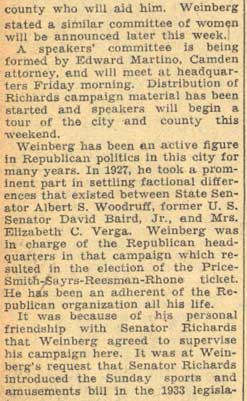
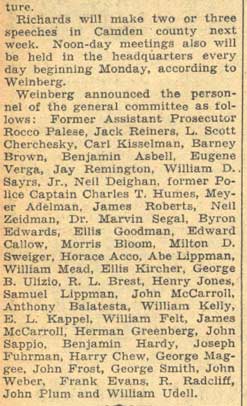
Richards Opens Camden Quarters
Richards Opens Camden Quarters
Jack Weinberg in Charge of Senator's Campaign for Governor Here
Camden campaign headquarters for State Senator Emerson L. Richards, one of the four candidates seeking the Republican nomination for governor, was opened yesterday in the Hotel Walt Whitman building on the Broadway side.
At the same time, Jack Weinberg, who is supervising the campaign of Senator Richards in Camden, announced a committee of 50 business and professional men of Camden
Camden Courier-Post
Camden Courier-Post —
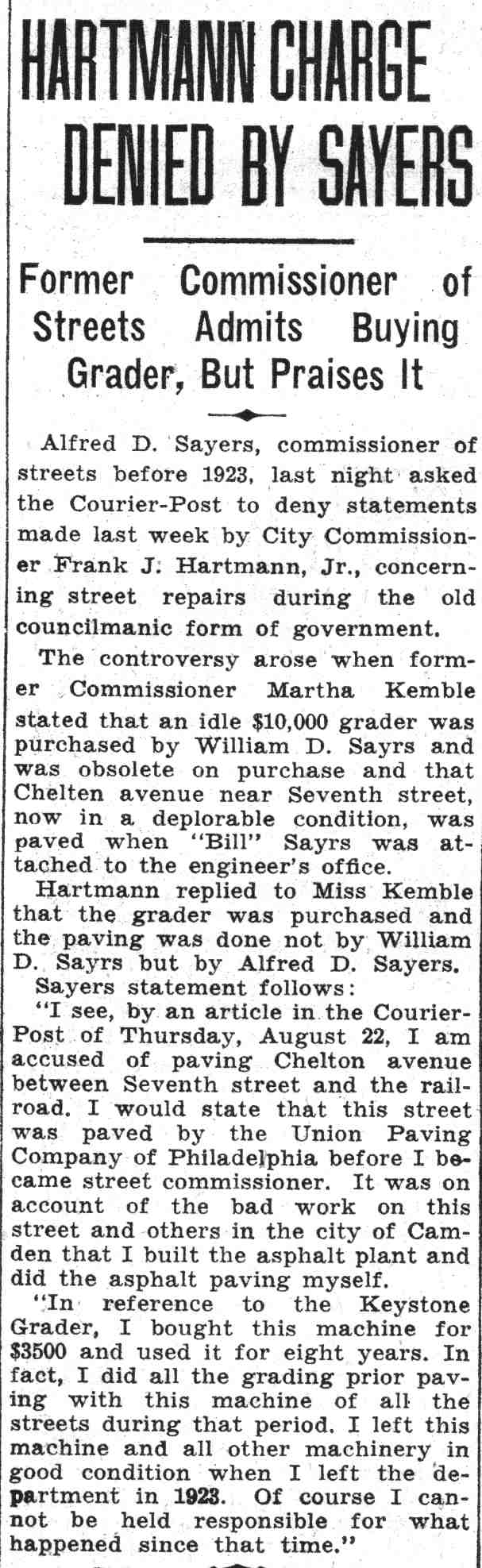
Hartmann Charge Denied by Sayers
HARTMANN CHARGE DENIED BY SAYERS
Former Commissioner of Streets Admits Buying Grader, But Praises It
Alfred D. Sayers, commissioner of streets before 1923, last night asked the Courier-Post to deny statements made last week by City Commissioner Frank J. Hartmann, Jr., concerning street repairs during the old councilmanic form of government.
The controversy arose when former Commissioner Martha Kemble stated that an idle $10,000 grader was purchased by William D. Sayrs and was obsolete and on purchase and that Chelten avenue near Seventh street, now in a deplorable condition, was paved when "Bill" Sayrs was attached to the engineer's office.
Hartmann replied to Miss Kemble that the grader was purchased and the paving was done not by William D. Sayrs but by Alfred D. Sayers.
Sayers statement follows:
"I see, by an article in the Courier-Post of Thursday, August 22, I am accused of paving Chelten avenue between Seventh street and the railroad. I would state that this street was paved by the Union Paving Company of Philadelphia before I became street commissioner. It was on account of the bad work on this street and others in the city of Camden that I built the asphalt plant and did the asphalt paving myself.
"In reference to the Keystone Grader, I bought this machine for $3500 and used it for eight years. In fact, I did all the grading prior paving with this machine of all the streets during that period. I left this machine and all other machinery in good condition when I left the department in 1923. Of course I can not be held responsible for what happened since that time."
Camden Courier-Post
Camden Courier-Post —
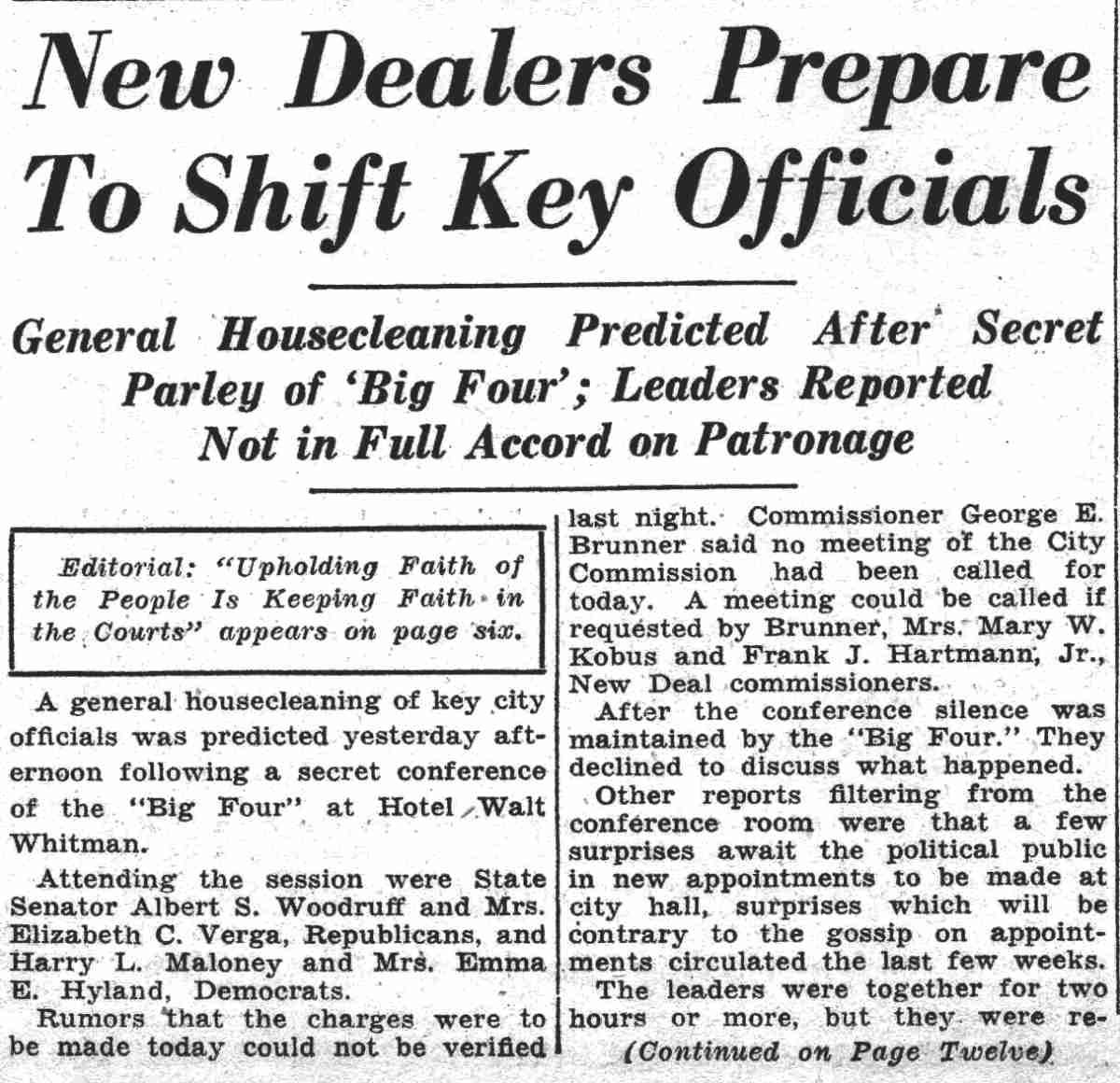

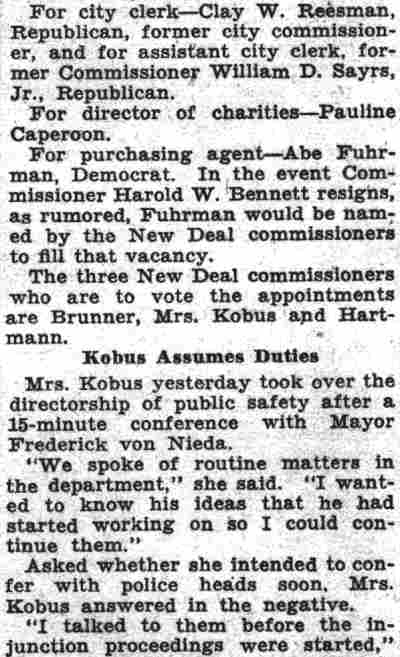
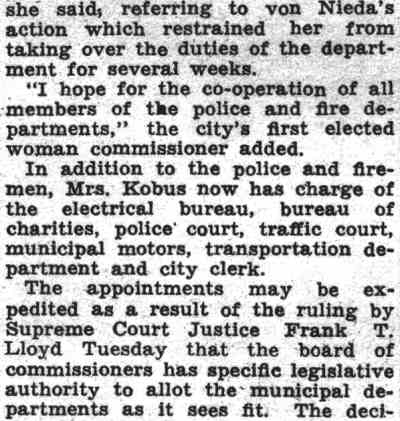
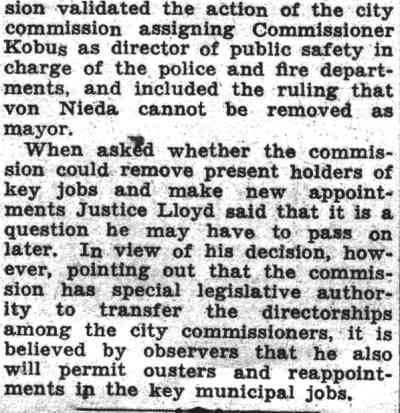
Named: Camden Courier-Post, August 29, 1935, Albert S. Woodruff, Elizabeth C. Verga, Emma Hyland, Harry L. Maloney, Hotel Walt Whitman, Firmin Michel, Carl Kisselman, Mitchell H. Cohen, Edward V. Martino, John J. Crean, Clay W. Reesman, William D. Sayrs, Pauline Caperoon, Abe Fuhrman, Harold W. Bennett, Mary Kobus, George E. Brunner, Frank J. Hartmann Jr., Frank T. Lloyd, and Frederick von Nieda.
Camden Courier-Post
Camden Courier-Post —
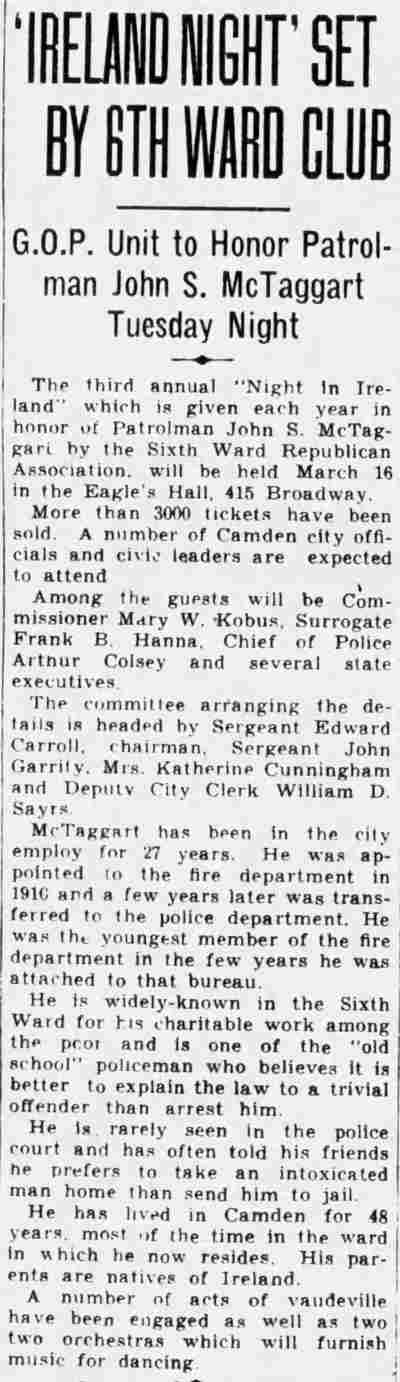
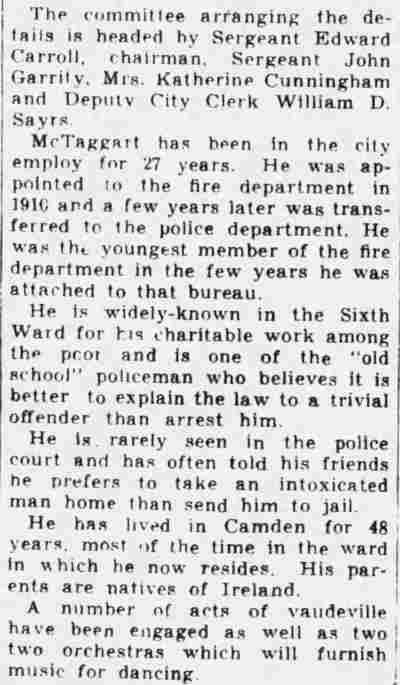
Named: Camden Courier-Post, March 13, 1937, John S. McTaggart, Frank B. Hanna, Arthur Colsey, Mary Kobus, Edward Carroll, William D. Sayrs, John Garrity, Katherine Cunningham, and Eagles Hall.
Camden Courier-Post
Camden Courier-Post —
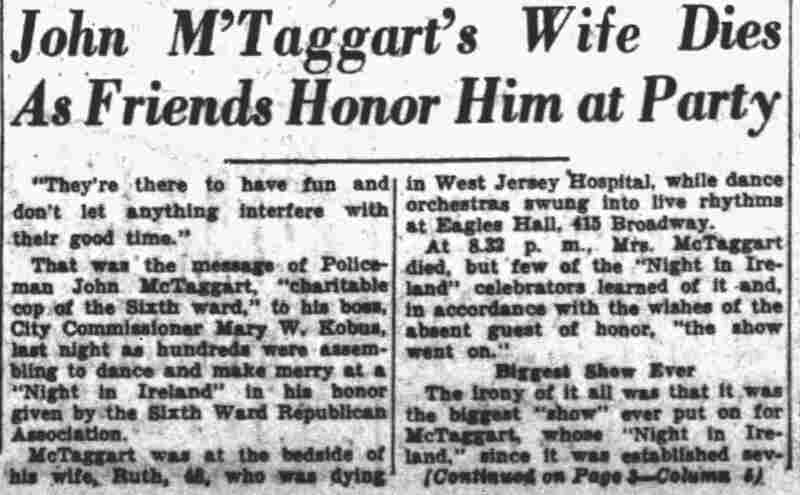
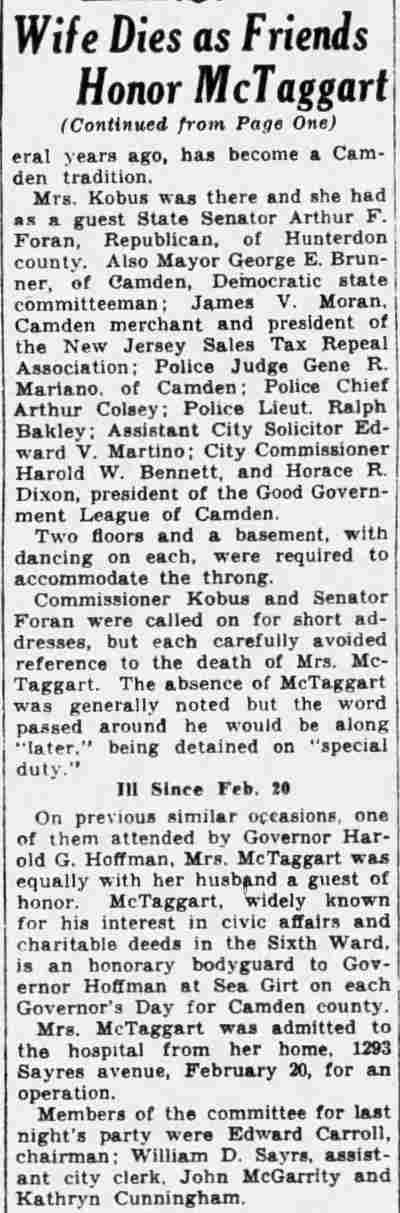
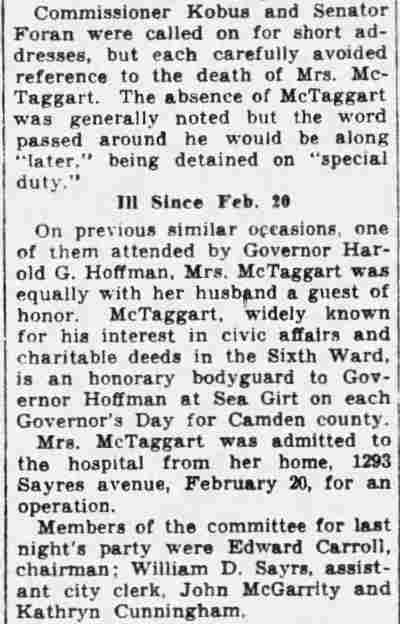
Named: Camden Courier-Post, March 17, 1937, John S. McTaggart, Arthur F. Foran, George E. Brunner, James V. Moran, Gene R. Mariano, Arthur Colsey, Ralph Bakley, Edward V. Martino, Harold W. Bennett, Horace R. Dixon, Mary Kobus, Edward Carroll, William D. Sayrs, john garrity, Kathryn Cunningham, and Harold Hoffman.
Polls Aides, Owners Will Get Paid Today
Camden Courier-Post —
A total of $7380 will be paid today to election board officers and owners of polling places in the recent city commission election, it was announced yesterday by Deputy City Clerk William B. Sayrs.
Each of the 456 district officers, four from each of the 114 districts, will be required to present his certificate of appointment and the 54 owners of properties used as polling places must return the flags loaned for the election. The owners will receive $10 each. The remaining polling places were in school buildings.
Payments will be made from 9 a. m. to 4 p. m., Sayrs said..
Henry Magin Laid to Rest By War Veteran Buddies
Camden Courier-Post —
Trucks of Flowers in Funeral Cortege
Funeral services for City Commissioner Henry Magin were held today with his colleagues in official and veterans circles participating.
Services were conducted in city commission chambers on the second floor of city hall, in charge of Rev. Dr. W.W. Ridgeway, rector of St. Wilfrid’s Episcopal Church.
The casket was carried by war veteran associates of the public works director, who died from a heart attack Friday. A color guard from the Veterans of Foreign Wars and the American Legion preceded the casket, followed by the four remaining members of the city commission, Mayor George Brunner and commissioners E. George Aaron, Mrs. Mary W. Kobus and Dr. David S. Rhone.
A guard of honor lined both sides of city hall steps, 22 policemen on one side and 22 firemen on the other, representing Magin’s age, 44 years.
Hundreds of men and women waited outside the building to pay their respects as the solemn procession filed by. Mayor Brunner had declared this morning a holiday for city employees. The casket was borne by Thomas Jackson and Samuel Magill, both past Legion commanders; Leon McCarty, past commander of August Walter Chapter, Disabled American Veterans; Richard Jermyn, past commander of Post 1270, Veterans of Foreign Wars; Benjamin P. Thomas, past captain of Sparrow Ship No. 1269. V. F. W.; and William Miller, past State commander, D. A. V.
Three trucks were required to carry the floral pieces from the scene of the services to the National Cemetery at Beverly, where burial took place.
An estimated 8000 persons from all walks of life paid their respects to the late official by viewing the body as it lay in state in the commission chambers.
The throng of mourners of Camden city and county was the largest to converge on a public building since the funeral of Fire Chief Charles Worthington, who was killed while fighting a fire almost 20 years ago. His body was placed on public view in the rotunda of the old county courthouse.
File Past Bier
A continuous progression of people filed past the flag draped bier for more than three and one-half hours. Scores of Republicans and hundreds of Democrats joined in the tribute.
Services were conducted by Camden lodges of Elks and Moose. Military rites were conducted by the Fairview Post, American Legion, of which Magin was a founder and past commander. The tribute was led by Mitchell Halin, post commander, and C. Richard Allen, past department commander.
James W. Conner, chief clerk of the city water bureau and past State Commander of the V.F.W., conducted rites at the grave.
Mayor Brunner and Commissioners Kobus, Aaron, and Rhone came early and remained throughout the hours of viewing. Mrs. Helen Magin, the widow, and daughter Helen, attired in deep mourning, arrived shortly after 7:00 PM.
Embraces Widow, Daughter
Commissioner Kobus, who knelt in prayer before the bier, arose and went over to Mrs. Magin and her daughter. Mrs. Kobus embraced and kissed the widow and daughter of the late commissioner. They were in tears.
Three firemen and three policemen maintained a vigil as a guard of honor. They were Patrolmen Jack Kaighn, George Weber, and William Deery and Firemen Arthur Batten, Warren Carter and William Reed.
American Legion and V. F. W. members in uniform alternated as members of the military guard of honor. A detail of 50 policemen was under command of Acting Lieutenant John Garrity. Fifty firemen, under supervision of Deputy Chief Walter Mertz, assisted the patrolmen in handling the crowd, which at times choked the stairways leading to the second floor.
Freeholders Arrive
Albert H. Molt, director of the Board of Freeholders and Freeholders John J. Tull, oscar moore, Ventorino Francesconi, Stanley Ciechanowski, Earl Armstrong and Emil J. McCall arrived shortly after 7:00 PM. Moore and Tull wore American Legion overseas caps. Albert S. Marvel, clerk of the board, accompanied the freeholders.
Employees of the various bureaus in the department of public works, headed by Commissioner Magin, came in delegations with the highway bureau having 150, the largest number.
frank a. abbott, acting director of the department, accompanied by James P. Carr, superintendent of Streets; led the highway bureau employees. Abbott is deputy director of revenue and finance and first assistant to Mayor Brunner. He was named by Brunner as acting director until the City Commission elects Mr. Magin’s successor.
County Clerk frank j. suttill, city clerk clay w. reesman, fire chief john H. Lennox and James A. Howell, chief of the city electrical bureau, attended, as did Albert Austermuhl, secretary of the board of education. Every city department sent a floral piece.
Outstanding Floral Tribute
Outstanding among the floral tributes was a six-toot broken circle of varied flowers, an offering from Mayor Brunner and Commissioners Kobus, Aaron, and Rhone.
A floral chair was sent by the Camden Police and Firemen’s Association. The word “Rest” was made up of flowers. The offering of the Veterans League of South Jersey, an organization formed by Commissioner Magin and of which he was the first president, was a large floral pillow.
The freeholders and county officials gave a large floral basket. Floral tributes came from the employees of the board of education, the RCA Manufacturing Company, the police and fire bureaus, Pyne Point Athletic Association, the Elks, Moose and several Democratic clubs.
The floral tributes came in such numbers yesterday afternoon that Funeral Director Harry Leonard and his assistants could not find room for them in the commission chamber proper. They were banked on both sides, in the rear and over the casket.
Among prominent officials and citizens who came to pay their respects were Congressman Charles A. Wolverton and his son, Donnell, Assemblymen Joseph W. Cowgill and J. Frank Crawford, Sidney P. McCord, city comptroller, Thomas C. Schneider, president of Camden County Council No. 10, New Jersey Civil Service Association.
Others at Bier
Others were Sue Devinney, secretary to mrs. kobus; Fred S. Caperoon; Henry Aitken, city sealer of weights and measures, Horace R. Dixon, executive director of the Camden Housing Authority; George I. Shaw, vice president of the board of education.
Sgt. Ray Smith, chairman of the Elks Crippled Children Committee and commander of East Camden Post, V.F.W.; Albert Becker, commander of Camden County Post 126, Jewish War Veterans; Dr. Howard E. Primas and Wilbur F. Dobbins, members of the Camden Housing Authority; Postmaster Emma E. Hyland; Samuel E. Fulton, member of the Camden local assistance board.
Also former Assemblyman Rocco Palese, former Freeholder Maurice Bart and wife, County Detective James Mulligan, Deputy City Clerk William D. Sayrs, Mary King, secretary to City Clerk reesman, Charles W. Anderson and John W. Diehl Jr., former members of the housing authority, Walter P. Wolverton, chief clerk of the public works department; Thomas J. Kenney, Maurice Hertz, Isadore Hermann, chief of the city tax title bureau; S. Raymond Dobbs; acting chief of city property, John Oziekanski, building inspector, Harry Langebein, city assessor.
Oliver H. Bond, housing manager of Clement T. Branch Village; former Judge Joseph Varbalow, acting city counsel John J. Crean, assistant City Counsel Edward V. Martino, Paul Day, secretary of city board of assessors, former Assemblyman William T. Iszard, Harry Roye, district director of NYA; Victor J. Scharle and Martin Segal, Democratic and Republican registrars, respectively, of the Camden County permanent registration bureau.
Mrs. Marian Garrity and Mrs. Mary F. Hendricks, vice chairman and secretary respectively, of the Republican City Committee; Dr, Ethan A. Lang and Dr. Richard P. Bowman, members of the board of education; Edward J. Borden, Carl Kisselman, Harry A. Kelleher, Samuel T. French Sr., former Freeholder Walter Budniak, Coroner Paul R. Rilatt, County Treasurer Edward J. Kelleher, William Shepp, of the city legal bureau, Marie Carr, stenographer, mayor’s office; Samuel T. French Jr., member, board of education.
Also John C. Trainor, member of the Camden County Board of Elections; Antonio Mecca, funeral director; Alexander Feinberg, solicitor of the housing authority, former Freeholder John T. Hanson, Sterling Parker and Paul Reihman, member of the county park commission.
James O’Brien, commander of the Camden Disabled American Veterans, was in charge of services by veterans at the cemetery. Former Freeholder Edward J. Quinlan, county vice-commander of the American Legion, directed last night memorial services and was in charge of the firing squad at the grave.
Wm. D. Sayrs Funeral To Be Held Monday
Camden Courier-Post —
Funeral services for Deputy City Clerk William D. Sayrs will be held at 2:00 p. m. Monday, in the Holl funeral parlor, 811 Cooper Street. Mr. Sayrs died in his sleep yesterday. He was 74.
Pallbearers for the former city commissioner will include City District Court Judge Edward V. Martino, Advisory Master William R. J. Burton; Thomas C. Schneider, secretary of the County Board of Elections; Mayor Soren A. Tollefson, of Oaklyn; Andrew Mazur and Dominick Palese.
Surviving Mr. Sayrs are his widow, Jennie, an adopted daughter, Mrs. Sarah Thompson, and a brother, Frank, of Haddonfield, a Masonic leader in New Jersey.
Friends may call tomorrow night. Burial will be in Harleigh cemetery.