Introduction
Abner Benjamin Sparks was born in Camden, New Jersey in 1862 to Abner and Amelia Sparks. His father was in the tobacco business in Camden as early as 1850. The 1880 Census shows the Sparks family living at 302 Arch Street, where the elder Sparks conducted his cigar store and cigar manufacturing business. By 1890 A. Benjamin Sparks had followed his father into the cigar trade. The elder Sparks apparently passed away during the 1890s.
A. Benjamin Sparks was living in Camden in 1900. He was boarding at 3rd and Benson Streets, and working as a house painter at that time. Shortly afterwards he married, and a son, Benjamin, was born the following year.
When the Census was taken in 1910 A. Benjamin Sparks was working as a bank teller. He lived with his wife and son at 609 South 4th Street. His neighbor at 605 South 4th was Camden’s Tax Receiver, John S. Roberts, and at some point after the census Sparks succeeded him in that office.
In 1930 A. Benjamin Sparks was living in a house he owned at 408 Chambers Avenue with his wife Mary, 60, and son Benjamin, 29, a clerk in a broker’s office. Sparks, then 67, was working in Camden’s tax office, a position he was laid off from in February of 1933 as the city tried to economize due to the Depression, but was called back at least temporarily to service in June of that year. He was still living on Chambers Avenue as late as the fall of 1936.
A. Benjamin Sparks died on June 18, 1941. It is reported that he wrote his own obituary.
A. Benjamin Sparks’ older brother, David Sparks, served with the Camden Fire Department in the 1870s.
As a young man, A. Benjamin Sparks had been an active member of Camden Council, No. 7, of the Order of United American Mechanics, which had been instituted July 29, 1847, when John R. Thompson, William Rianhardt, Robert P. Smith, Shelbourne S. Kennedy, David Surran, William P. Murphy, William C. Monroe, Charles M. Thompson, John S. Long, William A. Davis, Charles S. Sturgis, Wesley P. Murray and Richard Jones met in Starr’s Hall, and were constituted as Camden Council, No. 7, by State Councilor James Cappuck and State Council Secretary George S. Willits. They soon removed to Bontemps’ Hall, and many years afterward to United Order of American Mechanics’ Hall, where they now meet. Camden was the oldest council of the order in the city, and exercised large influence in the State, and furnished, among many others, these State Councilors—John S. Read, William D. Middleton and Edward T. James. The officers in 1886 were as follows: Junior Ex-Councilor, Edwin A. Stone; Councilor, Thaddeus B. Andrews; Vice-Councilor, Joseph B. Elfreth; Recording Secretary, A. Benjamin Sparks; Financial Secretary, Joseph L. Bright; Treasurer, Abner Sparks; Inductor, F. W. Armstrong; Examiner, James H. Armington; Inside Protector, Merrit H. Pike; and Outside Protector, Ballinger Smick. Edward S. Andrews, father of the above-mentioned Thaddeus B. Andrews and at one time a member of the Camden Fire Department, was also a member.
302 Arch Street, 1880s

The white-haired man is probably Abner Sparks. The young man is possibly A. Benjamin Sparks. The boy is unknown.
Third Ward Republican Club Banquet
Camden Post-Telegram —
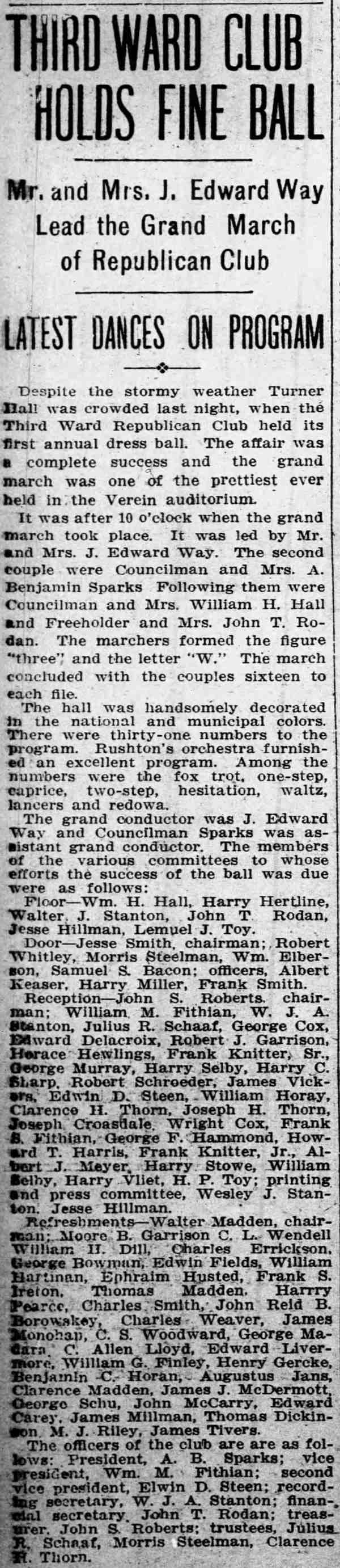
Third Ward Club Holds Fine Ball
Mr. and Mrs. J. Edward Way Lead the Grand March of Republican Club
Latest Dances on Program
Despite the stormy weather Turner Hall was crowded last night, when the Third Ward Republican Club held its first annual dress ball. The affair was a complete success and the grand march was one of the prettiest ever held in the Verein auditorium.
It was after 10 o’clock when the grand march took place. It was led by Mr. and Mrs. J. Edward Way. The second couple were Councilman and Mrs. A. Benjamin Sparks. Following them were Councilman and Mrs. William H. Hall and Freeholder and Mrs. John T. Rodan. The marchers formed the figure “three” and the letter “W.” The march concluded with the couples sixteen to each file.
The hall was handsomely decorated in the national and municipal colors. There were thirty-one numbers to the program. Rushton’s orchestra furnished an excellent program. Among the numbers were the fox trot, one-step, caprice, two-step, hesitation, waltz, lancers and redowa.
The grand conductor was J. Edward Way and Councilman Sparks was assistant grand conductor. The members of the various committees to whose efforts the success of the ball was due were as follows:
Floor—Wm. H. Hall, Harry Hertline, Walter J. Stanton, John T. Rodan, Jesse Hillman, Lemuel J. Toy.
Door—Jesse Smith, chairman; Robert Whitley, Morris Steelman, Wm. Elberson, Samuel S. Bacon; officers, Albert Keaser, Harry Miller, Frank Smith.
Reception—John S. Roberts, chairman; William M. Fithian, W. J. A. Stanton, Julius R. Schaaf, George Cox, Edward Delacroix, Robert J. Garrison, Horace Hewlings, Frank Knitter, Sr., George Murray, Harry Selby, Harry C. Sharp, Robert Schroeder, James Vickers, Edwin D. Steen, William Horay, Clarence H. Thorn, Joseph H. Thorn, Joseph Croasdale, Wright Cox, Frank S. Fithian, George F. Hammond, Howard T. Harris, Frank Knitter, Jr., Albert J. Meyer, Harry Stowe, William Selby, Harry Vliet, H. P. Toy; printing and press committee, Wesley J. Stanton, Jesse Hillman.
Refreshments—Walter Madden, chairman; Moore B. Garrison, C. L. Wendell, William H. Dill, Charles Errickson, George Bowman, Edwin Fields, William Hartman, Ephraim Husted, Frank S. Ireton, Thomas Madden, Harry Pearce, Charles Smith, John Reid B. Borowakey, Charles Weaver, James Monohan, C. S. Woodward, George Madura, C. Allen Lloyd, Edward Livermore, William G. Finley, Henry Gercke, Benjamin C. Horan, Augustus Jans, Clarence Madden, James J. McDermott, George Schu, John McCarry, Edward Carey, James Millman, Thomas Dickinson, M. J. Riley, James Tivers.
The officers of the club are are [sic] as follows: President, A. B. Sparks; vice president, Wm. M. Fithian; second vice president, Elwin D. Steen; recording secretary, W. J. A. Stanton; financial secretary, John T. Rodan; treasurer, John S. Roberts; trustees, Julius R. Schaaf, Morris Steelman, Clarence R. Thorn.
Admiral Wilson Homecoming
Philadelphia Inquirer —
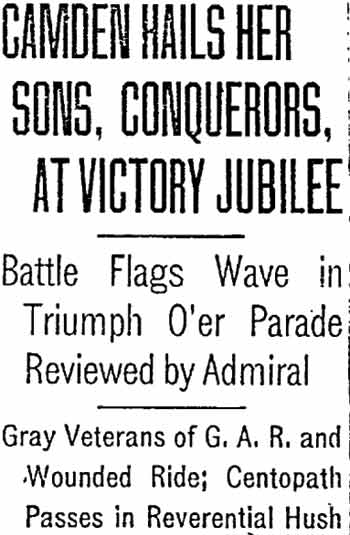
Battle Flags Wave in Triumph O’er Parade Reviewed by Admiral
Gray Veterans of G. A. R. and Wounded Ride; Centopath Passes in Reverential Hush
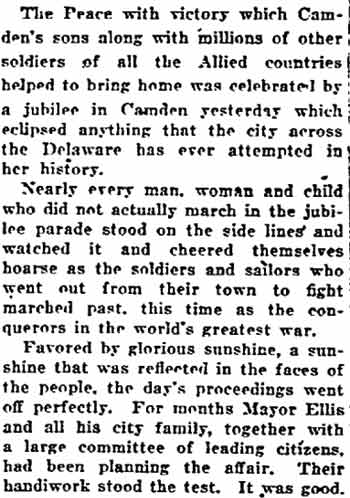
The Peace with victory which Camden’s sons along with millions of other soldiers of all the Allied countries helped to bring home was celebrated by a jubilee in Camden yesterday which eclipsed anything that the city across the Delaware has ever attempted in her history.
Nearly every man, woman and child who did not actually march in the jubilee parade stood on the side lines and watched it and cheered themselves hoarse as the soldiers and sailors who went out from their town to fight marched past, this time as the conquerors in the world’s greatest war.
Favored by glorious sunshine, a sunshine that was reflected in the faces of the people, the day’s proceedings went off perfectly. For months Mayor Ellis and all his city family, together with a large committee of leading citizens, had been planning the affair. Their handiwork stood the test. It was good.
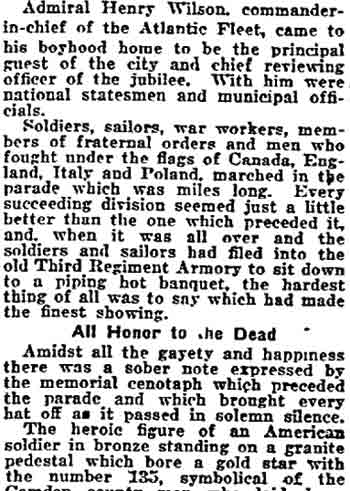
Admiral Henry Wilson, commander-in-chief of the Atlantic Fleet, came to his boyhood home to be the principal guest of the city and chief reviewing officer of the jubilee. With him were national statesmen and municipal officials.
Soldiers, sailors, war workers, members of fraternal orders and men who fought under the flags of Canada, England, Italy and Poland, marched in the parade which was miles long. Every succeeding division seemed just a little better than the one which preceded it, and, when it was all over and the soldiers and sailors had filed into the old Third Regiment Armory to sit down to a piping hot banquet, the hardest thing of all was to say which had made the finest showing.
All Honor to the Dead
Amidst all the gayety and happiness there was a sober note expressed by the memorial cenotaph which preceded the parade and which brought every hat off as it passed in solemn silence.
The heroic figure of an American soldier in bronze standing on a granite pedestal which bore a gold star with the number 135, symbolical of the Camden county men who laid down their lives in their country’s cause, was carried along the route ten minutes before the parade commenced. Encircler [sic] by flowers and palms, it moved through the reverential hush which had fallen over the throngs.
While every organization in the county of Philadelphia was represented in the parade, to the thousands who lined the sidewalks, there was really only one great big important factor—the service men. And when those self-same service men, many of whom bearing the Distinguished Service Cross of their own United States, others wearing the Croix de Guerre, bestowed on them by the sister republic of France, and still others carrying on their breasts the Italian and British War Crosses, given them by grateful countries, marched down the streets and avenues, all the pent up emotion in thousands of hearts was let loose.
It mattered not whether the men were officers or enlisted men, black or white, neat or untidy, they were all soldiers and they had done all that was asked of them. Their home town honored them. The men in blue and the women in blue, too, received a welcome not one whit less feeling than their brothers in khaki.
They had a certain advantage over the doughboys, for they put half a dozen of the prettiest and smartest yoemanettes that ever wore Uncle Sam’s uniform at the head of their division. The crowd simply had to be with them.
Canada and England, too, had a detachment of men in line. About two dozen of these veterans, half of whom wore the ribbon of the Mons Star, showing that they were in service in France in 1914, were in line, and they marched snappily and smartly and drew their full modicum of pleasurable comments.
Red Cross women, some of them grandmothers, others young girls still in their teens, marched in their snowy white uniforms with their crosses of red emblazoned on headcover and breast. Salvation Army lassies who had cooked doughnuts right up under the muzzles of the guns were there with Y. M. C. A. and Knights of Columbus workers.
Elks, Masons, Knights Templar, Red Men, Moose and scores of other fraternal organizations turned out in all their glorious trappings and regalia.
The delegation of Elks, startling in their spic and span white uniforms, marched behind their own band like squads of veterans. A foretaste of what Philadelphia will see during the coming week was given when more than 100 Knights Templar, resplendent in their uniforms and swords and cocked hats with white ostrich feathers, marched in the second division of the parade. As the formation reached the reviewing stand near the Ninth Ward Republican Association they deployed into the formation of a cross, the symbol of their order, and marched past in this formation.
Many gorgeous floats were in line, th Ninth Ward Republican Association having no less than five. All were artistic. The first was bedecked with growing flowers, while a beautiful young woman reprsenting “Peace” stood flanked by a soldier and sailor. The one following had a replica of the Liberty Bell with the inscription, “Peace on Earth, Good Will Towards men.” Two soldiers rang the bell. Behind them marched a band playing “Onward Christian Soldiers” as the men marched on. Floats symbolical of every war activity were there. The Knights of Columbus showed a replica of their famous service hut which was the doughboy’s home when he had no other.
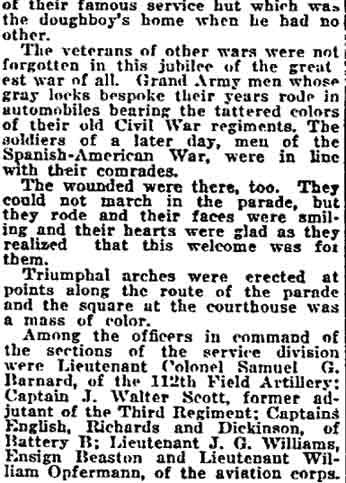
The veterans of other wars were not forgotten in this jubilee of the greatest war of all. Grand Army men whose gray locks bespoke their years rode in automobiles bearing the tattered colors of their old Civil War regiments. The soldiers of a later day, men of the Spanish-American War, were in line with their comrades.
The wounded were there, too. They could not march in the parade, but they rode and their faces were smiling and their hearts were glad as they realized that this welcome was for them.
Triumphal arches were erected at points along the route of the parade and the square at the courthouse was a mass of color.
Among the officers in command of the sections of the service division were Lieutenant Colonel Samuel G. Barnard, of the 112th Field Artillery; Captain J. Walter Scott, former adjutant of the Third Regiment; Captains English, Richards and Dickinson, of Battery B; Lieutenant J. G. Williams, Ensign Beaston and Lieutenant William Opfermann, of the aviation corps.
Battle Flags Wave Triumphant
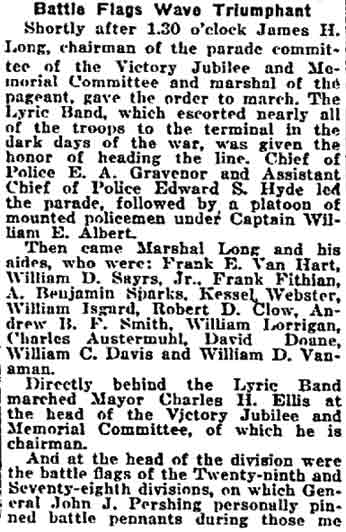
Shortly after 1.30 o’clock James H. Long, chairman of the parade committee of the Victory Jubilee and Memorial Committee and marshal of the pageant, gave the order to march. The Lyric Band, which escorted nearly all of the troops to the terminal in the dark days of the war, was given the honor of heading the line. Chief of Police E. A. Gravenor and Assistant Chief of Police Edward S. Hyde led the parade, followed by a platoon of mounted policemen under Captain William E. Albert.
Then came Marshal Long and his aides, who were: Frank E. Van Hart, William D. Sayrs, Jr., Frank Fithian, A. Benjamin Sparks, Kessel Webster, William Isgard, Robert D. Clow, Andrew B. F. Smith, William Lorrigan, Charles Austermuhl, David Doane, William C. Davis and William D. Vanaman.
Directly behind the Lyric Band marched Mayor Charles H. Ellis at the head of the Victory Jubilee and Memorial Committee, of which he is chairman.
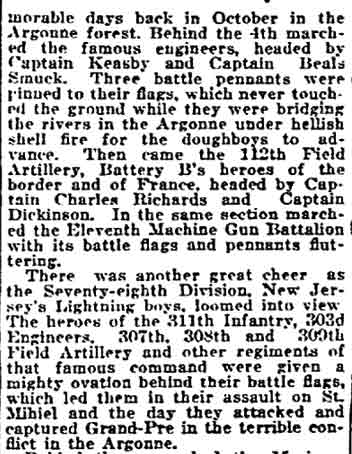
And at the head of the division were the battle flags of the Twenty-ninth and Seventy-eighth divisions, on which General John J. Pershing personally pinned battle pennants during those memorable days back in October in the Argonne forest. Behind the 4th marched the famous engineers, headed by Captain Keasby and Captain Beals Smuck. Three battle pennants were pinned to their flags, which never touched the ground while they were bridging the rivers in the Argonne under hellish shell fire for the doughboys to advance. Then came the 112th Field Artillery, Battery B’s heroes of the border and of France, headed by Captain Charles Richards and Captain Dickinson. In the same section marched the Eleventh Machine Gun Battalion with its battle flags and pennants fluttering.
There was another great cheer as the Seventy-eighth Division, New Jersey’s Lightning boys, loomed into view. The heroes of the 311th Infantry, 303d Engineers, 307th, 308th and 309th Field Artillery and other regiments of that famous command were given a mighty ovation behind their battle flags, which led them in their assault on St. Mihiel and the day they attacked and captured Grand-Pre in the terrible conflict in the Argonne.
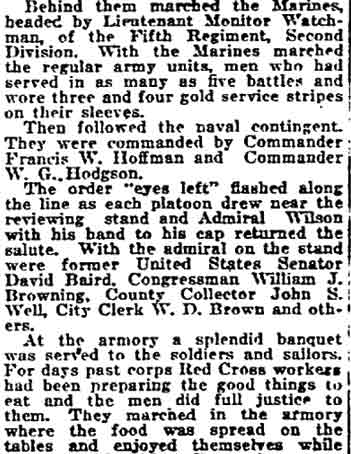
Behind them marched the Marines, headed by Lieutenant Monitor Watchman, of the Fifth Regiment, Second Division. With the Marines marched the regular army units, men who had served in as many as five battles and wore three and four gold service stripes on their sleeves.
Then followed the naval contingent. They were commanded by Commander Francis W. Hoffman and Commander W. G. Hodgson.
The order “eyes left” flashed along the line as each platoon drew near the reviewing stand and Admiral Wilson with his band to his cap returned the salute. With the admiral on the stand were former United States Senator David Baird, Congressman William J. Browning, County Collector John S. Well, City Clerk W. D. Brown and others.
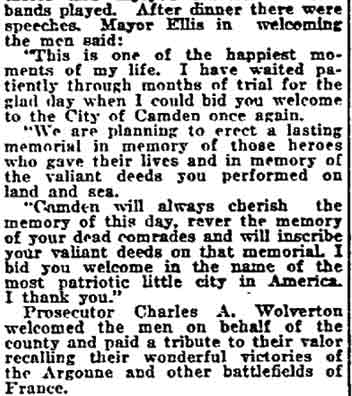
At the armory a splendid banquet was served to the soldiers and sailors. For days past corps Red Cross workers had been preparing the good things to eat and the men did full justice to them. They marched in the armory where the food was spread on the tables and enjoyed themselves while bands played. After dinner there were speeches. Mayor Ellis in welcoming the men said:
“This is one of the happiest moments of my life. I have waited patiently through months of trial for the glad day when I could bid you welcome to the City of Camden once again.
“We are planning to erect a lasting memorial in memory of those heroes who gave their lives and in memory of the valiant deeds you performed on land and sea.
“Camden will always cherish the memory of this day, rever the memory of your dead comrades and will inscribe your valiant deeds on that memorial. I bid you welcome in the name of the most patriotic little city in America. I thank you.”
Prosecutor Charles A. Wolverton welcomed the men on behalf of the county and paid a tribute to their valor recalling their wonderful victories of the Argonne and other battlefields of France.
Third Ward GOP Rally
Philadelphia Inquirer —
FRELINGHUYSEN MAJORITY SEEN IN CAMDEN COUNTY
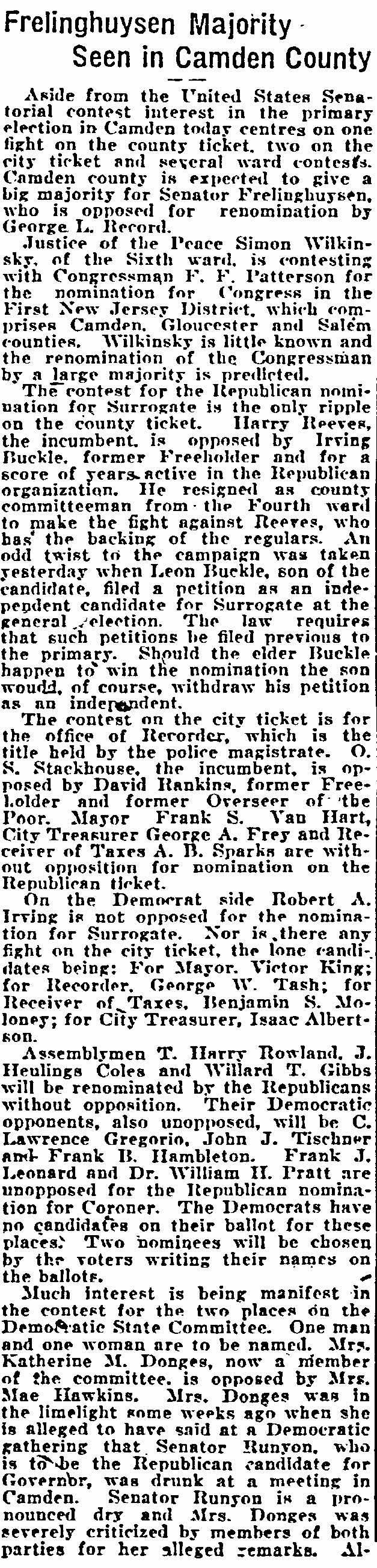
Aside from the United States Senatorial contest interest in the primary election in Camden today centres on one fight on the county ticket, two on the city ticket and several ward contests. Camden county is expected to give a big majority for Senator Frelinghuysen, who is opposed for renomination by George L. Record.
Justice of the Peace Simon Wilkinsky, of the Sixth ward, is contesting with Congressman F. F. Patterson for the nomination for Congress in the First New Jersey District, which comprises Camden, Gloucester and Salem counties. Wilkinsky is little known and the renomination of the Congressman by a large majority is predicted.
The contest for the Republican nomination for Surrogate is the only ripple on the county ticket. Harry Reeves, the incumbent, is opposed by Irving Buckle, former Freeholder and for a score of years active in the Republican organization. He resigned as county committeeman from the Fourth ward to make the fight against Reeves, who has the backing of the regulars. An odd twist to the campaign was taken yesterday when Leon Buckle, son of the candidate, filed a petition as an independent candidate for Surrogate at the general election. The law requires that such petitions be filed previous to the primary. Should the elder Buckle happen to win the nomination the son would, of course, withdraw his petition as an independent.
The contest on the city ticket is for the office of Recorder, which is the title held by the police magistrate. O. S. Stackhouse, the incumbent, is opposed by David Rankins, former Freeholder and former Overseer of the Poor. Mayor Frank S. Van Hart, City Treasurer George A. Frey and Receiver of Taxes A. B. Sparks are without opposition for nomination on the Republican ticket.
On the Democrat side Robert A. Irving is not opposed for the nomination for Surrogate. Nor is there any fight on the city ticket, the lone candidates being: For Mayor, Victor King; for Recorder, George W. Tash; for Receiver of Taxes, Benjamin S. Moloney; for City Treasurer, Isaac Albertson.
Assemblymen T. Harry Rowland, J. Heulings Coles and Willard T. Gibbs will be renominated by the Republicans without opposition. Their Democratic opponents, also unopposed, will be C. Lawrence Gregorio, John J. Tischner and Frank B. Hambleton. Frank J. Leonard and Dr. William H. Pratt are unopposed for the Republican nomination for Coroner. The Democrats have no candidates on their ballot for these places. Two nominees will be chosen by the voters writing their names on the ballots.
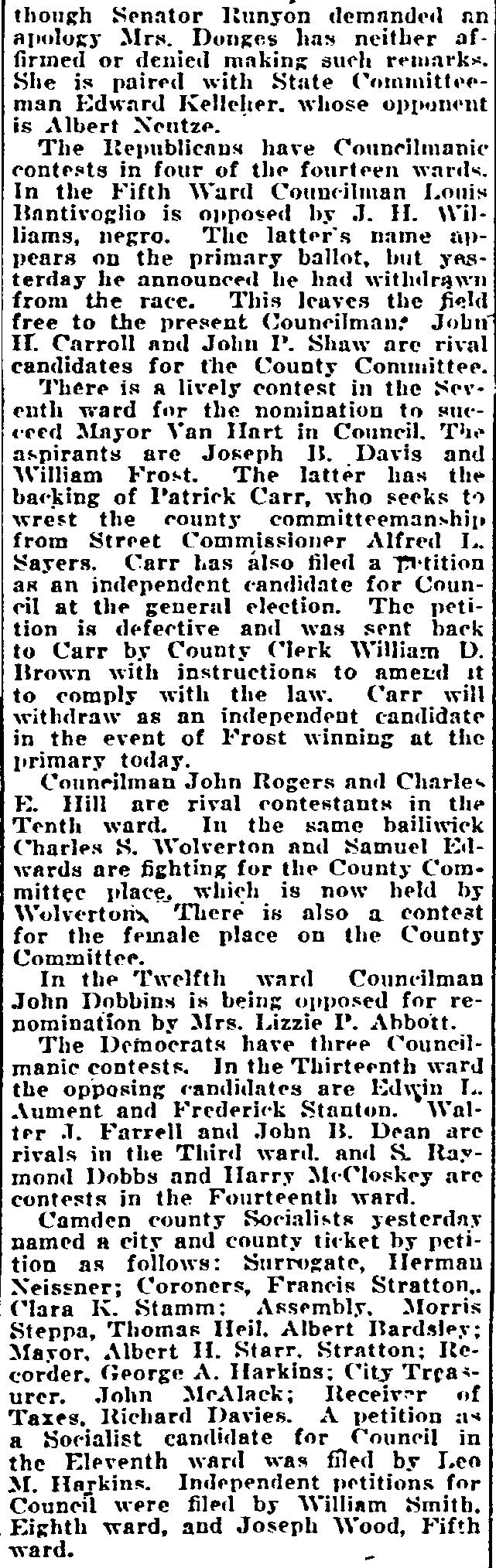
Much interest is being manifest in the contest for the two places on the Democratic State Committee. One man and one woman are to be named. Mrs. Katherine M. Donges, now a member of the committee, is opposed by Mrs. Mae Hawkins. Mrs. Donges was in the limelight some weeks ago when she is alleged to have said at a Democratic gathering that Senator Runyon, who is to be the Republican candidate for Governor, was drunk at a meeting in Camden. Senator Runyon is a pronounced dry and Mrs. Donges was severely criticized by members of both parties for her alleged remarks. …though Senator Runyon demanded an apology Mrs. Donges has neither affirmed or denied making such remarks. She is paired with State Committeeman Edward Kelleher, whose opponent is Albert Neutze.
The Republicans have Councilmanic contests in four of the fourteen wards. In the Fifth Ward Councilman Louis Bantivoglio is opposed by J. H. Williams, negro. The latter’s name appears on the primary ballot, but yesterday he announced he had withdrawn from the race. This leaves the field free to the present Councilman. John H. Carroll and John P. Shaw are rival candidates for the County Committee.
There is a lively contest in the Seventh ward for the nomination to succeed Mayor Van Hart in Council. The aspirants are Joseph B. Davis and William Frost. The latter has the backing of Patrick Carr, who seeks to wrest the county committeemanship from Street Commissioner Alfred L. Sayers. Carr has also filed a petition as an independent candidate for Council at the general election. The petition is defective and was sent back to Carr by County Clerk William D. Brown with instructions to amend it to comply with the law. Carr will withdraw as an independent candidate in the event of Frost winning at the primary today.
Councilman John Rogers and Charles E. Hill are rival contestants in the Tenth ward. In the same bailiwick Charles S. Wolverton and Samuel Edwards are fighting for the County Committee place, which is now held by Wolverton. There is also a contest for the female place on the County Committee.
In the Twelfth ward Councilman John Dobbins is being opposed for renomination by Mrs. Lizzie P. Abbott.
The Democrats have three Councilmanic contests. In the Thirteenth ward the opposing candidates are Edwin L. Aument and Frederick Stanton. Walter J. Farrell and John B. Dean are rivals in the Third ward, and S. Raymond Dobbs and Harry McCloskey are contests in the Fourteenth ward.
Camden county Socialists yesterday named a city and county ticket by petition as follows: Surrogate, Herman Neissner; Coroners, Francis Stratton, Clara K. Stamm; Assembly, Morris Steppa, Thomas Heil, Albert Bardsley; Mayor, Albert H. Starr, Stratton; Recorder, George A. Harkins; City Treasurer, John McAlack; Receiver of Taxes, Richard Davies. A petition as a Socialist candidate for Council in the Eleventh ward was filed by Leo M. Harkins. Independent petitions for Council were filed by William Smith, Eighth ward, and Joseph Wood, Fifth ward.
City Drops A.B. Sparks
Camden Courier-Post —
CITY DROPS A.B. SPARKS
Tax Sales Clerk Loses Position as Economy Program Continues to Cut Expense
Services of A. Benjamin Sparks as city tax sales clerk terminated yesterday as city officials furthered their economy program. Sparks, a former city tax receiver, re-entered the municipal service August 1, 1929, and has been in charge of tax sales.
Commissioner Harold W. Bennett, director of revenue and finance, expressing regret that economy compelled him to dispense with Sparks’ services, said that Louis Hoffman, assistant to Sparks, will be in charge of the tax sales department. Bennett commended Sparks as an able, conscientious and trustworthy employee.
Sparks served as city tax receiver under councilmanic form of government. After retirement from his municipal post, he became a cashier at the old Central Trust Company and later held a responsible position with the Broadway Merchants Trust Company.
Sparks lives at 408 Chambers Avenue.
City Tax Deadline May Be Extended
Camden Courier-Post —
CITY TAX DEADLINE MAY BE EXTENDED
Collector’s Office Swamped by Payments – Bennett Asks More Help
Because of the unprecedented rush to pay first-half taxes for 1933, Commissioner Harold W. Bennett, director of revenue and finance, may extend the deadline from 9 p.m. tonight to 9 p.m. June 7 without penalty.
The director, who has asked for more help, said it was the greatest tax rush in the history of Camden. The line of taxpayers yesterday extended past the public health offices, almost a full city block. A large volume of receipts also is coming in by mail, he said.
The commissioner said he was unable to issue figures showing total receipts to date, but said about $119,000 was paid in Saturday, half of which was in scrip.
Five cashiers’ windows are open. Three always have been sufficient to accommodate last-minute payments in previous years.
Bennett said he attributed the unprecedented rush to the fact that bills were late in being sent out, that persons wish to cash in on scrip and because citizens have been impressed by the “educational campaign” conducted by the city, impressing the importance of prompt tax payments.
A. Benjamin Sparks, former receiver of taxes; Otto E. Braun, formerly employed in the tax office, but now with the emergency relief, and men from the controller’s and assessor’s offices have been pressed into service. Bennett has asked for more from other department heads.