George Nowrey
GEORGE NOWREY was born in Glendon PA, a few miles from Easton, in 1862. His family moved to Camden when he was 11. His brother was Joseph E. Nowrey, Democratic politician from Camden who served as the city’s Mayor from 1902 to 1905. Joseph Nowrey also served as Camden County sheriff.
George and Joseph E. Nowrey appear in the City Directories for Camden in the late 1880s and early 1890s as living at 842 Locust Street in Camden. In these years George Nowrey worked as a blacksmith, while Joseph E. Nowrey is listed as a machinist. Also listed at this address is Mary Nowrey, the widow of Alexander, who had a dry goods business. It is likely that Alexander and Mary were the parents. There also appear a James G. and John Nowrey at the same address.
Joseph E. Nowrey became very active in Camden’s political life in the 1890s and 1900s. Brother George Nowrey was appointed to the Camden Police Department on August 8, 1898. He served until his retirement in June of 1937, a 39 year long career, rising to the rank of sergeant.
The 1924 Camden City Directory shows George Nowrey as a sergeant on the Camden Department, living at 1493 Princess Avenue in Parkside.
Plagued by ill-health after retirement, George Nowrey passed away at Mercer Hospital in Trenton NJ on January 21, 1938. After funeral services at St. John’s Episcopal Church in Camden, of which George Nowrey was a member from the time he came to Camden until his passing, he was buried at Harleigh Cemetery in Camden NJ. His grandson, PFC John A. Nowrey of Camden NJ, would be killed in action in 1945.
Police Appointments
Camden Daily Courier —
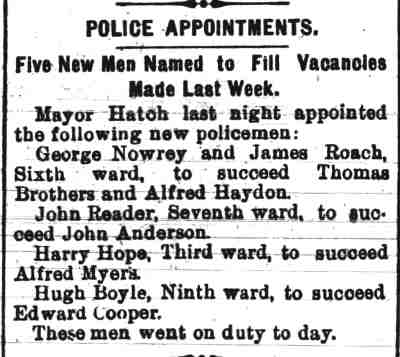
Five New Men Named to Fill Vacancies Made Last Week.
Mayor Hatch last night appointed the following new policemen:
George Nowrey and James Roach, Sixth ward, to succeed Thomas Brothers and Alfred Haydon.
John Reader, Seventh ward, to succeed John Anderson.
Harry Hope, Third ward, to succeed Alfred Myers.
Hugh Boyle, Ninth ward, to succeed Edward Cooper.
These men went on duty to day.
Camden Policemen Raid a Sunday Liquor Seller
Philadelphia Inquirer —
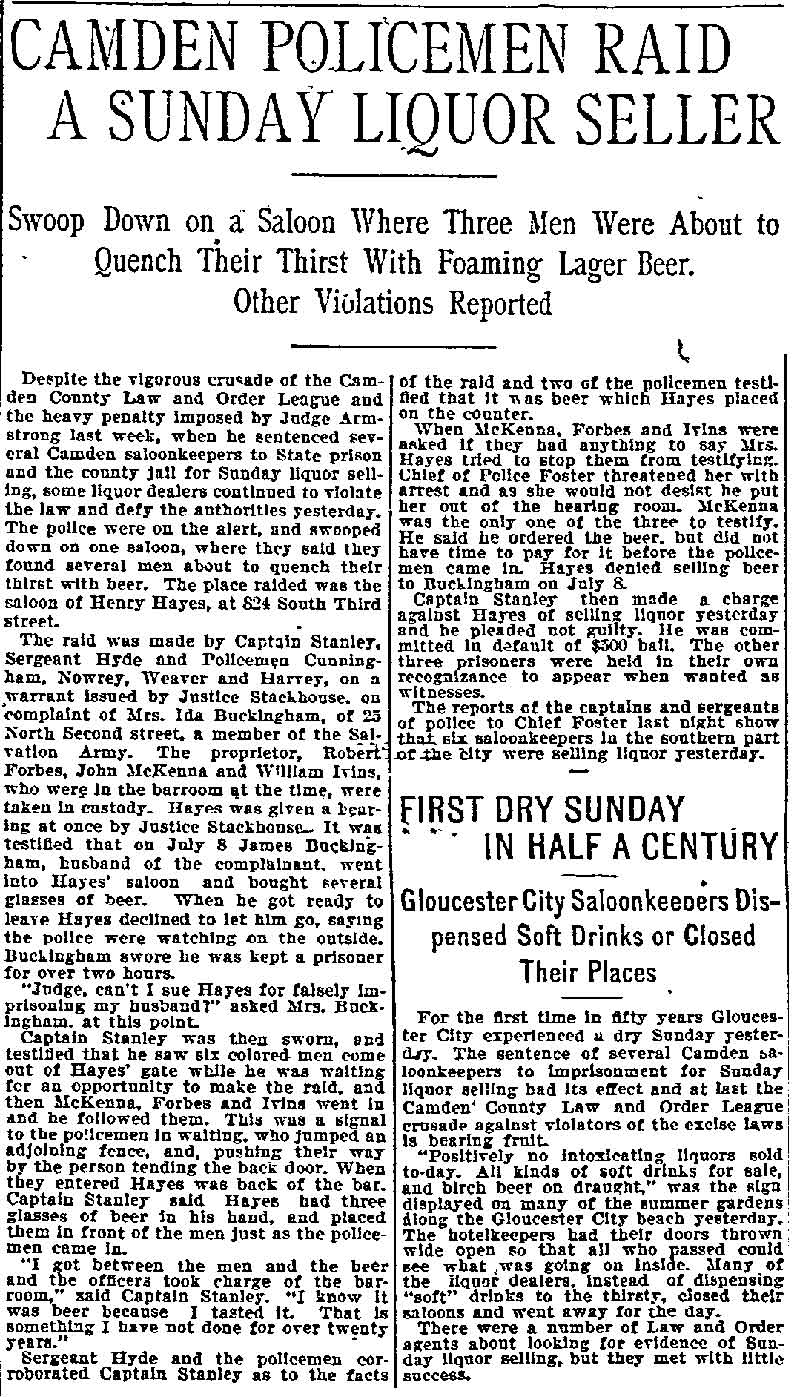
Swoop Down on a Saloon Where Three Men Were About to Quench Their Thirst With Foaming Lager Beer. Other Violations Reported
Despite the vigorous crusade of the Camden County Law and Order League and the heavy penalty imposed by Judge Armstrong last week, when he sentenced several Camden saloonkeepers to State prison and the county jail for Sunday liquor selling, some liquor dealers continued to violate the law and defy the authorities yesterday. The police were on the alert, and swooped down on one saloon, where they said they found several men about to quench their thirst with beer. The place raided was the saloon of Henry Hayes, at 824 South Third street.
The raid was made by Captain Stanley, Sergeant Hyde and Policemen Cunningham, Nowrey, Weaver and Harvey, on a warrant issued by Justice Stackhouse, on complaint of Mrs. Ida Buckingham, of 25 North Second street, a member of the Salvation Army. The proprietor, Robert Forbes, John McKenna and William Ivins, who were in the barroom at the time, were taken in custody. Hayes was given a hearing at once by Justice Stackhouse. It was testified that on July 8 James Buckingham, husband of the complainant, went into Hayes’ saloon and bought several glasses of beer. When he got ready to leave Hayes declined to let him go, saying the police were watching on the outside. Buckingham swore he was kept a prisoner for over two hours.
“Judge, can’t I sue Hayes for falsely imprisoning my husband?” asked Mrs. Buckingham, at this point.
Captain Stanley was then sworn, and testified that he saw six colored men come out of Hayes’ gate while he was waiting for an opportunity to make the raid, and then McKenna, Forbes and Ivins went in and he followed them. This was a signal to the policemen in waiting, who jumped an adjoining fence, and, pushing their way by the person tending the back door. When they entered Hayes was back of the bar. Captain Stanley said Hayes had three glasses of beer in his hand, and placed them in front of the men just as the policemen came in.
“I got between the men and the beer and the officers took charge of the barroom,” said Captain Stanley. “I know it was beer because I tasted it. That is something I have not done for over twenty years.”
Sergeant Hyde and the policemen corroborated Captain Stanley as to the facts of the raid and two of the policemen testified that it was beer which Hayes placed on the counter.
When McKenna, Forbes and Ivins were asked if they had anything to say Mrs. Hayes tried to stop them from testifying. Chief of Police Foster threatened her with arrest and as she would not desist he put her out of the hearing room. McKenna was the only one of the three to testify. He said he ordered the beer, but did not have time to pay for it before the policemen came in. Hayes denied selling beer to Buckingham on July 8.
Captain Stanley then made a charge against Hayes of selling liquor yesterday and he pleaded not guilty. He was committed in default of $500 bail. The other three prisoners were held in their own recognizance to appear when wanted as witnesses.
The reports of the captains and sergeants of police to Chief Foster last night show that six saloonkeepers in the southern part of the city were selling liquor yesterday.
First Dry Sunday in Half a Century
Gloucester City Saloonkeepers Dispensed Soft Drinks or Closed Their Places
For the first time in fifty years Gloucester City experienced a dry Sunday yesterday. The sentence of several Camden saloonkeepers to imprisonment for Sunday liquor selling had its effect and at last the Camden County Law and Order League crusade against violators of the excise laws is bearing fruit.
“Positively no intoxicating liquors sold to-day. All kinds of soft drinks for sale, and birch beer on draught,” was the sign displayed on many of the summer gardens along the Gloucester City beach yesterday. The hotelkeepers had their doors thrown wide open so that all who passed could see what was going on inside. Many of the liquor dealers, instead of dispensing “soft” drinks to the thirsty, closed their saloons and went away for the day.
There were a number of Law and Order agents about looking for evidence of Sunday liquor selling, but they met with little success.
Camden Police Form Organization
Philadelphia Inquirer —
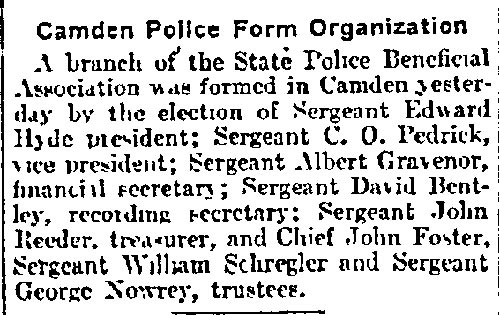
A branch of the State Police Beneficial Association was formed in Camden yesterday by the election of Sergeant Edward Hyde president; Sergeant C. O. Pedrick, vice president; Sergeant Albert Gravenor, financial secretary; Sergeant David Bentley, recording secretary; Sergeant John Reeder, treasurer, and Chief John Foster, Sergeant William Schregler and Sergeant George Nowrey, trustees.
Rush for Work Brings on Riot
Philadelphia Inquirer —
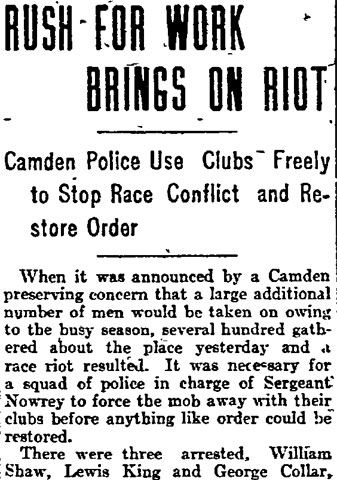
Camden Police Use Clubs Freely to Stop Race Conflict and Restore Order
When it was announced by a Camden preserving concern that a large additional number of men would be taken on owing to the busy season, several hundred gathered about the place yesterday and a race riot resulted. It was necessary for a squad of police in charge of Sergeant Nowrey to force the mob away with their clubs before anything like order could be restored. There were three arrested, William Shaw, Lewis King and George Collar, The first two were held for a further hearing by Recorder Stackhouse, while the latter was held in $300 bail for court, he being accused of drawing a revolver by George Justice, a boy.
Long before daylight there were scores of men standing about the place, and when the doors were finally opened there was one grand rush to the office. Some American born men declared that foreigners were being given the preference because they agreed to work cheaper, although this was denied by the firm.
At any rate, within a few minutes, the Americans, Italians, Poles and negroes were having a free-for-all fight. Policeman George Murray essayed to stop the disturbance single handed, but he was thrown about by the struggling throng until he was forced out. Then he called upon Sergeant Nowrey, which resulted in the squad going to his aid.
When the bluecoats arrived there were several hundred men with cobbles, revolvers, knives and clubs. Before anything like order was restored, many received bruised heads, but none received injuries of a sufficiently serious character to necessitate their removal to the hospital.
Court Dismisses Gambling Charge
Camden Post-Telegram —
Eli Johnson and Those Caught in Raid Are Freed by Recorder.
THIRTY-ONE TAKEN IN TWO DESCENTS
It was late yesterday afternoon when the hearings in the raids in two alleged disorderly houses in South Camden, made early on Sunday morning by Captain Stanley, Sergeant Nowrey and details of police, were concluded in Police Court.
In the case of Eli Johnson, colored, charged with conducting a gambling house at 307 Spruce street, Recorder Stackhouse found him not guilty and discharged the defendant and the persons captured in the raid. Lawyer William P. Walsh represented Johnson.
Daniel Bussey, a negro, was charged with being the principal at 829 Locust street, but the testimony showed that he was but one of a colored social and beneficial club which held forth at that place.
Recorder Stackhouse therefore fined Bussey and the fourteen others caught in the raid $3 each. All paid.
An amusing attempt of a negro to escape lent a touch of merriment to the descent on the Locust street house. Hearing the pattering of shoe leather on the cellar steps, Detective Painter got a lamp and descended into the dungeon-like darkness and in a far corner of the cellar, loking [sic] as if he were trying to squeeze himself through a crack in the angle of the wall, was found hiding a terrified young negro.
“Come out of that mister corner man,” said Painter shading the lamp with his hand. “What’s you doing in there”
“I didn’t run out the back way,” explained the prisoner, “because I was scared of de dawg.”
One of the negroes caught in the raid at 829 Locust street is Walter Edgerton, now aged 52 years, a former famous prize fighter known as the “Kentucky Rosebud,” who has been living in South Camden for some time. A couple of years ago Edgerton figured in a sensational case in the Philadelphia courts in his desperate but futile efforts to retain possession of a white baby whom he had adopted and on whom he lavished the finest clothing and luxuries which money could buy.
No liquor was found at either of the places raided. In fact it was not alleged that they were speak-easies but gambling houses. No gaming paraphernalia was found at 307 Spruce street.
At 829 Locust street, the police copped a crap table and four big bloodhued bones. Captain Stanley resurrected the cubes from the depths of a coal basket in the second-story front room where they had been shoved and shuffled up when the police were heard approaching.
Police Shake-up in Camden
Philadelphia Inquirer —
There was a general change in Camden’s Police Department yesterday occasioned by the retirement of Captain Arthur Stanley after nearly twenty years of service. He was succeeded as captain by Sergeant Lewis Stehr, who takes charge of the Second district. Sergeant George Nowrey was transferred from the Third to the Second district and Patrolman George Anderson made a sergeant in the Third district. Policeman Fred Lechleidner was made a jailor and Harry A. Corson, of the Sixth ward, was made a patrolman by Mayor Ellis.
Nowrey Back From Hospital
Camden Courier-Post —
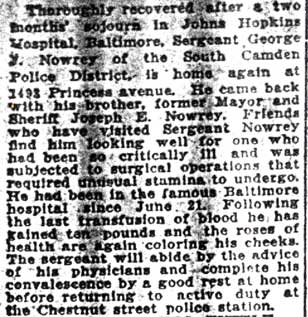
Sergeant Said to Have Thoroughly Recovered from Operation for Abscess
Thoroughly recovered after a two months’ sojourn in Johns Hopkins Hospital, Baltimore, Sergeant George Nowrey of the South Camden Police District is home again at 1493 Princess avenue. He came back with his brother, former Mayor and Sheriff Joseph E. Nowrey. Friends who have visited Sergeant Nowrey find him looking well for one who had been so critically ill and was subjected to surgical operations that required unusual stamina to undergo. He had been in the famous Baltimore hospital since June 21. Following the last transfusion of blood he has gained ten pounds and the roses of health are again coloring his cheeks.
The sergeant will abide by the advice of his physicians and complete his convalescence by a good rest at home before returning to active duty at the Chestnut street police station.
Funeral for Stehr to Be Held Saturday
Camden Evening Courier —
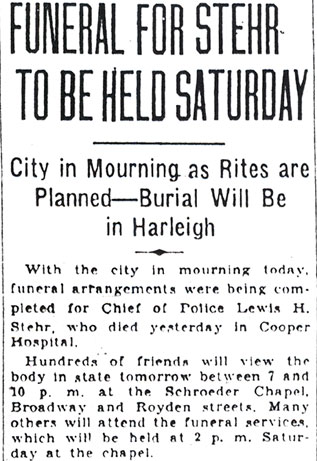
FUNERAL FOR STEHR TO BE HELD SATURDAY
City in Mourning as Rites are Planned—Burial Will Be in Harleigh
With the city in mourning today, funeral arrangements were being completed for Chief of Police Lewis H. Stehr, who died yesterday in Cooper Hospital. Hundreds of friends will view the body in state tomorrow between 7 and 10 p. m. at the Schroeder Chapel, Broadway and Royden streets. Many others will attend the funeral services, which will be held at 2 p. m. Saturday at the chapel.
Burial will be in Harleigh Cemetery.
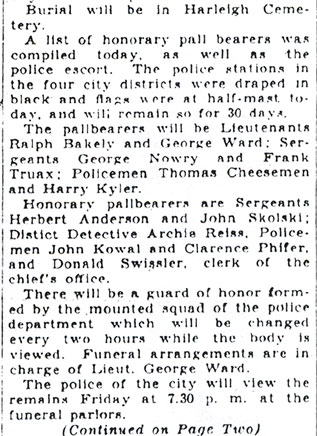
A list of honorary pall bearers was compiled today, as well as the police escort. The police stations in the four city districts were draped in black and flags were at half-mast today, and will remain so for 30 days.
The pallbearers will be Lieutenants Ralph Bakely and George Ward; Sergeants George Nowry and Frank Truax; Policemen Thomas Cheeseman and Harry Kyler.
Honorary pallbearers are Sergeants Herbert Anderson and John Skolski; District Detective Archie Reiss, Policemen John Kowal and Clarence Phifer, and Donald Swissler, clerk of the chief’s office.
There will be a guard of honor formed by the mounted squad of the police department which will be changed every two hours while the body is viewed. Funeral arrangements are in charge of Lieut. George Ward.
The police of the city will view the remains Friday at 7.30 p. m. at the funeral parlors.
(Continued on Page Two)
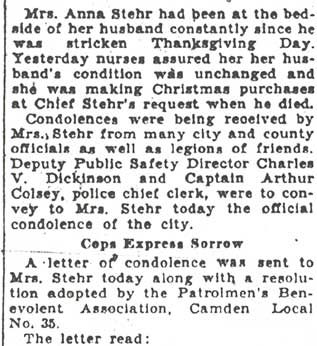
Mrs. Anna Stehr had been at the bedside of her husband constantly since he was stricken Thanksgiving Day. Yesterday nurses assured her her husband’s condition was unchanged and she was making Christmas purchases at Chief Stehr’s request when he died. Condolences were being received by Mrs. Stehr from many city and county officials as well as legions of friends. Deputy Public Safety Director Charles V. Dickinson and Captain Arthur Colsey, police chief clerk, were to convey to Mrs. Stehr today the official condolence of the city.
Cops Express Sorrow
A letter of condolence was sent to Mrs. Stehr today along with a resolution adopted by the Patrolmen’s Benevolent Association, Camden Local No. 35. The letter read:
“It is with heartfelt regret and with deepest sympathy that we offer condolences to you in this hour of bereavement. The sudden action of the Almighty in plucking this noble man from our midst has overwhelmed us with sorrow and regret that words alone cannot express. This, however, being the desire of the Lord, we feel that the benevolent performance of our beloved chief so ably executed upon this humble earth, will be amply rewarded in a celestial sphere not made by man.
“We sincerely trust, we, his brothers and friends, have lessened your grief in this, our expression, of what your faithful husband has meant to us, the members of the P. B. A. as well as yourself.
“Respectfully yours, “CLIFFORD A. FLENNARD, “President.”
The resolution declares: “Whereas this local feels that it has sustained a severe loss in the passing of its greatest force for good, and “Whereas we deeply deplore his passing, “Be it resolved that it is the unanimous opinion of the membership of this organization that the death of Lewis H. Stehr, chief of police of the City of Camden, N. J., has caused great sorrow among us. His good deeds in life might well cause one to write a never-ending stream of eulogies but in this case we wish to call him and always think of him as a friend, a word that is applied to him whole-heartedly and in the fullest sense of the word. It is impossible to express to what extent we shall miss him but we shall always and forever remember Chief Stehr as a friend whose place made vacant by death will be very difficult to fill.
“Be it further resolved that Camden Local, No. 35, P. B. A., also wishes to extend its sympathies to Mrs. Stehr and to offer whatever assistance possible at this time of her bereavement and at any other time this organization may find it in its power to do so.
“Be it further resolved that we also extend our sympathies to his relatives and friends who are no doubt feeling his passing as deeply as we do so.”
Copies of the resolution were sent to Director of Public Safety David S. Rhone, Mrs. Stehr and the press. The resolution was passed at the regular meeting of the local yesterday. The resolution was signed by Flennard, the president, and Joseph Keefe, the secretary.
Chief George W. Black, secretary of the International Chief of Police Association, sent his regrets and letter of condolence to Captain Arthur Colsey and asking that a floral design be sent to the funeral at the association’s expense.
Mayor Expresses Sorrow
Mayor Price issued the following statement: “I was very greatly shocked to learn of the death of Chief Stehr. While I understood he was in a serious physical condition, I did not anticipate his death.
“Chief Stehr had devoted practically his entire lifetime to the service of the city, having entered the police department in his early youth, and is entitled to the commendation of his fellow citizens for his efforts in the public service.”
Commissioner Frank B. Hanna, when apprised of the police chief’s death, said: “The news of Chief Stehr’s death was a terrible shock. I feel a personal loss, as we were close friends. I knew him since I was a young boy, and our contacts in the past two years were most pleasant.”
Prosecutor Clifford A. Baldwin declared: “The suddenness of the death of Chief Stehr comes as a shock to those of his friends who were wishing him well in his illness. His passing naturally causes grief to those whose work brought them into close contact with him.”
City Commissioner Clay W. Reesman said: “The passing of Chief Stehr is a great loss to the community. We were all hoping that Chief Stehr was on the road to recovery and only several days ago when I inquired at the hospital, I learned that his condition was greatly improved. His sudden passing is a terrible shock.”
It is with heartfelt regret and with deepest sympathy that we offer condolences to you in this hour of bereavement. The sudden action of the Almighty in plucking this noble man from our midst has overwhelmed us with sorrow and regret that words alone cannot express. This, however, being the desire of the Lord, we feel that the benevolent performance of our beloved chief so ably executed upon this humble earth, will be amply rewarded in a celestial sphere not made by man.
“We sincerely trust, we, his brothers and friends, have lessened your grief in this, our expression, of what your faithful husband has meant to us, the members of the P. B. A. as well as yourself.
“Respectfully yours, “CLIFFORD A. FLENNARD, “President.
The resolution declares: “Whereas this local feels that it has sustained a severe loss in the passing of its greatest force for good, and “Whereas we deeply deplore his passing, “Be it resolved that it is the unanimous opinion of the membership of this organization that the death of Lewis H. Stehr, chief of police of the City of Camden, N. J., has caused great sorrow among us. His good deeds in life might well cause one to write a never-ending stream of eulogies but in this case we wish to call him and always think of him as a friend, a word that is applied to him whole-heartedly and in the fullest sense of the word. It is impossible to express to what extent we shall miss him but we shall always and forever remember Chief Stehr as a friend whose place made vacant by death will be very difficult to fill.
“Be it further resolved that Camden Local, No. 35, P. B. A., also wishes to extend its sympathies to Mrs. Stehr and to offer whatever assistance possible at this time of her bereavement and at any other time this organization may find it in its power to do so.
“Be it also resolved that we also extend our sympathies to his relatives and friends who are no doubt feeling his passing as deeply as we do so.”
Copies of the resolution were sent to Director of Public Safety David S. Rhone, Mrs. Stehr and the press. The resolution was passed at the regular meeting of the local yesterday. The resolution was signed by Flennard, the president, and Joseph Keefe, the secretary.
Chief George W. Black, secretary of the International Chief of Police Association, sent his regrets and letter of condolence to Captain Arthur Colsey and asking that a floral design be sent to the funeral at the association’s expense.
Mayor Expresses Sorrow
Mayor Price issued the following statement: “I was very greatly shocked to learn of the death of Chief Stehr. While I understood he was in a serious physical condition, I did not anticipate his death.
“Chief Stehr had devoted practically his entire lifetime to the service of the city, having entered the police department in his early youth, and is entitled to the commendation of his fellow citizens for his efforts in the public service.”
Commissioner Frank B. Hanna, when apprised of the police chief’s death, said: “The news of Chief Stehr’s death was a terrible shock. I feel a personal loss, as we were close friends. I knew him since I was a young boy, and our contacts in the past two years were most pleasant.”
Prosecutor Clifford A. Baldwin declared: “The suddenness of the death of Chief Stehr comes as a shock to those of his friends who were wishing him well in his illness. His passing naturally causes grief to those whose work brought them into close contact with him.”
City Commissioner Clay W. Reesman said: “The passing of Chief Stehr is a great loss to the community. We were all hoping that Chief Stehr was on the road to recovery and only several days ago when I inquired at the hospital, I learned that his condition was greatly improved. His sudden passing is a terrible shock.”
Pallbearers Named for Stehr Funeral
Camden Morning Post —
Body Will Lie in State Tonight—Burial Tomorrow Afternoon
Funeral arrangements were completed yesterday for Chief of Police Lewis H. Stehr, who died Wednesday in Cooper Hospital following a heart attack.
The body will lie in state tonight between 7 and 10 p. m. at the Schroeder Chapel, Broadway and Royden streets. The funeral services will be held at 2 p. m. Saturday at the chapel. Thousands of friends are expected to view the remains.
Burial will be in Harleigh cemetery.
A police escort and a list of honorary pallbearers was compiled yesterday. All police buildings in the city were draped in black and flags over municipal buildings were at half-mast and will remain so for 30 days.
The active pallbearers will be Lieuts. Ralph Bakely and George Ward, Sergts. George Nowry and Frank Truax, Policemen Thomas Cheeseman and Harry Kyler.
Honorary pallbearers are Lieut. Herbert Anderson, Sergt. John Skolski, District Detective Archie Reiss, Policemen John Kowal and Clarence Phifer and Donald Swissler, clerk of the chief’s office.
There will be a guard of honor formed by the members of the mounted squad. A fire truck will convey the flowers to the cemetery.
The police of the city will view the body at 7:30 p. m. tonight at the funeral parlors.
Members of the Sixth Ward Republican Club, of which Chief Stehr was an active member, will assemble at their headquarters at 7 p. m. and march to the funeral parlors. They will be led by John J. Breslin, president of the club.
Rev. Edward Weeks, pastor of the Union M. E. Church, Fifth and Mt. Vernon streets, will conduct the services.
Sgt. Nowrey Dies, Retired Policeman
Camden Courier-Post —
Veteran Officer, 75, Left Service Last June After 39 Years on Force
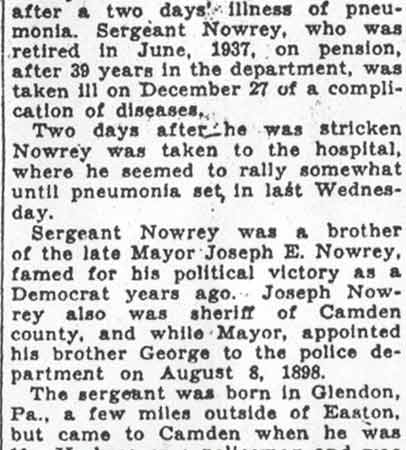
Former Police Sergeant George Nowrey, 75, retired members of the Camden police department, died yesterday in Mercer Hospital, Trenton, after a two days’ illness of pneumonia. Sergeant Nowrey, who was retired in June, 1937, on pension, after 39 years in the department, was taken ill on December 27 of a complication of diseases.
Two days after he was stricken Nowrey was taken to the hospital, where he seemed to rally somewhat until pneumonia set in last Wednesday.
Sergeant Nowrey was a brother of the late Mayor Joseph E. Nowrey, famed for his political victory as a Democrat years ago. Joseph Nowrey also was sheriff of Camden county, and while Mayor, appointed his brother George to the police department on August 8, 1898.
The sergeant was born in Glendon, Pa., a few miles outside of Easton, but came to Camden when he was 11. He became a policeman and was later promoted to sergeant.
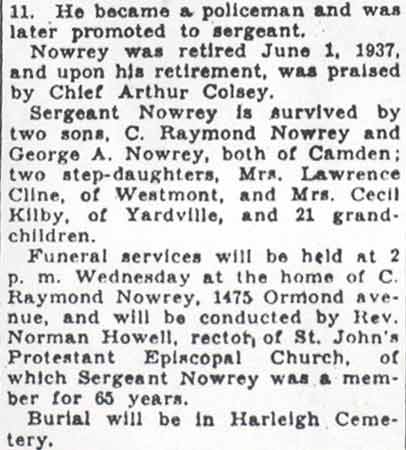
Nowrey was retired June 1, 1937, and upon his retirement, was praised by Chief Arthur Colsey.
Sergeant Nowrey is survived by two sons, C. Raymond Nowrey and George A. Nowrey, both of Camden; two step-daughters, Mrs. Lawrence Cline, of Westmont, and Mrs. Cecil Kilby, of Yardville, and 21 grandchildren.
Funeral services will be held at 2 p. m. Wednesday at the home of C. Raymond Nowrey, 1475 Ormond avenue, and will be conducted by Rev. Norman Howell, rector of St. John’s Protestant Episcopal Church, of which Sergeant Nowrey was a member for 65 years. Burial will be in Harleigh Cemetery.
Police Shakeups of Today Mild Compared to Years Ago
Camden Courier-Post —
Force Changed Every Time Political Regime of City Shifted; Larry Doran Fired for Crossing Street to Get Cinnamon Bun; Old Patrol Recalled
By BEN COURTER
(Another in a series of articles on municipal affairs and personalities of yesteryear.)
Ben Courter
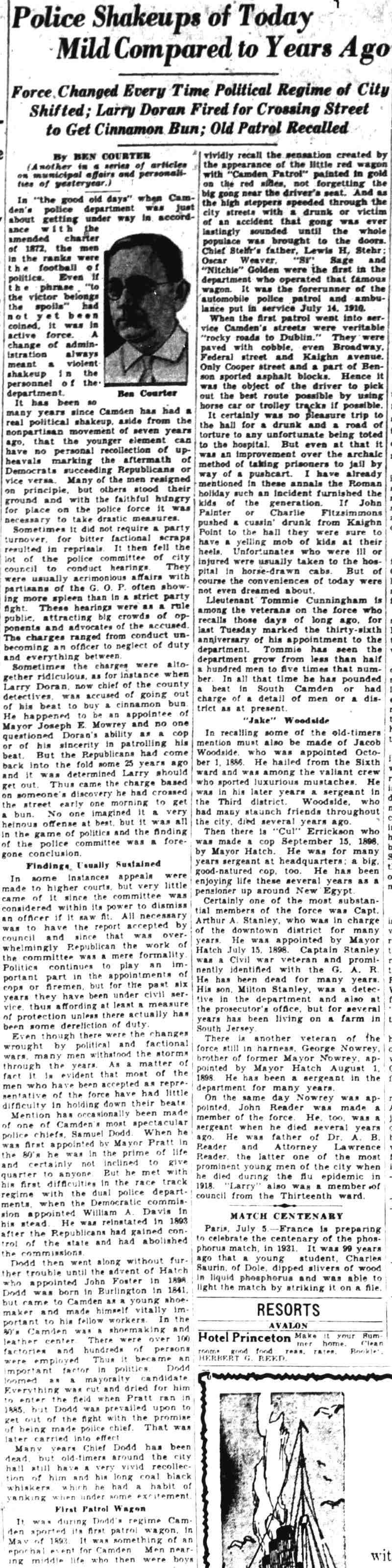
In “the good old days” when Camden’s police department was just about getting under way in accordance with the amended charter of 1872, the men in the ranks were the football of politics. Even if the phrase “to the victor belongs the spoils” had not yet been coined, it was in active force. A change of administration always meant a violent shakeup in the personnel of the department.
It has been so many years since Camden has had a real political shakeup, aside from the nonpartisan movement of seven years ago, that the younger element can have no personal recollection of upheavals marking the aftermath of Democrats succeeding Republicans or vice versa. Many of the men resigned on principle, but others stood their ground and with the faithful hungry for place on the police force it was necessary to take drastic measures.
Sometimes it did not require a party turnover, for bitter factional scraps resulted in reprisals. It then fell the lot of the police committee of city council to conduct hearings. They were usually acrimonious affairs with partisans of the G. O. P. often showing more spleen than in a strict party fight. These hearings were as a rule public, attracting big crowds of opponents and advocates of the accused. The charges ranged from conduct unbecoming an officer to neglect of duty and everything between.
Sometimes the charges were altogether ridiculous, as for instance when Larry Doran, now chief of the county detectives, was accused of going out of his beat to buy a cinnamon bun. He happened to be an appointee of Mayor Joseph E. Mowrey and no one questioned Doran’s ability as a cop or of his sincerity in patrolling his beat. But the Republicans had come back into the fold some 25 years ago and it was determined Larry should get out. Thus came the charge based on someone’s discovery he had crossed the street early one morning to get a bun. No one imagined it a very heinous offense at best, but it was all in the game of politics and the finding of the police committee was a foregone conclusion.
Findings, Usually Sustained
In some instances appeals were made to higher courts, but very little came of it since the committee was considered within its power to dismiss an officer if it saw fit. All necessary was to have the report accepted by council and since that was overwhelmingly Republican the work of the committee was a mere formality. Politics continues to play an important part in the appointments of cops or firemen, but for the past six years they have been under civil service, thus affording at least a measure of protection unless there actually has been some dereliction of duty.
Even though there were the changes wrought by political and factional wars, many men withstood the storms through the years. As a matter of fact it is evident that most of the men who have been accepted as representative of the force have had little difficulty in holding down their beats.
Mention has occasionally been made of one of Camden’s most spectacular police chiefs, Samuel Dodd. When he was first appointed by Mayor Pratt in the 80’s he was in the prime of life and certainly not inclined to give quarter to anyone. But he met with his first difficulties in the race track regime with the dual police departments, when the Democratic commission appointed William A. Davis in his stead. He was reinstated in 1893 after the Republicans had gained control of the state and had abolished the commissions.
Dodd then went along without further trouble until the advent of Hatch who appointed John Foster in 1898. Dodd was born in Burlington in 1841, but came to Camden as a young shoemaker and made himself vitally important to his fellow workers. In the 80’s Camden was a shoemaking and leather center. There were over 100 factories and hundreds of persons were employed. Thus it became an important factor in politics. Dodd loomed as a mayoralty candidate. Everything was cut and dried for him to enter the field when Pratt ran in 1885, but Dodd was prevailed upon to get out of the fight with the promise of being made police chief. That was later carried into effect.
Many years Chief Dodd has been dead, but old-timers around the city hall still have a very vivid recollection of him and his long coal black whiskers, which he had a habit of yanking when under some excitement.
First Patrol Wagon
It was during Dodd’s regime Camden sported its first patrol wagon, in May of 1893. It was something of an epochal event for Camden. Men nearing middle life who then were boys vividly recall the sensation created by the appearance of the little red wagon with “Camden Patrol” painted in gold on the red sides, not forgetting the big gong near the driver’s seat. And as the high steppers speeded through the city streets with a drunk or victim of an accident that gong was everlastingly sounded until the whole populace was brought to the doors. Chief Stehr’s father, Lewis H. Stehr; Oscar Weaver, “Si” Sage and “Nitchie” Golden were the first in the department who operated that famous wagon. It was the forerunner of the automobile police patrol and ambulance put in service July 14, 19[?].
When the first patrol went into service Camden’s streets were veritable “rocky roads to Dublin.” They were paved with cobble, even Broadway, Federal street and Kaighn avenue. Only Cooper street and a part of Benson sported asphalt blocks. Hence it was the object of the driver to pick out the best route possible by using horse car or trolley tracks if possible.
It certainly was no pleasure trip to the hall for a drunk and a road of torture to any unfortunate being toted to the hospital. But even at that it was an improvement over the archaic method of taking prisoners to jail by way of a pushcart. I have already mentioned in these annals the Roman holiday such an incident furnished the kids of the generation. If John Painter or Charlie Fitzsimmons pushed a cussin’ drunk from Kaighn Point to the hall they were sure to have a yelling mob of kids at their heels. Unfortunates who were ill or injured were usually taken to the hospital in horse-drawn cabs. But of course the conveniences of today were not even dreamed about.
Lieutenant Tommie Cunningham is among the veterans on the force who recalls those days of long ago, for last Tuesday marked the thirty-sixth anniversary of his appointment to the department. Tommie has seen the department grow from less than half a hundred men to five times that number. In all that time he has pounded a beat in South Camden or had charge of a detail of men or a district as at present.
“Jake” Woodside
In recalling some of the old-timers mention must also be made of Jacob Woodside, who was appointed October 1, 1898. He hailed from the Sixth ward and was among the valiant crew who sported luxurious mustaches. He was in his later years a sergeant in the Third district. Woodside, who had many staunch friends throughout the city, died several years ago.
Then there is “Cul” Errickson who was made a cop September 15, 1898, by Mayor Hatch. He was for many years sergeant at headquarters; a big, good-natured cop, too. He has been enjoying life these several years as a pensioner up around New Egypt.
Certainly one of the most substantial members of the force was Capt. Arthur A. Stanley, who was in charge of the downtown district for many years. He was appointed by Mayor Hatch July 15, 1898. Captain Stanley was a Civil war veteran and prominently identified with the G. A. R. He has been dead for many years. His son, Milton Stanley, was a detective in the department and also at the prosecutor’s office, but for several years has been living on a farm in South Jersey.
There is another veteran of the force still in harness, George Nowrey, brother of former Mayor Nowrey, appointed by Mayor Hatch August 1, 1898. He has been a sergeant in the department for many years.
On the same day Nowrey was appointed, John Reader was made a member of the force. He, too, was a sergeant when he died several years ago. He was father of Dr. A. B. Reader and Attorney Lawrence Reader, the latter one of the most prominent young men of the city when he died during the flu epidemic in 1918. “Larry” also was a member of council from the Thirteenth ward.