William T. Boyle
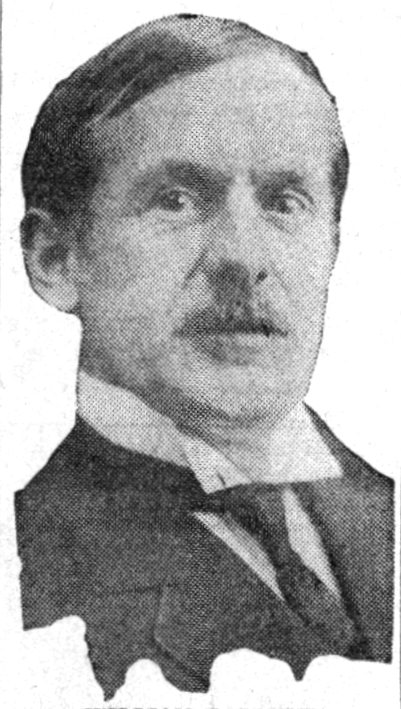
William T. Boyle
WILLIAM T. BOYLE practiced law in and around Camden from the 1890s through the late 1940s. He served as a judge from 1912 to 1917 and was president of the New Jersey Bar Association in 1932–1933. He was a director of the First Camden National Bank & Trust Company, and was active in Catholic church affairs and the Rotary organization.
The Camden County Bar Association at one time had an award known as the William T. Boyle Award for Distinguished Community Service. One awardee was Camden business owner William J. Myles.
William T. Boyle passed away after a long illness in September of 1951 and was buried in Calvary Cemetery in what was then Delaware Township (present-day Cherry Hill), New Jersey. His wife, Emma W. Boyle, had died the previous year.
Two Camden Women Were Refused Divorces
Camden Post-Telegram —
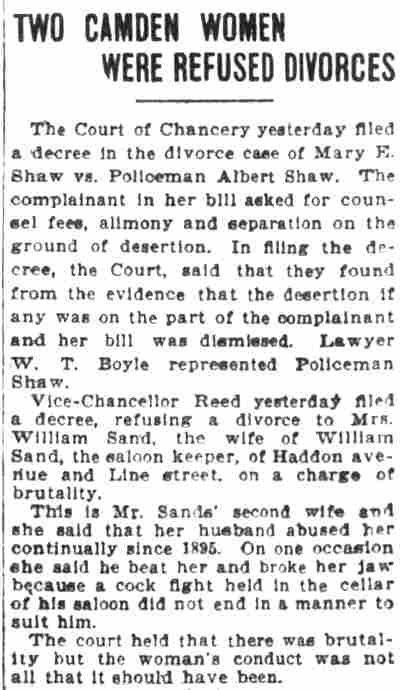
The Court of Chancery yesterday filed a decree in the divorce case of Mary E. Shaw vs. Policeman Albert Shaw. The complainant in her bill asked for counsel fees, alimony and separation on the ground of desertion. In filing the decree, the Court, said that they found from the evidence that the desertion if any was on the part of the complainant and her bill was dismissed. Lawyer W. T. Boyle represented Policeman Shaw.
Vice-Chancellor Reed yesterday filed a decree, refusing a divorce to Mrs. William Sand, the wife of William Sand, the saloon keeper, of Haddon avenue and Line street, on a charge of brutality. This is Mr. Sand’s second wife and she said that her husband abused her continually since 1895. On one occasion she said he beat her and broke her jaw because a cock fight held in the cellar of his saloon did not end in a manner to suit him. The court held that there was brutality but the woman’s conduct was not all that it should have been.
Philadelphia Inquirer — November 23, 1910

Rumor has it that Lawyer William T. Boyle has excellent chances of being made Judge of the Court of Common Pleas when the term of Judge Joline expires in a little over a year.
Columbus Day in Camden
Philadelphia Inquirer —
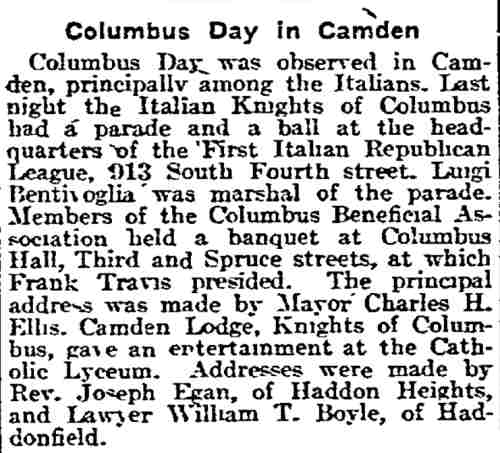
Columbus Day was observed in Camden, principally among the Italians. Last night the Italian Knights of Columbus had a parade and a ball at the headquarters of the First Italian Republican League, 913 South Fourth street. Luigi Bentivoglia was marshal of the parade. Members of the Columbus Beneficial Association held a banquet at Columbus Hall, Third and Spruce streets, at which Frank Travis presided. The principal address was made by Mayor Charles H. Ellis. Camden Lodge, Knights of Columbus, gave an entertainment at the Catholic Lyceum. Addresses were made by Rev. Joseph Egan, of Haddon Heights, and Lawyer William T. Boyle, of Haddonfield.
Some Shifts in Camden
Philadelphia Inquirer —
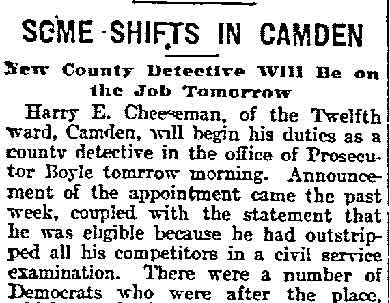
Harry E. Cheeseman, of the Twelfth ward, Camden, will begin his duties as a county detective in the office of Prosecutor Boyle tomorrow morning. Announcement of the appointment came the past week, coupled with the statement that he was eligible because he had outstripped all his competitors in a civil service examination. There were a number of Democrats who were after the place, which was held by Marcus N. Carroll, who resigned shortly after the appointment of Prosecutor Boyle.
It was also rumored yesterday that when Judge French assumes charge of the District Court on April 1 he will have Frank X. Devereaux, of the Sixth ward, as his sergeant-at-arms, a position which Fred Voight has held for several years. Voight is a stalwart Republican and will not remain in the position. Devereaux has been prominently mentioned in connection with the coming appointment to fill the vacancy in the County Board of Taxation. It is likely that William Schmid will get that plum, however.
New Judge Sworn In
Philadelphia Inquirer —
With many of his professional friends as witnesses, Judge Howard Carrow was sworn in as presiding officer of the Camden Court of Common Pleas yesterday. The formal ceremony took place at the Court House, the oath being administered by County Clerk Patterson.
Representing the County Bar Association, Lawyer William J. Kraft, former law partner of the judge, gave a brief address of felicitation, to which Judge Carrow responded. Prosecutor Boyle was the first to offer congratulations and he also arranged for Judge Carrow’s first session of court, which will take place Thursday. One of the pleasing features of the occasion was the presence of nearly a dozen former law students of Judge Carrow, many of whom have become prominently identified with the bar.
Baby Suffocated, Mother Held
Philadelphia Inquirer —
Prosecutor Boyle, in Camden last night, stated he had decided to hold Mrs. Eva Zark, of 717 Ringgold street, whose infant daughter was found dead beside her, until she can be examined as to her sanity. Both County Physician Jones and Coroner Saunders, who viewed the body of the infant, concluded the body had been suffocated while lying in bed.
Murder Cases on in Camden Court
Philadelphia Inquirer —
Prosecutor and His Assistant Will Be Kept Busy at This Term of Court
Beginning with tomorrow, Prosecutor Boyle and his assistant, Charles A. Wolverton, will have their hands filled with murder trials. There are four cases of murder on the calendar, and also several other serious criminal matters.
The first case to be tried will probably be that of Charles G. Garrison, who is charged with the murder of his wife in March. Howard Carrow will preside at this trial and Roland Evans, of Philadelphia, will be one of the attorneys for the defense.
Herbert Drake, William Harris, William Gradwell, Georgianna Gilliland, Robert Green, Stefano Torcesso, Nunzio Imperato, Charles Ford, and Effie Wagner are among the witnesses.
Philadelphia Inquirer — June 15, 1912
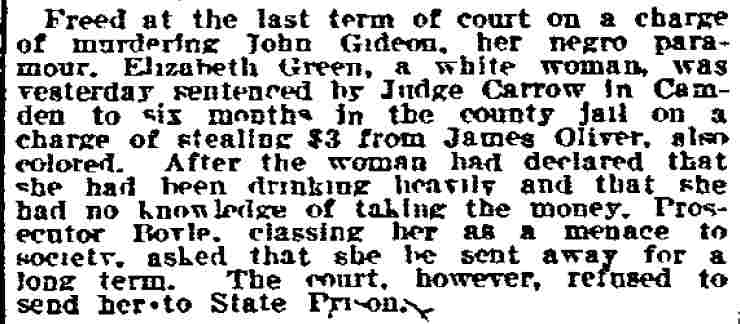
Freed at the last term of court on a charge of murdering John Gideon, her negro paramour, Elizabeth Green, a white woman, was yesterday sentenced by Judge Carrow in Camden to six months in the county jail on a charge of stealing $3 from James Oliver, also colored. After the woman had declared that she had been drinking heavily and that she had no knowledge of taking the money, Prosecutor Boyle, classing her as a menace to society, asked that she be sent away for a long term. The court, however, refused to send her to State Prison.
Camden’s Court Docket Is Brief
Philadelphia Inquirer —
Smallest Number of Cases in Years for Session Opening Tuesday
In the various courts which will open for the September term in Camden on Tuesday, the respective lists of cases are shown to be exceptionally brief. This not only includes the Supreme Court, where there were but seventy issues scheduled, but also the Circuit Court, Common Pleas and the Criminal Courts. As a result most of the civil business will have been completed in a few weeks’ sitting by the judges.
As to the new grand jury which will be summoned and sworn in before Supreme Court Justice Garrison, there will be presented by Prosecutor Boyle the smallest number of cases in a number of years. Where it has been customary to have at least four or five hundred such issues, there are a little over two hundred and most of them are of such comparatively trifling import that they will not reach court for trial. This is due largely to the holding of special sessions throughout the summer, which has had a tendency to keep the calendar clean.
Boy’s Brutal Murderer Collapses at Hearing
Camden Post-Telegram —
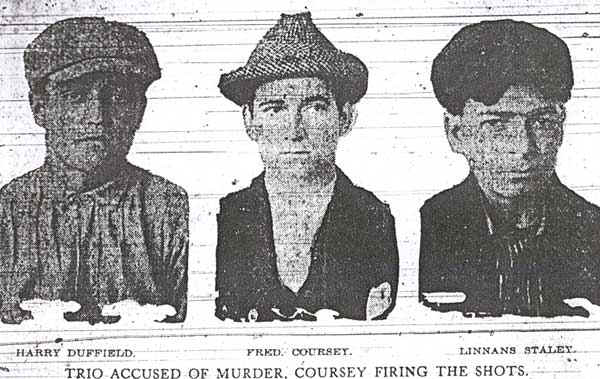
Trio Accused of Murder. Coursey Firing the Shots.
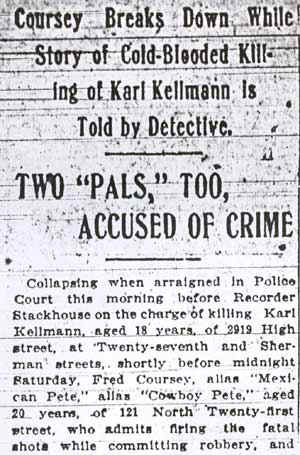
Coursey Breaks Down While Story of Cold-Blooded Killing of Karl Kellmann Is Told by Detective.
Two “Pals,” Too, Accused of Crime
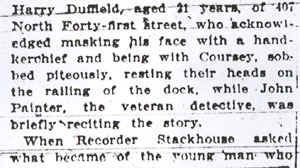
Collapsing when arraigned in Police Court this morning before Recorder Stackhouse on the charge of killing Karl Kellmann, aged 18 years, of 2919 High street, at Twenty-seventh and Sherman streets, shortly before midnight Saturday, Fred Coursey, alias “Mexican Pete,” alias “Cowboy Pete,” aged 20 years, of 121 North Twenty-first street, who admits firing the fatal shots while committing robbery, and Harry Duffield, aged 21 years, of 407 North Forty-first street, who acknowledged masking his face with a handkerchief and being with Coursey, sobbed piteously, resting their heads on the railing of the dock, while John Painter, the veteran detective, was briefly reciting the story.
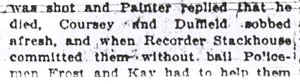
When Recorder Stackhouse asked what became of the young man who was shot and Painter replied that he died, Coursey and Duffield sobbed afresh, and when Recorder Stackhouse committed them without bail Policemen Frost and Kay had to help them.
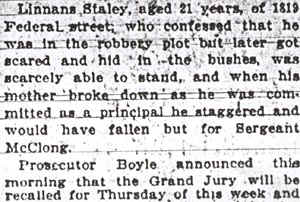
Linnans Staley, aged 21 years, of 1819 Federal street, who confessed that he was in the robbery plot but later got scared and hid in the bushes, was scarcely able to stand, and when his mother broke down as he was committed as a principal he staggered and would have fallen but for Sergeant McClong.
Prosecutor Boyle announced this morning that the Grand Jury will be recalled for Thursday of this week and the case will be made the special order of the day.
Without the slightest clue to start with in the most brutal murder committed in recent years in Camden county, police and detectives under the personal direction of Chief Gravenor in two hours arrested two of the three prisoners and obtained their signatures to confessions and before sunrise the other was lodged behind the bars at the City Hall.
According to their statements to the police the prisoners while drinking on a lot near Twenty-first and Federal streets on Saturday night planned to go to a lone spot near Twenty-seventh and Sherman streets to hold someone up to get money and jewelry to buy more drink. Coursey had a 38-calibre cowboy pistol and Duffield used Coursey’s bandanna as a mask. Staley weakened before the spot selected was reached and at the time of the murder was hiding in a clump of weeds a short distance away.
The murdered boy was the son of Karl and Lulu D. Kellmann. He was a member of the Bible class of Grace Presbyterian Church, East Side, and active in church work.
Saturday night was the closing of a carnival given on High street between Twenty-seventh and Thirtieth streets. Karl was there and made several purchases. At one booth he bought a necktie, from another some ice cream and a box of candy and spent some time conversing with the young ladies connected with the church.
When it grew rather late he noticed that Misses Bertha and Bessie Skillen, of 815 North Thirty-fourth street, the latter a teacher in Grace Church Sunday-school, were without an escort and he volunteered to see them home. They accepted his invitation to be their escort. He saw them safely home and he was on his way back and had reached a point on the east side of Twenty-seventh street south of Sherman street and near the foot of the bridge that spans the Pennsylvania Railroad tracks when two men jumped out from behind a tree and as one commanded him to hold up his hands the other began to shoot.
The first shot struck him in the breast and turned him partially around. The next ploughed a hole through his neck, knocking him down, and the third went wide.
Screaming for help he tried to rise to his feet and was on his knees when Night Yardmaster Albert Ludlow and Brakeman Joseph Wittick, who were on the opposite side of the bridge, ran to his assistance. By the light of their lanterns they saw that he was seriously hurt and they took him to ‘Squire Sasse’s house nearby to await the arrival of the ambulance. As the railroaders sped across the bridge Ludlow saw a man run down the tracks in the direction of Seventeenth street.
In the signal tower at Pavonia station known as C. B. the operator, Thomas Sink, heard the shots and cries for help and ‘phoned to Captain James at Police Headquarters that a murder had been committed. Sink also saw a man run down through the weeds and bushes on the east side of the bridge toward the railroad tracks.
Policeman Hurlock and Schmid, ‘Squire and Mrs. Sasse and several others were out on the street before the railroad men reached the Sasse home and all hurried to ‘phones to notify police headquarters.
In less than five minutes by use of the red light system Captain James had every officer on duty on the East Side hurrying to the scene, officers stationed at every bridge, ferry house and railroad terminal, and the downtown auto with Detectives Schregler, Painter, Brothers and Moffett on its way to East Camden.
On information from the railroad men Sergeant Horner took all the East Side officers and the four detectives and they worked westward among the cars while Captain James started Policemen Colsey and Kelly to walk eastward from Fifteenth street until they met the main body.
The search proved fruitless and as they returned to the bridge one of the men picked up a green bandanna with yellow spots and sheep burrs embedded on it on the incline near the signal tower. Later he recalled that the man who went down the slope wore a Khaki shirt and cap.
The handkerchief was recognized as the kind used by “Indian Bill” May, and Detectives Brothers and Policeman Abbott were sent to arrest him. They found May and Eugene Cafferty asleep in a moving van in Marlton avenue. “Indian Bill” soon established an alibi.
Detective Schregler and a couple of officers who were sure that the description of the man with the khaki shirt tallied with Duffield started for his brother’s house, but failed to find him there. About this time the downtown auto turned into Twenty-seventh street to get Karl’s father, mother and sister and take them to the hospital. Councilman Finkeldey and a friend shouted to the crew that a woman was down and out on a step nearby, but the crew yelled back that they were on an emergency run and the woman would keep until they returned. Fireman J. H. Vickers walked across the street to investigate and found that the supposed woman was Duffield and that he seemed to be asleep.
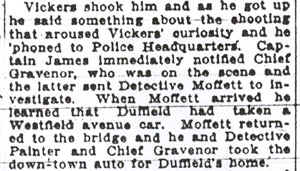
Vickers shook him and as he got up he said something about the shooting that aroused Vickers’ curiosity and he ‘phoned to Police Headquarters. Captain James immediately notified Chief Gravenor, who was on the scene and the latter sent Detective Moffett to investigate. When Moffett arrived he learned that Duffield had taken a Westfield avenue car. Moffett returned to the bridge and he and Detective Painter and Chief Gravenor took the down-town auto for Duffield’s home.
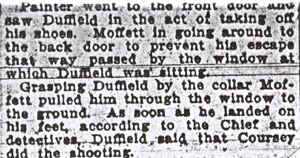
Painter went to the front door and saw Duffield in the act of taking off his shoes. Moffett in going around to the back door to prevent his escape that way passed by the window at which Duffield was sitting.
Grasping Duffield by the collar Moffett pulled him through the window to the ground. As soon as he landed on his feet, according to the Chief and detectives, Duffield said that Coursey did the shooting.
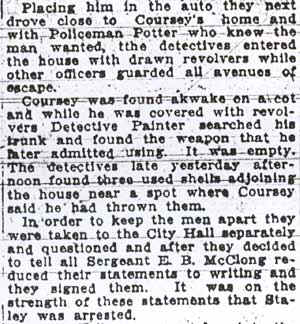
Placing him in the auto they next drove close to Coursey’s home and with Policeman Potter who knew the man wanted, the detectives entered the house with drawn revolvers while other officers guarded all avenues of escape.
Coursey was found awake on a cot and while he was covered with revolvers Detective Painter searched his trunk and found the weapon that he later admitted using. It was empty. The detectives late yesterday afternoon found three used shells adjoining the house near a spot where Coursey said he had thrown them.
In order to keep the men apart they were taken to the City Hall separately and questioned and after they decided to tell all Sergeant E. B. McClong reduced their statements to writing and they signed them. It was on the strength of these statements that Staley was arrested.
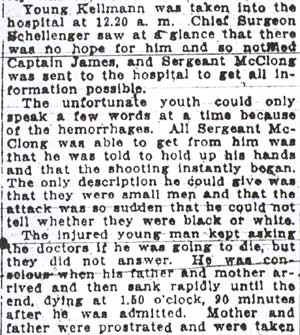
Young Kellmann was taken into the hospital at 12.20 a. m. Chief Surgeon Schellenger saw at a glance that there was no hope for him and so notified Captain James, and Sergeant McClong was sent to the hospital to get all information possible.
The unfortunate youth could only speak a few words at a time because of the hemorrhages. All Sergeant McClong was able to get from him was that he was told to hold up his hands and that the shooting instantly began. The only description he could give was that they were small men and that the attack was so sudden that he could not tell whether they were black or white.
The injured young man kept asking the doctors if he was going to die, but they did not answer. He was conscious when his father and mother arrived and then sank rapidly until the end, dying at 1.50 o’clock, 90 minutes after he was admitted. Mother and father were prostrated and were taken home by the up-town auto.
County Physician Jones conducted the autopsy yesterday morning. He said that either wound would have caused death. The bullet in the breast pierced the right lung at the top and lodged in the cavity. It is now in the doctor’s possession. The other bullet went clear through the neck.
Coursey and Duffield have been working in the Pavonia car yard. The former was born in El Paso, Texas, but has lived East nearly all his life. He is an expert shot and was a member of the vaudeville team of Coursey & Cook, according to their letter heads presenting a fifteen-minute thriller.
Duffield was only recently paroled for robbing Gallagher’s saloon, Nineteenth and Federal streets of a lot of drinkables. Staley has been arrested several times on petty charges but was never convicted of crime. When Duffield’s coat was examined at the City Hall, it was found to contain sheep burrs.
To a reporter Coursey said that whenever he was drinking he had to get his gun and shoot something or somebody. He insisted that all were in on the job and that they let the man who preceded Kellman go over the bridge without molestation because he didn’t look as if he had any too much money.
Yesterday morning Assistant Prosecutor Wolverton and Stenographer Cleary called at the City Hall. The prisoners were examined by Mr. Wolverton and their statements taken by Mr. Cleary, but there was little or nothing new elicited.
Ford Claims Drink Prompted Murder
Philadelphia Inquirer —
Case of Mrs. May Wagner’s Slayer Will Go to the Jury Today
Alleging that because of excessive and continuous drinking he was irrational and thus irresponsible for his act, Charles Ford yesterday combatted the efforts of Prosecutor Boyle to send him to the electric chair for the murder of May Effie Wagner. The case was partly tried before Supreme Court Justice Garrison, all the evidence being submitted. It will go to the jury this morning.
It is charged by the State that Ford, on the afternoon of March 14 last went to Laurel Springs and visited the home of Mrs. Wagner, with whom he had lived for eighteen years and who had left him because of his abuse. Failing in his efforts to persuade her to return home with him on a previous occasion, he had repeated the call and hunted for Robert Wilson, whom he accused of being responsible for Mrs. Wagner’s obduracy. After shooting Wilson he broke into the home of Mrs. Wagner and shot her to death, sending two bullets into his own head but recovering in the Cooper Hospital. Prosecutor Boyle had a number of witnesses who traced Ford’s movement and who testified as to his declarations to “do” Wilson and the woman.
In the defense presented through Lawyers Frank B. Jess and Adam R. Sloan, it was shown by witnesses that Ford had been a heavy drinker all his life and that because of the woman’s going away from him he drank more than ever. As a result it was asserted his mind was so affected that he did not know what he was doing.
Slayer of Woman Sentenced to Die
Philadelphia Inquirer —
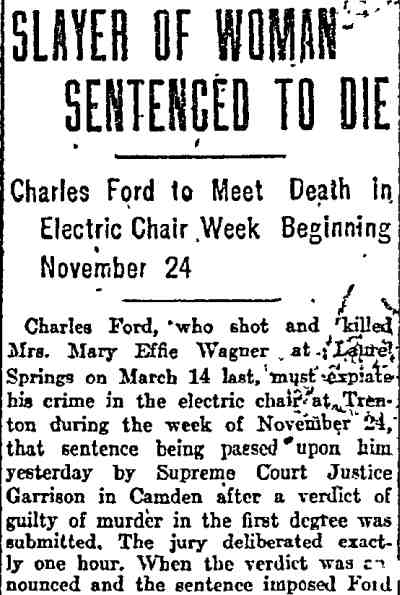
Charles Ford to Meet Death in Electric Chair Week Beginning November 24
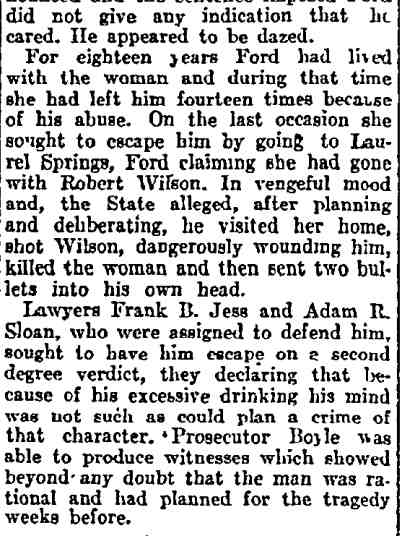
Charles Ford, who shot and killed Mrs. Mary Effie Wagner at Laurel Springs on March 14 last, must expiate his crime in the electric chair at Trenton during the week of November 24, that sentence being passed upon him yesterday by Supreme Court Justice Garrison in Camden after a verdict of guilty of murder in the first degree was submitted. The jury deliberated exactly one hour. When the verdict was announced and the sentence imposed Ford did not give any indication that he cared. He appeared to be dazed.
For eighteen years Ford had lived with the woman and during that time she had left him fourteen times because of his abuse. On the last occasion she sought to escape him by going to Laurel Springs, Ford claiming she had gone with Robert Wilson. In vengeful mood and, the State alleged, after planning and deliberating, he visited her home, shot Wilson, dangerously wounding him, killed the woman and then sent two bullets into his own head.
Lawyers Frank B. Jess and Adam R. Sloan, who were assigned to defend him, sought to have him escape on a second degree verdict, they declaring that because of his excessive drinking his mind was not such as could plan a crime of that character. Prosecutor Boyle was able to produce witnesses which showed beyond any doubt that the man was rational and had planned for the tragedy weeks before.
Moving Picture Hold-Up Gave Idea for Real Crime
Idaho Statesman —
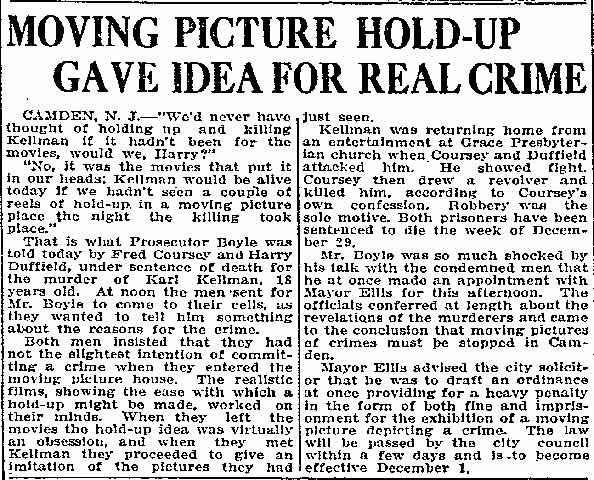
CAMDEN, N. J.—“We’d never have thought of holding up and killing Kellman if it hadn’t been for the movies, would we, Harry?”
“No, it was the movies that put it in our heads; Kellman would be alive today if we hadn’t seen a couple of reels of hold-up in a moving picture place the night the killing took place.”
That is what Prosecutor Boyle was told today by Fred Coursey and Harry Duffield, under sentence of death for the murder of Karl Kellman, 18 years old. At noon men sent for Mr. Boyle to come to their cells, as they wanted to tell him something about the reasons for the crime.
Both men insisted that they had not the slightest intention of committing a crime when they entered the moving picture house. The realistic films, showing the ease with which a hold-up might be done, worked on their minds. When they left the movies the hold-up idea was virtually an obsession, and when they met Kellman they proceeded to give an imitation of the pictures they had just seen.
Kellman was returning home from an entertainment at Grace Presbyterian church when Coursey and Duffield attacked him. He showed fight. Coursey then drew a revolver and killed him, according to Coursey’s own confession. Robbery was the sole motive. Both prisoners have been sentenced to die the week of December 29.
Mr. Boyle was so much shocked by his talk with the condemned men that he at once made an appointment with Mayor Ellis for this afternoon. The officials conferred at length about the revelations of the murderers and came to the conclusion that moving pictures of crimes must be stopped in Camden.
Mayor Ellis advised the city solicitor that he was to draft an ordinance at once providing for a heavy penalty in the form of both fine and imprisonment for the exhibition of a moving picture depicting a crime. The law will be passed by the city council within a few days and is to become effective December 1.
Ford’s Attorney Sees Little Hope of Pardon
Philadelphia Inquirer —
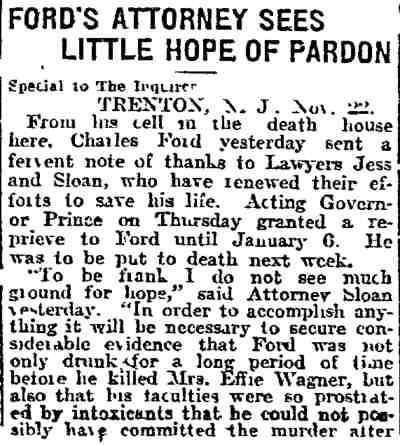
Special to The Inquirer. TRENTON, N. J., Nov. 22.—From his cell in the death house here, Charles Ford yesterday sent a fervent note of thanks to Lawyers Jess and Sloan, who have renewed their efforts to save his life. Acting Governor Prince on Thursday granted a reprieve to Ford until January 6. He was to be put to death next week.
“To be frank I do not see much ground for hope,” said Attorney Sloan yesterday. “In order to accomplish anything it will be necessary to secure considerable evidence that Ford was not only drunk for a long period of time before he killed Mrs. Effie Wagner, but also that his faculties were so prostrated by intoxicants that he could not possibly have committed the murder after premeditation. Friends of the condemned man are at work along this line and we shall make every effort to have his sentence commuted by the Board of Pardons to life imprisonment.”
It is understood that Prosecutor Boyle will oppose leniency.
Philadelphia Inquirer — March 29, 1913
Camden News Notes
Pleading guilty to a charge of stealing a suit of clothes from Mont Simkins, Jerome Marshon was freed on suspension of sentence by Judge Boyle.
Philadelphia Inquirer — July 31, 1913
Philip Marlow, who has been arrested many times for annoying his wife, was given still another chance by Judge Boyle yesterday, on the ground that his wife, who appeared in his behalf, had taken him back.
‘Kentucky Rosebud’ Goes to Trenton
Camden Post Telegram —
Convicted This Morning and Immediately Sentenced to from 1 to 3 Years
Walter Edgerton, colored, alias “Kentucky Rose Bud,” was convicted this morning in the Criminal Court on a charge of keeping a disorderly house at 311 Locust street. He was immediately sentenced to from one to 3 years in State Prison by Judge Boyle, who said that notwithstanding the fact that the defendant was a negro the same law applied to him as to white men.
Philadelphia Inquirer — December 20, 1913

Judge Boyle yesterday granted inn and tavern licenses to Helene Barthman, of Centre Township, Antonio Munza and Mary Kohler, of Waterford Township, and Ernest P. Steubing, of Voorhees Township.
Philadelphia Inquirer — June 27, 1914
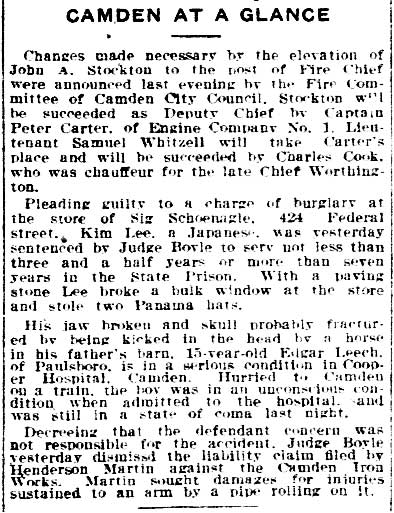
Pleading guilty to a charge of burglary at the store of Sig Schoenagle, 424 Federal street, Kim Lee, a Japanese, was yesterday sentenced by Judge Boyle to serve not less than three and a half years or more than seven years in the State Prison at Trenton.
Philadelphia Inquirer — June 27, 1914
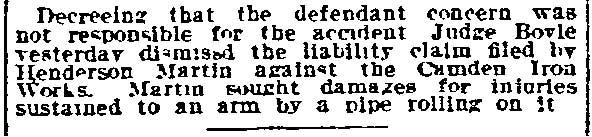
Decreeing that the defendant concern was not responsible for the accident Judge Boyle yesterday dismissed the liability claim filed by Henderson Martin against the Camden Iron Works. Martin sought damages for injuries sustained to an arm by a pipe rolling on it.
Philadelphia Inquirer — July 4, 1914
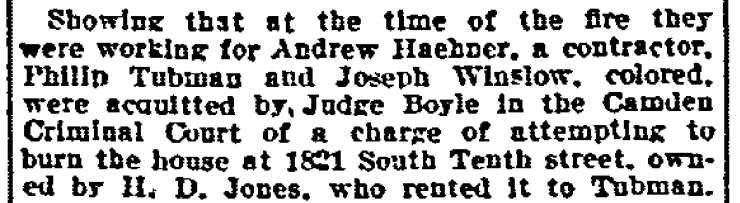
Showing that at the time of the fire they were working for Andrew Haehner, a contractor, Philip Tubman and Joseph Winslow, colored, were acquitted by Judge Boyle in the Camden Criminal Court of a charge of attempting to burn the house at 1821 South Tenth street.
Prison Term for Circus Man
Philadelphia Inquirer —
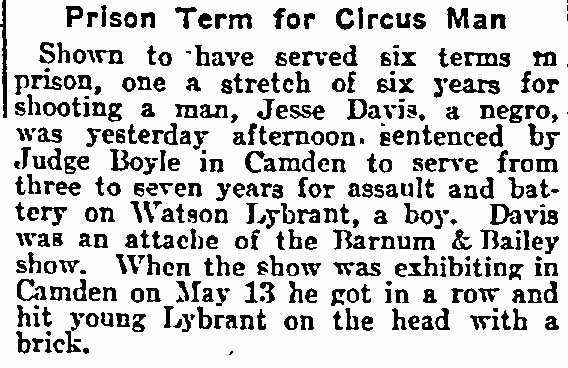
Jesse Davis, a circus performer who had been convicted of assault and battery on Watson Lybrant, was yesterday afternoon sentenced by Judge Boyle in Camden to serve from three to seven years for assault and battery with intent to kill.
Philadelphia Inquirer — July 18, 1914
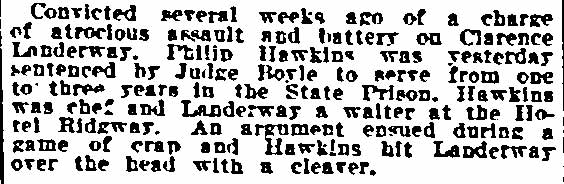
Convicted several weeks ago of a charge of atrocious assault and battery on Clarence Landerway, Philip Hawkins was yesterday sentenced by Judge Boyle in Camden to not less than two and a half nor more than five years in State Prison.
Both Given Six Months
Philadelphia Inquirer —
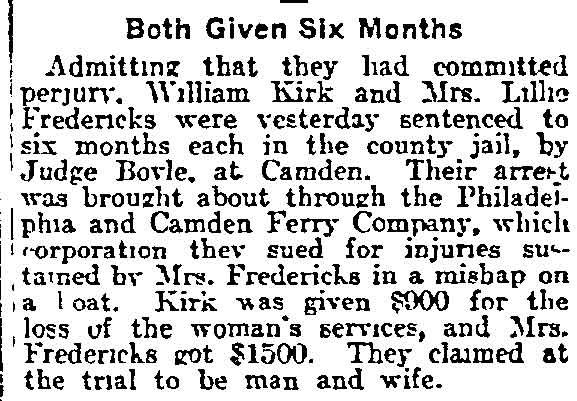
Admitting that they had committed perjury, William Kirk and Mrs. Lillie Fredericks were yesterday sentenced to six months each in the county jail, by Judge Boyle, who said that perjury was a crime that strikes at the very foundation of justice.
Pleads Guilty to Charges
Philadelphia Inquirer —
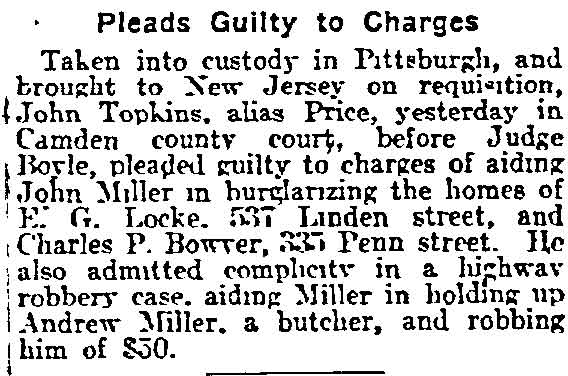
Taken into custody in Pittsburgh, where he had fled after the commission of his crime, John Topkins, alias Price, yesterday in Camden county court, before Judge Boyle, pleaded guilty to charges of aiding John Miller in burglarizing a house on Penn street and stealing clothes valued at $200, and of breaking into a house on Linden street. E. G. Locke, Charles Bowyer and Andrew Miller also pleaded guilty to charges arising from the same operations.
Lawyer Jailed, Client Fined for Contempt
Philadelphia Inquirer —
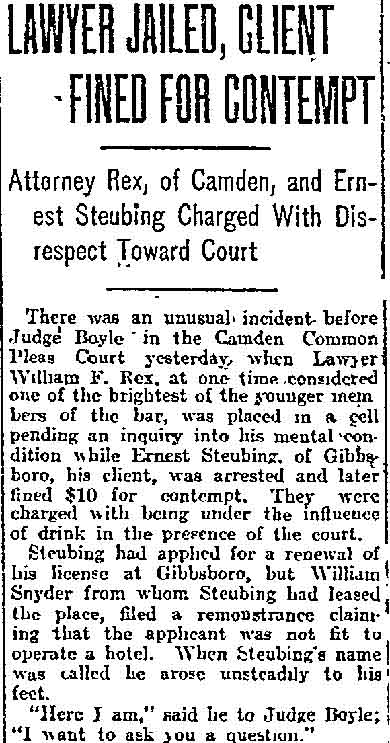
Attorney Rex, of Camden, and Ernest Steubing Charged With Disrespect Toward Court
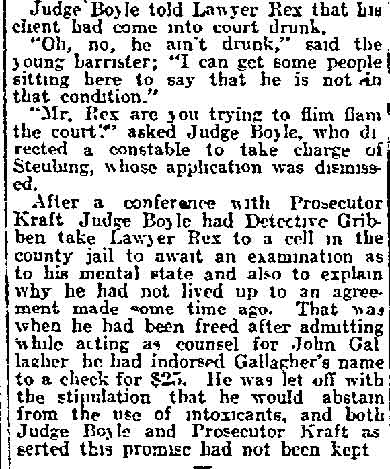
There was an unusual incident before Judge Boyle in the Camden Common Pleas Court yesterday, when Lawyer William F. Rex, of Market street, was placed in a cell pending an inquiry into his mental condition, and his client, Ernest Steubing, was fined $25 for contempt of court.
Judge Boyle told Lawyer Rex that his client had come into court drunk. Rex replied that his client was not drunk. “Mr. Rex are you trying to flim flam the court?” asked the judge. “No, your honor, I am not,” said Rex. “Then I am going to give you a chance to think it over,” said Judge Boyle.
After a conference with Prosecutor Kraft, Judge Boyle had Detective Gribben take Lawyer Rex to a cell in the county jail, while Steubing was fined $25 for contempt in appearing before the court in an intoxicated condition. Rex was released from the cell after about an hour, having satisfied the judge as to his mental condition. John Gallagher, an innkeeper, was held responsible for permitting Steubing to drink in his establishment.
Crooks Go to Prison
Philadelphia Inquirer —
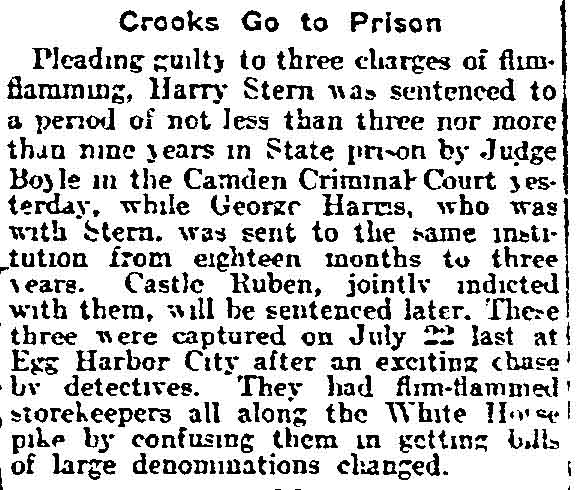
Pleading guilty to three charges of flim-flamming, Harry Stern was sentenced to a period of not less than three nor more than nine years in State Prison by Judge Boyle, who said that crimes of this kind would receive short shrift in his court.
Affect Estate Settlement
Philadelphia Inquirer —
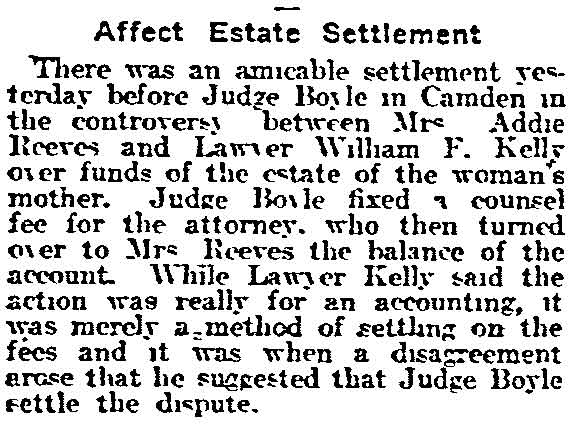
There was an amicable settlement yesterday before Judge Boyle in Camden in the controversy between Mrs. Addie Reeves and Lawyer William F. Kelly over funds of the estate of the woman’s mother, Mrs. Emma Haines. The settlement was for $1,200, the claim having been for $1,800.
Gets Same Sentence as Partner in Crime
Philadelphia Inquirer —
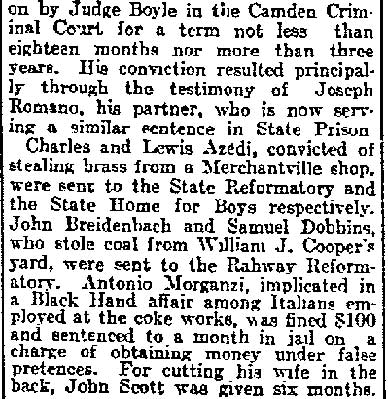
Judge Boyle, in Camden Common Pleas Court, Deals Out Justice to Several Offenders
Convicted of participating in the robbery of the storehouse of the Pennsylvania Railroad at Delair, John Clemento was yesterday sentenced to State Prison by Judge Boyle in the Camden Criminal Court for a term not less than eighteen months nor more than three years. His conviction resulted principally through the testimony of Joseph Romano, his partner, who is now serving a similar sentence in State Prison. Charles and Lewis Azedi, convicted of stealing brass from a Merchantville shop, were sent to the State Reformatory and the State Home for Boys respectively. John Breidenbach and Samuel Dobbins, who stole coal from William J. Cooper’s yard, were sent to the Rahway Reformatory. Antonio Morganzi, implicated in a Black Hand affair among Italians employed at the coke works, was fined $100 and sentenced to a month in jail on a charge of obtaining money under false pretences. For cutting his wife in the back, John Scott was given six months.
Court Cancels Mortgage
Philadelphia Inquirer —
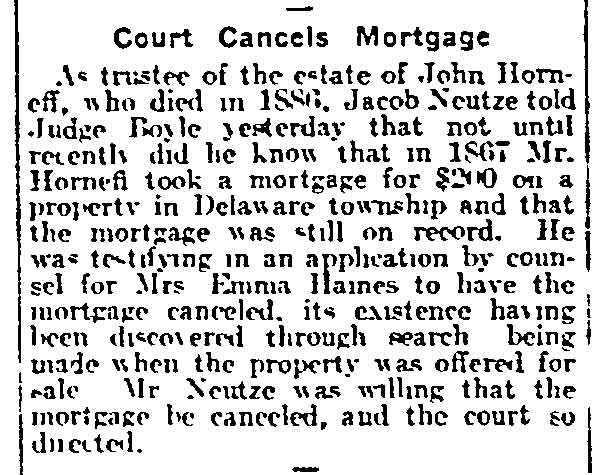
As trustee of the estate of John Horneff, who died in 1886, Jacob Neutze told Judge Boyle yesterday that not until recently did he know that in 1867 Mr. Horneff took a mortgage for $200 on a piece of ground and that this mortgage was still on record. The estate passed to Mrs. Emma Haines, a daughter, and she had sold it. Judge Boyle declared the mortgage cancelled.
Wife’s Plea Gains Liberty for Husband
Philadelphia Inquirer —
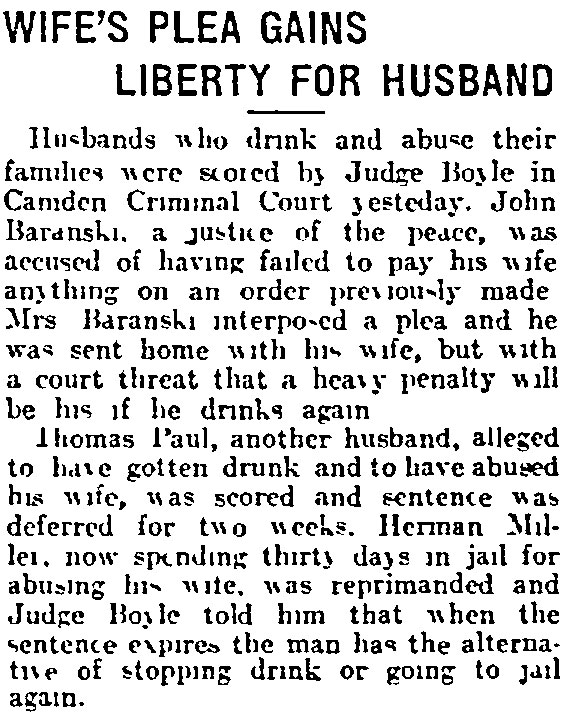
Husbands who drink and abuse their families were scored by Judge Boyle in Camden Criminal Court yesterday. John Baranski and Thomas Paul were each given six months in the county jail, but Herman Miller, who pleaded for mercy, was released in the custody of his wife after she had appeared in court and begged that her husband be given another chance.
Sent to Prison for Theft
Philadelphia Inquirer —
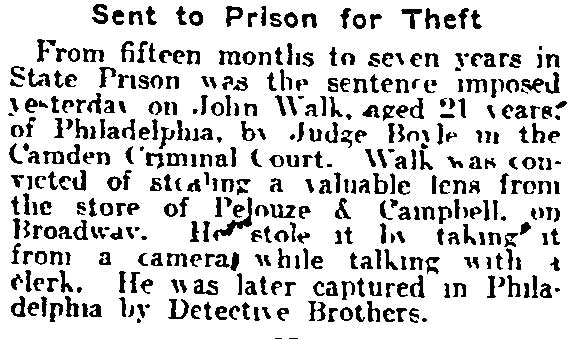
From fifteen months to seven years in State Prison was the sentence imposed yesterday on John Walk, aged 21 years, of Philadelphia, by Judge Boyle in Camden. Walk had been convicted of stealing a valuable lens from the store of Pelouze & Campbell, on Broadway. He was captured in Philadelphia by Detective Brothers.
Philadelphia Inquirer — June 18, 1915
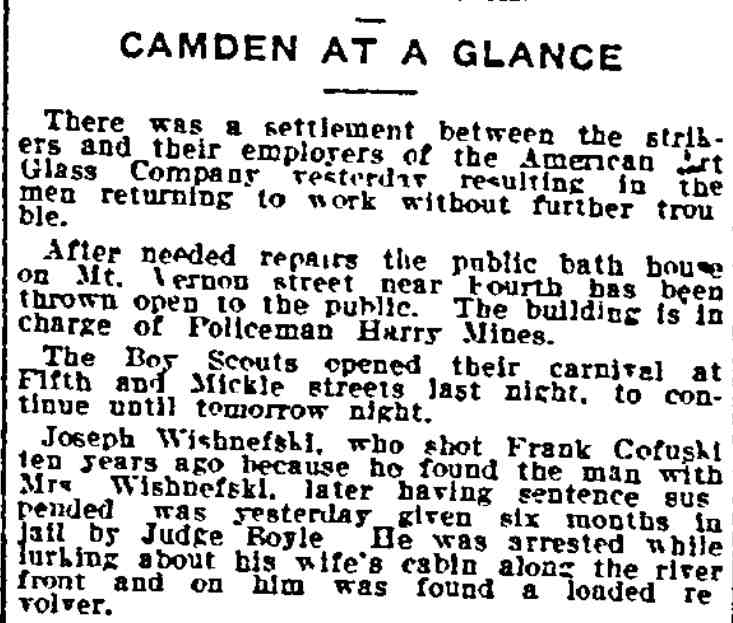
Camden at a Glance
There was a settlement between the strikers and their employers of the American Art Glass Company yesterday, the men returning to work at the old scale of wages.
After needed repairs the public bath house on Mt. Vernon street near Fourth has been thrown open to the public.
Joseph Wishnefski, who shot Frank Cofuski ten years ago and was only recently released from State Prison, was yesterday given six months in jail by Judge Boyle for illegally carrying a revolver.
Negligent Husband Held
Philadelphia Inquirer —
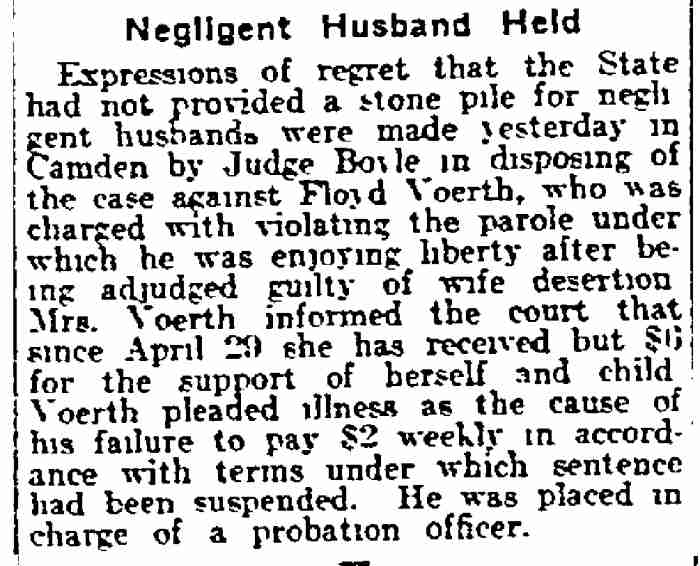
Expressions of regret that the State had not provided a stone pile for negligent husbands were made yesterday in Camden by Judge Boyle in disposing of the case against Floyd Voerth, who was charged with neglecting to support his family. Voerth was given a suspended sentence on the condition that he pay $6 a week to his wife.
Held on Charge of Manslaughter
Camden Daily Courier —
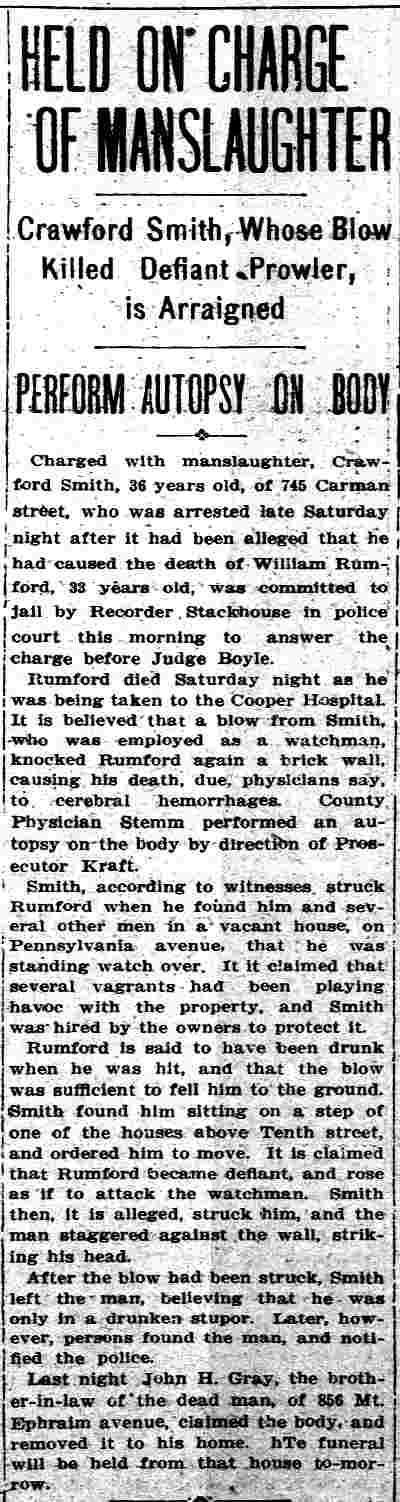
Crawford Smith, Whose Blow Killed Defiant Prowler, is Arraigned
Perform Autopsy on Body
Charged with manslaughter, Crawford Smith, 36 years old, of 745 Carman street, who was arrested late Saturday night after it had been alleged that he had caused the death of William Rumford, 33 years old, was committed to jail by Recorder Stackhouse in police court this morning to answer the charge before Judge Boyle.
Rumford died Saturday night as he was being taken to the Cooper Hospital. It is believed that a blow from Smith, who was employed as a watchman, knocked Rumford against a brick wall, causing his death, due, physicians say, to cerebral hemorrhages. County Physician Stemm performed an autopsy on the body by direction of Prosecutor Kraft.
Smith, according to witnesses struck Rumford when he found him and several other men in a vacant house, on Pennsylvania avenue, that he was standing watch over. It is claimed that several vagrants had been playing havoc with the property, and Smith was hired by the owners to protect it.
Rumford is said to have been drunk when he was hit, and that the blow was sufficient to fell him to the ground. Smith found him sitting on a step of one of the houses above Tenth street, and ordered him to move. It is claimed that Rumford became defiant, and rose as if to attack the watchman. Smith then, it is alleged, struck him, and the man staggered against the wall, striking his head.
After the blow had been struck, Smith left the man, believing that he was only in a drunken stupor. Later, however, persons found the man, and notified the police.
Last night John H. Gray, the brother-in-law of the dead man, of 856 Mt. Ephraim avenue, claimed the body, and removed it to his home. The funeral will be held from that house to-morrow.
Robbers Get Severe Sentences
Philadelphia Inquirer —
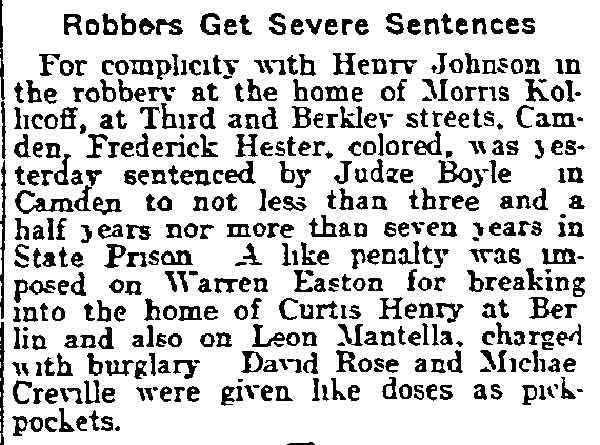
For complicity with Henry Johnson in the robbery at the home of Morris Kollhcoff, 107 South Eighth street, Frederick Hester, aged 20 years, of New York, was yesterday sentenced by Judge Boyle in Camden to not less than three and a half years nor more than seven years in State Prison.
Philadelphia Inquirer — March 22, 1916
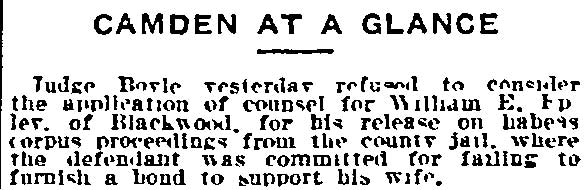
Camden at a Glance
Judge Boyle yesterday refused to consider the application of counsel for William E. Epley, of Blackwood, for his release on habeas corpus proceedings from the county jail, where the defendant was committed for failing to furnish a bond to support his wife.
Camden Estates Passed
Philadelphia Inquirer —
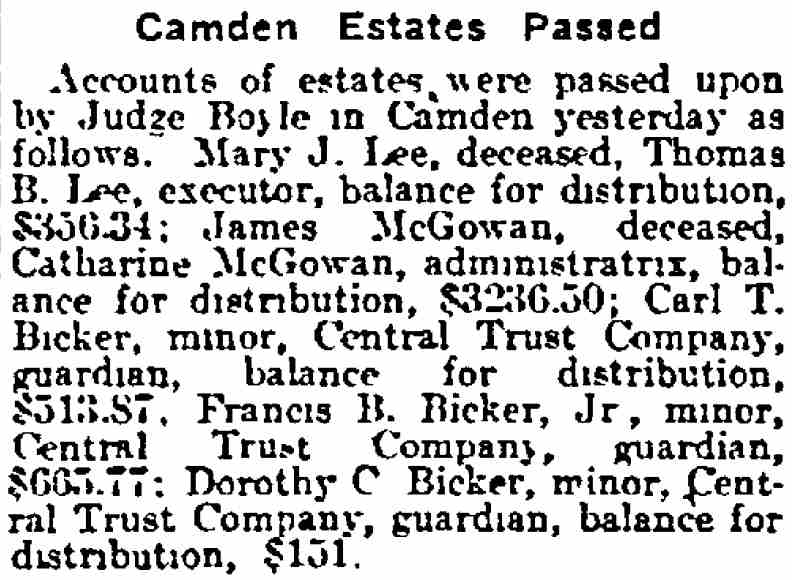
Accounts of estates were passed upon by Judge Boyle in Camden yesterday as follows: Carl T. Bicker, minor, Central Trust Company, guardian, balance for distribution, $513.57; Francis B. Bicker Jr., minor, Central Trust Company, guardian, balance for distribution, $513.57; Dorothy Bicker, minor, Central Trust Company, guardian, balance for distribution, $513.57.
Philadelphia Inquirer — May 26, 1918
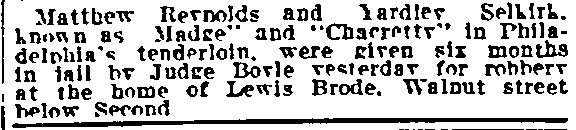
Matthew Reynolds and Yardley Selkirk, known as “Madge” and “Charette” in Philadelphia’s tenderloin, were given six months in jail by Judge Boyle yesterday for robbery at the home of Lewis Brode, Walnut street below Second.
War Work Director Named
Philadelphia Inquirer —
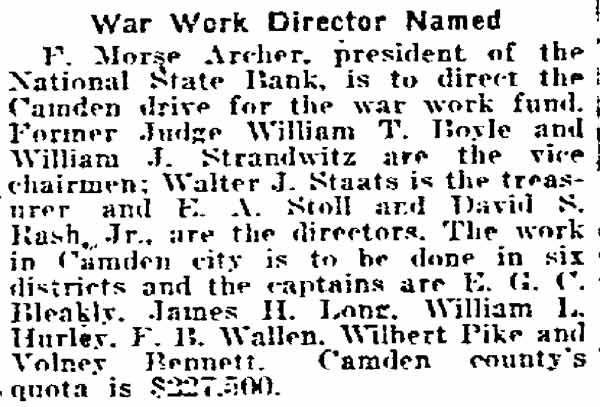
F. Morse Archer, president of the National State Bank, is to direct the Camden drive for the war work fund. Former Judge William T. Boyle and William J. Strandwitz are the vice chairmen; Walter J. Staats is the treasurer and E. A. Stoll and David S. Rush, Jr., are the directors. The work in Camden city is to be done in six districts and the captains are E. G. C. Bleakly, James H. Long, William L. Hurley, F. B. Wallen, Wilbert Pike and Volney Bennett. Camden county’s quota is $227,500.
Notice to Creditors
Camden Courier-Post —
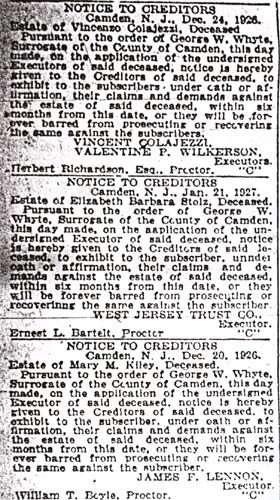
NOTICE TO CREDITORS. Camden, N. J., Dec. 24, 1926. Estate of Vincenzo Colajezzi, Deceased. Pursuant to the order of George Whyte, Surrogate of the County of Camden, this day made, on the application of the undersigned Executors of said deceased, notice is hereby given to the Creditors of said deceased, to exhibit to the subscribers under oath or affirmation, their claims and demands against the estate of said deceased, within six months from this date, or they will be forever barred from prosecuting or recovering the same against the subscribers. VINCENT COLAJEZZI, VALENTINE P. WILKERSON, Executors. Herbert Richardson, Esq., Proctor.
NOTICE TO CREDITORS. Camden, N. J., Jan. 7, 1927. Estate of Elizabeth Barbara Stolz, Deceased. Pursuant to the order of George Whyte, Surrogate of the County of Camden, this day made, on the application of the undersigned Executor of said deceased, notice is given to the Creditors of said deceased, to exhibit to the subscriber, under oath or affirmation, their claims and demands against the estate of said deceased, within six months from this date, or they will be forever barred from prosecuting or recovering the same against the subscriber. WEST JERSEY TRUST CO., Executor. Ernest L. Bartelt, Proctor.
NOTICE TO CREDITORS. Camden, N. J., Dec. 20, 1926. Estate of Mary M. Kiley, Deceased. Pursuant to the order of George Whyte, Surrogate of the County of Camden, this day made, on the application of the undersigned Executor of said deceased, notice is hereby given to the Creditors of said deceased, to exhibit to the subscriber, under oath or affirmation, their claims and demands against the estate of said deceased, within six months from this date, or they will be forever barred from prosecuting or recovering the same against the subscriber. JAMES F. LENNON, Executor. William T. Boyle, Proctor.
Patrons, Patronesses Announced Today for First Military Ball
Camden Courier-Post —
Patrons and patronesses for the first military ball of the Camden Post No. 960, Veterans of Foreign Wars, to be held on Friday evening February 3 in the Elks auditorium, Seventh and Cooper Streets, are announced today.
The following prominent men and women are listed: Mrs. J. W. Connor, Miss C. M. Day, Mrs. J. H. Forsyth, Mrs. H. J. Goodyear, Miss B. Graham, Mrs. R. E. Green, Mrs. E. F. Haines, Mrs. J. Hood Jr., Mrs. W. Hurley, Mrs. J. Jarrell, Mrs. T. Keefe, Mrs. J. F. Kobus, Mrs. L. Liberman, Mrs. F. L. Lloyd, Mrs. M. A. Logan, Mrs. T. P. McConaghy, Mrs. F. F. Neutze, Mrs. L. K. Marr, Mrs. J. A. Pennington, Mrs. M. E. Ramsey, Mrs. E. Truax, Mrs. S. M. Shay, Mrs. W. J. Staats, Mrs. B. G. Tarburton, Mrs. R. W. Waddell, Mrs. E. Watson, Mrs. E. P. Wescott, Mrs. C. A. Wolverton.
David Baird Jr., William T. Boyle, Isaac Ferris, William Hurley, John Hood Jr., John Jarrell, Victor King, William J. Kraft, Thomas Keefe, Joseph F. Kobus, Hon. Edmund B. Leaming, Dr. A. Haines Lippincott, James H. Long, L. K. Marr, Dr. Thomas P. McConaghy, Hon. Frank F. Neutze, Samuel P. Orlando, Albert E. Simmons, Edwin Watson, Ethan P. Wescott.
Boyle Will Head State Bar Group
Camden Courier-Post —
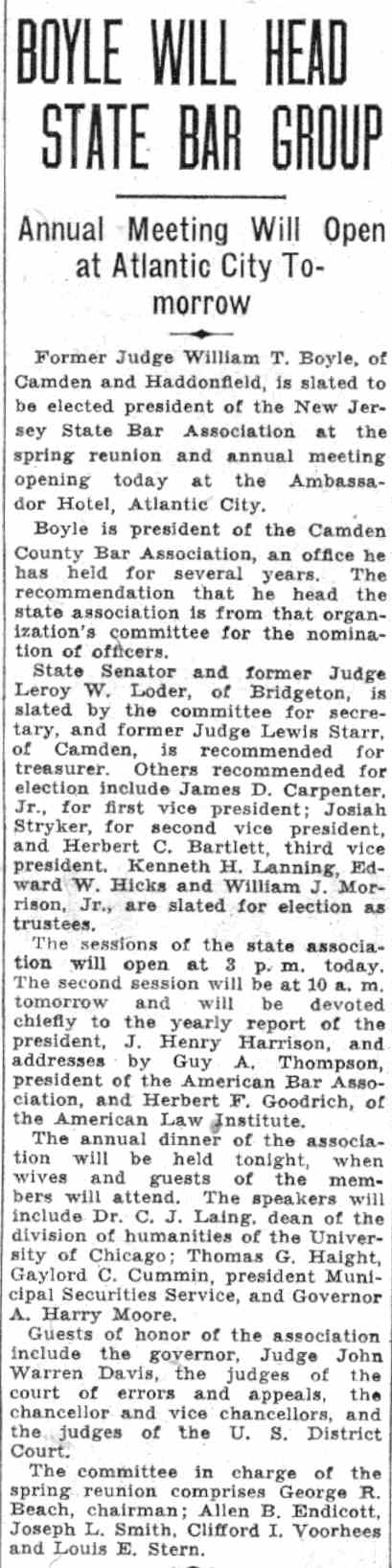
Annual Meeting Will Open at Atlantic City Tomorrow
Former Judge William T. Boyle, of Camden and Haddonfield, is slated to be elected president of the New Jersey State Bar Association when it convenes at Atlantic City tomorrow for its annual meeting.
The sessions of the state association will open at 3 p.m. today. The second session will be at 10 a.m. tomorrow and will be devoted chiefly to the yearly report of the president, J. Henry Harrison, and addresses by Guy A. Thompson, president of the American Bar Association, and Herbert F. Goodrich, of the American Law Institute.
The annual dinner of the association will be held tonight, when wives and guests of the members will attend. The speakers will include Dr. C. J. Laing, dean of the division of humanities of the University of Chicago; Thomas G. Haight, Gaylord C. Cummin, president Municipal Securities Service, and Governor A. Harry Moore.
Guests of honor of the association include the governor, Judge John Warren Davis, the judges of the court of errors and appeals, the chancellor and vice chancellors, and the judges of the U. S. District Court. The committee in charge of the spring reunion comprises George R. Beach, chairman; Allen B. Endicott, Joseph L. Smith, Clifford I. Voorhees and Louis E. Stern.
Camden Ex-Judge Chosen President of New Jersey Bar
Camden Courier-Post —
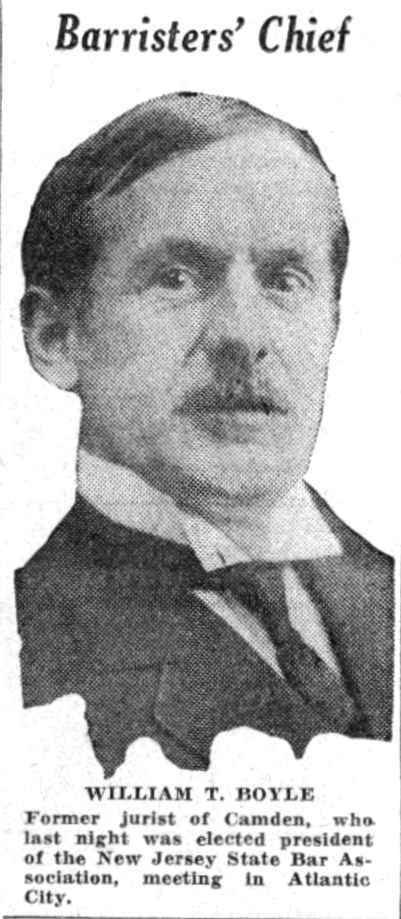
Barristers’ Chief — William T. Boyle — Former jurist of Camden, who last night was elected president of the New Jersey State Bar Association, meeting in Atlantic City.
Former Federal Jurist Assails Dry Law as Major Cause of Crime
Court Revision Urged
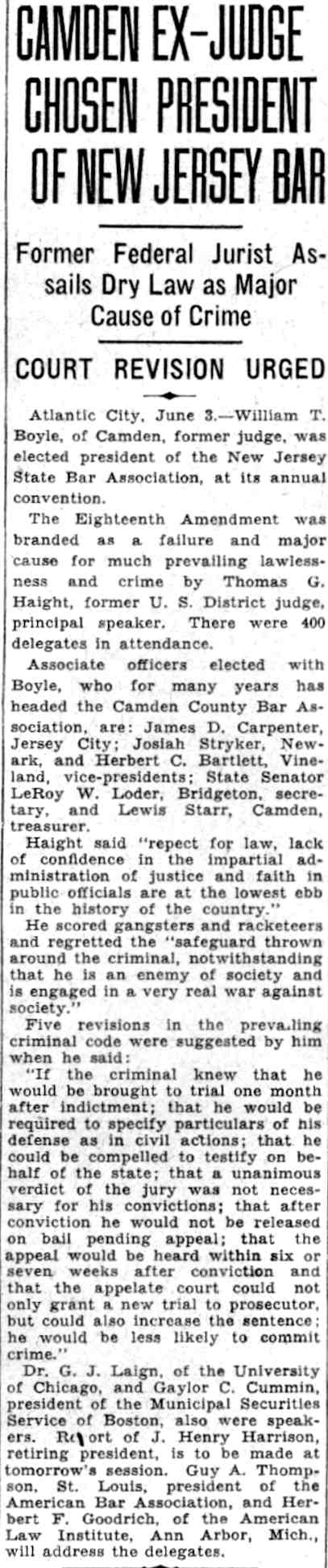
Atlantic City, June 3.—William T. Boyle, of Camden, former judge, was elected president of the New Jersey State Bar Association last night at the association’s annual dinner in Atlantic City. Lewis Starr was elected vice president.
Prohibition was denounced as the major single cause of crime today by Judge Boyle in an address before the New Jersey Bar Association at its annual meeting here.
Declaring that the eighteenth amendment was “the most unfortunate piece of legislation ever enacted by the Congress of the United States,” the newly elected president of the association asserted that the prohibition law was responsible for the breakdown of respect for all law.
“The eighteenth amendment has proved to be such a total failure that it has become a serious menace to the State,” said Judge Boyle. He called for a revision of the court system, saying that the courts were clogged with cases arising from the volstead act and other liquor legislation.
$40,400 Suit Opens Over Auto Crash
Camden Courier-Post —
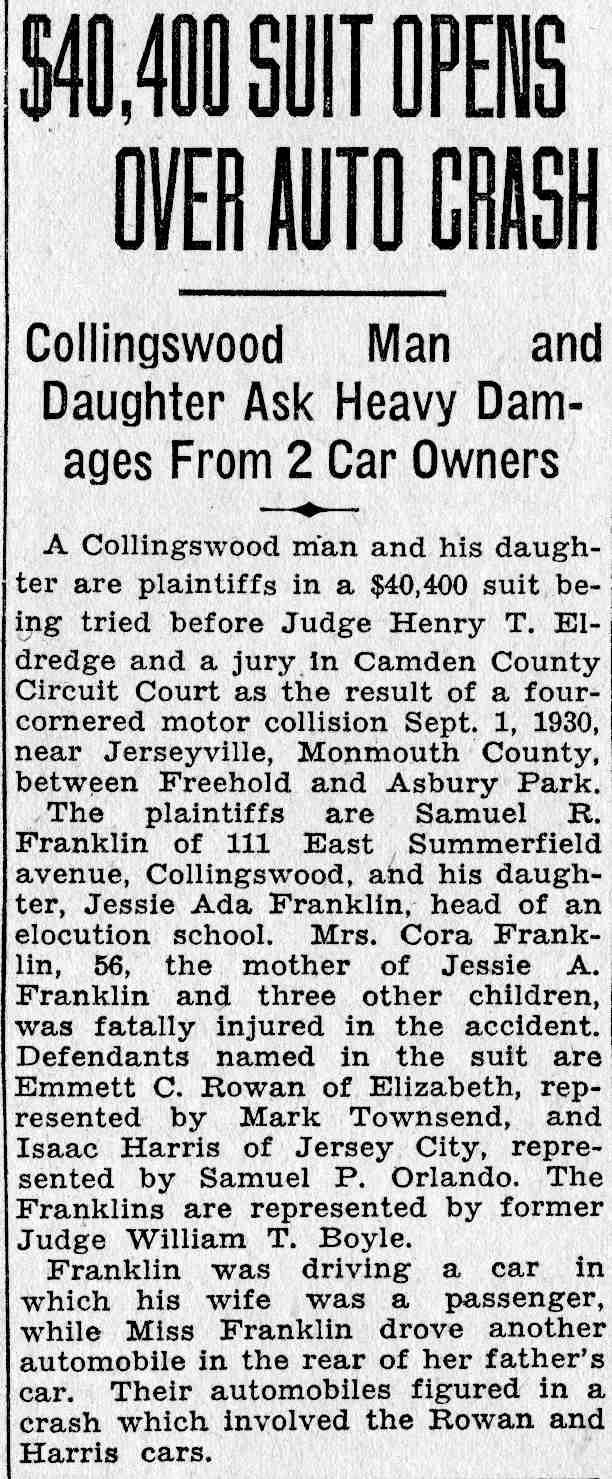
Collingswood Man and Daughter Ask Heavy Damages From 2 Car Owners
A Collingswood man and his daughter are plaintiffs in a $40,400 suit being tried before Judge Henry T. Eldredge in Camden County Court of Common Pleas. The accident in question occurred near Jerseyville, Monmouth County, between Freehold and Asbury Park.
The plaintiffs are Samuel R. Franklin of 111 East Summerfield avenue, Collingswood, and his daughter, Jessie Ada Franklin, head of an elocution school. Mrs. Cora Franklin, 56, the mother of Jessie A. Franklin and three other children, was fatally injured in the accident. Defendants named in the suit are Emmett C. Rowan of Elizabeth, represented by Mark Townsend, and Isaac Harris of Jersey City, represented by Samuel P. Orlando.
The Franklins are represented by former Judge William T. Boyle. Franklin was driving a car in which his wife was a passenger, while Miss Franklin drove another automobile in the rear of her father’s car. Their automobiles figured in a crash which involved the Rowan and Harris cars.
Offer of $5,300,000 for Catholic Church Property Disclosed in Court
Camden Courier-Post —


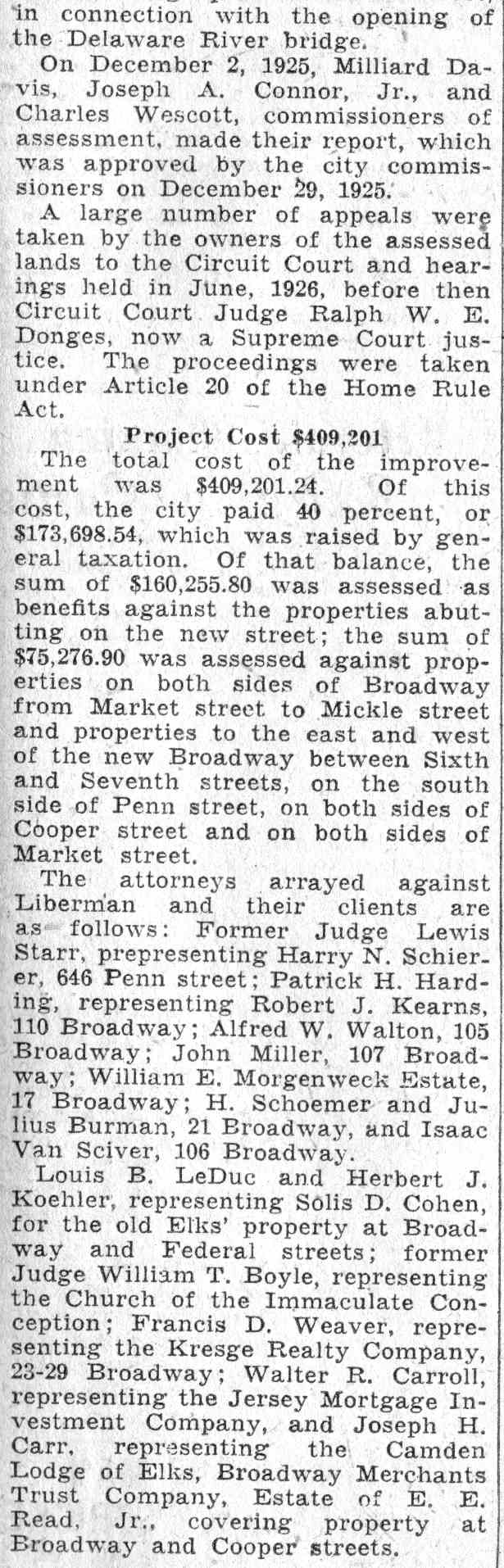
Photos from the Camden Courier-Post, June 11, 1932, showing proceedings related to the Church of the Immaculate Conception property case. Those depicted include Lewis Liberman, Edward Borden, Ralph W.E. Donges, Lewis Starr, Harry M. Schierer, Patrick H. Harding, Robert J. Kearns, William Morgenweck, Isaac Van Sciver, Solis D. Cohen, William T. Boyle, Francis D. Weaver, Walter R. Carroll, and others, as well as representatives of the Camden Lodge of Elks and Broadway Merchants Trust Company.
First Camden National Bank & Trust Co. — The Directors
Camden Courier-Post —
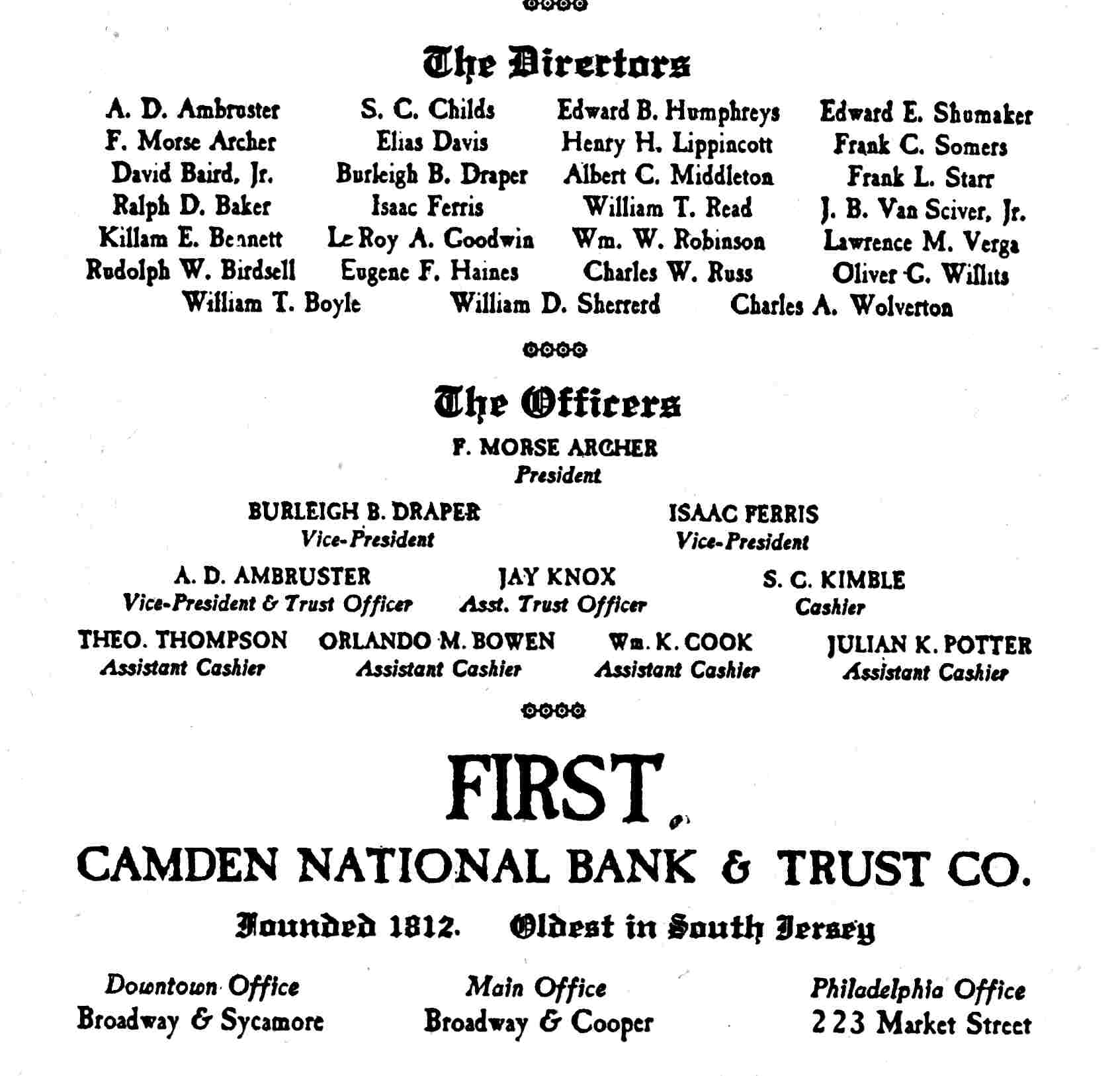
The Directors: A. D. Ambruster — S. C. Childs — Edward B. Humphreys — Edward E. Shumaker — F. Morse Archer — Elias Davis — Henry H. Lippincott — Frank C. Somers — David Baird, Jr. — Burleigh B. Draper — Albert C. Middleton — Frank L. Starr — Ralph D. Baker — Isaac Ferris — William T. Read — J. B. Van Sciver, Jr. — Killam E. Bennett — Le Roy A. Goodwin — Wm. W. Robinson — Lawrence M. Verga — Rudolph W. Birdsell — Eugene F. Haines — Charles W. Russ — Oliver C. Willits — William T. Boyle — William D. Sherrerd — Charles A. Wolverton
The Officers: F. MORSE ARCHER, President — BURLEIGH B. DRAPER, Vice-President — ISAAC FERRIS, Vice-President — A. D. AMBRUSTER, Vice-President & Trust Officer — JAY KNOX, Asst. Trust Officer — S. C. KIMBLE, Cashier — THEO. THOMPSON, Assistant Cashier — ORLANDO M. BOWEN, Assistant Cashier — Wm. K. COOK, Assistant Cashier — JULIAN K. POTTER, Assistant Cashier
FIRST CAMDEN NATIONAL BANK & TRUST CO. Founded 1812. Oldest in South Jersey. Downtown Office: Broadway & Sycamore — Main Office: Broadway & Cooper — Philadelphia Office: 223 Market Street
Boyle Hits Politics in Naming Judges
Camden Courier-Post —
Camden Man Excoriates Spoils System at Bar Meet at Shore
By Staff Correspondent
Atlantic City, June 3.—The “abhorrent” practice of “parceling out judicial offices as part of a nefarious spoils system” must cease if the honor and eminence of the bench is to be upheld, former Judge William T. Boyle, of Camden, told the State Bar Association yesterday.
Boyle, delivering his farewell address as retiring president of the association, mentioned no names. However, he apparently was referring to certain judicial appointments which recently drew widespread criticism, not because of the ability of the appointees but because of the political nature of the nominations.
He spoke of one county which has a vacancy in the office of prosecutor and a vacancy on the common pleas bench, neither of which has been filled because the political leaders could not get together and decide who they wanted.
“It seems,” he observed, “that one senator is able to block appointments.”
Senate President Richards, of Atlantic City, has been at odds with Democratic leaders in Atlantic County over appointments to the common pleas bench and the prosecutorship in that county.
“At one time,” said Boyle, “there were standards for qualifications maintained for men of the bench. In recent years, however, appointing and confirming powers engage in what appears to be a battle of political strategy over judicial appointments.
“The political party system permeates every branch of government in the state, but it should have no part where the administration of justice is concerned or is involved.
“We cannot be unmindful of the criticisms of the press, reflecting upon the manner in which judicial selections have been made in recent years. The bar association is without influence in this branch of government which is most vital to this profession.
“In the selection of judicial officials such an organization should not be ignored. We have complacently submitted to the growth of a system that is bringing reproach to the administration of justice.
Highest Types Needed
“It would be a great day for the state if only the interests of the people were considered where courts are concerned. I trust the day will come.
“Men, after years of honorable service upon the bench, have failed reappointment, because political leaders have been opposed to them. This parceling out judicial offices as a part of a nefarious spoils system is abhorrent and should be met with vigorous protests from this association.
“The time is at hand for courageous and determined action on our part. Otherwise, the profession of the law will yield its position of eminence, honor and influence in the forum and on the bench to the place-hunter and spoils-monger, and then, if that day shall ever arrive, there will be missing from the temples of justice the learned and honorable ministers to whom we have been so long accustomed and the glory of the bar will pass forever.”
Fears that the sweeping moves of the Roosevelt administration since March 4 would raise grave legal questions was expressed by William D. Mitchell, of New York, solicitor general under President Coolidge and Attorney General under President Hoover. “What has happened in Washington in the last three months,” Mitchell said, “will keep lawyers occupied for the next three years. It is obvious that the courts are to be confronted with grave legal questions during a period of great unrest and public agitation.”
William T. Boyle Dies; Noted Camden Jurist
Camden Courier-Post —
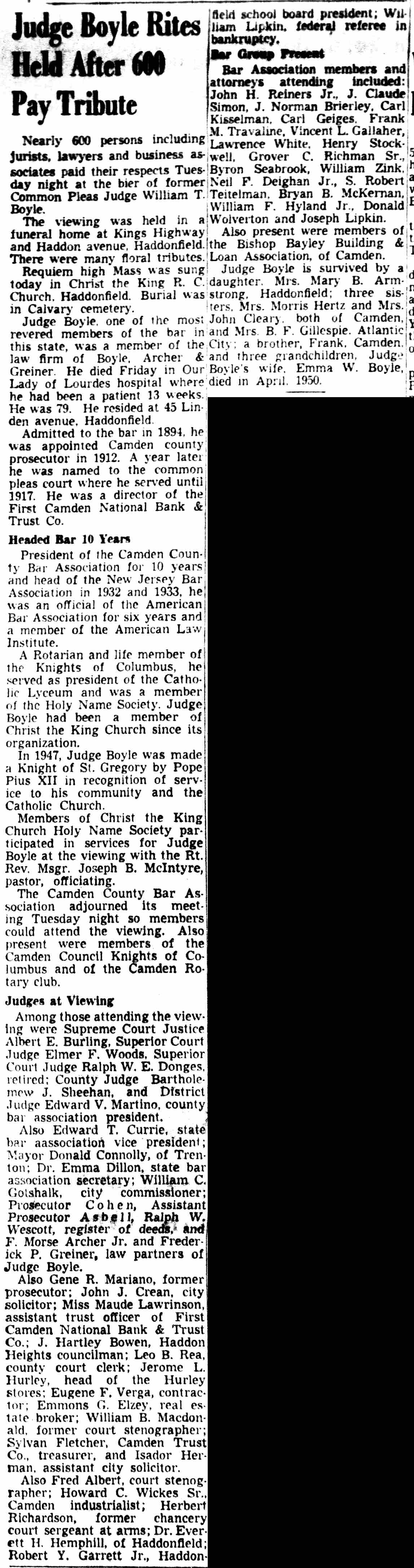
Former Common Pleas Court Judge Had Active Career
Nearly 600 persons including jurists, lawyers and business associates paid their respects Tuesday night at the bier of former Common Pleas Judge William T. Boyle. The viewing was held in a funeral home at Kings Highway and Haddon avenue, Haddonfield. Requiem high Mass was sung today in Christ the King Church, Haddonfield. Burial was in Calvary cemetery.
Judge Boyle, one of the most revered members of the bar in this state, was a member of the law firm of Boyle, Archer & Greiner. He died Friday in Our Lady of Lourdes hospital where he had been a patient 13 weeks. He was 79. He resided at 45 Linden avenue, Haddonfield.
Admitted to the bar in 1894, he was appointed Camden county prosecutor in 1912. A year later he was named to the common pleas court where he served until 1917. He was a director of the First Camden National Bank & Trust Co.
Headed Bar 10 Years
President of the Camden County Bar Association for 10 years and head of the New Jersey Bar Association in 1932 and 1933, he was an official of the American Bar Association for six years and a member of the American Law Institute.
A Rotarian and life member of the Knights of Columbus, he served as president of the Catholic Lyceum and was a member of the Holy Name Society. Judge Boyle had been a member of Christ the King Church since its organization.
In 1947, Judge Boyle was made a Knight of St. Gregory by Pope Pius XII in recognition of service to his community and the Catholic Church.
Members of Christ the King Church Holy Name Society participated in services for Judge Boyle at the viewing with the Rt. Rev. Msgr. Joseph B. McIntyre, pastor, officiating. The Camden County Bar Association adjourned its meeting Tuesday night so members could attend the viewing. Also present were members of the Camden Council Knights of Columbus and of the Camden Rotary club.
Judges at Viewing
Among those attending the viewing were Supreme Court Justice Albert E. Burling, Superior Court Judge Elmer F. Woods, Superior Court Judge Ralph W. E. Donges, retired; County Judge Bartholomew J. Sheehan, and District Judge Edward V. Martino, county bar association president.
Also Edward T. Currie, state bar association vice president; Mayor Donald Connolly, of Trenton; Dr. Emma Dillon, state bar association secretary; William C. Gotshalk, city commissioner; Prosecutor Cohen, Assistant Prosecutor Asbell, Ralph W. Wescott, register of deeds, and F. Morse Archer Jr. and Frederick P. Greiner, law partners of Judge Boyle.
Also Gene R. Mariano, former prosecutor; John J. Crean, city solicitor; Miss Maude Lawrinson, assistant trust officer of First Camden National Bank & Trust Co.; J. Hartley Bowen, Haddon Heights councilman; Leo B. Rea, county court clerk; Jerome L. Hurley, head of the Hurley stores; Eugene F. Verga, contractor; Emmons G. Elzey, real estate broker; William B. Macdonald, former court stenographer; Sylvan Fletcher, Camden Trust Co., treasurer, and Isador Herman, assistant city solicitor.
Also Fred Albert, court stenographer; Howard C. Wickes Sr., Camden industrialist; Herbert Richardson, former chancery court sergeant at arms; Dr. Everett H. Hemphill, of Haddonfield; Robert Y. Garrett Jr., Haddonfield school board president; William Lipkin, federal referee in bankruptcy.
Bar Group Present
Bar Association members and attorneys attending included: John H. Reiners Jr., J. Claude Simon, J. Norman Brierley, Carl Kisselman, Carl Geiges, Frank M. Travaline, Vincent L. Gallaher, Lawrence White, Henry Stockwell, Grover C. Richman Sr., Byron Seabrook, William Zink, Neil F. Deighan Jr., S. Robert Teitelman, Bryan B. McKernan, William F. Hyland Jr., Donald Wolverton and Joseph Lipkin.
Also present were members of the Bishop Bayley Building & Loan Association, of Camden.
Judge Boyle is survived by a daughter, Mrs. Mary B. Armstrong, Haddonfield; three sisters, Mrs. Morris Hertz and Mrs. John Cleary, both of Camden, and Mrs. B. F. Gillespie, Atlantic City; a brother, Frank, Camden, and three grandchildren. Judge Boyle’s wife, Emma W. Boyle, died in April, 1950.