James E. Hewitt
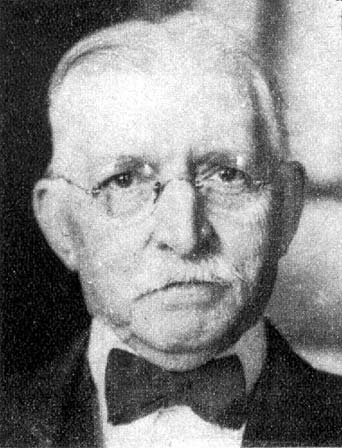
James E. Hewitt, c. 1931
James E. Hewitt was born in Camden, NJ, around 1864 to John K. and Hannah Hewitt. In 1880 the family was living at 439 Kaighn Avenue, John Hewitt supporting his family as a shoemaker. Living at the end of the block, at 463 Kaighn Avenue, was dry goods merchant Isaac C. Toone, who would go on to found one of Camden’s first department stores. James E. Hewitt had already gone into business, as a fruit dealer. He married his wife Carrie at the age of 21. By 1887 he had a confectionary shop at 415 Kaighn Avenue, where he also lived.
James E. Hewitt was a member of the Union Methodist Episcopal Church at the northwest corner of Mount Vernon Street and Newton Avenue. In 1909 he was appointed to the Official Board of the church.
In January of 1920 the James E. Hewitt family owned a home at 529 South 5th Street. The family then consisted of James and Carrie Hewitt and their fourteen year-old daughter Grace. James Hewitt was then serving as the Undersheriff of Camden County. He later served as the Director of Charities for the city of Camden, under the direction of Winfield S. Price, who served as Mayor of Camden from 1927 to 1931. He also at one time had served as President of Camden’s City Council.
Last a resident of 529 South 5th Street, James E. Hewitt died on May 20, 1935, of a heart ailment.
In the Political Whirl
Philadelphia Inquirer —
Camden in a Lively Congressional Contest.
ANTI-GRATZ WORKERS ENCOURAGED
Campaign Jottings of Interest Gathered at the City and State Committee Headquarters of Both Parties.
There was widespread interest in the Republican delegate election in Camden county last night. Delegates were chosen to the Congressional District Convention, which meets at Bridgeton on Thursday next. Hon. Thomas H. Dudley and Christopher Bergen were the rival candidates, and the latter’s friends claim to have carried every ward in the city.
During the voting at the Fourth ward polls Policeman Ikey Scheeve got into an altercation with two men named Richmond and Walters. It is alleged that he used a blackjack without provocation. The two men who were assaulted immediately engaged the services of a lawyer, who will cause Sheeve’s arrest to-day on the charge of assault and battery. Following are the delegates elected in Camden city and in the various townships:
First Ward—W. Baily, Isaac Githens, George Barrett, Frank Welch and Howland Croft.
Second Ward—J. Willard Somers, Frank C. Somers, John Wells, W. H. Day and Samuel Bakely.
Third Ward—Dilwyn Pettit, J. Milton Powell, David Freeman, Sr., George Denny and Albion Lane.
Fourth Ward—Everett Ackley, Samuel M. Gall, William Ireton, Joseph Brown and Howard Lee.
Fifth Ward—Christopher J. Mines, Jr., Frederick Parker, John H. Miller, David Rankin and Samuel Roach.
Sixth Ward—A. R. Dease, James Brown, Isaac Robinson, John Brother and James Hewitt.
Seventh Ward—John C. Edwards, M. D. Cornish, William K. Price, Reuben Gaskill and John W. Everman.
Eighth Ward—Samuel H. Mourey, William H. Smith, Herman Helmbold, E. Thompson and Thomas Watson.
Stockton township was carried by Dudley, and W. Harrison Livermore carried Woodbury. Centre, Delaware and Haddon townships of Camden county were carried by Bergen.
The Congressional district includes Camden, Gloucester, Cumberland, Salem and Cape May counties. The indications are that Congressman Hires will be renominated.
Station or No More Privileges Cry Camdenites
Philadelphia Inquirer —
Mass Meeting Insists Pennsy Retain Depot at Haddon Avenue
CLAIM RAILROAD BUNCOED CITY
Refusing to accept the explanations of the representatives of the Pennsylvania Railroad Company as to the impracticability of continuing the Haddon avenue station, Camden citizens at a mass meeting held with the Board of Trade last night adopted the following resolutions:
Resolved, That it is the sense of this meeting of the citizens of Camden that the Pennsylvania Railroad Company shall not be granted any further privileges or concessions by the city of Camden until the said corporation shall establish a station in the vicinity of Haddon avenue.
“Resolved, That the secretary be directed to transmit a copy of these resolutions to City Council.”
City Was Buncoed
This action was taken after it had been shown that the company had practically buncoed Camden when the ordinances providing for the elevation of the tracks were adopted by Council last year.
Councilman James E. Hewitt and City Clerk Isaac V. Bradley, who was a Councilman at that time, declared there had been a tacit agreement to continue the station, notwithstanding the assertion of the corporation’s representatives to the contrary. Ordinances presented in 1902 provided for the station, but the clause relating to this matter was eliminated in those subsequently adopted in a revised form.
A committee appointed by the Board of Trade submitted a report of the result of an interview they had had with General Manager Atterbury bearing on the subject of Haddon avenue station. In reply to their presentation of the request of the citizens of Camden, Mr. Atterbury said there were several reasons why the station could not be continued. The first is because of the narrow construction of the elevated railroad, which is insufficient to admit “island platforms.” Another reason is that such a structure would be a menace to life, while a third is that there are too many switches at that point to admit the building of a station.
These ideas were further elaborated by Superintendent Lovell, of the West Jersey and Seashore Railroad, and Engineer Temple, who has charge of the work.
These explanations did not satisfy the throng, several of whom declared the corporation was not considering the city’s interests, but was carrying out its own plans without the formality of letting the public know about them.
May Want New Concessions
It was also declared that it had been rumored that the company would require a number of concessions from the city in the near future.
“If this is the case,” said Councilman Hewitt, “I think the company should grant this concession to Camden before it is given any further consideration by the city.”
Elmer E. Long, Charles Boyer and others spoke of the necessity of continuing the station because of the business interests of Camden, after which the resolution already mentioned was adopted.
Pennsy Refuses to Retain Haddon Avenue Station
Undetermined Newspaper —
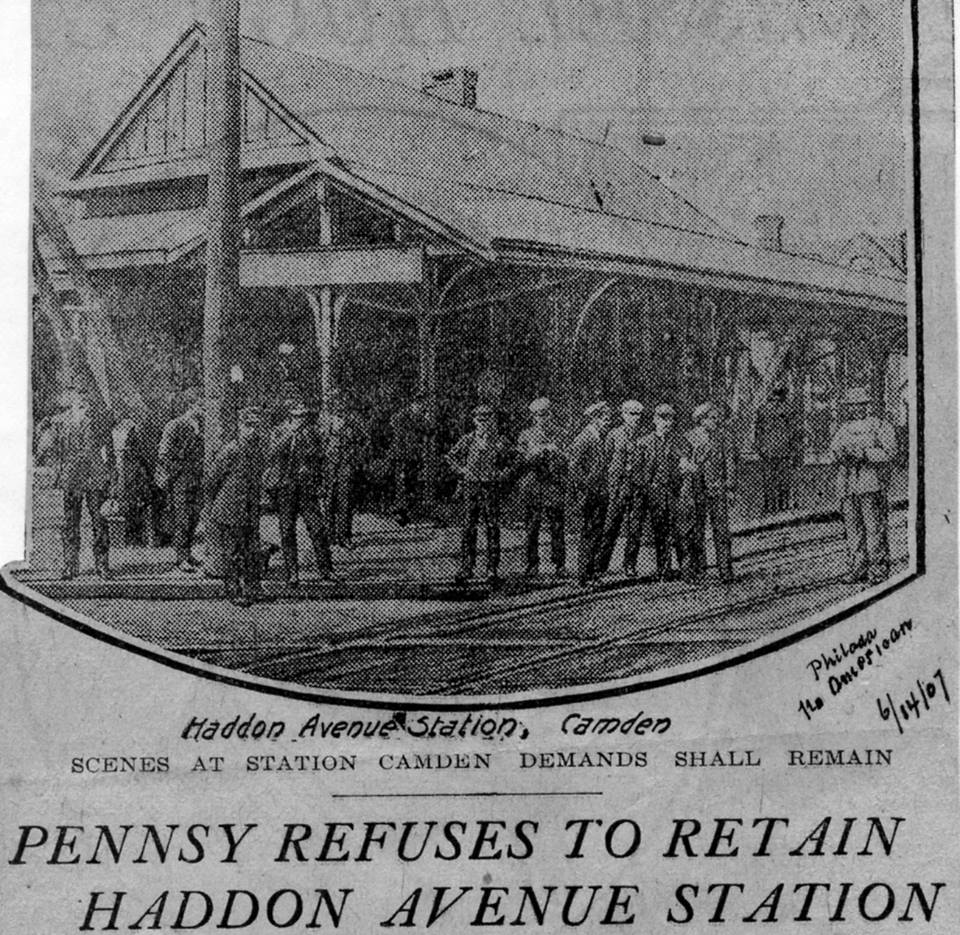
Haddon Avenue Station, Camden
SCENES AT STATION CAMDEN DEMANDS SHALL REMAIN
PENNSY REFUSES TO RETAIN HADDON AVENUE STATION
Philadelphia Inquirer — February 27, 1908
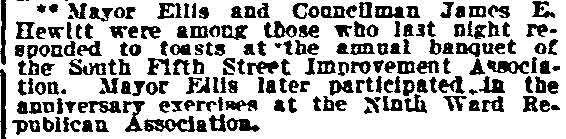
•• Mayor Ellis and Councilman James E. Hewitt were among those who last night responded to toasts at the annual banquet of the South Fifth Street Improvement Association. Mayor Ellis later participated in the anniversary exercises at the Ninth Ward Republican Association.
Camden Candidates Ready for Primaries
Philadelphia Inquirer —
Though City Clerk Extends Time the Line Up of Contestants Is Virtually Complete
Virtually all of the municipal candidates, Republicans and Democrats, filed their petitions with City Clerk Brown in Camden yesterday. Although the new law apparently provided that yesterday was the last day on which the petitions could be filed, Clerk Brown placed a different construction on the act and extended the time until next Monday.
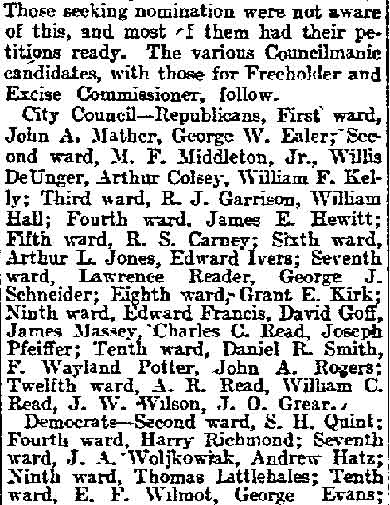
Those seeking nomination were not aware of this, and most of them had their petitions ready. The various Councilmanic candidates, with those for Freeholder and Excise Commissioner, follow.
City Council—Republicans, First ward, John A. Mather, George W. Ealer; Second ward, M. F. Middleton, Jr., Willis DeUnger, Arthur Colsey, William F. Kelly; Third ward, R. J. Garrison, William Hall; Fourth ward, James E. Hewitt; Fifth ward, R. S. Carney; Sixth ward, Arthur L. Jones, Edward Ivers; Seventh ward, Lawrence Reader, George J. Schneider; Eighth ward, Grant E. Kirk; Ninth ward, Edward Francis, David Goff, James Massey, Charles C. Read, Joseph Pfeiffer; Tenth ward, Daniel R. Smith, F. Wayland Potter, John A. Rogers; Twelfth ward, A. R. Read, William C. Read, J. W. Wilson, J. O. Grear.
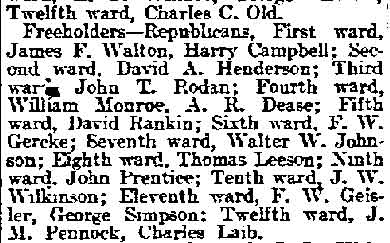
Democrats—Second ward, S. H. Quint; Fourth ward, Harry Richmond; Seventh ward, J. A. Woljkowiak, Andrew Hatz; Ninth ward, Thomas Lattlehales; Tenth ward, E. F. Wilmot, George Evans; [a partly cut line at the top of the next crop is not legible] Twelfth ward, Charles C. Old.
Freeholders—Republicans, First ward, James F. Walton, Harry Campbell; Second ward, David A. Henderson; Third ward, John T. Rodan; Fourth ward, William Monroe, A. R. Dease; Fifth ward, David Rankin; Sixth ward, F. W. Gercke; Seventh ward, Walter W. Johnson; Eighth ward, Thomas Leeson; Ninth ward, John Prentice; Tenth ward, J. W. Wilkinson; Eleventh ward, F. W. Geisler, George Simpson; Twelfth ward, J. M. Pennock, Charles Laib.
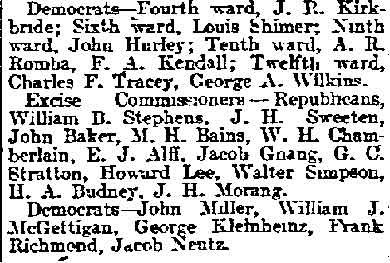
Democrats—Fourth ward, J. R. Kirkbride; Sixth ward, Louis Shimer; Ninth ward, John Hurley; Tenth ward, A. R. Romba, F. A. Kendall; Twelfth ward, Charles F. Tracey, George A. Wilkins.
Excise Commissioners—Republicans, William B. Stephens, J. H. Sweeten, John Baker, M. H. Bains, W. H. Chamberlain, E. J. Alff, Jacob Gnang, G. C. Stratton, Howard Lee, Walter Simpson, H. A. Budney, J. H. Morang.
Democrats—John Miller, William J. McGettigan, George Kleinheinz, Frank Richmond, Jacob Neutz.
Camden’s Bodies Begin New Year
Philadelphia Inquirer —
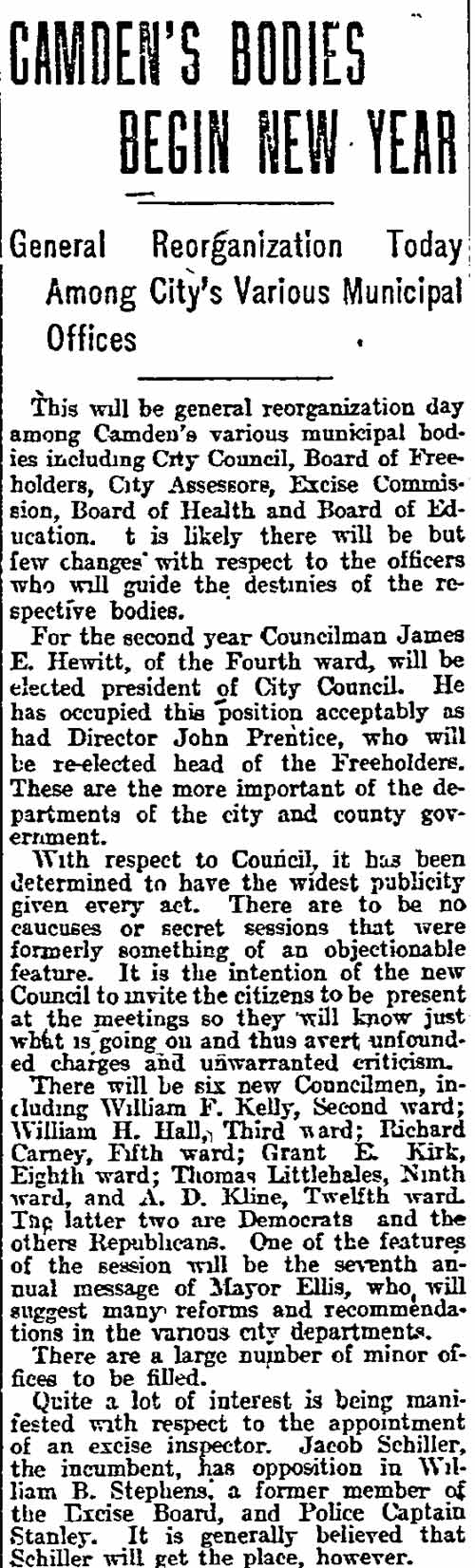
General Reorganization Today Among City’s Various Municipal Offices
This will be general reorganization day among Camden’s various municipal bodies including City Council, Board of Freeholders, City Assessors, Excise Commission, Board of Health and Board of Education. It is likely there will be but few changes with respect to the officers who will guide the destinies of the respective bodies.
For the second year Councilman James E. Hewitt, of the Fourth ward, will be elected president of City Council. He has occupied this position acceptably as had Director John Prentice, who will be re-elected head of the Freeholders. These are the more important of the departments of the city and county government.
With respect to Council, it has been determined to have the widest publicity given every act. There are to be no caucuses or secret sessions that were formerly something of an objectionable feature. It is the intention of the new Council to invite the citizens to be present at the meetings so they will know just what is going on and thus avert unfounded charges and unwarranted criticism.
There will be six new Councilmen, including William F. Kelly, Second ward; William H. Hall, Third ward; Richard Carney, Fifth ward; Grant E. Kirk, Eighth ward; Thomas Littlehales, Ninth ward, and A. D. Kline, Twelfth ward. The latter two are Democrats and the others Republicans. One of the features of the session will be the seventh annual message of Mayor Ellis, who will suggest many reforms and recommendations in the various city departments.
There are a large number of minor offices to be filled.
Quite a lot of interest is being manifested with respect to the appointment of an excise inspector. Jacob Schiller, the incumbent, has opposition in William B. Stephens, a former member of the Excise Board, and Police Captain Stanley. It is generally believed that Schiller will get the place, however.
John H. Carmany Dead in Camden
Philadelphia Inquirer —

Was a Prominent Member of City Council and Well-Known in Industrial and Lodge Circles
Death yesterday made another call on Camden’s official family. Councilman John Carmany expired at his home, 772 Pine street, after a three weeks’ siege with Bright’s disease. As a member of the Water Committee of City Council, Mr. Carmany was intimately associated with Chief Robert Hollingsworth, whose death occurred just a week ago yesterday. He had served seven years in the city law-making body and there yet remained another year of his fourth consecutive term as one of the representatives of the Seventh ward. Before being elected to Council, Mr. Carmany was a member of the Board of Education for several years, and in both capacities he was attentive and painstaking.
Succeeding his father in the ownership of the Wissahickon Dye Works, at Eighth and Cherry streets, Mr. Carmany two years ago moved his plant to a new building he erected at Eleventh and Pine streets. He was also engaged as a cotton broker on quite an extensive scale. Born in Lebanon county, Pa., 51 years ago, Mr. Carmany came to Camden at the age of 14 and had since resided there. He was a member of Philadelphia Lodge No. 9, F. and A. M.; Camden Elks, Moose, Seventh Ward Republican Club and Camp No. 50, P. O. S. of A., of Roxborough, Pa. He is survived by a widow and three children, one of whom is Mrs. Howard Justice.
President of City Council Hewitt last night named Messrs. Broome, Gordon, Read, Francis, De Unger and Kensinger as a committee to make arrangements for the city officials to attend the funeral, which takes place on Wednesday afternoon at 2 o’clock. The committee held a meeting at the City Hall last night.
JOHN H. CARMANY
Prominent member of Camden City Council who died yesterday
Finkeldey Out for Sheriff Nomination
Philadelphia Inquirer —
In Contest Among Republicans Are Prominent Officials—Democrats Seem Listless
It was announced in Camden yesterday by Councilman Frederick A. Finkeldey, of the Eleventh ward, that he is a candidate for the Republican Shrievalty nomination. He asserts that he is in the contest until the end. He is understood to have the backing of the German-American Alliance.
This contest among the Republicans bids fair to become much more interesting than in the Democratic camp. Others in the contest with Finkeldey include President of Council James E. Hewitt, Councilman Joshua C. Haines, Sheriff’s Clerk Harry Marter, George Starn, in the city, and Jacob Price, of Gloucester township, and Willard Gibbs, in Clementon township.
Among the Democrats it is hardly likely that anyone other than Under Sheriff Alvin B. Pitman will have a chance for the nomination. He is the unqualified choice of Sheriff Nowrey, the nominal leader at least of Camden’s Democracy. But there is some factional trouble brewing.
Planning Memorial Day Program
Philadelphia Inquirer —
Mayor Ellis, in Camden yesterday, announced the committee of citizens who will act in conjunction with the veterans in arranging for the Memorial Day festivities. The committee follows: Frank W. Tussey, chairman; Charles M. Curry, secretary; Fred Roedel, William Sanginette, W. L. Tushingham, B. F. Schroeder, Edward H. Nieland, Daniel M. Stevens, W. F. Powell, Abe Fuhrman, C. K. Deacon, Jacob Neutze, Francis B. Wallen, Charles S. Ackley, Wallace McGeorge, Ralph D. Baker, Wm. F. Kelly, William Schmid, Lawrence B. Reader, M. D. Cornish, Harry Whaland, General John A. Mather, James E. Hewitt and David Jester.
Thousands View Chief's Remains
Camden Post-Telegram —
Throngs Jam Court House While Body Lies in State for Two Hours.
Last Sad Rites This Afternoon
Not since the memorable funeral of Chief of Police Foster ten years ago, has there been such a genuine public tribute paid an official of Camden as was in evidence last night at the bier of the lamented Fire Chief Worthington, and today at his funeral. It is hard to estimate the number of persons in a crowd, but from 7 until 9 o’clock last night there was a steady stream of men, women and children, two abreast, who passed from the main entrance, through the center corridor and beneath the illuminated rotunda, where the body lay, and thence out by the west corridor. There was never a stop, and it is estimated that at least 10,000 persons were there, perhaps more.
There could not have been a more ideal location for the repose of the casket containing the honored dead, and the great array of beautiful flowers than beneath the rotunda. It seemed to be a sacred shrine in itself where the citizenry dropped a tear for the lamented departed. The effulgence of the soft lights from above specially installed by Electrical Chief Kelly but lent to the scene and as the dark garbed escort of firemen, the active pall bearers, stood on guard, the scene was unusually impressive.
Chief Worthington, aside from the pallor that comes to the dead, looked as he did in life, for the thread had been snapped so quickly that it was while he was in his full vigor that the vital spark had taken its flight. There were some marks on his face that indicated the intense though momentary suffering through which he passed on his fateful plunge from the roof of the burning building to his quick death, and the passing crowd remarked this. But withal there was that calmness and repose feature which seemed to indicate that the gallant leader of Camden’s fire fighters but lay sleeping rather than that his soul had taken its eternal flight.
Public grief may be a mere ephemeral emotion, born of the moment and only to be succeeded by the acclaim of the newly arisen public idol, but last night’s encomiums seemed to come from hearts that overflowed with genuine and permanent sorrow over the untimely passing of so excellent a public servant. Many tear-suffused eyes indicated this, many expressions of grief, of sorrow, of condolence of those left showed this. The sentiment in evidence everywhere can only be likened to the sweetness of the wonderful flowers whose odor spread through all the corridors and in all the rooms of the great marble building.
High in the clock tower of the City Hall the bell began tolling at 6:30 o’clock. At half-minute intervals its doleful strains went forth on the cold blustery east wind which had succeeded a day of spring sunshine. The bell and the screeching wind seemed to combine as a knell indicating the passing grief of the city. It was the preliminaries to the marching of the funeral cortege from the stricken Chief’s home on Penn Street to the resting place at the Court House.
There were forty policemen in dress uniform with Chief Gravenor at their head. There were twenty-six fire heads from Philadelphia, with Chief William Murphy in the van, a tribute in itself of more than passing moment. There was the caisson on which was the black draped casket containing the body of he who all honored. There was the little red car in which Chief Worthington was wont to speed through the city at every alarm and there was his helmet and coat. There was Acting Chief Stockton and forty of the men who fought flames under the direction of he who lay so still. There was the family in cabs with curtains drawn, the members of City Council and the active pall bearers—Daniel Leach, Peter B. Carter, James White, William Patterson, Elmer Burkett, Samuel Harring.
When the cortege reached the Court House the Camden boys took up their position on the inside beneath the rotunda while the Philadelphia visitors made an imposing array on the granite steps outside. And then came the public in its steady and unending stream.
Later the Philadelphia delegation was escorted to the Board of Freeholders room where tribute was paid to the dead and where a mingling of the two cities took place. Besides Chief Murphy the visitors included Battalion Chiefs William T. Barrett and George P. McConaghy, Captains L. F. Bunting, William Lindsey, H. Dinlocker, J. Higginson, J. E. Talbot, D. Campbell, T. O’Brien, F. Hughes, E. Basenfelder, H. Hutt, William McCusker, G. Rheim, R. Wilsey, J. Webb, H. Goers, H. Haines, Insurance Patrol Captain Joseph H. Shermer, William Hickman, William Rodgers, John Wyatt, David Phillip, John Clyde, H. Wilkinson.
President of City Council James E. Hewitt spoke of the work Chief Worthington had already accomplished, of his plans, of his value and worth to Camden. Chief Murphy responded in a fitting way and this incident in itself was one to be remembered.
An affecting sight was witnessed by the handful of spectators, among them being other firemen, city and county officials and policemen who remained after the big doors on Sixth Street had been closed. The last to view the Chief’s remains were a delegation of about twenty firemen. Solemnly the men passed by the bier and gazed upon the features of their departed brother.
As the last of the line approached, Deputy Chief John A. Stockton was seen. He stopped and with his cap laid across his breast he looked down into the casket. For almost a minute Chief Stockton stood as though glued to the spot. Then he glanced about him and the sympathetic look upon his face thrilled all.
He heaved a sigh and perhaps the teardrops refused to come, but Chief Stockton, as the lines upon his face showed, was struggling with the inner man. His emotions were tugging at his heart, but a fire laddie cannot give way to his feelings although his brother superior officer and dear friend had answered his last alarm.
The floral pieces surrounding the bier bespoke the love, admiration and respect the donors held for the dead chief. One design particularly beautiful was a mammoth loving cup made of blossoms, flowers and roses. This was the token sent by members of City Council and other city officials.
Another was the design sent by the Electrical Bureau through Chief Kelly. The original fire box, No. 134, which was pulled on the night of the fire by Chief Worthington was enshrouded by roses, carnations and lilies.
A maltese cross standing several feet high and bearing the initials of the organization was the tribute sent by the Firemen’s Mutual Benevolent Association. Chief Worthington was president of this association.
The Camden police sent a large shield of flowers and Council members offered a vacant chair of roses. The New Jersey Auto Supply Company, No. 2 Engine Company and No. 1 Truck sent beautiful broken circles and a wreath was the offering from the employees of the Victor Talking Machine Company.
A broken circle from members of the Sixth Ward Republican Club and a wreath from his friends in the sixth precinct of the Second Ward were other beautiful pieces. West Collingswood and Collingswood firemen sent two beautiful floral circles and from the Loyal Order Legion a wreath was received.
Other offerings were from the Camden Liquor Dealers league, a beautiful circle from No. 6 Engine Company, in which house Chief Worthington was captain previous to his elevation to the office of chief; sprays from the Bethany M.E. Church, Ladies Auxiliary of the Loyal Order of Moose; a wreath from the pupils of the eighth grade Sewell school, and a spray from North Baptist Church. There also were designs from members of the family and friends, all of which bespoke the great love held for the departed fire chief.
The impressive services of the P.E. Church marked the last sad rites this afternoon at St. Paul’s Church. The guard of honor and city officials left Fire Headquarters at 1:20 and proceeded to the Worthington home and escorted the remains to the church, where services were conducted by the rector, Rev. R.E. Brestell, and Rev. H.O. Jones, rector of St. Stephen’s P.E. Church. Interment was made at Arlington.
The honorary pallbearers were Mayor Ellis, Hon. David Baird, Frank F. Patterson, John W. Bell, General John A. Mather, Melbourne F. Middleton Jr., Harry R. Reed, Arthur L. Jones, Robert Gordon, David Jester, George Schneider, William Mills, J.O. Grear, William Hall, George L. Bender, and James E. Hewitt.
Trolley Demands to Be Presented Today
Philadelphia Inquirer —
Special Committee of Camden Councilmen and Citizens Agree on Requisites of Good Service
Members of the special committee of Councilmen and citizens appointed by President Hewitt, of Camden City Council, to look after better trolley service, held a preliminary meeting yesterday at which arguments and plans were prepared for presentation to Vice President Burleigh and other officials of the Public Service Railway Company today. If the demands are unheeded the Public Utilities Commission will be asked to investigate.
In the demands to be made today it will be asked that there be a complete restoration of the service on the North Cramer Hill and old Crosstown lines with ten minute headway; that twelve minutes service be given on the Fifth-Broadway line and that cars be operated Sunday nights. On the Sixth and Eighth streets line ten-minute service will be demanded during rush hours and fifteen-minute service at other periods. The company will be requested to withdraw the old style cars on this line.
On the Kaighn avenue line seven instead of twelve-minute service will be asked, and, in addition, efforts will be made to have a double track constructed to Park Boulevard, which will be a real tap of Forest Hill Park. Ten-minute service will also be asked on the Second and Fourth street line with service all day instead of cutting the cars of [sic] from 10 until 2 o’clock, as at present.
At the terminals it will be asked that the cars discharge passengers without running half way back to Front street, as at present, which creates much confusion.
Retiring Councilman to Serve as President
Philadelphia Inquirer —
In appreciation of his ten years of service as a City Councilman, Frederick A. Finkeldey, of the Eleventh ward, who retires this year, will be selected as president of Camden City Council for the balance of 1914, James E. Hewitt having resigned on account of his appointment as under sheriff.
Councilman Frank Vanhart, of the Seventh ward, will probably be selected as president at the reorganization January 1. A. R. Dease, a Republican, who made an excellent run at the primaries, may succeed Hewitt as Fourth ward Councilman.
To Help Those in Need
Philadelphia Inquirer —
With the object of looking after the “down and out class” of men, women and children, the Camden Rescue Society has been organized by the election of these officers: President John A. Rogers; vice president, James L. Hewitt; treasurer, Howard B. Hemphill; secretary, W. H. Cox; trustees, Charles A. Reynolds, E. G. C. Bleakly, George A. Frey, Charles S. Read, Frederick S. Fox, Edward Schuster, Jr., J. Harry Knerr, Ambrose R. Russell. The society has its headquarters at 231 Kaighn avenue.
Heavy Bail Demanded; Man Later Released
Philadelphia Inquirer —
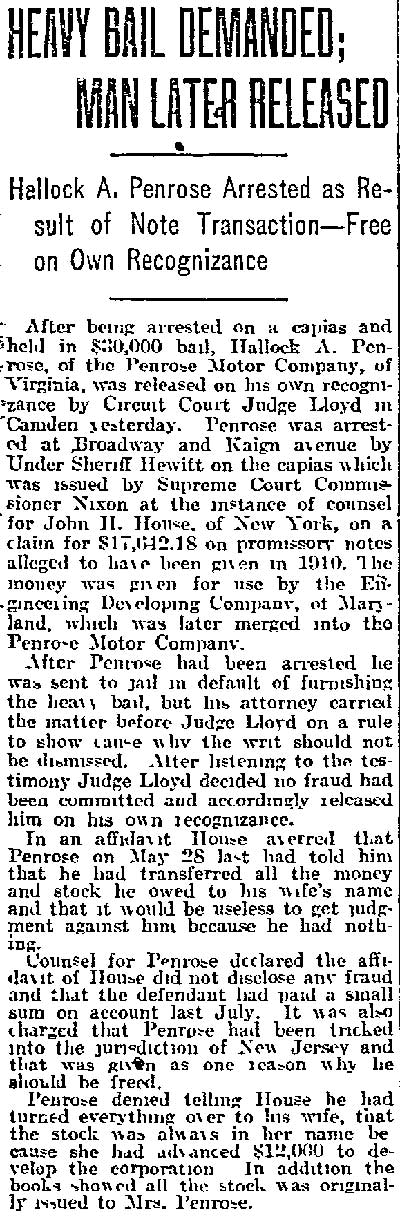
Hallock A. Penrose Arrested as Result of Note Transaction—Free on Own Recognizance
After being arrested on a capias and held in $[?]0,000 bail, Hallock A. Penrose, of the Penrose Motor Company, of Virginia, was released on his own recognizance by Circuit Court Judge Lloyd in Camden yesterday. Penrose was arrested at Broadway and Kaign [sic] avenue by Under Sheriff Hewitt on the capias which was issued by Supreme Court Commissioner Nixon at the instance of counsel for John H. House, of New York, on a claim for $17,[?]42.18 on promissory notes alleged to have been given in 1910. The money was given for use by the Engineering Developing Company, of Maryland, which was later merged into the Penrose Motor Company.
After Penrose had been arrested he was sent to jail in default of furnishing the heavy bail, but his attorney carried the matter before Judge Lloyd on a rule to show cause why the writ should not be dismissed. After listening to the testimony Judge Lloyd decided no fraud had been committed and accordingly released him on his own recognizance.
In an affidavit House averred that Penrose on May 28 last had told him that he had transferred all the money and stock he owed to his wife’s name and that it would be useless to get judgment against him because he had nothing.
Counsel for Penrose declared the affidavit of House did not disclose any fraud and that the defendant had paid a small sum on account last July. It was also charged that Penrose had been tricked into the jurisdiction of New Jersey and that was given as one reason why he should be freed.
Penrose denied telling House he had turned everything over to his wife, that the stock was always in her name because she had advanced $12,000 to develop the corporation. In addition the books showed all the stock was originally issued to Mrs. Penrose.
Many at Williams' Funeral
Philadelphia Inquirer —
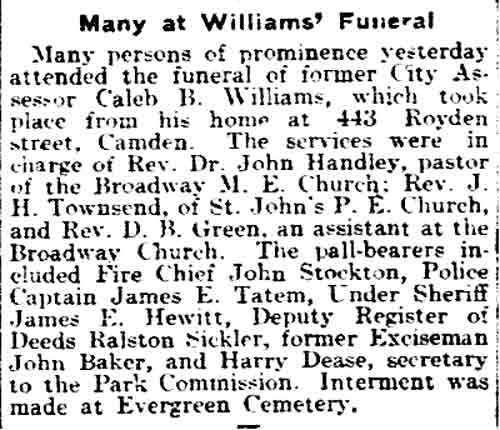
Many persons of prominence yesterday attended the funeral of former City Assessor Caleb B. Williams, which took place from his home at 443 Royden street, Camden. The services were in charge of Rev. Dr. John Handley, pastor of the Broadway M. E. Church; Rev. J. H. Townsend, of St. John’s P. E. Church, and Rev. D. B. Green, an assistant at the Broadway Church. The pall-bearers included Fire Chief John Stockton, Police Captain James E. Tatem, Under Sheriff James E. Hewitt, Deputy Register of Deeds Ralston Sickler, former Exciseman John Baker, and Harry Dease, secretary to the Park Commission. Interment was made at Evergreen Cemetery.
New Suit Against Titus
Philadelphia Inquirer —
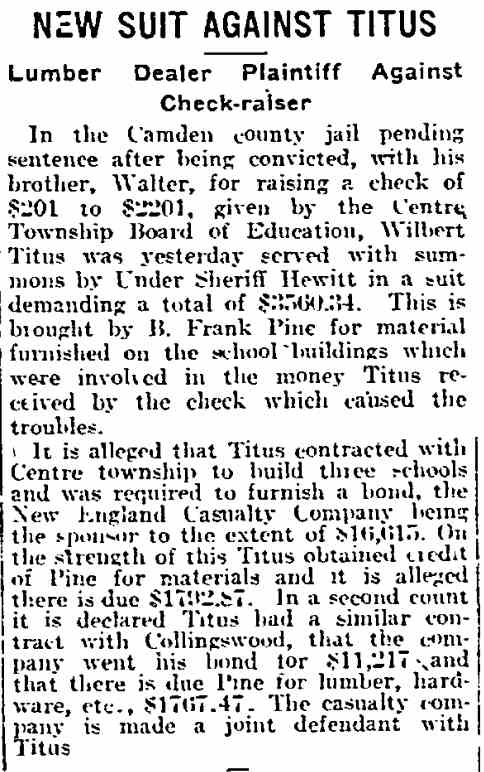
Lumber Dealer Plaintiff Against Check-raiser
In the Camden county jail pending sentence after being convicted, with his brother, Walter, for raising a check of $201 to $2201, given by the Centre Township Board of Education, Wilbert Titus was yesterday served with summons by Under Sheriff Hewitt in a suit demanding a total of $3560.34. This is brought by B. Frank Pine for material furnished on the school buildings which were involved in the money Titus received by the check which caused the troubles.
It is alleged that Titus contracted with Centre township to build three schools and was required to furnish a bond, the New England Casualty Company being the sponsor to the extent of $16,615. On the strength of this Titus obtained credit of Pine for materials and it is alleged there is due $1792.87. In a second count it is declared Titus had a similar contract with Collingswood, that the company went his bond for $11,217, and that there is due Pine for lumber, hardware, etc., $1767.47. The casualty company is made a joint defendant with Titus.