Introduction
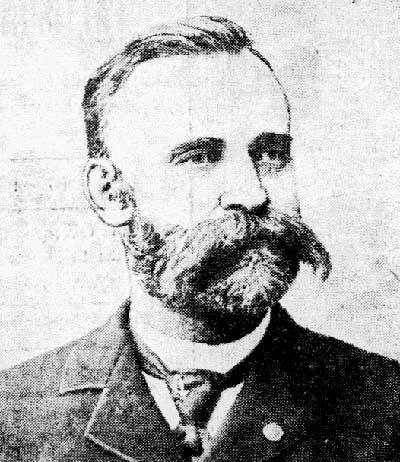
Colonel George G. Felton
COLONEL GEORGE G. FELTON was born in Massachusetts. He served in the Union army during the Civil War with Company F, 52nd Massachusetts Volunteer Infantry Regiment. At war’s end he settled in Burlington, New Jersey, then moved to Camden not long afterwards. In August of 1883 he entered the New Jersey National Guard as a first lieutenant and quartermaster of the Sixth Regiment, where he rose to the rank of Colonel. In 1887 he began working with his brother Charles H. Felton, a prominent real estate broker. After his brother’s death in November of 1887, he stayed with the firm, then run by his sister-in-law, Mrs. Mary Felton. George G. Felton went into business for himself in 1893.
George Felton was active politically as a Republican. He was appointed to the Board of Public Works in 1892. After City Treasurer Frank Michellon resigned in 1896, George F. Felton was appointed to the post to finish out Michellon’s term. George G. Felton was elected city treasurer in 1897. He was also active in banking circles, as a director of the Central Trust Company and the Security Trust Company, and was a Mason, a member of the Ancient Order of United Workmen, of William B. Hatch Post No. 37, G.A.R., and the Camden Republican Club.
Col. George G. Felton committed suicide on the night of July 7, 1902.
William B. Hatch Post No. 37, G.A.R.
George Reeser Prowell’s History of Camden County, N.J. — 1886
WILLIAM B. HATCH POST No. 37, of Camden, was instituted and chartered November 25, 1879, with eighty-one members and the following named Post officers:
Post Commander, John E. Grubb; Senior Vice-Commander, Richard J. Robinson; Junior Vice-Commander, Daniel J. Fullen; Surgeon, Thomas G. Rowand, M.D.; Chaplain, John Quick; Officer of the Day, John A. Dall; Officer of the Guard, Edmund G. Jackson, Jr.; Quartermaster, Christopher J. Mines, Jr.; Adjutant, Benjamin J. Pierce; Sergeant-Major, William A. Tattern; Quartermaster-Sergeant, William B. E. Miller.
At the first meeting of the Post it was decided by a unanimous vote to name it in honor of the late Colonel William B. Hatch, of the Fourth Regiment. When Mrs. C. Hatch, the mother of the colonel was informed that the post had honored the memory of her son by naming it after him, she sent to the Post the following response:
Camden N. J.,
November 26th, 1879John E. Grubb, Post Commander
Dear Sir,
It will afford me much pleasure to be identified with Post 37, G. A. R., named in honor of my son, William B. Hatch, by allowing me to present to the same its colors. The memory of my son is ever dear to me, and, while at the same moment I may have thought the sacrifice too great an affliction, yet I was consoled by the fact that I gave him up that this Union might be preserved. It was duty and patriotism that called him, and while I mourn him as a mother for a well-beloved son, yet I would not have stayed him, for the love of country and the upholding of this glorious Republic is what every mother should instill into her sons, as the purest and holiest spirit.Yours truly,
C. HatchThe following is a complete roster of this post for 1886:
Post Commander, Benjamin H. Connelly; Senior Vice-Commander, Adam C. Smith; Junior Vice-Commander, William Haegele; Surgeon, George Pfau; Chaplain, Samuel Gaul; Officer of the Day, Robert Crawford; Officer of the Guard, John D. Cooper; Quartermaster, Samuel J. Fenner; Adjutant, William B. Summers; Sergeant-Major, Stacy H. Bassett; Quartermaster-Sergeant, Otto K. Lockhart.
Comrades: Philip Achenbach, George L. Allchin, Isaac Albertson, Joseph Applegate, John W. Barclay, Martin M. Barney, Joseph Baxter, William W. Bennett, Charles L. Bennett, Henry Bickering, Abel Biddle, George K. Biddle, John Bieri, Robert M. Bingham, Socrates T. Bittle, George W. Bittle, Benjamin F. Blizzard, Joseph Borton, Frederick Bowers, Benjamin M. Braker, John Breyer, William H. Brians, Wm. J. Broadwater, William Broadwater, John Brown, Harris Brooks, William H. Brooks, Joseph F. Bryan, Joseph Buddew, J. Q. Burniston, George Burton, Frederick Buser, Thomas L. Bush, William Butcher, Isaac B. Buzby, Edward C. Cattell, Joseph Cameron, James H. Carey, William Carey, James Chadwick, James Chafey, George M. Chester, James D. Chester, Lewis L. Chew, Henry S. Chew, John W. Churn, Andrew B. Cline, Charles Clarke, Samuel J. Cook, Levi E. Cole, John J. Collins, John C. Cooper, John W. Cotner, Thomas L. Conly, Harvey M. Cox, Jason S. Cox, Harris Crane, Charles Cress, Joel G. Cross, O. C. Cunningham, John A. Dall, John Dalby, John H. Damon, Westley Dare, John E. Dawson, Adam T. Dawson, James L. Davis, William Davis, Amos R. Dease, Henry Deford, Lewis F. Derousse, Michael Devinney, Glendora Devo, John Digney, Joseph Dilks, William A. Dobbins, George W. Dunlap, Aaron B. Eacritt, John J. Early, Christopher Ebele, Godfrey Eisenhart, John Elberson, Charles Elwell, Charles Eminecker, John Esler, John H. Evans, Charles S. Fackler, James Fanington, James A. Farraday, John H. Farry, John Faughey, Wm. H. Fenlin, George G. Felton, George W. Ferguson, Charles W. Fish, Israel L. Fish, James Finnan, Samuel B. Fisher, Edward L. Fisher, Ephraim B. Fithian, Jacob T. Fisher, Edward Fitzer, Samuel Flock, Leonard Flor, John Fox, John S. Fox, H. H. Franks, Chas. B. Frazer, Thomas J. Francis, Samuel W. Gahan, Chas. H. Gale, James Galbraith, Thomas Garman, Harry Garren, John W. Garwood, Josiah Garrison, John B. Gaskill, Richard Gaunt, Wm. German, Christopher Getsinger, Christopher Gifney, Jacob Giffens, Albert Gilbert, James Gillen, Wm. Giffins, C. C. Greany, Charles Green, W. H. Griffin, Louis Grosskops, William Grindrod, John B. Grubb, Mark H. Guest, John Guice, Alfred Haines, Charles G. Haines, Japhet Haines, George F. Hammond, Charles Hall, Solon B. Hankinson, Samuel P. Hankinson, James Hanson, Charles Hannans, H. A. Hartranft, Mahlon E. Harden, William F. Harper, George W. Hayter, Samuel B. Harbeson, J. T. Hazleton, H. Heinman, James Henderson, William H. Heward, Franklin Hewitt, James T. Hemmingway, Charles Hewitt, Edward K. Hess, Samuel B. Hickman, George Higgens, Ephraim Hillman, C. M. Hoagland, Guadaloupe Holl, William A. Holland, Isaac K. Horner, Count D. G. Hogan, William H. Howard, Baxter Howe, Alien Hubbs, Charles G. Hunsinger, Presmel D. Hughes, I. N. Hugg, Sebastian Hummell, Edward Hutchinson, C. Innes, Alfred Ivins, Benjamin Ivins, E. G. Jackson Sr., E. G. Jackson Jr., Thomas Jameson, George Jauss, William P. Jenkins, James L. Johnson, Alfred Jones, B. F. Jones, William Joline, Charles Joseph, Charles Justice, C. H. Kain, E. E. Kates, Benjamin Kebler, Frank Kebler, Peter Keen, Henry N. Killian, J. W. Kinsey, C. H. Knowlton, Thomas W. Krips, Joseph H. Large, John E. Leake, John Lecroy, Charles Leonhart, George W. Locke, E. J. Long, Charles L. Lukens, J. H. Lupton, Valentine Machemer, Edward Macloskey, Edward A. Martin, William P. Marsh, John Mapes, William Mead, William Metcalf, E. A. Meyer, C. Meyers, George Meilor, C. A. Michener, William B. E. Miller, Jacob Miller, W. D. Miller, Samuel Mills, William W. Mines, Christopher J. Mines, George Molesbury, William. Moran, Edward More, Richard Morgan, John F. Moore, S. H. Moyer, Jacob L. Morton, John Muir, John J. Murphy, Isaac Murray, Charles Myers, W. H. McAllister, James McCracken, Edward C. McDowell, Hugh McGrogan, H. M. Mcllvaine, W. F. McKillip, W. J. McNeir, Lewis McPherson, E. McPherson, Jacob Naglee, William Naphas, Antonio Nosardi, Robert O’Keefe, John S. Owens, Robert Owens, Edward H. Pancoast, James Pancoast, Robert B. Patterson, William Patterson, E. W. Pease, John B. Pepper, Joel Perrine, John Peterson, D. E. Peugh, Frederick Phile, Samuel B. Pine, William M. Pine, Adon Powell, John Powell, John Portz, J. B. Prucelle, John Quick, S. E. Radcliffe, Isaac C. Randolph, James A. Regens, Philip Reilly, Charles P. Reynolds, Alexander Rhodes, Benjamin F. Richard, Andrew Ridgway, Benjamin Robbins, Edward C. Roberts, James Roberts, Richard J. Robinson, William B. Robertson, Isaac Rogers, John Rogers, William H. Rogers, Thomas G. Rowand, Sebastian Schaub, Maurice Schmidt, Christian K. Schallers, James Schofield, George W. Scott, John E. Scott, John M. Shemelia, Edward M. Siemers, John Simmons, Benjamin F. Shinn, Thomas Sheeran, James Shield, Charles Smith, George H. Smith, William W. Smith, Charles S. Small, Adolph Snow, W. Souder, Francis Senders, Robert Sparks, David C. Sprowl, Alfred L. Sparks, Abraham Springer, George W. Stewart, William L. Stevenson, Thomas G. Stephenson, Samuel R. Stockton, Thomas Stockton, Thomas H. Stone, Henry Strick, E. J. Strickland, Charles String, George F. Stull, George W. Swaney, Crosby Sweeten, William F. Tarr, William A. Tatem, Thomas S. Tanier, George Rudolph Tenner, Charles L. Test, Leonard Thomas, Benjamin Thomas, Henry C. Thomas, George F. Thorne, Wesley Thorn, Thomas W. Thornley, Alexander W. Titus, Joseph Tompkins, J. E. Troth, Isaac C. Toone, Samuel Tyier, Jacob M. Van Nest, Albert Vansciver, Joseph Wakeman, Theodore F. Walker, Charles Walton, George Walton, Joseph Welsh, David Watson, George W. Wentling, Edward West, Elmer M. West, George Weyman, Wilmer Whillden, James Whittaker, Samuel Wickward, Calvin T. Williams, George W. Williams, William H. Williams, John Williams, Samuel Winner, Amos P. Wilson, D. H. Wilson, G. A. Wilson, Richard Wilson, George Wispert, John W. Wood, Joseph Woodfield, Walter Wolfkill, E. W. Wolverton, Elijah Worthington, C. M. Wright, George B. Wright, Henry S. Wright, Wesley T. Wright, William Zane.
As of 1886, the Hatch Post met every Thursday evening in their own G. A. R. Hall, on Stevens Street, below Fifth Street. This same building had been used in the late 1870s as the original home of the congregation that formed the Tabernacle Baptist Church. The Hatch Post was affiliated with Hatch League No. 2, of the Loyal Ladies League, their auxiliary, which met at the Post Hall.
Camden’s Factional Fight
Philadelphia Inquirer —
DEMOCRATIC LEADERS WARRING SAVAGELY AMONG THEMSELVES.
The Horse Railway Company Elects Officers—Other Gossip from the City Across the Delaware.
The Democrats of Camden had another fight among themselves last night. It was the same old story, the Pfeiffer and Thompson faction against each other. Last night was the time, according to the rules of the Democratic party of that city, for organizing the City-Committee. Notwithstanding the fact that John Heileman, who owns the hall where the call for the meeting was designated, had given notice through the local papers that he would not allow the meeting to be held at his place, there were a crowd on hand early in the evening. Instead of one meeting being held there were two. Both factions organized a City Committee.
The Thompson people were represented by the following committeemen: Second ward, Harry B. Paul; Fourth ward, Thomas Devine; Fifth ward, James Cleary; Sixth ward, John Foley; Seventh ward, David Corbeth [sic]; Eighth ward, Patrick Whalen; Ninth ward, Patrick J. Farley. The latter people were ready to recognize William H. Getty as the member-elect from the Third ward, but the latter gentlemen refused to take part with their faction. This committee organized by electing Harry B. Paul chairman, James Cleary secretary and Patrick J. Farley treasurer.
The Pfeiffer faction organized by electing John Johnson, of the Fourth ward, chairman; John McElwee, Ninth ward, secretary, and William Guthridge, Sixth ward, treasurer. The Pfeiffer people claim that they are the only committee organized in accordance with the rules. There are four Democratic committees now, both factions each having one city and county committee.
The Camden Republican Club last night elected: F. H. Burdsall, president; Watson Depuy and Postmaster Browning, vice presidents; George G. Felton, treasurer; S. Chew, Charles F. Ware, E. Woodward and Welling Schrack, directors.
At the annual election of the Camden Horse Company yesterday the following directors were elected: F. Wayland Ayres, W. S. Scull, G. Genge Browning, B. C. Reeve and E. Ambler Armstrong; president, W. G. Scull; secretary, Morris H. Hall; treasurer, G. Genge Browning; solicitor, E. A. Armstrong.
The case of A. Elwood Jones against John S. Davis was begun in the Court of Chancery yesterday before Vice Chancellor Green. When Davis purchased the United States Hotel of Atlantic City, about a year ago. Jones acted as agent. The latter now sues for services, and the defendant disputes his claim on the ground that he neglected his work.
A young son of Patrick Daly, a saloon-keeper, of Ninth and Division streets, while playing with some companions last night was accidentally stabbed in the back and now lies in a precarious condition.
Obituary
Camden Post —
Mrs. Lurene Felton, relict of the late M. B. Felton, died yesterday, at her residence, in this city, after a short illness, in her seventieth year. Deceased was the mother of George G. Felton, the well known real estate operator of this city, and of the late Charles H. Felton. Mrs. Felton has been a resident of Camden for a number of years, and was highly esteemed. She was one of the organizers of Unity Church, and was actively identified with all its interests. The burial will occur at Gardner, Mass., where the funeral services will also be held.
Politicians’ Day at Mt. Holly
Philadelphia Inquirer —
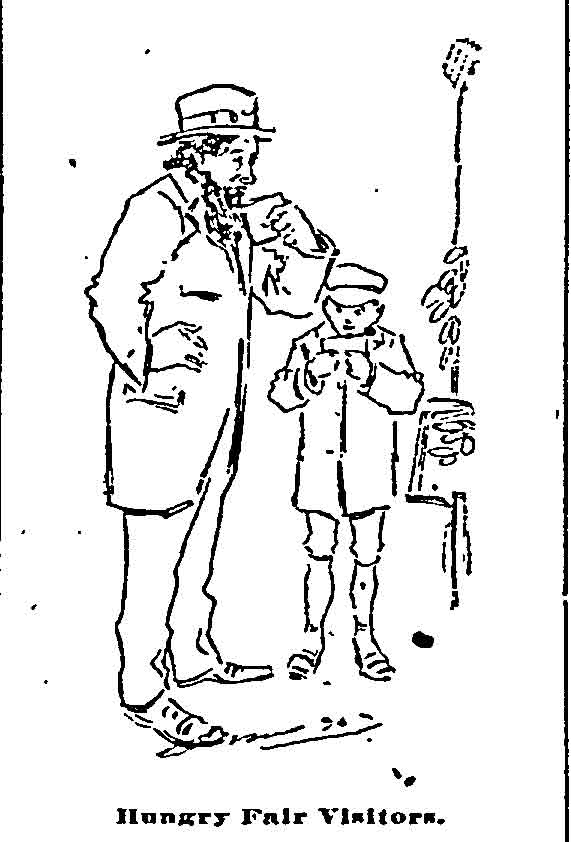
POLITICIANS’ DAY AT MT. HOLLY
CANDIDATE GRIGGS SHOOK HUNDREDS OF HORNY HANDS AT THE BURLINGTON COUNTY FAIR.
CAMDEN WELL REPRESENTED
It Was a Fine Day, But the “Big Thursday” Crowd Was Smaller Than Last Year—A Canine Parachutist Killed—The Races—Other Jersey Matters.
Special to The Inquirer.
MOUNT HOLLY, N. J., Oct. 10.—The Mount Holly Fair, like all the other Jersey fairs, has its “Big Thursday.” That is the day the politicians get together to shake hands, swop stories and look after the political machine generally. The candidates make it a point to be present and try to win votes with cordial greetings and honeyed words. The Mount Holly Fair was favored with exceptionally fine weather for its “Big Thursday,” but the attendance was not as large as last year’s crowd.
The politicians congregated around a tent at the left of the grand stand. John W. Griggs, the Republican candidate for Governor, arrived on the grounds shortly after noon and was tendered a reception at the entrance. All the afternoon he was kept busy shaking hands with the grangers and telling them how glad he was to meet them. Mr. Griggs got lots of promises of votes. He made many friends among the farmers, who had their first chance of talking with him. Nearly every one addressed him as “Governor.”
Camden county was well represented by its leading political lights, among whom were: Senator William J. Sewell, ex-Sheriff David Baird, City Counsel J. Willard Morgan, City Clerk T. P. Varney, County Clerk Robert Barber, Mayor J. Leighton Westcott, Deputy Sheriff J. Wesley Sell, Frank Lloyd, William J. Thompson, Thomas P. Curley, Receiver of Taxes William A. Husted, Secretary of the Commission of Public Instruction W. D. Brown, Freeholder George Martin, ex-President of the City Council Arthur Bedell, Senator Maurice A. Rogers, ex-Senator George Pfeiffer, ex-Sheriff Henry J. West, William Bettle, Assemblyman Louis T. Derousse, Colonel George G. Felton, Coroner Jacob Justice, Councilman Richard Dease, ex-Sheriff Theodore B. Gibbs and Assemblyman William Barnard.
Gloucester county was represented by William Moore, Senator Daniel Packer, Congressman Henry C. Loudenslager, Dr. S. F. Stanger, County Clerk F. B. Ridgway and Lewis Starr.
Other prominent persons present were: Ex-Judge J. Frank Fort, State Comptroller W. S. Hancock, County Clerk Barker Gummere, of Mercer county; Prosecutor Charles E. Hendrickson, of Mount Holly; Frank B. Lee, son of Supreme Court Clerk Lee; Judge Clifford Stanley Simms, ex-Congressman James Buchanan, Lieutenant-Colonel Franklin Gaunt, of Burlington; Richard Miller, Robert Diamond and M. V. D. Dickinson, of Salem county; Judge Joseph H. Gaskill, Robert Hutchinson and ex-Sheriff Nathan Hays, of Burlington county.
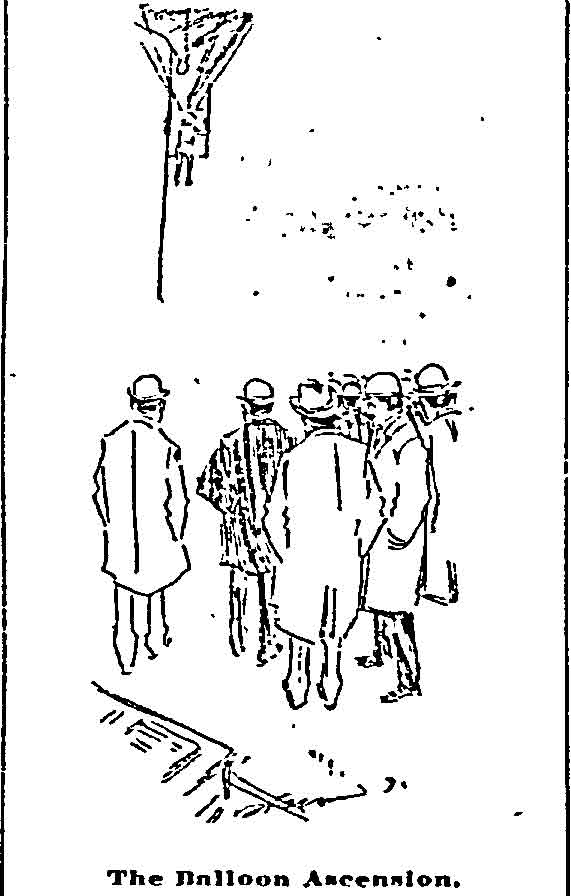
One of the features of the fair has been the daily ascension of a large balloon, from which a man and dog drop with parachutes. This afternoon the ropes which held the dog became loose. He dropped upon one of the booths and was killed.
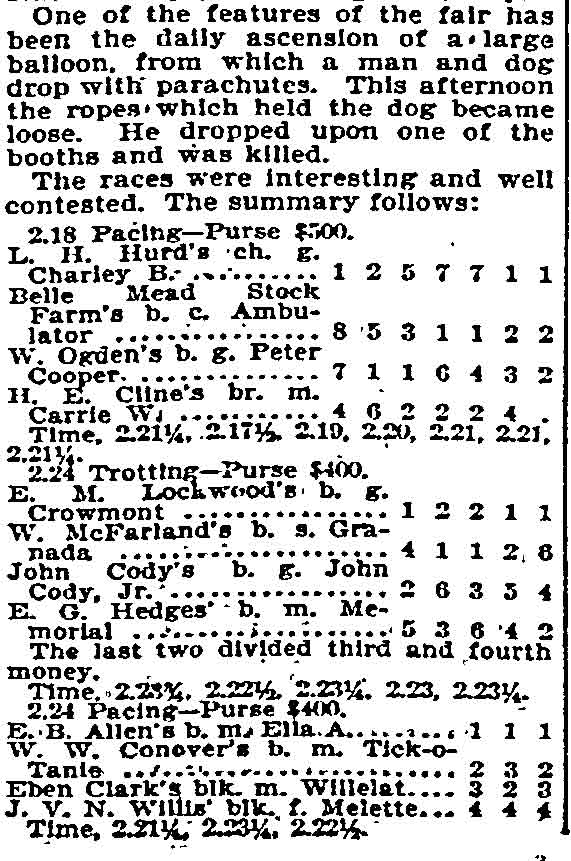
The races were interesting and well contested. The summary follows:
2.18 Pacing—Purse $500.
L. H. Hurd’s ch. g. Charley B....1 2 5 7 7 1 1
Belle Mead Stock Farm’s b. c. Ambulator....8 5 3 1 1 2 2
W. Ogden’s b. g. Peter Cooper....7 1 1 6 4 3 2
H. E. Cline’s br. m. Carrie W....4 6 2 2 2 4
Time. 2.21¼, 2.17½, 2.19, 2.20, 2.21, 2.21, 2.21¼.
2.24 Trotting—Purse $400.
E. M. Lockwood’s b. g. Crowmont....1 2 2 1 1
W. McFarland’s b. s. Granada....4 1 1 2 8
John Cody’s b. g. John Cody, Jr....2 6 3 5 4
E. G. Hedges’ b. m. Memorial....5 3 6 4 2
The last two divided third and fourth money.
Time. 2.23¾, 2.22½, 2.23¼, 2.23, 2.23¼.
2.24 Pacing—Purse $400.
E. B. Allen’s b. m. Ella A....1 1 1
W. W. Conover’s b. m. Tick-o-Tanie....2 3 2
Eben Clark’s blk. m. Willelat....3 2 3
J. V. N. Willis’ f. Melette....4 4 4
Time, 2.21¼, 2.23¼, 2.22½.
Camden Political Notes
Philadelphia Inquirer —
—The Democrats will hold their city convention to-night.
—Resolutions indorsing the Republican nominations have been adopted by the Sixth Ward Republican Club.
—The Committee of One Hundred had twenty-five men at work yesterday serving circulars to citizens of Camden appealing for funds to carry on the campaign.
—Ex-Assemblyman Joseph M. Engard and Councilman Charles H. Ellis, Jr., were among the speakers at the opening of the new quarters of the Hebrew Republican Club last night at Rogers’ Hall, Fifth and Chestnut streets.
—Councilman-at-Large W. R. E. Miller states that he is thankful for the letters congratulating him upon his nomination, but he desires to inform his friends that they are mistaken, as it is R. R. Miller, who received the Republican nomination as his successor.
—War Veterans’ Association, No. 1, last night adopted resolutions indorsing the Republican candidates and proposing Under Sheriff H. L. Hartsnorn as a candidate for Sheriff next fall. George E. Martin presided. Addresses were made by City Treasurer Felton, Mayor Westcott, Councilmen Potter and Hillman, Recorder Braker and Candidates R. R. Miller, E. E. Reed, Jr., Arthur Bedell and A. F. Shultz. A collation was served.
(news brief — city tax payment to county)
Philadelphia Inquirer —

(news brief — city tax payment to county)
City Treasurer Felton yesterday paid $5000 to County Collector Ivins on the taxes due the county, leaving a balance of $26,431.10 which the city still owes.
City Treasurer Felton yesterday paid $5000 to County Collector Ivins on the taxes due the county, leaving a balance of $26,431.10 which the city still owes.
Serious Charges by Defeated Candidate
Philadelphia Inquirer —
Freedom C. Lippincott Claims That Philadelphia Repeaters Voted in Camden.
BEGINS A NEW CONTEST
Committee of One Hundred Starts on a New Tack in Its Efforts to Oust City Treasurer Felton—A Bond Filed.
Another move was made yesterday by counsel for Freedom C. Lippincott, the Committee of One Hundred contestant for the Camden City Treasurership, when petitions were presented to Justice Garrison for a regular contest. He granted a hearing in the matter to take place before Judge Miller on July 10. George G. Felton holds the City Treasurership by the narrow margin of eleven majority, which was fixed after a recount of four wards. Now Mr. Lippincott wants the entire vote recounted.
The petitioner contests the election on the grounds of “mal-conduct, fraud and corruption on the part of some of the members of the Registry Board in one of the wards sufficient to change the result; that illegal votes for Felton were cast and received, and that legal votes for Lippincott were rejected, and for error in the Board of Canvassers in counting the votes.
The petition also sets forth that seventeen ballots for Lippincott were rejected in the First precinct of the Ninth ward because they had the wrong precinct on the back.
The most serious charge in the petition is the allegation that fifteen repeaters were taken to the polls by Policeman George Anderson and E. B. McClong and given Felton tickets to vote. Accompanying the petition are affidavits of men who claim Philadelphia as their place of residence and who say they voted in Camden, although they were never qualified voters in the State of New Jersey. The names of the alleged repeaters and the names they voted on are given.
Lippincott filed a bond for $500 to carry on the contest, with Cooper B. Hatch and Volney G. Bennett as vouchers.
Col. Felton Committed Suicide in His Office
Camden Daily Courier —

Closed the Place Up Tightly and Turned on Gas Jet.
His Family at Stone Harbor
The Real Estate Operator’s Confidential Clerk Made a Startling Discovery When He Opened the Office This Morning—He Had Been Acting Strangely for Weeks.
Colonel George G. Felton, the well known real estate dealer, former City Treasurer and Deputy Quartermaster of the National Guards, committed suicide sometime last night or early this morning by asphyxiating himself in the Felton building, northeast corner of Second and eFderal [sic] streets.
The suicide caused a great sensation when it became generally known and a large crowd of people surrounded the building all morning until the removal of the body by Funeral Director Fithian Simmons to his office on Market street. Mr. Felton resided at 413 Washington street, but his family has been summering at Stone Harbor.
The death of Col. Felton was not discovered until half-past 7 o’clock this morning, when Confidential Clerk Smith on opening the doors of the office detected the smell of gas. Col. Felton had been absent from the office for several days and Clerk Smith’s suspicions were aroused, knowing that County Colector [sic] Mahlon F. Ivins was a bosom friend and business confidante of Col. Felton, he hastened across the street to his office and informing him of his misgivings, asked him to assist him in making an investigation. Before accompanying Mr. Smith to the Felton building, Collector Ivins ‘phoned to the City Hall and the police in turn notified Coroners Robinson and Litchfield. The Central station also directed Policeman George Kappel to take charge of the premises and when he arrived there was joined by Policeman Harry Hiller. Chief Foster and Captain Boyle were also soon on the scene.
Accompanied by Mr. Ivins, Clerk Smith returned to the Felton building. Passing through the main office they treaded their way down a dim, narrow corridor to the private examining room of the U. S. Pension physicians. Opening the door the stench of gas was so overpowering that it nearly knocked them down. They, however, bravely ventured into the room and threw open the windows, the gas escaping into the street and enabling them to pursue their gruesome search. They found it on a sofa in a corner of the room, a small but high ceilinged apartment. On the sofa lay the dead body of Col. Felton, disrobed of his outer garments and wearing a calm, peaceful expression in sad discord with his worldly troubles. Overhead the gas stove connection was on full tilt, graphically explaining the mode of death. On a chair nearby were found his trousers and vest, while his hat, coat and watch were found in his own main office.
Coroners Litchfield and Robinson gave a certificate of death of heart failure, superinduced by inhaling gas. From the pink discoloration about the wrists where the blood was leaving the veins, Dr. Litchfield said that the body had been dead at least six hours, though he may have been dead ten or twelve.
Col. Felton was seen to enter his building at exactly 12.10 o’clock this morning. A citizen, whose name is withheld at his own request, had been talking with Night Watchman Clarence Hires on Federal street. He bade Hires good night and when he reached Second street saw the Colonel come around the corner. He came as though to enter his office by the front door, but turned and going back up Second street entered the side-door. Mr. Hires says the light was burning in the Colonel’s front office from 7 o’clock last night to 5 o’clock this morning, when he went off duty and Mr. Smith found it still burning when he arrived.
Colonel Felton has been acting strangely for several weeks and had not been at his office for two or three days.
When asked by anxious friends what the trouble was, he would put his hands to the side of his head and complain that it was in bad shape. He was seen in the hotel at Haddon avenue station on Saturday afternoon. He carried a grip and appeared very cheerful. Asked if he had been to the shore he replied no, he had been down the country, Bridgeton.
Grocer Charles F. Eastlack, by whom Col. Felton was at one time employed, went to Stone Harbor this morning to notify the family of his death. Col. Felton leaves a widow and adopted daughter, Miss Leona Felton.
Col. George G. Felton was born at Westville, Mass., and was fifty-six years of age. He had been a resident of this city for about quarter of a century. Previous to that he was engaged in the grocery business at Burlington. On coming to Camden, he entered the employ of Grocer Charles F. Eastlack, at Third and Washington streets, but later entered the employ of his brother, Charles H. Felton, who had an extensive real estate business. On the death of the latter the Colonel went into the same business for himself, his brother’s widow continuing the old business under the name of Charles H. Felton & Co. It is not known, however, whether business troubles impelled him to end his life.
Col. Felton was prominent in political, military and society circles. In 1892 he was appointed by Mayor Wescott a member of the Board of Public Works.
In 1896 he was appointed City Treasurer to fill the unexpired term of the late F. F. Michellon. In 1897 he was elected City Treasurer for two years, his election being contested by his Democratic rival, Freedom C. Lippincott, but was confirmed by the County Board of Elections.
He was Deputy Quartermaster on the Governor’s staff and a member of the Masonic order and A. O. U. W.
Colonel Felton was active in building and loan association circles. He was treasurer of the Mechanics’ and Workingmen’s Building and Loan Association and was former secretary of the People’s. He was also a director of the Security Trust Company. He had also been a director in the Central Trust.
Mrs. Felton will arrive from Stone Harbor this evening, when arrangements for the funeral will be made. The flag at Post 5 Hall is flying at half-mast in Col. Felton’s memory, for he was a Grand Army veteran, having gone to the front when a mere boy.
Notable Growth of Labor Unions
Membership of the Telegraphers Union Increasing in the West.
By “The Courier’s” Own Wire.
Chicago, July 7.—President Samuel Gompers, of the American Federation of Labor, was in Chicago yesterday on his way to San Francisco, and while here addressed a meeting of the Commercial Telegraphers’ Union. President Gompers expressed himself as pleased with the action of the telegraphers in organizing, and with the condition of labor organizations throughout the country. He stated that there were more unions and larger memberships of the same than at any time in the history of labor. President MacDonald, of the Telegraphers’ Union, said that the membership was increasing, and that there were similar unions now established at Milwaukee and Kansas City. About five hundred telegraphers were present at the meeting.
Florist Fish Dies Suddenly
Expired Yesterday Morning at Pleasantville Where He Was Visiting Friends.
Walter C. Fish, a well known florist of Broadway and Spruce streets, this city, died suddenly early yesterday morning at Pleasantville, N. J., where he had been visiting friends since the Fourth. For some months past he has not been well and complained frequently of pains in his head.
Yesterday morning he arose as usual, and at about half-past 6 o’clock was taken with severe pains in the head. He continued to grow worse and two physicians were summoned. They ministered to the sick man, but without any apparent success, and at twenty minutes after 7 o’clock he died.
A member of the family could not state this morning just what Mr. Fish’s malady was. It was thought probably that he suffered from brain trouble.
The body was brought to this city yesterday afternoon at 5 o’clock, and the funeral will be held on Wednesday afternoon next at 2 o’clock. Mr. Fish was a member of Fidelity Lodge, No. 3, A. O. U. W., Improved Order of Heptasophs; Camden Conclave, No. 215; Witherspoon Circle, No. 1, Brotherhood of the Union.
“Just a Gentle Touch.”
That Was All, But Joseph’s Watch and Money Went With It.
Annie McAntee, alias Hayes, twenty-four years old, of Philadelphia, and Joseph Costello, thirty years old, also of Philadelphia, were arraigned before Recorder Stackhouse this morning on a charge of being drunk and disorderly. The twain were picked up by Policeman Matlack on Sunday morning about 3 o’clock at Third and Walnut streets, very much the worse for liquor.
The aimless wanderings of the couple and their suspicious actions first caught the attention of the policeman and he followed them. Costello became tired of walking and went to sleep on a convenient door step. At this stage of the game the Hayes woman was seen by the officer to abstract something from the clothes of the sleeping man, and then to slip away and hide behind a tree on the opposite side of the street. In a few moments the man awoke and not seeing the woman started off down Walnut street. As soon as he was out of sight the woman skipped down Third
Col. George G. Felton Ends His Life by Inhaling Illuminating Gas
Camden Post-Telegram —
COL. GEORGE G. FELTON ENDS HIS LIFE BY INHALING ILLUMINATING GAS
Body of the Former City Treasurer Found This Morning Cold in Death in His Real Estate Office With Gas Jets Turned On.
RUMORS OF FINANCIAL TROUBLE GIVEN AS CAUSE OF SUICIDE
Colonel George G. Felton, former City Treasurer, Deputy Quartermaster General of the National Guard of New Jersey, real estate broker and prominent in the building and loan association world, was found dead in the U. S. Pension office, in the Felton building, northeast corner of Second and Federal streets, shortly before 8 o’clock this morning. Death was due to inhaling gas, two jets in the office being turned on full head, and a cap having been removed from a pipe formerly used to supply gas to a radiator.
[Photo caption:] COL. GEORGE G. FELTON. —Photo by Garns & Co.
Colonel Felton occupied the front offices of the Felton building. When Thomas Smith, head bookkeeper for Mr. Felton, arrived at the office a few minutes before 8 o’clock this morning, a strong odor of gas was present.
Surmising that something was wrong, Mr. Smith at once notified Mahlon Ivins, whose paint office is directly across Federal street. Mr. Ivins in turn communicated with the Police Department, and Policemen Harry Miller and George Kappell were ordered to make an investigation.
FOUND DEAD ON THE COUCH.
Passing through Mr. Felton’s offices, the officers went into the long hallway, from which the other offices on the first floor open. The escaping gas was found to come from the pension office, the last room back, and on pushing open the unlocked door the searchers were horrified to see Colonel Felton dead on the couch.
The strong flow of gas almost knocked the officers down, and after turning off the two jets, they raised the windows. The hissing of escaping gas was still heard, and the officers found it pouring in volumes from a pipe, which formerly fed a radiator and from which the cap had been removed. The cap was found on the floor and was placed back on the pipe.
DISROBED BEFORE DEATH.
The Colonel lay on his back and appeared to have died peacefully. He had taken off his outer clothing and had placed his clothes on a chair.
In the meantime Councilman Henry D. Longacre, who was associated with Colonel Felton, reached the office, and closed it temporarily.
Coroner Litchfield was notified, and after viewing the body, gave a certificate of death from suicide. In the opinion of the Coroner, Colonel Felton had been dead about eight hours.
Mrs. Felton who with an adopted daughter is spending a few days at Stone Harbor, was notified by telegraph. Funeral Director Simmons removed the body to Colonel Felton’s late home at 413 Washington street.
RUMORS OF FINANCIAL TROUBLE.
While no one cares to assign a direct cause for his suicide, it is rumored that a tangle in Colonel Felton’s accounts in the building associations, of which he was secretary, have preyed on his mind and made him despondent. It is reported that not long ago he was hard pushed to settle his accounts with the People’s Association, after which he was succeeded in the secretaryship by Frank C. Sayrs.
For awhile the police were of the opinion that Colonel Felton was in the building since Saturday night as he was seen in the vicinity of his office late on Saturday acting strangely. This belief, however, was dispelled at noon through information given to the police by a business man to the effect that Colonel Felton was seen to enter the building by the side door at ten minutes past 12 o’clock this morning.
County Collector Ivins telegraphed Quartermaster General Richard A. Donnelly, of the death of Colonel Felton.
COLONEL FELTON’S CAREER.
Colonel George G. Felton was born in Winchedon [sic], Mass., in 1845, where he resided until he was fourteen years of age. After receiving a common school education he went to Northfield, Mass., where on September 1, 1862, he enlisted as a private in Company F, Fifty-second Massachusetts Infantry Volunteers, serving until the close of the war. He then came to New Jersey in which state he took up his residence. He lived for a short time in Burlington, after which he came to this city.
In 1887 he associated himself with Charles H. Felton & Co., in the real estate business. In 1893 he entered the real estate business for himself and continued in it at Second and Federal streets until the time of his death.
Colonel Felton was for a number of years connected with the National Guard of this state. He entered the Guard on August 29, 1883, by appointment as First Lieutenant and Quartermaster of the Sixth Regiment. He attained the rank of captain, August 19, 1888, and was appointed to the staff of the Quartermaster-General with the rank of Lieutenant-Colonel on May 21, 1890. He was advanced to the rank of Colonel and Deputy Quartermaster-General April 26, 1894, which rank he held up to the time of his death.
Colonel Felton was one of the most popular officers of the National Guard. His energy and executive ability made him an invaluable assistant to Quartermaster-General Donnelly and every summer he practically had charge of the Quartermaster’s department at the state camping ground at Sea Girt.
Mr. Felton was appointed by City Council in 1896 to fill the vacancy caused by the resignation of City Treasurer Frank Michelon and in the spring of the same year was elected to fill the unexpired term of one year of Mr. Michelon’s term of office. On Tuesday, April 13, 1897, Mr. Felton was elected City Treasurer on the Republican ticket, by 45 majority over Freedom C. Lippincott, the candidate of the Democrats and Committee of One Hundred. He was appointed a member of the Board of Public Works in 1892 by Mayor Westcott.
He was well-known in building association circles, being secretary of the Mechanics and the Homestead Building and Loan Associations until his demise. Mr. Felton was also a director of the Central Trust Company for several years, but some weeks ago disposed of his stock and ceased to be an officer of that company.
He was a director in the Security Trust Company at the time of his death. He was a member of the Masonic Order, and the A. O. U. W., and was also treasurer of the Camden Republican Club.
Col. George Felton Made Suicide Sure
Philadelphia Inquirer —
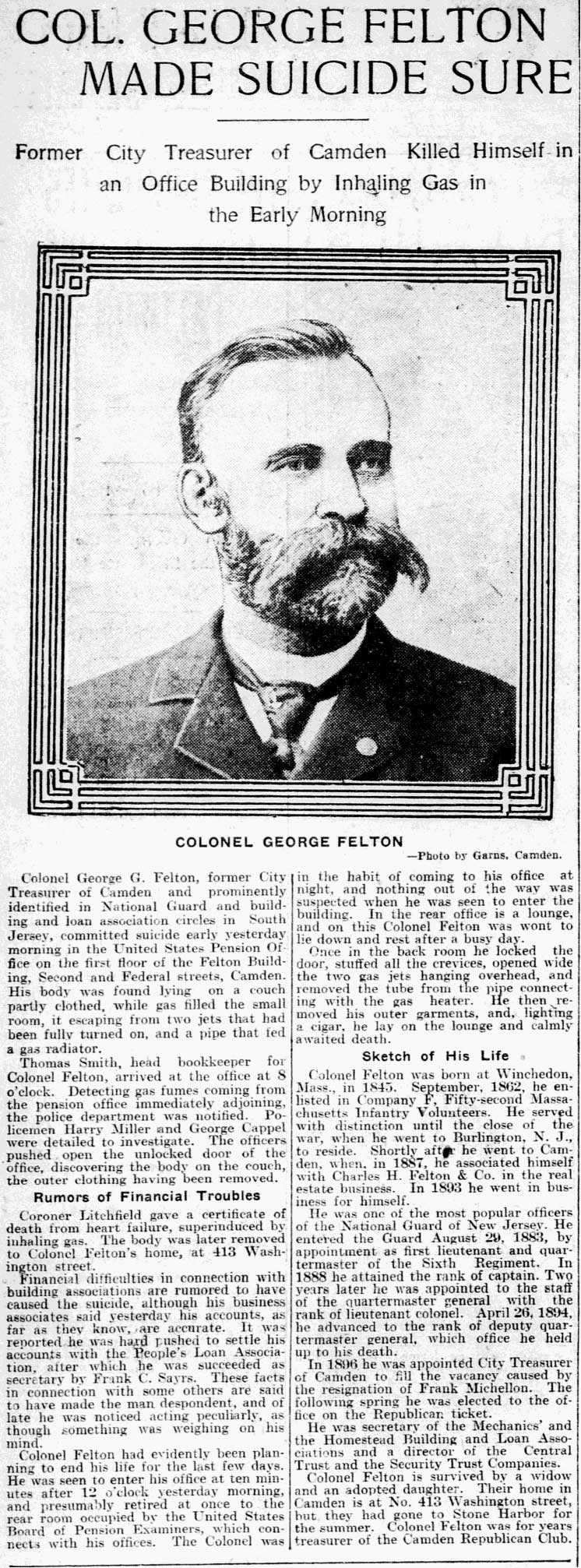
COL. GEORGE FELTON MADE SUICIDE SURE
Former City Treasurer of Camden Killed Himself in an Office Building by Inhaling Gas in the Early Morning
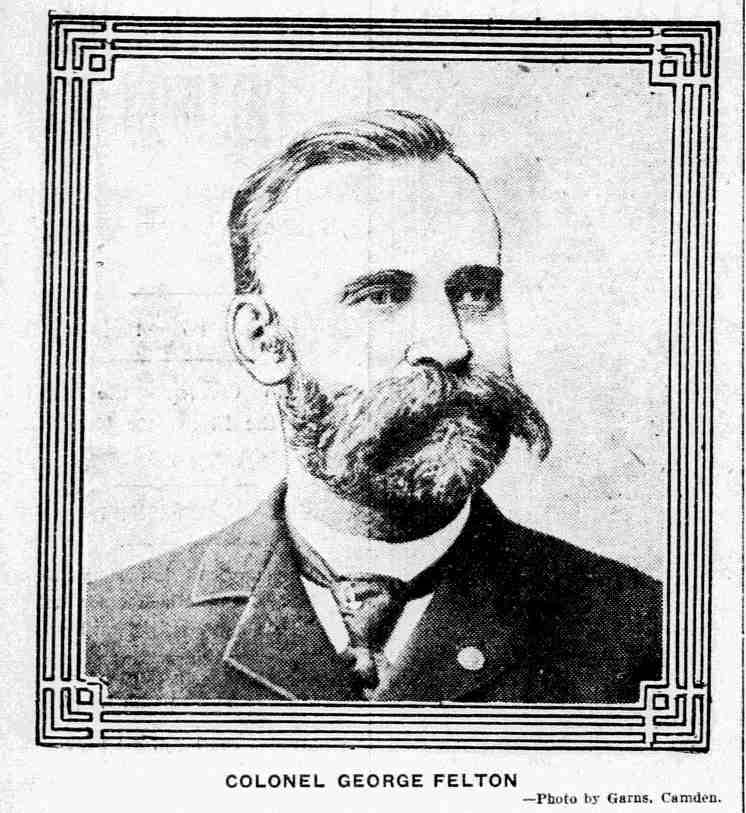
COLONEL GEORGE FELTON
—Photo by Garns, Camden.
Colonel George G. Felton, former City Treasurer of Camden and prominently identified in National Guard and building and loan association circles in South Jersey, committed suicide early yesterday morning in the United States Pension Office on the first floor of the Felton Building, Second and Federal streets, Camden. His body was found lying on a couch partly clothed, while gas filled the small room, it escaping from two jets that had been fully turned on, and a pipe that fed a gas radiator.
Thomas Smith, head bookkeeper for Colonel Felton, arrived at the office at 8 o’clock. Detecting gas fumes coming from the pension office immediately adjoining, the police department was notified. Policemen Harry Miller and George Cappel were detailed to investigate. The officers pushed open the unlocked door of the office, discovering the body on the couch, the outer clothing having been removed.
Rumors of Financial Troubles
Coroner Litchfield gave a certificate of death from heart failure, superinduced by inhaling gas. The body was later removed to Colonel Felton’s home, at 413 Washington street.
Financial difficulties in connection with building associations are rumored to have caused the suicide, although his business associates said yesterday his accounts, as far as they know, are accurate. It was reported he was hard pushed to settle his accounts with the People’s Loan Association, after which he was succeeded as secretary by Frank C. Sayrs. These facts in connection with some others are said to have made the man despondent, and of late he was noticed acting peculiarly, as though something was weighing on his mind.
Colonel Felton had evidently been planning to end his life for the last few days. He was seen to enter his office at ten minutes after 12 o’clock yesterday morning, and presumably retired at once to the rear room occupied by the United States Board of Pension Examiners, which connects with his offices. The Colonel was in the habit of coming to his office at night, and nothing out of the way was suspected when he was seen to enter the building. In the rear office is a lounge, and on this Colonel Felton was wont to lie down and rest after a busy day.
Once in the back room he locked the door, stuffed all the crevices, opened wide the two gas jets hanging overhead, and removed the tube from the pipe connecting with the gas heater. He then removed his outer garments, and, lighting a cigar, he lay on the lounge and calmly awaited death.
Sketch of His Life
Colonel Felton was born at Winchedon [sic], Mass., in 1845. September, 1862, he enlisted in Company F, Fifty-second Massachusetts Infantry Volunteers. He served with distinction until the close of the war, when he went to Burlington, N. J., to reside. Shortly after he went to Camden, when, in 1887, he associated himself with Charles H. Felton & Co. in the real estate business. In 1893 he went in business for himself.
He was one of the most popular officers of the National Guard of New Jersey. He entered the Guard August 29, 1883, by appointment as first lieutenant and quartermaster of the Sixth Regiment. In 1888 he attained the rank of captain. Two years later he was appointed to the staff of the quartermaster general with the rank of lieutenant colonel. April 26, 1894, he advanced to the rank of deputy quartermaster general, which office he held up to his death.
In 1896 he was appointed City Treasurer of Camden to fill the vacancy caused by the resignation of Frank Michellon. The following spring he was elected to the office on the Republican ticket.
He was secretary of the Mechanics’ and the Homestead Building and Loan Associations and a director of the Central Trust and the Security Trust Companies.
Colonel Felton is survived by a widow and an adopted daughter. Their home in Camden is at No. 413 Washington street, but they had gone to Stone Harbor for the summer. Colonel Felton was for years treasurer of the Camden Republican Club.