Joshua C. Haines
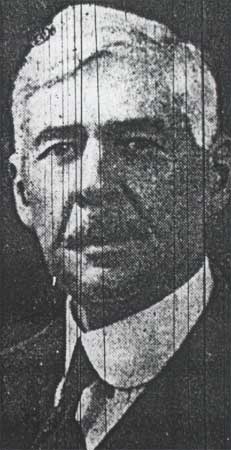
Joshua C. Haines
Joshua C. Haines was born in Swedesboro, Gloucester County, NJ, on July 1, 1868, to Chalkley Haines and Sarah James Patterson. His father was a farmer in nearby Woolwich Township, the nearest post office then being at Bridgeport. Chalkley Haines died in January of 1879. Sarah Haines, however, maintained the farm through at least 1880. On October 24, 1890 Joshua C. Haines married Maggie A. Sherwin at her home in Mullica Hill NJ.
After living on a farm in Gloucester County for several years, Mr. and Mrs. Haines moved to Camden NJ. He was working as a milkman at the time of the 1920 Census. Ten years later his occupation was that of a mover. Joshua and Maggie Haines would have two daughters, Miriam, born in April of 1892, and Elizabeth “Betty” Haines, born in 1909.
As a Republican, Joshua C. Haines became involved in local politics. He settled in Camden’s Sixth Ward, and was elected to City Council. Joshua C. Haines was then elected to a three-year term as Camden County Sheriff in 1914. He was preceded in that job by former mayors Cooper B. Hatch (1908–1911) and Joseph Nowrey (1911–1914). When his term as Sheriff expired, Mr. Haines was elected to the New Jersey State Senate from Camden County, and served in that body from 1918 to 1920. He subsequently served three terms as Register of Deeds for Camden County.
On October 24, 1936 Joshua and Maggie Haines celebrated their 50th wedding anniversary. They were then living at 227 South 6th Street, the corner of South 6th and Stevens Street.
In matters of faith Joshua C. Haines was a Presbyterian. He also belonged to the Freemasons, Elks, Odd Fellows, and Camden’s Rotary Club. Maggie Haines was active in the Woman’s Club of Camden.
Joshua C. and Maggie Haines were still living at 227 South 6th Street as late as 1947.
227 South 6th Street
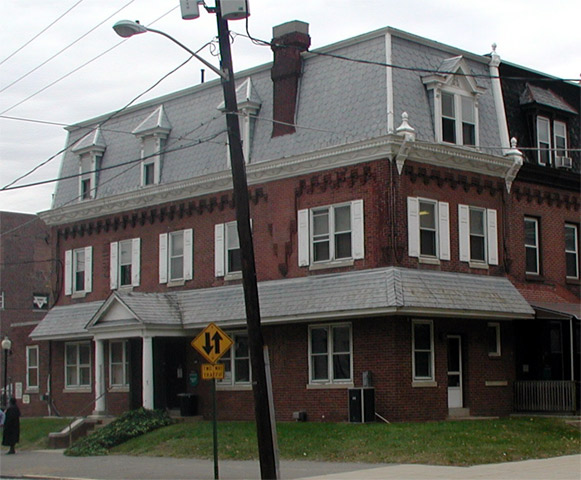
227 South 6th Street — November 2004
Philadelphia Inquirer — January 16, 1898
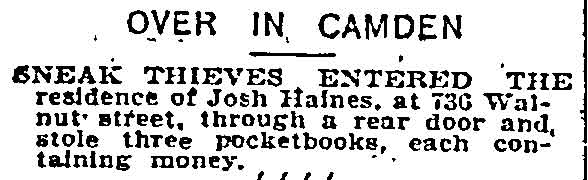
Walnut Street — Joshua C. Haines
Camden’s Mayor Has Field to Himself
Philadelphia Inquirer —
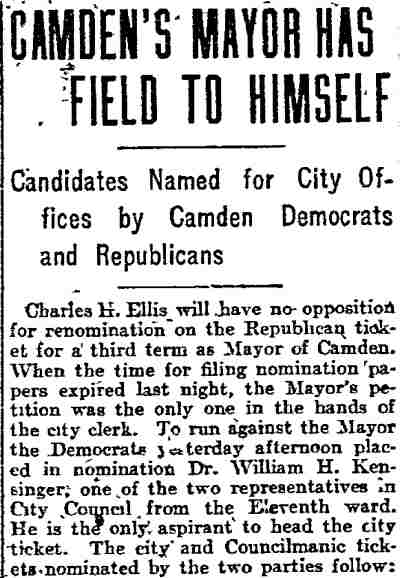
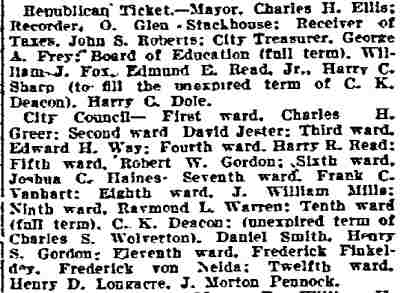
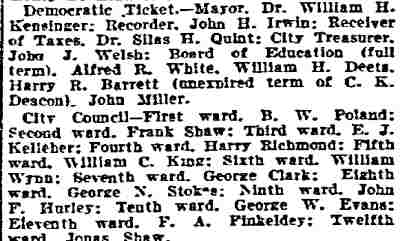
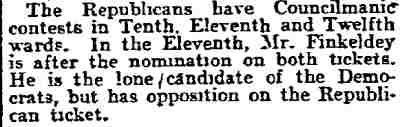
Candidates Named for City Offices by Camden Democrats and Republicans
Charles H. Ellis will have no opposition for renomination on the Republican ticket for a third term as Mayor of Camden. When the time for filing nomination papers expired last night, the Mayor’s petition was the only one in the hands of the city clerk. To run against the Mayor the Democrats yesterday afternoon placed in nomination Dr. William H. Kensinger; one of the two representatives in City Council from the Eleventh ward. He is the only aspirant to head the city ticket. The city and Councilmanic tickets nominated by the two parties follow:
Republican Ticket.—Mayor, Charles H. Ellis; Recorder, O. Glen Stackhouse; Receiver of Taxes, John S. Roberts; City Treasurer, George A. Frey; Board of Education (full term), William J. Fox, Edmund E. Read, Jr., Harry C. Sharp (to fill the unexpired term of C. K. Deacon), Harry C. Dole.
City Council—First ward, Charles H. Greer; Second ward David Jester; Third ward, Edward H. Way; Fourth ward, Harry R. Read; Fifth ward, Robert W. Gordon; Sixth ward, Joshua C. Haines; Seventh ward, Frank C. Vanhart; Eighth ward, J. William Mills; Ninth ward, Raymond L. Warren; Tenth ward (full term), C. K. Deacon; (unexpired term of Charles S. Wolverton), Daniel Smith, Henry S. Gordon; Eleventh ward, Frederick Finkeldey; Frederick von Neida; Twelfth ward, Henry D. Longacre, J. Morton Pennock.
Democratic Ticket.—Mayor, Dr. William H. Kensinger; Recorder, John H. Irwin; Receiver of Taxes, Dr. Silas H. Quint; City Treasurer, John J. Welsh; Board of Education (full term), Alfred R. White, William H. Deets, Harry R. Barrett (unexpired term of C. K. Deacon), John Miller.
City Council—First ward, B. W. Poland; Second ward, Frank Shaw; Third ward, E. J. Kelleher; Fourth ward, Harry Richmond; Fifth ward, William C. King; Sixth ward, William Wynn; Seventh ward, George Clark; Eighth ward, George N. Stokes; Ninth ward, John F. Hurley; Tenth ward, George W. Evans; Eleventh ward, F. A. Finkeldey; Twelfth ward, Jonas Shaw.
The Republicans have Councilmanic contests in Tenth, Eleventh and Twelfth wards. In the Eleventh, Mr. Finkeldey is after the nomination on both tickets. He is the lone candidate of the Democrats, but has opposition on the Republican ticket.
Joshua Haines Files Campaign Expense Account
Philadelphia Inquirer —

As candidate for Sheriff on the Republican ticket, Joshua C. Hains [sic] filed his expense account with County Clerk Patterson yesterday. It shows he spent $4[?]43.2[?].
Finkeldey Out for Sheriff Nomination
Philadelphia Inquirer —
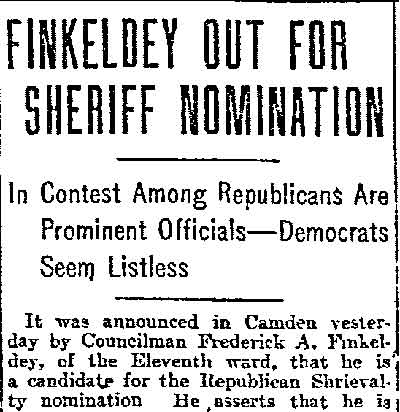
In Contest Among Republicans Are Prominent Officials—Democrats Seem Listless
It was announced in Camden yesterday by Councilman Frederick A. Finkeldey, of the Eleventh ward, that he is a candidate for the Republican Shrievalty nomination. He asserts that he is in the contest until the end. He is understood to have the backing of the German-American Alliance.
This contest among the Republicans bids fair to become much more interesting than in the Democratic camp. Others in the contest with Finkeldey include President of Council James E. Hewitt, Councilman Joshua C. Haines, Sheriff’s Clerk Harry Marter, George Starn, in the city, and Jacob Price, of Gloucester township, and Willard Gibbs, in Clementon township.
Among the Democrats it is hardly likely that anyone other than Under Sheriff Alvin B. Pitman will have a chance for the nomination. He is the unqualified choice of Sheriff Nowrey, the nominal leader at least of Camden’s Democracy. But there is some factional trouble brewing.
Acquittal Verdict Brings Applause
Philadelphia Inquirer —
So elated were the friends of Cecil Slaughter, yesterday afternoon, in the Camden Criminal Court, when he was acquitted of a charge of manslaughter in connection with the death of James O’Brien, that they burst into loud cheering. Sheriff Haines and his officers quickly restored order.
O’Brien was killed during a quarrel last July. It was shown that he had fallen during the melee and that his skull was fractured. It was from that injury that he died after his admission to the Homeopathic Hospital.
Damage Suit Result of Alleged Abduction
Philadelphia Inquirer —
DAMAGE SUIT RESULT OF ALLEGED ABDUCTION
Camden Youth Held in Default of Bond for Action by Girl’s Father
Discharged in his own recognizance by Acting Recorder Knight in Camden yesterday, Joseph J. Cooper, aged 21 years, of 640 Central avenue, arrested on a charge of abducting Mary Miller, aged 17 years, daughter of Andrew Miller, of 625 Ferry ave., was taken in charge by Sheriff Haines on a capias issued as a result of Miller bringing suit to recover $10,000 damages from the young man. Supreme Court Commissioner Bleakly committed him to jail in default of furnishing a bond of $2,500.
It is alleged that Cooper took the girl away from her home last August. At the time he was employed as a bartender at the Miller saloon. Nothing was heard of the couple for several months. In fact it was not until after Cooper’s arrest on Thursday by Detective Fitzsimmons that it was learned that the girl was at Providence, R.I. When the father and a Camden policeman went to Providence and located the girl it developed that she had an infant and, it is alleged, Cooper is the father. The girl and the little one were taken to Camden Friday.
Miller instituted the damage suit for the loss of the services of his daughter. Cooper is married.
Wilson Ashbridge and George E. Thompson
Camden Post-Telegram —
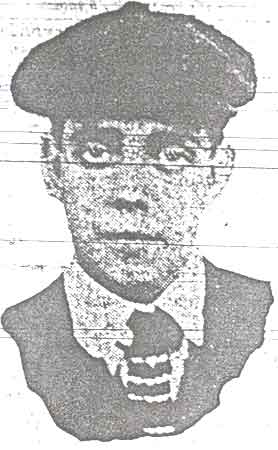
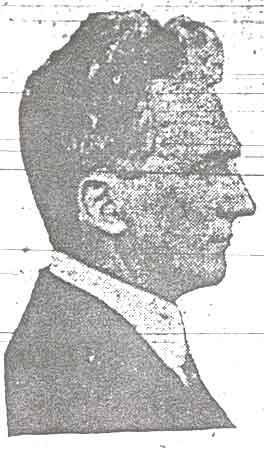
WILSON ASHBRIDGE — GEORGE E. THOMPSON
Murderer and Forger Escape Jail After Shooting Keepers, Killing One
Camden Post-Telegram —
Wilson Ashbridge, Who Shot and Killed Mrs. Elizabeth Dunbar and George E. Thompson, Check Swindler, Trap Jailor Hibbs by a Ruse and After Slaying Him Shoot Joe Ellis Who Intercepted Them in Flight.
Used Revolver Smuggled Into Prison by Confederates and Leave Jail Wide Open in Their Flight, a General Delivery Being Averted by Police Who Were Summoned by the Wounded Men.
Murdering one jailor and wounding another with a revolver that had been smuggled into them by outside confederates, Wilson T. Ashbridge, slayer of Mrs. Elizabeth Dunbar, and Francis Murphy, alias George E. Thompson, a check forger, made their escape from the county jail a few minutes before seven o’clock last night.
Ashbridge with his wife was caught at noon in the Keystone Hotel in Chester PA where they registered at one o’clock this morning.
Thompson is still at liberty but from the confident manner of Prosecutor Kraft his early arrest seems assured.
The murdered jailor was Isaac Hibbs, aged 65 years of 913 South 8th Street. The wounded keeper is Joseph Ellis, aged 45 years, of 416 Carteret Street. Shot twice, he is in Cooper Hospital. His condition today is very satisfactory.
Thompson, who is 41 years old, forged a check for $650 which he gave to V.M. Fulton as part of the purchase price of an automobile. The forgery was discovered before the deal was completed and his arrest followed on June 8. he also passed a forged check for $15 on State Motor Vehicle Agent Kraft. He, too, was awaiting trial. In spite of the positive evidence against him Thompson had spurned all efforts to have him plead guilty and it is now believed that he was sparring for time while hatching a plan to escape. He is no doubt the master mind.
R.L. Hunter, a farmer of Bensalem Township, Bucks County PA, about four miles above Torresdale, reported to the Philadelphia police the morning that he had seen a man answering Ashbridge’s description on the Bucks Road at daylight. The man asked the way to Riegelsville.
According to Hunter, the man was dressed in a dark suit, and had no hat. His clothing was wet. Hunter did not see anything suspicious in his actions, and after giving him directions, they parted.
Upon seeing the paper with a picture of Ashbridge, the farmer was struck by its resemblance to the man with whom he had talked. He hurried to Tacony and notified the police.
The State police, who patrol that section of the county, and who have an office at Langhorne, were immediately notified as were the surrounding towns.
The shootings took place in different parts of the jail. Hibbs was murdered in the exercise room just outside the cell room on the Sixth and Arch corner of the building. Ellis was shot down in the corridor just outside the Market Street end of the building when he heroically grappled with Ashbridge after the latter had pointed a gun at his head. In spite of his wounds Ellis dragged himself to a telephone and after notifying Police Headquarters of what had happened he collapsed.
Only one of the two bullets is still in Ellis. It entered the groin on the right side and is buried in the muscles of the leg, having taken a downward course for seven or eight inches. The other bullet struck Ellis in the right breast and came out in the left breast, traversing the upper fleshy parts of the body.
Hibbs was almost instantaneously killed by a bullet that went within an inch of his heart, producing a hemorrhage. The bullet was extracted this morning from the body early this morning in an autopsy performed at the morgue by County Physician Stem. In spite of the fact that it is pretty well established that three shots were fires in the attack on Hibbs, only one of the bullets took effect.
“But it makes little difference which of the two men handled the gun” said Prosecutor Kraft this morning. “Both are equally guilty of this murder and what we are concerned about now is the recapture of the gunmen.” Mr. Kraft added that it his purpose to examine all of the prisoners in that part of the jail where Hibbs was murdered to determine fully who fired the fatal shot.
The escape had been carefully planned and timed to the minute. Of course the desperate prisoners were aided by confederates on the outside and it is the general belief that a high powered motor car was in waiting for them not far from the jail. They are known to have been in possession of money and openly boasted yesterday that it was their intention to leave the prison last night. These boasts were made to two young ladies connected with a religious organization who called on the two men yesterday to offer spiritual reconciliation. The girls are frequent visitors to the jail and naturally their efforts at evangelization were directed in the main toward Ashbridge, because of the fact that he was accused of murder. These girls, whose identity officials will not disclose, were closeted with Prosecutor Kraft until one o’clock this morning. Both declared that on their visit yesterday they were told by Ashbridge and Thompson that it was the last day they expected to spend in jail.
“We are going to get away from here tonight and we’ve got money to help us after we are out ” said Ashbridge, who further told the girls he had considerable cash sewed up in the waistband of his trousers. The girls begged the prisoners not to do anything that would cause them more trouble and they told the Prosecutor that Ashbridge and Thompson promised them that they would not make any effort to escape. In their talks with the girls neither of the prisoners said a word that would indicate that they would kill if necessary to escape. The full force of their boast did not dawn on the religious workers and for this reason it never occurred to them to inform the Sheriff of what the prisoners had in said.
A general jail delivery of at least all the men confined in what is known as the untried department, where the two were held, was only averted by the prompt arrival of the police on their beat, which was made easy by means of the keys taken from the prostrate body of Hibbs. Ashbridge and Thompson left all of the doors open and the vanguard of the inrushing police found the prisoners swarming all over the corridors on the east side of the prison. In the wild excitement following the double shooting and escape none else thought of freedom and a checking up of the inmates after they had been herded in the exercise room of the untried department accounted for all but the fugitive slayers.
The department, in which the two men were confined is the same one which William Brown and Charles Berger made their sensational escape several years ago by sawing away the bars on the Federal Street front of the jail. Thrilling as it was, the former escape was insignificant in comparison with last night’s tragic event.
With the full force of the keepers out of the way— one dead and the other suffering from gunshot wounds at first supposed to have been fatal— Ashbridge and Thompson had nothing between them and freedom but the door entering from the spiral stairway leading to the narrow entrance of the Sixth and Market Streets end of the Court House. With the keys taken from Hibbs they opened the door and in a few seconds were breathing the free air. It was still daylight when the daring murderers walked from the building and although they were no doubt seen by some of the scores of persons passing it is certain that they managed to control themselves to such an extent as not to arouse any undue suspicion. The exit they used to escape is that used by the general public and therefore persons passing calmly in and out of the door would not in any manner be thought to have been connected with a jail delivery. However the shots which had laid low the keepers had been plainly heard on all four sides of the building and it is strange that no one has yet been found who can give positive information as to what course the fleeing men took and whether they were aided in their flight by an automobile.
While the police and detectives of Camden and all other cities in the East are watching railroad terminals, steamship lines, and all other avenues of travel in response to the general alarm sent out last night, Prosecutor Kraft is bending all his energies to learn who smuggled in the revolver which the fugitives used. Thus far this feature of the case is as complete a mystery as it was last night. Mr. Kraft and Sheriff Haines are satisfied, however, that only one gun was used for both shootings. It was at first thought that each man had a pistol when they left the jail; that one of them armed himself with the gun that Hibbs was supposed to have carried, but it was determined that Hibbs was not armed when he went into the jail last night. There was no occasion for him to come in contact with any of the prisoners and for that reason he left his revolver in his desk in the office. Even had he carried it he would have little chance to use it, so cold-bloodedly was he slain as he unsuspectingly fell into the trap laid for him by the desperate gunmen. There is also some conflict as to how at least one of the fugitives was dressed. Alfred Williams, who witnessed the murder of Hibbs, said that Ashbridge was without coat or hat when he dashed out of the cell-room, and that Thompson carried his coat and hat under his arm. However in a description of the two men given at the Prosecutor’s office it was set forth that Ashbridge wore a blue serge suit and a checkered cap. The coat that he is supposed to have taken bore the mark of “Tull— the Tailor,” of Jacksonville, Florida, and had been borrowed by him from another prisoner. He wore tan shoes. Ashbridge is 27 years old, 5 feet 7-1/2 inches in height and weighs 137 pounds. He has brown hair, smooth face and is of light complexion.
Thompson wore a brown suit and a Panama hat. He is 41 years old 5 feet seven inches in height, and weighs 175 pounds. He has brown bushy hair, is minus one of the fingers on his left hand, and is light complexioned.
The tan shoes worn by Ashbridge were also borrowed from one of the prisoners. He got them on Saturday and remarked that he wanted to look neat.
Keepers Ellis and Hibbs were reading in the prison office last evening when Hibbs glanced up at the clock and noticed that it was a few minutes of seven. “Joe, I’m going back and put the boys in their cells,” he said to Ellis and with his keys in his hand he started for the cell room in the untried department. A thirty foot long corridor runs from the office to the barred and grated door opening into the department in which the cells are situated. This department is about the size of three ordinary school rooms and in the southeastern corner of the jail are the cells, in two tiers.
Around the cells is a three foot corridor into which all the cells doors open and in which all the prisoners are permitted to walk when they are not allowed out in the main room. When the inmates are ordered into their cells and their doors closed the doors are locked from the outside of the steel cage by means of a lever worked by the jailor. Thus every cell door can be made secure without the keepers coming into actual contact with the prisoners. In addition to the bars around the corridor fronting on the double tier of cells there is a fine mesh heavy wire screening.
As Hibbs approached the lever which is operated to shut the cell doors after the prisoners have retired from the corridors, Ashbridge was leaning against the grating of his cell, Number 18. Thompson was lounging a few feet away.
“Daddy, open the door, I want you to see this note,” said Ashbridge to the keeper, at the same time displaying a piece of paper which he had in his hand. Never giving a thought that he was about to perform an act that which was absolutely necessary for the carrying-out of the well laid plot, or that he was going to his doom, or was even in danger, “Daddy,” as the aged keeper was known to all the prisoners, opened the door without hesitation.
As he swung wide the big steel frame, Ashbridge quickly stepped out and the next instant was pressing a gun against the abdomen of the jailor.
“Throw up your hands, you ___ ___ ___” he commanded.
“What are you up to, what’s this mean,” asked the keeper, apparently not realizing he had been trapped.
For reply Thompson jumped out the door, wrenched the gun from Ashbridge’s grasp and with an oath began firing at Hibbs, who sank to the floor at the first shot. Only a few feet away and the only other person in the exercise room, although the shooting could have been seen by any other prisoners who had not retired to their cells, Alfred Williams, trusty, is emphatic in his assertion that Thompson fired the shot that killed Hibbs and that he fired three times.
“It’s a wonder they did not get me,” said Williams. “Ashbridge and I could not hit it and in his desperate mood I am surprised he didn’t kill me, too.” Williams, who has just completed a six months’ sentence for obtaining money from Italian grocers by falsely representing himself as an agent for a wholesale house in Chicago and who is wanted in the Windy City for the same offense, says the whole transaction took less than a minute and that the moves came so fast he and the other prisoners were powerless to aid.
“It was like a flash of lightning” said Williams, “and before I could fully understand what had happened Ashbridge had grabbed Daddy’s keys’ which had fallen to the floor, and was off like a deer for the barred door. Ashbridge had taken the smoking gun from Thompson, who had his hat and coat under his arm and who was right behind the other one.
“As they hurried through the door after Ashbridge had opened it with Daddy’s keys Daddy called to me to raise him. I put my arm under his head and lifted him slightly from the floor. ‘Hold my hands’ he said to me. I took hold of his hands and the next minute he died in my arms. Then I heard two more shots and I knew they got Joe Ellis.”
Startled by the shots, and he is emphatic there were three in rapid succession, Ellis leaped to his feet and without taking the time to arm himself ran from the office and turned into the corridor just as Ashbridge, wild-eyed and gun in his hand, came running toward him. Halting three yards away Ashbridge pointed the revolver at Ellis’ head and ordered him to throw up his hands.
For reply and without fear of himself the keeper dashed at the murderer and the next instant they were locked in each others’ embrace. Working loose the hand which held the gun, Ashbridge pulled the trigger. The bullet struck Ellis in the breast, but the wound was not sufficient to render him helpless. However, before he could grip the pistol arm, Ashbridge fired again and the keeper fell back with a bullet in his groin.
“The second shot got me,” said Ellis to Prosecutor Kraft and Assistant Prosecutor Butler at the hospital. “The first one wasn’t bad but my strength left me when the second bullet struck. Ashbridge was the only one I saw. I did not see Thompson.”
Dragging himself to the office Ellis managed to reach a telephone and called up the police.
“This is Ellis at the county jail; come quick. Ashbridge has shot me” he weakly said over the phone to Captain Hyde. Then the receiver fell from his hand and he dropped to the floor, but after a minute or two managed to climb into chair.
While patrol loads of policemen were being hurried to the Court House from the First and Second District station houses, Reserve Officer Charles Hose, on duty at Broadway and Federal Street, who had heard the shots, ran to the Court House and from the office of Assistant Custodian John Lack phoned up to the jail. Ellis managed to answer and in a few words told what had happened. They ran up to the jail and were admitted by Ellis, who was rapidly growing weaker from loss of blood, the trail of which plainly showed just where the injured keeper had moved.
“I guess Ashbridge got away and the jail is all open, you had better take care of the rest of the prisoners,” said Ellis to Hose and Lack. The fugitive-murderers had left all doors open and the other occupants of the untried department were swarming through the corridors. Their curses and yells and the shrieks and cries of the female prisoners had turned the place into a perfect bedlam. With the aid of other policemen who swarmed into the Court House like bees, the prisoners were soon herded into the exercise room, where Trusty Williams checked them up and accounted for all but Ashbridge and Thompson.
With the faint hope that the missing pair had not risked leaving the building but had secreted themselves in the structure, the courthouse was searched from pit to dome, but no trace of the men were found.
Detective Doran was the first of the Prosecutor’s staff to reach the scene. Mr. Kraft and the balance of the staff soon followed. In the lower end of the county, on official business, Sheriff Haines was reached by phone and Under Sheriff Hewitt was summoned from Pitman and until an early hour this morning the officials were in conference and examining numerous prisoners.
State Detective Walter Le Torneau furnished Prosecutor Kraft with a promising “tip” this morning when he learned that Thompson gave a letter to Freeholder Howard Marshall, of the Eighth Ward, to mail on Sunday. Mr. Marshall states that the letter was addressed to a woman by the name of Mrs. Shelton, in Baltimore MD.
Marshall was attending religious service in the jail when Thompson approached him.
“Put this in your pocket and mail it for me when you go out,” said Thompson to Mr. Marshall, who agreed to carry out the request. Dropping the letter in the mail box Marshall allowed the incident to pass without further notice.
Detective Le Torneau learned this morning that Marshall had spoken to the incident to a friend and the sleuth notified the Prosecutor. The tip will be run down the Prosecutor stated.
Funeral services for Hibbs will be held on Thursday from his late residence. The body will be taken to Langhorne PA where interment will be made in the Friends’ Cemetery under the direction of the Schroeder-Kephart Company. Services will be conducted Wednesday evening by Reverend Henry Bradway, pastor of the Eighth Street Methodist Episcopal Church.
POLICE QUICKLY AT WORK
Although the murderous prisoners made their escape, it was no fault of the local police department, which threw out a “dragnet system” that covered practically every outlet from the city. As soon as the call reached headquarters the red lights were flashing and every officer and detective who could be reached was sent out on the “man hunt” which was pursued with vigor.
Passing automobiles were pressed into service by the detectives and officers and all haste was made for the ferries, railroad yards, terminals, and trolley points. Citizens cooperated with the police in their efforts to run down the escaping prisoners.
Assistant Chief Hyde received the call from Jailor Ellis, who though wounded himself summoned strength enough to reach the phone.
“This is Jailor Ellis. Hibbs and me have been shot by that man Ashbridge and help quick!” was the startling message which came over the phone to Chief Hyde about one minute past seven.
It was just at the time the shifts were going on and off at the local station houses. Chief Hyde lost no time. He called to Machine Operator “Eddie” King to send the message to the station houses and flash the red lights. This was done and as fast as the men could run they covered the various points.
The auto patrols were dispatched with all hands to the Court House and the wounded men hurried to the hospital. Coroner Robert G. Schroeder reached the hospital as Hibbs and Ellis were being admitted and he took charge of the situation and got in touch with Prosecutor Kraft and County Physician Stem.
Detective Captain Schregler was hurriedly summoned, and his men were sent in all directions. Detective Brothers boarded a waiting automobile and a record run was made for the Federal Street ferry. Sergeant Humes was picked up and in four minutes after the call was received from Ellis Detective Brothers had the ferry covered.
Detectives Troncone, Painter and Murry and captain Schregler covered the Kaighn Avenue, Vine Street, and Cramer Hill ferry lines.
Detective Brothers got in touch with the Pennsylvania Railroad officials who put their detective force to work searching freight and passenger cars. The orders were sent out from the railroad office to stop and search every freight train. Dispatches were also sent to Trenton, Mount Holly, and Burlington and it was not long before the news of the atrocious deed had spread throughout the country and many distant places.
Trolley cars were stopped and searched by the police, but not the slightest trace could be found of the escaped prisoners. The police left nothing undone in the “man-hunt.”
When news of the affair spread through the city phone calls began to come in to headquarters. Over fifty persons called up to tell the police that they had seen the two men at various places. The “tips” were all run down but none materialized.
Officers Arthur Colsey and Theodore Guthrie, who were on their vacations, lent their aid to Chief Hyde. Policeman Colsey pressed his automobile into service and carried the police to various parts of the city.
Co-operating closely with Prosecutor Kraft’s detectives the city officials formed a combination which in nine times out of ten would have been successful, but the escaped men cleverly eluded their pursuers.
Assisted by Coroner Schroeder, County Physician Stem held a post mortem examination on Hibbs’ body. The bullet which caused the death was located in the region of the heart, It passed through the victim’s lung, causing a hemorrhage, which resulted in death. Following the examination the body was taken by the Schroeder-Kephart Company at the family’s orders to be prepared for burial.
ASHBRIDGE’S FIRST CRIME
The brutal crime for which Ashbridge stood indicted but untried was committed on the night of January 22 at Ninth and Market Streets. It developed that the murderer had followed his intended victim from the morning hours. He trailed her to the home of her sister, a Mrs. Meredith, of 911 Market Street, and laid in wait in the darkness of a building that fatal Saturday night.
Mrs. Dunbar came out of the house and stood on the northeast corner while waiting for a ferry-bound trolley car. She intended going to Sicklerville that night to visit her relatives. With her at the time was her 7-year-old daughter, Eleanor, and her father, Charles Dunbar. Ashbridge advanced toward the woman, who was startled when she saw him. She called to her father that she “didn’t want anything to do with Ashbridge.”
Before the father could interfere the young murderer whipped out a revolver and covered the father and the woman. He then struck the woman violently in the face with his fist and as she was reeling under the force of the brutal blow Ashbridge fired, the first bullet taking effect in the woman’s chest. The brutal murderer then stood over his prostrate victim and holding the revolver less than five inches from his victim’s body he pumped four more shots into her.
Policeman Howard Smith and Policeman Taylor were a square distant. Smith saw the entire proceedings and screamed at Ashbridge to stop shooting. A crowd quickly gathered and Dr. Maldeis, who lives nearby, came running to the scene to aid the stricken woman.
Officer Taylor espied Ashbridge in the crowd. The murderer made no effort to run, but stood his ground. Detecting the murderer trying to slip something up his sleeve, Taylor pounced upon him and bore him to the ground, at the same time taking the gun away from him and slipping the handcuffs over the murderer’s wrists. Policeman Taylor had to draw his revolver to keep back the large crowd that was threatening. Showing no concern whatever, Ashbridge calmly waited until the police auto arrived. In the meantime the murdered woman’s still warm body was placed in a “jitney” and with Officer Smith and Dr. Maldeis a hurry run was made for Cooper Hospital but when the institution was reached, Mrs. Dunbar was pronounced dead.
Ashbridge was taken to the hospital by Policeman Taylor in the police auto. He asked “how she is.” Informed that he had accomplished his purpose, the young murderer asked to see the woman. When the white sheet covering the still form of the murdered woman was drawn from the face Ashbridge leaned over and kissed the forehead of the woman. He was then taken to the County jail and locked up. Before Recorder Stackhouse on the following Monday Ashbridge pleaded guilty.
Ashbridge was infatuated with the woman, who was a member of the Temple Theater chorus. Because of Ashbridge’s persistent attentions she was compelled to give up her position. Mrs. Dunbar had previously accepted Ashbridge’s attentions, thinking that he was unmarried, but upon learning that he had a wife and child she informed him that it would be best for them not to see each other, but the young man refused to discontinue his attentions.
On the day of the shooting Ashbridge was seen in various places. He is said to have followed the woman to the Federal Street ferry, but lost track of her. Around noon he was seen at Front and Pearl Streets by Policeman Boyd, who ordered him to move on. Boyd was about to arrest him as a suspicious character, but Ashbridge pleaded that he was looking for a friend. All that day Ashbridge followed the woman until night, when he cruelly murdered her.
The murderer came from a respectable family. Dissipation is thought to have caused the young man to lose his sense of reasoning. Rather good-looking, Ashbridge had tender baby-like eyes and his case excited sympathy among the more tender-hearted people.
Sweetmeats, tasty sandwiches, and other small luxuries were said to have been given the young murderer while he languished in his cell. He had many visitors. Recently Ashbridge was taken violently ill after eating some crabs which were given him by a friend. He and Jailor Hibbs were very friendly.
THOMPSON A CLEVER FORGER
Thompson, or Murphy, was a self-styled lawyer and was committed by Recorder Stackhouse in June for forging checks to the amount of $1,055. The worthless checks were “worked” on the McClelland-Fulton Auto Company and Motor Vehicle Agent A.C. Kraft.
When a check for $150 presented to the automobile company by Thompson and drawn to the order of “G.E. Thompson” on the Harrisonburg, Virginia National Bank came back from the home office of the Studebaker Company as worthless, Mr. Fulton called in the police.
Thompson had previously presented a check for $890 as payment on an automobile. This check was drawn on Thompson’s favor on the Coatesville National Bank and was purported to have been signed by Louis L. Gibney, a hotel man of Downington PA. This check was still in the possession of Mr. Fulton when Thompson was arrested after the first check was returned marked “no funds.”
The clever swindler also presented a bad check to Agent Kraft for $15 for which he received the license to operate the automobile which he proposed buying.
Detective Troncone arrested Thompson at Fifth and Market Streets on June 2. The defendant had been living in a room at 220 North Fifth Street.
Giving his home address as Daytona, Florida, Thompson represented himself as a lawyer. Well dressed and wearing nose glasses, Thompson was an intelligent appearing man, he had a bushy pompadour which was streaked with gray and talked in a persuasive manner. His forgeries on Mr. Gibney’s signature were so clever that Gibney himself could not tell the difference.
After Thompson’s arrest Detective Captain Schregler sent out notices to several southern cities. He received responses from Harrisonburg, Norfolk, and Petersburg Virginia and that Thompson was wanted in all three cities for check forgeries.
Bert Hibbs, a city foreman and a son of the slain jailor, was murdered early Sunday morning, December 25, 1910 when his throat was cut by Clement Ridgway, a negro, aged 22 years, of Seventh and Sycamore Streets. It was about 12:20 on Christmas morning that Hibbs while crossing the lots at Seventh and Sycamore was accosted by Ridgeway, who wanted to shake hands with Hibbs. The latter refused, a quarrel ensued and Ridgeway whipped out a razor and slashed Hibbs across the throat with such violence that his head was nearly severed. Hibbs died while on the way to the hospital. Ridgway was arrested after a battle by Detectives Schregler, Painter and Brothers and several officers at his home, 1207 Lilly Row.
Indicted for murder Ridgway pleaded non vult. On April 24, 1911, to a charge of murder in the second degree, he was sentenced to 25 years in state Prison at hard labor.
SECOND MURDER IN JAIL
This is the second murder and second escape from the present jail. The first murder took place in November, 1907, when George Stewart, a young negro, stabbed to death John Snell, who was awaiting trial for carrying in the business of fortune telling. Stewart was in jail on a charge of dealing in opium and cocaine. He had a complete opium layout in his cell. He and Snell had a quarrel and he stabbed Snell to death in his cell. He was tried and convicted and sentenced to be electrocuted during the week of February 8, 1908. He was electrocuted on February 4, being the first man to suffer the death penalty by electrocution.
On July 13, 1910 William T. Brown, alias Gillespie, who had been sentenced to seven years on a charge of forgery, and Charles Berger, who was under sentence for picking pockets, made their escape from jail after sawing the bars on the Federal Street front. They climbed over the balustrade to the roof, descended through a trapdoor, climbed down stairs and walked leisurely through the Court House building and out into the street unnoticed. They entered an automobile and were driven away. They crossed to Philadelphia on a North Cramer Hill Ferry boat.
Several weeks later Brown was arrested in New York City and was sentenced to Auburn Prison on an old charge. His term will expire shortly and he has also applied to the Court of Pardons of this State for a parole. A detainer has been lodged against him at the State prison where he is located and he will be brought back and resentenced. Berger was captured in Chicago and was brought back and served a term at Trenton.
Mrs. Marion Ashbridge
Camden Post-Telegram —
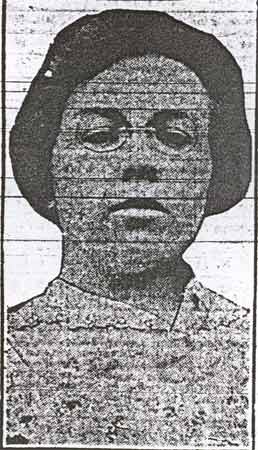
Slayer’s Wife
Murderer’s Wife Supplied Revolver, Smuggling It In Covered by Fruit
Camden Post-Telegram —
Confessing Supplying Pistol, in Spite of Husband’s Denial That She Was Guiltless, Mrs. Ashbridge Is Held Without Bail on Charge of Conspiracy in Aiding and Abetting Escape From Jail
With Wilson T. Ashbridge under guard in a cell in what was formerly known as Murderer’s Row, the police and county detectives today redoubled their energies towards the capture of George E. Thompson, the forger who escaped with Ashbridge from the County Jail on Monday night after murdering one keeper and wounding another. Stirring the police of all cities in the East to renewed activity, another circular was sent out today by the authorities giving notice of the reward of $500 offered for Thompson’s capture. Attention was strongly directed in the circular due to the fact that one of the fingers of Thompson’s left hand is missing.
The gun with which Ashbridge murdered jailor Isaac Hibbs and wounded Jailor Ellis was smuggled into the jail by Mrs. Ashbridge on Saturday morning. With it went a box of cartridges. The weapon and bullets were passed to Ashbridge in a basket of fruit, being at the bottom of the basket. The jailors were busy at the time she called and as she frequently had brought her husband fruit they did not take precaution to search the basket. Mrs. Ashbridge bought the gun and cartridges on the written request of her husband.
Her confession as to the very grave part she played in the escape and murder was made to the Prosecutor late yesterday afternoon after she had first insisted she had no knowledge of how the gun got into the jail and after her husband had repeatedly declared that the revolver was supplied by Thompson. The revolver, fully loaded, was still carried by Ashbridge when he was captured in the Keystone Hotel…
… by Recorder Stackhouse without bail for conspiracy in aiding and abetting the escape of her husband and George E. Thompson from the County Jail on Monday night.
The court room was packed to suffocation by a morbidly curious crowd, composed primarily of women. A strange silence spread through the court room when the little woman was led into the court room by Captain Schregler. The regular formality of placing prisoners in the dock was dispensed with the woman’s case.
Prosecutor De Unger pointed to the high witness chair and Mrs. Ashbridge sat in it. She evaded the gaze of the crowd, looking intently at the floor and through a window on the Washington Street side. She wore a blue skirt and a white waist. She was without her hat. Her hair was carefully arranged and she wore nose glasses.
Resting her chin on her right hand her arm and hand were seen to tremble slightly. So quiet was the room that a pin dropping could have been heard.
“Mrs. Marian Ashbridge,” called the Recorder.
“Yes, Sir” was the faint reply of the woman, who did not even look up at the call of her name.
“This complaint charges you with delivering to Wilson Ashbridge and George E. Thompson a pistol and aiding and abetting them in escaping from the County Jail, where they had been lawfully committed. Do you plead guilty or not guilty,” said the Recorder as he read the complaint.
The woman said nothing. Detective Schregler was then called as the complainant. He told of the confession made by the woman and produced the revolver which the woman purchased and which Ashbridge used in his daring escape. The gun, Captain Schregler said, was purchased in a pawnshop at Eleventh and Arch Streets, Philadelphia, on Friday of last week and was delivered to Ashbridge on Saturday morning along with a box of cartridges. “Marian, I will hold you without bail,” said the Recorder.
As the woman was being led from the court room by Captain Schregler and Sergeant Reed the crowd made a rush for the door leading from the court room, whereupon orders were given by the police to the crowd and many were prevented from rushing out. Everybody seemed anxious to secure a closer look at the unfortunate woman.
Visitors were denied Mrs. Ashbridge. Not even her children were permitted to be brought before her, although the broken-hearted mother asked for them.
“Oh, God, I don’t know why I did this; why I left the little ones to go with Wilson,” tearfully expostulated Mrs. Ashbridge to the kind-hearted matron, who spent the best part of last night with the distraught woman.
“If I could only see little Marian,” sobbed the woman in the arms of Mrs. Kirkpatrick, who informed her that perhaps she could see them today.
Last evening the only support Mrs. Ashbridge had was a cup of tea. The morning she sipped a portion of a cup of coffee. She told Matron Kirkpatrick that she was not hungry.
“Everybody hounded me, I had no friends, and that’s why I went with my husband, because he was the only friend I had left,” said Mrs. Ashbridge. “He was a good boy, but was easily led.” The wife said even before her marriage that Ashbridge would run around with other girls, but he always returned to her and she forgave him. She said he seemed to have a spell over her and she couldn’t leave him.
“I love my husband, still and will stand by him to the end,” sobbed the little woman to Mrs. Kirkpatrick. She told how her relatives disowned her and how after her father’s death she went to live with strangers. When her husband fostered the plan to escape she willingly consented to aid him. She drew $100 out of the bank and purchased clothes and the gun and bullets. She never faltered in her plan.
“My heart aches for that woman,” said Matron Kirkpatrick this morning to a Post-Telegram reporter. “She’s a good girl, but was easily led into her present predicament. It only goes to show what a woman will do for the man she loves, no matter how base a wretch he may be. Mrs. Ashbridge is more to be pitied than scorned.
Recorder Stackhouse this morning produced a copy of the marriage of the couple, performed by him on July 28, 1914. The marriage was performed at the instance of Assistant Prosecutor Butler after Ashbridge wronged the girl. Constable William E. Headley and William C. Ashbridge, the latter father of the murderer, were witnesses.
As told in yesterday’s Post-Telegram, Ashbridge and his wife and their captors arrived at the City Hall from Chester shortly after 2:00 o’clock. After a brief stay they were taken to the Court House and turned over to Prosecutor Kraft, Ashbridge being taken into the Prosecutor’s private office and Mrs. Ashbridge being placed under guard in the ante room.
Taking full blame for the murder of Hibbs and the wounding of Ellis, Ashbridge declared that none of the shots were fired by Thompson.
“I shot both men,” he declared, “but Thompson gave me the gun. He had it since Saturday.” He repeated this assertion several times in the course of his examination, adding each time that his wife had no part in supplying the firearm. His voluntary insistence in…
… exercise corridor of their cells in response to his request that he wanted to show him a note that had been left for him, he asked the aged keeper to step inside the corridor. Evidently suspecting something was wrong Hibbs refused to enter the corridor. When Ashbridge repeated his request that Hibbs step inside, Thompson, who was immediately behind Ashbridge, said something to the murderer. Ashbridge could not exactly recall what the expression was. At any rate it was then that he fired and Hibbs fell to the floor with his death wound. To take Hibbs’ keys and open the door leading from the exercise room to the corridor was the work of but an instant. It was then that Ellis confronted Ashbridge at the other end of the corridor. He refused to throw up his hands when the murderer so ordered. Instead, the plucky jailor grappled with the slayer, who again brought the gun into play, twice wounding the remaining jailor.
Ashbridge did not say why he wanted Hibbs to step inside the corridor. One surmise is that the pair had planned to get the old man into the corridor, overpower him, take his keys and after gagging him place him in a cell, depending on the gun to awe any prisoners who might make an outcry. But whatever their plan was in this respect it miscarried. Hibbs would not enter the corridor and was shot down where he stood.
Thompson carried both his own and Ashbridge’s coats when they fled. As Ashbridge had decided to do the talking with Hibbs when the jailor came to lock them in their cells it was agreed that it would not be wise for the murderer to be wearing a coat. This might look suspicious to Hibbs and in all likelihood he would refuse to open the door. Hence it was decided that Thompson should take both coats. He also carried Ashbridge’s cap and his own Panama.
The coats and hats were adjusted as they ran down the spiral stairway leading to the street. They walked slowly into Sixth Street; increasing their pace up Sixth Street after crossing Market and after turning into Cooper walked very rapidly. They turned north on Third Street to Main and thence to the Vine Street ferry, where they caught the boat leaving at 7:15 for Philadelphia. Landing on the other side the fugitives exchanged hats. They walked rapidly to Broad Street Station, where Mrs. Ashbridge was in waiting, this arrangement having been made when she smuggled the gun in to her husband on Saturday morning.
Accompanied by Thompson the Ashbridges walked out Market Street to Thirty-second Street. Here Thompson left them and after walking the street for a brief while longer the slayer and his wife boarded a trolley car for Chester, where a few hours later the murderer’s short-lived liberty was so dramatically terminated.
Although jailor Ellis still insists that three shots were fired before he was attacked and in spite of the positive declaration of Alfred Williams, the trusty, that three shots were fired at Hibbs, Ashbridge claims that Hibbs was shot only once and that two bullets were used on Ellis. He said that the three empty shells which the detectives found in his pocket contained the only bullets fired in the jail. The post mortem examination made yesterday by County Physician Stem bears out his contention as to the number of shots fired. Only one bullet was found and that had penetrated the jailor’s heart.
“That’s the truth about the shooting,” declared Ashbridge. “I fired the shots— three of them in all— and the gun was given me by Thompson. My wife had nothing to do with it. Don’t blame her.”
Enroute back to the prison from which he had made his tragic getaway on Monday night, Ashbridge passed through the ante room where his wife was under guard. He stopped, kissed her, gently caressed her cheek, told her not to worry and passed on to the jail, from whence his next exit will be to the electric chair.
Haggard and very weak Mrs. Ashbridge was at once taken before the Prosecutor. With due regard for her condition Mrs. Ashbridge was handled very gently. At first she insisted that she had no part in getting the gun, but under skillful handling she finally broke down and confessed that she had supplied the revolver.
She stated that on Friday night she received a letter from her husband telling her that he planned to escape from the jail on Monday night and that he needed a revolver to make certain that his scheme would not fail. He requested that she procure the pistol and cartridges and personally deliver them on Saturday. Being anxious to aid her husband in every way possible she readily decided to do as he requested.
Accordingly she purchased the needed articles in a Philadelphia pawnshop on Friday afternoon, paying $3.00 for the pistol and 67 cents for the cartridges. She kept them over night and on Saturday safely delivered the weapon and bullets to her husband in the bottom of a basket of fruit. At the same time Ashbridge asked her to go with him and when she agreed to share his fate he told her to meet him in Broad Street Station, Philadelphia, shortly after seven o’clock on Monday night. He further told her that he had carefully studied the situation and did not see how it was possible for his plan to miscarry. On Monday morning she sent her children to the home of Mrs. Anna Dick and later in the day sent the letter to Mrs. Dick telling of her “rash deed” and enclosing $10 for the children.
As Mrs. Ashbridge told her story she spoke in a very low tone. Most of the time her eyes were cast down and as she concluded her brief narrative she sobbed convulsively and was in a state of utter collapse. Reviving somewhat when given cold water Mrs. Ashbridge was turned over to the police and taken back to City Hall to await her hearing this morning.
The prison key stolen by Ashbridge from Hibbs’ murdered body was recovered this morning by Detective Doran in the yard of Dr. Frank, 2025 Chestnut Street, Philadelphia. The recovery of the key was due to information given by Ashbridge, after he had been locked up in jail yesterday afternoon. Ashbridge, when questioned as to the whereabouts of the key, said that Thompson had it and that he had seen him toss it over a wall of a residence near Twenty-third and Chestnut Streets on Monday night while he and his wife and Thompson were walking to Thirty-second Street.
Detective Doran and Constable Voight went to Philadelphia late yesterday afternoon and searched in vain for the key in the vicinity of Twenty-third and Chestnut Streets until darkness came on. Detective Doran renewed the search early this morning. There is a high wall fronting the yard at the home of Dr. Frank, and a search of the grounds resulted in the finding of the key, which was returned to Sheriff Haines.
Ashbridge is confined in a large cell in what is known as Section E. As cellmates he has two persons who are being held as witnesses to the crime. Sheriff Haines has assigned three constables, Gardner, Ford, and Addison. They will work on eight-hour shifts and will see that Ashbridge does not attempt any further escape or try to end his life.
Sergeant Detective Kane of the Chicago Police Department today took to Chicago Alfred Williams, who was an eyewitness to the murder of Hibbs. Williams, an Italian, served six months here on a charge of false pretence in obtaining money from a number of Italian grocers under the pretence that he represented the Roma Grocery Company. After his arrest and sentence here the police of Chicago lodged a detainer against Williams who is wanted in the West for a like crime.
The body of Jailor Hibbs will be exposed to view tonight at his home, 913 South 8th Street. Services will be conducted by Reverend Harry Bradway, pastor of Eighth Street Methodist Episcopal Church. Members of the Seventh Ward Republican Club, Mutual Aid and the Liberty Beneficial Society will attend in a body.
Tomorrow morning the body will be taken to Langhorne, where services will be held in the Friends Meeting House, after which interment will be made in the burial ground by the Schroeder-Kephart Company. Friends may call this evening to pay their respects.
Ashbridge will not be tried until December. On the day he was listed for trial of murdering Mrs. Dunbar his lawyer, Assemblyman Wolverton, was ill. In the interim the entire panel of jurors for the April term of court was discharged following a case of alleged tampering. This makes it necessary that he be held until September for trial unless the Court should otherwise decree, which is hardly likely.
Ashbridge is 22 years old and not 27, as previously stated. His real age was disclosed by the certificate of his marriage. He was 20 when he wedded two years ago.
The Howard Marshall who mailed a letter to a woman in Baltimore is not Freeholder Howard Marshall of the Eighth Ward, as was reported to the Prosecutor yesterday. Mr. Kraft’s investigation disclosed that Freeholder Marshall does not know either Ashbridge or Thompson and that as a matter of fact the Marshall in question is an East Sider and no relative to the freeholder, who was naturally much upset at being mistakenly dragged into the case.
E.S. Fry, proprietor of the Keystone Hotel, Chester, where the couple were caught, told the story of the capture both to the city police and Prosecutor Kraft.
“Late on Monday night I received a call from another hotel, requesting that I take care of a man and his wife for the evening,” said Mr. Fry. “I waited until a little before midnight when the couple arrived. He seemed nervous and registered in a shaky hand, and I was suspicious that there was something wrong.”
“I did not pay much attention to the way he registered until the next morning when I examined the register and saw that he had neglected to register his wife. He signed ‘Mr. Smythe, Washington, D.C.’ I communicated my suspicions to my wife and told her to go observe the couple, too. Then I went out on the porch and picked up a morning newspaper. On the front page were the pictures of the two men who escaped.”
“I instantly recognized Ashbridge, but was not just sure of my identity of the man, so I decided to get a better look at him. At the breakfast table I observed him more closely and feeling sure of my ground I called Captain Schregler, afterward securing the service of two negro policemen, whom I placed on guard outside the hotel, giving them orders not to allow the couple to leave. The officers, William Padgett and William Robinson, took their positions outside the hotel, ready for the signal to enter when I gave it.”
“Ashbridge arose.”
“What’s the matter,” he exclaimed. “You know what’s the matter,” replied Mr. Fry, who brought in Captain Schregler and Detective Hunt. Schregler and Hunt instantly recognized the fugitive.
Before Ashbridge had a chance to move his arms were pinioned by his sides and Policeman Hunt had extracted the murder gun from his right hip pocket. It was fully loaded. In the same pocket were seventeen additional cartridges and in a suitcase in his room, Number 9, was a fresh box of cartridges.
“The little wife was crying bitterly,” said Mr. Fry. “She leaned her head upon his shoulder and the husband tried to console her.”
Captain Schregler sent a telegram to Chiefs Gravenor and Hyde with the startling news that Ashbridge had been caught.
On the way back to Camden Mrs. Ashbridge began to cry. She was sitting beside Captain Schregler, and he tried to console her. Her sobs increased, and Ashbridge called to her to “take it easy.”
This seemed to quiet her a bit, and Schregler spoke to her kindly, saying that she would not be blamed very much for her part in the escape. “That’s not worrying me” she answered. “I am worried about ‘Wil’.”
“Well, you women beat me” was Schregler’s comment. “What did you want to help him escape for, anyhow? He had beaten you, deserted you for another woman and when she turned him down, he killed her. Yet you make up with him, leave your kids and risk everything to help him escape. Seems to me the worse men treat you women, the more you will do for them.”
“Lots of truth in what you say,” remarked Mrs. Ashbridge, with a sigh.
Mr. Fry was the center of attention. Everybody seemed anxious to hear his story.
“I’m not going back until I collect that $500 either,” he was heard to say. The capturer was formerly coroner of Delaware County.
Scenes of excitement were prevalent when the automobile of Chief Gravenor with Detective-chauffer David Hunt at the wheel, Captain Schregler and the prisoners in the rear and Chief Dodd, of the Pennsylvania Railroad police force in the front seat came from the Federal Street Ferry. E.S. Fry, the hotel proprietor who caught the Ashbridges, was also in the car.
Ashbridge and his wife were instantly recognized. The news spread like wildfire and was passed along the route of the machine to police headquarters.
Thinking that the prisoners would be brought to the Prosecutors office, a battery of newspapermen and photographers were camped on the Court House plaza. When someone cried in bellowed tones “There they go,” the scribes and photographers started in hot pursuit behind the automobile.
The officers upon reaching the City Hall had to fight their way through the dense crowd which had gathered outside Police Headquarters. Many stood tiptoed to get a good glance at the prisoners who were abashed at their predicament.
Pulling her black straw hat over her face, Mrs. Ashbridge leaned on her husband’s arm. To hide his face the murderer pulled the Panama hat, which he had secured from Thompson, over his countenance.
Preliminary questioning was done by Captain A.L. James, after which the officers and prisoners were escorted upstairs to the office of Chief Gravenor.
Still clenching the stump of a cheap cigarette in the corner of his mouth, Ashbridge had a pitiful look on his face. He was much thinner than he was when he was arrested for the murder of the Dunbar girl. On his upper lip was a small mustache, which he raised during the last week.
His beautiful and baby-like eyes still retained their piercing stare. The murderer looked wild-eyed at persons in the room. He seemed to take delight in singling out persons in the room and “staring them out.” None seemed courageous enough to return Ashbridge’s strange stare. He looked distressed but the only betraying sign of nervousness was his incessant twitching of his fingers. Seated on the couch in the chief’s room, Ashbridge talked freely.
His wife dried away the tears as they trickled down her reddened face but after regaining her composure she seemed quite calm. She intently watched Captain Schregler and Detective Hunt as they searched through her husband’s clothes.
When the trip for the Court House was being arranged the two prisoners, still handcuffed together, walked in the outer room of the chief’s office. It was then that the wife broke down slightly. She choked back a sob and leaned her head on her husband’s shoulder. Ashbridge did likewise and patted her on the back, at the same time, saying something in a suppressed tone of voice. The only persons in the room at the time were Assistant Chief Hyde and a Post-Telegram reporter. Neither was able to catch the words uttered. Captain Schregler, Chief Gravenor, and Detective Hunt later entered the room and the start for the Court House was made.
The crowd below which was camped about the entrance to the building awaited with patient expectancy, when the news was spread that the prisoners were leaving the building.
Camera men took their positions, ready to snap the couple, but the Ashbridges fooled them. Before the door leading to the street was opened Ashbridge drew his wife to him and with their free hands pulled their hats over their faces, thus eluding the photographers, who resorted to every means to secure a photograph.
Once inside the automobile the prisoners seemed content until the Court House was reached when another large crowd was on hand to greet them. Both repeated the trick of hiding their faces.
After Ashbridge was taken to his cell his wife was ordered taken to the detention department in the City Hall. Captain Schregler and Detective Hunt half-carrying the sobbing and broken-hearted woman, who has aroused some sympathy for her courageousness in taking such a desperate chance for the man she loved, the father of her children and a cruel murderer.
“What other woman would do as much as she has for her husband,” was the query advanced by one of the spectators in the Court House corridor as Mrs. Ashbridge passed through on her way to the waiting automobile.
Murderer and His Wife Are Caught at Chester Hotel
Camden Daily Courier —
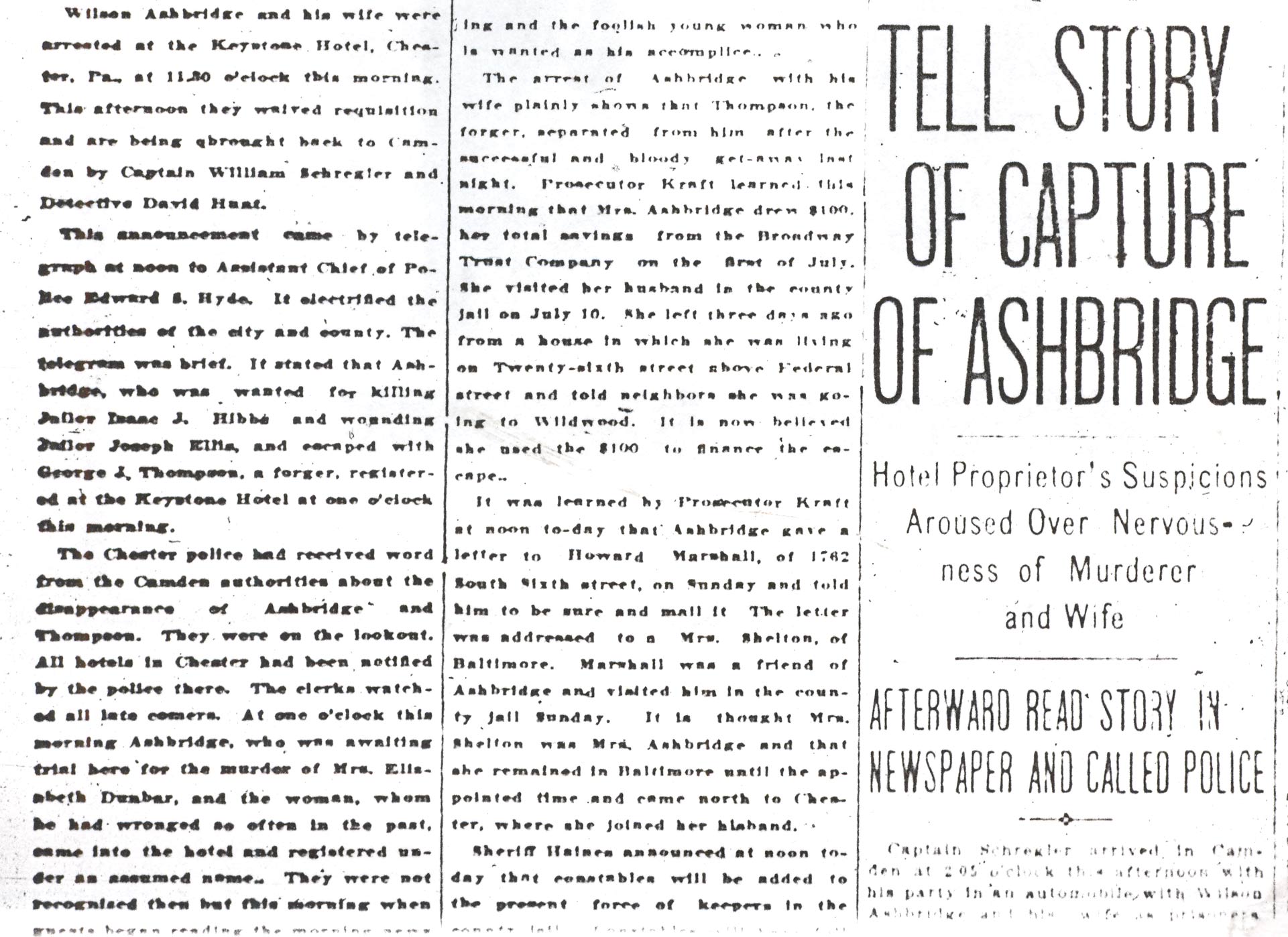
Wilson Ashbridge and his wife were arrested at the Keystone Hotel, Chester, Pa., at 11:30 o’clock this morning. This afternoon they waived requisition and are being brought back to Camden by Captain William Schregler and Detective David Hunt.
This announcement came by telegraph at noon to Assistant Chief of Police Edward S. Hyde. It electrified the authorities of the city and county. The telegram was brief. It stated that Ashbridge, who was wanted for killing Jailer Isaac J. Hibbs and wounding Jailer Joseph Ellis, and escaped with George J. Thompson, a forger, registered at the Keystone Hotel at one o’clock this morning.
The Chester police had received word from the Camden authorities about the disappearance of Ashbridge and Thompson. They were on the lookout. All hotels in Chester had been notified by the police there. The clerks watched all late comers. At one o’clock this morning Ashbridge, who was awaiting trial here for the murder of Mrs. Elisabeth Dunbar, and the woman, whom he had wronged so often in the past, came into the hotel and registered under an assumed name. They were not recognized then but this morning when guests began reading the morning news [words missing at the crop edge]ing and the foolish young woman who is wanted as his accomplice.
The arrest of Ashbridge with his wife plainly shows that Thompson, the forger, separated from him after the successful and bloody get-away last night. Prosecutor Kraft learned this morning that Mrs. Ashbridge drew $100, her total savings from the Broadway Trust Company on the first of July. She visited her husband in the county jail on July 10. She left three days ago from a house in which she was living on Twenty-sixth street above Federal street and told neighbors she was going to Wildwood. It is now believed she used the $100 to finance the escape.
It was learned by Prosecutor Kraft at noon to-day that Ashbridge gave a letter to Howard Marshall, of 17[?]2 South Sixth street, on Sunday and told him to be sure and mail it. The letter was addressed to a Mrs. Shelton, of Baltimore. Marshall was a friend of Ashbridge and visited him in the county jail Sunday. It is thought Mrs. Shelton was Mrs. Ashbridge and that she remained in Baltimore until the appointed time and came north to Chester, where she joined her husband.
Sheriff Haines announced at noon today that constables will be added to the present force of keepers in the [cut off at the crop edge]
Tell Story of Capture of Ashbridge
Hotel Proprietor’s Suspicions Aroused Over Nervousness of Murderer and Wife
Afterward Read Story in Newspaper and Called Police
Captain Schregler arrived in Camden at 2:05 o’clock this afternoon with his party in an automobile, with Wilson Ashbridge and his wife as prisoners [cut off at the crop edge]
Thousands View Jailor’s Remains
Camden Post-Telegram —
Great Crowds Pay Tribute to Memory of “Daddy” Isaac Hibbs, Slain Keeper — Casket Banked by Handsome Flowers
Thousands of persons last night paid tribute to the memory of “Daddy” Isaac J. Hibbs, the jailor, who on Monday night was murdered by Wilson Ashbridge. The humble Hibbs residence at 913 South 8th Street was visited by over 5,000 people, who came from all sections to gaze on the death-stilled features of the aged jailor who sacrificed his life in the performance of his duty. Many were unable to gain entrance.
Services were conducted last evening by Reverend Harry Bradway, pastor of Eighth Street Methodist Church. Members of the family and close relatives attended the services.
This morning the funeral occurred, the body being taken to Langhorne PA where interment was made in the Friends burial ground, following the holding of the Quaker service. It was an auto funeral, and the arrangements were made by the Schroeder-Kephart Company.
Long before seven o’clock a waiting crowd gathered about the Hibbs residence. A line of people formed when the doors to the Hibbs residence were opened. The procession reached over two squares in length and for over two hours the crowd wended its way into the little home and took a parting gaze upon “Daddy” Hibbs’ peaceful countenance.
There were old folks, young folks, and the little children. Even the kiddies looked saddened as they tiptoed to look at the dead jailor’s face. Older persons kindly lifted the little ones up to give them a better view. “Daddy” Hibbs was loved by everyone, especially by the children. Many tear-stained faces were seen.
The grief-stricken wife, who is not seriously ill, was able to walk into the room and gaze upon the features of her beloved helpmate. In the visiting assemblage was Sheriff Haines and other well-known county and city officials.
Banked on all sides of the bier were the floral designs. Among the prettiest designs was a seven-foot standing broken circle from the Seventh Ward Republican Club. Court House attaches sent a large anchor and wreath, a star and cross, a large spray of red roses, a beautiful pillow and a broken circle. The wife gave a handsome pillow with the attached inscription, “My Husband.”
Two sons and a daughter survive beside the wife. The sons are Wesley W. and Benjamin Hibbs, and the daughter is Mrs. Katie Terry of Langhorne PA.
Philadelphia Inquirer — February 11, 1917
Selective Boards Organize
Philadelphia Inquirer —
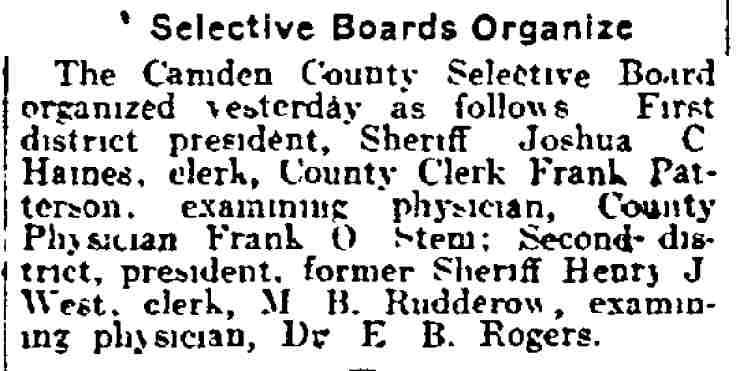
The Camden County Selective Board organized yesterday as follows. First district president, Sheriff Joshua C Haines, clerk, County Clerk Frank Patterson, examining physician, County Physician Frank O Stem; Second district, president, former Sheriff Henry J West, clerk, M B. Rudderow, examining physician, Dr E. B. Rogers.
Funeral of Dr. P. N. Litchfield
Philadelphia Inquirer —
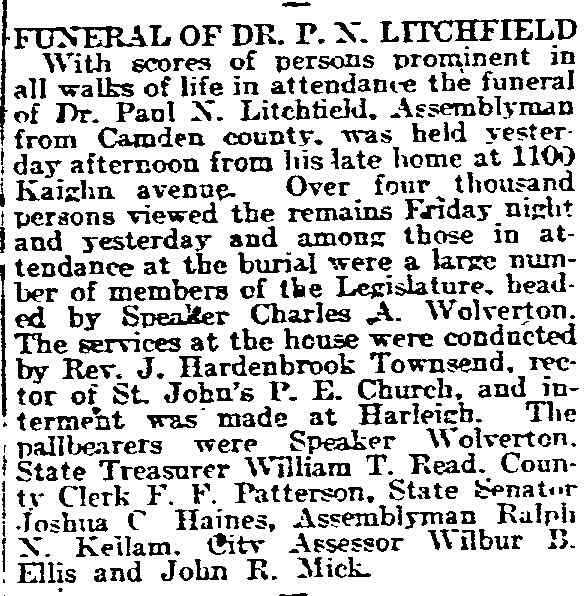
With scores of persons prominent in all walks of life in attendance the funeral of Dr. Paul N. Litchfield, Assemblyman from Camden county, was held yesterday afternoon from his late home at 1100 Kaighn avenue. Over four thousand persons viewed the remains Friday night and yesterday and among those in attendance at the burial were a large number of members of the Legislature, headed by Speaker Charles A. Wolverton. The services at the house were conducted by Rev. J. Hardenbrook Townsend, rector of St. John’s P. E. Church, and interment was made at Harleigh. The pallbearers were Speaker Wolverton, State Treasurer William T. Read, County Clerk F. F. Patterson, State Senator Joshua C. Haines, Assemblyman Ralph N. Keilam, City Assessor Wilbur B. Ellis and John R. Mick.
Reception Given in Honor of Their Golden Wedding
Camden —
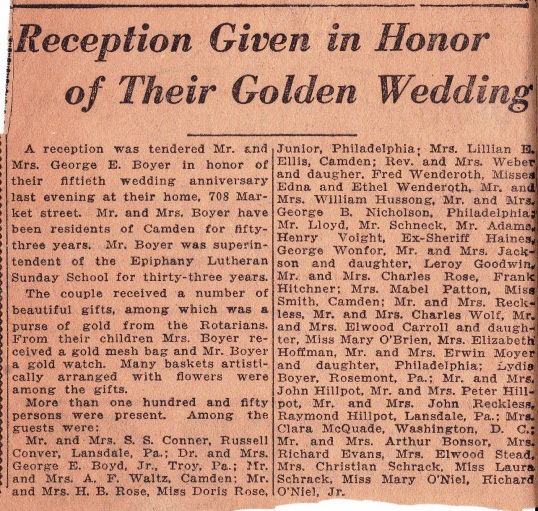
A reception was tendered Mr. and Mrs. George E. Boyer in honor of their fiftieth wedding anniversary last evening at their home, 708 Market street. Mr. and Mrs. Boyer have been residents of Camden for fifty-three years. Mr. Boyer was superintendent of the Epiphany Lutheran Sunday School for thirty-three years.
The couple received a number of beautiful gifts, among which was a purse of gold from the Rotarians. From their children Mrs. Boyer received a gold mesh bag and Mr. Boyer a gold watch. Many baskets artistically arranged with flowers were among the gifts.
More than one hundred and fifty persons were present. Among the guests were:
Mr. and Mrs. S. S. Conner, Russell Conver, Lansdale, Pa.; Dr. and Mrs. George E. Boyd, Jr., Troy, Pa.; Mr. and Mrs. A. F. Waltz, Camden; Mr. and Mrs. H. B. Rose, Miss Doris Rose, Junior, Philadelphia; Mrs. Lillian E. Ellis, Camden; Rev. and Mrs. Weber and daugher [sic], Fred Wenderoth, Misses Edna and Ethel Wenderoth, Mr. and Mrs. William Hussong, Mr. and Mrs. George B. Nicholson, Philadelphia; Mr. Lloyd, Mr. Schneck, Mr. Adams, Henry Voight, Ex-Sheriff Haines, George Wonfor, Mr. and Mrs. Jackson and daughter, Leroy Goodwin, Mr. and Mrs. Charles Rose, Frank Hitchner; Mrs. Mabel Patton, Miss Smith, Camden; Mr. and Mrs. Reckless, Mr. and Mrs. Charles Wolf, Mr. and Mrs. Elwood Carroll and daughter, Miss Mary O’Brien, Mrs. Elizabeth Hoffman, Mr. and Mrs. Erwin Moyer and daughter, Philadelphia; Lydia Boyer, Rosemont, Pa.; Mr. and Mrs. John Hillpot, Mr. and Mrs. Peter Hillpot, Mr. and Mrs. John Reckless, Raymond Hillpot, Lansdale, Pa.; Mrs. Clara McQuade, Washington, D. C.; Mr. and Mrs. Arthur Bonsor, Mrs. Richard Evans, Mrs. Elwood Stead, Mrs. Christian Schrack, Miss Laura Schrack, Miss Mary O’Niel, Richard O’Niel, Jr.
Life Size Portrait of Lord Camden Is Presented to City
Camden Courier-Post —
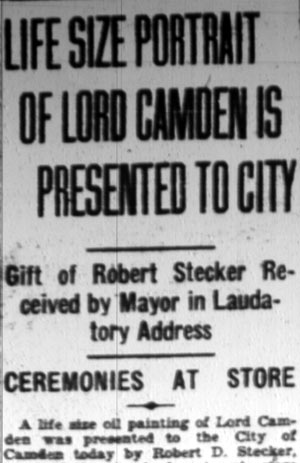

Gift of Robert Stecker Received by Mayor in Laudatory Address
Ceremonies at Store
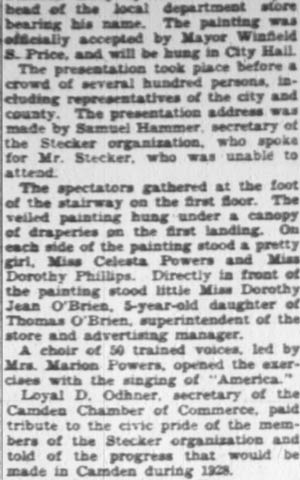
A life size oil painting of Lord Camden was presented to the City of Camden today by Robert D. Stecker, head of the local department store bearing his name. The painting was officially accepted by Mayor Winfield S. Price, and will be hung in City Hall.
The presentation took place before a crowd of several hundred persons, including representatives of the city and county. The presentation address was made by Samuel Hammer, secretary of the Stecker organization, who spoke for Mr. Stecker, who was unable to attend.
The spectators gathered at the foot of the stairway on the first floor. The veiled painting hung under a canopy of draperies on the first landing. On each side of the painting stood a pretty girl, Miss Celesta Powers and Miss Dorothy Phillips. Directly in front of the painting stood little Miss Dorothy Jean O’Brien, 5-year-old daughter of Thomas O’Brien, superintendent of the store and advertising manager.
A choir of 50 trained voices, led by Mrs. Marion Powers, opened the exercises with the singing of “America.”
Loyal D. Odhner, secretary of the Camden Chamber of Commerce, paid tribute to the civic pride of the members of the Stecker organization and told of the progress that would be made in Camden during 1928.
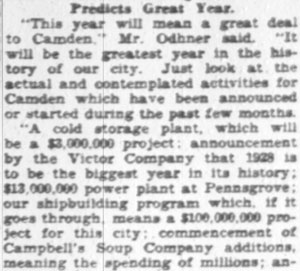
Predicts Great Year.
“This year will mean a great deal to Camden,” Mr. Odhner said. “It will be the greatest year in the history of our city. Just look at the actual and contemplated activities for Camden which have been announced or started during the past few months.
“A cold storage plant, which will be a $3,000,000 project; announcement by the Victor Company that 1928 is to be the biggest year in its history; $13,000,000 power plant at Pennsgrove; our shipbuilding program which, if it goes through, means a $100,000,000 project for this city; commencement of Campbell’s Soup Company additions, meaning the spending of millions; announcement for the plans of a new $15,000,000 highway from Camden to Atlantic City; commencement of activities on the $2,000,000 marine terminal project; continuation of the $2,000,000 county park program; announcement that the proposed Galen building is financed and work will be started this year; the Tacony-Palmyra bridge; vocational school.
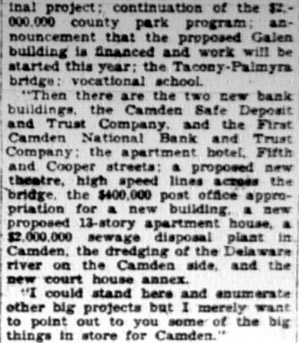
“Then there are the two new bank buildings, the Camden Safe Deposit and Trust Company, and the First Camden National Bank and Trust Company; the apartment hotel, Fifth and Cooper streets; a proposed new theatre, high speed lines across the bridge, the $400,000 post office appropriation for a new building, a new proposed 13-story apartment house, a $2,000,000 sewage disposal plant in Camden, the dredging of the Delaware river on the Camden side, and the new court house annex.
“I could stand here and enumerate other big projects but I merely want to point out to you some of the big things in store for Camden.”
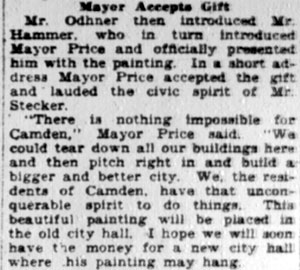
Mayor Accepts Gift
Mr. Odhner then introduced Mr. Hammer, who in turn introduced Mayor Price and officially presented him with the painting. In a short address Mayor Price accepted the gift and lauded the civic spirit of Mr. Stecker.
“There is nothing impossible for Camden,” Mayor Price said. “We could tear down all our buildings here and then pitch right in and build a bigger and better city. We, the residents of Camden, have that unconquerable spirit to do things. This beautiful painting will be placed in the old city hall. I hope we will soon have the money for a new city hall where his painting may hang.”
Then little Dorothy O’Brien pulled a silken cord and the covering on the big painting, revealing the work of Raphael Senseman, 719 Stokes avenue, Collingswood, illustrator and painter.
The chorus then sang the “Star Spangled Banner,” and the presentation exercises had been concluded. Among the guests were the following: Surrogate George Whyte, Register of Deeds Joshua Haines, and County Clerk Charles Wise, who represented Camden county; Mayor Price, City Commissioner T. Yorke Smith and City Clerk William Brown, who represented the city; Rev. Father Thomas J. Whelan, of the Church of the Holy Name; James V. Moran, of the Hurley Store, and Clarence Munger, who formerly operated the Stecker store when it was known as Munger and Long.
Haines and Reinert Head G.O.P.; Madden To Lead Democrats
Camden Courier-Post —
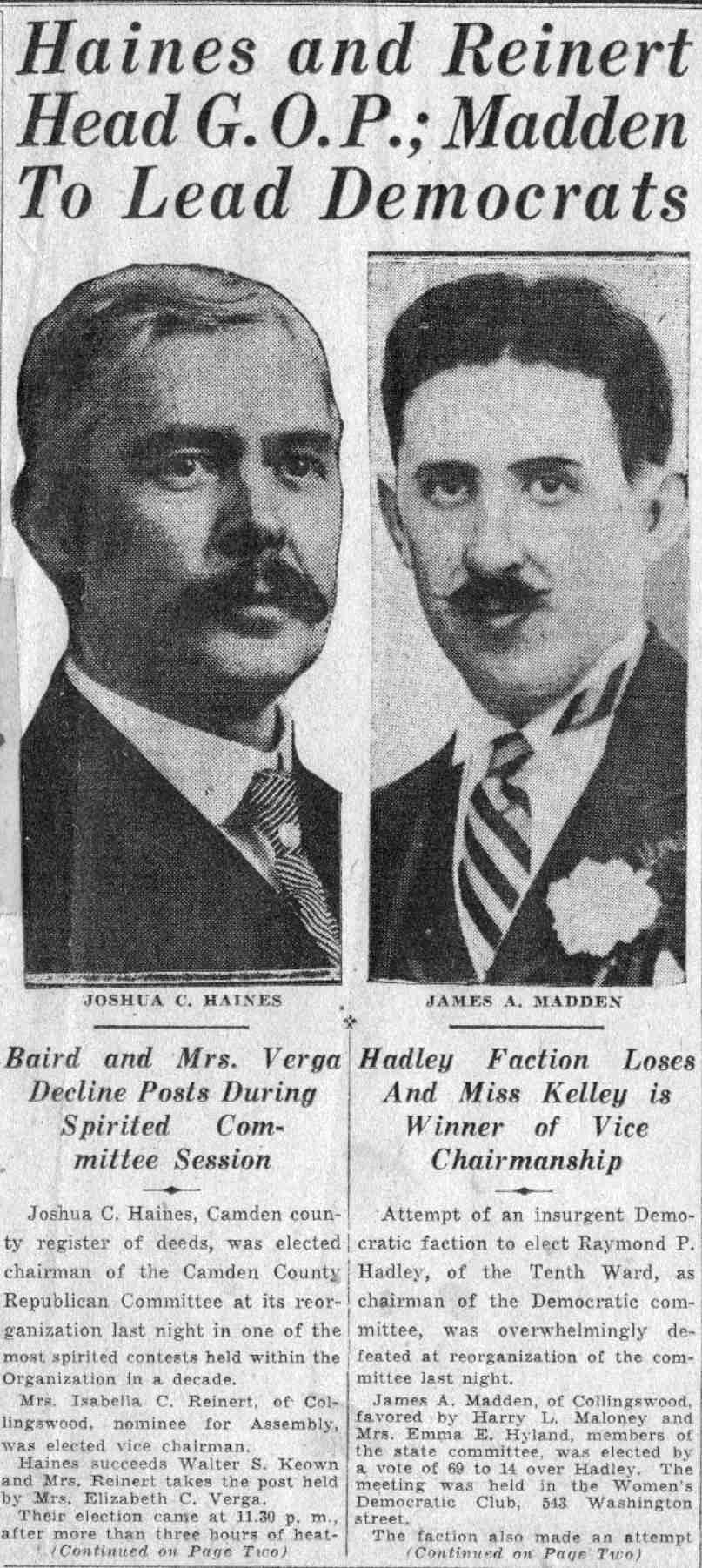

JOSHUA C. HAINES
Baird and Mrs. Verga Decline Posts During Spirited Committee Session
Joshua C. Haines, Camden county register of deeds, was elected chairman of the Camden County Republican Committee at its reorganization last night in one of the most spirited contests held within the Organization in a decade.
Mrs. Isabella C. Reinert, of Collingswood, nominee for Assembly, was elected vice chairman.
Haines succeeds Walter S. Keown and Mrs. Reinert takes the post held by Mrs. Elizabeth C. Verga.
Their election came at 11.30 p. m., after more than three hours of heated argument behind closed doors, and after former U. S. Senator David Baird and Mrs. Verga had declined to accept the offices.
Keown, Hanna Mentioned
Others nominated were Keown and Camden City Commissioner Frank B. Hanna, for chairman, and Mrs. Etta C. Pfrommer, of the Eleventh Ward. Mrs. Pfrommer twice declined.
In previous years reorganization of the county committee had been effected without dispute, and with unanimous action by the members. Last night, however, the discussion waged long and loud.
Though newspapermen were excluded from the meeting, the voices of the debating members coming through the locked doors left no doubt as to the progress of the election.
Other officers were re-elected as follows: Howard B. Dyer, secretary; William D. Sayrs, Jr., treasurer, and Mrs. Lottie B. Stinson, assistant secretary. Mrs. Anna G. Holl, of Collingswood, was elected assistant treasurer to succeed Mrs. Reinert.
Keown opened the meeting and then Baird spoke.
The former Senator presented the recommendation of the Republican executive conference committee that the members elect Haines and Mrs. Reinert in view of the fact that Keown and Mrs. Verga had resisted all requests to continue.
Then Mrs. Margaret Wermuth, of Delaware township, and Carlton M. “Cy” Harris, of the Twelfth Ward, presented a petition signed by virtually all the committee, asking Baird and Mrs. Verga to accept the chairmanship and vice chairmanship.
Baird Declines
Baird then declared that he was unable to take over any additional work.
“I must not be chosen, but must work with and for you, and I ask that you respect my wishes.”
He then proposed that Haines and Mrs. Reinert be chosen unanimously.
Despite his proposal, Mrs. Wermuth moved the election of Baird and Mrs. Verga. The vote was virtually unanimous. Immediately J. C. Remington, Jr., of Haddonfield, moved to adjourn. The chair refused to recognize the motion.
Several members threatened to resign from the committee unless Baird and Mrs. Verga accepted. To this Baird answered:
“I’m still fighting for the party, no matter who quits. If you quit, you’re not worthy to be members.” His remarks were greeted with applause.
In announcing her decision not to accept renomination Mrs. Verga said her duties as state vice chairman, taking her into all the 21 counties, made it impossible for her to continue to devote the time to the county committee which it deserved. She explained that her term as state vice chairman still has two years to run.
Haines Finally Elected
Then Baird announced his resignation from the chairmanship and Mrs. Verga from the vice chairmanship.
Keown was nominated for re-election and Haines and Hanna for election. Baird was renominated by Remington. Keown reiterated his insistence, announced several weeks ago, not to stand for re-election. Baird again declined.
Then Keown moved the election of Haines and Mrs. Reinert. The discussion which followed continued for three hours. Finally the vote was taken at 11.30 and Haines and Mrs. Reinert were declared elected.
Mrs. Reinert, however, declined the office, stating her candidacy for assembly would consume all her time. Then Mrs. Pfrommer was nominated, but she turned it down twice. After much persuasion Mrs. Reinert agreed to accept with the provision that she serve through the summer and that she be permitted to resign later, if she wished.
In a telegram to the committee, Congressman Charles A. Wolverton urged the election of Baird and Mrs. Verga.
The committee elected the following solicitors: Carl Kisselman, Edward R. Deibert, L. Scott Cherchesky, William E. A. King, J. Claud Simon, T. Philips Brown, J. H. Reiners, Jr., Rocco Palese and Morris Praissman.
The conference committee, which suggested Haines and Mrs. Reinert, comprises Baird, Keown, George R. Pelouze, Albert S. Woodruff, Mrs. Verga, Remington, Commissioners Hanna and Clay W. Reesman, Sayrs, William Wimer, Horace G. Githens, J. Wesley Sell and A. C. Middleton.
Members of the Republican County Committee, which organized last night, follow:
Camden City
(*-Indicates New Member)
First Ward—Robert Brennan and Marie Mackintosh.
Second—*William H. Heiser and Mary McCready.
Third—James Corea and *Susie Marchiano.
Fourth—James E. Tatem and *Mary A. Ivins.
Fifth—*Martin A. McNulty and Madeline Salvatore.
Sixth—Howard B. Dyer and Mary S. Hartung.
Seventh—Edward A. Kemble and Mary D. Guthridge.
Eighth—*Edmund A. Walsh and Mamie F. Piraine.
Ninth—Edward Holloway and Deborah Schuck.
Tenth—*Henry I. Haines and Lillian M. Walker.
Eleventh—Horace B. Beideman and Etta C. Pfrommer.
Twelfth—Carlton M. Harris and Mary E. Hamel.
Thirteenth—*Henry Knauer and Louella I. Whaland.
Fourteenth—*Jesse M. Donaghy and Lottie B. Stinson.
Gloucester City
First Ward—Walter H. Craig and E. C. Moffet.
Second—James A. Lewis and *Nellie Keebler.
Third—*James M. Officer and *Margaret P. Powell.
Suburban Districts
Audubon—*Marshall N. Hammon, Jr., and Laura Williams.
Barrington—Harry J. Stone and Margaret Taylor.
Bellmawr—*William C. Stillwill and Katherine Dyer.
Berlin Borough—Leslie M. Ewing and Esther B. Jaggard.
Berlin Township—Frank M. Tyson and Lydia M. Eckstein.
Brooklawn—Morton S. Broomall and C. Mae Marsh.
Chesilhurst—*William Wiegand, Sr., and Mary L. Lyons.
Clementon—J. Palmer Earl and Mabel Rogers.
Collingswood—Edward B. Rogers and Isabella C. Reinert.
Delaware Township—Leonard Hoffman, Sr., and Margaret E. Wermuth.
Gibbsboro—*P. Richard Cummings and *Ethel H. Bone.
Gloucester Township—*William E. Cozens and Mary W. Frazer.
Haddon Township—*Milton E. Hanson and *Eve W. Hannum.
Haddonfield—J. C. Remington, Jr., and Anna G. Holl.
Haddon Heights—Robert E. Bromley and Mary H. Tegge.
Hi-Nella—Samuel D. Mansfield and Elsie H. Castor.
Laurel Springs—Charles V. Osborne and Anna M. Hess.
Lawnside—Horace J. Bryant and Maidie M. Gibson.
Lindenwold—George T. Neely and Irene A. Haney.
Magnolia—*Charles T. Wood and *Lillian Shoemaker.
Merchantville—E. Durell Parker and Ruth K. Yarnall.
Mt. Ephraim—Harvey L. Jacoby and *Theresa Osler.
Oaklyn—John Beasley and *Mae Walker.
Pennsauken Township—*Andrew Stewart and Catherine Brooks.
Pine Hill—*Conrad Schmidt and Mary J. Smith.
Pine Valley—Clinton L. Bardo and Anna E. Howe.
Runnemede—*John S. Adams and *Mrs. John Gaunt.
Somerdale—Edward Arentzen and Louise Brusius.
Stratford—John T. Matthews and L. Mae Titus.
Voorhees Township—*George Ziesch and *Elizabeth Ebert.
Waterford Township—Thomas A. Fanelli and Catherine Zoppel.
Tavistock—Frank B. Middleton, Jr., and no committeewoman.
Winslow Township—Samuel Withers and Kathryn Wuertz.
Woodlynne—Thomas W. Leeson and Edna M. Fritsche.
Scouts to Hold Court of Honor
Camden Courier-Post —

**118 Youths Receive Awards at Exercises Tonight in Gloucester**
The semi-annual Court of Honor of the Camden County Council, Boy Scouts of America, will be held in the Gloucester High School at 8.30 p. m. today.
One hundred and eighteen scouts will be awarded various badges for advancement in Scouting. Hundreds of others will be present with their parents and friends.
Four Scouts will receive the badge of Eagle Scout, the highest rank a Scout can attain by his own efforts. Others will receive the Star and Life badges and several Scout and Scouters who have served faithfully for five or more years will be presented with Veteran pins and certificates of membership in the Veteran Scout Association.
The program wil [sic] consist of songs, music, short addresses and moving pictures of Scouts in camp. Leroy A. Goodwin will make the principal address. Herman Hensgen will talk about camp life. A. W. Stedman, president of the council, will make the awards.
**Patrol Award Planned**
An additional award will be made to the winning patrol in the recent patrol camping contest. This is a silver placque [sic] engraved with the name of the winning patrol and troop. The Fox Patrol of Troop No. 105, Collingswood, was the winning patrol with 822 points out of a possible 1000.
Scout Commissioner Joshua C. Haines is chairman of the Court of Honor and will preside.
Awards will be made as follows:
**Veteran Scouts**
Five Years—Robert B. Rich, Jr., Troop No. 4 (Sea Scout Ship Farragut); Earl Kirby, Troop No. 88, Audubon; Charles W. Pemberton, Troop No. 88, Audubon; Thomas W. Hillegas, S. M. Troop 112, West Collingswood; Harry W. Hewitt, S. M. Troop No. 1, Camden; Ten Years—A. W. Stedman; Fifteen Years—Frank Lawrence.
**Star Scouts**
Edgar Anderson, Barrington 87; Robert L. Bergstresser, Troop 12, Camden; James M. Chemi, Troop 87, Barrington; Lawrence Corn, Troop 2, Camden; Gus Copoulas, Troop 21, Camden; Harry F. Dolmetsch, Troop 21, Camden; Rawlins Eastwick, Troop 64, Haddonfield; George L. Garver, Troop 2, Camden; Lemuel Gilbert, Troop 88, Audubon; Robert E. Hamilton, Troop 98, Gibbsboro; Harry O. Jones, Troop 55, Berlin; Darwin Keil, Troop 87, Barrington; William R. Long, Troop 56, Brooklawn; Alfred Milask, Troop 64, Haddonfield; Geo. M. Minter, Troop 110, Merchantville; John B. Price, Troop 112, West Collingswood; Norman Sanger, Troop 87, Barrington; Howard A. Walker, Troop 4, SS. Farragut; Francis E. Weatherby, Troop 110, Merchantville; Willett, Troop 21, Camden.
**Life Scouts**
Daniel Batezel, Troop 73, Gloucester; Elmer Batezel, Troop 73, Gloucester; Robert L. Bergatresser [sic], Troop 78, West Collingswood; Edmund Buczkowski, Troop 25, Camden; Russell Carr, Troop 1, Camden; Quentin P. Harring, Troop 17, Camden; Hartley Pike, Troop 17, Camden; Harold Ruther, Troop 1, Camden; Robert Schoelkopf, Troop 21, Camden; Raymond Scholow, Troop 21, Camden; George Smith, Troop 21, Camden; Howard Sparks, Troop 1, Camden; Aaron Spiegel, Troop 4, S. S. S. Farragut; Norman Steinberg, Troop 21, Camden.
**Eagle Palms**
James E. Eckenhoff, Troop 112, West Collingswood; Robert B. Rich, Jr., mate, S. S. S. Farragut; Lester H. Daniels, S. S. S. Farragut; George W. Fiddler, Troop 113, Oaklyn; Earl R. Kirby, Troop 88, Audubon; William Whitehead, Jr., Troop 88, Audubon.
**Eagle Scouts**
Daniel Batezel, Gloucester No. 73; Jack Cox, Westmont No. 79; Joseph P. Hamilton, No. 4 (Sea Scout Ship Farragut); David S. McCoy, Oaklyn No. 113.
Rotarians Have ‘Good Time,’ Even to Milking of Cows
Camden Courier-Post —
Everything from airplane flights to cow-milking contests was on the program enjoyed by 250 members of Camden Rotary Club and their guests at the club’s annual Field Day at Woodcrest Country Club yesterday.
The club members were guests of Wesley D. Goldthorpe, director of the country club during the afternoon and evening.
The members enjoyed short hops in the plane of Warren Webster, Jr., of Haddonfield and were thrilled by a parachute jump made by Roy C. Adams. Both are members of Rotary.
All sorts of athletic events were held including golf and baseball. The cow milking contest was won by George C. Moore, former manager of the Supplee-Wills-Jones Company. Other contestants included Joshua C. Haines, register of deeds; Volney Bennett, Elias Davis, Edward Mechling and Dr. Leon N. Neulen, superintendent of Camden schools.
The barrel rolling contest was won by Samuel A. Riggins.
A steeplechase race on horses furnished by Walter Levering was won by William T. Read, former state senator, president-elect of the Rotary Club. Paul H. Engle is retiring president.
Dinner under a large tent on the grounds was followed by a musical entertainment. A vocal quartet was composed of James Clancy, Walter Weidler, Fred Veiser and Len Lizst. Charles Janney was chairman of the entertainment committee.
Young G.O.P. to Dine County Party Chiefs
Camden Courier-Post —
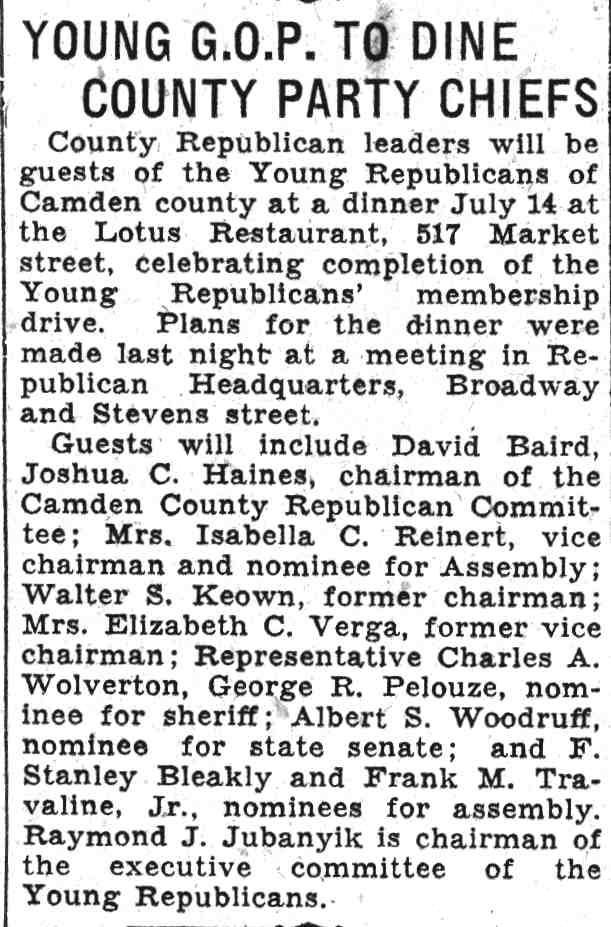
County Republican leaders will be guests of the Young Republicans of Camden county at a dinner July 14 at the Lotus Restaurant, 517 Market street, celebrating completion of the Young Republicans’ membership drive. Plans for the dinner were made last night at a meeting in Republican Headquarters, Broadway and Stevens street.
Guests will include David Baird, Joshua C. Haines, chairman of the Camden County Republican Committee; Mrs. Isabella C. Reinert, vice chairman and nominee for Assembly; Walter S. Keown, former chairman; Mrs. Elizabeth C. Verga, former vice chairman; Representative Charles A. Wolverton, George R. Pelouze, nominee for sheriff; Albert S. Woodruff, nominee for state senate; and F. Stanley Bleakly and Frank M. Travaline, Jr., nominees for assembly. Raymond J. Jubanyik is chairman of the executive committee of the Young Republicans.
Rotarians Have ‘Good Time,’ Even to Milking of Cows
Camden Courier-Post —
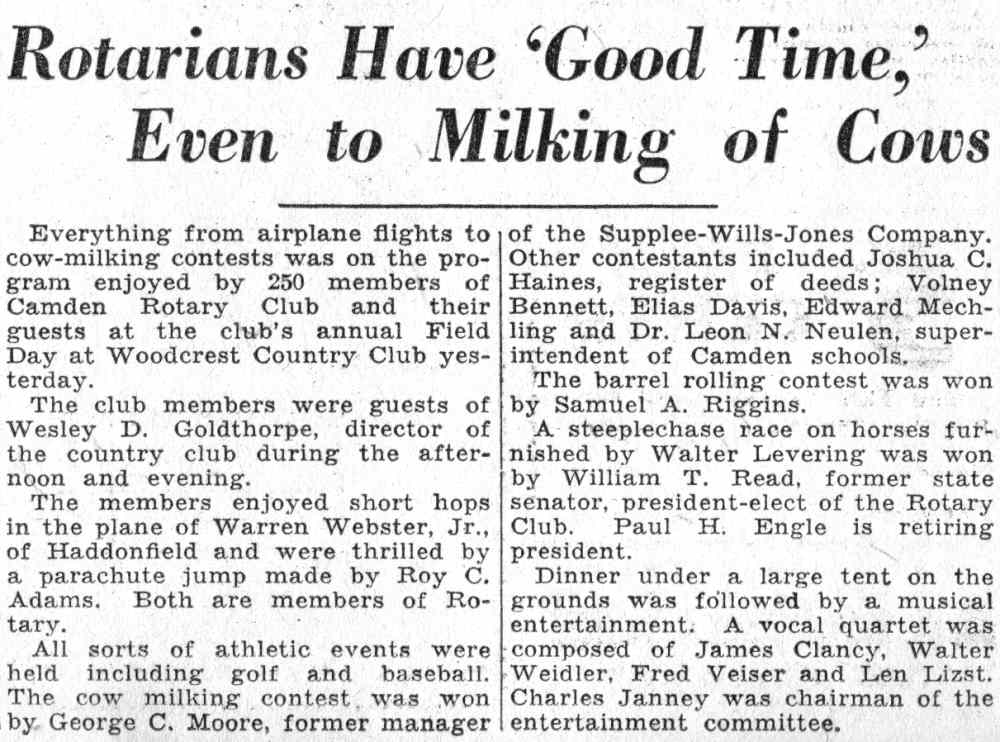
Everything from airplane flights to cow-milking contests was on the program enjoyed by 250 members of Camden Rotary Club and their guests at the club’s annual Field Day at Woodcrest Country Club yesterday.
The club members were guests of Wesley D. Goldthorpe, director of the country club during the afternoon and evening.
The members enjoyed short hops in the plane of Warren Webster, Jr., of Haddonfield and were thrilled by a parachute jump made by Roy C. Adams. Both are members of Rotary.
All sorts of athletic events were held including golf and baseball. The cow milking contest was won by George C. Moore, former manager of the Supplee-Wills-Jones Company. Other contestants included Joshua C. Haines, register of deeds; Volney Bennett, Elias Davis, Edward Mechling and Dr. Leon N. Neulen, superintendent of Camden schools.
The barrel rolling contest was won by Samuel A. Riggins.
A steeplechase race on horses furnished by Walter Levering was won by William T. Read, former state senator, president-elect of the Rotary Club. Paul H. Engle is retiring president.
Dinner under a large tent on the grounds was followed by a musical entertainment. A vocal quartet was composed of James Clancy, Walter Weidler, Fred Veiser and Len Lizst. Charles Janney was chairman of the entertainment committee.
Proficiency Awards Presented To Camden County Boy Scouts
Camden Courier-Post —
Court of Honor Held in Haddon Heights High School; Badges Given by Stedman; Haines Presides at Event
Boy Scouts of Camden county participated last night in impressive ceremonies at the semi-annual Court of Honor of the Camden County Council when awards for proficiency in scouting were made.
The court was held in Haddon Heights High School Auditorium. Joshua C. Haines, county scout commissioner, presided and the Eagle Scout badges, highest award, were presented by A.W. Stedman, president of the council.
The awards follow:
Eagle Badge — Edward Buczkowski and Alexander Foster of Troop 21, Camden.
Life Scout Badge — Conrad W. Deuter, Edwin A. Forbes and Charles J.J. Meyer of Troop 5, Camden; George Copoulas, Troop 21, Camden; Harold W. Shallcross, W.E. Hayes and Kirk Cramer, of Troop 55, Berlin; Rawlins Eastwick, Troop 64, Haddonfield; E.W. Roberts, Troop 105, Collingswood; Francis Weatherby, Troop 110, Merchantville.
Silver Quartermaster’s Badge — Thomas L. Rich, mate of the Sea Scout Ship Farragut.
Star Scout Badge — H. Robert Lind, Joseph W. Martin and Harry Martin, Sea Scout Ship Farragut; Walter B. Everett, L.H. Gehr, Jr., Michael Melka and Edward S. Hunt, Troop 5, Camden; David King, Troop 2, Camden; K. Borman, Troop 14, Camden; William Neale, Troop 10, Camden; Albert Pape, Edward Watson and Taylor Kellogg, Troop 21, Camden; J. Frank Sweeney and Rainsford Darling, Troop 59, Collingswood; William E. Hales and Richard Groo, Troop 78, West Collingswood; S. Joseph Burns, Edward Taylor and Nelson Ulrich, Troop 80, Gloucester; Lloyd Van Horn, Troop 90, Atco; Eric Crowe, Richard McKinney and Kenneth Price, Troop 109, Gloucester; Charles Breme and Kenneth Litzinger, Troop 105, Collingswood; Charles Arentzen, Troop 111, Stratford; Charles David Smith, Troop 110, Merchantville; Edward C. Barnett, Jr., Conrad V. Kanuf, Robert D. Sayrs and William C. Stevenson, Troop 112, West Collingswood; Willard Schaeffer, Robert Fiddler, Robert B. Riddle, R. Proctor, Jr., J. Laing Jr., and G. Cook, Troop 113, Oaklyn; Erik Hemmingsen, Troop 118, Gibbsboro.
Merit Badges — David King, Leo Ocroombout, Lawrence Corn, Troop 2, Camden; Lester Daniels, H. Robert Lind, Patrick Brady, Howard Walker, Andrew Weatherby, Edward Trummel, Joseph E. West, Alvah Veit, Joseph Martin, Harry Martin, Warren Weber, James A. Keenan, Leslie Smith, Russell Walls, Marvin Lequer, Paul Thompson, Elmer Hamilton, Thomas B. Rich, Jr., Robert Rich, Troop 4, S.S.S. Farragut; Walter B. Everett, Michael Melko, William Walston, Roy A. Voll, Robert Trace, Robert Stephens, Carl Seifling, Oliver Rinear, Charles Meyers, Edward S. Hunt, Philip Tice, L.H. Gehr Jr., E. Forbes, Fred Brooke, Conrad W. Deuter, Troop 5, Camden.
A. Braun, Troop 9, Camden; Wilbur Powell, William Brenton, Troop 11, Camden; K. Borman, Troop 14, Camden; Norman Steinberg, Joseph Foster, Edmund Buczkowski, Alex Foster, Franklin Kinsky, Albert Pape, B.F. Mercer, George Copoulas, Scott Hilton, Edward Watson, Harry Dolmetsch, Taylor Kellogg, James Capoulas, Albert Baker, Loy Zorger, Troop 21, Camden; Howard Todt and W. Albinson, Troop 52.
Lloyd Van Horn, Harold W. Shallcross, W. Edgar Hayes, Benjamin Toy, Kirk Cramer, Claude Rowand, Lewis Orchard, William Straub, Troop 55; Joseph Hittorff, Raymond Giron, Edward Schultz, Frank Sweeney, Troop 59; Theodore Fox, Alfred Benson, Arthur Ruby, Charles Cox, Thomas Gibson, Robert Carpenter, Alfred Milash, Rawlins Eastwick, Troop 64; Wayne Garrigues, William E. Hales, Virgil Groo, Elmer Groo, Richard Groo, Robert Reck, Fred Miller, Paul Bennett, Ronald Ferguson, William Hales, Stewart Smith, Jr., John Scarborough, Robert Bergstresser, Troop 78; J. Burns, Edward Taylor, Nelson Ulrich, Troop 80; Walter Angelo, Jr., Harvey Hartzelt, Joseph E. Kirk, Jack Lotz, Troop 85; James Chemi, Charles Weaver, George Sanger, Norman Sanger, William Farr, Troop 87; John R. Hohn and Robert Pierce, Troop 102; Harry Rainey, Carl Miller, Jr., Charles Breme, E.W. Roberts, Raymond Krawczk, James Moncrief, Kenneth Litzinger, Troop 105; Eric Crowe, Kenneth Rice, Richard McKinney, Troop 109; Charles Smith, Francis Weatherby, C. Hammond, Fred Shouds, Troop 110.
Edge to Speak Here at G.O.P. Reception
Camden Courier-Post —
Kean and Barbour Also Coming to Affair for Reesman and Mrs. Verga
Former Ambassador Walter E. Edge today sent word to the committee in charge, that he will speak at the reception and dinner being given June 29 to Commissioner Clay W. Reesman and Mrs. Elizabeth C. Verga in honor of their election as chairman and vice chairman, respectively, of the Camden County Republican Committee.
In addition to Ambassador Edge, United States Senators Hamilton F. Kean and W. Warren Barbour have accepted invitations. Others on the speaking list are: Mrs. Edna B. Conklin, member of the Republican State committee from Bergen county; former U.S. Senator David Baird, Congressman Charles A. Wolverton, Registrar of Deeds Joshua C. Haines and Assemblywoman Isabella C. Reinert, retiring chairman and vice chairman of the county committee.
The reception is being held at the Walt Whitman Hotel, with tickets being distributed through county committee members.
State G.O.P. Chiefs Speak Here Tonight
Camden Courier-Post —
Stokes, Kean, Barbour Listed for Fete to Reesman and Mrs. Verga
A testimonial dinner will be given tonight by the Camden County Republican Committee in honor of party leaders with former Governor Edward C. Stokes as principal speaker.
Those to be honored are Mrs. Elizabeth C. Verga, vice chairman of the county committee and state committeewoman; Assemblywoman Isabella C. Reinert, former vice chairman; Commissioner Clay W. Reesman, new chairman of the county committee, and Joshua C. Haines, register of deeds, the retiring chairman.
Other speakers will include Mrs. Edna B. Conklin, national committeewoman from Bergen county; Congressman Charles A. Wolverton; former U.S. Senator David Baird, Jr., U.S. Senators Hamilton F. Kean and W. Warren Barbour and E. Bertram Mott, state chairman.
State Senator Albert S. Woodruff will be toastmaster. Carlton M. Harris, chairman of the dinner committee, said last night that reservations have been made at the Hotel Walt Whitman for 500 guests and the committee is swamped with applications.
Other members of the committee in charge of the dinner are William D. Sayrs, Jr., treasurer, and Mrs. Pauline Caperoon, secretary.
Baird, Stokes Lash Richards Ambitions And ‘Horse Trading’
Camden Courier-Post —
Dinner to Reesman and Mrs. Verga Packs Whitman; Local Delegates Get High Praise
Ex-Governor Denounces Roosevelt Program, Hits Inflation
By Ransloe Boone
Bitter criticism of the “horse trading” of the Legislature and the gubernatorial aspirations of Senate President Emerson L. Richards, were coupled with appeals for party loyalty and praise for Camden county’s leaders at a dinner of the Camden County Republican Committee in Hotel Walt Whitman last night.
The dinner, one of the largest ever held in the hotel, was in honor of City Commissioner Clay W. Reesman, new chairman of the county committee, Mrs. Elizabeth C. Verga, vice-chairman of the county and state committees; Joshua C. Haines, former chairman, and Mrs. Isabella C. Reinert, assemblywoman and former vice chairman.
Tribute was paid them by a distinguished gathering of more than 500 national, state and county leaders. So great was the crowd that the capacity of the main ball room was taxed and the junior ballroom was utilized also.
The attacks on “horse trading” and Richards were made by former Governor Edward C. Stokes and former United States Senator David Baird, Jr. Baird did not mention Richards by name.
Proud of Own Legislators
“We Republicans in Camden County have a faculty for victory,” Baird said, “but we can and will help to defeat selfish aspirants to office if they don’t play straight with the Republican party.”
“I am proud of the record of Senator Albert S. Woodruff and our Assembly members, Mrs. Isabella C. Reinert, F. Stanley Bleakly and Frank M. Travaline, Jr. They didn’t take any part in the trading of judges, highway commissioners and prosecutors.
“Camden County has been accused of not wanting civil service. When it came time to vote on the question Camden County stood by civil service as it always has, and beat the ripper.”
“Only when you play the game and stand four-square for the ideals of the party can you expect the people of the state to trust you.”
“Whose Legislature?” Stokes declared:
“We won a great victory in New Jersey in the last presidential election. We did it by remaining loyal and not by trading with the Democrats.
“We thought we elected a Republican legislature. John Milton, Hudson County Democratic leader, however, says we elected a Republican legislature but the Democrats are putting on the show. But in that very paternal letter he wrote me not long ago, telling me what I should do and why I should not ‘interfere’ with the Legislature, Senator Richards assured me the Republicans controlled the Legislature. I’m glad to know that for, of course, Richards is always right.”
Stokes predicted history would repeat itself and the Republican party soon would come back into its own.
“The party that stands by its principles despite defeat always comes back.”
The former governor proposed two means of lowering the present high taxes and heavy expenditures.
“I wish this county committee and all those throughout the state would insist on legislation to prohibit municipalities from spending more than they have and from floating bond issues and I wish you would support legislation providing for a limited local tax rate and providing for a gradual reduction of taxes to that maximum.”
Doubts Roosevelt Plan
He expressed doubt as to the wisdom of some of the Roosevelt program. “Inflation makes us prosperous, if revoking the gold standard aids us, amen, if calling 18 inches a yard will help us, that’s fine. If we can ask employers to sell us more and not throw more of our own workers out of work, that will be wonderful. But I can’t understand how we will be aided by those proposals. It’s too much for me.”
He demanded that France, England, and the other nations pay their debts, declaring they were spending five times their debts on armaments.
Congressmen Defend F. D. R.
Wholehearted support of all of President Roosevelt’s measures which will promote relief from present economic conditions was pledged by United States Senators Hamilton F. Kean and W. Warren Barbour and Congressman Charles A. Wolverton.
Kean explained that he voted for the economy bill after he had been assured the president would not touch the compensation of those veterans whose injuries were service connected and that it was passed only because “pressure was brought to bear.”
After paying tribute to Reesman and Mrs. Verga, Kean said:
“One of the first bills introduced by the new administration was the economy bill. This bill authorized the president to consolidate departments of the government, of which there are a great many overlapping and which could be done without any injury to anybody except those receiving salaries or emoluments therefrom. The bill also authorized the president to adjust the wages of government employees and to examine in and make new rules for those receiving pensions from the government. A year ago we tried to give Mr. Hoover power to do away with a lot of these offices that were unnecessary and useless. Mr. Hoover promised if he had the power that he would do so, but this was beaten by the Democrats, so that Mr. Hoover never had the power to do away with these useless bureaus.
Economy Bill
“The history of the economy bill is this: After it was passed by the House, before they had time to read it and under a special rule the debate was so limited that nobody knew anything about it before it was voted on, it was then sent over to the Senate and referred to the finance committee. In the finance committee a Democrat moved that the president should not have authority to reduce anybody’s compensation more than 25 percent.
“Each senator voted for or against the measure or amendment under consideration. On this amendment, upon the call of the roll, the majority of the Democrats voted in favor of the amendment. Most of the Republicans voted against the amendment and it was a tie on the last Republican name on the committee. This was Senator Walcott, of Connecticut, and he voted ‘nay’ on the amendment. This beat the amendment. Next was the question of reporting the bill out of the committee to the floor of the Senate. This was again a tie vote when it came to Senator Walcott and he voted ‘aye,’ which reported the bill out.
Won on G. O. P. Votes
On the floor of the Senate the bill would not have passed but for the Republican votes. We were assured by the Democratic leaders that the president would not touch the compensation of those veterans whose injuries are service connected. In other words, the wounded. When the regulations came out, some two months after this bill had been passed, they had cut the wounded veterans to pieces.
“When the president saw that the Senate voted almost two-thirds to take away this power from him, he got up some compromise formula which was not satisfactory, and got it passed by the House. This was submitted to the Senate and it was on this proposition that every Republican senator voted to support the Senate amendment rather than the House amendment, and I believe that had no pressure been brought to bear on the senators that every senator in the chamber would have voted for the Senate amendment, rather than for the House amendment.”
‘Pay Tribute’
“I don’t criticize the president, I pay him tribute,” Barbour said. “He showed outstanding courage and initiative. He is taking a long chance in many respects and it is the duty of Congress to make the program succeed. It is the program of the nation and I hope it does succeed. However, I do not forget my loyalty to the Republican party. The test is coming this winter in the administration of these great pieces of legislation. I feel it my duty as a Republican not to play politics, but I shall raise potent protest against any unfair or unwise laws.”
He praised Mrs. Verga and Mrs. Edna B. Conklin, of Bergen county, national committeewoman, who was among the guests of honor.
“I never would have been elected if it were not for the combined efforts of those ladies,” he said.
Two future booms were launched.
Mrs. Verga for Senator
“Some day when Senator Woodruff gets tired of being Senator, I hope to see Mrs. Verga as Senator or, if Congressman Wolverton would become Governor, I should like to see Mrs. Verga in his place at Washington. She is marvelously capable of filling both jobs.”
In response Wolverton laughingly said:
“That’s the first time I ever heard a sober man nominate me for governor.”
Wolverton’s address follows:
‘Cites Relief Jigsaw’
“In the few minutes allotted to me, it will not be possible to speak upon several subjects as I would like. I do wish however, to touch briefly and in a general way upon what in my opinion should be the policy of the Republican party at this time with reference to national affairs.
“The economic condition that confronts our nation today, with its attendant paralysis of business, finance, industry and agriculture, creating widespread unemployment, destitution and need, has brought us face to face with an emergency surpassing in its possible consequences even that of the World War. Its devastating effect has brought distress to millions of our people.
“Demand for relief comes from every conceivable source. It is not confined to any particular class. Bankers, railroads, industrial corporations, farmers, homeowners, businessmen, sovereign states, local municipal governments, capital and labor, rich and poor, each with divergent views and often conflicting interests, but all with an insistent demand that each shall receive the particular kind of relief its individual need requires.
Defends Administration
“In answer to the demand of our people for relief, the president called Congress into special session. He submitted his program for relief and recovery to the Congress and it has been enacted into law. To provide effectual relief in the variety of ways made necessary by the different needs to be served required the entrance of our government into new fields of activity.
“There has been a disposition upon the part of some who hold representative positions in our party to criticize the enactment of such laws upon the basis that we have cast aside many of the fundamental traditions of our nation. Such criticism in my opinion is wrong. It overlooks entirely the serious emergency now existing affecting the welfare of our people and which in my opinion is sufficient justification for the enactment of such temporary legislation.
In times such as these, if we are to best serve our people, we cannot hold to the same course of action that has prevailed in other times.
“This is a time of distress and need—a time that calls for the application of new principles or a rearrangement of the old.
“Policies and principles of government set up and agreed upon in times of prosperity cannot be accepted as standards in times of economic distress when the financial and industrial organizations of the country are prostrate and our people in want.
Warns Of Criticism
“Nor do I believe our party can gain public confidence by inaugurating at this time a campaign of criticism against the program and policies recently enacted by Congress. It has not as yet had a chance or a trial. This is not time to be destructive denunciation without constructive proposals. This is no time to create doubt. It is a time when everyone regardless of party affiliations should cooperate to build confidence, dispel fear and create courage.
“What we need today is constructive cooperation by all political parties. Let each retain his party lines, but cooperate for the common good.
“As a party we must have the vision that will enable us to recognize that new conditions create new obligations and the necessity for the application of new and different policies of government to fulfill our entire responsibility.
“We must have not only the vision as to the necessity, but also the courage to do things which a few years ago would have been unthought of because contrary to accepted theories of what is a proper field of governmental activity and unjustified under the prosperous conditions then prevailing.
‘No Place for Politics’
“Let our thought be in terms of the common good, then there will be no denial of the necessity or the propriety of the government in times such as these, assuming a responsibility to promote the general welfare and seeking to fulfill that obligation by entering into enterprises or assuming functions, that otherwise would be unjustified.
“In this time of crisis, when we are seeking to relieve human misery, there is no place for small or mean partisan politics. Nor is this any time for demagogic utterances—this is a time for calm and deliberate consideration and judgment. A time when it is imperative that whatever gives promise of relief shall have our whole-hearted support.
“In conclusion, permit me to suggest that the greatest opportunity for our party in the days immediately before us is to give sympathetic consideration and support to those measures and policies that will best promote human rights. Our party had its origin in support of that great principle and the future measure of its success will depend upon the extent of our adherence to it.”
Baird also declared he would support the president.
“Mr. Roosevelt is our president. Republicans will support him in everything which is for the best interests of the country. All should wish for his success,” Baird said.
Sales Tax Urged
Mott urged that Republicans support a sales tax as the most equitable means of raising needed money.
“A sales tax would distribute the cost equally and would be more fair than the income tax. As we know from the hearings in Washington, some aren’t paying their income tax, anyway.”
Mrs. Conklin paid tribute to Mrs. Verga for her great political sense, ability and understanding of human nature.
She urged that all Republicans work as enthusiastically as a minority party as they did as a majority.
“We must go along and build until we become the majority again,” she said.
Edge Sends Regrets
Walter E. Edge, former Ambassador to France, who was to have been the principal speaker, was unable to attend because he and his family are at their summer home in Maine. He sent a telegram expressing his regrets and his wishes for success to Mrs. Verga and Reesman. It had been reported Edge would be boomed for governor at the dinner but no mention of such a proposal was made.
The honor guests spoke briefly. Reesman asked for the support of the county committee and pledged himself to give all his energy towards the success of the party.
Mrs. Verga praised the committee members and thanked them for their support. She paid a special tribute to former Senator Baird.
“We have been successful in Camden County,” she said, “because we still stand solidly behind our leader, David Baird.” Her tribute was greeted by long applause.
Mrs. Reinert and Haines also spoke briefly pledging their support to the new chairman and vice chairman.
Woodruff Toastmaster
State Senator Albert S. Woodruff was toastmaster. He was introduced by Carlton M. Harris, chairman of the dinner committee.
The county committee presented a lounging chair to Reesman and a silver flower bowl to Mrs. Verga, as well as flowers to Mrs. Reinert and Haines. Flowers also were presented to the new chairman and vice chairman by the Twelfth Ward Republican Club and the ladies’ auxiliary, by the Young Republicans of Camden county through Harold Joyce, its president, and by the Bergen county Republicans, through Mrs. Conklin.
The dinner committee, in addition to Harris, was headed by Mrs. Pauline Caperoon, secretary; Mrs. Mary S. Hartung, assistant secretary, and William D. Sayrs, Jr., treasurer.
7 G.O.P. Members 2 Democrats Quit Committee Races
Camden Courier-Post —

No Shifts in Candidates Made as Withdrawal Deadline Passes
3 PETITIONS REJECTED
Passing of the deadline for withdrawals of primary petitions at 4 p. m. yesterday showed seven Republicans and two Democrats quitting the race for election on the Camden county Republican and Democratic county committees. In addition three Republicans were removed as candidates by City Clerk Otto E. Braun.
No changes were made by the Republican or Democratic organization leaders in the candidates for the county tickets, despite reports up to the last minute that substitutions would be made.
The candidates withdrawing follow:
Republicans
Glenwood F. Watson, “Regular Republican, First ward.
Bronislaw Derowski, Jr., “Regular Republican Repeal Sales Tax,” Seventh ward.
Joseph Witek, “Regular Republican,” Seventh ward.
Robert J. Gartland, “Independent Republican,” Eighth ward.
William J. Rose, “Republican Against Sales Tax,” Tenth ward.
Thomas W. Anderson, “Independent Republican,” Eleventh ward.
Joseph Munger, “Republican Against Sales Tax,” Eleventh ward.
Democrats
Louis Di Renzo, “Always Regular Democrat,” Third ward.
Francis J. Hufner, “Regular Democrat,” Eleventh ward.
Woycicck Pyzik, “New Deal Democrat,” Thirteenth ward.
Those removed because of insufficient legal signatures:
Republicans
James H. Beal, Fifth ward.
Georgia R. Green, “Regular Republican—Repeal Sales Tax,” Fifth ward.
Helen Derowski, “Republican—Against Sales Tax,” Seventh ward.
City Clerk Braun allowed the petitions of Michael Russian and Mrs. Norah Falvey, Democrats, in the Eighth ward. John J. Hainesworth and Mrs. Catherine Corbett claimed 23 of the 45 names on their petition were illegal but Braun decided that only 20 names were illegal, leaving 25 legal names, sufficient for filing.
2 Candidates Withdraw
Two candidates for Republican Assembly nominations were shown to have withdrawn. They are J. Lewis Kollin and Clarence Wolf. The ticket sponsored by the organization headed by David Baird, Jr., remains as it was filed, as follows:
Albert E. Burling, for Senate; Edwin G. Scovel, J. Claud Simon and Henry M. Evans for Assembly; Joseph H. Van Meter for sheriff; Leslie H. Ewing for county clerk, and Joshua C. Haines for register of deeds. Clyde W. Briggs and Clarence Dunkleberger are running independently for Assembly.
The Democratic candidates running are those sponsored by the organization of Harry L. Maloney and Mrs. Emma E. Hyland. They are Francis G. Homan for Senate; Herbert E. Beattie, Anthony F. Marino and Leon H. Rose for Assembly; Albert S. Marvel, Jr., for sheriff; Victor J. Scharle, for county clerk, and William L. May for register of deeds. Albert Neutze is running independently for sheriff.
Candidates seeking to run in the general election have until September 12 to file.
Women’s Club Backs Republican Candidates
Camden Courier-Post —
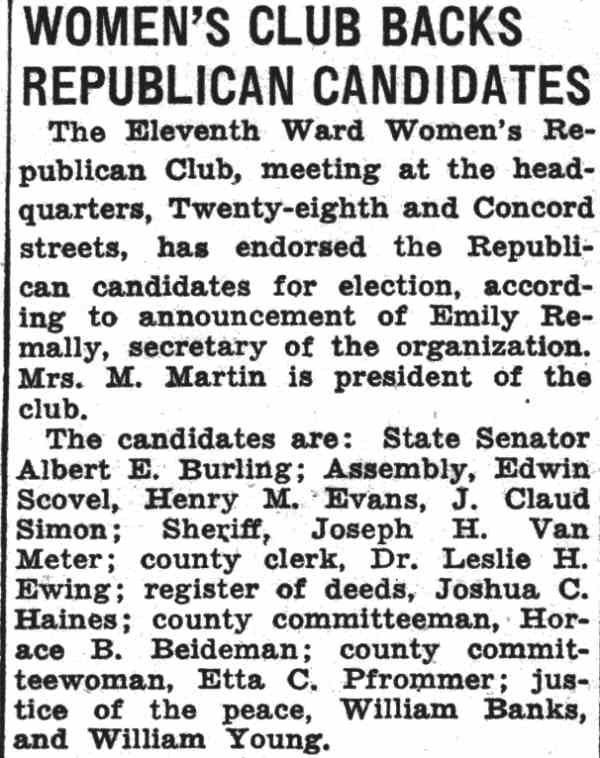
The Eleventh Ward Women’s Republican Club, meeting at the headquarters, Twenty-eighth and Concord streets, has endorsed the Republican candidates for election, according to announcement of Emily Remally, secretary of the organization. Mrs. M. Martin is president of the club.
The candidates are: State Senator Albert E. Burling; Assembly, Edwin Scovel, Henry M. Evans, J. Claud Simon; Sheriff, Joseph H. Van Meter; county clerk, Dr. Leslie H. Ewing; register of deeds, Joshua C. Haines; county committeeman, Horace B. Beideman; county committeewoman, Etta C. Pfrommer; justice of the peace, William Banks, and William Young.
Camden Courier-Post — October 29, 1935
G.O.P. Meetings Today
Third Ward — Third Ward Republican Club, 432 South Third street. Fifth Ward — First Italian Republican League, 813 South Fourth street. Sixth Ward — 506 Chestnut street. Twelfth Ward — 300 North Twenty-seventh street. Fourteenth Ward — 2523 Morgan boulevard. Third Ward (Gloucester) — Broadway and Powell street. Collingswood — Library. Lindenwold — Garden Lake Republican Club. Runnemede — Legion Hall, Clements Bridge road. Winslow Township — North Tansboro School House.
Mrs. Frederick von Nieda, wife of the mayor, will conduct one of nearly 100 parlor meetings to be held simultaneously throughout the county tomorrow afternoon between 3 and 4 o’clock, when women will gather in each voting district to hear radio appeals from Station WCAM in behalf of the Republican candidates.
On the program will be Congressman Charles A. Wolverton and Mrs. Florence Baker, members of the Republican state committee; former United States Senator David Baird, Jr., and the candidates: Albert E. Burling for state senator; Edwin G. Scovel, J. Claud Simon and Henry M. Evans for assembly; Mayor Joseph H. Van Meter for sheriff; Dr. Leslie H. Ewing for county clerk, and Joshua C. Haines for register of deeds.
Cramer Hill Stores Praised by Officials
Importance of neighborhood business was stressed last night at an open air meeting sponsored by the Cramer Hill Businessmen’s association, at Veterans Park, Twenty-sixth street and Hayes avenue. Businessmen of the section were praised in brief talks by Mayor Frederick von Nieda, Mayor Joseph H. Van Meter, Collingswood, and Joshua C. Haines, recorder of deeds.
Prizes were awarded to Mrs. Newton Ash, 840 North Thirtieth street, electric refrigerator; Walter Conine, 1809 River avenue, radio; and George Blanck, 1026 North Twenty-first street, vacuum cleaner.
Mrs. Lippincott Tea for Republican Candidates
Mrs. Miriam Lee Early Lippincott, social and civic leader, will hold an afternoon tea at 3 p.m. Thursday in behalf of the Republican candidates at her home, 406 Cooper street.
Among speakers will be Albert E. Burling, candidate for state senator; Edwin G. Scovel, Henry M. Evans and J. Claud Simon, candidates for the Assembly; Mayor Joseph Van Meter, for sheriff; Dr. Leslie H. Ewing, for county clerk, and Joshua C. Haines, candidate for Register of Deeds, and Cecil Rotzell, attorney, and George Walton.
Camden Courier-Post — October 23, 1936
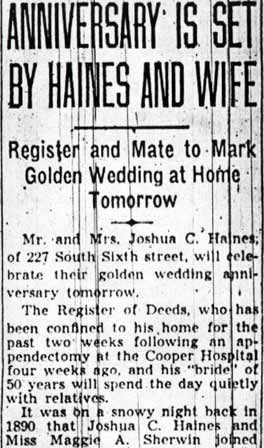
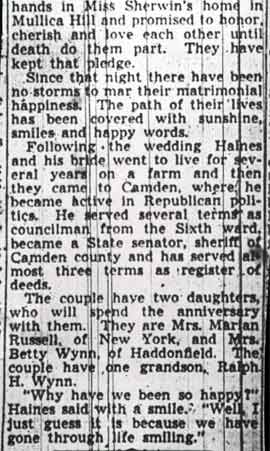
Joshua C. Haines — 50th wedding anniversary, October 24, 1936
Webster Elected Executive Head of Camden Boy Scouts
Camden Courier-Post —
30 Men Get Certificates as Leaders and Five Troops Receive Star Awards — Trophy for Veteran
Warren Webster, Jr., was elected president of the executive board of Camden County Council, Boy Scouts of America, at its annual dinner meeting last night. He succeeds J. William Markeim. The meeting was in the junior ballroom of the Hotel Walt Whitman, with 150 members attending.
Others elected were A.W. Stedman, honorary president; Joshua C. Haines, honorary commissioner; Dr. E.W. Roberts, first vice president; Albert M. Bean, second vice president; Walter G. Garlan, third vice president; Elmer J. Williams, treasurer; Col. G. Barrett Glover, commissioner; S. Lewis Davis, Cub commissioner; Webster and Davis, National Council representatives; Stedman, trustee for one year, Webster, trustee for two years and Lorenzo J. List, trustee for three years.
All were named by a nominating committee of which William J. Strandwitz was chairman. Bean was chairman of the meeting and List was toastmaster at the dinner which preceded it.
As chairman of the training committee, Bean presented certificates to 30 men who had completed courses in Scout leadership.
Commissioner Davis presented awards to the following “star” troops: 65, of Haddonfield; 117, Runnemede; 112, West Collingswood; 105, Collingswood, and 82, Westmont.
The Council awarded to Edward W. Tomkins a bronze statuette of a Boy Scout as a trophy in recognition of 25 years service as a Scouter.
Tomkins, who began his career as a Scouter in 1913, has been successively assistant scoutmaster of Troop 2, scoutmaster of Troop 3, scoutmaster of Troop 21, assistant camp director of county Scout camps, field executive of Camden city, merit badge councilor and examiner and has held numerous other positions organizing and furthering the Boy Scout movement.
The principal speaker was E. Urner Goodman, national director of program, whose subject was “Building a Stronger Generation,” the theme of the anniversary week of the Boy Scouts to be celebrated February 6 to 13.
There was an invocation by Rev. Albert F. Banse, pastor of the Francis Childs M.E. Church, West Collingswood, and a program of vocal selections by Mrs. L.J. List, soloist, and the Franklin Quartet.
Building Committee and Board Members
1913
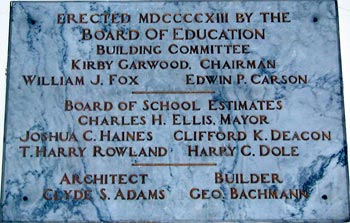
ERECTED MDCCCCXIII BY THE
BOARD OF EDUCATION
BUILDING COMMITTEE
KIRBY GARWOOD, CHAIRMAN
WILLIAM J. FOX EDWIN P. CARSON
BOARD OF SCHOOL ESTIMATES
CHARLES H. ELLIS, MAYOR
JOSHUA C. HAINES CLIFFORD K. DEACON
T. HARRY ROWLAND HARRY C. DOLE
ARCHITECT BUILDER
CLYDE S. ADAMS GEO. BACHMANN