Francis Ford Patterson Jr.
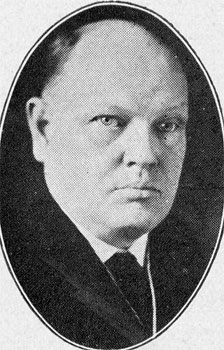
Francis Ford Patterson Jr., as pictured in the Centennial Mirror of Camden, 1828–1928.
FRANCIS FORD PATTERSON JR. was born in Newark NJ on July 30, 1867. He moved with his parents to Woodbury, N.J., in 1874 and attended the public schools. At the age of thirteen he began work in a newspaper office. The Patterson family moved from Woodbury to 322 North 3rd Street in Camden NJ in 1882 after his father started the Camden Daily Courier. Francis Ford Patterson Jr. was connected with the Camden Courier until 1889, when his father sold the paper. The family had moved to 315 Linden Street, Camden NJ, by 1887. Another move took place in 1892, when they relocated to 219 Penn Street.
Francis Ford Patterson Jr. went to Baltimore and briefly worked for the Baltimore Herald, before returning to Camden. He held various jobs in local journalism until 1891, when he became the New Jersey editor of the Philadelphia Record 1890, where he remained until September of 1894, when he became the president, publisher, and editor of the Camden Post Telegram. His brothers, Theodore N. Patterson and Wolcott Patterson, worked with him for many years. Francis Ford Patterson ran the Post-Telegram until he sold the newspaper on October 1, 1923 to the Camden Publishing Company, headed by William Searle. Francis Ford Patterson reassumed control of the Post-Telegram shortly thereafter, and sold the paper once again, this time to a syndicate of Republican leaders headed by David Baird Jr., in 1924.
During the 1900s and 1910s Frank Ford Patterson Jr. lived at 327 Cooper Street. He later moved to 303 East Maple Avenue in Merchantville NJ. After the death of his brother-in-law, Dr. Edward A.Y. Schellenger Sr. in 1917, his sister Lillian and nephew Edward A.Y. Schellenger Jr moved to a house around the corner at 33 Fithian Avenue.
A charter member of the Camden Republican Club, he was aligned with William Joyce Sewell and David Baird. He first held office when elected to the New Jersey State Assembly in 1900, and was county clerk of Camden County 1900–1920. A friend and political ally of J. Wesley Sell, the two were referred to as “the Damon and Pythias of Camden politics… whose perpetual smiles and gentle demeanor have earned for them the sobriquet of the ‘Laughing Statesmen’…” in the Trenton Times in March of 1902.
Patterson was a delegate to the Republican National Convention from New Jersey in 1916 as an alternate, and in 1920 as a regular delegate.
Francis Ford Patterson Jr. was elected to represent New Jersey’s 1st District in the United States House of Representatives to fill the vacancy caused by the death of Congressman William J. Browning. He began serving November 2, 1920. Reelected in 1922 and 1924, he was an unsuccessful candidate for re-nomination in 1926. He had been defeated for re-nomination by Charles A. Wolverton, who was elected to the seat, and held it for the next 32 years. Francis Ford Patterson Jr. left Congress on March 3, 1927.
Francis Ford Patterson Jr. was also engaged in the banking business in Camden. He was president of the West Jersey Trust Company from 1916 to 1925; and director of the West Jersey Title Company from 1920 to 1925. On May 16, 1927 he effected the merger of his West Jersey Trust Company with the Parkside Title and Trust Company, the new bank being called the West Jersey-Parkside Trust Company. He served as President of the new bank until his death in Merchantville, N.J., on November 30, 1935. He was buried at Colestown Cemetery in what was then Delaware Township (present day Cherry Hill) NJ.
Francis Ford Patterson’s brother Theodore N. Patterson was married to Fanny Thomas. Her father, Seth Thomas, was a tailor and in April of 1865 made the suit that President Lincoln was buried in.
Not checked against a scan. The following items on this page are transcribed from site copies or printed books whose scans are not in the scan mirror, or are captions for photographs with no printed text; their wording has not been verified against the printed page:
- Jobless Son Kills Jake Schiller Who Saves Boy's Wife From Gun — Camden Evening Courier — September 18, 1933 (story body is a site copy; only the portrait strip is scanned)
Francis Ford Patterson, Jr.
Biographical Review — 1897
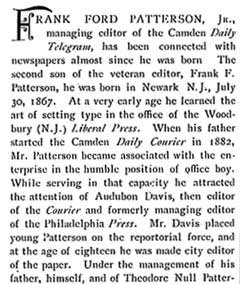
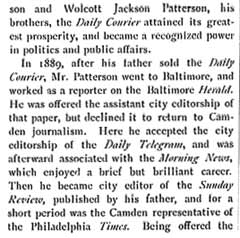
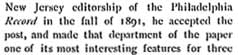
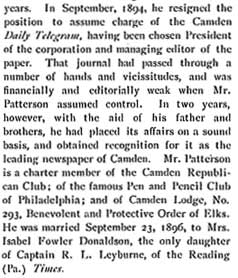
Francis Ford Patterson Jr. – Biographical Review, 1897
Camden’s Happy Contingent.
Philadelphia Inquirer —
I asked a gentleman from the big town across your Delaware river what that city was doing, and this was the answer he wrote: “Camden is one of Atlantic’s suburbs, and her politicians, like those of the Quaker City, find the salt air and the sad sea waves a great assistance in fixing up slates. It is not always these adjuncts are potent. Occasionally a hack and wine are necessary for a big position, while street cars and beer does for the general average.
To-day Camden showed up in great shape. Frank L. Vinton, Howard Pine, Richard Evans, Judges Alfred Hugg and Thomas McDowell, Detective James S. Henry, William Sexton, John Smith, Jr., Charles Bosch, W. H. Fredericks, Councilmen James M. Lane, Robert F. Smith, John H. Furey and Arthur Bedell, Andrew Rabeau, Colonel D. B. Murphy, of General Sewell’s staff; F. F. Patterson, Sr. F. F. Patterson, Jr., of the Camden Sunday Review; John H. Fort, of the Camden Telegram; ex-Chief of Fire Department Daniel Carter, U. G. Styron, Wallace Armstrong, Joseph W. Cooper, C. C. Reeve “Lance,” Frank S. Heister and Fred Newton were among the visitors.
Camden Primaries
Philadelphia Inquirer —
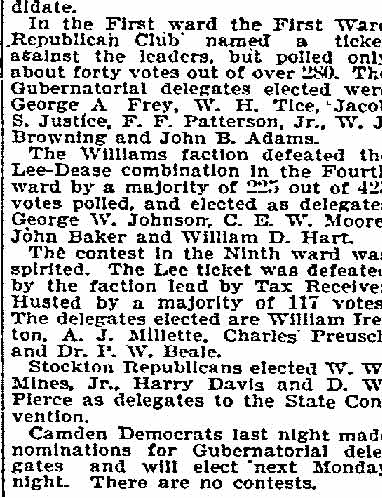
Republicans Elect Delegates to the State Convention.
There were contests at the Republican primary election in Camden last night in the First, Fourth, Eighth and Ninth wards. In the last two wards the fight for ward leadership was hotly contested. The result in the Eighth could not be ascertained at a late hour last night. There were several fights around the polls in this ward. The police took a hand and some of the participants are nursing sore heads.
All the delegates to the Gubernatorial convention, with possibly two or three exceptions, will be for Senator Rogers on the first ballot and for John Kean, Jr., on the final vote. Dr. A. H. Lippincott seems to have secured a majority of the delegates to the Coroner’s convention, defeating Charles N. Robinson, the colored candidate.
In the First ward the First Ward Republican Club named a ticket against the leaders, but polled only about forty votes out of over 280. The Gubernatorial delegates elected were George A Frey, W. H. Tice, Jacob S. Justice, F. F. Patterson, Jr., W. J. Browning and John B. Adams.
The Williams faction defeated the Lee-Dease combination in the Fourth ward by a majority of 225 out of 425 votes polled, and elected as delegates George W. Johnson, C. E. W. Moore, John Baker and William D. Hart.
The contest in the Ninth ward was spirited. The Lee ticket was defeated by the faction lead [sic] by Tax Receiver Husted by a majority of 117 votes. The delegates elected are William Ireton, A. J. Millette, Charles Preusch and Dr. P. W. Beale.
Stockton Republicans elected W. W. Mines, Jr., Harry Davis and D. W. Pierce as delegates to the State Convention.
Camden Democrats last night made nominations for Gubernatorial delegates and will elect next Monday night. There are no contests.
Atlanta Exposition
Philadelphia Inquirer —
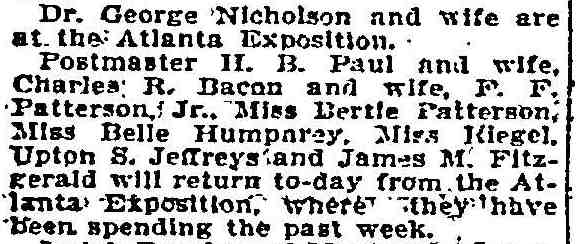
Dr. George Nicholson and wife are at the Atlanta Exposition.
Postmaster H. B. Paul and wife, Charles R. Bacon and wife, F. F. Patterson, Jr., Miss Bertie Patterson, Miss Belle Humphrey, Miss Riegel, Upton S. Jeffreys and James M. Fitzgerald will return to-day from the Atlanta Exposition, where they have been spending the past week.
One Week More of Campaigning
Philadelphia Inquirer —
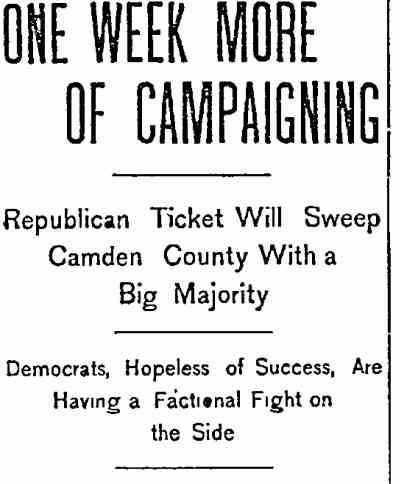
Republican Ticket Will Sweep Camden County With a Big Majority
Democrats, Hopeless of Success, Are Having a Factional Fight on the Side
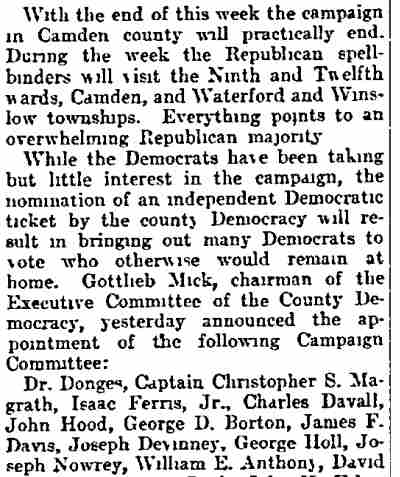
With the end of this week the campaign in Camden county will practically end. During the week the Republican spellbinders will visit the Ninth and Twelfth wards, Camden, and Waterford and Winslow townships. Everything points to an overwhelming Republican majority.
While the Democrats have been taking but little interest in the campaign, the nomination of an independent Democratic ticket by the county Democracy will result in bringing out many Democrats to vote who otherwise would remain at home. Gottlieb Mick, chairman of the Executive Committee of the County Democracy, yesterday announced the appointment of the following Campaign Committee:
Dr. Donges, Captain Christopher S. Magrath, Isaac Ferris, Jr., Charles Davall, John Hood, George D. Borton, James F. Davis, Joseph Devinney, George Holl, Joseph Nowrey, William E. Anthony, David T Campbell, John Pugh, John K. Esler, Harry Stetser, Cornelius Shepperkotter, Dr. F. J. Bickers, Jonas S. Miller, Allyn Brewer, Joseph Peacock, David A. Shreeve, Charles D. Heath, Frederick Krueger, F. S. Niepling, Aaron Bryant, Jacob C Lippincott, Thomas Wentz, Sr.
The committee will endeavor to get out a larger vote for the County Democracy ticket than the “regular” faction of the party will poll. The regulars have William J. Thompson as their leader, with County Detective John S. Smith as his chief lieutenant, and they expect to down the “silk stockings.”
A change was made in the County Democracy ticket yesterday, caused by the withdrawal of George Williams, of the Twelfth ward, as a candidate for the Assembly. The vacancy was filled by selecting Charles C. Old, of Pensauken township, who filed his acceptance with the County Clerk. Mr. Old is a shoe merchant in business in Philadelphia.
Jacob C Daubman, who recently filed a certificate of nomination as an “Independent Republican” candidate for Sheriff yesterday, announced his withdrawal. He had made a strong play for the County Democracy endorsement, but failed to land it, and this left him no ground to stand on.
Political Straws
Major William H. Tice, of the First ward, who has been in City Council, would like to occupy his old seat again, and will be a candidate for the Republican nomination in the First ward next spring.
The Republican County Executive Committee yesterday arranged for the appointment of two challengers in each election district.
The Democratic County Executive Committee of the “regulars” organized yesterday afternoon by the election of Clarence T. Atkinson as chairman; James Burke, secretary, and Thomas Bodell. Committees were appointed to carry on campaign work.
There is no more popular candidate on the Republican ticket than Editor F. F. Patterson, Jr., who is receiving many voluntary pledges of support from Democrats.
Banquet for Correspondents
Trenton Times —
Banquet for Correspondents
State Politicians Doing Right Thing by the Newspaper Men.
County Clerk Frank F. Patterson and Sheriff J. Wesley Sell, of Camden, last evening entertained the Legislative Correspondents’ Club with a dinner in the colonial room of the Trenton House. State Assessor David Baird, of Camden, was the honor guest and occupied a seat by the side of City Assessor John P. Dullard, who presided.
The menu was very elaborate and the speech-making that followed was of a very high order, so ‘tis said.
Those at the dinner were William K. Devereaux, Charles J. Allen, Her…
Frank F. Patterson Jr. — J. Wesley Sell — David Baird Sr. — Upton S. Jefferys — Trenton Times, January 15, 1902
Murder Case Finally Closed
Philadelphia Inquirer —
The last chapter in the murder of John Coffin and W. Price Jennings, for which Paul Woodward was recently hanged, was enacted yesterday when Prosecutor Lloyd directed County Clerk Patterson to cancel the indictment charging Woodward with the murder of young Jennings. It was done simply to make the records in the case complete.
Camden News Notes
Philadelphia Inquirer —
Judge Joline yesterday allowed the final accounting of the estate of the late Rev. Dr. J. B. Graw.
The F. S. McPherson Company, to manufacture drugs, filed articles of incorporation at the County Clerk’s office. The corporators are Frank S. McPherson, Sigmund Sceonagle [sic] and H. F. Stockwell, all Camden people.
Joseph Leonard was arrested last night by Policeman Pooley on a charge of writing policy. Leonard lives at Ninth and Ferry avenue, Camden, where Police Captain Stanley captured a policy outfit some days ago.
The Waterford Township Committee yesterday deposited with County Clerk Patterson $3, which had been awarded to Mrs. Emma Menard for damages. She refused to take the sum.
County Collector M. F. Ivins yesterday received from J. Willard Morgan, State Comptroller, a communication in which he was informed that Camden county’s quota for State school purposes will be $75,226.32. The quota would be $115,732.80, but the State made an appropriation of $40,506.48, leaving the balance for the county to raise.
Camden Commissioners of Deeds
Philadelphia Inquirer —
County Clerk Patterson in Camden yesterday received the thirty-two commissions for as many Commissioners of Deeds as follows: F. Joseph Rouh, Elias E. Truax, E. T. McGill, Howard L. Merrick, William Schmid, Benjamin E. Mellor, Thomas J. Peterson, George W. Jessup, John Campbell, Jr., Philip Schmitz, Robert L. Knight, Edward F. McGill, Howard L. Miller, Joseph F. Hoey, Chester D. Vanduyn, Thomas I. Dunlap, Charles G. Jessup, Washington W. Irvin, George W. Rexon, Henry Haltman, Thomas W. Smith, William J. Hoyt, Howard E. Truax, Charles H. Laird, John Furey, Edward Glass, Edward Wesley, Oscar Boardman, W. F. Eidell and W. Taylor Wright.
Royal Welcome for Ex-Sheriff Baird
Philadelphia Inquirer —
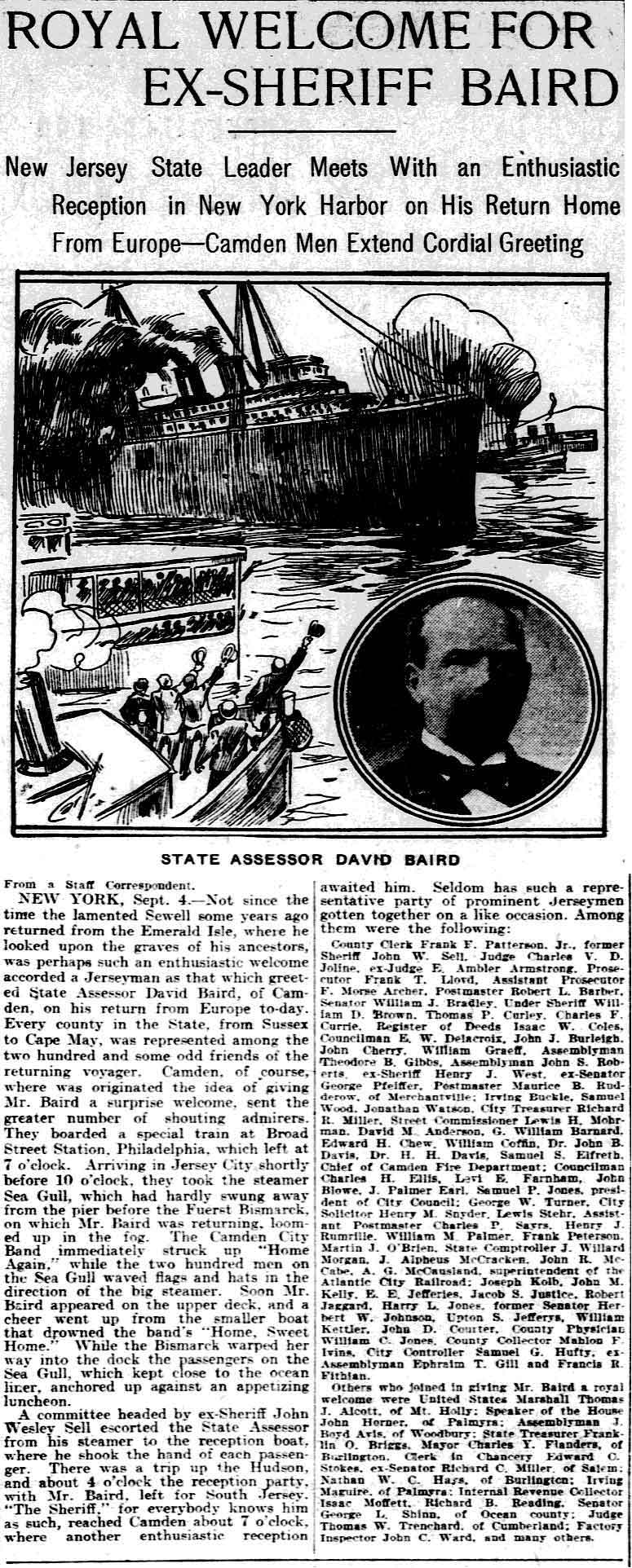
New Jersey State Leader Meets With an Enthusiastic Reception in New York Harbor on His Return Home From Europe—Camden Men Extend Cordial Greeting
STATE ASSESSOR DAVID BAIRD
From a Staff Correspondent.
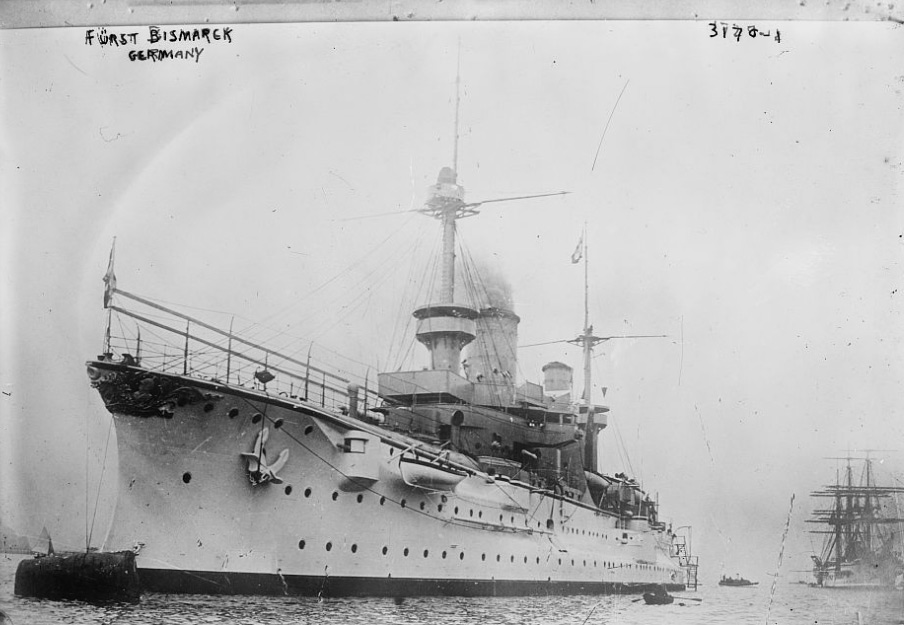
NEW YORK, Sept. 4.—Not since the time the lamented Sewell some years ago returned from the Emerald Isle, where he looked upon the graves of his ancestors, was perhaps such an enthusiastic welcome accorded a Jerseyman as that which greeted State Assessor David Baird, of Camden, on his return from Europe to-day. Every county in the State, from Sussex to Cape May, was represented among the two hundred and some odd friends of the returning voyager. Camden, of course, where was originated the idea of giving Mr. Baird a surprise welcome, sent the greater number of shouting admirers. They boarded a special train at Broad Street Station, Philadelphia, which left at 7 o’clock. Arriving in Jersey City shortly before 10 o’clock, they took the steamer Sea Gull, which had hardly swung away from the pier before the Fuerst Bismarck, on which Mr. Baird was returning, loomed up in the fog. The Camden City Band immediately struck up “Home Again,” while the two hundred men on the Sea Gull waved flags and hats in the direction of the big steamer. Soon Mr. Baird appeared on the upper deck, and a cheer went up from the smaller boat that drowned the band’s “Home, Sweet Home.” While the Bismarck warped her way into the dock the passengers on the Sea Gull, which kept close to the ocean liner, anchored up against an appetizing luncheon.
A committee headed by ex-Sheriff John Wesley Sell escorted the State Assessor from his steamer to the reception boat, where he shook the hand of each passenger. There was a trip up the Hudson, and about 4 o’clock the reception party, with Mr. Baird, left for South Jersey. “The Sheriff,” for everybody knows him as such, reached Camden about 7 o’clock, where another enthusiastic reception awaited him. Seldom has such a representative party of prominent Jerseymen gotten together on a like occasion. Among them were the following:
County Clerk Frank F. Patterson, Jr., former Sheriff John W. Sell, Judge Charles V. D. Joline, ex-Judge E. Ambler Armstrong, Prosecutor Frank T. Lloyd, Assistant Prosecutor F. Morse Archer, Postmaster Robert L. Barber, Senator William J. Bradley, Under Sheriff William D. Brown, Thomas P. Curley, Charles F. Currie, Register of Deeds Isaac W. Coles, Councilman E. W. Delacroix, John J. Burleigh, John Cherry, William Graeff, Assemblyman Theodore B. Gibbs, Assemblyman John S. Roberts, ex-Sheriff Henry J. West, ex-Senator George Pfeiffer, Postmaster Maurice B. Rudderow, of Merchantville; Irving Buckle, Samuel Wood, Jonathan Watson, City Treasurer Richard R. Miller, Street Commissioner Lewis H. Mohrman, David M. Anderson, G. William Barnard, Edward H. Chew, William Coffin, Dr. John B. Davis, Dr. H. H. Davis, Samuel S. Elfreth, Chief of Camden Fire Department; Councilman Charles H. Ellis, Levi E. Farnham, John Blowe, J. Palmer Earl, Samuel P. Jones, president of City Council; George W. Turner, City Solicitor Henry M. Snyder, Lewis Stehr, Assistant Postmaster Charles P. Sayrs, Henry J. Rumrille, William M. Palmer, Frank Peterson, Martin J. O’Brien, State Comptroller J. Willard Morgan, J. Alpheus McCracken, John R. McCabe, A. G. McCausland, superintendent of the Atlantic City Railroad; Joseph Kolb, John M. Kelly, E. E. Jefferies, Jacob S. Justice, Robert Jaggard, Harry L. Jones, former Senator Herbert W. Johnson, Upton S. Jefferys, William Kettler, John D. Courter, County Physician William C. Jones, County Collector Mahlon F. Ivins, City Controller Samuel G. Hufty, ex-Assemblyman Ephraim T. Gill and Francis R. Fithian.
Others who joined in giving Mr. Baird a royal welcome were United States Marshall Thomas J. Alcott, of Mt. Holly; Speaker of the House John Herner, of Palmyra; Assemblyman J. Boyd Avis, of Woodbury; State Treasurer Franklin O. Briggs, Mayor Charles Y. Flanders, of Burlington, Clerk in Chancery Edward C. Stokes, ex-Senator Richard C. Miller, of Salem; Nathan W. C. Hays, of Burlington; Irving Maguire, of Palmyra; Internal Revenue Collector Isaac Moffett, Richard B. Reading, Senator George L. Shinn, of Ocean county; Judge Thomas W. Trenchard, of Cumberland; Factory Inspector John C. Ward, and many others.
Fürst Bismarck
1903
First Ward Club Had a Jolly Time
Camden Daily Courier —
Annual Election and Feast of Fun Held Last Night.
PATTERSON ELECTED PRESIDENT
Hospitality was rampant at the First Ward Young Republican Club last night. The occasion was the annual meeting. Following the election of officers there was a delightful entertainment and a splendid feast, the honors being done by Captain William E. Alberts, simply resplendent facially in his new bunch of whiskers; Recorder O. Glen Stackhouse, who salivated more buttered ham sandwiches than George Kappel did fried oysters; Eph Hires, the school janitor, who saw to it especially that no one was unattended to; Exciseman Joseph Kolb, who insisted on everybody taking something every other minute; John Beard, who was happy over being elected a ward committeeman, and a number of others who looked after the comfort of the many guests in fine style.
The officers elected were: President, County Clerk Frank F. Patterson, Jr.; Vice President, Freeholder George P. Pechin; Treasurer, Thomas Walton; Board of Directors, Court House Superintendent Joseph Burt, Captain William Alberts, Walter Banks, E. T. Hires, William Lyons, Charles Cook, William Weaver and Robert Finley. Joseph Baumeister was re-elected secretary and none better could have been selected as he had everything down pat.
An Italian orchestra with an Irishman playing the flute furnished the music, and there was great fun when Walter Banks got under a rubber plant and roared out “Under the Bamboo Tree.” The cosy club rooms were prettily and patriotically decorated and pretty nearly everybody in te [sic] town was there, from Cooper’s Point to Centreville. Among them were Senator William J. Bradley, ex-Mayor J. Leighton Westcott, Fire Chief Samuel S. Elfreth, who warmed up on ginger ale; President of City Council Samuel P. Jones, Councilman Joseph Potter, County Clerk, Frank F. Patterson, Jr., whose re-election as president of the club was hearty and unanimous; Dr. John F. Leavitt, whose heroism and devotion to duty where disease stalks, has made Camden the healthiest city in the world; ex-County Physician William Iszard, Freeholder George Pechin, Fireman Joseph Logue, the owner of the great and only “Dewey;” Tony Mecca, president of the popular Italian Republican Club, and many others of equal note. The cigars were elegant, the menu grand, the orchestra in full harmony with the happy occasion, outside of playing “In the Goold [sic] Old Summer Time,” and the guests will ever remember the event as one of the pleasantest of incidents.
Ellis Named for Mayor of Camden
Philadelphia Inquirer —
Charles H. Ellis, of the Sixth ward, was made the Republican nominee for Mayor by acclamation at the convention held at the Camden City Hall yesterday. The convention was presided over by County Clerk Frank F Patterson, Jr., W. Penn Corson was secretary.
O. Glen Stackhouse, of the First ward, was renominated by acclamation as a candidate for City Recorder.
The convention to nominate a candidate for City Treasurer was held at Post 5 Hall. When George A Frey was made the party’s choice by acclamation.
John S. Roberts, of the Third ward, was nominated for Receiver of Taxes.
Eight candidates were nominated for the Board of Education. They are:
E. E. Read, Second ward; Harry C Sharp, Third ward; Kirby Garwood, Fifth ward; George Schneider, Seventh ward; Charles H. Mills, Eighth ward; George E. Bender, Ninth ward; Clifford K. Deacon, Tenth ward, and William J. Fox, Twelfth ward.
Clerk Patterson on Second Term
Philadelphia Inquirer —
Popular Camden County Official Takes Oath of Office and Entertains Bondsmen and Others
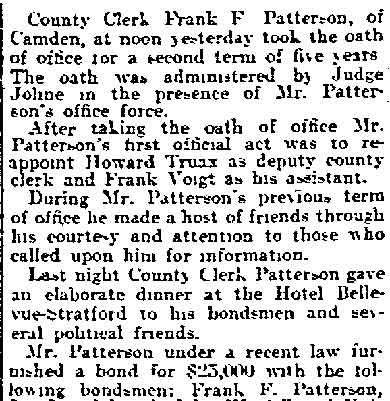
County Clerk Frank F. Patterson, of Camden, at noon yesterday took the oath of office for a second term of five years. The oath was administered by Judge Joline in the presence of Mr. Patterson’s office force.
After taking the oath of office Mr. Patterson’s first official act was to reappoint Howard Truax as deputy county clerk and Frank Voigt as his assistant.
During Mr. Patterson’s previous term of office he made a host of friends through his courtesy and attention to those who called upon him for information.
Last night County Clerk Patterson gave an elaborate dinner at the Hotel Bellevue-Stratford to his bondsmen and several political friends.
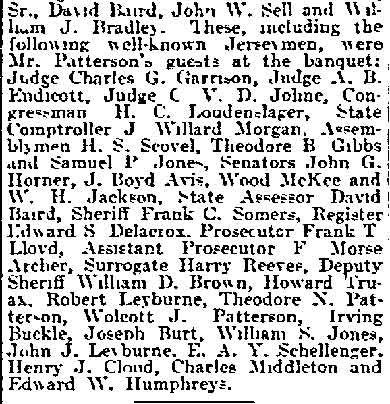
Mr. Patterson under a recent law furnished a bond for $25,000 with the following bondsmen: Frank F. Patterson, Sr., David Baird, John W. Sell and William J. Bradley. These, including the following well-known Jerseymen, were Mr. Patterson’s guests at the banquet: Judge Charles G. Garrison, Judge A. B. Endicott, Judge C. V. D. Joline, Congressman H. C. Loudenslager, State Comptroller J. Willard Morgan, Assemblymen H. S. Scovel, Theodore B. Gibbs and Samuel P. Jones, Senators John G. Horner, J. Boyd Avis, Wood McKee and W. H. Jackson, State Assessor David Baird, Sheriff Frank C. Somers, Register Edward S. Delacroix, Prosecutor Frank T. Lloyd, Assistant Prosecutor F. Morse Archer, Surrogate Harry Reeves, Deputy Sheriff William D. Brown, Howard Truax, Robert Leyburne, Theodore N. Patterson, Wolcott J. Patterson, Irving Buckle, Joseph Burt, William S. Jones, John J. Leyburne, E. A. Y. Schellenger, Henry J. Cloud, Charles Middleton and Edward W. Humphreys.
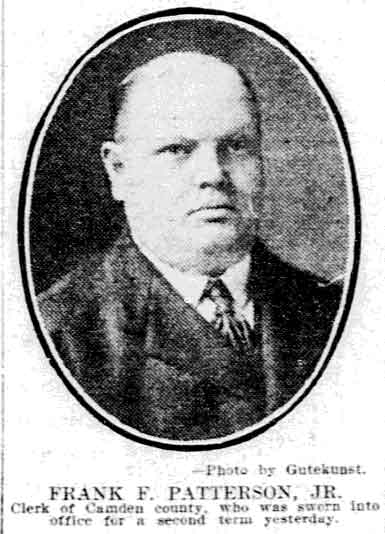
—Photo by Gutekunst
FRANK F. PATTERSON, JR.
Clerk of Camden county, who was sworn into office for a second term yesterday.
Herbert Beck Resigns From County Clerk’s Office
Philadelphia Inquirer —

Herbert Beck yesterday resigned as miscellaneous clerk in the office of County Clerk Patterson.
County License Applications Filed
Philadelphia Inquirer —
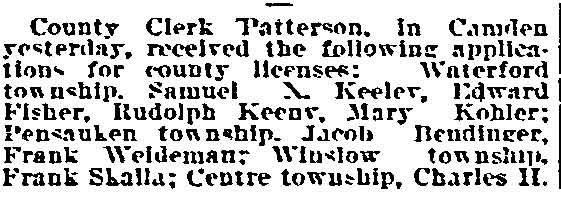
County Clerk Patterson, in Camden yesterday, received the following applications for county licenses: Waterford township, Samuel N. Keeler, Edward Fisher, Rudolph Keevy, Mary Kohler; Pensauken township, Jacob Bendinger, Frank Weideman; Winslow township, Frank Skalla; Centre township, Charles H.
Senator Bradley Files Nomination Petition
Philadelphia Inquirer —

The petition of nomination for another term as State Senator was filed with County Clerk Patterson by Senator William J. Bradley yesterday.
Marriage License for Henry Armstrong and Charlotte Fisher
Philadelphia Inquirer —
County Clerk Patterson yesterday granted a marriage license to Henry James Armstrong and Mrs. Charlotte Fisher, both of 205 South Marloe stret, Philadelphia. The groom-to-be is 59 years old and his prospective wife is 10 years his junior.
Handing Out Gunning Licenses in Camden
Philadelphia Inquirer —
County Clerk Patterson and His Office Force Work Overtime to Meet Gunners’ Demands
From the time County Clerk Frank Patterson opened his office in Camden yesterday until last night there was a constant coming and going of sportsmen anxious to get gunning licenses for the opening of the season tomorrow. The entire clerical force was kept busy, and, while usually the office closes at noon on Saturday, it was kept open until 5 o’clock to accommodate the sportsmen. Ofttimes they had their dogs with them and the occasional baying made the office sound like a field where cotton tails are skurrying to secure cover.
In all, it is estimated that at least three thousand licenses have been issued by Clerk Patterson, and it seems likely that the fields in and about Camden county will have a small army of gunners by the peep of day tomorrow morning. Not only have resident but non-resident licenses as well have been issued by the score, mostly to Philadelphians. While there has been some grumbling over the fact that it is necessary for the gunners to put up $1.50 for the privilege of hunting rabbits, as a rule, they look upon the matter as being beneficial to real sportsmen, as it has a tendency to eliminate the small pot hunters.
Those who have been over the haunts of the rabbits say they are exceedingly plentiful, especially in the lower end of Camden county, and farther south in Gloucester and Cumberland counties.
That the cotton tails will have to keep on the move is evident from the fact that Camden’s Police Department is to send to the woods such a squad of able sportsmen as Policemen James Clay, George Cooper, Fiore Troncone, Edward Pike, Walter Stanton, Oscar Weaver, Albert Shaw and Sergeants William Schregler, James Tatem and Edward Hartman.
Camden News Notes
Philadelphia Inquirer —
County Clerk Patterson yesterday received the paraphernalia for the coming fall election. It came in several wagon loads of boxes.
Many Accused of Election Frauds
Philadelphia Inquirer —
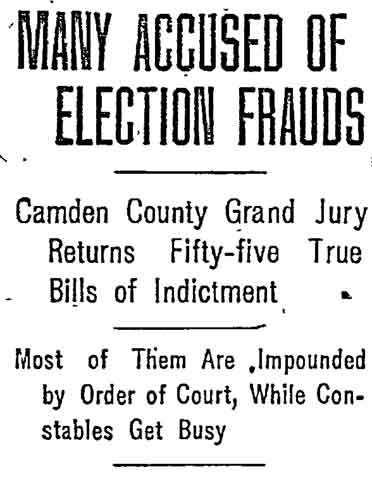
Camden County Grand Jury Returns Fifty-five True Bills of Indictment
Most of Them Are Impounded by Order of Court, While Constables Get Busy
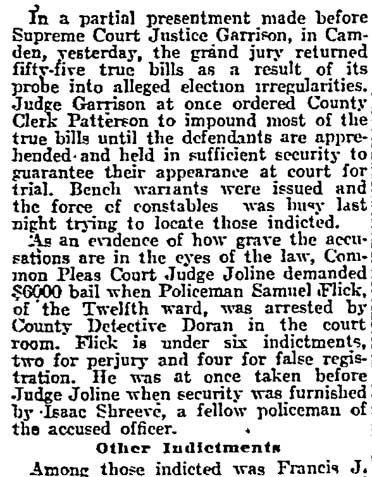
In a partial presentment made before Supreme Court Justice Garrison, in Camden, yesterday, the grand jury returned fifty-five true bills as a result of its probe into alleged election irregularities. Judge Garrison at once ordered County Clerk Patterson to impound most of the true bills until the defendants are apprehended and held in sufficient security to guarantee their appearance at court for trial. Bench warrants were issued and the force of constables was busy last night trying to locate those indicted.
As an evidence of how grave the accusations are in the eyes of the law, Common Pleas Court Judge Joline demanded $6000 bail when Policeman Samuel Flick, of the Twelfth ward, was arrested by County Detective Doran in the court room. Flick is under six indictments, two for perjury and four for false registration. He was at once taken before Judge Joline when security was furnished by Isaac Shreeve, a fellow policeman of the accused officer.
Other Indictments
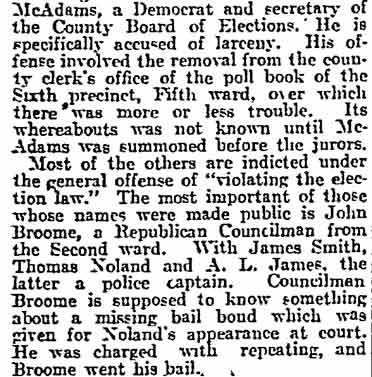
Among those indicted was Francis J. McAdams, a Democrat and secretary of the County Board of Elections. He is specifically accused of larceny. His offense involved the removal from the county clerk’s office of the poll book of the Sixth precinct, Fifth ward, over which there was more or less trouble. Its whereabouts was not known until McAdams was summoned before the jurors.
Most of the others are indicted under the general offense of “violating the election law.” The most important of those whose names were made public is John Broome, a Republican Councilman from the Second ward. With James Smith, Thomas Noland and A. L. James, the latter a police captain. Councilman Broome is supposed to know something about a missing bail bond which was given for Noland’s appearance at court. He was charged with repeating, and Broome went his bail.
Indicted on Five Counts
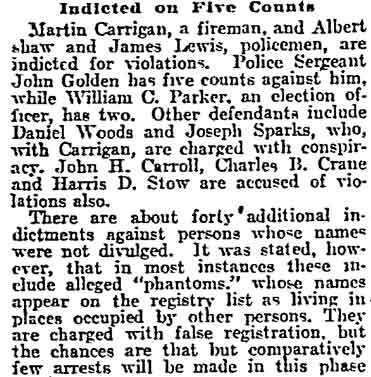
Martin Carrigan, a fireman, and Albert Shaw and James Lewis, policemen, are indicted for violations. Police Sergeant John Golden has five counts against him, while William C. Parker, an election officer, has two. Other defendants include Daniel Woods and Joseph Sparks, who, with Carrigan, are charged with conspiracy. John H. Carroll, Charles B. Crane and Harris D. Stow are accused of violations also.
There are about forty additional indictments against persons whose names were not divulged. It was stated, however, that in most instances these include alleged “phantoms,” whose names appear on the registry list as living in places occupied by other persons. They are charged with false registration, but the chances are that but comparatively few arrests will be made in this phase of the matter.
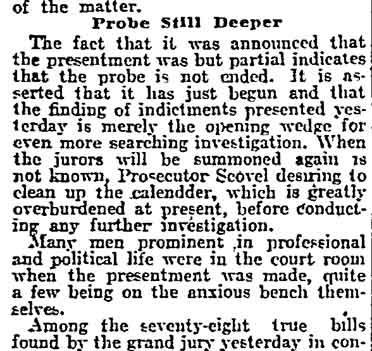
Probe Still Deeper
The fact that it was announced that the presentment was but partial indicates that the probe is not ended. It is asserted that it has just begun and that the finding of indictments presented yesterday is merely the opening wedge for even more searching investigation. When the jurors will be summoned again is not known, Prosecutor Scovel desiring to clean up the calendder [sic], which is greatly overburdened at present, before conducting any further investigation.
Many men prominent in professional and political life were in the court room when the presentment was made, quite a few being on the anxious bench themselves.
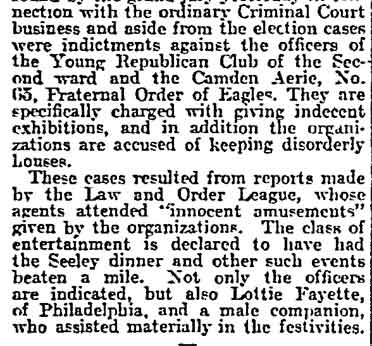
Among the seventy-eight true bills found by the grand jury yesterday in connection with the ordinary Criminal Court business and aside from the election cases were indictments against the officers of the Young Republican Club of the Second ward and the Camden Aerie, No. 65, Fraternal Order of Eagles. They are specifically charged with giving indecent exhibitions, and in addition the organizations are accused of keeping disorderly houses.
These cases resulted from reports made by the Law and Order League, whose agents attended “innocent amusements” given by the organizations. The class of entertainment is declared to have had the Seeley dinner and other such events beaten a mile. Not only the officers are indicated [sic], but also Lottie Fayette, of Philadelphia, and a male companion, who assisted materially in the festivities.
Camden News Notes
Philadelphia Inquirer —
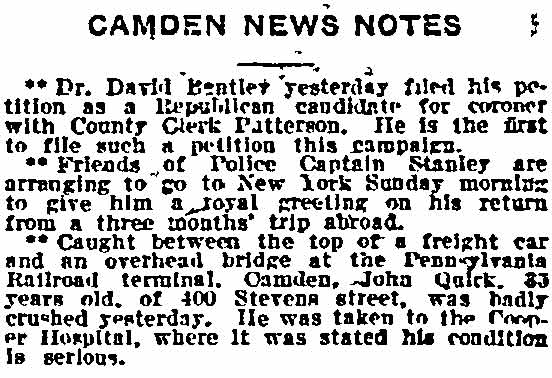
Dr. David Bentley yesterday filed his petition as a Republican candidate for coroner with County Clerk Patterson. He is the first to file such a petition this campaign.
Friends of Police Captain Stanley are arranging to go to New York Sunday morning to give him a royal greeting on his return from a three months’ trip abroad.
Caught between the top of a freight car and an overhead bridge at the Pennsylvania Railroad terminal, Camden, John Quick, 83 years old, of 400 Stevens street, was badly crushed yesterday. He was taken to the Cooper Hospital, where it was stated his condition is serious.
Joshua Haines Files Campaign Expense Account
Philadelphia Inquirer —

As candidate for Sheriff on the Republican ticket, Joshua C. Hains [sic] filed his expense account with County Clerk Patterson yesterday. It shows he spent $4[?]43.2[?].
County Liquor License Applications
Philadelphia Inquirer —
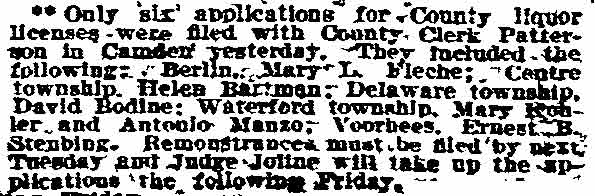
Only six applications for County liquor licenses were filed with County Clerk Patterson in Camden yesterday. They included the following: Berlin, Mary L. Bleche; Centre township, Helen Bariman; Delaware township, David Bodine; Waterford township, Mary Kohler and Antonio Manzo; Voorhees, Ernest B. Stenbing. Remonstrances must be filed by next Tuesday and Judge Joline will take up the applications the following Friday.
Senator Penrose Granted Non-Resident Gunner’s License
Philadelphia Inquirer —
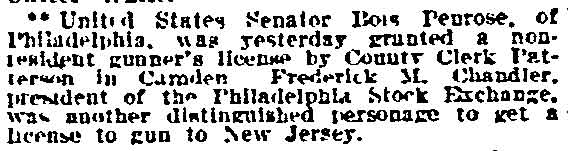
United States Senator Bois Penrose, of Philadelphia, was yesterday granted a non-resident gunner’s license by County Clerk Patterson in Camden. Frederick M. Chandler, president of the Philadelphia Stock Exchange, was another distinguished personage to get a license to gun to [sic] New Jersey.
New Judge Sworn In
Philadelphia Inquirer —
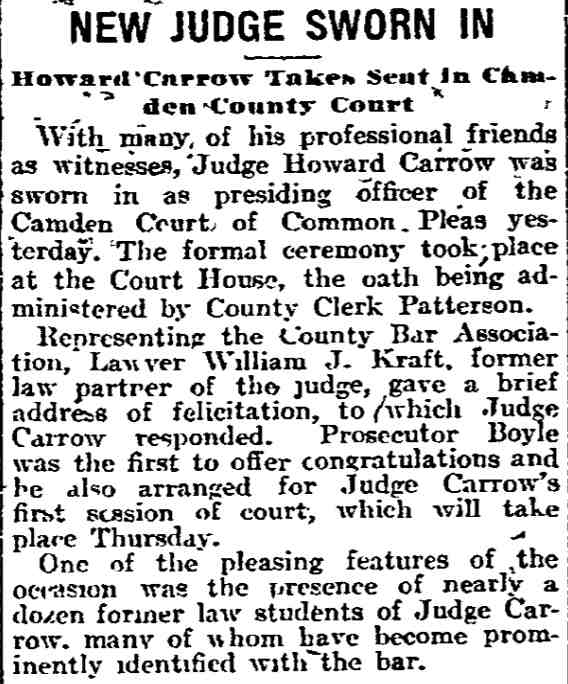
Howard Carrow Takes Seat in Camden County Court
With many of his professional friends as witnesses, Judge Howard Carrow was sworn in as presiding officer of the Camden Court of Common Pleas yesterday. The formal ceremony took place at the Court House, the oath being administered by County Clerk Patterson.
Representing the County Bar Association, Lawyer William J. Kraft, former law partner of the judge, gave a brief address of felicitation, to which Judge Carrow responded. Prosecutor Boyle was the first to offer congratulations and he also arranged for Judge Carrow’s first session of court, which will take place Thursday.
One of the pleasing features of the occasion was the presence of nearly a dozen former law students of Judge Carrow, many of whom have become prominently identified with the bar.
1913 Camden City Directory Advertisement
THOUSANDS VIEW CHIEF'S REMAINS
Camden Post-Telegram —
Throngs Jam Court House While Body Lies in State for Two Hours.
LAST SAD RITES THIS AFTERNOON
Not since the memorable funeral of Chief of Police Foster ten years ago, has there been such a genuine public tribute paid an official of Camden as was in evidence last night at the bier of the lamented Fire Chief Worthington, and today at his funeral. It is hard to estimate the number of persons in a crowd, but from 7 until 9 o’clock last night there was a steady stream of men, women and children, two abreast, who passed from the main entrance, through the center corridor and beneath the illuminated rotunda, where the body lay, and thence out by the west corridor. There was never a stop, and it is estimated that at least 10,000 persons were there, perhaps more.
There could not have been a more ideal location for the repose of the casket containing the honored dead, and the great array of beautiful flowers than beneath the rotunda. It seemed to be a sacred shrine in itself where the citizenry dropped a tear for the lamented departed. The effulgence of the soft lights from above specially installed by Electrical Chief Kelly but lent to the scene and as the dark garbed escort of firemen, the active pall bearers, stood on guard, the scene was unusually impressive.
Chief Worthington, aside from the pallor that comes to the dead, looked as he did in life, for the thread had been snapped so quickly that it was while he was in his full vigor that the vital spark had taken its flight. There were some marks on his face that indicated the intense though momentary suffering through which he passed on his fateful plunge from the roof of the burning building to his quick death, and the passing crowd remarked this. But withal there was that calmness and repose feature which seemed to indicate that the gallant leader of Camden’s fire fighters but lay sleeping rather than that his soul had taken its eternal flight.
Public grief may be a mere ephemeral emotion, born of the moment and only to be succeeded by the acclaim of the newly arisen public idol, but last night’s encomiums seemed to come from hearts that overflowed with genuine and permanent sorrow over the untimely passing of so excellent a public servant. Many tear-suffused eyes indicated this, many expressions of grief, of sorrow, of condolence of those left showed this. The sentiment in evidence everywhere can only be likened to the sweetness of the wonderful flowers whose odor spread through all the corridors and in all the rooms of the great marble building.
High in the clock tower of the City Hall the bell began tolling at 6:30 o’clock. At half-minute intervals its doleful strains went forth on the cold blustery east wind which had succeeded a day of spring sunshine. The bell and the screeching wind seemed to combine as a knell indicating the passing grief of the city. It was the preliminaries to the marching of the funeral cortege from the stricken Chief’s home on Penn Street to the resting place at the Court House.
There were forty policemen in dress uniform with Chief Gravenor at their head. There were twenty-six fire heads from Philadelphia, with Chief William Murphy in the van, a tribute in itself of more than passing moment. There was the caisson on which was the black draped casket containing the body of he who all honored. There was the little red car in which Chief Worthington was wont to speed through the city at every alarm and there was his helmet and coat. There was Acting Chief Stockton and forty of the men who fought flames under the direction of he who lay so still. There was the family in cabs with curtains drawn, the members of City Council and the active pall bearers — Daniel Leach, Peter B. Carter, James White, William Patterson, Elmer Burkett, Samuel Harring.
When the cortege reached the Court House the Camden boys took up their position on the inside beneath rotunda while the Philadelphia visitors made an imposing array on the granite steps outside. And then came the public in its steady and unending stream. Later the Philadelphia delegation was escorted to the Board of Freeholders room where tribute was paid to the dead and where a mingling of the two cities took place.
Besides Chief Murphy the visitors included Battalion Chiefs William T. Barrett and George P. McConaghy, Captains L. F. Bunting, William Lindsey, H. Dinlocker, J. Higginson, J. E. Talbot, D. Campbell, T. O’Brien, F. Hughes, E. Basenfelder; H. Hutt, William McCusker, G. Rheim, R. Wilsey, J. Webb, H. Goers, H. Haines, Insurance Patrol Captain Joseph H. Shermer William Hickman, William Rodgers, John Wyatt, David Phillip, John Clyde, H. Wilkinson.
President of City Council James E. Hewitt spoke of the work Chief Worthington had already accomplished, of his plans, of his value and worth to Camden. Chief Murphy responded in a fitting way and this incident in itself was one to be remembered.
An affecting sight was witnessed by the handful of spectators, among them being other firemen, city and county officials and policemen who remained after the big doors on Sixth Street had been closed. The last to view the Chief’s remains were a delegation of about twenty firemen. Solemnly the men passed by the bier and gazed upon the features of their departed brother. As the last of the line approached Deputy Chief John A. Stockton was seen. He stopped and with his cap laid across his breast he looked down into the casket. For almost a minute Chief Stockton stood as though glued to the spot. Then he glanced about him and the sympathetic look upon his face thrilled all. He heaved a sigh and perhaps the teardrops refused to come, but Chief Stockton, as the lines upon his face showed, was struggling with the inner man. His emotions were tugging at his heart, but a fire laddie cannot give way to his feelings although his brother superior officer and dear friend had answered his last alarm.
The floral pieces surrounding the bier bespoke the love, admiration and respect the donors held for the dead chief. One design particularly beautiful was a mammoth loving cup made of blossoms, flowers and roses. This was the token sent by members of City Council and other city officials. Another was the design sent by the Electrical Bureau through Chief Kelly. The original fire box, No. 134, which was pulled on the night of the fire by Chief Worthington was enshrouded by roses, carnations and lilies. A maltese cross standing several feet high and bearing the initials of the organization was the tribute sent by the Firemen’s Mutual Benevolent Association. Chief Worthington was president of this association. The Camden police sent a large shield of flowers and Council members offered a vacant chair of roses. The New Jersey Auto Supply Company, No. 2 Engine Company and No. 1 Truck sent beautiful broken circles and a wreath was the offering from the employees of the Victor Talking Machine Company. A broken circle from members of the Sixth Ward Republican Club and a wreath from his friends in the sixth precinct of the Second Ward were other beautiful pieces. West Collingswood and Collingswood firemen sent two beautiful floral circles and from the Loyal Order Legion a wreath was received. Other offerings were from the Camden Liquor Dealers league, a beautiful circle from No. 6 Engine Company, in which house Chief Worthington was captain previous to his elevation to the office of chief; sprays from the Bethany M.E. Church, Ladies Auxiliary of the Loyal Order of Moose; a wreath from the pupils of the eighth grade Sewell school, and a spray from North Baptist Church. There also were designs from members of the family and friends, all of which bespoke the great love held for the departed fire chief.
The impressive services of the P.E. Church marked the last sad rites this afternoon at St. Paul’s Church. The guard of honor and city officials left Fire Headquarters at 1:20 and proceeded to the Worthington home and escorted the remains to the church, where services were conducted by the rector, Rev. R.E. Brestell, and Rev. H.O. Jones, rector of St. Stephen’s P.E. Church. Interment was made at Arlington. The honorary pallbearers were Mayor Ellis, Hon. David Baird, Frank F. Patterson, John W. Bell, General John A. Mather, Melbourne F. Middleton Jr., Harry R. Reed, Arthur L. Jones, Robert Gordon, David Jester, George Schneider, William Mills, J.O. Grear, William Hall, George L. Bender, and James E. Hewitt.
Camden at a Glance
Philadelphia Inquirer —
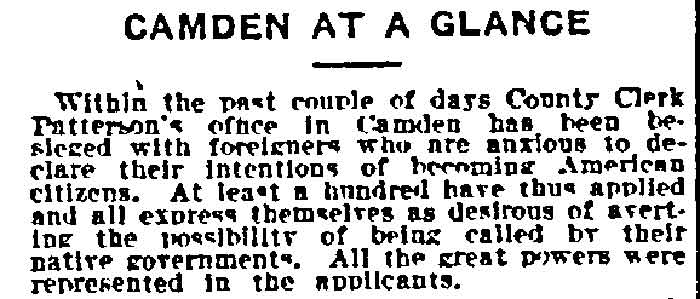
Within the past couple of days County Clerk Patterson’s office in Camden has been besieged with foreigners who are anxious to declare their intentions of becoming American citizens. At least a hundred have thus applied and all express themselves as desirous of averting the possibility of being called by their native governments. All the great powers were represented in the applicants.
License Petitions Filed
Philadelphia Inquirer —
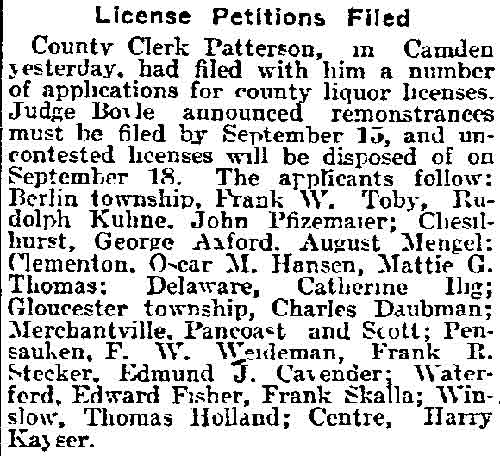
County Clerk Patterson, in Camden yesterday, had filed with him a number of applications for county liquor licenses. Judge Boyle announced remonstrances must be filed by September 15, and uncontested licenses will be disposed of on September 18. The applicants follow: Berlin township, Frank W. Toby, Rudolph Kuhne, John Pfizemaier; Chesilhurst, George Axford, August Mengel; Clementon, Oscar M. Hansen, Mattie G. Thomas; Delaware, Catherine Ilg; Gloucester township, Charles Daubman; Merchantville, Pancoast and Scott; Pensauken, F. W. Weideman, Frank R. Stecker, Edmund J. Cavender; Waterford, Edward Fisher, Frank Skalla; Winslow, Thomas Holland; Centre, Harry Kayser.
Camden at a Glance
Camden Courier-Post —
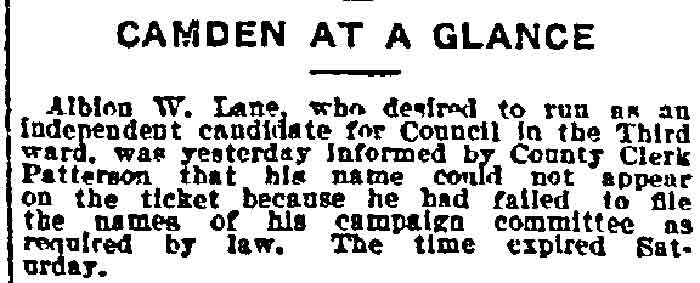
Albion W. Lane, who desired to run as an independent candidate for Council in the Third ward, was yesterday informed by County Clerk Patterson that his name could not appear on the ticket because he had failed to file the names of his campaign committee as required by law. The time expired Saturday.
Frank Ford Patterson Jr. – Albion Lane
Camden Jury Is Named
Philadelphia Inquirer —
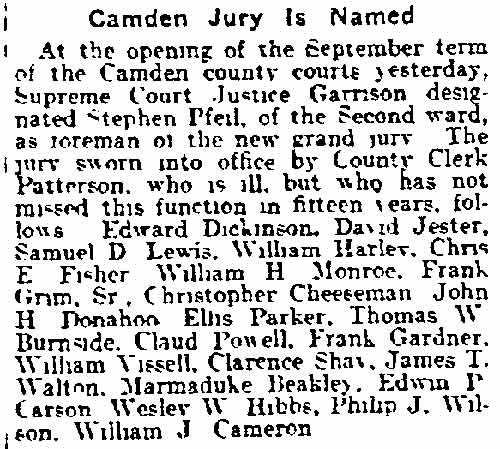
At the opening of the September term of the Camden county courts yesterday, Supreme Court Justice Garrison designated Stephen Pfeil, of the Second ward, as foreman of the new grand jury. The jury sworn into office by County Clerk Patterson, who is ill, but who has not missed this function in fifteen years, follows: Edward Dickinson, David Jester, Samuel D. Lewis, William Harley, Chris E. Fisher, William H. Monroe, Frank Grim, Sr., Christopher Cheeseman, John H. Donahoo, Ellis Parker, Thomas W. Burnside, Claud Powell, Frank Gardner, William Vissell, Clarence Shay, James T. Walton, Marmaduke Beakley, Edwin P. Carson, Wesley W. Hibbs, Philip J. Wilson, William J. Cameron
Selective Boards Organize
Philadelphia Inquirer —
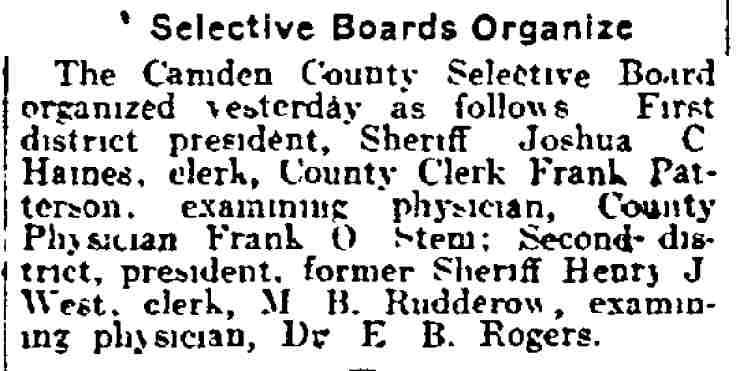
The Camden County Selective Board organized yesterday as follows. First district president, Sheriff Joshua C Haines, clerk, County Clerk Frank Patterson, examining physician, County Physician Frank O Stem; Second district, president, former Sheriff Henry J West, clerk, M B. Rudderow, examining physician, Dr E. B. Rogers.
Funeral of Dr. P. N. Litchfield
Philadelphia Inquirer —
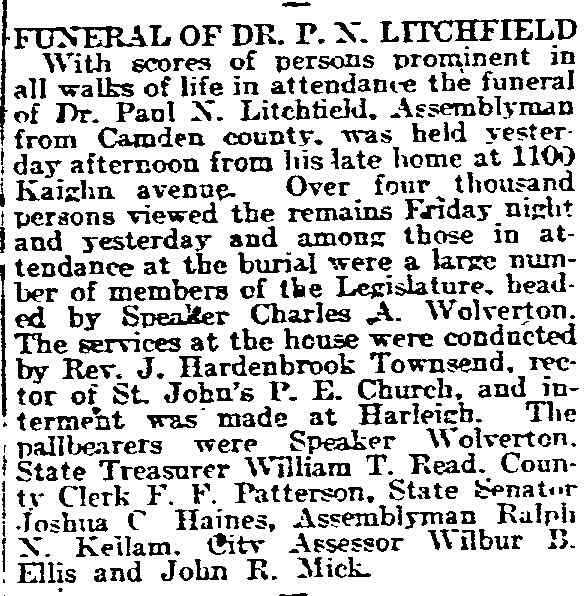
With scores of persons prominent in all walks of life in attendance the funeral of Dr. Paul N. Litchfield, Assemblyman from Camden county, was held yesterday afternoon from his late home at 1100 Kaighn avenue. Over four thousand persons viewed the remains Friday night and yesterday and among those in attendance at the burial were a large number of members of the Legislature, headed by Speaker Charles A. Wolverton. The services at the house were conducted by Rev. J. Hardenbrook Townsend, rector of St. John’s P. E. Church, and interment was made at Harleigh. The pallbearers were Speaker Wolverton, State Treasurer William T. Read, County Clerk F. F. Patterson, State Senator Joshua C. Haines, Assemblyman Ralph N. Keilam, City Assessor Wilbur B. Ellis and John R. Mick.
Events at the Church of the Immaculate Conception
Camden Post-Telegram —
ECHOES
Camden last night gave a splendid welcome to the Very Rev. Dean William J. Fitzgerald, J. c. D., M. R. V. F., the new pastor of the Church of the Immaculate Conception and Dean of the South Jersey Catholic parishes.
Citizens of other faiths, judges, doctors, lawyers and those in more humble stations of life, rubbed elbows in the vast audience that packed to capacity the Catholic Lyceum. All were present for a common purpose — to honor the new prelate, who comes to Camden with a splendid reputation as a Christian gentleman, patriot and ambassador of the Catholic Church.
At the reception in the Lyceum, former Judge William T. Boyle presided. He in turn introduced Rev. Francis J. McCallion, who was acting pastor of the parish. Father McCallion was given a wonderful reception after Judge Boyle extolled his oratorical and executive ability. In a splendid speech Father McCallion paid a glowing tribute to Dean Fitzgerald, the subject of the evening’s testimonial.
James F. Lennon was the principal speaker for the occasion. Already famed for his ability as an orator, Mr. Lennon probably gave his best talk last night. It was a tribute to the new Dean and the members of the Catholic clergy and Sisters of Mercy. In his remarks Mr. Lennon told of the duties of a priest, of his mission and his value to the community. To the good sisters a glowing tribute was also paid by the speaker. Mr. Lennon also lauded the public school system and explained the principles of the parochial school. His reference to the 312 Immaculate Conception members who fought in the war for Democracy evoked a storm of applause.
County Clerk Patterson, Mayor Ellis and other big men of the city and county were present to do him honor.
After the reception in the Lyceum Dean Fitzgerald adjourned to the parlor of the Lyceum where he met members of the parish and other friends. He stood under a canopy of flowers and colored electric lights. The guard of honor was comprised of fifty-fourth degree Knights of Columbus. Three hundred members of the parish formed the honorary escort from the train terminal to the rectory.
Unable to be present, because of previous engagements, Rev. Leon K. Willman, pastor of the Broadway M. E. Church, and Rev. Edwin F. Hann, of First M. E. Church, sent letters of regret in which they wished the new pastor success in his new fields of labor.
Success of last night’s eventful occasion can be attributed to Rev. Francis J. McCallion, who directed the affair. He was ably assisted by Edward Clare, George Slake, George Burke, Cornelius J. Healy, James McGowan, Hugh Pattie, Michael Quinn, Robert A. Stack and James Wren.
This morning the church reception was held with a solemn high mass, which was sung by Dean Fitzgerald. Father Whelan was deacon, Father Hennig, sub-deacon, and Father Shay, master of ceremonies. Father McCallion delivered a splendid sermon for the occasion and the singing of the altar boys was very fine. William H. Lorigan presided at the organ.
Children of the parish this afternoon tendered a reception to the new pastor. The altar boys will present Dean Fitzgerald with an enlarged and framed likeness of himself.
Reciprocation.
Trenton Times —
Reciprocation.
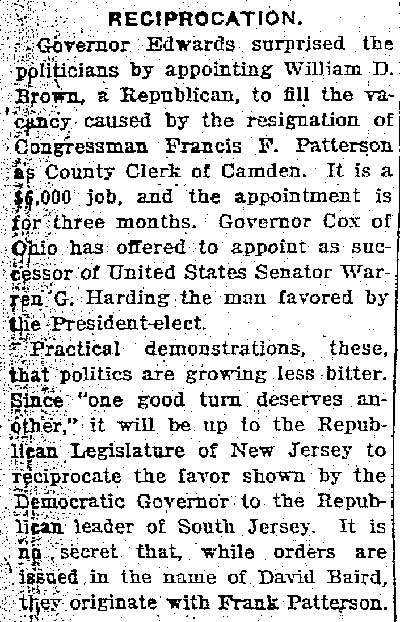
Governor Edwards surprised the politicians by appointing William D. Brown, a Republican, to fill the vacancy caused by the resignation of Congressman Francis F. Patterson as County Clerk of Camden. It is a $6,000 job, and the appointment is for three months. Governor Cox of Ohio has offered to appoint as successor of United States Senator Warren G. Harding the man favored by the President-elect.
Practical demonstrations, these, that politics are growing less bitter. Since “one good turn deserves another,” it will be up to the Republican Legislature of New Jersey to reciprocate the favor shown by the Democratic Governor to the Republican leader of South Jersey. It is no secret that, while orders are issued in the name of David Baird, they originate with Frank Patterson.
New Firemen Assigned for Two Platoons
Camden Post-Telegram —
Double Shift System Becomes Effective at 8 O’clock on Saturday Morning
ONE TEN HOURS; OTHER 14 HOURS
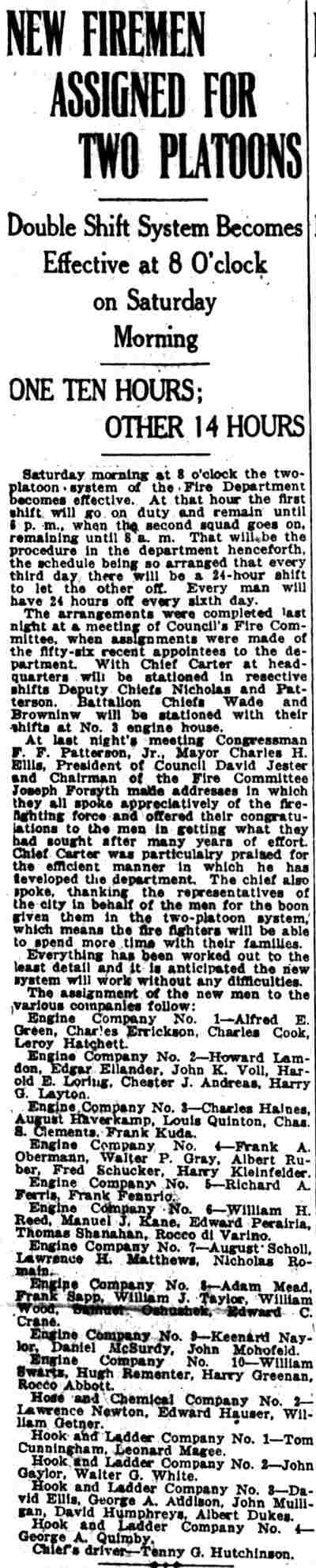
Saturday morning at 8 o’clock the two-platoon system of the Fire Department becomes effective. At that hour the first shift will go on duty and remain until 8 p. m., when the second squad goes on, remaining until 8 a. m. That will be the procedure in the department henceforth, the schedule being so arranged that every third day there will be a 24-hour shift to let the other off. Every man will have 24 hours off every sixth day.
The arrangements were completed last night at a meeting of Council’s Fire Committee, when assignments were made of the fifty-six recent appointees to the department. With Chief Carter at headquarters will be stationed in resective [sic] shifts Deputy Chiefs Nicholas and Patterson. Battalion Chiefs Wade and Browninw [sic] will be stationed with their shifts at No. 3 engine house.
At last night’s meeting Congressman F. F. Patterson, Jr., Mayor Charles H. Ellis, President of Council David Jester and Chairman of the Fire Committee Joseph Forsyth made addresses in which they all spoke appreciatively of the fire-fighting force and offered their congratulations to the men in getting what they had sought after many years of effort. Chief Carter was particularly praised for the efficient manner in which he has developed the department. The chief also spoke, thanking the representatives of the city in behalf of the men for the boon given them in the two-platoon system, which means the fire fighters will be able to spend more time with their families.
Everything has been worked out to the least detail and it is anticipated the new system will work without any difficulties.
The assignment of the new men to the various companies follow:
Engine Company No. 1—Alfred E. Green, Charles Errickson, Charles Cook, Leroy Hatchett.
Engine Company No. 2—Howard Lamdon, Edgar Ellander, John K. Voll, Harold E. Loring, Chester J. Andreas, Harry G. Layton.
Engine Company No. 3—Charles Haines, August Haverkamp, Louis Quinton, Chas. S. Clements, Frank Kuda.
Engine Company No. 4—Frank A. Obermann, Walter P. Gray, Albert Ruber, Fred Schucker, Harry Kleinfelder.
Engine Company No. 5—Richard A. Ferris, Frank Fennrio.
Engine Company No. 6—William H. Reed, Manuel J. Kane, Edward Perairia, Thomas Shanahan, Rocco di Varino.
Engine Company No. 7—August Scholl, Lawrence H. Matthews, Nicholas Romain.
Engine Company No. 8—Adam Mead, Frank Sapp, William J. Taylor, William Wood, Samuel Oshushek, Edward C. Crane.
Engine Company No. 9—Keenard Naylor, Daniel McSurdy, John Mohofeld.
Engine Company No. 10—William Swarts, Hugh Rementer, Harry Greenan, Rocco Abbott.
Hose and Chemical Company No. 2—Lawrence Newton, Edward Hauser, William Getner.
Hook and Ladder Company No. 1—Tom Cunningham, Leonard Magee.
Hook and Ladder Company No. 2—John Gaylor, Walter G. White.
Hook and Ladder Company No. 3—David Ellis, George A. Addison, John Mulligan, David Humphreys, Albert Dukes.
Hook and Ladder Company No. 4—George A. Quimby.
Chief’s driver—Tenny G. Hutchinson.
Circuit Court Judge Frank T. Lloyd Accepts Chairmanship of Unemployment Committee
Philadelphia Inquirer —
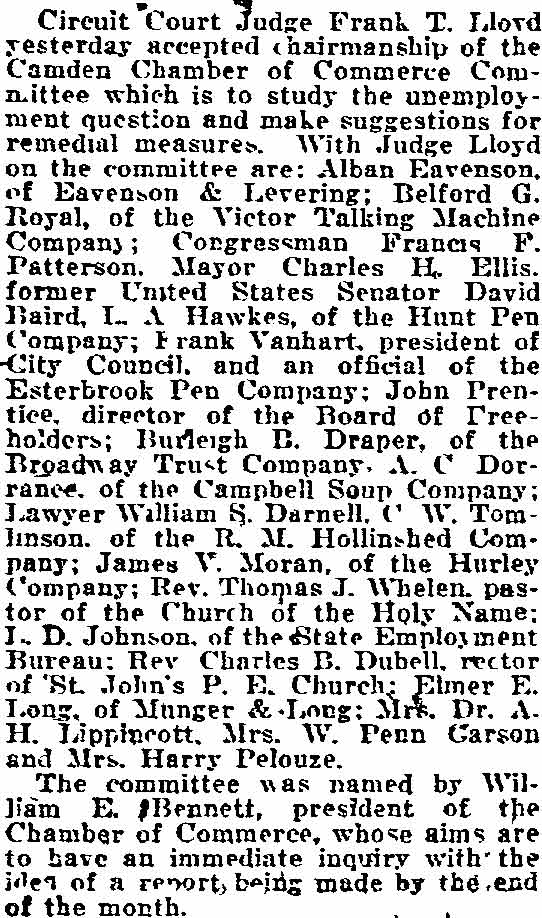
Circuit Court Judge Frank T. Lloyd yesterday accepted chairmanship of the Camden Chamber of Commerce Committee which is to study the unemployment question and make suggestions for remedial measures. With Judge Lloyd on the committee are: Alban Eavenson, of Eavenson & Levering; Belford G. Royal, of the Victor Talking Machine Company; Congressman Francis F. Patterson; Mayor Charles H. Ellis; former United States Senator David Baird; L. A. Hawkes, of the Hunt Pen Company; Frank Vanhart, president of City Council, and an official of the Esterbrook Pen Company; John Prentice, director of the Board of Freeholders; Burleigh B. Draper, of the Broadway Trust Company; A. C. Dorrance, of the Campbell Soup Company; Lawyer William S. Darnell; C. W. Tomlinson, of the R. M. Hollinshed Company; James V. Moran, of the Hurley Company; Rev. Thomas J. Whelen, pastor of the Church of the Holy Name; L. D. Johnson, of the State Employment Bureau; Rev. Charles B. Dubell, rector of St. John’s P. E. Church; Elmer E. Long, of Munger & Long; Mrs. Dr. A. H. Lippincott, Mrs. W. Penn Carson [sic] and Mrs. Harry Pelouze.
The committee was named by William E. Bennett, president of the Chamber of Commerce, whose aims are to have an immediate inquiry with the idea of a report, being made by the end of the month.
Frelinghuysen Majority Seen in Camden County
Philadelphia Inquirer —
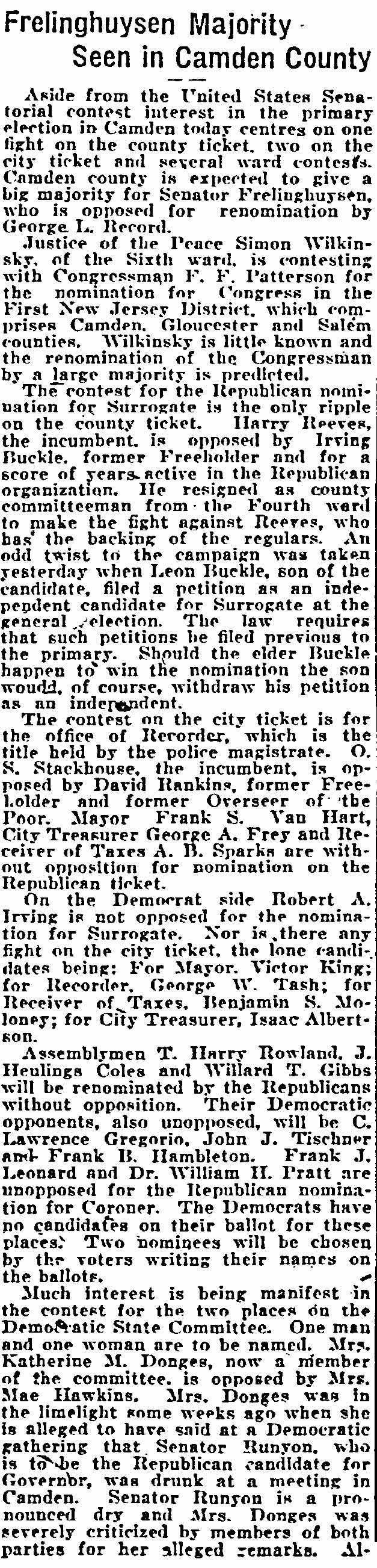
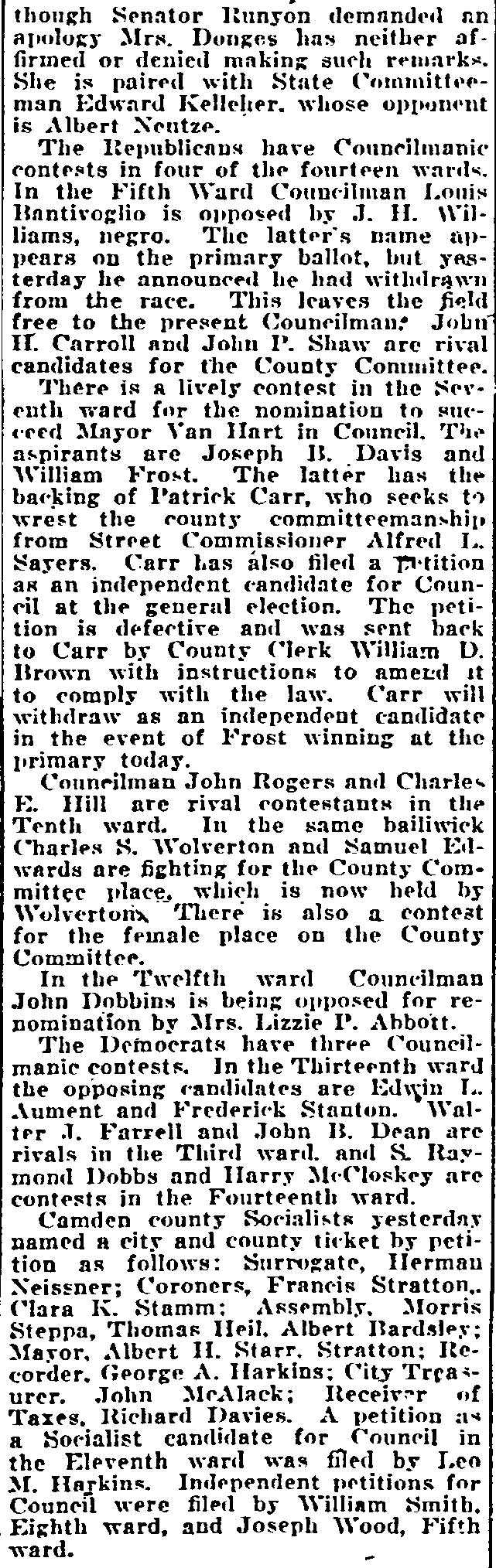
Aside from the United States Senatorial contest interest in the primary election in Camden today centres on one fight on the county ticket, two on the city ticket and several ward contests. Camden county is expected to give a big majority for Senator Frelinghuysen, who is opposed for renomination by George L. Record.
Justice of the Peace Simon Wilkinsky, of the Sixth ward, is contesting with Congressman F. F. Patterson for the nomination for Congress in the First New Jersey District, which comprises Camden, Gloucester and Salem counties. Wilkinsky is little known and the renomination of the Congressman by a large majority is predicted.
The contest for the Republican nomination for Surrogate is the only ripple on the county ticket. Harry Reeves, the incumbent, is opposed by Irving Buckle, former Freeholder and for a score of years active in the Republican organization. He resigned as county committeeman from the Fourth ward to make the fight against Reeves, who has the backing of the regulars. An odd twist to the campaign was taken yesterday when Leon Buckle, son of the candidate, filed a petition as an independent candidate for Surrogate at the general election. The law requires that such petitions be filed previous to the primary. Should the elder Buckle happen to win the nomination the son would, of course, withdraw his petition as an independent.
The contest on the city ticket is for the office of Recorder, which is the title held by the police magistrate. O. S. Stackhouse, the incumbent, is opposed by David Rankins, former Freeholder and former Overseer of the Poor. Mayor Frank S. Van Hart, City Treasurer George A. Frey and Receiver of Taxes A. B. Sparks are without opposition for nomination on the Republican ticket.
On the Democrat side Robert A. Irving is not opposed for the nomination for Surrogate. Nor is there any fight on the city ticket, the lone candidates being: For Mayor, Victor King; for Recorder, George W. Tash; for Receiver of Taxes, Benjamin S. Moloney; for City Treasurer, Isaac Albertson.
Assemblymen T. Harry Rowland, J. Heulings Coles and Willard T. Gibbs will be renominated by the Republicans without opposition. Their Democratic opponents, also unopposed, will be C. Lawrence Gregorio, John J. Tischner and Frank B. Hambleton. Frank J. Leonard and Dr. William H. Pratt are unopposed for the Republican nomination for Coroner. The Democrats have no candidates on their ballot for these places. Two nominees will be chosen by the voters writing their names on the ballots.
Much interest is being manifest in the contest for the two places on the Democratic State Committee. One man and one woman are to be named. Mrs. Katherine M. Donges, now a member of the committee, is opposed by Mrs. Mae Hawkins. Mrs. Donges was in the limelight some weeks ago when she is alleged to have said at a Democratic gathering that Senator Runyon, who is to be the Republican candidate for Governor, was drunk at a meeting in Camden. Senator Runyon is a pronounced dry and Mrs. Donges was severely criticized by members of both parties for her alleged remarks. Although Senator Runyon demanded an apology Mrs. Donges has neither affirmed or denied making such remarks. She is paired with State Committeeman Edward Kelleher, whose opponent is Albert Neutze.
The Republicans have Councilmanic contests in four of the fourteen wards. In the Fifth Ward Councilman Louis Bantivoglio is opposed by J. H. Williams, negro. The latter’s name appears on the primary ballot, but yesterday he announced he had withdrawn from the race. This leaves the field free to the present Councilman. John H. Carroll and John P. Shaw are rival candidates for the County Committee.
There is a lively contest in the Seventh ward for the nomination to succeed Mayor Van Hart in Council. The aspirants are Joseph B. Davis and William Frost. The latter has the backing of Patrick Carr, who seeks to wrest the county committeemanship from Street Commissioner Alfred L. Sayers. Carr has also filed a petition as an independent candidate for Council at the general election. The petition is defective and was sent back to Carr by County Clerk William D. Brown with instructions to amend it to comply with the law. Carr will withdraw as an independent candidate in the event of Frost winning at the primary today.
Councilman John Rogers and Charles E. Hill are rival contestants in the Tenth ward. In the same bailiwick Charles S. Wolverton and Samuel Edwards are fighting for the County Committee place, which is now held by Wolverton. There is also a contest for the female place on the County Committee.
In the Twelfth ward Councilman John Dobbins is being opposed for renomination by Mrs. Lizzie P. Abbott.
The Democrats have three Councilmanic contests. In the Thirteenth ward the opposing candidates are Edwin L. Aument and Frederick Stanton. Walter J. Farrell and John B. Dean are rivals in the Third ward, and S. Raymond Dobbs and Harry McCloskey are contests in the Fourteenth ward.
Camden county Socialists yesterday named a city and county ticket by petition as follows: Surrogate, Herman Neissner; Coroners, Francis Stratton, Clara K. Stamm; Assembly, Morris Steppa, Thomas Heil, Albert Bardsley; Mayor, Albert H. Starr, Stratton; Recorder, George A. Harkins; City Treasurer, John McAlack; Receiver of Taxes, Richard Davies. A petition as a Socialist candidate for Council in the Eleventh ward was filed by Leo M. Harkins. Independent petitions for Council were filed by William Smith, Eighth ward, and Joseph Wood, Fifth ward.
[News brief — Congressman Patterson secures free mail delivery for Oaklyn and Audubon]
Philadelphia Inquirer —
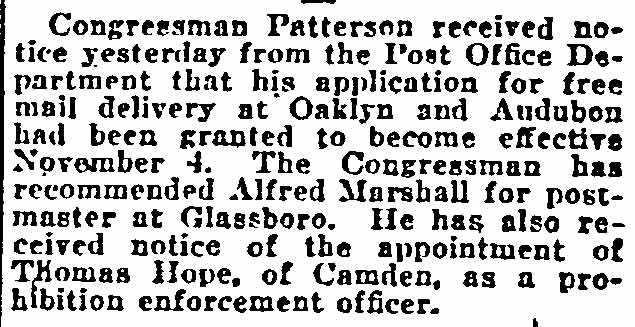
Congressman Patterson received notice yesterday from the Post Office Department that his application for free mail delivery at Oaklyn and Audubon had been granted to become effective November 4. The Congressman has recommended Alfred Marshall for postmaster at Glassboro. He has also received notice of the appointment of Thomas Hope, of Camden, as a prohibition enforcement officer.
The Patterson Home in Merchantville, N.J.
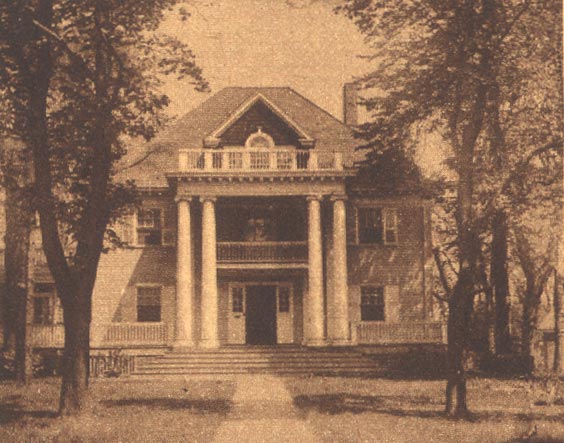
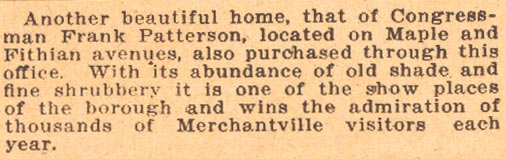
The Patterson Home in Merchantville NJ – 1926
Keown Named Head of County G.O.P. as Wallworth Resigns
Camden Courier-Post —

Mrs. Verga Re-elected Vice Chairman at Reorganization Meeting of Committee
OTHER OFFICERS CHOSEN
When the Camden County Republican Executive Committee reorganized last night Walter S. Keown was elected chairman without opposition.
He succeeds former State Senator Joseph F. Wallworth, who was Republican county chairman six years, and a member 12 years. At a dinner preceding the executive session a silver set and a vase were presented to Wallworth by the committee. The retiring members of the committee received bronze elephants as emblems of the party.
At the executive session Mrs. Elizabeth Grotty Verga was re-elected vice chairman; Harry C. Sharp, treasurer; William D. Sayrs, assistant treasurer; Howard B. Dyer, secretary, and Mrs. Laura Silbers and Mrs. Lottie Stinson, assistant secretaries. Harold W. Bennett, Edward R. Diebert, Bernard Bertman, L. Scott Chercesky, Carl Kisselman and Frank Voigt were chosen solicitors.
Wallworth Reviews Work
Upon retiring as chairman Senator Wallworth said:
“During the six years I acted as your chairman considerable political history has been made in our county. The Republican party was on the rocks and loyalty seemed to have drifted away when Frank Patterson, Al Matthews, Penn Corson and Senator Baird begged me to take the chairmanship. In doing so I quickly discovered I had undertaken one of the hardest up hill battles of my life.”
When Keown took over the gavel he pointed out to the committee members they were political leaders of their districts. He said it was their duty to find out the cause of unrest.
“In some of your districts the trouble is your tax rates are too high,” said the chairman. “High taxe [sic] rates are an evil and it is your duty to find the cause and remedy the situation. When there is a spirit of satisfaction in your district there is satisfaction throughout the county.”
Wolverton Favors Plan
Congressman Charles A. Wolverton complimented the new chairman on his advice. Sharp and Sayrs, who have been identified with the committee more than 20 years, were also speakers.
Keown then turned the gavel over to Mrs. Verga, who thanked the committee for her re-election. She introduced Mrs. Silbers and Mrs. Stinson, who urged loyalty and work on the part of the women members of the committee.
Keown was nominated by Daniel Silbers, Pennsauken township. Colonel George L. Selby nominated Sharp and Dyer. All of the officers received a unanimous vote.
Ten new members took seats from the five boroughs recently created out of Clementon township. Among them was Clinton L. Bardo, president of New York Shipbuilding Corp., who was elected from the new borough of Pine Valley last Tuesday. Twelve members of last year’s committee retired either as a result of the primary election or not being candidates.
In Family Tragedy
Camden Evening Courier —
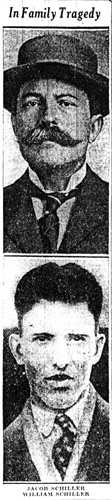
JACOB SCHILLER WILLIAM SCHILLER
Jobless Son Kills Jake Schiller Who Saves Boy’s Wife From Gun
Camden Evening Courier —
SLAYER CRAZED BY SEPARATION, RELATIVES SAY
Dazedly Insists He Had No Intention of Shooting Sire
ESTRANGED WIFE SEEN IN SUICIDE TRY
Slain Man Long Was Prominent Figure in Camden Politics
Jacob Schiller, 72, for 45 years a political figure here, is dead, shot by his own son.
The slayer, William Schiller, 30, a former summer policeman now unemployed, was held over today to the grand jury on a charge of murder. He made no comment whatever during his police court hearing.
A few hours later, young Schiller’s wife, Augusta, whom he had also tried to shoot, was found wandering through the city street, in a hysterical condition.
She had written a note which police believed showed intent to commit suicide, and had staggered dazedly through the streets last night. Both in her note and in her incoherent statements to detectives she declared she was to blame for the tragedy.
She said her father-in-law had tried to save her and was killed in the attempt.
The slaying occurred Saturday night at the elder Schiller’s home, 2420 Carman Street. It climaxed an estrangement between young Schiller and his wife, with “Jake” Schiller attempting to reconcile the couple.
Mrs. William Schiller, who had had her husband arrested several months ago, said she believed he had become mentally deranged, but Police Judge Pancoast was informed that an alienist had examined young Schiller in July and pronounced him sane.
Couple Separated
Young Schiller had been living with his father at the Carman Street address, while Mrs. Schiller has been residing with her parents, Mr. and Mrs. John I. Green, 409 North Thirty-seventh Street. The cause of the estrangement has not been revealed by police, but it is stated that young Schiller refused to consent to a reconciliation.
“Jake” Schiller was a Republican worker in the Twelfth ward for years, and was at the time of his death inspector of city street lights.
Were Alone at Home
The father and son were at home 9:00 p.m. Saturday night and apparently were quarreling when the young Mrs. Schiller, her brother-in-law and sister, Mr. and Mrs. William Miller and another sister, Mrs. Lottie Bennehler, reached the house.
“Don’t come in here,” the older Schiller shouted as they started to enter the front sun parlor. But Miller did enter and said young Schiller was clutching a revolver in his right hand. He declared he closed in on his brother-in-law and tried to wrench the revolver from him. Two shots rang out and the father fell to the floor.
Patrolman Joseph Keefe was standing at Twenty-fifth and Federal Streets when two boys ran up and told him there was a shooting at Twenty-fifth and Carman Street. He ran to the scene and said he reached there in time to see young Schiller shooting up the street at his wife.
Keefe said Schiller ran into the house when he saw him. Aided by Miller, Keefe overpowered Schiller and placed an iron claw on his right hand after disarming him.
Jacob Schiller Jr., another son, learning of the shooting, went to his father’s home and took him to Cooper Hospital in a passing automobile. As he was being taken into the hospital he failed to recognize City Detective Robert Ashenfelter and died five minutes later.
Expresses No Regret
Police Sergeant John Potter joined Keefe and Miller and they took young Schiller to police headquarters.
Keefe said the son expressed no regret at shooting his father.
At about 5 a.m. today, Policeman Keefe was patrolling his “beat” when he passed the Schiller home on Carman Street. He noticed the front door was standing open, and he went inside to investigate.
The officer saw a note on a smoking stand. Picking it up, he read:
“Dear Everybody:
“Please forgive me … You have all been so wonderful … But I couldn’t go on to see you all suffer for what is my fault … Lottie was right … He killed his father because of insane love for me … But he didn’t. I killed Pop and now am sending Bibs to jail for my weakness.
“Tell him I love him and ask my poor mother and dad to forgive me. I should have done this long ago and saved everyone all this suffering … I love Billy and I know he loves me but I am afraid he has been turned against me. But I forgive him for all.
“Gussie”
“Gussie” is Mrs. Schiller.
Finds ‘Gussie’ Hysterical
Keefe ran to Federal Street, but could not see Mrs. Schiller.
Meanwhile, Constable Dugan of the Twelfth Ward, saw Mrs. Schiller walking on Federal Street near the Cooper River. She was mumbling to herself and was in a hysterical condition, Dugan said.
Dugan telephoned police headquarters. City Detectives Rox Saponare and Maurice DeNicoli went out Federal Street and took her back with them to detective headquarters. There they sought to quiet her, but she continually sobbed.
“I want to take the blame—if I hadn’t gone to Pop’s home he would be living now.”
“Pop wanted to save me,” she said. “and he was shot. I can’t eat or sleep. I think I’m going crazy.”
Later, she was permitted to return to the home.
Young Schiller had been held in the city jail over the weekend. Today he was taken into police court. He wore no necktie and carried a raincoat over his arm. He was represented by counsel, C. Lawrence Gregorio, who said he had been retained “by friends” to act as attorney for the accused man.
City detective Benjamin Simon had signed the complaint in which he charged “on information received” that Schiller did feloniously and with malice aforethought shoot and kill his father.
The complaint was read to him and Gregorio told him not to say anything, as Judge Pancoast would enter a plea of “not guilty” in his behalf. This was done by the court and Schiller was then held without bail pending grand jury action. He was taken to the county jail.
Declared Sane
After the hearing, Mrs. Etta C. Pfrommer, acting overseer of the poor, told Judge Pancoast that on July 26, Dr. Harry Jarrett, Broadway and Cherry Street, well known alienist, had examined young Schiller and declared him sane. The examination was made on the request of Mrs. Schiller in police court on the previous day. At that time young Schiller had been released by the court in the custody of his father.
County Detective Chief Lawrence T. Doran, who was among the first to question young Schiller Saturday night, said the man did not seem repentant over what he had done. He said Schiller did not give authorities much information. According to Doran, young Schiller declared he had objected frequently to his father that he did not want his wife to come to their home.
“It doesn’t seem possible,” said young Mrs. Schiller some hours after the tragedy. “It seems as though it was only a dream. I don’t seem to remember anything.
“Poor Bill. He must have been crazy. He idolized his father. You can blame this all on the depression. He has been without work since they eliminated summer policemen two years ago. He has been worried as a result of being unable to obtain work. Just recently he started to drink.
“Bill intended to shoot me but his father tried to get the gun away from him and I believe it went off accidentally. Nothing could convince me that Bill would shoot his father in cold blood.
“I went to his father’s home last night to try to effect a reconciliation with my husband. He had been drinking.”
Registered as Sober
The police docket at headquarters shows Schiller registered as sober. The entry was not made until 2:15 a.m., and the shooting occurred shortly after 9:30 p.m.
Relatives said the father had attempted for months to patch up the marital difficulties of the couple.
Young Schiller had been living lately with his sister, Mrs. Bennehler, 2530 Bank Street and his wife with her parents at 409 North Thirty-seventh Street. He formerly lived at that address with his wife. He was appointed a summer policeman in 1929 and served until they were all dismissed two years ago.
Coroner Holl and Dr. Edward B. Rogers, county physician, yesterday performed an autopsy on the senior Schiller’s body and ascertained that death was due to an internal hemorrhage caused by a bullet wound of the upper portion of the abdomen. They said a .32-calibre revolver had been used in the shooting.
Camden Lodge of Elks will hold services tomorrow night at the Schiller home, at which time the body will be on view. The funeral will be private on Wednesday with burial in Evergreen Cemetery.
Judge Pancoast last night recalled that young Schiller was arrested two months ago after he had kept his wife a prisoner on a lot all night. At that time “Jake,” as he was affectionately known to his friends, tried to act as a mediator between his son and daughter-in-law.
The young Mrs. Schiller at that time told Pancoast she believed her husband was deranged and asked permission to have him examined by physicians she would name. Pancoast released young Schiller in the custody of his father. The police judge said the examination had apparently not been made as no commitment papers had been sent through his office.
Few political workers were better known than “Jake” Schiller. He was born in Philadelphia and was brought to Camden in early life by his parents, who conducted a saloon near Twenty-third and Federal Streets. East Camden was then the town of Stockton and the scene of Saturday night’s shooting was a farm. Schiller recalled to friends that he drove cows through a pasture on which his house now stands.
He was originally a Democrat but became a Republican through persuasion of the late U. S. Senator David Baird and remained a friend of the former leader for 40 years.
Schiller had been melancholy over the death of his wife on February 13 last, friends said.
When his son was arrested he remarked to Pancoast: “What is next?”
Figured in Shaw Case
None was more in the public eye 35 years ago in South Jersey than Schiller. It was then that he figured prominently in one phase of the locally celebrated Shaw murder trial.
It was during the second trial of Eli Shaw for the murder of his mother and grandmother, Mrs. Anna Shaw and Mrs. Emma Zane. They were found shot to death in September, 1897, in their bedroom of their home on Line Street near Third. Detective John Painter had found a revolver hidden in the chimney, one of several points in the circumstantial evidence that resulted in the indictment of Shaw. He was then a widely known young man about town and his arrest caused a big sensation. As time drew near for the trial feeling was intense, for there were adherents for and against the son and grandson, those arguments often grew bitter.
Henry Sidney Scovel, then one of the prominent criminal lawyers of Camden county, was retained to defend Shaw. Scovel was son of James Matlack Scovel, himself one of the leading barristers of this section. When the trial of Shaw was under way the city was astounded when it was charged Scovel had tampered with the jury. It was Schiller who made the charge.
The trial stopped abruptly. Scovel emphatically denied the story of Schiller and demanded vindication. An indictment for embracery was returned and at a trial, which had Camden on the tip toe of expectancy for days, it developed there was absolutely nothing to verify the charge, and Scovel was acquitted. He acted in two subsequent trials of Shaw, the second being a disagreement and the third acquittal for the son and grandson of the slain women.
Schiller, strangely enough, in later years became friendly with Scovel and when the latter was prosecutor from 1905 to 1912, “Jake,” as he was familiarly known, was usually to be found in the office at the courthouse. Scovel was then a white haired man of flowery speech and impressive personality who let bygones be bygones.
Long Excise Inspector
For more than 20 years Schiller was inspector of the Excise Commission in Camden. It was during the days when the principal object of the inspector apparently was to keep the saloonmen in line. He was considered pretty good at that job, by no means an unimportant one from the organization viewpoint. It was also during that period the city had its troubles enforcing the Sunday liquor laws. There were those who considered they had enough pull to keep their back or side doors open on the Sabbath to let in their regular thirsty trade. Some succeeded in getting by, but “Jake” had his own troubles in keeping the boys straight and sometimes causing their arrest, although that was not frequent by any means.
His reign as inspector, too, was in the halcyon days of free lunch and schooner beers. Saloonmen themselves were against the lunch idea eventually since it meant too much of a financial burden. Jake kept tabs on the recalcitrants so that the liquor dealers knew who was obeying the order and who was “cutting corners” to get some extra trade.
Schiller was virtually raised with the saloon trade since his father was one of the old time German beer garden owners here, having had a place at Fourth and Line Streets. That was in the days when that section was largely populated by the German, English and Irish families lately come from the motherlands. When he was a boy, Schiller entered the U. S. Navy and served several years. When he came out he went to the old Town of Stockton, now East Camden, where he opened a saloon on Federal Street near Twenty-fourth. At that period, some 45 years ago, Stockton seethed with politics and it was just as natural for a young man to get into the game as it was for a duck to swim. Jake at that period was a Democrat and during the battle in the middle 90’s when the West Jersey Traction and the Camden Horse Railway Company were fighting for the rail franchises in the town he was a candidate for council from the old Second Ward. The late Robert Lee was the Republican candidate and won out by the narrow margin of two votes. In later years Schiller became a Republican and was elected a constable.
Never Ran From Scrap
Throughout his career Schiller never quite forgot his training in the navy, particularly with reference to boxing or fighting at the drop of a hat. He was a scrapper in his early years and never ran from a fight. That was just as true in political battles, frequent then around the polls, as in purely personal matters. And Jake would battle for a friend just as readily as for any personal reason. He was usually in the thick of the political fracases of the years when it was the accepted thing to fight at the drop of a hat. But he also had lots of native wit which kept things interesting when he was a frequenter of the prosecutors’ office during the Scovel and Wolverton regimes. In late years, with the approach of age, he had tempered his propensity to get into an argument and liked nothing more than to tell of “the good old days” when he helped the elder Baird in his organization battles.
He made his last political stand for leadership of the Twelfth Ward in 1926 when he supported the candidacy of Sergeant Ray Smith against Commissioner Clay W. Reesman for ward committeeman. Schiller was supporting Congressman Charles A. Wolverton and the late Senator Joseph H. Forsyth in a campaign against former Congressman Francis F. Patterson and State Senator Albert S. Woodruff.
Reesman won and among the first to visit the hospital after learning of the shooting was the city commissioner. Reesman was his latest chief as lights inspector as he was attached to the highway department. Commissioner Frank B. Hanna also visited the hospital.
“In all the years I have known him he has always been an enthusiastic and loyal friend with a good heart for everybody in trouble,” Congressman Wolverton said when he learned of Schiller’s death.
Schiller was also a familiar figure at the Elks Club, where he was an ardent card player. But after the death of his wife he gave up this pastime, contenting himself with watching the games. He was also a frequent visitor among old friends at the courthouse.
Post and Courier parallel
Camden Courier-Post —


Mergers, shifting management mark early years
By STEPHEN M. O’KEEFE
Former Courier-Post Editor
As partners in establishing the Daily Post, Henry L. Bonsall and his son, Bartram L., also were witnesses to the founding of the Courier, first as a weekly in Haddonfield (April, 1878) then its transfer to Camden (July, 1879) and the beginning of the Courier as a daily on June 2, 1882.
The man who started the Courier was also a printer, Charles H. Whitecar, who had been employed by the elder Bonsall on the New Republic.
The son of a Methodist minister, Whitecar called his paper the Haddonfield Courier, then changed it to the Camden County Courier when he moved it to Camden in the summer of 1879. He had been publishing in the city only about three months when he was run over by a train at Haddonfield on Oct. 9. He died five days later at age 24.
WHITECAR HAD financial difficulties and occasionally the Post would speculate about whether he would fail. After his death, the paper was acquired by Sheriff William Cahoun and former Sheriff Jacob C. Daubman. They retained the name of Camden County Courier. The address listed as 132 Federal St., in May, 1880.
The paper was purchased by F. F. Patterson Sr. in September, 1880, and through that transaction it became identified with a family that figured prominently in New Jersey’s history for 78 years, from 1848 to 1926. Patterson made a daily of the Courier.
Frank Ford Patterson Sr. was a seasoned newspaperman when he acquired the County Courier. He continued issuing it on Saturdays with nine columns on each of four pages, compared to the six columns on each of the Post’s four pages. But the Post earned more revenue by printing each afternoon, except Sunday.
ON JUNE 2, 1882, Patterson started the daily. The Camden Daily Courier was circulated in the city while the County Courier was distributed in the outlying areas. The weekly was discontinued in 1884.
Patterson’s eldest son, Theodore N., was first associated in the Courier venture as business manager. The father was editor and top hand in the printing shop. Ownership of the paper was vested in the Courier Publishing Company, and Patterson shared control of the firm with John H. McMurray and Thomas C. Hamilton, as of Feb. 1, 1883.
Patterson, with the Courier, and Bonsall, with the Post, plodded along parallel lines during the next five years.
THE NEXT major event was in 1888, when George A. Frey came from Philadelphia to purchase the Courier. Associated with Frey were V.L. Cavanna and at least one other. Little is recorded about them, and Frey soon after appeared as the sole owner. In that role, he was credited with prudent management of the paper for more than 30 years.
Frey had worked on a newspaper in Pittsburgh and published a grocery business sheet in Philadelphia. In Camden, he became progressively identified with organizations dedicated to thrift, property acquisitions and banking. He served as Camden city treasurer for about 17 years and became president of a leading bank.
According to the talk around Camden, more than $18 million in municipal funds passed through Frey’s hands. Yet his accounts were always correct to the penny. Frey also had a reputation for punctuality. People used to say that when he was sighted strolling briskly to the old City Hall on Haddon Avenue a watch could be set at 8:58 a.m. and that he would take a seat at his desk at the stroke of 9.
IN HIS DRESS, Frey favored Prince Albert attire. The princely appearance was complete with his white mane, pointed mustache and neatly trimmed goatee. He owned a variety of canes. He was a firm believer in the value of walking and his trim figure relfected [sic] the benefits of that pastime.
Frey was a member of the state Board of Education and showed a steady interest in Bordentown Industrial Institute.
At the start of the Frey saga, Post and Bonsall had both experienced some troubles. One incident concerned the sale of a half-interest in the paper from father to son Aug. 1, 1883.
It is likely that expenses involved in equipping the plant at 116 Federal St. had drained the resources of Henry Bonsall and that Bartram drew upon his own savings to meet the costs. In any event, The Post Printing and Publishing Company was organized in 1886 with Bartram as secretary, Henry Bonsall, president, and Joseph M. Engrad, treasurer.
BONSALL HAD contracted for a new building, with a stone front, on the northeast corner of Front and Federal Streets. This was built and occupied in October 1887. Within two years a new press was purchased.
The Post continued to issue from the Front and Federal Street plant until June 12, 1899, when it was consolidated with the Camden Daily Telegram. The conbination [sic] was the Camden Post-Telegram. A major feature of the deal was the city’s first telegraphic news service.
James M. Fitzgerald, a stormy figure in the news field and politics, and Alvah M. Smith, a pipe-smoking writer, started the Telegram Feb. 24, 1886, at 95 Federal St. They were Democrats and offered some competition to the Republican Courier and Post.
They arranged for installation of a Morse apparatus with a wire connected to the Baltimore & Ohio Railroad Company cable.
IN LAUNCHING their enterprise, Fitzgerald and Smith decided to have news items sent as telegrams from correspondents in several key cities. In line with their plan, they selected Telegram as the name for the paper.
Fitzgerald has been described as a vigorous, intelligent and free-swinging journalist who delighted in aiming at a political target and walloping away with worlds [sic].
Smith, more careful and patient than Fitzgerald, spent about seven months with the Telegram and in September sold his one-third interest to his partner.
FRANCIS F. PATTERSON JR.
GEORGE A. FREY Courier Publisher until 1919
YEARS LATER, around 1916, Smith was hired by Frey and occupied a desk in the Camden Daily Courier newsroom alongside Ben Courter, an editorial writer. Ben was the second of four generations of Courters in the Courier-Post annals. His father, John D., started the strain in the 1870s, while his son, John D. and grandson, Robert, are included in the centennial roster of the Courier-Post.
After Smith’s separation from the Telegram the paper declined. Control shifted to John H. Fort the same month Smith quit. Fort was a newspaperman, lawyer, orator, historian and politician. With the Telegram, he added publisher to his titles.
Fort had his law office at his home, 311 Market St., and he moved the paper there, too. He changed the name to Daily Telegram and in 1888 formed the Telegram Publishing Company.
He enlisted Upton S. Jefferys, as secretary-treasurer, and Thomas C. Hamilton, as business manager. The latter two severed connections in 1890 and purchased the Saturday Evening Express, with an office at 211 Market St. but which was printed in Philadelphia.
AFTER THE 1888 sale of the Courier by his father, F.F. Patterson Jr. became a reporter on the Baltimore Herald. He was advancing to a desk position but accepted the city editorship of the Daily Telegram instead.
He was successively identified with the brief excitement that attended the Morning News and General Advertiser, another inovation [sic] of James M. Fitzgerald, and the Sunday Review, which was established by his brother, Theodore N. Patterson, in 1889.
In the fall of 1891, F.F. Patterson Jr. became New Jersey editor of the Philadelphia Record. He resigned in September, 1894, to take over the Camden Daily Telegram.
THAT CHANGE helped save the Telegram from complete failure. It had been subjected to several mutations and was handicapped by poor equipment. Worse, it was described as financially weak.
The paper was purchased by a group of Republican Party leaders who elected F.F. Patterson Jr. as president of the Camden Daily Telegram Company. He quickly discarded old type and badly-worm [sic] mechanical equipment and installed the first linotype machines ever used on a Camden newspaper.
Patterson’s father and brothers assisted in restoring the Telegram to a position of profit and influence in about two years. Theodore N. Patterson had disposed of the Sunday Review in 1892 to a syndicate financed by William J. Thompson, racetrack chieftain famed as the “Duke of Gloucester.”
AFTER THOMPSON put up the money to acquire the Sunday Review, it was changed from an independent Republican journal to a Democratic daily paper on Sept. 6, 1892. Harry B. Paul became publisher. The first editor was George M. Todd, perviously [sic] of the Elizabeth Herald. He was succeeded by Charles Bowman, who sprayed excitement over the political scene both in New Jersey and Pennsylvania.
Expenses and debts plagued the paper. On Feb. 13, 1894, it was subject to levy by Sheriff George Barrett and sold to William J. Paul. The Review was one of four daily newspapers in Camden, until it ceased publication Dec. 11, 1902. The others, the Post, Courier and Telegram, all were Republican sheets.
The Post and Telegram were consolidated June 12, 1899.
The Telegram was a livlier [sic] paper with the energy of the Pattersons devoted to it daily. The Post was noticeably slower, and the merger was considered to be in the best interest of Bonsall’s journal. It had been going along for nearly nine years without one of its mainsprings, since the death on Nov. 11, 1890, of Bartram Bonsall.
THE COMBINED papers appeared under the masthead of the Camden Post-Telegram, with Bonsall and his partner, Engard, teamed with F.F. Patterson Jr. and his brother, Theodore, as principals. Bonsall became the editor but died in 1900, at 66. He was replaced by Upton Jefferys, who resigned as New Jersey editor of the Philadelphia Inquirer.
Engard also died with a short time. The stock of both Bonsall and Engard was acquired by W. L. Patterson, then secretary-treasurer of the Post-Telegram Company. When the latter retired he was succeeded by Frank F. Patterson 3rd, who a quarter century was destined to be the last Patterson in a position of eminence in journalism.
The Courier and Post-Telegram continued an untroubled rivalry, each publishing 10, 12 and 16 pages, up to the end of 1919. The Post-Telgram [sic] occupied the row of buildings west of 2nd Street, at 139 Federal, while the Courier enjoyed more space since the transfer from 132
Stern the maverick publisher cuts in
Camden Courier-Post —
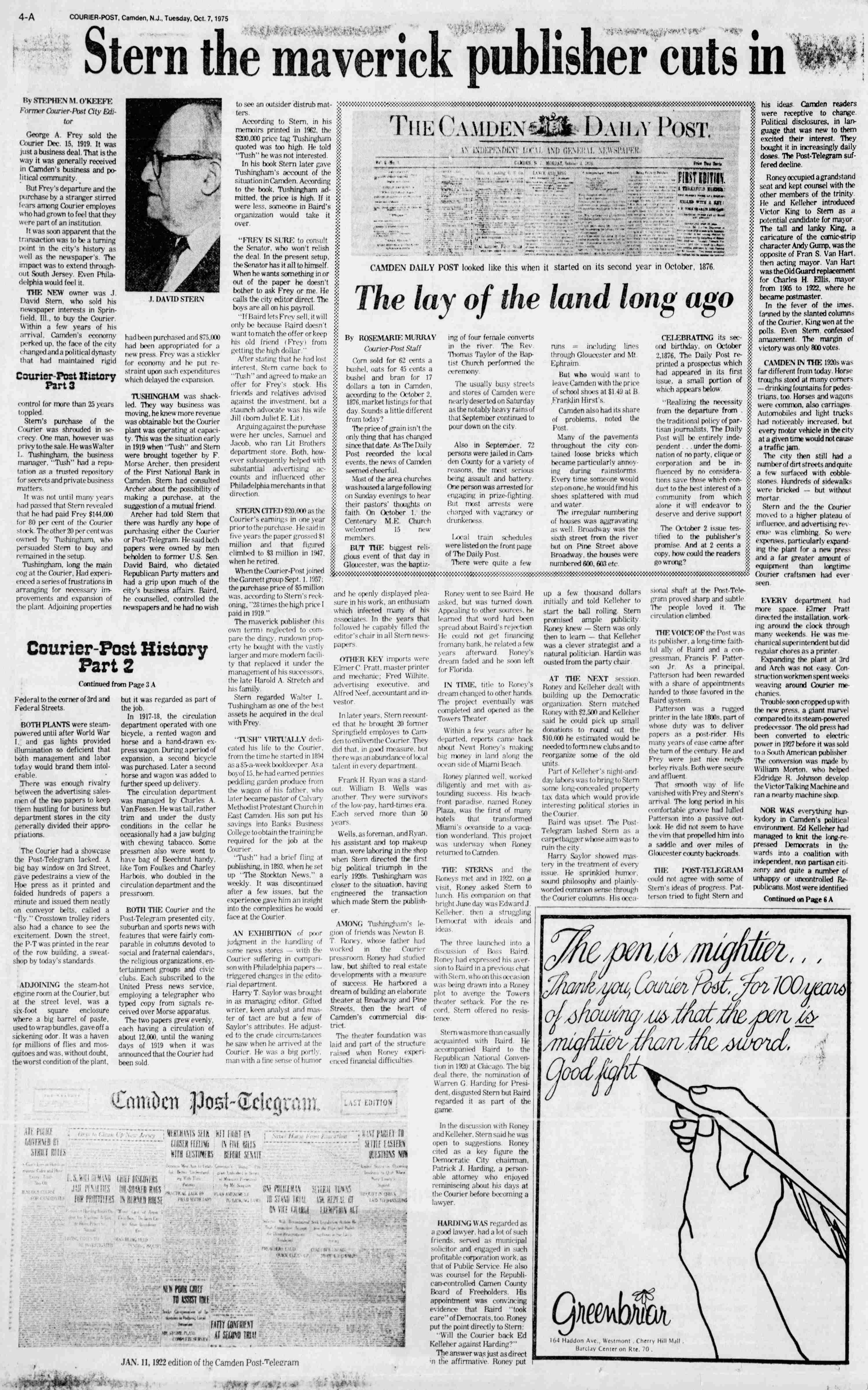

By STEPHEN M. O’KEEFE
Former Courier-Post City Editor
George A. Frey sold the Courier Dec. 15, 1919. It was just a business deal. That is the way it was generally received in Camden’s business and political community.
But Frey’s departure and the purchase by a stranger stirred fears among Courier employes who had grown to feel that they were part of an institution.
It was soon apparent that the transaction was to be a turning point in the city’s history as well as the newspaper’s. The impact was to extend throughout South Jersey. Even Philadelphia would feel it.
THE NEW owner was J. David Stern, who sold his newspaper interests in Springfield, Ill., to buy the Courier. Within a few years of his arrival, Camden’s economy perked up, the face of the city changed and a political dynasty that had maintained rigid control for more than 25 years toppled.
Stern’s purchase of the Courier was shrouded in secrecy. One man, however was privy to the sale. He was Walter L. Tushingham, the business manager. “Tush” had a reputation as a trusted repository for secrets and private business matters.
It was not until many years had passed that Stern revealed that he had paid Frey $144,000 for 80 per cent of the Courier stock. The other 20 per cent was owned by Tushingham, who persuaded Stern to buy and remained in the setup.
Tushingham, long the main cog at the Courier, had experienced a series of frustrations in arranging for necessary improvements and expansion of the plant. Adjoining properties had been purchased and $75,000 had been appropriated for a new press. Frey was a stickler for economy and he put restraint upon such expenditures which delayed the expansion.
TUSHINGHAM was shackled. They [sic] way business was moving, he knew more revenue was obtainable but the Courier plant was operating at capacity. This was the situation early in 1919 when “Tush” and Stern were brought together by F. Morse Archer, then president of the First National Bank in Camden. Stern had consulted Archer about the possibility of making a purchase, at the suggestion of a mutual friend.
Archer had told Stern that there was hardly any hope of purchasing either the Courier or Post-Telegram. He said both papers were owned by men beholden to former U.S. Sen. David Baird, who dictated Republican Party matters and had a grip upon much of the city’s business affairs. Baird, he counselled, controlled the newspapers and he had no wish to see an outsider distrub [sic] matters.
According to Stern, in his memoirs printed in 1962, the $200,000 price tag Tushingham quoted was too high. He told “Tush” he was not interested.
In his book Stern later gave Tushingham’s account of the situation in Camden. According to the book, Tushingham admitted, the price is high. If it were less, someone in Baird’s organization would take it over.
“FREY IS SURE to consult the Senator, who won’t relish the deal. In the present setup, the Senator has it all to himself. When he wants something in or out of the paper he doesn’t bother to ask Frey or me. He calls the city editor direct. The boys are all on his payroll.
“If Baird lets Frey sell, it will only be because Baird doesn’t want to match the offer or keep his old friend (Frey) from getting the high dollar.”
After stating that he had lost interest, Stern came back to “Tush” and agreed to make an offer for Frey’s stock. His friends and relatives advised against the investment, but a staunch advocate was his wife Jill (born Juliet E. Lit).
Arguing against the purchase were her uncles, Samuel and Jacob, who ran Lit Brothers department store. Both, however subsequently helped with substantial advertising accounts and influenced other Philadelphia merchants in that direction.
STERN CITED $20,000 as the Courier’s earnings in one year prior to the purchase. He said in five years the paper grossed $1 million and that figured climbed to $3 million in 1947, when he retired.
When the Courier-Post joined the Gannett group Sept. 1, 1957; the purchase price of $5 million was, according to Stern’s reckoning, “28 times the high price I paid in 1919.”
The maverick publisher (his own term) neglected to compare the dingy, rundown property he bought with the vastly larger and more modern facility that replaced it under the management of his successors, the late Harold A. Stretch and his family.
Stern regarded Walter L. Tushingham as one of the best assets he acquired in the deal with Frey.
“TUSH” VIRTUALLY dedicated his life to the Courier, from the time he started in 1894 as a $5-a-week bookkeeper. As a boy of 15, he had earned pennies peddling garden produce from the wagon of his father, who later became pastor of Calvary Methodist Protestant Church in East Camden. His son put his savings into Banks Business College to obtain the training he required for the job at the Courier.
“Tush” had a brief fling at publishing, in 1893, when he set up “The Stockton News,” a weekly. It was discontinued after a few issues, but the experience gave him an insight into the complexities he would face at the Courier.
AN EXHIBITION of poor judgment in the handling of some news stories — with the Courier suffering in comparison with Philadelphia papers — triggered changes in the editorial department.
Harry T. Saylor was brought in as managing editor. Gifted writer, keen analyst and master of tact are but a few of Saylor’s attributes. He adjusted to the crude circumstances he saw when he arrived at the Courier. He was a big portly man with a fine sense of humor and he openly displayed pleasure in his work, an enthusiam [sic] which infected many of his associates. In the years that followed he capably filled the editor’s chair in all Stern newspapers.
OTHER KEY imports were Elmer C. Pratt, master printer and mechanic; Fred Wilhite, advertising executive, and Alfred Neef, accountant and investor.
In later years, Stern recounted that he brought 20 former Springfield employes to Camden to enliven the Courier. They did that, in good measure, but there was an abundance of local talent in every department.
Frank H. Ryan was a standout. William B. Wells was another. They were survivors of the low-pay, hard-times era. Each served more than 50 years.
Wells, as foreman, and Ryan, his assistant and top makeup man, were laboring in the shop when Stern directed the first big political triumph in the early 1920s. Tushingham was closer to the situation, having engineered the transaction which made Stern the publisher.
AMONG Tushingham’s legion of friends was Newton B. T. Roney, whose father had worked in the Courier pressroom. Roney had studied law, but shifted to real estate developments with a measure of success. He harbored a dream of building an elaborate theater at Broadway and Pine Streets, then the heart of Camden’s commercial district.
The theater foundation was laid and part of the structure raised when Roney experienced financial difficulties.
Roney went to see Baird. He asked, but was turned down. Appealing to other sources, he learned that word had been spread about Baird’s rejection. He could not get financing from any bank, he related a few years afterward. Roney’s dream faded and he soon left for Florida.
IN TIME, title to Roney’s dream changed to other hands. The project eventually was completed and opened as the Towers Theater.
Within a few years after he departed, reports came back about Newt Roney’s making big money in land along the ocean side of Miami Beach.
Roney planned well, worked diligently and met with astounding success. His beachfront paradise, named Roney Plaza, was the first of many hotels that transformed Miami’s oceanside to a vacation wonderland. This project was underway when Roney returned to Camden.
THE STERNS and the Roneys met and in 1922, on a visit, Roney asked Stern to lunch. His companion on that bright June day was Edward J. Kelleher, then a struggling Democrat with ideals and ideas.
The three launched into a discussion of Boss Baird. Roney had expressed his aversion to Baird in a previous chat with Stern, who on this occasion was being drawn into a Roney plot to avenge the Towers theater setback. For the record, Stern offered no resistence [sic].
Stern was more than casually acquainted with Baird. He accompanied Baird to the Republican National Convention in 1920 at Chicago. The big deal there, the nomination of Warren G. Harding for President, disgusted Stern but Baird regarded it as part of the game.
In the discussion with Roney and Kelleher, Stern said he was open to suggestions. Roney cited as a key figure the Democratic City chairman, Patrick J. Harding, a personable attorney who enjoyed reminiscing about his days at the Courier before becoming a lawyer.
HARDING WAS regarded as a good lawyer, had a lot of such friends, served as municipal solicitor and engaged in such profitable corporation work, as that of Public Service. He also was counsel for the Republican-controlled Camen [sic] County Board of Freeholders. His appointment was convincing evidence that Baird “took care” of Democrats, too. Roney put the point directly to Stern:
“Will the Courier back Ed Kelleher against Harding?”
The answer was just as direct in the affirmative. Roney put up a few thousand dollars initially and told Kelleher to start the ball rolling. Stern promised ample publicity. Roney knew — Stern was only then to learn — that Kelleher was a clever strategist and a natural politician. Hardin [sic] was ousted from the party chair.
AT THE NEXT session, Roney and Kelleher dealt with building up the Democratic organization. Stern matched Roney with $2,500 and Kelleher said he could pick up small donations to round out the $10,000 he estimated would be needed to form new clubs and to reorganize some of the old units.
Part of Kelleher’s night-and-day labors was to bring to Stern some long-concealed property tax data which would provide interesting political stories in the Courier.
Baird was upset. The Post-Telegram lashed Stern as a carpetbagger whose aim was to ruin the city.
Harry Saylor showed mastery in the treatment of every issue. He sprinkled humor, sound philosophy and plainly-worded common sense through the Courier columns. His occasional shaft at the Post-Telegram proved sharp and subtle. The people loved it. The circulation climbed.
THE VOICE OF the Post was its publisher, a long-time faithful ally of Baird and a congressman, Francis F. Patterson Jr. As a principal, Patterson had been rewarded with a share of appointments handed to those favored in the Baird system.
Patterson was a rugged printer in the late 1800s, part of whose duty was to deliver papers as a post-rider. His many years of ease came after the turn of the century. He and Frey were just nice neighborley [sic] rivals. Both were secure and affluent.
That smooth way of life vanished with Frey and Stern’s arrival. The long period in his comfortable groove had lulled Patterson into a passive outlook. He did not seem to have the vim that propelled him into a saddle and over miles of Gloucester county backroads.
THE POST-TELEGRAM could not agree with some of Stern’s ideas of progress. Patterson tried to fight Stern and his ideas. Camden readers were receptive to change. Political disclosures, in language that was new to them excited their interest. They bought it in increasingly daily doses. The Post-Telegram suffered decline.
Roney occupied a grandstand seat and kept counsel with the other members of the trinity. He and Kelleher introduced Victor King to Stern as a potential candidate for mayor. The tall and lanky King, a caricature of the comic-strip character Andy Gump, was the opposite of Fran [sic] S. Van Hart, then acting mayor. Van Hart was the Old Guard replacement for Charles H. Ellis, mayor from 1905 to 1922, where he became postmaster.
In the fever of the imes [sic], fanned by the slanted columns of the Courier, King won at the polls. Even Stern confessed amazement. The margin of victory was only 800 votes.
CAMDEN IN THE 1920s was far different from today. Horse troughs stood at many corners — drinking fountains for pedestrians, too. Horses and wagons were common, also carriages. Automobiles and light trucks had noticeably increased, but every motor vehicle in the city at a given time would not cause a traffic jam.
The city then still had a number of dirt streets and quite a few surfaced with cobblestones. Hundreds of sidewalks were bricked — but without mortar.
Stern and the the [sic] Courier moved to a higher plateau of influence, and advertising revenue was climbing. So were expenses, particularly expanding the plant for a new press and a far greater amount of equipment than longtime Courier craftsmen had ever seen.
EVERY department had more space. Elmer Pratt directed the installation, working around the clock through many weekends. He was mechanical superintendent but did regular chores as a printer.
Expanding the plant at 3rd and Arch was not easy. Construction workmen spent weeks weaving around Courier mechanics.
Trouble soon cropped up with the new press, a giant marvel compared to its steam-powered predecessor. The old press had been converted to electric power in 1927 before it was sold to a South American publisher. The conversion was made by William Morton, who helped Eldridge R. Johnson develop the Victor Talking Machine and ran a nearby machine shop.
NOR WAS everything hunkydory in Camden’s political environment. Ed Kelleher had managed to knit the long-repressed Democrats in the wards into a coalition with independent, non partisan citizenry and quite a number of unhappy or uncontrolled Republicans. Most were identified with the Non-Partisan League and they were feeling their oats. The practical Roney and Kelleher, however, knew they had merely reached first base.
The two men huddled with Stern and came up with an idea — campaign for a new form of government for the city. The plan was worked out expertly, emphasizing the advantages of a compact, five-man governing group, each member accountable to voters all over the city.
The new plan was kept secret for a while. It was embodied in an exhaustive survey for the council by Mayor King. The new mayor startled the Old Guard and the city at large by calling for a referendum on a City Commission form of government. The speech prompted an abundance of favorable copy in the Courier; not so favorable comment in the Post-Telegram.
IN MARCH, 1923, the change was approved. In May, the voters elected the entire Non-Partisan League ticket. This put Baird and his organization out of business for the first time in 25 years.
Stern and the Courier were the chief beneficiaries of the change. The publisher — and now politician — was to know the stress of carrying water on both shoulders.
Patterson and the Post-Telegram were to feel the worst effect. With the downward turn of fortune, a frustrating decline in advertising and circulation revenues, the P-T was a loser each day.
STERN CALCULATED the advantages in buy [sic] the Post-Telegram, but Patterson wouldn’t consider a deal with Stern. He approached Baird and asked for a loan needed to fight Stern. Baird said he wanted Patterson to keep the competition and suggested a smaller loan. The Post publisher wouldn’t agree.
“The full amount or nothing,” Patterson declared.
Baird matched his stubbornness. Back in the office Patterson shared his misery with Upton S. Jefferys, the editor, and Frank S. Albright, city editor. Upton owned five shares of P-T stock. He and Albright had given their best efforts for many years, but the outlook was bleak.
THIS WAS the situation when Patterson saw Ed Kelleher enter the office. The two were not strangers, but Patterson had little reason to regard him warmly.
Kelleher came right out with an offer to buy the Post-Telegram. Patterson replied with equal candor:
“You know that I know, Ed, that you don’t have anough [sic] money to buy this paper.”
Kelleher put a hand in a coat pocket and was about to inform Patterson that he had come prepared to negotiate.
“I’m sure I know who you represent,” Patterson stated. “My answer is no.”
KELLEHER DREW a check from his pocket and placed it before Patterson. The publisher took a quick glance at the amount. It was $75,000. He then summoned his son, Frank F. Patterson 3d.
“Here, Frank, you’re the treasurer here; this is your department.”
Kelleher thought he was hearing a change of attitude by Patterson. The younger Patterson stared at both men. He glanced at both sides of the check as would an accountant, then turned to his parent.
“What am I supposed to do with this, Father?” he asked.
THE REPLY was intended for Kelleher:
“You are supposed to tear it up and throw the pieces in the waste basket, Son.”
Young Patterson obeyed.
Keleher [sic] accepted the gestured [sic] as finale. One minute later he was walking along Federal Street to the Courier building to report to Stern.
J. DAVID STERN
JAN. 11, 1922 edition of the Camden Post-Telegram
The lay of the land long ago
By ROSEMARIE MURRAY
Courier-Post Staff
Corn sold for 62 cents a bushel, oats for 45 cents a bushel and bran for 17 dollars a ton in Camden, according to the October 2, 1876, market listings for that day. Sounds a little different from today?
The price of grain isn’t the only thing that has changed since that date. As The Daily Post recorded the local events, the news of Camden seemed cheerful.
Most of the area churches was [sic] housed a large following on Sunday evenings to hear their pastors’ thoughts on faith. On October 1, the Centenary M.E. Church welcomed 15 new members.
BUT THE biggest religious event of that day in Gloucester, was the baptizing of four female converts in the river. The Rev. Thomas Taylor of the Baptist Church performed the ceremony.
The usually busy streets and stores of Camden were nearly deserted on Saturday as the notably heavy rains of that September continued to pour down on the city.
Also in September, 72 persons were jailed in Camden County for a variety of reasons, the most serious being assault and battery. One person was arrested for engaging in prize-fighting. But most arrests were charged with vagrancy or drunkeness [sic].
Local train schedules were listed on the front page of The Daily Post.
There were quite a few runs — including lines through Gloucester and Mt. Ephraim.
But who would want to leave Camden with the price of school shoes at $1.49 at B. Franklin Hirst’s.
Camden also had its share of problems, noted the Post.
Many of the pavements throughout the city contained loose bricks which became particularly annoying during rainstorms. Every time someone would step on one, he would find his shoes splattered with mud and water.
The irregular numbering of houses was aggravating as well. Broadway was the sixth street from the river but on Pine Street above Broadway, the houses were numbered 600, 603 etc.
CELEBRATING its second birthday, on October 2, 1876, The Daily Post reprinted a prospectus which had appeared in its first issue, a small portion of which appears below:
“Realizing the necessity from the departure from the traditional policy of partisan journalists, The Daily Post will be entirely independent . . . under the domination of no party, clique or corporation and be influenced by no considerations save those which conduct to the best interest of a community from which alone it will endeavor to deserve and derive support.”
The October 2 issue testified to the publisher’s promise. And at 2 cents a copy, how could the readers go wrong?
CAMDEN DAILY POST looked like this when it started on its second year in October, 1876.
Courier-Post History Part 2
Federal to the corner of 3rd and Federal Streets.
BOTH PLANTS were steam-powered until after World War I, and gas lights provided illumination so deficient that both management and labor today would brand them intolerable.
There was enough rivalry between the advertising salesmen of the two papers to keep them hustling for business but department stores in the city generally divided their appropriations.
The Courier had a showcase the Post-Telegram lacked. A big bay window on 3rd Street, gave pedestrains [sic] a view of the Hoe press as it printed and folded hundreds of papers a minute and issued them neatly on conveyor belts, called a “fly.” Crosstown trolley riders also had a chance to see the excitement. Down the street, the P-T was printed in the rear of the row building, a sweatshop by today’s standards.
ADJOINING the steam-hot engine room at the Courier, but at the street level, was a six-foot square enclosure where a big barrel of paste, used to wrap bundles, gave off a sickening odor. It was a haven for millions of flies and mosquitoes and was, without doubt, the worst condition of the plant, but it was regarded as part of the job.
In 1917-18, the circulation department operated with one bicycle, a rented wagon and horse and a hand-drawn express wagon. During a period of expansion, a second bicycle was purchased. Later a second horse and wagon was added to further speed up delivery.
The circulation department was managed by Charles A. Van Fossen. He was tall, rather trim and under the dusty conditions in the cellar he occasionally had a jaw bulging with chewing tabacco [sic]. Some pressmen also were wont to have bag of Beechnut handy, like Tom Foulkes and Charley Harbois, who doubled in the circulation department and the pressroom.
BOTH THE Courier and the Post-Telegram presented city, suburban and sports news with features that were fairly comparable in columns devoted to social and fraternal calendars, the religious organizations, entertainment groups and civic clubs. Each subscribed to the United Press news service, employing a telegrapher who typed copy from signals received over Morse apparatus.
The two papers grew evenly, each having a circulation of about 12,000, until the waning days of 1919 when it was announced that the Courier had been sold.
Night rider takes on carpetbagger
Camden Courier-Post —
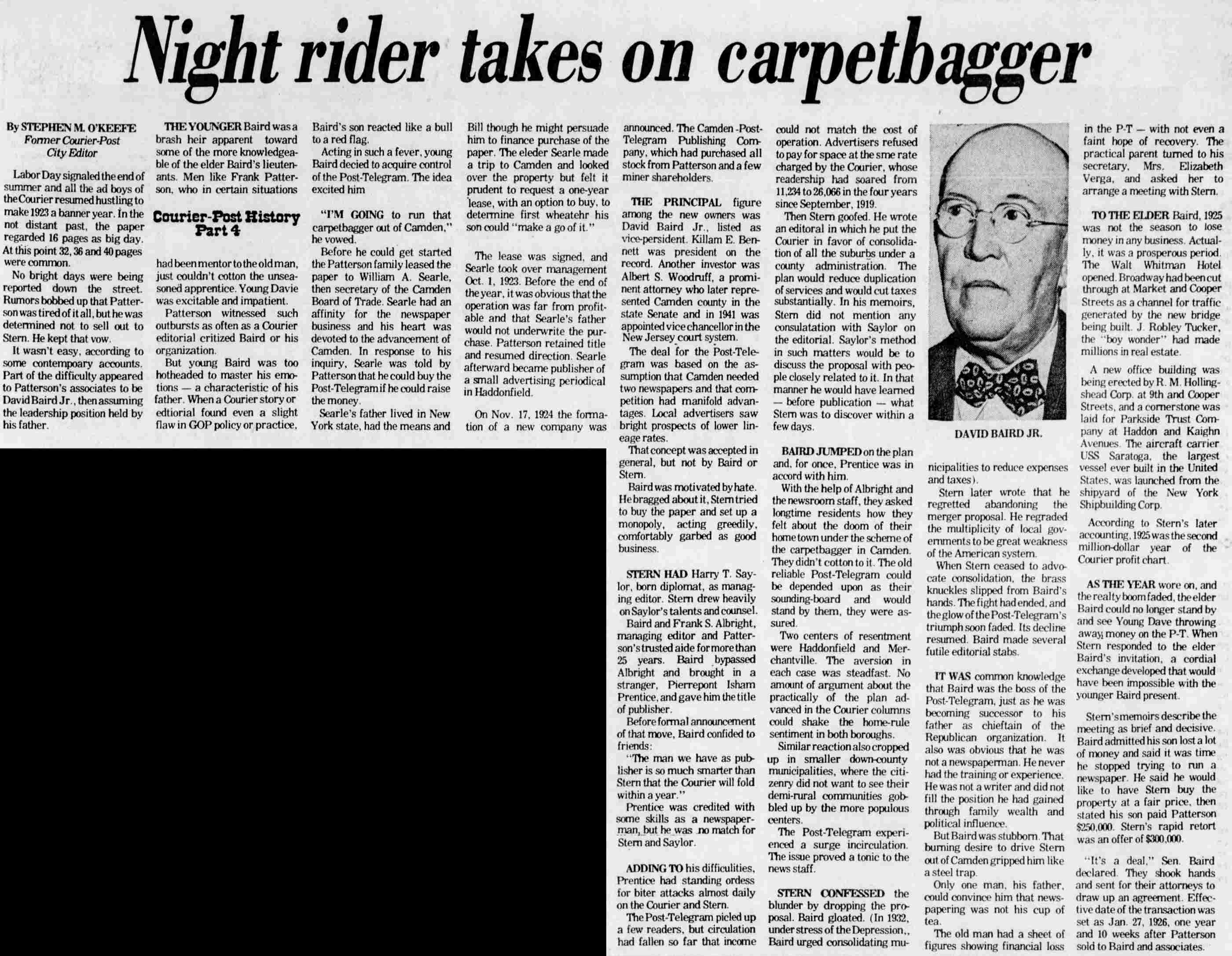
By STEPHEN M. O’KEEFE
Former Courier-Post City Editor
Labor Day signaled the end of summer and all the ad boys of the Courier resumed hustling to make 1923 a banner year. In the not distant past, the paper regarded 16 pages as big day. At this point 32, 36 and 40 pages were common.
No bright days were being reported down the street. Rumors bobbed up that Patterson was tired of it all, but he was determined not to sell out to Stern. He kept that vow.
It wasn’t easy, according to some contempoary [sic] accounts. Part of the difficulty appeared to Patterson’s associates to be David Baird Jr., then assuming the leadership position held by his father.
THE YOUNGER Baird was a brash heir apparent toward some of the more knowledgeable of the elder Baird’s lieutenants. Men like Frank Patterson, who in certain situations had been mentor to the old man, just couldn’t cotton the unseasoned apprentice. Young Davie was excitable and impatient.
Patterson witnessed such outbursts as often as a Courier editorial critized [sic] Baird or his organization.
But young Baird was too hotheaded to master his emotions — a characteristic of his father. When a Courier story or edtiorial [sic] found even a slight flaw in GOP policy or practice, Baird’s son reacted like a bull to a red flag.
Acting in such a fever, young Baird decied [sic] to acquire control of the Post-Telegram. The idea excited him
“I’M GOING to run that carpetbagger out of Camden,” he vowed.
Before he could get started the Patterson family leased the paper to William A. Searle, then secretary of the Camden Board of Trade. Searle had an affinity for the newspaper business and his heart was devoted to the advancement of Camden. In response to his inquiry, Searle was told by Patterson that he could buy the Post-Telegram if he could raise the money.
Searle’s father lived in New York state, had the means and Bill though he might persuade him to finance purchase of the paper. The eleder [sic] Searle made a trip to Camden and looked over the property but felt it prudent to request a one-year lease, with an option to buy, to determine first wheatehr [sic] his son could “make a go of it.”
The lease was signed, and Searle took over management Oct. 1, 1923. Before the end of the year, it was obvious that the operation was far from profitable and that Searle’s father would not underwrite the purchase. Patterson retained title and resumed direction. Searle afterward became publisher of a small advertising periodical in Haddonfield.
On Nov. 17, 1924 the formation of a new company was announced. The Camden-Post-Telegram Publishing Company, which had purchased all stock from Patterson and a few miner [sic] shareholders.
THE PRINCIPAL figure among the new owners was David Baird Jr., listed as vice-persident [sic]. Killam E. Bennett was president on the record. Another investor was Albert S. Woodruff, a prominent attorney who later represented Camden county in the state Senate and in 1941 was appointed vice chancellor in the New Jersey court system.
The deal for the Post-Telegram was based on the assumption that Camden needed two newspapers and that competition had manifold advantages. Local advertisers saw bright prospects of lower lineage rates.
That concept was accepted in general, but not by Baird or Stern.
Baird was motivated by hate. He bragged about it, Stern tried to buy the paper and set up a monopoly, acting greedily, comfortably garbed as good business.
STERN HAD Harry T. Saylor, born diplomat, as managing editor. Stern drew heavily on Saylor’s talents and counsel.
Baird and Frank S. Albright, managing editor and Patterson’s trusted aide for more than 25 years. Baird bypassed Albright and brought in a stranger, Pierrepont Isham Prentice, and gave him the title of publisher.
Before formal announcement of that move, Baird confided to friends:
“The man we have as publisher is so much smarter than Stern that the Courier will fold within a year.”
Prentice was credited with some skills as a newspaperman, but he was no match for Stern and Saylor.
ADDING TO his difficulties, Prentice had standing ordess [sic] for biter [sic] attacks almost daily on the Courier and Stern.
The Post-Telegram picled [sic] up a few readers, but circulation had fallen so far that income could not match the cost of operation. Advertisers refused to pay for space at the sme [sic] rate charged by the Courier, whose readership had soared from 11,234 to 26,066 in the four years since September, 1919.
Then Stern goofed. He wrote an editoral [sic] in which he put the Courier in favor of consolidation of all the suburbs under a county administration. The plan would reduce duplication of services and would cut taxes substantially. In his memoirs, Stern did not mention any consulatation [sic] with Saylor on the editorial. Saylor’s method in such matters would be to discuss the proposal with people closely related to it. In that manner he would have learned — before publication — what Stern was to discover within a few days.
BAIRD JUMPED on the plan and, for once, Prentice was in accord with him.
With the help of Albright and the newsroom staff, they asked longtime residents how they felt about the doom of their home town under the scheme of the carpetbagger in Camden. They didn’t cotton to it. The old reliable Post-Telegram could be depended upon as their sounding-board and would stand by them, they were assured.
Two centers of resentment were Haddonfield and Merchantville. The aversion in each case was steadfast. No amount of argument about the practically of the plan advanced in the Courier columns could shake the home-rule sentiment in both boroughs.
Similar reaction also cropped up in smaller down-county municipalities, where the citizenry did not want to see their demi-rural communities gobbled up by the more populous centers.
The Post-Telegram experienced a surge inciruclation [sic]. The issue proved a tonic to the news staff.
STERN CONFESSED the blunder by dropping the proposal. Baird gloated. (In 1932, under stress of the Depression, Baird urged consolidating municipalities to reduce expenses and taxes).
Stern later wrote that he regretted abandoning the merger proposal. He regraded [sic] the multiplicity of local governments to be great weakness of the American system.
When Stern ceased to advocate consolidation, the brass knuckles slipped from Baird’s hands. The fight had ended, and the glow of the Post-Telegram’s triumph soon faded. Its decline resumed. Baird made several futile editorial stabs.
IT WAS common knowledge that Baird was the boss of the Post-Telegram, just as he was becoming successor to his father as chieftain of the Republican organization. It also was obvious that he was not a newspaperman. He never had the training or experience. He was not a writer and did not fill the position he had gained through family wealth and political influence.
But Baird was stubborn. That burning desire to drive Stern out of Camden gripped him like a steel trap.
Only one man, his father, could convince him that newspapering was not his cup of tea.
The old man had a sheet of figures showing financial loss in the P-T — with not even a faint hope of recovery. The practical parent turned to his secretary, Mrs. Elizabeth Verga, and asked her to arrange a meeting with Stern.
TO THE ELDER Baird, 1925 was not the season to lose money in any business. Actually, it was a prosperous period. The Walt Whitman Hotel opened. Broadway had been cut through at Market and Cooper Streets as a channel for traffic generated by the new bridge being built. J. Robley Tucker, the “boy wonder” had made millions in real estate.
A new office building was being erected by R. M. Hollingshead Corp. at 9th and Cooper Streets, and a cornerstone was laid for Parkside Trust Company at Haddon and Kaighn Avenues. The aircraft carrier USS Saratoga, the largest vessel ever built in the United States, was launched from the shipyard of the New York Shipbuilding Corp.
According to Stern’s later accounting, 1925 was the second million-dollar year of the Courier profit chart.
AS THE YEAR wore on, and the realty boom faded, the elder Baird could no longer stand by and see Young Dave throwing away money on the P-T. When Stern responded to the elder Baird’s invitation, a cordial exchange developed that would have been impossible with the younger Baird present.
Stern’s memoirs describe the meeting as brief and decisive. Baird admitted his son lost a lot of money and said it was time he stopped trying to run a newspaper. He said he would like to have Stern buy the property at a fair price, then stated his son paid Patterson $250,000. Stern’s rapid retort was an offer of $300,000.
“It’s a deal,” Sen. Baird declared. They shook hands and sent for their attorneys to draw up an agreement. Effective date of the transaction was set as Jan. 27, 1926, one year and 10 weeks after Patterson sold to Baird and associates.
DAVID BAIRD JR.
Will Notify Camden Registered Men Tuesday
Philadelphia Inquirer —
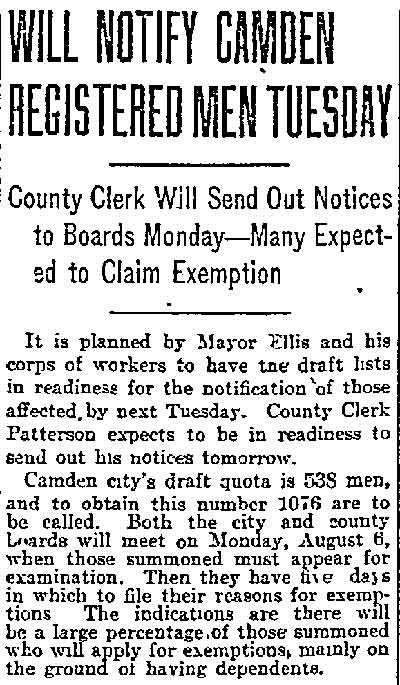
County Clerk Will Send Out Notices to Boards Monday—Many Expected to Claim Exemption
It is planned by Mayor Ellis and his corps of workers to have the draft lists in readiness for the notification of those affected, by next Tuesday. County Clerk Patterson expects to be in readiness to send out his notices tomorrow.
Camden city’s draft quota is 538 men, and to obtain this number 1076 are to be called. Both the city and county boards will meet on Monday, August 6, when those summoned must appear for examination. Then they have five days in which to file their reasons for exemptions. The indications are there will be a large percentage of those summoned who will apply for exemptions, mainly on the ground of having dependents.
Obituary: S. Conrad Ott
West Jersey Press —
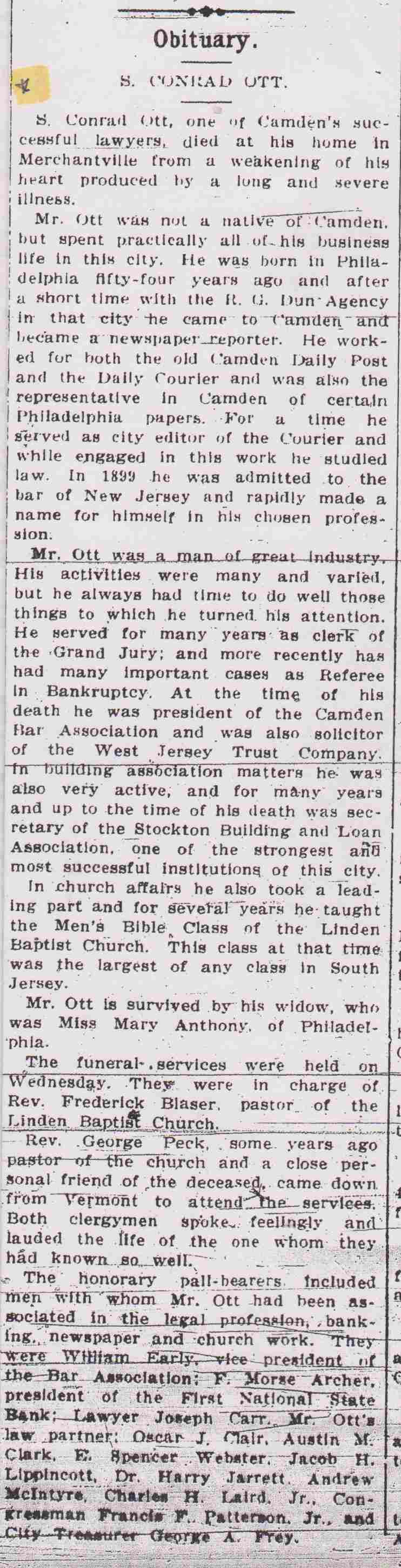
S. Conrad Ott, one of Camden’s successful lawyers, died at his home in Merchantville from a weakening of his heart produced by a long and severe illness.
Mr. Ott was not a native of Camden, but spent practically all of his business life in this city. He was born in Philadelphia fifty-four years ago and after a short time with the R. G. Dun Agency in that city he came to Camden and became a newspaper reporter. He worked for both the old Camden Daily Post and the Daily Courier and was also the representative in Camden of certain Philadelphia papers. For a time he served as city editor of the Courier and while engaged in this work he studied law. In 1899 he was admitted to the bar of New Jersey and rapidly made a name for himself in his chosen profession.
Mr. Ott was a man of great industry. His activities were many and varied, but he always had time to do well those things to which he turned his attention. He served for many years as clerk of the Grand Jury; and more recently has had many important cases as Referee in Bankruptcy. At the time of his death he was president of the Camden Bar Association and was also solicitor of the West Jersey Trust Company. In building association matters he was also very active, and for many years and up to the time of his death was secretary of the Stockton Building and Loan Association, one of the strongest and most successful institutions of this city.
In church affairs he also took a leading part and for several years he taught the Men’s Bible Class of the Linden Baptist Church. This class at that time was the largest of any class in South Jersey.
Mr. Ott is survived by his widow, who was Miss Mary Anthony, of Philadelphia.
The funeral services were held on Wednesday. They were in charge of Rev. Frederick Blaser, pastor of the Linden Baptist Church.
Rev. George Peck, some years ago pastor of the church and a close personal friend of the deceased, came down from Vermont to attend the services. Both clergymen spoke feelingly and lauded the life of the one whom they had known so well.
The honorary pall-bearers included men with whom Mr. Ott had been associated in the legal profession, banking, newspaper and church work. They were William Early, vice president of the Bar Association; F. Morse Archer, president of the First National State Bank; Lawyer Joseph Carr, Mr. Ott’s law partner; Oscar J. Clair, Austin M. Clark, E. Spencer Webster, Jacob H. Lippincott, Dr. Harry Jarrett, Andrew McIntyre, Charles H. Laird, Jr., Congressman Francis F. Patterson, Jr., and City Treasurer George A. Frey.