George Byron Wade
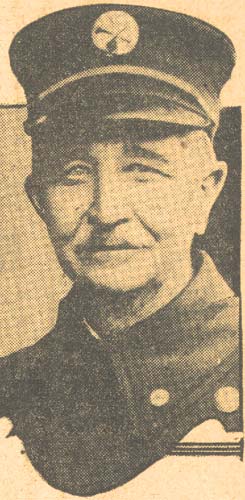
George B. Wade
GEORGE BYRON WADE was born in Philadelphia in 1860 to Francis Henry Wade and his wife, the former Sophia DuPutron. George B. Wade married Mary Ann Burns in March of 1879 in Philadelphia. The Wades came to Camden in 1885, George B. Wade then was working as a sheet metal worker. George Wade was appointed a city fireman on March 16, 1892. He was soon assigned to Engine Company 2. In 1894 the personnel of this unit was as follows: Foreman Harry C. Grosscup; Engineer, William Morris; Driver, John P. Long; Stoker Albert Jones; hosemen George Wade, William Hertline, and David Andrews.
George Wade was made Captain of Engine Company 2 at 5th and Arch Street in 1899. At that time he was living with his wife and children at 1323 Broadway. The family had moved to 503 Spruce Street by 1910. During the mid 1910s his son, George Clay Wade, was appointed to the Camden Fire Department. He served until April 1, 193…
George B. Wade was made battalion chief in 1924, and also served as the city fire marshal before his January 1, 1928 retirement. George B. Wade was injured and taken to hospital on 10 different occasions while fighting fires in Camden and the surrounding vicinity.
At the time of the 1920 census, George B. Wade lived at 503 Cherry Street in South Camden. His neighbors included Mayor Charles H. Ellis, stationary store owner Charles Devaull, and City Clerk William D. Brown, who all lived in the 900 block of South 5th Street.
George B. Wade died on August 29, 1935 at his home, 111 North 26th Street, Camden NJ. He is buried at Arlington Cemetery in Pennsauken NJ. His wife joined him in 1952. A grandson, George Byron Wade III, was also a career Camden firefighter, serving over 32 years before retiring in July of 1975.
Tossed From an Engine
Philadelphia Inquirer —
One of Camden’s Brave Firemen Hurt While on Duty.
George Wade, an extra driver of Engine Company No. 2, of Camden Fire Department, had his left leg broken and was otherwise seriously injured yesterday while responding to an alarm. Wade was driving the engine, and while going at rapid speed up Second street above Cooper, one of the horses shied at a trolley car. A front wheel of the engine struck the curb, and Wade was thrown from his seat.
As he fell one of the wheels ran over his left leg, crushing it just below the thigh. He was removed to the Cooper Hospital. Engineer Jacob Kellum took Driver Wade’s place on the engine.
The fire was at the Temple College Academy, at 534 Penn Street. It was caused by a gasoline stove, and was extinguished with a loss of $100, covered by insurance.
“Ned,” the horse that caused the accident, will be disposed of.
Could Not Agree on New Fireman
Philadelphia Inquirer —
Camden Councilmen From East Side Split on Selecting Appointees
There Is Also Trouble in the Second Ward — Benjamin Kellum Made Assistant Chief — Other Promotions
The Camden Fire Commissioners last evening selected firemen for the five new fire companies from all the wards except the Second, Eleventh and Twelfth, as the Councilmen in these wards could not agree on the candidates the appointments were laid over until Monday evening next.
In the Second ward the Councilmen have agreed on John W. Vanhart. The other candidates are W. Scott Franklin, backed by Freeholder Whyte, and Edgar Bolton, who is the choice of Mayor Hatch and Councilman McGill. Bolton will probably be selected.
In the Eleventh ward a meeting was held by the Councilmen and the candidates agreed upon. Councilman Arnold has since repudiated the agreement, and last evening presented a new set of names to the conference of the commissioners. Councilman Longacre presented those previously agreed upon.
In the Twelfth ward Councilman Lee submitted names in opposition to those of Councilman Leas. It is quite probable that the choice of Councilmen Leas and Longacre, who are members of the Fire Committee, will be selected.
Benjamin Kellum, foreman of Truck No. 1, was appointed assistant chief. He will have charge of the East Side companies.
Charles Robinson, of the Seventh ward; George B. Wade, of the Sixth ward; Albert Jones, of the Ninth ward; George Cox, of the Third ward; Edward Weston, of the Ninth ward, and Samuel Peoples, of the Fifth ward, were elected foremen. They will be assigned to their posts of duty on Monday.
The selection of new firemen was as follows: First ward, Harry B. Middleton, Harry Burroughs; Third ward, Robert W. Colkett, William G. Hillman; Fourth ward, James E. Navins, Charles Todd; Fifth ward, Daniel Smith, Peter B. Carter; Sixth ward, Alfred Hayden, Henry Elliott; Seventh ward, Josiah Sage, Samuel Price; Eighth ward, William Rose, Charles Sturgis; Ninth ward, Daniel Grimes, Harry Wagner; Tenth ward, Augustus Kester, William Simpson.
The commissioners presented the bell now in the William Penn hose house, East Side, to the First Baptist Church.
Want to Be Firemen
Philadelphia Inquirer —
There’ll Be Trouble in Finding Places for All Hands
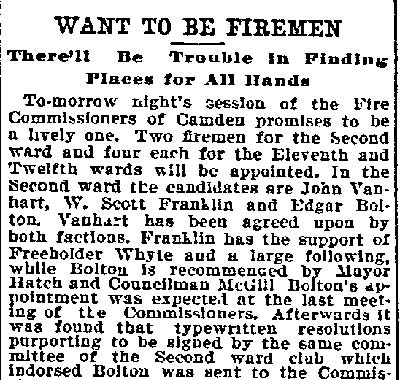
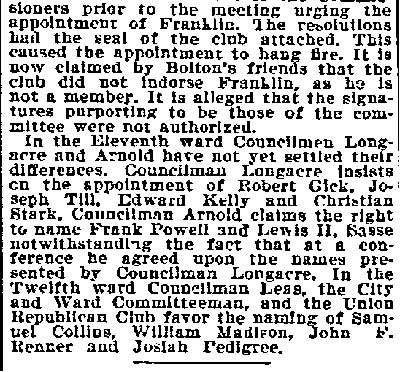
To-morrow night’s session of the Fire Commissioners of Camden promises to be a lively one. Two firemen for the Second ward and four each for the Eleventh and Twelfth wards will be appointed. In the Second ward the candidates are John Vanhart, W. Scott Franklin and Edgar Bolton. Vanhart has been agreed upon by both factions. Franklin has the support of Freeholder Whyte and a large following, while Bolton is recommended by Mayor Hatch and Councilman McGill. Bolton’s appointment was expected at the last meeting of the Commissioners. Afterwards it was found that typewritten resolutions purporting to be signed by the same committee of the Second ward club which indorsed Bolton was sent to the Commissioners prior to the meeting urging the appointment of Franklin. The resolutions had the seal of the club attached. This caused the appointment to hang fire. It is now claimed by Bolton’s friends that the club did not indorse Franklin, as he is not a member. It is alleged that the signatures purporting to be those of the committee were not authorized.
In the Eleventh ward Councilmen Longacre and Arnold have not yet settled their differences. Councilman Longacre insists on the appointment of Robert Gick, Joseph Till, Edward Kelly and Christian Stark. Councilman Arnold claims the right to name Frank Powell and Lewis H. Sasse notwithstanding the fact that at a conference he agreed upon the names presented by Councilman Longacre. In the Twelfth ward Councilman Leas, the City and Ward Committeeman, and the Union Republican Club favor the naming of Samuel Collins, William Madison, John F. Renner and Josiah Pedigree.
Firemen Selected
Philadelphia Inquirer —
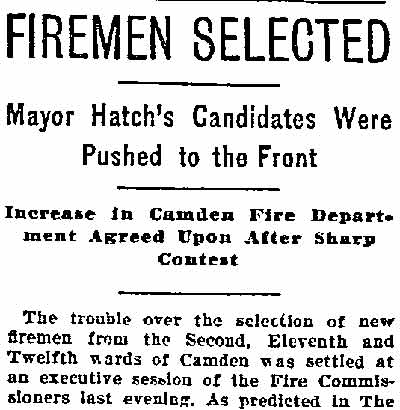
Mayor Hatch’s Candidates Were Pushed to the Front
Increase in Camden Fire Department Agreed Upon After Sharp Contest
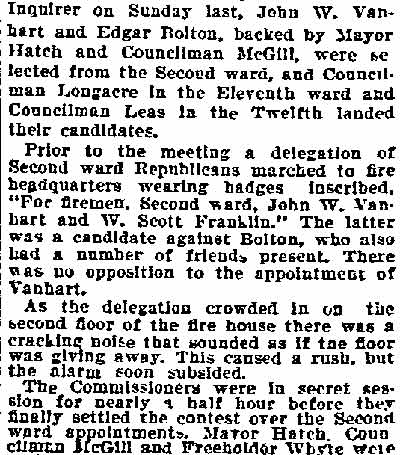
The trouble over the selection of new firemen from the Second, Eleventh and Twelfth wards of Camden was settled at an executive session of the Fire Commissioners last evening. John W. Vanhart and Edgar Bolton, backed by Mayor Hatch and Councilman McGill, were selected from the Second ward, and Councilman Longacre in the Eleventh ward and Councilman Leas in the Twelfth landed their candidates.
Prior to the meeting a delegation of Second ward Republicans marched to fire headquarters wearing badges inscribed, “For firemen, Second ward, John W. Vanhart and W. Scott Franklin.” The latter was a candidate against Bolton, who also had a number of friends present. There was no opposition to the appointment of Vanhart.
As the delegation crowded in on the second floor of the fire house there was a cracking noise that sounded as if the floor was giving away. This caused a rush, but the alarm soon subsided.
The Commissioners were in secret session for nearly a half hour before they finally settled the contest over the Second ward appointments. Mayor Hatch, Councilman McGill and Freeholder Whyte were each called before the Commissioners. The latter favored the appointment of Franklin. After the Second ward appointments were settled it did not take long to decide upon the new firemen from the Eleventh and Twelfth wards. Councilman Arnold, who has been opposing Councilman Longacre’s candidates in the Eleventh ward, was not present, neither was Councilman Lee, who was opposing the men backed by Councilman Leas in the Twelfth ward.
The men selected for firemen from these two wards are as follows: Eleventh ward, Robert Gich, Joseph Till, Edward Kelly and Christian Stark; Twelfth ward, Samuel Collins, William Madison, John Renner and Josiah Pedigree.
The following were promoted to foremen: George F. Cox, foreman Hook and Ladder Company No. 1; George Wade, Hook and Ladder Company No. 2; Samuel Peoples, Hook and Ladder Company No. 3; Charles Robinson, Chemical Engine Company No. 1; Edward Weston, Hose Company No. 1, East Side; Albert C. Jones, Hose Company No. 2, East Side.
The appointments, together with those made last Thursday evening, will be confirmed by City Council to-morrow night.
Camden Fire Department Postcard
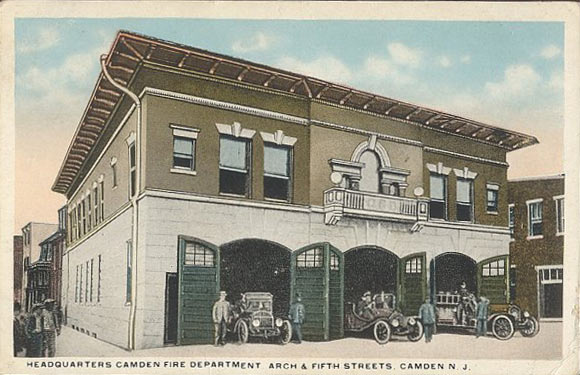
Camden Fire Department
Exciting Scenes Feature Big Fire
Philadelphia Inquirer —

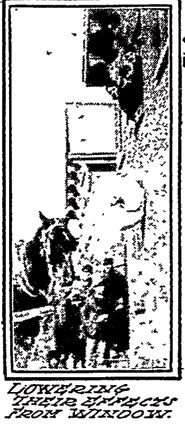
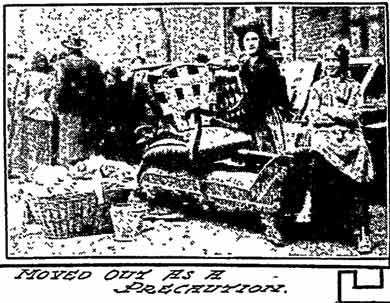
Conflagration in Paint and Varnish Works, in Camden, Resulted in Destruction of Much Valuable Property
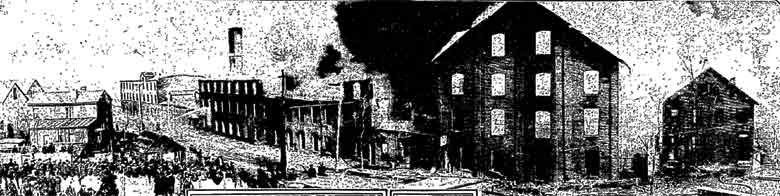
More than five hundred thousand dollars-worth of property destroyed, three persons seriously injured and half a score of families forced to flee from their homes were a few of the effects of a disastrous fire which yesterday swept its way through the big plant of the N. Z. Graves Paint and Varnish Company, on Twelfth street, Camden, between Linden and Federal streets.
It was the explosion of a mixing tank that caused the blaze, but no reason has yet been assigned for the explosion, and the only workman who was near the vat at the time is now lying in a critical condition at the Cooper Hospital.
Explosion followed explosion with the same deafening roar as that made by opposing batteries in a battle, and during the three hours when the fire raged its fiercest more than two hundred tanks blew up.
From the spectacular viewpoint the blaze was one of the greatest in years, owing to the chemical nature of the varnishes and paints which were destroyed. Flames mounted as high as two hundred feet in the air and could be plainly seen from Twenty-first and Market streets in this city.
Often as a vat exploded a dense mass of black smoke would mount high towards the heavens and then suddenly burst open like a huge pyrotechnic and out would come a large ball of flame. Then suddenly the whole building would seem to send up a solid square of flame that, after becoming lost in the clouds of smoke which hid the sky, would suddenly veer to the east or west and set fire to some small building.
Not the least of the curious sights was the throwing by the sun of a beautiful rainbow whose arch was easily one hundred feet long across a background of smoke. The sun had caught the spray from a fire hose and reflected it across the small buildings which had caught fire, but from which no flames came, there issued a dense cloud of red smoke which gradually changed to purple, then became white and finally black.
While all these explosions occurred and while the heat of the flames was so great that it singed the hair of persons on the opposite side of the street, thirty large tanks containing from five to ten thousand gallons of gasoline and benzine and located almost directly in the rear of the blazing buildings, remained unharmed, although it was momentarily feared that they, too, would explode.
All but one of the eight buildings of the Graves Company were either totally destroyed or so badly damaged that they will have to be rebuilt. Three houses were badly damaged and half a score of other houses scorched.
The persons injured were Joseph Pease, of 341 Kimball street, this city; George Ward, foreman of Fire Company No. 2, and Peter Gray, a fireman.
Pease was the workman who was near the vat at the time the first explosion occurred, and he was thrown high in the air and had his face, arms and body burned by the flames.
Ward was injured while leading his men in an attack upon the flames. He was mounting a ladder leading to the room of a dwelling at 316 Twelfth street when the cornice of the roof came off, fell and struck him on the head and caused an ugly wound of the scalp. Ward kept his hold upon the ladder and managed to descend. He was immediately hurried to the hospital.
Fireman Peter Gray was burned by the flaming benzine from a small tank which exploded.
Although one of the largest buildings resembled an enormous cauldron when they arrived upon the scene the Camden firemen, nothing discouraged, attacked the fire with vim, and while they could not confine it to the one building, they did splendid work in saving a number of small houses of workmen which surround the plant. They also saved one of the large buildings of the plant.
The police boats Ashbridge and Visitor, from this city, were sent to the fire, but were unable to get up Cooper Creek, which is in the rear of the plant, owing to the ice and mud. The Pennsylvania Railroad’s fire tug Jamestown, however, got to the plant and did effectual service.
Mayor Ellis was early upon the scene and had his hair singed while directing the firemen.
In Philadelphia great interest was taken in the fire, and at one time it looked as though all Camden were ablaze.
It was about half-past eleven yesterday morning that Pease, while working in what is known as building No. 1, at the Greaves plant, a large three-story brick structure, fifty by one hundred and twenty-five feet, was suddenly hurled from his feet by the explosion in a vat. Accounts differ as to what really occurred, but it is certain that there was an explosion. This building is used partly as an office building and partly to mix paints and varnishes.
For a minute the flames did not spread rapidly and a call was sent to the police headquarters for a chemical engine. By the time this apparatus arrived the whole building was on fire and a general alarm was sent in.
In the few moments elapsing between the call for the chemical engine and its arrival upon the scene several other explosions occurred and caused the employes to flee for their lives. There were only about fifty men, or one-third the regular force, working yesterday.
As soon as the firemen all arrived they tried to save building No. 5, which is of the same size and structure as the No. 1 building, but in which were stored one hundred and eight large vats of various kinds of varnish and paint, and all of them combustible.
Between the two buildings was a narrow archway, and over this the flames crept and defeated the efforts of the fire fighters. Then began the series of explosions that not only lit up the skies, but carried the fire to half a dozen dwelling houses.
These buildings are double houses and are two and one-half stories high. When the house at 306 Twelfth street caught fire all the other occupants of the row started to throw their household goods in the street, and in several cases the sparks set fire to bed clothing. Later in the day the residents, still fearful of their homes, secured wagons and carted their belongings away.
One man, James Demsey, when he found his house afire, thought only for a dozen of Plymouth Rock hens’ eggs which he had secured for the purpose of raising some chickens. Regardless of his danger he dashed into the burning building, secured the eggs, and then made his escape.
Prompt work by the firemen soon put an end to the flames which had attacked the dwellings, but against the blaze which raged in the two buildings of the paint works the fire fighters were helpless. It seemed that the more water was poured upon the buildings the wickeder the flames arose. Not until all the floors had fallen and everything burnable had been consumed did the flames cease their work of destruction, and the walls had been so scorched that half of them fell crashing into the interior of the buildings.
Besides the two large buildings the stable of the works caught fire but the employes of the plant were able to get all the horses and wagons out safely.
A. Graves, a son of the proprietor of the plant, stated that he did not know how great the loss would be nor could he tell exactly how the fire started. There is about $265,000 insurance upon the plant.
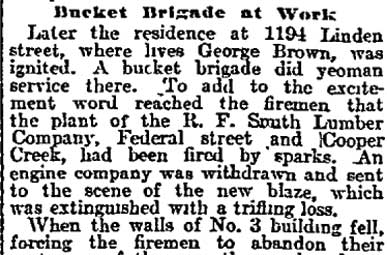
Later the residence at 1104 Linden street, where lives George Brown, was ignited. A bucket brigade did yeoman service there. To add to the excitement word reached the firemen that the plant of the R. F. Smith Lumber Company, Federal street and Cooper Creek, had been fired by sparks. An engine company was withdrawn and sent to the scene of the new blaze, which was extinguished with a trifling loss.
When the walls of No. 3 building fell, forcing the firemen to abandon their post, one of the recently purchased engines was left under the ruins. It wasn’t there long, however, a rope being attached and the steamer being pulled out by a hundred or so volunteers.
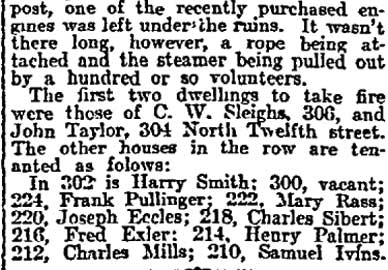
The first two dwellings to take fire were those of C. W. Sleighs, 306, and John Taylor, 304 North Twelfth street. The other houses in the row are tenanted as follows:
In 702 is Harry Smith; 300, vacant; 224, Frank Pullinger; 222, Mary Rass; 220, Joseph Eccles; 218, Charles Sibert; 216, Fred Exler; 214, Henry Palmer; 212, Charles Mills; 210, Samuel Ivins.
Wish Bone Club in Annual Banquet
Camden Post-Telegram —
WISH BONE CLUB IN ANNUAL BANQUET
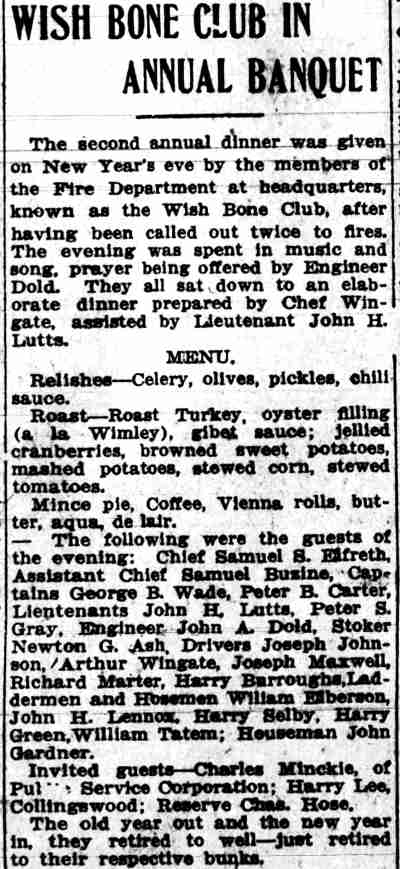
The second annual dinner was given on New Year’s eve by the members of the Fire Department at headquarters, known as the Wish Bone Club, after having been called out twice to fires. The evening was spent in music and song, prayer being offered by Engineer Dold. They all sat down to an elaborate dinner prepared by Chef Wingate, assisted by Lieutenant John H. Lutts.
MENU.
Relishes—Celery, olives, pickles, chilli sauce.
Roast—Roast Turkey, oyster filling (a la Wimley), giblet sauce; jellied cranberries, browned sweet potatoes, mashed potatoes, stewed corn, stewed tomatoes.
Mince pie, Coffee, Vienna rolls, butter, aqua de lair.
— The following were the guests of the evening: Chief Samuel S. Elfreth, Assistant Chief Samuel Buzine, Captains George B. Wade, Peter B. Carter, Lieutenants John H. Lutts, Peter S. Gray, Engineer John A. Dold, Stoker Newton G. Ash, Drivers Joseph Johnson, Arthur Wingate, Joseph Maxwell, Richard Marter, Harry Barroughs, Laddermen and Hosemen William Elberson, John H. Lennox, Harry Selby, Harry Green, William Tatem; Houseman John Gardner.
Invited guests—Charles Minckle, of Public Service Corporation; Harry Lee, Collingwood; Reserve Chas. Hose.
The old year out and the new year in, they retired to well—just retired to their respective bunks.
Flames Wrecked New High School
Philadelphia Inquirer —
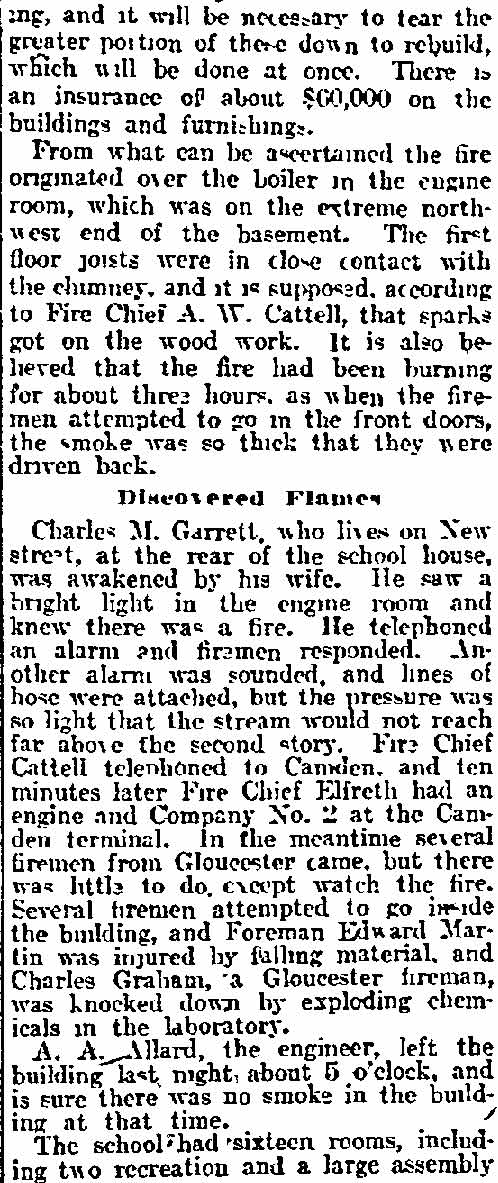
Walls Left of Handsome Building Erected at Woodbury Only a Short Time Ago
Believed Blaze Originated in Boiler Room by Joists Taking Fire, Pride of County Seat
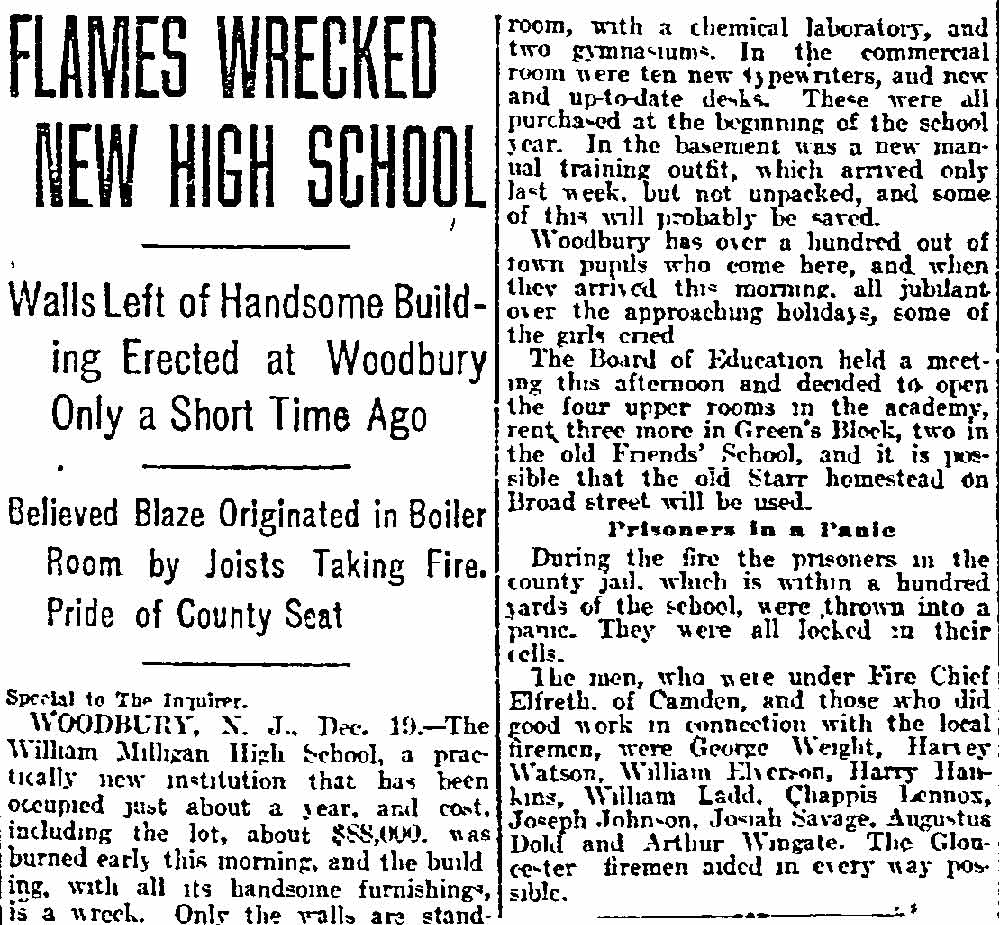
WOODBURY, N. J., Dec. 19.—The William Milligan High School, a practically new institution that has been occupied just about a year, and cost, including the lot, about $88,000, was burned early this morning, and the building, with all its handsome furnishings, is a wreck. Only the walls are standing, with a chemical laboratory, and two gymnasiums. In the commercial room were ten new typewriters, and new and up-to-date desks. These were all purchased at the beginning of the school year. In the basement was a new manual training outfit, which arrived only last week, but not unpacked, and some of this will probably be saved.
Woodbury has over a hundred out of town pupils who come here, and when they arrived this morning, all jubilant over the approaching holidays, some of the girls cried.
The Board of Education held a meeting this afternoon and decided to open the four upper rooms in the academy, rent three more in Green’s Block, two in the old Friends’ School, and it is possible that the old Starr homestead on Broad Street will be used.
During the fire the prisoners in the county jail, which is within a hundred yards of the school, were thrown into a panic. They were all locked in their cells.
The men, who were under Fire Chief Elfreth, of Camden, and those who did good work in connection with the local firemen, were George Weight, Harvey Watson, William Elverson, Harry Hankins, William Ladd, Chappis [sic] Lennox, Joseph Johnson, Josiah Savage, Augustus Dold and Arthur Wingate. The Gloucester firemen aided in every way possible.
Celebrations by 3 Fire Companies
Camden Post-Telegram —
No. 7, Headquarters and No. 1 Truck Make Merry at Respective Homes.
CHIEF ELFRETH MAKES ADDRESS
Engine Company No. 7 is the baby company of the fire department, that is, in years of service, but in up-to-date completeness in every respect, harmony and quick response to duty, the men in blue out Kaighn avenue, under Captain Charles Todd, are right there on the tap of the gong. Captain Todd is a stickler for good feeling among his men for the good of the service, and at a New Year’s Eve banquet this unanimity of good fellowship was strongly manifested.
It was the first New Year’s blowout given by Company 7 and the guests had as grand a time as if they were gathered about their own firesides at home. From door to roof, the firehouse was ablaze with a glow of the holiday and patriotic spirit. Flags, festoons of green, Christmas bells, and lights gladdened all hearts and a Christmas tree glistening with tinsel and topped with an electric bulb gave the banquet hall a homelike air. Over the tree was the gladsome greeting, “Merry Christmas and Happy New Year.”
Fifteen guests sat down to the festive board. In the centre of the table glowed in a big fireman’s horn a big bunch of electric lit American Beauties and from one end of the board to the other it was one sweep of delicacies, turkey, raw and fried oysters, stuffing chicken salad, cake, pie and a lot of other luxuries that make life happier as far as the inner man is concerned.
Chief Kelly presided at the head of the table and made a genial toastmaster. Chief Kelly supplied the electrical effects with his usual aptness. “Brother” Lutz said a short and timely prayer and then the guests sat down and for two hours were regaled with all the palatable good things of the season of good cheer. Cigars of pungent aroma being passed around, “Jim” Nevins and George Boone entertained delightfully with grapophone selections, including “Has Anyone Here Seen Kelly?” He was there.
With the midnight hour came the blowing of factory whistles and the tolling of bells. And from below in the firehouse came a terrific clangor and clash and gongs and bells. The firemen instinctively made for the sliding pole, but soon came back a-laughing. It was only Chief Kelly and Chief Chef Lutz ringing in the first alarm of the New Year, No. 1-9-1-3.
Those who had the great pleasure to participate in this most happy affair are as follows:
City Electrician John W. Kelly, Jr., Captain Charles Todd, Lieutenant John Lutz, Engineer William Busine, Stoker James Nevins, Drivers Richard Marter and Joseph Sparks, Hoseman George Boone, Roy Smith and Edward Simpson, and as welcome guests, Richard Saeur, John Watson, Albert Glanders, William Robinson and Harry Knowles, the faithful houseman of No. 7.
Chief Elfreth and Assistant Chiefs Cox, Stockton, Wade and Browning, were to have been there, but business on a holiday kept them at Headquarters awaiting alarms.
AT HEADQUARTERS.
Under the auspices of the Wishbone Club, firemen at headquarters, Fifth and Arch streets, held their annual dinner on Tuesday evening. Cheer and good-fellowship was the by word and the fire laddies and their friends made the evening one long to be remembered.
A short address was given by Chief Elfreth and Assistant Chief Stockton. John Dold offered prayer before the guests partook of the tasty dishes as prepared by Arthur Wingate and William Laud. The table presented an attractive appearance and the laddies and guests greatly enjoyed the fine spread. The menu follows:
Roast Sweet Potatoes, Peas, Cranberry Sauce, Mince Pie, Coffee, Cigars, Aqua De Lair, Olives, Beets, Celery, Roast Turkey, Oyster Filling, Giblet Sauce, Mashed White Potatoes.
Those participating were as follows: S. S. Elfreth, John S. Stockton, Captain George B. Wade, Lieutenant Jos. Ernest, John A. Dold, Josiah Sage, Daniel Smith, Arthur Wingate, Joseph Johnson, Harry Hankins, William Laird, William Elberson, John Lennox, Martin Carrigan, Charles Cook, Harry Belby, Harry Khrier, Charles Menke, Edward S. Gahan, D. P. McConnell.
With a fine feed, a grand graphophone concert, songs and speeches of a happy and humorous order, “the Jolly Nine” saw the old year out and the New Year in, at the house of Hook and Ladder Truck No. 1, on Fifth street above Arch street. Accoutred in their uniforms of blue, ready at a second’s tap of the gong to jump on the truck, the brave laddies and friends formed a happy picture of congeniality. The menu was most appetizing. Beginning with oysters on the shell and winding up with a delicious dish designated “Creme-a-la-Truck,” the guests were kept busy munching their molars, as the sedate and genial waiters, togged out in linen of spotless white. William Howell Tatem and “Chief” Harry Anderson did the elegant. Stewart Bakely, a slick Cooper river boat house cook from away back, was the popular chef of the feast, and that grand old fire hero, Captain “Joe” Maxwell, the Commander-in-Chief of festivities, who saw to it that no one got left as the plates passed around.
The floral and holiday decorations of the banquet hall were munificent and in happy accord with the gracious and good-natured gathering.
Engine Company 2, 1912
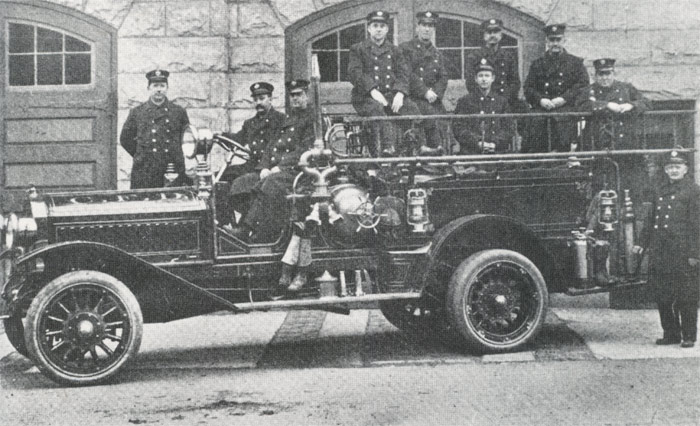
This 1912 Robinson Combination Chemical and Hose Wagon was assigned to Engine Company 2. It was one of two purchased as the first motorized apparatus in the Department. Pictured in this 1913 photograph are (l to r): Fireman John Lennox, Wagon Chauffer Harry Hankins, Firemen William Elberson, Joseph Ernst, Martin Carrigan, and Captain George Wade. Accompanying them are members of the engine crew: Stoker Arthur Wingate, Driver Joseph Johnson and Engineer John Augustus “Gus” Dold.
North Camden News
Camden Post-Telegram —
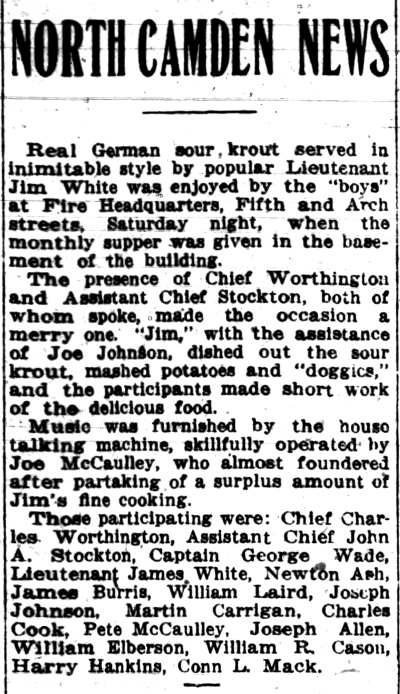
Real German sour krout served in inimitable style by popular Lieutenant Jim White was enjoyed by the “boys” at Fire Headquarters, Fifth and Arch streets, Saturday night, when the monthly supper was given in the basement of the building. The presence of Chief Worthington and Assistant Chief Stockton, both of whom spoke, made the occasion a merry one. “Jim,” with the assistance of Joe Johnson, dished out the sour krout, mashed potatoes and “doggies,” and the participants made short work of the delicious food. Music was furnished by the house talking machine, skillfully operated by Joe McCauley, who almost foundered after partaking of a surplus amount of Jim’s fine cooking. Those participating were: Chief Charles Worthington, Assistant Chief John A. Stockton, Captain George Wade, Lieutenant James White, Newton Ash, James Burris, William Laird, Joseph Johnson, Martin Carrigan, Charles Cook, Pete McCauley, Joseph Allen, William Elberson, William R. Cason, Harry Hankins, Conn L. Mack.
(social item, no headline)
Camden Post-Telegram —
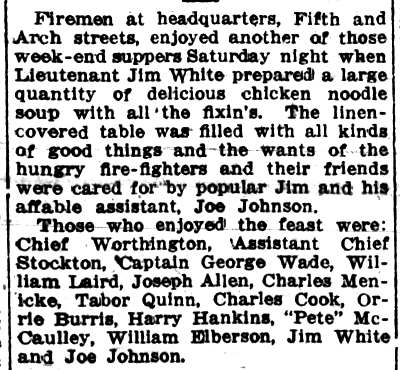
Firemen at headquarters, Fifth and Arch streets, enjoyed another of those week-end suppers Saturday night when Lieutenant Jim White prepared a large quantity of delicious chicken noodle soup with all the fixin’s. The linen-covered table was filled with all kinds of good things and the wants of the hungry fire-fighters and their friends were cared for by popular Jim and his affable assistant, Joe Johnson.
Those who enjoyed the feast were: Chief Worthington, Assistant Chief Stockton, Captain George Wade, William Laird, Joseph Allen, Charles Menicke, Tabor Quinn, Charles Cook, Orrie Burris, Harry Hankins, “Pete” McCaulley, William Elberson, Jim White and Joe Johnson.
(untitled — Fire Headquarters supper)
Camden Post-Telegram —
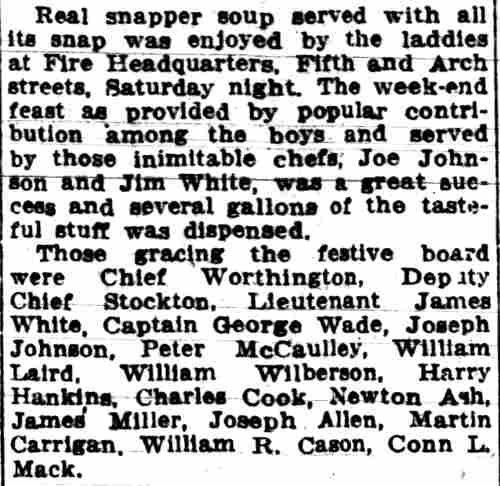
Real snapper soup served with all its snap was enjoyed by the laddies at Fire Headquarters, Fifth and Arch streets, Saturday night. The week-end feast as provided by popular contribution among the boys and served by those inimitable chefs, Joe Johnson and Jim White, was a great success and several gallons of the tasteful stuff was dispensed.
Those gracing the festive board were Chief Worthington, Deputy Chief Stockton, Lieutenant James White, Captain George Wade, Joseph Johnson, Peter McCaulley, William Laird, William Wilberson, Harry Hankins, Charles Cook, Newton Ash, James Miller, Joseph Allen, Martin Carrigan, William R. Cason, Conn L. Mack.
Six Hurt, One May Die as Result of Collingswood Fire
Philadelphia Inquirer —
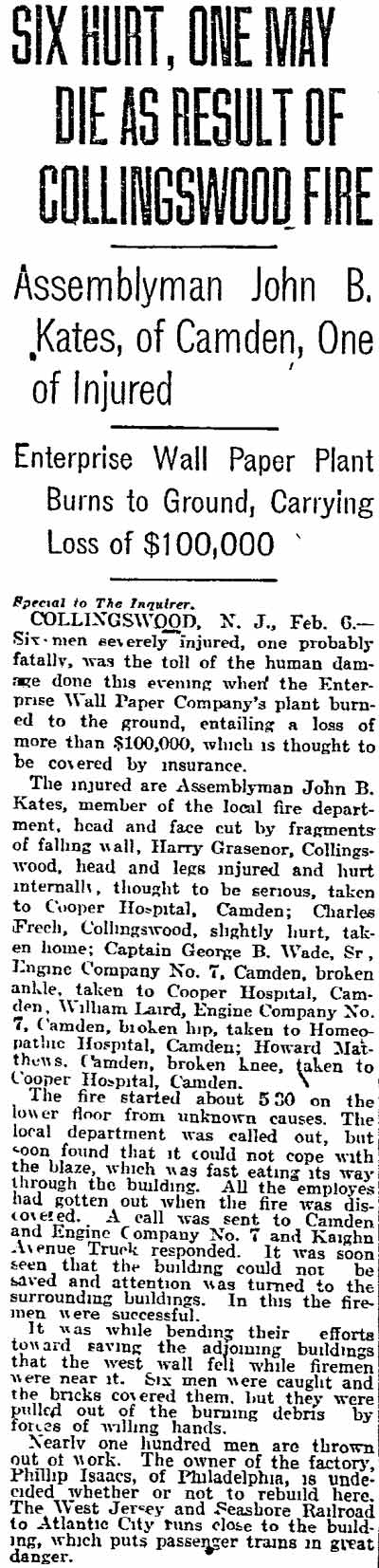
Assemblyman John B. Kates, of Camden, One of Injured
Enterprise Wall Paper Plant Burns to Ground, Carrying Loss of $100,000
Special to The Inquirer.
COLLINGSWOOD, N. J., Feb. 6.—Six men severely injured, one probably fatally, was the toll of the human damage done this evening when the Enterprise Wall Paper Company’s plant burned to the ground, entailing a loss of more than $100,000, which is thought to be covered by insurance.
The injured are Assemblyman John B. Kates, member of the local fire department, head and face cut by fragments of falling wall, Harry Grasenor, Collingswood, head and legs injured and hurt internally, thought to be serious, taken to Cooper Hospital, Camden; Charles Frech, Collingswood, slightly hurt, taken home; Captain George B. Wade, Sr., Engine Company No. 7, Camden, broken ankle, taken to Cooper Hospital, Camden; William Laird, Engine Company No. 7, Camden, broken hip, taken to Homeopathic Hospital, Camden; Howard Matthews, Camden, broken knee, taken to Cooper Hospital, Camden.
The fire started about 5:30 on the lower floor from unknown causes. The local department was called out, but soon found that it could not cope with the blaze, which was fast eating its way through the building. All the employes had gotten out when the fire was discovered. A call was sent to Camden and Engine Company No. 7 and Kaighn Avenue Truck responded. It was soon seen that the building could not be saved and attention was turned to the surrounding buildings. In this the firemen were successful.
It was while bending their efforts toward saving the adjoining buildings that the west wall fell while firemen were near it. Six men were caught and the bricks covered them, but they were pulled out of the burning debris by forces of willing hands.
Nearly one hundred men are thrown out of work. The owner of the factory, Phillip Isaacs, of Philadelphia, is undecided whether or not to rebuild here. The West Jersey and Seashore Railroad to Atlantic City runs close to the building, which puts passenger trains in great danger.
Injured Firemen on Road to Recovery
Philadelphia Inquirer —
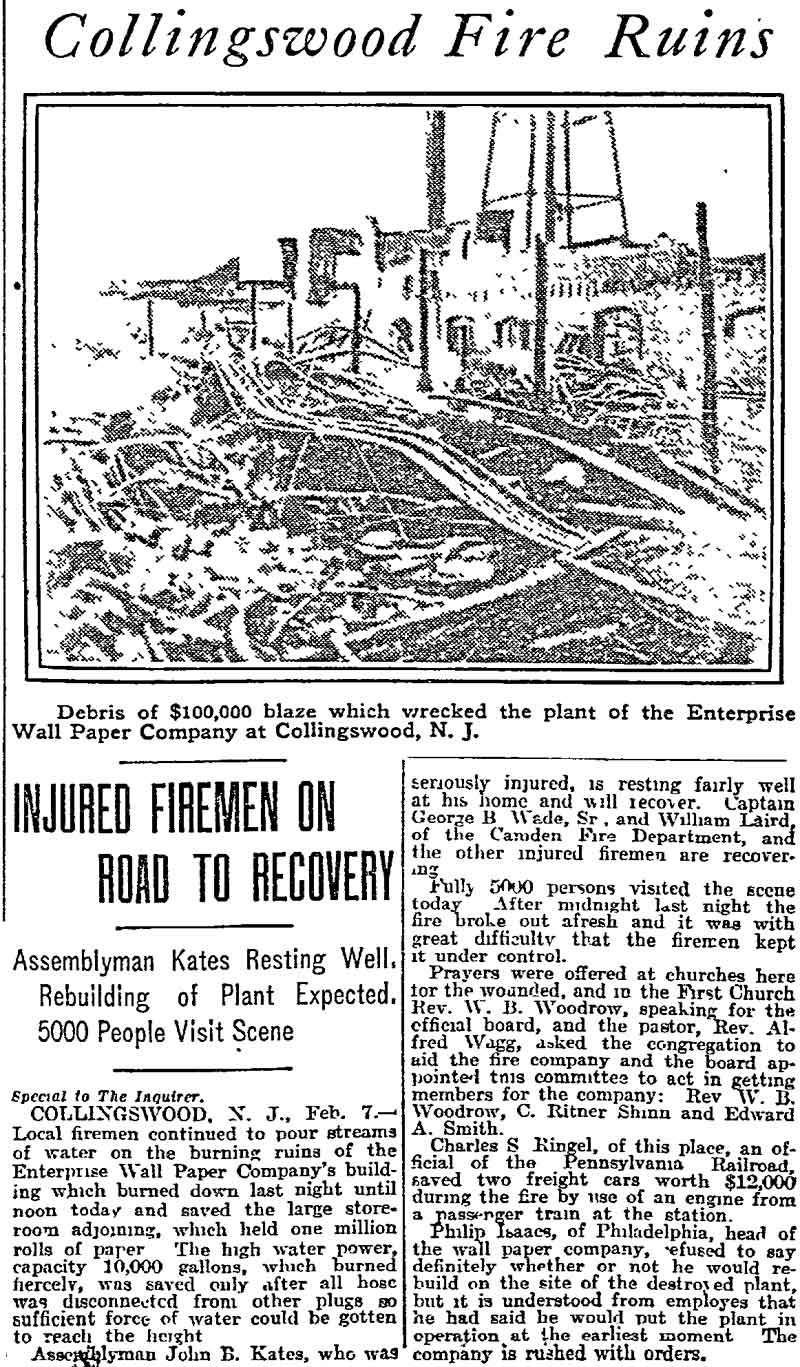
Assemblyman Kates Resting Well; Rebuilding of Plant Expected; 5000 People Visit Scene
Special to The Inquirer.
COLLINGSWOOD, N. J., Feb. 7.—Local firemen continued to pour streams of water on the burning ruins of the Enterprise Wall Paper Company’s building which burned down last night until noon today and saved the large storeroom adjoining, which held one million rolls of paper. The high water power, capacity 10,000 gallons, which burned fiercely, was saved only after all hose was disconnected from other plugs so sufficient force of water could be gotten to reach the height.
Assemblyman John B. Kates, who was seriously injured, is resting fairly well at his home and will recover. Captain George B. Wade, Sr., and William Laird, of the Camden Fire Department, and the other injured firemen are recovering.
Only 5000 persons visited the scene today. After midnight last night the fire broke out afresh and it was with great difficulty that the firemen kept it under control.
Prayers were offered at churches here for the wounded, and in the First Church Rev. W. B. Woodrow, speaking for the official board, and the pastor, Rev. Alfred Wagg, asked the congregation to aid the fire company and the board appointed this committee to act in getting members for the company: Rev. W. B. Woodrow, H. Ritter Reann and Edward A. Smith.
Charles S. Ringel, of this place, an official of the Pennsylvania Railroad, saved two freight cars worth $12,000 during the fire by use of an engine to a passenger train at the station.
Philip Isaacs, of Philadelphia, head of the wall paper company, refused to say definitely whether or not he would rebuild the line of the burned plant, but it is understood from employes that he had said he would put the plant in operation at the earliest moment the company is rushed with orders.
Fire Victims Are Recovering
Philadelphia Inquirer —
There was an echo of the fire which burned the wall paper plant at West Collingswood on February 6 when Assemblyman John B. Kates, who was badly injured in the fall of a wall, made his appearance for the first time yesterday. On a pair of crutches he made his way to an automobile and thus went to Trenton to attend the session of the Legislature, the first time since February 3. Captain George Wade, of Fire Headquarters, who had his ankle broken at the same time, was discharged from the Homeopathic Hospital yesterday. Fireman William Laird, who had a hip broken, and Howard Matthews, whose knee was broken, will be able to leave shortly.
Fireman Anderson May Not Recover
Camden Post-Telegram —
Hurt in Truck-Trolley Crash He is Dangerously Ill at Cooper Hospital.
HAS UNDERGONE TWO OPERATIONS
Injured in a collision at Fourth and Arch streets between a Public Service trolley and the big auto truck of No. 1 Truck Company, on the night of April 15, Lieutenant Harry Anderson, aged 43 years, of 1147 Federal street, is dangerously ill in Cooper Hospital from internal hurts and the effects of two operations.
Only partly unconscious because of the terrible pain, Anderson is just about able to recognize his friends. Although Cooper Hospital physicians insist his condition is not hopeless, Captain George B. Wade and fellow firemen of the injured laddie fear he will never get better.
His faithful wife is constantly at his bedside. Anderson failed to rally from the major operation performed at Cooper Hospital.
Following the accident Anderson was thought to be only slightly injured. When he was informed that he was internally injured he underwent an operation at the Homeopathic Hospital.
Anderson’s condition has cast a pall of gloom over the members of the two companies at Fifth and Arch streets. He is one of the most popular fireman in the two companies. Hopes are entertained that he will recover, but the outlook is far from encouraging.
New Firemen Assigned for Two Platoons
Camden Post-Telegram —
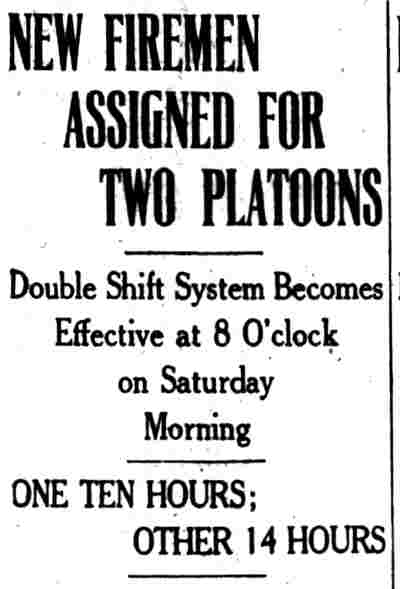
NEW FIREMEN ASSIGNED FOR TWO PLATOONS
Double Shift System Becomes Effective at 8 O’clock on Saturday Morning
One Ten Hours; Other 14 Hours
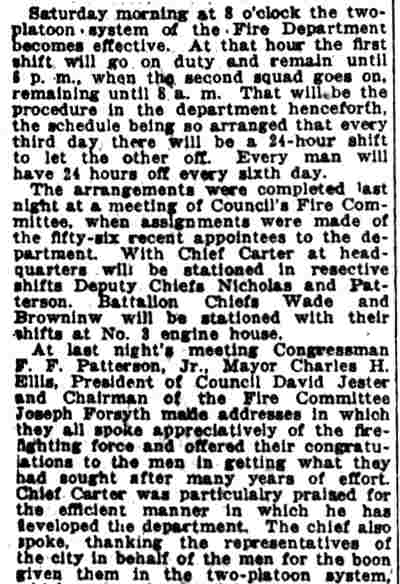
Saturday morning at 8 o’clock the two-platoon system of the Fire Department becomes effective. At that hour the first shift will go on duty and remain until 6 p. m., when the second squad goes on, remaining until 8 a. m. That will be the procedure in the department henceforth, the schedule being so arranged that every third day there will be a 24-hour shift to let the other off. Every man will have 24 hours off every sixth day.
The arrangements were completed last night at a meeting of Council’s Fire Committee, when assignments were made of the fifty-six recent appointees to the department. With Chief Carter at headquarters will be stationed in reserve shifts Deputy Chiefs Nicholas and Patterson. Battalion Chiefs Wade and Browning will be stationed with their shifts at No. 3 engine house.
At last night’s meeting Congressman F. F. Patterson, Jr., Mayor Charles H. Ellis, President of Council David Jester and Chairman of the Fire Committee Joseph Forsyth made addresses in which they all spoke appreciatively of the fire-fighting force and offered their congratulations to the men in getting what they had sought after many years of effort. Chief Carter was particularly praised for the efficient manner in which he has developed the department. The chief also spoke, thanking the representatives of the city in behalf of the men for the boon given them in the two-platoon system, which means the fire fighters will be able to spend more time with their families.
Everything has been worked out to the least detail and it is anticipated the new system will work without any difficulties.
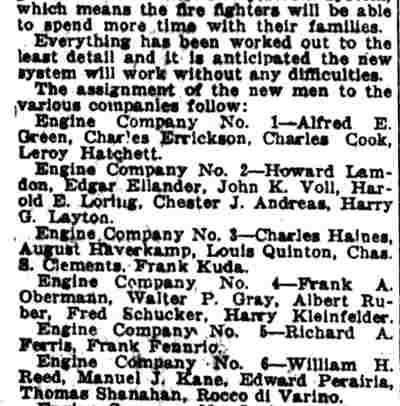
The assignment of the new men to the various companies follow:
Engine Company No. 1—Alfred E. Green, Charles Errickson, Charles Cook, Leroy Hatchett.
Engine Company No. 2—Howard Lamdon, Edgar Ellander, John K. Voll, Harold E. Lorang, Chester J. Andreas, Harry G. Layton.
Engine Company No. 3—Charles Haines, August Haverkamp, Louis Quinton, Chas. S. Clements, Frank Kuda.
Engine Company No. 4—Frank A. Obermann, Walter P. Gray, Albert Ruber, Fred Schucker, Harry Kleinfelder.
Engine Company No. 5—Richard A. Ferris, Frank Fennrio.
Engine Company No. 6—William H. Reed, Manuel J. Kane, Edward Perairia, Thomas Shanahan, Rocco di Varino.
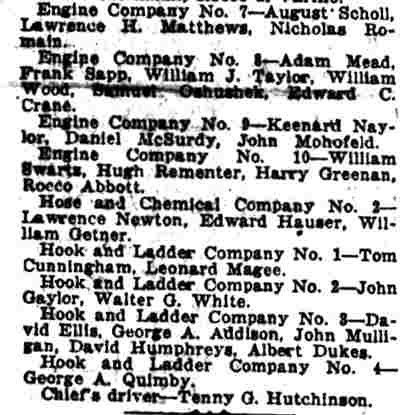
Engine Company No. 7—August Scholl, Lawrence H. Matthews, Nicholas Romain.
Engine Company No. 8—Adam Mead, Frank Sapp, William J. Taylor, William Wood, Samuel Oshushek, Edward C. Crane.
Engine Company No. 9—Keenard Naylor, Daniel McSurdy, John Mohofeld.
Engine Company No. 10—William Swarts, Hugh Rementer, Harry Greenan, Rocco Abbott.
Hose and Chemical Company No. 2—Lawrence Newton, Edward Hauser, William Getner.
Hook and Ladder Company No. 1—Tom Cunningham, Leonard Magee.
Hook and Ladder Company No. 2—John Gaylor, Walter G. White.
Hook and Ladder Company No. 3—David Ellis, George A. Addison, John Mulligan, David Humphreys, Albert Dukes.
Hook and Ladder Company No. 4—George A. Quimby.
Chief’s driver—Tenny G. Hutchinson.
Fire Bells Toll as Capt. Carrigan Is Laid to Rest
Camden Daily Courier —
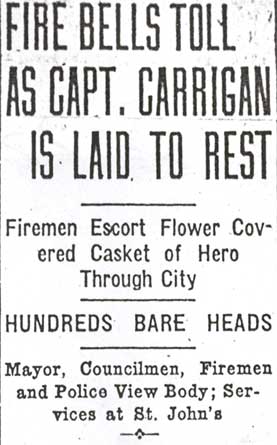
Firemen Escort Flower Covered Casket of Hero Through City
HUNDREDS BARE HEADS
Mayor, Councilmen, Firemen and Police View Body; Services at St. John’s
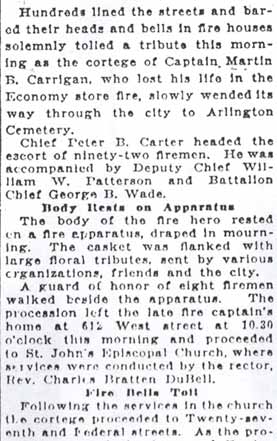
Hundreds lined the streets and bared their heads and bells in fire houses solemnly tolled a tribute this morning as the cortege of Captain Martin B. Carrigan, who lost his life in the Economy store fire, slowly wended its way through the city to Arlington Cemetery.
Chief Peter B. Carter headed the escort of ninety-two firemen. He was accompanied by Deputy Chief William W. Patterson and Battalion Chief George B. Wade.
Body Rests on Apparatus
The body of the fire hero rested on a fire apparatus, draped in mourning. The casket was flanked with large floral tributes, sent by various organizations, friends and the city. A guard of honor of eight firemen walked beside the apparatus. The procession left the late fire captain’s home at 612 West street at 10:30 o’clock this morning and proceeded to St. John’s Episcopal Church, where services were conducted by the rector, Rev. Charles Bratten DuBell.
Fire Bells Toll
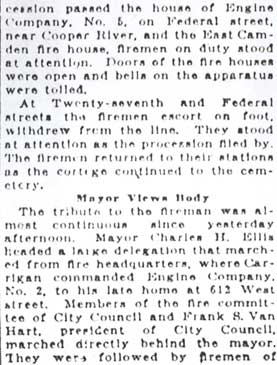
Following the services in the church the cortege proceeded to Twenty-seventh and Federal streets. As the procession passed the house of Engine Company, No. 5, on Federal street, near Cooper River, and the East Camden fire house, firemen on duty stood at attention. Doors of the fire houses were open and bells on the apparatus were tolled.
At Twenty-seventh and Federal streets the firemen escort on foot, withdrew from the line. They stood at attention as the procession filed by. The firemen returned to their stations as the cortege continued to the cemetery.
Mayor Views Body
The tribute to the fireman was almost continuous since yesterday afternoon. Mayor Charles H. Ellis headed a large delegation that marched from fire headquarters, where Carrigan commanded Engine Company No. 2, to his late home at 612 West street. Members of the fire committee of City Council and Frank S. Van Hart, president of City Council, marched directly behind the mayor. They were followed by firemen of both platoons, Chief Carter, Deputy Chief Patterson, Battalion Chiefs Wade, Nicholas and Browning.
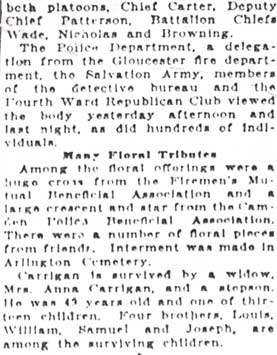
The Police Department, a delegation from the Gloucester fire department, the Salvation Army, members of the detective bureau and the Fourth Ward Republican Club viewed the body yesterday afternoon and last night, as did hundreds of individuals.
Many Floral Tributes
Among the floral offerings were a huge cross from the Firemen’s Mutual Beneficial Association and a large crescent and star from the Camden Police Beneficial Association. There were a number of floral pieces from friends. Interment was made in Arlington Cemetery.
Carrigan is survived by a widow, Mrs. Anna Carrigan, and a stepson. He was 43 years old and one of thirteen children. Four brothers, Louis, William, Samuel and Joseph, are among the surviving children.
Promoted Firemen Take Posts Today
Camden Courier-Post —
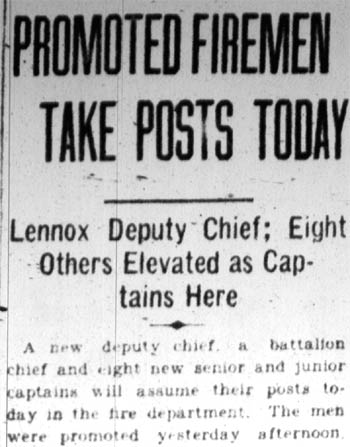
Lennox Deputy Chief; Eight Others Elevated as Captains Here
A new deputy chief, a battalion chief and eight new senior and junior captains will assume their posts today in the fire department. The men were promoted yesterday afternoon, along with the announcement of eleven new appointments of firemen, who will go into service April 15.
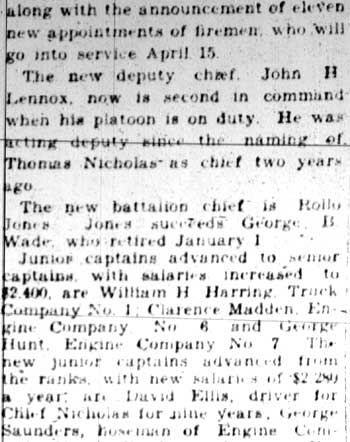
The new deputy chief, John H. Lennox, now is second in command when his platoon is on duty. He was acting deputy since the naming of Thomas Nicholas as chief two years ago.
The new battalion chief is Rollo Jones. Jones succeeded George B. Wade, who retired January 1.
Junior captains advanced to senior captains, with salaries increased to $2,400, are William H. Harring, Truck Company No. 1, Clarence Madden, Engine Company No. 6 and George Hunt, Engine Company No 7. The new junior captains advanced from the ranks, with new salaries of $2,299 a year, are David Ellis, driver for Chief Nicholas for nine years, George Saunders, hoseman of Engine Company No. 9; Eli Hunt, driver of Engine Company No. 3, and William Van Pfefferle, hoseman, Engine Company No. 1.
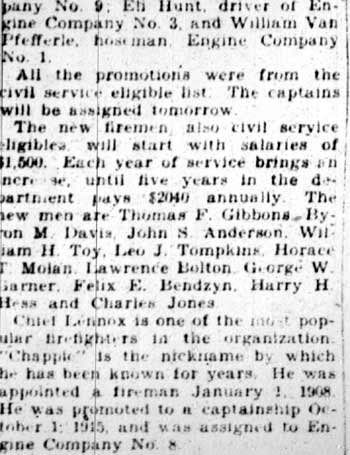
All the promotions were from the civil service eligible list. The captains will be assigned tomorrow.
The new firemen, also civil service eligibles, will start with salaries of $1,500. Each year of service brings an increase, until five years in the department pays $2,040 annually. The new men are Thomas F. Gibbons, Byron M. Davis, John S. Anderson, William H. Toy, Leo J. Tompkins, Horace T. Molan, Lawrence Bolton, George W. Garner, Felix E. Bendzyn, Harry H. Hess and Charles Jones.
Chief Lennox is one of the most popular firefighters in the organization. “Chappie” is the nickname by which he has been known for years. He was appointed a fireman January 1, 1908. He was promoted to a captainship October 1, 1915, and was assigned to Engine Company No. 8.
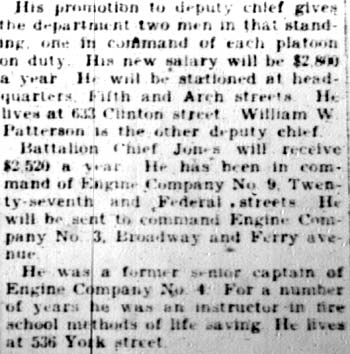
His promotion to deputy chief gives the department two men in that standing, one in command of each platoon on duty. His new salary will be $2,800 a year. He will be stationed at headquarters, Fifth and Arch streets. He lives at 633 Clinton street. William W. Patterson is the other deputy chief.
Battalion Chief Jones will receive $2,520 a year. He has been in command of Engine Company No. 9, Twenty-seventh and Federal streets. He will be sent to command Engine Company No. 3, Broadway and Ferry avenue. He was a former senior captain of Engine Company No. 4. For a number of years he was an instructor in fire school methods of life saving. He lives at 536 York street.
22 Firemen Assigned to New Stations
Camden Courier-Post —
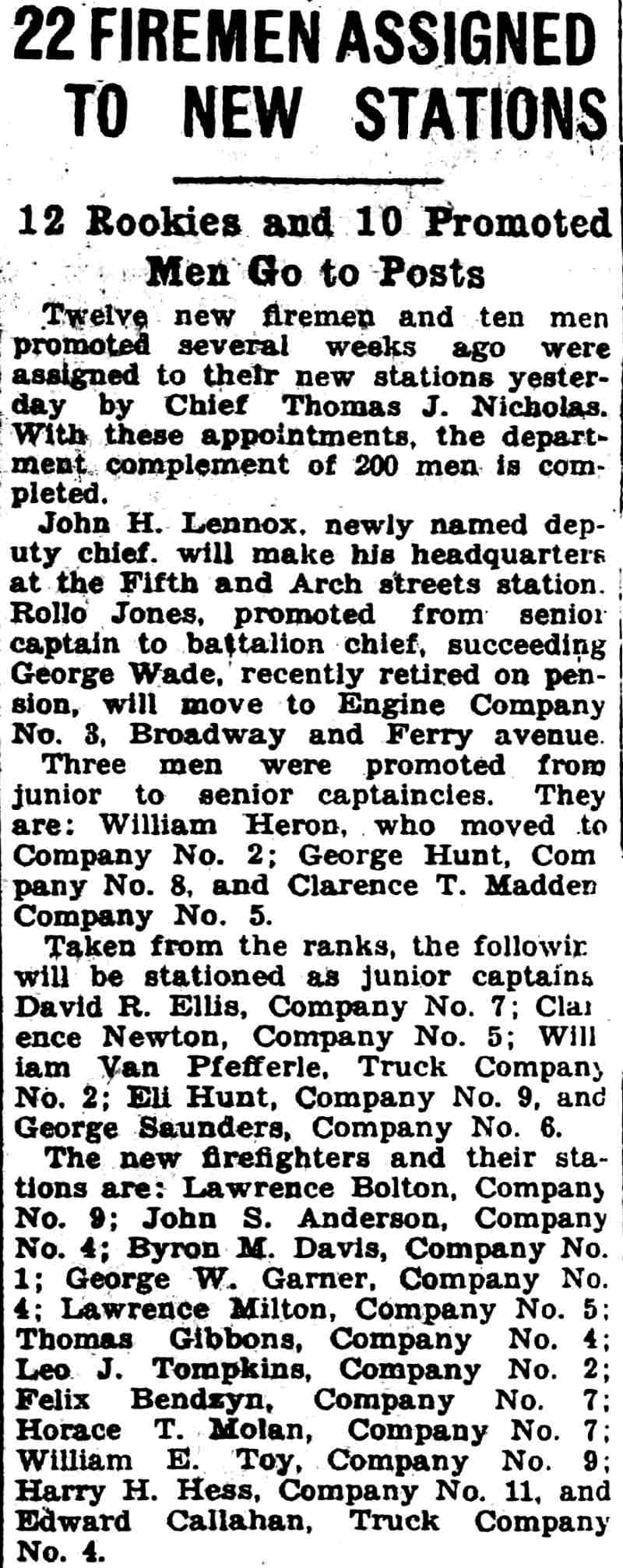
12 Rookies and 10 Promoted Men Go to Posts
Twelve new firemen and ten men promoted several weeks ago were assigned to their new stations yesterday by Chief Thomas J. Nicholas. With these appointments, the department complement of 200 men is completed.
John H. Lennox, newly named deputy chief, will make his headquarters at the Fifth and Arch streets station. Rollo Jones, promoted from senior captain to battalion chief, succeeding George Wade, recently retired on pension, will move to Engine Company No. 3, Broadway and Ferry avenue.
Three men were promoted from junior to senior captaincies. They are: William Heron, who moved to Company No. 2; George Hunt, Company No. 8, and Clarence T. Madden [sic] Company No. 5.
Taken from the ranks, the following will be stationed as junior captains: David R. Ellis, Company No. 7; Clarence Newton, Company No. 5; William Van Pfefferle, Truck Company No. 2; Eli Hunt, Company No. 9, and George Saunders, Company No. 6.
The new firefighters and their stations are: Lawrence Bolton, Company No. 9; John S. Anderson, Company No. 4; Byron M. Davis, Company No. 1; George W. Garner, Company No. 4; Lawrence Milton, Company No. 5; Thomas Gibbons, Company No. 4; Leo J. Tompkins, Company No. 2; Felix Bendzyn, Company No. 7; Horace T. Molan, Company No. 7; William E. Toy, Company No. 9; Harry H. Hess, Company No. 11, and Edward Callahan, Truck Company No. 4.
Geo. B. Wade Dies; Camden Fire Hero
Camden Courier-Post —
Former Battalion Chief Bedfast a Week, Victim of Heart Disease
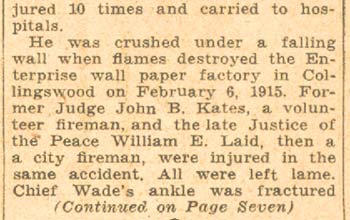
Former Battalion Chief George B. Wade, 75, one of Camden’s outstanding fire heroes, died at 6:10 a. m. yesterday at his home at 111 North Twenty-sixth street of a heart ailment. He had been bedfast a week. Chief Wade’s record in the fire department showed him always in the thickest of the smoke. He was injured 10 times and carried to hospitals.
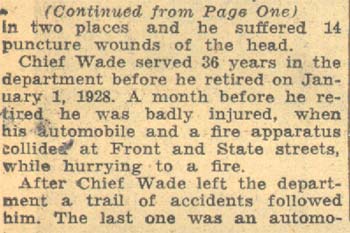
He was crushed under a falling wall when flames destroyed the Enterprise wall paper factory in Collingswood on February 6, 1915. Former Judge John B. Kates, a volunteer fireman, and the late Justice of the Peace William E. Laid, then a city fireman, were injured in the same accident. All were left lame. Chief Wade’s ankle was fractured in two places and he suffered 14 puncture wounds of the head.
Chief Wade served 36 years in the department before he retired on January 1, 1928. A month before he retired he was badly injured, when his automobile and a fire apparatus collided at Front and State streets, while hurrying to a fire.
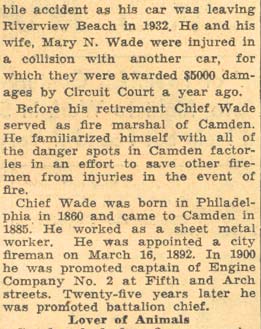
After Chief Wade left the department a trail of accidents followed him. The last one was an automobile accident as his car was leaving Riverview Beach in 1932. He and his wife, Mary N. Wade were injured in a collision with another car, for which they were awarded $5000 damages by Circuit Court a year ago.
Before his retirement Chief Wade served as fire marshal of Camden. He familiarized himself with all of the danger spots in Camden factories in an effort to save other firemen from injuries in the event of fire.
Chief Wade was born in Philadelphia in 1860 and came to Camden in 1885. He worked as a sheet metal worker. He was appointed a city fireman on March 16, 1892. In 1900 he was promoted captain of Engine Company No. 2 at Fifth and Arch streets. Twenty-five years later he was promoted battalion chief.
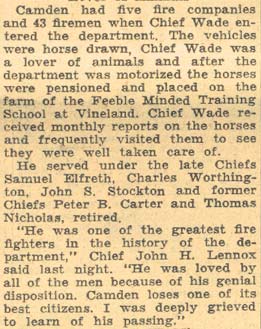
Camden had five fire companies and 43 firemen when Chief Wade entered the department. The vehicles were horse drawn. Chief Wade was a lover of animals and after the department was motorized the horses were pensioned and placed on the farm of the Feeble Minded Training School at Vineland. Chief Wade received monthly reports on the horses and frequently visited them to see they were well taken care of.
He served under the late Chiefs Samuel Elfreth, Charles Worthington, John S. Stockton and former Chiefs Peter B. Carter and Thomas Nicholas, retired.
“He was one of the greatest fire fighters in the history of the department,” Chief John H. Lennox said last night. “He was loved by all of the men because of his genial disposition. Camden loses one of its best citizens. I was deeply grieved to learn of his passing.”
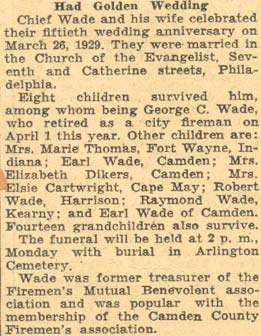
Chief Wade and his wife celebrated their fiftieth wedding anniversary on March 26, 1929. They were married in the Church of the Evangelist, Seventh and Catherine streets, Philadelphia.
Eight children survived him, among whom being George C. Wade, who retired as a city fireman on April 1 this year. Other children are: Mrs. Marie Thomas, Fort Wayne, Indiana; Earl Wade, Camden; Mrs. Elizabeth Dikers, Camden; Mrs. Elsie Cartwright, Cape May; Robert Wade, Harrison; Raymond Wade, Kearny; and Earl Wade of Camden. Fourteen grandchildren also survive.
The funeral will be held at 2 p. m. Monday with burial in Arlington Cemetery.
Wade was former treasurer of the Firemen’s Mutual Benevolent Association and was popular with the membership of the Camden County Firemen’s Association.