Introduction
South Jersey, A History 1624–1924
CHARLES WILLIAM AUSTERMUHL — Allied with every progressive business interest of Camden as Mr. Austermuhl is through his well-known insurance activities in this city, he is also individually an enterprising leader in civic welfare movements and in prominent financial and loan institutions. Much credit is to be given to him for his advanced citizenship interests, and for the active part that he has always taken in the betterment and improvement of the community. He has the reputation of being one of the most successful insurance men in Camden, his business bringing results, and his methods being those of mutual help.
A son of William and Anne E. (Massan) Austermuhl, Charles William Austermuhl was born February 4, 1883, on Bridge Avenue, Camden, where he attended the Stevens Public School, entering at five years, and graduating when he was thirteen years of age. He began life as an office boy at the Strawbridge and Clothier store, in Philadelphia, and had risen to the position of bookkeeper, when he went to another department store, where he became office manager. He then turned his attention to the business of R. F. Smith & Son, lumber dealers, with whom he became associated as bookkeeper, and while in their employ he became interested in insurance and building operations. He established a business for himself, July 5, 1908, and in partnership with R.W. Test, as Austermuhl & Test Company, this firm later dissolving partnership to form the Charles W. Austermuhl Company. In 1914, Mr. Austermuhl joined partnership with Andrew B. F. Smith, of the lumber company, under the firm name Smith-Austermuhl Company, with their first office at River and Federal streets, then No. 529 Market Street. Then the present Austermuhl Building was erected, the firm moving into its new quarters in November, 1920. Mr. Austermuhl is a member of the board of directors of the Central Trust Company, and of the Stockton Building and Loan Association, and he has been a director and the secretary of the Market Building and Loan Association since its organization in 1915; he is president of the Camden Materials Company, secretary and treasurer of the Jersey Mortgage Investment Company, and director of the “Post Telegram” Company, and the New Jersey Appraisal Company. He is a Republican in politics, but has not held political office. During the World War, Mr. Austermuhl was a member of the public welfare and the public safety committees; he was active in the Red Cross and the Salvation Army campaigns; and was foremost in Victory and Liberty Loan drives. He is a director in the Camden Community Hotel [the Walt Whitman Hotel], and is a member of the building committee. His fraternal affiliations are those of the Trimble Lodge, No. 117 Free and Accepted Masons, thirty-second degree; Excelsior Consistory, and Crescent Temple, Ancient Arabic Order Nobles of the Mystic Shrine; Camden Lodge, No. 293, Benevolent and Protective Order of Elks; the Tavistock Country Club, and the Camden Club. His religious fellowship is with the Methodist Episcopal Church.
Mr. Austermuhl married, February 21, 1920, at the Fifth Avenue Baptist Church, New York City, Vera S. Laudenfeld, a daughter of Henry and Rachel (Spaide) Laudenfeld.
WEDDING IN BAPTIST CHURCH
Camden Daily Courier —
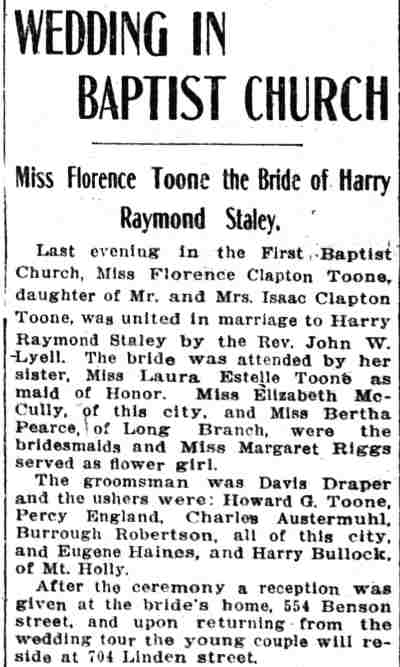
WEDDING IN BAPTIST CHURCH
Miss Florence Toone the Bride of Harry Raymond Staley.
Last evening in the First Baptist Church, Miss Florence Clapton Toone, daughter of Mr. and Mrs. Isaac Clapton Toone, was united in marriage to Harry Raymond Staley by the Rev. John W. Lyell. The bride was attended by her sister, Miss Laura Estelle Toone as maid of Honor. Miss Elizabeth McCully, of this city, and Miss Bertha Pearce, of Long Branch, were the bridesmaids and Miss Margaret Riggs served as flower girl.
The groomsman was Davis Draper and the ushers were: Howard G. Toone, Percy England, Charles Austermuhl, Burrough Robertson, all of this city, and Eugene Haines, and Harry Bullock, of Mt. Holly.
After the ceremony a reception was given at the bride's home, 554 Benson street, and upon returning from the wedding tour the young couple will reside at 704 Linden street.
Staley—Toone
Philadelphia Inquirer —
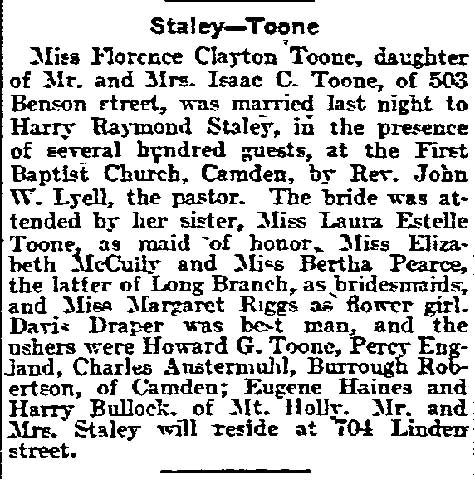
Staley—Toone
Miss Florence Clayton Toone, daughter of Mr. and Mrs. Isaac C. Toone, of 503 Benson street, was married last night to Harry Raymond Staley, in the presence of several hundred guests, at the First Baptist Church, Camden, by Rev. John W. Lyell, the pastor. The bride was attended by her sister, Miss Laura Estelle Toone, as maid of honor. Miss Elizabeth McCully and Miss Bertha Pearce, the latter of Long Branch, as bridesmaids, and Miss Margaret Riggs as flower girl. Davis Draper was best man, and the ushers were Howard G. Toone, Percy England, Charles Austermuhl, Burrough Robertson, of Camden; Eugene Haines and Harry Bullock, of Mt. Holly. Mr. and Mrs. Staley will reside at 704 Linden street.
Real Estate Transfers
Philadelphia Inquirer —
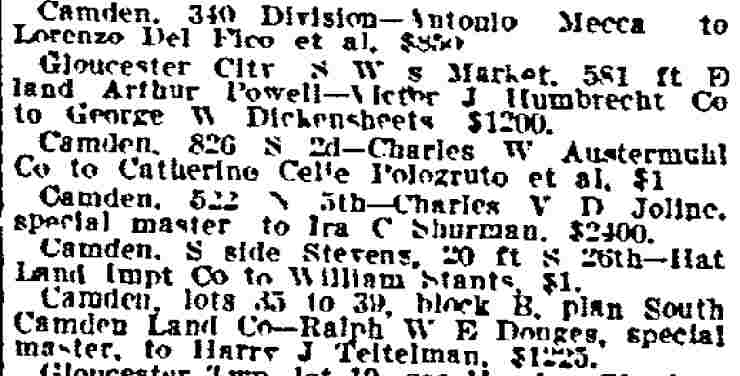
Real Estate Transfers
Camden. 340 Division—Antonio Mecca to Lorenzo Del Fico et al, $850.
Gloucester City, S W s Market, 581 ft D land Arthur Powell—Victor J. Humbrecht Co to George W. Dickensheets, $1200.
Camden. 826 S 2d—Charles W Austermuhl Co to Catherine Celie Polozruto et al, $1.
Camden. 522 N 5th—Charles V D Joline, special master to Ira C Shurman, $2400.
Camden. S side Stevens, 20 ft S 26th—Hat Land Impt Co to William Stants, $1.
Camden. lots 35 to 39, block B, plan South Camden Land Co—Ralph W E Donges, special master, to Harry J Teitelman, $1225.
Prepare. Memorial Resolutions
Philadelphia Inquirer —
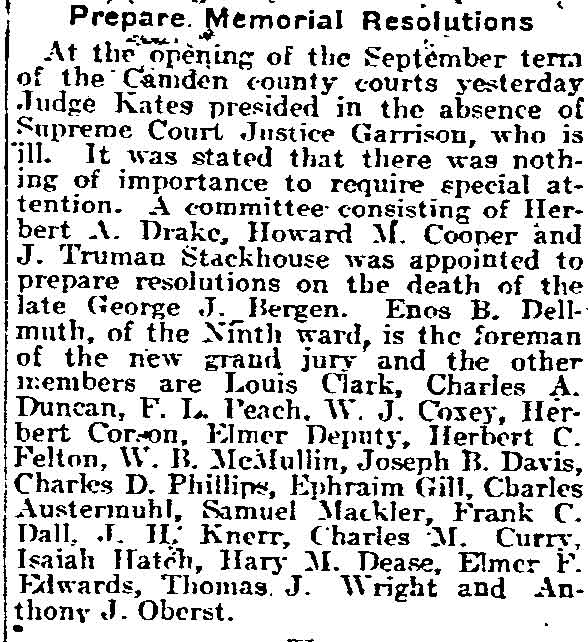
Prepare. Memorial Resolutions
At the opening of the September term of the Camden county courts yesterday Judge Kates presided in the absence of Supreme Court Justice Garrison, who is ill. It was stated that there was nothing of importance to require special attention. A committee consisting of Herbert A. Drake, Howard M. Cooper and J. Truman Stackhouse was appointed to prepare resolutions on the death of the late George J. Bergen. Enos B. Dellmuth, of the Ninth ward, is the foreman of the new grand jury and the other members are Louis Clark, Charles A. Duncan, F. L. Peach, W. J. Coxey, Herbert Corson, Elmer Deputy, Herbert C. Felton, W. B. McMullin, Joseph B. Davis, Charles D. Phillips, Ephraim Gill, Charles Austermuhl, Samuel Mackler, Frank C. Dall, J. H. Knerr, Charles M. Curry, Isaiah Hatch, Hary [sic] M. Dease, Elmer F. Edwards, Thomas J. Wright and Anthony J. Oberst.
Camden Hails Her Sons, Conquerors, at Victory Jubilee
Philadelphia Inquirer —
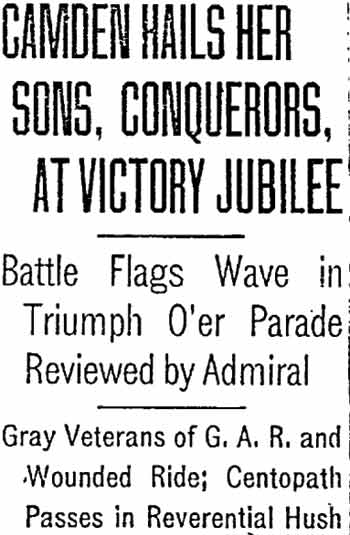
Battle Flags Wave in Triumph O’er Parade Reviewed by Admiral
Gray Veterans of G. A. R. and Wounded Ride; Centopath Passes in Reverential Hush
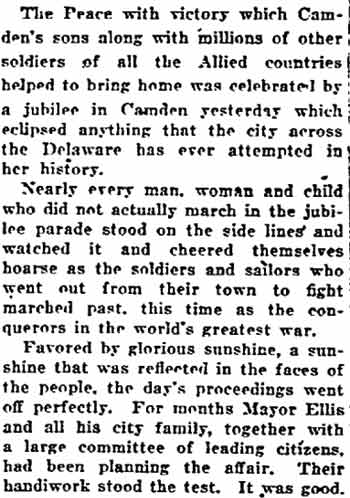
The Peace with victory which Camden’s sons along with millions of other soldiers of all the Allied countries helped to bring home was celebrated by a jubilee in Camden yesterday which eclipsed anything that the city across the Delaware has ever attempted in her history.
Nearly every man, woman and child who did not actually march in the jubilee parade stood on the side lines and watched it and cheered themselves hoarse as the soldiers and sailors who went out from their town to fight marched past, this time as the conquerors in the world’s greatest war.
Favored by glorious sunshine, a sunshine that was reflected in the faces of the people, the day’s proceedings went off perfectly. For months Mayor Ellis and all his city family, together with a large committee of leading citizens, had been planning the affair. Their handiwork stood the test. It was good.
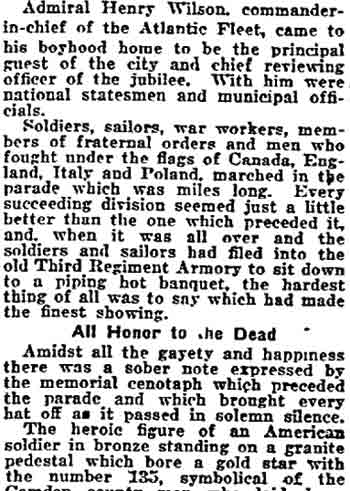
Admiral Henry Wilson, commander-in-chief of the Atlantic Fleet, came to his boyhood home to be the principal guest of the city and chief reviewing officer of the jubilee. With him were national statesmen and municipal officials.
Soldiers, sailors, war workers, members of fraternal orders and men who fought under the flags of Canada, England, Italy and Poland, marched in the parade which was miles long. Every succeeding division seemed just a little better than the one which preceded it, and, when it was all over and the soldiers and sailors had filed into the old Third Regiment Armory to sit down to a piping hot banquet, the hardest thing of all was to say which had made the finest showing.
All Honor to the Dead
Amidst all the gayety and happiness there was a sober note expressed by the memorial cenotaph which preceded the parade and which brought every hat off as it passed in solemn silence.
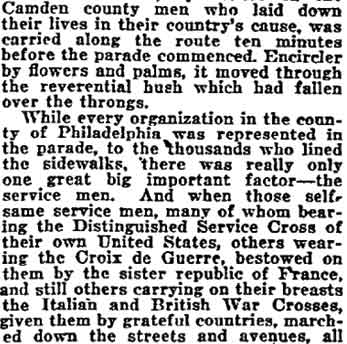
The heroic figure of an American soldier in bronze standing on a granite pedestal which bore a gold star with the number 135, symbolical of the Camden county men who laid down their lives in their country’s cause, was carried along the route ten minutes before the parade commenced. Encircler [sic] by flowers and palms, it moved through the reverential hush which had fallen over the throngs.
While every organization in the county of Philadelphia was represented in the parade, to the thousands who lined the sidewalks, there was really only one great big important factor—the service men. And when those self-same service men, many of whom bearing the Distinguished Service Cross of their own United States, others wearing the Croix de Guerre, bestowed on them by the sister republic of France, and still others carrying on their breasts the Italian and British War Crosses, given them by grateful countries, marched down the streets and avenues, all the pent up emotion in thousands of hearts was let loose.
It mattered not whether the men were officers or enlisted men, black or white, neat or untidy, they were all soldiers and they had done all that was asked of them. Their home town honored them. The men in blue and the women in blue, too, received a welcome not one whit less feeling than their brothers in khaki.
They had a certain advantage over the doughboys, for they put half a dozen of the prettiest and smartest yoemanettes that ever wore Uncle Sam’s uniform at the head of their division. The crowd simply had to be with them.
Canada and England, too, had a detachment of men in line. About two dozen of these veterans, half of whom wore the ribbon of the Mons Star, showing that they were in service in France in 1914, were in line, and they marched snappily and smartly and drew their full modicum of pleasurable comments.
Red Cross women, some of them grandmothers, others young girls still in their teens, marched in their snowy white uniforms with their crosses of red emblazoned on headcover and breast. Salvation Army lassies who had cooked doughnuts right up under the muzzles of the guns were there with Y. M. C. A. and Knights of Columbus workers.
Elks, Masons, Knights Templar, Red Men, Moose and scores of other fraternal organizations turned out in all their glorious trappings and regalia.
The delegation of Elks, startling in their spic and span white uniforms, marched behind their own band like squads of veterans. A foretaste of what Philadelphia will see during the coming week was given when more than 100 Knights Templar, resplendent in their uniforms and swords and cocked hats with white ostrich feathers, marched in the second division of the parade. As the formation reached the reviewing stand near the Ninth Ward Republican Association they deployed into the formation of a cross, the symbol of their order, and marched past in this formation.
Many gorgeous floats were in line, th Ninth Ward Republican Association having no less than five. All were artistic. The first was bedecked with growing flowers, while a beautiful young woman reprsenting “Peace” stood flanked by a soldier and sailor. The one following had a replica of the Liberty Bell with the inscription, “Peace on Earth, Good Will Towards men.” Two soldiers rang the bell. Behind them marched a band playing “Onward Christian Soldiers” as the men marched on. Floats symbolical of every war activity were there. The Knights of Columbus showed a replica of their famous service hut which was the doughboy’s home when he had no other.
The veterans of other wars were not forgotten in this jubilee of the greatest war of all. Grand Army men whose gray locks bespoke their years rode in automobiles bearing the tattered colors of their old Civil War regiments. The soldiers of a later day, men of the Spanish-American War, were in line with their comrades.
The wounded were there, too. They could not march in the parade, but they rode and their faces were smiling and their hearts were glad as they realized that this welcome was for them.
Triumphal arches were erected at points along the route of the parade and the square at the courthouse was a mass of color.
Among the officers in command of the sections of the service division were Lieutenant Colonel Samuel G. Barnard, of the 112th Field Artillery; Captain J. Walter Scott, former adjutant of the Third Regiment; Captains English, Richards and Dickinson, of Battery B; Lieutenant J. G. Williams, Ensign Beaston and Lieutenant William Opfermann, of the aviation corps.
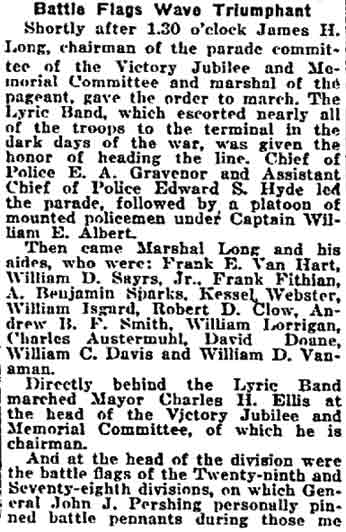
Battle Flags Wave Triumphant
Shortly after 1.30 o’clock James H. Long, chairman of the parade committee of the Victory Jubilee and Memorial Committee and marshal of the pageant, gave the order to march. The Lyric Band, which escorted nearly all of the troops to the terminal in the dark days of the war, was given the honor of heading the line. Chief of Police E. A. Gravenor and Assistant Chief of Police Edward S. Hyde led the parade, followed by a platoon of mounted policemen under Captain William E. Albert.
Then came Marshal Long and his aides, who were: Frank E. Van Hart, William D. Sayrs, Jr., Frank Fithian, A. Benjamin Sparks, Kessel Webster, William Isgard, Robert D. Clow, Andrew B. F. Smith, William Lorrigan, Charles Austermuhl, David Doane, William C. Davis and William D. Vanaman.
Directly behind the Lyric Band marched Mayor Charles H. Ellis at the head of the Victory Jubilee and Memorial Committee, of which he is chairman.
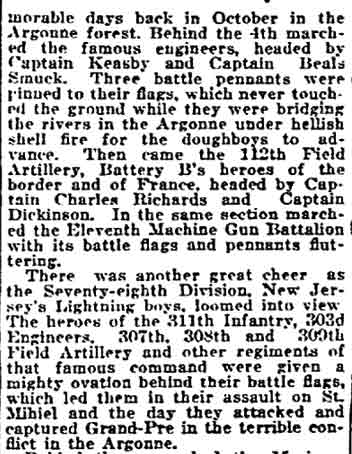
And at the head of the division were the battle flags of the Twenty-ninth and Seventy-eighth divisions, on which General John J. Pershing personally pinned battle pennants during those memorable days back in October in the Argonne forest. Behind the 4th marched the famous engineers, headed by Captain Keasby and Captain Beals Smuck. Three battle pennants were pinned to their flags, which never touched the ground while they were bridging the rivers in the Argonne under hellish shell fire for the doughboys to advance. Then came the 112th Field Artillery, Battery B’s heroes of the border and of France, headed by Captain Charles Richards and Captain Dickinson. In the same section marched the Eleventh Machine Gun Battalion with its battle flags and pennants fluttering.
There was another great cheer as the Seventy-eighth Division, New Jersey’s Lightning boys, loomed into view. The heroes of the 311th Infantry, 303d Engineers, 307th, 308th and 309th Field Artillery and other regiments of that famous command were given a mighty ovation behind their battle flags, which led them in their assault on St. Mihiel and the day they attacked and captured Grand-Pre in the terrible conflict in the Argonne.
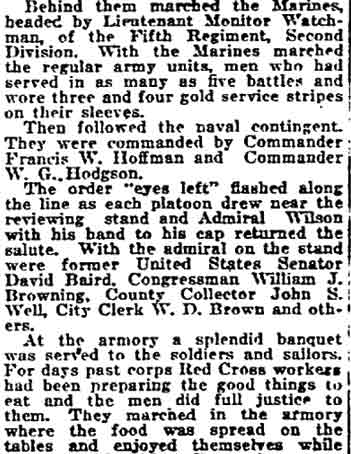
Behind them marched the Marines, headed by Lieutenant Monitor Watchman, of the Fifth Regiment, Second Division. With the Marines marched the regular army units, men who had served in as many as five battles and wore three and four gold service stripes on their sleeves.
Then followed the naval contingent. They were commanded by Commander Francis W. Hoffman and Commander W. G. Hodgson.
The order “eyes left” flashed along the line as each platoon drew near the reviewing stand and Admiral Wilson with his band to his cap returned the salute. With the admiral on the stand were former United States Senator David Baird, Congressman William J. Browning, County Collector John S. Well, City Clerk W. D. Brown and others.
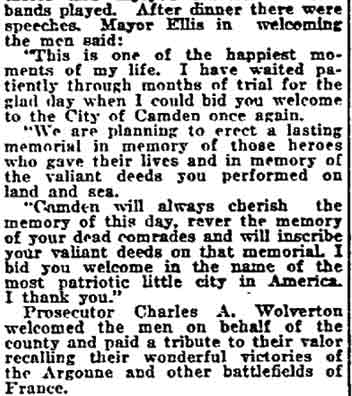
At the armory a splendid banquet was served to the soldiers and sailors. For days past corps Red Cross workers had been preparing the good things to eat and the men did full justice to them. They marched in the armory where the food was spread on the tables and enjoyed themselves while bands played. After dinner there were speeches. Mayor Ellis in welcoming the men said:
“This is one of the happiest moments of my life. I have waited patiently through months of trial for the glad day when I could bid you welcome to the City of Camden once again.
“We are planning to erect a lasting memorial in memory of those heroes who gave their lives and in memory of the valiant deeds you performed on land and sea.
“Camden will always cherish the memory of this day, rever the memory of your dead comrades and will inscribe your valiant deeds on that memorial. I bid you welcome in the name of the most patriotic little city in America. I thank you.”
Prosecutor Charles A. Wolverton welcomed the men on behalf of the county and paid a tribute to their valor recalling their wonderful victories of the Argonne and other battlefields of France.
Mortgage Money
Camden Courier-Post —
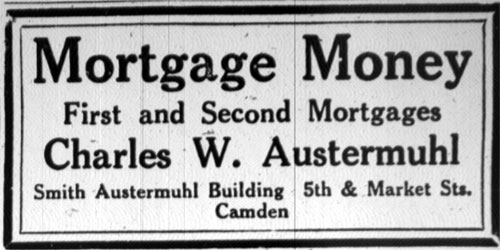
Mortgage Money
Mortgage Money
First and Second Mortgages
Charles W. Austermuhl
Smith Austermuhl Building, 5th & Market Sts., Camden
Smith-Austermuhl Company Building
Camden Courier-Post — 1928
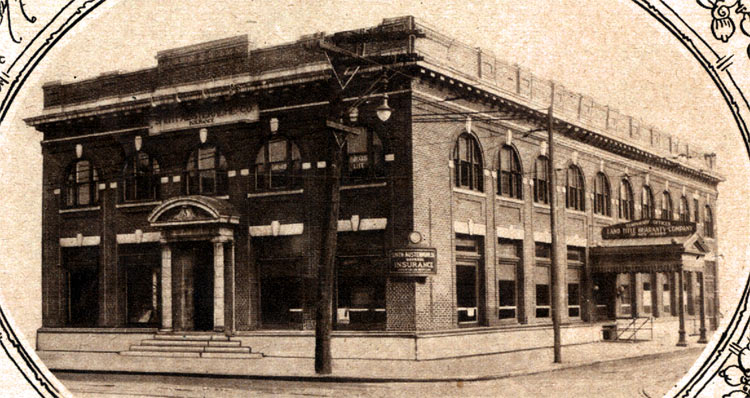
Smith-Austermuhl Company Building
Smith-Austermuhl Company building at Fifth and Market Streets, Camden, New Jersey. [Photo — no caption text]
Smith-Austermuhl Company Insurance
Camden Courier-Post — 1928
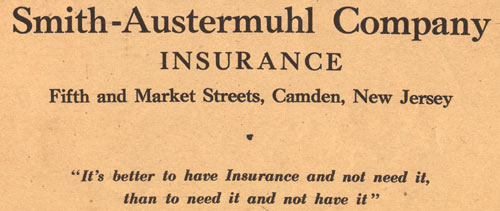
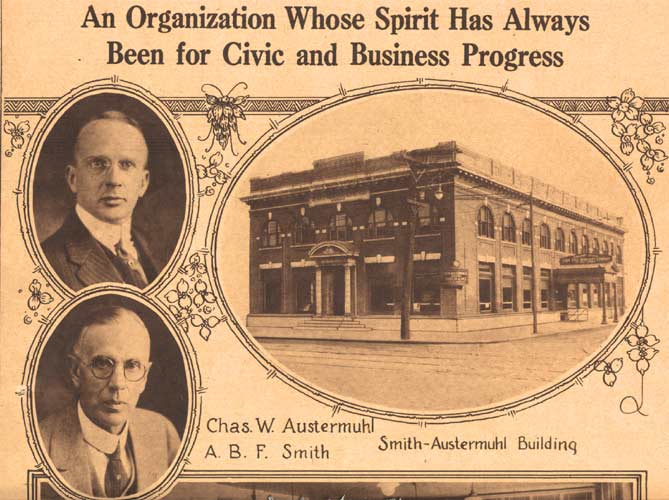
Smith-Austermuhl Company Insurance
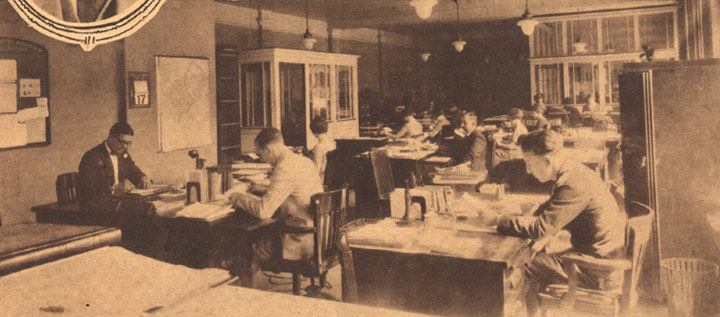
Smith-Austermuhl Company INSURANCE Fifth and Market Streets, Camden, New Jersey
"It's better to have Insurance and not need it, than to need it and not have it"
Truth Stranger Than Fiction
Camden Courier-Post —
Truth Stranger Than Fiction
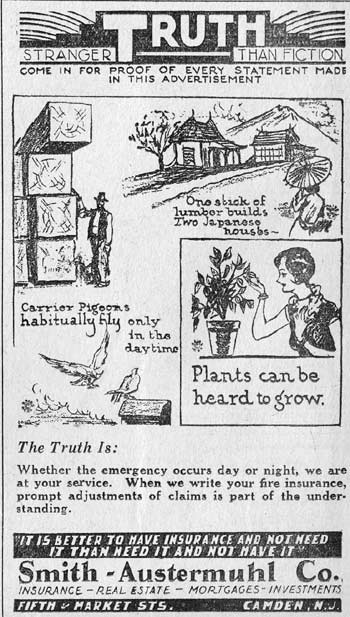
TRUTH STRANGER THAN FICTION
COME IN FOR PROOF OF EVERY STATEMENT MADE IN THIS ADVERTISEMENT
One stick of lumber builds two Japanese houses. Carrier Pigeons habitually fly only in the daytime. Plants can be heard to grow.
The Truth Is:
Whether the emergency occurs day or night, we are at your service. When we write your fire insurance, prompt adjustments of claims is part of the understanding.
"IT IS BETTER TO HAVE INSURANCE AND NOT NEED IT THAN NEED IT AND NOT HAVE IT"
Smith-Austermuhl Co. INSURANCE — REAL ESTATE — MORTGAGES — INVESTMENTS FIFTH & MARKET STS. CAMDEN, N.J.
Bonding Employes Creates Efficiency
Camden Courier-Post —
Bonding Employes Creates Efficiency
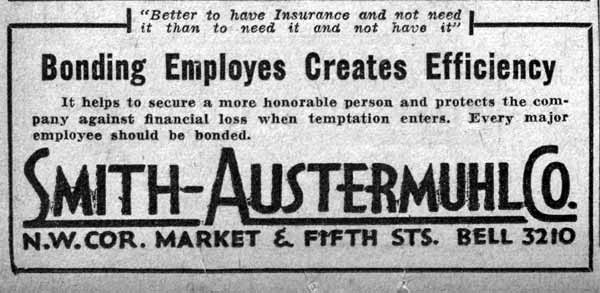
"Better to have Insurance and not need it than to need it and not have it"
Bonding Employes Creates Efficiency
It helps to secure a more honorable person and protects the company against financial loss when temptation enters. Every major employee should be bonded.
Smith-Austermuhl Co. N.W. COR. MARKET & FIFTH STS. BELL 3210
Charles W. Austermuhl Dies at 55 at Cooper Hospital
(Mt. Holly) New Jersey Mirror —
Charles W. Austermuhl, president of the Smith-Austermuhl Insurance Company, of Camden, died in Cooper Hospital shortly after 9 a. m. on Wednesday [September 14]. He was 55.
One of the best-known insurance brokers in South Jersey, Mr. Austermuhl was taken to the hospital on Monday after he had been convalescing at his home, 602 Chester avenue, of Moorestown, for two months. He was ordered to bed early in July after a general breakdown induced by a heart condition. When his condition grew worse over the weekend he was sent to the hospital. He was extremely active in the affairs of Camden and took large part in the organization of the Community Hotel Corporation which built and still owns the Hotel Walt Whitman. He was a member of the old City Planning Commission which brought about numerous improvements in streets, parks and municipal properties in Camden.
Mr. Austermuhl was a director in the David Baird Lumber Company and was treasurer for many years of the old Camden Club, which in recent years became the City Club. He was a member of the Tavistock Country Club and the Camden Lodge of Elks for many years.
He is survived by his widow, Mrs. Vera S. Austermuhl; a daughter, Ruth S. Austermuhl; his mother, Mrs. Annie E. Austermuhl, and a sister, Mrs. Edgar S. Batten. Funeral services were held at his late residence, 602 Chester avenue, Moorestown, on Saturday afternoon. Interment was in Harleigh cemetery, Camden.