Introduction
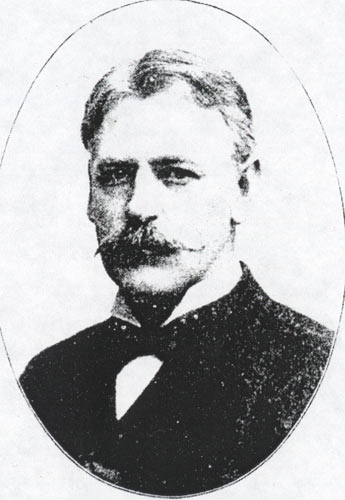
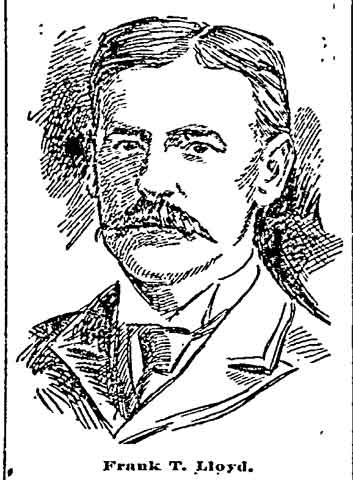
Frank T. Lloyd
Frank T. Lloyd was born in Middletown, Delaware on October 29, 1859, to Horatio and Caroline Lloyd. He was one of at least four children. He received his education and was graduated from the Middletown Academy. In 1875 he moved to Camden and became a compositor. The 1880 census shows the Lloyd family at 578 Clinton Street in Camden NJ. That block of Clinton Street, still standing today, was a series of row homes. On either side of the Lloyd family lived John Warnock at 576 and E.L. Senseman and 580. Both were printers, and Frank T. Lloyd was in 1890 working as a printer as well. At 582 Clinton Street lived Professor Horatio Draper, who had a long and distinguished career in the Camden School system. It is likely that Professor Draper influenced young Lloyd to further his education.
While serving his apprenticeship as a compositor he studied law in the office of Judge James Otterson, of Philadelphia. He was admitted to the bar of Pennsylvania in 1882 and practiced in the Philadelphia courts 15 years. He was elected to the Assembly from Camden county in 1896, and admitted to the New Jersey bar in 1897, was also re-elected to the Assembly that year. On March 24, 1899 he introduced a bill into the Assembly which enabled the Town of Stockton to be annexed by the City of Camden, bringing present-day East Camden and Cramer Hill into the city. In 1900 he became a counselor-at-law and the same year was appointed prosecutor of Camden County when both the current prosecutor, Wilson Jenkins, and his assistant, William Carson, died unexpectedly.
Frank Lloyd married about 1887, and with wife Mary, had at least one child, a son, Frank T. Lloyd Jr., born in 1894. The Lloyds appear in the 1888–1889 and 1890–1891 Camden City Directories as living at “4th near State” in the Pavonia section of Stockton Township, now known as Cramer Hill. In the late 1890s he resided at what is now North 18th Street and River Avenue in the Town of Stockton. This home was later converted into an orphanage.
By 1910 Frank T. Lloyd and family were living at 527 Cooper Street, next door to businessman and local historian Charles S. Boyer. The two would remain friends until Boyer’s death in November of 1936.
Frank T. Lloyd was appointed to the Circuit bench in 1906 by then Governor Edward C. Stokes. He was re-appointed by Governor James F. Fielder in 1914 and Governor Edward I. Edwards in 1921. He was named to the New Jersey State Supreme Court in 1924 and re-appointed in 1931. During his tenure on the Supreme Court, Judge Lloyd was an active opponent of organized crime and public corruption.
During World War I, Judge Lloyd and County Prosecutor Charles A. Wolverton served as Federal Food Administrators for Camden County.
At the time of the 1930 census, Justice and Mrs. Lloyd were living at 6507 Maple Avenue, the corner of Maple and Cove Road, in Pennsauken NJ. Justice Lloyd retired from the New Jersey State Supreme Court post in January of 1938 and returned to private practice.
Justice Frank T. Lloyd passed away in 1951.
Politics in Stockton
Philadelphia Inquirer —
A Hot Contest in the New Town Across the Delaware.
The political contest in the town of Stockton is at fever heat. Leaders in both the Republican and Democratic parties are wrangling among themselves and it is impossible to foretell the outcome. The principal officials to be elected are one Freeholder and one Councilman in each of the three wards, and two Justices of the Peace. Freeholder Hope, Republican, is a candidate for re-election in the First ward, and is opposed for the nomination by Otto Stix. The chances favor Hope. Councilman O. E. Schmid, Republican, wants a renomination in the same ward and is opposed by Frank T. Lloyd. Freeholder Buren, in the Second ward, will have opposition for re-election, as W. Oscar Buck yesterday announced himself as a candidate for the Republican nomination. For Council in the Second ward, Silas Betts, Jr., has a clear field for the Republican nomination.
The fiercest contest is in the Third ward, where Freeholder Davis, who is director of the County Board of Freeholders, is opposed for a renomination by Samuel Jacquillard, a staunch Republican, who is backed by the old leaders. Indications point to the nomination of the latter.
The Democrats are quiet and are watching the actions of the Republicans. The only hope they have of securing any of the offices is in the nomination of an Independent Republican ticket. The Democrats are practically at sea as to who they will nominate. Albert Plum will be renominated for justice by the Republicans.
The Republican primary elections will be held next Tuesday evening and the Democrats will elect their delegates on the 28th inst., and hold their convention on the 30th.
Republican Legislative Nominations
Philadelphia Inquirer —
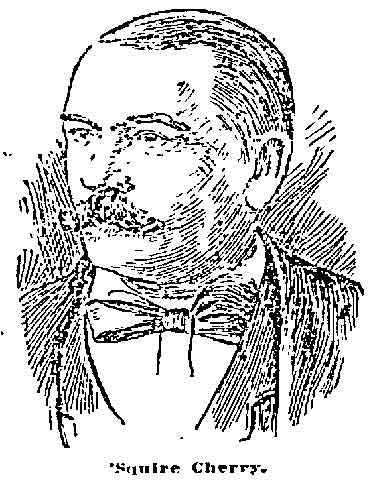
The contest over the Republican Legislative nominations is exciting more interest among the politicians than the more important county nominations aroused. Assemblyman Derousse has no opposition for renomination, but for the other two nominations there are four candidates, John Cherry, Lawyer Frank A. [sic] Lloyd, County Solicitor Harry S. Scovel and Isaac Coles. Two of the four are bound to get it where the chicken got the ax, but they are all confident of their ability to dodge the knock-out blow. They are all stalwart Republicans, and it is hard to choose when there is such good material to pick from.
‘Squire Cherry.
Probably the most popular of the quartet is ‘Squire John Cherry, who dispenses Jersey Justice and Fulton Market clam chowder opposite the county jail, and who is persona grata with all the politicians of all the parties. Cherry has done a yeoman’s service in the Republican ranks. In fact, he was one of the “ten men that weighed a ton,” who acted as body guard to President Rogers, of the Senate in the famous clash of the rival Senates at Trenton. Colonel “Jim” Scovel, the lawyer-evangelist, says Cherry, like a distinguished public man with third term aspirations, carries his collar in a cheese-box, but this is hardly true. However, he is big, brawny, brave and broad-minded and would make a good law maker. ‘Squire Cherry has already made his debut in Legislative circles, for he faithfully held a door and failed not in drawing his modest stipend at the last Legislative session.
John Cherry is proud of the fact that he is a New Yorker. When the country had need of his services he went to the front, fought bravely, and after peace was declared and he had traveled extensively over the country he settled down in Camden. He has been honored with election to the Excise Commission, of which he became president, to the Board of Freeholders and, recently, as Justice of the peace. He is a past master of Camden Lodge, No. 15, F. and A. M.; a member of Siloam Chapter, and Excelsior Consistory of Camden and Mecca Temple, New York city; Camden Lodge of Elks, Lenni Lenape Tribe of Red Men, Damon Lodge, Knights of Pythias and William B. Hatch Post, 37, G. A. R.
Assembly Delegates
Camden Courier —
Most of Whom Have No Opposition
FOR DEROUSSE, SCOVEL, LLOYD.
Although Coles is in the Fight for the Nomination. Other Campaign Notes. Register To-day.
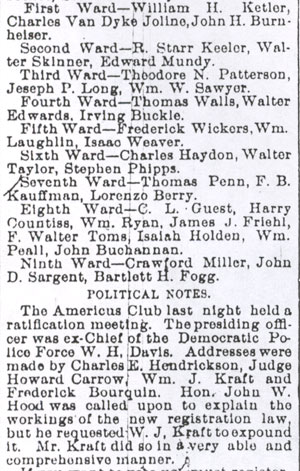
The Republicans last night placed in nomination delegates to be elected to attend the Assembly Convention, which will be held in this city on October 17. The election of the delegates will take place on Monday next. The following nominations were made at last night’s meeting, most of whom are for Derousse, Scovel and Lloyd:
First Ward—William H. Ketler, Charles Van Dyke Joline, John H. Burnheiser. Second Ward—R. Starr Keeler, Walter Skinner, Edward Mundy. Third Ward—Theodore N. Patterson, Jeseph P. Long [sic], Wm. W. Sawyer. Fourth Ward—Thomas Walls, Walter Edwards, Irving Buckle. Fifth Ward—Frederick Wickers, Wm. Laughlin, Isaac Weaver. Sixth Ward—Charles Haydon, Walter Taylor, Stephen Phipps. Seventh Ward—Thomas Penn, F. B. Kauffman, Lorenzo Berry. Eighth Ward—C. L. Guest, Harry Countiss, Wm. Ryan, James J. Friehl, F. Walter Toms, Isaiah Holden, Wm. Peall, John Buchannan. Ninth Ward—Crawford Miller, John D. Sargent, Bartlett H. Fogg.
POLITICAL NOTES. The Americus Club last night held a ratification meeting. The presiding officer was ex-Chief of the Democratic Police Force W. H. Davis. Addresses were made by Charles E. Hendrickson, Judge Howard Carrow, Wm. J. Kraft and Frederick Bourquin. Hon. John W. Hood was called upon to explain the workings of the new registration law, but he requested W. J. Kraft to expound it. Mr. Kraft did so in a very able and comprehensive manner.
Politicians’ Day at Mt. Holly
Philadelphia Inquirer —
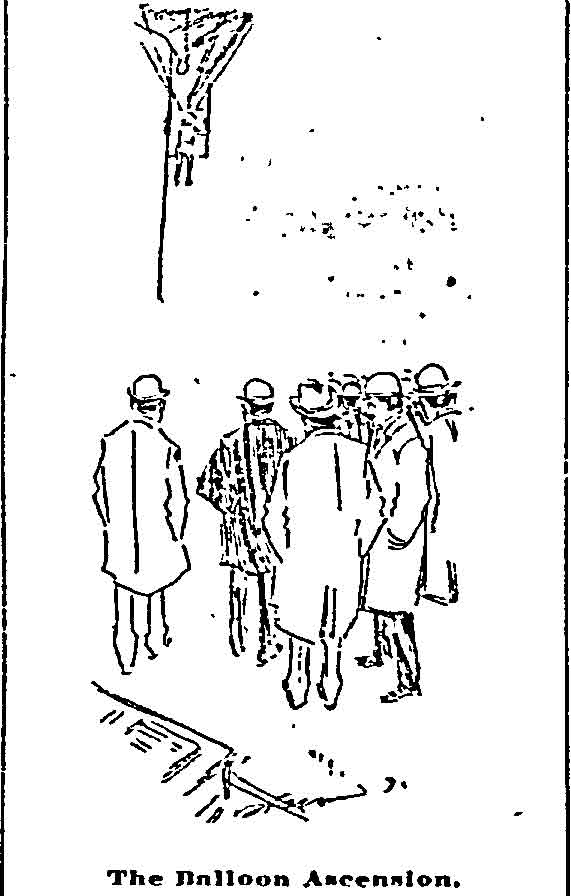
POLITICIANS’ DAY AT MT. HOLLY
CANDIDATE GRIGGS SHOOK HUNDREDS OF HORNY HANDS AT THE BURLINGTON COUNTY FAIR.
CAMDEN WELL REPRESENTED
It Was a Fine Day, But the “Big Thursday” Crowd Was Smaller Than Last Year—A Canine Parachutist Killed—The Races—Other Jersey Matters.
Special to The Inquirer.
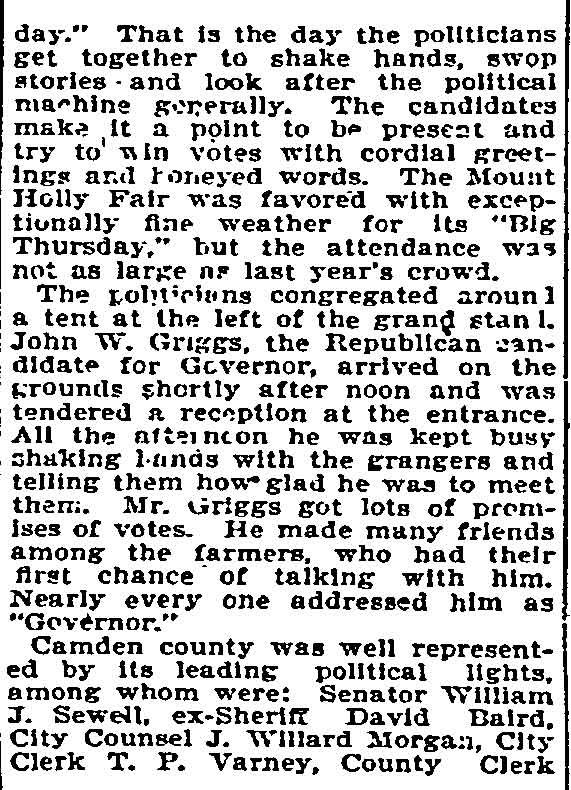
MOUNT HOLLY, N. J., Oct. 10.—The Mount Holly Fair, like all the other Jersey fairs, has its “Big Thursday.” That is the day the politicians get together to shake hands, swop stories and look after the political machine generally. The candidates make it a point to be present and try to win votes with cordial greetings and honeyed words. The Mount Holly Fair was favored with exceptionally fine weather for its “Big Thursday,” but the attendance was not as large as last year’s crowd.
The politicians congregated around a tent at the left of the grand stand. John W. Griggs, the Republican candidate for Governor, arrived on the grounds shortly after noon and was tendered a reception at the entrance. All the afternoon he was kept busy shaking hands with the grangers and telling them how glad he was to meet them. Mr. Griggs got lots of promises of votes. He made many friends among the farmers, who had their first chance of talking with him. Nearly every one addressed him as “Governor.”
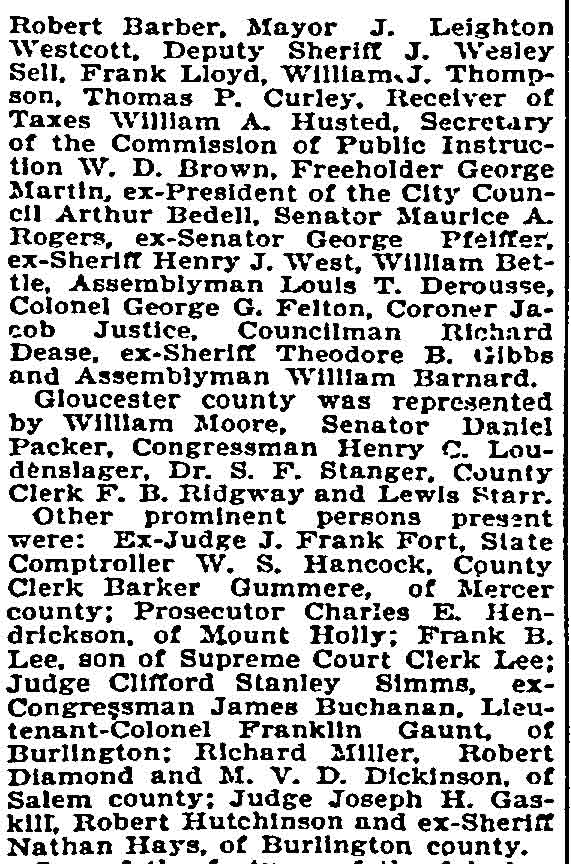
Camden county was well represented by its leading political lights, among whom were: Senator William J. Sewell, ex-Sheriff David Baird, City Counsel J. Willard Morgan, City Clerk T. P. Varney, County Clerk Robert Barber, Mayor J. Leighton Westcott, Deputy Sheriff J. Wesley Sell, Frank Lloyd, William J. Thompson, Thomas P. Curley, Receiver of Taxes William A. Husted, Secretary of the Commission of Public Instruction W. D. Brown, Freeholder George Martin, ex-President of the City Council Arthur Bedell, Senator Maurice A. Rogers, ex-Senator George Pfeiffer, ex-Sheriff Henry J. West, William Bettle, Assemblyman Louis T. Derousse, Colonel George G. Felton, Coroner Jacob Justice, Councilman Richard Dease, ex-Sheriff Theodore B. Gibbs and Assemblyman William Barnard.
Gloucester county was represented by William Moore, Senator Daniel Packer, Congressman Henry C. Loudenslager, Dr. S. F. Stanger, County Clerk F. B. Ridgway and Lewis Starr.
Other prominent persons present were: Ex-Judge J. Frank Fort, State Comptroller W. S. Hancock, County Clerk Barker Gummere, of Mercer county; Prosecutor Charles E. Hendrickson, of Mount Holly; Frank B. Lee, son of Supreme Court Clerk Lee; Judge Clifford Stanley Simms, ex-Congressman James Buchanan, Lieutenant-Colonel Franklin Gaunt, of Burlington; Richard Miller, Robert Diamond and M. V. D. Dickinson, of Salem county; Judge Joseph H. Gaskill, Robert Hutchinson and ex-Sheriff Nathan Hays, of Burlington county.
One of the features of the fair has been the daily ascension of a large balloon, from which a man and dog drop with parachutes. This afternoon the ropes which held the dog became loose. He dropped upon one of the booths and was killed.
The races were interesting and well contested. The summary follows:
2.18 Pacing—Purse $500.
L. H. Hurd’s ch. g. Charley B....1 2 5 7 7 1 1
Belle Mead Stock Farm’s b. c. Ambulator....8 5 3 1 1 2 2
W. Ogden’s b. g. Peter Cooper....7 1 1 6 4 3 2
H. E. Cline’s br. m. Carrie W....4 6 2 2 2 4
Time. 2.21¼, 2.17½, 2.19, 2.20, 2.21, 2.21, 2.21¼.
2.24 Trotting—Purse $400.
E. M. Lockwood’s b. g. Crowmont....1 2 2 1 1
W. McFarland’s b. s. Granada....4 1 1 2 8
John Cody’s b. g. John Cody, Jr....2 6 3 5 4
E. G. Hedges’ b. m. Memorial....5 3 6 4 2
The last two divided third and fourth money.
Time. 2.23¾, 2.22½, 2.23¼, 2.23, 2.23¼.
2.24 Pacing—Purse $400.
E. B. Allen’s b. m. Ella A....1 1 1
W. W. Conover’s b. m. Tick-o-Tanie....2 3 2
Eben Clark’s blk. m. Willelat....3 2 3
J. V. N. Willis’ f. Melette....4 4 4
Time, 2.21¼, 2.23¼, 2.22½.
Stockton Siftings
Philadelphia Inquirer —
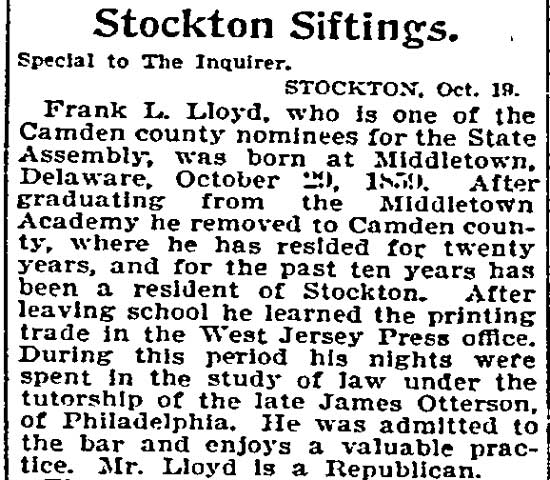
Stockton Siftings.
Special to The Inquirer.
STOCKTON, Oct. 19.
Frank L. Lloyd, who is one of the Camden county nominees for the State Assembly, was born at Middletown, Delaware, October 29, 1859. After graduating from the Middletown Academy he removed to Camden county, where he has resided for twenty years, and for the past ten years has been a resident of Stockton. After leaving school he learned the printing trade in the West Jersey Press office. During this period his nights were spent in the study of law under the tutorship of the late James Otterson, of Philadelphia. He was admitted to the bar and enjoys a valuable practice. Mr. Lloyd is a Republican.
Assemblyman Lloyd on marriage license bill
Philadelphia Inquirer —

Assemblyman Lloyd says he will introduce a marriage license bill at the coming session of the Legislature.
Murder Witness on the Rack
Philadelphia Inquirer —
Murder Witness on the Rack
County Detectives Smith and Cherry and City Detective Painter, of Camden, are investigating the death of Cornelius Preston, whose body was found in Big Timber Creek, near Westville, on March 5, 1899. Yesterday they had William Smith, of Camden, who furnished the clue to Preston’s alleged murder, taken before Prosecutor Lloyd for examination. The Prosecutor will not divulge the information given him by Smith until the detectives have had an opportunity to verify it.
On the Conductors and the Motormen
Philadelphia Inquirer —
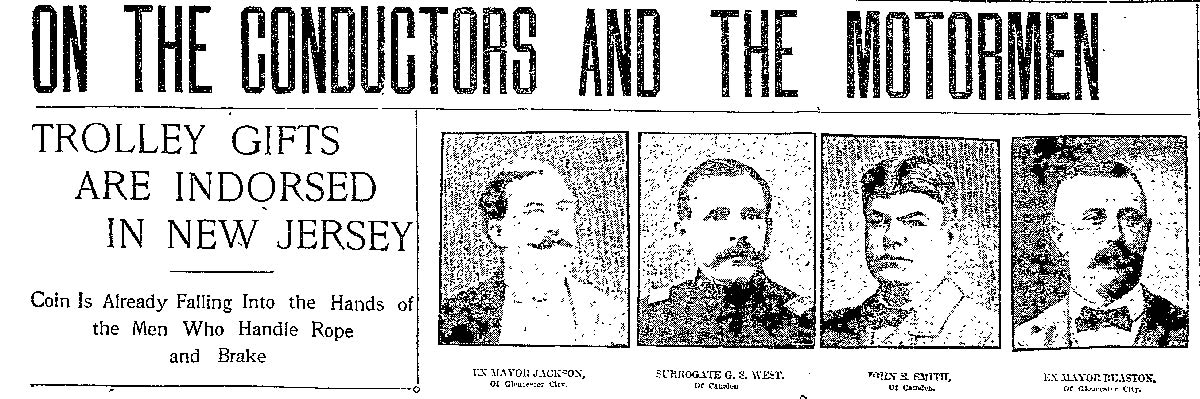
TROLLEY GIFTS ARE INDORSED IN NEW JERSEY
Coin Is Already Falling Into the Hands of the Men Who Handle Rope and Brake
EX MAYOR JACKSON, Of Gloucester City
SURROGATE G. S. WEST, Of Camden
JOHN S. SMITH, Of Camden
EX MAYOR BEASTON, Of Gloucester City
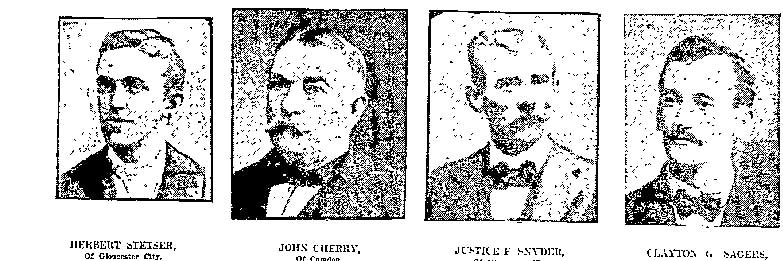
HERBERT STETSER, Of Gloucester City
JOHN CHERRY, Of Camden
JUSTICE F SNYDER, Of Gloucester City
CLAYTON G. SAGERS, Of Gloucester City
TALK WITH MEN WHO RUN THE CARS
Loud in Their Praise of The Inquirer’s Suggestion to Give to Worthy and Deserving Workmen
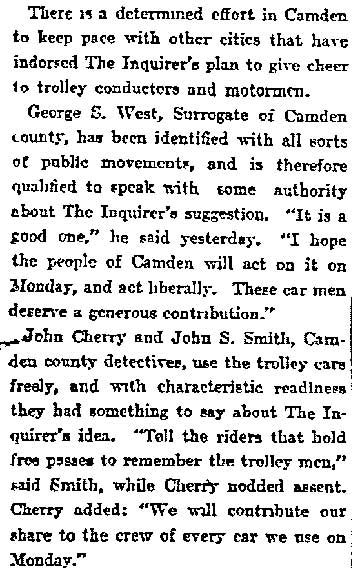
There is a determined effort in Camden to keep pace with other cities that have indorsed The Inquirer’s plan to give cheer to trolley conductors and motormen.
George S. West, Surrogate of Camden county, has been identified with all sorts of public movements, and is therefore qualified to speak with some authority about The Inquirer’s suggestion. “It is a good one,” he said yesterday. “I hope the people of Camden will act on it on Monday, and act liberally. These car men deserve a generous contribution.”
John Cherry and John S. Smith, Camden county detectives, use the trolley cars freely, and with characteristic readiness they had something to say about The Inquirer’s idea. “Tell the riders that hold free passes to remember the trolley men,” said Smith, while Cherry nodded assent. Cherry added: “We will contribute our share to the crew of every car we use on Monday.”
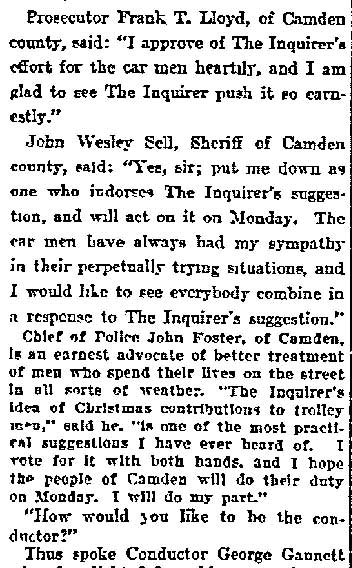
Prosecutor Frank T. Lloyd, of Camden county, said: “I approve of The Inquirer’s effort for the car men heartily, and I am glad to see The Inquirer push it so earnestly.”
John Wesley Sell, Sheriff of Camden county, said: “Yes, sir; put me down as one who indorses The Inquirer’s suggestion, and will act on it on Monday. The car men have always had my sympathy in their perpetually trying situations, and I would like to see everybody combine in a response to The Inquirer’s suggestion.”
Chief of Police John Foster, of Camden, is an earnest advocate of better treatment of men who spend their lives on the street in all sorts of weather. “The Inquirer’s idea of Christmas contributions to trolley men,” said he, “is one of the most practical suggestions I have ever heard of. I vote for it with both hands, and I hope the people of Camden will do their duty on Monday. I will do my part.”
“How would you like to be the conductor?”
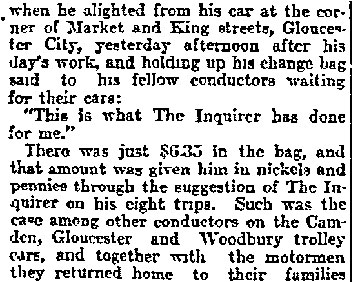
Thus spoke Conductor George Gannett when he alighted from his car at the corner of Market and King streets, Gloucester City, yesterday afternoon after his day’s work, and holding up his change bag said to his fellow conductors waiting for their cars:
“This is what The Inquirer has done for me.”
There was just $6.35 in the bag, and that amount was given him in nickels and pennies through the suggestion of The Inquirer on his eight trips. Such was the case among other conductors on the Camden, Gloucester and Woodbury trolley cars, and together with the motormen they returned home to their families wreathed in smiles, as they were sure of having a Christmas turkey.
On all the cars of the Woodbury trolley road the passengers would either drop an extra nickel or say “keep the change.”
Conductor Gannett said to an Inquirer reporter after leaving the trolley office that he did not think he would get so much, but when the nickels came pouring in on every trip he opened his eyes and said to his motorman: “The Inquirer is a great paper and maybe we will not have turkey galore.”
Camden Trolley Men Wreathed in Smiles
Camden trolley men are looking with eagerness to a Christmas offering from their passengers on Monday, and some of the conductors are already wreathed in smiles over tips already given them by riders who do not expect to be in town on Monday. It is refreshing to see a meek-looking and mild-mannered conductor look closely at the change tendered him for a fare, and then smile expansively when he sees an extra coin for himself and the motorman.
“Thank you,” is uttered in tones that makes the riders smile at one another in pleasure. The conductor returns to the rear platform and beams on the passengers within the car, and when he reaches up and pulls the signal to the motorman to stop the car, the sound of the bell seems to be really musical.
Vice Chief of Glassblowers Speaks To the Editor of The Inquirer.
The Philadelphia Inquirer deserves great credit for the interest it has taken in the conductors and motormen of three States. There is none more worthy to be helped. These men suffer more through exposure for the comforts of the people than any other class of workmen. Wishing all street railway workmen shorter hours and more home comforts, I am, very sincerely, W. M. DOUGHERTY, Vice President Glass Bottle Blowers’ Association of United States and Canada.
From the Hammonton South Jersey Republican.
The Philadelphia Inquirer has originated a novel and praiseworthy scheme, viz.: That patrons of trolley cars everywhere in paying their fare give the conductor an extra cent or more on Monday next. At night all this surplus money will be divided between the conductor who hands it in and his motorman, and will go far toward making for their families a merry Christmas. A great scheme—worthy of a great paper.
From the Camden Democrat.
Camden will doubtless respond most cheerfully to the thoughtful and timely suggestion of The Philadelphia Inquirer to remember the trolley conductors and motormen on Monday next, the day before Christmas. This the local travelling public are requested to do by handing to the conductor in conjunction with their regular fare an extra cent, nickel or dime, according to their individual inclination and means. These extra pennies are to be divided between the regular car men and designed, of course, to help in adding to the material accessories of their Christmas dinner. The plan is a most praiseworthy one, and commends itself to the practical consideration of every patron of our street car lines.
Prisoner Fought in State Capitol
Philadelphia Inquirer —

Samuel Warwick Taken Into Custody in the Assembly Chamber After Struggle
HE THREATENED OFFICIALS
Sheriff Sell and Prosecutor Lloyd Caused the Arrest of the Man, Who Is Somewhat Eccentric
Special to The Inquirer.
TRENTON, N. J., March 19.—A sensation was created in the Assembly Chamber this afternoon when County Detective John F. Smith, of Camden, placed Samuel G. Warwick, of Glassboro, under arrest on a warrant charging him with threatening to take the lives of Sheriff J. Wesley Sell and Prosecutor Frank T. Lloyd. Warwick, who is somewhat eccentric, was standing at the rail of the house when Detective Smith placed him under arrest.
Warwick, who is of rather spare build, protested loudly, and Sergeant-at-Arms Frank Tantum went to the assistance of Smith, but the two big officials were unable to quiet the prisoner, and two additional men were pressed into service. Warwick was finally handcuffed and taken to Camden by Smith.
Imaginary Wrongs
For many weeks Warwick has been hanging about the legislative halls endeavoring to induce some one to introduce a bill to reimburse him for imaginary wrongs he claims to have suffered while serving a term in State prison. He was sent to prison for forgery, and upon being released sought to bring an action against the State on the ground that he had been rendered speechless because of the ill treatment he received in the prison.
In an unguarded moment one day at the State House he broke forth into good, strong speech. Nothing daunted, however, he has kept up his endeavor to get legislation reimbursing him for his alleged injury.
Held Up Nomination
It was stated by one of the Senators to night that Warwick was the means of holding up the nomination of Judge Jessup, of Gloucester county, by the Senate for upwards of a week. The cause of the delay was sought for in vain by some of Judge Jessup’s friends. It then leaked out that Warwick had entered a protest with several of the Senators against Judge Jessup. It was Judge Jessup who sentenced Warwick to prison.
The threats that Warwick has been making against Sheriff Sell and Prosecutor Lloyd have been so virulent and repeated that it was deemed necessary to take him into custody. He was taken to Camden this afternoon.
Pending an examination as to his sanity, Warwick was committed to jail in default of $1000 bail by Justice Schmitz, of Camden, last night, on the charge of threatening to kill Prosecutor Frank T. Lloyd and Sheriff John W. Sell. Some time ago Warwick was sentenced to pay a fine for robbing his boarding mistress, and in default was committed to the county jail. Under a custom prisoners are allowed to serve a day for each dollar of the fine imposed, but it was not allowed in this case. After serving several days over the usual allotted time he paid his fine and then demanded a rebate of $1 for each day. Because the Prosecutor and Sheriff refused his demand he made threats against their lives.
Held for Morrison’s Death
Philadelphia Inquirer —
James Bland, of Camden, in Serious Trouble Because of the Riot.
James Bland has been held responsible for the murder of John Morrison at the Camden primaries of Monday night by a coroner’s jury.
George Murray has been arrested as an accomplice and held under bail at the instance of Prosecutor Lloyd.
The death of Joseph Goddard, who was shot at “Dog Corner” near Merchantville, is momentarily expected.
The Paul Woodward Murder Case
On October 1, 1902 Paul Woodward murdered two young boys by giving them poison. Frank T. Lloyd, then Camden County prosecutor, was responsible for leading the investigation and prosecuting the case. Woodward was arrested, indicted, tried, convicted of murder in the first degree, and on January 7, 1903 executed at the Camden County Jail.
People connected to the case included: Joseph Jennings — Jennings’ Third Regiment Band — Frank T. Lloyd — Dr. William S. Jones — William D. Hart — Dr. Paul N. Litchfield — F. Morse Archer — John Foster — John Painter — John Cherry — Isaac Toone — Paul Woodward — George M. Beringer — Charles G. Garrison — J. Wesley Sell — Christopher J. Mines Jr. — Frederick A. Rex — J. Frederick Voigt — George F. Kappel — Isaac Toy — Harry S. Scovel — Francis Ford Patterson Jr.
Philadelphia Inquirer — October 5, 1902
Missing Camden Boys Murdered in a Field
Philadelphia Inquirer —
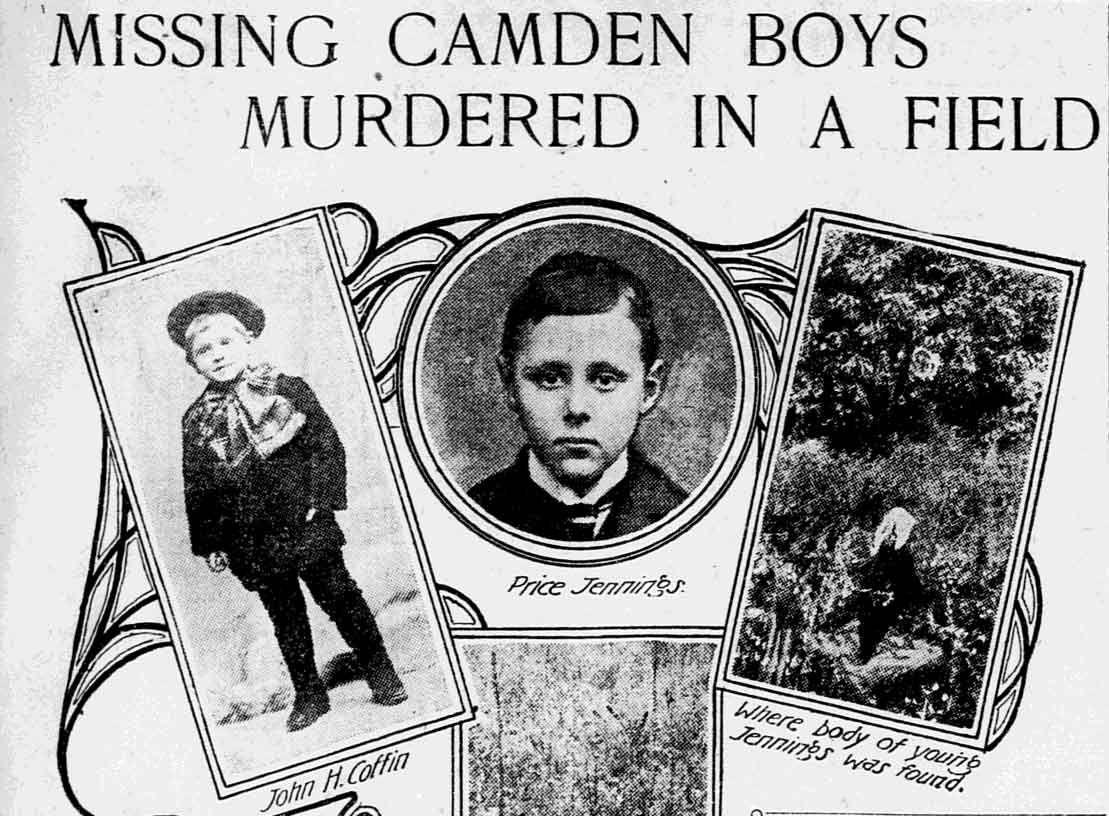
Young John Coffin and Price Jennings Believed to Have Been Poisoned—Companion Arrested and Committed to Jail
John H. Coffin
Price Jennings.
Where body of young Jennings was found.
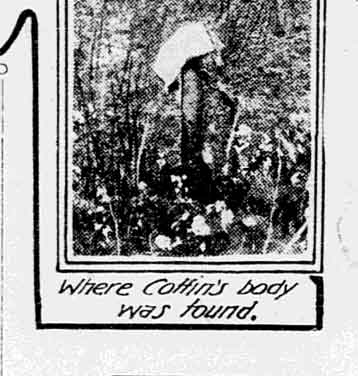
Where Coffin’s body was found.
The discovery of their bodies cold in death, the victims of an atrocious double murder, yesterday solved the mystery surrounding the disappearance from their homes in Camden on Wednesday of John H. Coffin, the 11-year-old son of William Coffin, division freight agent of the Pennsylvania Railroad, and Price Jennings, his chum and playmate, the 13-year old son of Josephus Jennings, leader of Jennings’ Third Regiment Band, of Camden.
Paul Woodward, 18 years old, a companion of both the boys, is charged with their murder and is locked up in the county jail awaiting the further action of the authorities. There are no evidences of external injuries and the only theory to which the police can attribute the cause of death is that the assassin of the boys administered poison to them, and it is along this line that County Physician Jones and Prosecutor Lloyd are conducting an investigation.
The details surrounding the atrocious crime makes it one the like of which has never been known in the criminal history of this section of the country. The youth of the boys, their heretofore relations of good companionship, and many other circumstances make of it an almost unparalleled crime, and while there is said to be every evidence of a motive for the murder, in the opinion of those who are in close touch with the case, it is an instance in which the work is that of a degenerate boy in whom all sense of right and wrong have long since been dead. Certain it is that the crime has stirred the people of Camden and vicinity to a feverish heat to which it has not been stirred since the days following the murder of Annie Leconey.
Found in a Field
The bodies of both the lads were found yesterday morning in a field near the Haddon Heights Station of the Reading Railroad on what is known as the Lippincott farm, about a quarter mile from Station Avenue. The body of young Jennings was found lying in a clump of bushes and less than forty yards away lay the remains of Coffin. Both bodies were stiff and in a state of decomposition. Coffin’s body was the first discovered, and it was not long after when that of his companion was found.
No sooner did the news of the discovery become known than the greatest excitement prevailed through the city of Camden and its suburbs. All sorts of rumors began to circulate, some of them hinting that the bodies were in a horribly mutilated condition and that the work was that of a negro. In a short time, however, whatever element of mystery there was about the case, so far as present indications go, was dissipated when the identification of the bodies was made and the arrest of young Woodward was accomplished soon afterwards.
Then the mystery began to clear somewhat. Both boys disappeared from their homes on Wednesday afternoon. When they failed to return that night the police were notified and a description of them was sent around the country adjacent to Camden and also to Philadelphia. Some persons said they had gone to Trenton to the fair, while others told of having seen them in the vicinity of Haddon Heights Station. Nothing came of these statements at the time, and meanwhile the boys failed to return home. Coffin’s father was of the opinion that the boys had been kidnapped, but this theory was not held by the police.
First Body Discovered
Late Friday night, Clarence Kreuson, whose home is at Haddon Heights, and a friend of his, Frank Johnson, who lives in this city, were returning from an afternoon of blackbird shooting. While crossing the field they came across the body of a boy. It was lying in the bushes, half concealed, and when they made a closer examination they discovered that life was extinct. In alarm Kreuson and his companion ran to the home of A. H. Wood, near-by, and communicated their intelligence. Wood immediately sent a telephone message to Coroner Litchfield in Camden, apprising him of the discovery. That official, through some misunderstanding, thought it was a man named Brown who had been talking to him. He hitched up his horse and drove to Haddon Heights, but was unable to locate the body. He was also unable to locate anyone named Brown. Further investigation was, therefore, postponed until yesterday morning, when the Coroner again visited the scene and found the body in the bushes.
From the clothing worn it was thought at first it might be Coffin’s, and after it had been brought to the Morgue, William Coffin, the lad’s father, was sent for. He was accompanied by Kingston Jennings, elder brother of the other missing boy. Mr. Coffin when nerved to look at the remains, exclaimed, “My God, it’s Price. Where is my boy. He must be found.” The identification was then made complete by the dead boy’s brother.
Meanwhile a number of persons had been going over the field where the body had been found in the search for clues that might lead to a discovery of the murderer of the boy, when one of them chanced across the remains of the other lad lying under a dead tree. This body was identified on the spot by Detective Curtis, of the Pennsylvania Railroad. The lad’s body was also taken to the Morgue and laid on a slab alongside of his chum.
Police at Work
The police in the interim had not been idle, and after scouring the vicinity of the place where the bodies had been found, came across Lillian Martin, the 15-year-old daughter of J. Wilson Martin, who conducts a “Cyclers’ Rest” at Collings avenue and the White Horse pike. She remembered having seen two boys answering the description of the dead lads in their place on Wednesday. They were accompanied by an older and a taller boy. Jennings seemed to have considerable money and purchased three pies and three bottles of soda water. After that they left the place and she never saw them again until she looked upon their bodies.
Prosecutor Frank Lloyd at once set to work, and Detective Hart was sent in search of young Woodward. Inquiry at his home, at 221 Benson street, brought the response that he was not at home. His mother learned what he was wanted for, and about 2 o’clock sent for Detective Hart and turned the boy over to him. She accompanied him to the Prosecutor’s office and, talking to the newspaper reporters, said that beyond being addicted to the use of cigarettes Paul was a good boy. She persisted that he could not have committed the crime as he was home all of Wednesday, Thursday and yesterday until the afternoon, when he went to Philadelphia to visit relatives. What the police are reported to view with importance is a statement that the mother is also alleged to have made to the effect that on Wednesday he had bothered her a great deal about money for a hat and shoes. While the authorities will make no admission, it is intimated that the motive they ascribe for the crime is robbery, and that the fact that Jennings had $10 when he disappeared was what led to his murder, and the murder of the other little fellow followed as a necessity for hiding the crime, as well as to get possession of a silver watch he is said to have had.
Identified Woodward
After young Woodward was taken into the Prosecutor’s office, besides the Prosecutor there were present Assistant Prosecutor F. Morse Archer, Court Stenographer Berry, Chief of Police Foster, of Camden; Chief of Police Linderman, of Merchantville, and Detectives Painter and Hart. In a few minutes Detective Cherry arrived with Lillian Martin. The latter had been cautioned not to say anything to anybody, either in or out of the room. She was inside for less than thirty seconds, and when she came out she is reported to have said that Woodward was the young man whom she had seen with the boys on Wednesday in her father’s place. She was taken back a second and a third time, and after the latter, it is said, she told the detectives that she was certain he was the person. She then left for her home, where she resisted all attempts to interview her.
In the meantime Recorder Stackhouse issued a commitment for Woodward on the oath of Detective Cherry, charging the young man with the murder of Coffin. Jennings’ name was not mentioned, as Coffin’s answered the same purpose.
While this was going on County Physician Jones was holding an autopsy in the basement of the jail, where the morgue is located. A personal examination showed that there were no external marks of violence, and in order to clinch the result of the autopsy he summoned from Philadelphia Professors Copeland and Rosenberger, of the Jefferson Hospital. Dr. Copeland performed the autopsy, and was at work until nearly 6 o’clock, when it was announced that no results other than that death was not due to external injuries, had been accomplished.
Prosecutor Lloyd said: “There was a double murder. Of that much we are certain. Death was not due to external injuries. What we suspect you will have to conjecture. The organs of both the boys have been sent to a chemist for examination. More than that I cannot say, except that we have arrested Paul Woodward on suspicion and that he is charged with the murder. The same man that killed one of the boys no doubt killed the other. All I ask now is that judgment be suspended for a few days, when I believe all will be cleared up.”
Woodward Visited Mr. Coffin
Mr. Coffin, whose home is at 305 North Third street, yesterday said: “It’s an awful blow that has come to me and I hardly know what to say. It does seem to me that Paul Woodward exerted an evil influence over my boy. I remember now that on Thursday he came to the house and wanted me to hire him to look for John. He then said that he thought he could find him.”
At the Woodward home it was stated that the mother and father of the boy had gone to Philadelphia. Charles May, a boarder, said there would be no trouble in proving that Paul was home all day of Wednesday, as well as the day following. He said that on each of those nights the boy had been in bed by 8 o’clock. This testimony, he said, would be corroborated by the boy’s mother, father, sister and himself. The only time Paul was out of the house, he said, was when he went several errands for his mother.
Late yesterday afternoon Coroner Litchfield empaneled the following jury: David Kaighn, George Leathwite, Isaac Toone, George J. Pechin, Elmer E. Cox and T. L. Bear. At 5 o’clock they viewed the remains, after which the bodies were sent to their respective homes. No date for the inquest has been fixed.
The stomach and other organs of both the youthful victims are in the possession of George M. Beringer, a druggist and chemist, at Fifth and Federal streets. Last night he said he had begun his examination, but it would take him probably a day or two more to complete his analysis.
Deep Mystery Still Envelops Camden Tragedy
Philadelphia Inquirer —
Authorities Apparently at Sea Regarding Theory for Lads’ Taking Off
THEY WERE MURDERED
Such Is the Belief of Prosecutor Lloyd and Others in the Case
WOODWARD UNDER FIRE
Declares Not Guilty of the Awful Crime—Two Boys to Be Buried To-day
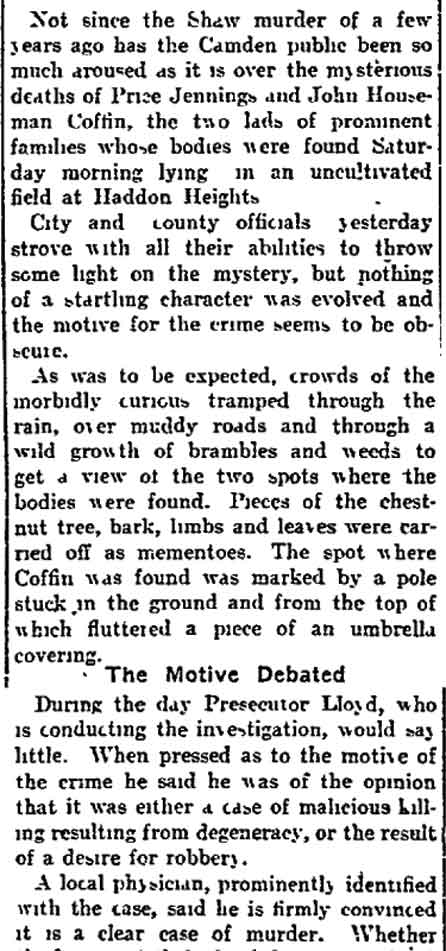
Not since the Shaw murder of a few years ago has the Camden public been so much aroused as it is over the mysterious deaths of Price Jennings and John Houseman Coffin, the two lads of prominent families whose bodies were found Saturday morning lying in an uncultivated field at Haddon Heights.
City and county officials yesterday strove with all their abilities to throw some light on the mystery, but nothing of a startling character was evolved and the motive for the crime seems to be obscure.
As was to be expected, crowds of the morbidly curious tramped through the rain, over muddy roads and through a wild growth of brambles and weeds to get a view of the two spots where the bodies were found. Pieces of the chestnut tree, bark, limbs and leaves were carried off as mementoes. The spot where Coffin was found was marked by a pole stuck in the ground and from the top of which fluttered a piece of an umbrella covering.
The Motive Debated
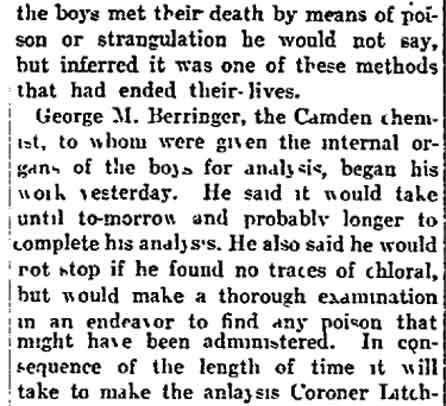
During the day Prosecutor Lloyd, who is conducting the investigation, would say little. When pressed as to the motive of the crime he said he was of the opinion that it was either a case of malicious killing resulting from degeneracy, or the result of a desire for robbery.
A local physician, prominently identified with the case, said he is firmly convinced it is a clear case of murder. Whether the boys met their death by means of poison or strangulation he would not say, but inferred it was one of these methods that had ended their lives.
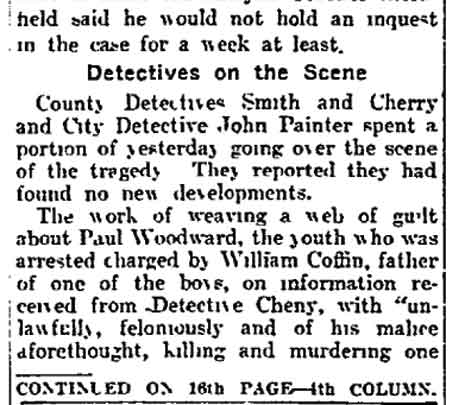
George M. Berringer, the Camden chemist, to whom were given the internal organs of the boys for analysis, began his work yesterday. He said it would take until to-morrow and probably longer to complete his analysis. He also said he would not stop if he found no traces of chloral, but would make a thorough examination in an endeavor to find any poison that might have been administered. In consequence of the length of time it will take to make the analysis Coroner Latchfield said he would not hold an inquest in the case for a week at least.
Detectives on the Scene
County Detectives Smith and Cherry and City Detective John Painter spent a portion of yesterday going over the scene of the tragedy. They reported they had found no new developments.
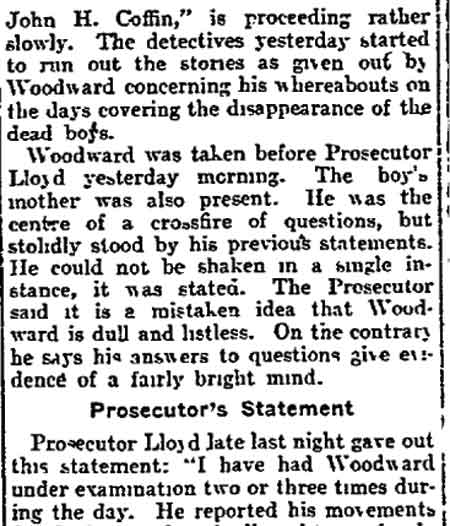
The work of weaving a web of guilt about Paul Woodward, the youth who was arrested charged by William Coffin, father of one of the boys, on information received from Detective Cherry, with “unlawfully, feloniously and of his malice aforethought, killing and murdering one John H. Coffin,” is proceeding rather slowly. The detectives yesterday started to run out the stories as given out by Woodward concerning his whereabouts on the days covering the disappearance of the dead boys.
Woodward was taken before Prosecutor Lloyd yesterday morning. The boy’s mother was also present. He was the centre of a crossfire of questions, but stolidly stood by his previous statements. He could not be shaken in a single instance, it was stated. The Prosecutor said it is a mistaken idea that Woodward is dull and listless. On the contrary he says his answers to questions give evidence of a fairly bright mind.
Prosecutor’s Statement
Prosecutor Lloyd late last night gave out this statement: “I have had Woodward under examination two or three times during the day. He reported his movements for the last week and adhered tenaciously to his original story that he had nothing to do with the doing away of the two children. I am awaiting the result of the chemical analysis of the organs of the two boys. There were no signs of strangulation, no bruises, scratches or scars excepting a slight cut on the left hand of one of the boys.”
Woodward spent Saturday night and yesterday in the manner of prisoners who are charged with petty offenses. Once, Saturday night, he is said to have cried. Aside from this evidence of feeling he slept and ate his food as though nothing out of the ordinary had occurred.
All the necessary arrangements for the funeral of the two boys have been completed and they will be buried this afternoon, young Coffin from his home, 305 North Third street, and Jennings from his home, 213 North Third street. Both funerals will be strictly private and no one except the respective families will be permitted to see the bodies.
Say Boys Were Seen
Several stories came from Haddon Heights to the effect that the boys were seen Wednesday afternoon near the spot where their bodies were found.
John Mann, colored, says he saw the two boys about 11 o’clock Wednesday morning on the Haddonfield road. Later he saw them under the chestnut tree in company with a man about 35 years old.
Edward Lippincott, who has a farm just below the scene of the murder, said a man who serves him with ice saw the boys about 5 o’clock in the afternoon. While he was not positive they were the boys, they tallied with the description.
The theory has been advanced the ill-fated lads met their deaths through eating some poisonous berry, but residents say there is nothing about there that would cause their death.
From what several persons say who saw the bodies before they were moved, they must have been laid down carefully, especially that of young Coffin, under whose head had been placed his hat neatly folded.
The small bottle of pellets taken from Woodward, which it was expected would figure in the case, were given back to him yesterday. They were simply homeopathic remedies given him at the Hahnemann Hospital.
The Trinity Baptist Sunday school yesterday adopted resolutions of regret and condolence on the death of young Jennings.
Philadelphia Inquirer — October 7, 1902
Woman Involved in Camden Mystery
Philadelphia Inquirer —
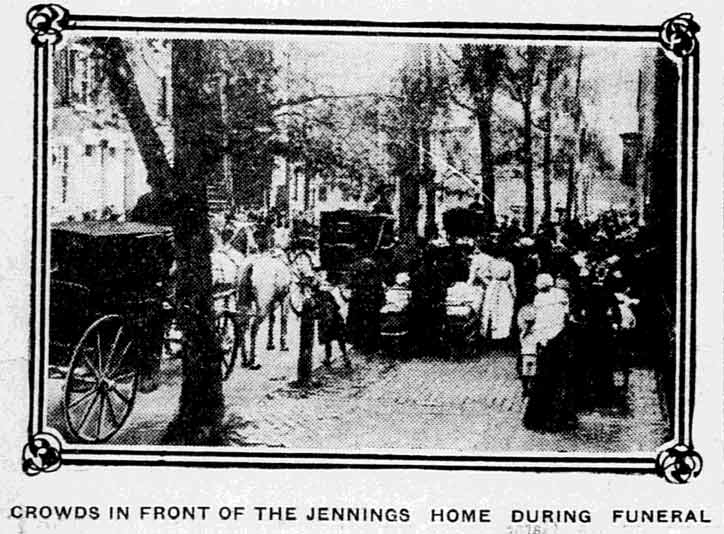
After Being Questioned by the Prosecutor She Is Committed to the County Jail—Believed to Be an Important Arrest
Crowds in Front of the Jennings Home During Funeral
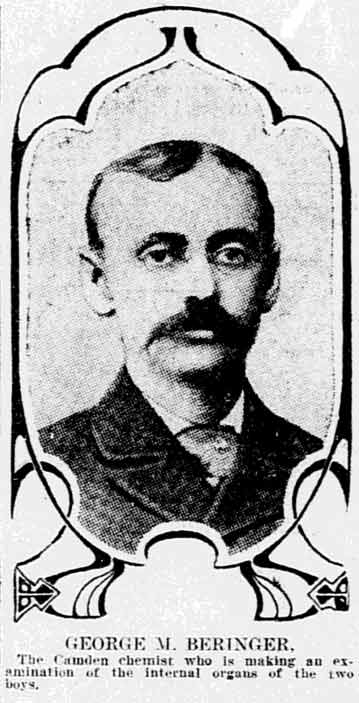
George M. Beringer.
The Camden chemist who is making an examination of the internal organs of the two boys.
While mystery apparently as absolute as ever still obscures the motive and the criminal in the case of John Houseman Coffin and W. Price Jennings, the unfortunate Camden lads whose trip to the country at Haddon Heights last Wednesday resulted so tragically, it is surmised from hints dropped now and again the matter may soon be cleared. However, those who are working so assiduously to bring the guilty person to justice are as close-mouthed as the proverbial clam, and but meagre information reaches the public.
Last night a woman, about 45 years old, was committed to the county jail by Recorder Stackhouse. On the commitment her name is given as Mrs. Barber. She was committed on complaint of County Detective John Cherry “as a material witness to prove certain allegations pending against one Paul Woodward, who is committed to the county jail charged with the murder of one John Coffin.”
The woman was placed under arrest after a long conference in the Prosecutor’s office. Prosecutor Lloyd said last night that the woman lives on a farm at Marlton, and that she is a very important witness in the case, so important, in fact, that she cannot regain her freedom without a good round sum being put up for her security.
Woodward Again Examined
The investigation into the case was somewhat retarded yesterday owing to an attack of rheumatism that made Prosecutor Frank T. Lloyd remain at home. The day’s responsibility rested on F. Morse Archer, the assistant prosecutor. The latter yesterday morning had Woodward brought into his office, where he underwent for the sixth time a thorough cross-examination. Mr. Archer said Woodward had made no confession, as had been rumored. On the contrary, he still maintained his innocence.
In answer to a question Mr. Archer said: “We are doing our best and while we are in possession of information which we consider important and vital to the case, it is impossible at this time to make it public.”
On the other hand, County Physician Jones was very emphatic in this particular, saying the boys were murdered beyond a doubt.
Boys’ Funerals
Yesterday afternoon the funeral of the boys took place at the same hour and within a square of one another’s homes. Although the hour set for the obsequies, 2 o’clock in the afternoon, had been kept secret scores of persons stood about in knots discussing the tragedy and eager to get a glimpse of the caskets containing the remains of the boys.
Police Captain Boyle and Policemen Kappel, Toy and Ridgeley guarded the houses, and no one except relatives and intimate friends were permitted to enter. But when the caskets were carried from the houses the crowd could not be kept back. Many persons crowded about, and the mourners entered the carriages between two solid phalanxes of curiosity seekers.
The services over Jennings were conducted at his home, 219 North Third street, by Rev. C. A. Adams and Rev. John Lyell. At the Coffin home, 305 North Third street, Rev. William H. Fishburn had charge of the obsequies. Companions of the boys acted as pallbearers. Jennings was buried at Evergreen and Coffin at Harleigh Cemetery.
George M. Beringer, a Camden chemist, who has the important duty of discovering, if possible, traces of poison in the stomachs of the boys, said yesterday he is making a thorough chemical analysis and is of necessity proceeding slowly. He said he will not be able to report the result for some days to come.
A pathetic little incident occurred at the Cooper School during recess yesterday morning when the children, school mates of the lads, gathered about and listened to the muffled beats of a drum. The school flag was at half mast and in every room there was a flag draped with black crepe. The youngsters were visibly affected.
Philadelphia Inquirer — October 8, 1902
Woodward Has Knowledge of Camden Murder
Philadelphia Inquirer —
So Confessed to Officers, Who Searched New York at Prisoner’s Instance
NO HAND IN THE CRIME
But Said He Knew Name of the Man Who Committed Awful Deed
YOUTH’S STRENUOUS DAY
Taken to the Scene of the Tragedy and Closeted With the Prosecutor
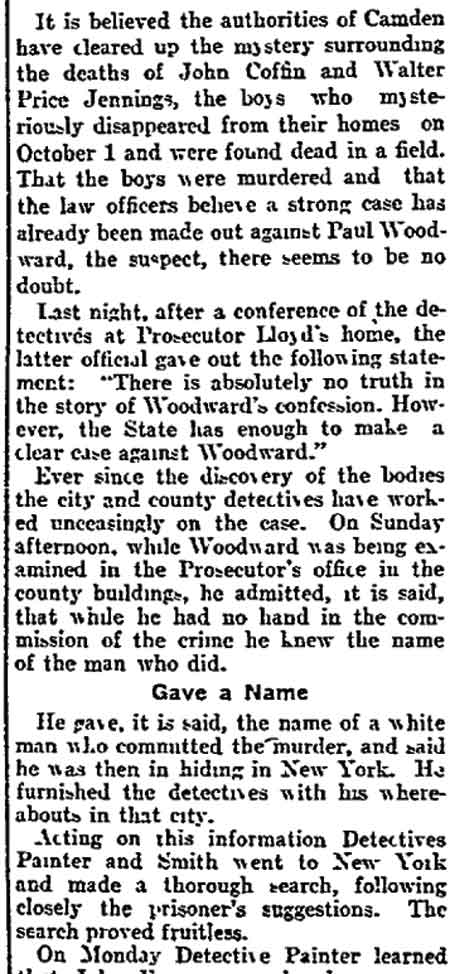
It is believed the authorities of Camden have cleared up the mystery surrounding the deaths of John Coffin and Walter Price Jennings, the boys who mysteriously disappeared from their homes on October 1 and were found dead in a field. That the boys were murdered and that the law officers believe a strong case has already been made out against Paul Woodward, the suspect, there seems to be no doubt.
Last night, after a conference of the detectives at Prosecutor Lloyd’s home, the latter official gave out the following statement: “There is absolutely no truth in the story of Woodward’s confession. However, the State has enough to make a clear case against Woodward.”
Ever since the discovery of the bodies the city and county detectives have worked unceasingly on the case. On Sunday afternoon, while Woodward was being examined in the Prosecutor’s office in the county buildings, he admitted, it is said, that while he had no hand in the commission of the crime he knew the name of the man who did.
Gave a Name
He gave, it is said, the name of a white man who committed the murder, and said he was then in hiding in New York. He furnished the detectives with his whereabouts in that city.
Acting on this information Detectives Painter and Smith went to New York and made a thorough search, following closely the prisoner’s suggestions. The search proved fruitless.
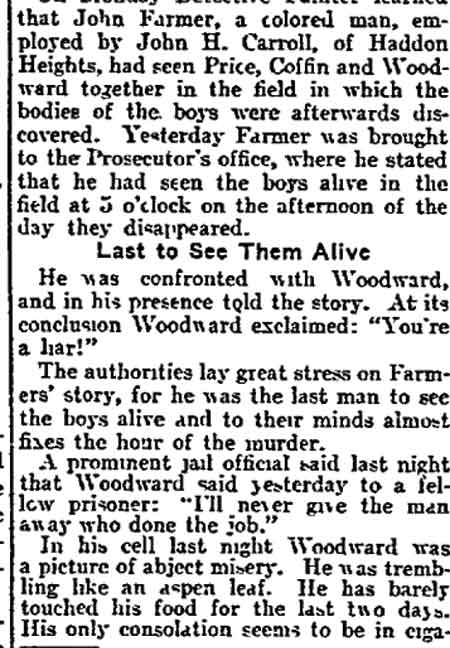
On Monday Detective Painter learned that John Farmer, a colored man, employed by John H. Carroll, of Haddon Heights, had seen Price, Coffin and Woodward together in the field in which the bodies of the boys were afterwards discovered. Yesterday Farmer was brought to the Prosecutor’s office, where he stated that he had seen the boys alive in the field at 5 o’clock on the afternoon of the day they disappeared.
Last to See Them Alive
He was confronted with Woodward, and in his presence told the story. At its conclusion Woodward exclaimed, “You’re a liar!”
The authorities lay great stress on Farmers’ story, for he was the last man to see the boys alive and to their minds almost fixes the hour of the murder.
A prominent jail official said last night that Woodward said yesterday to a fellow prisoner: “I’ll never give the man away who done the job.”
In his cell last night Woodward was a picture of abject misery. He was trembling like an aspen leaf. He has barely touched his food for the last two days. His only consolation seems to be in cigarettes, of which he daily consumes several packs.
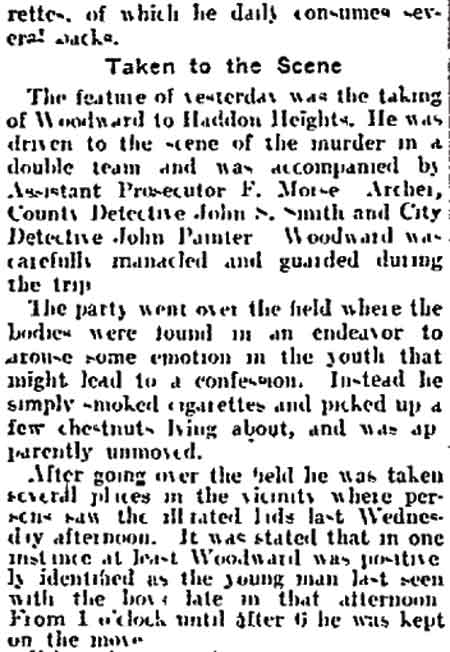
Taken to the Scene
The feature of yesterday was the taking of Woodward to Haddon Heights. He was driven to the scene of the murder in a double team and was accompanied by Assistant Prosecutor F. Morse Archer, County Detective John S. Smith and City Detective John Painter. Woodward was carefully manacled and guarded during the trip.
The party went over the field where the bodies were found in an endeavor to arouse some emotion in the youth that might lead to a confession. Instead he simply smoked cigarettes and picked up a few chestnuts lying about, and was apparently unmoved.
After going over the field he was taken to several places in the vicinity where persons saw the ill-fated lads last Wednesday afternoon. It was stated that in one instance at least Woodward was positively identified as the young man last seen with the boys late in that afternoon. From 1 o’clock until after 6 he was kept on the move.
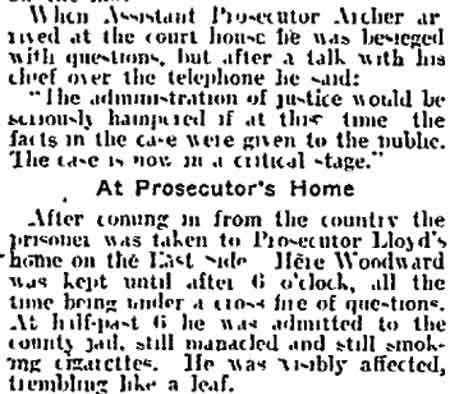
When Assistant Prosecutor Archer arrived at the court house he was besieged with questions, but after a talk with his chief over the telephone he said: “The administration of justice would be seriously hampered if at this time the facts in the case were given to the public. The case is now in a critical stage.”
At Prosecutor’s Home
After coming in from the country the prisoner was taken to Prosecutor Lloyd’s home on the East side. Here Woodward was kept until after 6 o’clock, all the time being under a cross fire of questions. At half-past 6 he was admitted to the county jail, still manacled and still smoking cigarettes. He was visibly affected, trembling like a leaf.
Late yesterday afternoon County Detective Cherry and City Detective Hart visited the home of Woodward on Benson street and brought back with them some clothing and about fifty novels. The latter were of a trashy order.
Harry Bowen and Joseph Simpkins, a trolley crew on one of the West Collingswood cars of the Camden and Suburban Railway Company, were examined by Assistant Prosecutor Archer. They had charge of a car that left Camden at 10 43 and arrived at West Collingswood at 11 13 Wednesday morning. It is believed that on this car the two dead boys and Woodward went to West Collingswood and from there walked over to Haddon Heights.
Money for Defense
Mrs. Woodward, mother of the accused boy, was at the Court House yesterday and said her father had sent her $5000 with which to use in defense of his grandson. She claimed to have engaged the services of Harry S. Scovel, who defended Eli Shaw. Mrs. Woodward also said that the Mrs. Barber arrested Monday night was a personal friend of the family, and that Paul had simply boarded with her.
County Physician Jones has advanced a theory as to the killing of the boys. He maintains poison was administered with no intention of killing. According to his theory, the boys were given “knockout drops,” or chloral, in sufficient quantities to kill a man. It was the intention of the murderer, however, to just give them a sufficient quantity to render them unconscious, and while in this state discover them at the solicitation of the boys’ families and receive a reward.
Camden’s Mystery Is Still Unsolved
Philadelphia Inquirer —
Camden’s Mystery Is Still Unsolved
Philadelphia Inquirer —
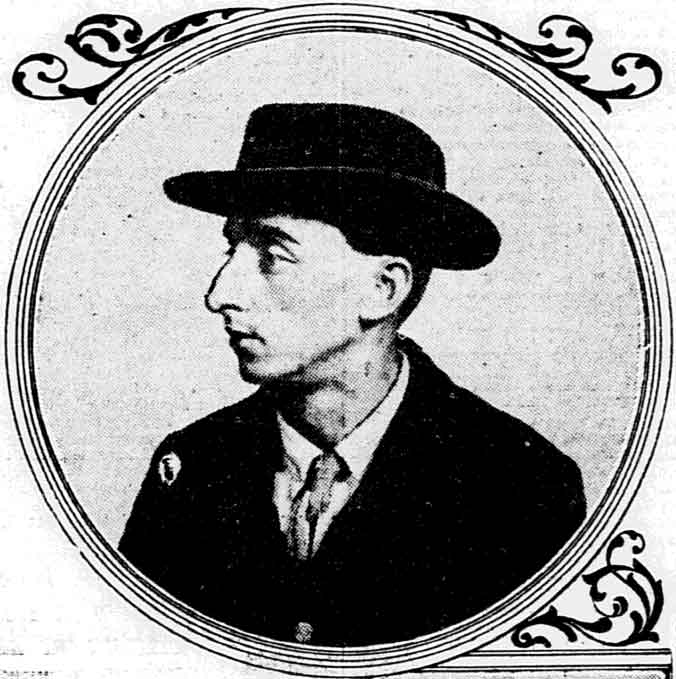
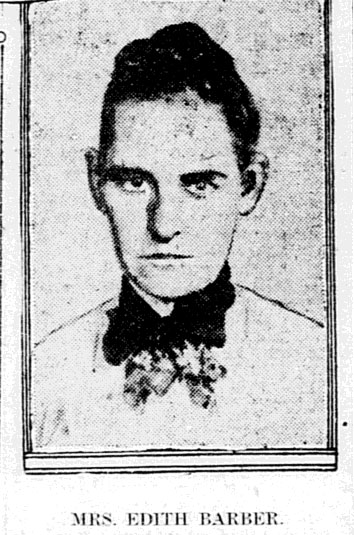
While Authorities Are at Work, Public Watch and Wait. Weaving a Net About Paul Woodward, the Young Suspect Now in Jail
Paul Woodward.
Mrs. Edith Barber.
It is now generally believed that the Camden county authorities have succeeded in establishing a clear case against young Paul Woodward, who is in the county jail, charged with the crime of taking away the lives of little John Coffin and Price Jennings. It was just a week ago yesterday when the boys went on their trip to Haddon Heights from which they were destined never to return alive.
Since the discovery of the bodies last Saturday partially hidden in rain-soaked weeds, the Prosecutor’s office, assisted by County Detectives Smith and Cherry and City Detectives Painter and Hart, have left no stone unturned.
No Confession
Prosecutor Lloyd yesterday reiterated his statement that Woodward had made no confession, but it is generally conceded as true that the accused youth did tell a story in which he makes some one else the principal criminal in the case.
Several incidents transpired yesterday that threw off the monotony of waiting for developments. Joseph Jennings, brother of one of the murdered boys, was taken to the cell in which Woodward is confined. He had no difficulty in recognizing the prisoner before. But as to whether he ever saw him in company with the dead lads he was not permitted to say.
Wild Rumor
There was much excitement about the Court House when it became rumored that Mrs. Edith Barber, the woman detained as a material witness against Woodward, had the small pox. To allay the alarm County Physician Jones called in representatives of the Board of Health, who concluded she had no sign of the disease.
After matters quieted somewhat the woman was taken into the Prosecutor’s office and questioned. When taken back to her cell she was crying and appeared to be almost unable to walk.
Woodward spent the day in his cell, smoking cigarettes as usual. He was visited in the morning by Lawyer Harry Scovel, who has not yet been engaged as counsel, as reported. Again in the afternoon Lawyer Scovel visited the youth in company with Woodward’s mother. At first Mrs. Woodward was denied admittance, but after waiting on the jail steps for nearly an hour she was permitted to go in and see her son. Lawyer Scovel and Mrs. Woodward were with the young man for a couple of hours.
Talked a Whole Lot
To all questions Lawyer Scovel said: “Woodward talked a whole lot, but I have nothing to say.”
He said he had not confessed to him. On the other hand Woodward had maintained his innocence.
When asked if Woodward could have a hearing if he demanded it Mr. Archer said he could. Asked if enough evidence was in hand to hold him, Mr. Archer said there was.
“On a simple assault charge?”
“No, sir, for the crime he is charged with—committing the murder of John Coffin,” replied Mr. Archer.
Coroner Litchfield said last night he would not set a date for the inquest before some time next week. Despite all reports to the contrary, Coroner Litchfield says Chemist George M. Beringer, who is analyzing the internal organs of the boys, will not complete the work before the end of the week.
Prosecutor Lloyd, who is still confined to his home with rheumatism, would make no statement last night, although admitting that the day’s work had not resulted in anything of material importance.
Unraveling the Camden Mystery
Philadelphia Inquirer —
Prosecutor Lloyd Declares That Woodward Is the Guilty Man
NO MORE ARRESTS LIKELY
Weaving Web Around Alleged Slayer of the Murdered Boys
“Beyond all question the murderer of these little boys is now in jail and the public’s anxiety can now be allayed,” said Prosecutor Frank T. Lloyd last night in making the first important statement concerning the tragedy of last week, when John Coffin and W. Price Jennings, two Camden lads, were murdered in an uncultivated field near Haddon Heights. The mystery which has enshrouded the case since the discovery of the bodies last Friday has almost been cleared up with the exception of the report of Chemist George M. Beringer, who is making an analysis of the internal organs of the boys.
Prosecutor Lloyd gave out the following statement shortly before 8 o’clock at his home on the East Side:
“Because of a suspicion that more than one person was engaged in the murder of these little boys the State has been obliged to work with much secrecy and to withhold from the press the result of our work. That suspicion is now removed. Beyond all question the murderer is now in jail and the public’s anxiety can be allayed. Woodward was alone the perpetrator of this crime.
Case Nearly Complete
“It is my duty to say this much in view of the deep public concern and the apprehension of other parents having little ones, but it would be improper for me to state the character or the quantity of evidence upon which our conclusions are based. I will only say that with the exception of the report of the chemist, which has not yet been received, the State’s case is almost complete.
“Woodward himself has made a number of statements, which, while not confessions, will be materially helpful toward securing his conviction.”
This statement precludes the possibility of another arrest being made in connection with the case, as has been currently reported during the week.
There were several conferences held yesterday between Assistant Prosecutor Archer and Detectives Smith, Cherry, Painter and Hart and Chief of Police Linderman, of Merchantville. During one of the conferences John Farmer, the colored man who recognized Woodward as having been seen with the boys last Wednesday afternoon, was called in and closely questioned. Following the detectives departed apparently on several different clues.
Detectives Hard at Work
Detective Hart subsequently returned with a Mrs. Somers, said to reside on Royden street. She was interviewed by the Assistant Prosecutor, but what connection she has with the case the authorities refused to divulge. The woman refused to talk.
Louis Ross, a German, who resides near Haddon Heights, was also called into the Prosecutor’s office late in the afternoon. At first he was thought to be an important witness, but it was afterwards learned that he knew little about the case.
Detective Robert J. McKentry, of Philadelphia, and Detective Smith took over the river Mrs. William H. Hubbert and another young woman. It is at the home of Mrs. Hubbert, at West Philadelphia, that Woodward said he was present last Friday night.
Woodward became rather obdurate yesterday, refusing the usual prison fare. He waited until his mother sent him coffee and other victuals. The accused youth was at first placed in the cell formerly occupied by Lafayette Gruff, the wife murderer, who was hanged September 19. He has now been placed in another cell.
More Arrests in Camden Mystery
Philadelphia Inquirer —
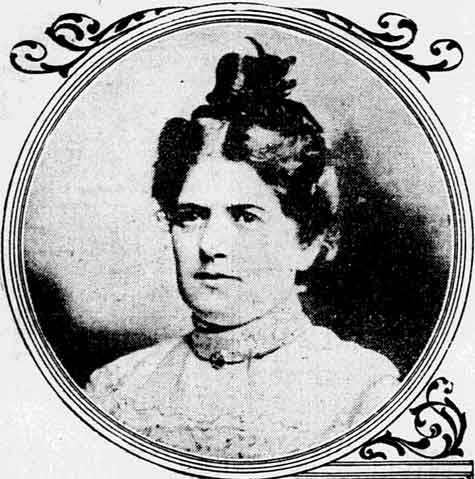
Paul Woodward’s Mother and Two Men Locked Up in the County Jail—Woman Lawyer to Defend the Prisoner
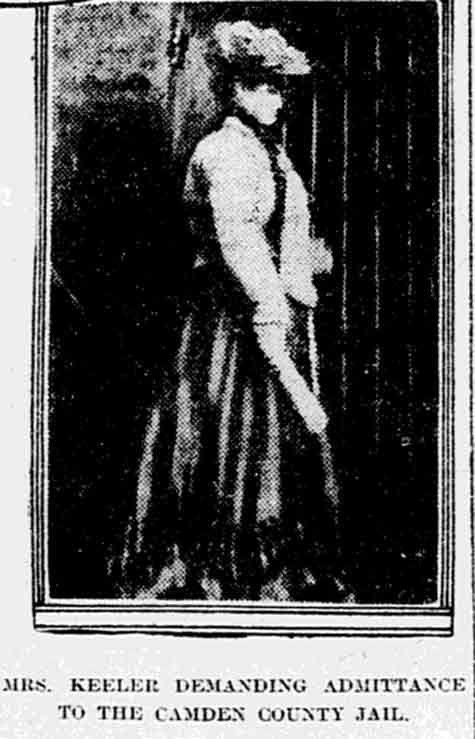
Mrs. Keeler Demanding Admittance to the Camden County Jail.
Mrs. Annie Irving Keeler,
Camden’s female lawyer, who has been engaged to defend young Woodward.
Following the statement given out Thursday night by Prosecutor Frank T. Lloyd that the authorities have the right man in jail for the murder of John Coffin and W. Price Jennings, whose bodies were found near Haddon Heights just a week ago to-day, the story of a confession by Paul Woodward, the accused youth, as exclusively told in The Inquirer last Wednesday, yesterday became public property. In this confession by Woodward he denies having killed the boys. He has told half a dozen stories already, all of which are different with the exception that he maintains he did not commit the crime. He says the motive was robbery and that he put a New York thug on the track of the boys last Wednesday week when the murdered lads were supposed to have a considerable sum of money on them. Woodward was to receive a reward, $50 for turning the youngsters over to the New Yorker.
The accused youth says he escorted young Coffin and Jennings out the White Horse pike to Haddon Heights, where they fell in with the mysterious person from New York whom the detectives made a fruitless effort to locate. Other stories told by Woodward were found to have in them no truth whatever.
Woodward Alone Guilty
In the mind of the Prosecutor, according to his statement of Thursday night, Woodward is alone guilty of taking the lives of the boys. Prosecutor Lloyd, who has been confined at his home on the East Side with rheumatism, was at his office yesterday for the first time in several days. When asked whether Woodward had made a complete confession he declined to discuss the subject.
More Arrests Made
Contrary to the inference to be gathered from the prosecutor’s statement, three additional arrests were made yesterday. There was much surprise when it was learned that Mrs. Woodward, mother of the prisoner, had been arrested by County Detectives Smith and Cherry. With her were also taken in custody Charles May, 60 years old, and William May, an East Indian, both of whom boarded at the Woodward home on Benson street. When asked the significance of the three arrests Prosecutor Lloyd said:
“It was deemed advisable to lock them up as witnesses and possible accessories after the fact.”
Annie Irving Keeler, Camden’s woman lawyer, announced yesterday afternoon she had been retained by Mrs. Woodward to defend the latter’s son. Mrs. Keeler at once endeavored to see the client, but she was denied admittance to the jail by the prosecutor, who said she had no right to see Woodward unless he himself had sent for her.
Admitted to Jail
Mrs. Keeler then went to the jail door and demanded admittance of Jailer Entriken. She was permitted to enter and visited Woodward’s cell, where she conferred with the prisoner for nearly an hour.
Prosecutor Lloyd went to Haddon Heights yesterday afternoon in company with County Physician Jones and County Detective Smith. The Prosecutor for the first time went over the field where the boys were slain.
Woodward was again questioned by the Prosecutor yesterday. He was taken to the Prosecutor’s office, where at the same time was Chemist George Beringer, who is analyzing the boys’ internal organs. Woodward and Chemist Beringer were alone in the office for ten minutes. Mr. Beringer held a conference with the Prosecutor that lasted one hour and twenty minutes. It was stated he had not presented his report of the chemical analysis.
Another Arrest in Murder Case
Philadelphia Inquirer —
West Philadelphian and a Supposed Companion of Young Paul Woodward Taken in Custody
There is but little remaining in the way of a mystery for the Camden county authorities to clear up in the murder case of little John Coffin and W. Price Jennings, of Camden. After working practically day and night during the past week Prosecutor Lloyd and his able assistants have brought to light such strong evidence against Paul Woodward, the young man in the county jail charged with the crime, that it will be next to impossible to refute it.
The sixth arrest in the case was made yesterday, when James Sheiding was taken into custody by County Detective Smith and committed to the county jail by Recorder Stackhouse as “a material witness.” Sheiding, who lives in West Philadelphia, was lured across the river to Camden, when Detective Smith at once took him in custody.
The prisoner is believed to be the companion of Woodward who, on the Friday night preceding the discovery of the murdered boys, was in the company of the accused murderer. On that occasion it is said Woodward had considerable money and that Sheiding assisted him in spending it.
Woodward did not give any evidence yesterday of being insane. On the other hand he was very quiet and evidently saw the futility of trying to make the Prosecutor believe him to be of unsound mind. He utterly refused to take part in the regular Sunday jail services. His whole concern seemed to be as to whether or not his mother would visit him to-day. He was of the opinion yesterday that his mother had gone to West Chester, where she is said to have relatives of means. Woodward thinks such a visit would result in him having sufficient funds with which to engage counsel.
Mrs. Edith Barker, the woman witness against Woodward, is very ill. Two of her children are ill with typhoid fever and the worry over this in connection with her important part in the case has made her one of the most wretched prisoners ever incarcerated at the county prison. Prosecutor Lloyd tried to have her admitted to a hospital, but his efforts were unavailing.
In all probability the case will come up before the present grand jury and be tried this month. Prosecutor Lloyd said last night that as soon as Chemist Beringer has made his report on his analysis of the viscera of the boys the Coroner’s inquest will be held. Immediately the court will be asked to take up the case.
Speedy Trial for Young Woodward
Philadelphia Inquirer —
But little developed in the murder case in Camden, for which Paul Woodward is incarcerated in the county jail. Prosecutor Lloyd has everything well in hand and his sole object is to have a speedy trial of the accused youth. He said yesterday his office would give out nothing further before the trial.
It is said Woodward has declared he gave John Coffin and W. Price Jennings, the murdered boys, bichloride of gold and not chloral. He is also reported to have said he did not intend giving such a large dose as would terminate fatally.
While as yet Woodward has no counsel it is probable he will be defended by Lawyer Edwin Hillman, who will be named by the court.
To Hurry Along Woodward Trial
Philadelphia Inquirer —
Paul Woodward, the youth accused of the murder of John Coffin and W. Price Jennings, the Camden boys whose bodies were found near Haddon Heights last Saturday week, may possibly be indicted for the crime to-day or to-morrow. Prosecutor Lloyd has the case so well in hand that he will present the facts before the grand jury this morning.
The State has practically concluded its investigation with the exception of making the necessary preparations for the trial. It is believed the grand jury will speedily find a bill of indictment against Woodward, and he may know his fate before the end of the present month.
Harry H. Robinson, a Philadelphia lawyer, was yesterday engaged to defend Woodward.
Woodward Writ to Be Argued To-day
Philadelphia Inquirer —
The rule granted by Judge Garrison last Tuesday to show cause why Paul Woodward, the youthful Camden murderer, should not be released on habeas corpus proceedings will be argued in Camden to-day. The indictment against Woodward may be presented and the case hurried toward the trial which will take place this term.
Prosecutor Frank T. Lloyd was able to be at his desk again yesterday after an attack of rheumatism.
Woodward Says He Is Not Guilty
Philadelphia Inquirer —
Paul Woodward, in Camden yesterday, pleaded not guilty to the indictments charging him with the murders of John Coffin and W. Price Jennings, the two Camden boys whose dead bodies were found near Haddon Heights a month ago.
Woodward was taken from the county jail to the court-room, where Justice Garrison was waiting to hear the plea. The accused youth did not give any evidence of emotion.
After listening to the reading of both indictments Woodward answered “not guilty” in a firm voice.
Prosecutor Lloyd then moved for the trial to take place Wednesday, November 12.
Woodward’s Parents on Stand; Boy in a Rage
Philadelphia Inquirer —


State Rests Its Case and the Defense Opens With an Effort to Prove an Alibi. Father and Mother Say Paul Was at Home
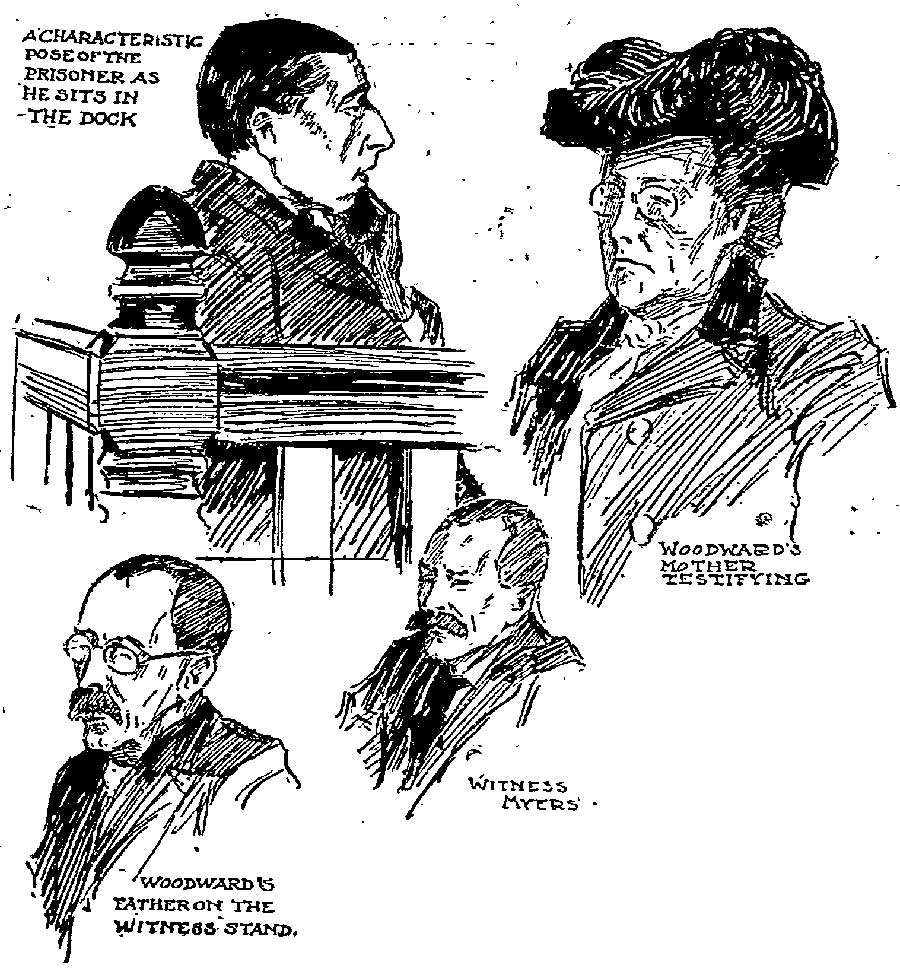
A Characteristic Pose of the Prisoner as He Sits in the Dock. Woodward’s Mother Testifying. Witness Myers. Woodward’s Father on the Witness Stand.
“I wish I had a good gun; I’d get a bead on Lloyd and plug him sure,” Paul Woodward is said to have remarked yesterday to Constable Christman as he crossed the “bridge of sighs” from the Camden Court House to the county jail at the conclusion of the fourth day of his trial on the charge of killing John Coffin. He was angered at the merciless cross-examination of his mother by Prosecutor Lloyd during the last half hour of the session.
A few minutes before court adjourned he leaned over to Lawyer Robinson, one of his counsel, and uttered a string of oaths.
“Be quiet; I insist that you do not talk,” urged the attorney.
“He’s got no right to talk to her that way, and I won’t stand for it. He didn’t do that to the other witnesses,” replied the prisoner as he resumed his crouching position in the chair and glared defiantly at the Prosecutor.
After offering the dead boys’ clothing, the plan of the country at Haddon Heights and the watch and ring introduced in the case, Prosecutor Lloyd at 10.35 o’clock said: “The State rests its case.”
Defense Opens
Lawyer Maurice Daniels, of counsel for the defense, occupied but a few minutes in opening the case to the jury. He said the defense would prove that Paul Woodward could not have been on the White Horse pike when the State’s witnesses say he was, and that it was highly improbable the boys died from strychnine poisoning. He concluded by saying that every moment of the time of Paul Woodward, from Wednesday, when the boys disappeared, until his arrest, would be accounted for by reputable witnesses.
Charles May, of 221 Benson street, the Woodward home, said that on Wednesday, October 1, Paul was home until after 11 o’clock in the morning. He went out for a short time and returned, as was his custom, to do errands before dinner. Dinner was eaten at about 3 o’clock. After that time Paul did not go out. On Thursday Paul went out to look for work, and came in at 11.30 in the morning. He stayed in to dinner and spent the rest of the day mending clothing and shoes. Friday he went to Philadelphia to pay lodge dues, and did not return until Saturday afternoon.
Two Days Missing
On cross-examination the witness could not tell what the defendant did on the Monday and Tuesday preceding. He finally admitted that “Paul was generally home if he wasn’t in the country.”
Thomas Woodward, the boy’s father, said he is employed as a watchman for the Reading Railroad Company and worked at night. On October 1 he got home at 7.45 in the morning and Paul was there. When he got up at 11.30 o’clock Paul was still there. Paul took dinner with him at 3 o’clock, and was still at home when he started for work at 5 o’clock. On Thursday he was out in the morning, but remained in the remainder of the day. Friday he went to Philadelphia and returned on Saturday.
Mother Testifies
“Mrs. Bella Woodward,” called Mr. Daniels. Instantly all necks were craned. Mrs. Woodward entered the court room in an unconcerned manner and took her seat in the witness box. She testified in a firm voice, and only displayed feeling under the cross-examination of Prosecutor Lloyd.
She said that on Wednesday, October 1, she left Paul at home about 10 o’clock in the morning and went to Philadelphia to attend to some lodge matters. She returned about 1.45 in the afternoon. Paul was not there, but came in a few minutes later. After dinner at 3 o’clock he did not go out until the next morning. Thursday morning she gave him $2. He went out and purchased a pair of shoes and came back in the afternoon, about 2 o’clock. He spent the balance of the afternoon mending his clothing. He did not go out at night.
Friday she gave Paul $5 to go to Philadelphia to pay dues amounting to $4.16 to the Home Circle, an organization of which her husband is a member. He did not pay the dues and did not return until the next afternoon at about half-past 1 o’clock.
Knew Mrs. Barber
Continuing, Mrs. Woodward said she knew Mrs. Edith Barber very well; that she had visited her for a period of seven weeks; that she intended to give her a silk dress and that she had two real estate agents looking for a farm for her which she wanted to purchase with money she was to get from an estate.
“I think it was on July 9 that I gave Paul money and sent him to Collins’ drug store to buy some strychnine,” said the mother. “We had thirty homing pigeons and the cats were killing them. I told him to give his name and address to the druggist. We put the poison on bread and butter and placed the pieces on the top of the pigeon house. It stayed there three days and as the cats wouldn’t touch it I took the pieces down and burned them.
“About the first week in September I sent him to the same place to purchase more strychnine. He got it and when he returned we put it on meat and placed the meat on top of the pigeon house. The next morning we found one dead cat, the meat all gone, and we haven’t been bothered with cats very much since.”
Paul’s Age
“How old is Paul?” asked Prosecutor Lloyd on cross-examination.
“Twenty-four last April,” was the reply.
“Didn’t you tell me in my office that he was only 18?”
“Yes, sir.”
“In the face of the fact that he is 24 you told me he was but 18?”
“Yes, but I wasn’t on my oath, then.”
“Then you said what was not true?”
“Yes, sir.”
“Have you ever been convicted of crime?”
“No, sir.”
Were you not tried in the Court of Quarter Sessions of Philadelphia in June, 1895, for obtaining a carpet valued at $56 from Edward Whitehall by the false representation that you owned the premises 1313 Mt. Vernon street, Philadelphia?”
“No, sir.”
“Did you not serve nine months in the county prison for that crime?”
“No, sir.”
The Boy Angry
It was at this time that Woodward, who was eying the prosecutor like a hawk, made strong objections to his counsel as to the manner in which his mother was being examined.
The prosecutor then took up a certified copy of a record and asked her a number of questions on the same subject. She denied all knowledge of the crime and the names of the witnesses.
At the conclusion of the cross-examination Mr. Daniels handed her a silver watch and chain, which she said belonged to Willie May and was the same one Paul took to Philadelphia.
Mr. Daniels also handed her a plain gold ring. She said it had been Paul’s for over twelve years, but he had not worn it until three years ago, because it was too large for his finger.
“Where did you get that ring?” asked the Prosecutor.
“A young man gave it to me.”
“His name, please?”
“Joseph Harback; he was in prison in Philadelphia and we did him a favor.”
This concluded the testimony of the day. The ring introduced by the defense contains the letters “C. K.,” engraved in old English. Court adjourned until to-morrow morning.
Woodward Spent a Quiet Sunday
Philadelphia Inquirer —
Apparently Buoyed Up by the Efforts of His Counsel, Who Now Have Their Inning
Paul Woodward, the young man on trial for his life before Judge Garrison, charged with the murder of little John Coffin, spent a quiet Sunday in his cell in the Camden county jail. He ate his meals as usual and gave no evidence whatever of being affected by the ordeal through which he has passed since last Wednesday. Since the defense has opened its case he appears to be more cheerful, presumably expectant of something occurring before the end of the trial that will strengthen his chances of acquittal.
The trial has caused more comment in Camden than anything since the time Eli Shaw was accused of the murder of his mother and grandmother some years ago.
There was great surprise manifested when Lawyer Daniels, in outlining the defense, said it would be proven Woodward could not have been present when the crime was committed, and the subsequent attempt to prove an alibi. Woodward may be placed on the stand to-day and it remains to be seen how his story will stand the keen cross-examination of Prosecutor Lloyd. One of the features of the trial has been the manner in which the jury has noticed every move and characteristic of the defendant as he sits in the prisoners’ dock.
The jurymen were yesterday taken out for exercise. They were accompanied by constables and walked about the streets for some time.
Several letters have been received at the county jail, where Woodward is incarcerated, from persons who are desirous of securing the young man’s brain in the event of him being convicted and hanged.
Woodward Had Many Vices
Philadelphia Inquirer —
Some Things That Prosecutor Lloyd Held Back
From the Prosecutor’s office in Camden it is learned that much more evidence was in hand than that which was presented against Paul Woodward, convicted of murdering John Coffin and W. Price Jennings and who is under sentence to be hanged. The Prosecutor had knowledge that Woodward blackmailed a South Camden woman and her husband, almost resulting in a separation. Then he is said to have proposed to a young man a scheme of operating a “knock-out” resort.
One of his plans for getting money, it is said, was to play detective by going to certain women, telling them of misconduct on the part of their husbands and demanding a fee for watching the latter. Then he would turn around and work the same scheme on the men.
Woodward’s Last Hope Vanished
Philadelphia Inquirer —
Court of Pardons Refuses to Interfere in Case of Camden’s Condemned Murderer
Special to The Inquirer.
TRENTON, N. J., Dec. 30.—The Court of Pardons in special session this afternoon refused to interfere in the case of Paul Woodward, now under sentence of death in Camden for the killing of the Coffin and Jennings boys, and aged Mrs. Woodward, mother of the condemned youth, was sent back to her home a broken-hearted woman with the assurance that nothing short of a miracle will prevent the hanging of her son next week.
Lawyer Rex sent a letter to the court announcing that he had been unable to secure the additional evidence he expected and that it was not possible for him to present the case as he had anticipated. Prosecutor Lloyd, of Camden, then recited the events leading up to the sentencing of the youth and the application for commutation of sentence was dismissed.
Mrs. Woodward came to Trenton early to-day and remained at the State House until she was convinced there was no hope for her son.
Murder Case Finally Closed
Philadelphia Inquirer —
The last chapter in the murder of John Coffin and W. Price Jennings, for which Paul Woodward was recently hanged, was enacted yesterday when Prosecutor Lloyd directed County Clerk Patterson to cancel the indictment charging Woodward with the murder of young Jennings. It was done simply to make the records in the case complete.
Officers Traced Woodward’s Steps
Philadelphia Inquirer —
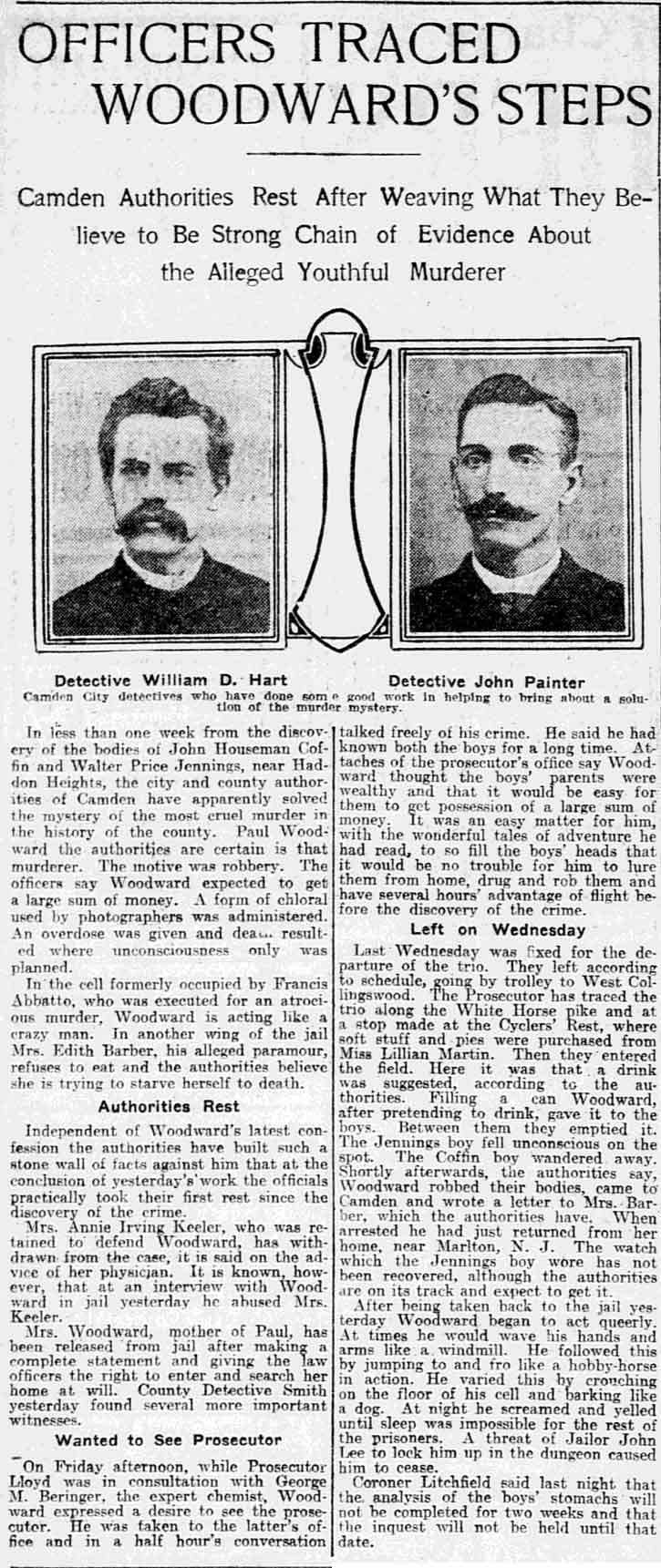
Camden Authorities Rest After Weaving What They Believe to Be Strong Chain of Evidence About the Alleged Youthful Murderer
Detective William D. Hart
Detective John Painter
Camden City detectives who have done some good work in helping to bring about a solution of the murder mystery.
In less than one week from the discovery of the bodies of John Houseman Coffin and Walter Price Jennings, near Haddon Heights, the city and county authorities of Camden have apparently solved the mystery of the most cruel murder in the history of the county. Paul Woodward the authorities are certain is that murderer. The motive was robbery. The officers say Woodward expected to get a large sum of money. A form of chloral used by photographers was administered. An overdose was given and death resulted where unconsciousness only was planned.
In the cell formerly occupied by Francis Abbatto, who was executed for an atrocious murder, Woodward is acting like a crazy man. In another wing of the jail Mrs. Edith Barber, his alleged paramour, refuses to eat and the authorities believe she is trying to starve herself to death.
Authorities Rest
Independent of Woodward’s latest confession the authorities have built such a stone wall of facts against him that at the conclusion of yesterday’s work the officials practically took their first rest since the discovery of the crime.
Mrs. Annie Irving Keeler, who was retained to defend Woodward, has withdrawn from the case, it is said on the advice of her physician. It is known, however, that at an interview with Woodward in jail yesterday he abused Mrs. Keeler.
Mrs. Woodward, mother of Paul, has been released from jail after making a complete statement and giving the law officers the right to enter and search her home at will. County Detective Smith yesterday found several more important witnesses.
Wanted to See Prosecutor
On Friday afternoon, while Prosecutor Lloyd was in consultation with George M. Beringer, the expert chemist, Woodward expressed a desire to see the prosecutor. He was taken to the latter’s office and in a half hour’s conversation talked freely of his crime. He said he had known both the boys for a long time. Attaches of the prosecutor’s office say Woodward thought the boys’ parents were wealthy and that it would be easy for them to get possession of a large sum of money. It was an easy matter for him, with the wonderful tales of adventure he had read, to so fill the boys’ heads that it would be no trouble for him to lure them from home, drug and rob them and have several hours’ advantage of flight before the discovery of the crime.
Left on Wednesday
Last Wednesday was fixed for the departure of the trio. They left according to schedule, going by trolley to West Collingswood. The Prosecutor has traced the trio along the White Horse pike and at a stop made at the Cyclers’ Rest, where soft stuff and pies were purchased from Miss Lillian Martin. Then they entered the field. Here it was that a drink was suggested, according to the authorities. Filling a can Woodward, after pretending to drink, gave it to the boys. Between them they emptied it. The Jennings boy fell unconscious on the spot. The Coffin boy wandered away. Shortly afterwards, the authorities say, Woodward robbed their bodies, came to Camden and wrote a letter to Mrs. Barber, which the authorities have. When arrested he had just returned from her home, near Marlton, N. J. The watch which the Jennings boy wore has not been recovered, although the authorities are on its track and expect to get it.
After being taken back to the jail yesterday Woodward began to act queerly. At times he would wave his hands and arms like a windmill. He followed this by jumping to and fro like a hobby-horse in action. He varied this by crouching on the floor of his cell and barking like a dog. At night he screamed and yelled until sleep was impossible for the rest of the prisoners. A threat of Jailor John Lee to lock him up in the dungeon caused him to cease.
Coroner Litchfield said last night that the analysis of the boys’ stomachs will not be completed for two weeks and that the inquest will not be held until that date.
Morphia Killed Two Camden Boys
Philadelphia Inquirer —
Chemist Beringer Makes His Report to Prosecutor Lloyd—Another Witness in Murder Case
George M. Beringer, the chemist who made an analysis of the organs of John Houseman Coffin and Walter Price Jennings, who were found dead near Haddon Heights, two weeks ago, has made a report of his findings to Prosecutor Lloyd.
It was stated yesterday by an official in a position to know that Mr. Beringer found traces of enough morphia in each of the boys’ stomachs to kill a man. What seems to puzzle the authorities is to learn in what manner it was administered. It is not believed it was given them in a liquid and there were no traces of food such in which it could have been secreted.
The authorities yesterday discovered another witness who saw the three boys together in the field a short distance from where the bodies were found. They refuse to divulge his name.
No day has as yet been fixed for the trial of the alleged murderer, Young Paul Woodward, but it is believed if Prosecutor Lloyd’s health will permit the case will be disposed of early in November. Woodward spends most of his time in smoking cigarettes and discussing with all who will converse with him his chances for being sent to State prison.
Woodward on Trial for Coffin Murder
Philadelphia Inquirer —
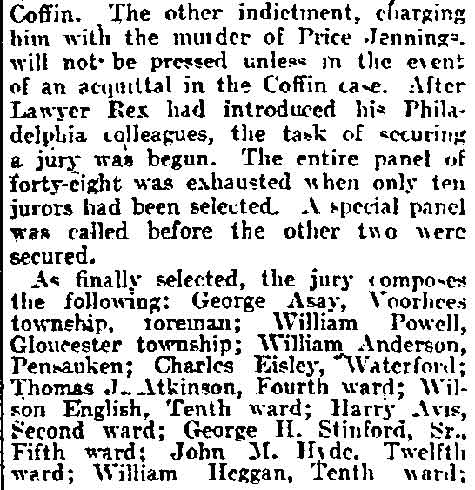
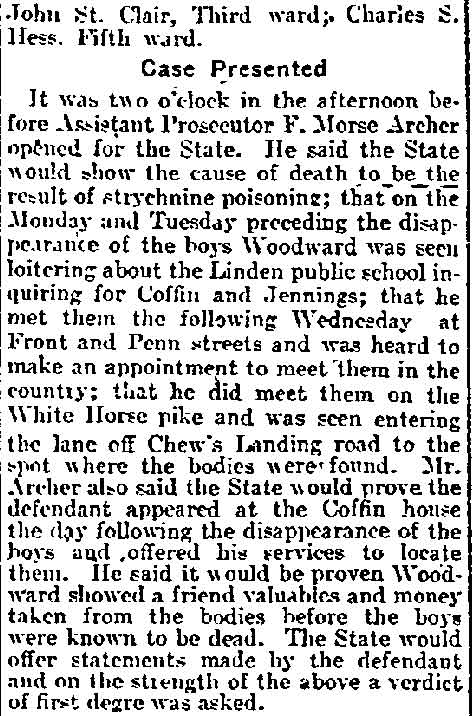
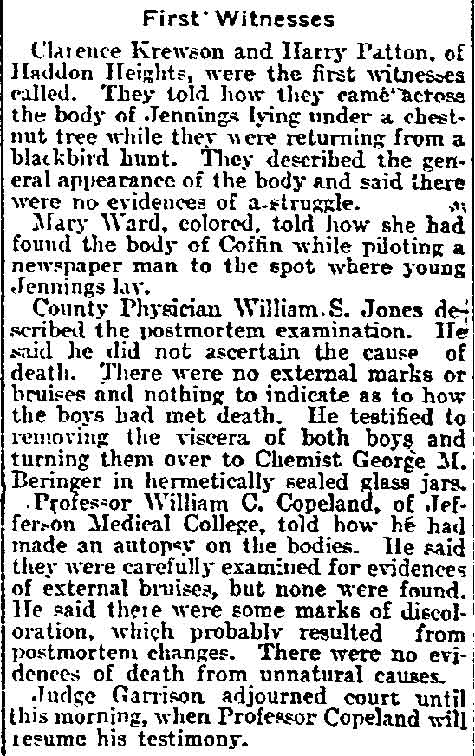
Less Than Six Weeks After Alleged Crime Case Is Called in Camden Court — The Prisoner’s Appearance — What State Will Try to Prove
Six weeks ago yesterday John Coffin and W. Price Jennings, two rosy-cheeked Camden lads, left their comfortable homes for a boyish romp in the country. Three days later their bodies were found lying half concealed among a wild growth of bushes in an uncultivated field near Haddon Heights.
Yesterday Paul Woodward, termed a cigarette fiend and a reader of trashy novels, was placed on trial in Camden before Judge Garrison, on indictments charging him with the murder of John Coffin.
Directly the doors of the court room were opened a crowd of men and women made a mad rush for seats, and the constables with difficulty restrained them. In a few minutes every seat had been taken and the throng awaited expectantly for a glimpse of the accused youth. The space reserved for members of the bar was filled, too, with many lawyers interested in the outcome of what doubtless will prove one of the most famous murder trials in Camden county.
Court Opened
A few minutes after 10 o’clock Judge Garrison arrived, court was formally opened and Prosecutor of the Pleas Frank T. Lloyd read the list of the State’s witnesses, nearly sixty in number. In the meantime Constable Christman had been dispatched for Woodward, and before the Prosecutor had completed reading the list of witnesses the accused youth appeared by way of the “Bridge of Sighs,” which connects the county jail with the Court House.
Immediately he was the cynosure of all eyes, but he did not appear to heed the gaze of the spectators. Pulling up his trousers with a sailor-like motion he walked buoyantly to his seat in the prisoner’s dock. His counsel, Lawyers Robinson and Daniels, of Philadelphia, and William Rex, of Camden, greeted him with, “How do you feel, Paul?”
He Couldn’t Kick
“All right; I can’t kick,” he replied, nonchalantly, and he settled himself down in the chair until only the top of his peculiarly shaped head was visible. He was less excited than many spectators. He had the appearance more of an undersized boy than a man—he is 25[?] years old, and not 19[?], as has been stated.
His hair, jet black, was plastered down on his head with scrupulous care. In fact, he very evidently took more pains in arranging his hair than his clothing, which was ill-fitting. His low-cut vest had fancy gilded buttons as large as a quarter, while his trousers, the same he wore when apprehended for the crime, were of a coarse material, navy blue, and several sizes too large for him.
Prisoner’s Parents There
Shortly after court convened, Woodward’s parents appeared, accompanied by a little girl, said to be Woodward’s sister. The family occupied seats among the spectators, taking keen interest in the proceedings.
Prosecutor Lloyd moved the indictment against Woodward for the murder of John Coffin. The other indictment, charging him with the murder of Price Jennings, will not be pressed unless in the event of an acquittal in the Coffin case. After Lawyer Rex had introduced his Philadelphia colleagues, the task of securing a jury was begun. The entire panel of forty-eight was exhausted when only ten jurors had been selected. A special panel was called before the other two were secured.
As finally selected, the jury composes the following: George Asay, Voorhees township, foreman; William Powell, Gloucester township; William Anderson, Pensauken; Charles Eisley, Waterford; Thomas J. Atkinson, Fourth ward; Wilson English, Tenth ward; Harry Avis, Second ward; George H. Stinford, Sr., Fifth ward; John M. Hyde, Twelfth ward; William Heggan, Tenth ward; John St. Clair, Third ward; Charles S. Hess, Fifth ward.
Case Presented
It was two o’clock in the afternoon before Assistant Prosecutor F. Morse Archer opened for the State. He said the State would show the cause of death to be the result of strychnine poisoning; that on the Monday and Tuesday preceding the disappearance of the boys Woodward was seen loitering about the Linden public school inquiring for Coffin and Jennings; that he met them the following Wednesday at Front and Penn streets and was heard to make an appointment to meet them in the country; that he did meet them on the White Horse pike and was seen entering the lane off Chew’s Landing road to the spot where the bodies were found. Mr. Archer also said the State would prove the defendant appeared at the Coffin house the day following the disappearance of the boys and offered his services to locate them. He said it would be proven Woodward showed a friend valuables and money taken from the bodies before the boys were known to be dead. The State would offer statements made by the defendant and on the strength of the above a verdict of first degree was asked.
First Witnesses
Clarence Krewson and Harry Patton, of Haddon Heights, were the first witnesses called. They told how they came across the body of Jennings lying under a chestnut tree while they were returning from a blackbird hunt. They described the general appearance of the body and said there were no evidences of a struggle.
Mary Ward, colored, told how she had found the body of Coffin while piloting a newspaper man to the spot where young Jennings lay.
County Physician William S. Jones described the postmortem examination. He said he did not ascertain the cause of death. There were no external marks or bruises and nothing to indicate as to how the boys had met death. He testified to removing the viscera of both boys and turning them over to Chemist George M. Beringer in hermetically sealed glass jars.
Professor William C. Copeland, of Jefferson Medical College, told how he had made an autopsy on the bodies. He said they were carefully examined for evidences of external bruises, but none were found. He said there were some marks of discoloration, which probably resulted from postmortem changes. There were no evidences of death from unnatural causes.
Judge Garrison adjourned court until this morning, when Professor Copeland will resume his testimony.
Woodward Placed on Trial To-Morrow
Philadelphia Inquirer —
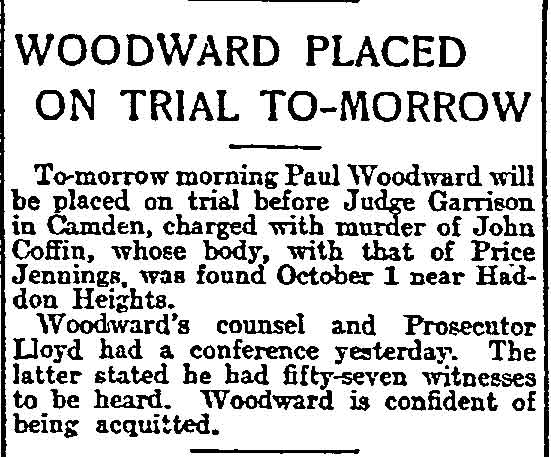
To-morrow morning Paul Woodward will be placed on trial before Judge Garrison in Camden, charged with murder of John Coffin, whose body, with that of Price Jennings, was found October 1 near Haddon Heights.
Woodward’s counsel and Prosecutor Lloyd had a conference yesterday. The latter stated he had fifty-seven witnesses to be heard. Woodward is confident of being acquitted.
Woodward Bought Poison, Says Druggist
Philadelphia Inquirer —

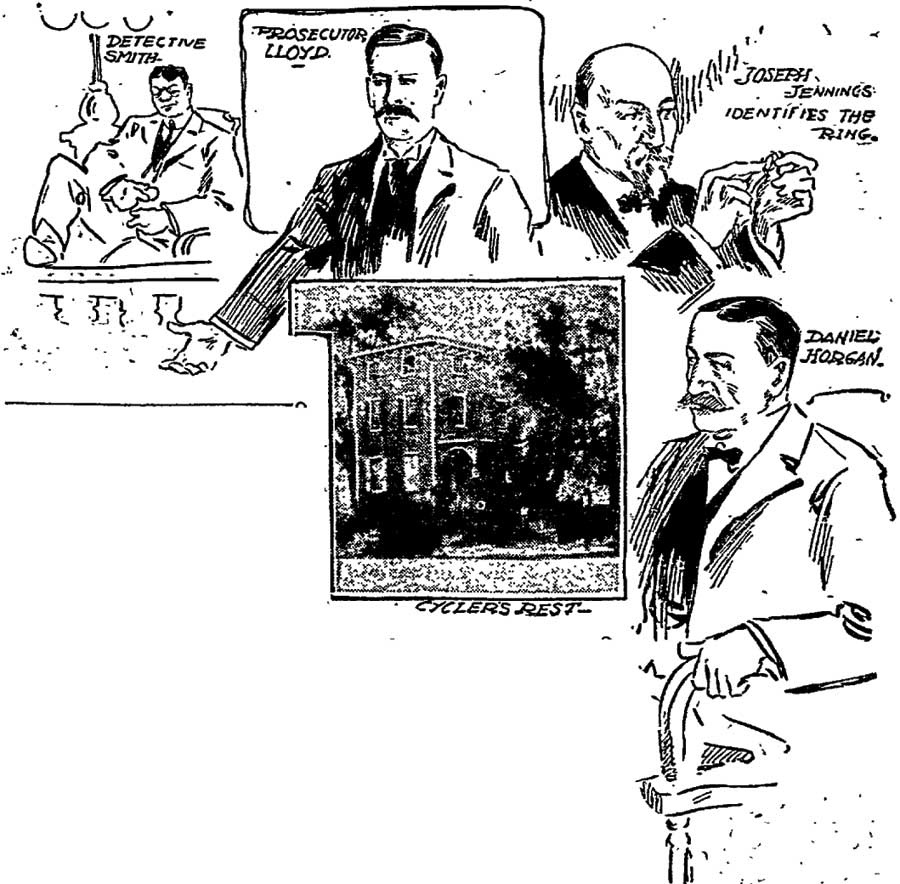
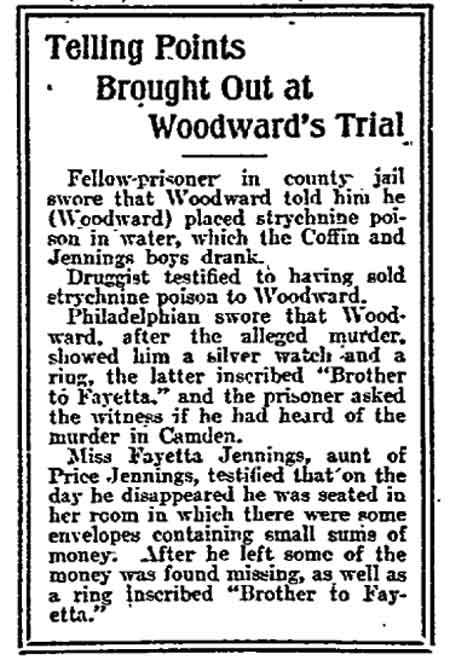
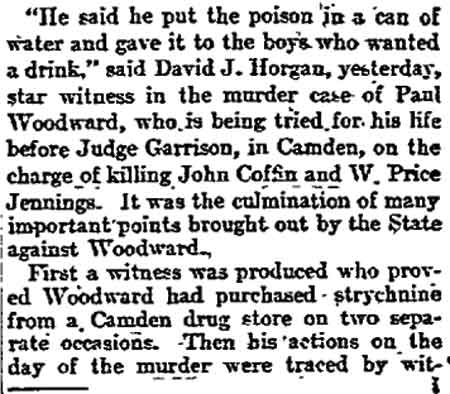
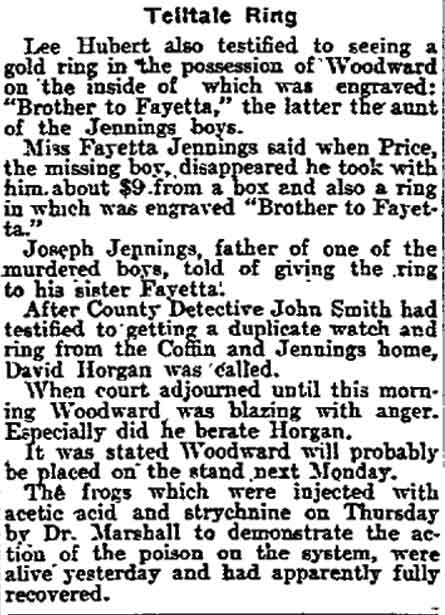
Telling Points Brought Out at Woodward’s Trial
Fellow-prisoner in county jail swore that Woodward told him he (Woodward) placed strychnine poison in water, which the Coffin and Jennings boys drank.
Druggist testified to having sold strychnine poison to Woodward.
Philadelphian swore that Woodward, after the alleged murder, showed him a silver watch and a ring, the latter inscribed “Brother to Fayetta,” and the prisoner asked the witness if he had heard of the murder in Camden.
Miss Fayetta Jennings, aunt of Price Jennings, testified that on the day he disappeared he was seated in her room in which there were some envelopes containing small sums of money. After he left some of the money was found missing, as well as a ring inscribed “Brother to Fayetta.”
Fellow Prisoner Tells of a Confession Made by the Alleged Murderer — Relatives of Dead Boys Give Damaging Testimony
“He said he put the poison in a can of water and gave it to the boys who wanted a drink,” said David J. Horgan, yesterday, star witness in the murder case of Paul Woodward, who is being tried for his life before Judge Garrison, in Camden, on the charge of killing John Coffin and W. Price Jennings. It was the culmination of many important points brought out by the State against Woodward.
First a witness was produced who proved Woodward had purchased strychnine from a Camden drug store on two separate occasions. Then his actions on the day of the murder were traced by witnesses whose testimony could not be shaken.
Horgan, the last witness called during the day, was the most important and Prosecutor Lloyd through him scored a point against the defendant.
Horgan is a Gloucester saloonkeeper serving four months in the county jail for illegal liquor selling. To him Woodward told how he had killed the boys. The witness said he had spoken to the defendant several times since he has been confined in the jail, both their cells being on the third tier. Woodward asked him if he thought he would be hanged. Horgan told him he did not think so. Then Woodward told him the story.
Horgan’s Story
“Woodward said he met the boys at the Haddon avenue station on Wednesday afternoon,” said Horgan. Then Woodward said they went out the White Horse pike and stopped at the Cyclers’ Rest, at West Collingswood and bought three pies and three bottles of soda water. Then they continued their way to Haddon Heights and to the field where the bodies were found.
“At that place Woodward told me he got a can and filled it with water. He said he put the poison in the water and gave it to the boys, who wanted a drink. I asked Woodward how he had left the boys. He said they were sitting in the field and both were complaining of headache. He left them and said he was going to Haddonfield for a doctor. What he did after he got there Woodward did not say.”
Horgan also said Woodward told him he secured $12 in bills, a gold ring, a silver watch and breastpin from the boys. He spent one dollar, but the Saturday morning following he dropped the balance of the money, which was in a pocketbook, and the jewelry in the Delaware while crossing in a ferryboat.
Prisoner’s Actions
All during the testimony Woodward moved about in his seat and when Horgan spoke of the method of administering the poison, the accused youth gave a low, nervous chuckle. His face reddened and he appeared to be more moved than at any time previous during the trial.
The first witness called yesterday by Prosecutor Lloyd was Isaac G. Seibert, a drug clerk, now at Trenton, but who was formerly employed at Collins’ Pharmacy, Third and Arch streets, Camden. Seibert is one of the most important witnesses for the State, because through him was established a missing link in the chain of evidence, namely, just where and how Woodward purchased the poison.
Seibert said he had seen the defendant before at Collins’ Pharmacy. He said he sold Woodward strychnine on two occasions, once in the summer and again sometime before the murder. He sold on each occasion from two to five grains of strychnine. Woodward gave a plausible excuse saying, on his first visit he wished to kill a cat. When he returned the second time he said the previous dose had done no good and he wanted more.
Major Edward Coffin, the grandfather of John Coffin, was next called. He said he lived on a farm near Ashland, N. J. Woodward was there last August while Major Coffin’s grandsons were enjoying their vacations, and the boys became friendly.
Brother Testifies
William Coffin, a brother of the murdered boy, said he saw Woodward the Monday preceding the tragedy, and he asked young Coffin as to the whereabouts of his brother John. On the following Thursday Coffin again saw Woodward, who said John knew of a boy who had $800, and they were going South. He asked to be employed to find the boys and wanted a railroad ticket. Coffin identified a watch shown him by the Prosecutor as one belonging to him. John had a similar watch, he said.
Mary Eiler, a school girl, said on Wednesday, October 1, she was coming home from school, and at Front and Penn streets saw John Coffin and Price Jennings in company with a young man who she since recognized as Woodward.
“I heard Price Jennings say he would meet Woodward at a place in the country,” said the witness.
At Cyclers’ Rest
Lillian Marshall, daughter of the proprietor of Cyclers’ Rest, on the White Horse pike and Collings road, said that on Wednesday, October 1, two boys came to her father’s place. They bought three pies and three bottles of soft drinks. Afterwards a third boy came in.
“Who was the third boy to come in?” was asked.
“Paul Woodward; that’s him there,” said Miss Marshall, pointing to the defendant.
She said John Coffin paid for the drinks and pies.
John C. Farmer, colored, a gardener employed by James Carroll at Haddon Heights, said he saw the defendant twice on Wednesday, October 1, once when he was driving the Carroll family to the railroad station and again on his return. On the latter occasion he saw the boys had turned into the Lippincott farm and had stopped in a woods. Woodward was sitting on a rail pile. The following Saturday Farmer saw the body of Jennings in the field and at once recognized it as one of the trio of boys he had seen.
Mrs. Coffin Testifies
“Mrs. Coffin,” called the Prosecutor, and there was a hush as the mother of the murdered boy appeared. She was in deep mourning and when she threw back her heavy black veil a sweet, motherly face was seen. She shook with emotion and occasionally wept bitterly. Many spectators were moved and half the jurymen turned away with their eyes filled with tears. Only Woodward looked on with his stoical nonchalance.
Mrs. Coffin, amid sobs, said she had seen her boy on the Wednesday of his disappearance when he came from school. He took out a little silver watch and asked if he could get it fixed. Mrs. Coffin was shown a watch, but she said it belonged to her other boy, similar to the one owned by John. On the morning following John’s disappearance, Woodward visited her and she asked him if he knew where her boy was. Mrs. Coffin said she cried and Paul said: “Don’t cry; he’ll come back.”
Later the same day she again saw Woodward. On this occasion he was well dressed. On his previous visit he was dressed like a tramp.
Father on the Stand
William Coffin, father of the boy, was called and said he had seen a man answering Woodward’s description loitering about his house early the Thursday morning suceeding [sic] the murder. This was between 3 and 4 o’clock. Mr. Coffin had not gone to bed because of worriment over his boy. He heard some one in his vestibule, and, hurrying down stairs, saw a figure resembling Woodward several doors above.
William F. Smith, a news agent at the Haddon avenue station, said Woodward wanted to buy his watch. Woodward said he expected to have some money about the 1st or 2d of October.
James Sheiding, who has been locked up since Friday, October 10, as a witness, was placed on the witness stand. He said he talked with Woodward the afternoon of October 3. At that time Woodward said he guessed there was a murder in Camden as two boys were missing. Later the defendant pulled out a ring and wanted him to pawn it for $4. Again Woodward pulled a watch from his pocket. This was a silver watch, the same as the one belonging to young Coffin’s brother.
Telltale Ring
Lee Hubert also testified to seeing a gold ring in the possession of Woodward on the inside of which was engraved: “Brother to Fayetta,” the latter the aunt of the Jennings boys.
Miss Fayetta Jennings said when Price, the missing boy, disappeared he took with him about $9 from a box and also a ring in which was engraved “Brother to Fayetta.”
Joseph Jennings, father of one of the murdered boys, told of giving the ring to his sister Fayetta.
After County Detective John Smith had testified to getting a duplicate watch and ring from the Coffin and Jennings home, David Horgan was called.
When court adjourned until this morning Woodward was blazing with anger. Especially did he berate Horgan.
It was stated Woodward will probably be placed on the stand next Monday.
The frogs which were injected with acetic acid and strychnine on Thursday by Dr. Marshall to demonstrate the action of the poison on the system, were alive yesterday and had apparently fully recovered.
Detective Smith.
Prosecutor Lloyd.
Joseph Jennings Identifies the Ring.
Daniel Horgan.
Cycler’s Rest.
Wagner’s Trial for Stabbing Miller
Camden Daily Courier —


Witnesses Say Policeman Keaser Held Fellow Officer When He Was Knifed.
CUT DURING THIRD WARD RIOT
The main court room was crowded with interested Third warders this morning, when the first of the criminal complaints growing out of the riots at Third and Beckett streets, on the night of July 28, last, during the Congressional primary, was taken up. It charged Charles Wagner with assault and battery on Policeman Harry Miller. Judge Joline was on the bench. Prosecutor Lloyd appeared for the State and the defendant was represented by Lawyers Fred A. and William F. Rex. Some little trouble was experienced in getting a jury.
After Prosecutor Lloyd outlined the case, Policeman Miller was called to the stand. He said that on the night in question just before the close of the polls, a fight ensued between ex-Policeman “Bob” Miller and John Morrisey, the man who was killed. A general racket followed and “Bob” Miller, Policeman Keaser and others were brutally assaulting George Murray with a blackjack, when witness went to Murray’s aid. Keaser, he said, turned on him and grappled.
MILLER STABBED.
“He had a hold of me and I of him,” said Miller, “and while we were standing in that position, this man Wagner came up in front of me, jabbed his knife in my stomach, turned it like that (giving his hand a twist) and pulled it out. Keaser still had a hold of me and I could not help myself. Wagner ran away after stabbing me.”
Miller said he was taken to Cooper Hospital and was there four weeks.
On cross-examination by Mr. Rex, Miller said he was positive that Wagner was his assailant and denied saying in the hospital the morning after the stabbing, that he did not know who cut him. He also denied hitting Keaser with his blackjack.
When questioned concerning Morrisey, the man who was killed, Miller said he only met him that day and did not know whether he was a voter or not.
DIDN’T WANT DETAILS.
Mr. Rex tried to get the witness to detail a talk he had with Morrisey, but Mr. Lloyd objected. Mr. Rex seemed so anxious to carry the point that Mr. Lloyd said he was willing to withdraw the objection, provided Mr. Rex would not object to detailed conversation responses to his questions. Mr. Rex promptly vetoed the proposition and withdrew his questions.
Harry Selby, son of former Policeman Selby, followed on the stand. He said he did not see the stabbing, but that a few moments before the polls closed he saw Wagner try to stab Miller at the window of the polling place. The two, it appears, had had some words.
Dr. Grimes, of the Cooper Hospital staff, said that he helped dress Miller’s wound and that it was a dangerous one.
SAW WAGNER KNIFE MILLER.
William Laws, colored, corroborated Miller’s testimony. He said he saw Policeman Keaser hold Policeman Miller while Wagner stabbed him. This hapepned [sic] he said about four minutes of 8 o’clock.
Policeman Edward Hartman told of seeing Wagner having an open knife in his hand, of seeing him jab at several people and that he grabbed at him.
“You saw all of that did you?” asked Mr. Rex.
“I certainly did,” replied the officer.
“Then why didn’t you as a policeman arrest him?”
“I tried to, but his brother interfered.”
Mr. Rex had no more questions to ask.
George Murray, also told of seeing defendant have a knife in his hand.
Detectives Smith and Cherry told of making an unsuccessful search in this city for Wagner and finally locating him at Waterford living with a woman.
Detective Cherry said that Wagner told him that he had been at Hammonton.
“Hammonton is in Camden county, isn’t it?” asked Mr. Rex.
“No, sir, Atlantic county.”
“My geography is twisted somewhat commented Mr. Rex.” With these witnesses the State rested.
WAGNER DENIES CHARGE.
Addressing the jury Mr. Rex said the defense would be an alibi. Wagner then took the stand. He said he lived at 666 South Second street and that on the night of July 28, left the polling place about quarter of eight o’clock.
“Did you have a penknife in your hands at all?”
“No, sir.”
“Did you cut Harry Miller?”
“No, sir.”
In answer to questions by Mr. Rex, Wagner said he was with Constable “Bo” Bates nearly every day while in Waterford.
Cross-questioned by Mr. Lloyd Wagner said he went to Waterford on July 30—two days after the stabbing. He went down, he said, to visit a Mrs. Fox. His visit lasted until the middle of September, the time of his arrest. Previous visits he said never extended over a week. He said he had no knowledge that he was wanted for any crime until two weeks later when he read in the papers that he was charged with stabbing Miller. He told Mr. Bates about it. He further said that no trouble had occurred at all while he was at the polls.
Charles Cahill, a clerk at the Reading terminal, said he was at the polls and that at about quarter of eight o’clock he went up Beckett street in company with Wagner and another man. About fifty feet away, he said he went into an alley and Wagner proceeded up the street. Witness said he returned to the polling place just as the trouble began. He did not see Wagner.
Questioned by the Prosecutor Cahill said he was present as a challenger.
“Are you of the same political party that was holding the election?”
“I vote for the best man,” snapped Cahill in reply.
DIDN’T HAVE ANY POLITICS.
The Prosecutor repeated the question several times only to receive evasive answers such as “I was a Republican for that night,” and “I’m for the best man,” until Judge Joline was compelled to sharply admonish the witness to answer the question. Even then the spectators were in doubt as to Cahill’s politics, as he said he guessed he didn’t have any politics.
Owen McDonald testified to seeing Wagner and two other men pass up the street and despite the general excitement, Mr. McDonald said he watched Wagner until he got to Fourth street.
With the testimony of Butcher John Heim to the effect that he did not see Wagner at all around the polls until after the trouble was over court took a recess.
Policeman Albert Keaser was the first witness called this afternoon. He said he was present when the row started, that he took a blackjack from George Murray and also took a similar weapon from Policeman Harry Miller. The latter, he said, had hit him with the weapon. Witness said he saw Wagner leave the polling place and at that time Miller was not cut.
“Did Mr. Archer, the Assistant Prosecutor, tell you that he had a talk with Miller and that Miller said he didn’t know who cut him?”
Mr. Lloyd objected to the question, but expressed a willingness to allow it, provided Mr. Rex would let him call Mr. Archer to the stand.
Mr. Rex would not do so and the Prosecutor pressed his objection. It was sustained.
On cross examination Keaser denied saying to a man named Ogden that Wagner was “the fellow who did Miller.”
BEAT FELLOW POLICEMAN.
Policeman John Wagner, another of the defendants, said his brother went away before the fight started. In detailing the fracas Wagner voluntarily said he hit Harry Miller in the head with his jack and that he also hit Policeman Hartman.
Policeman Truitt also said he saw Wagner leave the polling place just before the fight started. While Mr. Lloyd was cross examining the witness Mr. Rex objected to the form of a question and remarked the “Court has ruled on that several times and I suppose I’ll get the same ruling.”
Judge Joline rebuked Mr. Rex for making such a statement. Mr. Rex begged the Court’s pardon, made the objection in regular form and it was sustained.
Mrs. Anna Hutner, a sister of the defendant, said she saw him go away about quarter of 8 o’clock and that he did not come back during the trouble. She explained her presence there by saying she had gone to prevent George Murray from shooting her brother.
William Ridgway said he was present during the trouble but did not see Wagner.
Constable “Bo” Bates said that Wagner was in his company nearly every day while he was visiting Waterford and that he made no attempt to escape.
SHIELDED WAGNER.
Prosecutor Lloyd’s only question was:
“You as an officer of this court knew that this man was accused of stabbing Harry Miller and you did not report it to the authorities, is that right?”
“Yes, sir; it is.”
When asked why, by Mr. Rex, the witness said the authorities could have got him at any time.
The defense rested and Mr. Lloyd called Mr. Ogden to the stand in rebuttal. He testified that Keaser told him that Wagner did Miller. Before the question was answered Judge Joline again rebuked Mr. Rex for his manner.
Argument commenced at 2.45 o’clock.
Another Case in Third Ward Riot
Camden Daily Courier —

Policeman Keaser and Ex-Policeman “Bob” Miller on Trial for Assault.
WAGNER JURY COULD NOT AGREE
In the Criminal Court this morning George V. Tucker, who was convicted of a charge of assault and battery, was sentenced by Judge Joline to pay a fine of $50 and costs and stand committed until the money is paid.
Henry J. Shuster pleaded guilty to a charge of embezzling $260.16 from King David Lodge, I. O. O. F., of which he was treasurer. Shuster served three months in the County Jail last spring on a similar charge. At that time he said he used the money to care for his wife, who was ill. It appears that he did use part of the money for this purpose, but that he squandered a large sum in poker playing.
Rev. Q. C. Davis, pastor of the Emmanuel Baptist church, testified that since Shuster has been out of jail he has led a correct life, and at the present time has a good position.
Prosecutor Lloyd made an appeal for clemency.
Judge Joline announced that he was not ready to decide the case and it went over.
POLICEMEN ON TRIAL.
The indictment against Policeman Albert Keaser and ex-Policeman Robert Miller, on charges of assault and battery on George Murray, was then moved. This is the second case to be tried as the outcome of the election riot, in the Third ward during the primary election last July. Considerable time was occopued [sic] in securing a jury.
After the jury was sworn Assistant Prosecutor Archer outlined the case, in which he said the two defendants at that time were policemen and the alleged assault took place at the polling place at Third and Beckett streets, and during the row, Robert Miller, struck George Murray several times with a blackjack. Keaser, it is alleged, assisted Miller in the assault.
The first witness called was George Murray, the complainant, who testified that while standing near the polling booth with some tickets “Bob” Miller, without any provocation, beat him with a blackjack. He said that Policeman Keaser and John Wagner came to Miller’s assistance. During the row, Policemen Hartman and Harry Miller came to his aid.
BEATEN WITH A BLACKJACK.
On cross-examination witness said he had no pistol or blackjack, but that Miller came up to him and deliberately struck witness with a blackjack. He denied that he said on the steps of the Third Ward Republican Club, in the presence of John Rodan, that if a certain —— would come along he would kill him.
William Laws, who testified in yesterday’s trial, gave corroborative testimony as to the blackjacking. He said that Murray did nothing to provoke the assault.
Spencer Moore, also gave corroborative testimony.
Policeman Harry Miller testified to seeing “Bob” Miller beating Murray with a blackjack while out in the middle of Beckett street. The witness said he surged in the crowd and struck at Keaser at the same time exclaiming:
“What are you trying to do, kill this man?”
The witness said he was thrown down, and was pulled up on his feet by Keaser, who grappled with him. He heard thre [sic] or four pistol shots.
The witness identified a blackjack, in the possession of Lawyer Rex, which he used on the night of the primaries.
Howard Roberts, a son of Assemblyman Roberts, also gave corroborative testimony.
DEFENSE OPENS.
At the afternoon session of the court the defense opened. Counsel said that the defendants were justified in using force to put Murray into subjection.
Policeman Toy testified that he saw the occurrence and thought that “Bob” Miller, was acting as a peacemaker. He saw Murray shoot off a revolver.
Daniel Ayres testified to seeing the riot and heard Murray say that he would get some one before the night was over. He saw Murray shoot off a revolver under a tree.
Ex-Policeman “Bob” Miller admitted that he struck Murray while attempting to arrest him. He also testified that he was knocked down and beaten and that some person had attempted to stab him. He exhibited his clothing which was soiled and cut.
Policeman Shaw testified that on July 28 he went to Third and Beckett streets and found George Murray in his home, where he was under arrest by Detective Hart. Witness recovered a revolver from the wife of Murray.
Mrs. Widener, who was a witness in the trial yesterday, gave the same line of evidence in this case.
CHEESEMAN SENTENCED.
At the noon recess Judge Joline imposed sentence on Thomas J. Cheeseman, the former secretary of Thomas Jefferson Council, No. 138, Jr. O. U. A. M., who was convicted of a charge of false pretenses on Thursday last. Before sentence was imposed Rev. J. R. Mason, pastor of the Kaighn Avenue M. E. church, and Rev. Robert Wesley Peach, pastor of the Second Presbyterian church, made appeals to the court for clemency in his case. Judge Joline sentenced Cheeseman to three months in the County Jail and a fine of $150 and costs.
After being out for seven hours without being able to agree on a verdict the jury in the case of Charles Wagner, tried yesterday on a charge of stabbing Policeman Harry Miller, at the time of the same election riot, were discharged at 10 o’clock last night.
McCann Out of Jail
Philadelphia Inquirer —
James McCann, who was committed to the Camden county jail last week on a charge of assault and battery on his brother, John, who died shortly after his admission to the Cooper Hospital, was yesterday held in bail for court. Bail was accepted by Judge Joline, who heard testimony on the return of the writ of habeas corpus. Prosecutor Lloyd said he saw no evidence to indicate that the death of John was caused by an assault made by James, but thought he should be held for the grand jury on a charge of assault.
Royal Welcome for Ex-Sheriff Baird
Philadelphia Inquirer —
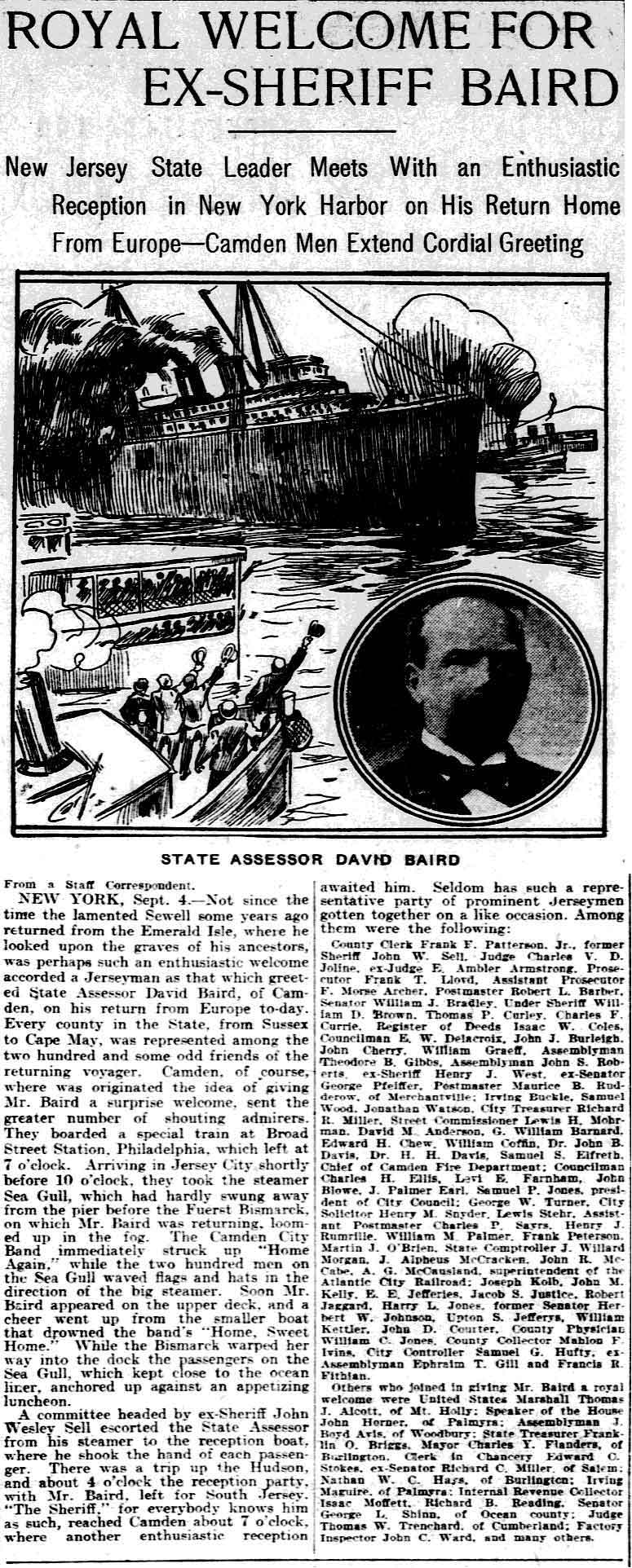
New Jersey State Leader Meets With an Enthusiastic Reception in New York Harbor on His Return Home From Europe—Camden Men Extend Cordial Greeting
STATE ASSESSOR DAVID BAIRD
From a Staff Correspondent.
NEW YORK, Sept. 4.—Not since the time the lamented Sewell some years ago returned from the Emerald Isle, where he looked upon the graves of his ancestors, was perhaps such an enthusiastic welcome accorded a Jerseyman as that which greeted State Assessor David Baird, of Camden, on his return from Europe to-day. Every county in the State, from Sussex to Cape May, was represented among the two hundred and some odd friends of the returning voyager. Camden, of course, where was originated the idea of giving Mr. Baird a surprise welcome, sent the greater number of shouting admirers. They boarded a special train at Broad Street Station, Philadelphia, which left at 7 o’clock. Arriving in Jersey City shortly before 10 o’clock, they took the steamer Sea Gull, which had hardly swung away from the pier before the Fuerst Bismarck, on which Mr. Baird was returning, loomed up in the fog. The Camden City Band immediately struck up “Home Again,” while the two hundred men on the Sea Gull waved flags and hats in the direction of the big steamer. Soon Mr. Baird appeared on the upper deck, and a cheer went up from the smaller boat that drowned the band’s “Home, Sweet Home.” While the Bismarck warped her way into the dock the passengers on the Sea Gull, which kept close to the ocean liner, anchored up against an appetizing luncheon.
A committee headed by ex-Sheriff John Wesley Sell escorted the State Assessor from his steamer to the reception boat, where he shook the hand of each passenger. There was a trip up the Hudson, and about 4 o’clock the reception party, with Mr. Baird, left for South Jersey. “The Sheriff,” for everybody knows him as such, reached Camden about 7 o’clock, where another enthusiastic reception awaited him. Seldom has such a representative party of prominent Jerseymen gotten together on a like occasion. Among them were the following:
County Clerk Frank F. Patterson, Jr., former Sheriff John W. Sell, Judge Charles V. D. Joline, ex-Judge E. Ambler Armstrong, Prosecutor Frank T. Lloyd, Assistant Prosecutor F. Morse Archer, Postmaster Robert L. Barber, Senator William J. Bradley, Under Sheriff William D. Brown, Thomas P. Curley, Charles F. Currie, Register of Deeds Isaac W. Coles, Councilman E. W. Delacroix, John J. Burleigh, John Cherry, William Graeff, Assemblyman Theodore B. Gibbs, Assemblyman John S. Roberts, ex-Sheriff Henry J. West, ex-Senator George Pfeiffer, Postmaster Maurice B. Rudderow, of Merchantville; Irving Buckle, Samuel Wood, Jonathan Watson, City Treasurer Richard R. Miller, Street Commissioner Lewis H. Mohrman, David M. Anderson, G. William Barnard, Edward H. Chew, William Coffin, Dr. John B. Davis, Dr. H. H. Davis, Samuel S. Elfreth, Chief of Camden Fire Department; Councilman Charles H. Ellis, Levi E. Farnham, John Blowe, J. Palmer Earl, Samuel P. Jones, president of City Council; George W. Turner, City Solicitor Henry M. Snyder, Lewis Stehr, Assistant Postmaster Charles P. Sayrs, Henry J. Rumrille, William M. Palmer, Frank Peterson, Martin J. O’Brien, State Comptroller J. Willard Morgan, J. Alpheus McCracken, John R. McCabe, A. G. McCausland, superintendent of the Atlantic City Railroad; Joseph Kolb, John M. Kelly, E. E. Jefferies, Jacob S. Justice, Robert Jaggard, Harry L. Jones, former Senator Herbert W. Johnson, Upton S. Jefferys, William Kettler, John D. Courter, County Physician William C. Jones, County Collector Mahlon F. Ivins, City Controller Samuel G. Hufty, ex-Assemblyman Ephraim T. Gill and Francis R. Fithian.
Others who joined in giving Mr. Baird a royal welcome were United States Marshall Thomas J. Alcott, of Mt. Holly; Speaker of the House John Herner, of Palmyra; Assemblyman J. Boyd Avis, of Woodbury; State Treasurer Franklin O. Briggs, Mayor Charles Y. Flanders, of Burlington, Clerk in Chancery Edward C. Stokes, ex-Senator Richard C. Miller, of Salem; Nathan W. C. Hays, of Burlington; Irving Maguire, of Palmyra; Internal Revenue Collector Isaac Moffett, Richard B. Reading, Senator George L. Shinn, of Ocean county; Judge Thomas W. Trenchard, of Cumberland; Factory Inspector John C. Ward, and many others.
Prosecutor Lloyd Investigates Robbery Case
Philadelphia Inquirer —
Prosecutor Lloyd has detailed County Detective Cherry to investigate the case of Charles Peters, of Williamstown, who says he was held up last week by three negroes and relieved of $90. The Camden authorities think it rather strange Peters did not tell anyone of the alleged hold up until some time after it occurred.
Testimonial Dinner to Dr. Fishburn
Philadelphia Inquirer —
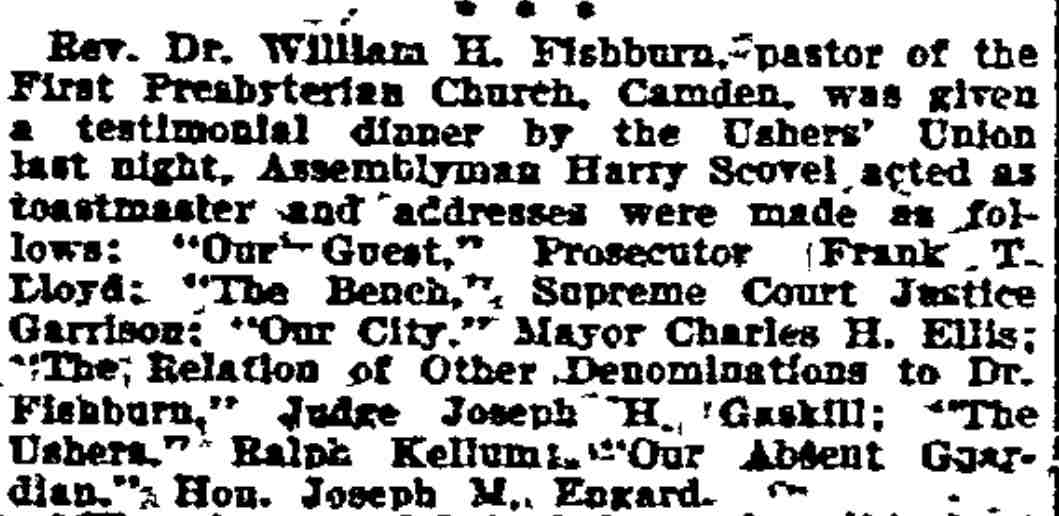
Rev. Dr. William H. Fishburn, pastor of the First Presbyterian Church, Camden, was given a testimonial dinner by the Ushers’ Union last night. Assemblyman Harry Scovel acted as toastmaster and addresses were made as follows: “Our Guest,” Prosecutor Frank T. Lloyd; “The Bench,” Supreme Court Justice Garrison; “Our City,” Mayor Charles H. Ellis; “The Relation of Other Denominations to Dr. Fishburn,” Judge Joseph H. Gaskill; “The Ushers,” Ralph Kellum; “Our Absent Guardian,” Hon. Joseph M. Engard. [cut off at the crop edge]
Attempted Assault
Philadelphia Inquirer —
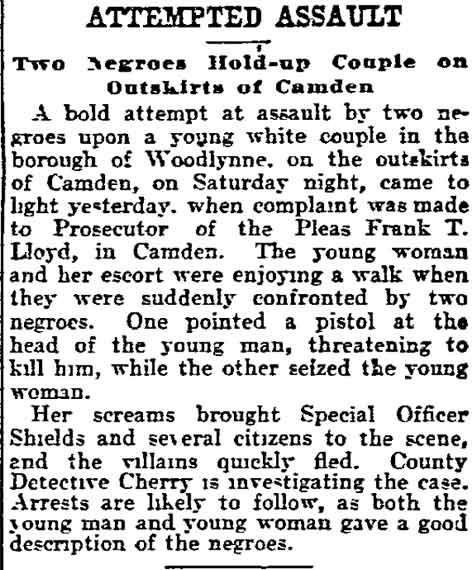
Two Negroes Hold-up Couple on Outskirts of Camden
A bold attempt at assault by two negroes upon a young white couple in the borough of Woodlynne, on the outskirts of Camden, on Saturday night, came to light yesterday, when complaint was made to Prosecutor of the Pleas Frank T. Lloyd, in Camden. The young woman and her escort were enjoying a walk when they were suddenly confronted by two negroes. One pointed a pistol at the head of the young man, threatening to kill him, while the other seized the young woman.
Her screams brought Special Officer Shields and several citizens to the scene, and the villains quickly fled. County Detective Cherry is investigating the case. Arrests are likely to follow, as both the young man and young woman gave a good description of the negroes.
Philadelphia Inquirer — August 30, 1905
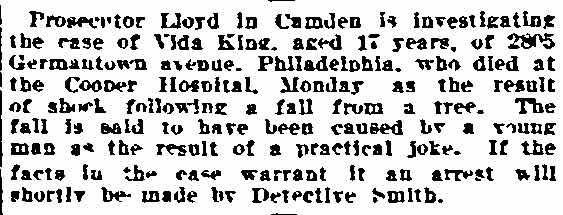
Prosecutor Lloyd in Camden is investigating the case of Vida King, aged 17 years, of 2805 Germantown avenue, Philadelphia, who died at the Cooper Hospital, Monday as the result of shock following a fall from a tree. The fall is said to have been caused by a young man as the result of a practical joke. If the facts in the case warrant it an arrest will shortly be made by Detective Smith.
Clerk Patterson on Second Term
Philadelphia Inquirer —
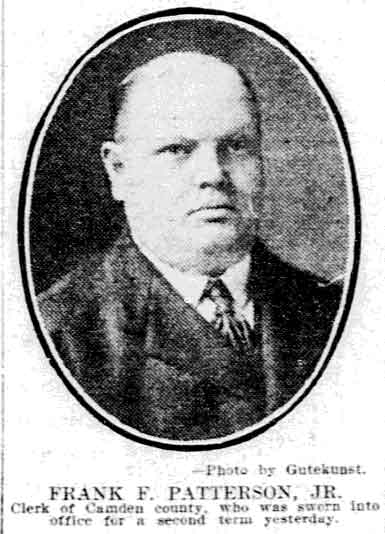
Popular Camden County Official Takes Oath of Office and Entertains Bondsmen and Others
County Clerk Frank F. Patterson, of Camden, at noon yesterday took the oath of office for a second term of five years. The oath was administered by Judge Joline in the presence of Mr. Patterson’s office force.
After taking the oath of office Mr. Patterson’s first official act was to reappoint Howard Truax as deputy county clerk and Frank Voigt as his assistant.
During Mr. Patterson’s previous term of office he made a host of friends through his courtesy and attention to those who called upon him for information.
Last night County Clerk Patterson gave an elaborate dinner at the Hotel Bellevue-Stratford to his bondsmen and several political friends.
Mr. Patterson under a recent law furnished a bond for $25,000 with the following bondsmen: Frank F. Patterson, Sr., David Baird, John W. Sell and William J. Bradley. These, including the following well-known Jerseymen, were Mr. Patterson’s guests at the banquet: Judge Charles G. Garrison, Judge A. B. Endicott, Judge C. V. D. Joline, Congressman H. C. Loudenslager, State Comptroller J. Willard Morgan, Assemblymen H. S. Scovel, Theodore B. Gibbs and Samuel P. Jones, Senators John G. Horner, J. Boyd Avis, Wood McKee and W. H. Jackson, State Assessor David Baird, Sheriff Frank C. Somers, Register Edward S. Delacroix, Prosecutor Frank T. Lloyd, Assistant Prosecutor F. Morse Archer, Surrogate Harry Reeves, Deputy Sheriff William D. Brown, Howard Truax, Robert Leyburne, Theodore N. Patterson, Wolcott J. Patterson, Irving Buckle, Joseph Burt, William S. Jones, John J. Leyburne, E. A. Y. Schellenger, Henry J. Cloud, Charles Middleton and Edward W. Humphreys.
—Photo by Gutekunst
FRANK F. PATTERSON, JR.
Clerk of Camden county, who was sworn into office for a second term yesterday.
Camden News Notes
Philadelphia Inquirer —
Bryant Smith, who was whirled about in a fly wheel at a paper mill, will probably have one of his feet amputated at the Cooper Hospital.
The cruiser Washington, recently launched at the New York shipyard, will be given a dock trial on Monday.
The Camden Hebrew relief fund has reached $694.38.
Frank Ireland, Calvin Kircher, Wesley Huff and Robert Barnes, boys, whose ages range from 14 to 16 years, were committed to the county jail by Recorder Stackhouse yesterday to await action on the part of Prosecutor Lloyd, who will probably have them sent to the reform school. According to Detectives Moffett and Hart, the youthful defendants are four of a gang that has been preying on local stores recently.
An unknown boy while passing the grocery store of E. S. Moore, 527 South Sixth street, yesterday lit a match and deliberately threw it into a can of gasoline. There was an explosion that shook the neighborhood and a slight fire resulted. The boy escaped.
Detectives Find Stolen Articles
Philadelphia Inquirer —
Loot Alleged to Have Been Lifted by Railroad Porters Recovered in Camden
Another Arrest in Connection With Rifling of Suit Cases and Packages at Camden Terminal
Thousands of dollars worth of jewelry was located in Camden yesterday by County Detectives Smith and Cherry, when they searched the homes of John Cohee and Andrew Shafer, porters of the Pennsylvania Railroad Company, who are alleged to have robbed packages and dress suit cases at the terminal in Camden. Cohee was arrested Tuesday night in Philadelphia while entering a pawn shop. Shafer was taken in custody yesterday. The latter was locked up at the county jail charged by County Detective Smith with larceny. The complaint was made before Justice Schmitz.
Searched Shafer’s Home
Yesterday morning the detectives visited the home of Shafer, at 410 South Second street. They made a thorough search and according to the officers they located about $1500 worth of jewelry, furs and trinkets of various kinds. These articles were scattered all about the house, under carpets, beds, in pans and closets. The whole lot was taken to the office of Prosecutor Lloyd to await identification, with that already recovered from the home of Cohee at 543 West street. In the latter house the articles found are valued approximately at $3000.
According to Detective Smith a confession was made by Cohee at the Central Station in Philadelphia, in which he implicates several other persons. The thefts have been going on for the past two years. During that time scores of complaints have been received at the railroad offices because of missing articles.
How It Was Done
Owing to the method of the alleged thieves it was difficult to detect those responsible. From what Cohee is alleged to have said the dress suit cases and packages were carefully opened and whatever struck the fancy of the men extracted. The cases would then be closed and sent to their owners. Nothing would be found amiss until the packages or cases were received and even then the owners could not account for the disappearance of their property.
Already the railroad company has paid out nearly $5000 to satisfy claims for missing property belonging to patrons of the road.
Philadelphia Inquirer — January 16, 1916
Circuit Court Judge Lloyd yesterday appointed Raymond L. Warren, Edward M. Sharp and John B. Tunstall a commission to assess benefits accruing from sewers constructed during 1916 in Camden.
Camden News Notes
Philadelphia Inquirer —

Circuit Court Judge Lloyd will hold a session of court in Camden on March 11. Since his appointment he has been in the upper end of the State.
John P. Weisler, 67 years old, of 47 North Third street, died suddenly at his home yesterday. Coroner Fithian gave a certificate of death from heart disease.
About a dozen property owners yesterday appeared before Circuit Court Judge Endicott in Camden and appealed from the assessment made against their holdings by the Sewer Commission. After hearing their testimony Judge Endicott dismissed their complaints and confirmed the report of the commission.
While chopping wood yesterday, Policeman James Ware, of Seventh and Florence streets, Camden, struck his left foot with the keen edge of the hatchet. Several arteries were severed and but for the policeman’s presence of mind he might have bled to death. He made a tourniquet with his handkerchief and stopped the flow of blood until he reached the Cooper Hospital in the ambulance.
In a decision given in Camden yesterday Vice Chancellor Leaming refused the application of William B. M. Burrell to restrain Dr. M. F. Middleton from driving over two lots owned by the plaintiff in the rear of his home at 425 Market street. There has been considerable controversy over the matter since the purchase of the lot by Mr. Burrell, who is Dr. Middleton’s neighbor.
Baird Holds a Christmas Party
Philadelphia Inquirer —
Politicians Gather in Force at the State Assessor’s Annual Reception.
Camden, Dec. 27.—David Baird, State Assessor and Republican leader of South Jersey, following his annual custom, held a Christmas reception Christmas morning at his handsome home in Cooper Street, Camden. Prominent politicians, citizens and persons in all walks of life to the number of 500 greeted Mr. Baird.
Among those who mingled with the guests of the State Assessor were ex-Governor Stokes, Congressman Loudenslager, William J. Browning, chief clerk of the House of Representatives; former State Senator Samuel K. Robbins, now clerk of the Court of Chancery; Senators Bradley of Camden and Lewis of Burlington Counties; Assemblymen Tatem, DeUnger and Whyte of Camden, and White and Pino of Burlington County; State Railroad Director Joshua E. Borton of Burlington County; Robert C. Hutchinson, member of the State Committee from Burlington County; State Comptroller Henry J. West, ex-State Comptroller J. Willard Morgan; John J. Burleigh, vice-president of the Public Service Corporation; Circuit Court Judge Frank F. [sic] Lloyd, Isaac Moffett, Collector of Internal Revenue; Judge Joline of the Camden County courts; Judge Jones of the Camden District Court; Judge Horner of the Burlington County Courts; Major W. Powell, United States Marine Corps; Mayor Ellis of Camden; Mayor Lincoln of Gloucester City; Mayor Collings of Collingswood, and all the Camden county and city officials.
Judge Lloyd holds first session
Philadelphia Inquirer —

Circuit Court Judge Lloyd yesterday held his first session as presiding officer over the Camden county circuit. He will begin the regular trial of cases next Monday.
Heavy Bail Demanded; Man Later Released
Philadelphia Inquirer —
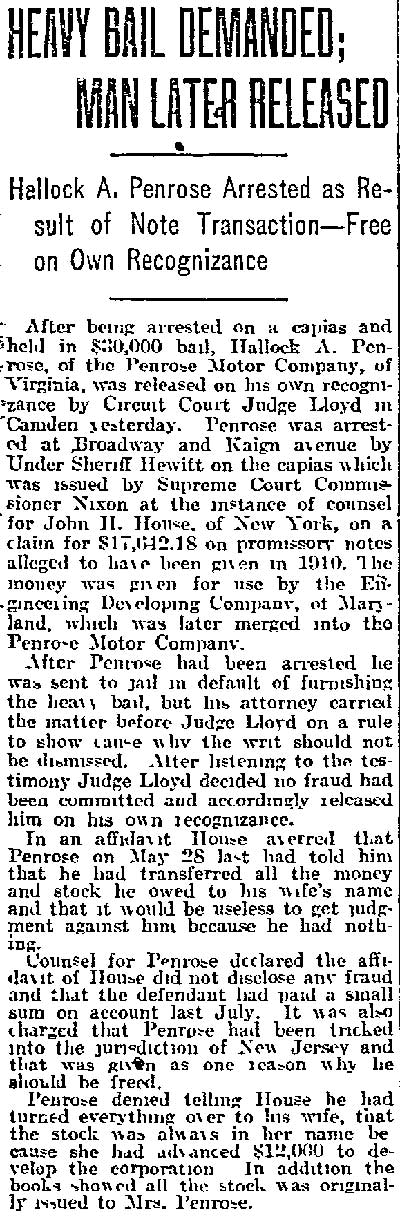
Hallock A. Penrose Arrested as Result of Note Transaction—Free on Own Recognizance
After being arrested on a capias and held in $[?]0,000 bail, Hallock A. Penrose, of the Penrose Motor Company, of Virginia, was released on his own recognizance by Circuit Court Judge Lloyd in Camden yesterday. Penrose was arrested at Broadway and Kaign [sic] avenue by Under Sheriff Hewitt on the capias which was issued by Supreme Court Commissioner Nixon at the instance of counsel for John H. House, of New York, on a claim for $17,[?]42.18 on promissory notes alleged to have been given in 1910. The money was given for use by the Engineering Developing Company, of Maryland, which was later merged into the Penrose Motor Company.
After Penrose had been arrested he was sent to jail in default of furnishing the heavy bail, but his attorney carried the matter before Judge Lloyd on a rule to show cause why the writ should not be dismissed. After listening to the testimony Judge Lloyd decided no fraud had been committed and accordingly released him on his own recognizance.
In an affidavit House averred that Penrose on May 28 last had told him that he had transferred all the money and stock he owed to his wife’s name and that it would be useless to get judgment against him because he had nothing.
Counsel for Penrose declared the affidavit of House did not disclose any fraud and that the defendant had paid a small sum on account last July. It was also charged that Penrose had been tricked into the jurisdiction of New Jersey and that was given as one reason why he should be freed.
Penrose denied telling House he had turned everything over to his wife, that the stock was always in her name because she had advanced $12,000 to develop the corporation. In addition the books showed all the stock was originally issued to Mrs. Penrose.
Philadelphia Inquirer — January 16, 1916
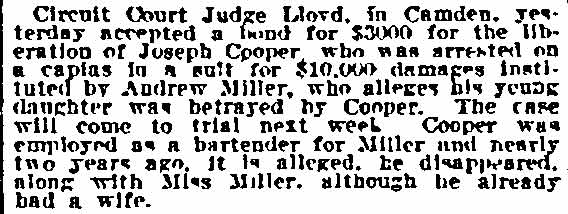
Circuit Court Judge Lloyd, in Camden, yesterday accepted a bond for $3000 for the liberation of Joseph Cooper, who was arrested on a capias in a suit for $10,000 damages instituted by Andrew Miller, who alleges his young daughter was betrayed by Cooper. The case will come to trial next week. Cooper was employed as a bartender for Miller and nearly two years ago, it is alleged, he disappeared, along with Miss Miller, although he already had a wife.
Object to Sewer Assessments
Philadelphia Inquirer —
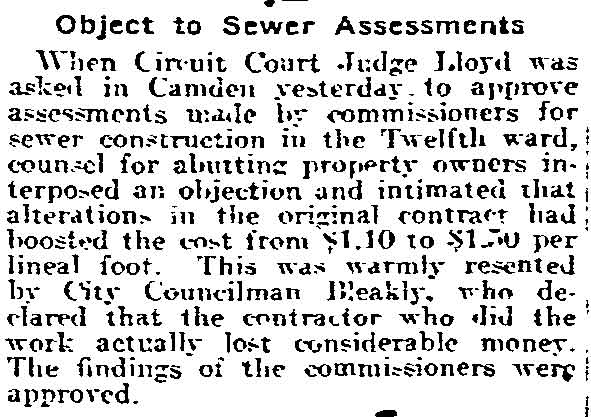
When Circuit Court Judge Lloyd was asked in Camden yesterday, to approve assessments made by commissioners for sewer construction in the Twelfth ward, counsel for abutting property owners interposed an objection and intimated that alterations in the original contract had boosted the cost from $1.10 to $1.[?]0 per lineal foot. This was warmly resented by City Councilman Bleakly, who declared that the contractor who did the work actually lost considerable money. The findings of the commissioners were approved.
Veteran Court Clerk Honored
Philadelphia Inquirer —
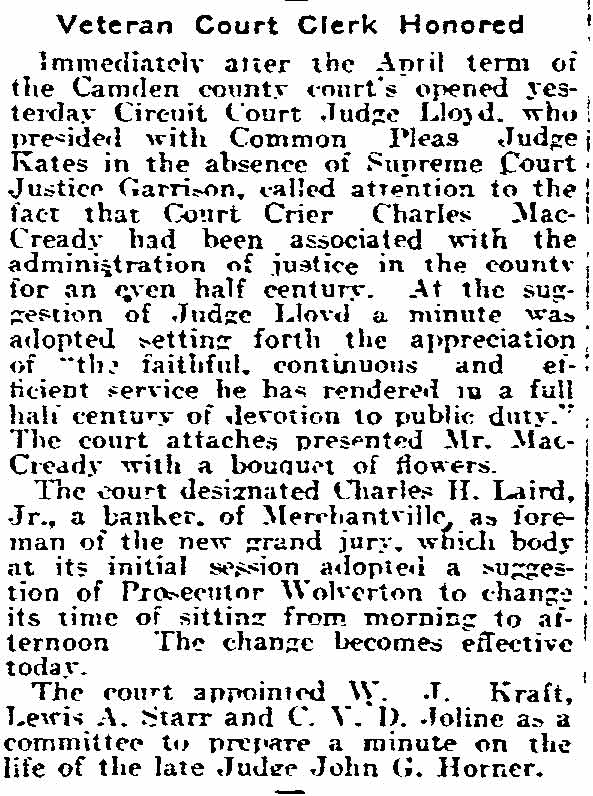
Immediately after the April term of the Camden county court’s opened yesterday, Circuit Court Judge Lloyd, who presided with Common Pleas Judge Kates in the absence of Supreme Court Justice Garrison, called attention to the fact that Court Crier Charles MacCready had been associated with the administration of justice in the county for an even half century. At the suggestion of Judge Lloyd a minute was adopted setting forth the appreciation of “the faithful, continuous and efficient service he has rendered in a full half century of devotion to public duty.” The court attaches presented Mr. MacCready with a bouquet of flowers.
The court designated Charles H. Laird, Jr., a banker, of Merchantville, as foreman of the new grand jury, which body at its initial session adopted a suggestion of Prosecutor Wolverton to change its time of sitting from morning to afternoon. The change becomes effective today.
The court appointed W. J. Kraft, Lewis A. Starr and C. V. D. Joline as a committee to prepare a minute on the life of the late Judge John G. Horner.
Philadelphia Inquirer — June 17, 1918

Judge Lloyd and Prosecutor Wolverton, Food Administrators for Camden county, will establish quarters in the courthouse next Tuesday.
Circuit Court Judge Frank T. Lloyd Accepts Chairmanship of Unemployment Committee
Philadelphia Inquirer —
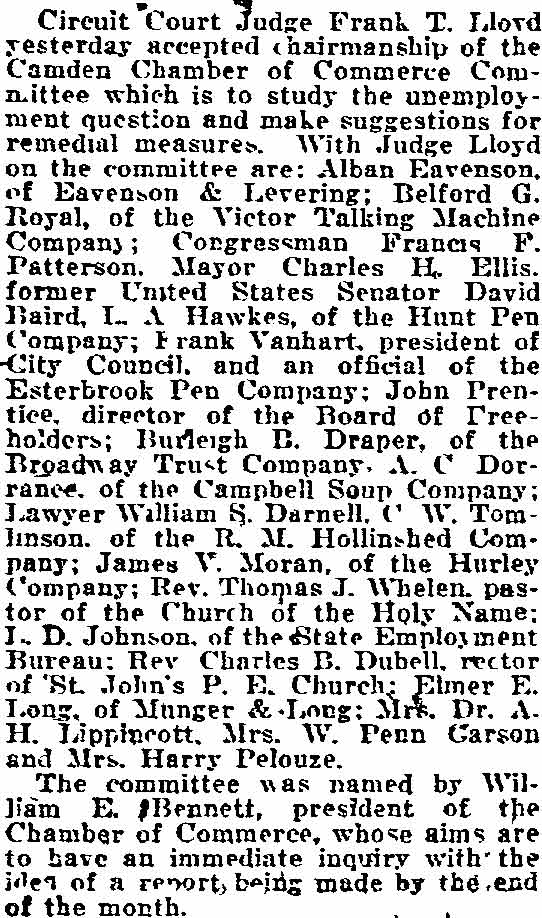
Circuit Court Judge Frank T. Lloyd yesterday accepted chairmanship of the Camden Chamber of Commerce Committee which is to study the unemployment question and make suggestions for remedial measures. With Judge Lloyd on the committee are: Alban Eavenson, of Eavenson & Levering; Belford G. Royal, of the Victor Talking Machine Company; Congressman Francis F. Patterson; Mayor Charles H. Ellis; former United States Senator David Baird; L. A. Hawkes, of the Hunt Pen Company; Frank Vanhart, president of City Council, and an official of the Esterbrook Pen Company; John Prentice, director of the Board of Freeholders; Burleigh B. Draper, of the Broadway Trust Company; A. C. Dorrance, of the Campbell Soup Company; Lawyer William S. Darnell; C. W. Tomlinson, of the R. M. Hollinshed Company; James V. Moran, of the Hurley Company; Rev. Thomas J. Whelen, pastor of the Church of the Holy Name; L. D. Johnson, of the State Employment Bureau; Rev. Charles B. Dubell, rector of St. John’s P. E. Church; Elmer E. Long, of Munger & Long; Mrs. Dr. A. H. Lippincott, Mrs. W. Penn Carson [sic] and Mrs. Harry Pelouze.
The committee was named by William E. Bennett, president of the Chamber of Commerce, whose aims are to have an immediate inquiry with the idea of a report, being made by the end of the month.
Blair Indicted by Grand Jury for Threat to Blow Up Home
Camden Courier-Post —
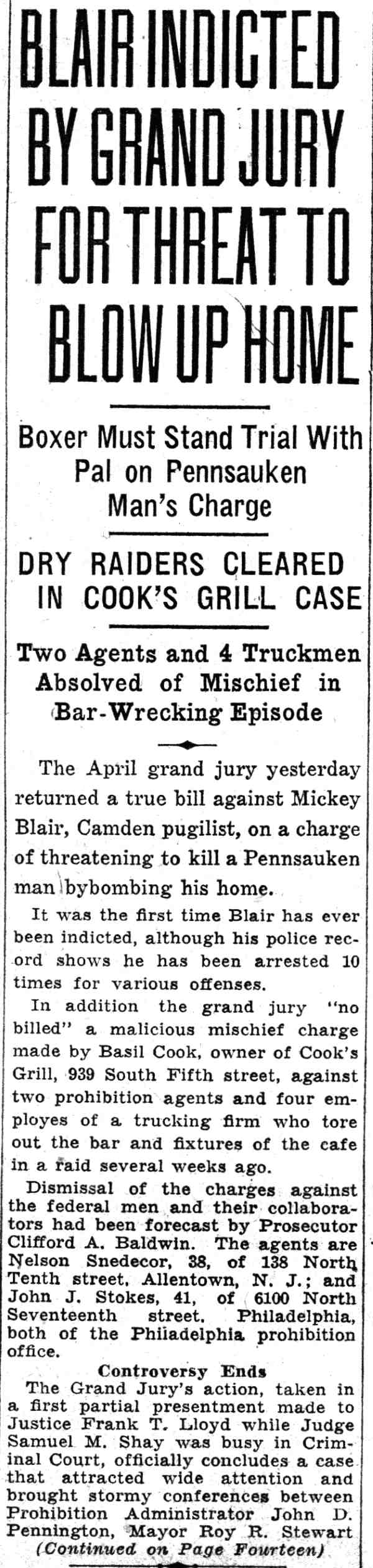
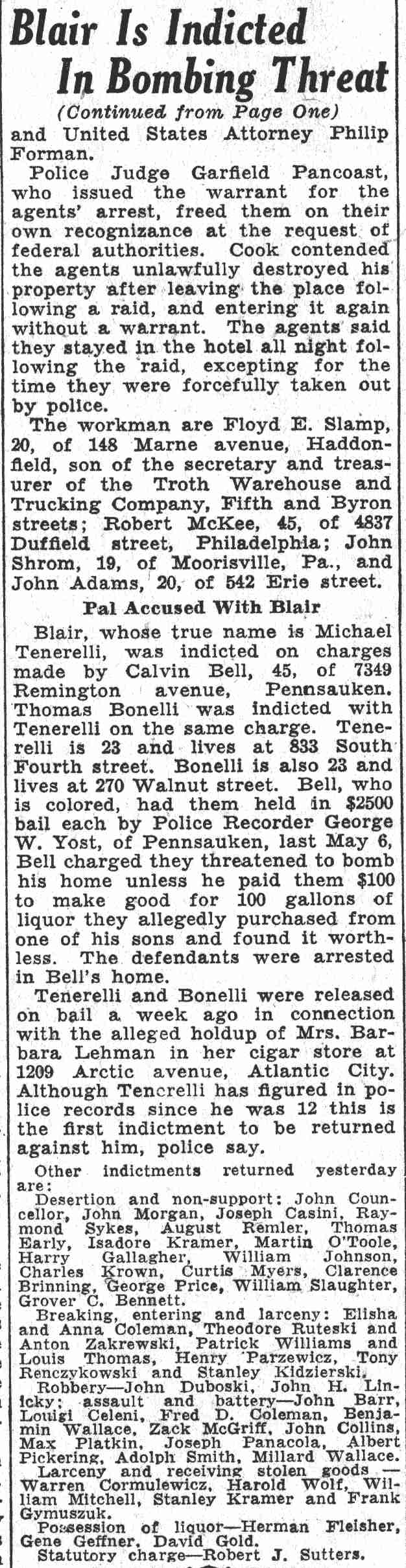
Boxer Must Stand Trial With Pal on Pennsauken Man’s Charge
DRY RAIDERS CLEARED IN COOK’S GRILL CASE
Two Agents and 4 Truckmen Absolved of Mischief in Bar-Wrecking Episode
The April grand jury yesterday returned a true bill against Mickey Blair, Camden pugilist, on a charge of threatening to kill a Pennsauken man by bombing his home.
It was the first time Blair has ever been indicted, although his police record shows he has been arrested 10 times for various offenses.
In addition the grand jury “no billed” a malicious mischief charge made by Basil Cook, owner of Cook’s Grill, 939 South Fifth street, against two prohibition agents and four employes of a trucking firm who tore out the bar and fixtures of the cafe in a raid several weeks ago.
Dismissal of the charges against the federal men and their collaborators had been forecast by Prosecutor Clifford A. Baldwin. The agents are Nelson Snedecor, 38, of 138 North Tenth street, Allentown, N. J.; and John J. Stokes, 41, of 6100 North Seventeenth street, Philadelphia, both of the Philadelphia prohibition office.
Controversy Ends
The Grand Jury’s action, taken in a first partial presentment made to Justice Frank T. Lloyd while Judge Samuel M. Shay was busy in Criminal Court, officially concludes a case that attracted wide attention and brought stormy conferences between Prohibition Administrator John D. Pennington, Mayor Roy R. Stewart and United States Attorney Philip Forman.
Police Judge Garfield Pancoast, who issued the warrant for the agents’ arrest, freed them on their own recognizance at the request of federal authorities. Cook contended the agents unlawfully destroyed his property after leaving the place following a raid, and entering it again without a warrant. The agents said they stayed in the hotel all night following the raid, excepting for the time they were forcefully taken out by police.
The workman [sic] are Floyd E. Slamp, 20, of 148 Marne avenue, Haddonfield, son of the secretary and treasurer of the Troth Warehouse and Trucking Company, Fifth and Byron streets; Robert McKee, 45, of 4837 Duffield street, Philadelphia; John Shrom, 19, of Moorisville, Pa., and John Adams, 20, of 542 Erie street.
Pal Accused With Blair
Blair, whose true name is Michael Tenerelli, was indicted on charges made by Calvin Bell, 45, of 7349 Remington avenue, Pennsauken. Thomas Bonelli was indicted with Tenerelli on the same charge. Tenerelli is 23 and lives at 833 South Fourth street. Bonelli is also 23 and lives at 270 Walnut street. Bell, who is colored, had them held in $2500 bail each by Police Recorder George W. Yost, of Pennsauken, last May 6. Bell charged they threatened to bomb his home unless he paid them $100 to make good for 100 gallons of liquor they allegedly purchased from one of his sons and found it worthless. The defendants were arrested in Bell’s home.
Tenerelli and Bonelli were released on bail a week ago in connection with the alleged holdup of Mrs. Barbara Lehman in her cigar store at 1209 Arctic avenue, Atlantic City. Although Tenerelli has figured in police records since he was 12 this is the first indictment to be returned against him, police say.
Other indictments returned yesterday are:
Desertion and non-support: John Councellor, John Morgan, Joseph Casini, Raymond Sykes, August Remler, Thomas Early, Isadore Kramer, Martin O’Toole, Harry Gallagher, William Johnson, Charles Krown, Curtis Myers, Clarence Brinning, George Price, William Slaughter, Grover C. Bennett.
Breaking, entering and larceny: Elisha and Anna Coleman, Theodore Ruteski and Anton Zakrewski, Patrick Williams and Louis Thomas, Henry Parzewicz, Tony Renczykowski and Stanley Kidzierski.
Robbery—John Duboski, John H. Linicky; assault and battery—John Barr, Louigi Celeni, Fred D. Coleman, Benjamin Wallace, Zack McGriff, John Collins, Max Platkin, Joseph Panacola, Albert Pickering, Adolph Smith, Millard Wallace.
Larceny and receiving stolen goods—Warren Cormulewicz, Harold Wolf, William Mitchell, Stanley Kramer and Frank Gymuszuk.
Possession of liquor—Herman Fleisher, Gene Geffner, David Gold.
Statutory charge—Robert J. Sutters.
Grand Jury Vice Probe to Be Ordered by Lloyd; Stewart Quizzes Cops
Camden Evening Courier —
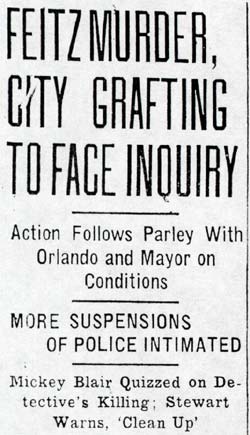
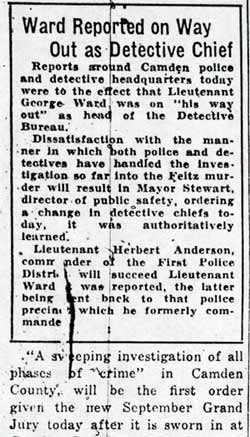
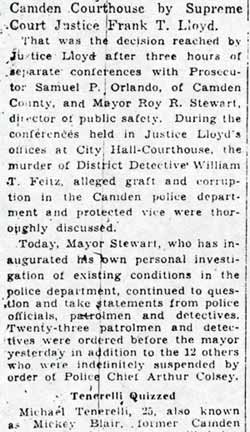
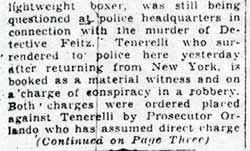
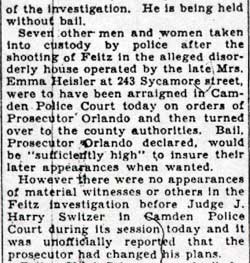
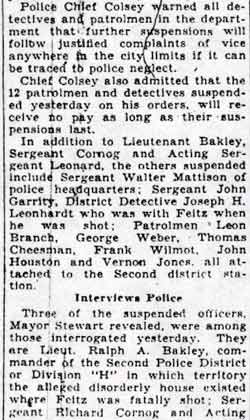
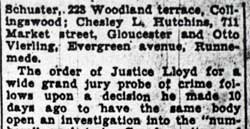
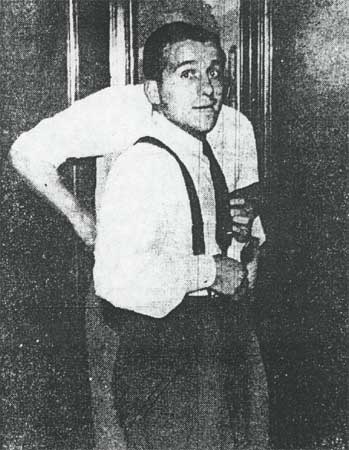

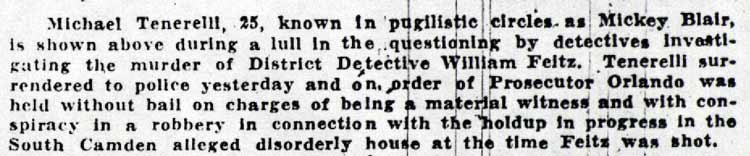
FEITZ MURDER, CITY GRAFTING TO FACE INQUIRY
Action Follows Parley With Orlando and Mayor on Conditions
MORE SUSPENSIONS OF POLICE INTIMATED
Mickey Blair Quizzed on Detective’s Killing; Stewart Warns, ‘Clean Up’
Questioned in Feitz Murder
Michael Tenerelli, 25, known in pugilistic circles as Mickey Blair, is shown above during a lull in the questioning by detectives investigating the murder of District Detective William Feitz. Tenerelli surrendered to police yesterday and on order of Prosecutor Orlando was held without bail on charges of being a material witness and with conspiracy in a robbery in connection with the holdup in progress in the South Camden alleged disorderly house at the time Feitz was shot.
Ward Reported on Way Out as Detective Chief
Reports around Camden police and detective headquarters today were to the effect that Lieutenant George Ward was on “his way out” as head of the Detective Bureau.
Dissatisfaction with the manner in which both police and detectives have handled the investigation so far into the Feitz murder will result in Mayor Stewart, director of public safety, ordering a change in detective chiefs today, it was authoritatively learned.
Lieutenant Herbert Anderson, commander of the First Police District, will succeed Lieutenant Ward as it was reported, the latter being sent back to that police precinct which he formerly commanded.
“A sweeping investigation of all phases of “crime” in Camden County, will be the first order given the new September Grand Jury today after it is sworn in at Camden Courthouse by Supreme Court Justice Frank T. Lloyd.
That was the decision reached by Justice Lloyd after three hours of separate conferences with Prosecutor Samuel P. Orlando, of Camden County, and Mayor Roy R. Stewart, director of public safety. During the conferences held in Justice Lloyd’s offices at City Hall-Courthouse, the murder of District Detective William T. Feitz, alleged graft and corruption in the Camden police department and protected vice were thoroughly discussed.
Today, Mayor Stewart, who has inaugurated his own personal investigation of existing conditions in the police department, continued to question and take statements from police officials, patrolmen and detectives. Twenty-three patrolmen and detectives were ordered before the mayor yesterday in addition to the 12 others who were indefinitely suspended by order of Police Chief Arthur Colsey.
Tenerelli Quizzed
Michael Tenerelli, 25, also known as Mickey Blair, former Camden lightweight boxer, was still being questioned at police headquarters in connection with the murder of Detective Feitz. Tenerelli who surrendered to police here yesterday after returning from New York, is booked as a material witness and on a charge of conspiracy in a robbery. Both charges were ordered placed against Tenerelli by Prosecutor Orlando who has assumed direct charge of the investigation. He is being held without bail.
Seven other men and women taken into custody by police after the shooting of Feitz in the alleged disorderly house operated by the late Mrs. Emma Heisler at 243 Sycamore street, were to have been arraigned in Camden Police Court today on orders of Prosecutor Orlando and then turned over to the county authorities. Bail, Prosecutor Orlando declared, would be “sufficiently high” to insure their later appearances when wanted.
However there were no appearances of material witnesses or others in the Feitz investigation before Judge J. Harry Switzer in Camden Police Court during its session today and it was unofficially reported that the prosecutor had changed his plans.
Police Chief Colsey warned all detectives and patrolmen in the department that further suspensions will follow justified complaints of vice anywhere in the city limits if it can be traced to police neglect.
Chief Colsey also admitted that the 12 patrolmen and detectives suspended yesterday on his orders, will receive no pay as long as their suspensions last.
In addition to Lieutenant Bakley, Sergeant Cornog and Acting Sergeant Leonard, the others suspended include Sergeant Walter Mattison of police headquarters; Sergeant John Garrity, District Detective Joseph H. Leonhardt who was with Feitz when he was shot; Patrolmen Leon Branch, George Weber, Thomas Cheeseman, Frank Wilmot, John Houston and Vernon Jones, all attached to the Second district station.
Interviews Police
Three of the suspended officers, Mayor Stewart revealed, were among those interrogated yesterday. They are Lieut. Ralph A. Bakley, commander of the Second Police District or Division “H” in which territory the alleged disorderly house existed where Feitz was fatally shot; Sergeant Richard Cornog and Acting [lines between the bottom of crop 15 and the top of crop 16 are not captured in the scanned crops]
Edwin Andrews, Winslow township; Joseph Dougherty, 140 Prospect avenue, Merchantville.
William Tomlinson, Glendale, Voorhees township; Edmund S. Stafford, 546 Stevens street; Harry Buffington, 123 East Clinton avenue, Oaklyn; Samuel A. Dobbins, 2599 Baird boulevard; Charles H. Thatcher, 129 Kendall boulevard, Oaklyn; Richard S. Thompson, East Zane avenue, Collingswood; Benjamin F. Stemmer, 420 Third Avenue, Haddon Heights; Horace J. Harvey, 721 Amherst avenue, Audubon; H. B. Cox, Evesham avenue, Voorhees township; Dr. Walter F. Wood, Collingswood; John W. Underwood, 801 Cumberland street, Gloucester; Clarence Alloway, Blackwood; Charles A. McWilliams, Blackwood; Louis G. Clark, Barrington; Albert J. Cline, 18 East Crystal Lake avenue, Westmont; Robert Bushbeck, First avenue, Pine Hill, Harry Burkhardt, Bell road, Mt. Ephraim; George T. Schuster, 223 Woodland terrace, Collingswood; Chesley L. Hutchins, 711 Market street, Gloucester and Otto Vierling, Evergreen avenue, Runnemede.
The order of Justice Lloyd for a wide grand jury probe of crime follows upon a decision he made 10 days ago to have the same body open an investigation into the “numbers” racket in Camden city and county. At that time he declared he did not believe any graft or corruption existed in the Camden police department in connection with the operation of the lottery game here.
Tenerelli was identified, Colsey said, as a frequenter of Mrs. Emma Heisler’s disorderly house at 243 Sycamore street, where Feitz was killed, and was booked as a material witness in the Feitz murder, and on a charge of “shaking down” Mrs. Heisler by force, prior to the murder.
Unlike Mrs. Heisler, who leaped to her death after 60 hours freedom in the detective bureau, Blair was slapped without bail into the “cold storage” or incommunicado cell in the bureau.
Blair, after surrendering to Colsey, was sent to the “downstairs” jail and kept there until about 4 p. m. yesterday. Then he was questioned for an hour and a half by Prosecutor Orlando and Colsey.
Blair denied all knowledge of the murder, Colsey said, after the grilling ceased, but added that two inmates of Mrs. Heisler’s house, whom he would not identify, named Blair as one of several men who had come several times to Mrs. Heisler’s place, attempted to extort money from her and, failing, had “held up the place” or a “shakedown.”
This coincided with the statement of Detective Sergeant Gus Koerner, on the day Feitz was killed, that the place had been held up several times, and Mrs. Heisler, because of the nature of her occupation, would not report the holdups.
Prosecutor Orlando, subsequently, had stated that Feitz met death in an attempt to block a “shake-down” holdup of the place.
Boxer Is Identified
Both the inmates of Mrs. Heisler’s place, held incommunicado, looked at Blair in the new detective bureau “lineup” room and identified him as a shakedown visitor, but said he was not in the house on the night of the murder, Colsey said.
The chief then was asked if he believes friends of Blair staged the fatal shake-down and killed Feitz, and replied:
“That’s what we want to know. We don’t know yet. But we are getting somewhere and will solve this case.”
The two inmates of the Heisler house were brought back to the lineup room a second time, took another look at Blair through the screen that made him a “high-lighted” figure and prevented him from seeing them and reaffirmed their previous statements, Colsey said.
Upon the suspension of the twelve members of the force and the installation of a new acting second district commander and new acting sergeants to relieve those suspended, Chief Colsey said he issued the following order to the entire department:
Calls for Cleanup
“All vice must be eliminated absolutely and entirely in Camden. This means all types of vice, including the numbers racket, gambling houses, disorderly houses, horse-race bookmaking speakeasies and everything else though it may not be specifically enumerated here.
“In the future if any complaint of vice comes in, and is proved to be justified, and is attributable to negligence on the part of any patrolmen of police officer [sic], immediate suspension of the negligent members of the force will follow without exception.”
Chief Colsey also said he will recommend that bail of $2000 be set in all numbers racket cases in future, and that all arrested be held for grand jury action, except in cases where innocent players are brought in.
‘Prompted by Facts’
In making public the suspensions of the policemen, Chief Colsey said his action was “prompted by facts” uncovered during the course of his investigation.
In announcing the taking over of the murder investigation, Prosecutor Orlando said:
“As a result of my conference with Justice Lloyd it has been decided that the prosecutor’s office from this time on will take charge of the murder investigation.
“In doing so, however, it does not mean that the city police will cease acting in the matter and will act with just as much zeal as is within their command in bringing about the apprehension of those responsible.
“This investigation has been taken over by this office by reason of the policy assumed in other murder investigations. Hereafter all murder investigations in Camden county will be under the supervision of the prosecutor’s office and at the same time through co-ordinated efforts of this office and the police department of the particular community where the murder takes place.
“As far as developments are concerned, there is nothing new in the case except the arrest of Mickey Blair, who was surrendered by his counsel and who is in the custody of the police until he is committed.”
Lieutenant Walter Welch in command of the Third Police District was assigned by Chief Colsey to replace Lieutenant Bakley and make the suspensions of all sergeants and patrolmen in that precinct effective immediately. Sergeant John Potter of the Third District was named an acting lieutenant to replace Lieutenant Welch as commander of that precinct.
Welch said he will instruct every policeman under his new command that he must work in harmony with earnest efforts to stamp out vice.
“If they do not do this,” Welch said, “I do not want them. They will be of no use to me. They know what to expect if they fail to cooperate. My efforts will be directed to maintaining order without vice in the Second district, just as I have done in the Third.”
Lieut. Bakley and 11 Police Suspended in Feitz Inquiry
Camden Evening Courier —
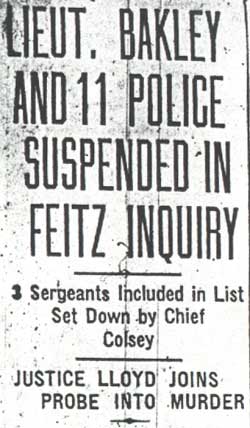
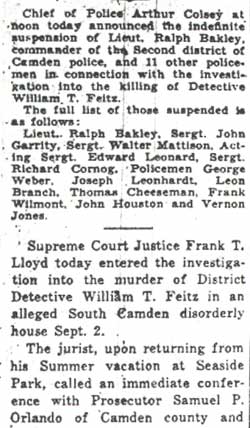
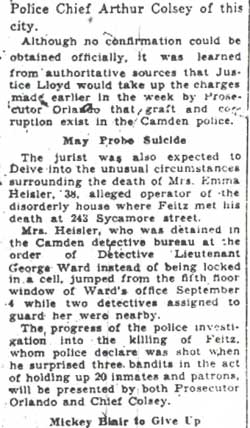
3 Sergeants Included in List Set Down by Chief Colsey
JUSTICE LLOYD JOINS PROBE INTO MURDER
Chief of Police Arthur Colsey at noon today announced the indefinite suspension of Lieut. Ralph Bakley, commander of the Second district of Camden police, and 11 other policemen in connection with the investigation into the killing of Detective William T. Feitz.
The full list of those suspended is as follows:
Lieut. Ralph Bakley, Sergt. John Garrity, Sergt. Walter Mattison, Acting Sergt. Edward Leonard, Sergt. Richard Cornog, Policemen George Weber, Joseph Leonhardt, Leon Branch, Thomas Cheeseman, Frank Wilmont [sic], John Houston and Vernon Jones.
Supreme Court Justice Frank T. Lloyd today entered the investigation into the murder of District Detective William T. Feitz in an alleged South Camden disorderly house Sept. 2.
The jurist, upon returning from his Summer vacation at Seaside Park, called an immediate conference with Prosecutor Samuel P. Orlando of Camden county and Police Chief Arthur Colsey of this city.
Although no confirmation could be obtained officially, it was learned from authoritative sources that Justice Lloyd would take up the charges made earlier in the week by Prosecutor Orlando that graft and corruption exist in the Camden police.
May Probe Suicide
The jurist was also expected to delve into the unusual circumstances surrounding the death of Mrs. Emma Heisler, 38, alleged operator of the disorderly house where Feitz met his death at 243 Sycamore street.
Mrs. Heisler, who was detained in the Camden detective bureau at the order of Detective Lieutenant George Ward instead of being locked in a cell, jumped from the fifth floor window of Ward’s office September 4 while two detectives assigned to guard her were nearby.
The progress of the police investigation into the killing of Feitz, whom police declare was shot when he surprised three bandits in the act of holding up 20 inmates and patrons, will be presented by both Prosecutor Orlando and Chief Colsey.
Mickey Blair to Give Up
Mickey Blair, boxer whose real name is Michael Tenerelli, 25, who has been living in New York City, but whose Camden address is 833 South Fourth street, is to be surrendered to Camden police for questioning in connection with the murder of Feitz.
He has been sought by detectives for grilling since a few hours after the shooting of Feitz.
His attorney, Edward V. Martino, of 540 Cooper street, notified Chief Colsey today that he would surrender Tenerelli or Blair to the police in his office at 1 p.m.
“Mickey knows absolutely nothing about the killing of Feitz,” Martino told newspapermen. “Learning through a friend that police were seeking him for questioning, he called me Saturday night and asked me to ascertain the facts.”
“I learned that police wanted to talk to him and telephoned him to that effect in New York City where he has been staying for the past few weeks. He later called me back and told me that he would be in Camden at 1 p.m. today.”
‘Attended Funeral’
Martino revealed that Tenerelli or Blair said he had been in Camden prior to the killing of Feitz and also on Labor Day, the day following the shooting of the detective. He was here to attend the funeral of a brother-in-law, Martino said.
Neither Chief Colsey or other police or detective officials would comment upon what they hoped to learn from Tenerelli that might bring an early solution of the murder and lead to the arrest of the killers.
Prosecutor Orlando at the conference with Justice Lloyd in his City Hall-Court House offices, was to present a complete report on the murder of the detective together with statements obtained from all persons who figured in the crime.
Will Probe Numbers
Prosecutor Orlando stepped in and assumed nominal charge of the investigation last Thursday when he ordered police to submit to him all reports and statements of witnesses. However it was learned that the police are still directing the search for the killers.
The conference between Justice Lloyd, Prosecutor Orlando and Chief Colsey comes on the eve of swearing in the September Grand Jury tomorrow at which time the grand jurors wil [sic] be ordered among other issues, to probe into the “numbers” racket in Camden county.
12 Questioned, 2 Men Held in Murder Probe
Camden Evening Courier —


COLSEY LEADS CITY-WIDE HUNT FOR BANDIT KILLERS OF COP
Comrades Eager to Avenge Feitz, Shot 4 Times in Back at Holdup
ORLANDO CONDUCTS OWN INVESTIGATION
Mad Scramble of 20 to Escape Tragedy Scene Described by Sleuth
The greatest man-hunt in the history of the Camden police department was under way today to apprehend the murderers of Detective William T. Feitz, slain early yesterday when he surprised bandits holding up 20 persons in a South Camden disorderly house.
Feitz, recently promoted from a patrolman, was shot four times in the back as he attempted to reach the front door of the establishment at 243 Sycamore street to summon aid.
Police today said they “had a pretty good idea” as to the identity of his slayers, although none has been charged with the crime.
A “mystery blonde” was arrested in the case early today in Atlantic City by Detective Stanley Wertz [sic]. Police refused to reveal her name and will not allow anyone to talk to her.
A man, first believed to have been the trigger-man, arrested in Philadelphia early today, was released by police after a few minutes’ questioning.
Two men are being held “incommunicado” in connection with the case, while a dozen material witnesses were being questioned at detective headquarters.
Probe Rushed
The investigation into the shooting, begun within a few minutes of the slaying continued throughout the day and night without a break.
Police Chief Arthur Colsey took personal command of the probe with Detective Lieut. George Ward and Detective Sergeant Gus Koerner.
Prosecutor Samuel P. Orlando, who “sat in” yesterday as police questioned a score of witnesses, stated this morning he will open his own investigation today. He intimated “new developments” may throw a startling light on the case.
Feitz’ slayers escaped as 20 inmates and frequenters of the alleged disorderly house scrambled mainly for freedom beneath the eyes of Detective Joseph H. Leonhardt, who sat outside the place in a police radio car.
Leonhardt told his superiors he was so startled by the shooting he failed to act until after the slayers had escaped.
Feitz and Leonhardt had driven to the scene in the radio car, after trailing a suspicious sedan for 15 minutes through a maze of South Camden streets.
Followed 3 Men
The sedan had stopped near the Sycamore street place and three of the men had entered the dwelling. Feitz followed and Leonhardt remained in the car.
Mrs. Emma Heisler, 38, alleged proprietress of the house, and Cornelius Murphy, 50, doorkeeper, headed a list of 14 witnesses held by police for questioning or as material witnesses.
Murphy was booked early today as a material witness, with Thomas Bonelli, 27, of 207 Walnut street; Edward Grapatin, 32, of 246 Kaighn avenue; Joseph McKenna, 30, and Catherine Lougheed, 32, an inmate, and Edith Miller and Edna Butler, colored domestics employed by Mrs. Heisler.
Joseph Powell, 25, former Camden boxer, and Stanley, his brother, were the two men held incommunicado. Police refused to reveal what connection either had with the murder, although stating they were merely being held pending investigation.
Feitz died five minutes after being admitted to West Jersey Homeopathic hospital, where he was taken by Leonardt [sic] and McKenna, who stopped in his flight from the house to assist the wounded policeman. Three .32-calibre slugs were buried in his back and a fourth had pierced his wrist.
Lieutenant Ward today clamped down on news of the investigation, ordering all detectives and police to refuse information to news reporters.
Orlando said he would make known facts in the case known to him later today.
The Heisler woman, said by police to be the sister-in-law of Patrolman Thomas Cheeseman, recently demoted city detective, was not booked on the police docket this morning, but Ward declared he was not through questioning her and that she would be “booked” later in the day.
Several of the witnesses made their escape from the vicinity of the shooting in Powell’s car, police stated, one of whom was the mysterious woman arrested early today in Atlantic City.
Supreme Court Justice Frank T. Lloyd last night declared the case would be investigated by the September Grand Jury. It will not, he said, assume more importance in that body’s deliberations than the numbers racket.
Note Lack of Noise
Investigators were at a loss to understand why Feitz and Leonhardt, seated in an automobile on a quiet side street within 20 feet of where a holdup was taking place, did not hear any accompanying sounds. The belief was expressed that 20 men and women, being robbed, would become hysterical and noisy. The Sycamore street house is a ramshackle, two-story structure, with no vestibule leading into the parlor. There is no porch.
Powell drove first to the Lougheed woman’s home, where Mrs. Heisler, the Lougheed woman and Grapatin alighted. He then drove to Atlantic City with the unidentified girl, he said.
Police, advised of Powell’s presence in the house, dispatched the license number of his green sedan over the police teletype system.
Powell was apprehended at Folsom, 40 miles from Camden, as he was returning to Camden from Atlantic City. Sergeant Albert T. Varreiman of the Mt. Ephraim state police barracks stopped Powell’s machine and took him into custody. Powell was alone.
Feitz’s murder was a climax to half an hour’s scrutiny by him and Leonhardt into the suspicious actions of the four bandits. A car in which they were riding was sighted in the neighborhood by the two detectives at 2 a. m.
Trailed Car Fifteen Minutes
They trailed it in their police car for 15 minutes, as it wound through the narrow streets, repeatedly passing the Sycamore street house. Finally, the detectives saw the bandits park their machine on Locust street. Three of them emerged, walked down Sycamore street, and entered the house.
According to Leonhardt, neither he nor Feitz obtained the license number of the bandit car.
Upon seeing them enter the place, Leonhardt drove the police car around the block and stopped in front of the house.
Feitz and Leonhardt sat outside in their machine for 15 minutes. Finally, Leonhardt said, Feitz opened the door and stepped to the sidewalk.
“I’m going in there and see what’s going on,” he said.
Turning, he walked up the steps and rang the doorbell. Leonhardt said the door was opened after a short pause, and Feitz entered. The door was closed.
Hears Bandits’ Guns
Almost immediately, Leonhardt heard the muffled roar of the bandits’ revolvers. Feitz’s body came flying through the door. Pandemonium followed. As the persons in the house fled, neighbors came to doors and windows. Almost immediately, the street was filled.
Leonhardt was so shocked he was unable to drive. An unnamed witness drove the police car with Feitz’s body in it to the hospital.
Prosecutor Orlando indicated his office will step into the probe today.
Shooting Reconstructed
With the aid of witnesses, police yesterday were able to reconstruct the shooting.
“Feitz walked into the house just as the three bandits were holding up the inmates,” Detective Gus Koerner said.
“Witnesses say that when the doorbell rang, the three bandits conferred briefly and decided to admit whoever was at the door. They thought it was another frequenter.
“’Let him in; we’ll take his money too,’ one of the witnesses said a bandit ordered.
One of the bandits went to the door, opened it and admitted Feitz. The detective took five steps into the living room, pausing at the door of the dining room, where he was recognized by a bandit who was frisking the inmates.
“This bandit shouted: ‘It’s a dick; let ‘im have it!’”
Shot in Back
As Feitz reached for his revolver, the man who had admitted him shot him in the back. Feitz attempted to reach the front door, apparently to call Leonhardt, and three more slugs tore into his body.
“It is not known whether the shooting was done by only one of the bandits, or whether all three fired. We do not know whether Feitz opened the front door himself and fell to the street; whether he fell through the glass, or whether the bandits opened the door and pushed him to the street.
“The glass in the front door was broken later by police, who struck it with their blackjacks in order to gain admittance. Leonhardt told me he is unable to clear up this point as everything happened too quickly.
“He said he suddenly heard shots, and a moment later, saw Feitz’ body on the pavement.”
One of the bandit’s bullets went wild, imbedding itself in the wall near the front door. It was fired from the dining room. Ballistics tests will be made of the bullet.
City-wide Raids Follow
Under the direction of Detective Lieut. George Ward, Camden was subjected yesterday and last night to a fine tooth-combing for suspects. All police leaves were cancelled, and all patrolmen volunteered to do active duty until some results of the probe are forthcoming.
A series of raids on known disorderly houses resulted last night in the arrests of more than 20 persons all of whom were taken to police headquarters and lined up for the perusal of witnesses. It was not known whether this scrutiny brought results.
Chief Colsey declared last night the murder will be the signal for an intensive “cleanup” of the city. Policemen in patrol cars were dispatched on prowl duty, ordered to pick up everyone of a suspicious nature.
City officials and citizens voiced their regrets at the killing. Feitz was the father of two children, a boy and a girl. Their names could not be obtained last night. He was estranged from his wife, who resides in Cape May with the children.
Woman Questioned
Mrs. Heisler, regarded by police as a key witness, was questioned several hours in detective headquarters by Chief Colsey, Ward, Orlando and Koerner. The officers refused to disclose the results of the quiz.
No adequate description of the bandits could be furnished by any of the witnesses, Koerner said. Two were described as being of average height, one taller. Two were dark, the third blond.
None of the three was masked. Each was armed.
Mrs. Heisler and Murphy were held without bail as material witnesses. Powell, accompanied by Camden detectives, left for Atlantic City to show them where he dropped off the unidentified girl inmate of the house. They had not returned at a late hour last night.
According to Murphy, two of the bandits previously had visited the house as patrons, and at one time attempted to “shake down” Mrs. Heisler. She resisted their demands, Murphy declared.
Other persons arrested as material witnesses who, after hours of questioning were released in their own recognizance, include:
Frank Adams, 21, of 938 Atlantic avenue; Joseph MacDonald, 20, of 1605 South Sixth street; Henry Gorba, 19, of 17 North Twenty-first street and Edward McKenna, 31, of 1304 Broadway.
Edith Miller, 28, colored, of 205 Sycamore street, and Edna Butler, 32, also colored, 1122 South Second street, also were arrested and held as witnesses. They are inmates of the house, Koerner said.
Police said the bandits, in their search for booty, forced their victims to remove their shoes during the holdup to ascertain whether they were concealing any money. Only $8 was taken.
An autopsy performed on Feitz’ body yesterday by Coroner Arthur H. Holl and County Physician Edward B. Rogers showed that two of the bullets had penetrated the detective’s body. Coroner Holl, in whose undertaking establishment the detective’s body lay last night, declared death was virtually instant.
Chief Colsey last night denied Feitz and Leonhardt were acting under orders to watch the Sycamore street house.
“There have been general orders out to clean up all disorderly houses for a long time,” Colsey said. “I imagine the detectives were more interested in what the four men were doing than they were in the house. I talked at great length with Leonhardt and he told me neither he nor Feitz knew the place was a disorderly house.”
Leonhardt could not be reached last night to give his version of the affair. Colsey said Leonhardt was taking an active part in police efforts to solve the crime.
“If I had known the house in Sycamore street was a disorderly house,” Colsey said, “I would of course have ordered it raided long ago.”
Feitz and Leonhardt were assigned to detective duty from the uniformed ranks last week, replacing former Detectives Thomas Cheeseman and Vernon Jones, who are now reduced to rank of patrolmen.
Chief Colsey said the reason Cheeseman and Jones were reduced was “merely for the good of the department.” He would not amplify that statement.
According to Detective Rox Saponare, Cheeseman is the brother-in-law of Mrs. Heisler, charged with operating the house. Cheeseman, also active in the investigation of the killing, could not be reached last night to comment.
Commended for Bravery
Feitz was appointed to the police force March 1, 1928. He was appointed to the detective bureau last week by Mayor Roy R. Stewart. In 1931, Feitz was commended for bravery in arresting three men in a holdup at a chain grocery store at Locust street and Kaighn avenue.
Last week, the same store was robbed, and Feitz arrested three other men for the theft.
Leonhardt, 39, resides at 512 Division street. The last arrest he made in company with Feitz was at 12.45 a. m. the morning of Feitz’ death. The officers nabbed Cecilia Spencer, 28, colored, at 806 Locust street, a block from the Sycamore street house, on charges of soliciting.
Chief Colsey and other city officials reached Feitz’ bedside in the hospital too late to see him alive. The officer died without regaining consciousness. Funeral arrangements were not completed last night.
Before the estrangement from his wife two years ago, Feitz lived with her and their children at 1062 Langham avenue. He resided recently at the Liberty street address with his widowed mother, Mrs. Pauline Feitz, who last night was prostrated at the news of her son’s death.
Chief Colsey last night absolved Leonhardt of any negligence in not chasing the killers. The police chief declared Leonhardt’s first duty was to look to the condition of Feitz.
Chief Colsey said Mayor Stewart, vacationing in Ocean City, will not return until tomorrow morning. Any investigation into possible negligence on the part of police in permitting the Sycamore street house to operate will be conducted after the mayor returns, Colsey said.
“I consider it more important at this time to lend all our efforts toward solving the crime rather than in conducting any side-bar probe into the question of negligence by any policemen,” Colsey said.
New Dealers Prepare To Shift Key Officials
Camden Courier-Post —

General Housecleaning Predicted After Secret Parley of ‘Big Four’; Leaders Reported Not in Full Accord on Patronage
Editorial: “Upholding Faith of the People Is Keeping Faith in the Courts” appears on page six.
A general housecleaning of key city officials was predicted yesterday afternoon following a secret conference of the “Big Four” at Hotel Walt Whitman.
Attending the session were State Senator Albert S. Woodruff and Mrs. Elizabeth C. Verga, Republicans, and Harry L. Maloney and Mrs. Emma E. Hyland, Democrats.
Rumors that the charges were to be made today could not be verified last night. Commissioner George E. Brunner said no meeting of the City Commission had been called for today. A meeting could be called if requested by Brunner, Mrs. Mary W. Kobus and Frank J. Hartmann, Jr., New Deal commissioners.
After the conference silence was maintained by the “Big Four.” They declined to discuss what happened.
Other reports filtering from the conference room were that a few surprises await the political public in new appointments to be made at city hall, surprises which will be contrary to the gossip on appointments circulated the last few weeks.
The leaders were together for two hours or more, but they were reported not in entire agreement about the patronage setup when their conference concluded.
Indications were that, with perhaps but one or two changes, the rumored lineup of appointees of the New Deal, as forecast in recent reports, will hold when the appointments are made by the city commission.
Favored for Jobs
Under the arrangements which has [sic] been conjectured by New Deal observers the last few days, the leaders are said to have agreed on these appointments:
For police judge—Firmin Michel, Democrat.
For city solicitor—Carl Kisselman, Republican.
For city prosecutor—Mitchell H. Cohen, Republican.
For assistant city solicitors—Edward V. Martino, Republican, and John Crean, Democrat.
For city clerk—Clay W. Reesman, Republican, former city commissioner, and for assistant city clerk, former Commissioner William D. Sayrs, Jr., Republican.
For director of charities—Pauline Caperoon.
For purchasing agent—Abe Fuhrman, Democrat. In the event Commissioner Harold W. Bennett resigns, as rumored, Fuhrman would be named by the New Deal commissioners to fill that vacancy.
The three New Deal commissioners who are to vote the appointments are Brunner, Mrs. Kobus and Hartmann.
Kobus Assumes Duties
Mrs. Kobus yesterday took over the directorship of public safety after a 15-minute conference with Mayor Frederick von Nieda.
“We spoke of routine matters in the department,” she said. “I wanted to know his ideas that he had started working on so I could continue them.”
Asked whether she intended to confer with police heads soon, Mrs. Kobus answered in the negative.
“I talked to them before the injunction proceedings were started,” she said, referring to von Nieda’s action which restrained her from taking over the duties of the department for several weeks.
“I hope for the co-operation of all members of the police and fire departments,” the city’s first elected woman commissioner added.
In addition to the police and firemen, Mrs. Kobus now has charge of the electrical bureau, bureau of charities, police court, traffic court, municipal motors, transportation department and city clerk.
The appointments may be expedited as a result of the ruling by Supreme Court Justice Frank T. Lloyd Tuesday that the board of commissioners has specific legislative authority to allot the municipal departments as it sees fit. The decision validated the action of the city commission assigning Commissioner Kobus as director of public safety in charge of the police and fire departments, and included the ruling that von Nieda cannot be removed as mayor.
When asked whether the commission could remove present holders of key jobs and make new appointments Justice Lloyd said that it is a question he may have to pass on later. In view of his decision, however, pointing out that the commission has special legislative authority to transfer the directorships among the city commissioners, it is believed by observers that he also will permit ousters and reappointments in the key municipal jobs.
Bennie Approval Awaited in Senate
Camden Courier-Post —
Governor Sends in His Name as Camden County Jury Commissioner
Trenton, June 11 (Saturday) — Nomination of former Freholder [sic] Joseph Bennie, Camden Democrat, as Camden county jury commissioner, was sent to the Senate yesterday afternoon by the governor. It had not been acted on early today as the Legislature prepared to adjourn.
Bennie, who would serve a one-year term at $750, would succeed George Kleinheinz, also a Democrat. Kleinheinz has been acting jury commissioner since April 1, when his term expired, being named temporarily by Supreme Court Justice Frank T. Lloyd.
Bennie has been slated for the job for some time but Senator Stewart said he had been holding up his approval of Bennie’s appointment while awaiting a report on the case of Judge Frank F. Neutze, of Camden district court, from the ethics committee of the Camden County Bar Association. The committee is investigating charges made by Stewart that Neutze was guilty of “ambulance chasing.” Stewart cited the charge as one of his reasons for refusing to approve the governor’s re-appointment of Neutze.
“I have changed my mind,” Stewart said yesterday, “because the Neutze matter cannot be settled now and the jury commissioner appointment might as well be approved.”
Bennie’s appointment was recommended by Harry L. Maloney, and Mrs. Emma E. Hyland, Democratic state committee members from Camden county.
Gangster Shot as Racketeers Open War Here
Camden Courier-Post —

Gloucester Man Near Death After Attack at Broadway and Kaighn Avenue
FELLED NEAR QUARTERS OF CAMDEN GAMBLERS
Brother of Frank Doris Accused After Police Round Up 10 Men
In Gang Shooting
JOHN DORIS
Brother of Frank Doris, who was electrocuted for murder in connection with the Olney Bank robbery. John Doris is under arrest for shooting an alleged racketeer here yesterday.
Shooting of an alleged racketeer at Broadway and Kaighn avenue, near the threshold of one of South Jersey’s notorious reputed gambling joints, threw Camden police into renewed warfare on gangdom yesterday.
Like the shots that riddled Hughy McLoon, the dwarfed Philadelphia hunchback—shots that blew off the lid off Philadelphia vice and police corruption—those that echoed in the recognized rendezvous of Camden gangdom promised to have far-reaching effects.
The victim was Joseph Connors, 28, of 135 North Broadway, Gloucester, alleged beer racketeer. With a bullet in his lungs and another in his abdomen, he was conceded “an even chance” to live at West Jersey Homeopathic Hospital last night
John Doris, 24, brother of Frank Doris, who died in the electric chair for murder during the Olney Bank holdup is under arrest charged with the shooting.
A roundup by a special squad of detectives immediately following the shooting resulted in the arrest of 10 men, among them some well-known gangsters and racketeers. All were held in bail as material witnesses.
Those netted in the roundup and the bail demanded follow:
Russell Sage, 426 Mechanic street, several times suspected in Camden gang shootings, held without bail for trying to help Doris escape; James “Jimmie” Toland, former Philadelphia pugilist and now operator of the Nonpariel Club, $2500 bail; Joseph Simms, cook in the Nonpariel Club, $500 bail; Charles Riehm, 1051 Haddon avenue, manager of the club; William Kelly, alias Leo Morton, 425 Van Hook street, $500; Harry Selah, 1240 South Third street, a spectator who named Doris as the assailant, $500; William J. Merrick, 1128 Liberty street, $2500; Lorenzo Cole, 920 Jefferson avenue, $500; Ernest Matsius, 506 Kaighn avenue, $500; Leo McKenna, 426 Mt. Vernon street, $500.
Motive in Doubt
Motive for the shooting was so tangled in the mazes of gangland’s intrigues of love, avarice and rivalry that police confessed they were unable to fathom it. Gangland’s glib explanation was that Doris and Connors quarreled over change for a $5 bill in the Nonpariel Club, Second and Kaighn avenue several hours before the shooting.
The shooting took place in front of the American Restaurant, 506 Kaighn avenue after the two men had engaged in a bitter quarrel at a table inside. Other patrons saw both arise and punch viciously. Doris suffered severe cuts on the face in the exchange. Then the fighters walked out to the street to finish the battle.
But as Connors raised his hands, the other pulled a pistol and began firing at point-blank range. Connors screamed and ran back toward the restaurant with Doris, the pistol still in readiness, in pursuit.
Shot Shatters Pane
Three shots were fired. One crashed through a window of the United Shoe Repair Shop on the opposite side of the street at 505 Kaighn avenue.
In his haste to escape, Connors lunged through the glass panel of the restaurant door, cutting his hands and face.
The wounded man ran through the kitchen into Amber street at the rear. Doris pursued him as far as Broadway, but turned from the chase when a group of pedestrians ran toward him. Connors collapsed near the corner as he cried “Get the wagon. I’m shot.”
Sage, the suspect denied bail, tried to put the fugitive board [sic] a Philadelphia-Pitman bus, police said, but the driver refused to take him as passenger because he said he was not permitted to make stops in Gloucester, where Sage asked the driver to discharge Doris.
Meanwhile available detectives and patrolmen were hurried to the scene. When the search ended Doris had been in a cell in Camden police headquarters several hours as a “drunk.”
Picked Up as Drunk
He was “sent in” by Policeman Joseph Leonhardt after telling an incoherent story of “bumping off a guy.” Leonhardt sized him up as helplessly drunk and arrested him near the Nonpareil Club less than 30 minutes after the shooting.
It was not until later, when Doris’ friends, a woman among them, called police headquarters for news of him. All asked for him by his right name except the woman. She asked first for Doris and then for “John King.” This was the alias Doris gave when “slated.” He was questioned in his cell by Detective Sergeant Samuel Johnson, but it was not until he actually was identified as the assailant that police were certain they had the right man.
As Detectives Koerner, Cheesman, Carpani, McGrath and Troncone continued to bring suspects into headquarters for questioning, Selah, one of those arrested near the scene of the shooting, was asked as a detective pointed to Doris:
“Is that the man?”
Selah nodded.
Doris Record Bad
Doris has a criminal record that dates back to his school days. Once, Judge James E. Gorman, Philadelphia, told him he was headed for the electric chair—an end that looms as a distinct possibility. Doris also was suspected in the murder of Joseph (Mose) Flannery, in Kaighn avenue, between Front and Second streets, a few doors from the Nonpareil Club.
So far as Camden authorities were able to determine last night, Connors has no police record. He has been linked, they said, to a beer racket and is known as a frequenter of gambling joints, police said, but local records show no mark against him.
Machine Gun Holds Mystery
Two mysterious elements stand out to further baffle scrutiny of the motives behind the shooting. One is the sudden closing of two South Camden gambling joints—one in a second floor room in Broadway, below Kaighn avenue and the other at Tenth street and Kaighn avenue. These places, both operating at full blast, closed their doors on Friday without an explanation that could be reconciled with the circumstances.
The other mysterious touch to yesterday’s affair was an apparently well-authenticated report that police arrested a man in a car with a machine gun. Efforts to learn the identity of this man were fruitless.
Speculation concerning the closing of the gambling houses jumped from rumors of a war of rival gamblers, to warnings of a holdup or of a police raid. Paraphernalia was removed from both places and sentries posted to spread discreet warnings for patrons to keep away. The place at Tenth street and Kaighn avenue was closed by police three months ago. Its reopening was unexplained.
The shooting spurred police officials to what Chief Lewis Stehr declared would be a wholesale cleanup of South Camden’s hangouts, and gaming dens.
“Orders went out three months ago,” said Stehr “to clamp on the lid. We have been working hard to keep it on. This shooting may have no significance in itself, but it stresses the need to wipe out the practice of carrying weapons.”
Extra details of plain clothesmen were on duty in the Kaighn avenue district last night, Stehr announced.
Supreme Court Justice Frank T. Lloyd, Merchantville, recently appointed to serve the district including Camden, declared he intends to review the facts in yesterday’s shooting to determine if his intervention in alleged Camden racketeering is warranted.
Justice Lloyd’s charge to the April grand jury demanding a curb on the carrying of firearms and asking a campaign to curb the influx of Philadelphia criminals into South Jersey, caused widespread anticipation of a general review of vice conditions here.
Commissioner David S. Boone, director of public safety, said the police department “has its hands full” in attempting to execute orders for a cleanup he issued some months ago.
He declared he issued special orders yesterday to Chief Stehr as a result of the most recent shooting. But he declined to disclose their purport.
The shooting was subject of a lengthy conference of the county’s law-enforcement officers in the prosecutor’s office. Lawrence T. Doran, chief of county detectives and Rocco Palese, assistant prosecutor, refused to comment on the possible effect the shooting might have on demands for a review of conditions here.
Doran, who entered the investigation on orders of the prosecutor’s office, attempted unsuccessfully to induce the wounded man to name his assailant. He permitted Connors’ brother, Raymond, to see Joseph, hoping that the brother would aid him.
Instead, Raymond walked to his brother’s side and whispered:
“Don’t say a word. Keep your mouth shut.”
Doran arrested him immediately as a material witness.
Scene of Shooting That Renewed War on Gangdom
—Courier-Post Photo
This diagram shows where John Doris shot down Joseph Connors, alleged racketeer, in a mysterious feud of Camden’s underworld. Doris, gunman, gangster and racketeer, shot his foeman at point-blank range. The dotted line shows how the victim ran for his life into the American Restaurant, 506 Kaighn avenue, with the gunman in pursuit.
John Doris, Fugitive
Camden Courier-Post —
Supreme Court Justice Lloyd is to be congratulated upon his firm and unequivocal handling of the bail application of John Doris, who has been indicted for the murder of Joseph Flannery.
Not only did he refuse the application, but he made plain that no mollycoddling of gangsters or gangster suspects will be tolerated. And to emphasize his point, he rebuked two constables for not handcuffing Doris as a “desperate character.”
John Doris’ police record, a sizeable one, was given in full in these columns some months ago.
But what is one to think when it is revealed that Doris, while technically a fugitive from justice, made virtually no effort to elude Camden police.
Wanted for murder, Doris did not flee to the coast. He did not make for Canada or Mexico. He didn’t even go into hiding.
Wanted for murder, Doris stayed right in Camden, where he was indicted.
A “desperate character” roaming at large among law-abiding citizens. An admitted gangster, he did pretty much what he choose. And when he was arrested, he was arrested on another case.
Just what view will the man on the street take of this case?
Did our county detectives and city police lack means for identifying Doris?
Were they waiting for a formal letter of introduction?
Or weren’t they interested?
Von Nieda-Kobus Rulings Explained by Justice Lloyd
Camden Courier-Post —
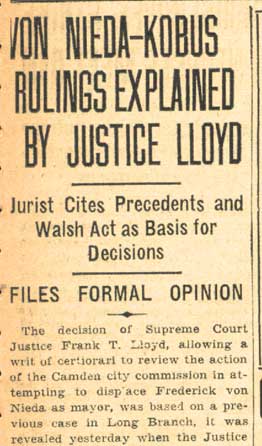
Jurist Cites Precedents and Walsh Act as Basis for Decisions
FILES FORMAL OPINION
The decision of Supreme Court Justice Frank T. Lloyd, allowing a writ of certiorari to review the action of the Camden city commission in attempting to displace Frederick von Nieda as mayor, was based on a previous case in Long Branch, it was revealed yesterday when the Justice filed his formal opinion in Trenton.
At the same time, Justice Lloyd explained that the assignment of departments is subject to change “at any time in the interest of public service” under the Walsh Act, and that therefore the commission had the authority to take the public safety department away from von Nieda.
Von Nieda had been named mayor and director of public safety at the first meeting of the commission after the May 14 election. Subsequently, a recount declared Frank J. Hartmann elected in place of Frank J. Leonard, thereby shifting the balance of power to the New Deal faction of the commission.
Cites Precedent
At the first meeting of the reorganized commission after the result of the recount was announced, the New Deal majority elected George E. Brunner to succeed von Nieda as mayor, and Mrs. Mary W. Kobus to assume the duties of director of public safety. Mrs. Kobus’ previous department, public affairs, was given to von Nieda.
The Republican organization sought to have these two changes set aside, and filed certiorari proceedings.
“In considerinng [sic] the first resolution, it is only necessary to say that in the case of Woolley versus Flock, 92 N. J. L., 65, the Supreme Court held that the selection of a mayor under the Walsh act, once designated, cannot be altered in the life time of the board, four years next following their taking office,” declared Justice Lloyd.
“The result is that the selection of Mr. von Nieda was irrevocable and a writ of certiorari to review the action of the board in attempting to displace him, must be awarded.”
Concerning the second resolution under which the department of public safety was transferred from the mayor to Mrs. Mary W. Kobus, the opinion of Justice Lloyd said that it had been contended the designation of the mayor to be director of a department was as final as his selection as mayor, and that the language of the Walsh act provides only for changes in directors from time to time with respect to the remaining four members of the commission.
Upholds Shifts
Justice Lloyd said it did not seem to him that the commission government law could be given such a construction.
The opinion points out that the Walsh act of 1911, under section 4, provides that the mayor may be designated director of such departments as the majority of the members of the commission should in [cut off at the crop edge]
Bribery Charged by Grand Jurors
Camden Courier-Post —
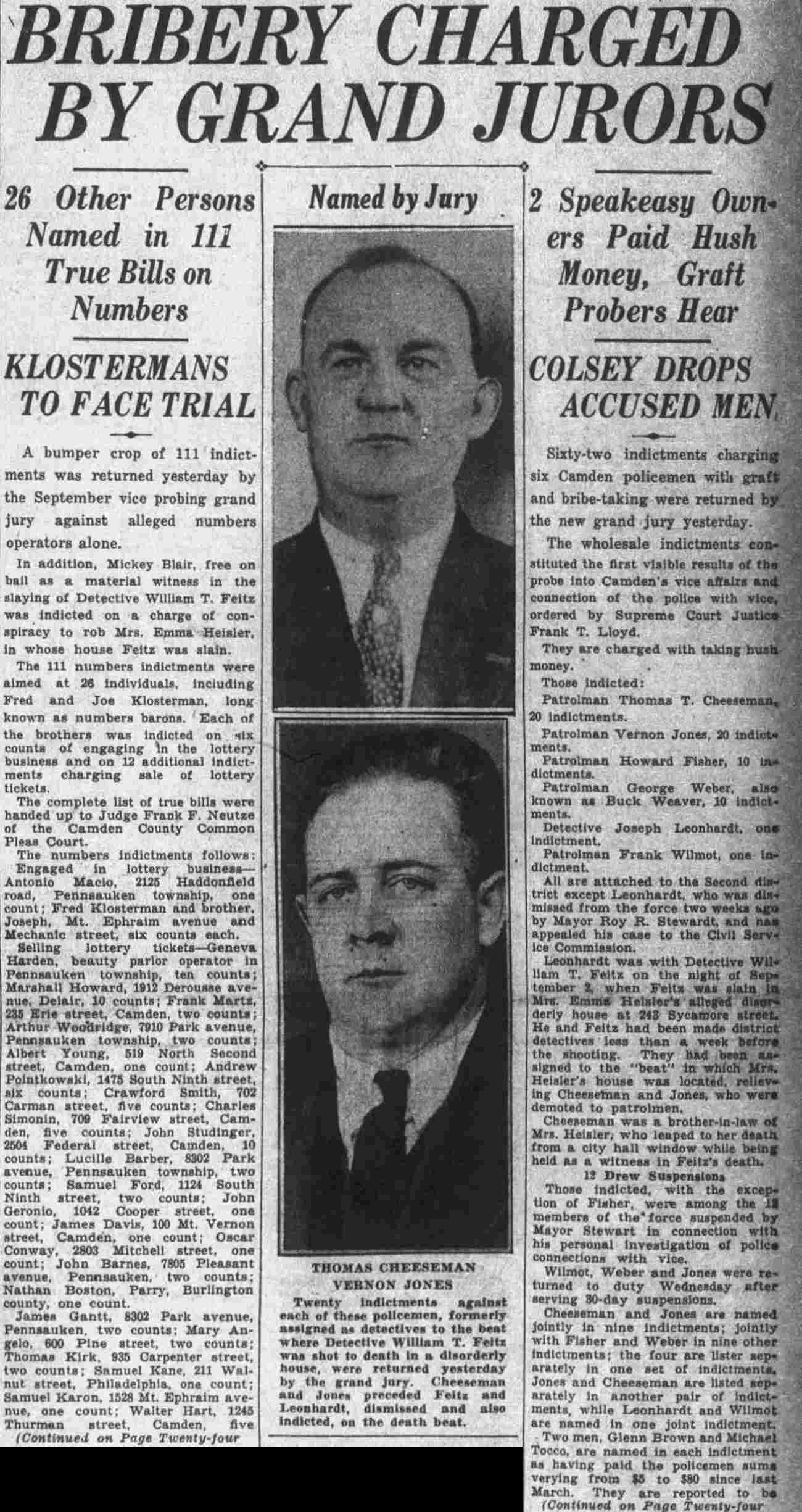
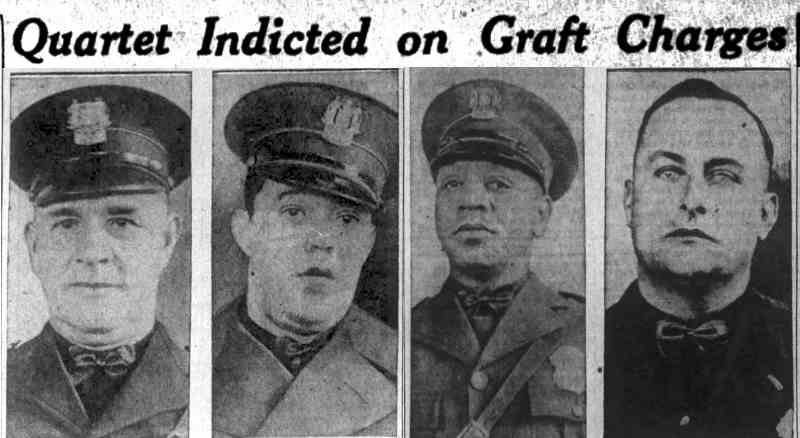

26 Other Persons Named in 111 True Bills on Numbers
KLOSTERMANS TO FACE TRIAL
A bumper crop of 111 indictments was returned yesterday by the September vice probing grand jury against alleged numbers operators alone.
In addition, Mickey Blair, free on bail as a material witness in the slaying of Detective William T. Feitz was indicted on a charge of conspiracy to rob Mrs. Emma Heisler, in whose house Feitz was slain.
The 111 numbers indictments were aimed at 26 individuals, including Fred and Joe Klosterman, long known as numbers barons. Each of the brothers was indicted on six counts of engaging in the lottery business and on 12 additional indictments charging sale of lottery tickets.
The complete list of true bills were handed up to Judge Frank F. Neutze of the Camden County Common Pleas Court.
The numbers indictments follows [sic]:
Engaged in lottery business—Antonio Macio, 2125 Haddonfield road, Pennsauken township, one count; Fred Klosterman and brother, Joseph, Mt. Ephraim avenue and Mechanic street, six counts each.
Selling lottery tickets—Geneva Harden, beauty parlor operator in Pennsauken township, ten counts; Marshall Howard, 1912 Derousse avenue, Delair, 10 counts; Frank Martz, 235 Erie street, Camden, two counts; Arthur Woodridge, 7910 Park avenue, Pennsauken township, two counts; Albert Young, 519 North Second street, Camden, one count; Andrew Pointkowski, 1475 South Ninth street, six counts; Crawford Smith, 702 Carman street, five counts; Charles Simonin, 709 Fairview street, Camden, five counts; John Studinger, 2504 Federal street, Camden, 10 counts; Lucille Barber, 8302 Park avenue, Pennsauken township, two counts; Samuel Ford, 1124 South Ninth street, two counts; John Geronio, 1042 Cooper street, one count; James Davis, 100 Mt. Vernon street, Camden, one count; Oscar Conway, 2803 Mitchell street, one count; John Barnes, 7805 Pleasant avenue, Pennsauken, two counts; Nathan Boston, Parry, Burlington county, one count.
James Gantt, 8302 Park avenue, Pennsauken, two counts; Mary Angelo, 600 Pine street, two counts; Thomas Kirk, 935 Carpenter street, two counts; Samuel Kane, 211 Walnut street, Philadelphia, one count; Samuel Karon, 1528 Mt. Ephraim avenue, one count; Walter Hart, 1245 Thurman street, Camden, five counts; Frank Kulzcnski, 1100 Orchard street, two counts.
The presentment required only three minutes and the grand jury immediately withdrew to its chambers to consider new evidence in its probe of vice and gambling here.
It was indicated that the first batch of indictments found by the grand jury was just that, and that further true bills would be forthcoming as the work of sifting the mass of evidence continues.
A quartet of former city detectives who were transferred to regular police duty June 14, and seven attaches of the county jail were among the list of witnesses subpoenaed.
The erstwhile plainclothesmen are Clarence Arthur, Benjamin Simon, Clifford Del Rossi and Leon Branch. All were put into uniform without explanation, and with the understanding, they declare, that they would not be displaced. All expressed surprise at their removal, inasmuch as others were later appointed to their posts, because they had good records while members of the detective bureau.
Arthur and Branch appeared briefly before the probing body.
Crawford Smith is the brother of Detective Walter Smith and former Detective Howard Smith, it was reported by Mayor Roy R. Stewart.
Michael Tenerelli, known in fistic cicles [sic] as Mickey Blair, was among those waiting in the grand jury anteroom when the jury adjourned to be called before the probers. All those called were subpoenaed on “John Doe” warrants.
Mickey told reporters he has no idea what form of questioning will be followed when he is called into the grand jury room. He was recently released under bail of $5000 as a material witness in the Feitz killing investigation.
Those who could not be heard by the grand jurors before adjournment yesterday were told to come back next Thursday.
Among the witnesses in the vice probe called into the jury room were two Camden county jail attaches, Mrs. Lillian Vincent, matron, and Frank Tyson, jail clerk.
Both were asked questions regarding the proceedure [sic] followed in releasing prisoners from the pail [sic], it was learned. Tyson was not asked by the grand jurors if the prisoners were ever allowed to leave jail before their terms were up, he said.
“We never discharged a prisoner during my long experience in the county jail,” he told reporters, “without the proper release slip. I do not know of any prisoner ever being released before his time was up.”
Other members of the county jail staff waiting to appear were Edmund Powell, former warden; William Kinsler, Walter Taylor, Joseph Rea and John Feitz.
Another witness to testify was Mrs. Anna Smallwood, of Fifth and Chestnut, who posted $5000 bail for Mickey Blair to effect the former boxer’s release in the Feitz murder case.
It is thought that the county jail attaches will be questioned in an endeavour to learn how prisoners are released before time, although confirmation of this report was lacking.
The grand jury also returned indictments against Robert R. Young and Fred H. Schmitz, both of Philadelphia, former employes of the RCA Victor Company, charging them with the theft of four automobile radio sets from the plant on September 19.
Harry Smith, John Lockwood, Edward Troutman and Thomas Moreland, of Camden, were charged with larceny of merchandise from the American Stores Company on August 30.
Stanley Gaisor and Henry Parewicz, both of Camden, were indicted on charges of the theft of an automobile owned by County Physician Edward B. Rogers. The automobile was stolen in Camden, August 31.
Paul Pralas was indicted on charges of atrocious assault and battery on Rocco Piliro on September 19 in Camden.
The following were indicted on charges of desertion and non-support: Cornelius Chambers, charged by his wife, Ethel, with deserting her and three small children.
Thomas Porter, of Clementon, with non-support of his three small children. Frank Drew, Camden, desertion and non-support of his wife, Martha, and three minor children. Walter Butterfield, Brooklawn, with desertion of his wife, Verna, and one minor child. Eugene Morselander, of Camden, with desertion of his wife, Gladys.
2 Speakeasy Owners Paid Hush Money, Graft Probers Hear
COLSEY DROPS ACCUSED MEN
Sixty-two indictments charging six Camden policemen with graft and bribe-taking were returned by the new grand jury yesterday.
The wholesale indictments constituted the first visible results of the probe into Camden’s vice affairs and connection of the police with vice, ordered by Supreme Court Justice Frank T. Lloyd.
They are charged with taking hush money.
Those indicted:
Patrolman Thomas T. Cheeseman, 20 indictments.
Patrolman Vernon Jones, 20 indictments.
Patrolman Howard Fisher, 10 indictments.
Patrolman George Weber, also known as Buck Weaver, 10 indictments.
Detective Joseph Leonhardt, one indictment.
Patrolman Frank Wilmot, one indictment.
All are attached to the Second district except Leonhardt, who was dismissed from the force two weeks ago by Mayor Roy R. Stewardt [sic], and has appealed his case to the Civil Service Commission.
Leonhardt was with Detective William T. Feitz on the night of September 2, when Feitz was slain in Mrs. Emma Heisler’s alleged disorderly house at 243 Sycamore street. He and Feitz had been made district detectives less than a week before the shooting. They had been assigned to the “beat” in which Mrs. Heisler’s house was located, relieving Cheeseman and Jones, who were demoted to patrolmen.
Cheeseman was a brother-in-law of Mrs. Heisler, who leaped to her death from a city hall window while being held as a witness in Feitz’s death.
12 Drew Suspensions
Those indicted, with the exception of Fisher, were among the 12 members of the force suspended by Mayor Stewart in connection with his personal investigation of police connections with vice.
Wilmot, Weber and Jones were returned to duty Wednesday after serving 30-day suspensions.
Cheeseman and Jones are named jointly in nine indictments; jointly with Fisher and Weber in nine other indictments; the four are lister [sic] separately in one set of indictments. Jones and Cheeseman are listed separately in another pair of indictments, while Leonhardt and Wilmot are named in one joint indictment.
Two men, Glenn Brown and Michael Tocco, are named in each indictment as having paid the policemen sums verying [sic] from $5 to $80 since last March. They are reported to be operators of illegal liquor establishments.
Jury Indicts 6 Cops On Vice Graft Charge
Prosecutor Samuel P. Orlando announced evidence had been given the grand jury to support charges that each of the men indicted had been accepting graft from racketeers and underworld characters.
The nine indictments against Cheeseman, Jones, Fisher and Weber charge them with having received the sum of $5 from Brown on nine different dates in March and April of this year, for a total of $45.
Cheeseman and Jones are jointly indicted on nine counts for having received from Tocco the sum of $160, in various amounts ranging from $10 to $80 on various dates in May, June and July.
Cheeseman and Jones are each indicted on two separate counts. Jones is charged with having accepted a $40 bribe from Tocco on May 24 and with having received another $5 from Brown on March 3. Cheeseman is indicted for receiving the same sums from the same persons on the same dates.
Fisher is indicted alone on one count of having received a $5 bribe from Brown in March. Weber was also indicted alone for the same offense.
Leonhardt and Wilmot, mentioned in only one indictment, are charged with having accepted $20 from Tocco in March.
Cheeseman has been a member of the police department for 16 years, most of which he served in the capacity of a detective. He was demoted on Sept. 3, 1930, to the rank of a patrolman, but later was again promoted to district detective. Two months ago he was demoted back to patrolman again and has been patrolling a ‘beat’ in South Camden since that time.
Cheeseman Appointed in 1918
Cheeseman is 48. He was appointed to the police force on January 11, 1918, and lives at 249 Rand street. He has served in various capacities since appointment, having been a member of the city vice squad, detective bureau, district detective and patrolman. His rank in the department was listed as a detective, although recently he has been assigned to uniform in South Camden.
Fisher, 42, of 1139 Baring street, was appointed to the force September 29, 1919. He has spent comparatively all of his time in the department as a patrolman in the Second Police district.
Jones is 37 and lives at 1011 South Sixth street. He received his appointment April 27, 1924. He has served on the vice squad, as a detective and plainclothesman. He was recently demoted to a patrolman’s rank.
Leonhardt lives at 553 Division street and is 39. He was appointed a member of the police department on April 25, 1924, two days before Jones. He served until recently as a patrolman, but was promoted to district detective when Jones suffered demotion. He was discharged from the police payroll on September 26 by Mayor Stewart, who said he had gathered evidence against him in his probe of the department which followed the murder of Feitz.
Wilmot is 32 and lives at 201 Kaighn avenue. He was appointed a policeman on July 1, 1928, and has served as a member of the Second district since his appointment.
Weber, 47, of 1369 Princess avenue, was made a member of the force on May 17, 1922. He also has served his entire time as a patrolman in the Second district.
The indictments were presented to Judge Frank F. Neutze in Justice Lloyd’s absence.
Five Are Suspended
Mayor Stewart and Police Chief Arthur Colsey conferred shortly after the indictments were returned.
[Text between this point and the next crop is not on the scan; crop 09a is not in the archive.]
and Judge Neutze to grant these men a speedy trial,” the mayor declared, “so that the cases against them will be disposed of and their guilt or innocence established. In this way the community will have the benefit of their services, if they be found not guilty, as soon as possible.”
None of the policemen indicted had been arrested last night.
Chief of County Detectives Lawrence T. Doran said he expects them to surrender today and post such bail as may be set.
Named by Jury
THOMAS CHEESEMAN
VERNON JONES
Twenty indictments against each of these policemen, formerly assigned as detectives to the beat where Detective William T. Feitz was shot to death in a disorderly house, were returned yesterday by the grand jury. Cheeseman and Jones preceded Feitz and Leonhardt, dismissed and also indicted, on the death beat.
Quartet Indicted on Graft Charges
Four of the six policemen indicted yesterday on charges of bribery. They are George Weber, (upper left) also known as “Bucky Weaver”; Frank Witmot [sic] (upper right), Howard Fisher, (lower left), and Joseph Leonhardt, (lower right), who had been dismissed from the police department.
Camden Strikers Held for Disorder
Trenton Evening Times —

Camden Strikers Held for Disorder
City Commissioner Declares That Settlement Will Be Reached
CAMDEN, July 21 (AP).—Judge Frank T. Neutze today turned over to the Grand Jury 26 cases involving riot charges growing out of RCA strike disorders last week. He demanded an aggregate of $135,000 bail for the release of the men.
The court dismissed 39 other defendants, most of whom had been held in default of bail since the outbreaks last Thursday and Friday. He turned over five other cases to Police Judge Lewis Liberman, who fined four of the defendants and suspended sentence on the fifth. Fines exacted totaled $55.
Judge Neutze said he sat as a committing magistrate at the direction of Supreme Court Justice Frank T. Lloyd, who last week personally presided in a similar capacity at preliminary hearings.
There were frequent oral clashes between attorneys for the strikers and sympathizers and assistant prosecutors. Several hundred spectators were denied admittance after the room became filled. Policemen carrying sticks patrolled the halls.
Ernest Christy, 27, of Philadelphia, who, Police Sergeant Edward Carroll testified, was arrested after he shouted, “Go get the cops, kill them,” was held in $10,000 bail.
State Police Summoned for County-Wide Investigation
Camden Courier-Post —
Jurist Parries Questions on Details of Plans When Interviewed
RESULTS NOT LOOKED FOR AT ONCE, HE HINTS
By WALTER R. BATEZEL
A probe of vice and crime conditions is being conducted in Camden city and county by New Jersey state police on orders of Supreme Court Justice Frank T. Lloyd.
The troopers said to be working in Camden on the request of Justice Lloyd are Detective Wilfred Dube and Corp. Francis J. Ruggerio. Both have good reputations as detectives. Dube recently was assigned to the job of guarding Paul H. Wendel in Brooklyn.
Dube and Ruggerio have been seen in Camden many times during the past two days but have not divulged the reason for their presence here.
Admits Troopers Here
This was established last night when Justice Lloyd admitted state troopers were working out of his office.
It is the first time that state police have been asked to make an investigation of crime in Camden county, although several times in the past Justice Lloyd called the attention of the grand jury to vice conditions here, particularly during the days of prohibition when the late “Mickey” Duffy and his lieutenants made Camden their headquarters. Duffy had a suite of rooms in a Camden hotel at the time he was shot in an Atlantic City hotel on Aug. 30, 1931. Clifford A. Baldwin was prosecutor at that time and Mayor Roy R. Stewart was director of public safety.
It could not be learned last night whether Prosecutor Samuel P. Orlando, Sheriff Joseph H. Van Meter or Director of Public Safety Mary W. Kobus had been informed by Justice Lloyd of the present probe.
Questions seeking to learn whether specific crimes or general vice were involved in the probe were rebuffed by the jurist.
Asked if state troopers were (Continued on Page 2—Column 3)
Lloyd Orders Probe Of Crime in County
(Continued from Page One)
“working out of his office,” Justice Lloyd replied:
“I can’t tell you what they are after.”
“Is it the first time in your career that you have called upon state police to investigate a county?” was the next question asked him.
“No, dozens of times,” was his reply.
“Does it have to do with crime?”
“It has to do with crime, of course,” Justice Lloyd said. “They are not out on a picnic. Don’t ask me any more questions. I won’t answer them.”
Results May Wait
“Do you expect any quick results from the probe?” was the next question.
“There is no hope of results right away,” Justice Lloyd answered, but who told you?
Assured his questioner could not answer that question, Justice Lloyd said: “Well, I can’t tell you what you want to know, either.”
“Well, we are two of a kind,” was the reply of the questioner.
“Yes,” was the retort of Lloyd, “we are. I hope you feel all right after election day.”
This answer was a surprise inasmuch as Justice Lloyd was not asked if politics was involved in the probe.
The question, “What do you mean by that?” was cut off by the justice as he hung up the receiver of his telephone.
Lloyd Ends Term, Will Take Sea Trip
Camden Courier-Post —
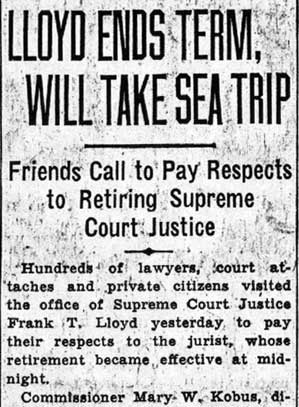
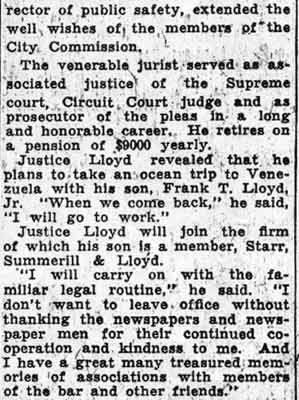
Friends Call to Pay Respects to Retiring Supreme Court Justice
Hundreds of lawyers, court attaches and private citizens visited the office of Supreme Court Justice Frank T. Lloyd yesterday, to pay their respects to the jurist, whose retirement became effective at midnight.
Commissioner Mary W. Kobus, director of public safety, extended the well wishes of the members of the City Commission.
The venerable jurist served as associated justice of the Supreme court, Circuit Court judge and as prosecutor of the pleas in a long and honorable career. He retires on a pension of $9000 yearly.
Justice Lloyd revealed that he plans to take an ocean trip to Venezuela with his son, Frank T. Lloyd, Jr. “When we come back,” he said, “I will go to work.”
Justice Lloyd will join the firm of which his son is a member, Starr, Summerill & Lloyd.
“I will carry on with the familiar legal routine,” he said. “I don’t want to leave office without thanking the newspapers and newspaper men for their continued cooperation and kindness to me. And I have a great many treasured memories of associations with members of the bar and other friends.”
Camden Courier-Post — February 1, 1938
Back to Practice After 30 Years
Lloyd Reveals He Declined Offer From Governor for Another Term
Justice Declares Pace of Court Work Calls for Toil Unsuited to Man of 78
Sails Next Week on Ocean Cruise
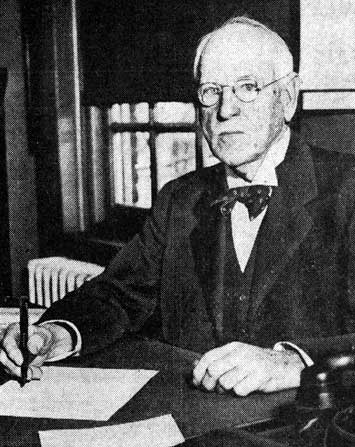
Former Justice Frank T. Lloyd who retired from the Supreme Court Saturday and resumed the practice yesterday with the firm of Starr, Summerill and Lloyd. Justice Lloyd is shown at his new desk.
Resuming law practice after 30 years on the bench, former Supreme Court Justice Frank T. Lloyd yesterday revealed that Governor Moore offered to reappoint him for another term but he declined.
“The work in the Supreme Court in these days is terrific,” Judge Lloyd said at his desk at the law offices of Starr, Summerill and Lloyd, of which his son, Frank T. Lloyd, Jr., is a partner. Justice Lloyd retired from the bench on Saturday.
“My physical and mental faculties are good, but the endurance of the pace is too much,” the former jurist, who is 78, said with a kindly smile. “You are required to read 2000 law books in a year. You read them in the daytime and lay awake at nights thinking about them.”
“I am leaving on February 11 for an ocean cruise to and from Venezuela. I have made these trips before, but took about 25 briefs with me to write opinions on Court of Errors and Appeals cases. This time I will have no opinions to write, but will enjoy a complete rest, returning on the last day of the month.”
Reminiscing he recalled a number of circumstances, which led him into public life and eventually to the dream of every attorney, the Supreme Court bench.
Native of Delaware
Born at Middletown, Delaware, on October 29, 1859, he was graduated from the Middletown Academy. In 1875 he moved to Camden and became a compositor. While serving his apprenticeship he studied law in the office of Judge James Otterson, of Philadelphia. He was admitted to the bar of Pennsylvania in 1882 and practiced in the Philadelphia courts 15 years.
“Here is where the series of coincidents come in,” Justice Lloyd said. “I was elected to the Assembly from Camden county in 1896, a year before I was admitted to the New Jersey bar.”
“The chairman of the State Examining Board asked why I did not apply for admission to the New Jersey bar. It was only through his persuasion that I was admitted in 1897, and that year I was re-elected to the Assembly.”
“Three years later I became a counselor-at-law. That was in 1900. That year I was named prosecutor of Camden County. One of the requirements to qualify as a prosecutor is that an attorney must be a counselor-at-law.”
“Wilson Jenkins was prosecutor and William Carson his assistant. Then came another series of coincidents. Mr. Jenkins fell dead. Mr. Carson was slated for prosecutor. But before the appointment could be made he was shot and killed by a relative in North Jersey.”
Named as Prosecutor
“I was named prosecutor to succeed Mr. Jenkins at a time when lawlessness was rampant in Camden county. The county had not recovered from the racetrack days. Legislature had passed drastic laws to wipe out the evils of the racetrack days but they had not been effectively enforced as yet. That lot fell to me.”
This conversation led up to the recent criticism of the jurist in enforcing laws against lotteries of churches and lodges.
“I have quite a little feeling about gambling,” Justice Lloyd declared. “I had nothing to do with making the laws restricting gambling and putting an end to racetracks in the state. They were made before I went to the Legislature.”
“As judge I had to recognize them and bring them to the attention of the grand juries from time to time. The rigid enforcement of these laws sometimes was not so easy.”
Views on Gambling
“There is a great difference in gambling. If I had the laws to make, I would not make them so drastic. There is a difference between the games conducted in churches and lodges and those of the commercial and professional gambler. The trouble is the law does not raise the distinction.”
“And perhaps after all if the people would stop to think the development of the gambling spirit can be created among youth, with pinball machines and bingo games in churches and lodges. I hate to see so many thousands of dollars taken out of Camden County by professional gambling syndicates. I am speaking of horse race betting and the numbers racket. The income taxes some of these people pay gives you an idea what honest people are losing by playing either of them.”
“When little children spend their lunch pennies to play the numbers, as they have done in South Camden, then it is alarming. If the people knew how many wives came to me and complained that their husbands were playing all of their wages on the numbers and horse race betting. This habit grows on the player as the dope habit grows on an addict. I think he can never get rid of it.”
Here and there Justice Lloyd mentioned some celebrated cases he participated in as presiding jurist.
Praises Courier-Post
“The Gladys May Parks case was the outstanding trial I ever presided at on the Supreme bench,” he declared. “I mean that also from a psychological standpoint.”
Then he inquired about the health of the Sphinx woman, who was convicted in his court of slaying two children—second cousins. He was informed she is alive and at the State Hospital for Insane.
Then Justice Lloyd commended the Courier-Post Newspapers for their enterprise in reporting the woman’s trial, recalling a camera smuggled into the room and a photograph taken without the use of a flashlight bulb. At the time the photo was taken, Justice Lloyd was asking the woman 13 questions as to why she even wanted the children in her custody.
“We had considerable difficulty to get sugar as the supplies were limited,” he declared. “At one time none of the small dealers had sugar in stock and appealed to the American Stores Company and the Atlantic and Pacific Tea Company to divide their stocks with the small storekeepers, which they did handsomely.”
Speaks of His Career
In summing up his career of distinguished service he said:
“Any mistakes I have made have been of the head and not the heart. No matter whether they agreed with me politically or not the people will have to agree with me on that.”
And in conclusion he said:
“Have said this before and wish to reiterate it. I want to thank the Courier-Post Newspapers for their kindly and courteous treatment. Of course, they have not always agreed with me. I did not expect them to. And I am grateful for the manifestation of confidence on the part of the people.”
During his second term in the Assembly, Justice Lloyd served as chairman of the judiciary committee and sponsored new marriage laws, few of which have since been revised. He was appointed to the Circuit bench in 1906 by former Gov. Edward C. Stokes. He was re-appointed by Gov. James F. Fielder in 1914 and Gov. Edward I. Edwards in 1921. He was named to the Supreme Court in 1924 and re-appointed in 1931.
“If we had had that same enterprise while I was prosecutor I would not have had so much trouble in solving the Paul Woodward murder case,” he said. “Woodward coaxed two boys into robbing their parents’ homes. Then he lured them to the woods and murdered them by giving them pie filled with deadly poison just to get the few trinkets they had stolen from home.”
Refers to Noted Trial
Speaking of his career on the Circuit Court bench Justice Lloyd said one of the outstanding cases tried before him was an alienation suit in which former Gov. George S. Silzer was one of the attorneys.
“A boarder alienated the affections of the wife of his landlord,” he said. “After breaking up the landlord’s home, he deserted the new-found wife and then alienated the affections of her daughter from her husband.”
Speaking of his experiences as food administrator during the war he commended the people on their loyalty to the Government.
Camden Courier-Post — February 1, 1938
Moore Picks Porter to Succeed Lloyd
Surprise Appointment Elevates Essex Judge Instead of Palmer
Trenton, January 31— Governor Moore today nominated Circuit Court Judge Newton H. Porter, now sitting in Essex county, to the state Supreme Court seat left vacant by the retirement of Justice Frank T. Lloyd, of Merchantville. The nomination is now before the Senate for confirmation.
The naming of Porter, a Republican, was a distinct surprise. Circuit Judge V. Claude Palmer, of Burlington county and also a Republican, was believed to have had the inside track for the court vacancy.
J. Warren Leyden, of Hackensack, was nominated as circuit judge to succeed Judge Porter.
The nomination of Porter marks the fourth time he has been appointed to the bench by a Democratic Governor and the third time by Moore.
He first was named to the Essex County Common Pleas Court in 1924 by Gov. George S. Silzer. Moore appointed him to the Circuit Court in 1926 and reappointed him during the second Moore administration.
Porter’s appointment maintains the five to four Republican majority on the Supreme Court. When Moore first took office, it was reported that he would name a Democrat to reverse the balance, but later it was understood that the seat would go to a Republican.
The terms of Chief Justice Brogan and Chancellor Campbell, both Democrats, expire during Moore’s present administration and it was understood that the Democrats felt that by appointing a G. O. P. man to the Lloyd vacancy they could forestall any criticism of continuing two of their own party in the highest judicial posts in the state.
Porter is a resident of Montclair.
He was born in Somerville, April 13, 1877, and moved with his parents to Newark in 1885. At the age of 12 he went to work in the Newark office of the Bureau of Internal Revenue, where he remained until January 1, 1910.
Meanwhile, he went to school at night and in 1902 was graduated from the New York University’s evening law school. He was admitted to the New Jersey bar as an attorney in 1904 and as a counselor in 1907. From 1910 until his appointment to Common Pleas Court he practiced law in Newark.
Legislative correspondents here recalled Porter as a capable attorney who took part in a number of public hearings on bills. He usually represented liquor interests in hearings on measures governing that industry.
The Supreme Court appointment is for seven years and pays $18,000 annually. Justice Lloyd ended his term last Saturday and chose to retire at $9000 a year, thus causing the vacancy.
Justice Donges, now sitting in the Atlantic, Cape May, Cumberland and Salem counties district, is expected to take over Lloyd’s old district of Camden and Gloucester counties, while Justice Perskie may move down from the Burlington, Monmouth and Ocean counties district to the so-called “Shore Circuit” vacated by Donges.
Justices select their own districts according to seniority and usually chose one near their residence. Since Donges lives in Camden he is expected to choose Camden and Gloucester. Perskie’s home is in Atlantic City, and it is believed he will take over the shore district.
This will leave the Burlington, Monmouth and Ocean circuit open for Porter, provided some other justice does not choose it.
Porter’s appointment apparently dashed the hopes of South Jersey Democrats that they might get a judgeship out of the Supreme Court shift. They had anticipated that if Palmer, who had the backing of Senator Powell and other Hoffmanite Republicans, were named to the Supreme Court, some local Democrat would take Palmer’s place on Circuit. With Porter being appointed, however, his successor on the Circuit bench probably will be Grossman or some other North Jersey man.
Reilly, for 27 years connected with the Federal Trust Company, Newark, and now treasurer of the institution, is best known politically since the inauguration of President Roosevelt for his work in connection with the Birthday Ball committee. He has been treasurer of the committee in Essex county each year, and served in a like capacity for the Jackson Day Dinner committees. He is a member of the American Institute of Banking.
In addition to his post with the Federal Trust, Reilly is president of the North Newark and secretary of the Newark 21 Building and Loan Associations. He never before has held public office.
In his youth Reilly was well known as a professional basketball player. Later, he enlisted in the Navy during the World War. He never married.
Donges Assigned to Head Court Here
Camden Courier-Post —
Legal Profession Pleased at Designation to Preside Over Lloyd’s District
Supreme Court Justice Ralph W. E. Donges yesterday was assigned to preside over the Camden-Gloucester county Second judicial district of the Supreme Court.
A copy of the order of assignment was received by County Clerk Leslie H. Ewing. Justice Donges will take over the circuit presided over for many years by Justice Frank T. Lloyd who retired on pension last month.
Word of Justice Donges’ assignment to his “home” district elicited expressions of pleasure from many members of the legal profession in Camden county.
Heretofore Justice Donges has been serving the First judicial district, embracing Cape May, Cumberland, Salem and Atlantic counties. His new assignment was made by a vote of the membership of the state Supreme Court, Chief Justice Thomas J. Brogan signed the assignment order.
“Pleasure to Come Back”
“It is a real pleasure to come back to my home county,” Justice Donges said. “I was very happy in my first assignment, but it is a great satisfaction to be among my friends in Camden and Gloucester counties.”
Louis B. Duc, president of the Camden county Bar Association, said he felt he spoke for every member of the county bar when he said the assignment of Justice Donges was a most natural choice.
“For several decades only sons of Camden County have had the assignment to the Second judicial district,” he said. “Our regret at losing Justice Lloyd is balanced by our joy of receiving Justice Donges.
“The bar of Camden County tenders him our loyalty and appropriate greetings on his return home.”
Outstanding Citizen
Another who expressed keen pleasure over the assignment was Samuel T. French, a veteran member of the local bar.
“Justice Lloyd served the Supreme Court and the citizens of New Jersey faithfully and with glory to himself. Now Justice Donges takes up where he left off. It was to be expected that Justice Donges should be assigned to Camden County.
“He is an outstanding citizen and an eminent jurist who has given dignity to his democracy is unchallenged.”
Speaking as a junior member of the bar Bartholomew A. Sheehan joined in a personal tribute:
“As one of the younger members of the bar naturally am pleased over his assignment to Camden. Justice Donges has distinguished himself as one of New Jersey’s ablest and most eminent jurists and a judge who is keenly interested in the problems of the young law practitioners.
Burling Pleased
“State Senator Albert E. Burling expressed his pleasure by declaring he had the honor as senator from Camden County to present Justice Donges’ reappointment to the State Senate for confirmation.
“I have long admired Justice Donges for his ability, his industry and integrity as an associate Justice of the State Supreme Court,” Burling said.
“Many members of the bar regretted his elevation to the state’s highest court because he was a judge of the Circuit Court. His elevation was richly deserved.
“With other members of the Camden county bar I wish to join in extending a gracious welcome to Justice Donges on his return to his home county.”
Orlando Lauds Donges
Prosecutor Samuel P. Orlando was another who paid tribute to Donges. He said:
“I am highly pleased, to say the least. Justice Donges has served his state faithfully in his high judicial position. He is esteemed by all who know him and he commands the respect of all good citizens.
“I propose as county prosecutor to give Justice Donges the same wholehearted co-operation as given to his predecessor, Justice Frank T. Lloyd.”
Justice Donges was lauded by County Solicitor Walter S. Keown as one of the state’s outstanding jurists.
“I regret that Justice Lloyd decided to retire after his long and honored career on the bench,” Keown said. “However it is with mingled happiness and satisfaction that members of the local bar welcome Justice Donges to his own home district.”
The retirement of Justice Lloyd leaves eight justices for the nine circuits. Circuit Court Judge Newton H. Porter, of Essex County, has been named by Governor Moore to succeed Justice Lloyd. The nomination is before the Senate for confirmation.
Test Case Planned on Police Pensions
Camden Courier-Post —
City to Oppose Sergeant’s Plea Against Paying Two Percent Assessments
A test suit to clarify the law governing a two-percent assessment against the pension salary of James R. Clay, retired Camden police sergeant, will be brought by the City of Camden through Firmin Michel, city counsel.
This was learned yesterday when counsel for Clay confirmed the report. Michel, after first ruling the money was illegally deducted for a period of several years, decided to oppose the writ of mandamus sought by Alex Schueneman, Jr., attorney for Clay.
John J. Crean, assistant city solicitor, stated the legal department deemed it advisable to settle the matter in the Supreme Court in an effort to clarify the law. Crean spoke in the absence of Michel, who was not available for a statement.
Under the act concerning pensions, four percent of salary is deducted and contributed to the police and firemen’s pension fund. The two percent is in addition to the regular pension assessment. This amount is set aside for the pensions of widows of deceased pensioners.
Schueneman contends that inasmuch as Clay has no immediate survivor to receive a pension he should receive his pension salary without the additional two percent assessment.
“The point in question is debatable and the law is not entirely clear,” said Crean. “The city does not want to deprive any pensioner of his rightful amount. The law should be clarified by the court. The city legal department will oppose the writ of mandamus in the form of a test case.”
Supreme Court Justice Frank T. Lloyd issued the rule to show cause why a mandamus should not issue. The case will be heard later in the month by Supreme Court Justice Ralph W. E. Donges.
Camden Courier-Post — February 12, 1938
Porter Is Sworn In as Lloyd Successor
Trenton, Feb. 11.—Judge Newton H. Porter, Montclair Republican, was sworn in yesterday as a Supreme Court Justice and a member of the Court of Errors and Appeals. Justice Porter was appointed to succeed Justice Frank T. Lloyd, whose term expired several weeks ago.
Justice Porter went to work in Supreme Court immediately after being sworn in at an unpretentious ceremony. He was assigned to the First district of the court, including Atlantic, Cumberland, Cape May and Salem counties. The post pays $18,000 a year.
Checked and Double Checked
Camden Courier-Post —
By Jiminy
When the faithful and loyal threw that birthday party to Harold Hoffman in New York the other night, Paul Wendel happened to be in the same hotel…They didn’t meet…The “numbers raid” in Merchantville is another attribute to Chief Bill Linderman and his on-the-toes police department. The irony of it, however, can’t pass notice…The pinch was made within a few blocks of Justice Lloyd, who before his recent retirement caustically criticized numbers and other gambling racket elsewhere…
Camden Courier-Post — February 12, 1938
Lloyd and Son Off on Winter Cruise

Frank T. Lloyd, retired Justice of the Supreme Court in Camden, and his son, Frank, Jr., both of whom live in Merchantville, are on a Winter cruise through the Caribbean. Father and son are shown as they appeared aboard the Grace liner, Santa Elena, just before sailing. After the brief holiday, the former justice expects to return to legal work in Camden.
Is Zat So!
Camden Courier-Post —
Freed from the restraint of judicial dignity, former Supreme Court Justice Frank T. Lloyd is back to the simple pleasures of the barrister once more. The justice makes no bones about his release from the ermine. After 30 years tied to judicial duties he told me the other day he “felt like a man free from prison.”
“Maybe that’s hardly the right comparison,” laughed the jurist, “but let’s say that I feel like a boy out of school. You know that’s a trying position, being on the Supreme bench.”
“I’ll say that I went through 2000 books a year. The worst of the experience was that you never were free from your work. Don’t mistake my meaning. You spent your day in the chambers or in the courtroom, then when you went to bed at night the problems, the cases, the decisions, the opinions all raced through your mind during the night.”
“So you like the work of getting back into practice?” we asked the justice.
“Yes sir,” he replied. Then his eyes twinkled as we suggested that perhaps he might run against a contretemps sometime.
“I want to be around the courtroom,” I told the justice, “when you begin to slam an opinion or precedent and find you set them both.”
Might Happen Here All Right
“You know,” he said seriously, “such a thing could easily happen. In fact, it did to one of my colleagues. You can’t keep track of thousands of opinions a year. No man can.
“To refer to my colleague on the supreme bench. He was hearing an argument one day, shortly before I retired from the bench. Counsel for one of the litigants quoted an opinion given in a case similar to the one being heard, and in which my colleague made a ruling.
“It was apparent the justice did not hold much sympathy with the opinion which had just been read.”
“Who wrote that opinion my colleague asked, rather sharply. ‘Well,’ counsel smiled, ‘with all due reference to the court, you did.’”
“Now,” laughed the former justice, “it won’t do for me to make any arguments unless I’m pretty sure of the origin of the decisions and precedents I quote.”
If Justice Lloyd becomes mellow with his release from the judicial serfdom which he says he feels his present freedom to be, I figure New Jersey has judges who should be summarily pushed right into the lay ranks as speedily as possible.
This Garden State, with Hague in Jersey City and some of the judges who wear its ermine, should be rather tolerant of doings below the Hague-Sweatshop Line.
When we scan the destruction of civil liberty in Jersey City, and read some of the unholy decisions of the bench, we stand aghast.
Berry Seems Anomaly on Bench
This Maja Leon Berry seems a veritable anomaly to be wearing the ermine of any judiciary. The decisions that he makes in labor matters are absolutely without reason in either law or fact. He is probably the worst foe that constitutional government knows on any bench of which I have heard.
His ruling that a strike in any plant ends when strikebreakers fill the places, of the strikers’ is such a miscarriage of justice, that, if rendered from a backwoods bench, would be laughed out of court.
No, court can sensibly or in reality declare when a strike starts, or when it ends.
That is a matter for the parties involved, the strikers. To say that a strike ends when strike-breakers fill places is the same, as to declare that no freeholder can vote on a question in Camden, because a spectator is occupying his seat. That decision just about hits the apex of the ridiculous. That any jurist would make such a decision, save at a minstrel show or a comic opera, is proof enough that one vice-chancellor is the “Berry” for legal decisions that can’t be found in Blackstone, Coke or any other lawyer’s mind, save Berry’s.
Along with that masterpiece that a strike ends when there are no vacant places at the loom, Berry climbs another legal Matterhorn. The climax to judicial nonsense that leaves Berry in a class by himself.
Berry has just decreed that a labor union cannot be the judge of its own membership. He has ordered a union to reinstate a member who was ousted, for good and sufficient reasons according to the union.
Berry says no. The member must be reinstated because the union is not to be the sole judge of the qualifications of its own membership, a privilege that has been given to any organization of which I have ever heard or read.
Of course, the opportunity to place labor spies in a union is wide open under such a decision. Judging from Berry’s record that might be the inspiring motive in, both the member’s suit and the bench’s decision.
Vice-Chancellor Berry, too, seems to believe, as did Congressman Tim Campbell, famous Tammany sachem of years ago: “What’s the Constitution among friends?” The vice-chancellor has just decided that peaceful picketing may be satisfactory to the United States Supreme Court; but we’ll have none of those didoes in Ocean County, where justice and freedom sit personified in Vice Chancellor Maja Leon Berry.
Therefore, peaceful picketing of hotels where strikes are in existence in Lakewood, or any other spot, is illegal. We’ll have none of that Russian gold circulating in Lakewood, any more than in Jersey City. We’ll have no sabotage of our kitchens and menus in Lakewood hotels under orders from Moscow.
Camden Courier-Post — March 1949
Stockton Annexed Against Protest of Democrats
Fifty years ago, the old town of Stockton was annexed to the City of Camden over the protests of Democratic members of the town council.
But a Republican Legislature approved a bill introduced by former Justice Frank T. Lloyd on March 24, 1899. He was a member of the Assembly at the time. He resided then in the structure now occupied by the Sheltering Arms Home at Eighteenth Street and River Avenue.
The town of Stockton had been in existence five years when the annexation took place. Merchantville and Pennsauken township were part of the original Stockton Township with the present East Camden area. Merchantville received its charter as a borough 75 years ago this month. In 1892, Pennsauken township withdrew from the township to become a separate municipality.
For two years East Camden remained in the township. In 1894 Alfred Cramer, founder of Cramer Hill, launched a movement to create the town of Stockton and the first governing body was elected. Edward Dudley, then a leading lawyer, was elected councilman-at-large, which entitled him to preside as mayor. William S. Abbott, a lifelong resident, became clerk.
The town was divided into three wards. Fred Voigt and Justice Lloyd also served with Cramer and Dudley in the town council. The town hall was on the triangle, at Twenty-seventh and Federal Streets.
Albert Plum and William C. Reeves were justices of the peace. Samuel M. Jaquillard served on the Board of Freeholders as did W.O. Buck and Joseph Funfer. Charles E. Allen was a member of the Board of Education.
After the annexation Abbott was elected to Camden City Council. Others elected were Dr. William H. Kensinger, now a resident of Florida; Frederick S. von Nieda, Frederick H. Finkeldey, president of the first Playground Commission; Arthur R. Gemberling, now of Woodstown.
Other active citizens were Lemuel D. Horner, undertaker; Dr. H. F. Hadley, Jacob Bendinger, proprietor of the Rosedale Inn, and Walter L. Tushingham, former vice-president and general manager of the Courier-Post Newspapers.
Photos

Frank T. Lloyd, 1938
2 Youths Face Court And Deny Store Murder
Camden Courier-Post —
Makowski and Janasz Indicted in Killing of John W. Cullen
PROSECUTOR WILL ASK FOR DEATH PENALTY
Collingswood Burglar is Named By Grand Jury in Its Report
Two Camden youths, nervous and incoherent in speech under the threat of the electric chair, today stood before Supreme Court Justice Frank T. Lloyd in criminal court and pleaded not guilty to charges of murdering a store manager to get $5 in receipts.
They are John “Fingers” Makowski and Stanley B. Janasz, also known as Benny Jones.
Both were white-lipped as they listened to the grave charges contained in indictments returned by the retiring September Grand Jury yesterday and read in court today by Assistant Prosecutor Rocco Palese. At the conclusion of the reading, Palese asked them how they would plead.
Neither made answer, and Justice Lloyd then put the question to them. Their answer, made in a low, indistinct voice, was:
“Not guilty.”
State Aid Asked
Janasz is represented by Joseph A. Varbalow, but Makowski has no lawyer. His mother, a widow who has four other children, then made application to Justice Lloyd for the court to appoint counsel for her son at the state’s expense, as she has not the money with which to procure legal defense for him.
Prosecutor Baldwin will place the youths on trial probably in January, when the death penalty will be asked.
They are accused of murdering John William Cullen, 22, of 1088 South Common road, Fairview, manager of an American Store at 1201 Lansdowne avenue, and father of a 13-month-old girl. The shooting occurred at the store on the night of November 28 and Cullen died two days later in the West Jersey Homeopathic Hospital.
On the day following the shooting the two captives are alleged to have confessed to the robbery and shooting. When arraigned in police court on atrocious assault and battery charges, they pleaded guilty. Jones admitted it was his gun that fired the fatal shot, but he said it was discharged accidentally.
They are probably two of the youngest defendants in a Camden county murder case in which the electric chair has ever been asked by the state. Jones is 18 and resides at 1509 Newport street, while Makowski is 19 and lives at 1476 Mount Ephraim avenue.
Moore in Camden Speech Demands Fairness at Polls
Camden Courier-Post —
Towers Theatre Packed at Climax of All-Day Invasion Here
TOURS SMALLER TOWNS
Editorial: “Mr. Harry Moore’s Great Exposé That Exposes Nothing” appears on page 16.
By RANSLOE BOONE
Demanding a fair election and protection to Democratic voters, A. Harry Moore was greeted here last night by the largest crowd to gather at a Democratic meeting in Camden’s recent history.
The Democratic candidate for governor brought to a climax an all-day speaking tour of Camden county with a mass meeting which overflowed the Towers Theatre, Broadway and Pine street. At least 3500 persons crowded the theatre to its doors and more than 1000 others, unable to get in, heard the speakers’ words through amplifiers over the sidewalks.
Assails Justice Lloyd
Moore criticized Supreme Court Justice Frank T. Lloyd, for his refusal last week to order state police into Camden to protect the interests of the Democrats.
“The court has not given me that assurance. Instead, the court delivered from the bench a fine speech for my opponent.”
The Democratic candidate had promised in an earlier speech here September 8, to name names of those he charged had resorted to illegal practices at the polls. He made no mention of them last night except to say he had given the names in affidavits filed with Justice Lloyd.
Earlier in the evening the Democratic standard-bearer addressed more than 250 at a combined meeting of Merchantville, Delaware Township and Pennsauken Township voters at Merchantville Hall, 15 West Maple Avenue, Merchantville, and to 1200 at Gloucester city hall.
Lauds Courier-Post Fairness
In an address at noon to employees of the RCA Victor and Campbell Soup companies, Moore, without naming his Republican opponent, declared:
“Come on with your millions,” he added without mentioning the name of his Republican opponent, “and with the editors you have bought and paid for, and next Tuesday I’ll crash through to the governor’s chair!”
“When I speak of the editors who have been bought and paid for, I’m not in anyway referring to the local newspapers— the Morning Post and the Evening Courier. Both of these papers have been fair to me in handling the news of the campaign.”
Moore’s address at the Towers Theatre follows:
Cites Request for Trooper
“Evidence is on file with the justice of the Supreme Court here showing clearly that extraordinary means must be taken by me to protect my interests on election day in certain parts of the City of Camden. When I spoke here the last time, I referred to conditions that existed in the Eighth and Fifth wards, conditions that made it impossible for opponents of Republican candidates to receive the protection that the laws provide for all candidates for office.
“I promise at that time that the names of certain individuals who resort to illegal practices at the polls would be made public. This has been done. The names have been given to the justice of the Supreme Court here.
“Though my counsel, I have appealed to the justice of the Supreme Court for assurance that he would use the power of his high judicial office to give my interests the protection of the law of New Jersey in those sections where I am compelled to believe my interests are in jeopardy. Filed with the court are 40 affidavits showing what has happened in the Fifth and Eighth wards in the past, and what I have every reason to believe will be repeated this year unless checked beforehand.
Ridicules Supreme Court
“The court has not given me that assurance. Instead, the court delivered from the bench a fine speech for my opponent. The court insisted on emphasizing that the City of Camden and the County of Camden were no more capable of election law violations than any other city or county in the state.
“Now, I have no criticism to make of the people of Camden city or Camden county. Certainly the great majority of the people here are law abiding. I never said they weren’t. But the court was given evidence of the strong-arm and illegal methods used at the polls in the Fifth and Eighth wards in the City of Camden, evidence submitted by persons who witnessed the stuffing of ballot box and by other persons who were victims of intimidation and beating by gangsters.
“Am I not entitled to the protection that I seek? What are courts for, if not to see that justice is done and the law respected?
Hits at Baldwin and Cops
“Can I depend on the prosecutor of Camden county to see that the law is not violated on election day, when the prosecutor has appeared as counsel for my opponent in these matters, and is out campaigning for him?
“Can I look to the police for protection when the affidavits now on file with the justice of the Supreme Court show that the policemen on duty at the polling places where these law violations occurred closed their eyes to what was going on, some leaving the polling place at the approach of bullies in the Eighth ward, and others actually assisting in the assaults made upon voters and election officers?
“The justice said that Camden county has been cleaned up. Two years ago he told the grand jury here that conditions were rotten and charged the grand jury to do its full duty. Granting that Camden now is free of all the things Justice Lloyd said existed here two years ago, credit for the change must go to Justice Lloyd.
“If then, a word from the court accomplished that much, why won’t a word from him now, about what habitually happens in the Fifth and Eighth wards, on election day— occurrences that everyone is familiar with— put a stop to that?
Appeals to Fairness
“I want the same protection here that my opponent will have in my county on election day. Guarding his interests at the polls in Hudson will be a Republican prosecutor and a Republican bureau of elections, Mr. Baird will have at every polling place in Hudson county, in addition to the regular challengers and watchers, two Republican deputies from the Bureau of Elections, paid not by the Republican party, but by the taxpayers of Hudson county.
“It is costing our people $100,000 a year to maintain this Republican election bureau with its investigators and deputies.
“The records disclose that 19 names are registered from the saloon owned by the Republican leader of the Fifth ward, and those names, together with the name of the saloon owner and the address of the saloon, have been submitted to the court. In addition, there are at least 1000 names on the Camden city registry lists that do not belong there. That evidence is also in Justice Lloyd’s possession.
Threatens Vote Crooks Here
“These 19 names we know for a positive fact are illegally on the registry books. They are the remainder of the 4000 illegal registrants that were discovered during an investigation. Three thousand have been stricken from the registry lists by the Common Pleas Court here, and but for the expiration of the statutory time limit they all would have been stricken.
“However, despite the refusal of the court to assure me of the protection to which I am entitled, I want the people to know that every safeguard will be thrown around their ballots. Even without the support of the law enforcement agencies of this city and county the polls will be properly protected next Tuesday. The next time I come to Camden it will be as the governor of New Jersey, and I promise now that it will be a sad day for the law violators and recreant officials, from the highest down. They will answer to me for whatever frauds occur next Tuesday.
“I pledge to you that the law will be respected, that the ballot box stuffers will be put where they belong, that the reign of terror of the gangsters will end, and end speedily; that the machinery of government will be returned to the people, that the ballot will be cast by the people of South Jersey in accordance with their own desires— unhampered and unafraid.
Pledges Jury Reform
“The question of jury reform no doubt is of particular interest to the people of Camden. I believe that one of the main reasons why hand-picked and political juries are possible is the present method of selecting jury commissioners.
“Instead of improving on the original method of having the jury commissioners for each county appointed by the chancellor, the present administration at Trenton threw the procedure completely into politics by placing the appointment of these officials in the hands of the governor.
“I advocate that jury commissioners be appointed by the justice of the Supreme Court in the respective counties. In addition, I favor life tenure for justices of the Supreme Court. The latter reform would completely remove the Supreme Court from politics.
“That much accomplished, the justice of the Supreme Court becomes the only proper officer to select jury commissioners.”
Nowrey Presides
The Camden mass meeting was opened by former Mayor Joseph E. Nowrey, who presided. District Court Judge Myron Ernst, of Jersey City, predicting Hudson County would give Moore 100,000 majority, paid tribute to Mayor Frank Hague, of Jersey City, Democratic state leader.
“We love and respect Mayor Hague,” he declared. “He never has been a boss, as the Republicans charge, but he gives the people value, dollar for dollar.”
He declared the election of Moore would be a “beacon signal making possible the election of a Democratic president of the United States.”
Other speakers included Gene Mariano and E. George Aaron, Camden attorneys; Harvey Rothberg, Trenton, organizer of the A. Harry Moore Veterans’ League; James Baker, former president of the State Board of Taxation; Edward Hart, Jersey City corporation counsel, and the three Democratic candidates for Assembly, Vincent de P. Costello, William C. French, Jr., and Frederick Stanton.
Entrance of Moore was the signal for a deafening ovation. Stamping, whistling and cheering broke out spontaneously as the Democratic candidate stepped on the platform. He was forced to wait several minutes before he could silence his supporters and open his address.
Addresses RCA and Soup Workers
Moore opened his Camden county tour with an open-air address to more than 700 employees of RCA Victor and Campbell Soup Companies at Second and Market streets at noon.
“I want to see that every poor boy and girl in the state has a chance equal to the rich,” he declared, describing how he himself had started as a poor boy and went to work when he was 13 years old.
“You are my kind of people and I am going to represent you. You are the laboring class and the American Federation of Labor has endorsed me. Labor organizations are with me everywhere.
“There is a demand for a change.
A Republican came to me the other day and said, ‘I’m a Republican and I’m going to vote for you. You can’t be worse than what we’ve had.’ I smiled and said, ‘It’s true I can’t be worse, but I hope to be better and I will be.’”
Hits ‘Hoover Prosperity’
Moore attacked what he termed the “Hoover promises of prosperity.”
“Where is the job for every man that he promised, where the chicken at every table and the automobile for every workingman that we were to have under Hoover prosperity?” he asked.
“I ask, where are those evidences of prosperity that were promised? I represent you. I’m going to represent you. I want, and you want, the government taken out of the hands of a boss.”
Moore’s remarks were greeted with cheers and applause, interrupted occasionally with cries “We want Moore” and “atta boy, Harry.”
Skirmishes Black Horse Pike
The Democratic candidate was the guest of Harry A. Maloney, state committeeman, at luncheon at his home in Bellmawr, from where the party resumed its tour.
Moore visited the New York Shipbuilding Company at 2 p. m., and greeted many workers.
Five other open-air meetings followed at Mt. Ephraim, at Runnemede at 3.20 p. m., at the Blackwood Bank at 3.45 p. m., at Clementon Democratic headquarters at 4:15 p. m. and at the Atco station at 4:45 p. m. More than 2300 heard the candidate at these meetings.
He attacked Baird’s state and national record at a mass meeting at 5:30 p. m. at the headquarters of the Independent A. Harry Moore Club, Haddon and Lees avenues, Collingswood. More than 300 crowded into the hall while many more heard the address outside through amplifiers.
Moore’s cause was aided by two prominent Collingswood Republicans when the Democratic candidate spoke in that borough. Both Mayor Joseph H. Van Meter and Thomas M. Jack, former mayor and former sheriff greeted Moore on his arrival in Collingswood and attended the meeting there. Van Meter also was present later at the Camden meeting.
“David Baird was responsible for passage of the Public Service paving bill which relieved the company, of which he was a director, of the expense of paving between and beside its tracks. He saved the company $3,000,000 a year, placing the burden on the taxpayers.
Commends Woodruff
“When this measure came up during my term as governor, I vetoed it.
“At that time Senator Albert S. Woodruff, whom I consider a most honest and upright man, refused to favor the measure as demanded by Baird.
‘I represent the people, not you,’ Woodruff told Baird, and I admire Woodruff as a man who can be a man, not a mouse.
“Baird then answered Woodruff: ‘You’ll vote to override the veto or you won’t go back to the Senate.’ Woodruff refused, and he was defeated at the next primary.
“When he was a member of the United States Senate, David Baird answered only 193 out of 454 roll calls, being absent for 261 of them, and yet now he promises to be a full-time governor if he is elected. He failed to appear at the 1930 special session of Congress, yet he collected his stipend just the same.”
Moore attacked Baird’s failure to vote on the Mexican immigration bill which affected southern labor, declaring: “He could not make up his mind how to vote.”
During the last three years, when David Baird was boss of the state, it cost $96,000,000 to run the government, $24,000,000 more than when I was governor. Baird, as boss of the legislature, increased the burden of taxation. All he wants is more power to build up his political organization.”
Moore spoke along the same lines at Merchantville and Gloucester.
Precautions Taken to Prevent Outbreak by Gangdom Friends
Camden Courier-Post —
Spectators to Be Barred at Hearing Thursday; Gunman Denounced by Justice
JUDGE DENIES FREEDOM
Precautions are being taken by Prosecutor Clifford A. Baldwin to prevent any gangster demonstration Thursday when John Doris, alleged racketeer, goes on trial in Criminal Court on a charge of shooting Joseph Connors, 28, Gloucester, April 28 near Broadway and Kaighn avenue.
The prosecutor said no one will be admitted to the court room without first showing a subpena unless they are court officials, attorneys or newspapermen. He said the court room will be guarded heavily during the trial.
“We are not going to take any chances on Doris,” Baldwin said. “We do not know that Philadelphia gangsters will attempt anything here, but are going to be on guard.”
Doris recently was brought before Supreme Court Justice Lloyd by two constables but not handcuffed. Justice Lloyd branded Doris as a desperate character and ordered him taken from his presence until he could be handcuffed. At that time Doris asked for release on a writ of habeas corpus but the court refused.
The gangster also has been indicted in connection with the murder of Joseph (Mose) Flannery last Fall at Front street and Kaighn avenue. This indictment was disclosed after his arrest in the Connors’ case.
He will go on trial Thursday on a charge of atrocious assault and battery with intent to kill Connors. Connors was in West Jersey Homeopathic Hospital several weeks. When he was released he refused to identify Doris as his assailant. It is alleged the two quarreled over a woman.
Doris is a brother of Frank Doris, one of four bandits executed for the murder of a policeman in the Olney Bank robbery in Philadelphia two years ago. Doris has been living at Front and York streets since the murder of Flannery.
Woodward Smiled When He Heard Death Verdict
Philadelphia Inquirer —

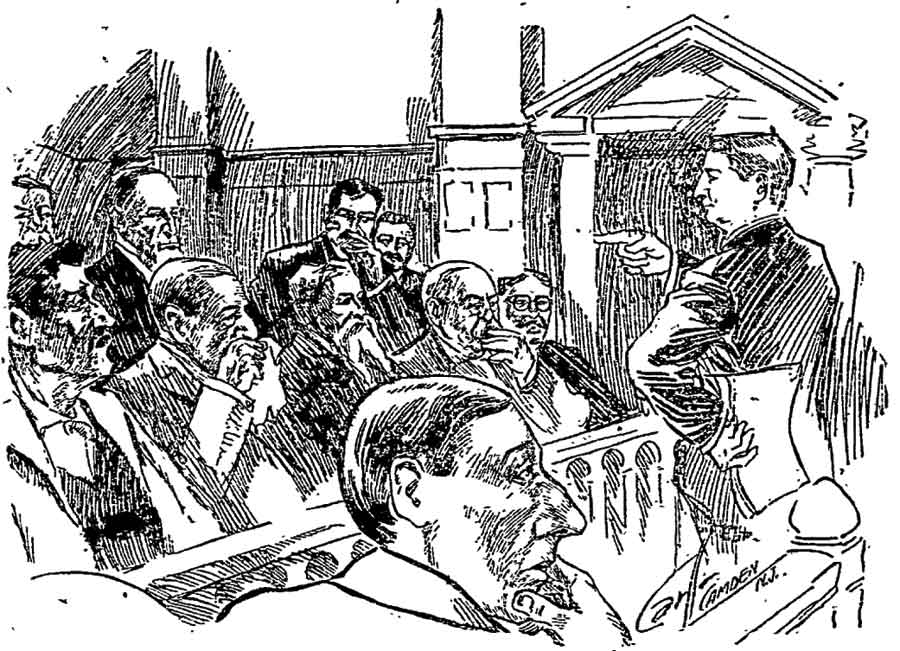

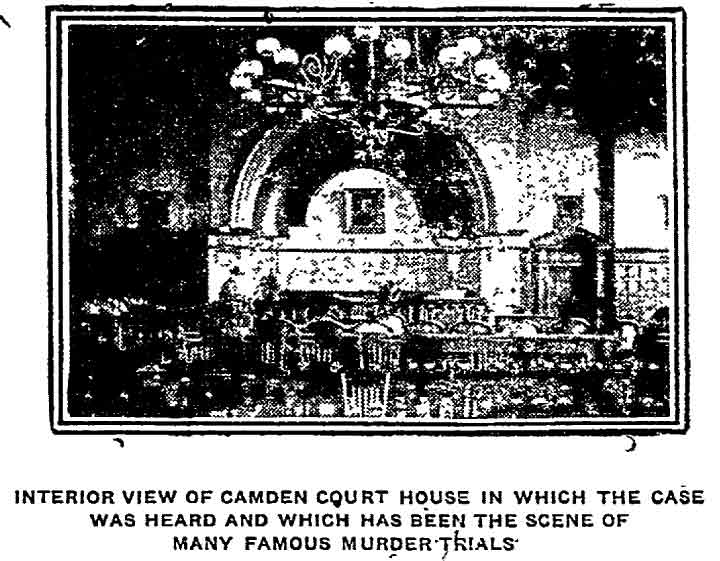
Camden Trial Came to a Sudden End With the Jury Returning a Conviction of Murder in the First Degree, After Deliberating Less Than an Hour
Attorney Robinson Making His Address to the Jury. Paul Woodward in Foreground.
Interior View of Camden Court House in Which the Case Was Heard and Which Has Been the Scene of Many Famous Murder Trials.
Paul Woodward was last evening found guilty of murdering little John Coffin, whose body, with that of W. Price Jennings, was found in a field near Haddon Heights on October 4. Woodward’s trial began last Wednesday before Judge Garrison in Camden.
The jury retired at 3.45 o’clock, after a brief charge by Judge Garrison. At twenty minutes to 5 o’clock an agreement had been reached, but it was two minutes to 6 o’clock before Judge Garrison arrived, he having gone to his home at Merchantville.
In the meantime Woodward had been brought into the court room, and after the jury had filed in he was told to stand up. He arose without a tremor, looked at the ceiling, at the Judge and then turned to the twelve men who had his fate in their hands. His peculiar features lit up with a broad grin when the County Clerk said:
“Jury look upon the prisoner; prisoner look upon the jury.”
Guilty of Murder
Then when the jury was finally asked for its verdict and the foreman had solemnly announced “Guilty of murder in the first degree,” Woodward, apparently unmindful of the import of the words, turned to his counsel and laughed with a low chuckle. Each juror was polled and each man repeated “guilty of murder in the first degree.”
“The prisoner may retire,” said Judge Garrison, and with a sidelong glance at his counsel Woodward was led across the “bridge of sighs” to his cell in the county jail. He laughed loudly and slapped his custodian on the back in a playful mood, as if the whole proceedings had been a joke, but when he reached the jail he let go a tirade of profanity against the Prosecutor and those who appeared against him. He remarked that he did not care what became of him, all he cared for, he said, was his mother.
Motion for New Trial
Lawyer Rex immediately made a motion for a new trial, Judge Garrison stating he would hear argument on a date to be set. The jury was then discharged.
One of the features of the last day was the reappearance of Woodward’s mother, haggard, careworn and her eyes swollen with weeping. She was recalled to testify she had sworn falsely on Saturday when she denied even having been convicted of crime.
The climax in the defense’s case occurred in the morning, when Woodward, the defendant, was placed on the stand to testify. When he took his seat his eyes roamed about the room. He looked everywhere except in the direction of the jury. He admitted he was with the murdered boys, but denied absolutely having killed them. The alibi the defense tried to build about him during the period of the boys’ disappearance, was practically destroyed by contradictions made by Woodward concerning his movements. All the statements he made to Prosecutor Lloyd immediately following his arrest, he said, were false. He said he told the different stories because he was “scared.” The defense also tried to prove both boys were alive on Friday, October 3.
The defense called Dr. J. A. Leuf as an expert. He described the effects of strychnine on the human system. He said there were several other poisons that might have similar effects.
No Rebuttal Testimony
To the surprise of the assemblage no rebuttal testimony was given, Prosecutor Lloyd at once beginning his argument. He spoke for over an hour and at times was eloquent. He said the State asked for nothing but a first degree verdict, as the facts developed could have no other result consistent with the oath of the jury. It was a case of premeditation because there was first, an attempt at robbery, and second, because there was an attempt to do great bodily harm. The State, he said, had proved the crime against Woodward and followed him almost to the death bed of the boys.
Lawyer Robinson opened for the defense. He spoke for over an hour. “Paul is not guilty and if you follow the evidence you must acquit him,” concluded the defense.
Judge Garrison’s charge lasted just four minutes. He explained the law covering the case. He said anyone administering poison for robbery was guilty of murder in the first degree. If, however, it was not proven to the jury beyond a reasonable doubt that the defendant administered the poison, then he should be acquitted.
The jury then retired at 3.45.
Another postal card was received yesterday, asking for Woodward’s brain, but these seekers after the convicted man’s gray matter will be disappointed.