Introduction
DR. EDWARD AUGUSTUS YORK SCHELLENGER SR. was born in Camden in 1870 to Henry and Elizabeth Schellenger. When the Census was enumerated in 1870 the Schellenger family, which included an older son, William, were living in Camden at the home of Dr. Alexander Mecray. It appears that Henry Schellenger passed away prior to 1887. By this time Elizabeth Schellenger had remarried. Her new husband was Joseph J. Read, a prosperous real estate broker. The family home was at 429 Cooper Street in Camden as early as 1887.
After receiving his education at the Lauderbach Academy in Philadelphia, Edward Schellenger graduated from the University of Pennsylvania School of Medicine in 1892. Dr. Schellenger interned at Cooper Hospital and went on to practice general surgery.
During his career Dr. Schellenger served as Attending Surgeon at Cooper Hospital, Consulting Surgeon at Camden’s Municipal Hospital and at Camden County General Hospital at Lakeland in Gloucester Township, and as physician at the Camden County Tuberculosis Hospital at Ancora. He was also the official surgeon for the Camden Fire Department, and was on scene at several major fires.
Dr. Schellenger’s medical memberships included the Camden County Medical Society, of which he served as president in 1914, the Camden City Medical Society, where he served as secretary, the American Medical Association, the Cooper Medical Club, and the Camden City Dispensary.
Around 1900 Dr. Schellenger married Lillian Patterson, the daughter of journalist and newspaper publisher Francis Ford Patterson. The Schellengers made their home at 429 Cooper Street, Camden NJ. When the census was taken in 1900, his mother, Mrs. Elizabeth Read, brother-in-law Wolcott Patterson, the news editor of one of Camden’s daily newspapers, and father-in-law all lived with them at the Cooper Street address. A daughter, Elizabeth was born around 1901, and a son, Edward Jr., came in 1903.
Dr. Schellenger died when a very early version of an x-ray machine malfunctioned and burned him, leading to an infection, which proved fatal. He was survived by his wife and children, Edward A.Y. Schellenger Jr. and Elizabeth.
Shortly after his death in 1917, Lillian Schellenger built a home in Merchantville NJ adjacent to that of his brother, Francis Ford Patterson Jr. She retained the property in Camden. Sadly, daughter Elizabeth Schellenger died of polio at the age of 18. Edward A.Y. Schellenger Jr. became a medical doctor and like his father, worked at Cooper Hospital. The younger Dr. Schellenger used the building at 429 Cooper Street for his medical practice office for 35 years. When he retired, he donated the building to Rutger’s University.
Camden County Medical Society 1846–1956
SCHELLENGER, E. A. Y. SR., 429 Cooper St., Camden. b. Camden 1870. d. 1917. Ed.—Lauderbach Acad., Phila.; Univ. of Pa. Sch. of Med. 1892. Intern.—The Cooper Hosp. Prac.—General Surgery. Hosp. Appt.—Att. Surg., The Cooper Hosp.; Cons. Surg., Municipal Hosp.; Cam. Co. Gen. Hosp.; Phys., Cam. Co. Tb. Hosp., Ancora (P. Pres.). Mem.—Cam. Co. Med. Soc. (P. Pres.); Cam. City Med. Soc. (P. Sec’y); A.M.A.; Cooper Med Club; Cam. City Disp. Wife—Lillian Patterson. Children—Ed A. Y., Jr., M.D., Elizabeth.
Hill Hired to Murder Dodson
Philadelphia Inquirer —

HILL HIRED TO MURDER DODSON
A Youthful Slayer’s Story of a Cold-Blooded Crime
Plied With Liquor and Urged On by Reed and Derrickson.
Remarkable Defense in a Camden Murder Trial—The Prisoner Unconcerned—His Counsel Endeavoring to Secure a Second Degree Verdict.
Abbatto Hanged in Camden Jail
Philadelphia Inquirer —
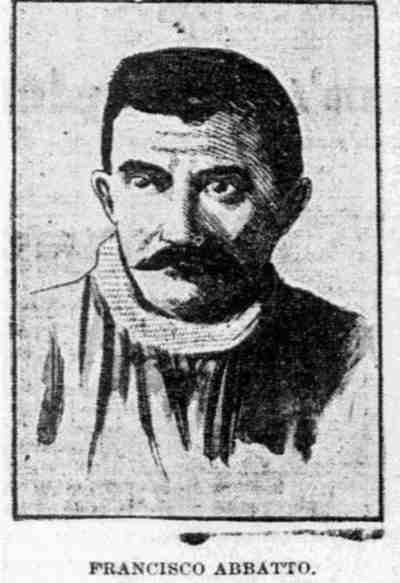
FRANCISCO ABBATTO.
ABBATTO HANGED IN CAMDEN JAIL
Quick Work by Sheriff Sell in Executing the Murderer of Genaro De Feo
Condemned Man Died Without a Struggle, and Was Buried in Potters’ Field
John Wesley Sell, Sheriff of Camden county, had his first hanging yesterday, and he made a record for celerity in launching Francisco Abbatto into eternity. The earliest moment that the hanging could take place, under the order of the court, was 10 o’clock. Within 6 minutes after the hour struck Abbatto was standing on the gallows. A minute later the trap was sprung, and five minutes later the man was dead.
Abbatto slept soundly during his last night on earth. He was up betimes yesterday morning, and dressed himself in the black suit of clothes which he knew would be his death garments. He declined to eat any breakfast, but drank a cup of coffee. At 8 o’clock the priests came to prepare the condemned man for the end. They were Father Pozzi, of East Vineland, and Father Caruso, of the Church of Our Lady of Good Counsel, of Philadelphia.
FINAL PREPARATIONS.
The persons authorized by law to witness the execution, about forty in number, gathered in the Sheriff’s office by half past
9 o’clock. County Clerk Barber administered the oath to the twelve citizens appointed by Judge Garrison to see that the sentence of death was carried out. They were County Physician W. S. Jones, Dr. Alexander McAlister, Dr. S. Ramsdell, Dr. E. A. Y. Schellinger, Dr. A. H. Lippincott, Dr. Joseph Nicholson, Dr. Paul N. Mecray, Upton S. Jeffreys, Harry B. Paul, Charles R. Bacon, William H. Cole and County Detective John S. Smith.
The death jury were taken through the jail to the loft at the Broadway and Federal streets corner of the building, where the gallows awaited its victim.
A few minutes before 10 o’clock the Sheriff led his deputies and the newspaper men across the “Bridge of Sighs” to the jail, and they joined the group in the death chamber. The clock struck 10, and all was ready to execute the mandate of the law. Five minutes later a door at the foot of the gallows, leading into the jail opened, and the condemned man was seen walking to his doom.
QUICK EXECUTION.
The two priests were in the lead. They were silent, for they had finished their ministrations in the jail. Abbatto was supported on either side by Constable Voight, of the death watch, and County Detective Smith. He was pale, but he walked with a firm step. He paused an instant at the foot of the gallows, cast a furtive glance at the dangling rope, and then mounted the thirteen steps to the platform. The officers stepped back when they had placed the condemned man at the centre of the trap. An instant Abbatto stood gazing at a ray of sunlight on the floor, and then the black cap shut the light from his eyes. Quickly but carefully Sheriff Sell adjusted the noose, and then, at 10:07, as the murderer swayed like a reed in the wind the silence was broken by the crash of the falling trap doors and the body fell a distance of six feet.
Abbatto’s hands were manacled behind his back, but his legs were not pinioned. He did not struggle and only a few tremors shook his body. In five minutes the doctors found that the heart had ceased to beat, but the body was allowed to hang for twenty-eight minutes. Then it was taken in charge by Morgue Keeper O’Brien, and after the doctors had gotten through with it, it was buried in potter’s field. Death was due to strangulation, and the face of the dead man was not distorted.
ABBATTO’S CRIME.
Francisco Abbatto was hanged for the murder of Genaro DeFeo. The crime was committed on the night of April 22, 1890, in the woods near Blue Anchor, Camden county. After stabbing DeFeo to death, Abbatto hacked his victim’s head off. Both body and head were found in the woods by searchers eight days later. Abbatto boarded with DeFeo, and was enamoured of his wife. He induced Mrs. DeFeo to go to New York with him to search for her husband. When they returned Abbatto was arrested. At his trial he claimed that he had killed DeFeo during a quarrel. The Court of Errors and Appeals sustained the conviction and Governor Voorhees refused to grant a reprieve.
Clerk Patterson on Second Term
Philadelphia Inquirer —
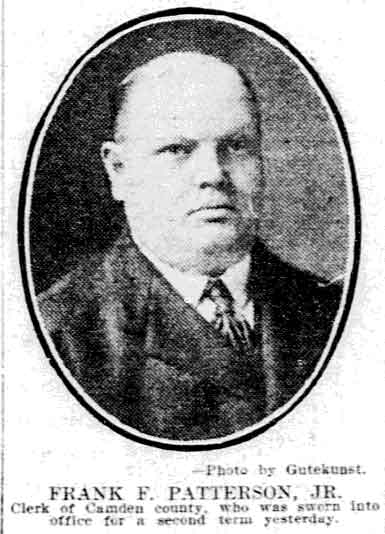
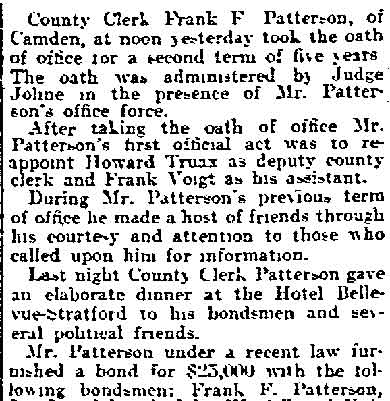
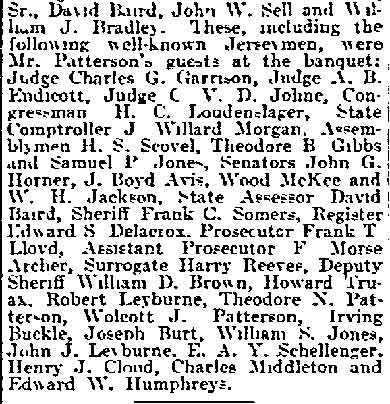
Named: Philadelphia Inquirer, February 25, 1906, Frank F. Patterson Jr., Edward Van Dyke Joline, Howard Truax, Frank Voight, David Baird Sr., J. Wesley Sell, William J. Bradley, Charles G. Garrison, A.B. Endicott, Harry C. Loudenslager, J. Willard Morgan, Henry S. Scovel, Theodore Gibbs, Samuel P. Jones, John G. Horner, J. Boyd Avis, Wood McKee, W.H. Jackson, Frank Somers, Frank T. Lloyd, Edward S. Delacroix, F. Morse Archer, Harry Reeves, William D. Brown, Robert Leyburne, Theodore N. Patterson, Wolcott J. Patterson, Irving Buckle, Joseph Burt, Dr. William S. Jones, Dr. E.A.Y. Schellenger, Henry J. Cloud, Charles Middleton, and Edward W. Humphreys.
Boy's Brutal Murderer Collapses at Hearing
Camden Post-Telegram —
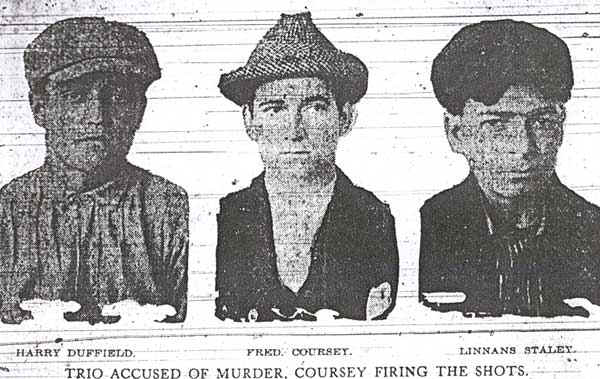
TRIO ACCUSED OF MURDER. COURSEY FIRING THE SHOTS.
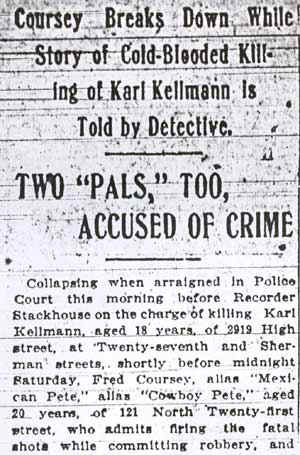
Coursey Breaks Down While Story of Cold-Blooded Killing of Karl Kellmann Is Told by Detective.
TWO “PALS,” TOO, ACCUSED OF CRIME
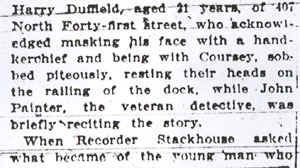
Collapsing when arraigned in Police Court this morning before Recorder Stackhouse on the charge of killing Karl Kellmann, aged 18 years, of 2919 High street, at Twenty-seventh and Sherman streets, shortly before midnight Saturday, Fred Coursey, alias “Mexican Pete,” alias “Cowboy Pete,” aged 20 years, of 121 North Twenty-first street, who admits firing the fatal shots while committing robbery, and Harry Duffield, aged 21 years, of 407 North Forty-first street, who acknowledged masking his face with a handkerchief and being with Coursey, sobbed piteously, resting their heads on the railing of the dock, while John Painter, the veteran detective, was briefly reciting the story.
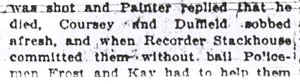
When Recorder Stackhouse asked what became of the young man who was shot and Painter replied that he died, Coursey and Duffield sobbed afresh, and when Recorder Stackhouse committed them without bail Policemen Frost and Kay had to help them.
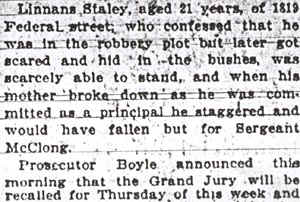
Linnans Staley, aged 21 years, of 1819 Federal street, who confessed that he was in the robbery plot but later got scared and hid in the bushes, was scarcely able to stand, and when his mother broke down as he was committed as a principal he staggered and would have fallen but for Sergeant McClong.
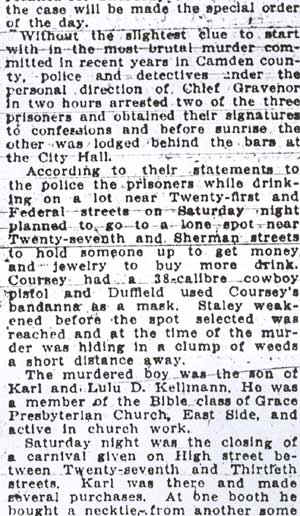
Prosecutor Boyle announced this morning that the Grand Jury will be recalled for Thursday of this week and the case will be made the special order of the day.
Without the slightest clue to start with in the most brutal murder committed in recent years in Camden county, police and detectives under the personal direction of Chief Gravenor in two hours arrested two of the three prisoners and obtained their signatures to confessions and before sunrise the other was lodged behind the bars at the City Hall.
According to their statements to the police the prisoners while drinking on a lot near Twenty-first and Federal streets on Saturday night planned to go to a lone spot near Twenty-seventh and Sherman streets to hold someone up to get money and jewelry to buy more drink. Coursey had a 38-calibre cowboy pistol and Duffield used Coursey’s bandanna as a mask. Staley weakened before the spot selected was reached and at the time of the murder was hiding in a clump of weeds a short distance away.
The murdered boy was the son of Karl and Lulu D. Kellmann. He was a member of the Bible class of Grace Presbyterian Church, East Side, and active in church work.
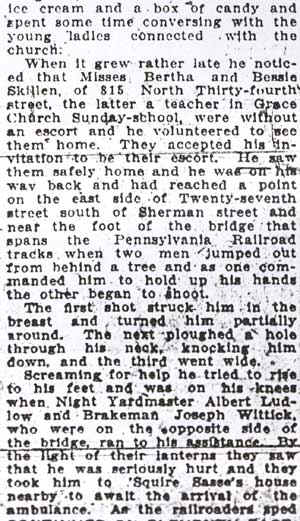
Saturday night was the closing of a carnival given on High street between Twenty-seventh and Thirtieth streets. Karl was there and made several purchases. At one booth he bought a necktie, from another some ice cream and a box of candy and spent some time conversing with the young ladies connected with the church.
When it grew rather late he noticed that Misses Bertha and Bessie Skillen, of 815 North Thirty-fourth street, the latter a teacher in Grace Church Sunday-school, were without an escort and he volunteered to see them home. They accepted his invitation to be their escort. He saw them safely home and he was on his way back and had reached a point on the east side of Twenty-seventh street south of Sherman street and near the foot of the bridge that spans the Pennsylvania Railroad tracks when two men jumped out from behind a tree and as one commanded him to hold up his hands the other began to shoot.
The first shot struck him in the breast and turned him partially around. The next ploughed a hole through his neck, knocking him down, and the third went wide.
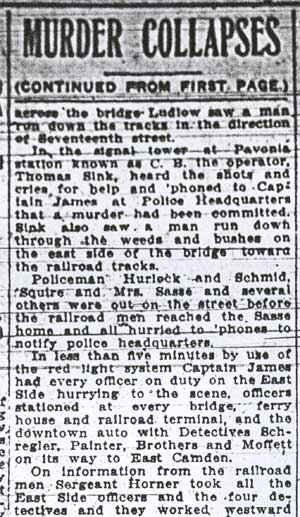
Screaming for help he tried to rise to his feet and was on his knees when Night Yardmaster Albert Ludlow and Brakeman Joseph Wittick, who were on the opposite side of the bridge, ran to his assistance. By the light of their lanterns they saw that he was seriously hurt and they took him to ‘Squire Sasse’s house nearby to await the arrival of the ambulance. As the railroaders sped across the bridge Ludlow saw a man run down the tracks in the direction of Seventeenth street.
In the signal tower at Pavonia station known as C. B. the operator, Thomas Sink, heard the shots and cries for help and ‘phoned to Captain James at Police Headquarters that a murder had been committed. Sink also saw a man run down through the weeds and bushes on the east side of the bridge toward the railroad tracks.
Policeman Hurlock and Schmid, ‘Squire and Mrs. Sasse and several others were out on the street before the railroad men reached the Sasse home and all hurried to ‘phones to notify police headquarters.
In less than five minutes by use of the red light system Captain James had every officer on duty on the East Side hurrying to the scene, officers stationed at every bridge, ferry house and railroad terminal, and the downtown auto with Detectives Schregler, Painter, Brothers and Moffett on its way to East Camden.
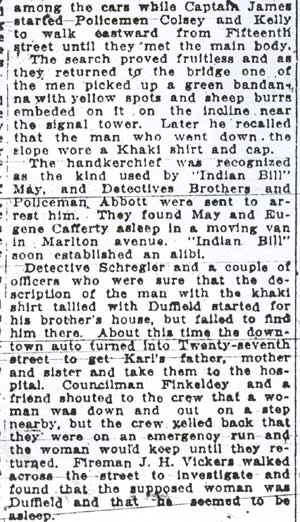
On information from the railroad men Sergeant Horner took all the East Side officers and the four detectives and they worked westward among the cars while Captain James started Policemen Colsey and Kelly to walk eastward from Fifteenth street until they met the main body.
The search proved fruitless and as they returned to the bridge one of the men picked up a green bandanna with yellow spots and sheep burrs embedded on it on the incline near the signal tower. Later he recalled that the man who went down the slope wore a Khaki shirt and cap.
The handkerchief was recognized as the kind used by “Indian Bill” May, and Detectives Brothers and Policeman Abbott were sent to arrest him. They found May and Eugene Cafferty asleep in a moving van in Marlton avenue. “Indian Bill” soon established an alibi.
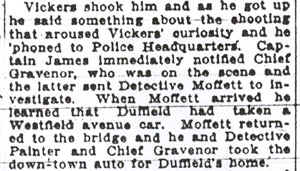
Detective Schregler and a couple of officers who were sure that the description of the man with the khaki shirt tallied with Duffield started for his brother’s house, but failed to find him there. About this time the downtown auto turned into Twenty-seventh street to get Karl’s father, mother and sister and take them to the hospital. Councilman Finkeldey and a friend shouted to the crew that a woman was down and out on a step nearby, but the crew yelled back that they were on an emergency run and the woman would keep until they returned. Fireman J. H. Vickers walked across the street to investigate and found that the supposed woman was Duffield and that he seemed to be asleep.
Vickers shook him and as he got up he said something about the shooting that aroused Vickers’ curiosity and he ‘phoned to Police Headquarters. Captain James immediately notified Chief Gravenor, who was on the scene and the latter sent Detective Moffett to investigate. When Moffett arrived he learned that Duffield had taken a Westfield avenue car. Moffett returned to the bridge and he and Detective Painter and Chief Gravenor took the down-town auto for Duffield’s home.
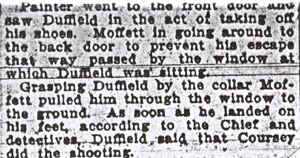
Painter went to the front door and saw Duffield in the act of taking off his shoes. Moffett in going around to the back door to prevent his escape that way passed by the window at which Duffield was sitting.
Grasping Duffield by the collar Moffett pulled him through the window to the ground. As soon as he landed on his feet, according to the Chief and detectives, Duffield said that Coursey did the shooting.
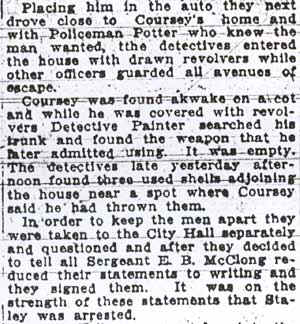
Placing him in the auto they next drove close to Coursey’s home and with Policeman Potter who knew the man wanted, the detectives entered the house with drawn revolvers while other officers guarded all avenues of escape.
Coursey was found awake on a cot and while he was covered with revolvers Detective Painter searched his trunk and found the weapon that he later admitted using. It was empty. The detectives late yesterday afternoon found three used shells adjoining the house near a spot where Coursey said he had thrown them.
In order to keep the men apart they were taken to the City Hall separately and questioned and after they decided to tell all Sergeant E. B. McClong reduced their statements to writing and they signed them. It was on the strength of these statements that Staley was arrested.
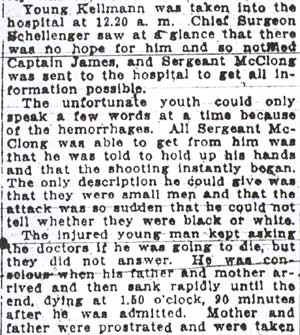
Young Kellmann was taken into the hospital at 12.20 a. m. Chief Surgeon Schellenger saw at a glance that there was no hope for him and so notified Captain James, and Sergeant McClong was sent to the hospital to get all information possible.
The unfortunate youth could only speak a few words at a time because of the hemorrhages. All Sergeant McClong was able to get from him was that he was told to hold up his hands and that the shooting instantly began. The only description he could give was that they were small men and that the attack was so sudden that he could not tell whether they were black or white.
The injured young man kept asking the doctors if he was going to die, but they did not answer. He was conscious when his father and mother arrived and then sank rapidly until the end, dying at 1.50 o’clock, 90 minutes after he was admitted. Mother and father were prostrated and were taken home by the up-town auto.
County Physician Jones conducted the autopsy yesterday morning. He said that either wound would have caused death. The bullet in the breast pierced the right lung at the top and lodged in the cavity. It is now in the doctor’s possession. The other bullet went clear through the neck.
Coursey and Duffield have been working in the Pavonia car yard. The former was born in El Paso, Texas, but has lived East nearly all his life. He is an expert shot and was a member of the vaudeville team of Coursey & Cook, according to their letter heads presenting a fifteen-minute thriller.
Duffield was only recently paroled for robbing Gallagher’s saloon, Nineteenth and Federal streets of a lot of drinkables. Staley has been arrested several times on petty charges but was never convicted of crime. When Duffield’s coat was examined at the City Hall, it was found to contain sheep burrs.
To a reporter Coursey said that whenever he was drinking he had to get his gun and shoot something or somebody. He insisted that all were in on the job and that they let the man who preceded Kellman go over the bridge without molestation because he didn’t look as if he had any too much money.
Yesterday morning Assistant Prosecutor Wolverton and Stenographer Cleary called at the City Hall. The prisoners were examined by Mr. Wolverton and their statements taken by Mr. Cleary, but there was little or nothing new elicited.
Forger Thompson Still at Liberty
Camden Post-Telegram —
No Trace Yet Found of the Ashbridge’s Pass in Sensational and Tragic Escape From the County Prison on Monday Night
FOOD SHUNNED BY YOUNG MURDERER
Evidently in hiding, George E. Thompson, who escaped from prison with Wilson Ashbridge on Monday night after Murdering one jailor and wounding another, is still at liberty. No trace of him has been found after he left Ashbridge and Mrs. Ashbridge at Thirty-second and Chestnut Streets, Philadelphia, on Monday night, and the police and county officials have assumed a policy of watching, waiting, in the hope that the hundreds of circulars sent to the police all over the country will be productive of the capture of the fugitive or at least some real clue as to his whereabouts.
Ashbridge has not eaten anything since his return to the jail. This, however, is not regarded by the prison officials as a hunger strike. A man who had gone through what Ashbridge experienced in the last three days is naturally not hungry and the fact that he had not touched the food served to him is not causing any worry. Just as soon as his nerves settle a bit and he becomes resigned to his fate Ashbridge will likely eat as heartily as before.
The murderer is much more composed today than he was yesterday. Practically all of yesterday he spent pacing the narrow confines of his cell in Murderers’ Row and for the greater part of the time he was crying. Toward evening he became less restless. A little after 9:00 o’clock he threw himself on his bunk and was soon in a sound sleep, which lasted until 6:00 o’clock this morning.
The food handed into the double murderer through the opening in the door of his cell has been taken out untouched, and not a mouthful of the nourishment has been taken by the prisoner. He drank freely of water and craves for tobacco, which thus far has been denied him. The food served him is the same given the other prisoners. In the morning it is half a loaf of bread and a cup of coffee. For dinner they get pea or bean soup with bread, and for supper some sort of stew or soup with bread and sometimes boiled potatoes with the skins on. Fish is served on Friday. None of this has looked good to Ashbridge, who probably would not touch a more tempting menu. At any rate he has not asked for anything for the very simple reason that he is not hungry.
Seemingly more composed and realizing the gravity of her position, Mrs. Ashbridge still languishes in the detention Department of Police Headquarters, where she is under the care of the kindly matron, Mrs. Kirkpatrick.
The woman frequently expresses her regret for her rashness. She confides in Mrs. Kirkpatrick, who has given her every care.
“I don’t know why I did it,” said Mrs. Ashbridge to the matron several times.
“Oh, I wish someone had shot me, because I deserved it,” she tearfully cried when the matron tried to console her. To Jailor Fred Lechleidner, who knew her when she was a little girl, Mrs. Ashbridge also expressed regret for her act.
Since her hearing yesterday the woman has talked very little of her husband. When mention is made of his name she seems indifferent, and the police suspect that her affections for her murderer-husband are cooling.
When told that Mrs. Gick had agreed to take her two children to Wildwood for a vacation, Mrs. Ashbridge smiled and clapped her hands in joy.
“Thank God for that; I know they’ll be alright now” she said to the matron.
For supper last night Mrs. Ashbridge ate a chop, a large quantity of tomatoes and potatoes, a cup of tea and some sliced peaches. She said she felt much better after eating. For her breakfast she ate two slices of toast and drank a cup of coffee. Mrs. Kilpatrick said she slept soundly all through the night and arose about six o’clock this morning.
The circular being sent out to the police all over the country contain front and side likenesses of Thompson and read as follows:
$500 REWARD
WANTED FOR MURDEROn July 17th, 1916 at 7 o’clock p.m., George E. Thompson, alias Francis Murphy, shot and killed a jailor at Camden County Jail, Camden, New Jersey, shot and wounded another jailor, and escaped.
George E. Thompson, alias Francis Murphy, is white, 41 years of age, 5 feet 7 inches in height, weighs 175 pounds, has dark brown hair mixed with gray, very bushy, light complexion, gray eyes, smooth face, first and middle finger of his left hand are missing, wears nose glasses. He was confined in the County Jail on charges of forgery and obtaining money under false pretences. He is well-educated and represents himself as an attorney-at-law.
Bertillon measurements: 70; 70; 91-0; 19-1; 15-4; 0-2; 12-4; 24-4; First and L.M. Fing missing; 8-4; 43-8.
Five hundred dollars reward will be paid for the arrest or information leading to the arrest of this man.
The circular, which is signed by Prosecutor Kraft and Chief of Police Gravenor, discloses the fact that the first and middle fingers of the fugitive’s hand are missing. In the prior descriptions mention was made of but one finger gone. The fact that two of his fingers are gone should serve to make his capture all the more certain should he venture out in public.
City and county detectives spent several hours in Philadelphia last night scouring the Tenderloin and other places where crooks are likely to gather, but no trace of the fugitive could be found.
Asked today if he would represent Ashbridge for the murder of Hibbs, Charles A. Wolverton, who is counsel for Ashbridge on the charge of shooting the Dunbar woman, said: “As an officer of the court I am subject to whatever order Judge Garrison may make. In representing Ashbridge in the former matter I am operating under an order of the Court which was made by Judge Garrison on the application of Ashbridge for counsel to represent him, as he was without means to employ counsel. For a great many years it has been the custom of the Court of this country to grant such requests and this was accordingly done when Ashbridge made application; in fact, it is a right that the accused person has under the laws of the State. Whether I will be appointed to act for him in this last case I do not know. The matter is entirely in the hands of Judge Garrison, who has the right to appoint any member of the Bar he desires.”
Provisions for the temporary care of the Ashbridge babies—Marian and Thomas—was made last night. Mr. and Mrs. Gick, of 2744 Pierce Avenue, East Camden, notifying Secretary Walsh, of the S.P.C.C. that they would take the kiddies with them to Wildwood this afternoon.
Jailor Ellis is rapidly recovering at Cooper Hospital, Police Surgeon Schellenger stating today that his condition is fine.
Dr. Schellenger Reported Recovered
Philadelphia Inquirer —

Dr. E. A. Y. Schellenger, one of the chiefs of the surgical staff at Cooper Hospital, who has been seriously ill, was yesterday reported to have recovered.
14 Camden Firemen Overcome by Smoke
Philadelphia Inquirer —
14 CAMDEN FIREMEN OVERCOME BY SMOKE
Twelve-Hour Fight Follows Discovery of Smoldering Fire in Wall Paper Plant
Fourteen firemen were overcome by smoke, one of them being removed to Cooper Hospital, and about $20,000 in damage was done at a fire at the plant of the Frank G. Hitchner Wall Paper Manufacturing Company, Fifth and Mickle streets, Camden, yesterday. It was not until late yesterday afternoon,
after twelve hours’ fighting, that the flames were subdued, although not at any time was there a burst of flame.
Captain Joseph Maxwell, of No. 1 Truck Company, was taken to the hospital. Fire Chief Peter B. Carter was hurt about the ankle in a slight fall. The other firemen were able to resume their work after being treated by Fire Surgeon Scheilinger.
It was some time before three o’clock in the morning that John Wilfson, a watchman, saw the smoke issuing from the kiln. In this building thousands of feet of lumber to be converted into moulding is dried. It is placed on racks six inches apart, and it was because of this that the firemen could not reach the fire.
Pouring from the plant, the water ran into the cellars of nearby dwellings. Considerable damage was done at the home of Mrs. Sallie Gordon, at 215 South Fifth street, and John Orr, 441 Judson street. Others who suffered were Mrs. Mary Brooks, 217 South Fifth street; John Humphries, 445 Steven street, and L. J. Donavan, 434 Mickle street.