Introduction
Most every person who has gone through elementary school in the United States of America has sharpened a pencil, and for many, many years the ubiquitous BOSTON pencil sharpener was made by the C. Howard Hunt Pen Company of Camden, NJ. Prior to the advent of the ball point pen, the Hunt round point pen, and more famously, the Speedball® pen were known and used worldwide. The Hunt Company also published books to aid people interested in lettering and cartooning, and sponsored scholarships in the arts and crafts.
Hunt Pen, with offices at 652 State Street and a plant at 701 State Street in North Camden, was a fixture in North Camden up until 1958, when factory operations were moved to Statesville, NC. The offices of Hunt Pen left Camden in 1963. During its time in Camden, notable events include the company’s arranging for the immigration of expert pen makers from England, and its sponsorship of sports teams in Camden’s amateur and industrial leagues. The 1936–37 championship softball team won 62 out of 71 games over two years.
1915 Advertisement
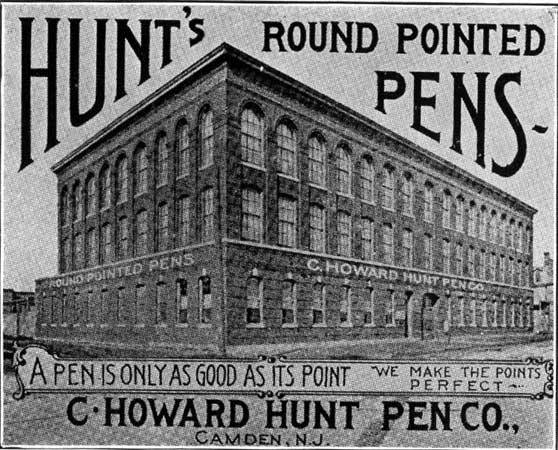
C. Howard Hunt Pen Company advertisement, 1915
Receipt dated July 24, 1902
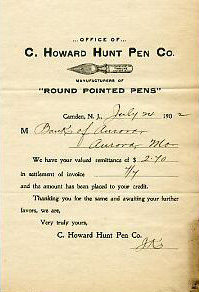
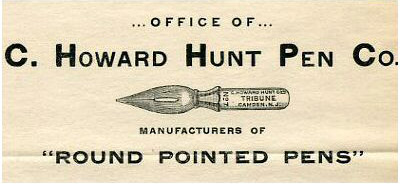
C. Howard Hunt Pen Co. receipt dated July 24, 1902
Hunt's Centennial Historical Tour
Hunt Corporation invites you on a fascinating trip through time. Your ten minute journey will take you back to 1899 and The Foundations — followed by Hunt’s Response to Change, Acquisitions and the strategic planning for New Growth that will enable Hunt to answer the challenges of a new century with energy and imagination.
Foundations (1899–1927)
This section depicts important milestones during Hunt Corporation’s first 100 years. Hunt has always valued its employees, customers and community and as it prepares for its second century, looks for inspiration to the many innovative people who have contributed to its past successes.
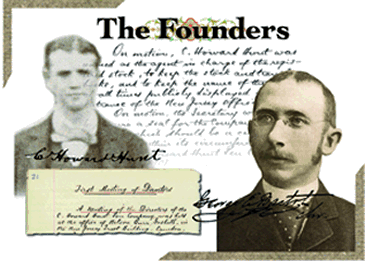
The Founders — In 1899 C. Howard Hunt formed his own company, which he incorporated in 1901. George E. Bartol, a Philadelphia grain and commodities exporter and founder of the Philadelphia Bourse, a merchants exchange and business center, was among the first 28 shareholders. In 1903, Mr. Bartol was elected president and a director of the Company and served until 1917.
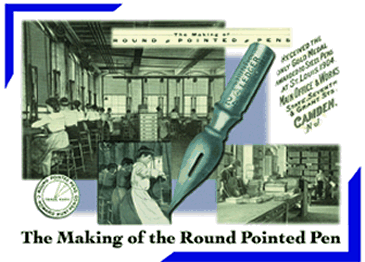
The Making of the Round Pointed Pen — The C. Howard Hunt Pen Company invented the smooth gliding round pointed pen, which required about 15 operations in the manufacturing. Expert cutters used cutting presses to produce almost 45,000 pens a day from rolled sheets of steel. Pictured from left, workers imprint, grind and ship 25 pens per minute.
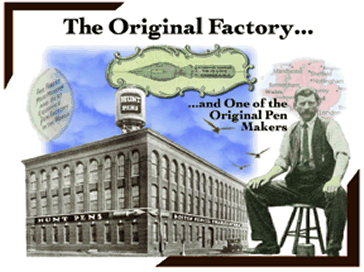
The Original Factory — The C. Howard Hunt Pen Company began in this building in Camden, NJ. The factory moved to Statesville, NC, in 1958. The office moved from Camden to Pennsauken, NJ, in 1963 and then to Philadelphia in 1965. Also pictured here is Benjamin Newman, one of the expert pen makers C. Howard Hunt brought to Camden from Birmingham, England, in 1899.

The Speedball® Pen — The Speedball Pen was developed and patented by sign letterer Ross F. George of Seattle. His square-tipped pen could make broad and thin lines. George took the patent to the C. Howard Hunt Pen Company in 1915. They manufactured the pens in six sizes and published the Speedball Text Book written by George, shown here in his Model T Ford.
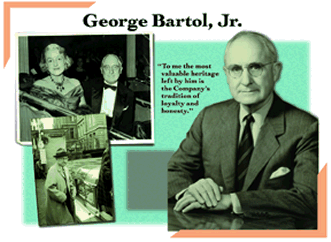
George Bartol, Jr. — In 1916, George E. Bartol resigned as President of the C. Howard Hunt Company. His son George Bartol, Jr., succeeded him and was elected Vice President and then Chairman of the Board in 1926. He led the Company for 50 years. George Bartol, Jr., retired in 1969 and died in 1972 at the age of 80.
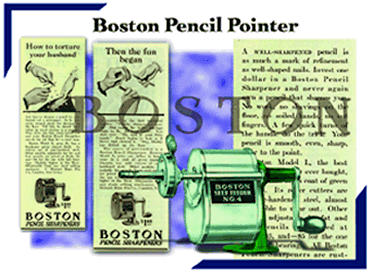
BOSTON® Pointer — In 1925 the C. Howard Hunt Pen Company purchased the Boston Specialty Company, manufacturer of Boston Pencil Pointers. In the 1926 report to stockholders, this was called one of the most important steps in the history of the Company. The series of advertisements pictured here appeared in issues of the Saturday Evening Post during 1928.
Response to Change (1928–1956)
Because of the ingenuity of its employees who responded to market needs and discovered creative uses for available materials, Hunt remained viable through wars and the great Depression. The values rooted in this period of Company history remain important components of today’s Hunt Corporation.
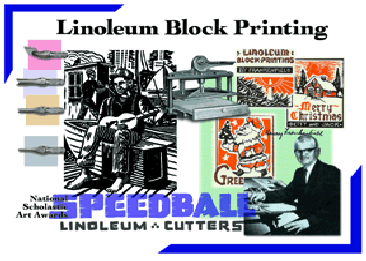
Linoleum Block Printing — In 1936, Hunt became America’s first large manufacturer of inexpensive accessories for linoleum block printing, a popular school craft. Henry Frankenfield, printmaker and art educator, developed this line. In 1937, Hunt began to sponsor the National Scholarship Award, for categories such as linoleum block prints, lettering and pen and ink drawings, and still sponsors talented young artists.

Difficult Times — Throughout the Depression, Hunt reduced operations, recovering with the development of the gold-plated stainless steel pen, which was boosted by the Company’s invention of a special patented tip. In 1942 regulations on stainless steel stopped production of pencil sharpeners and specialty metal items. The sale of silver alloy nibs kept the Company viable during World War II.

Spotlight On People — Hunt employees have worked hard for the Company and also have participated in many special events. The 1936–37 championship softball team won 62 out of 71 games over two years. In 1950 Bert Eadon became the first employee to commemorate 50 years of service, having joined the Company in 1900 to work on a rolling mill.

A Tradition Of Values — Hunt has always valued its people, providing liberal employee benefits, a safe workplace and community support. A particular source of pride is the annual award of scholarships to children of employees, a practice begun in 1956 with the establishment of the Hunt Foundation.
The Hunt Pen-Nant
First published on February 15, 1947, and issued monthly, The Hunt Pen-Nant featured articles about Company products and events, world conditions affecting the business and employee news. In 1973 the newspaper went quarterly and became The Pen-Nant. In 1977, to reflect increasing diversification, the newsletter became Hunt Happenings. Today periodic newsletters highlighting special Company initiatives are published.
Acquisitions (1957–1989)
Over the years, Hunt expanded its product line and markets through acquisitions such as Bienfang, Lit-Ning, Bevis and Data Products. Even though some of these acquisitions are no longer part of the company, they do represent an important chapter in the Hunt Story.
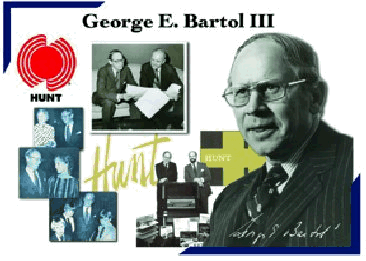
George E. Bartol, III — George Bartol, III, joined the C. Howard Hunt Pen Company in 1946. He apprenticed in the Company’s manufacturing department, and succeeded his father as President in 1956. In 1969 he also became Chairman of the Board. Bartol’s leadership transformed the small, family-owned C. Howard Hunt Pen Company into the publicly held Hunt Manufacturing Company.

Statesville — In 1957 Hunt moved its expanding manufacturing business to Statesville, NC, a progressive city with available labor, excellent living conditions and a reasonably priced site. Governor Luther Hodges welcomed Hunt to the state during a ribbon-cutting ceremony in 1958. Hunt now has two plants and a distribution center in Statesville.
A Memory from the Neighborhood
I was looking at the update on Hunt Pen, which mention’s sports teams. I still remember their ball team playing at Pyne Point. Hell, that’s almost 45–50 years ago! As a kid we had a neighbor who played first base for them. He ran a punch press for them, banging out parts for pencil sharpeners. This position’s were piece work. If you became too fast, the rate per piece was lowered. Unfortunately this gentleman got his hand caught in a punch press 1 day. They wanted to remove his hand but he had balls and said no way. Well he did keep the hand but only had about 10% use after that. Shortly afterwards the company moved their plant to Statesville NC.
Another neighbor was a chemist there I guess for the ink. A lot of people in that neighborhood worked there. I remember many times walking up State street and looking through the windows at the employees running the various machines. The windows were wide open in the summer and it was hot. You could feel the heat from inside the factory.
—John Ciafrani, September 2004
Letter dated July 17, 1908
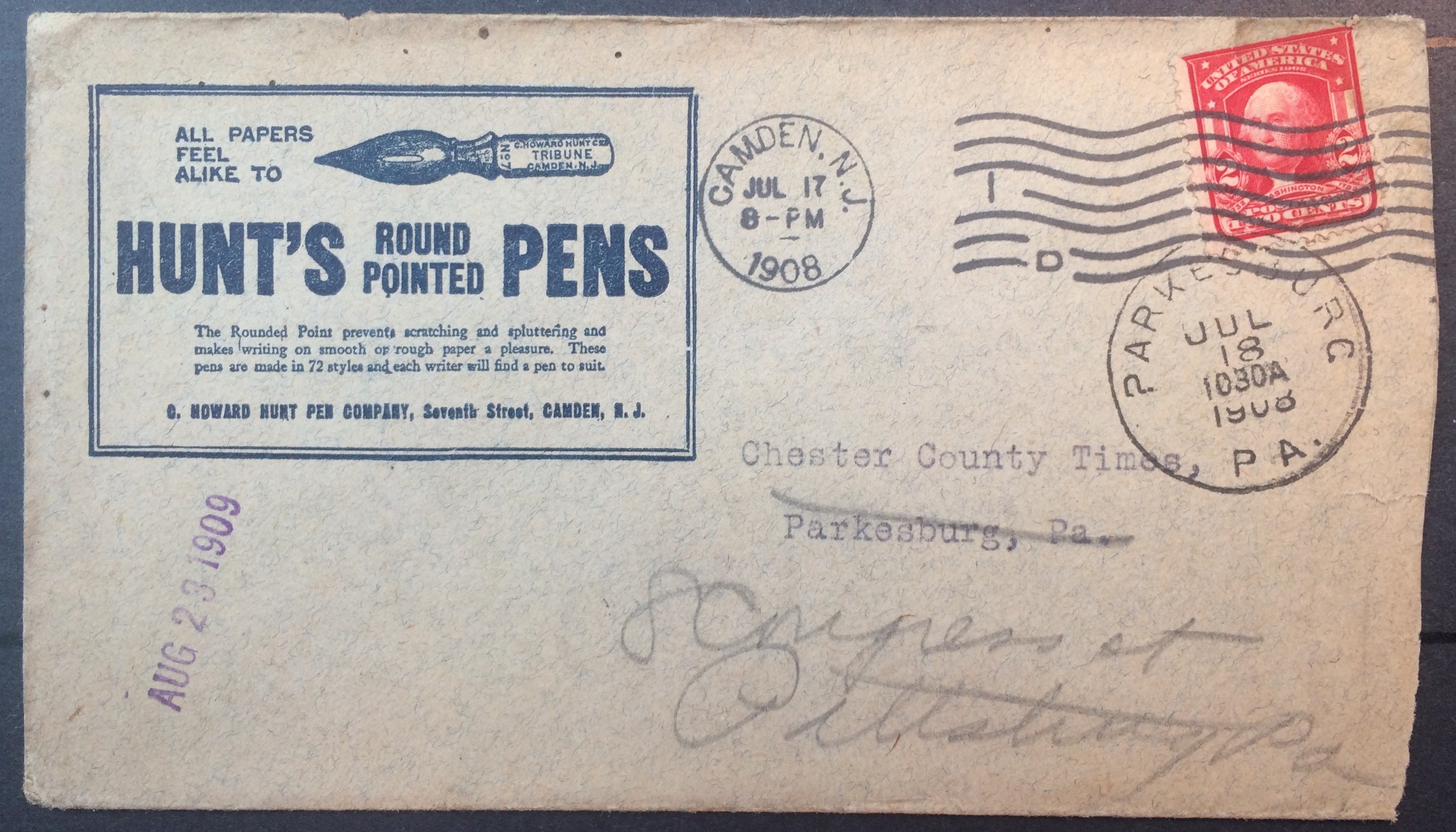
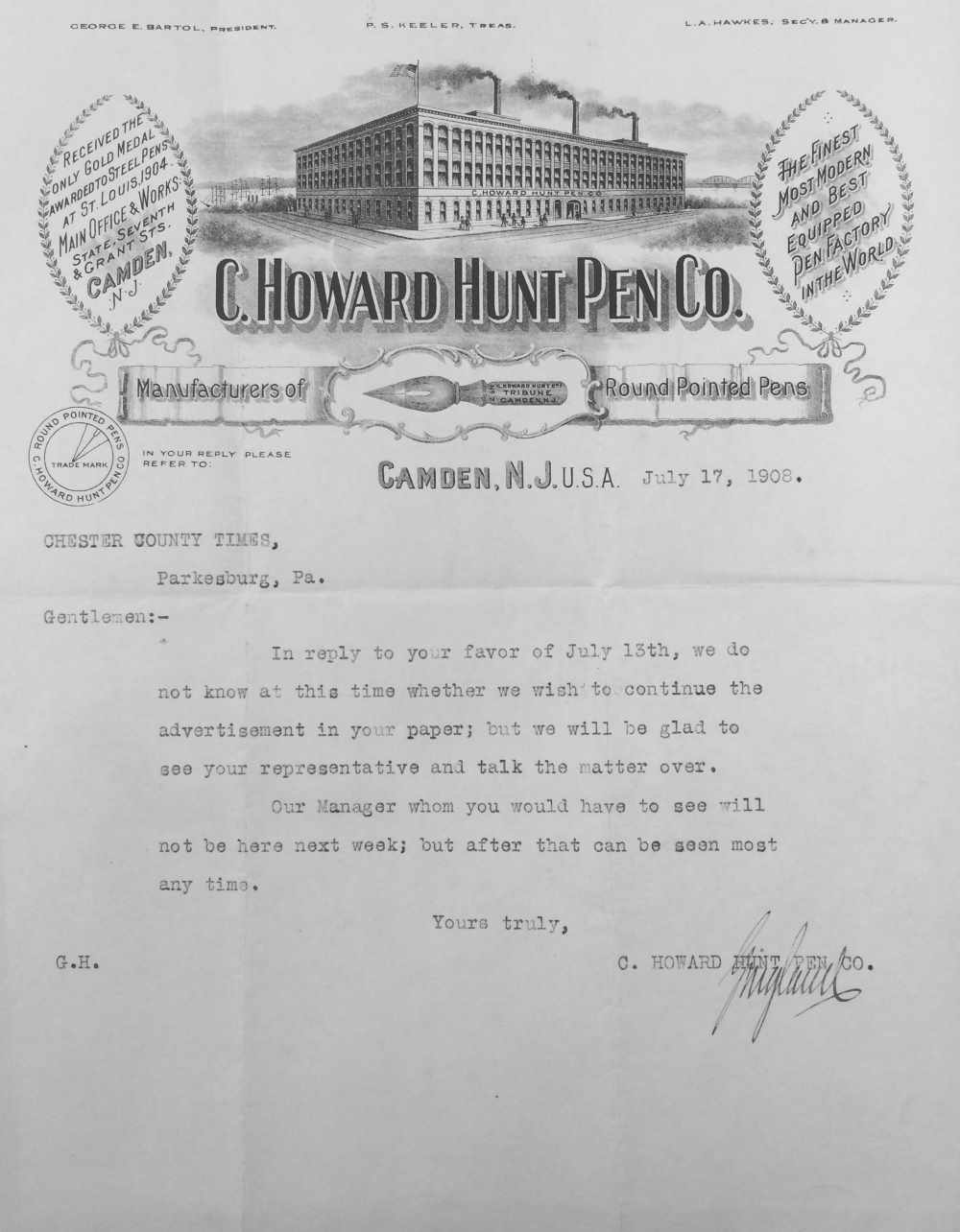
C. Howard Hunt Pen Company advertising envelope and business letter to the Chester County Times of Parkesburg, PA, dated July 17, 1908.
The envelope reads: “ALL PAPERS FEEL ALIKE TO HUNT’S ROUND POINTED PENS — The Rounded Point prevents scratching and splattering and makes writing on smooth or rough paper a pleasure. These pens are made in 72 styles and each writer will find a pen to suit. C. HOWARD HUNT PEN COMPANY, Seventh Street, CAMDEN, N. J.”
The letter, signed by George E. Bartol, President, with L. A. Hawkes as Secretary & Manager, reads: “In reply to your favor of July 13th, we do not know at this time whether we wish to continue the advertisement in your paper; but we will be glad to see your representative and talk the matter over. Our Manager whom you would have to see will not be here next week; but after that can be seen most any time.”
Circuit Court Judge Frank T. Lloyd Accepts Chairmanship of Unemployment Committee
Philadelphia Inquirer —
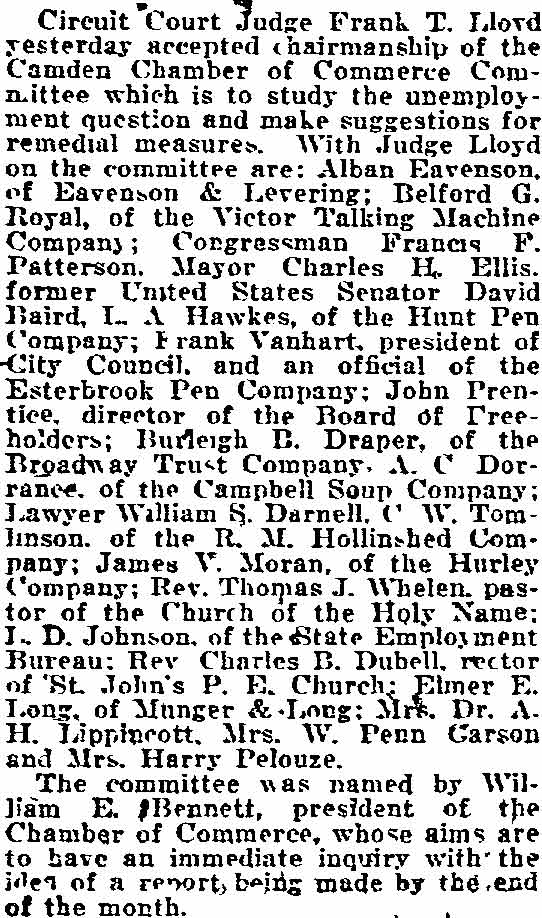
Circuit Court Judge Frank T. Lloyd yesterday accepted chairmanship of the Camden Chamber of Commerce Committee which is to study the unemployment question and make suggestions for remedial measures. With Judge Lloyd on the committee are: Alban Eavenson, of Eavenson & Levering; Belford G. Royal, of the Victor Talking Machine Company; Congressman Francis F. Patterson; Mayor Charles H. Ellis; former United States Senator David Baird; L. A. Hawkes, of the Hunt Pen Company; Frank Vanhart, president of City Council, and an official of the Esterbrook Pen Company; John Prentice, director of the Board of Freeholders; Burleigh B. Draper, of the Broadway Trust Company; A. C. Dorrance, of the Campbell Soup Company; Lawyer William S. Darnell; C. W. Tomlinson, of the R. M. Hollinshed Company; James V. Moran, of the Hurley Company; Rev. Thomas J. Whelen, pastor of the Church of the Holy Name; L. D. Johnson, of the State Employment Bureau; Rev. Charles B. Dubell, rector of St. John’s P. E. Church; Elmer E. Long, of Munger & Long; Mrs. Dr. A. H. Lippincott, Mrs. W. Penn Carson [sic] and Mrs. Harry Pelouze.
The committee was named by William E. Bennett, president of the Chamber of Commerce, whose aims are to have an immediate inquiry with the idea of a report, being made by the end of the month.
Enos B. Dellmuth Dies from Stroke
Camden Courier-Post —
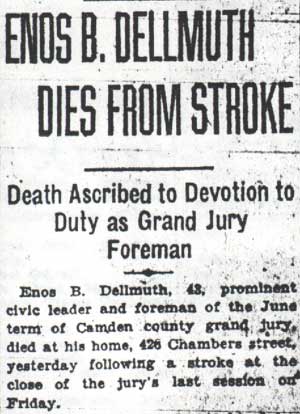
Death Ascribed to Devotion to Duty as Grand Jury Foreman
Enos B. Dellmuth, 43, prominent civic leader and foreman of the June term of Camden county grand jury, died at his home, 426 Chambers street, yesterday following a stroke at the close of the jury’s last session on Friday.
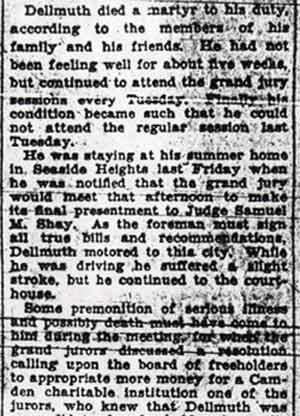
Dellmuth died a martyr to his duty, according to the members of his family and his friends. He had not been feeling well for about five weeks, but continued to attend the grand jury sessions every Tuesday. Finally his condition became such that he could not attend the regular session last Tuesday.
He was staying at his summer home in Seaside Heights last Friday when he was notified that the grand jury would meet that afternoon to make its final presentment to Judge Samuel M. Shay. As the foreman must sign all true bills and recommendations, Dellmuth motored to this city. While he was driving he suffered a slight stroke, but he continued to the courthouse.
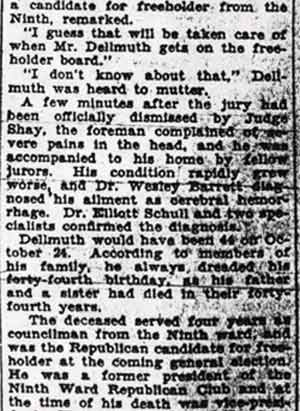
Some premonition of serious illness and possibly death must have come to him during the meeting, for while the grand jurors discussed a resolution calling upon the board of freeholders to appropriate more money for a Camden charitable institution one of the jurors, who knew that Dellmuth was a candidate for freeholder from the Ninth, remarked,
“I guess that will be taken care of when Mr. Dellmuth gets on the freeholder board.”
“I don’t know about that,” Dellmuth was heard to mutter.
A few minutes after the jury had been officially dismissed by Judge Shay, the foreman complained of severe pains in the head, and he was accompanied to his home by fellow jurors. His condition rapidly grew worse, and Dr. Wesley Barrett diagnosed his ailment as cerebral hemorrhage. Dr. Elliott Schull and two specialists confirmed the diagnosis.
Dellmuth would have been 44 on October 24. According to members of his family, he always dreaded his forty-fourth birthday, as his father and a sister had died in their forty-fourth years.
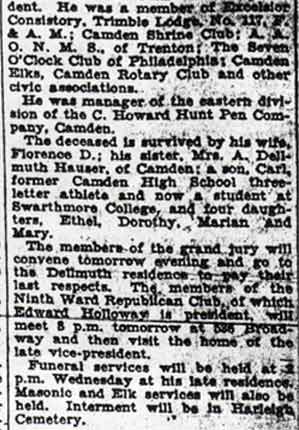
The deceased served four years as councilman from the Ninth ward, and was the Republican candidate for freeholder at the coming general election. He was a former president of the Ninth Ward Republican Club and at the time of his death was vice-president. He was a member of Excelsior Consistory, Trimble Lodge, No. 117, F. & A. M.; Camden Shrine Club; A. A. O. N. M. S., of Trenton; The Seven O’Clock Club of Philadelphia; Camden Elks, Camden Rotary Club and other civic associations.
He was manager of the eastern division of the C. Howard Hunt Pen Company, Camden.
The deceased is survived by his wife, Florence D.; his sister, Mrs. A. Dellmuth Hauser, of Camden; a son, Carl, former Camden High School three-letter athlete and now a student at Swarthmore College, and four daughters, Ethel, Dorothy, Marian and Mary.
The members of the grand jury will convene tomorrow evening and go to the Dellmuth residence to pay their last respects. The members of the Ninth Ward Republican Club, of which Edward Holloway is president, will meet 8 p.m. tomorrow at [?] Broadway and then visit the home of the late vice-president.
Funeral services will be held at 2 p.m. Wednesday at his late residence. Masonic and Elk services will also be held. Interment will be in Harleigh Cemetery.