Dr. Henry H. Davis
DR. HENRY H. DAVIS was born at Crosswicks, N. J., August 16, 1848. He became a student of medicine in the office of Dr. Alexander Mecray in 1867; and enrolled at the Jefferson Medical College the fall of the same year, from which he graduated in March of 1869. He completed a course in pharmacy at the Philadelphia College of Pharmacy and Science, graduating at the same time, and began the practice of medicine in Camden. In 1874 he opened a drug store, which he conducted in connection with his profession through at least 1886. In 1881 he joined the Camden County and City Medical Societies, and also the State Medical Society. He ran unsuccessfully for Mayor in 1883, losing the election to Claudius W. Bradshaw.
Dr. Davis made his home and conducted his medical practice and pharmacy at 299 Kaighn Avenue, the northwest corner of Third Street and Kaighn Avenue through most of the 1880s. When the 1890–1891 Camden City Directory was published he had moved his residence and practice to the southeast corner. He later served as a physician at the Camden City Dispensary, one of the city’s early hospitals. When the census was taken in 1910 he and his wife resided in the apartments at 232 North 2nd Street, at the southeast corner of 2nd and Penn Streets. He later lived, with his wife, the former Harriet Blizzard, at 417 Cooper Street in Camden.
In these times Dr. Davis served as a school board member, county coroner, Camden’s first medical inspector, and first chief medical inspector. He served for many years on Camden’s Board of Health, and was president during the years when the Camden Municipal Hospital for Contagious Diseases was planned and built. He was also the Chief of the Medical Department of Camden’s public schools, and was the first person to serve as a School Medical Inspector in the State of New Jersey.
Plans for Camden Municipal Hospital were prepared in 1910. In 1912 construction was actually started under the direction of a building committee, composed of Raymond L. Warren, John A. Mather, Jr., and William H. Kensinger, M.D. The members of the City Board of Health, at this time, were Henry H. Davis, M.D., president; Marcus K. Mines, M.D.; E. Winner Collins; Reuben L. Gaskill; S. G. Bushey, M.D.; Melbourne F. Middleton, M.D.; and William I. Kelchner, M.D. Bids for equipping the hospital were let in 1914, and Dr. David Rhone was active in selecting the medical supplies and equipment.
With the appointment of four assistant medical inspectors, in addition to Chief Medical Inspector Davis, in September 1911, the medical department made significant strides in preserving the health and well-being of the students. In the first full month of employment, the five medical inspectors examined over 2,700 students. The department was also able to keep statistics on the various childhood diseases prevalent in the schools, and provide vaccinations in greater numbers. One year later, the board appointed Dr. Roscoe L. Moore, graduate of Camden High School, class of 1903, as an assistant medical inspector for the colored schools, with a salary of $240 per year.
By the time school opened in September 1911, the district had immigrants from Germany, Italy, England, Prussia, Poland, Romania, and Holland in the classrooms. The medical department, in one month alone, found 81 children with malnutrition among them, and found 16 native-born Americans having defective vision, and 84 with periodontal problems. The teachers’ club informed the board of the wonderful work of the medical department, and the teachers agreed that the examinations alone reduced student absences and alerted teachers to medical problems. The medical department had a great deal of success meeting with parents who were more or less opposed to vaccinations, but in cases in which parents refused to have their children vaccinated, the board rejected their admittance. The department also had the board pass a rule that teachers found to have a communicable disease during the school year, did not lose any part of their salary for time lost, up to 30 days.
In February 1913, scarlet fever was in epidemic proportions in the school district, and in March, it was measles. Dr. Davis felt that epidemics resulted from the fact that there were too many families where diseases exist, but who have no physicians to report the diseases. If parents gave immediate attention to every case of a simple sore throat, they could prevent many sever and fatal cases of diphtheria and scarlet fever. He warned parents that they should be circumspect about the popular movie houses, which might be largely responsible for the spread of the contagious and infectious diseases.
Dr. Davis stated that providing classrooms with screens that allowed fresh air to circulate throughout the room was a health benefit to the students. To prove his point, the board allowed him to open an all-girls open-air class in the Bergen School in September 1913. The teacher held the open-air class outside, regardless of temperature, weather permitting. Parents had to sign a consent form and they used Rochester, or portable desks, for the students. The board bought suitable clothing for the students, provided milk twice a day, and lunch, with a changing menu, on a daily basis. The meal consisted of foods like cereals, cocoa, baked potatoes, and Hornlick’s malted milk (that the company kindly donated free.) Attendance in the open-air class showed much better turnout than other classes in the school. He concluded from this small experiment, that the district should create more open-air classrooms, and added that other school districts around the country were establishing open-air classrooms. Nevertheless, because of the very small enrollment in the open-air class at the Bergen School, the committee on teachers discontinued the class as of February 1, 1925.
Medical suites were more or less established when the board consented to the purchase of medical cabinets, and examination screens for the schools. Many girls were embarrassed when examined with boys present, but with the screens in place, examinations continued and the medical department found children with malnutrition, vision problems, tuberculosis, lice, and children who Davis classified as “dull or deficient.” The teachers’ club urged the board to hire full-time nurses to follow up on the work of the doctors. Davis echoed the request, as nurses would help with the eradication of the lice problem by visiting the homes of those children, and giving parents instruction on what to do. Nurses could give advice on minor diseases caused by dirt and lack of good hygiene. Davis informed the board that in one city in New Jersey, the use of school nurses was so successful that the number of nurses rose from 8 to 38. He proposed one nurse for every 5,000 students.
The board hired Miss Sarah Kroenwetter, as the district’s first nurse, on January 19, 1914, with a salary of $625 per year, and Davis assigned her to the Central School. Within three months, Nurse Kroenwetter examined every student in the school, and visited 101 homes of pupils sent home for treatment of lice. In addition, Davis assigned the nurse to visit the homes of children identified by the medical department as mentally deficient to obtain family histories, and spent time working with parents on how to keep their hands, and the hands of their children, clean. Because of her excellent work, and her continued training at the University of Pennsylvania, the board granted her an annual $100 salary increase, starting in January 1915.
Davis found; after looking over the historical records of the Camden County Board of Health, that Camden was never freer from disease then the present. He was delighted that parents were calling physicians when their children became ill, and could say with pride that as of February 1915, not one school reported the death of a child from an illness. He attributed this to early detection and isolation of those infected by the medical department. The board directed him to prosecute parents who sent their children to school with dirty hands, and to this end, he held “court” each Wednesday, and through the courts, Davis summoned parents and their children.
With the start of 1915–1916 school year, he needed three more nurses, and when an assistant medical inspector resigned, Davis pleaded to replace the inspector with a nurse. The board hired Nurse Rebecca O. Kandle, because she qualified by competitive examination, and held a New Jersey certificate. Her starting salary was $720 per year.
In September 1918, Davis reported that the so-called Spanish Influenza was an epidemic, and the severity of the disease caused many deaths among the students (more than 600,000 Americans lost their lives in the 1918 flu epidemic.) The average daily attendance dropped by almost 2,000 students, and the disease affected both teachers and janitors as well. Yet, Davis knew of many instances that came to his attention in which teachers rendered heroic service. Because of the medical emergency, the board deferred medical decision-making authority to Davis to determine when, or if, a school should close during the epidemic. Subsequently, he closed both day and evening schools from October 1 to November 6, 1918. A second influenza epidemic broke out in January, but abated by March, allowing Davis to declare the epidemic to have ended. It was not until that announcement that school attendance, for both students and staff, made significant improvement. The influenza returned in February 1920, not only depleting student attendance, but staff attendance, too. Fortunately, there were no fatalities this time.
Meanwhile, the Camden Municipal Hospital for Contagious Diseases was officially opened in 1916 under Dr. Davis, who by then had the title of Health Director of the City of Camden. Dr. Rhone treated over one hundred polio patients in the large epidemic of that year; and a Dr. Jungman was employed as full time Medical Director.
In 1917 Dr. Jungman was called into the military service, and the hospital was run by Dr. Henry H. Davis and by Dr. John Leavitt. During the influenza epidemic of 1918, the hospital was filled to overflowing, and patients were housed in the doctor’s bungalow and in the nurses’ home, as well as in the armory on Haddon Avenue. Additional nurses and physicians were assigned from the New York Shipbuilding Corporation during the epidemic. Dr. Davis did notable work with Dr. Marcus K. Mines when Camden was hit by the influenza epidemic of 1918.
Epidemics of smallpox occurred in Camden, and not infrequently, before 1910. Under the supervision of Dr. Davis, vaccination of all the population was pressed, and this disease became less common. However, the periodic influx of migratory workers has always been a public health problem in South Jersey, and there was an outbreak of smallpox in Camden in 1925 with 97 cases and 44 deaths. In 1933 there was one fatal case, and in 1947 there was one fatal case. In 1923 Dr. Davis was succeeded as Health Director by Dr. Arthur L. Stone.
Named in Dr. Davis’ memory, the Henry H. Davis School, the largest elementary school in Camden, was built in 1925 at 3425 Cramer Street in East Camden. The school was designed by architect Benjamin Howell Lackey. In addition, Davis Street, which adjoins the property where the Municipal Hospital was located, was named in his honor.
Dr. Davis was a member and served as president of the Camden County and Camden City Medical Societies. He also was a member of the American Medical Association, among other professional organizations. He was an active member of Camden Lodge No. 293 of the Benevolent Protective Order of Elks.
Dr. Henry Hill Davis passed away in 1929, a much loved and respected figure who served the city faithfully for many years.
Dr. Henry H. Davis
Camden Post —
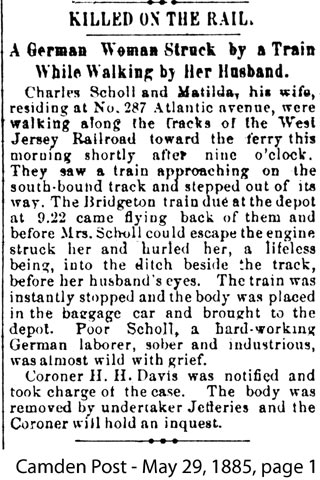
Charles Scholl and Matilda, his wife, residing at No. 287 Atlantic avenue, were walking along the tracks of the West Jersey Railroad toward the ferry this morning shortly after nine o’clock. They saw a train approaching on the south-bound track and stepped out of its way. The Bridgeton train due at the depot at 9.22 came flying back of them and before Mrs. Scholl could escape the engine struck her and hurled her, a lifeless being, into the ditch beside the track, before her husband’s eyes. The train was instantly stopped and the body was placed in the baggage car and brought to the depot. Poor Scholl, a hard-working German laborer, sober and industrious, was almost wild with grief.
Coroner H. H. Davis was notified and took charge of the case. The body was removed by undertaker Jefferies and the Coroner will hold an inquest.
Matilda Scholl
Philadelphia Inquirer —
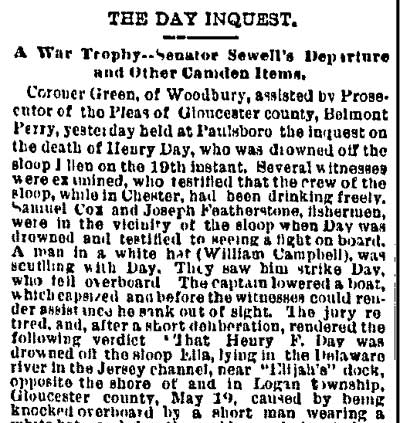
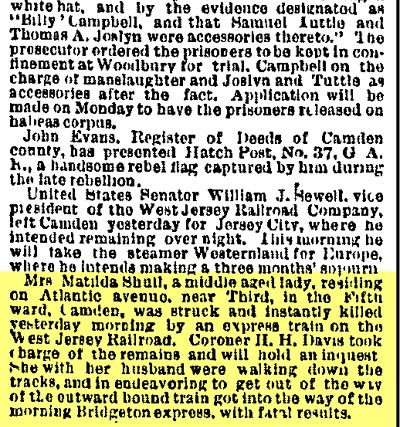
Mrs. Matilda Shull, a middle aged lady, residing on Atlantic Avenue, near Third, in the Fifth ward, Camden, was struck and instantly killed yesterday morning by an express train on the West Jersey Railroad. Coroner H. H. Davis took charge of the remains and will hold an inquest. She with her husband were walking down the tracks, and in endeavoring to get out of the way of the outward bound train got into the way of the morning Bridgeton express, with fatal results.
Matilda Scholl
Philadelphia Inquirer —
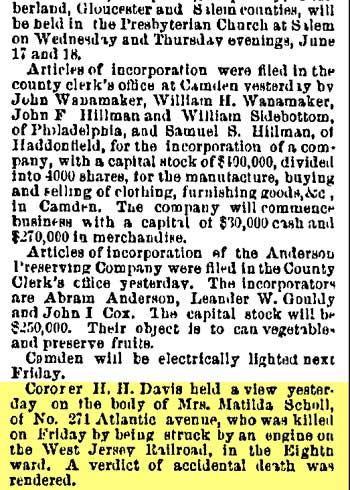
Coroner H. H. Davis held a view yesterday on the body of Mrs. Matilda Scholl, of No. 271 Atlantic Avenue, who was killed on Friday by being struck by an engine on the West Jersey Railroad, in the Eighth ward. A verdict of accidental death was rendered.
Matilda Scholl
Trenton Evening Times —
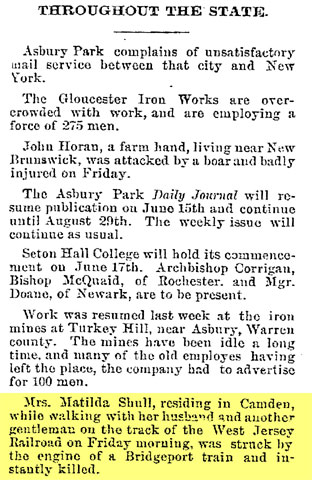
Mrs. Matilda Shull, residing in Camden, while walking with her husband and another gentleman on the track of the West Jersey Railroad on Friday morning, was struck by the engine of a Bridgeport train and instantly killed.
Matilda Scholl Death Certificate
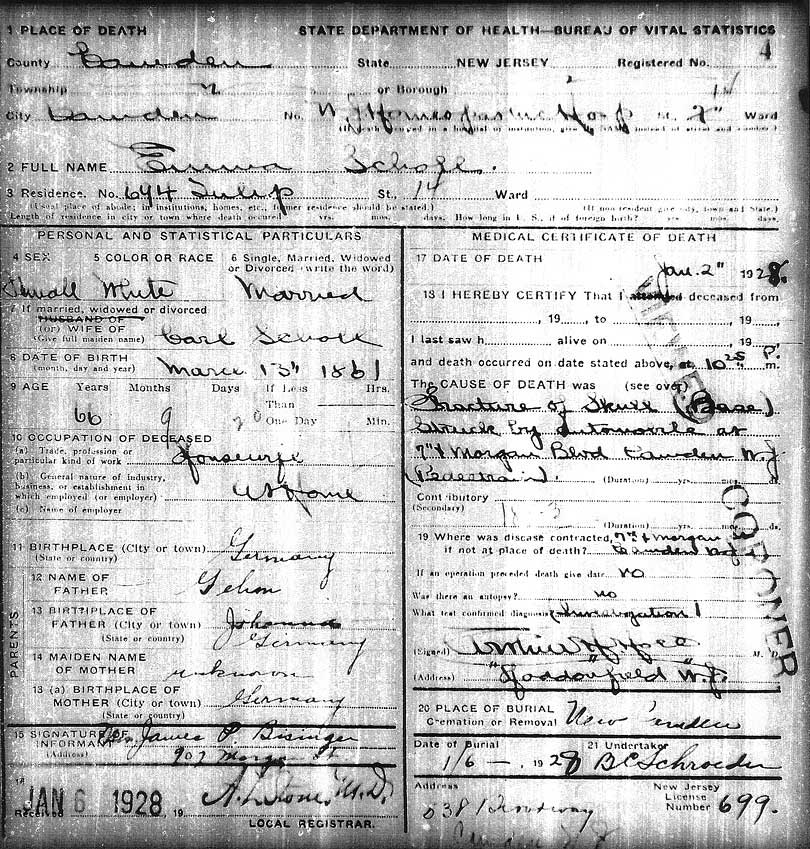
Named: Matilda Scholl Death Certificate, May 29, 1885, Dr. Henry H. Davis, E.E. Jefferis, and West Jersey Railroad.
Dr. Henry H. Davis
Philadelphia Inquirer —
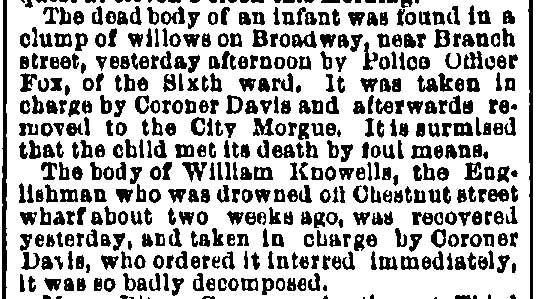
The dead body of an infant was found in a clump of willows on Broadway, near Branch Street, yesterday afternoon by Police Officer Fox, of the Sixth ward. It was taken in charge by Coroner Davis and afterwards removed to the City Morgue. It is surmised that the child met its death by foul means.
The body of William Knowells, the Englishman who was drowned off Chestnut Street wharf about two weeks ago, was recovered yesterday, and taken in charge by Coroner Davis, who ordered it interred immediately, it was so badly decomposed.
Dr. Henry H. Davis
Philadelphia Inquirer —

Coroner Davis yesterday held the inquest on the body of the colored girl who is supposed to have been murdered. The verdict was that the child came to its death from shock, occasioned by a person or persons unknown to the jury.
Dr. Henry H. Davis
Philadelphia Inquirer —

Coroner Davis yesterday gave a certificate of burial in the case of Charles Blieth, of No. 22 Oak street Camden, who died without medical attendance.
Dr. Henry H. Davis
Philadelphia Inquirer —
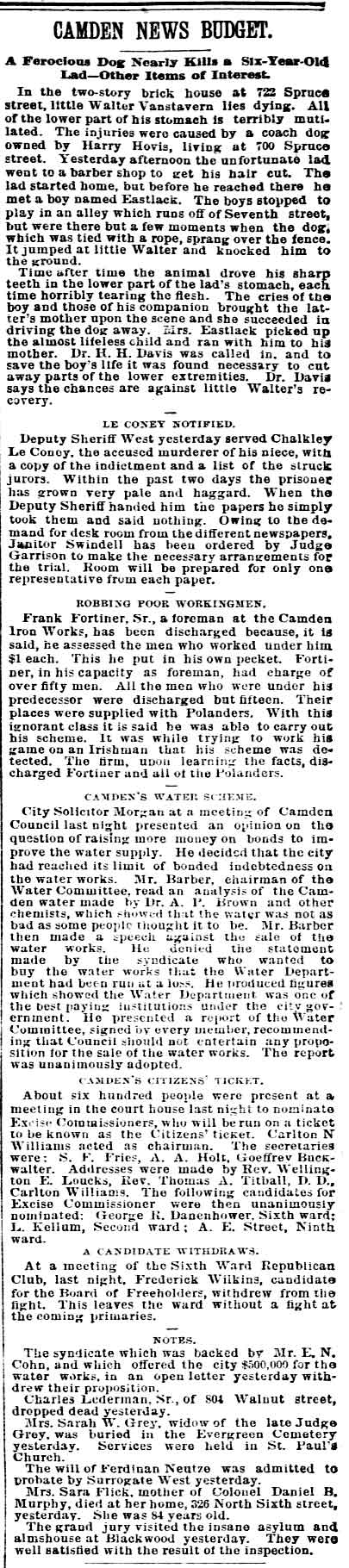
A ferocious dog nearly killed a six-year-old boy named Walter Vanstavern on Spruce Street near South 7th Street. Coroner H. H. Davis took charge of the case.
Dr. Henry H. Davis
Camden Daily Telegram —
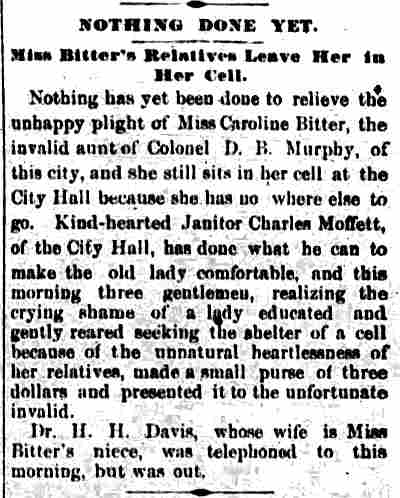
Miss Bitter’s Relatives Leave Her in Her Cell.
Nothing has yet been done to relieve the unhappy plight of Miss Caroline Bitter, the invalid aunt of Colonel D. B. Murphy, of this city, and she still sits in her cell at the City Hall because she has no where else to go. Kind-hearted Janitor Charles Moffett, of the City Hall, has done what he can to make the old lady comfortable, and this morning three gentlemen, realizing the crying shame of a lady educated and gently reared seeking the shelter of a cell because of the unnatural heartlessness of her relatives, made a small purse of three dollars and presented it to the unfortunate invalid.
Dr. H. H. Davis, whose wife is Miss Bitter’s niece, was telephoned to this morning, but was out.
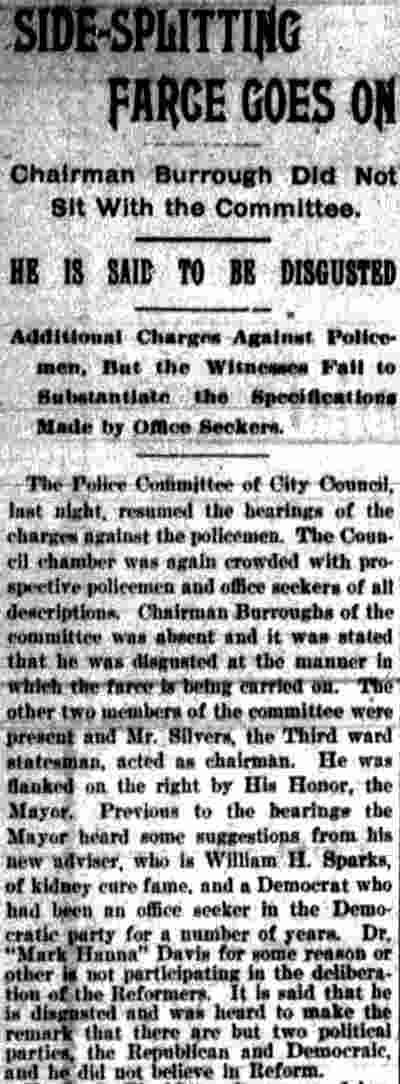
Side-Splitting Farce Goes On
Camden Daily Telegram —
Chairman Burrough Did Not Sit With the Committee.
HE IS SAID TO BE DISGUSTED
Additional Charges Against Policemen, But the Witnesses Fail to Substantiate the Specifications Made by Office Seekers.
The Police Committee of City Council, last night, resumed the hearings of the charges against the policemen. The Council chamber was again crowded with prospective policemen and office seekers of all descriptions. Chairman Burroughs of the committee was absent and it was stated that he was disgusted at the manner in which the farce is being carried on. The other two members of the committee were present and Mr. Silvers, the Third ward statesman, acted as chairman. He was flanked on the right by His Honor, the Mayor. Previous to the hearings the Mayor heard some suggestions from his new adviser, who is William H. Sparks, of kidney cure fame, and a Democrat who had been an office seeker in the Democratic party for a number of years. Dr. “Mark Hanna” Davis for some reason or other is not participating in the deliberation of the Reformers. It is said that he is disgusted and was heard to make the remark that there are but two political parties, the Republican and Democratic, and he did not believe in Reform.
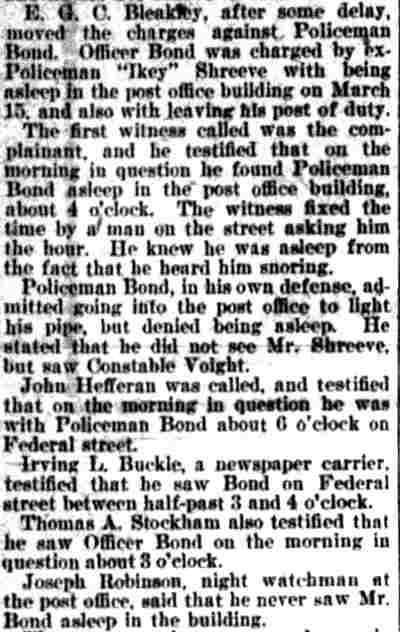
E. G. C. Bleakley, after some delay, moved the charges against Policeman Bond. Officer Bond was charged by ex-Policeman “Ikey” Shreeve with being asleep in the post office building on March 15, and also with leaving his post of duty.
The first witness called was the complainant, and he testified that on the morning in question he found Policeman Bond asleep in the post office building, about 4 o’clock. The witness fixed the time by a man on the street asking him the hour. He knew he was asleep from the fact that he heard him snoring.
Policeman Bond, in his own defense, admitted going into the post office to light his pipe, but denied being asleep. He stated that he did not see Mr. Shreeve, but saw Constable Voight.
John Hefferan was called, and testified that on the morning in question he was with Policeman Bond about 6 o’clock on Federal street.
Irving L. Buckle, a newspaper carrier, testified that he saw Bond on Federal street between half-past 3 and 4 o’clock.
Thomas A. Stockham also testified that he saw Officer Bond on the morning in question about 3 o’clock.
Joseph Robinson, night watchman at the post office, said that he never saw Mr. Bond asleep in the building.
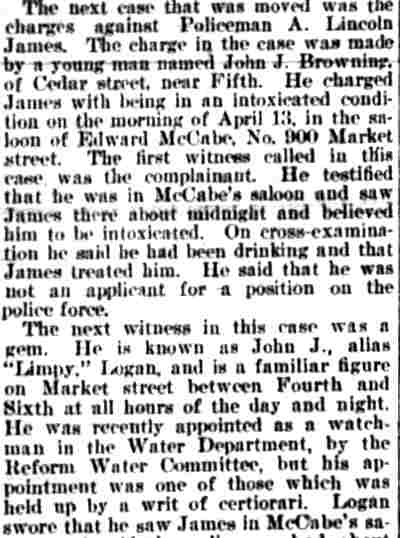
The next case that was moved was the charges against Policeman A. Lincoln James. The charge in the case was made by a young man named John J. Browning, of Cedar street, near Fifth. He charged James with being in an intoxicated condition on the morning of April 13, in the saloon of Edward McCabe, No. 900 Market street. The first witness called in this case was the complainant. He testified that he was in McCabe’s saloon and saw James there about midnight and believed him to be intoxicated. On cross-examination he said he had been drinking and that James treated him. He said that he was not an applicant for a position on the police force.
The next witness in this case was a gem. He is known as John J., alias “Limpy,” Logan, and is a familiar figure on Market street between Fourth and Sixth at all hours of the day and night. He was recently appointed as a watchman in the Water Department, by the Reform Water Committee, but his appointment was one of those which was held up by a writ of certiorari. Logan swore that he saw James in McCabe’s sa-
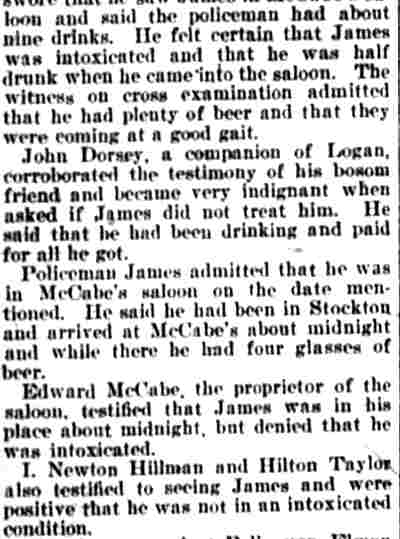
loon and said the policeman had about nine drinks. He felt certain that James was intoxicated and that he was half drunk when he came into the saloon. The witness on cross examination admitted that he had plenty of beer and that they were coming at a good gait.
John Dorsey, a companion of Logan, corroborated the testimony of his bosom friend and became very indignant when asked if James did not treat him. He said that he had been drinking and paid for all he got.
Policeman James admitted that he was in McCabe’s saloon on the date mentioned. He said he had been in Stockton and arrived at McCabe’s about midnight and while there he had four glasses of beer.
Edward McCabe, the proprietor of the saloon, testified that James was in his place about midnight, but denied that he was intoxicated.
I. Newton Hillman and Hilton Taylor also testified to seeing James and were positive that he was not in an intoxicated condition.
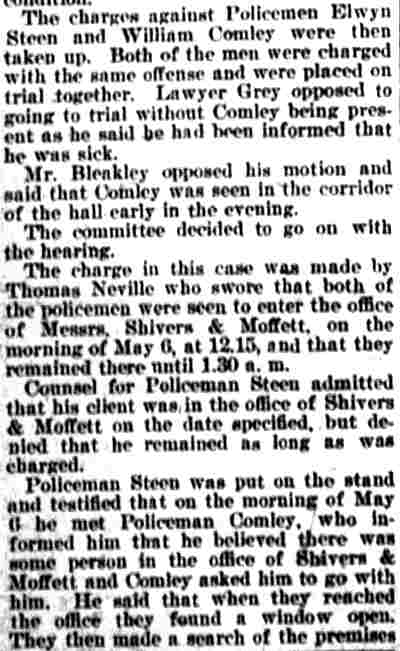
The charges against Policemen Elwyn Steen and William Comley were then taken up. Both of the men were charged with the same offense and were placed on trial together. Lawyer Grey opposed to going to trial without Comley being present as he said he had been informed that he was sick.
Mr. Bleakley opposed his motion and said that Comley was seen in the corridor of the hall early in the evening.
The committee decided to go on with the hearing.
The charge in this case was made by Thomas Neville who swore that both of the policemen were seen to enter the office of Messrs. Shivers & Moffett, on the morning of May 6, at 12.15, and that they remained there until 1.30 a. m.
Counsel for Policeman Steen admitted that his client was in the office of Shivers & Moffett on the date specified, but denied that he remained as long as was charged.
Policeman Steen was put on the stand and testified that on the morning of May 6 he met Policeman Comley, who informed him that he believed there was some person in the office of Shivers & Moffett and Comley asked him to go with him. He said that when they reached the office they found a window open. They then made a search of the premises and also the lumber yard. He testified that the place had been frequently robbed and that Messrs. Shivers & Moffett had furnished Policeman Comley with a key, for the purpose of going through the place.
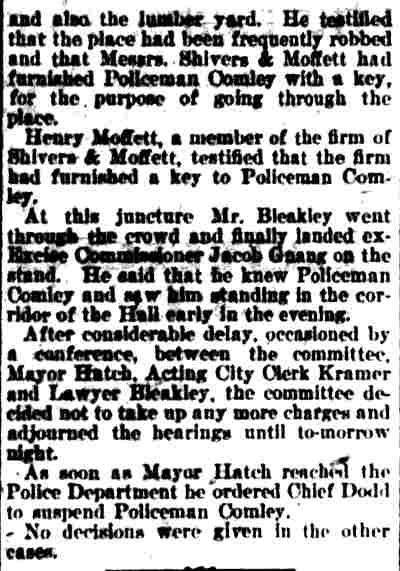
Henry Moffett, a member of the firm of Shivers & Moffett, testified that the firm had furnished a key to Policeman Comley.
At this juncture Mr. Bleakley went through the crowd and finally landed ex-Excise Commissioner Jacob Gnang on the stand. He said that he knew Policeman Comley and saw him standing in the corridor of the Hall early in the evening.
After considerable delay, occasioned by a conference, between the committee, Mayor Hatch, Acting City Clerk Kramer and Lawyer Bleakley, the committee decided not to take up any more charges and adjourned the hearings until to-morrow night.
As soon as Mayor Hatch reached the Police Department he ordered Chief Dodd to suspend Policeman Comley.
No decisions were given in the other cases.
SIDE-SPLITTING FARCE GOES ON
Chairman Burrough Did Not Sit With the Committee.
HE IS SAID TO BE DISGUSTED
Additional Charges Against Policemen, But the Witnesses Fail to Substantiate the Specifications Made by Office Seekers.
The Police Committee of City Council, last night, resumed the hearings of the charges against the policemen. The Council chamber was again crowded with prospective policemen and office seekers of all descriptions. Chairman Burroughs of the committee was absent and it was stated that he was disgusted at the manner in which the farce is being carried on. The other two members of the committee were present and Mr. Silvers, the Third ward statesman, acted as chairman. He was flanked on the right by His Honor, the Mayor. Previous to the hearings the Mayor heard some suggestions from his new adviser, who is William H. Sparks, of kidney cure fame, and a Democrat who had been an office seeker in the Democratic party for a number of years. Dr. “Mark Hanna” Davis for some reason or other is not participating in the deliberation of the Reformers. It is said that he is disgusted and was heard to make the remark that there are but two political parties, the Republican and Democratic, and he did not believe in Reform.
E. G. C. Bleakley, after some delay, moved the charges against Policeman Bond. Officer Bond was charged by ex-Policeman “Ikey” Shreeve with being asleep in the post office building on March 15, and also with leaving his post of duty.
The first witness called was the complainant, and he testified that on the morning in question he found Policeman Bond asleep in the post office building, about 4 o’clock. The witness fixed the time by a man on the street asking him the hour. He knew he was asleep from the fact that he heard him snoring.
Policeman Bond, in his own defense, admitted going into the post office to light his pipe, but denied being asleep. He stated that he did not see Mr. Shreeve, but saw Constable Voight.
John Hefferan was called, and testified that on the morning in question he was with Policeman Bond about 6 o’clock on Federal street.
Irving L. Buckle, a newspaper carrier, testified that he saw Bond on Federal street between half-past 3 and 4 o’clock.
Thomas A. Stockham also testified that he saw Officer Bond on the morning in question about 3 o’clock.
Joseph Robinson, night watchman at the post office, said that he never saw Mr. Bond asleep in the building.
The next case that was moved was the charges against Policeman A. Lincoln James. The charge in the case was made by a young man named John J. Browning, of Cedar street, near Fifth. He charged James with being in an intoxicated condition on the morning of April 13, in the saloon of Edward McCabe, No. 900 Market street. The first witness called in this case was the complainant. He testified that he was in McCabe’s saloon and saw James there about midnight and believed him to be intoxicated. On cross-examination he said he had been drinking and that James treated him. He said that he was not an applicant for a position on the police force.
The next witness in this case was a gem. He is known as John J., alias “Limpy,” Logan, and is a familiar figure on Market street between Fourth and Sixth at all hours of the day and night. He was recently appointed as a watchman in the Water Department, by the Reform Water Committee, but his appointment was one of those which was held up by a writ of certiorari. Logan swore that he saw James in McCabe’s sa-
loon and said the policeman had about nine drinks. He felt certain that James was intoxicated and that he was half drunk when he came into the saloon. The witness on cross examination admitted that he had plenty of beer and that they were coming at a good gait.
John Dorsey, a companion of Logan, corroborated the testimony of his bosom friend and became very indignant when asked if James did not treat him. He said that he had been drinking and paid for all he got.
Policeman James admitted that he was in McCabe’s saloon on the date mentioned. He said he had been in Stockton and arrived at McCabe’s about midnight and while there he had four glasses of beer.
Edward McCabe, the proprietor of the saloon, testified that James was in his place about midnight, but denied that he was intoxicated.
I. Newton Hillman and Hilton Taylor also testified to seeing James and were positive that he was not in an intoxicated condition.
The charges against Policemen Elwyn Steen and William Comley were then taken up. Both of the men were charged with the same offense and were placed on trial together. Lawyer Grey opposed to going to trial without Comley being present as he said he had been informed that he was sick.
Mr. Bleakley opposed his motion and said that Comley was seen in the corridor of the hall early in the evening.
The committee decided to go on with the hearing.
The charge in this case was made by Thomas Neville who swore that both of the policemen were seen to enter the office of Messrs. Shivers & Moffett, on the morning of May 6, at 12.15, and that they remained there until 1.30 a. m.
Counsel for Policeman Steen admitted that his client was in the office of Shivers & Moffett on the date specified, but denied that he remained as long as was charged.
Policeman Steen was put on the stand and testified that on the morning of May 6 he met Policeman Comley, who informed him that he believed there was some person in the office of Shivers & Moffett and Comley asked him to go with him. He said that when they reached the office they found a window open. They then made a search of the premises
and also the lumber yard. He testified that the place had been frequently robbed and that Messrs. Shivers & Moffett had furnished Policeman Comley with a key, for the purpose of going through the place.
Henry Moffett, a member of the firm of Shivers & Moffett, testified that the firm had furnished a key to Policeman Comley.
At this juncture Mr. Bleakley went through the crowd and finally landed ex-Excise Commissioner Jacob Gnang on the stand. He said that he knew Policeman Comley and saw him standing in the corridor of the Hall early in the evening.
After considerable delay, occasioned by a conference, between the committee, Mayor Hatch, Acting City Clerk Kramer and Lawyer Bleakley, the committee decided not to take up any more charges and adjourned the hearings until to-morrow night.
As soon as Mayor Hatch reached the Police Department he ordered Chief Dodd to suspend Policeman Comley.
No decisions were given in the other cases.
Dr. Henry H. Davis
Philadelphia Inquirer —
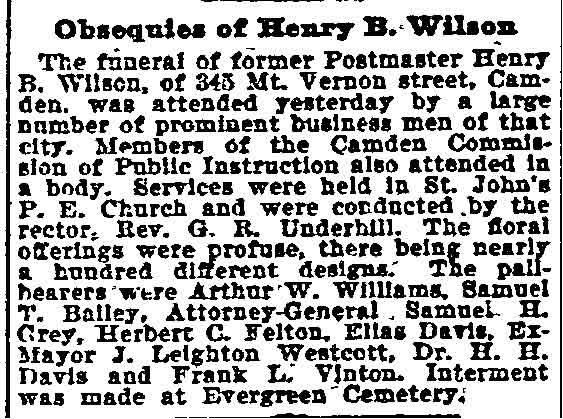
Obsequies of Henry B. Wilson
Obsequies of Henry B. Wilson
The funeral of former Postmaster Henry B. Wilson, of 345 Mt. Vernon street, Camden, was attended yesterday by a large number of prominent business men of that city. Members of the Camden Commission of Public Instruction also attended in a body. Services were held in St. John's P. E. Church and were conducted by the rector, Rev. G. R. Underhill. The floral offerings were profuse, there being nearly a hundred different designs. The pallbearers were Arthur W. Williams, Samuel T. Bailey, Attorney-General Samuel H. Grey, Herbert C. Felton, Elias Davis, Ex-Mayor J. Leighton Westcott, Dr. H. H. Davis and Frank L. Vinton. Interment was made at Evergreen Cemetery.
Dr. Henry H. Davis
Philadelphia Inquirer —
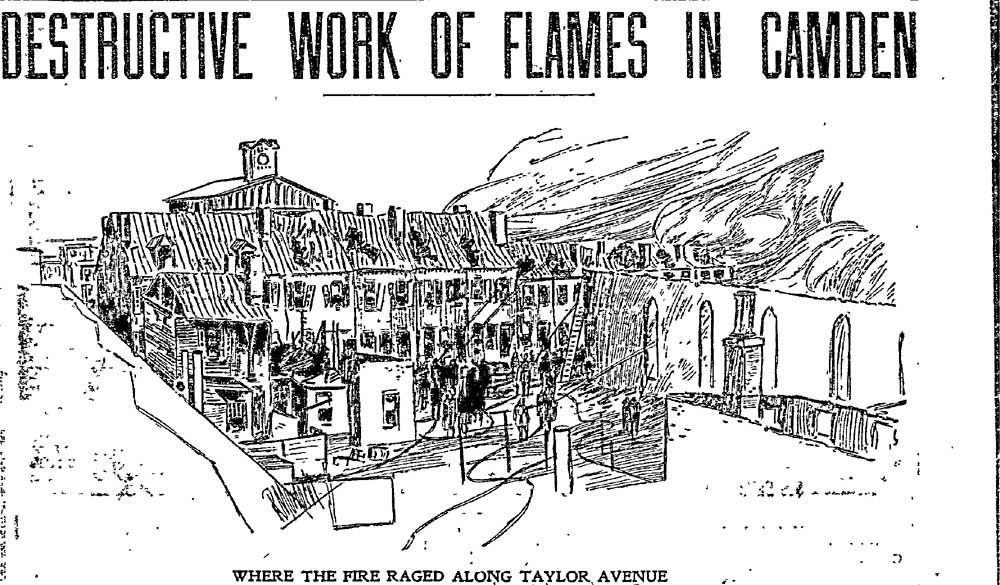
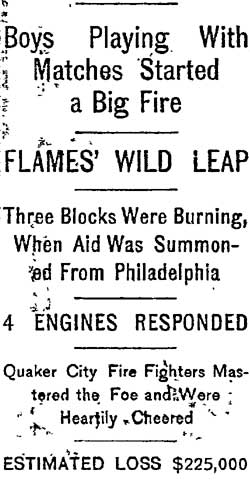
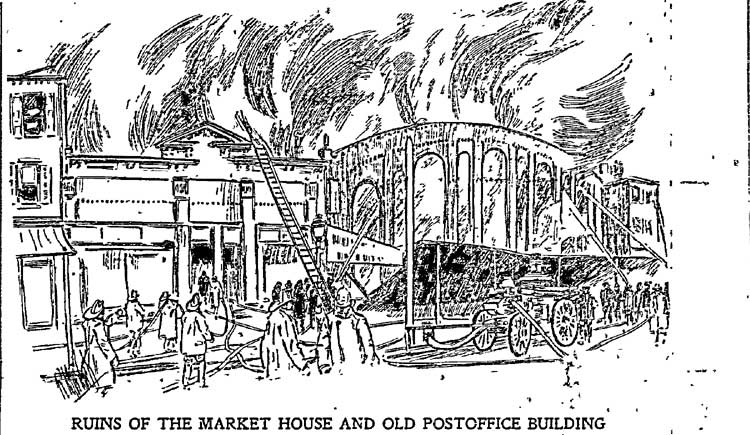
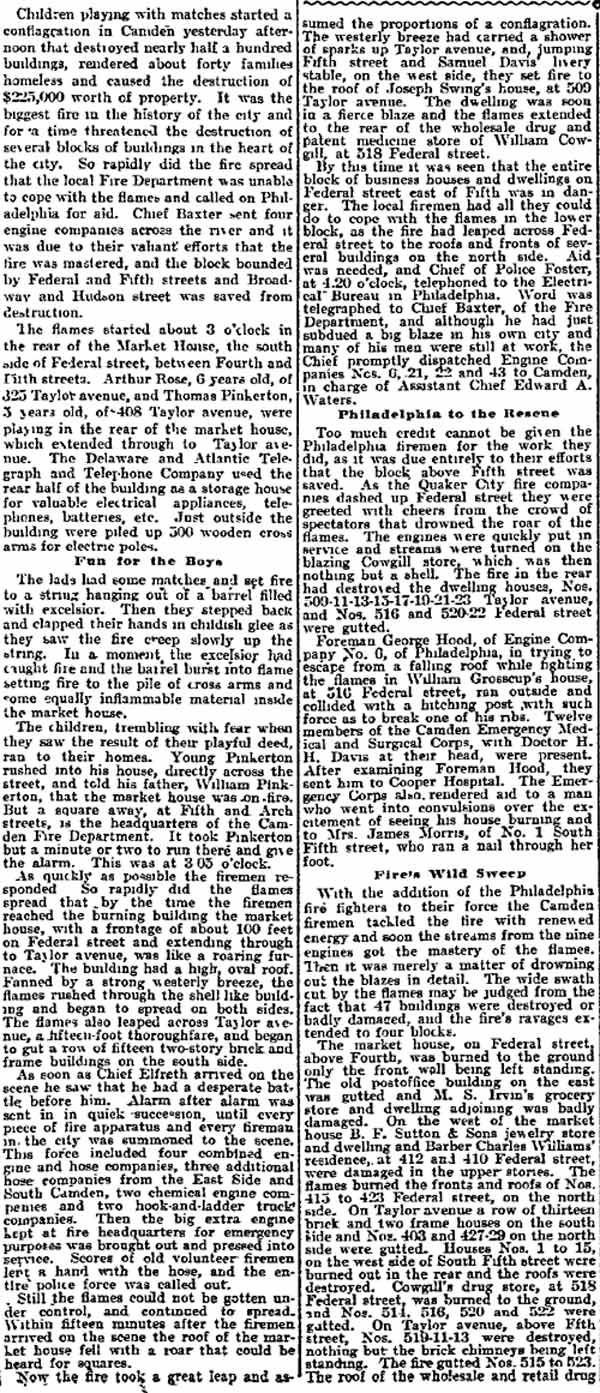

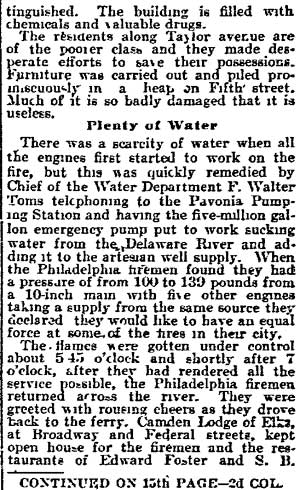
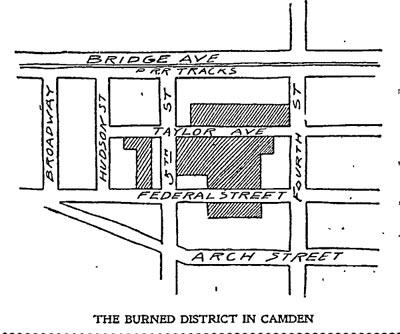
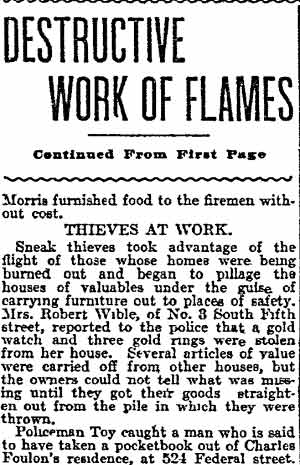
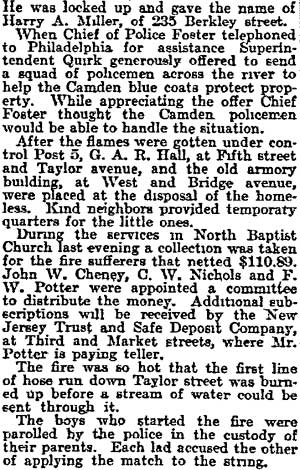
Named: Philadelphia Inquirer, May 14, 1900, Taylor Avenue, Federal Street, South 5th Street, Arch Street, Dr. Henry H. Davis, Cooper Hospital, George M. Beringer, Camden Lodge of Elks No. 293, and Samuel S. Elfreth.
David Baird Sr.
Philadelphia Inquirer —
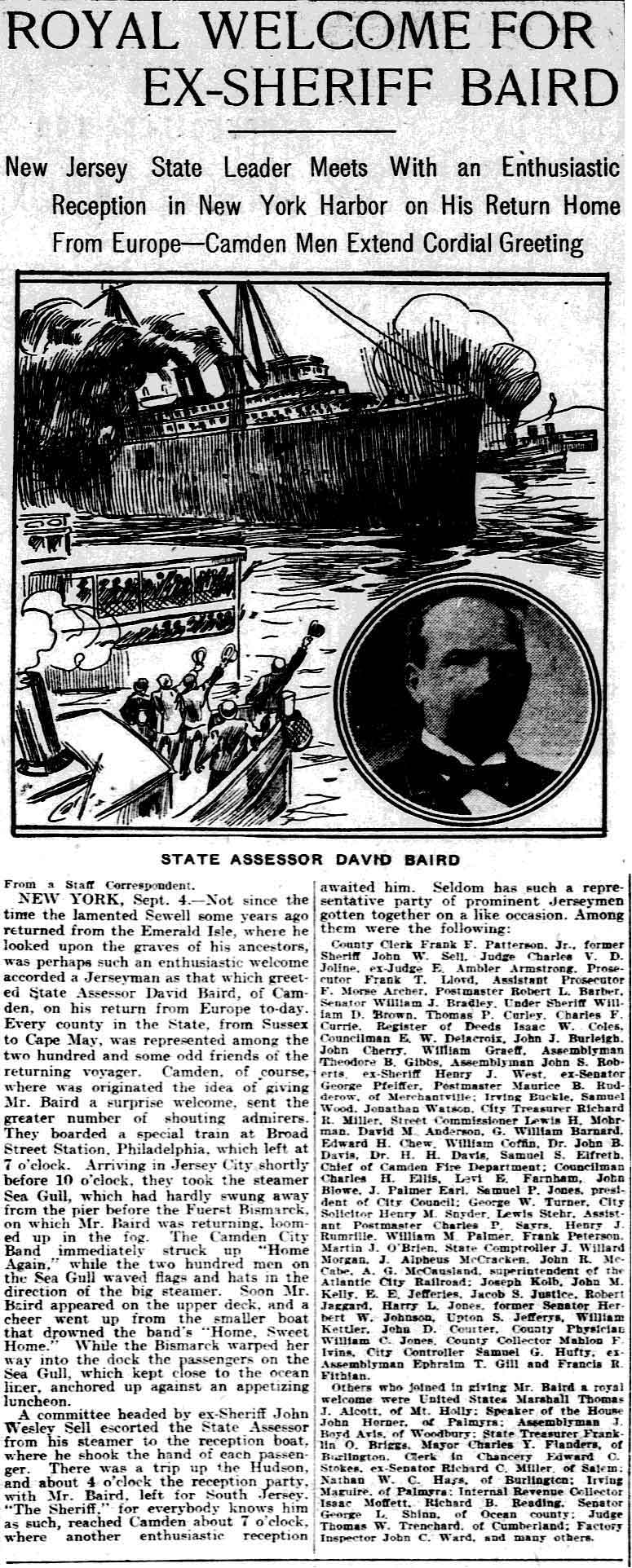
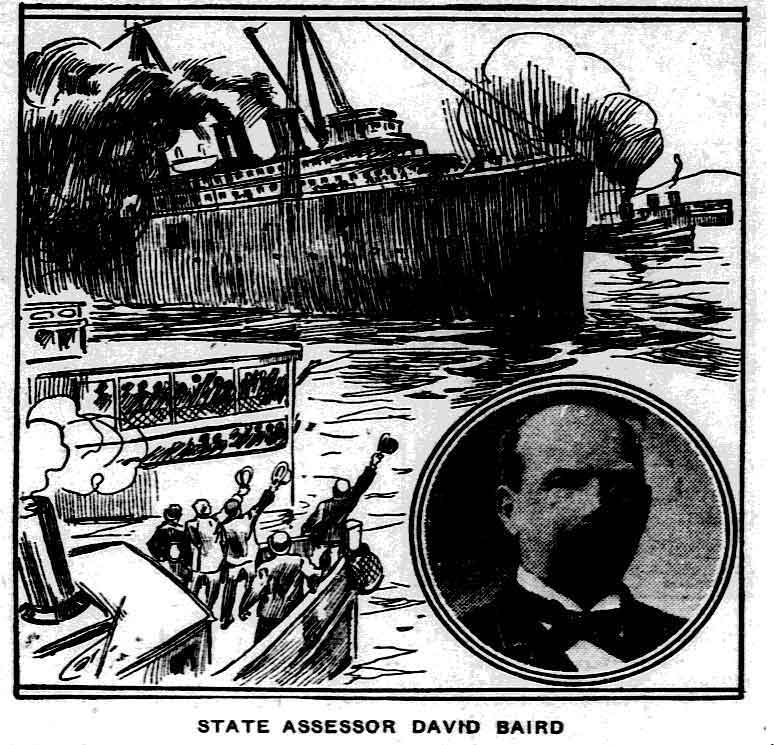
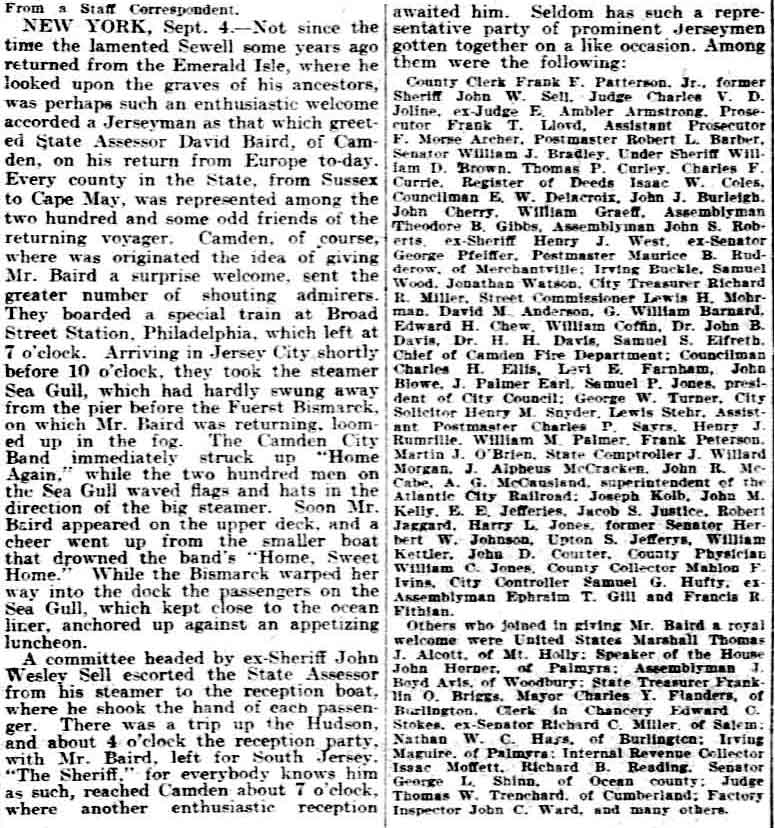
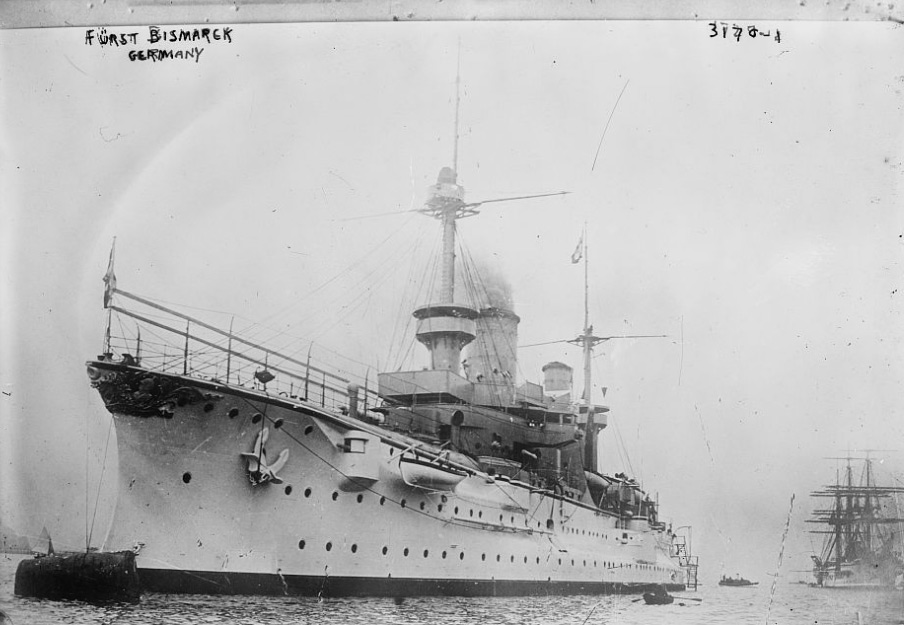
Royal Welcome for Ex-Sheriff Baird
Royal Welcome for Ex-Sheriff Baird
New Jersey State Leader Meets With an Enthusiastic Reception in New York Harbor on His Return Home From Europe — Camden Men Extend Cordial Greeting
State Assessor David Baird
Camden Lodge No. 293, B. P. O. E.
Meeting
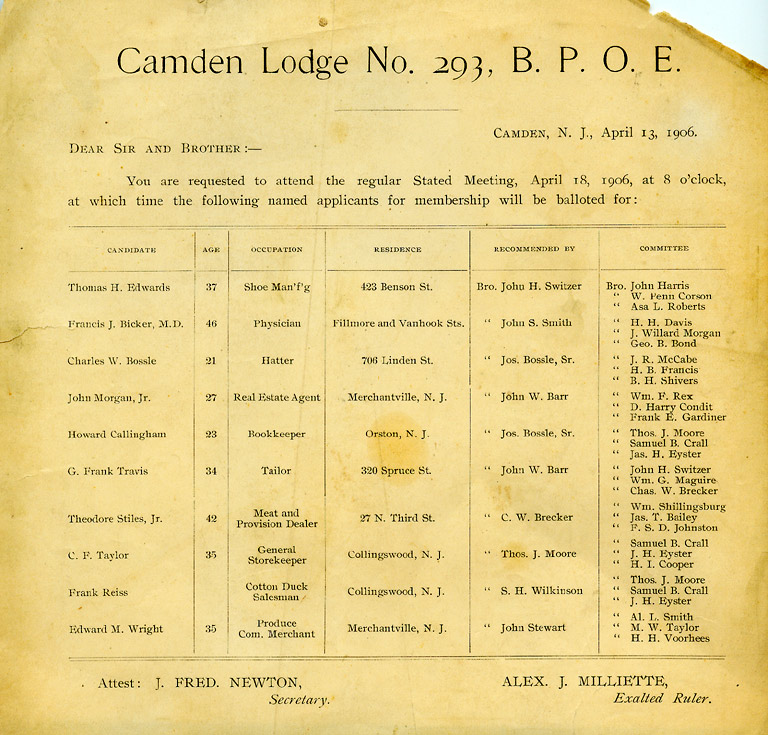
CAMDEN, N. J., April 13, 1906
DEAR SIR AND BROTHER:
You are requested to attend the regular Stated Meeting, April 18, 1906, at 8 o’clock, at which time the following named applicants for membership will be balloted for:
| Candidate | Age | Occupation | Residence | Endorsed By | Committee |
|---|---|---|---|---|---|
| Thomas H. Edwards | 37 | Shoe Man’f’g | 423 Benson St. | Brother John H. Switzer | Bro. John Harris Bro. W. Penn Corson Bro. Asa L. Roberts |
| Francis J. Bicker M.D. | 46 | Physician | Fillmore & Van Hook Sts. | Bro. John S. Smith | Bro. H.H. Davis Bro. J. Willard Morgan Bro. George B. Bond |
| Charles W. Bossle | 31 | Hatter | 706 Linden Street | Bro. Joseph Bossle Sr. | Bro. J.R. McCabe Bro. H.B. Francis Bro. B.H. Shivers |
| John Morgan Jr. | 27 | Real Estate Agent | Merchantville, N.J. | Bro. John W. Barr | Bro. William F. Rex Bro. D. Harry Condit Bro. Frank E. Gardiner |
| Howard Callingham | 23 | Bookkeeper | Orston, N.J. | Bro. Joseph Bossle Sr. | Bro. Thomas J. Moore Bro. Samuel B. Crall Bro. James H. Eyster |
| G. Frank Travis | 34 | Tailor | 320 Spruce Street | Bro. John W. Barr | Bro. John H. Switzer Bro. William G. Maguire Bro. Charles W. Brecker |
| Theodore Stiles Jr. | 42 | Meat and Provision Dealer | 27 N. Third Street | Bro. C.W. Brecker | Bro. Wm. Shillingsburg Bro. James T. Bailey Bro. P.S.D. Johnston |
| C.F. Taylor | 35 | General Storekeeper | Collingswood, N.J. | Bro. Thomas J. Moore | Bro. Samuel B. Crall Bro. James H. Eyster Bro. H.I. Cooper |
| Frank Reiss | Cotton Duck Salesman | Collingswood, N.J. | Bro. S.H. Wilkinson | Bro. Thomas J. Moore Bro. Samuel B. Crall Bro. James H. Eyster |
|
| Edward M. Wright | 35 | Produce Com. Merchant | Merchantville, N.J. | Bro. John Stewart | Bro. Al. L. Smith Bro. M.W. Taylor Bro. H.H. Voorhees |
Attest: J. FRED. NEWTON, Secretary — ALEX. J. MILLIETTE, Exalted Ruler.
Dr. Henry H. Davis
Camden Daily Courier —
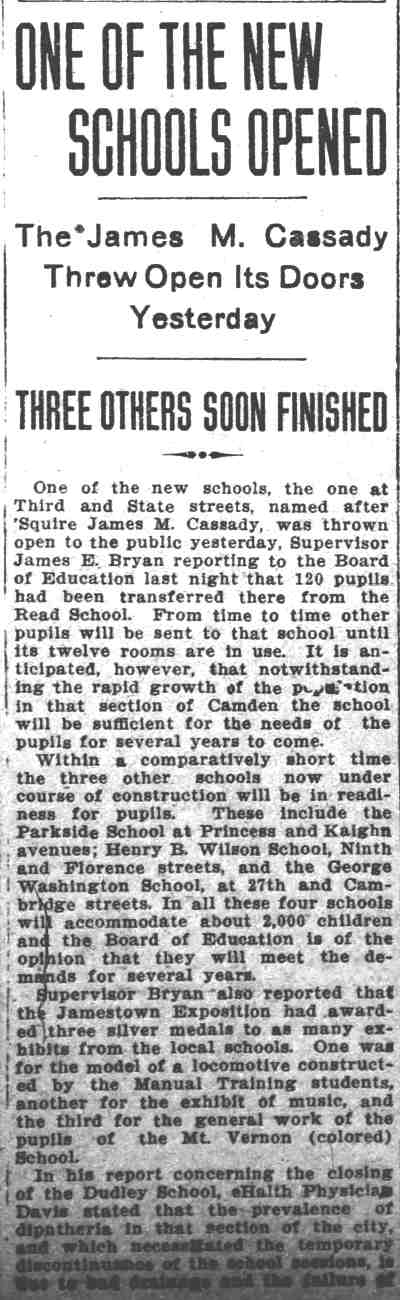
The James M. Cassady Threw Open Its Doors Yesterday
THREE OTHERS SOON FINISHED
One of the new schools, the one at Third and State streets, named after ’Squire James M. Cassady, was thrown open to the public yesterday, Supervisor James E. Bryan reporting to the Board of Education last night that 120 pupils had been transferred there from the Read School. From time to time other pupils will be sent to that school until its twelve rooms are in use. It is anticipated, however, that notwithstanding the rapid growth of the population in that section of Camden the school will be sufficient for the needs of the pupils for several years to come.
Within a comparatively short time the three other schools now under course of construction will be in readiness for pupils. These include the Parkside School at Princess and Kaighn avenues; Henry B. Wilson School, Ninth and Florence streets, and the George Washington School, at 27th and Cambridge streets. In all these four schools will accommodate about 2,000 children and the Board of Education is of the opinion that they will meet the demands for several years.
Supervisor Bryan also reported that the Jamestown Exposition had awarded three silver medals to as many exhibits from the local schools. One was for the model of a locomotive constructed by the Manual Training students, another for the exhibit of music, and the third for the general work of the pupils of the Mt. Vernon (colored) School.
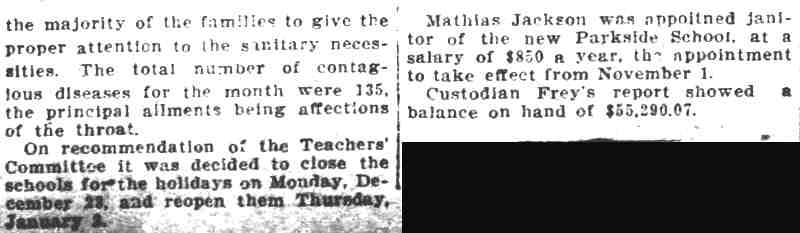
In his report concerning the closing of the Dudley School, Health Physician Davis stated that the prevalence of diphtheria in that section of the city, and which necessitated the temporary discontinuance of the school sessions, is due to bad drainage and the failure of the majority of the families to give the proper attention to the sanitary necessities. The total number of contagious diseases for the month were 135, the principal ailments being affections of the throat.
On recommendation of the Teachers’ Committee it was decided to close the schools for the holidays on Monday, December 23, and reopen them Thursday, January 2.
Mathias Jackson was appoitned janitor of the new Parkside School, at a salary of $850 a year, the appointment to take effect from November 1.
Custodian Frey’s report showed a balance on hand of $55,290.07.
Dr. Henry H. Davis
Philadelphia Inquirer —
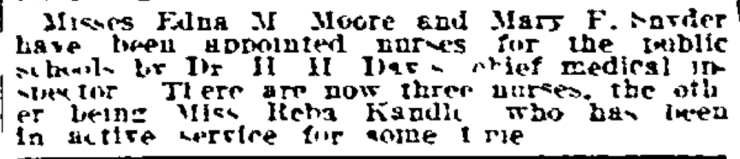
Misses Edna M. Moore and Mary F. Snyder have been appointed nurses for the public schools by Dr. H. H. Davis, chief medical inspector. There are now three nurses, the other being Miss Reba Kandle, who has been in active service for some time.
Dr. Henry H. Davis
Philadelphia Inquirer —
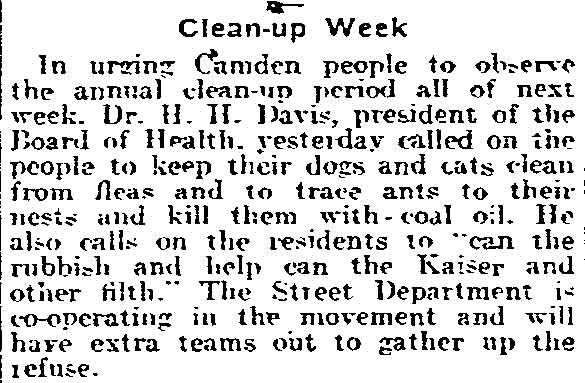
In urging Camden people to observe the annual clean-up period all of next week, Dr. H. H. Davis, president of the Board of Health, yesterday called on the people to keep their dogs and cats clean from fleas and to trace ants to their nests and kill them with coal oil. He also calls on the residents to “can the rubbish and help can the Kaiser and other filth.” The Street Department is co-operating in the movement and will have extra teams out to gather up the refuse.
Dr. Henry H. Davis
Philadelphia Inquirer —
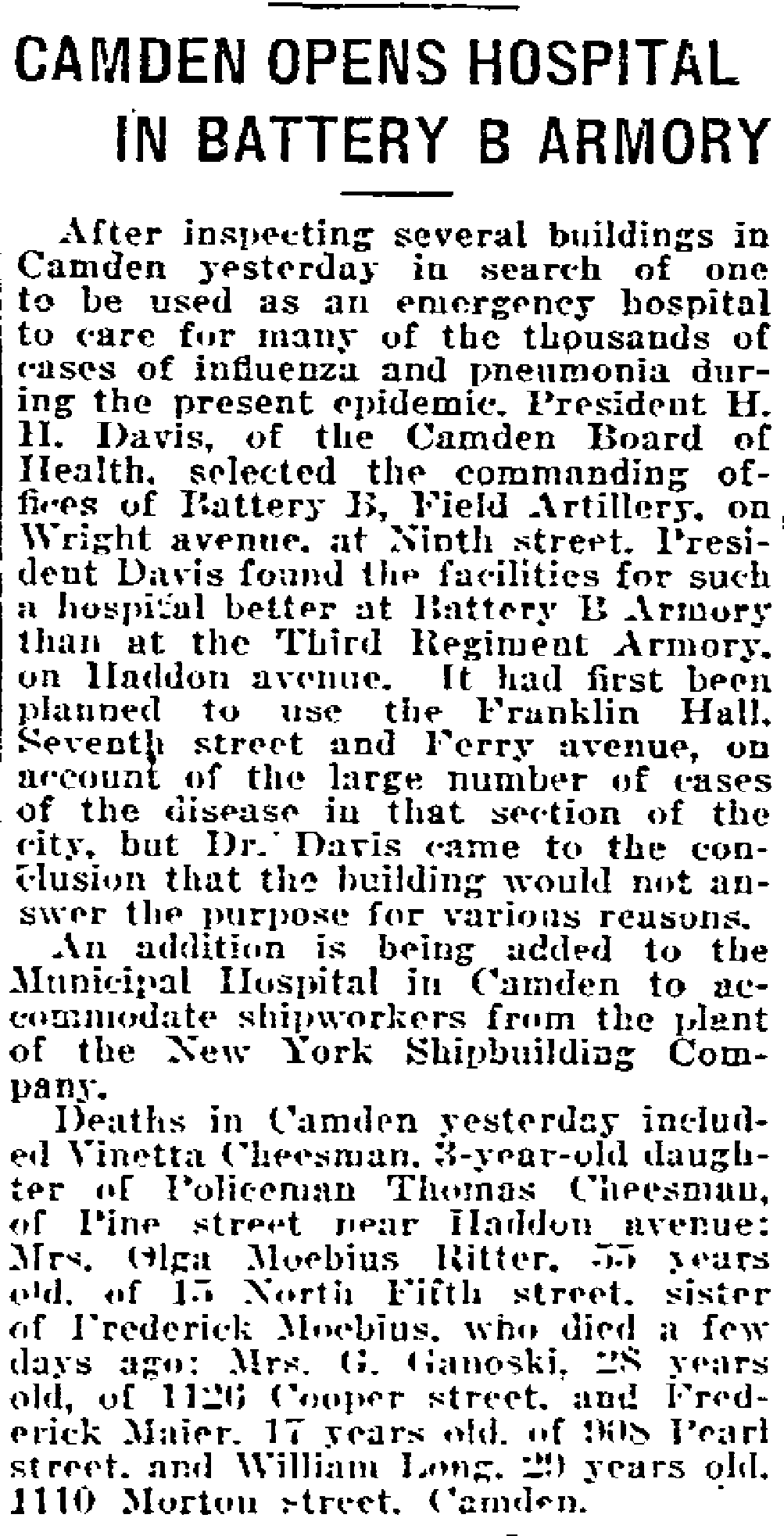
Camden Opens Hospital in Battery B Armory
After inspecting several buildings in Camden yesterday in search of one to be used as an emergency hospital to care for many of the thousands of cases of influenza and pneumonia during the present epidemic, President H. H. Davis, of the Camden Board of Health, selected the commanding offices of Battery B, Field Artillery, on Wright avenue, at Ninth street. President Davis found the facilities for such a hospital better at Battery B Armory than at the Third Regiment Armory, on Haddon Avenue. It had first planned to use the Franklin Hall, Seventh street and Ferry avenue, on account of the large number of cases of the disease in that section of the city, but Dr. Davis came to the conclusion that the building would not answer the purpose for various reasons.
An addition is being added to the Municipal Hospital in Camden to accommodate shipworkers from the plant of the New York Shipbuilding Company.
Deaths in Camden yesterday included Vinetta Cheesman, 3-year-old daughter of Policeman Thomas Cheeseman, of Pine Street near Haddon Avenue; Mrs. Olga Moebius Ritter, 55 years old, of 15 North Fifth street, sister of Frederick Moebius, who died a few days ago; Mrs. G. Ganowki, 28 years old, of 1126 Cooper street; and Frederick Lanier, 17 years old, of 985 Pearl street; and William Long, 29 years old, 1110 Morton street, Camden.
Four Prominent Physicians
Camden Courier-Post —
Reminiscences of Drs. Godfrey, Iszard, Davis and Gross, All Leaders of Their Profession in South Jersey
(Another in a series of articles on Camden affairs and personalities of yesteryear)
By BEN COURTER
SINCE these annals of medical men in Camden county have appeared, other residents have occasionally as-serted this or that physician, their family doctor half a century ago, has been forgotten,
“What’s the matter with Doc So-and-So?” they have asked, and they have usually added, “He was the best doctor in typhoid” or whatever ailment was probably cured in their own particular household. The particular phy-sician’s victory over a malady which prolonged the life of some kin has evidently been handed down through the years as such an outstanding accomplishment that if monuments were in order it is unquestioned Camden would be liberally sprinkled with them, It likewise is certain that when family physicians were more the order of the day in lieu of the present tendency to develop specialists, the medical man’s clientele stuck to him through two or three generations and usually placed him on a figurative pedestal at least.
Doctor of 50 Years Ago
Fifty years ago one of the city’s leading physicians was Dr. E. L. B. Godfrey, whose office then was at 621 North Second Street. He was born in Cape May, February 2, 1850. After graduating at the Hightstown Institute, he took up the study of medicine with Dr. E. L. B. Wales, at Cape May.
Later he entered Jefferson College, graduating in 1875, serving his term as intern at the Rhode Island Hospital, Providence. He reached here the next year and immediately became one of the most active men of his profession, being on the surgical staff when Cooper Hospital was opened in 1887. He also was lecturer on fractures at the Medico-Chi Hos-pital in Philadelphia was major and surgeon of the Sixth Regiment, National Guard served as president of both the city and county societies and contributed authoritative papers to medical journals.
One of the early county physicians of Camden was Dr. William H. Iszard, a native of Gloucester County, where he was born in 1842. In 1862 he entered the service of the government as a medical cadet, being stationed at the hospital on Broad Street, Philadelphia, entering Jefferson College the following year. He was considerably hampered through ill health, but after much interruption graduated in 1870. He first located at Elmer, but soon afterward came here and opened an office at 411 North Fourth Street, where he practiced for many years. He was active in political work, being one of the first presidents of the Camden Republican Club, which long had its headquarters on Cooper Street above Third, and where many of the national figures in the party were occasional guests. He not only was welcome to any sick room but popular about town because of his affability and general all-around good fellowship. William H. Iszard, the realty man and prominent Elk, is a surviving son. Dr. Iszard died a couple of years ago in his eighties, mourned by many an old-timer.
Dr. H. H. Davis
Contemporary with him was Dr. Henry H. Davis, whose name is still identified with all that means health protection for Camden’s school children. For a generation he was either identified with the Board of Health as its president or the schools as chief medical officer. It was he who was largely responsible for rules guarding young pupils in public schools.
Prior to his activities not much attention was paid to ailing youngsters. If they had poor eyesight they were just as liable to be seated far from the blackboard. if their record put them in that position. Not much attention was paid to the cause of their backwardness and if they couldn’t see the figures the teacher placed on the board failure was laid to natural dumbness. Not much attention was paid to chronic sore throats, bad teeth or other imperfections, but when Dr. Davis was placed in full charge of the schools he changed all that and children who have passed through the classes in the past quarter of a century owe much to this veteran medical man whom fate ordained should be killed by an auto in his eightieth year. It was through his efforts clinics were established where poor eyesight might be corrected and other deficiencies looked after by the hospitals or dental men.
Dr. Davis was born at Crosswicks, August 16, 1848, and became a student of pharmacy in the office of Dr. Alexander Mecray in 1867, entering Jefferson College in the fall of that year. He graduated two years later, courses then being half of the present requirements, and began practice here. For many years he had his office at Third Street and Kaighn Avenue. Two young men whose preceptor he was, Dr. Harry Jarrett and Dr. Rowland I. Haines, afterwards ranked among Camden’s leading physicians. Dr. Davis was active in the county society, was a former coroner and for many years identified with many of the city’s activities.
Dr. Onan B. Gross
Arch Street at one time was among Camden’s leading residential thoroughfares, although in these days, with most of the old dwellings either gone or in a state of dilapidation that perhaps would be difficult to believe. Half a century ago some of the city’s best known professional men resided there, among them Dr. Onan B. Gross, who had his office at 407 Arch Street. In later years he was located at Seventh and Federal Streets.
Dr. Gross was a native of Ephrata, Pa., where he was born February 19, 1851. He entered Ephrata Academy but when he was 17 he was thrown on his own resources and apprenticed as a carpenter. He served his time and worked as a journeyman, but he sought a medical career. Through hard work and rigid economy he saved enough to enter the University of Pennsylvania in 1875, graduating three years later. His ability was recognized even then for he was assistant demonstrator in anatomy in the last two years of his course, the first time such an honor had been given one not yet a graduate. In the year of his graduation he received a prize for skill in dissection work.
Dr. Gross was county physician three years, president of the county society, a surgeon at Cooper Hospital, member of the board of managers of the City Dispensary and identified with the various medical groups of the period.