Introduction
Jacob F. Nessen was born in Pennsylvania in September of 1842 to Peter W. and Hannah Nessen. His father, who had been born in Denmark, worked as a Philadelphia policeman when the Census was taken in 1850.
At some point after the Census was taken in 1850 Jacob Nessen moved to New Jersey. On August 15, 1861 Jacob Nessen enlisted as a Private in Company F, Fourth New Jersey Infantry Regiment.
The Fourth New Jersey Infantry was organized under the provisions of an act of Congress, approved July 22, 1861. During its time in service it was led by Colonels James H. Simpson, William B. Hatch, William Birney, Edward L. Campbell; Lieutenant Colonels J.L. Kirby Smith, Barzilla Ridgway, Charles Ewing, Baldwin Hufty; and Majors Samuel Mulford, and David Vickers.
The Fourth was fully organized, equipped and officered by August 19, at which time it was mustered into the U. S. service for three years, at Camp Olden, Trenton. It left the state the next day with 38 officers, 871 non-commissioned officers and privates, a total of 909. It reached Washington on August 21, accompanied by a battery of 6 pieces, furnished by the state and commanded by Captain William Hexamer, who had been waiting for six months for an opportunity to enter the service. It was assigned to the brigade of General Kearney, then consisting of the First, Second and Third N. J. regiments. Immediately after the first battle of Bull Run it joined the brigade near Alexandria, and in the operations along the line of the Orange & Alexandria railroad acted as a support to the advance. Just before the battle of West Point, Virginia, the brigade relieved the troops in advance and the men lay on their arms in line of battle until daylight, when they were ordered forward, the Fourth being held as a reserve. At the battle at Gaines’ Mill the brigade was formed in two lines, the Fourth being in the front, and advanced to the brow of a hill, where the Fourth was sent into the woods by order of an aide of General McClellan, all the brigade being engaged at the most dangerous and difficult parts of the field, until at last, wearied, bleeding, ammunition exhausted, the brigade slowly retired and crossing the bridge at 11 o’clock, reached its old camp about midnight, having sustained a total loss of over 1,000 men in killed and wounded, of whom some 500, belonging to the Fourth were captured in a body, having refused to retreat from the woods when they might have done so, and continuing to fight until completely surrounded. Besides this loss in prisoners the regiment lost 38 killed and 111 wounded.
The regiment participated in the battles of Charles City Crossroads, White Oak Swamp, Malvern Hill, Manassas, Chantilly and Crampton’s Gap, the total loss of the brigade during the latter engagement being 174 in killed and wounded, Adjutant Studdiford being among the slain. In December, 1862 the Fourth took part in the movement against Fredericksburg, but in the Gettysburg campaign the Fourth was detailed for provost duty in Washington. It was back with the brigade again in time for the spring campaign of 1864. At the battle of the Wilderness the First, Fourth and Tenth regiments, lying on the left, were several times attacked with great ferocity by the Confederates, but at nightfall still held substantially the ground occupied by them in the morning—a heavy assault by the Confederate General Gordon just at dusk being repulsed with heroic gallantry. Among the wounded in that engagement was Lieutenant Colonel Van Syckel of the Fourth. At the battle of Spottsylvania the regiment participated in the charge upon the “bloody angle,” winning its share of the glory and sustaining its share of casualties. During the first eleven days of Grant’s campaign against Richmond the regiment lost 26 killed, 126 wounded and 42 missing. The Fourth fought at the North Anna river, Hanover Court House, Totopotomoy Creek, Cold Harbor, Weldon Railroad, Snicker’s Gap, Strasburg, Winchester and Charlestown. At the battle of the Opequan the Fourth was with the troops that pressed forward, swept up the opposite hill and forced back the Confederate line, obtaining permanent possession of the hill and holding it, though constantly exposed to a fire which inflicted severe loss, the Fourth having 2 killed, 18 wounded and 1 missing. After the fight at the Opequan the Fourth was engaged at Winchester, Virginia on September 22, 1864. During the battle at Cedar Creek, Virginia, on October 19, 1864 the Fourth took part in the pursuit of the Confederates towards Fisher’s Hill. At Fisher’s hill a private of the Fourth named Beach compelled a Confederate lieutenant colonel to surrender his sword, and there were other instances of daring no less noteworthy.
The Fourth New Jersey then took part in the siege at Petersburg, engaging Confederate troops on January 6, 1865. Jacob F. Nesson was promoted to Full Sergeant after this action. The regiment fought again at Petersburg in April of 1865.
After Lee’s surrender the regiment was assigned to what was known as the provisional corps, Army of the Potomac. Jacob F. Nesson was again promoted, to First Sergeant, on May 1, 1865.
The Fourth New Jersey Infantry Regiment mustered out on July 9, 1865. The total strength of the regiment was 2,036, and it lost during service 29 by resignation, 319 by discharge, 83 by promotion, 81 by transfer, 257 by death, 372 by desertion, 3 by dismissal, 109 not accounted for, mustered out 783. First Sergeant Nessen was among those who mustered out at Hall’s Hill.
Jacob Nessen came to Camden after completing his military service. The Census of 1870, taken in August of that year, shows Jacob Nessen, his 20 year-old wife Henrietta, and 5 month-old son William living in Newton Township. Jacob Nessen was working as an iron moulder at one of the nearby foundries. Newton Township was annexed to Camden shortly after the census was taken, forming the Seventh and Eighth Wards of Camden.
Jacob Nessen became active in Republican politics in the Eighth Ward, where he lived. When the 1878–1879 City Directory was compiled, Jacob Nessen was living at 428 Jasper Street, working as a constable. The 1880 Census shows him living at 428 Jasper Street with his wife, widowed mother Hannah, and children Jacob F. Jr., Mary, and George W. Nessen. By 1900 the Nessens had 10 children, but only five were still living. Jacob Nessen was working as a laborer when the Census was taken. He worked as a laborer and as an iron moulder at the Gloucester Foundry in nearby Gloucester City during the early and mid-1880s. He also stayed active in local politics.
When Samuel S. Elfreth returned as Chief of the Camden Fire Department in 1885, Jacob Nessen was appointed to the department as a stoker with Engine Company Number 1. He was still active with the Department in 1886.
In 1886 the Camden Steam Fire Engine Company Number 1 was located at 409 Pine Street in a three story 20 by 90 foot brick building (the old Independence Fire Company No. 3 engine house). The company’s apparatus was an Amoskeag second class steamer (maker’s plate 6318) drawn by two horses and one Silsby two wheel hose cart drawn by a single horse. The company was equipped with 1000 feet of good hose, axes, lamps, etc. The company roster included John Stockton, Foreman; G. Rudolph Tenner, Engineer; William Deno, driver; William W. Laird, stoker; Wilson Bromley and Jacob F. Nessen, hosemen. Call men were William Deith, Andrew Miller and William Bogia. Bromley and Bogia would later suffer line of duty deaths.
By the spring of 1887 Jacob Nessen had been appointed to the Camden Police Department. He was still living at 428 Jasper Street at that time. Jacob Nessen served with the Camden Police for three years. By the end of 1890 he had moved to 434 Jasper Street and had gone back to work as a moulder. He was still living at 434 Jasper Street when the Census was taken in 1900. The Census shows Jacob and Henrietta Nessen living with three of their five living children, George, Emma, and Raymond. Their neighbors at 424 Jasper Street were Camden firefighter Lewis Buzine and family.
To his last day a resident of 434 Jasper Street, Jacob F. Nessen passed away on January 14, 1903. He was buried at Evergreen Cemetery.
Over the River: Eighth Ward Republican Club Organized
Philadelphia Inquirer —
Political
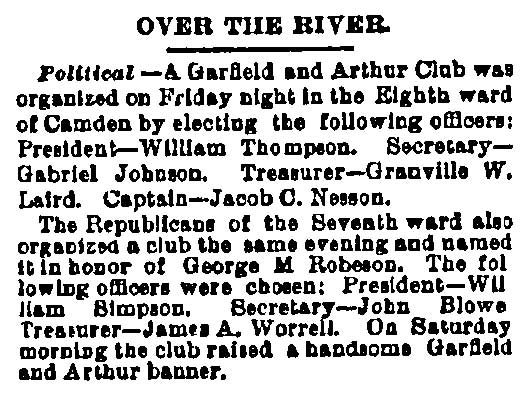
A Garfield and Arthur Club was organized on Friday night in the Eighth ward of Camden by electing the following officers: President—William Thompson. Secretary—Gabriel Johnson. Treasurer—Granville W. Laird. Captain—Jacob C. Nesson.
The Republicans of the Seventh ward also organized a club the same evening and named it in honor of George M. Robeson. The following officers were chosen: President—William Simpson. Secretary—John Blowe. Treasurer—James A. Worrell. On Saturday morning the club raised a handsome Garfield and Arthur banner.
Elected Justice of the Peace
Philadelphia Inquirer —
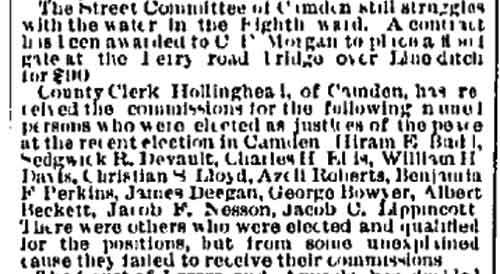
The Street Committee of Camden still struggles with the water in the Eighth ward. A contract has been awarded to C. F. Morgan to place a foot gate at the Ferry road bridge over Lino ditch for $110.
County Clerk Hollingshead, of Camden, has received the commissions for the following named persons who were elected as justices of the peace at the recent election in Camden: Hiram E. Budd, Sedgwick R. Devault, Charles H. Ellis, William H. Davis, Christian S. Lloyd, Azell Roberts, Benjamin F. Perkins, James Deegan, George Bowyer, Albert Beckett, Jacob F. Nesson, Jacob C. Lippincott. There were others who were elected and qualified for the positions, but from some unexplained cause they failed to receive their commissions.
Camden’s News Budget: Dismissed from the Police Force
Philadelphia Inquirer —
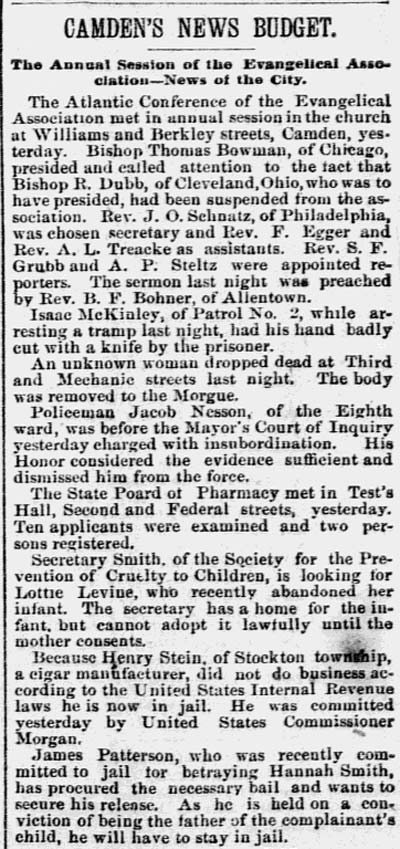
The Annual Session of the Evangelical Association—News of the City.
The Atlantic Conference of the Evangelical Association met in annual session in the church at Williams and Berkley streets, Camden, yesterday. Bishop Thomas Bowman, of Chicago, presided and called attention to the fact that Bishop R. Dubb, of Cleveland, Ohio, who was to have presided, had been suspended from the association. Rev. J. O. Schnatz, of Philadelphia, was chosen secretary and Rev. F. Egger and Rev. A. L. Treacke as assistants. Rev. S. F. Grubb and A. P. Steltz were appointed reporters. The sermon last night was preached by Rev. B. F. Bohner, of Allentown.
Isaac McKinley, of Patrol No. 2, while arresting a tramp last night, had his hand badly cut with a knife by the prisoner.
An unknown woman dropped dead at Third and Mechanic streets last night. The body was removed to the Morgue.
Policeman Jacob Nesson, of the Eighth ward, was before the Mayor’s Court of Inquiry yesterday charged with insubordination. His Honor considered the evidence sufficient and dismissed him from the force.
The State Board of Pharmacy met in Test’s Hall, Second and Federal streets, yesterday. Ten applicants were examined and two persons registered.
Secretary Smith, of the Society for the Prevention of Cruelty to Children, is looking for Lottie Levine, who recently abandoned her infant. The secretary has a home for the infant, but cannot adopt it lawfully until the mother consents.
Because Henry Stein, of Stockton township, a cigar manufacturer, did not do business according to the United States Internal Revenue laws he is now in jail. He was committed yesterday by United States Commissioner Morgan.
James Patterson, who was recently committed to jail for betraying Hannah Smith, has procured the necessary bail and wants to secure his release. As he is held on a conviction of being the father of the complainant’s child, he will have to stay in jail.
Obituary: Jacob F. Nessen
Philadelphia Inquirer —
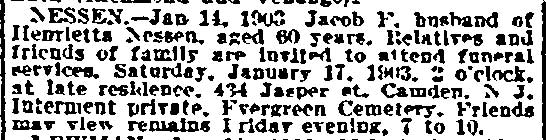
NESSEN.—Jan 14, 1903. Jacob F., husband of Henrietta Nessen, aged 60 years. Relatives and friends of family are invited to attend funeral services, Saturday, January 17, 1903, 2 o’clock, at late residence, 434 Jasper st., Camden, N. J. Interment private. Evergreen Cemetery. Friends may view remains Friday evening, 7 to 10.