State Street Methodist Episcopal Church
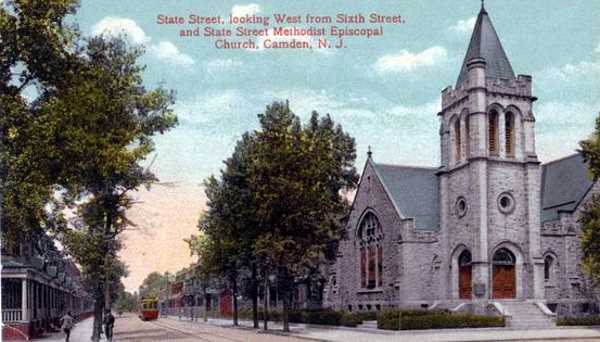
State Street Methodist Episcopal Church, northwest corner of North 6th Street and State Street, North Camden, New Jersey.
State Street Methodist Episcopal Church in North Camden grew out of a mission established in 1875 by Tabernacle Methodist Episcopal Church. The story of the early years of the church through 1909 are below. The magnificent church at the corner of North 6th Street and State Street was completed in 1904.
Some say a miracle took place at State Street Methodist Episcopal Church in 1916, and who are we to question? Camden Fire Department historian Lee Ryan wrote about it in the Fire Department’s 125th anniversary book, published in 1994:
Something akin to a miracle occurred on the frigid night of January 11, 1916 at the State Street Methodist Episcopal Church, Sixth and State Streets, North Camden. At 10 P.M., three alarms were transmitted in rapid succession for a serious fire involving the main auditorium of the church. Heavy fire conditions extended to destroy the roof, the organ loft, the altar, Sunday School classrooms, and the entire pew area throughout the auditorium. When the blaze was finally extinguished, all that remained standing were four granite walls. On the south side of the building along State Street, was a magnificent stained glass window of gigantic proportion depicting Christ breaking bread with Martha and Mary, the sisters of Lazarus. The window had inexplicably withstood the flames and heat. The scene from the life of Christ was not blistered, scorched or marred in any way. It has never been retouched and still stands as a miracle, surviving one of the most disastrous church fires in City history. Chief of Department Peter Carter was injured at this incident when he fell through a passageway between the auditorium and the school building. He was hospitalized for several weeks. Captain Joseph Maxwell and Fireman Steward Bakley of Hook & Ladder Company 1, Fireman John Hunt of Engine Company 3, and Fireman William McCauley of Chemical Company 1 were injured when the church roof collapsed on them. Under heavy smoke conditions and following some difficulty, the members were able to extricate themselves, three of them safely. Captain Maxwell was admitted to the hospital for a brief stay.
State Street Methodist Episcopal Church — May 2004
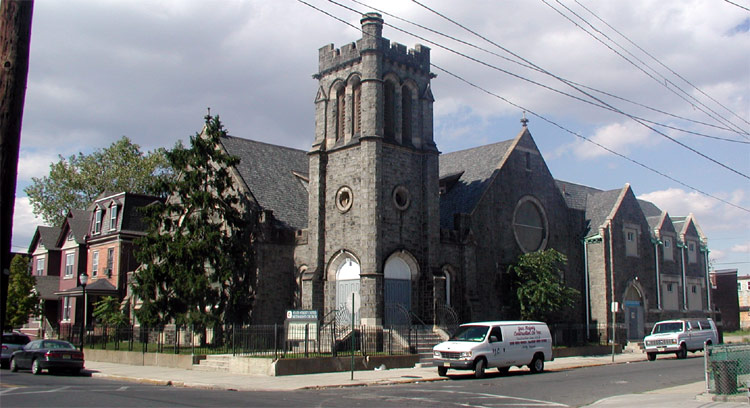
State Street Methodist Episcopal Church, May 2004.
History of the State Street Methodist Episcopal Church of Camden, N.J.
From The Centennial History of Camden Methodism — Published 1909
The Mission
The record of the State Street M. E. Church, and before it, the Mission, is one of unbroken attainment and success from the beginning. Providence has smiled upon its labors and made it a blessing to hundreds of homes in this community.
He who saw the need of carrying the Gospel to the children of Cooper’s Point has been spared to see his visions grow into realities. Not only that, but in all the history of the school and church he has been able, in spite of the cares of business or physical ailments, to be present and take part in every Christmas, Easter and Children’s Day entertainment of the school, and every pastor’s reception to the church.
In the year 1875, Brother Bingham, then an active official member of Tabernacle M. E. Church, was impressed with the need of some religious work among the children of what was then and is still known as “Cooper’s Point.”
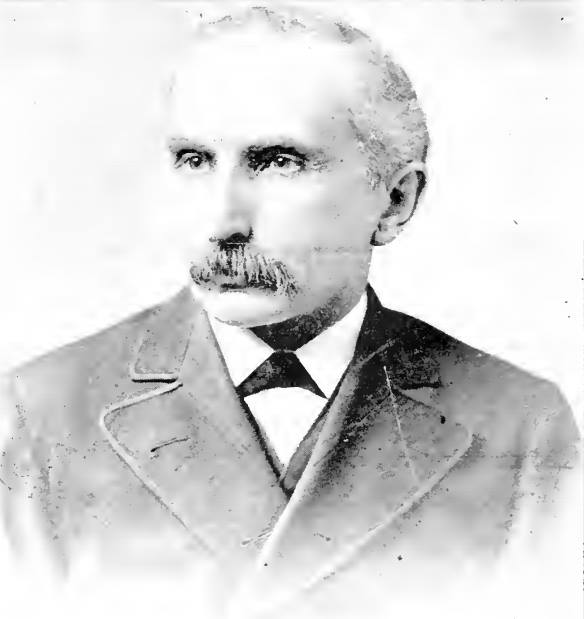
Barclay C. Bingham.
On his daily trips to and from his place of business he saw there were hundreds of persons whom the established means of grace failed to reach, and felt convinced that something should be done to bring Christ to these people, and especially to the children.
Pondering and praying much over the matter, the impression was deepened into a conviction, and he determined to act in the matter.
With the conviction pressing upon him, Brother Bingham was on the lookout for the means to attain the desired end. His attention was directed to a building, 16x40 feet, known as “Haslett’s Paint Shop,” corner Point and North streets, which he felt assured could be made to answer the purpose. He learned it belonged to the Camden & Atlantic Railroad, and could be rented for $75 per year. He had several consultations with other active members of Tabernacle Church, and at the third Quarterly Conference, 1875, the governing body of the church endorsed the project.
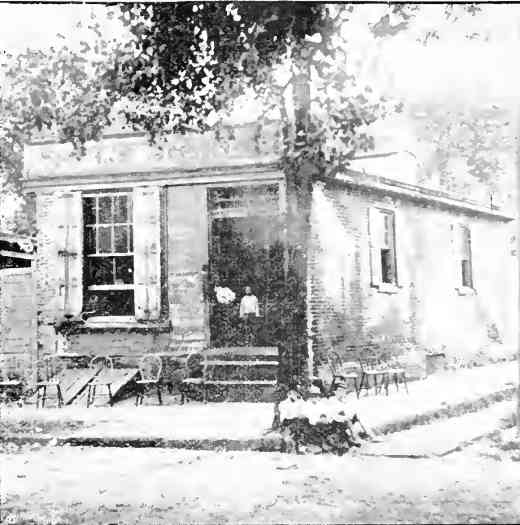
John R. Haslett’s Paint Shop — 1875.
On October 27th the matter was presented to the Sunday School Board, with the assurance that the mission would be self-supporting. After a lengthy consideration of the matter all objections were withdrawn, and it was unanimously decided to at once inaugurate a mission at Point and North streets, with the following Committee on Organization: Brothers Bingham, Sleeper, Hines, Woodrow, Carson, Green, Corson, Pierson and Patton.
The first meeting of the committee was held on November 14th, 1875, in the lecture room of Tabernacle Church, with the pastor, Rev. George K. Morris, in the chair, at which time a committee was appointed to make the necessary repairs on the old building which was in very bad condition.
On November 24th, 1875, the fourth and last meeting of the Committee on Organization was held, with the pastor in the chair. Repairs were reported as finished, and the following officers were elected: Superintendent, B. C. Bingham; Asst. Superintendent, John Moore; Secretary, George Green; Treasurer, James DeMaris. It was decided to start the mission with the new year. The time between the meeting and dedication was spent in active preparation. Bishop Simpson delivered a lecture in Tabernacle Church, in aid of the movement. Members of the church subscribed liberally, and on the appointed day, January 1st, 1876, the room was thrown open from 2 to 4 P. M. for inspection and dedication.
The interior was fresh and inviting. The walls had been painted and a new floor laid; a neat carpet had been put on the platform and the room furnished with benches.
In front the old sign, “John R. Haslet, Paint Shop,” had been succeeded by one bearing the words, “Tabernacle Methodist Mission.” Everything that could be done was accomplished to convert the old paint shop into a suitable building for the uses intended — the spreading of the Gospel of our Lord Jesus Christ.
As a result of announcements and circulars giving details of the movement, and of personal efforts on the part of those interested, on January 2d, 1876, the room was well filled with children of the neighborhood, representing all ages and conditions, some having been neatly dressed by parents and sent to the mission, while others had wandered in through idle curiosity. During the history of the school Brother Bingham had kept a notebook, and from it we learn that the day was unusually warm for mid-winter and that it rained before the close of the session.
The original enrollment consisted of thirteen officers and teachers and forty-seven scholars.
The work moved on harmoniously, and the end of the first quarter found ninety scholars in the Sabbath school, with fifteen officers and teachers.
During the first year a missionary society was organized, a weekly prayer meeting held, in which several scholars were converted, a library established, an organ purchased, a visiting relief society formed, temperance meetings held, and a Christmas entertainment and treat given for the children. The report submitted at the end of the year showed a record of seventeen officers and teachers, one hundred and ten scholars, with 278 visitors. The amount of the collections were $164.86 from the school and $197.57 collected outside. After all expenses had been paid the school had a balance in the treasury at the close of the year of $14.08.
The pastors of Tabernacle church took great interest in the work and helped in every possible way. Rev. Edmund Hewitt, who succeeded Rev. G. K. Morris, was especially active, editing “The Little Mission” (of which Brother Bingham was business manager) in the interest of the enterprise.
In November, 1878, a committee was appointed to look after the poor, and it is not too much to say that no little member of the Mission ever went barefooted or thinly clad in the winter again.
‘Twas thus the years passed away, filled with work and prayer, crowded with anxieties and hopes for the little mission, which, in the meanwhile, had been constantly growing in numbers and influence until many a home had felt a new impetus and many a careless family was looking up. Christmas brought the treat, and the summer the picnic.
On the fourth of February, 1883, a committee of five, consisting of Brothers Bingham, Propert, Adams, Stiles and Evans, were appointed to select a building site, for the old paint shop could no longer accommodate the Sabbath school. The committee decided upon a plot of ground on the corner of Sixth and State streets, which was surrounded by a rail fence, and which had been used as a truck patch.
Surrounding the plot of ground were fields that the previous summer had been planted with corn. No houses were to the right, to the left, at the rear or in front. But seeing far into the future, and reveling in a vision of paved streets and rows of stone houses, which has actually come to pass, the mission bought the ex-cabbage patch for $3,000, and, letting down the bars, began to lay the foundations of a chapel.
The work of building went on gloriously. Many a hard-earned dollar was thrown into the little treasury, all for love of the work. The brethren built and dug and plastered to help the cause along. The sisters scrubbed and toiled, inspiring the brethren. When at last the time came to leave the old paint shop behind, the heart, filled with precious memories, gave thanks to God mightily, and the little band, with its young charges, took possession of the new chapel.
Previous to the erection of the chapel Rev. J. S. Heisler, pastor of Tabernacle Church, organized the State Street Mission, under the control of the mother church, but having a separate Board of Trustees. The Trustees of State Street Mission were: B.C. Bingham, Z.T. Faunce, W.T. Propert, John H. Stiles, Samuel Hollingsworth, Charles F. Adams and Edward Evans. The organization of the State Street Mission and election of its Trustees took place on April 19th, and the erection of the chapel was immediately pushed.
The chapel cost $2,500, the greater part of which was raised by subscription, Mr. Bingham alone collecting over $1,200 of the sum.
On Thursday evening, September 20th, 1883, after five months of hard labor, the State Street Mission School was formally opened and dedicated as a house of God. The services were under the direction of the Presiding Elder, Rev. J. B. Graw, D. D., and the dedicatory sermon was preached by Rev. J. L. Sooy, who was at that time the pastor of Centenary Church.
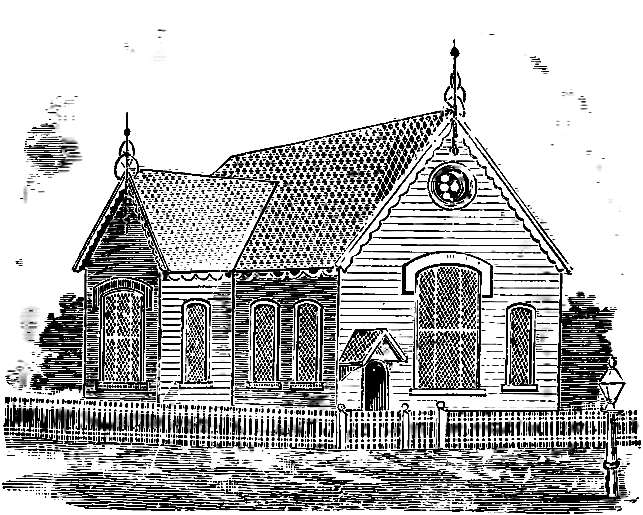
1883 — The State Street Mission School and chapel.
On Sunday, September 23rd, the Sabbath school was held for the first time in the new chapel, with an enrollment of all the old scholars, save one, and an addition of several new names.
The infant department outgrew its limits, and on June 2d, 1889, a new room at the rear of the chapel was dedicated to that purpose. Other improvements had been made and the chapel was formally reopened with the preaching in the morning by Rev. D. B. Green, and in the evening by Rev. J. L. Sooy, the pastor of Tabernacle church.
On the 20th day of December of this year (1889) the mission met with a severe blow in the death of Mr. Samuel Fish, the assistant superintendent, and one of the most earnest and devoted Christian workers that had ever befriended the little mission.
The changes that had occurred were but a presage of still greater changes. The mission had been self-supporting from the beginning. Encouraged by its past success, it began to think of starting out for itself; and, therefore, at the fourth Quarterly Conference of Tabernacle Church for the year 1889 the Trustees of the mission asked the Quarterly Conference to grant them the privilege of establishing an independent church. The request was granted, and the Presiding Elder was petitioned to appoint a preacher for the ex-mission, now to be called State Street Methodist Episcopal Church.
The Church
From this time the history of the school becomes merged in that of State Street Church. The Annual Conference of March, 1890, assigned Rev. C. E. P. Mayhew to the new church. On Sunday, March 23rd, 1890, the new pastor occupied the pulpit for the first time, and the State Street Methodist Episcopal Church was organized with fifty members received by certificate from Tabernacle M. E. Church. The list in full is as follows:
*Barclay C. Bingham, *Mary C. Bingham, Margaret A. Bruce, Marietta Boddy, Anna R. Covert, Selena Covert, Lizzie P. Covert, Kate Covert, Ruth Danzenbaker, George Danzenbaker, Joanna P. Day, Z. T. Faunce, Mary Faunce, *Priscilla A. Fish, George L. Fox, *Lillie W. Fox, Samuel Greaves, Arthur Greaves, Samuel Hollingsworth, E. F. Hollingsworth, Harry Hellings, Mary Hellings, Michael Hoffman, Joseph W. Hinkley, Emma A. Hinkley, Japhet B. Joyce, Beulah Joyce, Albert Joyce, Amanda Kinney, John W. Kemble, Sarah R. Kemble, James Lewallen, Edwin S. Matlock, Ella R. Matlock, Frank B. Mull, *Wm. T. Propert, *Hannah E. Propert, Phoebe Preston, Mary R. Stiles, Catherine Sheldon, Ida L. Sheldon, Charles Sheldon, Mary A. Travis, Franklin B. Titus, Ella Titus, Alice M. Vincent, Lizzie Worthington, Delia T. Wyant and *Verona E. Wheaton.
The church prospered. The Sunday school advanced. The pastor was popular. During his pastorate 120 scholars were added to the school; the church was painted and improved at a cost of several hundred dollars, all of which was paid. The Epworth League was organized, the Ladies’ Aid Society was formed and the church membership increased to ninety-six full members and fourteen probationers.
Mr. Mayhew was succeeded by Rev. M. E. Snyder, during whose pastorate a Junior League was formed, Epworth Guards organized (the first company to receive a charter in the New Jersey Conference) and the Orpheus Social organized (which purchased the piano and re-carpeted the church). He was pastor three years.
Rev. W. Gerges Moyer succeeded Mr. Snyder, in 1895. A parsonage was rented and furnished by the Ladies’ Aid Society. The church building was still further enlarged, the steeple added and the church repainted and re-carpeted. During this year the streets surrounding the church were paved.
In 1896 Rev. E. C. Sunfield was sent to us, and for three and one-half years labored earnestly. During 1898 a modern brick parsonage was erected adjoining the church, and other improvements made on the property amounting to $4,000. In July, 1899, he made a transfer with Rev. J. C. Dodd, of Chestertown, Md., Wilmington Conference.
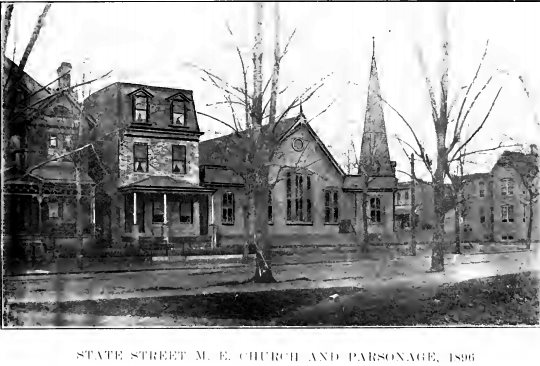
1896 — State Street Methodist Episcopal Church, parsonage & steeple.
In 1901 Rev. F. A. De Maris was sent to us, and he labored effectively until March of 1908. In the fall of 1902 a forward movement was determined upon, and in May, 1903, the chapel-building was removed to its present position, and ground broken for the new structure. The Building Committee consisted of Rev. F.A. De Maris, Barclay C. Bingham, William T. Propert, George L. Fox, Walter D. Gibbs, F. H. Cornelius and R. B. Simmerman. Work on the new temple progressed rapidly, and the structure, at a cost of nearly $30,000, was completed and dedicated January 24, 1904.
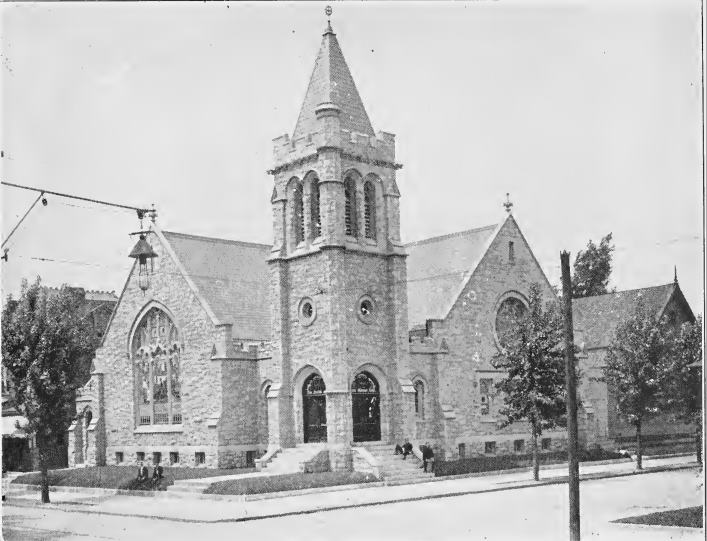
1909 — State Street Methodist Episcopal Church.
The pastorate of Rev. F. A. De Maris was uniformly successful. More than 450 members were received in the church during this period.
The church property at the present time is appraised conservatively at $50,000.
The Conference of 1908 assigned Rev. S. M. Vansant to this charge and for two years his labors were blessed of God in our midst.
State Street Methodist Episcopal Church Official Board — 1909
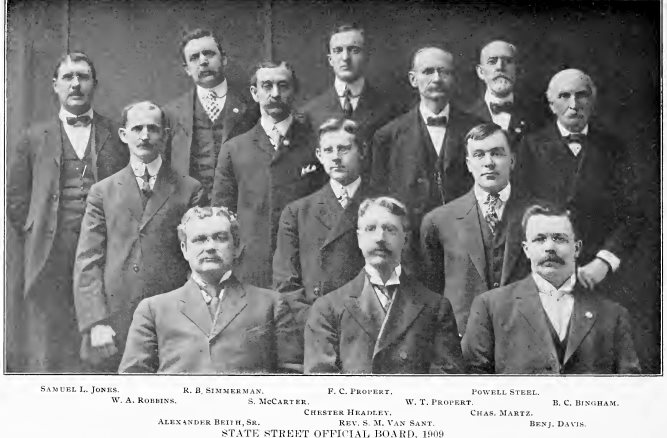
Samuel L. Jones — R.B. Simmerman — S. McCarter — P.C. Propert — W.T Propert — Powell Steel — B.C. Bingham
W.A. Robbins — Chester Headly — Charles Martz
Alexander Beith Sr. — Rev. S.M. Van Sant — Benjamin Davis
Rev. F.A. De Maris and Rev. S. Monroe Van Sant
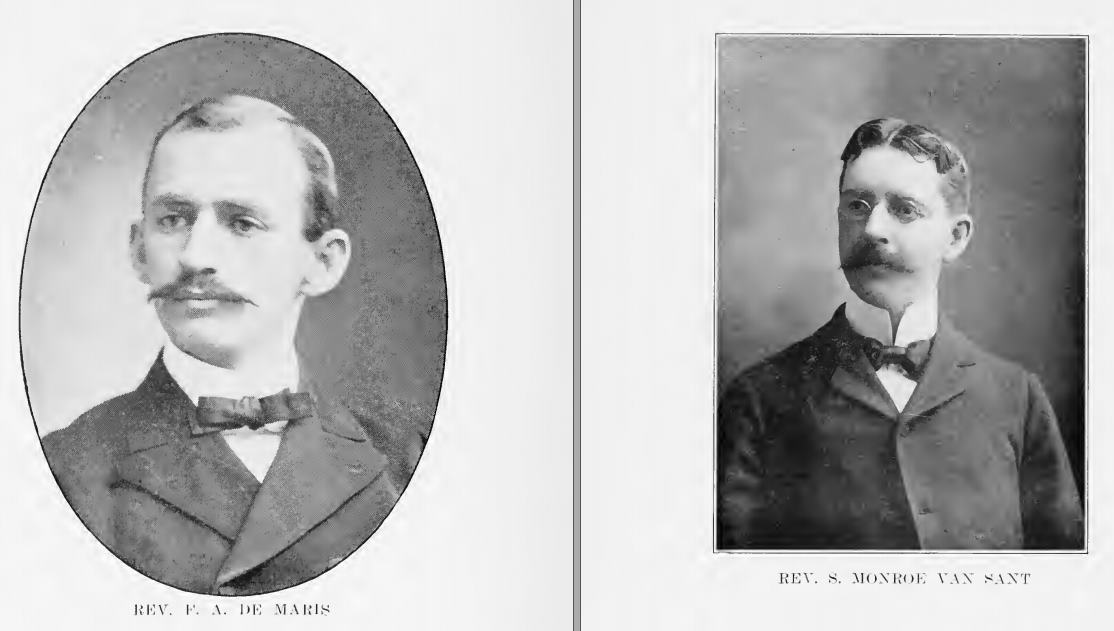
Rev. F.A. De Maris and Rev. S. Monroe Van Sant, pastors of State Street Methodist Episcopal Church.
Philadelphia Inquirer
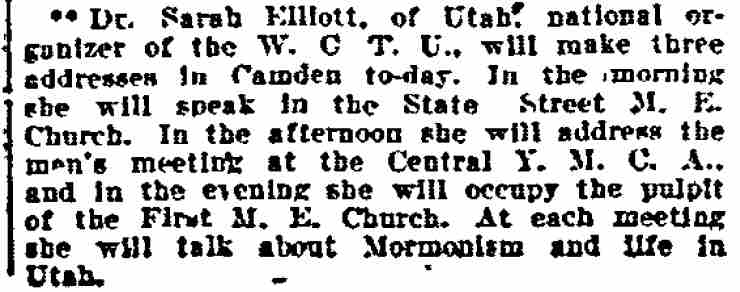
Dr. Sarah Elliott, of Utah, national organizer of the W. C. T. U., will make three addresses in Camden to-day. In the morning she will speak in the State Street M. E. Church. In the afternoon she will address the men’s meeting at the Central Y. M. C. A., and in the evening she will occupy the pulpit of the First M. E. Church. At each meeting she will talk about Mormonism and life in Utah.
Philadelphia Inquirer
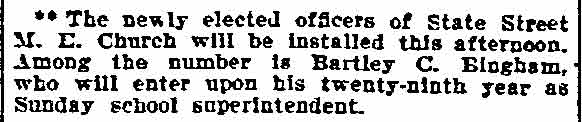
The newly elected officers of State Street M. E. Church will be installed this afternoon. Among the number is Bartley C. Bingham, who will enter upon his twenty-ninth year as Sunday school superintendent.
Philadelphia Inquirer

Jubilee Day will be celebrated to-day at State Street M. E. Church by special exercises. To-night Rev. F. A. DeMaris, the pastor, will preach on “Crossing the Dead Line.”
Camden News Notes
Philadelphia Inquirer —
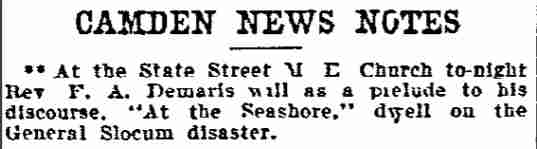
At the State Street M E Church to-night Rev F. A. Demaris will as a prelude to his discourse, “At the Seashore,” dwell on the General Slocum disaster.
Camden's Scarred Patriots
Philadelphia Inquirer —
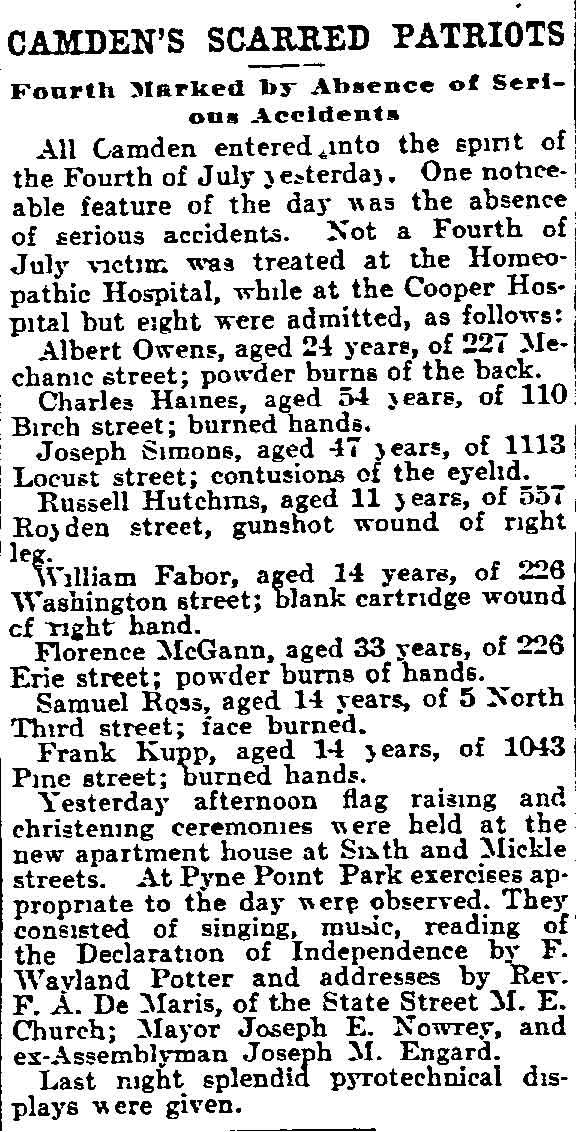
Fourth Marked by Absence of Serious Accidents
All Camden entered into the spirit of the Fourth of July yesterday. One noticeable feature of the day was the absence of serious accidents. Not a Fourth of July victim was treated at the Homeopathic Hospital, while at the Cooper Hospital but eight were admitted, as follows:
Albert Owens, aged 24 years, of 227 Mechanic street; powder burns of the back. Charles Haines, aged 54 years, of 110 Birch street; burned hands. Joseph Simons, aged 47 years, of 1113 Locust street; contusions of the eyelid. Russell Hutchins, aged 11 years, of 557 Royden street, gunshot wound of right leg. William Fabor, aged 14 years, of 226 Washington street; blank cartridge wound of right hand. Florence McGann, aged 33 years, of 226 Erie street; powder burns of hands. Samuel Ross, aged 14 years, of 5 North Third street; face burned. Frank Kupp, aged 14 years, of 1043 Pine street; burned hands.
Yesterday afternoon flag raising and christening ceremonies were held at the new apartment house at Sixth and Mickle streets. At Pyne Point Park exercises appropriate to the day were observed. They consisted of singing, music, reading of the Declaration of Independence by F. Wayland Potter and addresses by Rev. F. A. De Maris, of the State Street M. E. Church; Mayor Joseph E. Nowrey, and ex-Assemblyman Joseph M. Engard.
Last night splendid pyrotechnical displays were given.
Philadelphia Inquirer

“The Treating Habit in Our American Saloons” was the subject of a sermon preached by Rev. F. A. DeMaris, at the State Street M. E. Church, yesterday.
Camden News Notes
Philadelphia Inquirer —
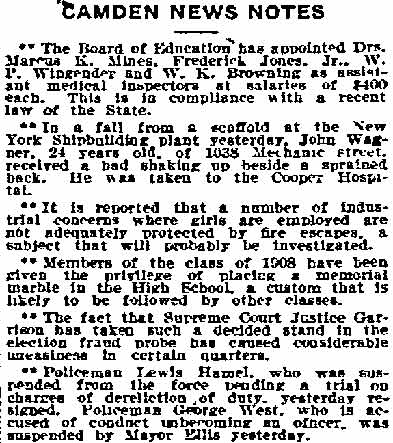
The Board of Education has appointed Drs. Marcus K. Mines, Frederick Jones Jr., W. P. Wingender and W. K. Browning as assistant medical inspectors at salaries of $400 each. This is in compliance with a recent law of the State.
In a fall from a scaffold at the New York Shipbuilding plant yesterday John Wagner, 24 years old, of 1038 Mechanic street, received a bad shaking up beside a sprained back. He was taken to the Cooper Hospital.
It is reported that a number of industrial concerns where girls are employed are not adequately protected by fire escapes, a subject that will probably be investigated.
Members of the class of 1908 have been given the privilege of placing a memorial marble in the High School, a custom that is likely to be followed by other classes.
The fact that Supreme Court Justice Garrison has taken such a decided stand in the election fraud probe has caused considerable uneasiness in certain quarters.
Policeman Lewis Hamel, who was suspended from the force pending a trial on charges of dereliction of duty, yesterday resigned. Policeman George West, who is accused of conduct unbecoming an officer, was suspended by Mayor Ellis yesterday.
William Beith Heads Club
Camden Courier-Post —
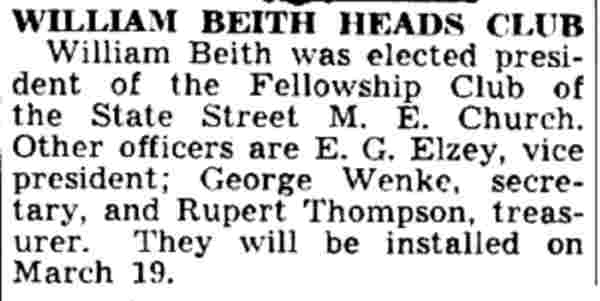
William Beith was elected president of the Fellowship Club of the State Street M. E. Church. Other officers are E. G. Elzey, vice president; George Wenke, secretary, and Rupert Thompson, treasurer. They will be installed on March 19.
Camden Courier-Post
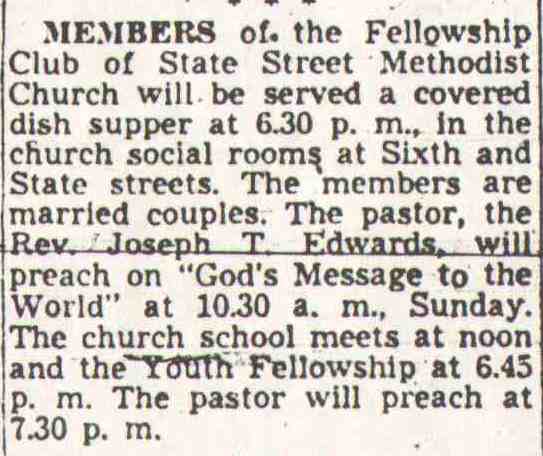
Members of the Fellowship Club of State Street Methodist Church will be served a covered dish supper at 6.30 p. m., in the church social rooms at Sixth and State streets. The members are married couples. The pastor, the Rev. Joseph T. Edwards, will preach on “God’s Message to the World” at 10.30 a. m., Sunday. The church school meets at noon and the Youth Fellowship at 6.45 p. m. The pastor will preach at 7.30 p. m.
Camden Courier-Post
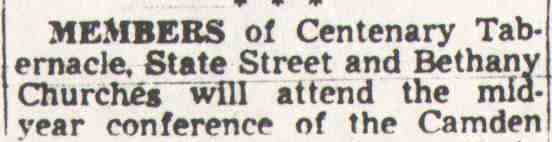
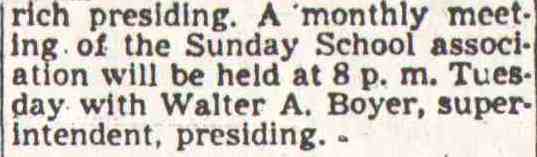
Members of Centenary Tabernacle, State Street and Bethany Churches will attend the mid-year conference of the Camden district. A monthly meeting of the Sunday School association will be held at 8 p. m. Tuesday with Walter A. Boyer, superintendent, presiding.