Introduction
GEORGE TABOR QUINN was born in New Jersey on January 23, 1875 to Davis Quinn and his wife, the former Estelle Abel. The family, which included older sister Violet, lived at 448 Benson Street as early as 1878 and were still there in 1888. Two younger children were born during this time, Leila A. Quinn in 1880 and Albert Quinn in 1886. By 1890 the Quinns had moved to 450 Benson Street. The 1900 Census shows George T. Quinn had married. He was living with his wife of 1 year, Clara, at 538 Federal Street, and that he worked as a paperhanger. Fire Department records show him already to have been working as a fireman, however.
The 1906 City Directory gives George T. Quinn’s address as 453 Royden Street. By April 22, 1910 George T. and Clara Quinn had relocated to 622 South 5th Street, where they stayed for at least the next 20 years. The Quinns were never blessed with children, but did raise a nephew, Charles F. Mills, who lived with them from the 1920s through the 1930s.
George T. Quinn was appointed to the Camden Fire Department at some point in the 1890s. He was serving as a ladderman with the Hook & Ladder Company, later known as Ladder Company 1, by November 1, 1898. On November 4, 1902 he was reassigned to another company, possibly the Chemical Engine Company (later Engine Company 8) on Kaighn Avenue. He returned to Ladder Company 1 on May 1, 1903 and worked there until August 26, 1903, when he was again reassigned. George T. Quinn was serving with Engine Company 8 on March 19, 1906 when the Sixth Regiment Armory on West Street between Bridge Avenue and Mickle Street burned down, taking the lives of three Camden firefighters. George T. Quinn was in a party of eight firefighters and a civilian guide who had entered the building and were caught in a ceiling collapse. Three men, George Shields, William Hillman, and William Jobes, lost their lives. Not long after this incident, George T. Quinn left the Camden Fire Department. On January 1, 1908 George T. Quinn was appointed to the Camden Police Department. He was still working as a member of the Camden Police Department as late as April, 1930.
The April 1930 Census shows George T. and Clara Quinn living at 622 South 5th Street, along with nephew Charles F. Mills, 24, who worked as a laborer in one of Camden’s shipyards. Neither George nor Clara Quinn is listed in the 1940 Camden City Directory.
Three Firemen Met Death in Camden Blaze
Philadelphia Inquirer —
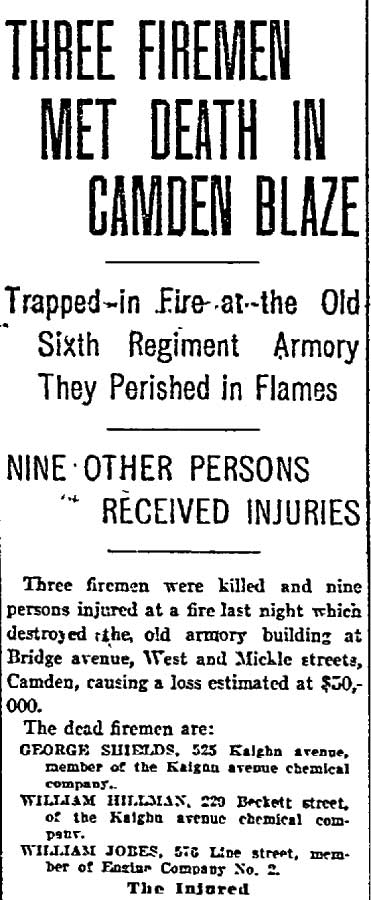
THREE FIREMEN MET DEATH IN CAMDEN BLAZE
Trapped in Fire at the Old Sixth Regiment Armory They Perished in Flames
NINE OTHER PERSONS RECEIVED INJURIES
Three firemen were killed and nine persons injured at a fire last night which destroyed the old armory building at Bridge avenue, West and Mickle streets, Camden, causing a loss estimated at $50,000.
The dead firemen are: GEORGE SHIELDS, 525 Kaighn avenue, member of the Kaighn avenue chemical company. WILLIAM HILLMAN, 229 Beckett street, of the Kaighn avenue chemical company. WILLIAM JOBES, 576 Line street, member of Engine Company No. 2.
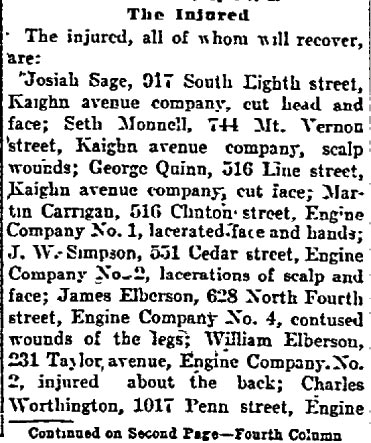
The Injured
The Injured
The injured, all of whom will recover, are: Josiah Sage, 917 South Eighth street, Kaighn avenue company, cut head and face; Seth Monnell, 744 Mt. Vernon street, Kaighn avenue company, scalp wounds; George Quinn, 516 Line street, Kaighn avenue company, cut face; Martin Carrigan, 516 Clinton street, Engine Company No. 1, lacerated face and hands; J. W. Simpson, 551 Cedar street, Engine Company No. 2, lacerations of scalp and face; James Elberson, 628 North Fourth street, Engine Company No. 4, contused wounds of the legs; William Elberson, 231 Taylor avenue, Engine Company No. 2, injured about the back; Charles Worthington, 1017 Penn street, Engine
Continued on Second Page—Fourth Column
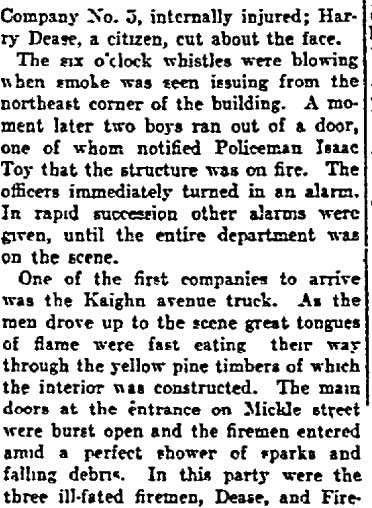
Company No. 3, internally injured; Harry Dease, a citizen, cut about the face.
The six o’clock whistles were blowing when smoke was seen issuing from the northeast corner of the building. A moment later two boys ran out of a door, one of whom notified Policeman Isaac Toy that the structure was on fire. The officers immediately turned in an alarm. In rapid succession other alarms were given, until the entire department was on the scene.
One of the first companies to arrive was the Kaighn avenue truck. As the men drove up to the scene great tongues of flame were fast eating their way through the yellow pine timbers of which the interior was constructed. The main doors at the entrance on Mickle street were burst open and the firemen entered amid a perfect shower of sparks and falling debris. In this party were the three ill-fated firemen, Dease, and Fire-
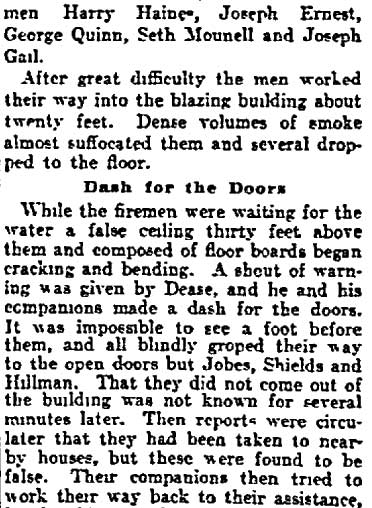
men Harry Haines, Joseph Ernest, George Quinn, Seth Mounell and Joseph Gail.
After great difficulty the men worked their way into the blazing building about twenty feet. Dense volumes of smoke almost suffocated them and several dropped to the floor.
Dash for the Doors
While the firemen were waiting for the water a false ceiling thirty feet above them and composed of floor boards began cracking and bending. A shout of warning was given by Dease, and he and his companions made a dash for the doors. It was impossible to see a foot before them, and all blindly groped their way to the open doors but Jobes, Shields and Hillman. That they did not come out of the building was not known for several minutes later. Then reports were circulated that they had been taken to nearby houses, but these were found to be false. Their companions then tried to work their way back to their assistance,
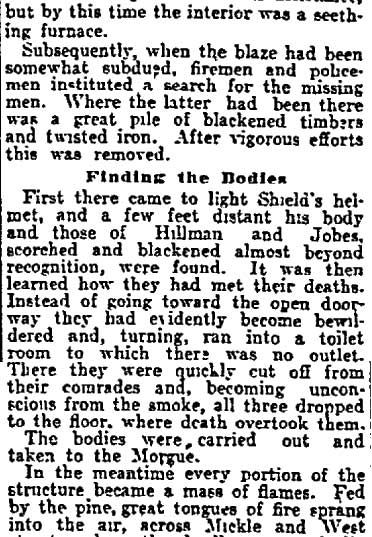
but by this time the interior was a seething furnace.
Subsequently, when the blaze had been somewhat subdued, firemen and policemen instituted a search for the missing men. Where the latter had been there was a great pile of blackened timbers and twisted iron. After vigorous efforts this was removed.
Finding the Bodies
First there came to light Shield’s helmet, and a few feet distant his body and those of Hillman and Jobes, scorched and blackened almost beyond recognition, were found. It was then learned how they had met their deaths. Instead of going toward the open doorway they had evidently become bewildered and, turning, ran into a toilet room to which there was no outlet. There they were quickly cut off from their comrades and, becoming unconscious from the smoke, all three dropped to the floor, where death overtook them.
The bodies were carried out and taken to the Morgue.
In the meantime every portion of the structure became a mass of flames. Fed by the pine, great tongues of fire sprang into the air, across Mickle and West
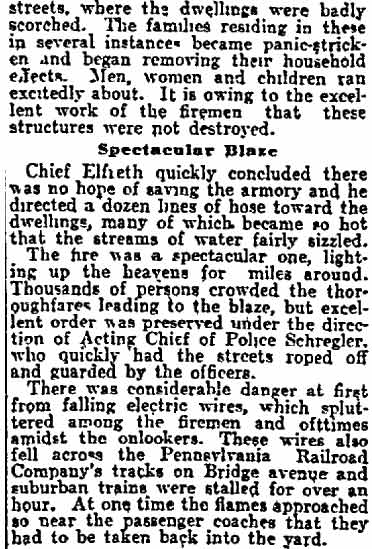
streets, where the dwellings were badly scorched. The families residing in these in several instances became panic-stricken and began removing their household effects. Men, women and children ran excitedly about. It is owing to the excellent work of the firemen that these structures were not destroyed.
Spectacular Blaze
Chief Elfieth quickly concluded there was no hope of saving the armory and he directed a dozen lines of hose toward the dwellings, many of which became so hot that the streams of water fairly sizzled.
The fire was a spectacular one, lighting up the heavens for miles around. Thousands of persons crowded the thoroughfares leading to the blaze, but excellent order was preserved under the direction of Acting Chief of Police Schregler, who quickly had the streets roped off and guarded by the officers.
There was considerable danger at first from falling electric wires, which spluttered among the firemen and ofttimes amidst the onlookers. These wires also fell across the Pennsylvania Railroad Company’s tracks on Bridge avenue and suburban trains were stalled for over an hour. At one time the flames approached so near the passenger coaches that they had to be taken back into the yard.
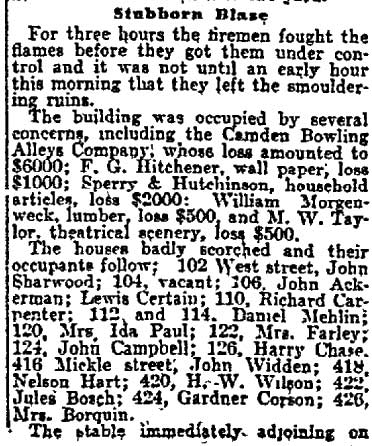
Stubborn Blaze
For three hours the firemen fought the flames before they got them under control and it was not until an early hour this morning that they left the smouldering ruins.
The building was occupied by several concerns, including the Camden Bowling Alleys Company, whose loss amounted to $6000; F. G. Hitchener, wall paper, loss $1000; Sperry & Hutchinson, household articles, loss $2000; William Morgenweck, lumber, loss $500, and M. W. Taylor, theatrical scenery, loss $500.
The houses badly scorched and their occupants follow: 102 West street, John Sharwood; 104, vacant; 106, John Ackerman; Lewis Certain; 110, Richard Carpenter; 112, and 114, Daniel Mehlin; 120, Mrs. Ida Paul; 122, Mrs. Farley; 124, John Campbell; 126, Harry Chase; 416 Mickle street: John Widden; 418, Nelson Hart; 420, H.-W. Wilson; 422, Jules Bosch; 424, Gardner Corson; 426, Mrs. Borquin.
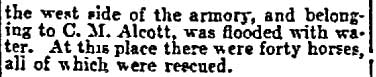
The stable immediately adjoining on
the west side of the armory, and belonging to C. M. Alcott, was flooded with water. At this place there were forty horses, all of which were rescued.
Formerly a Market
The destroyed building was erected in 1873, by a number of well-known Camden men, as the Farmers’ and Merchants’ Market. From the first it was not a success, and subsequently became known as the Camden Opera House. After a more or less successful season the promoters of this scheme closed the doors. In 1886 the building was purchased by the State as an armory for the old Sixth Regiment, N. G. N. J. For ten years Camden’s citizen soldiers drilled and gave balls and receptions in the building. When the regiment moved to the new armory on Haddon avenue the old structure was cut up into several rooms and had been used by many different concerns. Recently it was purchased by the Pennsylvania Railroad Company to make way for the elevated railroad. All the tenants had been ordered to vacate.
The origin of the fire is unknown. Incendiarism is hinted at and Mayor Ellis declared he will detail the detectives on the case to-day to make a rigid investigation.
Speaking of the matter, he said it is very peculiar that most of Camden’s fires occur about the time the firemen are at their meals. This has been the case in most every blaze if any importance in the city. The Mayor also highly commended the excellent work of the men in preventing a spread of the flames.
In Memory of Dead Heroes
Philadelphia Inquirer —
Mayor Ellis, in Camden, yesterday issued a proclamation calling on the citizens to assemble at the First Baptist and the Broadway M. E. Churches on Sunday to participate in the services to be held in memory of Firemen George Shields, William Jones and William Hillman, who were killed at the Armory fire last Friday night. The first service will be held at the Baptist Church, at three o’clock, while the one at the Methodist Church will be held at quarter after four o’clock. The subscription fund being raised for the families of the firemen had reached nearly $2000 last night.
The funeral of Fireman Shields took place yesterday from his home, 525 Kaikhn [sic] avenue. Hundreds of persons viewed the body, both Tuesday night and yesterday morning. hTe [sic] services were in charge of Rev. John S. Heisler, of the M. E. Church. The body reposed in a handsome oak casket and was surrounded by numerous floral tributes. The services were attended by forty firemen under Chief Elfreth, while the pall-bearers included Firemen Samuel Price, William Deno, Charles Robinson, Peter Carter, Joseph Ernest and George Quinn. Interment was made at the Evergreen Cemetery.
Camden Increases Its Police Force
Philadelphia Inquirer —
Camden’s police force was increased by the appointment of twenty-five additional officers by Mayor Ellis yesterday. There were also several promotions, two new captains, two sergeants and one detective being made as follows: Captains, Edward Hyde and A. Lincoln James, advanced from sergeants; sergeants, E. B. McClong and Edward Hartman, advanced from patrolmen; detective, John Brothers, advanced from patrolman; new patrolmen. Fred Schwetzer, William Briant, Charles Hume, Charles Wilbur, Wright Cox, Walter Stanton, John Barnett, Tabor Quinn, John Gilbert, Joseph Palese, William Haines, Frederick Watson, Charles Whaland, William Kiker, James Hutt, George Krown, Ule Andrews, Daniel Stanton, Albert Archer, Harry Bakley, John Shuman, Oscar Till, Albertson Matlack, John Devlin, George Hollins, Frank Koplain, Edward King and George Beasley, substitutes.
For the past several weeks there has been much pulling and hauling of the political wires and the various ward leaders have had their own troubles in making selections. Each appointee was subjected to a regulation army examination by Dr. A. H. Lippincott before he was pronounced fit for the service. When the horses are procured, which may be by next June, six of the men will compose a mounted squad.
Police Carnival Was a Gigantic Success
Philadelphia Inquirer —
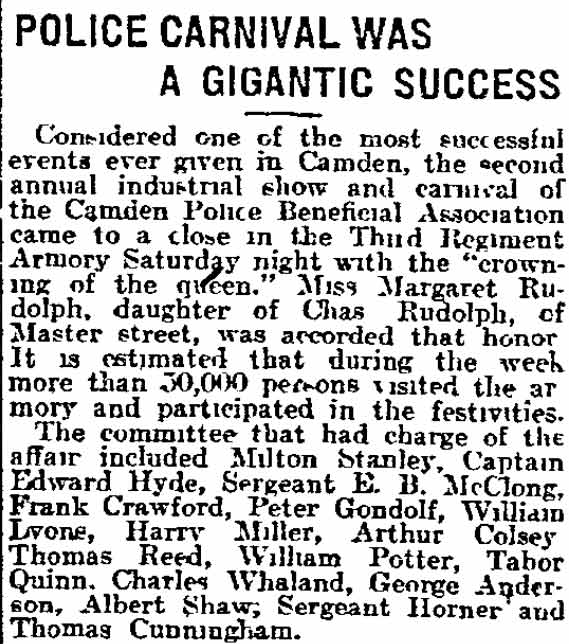
Considered one of the most successful events ever given in Camden, the second annual industrial show and carnival of the Camden Police Beneficial Association came to a close in the Third Regiment Armory Saturday night with the “crowning of the queen.” Miss Margaret Rudolph, daughter of Chas. Rudolph, of Master street, was accorded that honor. It is estimated that during the week more than 50,000 persons visited the armory and participated in the festivities.
The committee that had charge of the affair included Milton Stanley, Captain Edward Hyde, Sergeant E. B. McClong, Frank Crawford, Peter Gondolf, William Lvone, Harry Miller, Arthur Colsey, Thomas Reed, William Potter, Tabor Quinn, Charles Whaland, George Anderson, Albert Shaw, Sergeant Horner and Thomas Cunningham.
(social item, no headline)
Camden Post-Telegram —
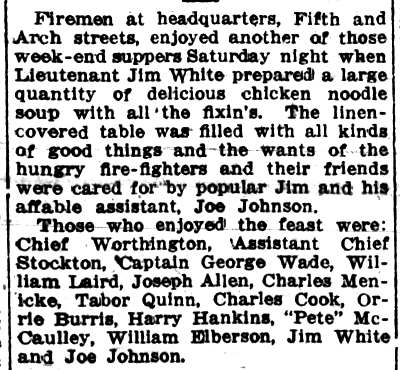
Firemen at headquarters, Fifth and Arch streets, enjoyed another of those week-end suppers Saturday night when Lieutenant Jim White prepared a large quantity of delicious chicken noodle soup with all the fixin’s. The linen-covered table was filled with all kinds of good things and the wants of the hungry fire-fighters and their friends were cared for by popular Jim and his affable assistant, Joe Johnson.
Those who enjoyed the feast were: Chief Worthington, Assistant Chief Stockton, Captain George Wade, William Laird, Joseph Allen, Charles Menicke, Tabor Quinn, Charles Cook, Orrie Burris, Harry Hankins, “Pete” McCaulley, William Elberson, Jim White and Joe Johnson.
Firemen at headquarters, Fifth and Arch streets, enjoyed another of those week-end suppers Saturday night when Lieutenant Jim White prepared a large quantity of delicious chicken noodle soup with all the fixin’s. The linen-covered table was filled with all kinds of good things and the wants of the hungry fire-fighters and their friends were cared for by popular Jim and his affable assistant, Joe Johnson.
Those who enjoyed the feast were: Chief Worthington, Assistant Chief Stockton, Captain George Wade, William Laird, Joseph Allen, Charles Menicke, Tabor Quinn, Charles Cook, Orrie Burris, Harry Hankins, “Pete” McCaulley, William Elberson, Jim White and Joe Johnson.
World War I Draft Card
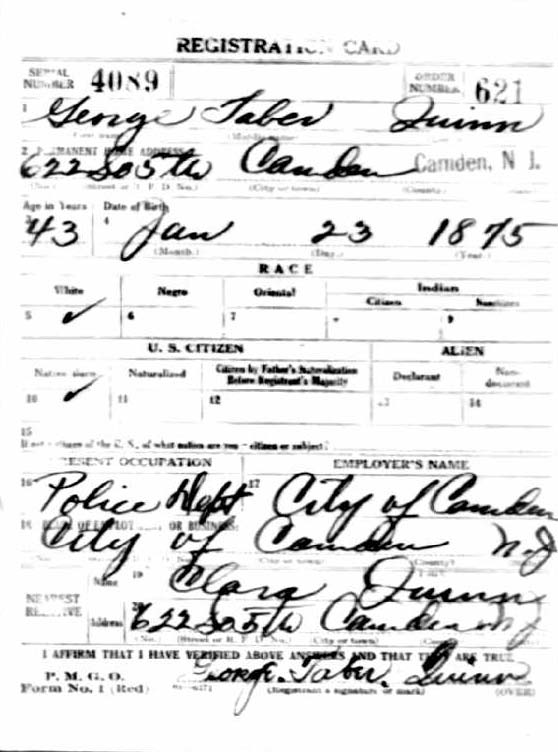
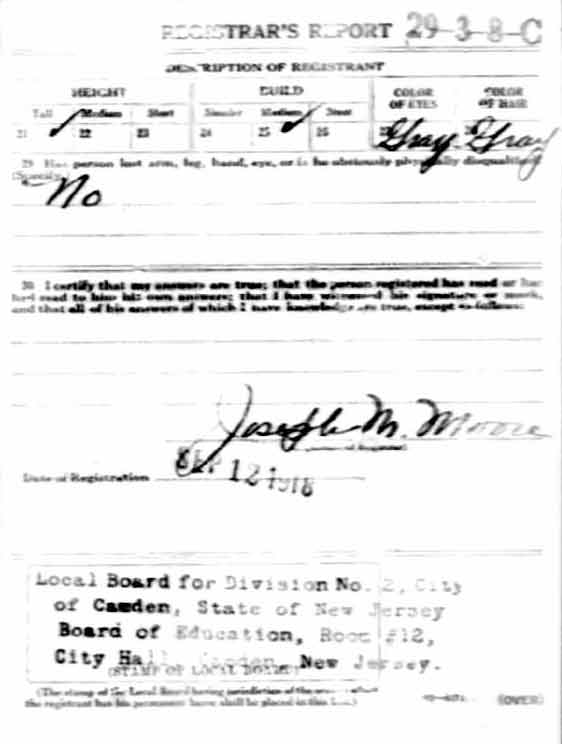
George Tabor Quinn — World War I Draft Card