Introduction
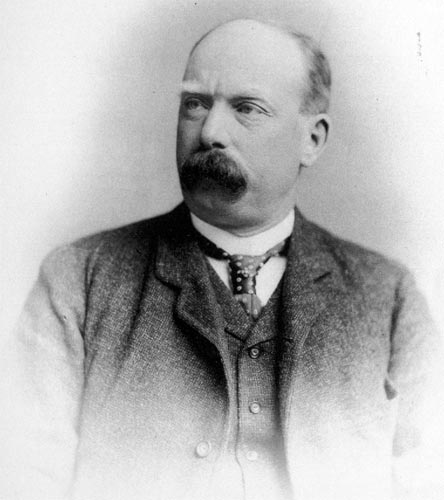
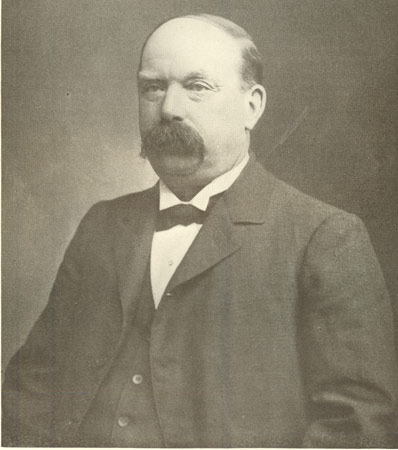
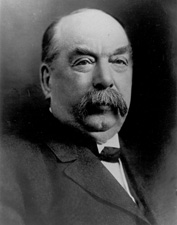
Portraits of David Baird Sr.: photos published in 1886 and 1908, and a congressional photo from 1918.
David Baird Sr. was one of Camden’s leading citizens for well over 50 years. Born in Ireland on April 7th of 1839, he came to America in 1858 after the death of his father, and settled in Camden the following year. After working in a Philadelphia lumber yard for 13 years, he opened his own business, the David Baird Company, in Camden in 1872 and became quite successful, with lumber operations in eight states and ship’s spar yards in five different cities in the northeast.
David Baird involved himself in politics, and served in a variety of capacities. He was a quite powerful figure in the Republican party which dominated Camden politics. A protégé of Civil War hero, Congressional Medal of Honor winner, and United States Senator William Joyce Sewell, he secured contracts to supply poles to string the new telegraph, telephone and electrical lines in Camden and the surrounding area, and timber contracts during the Spanish-American War through Sewell’s patronage. In return, David Baird ran the local Republican organization while Sewell served in Trenton and Washington.
To say David Baird Sr. did quite well during these years would be an understatement. He acquired the home at 804 Cooper Street in the 1890s, the mansion built by real estate developer Edward N. Cohn in the late 1880s. The Baird family would make its home here until October of 1936, when his son David Baird Jr. left Camden for his farm in Delaware Township (present-day Cherry Hill).
David Baird Sr. was the dominant figure in the Camden County Republican party after Sewell’s death. At different times he served as a member of the Board of Chosen Freeholders, Camden County Sheriff, and sat on the New Jersey State Board of Assessors. An unsuccessful Senatorial candidate in 1910, he was appointed to the United States Senate in 1918 to fill the seat vacated by the death of Senator William Hughes, and won a special election in November of that year to serve the remaining two years of that term. He served on the Republican State Committee and was a delegate to the National Conventions in 1888, 1904, and 1916. After returning to Camden from his senatorial service in Washington DC, David Baird continued his involvement in local politics, and was instrumental in the acquisition of 225 Broadway, which served as Republican Party headquarters in Camden from 1923 until 1940.
Besides his lumberyard, David Baird’s business interests included a partnership with Joseph I. Morris of the Morris and Mathis Shipyard and Joseph Tway. The three founded the Tway Steel Forge, which later became the Camden Forge, on Mount Ephraim Avenue. This business provided most of the steel forging for the New York Shipbuilding yards during both World Wars. In 1916, David Baird Sr. was the President of the First National Bank of Camden, and on the Board of Directors of the Security Trust Company.
On January 28, 1897 then Sheriff David Baird Sr. was one of several dignitaries who were in attendance at the opening of the Catholic Lyceum, attached to the Church of the Immaculate Conception on Broadway at Market Street. Other attendees included the New Jersey Governor John W. Griggs, Mayor John L. Westcott, late Attorney-General Samuel H. Grey, Camden city solicitor J. Willard Morgan, Senator H. W. Johnson, then-Assemblymen Louis Derousse and Scovel, Postmaster Harry B. Paul, ex-Judge Armstrong, Architect Henry S. Dagit, J. J. Burleigh, George A. Frey, and H. L. Bonsall. The Lyceum would evolve into Camden Catholic High School.
David Baird Sr.’s wife, Christianna Beatty Baird, was very involved with the founding and operation of The Home for the Aged and Infirm of the Methodist Episcopal Church, which was originally at 531 York Street before its construction and opening in Collingswood in 1891. Mrs. Baird passed away on August 29, 1897. The Baird’s daughter, Mrs. Mary Baird Fox, then took up her mother’s role as President of the Board of Managers of the Home.
David Baird Sr. served twice as Sheriff of Camden County, from 1887 to 1890 and from 1896 to 1898. While Sheriff in 1887 he appointed his cousin, David Logue to the position of turnkey of the Camden County jail, a post he held until 1906, when he was made warden, serving in that capacity until 1921. Another cousin, Joseph Logue, served from 1894 to 1920 as a firefighter with the Camden Fire Department.
David Baird Sr. passed away at his home, 804 Cooper Street, Camden NJ on February 25, 1927. He was interred at Harleigh Cemetery. His surviving family members included his son David Baird Jr., who also served as a senatorial appointee from New Jersey, and was a dominant figure in South Jersey Republican politics for many years after his father’s passing.
BAIRD BOULEVARD in Camden was named in honor of David Baird Sr.
The History of Camden County New Jersey
George Reeser Prowell – 1886
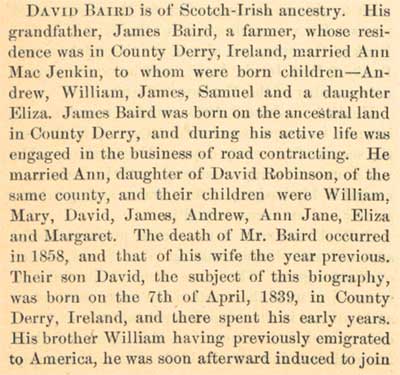
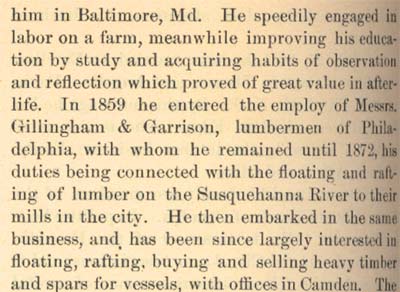
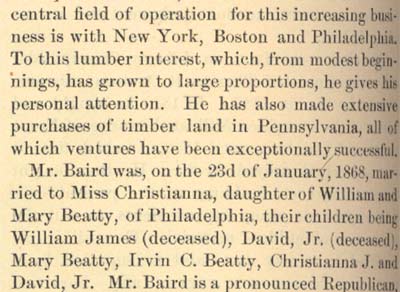
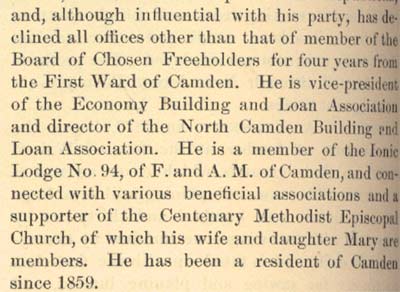
The History of Camden County New Jersey – George Reeser Prowell, 1886
Executive Committee
Philadelphia Inquirer —
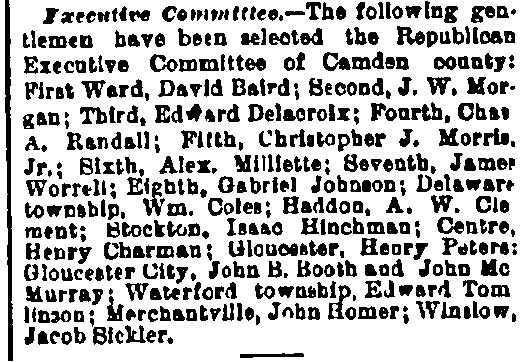
The following gentlemen have been selected the Republican Executive Committee of Camden county: First Ward, David Baird; Second, J. W. Morgan; Third, Edward Delacroix; Fourth, Chas. A. Randall; Fifth, Christopher J. Morris, Jr.; Sixth, Alex. Millette; Seventh, James Worrell; Eighth, Gabriel Johnson; Delaware township, Wm. Coles; Haddon, A. W. Clement; Stockton, Isaac Hinchman; Centre, Henry Charman; Gloucester, Henry Peters; Gloucester City, John B. Booth and John McMurray; Waterford township, Edward Tomlinson; Merchantville, John Homer; Winslow, Jacob Bickler.
An Attempted Outrage
Camden Daily Courier —
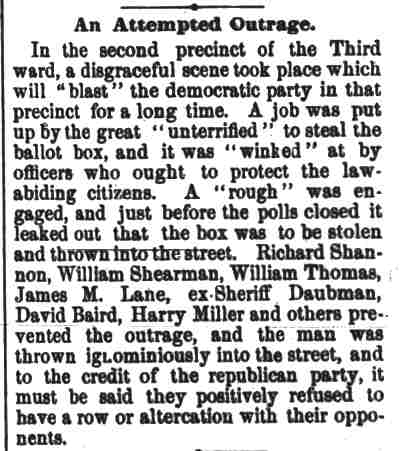
In the second precinct of the Third ward, a disgraceful scene took place which will “blast” the democratic party in that precinct for a long time. A job was put up by the great “unterrified” to steal the ballot box, and it was “winked” at by officers who ought to protect the law-abiding citizens. A “rough” was engaged, and just before the polls closed it leaked out that the box was to be stolen and thrown into the street. Richard Shannon, William Shearman, William Thomas, James M. Lane, ex-Sheriff Daubman, David Baird, Harry Miller and others prevented the outrage, and the man was thrown ignominiously into the street, and to the credit of the republican party, it must be said they positively refused to have a row or altercation with their opponents.
Camden County Republican Committee Meeting
Philadelphia Inquirer —
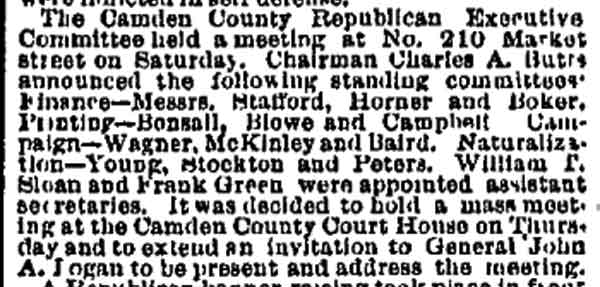
The Camden County Republican Executive Committee held a meeting at No. 210 Market Street on Saturday. Chairman Charles A. Butts announced the following standing committees: Finance, Printing (including John Blowe), and Campaign (including David Baird). William P. Sloan and Frank Green were appointed assistant secretaries. It was decided to hold a mass meeting at the Camden County Court House and to extend an invitation to General John A. Logan to preside.
Politics in Jersey.
Philadelphia Inquirer —
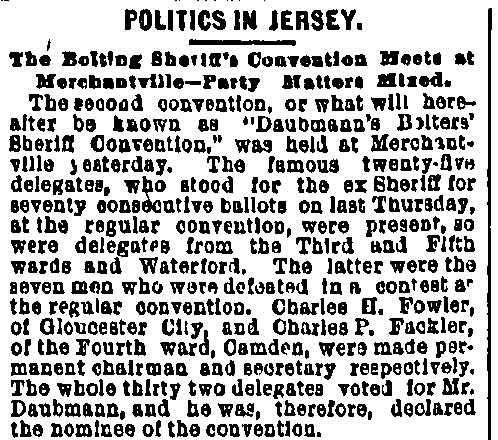
The Bolting Sheriff’s Convention Meets at Merchantville—Party Matters Mixed.
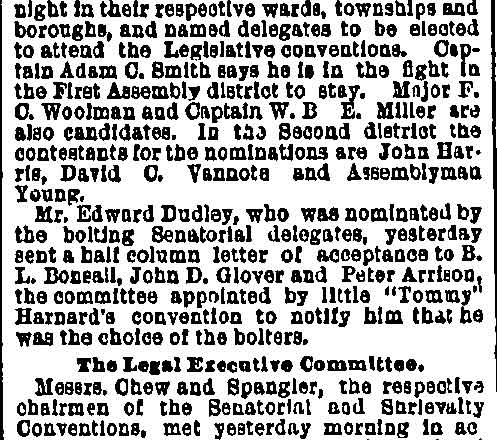
The second convention, or what will hereafter be known as “Daubmann’s Bolters’ Sheriff Convention,” was held at Merchantville yesterday. The famous twenty-five delegates, who stood for the ex-Sheriff for seventy consecutive ballots on last Thursday, at the regular convention, were present, so were delegates from the Third and Fifth wards and Waterford. The latter were the seven men who were defeated in a contest at the regular convention. Charles H. Fowler, of Gloucester City, and Charles P. Fackler, of the Fourth ward, Camden, were made permanent chairman and secretary reepectively [sic]. The whole thirty two delegates voted for Mr. Daubmann, and he was, therefore, declared the nominee of the convention.
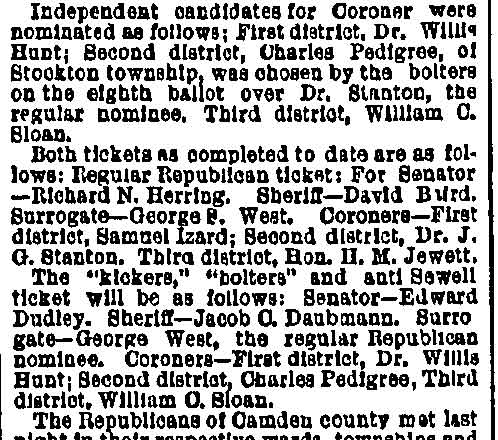
Independent candidates for Coroner were nominated as follows; First district, Dr. Willis Hunt; Second district, Charles Pedigree, of Stockton township, was chosen by the bolters on the eighth ballot over Dr. Stanton, the regular nominee. Third district, William C. Sloan.
Both tickets as completed to date are as follows: Regular Republican ticket: For Senator—Richard N. Herring. Sheriff—David Burd [sic]. Surrogate—George S. West. Coroners—First district, Samuel Izard; Second district, Dr. J. G. Stanton. Third district, Hon. H. M. Jewett.
The “kickers,” “bolters” and anti Sewell ticket will be as follows: Senator—Edward Dudley. Sheriff—Jacob C. Daubmann. Surrogate—George West, the regular Republican nominee. Coroners—First district, Dr. Willis Hunt; Second district, Charles Pedigree. Third district, William O. Sloan.
The Republicans of Camden county met last night in their respective wards, townships and boroughs, and named delegates to be elected to attend the Legislative conventions. Captain Adam C. Smith says he is in the fight in the First Assembly district to stay. Major F. C. Woolman and Captain W. B. E. Miller are also candidates. In the Second district the contestants for the nominations are John Harris, David C. Vannots and Assemblyman Young.
Mr. Edward Dudley, who was nominated by the bolting Senatorial delegates, yesterday sent a half column letter of acceptance to B. L. Bonsall, John D. Glover and Peter Arrison, the committee appointed by little “Tommy” Harnard’s convention to notify him that he was the choice of the bolters.
The Legal Executive Committee.
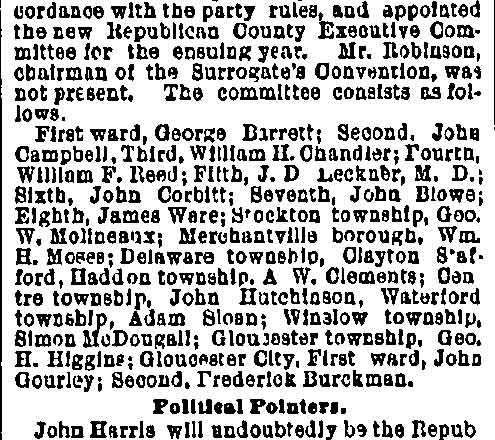
Messrs. Chew and Spangler, the respective chairmen of the Senatorial and Surlevalty Conventions, met yesterday morning in accordance with the party rules, and appointed the new Republican County Executive Committee for the ensuing year. Mr. Robinson, chairman of the Surrogate’s Convention, was not present. The committee consists as follows.
First ward, George Barrett; Second, John Campbell, Third, William H. Chandler; Fourth, William F. Reed; Fifth, J. D. Leckner, M. D.; Sixth, John Corbitt; Seventh, John Blowe; Eighth, James Ware; Stockton township, Geo. W. Molineaux; Merchantville borough, Wm. H. Moses; Delaware township, Clayton Stafford, Haddon township, A. W. Clements; Centre township, John Hutchinson, Waterford township, Adam Sloan; Winslow township, Simon McDougall; Gloucester township, Geo. H. Higgins; Gloucester City, First ward, John Gourley; Second, Frederick Burckman.
Political Pointers.
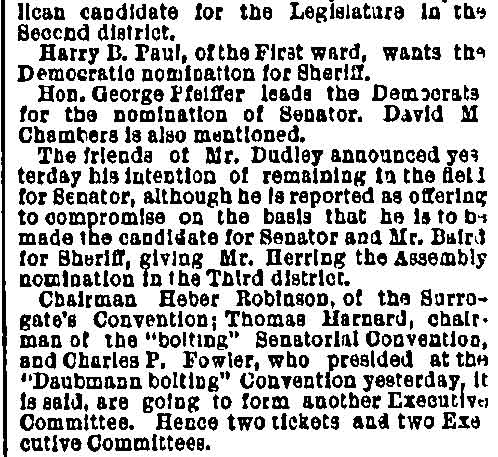
John Harris will undoubtedly be the Republican candidate for the Legislature in the Second district.
Harry B. Paul, of the First ward, wants the Democratic nomination for Sheriff.
Hon. George Pfeiffer leads the Democrats for the nomination of Senator. David M Chambers is also mentioned.
The friends of Mr. Dudley announced yesterday his intention of remaining in the field for Senator, although he is reported as offering to compromise on the basis that he is to be made the candidate for Senator and Mr. Baird for Sheriff, giving Mr. Herring the Assembly nomination in the Third district.
Chairman Heber Robinson, of the Surrogate’s Convention; Thomas Harnard, chairman of the “bolting” Senatorial Convention, and Charles P. Fowler, who presided at the “Daubmann bolting” Convention yesterday, it is said, are going to form another Executive Committee. Hence two tickets and two Executive Committees.
Jottings.
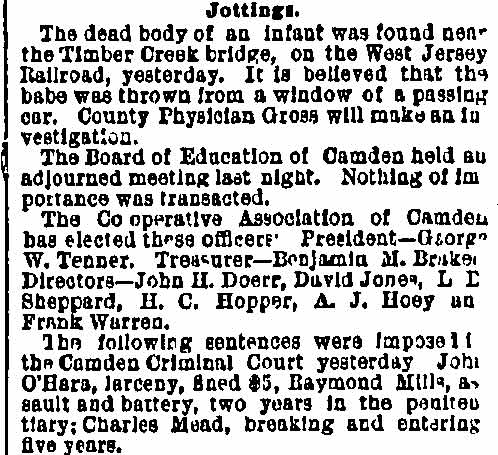
The dead body of an infant was found near the Timber Creek bridge, on the West Jersey Railroad, yesterday. It is believed that the babe was thrown from a window of a passing car. County Physician Gross will make an investigation.
The Board of Education of Camden held an adjourned meeting last night. Nothing of importance was transacted.
The Co-operative Association of Camden has elected these officers: President—George W. Tenner. Treasurer—Benjamin M. Braker. Directors—John H. Doerr, David Jones, L. D. Sheppard, H. C. Hopper, A. J. Hoey and Frank Warren.
The following sentences were imposed at the Camden Criminal Court yesterday: John O’Hara, larceny, fined $5; Raymond Mills, assault and battery, two years in the penitentiary; Charles Mead, breaking and entering five years.
By His Victim’s Bedside.
Philadelphia Inquirer —
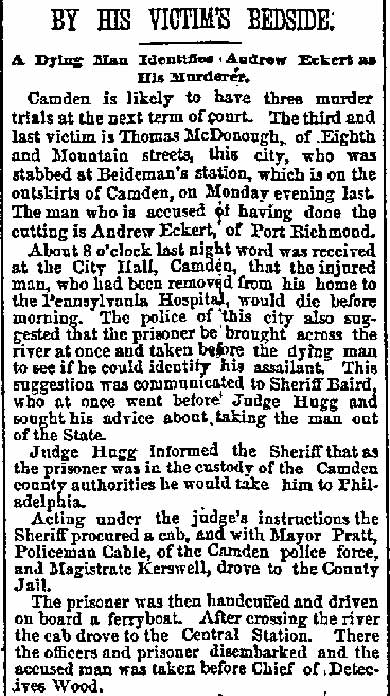
A Dying Man Identifies Andrew Eckert as His Murderer.
Camden is likely to have three murder trials at the next term of court. The third and last victim is Thomas McDonough, of Eighth and Mountain streets, this city, who was stabbed at Beideman’s station, which is on the outskirts of Camden, on Monday evening last. The man who is accused of having done the cutting is Andrew Eckert, of Port Richmond.
About 8 o’clock last night word was received at the City Hall, Camden, that the injured man, who had been removed from his home to the Pennsylvania Hospital, would die before morning. The police of this city also suggested that the prisoner be brought across the river at once and taken before the dying man to see if he could identify his assailant. This suggestion was communicated to Sheriff Baird, who at once went before Judge Hugg and sought his advice about taking the man out of the State.
Judge Hugg informed the Sheriff that as the prisoner was in the custody of the Camden county authorities he would take him to Philadelphia.
Acting under the judge’s instructions the Sheriff procured a cab, and with Mayor Pratt, Policeman Cable, of the Camden police force, and Magistrate Kerswell, drove to the County Jail.
The prisoner was then handcuffed and driven on board a ferryboat. After crossing the river the cab drove to the Central Station. There the officers and prisoner disembarked and the accused man was taken before Chief of Detectives Wood.
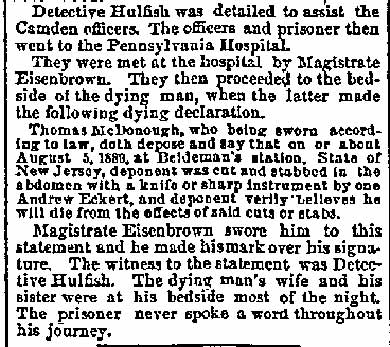
Detective Hulfish was detailed to assist the Camden officers. The officers and prisoner then went to the Pennsylvania Hospital.
They were met at the hospital by Magistrate Eisenbrown. They then proceeded to the bedside of the dying man, when the latter made the following dying declaration:
Thomas McDonough, who being sworn according to law, doth depose and say that on or about August 5, 1889, at Beideman’s station, State of New Jersey, deponent was cut and stabbed in the abdomen with a knife or sharp instrument by one Andrew Eckert, and deponent verily believes he will die from the effects of said cuts or stabs.
Magistrate Eisenbrown swore him to this statement and he made his mark over his signature. The witness to the statement was Detective Hulfish. The dying man’s wife and his sister were at his bedside most of the night. The prisoner never spoke a word throughout his journey.
Historical and Industrial Review of Camden, N.J.
1890
DAVID BAIRD, SPARS, TIMBER AND PILING, POINT AND PEARL STREETS
IN the important department of heavy timber for ships’ spars and masts, for wharf building, and for all constructive work requiring massive girders, etc., the establishment of Mr. David Baird is one of the most prominent in Camden. Mr. Baird has been connected with this line of business for the past 30 years, and is therefore thoroughly practised and experienced in all its details. In 1873 he commenced the present firm, dealing in spars, heavy logs and timber, and piling, and now carries a stock which is the heaviest of this kind in the United States, and which is divided between the three cities, New York, Boston and Philadelphia. The yards and log-pens are located at Point and Pearl streets, having a large river frontage, and all the necessary conveniences, and the trade is one which may be said practically to extend to all parts of the country, the chief markets being New York City, New London, Boston, Mystic Bridge, Portland, Maine; Gloucester, Mass., and the East generally. The spars, which vary in length from 30 to 100 feet, and from 6 to 40 inches in diameter, are either floated in rafts or brought by vessels from the lumber districts of Pennsylvania, Nova Scotia, New York State, Michigan and California, and are secured in the log-pens until needed. Some are sold in the rough, and others dressed and finished for their destined purpose, the majority being made into spars of various dimensions for shipping. The business is a heavy one in all its details, employs very large capital and much labor, both skilled and unskilled, and is almost entirely wholesale. It is an essentially water-side and maritime industry, and one for which the city of Camden, with its fine river frontage, is particularly well adapted.
In addition to his business in spars, Mr. Baird is also a considerable owner of vessel property, either owning entirely, or in part, a large number of sailing vessels and several tug-boats. He is an influential citizen of Camden, known and respected highly in all circles, especially in political life. He has held most of the prominent public municipal offices, and now sustains the responsible duty of Sheriff of Camden City and County.
Corporation Elections
Philadelphia Inquirer —
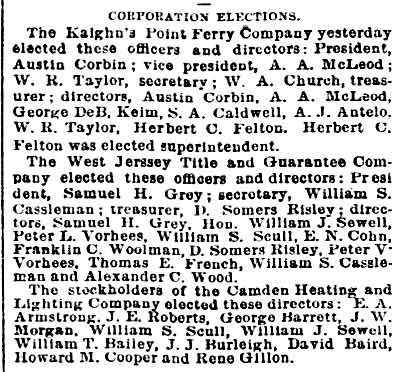
CORPORATION ELECTIONS.
The Kaighn’s Point Ferry Company yesterday elected these officers and directors: President, Austin Corbin; vice president, A. A. McLeod; W. R. Taylor, secretary; W. A. Church, treasurer; directors, Austin Corbin, A. A. McLeod, George DeB. Keim, S. A. Caldwell, A. J. Antelo. W. R. Taylor, Herbert C. Felton. Herbert C. Felton was elected superintendent.
The West Jersey Title and Guarantee Company elected these officers and directors: President, Samuel H. Grey; secretary, William S. Cassleman; treasurer, D. Somers Risley; directors, Samuel H. Grey, Hon. William J. Sewell, Peter L. Vorhees, William S. Scull, E. N. Cohn, Franklin C. Woolman, D. Somers Risley, Peter V. Vorhees, Thomas E. French, William S. Cassleman and Alexander C. Wood.
The stockholders of the Camden Heating and Lighting Company elected these directors: E. A. Armstrong, J. E. Roberts, George Barrett, J. W. Morgan, William S. Scull, William J. Sewell, William T. Bailey, J. J. Burleigh, David Baird, Howard M. Cooper and Rene Gillon.
A Dark Democratic Scheme
Philadelphia Inquirer —
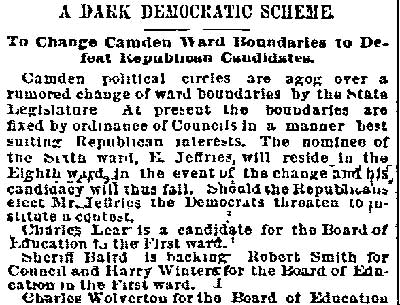
To Change Camden Ward Boundaries to Defeat Republican Candidates.
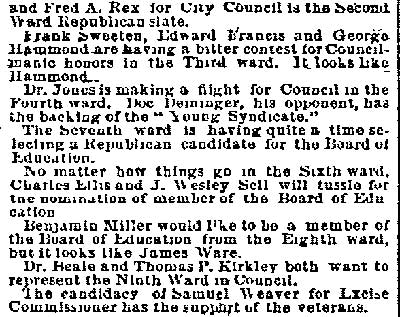
Camden political circles are agog over a rumored change of ward boundaries by the State Legislature. At present the boundaries are fixed by ordinance of Councils in a manner best suiting Republican interests. The nominee of the Sixth ward, E. Jeffries, will reside in the Eighth ward, in the event of the change and his candidacy will thus fail. Should the Republicans elect Mr. Jeffries the Democrats threaten to institute a contest.
Charles Lear is a candidate for the Board of Education to [sic] the First ward.
Sheriff Baird is backing Robert Smith for Council and Harry Winters for the Board of Education in the First ward.
Charles Wolverton for the Board of Education and Fred A. Rex for City Council is the Second Ward Republican slate.
Frank Sweeten, Edward Francis and George Hammond are having a bitter contest for Councilmanic honors in the Third ward. It looks like Hammond.
Dr. Jones is making a fight for Council in the Fourth ward. Doc Deminger, his opponent, has the backing of the “Young Syndicate.”
The Seventh ward is having quite a time selecting a Republican candidate for the Board of Education.
No matter how things go in the Sixth ward, Charles Ellis and J. Wesley Sell will tussle for the nomination of member of the Board of Education.
Benjamin Miller would like to be a member of the Board of Education from the Eighth ward, but it looks like James Ware.
Dr. Heale and Thomas P. Kirkley both want to represent the Ninth Ward in Council.
The candidacy of Samuel Weaver for Excise Commissioner has the support of the veterans.
Sensational Assault and Battery Case
Camden Post —
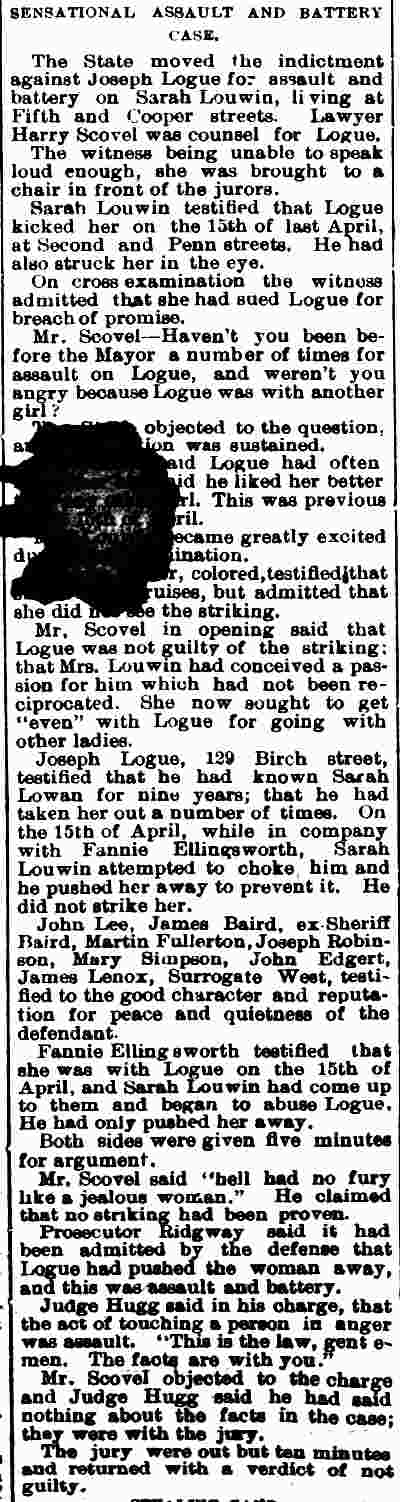
The State moved the indictment against Joseph Logue for assault and battery on Sarah Louwin, living at Fifth and Cooper streets. Lawyer Harry Scovel was counsel for Logue. The witness being unable to speak loud enough, she was brought to a chair in front of the jurors.
Sarah Louwin testified that Logue kicked her on the 15th of last April, at Second and Penn streets. He had also struck her in the eye.
On cross examination the witness admitted that she had sued Logue for breach of promise.
Mr. Scovel—Haven’t you been before the Mayor a number of times for assault on Logue, and weren’t you angry because Logue was with another girl?
[text partially obscured] objected to the question, and [text partially obscured] ion was sustained. [text partially obscured] id Logue had often [text partially obscured] id he liked her better [text partially obscured] l. This was previous [text partially obscured] ril. [text partially obscured] became greatly excited du[text partially obscured] ination. [text partially obscured] r, colored, testified that [text partially obscured] ruises, but admitted that she did not see the striking.
Mr. Scovel in opening said that Logue was not guilty of the striking; that Mrs. Louwin had conceived a passion for him which had not been reciprocated. She now sought to get “even” with Logue for going with other ladies.
Joseph Logue, 129 Birch street, testified that he had known Sarah Lowan for nine years; that he had taken her out a number of times. On the 15th of April, while in company with Fannie Ellingsworth, Sarah Louwin attempted to choke him and he pushed her away to prevent it. He did not strike her.
John Lee, James Baird, ex-Sheriff Baird, Martin Fullerton, Joseph Robinson, Mary Simpson, John Edgert, James Lenox, Surrogate West, testified to the good character and reputation for peace and quietness of the defendant.
Fannie Ellingsworth testified that she was with Logue on the 15th of April, and Sarah Louwin had come up to them and began to abuse Logue. He had only pushed her away.
Both sides were given five minutes for argument.
Mr. Scovel said “hell had no fury like a jealous woman.” He claimed that no striking had been proven.
Prosecutor Ridgway said it had been admitted by the defense that Logue had pushed the woman away, and this was assault and battery.
Judge Hugg said in his charge, that the act of touching a person in anger was assault. “This is the law, gentlemen. The facts are with you.”
Mr. Scovel objected to the charge and Judge Hugg said he had said nothing about the facts in the case; they were with the jury.
The jury were out but ten minutes and returned with a verdict of not guilty.
Odds and Ends
Philadelphia Inquirer —
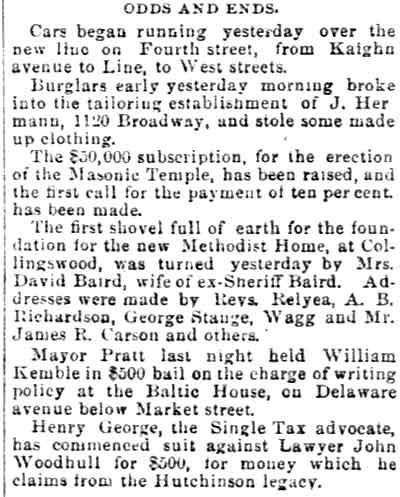
Cars began running yesterday over the new line on Fourth street, from Kaighn avenue to Line, to West streets.
Burglars early yesterday morning broke into the tailoring establishment of J. Hermann, 1120 Broadway, and stole some made up clothing.
The $50,000 subscription, for the erection of the Masonic Temple, has been raised, and the first call for the payment of ten per cent. has been made.
The first shovel full of earth for the foundation for the new Methodist Home, at Collingswood, was turned yesterday by Mrs. David Baird, wife of ex-Sheriff Baird. Addresses were made by Revs. Relyea, A. B. Richardson, George Stange, Wagg and Mr. James R. Carson and others.
Mayor Pratt last night held William Kemble in $500 bail on the charge of writing policy at the Baltic House, on Delaware avenue below Market street.
Henry George, the Single Tax advocate, has commenced suit against Lawyer John Woodhull for $500, for money which he claims from the Hutchinson legacy.
Camden
Philadelphia Inquirer —
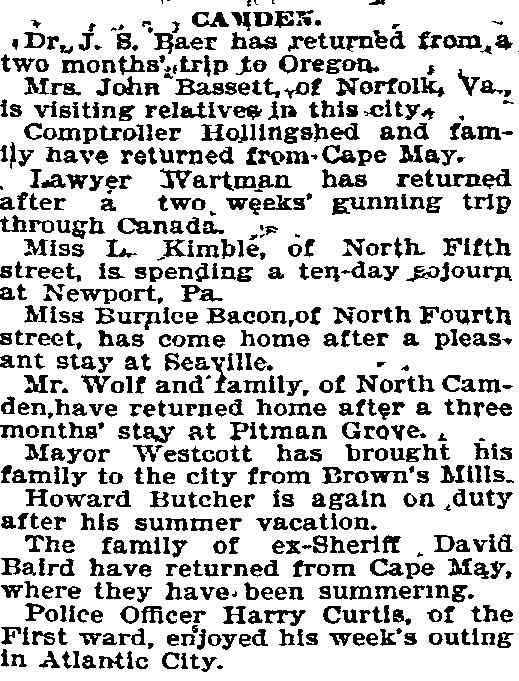
Dr. J. S. Baer has returned from a two months’ trip to Oregon.
Mrs. John Bassett, of Norfolk, Va., is visiting relatives in this city.
Comptroller Hollingshed and family have returned from Cape May.
Lawyer Wartman has returned after a two weeks’ gunning trip through Canada.
Miss L. Kimble, of North Fifth street, is spending a ten-day sojourn at Newport, Pa.
Miss Burnice Bacon, of North Fourth street, has come home after a pleasant stay at Seaville.
Mr. Wolf and family, of North Camden, have returned home after a three months’ stay at Pitman Grove.
Mayor Westcott has brought his family to the city from Brown’s Mills.
Howard Butcher is again on duty after his summer vacation.
The family of ex-Sheriff David Baird have returned from Cape May, where they have been summering.
Police Officer Harry Curtis, of the First ward, enjoyed his week’s outing in Atlantic City.
Politicians’ Day at Mt. Holly
Philadelphia Inquirer —
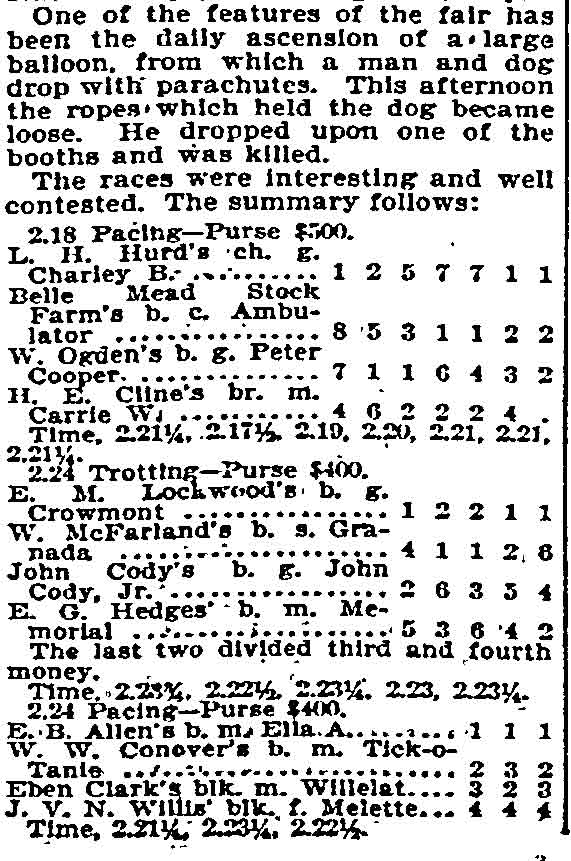
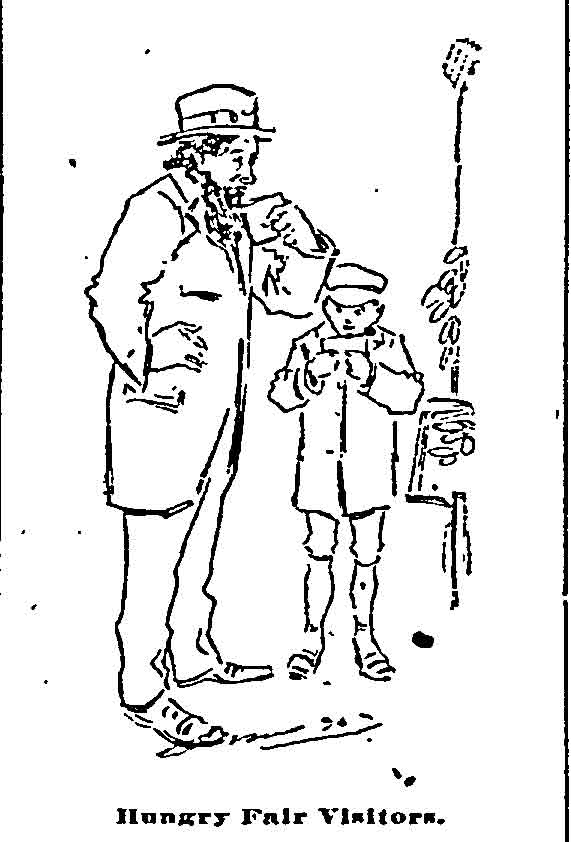
POLITICIANS’ DAY AT MT. HOLLY
CANDIDATE GRIGGS SHOOK HUNDREDS OF HORNY HANDS AT THE BURLINGTON COUNTY FAIR.
CAMDEN WELL REPRESENTED
It Was a Fine Day, But the “Big Thursday” Crowd Was Smaller Than Last Year—A Canine Parachutist Killed—The Races—Other Jersey Matters.
Special to The Inquirer.
MOUNT HOLLY, N. J., Oct. 10.—The Mount Holly Fair, like all the other Jersey fairs, has its “Big Thursday.” That is the day the politicians get together to shake hands, swop stories and look after the political machine generally. The candidates make it a point to be present and try to win votes with cordial greetings and honeyed words. The Mount Holly Fair was favored with exceptionally fine weather for its “Big Thursday,” but the attendance was not as large as last year’s crowd.
The politicians congregated around a tent at the left of the grand stand. John W. Griggs, the Republican candidate for Governor, arrived on the grounds shortly after noon and was tendered a reception at the entrance. All the afternoon he was kept busy shaking hands with the grangers and telling them how glad he was to meet them. Mr. Griggs got lots of promises of votes. He made many friends among the farmers, who had their first chance of talking with him. Nearly every one addressed him as “Governor.”
Camden county was well represented by its leading political lights, among whom were: Senator William J. Sewell, ex-Sheriff David Baird, City Counsel J. Willard Morgan, City Clerk T. P. Varney, County Clerk Robert Barber, Mayor J. Leighton Westcott, Deputy Sheriff J. Wesley Sell, Frank Lloyd, William J. Thompson, Thomas P. Curley, Receiver of Taxes William A. Husted, Secretary of the Commission of Public Instruction W. D. Brown, Freeholder George Martin, ex-President of the City Council Arthur Bedell, Senator Maurice A. Rogers, ex-Senator George Pfeiffer, ex-Sheriff Henry J. West, William Bettle, Assemblyman Louis T. Derousse, Colonel George G. Felton, Coroner Jacob Justice, Councilman Richard Dease, ex-Sheriff Theodore B. Gibbs and Assemblyman William Barnard.
Gloucester county was represented by William Moore, Senator Daniel Packer, Congressman Henry C. Loudenslager, Dr. S. F. Stanger, County Clerk F. B. Ridgway and Lewis Starr.
Other prominent persons present were: Ex-Judge J. Frank Fort, State Comptroller W. S. Hancock, County Clerk Barker Gummere, of Mercer county; Prosecutor Charles E. Hendrickson, of Mount Holly; Frank B. Lee, son of Supreme Court Clerk Lee; Judge Clifford Stanley Simms, ex-Congressman James Buchanan, Lieutenant-Colonel Franklin Gaunt, of Burlington; Richard Miller, Robert Diamond and M. V. D. Dickinson, of Salem county; Judge Joseph H. Gaskill, Robert Hutchinson and ex-Sheriff Nathan Hays, of Burlington county.
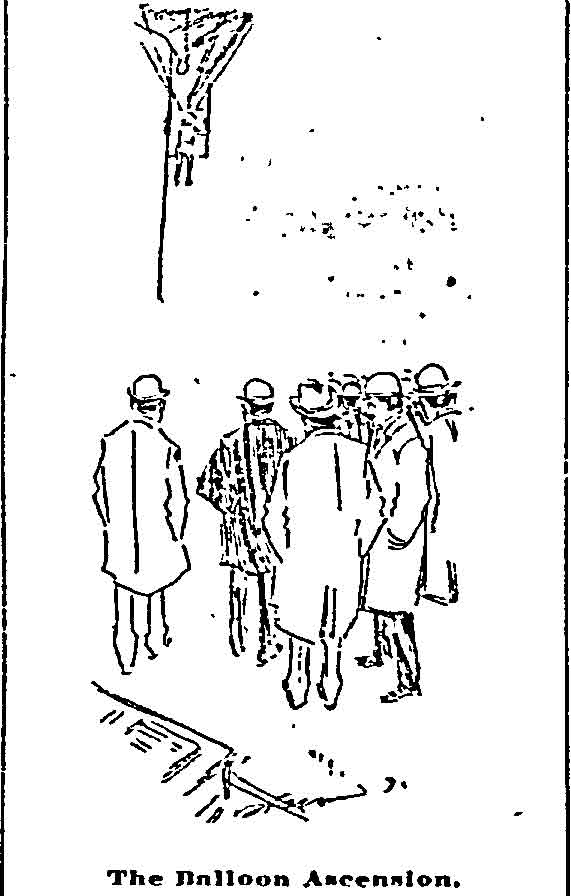
One of the features of the fair has been the daily ascension of a large balloon, from which a man and dog drop with parachutes. This afternoon the ropes which held the dog became loose. He dropped upon one of the booths and was killed.
The races were interesting and well contested. The summary follows:
2.18 Pacing—Purse $500.
L. H. Hurd’s ch. g. Charley B....1 2 5 7 7 1 1
Belle Mead Stock Farm’s b. c. Ambulator....8 5 3 1 1 2 2
W. Ogden’s b. g. Peter Cooper....7 1 1 6 4 3 2
H. E. Cline’s br. m. Carrie W....4 6 2 2 2 4
Time. 2.21¼, 2.17½, 2.19, 2.20, 2.21, 2.21, 2.21¼.
2.24 Trotting—Purse $400.
E. M. Lockwood’s b. g. Crowmont....1 2 2 1 1
W. McFarland’s b. s. Granada....4 1 1 2 8
John Cody’s b. g. John Cody, Jr....2 6 3 5 4
E. G. Hedges’ b. m. Memorial....5 3 6 4 2
The last two divided third and fourth money.
Time. 2.23¾, 2.22½, 2.23¼, 2.23, 2.23¼.
2.24 Pacing—Purse $400.
E. B. Allen’s b. m. Ella A....1 1 1
W. W. Conover’s b. m. Tick-o-Tanie....2 3 2
Eben Clark’s blk. m. Willelat....3 2 3
J. V. N. Willis’ f. Melette....4 4 4
Time, 2.21¼, 2.23¼, 2.22½.
Talked About in Camden
Philadelphia Inquirer —
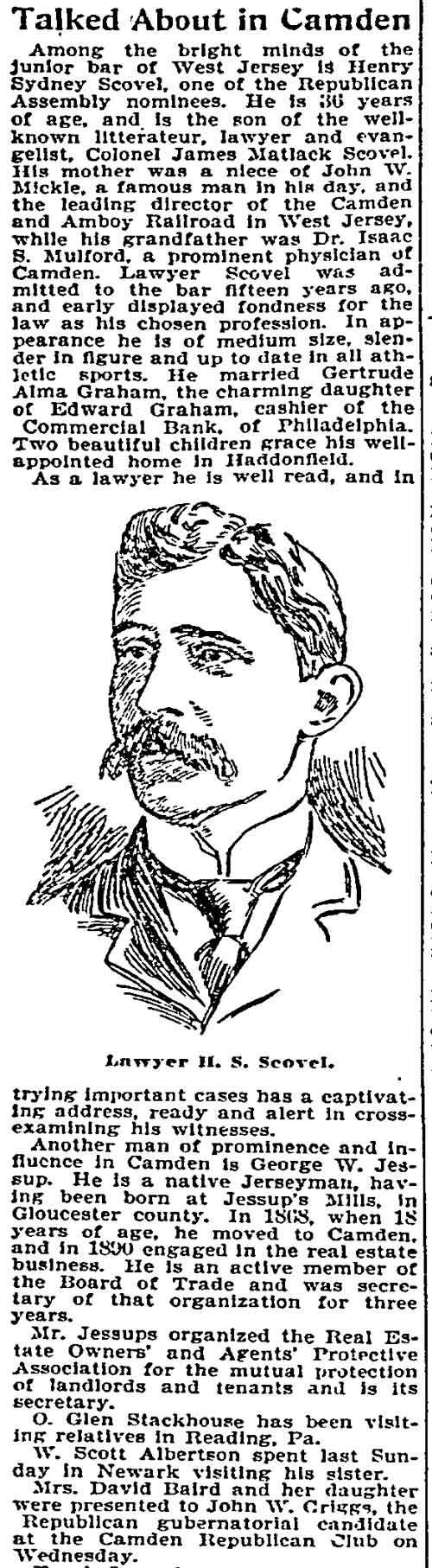
Talked About in Camden
Among the bright minds of the junior bar of West Jersey is Henry Sydney Scovel, one of the Republican Assembly nominees. He is 36 years of age, and is the son of the well-known litterateur, lawyer and evangelist, Colonel James Matlack Scovel. His mother was a niece of John W. Mickle, a famous man in his day, and the leading director of the Camden and Amboy Railroad in West Jersey, while his grandfather was Dr. Isaac S. Mulford, a prominent physician of Camden. Lawyer Scovel was admitted to the bar fifteen years ago, and early displayed fondness for the law as his chosen profession. In appearance he is of medium size, slender in figure and up to date in all athletic sports. He married Gertrude Alma Graham, the charming daughter of Edward Graham, cashier of the Commercial Bank, of Philadelphia. Two beautiful children grace his well-appointed home in Haddonfield.
As a lawyer he is well read, and in trying important cases has a captivating address, ready and alert in cross-examining his witnesses.
Another man of prominence and influence in Camden is George W. Jessup. He is a native Jerseyman, having been born at Jessup's Mills, in Gloucester county. In 1868, when 18 years of age, he moved to Camden, and in 1890 engaged in the real estate business. He is an active member of the Board of Trade and was secretary of that organization for three years.
Mr. Jessups organized the Real Estate Owners' and Agents' Protective Association for the mutual protection of landlords and tenants and is its secretary.
O. Glen Stackhouse has been visiting relatives in Reading, Pa.
W. Scott Albertson spent last Sunday in Newark visiting his sister.
Mrs. David Baird and her daughter were presented to John W. Griggs, the Republican gubernatorial candidate at the Camden Republican Club on Wednesday.
Camden Political and Personal Chat
Philadelphia Inquirer —
If there is one man above another who will be entitled to credit for the big majority that John W. Griggs is bound to roll up in South Jersey, and particularly in Camden county, it is ex-Sheriff David Baird, of Camden. He has served on the State Committee for several years and he has proved himself one of the most energetic and valuable members of that body. While John Kean was Mr. Baird’s choice for the nomination, and he gave the Union county man loyal support, when the State Convention selected Griggs he turned in for his party’s candidate with the indomitable energy that has won many a hard-fought political battle in Camden county. Garrett A. Hobart, who is managing the Griggs campaign, has left the South Jersey canvass largely in the hands of State Committeeman Baird, and the wisdom of this course has already been demonstrated. Mr. Baird has given assurances of a rousing Republican majority in the South Jersey counties and is confident of the election of Griggs.
Baird, Morgan and Varney Off to the Atlanta Exposition
Philadelphia Inquirer —
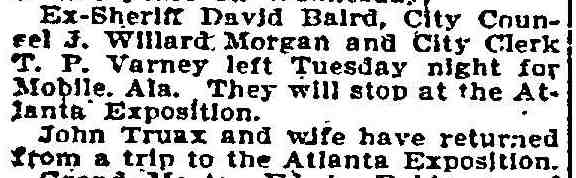
Ex-Sheriff David Baird, City Councel [sic] J. Willard Morgan and City Clerk T. P. Varney left Tuesday night for Mobile, Ala. They will stop at the Atlanta Exposition.
John Truax and wife have returned from a trip to the Atlanta Exposition.
1896 Camden City Directory Advertisement
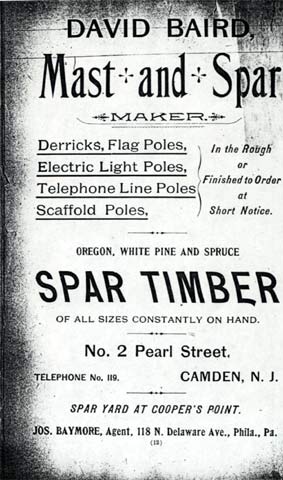
1896 Camden City Directory Advertisement
Talked About in Camden
Philadelphia Inquirer —

Among the progressive and successful business men of Camden is Hiram G. Hallinger, who is truly a self-made man. He was born in Bridgeton nearly thirty-seven years ago. At the age of 18 years he entered the steamboat brokerage business with his father in Philadelphia. Seven years ago he gave up this to go into the real estate business in Camden. He is one of the largest dealers in South Jersey and is an acknowledged authority on realty values. He is president of the Real Estate Title Company, of Camden, and a director in two other local institutions. He takes considerable interest in religious matters and is treasurer of one M. E. church and trustee in another. Mr. Hallinger is an extensive traveler and has visited every part of the United States during his annual vacations. His success is largely due to his integrity, perseverance and energy.
H. G. Hallinger.
Rev. F. F. Brace, D. D., ex-Superintendent of Public Education of Camden county, who has been seriously ill for several months past, is convalescent.
Miss Clara Shinn is visiting friends in Germantown.
Martin Bergen has returned from Iowa, where he has been coaching the Grinnell University football team.
William J. Thompson and wife, Richard J. Thompson, Mrs. Sweeney and Mrs. Flynn left on Thursday for a trip to Atlanta, Ga., to attend the Cotton Exposition.
County Clerk Robert L. Barber and Lawyer Fred A. Rex are at the Atlanta Exposition.
Alfred B. Sweeten and Miss Mary H. B. Middleton were married on Wednesday evening by Rev. E. C. Hancock.
James Hunt and George Beckett have been gunning in Cape May county the past two days.
Volney Bennett, Jr., has just completed a 10,900-mile trip throughout the United States that consumed ten months and three days.
Mrs. W. D. Brown is visiting at Auburn, Pa.
Miss R. Bourke has returned from the Atlanta Exposition.
Philip Nieukirk and wife, of Maryland, are spending a month visiting friends in Camden.
Charles Preisendanz and wife have returned from a trip through the South, stopping at Washington and the Atlanta Exposition.
Walter Wallace is at Norfolk, Va., on a two weeks’ visit.
Miss Alice Hastings is visiting relatives in Pottstown, Pa.
Miss Theresa Anthony, of Wilmington, Del., is visiting friends in Camden.
Dr. George Nicholson and wife are at the Atlanta Exposition.
Postmaster H. B. Paul and wife, Charles R. Bacon and wife, F. F. Patterson, Jr., Miss Bertie Patterson, Miss Belle Humphrey, Miss Kiegel, Upton S. Jeffreys and James M. Fitzgerald will return to-day from the Atlanta Exposition, where they have been spending the past week.
Josiah Bowden, of Montana, is visiting his father, Rev. Charles Bowden.
Editor Louis W. Albright has been spending the past two days gunning in Winslow township.
Register of Deeds Jacob Sickler took the oath of office for the second term of five years on Wednesday.
Ex-Sheriff David Baird, City Counsel J. Willard Morgan and City Clerk T. P. Varney left Tuesday night for Mobile, Ala. They will stop at the Atlanta Exposition.
John Truax and wife have returned from a trip to the Atlanta Exposition.
Grand Master Edwin Robinson, of the Shield of Honor, of New Jersey, is ill with typhoid fever.
Justice Charles M. Baldwin has been selected as chief marshal of the Volunteer Firemen’s Association for the parade at Haddonfield on Thanksgiving Day.
W. H. Etna is spending two weeks in the mountains of Pennsylvania.
Miss Fannie Hiers has been visiting friends at Merchantville.
Miss Leula Thomas, of Norristown, Pa., is visiting friends in Camden.
Miss Alice Jordan is on a visit at Pottsville, Pa.
Dr. A. B. Lippincott was sworn in as Coroner on Thursday.
Funeral of Benjamin A. Starr
Philadelphia Inquirer —
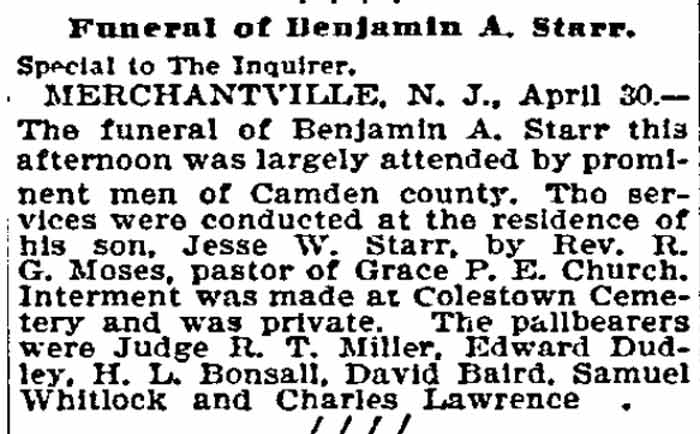
The funeral of Benjamin A. Starr in Merchantville, N.J., April 30, was largely attended by prominent men of Camden County. The services were conducted at the residence of his son, Jesse W. Starr, by Rev. R. T. Miller. Pallbearers included Edward Dudley, H. L. Bonsall, David Baird, Samuel Whitlock, and Charles Lawrence.
Philadelphia Inquirer
Philadelphia Inquirer —
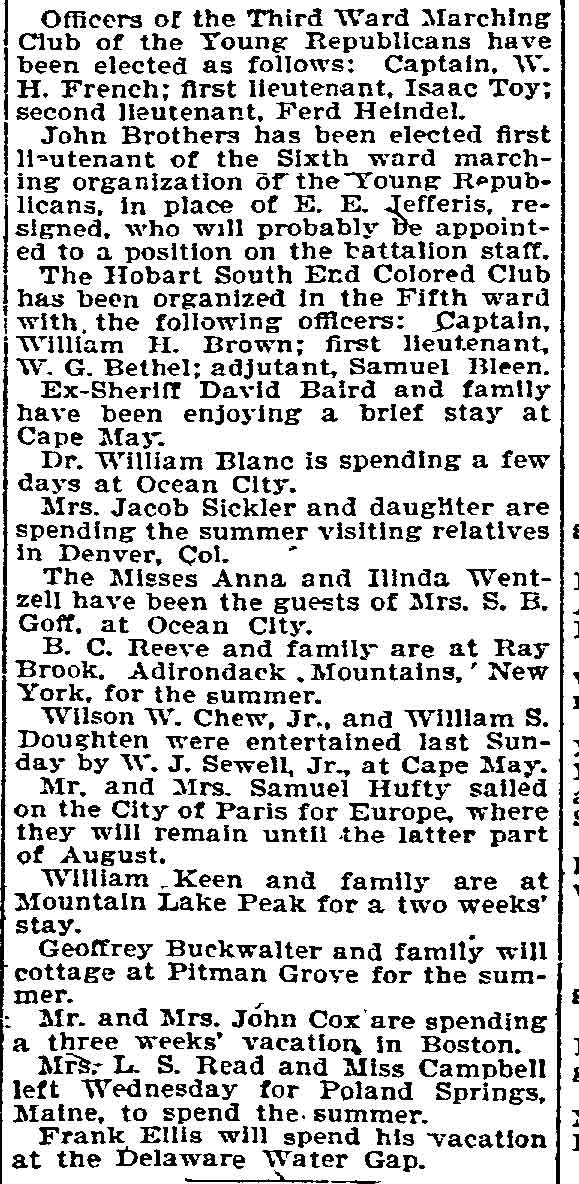
Officers of the Third Ward Marching Club of the Young Republicans have been elected as follows: Captain, W. H. French; first lieutenant, Isaac Toy; second lieutenant, Ferd Heindel.
John Brothers has been elected first lieutenant of the Sixth ward marching organization of the Young Republicans, in place of E. E. Jefferis, resigned, who will probably be appointed to a position on the battalion staff.
The Hobart South End Colored Club has been organized in the Fifth ward with the following officers: Captain, William H. Brown; first lieutenant, W. G. Bethel; adjutant, Samuel Bleen.
Ex-Sheriff David Baird and family have been enjoying a brief stay at Cape May.
Dr. William Blanc is spending a few days at Ocean City.
Mrs. Jacob Sickler and daughter are spending the summer visiting relatives in Denver, Col.
The Misses Anna and Ilnda Wentzell have been the guests of Mrs. S. B. Goff, at Ocean City.
B. C. Reeve and family are at Ray Brook, Adirondack Mountains, New York, for the summer.
Wilson W. Chew, Jr., and William S. Doughten were entertained last Sunday by W. J. Sewell, Jr., at Cape May.
Mr. and Mrs. Samuel Hufty sailed on the City of Paris for Europe, where they will remain until the latter part of August.
William Keen and family are at Mountain Lake Peak for a two weeks’ stay.
Geoffrey Buckwalter and family will cottage at Pitman Grove for the summer.
Mr. and Mrs. John Cox are spending a three weeks’ vacation in Boston.
Mrs. L. S. Read and Miss Campbell left Wednesday for Poland Springs, Maine, to spend the summer.
Frank Ellis will spend his vacation at the Delaware Water Gap.
Sheriff Baird Drew First Panel of Jurors
Philadelphia Inquirer —

Sheriff Baird yesterday drew his first panel of jurors and the personnel is above the average. The jurors will serve during the April term of court.
Biographical Review
1897
Biographical Review, 1897
804 Cooper Street
Baird Family Home, 1890s–1936
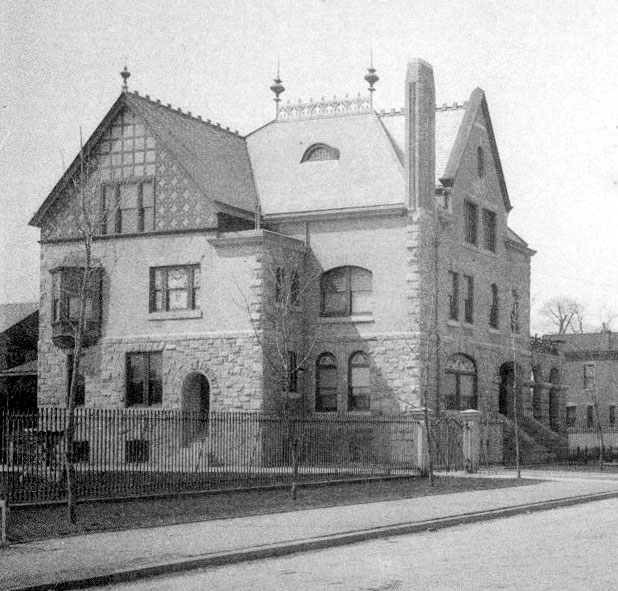
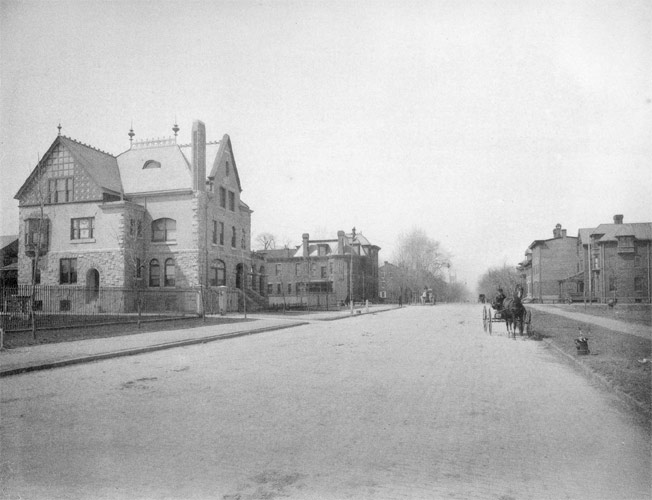
Named: 804 Cooper Street, Baird Family home from the 1890s until October, 1936, and 800 Block of Cooper Street, 1893.
In the Whirl of Camden Politics
Philadelphia Inquirer —
May Be Opposition to Ex-Sheriff Barrett’s Mayoralty Candidacy
CHAMBERS HESITATES
Thompsonites Hope to Coax Him Into Taking Their Nomination. Printing Registry Lists
Former Sheriff George Barrett, who is looked upon as the probable nominee of the Camden Republicans for Mayor, is likely to have opposition in the convention. He has stated that he will not accept the nomination unless it is tendered him unanimously. Delegates to the convention will be elected to-morrow night. The Fifth ward delegates will probably favor the nomination of Harry F. Wolfe, Director of the Board of Freeholders, for Mayor. Isaac Toone may be the choice of the Ninth ward delegation, while Lawyer John H. Fort is likely to have a few delegates. To insure Barrett’s acceptance of the nomination it will be necessary to overcome this opposition, but the leaders say this will be easy.
There are plenty of candidates for the City Recordership nomination. Among those who would like to preside in the police court are: Justices Philip Schmitz, O. Glen Stackhouse, Charles Baldwin, George R. Thompson and Frederick B. Kauffman. Recorder Benjamin M. Braker is also seeking renomination.
COAXING CHAMBERS.
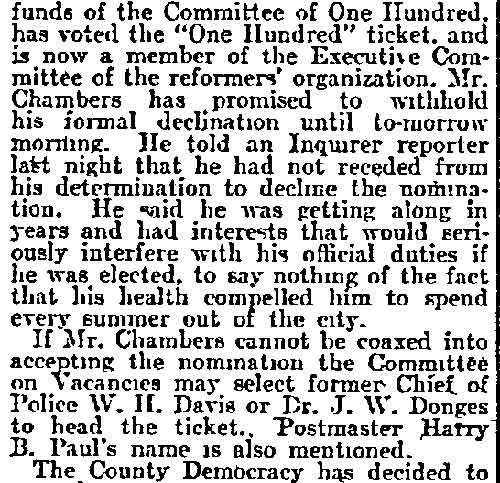
The Thompson Democrats are working hard to induce David M. Chambers to reconsider his declination to stand as their candidate for mayor, despite the fact that Mr. Chambers has contributed to the funds of the Committee of One Hundred, has voted the “One Hundred” ticket, and is now a member of the Executive Committee of the reformers’ organization. Mr. Chambers has promised to withhold his formal declination until to-morrow morning. He told an Inquirer reporter last night that he had not receded from his determination to decline the nomination. He said he was getting along in years and had interests that would seriously interfere with his official duties if he was elected, to say nothing of the fact that his health compelled him to spend every summer out of the city.
If Mr. Chambers cannot be coaxed into accepting the nomination the Committee on Vacancies may select former Chief of Police W. H. Davis or Dr. J. W. Donges to head the ticket. Postmaster Harry B. Paul’s name is also mentioned.
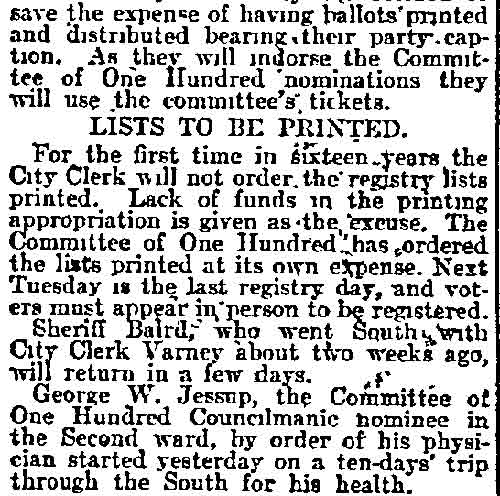
The County Democracy has decided to save the expense of having ballots printed and distributed bearing their party caption. As they will indorse the Committee of One Hundred nominations they will use the committee’s tickets.
LISTS TO BE PRINTED.
For the first time in sixteen years the City Clerk will not order the registry lists printed. Lack of funds in the printing appropriation is given as the excuse. The Committee of One Hundred has ordered the lists printed at its own expense. Next Tuesday is the last registry day, and voters must appear in person to be registered.
Sheriff Baird, who went South with City Clerk Varney about two weeks ago, will return in a few days.
George W. Jessup, the Committee of One Hundred Councilmanic nominee in the Second ward, by order of his physician started yesterday on a ten-days’ trip through the South for his health.
Over in Camden
Philadelphia Inquirer —
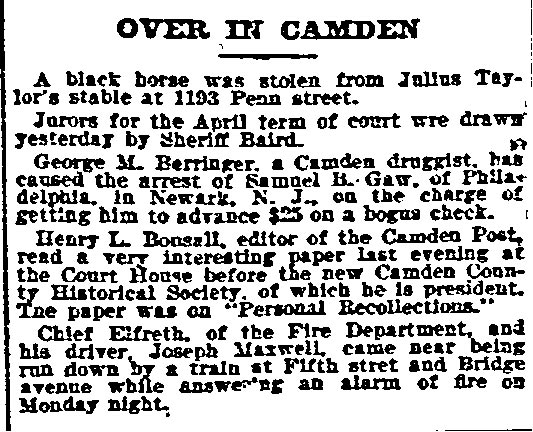
A black horse was stolen from Julius Taylor’s stable at 1193 Penn street.
Jurors for the April term of court were drawn yesterday by Sheriff Baird.
George M. Berringer, a Camden druggist, has caused the arrest of Samuel B. Gaw, of Philadelphia, in Newark, N. J., on the charge of getting him to advance $25 on a bogus check.
Henry L. Bonsall, editor of the Camden Post, read a very interesting paper last evening at the Court House before the new Camden County Historical Society, of which he is president. The paper was on “Personal Recollections.”
Chief Elfreth, of the Fire Department, and his driver, Joseph Maxwell, came near being run down by a train at Fifth street and Bridge avenue while answering an alarm of fire on Monday night.
Doings in Realty
Camden Daily Courier —
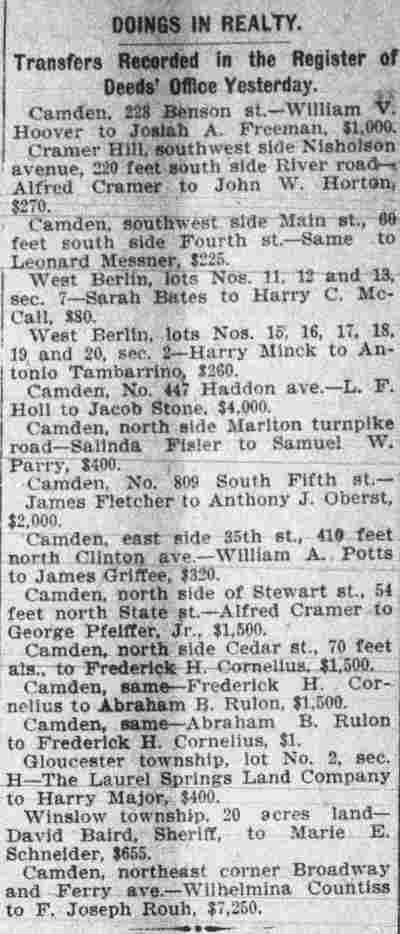
Transfers Recorded in the Register of Deeds’ Office Yesterday.
Camden, 228 Benson st.—William V. Hoover to Josiah A. Freeman, $1,000.
Cramer Hill, southwest side Nisholson [sic] avenue, 220 feet south side River road—Alfred Cramer to John W. Horton, $270.
Camden, southwest side Main st., 60 feet south side Fourth st.—Same to Leonard Messner, $225.
West Berlin, lots Nos. 11, 12 and 13, sec. 7—Sarah Bates to Harry C. McCall, $80.
West Berlin, lots Nos. 15, 16, 17, 18, 19 and 20, sec. 2—Harry Minck to Antonio Tambarrino, $260.
Camden, No. 447 Haddon ave.—L. F. Holl to Jacob Stone, $4,000.
Camden, north side Marlton turnpike road—Salinda Fisler to Samuel W. Parry, $400.
Camden, No. 809 South Fifth st.—James Fletcher to Anthony J. Oberst, $2,000.
Camden, east side 35th st., 410 feet north Clinton ave.—William A. Potts to James Griffee, $320.
Camden, north side of Stewart st., 54 feet north State st.—Alfred Cramer to George Pfeiffer, Jr., $1,500.
Camden, north side Cedar st., 70 feet als., to Frederick H. Cornelius, $1,500.
Camden, same—Frederick H. Cornelius to Abraham B. Rulon, $1,500.
Camden, same—Abraham B. Rulon to Frederick H. Cornelius, $1.
Gloucester township, lot No. 2, sec. H—The Laurel Springs Land Company to Harry Major, $400.
Winslow township, 20 acres land—David Baird, Sheriff, to Marie E. Schneider, $655.
Camden, northeast corner Broadway and Ferry ave.—Wilhelmina Countiss to F. Joseph Rouh, $7,250.
Philadelphia Inquirer
Philadelphia Inquirer —

Sheriff David Baird has returned from a business trip to Mobile, Ala. City Comptroller Samuel Huffty and
Camden Lighting and Heating Company Annual Meeting
Philadelphia Inquirer —
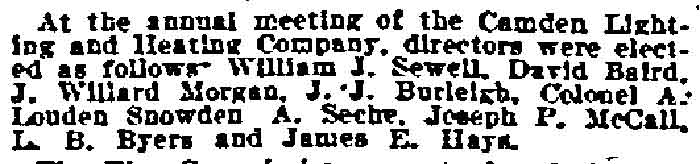
At the annual meeting of the Camden Lighting and Heating Company, directors were elected as follows: William J. Sewell, David Baird, J. Willard Morgan, J. J. Burleigh, Colonel A. Louden Snowden, A. Seche, Joseph P. McCall, L. B. Byers and James E. Hays.
Banquet for Correspondents
Trenton Times —
Banquet for Correspondents
State Politicians Doing Right Thing by the Newspaper Men.
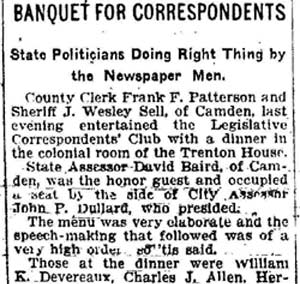
County Clerk Frank F. Patterson and Sheriff J. Wesley Sell, of Camden, last evening entertained the Legislative Correspondents’ Club with a dinner in the colonial room of the Trenton House. State Assessor David Baird, of Camden, was the honor guest and occupied a seat by the side of City Assessor John P. Dullard, who presided.
The menu was very elaborate and the speech-making that followed was of a very high order, so ‘tis said.
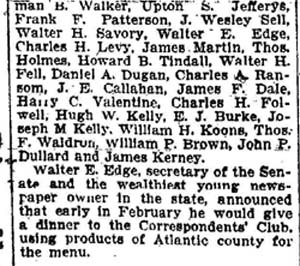
Those at the dinner were William K. Devereaux, Charles J. Allen, Her…
Frank F. Patterson Jr. — J. Wesley Sell — David Baird Sr. — Upton S. Jefferys — Trenton Times, January 15, 1902
After Long Service Retires on Pension
Philadelphia Inquirer —
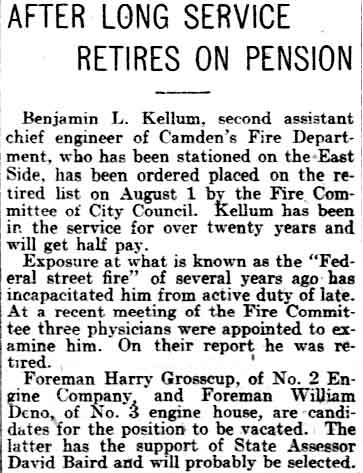
Benjamin L. Kellum, second assistant chief engineer of Camden’s Fire Department, who has been stationed on the East Side, has been ordered placed on the retired list on August 1 by the Fire Committee of City Council. Kellum has been in the service for over twenty years and will get half pay.
Exposure at what is known as the “Federal street fire” of several years ago has incapacitated him from active duty of late. At a recent meeting of the Fire Committee three physicians were appointed to examine him. On their report he was retired.
Foreman Harry Grosscup, of No. 2 Engine Company, and Foreman William Deno, of No. 3 engine house, are candidates for the position to be vacated. The latter has the support of State Assessor David Baird and will probably be selected.
Royal Welcome for Ex-Sheriff Baird
Philadelphia Inquirer —
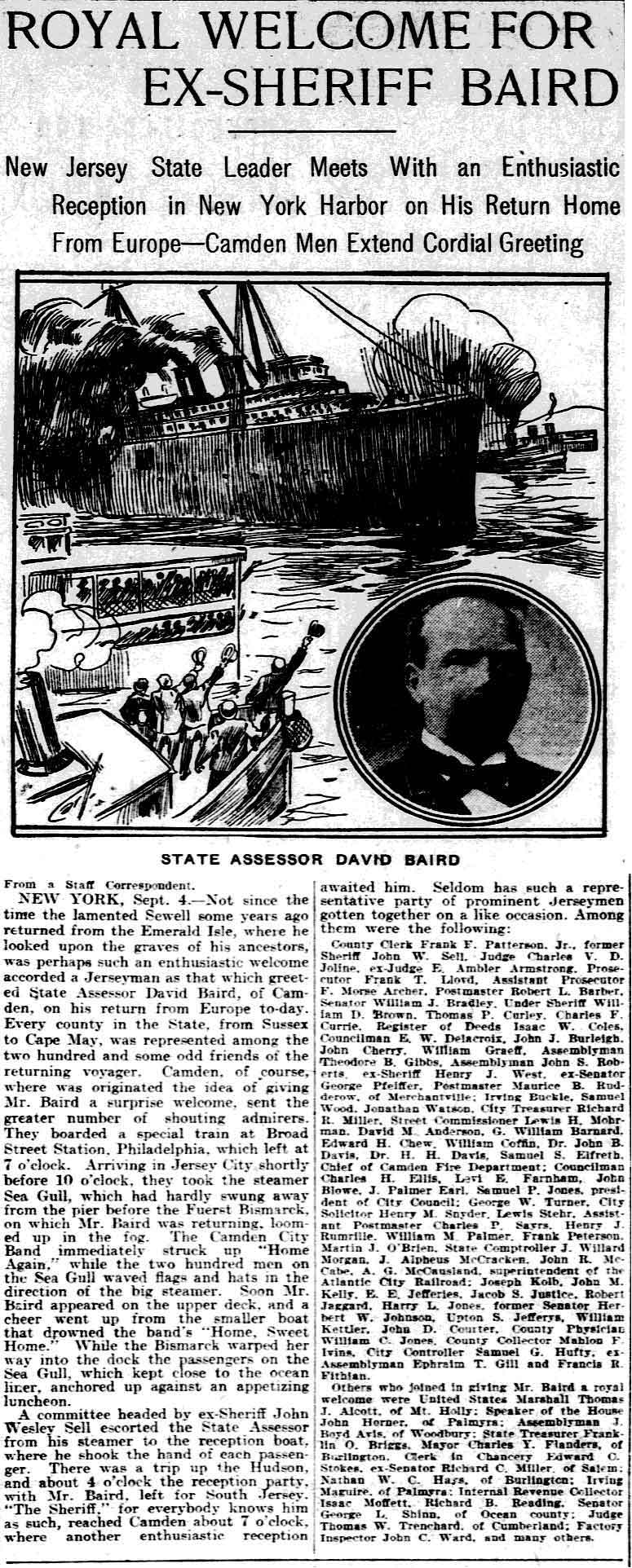
New Jersey State Leader Meets With an Enthusiastic Reception in New York Harbor on His Return Home From Europe—Camden Men Extend Cordial Greeting
STATE ASSESSOR DAVID BAIRD
From a Staff Correspondent.
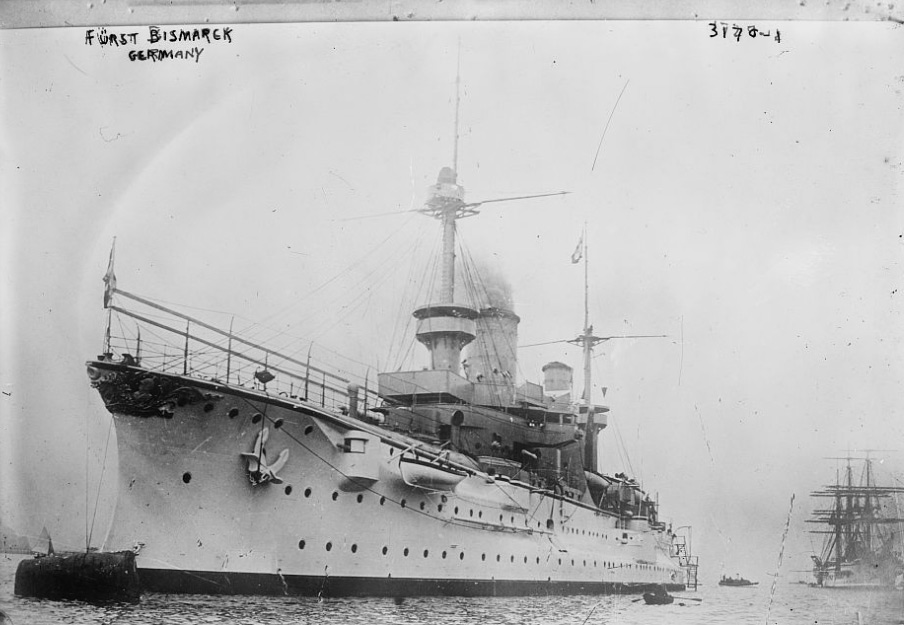
NEW YORK, Sept. 4.—Not since the time the lamented Sewell some years ago returned from the Emerald Isle, where he looked upon the graves of his ancestors, was perhaps such an enthusiastic welcome accorded a Jerseyman as that which greeted State Assessor David Baird, of Camden, on his return from Europe to-day. Every county in the State, from Sussex to Cape May, was represented among the two hundred and some odd friends of the returning voyager. Camden, of course, where was originated the idea of giving Mr. Baird a surprise welcome, sent the greater number of shouting admirers. They boarded a special train at Broad Street Station, Philadelphia, which left at 7 o’clock. Arriving in Jersey City shortly before 10 o’clock, they took the steamer Sea Gull, which had hardly swung away from the pier before the Fuerst Bismarck, on which Mr. Baird was returning, loomed up in the fog. The Camden City Band immediately struck up “Home Again,” while the two hundred men on the Sea Gull waved flags and hats in the direction of the big steamer. Soon Mr. Baird appeared on the upper deck, and a cheer went up from the smaller boat that drowned the band’s “Home, Sweet Home.” While the Bismarck warped her way into the dock the passengers on the Sea Gull, which kept close to the ocean liner, anchored up against an appetizing luncheon.
A committee headed by ex-Sheriff John Wesley Sell escorted the State Assessor from his steamer to the reception boat, where he shook the hand of each passenger. There was a trip up the Hudson, and about 4 o’clock the reception party, with Mr. Baird, left for South Jersey. “The Sheriff,” for everybody knows him as such, reached Camden about 7 o’clock, where another enthusiastic reception awaited him. Seldom has such a representative party of prominent Jerseymen gotten together on a like occasion. Among them were the following:
County Clerk Frank F. Patterson, Jr., former Sheriff John W. Sell, Judge Charles V. D. Joline, ex-Judge E. Ambler Armstrong, Prosecutor Frank T. Lloyd, Assistant Prosecutor F. Morse Archer, Postmaster Robert L. Barber, Senator William J. Bradley, Under Sheriff William D. Brown, Thomas P. Curley, Charles F. Currie, Register of Deeds Isaac W. Coles, Councilman E. W. Delacroix, John J. Burleigh, John Cherry, William Graeff, Assemblyman Theodore B. Gibbs, Assemblyman John S. Roberts, ex-Sheriff Henry J. West, ex-Senator George Pfeiffer, Postmaster Maurice B. Rudderow, of Merchantville; Irving Buckle, Samuel Wood, Jonathan Watson, City Treasurer Richard R. Miller, Street Commissioner Lewis H. Mohrman, David M. Anderson, G. William Barnard, Edward H. Chew, William Coffin, Dr. John B. Davis, Dr. H. H. Davis, Samuel S. Elfreth, Chief of Camden Fire Department; Councilman Charles H. Ellis, Levi E. Farnham, John Blowe, J. Palmer Earl, Samuel P. Jones, president of City Council; George W. Turner, City Solicitor Henry M. Snyder, Lewis Stehr, Assistant Postmaster Charles P. Sayrs, Henry J. Rumrille, William M. Palmer, Frank Peterson, Martin J. O’Brien, State Comptroller J. Willard Morgan, J. Alpheus McCracken, John R. McCabe, A. G. McCausland, superintendent of the Atlantic City Railroad; Joseph Kolb, John M. Kelly, E. E. Jefferies, Jacob S. Justice, Robert Jaggard, Harry L. Jones, former Senator Herbert W. Johnson, Upton S. Jefferys, William Kettler, John D. Courter, County Physician William C. Jones, County Collector Mahlon F. Ivins, City Controller Samuel G. Hufty, ex-Assemblyman Ephraim T. Gill and Francis R. Fithian.
Others who joined in giving Mr. Baird a royal welcome were United States Marshall Thomas J. Alcott, of Mt. Holly; Speaker of the House John Herner, of Palmyra; Assemblyman J. Boyd Avis, of Woodbury; State Treasurer Franklin O. Briggs, Mayor Charles Y. Flanders, of Burlington, Clerk in Chancery Edward C. Stokes, ex-Senator Richard C. Miller, of Salem; Nathan W. C. Hays, of Burlington; Irving Maguire, of Palmyra; Internal Revenue Collector Isaac Moffett, Richard B. Reading, Senator George L. Shinn, of Ocean county; Judge Thomas W. Trenchard, of Cumberland; Factory Inspector John C. Ward, and many others.
Fürst Bismarck
1903
1904 Cartoon Depicting David Baird
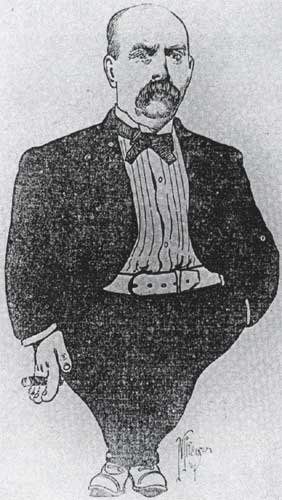
1904 Cartoon depicting David Baird Sr.
Criminal Court in Camden
Philadelphia Inquirer —
Judge Joline held a special session of Criminal Court in Camden, at which George Moore pleaded guilty to passing bogus checks. He was sentenced to State Prison for two years and six months.
Charles Campbell, charged with stealing harness from State Assessor David Baird, was given one year in the same institution. A similar sentence was given to Stephen Warwick, who pleaded guilty to taking $55 from Joseph Gabelinski, an Oaklyn farmer.
Clerk Patterson on Second Term
Philadelphia Inquirer —
Popular Camden County Official Takes Oath of Office and Entertains Bondsmen and Others
County Clerk Frank F. Patterson, of Camden, at noon yesterday took the oath of office for a second term of five years. The oath was administered by Judge Joline in the presence of Mr. Patterson’s office force.
After taking the oath of office Mr. Patterson’s first official act was to reappoint Howard Truax as deputy county clerk and Frank Voigt as his assistant.
During Mr. Patterson’s previous term of office he made a host of friends through his courtesy and attention to those who called upon him for information.
Last night County Clerk Patterson gave an elaborate dinner at the Hotel Bellevue-Stratford to his bondsmen and several political friends.
Mr. Patterson under a recent law furnished a bond for $25,000 with the following bondsmen: Frank F. Patterson, Sr., David Baird, John W. Sell and William J. Bradley. These, including the following well-known Jerseymen, were Mr. Patterson’s guests at the banquet: Judge Charles G. Garrison, Judge A. B. Endicott, Judge C. V. D. Joline, Congressman H. C. Loudenslager, State Comptroller J. Willard Morgan, Assemblymen H. S. Scovel, Theodore B. Gibbs and Samuel P. Jones, Senators John G. Horner, J. Boyd Avis, Wood McKee and W. H. Jackson, State Assessor David Baird, Sheriff Frank C. Somers, Register Edward S. Delacroix, Prosecutor Frank T. Lloyd, Assistant Prosecutor F. Morse Archer, Surrogate Harry Reeves, Deputy Sheriff William D. Brown, Howard Truax, Robert Leyburne, Theodore N. Patterson, Wolcott J. Patterson, Irving Buckle, Joseph Burt, William S. Jones, John J. Leyburne, E. A. Y. Schellenger, Henry J. Cloud, Charles Middleton and Edward W. Humphreys.
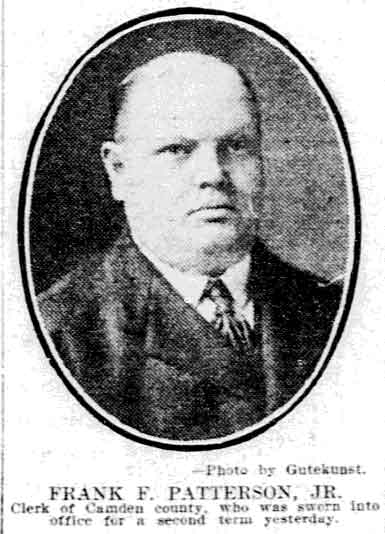
—Photo by Gutekunst
FRANK F. PATTERSON, JR.
Clerk of Camden county, who was sworn into office for a second term yesterday.
Blue Jackets Fight Flames in Lumber Yard
Philadelphia Inquirer —
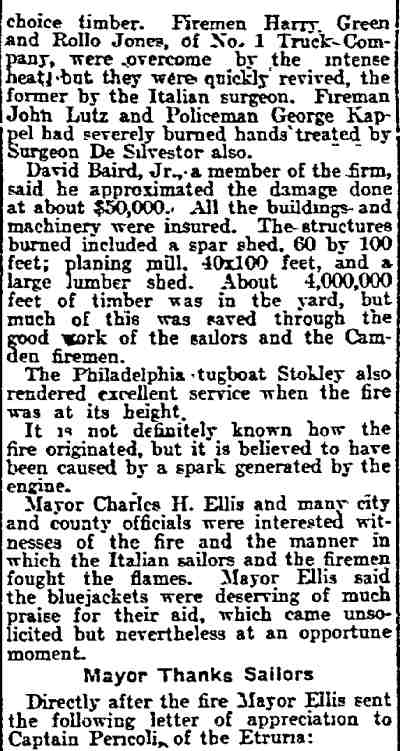
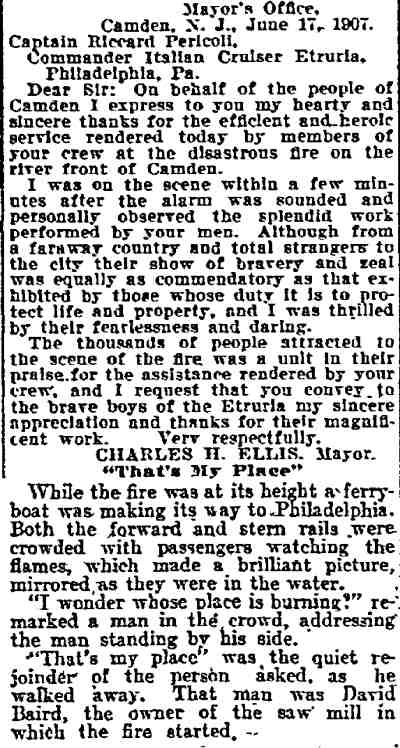
Fully Equipped They Push Off From Cruiser Etruria to the Jersey Shore
Battled With Blaze in Their Bare Feet
Mayor Sends Letter to Commander David—Baird’s Big Plant Scene of Disastrous Conflagration
One hundred sailors from the Italian cruiser Etruria, now lying in the Delaware river, off Race street, materially assisted the Camden firemen yesterday afternoon in preventing a fire from destroying the plant of David Baird & Co., foot of Pearl street. While the flames did damage to the extent of $50,000, there would have been a much heavier loss but for the excellent work of the bluejackets.
It was shortly after 1 o’clock when the flames were discovered in the engine room by Howard Mulford. His efforts to extinguish the tiny blaze proved futile. In a few minutes the fire had eaten its way through the inflammable wooden structure and the long, red tongues had communicated with the spar shed. From this they leaped about twenty feet into the saw and planing mill. All these structures were blazing fiercely when the Camden firemen responded to a general alarm.
Italian Jackies Busy
It was at this juncture that a hundred white-capped sailors in command of Lieutenant Alyigina Guardsumarsina made their landing at the Pearl street wharf in Camden. They were assembled by a bugler and with hand axes, hose and other apparatus they sallied forth to combat the flames which were fast eating their way through the extensive yard of the plant.
Many of the bluejackets were barefooted, but none of these stopped when burning timbers were encountered. They rushed through flame and smoke with all the vim and ardor that characterize the sailor when in action.
Attacked Blazing Planks
There was a huge lumber pile that stood near a shed that contained several hundred thousand feet of valuable timber. When the flames communicated with this the sailors, summoned by the bugler, made an attack on the great long blazing planks. Like veritable trojans they worked, running up to the flames with their axes and knocking the timbers in all directions.
The smoke was dense enough to make even the professional fire fighters seek cover, but the men from the Etruria stood their ground and managed to save much of the timber.
Hands and Feet Scorched
For over two hours they continued in service. Surgeon De Silvestor, with an assistant, had a busy time attending the burned feet and hands and scorched faces of his compatriots. They had a typical Red Cross outfit with them and when they had ended their work there was little left of the tape and liniments.
It was only after the fire was practically extinguished that Lieutenant Guardsumarsina gathered his men about him and returned to the Etruria. There were several thousand persons on the surrounding wharves and buildings and these gave three lusty cheers when the valiant sons of Italy left for the cruiser.
Fire a Scorcher
The fire was an extremely fierce one, fed as it was by thousands of feet of choice timber. Firemen Harry Green and Rollo Jones, of No. 1 Truck Company, were overcome by the intense heat, but they were quickly revived, the former by the Italian surgeon. Fireman John Lutz and Policeman George Kappel had severely burned hands treated by Surgeon De Silvestor also.
David Baird, Jr., a member of the firm, said he approximated the damage done at about $50,000. All the buildings and machinery were insured. The structures burned included a spar shed, 60 by 100 feet; planing mill, 40x100 feet, and a large lumber shed. About 4,000,000 feet of timber was in the yard, but much of this was saved through the good work of the sailors and the Camden firemen.
The Philadelphia tugboat Stokley also rendered excellent service when the fire was at its height.
It is not definitely known how the fire originated, but it is believed to have been caused by a spark generated by the engine.
Mayor Charles H. Ellis and many city and county officials were interested witnesses of the fire and the manner in which the Italian sailors and the firemen fought the flames. Mayor Ellis said the bluejackets were deserving of much praise for their aid, which came unsolicited but nevertheless at an opportune moment.
Mayor Thanks Sailors
Directly after the fire Mayor Ellis sent the following letter of appreciation to Captain Pericoli, of the Etruria:
Mayor’s Office,
Camden, N. J., June 17, 1907.
Captain Riccard Pericoli,
Commander Italian Cruiser Etruria,
Philadelphia, Pa.
Dear Sir: On behalf of the people of Camden I express to you my hearty and sincere thanks for the efficient and heroic service rendered today by members of your crew at the disastrous fire on the river front of Camden.
I was on the scene within a few minutes after the alarm was sounded and personally observed the splendid work performed by your men. Although from a faraway country and total strangers to the city their show of bravery and zeal was equally as commendatory as that exhibited by those whose duty it is to protect life and property, and I was thrilled by their fearlessness and daring.
The thousands of people attracted to the scene of the fire was a unit in their praise for the assistance rendered by your crew, and I request that you convey to the brave boys of the Etruria my sincere appreciation and thanks for their magnificent work.
Very respectfully, CHARLES H. ELLIS, Mayor.
“That’s My Place”
While the fire was at its height a ferryboat was making its way to Philadelphia. Both the forward and stern rails were crowded with passengers watching the flames, which made a brilliant picture, mirrored as they were in the water.
“I wonder whose place is burning?” remarked a man in the crowd, addressing the man standing by his side.
“That’s my place” was the quiet rejoinder of the person asked, as he walked away. That man was David Baird, the owner of the saw mill in which the fire started.
The Story of David Baird
National Magazine —
By Mitchell Mannering
WEEPING the horizon in search of men who are types of our times, men who have “done things,” men whose influence and power have made an impression upon our national life, through the kindness of Congressman Harry Loudenslager, I met Mr. David Baird, of Camden, New Jersey.
It is not necessary to tell anyone in New York, Pennsylvania or New Jersey anything about David Baird, for he is well known there, as a virile, strong type of adopted citizen, whose life-story is fascinating and inspiring.
A red-cheeked, Irish boy, after the death of both his parents, in the sturdy strength of his seventeen years, he set sail for the new land of promise, where “there’s bread and work for all.” For eleven weeks that sailing vessel careened with the tossing waves, buffeted by the winds of the Atlantic, but at last, in August 1856, the Irish lad landed in New York. His story, since his birth in County Derry, Ireland, April, 1839, reads like a romance, and is as thrilling as the history of the defense made by that famous city of his home county, when the resolute citizens starved behind their strong walls rather than relinquish what they believed to be a righteous cause. Mr. Baird is animated by just such a spirit as was possessed by the daring young apprentice who with his own hands closed the gates of Londonderry, and commenced the siege that has gone down into history as one of the most resolute defenses ever made for home and religion.
At Port Deposit, Maryland, the young Derry lad worked on a farm known as Brick Meeting House, where he earned $6 a month and his board. The panic of 1857 came and it was evident that there would be no more work for the Irish lad, even at low wage. He was about to set forth in search of work when the good wife of the farmer pleaded with her husband to let “David stay and work for his board. He is such a good boy and always gets things done,” she said. So David remained until the spring of 1858, when he was employed by Gillingham & Garrison in rafting logs on the Susquehanna River, at a wage of $16 per month.
At a luncheon recently given at the Union League Club, in Philadelphia, it was affecting to hear this man, who has long since reaped success beyond his wildest hopes, pay a tribute to that good wife who made an effort to save him a winter of hardship. Nothing could have more plainly indicated the warm heart and splendid qualities of the man who in youth, was accounted a good “log sailor.”
On this same occasion a suggestive tribute was paid to Mr. Baird himself at the Union League of Philadelphia, by the Republicans of Southern New Jersey; that banquet was an event in the history of the party and state. The greeting to the honored guest of the occasion expressed the feeling of his friends in a very charming manner:
It seems the whole durned country
Has come around tonight
To celebrate your doin’s
In the great South Jersey fight,
To take you by the hand, old man
And say? ‘Dave, you’re all right.’
“Dave’s all right,” seems to be the general opinion, even when expressed in a more conservative but not less positive manner by Philadelphia’s prominent business men, with several of whom I talked; his political associates also chime in promptly with the sentiment, “Dave is a good man,”
Mr. Baird hails from the same town as Walt Whitman, and many other celebrated names come to mind in connection with the state, deepening the conviction that New Jersey is the right place for training and keeping the best men, whether in literature, politics, business, or billion dollar corporation.
Mr. Baird is one of those men who never forget a friend, and when in later years he returned to Port Deposit his first care was to go in search of the farmer’s wife, but the patron saint of Brick Meeting House had passed to a wider sphere of work. The grateful lad invited the bereaved farmer to come and see him in his prosperous days at $16 a month, and afterwards visited the Old Brick Meeting House to assure himself that the good farmer lacked nothing, for the successful young man never forgot those who had shown kindness to a homeless lad.
It was probably his early experience which molded the opinions of David Baird and made him an ardent Republican for life. The hard times on the farm and the panic of 1857 taught him by bitter experience what the days of “ten-cent Jimmy Buchanan” meant to the working man, and made him in after years a consistent adherent of his party irrespective of his own business affairs.
Those happy days on the Susquehanna River are still recalled by Mr. Baird; it is delightful to hear him tell of the swirling rapids, the rolling logs, the seething waters that are as fresh and forceful as that rich brogue, which he declares is “as good now as ever.” As he talks, one almost sees the logs coming down the Pennsylvania primeval forests. It is easy to see that then as now he loved America and American institutions, and already promised to be what he has since become a type of those men who have created wealth and influence from the latent opportunity of a new country, and have used their acquisitions to help their fellowmen, rather than for personal aggrandizement.
In 1859 Mr. Baird came to Camden, New Jersey, and his sincere loyalty to the firm for which he worked soon advanced him to the position of foreman, in which he had charge of rafting lumber on the Susquehanna and delivering it at Baltimore, Philadelphia, New York and New Haven. During the panic of 1873, when he felt that his employers were paying him a salary that he was not earning, he insisted on embarking in business for himself, with a capital of less than a thousand dollars, which represented his entire savings, and that is a story by itself.
In 1868 David Baird married Christiana Beaty, an Irish lass; in 1873, when the hard times came it was his wife who had ready for use the savings that started Mr. Baird in business, and what a tribute he paid to her, who had stood by him in all the struggles of business and political life, always understanding his purposes, and always inspiring him with the highest ideals and the brightest hopes. Never have I heard a more beautiful tribute paid in so few words, and while he spoke I realized what a heavy loss the husband sustained in the death of such a wife.
Despite the fact that he began business in the teeth of that panic, Mr. Baird began to make money, aided by his former employers who told the bank that “David was to have anything he wanted.” In the years that followed the young man started in the business in which he had formerly been employed, and had the pleasure of hearing from the lips of his sometime employers warm expressions of gratitude and appreciation, who were always ready with a “good word” for a loyal worker who has since become one of the richest men in the community in which he resides.
Early in life the young Irishman showed a decided aptitude and liking for politics, and even before he had a vote he allied himself to the party and principles for which he has been a lifelong worker. After he had entered into business he was asked to become a candidate for the Board of Chosen Freeholders of the County of Camden, in 1875. The matter was discussed in the humble, two-tenement home that had been provided by their own earnings, and it was the bright-eyed Irish wife who encouraged him to take up his duties as an American citizen. The young man called the attention of the lady of the home to the fact that “it cost money to be elected,” for at that time “the bright metals” were somewhat scarce in that household. Mrs. Baird promptly went to a pillow that was her especial pride and from it took the savings that furnished funds for David Baird’s first campaign. He was popular with “the boys,” and when he made the fight it was to win, though in the beginning he was somewhat hard pushed. He was elected for four years and was a member of the Court House Committee during the time of his membership. Mr. Baird’s activity in the interests of his party and loyalty to his friends soon became known throughout the state. He was interested in everything that concerned New Jersey and Camden County and helped to build the Insane Asylum, in Blackwood, and the new county office building. He was nominated as sheriff of Camden County, after a bitter contest at the polls, where he was opposed by one Democratic candidate and two Republicans.
Mr. Baird was the only Republican candidate elected in the county at that time. After an interim of two terms he was again nominated for sheriff for 1896 and was chosen at the same time that William McKinley was elected president. He enjoys the distinction of being the only man ever elected more than once for the office of sheriff in Camden County, and was also the only sheriff who was successful in having his deputies elected to succeed him, which is suggestive of Mr. Baird’s loyalty to his associates.
As a delegate to the National Republican Convention in Minneapolis, Mr. Baird was an active factor in securing the nomination for Benjamin Harrison, also in the election of Governor Griggs in 1896, of Governor Voorhees in 1899, of Governor Murphy in 1902, and of Governor Stokes in 1905 and lastly of Governor Fort in 1908. In 1900 he was chosen as national elector for president and delegate to the National Convention to Chicago, which nominated Theodore Roosevelt for president. At the St. Louis Convention, when President McKinley was nominated, Mr. Baird was active in the selection of Garret A. Hobart, of New Jersey, for vice-president. He secured the delegates from Alabama for Mr. Hobart; that state being the first on the roll call it had much to do with influencing results. A democratic governor appointed Mr. Baird as member of the State Board of Assessors in 1895, which office he resigned to become a nominee for sheriff. In 1901 he was again made a member of the same board and was also appointed in 1905, and is still a member being at present president of this board.
Mr. Baird was a devoted admirer of General William J. Sewell, United States Senator, and his tribute to his old chief emphasized the fact that to be a leader one must know how to serve faithfully. Mr. Baird is truly a leader of men, and holds the position of political chief in South Jersey. He did much to forward the election of Mr. Jess, a Camden County boy who became speaker of the House of Assembly, and also active in securing the election of Henry J. West as State Comptroller. His successful work on behalf of friends emphasizes his strength as a state leader of his party. In several campaigns he has been prominently mentioned as a candidate for United States Senator. He is especially suited to fill public office, because there is nothing of importance, either for the betterment of the state or the city, that fails to secure his attention and aid. Large hearted and charitable, he has always been a contributor to churches and is particularly interested in the Young Men’s Christian Association, an institution to which he gives largely; he especially delights in assisting young men, and expends money and time to secure their advancement in life. He has not forgotten the struggles of his youth and one of the greatest factors in his career has been the fidelity to his word when once given.
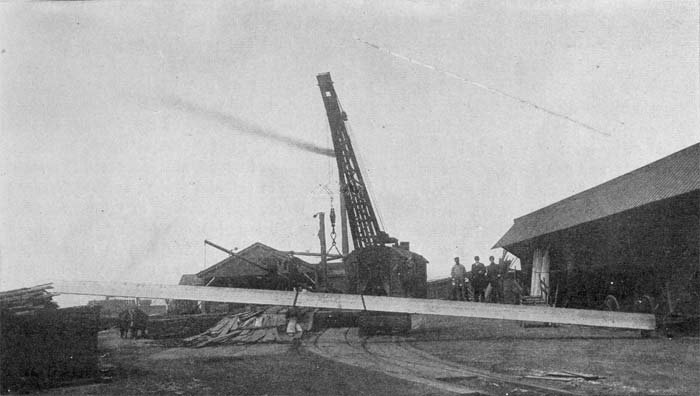
PLANT OF THE DAVID BAIRD LUMBER COMPANY AT CAMDEN, N. J., SHOWING HOW THE MAMMOTH SPARS ARE HANDLED
His promises, whether in business or politics, are always kept, no matter at what sacrifice to himself, and he evidently is one of the old-time men who “sweareth to his own hurt and changeth not.” Hard work and fidelity to duty have been the keynotes of his successful career. He is frank and self-sacrificing and does not hesitate to inconvenience himself to fulfill a promise to a humble friend. He candidly acknowledges a mistake, and is eager to make full return for any favor received; he says: “My heart was in it; I would have felt an ingrate to do otherwise.”
Mr. Baird is a fine example of manhood, and has all the prowess of the raftsman; he is stocky and powerful in build, wears a heavy mustache, and has keen blue eyes; Mr. Baird has an emphatic way of bringing down his fist that emphasizes his conviction. He is peculiarly devoted to his family, and his affection is equaled by theirs for him. They believe absolutely in him, and when in former days his wife said: “You will beat him, Dave,” there was not a dissentient voice all along the line. “I may have been wrong,” he said, “but they were always with me.”
Mr. Baird has a beautiful home in Camden, but is one of those men who has never been envied because of his modest success— sharing it far and wide, doing good to all, and everyone is welcome to a share in his prosperity. Mrs. Baird was noted for her philanthropy and her warm-hearted way of helping others.
In early days Mr. Baird won distinction in other lines than politics, he had the honor of towing the first raft of spars from New York to Boston; its value was $25,000 and the safe conduct of such a raft was considered an impossible feat until achieved by the enterprising young Irishman. He also towed valuable rafts from Lake Michigan to Buffalo, through the Erie Canal, down the Hudson River to New York, and to Philadelphia, Baltimore and Norfolk. For many years Mr. Baird purchased spars and piling from Alger, Smith & Company, of Detroit, Michigan, and his business relations with, and tribute to General Alger aptly exemplify that “comrade” spirit which prevails in the lumber trade, in which the men are always ready to help each other during troublesome times, when the worth of friendship is tested. At such periods David Baird has always been a true friend.
The enterprising man from Derry has also dealt in timber, lands, saw and planing mills in Pennsylvania, New York and the South, and knows the quality of timber as well as he does human nature. He seems instinctively to recognize sound wood and a good man and it is this insight which has created his fortune, combined with his doing and daring things that other men never attempted. His feats in raft transportation are well known in the lumber trade, and represent a saving of thousands of dollars, owing to the expert methods employed.
Mr. Baird is active in commercial life and is interested in the financial institutions of his city, and in building associations, which have been in existence more than twenty-six years, and are the strongest and most successful in the southern part of the state. He is president of one of these societies. He succeeded John F. Starr, war congressman and former member of the district, as president of the First National Bank, which was established in 1855, and is located in a stately building of colonial design, surrounded by an iron fence, and standing in the center of the city. During his presidency the deposits have doubled. Mr. Baird is also director of the Security Trust Company of his home city, and is loved and revered by his fellow citizens in Camden— his home—where his “boys” and friends all agree “Dave is a real man.”
Some five years ago he purchased an extensive property in Camden at the foot of Pearl Street, where in 1859 he found his first employment in Camden; he has now on this site a large lumber, saw and planing mill and spar manufacturing business and has also an extensive spar making establishment in Brooklyn, New York. This enterprise is known as the David Baird Company and those interested are: Mr. Baird, his two sons, Irvine Baird and David Baird, Jr., bright active young men, and E. F. Van Stavoren who came into Mr. Baird’s employ some twenty years ago.
At all times there can be found at this plant some of the largest timbers and spars that are to be had in any section of the country. The large stock includes yellow pine from the South, white pine, fir and oak from various sections, in fact almost everything in the lumber or spar line is to be found in the large and varied stock.
Funeral of Jane Stoy Fox
Philadelphia Inquirer —
•• There were many persons in attendance at the funeral yesterday of Jane Stoy Fox, daughter of Mr. and Mrs. William Fox, which took place from the home of her grandfather, State Assessor David Baird, 806 Cooper st. The body was placed in the Baird mausoleum, at Harleigh Cemetery.
Baird Holds a Christmas Party
Philadelphia Inquirer —
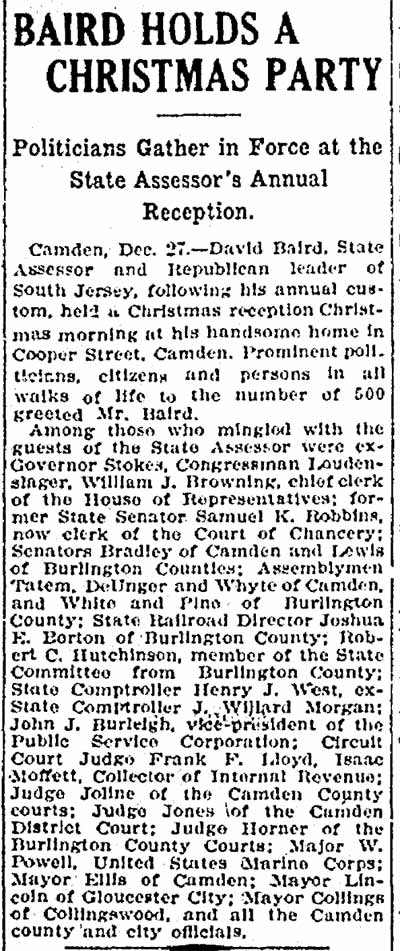
Politicians Gather in Force at the State Assessor’s Annual Reception.
Camden, Dec. 27.—David Baird, State Assessor and Republican leader of South Jersey, following his annual custom, held a Christmas reception Christmas morning at his handsome home in Cooper Street, Camden. Prominent politicians, citizens and persons in all walks of life to the number of 500 greeted Mr. Baird.
Among those who mingled with the guests of the State Assessor were ex-Governor Stokes, Congressman Loudenslager, William J. Browning, chief clerk of the House of Representatives; former State Senator Samuel K. Robbins, now clerk of the Court of Chancery; Senators Bradley of Camden and Lewis of Burlington Counties; Assemblymen Tatem, DeUnger and Whyte of Camden, and White and Pino of Burlington County; State Railroad Director Joshua E. Borton of Burlington County; Robert C. Hutchinson, member of the State Committee from Burlington County; State Comptroller Henry J. West, ex-State Comptroller J. Willard Morgan; John J. Burleigh, vice-president of the Public Service Corporation; Circuit Court Judge Frank F. [sic] Lloyd, Isaac Moffett, Collector of Internal Revenue; Judge Joline of the Camden County courts; Judge Jones of the Camden District Court; Judge Horner of the Burlington County Courts; Major W. Powell, United States Marine Corps; Mayor Ellis of Camden; Mayor Lincoln of Gloucester City; Mayor Collings of Collingswood, and all the Camden county and city officials.
“DAVID BAIRD TO FACE GRAND JURY”
Philadelphia Inquirer —
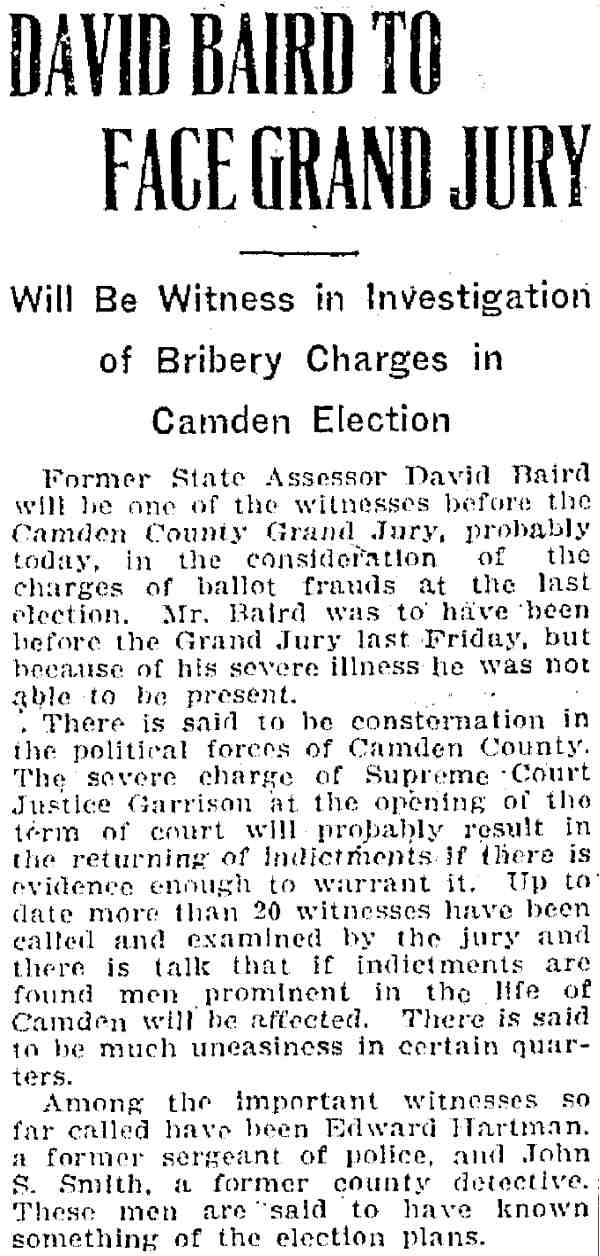
Will Be Witness in Investigation of Bribery Charges in Camden Election
Former State Assessor David Baird will be one of the witnesses before the Camden County Grand Jury, probably today, in the consideration of the charges of ballot frauds at the last election. Mr. Baird was to have been before the Grand Jury last Friday, but because of his severe illness he was not able to be present.
There is said to be consternation in the political forces of Camden County. The severe charge of Supreme Court Justice Garrison at the opening of the term of court will probably result in the returning of indictments if there is evidence enough to warrant it. Up to date more than 20 witnesses have been called and examined by the jury and there is talk that if indictments are found men prominent in the life of Camden will be affected. There is said to be much uneasiness in certain quarters.
Among the important witnesses so far called have been Edward Hartman, a former sergeant of police, and John S. Smith, a former county detective. These men are said to have known something of the election plans.
Hatch’s Next Camden Grand Jury Is Puzzler
Philadelphia Inquirer —
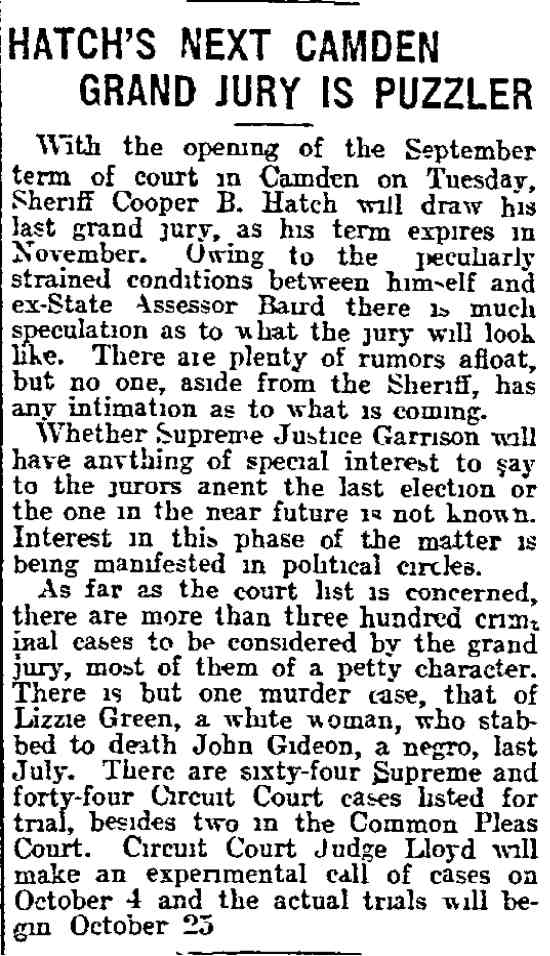
With the opening of the September term of court in Camden on Tuesday, Sheriff Cooper B. Hatch will draw his last grand jury, as his term expires in November. Owing to the peculiarly strained conditions between himself and ex-State Assessor Baird there is much speculation as to what the jury will look like. There are plenty of rumors afloat, but no one, aside from the Sheriff, has any intimation as to what is coming.
Whether Supreme Justice Garrison will have anything of special interest to say to the jurors anent the last election or the one in the near future is not known. Interest in this phase of the matter is being manifested in political circles.
As far as the court list is concerned, there are more than three hundred criminal cases to be considered by the grand jury, most of them of a petty character. There is but one murder case, that of Lizzie Green, a white woman, who stabbed to death John Gideon, a negro, last July. There are sixty-four Supreme and forty-four Circuit Court cases listed for trial, besides two in the Common Pleas Court. Circuit Court Judge Lloyd will make an experimental call of cases on October 4 and the actual trials will begin October 25.
Thousands View Chief’s Remains
Camden Post-Telegram —
Throngs Jam Court House While Body Lies in State for Two Hours.
LAST SAD RITES THIS AFTERNOON
Not since the memorable funeral of Chief of Police Foster ten years ago, has there been such a genuine public tribute paid an official of Camden as was in evidence last night at the bier of the lamented Fire Chief Worthington, and today at his funeral. It is hard to estimate the number of persons in a crowd, but from 7 until 9 o’clock last night there was a steady stream of men, women and children, two abreast, who passed from the main entrance, through the center corridor and beneath the illuminated rotunda, where the body lay, and thence out by the west corridor. There was never a stop, and it is estimated that at least 10,000 persons were there, perhaps more.
There could not have been a more ideal location for the repose of the casket containing the honored dead, and the great array of beautiful flowers than beneath the rotunda. It seemed to be a sacred shrine in itself where the citizenry dropped a tear for the lamented departed. The effulgence of the soft lights from above specially installed by Electrical Chief Kelly but lent to the scene and as the dark garbed escort of firemen, the active pall bearers, stood, on guard, the scene was unusually impressive.
Chief Worthington, aside from the pallor that comes to the dead, looked as he did in life, for the thread had been snapped so quickly that it was while he was in his full vigor that the vital spark had taken its flight. There were some marks on his face that indicated the intense though momentary suffering through which he passed on his fateful plunge from the roof of the burning building to his quick death, and the passing crowd remarked this. But withal there was that calmness and repose feature which seemed to indicate that the gallant leader of Camden’s fire fighters but lay sleeping rather than that his soul had taken its eternal flight.
Public grief may be a mere ephemeral emotion, born of the moment and only to be succeeded by the acclaim of the newly arisen public idol, but last night’s encomiums seemed to come from hearts that overflowed with genuine and permanent sorrow over the untimely passing of so excellent a public servant. Many tear-suffused eyes indicated this, many expressions of grief, of sorrow, of condolence of those left showed this. The sentiment in evidence everywhere can only be likened to the sweetness of the wonderful flowers whose odor spread thorough all the corridors and in all the rooms of the great marble building.
High in the clock tower of the City Hall the bell began tolling at 6:30 o’clock. At half-minute intervals its doleful strains went forth on the cold blustery east wind which had succeeded at day of spring sunshine. The bell and the screeching wind seemed to combine as a knell indicating the passing grief of the city. It was the preliminaries to the marching of the funeral cortege from the stricken Chief’s home on Penn Street to the resting place at the Court House.
There were forty policemen in dress uniform with Chief Gravenor at their head. There were twenty-six fire heads from Philadelphia, with Chief William Murphy in the van, a tribute in itself of more than passing moment. There was the caisson on which was the black draped casket containing the body of he who all honored. There was the little red car in which Chief Worthington was wont to speed through the city at every alarm and there was his helmet and coat. There was Acting Chief Stockton and forty of the men who fought flames under the direction of he who lay so still. There was the family in cabs with curtains drawn, the members of City Council and the active pall bearers— Daniel Leach, Peter B. Carter, James White, William Patterson, Elmer Burkett, Samuel Harring.
When the cortege reached the Court House the Camden boys took up their position on the inside beneath rotunda while the Philadelphia visitors made an imposing array on the granite steps outside. And then came the public in its steady and unending stream.
Later the Philadelphia delegation was escorted to the Board of Freeholders room where tribute was paid to the dead and where a mingling of the two cities took place. Besides Chief Murphy the visitors included Battalion Chiefs William T. Barrett and George P. McConaghy, Captains L. F. Bunting, William Lindsey; H. Dinlocker, J. Higginson, J. E. Talbot, D. Campbell, T. O’Brien, F. Hughes, E. Basenfelder; H. Hutt, William McCusker, G. Rheim, R. Wilsey, J. Webb, H. Goers, H. Haines, Insurance Patrol Captain Joseph H. Shermer William Hickman, William Rodgers, John Wyatt, David Phillip, John Clyde, H. Wilkinson.
President of City Council James E. Hewitt spoke of the work Chief Worthington had already accomplished, of his plans, of his value and worth to Camden. Chief Murphy responded in a fitting way and this incident in itself was one to be remembered.
An affecting sight was witnessed by the handful of spectators, among them being other firemen, city and county officials and policemen who remained after the big doors on Sixth Street had been closed. The last to view the Chief’s remains were a delegation of about twenty firemen. Solemnly the men passed by the bier and gazed upon the features of their departed brother.
As the last of the line approached Deputy Chief John A. Stockton was seen. He stopped and with his cap laid across his breast be looked down into the casket. For almost a minute Chief Stockton stood as though glued to the spot. Then he glanced about him and the sympathetic look upon his face thrilled all.
He heaved a sigh and perhaps the teardrops refused to come, but Chief Stockton, as the lines upon his face showed, was struggling with the inner man. His emotions were tugging at his heart, but a fire laddie cannot give way to his feelings although his brother superior officer and dear friend had answered his last alarm.
The floral pieces surrounding the bier bespoke the love, admiration and respect the donors held for the dead chief. One design particularly beautiful was a mammoth loving cup made of blossoms, flowers and roses. This was the token sent by members of City Council and other city officials.
Another was the design sent by the Electrical Bureau through Chief Kelly. The original fire box, No. 134, which was pulled on the night of the fire by Chief Worthington was enshrouded by roses, carnations and lilies.
A maltese cross standing several feet high and bearing the initials of the organization was the tribute sent by the Firemen’s Mutual Benevolent Association. Chief Worthington was president of this association.
The Camden police sent a large shield of flowers and Council members offered a vacant chair of roses. The New Jersey Auto Supply Company, No. 2 Engine Company and No. 1 Truck sent beautiful broken circles and a wreath was the offering from the employees of the Victor Talking Machine Company.
A broken circle from member of the Sixth Ward Republican Club and a wreath from his friends in the sixth precinct of the Second Ward were other beautiful pieces. West Collingswood and Collingswood firemen sent two beautiful floral circles and from the Loyal Order Legion a wreath was received.
Other offerings were from the Camden Liquor Dealers league, a beautiful circle from No. 6 Engine Company, in which house Chief Worthington was captain previous to his elevation to the office of chief; sprays from the Bethany M.E. Church, Ladies Auxiliary of the Loyal Order of Moose; a wreath from the pupils of the eighth grade Sewell school, and a spray from North Baptist Church. There also were designs from members of the family and friends, all of which bespoke the great love held for the departed fire chief.
The impressive services of the P.E. Church marked the last sad rites this afternoon at St. Paul’s Church. The guard of honor and city officials left Fire Headquarters at 1:20 and proceeded to the Worthington home and escorted the remains to the church, where services were conducted by the rector, Rev. R.E. Brestell, and Rev. H.O. Jones, rector of St. Stephen’s P.E. Church. Interment was made at Arlington.
The honorary pallbearers were Mayor Ellis, Hon. David Baird, Frank F. Patterson, John W. Bell, General John A. Mather, Melbourne F. Middleton Jr., Harry R. Reed, Arthur L. Jones, Robert Gordon, David Jester, George Schneider, William Mills, J.O. Grear, William Hall, George L. Bender, and James E. Hewitt.
First National Bank of Camden
Bank Directory – March–
DAVID BAIRD, President
WILLIAM T. READ, Vice President and Solicitor
CHARLES LAFFERTY, Cashier
W. S. AYRES, Assistant Cashier
THEODORE THOMPSON, Assistant Cashier
Directors: David Baird – Frank L. Starr – Alfred W. Clement – Walter J. Staats – Frank C. Somers – J.J. Albertson – Joseph W. Graham – Albert C. Middleton – Lawrence M. Verga – Ferdinand A. Loeb – Melbourne F. Middleton Jr. – William T. Read
Philadelphia Office, 246 Market Street – W. S. AYRES, Assistant Cashier – Discount Day, Thursday
Security Trust Company
Bank Directory – March–
Security Trust Company
301 Market Street, Camden, N. J.
JOSHUA E. BORTON, President
HENRY D. MOORE, Vice President
C. H. POLHEMUS, Secretary and Treasurer
WALTER T. PRATT, Assistant Treasurer
HOWARD M. POTTER, Trust Officer
THOMAS E. FRENCH, General Counsel
Directors: Joshua E. Borton – Henry D. Moore – David Baird Sr. – Harry Reeves – Thomas W. Synnott – John F. Harned – Isaac Ferris Jr. – Cooper B. Hatch – Dr. Paul Mecray – Francis C. Howell – Townsend Stites – S. Stanger Iszard – J. Spicer Leaming – Valentine Kissling – Anthony Kuser
Banquet to Jewish Soldiers
Philadelphia Inquirer —
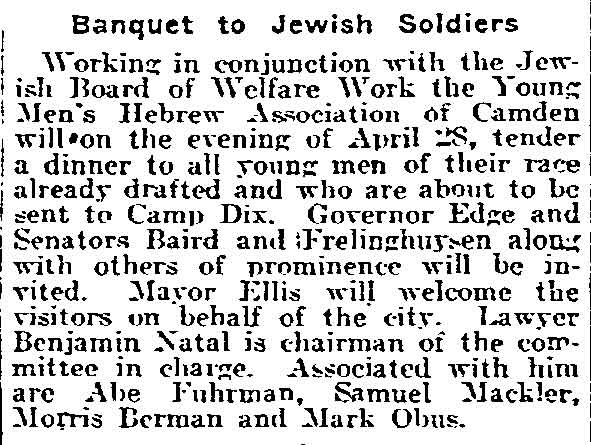
Working in conjunction with the Jewish Board of Welfare Work the Young Men’s Hebrew Association of Camden will on the evening of April 28, tender a dinner to all young men of their race already drafted and who are about to be sent to Camp Dix. Governor Edge and Senators Baird and Frelinghuysen along with others of prominence will be invited. Mayor Ellis will welcome the visitors on behalf of the city. Lawyer Benjamin Natal is chairman of the committee in charge. Associated with him are Abe Fuhrman, Samuel Mackler, Morris Berman and Mark Obus.
1918–1919 City Directory Advertisement
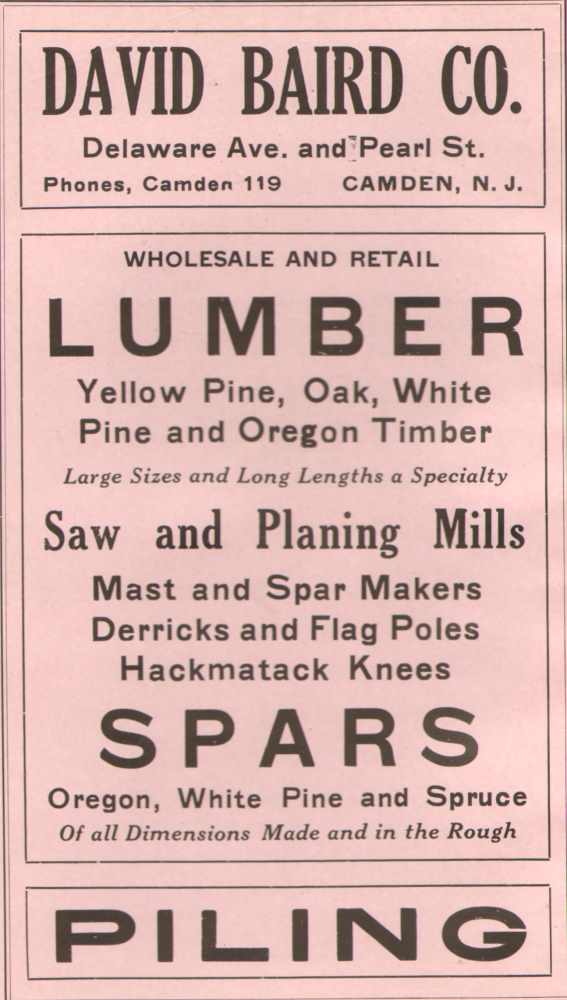
1918–1919 City Directory Advertisement
Leave It to Foch, Says Senator Baird
Philadelphia Inquirer —
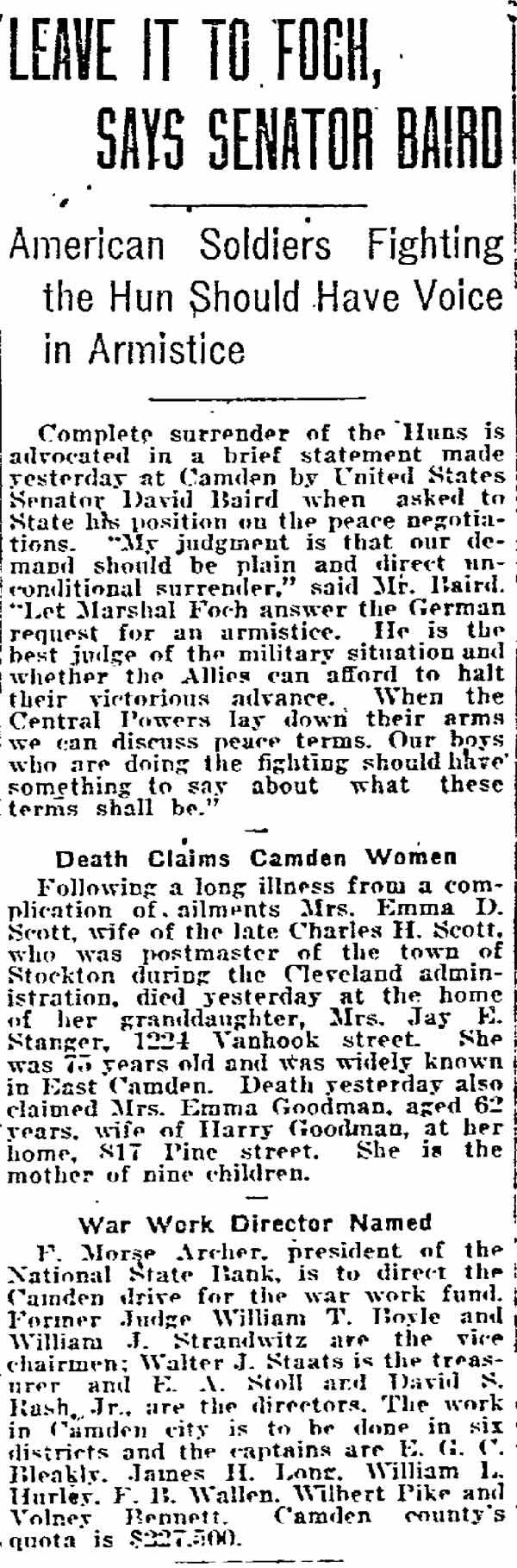
American Soldiers Fighting the Hun Should Have Voice in Armistice
Complete surrender of the Huns is advocated in a brief statement made yesterday at Camden by United States Senator David Baird when asked to state his position on the peace negotiations. "My judgment is that our demand should be plain and direct unconditional surrender," said Mr. Baird. "Let Marshal Foch answer the German request for an armistice. He is the best judge of the military situation and whether the Allies can afford to halt their victorious advance. When the Central Powers lay down their arms we can discuss peace terms. Our boys who are doing the fighting should have something to say about what these terms shall be."
Death Claims Camden Women
Following a long illness from a complication of ailments Mrs. Emma D. Scott, wife of the late Charles H. Scott, who was postmaster of the town of Stockton during the Cleveland administration, died yesterday at the home of her granddaughter, Mrs. Jay E. Stanger, 1224 Vanhook street. She was 75 years old and was widely known in East Camden. Death yesterday also claimed Mrs. Emma Goodman, aged 62 years, wife of Harry Goodman, at her home, 817 Pine street. She is the mother of nine children.
War Work Director Named
F. Morse Archer, president of the National State Bank, is to direct the Camden drive for the war work fund. Former Judge William T. Boyle and William J. Strandwitz are the vice chairmen; Walter J. Staats is the treasurer and E. A. Stoll and David S. Rash, Jr., are the directors. The work in Camden city is to be done in six districts and the captains are E. G. C. Bleakly, James H. Long, William L. Hurley, F. B. Wallen, Wilbert Pike and Volney Bennett. Camden county's quota is $227,500.
History of Camden County in the Great War, 1917–1918
Camden, N.J.: Publicity and Historical Committee, 1919
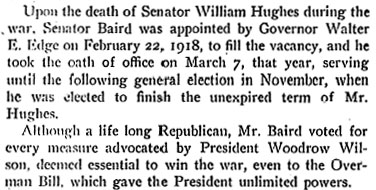
History of Camden County in the Great War, 1917–1918
Camden Hails Her Sons, Conquerors, at Victory Jubilee
Philadelphia Inquirer —
Battle Flags Wave in Triumph O’er Parade Reviewed by Admiral
Gray Veterans of G. A. R. and Wounded Ride; Centopath Passes in Reverential Hush
The Peace with victory which Camden’s sons along with millions of other soldiers of all the Allied countries helped to bring home was celebrated by a jubilee in Camden yesterday which eclipsed anything that the city across the Delaware has ever attempted in her history.
Nearly every man, woman and child who did not actually march in the jubilee parade stood on the side lines and watched it and cheered themselves hoarse as the soldiers and sailors who went out from their town to fight marched past, this time as the conquerors in the world’s greatest war.
Favored by glorious sunshine, a sunshine that was reflected in the faces of the people, the day’s proceedings went off perfectly. For months Mayor Ellis and all his city family, together with a large committee of leading citizens, had been planning the affair. Their handiwork stood the test. It was good.
Admiral Henry Wilson, commander-in-chief of the Atlantic Fleet, came to his boyhood home to be the principal guest of the city and chief reviewing officer of the jubilee. With him were national statesmen and municipal officials.
Soldiers, sailors, war workers, members of fraternal orders and men who fought under the flags of Canada, England, Italy and Poland, marched in the parade which was miles long. Every succeeding division seemed just a little better than the one which preceded it, and, when it was all over and the soldiers and sailors had filed into the old Third Regiment Armory to sit down to a piping hot banquet, the hardest thing of all was to say which had made the finest showing.
All Honor to the Dead
Amidst all the gayety and happiness there was a sober note expressed by the memorial cenotaph which preceded the parade and which brought every hat off as it passed in solemn silence.
The heroic figure of an American soldier in bronze standing on a granite pedestal which bore a gold star with the number 135, symbolical of the Camden county men who laid down their lives in their country’s cause, was carried along the route ten minutes before the parade commenced. Encircler [sic] by flowers and palms, it moved through the reverential hush which had fallen over the throngs.
While every organization in the county of Philadelphia was represented in the parade, to the thousands who lined the sidewalks, there was really only one great big important factor—the service men. And when those self-same service men, many of whom bearing the Distinguished Service Cross of their own United States, others wearing the Croix de Guerre, bestowed on them by the sister republic of France, and still others carrying on their breasts the Italian and British War Crosses, given them by grateful countries, marched down the streets and avenues, all the pent up emotion in thousands of hearts was let loose.
It mattered not whether the men were officers or enlisted men, black or white, neat or untidy, they were all soldiers and they had done all that was asked of them. Their home town honored them. The men in blue and the women in blue, too, received a welcome not one whit less feeling than their brothers in khaki.
They had a certain advantage over the doughboys, for they put half a dozen of the prettiest and smartest yoemanettes that ever wore Uncle Sam’s uniform at the head of their division. The crowd simply had to be with them.
Canada and England, too, had a detachment of men in line. About two dozen of these veterans, half of whom wore the ribbon of the Mons Star, showing that they were in service in France in 1914, were in line, and they marched snappily and smartly and drew their full modicum of pleasurable comments.
Red Cross women, some of them grandmothers, others young girls still in their teens, marched in their snowy white uniforms with their crosses of red emblazoned on headcover and breast. Salvation Army lassies who had cooked doughnuts right up under the muzzles of the guns were there with Y. M. C. A. and Knights of Columbus workers.
Elks, Masons, Knights Templar, Red Men, Moose and scores of other fraternal organizations turned out in all their glorious trappings and regalia.
The delegation of Elks, startling in their spic and span white uniforms, marched behind their own band like squads of veterans. A foretaste of what Philadelphia will see during the coming week was given when more than 100 Knights Templar, resplendent in their uniforms and swords and cocked hats with white ostrich feathers, marched in the second division of the parade. As the formation reached the reviewing stand near the Ninth Ward Republican Association they deployed into the formation of a cross, the symbol of their order, and marched past in this formation.
Many gorgeous floats were in line, th Ninth Ward Republican Association having no less than five. All were artistic. The first was bedecked with growing flowers, while a beautiful young woman reprsenting “Peace” stood flanked by a soldier and sailor. The one following had a replica of the Liberty Bell with the inscription, “Peace on Earth, Good Will Towards men.” Two soldiers rang the bell. Behind them marched a band playing “Onward Christian Soldiers” as the men marched on. Floats symbolical of every war activity were there. The Knights of Columbus showed a replica of their famous service hut which was the doughboy’s home when he had no other.
The veterans of other wars were not forgotten in this jubilee of the greatest war of all. Grand Army men whose gray locks bespoke their years rode in automobiles bearing the tattered colors of their old Civil War regiments. The soldiers of a later day, men of the Spanish-American War, were in line with their comrades.
The wounded were there, too. They could not march in the parade, but they rode and their faces were smiling and their hearts were glad as they realized that this welcome was for them.
Triumphal arches were erected at points along the route of the parade and the square at the courthouse was a mass of color.
Among the officers in command of the sections of the service division were Lieutenant Colonel Samuel G. Barnard, of the 112th Field Artillery; Captain J. Walter Scott, former adjutant of the Third Regiment; Captains English, Richards and Dickinson, of Battery B; Lieutenant J. G. Williams, Ensign Beaston and Lieutenant William Opfermann, of the aviation corps.
Battle Flags Wave Triumphant
Shortly after 1.30 o’clock James H. Long, chairman of the parade committee of the Victory Jubilee and Memorial Committee and marshal of the pageant, gave the order to march. The Lyric Band, which escorted nearly all of the troops to the terminal in the dark days of the war, was given the honor of heading the line. Chief of Police E. A. Gravenor and Assistant Chief of Police Edward S. Hyde led the parade, followed by a platoon of mounted policemen under Captain William E. Albert.
Then came Marshal Long and his aides, who were: Frank E. Van Hart, William D. Sayrs, Jr., Frank Fithian, A. Benjamin Sparks, Kessel Webster, William Isgard, Robert D. Clow, Andrew B. F. Smith, William Lorrigan, Charles Austermuhl, David Doane, William C. Davis and William D. Vanaman.
Directly behind the Lyric Band marched Mayor Charles H. Ellis at the head of the Victory Jubilee and Memorial Committee, of which he is chairman.
And at the head of the division were the battle flags of the Twenty-ninth and Seventy-eighth divisions, on which General John J. Pershing personally pinned battle pennants during those memorable days back in October in the Argonne forest. Behind the 4th marched the famous engineers, headed by Captain Keasby and Captain Beals Smuck. Three battle pennants were pinned to their flags, which never touched the ground while they were bridging the rivers in the Argonne under hellish shell fire for the doughboys to advance. Then came the 112th Field Artillery, Battery B’s heroes of the border and of France, headed by Captain Charles Richards and Captain Dickinson. In the same section marched the Eleventh Machine Gun Battalion with its battle flags and pennants fluttering.
There was another great cheer as the Seventy-eighth Division, New Jersey’s Lightning boys, loomed into view. The heroes of the 311th Infantry, 303d Engineers, 307th, 308th and 309th Field Artillery and other regiments of that famous command were given a mighty ovation behind their battle flags, which led them in their assault on St. Mihiel and the day they attacked and captured Grand-Pre in the terrible conflict in the Argonne.
Behind them marched the Marines, headed by Lieutenant Monitor Watchman, of the Fifth Regiment, Second Division. With the Marines marched the regular army units, men who had served in as many as five battles and wore three and four gold service stripes on their sleeves.
Then followed the naval contingent. They were commanded by Commander Francis W. Hoffman and Commander W. G. Hodgson.
The order “eyes left” flashed along the line as each platoon drew near the reviewing stand and Admiral Wilson with his band to his cap returned the salute. With the admiral on the stand were former United States Senator David Baird, Congressman William J. Browning, County Collector John S. Well, City Clerk W. D. Brown and others.
At the armory a splendid banquet was served to the soldiers and sailors. For days past corps Red Cross workers had been preparing the good things to eat and the men did full justice to them. They marched in the armory where the food was spread on the tables and enjoyed themselves while bands played. After dinner there were speeches. Mayor Ellis in welcoming the men said:
“This is one of the happiest moments of my life. I have waited patiently through months of trial for the glad day when I could bid you welcome to the City of Camden once again.
“We are planning to erect a lasting memorial in memory of those heroes who gave their lives and in memory of the valiant deeds you performed on land and sea.
“Camden will always cherish the memory of this day, rever the memory of your dead comrades and will inscribe your valiant deeds on that memorial. I bid you welcome in the name of the most patriotic little city in America. I thank you.”
Prosecutor Charles A. Wolverton welcomed the men on behalf of the county and paid a tribute to their valor recalling their wonderful victories of the Argonne and other battlefields of France.
Philadelphia Inquirer
Philadelphia Inquirer —
Robert Patterson Finley – David Baird Sr.
ECHOES
Camden Post-Telegram —
Story by Mr. Daniel P. McConnell, of the Camden Post Telegram, for Wednesday, March 18, 1920
Camden last night gave a splendid welcome to the Very Rev. Dean William J. Fitzgerald, J. c. D., M. R. V. F., the new pastor of the Church of the Immaculate Conception and Dean of the South Jersey Catholic parishes.
Citizens of other faiths, judges, doctors, lawyers and those in more humble stations of life, rubbed elbows in the vast audience that packed to capacity the Catholic Lyceum. All were present for a common purpose— to honor the new prelate, who comes to Camden with a splendid reputation as a Christian gentleman, patriot and ambassador of the Catholic Church.
At the reception in the Lyceum, former Judge William T. Boyle presided. He in turn introduced Rev. Francis J. McCallion, who was acting pastor of the parish. Father McCallion was given a wonderful reception after Judge Boyle extolled his oratorical and executive ability. In a splendid speech Father McCallion paid a glowing tribute to Dean Fitzgerald, the subject of the evening’s testimonial.
James F. Lennon was the principal speaker for the occasion. Already famed for his ability as an orator, Mr. Lennon probably gave his best talk last night. It was a tribute to the new Dean and the members of the Catholic clergy and Sisters of Mercy.
In his remarks Mr. Lennon told of the duties of a priest, of his mission and his value to the community. To the good sisters a glowing tribute was also paid by the speaker. Mr. Lennon also lauded the public school system and explained the principles of the parochial school. His reference to the 312 Immaculate Conception members who fought in the war for Democracy evoked a storm of applause. To the late and lamented Monsignor Mulligan Mr. Lennon offered a deserved tribute. In the course of his address the speaker told of the early struggles of the founders of the Immaculate parish. His description of the good old Irish mothers and fathers who erected a monument to Catholicism at Broadway and Market street struck a happy chord.
Turning to Dean Fitzgerald Mr. Lennon extended to him a warm welcome after which he presented the pastor with a large basket of beautiful flowers, a gift of the ladies of the parish.
Mayor Charles H. Ellis was warmly received and in a splendid talk the city’s chief executive turned over the keys of the city. The Mayor’s talk was punctuated with witty remarks concerning the “suburb of Philadelphia.”
The Mayor said that the great day had arrived when religious strife was no more and creeds were united for one common cause.
With much feeling Dean Fitzgerald told of his appreciation of the great honor. He was visibly affected by the testimonial, but modestly stated that he considered it not only a reception to him, but to the members of the Catholic clergy.
Dean Fitzgerald assured all that he was glad to come to Camden and he asked the hearty co-operation of his parishioners. He turned and gazed over the members of the reception committee seated on the stage and told how happy he was that men like former Senator Baird, County Clerk Patterson, Mayor Ellis and other big men of the city and county were present to do him honor.
After the reception in the Lyceum Dean Fitzgerald adjourned to the parlor of the Lyceum where he met members of the parish and other friends. He stood under a canopy of flowers and colored electric lights.
The guard of honor was comprised of fifty-fourth degree Knights of Columbus. Three hundred members of the parish formed the honorary escort from the train terminal to the rectory.
Unable to be present, because of previous engagements, Rev. Leon K. Willman, pastor of the Broadway M. E. Church, and Rev. Edwin F. Hann, of First M. E. Church, sent letters of regret in which they wished the new pastor success in his new fields of labor.
Success of last night’s eventful occasion can be attributed to Rev. Francis J. McCallion, who directed the affair. He was ably assisted by Edward Clare, George Slake, George Burke, Cornelius J. Healy, James McGowan, Hugh Pattie, Michael Quinn, Robert A. Stack and James Wren.
This morning the church reception was held with a solemn high mass, which was sung by Dean Fitzgerald. Father Whelan was deacon, Father Hennig, sub-deacon, and Father Shay, master of ceremonies. Father McCallion delivered a splendid sermon for the occasion and the singing of the altar boys was very fine. William H. Lorigan presided at the organ.
Children of the parish this afternoon tendered a reception to the new pastor. The altar boys will present Dean Fitzgerald with an enlarged and framed likeness of himself.
Reciprocation
Trenton Times —
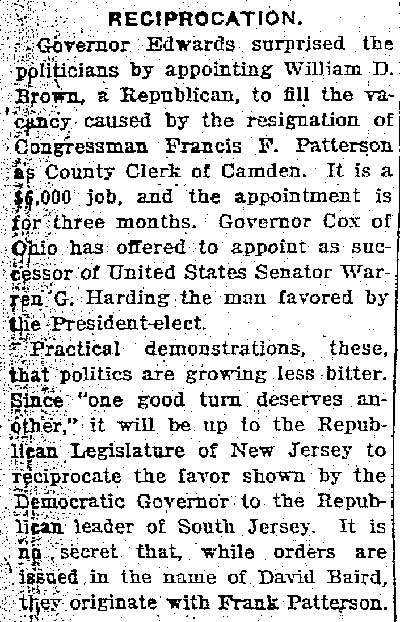
Reciprocation.
Governor Edwards surprised the politicians by appointing William D. Brown, a Republican, to fill the vacancy caused by the resignation of Congressman Francis F. Patterson as County Clerk of Camden. It is a $6,000 job, and the appointment is for three months. Governor Cox of Ohio has offered to appoint as successor of United States Senator Warren G. Harding the man favored by the President-elect.
Practical demonstrations, these, that politics are growing less bitter. Since “one good turn deserves another,” it will be up to the Republican Legislature of New Jersey to reciprocate the favor shown by the Democratic Governor to the Republican leader of South Jersey. It is no secret that, while orders are issued in the name of David Baird, they originate with Frank Patterson.
Circuit Court Judge Frank T. Lloyd Accepts Chairmanship of Unemployment Committee
Philadelphia Inquirer —
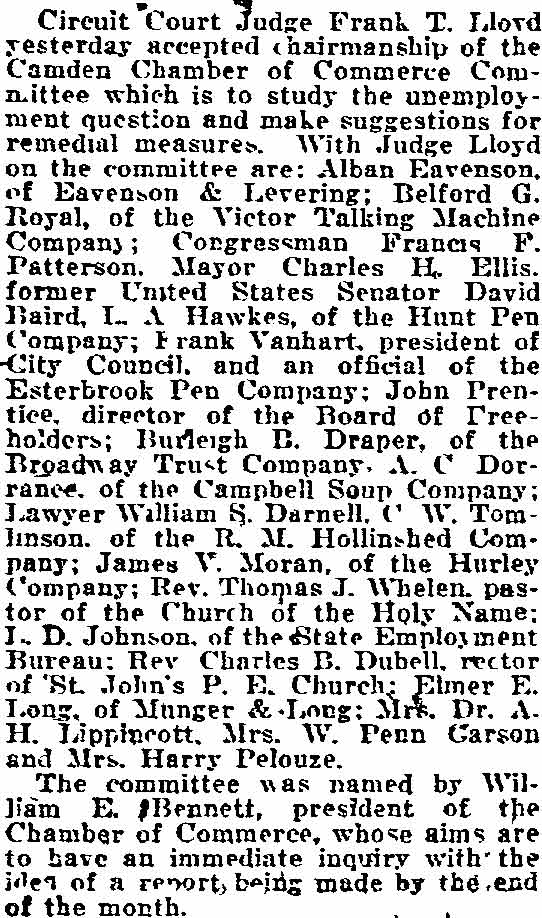
Circuit Court Judge Frank T. Lloyd yesterday accepted chairmanship of the Camden Chamber of Commerce Committee which is to study the unemployment question and make suggestions for remedial measures. With Judge Lloyd on the committee are: Alban Eavenson, of Eavenson & Levering; Belford G. Royal, of the Victor Talking Machine Company; Congressman Francis F. Patterson; Mayor Charles H. Ellis; former United States Senator David Baird; L. A. Hawkes, of the Hunt Pen Company; Frank Vanhart, president of City Council, and an official of the Esterbrook Pen Company; John Prentice, director of the Board of Freeholders; Burleigh B. Draper, of the Broadway Trust Company; A. C. Dorrance, of the Campbell Soup Company; Lawyer William S. Darnell; C. W. Tomlinson, of the R. M. Hollinshed Company; James V. Moran, of the Hurley Company; Rev. Thomas J. Whelen, pastor of the Church of the Holy Name; L. D. Johnson, of the State Employment Bureau; Rev. Charles B. Dubell, rector of St. John’s P. E. Church; Elmer E. Long, of Munger & Long; Mrs. Dr. A. H. Lippincott, Mrs. W. Penn Carson [sic] and Mrs. Harry Pelouze.
The committee was named by William E. Bennett, president of the Chamber of Commerce, whose aims are to have an immediate inquiry with the idea of a report, being made by the end of the month.
Miss Helen Baird Peak Weds
Philadelphia Inquirer —
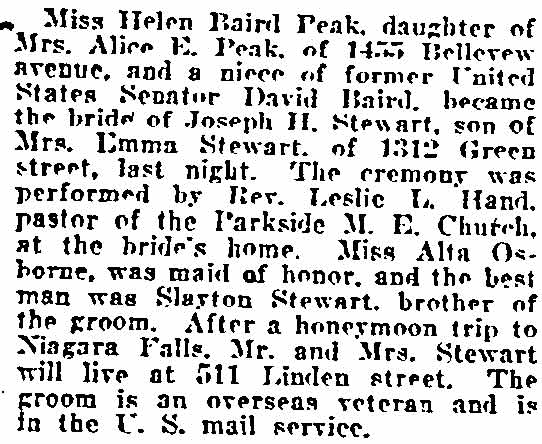
Miss Helen Baird Peak, daughter of Mrs. Alice E. Peak, of 1455 Belleview avenue, and a niece of former United States Senator David Baird, became the bride of Joseph H. Stewart, son of Mrs. Emma Stewart, of 1312 Green street, last night. The ceremony was performed by Rev. Leslie L. Hand, pastor of the Parkside M. E. Church, at the bride’s home. Miss Alta Osborne, was maid of honor, and the best man was Slayton Stewart, brother of the groom. After a honeymoon trip to Niagara Falls, Mr. and Mrs. Stewart will live at 511 Linden street. The groom is an overseas veteran and is in the U. S. mail service.
Fusion Coup In Camden Election
Trenton Evening Times —
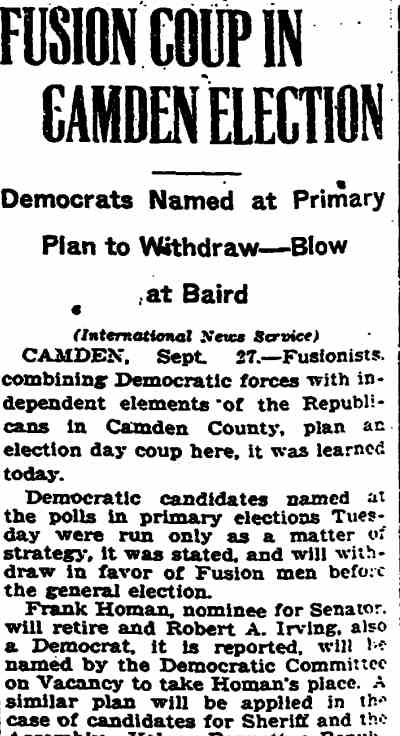
Democrats Named at Primary Plan to Withdraw—Blow at Baird
(International News Service) CAMDEN, Sept. 27.—Fusionists, combining Democratic forces with independent elements of the Republicans in Camden County, plan an election day coup here, it was learned today.
Democratic candidates named at the polls in primary elections Tuesday were run only as a matter of strategy, it was stated, and will withdraw in favor of Fusion men before the general election.
Frank Homan, nominee for Senator, will retire and Robert A. Irving, also a Democrat, it is reported, will be named by the Democratic Committee on Vacancy to take Homan’s place. A similar plan will be applied in the case of candidates for Sheriff and the Assembly. Volney Bennett, a Republican, will replace Horace L. Brewer, Democrat, as the candidate for Sheriff, according to authoritative sources.
The Fusion movement was born of the desire of Democrats and Republicans who have tired of the “Davy” Baird regime to take Camden County out of the hands of the latter’s forces. It was successful last fall, a Democrat being elected as mayor. Later the Fusionists sponsored the Commission Government movement, won out, and placed two Democrats on the Commission of five elected.
Camden has not sent a Democrat to the State Senate since 1887.
Keown Named Head of County G.O.P. as Wallworth Resigns
Camden Courier-Post —

Mrs. Verga Re-elected Vice Chairman at Reorganization Meeting of Committee
OTHER OFFICERS CHOSEN
When the Camden County Republican Executive Committee reorganized last night Walter S. Keown was elected chairman without opposition.
He succeeds former State Senator Joseph F. Wallworth, who was Republican county chairman six years, and a member 12 years. At a dinner preceding the executive session a silver set and a vase were presented to Wallworth by the committee. The retiring members of the committee received bronze elephants as emblems of the party.
At the executive session Mrs. Elizabeth Grotty Verga was re-elected vice chairman; Harry C. Sharp, treasurer; William D. Sayrs, assistant treasurer; Howard B. Dyer, secretary, and Mrs. Laura Silbers and Mrs. Lottie Stinson, assistant secretaries. Harold W. Bennett, Edward R. Diebert, Bernard Bertman, L. Scott Chercesky, Carl Kisselman and Frank Voigt were chosen solicitors.
Wallworth Reviews Work
Upon retiring as chairman Senator Wallworth said:
“During the six years I acted as your chairman considerable political history has been made in our county. The Republican party was on the rocks and loyalty seemed to have drifted away when Frank Patterson, Al Matthews, Penn Corson and Senator Baird begged me to take the chairmanship. In doing so I quickly discovered I had undertaken one of the hardest up hill battles of my life.”
When Keown took over the gavel he pointed out to the committee members they were political leaders of their districts. He said it was their duty to find out the cause of unrest.
“In some of your districts the trouble is your tax rates are too high,” said the chairman. “High taxe [sic] rates are an evil and it is your duty to find the cause and remedy the situation. When there is a spirit of satisfaction in your district there is satisfaction throughout the county.”
Wolverton Favors Plan
Congressman Charles A. Wolverton complimented the new chairman on his advice. Sharp and Sayrs, who have been identified with the committee more than 20 years, were also speakers.
Keown then turned the gavel over to Mrs. Verga, who thanked the committee for her re-election. She introduced Mrs. Silbers and Mrs. Stinson, who urged loyalty and work on the part of the women members of the committee.
Keown was nominated by Daniel Silbers, Pennsauken township. Colonel George L. Selby nominated Sharp and Dyer. All of the officers received a unanimous vote.
Ten new members took seats from the five boroughs recently created out of Clementon township. Among them was Clinton L. Bardo, president of New York Shipbuilding Corp., who was elected from the new borough of Pine Valley last Tuesday. Twelve members of last year’s committee retired either as a result of the primary election or not being candidates.
Hurley Based Success in Life and in Business on Square Deal to All
Camden Courier-Post —

By BEN COURTER
Nearly two score years ago an earnest young man called together a handful of employees in a small store at Fifth and Pine streets.
“Boys, see that door?” he said to them.
“Well, if by any chance I should be called upon to resort to unscrupulous methods in the conduct of this business that door will be closed and this enterprise will end. Square dealing is to be the principle on which we will do business, square dealing to everybody.”
That young man was William Leonard Hurley, then but 27 years old and virile, visioning a great business which he purposed to develop. It was the pronouncement of what then was nothing less than an ideal, for it was in a period when there was a tendency to take advantage of the unsuspecting to sell inferior goods at exorbitant prices. Many operated under what was known in the trade as the “borax system,” which resulted in the public looking askance at installment buying for the home.
Based on that determination to cultivate public confidence in his own business, Hurley built slowly but securely, his small enterprise into “the big trustful store,” with branches in half a dozen cities.
It was a determination that made him a kindred spirit, in later years, with Theodore Roosevelt whose guest the Rough Rider was to become in the midst of a political campaign that stirred the country from coast to coast. It was the straight-forward characteristic that likewise prompted his subsequent activities in the interest of Camden, that was to be a factor in throwing off the provincial spirit and entering the civic stride so pronounced in the advent of the Camden bridge and the extension of Broadway. In both these he was a strenuous advocate of civic expansion, scientifically planned.
Hurley Not Born With a ‘Silver Spoon’
When Hurley was born in Chester county, Pa., 65 years ago, it was not with a “silver spoon in his mouth.” His father, William Hurley, was a railroad man, an honest, hard-working father, who, in times which were hard enough for the bread-winner, struggled to keep his family in the necessities of life.
The son, William, obtained the rudiments of education under great difficulties, for schools were scarce and far between in the sparse settlement where his boyhood was spent. It was a school of hard knocks, an environment that evidenced the difficult problem the poorer class had in obtaining the bare necessities of life. It was the experience of those early years that William L. Hurley never forgot, for afterward, when success had come, he never was deaf to an appeal from those “pulling hard against the stream.”
At the age of 12 he obtained his first job on a farm in his native Chester county. Farming in those days was hard, strenuous work, seemingly never ending labor to the boy, even then strong and possessing much of the splendid physique of later years.
“I worked from four in the morning until after dark,” Hurley once said, in a reminiscent way. “The farmer usually woke me in the morning by pounding his cane on the floor.
“My duties? Well, they included milking ten cows, feeding chickens and pigs, cleaning the horses, husking corn and doing odd chores. The farmer paid me $4 a month and board.
“In those days boys worked just as hard as grown folks. It was no cinch and when darkness came I couldn’t run fast enough to the farmhouse and to bed. I was dead tired and the bed brought supreme happiness to me. Sleeping was about the only fun I had.”
So the years went on with the hard work on the farm. The future held no great promise. The railroad was more alluring. Since his father was a railroader, young Hurley decided to try that field.
Railroading in 80’s No ‘Automatic’ Job
Back in the 80’s railroading was a far different proposition than it is now. There was none of the automatic brakes and couplings and numberless other inventions that have made it comparatively a safe job today. The old-fashioned coupling pin, for instance, was the abomination of the brakeman. What it did to Hurley he carried to his dying day in the loss of the end of one of his middle fingers.
Not only did he act as brakeman but also as fireman. As he stoked the pulsing engine he dreamed of the day when he might take the throttle. It seemed a wonderful career then, but fate had other things in store for him. He sensed it when he concluded to better his wage of $1.[?]0 a day and get “something on the side.” That was by selling sewing machines at night, often after he had worked hard on drilling freights or stoking the engine through the day.
But this selling of sewing machines impressed young Hurley that perhaps after all there was something else in life other than guiding a great locomotive over the rails. At any rate he concluded to try it out and this in 1888, the year of the “great Blizzard” in this section, he obtained a job with Edward Gately & Co. in Philadelphia as canvasser. It was not long before he had two assistants who acted as collectors, one of whom, Harry F. Jones, was to become his partner in the Atlantic City store many years later.
Gately was a wealthy man who had made his money mostly in the installment business, one who ever had an eye open for the promising young men in his organization. It was his custom to give them a chance and take them into partnership, opening stores in various cities. Young Hurley was one of these promising young men. In 1890 the business of Gately & Hurley was started. To be exact it was on February 1 of that year that a small store was opened, the corner store under old Wildey Hall at Fifth and Pine streets. It was there that he was inspired to tell his then small force of his square dealing policy.
Worked Long Hours to Make Store Success
Young Hurley worked like a Trojan. None in the ranks put in longer hours than he, sometimes 18 or 20 before he was willing to call it a day.
Not only did he direct his force in garnering business, but he went out on the street, often with rugs across his shoulders, to obtain patronage. Many recall the stalwart, earnest young man and his breezy manner which seldom failed to bring result.
Nor was Hurley, in the flush of subsequent success, averse to recalling those strenuous days, usually with a chuckle and remembrance of old timers who had stood staunch and strong with his organization through the intervening years.
Four years later the business had grown to such proportions that he concluded another location was needed. That was after all the stores under Wildey Hall had been occupied. In 1894 the Gately & Hurley store was opened at Broadway and Pine streets. It was then 33 by 90 feet.
When Hurley impressed Gately with the necessity for expanding and having a real store he prepared plans for a four-story structure. Camden then was filled with the “can’t be dones.” Toone & Hollinshed at Broadway and Kaighn avenue was the biggest place on that thoroughfare. Mrs. Varney’s place was on Kaighn avenue, the store of E. V. Story at Sycamore street, Hughes Brothers at Walnut street, Fuhrman Brothers at Chestnut and a few notion places here and there. But the Hurley enterprise seemed so outlandish that one day as George Leathwhite, then Camden’s leading plumber, was looking over the building operation a prominent business man of the period asked.
“Who is the damn fool building this place?”
Nor was he mollified in the least when informed it was “Bill” Hurley. It was regarded altogether a foolhardy undertaking, one that would spell certain disaster. It was pointed out there was nothing just like it on Broadway and that there was nothing to warrant such an outlay.
As a matter of fact that pessimistic note eventually reached Gately. He had some misgivings and Hurley’s four-story building was kept down to three. Just two months after the store had been finished it was necessary to find warehousing room by renting the old bakery of William Kairer at Line and West street. Incidentally, it may be of interest to recall it was Kairer the baker, who had been shot and killed by a burglar in 1893. Theodore Lambert was hanged in the old county jail for that murder.
In 1900 Hurley bought the Gately interests, giving him exclusive ownership, and the business continued to grow making more additions necessary. The old Field properties, two and a half story bricks, were bought, torn down and the store extended.
In 1903 a store was established at Wilkes-Barre with Daniel Loughran as Hurley’s partner. Three years later Henry J. Tobin was made his partner in another store at Trenton. Then in 1912 John J. Powell was commissioned to open the Hurley-Powell store at Wilmington. Harry F. Jones, Hurley’s collector in the very early days opened the Hurley-Jones store at Atlantic City in 1915. Five years later another Hurley store started business at Bridgeton. And in 1923 the home store was remodeled and in the meantime, old Turner Hall, where many a gay night was had by the old timers in masked balls and other festivities, was converted into a warehouse with other structures doing like service. Hurley has long since been recognized as one of South Jersey’s merchant princes.
Roosevelt Given Support in Bull Moose Campaign
Although he never consented to leave the helm of his great business enterprises, save later in life when he spent part of the winters at Hilton Head or occasionally went abroad, Mr. Hurley found time to take an active interest in the affairs of Camden. He did not seek political preferment but for more than 30 years he sought the best that might come with [blacked out]n progressive government. He ever desired to see Camden forge ahead in business in a civic way. Frequently he chafed over a tendency on the part of the political powers to let things drift along. He had no particular objection to the Republican organization as it was constituted under the late Senator David Baird, but he did believe with all possible sincerity that if the progressive spirit could be injected into it much would be accomplished, things that were left to very, very slow evolution.
It was therefore quite in keeping with that tendency that he aligned himself with the late Cooper B. Hatch in the late 90’s when the Committee of 100 was born with the Courier then under S. Conrad Ott as city editor being a potent factor in the victory. It was then that Hurley gave financial and moral aid to the movement with Hatch as the leader and with Lewis H. Moorman, [blacked out], C. Kramer and others many of whom have long since gone fostering the cause. [blacked out] its purpose perhaps although within a few years it had passed with the usual disintegration of independent movements.
When Colonel Roosevelt formed the Bull Moose party and became the Presidential candidate in 1912 with William H. Taft and Woodrow Wilson in the field, Mr. Hurley was an earnest active advocate of the Rough Rider. In fact he was one of the delegates to the Bull Moose convention that nominated Roosevelt.
In the midst of that truly hectic campaign when Wilson, Taft and Roosevelt visited Camden, Wilson’s meeting was enthusiastic enough to please any Democrat. Taft’s was a frost and hardly more than a fringe, mostly office holders greeted him, but Roosevelt’s was what the Colonel himself called a “rip snorter.”
Teddy Was Guest at Home of Hurley During Visit Here
Hurley was his host on that occasion, a hot summer night, itself suggestive of the extremely hot campaign. These meetings were held at the Third Regiment armory, no other building then being available. One may yet recall very vividly the entrance of the Colonel, Mr. Hurley and the Camden Bull Moose leaders. The great drill hall was literally jammed, with yelling enthusiasts even hanging from the top girders. Just as he arrived a terrific thunder storm broke loose, the reverberation, the vivid flashes lost in the roar of the crowd.
“Where’s your hat, Teddy?” someone yelled.
And the Colonel tossed his old black slouch hat in the ring while Hurley led the cheer that followed, a cheer that seemingly tested the strength of the expansive roof. Roosevelt had been a guest at the Hurley home at West Collingswood where the leaders, the rank and file of the Bull Moosers met him. It was one gala night and Mr. Hurley was in the zenith of his glory.
None was more disappointed when Colonel Roosevelt failed at the November election, for Mr. Hurley felt that the country needed the hero of San Juan Hill particularly at that time. He sincerely mourned the Colonel’s passing, but to the very last cherished his memory, regarding him as the Great American.
Backed Non-Partisan Move, Aided Opening of Broadway
As has been indicated, Mr. Hurley had no particular feeling against the Republican organization, but he was certain that Camden was on the threshold of big things and that there should be an awakening. There appeared to be no intention of getting out of the rut so far as the political powers were concerned and with the assurance of the bridge he regarded it necessary to be alive to the opportunities certain to come. There had been talk of certain outlets from the bridge which did not meet the situation in his judgment. For one thing, he was impressed with the extension of Broadway.
For more years than one might recall, Broadway had been Camden’s principal street. Many regarded it as the city’s most important business thoroughfare. Mr. Hurley early realized that to extend it to where the bridge plaza would eventually be located was a real civic essential, but the city administration did not consider the financial outlay that would be involved justified in the extension.
That was one of the factors that resulted in the Non-Partisan movement of 1922, of Mr. Hurley’s advocacy of its cause, of his financial and moral support. He was one of the leaders in the civic revolution that first brought the victory for commission form of government and later that ushered the Non-Partisan candidates into office.
It was the realization of a cherished dream when the new administration bought property that assured Broadway’s extension to the bridge plaza. It justified his prediction that it would be like giving a new blood stream to the city, for the Walt Whitman Hotel, the Wilson Building and others rapidly rising about Broadway and Cooper streets prove it beyond all doubt.
Camden Bridge Proposition Given Approval by Hurley
Mr. Hurley not only gave his every influence toward the Camden bridge proposition in the days when it was regarded more or less a joke, but he worked assiduously to crystalize [sic] sentiment so that the century-old dream would be a dream no longer. New Jersey did its part when Walter Edge was governor, but there was plenty of backing and filling on the part of Philadelphia and Pennsylvania. There were many discouraging epochs, even after a joint commission had been created, but Mr. Hurley was among those who refused to give up hope. What was subsequently accomplished was due mainly to men of his faith, of his courage, of his energy.
After its completion the necessity for a second span was impressed upon him. Shortly after the Camden bridge was opened to the public he advocated another from Market street, Gloucester to Pattison avenue, Philadelphia. Since other sites have been suggested. A joint commission has been named to make preliminary surveys but has been at loggerheads over a proposal to build a span from Red Bank to League Island. Mr. Hurley regarded his suggestion as far more feasible and he supported it by arguments that were hard to answer.
Throughout his career Mr. Hurley had been an earnest advocate of co-operation among business interests of the city. For many years there was the Board of Trade rather an innocuous organization, usually attended by half a dozen men and voiceless so far as influence went. He concluded a rejuvenation was necessary, consented to act as president and speeded it up with the late Louis T. Derousse as secretary. Later Charles M. Curry held that position and until the present Chamber of Commerce was formed under a campaign directed by the American City Bureau. Mr. Hurley or his subordinates had given it every possible aid to make it a factor in the community.
Assessment Commissioner Was Only Political Post
Aside from his principal business, Mr. Hurley was associated for many years with the late William J. Lorigan in building homes. Their first extensive operation was the construction of two rows of dwellings in Princeton avenue. Others were constructed in various parts of Camden and the development of the district about Twenty-seventh and Federal streets was largely due to the firm. After the elder Lorigan’s death he was succeeded by his son, William H. Lorigan, who has been associated with Mr. Hurley.
While he sought no political honors, Mr. Hurley did once accept for a few years a position. It was during the Committee of 100 regime when he became a commissioner of assessment. He [?] served for many years as a delegate to the Atlantic Deeper Waterways Convention. He took a keen interest in that organization and in the work of actually having an inland waterway along the eastern seaboard. It is slowly developing with the possibility of becoming an actuality a few years hence, mainly through the effort of men of Mr. Hurley’s caliber.
When he came to Camden Mr. Hurley first resided on Stevens street, then at [?] Pine and from 1894 to 19[?]9 at 7[?]8 Broadway. In the latter year he bought the estate on White Horse pike at West Collingswood that had been used as a sanitarium. The building was virtually reconstructed, the grounds were laid out in beautiful shrubbery and there were already fine nut trees which made it a show place. He called it Dungarvan, after the county in Ireland where his father was born.
It was there at his palatial home, with the beautiful surroundings that Mr. Hurley delighted in acting the role of host, of gathering about him old friends and harking back to the times that were.
Unspoiled Good Will Befriended All in Need
Old friends cherish the memory of one outstanding characteristic of “Bill” Hurley. Increasing fortune never “spoiled” him. He remained democratic until the end, and those who had known him through the years called him “Bill” just as they had done in the days when he was forging ahead in spite of the “can’t-be-dones.”
Nor did he ever forget an old customer. It might be an old, old woman upon whom fortune had consistently refused to shine but who made her little purchases at his store. None was too lowly for him to give his personal attention under such circumstances. There was ever a real grip of the hand that spoke sincerity.
It was quite natural that he enjoyed hunting and fishing. For many years his summer home was at Sea Isle City, where his family went through the vacation period each year. There he never failed to go out to sea or to try his luck off the pier, usually with an old friend. Catching the piscatorial beauties, particularly a channel bass or a drum, was regarded with almost the same satisfaction as putting over a big business deal.
Over a dozen years ago he bought the island at Hilton Head, off the coast of South Carolina and 30 miles from Savannah. While he enjoyed all the comforts of civilization, the surroundings were kept in their primitive simplicity. Nothing delighted him more than taking an old friend along to the island estate and showing the guest the time of his life.
Men like Hurley do much that is unheralded to alleviate the suffering of the world. Creed or color meant nothing to him if aid were needed. What he gave in that respect no one knows. Those long associated with him declare it was sufficient to make happy a small army in adversity.
Aided Worthy Causes Regardless of Creeds
Charitable organizations, religious or otherwise, enjoyed his bounty. No one was aware of such aid unless it happened to be in a “campaign” to raise a specified sum. It was Hurley very often who started things going by way of a liberal contribution. It mattered not whether the cause was for Protestant, Catholic or Jew—just so it was worth while. When the vicious pogroms were sweeping Russia he was one of the most generous contributors to the Camden funds for the sufferers. In the flu epidemic of 1918 he was among the leaders who aided the stricken, who gave many a family a lift over rough places.
During the war he was active in every Liberty Loan drive, in every movement that aided ultimate victory. He was chairman of the Knights of Columbus drive, he was a potent factor in the United War Workers’ campaign, in the Red Cross and kindred movements. He took great interest in the boys who “went over there” for his own son, Jerome, was in the service.
Surely in glancing over Camden’s history in the past two-score years not an instance conducive to the city’s development may be cited without finding William L. Hurley’s name connected with it some way, some how. He was so much a part of its warp and woof that the civic fabric bears indelibly the impress of his personality.
David Baird Company Advertisement
Camden Courier-Post —
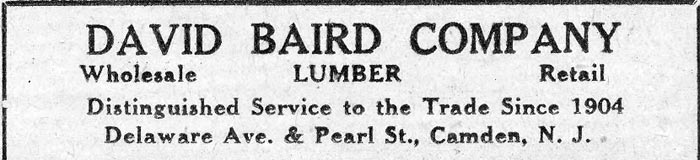
DAVID BAIRD COMPANY Wholesale LUMBER Retail Distinguished Service to the Trade Since 1904 Delaware Ave. & Pearl St., Camden, N. J.
Jobless Son Kills Jake Schiller Who Saves Boy’s Wife From Gun
Camden Courier-Post —
Slayer Crazed by Separation, Relatives Say
Dazedly Insists He Had No Intention of Shooting Sire
ESTRANGED WIFE SEEN IN SUICIDE TRY
Slain Man Long Was Prominent Figure in Camden Politics
Jacob Schiller, 72, for 45 years a political figure here, is dead, shot by his own son.
The slayer, William Schiller, 30, a former summer policeman now unemployed, was held over today to the grand jury on a charge of murder. He made no comment whatever during his police court hearing.
A few hours later, young Schiller’s wife, Augusta, whom he had also tried to shoot, was found wandering through the city street, in an hysterical condition.
She had written a note which police believed showed intent to commit suicide, and had staggered dazedly through the streets last night. Both in her note and in her incoherent statements to detectives she declared she was to blame for the tragedy.
She said her father-in-law had tried to save her and was killed in the attempt.
The slaying occurred Saturday night at the elder Schiller’s home, 2420 Carman Street. It climaxed an estrangement between young Schiller and his wife, with “Jake” Schiller attempting to reconcile the couple.
Mrs. William Schiller, who had had her husband arrested several months ago, said she believed he had become mentally deranged, but Police Judge Pancoast was informed that an alienist had examined young Schiller in July and pronounced him sane.
Couple Separated
Young Schiller had been living with his father at the Carman Street address, while Mrs. Schiller has been residing with her parents, Mr. and Mrs. John I. Green, 409 North Thirty-seventh Street. The cause of the estrangement has not been revealed by police, but it is stated that young Schiller refused to consent to a reconciliation.
“Jake” Schiller was a Republican worker in the Twelfth ward for years, and was at the time of his death inspector of city street lights.
Were Alone at Home
The father and son were at home 9.00 p. m. Saturday night and apparently were quarreling when the young Mrs. Schiller, her brother-in-law and sister, Mr. and Mrs. William Miller and another sister, Mrs. Lottie Bennehler, reached the house.
“Don’t come in here,” the older Schiller shouted as they started to enter the front sun parlor. But Miller did enter and said young Schiller was clutching a revolver in his right hand. He declared he closed in on his brother-in-law and tried to wrench the revolver from him. Two shots rang out and the father fell to the floor.
Patrolman Joseph Keefe was standing at Twenty-fifth and Federal Streets when two boys ran up and told him there was a shooting at Twenty-fifth and Carman Street. He ran to the scene and said he reached there in time to see young Schiller shooting up the street at his wife.
Keefe said Schiller ran into the house when he saw him. Aided by Miller, Keefe overpowered Schiller and placed an iron claw on his right hand after disarming him.
Jacob Schiller Jr., another son, learning of the shooting, went to his father’s home and took him to Cooper Hospital in a passing automobile. As he was being taken into the hospital he failed to recognize City Detective Robert Ashenfelter and died five minutes later.
Expresses No Regret
Police Sergeant John Potter joined Keefe and Miller and they took young Schiller to police headquarters.
Keefe said the son expressed no regret at shooting his father.
Young Schiller was taken into police court. He wore no necktie and carried a raincoat over his arm. He was represented by counsel, C. Lawrence Gregorio, who said he had been retained “by friends” to act as attorney for the accused man.
City detective Benjamin Simon had signed the complaint in which he charged “on information received” that Schiller did feloniously and with malice aforethought shoot and kill his father.
The complaint was read to him and Gregorio told him not to say anything, as Judge Pancoast would enter a plea of “not guilty” in his behalf. This was done by the court and Schiller was then held without bail pending grand jury action. He was taken to the county jail.
Declared Sane
After the hearing, Mrs. Etta C. Pfrommer, acting overseer of the poor, told Judge Pancoast that on July 26, Dr. Harry Jarrett, Broadway and Cherry Street, well known alienist, had examined young Schiller and declared him sane. The examination was made on the request of Mrs. Schiller in police court on the previous day. At that time young Schiller had been released by the court in the custody of his father.
County Detective Chief Lawrence T. Doran, who was among the first to question young Schiller Saturday night, said the man did not seem repentant over what he had done. He said Schiller did not give authorities much information. According to Doran, young Schiller declared he had objected frequently to his father that he did not want his wife to come to their home.
“It doesn’t seem possible,” said young Mrs. Schiller some hours after the tragedy. “It seems as though it was only a dream. I don’t seem to remember anything.
“Poor Bill. He must have been crazy. He idolized his father. You can blame this all on the depression. He has been without work since they eliminated summer policemen two years ago. He has been worried as a result of being unable to obtain work. Just recently he started to drink.
“Bill intended to shoot me but his father tried to get the gun away from him and I believe it went off accidentally. Nothing could convince me that Bill would shoot his father in cold blood.
“I went to his father’s home last night to try to effect a reconciliation with my husband. He had been drinking.”
Registered as Sober
The police docket at headquarters shows Schiller registered as sober. The entry was not made until 2.15 a. m., and the shooting occurred shortly after 9.30 p.m.
Relatives said the father had attempted for months to patch up the marital difficulties of the couple.
Young Schiller had been living lately with his sister, Mrs. Bennehler, 2530 Bank Street and his wife with her parents at 409 North Thirty-seventh Street. He formerly lived at that address with his wife. He was appointed a summer policeman in 1929 and served until they were all dismissed two years ago.
Coroner Holl and Dr. Edward B. Rogers, county physician, yesterday performed an autopsy on the senior Schiller’s body and ascertained that death was due to an internal hemorrhage caused by a bullet wound of the upper portion of the abdomen. They said a .32-calibre revolver had been used in the shooting.
Camden Lodge of Elks will hold services tomorrow night at the Schiller home, at which time the body will be on view. The funeral will be private on Wednesday with burial in Evergreen Cemetery.
Judge Pancoast last night recalled that young Schiller was arrested two months ago after he had kept his wife a prisoner on a lot all night. At that time “Jake,” as he was affectionately known to his friends, tried to act as a mediator between his son and daughter-in-law.
The young Mrs. Schiller at that time told Pancoast she believed her husband was deranged and asked permission to have him examined by physicians she would name. Pancoast released young Schiller in the custody of his father. The police judge said the examination had apparently not been made as no commitment papers had been sent through his office.
Long Excise Inspector
Few political workers were better known that “Jake” Schiller. He was born in Philadelphia and was brought to Camden in early life by his parents, who conducted a saloon near Twenty-third and Federal Streets. East Camden was then the town of Stockton and the scene of Saturday night’s shooting was a farm. Schiller recalled to friends that he drove cows through a pasture on which his house now stands.
He was originally a Democrat but became a Republican through persuasion of the late U. S. Senator David Baird and remained a friend of the former leader for 40 years.
Schiller had been melancholy over the death of his wife on February 13 last, friends said.
When his son was arrested he remarked to Pancoast: “what is next?”
Figured In Shaw Case
None was more in the public eye 35 years ago in South Jersey than Schiller. It was then that he figured prominently in one phase of the locally celebrated Shaw murder trial.
It was during the second trial of Eli Shaw for the murder of his mother and grandmother, Mrs. Anna Shaw and Mrs. Emma Zane. They were found shot to death in September, 1897, in their bedroom of their home on Line Street near Third. Detective John Painter had found a revolver hidden in the chimney, one of several points in the circumstantial evidence that resulted in the indictment of Shaw. He was then a widely known young man about town and his arrest caused a big sensation. As time drew near for the trial feeling was intense, for there were adherents for and against the son and grandson, those arguments often grew bitter.
Henry Sidney Scovel, then one of the prominent criminal lawyers of Camden county, was retained to defend Shaw. Scovel was son of James Matlack Scovel, himself one of the leading barristers of this section. When the trial of Shaw was under way the city was astounded when it was charged Scovel had tampered with the jury. It was Schiller who made the charge.
The trial stopped abruptly. Scovel emphatically denied the story of Schiller and demanded vindication. An indictment for embracery was returned and at a trial, which had Camden on the tip toe of expectancy for days, it developed there was absolutely nothing to verify the charge, and Scovel was acquitted. He acted in two subsequent trials of Shaw, the second being a disagreement and the third acquittal for the son and grandson of the slain women.
Schiller, strangely enough, in later years became friendly with Scovel and when the latter was prosecutor from 1905 to 1912, “Jake,” as he was familiarly known, was usually to be found in the office at the courthouse. Scovel was then a white haired man of flowery speech and impressive personality who let bygones be bygones.
Long Excise Inspector
For more than 20 years Schiller was inspector of the Excise Commission in Camden. It was during the days when the principal object of the inspector apparently was to keep the saloonmen in line. He was considered pretty good at that job, by no means an unimportant one from the organization viewpoint. It was also during that period the city had its troubles enforcing the Sunday liquor laws. There were those who considered they had enough pull to keep their back or side doors open on the Sabbath to let in their regular thirsty trade. Some succeeded in getting by, but “Jake” had his own troubles in keeping the boys straight and sometimes causing their arrest, although that was not frequent by any means.
His reign as inspector, too, was in the halcyon days of free lunch and schooner beers. Saloonmen themselves were against the lunch idea eventually since it meant too much of a financial burden. Jake kept tabs on the recalcitrants so that the liquor dealers knew who was obeying the order and who was “cutting corners” to get some extra trade.
Schiller was virtually raised with the saloon trade since his father was one of the old time German beer garden owners here, having had a place at Fourth and Line Streets. That was in the days when that section was largely populated by the German, English and Irish families lately come from the motherlands. When he was a boy, Schiller entered the U. S. Navy and served several years. When he came out he went to the old Town of Stockton, now East Camden, where he opened a saloon on Federal Street near Twenty-fourth. At that period, some 45 years ago, Stockton seethed with politics and it was just as natural for a young man to get into the game as it was for a duck to swim. Jake at that period was a Democrat and during the battle in the middle 90’s when the West Jersey Traction and the Camden Horse Railway Company were fighting for the rail franchises in the town he was a candidate for council from the old Second Ward. The late Robert Lee was the Republican candidate and won out by the narrow margin of two votes. In later years Schiller became a Republican and was elected a constable.
Never Ran From Scrap
Throughout his career Schiller never quite forgot his training in the navy, particularly with reference to boxing or fighting at the drop of a hat. He was a scrapper in his early years and never ran from a fight. That was just as true in political battles, frequent then around the polls, as in purely personal matters. And Jake would battle for a friend just as readily as for any personal reason. He was usually in the thick of the political fracaës of the years when it was the accepted thing to fight at the drop of a hat. But he also had lots of native wit which kept things interesting when he was a frequenter of the prosecutors’ office during the Scovel and Wolverton regimes. In late years, with the approach of age, he had tempered his propensity to get into an argument and liked nothing more than to tell of “the good old days” when he helped the elder Baird in his organization battles.
He made his last political stand for leadership of the Twelfth Ward in 1926 when he supported the candidacy of Sergeant Ray Smith against Commissioner Clay W. Reesman for ward committeeman. Schiller was supporting Congressman Charles A. Wolverton and the late Senator Joseph H. Forsyth in a campaign against former Congressman Francis F. Patterson and State Senator Albert S. Woodruff.
Reesman won and among the first to visit the hospital after learning of the shooting was the city commissioner. Reesman was his latest chief as lights inspector as he was attached to the highway department. Commissioner Frank B. Hanna also visited the hospital.
“In all the years I have known him he has always been an enthusiastic and loyal friend with a good heart for everybody in trouble,” Congressman Wolverton said when he learned of Schiller’s death.
Schiller was also a familiar figure at the Elks Club, where he was an ardent card player. But after the death of his wife he gave up this pastime, contenting himself with watching the games. He was also a frequent visitor among old friends at the courthouse.
Baird Family Mausoleum
Harleigh Cemetery, Camden NJ
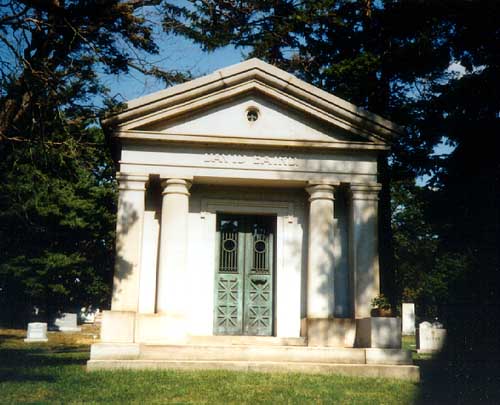
Baird Family Mausoleum at Harleigh Cemetery, Camden NJ
Magin’s Body to Lie in State In Commission Room Monday
Camden Courier-Post —
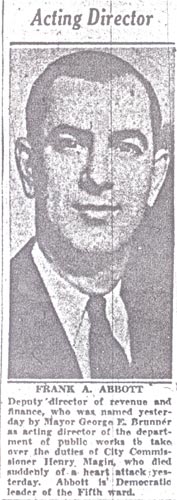
Acting Director
Abbott Named as Temporary Department Head by Mayor
CHURCH SERVICES TUESDAY MORNING
Frank A. Abbott.
Deputy director of revenue and finance, who was named yesterday by Mayor George E. Brunner as acting director of the department of public works to take over the duties of City Commissioner Henry Magin, who died suddenly of a heart attack yesterday. Abbott is Democratic leader of the Fifth ward.
The body of Commissioner Henry Magin will lie in state in the city commission chambers Monday night.
Mayor Brunner made that announcement today following completion of funeral arrangements with members of Commissioner Magin’s family. Magin died suddenly yesterday from a heart attack at the city incinerator plant.
On Tuesday morning, the body will be moved to the Church of St. Joan of Arc, Fairview, where a Requiem Mass will be sung at 9 a. m. Burial will be in Holy Sepulchre Cemetery, Philadelphia.
Half-Holiday Declared
The public will be permitted to pay its last respects after 7 p. m. Monday. Mayor Brunner has declared a half-holiday Tuesday morning so that city employes can attend the funeral. The mayor said employes of as many departments as can conveniently be closed will be given time off.
The four city commissioners will act as pallbearers. Commissioner Kobus is in Buffalo, attending a convention, but will be home Monday.
In addition to the commissioners, Thomas Jackson, an employe of the highway department, and Samuel Magill, a former commander of Fairview Post, American Legion, also will be pallbearers.
Jackson served as a sergeant with Magin during the World War and the two men had been close friends ever since. He was named a pallbearer at Mrs. Magin’s request. A list of honorary pallbearers is being compiled by Mayor Brunner.
City, county, State, Federal and veterans’ officials are expected to view the body Monday night. Several veterans’ organizations of which Magin was an officer or member will conduct their rituals at the cemetery.
Mayor Brunner said that James O’Brien, commander of the Disabled American Veterans and president of the Veterans’ Political League which sponsored Magin as a city commissioner, will be in charge of the arrangements for services by veterans.
Edward J. Quinlan, a vice commander of the Camden County American Legion, will be in charge of memorial services in the commission chamber Monday night and military services at the grave. The funeral will be a military one, Brunner said.
Quinlan requested all veteran groups assemble at the City Hall Plaza at 7.45 p. m. Monday so they can attend the services at 8 p. m. in a body.
The police and firemen also will attend the Monday night services in a body. Firemen will be led by Chief John H. Lennox while the police will be in charge of Chief Clerk George Clayton.
Brunner said parking at the plaza will not be permitted Tuesday morning until after the funeral party has left for the church.
Commissioner Magin collapsed in the arms of James Carr, assistant superintendent of streets, a minute after he had been photographed while conversing with Samuel Burgess, an official of the Nichols Engineering & Research Corp., New York, who was inspecting the plant. The commissioner was 44.
Mayor Goes to Home
When Mayor Brunner was informed the Commissioner was dead he immediately went to the Magin home at 3043 Alabama road to console the widow, Helen, and a daughter, Helen, 20. The Mayor remained two hours until Mrs. Magin regained her composure.
Mayor Brunner announced Frank A. Abbott, deputy director of revenue and finance, will assume temporary charge of the public works department, beginning Monday.
“I appointed Mr. Abbott acting director of the department of public works in order that business and functions of the department will not be curtailed,” Mayor Brunner said. “This is the largest department in the city and it requires a directing head until such time as a successor to Commissioner Magin is elected by the City Commission.”
Abbott is familiar with workings of the department, having been acting director several weeks last year when Magin was ill in a hospital. It is reported he will be named to succeed Magin.
Although he has the title of deputy director of revenue and finance, Abbott actually is first assistant to Mayor Brunner who heads the revenue and finance department.
Abbott is serving his second consecutive four-year term as deputy. For more than 15 years he has been Democratic leader of the Fifth ward. He lives at 346 Cherry street.
Native of Camden
Born in Camden, Abbott attended Fetters school and later learned and worked at the plastering trade. He was a Fifth ward Democratic leader in days when Democrats ran for but seldom were elected to public office.
He went through several torrid political campaigns against the late John Carroll, Republican leader of the ward and political lieutenant of the late former U. S. Senator David Baird, Sr.
Abbott learned to play baseball on the rocky vacant lots in the Fifth ward. He was regarded as a fleet-footed outfielder and a fast base runner.
For a short time he had a brief fling as a dancer in vaudeville, but Pater Abbott put his foot down, ordered him to return home and learn the plastering trade.
Close Friend of Mayor
The Damon and Pythias like friendship between Mayor Brunner and his deputy is a legend in the Democratic party of Camden. One of Brunner’s first acts when he was elected a city commissioner six years ago was to name Abbott as his deputy at a salary of $3000 a year.
Brunner has stated publicly that Abbott will be his aide in any position to which he is elected or appointed. Abbott’s loyalty to Brunner is little short of devotion.
It’s Abbott’s job to keep Brunner’s appointments, admit those the mayor wants to talk to and give the gate to those the mayor doesn’t want to meet. Abbott makes a perfect buffer for the city’s chief executive.
David Baird Co. Closes Business After 72 Years
Camden Courier-Post —
By OSCAR W. MAGNUSON
The David Baird Co., lumber dealers, a business which was started in Camden 72 years ago, has been discontinued.
Announcement of the closing of the business was made today by David Baird Jr., president of the concern, and son of the founder, David Baird Sr.
Termination of the business was announced to all of the customers of the company in a letter which Baird mailed, notifying them that the actual business had ceased as of June 1.
As he made the announcement, Baird said that he will now give his full time to the Smith-Austermuhl Co., general insurance brokers, of which he is the president.
Closing of the business ends the life of a concern which through the years has been much in evidence in the business life of not only Camden but in many other cities and states in the union.
Baird said that the lumber yard property on Delaware avenue and Pearl streets will continue in the ownership of the David Baird Co., but that it is in the market for sale “to any industry, and especially the lumber business,” he declared.
David Baird Sr., who came to the United States from Ireland in 1859 and to Camden in 1861 and who took a job in a Camden lumber yard, started the business at the southeast corner of Point and Pearl streets, a site now occupied by the RCA Victor plant.
The elder Baird bought the old Patchin property in 1901, and this included all the ground from the south side of Pearl street to 75 feet south of Linden street, and from Front street to the pier head line on the Delaware river.
He later sold Linden street to the City of Camden and the property where the first house is located at Front and Linden streets. Then he sold property to the old Victor Talking Machine Co., now the RCA Victor and to the H. Humphreys Co., now occupied by the Esterbrook Pen Co.
Operated Sawmills
Before organizing the David Baird Co. in 1903, after David Baird Jr. had been graduated from Princeton, David Baird Sr. operated saw mills and timber camps in Pennsylvania, New York, Virginia, North Carolina, Alabama, Mississippi and Tennessee.
After incorporating in 1903, David Baird Sr. discontinued spar yards in Baltimore, Md., Mystic, Conn., Boston, Mass., and Bangor, Me., and kept only the Brooklyn Spar Co., which was operated until 1935 by the David Baird Co. In 1927 David Baird Sr. died, since which time the management of the business continued under David Baird Jr.
“The David Baird Company specialized in heavy construction timber, piling and spars and with the passing of the majority of wooden steamships, barges and lighters, we discontinued the making of spars in 1935 and therefore discontinued the Brooklyn Spar Co.,” said Baird. “Since 1935 the demand for Baird company specialties, heavy timber, has been greatly diminished due to the substitution of creosoted lumber, reinforced steel and large concentrated yards started in this area,” he said.
Other Company Officers
In addition to Baird, the present officers of the company are David Baird 3d, vice president; Maurice F. O’Neill, treasurer; George S. Bingham, secretary. Directors are Baird Jr., Baird 3d, O’Neill and T. Gordon Coulter.
The announcement telling the trade of the termination of the business also stated that Watson Malone & Sons, Philadelphia, has purchased most of the lumber inventory of the Baird company. O’Neill, who has been with the Baird company for 28 years, has been engaged by the Malone concern and will service old customers of the Baird company at the Philadelphia concern’s yard at Allegheny avenue and the Delaware river.
Stern the maverick publisher cuts in
Camden Courier-Post —

By STEPHEN M. O’KEEFE
Former Courier-Post City Editor
George A. Frey sold the Courier Dec. 15, 1919. It was just a business deal. That is the way it was generally received in Camden’s business and political community.
But Frey’s departure and the purchase by a stranger stirred fears among Courier employes who had grown to feel that they were part of an institution.
It was soon apparent that the transaction was to be a turning point in the city’s history as well as the newspaper’s. The impact was to extend throughout South Jersey. Even Philadelphia would feel it.
THE NEW owner was J. David Stern, who sold his newspaper interests in Springfield, Ill., to buy the Courier. Within a few years of his arrival, Camden’s economy perked up, the face of the city changed and a political dynasty that had maintained rigid control for more than 25 years toppled.
Stern’s purchase of the Courier was shrouded in secrecy. One man, however was privy to the sale. He was Walter L. Tushingham, the business manager. “Tush” had a reputation as a trusted repository for secrets and private business matters.
It was not until many years had passed that Stern revealed that he had paid Frey $144,000 for 80 per cent of the Courier stock. The other 20 per cent was owned by Tushingham, who persuaded Stern to buy and remained in the setup.
Tushingham, long the main cog at the Courier, had experienced a series of frustrations in arranging for necessary improvements and expansion of the plant. Adjoining properties had been purchased and $75,000 had been appropriated for a new press. Frey was a stickler for economy and he put restraint upon such expenditures which delayed the expansion.
TUSHINGHAM was shackled. They [sic] way business was moving, he knew more revenue was obtainable but the Courier plant was operating at capacity. This was the situation early in 1919 when “Tush” and Stern were brought together by F. Morse Archer, then president of the First National Bank in Camden. Stern had consulted Archer about the possibility of making a purchase, at the suggestion of a mutual friend.
Archer had told Stern that there was hardly any hope of purchasing either the Courier or Post-Telegram. He said both papers were owned by men beholden to former U.S. Sen. David Baird, who dictated Republican Party matters and had a grip upon much of the city’s business affairs. Baird, he counselled, controlled the newspapers and he had no wish to see an outsider distrub [sic] matters.
According to Stern, in his memoirs printed in 1962, the $200,000 price tag Tushingham quoted was too high. He told “Tush” he was not interested.
In his book Stern later gave Tushingham’s account of the situation in Camden. According to the book, Tushingham admitted, the price is high. If it were less, someone in Baird’s organization would take it over.
“FREY IS SURE to consult the Senator, who won’t relish the deal. In the present setup, the Senator has it all to himself. When he wants something in or out of the paper he doesn’t bother to ask Frey or me. He calls the city editor direct. The boys are all on his payroll.
“If Baird lets Frey sell, it will only be because Baird doesn’t want to match the offer or keep his old friend (Frey) from getting the high dollar.”
After stating that he had lost interest, Stern came back to “Tush” and agreed to make an offer for Frey’s stock. His friends and relatives advised against the investment, but a staunch advocate was his wife Jill (born Juliet E. Lit).
Arguing against the purchase were her uncles, Samuel and Jacob, who ran Lit Brothers department store. Both, however subsequently helped with substantial advertising accounts and influenced other Philadelphia merchants in that direction.
STERN CITED $20,000 as the Courier’s earnings in one year prior to the purchase. He said in five years the paper grossed $1 million and that figured climbed to $3 million in 1947, when he retired.
When the Courier-Post joined the Gannett group Sept. 1, 1957; the purchase price of $5 million was, according to Stern’s reckoning, “28 times the high price I paid in 1919.”
The maverick publisher (his own term) neglected to compare the dingy, rundown property he bought with the vastly larger and more modern facility that replaced it under the management of his successors, the late Harold A. Stretch and his family.
Stern regarded Walter L. Tushingham as one of the best assets he acquired in the deal with Frey.
“TUSH” VIRTUALLY dedicated his life to the Courier, from the time he started in 1894 as a $5-a-week bookkeeper. As a boy of 15, he had earned pennies peddling garden produce from the wagon of his father, who later became pastor of Calvary Methodist Protestant Church in East Camden. His son put his savings into Banks Business College to obtain the training he required for the job at the Courier.
“Tush” had a brief fling at publishing, in 1893, when he set up “The Stockton News,” a weekly. It was discontinued after a few issues, but the experience gave him an insight into the complexities he would face at the Courier.
AN EXHIBITION of poor judgment in the handling of some news stories — with the Courier suffering in comparison with Philadelphia papers — triggered changes in the editorial department.
Harry T. Saylor was brought in as managing editor. Gifted writer, keen analyst and master of tact are but a few of Saylor’s attributes. He adjusted to the crude circumstances he saw when he arrived at the Courier. He was a big portly man with a fine sense of humor and he openly displayed pleasure in his work, an enthusiam [sic] which infected many of his associates. In the years that followed he capably filled the editor’s chair in all Stern newspapers.
OTHER KEY imports were Elmer C. Pratt, master printer and mechanic; Fred Wilhite, advertising executive, and Alfred Neef, accountant and investor.
In later years, Stern recounted that he brought 20 former Springfield employes to Camden to enliven the Courier. They did that, in good measure, but there was an abundance of local talent in every department.
Frank H. Ryan was a standout. William B. Wells was another. They were survivors of the low-pay, hard-times era. Each served more than 50 years.
Wells, as foreman, and Ryan, his assistant and top makeup man, were laboring in the shop when Stern directed the first big political triumph in the early 1920s. Tushingham was closer to the situation, having engineered the transaction which made Stern the publisher.
AMONG Tushingham’s legion of friends was Newton B. T. Roney, whose father had worked in the Courier pressroom. Roney had studied law, but shifted to real estate developments with a measure of success. He harbored a dream of building an elaborate theater at Broadway and Pine Streets, then the heart of Camden’s commercial district.
The theater foundation was laid and part of the structure raised when Roney experienced financial difficulties.
Roney went to see Baird. He asked, but was turned down. Appealing to other sources, he learned that word had been spread about Baird’s rejection. He could not get financing from any bank, he related a few years afterward. Roney’s dream faded and he soon left for Florida.
IN TIME, title to Roney’s dream changed to other hands. The project eventually was completed and opened as the Towers Theater.
Within a few years after he departed, reports came back about Newt Roney’s making big money in land along the ocean side of Miami Beach.
Roney planned well, worked diligently and met with astounding success. His beachfront paradise, named Roney Plaza, was the first of many hotels that transformed Miami’s oceanside to a vacation wonderland. This project was underway when Roney returned to Camden.
THE STERNS and the Roneys met and in 1922, on a visit, Roney asked Stern to lunch. His companion on that bright June day was Edward J. Kelleher, then a struggling Democrat with ideals and ideas.
The three launched into a discussion of Boss Baird. Roney had expressed his aversion to Baird in a previous chat with Stern, who on this occasion was being drawn into a Roney plot to avenge the Towers theater setback. For the record, Stern offered no resistence [sic].
Stern was more than casually acquainted with Baird. He accompanied Baird to the Republican National Convention in 1920 at Chicago. The big deal there, the nomination of Warren G. Harding for President, disgusted Stern but Baird regarded it as part of the game.
In the discussion with Roney and Kelleher, Stern said he was open to suggestions. Roney cited as a key figure the Democratic City chairman, Patrick J. Harding, a personable attorney who enjoyed reminiscing about his days at the Courier before becoming a lawyer.
HARDING WAS regarded as a good lawyer, had a lot of such friends, served as municipal solicitor and engaged in such profitable corporation work, as that of Public Service. He also was counsel for the Republican-controlled Camen [sic] County Board of Freeholders. His appointment was convincing evidence that Baird “took care” of Democrats, too. Roney put the point directly to Stern:
“Will the Courier back Ed Kelleher against Harding?”
The answer was just as direct in the affirmative. Roney put up a few thousand dollars initially and told Kelleher to start the ball rolling. Stern promised ample publicity. Roney knew — Stern was only then to learn — that Kelleher was a clever strategist and a natural politician. Hardin [sic] was ousted from the party chair.
AT THE NEXT session, Roney and Kelleher dealt with building up the Democratic organization. Stern matched Roney with $2,500 and Kelleher said he could pick up small donations to round out the $10,000 he estimated would be needed to form new clubs and to reorganize some of the old units.
Part of Kelleher’s night-and-day labors was to bring to Stern some long-concealed property tax data which would provide interesting political stories in the Courier.
Baird was upset. The Post-Telegram lashed Stern as a carpetbagger whose aim was to ruin the city.
Harry Saylor showed mastery in the treatment of every issue. He sprinkled humor, sound philosophy and plainly-worded common sense through the Courier columns. His occasional shaft at the Post-Telegram proved sharp and subtle. The people loved it. The circulation climbed.
THE VOICE OF the Post was its publisher, a long-time faithful ally of Baird and a congressman, Francis F. Patterson Jr. As a principal, Patterson had been rewarded with a share of appointments handed to those favored in the Baird system.
Patterson was a rugged printer in the late 1800s, part of whose duty was to deliver papers as a post-rider. His many years of ease came after the turn of the century. He and Frey were just nice neighborley [sic] rivals. Both were secure and affluent.
That smooth way of life vanished with Frey and Stern’s arrival. The long period in his comfortable groove had lulled Patterson into a passive outlook. He did not seem to have the vim that propelled him into a saddle and over miles of Gloucester county backroads.
THE POST-TELEGRAM could not agree with some of Stern’s ideas of progress. Patterson tried to fight Stern and his ideas. Camden readers were receptive to change. Political disclosures, in language that was new to them excited their interest. They bought it in increasingly daily doses. The Post-Telegram suffered decline.
Roney occupied a grandstand seat and kept counsel with the other members of the trinity. He and Kelleher introduced Victor King to Stern as a potential candidate for mayor. The tall and lanky King, a caricature of the comic-strip character Andy Gump, was the opposite of Fran [sic] S. Van Hart, then acting mayor. Van Hart was the Old Guard replacement for Charles H. Ellis, mayor from 1905 to 1922, where he became postmaster.
In the fever of the imes [sic], fanned by the slanted columns of the Courier, King won at the polls. Even Stern confessed amazement. The margin of victory was only 800 votes.
CAMDEN IN THE 1920s was far different from today. Horse troughs stood at many corners — drinking fountains for pedestrians, too. Horses and wagons were common, also carriages. Automobiles and light trucks had noticeably increased, but every motor vehicle in the city at a given time would not cause a traffic jam.
The city then still had a number of dirt streets and quite a few surfaced with cobblestones. Hundreds of sidewalks were bricked — but without mortar.
Stern and the the [sic] Courier moved to a higher plateau of influence, and advertising revenue was climbing. So were expenses, particularly expanding the plant for a new press and a far greater amount of equipment than longtime Courier craftsmen had ever seen.
EVERY department had more space. Elmer Pratt directed the installation, working around the clock through many weekends. He was mechanical superintendent but did regular chores as a printer.
Expanding the plant at 3rd and Arch was not easy. Construction workmen spent weeks weaving around Courier mechanics.
Trouble soon cropped up with the new press, a giant marvel compared to its steam-powered predecessor. The old press had been converted to electric power in 1927 before it was sold to a South American publisher. The conversion was made by William Morton, who helped Eldridge R. Johnson develop the Victor Talking Machine and ran a nearby machine shop.
NOR WAS everything hunkydory in Camden’s political environment. Ed Kelleher had managed to knit the long-repressed Democrats in the wards into a coalition with independent, non partisan citizenry and quite a number of unhappy or uncontrolled Republicans. Most were identified with the Non-Partisan League and they were feeling their oats. The practical Roney and Kelleher, however, knew they had merely reached first base.
The two men huddled with Stern and came up with an idea — campaign for a new form of government for the city. The plan was worked out expertly, emphasizing the advantages of a compact, five-man governing group, each member accountable to voters all over the city.
The new plan was kept secret for a while. It was embodied in an exhaustive survey for the council by Mayor King. The new mayor startled the Old Guard and the city at large by calling for a referendum on a City Commission form of government. The speech prompted an abundance of favorable copy in the Courier; not so favorable comment in the Post-Telegram.
IN MARCH, 1923, the change was approved. In May, the voters elected the entire Non-Partisan League ticket. This put Baird and his organization out of business for the first time in 25 years.
Stern and the Courier were the chief beneficiaries of the change. The publisher — and now politician — was to know the stress of carrying water on both shoulders.
Patterson and the Post-Telegram were to feel the worst effect. With the downward turn of fortune, a frustrating decline in advertising and circulation revenues, the P-T was a loser each day.
STERN CALCULATED the advantages in buy [sic] the Post-Telegram, but Patterson wouldn’t consider a deal with Stern. He approached Baird and asked for a loan needed to fight Stern. Baird said he wanted Patterson to keep the competition and suggested a smaller loan. The Post publisher wouldn’t agree.
“The full amount or nothing,” Patterson declared.
Baird matched his stubbornness. Back in the office Patterson shared his misery with Upton S. Jefferys, the editor, and Frank S. Albright, city editor. Upton owned five shares of P-T stock. He and Albright had given their best efforts for many years, but the outlook was bleak.
THIS WAS the situation when Patterson saw Ed Kelleher enter the office. The two were not strangers, but Patterson had little reason to regard him warmly.
Kelleher came right out with an offer to buy the Post-Telegram. Patterson replied with equal candor:
“You know that I know, Ed, that you don’t have anough [sic] money to buy this paper.”
Kelleher put a hand in a coat pocket and was about to inform Patterson that he had come prepared to negotiate.
“I’m sure I know who you represent,” Patterson stated. “My answer is no.”
KELLEHER DREW a check from his pocket and placed it before Patterson. The publisher took a quick glance at the amount. It was $75,000. He then summoned his son, Frank F. Patterson 3d.
“Here, Frank, you’re the treasurer here; this is your department.”
Kelleher thought he was hearing a change of attitude by Patterson. The younger Patterson stared at both men. He glanced at both sides of the check as would an accountant, then turned to his parent.
“What am I supposed to do with this, Father?” he asked.
THE REPLY was intended for Kelleher:
“You are supposed to tear it up and throw the pieces in the waste basket, Son.”
Young Patterson obeyed.
Keleher [sic] accepted the gestured [sic] as finale. One minute later he was walking along Federal Street to the Courier building to report to Stern.
J. DAVID STERN
JAN. 11, 1922 edition of the Camden Post-Telegram
The lay of the land long ago
By ROSEMARIE MURRAY
Courier-Post Staff
Corn sold for 62 cents a bushel, oats for 45 cents a bushel and bran for 17 dollars a ton in Camden, according to the October 2, 1876, market listings for that day. Sounds a little different from today?
The price of grain isn’t the only thing that has changed since that date. As The Daily Post recorded the local events, the news of Camden seemed cheerful.
Most of the area churches was [sic] housed a large following on Sunday evenings to hear their pastors’ thoughts on faith. On October 1, the Centenary M.E. Church welcomed 15 new members.
BUT THE biggest religious event of that day in Gloucester, was the baptizing of four female converts in the river. The Rev. Thomas Taylor of the Baptist Church performed the ceremony.
The usually busy streets and stores of Camden were nearly deserted on Saturday as the notably heavy rains of that September continued to pour down on the city.
Also in September, 72 persons were jailed in Camden County for a variety of reasons, the most serious being assault and battery. One person was arrested for engaging in prize-fighting. But most arrests were charged with vagrancy or drunkeness [sic].
Local train schedules were listed on the front page of The Daily Post.
There were quite a few runs — including lines through Gloucester and Mt. Ephraim.
But who would want to leave Camden with the price of school shoes at $1.49 at B. Franklin Hirst’s.
Camden also had its share of problems, noted the Post.
Many of the pavements throughout the city contained loose bricks which became particularly annoying during rainstorms. Every time someone would step on one, he would find his shoes splattered with mud and water.
The irregular numbering of houses was aggravating as well. Broadway was the sixth street from the river but on Pine Street above Broadway, the houses were numbered 600, 603 etc.
CELEBRATING its second birthday, on October 2, 1876, The Daily Post reprinted a prospectus which had appeared in its first issue, a small portion of which appears below:
“Realizing the necessity from the departure from the traditional policy of partisan journalists, The Daily Post will be entirely independent . . . under the domination of no party, clique or corporation and be influenced by no considerations save those which conduct to the best interest of a community from which alone it will endeavor to deserve and derive support.”
The October 2 issue testified to the publisher’s promise. And at 2 cents a copy, how could the readers go wrong?
CAMDEN DAILY POST looked like this when it started on its second year in October, 1876.
Courier-Post History Part 2
Federal to the corner of 3rd and Federal Streets.
BOTH PLANTS were steam-powered until after World War I, and gas lights provided illumination so deficient that both management and labor today would brand them intolerable.
There was enough rivalry between the advertising salesmen of the two papers to keep them hustling for business but department stores in the city generally divided their appropriations.
The Courier had a showcase the Post-Telegram lacked. A big bay window on 3rd Street, gave pedestrains [sic] a view of the Hoe press as it printed and folded hundreds of papers a minute and issued them neatly on conveyor belts, called a “fly.” Crosstown trolley riders also had a chance to see the excitement. Down the street, the P-T was printed in the rear of the row building, a sweatshop by today’s standards.
ADJOINING the steam-hot engine room at the Courier, but at the street level, was a six-foot square enclosure where a big barrel of paste, used to wrap bundles, gave off a sickening odor. It was a haven for millions of flies and mosquitoes and was, without doubt, the worst condition of the plant, but it was regarded as part of the job.
In 1917-18, the circulation department operated with one bicycle, a rented wagon and horse and a hand-drawn express wagon. During a period of expansion, a second bicycle was purchased. Later a second horse and wagon was added to further speed up delivery.
The circulation department was managed by Charles A. Van Fossen. He was tall, rather trim and under the dusty conditions in the cellar he occasionally had a jaw bulging with chewing tabacco [sic]. Some pressmen also were wont to have bag of Beechnut handy, like Tom Foulkes and Charley Harbois, who doubled in the circulation department and the pressroom.
BOTH THE Courier and the Post-Telegram presented city, suburban and sports news with features that were fairly comparable in columns devoted to social and fraternal calendars, the religious organizations, entertainment groups and civic clubs. Each subscribed to the United Press news service, employing a telegrapher who typed copy from signals received over Morse apparatus.
The two papers grew evenly, each having a circulation of about 12,000, until the waning days of 1919 when it was announced that the Courier had been sold.
News monopolist: into politics and out again
Camden Courier-Post —
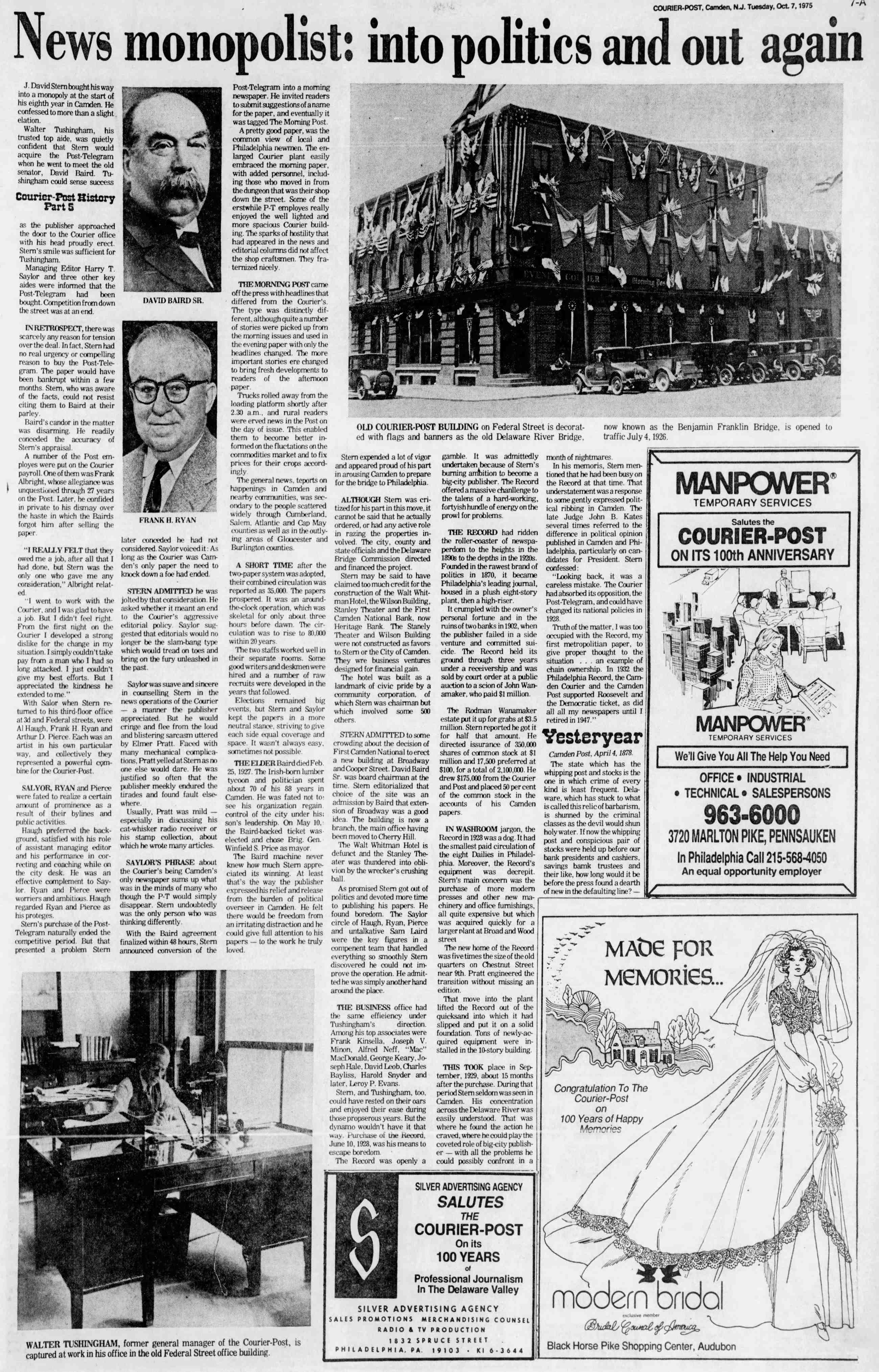
J. David Stern bought his way into a monopoly at the start of his eighth year in Camden. He confessed to more than a slight elation.
Walter Tushingham, his trusted top aide, was quietly confident that Stern would acquire the Post-Telegram when he went to meet the old senator, David Baird. Tushingham could sense success as the publisher approached the door to the Courier office with his head proudly erect. Stern’s smile was sufficient for Tushingham.
Managing Editor Harry T. Saylor and three other key aides were informed that the Post-Telegram had been bought. Competition from down the street was at an end.
IN RETROSPECT, there was scarcely any reason for tension over the deal. In fact, Stern had no real urgency or compelling reason to buy the Post-Telegram. The paper would have been bankrupt within a few months. Stern, who was aware of the facts, could not resist citing them to Baird at their parley.
Baird’s candor in the matter was disarming. He readily conceded the accuracy of Stern’s appraisal.
A number of the Post employes were put on the Courier payroll. One of them was Frank Albright, whose allegiance was unquestioned through 27 years on the Post. Later, he confided in private to his dismay over the haste in which the Bairds forgot him after selling the paper.
“I REALLY FELT that they owed me a job, after all that I had done, but Stern was the only one who gave me any consideration,” Albright related.
“I went to work with the Courier, and I was glad to have a job. But I didn’t feel right. From the first night on the Courier I developed a strong dislike for the change in my situation. I simply couldn’t take pay from a man who I had so long attacked. I just couldn’t give my best efforts. But I appreciated the kindness he extended to me.”
With Salor [sic] when Stern returned to his third-floor office at 3d and Federal streets, were Al Haugh, Frank H. Ryan and Arthur D. Pierce. Each was an artist in his own particular way, and collectively they represented a powerful combine for the Courier-Post.
SALYOR, RYAN and Pierce were fated to realize a certain amount of prominence as a result of their bylines and public activities.
Haugh preferred the background, satisfied with his role of assistant managing editor and his performance in correcting and coaching while on the city desk. He was an effective complement to Saylor. Ryan and Pierce were worriers and ambitious. Haugh regarded Ryan and Pierce as his proteges.
Stern’s purchase of the Post-Telegram naturally ended the competitive period. But that presented a problem Stern later conceded he had not considered. Saylor voiced it: As long as the Courier was Camden’s only paper the need to knock down a foe had ended.
STERN ADMITTED he was jolted by that consideration. He asked whether it meant an end to the Courier’s aggressive editorial policy. Saylor suggested that editorials would no longer be the slam-bang type which would tread on toes and bring on the fury unleashed in the past.
Saylor was suave and sincere in counselling Stern in the news operations of the Courier — a manner the publisher appreciated. But he would cringe and flee from the loud and blistering sarcasm uttered by Elmer Pratt. Faced with many mechanical complications, Pratt yelled at Stern as no one else would dare. He was justified so often that the publisher meekly endured the tirades and found fault elsewhere.
Usually, Pratt was mild — especially in discussing his cat-whisker radio receiver or his stamp collection, about which he wrote many articles.
SAYLOR’S PHRASE about the Courier’s being Camden’s only newspaper sums up what was in the minds of many who though [sic] the P-T would simply disappear. Stern undoubtedly was the only person who was thinking differently.
With the Baird agreement finalized within 48 hours, Stern announced conversion of the Post-Telegram into a morning newspaper. He invited readers to submit suggestions of a name for the paper, and eventually it was tagged The Morning Post.
A pretty good paper, was the common view of local and Philadelphia newmen. The enlarged Courier plant easily embraced the morning paper, with added personnel, including those who moved in from the dungeon that was their shop down the street. Some of the erstwhile P-T employes really enjoyed the well lighted and more spacious Courier building. The sparks of hostility that had appeared in the news and editorial columns did not affect the shop craftsmen. They fraternized nicely.
THE MORNING POST came off the press with headlines that differed from the Courier’s. The type was distinctly different, although quite a number of stories were picked up from the morning issues and used in the evening paper with only the headlines changed. The more important stories ere [sic] changed to bring fresh developments to readers of the afternoon paper.
Trucks rolled away from the loading platform shortly after 2.30 a.m., and rural readers were erved [sic] news in the Post on the day of issue. This enabled them to become better informed on the fluctations [sic] on the commodities market and to fix prices for their crops accordingly.
The general news, teports [sic] on happenings in Camden and nearby communities, was secondary to the people scattered widely through Cumberland, Salem, Atlantic and Cap May [sic] counties as well as in the outlying areas of Gloucester and Burlington counties.
A SHORT TIME after the two-paper system was adopted, their combined circulation was reported as 35,000. The papers prospered. It was an around-the-clock operation, which was skeletal for only about three hours before dawn. The circulation was to rise to 80,000 within 20 years.
The two staffs worked well in their separate rooms. Some good writers and deskmen were hired and a number of raw recruits were developed in the years that followed.
Elections remained big events, but Stern and Saylor kept the papers in a more neutral stance, striving to give each side equal coverage and space. It wasn’t always easy, sometimes not possible.
THE ELDER Baird died Feb. 25, 1927. The Irish-born lumber tycoon and politician spent about 70 of his 88 years in Camden. He was fated not to see his organization regain control of the city under his son’s leadership. On May 10, the Baird-backed ticket was elected and chose Brig. Gen. Winfield S. Price as mayor.
The Baird machine never knew how much Stern appreciated its winning. At least that’s the way the publisher expressed his relief and release from the burden of political overseer in Camden. He felt there would be freedom from an irritating distraction and he could give full attention to his papers — to the work he truly loved.
Stern expended a lot of vigor and appeared proud of his part in arousing Camden to prepare for the bridge to Philadelphia.
ALTHOUGH Stern was critized [sic] for his part in this move, it cannot be said that he actually ordered, or had any active role in razing the properties involved. The city, county and state officials and the Delaware Bridge Commission directed and financed the project.
Stern may be said to have claimed too much credit for the construction of the Walt Whitman Hotel, the Wilson Building, Stanley Theater and the First Camden National Bank, now Heritage Bank. The Stanely [sic] Theater and Wilson Building were not constructed as favors to Stern or the City of Camden. They wre [sic] business ventures designed for financial gain.
The hotel was built as a landmark of civic pride by a community corporation, of which Stern was chairman but which involved some 500 others.
STERN ADMITTED to some crowding about the decision of First Camden National to erect a new building at Broadway and Cooper Street. David Baird Sr. was board chairman at the time. Stern editorialized that choice of the site was an admission by Baird that extension of Broadway was a good idea. The building is now a branch, the main office having been moved to Cherry Hill.
The Walt Whitman Hotel is defunct and the Stanley Theater was thundered into oblivion by the wrecker’s crushing ball.
As promised Stern got out of politics and devoted more time to publishing his papers. He found boredom. The Saylor circle of Haugh, Ryan, Pierce and untalkative Sam Laird were the key figures in a compenent [sic] team that handled everything so smoothly Stern discovered he could not improve the operation. He admitted he was simply another hand around the place.
THE BUSINESS office had the same effieiency [sic] under Tushingham’s direction. Among his top associates were Frank Kinsella, Joseph V. Minon, Alfred Neff, “Mac” MacDonald, George Keary, Joseph Hale, David Leob, Charles Bayliss, Harold Snyder and later, Leroy P. Evans.
Stern, and Tushingham, too, could have rested on their oars and enjoyed their ease during those propserous [sic] years. But the dynamo wouldn’t have it that way. Purchase of the Record, June 10, 1928, was his means to escape boredom.
The Record was openly a gamble. It was admittedly undertaken because of Stern’s burning ambition to become a big-city publisher. The Record offered a massive chanllenge [sic] to the talens [sic] of a hard-working, fortyish hundle [sic] of energy on the prowl for problems.
THE RECORD had ridden the roller-coaster of newspaperdom to the heights in the 1890s to the depths in the 1920s. Founded in the rawest brand of politics in 1870, it became Philadelphia’s leading journal, housed in a plush eight-story plant, then a high-riser.
It crumpled with the owner’s personal fortune and in the ruins of two banks in 1902, when the publisher failed in a side venture and committed suicide. The Record held its ground through three years under a receivership and was sold by court order at a public auction to a scion of John Wanamaker, who paid $1 million.
The Rodman Wanamaker estate put it up for grabs at $3.5 million. Stern reported he got it for half that amount. He directed issurance [sic] of 350,000 shares of common stock at $1 million and 17,500 preferred at $100, for a total of 2,100,000. He drew $175,000 from the Courier and Post and placed 50 per cent of the common stock in the accounts of his Camden papers.
IN WASHROOM jargon, the Record in 1928 was a dog. It had the smallest paid circulation of the eight Dailies in Philadelphia. Moreover, the Record’s equipment was decrepit. Stern’s main concern was the purchase of more modern presses and other new machinery and office furnishings, all quite expensive but which was acquired quickly for a larger plant at Broad and Wood street.
The new home of the Record was five times the size of the old quarters on Chestnut Street near 9th. Pratt engineered the transition without missing an edition.
That move into the plant lifted the Record out of the quicksand into which it had slipped and put it on a solid foundation. Tons of newly-acquired equipment were installed in the 10-story building.
THIS TOOK place in September, 1929, about 15 months after the purchase. During that period Stern seldom was seen in Camden. His concentration across the Delaware River was easily understood. That was where he found the action he craved, where he could play the coveted role of big-city publisher — with all the problems he could possibly confront in a month of nightmares.
In his memoris [sic], Stern mentioned that he had been busy on the Record at that time. That understatement was a response to some gently expressed political ribbing in Camden. The late Judge John B. Kates several times referred to the difference in political opinion published in Camden and Philadelphia, particularly on candidates for President. Stern confessed:
“Looking back, it was a careless mistake. The Courier had absorbed its opposition, the Post-Telegram, and could have changed its national policies in 1928.
Truth of the matter, I was too occupied with the Record, my first metropolitan paper, to give proper thought to the situation . . . an example of chain ownership. In 1932 the Philadelphia Record, the Camden Courier and the Camden Post supported Roosevelt and the Democratic ticket, as did all all [sic] my newspapers until I retired in 1947.”
DAVID BAIRD SR.
FRANK H. RYAN
OLD COURIER-POST BUILDING on Federal Street is decorated with flags and banners as the old Delaware River Bridge, now known as the Benjamin Franklin Bridge, is opened to traffic July 4, 1926.
WALTER TUSHINGHAM, former general manager of the Courier-Post, is captured at work in his office in the old Federal Street office building.
Yesteryear
Camden Post, April 4, 1878.
The state which has the whipping post and stocks is the one in which crime of every kind is least frequent. Delaware, which has stuck to what is called this relic of barbarism, is shunned by the criminal classes as the devil would shun holy water. If now the whipping post and conspicuous pair of stocks were held up before our bank presidents and cashiers, savings bamk [sic] trustees and their like, how long would it be before the press found a dearth of new [sic] in the defaulting line? —
Night rider takes on carpetbagger
Camden Courier-Post —
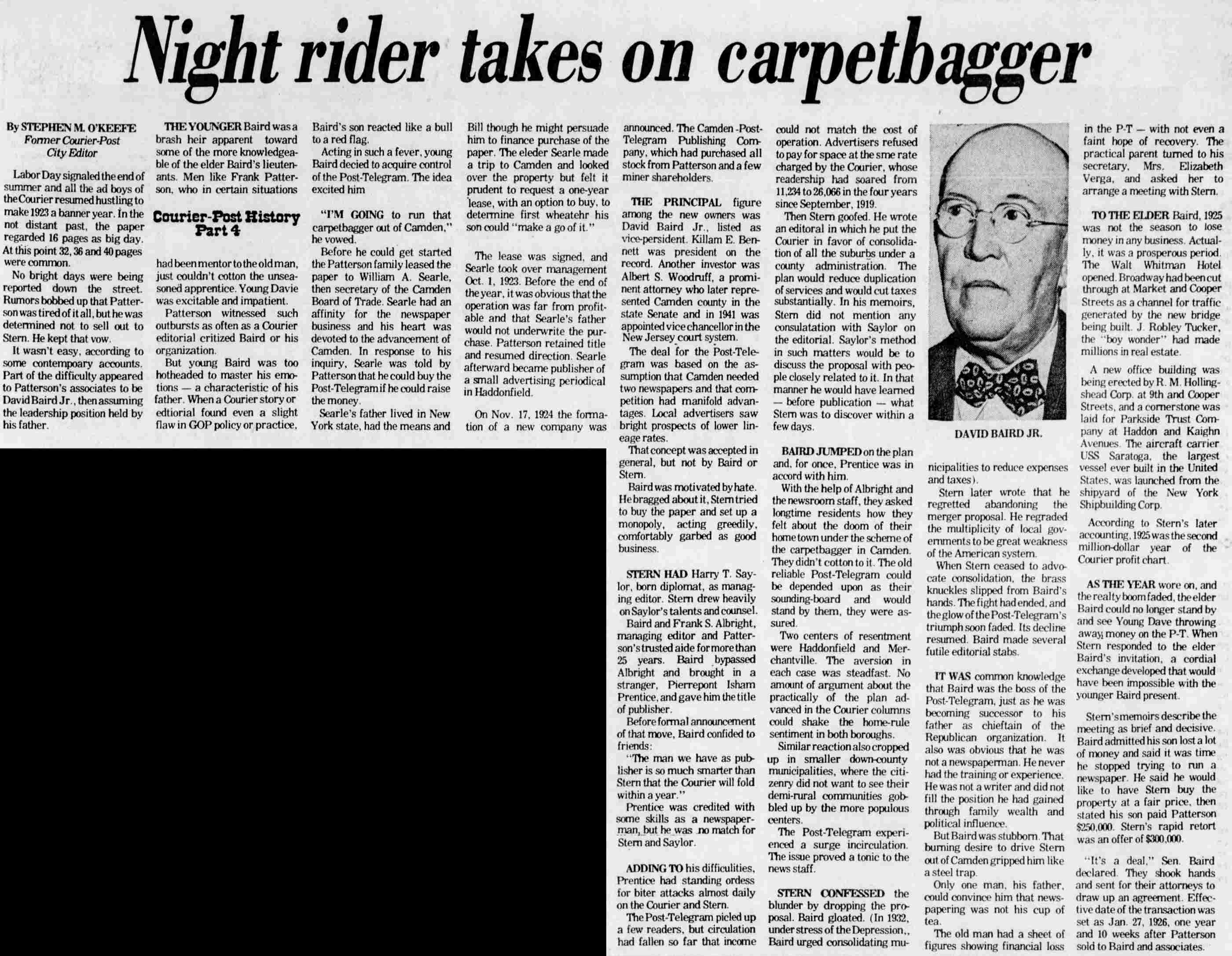
By STEPHEN M. O’KEEFE
Former Courier-Post City Editor
Labor Day signaled the end of summer and all the ad boys of the Courier resumed hustling to make 1923 a banner year. In the not distant past, the paper regarded 16 pages as big day. At this point 32, 36 and 40 pages were common.
No bright days were being reported down the street. Rumors bobbed up that Patterson was tired of it all, but he was determined not to sell out to Stern. He kept that vow.
It wasn’t easy, according to some contempoary [sic] accounts. Part of the difficulty appeared to Patterson’s associates to be David Baird Jr., then assuming the leadership position held by his father.
THE YOUNGER Baird was a brash heir apparent toward some of the more knowledgeable of the elder Baird’s lieutenants. Men like Frank Patterson, who in certain situations had been mentor to the old man, just couldn’t cotton the unseasoned apprentice. Young Davie was excitable and impatient.
Patterson witnessed such outbursts as often as a Courier editorial critized [sic] Baird or his organization.
But young Baird was too hotheaded to master his emotions — a characteristic of his father. When a Courier story or edtiorial [sic] found even a slight flaw in GOP policy or practice, Baird’s son reacted like a bull to a red flag.
Acting in such a fever, young Baird decied [sic] to acquire control of the Post-Telegram. The idea excited him
“I’M GOING to run that carpetbagger out of Camden,” he vowed.
Before he could get started the Patterson family leased the paper to William A. Searle, then secretary of the Camden Board of Trade. Searle had an affinity for the newspaper business and his heart was devoted to the advancement of Camden. In response to his inquiry, Searle was told by Patterson that he could buy the Post-Telegram if he could raise the money.
Searle’s father lived in New York state, had the means and Bill though he might persuade him to finance purchase of the paper. The eleder [sic] Searle made a trip to Camden and looked over the property but felt it prudent to request a one-year lease, with an option to buy, to determine first wheatehr [sic] his son could “make a go of it.”
The lease was signed, and Searle took over management Oct. 1, 1923. Before the end of the year, it was obvious that the operation was far from profitable and that Searle’s father would not underwrite the purchase. Patterson retained title and resumed direction. Searle afterward became publisher of a small advertising periodical in Haddonfield.
On Nov. 17, 1924 the formation of a new company was announced. The Camden-Post-Telegram Publishing Company, which had purchased all stock from Patterson and a few miner [sic] shareholders.
THE PRINCIPAL figure among the new owners was David Baird Jr., listed as vice-persident [sic]. Killam E. Bennett was president on the record. Another investor was Albert S. Woodruff, a prominent attorney who later represented Camden county in the state Senate and in 1941 was appointed vice chancellor in the New Jersey court system.
The deal for the Post-Telegram was based on the assumption that Camden needed two newspapers and that competition had manifold advantages. Local advertisers saw bright prospects of lower lineage rates.
That concept was accepted in general, but not by Baird or Stern.
Baird was motivated by hate. He bragged about it, Stern tried to buy the paper and set up a monopoly, acting greedily, comfortably garbed as good business.
STERN HAD Harry T. Saylor, born diplomat, as managing editor. Stern drew heavily on Saylor’s talents and counsel.
Baird and Frank S. Albright, managing editor and Patterson’s trusted aide for more than 25 years. Baird bypassed Albright and brought in a stranger, Pierrepont Isham Prentice, and gave him the title of publisher.
Before formal announcement of that move, Baird confided to friends:
“The man we have as publisher is so much smarter than Stern that the Courier will fold within a year.”
Prentice was credited with some skills as a newspaperman, but he was no match for Stern and Saylor.
ADDING TO his difficulties, Prentice had standing ordess [sic] for biter [sic] attacks almost daily on the Courier and Stern.
The Post-Telegram picled [sic] up a few readers, but circulation had fallen so far that income could not match the cost of operation. Advertisers refused to pay for space at the sme [sic] rate charged by the Courier, whose readership had soared from 11,234 to 26,066 in the four years since September, 1919.
Then Stern goofed. He wrote an editoral [sic] in which he put the Courier in favor of consolidation of all the suburbs under a county administration. The plan would reduce duplication of services and would cut taxes substantially. In his memoirs, Stern did not mention any consulatation [sic] with Saylor on the editorial. Saylor’s method in such matters would be to discuss the proposal with people closely related to it. In that manner he would have learned — before publication — what Stern was to discover within a few days.
BAIRD JUMPED on the plan and, for once, Prentice was in accord with him.
With the help of Albright and the newsroom staff, they asked longtime residents how they felt about the doom of their home town under the scheme of the carpetbagger in Camden. They didn’t cotton to it. The old reliable Post-Telegram could be depended upon as their sounding-board and would stand by them, they were assured.
Two centers of resentment were Haddonfield and Merchantville. The aversion in each case was steadfast. No amount of argument about the practically of the plan advanced in the Courier columns could shake the home-rule sentiment in both boroughs.
Similar reaction also cropped up in smaller down-county municipalities, where the citizenry did not want to see their demi-rural communities gobbled up by the more populous centers.
The Post-Telegram experienced a surge inciruclation [sic]. The issue proved a tonic to the news staff.
STERN CONFESSED the blunder by dropping the proposal. Baird gloated. (In 1932, under stress of the Depression, Baird urged consolidating municipalities to reduce expenses and taxes).
Stern later wrote that he regretted abandoning the merger proposal. He regraded [sic] the multiplicity of local governments to be great weakness of the American system.
When Stern ceased to advocate consolidation, the brass knuckles slipped from Baird’s hands. The fight had ended, and the glow of the Post-Telegram’s triumph soon faded. Its decline resumed. Baird made several futile editorial stabs.
IT WAS common knowledge that Baird was the boss of the Post-Telegram, just as he was becoming successor to his father as chieftain of the Republican organization. It also was obvious that he was not a newspaperman. He never had the training or experience. He was not a writer and did not fill the position he had gained through family wealth and political influence.
But Baird was stubborn. That burning desire to drive Stern out of Camden gripped him like a steel trap.
Only one man, his father, could convince him that newspapering was not his cup of tea.
The old man had a sheet of figures showing financial loss in the P-T — with not even a faint hope of recovery. The practical parent turned to his secretary, Mrs. Elizabeth Verga, and asked her to arrange a meeting with Stern.
TO THE ELDER Baird, 1925 was not the season to lose money in any business. Actually, it was a prosperous period. The Walt Whitman Hotel opened. Broadway had been cut through at Market and Cooper Streets as a channel for traffic generated by the new bridge being built. J. Robley Tucker, the “boy wonder” had made millions in real estate.
A new office building was being erected by R. M. Hollingshead Corp. at 9th and Cooper Streets, and a cornerstone was laid for Parkside Trust Company at Haddon and Kaighn Avenues. The aircraft carrier USS Saratoga, the largest vessel ever built in the United States, was launched from the shipyard of the New York Shipbuilding Corp.
According to Stern’s later accounting, 1925 was the second million-dollar year of the Courier profit chart.
AS THE YEAR wore on, and the realty boom faded, the elder Baird could no longer stand by and see Young Dave throwing away money on the P-T. When Stern responded to the elder Baird’s invitation, a cordial exchange developed that would have been impossible with the younger Baird present.
Stern’s memoirs describe the meeting as brief and decisive. Baird admitted his son lost a lot of money and said it was time he stopped trying to run a newspaper. He said he would like to have Stern buy the property at a fair price, then stated his son paid Patterson $250,000. Stern’s rapid retort was an offer of $300,000.
“It’s a deal,” Sen. Baird declared. They shook hands and sent for their attorneys to draw up an agreement. Effective date of the transaction was set as Jan. 27, 1926, one year and 10 weeks after Patterson sold to Baird and associates.
DAVID BAIRD JR.