E.G.C. Bleakly
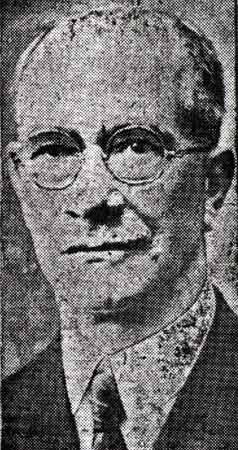
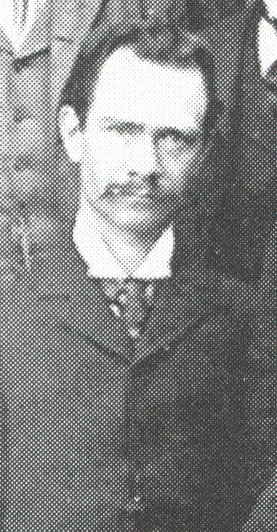
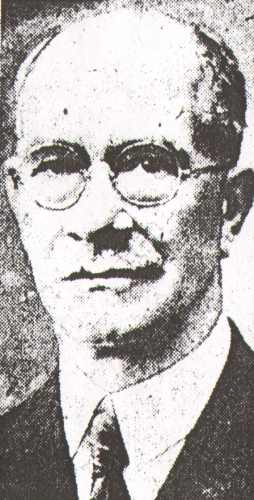
E.G.C. Bleakly
EDWIN GUY COOPER BLEAKLY was born in Ohio on October 5, 1865 to William and Elizabeth Bleakly. His family came to Camden sometime after 1870, his father owning a successful lime and cement business in the unit block of Federal Street, with an office at 34 Market Street. The family prospered, and in 1880 lived at 316 State Street. The next door neighbor was a young telegraph operator named John J. Burleigh, who over the next 30 years would play a crucial role in bringing telephone, electricity, and public transportation to Camden and South Jersey. William Bleakly was also active in the affairs of Centenary Methodist Episcopal Church, and E.G.C. Bleakly also became active, sitting on the Board of Stewards for the church in 1909.
Edwin Bleakly worked in his father's business through 1888, when, according to the Camden City Directories, he began studying law. He was in practice by 1890, according to those same Directories, with an office at 106 Market Street. This address also held the offices of many other influential lawyers of the period 1880 through 1930, including David Pancoast, Howard M. Cooper, Alfred Reed, and Thomas French. Known professionally as E.G.C. Bleakly, he was well connected, and soon became one of the city’s most influential attorneys. He married around 1895.
E.G.C. Bleakly was named as Camden’s City Solicitor in 1898 and held that position until his retirement in 1923. A Republican in his politics, he returned to office after the Republicans returned to power in Camden in 1927. He was still in that post when, in October of 1936, control of City Government shifted from the Republican to the Democrat party. An at will appointee, he was replaced by Firmin F. Michel when the new administration took power.
In November of 1927 Mayor Winfield S. Price appointed a committee to arrange for the observance in February 1928 of the One Hundredth Anniversary of the City of Camden. The committee was composed of Charles S. Boyer, Chairman; T. Yorke Smith, E.G.C. Bleakly, Mahlon F. Ivins Jr., Fred S. Caperoon and Frank S. Albright.
The 1920 census shows him living, along with wife Ida at 318 Cooper Street. Also living there were daughter Edith P., older sister Helen. Still there in 1930, the Bleakly family had been joined by his widower brother-in-law, Charles Seymour.
A brother, John W.F. Bleakly, was a prominent real estate developer in Camden, and served for several years as secretary to the Camden Board of Education. His nephew, Fletcher Stanley Bleakly, was involved in the stationary and office supply business in the 1920s and 1930s. F. Stanley’s firm sold the first steel office furniture used in the new Camden City Hall that opened in 1931. F. Stanley Bleakly operated a Ford automobile dealership in Camden in the late 1930s, with Edgar Myers. This franchise was taken over by Ed Berglund by the early 1940s, and after a building was erected on Admiral Wilson Boulevard, operated as Berglund Ford for over forty years.
E.G.C. Bleakly, along with Henry Ford Stockwell, founded the law firm of Bleakly & Stockwell. In 1923 the firm became Bleakly, Stockwell, & Burling, and later was known as Bleakly, Stockwell, & Zink. The firm remained in business in Camden at 317 Market Street through at least 1977. E.G.C. Bleakly himself was still living at 318 Cooper Street as late as 1947.
Members of the Camden County Bar Association, c. 1894
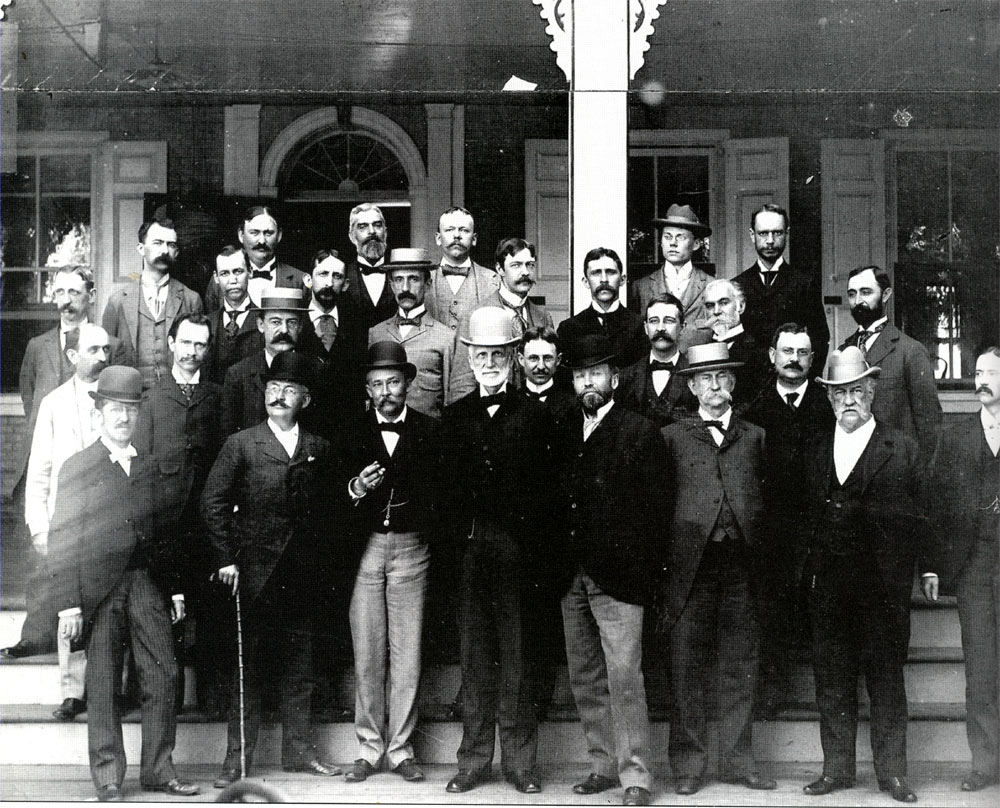
From left (first row) Judge Charles Joline, Supreme Court Justice Charles Garrison, Judge Richard R. Miller, vice chancellor Henry C. Pitney, Supreme Court Justice Alfred Reed, Benjamin Shreeve, Caleb Shreeve, George H. Pierce; (second row) William Casselman, Edwin Bleakly, J. Willard Morgan, Peter Voorhees, Samuel Beldon, Frank Shreeve, Scuyler Woodhull, Lewis Starr, H. S. Scovel, George Vroom, Charles Wooster, and Howard Carrow; (third row) Samuel Robbins, E. A. Armstrong, Thomas Curley, unknown Philadelphia lawyer, Charles Stevenson, H. F. Nixon, Henry I. Budd, Israel Roberts.
318 Cooper Street — The Home of E.G.C. Bleakly
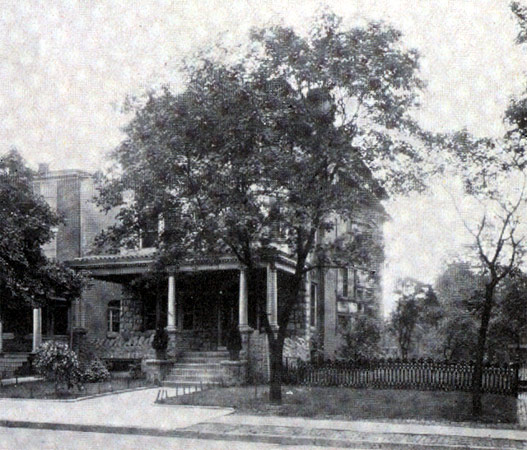
Photograph Published 1915
Edwin Guy Cooper Bleakly
South Jersey: A History 1624–1924
EDWIN GUY COOPER BLEAKLY— Among the well-known men of the legal profession in South Jersey is Edwin Guy Cooper Bleakly, senior member of the law firm of Bleakly, Stockwell & Burling, who has been practicing in Camden, New Jersey, since 1890.
Born in Wellsville, Columbiana County, Ohio, October 5, 1865, Mr. Bleakly is a son of William and Elizabeth (Armstrong) Bleakly, and started his early education by taking a course in Pierce Business College, from which he was graduated in 1881. He then further prepared for his future career by attending Friends’ Central High School, of Philadelphia, from which he was graduated in June, 1885. Then, deciding to enter the legal profession, he began the study of law under the direction of Benjamin D. Shreve, one of the prominent members of the Camden bar. He was admitted to the New Jersey bar as an attorney in February, 1890, as a counselor three years later, and steadily built up a clientele which grew to be one of the important legal practices of the city. He had always taken an active interest in local public affairs, and eight years after his admission to the bar he was elected solicitor of the city of Camden. His term began in April, 1898, and for twenty-five years following that date he was continuously reelected, and efficiently discharged the duties of the office until his retirement, April 16, 1923. In the meantime, he had formed a partnership with Mr. Stockwell and Mr. Burling, under the firm name of Bleakly, Stockwell & Burling, and in that association he is still taking care of a large and important clientele. In addition to his responsibilities in connection with his private practice, Mr. Bleakly is a member of the board of directors, and also serves as solicitor for the Merchants’ Trust Company, of Camden. Politically he gives his support to the candidates and the principles of the Republican party, but he had held just one local office, that of city solicitor, which, as already mentioned, he held for a quarter of a century. He finds recreation in affiliation with the Camden Club and Tavistock Country Club, and his religious affiliation is with the Centenary Methodist Episcopal Church, of Camden, New Jersey. Mr. Bleakly is widely known and highly esteemed in Camden, both among his professional associates and among those with whom he is associated in other connections.
In Camden, New Jersey, July 24, 1894, Edwin Guy Cooper Bleakly married Ida Seymour, daughter of John T. and Emma (Bryan) Seymour, the latter of whom is a descendant of an old Burlington County line related to the Deacons, the Lippincotts, and other families of the old Colonial times. Mr. and Mrs. Bleakly are the parents of one daughter, Edith Bryan Bleakly, who was born in Camden, New Jersey, February 20, 1902.
Camden Daily Courier — May 12, 1898
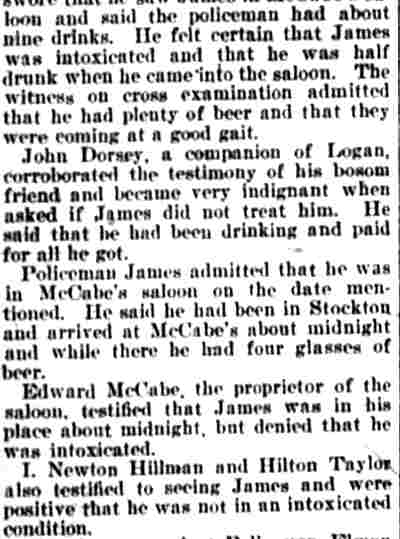
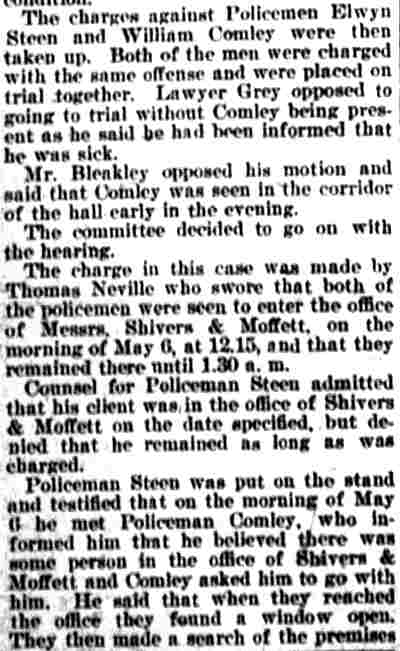
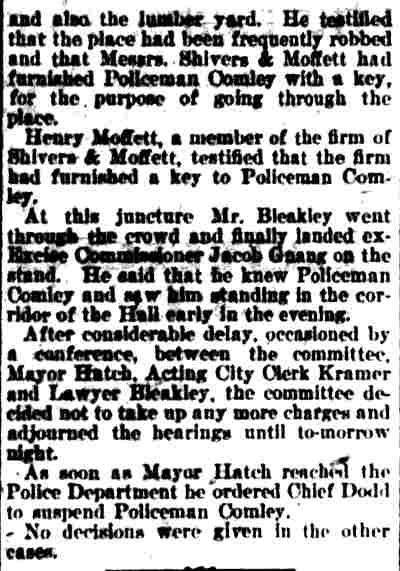
SIDE-SPLITTING FARCE GOES ON
Chairman Burrough Did Not Sit With the Committee.
HE IS SAID TO BE DISGUSTED
Additional Charges Against Policemen, But the Witnesses Fail to Substantiate the Specifications Made by Office Seekers.
The Police Committee of City Council, last night, resumed the hearings of the charges against the policemen. The Council chamber was again crowded with prospective policemen and office seekers of all descriptions. Chairman Burroughs of the committee was absent and it was stated that he was disgusted at the manner in which the farce is being carried on. The other two members of the committee were present and Mr. Silvers, the Third ward statesman, acted as chairman. He was flanked on the right by His Honor, the Mayor. Previous to the hearings the Mayor heard some suggestions from his new adviser, who is William H. Sparks, of kidney cure fame, and a Democrat who had been an office seeker in the Democratic party for a number of years. Dr. “Mark Hanna” Davis for some reason or other is not participating in the deliberation of the Reformers. It is said that he is disgusted and was heard to make the remark that there are but two political parties, the Republican and Democratic, and he did not believe in Reform.
E. G. C. Bleakley, after some delay, moved the charges against Policeman Bond. Officer Bond was charged by ex-Policeman “Ikey” Shreeve with being asleep in the post office building on March 15, and also with leaving his post of duty.
The first witness called was the complainant, and he testified that on the morning in question he found Policeman Bond asleep in the post office building, about 4 o’clock. The witness fixed the time by a man on the street asking him the hour. He knew he was asleep from the fact that he heard him snoring.
Policeman Bond, in his own defense, admitted going into the post office to light his pipe, but denied being asleep. He stated that he did not see Mr. Shreeve, but saw Constable Voight.
John Hefferan was called, and testified that on the morning in question he was with Policeman Bond about 6 o’clock on Federal street.
Irving L. Buckle, a newspaper carrier, testified that he saw Bond on Federal street between half-past 3 and 4 o’clock.
Thomas A. Stockham also testified that he saw Officer Bond on the morning in question about 3 o’clock.
Joseph Robinson, night watchman at the post office, said that he never saw Mr. Bond asleep in the building.
The next case that was moved was the charges against Policeman A. Lincoln James. The charge in the case was made by a young man named John J. Browning, of Cedar street, near Fifth. He charged James with being in an intoxicated condition on the morning of April 13, in the saloon of Edward McCabe, No. 900 Market street. The first witness called in this case was the complainant. He testified that he was in McCabe’s saloon and saw James there about midnight and believed him to be intoxicated. On cross-examination he said he had been drinking and that James treated him. He said that he was not an applicant for a position on the police force.
The next witness in this case was a gem. He is known as John J., alias “Limpy,” Logan, and is a familiar figure on Market street between Fourth and Sixth at all hours of the day and night. He was recently appointed as a watchman in the Water Department, by the Reform Water Committee, but his appointment was one of those which was held up by a writ of certiorari. Logan swore that he saw James in McCabe’s sa-
loon and said the policeman had about nine drinks. He felt certain that James was intoxicated and that he was half drunk when he came into the saloon. The witness on cross examination admitted that he had plenty of beer and that they were coming at a good gait.
John Dorsey, a companion of Logan, corroborated the testimony of his bosom friend and became very indignant when asked if James did not treat him. He said that he had been drinking and paid for all he got.
Policeman James admitted that he was in McCabe’s saloon on the date mentioned. He said he had been in Stockton and arrived at McCabe’s about midnight and while there he had four glasses of beer.
Edward McCabe, the proprietor of the saloon, testified that James was in his place about midnight, but denied that he was intoxicated.
I. Newton Hillman and Hilton Taylor also testified to seeing James and were positive that he was not in an intoxicated condition.
The charges against Policemen Elwyn Steen and William Comley were then taken up. Both of the men were charged with the same offense and were placed on trial together. Lawyer Grey opposed to going to trial without Comley being present as he said he had been informed that he was sick.
Mr. Bleakley opposed his motion and said that Comley was seen in the corridor of the hall early in the evening.
The committee decided to go on with the hearing.
The charge in this case was made by Thomas Neville who swore that both of the policemen were seen to enter the office of Messrs. Shivers & Moffett, on the morning of May 6, at 12.15, and that they remained there until 1.30 a. m.
Counsel for Policeman Steen admitted that his client was in the office of Shivers & Moffett on the date specified, but denied that he remained as long as was charged.
Policeman Steen was put on the stand and testified that on the morning of May 6 he met Policeman Comley, who informed him that he believed there was some person in the office of Shivers & Moffett and Comley asked him to go with him. He said that when they reached the office they found a window open. They then made a search of the premises
and also the lumber yard. He testified that the place had been frequently robbed and that Messrs. Shivers & Moffett had furnished Policeman Comley with a key, for the purpose of going through the place.
Henry Moffett, a member of the firm of Shivers & Moffett, testified that the firm had furnished a key to Policeman Comley.
At this juncture Mr. Bleakley went through the crowd and finally landed ex-Excise Commissioner Jacob Gnang on the stand. He said that he knew Policeman Comley and saw him standing in the corridor of the Hall early in the evening.
After considerable delay, occasioned by a conference, between the committee, Mayor Hatch, Acting City Clerk Kramer and Lawyer Bleakley, the committee decided not to take up any more charges and adjourned the hearings until to-morrow night.
As soon as Mayor Hatch reached the Police Department he ordered Chief Dodd to suspend Policeman Comley.
No decisions were given in the other cases.
Philadelphia Inquirer — July 26, 1898
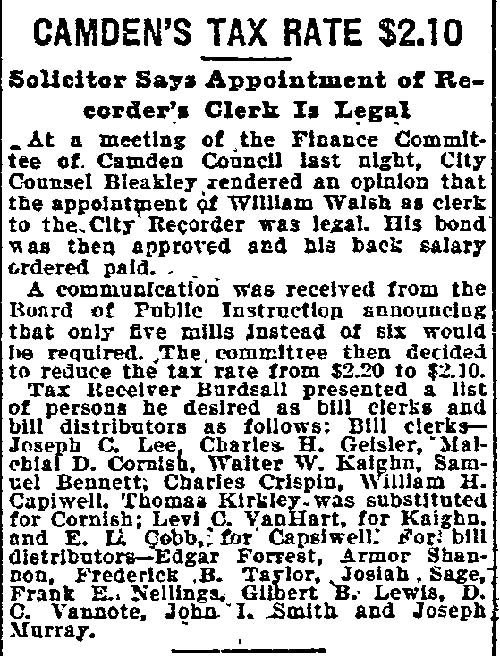
CAMDEN’S TAX RATE $2.10
Solicitor Says Appointment of Recorder’s Clerk Is Legal
At a meeting of the Finance Committee of Camden Council last night, City Counsel Bleakley rendered an opinion that the appointment of William Walsh as clerk to the City Recorder was legal. His bond was then approved and his back salary ordered paid.
A communication was received from the Board of Public Instruction announcing that only five mills instead of six would be required. The committee then decided to reduce the tax rate from $2.20 to $2.10.
Tax Receiver Burdsall presented a list of persons he desired as bill clerks and bill distributors as follows: Bill clerks—Joseph C. Lee, Charles H. Geisler, Malachi D. Cornish, Walter W. Kaighn, Samuel Bennett; Charles Crispin, William H. Capiwell, Thomas Kirkley was substituted for Cornish; Levi C. VanHart, for Kaighn, and E. L. Cobb, for Capiwell. For bill distributors—Edgar Forrest, Armor Shannon, Frederick B. Taylor, Josiah Sage, Frank E. Nellings, Gilbert B. Lewis, D. C. Vannote, John I. Smith and Joseph Murray.
Philadelphia Inquirer — July 28, 1899

EVIL DOERS QUAKE
Mayor Hatch, of Camden, Starts in to Wipe Out Speak-Easies
FIRST RAID A SUCCESS
Fines Imposed by Recorder Nowrey for Operating Gambling Machines. Sunday Sellers Hope to Escape
Mayor Cooper B. Hatch is making life miserable for evil doers in Camden. After waging relentless warfare on Sunday liquor sellers and seizing all the gambling machines in saloons and cigar stores, he is now clearing out speak-easies. The first raid was made yesterday afternoon, when Captain Stanley, Sergeant Hyde, Detective Painter and Policeman Shaw swooped down on Mrs. Mary Mahan’s house, at 1062 South Front street. They found nearly enough liquor there to stock a saloon. There were two cases of bottled beer, five gallons of whisky, a large quantity of California wines, and other “wet” goods. This was all confiscated and was sent to the City Hall, together with Mrs. Mahan and a young girl.
For some time past Mayor Hatch’s private detectives have been gathering evidence against speak-easies and disorderly houses in different parts of the city, and several more arrests will be made.
The saloonkeepers arrested about ten days ago for operating slot machines in their places were arraigned yesterday before Recorder Nowrey. Maurice Hertz, of Locust street and Kaighn avenue, was the first to be tried. He was represented by former Judge Howard Carrow. The complaints against Hertz charged him with operating nickel-in-the-slot gambling machines on July 2 and 9.
Harry Williams, one of Secretary Gibboney’s detectives, who was employed in the recent Sunday liquor crusade, testified that he played “The Owl” in Hertz’s saloon on July 9. He lost five cents on the red but hit the black and quit even. On cross-examination Williams refused to tell by whom he was employed, and Recorder Nowrey would not compel him to answer. Detective Fields swore that he was with Williams in Hertz’s place, and also played the slot machine. Police Captain Stanley said he found four of the slot machines in Hertz’s place when he made the raid.
At this point Judge Carrow moved to dismiss the complaint, as it was dated in the year “189.” Decision was reserved, and the other complaint was taken up. Judge Carrow wanted this set aside on the ground that it did not specify the premises where the law was alleged to have been violated. Recorder Nowrey overruled the motion.
Detective Graper said he played the slot machine at Hertz’s saloon on Sunday, July 2. On cross-examination he refused to give his address, but said he worked for Mayor Hatch. He didn’t know, he said, whether he was on the city pay roll.
David B. Kaighn and other Kaighn avenue residents testified that they never saw slot machines in operation in Hertz’s place, but had seen them standing in the office.
Hertz, in his own defense, said he was agent for the slot machines, and those found in his office were samples to be examined by prospective purchasers.
Recorder Nowrey sentenced Hertz to pay a fine of $50 and costs. Judge Carrow gave notice that he would appeal the case, but the Recorder refused to permit Hertz to depart without paying the fine.
Peter Kelly, of Eighth street and Ferry avenue, was also convicted and paid his fine.
John Keefe, of Haddon avenue and Carman street, and Marshall Hutchinson, of Ninth and Walnut streets, pleaded guilty and were fined $50 and costs each. There were about seven more cases, which Recorder Nowrey adjourned until next Wednesday.
The 130 saloonkeepers rounded up in the recent crusade against Sunday liquor selling were in high glee yesterday over the discovery of a law that they hoped would save them from punishment for their alleged misdoings. This law was passed in 1874, and makes it unlawful to prosecute any person by indictment for violations of the liquor laws in municipalities where city ordinances provide punishment for such offenses. As the Supreme Court has set aside the Camden excise ordinance, the saloonkeepers hoped to escape further prosecution.
City Counsel Bleakly, after looking up the matter yesterday, said: “A house in which the unlawful sale of liquors is habitually made is an indictable nuisance, although there is a city ordinance prescribing penalty for such sales. Such traffic is not only a breach of the city law, but is also forbidden by the State law.” This decision was made by Judge Van Syckel in 1880, in the Court of Errors and Appeals, and was reaffirmed in 1888. It is now a State law.
The Excise Commission, at its regular meeting next Wednesday evening, will probably adopt a substitute ordinance against Sunday liquor selling to conform to the city charter, under the Supreme Court’s decision setting aside the old ordinance.
Philadelphia Inquirer — January 31, 1904
** A number of the officials and employes of the New York Shipbuilding Company have organized the Shipbuilders’ Home Building and Loan Association by the election of the following officers: President, William J. Bradley; Vice president, Thomas J. Moore; secretary, John M. Kelly; treasurer, Central Trust Company; solicitor, E. G. C. Bleakly. The directors are nearly all connected with the shipbuilding company.
Philadelphia Inquirer — September 12, 1906
After tearing up a part of Broadway near the Newton Creek, Camden, preparatory to laying the underground conduits for the Bell Telephone Company, the contractors were called off yesterday. This was the result of opposition on the part of Street Commissioner Mohrman, who claimed that the company has not the right to go on with the improvement until City Council finally approves the action of the Street Committee which recently adopted a resolution providing for the burying of the wires. While City Engineer Farnham has approved the plans and specifications of the company’s proposed conduits, Street Commissioner Mohrman has thus far refused.
When it was learned that the work of opening the street had been proceeded with, Mayor Ellis, City Solicitor Bleakly and Commissioner Mohrman held a conference. Before any line of action could be decided upon the Bell Company, by telephone, imparted the information that the work had been stopped. In the meantime the rights of the city will be safeguarded, even if it is necessary to call on the police to do so. Mayor Ellis says he will be guided solely by the advice of Solicitor Bleakly.
Philadelphia Inquirer — November 28, 1907
Named: Newton Ash, Ephraim Hires, Gardner Corson, John H. Lennox, Herbert Hibbs, Dr. A. Haines Lippincott, Charles H. Ellis, and E.G.C. Bleakly.
Philadelphia Inquirer — January 28, 1908
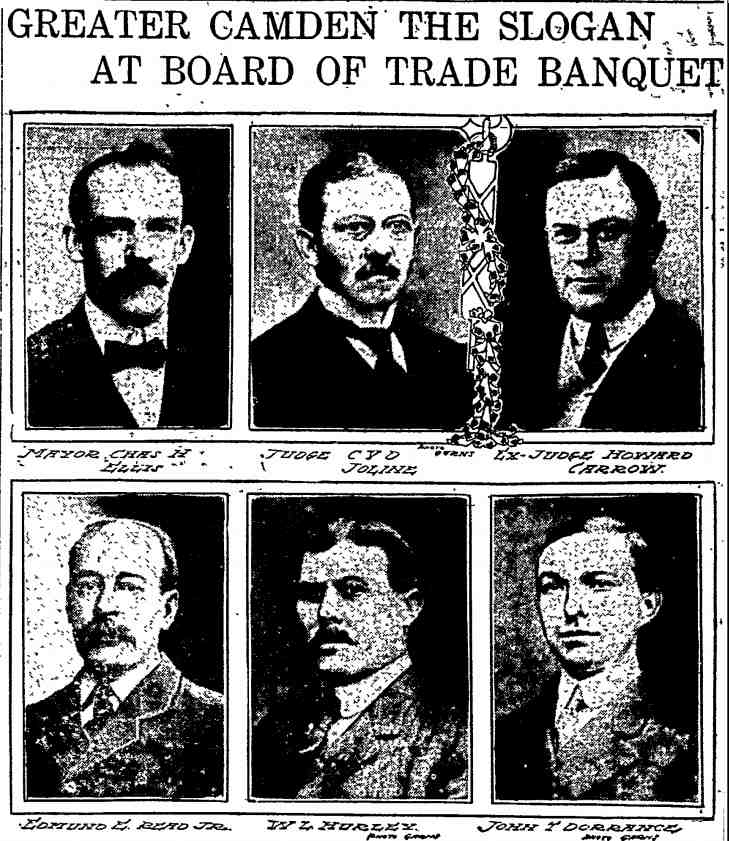
GREATER CAMDEN THE SLOGAN AT BOARD OF TRADE BANQUET
(Group photo: Mayor Chas H. Ellis, Judge C.V.D. Joline, Ex-Judge Howard Carrow, Edmund E. Read Jr., W.L. Hurley, John T. Dorrance)
Men Prominent in Business Affairs Sound Praises of Growing City at Annual Feast
A greater, more progressive Camden was the watchword at he [sic] annual banquet given by Camden’s Board of Trade last night. And that this means something is evident from the fact that it came from the city’s “Captains of Industry” to the number of two hundred.
It was Camden’s rejuvenated Board of Trade that gave the banquet and the interest taken was manifested by the presence of representatives from every business concern of any prominence in the city.
All Represented
There were bankers besides just ordinary business men, professional men of every character, and all were imbued with the spirit to make of Camden a place that will be known on the map throughout the country. William L. Hurley, president of the board, presided at the banquet.
“Generally speaking, we are satisfied with our city,” said Mayor Charles H. Ellis in responding to the toast, “Camden as it is,” “but, of course, there is room for improvement in many respects, and it rests with you gentlemen, you members of the Board of Trade to largely aid in solving our municipal problems.”
Former Judge Howard Carrow acted as toastmaster and, beside Mayor Ellis, those who responded to toasts were Congressman James H. Davidson, of Wisconsin, who spoke on “Boards of Trades;” Judge of the Court of Common Pleas C. V. D. Joline, “Camden’s Eighty Years;” Lawyer Edmund E. Read, president of the Board of Education, “Camden’s Future.”
One of the features of the occasion was the presentation of a life-size oil painting of President William Leonard Hurley, to the board, by Lawyer Harry C. Kramer. This came as a complete surprise to President Hurley, but he expressed his thorough appreciation of the honor.
Senator Philander C. Knox, of Pennsylvania, was among the specially invited guests and a warm welcome awaited him, but he was unavoidably detained.. [sic]
Some good points to Camden’s credit were enumerated in the menu cards as follows:
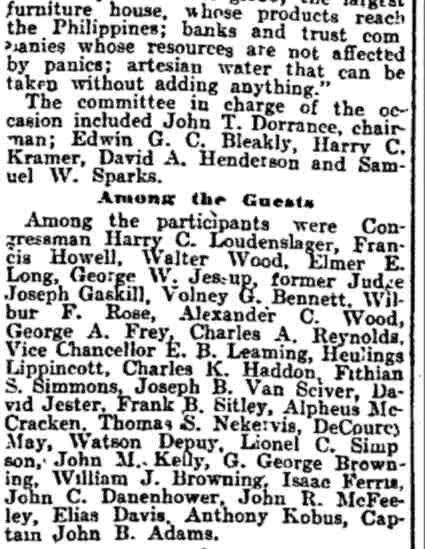
“Camden has within its borders a population of nearly 100,000 and shipbuilding firms that can either supply a launch or the greatest battleship; the largest lace curtain manufacturers in America; a talking machine that speaks every known language; iron works that make enough pipe to girdle the earth; leather manufacturers who tan skins from all parts of the globe; the largest furniture house, whose products reach the Philippines; banks and trust companies whose resources are not affected by panics; artesian water that can be taken without adding anything.”
The committee in charge of the occasion included John T. Dorrance, chairman; Edwin G. C. Bleakly, Harry C. Kramer, David A. Henderson and Samuel W. Sparks.
Among the Guests
Among the participants were Congressman Harry C. Loudenslager, Francis Howell, Walter Wood, Elmer E. Long, George W. Jessup, former Judge Joseph Gaskill, Volney G. Bennett, Wilbur F. Rose, Alexander C. Wood, George A. Frey, Charles A. Reynolds, Vice Chancellor E. B. Leaming, Heulings Lippincott, Charles K. Haddon, Fithian S. Simmons, Joseph B. Van Sciver, David Jester, Frank B. Sitley, Alpheus McCracken, Thomas S. Nekervis, DeCourcy May, Watson Depuy, Lionel C. Simpson, John M. Kelly, G. George Browning, William J. Browning, Isaac Ferris, John C. Danenhower, John R. McFeeley, Elias Davis, Anthony Kobus, Captain John B. Adams.
[Continuation of article — see anthonykobus-012808-inq-2.md for full text]
All Represented
There were bankers besides just ordinary business men, professional men of every character, and all were imbued with the spirit to make of Camden a place that will be known on the map throughout the country. William L. Hurley, president of the board, presided at the banquet.
“Generally speaking, we are satisfied with our city,” said Mayor Charles H. Ellis in responding to the toast, “Camden as it is,” “but, of course, there is room for improvement in many respects, and it rests with you gentlemen, you members of the Board of Trade to largely aid in solving our municipal problems.”
Former Judge Howard Carrow acted as toastmaster and, beside Mayor Ellis, those who responded to toasts were Congressman James H. Davidson, of Wisconsin, who spoke on “Boards of Trades;” Judge of the Court of Common Pleas C. V. D. Joline, “Camden’s Eighty Years;” Lawyer Edmund E. Read, president of the Board of Education, “Camden’s Future.”
[Continuation of article — see anthonykobus-012808-inq-2.md for full text]
One of the features of the occasion was the presentation of a life-size oil painting of President William Leonard Hurley. [sic] to the board, by Lawyer Harry C. Kramer. This came as a complete surprise to President Hurley, but he expressed his thorough appreciation of the honor.
Senator Philander C. Knox, of Pennsylvania, was among the specially invited guests and a warm welcome awaited him, but he was unavoidably detained.. [sic]
Some good points to Camden’s credit were enumerated in the menu cards as follows:
“Camden has within its borders a population of nearly 100,000 and shipbuilding firms that can either supply a launch or the greatest battleship; the largest lace curtain manufacturers in America; a talking machine that speaks every known language; iron works that make enough pipe to girdle the earth; leather manufacturers who tan skins from all parts of the globe; the largest [furniture house...]”
[Continuation of article — see anthonykobus-012808-inq-2.md for full text]
...furniture house, whose products reach the Philippines; banks and trust companies whose resources are not affected by panics; artesian water that can be taken without adding anything.“
The committee in charge of the occasion included John T. Dorrance, chairman; Edwin G. C. Bleakly, Harry C. Kramer, David A. Henderson and Samuel W. Sparks.
Among the Guests
Among the participants were Congressman Harry C. Loudenslager, Francis Howell, Walter Wood, Elmer E. Long, George W. Jessup, former Judge Joseph Gaskill, Volney G. Bennett, Wilbur F. Rose, Alexander C. Wood, George A. Frey, Charles A. Reynolds, Vice Chancellor E. B. Leaming, Heulings Lippincott, Charles K. Haddon, Fithian S. Simmons, Joseph B. Van Sciver, David Jester, Frank B. Sitley, Alpheus McCracken, Thomas S. Nekervis, DeCourcy May, Watson Depuy, Lionel C. Simpson, John M. Kelly, G. George Browning, William J. Browning, Isaac Ferris, John C. Danenhower, John R. McFeeley, Elias Davis, Anthony Kobus, Captain John B. Adams.
Philadelphia Inquirer — April 15, 1910
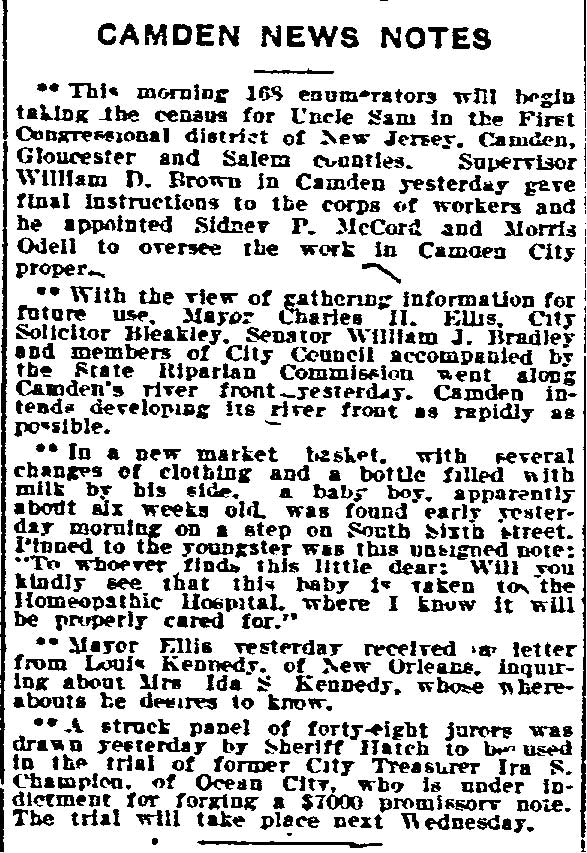
CAMDEN NEWS NOTES
•• This morning 168 enumerators will begin taking the census for Uncle Sam in the First Congressional district of New Jersey, Camden, Gloucester and Salem counties. Supervisor William D. Brown in Camden yesterday gave final instructions to the corps of workers and he appointed Sidney P. McCord and Morris Odell to oversee the work in Camden City proper.
•• With the view of gathering information for future use, Mayor Charles H. Ellis, City Solicitor Bleakley, Senator William J. Bradley and members of City Council accompanied by the State Riparian Commission went along Camden’s river front yesterday. Camden intends developing its river front as rapidly as possible.
•• In a new market basket, with several changes of clothing and a bottle filled with milk by his side, a baby boy, apparently about six weeks old, was found early yesterday morning on a step on South Sixth street. Pinned to the youngster was this unsigned note: “To whoever finds this little dear: Will you kindly see that this baby is taken to the Homeopathic Hospital, where I know it will be properly cared for.”
•• Mayor Ellis yesterday received a letter from Louis Kennedy, of New Orleans, inquiring about Mrs. Ida S. Kennedy, whose whereabouts he desires to know.
•• A struck panel of forty-eight jurors was drawn yesterday by Sheriff Hatch to be used in the trial of former City Treasurer Ira S. Champion, of Ocean City, who is under indictment for forging a $7000 promissory note. The trial will take place next Wednesday.
Philadelphia Inquirer — February 4, 1912
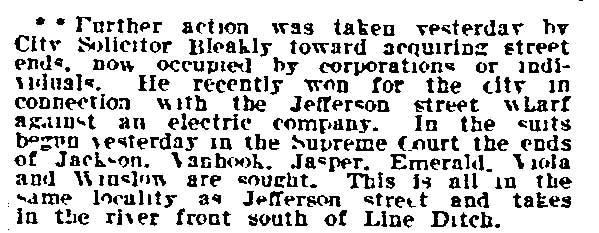
Further action was taken yesterday by City Solicitor Bleakly toward acquiring street ends, now occupied by corporations or individuals. He recently won for the city in connection with the Jefferson street Wharf against an electric company. In the suits begun yesterday in the Supreme Court the ends of Jackson, Vanhook, Jasper, Emerald, Viola and Winslow are sought. This is all in the same locality as Jefferson street and takes in the river front south of Line Ditch.
Philadelphia Inquirer — March 5, 1913
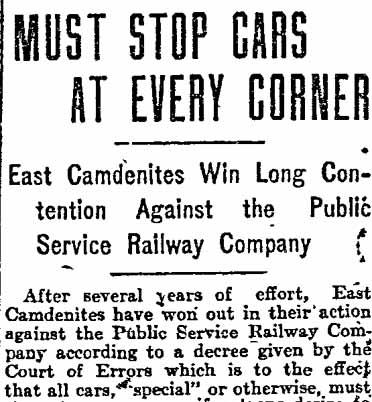
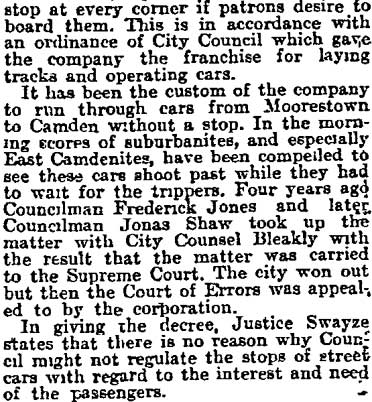
Named: East Camden, Frederick Jones, Jonas Shaw, and E.G.C. Bleakly.
Philadelphia Inquirer — October 22, 1914
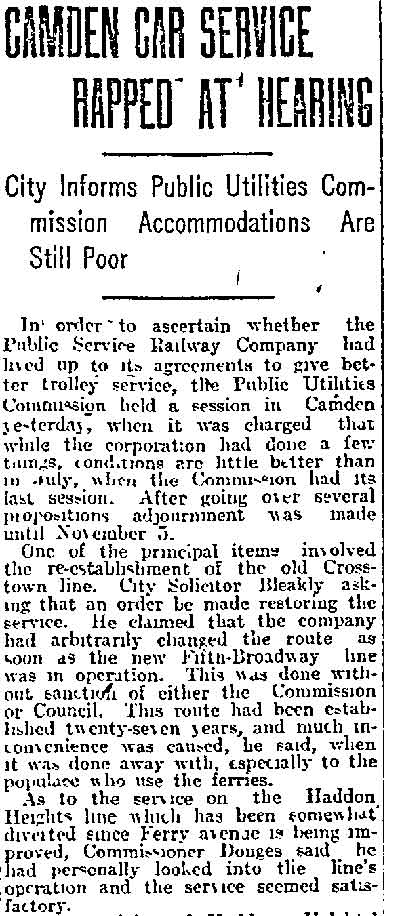
Camden Car Service Rapped at Hearing
City Informs Public Utilities Commission Accommodations Are Still Poor
In order to ascertain whether the Public Service Railway Company had lived up to its agreements to give better trolley service, the Public Utilities Commission held a session in Camden yesterday, when it was charged that while the corporation had done a few things, conditions are little better than in July, when the Commission had its last session. After going over several propositions adjournment was made until November 5.
One of the principal items involved the re-establishment of the old Crosstown line. City Solicitor Bleakly asking that an order be made restoring the service. He claimed that the company had arbitrarily changed the route as soon as the new Fifth-Broadway line was in operation. This was done without sanction of either the Commission or Council. This route had been established twenty-seven years, and much inconvenience was caused, he said, when it was done away with, especially to the populace who use the ferries.
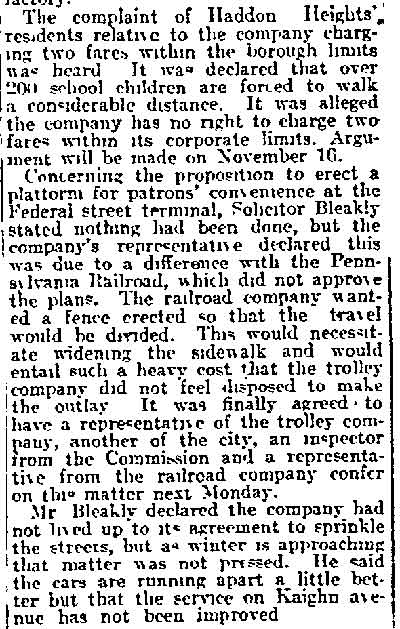
As to the service on the Haddon Heights line which has been somewhat diverted since Ferry avenue is being improved, Commissioner Douges said he had personally looked into the line’s operation and the service seemed satisfactory.
The complaint of Haddon Heights’ residents relative to the company charging two fares within the borough limits was heard. It was declared that over 200 school children are forced to walk a considerable distance. It was alleged the company has no right to charge two fares within its corporate limits. Argument will be made on November 16.
Concerning the proposition to erect a platform for patrons’ convenience at the Federal street terminal, Solicitor Bleakly stated nothing had been done, but the company’s representative declared this was due to a difference with the Pennsylvania Railroad, which did not approve the plans. The railroad company wanted a fence erected so that the travel would be divided. This would necessitate widening the sidewalk and would entail such a heavy cost that the trolley company did not feel disposed to make the outlay. It was finally agreed to have a representative of the trolley company, another of the city, an inspector from the Commission and a representative from the railroad company confer on this matter next Monday.
Mr. Bleakly declared the company had not lived up to its agreement to sprinkle the streets, but as winter is approaching that matter was not pressed. He said the cars are running apart a little better but that the service on Kaighn avenue has not been improved.
Philadelphia Inquirer — December 14, 1914
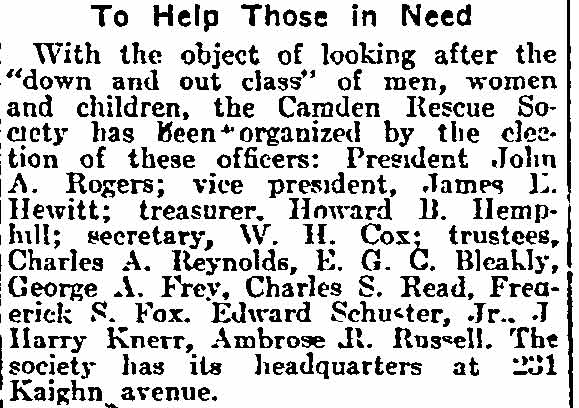
To Help Those in Need
With the object of looking after the “down and out class” of men, women and children, the Camden Rescue Society has been organized by the election of these officers: President John A. Rogers; vice president, James L. Hewitt; treasurer, Howard B. Hemphill; secretary, W. H. Cox; trustees, Charles A. Reynolds, E. G. C. Bleakly, George A. Frey, Charles S. Read, Frederick S. Fox, Edward Schuster, Jr., J. Harry Knerr, Ambrose R. Russell. The society has its headquarters at 231 Kaighn avenue.
Philadelphia Inquirer — July 1, 1915
FACTORY WILL BE BUILT TO FILL WAR ORDERS
New Industry in Camden Will Give Employment to Several Thousand Persons
After several weeks of negotiations it became known in Camden yesterday that plans have been made for the establishment of a big factory at Tenth and State streets, where shrapnel for the warring armies in Europe will be manufactured. It is declared that several thousand men will be employed. In addition it was also learned that efforts have been made through Henry F. Stockwell, as receiver for the extensive Dialogue Estate at Kaighn’s Point, to secure that property for another factory.
It was when those back of this first enterprise went to City Solicitor Bleakly and Assistant Solicitor Woodruff to learn what the requirements about storing powder and other explosives are that the establishment of the plant was made public. It was found that while there will be a great output of shrapnel there will not be a very large amount of black powder or other dangerous materials kept on hand in Camden. It will be sent to the plant as wanted. This satisfied the Camden authorities, and L. N Creighton, of Bayonne, N. J., who has been carrying on the negotiations, was at once acquainted with the facts
Philadelphia Inquirer — April 3, 1918
Frank T. Lloyd – E.G.C. Bleakly
Philadelphia Inquirer — October 27, 1918
F. Morse Archer, president of the National State Bank, is to direct the Camden drive for the war work fund. Former Judge William T. Boyle and William J. Strandwitz are the vice chairmen; Walter J. Staats is the treasurer and E. A. Stoll and David S. Rush, Jr., are the directors. The work in Camden city is to be done in six districts and the captains are E. G. C. Bleakly, James H. Long, William L. Hurley, F. B. Wallen, Wilbert Pike and Volney Bennett. Camden county’s quota is $227,500.
City Farm Gardens
Camden County in the Great War
Another weapon to defeat the enemy was the establishment of City Farm Gardens in the country. They were urged by the Government and not only provided food for city residents, but abolished unsightly vacant lots. Mayor Ellis named the first City Gardens Committee on April 19, 1917, as follows: E.G.C. Bleakly, Judge Frank T. Lloyd, Zed H. Copp, William Derham, L. E. Farnham, B. M. Hedrick, David Jester, O. B. Kern, M. F. Middleton, Dr. H. L. Rose, Asa L. Roberts, W. D. Sayrs, Jr., Charles A. Wolverton, Earl T. Jackson, H. R. Kuehner, Herbert N. Moffett and Hubert H. Pfeil. At the initial meeting of the above date B. M. Hedrick was elected chairman; Zed H. Copp secretary and M. F. Middleton treasurer. Brandin W. Wright, a farming expert, was employed as general superintendent on May 3, 1917. At a meeting on May 18, 1918, the names of Frank Sheridan and Daniel P. McConnell were added to the publicity committee in the place of Messrs. Pfeil and Jackson.
In his annual report to City Council on January 1, 1918, Mayor Ellis urged the appointment of a committee by City Council on City Gardens and Councilman Frederick Von Neida was named as chairman. This committee with a committee of representative citizens met in the City Hall in February, 1918, to organize for the ensuing summer. The members of the Councilmanic committee were: Frederick Von Neida, Frank S. Van Hart, William J. Kelly and John J. Robinson.
The committee planned an exposition of farm garden products for the fall of 1918, but this plan was frustrated by the Spanish influenza epidemic.
The war gardens became victory gardens in the year 1919 when the committee met on January 29, 1919. Meyers Baker was elected secretary and William D. Sayrs, Jr., treasurer. At the meeting on March 25 committees were appointed for the Victory War Gardens Exposition held in Third Regiment Armory from September 15 to 20. Benjamin Abrams was elected general manager and Frank Sheridan publicity agent.
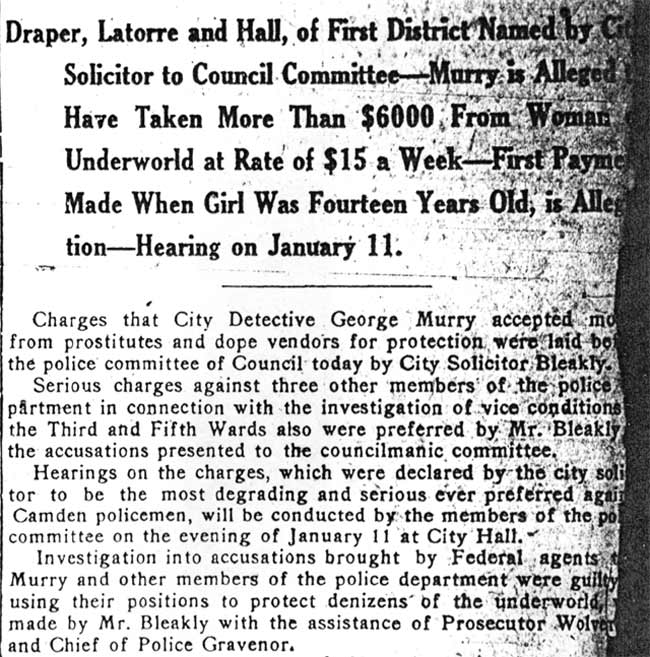
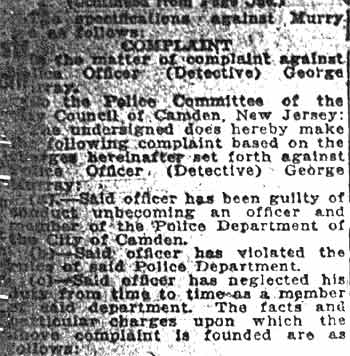
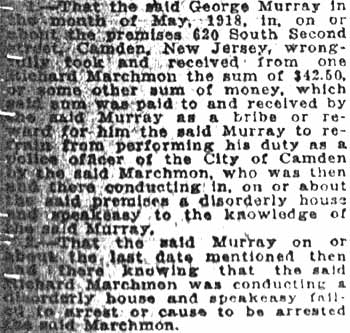
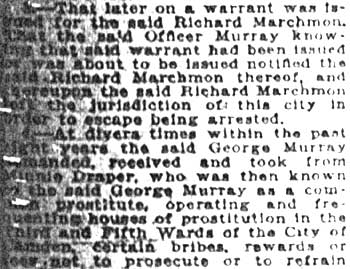
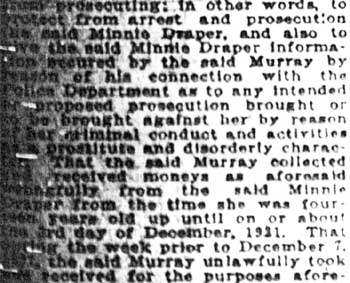
Charge Detective Murry Protected Vice
Camden Daily Courier –
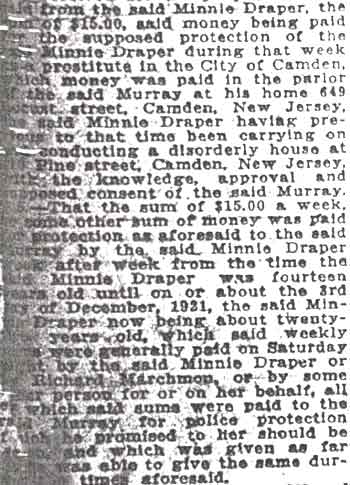
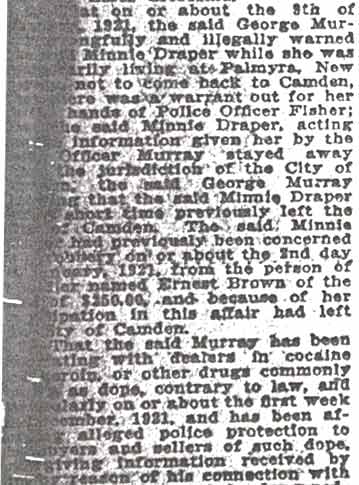
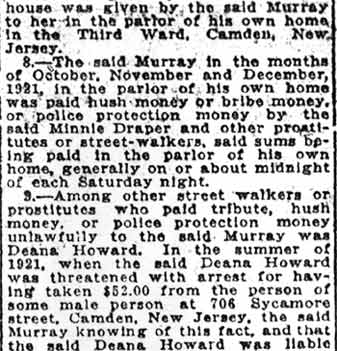
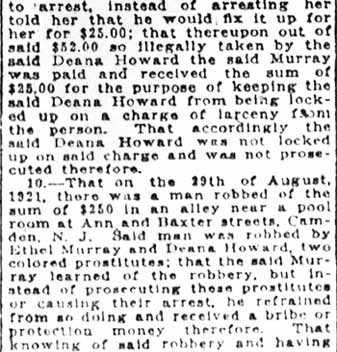
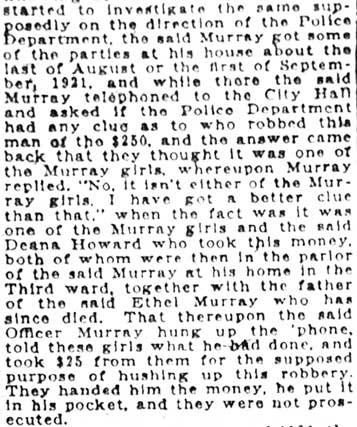
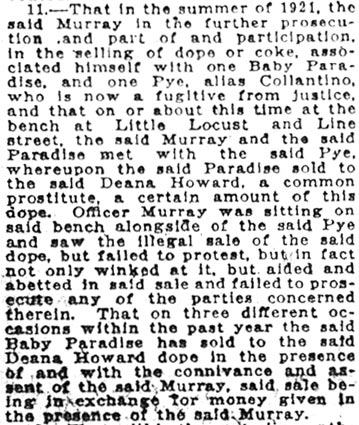
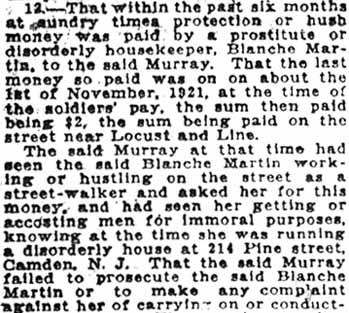
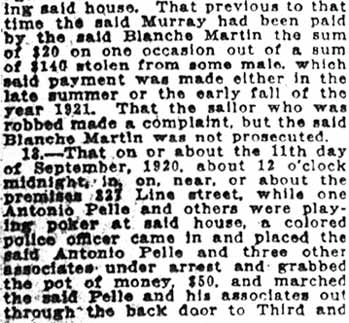
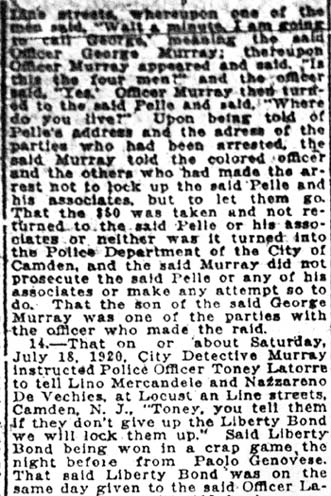
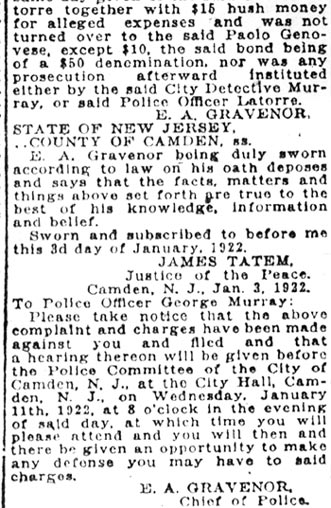
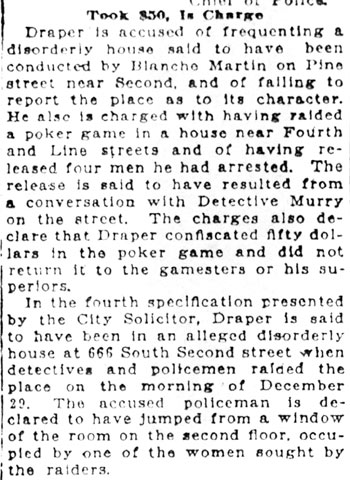

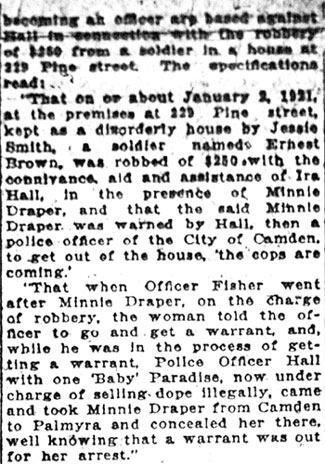
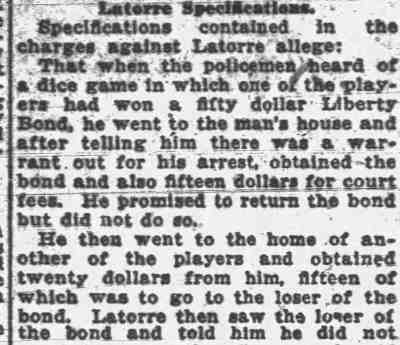
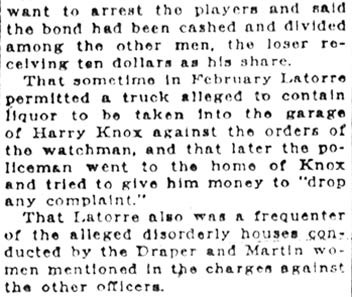
Named: John B. Kates, Walter Keown, George Ward, Howard Fisher, James E. Tatem, Elisha A. Gravenor, E.G.C. Bleakly, Anthony “Babe” Paradise, “Pye” Calletino, George Murry, William Draper, Tony Latorre, Ira Hall, Harry “Dutch” Selby, Gus Davis, Albert “Salty” Cook, Ned Galvin, James Wilson, Sycamore Street, Pine Street, Rosetta Blue, Deena Howard, Minnie Draper, Harry Knox, Blanche Martin, Jesse Smith, Antonio Pelle, Ethel Murray, Paulo Genovese, Nazzara DeVecches, Nino Mercandino, South 2nd Street, South 3rd Street, South 4th Street, Line Street, Pine Street, Ann Street, Baxter Street, and Sycamore Street.
Camden Post-Telegram — January 4, 1922
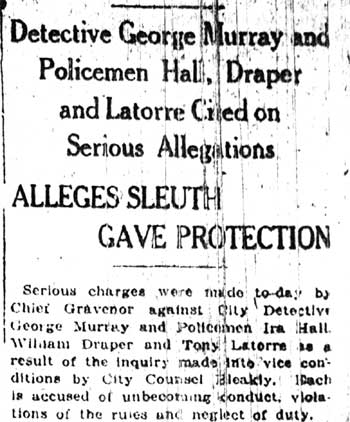
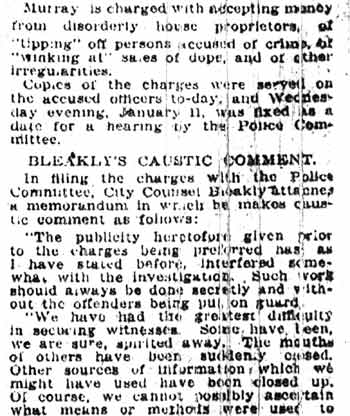
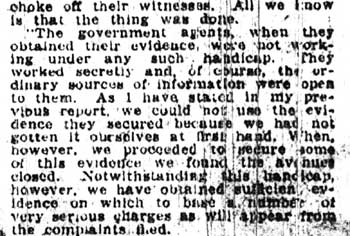
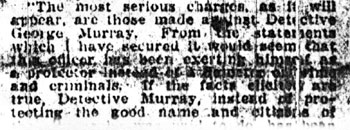
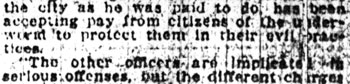
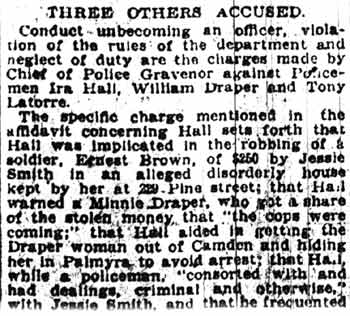
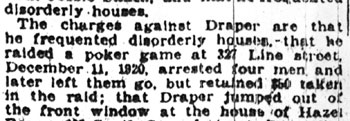
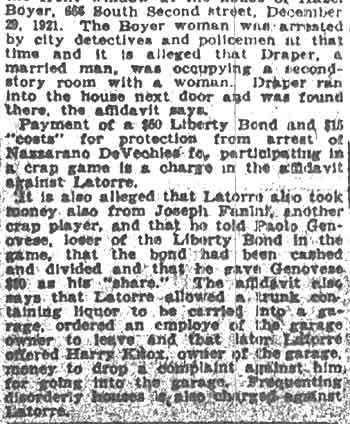
Named: John B. Kates, Walter Keown, George Ward, Howard Fisher, Anthony “Babe” Paradise, “Pye” Calletino, Polack Joe Devon, Richard Marchmon, E.G.C. Bleakly, George Murry, William Draper, Tony Latorre, Ira Hall, Harry “Dutch” Selby, Gus Davis, Albert “Salty” Cook, Ned Galvin, James Wilson, Sycamore Street, Pine Street, Rosetta Blue, and Deena Howard.
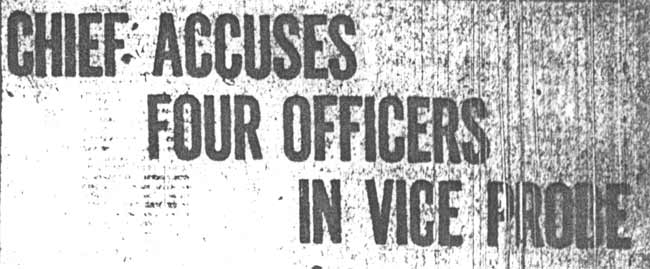
Vice Graft Probe Brings Suspensions for 4 Policemen
Camden Courier –
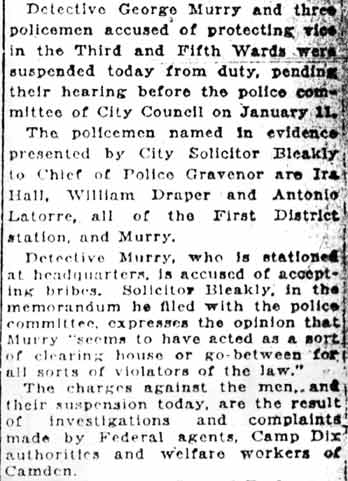
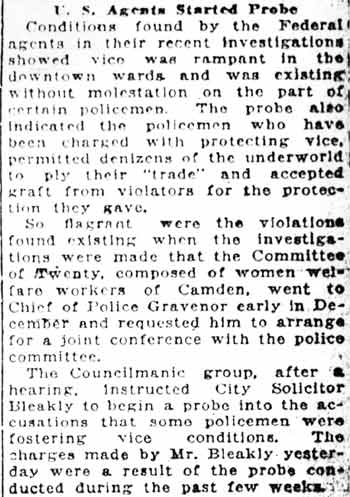

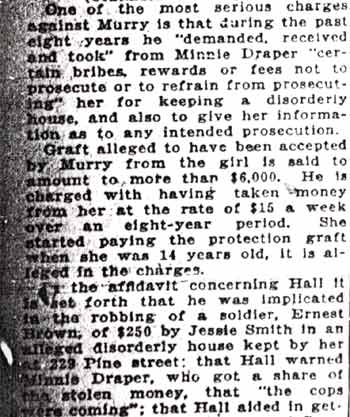
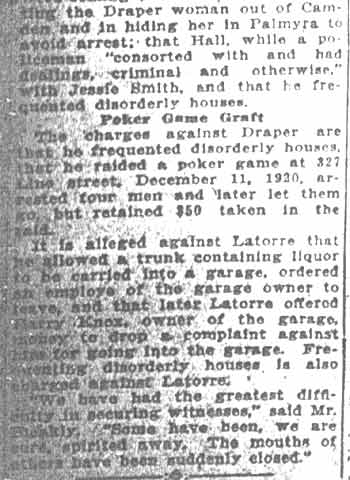
Named: Elisha A. Gravenor, E.G.C. Bleakly, George Murry, Ira Hall, William Draper, Anthony Latorre, Minnie Draper, Jessie Smith, Harry Knox, Line Street, and Pine Street.
Camden Courier — January 6, 1922
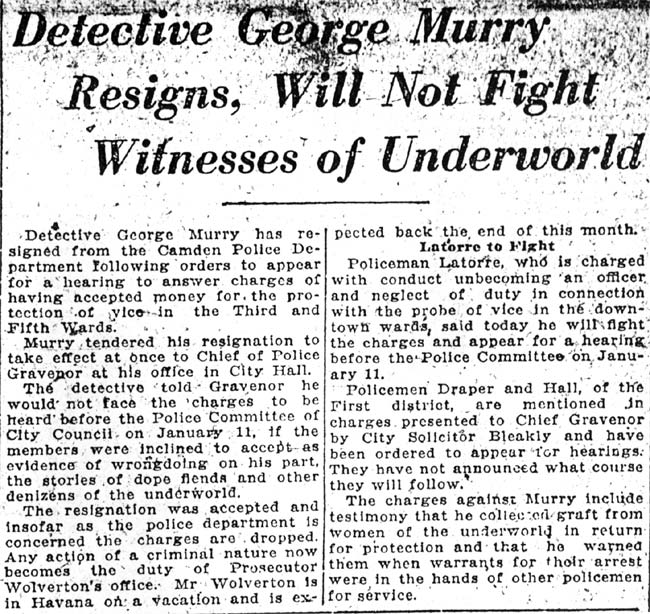
Named: Elisha A. Gravenor, E.G.C. Bleakly, Charles A. Wolverton, George Murry, Ira Hall, William Draper, and Anthony Latorre.
Camden Courier — January 9, 1922
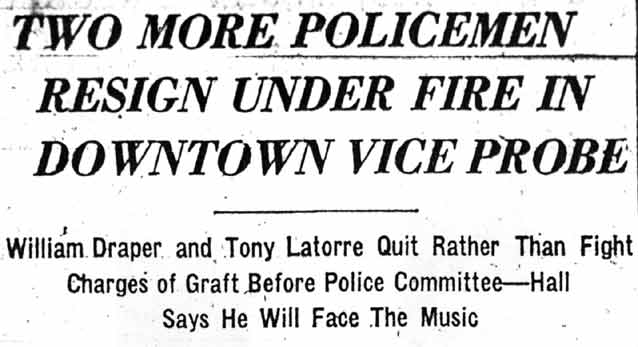
TWO MORE POLICEMEN RESIGN UNDER FIRE IN DOWNTOWN VICE PROBE
William Draper and Tony Latorre Quit Rather Than Fight Charges of Graft Before Police Committee—Hall Says He Will Face The Music
[Continuation — see gvm-cp-010922-01.md]
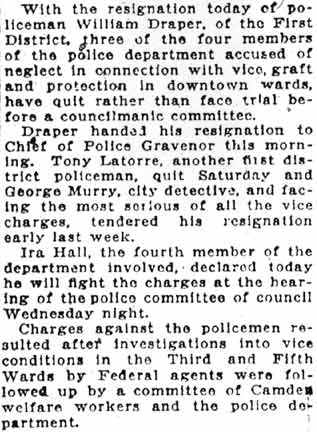
With the resignation today of policeman William Draper, of the First District, three of the four members of the police department accused of neglect in connection with vice, graft and protection in downtown wards, have quit rather than face trial before a councilmanic committee.
Draper handed his resignation to Chief of Police Gravenor this morning. Tony Latorre, another first district policeman, quit Saturday and George Murry, city detective, and facing the most serious of all the vice charges, tendered his resignation early last week.
Ira Hall, the fourth member of the department involved, declared today he will fight the charges at the hearing of the police committee of council Wednesday night.
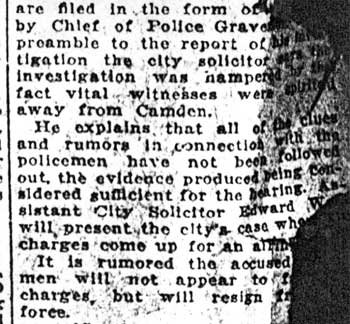
Charges against the policemen resulted after investigations into vice conditions in the Third and Fifth Wards by Federal agents were followed up by a committee of Camden welfare workers and the police department.
Camden Courier — January 11, 1922
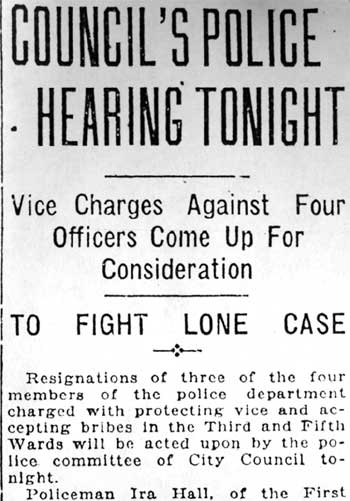
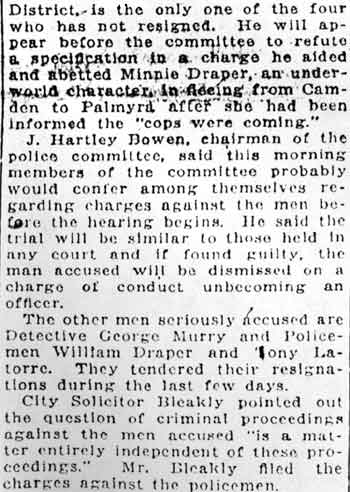
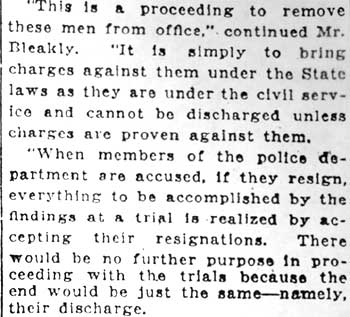
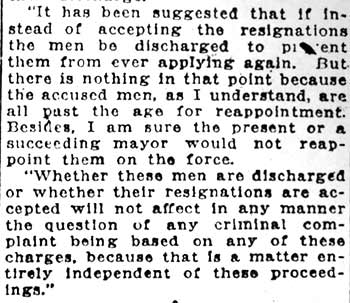
Named: E.G.C. Bleakly, J. Hartley Bowen, George Murry, Ira Hall, William Draper, Anthony Latorre, and Minnie Draper.
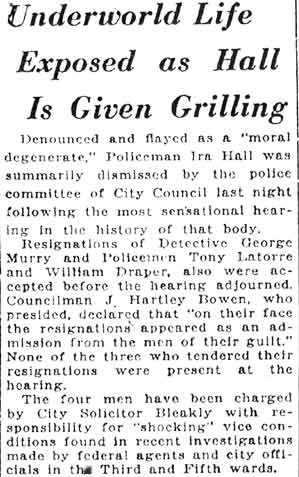
Ira Hall Is Dismissed, Evidence Against Four Men Given Prosecutor
Camden Courier –
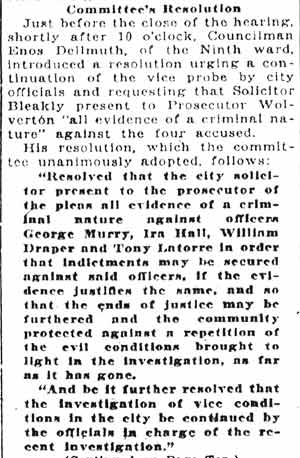
Criminal prosecution of Detective George Murry and Policemen Tony Latorre, William Draper and Ira Hall for their alleged “protection” of vice in the downtown underworld loomed today. At a sensational hearing before the police committee of City Council last night it was unanimously decided to turn the mass of evidence against the four men, gathered by City Solicitor Bleakly, over to Prosecutor Wolverton’s office.
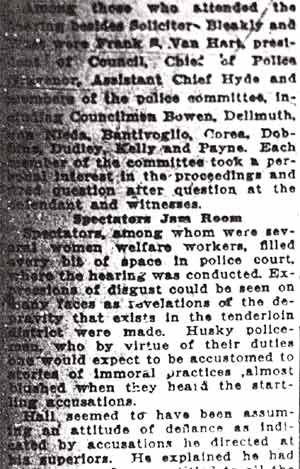
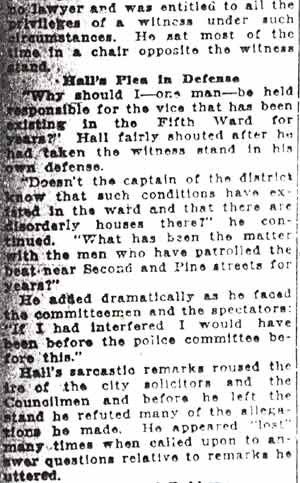
At the hearing, Policeman Hall was summarily dismissed from the department, classed as a “moral degenerate” and roundly flayed when, after he acted as his own attorney, he was cross-questioned by every member of the police committee.
Hall was the only one of the quartette of accused officers who made any attempt to defend himself. Murry, Latorre and Draper resigned several days ago. At the police committee session last night it was the sense of the members that their resignations was a tacit admission of guilt and that their mere removal from the police department is not sufficient punishment for their underworld activities.
The grand jury convened on Tuesday of this week. The next step will be the presentation of evidence gathered by Mr. Bleakly against the four men to the prosecutor’s office who, in turn, will turn it over to the grand jury. Quick action may be expected, it was predicted today in official circles.
Policeman Hall’s friendship for Anthony Paradise, charged with peddling “dope,” was brought out at last night’s hearing.
Camden Courier — January 12, 1922
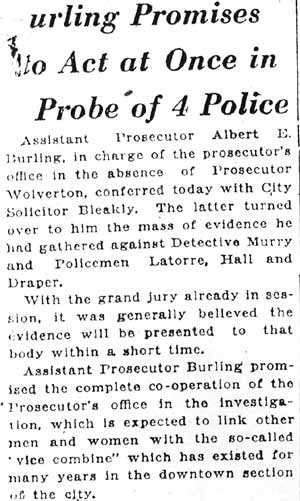
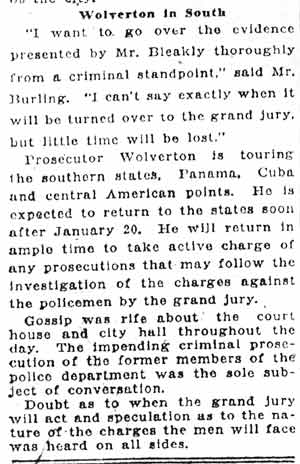
Named: E.G.C. Bleakly, Charles A. Wolverton, George Murry, Ira Hall, William Draper, and Anthony Latorre.
Camden Courier — January 12, 1922
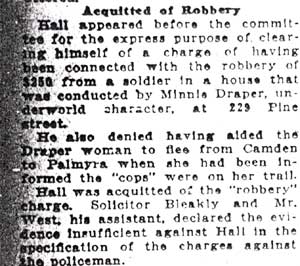
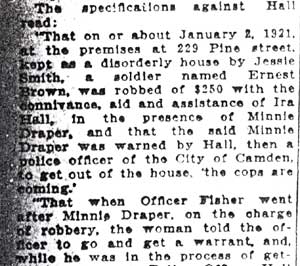
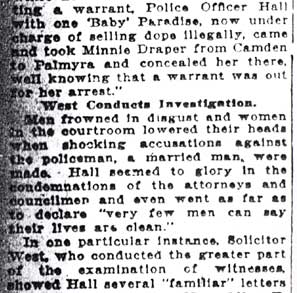
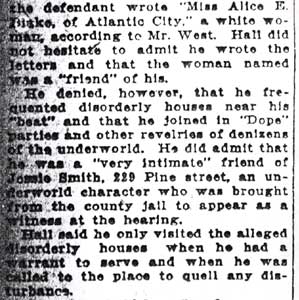
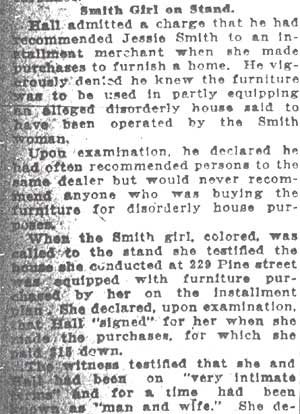
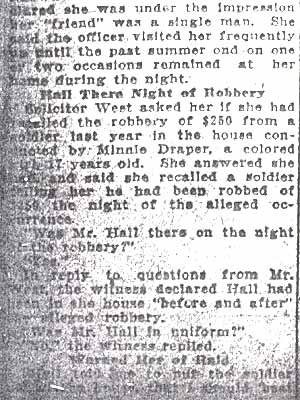
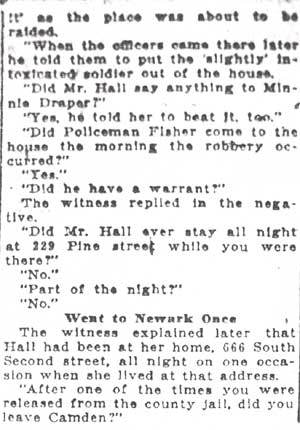
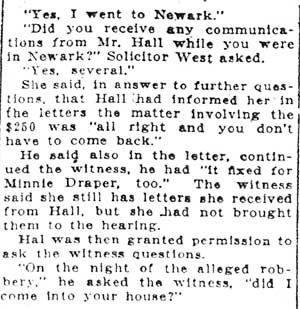
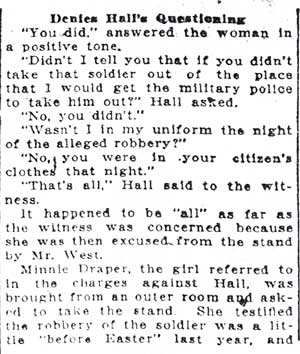
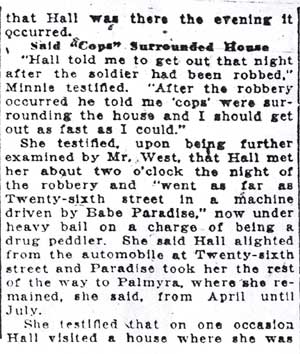
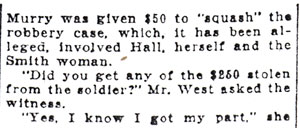
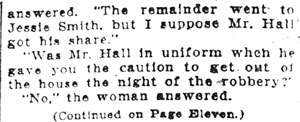
Named: E.G.C. Bleakly, Charles A. Wolverton, Edward West, Howard Fisher, George Murry, Ira Hall, William Draper, Anthony Latorre, Anthony “Babe” Paradise, Minnie Draper, Jessie Smith, 2nd Street, 26th Street, and Pine Street.
Philadelphia Inquirer — January 15, 1922
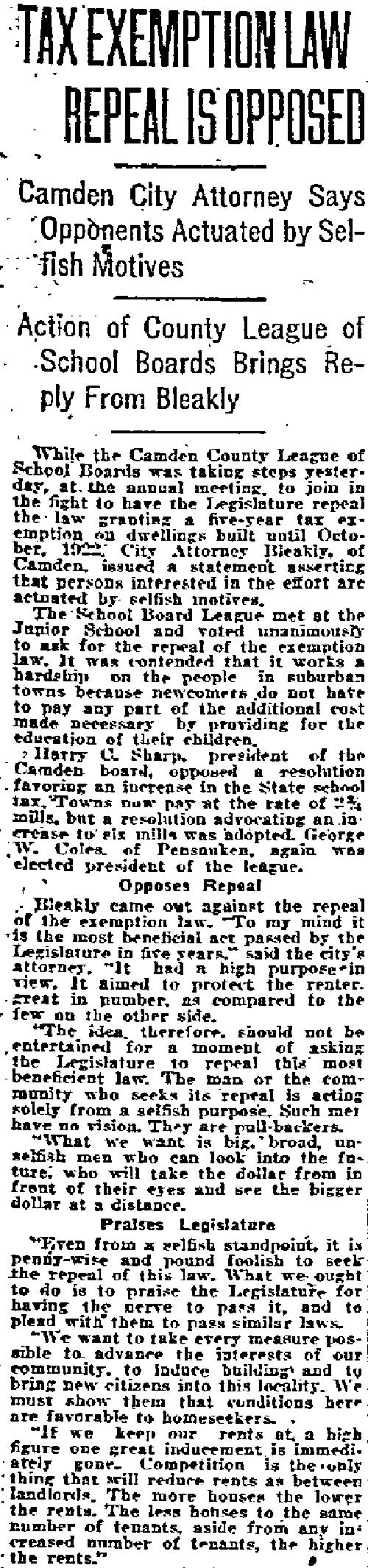
E.G.C. Bleakly – Harry C. Sharp
Camden Daily Courier — January 21, 1922
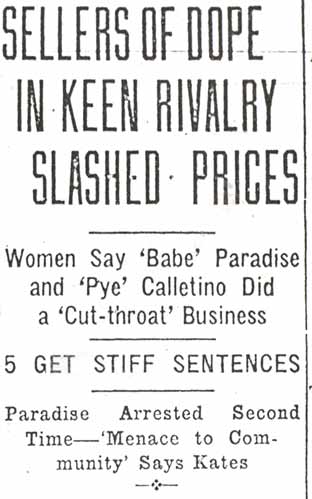
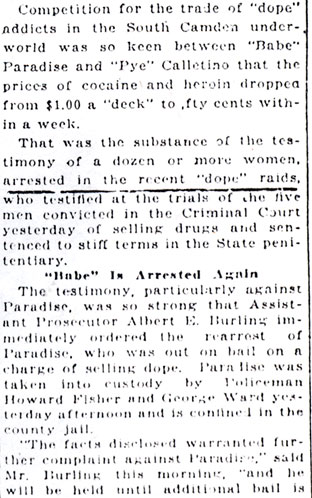
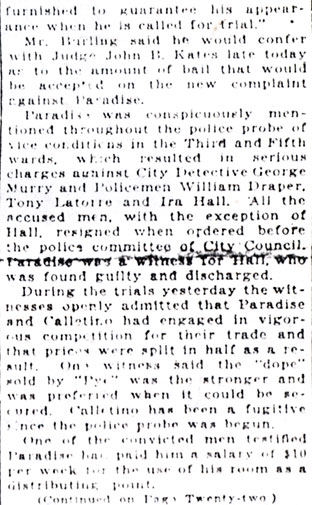
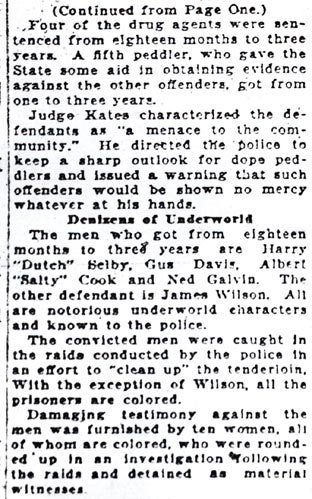
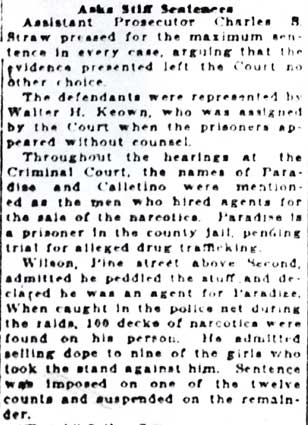
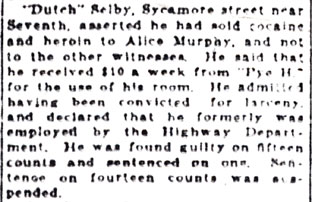
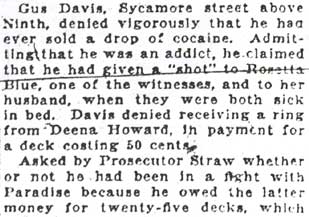
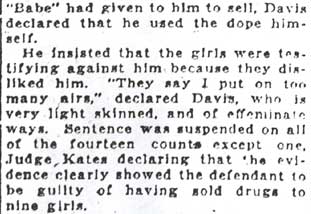
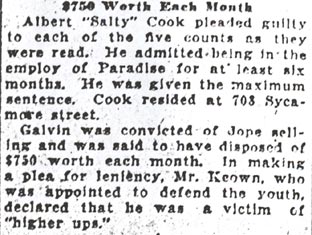
Named: John B. Kates, Walter Keown, George Ward, Howard Fisher, Anthony “Babe” Paradise, “Pye” Calletino, Polack Joe Devon, Richard Marchmon, Charles B. Straw, George Murry, William Draper, Tony Latorre, Ira Hall, Harry “Dutch” Selby, Gus Davis, Albert “Salty” Cook, Ned Galvin, James Wilson, Sycamore Street, Pine Street, Rosetta Blue, and Deena Howard.
Camden Courier — January 25, 1922
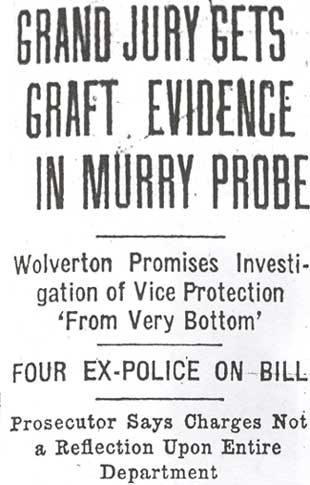
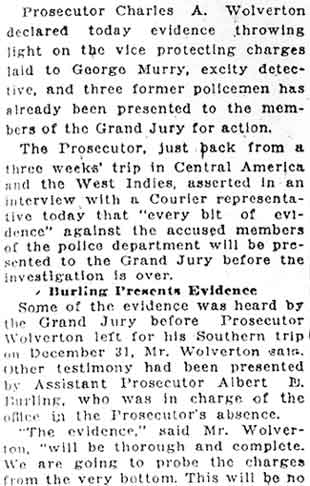
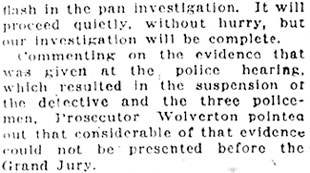
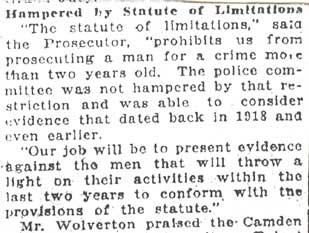
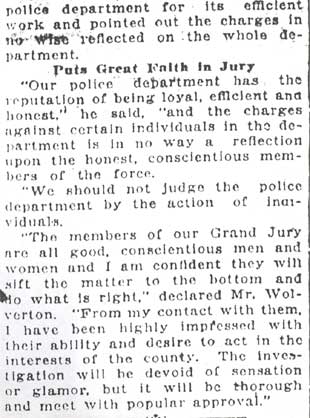
Named: E.G.C. Bleakly, Charles H. Ellis, Elisha A. Gravenor, Charles A. Wolverton, George Murry, Ira Hall, William Draper, Anthony Latorre, Dr. A. Haines Lippincott, Gus Giuseppi Guarino, Benson Street, Edward West, and Lewis Stehr Jr..
Former Detective Murry Drops Dead In Street
Camden Courier –
George Murry, ex-city detective, who resigned from the police department after being charged with promoting vice in the Third and Fifth Wards, was found dead on a doorstep near Locust and Line Streets shortly after nine o’clock last night.
A death certificate issued by Coroner Holl ascribes Murry’s death as due to apoplexy, superinduced by acute indigestion.
Grand Jury Probe Starts
Murry’s death came as a tragic aftermath of his exposure as a protector of prostitution and dope selling in the downtown tenderloin, in the role of which he is said to have amassed a snug fortune.
His death automatically puts to an end the proceedings that were begun to present his activities in the tenderloin before the Grand Jury with a view of bringing criminal prosecution.
Murry will be buried Thursday afternoon at Mt. Peace Cemetery, of which he was part owner. Funeral services will be conducted at the home and in the Macedonia Church, 3rd and Spruce Street, at noon.
Neighbors Find Body
Murry was 50 years old. According to his wife, Mrs. Cora J. Murry, the former city detective had been suffering for several days with indigestion.
After supper last night, Mrs. Murry said, her husband complained of feeling ill and she gave him a tablespoon of baking soda. He shortly after decided to take a walk in the belief the air might benefit him.
Half an hour later, neighbors came upon his lifeless body across a doorstep on Locust street, between Beckett and Line Streets.
The body was carried to the Murry home, at 649 Locust Street, a few doors away. Two physicians were called. Owing to the storm, the doctors were delayed in reaching the house. Dr. Clement T. Branch, of 721 Walnut Street, the first physician to arrive, said he believed Murry had died as he fell.
Mother Died 2 Years Ago, Same Hour
Besides his widow, Murry is survived by eight children, ranging in age from two months to 18 years. Curiously, Murry’s mother died exactly two years ago, to the very hour. Murry was colored, although many persons were unaware of his race because of his light complexion. He was a tall, powerful man. He was more than six feet in height and weighed about 230 pounds. His complexion was ruddy and his hair iron gray.
Murry’s death was a passing incident in the tenderloin today. Before he was shorn of his power, which he wielded proudly and with great vigor, his decease might have caused a great flurry.
Boss For Many Years
His loss of power probably worried Murry more than the outcome over the exposure of the criminal phase of the exposure. Murry had been the undisputed political “boss” of the Third and Fifth wards for years. The transition was too great; his fall too disgraceful.
Prosecutor Charles A. Wolverton pointed out today that with Murry dead, the presentation of evidence of vice conditions in the Fifth Ward to the Grand Jury would be dropped for the present and in all probability for good.
The reason is obvious, said Mr. Wolverton. “There’s nobody to convict.”
United States Started Probe
Murry’s downfall was due largely to the activities of attaches of the United States Interdepartmental Social Hygiene Bureau, who investigated vice conditions here at the request of the Camp Dix military authorities.
Officers of the camp complained many of the men had contracted contagious diseases during visits to the tenderloin in South Camden.
A series of meetings was held under the auspices of the bureau and a number of women prominent in social welfare work in the city.
With the co-operation of the Federal authorities, the local police began a “cleanup” of the tenderloin. No one was spared. Dope peddlers, prostitutes, bootleggers and gamblers fell in the clutches of the authorities. Questioned, their stories seemed to coincide on one fact—that Murry was the “invisible government” which sanctioned or frowned upon their industry and who had to be “greased” if they wished to ply their trade without molestation or criminal prosecution.
Three Other Members Accused
Three other members of the police department were accused of malfeasance along with Murry. They are Policemen William Draper, Tony Latorre and Ira Hall. The three men were dismissed by the police committee of City Council. Hall, who opposed his dismissal and demanded a trial, was excoriated by the committee and summarily dropped from the department.
Murry resigned from the force declaring that the evidence against him was untrustworthy, having been obtained from dope fiends and “other irresponsible people.” It was understood, however, that he resigned, believing it would put an end to the proceedings. He seemed to worry over the contemplated action by the Grand Jury.
Said He Amassed Wealth
Murry, however, boasted openly he had amassed wealth while he reigned as the “tenderloin boss.”
“I’ve got mine,” he declared only recently. “I’ve got enough to keep me and my family in clover for the rest of our lives. If they let up on me and don’t push this jail thing, I’m willing to lay down.”
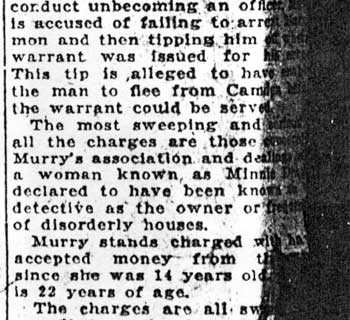
In addition, Murry was specifically charged with accepting graft from dope peddlers and with “tipping off” criminals against whom warrants were issued in City Hall.
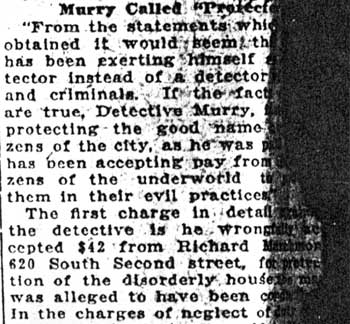
City Solicitor E.G.C. Bleakly drew up the complaint and charges against the detective. Commenting on the charges when they were first made public, Mr. Bleakly said:
“From the statements I have obtained it would seem this officer has been exerting himself as a protector instead of a detector of crime and criminals. If the facts elicited are true, Detective Murry, instead of protecting the good name and citizens of our city, as he was paid to do, has been accepting pay from the citizens of the underworld to protect them in their evil practices.”
In Department 16 Years
Murry was a member of the police department for 16 years, having been appointed in 1905. He was made a detective in 1913.
Philadelphia Inquirer — November 26, 1922
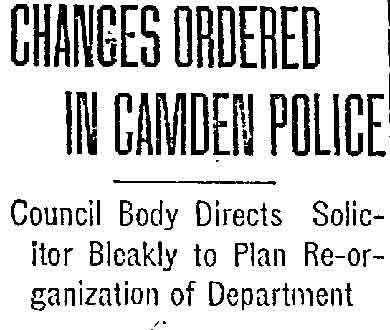
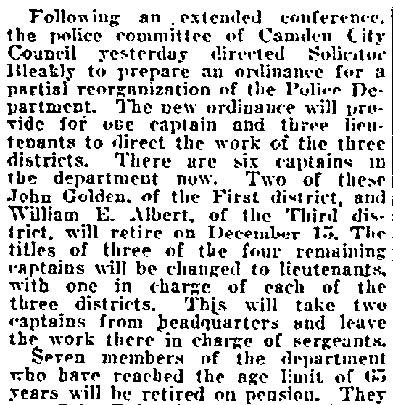
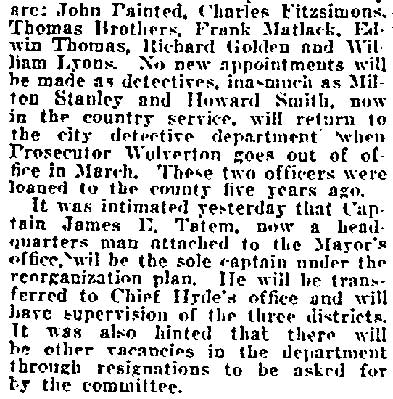
E.G.C. Bleakly – John Golden – William E. Albert – John Painter – Charles Fitzsimmons – Thomas Brothers – Edwin Thomas – Richard Golden – William Lyons – Milton Stanley – Howard Smith – Charles A. Wolverton – James E. Tatem – Edward Hyde
This story erred in reporting, as retirement at age 65 was NOT mandatory at the time. William E. Albert, Richard Golden, Frank Matlack, and Edwin Thomas did retire. John Golden, John Painter, Charles Fitzsimmons, Thomas Brothers, and William Lyons continued to work in the Police Department. John Golden was eventually promoted to Chief of Police.
Camden Courier-Post — August 25, 1931
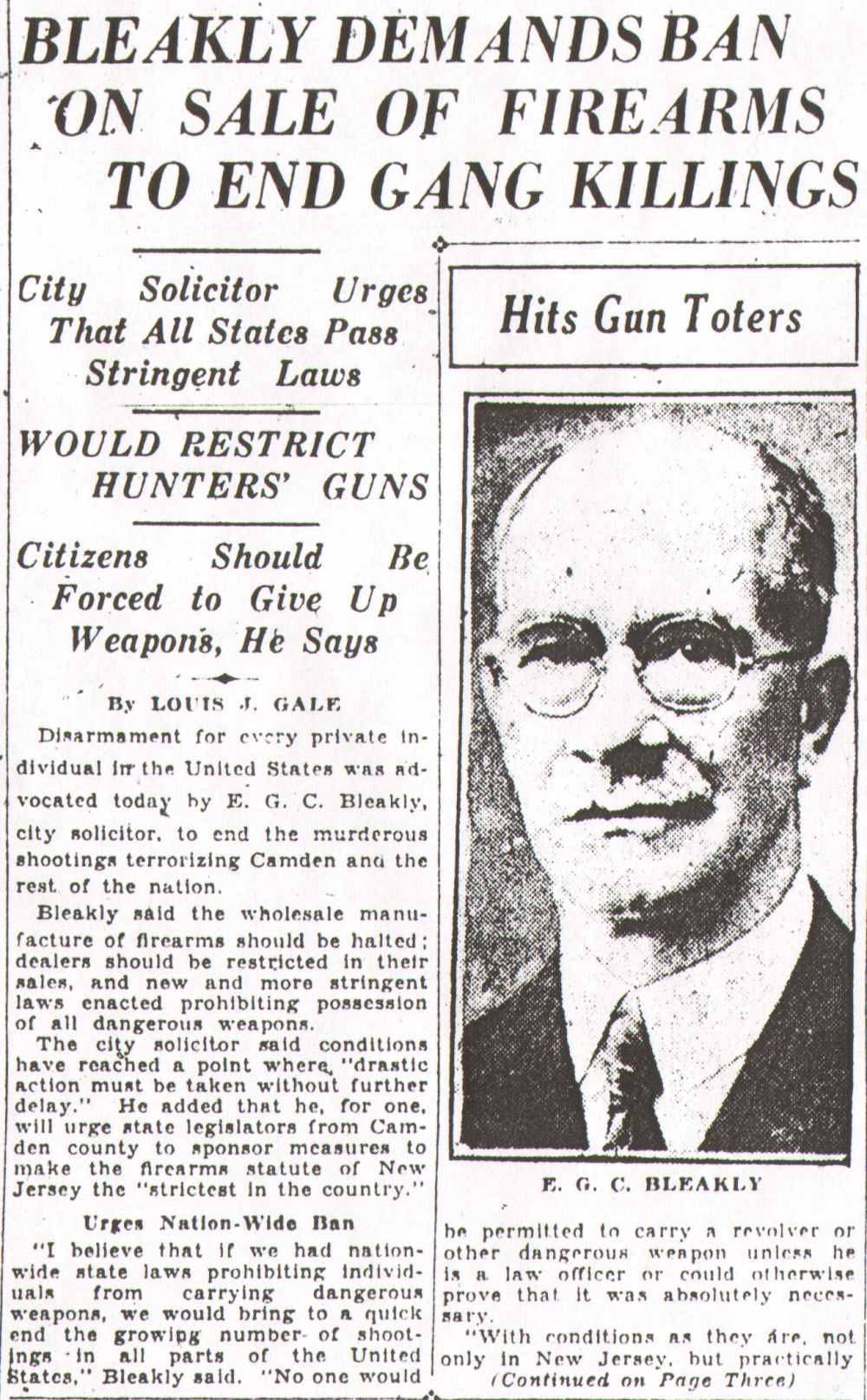
He was wrong on every aspect of this issue. — PMC
Lippincott Widow Sues for $225,000
Camden Courier-Post –
Suit for $255,000 was filed in New Jersey Supreme Court yesterday by Mrs. Margaret Lippincott against the Atlantic City Railroad in the death of her husband, Willet Lippincott, of 106 Station Avenue, Haddon Heights, a real estate operator and son of Benjamin A. Lippincott, first mayor of Haddon Heights.
The widow, mother of four children, charges that her husband met his death on the morning of July 23 at the Warwick Road crossing at Magnolia. Lippincott’s truck, loaded with hay, obtained from the farm of his mother, Mrs. Laura Lippincott, on Warwick road, was struck by a northbound Ocean City–Camden train. Lippincott was killed, and the truck and hay set afire when the gasoline tank exploded.
Papers in the suit have been prepared by former Senator Albert S. Woodruff and S. Huntley Beckett, attorneys. Allegations are made in the suit that the railroad was negligent in failing to protect the crossing, which is termed in the charges as “extra-dangerous and extra-hazardous.”
It is alleged further that a signal light at the crossing failed to work properly at the time of the tragedy, and that a curve of the railroad, a bank of earth, poles and other obstacles obstructed the view of an approaching train. No bell or whistle was sounded from the engine of the train, it is charged.
Lippincott met his death although he alighted from his truck to look up and down the tracks at the crossing, according to Woodruff. He had seen a southbound train pass, but was struck by the northbound train. Passengers on the northbound train included Magistrate Dennis F. Fitzgerald, of Philadelphia; Mayor Roy R. Stewart, Prosecutor Clifford A. Baldwin, City Solicitor E. G. C. Bleakly, Byron M. Seabrook, and Jerome Hurley, of the Hurley Stores, all of whom had summer homes at Ocean City.
Children surviving Lippincott include Priscilla, 8; Benjamin, 6; Summitt, 4, and Scott W. Lippincott, 1 year old.
Payroll Theft Is Re-Enacted; Two Men Held
Camden Courier-Post –
The $11,790 payroll holdup staged last Friday at the Radio Condenser Co., Thorne and Copewood Streets, was re-enacted yesterday.
Two suspects nabbed late Monday, at Lykens in Dauphin County, Pa., played the “heavy” roles. Also in the cast were eight women and two men, employees of the firm. For an hour and 20 minutes the spectacular robbery was “rehearsed” under the direction of three Camden detectives.
When the curtain was rung down LeRoy Jenkins, 23, who police say has addresses at 1161 Mechanic Street and 1220 Princess Avenue, and Joseph Putek, 23, said to reside at 1462 Louis Street, were held on suspicion. They will be questioned further today.
Has Nothing Definite
Acting Chief of Police John W. Golden admitted he “has nothing on the boys.” Detectives Benjamin Simon, Clarence Arthur and Clifford Del Rossi, however, were “pressing pursuit of ‘hunches’ and meager clues in attempts to solve the crime. There were several lines of information they obtained regarding the two suspects which will bear further study,” Simon said.
Putak, who has a police record although never convicted according to police, was questioned previously in connection with the Radio Condenser “job.” He was released at midnight last Saturday. After that the detectives centered attention upon Jenkins. They learned Jenkins borrowed an automobile from a man who operates a garage in the 1200 block on Atlantic Avenue. The garageman was reluctant to talk but under threat of arrest as an accessory he admitted lending a car to Jenkins.
Fliers were dispatched to police throughout Pennsylvania, New York, Delaware and New Jersey. The car was halted at Williamsport, Pa. and when Camden police were identified they were surprised that Putak was Jenkins’ companion. This stirred detectives to renewed vigor in the probe. They learned the men were planning to visit relatives of Jenkins in Williamsport and Pottsville. According to Simon, police of both cities say Jenkins is well known to them.
While at Williamsport the three detectives learned Putak and Jenkins visited a vice den and quarreled with a woman over money. They quoted Jenkins as declaring that he “could buy and sell the joint!”
Had Little Money
Putak had but $3 when released Saturday and $11 when arrested, Simon revealed. He told the detectives he had won money in a poker game here.
The two men were returned with the detectives as far as Philadelphia but refused to cross the river. They were turned over to police there on suspicion and brought to this city yesterday afternoon. Taken to the Radio Condenser plant they were confronted with the ten employees who were herded in a vault during the holdup last Friday.
According to Simon, several of the employees felt there were certain mannerisms of the suspects which corresponded with actions of the bandits but confessed they were unable to definitely identify Putak or Jenkins as the heavily masked pair who threatened their lives with a revolver and shotgun.
The detectives propose an inquiry to all banks in this area in an effort to learn whether safe deposit boxes were leased by anyone answering the description of the suspects. The money obtained in the robbery was in bills and change of small denomination; numbers of the bills were not available.
Although never convicted, Jenkins has a police record. Putak has never been formally under arrest, but has been questioned by the police in connection with various cases.
Jenkins was arrested December 18, 1931, charged with larceny of gasoline, and on last July 9 was charged with several robberies.
On April 2, 1931, he was held for the grand jury, charged with manslaughter after his automobile killed Mrs. Mary Cavanaugh, 70, a cook in the service of City Solicitor E. G. C. Bleakly.
Dr. Rhone on High Seas
Camden Courier-Post –
Dr. David S. Rhone, commissioner of public affairs, is on the high seas today bound for Germany on a vacation.
The city commissioner, who told only a few friends of his plans, sailed from New York Tuesday night.
Few city officials and friends knew of the projected trip and even Dr. Rhone’s secretary, Bayard M. Sullivan, pleaded ignorance of the commissioner’s plans. Sullivan said he did not know how long the commissioner would remain abroad. He said he believed Dr. Rhone sailed with some friends and may visit other countries in addition to Germany.
City Solicitor E. G. C. Bleakly was among those who expressed surprise at learning that Dr. Rhone had sailed.
Bleakly stated that he knew of no arrangements for a deputy commissioner to operate the public welfare department during the commissioner’s absence.
Mayor to Decide on Fire Alarm Bids
Camden Courier-Post –
Mayor Roy R. Stewart will rule within two or three days on whether the city will accept the bid of the Horni Signal Manufacturing Corporation, of New York, to install the new fire alarm and police signal system in the new city hall courthouse annex. The corporation submitted the lower of two estimates recently.
The mayor cited the corporation to show cause at a hearing before him Wednesday why the corporation’s bid of $44,995 should not be rejected as irregular in that it allegedly did not follow specifications, failed to reveal the corporation’s financial responsibility to complete the work, and made no provision to accept city bonds, warrants or other form of municipal security in payment for the work, as provided in the specifications. Mayor Stewart said the corporation, through three representatives at the hearing yesterday, pointed out that it would take city securities in payment, provided the city agreed to make up the difference should the value of the securities drop. The firm’s representatives also sought to have the city assume the responsibility for the payment of “extras,” should the National Board of Fire Underwriters specify that additional work and material be added, although the specifications themselves relieved the city of that responsibility. They also furnished a satisfactory statement of their financial status, the mayor said.
As a result of the hearing, the mayor can reject the corporation’s bid, accept that of the Gamewell Company, of New York, the rival bidder with an estimate of $51,837, or re-advertise for bids.
City Solicitor E. G. C. Bleakly and William Dilmore, acting city purchasing agent, attended the hearing in the mayor’s office.
Collapse of Homes to Bring Probe of All Old Buildings
Camden Courier-Post –
Investigation was ordered yesterday into the tragic collapse of the front walls of two vacant houses here Sunday. Mayor Roy R. Stewart announced he would push a probe to determine who is responsible for allowing the condemned buildings at 829 and 831 Bridge Avenue, to remain standing without repairs.
The mayor also declared that a move is under way to demolish 825 other unsafe buildings in Camden.
Jerry White, 22, colored, of 759 Carman Street, died yesterday of injuries suffered Sunday when he was buried under a ton of bricks. He was seated in front of one of the dwellings when the collapse occurred.
Mayor Stewart conferred with real estate and insurance agents yesterday and announced that he would ask the municipal legal department to proceed against other dangerous properties. In directing his investigation the mayor said he is anxious to determine whether there had been any laxity in connection with condemnation of the Bridge Avenue properties. City records reported them “torn down.”
“I assumed action had been taken in condemnation of the properties, but apparently that was not done and it is exceedingly regrettable that a life has been lost,” Mayor Stewart said.
Will Rush Action
“Certainly no other lives will be given if I can help it, and I am forthwith ordering that legal action be taken immediately in the tearing down of 825 properties in the city that have been found in a recent survey to be unsafe.
“Many citizens in the community, including prominent men and women, are heartily in favor of the action the city is taking in ordering dilapidated properties torn down.
“The death of the Carman Street man reveals glaringly the need for immediate action. That death should not have occurred. It could have been prevented had there been no delay in removing the hazardous buildings.
“At this time, I am placing no direct responsibility, and will not do so until I have made a thorough investigation. This is, indeed, a serious situation, and by no means must there be a repetition. It shows without question that such things as unsafe buildings cannot be permitted to remain indefinitely. I feel that the owners themselves should come to the front, and notify the city of their unsafe properties, and co-operate with us.”
City Not Wholly Lax
The mayor said the letters he has written regarding the Bridge Avenue properties show that the city had not been wholly lax regarding them. He added, however, that there has been laxity somewhere, and he is determined to find out who is to blame.
City Solicitor E. G. C. Bleakly said records in his office showed that the houses were “torn down.”
Bleakly was asked who made the report the houses were wrecked.
“I do not know at this time, but I shall join with the mayor in a thorough investigation,” the city solicitor said.
The mayor and Bleakly pointed out that vandals had been tearing properties apart in their efforts to obtain fixtures, lumber, etc. The mayor said the 829 Bridge Avenue property is owned by Mrs. George Murry, of 649 Locust Street, the widow of George Murry, the late city detective. He said he is checking to learn who is the owner of 831 Bridge Avenue.
The houses have been unoccupied for a number of years. They are believed to have been weakened by vandals who had stripped the interiors of wooden supports and fixtures.
Recent damage by vandals throughout the city has been estimated at $500,000.
8 in Camden Pass State Bar Tests
Camden Courier-Post –
Nine Camden law students and 14 others from South Jersey cities passed the April state bar examinations and may practice as attorneys in New Jersey.
That was announced at Trenton yesterday by Rue Brearley, secretary of the State Bar Examiners. Brearley stated that in the entire state, 206 students passed the tests. The counselor-at-law results were not announced.
Those in Camden were:
Howard G. Kulp, Jr., studying at the law offices of Carr and Carroll.
Norman Heine, law office of his brother, Aaron Heine.
Louis L. Goldman, firm of Orlando and Kisselman.
Franklin L. Deibert, offices of his brother, Edward R. Deibert.
Joseph Lipkin, offices of Judge Frank F. Neutze.
Stanley L. Bennett, law offices of his brother, City Commissioner Harold W. Bennett.
John F. Ruck, law offices of Walter S. Keown.
James D. Stockwell, law firm of Bleakly, Stockwell and Burling, of which his father, Henry F. Stockwell, is a member.
Bartholomew A. Sheehan, law offices of Walter S. Keown.
Among the other South Jersey students who were successful was Harold B. Wells, Jr., son of Judge Harold B. Wells, of Bordentown. The others are: Fred A. Gravino, John B. Wick and Frank Sahl, all of Woodbury; I. Harry Levin and W. Howard Sharp, of Vineland; Wheeler Grey, William B. Brooks and Morgan E. Thomas, of Atlantic City; Thomas H. Munyan and John E. Boswell of Ocean City; Francis Tanner, Toms River; James Edward McGlincy, Bridgeport, and Charles J. Berkowitz, Lakewood.
City Extends Pact for Track Removal
Camden Courier-Post –
The city commission yesterday afternoon extended for another year a three-year-old agreement entered into by the Pennsylvania Railroad to remove its Seventh Street tracks in Camden and thereby eliminate 14 grade crossings.
The extension in time was voted when the commission passed on final reading an ordinance introduced several weeks ago. It is the latest of several extensions granted to postpone start of the work.
City Solicitor E. G. C. Bleakly said the delays have been agreed to by the city and the railroad because the latter is not prepared at this time to carry out the project and because the city has no money.
Under the agreement, the railroad was to abandon use of the Seventh Street tracks and the city was to purchase the right of way from the railroad for use as a boulevard at a cost of $286,000. The railroad is to receive a first payment of $106,000.
The city-railroad plans called for electrification of the Tenth Street steam railroad over which the shore trains now using Seventh Street will run.
Bleakly Recovered; Back to Work Monday
Camden Courier-Post –
Ocean City, August 10.—Recovered from an illness which confined him to his Summer home here for three weeks, E. G. C. Bleakly, city solicitor of Camden, will return to his office on Monday.
Camden Courier-Post — August 29, 1935
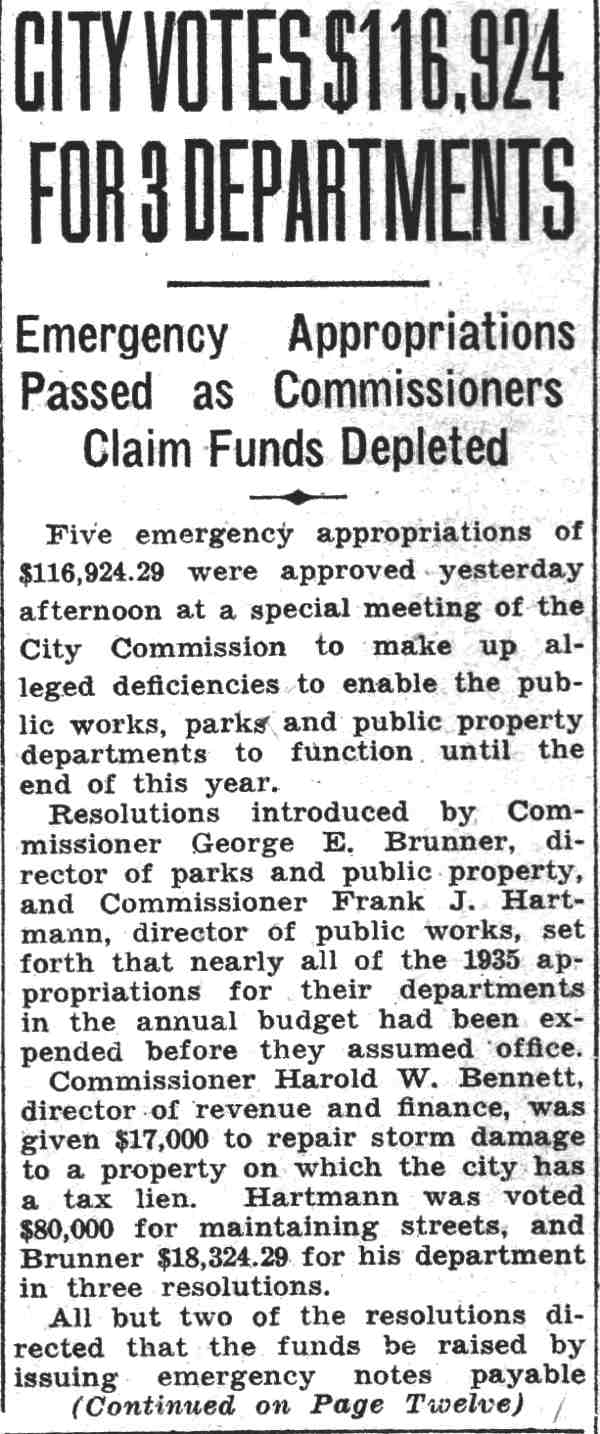

City Votes $116,924 For 3 Departments
Emergency Appropriations Passed as Commissioners Claim Funds Depleted
Five emergency appropriations of $116,924.29 were approved yesterday afternoon at a special meeting of the City Commission to make up alleged deficiencies to enable the public works, parks and public property departments to function until the end of this year.
Resolutions introduced by Commissioner George E. Brunner, director of parks and public property, and Commissioner Frank J. Hartmann, director of public works, set forth that nearly all of the 1935 appropriations for their departments in the annual budget had been expended before they assumed office.
Commissioner Harold W. Bennett, director of revenue and finance, was given $17,000 to repair storm damage to a property on which the city has a tax lien. Hartmann was voted $80,000 for maintaining streets, and Brunner $18,324.29 for his department in three resolutions.
All but two of the resolutions directed that the funds be raised by issuing emergency notes payable (Continued on Page Twelve)
City Votes $116,924 For 3 Departments (Continued from Page One)
within one year of the date of issue and bearing a rate of interest not exceeding 6 percent. They further directed Bennett to issue and sell the notes.
Spirited Debate Started
Reading of the Bennett resolution, which characterized damage done by a tornado to a property as an “act of God,” was the signal for spirited debate and was finally passed conditionally, with the understanding that City Solicitor E. G. C. Bleakly was to file a written legal opinion setting forth that the appropriation was necessary as an emergency.
Bennett was stricken by illness and left the meeting before any of the resolutions were introduced. All of the measures were passed unanimously by the three New Dealers and Mayor Frederick von Nieda.
One of Brunner’s resolutions, calling for $2629, directed that the amount be paid as a tax levy.
Bennett’s measure at one stage said the $17,000 he sought was to be raised by tax levy, and later specified the issuance of notes. The apparently conflicting situation was not clarified in subsequent argument, and the resolution was passed finally with the method of raising the sum left in doubt.
“Unforeseen Contingencies”
The resolution said the amount of $17,000 was needed because of “unforeseen contingencies” which included, it set forth, tax appeals and overdue collections.
Commissioner Kobus criticised the manner in which the measure was presented. Bennett was not present, and City Clerk Otto E. Braun had difficulty in reading it.
“This resolution is very vague,” Mrs. Kobus protested. “Passages are crossed out and others written in. What is the nature of this emergency?”
Bleakly said part of it was a property in South Camden on which the city holds a tax lein for $700, and which was damaged when struck by a tornado. He did not know the amount required to repair the damage.
Mrs. Kobus finally said she would vote in favor of the measure on condition Bleakly would file a legal opinion, and it was so passed.
Sets Minimum Amount
Hartmann introduced a resolution which set forth the city budget had appropriated $141,296.10 to the department of public works for use by the highway department. Up to July 31, he said, $128,316.49 had been expended, leaving a balance of $12,979.61 which he called insufficient to properly maintain and carry on the work in the department. He set $80,000 as the minimum amount required to carry on the work for the rest of the year.
Brunner, in his first resolution, said the budget had appropriated $43,200 for the city property department under parks and public property. Of this amount, he said, $36,296.73 has been spent already, leaving a balance of $6903.27 and requiring the addition of $10,759.29.
Brunner next introduced a resolution citing the amount appropriated for the division of cemeteries at $6082.83, all of which was expended by July 31, he said, leaving the department without funds to carry on its functions for the balance of the year.
As a result, he said, unless the sum of $4936 were appropriated, the department would be “unable to light, heat, maintain and repair the public properties under its control and will be unable to feed a horse owned by the city of Camden and used by it in the performance of its services.”
Even “Diamond” Mentioned
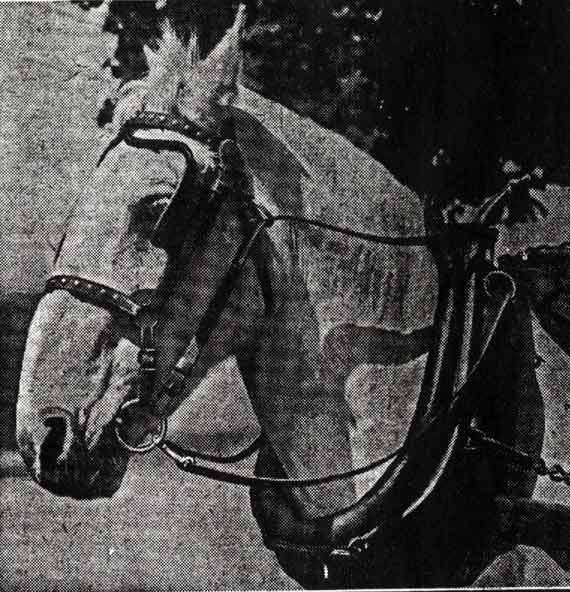
Mention of the famed “Diamond,” now serving his third boss, caused Mrs. Kobus to laughingly interpose:
“Was it necessary to mention the horse? What is this, a publicity stunt?”
Brunner’s third resolution called for an emergency appropriation of $2629 to finance a study of drainage areas, sewage disposal, slum elimination, revision of the building code, water facilities and proper city planning.
The commissioner recommended that this amount be raised by taxation, but his other resolutions called for the issuance of bonds at a rate of interest “not exceeding 6 percent.”
“I think they can be sold at less,” he said, “but I would set 6 percent as the top.”
Fund Transfer Ruled Out
Commissioner Kobus asked Mayor von Nieda if it were not possible to transfer funds from one department to another to prevent the issuance of further notes or adding additional taxes to next year’s levy.
The mayor replied that that could only be done at the end of the year to balance accounts.
The commission recessed to attend a conference with Works Progress Administration officials. After the recess a resolution was approved to appropriate $900 for Commissioner Hartmann’s department for the repair of water well pumps. The resolution declared an emergency.
Another resolution by Hartmann asked W. Gentry Hodgson, county director of emergency relief, to permit the City Commissioners to examine the entire relief list of the city. Brunner seconded the motion and Mrs. Kobus and von Nieda joined in voting for it. (The -4a crop of this article, continuing further, has not yet been transcribed.)
Hartmann Names Dr. Baker Public Works Staff Physician
Camden Courier-Post –
The State Civil Service Commission has been requested to authorize appointment of a staff physician for the Camden City department of public works at an annual salary of $1500, and Dr. Maurice E. Baker has been named to the post on an ad interim appointment by Commissioner Frank J. Hartmann, Jr.
Dr. Baker, a Democrat, was a candidate for city commissioner last May on the New Deal–Non Partisan ticket, which elected Hartmann and Commissioners Mary W. Kobus and George E. Brunner.
Hartmann said last night that Dr. Baker has been acting as staff physician for the past four days and has made 12 examinations.
Some of these, Hartmann said, were for city employees with frost-bitten toes, fingers and ears, who are claiming compensation, and one was of a woman who slipped and fell on a sidewalk.
“Dr. Baker, of course, is not getting paid a salary now,” Hartmann said, “but we hope he can be placed on a salary as a money-saving movement.
“Heretofore the physicians examining city workmen on compensation claims have charged the city $10 for each examination.
“I expect Dr. Baker to make 600 to 700 calls a year, most of them examinations, and thus get the work done for $2 in each case.
“I expect also to save money on compensation claims by having Dr. Baker make examinations of any new men hired, so that we may be sure they are in good physical condition. As it is a man could receive an injury somewhere else, go to work for the city and then claim compensation for the injury by pretending it happened on the city job.
“Dr. Baker’s examinations of the present employees will lead to compensation claim savings also, as we will be in position to make some of these men take steps to protect themselves and the city, where remedial action seems necessary.”
Hartmann said all members of the city commission except Mayor Frederick Von Nieda have endorsed the employment of a staff physician. “I haven’t had a chance to talk to the mayor about it yet,” Hartmann said. City Solicitor E. G. C. Bleakly also has approved the move as offering a chance to save money, Hartmann said.
Camden Courier-Post — August 31, 1936
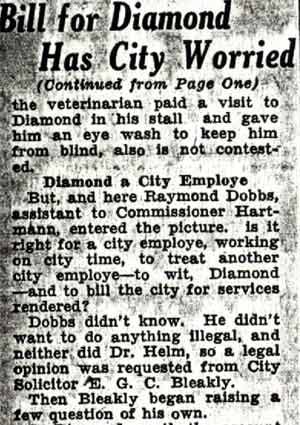
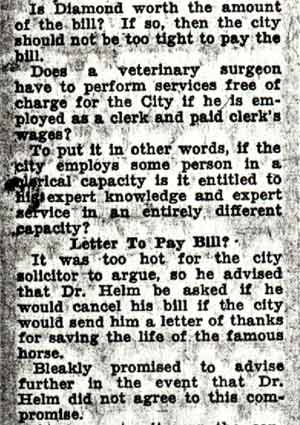
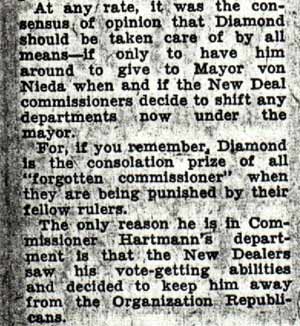
Named: S. Raymond Dobbs, E.G.C. Bleakly, Dr. David Helm, Frank J. Hartmann Jr., Frederick Von Nieda, and Charles L. Humes.
RCA Strikers Lose Appeal on Terms
Camden Courier-Post –
Trenton, Oct. 27.—The New Jersey State Supreme Court today dismissed the appeal of three defendants convicted in Camden Police Court as disorderly persons in activities growing out of the recent RCA strike in that city.
Appellants are Fred Barone, Catherine Bretschneider, and Irene Adair, each of whom was given 60 days and fined $100 on conviction of being disorderly persons. Samuel L. Rothbard, their counsel, attacked the validity of the complaints upon which the three were arrested, in his argument before Justices Trenchard, Bodine and Heher.
City Solicitor E. G. C. Bleakly opposed the setting aside of the convictions. John R. DiMona, also represented the city at the hearing.
Rothbard asked for a writ of certiorari to set aside the action of the Camden Common Pleas Court, which upheld the convictions of the Police Court. He argued that the complaint on which the three were convicted was invalid and ineffective under section three of the Disorderly Persons Act, in that the complaint failed to be specific and accurate in the charges made against them in the police court.
Bleakly contended that the defendants’ counsel had twice waived his right to get a review of their convictions. He claimed that under the Police Court Act of 1927 the matter could have been brought up to the higher court as soon as the complaint was made, or 30 days after the convictions.
Bleakly argued that Camden Common Pleas Court Judge Neutze, after reviewing the whole case could have granted the defendants a new trial, but instead upheld the proceedings in the police court. He also argued that the Common Pleas finding could not be reviewed by a writ of certiorari. Rothbard contended that no other kind of an appeal from the Common Pleas ruling could be taken.