William Deno
WILLIAM DENO was born in Pennsylvania in July of 1849 to William and Mary J. Deno. He appears in the 1870 Census working as a brickmaker and living in Camden’s South Ward with his wife, the former Catherine Gallagher, and what appears to be his mother, Jane, then 59 years of age. Beyond that his family background is not clear but he appears to have been related to James Deno, whom the 1878 Camden City Directory states was a brick manufacturer living at 321 Mount Vernon Street, Alfred Deno, of the same address, and Walter Deno, also a brickmaker, of 1910 Viola Street. William Deno is listed in this directory as a brickmaker, living at 733 Chestnut Street. By 1879 William Deno had moved to 629 Chestnut Street, and he was still at that address when the Census was taken in 1880. At the time of the Census the Deno family consisted of William and Catherine Deno and their daughters Mary, 8, and Kate, 5.
City Directories from 1881 through 1884 show William Deno and family at 1021 Broadway, where he operated a cigar store. The 1885 Directory shows an address of 1011 Broadway; this may have been a misprint.
In 1884 William Deno was appointed to the Camden Fire Department as a Driver, under the command of then Chief of Department Daniel A. Carter. When Samuel S. Elfreth was reelected to the Chief of Department position in 1885, William Deno was retained and he worked for the Fire Department until his passing on August 10, 1912.
In 1886 the Camden Steam Fire Engine Company Number 1 was located at 409 Pine Street in a three story 20 by 90 foot brick building (the old Independence Fire Company No. 3 engine house). The company’s apparatus was an Amoskeag second class steamer (maker’s plate 6318) drawn by two horses and one Silsby two wheel hose cart drawn by a single horse. The company was equipped with 1000 feet of good hose, axes, lamps, etc. The company roster included John Stockton, Foreman; G. Rudolph Tenner, Engineer; William Deno, driver; William W. Laird, stoker; Wilson Bromley and Jacob F. Nesson, hosemen. Call men were William Deith, Andrew Miller and William Bogia. Bromley and Bogia would later suffer line of duty deaths.
The 1887 Camden City Directory shows William Deno and family living at 902 Broadway. By the end of 1888 they had moved to 512 Chestnut Street, which remained the family home through 1894.
The 1890–1891 City Directory states that William Deno was the driver at Engine Company 3, whose firehouse was located at 1819 Broadway. The foreman of Engine 3 was Mortimer Wilson, engineer Samuel R. Lodge, driver William Deno, stoker John Helmbold, hosemen John Ware and Joseph Reed. John Helmbold resigned on August 1, 1890. Joseph Reed was promoted to stoker and George Shields was brought in on August 14, 1890 as a hoseman. Engine Company 3’s crew was still configured as such when the 1891–1892 Directory was compiled.
The 1893–1894 and 1894–1895 City Directories state that the crew at Engine Company 3 were as follows: Foreman William Deno, Engineer Samuel R. Lodge, Driver George B. Wade, Driver George Shields, Hosemen John Ware, and Lewis Buzine.
The 1895–1896 City Directory states that the crew at Engine Company 3 were as follows: Foreman William Deno, Engineer Samuel R. Lodge, Stoker Lewis Buzine, Driver George Shields, Hosemen John Ware, and Augustus Dole (John Augustus Dold).
By the time the 1896 City Directory was compiled, William Deno and his family had moved from 512 Chestnut Street to 1043 South 5th Street, where he lived for the rest of his days.
The 1896 Directory lists the crew at Engine Company 3 as follows: Foreman William Deno, Engineer Samuel R. Lodge, Stoker Lewis Buzine, Driver George Shields, Hosemen John Ware, Albert James, and John A. Dold.
The 1897 and 1898 Directories list the crew at Engine Company 3 as follows: Foreman William Deno, Engineer Samuel R. Lodge, Driver Lewis Buzine, Stoker George Shields, Hosemen John Ware, Albert James, and Wright Cox. Cox would later transfer to the police department.
The 1899 Directory lists the crew at Engine Company 3 as follows: Foreman William Deno, Engineer Samuel R. Lodge, Driver Lewis Buzine, Stoker George Shields, Hosemen John Ware, Albert James, and John A. Dold.
The 1900 Census shows the Deno family at 1043 South 5th Street. Catherine Deno had given birth to four children by this time, three of whom were still living. At home with William and Catherine Deno were daughter Kate and son William Deno Jr.
When the Census was taken in April of 1910 the Deno household consisted of William and Catherine Deno, daughter Kate Chew and her husband George W. Chew, brother-in-law Henry Gallagher and niece Kate McAllister.
William Deno remained Foreman of Engine Company 3 until July 1, 1910. Prior to that the Foreman job title was changed to Captain. On July 1, 1910 William Deno transferred to Engine Company 7 as it went into service, thus being the new company’s first Captain.
A Camden fire fighter to the end, Captain William Deno passed away on August 10, 1912 and was buried at Calvary Cemetery. His widow and daughters were living at the South 5th Street address when the 1924 Camden City Directory was compiled.
Camden Firemen
Philadelphia Inquirer —
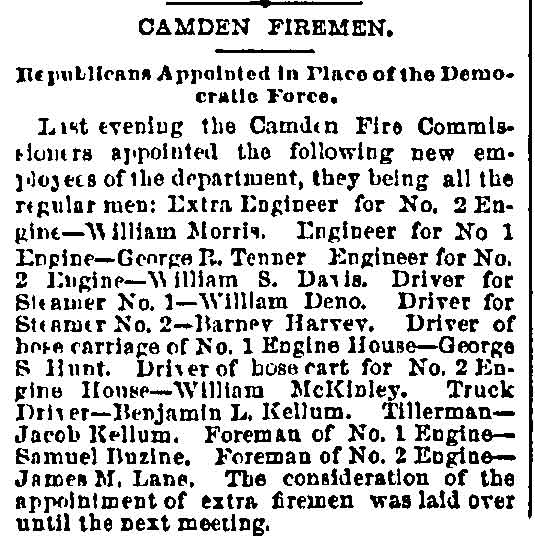
Republicans Appointed In Place of the Democratic Force.
Last evening the Camden Fire Commissioners appointed the following new employees of the department, they being all the regular men: Extra Engineer for No. 2 Engine—William Morris. Engineer for No 1 Engine—George R. Tenner. Engineer for No. 2 Engine—William S. Davis. Driver for Steamer No. 1—William Deno. Driver for Steamer No. 2—Barney Harvey. Driver of hose carriage of No. 1 Engine House—George S. Hunt. Driver of hose cart for No. 2 Engine House—William McKibley. Truck Driver—Benjamin J. Kellam. Tillerman—Jacob Kellum. Foreman of No 1 Engine—Samuel Buzine. Foreman of No 2 Engine—James M. Lane. The consideration of the appointment of extra firemen was laid over until the next meeting.
Fire in Camden
Philadelphia Inquirer —
FIRE IN CAMDEN.
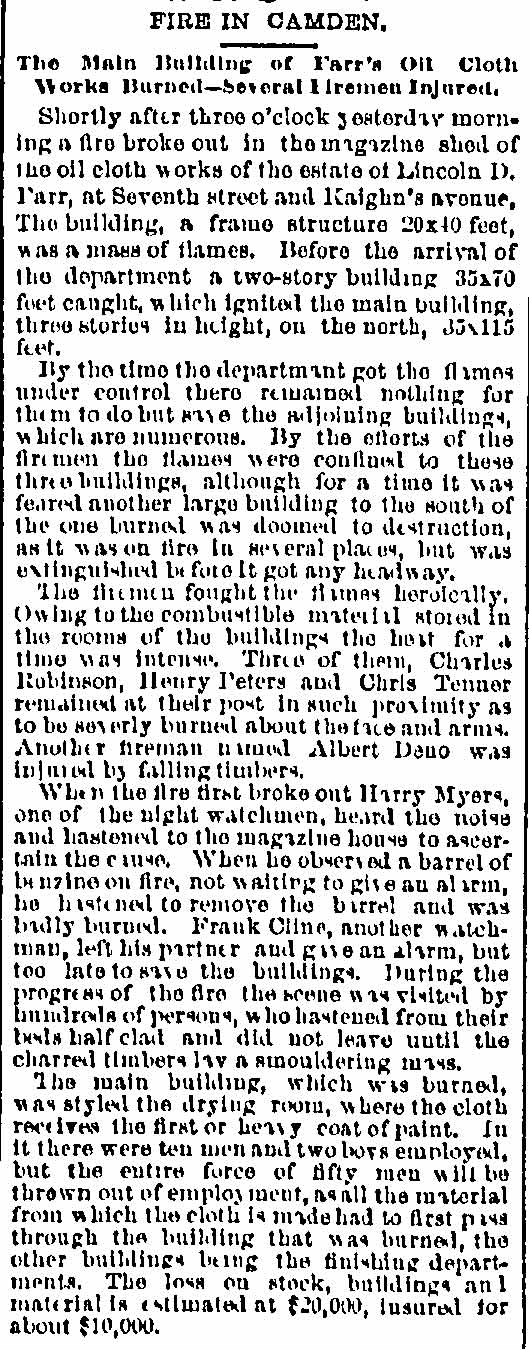
The Main Building of Farr’s Oil Cloth Works Burned—Several Firemen Injured.
Shortly after three o’clock yesterday morning a fire broke out in the magazine shed of the oil cloth works of the estate of Lincoln D. Farr, at Seventh street and Kaighn’s avenue. The building, a frame structure 20x40 feet, had a number of flames. Before the arrival of the department a two-story building 35x70 feet caught, which ignited the main building, three stories in height, on the north, 35x115 feet.
By the time the department got the flames under control there remained nothing for the fire to save the adjoining buildings, which are numerous. By the efforts of the firemen the flames were confined to these three buildings, although for a time it was feared that a large building to the south of the one burned was doomed to destruction, as it was on fire in several places, but was extinguished before it got any headway.
The firemen fought the flames heroically. One team, for example, was still stored in the rooms of the buildings the heat at time was intense. Three of them, Charles Robinson, Henry Peters and Chris Tenner remained at their post in such proximity as to be severly burned about the face and arms. Another fireman named Albert Deno was injured by falling timbers.
When the fire first broke out Harry Myers, one of the night watchmen, heard the noise and hastened to the magazine shed to ascertain the cause. When he observed a barrel of benzine on fire, not waiting to give an alarm, he hastened to remove the barrel and was badly burned. Frank Cline, another watchman, lost his nerve and gave an alarm too late to save the buildings. During the progress of the fire the scene was visited by hundreds of persons, who hastened from their beds half clad and did not leave until the charred timbers lay smoldering in ruins.
The main building, which was burned, was styled the drying room, where the cloth receives the first or heavy coat of paint. In it there were ten men and two boys employed, but they were fortunately saved. It will be thrown out of employment, as all the material from which the cloth is made had to first pass through the building that was burned, the other building being the finishing department. The loss on the building and material is estimated at $20,000, insured for about $10,000.
Charges Against William Deno
Philadelphia Inquirer —
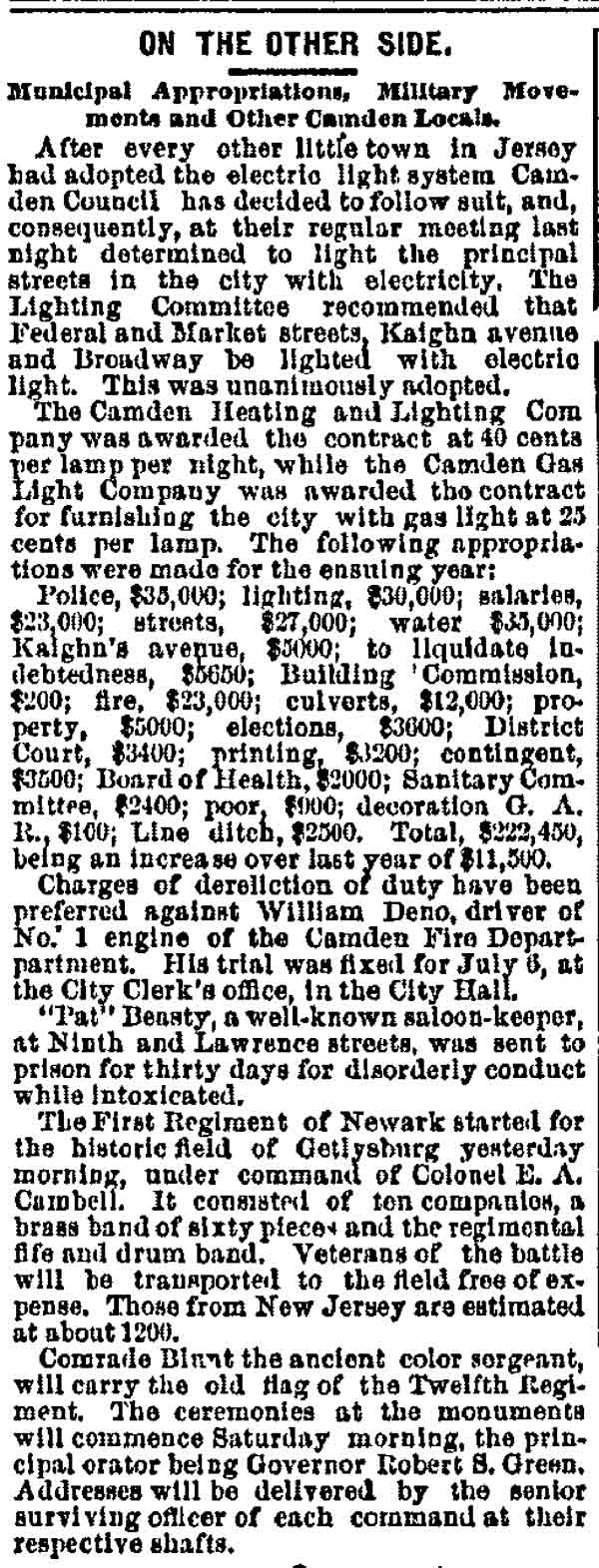
Charges of dereliction of duty have been preferred against William Deno, driver of No. 1 engine of the Camden Fire Department. His trial was fixed for July 3, at the City Clerk’s office, in the City Hall.
Politicians in a Fight
Philadelphia Inquirer —
POLITICIANS IN A FIGHT.
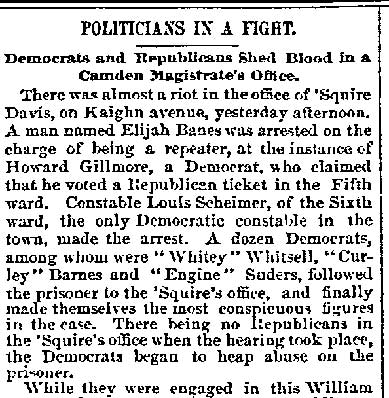
Democrats and Republicans Shed Blood in a Camden Magistrate’s Office.
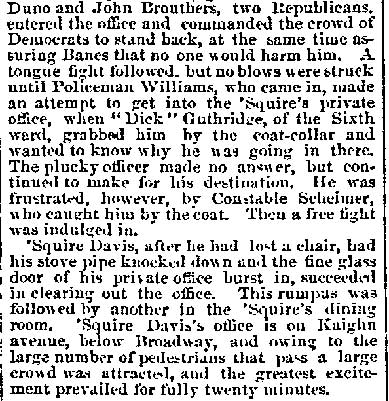
There was almost a riot in the office of ‘Squire Davis, on Kaighn avenue, yesterday afternoon. A man named Elijah Banes was arrested on the charge of being a repeater, at the instance of Howard Gillmore, a Democrat, who claimed that he voted a Republican ticket in the Fifth ward. Constable Louis Scheimer, of the Sixth ward, the only Democratic constable in the town, made the arrest. A dozen Democrats, among whom were “Whitey” Whitsell, “Curley” Barnes and “Engine” Suders, followed the prisoner to the ‘Squire’s office, and finally made themselves the most conspicuous figures in the case. There being no Republicans in the ‘Squire’s office when the hearing took place, the Democrats began to heap abuse on the prisoner.
While they were engaged in this William Duno and John Brouthers, two Republicans, entered the office and commanded the crowd of Democrats to stand back, at the same time assuring Banes that no one would harm him. A tongue fight followed, but no blows were struck until Policeman Williams, who came in, made an attempt to get into the ‘Squire’s private office, when “Dick” Guthridge, of the Sixth ward, grabbed him by the coat-collar and wanted to know why he was going in there. The plucky officer made no answer, but continued to make for his destination. He was frustrated, however, by Constable Scheimer, who caught him by the coat. Then a free fight was indulged in.
‘Squire Davis, after he had lost a chair, had his stove pipe knocked down and the fine glass door of his private office burst in, succeeded in clearing out the office. This rumpus was followed by another in the ‘Squire’s dining room. ‘Squire Davis’s office is on Kaighn avenue, below Broadway, and owing to the large number of pedestrians that pass a large crowd was attracted, and the greatest excitement prevailed for fully twenty minutes.
Engine Company 3 — First Roster, 1890
Located in what was then Camden’s Eighth Ward, Engine Company 3 was organized on June 1, 1890 and entered service on the same date at 1813 Broadway, just south of Ferry Avenue in South Camden. Approval for the purchase of land for this firehouse and for that of the new Engine Company 4 had been granted on September 4, 1889. When first organized, Engine Company 3 consisted of a Foreman, an Engineer, a Driver, and two hosemen.
The first members of Engine Company 3 were as follows.
| Position | Name |
|---|---|
| Foreman | Mortimer Wilson |
| Engineer | Samuel Lodge |
| Driver | William Deno |
| Stoker | John W. Helmbold |
| Hoseman | Joseph Reed |
| Hoseman | John Ware |
Annual salaries for the members of the paid force in 1869 were $600 for the Engineer, $450 for the Driver and the Stoker and $50 for the extra men. All but the extra men were paid monthly. The Chief Marshall received $800, and the Assistant Marshall $200 per year as well. After just one month, John W. Helmbold resigned as stoker. Joseph Reed was promoted into the position, and George W. Shields was brought in as hoseman.
News from Camden
Philadelphia Inquirer —
NEWS FROM CAMDEN.
A Sad Story from North Camden—The Court Discharges Two Juries—Notes.
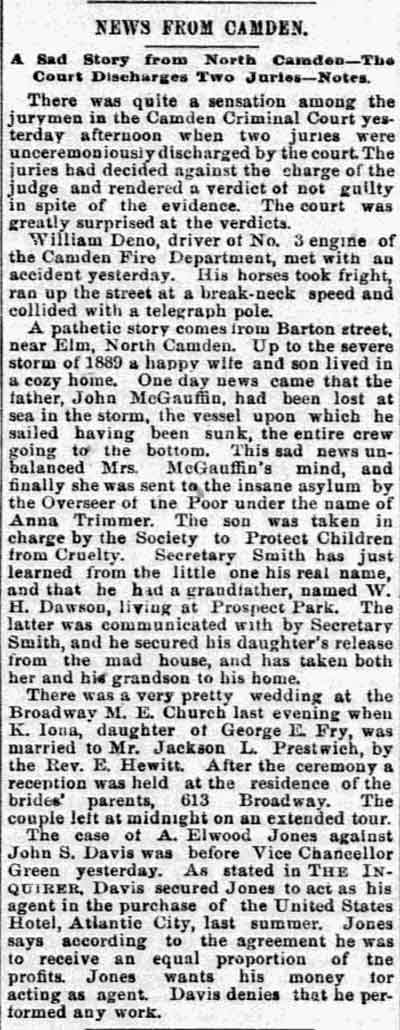
There was quite a sensation among the jurymen in the Camden Criminal Court yesterday afternoon when two juries were unceremoniously discharged by the court. The juries had decided against the charge of the judge and rendered a verdict of not guilty in spite of the evidence. The court was greatly surprised at the verdicts.
William Deno, driver of No. 3 engine of the Camden Fire Department, met with an accident yesterday. His horses took fright, ran up the street at a break-neck speed and collided with a telegraph pole.
A pathetic story comes from Barton street, near Elm, North Camden. Up to the severe storm of 1889 a happy wife and son lived in a cozy home. One day news came that the father, John McGauffin, had been lost at sea in the storm, the vessel upon which he sailed having been sunk, the entire crew going to the bottom. This sad news unbalanced Mrs. McGauffin’s mind, and finally she was sent to the insane asylum by the Overseer of the Poor under the name of Anna Trimmer. The son was taken in charge by the Society to Protect Children from Cruelty. Secretary Smith has just learned from the little one his real name, and that he had a grandfather, named W. H. Dawson, living at Prospect Park. The latter was communicated with by Secretary Smith, and he secured his daughter’s release from the mad house, and has taken both her and his grandson to his home.
There was a very pretty wedding at the Broadway M. E. Church last evening when K. Iona, daughter of George E. Fry, was married to Mr. Jackson L. Prestwich, by the Rev. E. Hewitt. After the ceremony a reception was held at the residence of the bride’s parents, 613 Broadway. The couple left at midnight on an extended tour.
The case of A. Elwood Jones against John S. Davis was before Vice Chancellor Green yesterday. As stated in THE INQUIRER, Davis secured Jones to act as his agent in the purchase of the United States Hotel, Atlantic City, last summer. Jones says according to the agreement he was to receive an equal proportion of the profits. Jones wants his money for acting as agent. Davis denies that he performed any work.
Reading Supplies Burned
Philadelphia Inquirer —
READING SUPPLIES BURNED.
Their Camden Storehouse Destroyed and Three Men Injured.
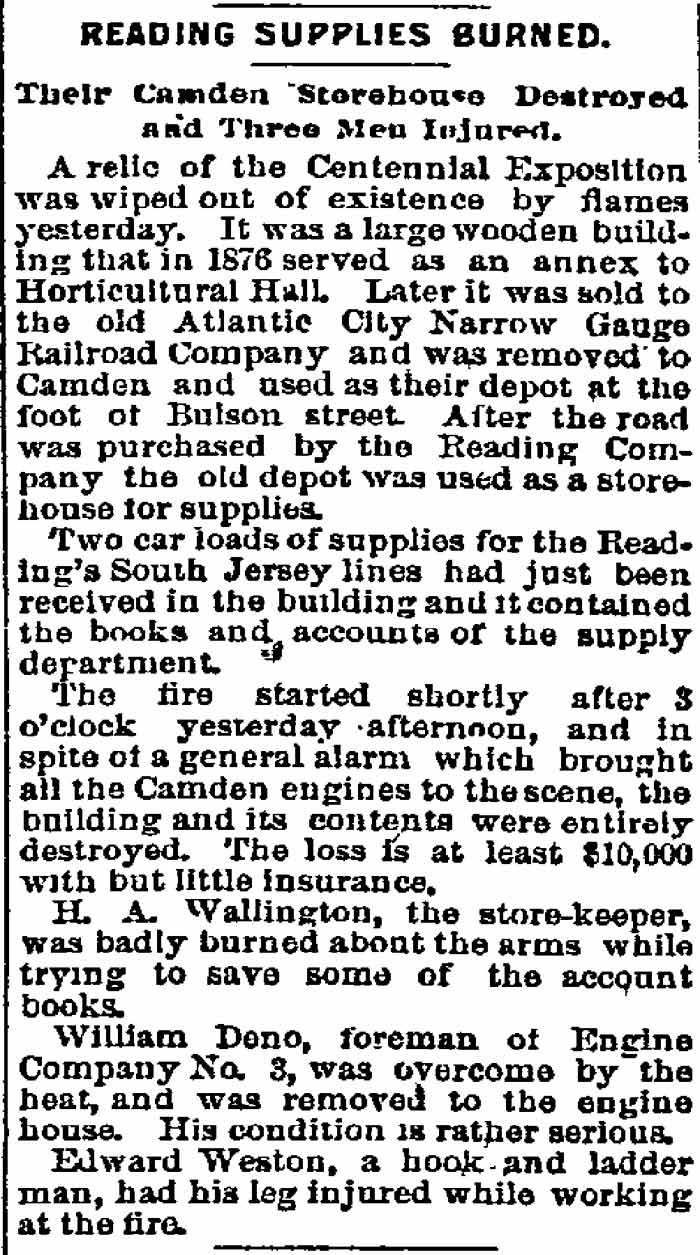
A relic of the Centennial Exposition was wiped out of existence by flames yesterday. It was a large wooden building that in 1876 served as an annex to Horticultural Hall. Later it was sold to the old Atlantic City Narrow Gauge Railroad Company and was removed to Camden and used as their depot at the foot of Bulson street. After the road was purchased by the Reading Company the old depot was used as a storehouse for supplies.
Two car loads of supplies for the Reading’s South Jersey lines had just been received in the building and it contained the books and accounts of the supply department.
The fire started shortly after 3 o’clock yesterday afternoon, and in spite of a general alarm which brought all the Camden engines to the scene, the building and its contents were entirely destroyed. The loss is at least $10,000 with but little insurance.
H. A. Wallington, the store-keeper, was badly burned about the arms while trying to save some of the account books.
William Deno, foreman of Engine Company No. 3, was overcome by the heat, and was removed to the engine house. His condition is rather serious.
Edward Weston, a hook-and-ladder man, had his leg injured while working at the fire.
No. 3 Firemen’s Vacations
Camden Evening Courier —
No. 3 Firemen’s Vacations.
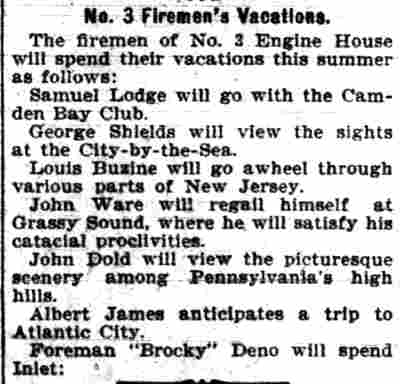
The firemen of No. 3 Engine House will spend their vacations this summer as follows:
Samuel Lodge will go with the Camden Bay Club.
George Shields will view the sights at the City-by-the-Sea.
Louis Buzine will go awheel through various parts of New Jersey.
John Ware will regail himself at Grassy Sound, where he will satisfy his catacial proclivities.
John Dold will view the picturesque scenery among Pennsylvania’s high hills.
Albert James anticipates a trip to Atlantic City.
Foreman “Brocky” Deno will spend [his vacation at the Inlet].
1043 South 5th Street
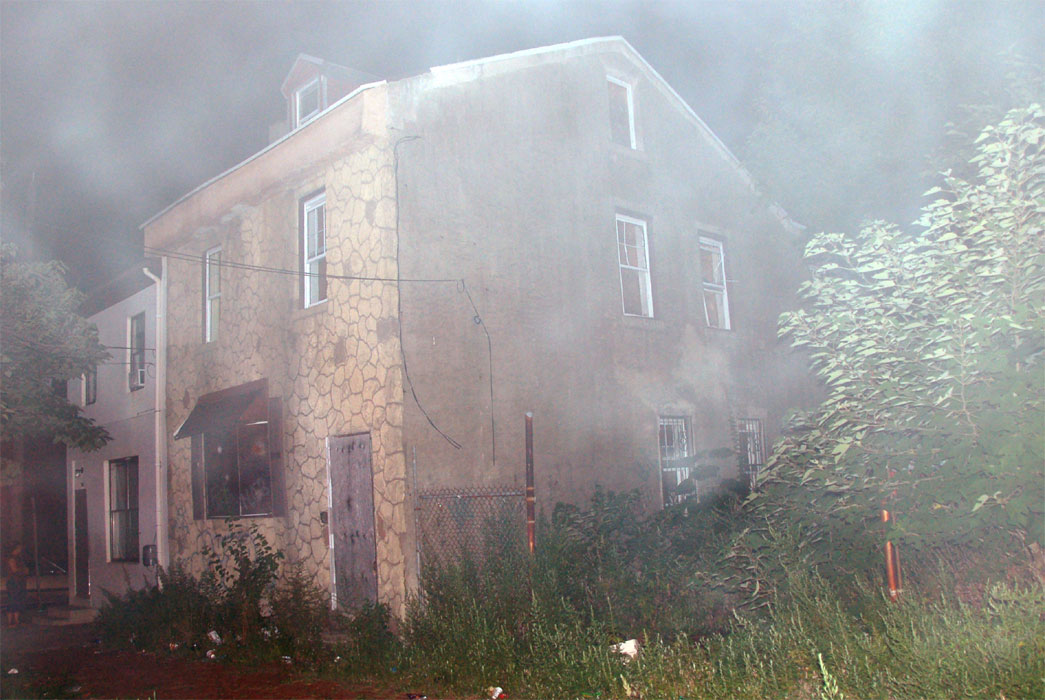
1043 South 5th Street — Home of William Deno from 1896 to 1912. Photo taken August 3, 2011.
After Long Service Retires on Pension
Philadelphia Inquirer —
Benjamin L. Kellum, second assistant chief engineer of Camden’s Fire Department, who has been stationed on the East Side, has been ordered placed on the retired list on August 1 by the Fire Committee of City Council. Kellum has been in the service for over twenty years and will get half pay.
Exposure at what is known as the “Federal street fire” of several years ago has incapacitated him from active duty of late. At a recent meeting of the Fire Committee three physicians were appointed to examine him. On their report he was retired.
Foreman Harry Grosscup, of No. 2 Engine Company, and Foreman William Deno, of No. 3 engine house, are candidates for the position to be vacated. The latter has the support of State Assessor David Baird and will probably be selected.
In Memory of Dead Heroes
Philadelphia Inquirer —
IN MEMORY OF DEAD HEROES
Mayor of Camden Calls for Services in Two Churches
Mayor Ellis, in Camden, yesterday issued a proclamation calling on the citizens to assemble at the First Baptist and the Broadway M. E. Churches on Sunday to participate in the services to be held in memory of Firemen George Shields, William Jones and William Hillman, who were killed at the Armory fire last Friday night. The first service will be held at the Baptist Church, at three o’clock, while the one at the Methodist Church will be held at quarter after four o’clock. The subscription fund being raised for the families of the firemen had reached nearly $2000 last night.
The funeral of Fireman Shields took place yesterday from his home, 525 Kaikhn [sic] avenue. Hundreds of persons viewed the body, both Tuesday night and yesterday morning. hTe [sic] services were in charge of Rev. John S. Heisler, of the M. E. Church. The body reposed in a handsome oak casket and was surrounded by numerous floral tributes. The services were attended by forty firemen under Chief Elfreth, while the pall-bearers included Firemen Samuel Price, William Deno, Charles Robinson, Peter Carter, Joseph Ernest and George Quinn. Interment was made at the Evergreen Cemetery.
Chew—Deno
Philadelphia Inquirer —
Chew—Deno
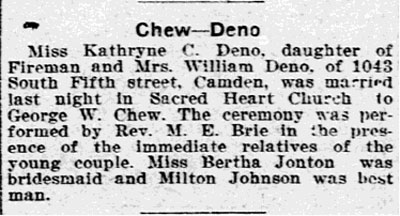
Miss Kathryne C. Deno, daughter of Fireman and Mrs. William Deno, of 1043 South Fifth street, Camden, was married last night in Sacred Heart Church to George W. Chew. The ceremony was performed by Rev. M. E. Brie in the presence of the immediate relatives of the young couple. Miss Bertha Jonton was bridesmaid and Milton Johnson was best man.
Firemen Shocked by Electric Wire
Philadelphia Inquirer —

While fighting a slight fire at the New York Shipbuilding plant yesterday Firemen Deno and Chambers were shocked by coming in contact with a live electric wire. The injuries were not of a serious character.
Deno Is Captain of New Company
Camden Post-Telegram —
DENO IS CAPTAIN OF NEW COMPANY
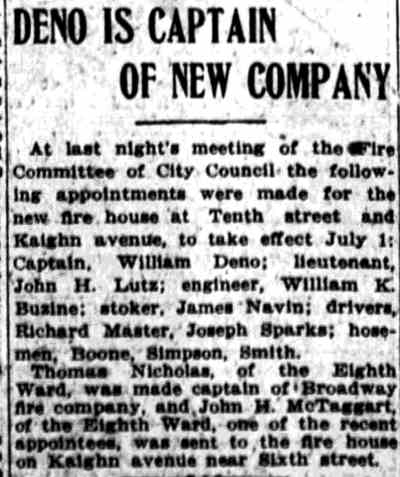
At last night’s meeting of the Fire Committee of City Council the following appointments were made for the new fire house at Tenth street and Kaighn avenue, to take effect July 1: Captain, William Deno; lieutenant, John H. Lutz; engineer, William K. Buzine; stoker, James Navin; drivers, Richard Master, Joseph Sparks; hosemen, Boone, Simpson, Smith.
Thomas Nicholas, of the Eighth Ward, was made captain of Broadway fire company, and John H. McTaggart, of the Eighth Ward, one of the recent appointees, was sent to the fire house on Kaighn avenue near Sixth street.
William Deno
Philadelphia Inquirer —
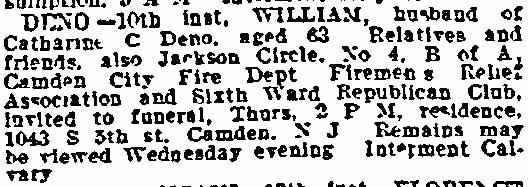
DENO—10th inst., WILLIAM, husband of Catharine C. Deno, aged 63. Relatives and friends, also Jackson Circle, No. 4, B. of A., Camden City Fire Dept., Firemen’s Relief Association and Sixth Ward Republican Club, invited to funeral, Thurs., 2 P.M., residence, 1043 S. 5th st., Camden, N.J. Remains may be viewed Wednesday evening. Interment Calvary [Cemetery].
Hundreds Gather at Captain Deno’s Funeral
Philadelphia Inquirer —
HUNDREDS GATHER AT CAPTAIN DENO’S FUNERAL
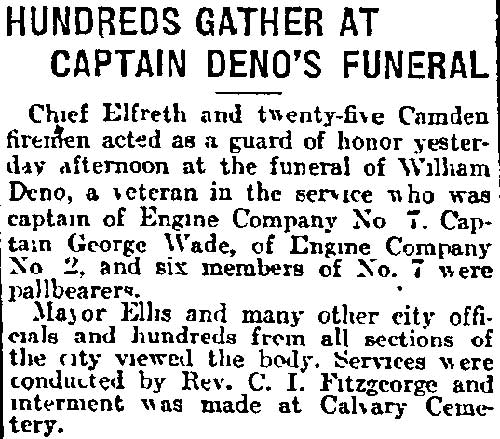
Chief Elfreth and twenty-five Camden firemen acted as a guard of honor yesterday afternoon at the funeral of William Deno, a veteran in the service who was captain of Engine Company No. 7. Captain George Wade, of Engine Company No. 2, and six members of No. 7 were pallbearers.
Mayor Ellis and many other city officials and hundreds from all sections of the city viewed the body. Services were conducted by Rev. C. I. Fitzgeorge and interment was made at Calvary Cemetery.
The Young Syndicate
Camden Courier-Post —
FROM AN OLD DIRECTORY
‘Coop’ Carman and Willard Morgan Led Movement for New Blood in G.O.P. Culminating in Bitter Battles of Race Track Days
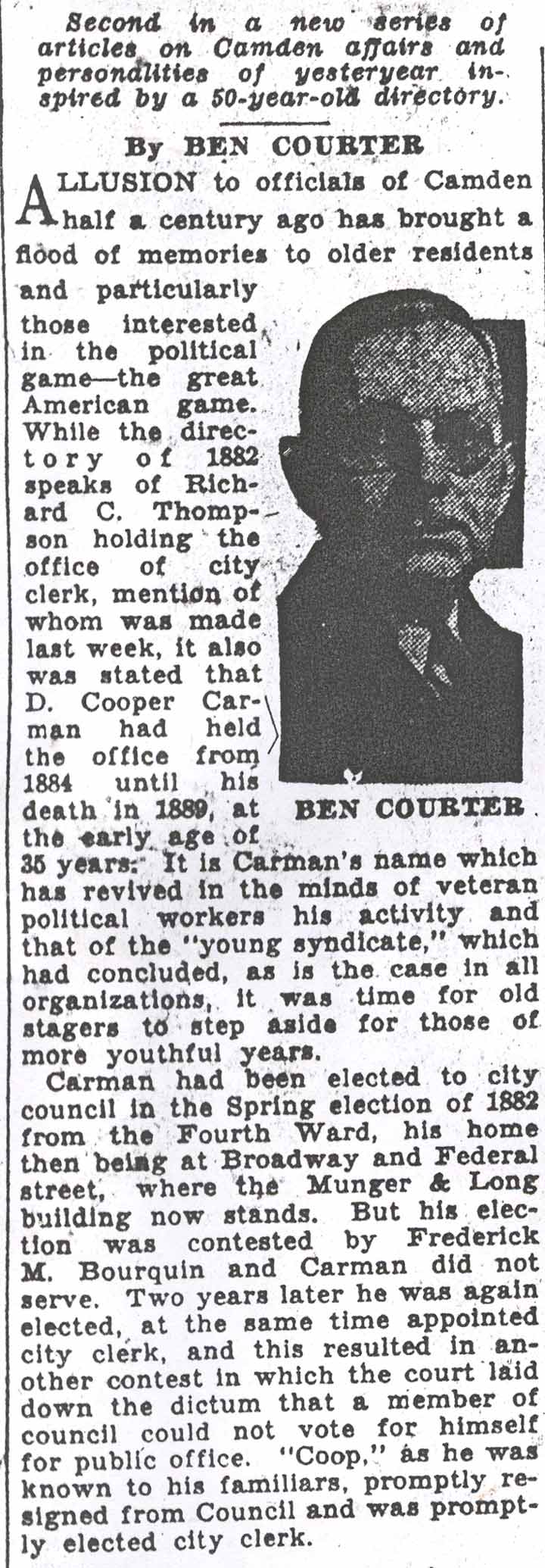
Second in a new series of articles on Camden affairs and personalities of yesteryear inspired by a 50-year-old directory.
By BEN COURTER
Allusion to officials of Camden half a century ago has brought a flood of memories to older residents and particularly those interested in the political game—the great American game. While the directory of 1882 speaks of Richard C. Thompson holding the office of city clerk, mention of whom was made last week, it also was stated that D. Cooper Carman had held the office from 1884 until his death in 1889, at the early age of 35 years. It is Carman’s name which has revived in the minds of veteran political workers his activity and that of the “young syndicate,” which had concluded, as is the case in all organizations, it was time for old stagers to step aside for those of more youthful years.
Carman had been elected to city council in the Spring election of 1882 from the Fourth Ward, his home then being at Broadway and Federal street, where the Munger & Long building now stands. But his election was contested by Frederick M. Bourquin and Carman did not serve. Two years later he was again elected, at the same time appointed city clerk, and this resulted in another contest in which the court laid down the dictum that a member of council could not vote for himself for public office. “Coop,” as he was known to his familiars, promptly resigned from Council and was promptly elected city clerk.
That combination carried things along pretty much as they pleased for a time and as one of the developments Maurice A. Rogers, down in the Fifth Ward and a councilman, was taken up as a Senatorial candidate against Colonel George Pfeiffer, Jr., a decade later to be the builder of Camden’s artesian water plant. The colonel, long one of Camden’s most popular men, had defeated the Republicans as a result of the factional fight between Henry L. Bonsall, editor of the Post, and Thomas Dudley, famed consul to Liverpool during Civil War days. But with the “young syndicate” back of him, Rogers won the Senate seat in 1890, taking his office January 1, 1891.
Carman’s Death Big Loss
Carman’s death was a big loss to the “young syndicate,” but it did not halt its activity. Since Rogers had won so easily in the 1890 election it was concluded there would be nothing to it when he was renominated for another two-year term.
Thus he decided on Frederick A. Rex, his personal counsel, a very able young attorney, and a Republican. Since at that time the Democratic police commission was in control of the cops it was considered easy to get possession of the polls.
Particular effort was to be made to sweep the Sixth Ward, where Thad Varney, elected city clerk to succeed Carman, was “boss,” and thus give him a political black eye. In Varney’s precinct in particular when the rumpus started “Brockie” Deno and “Al” Haydon, both widely known firemen now dead, grabbed the ballot box, lowered it down a chimney, fished it out when the racket was passed, went to Avis’ livery stable, and later to Varney’s home, where the votes were counted.
Repeaters Foiled
It was charged a scheme was on foot to bring repeaters from Philadelphia, not an unusual procedure in the political game of Camden years ago in either party. One of the “young syndicate’s” lieutenants learned the plot, told General Sewell, who sent the informant to Dave Martin, then Philadelphia’s political boss, who heard the story. The upshot was General Sewell himself saw Martin later, who was quite willing to aid Jersey’s G.O.P. leader, flooded Camden with sleuths from over the river and such close tabs were kept on the repeating army its efforts were halted from the very dawn of that very stirring election day. Rogers was elected, was made president of the Senate and for a time loomed so large on Jersey’s political horizon he had gubernatorial aspirations, but they never were realized.
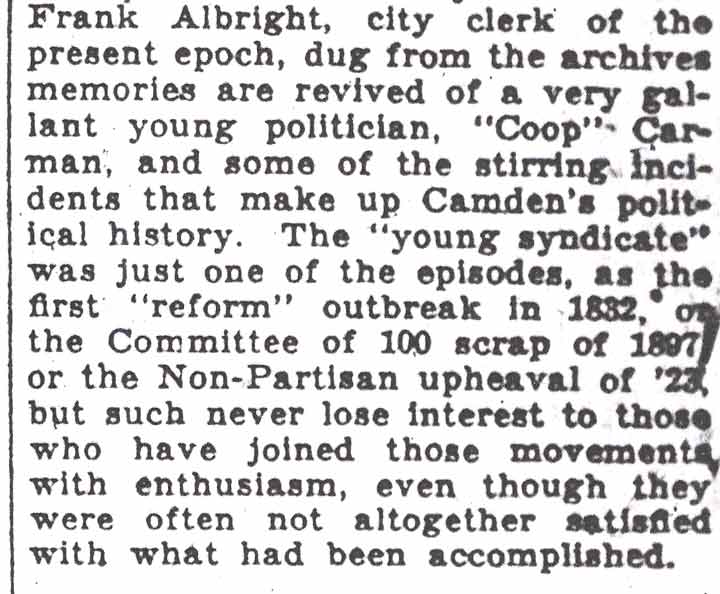
Frank Albright, city clerk of the present epoch, dug from the archives memories are revived of a very gallant young politician, “Coop” Carman, and some of the stirring incidents that make up Camden’s political history. The “young syndicate” was just one of the episodes, as the first “reform” outbreak in 1882, or the Committee of 100 scrap of 1897, or the Non-Partisan upheaval of ’23, but such never lose interest to those who have joined those movements with enthusiasm, even though they were often not altogether satisfied with what had been accomplished.