Introduction
Beckett Street was named after Henry and Mary Beckett, who owned a large tract of land that was laid out into town lots about 1853. The Becketts at one time owned the land from Royden to Line Street and from West to Second Street.
Beckett Street originally ran east to west, from Front Street to West Street, north of Line Street. At some point after 1947, all properties between Clinton and Line Streets and South 2nd and South 3rd Streets were acquired and razed, and an industrial building was erected on the site. Today Beckett Street runs only from South 3rd Street to West Street.
Livio Joseph Banda, Aviation Machinist’s Mate Third Class, born and raised on Birch Street, was killed in action while serving with the United States Navy during World War II.
1946 Map of Camden
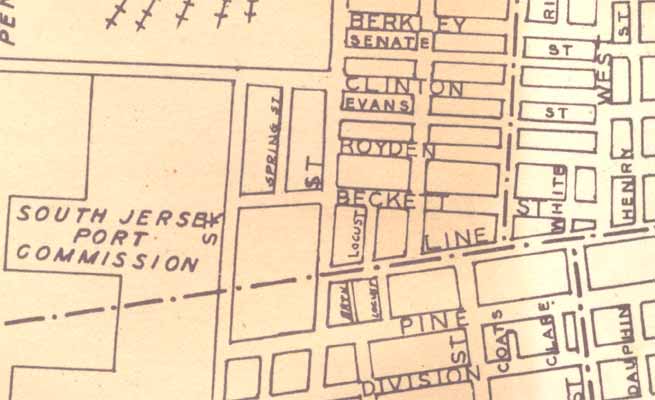
Beckett Street runs east to west, from Front Street to West Street, north of Line Street. 1946 Map of Camden.
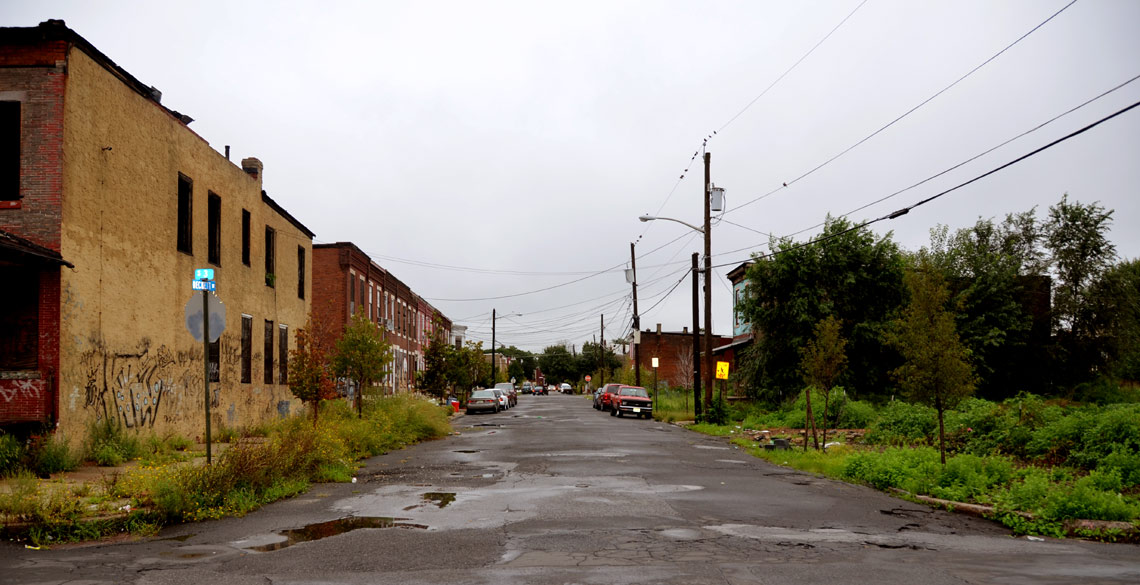
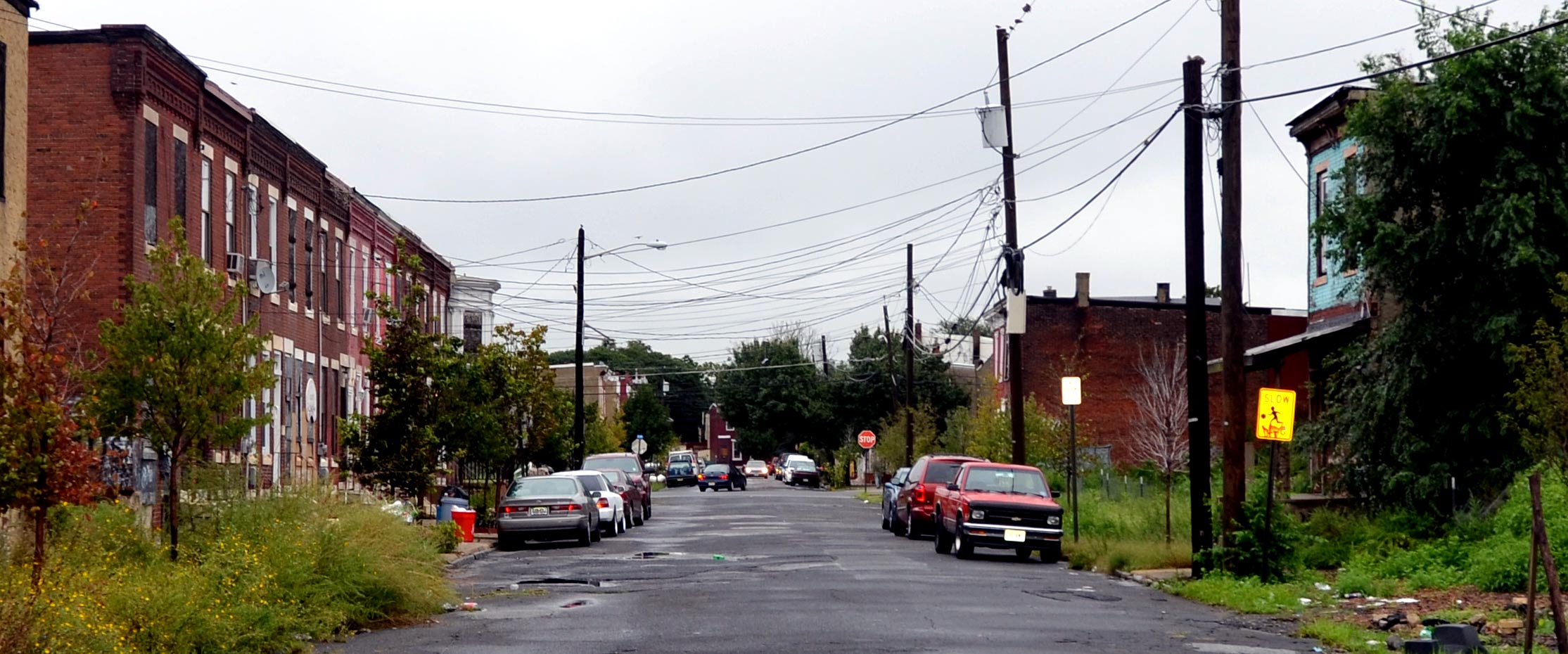
Intersection of South 3rd Street & Beckett Street
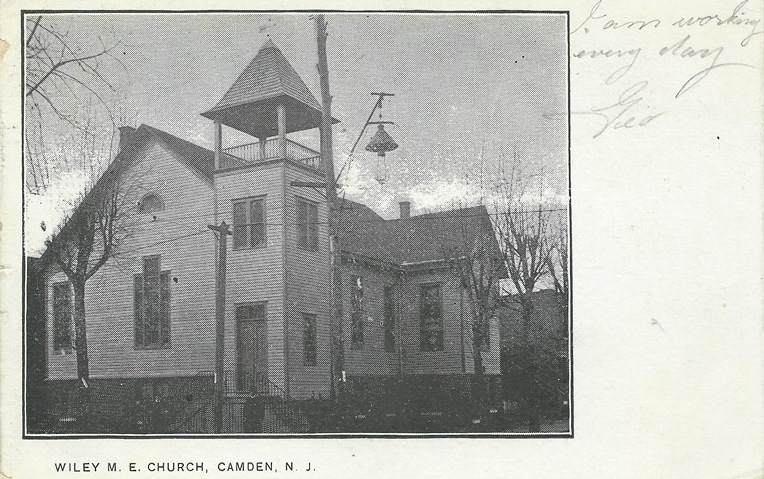
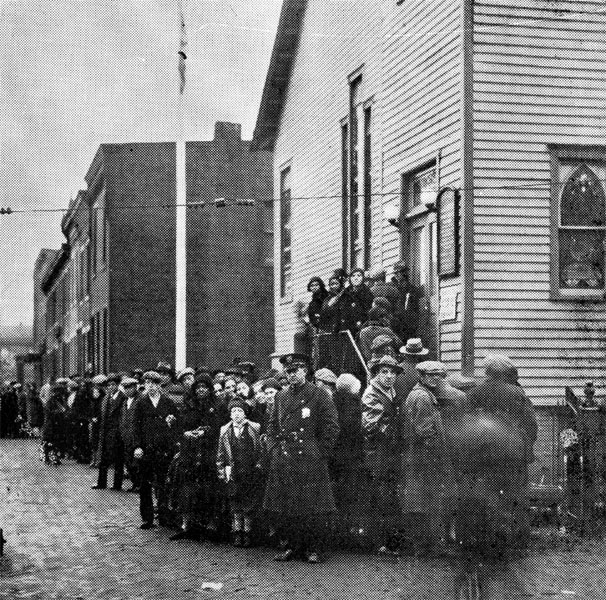
Southwest Corner of South 3rd Street & Beckett Street. Postcard circa 1906.
Looking east on Beckett Street from South 3rd Street. Photos taken September 8, 2011.
Southwest Corner, South 3rd & Beckett Street — 1920s–1930s, Wiley Methodist Episcopal Church; 1927–1930s, Rev. John S. Hackett; 1947, Little Rock Baptist Church.
Another Case in Third Ward Riot
Camden Daily Courier —

Policeman Keaser and Ex-Policeman “Bob” Miller on Trial for Assault.
WAGNER JURY COULD NOT AGREE
In the Criminal Court this morning George V. Tucker, who was convicted of a charge of assault and battery, was sentenced by Judge Joline to pay a fine of $50 and costs and stand committed until the money is paid.
Henry J. Shuster pleaded guilty to a charge of embezzling $260.16 from King David Lodge, I. O. O. F., of which he was treasurer. Shuster served three months in the County Jail last spring on a similar charge. At that time he said he used the money to care for his wife, who was ill. It appears that he did use part of the money for this purpose, but that he squandered a large sum in poker playing.
Rev. Q. C. Davis, pastor of the Emmanuel Baptist church, testified that since Shuster has been out of jail he has led a correct life, and at the present time has a good position.
Prosecutor Lloyd made an appeal for clemency.
Judge Joline announced that he was not ready to decide the case and it went over.
POLICEMEN ON TRIAL.
The indictment against Policeman Albert Keaser and ex-Policeman Robert Miller, on charges of assault and battery on George Murray, was then moved. This is the second case to be tried as the outcome of the election riot, in the Third ward during the primary election last July. Considerable time was occopued [sic] in securing a jury.
After the jury was sworn Assistant Prosecutor Archer outlined the case, in which he said the two defendants at that time were policemen and the alleged assault took place at the polling place at Third and Beckett streets, and during the row, Robert Miller, struck George Murray several times with a blackjack. Keaser, it is alleged, assisted Miller in the assault.
The first witness called was George Murray, the complainant, who testified that while standing near the polling booth with some tickets “Bob” Miller, without any provocation, beat him with a blackjack. He said that Policeman Keaser and John Wagner came to Miller’s assistance. During the row, Policemen Hartman and Harry Miller came to his aid.
BEATEN WITH A BLACKJACK.
On cross-examination witness said he had no pistol or blackjack, but that Miller came up to him and deliberately struck witness with a blackjack. He denied that he said on the steps of the Third Ward Republican Club, in the presence of John Rodan, that if a certain —— would come along he would kill him.
William Laws, who testified in yesterday’s trial, gave corroborative testimony as to the blackjacking. He said that Murray did nothing to provoke the assault.
Spencer Moore, also gave corroborative testimony.
Policeman Harry Miller testified to seeing “Bob” Miller beating Murray with a blackjack while out in the middle of Beckett street. The witness said he surged in the crowd and struck at Keaser at the same time exclaiming:
“What are you trying to do, kill this man?”
The witness said he was thrown down, and was pulled up on his feet by Keaser, who grappled with him. He heard thre [sic] or four pistol shots.
The witness identified a blackjack, in the possession of Lawyer Rex, which he used on the night of the primaries.
Howard Roberts, a son of Assemblyman Roberts, also gave corroborative testimony.
DEFENSE OPENS.
At the afternoon session of the court the defense opened. Counsel said that the defendants were justified in using force to put Murray into subjection.
Policeman Toy testified that he saw the occurrence and thought that “Bob” Miller, was acting as a peacemaker. He saw Murray shoot off a revolver.
Daniel Ayres testified to seeing the riot and heard Murray say that he would get some one before the night was over. He saw Murray shoot off a revolver under a tree.
Ex-Policeman “Bob” Miller admitted that he struck Murray while attempting to arrest him. He also testified that he was knocked down and beaten and that some person had attempted to stab him. He exhibited his clothing which was soiled and cut.
Policeman Shaw testified that on July 28 he went to Third and Beckett streets and found George Murray in his home, where he was under arrest by Detective Hart. Witness recovered a revolver from the wife of Murray.
Mrs. Widener, who was a witness in the trial yesterday, gave the same line of evidence in this case.
CHEESEMAN SENTENCED.
At the noon recess Judge Joline imposed sentence on Thomas J. Cheeseman, the former secretary of Thomas Jefferson Council, No. 138, Jr. O. U. A. M., who was convicted of a charge of false pretenses on Thursday last. Before sentence was imposed Rev. J. R. Mason, pastor of the Kaighn Avenue M. E. church, and Rev. Robert Wesley Peach, pastor of the Second Presbyterian church, made appeals to the court for clemency in his case. Judge Joline sentenced Cheeseman to three months in the County Jail and a fine of $150 and costs.
After being out for seven hours without being able to agree on a verdict the jury in the case of Charles Wagner, tried yesterday on a charge of stabbing Policeman Harry Miller, at the time of the same election riot, were discharged at 10 o’clock last night.
Camden Fire Alarms
Camden Courier-Post —
Midnight Monday Until Midnight Tuesday
10.50 a. m., 2nd and Beckett sts., grass.
12.52 p. m., 2709 Federal st., grass.
1.40 p. m., 31st and Pleasant sts., grass.
4.35 p. m., 1245 Mechanic st., rubbish.
6.29 p. m., 322 Pine st., part of flooring and joists.
Burglars Steal Equipment, Wine
Camden Courier-Post —
Burglars last night took two movie projectors and two electric typewriters from the offices of the Manpower Development Training Center, 17th Street and Admiral Wilson Boulevard, Camden.
In a second incident, burglars took nine cases of champagne from a boxcar on a private siding of Gallo Wine Sales of New Jersey, 2nd and Beckett Streets.
The training center burglary was reported to Ptl. William Lewis by Eduvicis A. Ortiz of the center. He estimated loss at $1,530.
The wine loss was placed at $162 by Nathan Long, a Gallo official. The theft was reported by railroad police.
200 Block of Beckett Street — Occupants
City directory records, 1887–1947.
202 Beckett Street
| Year ↕ | Name ↕ |
|---|---|
| 1947 | Joseph A. Ambrose |
204 Beckett Street
| Year ↕ | Name ↕ |
|---|---|
| 1912 | Giuseppe Azzari |
| 1947 | Rocco Ginobile |
206 Beckett Street
| Year ↕ | Name ↕ |
|---|---|
| 1947 | Nicholas Zamagni |
207 Beckett Street
| Year ↕ | Name ↕ |
|---|---|
| 1947 | Vacant |
| 1947 | George Patterson |
209 Beckett Street
| Year ↕ | Name ↕ |
|---|---|
| 1933 | Fioranto Costanzo |
| 1947 | William Woodsel |
| 1957 | Emma Brewer |
210 Beckett Street
| Year ↕ | Name ↕ |
|---|---|
| 1947 | Vacant |
211 Beckett Street
| Year ↕ | Name ↕ |
|---|---|
| 1947 | Emma V. Drummond |
212 Beckett Street
| Year ↕ | Name ↕ |
|---|---|
| 1947 | I. Kenneth Bowman |
213 Beckett Street
| Year ↕ | Name ↕ |
|---|---|
| 1947 | Mary Blackstone |
214 Beckett Street
| Year ↕ | Name ↕ |
|---|---|
| 1887–1888 | Harry Miller & Family (Camden Police Department) |
| 1887–1888 | Harry & Mary C. Miller |
| 1900 | William G. Hillman |
| 1927 | Carmin A. Fuscellaro Sr. Family |
| 1927 | Carmin & Anna Fuscellaro |
| 1927 | George A. Fuscellaro |
| 1927 | Nettie Fuscellaro |
| 1927 | Carmin A. Fuscellaro Jr. |
| 1947 | John S. Martorano |
215 Beckett Street
| Year ↕ | Name ↕ |
|---|---|
| 1947 | Otis Todd |
216 Beckett Street
| Year ↕ | Name ↕ |
|---|---|
| 1899–1900 | Warren C. Hill & Family |
| 1899–1900 | Warren C. & Sarah V. McCormick Hill |
| 1899–1900 | Violet Hill |
| 1899–1900 | Pearl Hill |
| 1899–1900 | William Hill |
| 1899–1900 | Robert Hill |
| 1899–1900 | Henrietta Hill |
| 1947 | Mrs. Sarah Hollingsworth |
217 Beckett Street
| Year ↕ | Name ↕ |
|---|---|
| 1947 | Anthony Prince |
218 Beckett Street
| Year ↕ | Name ↕ |
|---|---|
| 1947 | Joseph Constantini |
219 Beckett Street
| Year ↕ | Name ↕ |
|---|---|
| 1947 | Vacant |
221 Beckett Street
| Year ↕ | Name ↕ |
|---|---|
| 1947 | Anthony Passarelle |
223 Beckett Street
| Year ↕ | Name ↕ |
|---|---|
| 1947 | Salvatore Risarto (fruits) |
| 1947 | Salvatore Risarto |
227 Beckett Street
| Year ↕ | Name ↕ |
|---|---|
| 1947 | Russell Banks |
229 Beckett Street
| Year ↕ | Name ↕ |
|---|---|
| 1947 | Mrs. Hattie Barkley |
231 Beckett Street
| Year ↕ | Name ↕ |
|---|---|
| 1947 | Dominick Baldudar |
233 Beckett Street
| Year ↕ | Name ↕ |
|---|---|
| 1912–1913 | Charles Young |
| 1947 | Mrs. Rosie Difede |
235 Beckett Street
| Year ↕ | Name ↕ |
|---|---|
| 1920s–1930s | Nicholas Manzi |
| 1947 | Joseph DiMarco |
237 Beckett Street
| Year ↕ | Name ↕ |
|---|---|
| 1918 | Christian Staas & Family |
| 1918 | Christian & Ida Staas |
| 1918 | Evans O. Staas |
| 1947 | Nicholas Abiuso |
239 Beckett Street
| Year ↕ | Name ↕ |
|---|---|
| 1906 | Mrs. Caroline Martin; Arthur Martin |
| 1906 | Mrs. Caroline Martin |
| 1906 | Arthur Martin |
| 1947 | Mattar Nardi |
241 Beckett Street
| Year ↕ | Name ↕ |
|---|---|
| 1947 | Pasquale Geurrier |
243 Beckett Street
| Year ↕ | Name ↕ |
|---|---|
| 1947 | John J. Colton; George R. Colton (contractor) |
| 1947 | John J. Colton |
| 1947 | George R Colton |
Related: Five Injured in Collision — 209 Beckett Street, 1933. Intruder Held On Forceable Entry Charge — 209 Beckett Street, 1957. William G. Hillman — 214 Beckett Street. Death of Sarah V. Hill — 216 Beckett Street, 1900. Four Young Men Said to Have Confessed Thefts — 233 Beckett Street, 1913.
Five Injured in Collision
Camden Courier-Post —
Five persons were injured Saturday morning when a truck, and passenger automobile collided at Eighth and Van Hook Streets. The truck, containing four workmen, was overturned.
Dominic Fanelle, 20, of 703 Locust Street, driver of the truck, suffered chest and back injuries. The injured were taken to the West Jersey Homeopathic Hospital.
The driver of the car, Mrs. Anna K. Holt, 30, of 2898 North Congress Road, was cut and bruised. The others injured were Fioranto Costanzo, 18, of 209 Beckett Street; Felix Lee, 50, Cuthbert Road, Haddon Township, and Love Troutman, 56, of 717 South Eighth Street. All were cut and bruised.
Intruder Held On Forceable Entry Charge
Camden Courier-Post —
Thomas Merrill, 29, of the 300 block S. 5th st., was held without bail for the grand jury by Municipal Judge Marino today on charges of assault and battery and threats to kill.
The charges were made by Mrs. Emma Brewer, 25, of 209 Beckett st., at whose home he was arrested early this morning.
Mrs. Brewer testified Merrill forced his way into her home, carrying a shotgun under his coat, threatened her of harboring a man he claimed attacked him with a knife.
An hour earlier, Merrill had reported to police that he was stabbed by an unidentified man who fled into a house on Beckett st. He was treated for cuts of the face at Cooper Hospital.
William G. Hillman
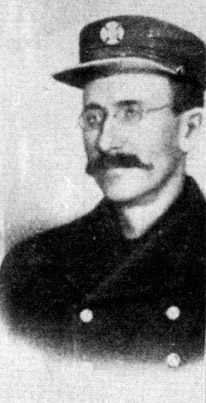
William G. Hillman, 214 Beckett Street, 1900.
Death of Sarah V. Hill
Philadelphia Inquirer —

HILL.—At Camden, N. J., on January 16, 1900, Sarah V., wife of Warren C. Hill. Interred at South Laurel Hill Cemetery, Thursday afternoon, 18th inst.
Four Young Men Said to Have Confessed Thefts
Philadelphia Inquirer —
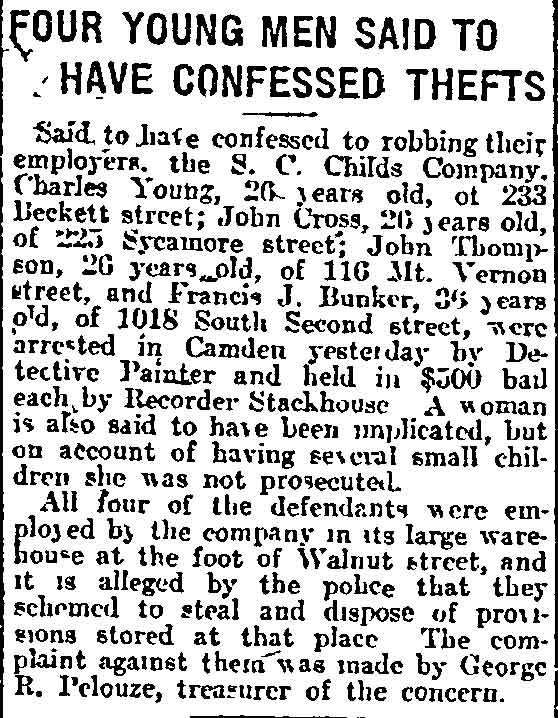
Said to have confessed to robbing their employers, the S. C. Childs Company, Charles Young, 26 years old, of 233 Beckett street; John Cross, 26 years old, of 225 Sycamore street; John Thompson, 26 years old, of 116 Mt. Vernon street, and Francis J. Bunker, 36 years old, of 1018 South Second street, were arrested in Camden yesterday by Detective Painter and held in $500 bail each by Recorder Stackhouse. A woman is also said to have been implicated, but on account of having several small children she was not prosecuted.
All four of the defendants were employed by the company in its large warehouse at the foot of Walnut street, and it is alleged by the police that they schemed to steal and dispose of provisions stored at that place. The complaint against them was made by George R. Pelouze, treasurer of the concern.
Some of the Beckett Streeters on a Sunday
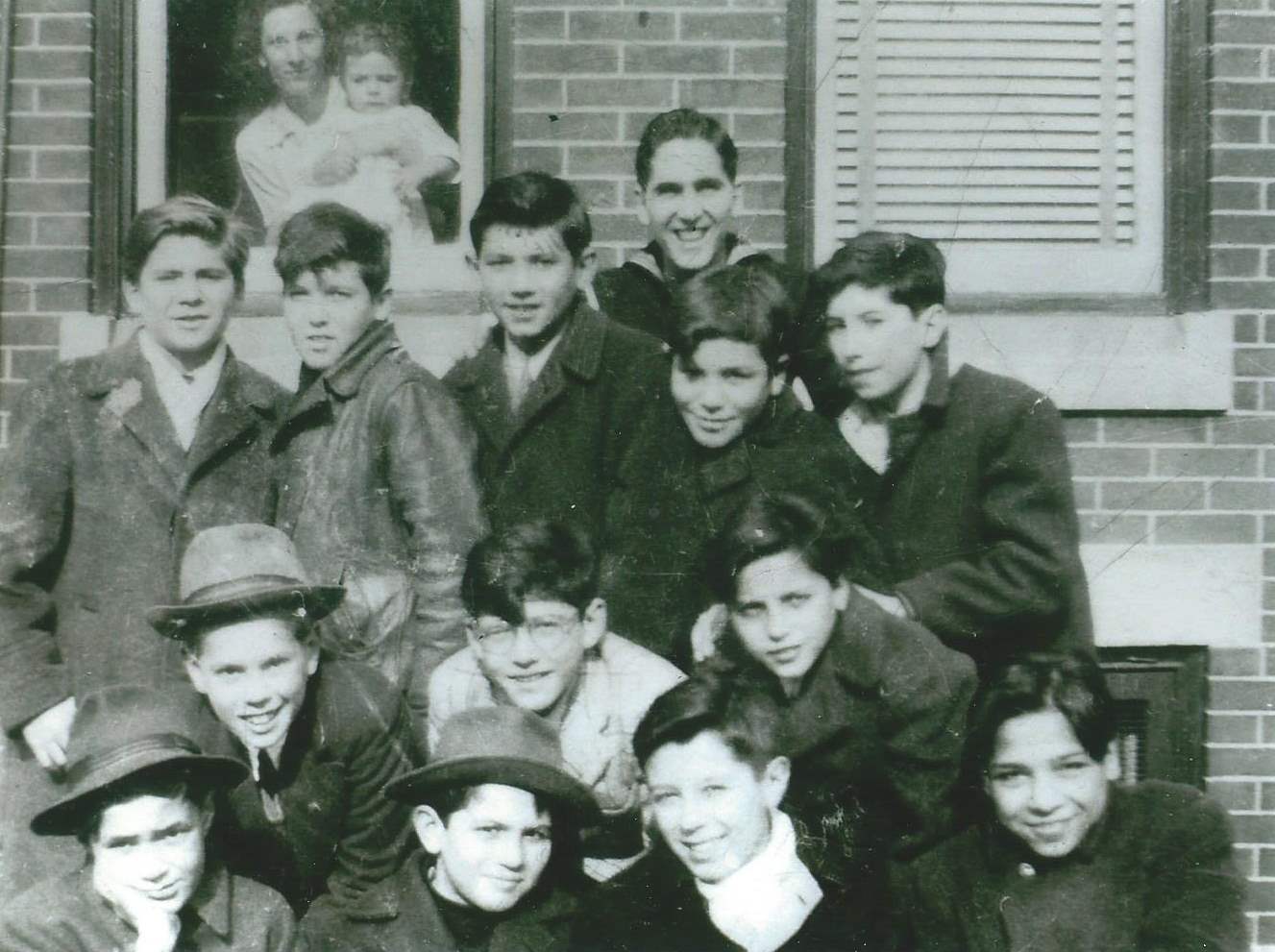
A usual Sunday routine — after church, the neighborhood boys would go up to Broadway to check the movies appearing at the many movie houses in Camden or play ball in the “stable.” Photo was taken in front of 329 Beckett Street. Circa World War II.
Top, left: Woman in the window holding her nephew: Emma Arcaini. Top, right: Billy Polidora, US Navy, home on leave from the war. Top row, from left: Rinaldo Grazioli, George Bordi, Mim Marcozzi, Lou Bordi, Muzzy Albano. Middle row: Shiz Grazioli, Mifit Arcaini, Chipsey Giletto. Bottom row: Junior Di Frank, Nino Marcozzi, Sonny Auletto, Carmen Giletto.
A usual Sunday routine — after church, the neighborhood boys would go up to Broadway to check the movies appearing at the many movie houses in Camden or play ball in the “stable.
Anthony “Nino” Marcozzi Sr.
May 2014
300 Block of Beckett Street — Occupants
City directory records, 1890–1973.
308 Beckett Street
| Year ↕ | Name ↕ |
|---|---|
| 1947 | Emedio Bordi |
309 Beckett Street
| Year ↕ | Name ↕ |
|---|---|
| 1947 | Mrs. Sadie Del Moro |
310 Beckett Street
| Year ↕ | Name ↕ |
|---|---|
| 1947 | Joseph Cuffari |
311 Beckett Street
| Year ↕ | Name ↕ |
|---|---|
| 1938–1947 | Joseph DiVincenzo & Family (Mary DiVincenzo) |
| 1938–1947 | Mary DiVicenzo |
| 1967 | Eligio Vassolotti |
312 Beckett Street
| Year ↕ | Name ↕ |
|---|---|
| 1947 | Dominick A. Terranova |
313 Beckett Street
| Year ↕ | Name ↕ |
|---|---|
| 1947–1967 | Florindo A. DiLodovico |
314 Beckett Street
| Year ↕ | Name ↕ |
|---|---|
| 1947 | Mrs. Anna Asper |
315 Beckett Street
| Year ↕ | Name ↕ |
|---|---|
| 1909–1911 | Samuel H. Young |
| 1947 | Elizabeth Flamini |
316 Beckett Street
| Year ↕ | Name ↕ |
|---|---|
| 1947 | Nicholas Pilla |
317 Beckett Street
| Year ↕ | Name ↕ |
|---|---|
| 1947 | Emidio Bernardi |
318 Beckett Street
| Year ↕ | Name ↕ |
|---|---|
| 1947 | Louis Pendeline |
319 Beckett Street
| Year ↕ | Name ↕ |
|---|---|
| 1919–1973 | John DiMaggio & Family |
| 1919–1973 | John & Mary DiMaggio |
| 1919–1973 | Santo DiMaggio |
| 1919–1973 | Anthony DiMaggio |
320 Beckett Street
| Year ↕ | Name ↕ |
|---|---|
| 1910–1922 | Harry Selby & Family (Harry & Daisy Mae Selby; William H. Selby); then Walter W. Selby & Family (Walter W. & Anna Selby; Lester Selby; Dorothy Selby); then Eli M. Hunt |
| 1947 | Nicholas Lototsky |
| 1920–1922 | Thomas Cunningham & Family |
| 1920–1922 | Thomas & Ida Lang Cunningham |
| 1920–1922 | Ida Cunningham |
321 Beckett Street
| Year ↕ | Name ↕ |
|---|---|
| 1902–1906 | Harry Miller & Family (Camden Police Department) |
| 1902–1906 | Harry & Mary C. Miller |
| 1947 | Emanuello Russo |
322 Beckett Street
| Year ↕ | Name ↕ |
|---|---|
| 1947 | Ralph Natale |
323 Beckett Street
| Year ↕ | Name ↕ |
|---|---|
| 1930–1947 | Alexander Polidora & Family (Alexander & Rose Polidora; James; Elvira; Marion; William 'Billy' Polidora) |
324 Beckett Street
| Year ↕ | Name ↕ |
|---|---|
| 1947 | Peter Bernard |
325 Beckett Street
| Year ↕ | Name ↕ |
|---|---|
| 1917–1918 | Thomas Cunningham & Family (Camden Fire Department) |
| 1917–1918 | Thomas & Ida Lang Cunningham |
| 1917–1918 | Ida Cunningham |
| 1947 | Anthony Palumbo |
326 Beckett Street
| Year ↕ | Name ↕ |
|---|---|
| 1910 | George Reese |
| 1921–1923 | Harry Selby & Family (Camden Fire Department) |
| 1921–1923 | Harry & Daisy Mae Selby |
| 1921–1923 | William H. Selby |
| 1921–1923 | Thelma May Selby |
| 1921–1923 | Norman H. Selby |
| 1940–1942 | Frank Saia & Family |
| 1940–1942 | Frank & Sadie Saia |
| 1940–1942 | Benjamin Saia |
| 1940–1942 | Pauline Saia |
| 1940–1942 | Rose Saia |
| 1940–1942 | Anthony Saia |
| 1940–1942 | Joseph Saia |
| 1940–1942 | Anna Koenig (step-daughter) |
| 1947 | William L. Gervasi |
327 Beckett Street
| Year ↕ | Name ↕ |
|---|---|
| 1947 | Carmello DiBartolomeo |
328 Beckett Street
| Year ↕ | Name ↕ |
|---|---|
| 1890–1921 | William H. Selby & Family (Camden Police Department, Water Department; William H. & Emma D. Selby; William H. Selby; George L. Selby; Elizabeth M. Selby; Harry Selby; Mabel Selby; Mary E. Selby; Walter W. Selby; John G. Selby; Dorothy Selby) |
| 1890–1921 | William H. & Emma D. Selby |
| 1890–1921 | George L. Selby |
| 1890–1921 | Elizabeth M. Selby |
| 1890–1921 | Harry Selby |
| 1890–1921 | Mabel Selby |
| 1890–1921 | Mary E. Selby |
| 1890–1921 | Walter W. Selby |
| 1890–1921 | John G. Selby |
| 1890–1921 | Dorothy Selby |
| 1947 | Julius Bernardi |
329 Beckett Street
| Year ↕ | Name ↕ |
|---|---|
| 1922–1947 | Berardo Arcaini & Family |
| 1922–1947 | Berardo & Elisa Arcaini |
| 1922–1947 | Rose Arcaini |
| 1922–1947 | Vincenzo Arcaini |
| 1922–1947 | Alfred "Miff" Arcaini |
| 1922–1947 | Emma Arcaini |
| 1953–? | Ernest Feriozzi & Family |
| — | Ernest & Maria Feriozzi |
| — | Anthony Feriozzi |
| — | Oswaldo Feriozzi |
| — | Guido Feriozzi |
| — | Helen Feriozzi |
| — | Adriana Feriozzi |
| — | Dominic "Mimi" Arcaini & Family |
| — | Dominic & Helen Feriozzi Arcaini |
| — | Ron Arcaini |
330 Beckett Street
| Year ↕ | Name ↕ |
|---|---|
| 1910–1920 | Harry Selby & Family (Camden Fire Department) |
| 1910–1920 | Harry & Daisy Mae Selby |
| 1910–1920 | William H. Selby |
| 1918–1929 | Eli M. Hunt |
| 1921–1929 | Walter W. Selby & Family |
| 1921–1929 | Walter W. & Anna Selby |
| 1921–1929 | Lester Selby |
| 1921–1929 | Dorothy Selby |
| 1930s–1940s | Achille Grazioli & Family |
| 1930s–1940s | Achille & Carmella Grazioli |
| 1930s–1940s | Hilda Grazioli |
| 1930s–1940s | Jean Grazioli |
| 1930s–1940s | Giovanni Grazioli |
| 1930s–1940s | Reynaldo Grazioli |
| 1930s–1940s | Dante Grazioli |
| 1930s–1940s | Joseph Grazioli |
331 Beckett Street
| Year ↕ | Name ↕ |
|---|---|
| 1947 | Givino DiPaolo |
332 Beckett Street
| Year ↕ | Name ↕ |
|---|---|
| 1930–1947 | Guido Marcozzi & Family |
| 1930–1947 | Guido & Marie Marcozzi |
| 1930–1947 | Theresa Marcozzi |
| 1930–1947 | Erasmo Marcozzi |
| 1930–1947 | Josephine Marozzi |
| 1930–1947 | Emidio "Mim" Marcozzi |
| 1930–1947 | Anthony "Nino" Marcozzi |
| 2001 | Gone |
334 Beckett Street
| Year ↕ | Name ↕ |
|---|---|
| 1947 | Louis Giardini |
| 2001–2012 | Vacant |
336 Beckett Street
| Year ↕ | Name ↕ |
|---|---|
| 1947 | Peter Alemi; Philip Dominiano |
| 1947 | Peter Alemi |
| 1947 | Philip Dominiano |
Related: Hospital Cases — 311 Beckett Street, 1938. DiMaggio Family — 319 Beckett Street. Death of Widow of Harry Selby — 326 Beckett Street, 1923. Frank Saia Family — 326 Beckett Street, 1940. Arcaini Family — 329 Beckett Street. Marcozzi Family — 332 Beckett Street.
Hospital Cases
Camden Courier-Post —
Cooper
Lewis Raupp, 53, 833 North 6th Street, dog bite of right index finger. Anna Veroline, 34, 318 Walnut Street, sprained ankle. Albert Passarella, 15, 433 Spruce Street, sprained ankle. Thomas J. Owens, 35, 420 Taylor Ave., bruised wrist and knee. Joseph Manfredi, 14, 335 Chestnut Street, infected palm. Margaret Cramer, 9, 323 Erie Street, infected finger. Laurence Wiggle, 5, 505 South 6th Street, cut hand. Joseph Carbone, 18, 336 Walnut Street, cut chin. Thomas DiRenzo, 13, 522 Clinton St., splinter in left foot. Cecelia Homan, 32, 511 Ray Avenue, foreign body in eye. Mary DiVincenzo, 10, 311 Beckett St., foreign body in eye.
West Jersey
Theresa Marolda, 59, 1713 South 4th Street, cut finger. Benjamin Druasowictz, 34, 1282 Van Hook St., cut finger. Charles Mangold, 52, 3 North 4th Street, cut finger. Stanley Kaminski, 25, 1119 Liberty Street, cut hand. Marie Birsch, 15, 697 Van Hook St., foreign particle in eye. Willard Dickson, 3, 1739 Railroad Ave., puncture wound of thigh.
DiMaggio Family
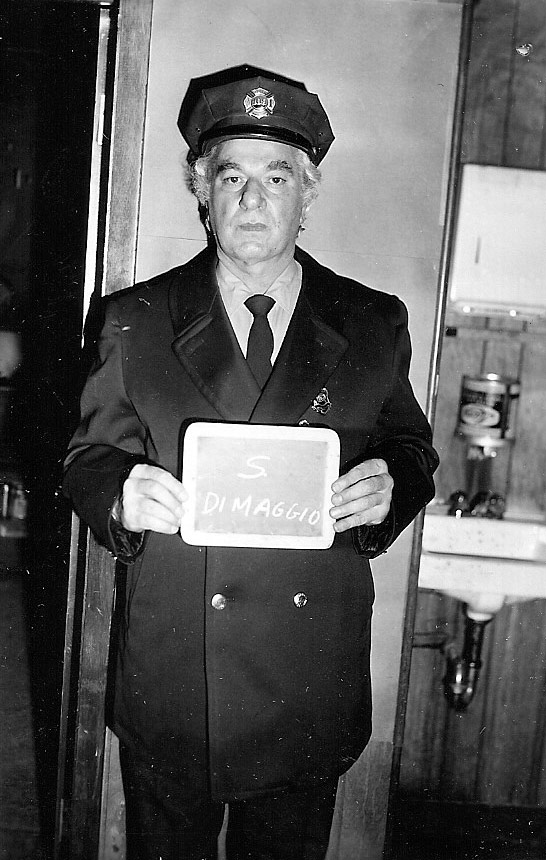
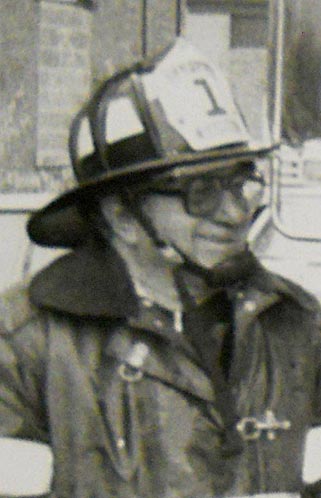
John DiMaggio & Family, 319 Beckett Street, 1919–1973. John & Mary DiMaggio; Santo DiMaggio; John DiMaggio; Anthony DiMaggio.
Left: Santo DiMaggio. Right: John DiMaggio, 1990s.
Death of Widow of Harry Selby
Camden Post-Telegram —
Ill since May 1 with an attack of pulmonary tuberculosis and heart trouble, Mrs. Daisy May Selby, of 326 Beckett street, died Saturday evening.
Mrs. Selby was the widow of Fire Lieutenant Harry Selby, who ended his life on May 8. Mrs. Selby was 40 years old and is survived by two sons and a daughter.
Funeral services will be held at her late residence to-morrow afternoon at 2 o’clock, with interment at Harleigh Cemetery, under the direction of Undertaker Frederick Roedel. Friends may view the remains this evening.
Frank Saia Family
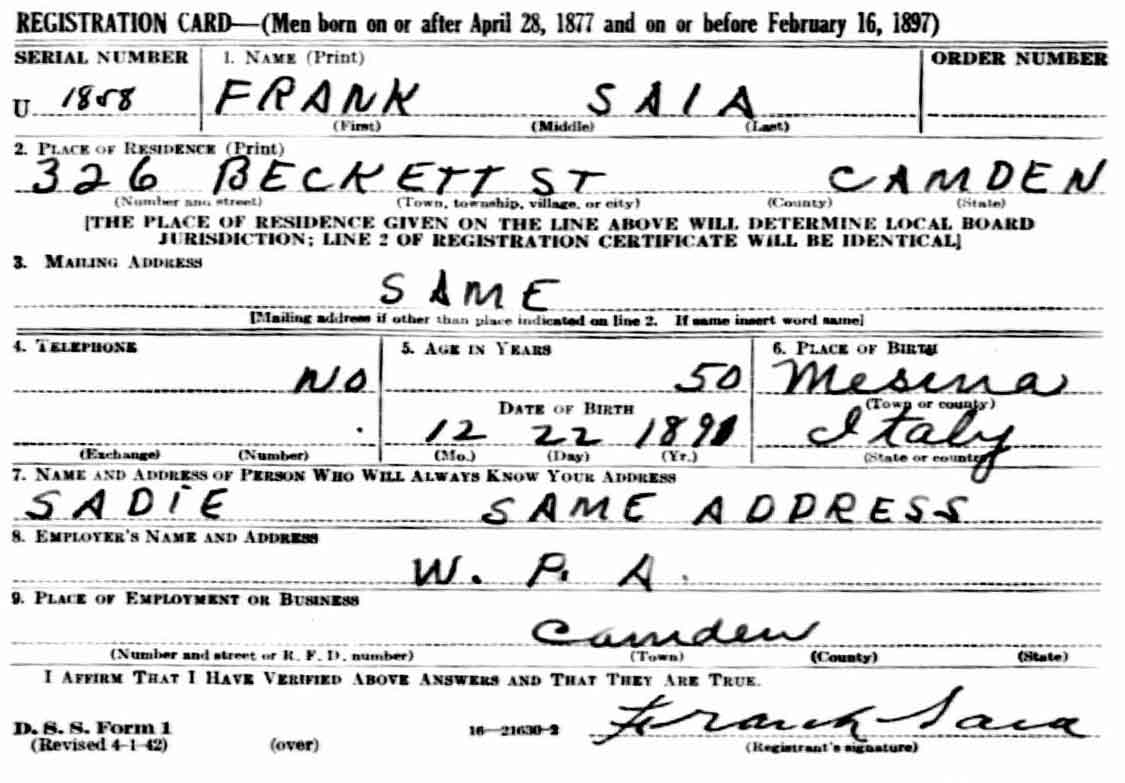
Frank Saia & Family, 326 Beckett Street, 1940–1942. Frank & Sadie Saia; Benjamin; Pauline; Rose; Anthony; Joseph Saia; Anna Koenig (step-daughter).
Arcaini Family
Berardo Arcaini & Family, 329 Beckett Street, 1922–1947. Berardo & Elisa Arcaini; Rose Arcaini; Vincenzo Arcaini; Dominic “Mimi” Arcaini; Alfred “Miff” Arcaini; Emma Arcaini.
Woman in the doorway — Emma Arcaini. Middle row, center — Alfred “Miff” Arcaini. Photo courtesy of Anthony “Nino” Marcozzi, bottom row, 2nd from left. Dominic Arcaini later married Helen Feriozzi of 905 South 5th Street.
I was born in Camden in 1947, father Dominic Arcaini “Mimi” from 329 Beckett. Mother, Helen Feriozzi Arcaini of 905 South 5th Street. We lived with my grandparents, Ernest Feriozzi who owned and operated Feriozzi Construction Company and my grandmother Maria “Mary” Feriozzi. We all lived at 905 South 5th until my grandfather moved all of us to 521 Spruce in about 1953 which became the base for the construction company. I don’t know how long prior to my birth they owned the house on 5th street, but the 1940 census had my grandparents and all of their children living there. The children (my uncles) were Anthony (Tony), Oswaldo (Ozzie), and Guido. My mother was Helen and my aunt was Adriana (Adri).
Ron Arcaini
November 2014
Marcozzi Family
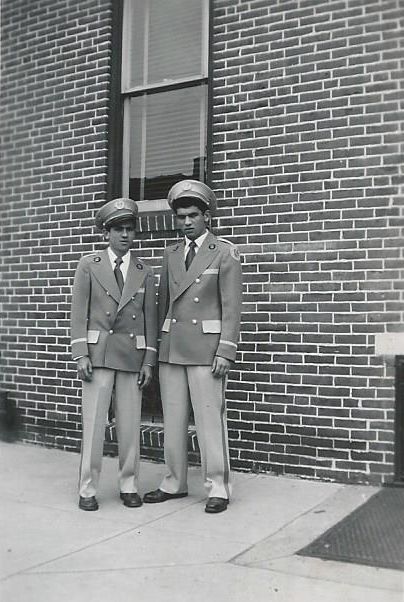
Guido Marcozzi & Family, 332 Beckett Street, 1930–1947. Guido & Marie Marcozzi; Theresa Marcozzi; Erasmo Marcozzi; Josephine Marcozzi; Emidio “Mim” Marcozzi; Anthony “Nino” Marcozzi. 2001, Gone.
Left: Mim and Nino Marcozzi in uniform of the A.M. Mucci VFW Post No. 2865 band. Circa 1949.
Intersection of South 4th Street & Beckett Street
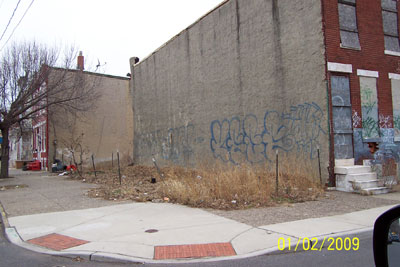
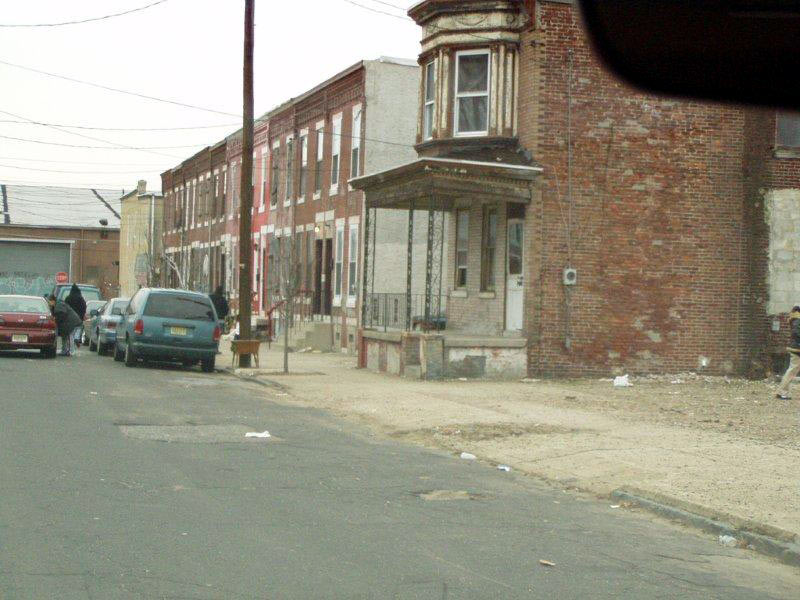
Northeast Corner of South 4th Street & Beckett Street. Formerly Buono’s Pharmacy & Doganiero’s Pharmacy. January 2, 2009. Photo by Tony Cannon.
Looking northwest on Beckett Street from West Street. December 26, 2004.
400 Block of Beckett Street — Occupants
City directory records, 1880s–1963.
407 Beckett Street
| Year ↕ | Name ↕ |
|---|---|
| 1924 | Vincenzo Gramenzi |
| 1947 | Joseph Lopergola |
408 Beckett Street
| Year ↕ | Name ↕ |
|---|---|
| 1947 | Mrs. Anne Iacovelli |
409 Beckett Street
| Year ↕ | Name ↕ |
|---|---|
| 1920s–1947 | Frank Tucci |
410 Beckett Street
| Year ↕ | Name ↕ |
|---|---|
| 1947 | Nicholas Parventi |
411 Beckett Street
| Year ↕ | Name ↕ |
|---|---|
| 1920s–1947 | Louis Labascio |
| 2012 | Vacant (scheduled for demolition) |
412 Beckett Street
| Year ↕ | Name ↕ |
|---|---|
| 1920s–1947 | Alexandro Stortino |
413 Beckett Street
| Year ↕ | Name ↕ |
|---|---|
| 1899–1900s | Walter P. Ellis |
| 1920s–1947 | Joseph Angelastro |
414 Beckett Street
| Year ↕ | Name ↕ |
|---|---|
| 1917 | Augustus E. 'Gus' Gondolf Sr. |
| 1929 | Antonio Ferri |
| 1947 | Albert M. Ferri |
415 Beckett Street
| Year ↕ | Name ↕ |
|---|---|
| 1929–1947 | Fred D'Alesandro |
| late 1950s–1970s | Joseph & Christina Palermo Family (Jane Palermo; Joseph Palermo Jr.; Josephine Palermo) |
416 Beckett Street
| Year ↕ | Name ↕ |
|---|---|
| 1915 | Harry L. Sanders; Ratcliffe Weitzman Co. |
| 1916 | Joseph Sparks (Camden Fire Department) |
| 1947 | Francis Doto |
417 Beckett Street
| Year ↕ | Name ↕ |
|---|---|
| 1929–1944 | Vito Antonio & Grazia (Piepoli) Loperfido; Marchione Family; Troiano Family |
| 1947 | Pietro DiSiena |
| 1958–? | Joseph Bendito / Seminara Families |
418 Beckett Street
| Year ↕ | Name ↕ |
|---|---|
| 1920s–1947 | Albert G. Annibale |
419 Beckett Street
| Year ↕ | Name ↕ |
|---|---|
| 1923–1946 | VitoAntonio & Costantina (Galasso) Leone & Family (Nicholas; Genaro 'Gene'; Annunziata 'Nancy'; Catherine 'Cass'; Anthony; Robert Leone) |
| 1947 | Nicholas Capone |
| 1949–1953 | Nicholas & Mary (Ragone) Leone |
| 1953–1962 | Santo 'Samuel' & Annunziata 'Nancy' (Leone) Loperfido; Donna Loperfido; Samuel Loperfido Jr. |
| 1963 | Simonelli Family |
420 Beckett Street
| Year ↕ | Name ↕ |
|---|---|
| 1922 | Harry Bolt |
| 1920s–1947 | Dominick & Rose Mazzarulli & Family (Enrico J. Mazzarulli; John Mazzarulli; Anthony Mazzarulli) |
421 Beckett Street
| Year ↕ | Name ↕ |
|---|---|
| 1920s–1947 | Michael Vadurro |
| 1950s–1960s | Augustine 'Tut' & Lillian Scappa Family (Donald Scappa; Joseph Scappa) |
422 Beckett Street
| Year ↕ | Name ↕ |
|---|---|
| 1947 | Guerino P. Sciamanna |
423 Beckett Street
| Year ↕ | Name ↕ |
|---|---|
| 1929 | Dominick LaMarra |
| 1947 | Mrs. Anne LaMarra |
424 Beckett Street
| Year ↕ | Name ↕ |
|---|---|
| 1947 | Ceasar Pioli |
425 Beckett Street
| Year ↕ | Name ↕ |
|---|---|
| 1929–1947 | Mrs. Nettie Odorisio |
426 Beckett Street
| Year ↕ | Name ↕ |
|---|---|
| 1947 | Joseph Ferranti |
427 Beckett Street
| Year ↕ | Name ↕ |
|---|---|
| 1880s–1890s | Belford G. Royal |
| 1947 | John Biasi |
429 Beckett Street
| Year ↕ | Name ↕ |
|---|---|
| 1893 | William G. Kairer Sr. & Family |
| 1929 | Tony Levecchia |
| 1947 | Henry Levecchia |
431 Beckett Street
| Year ↕ | Name ↕ |
|---|---|
| 1893 | William H. Upton |
| 1929 | Nicholas Ferri |
| 1947 | Mrs. Maria Ferri |
433 Beckett Street
| Year ↕ | Name ↕ |
|---|---|
| 1929–1947 | Guido Ferri |
435 Beckett Street
| Year ↕ | Name ↕ |
|---|---|
| 1890s–1900s | James E. Tatem |
| 1919–1920 | Joseph Sparks (Camden Police Department; Joseph & Mary Emma Sparks) |
| 1921–1925 | Giovanni & Grazia (Dragone) Loperfido |
| 1929–1947 | Antonio Delsole |
Related: Youth, 16, Nabbed as Drug Peddler — 420 Beckett Street, 1922. Palermo Family — 415 Beckett Street. Camden County Transfers — 416 Beckett Street, 1915. Loperfido Family — 419 Beckett Street. Kairer Family — 429 Beckett Street.
Youth, 16, Nabbed as Drug Peddler
Camden Courier —
Held In $1000 Bail After Witnesses Tell of Buying Heroin Downtown
Two alleged drug peddlers, one a boy, 16 years old, were held in $1000 bail each by Recorder Stackhouse today.
The youth is William Lovern, 210 Washington Street. With Harry Bolt, 24 years old, 420 Beckett street, he was arrested early today after they are alleged to have sold decks of heroin at Second and Beckett streets.
David Hunt and “Dorie” Guthrie, said two packages of heroin and cocaine were found on the suspect. Both denied their guilt.
Youths, who acted as amateur detectives to gather evidence accused young Lovern as the “little fellow” who sold them each a deck of heroin for one dollar. They said Lovern refused to take 75 cents for the drug and asked for the larger amount.
Palermo Family
This was the home of my best friend, Janie Palermo. In the early 60’s when we were between the ages of six and eight years old, Janie, and Gaila Levecchia (our other best friend), and I would walk with older friends or parents from Beckett St. to Broadway to go to the Camden Free Public Library. That library is where I first learned to love books.
Donna Loperfido Carlin
January 13, 2008
Joseph & Christina Palermo Family, 415 Beckett Street, late 1950s–1970s. Jane Palermo; Joseph Palermo Jr.; Josephine Palermo.
Camden County Transfers
Philadelphia Inquirer —

Camden 416 Beckett—Harry L Sanders to Ratcliffe Weitzman Co $2550
Loperfido Family
This is where I lived from my birth in 1954 until I was 8 years old. I have many happy memories of this house and the neighborhood. My maternal grandfather (VitoAntonio Leone) owned the building and he lived in it with my grandmother and their 6 children until 1946 when they moved to the larger house at 1121 S. 4th Street. After we moved out in 1962, he rented it to one or two more families, and then sold it. Years later, we learned that the building was blown up when a bullet or ‘bb-gun’ pellet hit a gas pipe, and thankfully everyone got out alive. The houses on either side (417 and 421) were also destroyed in the explosion and the houses no longer exist.
Donna Loperfido Carlin
January 13, 2008
VitoAntonio & Costantina (Galasso) Leone Family, 419 Beckett Street, 1923–1962. See 400 Block occupants for full resident history.
Kairer Family
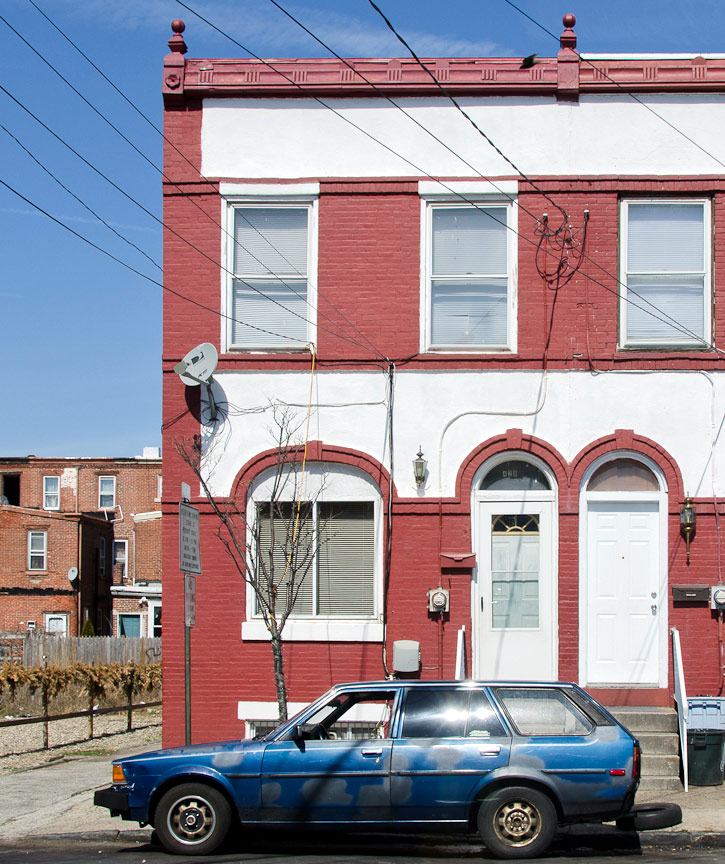
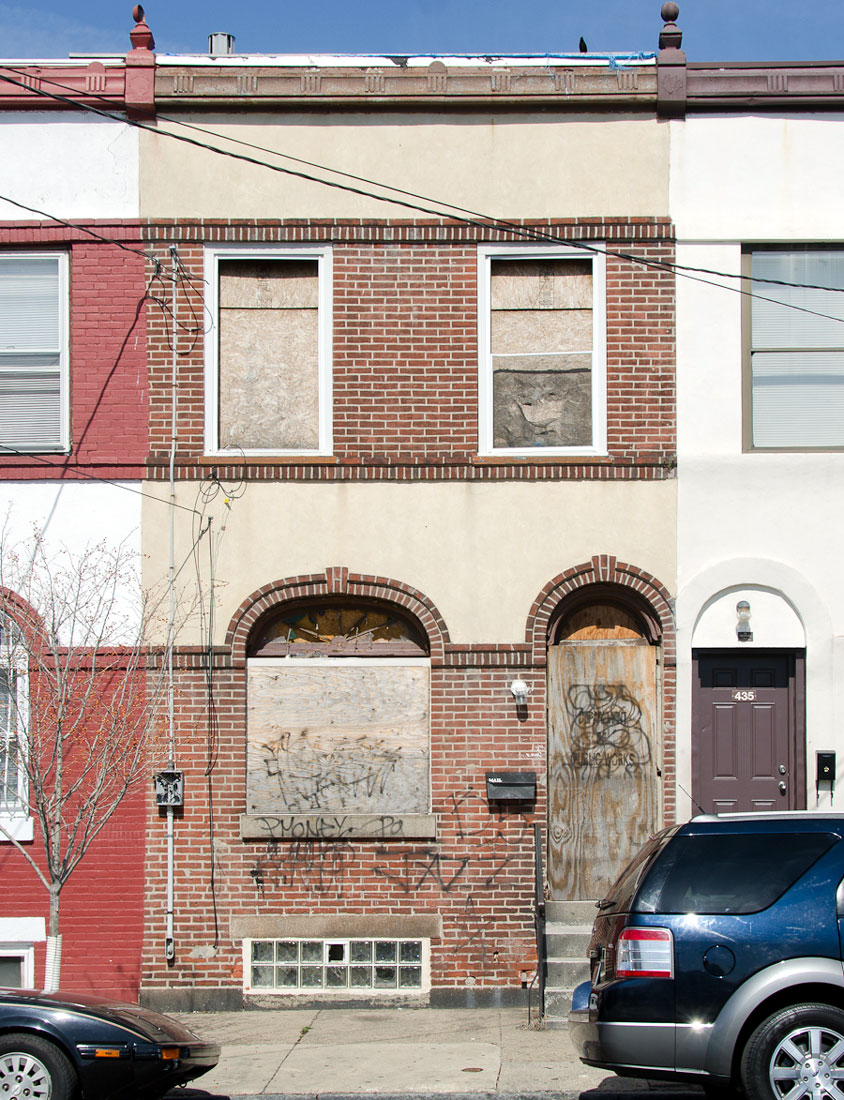
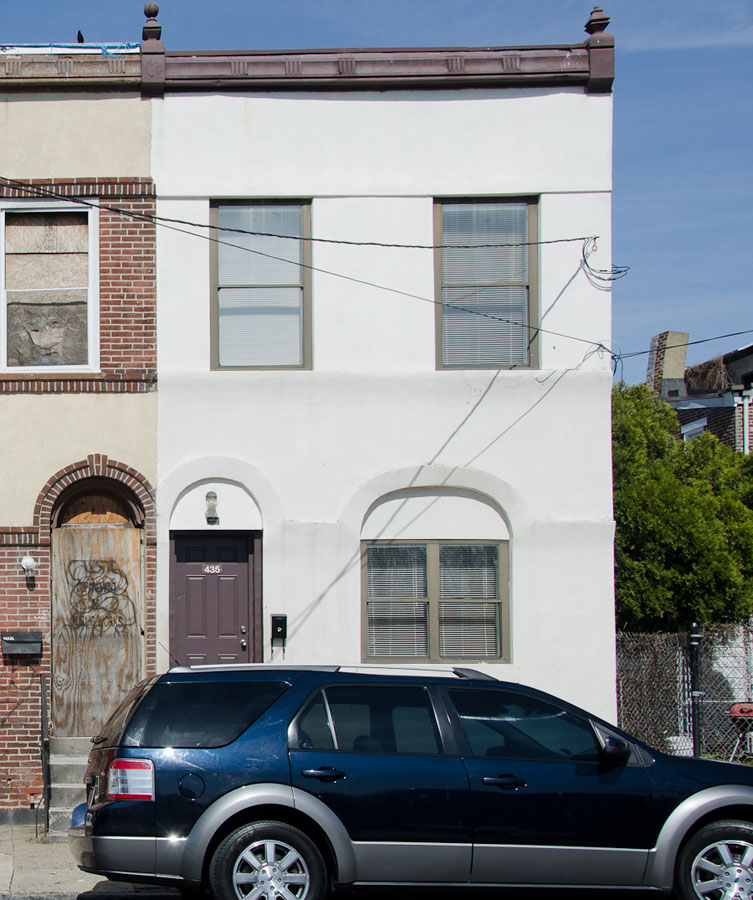
429 Beckett Street, 1893 — William G. Kairer Sr. & Family. 1929, Tony Levecchia. 1947, Henry Levecchia. Photo taken March 14, 2012.
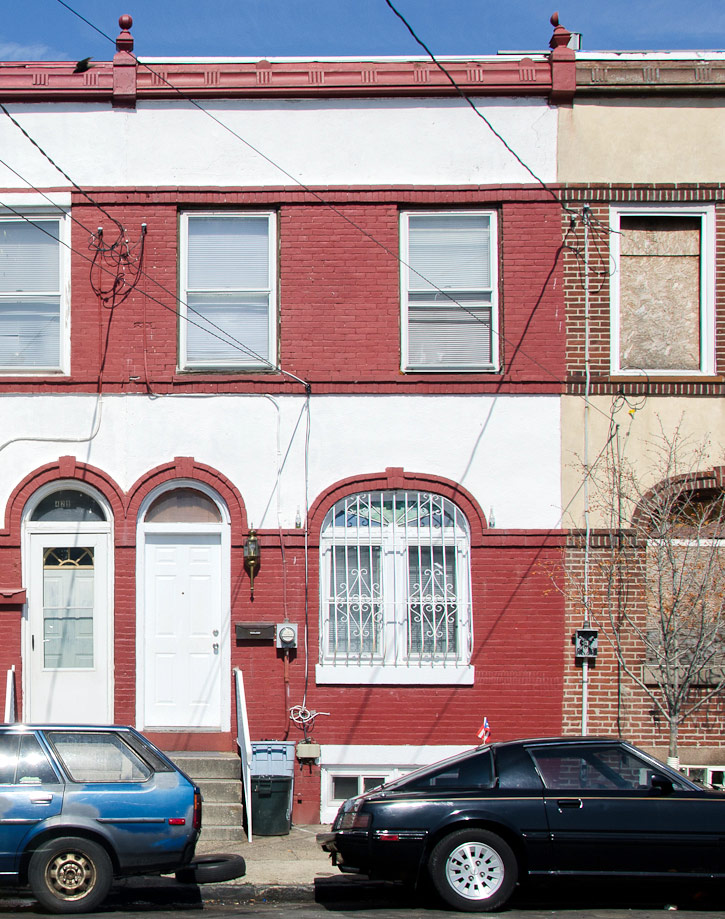
431, 433, 435 Beckett Street. Photos taken March 14, 2012.
Intersection of White Street & Beckett Street
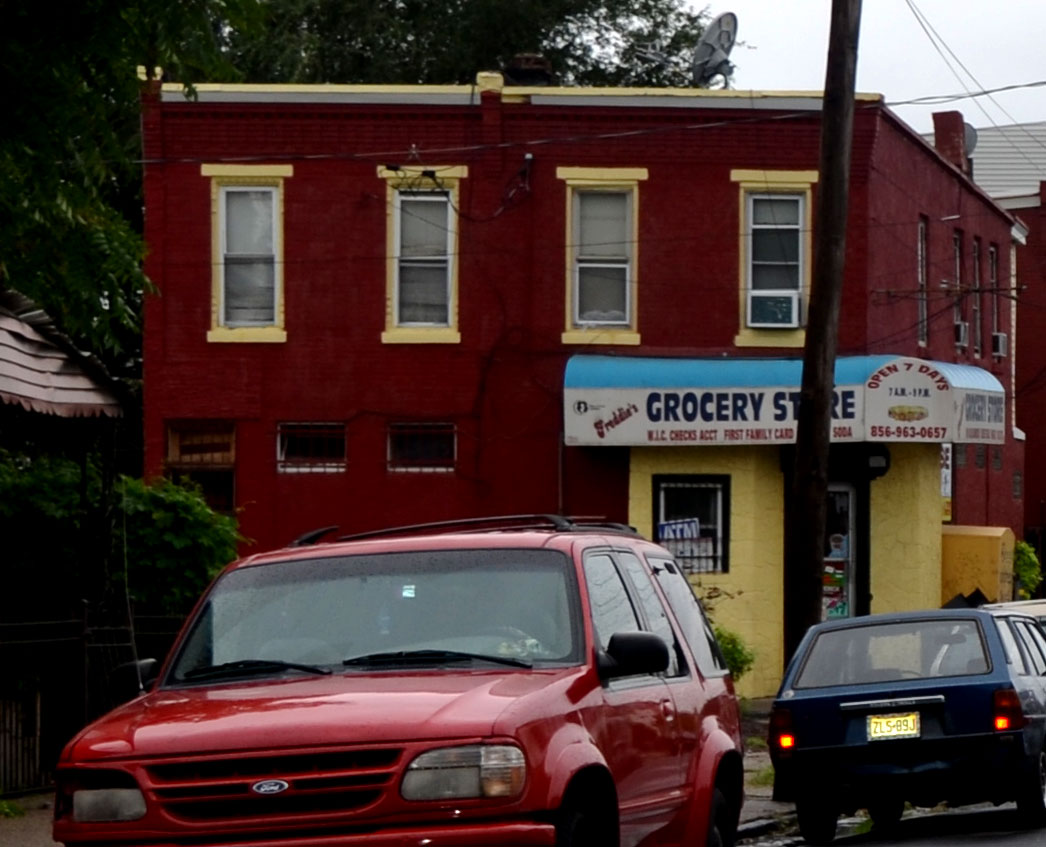
Southwest Corner, White Street & Beckett Street. September 8, 2011.
Intersection of West Street & Beckett Street
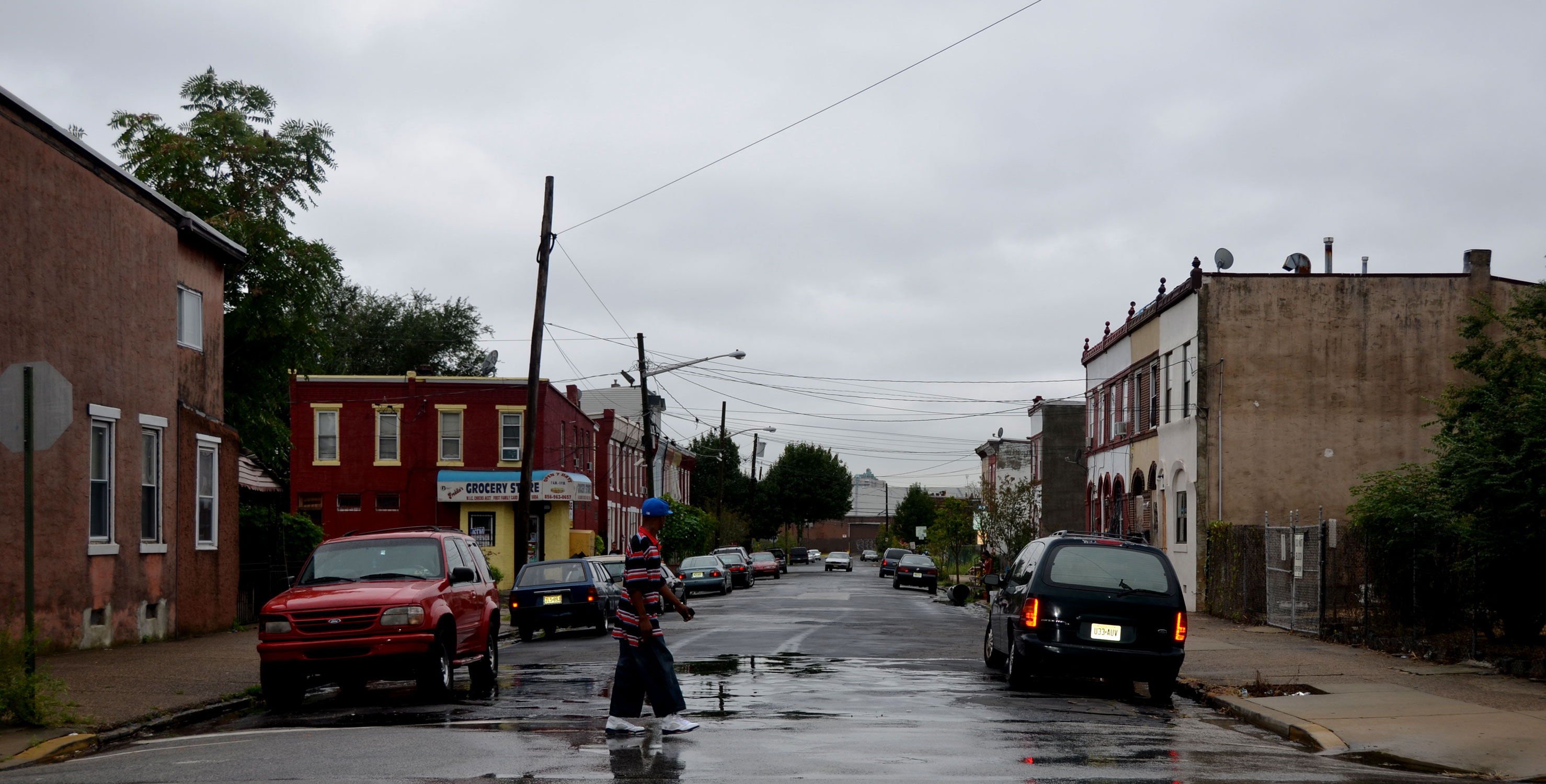
Looking west on Beckett Street from West Street. September 8, 2011.
Police, Fire Tests Take Heavy Toll
Camden Courier-Post —

Courier-Post Bureau
TRENTON — The high rate of failures on police and fire examinations was repeated yesterday in the Civil Service Department’s announcement of the results of tests for fire captain and patrolman in Camden City.
In the captain’s test, 23 passed, 64 failed and two did not show up for the test. In the test for patrolman, 10 passed, 32 failed and 14 failed to show. In the non-residents’ test for Camden patrolman, six passed, eight failed and five did not appear.
In the fire captain’s test, Kenneth M. Clark of 111 North 26th St., Camden, a veteran, qualified with a score of 92.6, highest for the seven veterans who qualified. Joseph R. Gfrorer of 3040 N. Constitution Road, Camden, was highest of applicants with a score of 96.5.
In the residents’ patrolman test, Robert D. Craig of 817 Vine Street was high with 78. In the non resident’s test, Edwin B. Hoffman of 514 Walnut Street, Audubon, a veteran qualified with 72.2 and Flem J. Hopkins Jr. of 113 Estates Ave., Pine Hill, was high with 78.
Others who passed the fire captain’s test were:
George D. Getty of 1111 N. 34 St., 95.4; John DiMaggio of 319 Beckett St., 94; Joseph J. Anderson of 2406 Denfield St., 92.96; Phillip A. Maycott of 2836 Lincoln Ave., 90.5; James McMaster of 402 N. 37th St., 90.2; William D. Hillman of 3071 Constitution Rd., 89.4; Joseph Arensberg of 1041 N. 32nd St., 88.3; Robert E. Briggs of 2861 Congress Road, veteran, 86.3; John S. Brzozowski of 371 N. 34th St., 86.2; Edmund F. Gorczynski of 272 N. 33rd St., veteran, 85.4; Anthony F. Orme of 3317 River Ave., veteran, 82.4; William B. Young of 1126 N. 33rd St., 80.5; William D. Ayers of 2846 Pierce Ave., veteran, 79.1; Joseph Dowhy Sr., of 866 Beideman Ave., veteran, 78.9; James O. Jones of 3214 Mitchell St., 78.3; Joseph Chelhowski of 1324 Sheridan St., veteran, 75.8; James T. Robinson of 504 Trenton Ave., 75.5; Anthony D. Moffa of 23 Leonard Ave., 73.3; Robert E. Davenport of 1026 Reeves Ave., 73; John F. Gaffney Jr., of 78 S. Dudley St., 72.8, and Albert E. Collum Jr., of 2409 Howell St., 72.6.
Patrolman (residents) who passed:
Joseph A. Fox of 2117 Mount Ephraim Ave., 77.1; Charles W. Cahilly 2d of 2015 Westminster Ave., 75.; Edward B. Bush of 3210 Mitchell St., 78.9; John F. Oppmann of 550 N. 30th St., 77.7; Gary E. Miller of 486-A Rand St., 77.4; Donald J. Tymusczuk of 2737 Concord Ave., 75.1; Joseph A. Broccoli of 1467 Pershing St., 74.2; Richard W. Merta of 1641 Pulaski St., 72.9, and Robert G. Gibson of 572 Clinton St., 72.6.
Patrolman (nonresidents) who passed:
Flem J. Hopkins Jr., 78; Elwood L. Ridge, 75.4; Joseph E. Benton, 74.7; David Vautier Jr., 74.1, and Frank R. Pedano, 73.8.
37 Camden Men Pass Tests for City Firemen
Camden Courier-Post —
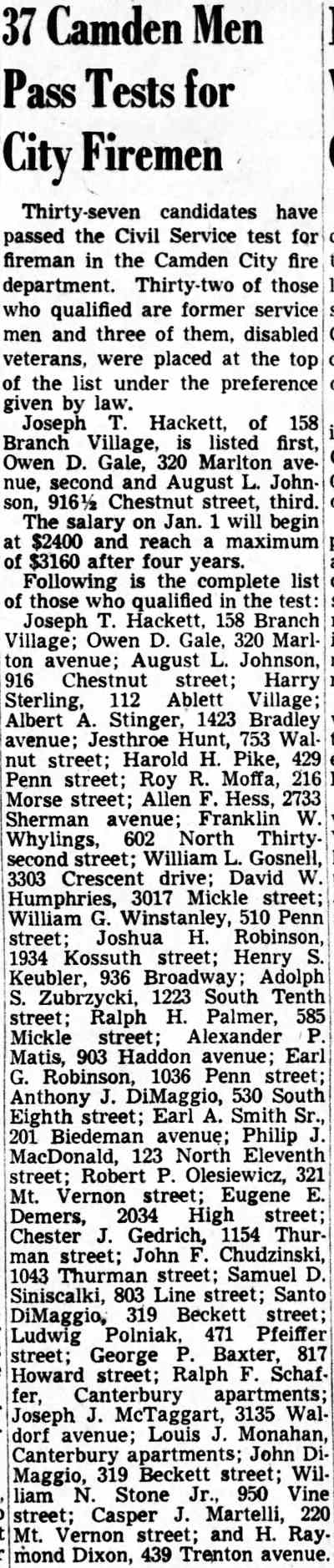
Thirty-seven candidates have passed the Civil Service test for fireman in the Camden City fire department. Thirty-two of those who qualified are former service men and three of them, disabled veterans, were placed at the top of the list under the preference given by law.
Joseph T. Hackett, of 158 Branch Village, is listed first, Owen D. Gale, 320 Marlton avenue, second and August L. Johnson, 916½ Chestnut street, third.
The salary on Jan. 1 will begin at $2400 and reach a maximum of $3160 after four years.
Following is the complete list of those who qualified in the test:
Joseph T. Hackett, 158 Branch Village; Owen D. Gale, 320 Marlton avenue; August L. Johnson, 916 Chestnut street; Harry Sterling, 112 Ablett Village; Albert A. Stinger, 1423 Bradley avenue; Jesthroe Hunt, 753 Walnut street; Harold H. Pike, 429 Penn street; Roy R. Moffa, 216 Morse street; Allen F. Hess, 2733 Sherman avenue; Franklin W. Whylings, 602 North Thirty-second street; William L. Gosnell, 3303 Crescent drive; David W. Humphries, 3017 Mickle street; William G. Winstanley, 510 Penn street; Joshua H. Robinson, 1934 Kossuth street; Henry S. Keubler, 936 Broadway; Adolph S. Zubrzycki, 1223 South Tenth street; Ralph H. Palmer, 585 Mickle street; Alexander P. Matis, 903 Haddon avenue; Earl G. Robinson, 1036 Penn street; Anthony J. DiMaggio, 530 South Eighth street; Earl A. Smith Sr., 201 Biedeman avenue; Philip J. MacDonald, 123 North Eleventh street; Robert P. Olesiewicz, 321 Mt. Vernon street; Eugene E. Demers, 2034 High street; Chester J. Gedrich, 1154 Thurman street; John F. Chudzinski, 1043 Thurman street; Samuel D. Siniscalki, 803 Line street; Santo DiMaggio, 319 Beckett street; Ludwig Polniak, 471 Pfeiffer street; George P. Baxter, 817 Howard street; Ralph F. Schaffer, Canterbury apartments; Joseph J. McTaggart, 3135 Waldorf avenue; Louis J. Monahan, Canterbury apartments; John DiMaggio, 319 Beckett street; William N. Stone Jr., 950 Vine street; Casper J. Martelli, 220 Mt. Vernon street; and H. Raymond Dixon, 439 Trenton avenue.
Elimination of 20 City Blocks Urged by Housing Committee
Camden Courier-Post —
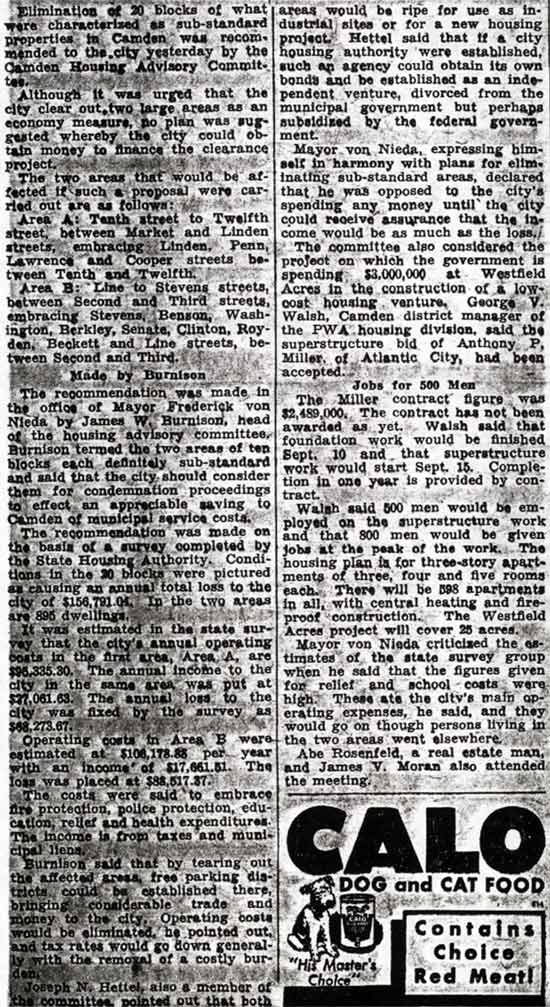
Advisory Board Suggests Razing 895 Dwellings In 2 Areas, Classified as Sub-Standard; Mayor Favors Plan For Parking Spaces
Elimination of 20 blocks of what were characterized as sub-standard properties in Camden was recommended to the city yesterday by the Camden Housing Advisory Committee.
Although it was urged that the city clear out two large areas as an economy measure, no plan was suggested whereby the city could obtain money to finance the clearance project.
The two areas that would be affected if such a proposal were carried out are as follows:
Area A: Tenth street to Twelfth street, between Market and Linden streets, embracing Linden, Penn, Lawrence and Cooper streets between Tenth and Twelfth.
Area B: Line to Stevens streets, between Second and Third streets, embracing Stevens, Benson, Washington, Berkley, Senate, Clinton, Royden, Beckett and Line streets, between Second and Third.
Made by Burnison
The recommendation was made in the office of Mayor Frederick von Nieda, by James W. Burnison, head of the housing advisory committee. Burnison termed the two areas of ten blocks each definitely sub-standard and said that the city should consider them for condemnation proceedings to effect an appreciable saving to Camden of municipal service costs.
The recommendation was made on the basis of a survey completed by the State Housing Authority. Conditions in the 20 blocks were pictured as causing an annual total loss to the city of $156,791.04. In the two areas are 895 dwellings.
It was estimated in the state survey that the city’s annual operating costs in the first area, Area A, are $95,335.30. The annual income to the city in the same area was put at $27,061.63. The annual loss to the city was fixed by the survey as $68,273.67.
Operating costs in Area B were estimated at $106,178.88 per year with an income of $17,661.51. The loss was placed at $88,517.37.
The costs were said to embrace fire protection, police protection, education, relief and health expenditures. The income is from taxes and municipal liens.
Burnison said that by tearing out the affected areas, free parking districts could be established there, bringing considerable trade and money to the city. Operating costs would be eliminated, he pointed out, and tax rates would go down generally with the removal of a costly burden.
Joseph N. Hettel, also a member of the committee, pointed out that both areas would be ripe for use as industrial sites or for a new housing project. Hettel said that if a city housing authority were established, such an agency could obtain its own bonds and be established as an independent venture, divorced from the municipal government but perhaps subsidized by the federal government.
Mayor von Nieda, expressing himself in harmony with plans for eliminating sub-standard areas, declared that he was opposed to the city’s spending any money until the city could receive assurance that the income would be as much as the loss.
The committee also considered the project on which the government is spending $3,000,000 at Westfield Acres in the construction of a low-cost housing venture. George V. Walsh, Camden district manager of the PWA housing division, said the superstructure bid of Anthony P. Miller, of Atlantic City, had been accepted.
Jobs for 500 Men
The Miller contract figure was $2,489,000. The contract has not been awarded as yet. Walsh said that foundation work would be finished Sept. 10 and that superstructure work would start Sept. 15. Completion in one year is provided by contract.
Walsh said 500 men would be employed on the superstructure work and that 800 men would be given jobs at the peak of the work. The housing plan is for three-story apartments of three, four and five rooms each. There will be 598 apartments in all, with central heating and fireproof construction. The Westfield Acres project will cover 25 acres.
Mayor von Nieda criticized the estimates of the state survey group when he said that the figures given for relief and school costs were high. These are the city’s main operating expenses, he said, and they would go on though persons living in the two areas went elsewhere.
Abe Rosenfeld, a real estate man, and James V. Moran also attended the meeting.
Kairer’s Slayer Still at Large
Philadelphia Inquirer —
Camden Police Thought They Had the Right Man, But Were Mistaken.
Their Capture Not the Man Who Pawned the Victim’s Watch.
They Will Hold Him on Other Charges While They Continue Their Search—The Burglar’s Bullet Went Through Kairer’s Heart—Other Jersey Matters.
When the Camden police arrested Theodore Lambert, colored, they thought they had the murderer of Cracker Baker William Kairer, who was shot in his home, 429 Beckett street, by a burglar early Monday morning. They held to this belief until late yesterday afternoon, when it was suddenly dispelled.
The only clue to the identity of the murderer started from the pawn shop of Ellis Silberstein, 123 North Ninth street, Philadelphia, where the murdered man’s gold watch was pledged. A colored man brought the watch into the pawn shop five hours after the crime was committed. The watch bore the murdered man’s initials and was worth at least $75. But $15 was asked on it, and this amount was issued without much questioning.
ARRESTED AN EX-CONVICT.
The description of the colored man who pawned the watch furnished the clue on which the Camden police arrested Theodore Lambert. Lambert has a bad record. He was sent to the New Jersey State Reform School when he was 15 years old. When he attained his majority he launched into a career of crime.
He has served several terms in State prison, and was released but a few months ago after serving three years for robbing a house on Mickle street.
He was arrested at 1883 South Ninth street early yesterday morning, and the police also took into custody Joseph B. Stevens and Levin Riley, colored, who were in the house. George Greenleaf, colored, was also arrested on suspicion early yesterday morning.
The police felt pretty sure that Lambert was the man they wanted until the pawnbroker’s clerk came over late in the afternoon. Then their belief was shattered. The clerk, who had waited on the colored man who pawned Kairer’s watch, looked at the prisoner and said emphatically he had never seen him before.
Lambert’s words and actions after his arrest had given the police good grounds for holding him. He confessed having been implicated in several recent robberies, where the work of one man was shown by filth being smeared on the walls. Lambert said he did this for luck.
He also admitted that he was on the street at half-past 3 o’clock Monday morning, a little over an hour before Kairer’s residence was entered.
He will be held for robbing a school house and for stealing a watch, warrants having been out for his arrest. The police still hope to connect him with the Kairer case.
MUST LOOK FOR ANOTHER MAN.
If the Lambert clue does not pan out the Camden police are at sea. The only clue they have to work on is the description of the negro who pawned Kairer’s watch. They will spread out their dragnet and gather in other colored men who answer this description.
County Physician Iszard made a post-mortem examination yesterday afternoon of the body of the murdered man. He found the burglar’s bullet had entered at the breast, passed through the heart and lodged in the spinal column. The ball was not recovered.
Lambert at Last Pays the Penalty
Philadelphia Inquirer —
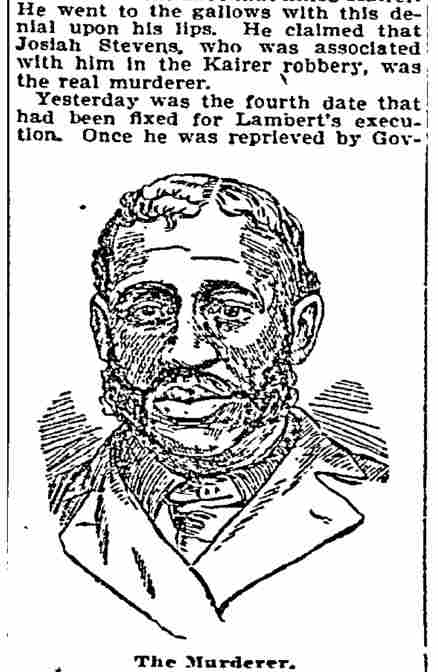
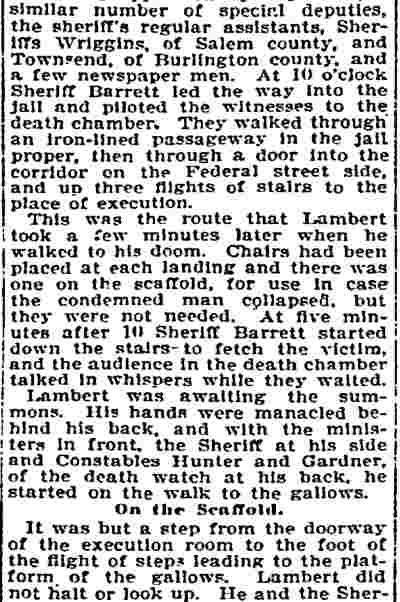
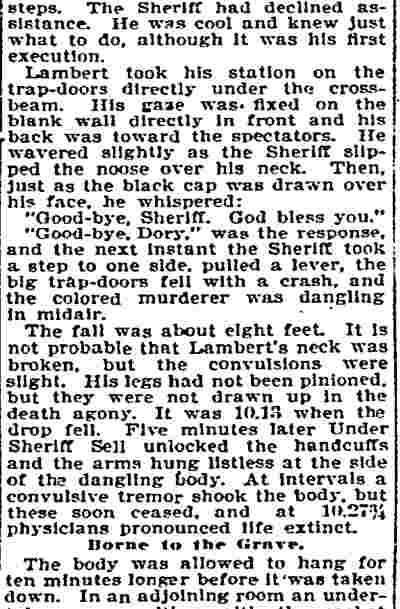
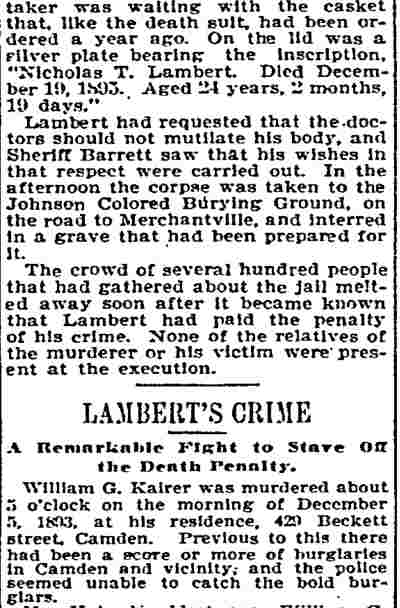
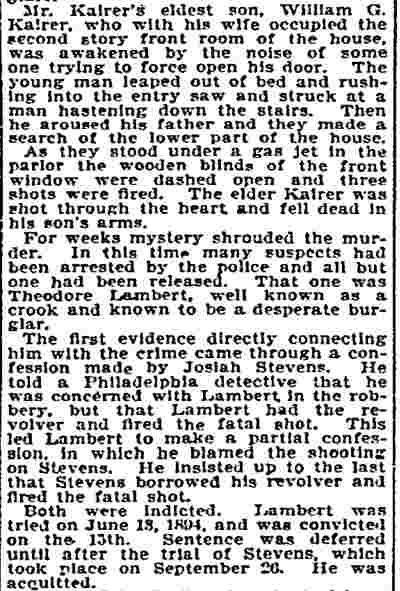
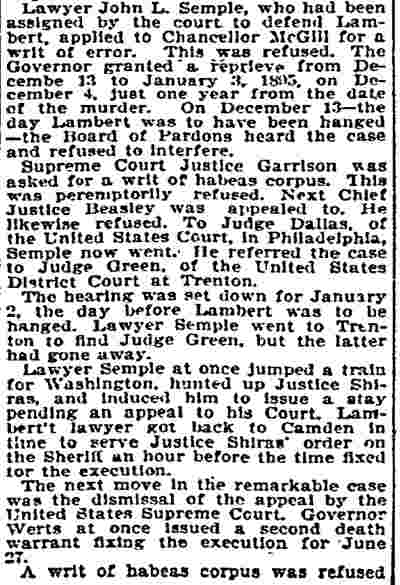
THE MURDERER OF BAKER KAIRER HANGED IN THE CAMDEN COUNTY JAIL
PROTESTED INNOCENCE TO THE END
HE SAID STEVENS FIRED THE FATAL SHOT
The Execution Devoid of Sensational Features—Lambert Walked Firmly to the Gallows—History of His Remarkable Case.
The Murderer.
Nicholas Theodore Lambert died on the gallows in the Camden county jail yesterday. He was hanged for the murder of William G. Kairer, a well-to-do cracker baker, of Camden. His death closes a case that was remarkable chiefly for the extraordinary efforts to save the condemned man from the gallows. Lambert was a bad man. From his youth up he had been a criminal. He had served time in prison for burglary and admitted while awaiting trial for murder that he had robbed a score or more of houses in and around Camden. But he denied that he had fired the shot that killed Kairer. He went to the gallows with this denial upon his lips. He claimed that Josiah Stevens, who was associated with him in the Kairer robbery, was the real murderer.
Yesterday was the fourth date that had been fixed for Lambert’s execution. Once he was reprieved by Governor Werts. Twice the United States Supreme Court interfered and postponed the hanging. The law finally claimed its victim after every ordinary and several extraordinary procedures had been resorted to to avert the death penalty.
Firm in the Face of Death.
Lambert’s death was devoid of sensation, as executions go. He walked to the scaffold without assistance. He did not flunk in the face of death. There was barely time for a whispered good-bye to the Sheriff and he was launched into eternity. He was hanged on the gallows that ended John Hill’s life about three years ago. It was erected in an unused and half-finished room on the top floor of the county jail building at the northwest corner of Broadway and Federal streets. The death chamber is directly over a part of the jail that is being fitted up for the use of female prisoners.
The scaffold stood over against a blank wall. On the other side windows let a flood of light into the bare room. Overhead were the gaunt rafters supporting the roof.
The heart-rending farewells between the condemned man and his mother and other relatives and friends had been uttered the night before. As the time drew on toward midnight the condemned seemed to realize for the first time that there was no further hope of escaping the death penalty.
“I can’t sleep,” he said to Constable Hunter, one of his death watch. “I feel oppressed, as if there was a heavy weight inside. I hope I will be able to walk to the gallows.”
At 1 o’clock Lambert sat down at a little table in his cell and for three hours he was busy with his pen writing farewell letters. There were six of these missives. The longest one was to his counsel, Lawyer John G. [sic] Semple, who had made such a gallant fight to save him. He thanked his lawyer and reiterated his assertion that he did not fire the shot that killed Kairer. One of the letters was to Mrs. Isabella Shipley, a resident of South Camden, who had displayed great interest in his case. The others were to personal friends. In all these missives Lambert gave expression to his religious faith and the belief that he had divine forgiveness of his sins.
Ready for the Rope.
About 6 o’clock the spiritual advisers of the condemned man entered his cell. They were colored ministers, Revs. W. H. Yocum, Thomas Als and H. C. Ashley. Under the soothing influence of prayer Lambert grew calmer, and when his breakfast, which consisted of half a dozen fried eggs, potatoes and coffee, was sent in from a restaurant opposite the jail, he ate heartily.
At 9 o’clock the suit of black clothing that had been ordered for his execution a year ago, was brought in and he dressed himself for the gallows. A barber had shaved him and trimmed his hair the previous night. He did not put on a collar.
The persons who were to witness the execution, in all less than forty, gathered in the sheriff’s office shortly before 10 o’clock. There was a jury of twelve appointed by the court, a similar number of special deputies, the sheriff’s regular assistants, Sheriffs Wriggins, of Salem county, and Townsend, of Burlington county, and a few newspaper men. At 10 o’clock Sheriff Barrett led the way into the jail and piloted the witnesses to the death chamber. They walked through an iron-lined passageway in the jail proper, then through a door into the corridor on the Federal street side, and up three flights of stairs to the place of execution.
This was the route that Lambert took a few minutes later when he walked to his doom. Chairs had been placed at each landing and there was one on the scaffold, for use in case the condemned man collapsed, but they were not needed. At five minutes after 10 Sheriff Barrett started down the stairs to fetch the victim, and the audience in the death chamber talked in whispers while they waited.
Lambert was awaiting the summons. His hands were manacled behind his back, and with the ministers in front, the Sheriff at his side and Constables Hunter and Gardner, of the death watch at his back, he started on the walk to the gallows.
On the Scaffold.
It was but a step from the doorway of the execution room to the foot of the flight of steps leading to the platform of the gallows. Lambert did not halt or look up. He and the Sheriff walked with firm tread up the steps. The Sheriff had declined assistance. He was cool and knew just what to do, although it was his first execution.
Lambert took his station on the trap-doors directly under the cross-beam. His gaze was fixed on the blank wall directly in front and his back was toward the spectators. He wavered slightly as the Sheriff slipped the noose over his neck. Then, just as the black cap was drawn over his face, he whispered:
“Good-bye, Sheriff. God bless you.”
“Good-bye, Dory,” was the response, and the next instant the Sheriff took a step to one side, pulled a lever, the big trap-doors fell with a crash, and the colored murderer was dangling in midair.
The fall was about eight feet. It is not probable that Lambert’s neck was broken, but the convulsions were slight. His legs had not been pinioned, but they were not drawn up in the death agony. It was 10.13 when the drop fell. Five minutes later Under Sheriff Sell unlocked the handcuffs and the arms hung listless at the side of the dangling body. At intervals a convulsive tremor shook the body, but these soon ceased, and at 10.27¾ physicians pronounced life extinct.
Borne to the Grave.
The body was allowed to hang for ten minutes longer before it was taken down. In an adjoining room an undertaker was waiting with the casket that, like the death suit, had been ordered a year ago. On the lid was a silver plate bearing the inscription, “Nicholas T. Lambert. Died December 19, 1895. Aged 24 years, 2 months, 19 days.”
Lambert had requested that the doctors should not mutilate his body, and Sheriff Barrett saw that his wishes in that respect were carried out. In the afternoon the corpse was taken to the Johnson Colored Burying Ground, on the road to Merchantville, and interred in a grave that had been prepared for it.
The crowd of several hundred people that had gathered about the jail melted away soon after it became known that Lambert had paid the penalty of his crime. None of the relatives of the murderer or his victim were present at the execution.
LAMBERT’S CRIME
A Remarkable Fight to Stave Off the Death Penalty.
William G. Kairer was murdered about 5 o’clock on the morning of December 5, 1893, at his residence, 429 Beckett street, Camden. Previous to this there had been a score or more of burglaries in Camden and vicinity; and the police seemed unable to catch the bold burglars.
Mr. Kairer’s eldest son, William G. Kairer, who with his wife occupied the second story front room of the house, was awakened by the noise of some one trying to force open his door. The young man leaped out of bed and rushing into the entry saw and struck at a man hastening down the stairs. Then he aroused his father and they made a search of the lower part of the house.
As they stood under a gas jet in the parlor the wooden blinds of the front window were dashed open and three shots were fired. The elder Kairer was shot through the heart and fell dead in his son’s arms.
For weeks mystery shrouded the murder. In this time many suspects had been arrested by the police and all but one had been released. That one was Theodore Lambert, well known as a crook and known to be a desperate burglar.
The first evidence directly connecting him with the crime came through a confession made by Josiah Stevens. He told a Philadelphia detective that he was concerned with Lambert in the robbery, but that Lambert had the revolver and fired the fatal shot. This led Lambert to make a partial confession, in which he blamed the shooting on Stevens. He insisted up to the last that Stevens borrowed his revolver and fired the fatal shot.
Both were indicted. Lambert was tried on June 1[?], 1894, and was convicted on the 13th. Sentence was deferred until after the trial of Stevens, which took place on September 26. He was acquitted.
Lawyer John L. Semple, who had been assigned by the court to defend Lambert, applied to Chancellor McGill for a writ of error. This was refused. The Governor granted a reprieve from Decembe [sic] 13 to January 3, 1895, on December 4, just one year from the date of the murder. On December 13—the day Lambert was to have been hanged—the Board of Pardons heard the case and refused to interfere.
Supreme Court Justice Garrison was asked for a writ of habeas corpus. This was peremptorily refused. Next Chief Justice Beasley was appealed to. He likewise refused. To Judge Dallas, of the United States Court, in Philadelphia, Semple now went. He referred the case to Judge Green, of the United States District Court at Trenton.
The hearing was set down for January 2, the day before Lambert was to be hanged. Lawyer Semple went to Trenton to find Judge Green, but the latter had gone away.
Lawyer Semple at once jumped a train for Washington, hunted up Justice Shiras, and induced him to issue a stay pending an appeal to his Court. Lambert’t [sic] lawyer got back to Camden in time to serve Justice Shiras’ order on the Sheriff an hour before the time fixed for the execution.
The next move in the remarkable case was the dismissal of the appeal by the United States Supreme Court. Governor Werts at once issued a second death warrant fixing the execution for June 27.
A writ of habeas corpus was refused [cut off at the crop edge]
Primary Riots to Be Aired in Court
Philadelphia Inquirer —
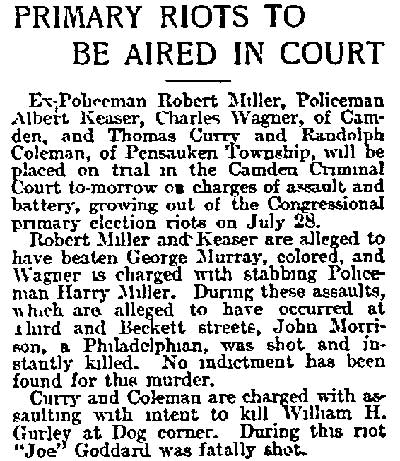
Ex-Policeman Robert Miller, Policeman Albert Keaser, Charles Wagner, of Camden, and Thomas Curry and Randolph Coleman, of Pensauken Township, will be placed on trial in the Camden Criminal Court to-morrow on charges of assault and battery, growing out of the Congressional primary election riots on July 28. Robert Miller and Keaser are alleged to have beaten George Murray, colored, and Wagner is charged with stabbing Policeman Harry Miller. During these assaults, which are alleged to have occurred at Third and Beckett streets, John Morrison, a Philadelphian, was shot and instantly killed. No indictment has been found for this murder. Curry and Coleman are charged with assaulting with intent to kill William H. Gurley at Dog corner. During this riot “Joe” Goddard was fatally shot.
Acquitted of Election Rioting
Philadelphia Inquirer —
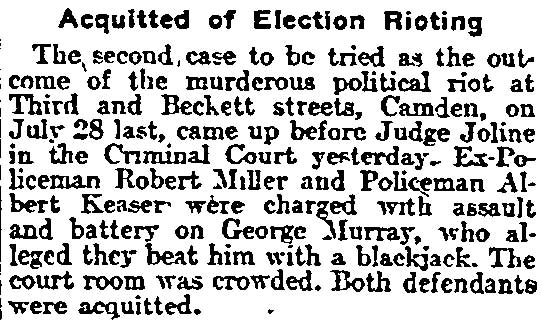
The second case to be tried as the outcome of the murderous political riot at Third and Beckett streets, Camden, on July 28 last, came up before Judge Joline in the Criminal Court yesterday. Ex-Policeman Robert Miller and Policeman Albert Keaser were charged with assault and battery on George Murray, who alleged they beat him with a blackjack. The court room was crowded. Both defendants were acquitted.
Charge, Murder to Italian Now on Sea
Philadelphia Inquirer —
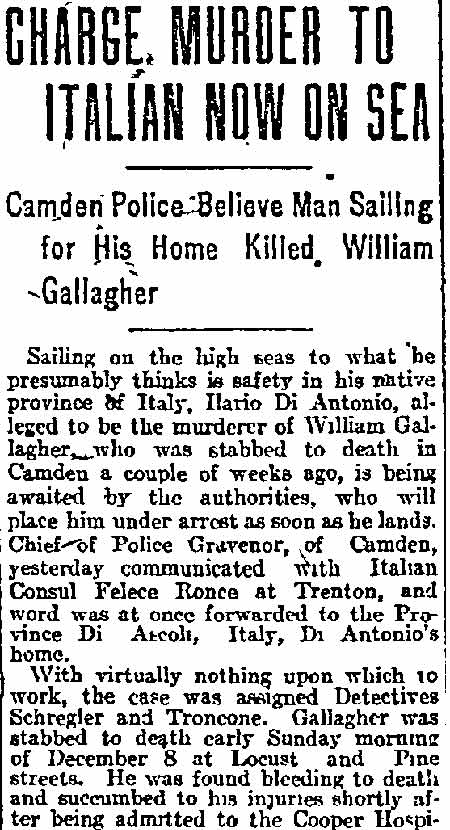
Camden Police Believe Man Sailing for His Home Killed William Gallagher
Sailing on the high seas to what he presumably thinks is safety in his native province of Italy, Ilario Di Antonio, alleged to be the murderer of William Gallagher, who was stabbed to death in Camden a couple of weeks ago, is being awaited by the authorities, who will place him under arrest as soon as he lands. Chief of Police Gravenor, of Camden, yesterday communicated with Italian Consul Felece Ronce at Trenton, and word was at once forwarded to the Province Di Ascoli, Italy, Di Antonio’s home.
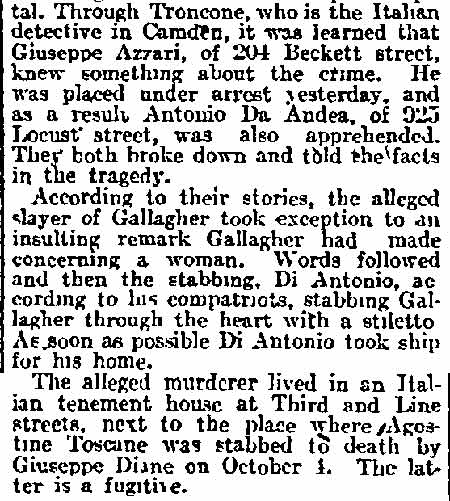
With virtually nothing upon which to work, the case was assigned Detectives Schregler and Troncone. Gallagher was stabbed to death early Sunday morning of December 8 at Locust and Pine streets. He was found bleeding to death and succumbed to his injuries shortly after being admitted to the Cooper Hospital. Through Troncone, who is the Italian detective in Camden, it was learned that Giuseppe Azzari, of 204 Beckett street, knew something about the crime. He was placed under arrest yesterday, and as a result Antonio Da Andea, of 9[?]5 Locust street, was also apprehended. They both broke down and told the facts in the tragedy.
According to their stories, the alleged slayer of Gallagher took exception to an insulting remark Gallagher had made concerning a woman. Words followed and then the stabbing. Di Antonio, according to his compatriots, stabbing Gallagher through the heart with a stiletto As soon as possible Di Antonio took ship for his home.
The alleged murderer lived in an Italian tenement house at Third and Line streets, next to the place where Agostine Toscane was stabbed to death by Giuseppe Diane on October 1. The latter is a fugitive.
Five to 15 Years for Gunman Who Shot Policemen
Camden Courier-Post —
Man Convicted of Wounding Detective Guthrie and John P. Brazier
DENIED PAIR OF CHARGES
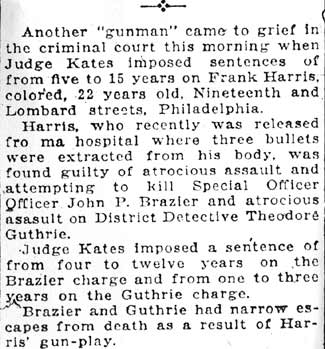
Another “gunman” came to grief in the criminal court this morning when Judge Kates imposed sentences of from five to 15 years on Frank Harris, colored, 22 years old, Nineteenth and Lombard streets, Philadelphia.
Harris, who recently was released fro ma [sic] hospital where three bullets were extracted from his body, was found guilty of atrocious assault and attempting to kill Special Officer Officer [sic] John P. Brazier and atrocious asault [sic] on District Detective Theodore Guthrie.
Judge Kates imposed a sentence of from four to twelve years on the Brazier charge and from one to three years on the Guthrie charge.
Brazier and Guthrie had narrow escapes from death as a result of Harris’ gun-play.
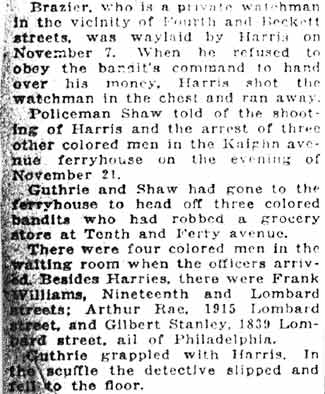
Brazier, who is a private watchman in the vicinity of Fourth and Beckett streets, was waylaid by Harris on November 7. When he refused to obey the bandit’s command to hand over his money, Harris shot the watchman in the chest and ran away.
Policeman Shaw told of the shooting of Harris and the arrest of three other colored men in the Kaighn avenue ferryhouse on the evening of November 21.
Guthrie and Shaw had gone to the ferryhouse to head off three colored bandits who had robbed a grocery store at Tenth and Ferry avenue.
There were four colored men in the waiting room when the officers arrived. Besides Harries [sic], there were Frank Williams, Nineteenth and Lombard streets; Arthur Rae, 1915 Lombard street, and Gilbert Stanley, 1839 Lombard street, all of Philadelphia.
Guthrie grappled with Harris. In the scuffle the detective slipped and fell to the floor.
“He fired two shots at me while down,” testified Guthrie “and but for Officer Shaw he would have fired more.”
Shaw said he fired four times, and that three of the bullets struck Harris, but that the latter did not go down until the fourth shot.
Harris pleaded no [sic] guilty to both charges, and denied knowing any of the men who were arrested with him.
George Barag, who conducts a grocery store at 1850 South Tenth street, identified the men as having come in his store under the pretense of making a purchase on the night the store at Tenth and Ferry avenue was robbed. Stacy Threadgill, 1864 South Tenth street, who was in Barag’s store at the time, also identified the prisoners.
E. Wesley Goldthorpe was appointed by the court to defend Harris, and Assistant Prosecutor Charles S. Straw presented the facts for the state.
Wagner’s Trial for Stabbing Miller
Camden Daily Courier —


Witnesses Say Policeman Keaser Held Fellow Officer When He Was Knifed.
CUT DURING THIRD WARD RIOT
The main court room was crowded with interested Third warders this morning, when the first of the criminal complaints growing out of the riots at Third and Beckett streets, on the night of July 28, last, during the Congressional primary, was taken up. It charged Charles Wagner with assault and battery on Policeman Harry Miller. Judge Joline was on the bench. Prosecutor Lloyd appeared for the State and the defendant was represented by Lawyers Fred A. and William F. Rex. Some little trouble was experienced in getting a jury.
After Prosecutor Lloyd outlined the case, Policeman Miller was called to the stand. He said that on the night in question just before the close of the polls, a fight ensued between ex-Policeman “Bob” Miller and John Morrisey, the man who was killed. A general racket followed and “Bob” Miller, Policeman Keaser and others were brutally assaulting George Murray with a blackjack, when witness went to Murray’s aid. Keaser, he said, turned on him and grappled.
MILLER STABBED.
“He had a hold of me and I of him,” said Miller, “and while we were standing in that position, this man Wagner came up in front of me, jabbed his knife in my stomach, turned it like that (giving his hand a twist) and pulled it out. Keaser still had a hold of me and I could not help myself. Wagner ran away after stabbing me.”
Miller said he was taken to Cooper Hospital and was there four weeks.
On cross-examination by Mr. Rex, Miller said he was positive that Wagner was his assailant and denied saying in the hospital the morning after the stabbing, that he did not know who cut him. He also denied hitting Keaser with his blackjack.
When questioned concerning Morrisey, the man who was killed, Miller said he only met him that day and did not know whether he was a voter or not.
DIDN’T WANT DETAILS.
Mr. Rex tried to get the witness to detail a talk he had with Morrisey, but Mr. Lloyd objected. Mr. Rex seemed so anxious to carry the point that Mr. Lloyd said he was willing to withdraw the objection, provided Mr. Rex would not object to detailed conversation responses to his questions. Mr. Rex promptly vetoed the proposition and withdrew his questions.
Harry Selby, son of former Policeman Selby, followed on the stand. He said he did not see the stabbing, but that a few moments before the polls closed he saw Wagner try to stab Miller at the window of the polling place. The two, it appears, had had some words.
Dr. Grimes, of the Cooper Hospital staff, said that he helped dress Miller’s wound and that it was a dangerous one.
SAW WAGNER KNIFE MILLER.
William Laws, colored, corroborated Miller’s testimony. He said he saw Policeman Keaser hold Policeman Miller while Wagner stabbed him. This hapepned [sic] he said about four minutes of 8 o’clock.
Policeman Edward Hartman told of seeing Wagner having an open knife in his hand, of seeing him jab at several people and that he grabbed at him.
“You saw all of that did you?” asked Mr. Rex.
“I certainly did,” replied the officer.
“Then why didn’t you as a policeman arrest him?”
“I tried to, but his brother interfered.”
Mr. Rex had no more questions to ask.
George Murray, also told of seeing defendant have a knife in his hand.
Detectives Smith and Cherry told of making an unsuccessful search in this city for Wagner and finally locating him at Waterford living with a woman.
Detective Cherry said that Wagner told him that he had been at Hammonton.
“Hammonton is in Camden county, isn’t it?” asked Mr. Rex.
“No, sir, Atlantic county.”
“My geography is twisted somewhat commented Mr. Rex.” With these witnesses the State rested.
WAGNER DENIES CHARGE.
Addressing the jury Mr. Rex said the defense would be an alibi. Wagner then took the stand. He said he lived at 666 South Second street and that on the night of July 28, left the polling place about quarter of eight o’clock.
“Did you have a penknife in your hands at all?”
“No, sir.”
“Did you cut Harry Miller?”
“No, sir.”
In answer to questions by Mr. Rex, Wagner said he was with Constable “Bo” Bates nearly every day while in Waterford.
Cross-questioned by Mr. Lloyd Wagner said he went to Waterford on July 30—two days after the stabbing. He went down, he said, to visit a Mrs. Fox. His visit lasted until the middle of September, the time of his arrest. Previous visits he said never extended over a week. He said he had no knowledge that he was wanted for any crime until two weeks later when he read in the papers that he was charged with stabbing Miller. He told Mr. Bates about it. He further said that no trouble had occurred at all while he was at the polls.
Charles Cahill, a clerk at the Reading terminal, said he was at the polls and that at about quarter of eight o’clock he went up Beckett street in company with Wagner and another man. About fifty feet away, he said he went into an alley and Wagner proceeded up the street. Witness said he returned to the polling place just as the trouble began. He did not see Wagner.
Questioned by the Prosecutor Cahill said he was present as a challenger.
“Are you of the same political party that was holding the election?”
“I vote for the best man,” snapped Cahill in reply.
DIDN’T HAVE ANY POLITICS.
The Prosecutor repeated the question several times only to receive evasive answers such as “I was a Republican for that night,” and “I’m for the best man,” until Judge Joline was compelled to sharply admonish the witness to answer the question. Even then the spectators were in doubt as to Cahill’s politics, as he said he guessed he didn’t have any politics.
Owen McDonald testified to seeing Wagner and two other men pass up the street and despite the general excitement, Mr. McDonald said he watched Wagner until he got to Fourth street.
With the testimony of Butcher John Heim to the effect that he did not see Wagner at all around the polls until after the trouble was over court took a recess.
Policeman Albert Keaser was the first witness called this afternoon. He said he was present when the row started, that he took a blackjack from George Murray and also took a similar weapon from Policeman Harry Miller. The latter, he said, had hit him with the weapon. Witness said he saw Wagner leave the polling place and at that time Miller was not cut.
“Did Mr. Archer, the Assistant Prosecutor, tell you that he had a talk with Miller and that Miller said he didn’t know who cut him?”
Mr. Lloyd objected to the question, but expressed a willingness to allow it, provided Mr. Rex would let him call Mr. Archer to the stand.
Mr. Rex would not do so and the Prosecutor pressed his objection. It was sustained.
On cross examination Keaser denied saying to a man named Ogden that Wagner was “the fellow who did Miller.”
BEAT FELLOW POLICEMAN.
Policeman John Wagner, another of the defendants, said his brother went away before the fight started. In detailing the fracas Wagner voluntarily said he hit Harry Miller in the head with his jack and that he also hit Policeman Hartman.
Policeman Truitt also said he saw Wagner leave the polling place just before the fight started. While Mr. Lloyd was cross examining the witness Mr. Rex objected to the form of a question and remarked the “Court has ruled on that several times and I suppose I’ll get the same ruling.”
Judge Joline rebuked Mr. Rex for making such a statement. Mr. Rex begged the Court’s pardon, made the objection in regular form and it was sustained.
Mrs. Anna Hutner, a sister of the defendant, said she saw him go away about quarter of 8 o’clock and that he did not come back during the trouble. She explained her presence there by saying she had gone to prevent George Murray from shooting her brother.
William Ridgway said he was present during the trouble but did not see Wagner.
Constable “Bo” Bates said that Wagner was in his company nearly every day while he was visiting Waterford and that he made no attempt to escape.
SHIELDED WAGNER.
Prosecutor Lloyd’s only question was:
“You as an officer of this court knew that this man was accused of stabbing Harry Miller and you did not report it to the authorities, is that right?”
“Yes, sir; it is.”
When asked why, by Mr. Rex, the witness said the authorities could have got him at any time.
The defense rested and Mr. Lloyd called Mr. Ogden to the stand in rebuttal. He testified that Keaser told him that Wagner did Miller. Before the question was answered Judge Joline again rebuked Mr. Rex for his manner.
Argument commenced at 2.45 o’clock.
Insistence on Kissing Gets Man, 73, in Trouble
Camden Courier-Post —
Camden’s most affectionate citizen has been found. He’s 73 years old and he spent last night behind bars.
The arrest of Dominick Botleron, 533 Mechanic street, came after he had battled policemen in the operating room of Cooper Hospital at midnight when they refused to be kissed or let him kiss all the nurses and doctors in sight.
“My name’s Valentino,” shouted the man, as Patrolman Walter Patton picked him up from a gutter at Third and Becket streets and loaded him into the First district patrol.
At the hospital where surgeons attempted to sew up a gash in his head, he boasted of being the “sheik of South Camden,” and then tried to osculate everyone in the room.
He frustrated the policemen’s attempt to take him home by giving six different addresses and was finally locked in a cell. Today sentence was suspended when he was arraigned before Judge Bertman in police court on a charge of disorderly conduct.
No Light on the Kairer Murder
Philadelphia Inquirer —
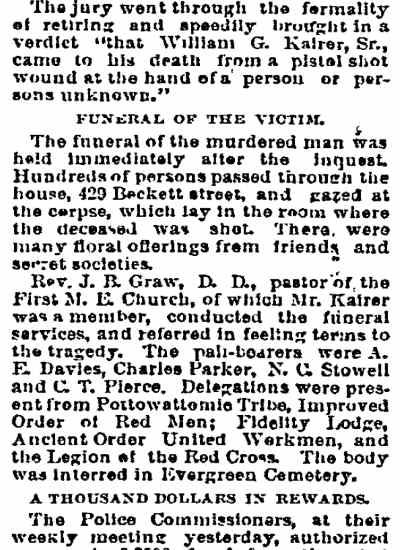
“Shot by an Unknown Man” the Verdict of the Coroner’s Jury.
Funeral Services Over the Remains of the Murdered Baker.
The Rewards Now Amount to a Thousand Dollars—Police Still Working in the Dark—A New But Faint Clue—Other Jersey Matters.
The closing scenes in Camden’s latest tragedy were enacted yesterday. In the morning an inquest was held and in the afternoon the body of William G. Kairer, Sr., the wealthy baker who was shot by an unknown burglar, was buried.
The inquest was held by Coroner Hopper in the court house, and a morbid crowd was present to hear the son tell how his father was shot down at his side.
Nothing of importance not previously known concerning the tragedy was brought out at the inquest, and the identity of the murderer remains as much a mystery as ever.
TESTIMONY AT THE INQUEST.
William G. Kairer, Jr., after a violent fit of weeping, took the witness stand and told how he was awakened by the burglar, the scuffle on the stairs, the search made by him and his father and how the front blinds were dashed open and his father was shot down. He said he was certain the shots were fired from outside the house.
The only person who testified to seeing the murderer was Miss Flora Upton, who lives at 432 Beckett street, next door to Kairer’s house. She saw him walking rapidly away after the shots were fired. She could describe him only as being of medium height, stout and wearing a dark coat.
The jury went through the formality of retiring and speedily brought in a verdict “that William G. Kairer, Sr., came to his death from a pistol shot wound at the hand of a person or persons unknown.”
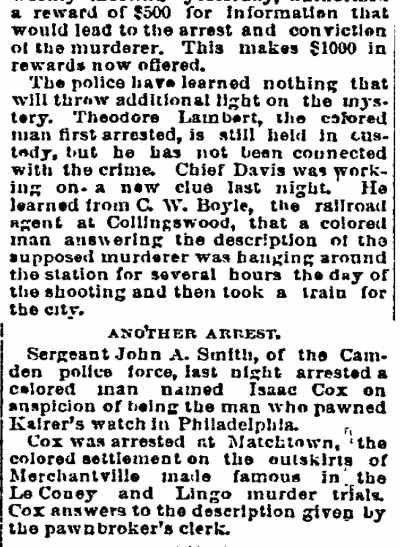
FUNERAL OF THE VICTIM.
The funeral of the murdered man was held immediately after the inquest. Hundreds of persons passed through the house, 429 Beckett street, and gazed at the corpse, which lay in the room where the deceased was shot. There were many floral offerings from friends and secret societies.
Rev. J. B. Graw, D. D., pastor of the First M. E. Church, of which Mr. Kairer was a member, conducted the funeral services, and referred in feeling terms to the tragedy. The pall-bearers were A. E. Davies, Charles Parker, N. C. Stowell and C. T. Pierce. Delegations were present from Pottowattomie [sic] Tribe, Improved Order of Red Men; Fidelity Lodge, Ancient Order United Workmen, and the Legion of the Red Cross. The body was interred in Evergreen Cemetery.
A THOUSAND DOLLARS IN REWARDS.
The Police Commissioners, at their weekly meeting yesterday, authorized a reward of $500 for information that would lead to the arrest and conviction of the murderer. This makes $1000 in rewards now offered.
The police have learned nothing that will throw additional light on the mystery. Theodore Lambert, the colored man first arrested, is still held in custody, but he has not been connected with the crime. Chief Davis was working on a new clue last night. He learned from C. W. Boyle, the railroad agent at Collingswood, that a colored man answering the description of the supposed murderer was hanging around the station for several hours the day of the shooting and then took a train for the city.
ANOTHER ARREST.
Sergeant John A. Smith, of the Camden police force, last night arrested a colored man named Isaac Cox on suspicion of being the man who pawned Kairer’s watch in Philadelphia.
Cox was arrested at Matchtown, the colored settlement on the outskirts of Merchantville made famous in the Le Coney and Lingo murder trials. Cox answers to the description given by the pawnbroker’s clerk.
George Murray Found Lifeless in Snow Drift
Camden Post-Telegram —
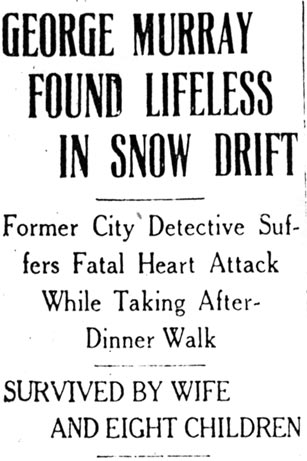
Former City Detective Suffers Fatal Heart Attack While Taking After-Dinner Walk
SURVIVED BY WIFE AND EIGHT CHILDREN
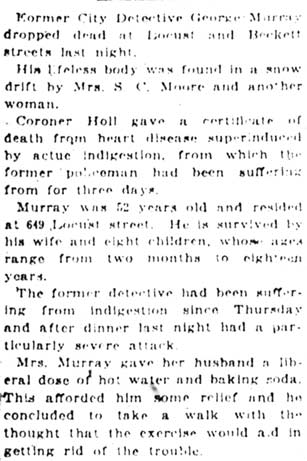
Former City Detective George Murray dropped dead at Locust and Beckett streets last night.
His lifeless body was found in a snow drift by Mrs. S. C. Moore and another woman.
Coroner Holl gave a certificate of death from heart disease superinduced by acute indigestion, from which the former policeman had been suffering from for three days.
Murray was 52 years old and resided at 649 Locust street. He is survived by his wife and eight children, whose ages range from two months to eighteen years.
The former detective had been suffering from indigestion since Thursday and after dinner last night had a particularly severe attack.
Mrs. Murray gave her husband a liberal dose of hot water and baking soda. This afforded him some relief and he concluded to take a walk with the thought that the exercise would aid in getting rid of the trouble.
Half an hour after he left the house his body was found in a huge drift of snow at Locust and Beckett streets. He had fallen into the drift as he toppled over while walking on the sidewalk.
Several men in the neighborhood carried the inanimate form into his home nearby and Drs. Branch and Vaughan were summoned.
The police were also notified and when the ambulance went to the scene it carried Dr. Gamen, of the Cooper Hospital staff. All three doctors pronounced Murray dead and agreed that death was due to a heart attack brought on by indigestion.
Murray resigned from the police force four weeks ago after charges had been preferred against him as a result of the inquiry into vice conditions.
It was alleged that he took money from habitues of the underworld to afford them protection from prosecution. The evidence gathered in this probe is now before the Grand Jury and definite action of some sort was expected this week.
Murray was appointed a policeman on March 1, 190[?], and was made a detective April 1, 1913.
Three Firemen Met Death in Camden Blaze
Philadelphia Inquirer —
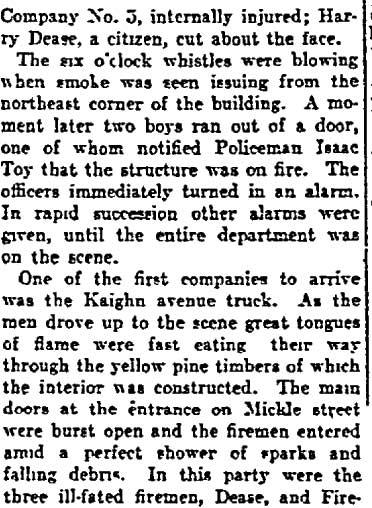
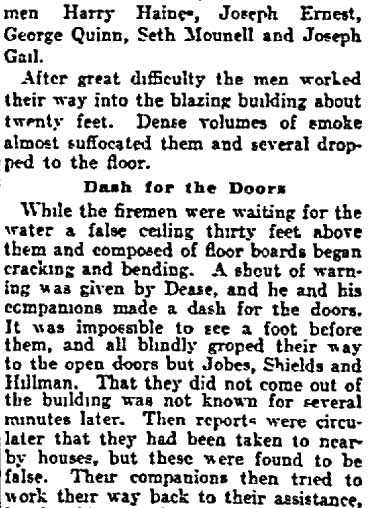
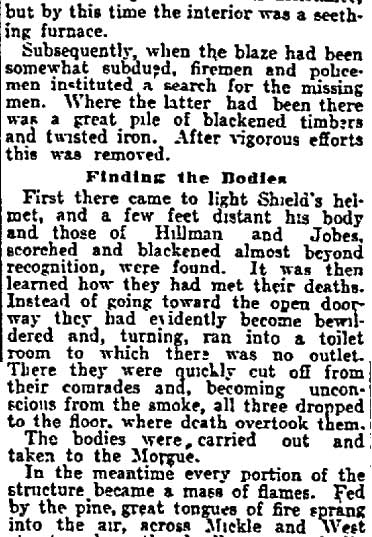
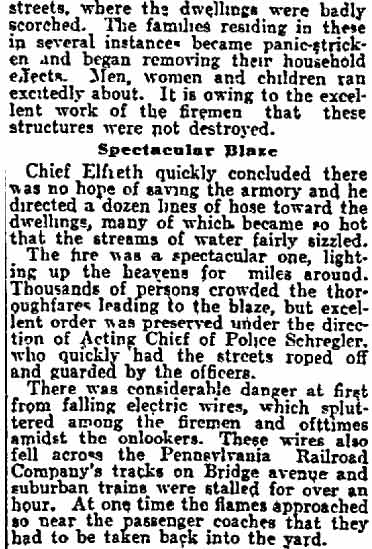
Trapped in Fire at the Old Sixth Regiment Armory They Perished in Flames
NINE OTHER PERSONS RECEIVED INJURIES
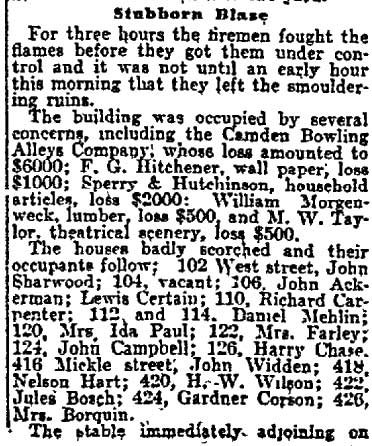
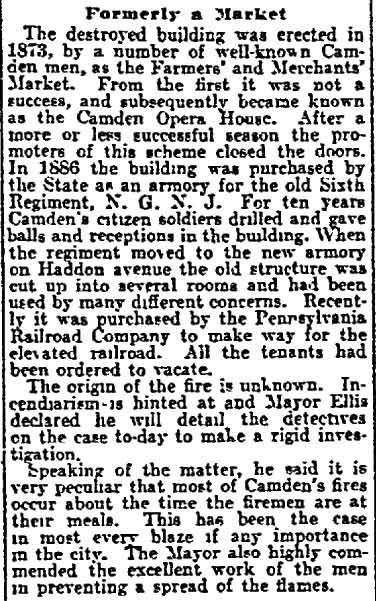
Three firemen were killed and nine persons injured at a fire last night which destroyed the old armory building at Bridge avenue, West and Mickle streets, Camden, causing a loss estimated at $50,000.
The dead firemen are: GEORGE SHIELDS, 525 Kaighn avenue, member of the Kaighn avenue chemical company. WILLIAM HILLMAN, 229 Beckett street, of the Kaighn avenue chemical company. WILLIAM JOBES, 57[?] Line street, member of Engine Company No. 2.
The Injured
The injured, all of whom will recover, are: Josiah Sage, 917 South Eighth street, Kaighn avenue company, cut head and face; Seth Monnell, 744 Mt. Vernon street, Kaighn avenue company, scalp wounds; George Quinn, 516 Line street, Kaighn avenue company, cut face; Martin Carrigan, 516 Clinton street, Engine Company No. 1, lacerated face and hands; J. W. Simpson, 551 Cedar street, Engine Company No. 2, lacerations of scalp and face; James Elberson, 628 North Fourth street, Engine Company No. 4, contused wounds of the legs; William Elberson, 231 Taylor avenue, Engine Company No. 2, injured about the back; Charles Worthington, 1017 Penn street, Engine Company No. 3, internally injured; Harry Dease, a citizen, cut about the face.
The six o’clock whistles were blowing when smoke was seen issuing from the northeast corner of the building. A moment later two boys ran out of a door, one of whom notified Policeman Isaac Toy that the structure was on fire. The officers immediately turned in an alarm. In rapid succession other alarms were given, until the entire department was on the scene.
One of the first companies to arrive was the Kaighn avenue truck. As the men drove up to the scene great tongues of flame were fast eating their way through the yellow pine timbers of which the interior was constructed. The main doors at the entrance on Mickle street were burst open and the firemen entered amid a perfect shower of sparks and falling debris. In this party were the three ill-fated firemen, Dease, and Firemen Harry Haines, Joseph Ernest, George Quinn, Seth Mounell and Joseph Gail.
After great difficulty the men worked their way into the blazing building about twenty feet. Dense volumes of smoke almost suffocated them and several dropped to the floor.
Dash for the Doors
While the firemen were waiting for the water a false ceiling thirty feet above them and composed of floor boards began cracking and bending. A shout of warning was given by Dease, and he and his companions made a dash for the doors. It was impossible to see a foot before them, and all blindly groped their way to the open doors but Jobes, Shields and Hillman. That they did not come out of the building was not known for several minutes later. Then reports were circulated that they had been taken to nearby houses, but these were found to be false. Their companions then tried to work their way back to their assistance, but by this time the interior was a seething furnace.
Subsequently, when the blaze had been somewhat subdued, firemen and policemen instituted a search for the missing men. Where the latter had been there was a great pile of blackened timbers and twisted iron. After vigorous efforts this was removed.
Finding the Bodies
First there came to light Shield’s helmet, and a few feet distant his body and those of Hillman and Jobes, scorched and blackened almost beyond recognition, were found. It was then learned how they had met their deaths. Instead of going toward the open doorway they had evidently become bewildered and, turning, ran into a toilet room to which there was no outlet. There they were quickly cut off from their comrades and, becoming unconscious from the smoke, all three dropped to the floor, where death overtook them.
The bodies were carried out and taken to the Morgue.
In the meantime every portion of the structure became a mass of flames. Fed by the pine, great tongues of fire sprang into the air, across Mickle and West streets, where the dwellings were badly scorched. The families residing in these in several instances became panic-stricken and began removing their household effects. Men, women and children ran excitedly about. It is owing to the excellent work of the firemen that these structures were not destroyed.
Spectacular Blaze
Chief Elfieth quickly concluded there was no hope of saving the armory and he directed a dozen lines of hose toward the dwellings, many of which became so hot that the streams of water fairly sizzled.
The fire was a spectacular one, lighting up the heavens for miles around. Thousands of persons crowded the thoroughfares leading to the blaze, but excellent order was preserved under the direction of Acting Chief of Police Schregler, who quickly had the streets roped off and guarded by the officers.
There was considerable danger at first from falling electric wires, which spluttered among the firemen and ofttimes amidst the onlookers. These wires also fell across the Pennsylvania Railroad Company’s tracks on Bridge avenue and suburban trains were stalled for over an hour. At one time the flames approached so near the passenger coaches that they had to be taken back into the yard.
Stubborn Blaze
For three hours the firemen fought the flames before they got them under control and it was not until an early hour this morning that they left the smouldering ruins.
The building was occupied by several concerns, including the Camden Bowling Alleys Company; whose loss amounted to $6000; F. G. Hitchener, wall paper; loss $1000; Sperry & Hutchinson, household articles, loss $2000; William Morgenweck, lumber, loss $500, and M. W. Taylor, theatrical scenery, loss $500.
The houses badly scorched and their occupants follow; 102 West street, John Sharwood; 104, vacant; 106, John Ackerman; Lewis Certain; 110, Richard Carpenter; 112, and 114. Daniel Mehlin; 120, Mrs. Ida Paul; 122, Mrs. Farley; 124, John Campbell; 126, Harry Chase. 416 Mickle street, John Widden; 418, Nelson Hart; 420, H.-W. Wilson; 422, Jules Bosch; 424, Gardner Corson; 426, Mrs. Borquin.
The stable immediately adjoining on the west side of the armory, and belonging to C. M. Alcott, was flooded with water. At this place there were forty horses, all of which were rescued.
Formerly a Market
The destroyed building was erected in 1873, by a number of well-known Camden men, as the Farmers’ and Merchants’ Market. From the first it was not a success, and subsequently became known as the Camden Opera House. After a more or less successful season the promoters of this scheme closed the doors. In 1886 the building was purchased by the State as an armory for the old Sixth Regiment, N. G. N. J. For ten years Camden’s citizen soldiers drilled and gave balls and receptions in the building. When the regiment moved to the new armory on Haddon avenue the old structure was cut up into several rooms and had been used by many different concerns. Recently it was purchased by the Pennsylvania Railroad Company to make way for the elevated railroad. All the tenants had been ordered to vacate.
The origin of the fire is unknown. Incendiarism is hinted at and Mayor Ellis declared he will detail the detectives on the case to-day to make a rigid investigation.
Speaking of the matter, he said it is very peculiar that most of Camden’s fires occur about the time the firemen are at their meals. This has been the case in most every blaze if [sic] any importance in the city. The Mayor also highly commended the excellent work of the men in preventing a spread of the flames.
World War I Registration Card and Registrar’s Report
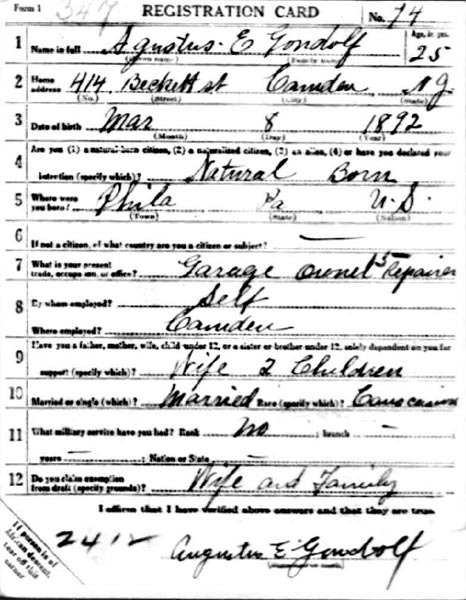
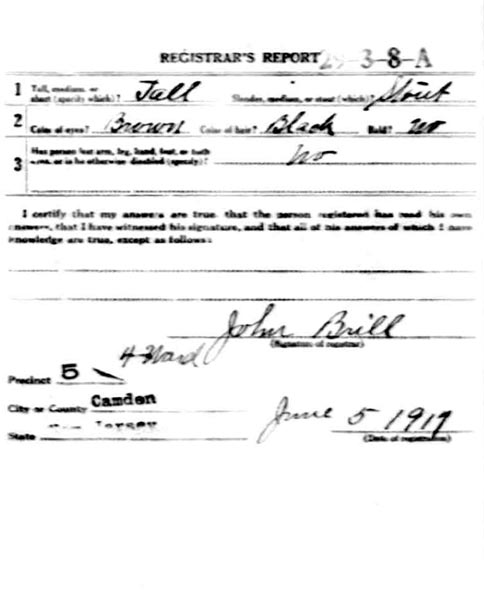
Form 1 [pencil: 347] REGISTRATION CARD No. 74
1. Name in full: Augustus E Gondolf. Age, in yrs.: 25
2. Home address: 414 Beckett st, Camden, N J
3. Date of birth: Mar 8 1892
4. Are you (1) a natural-born citizen, (2) a naturalized citizen, (3) an alien, (4) or have you declared your intention (specify which)? Natural Born
5. Where were you born? Phila, Pa, U.S.
6. If not a citizen, of what country are you a citizen or subject? —
7. What is your present trade, occupation, or office? Garage Owner & Repair[?]
8. By whom employed? Self. Where employed? Camden
9. Have you a father, mother, wife, child under 12, or a sister or brother under 12, solely dependent on you for support (specify which)? Wife 2 Children
10. Married or single (which)? Married. Race (specify which)? Caucasian
11. What military service have you had? Rank: No. Branch: —. Years: —. Nation or State: —
12. Do you claim exemption from draft (specify grounds)? Wife and Family
I affirm that I have verified above answers and that they are true.
2412 Augustus E Gondolf
REGISTRAR’S REPORT [stamped: 2?-3-8-A]
1. Tall, medium, or short (specify which)? Tall. Slender, medium, or stout (which)? Stout
2. Color of eyes? Brown. Color of hair? Black. Bald? [?]
3. Has person lost arm, leg, hand, foot, or both eyes, or is he otherwise disabled (specify)? No
I certify that my answers are true, that the person registered has read his own answers, that I have witnessed his signature, and that all of his answers of which I have knowledge are true, except as follows:
John Brill, Signature of registrar. 4 Ward. Precinct 5. City or County: Camden. State: New Jersey [partly cut off]. June 5 1917, Date of registration