Introduction
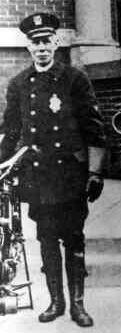
Charles Jefferson “Jeff” Kay
CHARLES JEFFERSON ‘JEFF’ KAY was born in Camden in October of 1860 to Isaac B. and Rebecca Kay. The 1880 census shows him living at 627 South 6th Street, the home of his parents, and working as an upholster. Also home was older brother Harry Kay, and two younger sisters, Mary and Violetta.
Directories from 1883 through 1885 all show Charles J. Kay living with his family at 317 Arch Street, working as a driver. Charles J. Kay turns up in the 1887–1888 and 1888–1889 Camden City Directory. He was then a teamster, and living at 444 Pine Street. He shows up in the 1890–1891 directory as a driver, basically the same thing, living at 921 Lawrence Street. The 1893–1894 City Directory shows him living at 325 Cole Street. The 1894–1895 City Directory shows him at 323 Cole Street, working as a fireman. Charles J. Kay joined the Camden Police Department in 1895. He was still living at 323 Cole in the 1896 Directory. The 1897 Camden City Directory lists Charles J. Kay at 324 North 3rd Street. He was living at 306 Linden Street when the 1898 City Directory was compiled. The directory for 1899 shows him living at 217 Linden Street.
By June 6, 1900 he was renting a home at 217 Linden Street with his wife of fourteen years, Elizabeth, and their two children, Violetta and Harry.
By 1906 he had moved to 204 Elm Street in North Camden. When the census was enumerated in 1910 he was living with his wife Elizabeth and 14-year old son Harry A. Kay, still at 204 Elm Street. Despite his age, he became one of Camden’s first motorcycle policemen. The Kay family was still at 204 Elm Street in 1914.
By 1920 he had been promoted to Sergeant, and was living at 606 North 4th Street. His son, who had married, was then working as a shipyard electrician. He was still on the force and living on North 4th Street in April of 1930. He was Sergeant and still on the motorcycle squad as late as October of 1931. Sergeant Kay retired from the police department in 1935 after having served the City of Camden for 40 years. He was 75 years old when he finally turned in his badge.
Elizabeth Kay died in August of 1940. After an illness of ten days, Charles Jefferson Kay joined his wife on March 27, 1941 and was buried at Calvary Cemetery, survived by his son and daughter and three grandchildren.
"Charles Berry's Funeral"
Camden Post —
Charles Berry's Funeral.
The funeral of Charles G. Berry, one of the bravest and most popular firemen in this city, took place at 2 o'clock this afternoon from his late residence at 226 Point street.
The firemen attended the funeral in a body, and the members of the First Ward Republican Club were represented in a large body, while Mayor Westcott, Councilman Robert Smith, George Barrett, and many other prominent men of this city viewed the body.
Rev. A. G. Lawson of the North Baptist Church preached the funeral sermon, after which the body was taken to Philadelphia where it was interred in Glenwood Cemetery. The body lay in a black cloth covered casket and was dressed in his fireman's uniform with the cap lying on the breast.
A profusion of floral offerings lay around the coffin. Among these were a pillow with the words “Comrades of No. 4,” a fireman's hat from No. 4 Company, cut flowers from Jesse Conley, a design of white roses from James Dunn and Joseph Love, two of his closest friends, a pillow from his family a handsome design from the Republican League and lilies from Councilman Smith.
The pall bearers were Chief Samuel Elfreth, of the Fire Department; Foreman Amadee Middleton, of No. 4; Engineer Frank Turner and Edward Hartman, Walter Browning, Robert Sheer, William Bogia and Charles Kay, all members of the Fire Department.
All the friends of the deceased accompanied the body to the ferry and there left the pall-bearers and family with his Philadelphia friends, who took the body to the cemetery.
Mr. Charles Berry was born in Philadelphia, in 1854. He graduated from the Friends' Central School and attended the Chester Military Academy. When he left school he went with John Mundell, the shoe manufacturer of Philadelphia, and became foreman of Mr. Mundell's extensive works. Ten years ago he came to Camden and was foreman of George Martin's shoe factory, and from there he went to Deitrich's place, on Market street, where he held a similar position, which he gave up to enter the fire department. He has been a fireman for three years, and was known as one of the bravest and best men in the department.
Fire Commissioners.
Camden Daily Telegram —
Fire Commissioners.
Appointments Made as Provided for by Ordinance.
At a meeting of the Board of Fire Commissioners of City Council on Tuesday night James Baird was awarded the contract for supplying the department with two horses at $400.
The Commissioners made the following appointments, in conformity with a recent ordinance: First ward, Joseph Logue; Second ward, William Patterson; Third ward, George Cox; Fourth ward, David Andrews; Fifth ward, Joseph Dold; Sixth ward, William Jobes; Seventh ward, William O. Sawyer; Eighth ward, Albert James; Ninth ward, Samuel Curriden.
Four of the above appointments are to be assigned to the new chemical engine, and one man is to be assigned to each of the five companies. By this arrangement the extra men are dispensed with. James Elberson, of the First ward, was appointed to fill the vacancy caused by the resignation of Charles Kay, who was appointed to the police force to succeed Elberson.
Police Almost Got Cool Bath
Camden Daily Courier —
POLICE ALMOST GOT COOL BATH
Someone Pulled Plug Out of a Chute-the-Chute Boat
FEARED A DUCKING IN LAGOON
Policemen “Al” Snow, “Jack” Brothers, “Tommie” Reed, “Tommie” Murphy and “Jeff” Kay, who acted as an escort to the youngsters of this city on their annual outing as guests of William J. Thompson, at Washington Park, yesterday, had rather an exciting experience. Snow and Brothers especially were for a time in a fair way of taking an involuntary plunge into the lagoon at the foot of the chute-the-chute affair.
After the children had been carefully looked after the bluecoats concluded to have a little pleasure on their own hook.
“Let’s try the chutes,” suggested Reed.
“Agreed,” said the other four in unison.
In a short time the quartet of coppers were being taken up on the elevator to the top of the tower. Then down the slide they went in the usual hurried manner. As soon as the water in the lagoon was encountered “Jack” Brothers felt something on his back. A hasty glance revealed the fact that there was a small sized geyser issuing from a hole in the flat bottomed scow. The plug had been removed and through the two inch aperture the water was rushing in at a great rate. In fact the ungainly craft began filling. The chap at the end who acted as sculler went toward shore, when Kay, Reed and Murphy jumped out onto the wharf.
Then, with Snow and Brothers still aboard, the scow drifted toward the middle of the place. All the time the water was entering and when it had reached the seats the sculler jumped overboard, leaving “Jack” and “Al” in the lurch.
“No, you don’t; you come back here,” commanded “Jack” to the oarsman.
The latter, thinking the officer was going to shoot, climbed back into the scow and then sculled to the wharf, when the two hopped ashore.
They are wondering as to who was responsible for the removal of the plug.
Camden Trolley Car Hit Motor Cyclist
Philadelphia Inquirer —
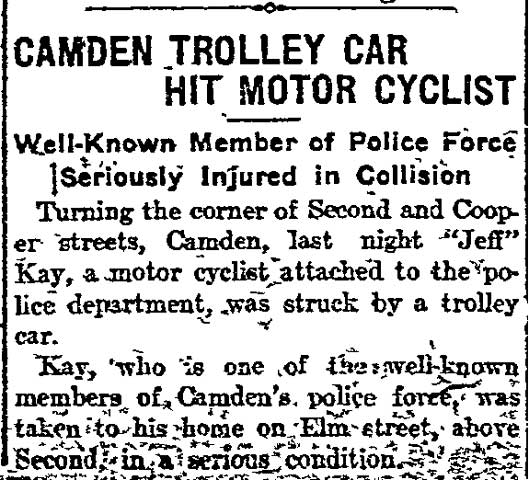
Philadelphia Inquirer, October 23, 1909
Risks Life to Save Boy
Wilkes-Barre Times —
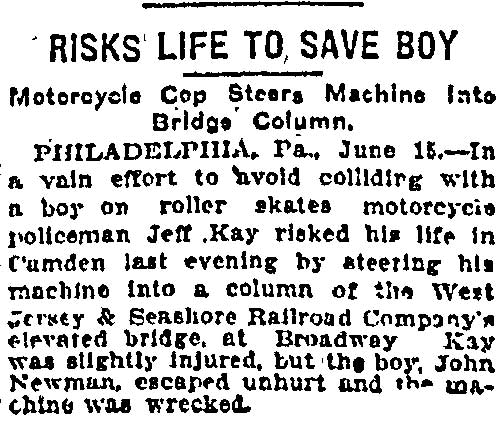
Wilkes-Barre, Pennsylvania Times, June 15, 1910
Jack Johnson Is Stopped in Camden
Trenton Times —
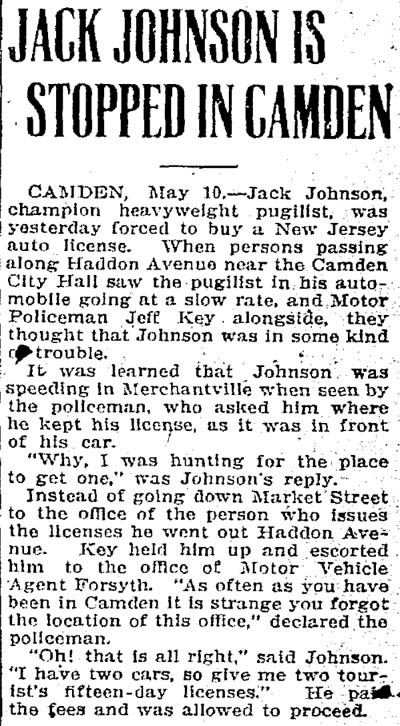
JACK JOHNSON IS STOPPED IN CAMDEN
CAMDEN, May 10.—Jack Johnson, champion heavyweight pugilist, was yesterday forced to buy a New Jersey auto license. When persons passing along Haddon Avenue near the Camden City Hall saw the pugilist in his automobile going at a slow rate, and Motor Policeman Jeff Kay alongside, they thought that Johnson was in some kind of trouble.
It was learned that Johnson was speeding in Merchantville when seen by the policeman, who asked him where he kept his license, as it was in front of his car.
“Why, I was hunting for the place to get one,” was Johnson’s reply.
Instead of going down Market Street to the office of the person who issues the licenses he went out Haddon Avenue. Kay held him up and escorted him to the office of Motor Vehicle Agent Forsyth. “As often as you have been in Camden it is strange you forgot the location of this office,” declared the policeman.
“Oh! that is all right,” said Johnson. “I have two cars, so give me two tourist’s fifteen-day licenses.” He paid the fees and was allowed to proceed.
Speedy Ride in Jersey
Philadelphia Inquirer —
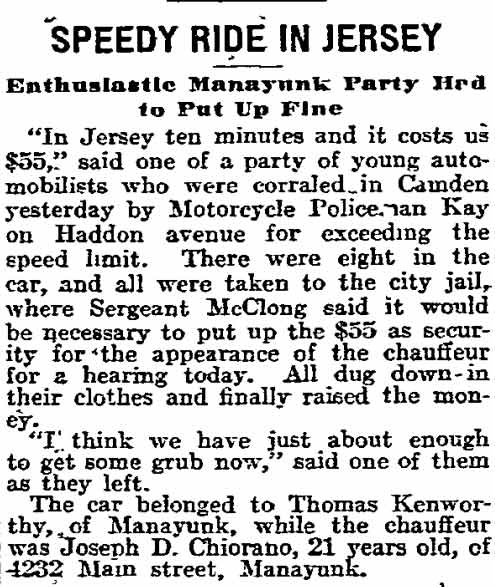
Named: Jeff Kay, Elbridge B. McClong, Haddon Avenue, Thomas Kenworthy, and Joseph Chiorano.
Wanamaker Fined $25 for Speeding in Jersey
Philadelphia Inquirer —

Jeff Kay – O. Glenn Stackhouse
Boy’s Brutal Murderer Collapses at Hearing
Camden Post-Telegram —
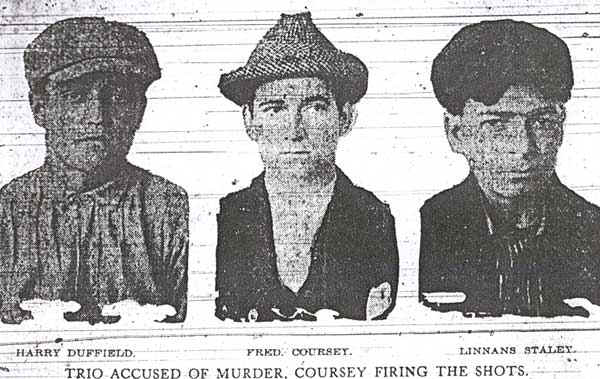
TRIO ACCUSED OF MURDER. COURSEY FIRING THE SHOTS.
Coursey Breaks Down While Story of Cold-Blooded Killing of Karl Kellman Is Told by Detective.
TWO “PALS,” TOO, ACCUSED OF CRIME
Collapsing when arraigned in Police Court this morning before Recorder Stackhouse on the charge of killing Karl Kellmann, aged 18 years, of 2919 High street, at Twenty-seventh and Sherman streets, shortly before midnight Saturday, Fred Coursey, alias “Mexican Pete,” alias “Cowboy Pete,” aged 20 years, of 121 North Twenty-first street, who admits firing the fatal shots while committing robbery, and Harry Duffield, aged 21 years, of 407 North Forty-first street, who acknowledged masking his face with a handkerchief and being with Coursey, sobbed piteously, resting their heads on the railing of the dock, while John Painter, the veteran detective, was briefly reciting the story.
When Recorder Stackhouse asked what became of the young man who was shot and Painter replied that he died, Coursey and Duffield sobbed afresh, and when Recorder Stackhouse committed them without bail Policemen Frost and Kay had to help them.
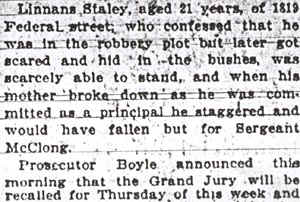
Linnans Staley, aged 21 years, of 1819 Federal street, who confessed that he was in the robbery plot but later got scared and hid in the bushes, was scarcely able to stand, and when his mother broke down as he was committed as a principal he staggered and would have fallen but for Sergeant McClong.
Prosecutor Boyle announced this morning that the Grand Jury will be recalled for Thursday of this week and the case will be made the special order of the day.
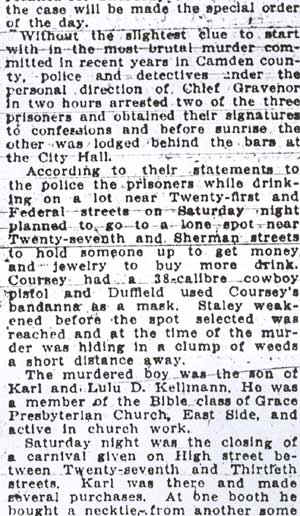
Without the slightest clue to start with in the most brutal murder committed in recent years in Camden county, police and detectives under the personal direction of Chief Gravenor in two hours arrested two of the three prisoners and obtained their signatures to confessions and before sunrise the other was lodged behind the bars at the City Hall.
According to their statements to the police the prisoners while drinking on a lot near Twenty-first and Federal streets on Saturday night planned to go to a lone spot near Twenty-seventh and Sherman streets to hold someone up to get money and jewelry to buy more drink. Coursey had a 38-calibre cowboy pistol and Duffield used Coursey’s bandanna as a mask. Staley weakened before the spot selected was reached and at the time of the murder was hiding in a clump of weeds a short distance away.
The murdered boy was the son of Karl and Lulu D. Kellmann. He was a member of the Bible class of Grace Presbyterian Church, East Side, and active in church work.
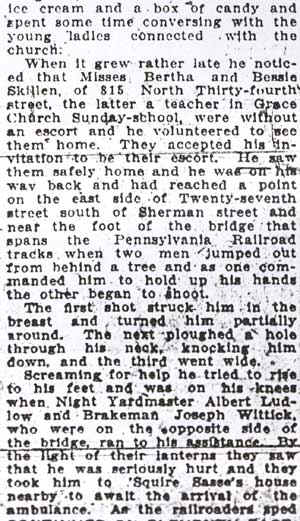
Saturday night was the closing of a carnival given on High street between Twenty-seventh and Thirtieth streets. Karl was there and made several purchases. At one booth he bought a necktie, from another some ice cream and a box of candy and spent some time conversing with the young ladies connected with the church.
When it grew rather late he noticed that Misses Bertha and Bessie Skillen, of 815 North Thirty-fourth street, the latter a teacher in Grace Church Sunday-school, were without an escort and he volunteered to see them home. They accepted his invitation to be their escort. He saw them safely home and he was on his way back and had reached a point on the east side of Twenty-seventh street south of Sherman street and near the foot of the bridge that spans the Pennsylvania Railroad tracks when two men jumped out from behind a tree and as one commanded him to hold up his hands the other began to shoot.
The first shot struck him in the breast and turned him partially around. The next ploughed a hole through his neck, knocking him down, and the third went wide.
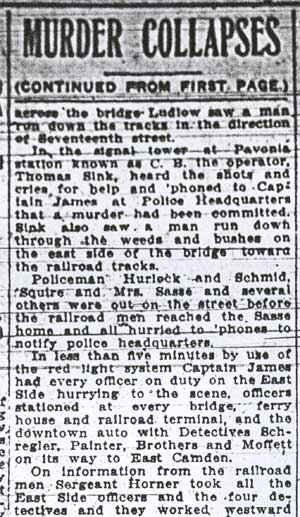
Screaming for help he tried to rise to his feet and was on his knees when Night Yardmaster Albert Ludlow and Brakeman Joseph Wittick, who were on the opposite side of the bridge, ran to his assistance. By the light of their lanterns they saw that he was seriously hurt and they took him to ’Squire Sasse’s house nearby to await the arrival of the ambulance. As the railroaders sped across the bridge Ludlow saw a man run down the tracks in the direction of Seventeenth street.
In the signal tower at Pavonia station known as C. B. the operator, Thomas Sink, heard the shots and cries for help and ’phoned to Captain James at Police Headquarters that a murder had been committed. Sink also saw a man run down through the weeds and bushes on the east side of the bridge toward the railroad tracks.
Policeman Hurlock and Schmid, ‘Squire and Mrs. Sasse and several others were out on the street before the railroad men reached the Sasse home and all hurried to ’phones to notify police headquarters.
In less than five minutes by use of the red light system Captain James had every officer on duty on the East Side hurrying to the scene, officers stationed at every bridge, ferry house and railroad terminal, and the downtown auto with Detectives Schregler, Painter, Brothers and Moffett on its way to East Camden.
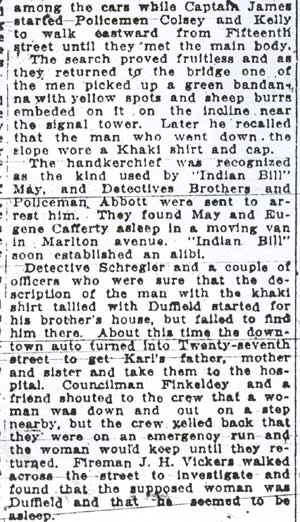
On information from the railroad men Sergeant Horner took all the East Side officers and the four detectives and they worked westward among the cars while Captain James started Policemen Colsey and Kelly to walk eastward from Fifteenth street until they met the main body.
The search proved fruitless and as they returned to the bridge one of the men picked up a green bandanna with yellow spots and sheep burrs embedded on it on the incline near the signal tower. Later he recalled that the man who went down the slope wore a Khaki shirt and cap.
The handkerchief was recognized as the kind used by “Indian Bill” May, and Detectives Brothers and Policeman Abbott were sent to arrest him. They found May and Eugene Cafferty asleep in a moving van in Marlton avenue. “Indian Bill” soon established an alibi.
Detective Schregler and a couple of officers who were sure that the description of the man with the khaki shirt tallied with Duffield started for his brother’s house, but failed to find him there. About this time the downtown auto turned into Twenty-seventh street to get Karl’s father, mother and sister and take them to the hospital. Councilman Finkeldey and a friend shouted to the crew that a woman was down and out on a step nearby, but the crew yelled back that they were on an emergency run and the woman would keep until they returned. Fireman J. H. Vickers walked across the street to investigate and found that the supposed woman was Duffield and that he seemed to be asleep.
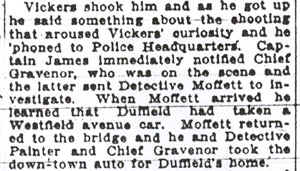
Vickers shook him and as he got up he said something about the shooting that aroused Vickers’ curiosity and he ’phoned to Police Headquarters. Captain James immediately notified Chief Gravenor, who was on the scene and the latter sent Detective Moffett to investigate. When Moffett arrived he learned that Duffield had taken a Westfield avenue car. Moffett returned to the bridge and he and Detective Painter and Chief Gravenor took the down-town auto for Duffield’s home.
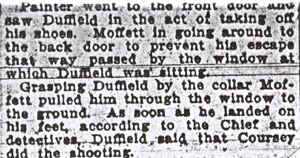
Painter went to the front door and saw Duffield in the act of taking off his shoes. Moffett in going around to the back door to prevent his escape that way passed by the window at which Duffield was sitting.
Grasping Duffield by the collar Moffett pulled him through the window to the ground. As soon as he landed on his feet, according to the Chief and detectives, Duffield said that Coursey did the shooting.
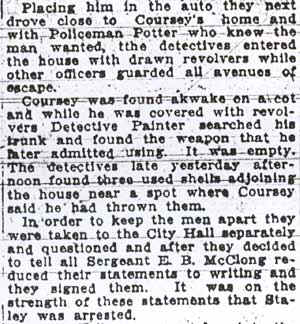
Placing him in the auto they next drove close to Coursey’s home and with Policeman Potter who knew the man wanted, the detectives entered the house with drawn revolvers while other officers guarded all avenues of escape.
Coursey was found awake on a cot and while he was covered with revolvers Detective Painter searched his trunk and found the weapon that he later admitted using. It was empty. The detectives late yesterday afternoon found three used shells adjoining the house near a spot where Coursey said he had thrown them.
In order to keep the men apart they were taken to the City Hall separately and questioned and after they decided to tell all Sergeant E. B. McClong reduced their statements to writing and they signed them. It was on the strength of these statements that Staley was arrested.
Young Kellmann was taken into the hospital at 12.20 a. m. Chief Surgeon Schellenger saw at a glance that there was no hope for him and so notified Captain James, and Sergeant McClong was sent to the hospital to get all information possible.
The unfortunate youth could only speak a few words at a time because of the hemorrhages. All Sergeant McClong was able to get from him was that he was told to hold up his hands and that the shooting instantly began. The only description he could give was that they were small men and that the attack was so sudden that he could not tell whether they were black or white.
The injured young man kept asking the doctors if he was going to die, but they did not answer. He was conscious when his father and mother arrived and then sank rapidly until the end, dying at 1.50 o’clock, 90 minutes after he was admitted. Mother and father were prostrated and were taken home by the up-town auto.
County Physician Jones conducted the autopsy yesterday morning. He said that either wound would have caused death. The bullet in the breast pierced the right lung at the top and lodged in the cavity. It is now in the doctor’s possession. The other bullet went clear through the neck.
Coursey and Duffield have been working in the Pavonia car yard. The former was born in El Paso, Texas, but has lived East nearly all his life. He is an expert shot and was a member of the vaudeville team of Coursey & Cook, according to their letter heads presenting a fifteen-minute thriller.
Duffield was only recently paroled for robbing Gallagher’s saloon, Nineteenth and Federal streets of a lot of drinkables. Staley has been arrested several times on petty charges but was never convicted of crime. When Duffield’s coat was examined at the City Hall, it was found to contain sheep burrs.
To a reporter Coursey said that whenever he was drinking he had to get his gun and shoot something or somebody. He insisted that all were in on the job and that they let the man who preceded Kellman go over the bridge without molestation because he didn’t look as if he had any too much money.
Yesterday morning Assistant Prosecutor Wolverton and Stenographer Cleary called at the City Hall. The prisoners were examined by Mr. Wolverton and their statements taken by Mr. Cleary, but there was little or nothing new elicited.
Prisoners Wore Stolen Raiment
Camden Post-Telegram —
PRISONERS WORE STOLEN RAIMENT
New Comers at Apartment House Donned Clothes Belonging to Boarder.
POLICE ARRIVED AS COUPLE FLED
In default of $500 bail William Wilkins, aged 39 years, of Danville, Va., and Charles Sampson, aged 33 years, of Cincinnati, were this morning committed by Recorder Stackhouse on charges of larceny.
Representing themselves as contractors the two defendants visited the apartment house of Mrs. Wiltshire, 218 Penn Street, and engaged a room. Yesterday while George Garner, a boarder, was taking a bath his wardrobe was broken into and two suits of clothes were taken. When Garner discovered the theft he instructed another roomer in the house to notify the police.
Wilkins and Sampson were suspected and they were watched. After a short time the two men tried to sneak from the house just as Motorcycle Policemen Kay and Laib reached the front door and stopped them. Each of the defendants wore a suit of Garner’s clothes. They were promptly placed under arrest. Both admitted the thefts before the Recorder this morning.
The two men engaged the room on Saturday. When they were requested to pay in advance they offered the excuse that they desired to fix up the payroll for their workmen and they promised to pay up yesterday. The room to which Wilkins and Sampson were assigned adjoined that occupied by Garner.
"Police Department Changes"
Philadelphia Inquirer —
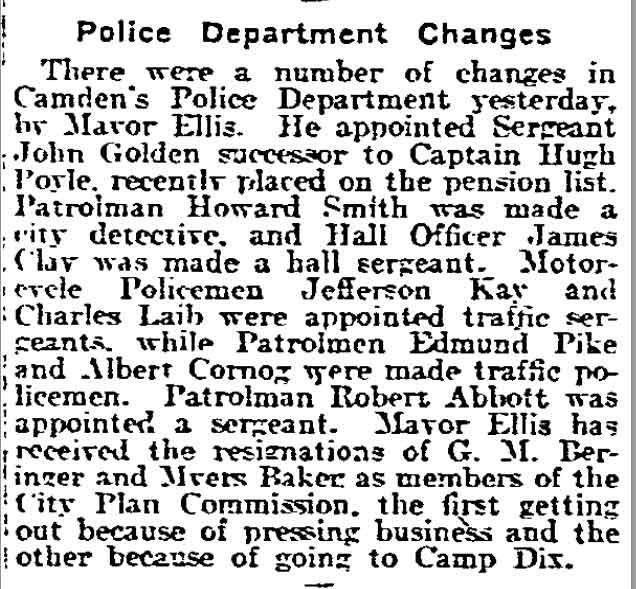
Police Department Changes
There were a number of changes in Camden's Police Department yesterday, by Mayor Ellis. He appointed Sergeant John Golden successor to Captain Hugh Boyle, recently placed on the pension list. Patrolman Howard Smith was made a city detective, and Hall Officer James Clay was made a hall sergeant. Motorcycle Policemen Jefferson Kay and Charles Laib were appointed traffic sergeants, while Patrolmen Edmund Pike and Albert Cornog were made traffic policemen. Patrolman Robert Abbott was appointed a sergeant. Mayor Ellis has received the resignations of G. M. Beringer and Myers Baker as members of the City Plan Commission, the first getting out because of pressing business and the other because of going to Camp Dix.
Camden Motorcycle Police
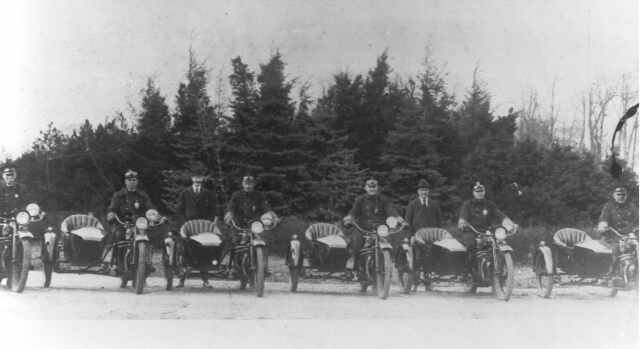
Named: Above: Camden Motorcycle Police, location unknown, around 1920, and at far left, Officer Jeff Kay.
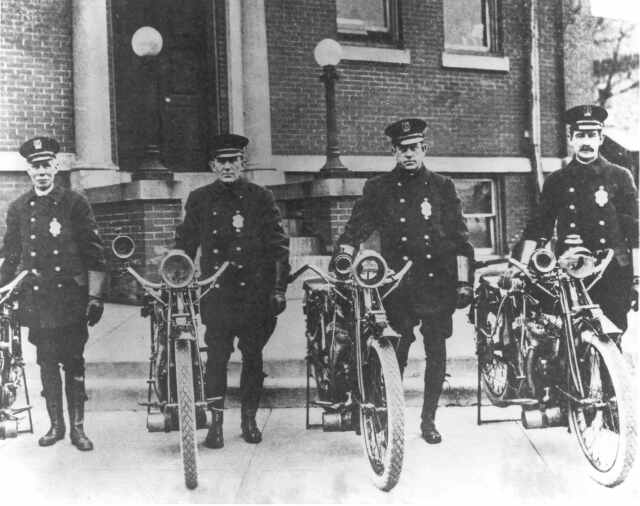
Above: Early photo of Camden Motorcycle Police — 1910s — Charles “Jeff” Kay – Charles Laib – Frank Frost – Josiah Pedigree. Note that Officer Jeff Kay on far left in this photo is also on far left in the picture above.
Camden Motorcycle Police
Circa 1922
Named: From Left: Unknown civilian, Unknown Civilian, Charles J. “Jeff” Kay, George Clayton, unknown civilian in sidecar, Unknown Policeman, and Unknown Policeman.
Police Escort Funeral of Former Chief Hyde
Camden Courier-Post —
A police motorcycle squad under the command of Inspector Humes acted as escort today at the funeral service of Edward S. Hyde, former police chief and a member of the board of freeholders, who died Sunday.
Services took place at the home, 832 Haddon Avenue, and burial was in Harleigh Cemetery. Members of the police detail were Sergeant jefferson kay, patrolmen Thomas Kauffman, William Moll, John Stanton, Thomas Welch and James Wilson.
Hyde was appointed to the police force in April, 1894, and pensioned July, 1923. He succeeded Chief Gravenor when the latter resigned in 1922. Long interested in politics, he was elected freeholder two years ago. He is survived by his widow, Mina B. Hyde, and three daughters, Mrs. Marion Garlan, Mrs. Mary Van Hart and Emma Hyde.
6 Men Are Nabbed as Number Writers
Camden Morning —
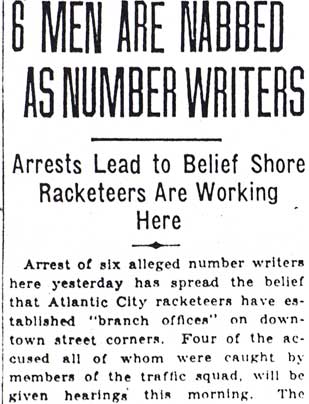
6 MEN ARE NABBED AS NUMBER WRITERS
Arrests Lead to Belief Shore Racketeers Are Working Here
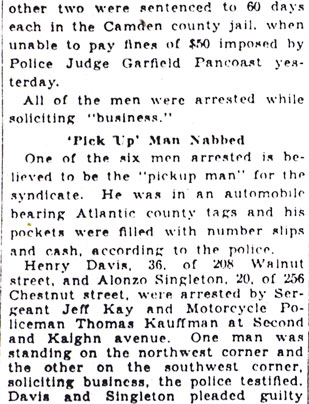
Arrest of six alleged number writers here yesterday has spread the belief that Atlantic City racketeers have established “branch offices” on downtown street corners. Four of the accused all of whom were caught by members of the traffic squad, will be given hearings this morning. The other two were sentenced to 60 days each in the Camden county jail, when unable to pay fines of $50 imposed by Police Judge Garfield Pancoast yesterday.
All of the men were arrested while soliciting “business.”
’Pick Up’ Man Nabbed
One of the six men arrested is believed to be the “pickup man” for the syndicate. He was in an automobile bearing Atlantic county tags and his pockets were filled with number slips and cash, according to the police.
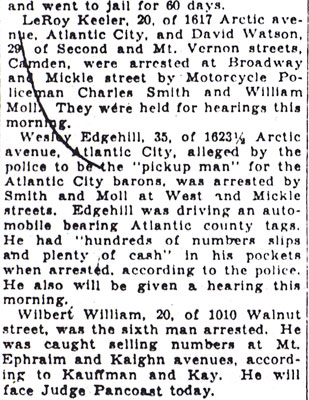
Henry Davis, 36, of 208 Walnut Street, and Alonzo Singleton, 20, of 256 Chestnut Street, were arrested by Sergeant Jeff Kay and Motorcycle Policeman Thomas Kauffman at Second and Kaighn Avenue. One man was standing on the northwest corner and the other on the southwest corner, soliciting business, the police testified. Davis and Singleton pleaded guilty and went to jail for 60 days.
LeRoy Keeler, 20, of 1617 Arctic avenue, Atlantic City, and David Watson, 29, of Second and Mt. Vernon Streets, Camden, were arrested at Broadway and Mickle Street by Motorcycle Policeman Charles Smith and William Moll. They were held for hearings this morning.
Wesley Edgehill, 35, of 1623½ Arctic avenue, Atlantic City, alleged by the police to be the “pickup man” for the Atlantic City barons, was arrested by Smith and Moll at West and Mickle streets. Edgehill was driving an automobile bearing Atlantic county tags. He had “hundreds of numbers slips and plenty of cash” in his pockets when arrested, according to the police. He also will be given a hearing this morning.
Wilbert Williams, 20, of 1010 Walnut Street, was the sixth man arrested. He was caught selling numbers at Mt. Ephraim and Kaighn Avenues, according to Kauffman and Kay. He will face Judge Pancoast today.
PROBE STARTED BY DICKINSON IN RAID 'LEAK'
Camden Evening Courier —
PROBE STARTED BY DICKINSON IN RAID ‘LEAK’
Men Fled $250,000 Still Before Cops Arrived, Deputy Learns
Baldwin Gave Clue to Giant Plant
Vast Amount of Rum Supplies Seized in North Camden
Major Charles V. Dickinson, deputy director of public safety, today started an investigation to ascertain how plans for a raid on a $250,000 North Camden distilling plant leaked out more than an hour before the raid was made late yesterday afternoon.
The inquiry to locate the “leak” was prompted by rumors that neighbors saw employes of the distillery running from the plant at Ninth and State streets an hour and 20 minutes before detectives and the police raided it. Major Dickinson, however, insists he and Lieut. George Ward were the only persons in the police department who knew the location of the plant prior to the raid.
Police believe the distillery to be one of a chain of such places operated throughout this state with headquarters in Newark.
The raid was the result of an investigation made by Prosecutor Clifford A. Baldwin after he had heard rumors a large distilling plant was being operated in North Camden. Baldwin assigned Lawrence T. Doran, chief of county detectives, and other county detectives, to make a survey, and men were stationed near the plant.
Baldwin Orders Raid
When Chief Doran reported the results of the survey to Baldwin the prosecutor immediately notified Major Dickinson and ordered him to make the raid. Dickinson called in Lieutenant Ward and plans were made for descending on the plant.
A squad of detectives and patrolmen, led by Dickinson, raided the plant a few minutes before 4 p.m. It was the third raid on the plant within two years, Lieutenant Ward having seized a 1500-gallon still there on March 25, 1929, and federal prohibition agents confiscating $100,000 worth of alcohol distilling equipment about 18 months ago.
“If there was a leak, and if the employes and operators were tipped off, I would like to know how it happened,” Major Dickinson said today. “As soon as I heard of this distilling plant I called Lieutenant Ward into my office and we made arrangements and completed plans to raid the place immediately. The plans, however, were not completed until 3 p.m. about an hour after I was notified of the existence of the plant.”
“All arrangements were made by telephone and there could not have been anyone, to my knowledge, who knew the plans. Detectives and patrolmen were told to assemble at the First District police station. They were not told where they were going or what for. Ward and myself were the only ones in the police department who knew the location of the plant.”
Alcohol Seized
The raiders seized 915 gallons of alcohol in 53 five-gallon cans and 12 50-gallon drums, 1500 pounds of brown sugar, 400,000 gallons of mash, 12 bags of white powder and one bale of hops.
Five steel tanks, each of 80,000 gallons capacity, two stills of 50,000 gallons capacity each, one 3000-gallon still, several large wooden tanks, thousands of feet of piping and coiling equipment were found in the plant. The steel tanks had been built in, a section of one floor having been removed to make room. The plant was located on four floors, the fermentation tanks being on the top floors and pipes arranged so that the products could be “worked down” to the first floor tanks where the alcohol was put in five-gallon cans for shipping.
Baldwin called the plant the largest illicit distillery in the United States and said he believed it to be operated by a big liquor ring. He believed it took several months to install the extensive equipment, which was new. An elaborate system of signal alarms, secret telephones, tunnels for hurried exits and arrangements for lookouts two blocks from the plant were found.
All of the equipment, as well as supplies for the plant, were taken there by boat, Baldwin believes. Arrangements had been made for emptying the mash into Cooper River. The entire plant was surrounded by a high fence.
Plant in Use 10 Days
Dickinson said he believed the plant had been in operation not more than 10 days as the valves, turnhandles, spigots and brass work showed little signs of wear. Preparations had been made against a possible raid. Dickinson learned after visiting the plant, as the names on shipping labels had been torn so they were not readable. Tar paper had been placed over the window. Names had been removed from the lunch boxes of workmen.
Large packing boxes such as used for the shipment of radio and phonograph sets were used to hide the machinery and also for shipping the cans of alcohol.
The stills and steel tanks were dismantled by acetylene torches, the mash and chemicals were dumped in Cooper river and the alcohol was taken to city hall. The alcohol probably will be turned over to hospitals and charitable institutions.
Lessors Sought
Dickinson and Baldwin are making surveys today to ascertain, if possible, who leased the building. Nearby plant owners and neighbors will be questioned.
The building for many years was headquarters of the old Highland Worsted Mills and extends from Ninth street to the Cooper river; on State street, and runs back about a half square to Moore street.
Yesterday the buildings were empty when the big squad of cops swarmed into the place. The lunch baskets of several employes were found on tables in the room and there were other evidences of a hasty exit having taken place. There were rumors that a “tip off” had been given the men in the building, and it was reported they were seen to rush from the building a few minutes before the arrival of the raiders.
Owners Escape
The raid, observers recalled, bears every indication of paralleling that on Chestnut street, near the second district police station, on October 22 when a $200,000 distillery was uncovered. Of nine men arrested there, six were fined $300 each and three were dismissed yesterday. Their attorney declared the men were merely employes and that the “owners have skipped out, leaving these men in the middle.”
Neighbors stated they had smelled peculiar odors in the vicinity for several weeks past but were unable to establish the location of the still until it was uncovered by yesterday’s raid. The raid also brought to climax a series of reports that have been in circulation for several weeks that there was a bigger still in operation in Camden than the one found on Chestnut street.
The raiders entered the building through a tunnel on the banks of Cooper river. The tunnel ended under the building with a trapdoor giving ingress to the basement of the distillery.
None of the stills was in operation. Warm storage tanks containing mash indicated that two stills had been in operation recently. Three huge storage tanks reaching to the third floor had a total capacity of 240,000 gallons. It is estimated that the distillery had an output of about 500,000 gallons of alcohol per day.
On the same factory site is a building now occupied by the Joseph A. Middlebrook Company, Inc., wool washers. The building occupied by the distillery is separated from the Middlebrook Company by a roadway.
An official of the Middlebrook Company said he had seen no activity in or about the building opposite, but declared it was leased by Joseph A. Madison of Philadelphia, agent for the owner.
Only three five-gallon cans of alcohol were found when the policemen arrived. Fifty cans were filled from one still by the raiders. The distillery was so enveloped in darkness, with few electric lights, that the raiders were forced to use flashlights in inspecting the five floors and locating equipment.
Stored against the wall on the first floor were 1500 empty five-gallon cans.
A 10-inch pipe line equipped with a force pump runs from the large storage tanks into Cooper river for dumping of residue from mash.
The raiders in addition to Deputy Director Dickinson and Lieutenant Ward included Sergeant Walter Mattison, Sergeant Jeff Kay, Detectives Howard Smith, Alfred Shires, Harry Kyler, Archie Reese, and Patrolmen Walter Smith, Alfred Shires, Harry Cattell, Earl Rider, Charles Smith, a second patrolman of the same name, John Toll, John Taylor, Frank Carle and Oscar Thompson.
Wilkie Threatened by Eight Men in Auto
Camden Courier-Post —
Search for a maroon-colored touring car believed by John V. Wilkie, Camden’s “notebook cop,” to contain eight beer runners was made yesterday after Wilkie had been threatened by an occupant of the automobile while in his traffic booth at Baird and Wilson boulevards.
The car containing the eight men, three in the front and five in the rear, was proceeding northwest on Admiral Wilson boulevard when one of the occupants uttered the threat against Wilkie.
“Come on out and fight; you ____” the stranger shouted. Wilkie said he placed the light at amber and sought to learn the license number of the automobile. The plates however, were indistinguishable, he said, or had been either smeared or turned around to be unrecognizable.
Wilkie said he reported to police headquarters and that Major Charles V. Dickinson, deputy director of public safety, and Motorcycle Police Sergeant Jeff Kay and Policeman Nathan Wine searched and waited for hours for the return of the mysterious car without avail.
5 Camden Police Granted Pensions
Camden Courier-Post —
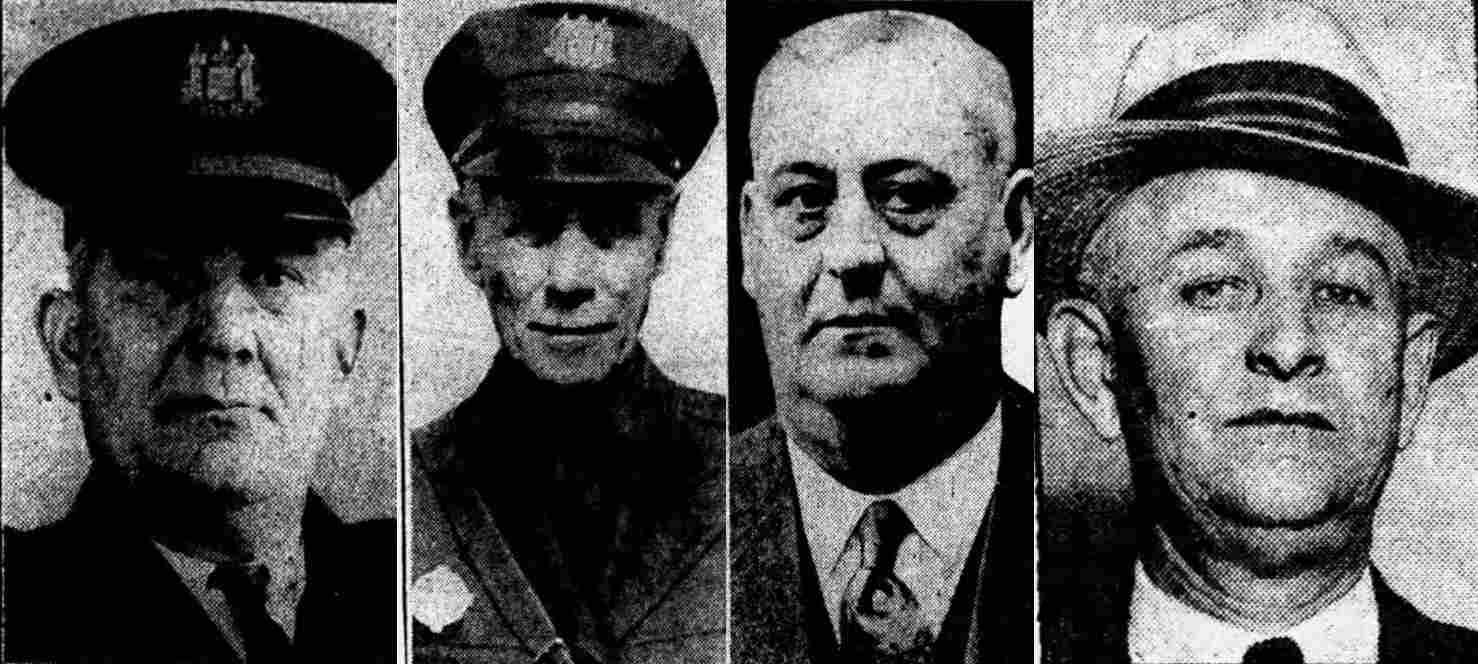
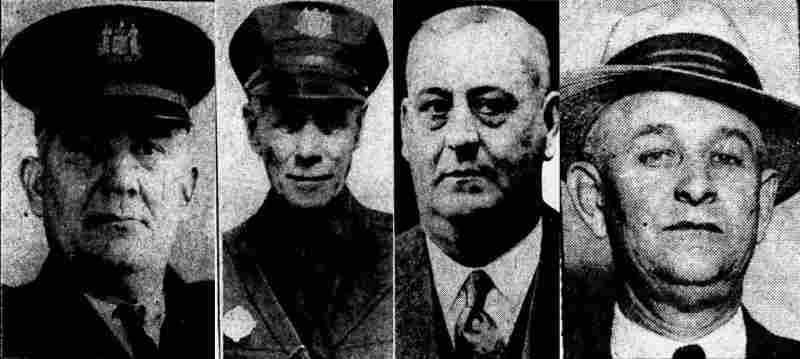

5 CAMDEN POLICE GRANTED PENSIONS
Laib, Kay, Guthrie, Smith and Till to Be Retired Next Month
Petitions for pensions were granted yesterday to five members of the Camden police department.
The retiring men are: Lieutenant Charles Laib, in charge of the traffic bureau; Sergeant Charles J. “Jeff” Kay, City Detectives Theodore “Dory” Guthrie and Howard Smith, and Patrolman J. Oscar Till.
The retirements are to become effective Jan. 1, it was announced after a special meeting of the pension committee in city hall. Mrs. Louise F. Walsh, secretary of the board, presented the five applications.
Eventual retirement of Lieut. Laib has been rumored in the department for several months, but it was not until recently that the report was regarded seriously. It is understood that his associates as late as yesterday had requested him to remain on duty. He is recognized as one of the most competent officers in the department. Failing health, however, is said to have prompted the pension committee to approve his application.
Successor Not Named
No announcement as to Lieut. Laib’s successor was made by Acting Chief John W. Golden.
Lieutenant Laib was appointed to the police force on January 12, 1912, by former Mayor Charles H. Ellis. He was promoted to sergeant in 1916 and became a lieutenant in 1929. He has been in charge of the traffic detail for a year, succeeding Captain Charles L. Humes, who has been named inspector of personnel.
Laib is but 51 years of age and is one of the youngest men in the department to apply for pension. If his pension is approved he will receive a monthly salary of $102.05. His home is with his wife at 76 South Twenty-fourth Street.
For many years, Laib has been conducting a “one-man” relief organization and is recognized by charitable organizations throughout the city for his generosity among the destitute. At Thanksgiving and Christmas, he personally collects funds for dinners for the children of the Sheltering Arms Home, Seventeenth street and River avenue, and has also been responsible for the home getting a daily supply of bread from a Camden bakery for several years.
Kay Served 38 Years
Sergeant Kay is a veteran member of the police department and has been an officer for 38 years. He is 72 and lives at 606 North Fourth Street. He will receive $90.65 monthly. He has been on the sick list for several months, recovering from injuries received in an accident.
Detective Smith is 58 and lives at 933 Penn Street. For several years he was loaned to the county as a detective and helped in the discovery of Camden county murders. He was recently returned to the police department and Detective Fiore Troncone turned over to the county in his place. He will receive $90.65 a month. He was appointed June 20, 1905.
Detective Guthrie served 19 years as a policeman and two as a fireman. He resides at 570 Chestnut Street. He will receive $92.50 per month, the additional $2 being added because he will not have the usual two per cent deducted for the pension fund.
Patrolman Till, who is 56, resides at North Twenty-fifth Street. He served 19 years as a policeman and two and one-half years as a fireman. He is attached to the Second district. Till will receive $83.60 monthly.
The members of the pension committee who passed on the applications is headed by Mayor Roy R. Stewart and includes, Newton W. Ash, fire department representative; William Michalak, police department representative; John J. Robinson, a citizen member, and Mrs. Walsh.
Dies at 81
Camden Courier-Post —
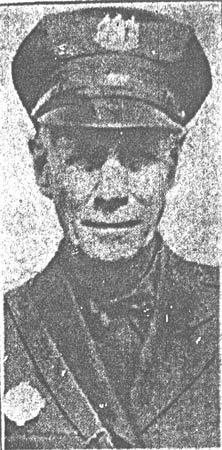
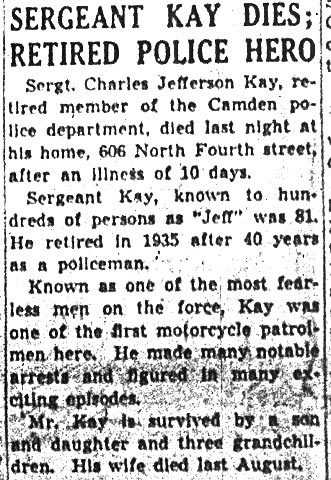
Camden Courier-Post, March 28, 1941 — “Dies at 81”