J. William Simpson
J. William Simpson, who was also known as John William Simpson, was born in Pennsylvania in May of 1855, according to the 1900 Census. His parents were Thomas and Emma Simpson. His father worked as a watchcase maker. J. William Simpson was the oldest of at least six children, coming before Thomas, Rebecca, Elizabeth, Sarah, and Horace.
He married around 1879, and his wife Louisa bore a son, Horace Thomas Simpson, in December of 1880. The family moved to Camden at some point thereafter.
The 1894 City Directory shows J. William Simpson at 621 North 6th Street in North Camden. He was working as a shipping clerk. By the time the next year’s directory was being compiled he had moved to 551 Cedar Street.
J. William Simpson was appointed to the Camden Fire Department on November 23, 1899. From April 19, 1902 to April 30, 1903 he served with Ladder Company 1.
The 1900 Census shows the Simpsons still living at 551 Cedar Street in North Camden. They stayed at that address into 1906. The 1907 City Directory shows that he had moved around the corner to 604 North 6th Street. This would be his address for the rest of his days.
The 1910 Census shows J. William Simpson living at 604 North 6th Street in North Camden with his wife Louisa, son Horace, daughter-in-law Ethel, and his widowed mother, Emma Simpson.
William Simpson was on duty on March 18, 1906 when three of his brother firefighters were killed at the old Sixth Regiment Armory. This incident troubled him through the years. On July 21, 1915 while on duty at Engine Company 4 on Vine Street in North Camden, William Simpson attempted to take his own life. He was prevented in this effort, however he passed away on December 9, 1917.
Could Not Agree on New Fireman
Philadelphia Inquirer —
Camden Councilmen From East Side Split on Selecting Appointees
There Is Also Trouble in the Second Ward — Benjamin Kellum Made Assistant Chief — Other Promotions
The Camden Fire Commissioners last evening selected firemen for the five new fire companies from all the wards except the Second, Eleventh and Twelfth, as the Councilmen in these wards could not agree on the candidates the appointments were laid over until Monday evening next.
In the Second ward the Councilmen have agreed on John W. Vanhart. The other candidates are W. Scott Franklin, backed by Freeholder Whyte, and Edgar Bolton, who is the choice of Mayor Hatch and Councilman McGill. Bolton will probably be selected.
In the Eleventh ward a meeting was held by the Councilmen and the candidates agreed upon. Councilman Arnold has since repudiated the agreement, and last evening presented a new set of names to the conference of the commissioners. Councilman Longacre presented those previously agreed upon.
In the Twelfth ward Councilman Lee submitted names in opposition to those of Councilman Leas. It is quite probable that the choice of Councilmen Leas and Longacre, who are members of the Fire Committee, will be selected.
Benjamin Kellum, foreman of Truck No. 1, was appointed assistant chief. He will have charge of the East Side companies.
Charles Robinson, of the Seventh ward; George B. Wade, of the Sixth ward; Albert Jones, of the Ninth ward; George Cox, of the Third ward; Edward Weston, of the Ninth ward, and Samuel Peoples, of the Fifth ward, were elected foremen. They will be assigned to their posts of duty on Monday.
The selection of new firemen was as follows: First ward, Harry B. Middleton, Harry Burroughs; Third ward, Robert W. Colkett, William G. Hillman; Fourth ward, James E. Navins, Charles Todd; Fifth ward, Daniel Smith, Peter B. Carter; Sixth ward, Alfred Hayden, Henry Elliott; Seventh ward, Josiah Sage, Samuel Price; Eighth ward, William Rose, Charles Sturgis; Ninth ward, Daniel Grimes, Harry Wagner; Tenth ward, Augustus Kester, William Simpson.
The commissioners presented the bell now in the William Penn hose house, East Side, to the First Baptist Church.
Three Firemen Met Death in Camden Blaze
Philadelphia Inquirer —
Trapped in Fire at the Old Sixth Regiment Armory They Perished in Flames
NINE OTHER PERSONS RECEIVED INJURIES
Three firemen were killed and nine persons injured at a fire last night which destroyed the old armory building at Bridge avenue, West and Mickle streets, Camden, causing a loss estimated at $50,000.
The dead firemen are:
GEORGE SHIELDS, 525 Kaighn avenue, member of the Kaighn avenue chemical company.
WILLIAM HILLMAN, 229 Beckett street, of the Kaighn avenue chemical company.
WILLIAM JOBES, 576 Line street, member of Engine Company No. 2.
The Injured
The injured, all of whom will recover, are:
Josiah Sage, 917 South Eighth street, Kaighn avenue company, cut head and face; Seth Monnell, 744 Mt. Vernon street, Kaighn avenue company, scalp wounds; George Quinn, 516 Line street, Kaighn avenue company, cut face; Martin Carrigan, 516 Clinton street, Engine Company No. 1, lacerated face and hands; J. W. Simpson, 551 Cedar street, Engine Company No. 2, lacerations of scalp and face; James Elberson, 628 North Fourth street, Engine Company No. 4, contused wounds of the legs; William Elberson, 231 Taylor avenue, Engine Company No. 2, injured about the back; Charles Worthington, 1017 Penn street, Engine Company No. 3, internally injured; Harry Dease, a citizen, cut about the face.
The six o’clock whistles were blowing when smoke was seen issuing from the northeast corner of the building. A moment later two boys ran out of a door, one of whom notified Policeman Isaac Toy that the structure was on fire. The officers immediately turned in an alarm. In rapid succession other alarms were given, until the entire department was on the scene.
One of the first companies to arrive was the Kaighn avenue truck. As the men drove up to the scene great tongues of flame were fast eating their way through the yellow pine timbers of which the interior was constructed. The main doors at the entrance on Mickle street were burst open and the firemen entered amid a perfect shower of sparks and falling debris. In this party were the three ill-fated firemen, Dease, and Firemen Harry Haines, Joseph Ernst, George Quinn, Seth Monnell and Joseph Gail.
After great difficulty the men worked their way into the blazing building about twenty feet. Dense volumes of smoke almost suffocated them and several dropped to the floor.
Dash for the Doors
While the firemen were waiting for the water a false ceiling thirty feet above them and composed of floor boards began cracking and bending. A shout of warning was given by Dease, and he and his companions made a dash for the doors. It was impossible to see a foot before them, and all blindly groped their way to the open doors but Jobes, Shields and Hillman. That they did not come out of the building was not known for several minutes later. Then reports were circulated that they had been taken to nearby houses, but these were found to be false. Their companions then tried to work their way back to their assistance, but by this time the interior was a seething furnace.
Subsequently, when the blaze had been somewhat subdued, firemen and policemen instituted a search for the missing men. Where the latter had been there was a great pile of blackened timbers and twisted iron. After vigorous efforts this was removed.
Finding the Bodies
First there came to light Shield’s helmet, and a few feet distant his body and those of Hillman and Jobes, scorched and blackened almost beyond recognition, were found. It was then learned how they had met their deaths. Instead of going toward the open doorway they had evidently become bewildered and, turning, ran into a toilet room to which there was no outlet. There they were quickly cut off from their comrades and, becoming unconscious from the smoke, all three dropped to the floor, where death overtook them.
The bodies were carried out and taken to the Morgue.
In the meantime every portion of the structure became a mass of flames. Fed by the pine, great tongues of fire sprang into the air, across Mickle and West streets, where the dwellings were badly scorched. The families residing in these in several instances became panic-stricken and began removing their household effects. Men, women and children ran excitedly about. It is owing to the excellent work of the firemen that these structures were not destroyed.
Spectacular Blaze
Chief Elfieth quickly concluded there was no hope of saving the armory and he directed a dozen lines of hose toward the dwellings, many of which became so hot that the streams of water fairly sizzled.
The fire was a spectacular one, lighting up the heavens for miles around. Thousands of persons crowded the thoroughfares leading to the blaze, but excellent order was preserved under the direction of Acting Chief of Police Schregler, who quickly had the streets roped off and guarded by the officers.
There was considerable danger at first from falling electric wires, which spluttered among the firemen and ofttimes amidst the onlookers. These wires also fell across the Pennsylvania Railroad Company’s tracks on Bridge avenue and suburban trains were stalled for over an hour. At one time the flames approached so near the passenger coaches that they had to be taken back into the yard.
Stubborn Blaze
For three hours the firemen fought the flames before they got them under control and it was not until an early hour this morning that they left the smouldering ruins.
The building was occupied by several concerns, including the Camden Bowling Alleys Company, whose loss amounted to $6000; F. G. Hitchener, wall paper, loss $1000; Sperry & Hutchinson, household articles, loss $2000; William Morgenweck, lumber, loss $500, and M. W. Taylor, theatrical scenery, loss $500.
The houses badly scorched and their occupants follow: 102 West street, John Sharwood; 104, vacant; 106, John Ackerman; Lewis Certain; 110, Richard Carpenter; 112, and 114, Daniel Mehlin; 120, Mrs. Ida Paul; 122, Mrs. Farley; 124, John Campbell; 126, Harry Chase; 416 Mickle street: John Widden; 418, Nelson Hart; 420, H. W. Wilson; 422, Jules Bosch; 424, Gardner Corson; 426, Mrs. Borquin.
The stable immediately adjoining on the west side of the armory, and belonging to C. M. Alcott, was flooded with water. At this place there were forty horses, all of which were rescued.
Formerly a Market
The destroyed building was erected in 1873, by a number of well-known Camden men, as the Farmers’ and Merchants’ Market. From the first it was not a success, and subsequently became known as the Camden Opera House. After a more or less successful season the promoters of this scheme closed the doors. In 1886 the building was purchased by the State as an armory for the old Sixth Regiment, N. G. N. J. For ten years Camden’s citizen soldiers drilled and gave balls and receptions in the building. When the regiment moved to the new armory on Haddon avenue the old structure was cut up into several rooms and had been used by many different concerns. Recently it was purchased by the Pennsylvania Railroad Company to make way for the elevated railroad. All the tenants had been ordered to vacate.
The origin of the fire is unknown. Incendiarism is hinted at and Mayor Ellis declared he will detail the detectives on the case to-day to make a rigid investigation.
Speaking of the matter, he said it is very peculiar that most of Camden’s fires occur about the time the firemen are at their meals. This has been the case in most every blaze if any importance in the city. The Mayor also highly commended the excellent work of the men in preventing a spread of the flames.
Note: “Joseph Gail” in the original article was actually Joseph Daley.
Smoke Overcomes Two Firemen
Philadelphia Inquirer —
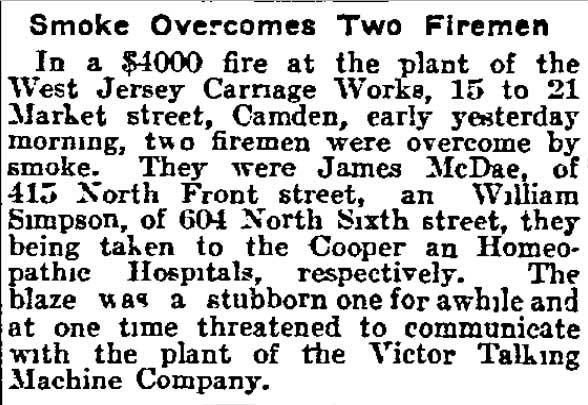
In a $4000 fire at the plant of the West Jersey Carriage Works, 15 to 21 Market street, Camden, early yesterday morning, two firemen were overcome by smoke. They were James McDade, of 415 North Front street, and William Simpson, of 604 North Sixth street, they being taken to the Cooper and Homeopathic Hospitals, respectively. The blaze was a stubborn one for awhile and at one time threatened to communicate with the plant of the Victor Talking Machine Company.
Fire Comrades Dead, Tries to End Life
Philadelphia Inquirer —
William J. Simpson, of Camden Department, Found in Ashpit With Wrists Cut
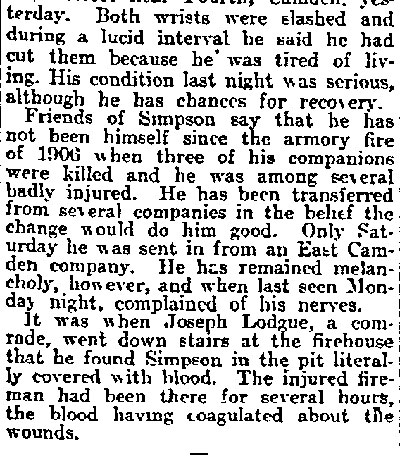
Almost dead from the loss of blood, City Fireman William J. Simpson, aged 56, of 604 North Sixth street, was found in the ash pit at No. 4 engine house, on Vine street near Fourth, Camden, yesterday. Both wrists were slashed and during a lucid interval he said he had cut them because he was tired of living. His condition last night was serious, although he has chances for recovery.
Friends of Simpson say that he has not been himself since the armory fire of 1906 when three of his companions were killed and he was among several badly injured. He has been transferred from several companies in the belief the change would do him good. Only Saturday he was sent in from an East Camden company. He has remained melancholy, however, and when last seen Monday night, complained of his nerves.
It was when Joseph Logue, a comrade, went down stairs at the firehouse that he found Simpson in the pit literally covered with blood. The injured fireman had been there for several hours, the blood having coagulated about the wounds.
Death Notice
Philadelphia Inquirer —

SIMPSON.—Dec. 9, 1917. WILLIAM husband of Louisa F. Simpson aged 62. Funeral and interment strictly private. Thurs., at 3 P M., from his late residence, 604 N. 6th st., Camden N. J. Interment Arlington Cem.