Murrell Dobbins
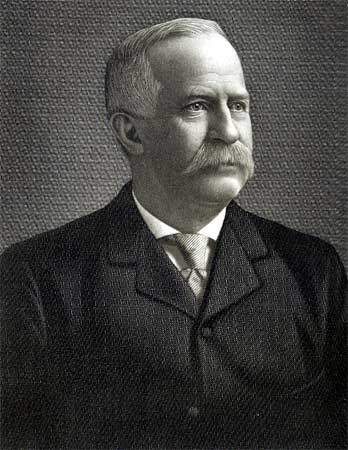
Murrell Dobbins
MURRELL DOBBINS (1843–1917), son of Joseph Ridgeway and Mary Ann (Hilyard) Dobbins, was born at Pemberton, NJ in 1843. After coming to Philadelphia upon the death of his father, he served a regular apprenticeship at the bricklaying trade. This early contact with trade instruction is reflected in his later interests when, as president of the Master Builders Exchange of Philadelphia, he was influential in providing an evening trade school within that organization.
From apprenticeship he rose to be a contractor, becoming one of Philadelphia’s leading builders. Later, he engaged in brick manufacturing, and in 1901 he founded the Camden Pottery Company. He hired Arthur J. Podmore, a Trenton NJ native with extensive experience in the pottery business in that city, to supervise the factory shortly thereafter.
He was elected to the Philadelphia Board of Education in January, 1906 and almost immediately urged the consideration of a plan for a system of mechanical trade schools. His diligence in pressing this point is indicated by the fact that the first school of this kind was opened in September of that year as The Philadelphia Trades School for Boys, at Twelfth and Locust Streets.
Mr. Dobbins served three years as an active member of the Philadelphia Board of Education. He resigned in 1909 to become Philadelphia City Treasurer. He continued his interest in vocational education during the remainder of his life, and it is most fitting that Philadelphia’s vocational school should bear his name.
Murrell Dobbins passed away in 1917. The ownership of Camden Pottery fell to his son, T. Munroe Dobbins.

Signature of Murrell Dobbins
Murrell Dobbins
South Jersey: A History 1624–1924
MURRELL DOBBINS—The death of the late Murrell Dobbins, on April 6, 1917, removed from South Jersey one of its ablest business men, and one of its most respected citizens. As president of the Camden Pottery Company, of Camden, he was at the head of one of the largest concerns of its kind in the State, and at one time he was the largest individual manufacturer of bricks in the country. He was also president and a member of the board of directors of the Third National Bank of Philadelphia.
Murrell Dobbins, son of Joseph Ridgway and Mary (Hillyard) Dobbins, was born in Pemberton, Burlington County, New Jersey, August 29, 1843. He received his early and preparatory education at Kelly’s School, Mount Holly, New Jersey, and in the Friends’ School, Philadelphia, Pennsylvania. He then matriculated in Burlington University, but did not finish his course. After the death of his father he removed to Philadelphia, where he served a regular apprenticeship at the brick-laying trade. For a number of years he was associated with his brother, the late Richard J. Dobbins, in the building and contracting business, and during this period he aided in the erection of some of the largest buildings in the city of Philadelphia, including the Ledger Building, the House of Correction, and the Memorial and Main Centennial Exhibition buildings. He was also extensively engaged in the manufacture of bricks, and at one time controlled four brick yards, which combination placed him first among brick manufacturers in the United States. In 1901, in association with T. Munroe Dobbins, he organized the Camden Pottery Company, and engaged in the manufacture of plumbers’ sanitary earthenware. The company commenced operating at once with the object of establishing a reputation for sound business principles and thus gaining the confidence of its trade. The success of the company since its incorporation is conclusive evidence that these resolutions were thoroughly well kept. The concern has steadily grown and prospered, and has from time to time altered the styles of its product to keep pace with advancements in engineering and in methods of sanitation in both public institutions and homes. Murrell Dobbins was the first president of the company, and T. Munroe Dobbins, its secretary and treasurer. The plant occupies several acres of ground in a very desirable section of Camden, New Jersey, bounded by Mount Vernon and Orchard streets, on the New Jersey & Seashore Railroad, convenient for shipping both by rail and water. There is every prospect that this already large and prosperous enterprise will continue to grow and expand in the future.
After the death of Mr. Dobbins, in 1917, the company was re-organized with T. Munroe Dobbins as president, and A. J. Podmore as secretary, but the sound business principles upon which the corporation was founded have been retained, and the present officials are still following the policies of the founder.
The company manufactures only strictly high grade plumbing goods, and caters to the trade which demands the complicated fixtures and special articles as designed by sanitary experts.
The product is distributed from coast to coast and installed in some of the largest hotels and institutions in the country, and can also be found in many foreign countries. The trade name “Capoco” has become universally known and is a guarantee of service and satisfaction. The materials used in manufacture, both foreign and domestic clays, are selected with the greatest care, as good quality of clay is essential in the product of first class ware. Another important factor in the product of the high class goods which the Camden Pottery Company sends out is its working force, consisting of one hundred and fifty highly skilled mechanics, well trained, carefully supervised, and selected from all sections of the country, who take an active interest in their work. Most of these have established comfortable residences in Camden, and the company encourages and rewards their efforts in every way possible. Before the organization of the Camden Pottery Company, the foundations of the business were laid by James Lyons, who operated the concern under the name of the Lyons Pottery Company, which he operated to the time of his death when business was suspended. The plant was then sold to the Camden Pottery Company, and has been in continued operation since under its present name.
Mr. Dobbins was a member of the old Bricklayers’ Company, and one of the incorporators of the Master Builders’ Exchange, also the organizer and first president of the New Jersey Society of Pennsylvania. In addition to the business responsibilities and activities already mentioned he was also at one time president of the Third National Bank of Philadelphia.
Numerous and important as were his business connections, Mr. Dobbins also found time for public service. For many years he served as Port Warden, and later he was made a member of the Board of Education, in which capacity he enthusiastically served until 1909, when he resigned to accept the nomination for City Treasurer, to which office he was elected on the Republican ticket. One of his notable achievements as a member of the Board of Education was the establishment of the Trade School. He was widely known as a member of the “Old Guard” of Republicans, having been a leader in the counsels of his party almost from the time he reached his majority. He was a member of the Union League, the Society of Colonial Wars, Pennsylvania Society; Sons of the Revolution; Pennsylvania Historical Society; Pennsylvania Horticultural Society; Manufacturers’ Club; Automobile Club of Pennsylvania; Franklin Lodge, Free and Accepted Masons; Chapter No. 169, Royal Arch Masons; and St. John’s Commandery, No. 4, Knights Templar. He was president of the Board of the Eastern State Penitentiary, and a State Prison Inspector to the time of his death. His religious affiliation was with the Protestant Episcopal Church.
Although the business organization which he founded will remain for many years a monument to his energy and ability, Mr. Dobbins will best be remembered for his many benevolent acts, and the influence exerted by his strong character will live in the hearts of many long after the work which he accomplished in the world of business has been lost and forgotten.
On January 26, 1871, at Philadelphia, Pennsylvania, Murrell Dobbins married Emily Munroe, daughter of Thomas G. and Hester (Art) Munroe, and they are the parents of two children: Laura E., and T. Munroe, a sketch of whom follows.
Named: Murrell Dobbins, South Jersey: A History 1624, and 1924.
Camden Authorities Condemned by Hill
Trenton Evening Times —
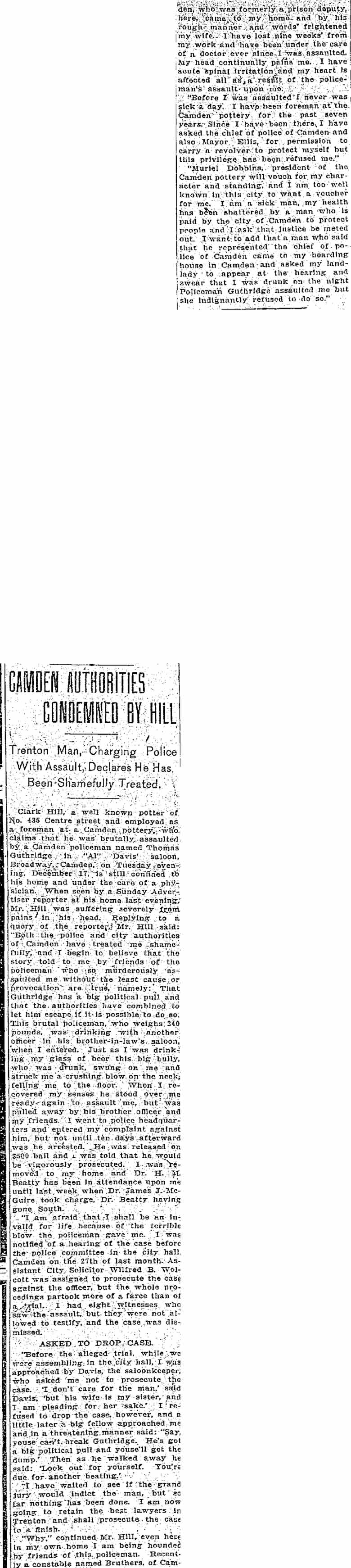
Trenton Man, Charging Police With Assault, Declares He Has Been Shamefully Treated.
Clark Hill, a well known potter of No. 435 Centre street and employed as a foreman at a Camden pottery, who was brutally assaulted on Tuesday evening by a Camden policeman named Thomas Guthridge, in “Al” Davis’ saloon, Broadway, Camden, on a Tuesday evening, December 17, is still confined to his home and under the care of a physician. When seen by a Sunday Advertiser reporter at his home last evening, Mr. Hill was suffering severely from pains in his head. Replying to a query of the reporter, Mr. Hill said: “The authorities of Camden have treated me shamefully, and I begin to believe that the stories told to me by friends of the policeman who so murderously assaulted me without the least cause or provocation are true, namely: That Guthridge has a big political pull and that the authorities have combined to let him escape if it is possible to do so. This brutal policeman, who weighs 340 pounds, was drinking with another officer in his brother-in-law’s saloon, when I entered. Just as I was drinking my glass of beer this big bully, who was drunk, swung on me and struck me a crushing blow on the neck, telling me to the floor. When I recovered my senses he stood over me ready again to assault me, but was pulled away by his brother officer and my friends. I went to police headquarters and entered my complaint against him, but not until ten days afterward was he arrested. He was released on $500 bail and I was told that he would be vigorously prosecuted. I was removed to my home and Dr. H. M. Beatty has been in attendance upon me until last week when Dr. James J. McGuire took charge, Dr. Beatty having gone South.
“I am afraid that I shall be an invalid for life because of the terrible blow the policeman gave me. I was notified of a hearing of the case before the police committee in the city hall, Camden on the 27th of last month. Assistant City Solicitor Wilfred B. Wolcott was assigned to prosecute the case against Hill, but the whole proceedings partook more of a farce than of a trial. I had eight witnesses who saw the assault, but they were not allowed to testify, and the case was dismissed.
ASKED TO DROP CASE
“Before the alleged trial, while we were assembling in the city hall, I was approached by Davis, the saloonkeeper, who asked me not to prosecute the case. ‘I don’t care for the man,’ said Davis, ‘but his wife is my sister, and I am pleading for her sake.’ I refused to drop the case, however, and a little later he followed me and in a threatening manner said: ‘Say, you’d better let alone Guthridge. He’s a big political pull and you’ll get the dump.’ Then as he walked away he said: ‘Look out for yourself. You’re due for another beating.’
“I have waited to see if the grand jury would indict the man, but so far nothing has been done. I am now going to retain the best lawyers in Trenton and shall prosecute the case to a finish.
“In my own home I am being hounded by friends of this policeman. Before I quit this fight…” [Mr. Hill stated that an individual connected with Camden authorities came to his home, and by his frank manner and words frightened his wife.] “I have lost nine weeks’ from my work and have been under the care of a doctor ever since. I was assaulted. My head continually pains me. I have acute spinal irritation and my heart is affected all as a result of the policeman’s assault upon me.
“Before I was assaulted I never was sick a day. I have been foreman at the Camden pottery for the past seven years. Since I have been there, I have asked the chief of police of Camden and also Mayor Ellis, for permission to carry a revolver to protect myself, but this privilege has been refused me.”
“Murrell Dobbins, president of the Camden pottery will vouch for my character and standing, and I am too well known in this city to want a voucher for me. I am a sick man, my health has been shattered by a man who is paid by the city of Camden to protect people and I ask that justice be meted out. I want to add that a man who said that he represented the chief of police of Camden came to my boarding house in Camden and asked my landlady to appear at the hearing and swear that I was drunk on the night Policeman Guthridge assaulted me, but she indignantly refused to do so.”
Hill Threatens to Sue Camden Maker
Trenton Evening Times —

Resents Story of Attack Made on Him by Policeman—He is Slowly Recovering.
Clark Hill, of 435 Centre street, foreman of the Camden Pottery company of Camden, has threatened the Camden Daily Courier of Camden with a suit for criminal libel, unless a derogatory article about him published in that paper January 6, is contradicted. The story alleges to state the facts that surrounded the assault made upon him by a Camden policeman, December 17. Mr. Hill has been ill at his home here for ten weeks, having been partially paralyzed by the blow he received back of his left ear. He is now able to be out.
He brands the article in the Camden paper as a fabrication, but particularly resents the charge that he “began arraigning Roosevelt in no mild terms and accused his administration of being ‘rotten.’” The article also intimated that Hill was intoxicated.
Mr. Hill, who was a potter in this city for more than twenty years prior to taking a foreman position seven years ago, said yesterday that the whole article was false.
“It was not a political discussion with Policeman Guthridge,” he stated. “I never referred to the name of President Roosevelt, nor to the government. I have been a member of the Patriotic Order of Americans for thirty-two years and the Junior Order of United American Mechanics for seventeen years and these facts are sufficient proof that I am not of anarchistical tendencies. I am also a holder in the name of Nathan Hale Council of the Jr. O. U. A. M.
“There were only a few potters in Camden when we desired to see one another we met at one of the saloons on Broadway. I was at Davis’ place on Broadway with a few friends. I had seen this same Policeman and was talking with him about a moving picture show across the street. Guthridge, who is the brother-in-law of Adam, and who was drunk when he came into the place, walked up and without the least warning, reached me from the rear, struck me a stinging blow behind my ear.
“I could not see after I had been struck, but I grappled with Guthridge. The policeman who was with Guthridge, him, separated us. I turned to Policeman Mines and said ‘You a police officer, you saw that, did you?’ He said nothing, but he did not answer me. Addressing Davis I said, ‘You saw that, didn’t you?’ He refused to answer. But this Guthridge spoke up and said ‘Shut up, I’ll give you another whack.’”
Mr. Hill has suffered severely from his injury and for a time it was feared he would lose his eye. It will be a long while before he will be able to resume work.
It was only after much difficulty that Mr. Hill was able to have action taken against Guthridge, and it now asserts that many have told him that his case would fall before the grand jury, and that this has actually happened. He considers that he did not receive fair treatment from the mayor, who has passed the case to his department, and who he declares sent him to various persons. He is now to be given a hearing before the police committee of common council of Camden, New Jersey, and Hill hopes to be able to attend the meeting.
“Murrell Dobbins, president of the Camden Pottery company, is working in the interest of this man Guthridge. He is a valuable employee, and is assisting in the prosecution.”