Elbridge Bennett McClong
ELBRIDGE BENNETT McCLONG was born in 1871 in New Jersey, the only child, according to Census records of Sylvia and Colonel Thomas K. McClong. His father was a veteran of the Civil War. He was named after his grandfather Ebridge G. McClong, a prominent resident of Millville, New Jersey. Census records indicate that he was born in New Jersey, however City Directories indicate that much of his early life was spent in Pittsburgh and Philadelphia, Pennsylvania. From 1868 to 1874 Thomas K. McClong is listed in Pittsburgh directories. The family lived at 13 Apsley Street in the Germantown section of Philadelphia in the late 1870s and early 1880s. The family came back to Millville for a short time after grandfather Elbridge G. McClong died in May of 1881. The 1883 Millville Directory shows Thomas K. McClong living their and engaging in the lumber business, and the rental of McClong’s Hall at 135 East Main Street for various sorts of events.
By 1885 Thomas K. McClong had relocated to Camden. The family is listed at 112 Federal Street through 1888. Thomas McClong stayed in the lumber business through this time. By the time the 1890 City Directory was published, there was a change in address and a change in careers.
The 1890 City Directory lists Thomas McClong and family at 820 Federal Street. For the next 23 years Thomas McClong is listed at this address. He was in the insurance business, working primarily in Philadelphia. Elbridge B. McClong makes his first appearance in City Directories in 1890, working in Philadelphia as a clerk. The 1891 and 1892 Directories show his occupation as salesman.
In 1893 Elbridge McClong engaged in a short lived shoe manufacturing business called McClong & Company at 94 Federal Street, with a partner, J. Wilson Simpkins. On December 30, 1893 he attended a meeting at the Camden County Courthouse, only two blocks from his home, to protest a free-trade bill that would have adversely impacted American businesses and workers. Shortly afterwards, Elbridge B. McClong was appointed to the Camden Police Department, appearing there in the 1894 City Directory.
Elbridge McClong’s clerical and administrative skills were soon recognized. By 1908 he had been promoted to sergeant and served in administrative positions culminating with a promotion to Chief Clerk in late 1913 or early 1914. This position carried the rank of Captain. He served as Chief Clerk until July of 1923 when political considerations forced him and Chief of Police Edward S. Hyde to retire on pension.
Elbridge McClong was married three times, but never had any children. His first wife, listed in the 1898 City Directory as May and the 1899 edition as Mary, was not living with him and his parents at 820 Federal Street when the 1900 Census was enumerated. Around 1903 he again wed. In 1911 Elbridge McClong and his second wife, the former Alice “Effie” Resch, began to be listed in Directories at 822 Federal Street. Alice McClong is last shown in City Directories in 1922.
Thomas McClong had been quite successful in the insurance business. He left Camden, first moving to Atlantic City, where he appears in the 1911 Directory, and then purchased a home in Ocean City, New Jersey. He passed away there in December of 1919 and was buried in Millville. He left property in Camden, a home in Ocean City and apparently an estate of some size.
After retiring on pension, Elbridge McClong began spending more time outside of Camden. His last appearance at 822 Federal Street Camden Directories came in 1928. His mother, Sylvia, last appears in the Ocean City Directories, at 5812 Central Avenue, in 1924. Elbridge McClong is listed at that address as late as 1948. In the 1930s Elbridge McClong began looking into buying a summer home in Florida. The 1940 Camden City Directory indicates that he was renting an apartment at 1026 Federal Street and he had a business interest in the Nash-Lakeview Garage. The 1940 Orlando City Directory shows him at 125 North Eola Drive. He traveled back and forth between New Jersey and Florida as late as 1948, his last listing in the Ocean City’s directory.
In the 1940s Elbridge McClong again married, this time to Elizabeth Graham. The McClongs lived at the North Eola Drive address through 1957. Mrs. McClong died in March of that year. Elbridge McClong moved to 808 Delaney Street in Orlando. He passed away in July of 1959.
Toilers Denounce the Wilson Bill
Philadelphia Inquirer —
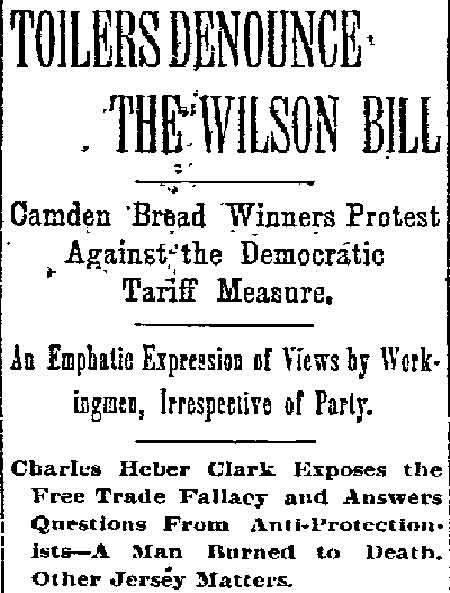
Camden Bread Winners Protest Against the Democratic Tariff Measure.
An Emphatic Expression of Views by Workingmen, Irrespective of Party.
Charles Heber Clark Exposes the Free Trade Fallacy and Answers Questions From Anti-Protectionists—A Man Burned to Death. Other Jersey Matters.
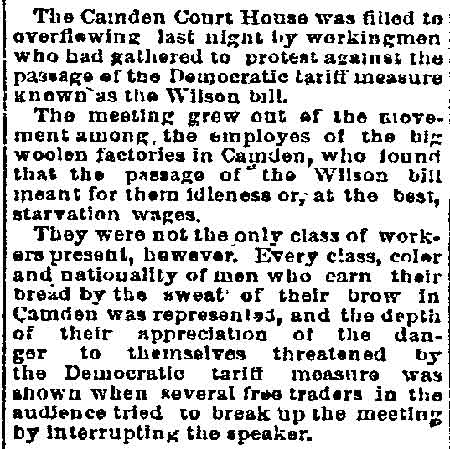
The Camden Court House was filled to overflowing last night by workingmen who had gathered to protest against the passage of the Democratic tariff measure known as the Wilson bill.
The meeting grew out of the movement among the employes of the big woolen factories in Camden, who found that the passage of the Wilson bill meant for them idleness or, at the best, starvation wages.
They were not the only class of workers present, however. Every class, color and nationality of men who earn their bread by the sweat of their brow in Camden was represented, and the depth of their appreciation of the danger to themselves threatened by the Democratic tariff measure was shown when several free traders in the audience tried to break up the meeting by interrupting the speaker.
Serious Charges by Defeated Candidate
Philadelphia Inquirer —
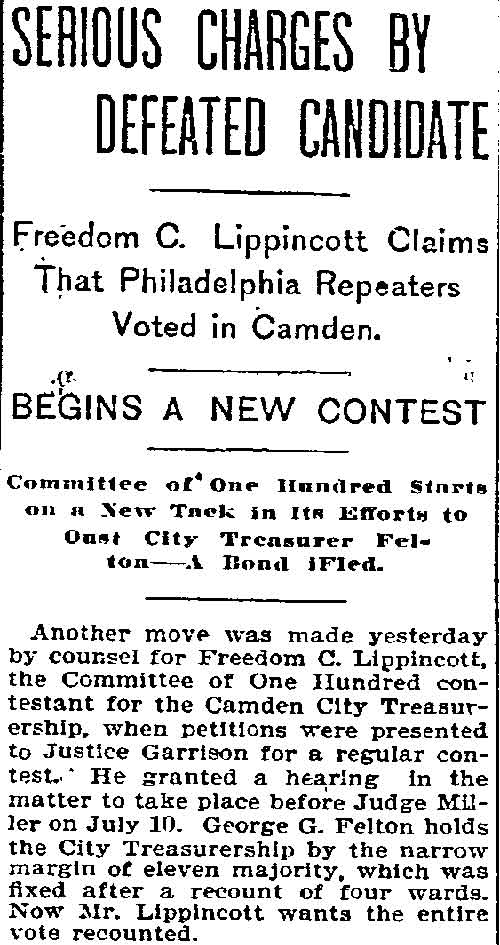
Freedom C. Lippincott Claims That Philadelphia Repeaters Voted in Camden.
Begins a New Contest
Committee of One Hundred Starts on a New Tack in Its Efforts to Oust City Treasurer Felton—A Bond Filed.
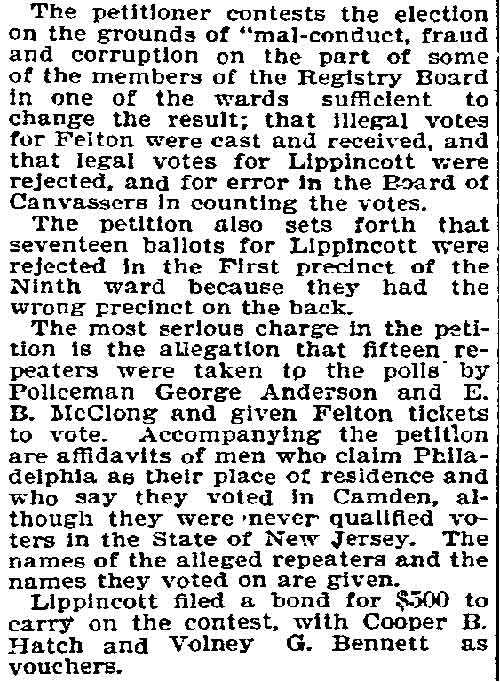
Another move was made yesterday by counsel for Freedom C. Lippincott, the Committee of One Hundred contestant for the Camden City Treasurership, when petitions were presented to Justice Garrison for a regular contest. He granted a hearing in the matter to take place before Judge Miller on July 10. George G. Felton holds the City Treasurership by the narrow margin of eleven majority, which was fixed after a recount of four wards. Now Mr. Lippincott wants the entire vote recounted.
The petitioner contests the election on the grounds of “mal-conduct, fraud and corruption on the part of some of the members of the Registry Board in one of the wards sufficient to change the result; that illegal votes for Felton were cast and received, and that legal votes for Lippincott were rejected, and for error in the Board of Canvassers in counting the votes.
The petition also sets forth that seventeen ballots for Lippincott were rejected in the First precinct of the Ninth ward because they had the wrong precinct on the back.
The most serious charge in the petition is the allegation that fifteen repeaters were taken to the polls by Policeman George Anderson and E. B. McClong and given Felton tickets to vote. Accompanying the petition are affidavits of men who claim Philadelphia as their place of residence and who say they voted in Camden, although they were never qualified voters in the State of New Jersey. The names of the alleged repeaters and the names they voted on are given.
Lippincott filed a bond for $500 to carry on the contest, with Cooper B. Hatch and Volney G. Bennett as vouchers.
Two Men Shot in a Race Riot in Camden
Philadelphia Inquirer —
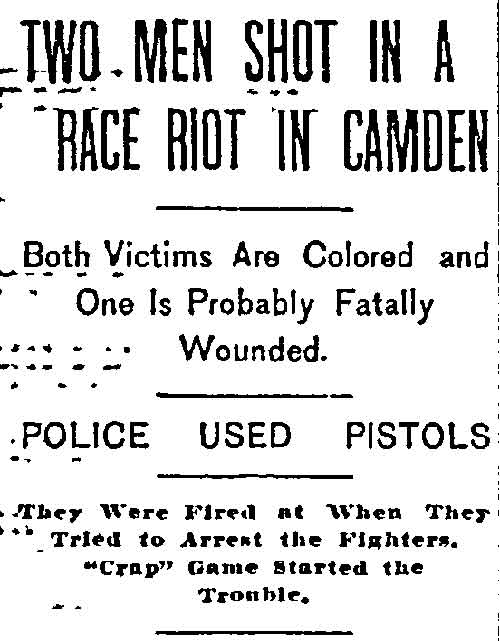
Both Victims Are Colored and One Is Probably Fatally Wounded.
Police Used Pistols
They Were Fired at When They Tried to Arrest the Fighters. “Crap” Game Started the Trouble.
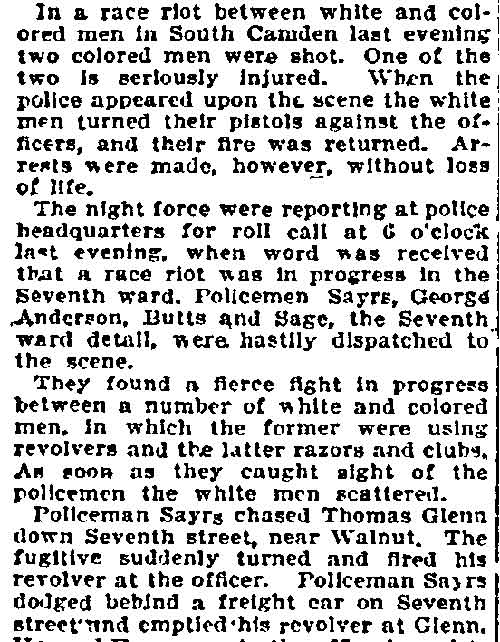
In a race riot between white and colored men in South Camden last evening two colored men were shot. One of the two is seriously injured. When the police appeared upon the scene the white men turned their pistols against the officers, and their fire was returned. Arrests were made, however, without loss of life.
The night force were reporting at police headquarters for roll call at 6 o’clock last evening, when word was received that a race riot was in progress in the Seventh ward. Policemen Sayrs, George Anderson, Butts and Sage, the Seventh ward detail, were hastily dispatched to the scene.
They found a fierce fight in progress between a number of white and colored men, in which the former were using revolvers and the latter razors and clubs. As soon as they caught sight of the policemen the white men scattered.
Policeman Sayrs chased Thomas Glenn down Seventh street, near Walnut. The fugitive suddenly turned and fired his revolver at the officer. Policeman Sayrs dodged behind a freight car on Seventh street and emptied his revolver at Glenn.
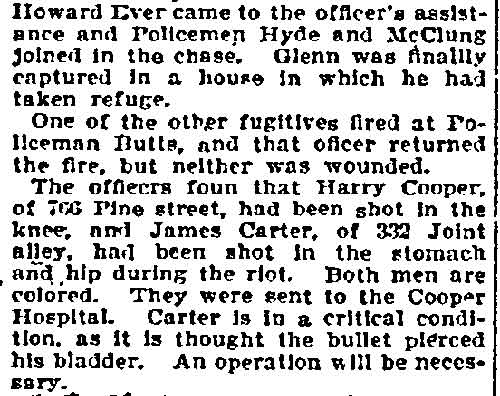
Howard Ever came to the officer’s assistance and Policemen Hyde and McClung joined in the chase. Glenn was finally captured in a house in which he had taken refuge.
One of the other fugitives fired at Policeman Butts, and that officer returned the fire, but neither was wounded.
The officers foun that Harry Cooper, of 706 Pine street, had been shot in the knee, and James Carter, of 332 Joint alley, had been shot in the stomach and hip during the riot. Both men are colored. They were sent to the Cooper Hospital. Carter is in a critical condition, as it is thought the bullet pierced his bladder. An operation will be necessary.
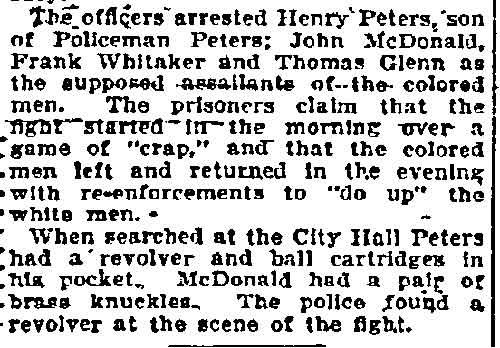
The officers arrested Henry Peters, son of Policeman Peters; John McDonald, Frank Whitaker and Thomas Glenn as the supposed assailants of the colored men. The prisoners claim that the fight started in the morning over a game of “crap,” and that the colored men left and returned in the evening with re-enforcements to “do up” the white men.
When searched at the City Hall Peters had a revolver and ball cartridges in his pocket. McDonald had a pair of brass knuckles. The police found a revolver at the scene of the fight.
Death Lurked on a Camden Street
Philadelphia Inquirer —
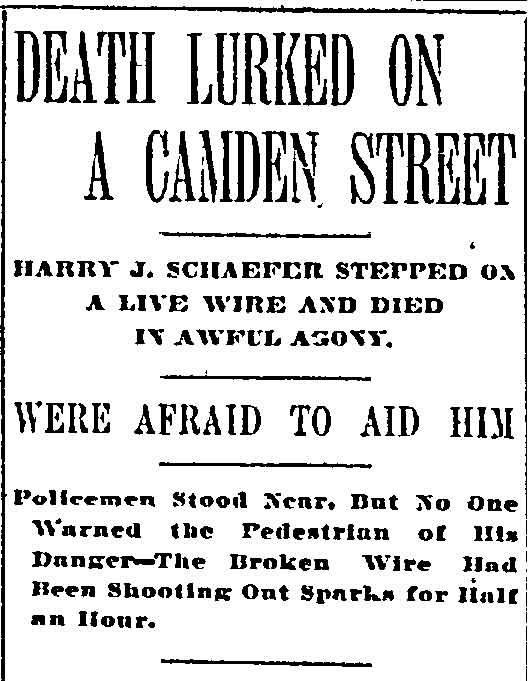
Harry J. Schaefer Stepped on a Live Wire and Died in Awful Agony.
Were Afraid to Aid Him
Policemen Stood Near, But No One Warned the Pedestrian of His Danger—The Broken Wire Had Been Shooting Out Sparks for Half an Hour.
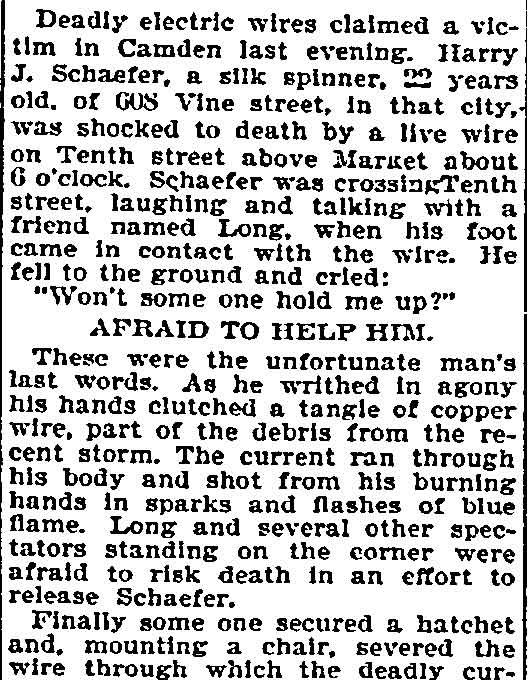
Deadly electric wires claimed a victim in Camden last evening. Harry J. Schaefer, a silk spinner, 22 years old, of 608 Vine street, in that city, was shocked to death by a live wire on Tenth street above Market about 6 o’clock. Schaefer was crossing Tenth street, laughing and talking with a friend named Long, when his foot came in contact with the wire. He fell to the ground and cried:
“Won’t some one hold me up?”
Afraid to Help Him.
These were the unfortunate man’s last words. As he writhed in agony his hands clutched a tangle of copper wire, part of the debris from the recent storm. The current ran through his body and shot from his burning hands in sparks and flashes of blue flame. Long and several other spectators standing on the corner were afraid to risk death in an effort to release Schaefer.
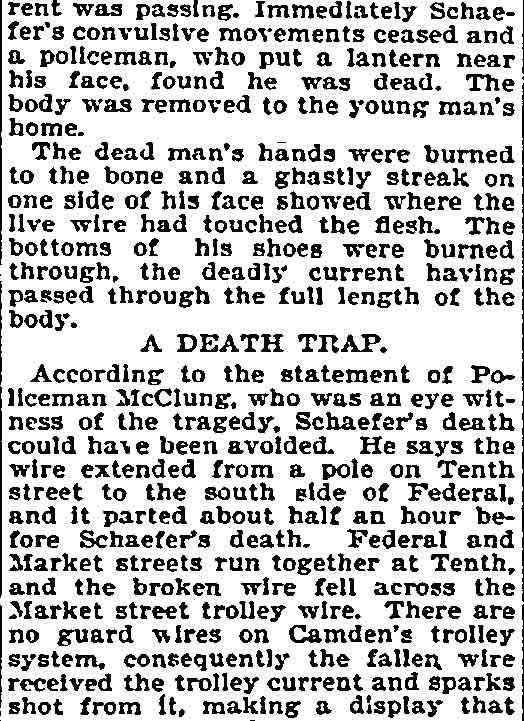
Finally some one secured a hatchet and, mounting a chair, severed the wire through which the deadly current was passing. Immediately Schaefer’s convulsive movements ceased and a policeman, who put a lantern near his face, found he was dead. The body was removed to the young man’s home.
The dead man’s hands were burned to the bone and a ghastly streak on one side of his face showed where the live wire had touched the flesh. The bottoms of his shoes were burned through, the deadly current having passed through the full length of the body.
A Death Trap.
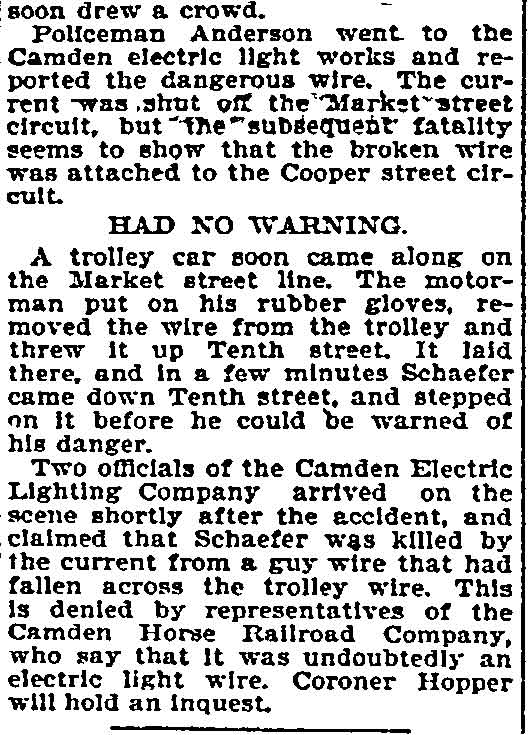
According to the statement of Policeman McClung, who was an eye witness of the tragedy, Schaefer’s death could have been avoided. He says the wire extended from a pole on Tenth street to the south side of Federal, and it parted about half an hour before Schaefer’s death. Federal and Market streets run together at Tenth, and the broken wire fell across the Market street trolley wire. There are no guard wires on Camden’s trolley system, consequently the fallen wire received the trolley current and sparks shot from it, making a display that soon drew a crowd.
Policeman Anderson went to the Camden electric light works and reported the dangerous wire. The current was shut off the Market street circuit, but the subsequent fatality seems to show that the broken wire was attached to the Cooper street circuit.
Had No Warning.
A trolley car soon came along on the Market street line. The motorman put on his rubber gloves, removed the wire from the trolley and threw it up Tenth street. It laid there, and in a few minutes Schaefer came down Tenth street, and stepped on it before he could be warned of his danger.
Two officials of the Camden Electric Lighting Company arrived on the scene shortly after the accident, and claimed that Schaefer was killed by the current from a guy wire that had fallen across the trolley wire. This is denied by representatives of the Camden Horse Railroad Company, who say that it was undoubtedly an electric light wire. Coroner Hopper will hold an inquest.
Deserter Picked Up
Philadelphia Inquirer —
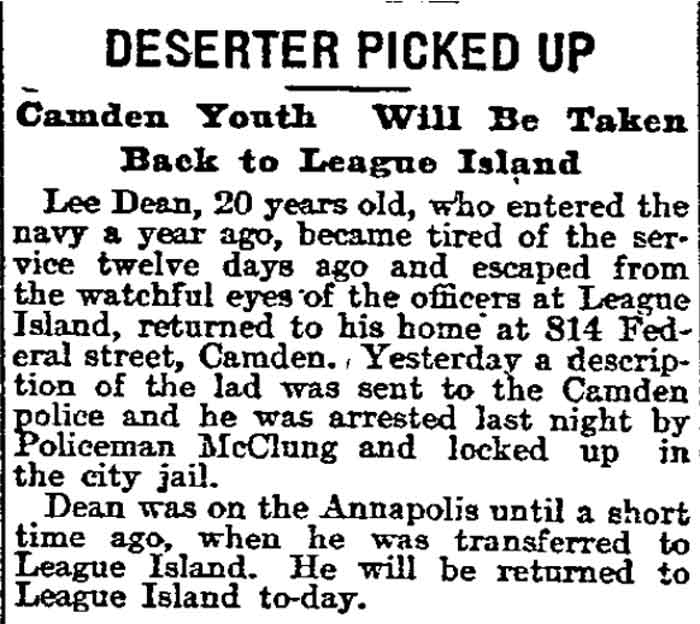
Camden Youth Will Be Taken Back to League Island
Lee Dean, 20 years old, who entered the navy a year ago, became tired of the service twelve days ago and escaped from the watchful eyes of the officers at League Island, returned to his home at 314 Federal street, Camden. Yesterday a description of the lad was sent to the Camden police and he was arrested last night by Policeman McClung and locked up in the city jail.
Dean was on the Annapolis until a short time ago, when he was transferred to League Island. He will be returned to League Island to-day.
Nichols Bites Saloonkeeper and Policeman McClong
Philadelphia Inquirer —
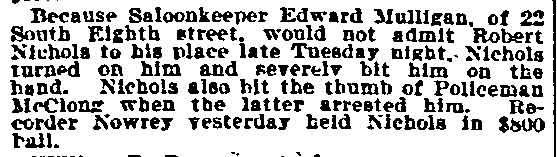
Because Saloonkeeper Edward Mulligan, of 22 South Eighth street, would not admit Robert Nichols to his place late Tuesday night, Nichols turned on him and severely bit him on the hand. Nichols also bit the thumb of Policeman McClong when the latter arrested him. Recorder Nowrey yesterday held Nichols in $800 bail.
Crazy Man Took to Swamps
Philadelphia Inquirer —
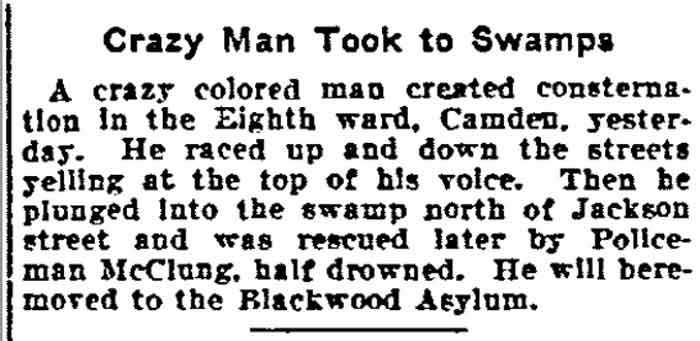
A crazy colored man created consternation in the Eighth ward, Camden, yesterday. He raced up and down the streets yelling at the top of his voice. Then he plunged into the swamp north of Jackson street and was rescued later by Policeman McClung, half drowned. He will be removed to the Blackwood Asylum.
Another Shift of Camden Policemen
Philadelphia Inquirer —
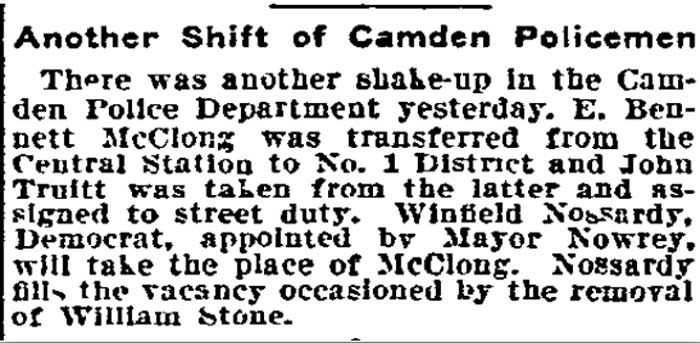
There was another shake-up in the Camden Police Department yesterday. E. Bennett McClong was transferred from the Central Station to No. 1 District and John Truitt was taken from the latter and assigned to street duty. Winfield Nossardy, Democrat, appointed by Mayor Nowrey, will take the place of McClong. Nossardy fills the vacancy occasioned by the removal of William Stone.
Scented Tragedy When Starved Cat Moaned
Philadelphia Inquirer —
Feline Left Alone in a House Put Up an Awful Howl That Attracted a Great Crowd
A constantly increasing crowd of men, women and children, careless of wind and rain, stood in front of the house at 700 Blaine street, Camden, yesterday. Occasionally a muffled groan emanated from the tightly-closed windows on the second floor. The crowd stood still with awe and terror and a tragedy was scented.
The door bell was rung furiously but nothing came forth but the sound as though someone was in agony. Volunteers essayed to gain an entrance through the windows, but these were securely fastened. Then came the groans again.
“Someone is being murdered,” whispered an awe-struck woman with blanched face. Then it went from one to another until several excited individuals rushed to the City Hall and informed Hall Officer McClong a murder had been committed. He found the house was occupied by a Mrs. Colbeck, who was at Beverly. Officer McClong sent a telephone message to her, but before a reply could be received others besieged the Police Department, declaring a tragedy was being enacted on Blaine street.
City Electrician George Rawle and John Fish procured a long ladder, and while the crowd looked on, climbed in one of the second story windows. They were greeted with a howl and two fiery eyes that made them shiver. Then there was a wailing shriek, as a black cat emerged from the darkness.
The cat was nearly starved to death and it was her groans that had aroused the neighborhood since Wednesday. The two men held up the woe-begone feline and the crowd cheered.
She Fell Asleep in Servant's Bed
Philadelphia Inquirer —
And Incidentally the Camden Police Department Was Requested to Look for a Burglar
About 10 o’clock last night William McFarland, living at 612 Benson street, Camden, reported to police headquarters that a burglar was in his house. Hall Officer McClong armed himself with a blackjack and revolver and went over to the house to investigate. He was told the supposed burglar was in a back room on the third floor. Officer McClong quickly slipped into the room and, turning up the gas, found a woman, fully dressed and asleep, in a bed. She was snoring away contentedly when the policeman aroused her and explanations were in order.
It seems that Mr. McFarland’s next door neighbor has a servant girl, named Katie. He, too, has a servant girl, named Annie. Now Annie and Katie have a way of calling on each other at times by stepping out of the third-story window and walking along the coping from one room to the other. Last night Katie made one of her perilous trips along the coping to Annie’s room. Annie didn’t happen to be in, so Katie threw herself on the bed to await Annie’s return. Soon Katie fell asleep, and the house began to tremble with her snoring. When Annie arrived she found some one in her bed. She told Mr. McFarland that a burglar was in her room, hence the call on the police department.
Rubbing her eyes and apologizing for causing so much trouble, Katie stepped out of the window and slid back along the coping to her own room.
Tramps in Lively Mix-Up in Cellar
Philadelphia Inquirer —
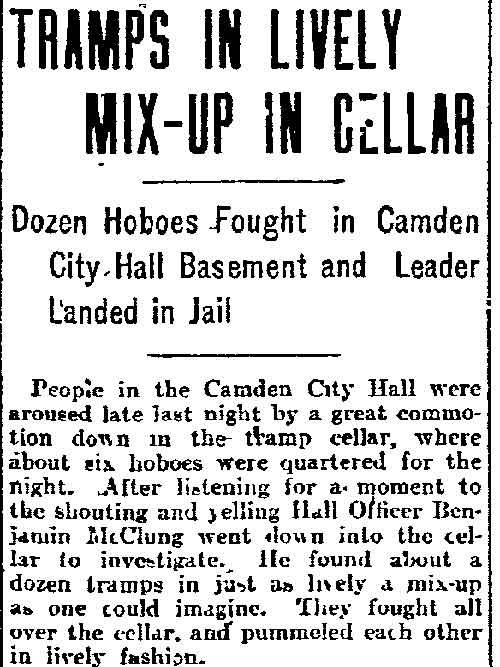
Dozen Hoboes Fought in Camden City Hall Basement and Leader Landed in Jail
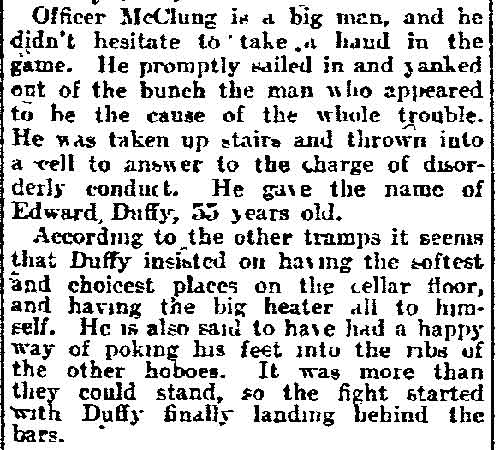
People in the Camden City Hall were aroused late last night by a great commotion down in the tramp cellar, where about six hoboes were quartered for the night. After listening for a moment to the shouting and yelling Hall Officer Benjamin McClung went down into the cellar to investigate. He found about a dozen tramps in just as lively a mix-up as one could imagine. They fought all over the cellar, and pummeled each other in lively fashion.
Officer McClung is a big man, and he didn’t hesitate to take a hand in the game. He promptly sailed in and yanked out of the bunch the man who appeared to be the cause of the whole trouble. He was taken up stairs and thrown into a cell to answer to the charge of disorderly conduct. He gave the name of Edward Duffy, 55 years old.
According to the other tramps it seems that Duffy insisted on having the softest and choicest places on the cellar floor, and having the big heater all to himself. He is also said to have had a happy way of poking his feet into the ribs of the other hoboes. It was more than they could stand, so the fight started with Duffy finally landing behind the bars.
Here's Camden's Finest, With Whiskers, in 1898
Camden Courier-Post —
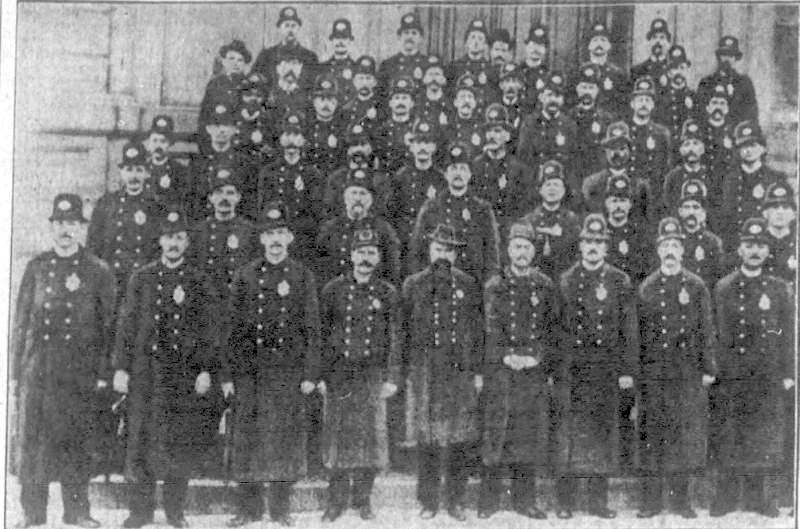
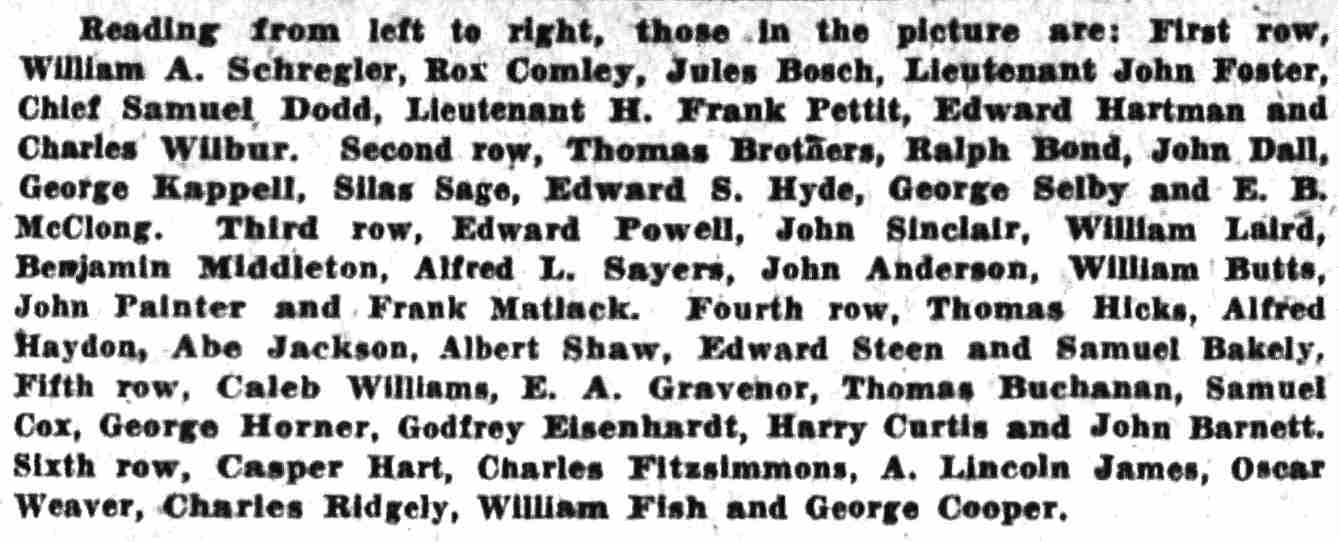
Harry Mines, not named above, is in the first row between H. Frank Pettit and Edward Hartman. In the fifth row, at the far right, “John Barnett” was a guess on the part of A. Lincoln James. Another person guessed George Johnson. Both were wrong and it is not known who that policeman is.
Camden Police Police Team Ready
Camden Daily Courier —
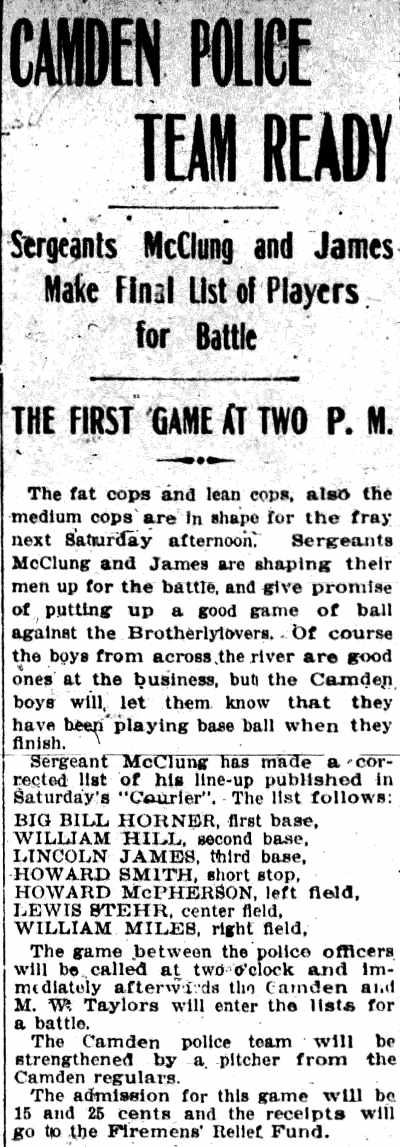
Sergeants McClung and James Make Final List of Players for Battle
The First Game at Two P. M.
The fat cops and lean cops, also the medium cops are in shape for the fray next Saturday afternoon. Sergeants McClung and James are shaping their men up for the battle, and give promise of putting up a good game of ball against the Brotherlylovers. Of course the boys from across the river are good ones at the business, but the Camden boys will let them know that they have been playing base ball when they finish.
Sergeant McClung has made a corrected list of his line-up published in Saturday’s “Courier.” The list follows:
BIG BILL HORNER, first base,
WILLIAM HILL, second base,
LINCOLN JAMES, third base,
HOWARD SMITH, short stop,
HOWARD McPHERSON, left field,
LEWIS STEHR, center field,
WILLIAM MILES, right field,
The game between the police officers will be called at two o’clock and immediately afterwards the Camden and M. W. Taylors will enter the lists for a battle.
The Camden police team will be strengthened by a pitcher from the Camden regulars.
The admission for this game will be 15 and 25 cents and the receipts will go to the Firemens’ Relief Fund.
Base Ball
Camden Daily Courier —
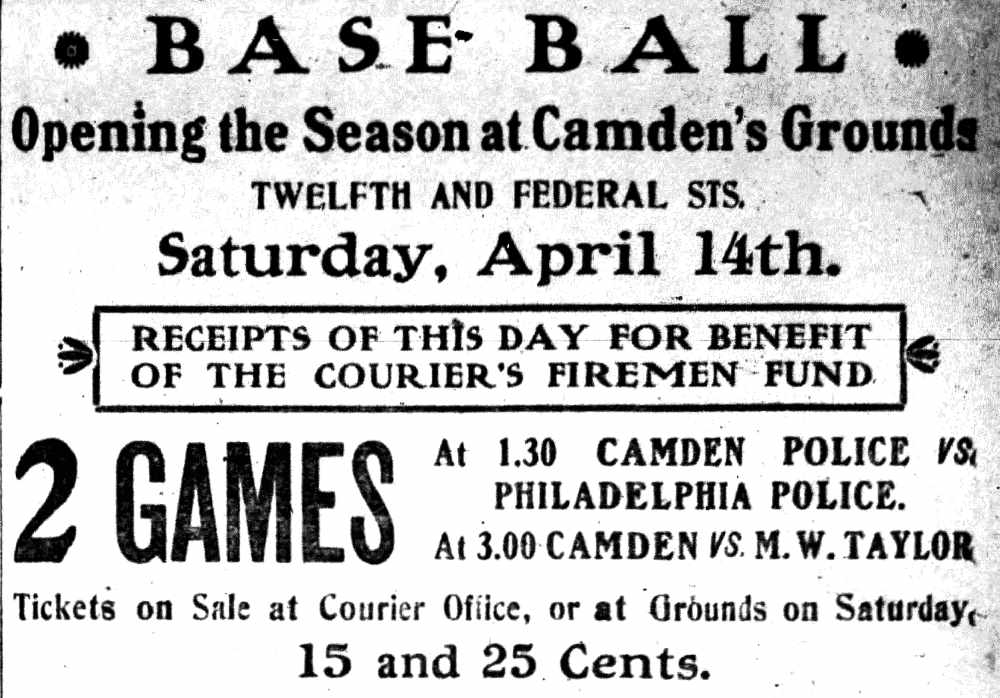
Opening the Season at Camden’s Grounds
Twelfth and Federal Sts.
Saturday, April 14th.
Receipts of This Day for Benefit of the Courier’s Firemen Fund
2 Games: At 1.30 Camden Police vs. Philadelphia Police. At 3.00 Camden vs. M. W. Taylor
Tickets on Sale at Courier Office, or at Grounds on Saturday. 15 and 25 Cents.
Sad Plight of Starved Woman
Camden Daily Courier —
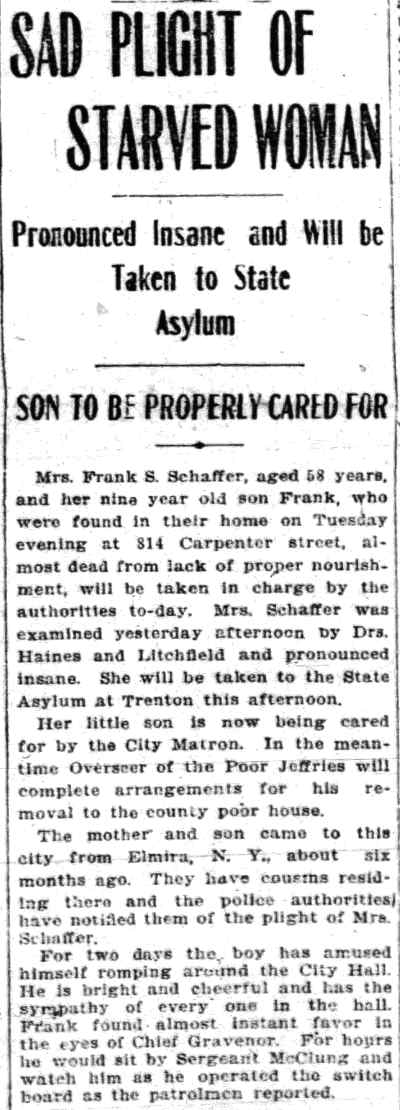
Pronounced Insane and Will be Taken to State Asylum
Son to Be Properly Cared For
Mrs. Frank S. Schaffer, aged 58 years, and her nine year old son Frank, who were found in their home on Tuesday evening at 314 Carpenter street, almost dead from lack of proper nourishment, will be taken in charge by the authorities to-day. Mrs. Schaffer was examined yesterday afternoon on Drs. Haines and Litchfield and pronounced insane. She will be taken to the State Asylum at Trenton this afternoon.
Her little son is now being cared for by the City Matron. In the meantime Overseer of the Poor Jeffries will complete arrangements for his removal to the county poor house.
The mother and son came to this city from Elmira, N. Y., about six months ago. They have cousins residing there and the police authorities have notified them of the plight of Mrs. Schaffer.
For two days the boy has amused himself romping around the City Hall. He is bright and cheerful and has the sympathy of every one in the hall. Frank found almost instant favor in the eyes of Chief Gravenor. For hours he would sit by and watch him as he operated the switch board as the patrolmen reported.
Suicide Attempt Foiled in Camden Jail
Philadelphia Inquirer —
Mrs. Lizzie Blackmore, of 1223 Kimball street, Philadelphia, would have committed suicide in the city jail in Camden early yesterday morning, but for the vigilance of Sergeant Schregler and Hall Officer McClong. The latter found the woman hanging from the bars with her skirt wrapped about her throat. She was unconscious when cut down but quickly revived. Less than an hour later Sergeant Schregler discovered her entirely nude with her undershirt knotted about her throat. Recorder Stackhouse sent her back to Philadelphia.
Sent Bullet in Head After Shooting Wife
Philadelphia Inquirer —
Troubles of Camden Man Drove Him to Verge of Insanity—Attempted Murder and Suicide
His daughter murdered and his son killed in a railroad accident, Daniel Weldon, 48 years old, of 1229 South Third street, after months of constant brooding, attempted to kill his wife, Mary, 52 years old, and commit suicide at their home yesterday afternoon. The woman was shot through the neck, while Weldon received a bullet in his right temple. Husband and wife were taken to the Cooper Hospital, where the physicians state that while in a serious condition, Mrs. Weldon will recover. The man, however, will probably die.
About five years ago Weldon’s daughterter, Mrs. Edith Hill, was shot to death by her husband, Robert, who was hanged. Shortly after the man’s son was caught between cars and crushed to death. Weldon suffered great mental anguish, so much, so, in fact, that he became a victim of melancholia. For the past six months or so his condition became such that it was thought he was going insane. Mrs. Weldon never thought for an instant that he would attack her, however.
On a cot in the hospital the woman told Hall Officer McClong that she and her husband had had a domestic quarrel, during which the man started upstairs, exclaiming:
“I’m tired of this; I’m going to end it all.”
Less than a minute later he returned with a loaded revolver in his hand. Walking up to Mrs. Weldon, he fired point blank at her head, but the bullet took effect in her neck. Then he presented the weapon to his right temple and fired. Husband and wife were found by neighbors lying within a few feet of one another on the floor. The ambulance was summoned and both were hurried to the hospital.
Camden News Notes
Philadelphia Inquirer —
Mayor Ellis Adds Twenty-five New Officers to Growing City’s Department
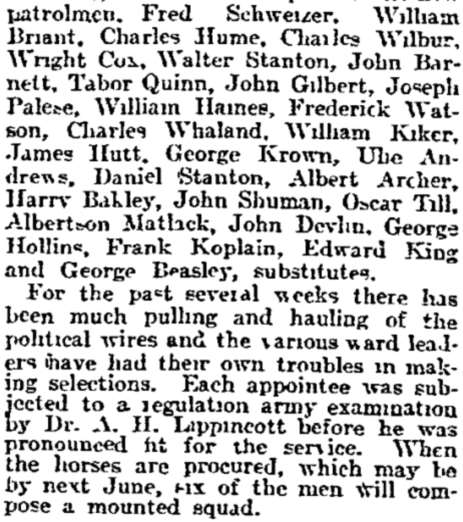
Camden’s police force was increased by the appointment of twenty-five additional officers by Mayor Ellis yesterday. There were also several promotions, two new captains, two sergeants and one detective being made as follows: Captains, Edward Hyde and A. Lincoln James, advanced from sergeants; sergeants, E. B. McClong and Edward Hartman, advanced from patrolmen; detective, John Brothers, advanced from patrolman; new patrolmen, Fred Schweizer, William Briant, Charles Hume, Charles Wilbur, Wright Cox, Walter Stanton, John Barnett, Tabor Quinn, John Gilbert, Joseph Palese, William Haines, Frederick Watson, Charles Whaland, William Kiker, James Hutt, George Krown, Ube Andrews, Daniel Stanton, Albert Archer, Harry Bakley, John Shuman, Oscar Till, Albertson Matlock, John Devlin, George Hollins, Frank Koplain, Edward King and George Beasley, substitutes.
For the past several weeks there has been much pulling and hauling of the political wires and the various ward leaders have had their own troubles in making selections. Each appointee was subjected to a regulation army examination by Dr. A. H. Lappincott before he was pronounced fit for the service. When the horses are procured, which may be by next June, six of the men will compose a mounted squad.
Badly Hurt in a Fight
Philadelphia Inquirer —
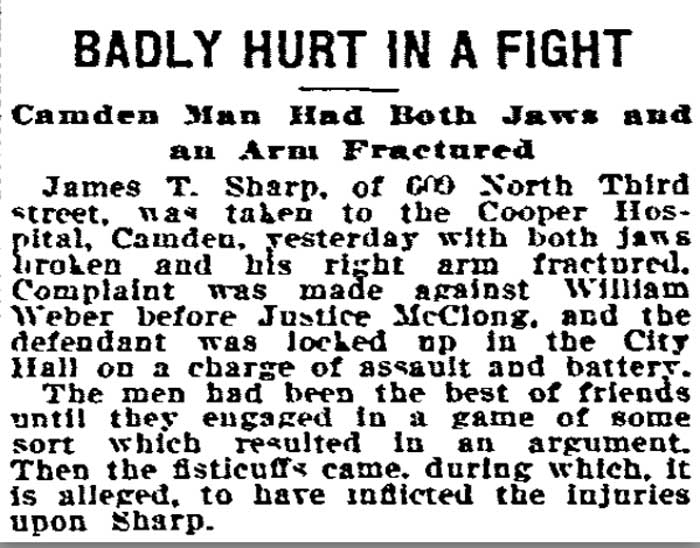
Camden Man Had Both Jaws and an Arm Fractured
James T. Sharp, of 609 North Third street, was taken to the Cooper Hospital, Camden, yesterday with both jaws broken and his right arm fractured. Complaint was made against William Weber before Justice McClong, and the defendant was locked up in the City Hall on a charge of assault and battery.
The men had been the best of friends until they engaged in a game of some sort which resulted in an argument. Then the fisticuffs came, during which, it is alleged, to have inflicted the injuries upon Sharp.
Weber Committed Without Bail by Justice McClong
Philadelphia Inquirer —
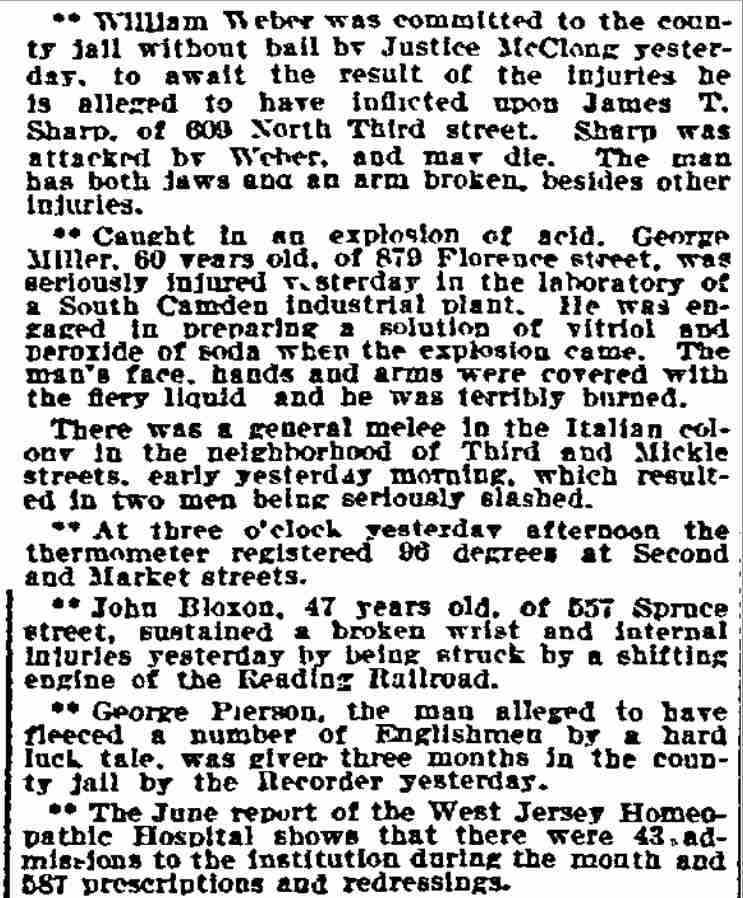
William Weber was committed to the county jail without bail by Justice McClong yesterday, to await the result of the injuries he is alleged to have inflicted upon James T. Sharp, of 609 North Third street. Sharp was attacked by Weber, and may die. The man has both jaws and an arm broken, besides other injuries.
Camden News Notes
Philadelphia Inquirer —
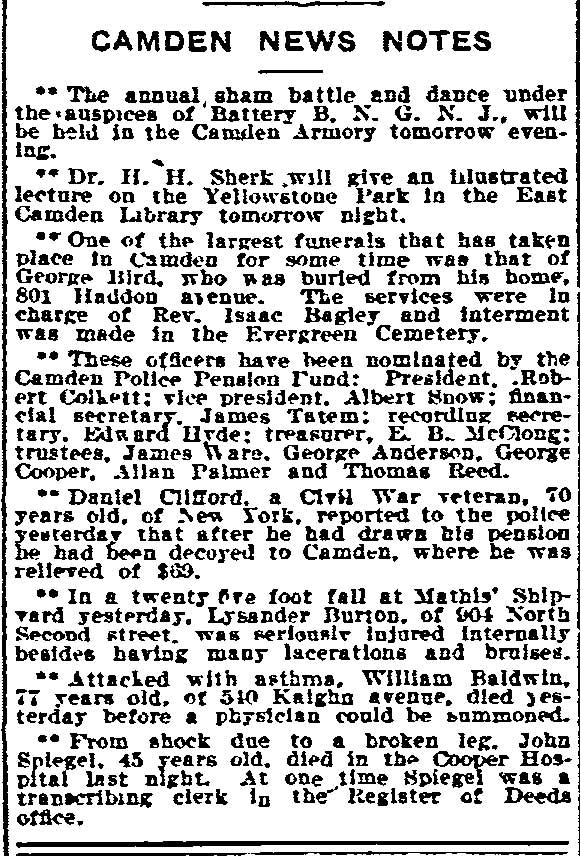
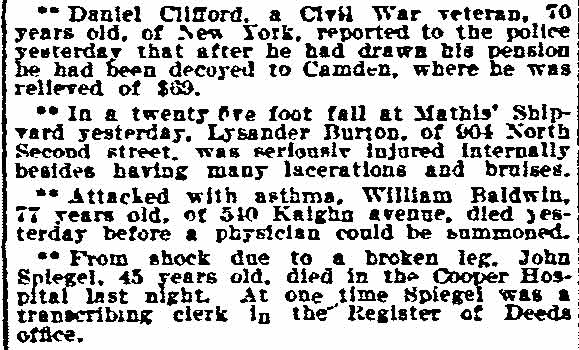
** The annual sham battle and dance under the auspices of Battery B, N. G. N. J., will be held in the Camden Armory tomorrow evening.
** Dr. H. H. Sherk will give an illustrated lecture on the Yellowstone Park in the East Camden Library tomorrow night.
** One of the largest funerals that has taken place in Camden for some time was that of George Bird, 801 Haddon avenue. The services were in charge of Rev. Isaac Bagley and interment was made in the Evergreen Cemetery.
** These officers have been nominated by the Camden Police Pension Fund: President, Robert Colkett; vice president, Albert Snow; financial secretary, James Tatem; recording secretary, Edward Hyde; treasurer, E. B. McClong; trustees, James Ware, George Anderson, George Cooper, Allan Palmer and Thomas Reed.
** Daniel Clifford, a Civil War veteran, 70 years old, of New York, reported to the police yesterday that after he had drawn his pension he had been decoyed to Camden, where he was relieved of $89.
** In a twenty five foot fall at Mathis’ Shipyard yesterday, Lysander Burton, of 904 North Second street, was seriously injured internally besides having many lacerations and bruises.
** Attacked with asthma, William Baldwin, 77 years old, of 510 Kaighn avenue, died yesterday before a physician could be summoned.
** From shock due to a broken leg, John Spiegel, 45 years old, died in the Cooper Hospital last night. At one time Spiegel was a transcribing clerk in the Register of Deeds office.
Arrest Woman on Another's Charge
Trenton Evening Times —
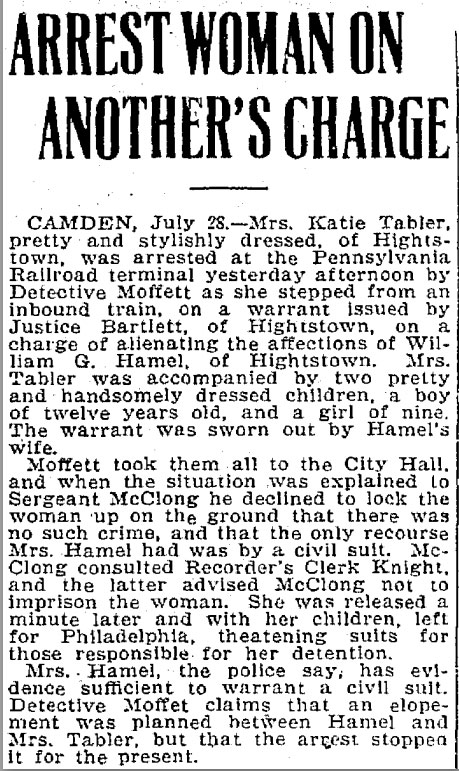
CAMDEN, July 28.—Mrs. Katie Tabler, pretty and stylishly dressed, of Hightstown, was arrested at the Pennsylvania Railroad terminal yesterday afternoon by Detective Moffett as she stepped from an inbound train, on a warrant issued by Justice Bartlett, of Hightstown, on a charge of alienating the affections of William G. Hamel, of Hightstown. Mrs. Tabler was accompanied by two pretty and handsomely dressed children, a boy of twelve years old, and a girl of nine. The warrant was sworn out by Hamel’s wife.
Moffett took them all to the City Hall, and when the situation was explained to Sergeant McClong he declined to lock the woman up on the ground that there was no such crime, and that the only recourse Mrs. Hamel had was by a civil suit. McClong consulted Recorder’s Clerk Knight, and the latter advised McClong not to imprison the woman. She was released a minute later and with her children, left for Philadelphia, theatening suits for those responsible for her detention.
Mrs. Hamel, the police say, has evidence sufficient to warrant a civil suit. Detective Moffett claims that an elopement was planned between Hamel and Mrs. Tabler, but that the arrest stopped it for the present.
Viciously Attacked in Fight on Street
Camden Post-Telegram —
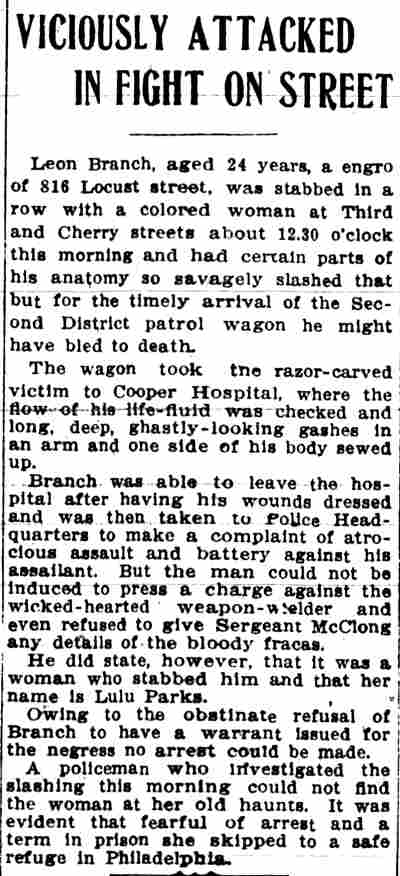
Leon Branch, aged 24 years, a engro of 816 Locust street, was stabbed in a row with a colored woman at Third and Cherry streets about 12.30 o’clock this morning and had certain parts of his anatomy so savagely slashed that but for the timely arrival of the Second District patrol wagon he might have bled to death.
The wagon took the razor-carved victim to Cooper Hospital, where the flow of his life-fluid was checked and long, deep, ghastly-looking gashes in an arm and one side of his body sewed up.
Branch was able to leave the hospital after having his wounds dressed and was then taken to Police Headquarters to make a complaint of atrocious assault and battery against his assailant. But the man could not be induced to press a charge against the wicked-hearted weapon-wielder and even refused to give Sergeant McClong any details of the bloody fracas.
He did state, however, that it was a woman who stabbed him and that her name is Lulu Parks.
Owing to the obstinate refusal of Branch to have a warrant issued for the negress no arrest could be made.
A policeman who investigated the slashing this morning could not find the woman at her old haunts. It was evident that fearful of arrest and a term in prison she skipped to a safe refuge in Philadelphia.
Police Pension Fund Election
Philadelphia Inquirer —
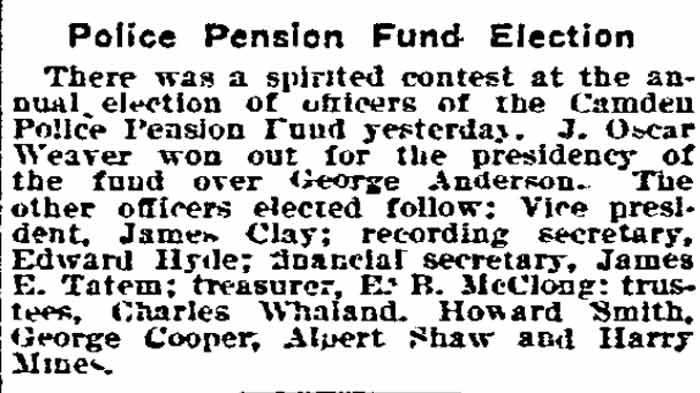
There was a spirited contest at the annual election of officers of the Camden Police Pension Fund yesterday. J. Oscar Weaver won out for the presidency of the fund over George Anderson. The other officers elected follow: Vice president, James Clay; recording secretary, Edward Hyde; financial secretary, James E. Tatem; treasurer, E. B. McClong; trustees, Charles Whaland, Howard Smith, George Cooper, Albert Shaw and Harry Mines.
Speedy Ride in Jersey
Philadelphia Inquirer —
Enthusiastic Manayunk Party Had to Put Up Fine
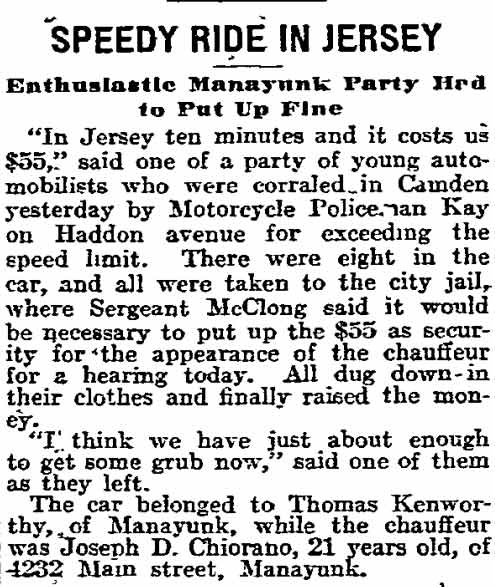
“In Jersey ten minutes and it costs us $55,” said one of a party of young automobilists who were corraled in Camden yesterday by Motorcycle Policeman Kay on Haddon avenue for exceeding the speed limit. There were eight in the car, and all were taken to the city jail, where Sergeant McClong said it would be necessary to put up the $55 as security for the appearance of the chauffeur for a hearing today. All dug down in their clothes and finally raised the money.
“I think we have just about enough to get some grub now,” said one of them as they left.
The car belonged to Thomas Kenworthy, of Manayunk, while the chauffeur was Joseph D. Chiorano, 21 years old, of 1232 Main street, Manayunk.
Boy's Brutal Murderer Collapses at Hearing
Camden Post-Telegram —
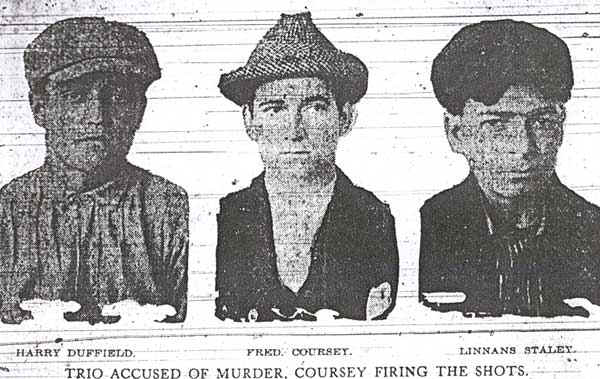
Trio Accused of Murder. Coursey Firing the Shots.
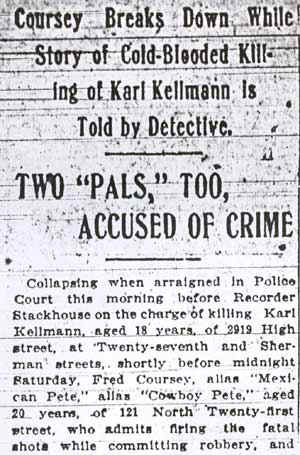
Coursey Breaks Down While Story of Cold-Blooded Killing of Karl Kellmann Is Told by Detective.
Two “Pals,” Too, Accused of Crime
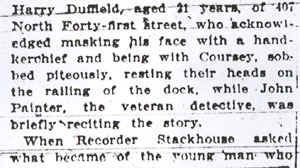
Collapsing when arraigned in Police Court this morning before Recorder Stackhouse on the charge of killing Karl Kellmann, aged 18 years, of 2919 High street, at Twenty-seventh and Sherman streets, shortly before midnight Saturday, Fred Coursey, alias “Mexican Pete,” alias “Cowboy Pete,” aged 20 years, of 121 North Twenty-first street, who admits firing the fatal shots while committing robbery, and Harry Duffield, aged 21 years, of 407 North Forty-first street, who acknowledged masking his face with a handkerchief and being with Coursey, sobbed piteously, resting their heads on the railing of the dock, while John Painter, the veteran detective, was briefly reciting the story.
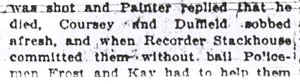
When Recorder Stackhouse asked what became of the young man who was shot and Painter replied that he died, Coursey and Duffield sobbed afresh, and when Recorder Stackhouse committed them without bail Policemen Frost and Kay had to help them.
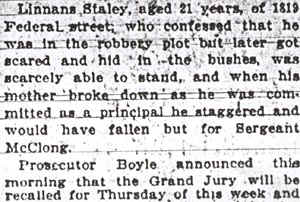
Linnans Staley, aged 21 years, of 1819 Federal street, who confessed that he was in the robbery plot but later got scared and hid in the bushes, was scarcely able to stand, and when his mother broke down as he was committed as a principal he staggered and would have fallen but for Sergeant McClong.
Prosecutor Boyle announced this morning that the Grand Jury will be recalled for Thursday of this week and the case will be made the special order of the day.
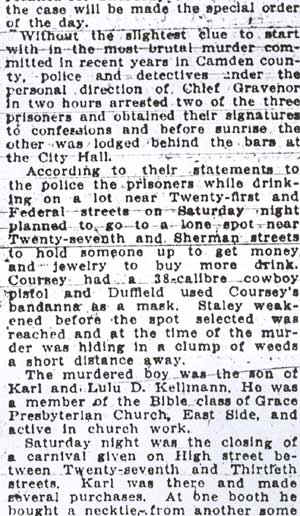
Without the slightest clue to start with in the most brutal murder committed in recent years in Camden county, police and detectives under the personal direction of Chief Gravenor in two hours arrested two of the three prisoners and obtained their signatures to confessions and before sunrise the other was lodged behind the bars at the City Hall.
According to their statements to the police the prisoners while drinking on a lot near Twenty-first and Federal streets on Saturday night planned to go to a lone spot near Twenty-seventh and Sherman streets to hold someone up to get money and jewelry to buy more drink. Coursey had a 38-calibre cowboy pistol and Duffield used Coursey’s bandanna as a mask. Staley weakened before the spot selected was reached and at the time of the murder was hiding in a clump of weeds a short distance away.
The murdered boy was the son of Karl and Lulu D. Kellmann. He was a member of the Bible class of Grace Presbyterian Church, East Side, and active in church work.
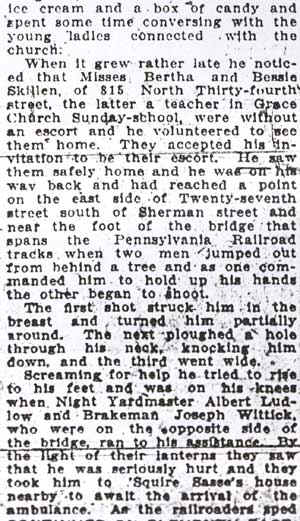
Saturday night was the closing of a carnival given on High street between Twenty-seventh and Thirtieth streets. Karl was there and made several purchases. At one booth he bought a necktie, from another some ice cream and a box of candy and spent some time conversing with the young ladies connected with the church.
When it grew rather late he noticed that Misses Bertha and Bessie Skillen, of 815 North Thirty-fourth street, the latter a teacher in Grace Church Sunday-school, were without an escort and he volunteered to see them home. They accepted his invitation to be their escort. He saw them safely home and he was on his way back and had reached a point on the east side of Twenty-seventh street south of Sherman street and near the foot of the bridge that spans the Pennsylvania Railroad tracks when two men jumped out from behind a tree and as one commanded him to hold up his hands the other began to shoot.
The first shot struck him in the breast and turned him partially around. The next ploughed a hole through his neck, knocking him down, and the third went wide.
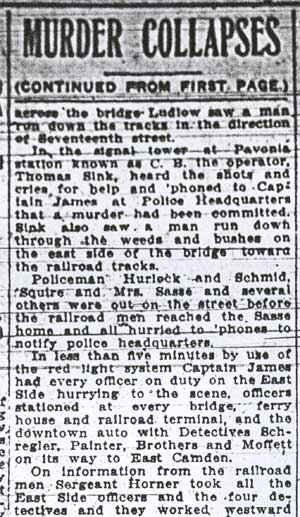
Screaming for help he tried to rise to his feet and was on his knees when Night Yardmaster Albert Ludlow and Brakeman Joseph Wittick, who were on the opposite side of the bridge, ran to his assistance. By the light of their lanterns they saw that he was seriously hurt and they took him to ‘Squire Sasse’s house nearby to await the arrival of the ambulance. As the railroaders sped across the bridge Ludlow saw a man run down the tracks in the direction of Seventeenth street.
In the signal tower at Pavonia station known as C. B. the operator, Thomas Sink, heard the shots and cries for help and ‘phoned to Captain James at Police Headquarters that a murder had been committed. Sink also saw a man run down through the weeds and bushes on the east side of the bridge toward the railroad tracks.
Policeman Hurlock and Schmid, ‘Squire and Mrs. Sasse and several others were out on the street before the railroad men reached the Sasse home and all hurried to ‘phones to notify police headquarters.
In less than five minutes by use of the red light system Captain James had every officer on duty on the East Side hurrying to the scene, officers stationed at every bridge, ferry house and railroad terminal, and the downtown auto with Detectives Schregler, Painter, Brothers and Moffett on its way to East Camden.
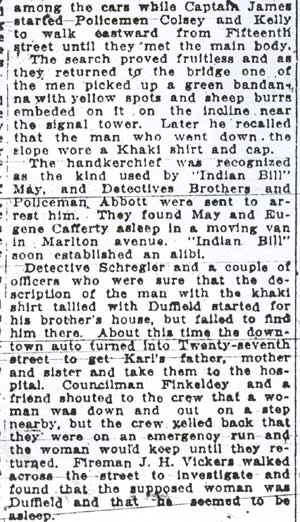
On information from the railroad men Sergeant Horner took all the East Side officers and the four detectives and they worked westward among the cars while Captain James started Policemen Colsey and Kelly to walk eastward from Fifteenth street until they met the main body.
The search proved fruitless and as they returned to the bridge one of the men picked up a green bandanna with yellow spots and sheep burrs embedded on it on the incline near the signal tower. Later he recalled that the man who went down the slope wore a Khaki shirt and cap.
The handkerchief was recognized as the kind used by “Indian Bill” May, and Detectives Brothers and Policeman Abbott were sent to arrest him. They found May and Eugene Cafferty asleep in a moving van in Marlton avenue. “Indian Bill” soon established an alibi.
Detective Schregler and a couple of officers who were sure that the description of the man with the khaki shirt tallied with Duffield started for his brother’s house, but failed to find him there. About this time the downtown auto turned into Twenty-seventh street to get Karl’s father, mother and sister and take them to the hospital. Councilman Finkeldey and a friend shouted to the crew that a woman was down and out on a step nearby, but the crew yelled back that they were on an emergency run and the woman would keep until they returned. Fireman J. H. Vickers walked across the street to investigate and found that the supposed woman was Duffield and that he seemed to be asleep.
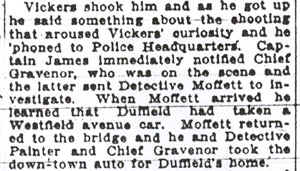
Vickers shook him and as he got up he said something about the shooting that aroused Vickers’ curiosity and he ‘phoned to Police Headquarters. Captain James immediately notified Chief Gravenor, who was on the scene and the latter sent Detective Moffett to investigate. When Moffett arrived he learned that Duffield had taken a Westfield avenue car. Moffett returned to the bridge and he and Detective Painter and Chief Gravenor took the down-town auto for Duffield’s home.
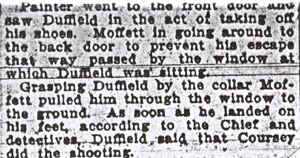
Painter went to the front door and saw Duffield in the act of taking off his shoes. Moffett in going around to the back door to prevent his escape that way passed by the window at which Duffield was sitting.
Grasping Duffield by the collar Moffett pulled him through the window to the ground. As soon as he landed on his feet, according to the Chief and detectives, Duffield said that Coursey did the shooting.
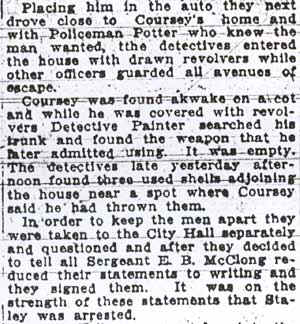
Placing him in the auto they next drove close to Coursey’s home and with Policeman Potter who knew the man wanted, the detectives entered the house with drawn revolvers while other officers guarded all avenues of escape.
Coursey was found awake on a cot and while he was covered with revolvers Detective Painter searched his trunk and found the weapon that he later admitted using. It was empty. The detectives late yesterday afternoon found three used shells adjoining the house near a spot where Coursey said he had thrown them.
In order to keep the men apart they were taken to the City Hall separately and questioned and after they decided to tell all Sergeant E. B. McClong reduced their statements to writing and they signed them. It was on the strength of these statements that Staley was arrested.
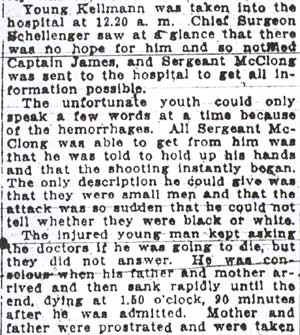
Young Kellmann was taken into the hospital at 12.20 a. m. Chief Surgeon Schellenger saw at a glance that there was no hope for him and so notified Captain James, and Sergeant McClong was sent to the hospital to get all information possible.
The unfortunate youth could only speak a few words at a time because of the hemorrhages. All Sergeant McClong was able to get from him was that he was told to hold up his hands and that the shooting instantly began. The only description he could give was that they were small men and that the attack was so sudden that he could not tell whether they were black or white.
The injured young man kept asking the doctors if he was going to die, but they did not answer. He was conscious when his father and mother arrived and then sank rapidly until the end, dying at 1.50 o’clock, 90 minutes after he was admitted. Mother and father were prostrated and were taken home by the up-town auto.
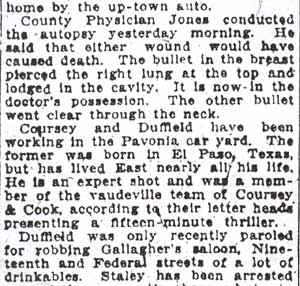
County Physician Jones conducted the autopsy yesterday morning. He said that either wound would have caused death. The bullet in the breast pierced the right lung at the top and lodged in the cavity. It is now in the doctor’s possession. The other bullet went clear through the neck.
Coursey and Duffield have been working in the Pavonia car yard. The former was born in El Paso, Texas, but has lived East nearly all his life. He is an expert shot and was a member of the vaudeville team of Coursey & Cook, according to their letter heads presenting a fifteen-minute thriller.
Duffield was only recently paroled for robbing Gallagher’s saloon, Nineteenth and Federal streets of a lot of drinkables. Staley has been arrested several times on petty charges but was never convicted of crime. When Duffield’s coat was examined at the City Hall, it was found to contain sheep burrs.
To a reporter Coursey said that whenever he was drinking he had to get his gun and shoot something or somebody. He insisted that all were in on the job and that they let the man who preceded Kellman go over the bridge without molestation because he didn’t look as if he had any too much money.
Yesterday morning Assistant Prosecutor Wolverton and Stenographer Cleary called at the City Hall. The prisoners were examined by Mr. Wolverton and their statements taken by Mr. Cleary, but there was little or nothing new elicited.
'Kentucky Rosebud' Accused by Police
Camden Post-Telegram —
Accused of keeping a disorderly house, Walter Edgerton, at one time a famous lightweight colored pugilist, known as the “Kentucky Rosebud,” was held in $300 bail by Justice McClong this morning. The defendant, now in his fifties, lives at 311 Locust street, where he was arrested by Police Captain Stanley yesterday. No intoxicants were found, but it is charged that the “Rosebud” maintained a house of assignation. He waived a hearing.
Girl Victim's Brother Accuses Man
Philadelphia Inquirer —
Traced to Camden by the brother of 15-year-old Elizabeth Jeter, of 3141 Heater street, New York, who was attacked and seriously injured, Joseph Zitz, aged 31 years, of Two-hundred-and-thirty-eighth street and Albany avenue, New York, was taken into custody by Detectives Schregler, Troncone and Fitzsimmons on Central avenue, Camden, yesterday. Zitz was accused of attacking the girl by Sinclair Jeter, the brother, and remanded to jail by Justice McClong pending requisition papers from New York.
Police Carnival Was a Gigantic Success
Philadelphia Inquirer —
Considered one of the most successful events ever given in Camden, the second annual industrial show and carnival of the Camden Police Beneficial Association came to a close in the Third Regiment Armory Saturday night with the “crowning of the queen.” Miss Margaret Rudolph, daughter of Chas. Rudolph, of Master street, was accorded that honor. It is estimated that during the week more than 50,000 persons visited the armory and participated in the festivities.
The committee that had charge of the affair included Milton Stanley, Captain Edward Hyde, Sergeant E. B. McClong, Frank Crawford, Peter Gondolf, William Lvone, Harry Miller, Arthur Colsey, Thomas Reed, William Potter, Tabor Quinn, Charles Whaland, George Anderson, Albert Shaw, Sergeant Horner and Thomas Cunningham.
4097 Camden Arrests in 1915
Philadelphia Inquirer —
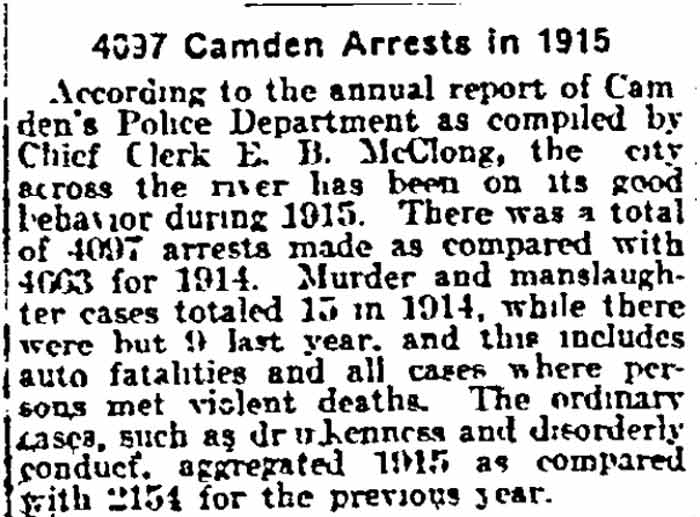
According to the annual report of Camden’s Police Department as compiled by Chief Clerk E. B. McClong, the city across the river has been on its good behavior during 1915. There was a total of 4097 arrests made as compared with 4063 for 1914. Murder and manslaughter cases totaled 15 in 1914, while there were but 9 last year, and this includes auto fatalities and all cases where persons met violent deaths. The ordinary cases, such as drunkenness and disorderly conduct, aggregated 1915 as compared with 2154 for the previous year.
Knights Templar Install
Philadelphia Inquirer —
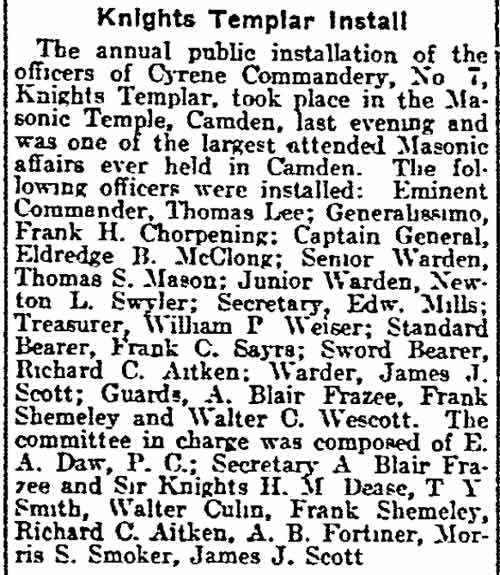
The annual public installation of the officers of Cyrene Commandery, No. 7, Knights Templar, took place in the Masonic Temple, Camden, last evening and was one of the largest attended Masonic affairs ever held in Camden. The following officers were installed: Eminent Commander, Thomas Lee; Generalissimo, Frank H. Chorpening; Captain General, Eldredge B. McClong; Senior Warden, Thomas S. Mason; Junior Warden, Newton L. Swyler; Secretary, Edw. Mills; Treasurer, William P. Weiser; Standard Bearer, Frank C. Sayrs; Sword Bearer, Richard C. Aitken; Warder, James J. Scott; Guards, A. Blair Frazee, Frank Shemeley and Walter C. Wescott. The committee in charge was composed of E. A. Daw, P. C.; Secretary A. Blair Frazee and Sir Knights H. M. Dease, T. Y. Smith, Walter Culin, Frank Shemeley, Richard C. Aitken, A. B. Fortiner, Morris S. Smoker, James J. Scott.
Police Elect Officers
Philadelphia Inquirer —
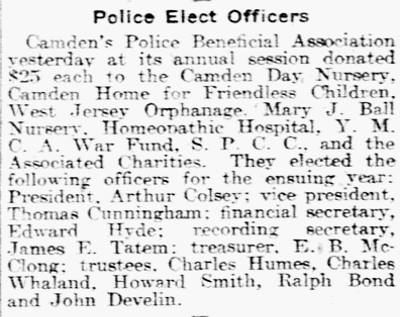
Camden’s Police Beneficial Association yesterday at its annual session donated $25 each to the Camden Day Nursery, Camden Home for Friendless Children, West Jersey Orphanage, Mary J. Ball Nursery, Homeopathic Hospital, Y. M. C. A. War Fund, S. P. C. C., and the Associated Charities. They elected the following officers for the ensuing year: President, Arthur Colsey; vice president, Thomas Cunningham; financial secretary, Edward Hyde; recording secretary, James E. Tatem; treasurer, E. B. McClong; trustees, Charles Humes, Charles Whaland, Howard Smith, Ralph Bond and John Develin.
Personals
Jackson Citizen — — Jackson, Michigan
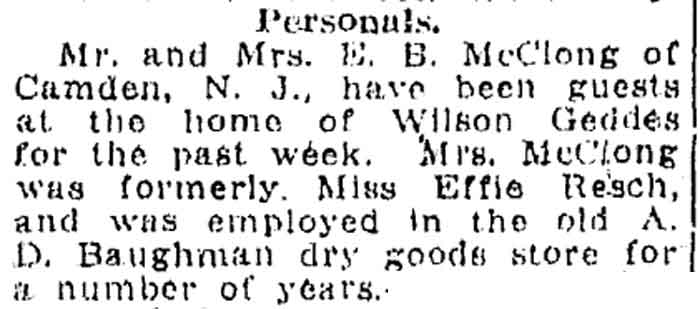
Mr. and Mrs. E. B. McClong of Camden, N. J., have been guests at the home of Wilson Geddes for the past week. Mrs. McClong was formerly Miss Effie Resch, and was employed in the old A. D. Baughman dry goods store for a number of years.
Mr. and Mrs. McClung Visit Millville Relatives
Bridgeton Evening News —

Mr. and Mrs. Eldredge McClung, of Camden, were week-end visitors of Millville relatives.
Chief of Camden Police Is Retired
Trenton Evening Times —
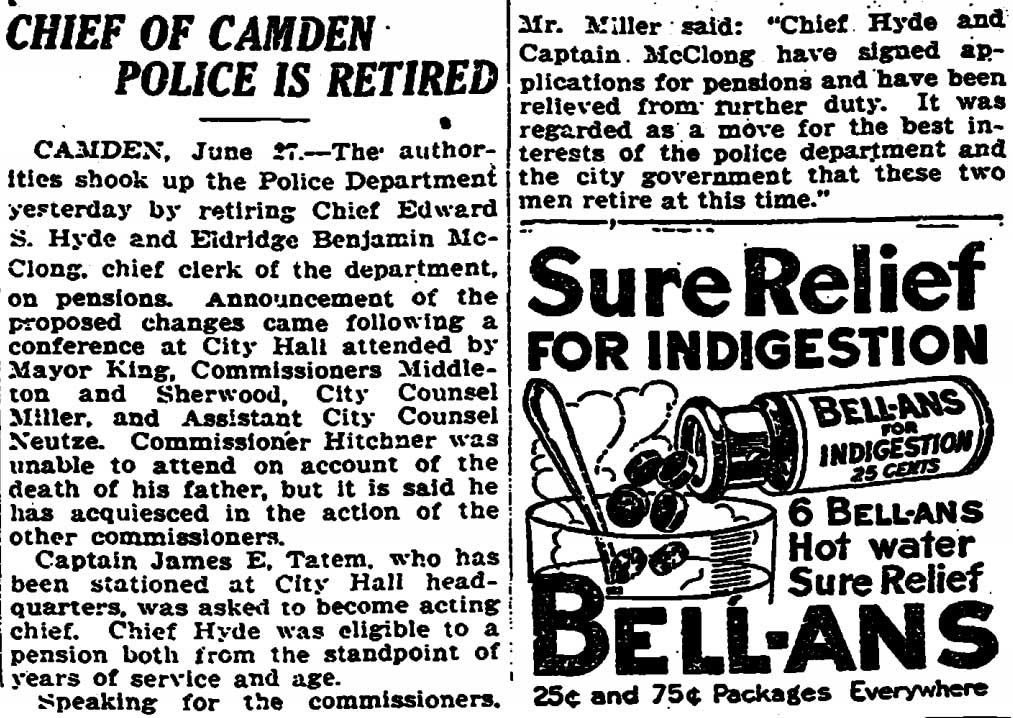
CAMDEN, June 27.—The authorities shook up the Police Department yesterday by retiring Chief Edward S. Hyde and Eldridge Benjamin McClong, chief clerk of the department, on pensions. Announcement of the proposed changes came following a conference at City Hall attended by Mayor King, Commissioners Middleton and Sherwood, City Counsel Miller, and Assistant City Counsel Neutze. Commissioner Hitchner was unable to attend on account of the death of his father, but it is said he has acquiesced in the action of the other commissioners.
Captain James E. Tatem, who has been stationed at City Hall headquarters, was asked to become acting chief. Chief Hyde was eligible to a pension both from the standpoint of years of service and age.
Mr. Miller said: “Chief Hyde and Captain McClong have signed applications for pensions and have been relieved from further duty. It was regarded as a move for the best interests of the police department and the city government that these two men retire at this time.”