Introduction
WALTER BENJAMIN GRAY was born June 25, 1893 in Worcester County, Maryland to Stephen Edward Gray and his wife, the former Sallie Virginia Mason. There were three younger brothers, Edward Lee Gray, Maurice William Gray, and Clarence Wesley Gray. He grew up in Worcester County, residing there through 1910. The 1900 Census shows the family, then consisting of Mr. & Mrs. Gray and sons Walter and Edward, living in Pocomoke, Maryland; Stephen Gray was then working in a shipyard. The 1910 Census shows the family in Colston, Maryland.
Walter B. Gray married Clemence Ruth Lindley, of 534 Cedar Street in North Camden, around 1914. The 1915 and 1916 Camden City Directories show Walter and Clemence Gray living with her parents at 534 Cedar Street. He was then working as a machinist. Son Edward Gray was born in 1916. The 1917 City Directory shows Walter Gray working as a clerk and living at 842 Grant Street.
When Walter B. Gray registered for the draft on June 5, 1917 he was living with his wife and son Edward at 814 Grant Street in North Camden. Walter B. Gray was then working as a pressman for the Victor Talking Machine Company.
The 1918 City Directory shows that the Walter Gray family was still at 842 Grant Street. Walter Gray was then working as a railroad brakeman. His brother Edward had come to Camden, was living at the Grant Street address and was also working as a brakeman. By January of 1920 Walter Gray’s brother Morris had also come to Camden and was living at the Grant Street address. Walter Gray had returned to work at the Victor Machine Company, while his brothers worked for the railroad, Edward as a brakeman, Morris as a switchman.
By the time the 1921 City Directory was compiled, Walter and Clemence Gray had moved to 547 York Street. He had also been appointed to the Camden Fire Department shortly after the 1920 Census enumeration. Walter Gray is listed as being with the department in the 1921, 1922, and 1923 City Directories. Sadly, Walter B. Gray died on January 21, 1924. He was survived by his wife Clemence, son Edward, his brothers, and his parents. A few years later Clemence Gray married again. Her new husband was Rollo Jones, who was promoted to Battalion Chief in April of 1928. Rollo Jones passed away in Camden in 1940.
World War I Draft Card
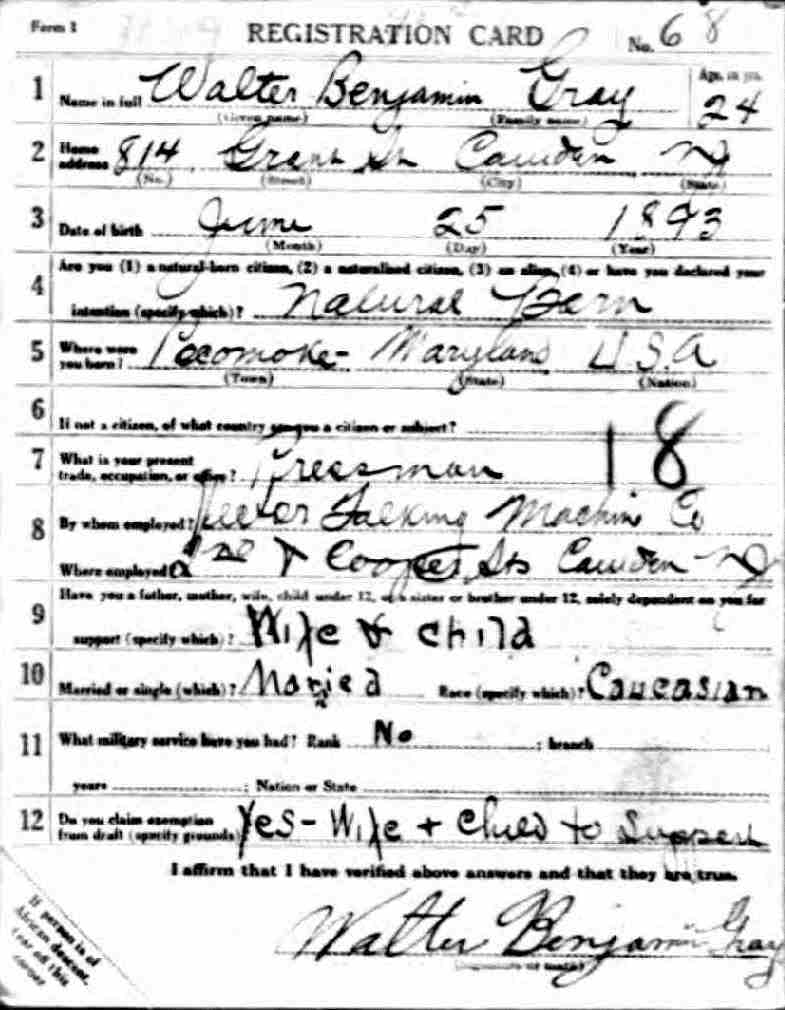
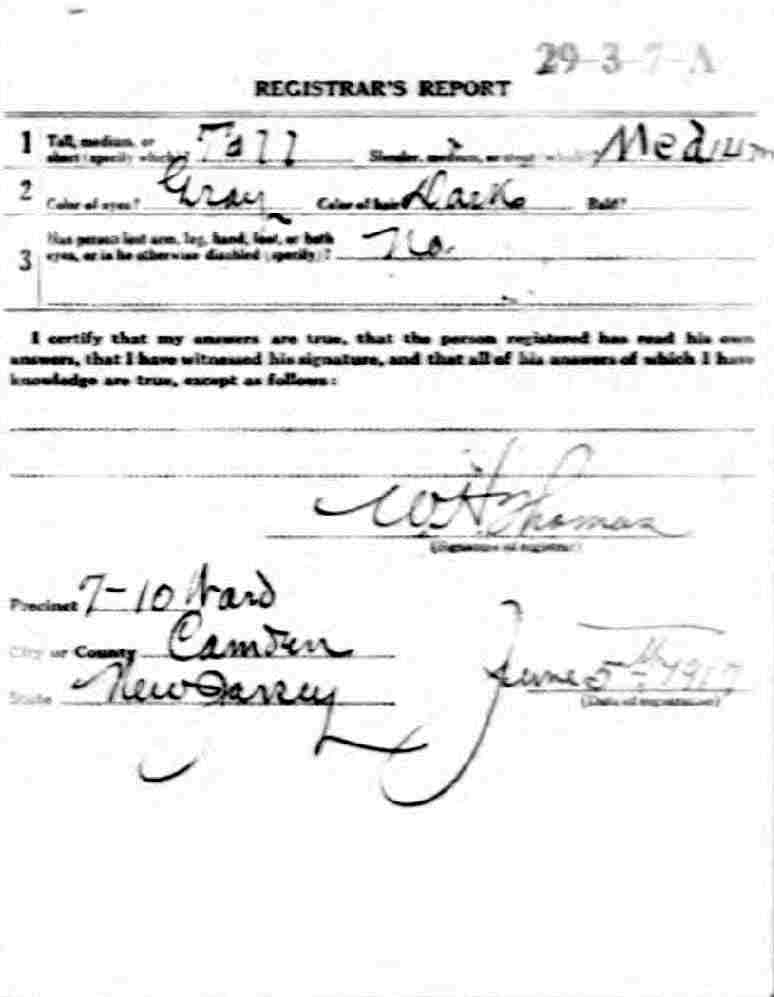
Walter B. Gray — World War I Draft Card
New Firemen Assigned for Two Platoons
Camden Post-Telegram —
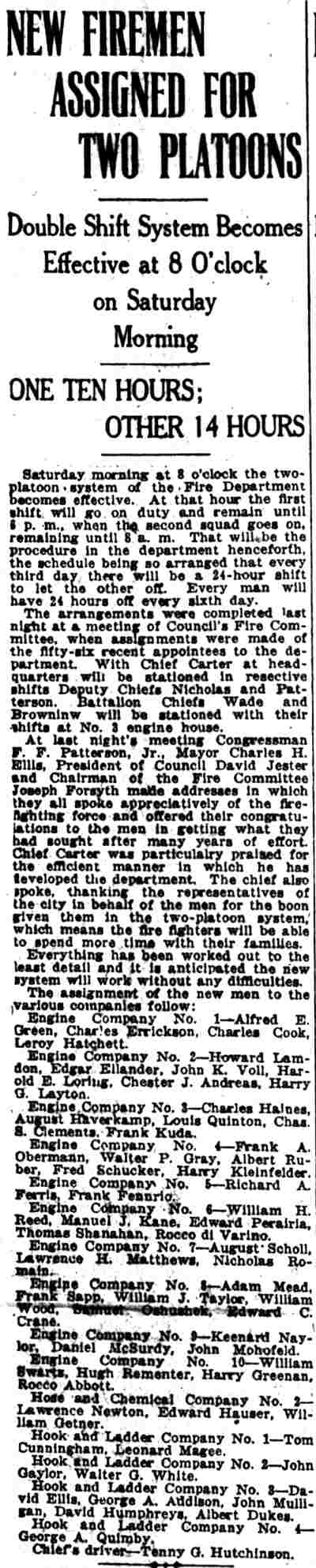
NEW FIREMEN ASSIGNED FOR TWO PLATOONS
Double Shift System Becomes Effective at 8 O’clock on Saturday Morning
One Ten Hours; Other 14 Hours
Saturday morning at 8 o’clock the two-platoon system of the Fire Department becomes effective. At that hour the first shift will go on duty and remain until 6 p. m., when the second squad goes on, remaining until 8 a. m. That will be the procedure in the department henceforth, the schedule being so arranged that every third day there will be a 24-hour shift to let the other off. Every man will have 24 hours off every sixth day.
The arrangements were completed last night at a meeting of Council’s Fire Committee, when assignments were made of the fifty-six recent appointees to the department. With Chief Carter at headquarters will be stationed in reserve shifts Deputy Chiefs Nicholas and Patterson. Battalion Chiefs Wade and Browning will be stationed with their shifts at No. 3 engine house.
At last night’s meeting Congressman F. F. Patterson, Jr., Mayor Charles H. Ellis, President of Council David Jester and Chairman of the Fire Committee Joseph Forsyth made addresses in which they all spoke appreciatively of the fire-fighting force and offered their congratulations to the men in getting what they had sought after many years of effort. Chief Carter was particularly praised for the efficient manner in which he has developed the department. The chief also spoke, thanking the representatives of the city in behalf of the men for the boon given them in the two-platoon system, which means the fire fighters will be able to spend more time with their families.
Everything has been worked out to the least detail and it is anticipated the new system will work without any difficulties.
The assignment of the new men to the various companies follow:
Engine Company No. 1—Alfred E. Green, Charles Errickson, Charles Cook, Leroy Hatchett.
Engine Company No. 2—Howard Lamdon, Edgar Ellander, John K. Voll, Harold E. Lorang, Chester J. Andreas, Harry G. Layton.
Engine Company No. 3—Charles Haines, August Haverkamp, Louis Quinton, Chas. S. Clements, Frank Kuda.
Engine Company No. 4—Frank A. Obermann, Walter P. Gray, Albert Ruber, Fred Schucker, Harry Kleinfelder.
Engine Company No. 5—Richard A. Ferris, Frank Fennrio.
Engine Company No. 6—William H. Reed, Manuel J. Kane, Edward Perairia, Thomas Shanahan, Rocco di Varino.
Engine Company No. 7—August Scholl, Lawrence H. Matthews, Nicholas Romain.
Engine Company No. 8—Adam Mead, Frank Sapp, William J. Taylor, William Wood, Samuel Oshushek, Edward C. Crane.
Engine Company No. 9—Keenard Naylor, Daniel McSurdy, John Mohofeld.
Engine Company No. 10—William Swarts, Hugh Rementer, Harry Greenan, Rocco Abbott.
Hose and Chemical Company No. 2—Lawrence Newton, Edward Hauser, William Getner.
Hook and Ladder Company No. 1—Tom Cunningham, Leonard Magee.
Hook and Ladder Company No. 2—John Gaylor, Walter G. White.
Hook and Ladder Company No. 3—David Ellis, George A. Addison, John Mulligan, David Humphreys, Albert Dukes.
Hook and Ladder Company No. 4—George A. Quimby.
Chief’s driver—Tenny G. Hutchinson.