William P. Elberson
William P. Elberson
WILLIAM P. ELBERSON was born in Camden on March 28, 1875 to John Elberson and his wife, the former Rachel Penyard. The family name also comes up as Elverson and in at least once source Elbertson. William P. Elberson was the oldest of five children, coming before Edith, Mamie, Theodore, and Walter. John Elberson was a veteran of the Civil War, having served with Company F, 4th New Jersey Infantry Regiment. The family, which then included William and his two younger sisters, was living at 219 Bridge Avenue at the time of the 1880 Census. By 1887 the younger brothers had been born and the family had moved to 564 Carman Street, where they remained into the 1900s.
William P. Elberson married Ella C. Gladney around 1898. He and wife Ella were living at 231 Taylor Avenue by the spring of 1900. He then was working as a day laborer. It appears that William P. Elberson was recorded twice during this census enumeration, at both his parents home and his own. At some point after that and before the 1906 Camden City Directory was compiled, William P. Elberson was appointed to the Camden Fire Department.
The 1906 City Directory and the 1910 Census show William Elberson living at 231 Taylor Avenue and working for the Fire Department. He and his wife Ella were still childless when the 1910 Census was enumerated. Sadly, Ella Elberson died on July 11, 1912. William Elberson soon remarried, and his wife Bessie bore him four children — Albert, Mary, William, and Earl.
William P. Elberson was serving with Engine Company 2 in 1913. The 1914 City Directory shows that William P. Elberson and his family had moved to 307 Federal Street. William P. Elberson died on March 16, 1918 at the age of 42, leaving his then pregnant wife and three children. His son Earl was born a few months after his father’s death.
Armory Fire
Philadelphia Inquirer —
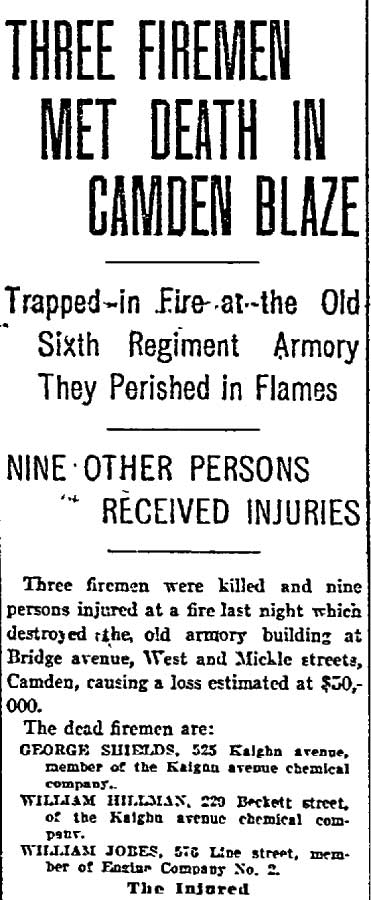
THREE FIREMEN MET DEATH IN CAMDEN BLAZE
Trapped in Fire at the Old Sixth Regiment Armory They Perished in Flames
NINE OTHER PERSONS RECEIVED INJURIES
Three firemen were killed and nine persons injured at a fire last night which destroyed the old armory building at Bridge avenue, West and Mickle streets, Camden, causing a loss estimated at $50,000.
The dead firemen are: GEORGE SHIELDS, 525 Kaighn avenue, member of the Kaighn avenue chemical company. WILLIAM HILLMAN, 229 Beckett street, of the Kaighn avenue chemical company. WILLIAM JOBES, 576 Line street, member of Engine Company No. 2.
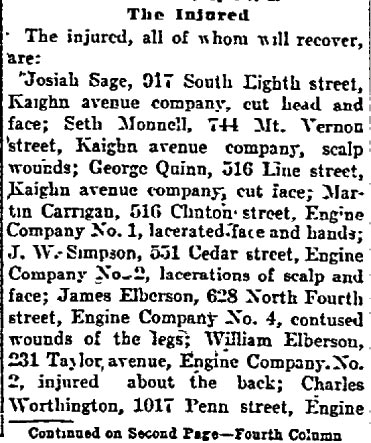
The Injured
The Injured
The injured, all of whom will recover, are: Josiah Sage, 917 South Eighth street, Kaighn avenue company, cut head and face; Seth Monnell, 744 Mt. Vernon street, Kaighn avenue company, scalp wounds; George Quinn, 516 Line street, Kaighn avenue company, cut face; Martin Carrigan, 516 Clinton street, Engine Company No. 1, lacerated face and hands; J. W. Simpson, 551 Cedar street, Engine Company No. 2, lacerations of scalp and face; James Elberson, 628 North Fourth street, Engine Company No. 4, contused wounds of the legs; William Elberson, 231 Taylor avenue, Engine Company No. 2, injured about the back; Charles Worthington, 1017 Penn street, Engine
Continued on Second Page—Fourth Column
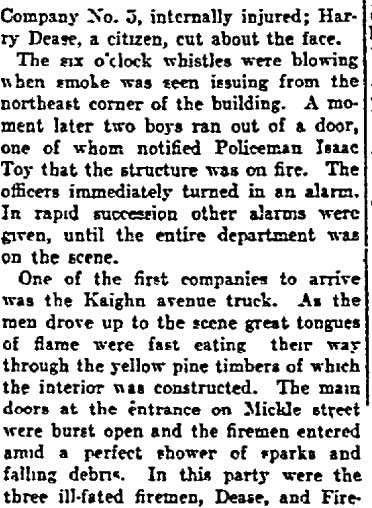
Company No. 3, internally injured; Harry Dease, a citizen, cut about the face.
The six o’clock whistles were blowing when smoke was seen issuing from the northeast corner of the building. A moment later two boys ran out of a door, one of whom notified Policeman Isaac Toy that the structure was on fire. The officers immediately turned in an alarm. In rapid succession other alarms were given, until the entire department was on the scene.
One of the first companies to arrive was the Kaighn avenue truck. As the men drove up to the scene great tongues of flame were fast eating their way through the yellow pine timbers of which the interior was constructed. The main doors at the entrance on Mickle street were burst open and the firemen entered amid a perfect shower of sparks and falling debris. In this party were the three ill-fated firemen, Dease, and Fire-
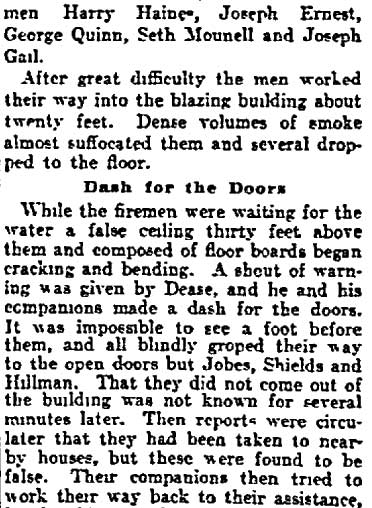
men Harry Haines, Joseph Ernest, George Quinn, Seth Mounell and Joseph Gail.
After great difficulty the men worked their way into the blazing building about twenty feet. Dense volumes of smoke almost suffocated them and several dropped to the floor.
Dash for the Doors
While the firemen were waiting for the water a false ceiling thirty feet above them and composed of floor boards began cracking and bending. A shout of warning was given by Dease, and he and his companions made a dash for the doors. It was impossible to see a foot before them, and all blindly groped their way to the open doors but Jobes, Shields and Hillman. That they did not come out of the building was not known for several minutes later. Then reports were circulated that they had been taken to nearby houses, but these were found to be false. Their companions then tried to work their way back to their assistance,
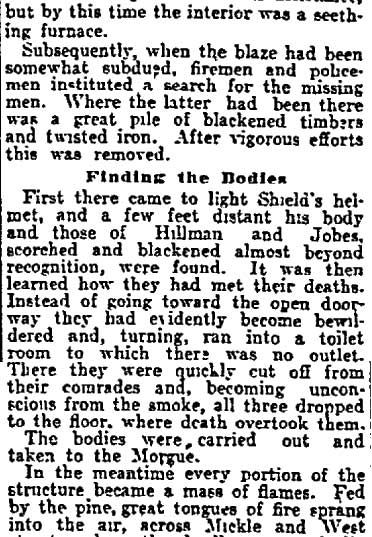
but by this time the interior was a seething furnace.
Subsequently, when the blaze had been somewhat subdued, firemen and policemen instituted a search for the missing men. Where the latter had been there was a great pile of blackened timbers and twisted iron. After vigorous efforts this was removed.
Finding the Bodies
First there came to light Shield’s helmet, and a few feet distant his body and those of Hillman and Jobes, scorched and blackened almost beyond recognition, were found. It was then learned how they had met their deaths. Instead of going toward the open doorway they had evidently become bewildered and, turning, ran into a toilet room to which there was no outlet. There they were quickly cut off from their comrades and, becoming unconscious from the smoke, all three dropped to the floor, where death overtook them.
The bodies were carried out and taken to the Morgue.
In the meantime every portion of the structure became a mass of flames. Fed by the pine, great tongues of fire sprang into the air, across Mickle and West
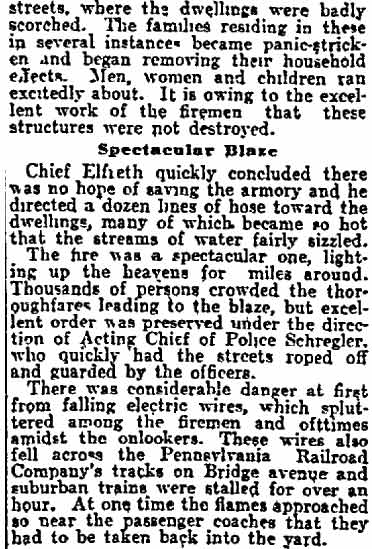
streets, where the dwellings were badly scorched. The families residing in these in several instances became panic-stricken and began removing their household effects. Men, women and children ran excitedly about. It is owing to the excellent work of the firemen that these structures were not destroyed.
Spectacular Blaze
Chief Elfieth quickly concluded there was no hope of saving the armory and he directed a dozen lines of hose toward the dwellings, many of which became so hot that the streams of water fairly sizzled.
The fire was a spectacular one, lighting up the heavens for miles around. Thousands of persons crowded the thoroughfares leading to the blaze, but excellent order was preserved under the direction of Acting Chief of Police Schregler, who quickly had the streets roped off and guarded by the officers.
There was considerable danger at first from falling electric wires, which spluttered among the firemen and ofttimes amidst the onlookers. These wires also fell across the Pennsylvania Railroad Company’s tracks on Bridge avenue and suburban trains were stalled for over an hour. At one time the flames approached so near the passenger coaches that they had to be taken back into the yard.
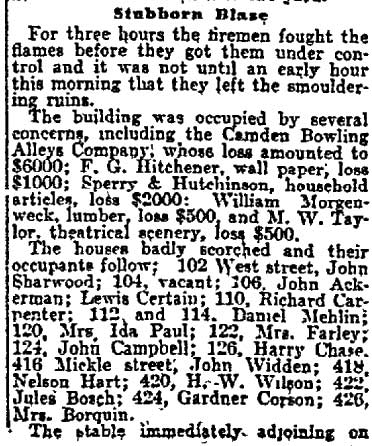
Stubborn Blaze
For three hours the firemen fought the flames before they got them under control and it was not until an early hour this morning that they left the smouldering ruins.
The building was occupied by several concerns, including the Camden Bowling Alleys Company, whose loss amounted to $6000; F. G. Hitchener, wall paper, loss $1000; Sperry & Hutchinson, household articles, loss $2000; William Morgenweck, lumber, loss $500, and M. W. Taylor, theatrical scenery, loss $500.
The houses badly scorched and their occupants follow: 102 West street, John Sharwood; 104, vacant; 106, John Ackerman; Lewis Certain; 110, Richard Carpenter; 112, and 114, Daniel Mehlin; 120, Mrs. Ida Paul; 122, Mrs. Farley; 124, John Campbell; 126, Harry Chase; 416 Mickle street: John Widden; 418, Nelson Hart; 420, H.-W. Wilson; 422, Jules Bosch; 424, Gardner Corson; 426, Mrs. Borquin.
The stable immediately adjoining on
the west side of the armory, and belonging to C. M. Alcott, was flooded with water. At this place there were forty horses, all of which were rescued.
Formerly a Market
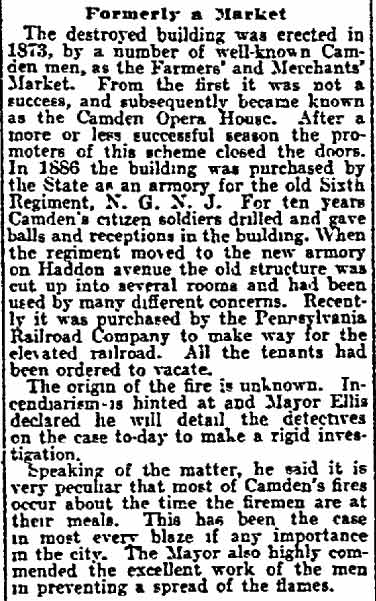
The destroyed building was erected in 1873, by a number of well-known Camden men, as the Farmers’ and Merchants’ Market. From the first it was not a success, and subsequently became known as the Camden Opera House. After a more or less successful season the promoters of this scheme closed the doors. In 1886 the building was purchased by the State as an armory for the old Sixth Regiment, N. G. N. J. For ten years Camden’s citizen soldiers drilled and gave balls and receptions in the building. When the regiment moved to the new armory on Haddon avenue the old structure was cut up into several rooms and had been used by many different concerns. Recently it was purchased by the Pennsylvania Railroad Company to make way for the elevated railroad. All the tenants had been ordered to vacate.
The origin of the fire is unknown. Incendiarism is hinted at and Mayor Ellis declared he will detail the detectives on the case to-day to make a rigid investigation.
Speaking of the matter, he said it is very peculiar that most of Camden’s fires occur about the time the firemen are at their meals. This has been the case in most every blaze if any importance in the city. The Mayor also highly commended the excellent work of the men in preventing a spread of the flames.
Camden Fire Department
Philadelphia Inquirer —
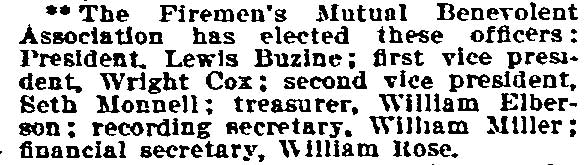
•• The Firemen’s Mutual Benevolent Association has elected these officers: President, Lewis Buzine; first vice president, Wright Cox; second vice president, Seth Monnell; treasurer, William Elberson; recording secretary, William Miller; financial secretary, William Rose.
Camden Fire Department Promotions
Camden Post-Telegram —
WISH BONE CLUB IN ANNUAL BANQUET
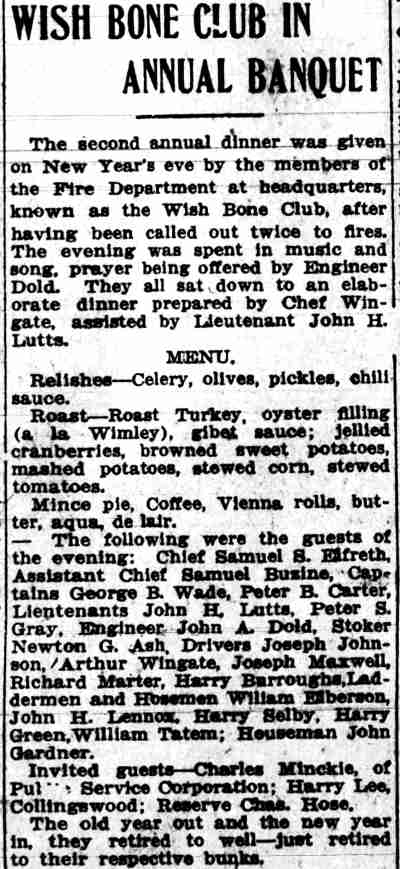
The second annual dinner was given on New Year’s eve by the members of the Fire Department at headquarters, known as the Wish Bone Club, after having been called out twice to fires. The evening was spent in music and song, prayer being offered by Engineer Dold. They all sat down to an elaborate dinner prepared by Chef Wingate, assisted by Lieutenant John H. Lutts.
MENU.
Relishes—Celery, olives, pickles, chilli sauce.
Roast—Roast Turkey, oyster filling (a la Wimley), giblet sauce; jellied cranberries, browned sweet potatoes, mashed potatoes, stewed corn, stewed tomatoes.
Mince pie, Coffee, Vienna rolls, butter, aqua de lair.
— The following were the guests of the evening: Chief Samuel S. Elfreth, Assistant Chief Samuel Buzine, Captains George B. Wade, Peter B. Carter, Lieutenants John H. Lutts, Peter S. Gray, Engineer John A. Dold, Stoker Newton G. Ash, Drivers Joseph Johnson, Arthur Wingate, Joseph Maxwell, Richard Marter, Harry Barroughs, Laddermen and Hosemen William Elberson, John H. Lennox, Harry Selby, Harry Green, William Tatem; Houseman John Gardner.
Invited guests—Charles Minckle, of Public Service Corporation; Harry Lee, Collingwood; Reserve Chas. Hose.
The old year out and the new year in, they retired to well—just retired to their respective bunks.
Camden Fire Department Promotions
Philadelphia Inquirer —
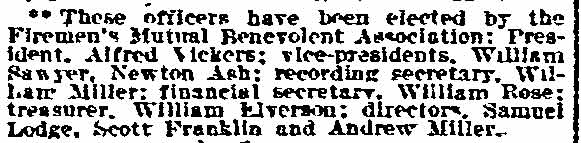
**These officers have been elected by the Firemen’s Mutual Benevolent Association: President, Alfred Vickers; vice-presidents, William Sawyer, Newton Ash; recording secretary, William Miller; financial secretary, William Rose; treasurer, William Elverson; directors, Samuel Lodge, Scott Franklin and Andrew Miller.
Camden Fire Department Promotions
Philadelphia Inquirer —
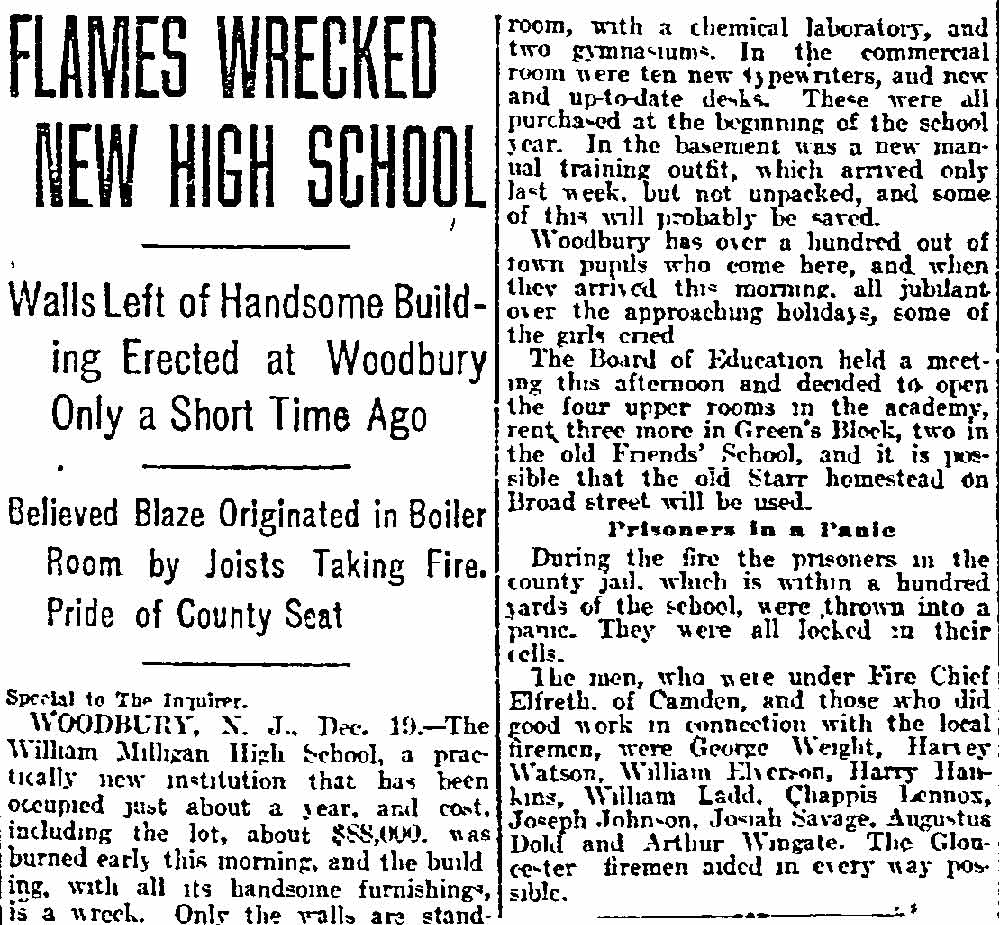
Flames Wrecked New High School
Walls Left of Handsome Building Erected at Woodbury Only a Short Time Ago
Believed Blaze Originated in Boiler Room by Joists Taking Fire, Pride of County Seat
WOODBURY, N. J., Dec. 19.—The William Milligan High School, a practically new institution that has been occupied just about a year, and cost, including the lot, about $88,000, was burned early this morning, and the building, with all its handsome furnishings, is a wreck. Only the walls are standing, with a chemical laboratory, and two gymnasiums. In the commercial room were ten new typewriters, and new and up-to-date desks. These were all purchased at the beginning of the school year. In the basement was a new manual training outfit, which arrived only last week, but not unpacked, and some of this will probably be saved.
Woodbury has over a hundred out of town pupils who come here, and when they arrived this morning, all jubilant over the approaching holidays, some of the girls cried.
The Board of Education held a meeting this afternoon and decided to open the four upper rooms in the academy, rent three more in Green’s Block, two in the old Friends’ School, and it is possible that the old Starr homestead on Broad Street will be used.
Prisoners in a Panic
During the fire the prisoners in the county jail, which is within a hundred yards of the school, were thrown into a panic. They were all locked in their cells.
The men, who were under Fire Chief Elfreth, of Camden, and those who did good work in connection with the local firemen, were George Weight, Harvey Watson, William Elverson, Harry Hankins, William Ladd, Chappis [sic] Lennox, Joseph Johnson, Josiah Savage, Augustus Dold and Arthur Wingate. The Gloucester firemen aided in every way possible.
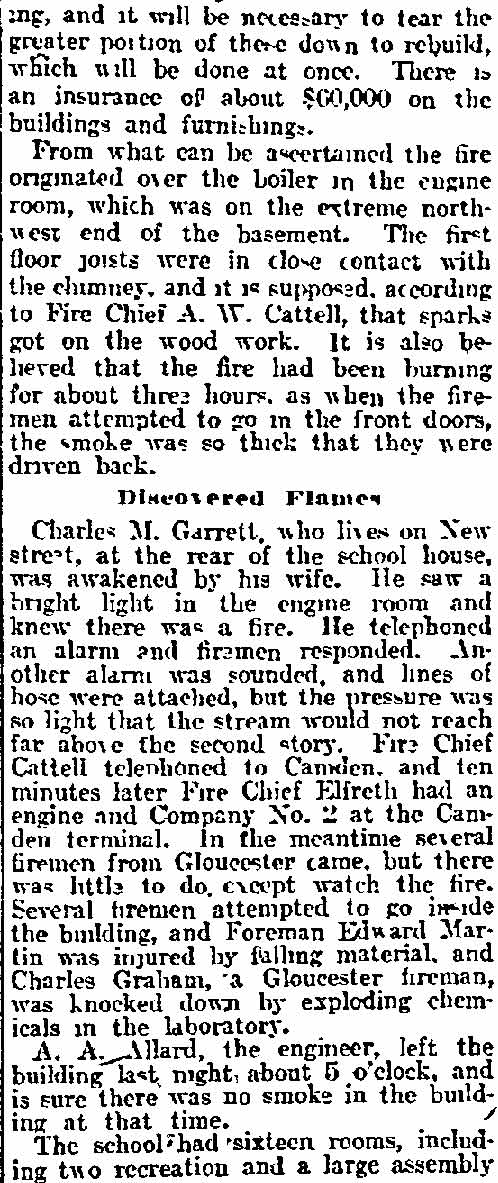
ing, and it will be necessary to tear the greater portion of these down to rebuild, which will be done at once. There is an insurance of about $60,000 on the buildings and furnishings.
From what can be ascertained the fire originated over the boiler in the engine room, which was on the extreme northwest end of the basement. The first floor joists were in close contact with the chimney, and it is supposed, according to Fire Chief A. W. Cattell, that sparks got on the wood work. It is also believed that the fire had been burning for about three hours, as when the firemen attempted to go in the front doors, the smoke was so thick that they were driven back.
Discovered Flames
Charles M. Garrett, who lives on New street, at the rear of the school house, was awakened by his wife. He saw a bright light in the engine room and knew there was a fire. He telephoned an alarm and firemen responded. Another alarm was sounded, and lines of hose were attached, but the pressure was so light that the stream would not reach far above the second story. Fire Chief Cattell telephoned to Camden, and ten minutes later Fire Chief Elfreth had an engine and Company No. 2 at the Camden terminal. In the meantime several firemen from Gloucester came, but there was little to do except watch the fire. Several firemen attempted to go inside the building, and Foreman Edward Martin was injured by falling material, and Charles Graham, a Gloucester fireman, was knocked down by exploding chemicals in the laboratory.
A. A. Allard, the engineer, left the building last night about 5 o’clock, and is sure there was no smoke in the building at that time.
The school had sixteen rooms, including two recreation and a large assembly [room].
Camden Fire Department Promotions
Camden Post-Telegram —
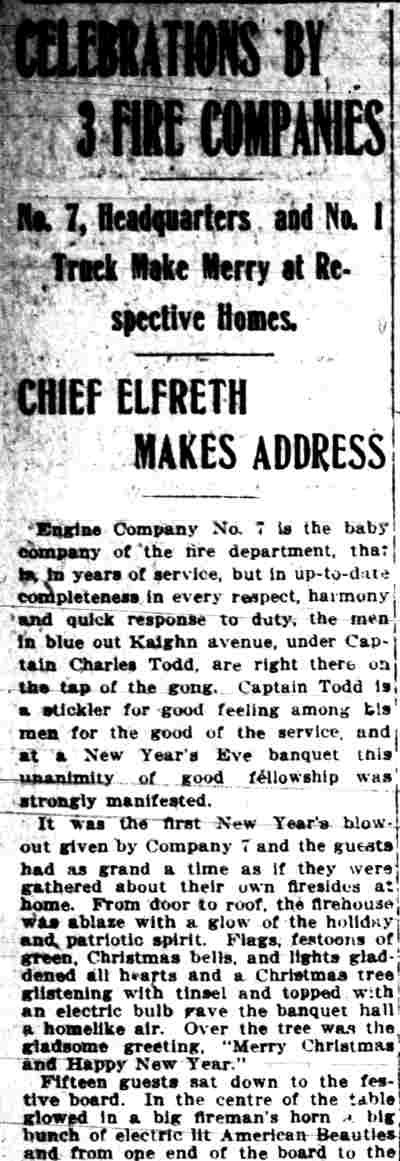
CELEBRATIONS BY 3 FIRE COMPANIES
No. 7, Headquarters and No. 1 Truck Make Merry at Respective Homes.
CHIEF ELFRETH MAKES ADDRESS
Engine Company No. 7 is the baby company of the fire department, that is, in years of service, but in up-to-date completeness in every respect, harmony and quick response to duty, the men in blue out Kaighn avenue, under Captain Charles Todd, are right there on the tap of the gong. Captain Todd is a stickler for good feeling among his men for the good of the service, and at a New Year’s Eve banquet this unanimity of good fellowship was strongly manifested.
It was the first New Year’s blowout given by Company 7 and the guests had as grand a time as if they were gathered about their own firesides at home. From door to roof, the firehouse was ablaze with a glow of the holiday and patriotic spirit. Flags, festoons of green, Christmas bells, and lights gladdened all hearts and a Christmas tree glistening with tinsel and topped with an electric bulb gave the banquet hall a homelike air. Over the tree was the gladsome greeting, “Merry Christmas and Happy New Year.”
Fifteen guests sat down to the festive board. In the centre of the table glowed in a big fireman’s horn a big bunch of electric lit American Beauties and from one end of the board to the other it was one sweep of delicacies, turkey, raw and fried oysters, stuffing chicken salad, cake, pie and a lot of other luxuries that make life happier as far as the inner man is concerned.
Chief Kelly presided at the head of the table and made a genial toastmaster. Chief Kelly supplied the electrical effects with his usual aptness. “Brother” Lutz said a short and timely prayer and then the guests sat down and for two hours were regaled with all the palatable good things of the season of good cheer. Cigars of pungent aroma being passed around, “Jim” Nevins and George Boone entertained delightfully with grapophone selections, including “Has Anyone Here Seen Kelly?” He was there.
With the midnight hour came the blowing of factory whistles and the tolling of bells. And from below in the firehouse came a terrific clangor and clash and gongs and bells. The firemen instinctively made for the sliding pole, but soon came back a-laughing. It was only Chief Kelly and Chief Chef Lutz ringing in the first alarm of the New Year, No. 1-9-1-3.
Those who had the great pleasure to participate in this most happy affair are as follows:
City Electrician John W. Kelly, Jr., Captain Charles Todd, Lieutenant John Lutz, Engineer William Busine, Stoker James Nevins, Drivers Richard Marter and Joseph Sparks, Hoseman George Boone, Roy Smith and Edward Simpson, and as welcome guests, Richard Saeur, John Watson, Albert Glanders, William Robinson and Harry Knowles, the faithful houseman of No. 7.
Chief Elfreth and Assistant Chiefs Cox, Stockton, Wade and Browning, were to have been there, but business on a holiday kept them at Headquarters awaiting alarms.
AT HEADQUARTERS.
Under the auspices of the Wishbone Club, firemen at headquarters, Fifth and Arch streets, held their annual dinner on Tuesday evening. Cheer and good-fellowship was the by word and the fire laddies and their friends made the evening one long to be remembered.
A short address was given by Chief Elfreth and Assistant Chief Stockton. John Dold offered prayer before the guests partook of the tasty dishes as prepared by Arthur Wingate and William Laud. The table presented an attractive appearance and the laddies and guests greatly enjoyed the fine spread. The menu follows:
Roast Sweet Potatoes, Peas, Cranberry Sauce, Mince Pie, Coffee, Cigars, Aqua De Lair, Olives, Beets, Celery, Roast Turkey, Oyster Filling, Giblet Sauce Mashed White Potatoes.
Those participating were as follows: S. S. Elfreth, John S. Stockton, Captain George B. Wade, Lieutenant Jos. Ernest, John A. Dold, Josiah Sage, Daniel Smith, Arthur Wingate, Joseph Johnson, Harry Hankins, William Laird, William Elberson, John Lennox, Martin Carrigan, Charles Cook, Harry Belby, Harry Khrier, Charles Menke, Edward S. Gahan, D. P. McConnell.
With a fine feed, a grand graphophone concert, songs and speeches of a happy and humorous order, “the Jolly Nine” saw the old year out and the New Year in, at the house of Hook and Ladder Truck No. 1, on Fifth street above Arch street. Accoutred in their uniforms of blue, ready at a second’s tap of the gong to jump on the truck, the brave laddies and friends formed a happy picture of congeniality. The menu was most appetizing. Beginning with oysters on the shell and winding up with a delicious dish designated “Creme-a-la-Truck,” the guests were kept busy munching their molars, as the sedate and genial waiters, togged out in linen of spotless white. William Howell Tatem and “Chief” Harry Anderson did the elegant. Stewart Bakely, a slick Cooper river boat house cook from away back, was the popular chef of the feast, and that grand old fire hero, Captain “Joe” Maxwell, the Commander-in-Chief of festivities, who saw to it that no one got left as the plates passed around.
The floral and holiday decorations of the banquet hall were munificent and in happy accord with the gracious and good-natured gathering.
completeness in every respect, harmony and quick response to duty, the men in blue out Kaighn avenue, under Captain Charles Todd, are right there on the tap of the gong. Captain Todd is a stickler for good feeling among his men for the good of the service, and at a New Year’s Eve banquet this unanimity of good fellowship was strongly manifested.
It was the first New Year’s blowout given by Company 7 and the guests had as grand a time as if they were gathered about their own firesides at home. From door to roof, the firehouse was ablaze with a glow of the holiday and patriotic spirit. Flags, festoons of green, Christmas bells, and lights gladdened all hearts and a Christmas tree glistening with tinsel and topped with an electric bulb gave the banquet hall a homelike air. Over the tree was the gladsome greeting, “Merry Christmas and Happy New Year.”
Fifteen guests sat down to the festive board. In the centre of the table glowed in a big fireman’s horn a big bunch of electric lit American Beauties and from one end of the board to the
other it was one sweep of delicacies, turkey, raw and fried oysters, stuffing chicken salad, cake, pie and a lot of other luxuries that make life happier as far as the inner man is concerned.
Chief Kelly presided at the head of the table and made a genial toastmaster. Chief Kelly supplied the electrical effects with his usual aptness. “Brother” Lutz said a short and timely prayer and then the guests sat down and for two hours were regaled with all the palatable good things of the season of good cheer. Cigars of pungent aroma being passed around, “Jim” Nevins and George Boone entertained delightfully with grapophone selections, including ’Has Anyone Here Seen Kelly?“ He was there.
With the midnight hour came the blowing of factory whistles and the tolling of bells. And from below in the firehouse came a terrific clangor and clash and gongs and bells. The firemen instinctively made for the sliding pole,
but soon same back a-laughing. It was only Chief Kelly and Chief Chef Lutz ringing in the first alarm of the New Year, No. 1-9-1-3.
Those who had the great pleasure to participate in this most happy affair are as follows:
City Electrician John W. Kelly, Jr., Captain Charles Todd, Lieutenant John Lutz, Engineer William Busine, Stoker James Nevins, Drivers Richard Marter and Joseph Sparks, Hoseman George Boone, Roy Smith and Edward Simpson, and as welcome guests, Richard Saeur, John Watson, Albert Glanders, William Robinson and Harry Knowles, the faithful houseman of No. 7.
Chief Elfreth and Assistant Chiefs Cox, Stockton, Wade and Browning, were to have been there, but business on a holiday kept them at Headquarters awaiting alarms.
AT HEADQUARTERS.
Under the auspices of the Wishbone Club, firemen at headquarters, Fifth and Arch streets, held their annual
dinner on Tuesday evening. Cheer and good-fellowship was the by word and the fire laddies and their friends made the evening one long to be remembered.
A short address was given by Chief Elfreth and Assistant Chief Stockton. John Dold offered prayer before the guests partook of the tasty dishes as prepared by Arthur Wingate and William Laud. The table presented an attractive appearance and the laddies and guests greatly enjoyed the fine spread. The menu follows:
Roast Sweet Potatoes, Peas, Cranberry Sauce, Mince Pie, Coffee, Cigars, Aqua De Lair, Olives, Beets, Celery, Roast Turkey, Oyster Filling, Giblet Sauce Mashed White Potatoes.
Those participating were as follows: S. S. Elfreth, John S. Stockton, Captain George B. Wade, Lieutenant Jos. Ernest, John A. Dold, Josiah Sage, Daniel Smith, Arthur Wingate, Joseph Johnson, Harry Hankins, William Laird, William Elberson, John Lennox, Martin Carrigan, Charles Cook, Harry Belby, Harry Khrier, Charles Menke, Edward S. Gahan, D. P. McConnell.
With a fine feed, a grand graphophone concert, songs and speeches of a happy and humorous order, “the Jolly Nine” saw the old year out and the New Year in, at the house of Hook and Ladder Truck No. 1, on Fifth street above Arch street. Accoutred in their uniforms of blue, ready at a second’s tap of the gong to jump on the truck, the brave laddies and friends formed a happy picture of congeniality. The menu was most appetizing. Beginning with oysters on the shell and winding up with a delicious dish designated “Creme-a-la-Truck,” the guests were kept busy munching their molars, as the sedate and genial waiters, togged out in linen of spotless white. William Howell Tatem and “Chief” Harry Anderson did the elegant. Stewart Bakely, a slick Cooper river boat house cook from away back, was the popular chef of the feast, and that grand old fire hero, Captain “Joe” Maxwell, the Commander-in-Chief of festivities, who saw to it that no one got left as the plates passed around.
The floral and holiday decorations of the banquet hall were munificent and in happy accord with the gracious and good-natured gathering.
Engine Company 2, 1912
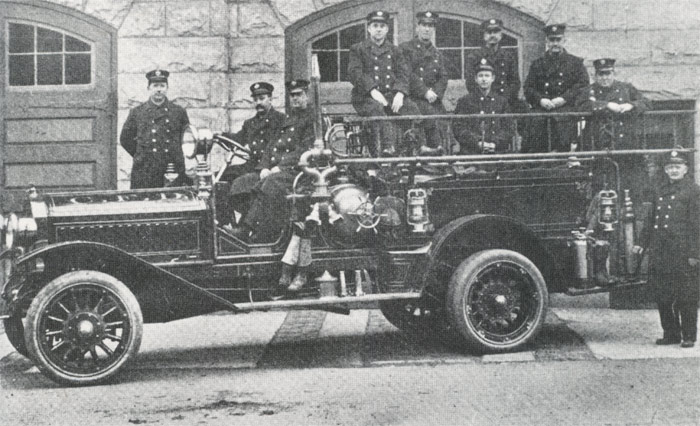
This 1912 Robinson Combination Chemical and Hose Wagon was assigned to Engine Company 2. It was one of two purchased as the first motorized apparatus in the Department. Pictured in this 1913 photograph are (l to r): Fireman John Lennox, Wagon Chauffeur Harry Hankins, Firemen William Elberson, Joseph Ernst, Martin Carrigan, and Captain George Wade. Accompanying them are members of the engine crew: Stoker Arthur Wingate, Driver Joseph Johnson, and Engineer John Augustus “Gus” Dold.
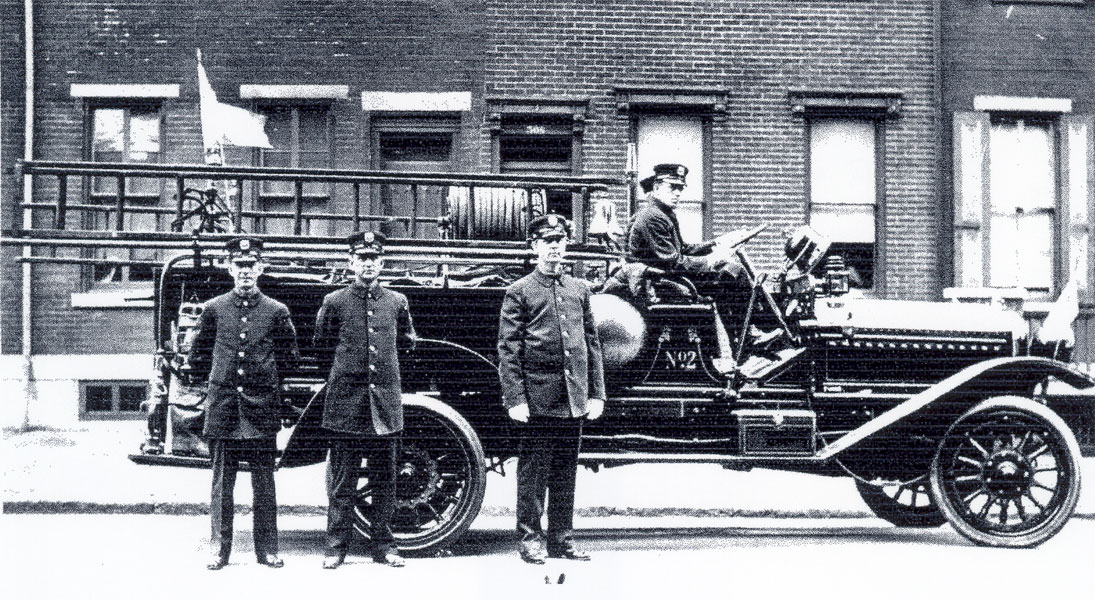
1912 Robinson Combination Chemical and Hose Wagon assigned to Engine Company 2. From left, standing: unknown, unknown, Fireman William Elberson. Seated, unknown driver and passenger.
Camden Fire Department Promotions
Camden Post-Telegram —
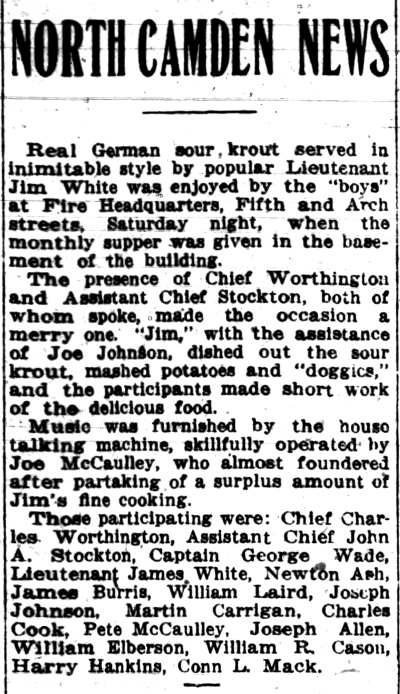
NORTH CAMDEN NEWS
Real German sour krout served in inimitable style by popular Lieutenant Jim White was enjoyed by the “boys” at Fire Headquarters, Fifth and Arch streets, Saturday night, when the monthly supper was given in the basement of the building. The presence of Chief Worthington and Assistant Chief Stockton, both of whom spoke, made the occasion a merry one. “Jim,” with the assistance of Joe Johnson, dished out the sour krout, mashed potatoes and “doggies,” and the participants made short work of the delicious food. Music was furnished by the house talking machine, skillfully operated by Joe McCauley, who almost foundered after partaking of a surplus amount of Jim’s fine cooking. Those participating were: Chief Charles Worthington, Assistant Chief John A. Stockton, Captain George Wade, Lieutenant James White, Newton Ash, James Burris, William Laird, Joseph Johnson, Martin Carrigan, Charles Cook, Pete McCauley, Joseph Allen, William Elberson, William R. Cason, Harry Hankins, Conn L. Mack.
Camden Fire Department Promotions
Camden Post-Telegram —
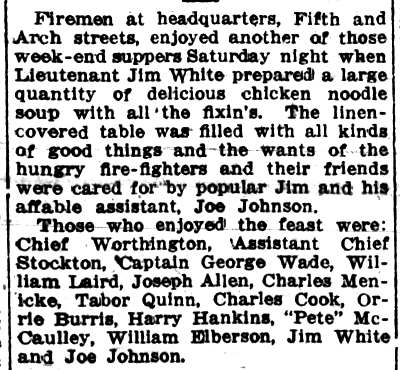
Firemen at headquarters, Fifth and Arch streets, enjoyed another of those week-end suppers Saturday night when Lieutenant Jim White prepared a large quantity of delicious chicken noodle soup with all the fixin’s. The linen-covered table was filled with all kinds of good things and the wants of the hungry fire-fighters and their friends were cared for by popular Jim and his affable assistant, Joe Johnson.
Those who enjoyed the feast were: Chief Worthington, Assistant Chief Stockton, Captain George Wade, William Laird, Joseph Allen, Charles Menicke, Tabor Quinn, Charles Cook, Orrie Burris, Harry Hankins, “Pete” McCaulley, William Elberson, Jim White and Joe Johnson.
Camden Fire Department Promotions
Camden Post-Telegram —
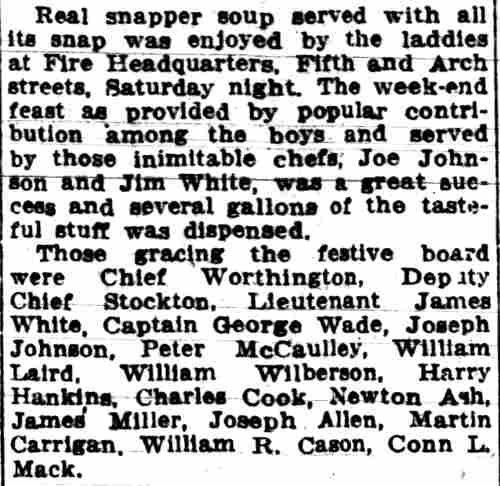
Real snapper soup served with all its snap was enjoyed by the laddies at Fire Headquarters, Fifth and Arch streets, Saturday night. The week-end feast as provided by popular contribution among the boys and served by those inimitable chefs, Joe Johnson and Jim White, was a great success and several gallons of the tasteful stuff was dispensed.
Those gracing the festive board were Chief Worthington, Deputy Chief Stockton, Lieutenant James White, Captain George Wade, Joseph Johnson, Peter McCaulley, William Laird, William Wilberson, Harry Hankins, Charles Cook, Newton Ash, James Miller, Joseph Allen, Martin Carrigan, William R. Cason, Conn L. Mack.
Third Ward Club Holds Fine Ball
Camden Post-Telegram —
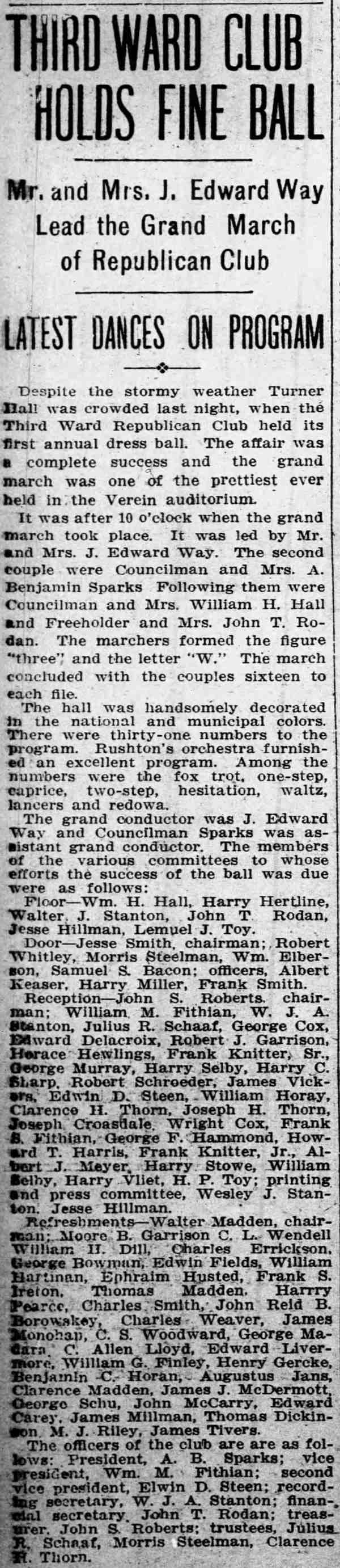
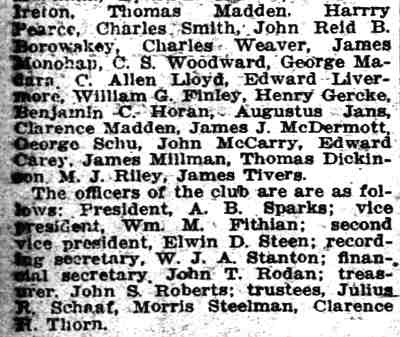
Despite the stormy weather Turner Hall was crowded last night, when the Third Ward Republican Club held its first annual dress ball. The affair was a complete success and the grand march was one of the prettiest ever held in the Verein auditorium.
It was after 10 o’clock when the grand march took place. It was led by Mr. and Mrs. J. Edward Way. The second couple were Councilman and Mrs. A. Benjamin Sparks. Following them were Councilman and Mrs. William H. Hall and Freeholder and Mrs. John T. Rodan. The marchers formed the figure “three” and the letter “W.” The march concluded with the couples sixteen to each file.
The hall was handsomely decorated in the national and municipal colors. There were thirty-one numbers to the program. Rushton’s orchestra furnished an excellent program. Among the numbers were the fox trot, one-step, caprice, two-step, hesitation, waltz, lancers and redowa.
The grand conductor was J. Edward Way and Councilman Sparks was assistant grand conductor. The members of the various committees to whose efforts the success of the ball was due were as follows:
Floor—Wm. H. Hall, Harry Hertline, Walter J. Stanton, John T. Rodan, Jesse Hillman, Lemuel J. Toy.
Door—Jesse Smith, chairman; Robert Whitley, Morris Steelman, Wm. Elberson, Samuel S. Bacon; officers, Albert Keaser, Harry Miller, Frank Smith.
Reception—John S. Roberts, chairman; William M. Fithian, W. J. A. Stanton, Julius R. Schaaf, George Cox, Edward Delacroix, Robert J. Garrison, Horace Hewlings, Frank Knitter, Sr., George Murray, Harry Selby, Harry C. Sharp, Robert Schroeder, James Vickers, Edwin D. Steen, William Horay, Clarence H. Thorn, Joseph H. Thorn, Joseph Croasdale, Wright Cox, Frank S. Fithian, George F. Hammond, Howard T. Harris, Frank Knitter, Jr., Albert J. Meyer, Harry Stowe, William Selby, Harry Vliet, H. P. Toy; printing and press committee, Wesley J. Stanton, Jesse Hillman.
Refreshments—Walter Madden, chairman; Moore B. Garrison, C. L. Wendell, William H. Dill, Charles Errickson, George Bowman, Edwin Fields, William Hartman, Ephraim Husted, Frank S. Ireton, Thomas Madden, Harry Pearce, Charles Smith, John Reid B. Borowakey, Charles Weaver, James Monohan, C. S. Woodward, George Madura, C. Allen Lloyd, Edward Livermore, William G. Finley, Henry Gercke, Benjamin C. Horan, Augustus Jans, Clarence Madden, James J. McDermott, George Schu, John McCarry, Edward Carey, James Millman, Thomas Dickinson, M. J. Riley, James Tivers.
The officers of the club are are [sic] as follows: President, A. B. Sparks; vice president, Wm. M. Fithian; second vice president, Elwin D. Steen; recording secretary, W. J. A. Stanton; financial secretary, John T. Rodan; treasurer, John S. Roberts; trustees, Julius R. Schaaf, Morris Steelman, Clarence R. Thorn.
Shipyard Wages Lure to Firemen
Camden Post-Telegram —
Chief Presents Six Resignations at Meeting of Council Commission
Camden’s Fire Department has been hard hit by the call of the shipyards and death. The report of Fire Chief Peter B. Carter presented last night at the meeting of the Fire Committee of City Council showed six resignations, two deaths and one vacancy from the draft.
The resignations follows: Louis Neuman, No. 3 Truck Company; George H. Pursglove, No. 7 Engine Company; Roy De Haven, Julius Hubert and Harry W. Stone, No. 3 Truck Company, and Lieutenant Joseph Sparks, No. 7 Engine Company.
Deaths reported were Captain Samuel Whitzell, of No. 1 Engine Company, and William Elberson, of Headquarters. William Schucher, of No. 4, was drafted into the Army.
To take the place of Captain Whitzell, Lieutenant Walter Mertz, of the same company, was appointed captain, and Horace Kerns was made lieutenant. The following appointments were made by the Fire Committee: Robert L. Knox, 822 Division street, to fill place of Julius Hubert; Allen Palmer, 120 North Eleventh street, for vacancy of Louis Neuman; Clarence Pursglove, 751 Mt. Vernon street, taking place of his brother George; Anthony Paradise, 658 South Second street, filling place of Roy De Haven; Harry B. Maxwell, 422 North Sixth street, for vacancy of Harry W. Stone; Robert Welsh, 512 Borton street, vacancy of William Schucher, and William Vile, 570 Carman street, to fill place of Captain Whitzell.
The American La France Company was awarded the contract to furnish a new two-in-one motor apparatus for $10,000.
A petition from members of the Firemen’s Pension Fund asked that the rule of ten years’ apprenticeship be abolished in view of the wages paid men employed in other industries. The petition requests that all men in the department be placed on full salary at once. The petition will be presented to City Council.