Introduction
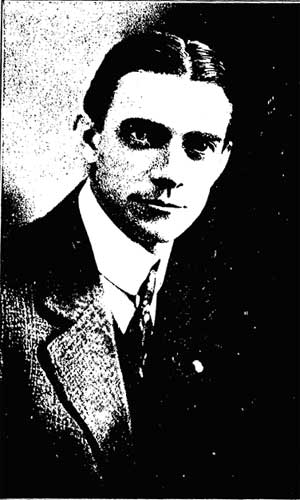
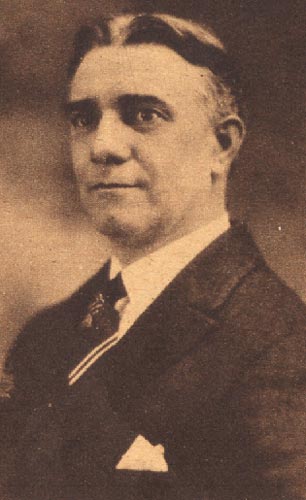
Left: 1918 – Right: 1926
Charles Anderson Wolverton was the son of Charles S. Wolverton and his wife Martha Anderson Wolverton. He was born in Camden NJ in 1880. His father was then working as a steamboat pilot, the family living in 1880 at 313 Birch Street in North Camden. In the mid-1880s the family lived at 66 Vine Street. A brother, Walter P. Wolverton was born in 1882. Charles S. Wolverton later worked for the Pennsylvania Railroad as a collector on the Vine Street Ferry. The Wolverton family had moved to 612 North 5th Street by this time. The Wolverton family moved to 601 State Street around 1905. Charles S. Wolverton rose to become Superintendent of the Ferry before it closed in the 1920s.
Charles A. Wolverton attended public school in Camden NJ. He was graduated from the law department of the University of Pennsylvania at Philadelphia in 1900; was admitted to the bar in 1901 and began practice in Camden NJ. His brother Walter studied accounting, and had a long career with the City of Camden.
In 1906 Charles A. Wolverton began serving as assistant prosecutor of Camden County, a post he held until 1913. During his time as prosecutor he appointed Lawrence Doran as an investigator. Doran would become Chief of Detectives, and serve in that capacity for many years.
Charles A. Wolverton married Sara Donnell on June 25, 1907. His wife Sara was a doctor of medicine. The Wolvertons were blessed with a son, Donnell K. Wolverton, in 1912.
Charles A. Wolverton entered state government as special assistant attorney general of New Jersey in 1913 and 1914. He was elected to the state legislature, serving as an Assemblyman from 1915 until 1918. He became speaker of the Assembly in 1918. During World War I years he also held the post of Associate Federal Food Administrator for Camden.
At the time of the 1920 Census Charles and Sara Wolverton were renting a home at 330 State Street in North Camden. After leaving the state assembly, Charles A. Wolverton worked as prosecutor of pleas of Camden County until 1923. He also was an alternate delegate to Republican National Convention from New Jersey in 1920.
In 1926, Charles A. Wolverton was elected to Congress as a Republican, defeating Edward J. Kelleher with 57,522 votes to Kelleher’s 24,990. In the years to follow, the Democrats had difficulty finding candidates to run against the popular Congressman Wolverton.
Charles A. Wolverton was sworn in on March 27, 1927, would serve continuously until January 3, 1959, a total of 16 terms. During his time in Congress he was chairman of the Committee on Interstate and Foreign Commerce, in the Eightieth and Eighty-third Congresses.
Donnell K. Wolverton graduated from Princeton with honors in 1933.
At the time of the 1930 Census, Charles Wolverton and family resided at 505 State Street in North Camden. His neighbor, at 513 State Street, was prominent Camden attorney Samuel J.T. French Sr. and his family. The 1932 Congressional race featured the two as opposing candidates, which must have been interesting, as they lived only six doors apart. The sons of both men followed their fathers into law, although not into politics. Sadly, Sarah Wolverton would pass away in 1938.
Charles Wolverton had moved to Merchantville by 1947, where he was living at 2 Oak Terrace. By 1956 Charles A. Wolverton had moved to an apartment at Greenleigh Court in Merchantville NJ. He was not a candidate for re-nomination in 1958. He resumed the practice of law in Camden NJ, where he died on May 16, 1969. Survived by his son Donnell K., Charles A. Wolverton was buried at Harleigh Cemetery in Camden, next to his wife Sara.
In addition to his political activity, Charles A. Wolverton was a member of the Freemasons, Knights Templar, Shriners, Elks, and the Rotary Club.
Philadelphia Inquirer – September 1, 1905
Camden Lid Is On During September
Camden City Council met in regular monthly session last night. Business of a purely routine character was transacted. The committee recently appointed by President Wolverton to inquire into the Sunday-closing laws reported that several meetings had been held with clergymen and business men and that other meetings were desired before making a report to Council.
This was granted by Council and no action was taken pending the future meetings with the business interests of the city. Consequently the “lid” will remain screwed down in Camden for at least another month, until the September meeting of Council.
Councilman Arnold, of the Eleventh ward, presented a petition to Council, signed by 690 voters in the ward, asking that the Sunday laws be modified. This petition was referred to the special committee.
Woman’s Suspicious Death
Philadelphia Inquirer —
Expired in Hospital While Her Husband Is in Jail
Mrs. Leon Sanoski, of 1146 Sycamore street, Camden, died in Cooper Hospital yesterday, under suspicious circumstances. Her husband is in the county jail. According to a statement made by County Physician Jones after he conducted, the post-mortem the woman died from cirrhosis of the liver. He said he saw no marks or bruises on the body.
The woman was found by Captain Stanley and Overseer of the Poor Jefferis unconscious on the floor of her home last Wednesday. She was examined by City Physician Jackson and ordered sent to the hospital. At the hearing the next day the doctor, police captain and overseer testified that the woman’s body was covered with bruises.
On Thursday Sanoski was taken to his wife’s bedside. Her ante-mortem statement was taken by Assistant Prosecutor Wolverton. Mrs. Sanoski said that her husband beat her into insensibility on Monday night and that he beat her once a week for eight years.
Lawyer Weds Doctor
Philadelphia Inquirer —
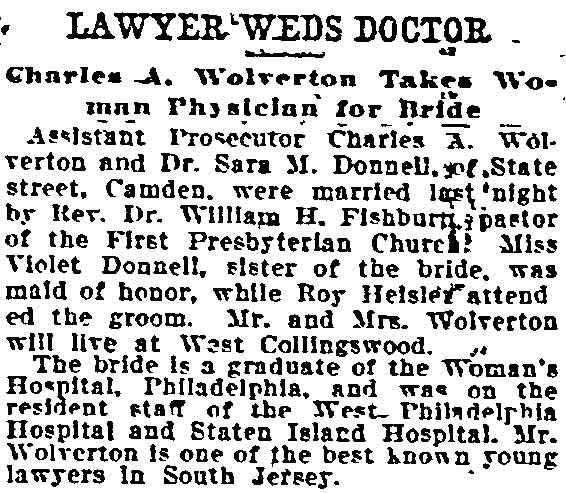
Charles A. Wolverton Takes Woman Physician for Bride
Assistant Prosecutor Charles A. Wolverton and Dr. Sara M. Donnell, of State street, Camden, were married last night by Rev. Dr. William H. Fishburn, pastor of the First Presbyterian Church. Miss Violet Donnell, sister of the bride, was maid of honor, while Roy Heisler attended the groom. Mr. and Mrs. Wolverton will live at West Collingswood.
The bride is a graduate of the Woman’s Hospital, Philadelphia, and was on the resident staff of the West Philadelphia Hospital and Staten Island Hospital. Mr. Wolverton is one of the best known young lawyers in South Jersey.
Clue to Trunk Mystery
Philadelphia Inquirer —
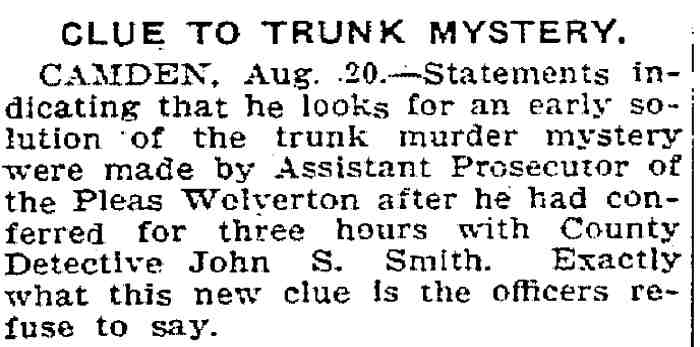
CAMDEN, Aug. 20.—Statements indicating that he looks for an early solution of the trunk murder mystery were made by Assistant Prosecutor of the Pleas Wolverton after he had conferred for three hours with County Detective John S. Smith. Exactly what this new clue is the officers refuse to say.
Washington DC Evening Star – August 22, 1908
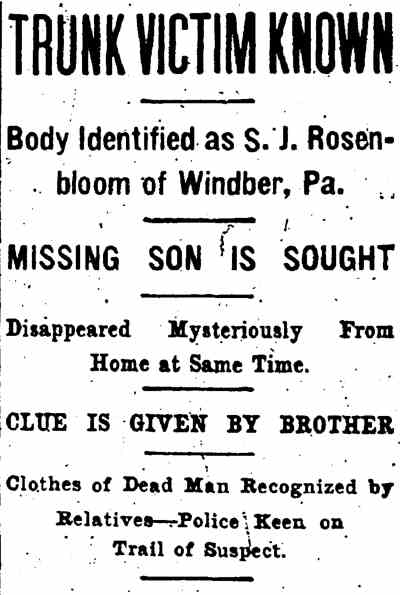
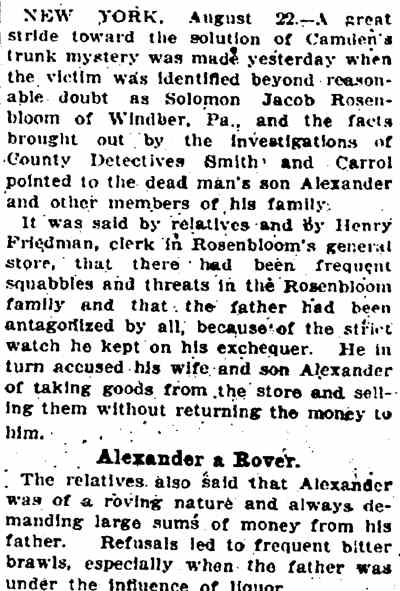
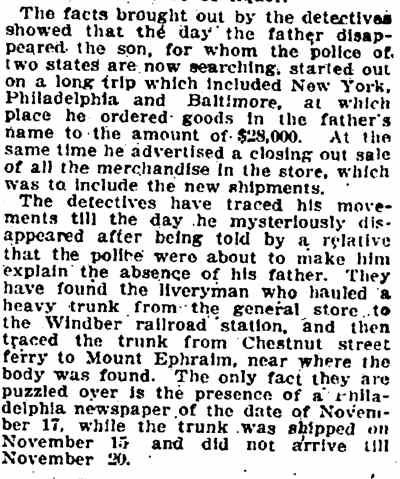
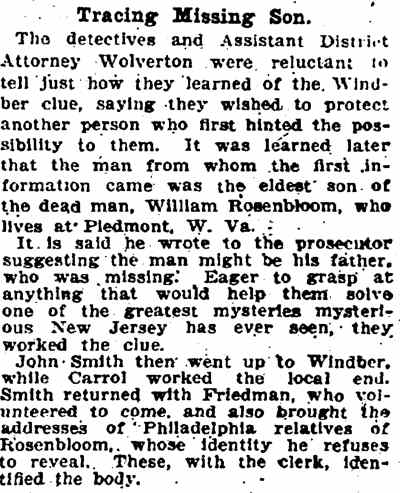
Washington DC Evening Star, August 22, 1908 – View PDF
Police Court
Camden Post-Telegram —
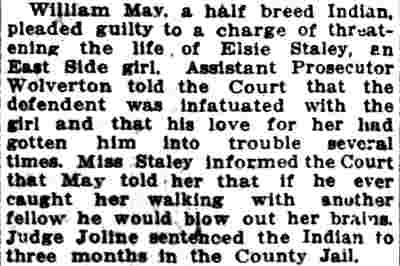
William May, a half breed Indian, pleaded guilty to a charge of threatening the life of Elsie Staley, an East Side girl. Assistant Prosecutor Wolverton told the Court that the defendent [sic] was infatuated with the girl and that his love for her had gotten him into trouble several times. Miss Staley informed the Court that May told her that if he ever caught her walking with another fellow he would blow out her brains. Judge Joline sentenced the Indian to three months in the County Jail.
Murder Cases on in Camden Court
Philadelphia Inquirer —
Prosecutor and His Assistant Will Be Kept Busy at This Term of Court
Beginning with tomorrow, Prosecutor Boyle and his assistant, Charles A. Wolverton, will be kept busy in the Camden Criminal Court disposing of many cases, including four defendants charged with murder. This is the first term of court in which there have been so many such cases for many years.
Yesterday Supreme Court Justice Garrison fixed Monday, April 22, as the date when he will preside at the trial of Roland Evans, who shot to death David Green in a house on Sycamore street on December 26 last. The State will press for a first degree. Lawyers Herbert Drake and William Harris have been assigned to defend Evans.
The next case to be tried will be that of William Graedwell, who brained his boarding mistress, Mrs. Georgeanna Gilliand, with an ax in her home in East Camden. After that will come to trial Stefano Torcesso, who stabbed to death Nunzioto Imperato in a duel over a girl. The last of the quartet of murder cases will be that of Charles Ford, who shot to death Mrs. May Effie Wagner, his erstwhile housekeeper.
About two hundred persons against whom indictments have been returned by the grand jury will be called upon to enter pleas tomorrow. Prosecutor Boyle will then begin to dispose of the cases on Tuesday before Judge Carrow, it being his intention to so systematize matters that everything will be cleaned up by the beginning of summer.
Coursey Breaks Down While Story of Cold-Blooded Killing of Karl Kellmann Is Told by Detective
Camden Post-Telegram —
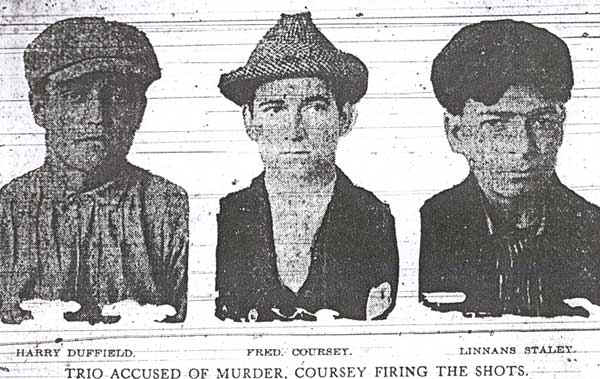
Two “Pals,” Too, Accused of Crime
Harry Duffield. Fred. Coursey. Linnans Staley.
Trio Accused of Murder, Coursey Firing the Shots.
Collapsing when arraigned in Police Court this morning before Recorder Stackhouse on the charge of killing Karl Kellmann, aged 18 years, of 2919 High street, at Twenty-seventh and Sherman streets, shortly before midnight Saturday, Fred Coursey, alias “Mexican Pete,” alias “Cowboy Pete,” aged 20 years, of 121 North Twenty-first street, who admits firing the fatal shots while committing robbery, and Harry Duffield, aged 21 years, of 407 North Forty-first street, who acknowledged masking his face with a handkerchief and being with Coursey, sobbed piteously, resting their heads on the railing of the dock, while John Painter, the veteran detective, was briefly reciting the story.
When Recorder Stackhouse asked what became of the young man who was shot and Painter replied that he died, Coursey and Duffield sobbed afresh, and when Recorder Stackhouse committed them without bail Policemen Frost and Kay had to help them.
Linnans Staley, aged 21 years, of 1819 Federal street, who confessed that he was in the robbery plot but later got scared and hid in the bushes, was scarcely able to stand, and when his mother broke down as he was committed as a principal he staggered and would have fallen but for Sergeant McClong.
Prosecutor Boyle announced this morning that the Grand Jury will be recalled for Thursday of this week and the case will be made the special order of the day.
Without the slightest clue to start with in the most brutal murder committed in recent years in Camden county, police and detectives under the personal direction of Chief Gravenor in two hours arrested two of the three prisoners and obtained their signatures to confessions and before sunrise the other was lodged behind the bars at the City Hall.
According to their statements to the police the prisoners while drinking on a lot near Twenty-first and Federal streets on Saturday night planned to go to a lone spot near Twenty-seventh and Sherman streets to hold someone up to get money and jewelry to buy more drink. Coursey had a 38-calibre cowboy pistol and Duffield used Coursey’s bandanna as a mask. Staley weakened before the spot selected was reached and at the time of the murder was hiding in a clump of weeds a short distance away.
The murdered boy was the son of Karl and Lulu D. Kellmann. He was a member of the Bible class of Grace Presbyterian Church, East Side, and active in church work.
Saturday night was the closing of a carnival given on High street between Twenty-seventh and Thirtieth streets. Karl was there and made several purchases. At one booth he bought a necktie, from another some ice cream and a box of candy and spent some time conversing with the young ladies connected with the church.
When it grew rather late he noticed that Misses Bertha and Bessie Skillen, of 815 North Thirty-fourth street, the latter a teacher in Grace Church Sunday-school, were without an escort and he volunteered to see them home. They accepted his invitation to be their escort. He saw them safely home and he was on his way back and had reached a point on the east side of Twenty-seventh street south of Sherman street and near the foot of the bridge that spans the Pennsylvania Railroad tracks when two men jumped out from behind a tree and as one commanded him to hold up his hands the other began to shoot.
The first shot struck him in the breast and turned him partially around. The next ploughed a hole through his neck, knocking him down, and the third went wide.
Screaming for help he tried to rise to his feet and was on his knees when Night Yardmaster Albert Ludlow and Brakeman Joseph Wittick, who were on the opposite side of the bridge, ran to his assistance. By the light of their lanterns they saw that he was seriously hurt and they took him to ’Squire Sasse’s house nearby to await the arrival of the ambulance. As the railroaders sped across the bridge Ludlow saw a man run down the tracks in the direction of Seventeenth street.
In the signal tower at Pavonia station known as C. B. the operator, Thomas Sink, heard the shots and cries for help and ’phoned to Captain James at Police Headquarters that a murder had been committed. Sink also saw a man run down through the weeds and bushes on the east side of the bridge toward the railroad tracks.
Policeman Hurlock and Schmid, ’Squire and Mrs. Sasse and several others were out on the street before the railroad men reached the Sasse home and all hurried to ’phones to notify police headquarters.
In less than five minutes by use of the red light system Captain James had every officer on duty on the East Side hurrying to the scene, officers stationed at every bridge, ferry house and railroad terminal, and the downtown auto with Detectives Schregler, Painter, Brothers and Moffett on its way to East Camden.
On information from the railroad men Sergeant Horner took all the East Side officers and the four detectives and they worked westward among the cars while Captain James started Policemen Colsey and Kelly to walk eastward from Fifteenth street until they met the main body.
The search proved fruitless and as they returned to the bridge one of the men picked up a green bandanna with yellow spots and sheep burrs embeded [sic] on it on the incline near the signal tower. Later he recalled that the man who went down the slope wore a Khaki shirt and cap.
The handkerchief was recognized as the kind used by “Indian Bill” May, and Detectives Brothers and Policeman Abbott were sent to arrest him. They found May and Eugene Cafferty asleep in a moving van in Marlton avenue. “Indian Bill” soon established an alibi.
Detective Schregler and a couple of officers who were sure that the description of the man with the khaki shirt tallied with Duffield started for his brother’s house, but failed to find him there. About this time the downtown auto turned into Twenty-seventh street to get Karl’s father, mother and sister and take them to the hospital. Councilman Finkeldey and a friend shouted to the crew that a woman was down and out on a step nearby, but the crew yelled back that they were on an emergency run and the woman would keep until they returned. Fireman J. H. Vickers walked across the street to investigate and found that the supposed woman was Duffield and that he seemed to be asleep.
Vickers shook him and as he got up he said something about the shooting that aroused Vickers’ curiosity and he ’phoned to Police Headquarters. Captain James immediately notified Chief Gravenor, who was on the scene and the latter sent Detective Moffett to investigate. When Moffett arrived he learned that Duffield had taken a Westfield avenue car. Moffett returned to the bridge and he and Detective Painter and Chief Gravenor took the down-town auto for Duffield’s home.
Painter went to the front door and saw Duffield in the act of taking off his shoes. Moffett in going around to the back door to prevent his escape that way passed by the window at which Duffield was sitting.
Grasping Duffield by the collar Moffett pulled him through the window to the ground. As soon as he landed on his feet, according to the Chief and detectives, Duffield said that Coursey did the shooting.
Placing him in the auto they next drove close to Coursey’s home and with Policeman Potter who knew the man wanted, the detectives entered the house with drawn revolvers while other officers guarded all avenues of escape.
Coursey was found akwake [sic] on a cot and while he was covered with revolvers Detective Painter searched his trunk and found the weapon that he later admitted using. It was empty. The detectives late yesterday afternoon found three used shells adjoining the house near a spot where Coursey said he had thrown them.
In order to keep the men apart they were taken to the City Hall separately and questioned and after they decided to tell all Sergeant E. B. McClong reduced their statements to writing and they signed them. It was on the strength of these statements that Staley was arrested.
Young Kellmann was taken into the hospital at 12.20 a. m. Chief Surgeon Schellenger saw at a glance that there was no hope for him and so notified Captain James, and Sergeant McClong was sent to the hospital to get all information possible.
The unfortunate youth could only speak a few words at a time because of the hemorrhages. All Sergeant McClong was able to get from him was that he was told to hold up his hands and that the shooting instantly began. The only description he could give was that they were small men and that the attack was so sudden that he could not tell whether they were black or white.
The injured young man kept asking the doctors if he was going to die, but they did not answer. He was conscious when his father and mother arrived and then sank rapidly until the end, dying at 1.50 o’clock, 90 minutes after he was admitted. Mother and father were prostrated and were taken home by the up-town auto.
County Physician Jones conducted the autopsy yesterday morning. He said that either wound would have caused death. The bullet in the breast pierced the right lung at the top and lodged in the cavity. It is now in the doctor’s possession. The other bullet went clear through the neck.
Coursey and Duffield have been working in the Pavonia car yard. The former was born in El Paso, Texas, but has lived East nearly all his life. He is an expert shot and was a member of the vaudeville team of Coursey & Cook, according to their letter heads presenting a fifteen-minute thriller.
Duffield was only recently paroled for robbing Gallagher’s saloon, Nineteenth and Federal streets of a lot of drinkables. Staley has been arrested several times on petty charges but was never convicted of crime. When Duffield’s coat was examined at the City Hall, it was found to contain sheep burrs.
To a reporter Coursey said that whenever he was drinking he had to get his gun and shoot something or somebody. He insisted that all were in on the job and that they let the man who preceded Kellman go over the bridge without molestation because he didn’t look as if he had any too much money.
Yesterday morning Assistant Prosecutor Wolverton and Stenographer Cleary called at the City Hall. The prisoners were examined by Mr. Wolverton and their statements taken by Mr. Cleary, but there was little or nothing new elicited.
Camden Assemblyman, Poisoned, Is Very Ill
Trenton Times —
CAMDEN, May 23.—Charles A. Wolverton, member of the lower house of the New Jersey Legislature, is very ill at his home from ptomaine poisoning. He ate salad in which there was mixed canned fish.
The trial of Wilson Ashbridge for the murder of his wife was to have taken place yesterday. Mr. Wolverton had been assigned by Supreme Court Justice Garrison to defend Ashbridge, and the trial was declared off indefinitely.
Mrs. Marion Ashbridge
Camden Post-Telegram —
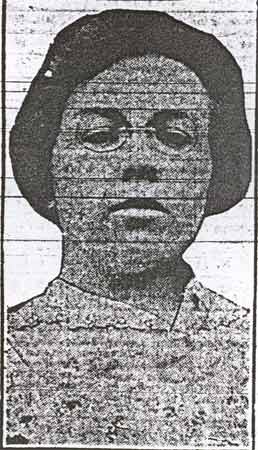
Slayer’s Wife
Murderer’s Wife Supplied Revolver, Smuggling It In Covered by Fruit
Camden Post-Telegram —
Confessing Supplying Pistol, in Spite of Husband’s Denial That She Was Guiltless, Mrs. Ashbridge Is Held Without Bail on Charge of Conspiracy in Aiding and Abetting Escape From Jail
With Wilson T. Ashbridge under guard in a cell in what was formerly known as Murderer’s Row, the police and county detectives today redoubled their energies towards the capture of George E. Thompson, the forger who escaped with Ashbridge from the County Jail on Monday night after murdering one keeper and wounding another. Stirring the police of all cities in the East to renewed activity, another circular was sent out today by the authorities giving notice of the reward of $500 offered for Thompson’s capture. Attention was strongly directed in the circular due to the fact that one of the fingers of Thompson’s left hand is missing.
The gun with which Ashbridge murdered jailor Isaac Hibbs and wounded Jailor Ellis was smuggled into the jail by Mrs. Ashbridge on Saturday morning. With it went a box of cartridges. The weapon and bullets were passed to Ashbridge in a basket of fruit, being at the bottom of the basket. The jailors were busy at the time she called and as she frequently had brought her husband fruit they did not take precaution to search the basket. Mrs. Ashbridge bought the gun and cartridges on the written request of her husband.
Her confession as to the very grave part she played in the escape and murder was made to the Prosecutor late yesterday afternoon after she had first insisted she had no knowledge of how the gun got into the jail and after her husband had repeatedly declared that the revolver was supplied by Thompson. The revolver, fully loaded, was still carried by Ashbridge when he was captured in the Keystone Hotel…
… by Recorder Stackhouse without bail for conspiracy in aiding and abetting the escape of her husband and George E. Thompson from the County Jail on Monday night.
The court room was packed to suffocation by a morbidly curious crowd, composed primarily of women. A strange silence spread through the court room when the little woman was led into the court room by Captain Schregler. The regular formality of placing prisoners in the dock was dispensed with the woman’s case.
Prosecutor De Unger pointed to the high witness chair and Mrs. Ashbridge sat in it. She evaded the gaze of the crowd, looking intently at the floor and through a window on the Washington Street side. She wore a blue skirt and a white waist. She was without her hat. Her hair was carefully arranged and she wore nose glasses.
Resting her chin on her right hand her arm and hand were seen to tremble slightly. So quiet was the room that a pin dropping could have been heard.
“Mrs. Marian Ashbridge,” called the Recorder.
“Yes, Sir” was the faint reply of the woman, who did not even look up at the call of her name.
“This complaint charges you with delivering to Wilson Ashbridge and George E. Thompson a pistol and aiding and abetting them in escaping from the County Jail, where they had been lawfully committed. Do you plead guilty or not guilty,” said the Recorder as he read the complaint.
The woman said nothing. Detective Schregler was then called as the complainant. He told of the confession made by the woman and produced the revolver which the woman purchased and which Ashbridge used in his daring escape. The gun, Captain Schregler said, was purchased in a pawnshop at Eleventh and Arch Streets, Philadelphia, on Friday of last week and was delivered to Ashbridge on Saturday morning along with a box of cartridges. “Marian, I will hold you without bail,” said the Recorder.
As the woman was being led from the court room by Captain Schregler and Sergeant Reed the crowd made a rush for the door leading from the court room, whereupon orders were given by the police to the crowd and many were prevented from rushing out. Everybody seemed anxious to secure a closer look at the unfortunate woman.
Visitors were denied Mrs. Ashbridge. Not even her children were permitted to be brought before her, although the broken-hearted mother asked for them.
“Oh, God, I don’t know why I did this; why I left the little ones to go with Wilson,” tearfully expostulated Mrs. Ashbridge to the kind-hearted matron, who spent the best part of last night with the distraught woman.
“If I could only see little Marian,” sobbed the woman in the arms of Mrs. Kirkpatrick, who informed her that perhaps she could see them today.
Last evening the only support Mrs. Ashbridge had was a cup of tea. The morning she sipped a portion of a cup of coffee. She told Matron Kirkpatrick that she was not hungry.
“Everybody hounded me, I had no friends, and that’s why I went with my husband, because he was the only friend I had left,” said Mrs. Ashbridge. “He was a good boy, but was easily led.” The wife said even before her marriage that Ashbridge would run around with other girls, but he always returned to her and she forgave him. She said he seemed to have a spell over her and she couldn’t leave him.
“I love my husband, still and will stand by him to the end,” sobbed the little woman to Mrs. Kirkpatrick. She told how her relatives disowned her and how after her father’s death she went to live with strangers. When her husband fostered the plan to escape she willingly consented to aid him. She drew $100 out of the bank and purchased clothes and the gun and bullets. She never faltered in her plan.
“My heart aches for that woman,” said Matron Kirkpatrick this morning to a Post-Telegram reporter. “She’s a good girl, but was easily led into her present predicament. It only goes to show what a woman will do for the man she loves, no matter how base a wretch he may be. Mrs. Ashbridge is more to be pitied than scorned.
Recorder Stackhouse this morning produced a copy of the marriage of the couple, performed by him on July 28, 1914. The marriage was performed at the instance of Assistant Prosecutor Butler after Ashbridge wronged the girl. Constable William E. Headley and William C. Ashbridge, the latter father of the murderer, were witnesses.
As told in yesterday’s Post-Telegram, Ashbridge and his wife and their captors arrived at the City Hall from Chester shortly after 2:00 o’clock. After a brief stay they were taken to the Court House and turned over to Prosecutor Kraft, Ashbridge being taken into the Prosecutor’s private office and Mrs. Ashbridge being placed under guard in the ante room.
Taking full blame for the murder of Hibbs and the wounding of Ellis, Ashbridge declared that none of the shots were fired by Thompson.
“I shot both men,” he declared, “but Thompson gave me the gun. He had it since Saturday.” He repeated this assertion several times in the course of his examination, adding each time that his wife had no part in supplying the firearm. His voluntary insistence in…
… exercise corridor of their cells in response to his request that he wanted to show him a note that had been left for him, he asked the aged keeper to step inside the corridor. Evidently suspecting something was wrong Hibbs refused to enter the corridor. When Ashbridge repeated his request that Hibbs step inside, Thompson, who was immediately behind Ashbridge, said something to the murderer. Ashbridge could not exactly recall what the expression was. At any rate it was then that he fired and Hibbs fell to the floor with his death wound. To take Hibbs’ keys and open the door leading from the exercise room to the corridor was the work of but an instant. It was then that Ellis confronted Ashbridge at the other end of the corridor. He refused to throw up his hands when the murderer so ordered. Instead, the plucky jailor grappled with the slayer, who again brought the gun into play, twice wounding the remaining jailor.
Ashbridge did not say why he wanted Hibbs to step inside the corridor. One surmise is that the pair had planned to get the old man into the corridor, overpower him, take his keys and after gagging him place him in a cell, depending on the gun to awe any prisoners who might make an outcry. But whatever their plan was in this respect it miscarried. Hibbs would not enter the corridor and was shot down where he stood.
Thompson carried both his own and Ashbridge’s coats when they fled. As Ashbridge had decided to do the talking with Hibbs when the jailor came to lock them in their cells it was agreed that it would not be wise for the murderer to be wearing a coat. This might look suspicious to Hibbs and in all likelihood he would refuse to open the door. Hence it was decided that Thompson should take both coats. He also carried Ashbridge’s cap and his own Panama.
The coats and hats were adjusted as they ran down the spiral stairway leading to the street. They walked slowly into Sixth Street; increasing their pace up Sixth Street after crossing Market and after turning into Cooper walked very rapidly. They turned north on Third Street to Main and thence to the Vine Street ferry, where they caught the boat leaving at 7:15 for Philadelphia. Landing on the other side the fugitives exchanged hats. They walked rapidly to Broad Street Station, where Mrs. Ashbridge was in waiting, this arrangement having been made when she smuggled the gun in to her husband on Saturday morning.
Accompanied by Thompson the Ashbridges walked out Market Street to Thirty-second Street. Here Thompson left them and after walking the street for a brief while longer the slayer and his wife boarded a trolley car for Chester, where a few hours later the murderer’s short-lived liberty was so dramatically terminated.
Although jailor Ellis still insists that three shots were fired before he was attacked and in spite of the positive declaration of Alfred Williams, the trusty, that three shots were fired at Hibbs, Ashbridge claims that Hibbs was shot only once and that two bullets were used on Ellis. He said that the three empty shells which the detectives found in his pocket contained the only bullets fired in the jail. The post mortem examination made yesterday by County Physician Stem bears out his contention as to the number of shots fired. Only one bullet was found and that had penetrated the jailor’s heart.
“That’s the truth about the shooting,” declared Ashbridge. “I fired the shots— three of them in all— and the gun was given me by Thompson. My wife had nothing to do with it. Don’t blame her.”
Enroute back to the prison from which he had made his tragic getaway on Monday night, Ashbridge passed through the ante room where his wife was under guard. He stopped, kissed her, gently caressed her cheek, told her not to worry and passed on to the jail, from whence his next exit will be to the electric chair.
Haggard and very weak Mrs. Ashbridge was at once taken before the Prosecutor. With due regard for her condition Mrs. Ashbridge was handled very gently. At first she insisted that she had no part in getting the gun, but under skillful handling she finally broke down and confessed that she had supplied the revolver.
She stated that on Friday night she received a letter from her husband telling her that he planned to escape from the jail on Monday night and that he needed a revolver to make certain that his scheme would not fail. He requested that she procure the pistol and cartridges and personally deliver them on Saturday. Being anxious to aid her husband in every way possible she readily decided to do as he requested.
Accordingly she purchased the needed articles in a Philadelphia pawnshop on Friday afternoon, paying $3.00 for the pistol and 67 cents for the cartridges. She kept them over night and on Saturday safely delivered the weapon and bullets to her husband in the bottom of a basket of fruit. At the same time Ashbridge asked her to go with him and when she agreed to share his fate he told her to meet him in Broad Street Station, Philadelphia, shortly after seven o’clock on Monday night. He further told her that he had carefully studied the situation and did not see how it was possible for his plan to miscarry. On Monday morning she sent her children to the home of Mrs. Anna Dick and later in the day sent the letter to Mrs. Dick telling of her “rash deed” and enclosing $10 for the children.
As Mrs. Ashbridge told her story she spoke in a very low tone. Most of the time her eyes were cast down and as she concluded her brief narrative she sobbed convulsively and was in a state of utter collapse. Reviving somewhat when given cold water Mrs. Ashbridge was turned over to the police and taken back to City Hall to await her hearing this morning.
The prison key stolen by Ashbridge from Hibbs’ murdered body was recovered this morning by Detective Doran in the yard of Dr. Frank, 2025 Chestnut Street, Philadelphia. The recovery of the key was due to information given by Ashbridge, after he had been locked up in jail yesterday afternoon. Ashbridge, when questioned as to the whereabouts of the key, said that Thompson had it and that he had seen him toss it over a wall of a residence near Twenty-third and Chestnut Streets on Monday night while he and his wife and Thompson were walking to Thirty-second Street.
Detective Doran and Constable Voight went to Philadelphia late yesterday afternoon and searched in vain for the key in the vicinity of Twenty-third and Chestnut Streets until darkness came on. Detective Doran renewed the search early this morning. There is a high wall fronting the yard at the home of Dr. Frank, and a search of the grounds resulted in the finding of the key, which was returned to Sheriff Haines.
Ashbridge is confined in a large cell in what is known as Section E. As cellmates he has two persons who are being held as witnesses to the crime. Sheriff Haines has assigned three constables, Gardner, Ford, and Addison. They will work on eight-hour shifts and will see that Ashbridge does not attempt any further escape or try to end his life.
Sergeant Detective Kane of the Chicago Police Department today took to Chicago Alfred Williams, who was an eyewitness to the murder of Hibbs. Williams, an Italian, served six months here on a charge of false pretence in obtaining money from a number of Italian grocers under the pretence that he represented the Roma Grocery Company. After his arrest and sentence here the police of Chicago lodged a detainer against Williams who is wanted in the West for a like crime.
The body of Jailor Hibbs will be exposed to view tonight at his home, 913 South 8th Street. Services will be conducted by Reverend Harry Bradway, pastor of Eighth Street Methodist Episcopal Church. Members of the Seventh Ward Republican Club, Mutual Aid and the Liberty Beneficial Society will attend in a body.
Tomorrow morning the body will be taken to Langhorne, where services will be held in the Friends Meeting House, after which interment will be made in the burial ground by the Schroeder-Kephart Company. Friends may call this evening to pay their respects.
Ashbridge will not be tried until December. On the day he was listed for trial of murdering Mrs. Dunbar his lawyer, Assemblyman Wolverton, was ill. In the interim the entire panel of jurors for the April term of court was discharged following a case of alleged tampering. This makes it necessary that he be held until September for trial unless the Court should otherwise decree, which is hardly likely.
Ashbridge is 22 years old and not 27, as previously stated. His real age was disclosed by the certificate of his marriage. He was 20 when he wedded two years ago.
The Howard Marshall who mailed a letter to a woman in Baltimore is not Freeholder Howard Marshall of the Eighth Ward, as was reported to the Prosecutor yesterday. Mr. Kraft’s investigation disclosed that Freeholder Marshall does not know either Ashbridge or Thompson and that as a matter of fact the Marshall in question is an East Sider and no relative to the freeholder, who was naturally much upset at being mistakenly dragged into the case.
E.S. Fry, proprietor of the Keystone Hotel, Chester, where the couple were caught, told the story of the capture both to the city police and Prosecutor Kraft.
“Late on Monday night I received a call from another hotel, requesting that I take care of a man and his wife for the evening,” said Mr. Fry. “I waited until a little before midnight when the couple arrived. He seemed nervous and registered in a shaky hand, and I was suspicious that there was something wrong.”
“I did not pay much attention to the way he registered until the next morning when I examined the register and saw that he had neglected to register his wife. He signed ‘Mr. Smythe, Washington, D.C.’ I communicated my suspicions to my wife and told her to go observe the couple, too. Then I went out on the porch and picked up a morning newspaper. On the front page were the pictures of the two men who escaped.”
“I instantly recognized Ashbridge, but was not just sure of my identity of the man, so I decided to get a better look at him. At the breakfast table I observed him more closely and feeling sure of my ground I called Captain Schregler, afterward securing the service of two negro policemen, whom I placed on guard outside the hotel, giving them orders not to allow the couple to leave. The officers, William Padgett and William Robinson, took their positions outside the hotel, ready for the signal to enter when I gave it.”
“Ashbridge arose.”
“What’s the matter,” he exclaimed. “You know what’s the matter,” replied Mr. Fry, who brought in Captain Schregler and Detective Hunt. Schregler and Hunt instantly recognized the fugitive.
Before Ashbridge had a chance to move his arms were pinioned by his sides and Policeman Hunt had extracted the murder gun from his right hip pocket. It was fully loaded. In the same pocket were seventeen additional cartridges and in a suitcase in his room, Number 9, was a fresh box of cartridges.
“The little wife was crying bitterly,” said Mr. Fry. “She leaned her head upon his shoulder and the husband tried to console her.”
Captain Schregler sent a telegram to Chiefs Gravenor and Hyde with the startling news that Ashbridge had been caught.
On the way back to Camden Mrs. Ashbridge began to cry. She was sitting beside Captain Schregler, and he tried to console her. Her sobs increased, and Ashbridge called to her to “take it easy.”
This seemed to quiet her a bit, and Schregler spoke to her kindly, saying that she would not be blamed very much for her part in the escape. “That’s not worrying me” she answered. “I am worried about ‘Wil’.”
“Well, you women beat me” was Schregler’s comment. “What did you want to help him escape for, anyhow? He had beaten you, deserted you for another woman and when she turned him down, he killed her. Yet you make up with him, leave your kids and risk everything to help him escape. Seems to me the worse men treat you women, the more you will do for them.”
“Lots of truth in what you say,” remarked Mrs. Ashbridge, with a sigh.
Mr. Fry was the center of attention. Everybody seemed anxious to hear his story.
“I’m not going back until I collect that $500 either,” he was heard to say. The capturer was formerly coroner of Delaware County.
Scenes of excitement were prevalent when the automobile of Chief Gravenor with Detective-chauffer David Hunt at the wheel, Captain Schregler and the prisoners in the rear and Chief Dodd, of the Pennsylvania Railroad police force in the front seat came from the Federal Street Ferry. E.S. Fry, the hotel proprietor who caught the Ashbridges, was also in the car.
Ashbridge and his wife were instantly recognized. The news spread like wildfire and was passed along the route of the machine to police headquarters.
Thinking that the prisoners would be brought to the Prosecutors office, a battery of newspapermen and photographers were camped on the Court House plaza. When someone cried in bellowed tones “There they go,” the scribes and photographers started in hot pursuit behind the automobile.
The officers upon reaching the City Hall had to fight their way through the dense crowd which had gathered outside Police Headquarters. Many stood tiptoed to get a good glance at the prisoners who were abashed at their predicament.
Pulling her black straw hat over her face, Mrs. Ashbridge leaned on her husband’s arm. To hide his face the murderer pulled the Panama hat, which he had secured from Thompson, over his countenance.
Preliminary questioning was done by Captain A.L. James, after which the officers and prisoners were escorted upstairs to the office of Chief Gravenor.
Still clenching the stump of a cheap cigarette in the corner of his mouth, Ashbridge had a pitiful look on his face. He was much thinner than he was when he was arrested for the murder of the Dunbar girl. On his upper lip was a small mustache, which he raised during the last week.
His beautiful and baby-like eyes still retained their piercing stare. The murderer looked wild-eyed at persons in the room. He seemed to take delight in singling out persons in the room and “staring them out.” None seemed courageous enough to return Ashbridge’s strange stare. He looked distressed but the only betraying sign of nervousness was his incessant twitching of his fingers. Seated on the couch in the chief’s room, Ashbridge talked freely.
His wife dried away the tears as they trickled down her reddened face but after regaining her composure she seemed quite calm. She intently watched Captain Schregler and Detective Hunt as they searched through her husband’s clothes.
When the trip for the Court House was being arranged the two prisoners, still handcuffed together, walked in the outer room of the chief’s office. It was then that the wife broke down slightly. She choked back a sob and leaned her head on her husband’s shoulder. Ashbridge did likewise and patted her on the back, at the same time, saying something in a suppressed tone of voice. The only persons in the room at the time were Assistant Chief Hyde and a Post-Telegram reporter. Neither was able to catch the words uttered. Captain Schregler, Chief Gravenor, and Detective Hunt later entered the room and the start for the Court House was made.
The crowd below which was camped about the entrance to the building awaited with patient expectancy, when the news was spread that the prisoners were leaving the building.
Camera men took their positions, ready to snap the couple, but the Ashbridges fooled them. Before the door leading to the street was opened Ashbridge drew his wife to him and with their free hands pulled their hats over their faces, thus eluding the photographers, who resorted to every means to secure a photograph.
Once inside the automobile the prisoners seemed content until the Court House was reached when another large crowd was on hand to greet them. Both repeated the trick of hiding their faces.
After Ashbridge was taken to his cell his wife was ordered taken to the detention department in the City Hall. Captain Schregler and Detective Hunt half-carrying the sobbing and broken-hearted woman, who has aroused some sympathy for her courageousness in taking such a desperate chance for the man she loved, the father of her children and a cruel murderer.
“What other woman would do as much as she has for her husband,” was the query advanced by one of the spectators in the Court House corridor as Mrs. Ashbridge passed through on her way to the waiting automobile.
Forger Thompson Still At Liberty
Camden Post-Telegram —
Forger Thompson Still At Liberty
Camden Post-Telegram, July 20, 1916
Officials Celebrate Birthdays
Philadelphia Inquirer —
Attorney General John W. Wescott and Prosecutor William J. Kraft, in Camden, yesterday jointly celebrated their natal anniversaries. Both are Democrats and are close personal friends. The Attorney General was born in 1847 and the Prosecutor in 1870. They were the recipients of the felicitations of their host of friends and each was the guest of the other at an informal luncheon. Mr. Kraft will step out of office on March 14 to be succeeded by Speaker of the House Charles A. Wolverton, who was an assistant to Prosecutor Henry S. Scovel some years ago. Mr. Kraft will resume his private law practice with his son, Bayard, who is now in France, and Wayne, who has been associated with his father in the Prosecutor’s office.
Veteran Court Clerk Honored
Philadelphia Inquirer —
Immediately after the April term of the Camden county court’s opened yesterday, Circuit Court Judge Lloyd, who presided with Common Pleas Judge Kates in the absence of Supreme Court Justice Garrison, called attention to the fact that Court Crier Charles MacCready had been associated with the administration of justice in the county for an even half century. At the suggestion of Judge Lloyd a minute was adopted setting forth the appreciation of “the faithful, continuous and efficient service he has rendered in a full half century of devotion to public duty.” The court attaches presented Mr. MacCready with a bouquet of flowers.
The court designated Charles H. Laird, Jr., a banker, of Merchantville, as foreman of the new grand jury, which body at its initial session adopted a suggestion of Prosecutor Wolverton to change its time of sitting from morning to afternoon. The change becomes effective today.
The court appointed W. J. Kraft, Lewis A. Starr and C. V. D. Joline as a committee to prepare a minute on the life of the late Judge John G. Horner.
Camden County in the Great War – City Farm Gardens
Camden County in the Great War – City Farm Gardens
Funeral of Dr. P. N. Litchfield
Philadelphia Inquirer —
With scores of persons prominent in all walks of life in attendance the funeral of Dr. Paul N. Litchfield, Assemblyman from Camden county, was held yesterday afternoon from his late home at 1100 Kaighn avenue. Over four thousand persons viewed the remains Friday night and yesterday and among those in attendance at the burial were a large number of members of the Legislature, headed by Speaker Charles A. Wolverton. The services at the house were conducted by Rev. J. Hardenbrook Townsend, rector of St. John’s P. E. Church, and interment was made at Harleigh. The pallbearers were Speaker Wolverton, State Treasurer William T. Read, County Clerk F. F. Patterson, State Senator Joshua C. Haines, Assemblyman Ralph N. Keilam, City Assessor Wilbur B. Ellis and John R. Mick.
Here and There in Camden
Philadelphia Inquirer —
The women who operated the booths during the Third Liberty Loan drive have formed an organization for the purpose of raising a fund with which to purchase an ambulance.
The Sixth Ward Republican Club yesterday contributed $25 to the Red Cross fund.
On a charge of selling sugar short weight, May Praissman, a grocer, of 701 Central avenue, was yesterday fined $25 by Recorder Stackhouse.
Plans for the Red Cross drive next week were laid last night by the Executive Committee and the workers at a meeting at the Y. M. C. A.
Agreeing to enlist, Jonas Davis, colored, aged 19 years, who was arrested on a charge of the theft of a watch from James Henry, was freed yesterday by Prosecutor Wolverton. He was sent to Fort Slocum, N.Y.
Philadelphia Inquirer – October 16, 1918
After Rent Gougers
Prosecutor Wolverton is after the rent gouger and already has settled many complaints to the satisfaction of persons who believe they are the victims of profiteering. Mr. Wolverton has prepared two sets of questionnaires, one for the tenant and one for the landlord, and the first step after complaint is made to have this questionnaire filled up, and on the information thus obtained the Prosecutor is able to quickly get at the merits of the case. All the Prosecutors of the State are working on the same lines by direction of Governor Edge.
Say Man Confesses Killing Woman
Philadelphia Inquirer —
In a statement made yesterday to Prosecutor Wolverton at Cooper Hospital, Gaetono Li Paolo declared that he murdered Mrs. Melina De Grassi in fear that the woman would harm him with a knife which he asserts she had picked from a table. Horrified when he realized that his stiletto had killed the woman, the Italian stabbed himself in the breast and slashed his throat. Although his lung is punctured and his windpipe nicked, Li Paolo was in fairly good condition yesterday and there is a chance for his recovery. The double tragedy was enacted at the woman’s home, at 1824 Salem street, where Li Paolo boarded, and followed a quarrel over the woman’s failure to have the boarder’s supper ready when he returned from work.
173 Suits for April Court Term
Philadelphia Inquirer —
A record number of civil cases are on the docket for trial at the April term of court which opens on Tuesday, 173 suits being listed. There are 173 cases on the Supreme Court list, 47 in the Circuit Court and 19 in Common Pleas Court. The new grand jury will not have work to do, Prosecutor Wolverton having kept the Criminal Court clear through special sessions of court.
Camden Hails Her Sons, Conquerors, at Victory Jubilee
Philadelphia Inquirer —
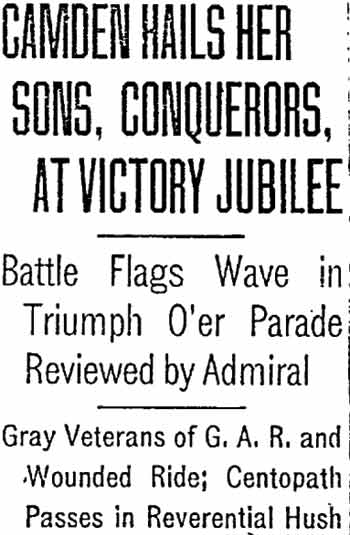
Battle Flags Wave in Triumph O’er Parade Reviewed by Admiral
Gray Veterans of G. A. R. and Wounded Ride; Centopath Passes in Reverential Hush
The Peace with victory which Camden’s sons along with millions of other soldiers of all the Allied countries helped to bring home was celebrated by a jubilee in Camden yesterday which eclipsed anything that the city across the Delaware has ever attempted in her history.
Nearly every man, woman and child who did not actually march in the jubilee parade stood on the side lines and watched it and cheered themselves hoarse as the soldiers and sailors who went out from their town to fight marched past, this time as the conquerors in the world’s greatest war.
Favored by glorious sunshine, a sunshine that was reflected in the faces of the people, the day’s proceedings went off perfectly. For months Mayor Ellis and all his city family, together with a large committee of leading citizens, had been planning the affair. Their handiwork stood the test. It was good.
Admiral Henry Wilson, commander-in-chief of the Atlantic Fleet, came to his boyhood home to be the principal guest of the city and chief reviewing officer of the jubilee. With him were national statesmen and municipal officials.
Soldiers, sailors, war workers, members of fraternal orders and men who fought under the flags of Canada, England, Italy and Poland, marched in the parade which was miles long. Every succeeding division seemed just a little better than the one which preceded it, and, when it was all over and the soldiers and sailors had filed into the old Third Regiment Armory to sit down to a piping hot banquet, the hardest thing of all was to say which had made the finest showing.
All Honor to the Dead
Amidst all the gayety and happiness there was a sober note expressed by the memorial cenotaph which preceded the parade and which brought every hat off as it passed in solemn silence.
The heroic figure of an American soldier in bronze standing on a granite pedestal which bore a gold star with the number 135, symbolical of the Camden county men who laid down their lives in their country’s cause, was carried along the route ten minutes before the parade commenced. Encircler [sic] by flowers and palms, it moved through the reverential hush which had fallen over the throngs.
While every organization in the county of Philadelphia was represented in the parade, to the thousands who lined the sidewalks, there was really only one great big important factor—the service men. And when those self-same service men, many of whom bearing the Distinguished Service Cross of their own United States, others wearing the Croix de Guerre, bestowed on them by the sister republic of France, and still others carrying on their breasts the Italian and British War Crosses, given them by grateful countries, marched down the streets and avenues, all the pent up emotion in thousands of hearts was let loose.
It mattered not whether the men were officers or enlisted men, black or white, neat or untidy, they were all soldiers and they had done all that was asked of them. Their home town honored them. The men in blue and the women in blue, too, received a welcome not one whit less feeling than their brothers in khaki.
They had a certain advantage over the doughboys, for they put half a dozen of the prettiest and smartest yoemanettes that ever wore Uncle Sam’s uniform at the head of their division. The crowd simply had to be with them.
Canada and England, too, had a detachment of men in line. About two dozen of these veterans, half of whom wore the ribbon of the Mons Star, showing that they were in service in France in 1914, were in line, and they marched snappily and smartly and drew their full modicum of pleasurable comments.
Red Cross women, some of them grandmothers, others young girls still in their teens, marched in their snowy white uniforms with their crosses of red emblazoned on headcover and breast. Salvation Army lassies who had cooked doughnuts right up under the muzzles of the guns were there with Y. M. C. A. and Knights of Columbus workers.
Elks, Masons, Knights Templar, Red Men, Moose and scores of other fraternal organizations turned out in all their glorious trappings and regalia.
The delegation of Elks, startling in their spic and span white uniforms, marched behind their own band like squads of veterans. A foretaste of what Philadelphia will see during the coming week was given when more than 100 Knights Templar, resplendent in their uniforms and swords and cocked hats with white ostrich feathers, marched in the second division of the parade. As the formation reached the reviewing stand near the Ninth Ward Republican Association they deployed into the formation of a cross, the symbol of their order, and marched past in this formation.
Many gorgeous floats were in line, th Ninth Ward Republican Association having no less than five. All were artistic. The first was bedecked with growing flowers, while a beautiful young woman reprsenting “Peace” stood flanked by a soldier and sailor. The one following had a replica of the Liberty Bell with the inscription, “Peace on Earth, Good Will Towards men.” Two soldiers rang the bell. Behind them marched a band playing “Onward Christian Soldiers” as the men marched on. Floats symbolical of every war activity were there. The Knights of Columbus showed a replica of their famous service hut which was the doughboy’s home when he had no other.
The veterans of other wars were not forgotten in this jubilee of the greatest war of all. Grand Army men whose gray locks bespoke their years rode in automobiles bearing the tattered colors of their old Civil War regiments. The soldiers of a later day, men of the Spanish-American War, were in line with their comrades.
The wounded were there, too. They could not march in the parade, but they rode and their faces were smiling and their hearts were glad as they realized that this welcome was for them.
Triumphal arches were erected at points along the route of the parade and the square at the courthouse was a mass of color.
Among the officers in command of the sections of the service division were Lieutenant Colonel Samuel G. Barnard, of the 112th Field Artillery; Captain J. Walter Scott, former adjutant of the Third Regiment; Captains English, Richards and Dickinson, of Battery B; Lieutenant J. G. Williams, Ensign Beaston and Lieutenant William Opfermann, of the aviation corps.
Battle Flags Wave Triumphant
Shortly after 1.30 o’clock James H. Long, chairman of the parade committee of the Victory Jubilee and Memorial Committee and marshal of the pageant, gave the order to march. The Lyric Band, which escorted nearly all of the troops to the terminal in the dark days of the war, was given the honor of heading the line. Chief of Police E. A. Gravenor and Assistant Chief of Police Edward S. Hyde led the parade, followed by a platoon of mounted policemen under Captain William E. Albert.
Then came Marshal Long and his aides, who were: Frank E. Van Hart, William D. Sayrs, Jr., Frank Fithian, A. Benjamin Sparks, Kessel Webster, William Isgard, Robert D. Clow, Andrew B. F. Smith, William Lorrigan, Charles Austermuhl, David Doane, William C. Davis and William D. Vanaman.
Directly behind the Lyric Band marched Mayor Charles H. Ellis at the head of the Victory Jubilee and Memorial Committee, of which he is chairman.
And at the head of the division were the battle flags of the Twenty-ninth and Seventy-eighth divisions, on which General John J. Pershing personally pinned battle pennants during those memorable days back in October in the Argonne forest. Behind the 4th marched the famous engineers, headed by Captain Keasby and Captain Beals Smuck. Three battle pennants were pinned to their flags, which never touched the ground while they were bridging the rivers in the Argonne under hellish shell fire for the doughboys to advance. Then came the 112th Field Artillery, Battery B’s heroes of the border and of France, headed by Captain Charles Richards and Captain Dickinson. In the same section marched the Eleventh Machine Gun Battalion with its battle flags and pennants fluttering.
There was another great cheer as the Seventy-eighth Division, New Jersey’s Lightning boys, loomed into view. The heroes of the 311th Infantry, 303d Engineers, 307th, 308th and 309th Field Artillery and other regiments of that famous command were given a mighty ovation behind their battle flags, which led them in their assault on St. Mihiel and the day they attacked and captured Grand-Pre in the terrible conflict in the Argonne.
Behind them marched the Marines, headed by Lieutenant Monitor Watchman, of the Fifth Regiment, Second Division. With the Marines marched the regular army units, men who had served in as many as five battles and wore three and four gold service stripes on their sleeves.
Then followed the naval contingent. They were commanded by Commander Francis W. Hoffman and Commander W. G. Hodgson.
The order “eyes left” flashed along the line as each platoon drew near the reviewing stand and Admiral Wilson with his band to his cap returned the salute. With the admiral on the stand were former United States Senator David Baird, Congressman William J. Browning, County Collector John S. Well, City Clerk W. D. Brown and others.
At the armory a splendid banquet was served to the soldiers and sailors. For days past corps Red Cross workers had been preparing the good things to eat and the men did full justice to them. They marched in the armory where the food was spread on the tables and enjoyed themselves while bands played. After dinner there were speeches. Mayor Ellis in welcoming the men said:
“This is one of the happiest moments of my life. I have waited patiently through months of trial for the glad day when I could bid you welcome to the City of Camden once again.
“We are planning to erect a lasting memorial in memory of those heroes who gave their lives and in memory of the valiant deeds you performed on land and sea.
“Camden will always cherish the memory of this day, rever the memory of your dead comrades and will inscribe your valiant deeds on that memorial. I bid you welcome in the name of the most patriotic little city in America. I thank you.”
Prosecutor Charles A. Wolverton welcomed the men on behalf of the county and paid a tribute to their valor recalling their wonderful victories of the Argonne and other battlefields of France.
October 1920 – Wanted Poster
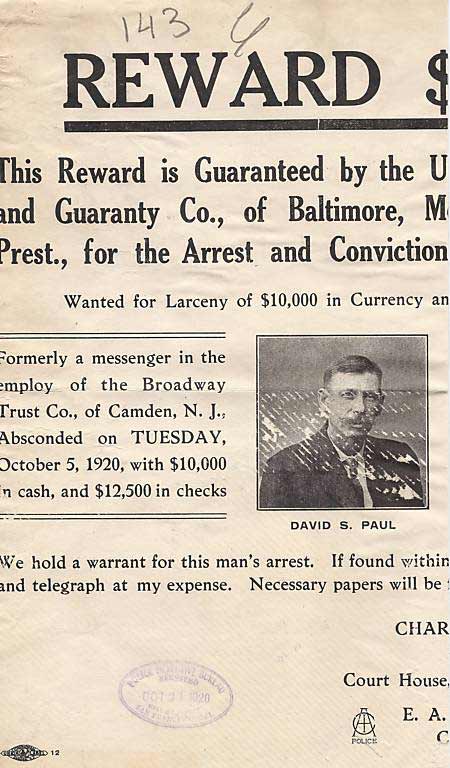
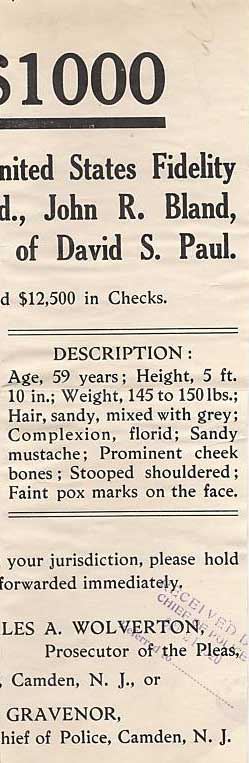
October 1920 – Wanted poster for David Paul, missing bank messenger
Hacked Remains of David Paul, Missing Bank Messenger, Discovered by Gunners
New Jersey Mirror —
Hacked Remains of David Paul, Missing Bank Messenger, Discovered by Gunners
New Jersey Mirror, October 20, 1920
James Convicted
New Jersey Mirror —
New Jersey Mirror, December 22, 1920
Schuck Trial Postponed
New Jersey Mirror —
New Jersey Mirror, December 29, 1920
Faces Jury With a Smile: Mystery Woman Appears
New Jersey Mirror —
New Jersey Mirror, February 6, 1921
Schuck Convicted
New Jersey Mirror —
New Jersey Mirror, February 23, 1921
Three Other Policemen Are Accused By Bleakly In Probe Of Grafting
Camden Daily Courier —
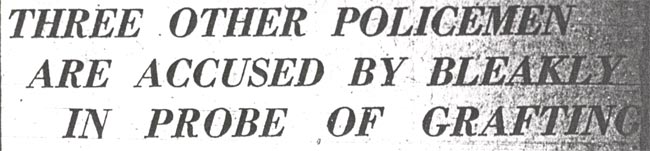
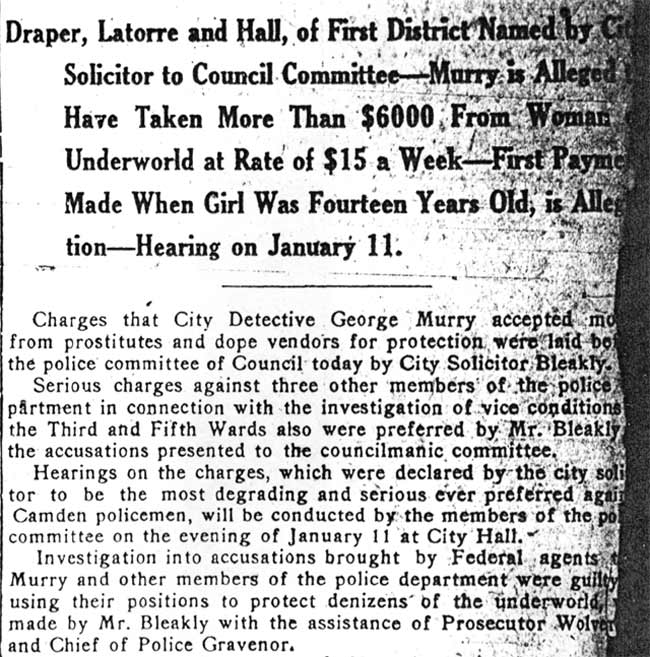

THREE OTHER POLICEMEN ARE ACCUSED BY BLEAKLY IN PROBE OF GRAFTING
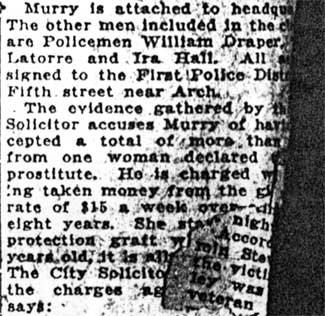
Draper, Latorre and Hall, of First District Named by Council Solicitor to Council Committee—Murry is Alleged to Have Taken More Than $6000 From Woman of Underworld at Rate of $15 a Week—First Payment Made When Girl Was Fourteen Years Old, is Allegation—Hearing on January 11.
Charges that City Detective George Murry accepted money from prostitutes and dope vendors for protection were laid before the police committee of Council today by City Solicitor Bleakly.
Serious charges against three other members of the police department in connection with the investigation of vice conditions in the Third and Fifth Wards also were preferred by Mr. Bleakly, in the accusations presented to the councilmanic committee.
Hearings on the charges, which were declared by the city solicitor to be the most degrading and serious ever preferred against Camden policemen, will be conducted by the members of the police committee on the evening of January 11 at City Hall.
Investigation into accusations brought by Federal agents that Murry and other members of the police department were guilty of using their positions to protect denizens of the underworld was made by Mr. Bleakly with the assistance of Prosecutor Wolverton and Chief of Police Gravenor.
Murry is attached to headquarters. The other men included in the charges are Policemen William Draper, Latorre and Ira Hall, all assigned to the First Police District, Fifth street near Arch.
The evidence gathered by the Solicitor accuses Murry of having accepted a total of more than $6,000 from one woman declared to have become a prostitute. He is charged with having taken money from her at the rate of $15 a week over an eight-year period. [Remainder of this paragraph illegible — the scan is smudged at this point on crop -03.]
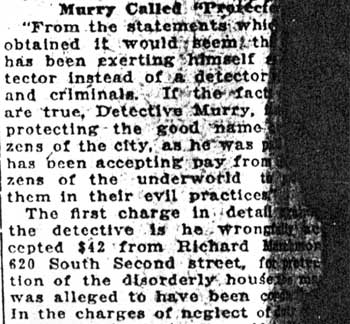
Murry Called “Protector”
“From the statements which obtained it would seem that he has been exerting himself as a protector instead of a detector of criminals. If the facts are true, Detective Murry, instead of protecting the good names of the city, as he was paid, has been accepting pay from denizens of the underworld to help them in their evil practices.
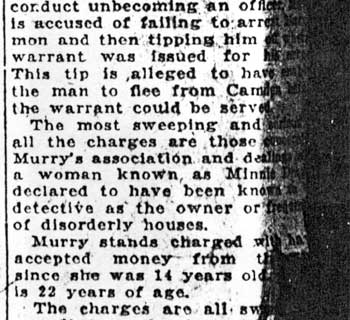
The first charge in detail is that the detective is he wrongly accepted $42.50 from Richard Marchmon, 620 South Second street, for protection of the disorderly house it was alleged to have been conducted. In the charges of neglect of duty conduct unbecoming an officer, he is accused of failing to arrest Marchmon and then tipping him a warrant was issued for him. This tip is alleged to have given the man to flee from Camden before the warrant could be served.
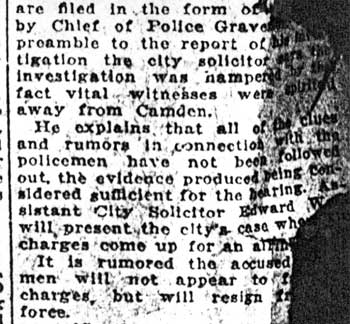
The most sweeping and all the charges are those of Murry’s association and dealings with a woman known as Minnie Draper, declared to have been known to the detective as the owner or keeper of disorderly houses. Murry stands charged with having accepted money from her since she was 14 years old; she is 22 years of age. The charges are all sworn to and filed in the form of affidavits by Chief of Police Gravenor.
In a preamble to the report of investigation the city solicitor said the investigation was hampered by the fact vital witnesses were kept away from Camden. He explains that all of the charges and rumors in connection with policemen have not been followed out, the evidence produced being considered sufficient for the hearing. Assistant City Solicitor Edward Wolverton will present the city’s case when charges come up for a hearing. It is rumored the accused policemen will not appear to fight the charges, but will resign from the force.
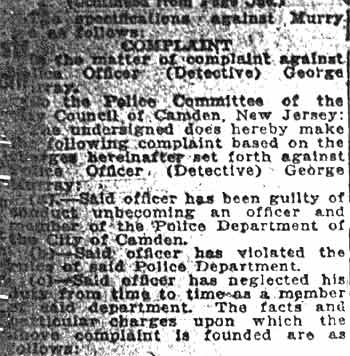
The specifications against Murry are as follows:
COMPLAINT
In the matter of complaint against Police Officer (Detective) George Murry:
To the Police Committee of the City Council of Camden, New Jersey:
The undersigned does hereby make the following complaint based on the charges hereinafter set forth against Police Officer (Detective) George Murry:
(a) Said officer has been guilty of conduct unbecoming an officer and member of the Police Department of the City of Camden.
(b) Said officer has violated the rules of said Police Department.
(c) Said officer has neglected his duties from time to time as a member of said department. The facts and particular charges upon which the above complaint is founded are as follows:
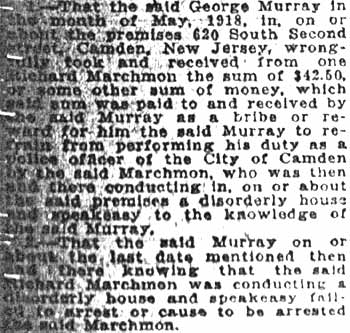
That the said George Murry in the month of May, 1918, in, on or about the premises 620 South Second St., Camden, New Jersey, wrongfully took and received from one Richard Marchmon the sum of $42.50, or some other sum of money, which sum was paid to and received by the said Murry as a bribe or reward for him the said Murry to refrain from performing his duty as a police officer of the City of Camden by the said Marchmon, who was then and there conducting in, on or about said premises a disorderly house and speakeasy to the knowledge of the said Murry.
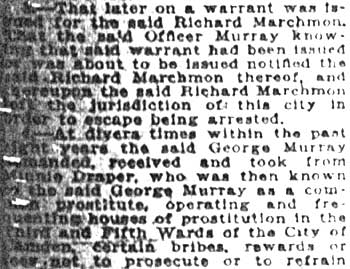
That the said Murry on or about the last date mentioned then and there knowing that the said Richard Marchmon was conducting a disorderly house and speakeasy failed to arrest or cause to be arrested said Marchmon. That later on a warrant was issued for the said Richard Marchmon. That the said Officer Murry knowing that said warrant had been issued or was about to be issued notified the said Richard Marchmon thereof, and thereupon the said Richard Marchmon left the jurisdiction of this city in order to escape being arrested.
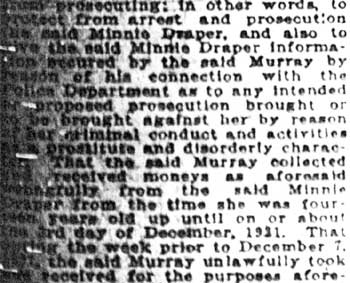
At divers times within the past three years the said George Murry demanded, received and took from Minnie Draper, who was then known to the said George Murry as a common prostitute, operating and frequenting houses of prostitution in the Third and Fifth Wards of the City of Camden, certain bribes, rewards or payments not to prosecute or refrain from prosecuting; in other words, to protect from arrest and prosecution the said Minnie Draper, and also to give the said Minnie Draper information procured by the said Murry by reason of his connection with the Police Department as to any intended or proposed prosecution brought or to be brought against her by reason of her criminal conduct and activities as a prostitute and disorderly character.
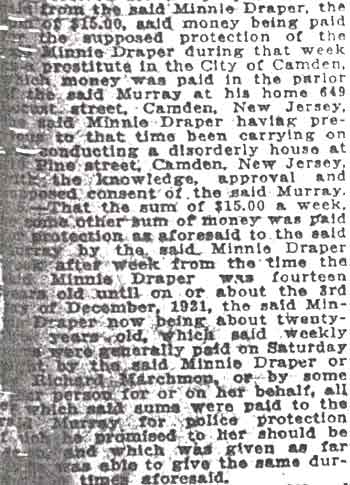
That the said Murry collected and received moneys as aforesaid wrongfully from the said Minnie Draper from the time she was fourteen years old up until on or about the 3rd day of December, 1921. That during the week prior to December 7, 1921, the said Murry unlawfully took and received for the purposes aforesaid from the said Minnie Draper, the sum of $15.00, said money being paid for the supposed protection of the said Minnie Draper during that week as a prostitute in the City of Camden, which money was paid in the parlor of the said Murry at his home 649 Scott street, Camden, New Jersey, the said Minnie Draper having previous to that time been carrying on and conducting a disorderly house at Pine street, Camden, New Jersey, with the knowledge, approval and supposed consent of the said Murry.
That the sum of $15.00 a week, or some other sum of money was paid for protection as aforesaid to the said Murry by the said Minnie Draper each and every week from the time the said Minnie Draper was fourteen years old until on or about the 3rd day of December, 1921, the said Minnie Draper now being about twenty-two years old, which said weekly sums were generally paid on Saturday night by the said Minnie Draper or by Richard Marchmon, or by some other person for or on her behalf, all of which said sums were paid to said Murry for police protection which he promised to her should be given and which was given as far as he was able to give the same during the times aforesaid.
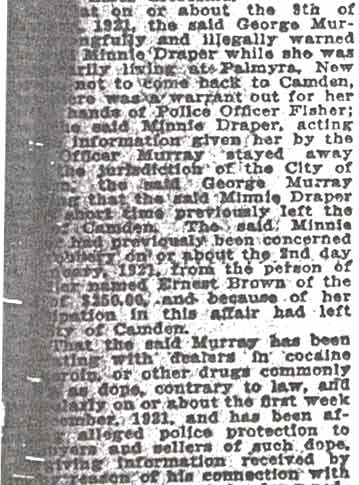
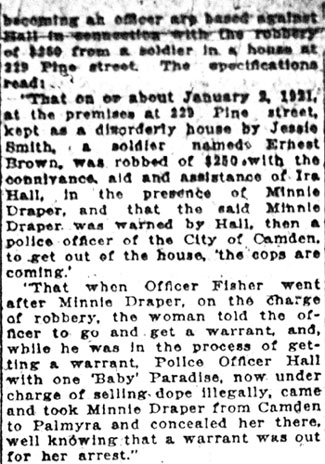
That on or about the 8th of January 1921, the said George Murry wrongfully and illegally warned the said Minnie Draper while she was temporarily living at Palmyra, New Jersey that there was a warrant out for her in the hands of Police Officer Fisher; and the said Minnie Draper, acting upon information given her by the said Officer Murry stayed away from the jurisdiction of the City of Camden, since the said George Murry knowing that the said Minnie Draper had a short time previously left the City of Camden. The said Minnie Draper had previously been concerned in a robbery on or about the 2nd day of January, 1921, from the person of a man named Ernest Brown of the sum of $250.00, and because of her participation in this affair had left the City of Camden.
That the said Murry has been dealing with dealers in cocaine, heroin or other drugs commonly known as dope, contrary to law, and particularly on or about the first week of December, 1921, and has been affording alleged police protection to buyers and sellers of such dope, receiving information received by him by reason of his connection with the Police Department to dope peddlers and buyers contrary to law.
That in this connection one Joe Pollack, early in December or the latter part of November, 1921, had been engaged in the business of dope or selling coke at 210 Pine street, Camden, New Jersey; that the next morning after raids the said Murry sent for Joe Pollack’s girl, Maude Jordan, and told her to get the stuff, meaning the dope or coke, out of Pollack’s house. That the direction to the said Jordan girl to take said dope away from the Pollack house was given by the said Murry to her in the parlor of his own home in the Third Ward, Camden, New Jersey.
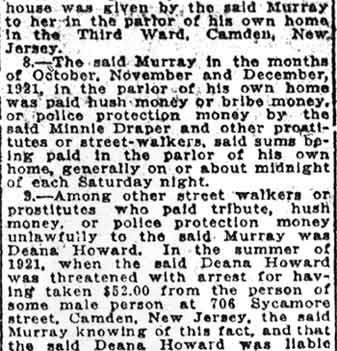
8.—The said Murry in the months of October, November and December, 1921, in the parlor of his own home was paid hush money or bribe money, or police protection money by the said Minnie Draper and other prostitutes or street-walkers, said sums being paid in the parlor of his own home, generally on or about midnight of each Saturday night.
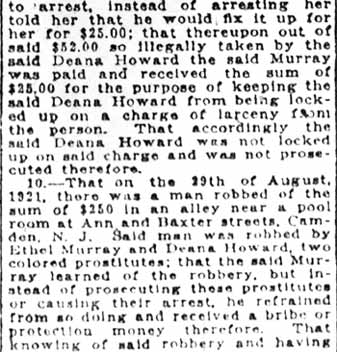
9.—Among other street walkers or prostitutes who paid tribute, hush money, or police protection money unlawfully to the said Murry was Deana Howard. In the summer of 1921, when the said Deana Howard was threatened with arrest for having taken $52.00 from the person of some male person at 706 Sycamore street, Camden, New Jersey, the said Murry knowing of this fact, and that the said Deana Howard was liable to arrest, instead of arresting her told her that he would fix it up for her for $25.00; that thereupon out of said $52.00 so illegally taken by the said Deana Howard the said Murry was paid and received the sum of $25.00 for the purpose of keeping the said Deana Howard from being locked up on a charge of larceny from the person. That accordingly the said Deana Howard was not locked up on said charge and was not prosecuted therefore.
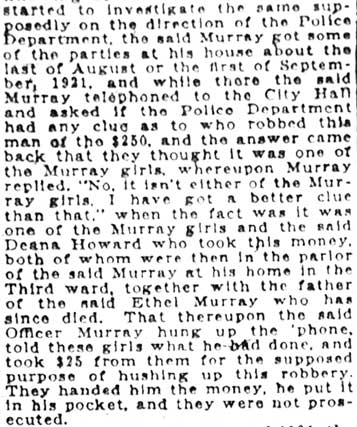
10.—That on the 29th of August, 1921, there was a man robbed of the sum of $250 in an alley near a pool room at Ann and Baxter streets, Camden, N. J. Said man was robbed by Ethel Murray and Deana Howard, two colored prostitutes; that the said Murry learned of the robbery, but instead of prosecuting those prostitutes or causing their arrest, he refrained from so doing and received a bribe or protection money therefore. That knowing of said robbery and having started to investigate the same supposedly on the direction of the Police Department, the said Murry got some of the parties at his house about the last of August or the first of September, 1921, and while there the said Murry telephoned to the City Hall and asked if the Police Department had any clue as to who robbed this man of the $250, and the answer came back that they thought it was one of the Murray girls, whereupon he replied, “No, it isn’t either of the Murray girls, I have got a better clue than that,” when the fact was it was one of the Murray girls and the said Deana Howard who took this money, both of whom were then in the parlor of the said Murry at his home in the Third ward, together with the father of the said Ethel Murray who has since died. That thereupon the said Officer Murry hung up the ’phone, told these girls what he had done, and took $25 from them for the supposed purpose of hushing up this robbery. They handed him the money, he put it in his pocket, and they were not prosecuted.
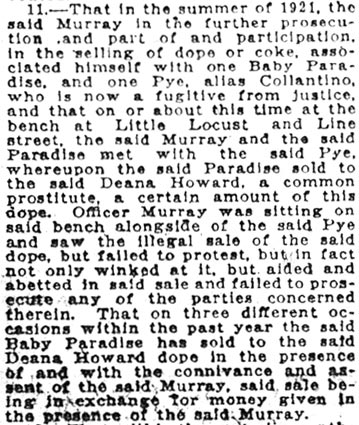
11.—That in the summer of 1921, the said Murry in the further prosecution and part of and participation in the selling of dope or coke, associated himself with one Baby Paradise, and one Pye, alias Collantino, who is now a fugitive from justice, and that on or about this time at the bench at Little Locust and Line street, the said Murry and the said Paradise met with the said Pye, whereupon the said Paradise sold to the said Deana Howard, a common prostitute, a certain amount of this dope. Officer Murry was sitting on said bench alongside of the said Pye and saw the illegal sale of the said dope, but failed to protest, but in fact not only winked at it, but aided and abetted in said sale and failed to prosecute any of the parties concerned therein. On three different occasions within the past year the said Baby Paradise has sold to the said Deana Howard dope in the presence of and with the connivance and assent of the said Murry, said sale being in exchange for money given in the presence of the said Murry.
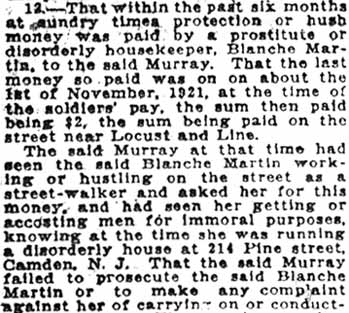
12.—That within the past six months at sundry times protection or hush money was paid by a prostitute or disorderly housekeeper, Blanche Martin, to the said Murry. The last money so paid was on or about the 1st of November, 1921, at the time of the soldiers’ pay, the sum then paid being $2, the sum being paid on the street near Locust and Line.
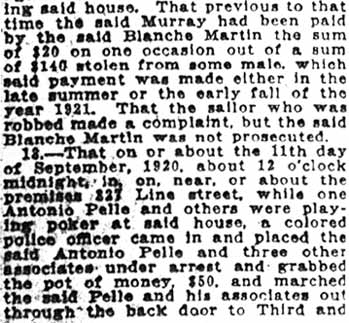
The said Murry at that time had seen the said Blanche Martin working or hustling on the street as a street-walker and asked her for this money, and had seen her getting or accosting men for immoral purposes, knowing at the time she was running a disorderly house at 214 Pine street, Camden, N. J. That the said Murry failed to prosecute the said Blanche Martin or to make any complaint against her of carrying on or conducting said house. That previous to that time the said Murry had been paid by the said Blanche Martin the sum of $20 on one occasion out of a sum of $140 stolen from some male, which said payment was made either in the late summer or the early fall of the year 1921. That the sailor who was robbed made a complaint, but the said Blanche Martin was not prosecuted.
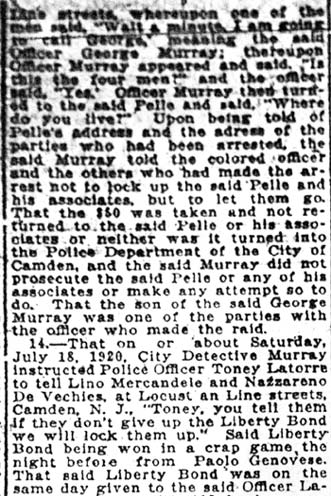
13.—That on or about the 11th day of September, 1920, about 12 o’clock midnight, in, on, near, or about the premises 327 Line street, while one Antonio Pelle and others were playing poker at said house, a colored police officer came in and placed the said Antonio Pelle and three other associates under arrest and grabbed the pot of money, $50, and marched the said Pelle and his associates out through the back door to Third and Line streets, whereupon one of the policemen said, “Wait a minute, I am going to call George,” meaning the said Officer George Murry; thereupon Officer Murry appeared and said, “Is this the four men?” and the officer said, “Yes.” Officer Murry then turned to the said Pelle and said, “Where do you live?” Upon being told of Pelle’s address and the address of the parties who had been arrested, the said Murry told the colored officer and the others who had made the arrest not to lock up the said Pelle and his associates, but to let them go. That the $50 was taken and not returned to the said Pelle or his associates or neither was it turned into the Police Department of the City of Camden, and the said Murry did not prosecute the said Pelle or any of his associates or make any attempt so to do. That the son of the said George Murry was one of the parties with the officer who made the raid.
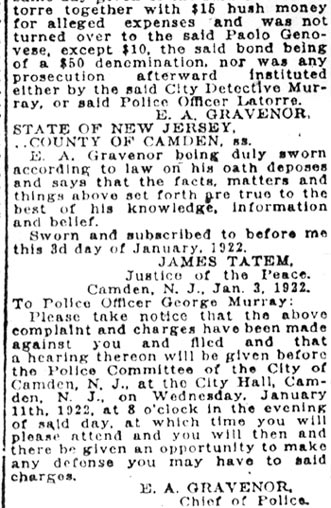
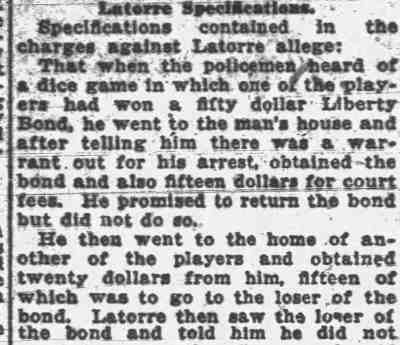
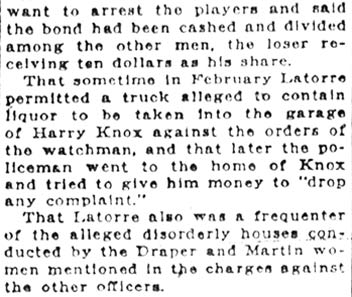
14.—That on or about Saturday, July 18, 1920, City Detective Murry instructed Police Officer Toney Latorre and Nazzareno De Vechies, at Locust and Line streets, Camden, N. J., “Toney, you tell them if they don’t give up the Liberty Bond we will lock them up.” Said Liberty Bond being won in a crap game, the night before from Paolo Genovese. That said Liberty Bond was on the same day given to the said Officer Latorre together with $15 hush money for alleged expenses and was not turned over to the said Paolo Genovese, except $10, the said bond being of a $50 denomination, nor was any prosecution afterward instituted either by the said City Detective Murry, or said Police Officer Latorre.
E. A. GRAVENOR.
STATE OF NEW JERSEY, COUNTY OF CAMDEN, ss.
E. A. Gravenor being duly sworn according to law on his oath deposes and says that the facts, matters and things above set forth are true to the best of his knowledge, information and belief.
Sworn and subscribed before me this 3d day of January, 1922.
JAMES TATEM
Justice of the Peace.
Camden, N. J., Jan. 3, 1922.
To Police Officer George Murry:
Please take notice that the above complaint and charges have been made against you and filed and that a hearing thereon will be given before the Police Committee of the City of Camden, N. J., at the City Hall, Camden, N. J., on Wednesday, January 11th, 1922, at 8 o’clock in the evening of said day, at which time you will please attend and you will then and there be given an opportunity to make any defense you may have to said charges.
E. A. GRAVENOR,
Chief of Police.
Took $50, Is Charge
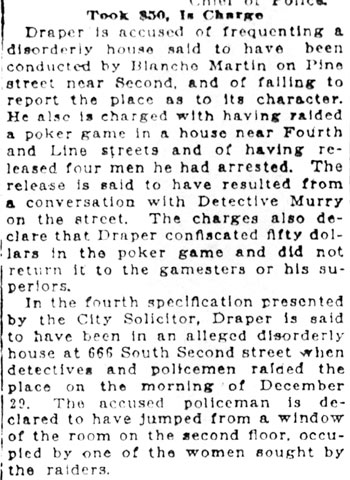
Draper is accused of frequenting a disorderly house said to have been conducted by Blanche Martin on Pine street near Second, and of failing to report the place as to its character. He also is charged with having raided a poker game in a house near Fourth and Line streets and of having released four men he had arrested. The release is said to have resulted from a conversation with Detective Murry on the street. The charges also declare that Draper confiscated fifty dollars in the poker game and did not return it to the gamesters or his superiors.
In the fourth specification presented by the City Solicitor, Draper is said to have been in an alleged disorderly house at 666 South Second street when detectives and policemen raided the place on the morning of December 29. The accused policeman is declared to have jumped from a window of the room on the second floor, occupied by one of the women sought by the raiders.
Says He Concealed Woman
Charges of neglect and conduct unbecoming an officer are based against Hall in connection with the robbery of $250 from a soldier in a house at 229 Pine street. The specifications read:
“That on or about January 2, 1921, at the premises at 229 Pine street, kept as a disorderly house by Jessie Smith, a soldier named Ernest Brown, was robbed of $250 with the connivance, aid and assistance of Ira Hall, in the presence of Minnie Draper, and that the said Minnie Draper was warned by Hall, then a police officer of the City of Camden, to get out of the house, ‘the cops are coming.’
“That when Officer Fisher went after Minnie Draper, on the charge of robbery, the woman told the officer to go and get a warrant, and, while he was in the process of getting a warrant, Police Officer Hall with one ‘Baby’ Paradise, now under charge of selling dope illegally, came and took Minnie Draper from Camden to Palmyra and concealed her there, well knowing that a warrant was out for her arrest.”
Latorre Specifications.
Specifications contained in the charges against Latorre allege:
That when the policemen heard of a dice game in which one of the players had won a fifty dollar Liberty Bond, he went to the man’s house and after telling him there was a warrant out for his arrest, obtained the bond and also fifteen dollars for court fees. He promised to return the bond but did not do so.
He then went to the home of another of the players and obtained twenty dollars from him, fifteen of which was to go to the loser of the bond. Latorre then saw the loser of the bond and told him he did not want to arrest the players and said the bond had been cashed and divided among the other men, the loser receiving ten dollars as his share.
That sometime in February Latorre permitted a truck alleged to contain liquor to be taken into the garage of Harry Knox against the orders of the watchman, and that later the policeman went to the home of Knox and tried to give him money to “drop any complaint.”
That Latorre also was a frequenter of the alleged disorderly houses conducted by the Draper and Martin women mentioned in the charges against the other officers.
Detective George Murry Resigns, Will Not Fight Witnesses of Underworld
Camden Courier —
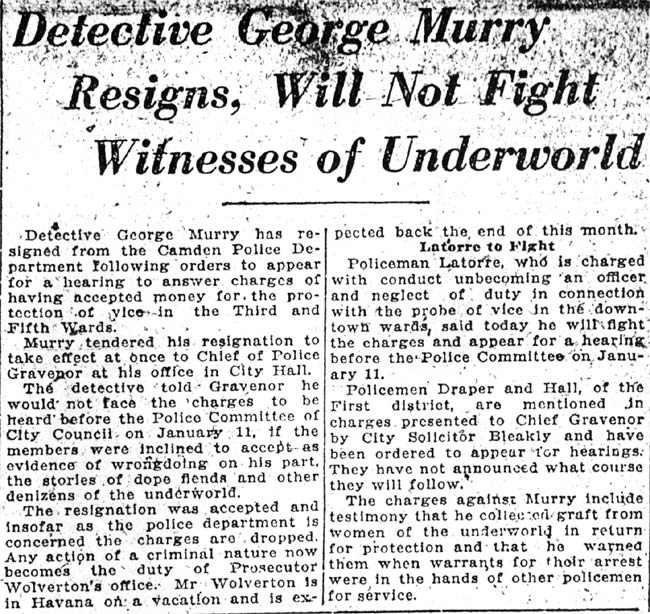
Detective George Murry has resigned from the Camden Police Department following orders to appear for a hearing to answer charges of having accepted money for the protection of vice in the Third and Fifth Wards.
Murry tendered his resignation to take effect at once to Chief of Police Gravenor at his office in City Hall.
The detective told Gravenor he would not face the charges to be heard before the Police Committee of City Council on January 11, if the members were inclined to accept as evidence of wrongdoing on his part, the stories of dope fiends and other denizens of the underworld.
The resignation was accepted and insofar as the police department is concerned the charges are dropped. Any action of a criminal nature now becomes the duty of Prosecutor Wolverton’s office. Mr. Wolverton is in Havana on a vacation and is expected back the end of this month.
Latorre to Fight
Policeman Latorre, who is charged with conduct unbecoming an officer and neglect of duty in connection with the probe of vice in the downtown wards, said today he will fight the charges and appear for a hearing before the Police Committee on January 11.
Policemen Draper and Hall, of the First district, are mentioned in charges presented to Chief Gravenor by City Solicitor Bleakly and have been ordered to appear for hearings. They have not announced what course they will follow.
The charges against Murry include testimony that he collected graft from women of the underworld in return for protection and that he warned them when warrants for their arrest were in the hands of other policemen for service.
Ira Hall Is Dismissed, Evidence Against Four Men Given Prosecutor
Camden Courier —
Criminal Prosecution of Murry, Latorre, Draper and Hall Looms as Result of Sensational Hearing by Police Committee— ‘Dope’ Sellers Linked With Detective and Policemen in Lurid Testimony at Crowded Session— Predict Speedy Action
Policeman as Own Attorney Given Grilling
Criminal prosecution of Detective George Murry and Policemen Tony Latorre, William Draper and Ira Hall for their alleged “protection” of vice in the downtown underworld loomed today. At a sensational hearing before the police committee of City Council last night it was unanimously decided to turn the mass of evidence against the four men, gathered by City Solicitor Bleakly, over to Prosecutor Wolverton’s office.
At the hearing, Policeman Hall was summarily dismissed from the department, classed as a “moral degenerate” and roundly flayed when, after he acted as his own attorney, he was cross-questioned by every member of the police committee.
Hall was the only one of the quartette of accused officers who made any attempt to defend himself. Murry, Latorre and Draper resigned several days ago. At the police committee session last night it was the sense of the members that their resignations was a tacit admission of guilt and that their mere removal from the police department is not sufficient punishment for their underworld activities.
The grand jury convened on Tuesday of this week. The next step will be the presentation of evidence gathered by Mr. Bleakly against the four men to the prosecutor’s office who, in turn, will turn it over to the grand jury. Quick action may be expected, it was predicted today in official circles.
Policeman Hall’s friendship for Anthony Paradise, charged with peddling “dope,” was brought out at last night’s hearing.
Burling Promises To Act at Once in Probe of 4 Police
Camden Courier —
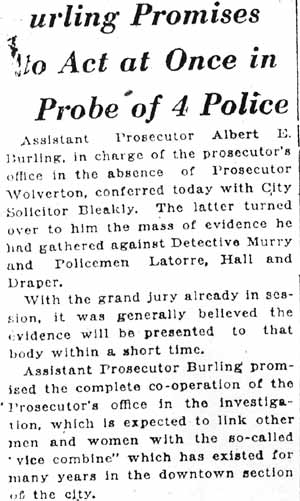
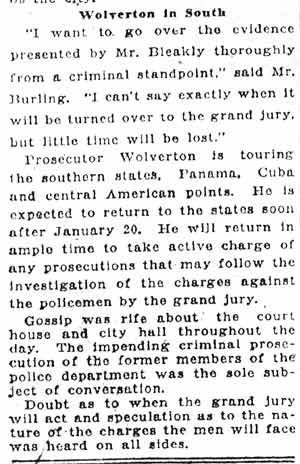
Assistant Prosecutor Albert E. Burling, in charge of the prosecutor’s office in the absence of Prosecutor Wolverton, conferred today with City Solicitor Bleakly. The latter turned over to him the mass of evidence he had gathered against Detective Murry and Policemen Latorre, Hall and Draper.
With the grand jury already in session, it was generally believed the evidence will be presented to that body within a short time.
Assistant Prosecutor Burling promised the complete co-operation of the Prosecutor’s office in the investigation, which is expected to link other men and women with the so-called “vice combine” which has existed for many years in the downtown section of the city.
Wolverton in South
“I want to go over the evidence presented by Mr. Bleakly thoroughly from a criminal standpoint,” said Mr. Burling. “I can’t say exactly when it will be turned over to the grand jury, but little time will be lost.”
Prosecutor Wolverton is touring the southern states, Panama, Cuba and central American points. He is expected to return to the states soon after January 20. He will return in ample time to take active charge of any prosecutions that may follow the investigation of the charges against the policemen by the grand jury.
Gossip was rife about the court house and city hall throughout the day. The impending criminal prosecution of the former members of the police department was the sole subject of conversation.
Doubt as to when the grand jury will act and speculation as to the nature of the charges the men will face was heard on all sides.
Underworld Life Exposed as Hall Is Given Grilling
Camden Courier —
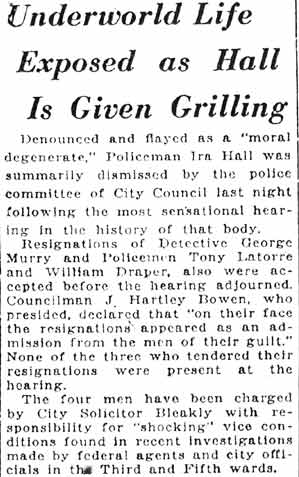
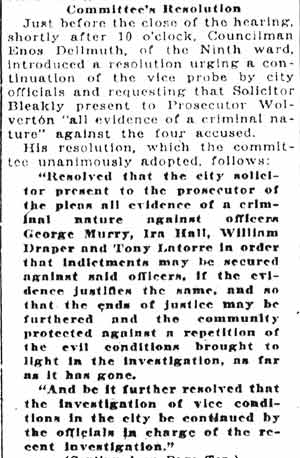
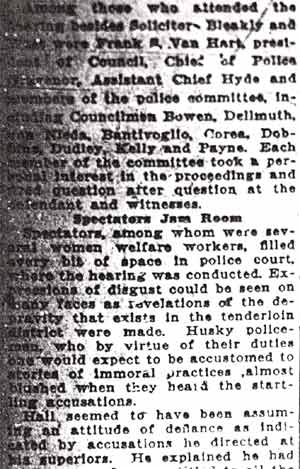
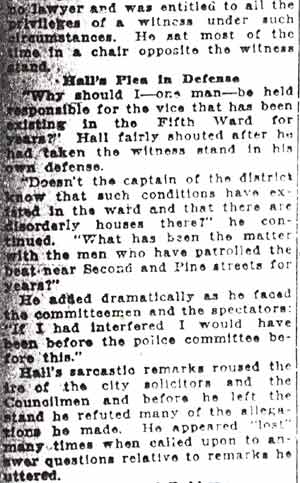
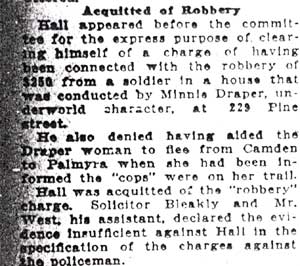
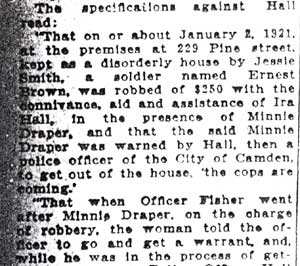
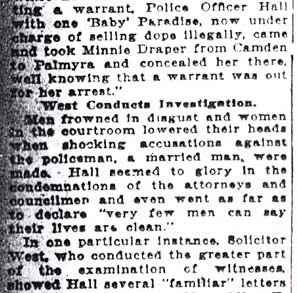
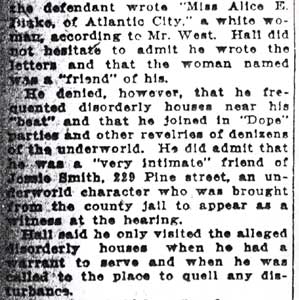
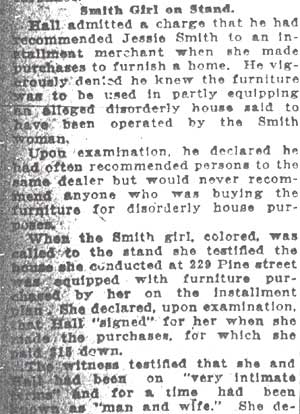
Denounced and flayed as a “moral degenerate,” Policeman Ira Hall was summarily dismissed by the police committee of City Council last night following the most sensational hearing in the history of that body.
Resignations of Detective George Murry and Policemen Tony Latorre and William Draper, also were accepted before the hearing adjourned. Councilman J. Hartley Bowen, who presided, declared that “on their face the resignations appeared as an admission from the men of their guilt.” None of the three who tendered their resignations were present at the hearing.
The four men have been charged by City Solicitor Bleakly with responsibility for “shocking” vice conditions found in recent investigations made by federal agents and city officials in the Third and Fifth wards.
Committee’s Resolution
Just before the close of the hearing, shortly after 10 o’clock, Councilman Enos Dellmuth, of the Ninth ward, introduced a resolution urging a continuation of the vice probe by city officials and requesting that Solicitor Bleakly present to Prosecutor Wolverton “all evidence of a criminal nature” against the four accused.
His resolution, which the committee unanimously adopted, follows:
“Resolved that the city solicitor present to the prosecutor of the pleas all evidence of a criminal nature against officers George Murry, Ira Hall, William Draper and Tony Latorre in order that indictments may be secured against said officers, if the evidence justifies the same, and so that the ends of justice may be furthered and the community protected against a repetition of the evil conditions brought to light in the investigation, as far as it has gone.
“And be it further resolved that the investigation of vice conditions in the city be continued by the officials in charge of the recent investigation.”
Among those who attended the hearing besides Solicitor Bleakly and [?] were Frank S. Van Hart, president of Council, Chief of Police Gravenor, Assistant Chief Hyde and members of the police committee, including Councilmen Bowen, Dellmuth, Von Nieda, Bantivoglio, Corea, Dobbins, Dudley, Kelly and Payne. Each member of the committee took a personal interest in the proceedings and [?] question after question at the defendant and witnesses.
Spectators Jam Room
Spectators, among whom were several women welfare workers, filled every bit of space in police court, where the hearing was conducted. Expressions of disgust could be seen on many faces as revelations of the depravity that exists in the tenderloin district were made. Husky policemen, who by virtue of their duties one would expect to be accustomed to stories of immoral practices, almost blushed when they heard the startling accusations.
Hall seemed to have been assuming an attitude of defiance as indicated by accusations he directed at his superiors. He explained he had no lawyer and was entitled to all the privileges of a witness under such circumstances. He sat most of the time in a chair opposite the witness stand.
Hall’s Plea in Defense
“Why should I—one man—be held responsible for the vice that has been existing in the Fifth Ward for years?” Hall fairly shouted after he had taken the witness stand in his own defense.
“Doesn’t the captain of the district know that such conditions have existed in the ward and that there are disorderly houses there?” he continued. “What has been the matter with the men who have patrolled the beat near Second and Pine streets for years?”
He added dramatically as he faced the committeemen and the spectators: “If I had interfered I would have been before the police committee before this.”
Hall’s sarcastic remarks roused the ire of the city solicitors and the Councilmen and before he left the stand he refuted many of the allegations he made. He appeared “lost” many times when called upon to answer questions relative to remarks he uttered.
Acquitted of Robbery
Hall appeared before the committee for the express purpose of clearing himself of a charge of having been connected with the robbery of $250 from a soldier in a house that was conducted by Minnie Draper, underworld character, at 229 Pine street.
He also denied having aided the Draper woman to flee from Camden to Palmyra when she had been informed the “cops” were on her trail.
Hall was acquitted of the “robbery” charge. Solicitor Bleakly and Mr. West, his assistant, declared the evidence insufficient against Hall in the specification of the charges against the policeman.
The specifications against Hall read:
“That on or about January 2, 1921, at the premises at 229 Pine street, kept as a disorderly house by Jessie Smith, a soldier named Ernest Brown, was robbed of $250 with the connivance, aid and assistance of Ira Hall, in the presence of Minnie Draper, and that the said Minnie Draper was warned by Hall, then a police officer of the City of Camden, to get out of the house, ‘the cops are coming.’
“That when Officer Fisher went after Minnie Draper, on the charge of robbery, the woman told the officer to go and get a warrant, and, while he was in the process of getting a warrant, Police Officer Hall with one ‘Baby’ Paradise, now under charge of selling dope illegally, came and took Minnie Draper from Camden to Palmyra and concealed her there, well knowing that a warrant was out for her arrest.”
West Conducts Investigation.
Men frowned in disgust and women in the courtroom lowered their heads when shocking accusations against the policeman, a married man, were made. Hall seemed to glory in the condemnations of the attorneys and councilmen and even went as far as to declare “very few men can say their lives are clean.”
In one particular instance, Solicitor West, who conducted the greater part of the examination of witnesses, showed Hall several “familiar” letters the defendant wrote “Miss Alice E. [?]iske, of Atlantic City,” a white woman, according to Mr. West. Hall did not hesitate to admit he wrote the letters and that the woman named was a “friend” of his.
He denied, however, that he frequented disorderly houses near his “beat” and that he joined in “Dope” parties and other revelries of denizens of the underworld. He did admit that he was a “very intimate” friend of Jessie Smith, 229 Pine street, an underworld character who was brought from the county jail to appear as a witness at the hearing.
Hall said he only visited the alleged disorderly houses when he had a warrant to serve and when he was called to the place to quell any disturbance.
Smith Girl on Stand.
Hall admitted a charge that he had recommended Jessie Smith to an installment merchant when she made purchases to furnish a home. He vigorously denied he knew the furniture was to be used in partly equipping an alleged disorderly house said to have been operated by the Smith woman.
Upon examination, he declared he had often recommended persons to the same dealer but would never recommend anyone who was buying the furniture for disorderly house purposes.
When the Smith girl, colored, was called to the stand she testified the house she conducted at 229 Pine street was equipped with furniture purchased by her on the installment plan. She declared, upon examination, that Hall “signed” for her when she made the purchases, for which she paid $1[?] down.
The witness testified that she and Hall had been on “very intimate terms” and for a time had been known as “man and wife.” She declared she was under the impression her “friend” was a single man. She said the officer visited her frequently up until the past summer and on one or two occasions remained at her home during the night.
Hall There Night of Robbery
Solicitor West asked her if she had [?]ailed the robbery of $250 from a soldier last year in the house conducted by Minnie Draper, a colored girl 17 years old. She answered she [?] and said she recalled a soldier telling her he had been robbed of $250 the night of the alleged occurrence.
“Was Mr. Hall there on the night of the robbery?”
“Yes.”
In reply to questions from Mr. West, the witness declared Hall had been in the house “before and after” the alleged robbery.
“Was Mr. Hall in uniform?”
“No,” the witness replied.
Warned Her of Raid
[?] told [?] to put the soldier [?] that I should beat it” as the place was about to be raided.
“When the officers came there later he told them to put the ‘slightly’ intoxicated soldier out of the house.
“Did Mr. Hall say anything to Minnie Draper?”
“Yes, he told her to beat it, too.”
“Did Policeman Fisher come to the house the morning the robbery occurred?”
“Yes.”
“Did he have a warrant?”
The witness replied in the negative.
“Did Mr. Hall ever stay all night at 229 Pine street while you were there?”
“No.”
“Part of the night?”
“No.”
Went to Newark Once
The witness explained later that Hall had been at her home, 666 South Second street, all night on one occasion when she lived at that address.
“After one of the times you were released from the county jail, did you leave Camden?”
“Yes, I went to Newark.”
“Did you receive any communications from Mr. Hall while you were in Newark?” Solicitor West asked.
“Yes, several.”
She said, in answer to further questions, that Hall had informed her in the letters the matter involving the $250 was “all right and you don’t have to come back.”
He said also in the letter, continued the witness, he had “it fixed for Minnie Draper, too.” The witness said she still has letters she received from Hall, but she had not brought them to the hearing.
Hal [sic] was then granted permission to ask the witness questions.
“On the night of the alleged robbery,” he asked the witness, “did I come into your house?”
Denies Hall’s Questioning
“You did,” answered the woman in a positive tone.
“Didn’t I tell you that if you didn’t take that soldier out of the place that I would get the military police to take him out?” Hall asked.
“No, you didn’t.”
“Wasn’t I in my uniform the night of the alleged robbery?”
“No, you were in your citizen’s clothes that night.”
“That’s all,” Hall said to the witness.
It happened to be “all” as far as the witness was concerned because she was then excused from the stand by Mr. West.
Minnie Draper, the girl referred to in the charges against Hall, was brought from an outer room and asked to take the stand. She testified the robbery of the soldier was a little “before Easter” last year, and that Hall was there the evening it occurred.
Said “Cops” Surrounded House
“Hall told me to get out that night after the soldier had been robbed,” Minnie testified. “After the robbery occurred he told me ‘cops’ were surrounding the house and I should get out as fast as I could.”
She testified, upon being further examined by Mr. West, that Hall met her about two o’clock the night of the robbery and “went as far as Twenty-sixth street in a machine driven by Babe Paradise,” now under heavy bail on a charge of being a drug peddler. She said Hall alighted from the automobile at Twenty-sixth street and Paradise took her the rest of the way to Palmyra, where she remained, she said, from April until July.
She testified that on one occasion Hall visited a house where she was staying while she and other women were “enjoying a coke party.” She said that on another occasion she saw Hall and Jessie Smith in a room together acting in a “very familiar manner.”
Admits She Got Stolen Cash
She also testified that Detective Murry was given $50 to “squash” the robbery case, which, it has been alleged, involved Hall, herself and the Smith woman.
“Did you get any of the $250 stolen from the soldier?” Mr. West asked the witness.
“Yes. I know I got my part,” she answered. “The remainder went to Jessie Smith, but I suppose Mr. Hall got his share.”
“Was Mr. Hall in uniform when he gave you the caution to get out of the house the night of the robbery?”
“No,” the woman answered.
New City Police Must Be ‘Clean’ Is Order of Mayor
Camden Courier —
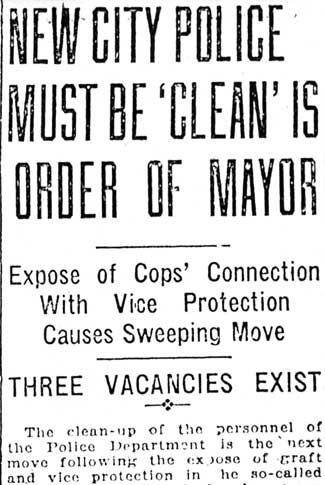
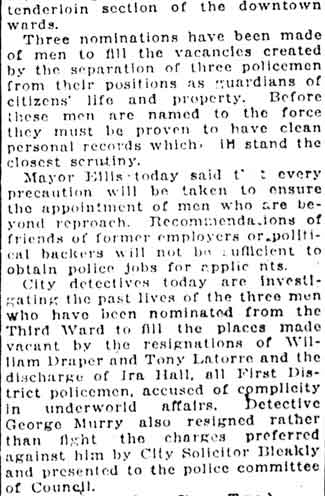
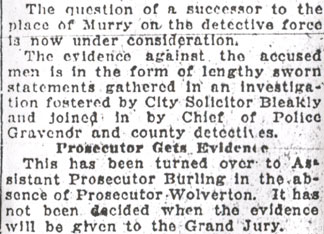
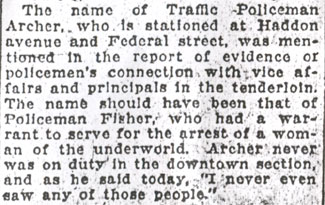
Expose of Cops’ Connection With Vice Protection Causes Sweeping Move
THREE VACANCIES EXIST
The clean-up of the personnel of the Police Department is the next move following the expose of graft and vice protection in the so-called tenderloin section of the downtown wards.
Three nominations have been made of men to fill the vacancies created by the separation of three policemen from their positions as guardians of citizens’ life and property. Before these men are named to the force they must be proven to have clean personal records which will stand the closest scrutiny.
Mayor Ellis today said that every precaution will be taken to ensure the appointment of men who are beyond reproach. Recommendations of friends of former employers or political backers will not be sufficient to obtain police jobs for applicants.
City detectives today are investigating the past lives of the three men who have been nominated from the Third Ward to fill the places made vacant by the resignations of William Draper and Tony Latorre and the discharge of Ira Hall, all First District policemen, accused of complicity in underworld affairs. Detective George Murry also resigned rather than fight the charges preferred against him by City Solicitor Bleakly and presented to the police committee of Council.
The question of a successor to the place of Murry on the detective force is now under consideration.
The evidence against the accused men is in the form of lengthy sworn statements gathered in an investigation fostered by City Solicitor Bleakly and joined in by Chief of Police Gravenor and county detectives.
Prosecutor Gets Evidence
This has been turned over to Assistant Prosecutor Burling in the absence of Prosecutor Wolverton. It has not been decided when the evidence will be given to the Grand Jury.
The name of Traffic Policeman Archer, who is stationed at Haddon avenue and Federal street, was mentioned in the report of evidence or policemen’s connection with vice affairs and principals in the tenderloin. The name should have been that of Policeman Fisher, who had a warrant to serve for the arrest of a woman of the underworld. Archer never was on duty in the downtown section, and as he said today, “I never even saw any of those people.”
Residents Asked to Give Evidence of Police Graft
Camden Courier —
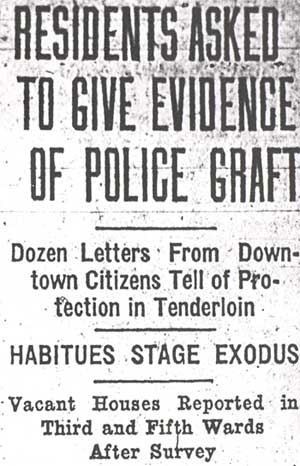
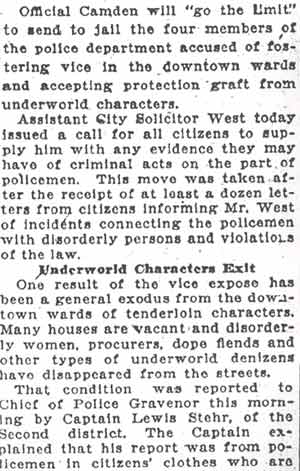
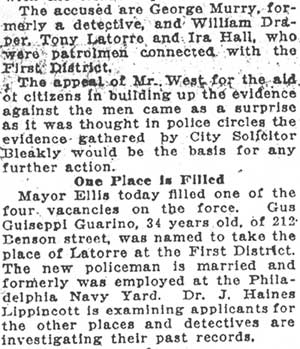
Dozen Letters From Downtown Citizens Tell of Protection in Tenderloin
HABITUES STAGE EXODUS
Vacant Houses Reported in Third and Fifth Wards After Survey
Official Camden will “go the limit” to send to jail the four members of the police department accused of fostering vice in the downtown wards and accepting protection graft from underworld characters.
Assistant City Solicitor West today issued a call for all citizens to supply him with any evidence they may have of criminal acts on the part of policemen. This move was taken after the receipt of at least a dozen letters from citizens informing Mr. West of incidents connecting the policemen with disorderly persons and violations of the law.
Underworld Characters Exit
One result of the vice expose has been a general exodus from the downtown wards of tenderloin characters. Many houses are vacant and disorderly women, procurers, dope fiends and other types of underworld denizens have disappeared from the streets. That condition was reported to Chief of Police Gravenor this morning by Captain Lewis Stehr, of the Second district. The Captain explained that his report was from policemen in citizens’ clothes who are “covering” the district twenty-four hours a day. Eight of these men have been detailed to the clean-up job and their report is that conditions in the district have improved to the extent that vacant houses are becoming common. Most of the disorderly charactors [sic] have left Camden and apparently are gone for good, the police report.
Await Action by Prosecutor
Prosecution of the four men affected by the expose now is waiting action by the office of Prosecutor Wolverton. The evidence presented to the Police Committee of City Council has been turned over to the Prosecutor and action will be taken before the Grand Jury. It has not been announced what steps are being taken to insure the presence in the city of the four men when they are called in connection with the criminal prosecutions.
The accused are George Murry, formerly a detective, and William Draper, Tony Latorre and Ira Hall, who were patrolmen connected with the First District.
The appeal of Mr. West for the aid of citizens in building up the evidence against the men came as a surprise as it was thought in police circles the evidence gathered by City Solicitor Bleakly would be the basis for any further action.
One Place Is Filled
Mayor Ellis today filled one of the four vacancies on the force. Gus Guiseppi Guarino, 34 years old, of 212 Benson street, was named to take the place of Latorre at the First District. The new policeman is married and formerly was employed at the Philadelphia Navy Yard. Dr. J. Haines Lippincott is examining applicants for the other places and detectives are investigating their past records.
Grand Jury Gets Graft Evidence in Murry Probe
Camden Courier —
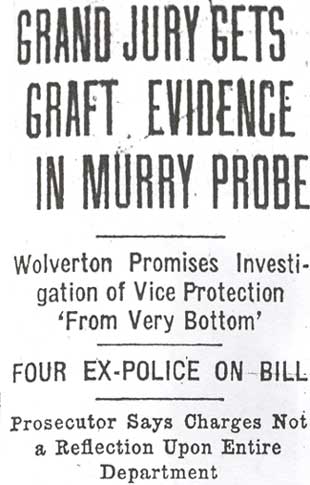
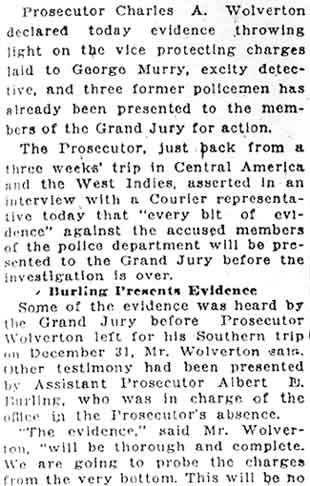
Wolverton Promises Investigation of Vice Protection ‘From Very Bottom’
FOUR EX-POLICE ON BILL
Prosecutor Says Charges Not a Reflection Upon Entire Department
Prosecutor Charles A. Wolverton declared today evidence throwing light on the vice protecting charges laid to George Murry, ex-city detective, and three former policemen has already been presented to the members of the Grand Jury for action.
The Prosecutor, just back from a three weeks’ trip in Central America and the West Indies, asserted in an interview with a Courier representative today that “every bit of evidence” against the accused members of the police department will be presented to the Grand Jury before the investigation is over.
Burling Presents Evidence
Some of the evidence was heard by the Grand Jury before Prosecutor Wolverton left for his Southern trip on December 31. Mr. Wolverton said other testimony had been presented by Assistant Prosecutor Albert B. Burling, who was in charge of the office in the Prosecutor’s absence.
“The evidence,” said Mr. Wolverton, “will be thorough and complete. We are going to probe the charges from the very bottom. This will be no flash in the pan investigation. It will proceed quietly, without hurry, but our investigation will be complete.
“Commenting on the evidence that was given at the police hearing, which resulted in the suspension of the detective and the three policemen, Prosecutor Wolverton pointed out that considerable of that evidence could not be presented before the Grand Jury.
Hampered by Statute of Limitations
“The statute of limitations,” said the Prosecutor, “prohibits us from prosecuting a man for a crime more than two years old. The police committee was not hampered by that restriction and was able to consider evidence that dated back in 1918 and even earlier.
“Our job will be to present evidence against the men that will throw a light on their activities within the last two years to conform with the provisions of the statute.”
Mr. Wolverton praised the Camden police department for its efficient work and pointed out the charges in no wise reflected on the whole department.
Puts Great Faith in Jury
“Our police department has the reputation of being loyal, efficient and honest,” he said, “and the charges against certain individuals in the department is in no way a reflection upon the honest, conscientious members of the force.
“We should not judge the police department by the action of individuals.
“The members of our Grand Jury are all good, conscientious men and women and I am confident they will sift the matter to the bottom and do what is right,” declared Mr. Wolverton. “From my contact with them, I have been highly impressed with their ability and desire to act in the interests of the county. The investigation will be devoid of sensation or glamor, but it will be thorough and meet with popular approval.”
Former Detective Murry Drops Dead In Street
Camden Courier —
Former Detective Murry Drops Dead In Street
Camden Courier, January 30, 1922
Death of Murry May End Probe
Camden Courier —
Grand Jury Meets This Afternoon—Third Ward Factions Declare a Truce
The death Sunday of George Murry, former city detective, while the Camden county Grand Jury was investigating charges that he had protected vice in the Third and Fifth wards, will probably end the proceedings contemplated against three other policemen, charged with like offenses.
The Grand Jury met this afternoon and much depends upon the attitude that body will take. Prosecutor Charles A. Wolverton, it is understood, will leave it to the discretion of the jurors to determine whether the investigation should go on or be dropped, at least for the present.
Warring Factions Make Peace
Reports emanating from the Third ward today were to the effect that warring Republican factions in the bailiwick had made peace since Murry’s death. A political reconciliation has been effected between Joseph Totarella, who opposed the Republican organization last year, and Councilman James Corea.
As a result of the truce, John S. Roberts, present committeeman from the Third ward, and assistant city clerk, will look after the upper end of the ward, while Corea and Totarella will form a coalition to “take care of” the lower section, over which Murry held sway.
Murry’s death was unexpected. He was of massive build and enjoyed perfect health. Coroner Holl and three physicians agreed that death was due to apoplexy superinduced by acute indigestion.
Changes Ordered in Camden Police
Philadelphia Inquirer —
Council Body Directs Solicitor Bleakly to Plan Re-organization of Department
Following an extended conference, the police committee of Camden City Council yesterday directed Solicitor Bleakly to prepare an ordinance for a partial reorganization of the Police Department. The new ordinance will provide for one captain and three lieutenants to direct the work of the three districts. There are six captains in the department now. Two of these John Golden, of the First district, and William E. Albert, of the Third district, will retire on December 15. The titles of three of the four remaining captains will be changed to lieutenants, with one in charge of each of the three districts. This will take two captains from headquarters and leave the work there in charge of sergeants.
Seven members of the department who have reached the age limit of 65 years will be retired on pension. They are: John Painted [sic], Charles Fitzsimons, Thomas Brothers, Frank Matlack, Edwin Thomas, Richard Golden and William Lyons. No new appointments will be made as detectives, inasmuch as Milton Stanley and Howard Smith, now in the country [sic] service, will return to the city detective department when Prosecutor Wolverton goes out of office in March. These two officers were loaned to the county five years ago.
It was intimated yesterday that Captain James E. Tatem, now a headquarters man attached to the Mayor’s office, will be the sole captain under the reorganization plan. He will be transferred to Chief Hyde’s office and will have supervision of the three districts. It was also hinted that there will be other vacancies in the department through resignations to be asked for by the committee.
Camden Courier – November 28, 1922
Through the efforts of Prosecutor Wolverton, a position has been obtained for William Ware, the “wild man,” who was taken in custody in the woods near Stratford, N. J., where his family was living in a cave. The man is anxious to get out to work for his family, but Mrs. Louise F. Walsh, secretary of the S. P. C. C., who interested herself in behalf of the children, said the problem is to get a home for the family. Three children are now being cared for at the Society’s Sheltering Arms.
Conn L. Mack Honored By Friends at Dinner
Camden Daily Courier —
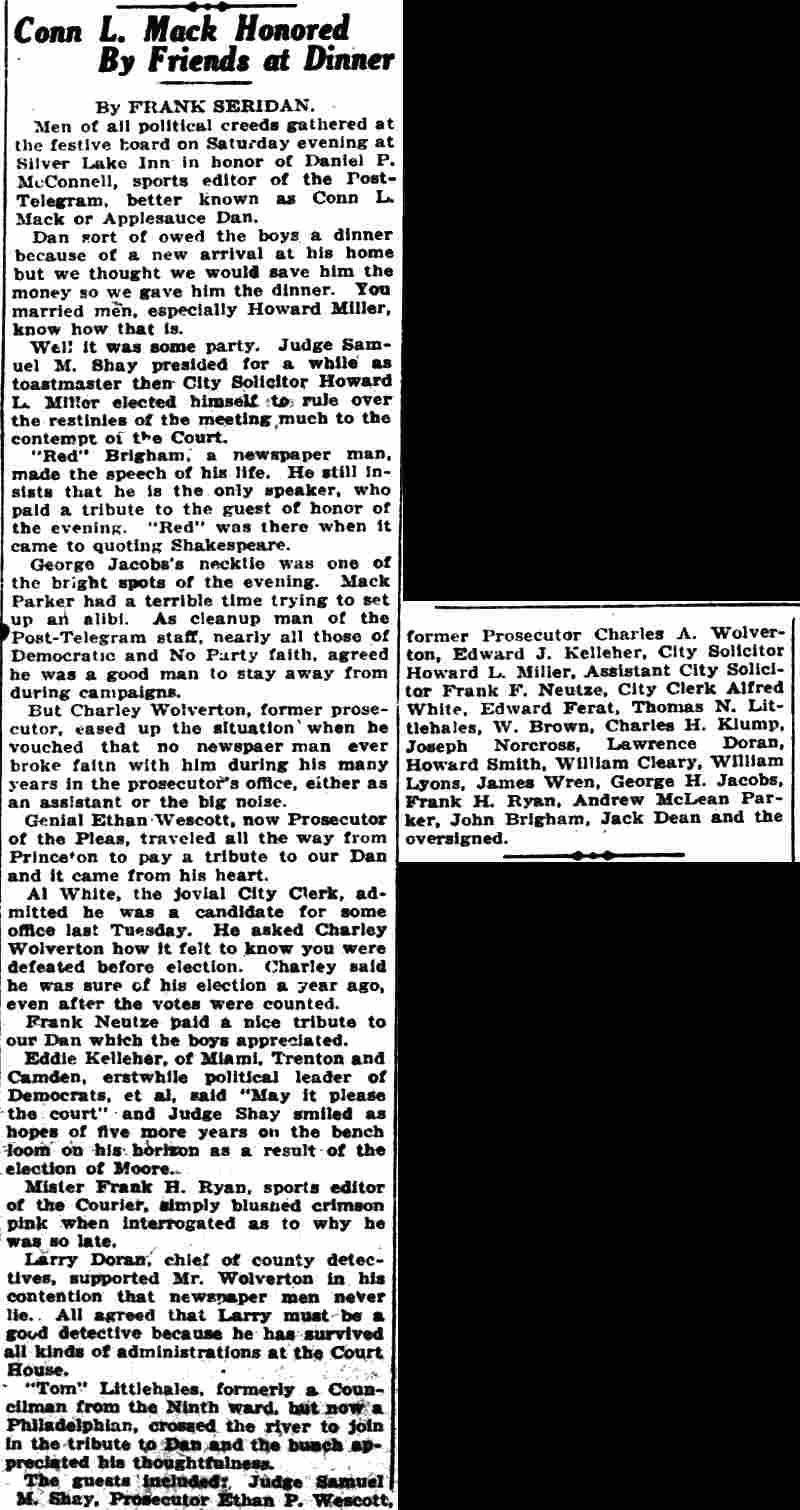
By FRANK SERIDAN [sic].
Men of all political creeds gathered at the festive board on Saturday evening at Silver Lake Inn in honor of Daniel P. McConnell, sports editor of the Post-Telegram, better known as Conn L. Mack or Applesauce Dan.
Dan sort of owed the boys a dinner because of a new arrival at his home but we thought we would save him the money so we gave him the dinner. You married men, especially Howard Miller, know how that is.
Well it was some party. Judge Samuel M. Shay presided for a while as toastmaster then City Solicitor Howard L. Miller elected himself to rule over the restinies [sic] of the meeting much to the contempt of the Court.
“Red” Brigham, a newspaper man, made the speech of his life. He still insists that he is the only speaker, who paid a tribute to the guest of honor of the evening. “Red” was there when it came to quoting Shakespeare.
George Jacobs’s necktie was one of the bright spots of the evening. Mack Parker had a terrible time trying to set up an alibi. As cleanup man of the Post-Telegram staff, nearly all those of Democratic and No Party faith, agreed he was a good man to stay away from during campaigns.
But Charley Wolverton, former prosecutor, eased up the situation when he vouched that no newspaer [sic] man ever broke faith with him during his many years in the prosecutor’s office, either as an assistant or the big noise.
Genial Ethan Wescott, now Prosecutor of the Pleas, traveled all the way from Princeton to pay a tribute to our Dan and it came from his heart.
Al White, the jovial City Clerk, admitted he was a candidate for some office last Tuesday. He asked Charley Wolverton how it felt to know you were defeated before election. Charley said he was sure of his election a year ago, even after the votes were counted.
Frank Neutze paid a nice tribute to our Dan which the boys appreciated.
Eddie Kelleher, of Miami, Trenton and Camden, erstwhile political leader of Democrats, et al, said “May it please the court” and Judge Shay smiled as hopes of five more years on the bench loom on his horizon as a result of the election of Moore.
Mister Frank H. Ryan, sports editor of the Courier, simply blushed crimson pink when interrogated as to why he was so late.
Larry Doran, chief of county detectives, supported Mr. Wolverton in his contention that newspaper men never lie. All agreed that Larry must be a good detective because he has survived all kinds of administrations at the Court House.
“Tom” Littlehales, formerly a Councilman from the Ninth ward, but now a Philadelphian, crossed the river to join in the tribute to Dan and the bunch appreciated his thoughtfulness.
The guests included: Judge Samuel M. Shay, Prosecutor Ethan P. Wescott, former Prosecutor Charles A. Wolverton, Edward J. Kelleher, City Solicitor Howard L. Miller, Assistant City Solicitor Frank F. Neutze, City Clerk Alfred White, Edward Ferat, Thomas N. Littlehales, W. Brown, Charles H. Klump, Joseph Norcross, Lawrence Doran, Howard Smith, William Cleary, William Lyons, James Wren, George H. Jacobs, Frank H. Ryan, Andrew McLean Parker, John Brigham, Jack Dean and the oversigned.
Civil War Vet Seeks Proof
Camden Courier-Post —
Civil War Vet Seeks Proof
Camden Courier-Post, January 7, 1928
23 Young Americans Anxious to Become Generals or Admirals
Camden Courier-Post —
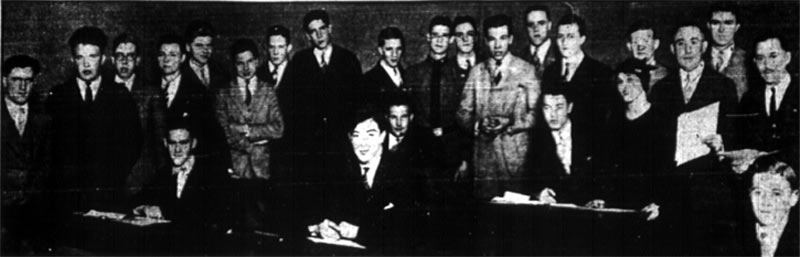
23 Young Americans Anxious to Become Generals or Admirals
Camden Courier-Post, January 7, 1928 – John R. Spiers
Officials Invited for Military Ball
Camden Courier-Post —
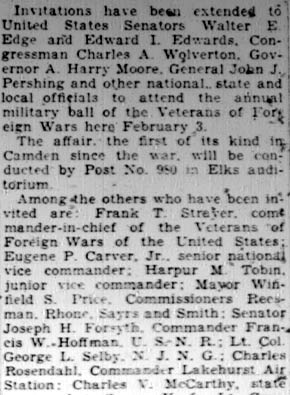
Governor, Senators, Pershing May Attend Affair of Vets Here Feb. 3
Invitations have been extended to United States Senators Walter E. Edge and Edward I. Edwards, Congressman Charles A. Wolverton, Governor A. Harry Moore, General John J. Pershing and other national, state and local officials to attend the annual military ball of the Veterans of Foreign Wars here February 3.
The affair, the first of its kind in Camden since the war, will be conducted by Post No. 980 in Elks auditorium.
Among the others who have been invited are: Frank T. Strayer, commander-in-chief of the Veterans of Foreign Wars of the United States; Eugene P. Carver, Jr., senior national vice commander; Harpur M. Tobin, junior vice commander; Mayor Winfield S. Price, Commissioners Reesman, Rhone, Sayrs and Smith; Senator Joseph H. Forsyth, Commander Francis W. Hoffman, U. S. N. R.; Lt. Col. George L. Selby, N. J. N. G.; Charles Rosendahl, Commander Lakehurst Air Station; Charles V. McCarthy, state commander; George Keefe, Lt. Commander U. S. N. R.; Arthur S. Grabowsky, senior vice commander; Charles W. Gilmour, chief of staff, state department, V. F. W., and Mrs. Florence E. Stark, national president; Mrs. Grace Davis, national secretary; Mrs. Margaret Soffel, state president of the ladies’ auxiliaries.
Gold star mothers of this vicinity have been invited to attend as guests of the post as well as post commanders of all the veteran organizations in Camden county.
The bugle corps of North Penn Post No. 676, of Glenside, Pa., consisting of 40 buglers, will be one of the attractions. The Phillips Bohemian orchestra will render the dance music during the evening.
John A. Pennington, post commander, heads the general committee. The other officers are James W. Connor, vice chairman; John Rouh, secretary, and Charles P. Bozian, treasurer.
Camden Courier-Post – February 10, 1928
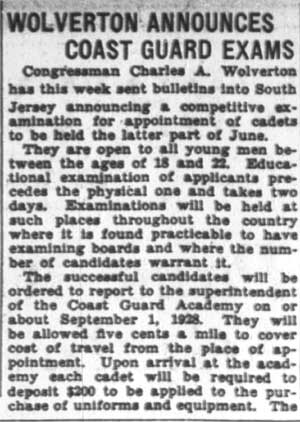
Wolverton Announces Coast Guard Exams
Congressman Charles A. Wolverton has this week sent bulletins into South Jersey announcing a competitive examination for appointment of cadets to be held the latter part of June. They are open to all young men between the ages of 15 and 22. Upon graduation, after three years at the academy, a cadet is eligible to be commissioned an ensign.
30 Cops Shifted Today in Opening of New District
Camden Courier-Post —

Shake-Up in Camden Force is Most Drastic in History
SMITH AT CITY HALL
Drastic shifts in the Camden police department, affecting more than 30 members of the force became effective at 8 a.m. today.
The shake-up, announced yesterday by Commissioner David S. Rhone, director of public safety, is the result of creation of a fourth police district.
The outstanding changes are the promotion of Sergeant of Detectives George Ward to acting lieutenant in the First district, supplanting Sergeant Samuel Nayler, who is sent to headquarters, and the return to the city detective bureau of Acting County Detective Howard Smith.
Smith was detailed to the second district today and was assigned to a robbery investigation in the thirteenth ward.
District Captaincies Abolished
With the shifts, the rank of district captain is abolished. Instead, lieutenants will be in charge of the districts. Captains will be in charge only of the traffic and detective bureaus and headquarters, Commissioner Rhone said.
The removal of Sergeant Naylor from the First District was not unexpected, since he had been “on the carpet” last October as a result of a speakeasy shooting in his district. Naylor, though holding the rank of sergeant, was acting captain of the district.
He was threatened with dismissal by Chief Stehr and Commissioner Rhone if the vice conditions in the First District were not cleaned up. The situation came to a climax with the wounding of Charles Arini and Louis Dei Duca in a speakeasy at Third and Mickle streets in October. It was reported Naylor was to be removed from the district several times since.
Ward Again Promoted
Ward was promoted to sergeant of detectives two months ago. Under the transfer, he is promoted again, remaining as acting lieutenant for a year, until he takes an examination for a lieutenancy.
Other police officers now acting-lieutenants will become lieutenants after examination.
Naylor, who was in charge of the First district for several years, will serve as desk sergeant under Capt. A. Lincoln James.
The return of Smith to the city detective bureau was requested by Prosecutor Clifford A. Baldwin, it is understood. Smith has been a county detective for more than eleven years. He first was transferred to the prosecutor’s office at the request of Prosecutor Charles A. Wolverton. Although a Republican, he was retained there under Prosecutor Ethan P. Wescott. Although some surprise was occasioned by the announcement of Smith’s return to the city force, inasmuch as the new prosecutor is a Republican, it was said that Baldwin wished to begin his term with an entire new force.
Worked For City Also
Although Smith acted for the county and was paid by the county, he received a salary of $1 a year to retain him in the city so that he could be recalled at any time.
Through the shift, Sergeant Charles Laib, serving under Traffic Inspector Charles T. Humes, is elevated to acting captain of the traffic department. In the future all motorcycle men with the exception of George Clayton will report direct to Humes and Laib instead of to headquarters.
Ralph Bakley, who has been acting sergeant of the First District, has been named acting lieutenant of the Second District, and Thomas Cunningham, who was acting captain of the Second District, becomes acting lieutenant of the new Fourth District. William Horner, who has been acting captain of the Third District, is elevated to the rank of acting lieutenant and remains in charge of that district.
Lindenwold G.O.P. Club Names Entire Ticket
Camden Courier-Post —
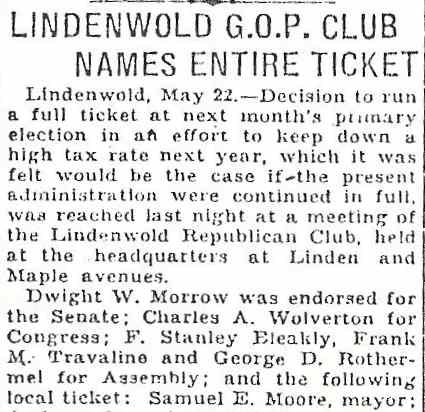
Lindenwold, May 22.—Decision to run a full ticket at next month’s primary election in an effort to keep down a high tax rate next year, which it was felt would be the case if the present administration were continued in full, was reached last night at a meeting of the Lindenwold Republican Club, held at the headquarters at Linden and Maple avenues.
Dwight W. Morrow was endorsed for the Senate; Charles A. Wolverton for Congress; F. Stanley Bleakly, Frank M. Travaline and George D. Rothermel for Assembly; and the following local ticket: Samuel E. Moore, mayor; [cut off at the crop edge]
400 Friends Pay Homage To ‘Good Gray Poet’
Camden Courier-Post —
Men and Women From Many Sections Visit Walt Whitman’s Tomb and Old Mickle Street Home on His 114th Anniversary
“It’s just a little street where old friends meet”
That’s Mickle Street where Walt Whitman, the “Good Gray Poet,” once lived, and old friends came back here from near and far yesterday to mingle under the portals of the house in which he wrote his famous works, on the 114th anniversary of his birth.
Among them was Mrs. Augusta K. Dole, 71, of Metuchen, whose husband has been a sports writer on New York newspapers for 45 years.
“They call it a dingy street and some are ashamed to return and say they lived there,” Mrs. Dole said. And with a gesture of the hand she pointed out the homes of some of neighbors, who became famous.
Among them was Button; famous artist [architect]. Another was the grandmother of J. B. Van Sciver.
“I lived at 319 Mickle Street when I was a young lady,” she said. “I was one year old when we moved into the house right across the street from Whitman. I remember when he lived on Stevens Street before he moved to Mickle Street.
Knew Whitman Well
“We lived at the Mickle Street address about 15 or 16 or 20 years; I knew Whitman well. He always stopped and exchanged greetings with me. I frequently saw him on the ferryboats crossing the rivers.
“I want to take issue right here with those who have questioned his chastity. He was more like Christ than anyone else. I saw him admiring me as a young woman one day on a ferryboat.”
“Years later I read a description of myself in one of his works. I did not begin to read his work until 30 years ago. He wrote of the true things in life. He wrote of life as it is and as we see it. I am glad to come here today at the invitation of the committee,”
Mrs. Dole sat in the last chair in which the poet rested before his last illness. She was introduced to Dr. Alexander MacAlister, who was his personal physician in his last illness and who is a member of the Walt Whitman foundation.
Then she posed with an etching by Lewis Daniel, New York artist, at the Walt Whitman art gallery, 641 Market Street. It is one of 14 the young artist drew on “The Song of the Open Road.” Two lines taken from the book are sketched under the etching as follows:
“The earth is crude and incomprehensible at first— Nature is rude and incomprehensible at first.”
400 Visit Home
More than 400 guests visited the home of the poet during the day to be welcomed by members of the foundation. Mrs. Charles A. Wolverton, wife of Congressman Wolverton, was chairman of the reception committee.
Many of the guests visited the tomb of the poet in Harleigh Cemetery where the door is ajar at his request “that his spirit may come and go as I choose.’” But no flowers were placed there as he requested none.
Born on May 31, 1819, near Huntingdon, Long Island, he had a varied career as a writer, war correspondent and poet. During the Civil War he ministered the wounded of both the North and South at Washington. He spent the last 19 years of his life in Camden, where he died in 1892.
Under the bed in his second story front bed room today is a huge metal bathtub, which he designed for use in his invalid days. His library, horsehair furniture, his favorite rocking chair and a cane with which he knocked on the floor to call his housekeeper.
Some of his writings, manuscripts and other works are the property of Miss Ann Harned and Madge Barton Feurer. They are now at the New Jerseyanna Exhibition at the State House at Trenton.
New Painting Viewed
A new painting of Walt Whitman has been completed by Byron T. Connor, of 4320 Manor Avenue, Merchantville, and is now on display at the Hotel Walt Whitman. The painting was completed in three weeks, so as to be ready for the birthday ceremonies.
Later it will be moved from the hotel and placed either in the Whitman home or hung in the lobby of the Walt Whitman Theatre.
Miss Harned, daughter of the late Thomas B. Harned, one of Whitman’s literary executors; Joseph Praissman and Mrs. Martha Davis curator of the Whitman home, were members of the anniversary committee headed by Mrs. Wolverton.
With few exceptions, members of the Walt Whitman Foundation attended yesterday’s program, including Dr. Macalister, chairman; Dr. Cornelius Weygandt, vice chairman; Mrs. Juliet Lit Stern, Joseph M. Conover, Mrs. Helen Taft Manning, Mrs. Allen Drew Cook, Mrs. Nicholas Douty, Dr. Herbert Spencer Harned, J. Frederick Harned, Roy Helton, William T. Innes, Eldridge R. Johnson, William H. Ketler, Dr. Rufus M. Jones, former Mayor Victor King, Oscar Wolf, John Frederick Lewis, Jr., Dr. Bliss Perry, Harrison S. Morris, Agnes Repplier, former Mayor Winfield S. Price, Vernon Whitman Rich, Dr. J. Duncan Spaeth, Dr. Felix E. Schelling, Dr. Robert E. Spiller, Mrs. David Abeel Storer, Frederick Von Nieda and Ralph W. Wescott.
Among the visitors was former Assemblyman William H. Iszard, who is secretary of the committee, which acquired the home as a national shrine. Iszard sponsored legislation in the Assembly for its upkeep.
Reserve Officers Wear New Uniforms
Camden Courier-Post —
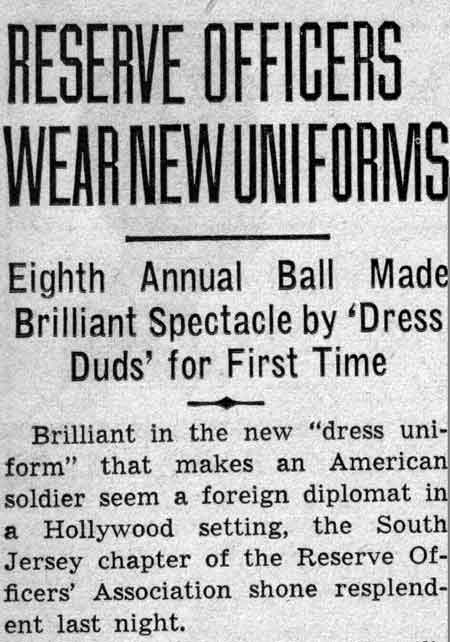
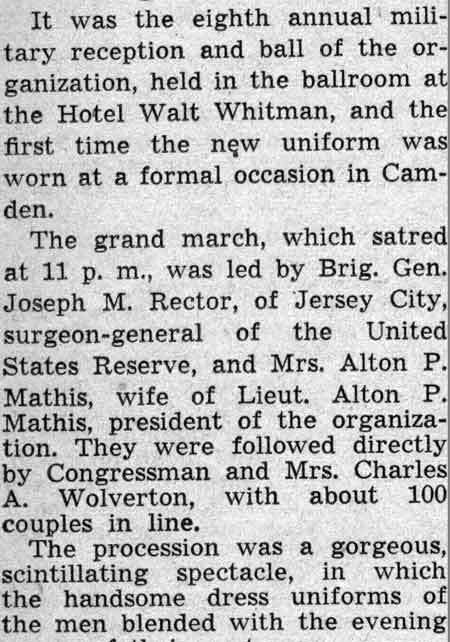
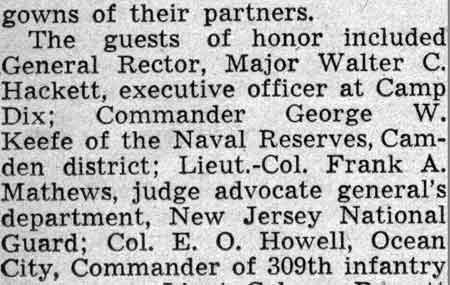
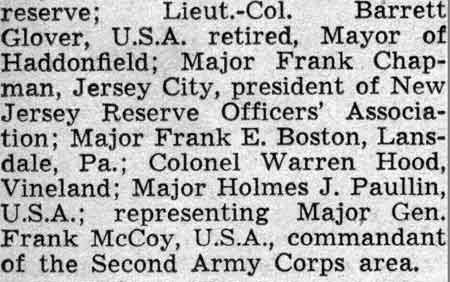
Eighth Annual Ball Made Brilliant Spectacle by ‘Dress Duds’ for First Time
Brilliant in the new “dress uniform” that makes an American soldier seem a foreign diplomat in a Hollywood setting, the South Jersey chapter of the Reserve Officers’ Association shone resplendent last night.
It was the eighth annual military reception and ball of the organization, held in the ballroom at the Hotel Walt Whitman, and the first time the new uniform was worn at a formal occasion in Camden.
The grand march, which satred [sic] at 11 p. m., was led by Brig. Gen. Joseph M. Rector, of Jersey City, surgeon-general of the United States Reserve, and Mrs. Alton P. Mathis, wife of Lieut. Alton P. Mathis, president of the organization. They were followed directly by Congressman and Mrs. Charles A. Wolverton, with about 100 couples in line.
The procession was a gorgeous, scintillating spectacle, in which the handsome dress uniforms of the men blended with the evening gowns of their partners.
The guests of honor included General Rector, Major Walter C. Hackett, executive officer at Camp Dix; Commander George W. Keefe of the Naval Reserves, Camden district; Lieut.-Col. Frank A. Mathews, judge advocate general’s department, New Jersey National Guard; Col. E. O. Howell, Ocean City, Commander of 309th infantry reserve; Lieut.-Col. Barrett Glover, U.S.A. retired, Mayor of Haddonfield; Major Frank Chapman, Jersey City, president of New Jersey Reserve Officers’ Association; Major Frank E. Boston, Lansdale, Pa.; Colonel Warren Hood, Vineland; Major Holmes J. Paullin, U.S.A.; representing Major Gen. Frank McCoy, U.S.A., commandant of the Second Army Corps area.
Increased Pension Won for Vet by Wolverton
Camden Courier-Post —
Courier Washington Bureau
Washington, D. C., April 3 — Michael Walsh, 65 years old, 846 Grant street, Camden, has been granted an increase in his monthly pension through the efforts of Congressman Charles A. Wolverton, of Camden.
Walsh served in the regular military establishment from February 5, 1884 until March 31, 1887 when he was discharged because of heart trouble. He had enlisted for a five-year period. During his period of service he was a member of Troop B, Eighth United States Cavalry.
For a number of years Walsh has been receiving a small monthly pension because of his disability. During the last few years his disability has increased and Congressman Wolverton submitted sworn medical evidence to the Bureau of Pensions in requesting an advance in Walsh’s pension rate. The claim was allowed by the Bureau as of October 1927.
Keown Named Head of County G.O.P. as Wallworth Resigns
Camden Courier-Post —

Mrs. Verga Re-elected Vice Chairman at Reorganization Meeting of Committee
OTHER OFFICERS CHOSEN
When the Camden County Republican Executive Committee reorganized last night Walter S. Keown was elected chairman without opposition.
He succeeds former State Senator Joseph F. Wallworth, who was Republican county chairman six years, and a member 12 years. At a dinner preceding the executive session a silver set and a vase were presented to Wallworth by the committee. The retiring members of the committee received bronze elephants as emblems of the party.
At the executive session Mrs. Elizabeth Grotty Verga was re-elected vice chairman; Harry C. Sharp, treasurer; William D. Sayrs, assistant treasurer; Howard B. Dyer, secretary, and Mrs. Laura Silbers and Mrs. Lottie Stinson, assistant secretaries. Harold W. Bennett, Edward R. Diebert, Bernard Bertman, L. Scott Chercesky, Carl Kisselman and Frank Voigt were chosen solicitors.
Wallworth Reviews Work
Upon retiring as chairman Senator Wallworth said:
“During the six years I acted as your chairman considerable political history has been made in our county. The Republican party was on the rocks and loyalty seemed to have drifted away when Frank Patterson, Al Matthews, Penn Corson and Senator Baird begged me to take the chairmanship. In doing so I quickly discovered I had undertaken one of the hardest up hill battles of my life.”
When Keown took over the gavel he pointed out to the committee members they were political leaders of their districts. He said it was their duty to find out the cause of unrest.
“In some of your districts the trouble is your tax rates are too high,” said the chairman. “High taxe [sic] rates are an evil and it is your duty to find the cause and remedy the situation. When there is a spirit of satisfaction in your district there is satisfaction throughout the county.”
Wolverton Favors Plan
Congressman Charles A. Wolverton complimented the new chairman on his advice. Sharp and Sayrs, who have been identified with the committee more than 20 years, were also speakers.
Keown then turned the gavel over to Mrs. Verga, who thanked the committee for her re-election. She introduced Mrs. Silbers and Mrs. Stinson, who urged loyalty and work on the part of the women members of the committee.
Keown was nominated by Daniel Silbers, Pennsauken township. Colonel George L. Selby nominated Sharp and Dyer. All of the officers received a unanimous vote.
Ten new members took seats from the five boroughs recently created out of Clementon township. Among them was Clinton L. Bardo, president of New York Shipbuilding Corp., who was elected from the new borough of Pine Valley last Tuesday. Twelve members of last year’s committee retired either as a result of the primary election or not being candidates.
Quintet in Crash Near Hightstown Dodge Serious Hurt
Camden Courier-Post —
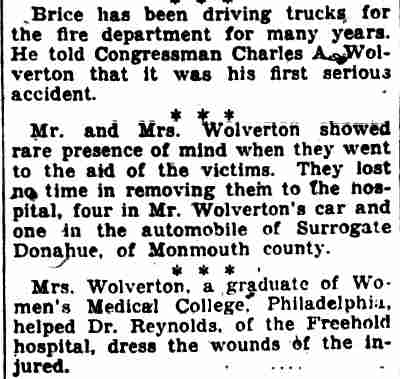
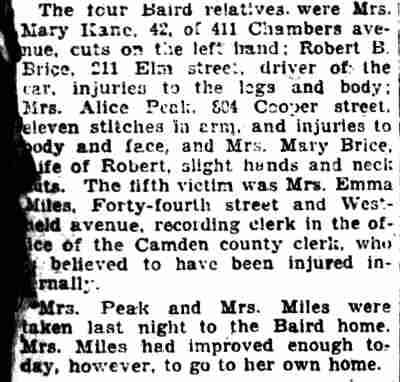
A caravan of 25 automobiles followed the buses to Sea Girt. Five Camden motorcycle policemen cleared the way to the county line in Pennsauken township, then returned.
Anxiety over the accident to the car of Robert Brice, which overturned two miles from Freehold on the Hightstown-Freehold road, was relieved when word was received from the Freehold hospital that none of the five persons injured, four of them relatives of David Baird, Jr., was critically hurt.
Brice has been driving trucks for the fire department for many years. He told Congressman Charles A. Wolverton that it was his first serious accident.
Mr. and Mrs. Wolverton showed rare presence of mind when they went to the aid of the victims. They lost no time in removing them to the hospital, four in Mr. Wolverton’s car and one in the automobile of Surrogate Donahue, of Monmouth county.
Mrs. Wolverton, a graduate of Women’s Medical College, Philadelphia, helped Dr. Reynolds, of the Freehold hospital, dress the wounds of the injured.
The four Baird relatives, were Mrs. Mary Kane, 42, of 411 Chambers avenue, cuts on the left hand; Robert B. Brice, 211 Elm street, driver of the car, injuries to the legs and body; Mrs. Alice Peak, 804 Cooper street, eleven stitches in arm, and injuries to body and face, and Mrs. Mary Brice, wife of Robert, slight hands and neck cuts. The fifth victim was Mrs. Emma Miles, Forty-fourth street and Westfield avenue, recording clerk in the office of the Camden county clerk, who is believed to have been injured internally.
Mrs. Peak and Mrs. Miles were taken last night to the Baird home. Mrs. Miles had improved enough today, however, to go to her own home.
1930 Portrait
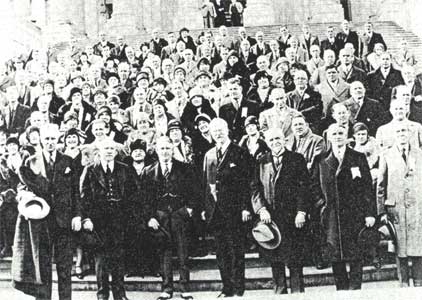

Charles A. Wolverton – David Baird Jr., circa 1930
Political Paragraphs
Camden Courier-Post —
A. Harry Moore, Democratic candidate for governor, is scheduled to speak at the meeting of Gloucester Democrats in the city this evening.
Gloucester Republicans tonight will hold a rally at the headquarters of the city committee, 104 North King Street.
Baird to Address Hebrew League
Camden Courier-Post —
David Baird, Jr., Republican nominee for governor, will make his final appearance in the current election campaign Monday night when he addresses the Camden Hebrew League at the Y.M.H.A. on Tuesday night.
Baird and Larson at Big Rally Today
Camden Courier-Post —
BAIRD AND LARSON AT BIG RALLY TODAY 5,000 Expected to Hear Candidate at Convention Hall in Afternoon
David Baird and Governor Morgan Larson will be the principal speakers this afternoon at a rally of more than 5000 Republicans at Convention Hall.
Wolverton Hits At Dry Charges
Camden Courier-Post —
WOLVERTON HITS AT DRY CHARGES Solon Answers Attacks for Supporting Beck Referendum
Congressman Charles A. Wolverton of Camden made it plain yesterday that he will not permit dry leaders to attack him for supporting the Beck referendum.
Camden Vet Granted Maximum U.S. Pension
Camden Courier-Post —
CAMDEN VET GRANTED MAXIMUM U.S. PENSION
Washington March 27.— Alfred Beardsley, 2992 Constitution road, Camden, N.J., who served in the Spanish-American War and was held as a prisoner of war by the Filipinos, has been awarded the maximum pension of $100 a month by the veterans bureau.
Haines and Reinert Head G.O.P.; Madden To Lead Democrats
Camden Courier-Post —
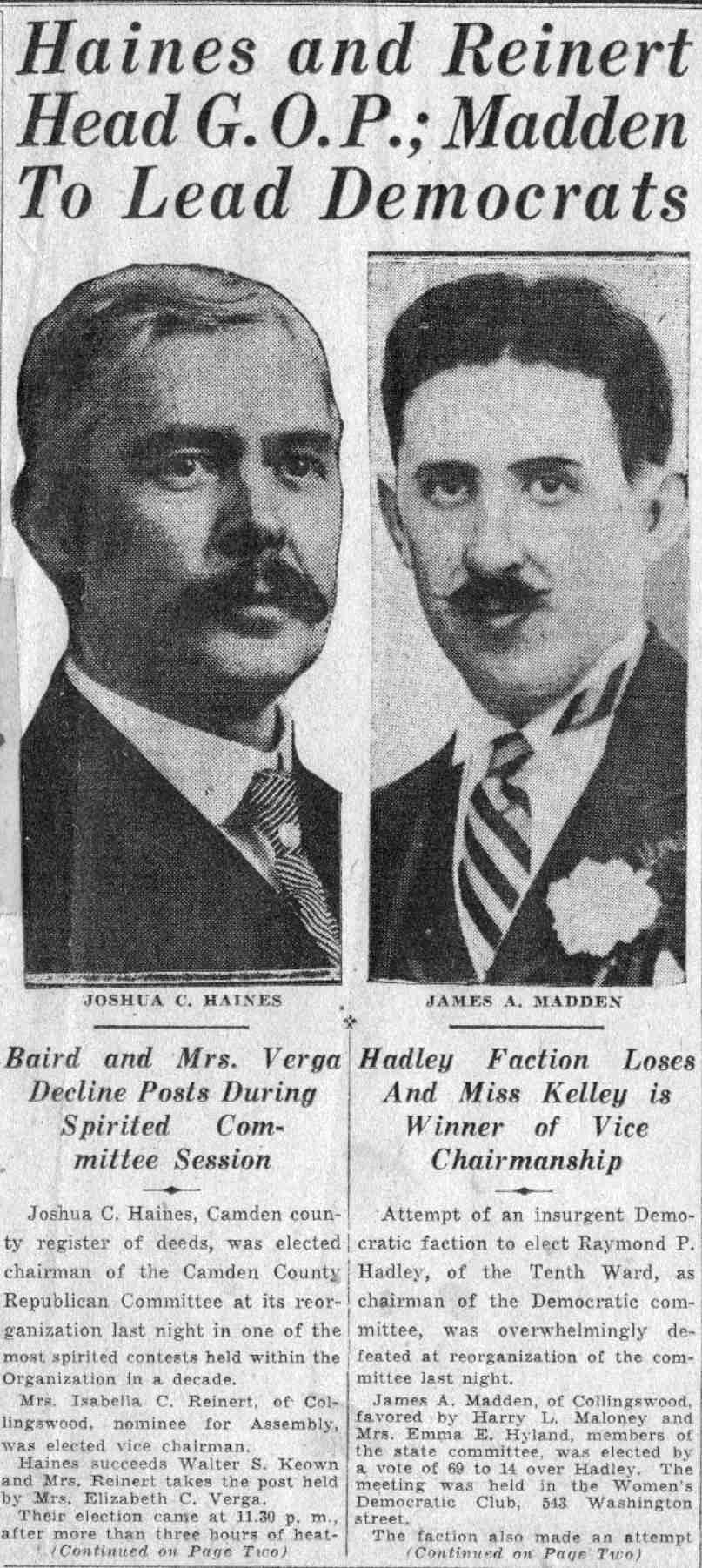
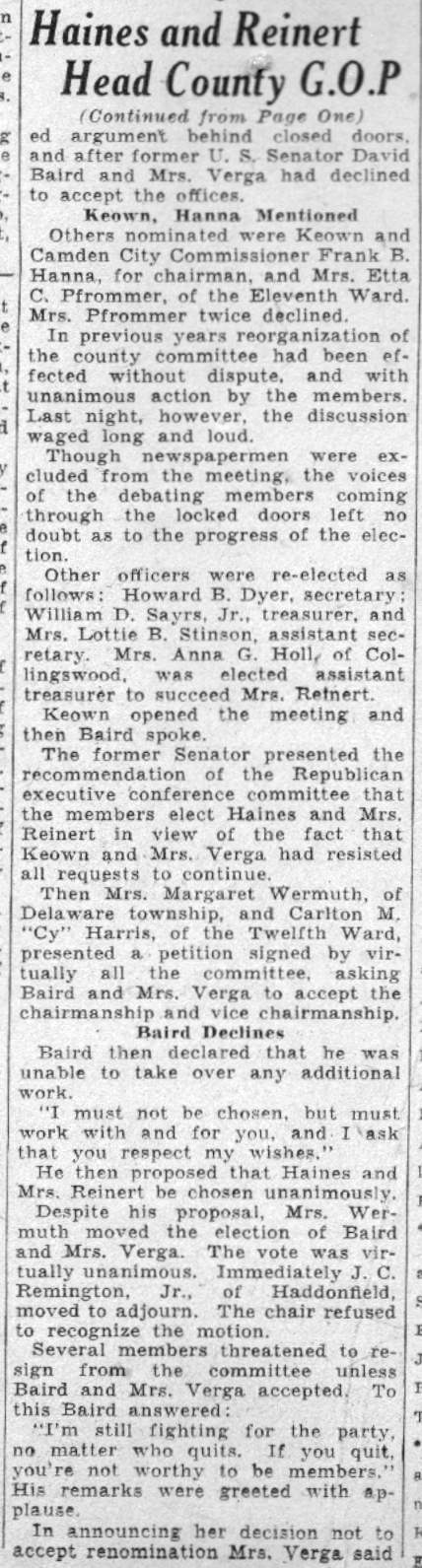

JOSHUA C. HAINES
Baird and Mrs. Verga Decline Posts During Spirited Committee Session
Joshua C. Haines, Camden county register of deeds, was elected chairman of the Camden County Republican Committee at its reorganization last night in one of the most spirited contests held within the Organization in a decade.
Mrs. Isabella C. Reinert, of Collingswood, nominee for Assembly, was elected vice chairman.
Haines succeeds Walter S. Keown and Mrs. Reinert takes the post held by Mrs. Elizabeth C. Verga.
Their election came at 11.30 p. m., after more than three hours of heated argument behind closed doors, and after former U. S. Senator David Baird and Mrs. Verga had declined to accept the offices.
Keown, Hanna Mentioned
Others nominated were Keown and Camden City Commissioner Frank B. Hanna, for chairman, and Mrs. Etta C. Pfrommer, of the Eleventh Ward. Mrs. Pfrommer twice declined.
In previous years reorganization of the county committee had been effected without dispute, and with unanimous action by the members. Last night, however, the discussion waged long and loud.
Though newspapermen were excluded from the meeting, the voices of the debating members coming through the locked doors left no doubt as to the progress of the election.
Other officers were re-elected as follows: Howard B. Dyer, secretary; William D. Sayrs, Jr., treasurer, and Mrs. Lottie B. Stinson, assistant secretary. Mrs. Anna G. Holl, of Collingswood, was elected assistant treasurer to succeed Mrs. Reinert.
Keown opened the meeting and then Baird spoke.
The former Senator presented the recommendation of the Republican executive conference committee that the members elect Haines and Mrs. Reinert in view of the fact that Keown and Mrs. Verga had resisted all requests to continue.
Then Mrs. Margaret Wermuth, of Delaware township, and Carlton M. “Cy” Harris, of the Twelfth Ward, presented a petition signed by virtually all the committee, asking Baird and Mrs. Verga to accept the chairmanship and vice chairmanship.
Baird Declines
Baird then declared that he was unable to take over any additional work.
“I must not be chosen, but must work with and for you, and I ask that you respect my wishes.”
He then proposed that Haines and Mrs. Reinert be chosen unanimously.
Despite his proposal, Mrs. Wermuth moved the election of Baird and Mrs. Verga. The vote was virtually unanimous. Immediately J. C. Remington, Jr., of Haddonfield, moved to adjourn. The chair refused to recognize the motion.
Several members threatened to resign from the committee unless Baird and Mrs. Verga accepted. To this Baird answered:
“I’m still fighting for the party, no matter who quits. If you quit, you’re not worthy to be members.” His remarks were greeted with applause.
In announcing her decision not to accept renomination Mrs. Verga said her duties as state vice chairman, taking her into all the 21 counties, made it impossible for her to continue to devote the time to the county committee which it deserved. She explained that her term as state vice chairman still has two years to run.
Haines Finally Elected
Then Baird announced his resignation from the chairmanship and Mrs. Verga from the vice chairmanship.
Keown was nominated for re-election and Haines and Hanna for election. Baird was renominated by Remington. Keown reiterated his insistence, announced several weeks ago, not to stand for re-election. Baird again declined.
Then Keown moved the election of Haines and Mrs. Reinert. The discussion which followed continued for three hours. Finally the vote was taken at 11.30 and Haines and Mrs. Reinert were declared elected.
Mrs. Reinert, however, declined the office, stating her candidacy for assembly would consume all her time. Then Mrs. Pfrommer was nominated, but she turned it down twice. After much persuasion Mrs. Reinert agreed to accept with the provision that she serve through the summer and that she be permitted to resign later, if she wished.
In a telegram to the committee, Congressman Charles A. Wolverton urged the election of Baird and Mrs. Verga.
The committee elected the following solicitors: Carl Kisselman, Edward R. Deibert, L. Scott Cherchesky, William E. A. King, J. Claud Simon, T. Philips Brown, J. H. Reiners, Jr., Rocco Palese and Morris Praissman.
The conference committee, which suggested Haines and Mrs. Reinert, comprises Baird, Keown, George R. Pelouze, Albert S. Woodruff, Mrs. Verga, Remington, Commissioners Hanna and Clay W. Reesman, Sayrs, William Wimer, Horace G. Githens, J. Wesley Sell and A. C. Middleton.
Members of the Republican County Committee, which organized last night, follow:
Camden City
(*-Indicates New Member)
First Ward—Robert Brennan and Marie Mackintosh.
Second—*William H. Heiser and Mary McCready.
Third—James Corea and *Susie Marchiano.
Fourth—James E. Tatem and *Mary A. Ivins.
Fifth—*Martin A. McNulty and Madeline Salvatore.
Sixth—Howard B. Dyer and Mary S. Hartung.
Seventh—Edward A. Kemble and Mary D. Guthridge.
Eighth—*Edmund A. Walsh and Mamie F. Piraine.
Ninth—Edward Holloway and Deborah Schuck.
Tenth—*Henry I. Haines and Lillian M. Walker.
Eleventh—Horace B. Beideman and Etta C. Pfrommer.
Twelfth—Carlton M. Harris and Mary E. Hamel.
Thirteenth—*Henry Knauer and Louella I. Whaland.
Fourteenth—*Jesse M. Donaghy and Lottie B. Stinson.
Gloucester City
First Ward—Walter H. Craig and E. C. Moffet.
Second—James A. Lewis and *Nellie Keebler.
Third—*James M. Officer and *Margaret P. Powell.
Suburban Districts
Audubon—*Marshall N. Hammon, Jr., and Laura Williams.
Barrington—Harry J. Stone and Margaret Taylor.
Bellmawr—*William C. Stillwill and Katherine Dyer.
Berlin Borough—Leslie M. Ewing and Esther B. Jaggard.
Berlin Township—Frank M. Tyson and Lydia M. Eckstein.
Brooklawn—Morton S. Broomall and C. Mae Marsh.
Chesilhurst—*William Wiegand, Sr., and Mary L. Lyons.
Clementon—J. Palmer Earl and Mabel Rogers.
Collingswood—Edward B. Rogers and Isabella C. Reinert.
Delaware Township—Leonard Hoffman, Sr., and Margaret E. Wermuth.
Gibbsboro—*P. Richard Cummings and *Ethel H. Bone.
Gloucester Township—*William E. Cozens and Mary W. Frazer.
Haddon Township—*Milton E. Hanson and *Eve W. Hannum.
Haddonfield—J. C. Remington, Jr., and Anna G. Holl.
Haddon Heights—Robert E. Bromley and Mary H. Tegge.
Hi-Nella—Samuel D. Mansfield and Elsie H. Castor.
Laurel Springs—Charles V. Osborne and Anna M. Hess.
Lawnside—Horace J. Bryant and Maidie M. Gibson.
Lindenwold—George T. Neely and Irene A. Haney.
Magnolia—*Charles T. Wood and *Lillian Shoemaker.
Merchantville—E. Durell Parker and Ruth K. Yarnall.
Mt. Ephraim—Harvey L. Jacoby and *Theresa Osler.
Oaklyn—John Beasley and *Mae Walker.
Pennsauken Township—*Andrew Stewart and Catherine Brooks.
Pine Hill—*Conrad Schmidt and Mary J. Smith.
Pine Valley—Clinton L. Bardo and Anna E. Howe.
Runnemede—*John S. Adams and *Mrs. John Gaunt.
Somerdale—Edward Arentzen and Louise Brusius.
Stratford—John T. Matthews and L. Mae Titus.
Voorhees Township—*George Ziesch and *Elizabeth Ebert.
Waterford Township—Thomas A. Fanelli and Catherine Zoppel.
Tavistock—Frank B. Middleton, Jr., and no committeewoman.
Winslow Township—Samuel Withers and Kathryn Wuertz.
Woodlynne—Thomas W. Leeson and Edna M. Fritsche.
Camden Courier-Post – June 2, 1932
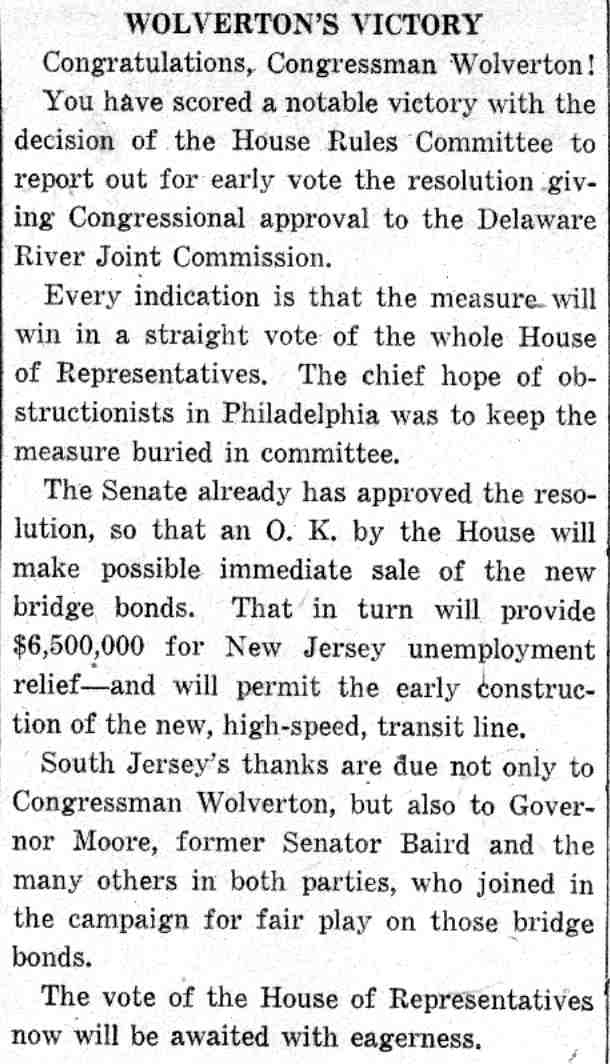
Wolverton’s Victory
Congratulations, Congressman Wolverton! You have scored a notable victory with the decision of the House Rules Committee to report out for early vote the resolution giving Congressional approval to the Delaware River Joint Commission.
Every indication is that the measure will win in a straight vote of the whole House of Representatives. The chief hope of obstructionists in Philadelphia was to keep the measure buried in committee.
The Senate already has approved the resolution, so that an O. K. by the House will make possible immediate sale of the new bridge bonds. That in turn will provide $6,500,000 for New Jersey unemployment relief—and will permit the early construction of the new, high-speed, transit line.
South Jersey’s thanks are due not only to Congressman Wolverton, but also to Governor Moore, former Senator Baird and the many others in both parties, who joined in the campaign for fair play on those bridge bonds.
Camden Courier-Post – June 4, 1932
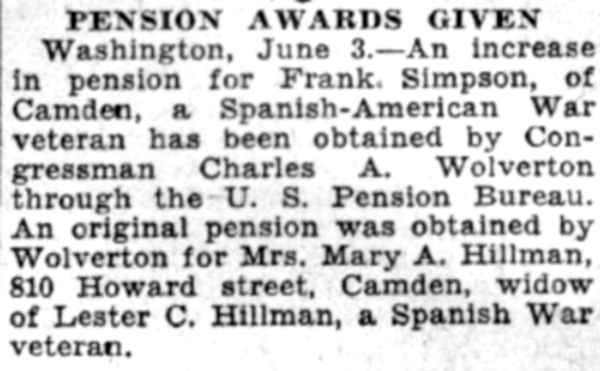
Pension Awards Given
Washington, June 3.—An increase in pension for Frank Simpson, of Camden, a Spanish-American War veteran has been obtained by Congressman Charles A. Wolverton through the U. S. Pension Bureau.
An original pension was obtained by Wolverton for Mrs. Mary A. Hillman, 810 Howard street, Camden, widow of Lester C. Hillman, a Spanish War veteran.
Camden Courier-Post – June 10, 1932
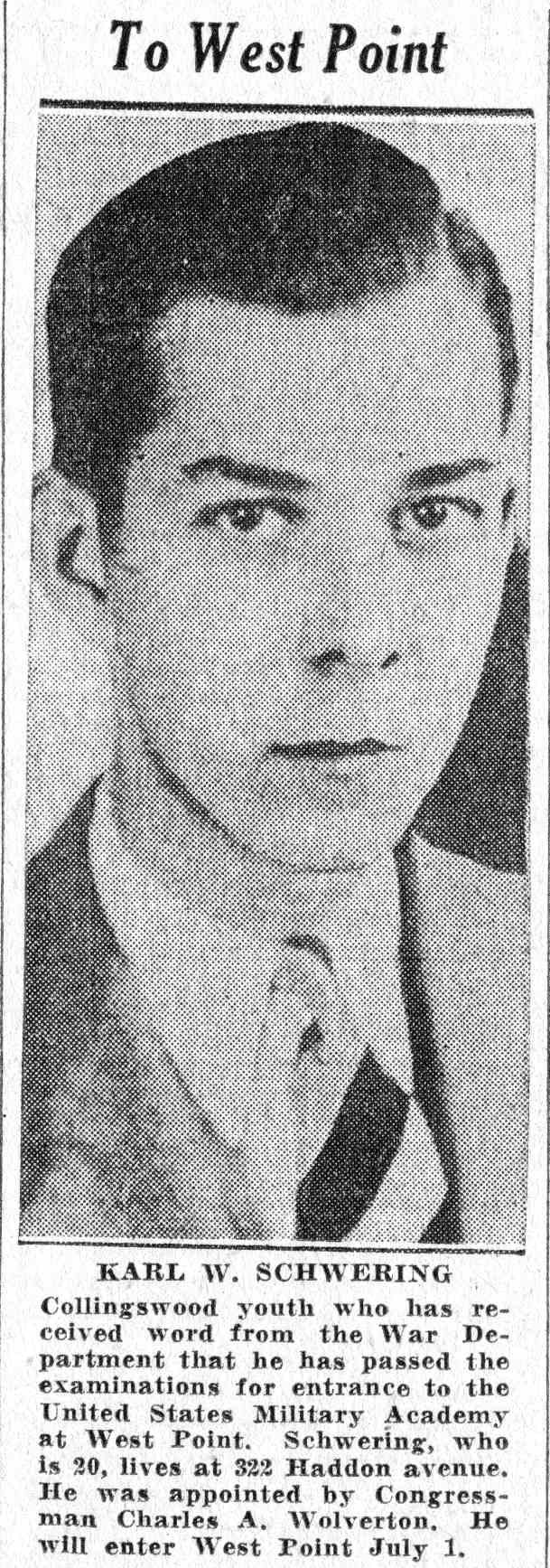
To West Point
Karl W. Schwering, Collingswood youth who has received word from the War Department that he has passed the examinations for entrance to the United States Military Academy at West Point. Schwering, who is 20, lives at 322 Haddon avenue.
He was appointed by Congressman Charles A. Wolverton. He will enter West Point July 1.
Pension Increased
Camden Courier-Post —
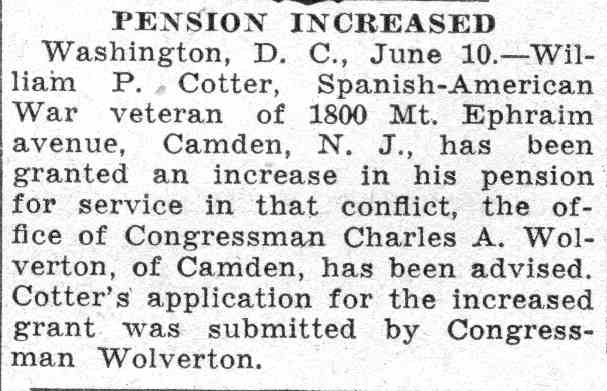
Washington, D. C., June 10.—William P. Cotter, Spanish-American War veteran of 1800 Mt. Ephraim avenue, Camden, N. J., has been granted an increase in his pension for service in that conflict, the office of Congressman Charles A. Wolverton, of Camden, has been advised. Cotter’s application for the increased grant was submitted by Congressman Wolverton.
Young G.O.P. to Dine County Party Chiefs
Camden Courier-Post —
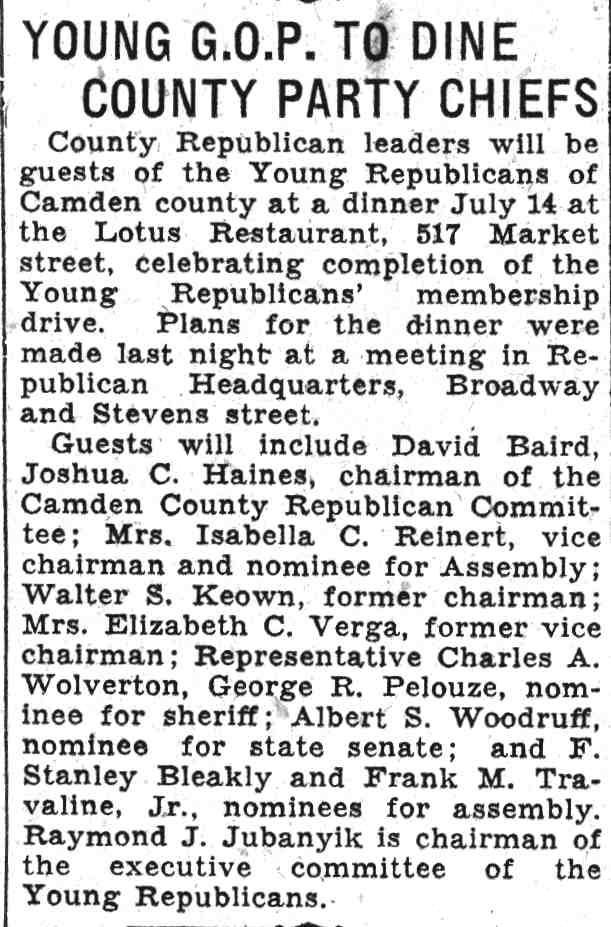
County Republican leaders will be guests of the Young Republicans of Camden county at a dinner July 14 at the Lotus Restaurant, 517 Market street, celebrating completion of the Young Republicans’ membership drive. Plans for the dinner were made last night at a meeting in Republican Headquarters, Broadway and Stevens street.
Guests will include David Baird, Joshua C. Haines, chairman of the Camden County Republican Committee; Mrs. Isabella C. Reinert, vice chairman and nominee for Assembly; Walter S. Keown, former chairman; Mrs. Elizabeth C. Verga, former vice chairman; Representative Charles A. Wolverton, George R. Pelouze, nominee for sheriff; Albert S. Woodruff, nominee for state senate; and F. Stanley Bleakly and Frank M. Travaline, Jr., nominees for assembly. Raymond J. Jubanyik is chairman of the executive committee of the Young Republicans.
First Camden National Bank & Trust Co. (advertisement)
Camden Courier-Post —
The Directors
A. D. Ambruster
S. C. Childs
Edward B. Humphreys
Edward E. Shumaker
F. Morse Archer
Elias Davis
Henry H. Lippincott
Frank C. Somers
David Baird, Jr.
Burleigh B. Draper
Albert C. Middleton
Frank L. Starr
Ralph D. Baker
Isaac Ferris
William T. Read
J. B. Van Sciver, Jr.
Killam E. Bennett
Le Roy A. Goodwin
Wm. W. Robinson
Lawrence M. Verga
Rudolph W. Birdsell
Eugene F. Haines
Charles W. Russ
Oliver C. Willits
William T. Boyle
William D. Sherrerd
Charles A. Wolverton
The Officers
F. MORSE ARCHER
President
BURLEIGH B. DRAPER
Vice-President
ISAAC FERRIS
Vice-President
A. D. AMBRUSTER
Vice-President & Trust Officer
JAY KNOX
Asst. Trust Officer
S. C. KIMBLE
Cashier
THEO. THOMPSON
Assistant Cashier
ORLANDO M. BOWEN
Assistant Cashier
Wm. K. COOK
Assistant Cashier
JULIAN K. POTTER
Assistant Cashier
FIRST
CAMDEN NATIONAL BANK & TRUST CO.
Founded 1812. Oldest in South Jersey
Downtown Office
Broadway & Sycamore
Main Office
Broadway & Cooper
Philadelphia Office
223 Market Street
Wolverton’s ‘Bonus’ Speech
Camden Courier-Post —
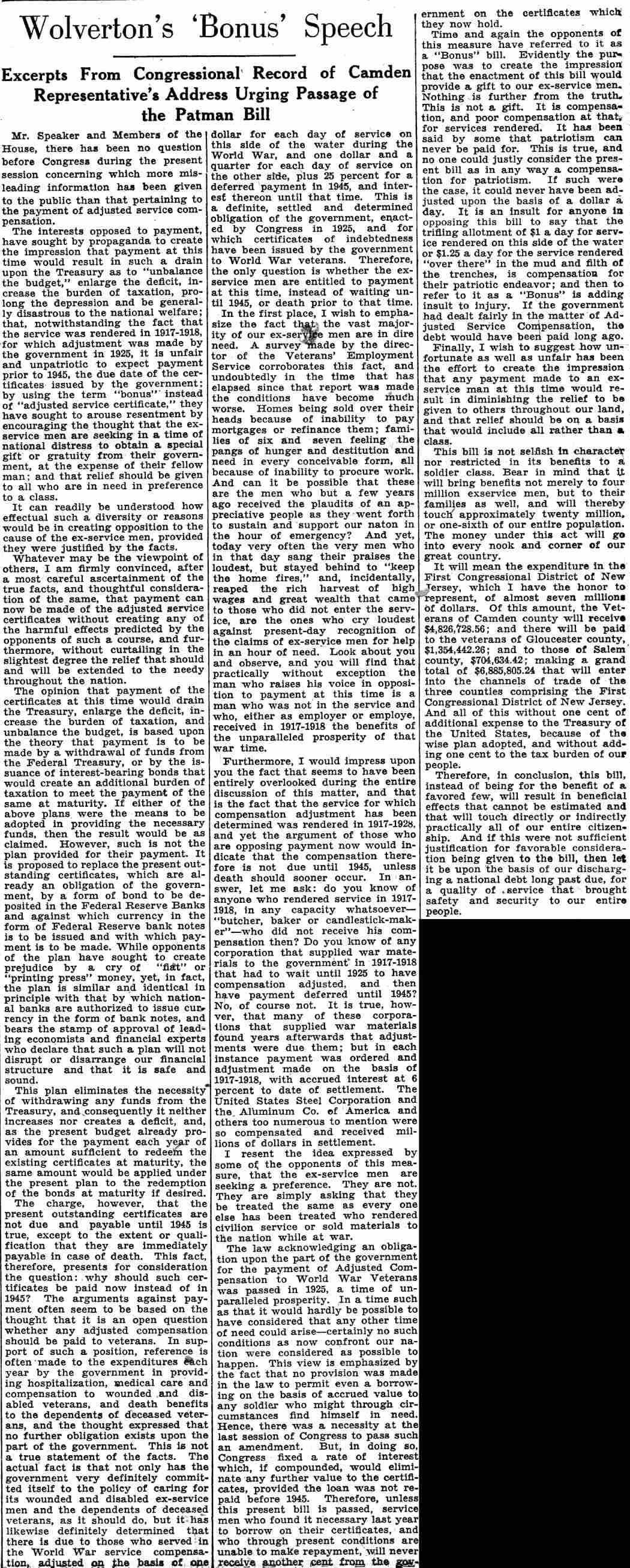
Excerpts From Congressional Record of Camden Representative’s Address Urging Passage of the Patman Bill
Mr. Speaker and Members of the House, there has been no question before Congress during the present session concerning which more misleading information has been given to the public than that pertaining to the payment of adjusted service compensation.
The interests opposed to payment, have sought by propaganda to create the impression that payment at this time would result in such a drain upon the Treasury as to “unbalance the budget,” enlarge the deficit, increase the burden of taxation, prolong the depression and be generally disastrous to the national welfare; that, notwithstanding the fact that the service was rendered in 1917-1918, for which adjustment was made by the government in 1925, it is unfair and unpatriotic to expect payment prior to 1945, the due date of the certificates issued by the government; by using the term “bonus” instead of “adjusted service certificate,” they have sought to arouse resentment by encouraging the thought that the ex-service men are seeking in a time of national distress to obtain a special gift or gratuity from their government, at the expense of their fellow man; and that relief should be given to all who are in need in preference to a class.
It can readily be understood how effectual such a diversity or [sic] reasons would be in creating opposition to the cause of the ex-service men, provided they were justified by the facts.
Whatever may be the viewpoint of others, I am firmly convinced, after a most careful ascertainment of the true facts, and thoughtful consideration of the same, that payment can now be made of the adjusted service certificates without creating any of the harmful effects predicted by the opponents of such a course, and furthermore, without curtailing in the slightest degree the relief that should and will be extended to the needy throughout the nation.
The opinion that payment of the certificates at this time would drain the Treasury, enlarge the deficit, increase the burden of taxation, and unbalance the budget, is based upon the theory that payment is to be made by a withdrawal of funds from the Federal Treasury, or by the issuance of interest-bearing bonds that would create an additional burden of taxation to meet the payment of the same at maturity. If either of the above plans were the means to be adopted in providing the necessary funds, then the result would be as claimed. However, such is not the plan provided for their payment. It is proposed to replace the present outstanding certificates, which are already an obligation of the government, by a form of bond to be deposited in the Federal Reserve Banks and against which currency in the form of Federal Reserve bank notes is to be issued and with which payment is to be made. While opponents of the plan have sought to create prejudice by a cry of “fiat” or “printing press” money, yet, in fact, the plan is similar and identical in principle with that by which national banks are authorized to issue currency in the form of bank notes, and bears the stamp of approval of leading economists and financial experts who declare that such a plan will not disrupt or disarrange our financial structure and that it is safe and sound.
This plan eliminates the necessity of withdrawing any funds from the Treasury, and consequently it neither increases nor creates a deficit, and, as the present budget already provides for the payment each year of an amount sufficient to redeem the existing certificates at maturity, the same amount would be applied under the present plan to the redemption of the bonds at maturity if desired.
The charge, however, that the present outstanding certificates are not due and payable until 1945 is true, except to the extent or qualification that they are immediately payable in case of death. This fact, therefore, presents for consideration the question: why should such certificates be paid now instead of in 1945? The arguments against payment often seem to be based on the thought that it is an open question whether any adjusted compensation should be paid to veterans. In support of such a position, reference is often made to the expenditures each year by the government in providing hospitalization, medical care and compensation to wounded and disabled veterans, and death benefits to the dependents of deceased veterans, and the thought expressed that no further obligation exists upon the part of the government. This is not a true statement of the facts. The actual fact is that not only has the government very definitely committed itself to the policy of caring for its wounded and disabled ex-service men and the dependents of deceased veterans, as it should do, but it has likewise definitely determined that there is due to those who served in the World War service compensation, adjusted on the basis of one dollar for each day of service on this side of the water during the World War, and one dollar and a quarter for each day of service on the other side, plus 25 percent for a deferred payment in 1945, and interest thereon until that time. This is a definite, settled and determined obligation of the government, enacted by Congress in 1925, and for which certificates of indebtedness have been issued by the government to World War veterans. Therefore, the only question is whether the ex-service men are entitled to payment at this time, instead of waiting until 1945, or death prior to that time.
In the first place, I wish to emphasize the fact that the vast majority of our ex-service men are in dire need. A survey made by the director of the Veterans’ Employment Service corroborates this fact, and undoubtedly in the time that has elapsed since that report was made the conditions have become much worse. Homes being sold over their heads because of inability to pay mortgages or refinance them; families of six and seven feeling the pangs of hunger and destitution and need in every conceivable form, all because of inability to procure work. And can it be possible that these are the men who but a few years ago received the plaudits of an appreciative people as they went forth to sustain and support our naton [sic] in the hour of emergency? And yet, today very often the very men who in that day sang their praises the loudest, but stayed behind to “keep the home fires,” and, incidentally, reaped the rich harvest of high wages and great wealth that came to those who did not enter the service, are the ones who cry loudest against present-day recognition of the claims of ex-service men for help in an hour of need. Look about you and observe, and you will find that practically without exception the man who raises his voice in opposition to payment at this time is a man who was not in the service and who, either as employer or employe, received in 1917-1918 the benefits of the unparalleled prosperity of that war time.
Furthermore, I would impress upon you the fact that seems to have been entirely overlooked during the entire discussion of this matter, and that is the fact that the service for which compensation adjustment has been determined was rendered in 1917-1928 [sic], and yet the argument of those who are opposing payment now would indicate that the compensation therefore is not due until 1945, unless death should sooner occur. In answer, let me ask: do you know of anyone who rendered service in 1917-1918, in any capacity whatsoever—“butcher, baker or candlestick-maker”—who did not receive his compensation then? Do you know of any corporation that supplied war materials to the government in 1917-1918 that had to wait until 1925 to have compensation adjusted, and then have payment deferred until 1945? No, of course not. It is true, however, that many of these corporations that supplied war materials found years afterwards that adjustments were due them; but in each instance payment was ordered and adjustment made on the basis of 1917-1918, with accrued interest at 6 percent to date of settlement. The United States Steel Corporation and the Aluminum Co. of America and others too numerous to mention were so compensated and received millions of dollars in settlement.
I resent the idea expressed by some of the opponents of this measure, that the ex-service men are seeking a preference. They are not. They are simply asking that they be treated the same as every one else has been treated who rendered civilian service or sold materials to the nation while at war.
The law acknowledging an obligation upon the part of the government for the payment of Adjusted Compensation to World War Veterans was passed in 1925, a time of unparalleled prosperity. In a time such as that it would hardly be possible to have considered that any other time of need could arise—certainly no such conditions as now confront our nation were considered as possible to happen. This view is emphasized by the fact that no provision was made in the law to permit even a borrowing on the basis of accrued value to any soldier who might through circumstances find himself in need. Hence, there was a necessity at the last session of Congress to pass such an amendment. But, in doing so, Congress fixed a rate of interest which, if compounded, would eliminate any further value to the certificates, provided the loan was not repaid before 1945. Therefore, unless this present bill is passed, service men who found it necessary last year to borrow on their certificates, and who through present conditions are unable to make repayment, will never receive another cent from the government on the certificates which they now hold.
Time and again the opponents of this measure have referred to it as a “Bonus” bill. Evidently the purpose was to create the impression that the enactment of this bill would provide a gift to our ex-service men. Nothing is further from the truth. This is not a gift. It is compensation, and poor compensation at that, for services rendered. It has been said by some that patriotism can never be paid for. This is true, and no one could justly consider the present bill as in any way a compensation for patriotism. If such were the case, it could never have been adjusted upon the basis of a dollar a day. It is an insult for anyone in opposing this bill to say that the trifling allotment of $1 a day for service rendered on this side of the water or $1.25 a day for the service rendered “over there” in the mud and filth of the trenches, is compensation for their patriotic endeavor; and then to refer to it as a “Bonus” is adding insult to injury. If the government had dealt fairly in the matter of Adjusted Service Compensation, the debt would have been paid long ago.
Finally, I wish to suggest how unfortunate as well as unfair has been the effort to create the impression that any payment made to an ex-service man at this time would result in diminishing the relief to be given to others throughout our land, and that relief should be on a basis that would include all rather than a class.
This bill is not selfish in character nor restricted in its benefits to a soldier class. Bear in mind that it will bring benefits not merely to four million exservice men, but to their families as well, and will thereby touch approximately twenty million, or one-sixth of our entire population. The money under this act will go into every nook and corner of our great country.
It will mean the expenditure in the First Congressional District of New Jersey, which I have the honor to represent, of almost seven millions of dollars. Of this amount, the Veterans of Camden county will receive $4,826,728.56; and there will be paid to the veterans of Gloucester county, $1,354,442.26; and to those of Salem county, $704,634.42; making a grand total of $6,885,805.24 that will enter into the channels of trade of the three counties comprising the First Congressional District of New Jersey. And all of this without one cent of additional expense to the Treasury of the United States, because of the wise plan adopted, and without adding one cent to the tax burden of our people.
Therefore, in conclusion, this bill, instead of being for the benefit of a favored few, will result in beneficial effects that cannot be estimated and that will touch directly or indirectly practically all of our entire citizenship. And if this were not sufficient justification for favorable consideration being given to the bill, then let it be upon the basis of our discharging a national debt long past due, for a quality of service that brought safety and security to our entire people.
Philadelphia Inquirer – June 25, 1932

Jail Faces Parents Who Let Child Die Without Physician
Coroner Puts Death of Audubon Girl Up to Christian Science
AUDUBON, N. J., June 24.—Court action against the parents of 8-year-old Mary Elizabeth Spargo, who died here yesterday after her mother and a Christian Science practitioner had administered the medical treatment of that sect during the seven days she was ill with acute appendicitis, was promised in a statement issued today by Prosecutor Charles A. Wolverton, of Camden county.
Prosecutor Wolverton’s announcement followed the certificate of death issued by Coroner F. Bentley, of Camden county, today, which reads: “The death of Mary Elizabeth Spargo, 8 years old, of 417 Maple avenue, at her home on June 23, was due to appendicitis superinduced by Christian Science.”
Veterans Branch for Rehabilitation Moved From Here
Camden Courier-Post —

Former Service Men Protest as Camden Office is Shifted to Millington
Wolverton Aid Asked
Despite protests by veterans’ organizations of South Jersey, government officials yesterday closed the local branch of veterans administration, in the postoffice building, removing the office personnel and equipment to the Lyons Hospital at Millington.
Terming the abandonment of the offices here as an economy measure, the government authorities at the North Jersey hospital centre, issued instructions for veterans in need of medical care, hospitalization or advice to apply at Philadelphia, or the veterans office at Millington.
Representatives of the Disabled American War Veterans, Veterans of Foreign Wars, and American Legion issued statements that a protest has been registered with Congressman Charles A. Wolverton and Senators and Representatives of New Jersey for restoration of the branch.
The order closing the branch here, also effects the office at Newark where veterans of North Jersey were handled.
A nation-wide protest of the move will be registered tomorrow night when a coast-to-coast radio broadcast sponsored by the D. A. V. will convey the veterans’ message.
William Amberg, rehabilitation officer of the D. A. V., and Joseph F. Markley, commander of John A. Mather Camp, United Spanish War Veterans, were among the leaders in a movement to halt the office removal. Veterans of all groups will stage a meeting tonight at 8 p. m. at the 114th Infantry Armory, Haddon avenue, and Mickle street, to prepare a plan of action.
One hundred members of the Disabled Veterans last night attended a meeting in the armory and withheld action pending the broadcast tomorrow. The post has arranged for veterans without radios to hear the broadcast at the Polish Post of the American Legion, Mt. Ephraim avenue and Chase streets.
The post elected delegates for the state convention to be held in Wildwood next month. They are Jeremiah Bennett, William Miller, Daniel Rivkin, William Copeland, Leon McCarthy, George Foos, Harold Walters, Sterling Parker, Louis Frost, William Fryer and Frank Bain.
Fifty delegates from 11 veteran posts in Camden County attended a meeting of the Camden County Council, Veterans’ of Foreign Wars, last night at 308 Broadway, to protest against removal of the Camden office.
A resolution was passed demanding the resignation of General Frank T. Hines, chief of the veterans’ bureau at Washington.
The veterans also voted to petition President Roosevelt to remove interest charges from veteran’s adjusted service certificates.
Wolverton Favors U.S. Patronage Probe
Camden Courier-Post —
WOLVERTON FAVORS U. S. PATRONAGE PROBE
Washington, June 4.—Congressman Charles A. Wolverton, of Camden, N.J., a Republican, voted with the solid Democratic majority to establish a special committee to investigate the manner in which patronage is distributed.
Vets in Colorful Memorial Crowd Convention Hall
Camden Courier-Post —
Military and Civic Organizations Parade in Camden and Join Services Addressed by Clergy and Congressman Wolverton
More than 2500 persons attended a joint veterans memorial observance in Convention Hall which followed a parade of veterans and civic organizations yesterday afternoon.
To the martial strains of bands and bugle corps, the participants marched from Fifth and Cooper to Seventh Street; south to Haddon avenue, then to Line Street and the Convention Hall.
The parade was headed by a squad of motorcycle police under Acting Sergeant William Taylor. They were followed by the band, headquarters, howitzer, medical and service companies of the 114th Infantry in command of Capt. Mahlon F. Ivins, Jr.
Then came the massed colors, National Guard, Naval Reserve, Disabled American Veterans, John J. Pershing Camp No. 9, United War Veterans, Gen. John A. Mather Post No. 18, Spanish War Veterans with their fife and drum corps and the Clara E. Waller Auxiliary; Posts 518 and 980 of the Veterans of Foreign Wars and their bugle corps; Mt. Ephraim Junior Legion, No. 150; and bugle corps; Public Service American Legion Post and bugle corps; Westmont American Legion Post and bugle corps; 50 Pennsylvania Gold Star Mothers led by Mrs. Mary E. Hewson; Elks color guard and the Salvation Army and band.
G. A. R. Vets In Line
Three veterans of the G. A. R., in flag-draped automobiles, participated in the parade. They were John W. Coleman, 76, of 31 North Thirty-fifth street, who served with the 19th Pennsylvania Cavalry; William A. Morgan, 93, of Clementon, who was with the 104th Doylestown Infantry, and Leonard L. Roray, 89, of Glassboro, who served with Company H, Third New Jersey Cavalry.
Ceremonies at Convention Hall opened with advance of the colors to the stage and invocation by Rabbi Nachmann Arnoff.
Rev. Charles Bratten Du Bell, former chaplain of the 114th Infantry, delivered a memorial address, taking as his subject the career of General “Stonewall” Jackson.
Congressman Charles A. Wolverton after paying tribute to the G. A. R., Spanish American and World War veterans, promised that Congress would make provisions to support widows and orphans of veterans who need aid before adjournment this Summer.
Criticizes Veteran Cuts
He attacked any plan for balancing the national budget which does so at the expense of the veterans.
“There are two ways to balance the budget,” he said. “One is to take the money from the veterans and federal employees. The other is to require wealth to help.”
American Legion, Veterans of Foreign Wars and United Spanish War Veterans memorial services and rituals also featured the program. Rev. Lewis A. Hayes, of Westmont, pronounced the benediction. C. Richard Allen, past county commander of the American Legion, was master of ceremonies.
The committee included Samuel Magill, Jr., chairman; Edward A. Stark, A. F. Klein, Joseph A. Kohler, Joseph Whylings, James J. Burke, Norval McHenry, Charles Buzine, William Amberg, James Milne, William P. Breen, William Miller, William Reinholdt; Edward J. Wintering, William Eisele, William Lloyd, Joseph F. Markley, Frank Ellis, D. J. Connors, Joseph Lounsberry and Charles M. Jefferies.
South Jersey Veterans Congratulate Wolverton
Camden Courier-Post —
Two South Jersey veterans organizations last night congratulated Congressman Charles A. Wolverton for his stand on pension legislation.
Wolverton Urges Boost in Veteran Allowances
Camden Courier-Post —
Washington, June 6.—Congressman Charles A. Wolverton, of Camden, N.J., opposed adjournment of Congress until there is a satisfactory settlement of the veterans’ allowances situation.
South Jersey Boy Ends First West Point Year
Camden Courier-Post —
SOUTH JERSEY BOY ENDS FIRST WEST POINT YEAR
Karl W. Schwering, of 322 Haddon avenue, Collingswood, has successfully completed his first year work as a cadet at the United States Military Academy, West Point, it was announced through the office of Congressman Charles A. Wolverton.
Wolverton Is Wary of Vet Compromise
Camden Courier-Post —
WOLVERTON IS WARY OF VET COMPROMISE
Washington, June 11.—The White House compromise on war veterans’ benefits, as delineated to date, is not satisfactory to Congressman Charles A. Wolverton, who insists that a just and adequate settlement must be provided.
‘All-Nations Revue’ Put On By Mission
Camden Courier-Post —
‘ALL-NATIONS REVUE’ PUT ON BY MISSION Part of Program Broadcast; Italians Extend Greetings
Europe was transferred to Third and Arch Streets last night, musically, vocally and spiritually, if not physically, when the Third Street Mission staged its all-nations revue.
Donnell Knox Wolverton, 1933
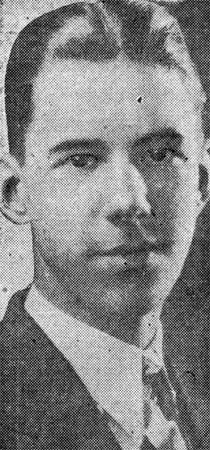
Donnell Knox Wolverton, Princeton University graduate, June 1933
Son of Wolverton Is Honor Graduate
Camden Courier-Post —
Youngest in Course at Princeton to Receive A. B. Degree
Donnell Knox Wolverton, 20, son of Congressman and Mrs. Charles A. Wolverton, was graduated with honors yesterday at Princeton University. He received the degree of Bachelor of Arts, the youngest graduate in his course.
Wolverton was a member of the university glee club, was active in promoting political discussion and forming political clubs at Princeton. He organized and was president of the Republican Club of the university, and last year he delivered a nationwide radio address from New York City under the auspices of the National Student Council, emphasizing the advantages of promoting political thought among college students.
Wolverton was also active in the Wig-Clio Debating Society of Princeton. He lives at 2 Oak Terrace, Merchantville.
In connection with his regular course, he also took a course in military science, graduating with honor, which entitles him to a commission in the Reserve Officers Corps, Artillery Unit. The granting of his commission as a Second Lieutenant, however, must necessarily await his twenty-first birthday in October.
In the fall, Donnell will take up the study of law either at Harvard Law School or the University of Pennsylvania School of Law.
Stratford Boy Enters U.S. Naval Academy
Camden Courier-Post —
STRATFORD BOY ENTERS U. S. NAVAL ACADEMY
Edward S. Arentzen, 17, son of Mr. and Mrs. Edward Arentzen, of Stratford, has entered the United States Naval Academy at Annapolis as a midshipman, through the appointment of Congressman Charles A. Wolverton.
Edge to Speak Here at G.O.P. Reception
Camden Courier-Post —
EDGE TO SPEAK HERE AT G.O.P. RECEPTION Kean and Barbour Also Coming to Affair for Reesman and Mrs. Verga
Former Ambassador Walter E. Edge today sent word to the committee in charge, that he will speak at the reception and dinner being given June 29 to Commissioner Clay W. Reesman and Mrs. Elizabeth C. Verga in honor of their election as chairman and vice chairman, respectively, of the Camden County Republican Committee.
In addition to Ambassador Edge, United States Senators Hamilton F. Kean and W. Warren Barbour have accepted invitations.
The reception is being held at the Walt Whitman Hotel, with tickets being distributed through county committee members.
Wolverton Leads in Biography Space
Camden Courier-Post —
WOLVERTON LEADS IN BIOGRAPHY SPACE Requires 21 Lines in Congressional Record to Tell Life’s Happenings
Washington, June 22.—Congressman Charles A. Wolverton, of Camden, leads the New Jersey congressional delegation in point of biographical space in the Congressional Directory.
Wolverton required 21 printed lines in the book to record the events which he considered proper for the purpose of a biography of a public official.
Wolverton Comments on Passing of Clara S. Burrough
Camden Courier-Post —
Congressman Charles A. Wolverton commented on the passing of Clara S. Burrough, long-time principal of Camden High School.
“I greatly deplore the fact that Miss Burrough has passed away. She was a wonderful leader. I was among her first students at Camden High School.”
State G.O.P. Chiefs Speak Here Tonight
Camden Courier-Post —
STATE G.O.P. CHIEFS SPEAK HERE TONIGHT Stokes, Kean, Barbour Listed for Fete to Reesman and Mrs. Verga
A testimonial dinner will be given tonight by the Camden County Republican Committee in honor of party leaders with former Governor Edward C. Stokes and former United States Senators David Baird, Jr. as principal speakers.
Those to be honored are Mrs. Elizabeth C. Verga, vice chairman of the county committee and state committeewoman; Assemblyman F. Stanley Bleakly and Frank M. Travaline, Jr.
Other speakers will include Mrs. Edna B. Conklin, national committeewoman from Bergen county; Congressman Charles A. Wolverton and State Senator Albert S. Woodruff.
Film Suit Hearing Called Tomorrow
Camden Courier-Post —
FILM SUIT HEARING CALLED TOMORROW Anti-Trust Charges Against Warner Brothers May Go Over Until Fall
Arguments will be heard tomorrow in U.S. District Court here by Judge John Boyd Avis on fixing a date for the resumption of hearing testimony against Warner Brothers and 13 subsidiaries in a suit charging violation of anti-trust laws.
The suit to restrain Warner Brothers interests was filed in Federal court last January by the Victoria Amusement Company, independent owners of local theaters, represented by Joseph A. Varbalow.
Reesman and Mrs. Verga Honored at Republican Dinner
Camden Courier-Post —
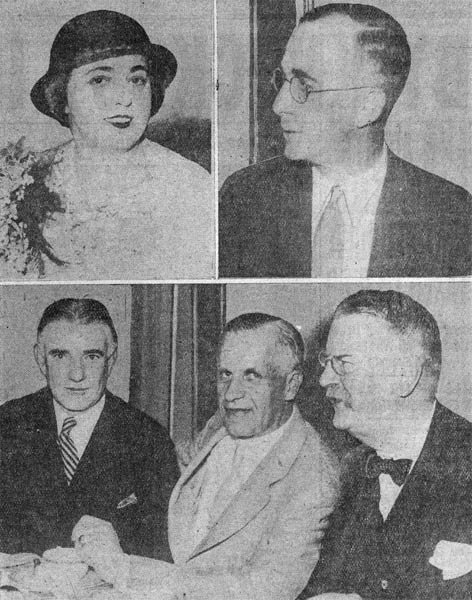
Upper left: Mrs. Elizabeth C. Verga, vice chairman of both the Republican State and Camden County committees; and City Commissioner Clay W. Reesman, chairman of the Republican county committee. Left to right in the lower group are Congressman Charles A. Wolverton, Republican State Chairman E. Bertram Mott and Senator Hamilton F. Kean.
Baird, Stokes Lash Richards Ambitions And ‘Horse Trading’
Camden Courier-Post —
Dinner to Reesman and Mrs. Verga Packs Whitman; Local Delegates Get High Praise
Ex-Governor Denounces Roosevelt Program, Hits Inflation
By Ransloe Boone
Bitter criticism of the “horse trading” of the Legislature and the gubernatorial aspirations of Senate President Emerson L. Richards, were coupled with appeals for party loyalty and praise for Camden county’s leaders at a dinner of the Camden County Republican Committee in Hotel Walt Whitman last night.
The dinner, one of the largest ever held in the hotel, was in honor of City Commissioner Clay W. Reesman, new chairman of the county committee, Mrs. Elizabeth C. Verga, vice-chairman of the county and state committees; Joshua C. Haines, former chairman, and Mrs. Isabella C. Reinert, assemblywoman and former vice chairman.
Tribute was paid them by a distinguished gathering of more than 500 national, state and county leaders. So great was the crowd that the capacity of the main ball room was taxed and the junior ballroom was utilized also.
The attacks on “horse trading” and Richards were made by former Governor Edward C. Stokes and former United States Senator David Baird, Jr. Baird did not mention Richards by name.
Proud of Own Legislators
“We Republicans in Camden County have a faculty for victory,” Baird said, “but we can and will help to defeat selfish aspirants to office if they don’t play straight with the Republican party.”
“I am proud of the record of Senator Albert S. Woodruff and our Assembly members, Mrs. Isabella C. Reinert, F. Stanley Bleakly and Frank M. Travaline, Jr. They didn’t take any part in the trading of judges, highway commissioners and prosecutors.
“Camden County has been accused of not wanting civil service. When it came time to vote on the question Camden County stood by civil service as it always has, and beat the ripper.”
“Only when you play the game and stand four-square for the ideals of the party can you expect the people of the state to trust you.”
“Whose Legislature?” Stokes declared:
“We won a great victory in New Jersey in the last presidential election. We did it by remaining loyal and not by trading with the Democrats.
“We thought we elected a Republican legislature. John Milton, Hudson County Democratic leader, however, says we elected a Republican legislature but the Democrats are putting on the show. But in that very paternal letter he wrote me not long ago, telling me what I should do and why I should not ‘interfere’ with the Legislature, Senator Richards assured me the Republicans controlled the Legislature. I’m glad to know that for, of course, Richards is always right.”
Stokes predicted history would repeat itself and the Republican party soon would come back into its own.
“The party that stands by its principles despite defeat always comes back.”
The former governor proposed two means of lowering the present high taxes and heavy expenditures.
“I wish this county committee and all those throughout the state would insist on legislation to prohibit municipalities from spending more than they have and from floating bond issues and I wish you would support legislation providing for a limited local tax rate and providing for a gradual reduction of taxes to that maximum.”
Doubts Roosevelt Plan
He expressed doubt as to the wisdom of some of the Roosevelt program. “Inflation makes us prosperous, if revoking the gold standard aids us, amen, if calling 18 inches a yard will help us, that’s fine. If we can ask employers to sell us more and not throw more of our own workers out of work, that will be wonderful. But I can’t understand how we will be aided by those proposals. It’s too much for me.”
He demanded that France, England, and the other nations pay their debts, declaring they were spending five times their debts on armaments.
Congressmen Defend F. D. R.
Wholehearted support of all of President Roosevelt’s measures which will promote relief from present economic conditions was pledged by United States Senators Hamilton F. Kean and W. Warren Barbour and Congressman Charles A. Wolverton.
Kean explained that he voted for the economy bill after he had been assured the president would not touch the compensation of those veterans whose injuries were service connected and that it was passed only because “pressure was brought to bear.”
After paying tribute to Reesman and Mrs. Verga, Kean said:
“One of the first bills introduced by the new administration was the economy bill. This bill authorized the president to consolidate departments of the government, of which there are a great many overlapping and which could be done without any injury to anybody except those receiving salaries or emoluments therefrom. The bill also authorized the president to adjust the wages of government employees and to examine in and make new rules for those receiving pensions from the government. A year ago we tried to give Mr. Hoover power to do away with a lot of these offices that were unnecessary and useless. Mr. Hoover promised if he had the power that he would do so, but this was beaten by the Democrats, so that Mr. Hoover never had the power to do away with these useless bureaus.
Economy Bill
“The history of the economy bill is this: After it was passed by the House, before they had time to read it and under a special rule the debate was so limited that nobody knew anything about it before it was voted on, it was then sent over to the Senate and referred to the finance committee. In the finance committee a Democrat moved that the president should not have authority to reduce anybody’s compensation more than 25 percent.
“Each senator voted for or against the measure or amendment under consideration. On this amendment, upon the call of the roll, the majority of the Democrats voted in favor of the amendment. Most of the Republicans voted against the amendment and it was a tie on the last Republican name on the committee. This was Senator Walcott, of Connecticut, and he voted ‘nay’ on the amendment. This beat the amendment. Next was the question of reporting the bill out of the committee to the floor of the Senate. This was again a tie vote when it came to Senator Walcott and he voted ‘aye,’ which reported the bill out.
Won on G. O. P. Votes
On the floor of the Senate the bill would not have passed but for the Republican votes. We were assured by the Democratic leaders that the president would not touch the compensation of those veterans whose injuries are service connected. In other words, the wounded. When the regulations came out, some two months after this bill had been passed, they had cut the wounded veterans to pieces.
“When the president saw that the Senate voted almost two-thirds to take away this power from him, he got up some compromise formula which was not satisfactory, and got it passed by the House. This was submitted to the Senate and it was on this proposition that every Republican senator voted to support the Senate amendment rather than the House amendment, and I believe that had no pressure been brought to bear on the senators that every senator in the chamber would have voted for the Senate amendment, rather than for the House amendment.”
‘Pay Tribute’
“I don’t criticize the president, I pay him tribute,” Barbour said. “He showed outstanding courage and initiative. He is taking a long chance in many respects and it is the duty of Congress to make the program succeed. It is the program of the nation and I hope it does succeed. However, I do not forget my loyalty to the Republican party. The test is coming this winter in the administration of these great pieces of legislation. I feel it my duty as a Republican not to play politics, but I shall raise potent protest against any unfair or unwise laws.”
He praised Mrs. Verga and Mrs. Edna B. Conklin, of Bergen county, national committeewoman, who was among the guests of honor.
“I never would have been elected if it were not for the combined efforts of those ladies,” he said.
Two future booms were launched.
Mrs. Verga for Senator
“Some day when Senator Woodruff gets tired of being Senator, I hope to see Mrs. Verga as Senator or, if Congressman Wolverton would become Governor, I should like to see Mrs. Verga in his place at Washington. She is marvelously capable of filling both jobs.”
In response Wolverton laughingly said:
“That’s the first time I ever heard a sober man nominate me for governor.”
Wolverton’s address follows:
‘Cites Relief Jigsaw’
“In the few minutes allotted to me, it will not be possible to speak upon several subjects as I would like. I do wish however, to touch briefly and in a general way upon what in my opinion should be the policy of the Republican party at this time with reference to national affairs.
“The economic condition that confronts our nation today, with its attendant paralysis of business, finance, industry and agriculture, creating widespread unemployment, destitution and need, has brought us face to face with an emergency surpassing in its possible consequences even that of the World War. Its devastating effect has brought distress to millions of our people.
“Demand for relief comes from every conceivable source. It is not confined to any particular class. Bankers, railroads, industrial corporations, farmers, homeowners, businessmen, sovereign states, local municipal governments, capital and labor, rich and poor, each with divergent views and often conflicting interests, but all with an insistent demand that each shall receive the particular kind of relief its individual need requires.
Defends Administration
“In answer to the demand of our people for relief, the president called Congress into special session. He submitted his program for relief and recovery to the Congress and it has been enacted into law. To provide effectual relief in the variety of ways made necessary by the different needs to be served required the entrance of our government into new fields of activity.
“There has been a disposition upon the part of some who hold representative positions in our party to criticize the enactment of such laws upon the basis that we have cast aside many of the fundamental traditions of our nation. Such criticism in my opinion is wrong. It overlooks entirely the serious emergency now existing affecting the welfare of our people and which in my opinion is sufficient justification for the enactment of such temporary legislation.
In times such as these, if we are to best serve our people, we cannot hold to the same course of action that has prevailed in other times.
“This is a time of distress and need—a time that calls for the application of new principles or a rearrangement of the old.
“Policies and principles of government set up and agreed upon in times of prosperity cannot be accepted as standards in times of economic distress when the financial and industrial organizations of the country are prostrate and our people in want.
Warns Of Criticism
“Nor do I believe our party can gain public confidence by inaugurating at this time a campaign of criticism against the program and policies recently enacted by Congress. It has not as yet had a chance or a trial. This is not time to be destructive denunciation without constructive proposals. This is no time to create doubt. It is a time when everyone regardless of party affiliations should cooperate to build confidence, dispel fear and create courage.
“What we need today is constructive cooperation by all political parties. Let each retain his party lines, but cooperate for the common good.
“As a party we must have the vision that will enable us to recognize that new conditions create new obligations and the necessity for the application of new and different policies of government to fulfill our entire responsibility.
“We must have not only the vision as to the necessity, but also the courage to do things which a few years ago would have been unthought of because contrary to accepted theories of what is a proper field of governmental activity and unjustified under the prosperous conditions then prevailing.
‘No Place for Politics’
“Let our thought be in terms of the common good, then there will be no denial of the necessity or the propriety of the government in times such as these, assuming a responsibility to promote the general welfare and seeking to fulfill that obligation by entering into enterprises or assuming functions, that otherwise would be unjustified.
“In this time of crisis, when we are seeking to relieve human misery, there is no place for small or mean partisan politics. Nor is this any time for demagogic utterances—this is a time for calm and deliberate consideration and judgment. A time when it is imperative that whatever gives promise of relief shall have our whole-hearted support.
“In conclusion, permit me to suggest that the greatest opportunity for our party in the days immediately before us is to give sympathetic consideration and support to those measures and policies that will best promote human rights. Our party had its origin in support of that great principle and the future measure of its success will depend upon the extent of our adherence to it.”
Baird also declared he would support the president.
“Mr. Roosevelt is our president. Republicans will support him in everything which is for the best interests of the country. All should wish for his success,” Baird said.
Sales Tax Urged
Mott urged that Republicans support a sales tax as the most equitable means of raising needed money.
“A sales tax would distribute the cost equally and would be more fair than the income tax. As we know from the hearings in Washington, some aren’t paying their income tax, anyway.”
Mrs. Conklin paid tribute to Mrs. Verga for her great political sense, ability and understanding of human nature.
She urged that all Republicans work as enthusiastically as a minority party as they did as a majority.
“We must go along and build until we become the majority again,” she said.
Edge Sends Regrets
Walter E. Edge, former Ambassador to France, who was to have been the principal speaker, was unable to attend because he and his family are at their summer home in Maine. He sent a telegram expressing his regrets and his wishes for success to Mrs. Verga and Reesman. It had been reported Edge would be boomed for governor at the dinner but no mention of such a proposal was made.
The honor guests spoke briefly. Reesman asked for the support of the county committee and pledged himself to give all his energy towards the success of the party.
Mrs. Verga praised the committee members and thanked them for their support. She paid a special tribute to former Senator Baird.
“We have been successful in Camden County,” she said, “because we still stand solidly behind our leader, David Baird.” Her tribute was greeted by long applause.
Mrs. Reinert and Haines also spoke briefly pledging their support to the new chairman and vice chairman.
Woodruff Toastmaster
State Senator Albert S. Woodruff was toastmaster. He was introduced by Carlton M. Harris, chairman of the dinner committee.
The county committee presented a lounging chair to Reesman and a silver flower bowl to Mrs. Verga, as well as flowers to Mrs. Reinert and Haines. Flowers also were presented to the new chairman and vice chairman by the Twelfth Ward Republican Club and the ladies’ auxiliary, by the Young Republicans of Camden county through Harold Joyce, its president, and by the Bergen county Republicans, through Mrs. Conklin.
The dinner committee, in addition to Harris, was headed by Mrs. Pauline Caperoon, secretary; Mrs. Mary S. Hartung, assistant secretary, and William D. Sayrs, Jr., treasurer.
Jobless Son Kills Jake Schiller Who Saves Boy’s Wife From Gun Slayer
Camden Courier-Post —
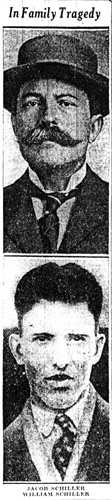
Jobless Son Kills Jake Schiller Who Saves Boy’s Wife From Gun Slayer
Crazed By Separation, Relatives Say; Dazedly Insists He Had No Intention of Shooting
Jacob Schiller, 72, for 45 years a political figure here, is dead, shot by his own son.
The slayer, William Schiller, 30, a former summer policeman now unemployed, was held over today to the grand jury on a charge of murder. He made no confession but asserted he had no intention of shooting his father.
A few hours later, young Schiller’s wife, Augusta, whom he had also tried to shoot, was found wandering through the city street, in an hysterical condition, and declared she was to blame for the tragedy. She said her father-in-law had tried to save her and was killed in the attempt.
The slaying occurred Saturday night at the elder Schiller’s home, 2420 Carman Street.
Banquet to Honor John S. M’Taggart
Camden Courier-Post —
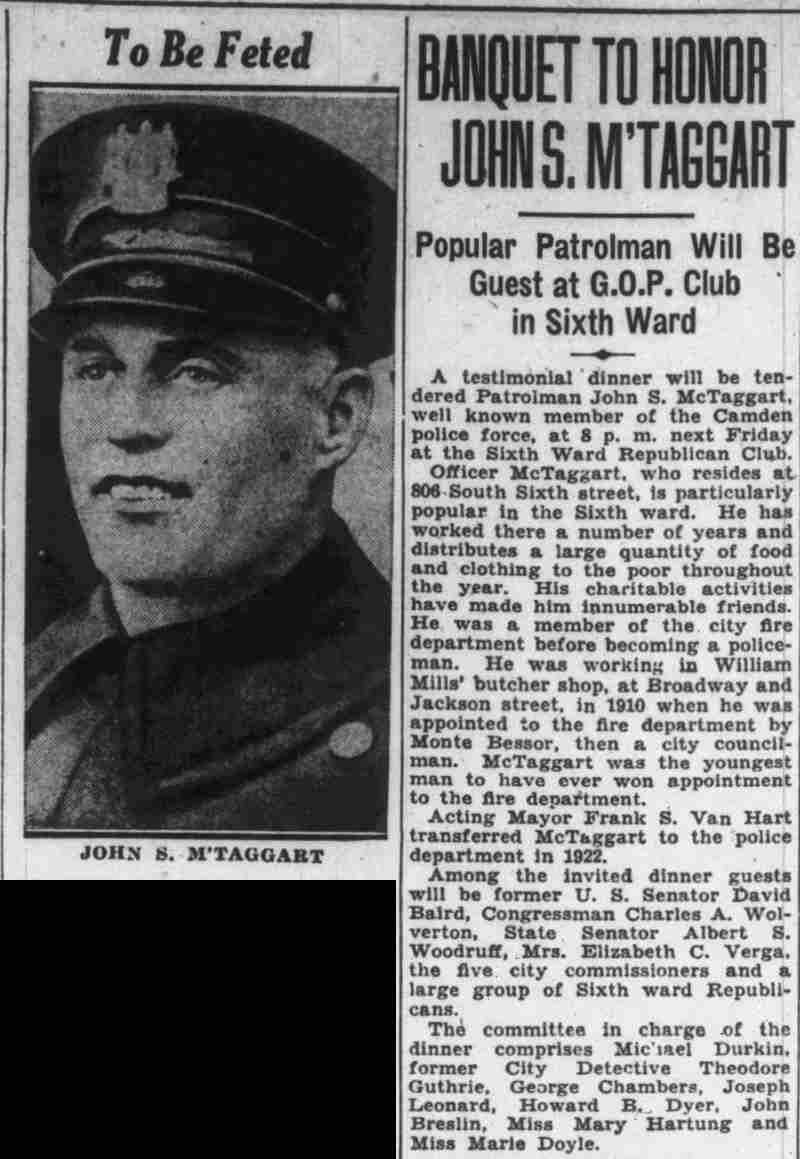
Popular Patrolman Will Be Guest at G.O.P. Club in Sixth Ward
To Be Feted
JOHN S. M’TAGGART
A testimonial dinner will be tendered Patrolman John S. McTaggart, well known member of the Camden police force, at 8 p. m. next Friday at the Sixth Ward Republican Club.
Officer McTaggart, who resides at 806 South Sixth street, is particularly popular in the Sixth ward. He has worked there a number of years and distributes a large quantity of food and clothing to the poor throughout the year. His charitable activities have made him innumerable friends. He was a member of the city fire department before becoming a policeman. He was working in William Mills’ butcher shop, at Broadway and Jackson street, in 1910 when he was appointed to the fire department by Monte Bessor, then a city councilman. McTaggart was the youngest man to have ever won appointment to the fire department.
Acting Mayor Frank S. Van Hart transferred McTaggart to the police department in 1922.
Among the invited dinner guests will be former U. S. Senator David Baird, Congressman Charles A. Wolverton, State Senator Albert S. Woodruff, Mrs. Elizabeth C. Verga, the five city commissioners and a large group of Sixth ward Republicans.
The committee in charge of the dinner comprises Michael Durkin, former City Detective Theodore Guthrie, George Chambers, Joseph Leonard, Howard B. Dyer, John Breslin, Miss Mary Hartung and Miss Marie Doyle.
Wolverton Backs Congress Action
Camden Courier-Post —
WOLVERTON BACKS CONGRESS ACTION Says Merit of Guffey Bill Justified Passage, Irrespective of Court Action
Constitutional arguments before a test case has been settled by the Supreme Court have no place in debates on legislation affecting the public welfare, Congressman Charles A. Wolverton declared.
The congressman referred to the Guffey coal bill in particular, passage of which he urged in the House before adjournment last week. Wolverton has repeatedly urged the protection of mining communities and the coal industry.
Fleet Adequate to Defend U.S. And Maintain Peace Urged by Wolverton
Camden Courier-Post —
Fleet Adequate to Defend U.S. And Maintain Peace Urged by Wolverton in Navy Day Speech
Congressman Charles A. Wolverton, in an address yesterday commemorating Navy Day, urged the United States to “maintain a fleet adequate for national defense and for the maintenance of peace.”
The address featured a program sponsored by the officers and enlisted men of the Second Battalion, U.S. Naval Reserves, at armory headquarters. In his address, broadcast over WCAM, Congressman Wolverton praised the efforts of former President Theodore Roosevelt to build up the nation’s naval forces.
“As the American Navy in the past has never been other than an instrument in the hands of the people to foster and maintain peace, there is every reason to believe that it will continue to serve in that capacity in the future.”
“The primary purpose of the Navy is to maintain peace. It never declares war, and when war is declared the power of the Navy is directed to the end of restoring peace.”
G.O.P. Meetings Today
Camden Courier-Post —
G.O.P. MEETINGS TODAY
Mrs. Frederick von Nieda, wife of the mayor, will conduct one of nearly 100 parlor meetings to be held simultaneously throughout Camden County this afternoon.
On the program will be Congressman Charles A. Wolverton and Mrs. Florence Baker, members of the Republican state committee.
Reserve Officers Plan 6th Military Reception, Ball
Camden Courier-Post —
The sixth annual military reception and ball under the auspices of the Reserve Officers’ Association will be held at the Walt Whitman Hotel.
Congressman and Mrs. Charles A. Wolverton, Mayor and Mrs. Frederick von Nieda, Rear Admiral S. Robison, U.S.N. (retired), are among the invited guests.
Wolverton Holds ‘Brain Trust’ Drew U. S. Constitution
Camden Courier-Post —
Believes New Day Awaits Graduates Coming Out of Colleges
Traces G. O. P. Record
The U. S. Constitution was called the greatest security document ever written by Congressman Charles A. Wolverton last night in addressing the Young Republicans of Haddonfield at the Birdwood Club.
“There were 24 college graduates in the convention, which drew the constitution and that was a large number for that period,” Wolverton declared. “Six of them had been or were later college presidents. Seven of them were either trustees or founders of colleges. That was the finest ‘brain trust’ ever asembled [sic].”
In emphasizing opportunity for youth of America he pointed out that some of the members of that convention were in their early 20’s.
“Madison was only 36 and Alexander Hamilton 30,” he said. “One man was 30, another 26 and three more younger than that. There is opportunity in America for young people when you consider the average of the men at that convention was 43.
“The thing that concerns me is young people coming out of colleges and after their effort find no place in the world for them. The same holds true for those coming out of high schools. To you who are in that position I say continue to be courageous. I have faith in America and I believe there will be a new day for you. We are in a day of darkness, but we are coming out, and you will get your opportunity.”
Then Wolverton pointed out that there are two major parties in the country, the Republican and the Democratic. He said they were not created by law but by the voice of the people, and it has worked out satisfactorily for the nation.
“You should choose one or the other parties of the two-party system,” he said. “Nothing can be gained by being independent, or an individualist. You must identify yourselves with one party or the other to accomplish something.
“Most of the accomplishments of the nation came with the Republican party. Fifty-eight out of 75 years the Republican party has been in power. There have been but three Democratic presidents in that time, Grover Cleveland, Woodrow Wilson and Franklin D. Roosevelt. There have been 13 Republican presidents. All of the advancements of the country have been synonymous with the party.
“The Republican party was founded on human rights. Its leaders have always been for human rights as against property rights. No party offers more opportunity to the youth than the Republican party.”
About 200 heard Wolverton’s address. He was introduced by George H. Walton, Haddonfield county committeeman, also a Young Republican.
Other speakers were Assemblymen J. Claud Simon and Henry M. Evans and Daniel R. Creato, state secretary of Young Republicans. Henry Del Snyder 3rd, president, introduced Walton and Evans.
“The issues of this campaign are more vital to you than it is to your parents,” Simon said. “If you were a stockholder in a corporation you would attend a meeting of stockholders. The government is a co-operation corporation and you should take as much interest in the government as you would a corporation.”
Simon said it is an honorable thing for a man to hold public office. He declared it is also honorable for young people to take an active interest in public affairs.
“You may not always agree with what your party does,” he declared. “I have not always agreed with with [sic] what the Republican party has done, but as a whole I do agree with its principles.”
Evans said he sponsored a bill in Legislature prohibiting the solicitation of votes from relief clients. He expressed the belief politics and relief should not be mixed. He charged that 11 Democratic members of Legislature voted against his measure and the Republicans all voted for it.
Wolverton Cites Votes in Congress for Common Good
Camden Courier-Post —
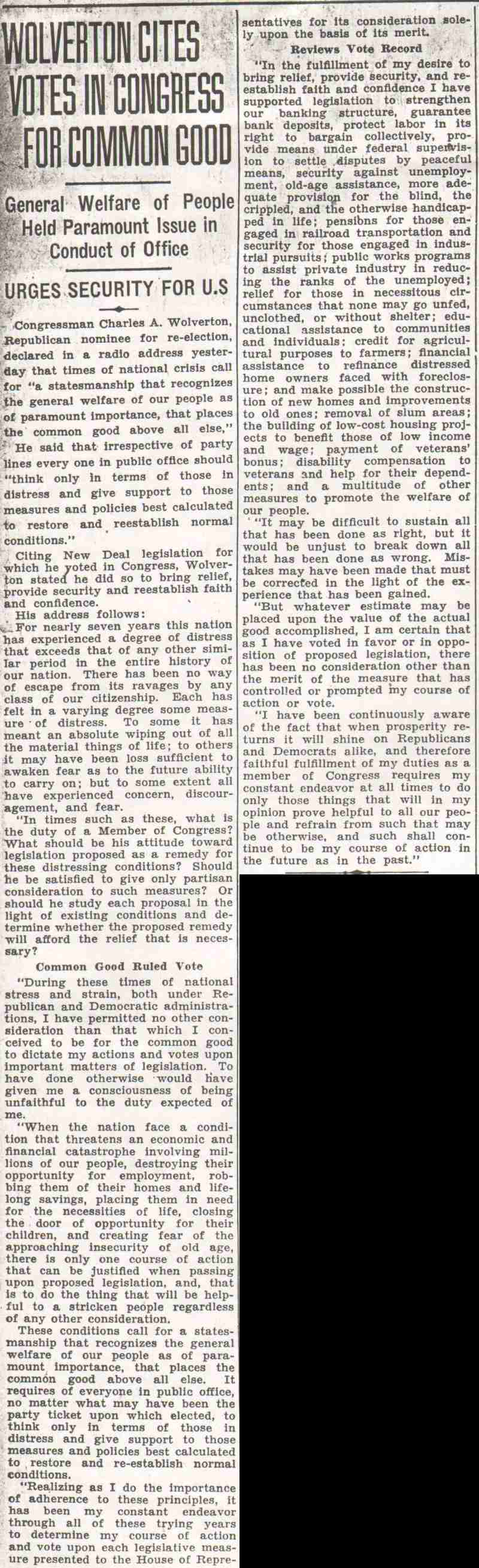
General Welfare of People Held Paramount Issue in Conduct of Office
Urges Security for U.S.
Congressman Charles A. Wolverton, Republican nominee for re-election, declared in a radio address yesterday that times of national crisis call for “a statesmanship that recognizes the general welfare of our people as of paramount importance, that places the common good above all else.”
He said that irrespective of party lines every one in public office should “think only in terms of those in distress and give support to those measures and policies best calculated to restore and reestablish normal conditions.”
Citing New Deal legislation for which he voted in Congress, Wolverton stated he did so to bring relief, provide security and reestablish faith and confidence.
His address follows:
For nearly seven years this nation has experienced a degree of distress that exceeds that of any other similar period in the entire history of our nation. There has been no way of escape from its ravages by any class of our citizenship. Each has felt in a varying degree some measure of distress. To some it has meant an absolute wiping out of all the material things of life; to others it may have been loss sufficient to awaken fear as to the future ability to carry on; but to some extent all have experienced concern, discouragement, and fear.
“In times such as these, what is the duty of a Member of Congress? What should be his attitude toward legislation proposed as a remedy for these distressing conditions? Should he be satisfied to give only partisan consideration to such measures? Or should he study each proposal in the light of existing conditions and determine whether the proposed remedy will afford the relief that is necessary?
Common Good Ruled Vote
“During these times of national stress and strain, both under Republican and Democratic administrations, I have permitted no other consideration than that which I conceived to be for the common good to dictate my actions and votes upon important matters of legislation. To have done otherwise would have given me a consciousness of being unfaithful to the duty expected of me.
“When the nation face [sic] a condition that threatens an economic and financial catastrophe involving millions of our people, destroying their opportunity for employment, robbing them of their homes and lifelong savings, placing them in need for the necessities of life, closing the door of opportunity for their children, and creating fear of the approaching insecurity of old age, there is only one course of action that can be justified when passing upon proposed legislation, and, that is to do the thing that will be helpful to a stricken people regardless of any other consideration.
These conditions call for a statesmanship that recognizes the general welfare of our people as of paramount importance, that places the common good above all else. It requires of everyone in public office, no matter what may have been the party ticket upon which elected, to think only in terms of those in distress and give support to those measures and policies best calculated to restore and re-establish normal conditions.
“Realizing as I do the importance of adherence to these principles, it has been my constant endeavor through all of these trying years to determine my course of action and vote upon each legislative measure presented to the House of Representatives for its consideration solely upon the basis of its merit.
Reviews Vote Record
“In the fulfillment of my desire to bring relief, provide security, and reestablish faith and confidence, I have supported legislation to strengthen our banking structure, guarantee bank deposits, protect labor in its right to bargain collectively, provide means under federal supervision to settle disputes by peaceful means, security against unemployment, old-age assistance, more adequate provision for the blind, the crippled, and the otherwise handicapped in life; pensions for those engaged in railroad transportation and security for those engaged in industrial pursuits; public works programs to assist private industry in reducing the ranks of the unemployed; relief for those in necessitous circumstances that none may go unfed, unclothed, or without shelter; educational assistance to communities and individuals; credit for agricultural purposes to farmers; financial assistance to refinance distressed home owners faced with foreclosure; and make possible the construction of new homes and improvements to old ones; removal of slum areas; the building of low-cost housing projects to benefit those of low income and wage; payment of veterans’ bonus; disability compensation to veterans and help for their dependents; and a multitude of other measures to promote the welfare of our people.
“It may be difficult to sustain all that has been done as right, but it would be unjust to break down all that has been done as wrong. Mistakes may have been made that must be corrected in the light of the experience that has been gained.
“But whatever estimate may be placed upon the value of the actual good accomplished, I am certain that as I have voted in favor or in opposition of proposed legislation, there has been no consideration other than the merit of the measure that has controlled or prompted my course of action or vote.
“I have been continuously aware of the fact that when prosperity returns it will shine on Republicans and Democrats alike, and therefore faithful fulfillment of my duties as a member of Congress requires my constant endeavor at all times to do only those things that will in my opinion be helpful to all our people and refrain from such that may be otherwise, and such shall continue to be my course of action in the future as in the past.”
Certificate for West Point Appointment Examination
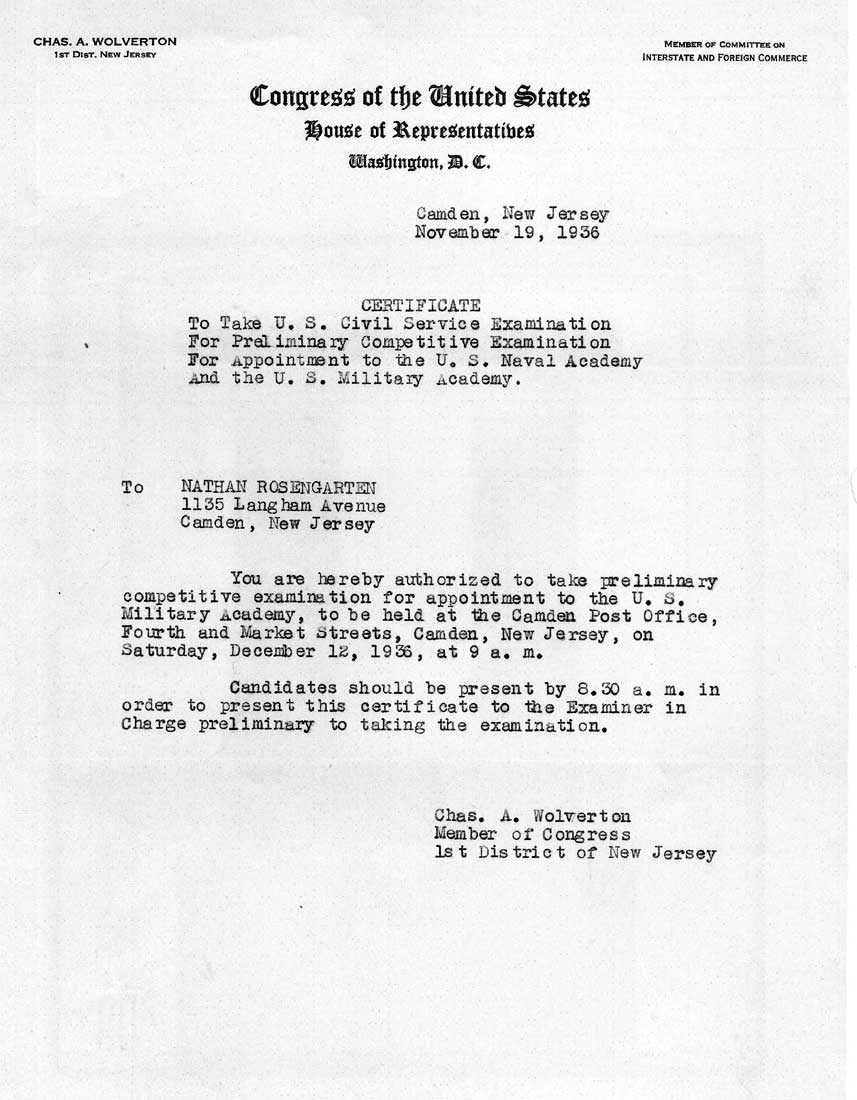
CHAS. A. WOLVERTON
1st Dist. New Jersey
Member of Committee on Interstate and Foreign Commerce
Congress of the United States
House of Representatives
Washington, D.C.
Camden, New Jersey
November 19, 1936
CERTIFICATE
To Take U.S. Civil Service Examination
For Preliminary Competitive Examination
For Appointment to the U.S. Naval Academy
And the U.S. Military Academy.
To NATHAN ROSENGARTEN
1135 Langham Avenue
Camden, New Jersey
You are hereby authorized to take preliminary competitive examination for appointment to the U.S. Military Academy, to be held at the Camden Post Office, Fourth and Market Streets, Camden, New Jersey, on Saturday, December 12, 1936, at 9 a.m.
Candidates should be present by 8.30 a.m. in order to present this certificate to the Examiner in Charge preliminary to taking the examination.
Chas. A. Wolverton
Member of Congress
1st District of New Jersey
Happenings in Washington
Camden Courier-Post —
By CHARLES A. WOLVERTON
CONGRESSIONAL ATTITUDE CHANGES
The convening of Congress in regular session on Monday last, presented a far different condition than when it convened in regular session one year ago.
On that occasion there was an air of positiveness and assurance. The tremendous Democratic victory in the preceding election, that had given an unprecedented majority to the President, and, an overwhelming Democratic majority in both Senate and House, naturally created a sense of dominating power and influence. There was not a doubt in the mind of any one that the President would be able to write into law whatever policies he might advise. There was every indication of clear sailing ahead for the Administration.
When the present session convened, however, there was a change so fundamental in character that it was almost unbelievable. The positiveness and assurance that had been so apparent one year ago had disappeared completely. Doubt and uncertainty had taken their places. There was a feeling that Democratic leaders could no longer issue commands with the expectation that they would be carried out.
SITUATION REMARKABLE
This situation is all the more remarkable when it is realized that this change of attitude has come without any change in the personnel that composes the membership of the Senate and House. The Democratic majority in both bodies is as great as one year ago, but, the Administration can no longer wield nor control it. The legislative branch has gotten entirely out of hand.
This change of attitude presents one of the most unusual happenings in the political history of any party during our existence as a nation.
Numerous reasons may be advanced to explain it, but the fact remains that it first became apparent when the President’s proposal to change the Supreme Court was first presented to Congress. Immediately a spirit of independence became evident and it became more pronounced as that long and bitter fight was waged. The disruption in party discipline that resulted did not end when that issue was settled. It has continued and found expression in every piece of major legislation that has since been presented by the Administration.
It is in this spirit of “revolt” or “independence,” within the ranks of the President’s own party, that Congress enters upon the work of this present session.
PROBLEMS
The problems to be solved are numerous, varied and important. In domestic affairs they are economic and social in character. In foreign affairs they relate to our neutrality policy and questions of trade. Many are intricate and involved. Their solution will directly affect the future welfare of the nation. They are so fundamental in character that they will demand careful consideration and a high order of patriotism.
LUDLOW WAR REFERENDUM
The first important question to come before Congress for decision, aside from farm and housing legislation passed but not completed at the special session, will in all probability be the so-called Ludlow war referendum resolution. This resolution provides that in no case, other than invasion of our own country, shall war be declared until the question of going to war shall first be submitted to the people in a nation-wide referendum and their favorable opinion rendered.
The question will come before the House on a motion to discharge the Rules Committee from further consideration of the resolution. This motion, as in the case of the wage and hour bill during the special session, is made possible by reason of the fact that 218 members, a majority of the whole House, have signed a petition that such a vote be taken. Under the rules of the House the Speaker must submit the question to a vote of the House.
Notwithstanding the fact that a majority of the House has signed the petition, there is considerable doubt whether a majority will vote in favor of discharging the committee from further consideration. This due to the fact that nearly a year has elapsed since some of the members signed the petition and many are of the opinion that the strained international situation that now exists makes it inadvisable to act upon it at this time. It is for this reason, and, the more fundamental reason, that the President should not be handicapped in handling our foreign affairs, that the administration will exert all the power and influence at its command to defeat the motion.
Whatever may be the individual opinion concerning the issue involved it is unfortunate that the world conditions, under which it is to be considered, are not more normal.
BUSINESS PROBLEMS
The “recession” in business that has been apparent for several months, with its consequent increasing unemployment, has created a condition that cannot longer be ignored. The problems growing out of it should have had consideration during the special session. They should now have precedence over everything else. To remedy them requires instant attention. To delay doing so will make increasingly difficult their solution. Confidence must be restored or there will be no recovery. The administration has the opportunity by quick and decisive action in proposing appropriate legislation to stem the tide of “recession.” To play “politics” in this emergency is to make disaster possible.
V.F.W. Post Auxiliary Stages Party for 16th Anniversary
Camden Courier-Post —
V.F.W. POST AUXILIARY STAGES PARTY FOR 16TH ANNIVERSARY — Parents of Three World War Heroes Honored by Women of Mathews-Purnell Unit; Mrs. Kobus Lauds Civic Work of Organization
Sixteen years ago the Ladies Auxiliary of the Mathews-Purnell Post, Veterans of Foreign Wars, was instituted. Last night the “coming out party,” as the occasion was described by Mrs. Mary W. Kobus, Director of Public Safety, was celebrated by the women and the soldiery of the post.
The affair had a dual importance, as it was not only the birthday of the auxiliary, with guests from the various parts of the State in attendance, but three gold star mothers were guests of honor.
The parents are Mr. and Mrs. Charles Mathews and Mr. and Mrs. Oliver Purnell, while the fifth member of the group, the third mother who gave up her son, is Mrs. Louise Atger.
Washington in Review
Camden Courier-Post —
Washington in Review
By C.A. Wolverton
During the past week the subject of National Defense has taken a place of importance that is shared only with the business problem known as the “recession.”
The Navy appropriation bill that carried substantial sums for replacing obsolete ships of war, as well as providing some new ones, and also for the construction of new naval air bases at Guam and other strategic points, has now passed both houses of Congress and is ready for the president’s signature.
The question of whether our Navy should be increased in size and efficiency raises the further question—If we do so, will it provoke or deter war?
Personally, I believe that a strong Navy is the best assurance of peace. The history of this country is replete with examples of how a strong Navy has been the means of averting war and preventing this country from being drawn into foreign conflicts.
Wolverton Assails Farm Bill
Camden Courier-Post —
WOLVERTON ASSAILS FARM BILL Eastern Area Neglected in Its Provisions, He Says in Washington
Washington Feb. 8.—Farmers in the eastern section of the United States are “the forgotten men” when Congress legislates in the field of agriculture, Congressman Charles A. Wolverton declared today.
“There seems to be an impression in the minds of those who draft our bills for farm relief that farming exists only in the south, midwest and west,” Wolverton said. “The eastern farmer is just as much in need of assistance as farmers elsewhere.”
That condition, he explained, was responsible for the fact that New Jersey agriculture, through its organizations and by individual efforts, has been asking Congress for consideration of their problems.
Happenings in Washington
Camden Courier-Post —
Happenings in Washington
By Charles A. Wolverton
The fog of uncertainty that obscures the Administration’s policy for rehabilitation of distressed business is no less in its density now than it was several weeks ago.
In this time of international turmoil and uncertainty with one-fourth of the world’s population engaged in war, it is natural that Congress and the country should be concerned about the possibility of our being drawn into the conflicts abroad.
There is no more indication, today, of the policy to be pursued to meet and solve the conditions that have brought about the “recession.”
V.F.W. Plans Ball on Armistice Night
Camden Courier-Post —
Plans are being formulated for the fourth annual military ball by the Veterans of Foreign Wars to be held Armistice night, November 11, 1938.
In answer to the appeal of the American Red Cross for the relief of the civilians in war-torn China, a check was mailed to the Camden County chapter of the Red Cross by the post.
Camden Boy Named for Annapolis Quiz
Camden Courier-Post —
CAMDEN BOY NAMED FOR ANNAPOLIS QUIZ Walter Esworthy Awarded Chance to Enroll in Naval Academy
Walter W. Esworthy, Jr., of 1454 Haddon avenue, has been designated principal to take entrance examinations to fill a vacancy at the United States Naval Academy.
Esworthy, named by Congressman Charles A. Wolverton, will take the tests in March and if he passes will enter the academy in June.
Daly to Be Honored at Banquet Thursday
Camden Courier-Post —
DALY TO BE HONORED AT BANQUET THURSDAY
Congressman Charles A. Wolverton and Congressman Elmer H. Wene will be guests of honor at a testimonial dinner to be given next Thursday night for John Daly, freeholder.
The affair also will celebrate Daly’s seventy-sixth birthday. Clarence E. Moullette is chairman of the banquet committee.
Indian Guest Listed for Daly Banquet
Camden Courier-Post —
INDIAN GUEST LISTED FOR DALY BANQUET Montana Chieftain to Send Son as Envoy to Testimonial for Freeholder
Chief Rain-on-the-Rump, whose tepee is pitched in Medicine Hat, Montana, is expected to send his son as an envoy when John Daly, Freeholder, is honored at a dinner Thursday night at the Walt Whitman Hotel.
Clarence E. Moullette, chairman of the banquet committee, reported the list of guests will comprise a real Who’s Who in Camden. Included are Congressman Charles A. Wolverton, Mayor Frederick von Nieda, Sheriff Andrew J. McMahon, City Clerk Edwin T. Tomlinson, and others.
Happenings in Washington
Camden Courier-Post —
Happenings in Washington
CONGRESS CONTINUES TO DRIFT
By Charles A. Wolverton
There is no more indication, today, of the policy to be pursued to meet and solve the conditions that have brought about the “recession.” While it is true that in recent weeks many conferences have been held at the White House between the President and representatives of business, finance and industry, there is no indication that these conferences have resulted in the enunciation of any definite policy.
There has been intimation that the President is looking to Congress for leadership in the solution of the problem. If this be true, it would mark a reversal of the usual method of procedure, as it is more customary for the executive to formulate a program and ask Congress to enact it into law.
The demand to be informed in these particulars is not based upon partisanship. Democrats as well as Republicans in Congress are baffled by the administration’s policy of “secret diplomacy.”
Little Patronage Still G.O.P. Fights
Camden Courier-Post —
LITTLE PATRONAGE STILL G.O.P. FIGHTS
There isn’t a whole lot of patronage available for the Camden county Republicans these days, but they’re fighting like cats about what there is. Wednesday was Headache Day for the G.O.P. patronage committee.
Among those there at various times were David Baird, County Clerk Leslie H. Ewing, Mrs. Florence Baker, and Arthur H. Holl.
750 Attend Dinner to Honor John Daly
Camden Courier-Post —
750 ATTEND DINNER TO HONOR JOHN DALY F.R. Sends Best Wishes as Civic Leaders, Friends Laud Freeholder
Green were the shamrocks from his own native Athlone that filled the big silver loving cup, and the First Citizen of the United States—the President—sent his best wishes, not personally, but through a secretary. And the occasion was fitting enough to merit both the shamrocks and the presidential greetings.
Political Camden, Republican and Democrat alike, came out to make a fete for the veteran official John Daly. So great was the attendance of more than 750 that the main dining room of the Walt Whitman Hotel was taxed and a balcony above was pressed into service.
Congressman Charles A. Wolverton, Clarence Moullette, Andrew McMahon, and Bart A. Sheehan were among the speakers.
Wolverton Urges Trade Pacts Limit
Camden Courier-Post —
WOLVERTON URGES TRADE PACTS LIMIT Congressman Says U.S. Jobs Lost by Treaties With Foreign Nations
Restriction of reciprocal trade agreements with foreign countries to prevent competition with American made goods was urged by Congressman Charles A. Wolverton.
“The seriousness of the situation can be readily understood when it is remembered that the report of John D. Biggers, director of the National Emergency Council, shows that during the last four years unemployment has increased by 1,700,000 persons,” Wolverton said.
“During the last few years numerous agreements of this kind have been entered into that have seriously affected and proved highly detrimental to workers in this country.”
K. of C. to Decorate Washington Statue
Camden Courier-Post —
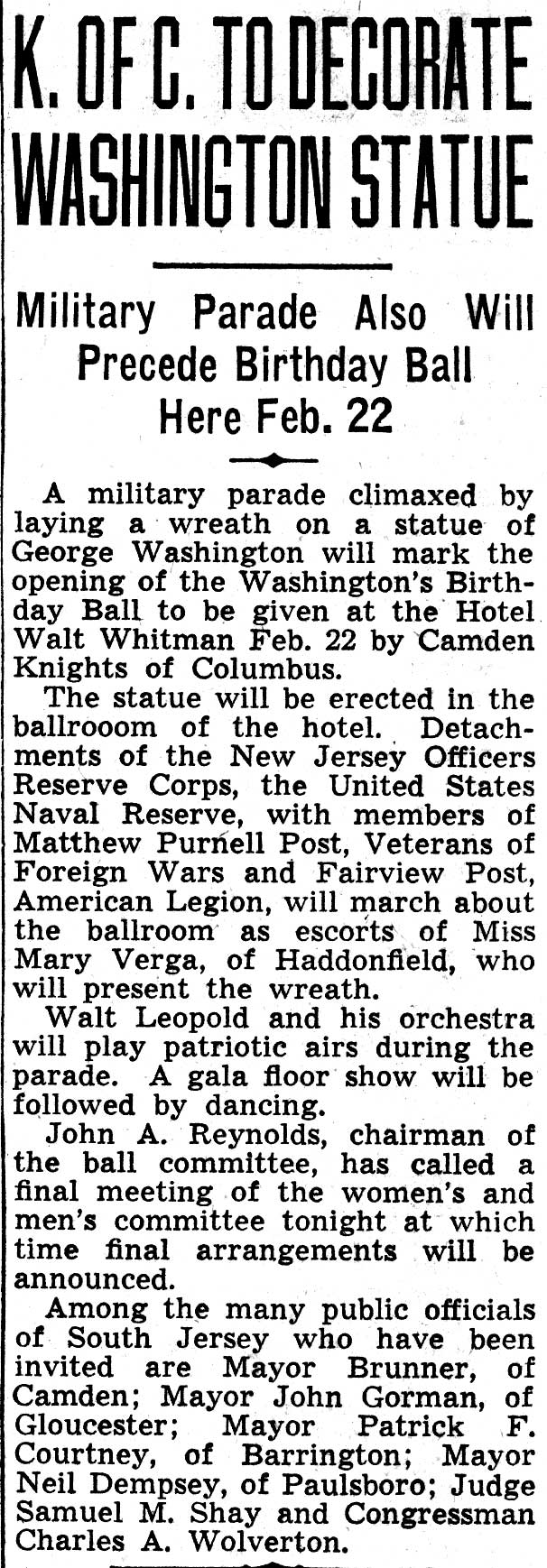
Military Parade Also Will Precede Birthday Ball Here Feb. 22
A military parade climaxed by laying a wreath on a statue of George Washington will mark the opening of the Washington’s Birthday Ball to be given at the Hotel Walt Whitman Feb. 22 by Camden Knights of Columbus.
The statue will be erected in the ballrooom [sic] of the hotel. Detachments of the New Jersey Officers Reserve Corps, the United States Naval Reserve, with members of Matthew Purnell Post, Veterans of Foreign Wars and Fairview Post, American Legion, will march about the ballroom as escorts of Miss Mary Verga, of Haddonfield, who will present the wreath.
Walt Leopold and his orchestra will play patriotic airs during the parade. A gala floor show will be followed by dancing.
John A. Reynolds, chairman of the ball committee, has called a final meeting of the women’s and men’s committee tonight at which time final arrangements will be announced.
Among the many public officials of South Jersey who have been invited are Mayor Brunner, of Camden; Mayor John Gorman, of Gloucester; Mayor Patrick F. Courtney, of Barrington; Mayor Neil Dempsey, of Paulsboro; Judge Samuel M. Shay and Congressman Charles A. Wolverton.
Allen Feted at Birthday Party; Joins G.O.P. Tribute to Forrest
Camden Courier-Post —
Assemblyman Sees Defeat for Moore-G.O.P. Plan to Provide Relief for N. J.
COUNTY SOLONS WIN PLAUDITS
Feted at Dinner
MILLARD E. ALLEN
WILFRED FORREST
Assemblyman Millard E. Allen appeared in a dual role last night which he admitted was much to his personal satisfaction. He had a birthday party at the Old Mill Inn and he appeared with Mayor Wilfred Forrest of Pine Hill, freeholder from the six-towns district, as a guest of the Republican clubs of their respective boroughs.
The guests of honor seem to feel the 400 present should be given an account of their stewardship, one at Trenton and the other at Camden. Allen made it clear he did not believe the Moore-G.O.P. work relief bill would pass, although he prophesied the legislators were in duty bound to inquire into any merits which might be claimed for the measure by its sponsors.
Forrest said he was a minority Republican, although elected as one of the majority in November, and that he intended to stand on the firing line, no matter who took potshots at him.
Letters of regret were read from Allen’s colleagues, who were busy in session at Trenton; Congressman Charles A. Wolverton, former Governor Harold G. Hoffman and others.
Forrest on ‘Firing Line’
Forrest as the first speaker said: “I am one of the minority party although I was elected as one of the majority members of the Board of Freeholders. I was elected as a Republican and I’m still a Republican. When a man enlists in service and is put on the sentry line, he challenges the foe and if the latter doesn’t halt he fires.
“The sentry may be shot in the encounter but he doesn’t hesitate. I’m a Republican, I have a sworn duty to perform to remain a Republican. I’m right on the firing line now, and no matter who fires at me, I will still be a Republican and remain a minority member.”
“I am absent from the Legislature tonight,” Allen said, “when we are slated to look into the Governor’s work relief bill. I don’t think the measure will ever mature, but we are in duty bound to look into any merits which anybody believes the bill may possess.
“This is the end of my first month in the Legislature and you can’t expect too much of me. I’m there only to serve in your interest, in the interest of the people of this end of the county which deserve their fair share of whatever benefits may be at hand.
“I want to tell you the delegation from Camden county has its feet on the ground and its eye on the ball and nobody up there is going to put anything over on the Camden delegation.
Pledged to Service
“I’ll serve you as long as you keep me there and the first consideration I shall have is to see the people of the lower county served in the manner they should be served.”
David Baird, Jr., urged a mass meeting of all “real Republicans” to get together and map plans for future action. He made reference to Camden county’s eggs which were said to have been produced at $1.65 a dozen and declared “as a farmer I would rather have my friends drink my liquor than my milk, because I know what my liquor costs me.”
“You know as I stand here,” continued Baird, “seeing real Republicans gathered from all over the county it doesn’t discourage me when I read the comment in the press of Camden.
“Why can’t we have all real Republicans of the county get together, at a big meeting or a dinner, or something of that sort to honor the Forrests and the Allens of the party, in the name of real Republicans?
“When I mean real Republicans I mean Republicans of the sort that I see here tonight. I can think of nothing worse that can be said about a good Republican than to be praised by the press of Camden.”
“How many of you people will come to a meeting for real Republicanism in this county?”
In response to this appeal the crowd rose and cheered.
Baird then touched on the election in November, with a remark that had his hearers rather visibly in wonderment. Whatever seemed to be in the speaker’s mind it apparently was not clear to the auditors.
“Remember we have an election next November,” he declared, “and we elect a congressman and sheriff. I think if the present sheriff can get enough county ads I doubt if Charlie Wolverton is going to be a candidate.”
Mrs. Baker Raps ‘Traitors’
Mrs. Florence Baker, state committeewoman, thundered against those Republicans she branded as “traitors” to the party. She praised the guests of honor for their party regularity.
“I think the man or woman who is elected as a Republican,” she continued, “and then sells them out are traitors. Any man or woman who sells you out is always a traitor and you never know when they’ll sell you out, and you never know when you can trust them.
“Don’t be discouraged, Wilfred Forrest, because when another year rolls around some people may not like the deals they made and you real Republicans will no longer be the minority party but the majority membership of the board of freeholders.”
Marshall Talks ‘Eggs’
Joseph Marshall, county committeeman from Magnolia, was toastmaster and gave a theme to the freeholders who talked later. This was the famous $1.65 eggs, which the hens and chickens at Lakeland are said to have laid during the date prior to January 1, 1938.
“I’m the man,” said Marshall, “who was supposed to sell those eggs to the county, but since the publicity I’ve been inclined to raise my price to $1.98 per dozen.
“I want to say one thing for the Courier-Post. When that stuff about the eggs first appeared, I was fit to tear the roof off the newspaper building. I went down to see them to tear something apart.
“But I must say they used me swell. When I told them the facts and the figures and asked for some space to present my shtatebent [sic], why they would have offered me the whole damn front page to state my side of the affair.”
James Wood, former director of freeholders; Louis Bantivoglio, member from the Fifth ward, of Camden; William Myers, of Voorhees township, and Lewis Orchard, of Berlin, all members of the board, also spoke.
All touched on the eggs and their alleged costliness before the New Year, Myers said Forrest was late for a caucus one night.
“Where were you?” I asked him when he appeared.
“Down to Lakeland for dinner” he told me, “where could you go and eat and get eggs at $1.65 a dozen?”
Von Nieda Lauds Baird
Commissioner Frederick von Nieda of Camden paid a tribute to “our Republican leader, Mr. Baird and said the moment would surely come when real Republicans would have charge of the party again.”
“Perhaps the mists will roll away in another year,” he declared, “and when that time sure ly [sic] comes we want men like Allen and Forrest, men we can trust, to bring about better times for the Republican party.”
Mrs. Mary F. Smith, chairman of the committee which arranged the affair, then presented Forrest with a brief case, while Mrs. Fred Bilson did likewise in giving Allen a traveling bag.
The sponsor of the affair was the Pine Hill Republican Club and the Laurel Springs Women’s Republican Club.
Improvement of Johnson Cemetery Urged
Camden Courier-Post —
Improvement of Johnson Cemetery at Thirty-eighth and Federal streets was urged by Freeholder Edward J. Quinlan and City Commissioner Frank J. Hartmann Jr.
Quinlan said the Negro cemetery is in a rundown condition and that 80 percent of the bodies buried there are those of Civil War Veterans. “I was asked by the American Legion to aid in remedying the appearance of the cemetery,” Hartmann said, “and we are working on a plan.”
Happenings in Washington
Camden Courier-Post —
Happenings in Washington
By Charles A. Wolverton
The President continues to refuse to be “smoked out” on what constitutes our foreign policy. This fact, together with the refusal of the administration’s leaders to make clear what the specific administration policy is in dealing with the present economic situation, makes the legislative calendar in Washington one of extreme uncertainty.
The demand to be informed in these particulars is not based upon partisanship. Democrats as well as Republicans in Congress are baffled and concerned about the mystery.
The whole situation in this country and abroad would be greatly relieved if the President would make a full and complete statement of his foreign policy and his economic policy.
Crippled Children to Attend Outing
Camden Courier-Post —
CRIPPLED CHILDREN TO ATTEND OUTING
More than 100 crippled children from this vicinity will be entertained at the seventh annual Sgt. Ray Smith’s crippled children’s party. The party, an annual affair, is staged by the Elks’ crippled children’s committee and the Sgt. Ray’s birthday party committee.
The youngsters will meet at the Elks Home, 808 Market street, and will be taken to Clementon Park in buses. After the children’s party, a dinner will be served in honor of Sgt. Ray Smith, on his 46th birthday.
Congressman Wolverton is among the invited guests.
Happenings in Washington – Separate Air Force
Camden Courier-Post —
Separate Air Force
By Charles A. Wolverton
Introduction by Senator McCarran of a bill to create an independent air force co-ordinate with the Army and Navy as arms of defense has renewed discussion of a hotly contested question in military circles.
Proponents of a separate air arm reinforce long-standing arguments, based on the Mitchell school of thought, with what they earnestly contend is the overwhelming proof furnished by the European war that air power is the decisive factor in modern war.
Indications are that the administration will oppose any drastic statutory change in the present Air Corps setup on the ground that such action would interfere with the existing unity of command under the joint chiefs of staff.
Henry Magin Laid to Rest By War Veteran Buddies
Camden Courier-Post —
HENRY MAGIN LAID TO REST BY WAR VETERAN BUDDIES — Trucks of Flowers in Funeral Cortege
Funeral services for City Commissioner Henry Magin were held today with his colleagues in official and veterans circles participating.
Services were conducted in city commission chambers on the second floor of city hall, in charge of Rev. Dr. W.W. Ridgeway, rector of Grace Episcopal Church. The casket was carried by war veteran associates of the public works director, who died from a heart attack Friday.
A guard of honor lined both sides of city hall steps, 22 policemen on one side and 22 firemen on the other, representing Magin’s dual role as director of public works and former fire director.
Among those present at the services were Congressman Charles A. Wolverton, Mrs. Mary W. Kobus, David Rhone, Charles Worthington, and C. Richard Allen.
Polish American Community Hall Opens Tonight
Camden Courier-Post —
A banquet tonight will mark the official opening of the new $130,000 community hall of the Polish American Citizens club, Warsaw and Lowell streets.
Congressman Wolverton, Mayor Brunner and the Rt. Rev. Arthur B. Strenski, pastor of St. Joseph’s R. C. Church, will be principal speakers. Stanley J. Jaskolski, president of the club, will present a check for $500 to Monsignor Strenski toward the fund being raised for erection of St. Joseph’s new high school.
The club voted to contribute $1000 toward the new school and the second payment will be made at a ball on May 13 according to Jaskolski. During the past year the club raised $101,000 toward the erection of the community hall and its members pledged $29,000 toward equipping it.
Plans for the erection of the building were launched by Jaskolski four years ago. He and more than 40 other members, who served on the campaign committee, which raised the needed money, have been honored with life memberships. A group of photographs of the group will be unveiled in the banquet room tonight.
Other speakers at tonight’s banquet include City Commissioners Rhone, Aaron, Gotshalk and Abbott, Postmaster Edward Praiss and S. Morawski, editor of the Nowy Swiant, the Polish Morning World, N. Y.
Joseph A. Dynakowski, treasurer of the club, will be toastmaster at the dinner which begins at 8.30 p.m. Watson Burdalski is chairman of the entertainment committee and Stephen Blelicki heads the banquet committee. Members of the Polish American Women’s Citizens club, of which Mrs. Jules B. Derowski is president, will be guests.
The club was formed in 1914 by seven citizens interested in aiding Polish emigrants to become American citizens. Josef Zbieratski, first president, will be among the honored guests tonight.
Classes in naturalization were established by Daniel Hoyt, of the Camden YMCA, and Edward L. Canning county president of the Patriotic Order Sons of America. Classes in this work have been continued by the club since then with all tuition free. The club met at 1559-Mt. Ephraim avenue for years before the new building was completed in December.
Camden’s Own ‘Miss Chips’
Camden Courier-Post —
Mentor to City’s ‘First Names’ Thrills at Recounting Work
Former Pupils to Join in Fete for Lucy Dean Wilson
Lucy Dean Wilson says that if she had stayed in Camden High school any longer than her 37 years, she would have earned the right to be called “Miss Chips.” And it’s a sure thing that the thousands of pupils she taught during that span of time would heartily corroborate her opinion. Several hundreds of them are going to pay tribute to the veteran teacher—now retired—with a testimonial dinner at the Walt Whitman hotel on April 22. And the chief speakers will be two of her most distinguished pupils—State Supreme Court Justice Albert E. Burling and Congressman Wolverton.
“As I walk along Camden streets and see the dozens and dozens of names of people that I taught, it never fails to give me a thrill,” said the blue-eyed 75-year-old “Miss Chips.” “It seems as though I taught all the doctors and lawyers in town.”
Started Teaching in ‘96
Miss Wilson started teaching music and dramatics at the school in September, 1896. It then was located in the old “Post-Telegram” building on Federal street, between Front and Second streets. “How well I remember the little wooden ferry house and the greasy approach to Federal street,” said Miss Wilson, interviewed in her home at 408 Fourth avenue, Haddon Heights. “In those days, the school rooms were heated by big stoves,” she said. “And we could hear the presses rolling when the newspaper went into an edition.”
Horatio Draper was principal then, she said, adding that from the very beginning she taught the music public-speaking and dramatic classes. Logically enough, it was in the latter that Miss Wilson found the greatest drama—usually unintentional, of course.
Recalls Near-Tragedy
It was in 1936 that she experienced a near-tragedy while rehearsing a Christmas pantomime, which required not only a Santa Claus, enacted by a pupil named Ambrose Evens, but also a number of younger children taking roles as gnomes and fairies. “Late one afternoon, we were practising,” said Miss Wilson. “Suddenly, I heard the voice of some of the little boys calling. But to save my life, I couldn’t see where they were.” At that, young Evens told Miss Wilson he knew where the voices were coming from. It turned out that there was a considerable space between the ceiling and the roof, and Ambrose climbed up there to find out what the boys were doing.
Rafter Hopping
Actually, they were hopping from rafter to rafter, with nothing between them and the floor but a thin layer of plaster and lathe. As Miss Wilson stood holding her breath, she saw the Evens boy fall through, his legs kicking wildly. “Somehow, he had the presence of mind to throw his arms around the rafter,” said the teacher. “And then, by a terrific effort, he managed to pull himself up over the beam.” But for months after that, Miss Wilson sighed, every time she glanced up at the ceiling, she saw those helpless, kicking legs.
A happier incident occurred during the performance of a play called “The Elixir of Life,” which involved a scene showing the transition of a grandmother into an infant. That feat was arranged by having several actresses—starting with the grandmother—enter the stage, take a swig of the “elixir” and then return unmistakably 20 years younger.
My Grandmother
The climax, of course, was the appearance of a baby, enacted by Dorothea Pratt, herself a teacher now. Young Miss Pratt was carried onto the stage by her uncle, the late Thomas Pratt, who held her out to the audience, shouting: “This is my grandmother!”
“I think I was born to be a teacher, and I loved it,” said Miss Wilson. But much as she loved her profession, she says she enjoys her retirement more. “I always liked an extended vacation, and the more extended it was, the better I liked it,” she chuckled. “Retirement is my idea of the way a vacation ought to be extended.”
Miss Wilson was born and reared in Philadelphia, and for many years she daily crossed to Camden on the ferry. In 1928, she otok [sic] an apartment adjacent to the school, and has been living in New Jersey ever since. “I knew I was a Jerseyite at heart,” she said. “I love New Jersey.” Miss Wilson retired in 1933.
‘Larry’ Doran Given Tribute at Dinner On Retirement as Head of Co. Sleuths
Camden Courier-Post —
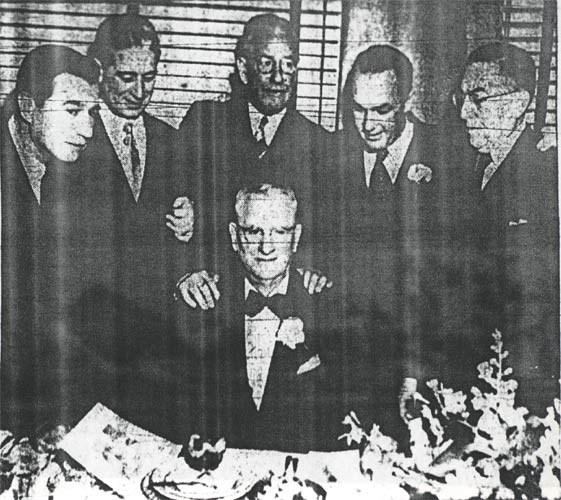
Good Fellows Get Together:
A cop’s life is filled with headaches and heartaches, and after time has taken its toll, a quiet life as a pensioner with some fishing and reminiscing with the few cronies who remember when—
But there was no quiet retirement and seclusion for Larry Doran. And after Thursday night’s farewell, there will be plenty to remember.
For Thursday was quite a night. Senator, congressman, judge, prosecutor, assistant prosecutor, lawyer, doctor and plain everyday layman gathered to pay homage to a grand cop.
“When a feller takes office and he is praised by such a gathering as this, he cannot help but wonder how many of those present are looking for something for themselves,” Larry Doran grinned hugely. “But when you are retiring and there is no favor left to bestow, but you are still honored by such a gathering as this, then you know you are among friends.”
Retires as Chief
Well, Larry Doran was among friends Thursday night. Several hundred of them. The place was Kenny’s, the affair a dinner, the occasion Doran’s retirement as county detective chief.
It wasn’t a testimonial dinner in that sense. The speakers were to tell the truth about Larry, and Larry was to tell the truth about the speakers. He won on both counts.
More than 40 years ago, Doran was a Camden cop. Then he was a game warden.
In 1910, he went into the prosecutor’s office as a county detective. Congressman Charles A. Wolverton, then a prosecutor, greeted him with “H’ya Irish.” That, and more, was recalled by the congressman at Thursday night’s dinner.
Lauded as ‘Institution’
Fifteen years later, he was named chief by Ethan Wescott, then prosecutor. That, and more, was recalled by Wescott at the dinner. Others, too. Former Prosecutors Samuel P. Orlando and Gene R. Mariano, and present Prosecutor Mitchell Cohen, Supreme Court Justice Albert E. Burling, speaking as a former prosecutor’s attache, and County Judge Rocco Palese, speaking in behalf of all assistant prosecutors—and they were legion—spoke of his unflagging devotion to duty, his perseverance and his loyalty. U. S. District Judge Thomas M. Madden, Superior Court Judge Frank T. Lloyd Jr., whose father knew Doran well while a Supereme [sic] Court Justice; Superior Court Judge Ralph W. E. Donges, and County Judge Bart A. Sheehan, the principal speaker, all lauded Doran not only as a law enforcement officer but also as an institution in the community.
There were many fellow police officers on hand, too. They included Assistant Superintendent of Philadelphia Police George Richardson, who presented Doran with a season pass for the Athletics on behalf of Connnie [sic] Mack; Capt. Thomas Cunningham and Lt. William Kelly of the state police. Chiefs John Parker of Audubon; Thomas Thorpe, of Pennsauken; William Beck of Collingswood; William Snyder of Haddon township; William Padgett of Haddonfield; County Detective Chief George Small of Gloucester; County Detective Captain Clinton Zeller of Burlington, and detectives from Mercer and Atlantic counties.
Receives $500 Bond
Many other public figures were there, including State Sen. Bruce Wallace, Assemblyman George Neutze, County District Judge Edward Martino, City Police Judge John DiMona, city and county officials, and the entire personnel of the prosecutor’s office.
The dinner committee was headed by Anthony Mitchell and [text missing between crops] presentation of a $500 savings bond to Doran, but the highlight of the evening was Doran’s impromptu remarks of appreciation. He spoke with the humility of a man overwhelmed by the eulogies he had heard applied to himself, reminisced humorously, and capped the best address of the evening by resting his case with the summation:
“A cop’s life is filled with headaches. And sometimes he causes heartache. I have enforced the law as I saw it without favor. I did the best I could. And I have no apologies.”
2 Scholarships Honor Miss Wilson
Camden Courier-Post —


At Testimonial by 600 Ex-Pupils
FORMER PUPILS paid heartfelt tribute to their ex-teacher, Miss Lucy Dean Wilson at a dinner, in the Walt Whitman hotel, Saturday night. The retired Camden High school teacher is shown with four eminent ex-students. From left, Congressman Wolverton, Supreme Court Justice Burling, Mrs. Dora Y. Rose, general chairman of the dinner committee; Miss Wilson, and former Assemblyman Frank M. Travaline Jr., who acted as toastmaster. More than 600 of Miss Wilson’s former students attended the dinner which was sponsored by the Camden High School Alumni Association.
Miss Lucy Dean Wilson found out Saturday night just how much her former students think of her.
More than 600 of them turned out to pay her honor at a testimonial dinner in the Hotel Walt Whitman and among them were many persons who have achieved eminence not only in Camden but nationally.
They established two scholarships which will bear her name. They presented her with $500 in U. S. savings bonds, and they gave her a radio-phonograph. In addition she received numerous floral tributes, and scores of telegrams from well-wishers.
The retired Camden High school teacher was escorted to her seat by a guard of honor comprising former pupils representing Miss Wilson’s years of service, from 1896 to 1933 when she left the school. And as she walked through the banquet room, the entire gathering sang “Let Me Call You Sweetheart.”
The principal speakers at the dinner sponsored by the Camden High School Alumni Association were two former students of Miss Wilson. They are Supreme Court Justice Albert A. Burling and Congressman Wolverton, with another ex-student, former Assemblyman Frank M. Travaline Jr., acting as toastmaster.
It was after his speech that Wolverton made the announcement of the two scholarships.
The first, provided by Charles M. Taylor, member of the endowment board of the Alumni Association, establishes funds for a scholarship at Cornell university to be awarded to the boy or girl graduate of the school who is adjudged most worthy to receive it. Funds for the first recipient will be available in 1951.
Second Scholarship
The second scholarship is a $10,000 gift provided by Mr. and Mrs. Robert Ostermayer, details of which are to be worked out by Miss Wilson herself.
In his speech Wolverton said [...] pre-eminent in the world because we have the highest type of national character, and declared that this position can only be maintained as long as we keep our standards of citizenship.
It is the teacher, he said, who inoculates principles that build character, ideals and influences the accomplishment of worthwhile things.
Making Americanism his keynote, Burling said that Miss Wilson’s life was dedicated to building character, and character is the basis of permanence in our government.
In her address, Miss Wilson paid tribute to Dr. James E. Bryan, former superintendent of city schools, who pronounced the invocation, and to the late Miss Clara S. Burrough, former principal.
Following Miss Wilson’s speech, Mrs. Rowland Ricketts presented the teacher with the $500 in bonds, contributed by alumni.
The record player was presented by Travaline on behalf of Delta Kappa fraternity, of which John Carson, class of 1925, is president.
Musical Program
Music was provided by three members of the nationally famous Philadelphia Piano Orchestra. In addition, there was a violin solo by Wallace M. Berul, a former music student of Miss Wilson, now a member of the Baltimore Symphony Orchestra. There also was “barber shop harmony,” with Mildred A. Burdge as accompanist.
The tribute was climaxed by the singing of a medley in Miss Wilson’s honor to the tune of “The Purple and the Gold,” the school’s song.
At the end of the affair, Miss Wilson, personally greeted all those attending, in the junior ballroom.
Miss Dora Y. Rose, was general chairman of the dinner, assisted by a committee of more than 100 persons.
518 to Mark 30th Birthday Saturday
Camden Courier-Post —
518 TO MARK 30TH BIRTHDAY SATURDAY
Corporal Mathews-Purnell Post No. 518 will celebrate its 30th anniversary at a dinner with the Ladies Auxiliary in the parish hall of St. Anthony of Padua Church.
Eleven Gold Star Mothers will be honored guests of Commander Irving J. Stiefel. Other invited guests are Congressman Wolverton, Mrs. Alice Trimble, department senior vice president, Ladies Auxiliary, and others.
Marking Two Anniversaries
Camden Courier-Post —
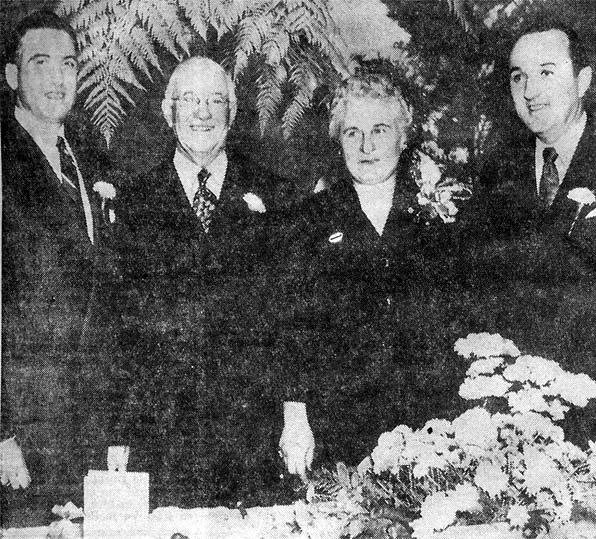
Cpl. Mathews-Purnell Post, VFW, and its auxiliary, were felicitated Saturday by Herbert L. Stoolman, Congressman Charles A. Wolverton, Mrs. Victoria Nicktern and Irving L. Stiefel.
Congress Responsibility at New Peak, Wolverton Tells VFW Birthday Group
Camden Courier-Post —
“At no time has the responsibility of Congress and the responsibility of the citizen been greater than at present,” Congressman Charles A. Wolverton told an audience Saturday night celebrating the anniversaries of Corporal Mathews-Purnell Post No. 518, VFW, and its auxiliary.
The congressman was principal speaker at a banquet in St. Anthony of Padua parish hall marking the 30th anniversary of the VFW post and the 29th anniversary of its auxiliary.
Wolverton praised the leaders of the post and commended its record in community activities. He also paid tribute to the Gold Star mothers who were present as honor guests.
Sketches Own Career
He then sketched his own career in Congress in order to show the great changes which the country has undergone in recent times.
“When I went to Congress,” he said, “we were in an era of prosperity and then came the depression followed by World War II and the Korean situation. At no other time have I had such an overpowering sense of my responsibilities as a member of Congress as I now have.
“Our citizens should also be aware of the enormity of their responsibility.”
Wolverton Sees Rohrer Making Great Senator
Camden Courier-Post —
Congressman Charles A. Wolverton today said “that the soundness and common sense approach of William G. Rohrer to public problems, his ability and his integrity fully qualify him to represent New Jersey in the United States Senate.”
“On returning to Camden County after a one-month tour of the capitals of Europe, including Moscow, I am deeply gratified to find our people are enthusiastic about William Rohrer for Senator.”
“What makes this enthusiasm so significant is that it is shared by both Democrats and independent voters along with Republicans. Democracy demands that each community should have representation in Washington of high character and genuine ability.”
Harleigh Cemetery
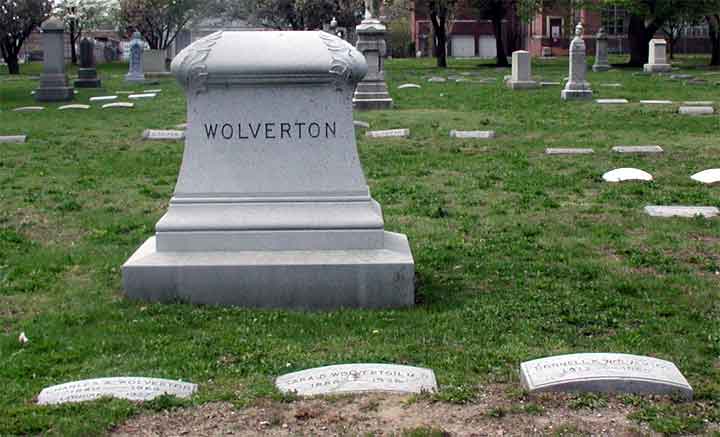
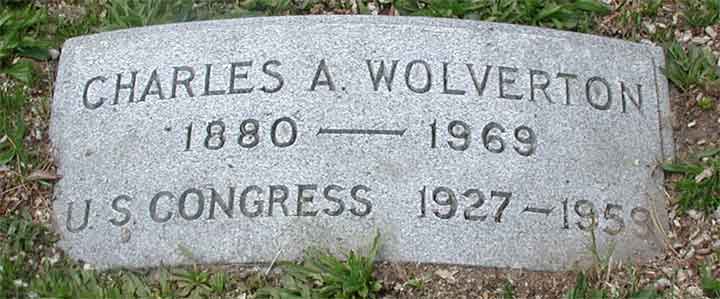

Harleigh Cemetery, Camden – Charles A. Wolverton is buried here alongside his wife Sara Wolverton
Memorial Park and Plaque Dedicated
Camden Courier-Post —
MEMORIAL PARK and plaque is dedicated at the Defense Personnel factory in Philadelphia to the late First District Congressman Charles A. Wolverton.
Camden Men Deny Plan to Gobble Small Towns
Philadelphia Inquirer —
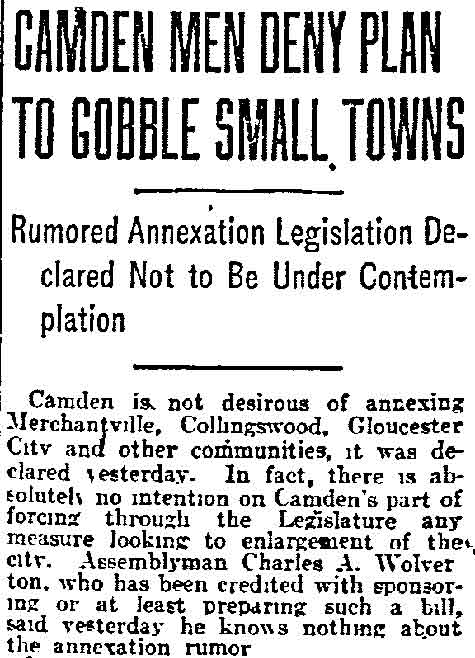
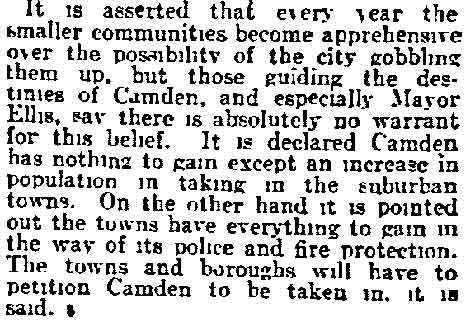
Rumored Annexation Legislation Declared Not to Be Under Contemplation
Camden is not desirous of annexing Merchantville, Collingswood, Gloucester City and other communities, it was declared yesterday. In fact, there is absolutely no intention on Camden’s part of forcing through the Legislature any measure looking to enlargement of the city. Assemblyman Charles A. Wolverton, who has been credited with sponsoring or at least preparing such a bill, said yesterday he knows nothing about the annexation rumor
It is asserted that every year the smaller communities become apprehensive over the possibility of the city gobbling them up, but those guiding the destinies of Camden, and especially Mayor Ellis, say there is absolutely no warrant for this belief. It is declared Camden has nothing to gain except an increase in population in taking in the suburban towns. On the other hand it is pointed out the towns have everything to gain in the way of its police and fire protection. The towns and boroughs will have to petition Camden to be taken in, it is said.