Introduction
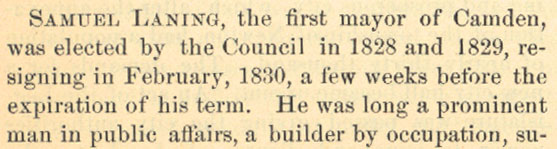
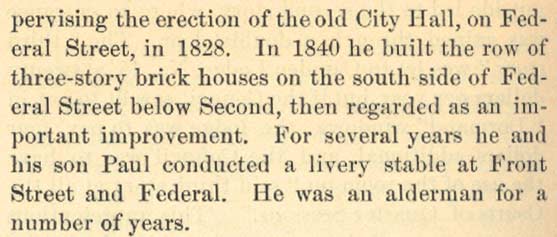
SAMUEL LANING (or Lanning) was the first Mayor of Camden, being chosen by fellow council members in 1828 and 1829. He resigned in February of 1830, shortly before his term expired.
Samuel Laning was a builder by trade and supervised the erection of Old City Hall on Federal Street in 1828. Also, he built a series of three-story brick row homes on the south side of Federal Street below Second Street. This area today is called Lanning Square and is zoned by the City as historical property. It is from this prominent developer that Lanning Square Elementary School, built in 1967, derived its name.
History of Camden County, 1886
The History of Camden County New Jersey — George Reeser Prowell, 1886
The History of Camden County New Jersey — George Reeser Prowell, 1886
On Keeping Chimneys Clean
Camden Courier-Post —
First Act of Camden City Council, Over Century Ago, Was to Cut Down Fire Hazard By Way of Ordinance for ‘Sweeps’
COMPARING Camden’s fire-fighting equipment of today with what the city had when it was incorporated, 103 years ago, the wonder is that some of the fires did not wipe out the tiny community. With their pumpers, chemicals and water mains, the average suburban town is protected like a metropolis when we consider the methods in vogue a century ago.
Fire ever has been man’s most implacable foe, and even yet it is merely a matter of degree — from barbarian ancestors and their rude thatched shacks, to modern skyscraper — as to the terror it inspires. Camden, in the late 20s of the last century, was merely a clutter of tiny dwellings, only the more prosperous citizenry such as the Coopers and Kaighns having brick domiciles graced with attics.
It was thus in keeping with the times to have thought first for safety from the fire demon when City Council held its first session, April 11, 1828. That was by way of an ordinance directed against those inclined to be careless and let their chimneys collect through the years, a great mass of soot. There were those who kept their chimneys clean as the proverbial whistle, first, so the fire would draw, and again to remove the fire hazard. But many apparently, took pot luck and let things go with little thought of what might happen until it did — oft-times in the dead of night with long tongues of flames wiping out their humble domicile.
Wood Exclusively Used
Electricity was little more than the mysterious force Ben Franklin had toyed with over the Delaware. Coal still was to be brought from its carboniferous beds in Pennsylvania. It had not even been proposed as “stones that would burn and give heat.” Oil came from whales and such and was used sparingly on new fangled mysteries called machinery. So the thick, clumps of trees here about were hewed down for heat in winter and to cook the meals. It was that constant use of wood that filled the chimneys with soot and soot evidently was most of the cause of fire.
When a fire started in Camden village it was a serious affair. If it wasn’t caught in the nick of time the house burned to the ground. So council passed its first ordinance to help the boys of old Perseverance in keeping down the fire record although in those days there were no records kept, of course. That first company, by the way, was on Second Street above Market, about where the National State Bank first built. The little frame shack was still there in the 70’s when the bank enlarged its building and tore it down, the company meanwhile having taken its quarters to Third Street.
But getting back to the ordinance of council, it required the thorough sweeping of every chimney at least once in three months. If a sweep tried the short cut to earning his money by burning out a chimney he was fined $1 because that method was declared to endanger surrounding property. The sweep was supposed to get into the chimney or at least sweep it in regulation fashion and not “cut corners,” as some persons have a habit of doing whether it’s sweeping chimneys or building a house.
That part of the ordinance is interesting for it provides “that if any person from or after the first day of May next, ensuing, shall burn his, her or their chimney, or suffer the same to burn or blaze out of the top thereof, unless the roof of the house thereof is covered with snow, or during the time of a storm of rain or snow, every such person shall forfeit and pay the sum of one dollar.” If a chimney should take fire the house owner was required to prove that it had been properly swept out within three months.
Further, it was provided if such a chimney burst into flame after it had been swept out the chimney sweep was to forfeit a dollar. That evidently was due to the determination of Laning, Cowperthwaite, Sloan and Lawrence, the city fathers, to make more and better chimney sweeps and to aid the Perseverance boys in staying the ravages of the flaming foe.
Outstanding Fireman
And if any of the boys of the present generation imagine they have the niftiest apparatus hereabouts; with all their compound engines, extension ladders and what not, they have nothing on Samuel D. Elfreth, who “ran” with old Perseverance so soon as he came to Camden, in 1824. Old annals relate, he was always on the spot when “she” was needed, meaning the hand engine, and was regarded as the outstanding fireman of Camden. In 1882 my grandfather wrote in the Courier that Elfreth, although verging on 80, was then still one of the most active volunteer firemen in Camden. He then resided within the shadow of his beloved old company and was filled with reminiscences of the days when he ran with the boys. His son, Samuel (S. Elfreth), then was chief of the paid fire department as he was in later years until his death some 15 years ago. Charles F. Elfreth, a veteran attache of the city’s finance department, is a grandson of the first Elfreth, a nephew of the late chief.
Those old ordinances relative to keeping chimneys clean seem amusing now, but they were vitally important then. They were, in fact, the very beginning of the present day system of keeping down fire losses by way of every possible method in alarms, in equipment, in man efficiency. It is from such humble beginnings that have evolved the methods in battling blazes in skyscrapers, in extensive plants, in keeping tabs on the very last thing in conquering the foe ever ready, and seemingly willing, to raze the works of man.
Camden, Now Eighty Years Old, Is Proud of Its Wonderful Growth
Philadelphia Inquirer —
City on Saint Valentine’s Day, Will Observe the Anniversary of Its Incorporation—Some Facts and Figures Concerning “Slow Town” Across the River
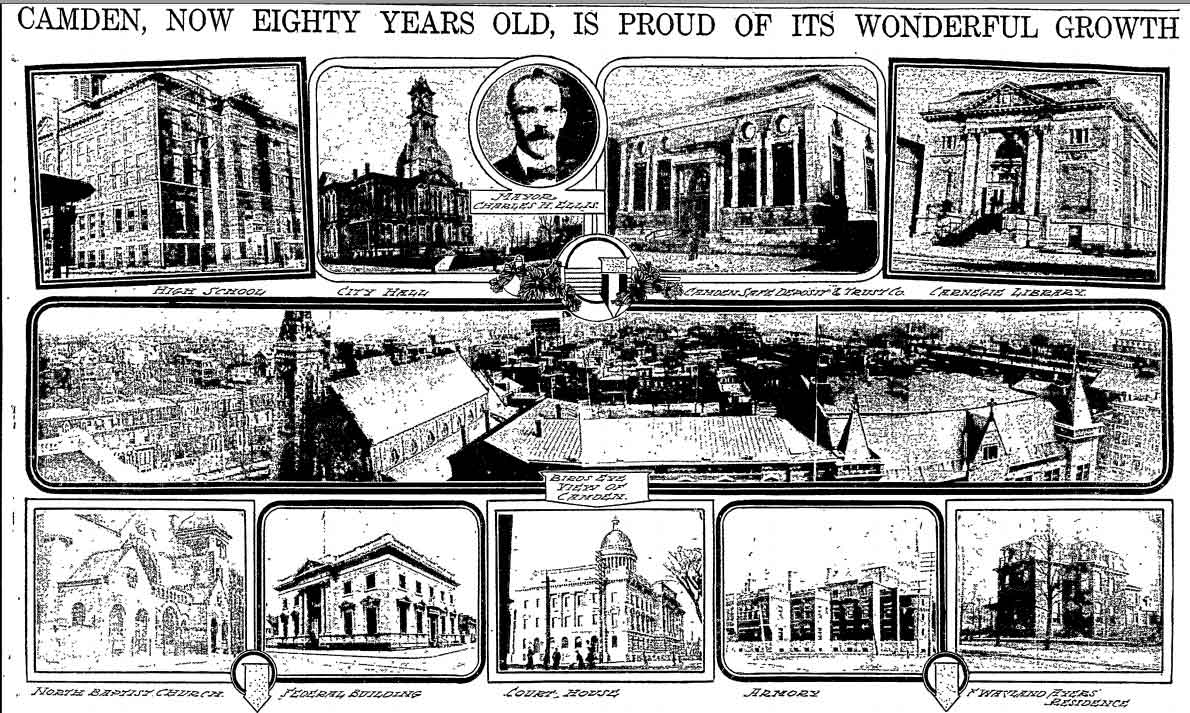
High School. City Hall. Mayor Charles H. Ellis. Camden Safe Deposit & Trust Co. Carnegie Library. Birds Eye View of Camden. North Baptist Church. Federal Building. Court House. Armory. N. Wayland Ayers’ Residence.
EIGHTY years will have passed on Friday, February 14, since Camden became an incorporated city, and just now the citizens are looking back over those years and recalling with a pardonable pride the epochs that have made it a community of homes, of splendid industries and of clean, progressive government. Luckily, Camden has comparatively few moss-bunkers and in consequence it has always been in the van of the modern spirit that means so much to American municipalities. With an energetic executive, with a rejuvenated Board of Trade composed of the representative business men of the city and containing residents who are anticipating an even greater Camden, the future bids well.
Although there was a settlement in what is now Camden late in the seventeenth century, it did not discard its swaddling clothes until long years after. It was in 1828 that the 1143 persons who made up the district bounded by the Delaware river and Sixth street and Cooper and Line street concluded that they should become an incorporated community. This was brought about principally as a result of the crowds that crossed the river from Philadelphia on Sundays and did pretty much as they pleased to the discomfort and anger of the townspeople. So a bill was prepared, and on February 14, of that year, the Legislature adopted it, thus making Camden the proud possessor of a charter. Samuel Laning was elected the first Mayor.
So Far, So Good
This was all very well, but Camdenites chafed over the fact of being a part of Gloucester county. There were those who thought they should have a county of their own, but Gloucester strenuously objected to having such a goodly portion sliced off for the benefit of the new city. Under the leadership of Captain John W. Mickle, however, the Camdenites carried the war into the Legislature and as a result Camden county was created. After this matters went along smoothly until 1848, when the question arose as to which community should be the county seat. Camden was opposed by Long-a-Coming, now Berlin. Matters waxed exceedingly warm, the ruralites aiding Long-a-Coming, the cities Camden.
Even yet old residents speak of the strenuous times in awesome whispers. Finally the question was decided at a special election and Camden lost. Possessed of that persistency that has made much for the success of the city, the residents did not give up by any means. They carried the fight to the Legislature and a new election was ordered. This time Camden was the victor. The farmers made all sorts of charges, but Camden remained the county seat and at present the wisdom of that selection is apparent.
Now for Town Hall
So soon as Camden became an incorporated city Mayor Laning and his counselors decided that there must be some municipal meeting place. At first the “Town Hall” was located on the second floor of Richard Fetter’s store at Third and Market streets. But in 1829 City Council voted to set aside $2500 to build a “City Hall, courthouse and jail.” This was located on Federal street, below Fifth, where stood the old market, burned down several years ago. Many exciting episodes occurred in this building, but it withstood the gibes of the residents until the early ‘70s. Then the “progressives” began agitating the question of having a new building, but it was not until 1875 that the present structure on Haddon avenue, then a corn field, was erected. And what a howl went up all over the city. “The idea of building a City Hall away out on the outskirts.”
True, it was fifteen minutes’ walk from the ferry and thirty minutes by the old Camden House Railroad Company. Well, the City Hall as it stands today, was built, and all around it and for blocks beyond are to be seen some of Camden’s most substantial residences. Now the question is being agitated for a more pretentious and modern building, the consummation of the plan not being such an idle dream as seems to be the impression.
Dark Days
Camden made steady increases in its population from the time of its incorporation until 1856. Up to that year there seemed to be every evidence that it would soon be a city of many thousands. Hundreds had moved across the river and come from distant lands to settle there, but a catastrophe occurred on March 15, 1856, which retarded its growth. While crossing the river the ferryboat New Jersey, crowded with passengers, caught fire. The river was full of ice and there was little opportunity of giving aid. In consequence sixty-one souls perished. Even yet that tragedy is often referred to by the older residents with horror.
This made many return to Philadelphia and caused others to fear going to Camden because of the fear of crossing the Delaware. Then came the panic of 1857 which also had a deterrent effect. But better times were coming for the little city and when more opportunity was given it by the revised charter of 1870, the population began increasing again. By 1880 there were over 40,000 men, women and children within the city’s confines. In two decades this had more than doubled and now there is close to 100,000 inhabitants. With increasing territory, it only being a matter of time when Merchantville, Collingswood, Woodlynne, Haddonfield, Gloucester City and other communities will be absorbed, Camden will very soon have many thousands added.
Spirit of Progress
As to the city’s government, there is everywhere in evidence a spirit of progress. Especially is this so with reference to the fire and police service. Concerning the former, Camden points with pride to the fact that last year the fire losses did not exceed $125,000. The present fire department is the outgrowth of the old volunteer organizations of nearly half a century ago. There were the Perseverance, the Niagara, the Weecacoe and other volunteer companies which did valiant service, but owing to the rivalry much valuable property was lost in sanguinary battles. In 1869 a paid fire department was created consisting of five commissioners, one fire marshal and two assistants. Thus was Camden among the first of New Jersey’s towns to have men paid to fight the flames. From that humble beginning grew the present force of nearly a hundred men under the direction of Chief Samuel Elfreth.
In the police department, under the direction of Chief Elisha A. Gravenor, there are 135 men, the outgrowth of a force of three men who protected forty years ago, the north, middle and south wards. Recently twenty-five men were added to the force, among them being several mounted men to look after the suburban sections of the city. These have already proved their value. As to crime there is little of it except of a petty nature and when the occasion arises the majesty of the law is upheld in such a manner as to give the impression that nowhere in the State is there a better exemplification of the declaration that “Jersey justice moves swiftly” than in Camden.
And Camden Water
Camden’s water is admittedly without a peer. It is drawn from artesian wells and every day over 15,000,000 gallons of it is sent through the mains. This comes from a $600,000 plant at Morris Station, which is always hailed as “Camden’s greatest asset.” Plans are under way now to augment this plant. The city’s first water plant was established after considerable controversy in 1854 at Pavonia. The Delaware River water was pumped through the mains for years. In consequence the harvest of death from typhoid fever was great. In the nineties the contagion manifested itself in such an alarming manner that the artesian plant was proposed. It was not put in operation until 1898, but the change in the water supply was at once apparent in the better health of the city. While a hundred new cases of typhoid fever within a month prior to that time was by no means unusual, subsequent to the installation of the new supply, less than half a dozen were reported within a like period. Last year there were but 38 cases of this disease and most of them were traced to other cities.
Camden has many miles of paved streets. All the principal thoroughfares are asphalted as a result of an agitation that began over a decade ago. Only lately the principal outlets of the city were ordered paved with that material—Federal street from Cooper Creek to Twenty-fifth street, Haddon avenue from Line street to Ferry avenue, and Broadway from Emerald street to Newton Creek.
The Public Schools
Then there are the schools, which are educating an army of nearly 12,000 children. Four additional modern school buildings were recently completed, making in all thirty-four, with a commodious high school. As has already been shown by The Inquirer in a previous article, Camden’s educational system is of the highest order, which has been demonstrated repeatedly by the pupils winning first prizes at contests in exhibitions of national prominence.
Camden is a city of churches. Within its confines there are close to a hundred churches and missions of all denominations. In consequence of this comparatively great church-going host, the city is peculiarly strict on Sabbatarian questions. This was evidenced a year or so ago when certain dealers sought to sell on Sunday as on other days of the week. In consequence the laws were enforced to such an extent that the Sundays, for several months, savored of the Simon Pure New England Sabbaths of Puritan days.
When Andrew Carnegie was ridding himself of his wealth some years ago, establishing libraries in many cities of the country, it was suggested that he be asked to contribute something for the benefit of the book-loving public of Camden. For months this matter hung fire, but Dr. Dowling Benjamin finally brought the subject to an issue by appealing to the Scotch ironmaster. As a result it was not long before $100,000 was sent to Camden with which to build a library with the proviso that the city expend $10,000 annually for its maintenance. This was agreed upon and a structure was erected at Broadway and Line streets that is not only pleasing to the eye because of architectural embellishments, but also on account of the thousands of volumes that are circulated to over 18,000 men, women and children.
City of Homes
Camden has approximately over 20,000 homes. These are of all kinds, from the more pretentious structures in which the wealthy reside to the humble but homelike dwellings in which the great bulk of the inhabitants live. And with the coming spring hundreds of additional dwellings will be erected in the outlying districts.
There is also a public park which is being slowly but surely developed, and if Mayor Charles H. Ellis has his way there will be several squares, a recreation pier or two and beautiful shade trees throughout the city. He proposes to have one day each year set aside to be known as the “Day of the City Beautiful” devoted to making Camden better from an artistic and orderly standpoint.
As to Camden’s business interests, they are legion. With a river front of several miles backed by the Cooper creek there is ample natural provision for industrial concerns of a varied character. A new era is heralded from the fact that the creek is to be deepened by the government so that craft of fairly deep draught may use it. Already a number of industrial manufacturing plants have signified their intention of locating along the banks of the stream and before many years there promises to be one complete chain of industries.
Just a Review
At the annual gathering of the Board of Trade last week the value of some of the city’s manufactories was expressed something in this wise: “Camden has within its border a population of nearly 100,000, and shipbuilding firms that can either supply a launch or the greatest battleship; the largest lace curtain manufactory in America; a talking machine that speaks every known language; iron works that make enough pipe to girdle the earth; leather manufactories that tan skins from all parts of the globe; the largest furniture house, whose products reach to the Philippines; banks and trust companies whose resources are not affected by panics; linoleum works, which manufacture one-half the country’s whole product; a plant whose kitchens annually make enough soup to float all the vessels built in our shipyards, a pickle works, which furnishes Uncle Sam with material for slot machines; a department store, whose experiment has proved a decided success; pen works, which produce two-thirds of the pens used in the world; an expanded metal works—the material produced there will stretch from Maine to Texas and its mills rival the largest.”
So, with the thousands of homes, its scores of industries, its charitable institutions and the manifold creations of a modern civilization, Camden is a city which is not slow, which is always in the van of progress and municipal improvement in all lines of endeavor.