Introduction
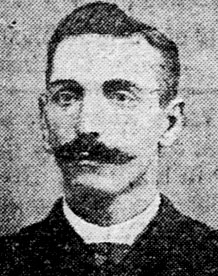
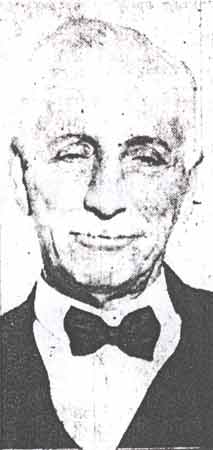
John Painter
JOHN PAINTER was born in December of 1856 to John and Lucy Painter. His father was a ship carpenter. The 1880 Census shows the family living at 824 South 2nd Street in Camden, New Jersey. John Painter was then working at a box factory. He remained at this address through early 1884. By 1885 he had moved to 329 Walnut Street, and had married.
John Painter was appointed to the Camden Police Department in 1884 and served for 48 years, retiring as a detective in 1932. When he was appointed he was one of only 40 patrolmen in the city.
John Painter married at the age of 28, around the same time that he was appointed to the police force. The Painters lived at 348 Cherry Street as early as 1887 through at least 1894.
By 1900 he had been promoted to detective. The Census shows him living with his wife Jennie, son John and daughter Catherine at 944 South 4th Street. Future Mayor Joseph Nowrey lived across the street at 939, and shoe merchant Henry Kobus was at 943 South 4th Street.
The 1910 Census shows the Painter family living at 941 South 4th Street.
By 1920 Jennie Painter had passed away. John Painter then lived at 1249 Princess Avenue in Camden’s Parkside neighborhood. He made this his home until his death in April of 1940 at the age of 86, after a brief illness. His daughter Catherine lived with him in the late 1920s and early 1930s.
Camden Daily Telegram
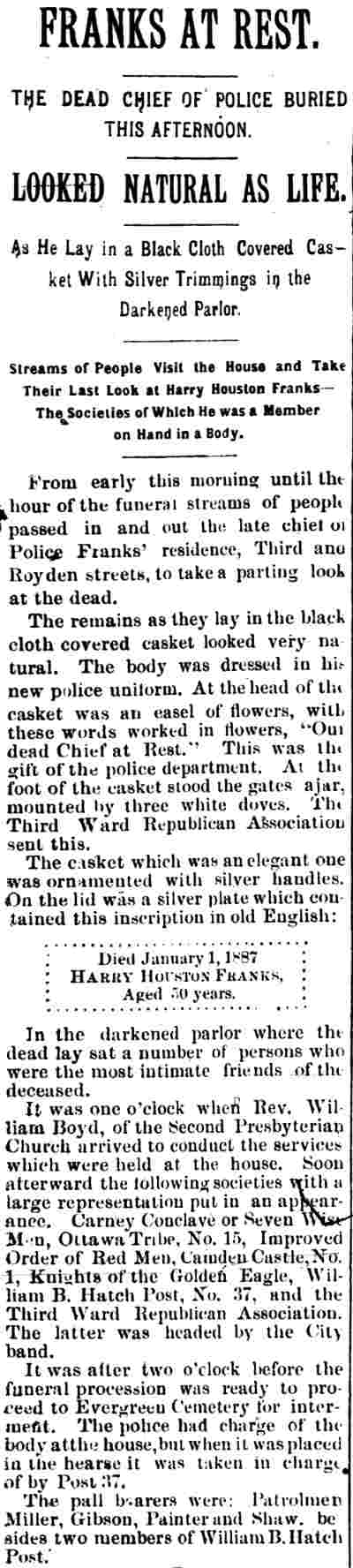
FRANKS AT REST.
THE DEAD CHIEF OF POLICE BURIED THIS AFTERNOON.
LOOKED NATURAL AS LIFE.
As He Lay in a Black Cloth Covered Casket With Silver Trimmings in the Darkened Parlor.
Streams of People Visit the House and Take Their Last Look at Harry Houston Franks—The Societies of Which He was a Member on Hand in a Body.
From early this morning until the hour of the funeral streams of people passed in and out the late chief of Police Franks’ residence, Third and Royden streets, to take a parting look at the dead.
The remains as they lay in the black cloth covered casket looked very natural. The body was dressed in his new police uniform. At the head of the casket was an easel of flowers, with these words worked in flowers, “Our dead Chief at Rest.” This was the gift of the police department. At the foot of the casket stood the gates ajar, mounted by three white doves. The Third Ward Republican Association sent this.
The casket which was an elegant one was ornamented with silver handles. On the lid was a silver plate which contained this inscription in old English:
Died January 1, 1887 Harry Houston Franks, Aged 50 years.
In the darkened parlor where the dead lay sat a number of persons who were the most intimate friends of the deceased.
It was one o’clock when Rev. William Boyd, of the Second Presbyterian Church arrived to conduct the services which were held at the house. Soon afterward the following societies with a large representation put in an appearance. Carney Conclave or Seven Wise Men, Ottawa Tribe, No. 15, Improved Order of Red Men, Camden Castle, No. 1, Knights of the Golden Eagle, William B. Hatch Post, No. 37, and the Third Ward Republican Association. The latter was headed by the City band.
It was after two o’clock before the funeral procession was ready to proceed to Evergreen Cemetery for interment. The police had charge of the body at the house, but when it was placed in the hearse it was taken in charge of by Post 37.
The pall bearers were: Patrolmen Miller, Gibson, Painter and Shaw, besides two members of William B. Hatch Post.
Camden Post
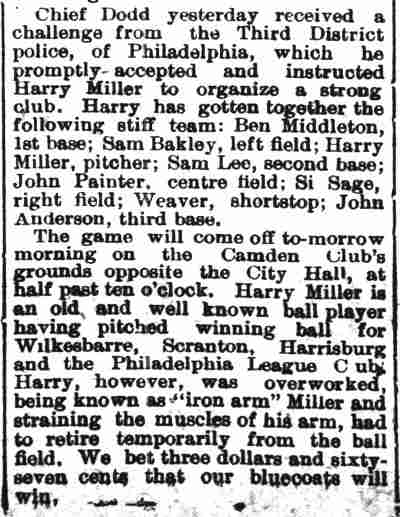
Chief Dodd yesterday received a challenge from the Third District police, of Philadelphia, which he promptly accepted and instructed Harry Miller to organize a strong club. Harry has gotten together the following stiff team: Ben Middleton, 1st base; Sam Bakley, left field; Harry Miller, pitcher; Sam Lee, second base; John Painter, centre field; Si Sage, right field; Weaver, shortstop; John Anderson, third base.
The game will come off to-morrow morning on the Camden Club’s grounds opposite the City Hall, at half past ten o’clock. Harry Miller is an old and well known ball player having pitched winning ball for Wilkesbarre, Scranton, Harrisburg and the Philadelphia League Club. Harry, however, was overworked, being known as “iron arm” Miller and straining the muscles of his arm, had to retire temporarily from the ball field. We bet three dollars and sixty-seven cents that our bluecoats will win.
Camden Post
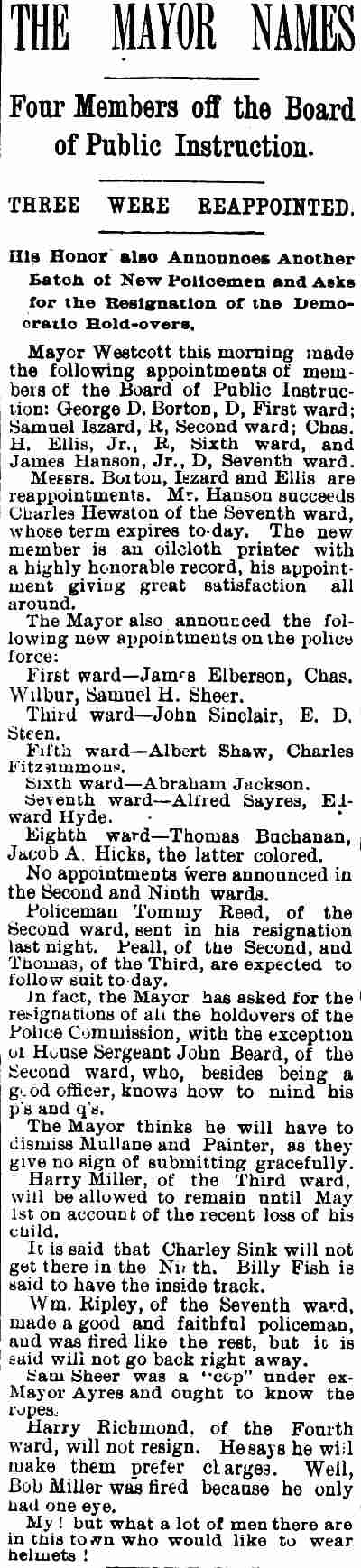
THE MAYOR NAMES
Four Members off the Board of Public Instruction.
THREE WERE REAPPOINTED.
His Honor also Announces Another Batch of New Policemen and Asks for the Resignation of the Democratic Hold-overs.
Mayor Westcott this morning made the following appointments of members of the Board of Public Instruction: George D. Borton, D, First ward; Samuel Iszard, R, Second ward; Chas. H. Ellis, Jr., R, Sixth ward, and James Hanson, Jr., D, Seventh ward. Messrs. Borton, Iezard and Ellis are reappointments. Mr. Hanson succeeds Charles Hewston of the Seventh ward, whose term expires to-day. The new member is an oilcloth printer with a highly honorable record, his appointment giving great satisfaction all around.
The Mayor also announced the following new appointments on the police force:
First ward—James Elberson, Chas. Wilbur, Samuel H. Sheer.
Third ward—John Sinclair, E. D. Steen.
Fifth ward—Albert Shaw, Charles Fitzsimmons.
Sixth ward—Abraham Jackson.
Seventh ward—Alfred Sayres, Edward Hyde.
Eighth ward—Thomas Buchanan, Jacob A. Hicks, the latter colored.
No appointments were announced in the Second and Ninth wards.
Policeman Tommy Reed, of the Second ward, sent in his resignation last night. Peall, of the Second, and Thomas, of the Third, are expected to follow suit to-day.
In fact, the Mayor has asked for the resignations of all the holdovers of the Police Commission, with the exception of House Sergeant John Beard, of the Second ward, who, besides being a good officer, knows how to mind his p’s and q’s.
The Mayor thinks he will have to dismiss Mullane and Painter, as they give no sign of submitting gracefully.
Harry Miller, of the Third ward, will be allowed to remain until May 1st on account of the recent loss of his child.
It is said that Charley Sink will not get there in the Ninth. Billy Fish is said to have the inside track.
Wm. Ripley, of the Seventh ward, made a good and faithful policeman, and was fired like the rest, but it is said will not go back right away.
Sam Sheer was a “cop” under ex-Mayor Ayres and ought to know the ropes.
Harry Richmond, of the Fourth ward, will not resign. He says he will make them prefer charges. Well, Bob Miller was fired because he only had one eye.
My! but what a lot of men there are in this town who would like to wear helmets!
Camden Daily Telegram

THE MAYOR’S APPOINTMENTS
He Announced Several This Week.
COMMISSIONERS OF INSTRUCTION.
The Old Members Re-Instated With the Exception of the Member From the Seventh Ward—Police Appointments and Resignations.
Mayor Wood made the following appointments as Commissioners of Instruction:
The following appointments were made: First Ward—George D. Borton, of the First Ward; Charles H. Ellis, Jr., of the Sixth ward, and John L. Westcott, of the Third ward.
The following appointments were made on the police force:
First Ward—James Elberson, Charles Wilbur, Samuel H. Sheer.
Second Ward—No appointments.
Third Ward—John Sinclair, E. D. Stein.
Fourth Ward—No appointments.
Fifth Ward—Albert Shaw, Charles Fitzsimmons.
Sixth Ward—Abraham Jackson.
Seventh Ward—Alfred Sayres, Edward Hyde.
Eighth Ward—Thomas Buchanan, Jacob A. Hicks (colored).
Ninth Ward—No appointments.
Mayor Westcott has requested the resignation of all the members of the police force who served under the Police Commission, to take effect May 1. They are Policemen Peall, Horner, Painter, Mullane, Miller and Reed.
POLITICAL POINTERS.
Who will be the postmaster?
Who will be the next prosecutor?
Many of the ward workers are suffering from election colds.
The name of Harry Moffitt was left out of the columns of honorable mention with the other hustlers of election day.
Senator Rogers and Messrs. Stafford and Watson, of the House are fully coming up to the expectations of their constituents.
If the Mayor could arrange it to hold his hearings a trifle earlier it would be a great source of satisfaction to the Camden afternoon papers.
There is still great anxiety on the part of the public as to the outcome of the present session of the legislature. Thus far their public acts have been highly commendable.
The abolishment of the Police Justice act restores to office the City Recorder, Benjamin M. Braker, who would be qualified to act in place of the Mayor should the Chief Executive be taken sick.
Jos. Potter, the new member of Council from the First ward is a man of wide business experience and will prove much advantage to the many large financial interests that will come under his care.
Owing to the satisfactory working of the present school commission in the two second-class counties up the State, the legislature made no change in the mode of placing the members as was anticipated.
Jos. B. Fox, of the Fourth ward, is what might be termed an old reliable, having had a long and varied experience in public affairs. He is always conservative in the expenditure of city money. He is always safe to trust.
Charles Sayrs, of the Seventh ward, who had a short experience in the present Council, but enough to make him feel at home among public affairs, is neck and ears in work between his real estate business and Councilmanic duties.
The colored people of the lower section of the city are anxious to see Squire Drake, the ex-Republican and ex-member of the School Board, come out of the Court House, where he holds a position under the Thompson Freeholders.
“Father” Figner is a proud sire. He was a member and president of Council in his days, and now sees his son treading in his footsteps. Mr. Figner, Jr., having been sent to Council from the Sixth ward on Tuesday by a large majority.
A special election will not be necessary for the new Board of Freeholders, as the City Council and Township Committees will appoint Freeholders who will serve until the Spring of 1895. The appointments will be made about the middle of May.
Arthur Bedell is spoken of as a candidate for the presidency of the new City Council. He is a stalwart and is never afraid to define his position on all public questions. He is one of those men who makes strong, warm friends and also creates an opposition of like force.
William D. Brown, the Secretary of the Board of Education, and Fred A. Rex, Treasurer, are quite pleased over the report of the committee on accounts and Expert O’Shaughnessy, they having examined the books of Messrs. Rex and Brown and found them correctly kept.
The library of the Camden public schools is one to be highly appreciated and much is due to the care with Miss Blowe the librarian has attended to her duties. She will hold over another year and should be allowed to retain the office as long as she merits it, and she surely does now.
J. R. Carson, the retiring member of Council from the First ward, is highly spoken of by his associates on committees and by Clerk Varney for the mature judgment displayed in the management of city affairs. It is with a general expression of regret that the city is to lose his service.
The reform in the Board of Freeholders can’t come too soon. If the public is to judge of the care of property given by the Democrats in the county, by the “hog combine” in this city, an inventory of the public property when turned over will make interesting reading. Ex-officials guarantee to save enough in the Board, if returned to their offices, to pay the expense of a special election, if one was necessary.
W. J. Bradley has been asked if he was a candidate for president of the new City Council. His reply was that he had not sought it in the first place, and would not seek it now, but whether he became president or remained merely a member on the floor, he would endeavor to discharge his duties in the interests of the city. He is commended by all who came in contact with him during the past year as one who had a new Camden at heart.
Philadelphia Inquirer
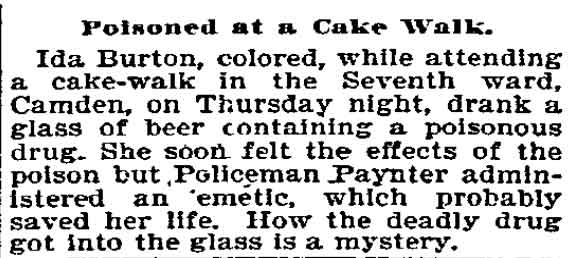
John Painter — Ida Burton
The North American
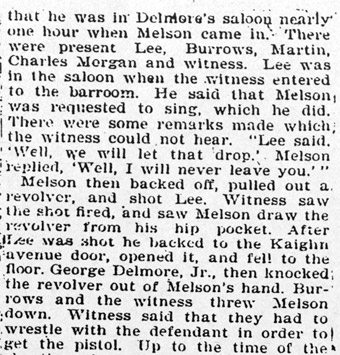
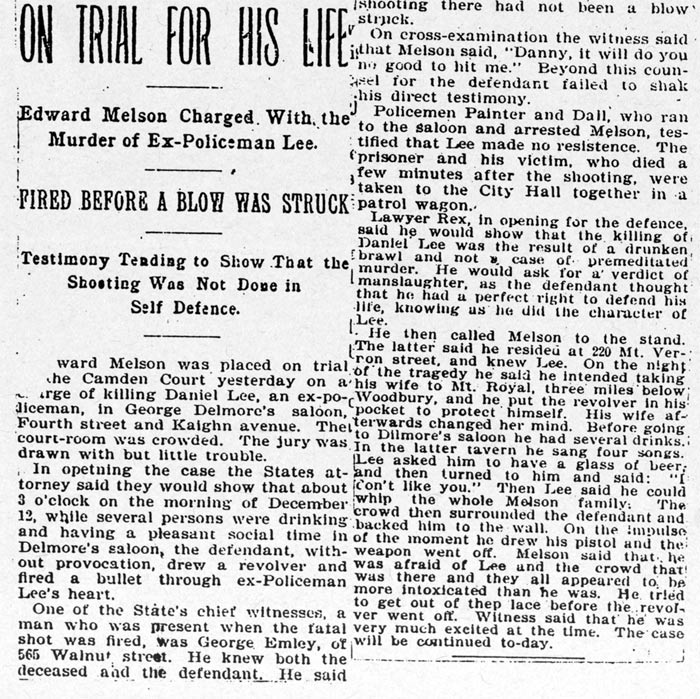
Named: Daniel Lee, George Dilmore Sr., Edward Melson, George Emley, Charles Morgan, Frederick Rex, George Dilmore Jr., John A. Dall, John Painter, South 4th Street, Mt. Vernon Street, Kaighn Avenue, and Walnut Street.
Philadelphia Inquirer
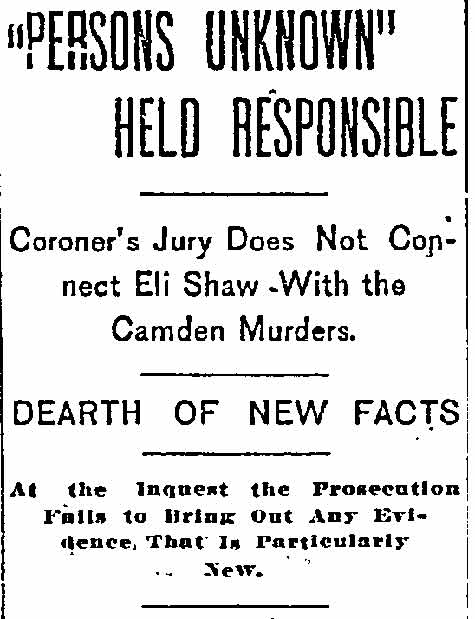
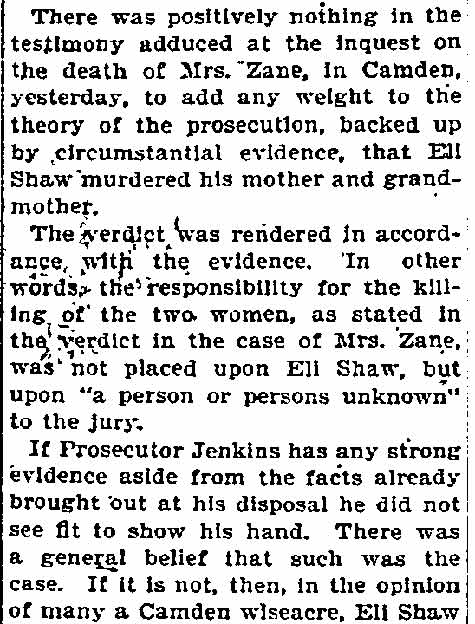
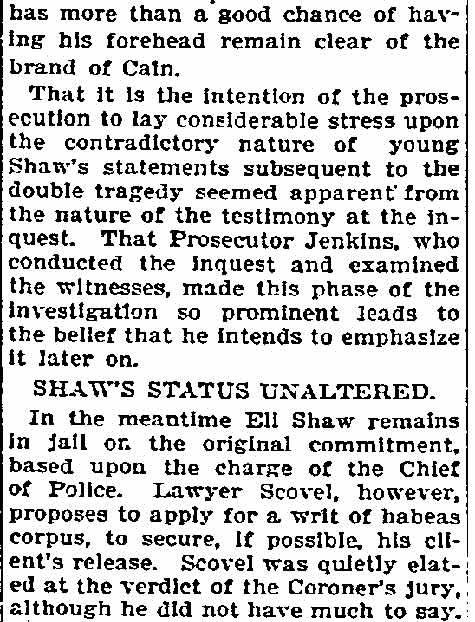
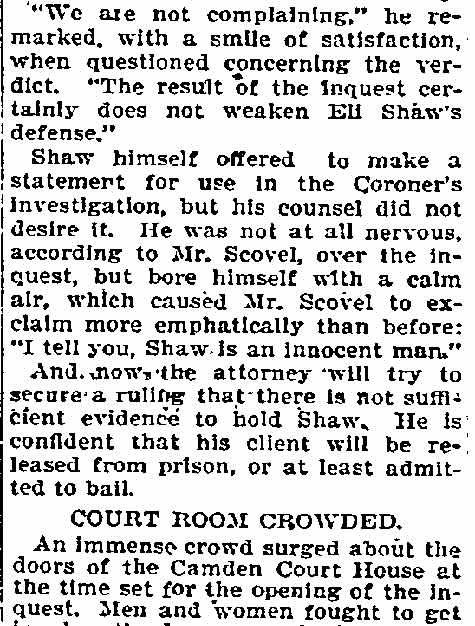
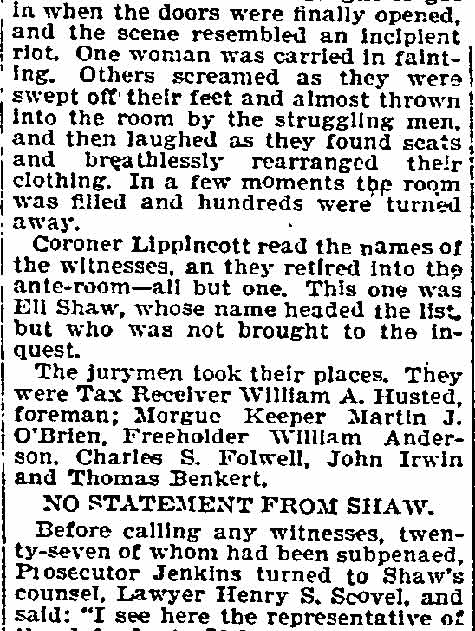
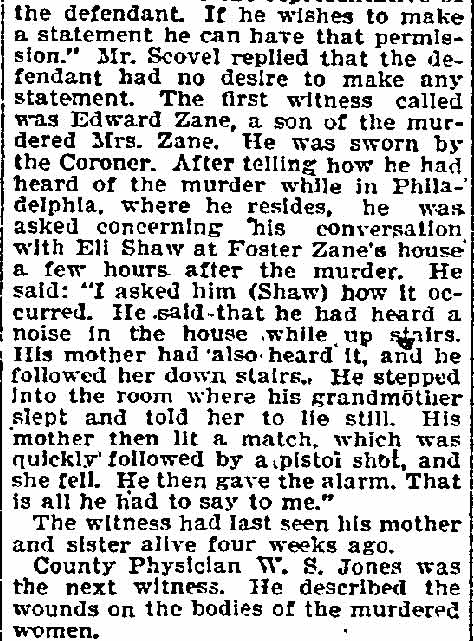
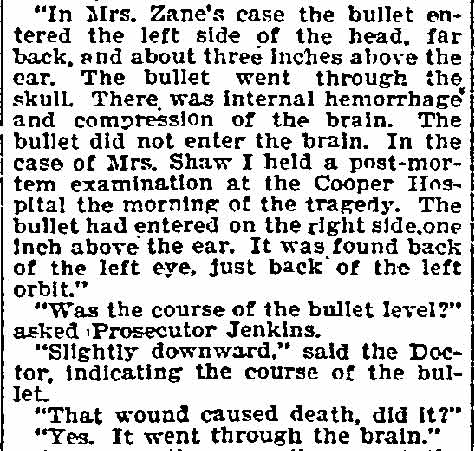
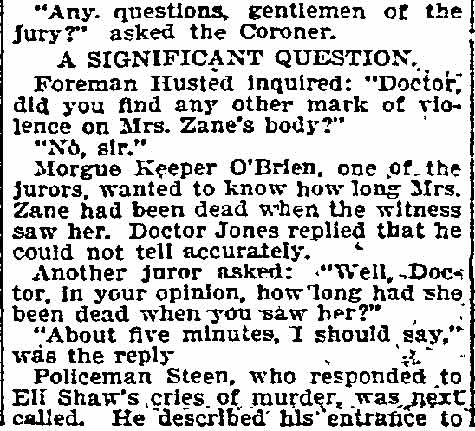
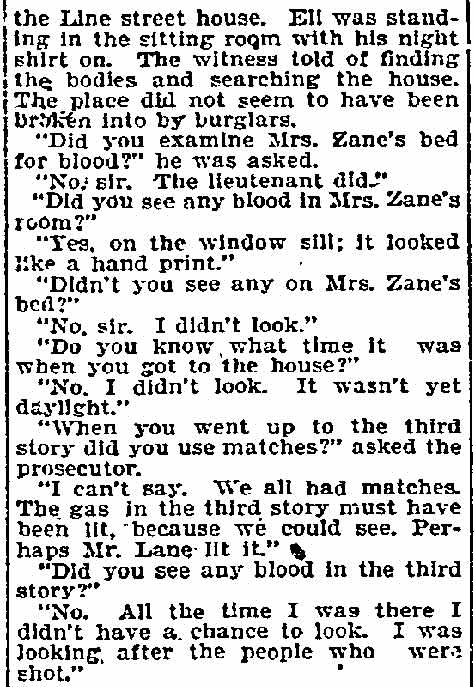
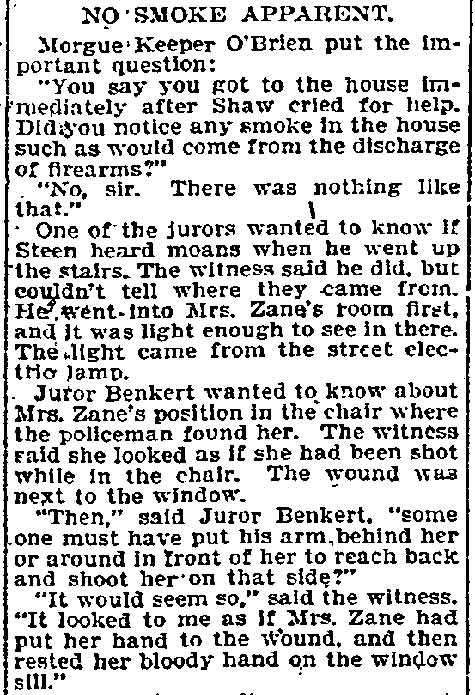
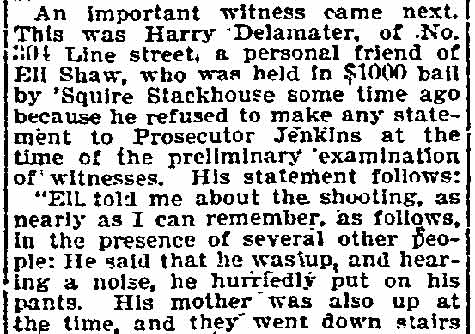
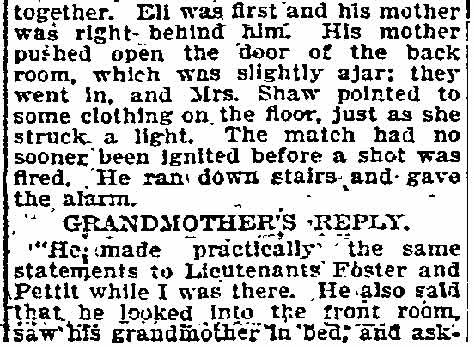
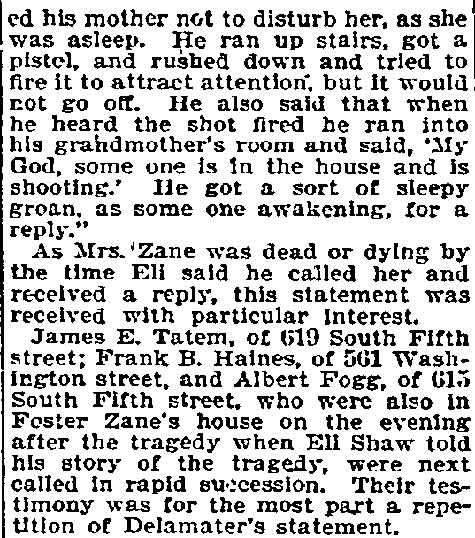
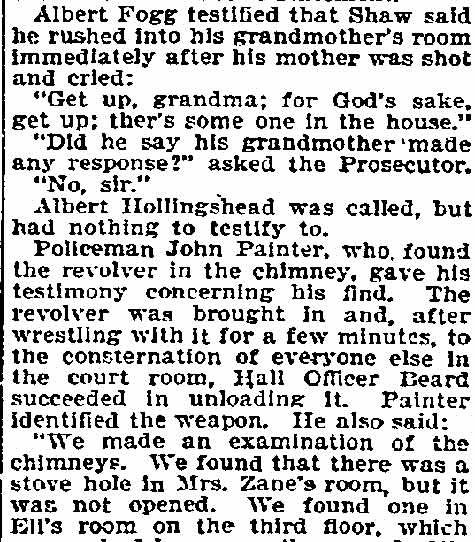
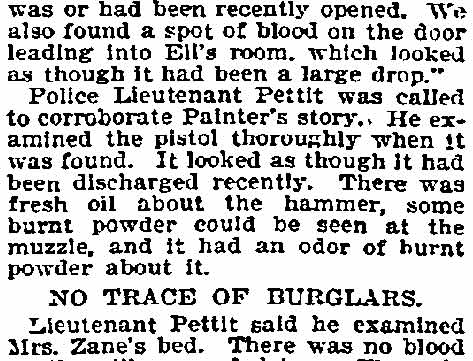
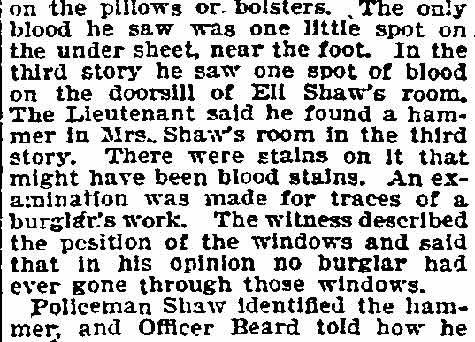
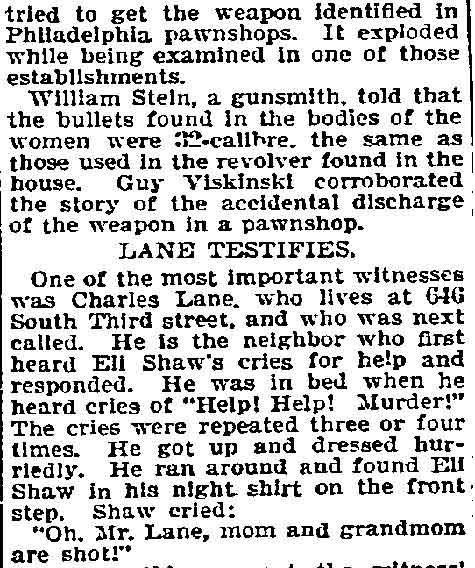
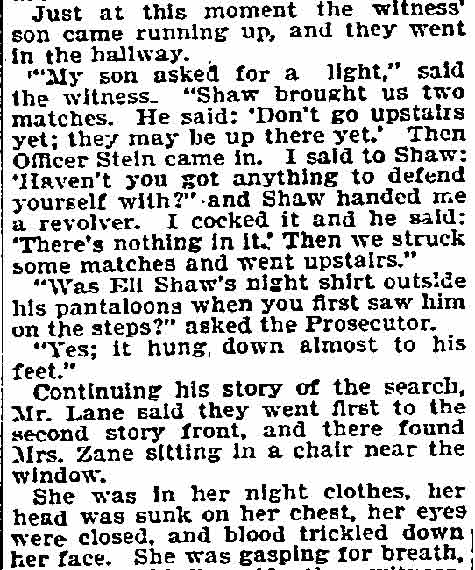
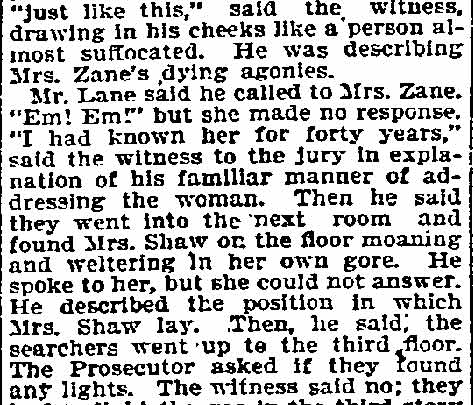
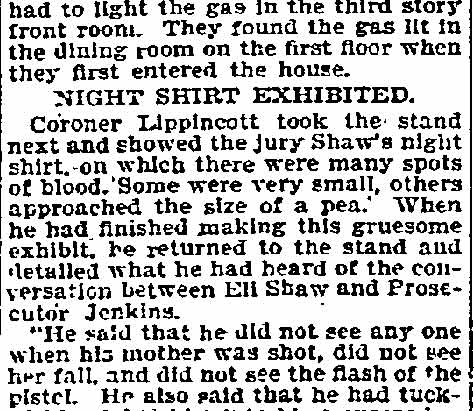
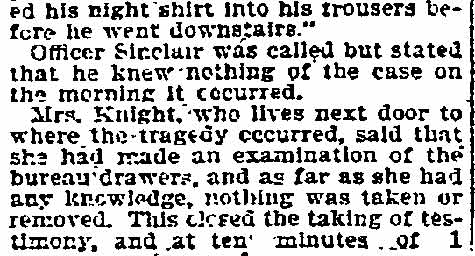
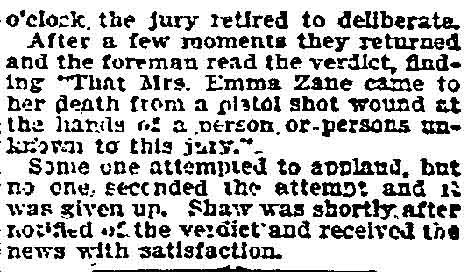
Named: Emma Zane, Eli Shaw, Wilson H. Jenkins, Henry S. Scovel, Dr. William S. Jones, Dr. A. Haines Lippincott, William A. Husted, Thomas Benkert, Martin J. O’Brien, William Anderson, Charles Folwell, John Irwin, Elwin Steen, Harry Delameter, O. Glen Stackhouse, John Foster, H. Frank Pettit, James E. Tatem, Frank B. Haines, Albert Fogg, John Painter, John H. Beard, Albert Hollingshead, William Stein, Charles M. Lane, Elwin Steen, John Sinclair, and Mrs. Anna Knight.
Philadelphia Inquirer
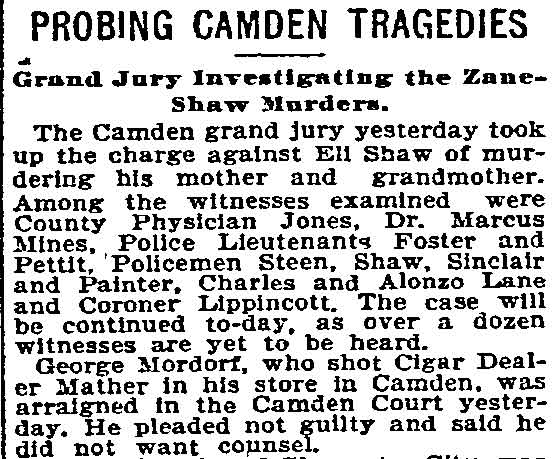
PROBING CAMDEN TRAGEDIES
Grand Jury Investigating the Zane-Shaw Murders.
The Camden grand jury yesterday took up the charge against Eli Shaw of murdering his mother and grandmother. Among the witnesses examined were County Physician Jones, Dr. Marcus Mines, Police Lieutenants Foster and Pettit, Policemen Steen, Shaw, Sinclair and Painter, Charles and Alonzo Lane and Coroner Lippincott. The case will be continued to-day, as over a dozen witnesses are yet to be heard.
George Mordecai, who keeps a cigar store in Camden, was arraigned in the Camden Court yesterday. He pleaded not guilty and said he would not want counsel.
Here's Camden's Finest, With Whiskers, in 1898
Camden Courier-Post —
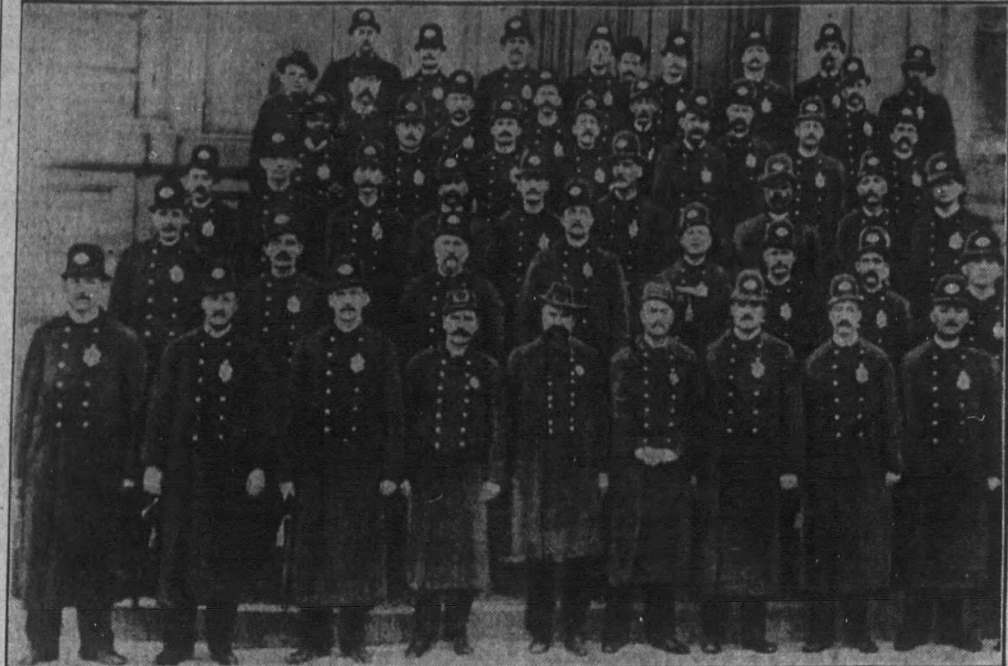
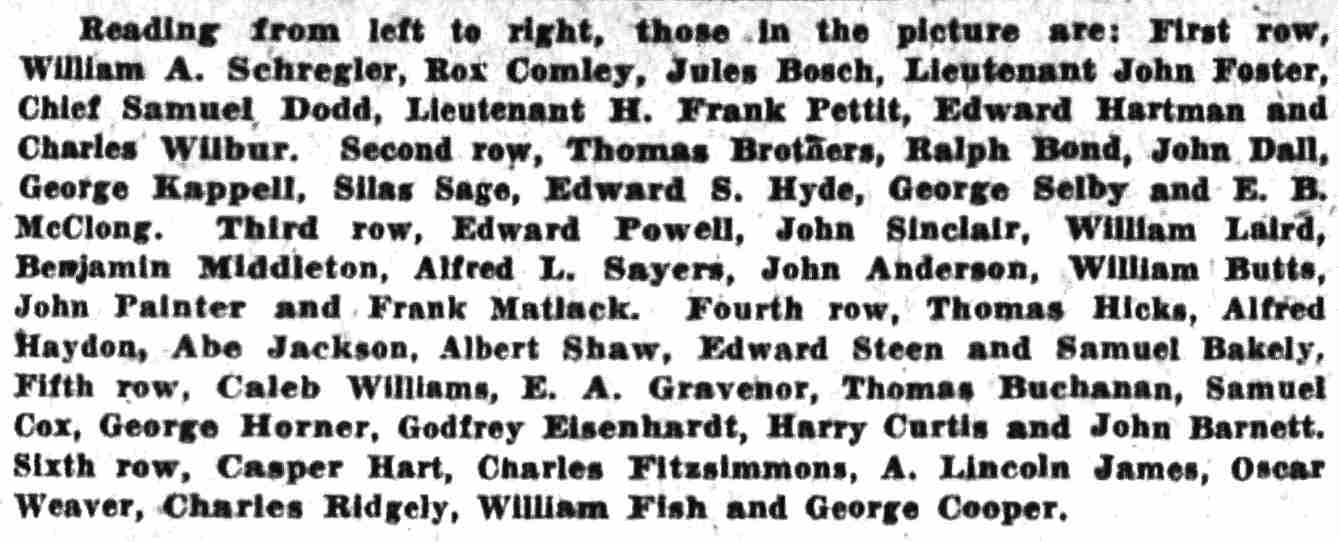
William A. Schregler — William “Rex” Comley — Jules Bosch — John Foster — Samuel Dodd — H. Franklin Pettit — Harry Mines — Edward Hartman — Charles Wilbur — Thomas Brothers — Ralph Bond — John Dall — George Kappell — Josiah Sage — Edward S. Hyde — William Selby — Elbridge B. McClong — Edward Powell — John Sinclair — William Laird — Benjamin Middleton — Alfred L. Sayers — John Anderson — William Butts — John Painter — Frank Matlack — Thomas Hicks — Alfred Hayden — Abe Jackson — Albert Shaw — Edward Steen — Samuel Bakley — Caleb Williams — Elisha A. Gravenor — Thomas Buchanan — Samuel Cox — George Horner — Godfrey Eisenhardt — Harry Curtis — George B. Johnson — John Barnett — Casper Hart — Charles Fitzsimmons — A. Lincoln James — J. Oscar Weaver Sr. — Charles Ridgely — William Fish — George Cooper
Harry Mines, not named above, is in the first row between H. Frank Pettit and Edward Hartman. In the fifth row, at the far right, “John Barnett” was a guess on the part of A. Lincoln James. Another person guessed George Johnson. Both were wrong and it is not known who that policeman is.
Philadelphia Inquirer

John Painter
Philadelphia Inquirer
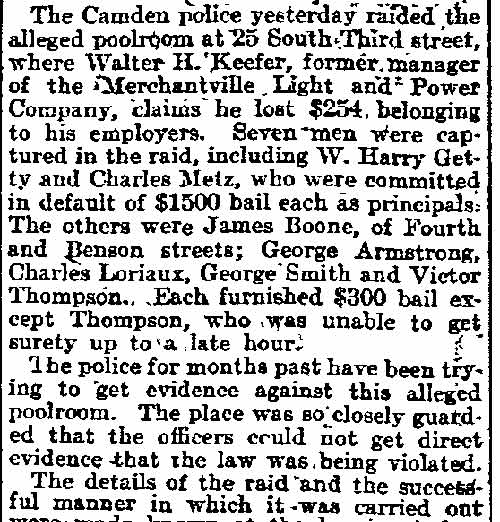
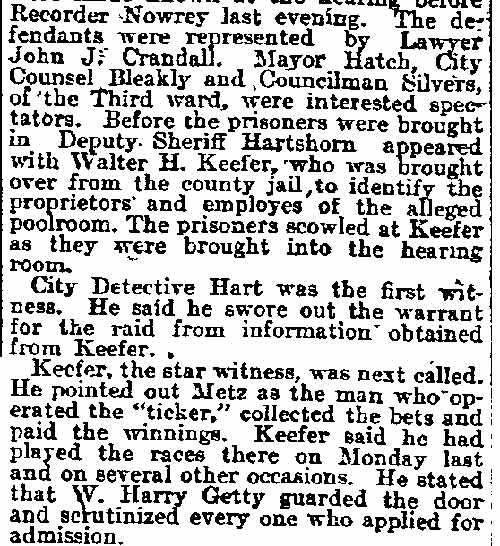
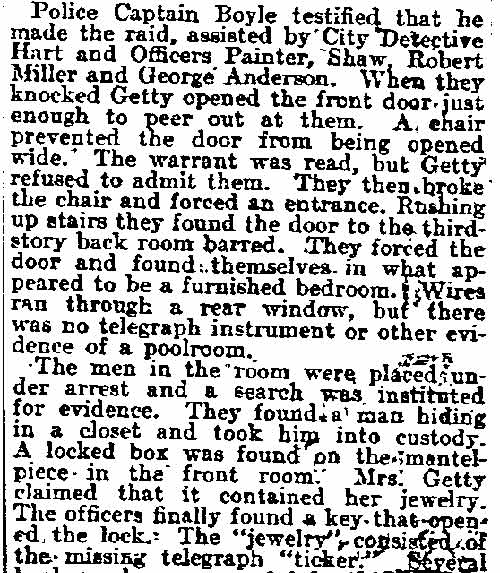
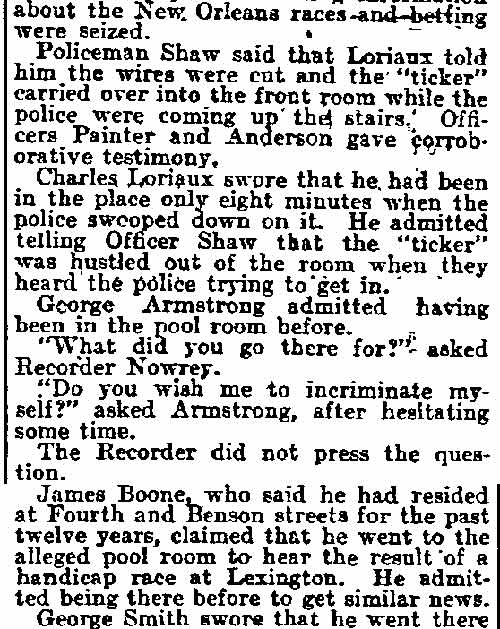
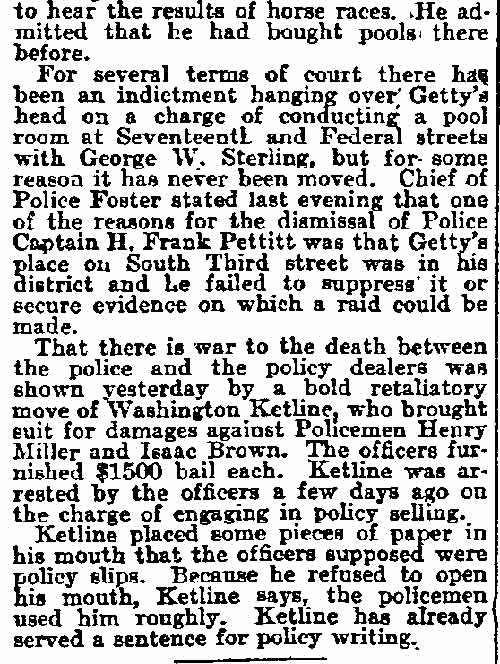
Named: South 3rd Street, W. Harry Getty, Charles Metz, Walter H. Keefer, James Boone, George Armstrong, Charles Loriaux, George Smith, Victor Thompson, George Sterling, Washington Ketline, William D. Hart, Hugh Boyle, John Painter, Albert Shaw, Robert F. Miller, John Foster, George W. Anderson, H. Frank Pettit, Harry Miller, Isaac C. Brown, Joseph Nowrey, South 4th Street, Benson Street, North 17th Street, and Federal Street.
Philadelphia Inquirer

EVIL DOERS QUAKE
Mayor Hatch, of Camden, Starts in to Wipe Out Speak-Easies
FIRST RAID A SUCCESS
Fines Imposed by Recorder Nowrey for Operating Gambling Machines. Sunday Sellers Hope to Escape
Mayor Cooper B. Hatch is making life miserable for evil doers in Camden. After waging relentless warfare on Sunday liquor sellers and seizing all the gambling machines in saloons and cigar stores, he is now clearing out speak-easies. The first raid was made yesterday afternoon, when Captain Stanley, Sergeant Hyde, Detective Painter and Policeman Shaw swooped down on Mrs. Mary Mahan’s house, at 1062 South Front street. They found nearly enough liquor there to stock a saloon. There were two cases of bottled beer, five gallons of whisky, a large quantity of California wines, and other “wet” goods. This was all confiscated and was sent to the City Hall, together with Mrs. Mahan and a young girl.
For some time past Mayor Hatch’s private detectives have been gathering evidence against speak-easies and disorderly houses in different parts of the city, and several more arrests will be made.
The saloonkeepers arrested about ten days ago for operating slot machines in their places were arraigned yesterday before Recorder Nowrey. Maurice Hertz, of Locust street and Kaighn avenue, was the first to be tried. He was represented by former Judge Howard Carrow. The complaints against Hertz charged him with operating nickel-in-the-slot gambling machines on July 2 and 9.
Harry Williams, one of Secretary Gibboney’s detectives, who was employed in the recent Sunday liquor crusade, testified that he played “The Owl” in Hertz’s saloon on July 9. He lost five cents on the red but hit the black and quit even. On cross-examination Williams refused to tell by whom he was employed, and Recorder Nowrey would not compel him to answer. Detective Fields swore that he was with Williams in Hertz’s place, and also played the slot machine. Police Captain Stanley said he found four of the slot machines in Hertz’s place when he made the raid.
At this point Judge Carrow moved to dismiss the complaint, as it was dated in the year “189.” Decision was reserved, and the other complaint was taken up. Judge Carrow wanted this set aside on the ground that it did not specify the premises where the law was alleged to have been violated. Recorder Nowrey overruled the motion.
Detective Graper said he played the slot machine at Hertz’s saloon on Sunday, July 2. On cross-examination he refused to give his address, but said he worked for Mayor Hatch. He didn’t know, he said, whether he was on the city pay roll.
David B. Kaighn and other Kaighn avenue residents testified that they never saw slot machines in operation in Hertz’s place, but had seen them standing in the office.
Hertz, in his own defense, said he was agent for the slot machines, and those found in his office were samples to be examined by prospective purchasers.
Recorder Nowrey sentenced Hertz to pay a fine of $50 and costs. Judge Carrow gave notice that he would appeal the case, but the Recorder refused to permit Hertz to depart without paying the fine.
Peter Kelly, of Eighth street and Ferry avenue, was also convicted and paid his fine.
John Keefe, of Haddon avenue and Carman street, and Marshall Hutchinson, of Ninth and Walnut streets, pleaded guilty and were fined $50 and costs each. There were about seven more cases, which Recorder Nowrey adjourned until next Wednesday.
The 130 saloonkeepers rounded up in the recent crusade against Sunday liquor selling were in high glee yesterday over the discovery of a law that they hoped would save them from punishment for their alleged misdoings. This law was passed in 1874, and makes it unlawful to prosecute any person by indictment for violations of the liquor laws in municipalities where city ordinances provide punishment for such offenses. As the Supreme Court has set aside the Camden excise ordinance, the saloonkeepers hoped to escape further prosecution.
City Counsel Bleakly, after looking up the matter yesterday, said: “A house in which the unlawful sale of liquors is habitually made is an indictable nuisance, although there is a city ordinance prescribing penalty for such sales. Such traffic is not only a breach of the city law, but is also forbidden by the State law.” This decision was made by Judge Van Syckel in 1880, in the Court of Errors and Appeals, and was reaffirmed in 1888. It is now a State law.
The Excise Commission, at its regular meeting next Wednesday evening, will probably adopt a substitute ordinance against Sunday liquor selling to conform to the city charter, under the Supreme Court’s decision setting aside the old ordinance.
Philadelphia Inquirer
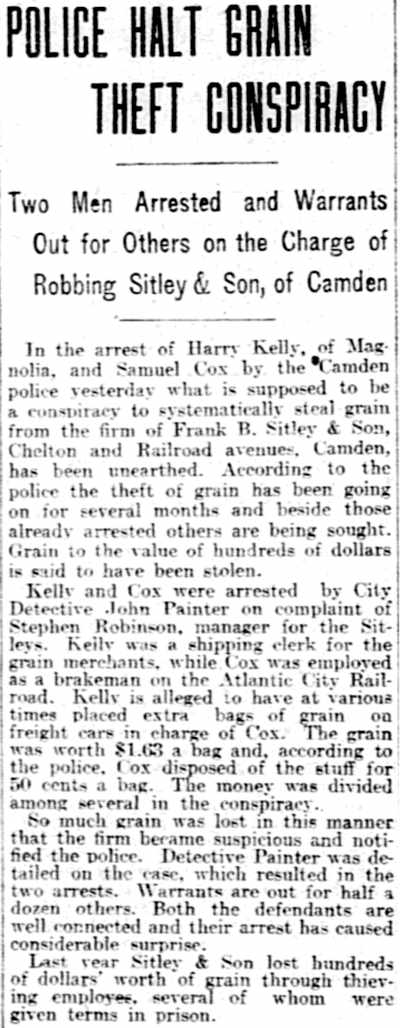
Named: Sitley & Son, Harry Kelly, Samuel Cox, John Painter, Stephen Robinson, Chelton Avenue, and Railroad Avenue.
Philadelphia Inquirer
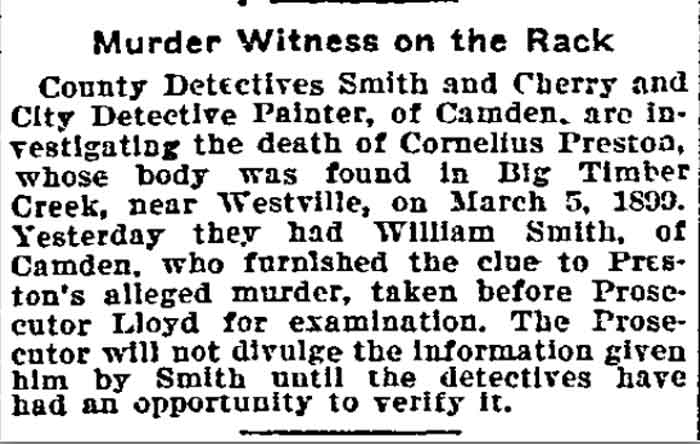
Murder Witness on the Rack
County Detectives Smith and Cherry and City Detective Painter, of Camden, are investigating the death of Cornelius Preston, whose body was found in Big Timber Creek, near Westville, on March 5, 1899. Yesterday they had William Smith, of Camden, who furnished the clue to Preston’s alleged murder, taken before Prosecutor Lloyd for examination. The Prosecutor will not divulge the information given him by Smith until the detectives have had an opportunity to verify it.
Philadelphia Inquirer

John Painter
Philadelphia Inquirer
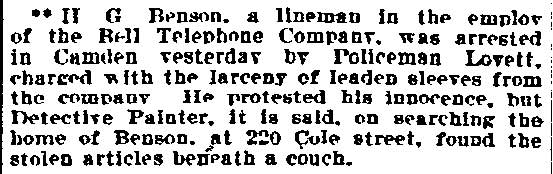
•• H G Benson, a lineman in the employ of the Bell Telephone Company, was arrested in Camden yesterday by Policeman Lovett, charged with the larceny of leaden sleeves from the company. He protested his innocence, but Detective Painter, it is said, on searching the home of Benson, at 220 Cole street, found the stolen articles beneath a couch.
The Paul Woodward Murder Case
to
On October 1, 1902 Paul Woodward murdered two young boys by giving them poison. Frank T. Lloyd, then Camden County prosecutor, was responsible for leading the investigation and prosecuting the case. Detective Painter was involved in the investigation. Woodward was arrested on October 4, 1902. Detective Painter was present later that day when Woodward was identified as being seen with the two victims. Woodward was indicted, tried, convicted of murder in the first degree, and on January 7, 1903 executed at the Camden County Jail.
People connected with this case: Joseph Jennings — Jennings’ Third Regiment Band — Frank T. Lloyd — Dr. William S. Jones — William D. Hart — Dr. Paul N. Litchfield — F. Morse Archer — John Foster — John Painter — John Cherry — Isaac Toone — Paul Woodward — George M. Beringer — Charles G. Garrison — J. Wesley Sell — Christopher J. Mines Jr. — Frederick A. Rex — J. Frederick Voigt — George F. Kappel — Henry S. Scovel — Francis Ford Patterson Jr. — John S. Smith — O. Glen Stackhouse — Hugh Boyle — Patrick Harding — Frank S. Albright — Thomas Walton — Dr. William H. Iszard — George H. Stineford Sr.
Philadelphia Inquirer — October 3, 1902
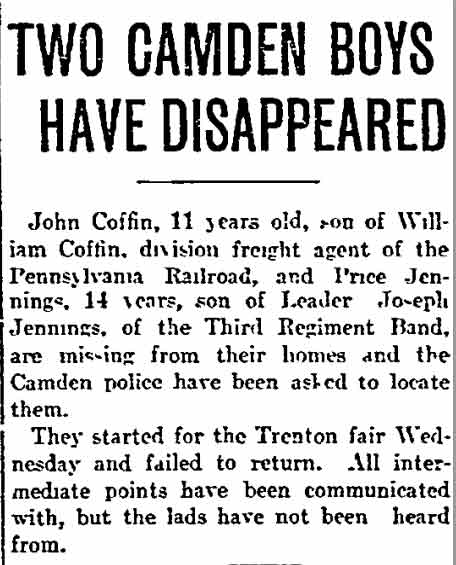
TWO CAMDEN BOYS HAVE DISAPPEARED
John Coffin, 11 years old, son of William Coffin, division freight agent of the Pennsylvania Railroad, and Price Jennings, 14 years old, son of Leader Joseph Jennings, of the Third Regiment Band, are missing from their homes and the Camden police have been asked to locate them.
They started for the Trenton fair Wednesday and failed to return. All intermediate points have been communicated with, but the lads have not been heard from.
Philadelphia Inquirer — October 4, 1902
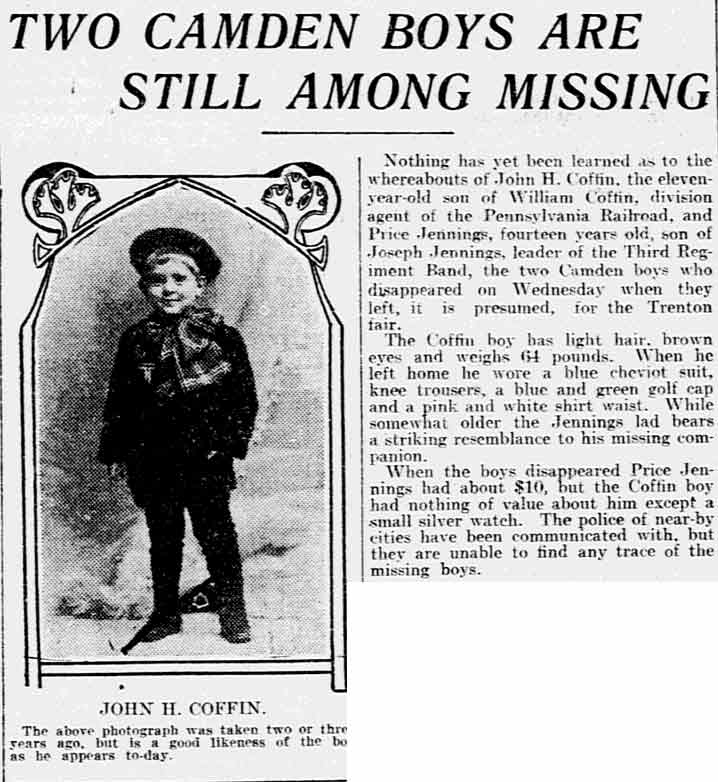
Two Camden Boys Are Still Among Missing
Nothing has yet been learned as to the whereabouts of John H. Coffin, the eleven-year-old son of William Coffin, division agent of the Pennsylvania Railroad, and Price Jennings, fourteen years old, son of Joseph Jennings, leader of the Third Regiment Band, the two Camden boys who disappeared on Wednesday when they left, it is presumed, for the Trenton fair.
The Coffin boy has light hair, brown eyes and weighs 64 pounds. When he left home he wore a blue cheviot suit, knee trousers, a blue and green golf cap and a pink and white shirt waist. While somewhat older the Jennings lad bears a striking resemblance to his missing companion.
When the boys disappeared Price Jennings had about $10, but the Coffin boy had nothing of value about him except a small silver watch. The police of near-by cities have been communicated with, but they are unable to find any trace of the missing boys.
[Photo caption: JOHN H. COFFIN. The above photograph was taken two or three years ago, but is a good likeness of the boy as he appears to-day.]
Philadelphia Inquirer — October 5, 1902
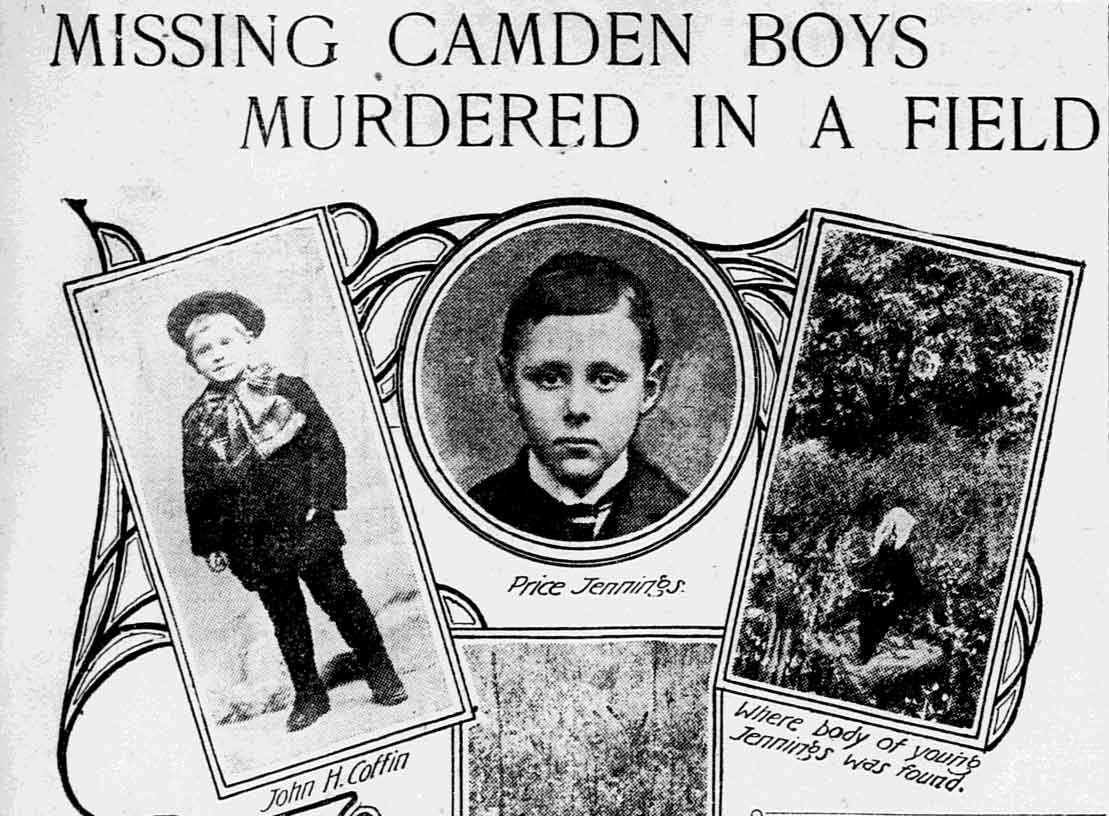
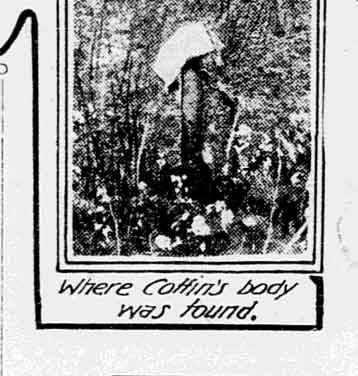
Missing Camden Boys Murdered in a Field
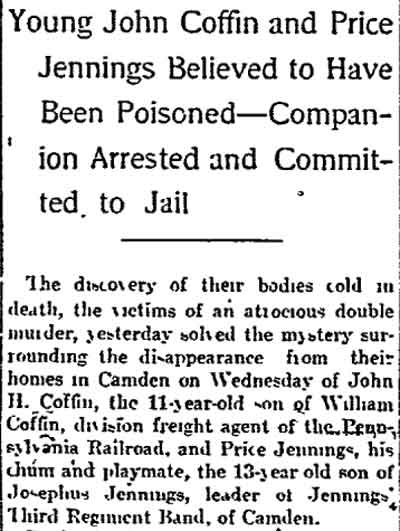
Young John Coffin and Price Jennings Believed to Have Been Poisoned—Companion Arrested and Committed to Jail
[Photo captions: John H. Coffin — Price Jennings — Where body of young Jennings was found — Where Coffin's body was found.]
The discovery of their bodies cold in death, the victims of an atrocious double murder, yesterday solved the mystery surrounding the disappearance from their homes in Camden on Wednesday of John H. Coffin, the 11-year-old son of William Coffin, division freight agent of the Pennsylvania Railroad, and Price Jennings, his chum and playmate, the 13-year old son of Josephus Jennings, leader of Jennings' Third Regiment Band, of Camden.
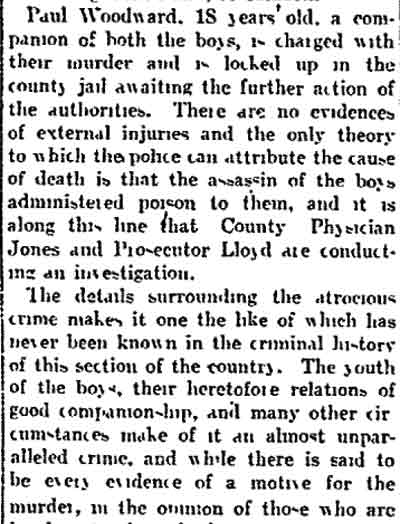
Paul Woodward, 18 years old, a companion of both the boys, is charged with their murder and is locked up in the county jail awaiting the further action of the authorities. There are no evidences of external injuries and the only theory to which the police can attribute the cause of death is that the assassin of the boys administered poison to them, and it is along this line that County Physician Jones and Prosecutor Lloyd are conducting an investigation.
The details surrounding the atrocious crime makes it one the like of which has never been known in the criminal history of this section of the country. The youth of the boys, their heretofore relations of good companionship, and many other circumstances make of it an almost unparalleled crime, and while there is said to be every evidence of a motive for the murder, in the opinion of those who are in close touch with the case, it is an instance in which the work is that of a degenerate boy in whom all sense of right and wrong have long since been dead. Certain it is that the crime has stirred the people of Camden and vicinity to a feverish heat to which it has not been stirred since the days following the murder of Annie Leconey.
Found in a Field
The bodies of both the lads were found yesterday morning in a field near the Haddon Heights Station of the Reading Railroad on what is known as the Lippincott farm, about a quarter mile from Station Avenue. The body of young Jennings was found lying in a clump of bushes and less than forty yards away lay the remains of Coffin. Both bodies were stiff and in a state of decomposition. Coffin's body was the first discovered, and it was not long after when that of his companion was found.
No sooner did the news of the discovery become known than the greatest excitement prevailed through the city of Camden and its suburbs. All sorts of rumors began to circulate, some of them hinting that the bodies were in a horribly mutilated condition and that the work was that of a negro. In a short time, however, whatever element of mystery there was about the case, so far as present indications go, was dissipated when the identification of the bodies was made and the arrest of young Woodward was accomplished soon afterwards.
Then the mystery began to clear somewhat. Both boys disappeared from their homes on Wednesday afternoon. When they failed to return that night the police were notified and a description of them was sent around the country adjacent to Camden and also to Philadelphia. Some persons said they had gone to Trenton to the fair, while others told of having seen them in the vicinity of Haddon Heights Station. Nothing came of these statements at the time, and meanwhile the boys failed to return home. Coffin's father was of the opinion that the boys had been kidnapped, but this theory was not held by the police.
First Body Discovered
Late Friday night, Clarence Kreuson, whose home is at Haddon Heights, and a friend of his, Frank Johnson, who lives in this city, were returning from an afternoon of blackbird shooting. While crossing the field they came across the body of a boy. It was lying in the bushes, half concealed, and when they made a closer examination they discovered that life was extinct. In alarm Kreuson and his companion ran to the home of A. H. Wood, near-by, and communicated their intelligence. Wood immediately sent a telephone message to Coroner Litchfield in Camden, apprising him of the discovery. That official, through some misunderstanding, thought it was a man named Brown who had been talking to him. He hitched up his horse and drove to Haddon Heights, but was unable to locate the body. He was also unable to locate anyone named Brown. Further investigation was, therefore, postponed until yesterday morning, when the Coroner again visited the scene and found the body in the bushes.
From the clothing worn it was thought at first it might be Coffin's, and after it had been brought to the Morgue, William Coffin, the lad's father, was sent for. He was accompanied by Kingston Jennings, elder brother of the other missing boy. Mr. Coffin when nerved to look at the remains, exclaimed, “My God, it's Price. Where is my boy. He must be found.“ The identification was then made complete by the dead boy's brother.
Meanwhile a number of persons had been going over the field where the body had been found in the search for clues that might lead to a discovery of the murderer of the boy, when one of them chanced across the remains of the other lad lying under a dead tree. This body was identified on the spot by Detective Curtis, of the Pennsylvania Railroad. The lad's body was also taken to the Morgue and laid on a slab alongside of his chum.
Police at Work
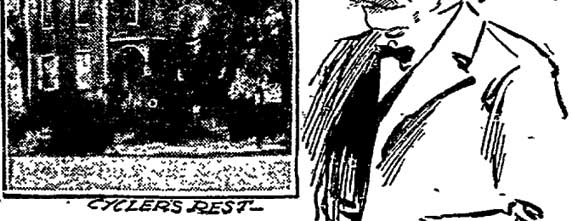
The police in the interim had not been idle, and after scouring the vicinity of the place where the bodies had been found, came across Lillian Martin, the 15-year-old daughter of J. Wilson Martin, who conducts a “Cyclers' Rest“ at Collings avenue and the White Horse pike. She remembered having seen two boys answering the description of the dead lads in their place on Wednesday. They were accompanied by an older and a taller boy. Jennings seemed to have considerable money and purchased three pies and three bottles of soda water. After that they left the place and she never saw them again until she looked upon their bodies.
Prosecutor Frank Lloyd at once set to work, and Detective Hart was sent in search of young Woodward. Inquiry at his home, at 221 Benson street, brought the response that he was not at home. His mother learned what he was wanted for, and about 2 o'clock sent for Detective Hart and turned the boy over to him. She accompanied him to the Prosecutor's office and, talking to the newspaper reporters, said that beyond being addicted to the use of cigarettes Paul was a good boy. She persisted that he could not have committed the crime as he was home all of Wednesday, Thursday and yesterday until the afternoon, when he went to Philadelphia to visit relatives. What the police are reported to view with importance is a statement that the mother is also alleged to have made to the effect that on Wednesday he had bothered her a great deal about money for a hat and shoes. While the authorities will make no admission, it is intimated that the motive they ascribe for the crime is robbery, and that the fact that Jennings had $10 when he disappeared was what led to his murder, and the murder of the other little fellow followed as a necessity for hiding the crime, as well as to get possession of a silver watch he is said to have had.
Identified Woodward
After young Woodward was taken into the Prosecutor's office, besides the Prosecutor there were present Assistant Prosecutor F. Morse Archer, Court Stenographer Berry, Chief of Police Foster, of Camden; Chief of Police Linderman, of Merchantville, and Detectives Painter and Hart. In a few minutes Detective Cherry arrived with Lillian Martin. The latter had been cautioned not to say anything to anybody, either in or out of the room. She was inside for less than thirty seconds, and when she came out she is reported to have said that Woodward was the young man whom she had seen with the boys on Wednesday in her father's place. She was taken back a second and a third time, and after the latter, it is said, she told the detectives that she was certain he was the person. She then left for her home, where she resisted all attempts to interview her.
In the meantime Recorder Stackhouse issued a commitment for Woodward on the oath of Detective Cherry, charging the young man with the murder of Coffin. Jennings' name was not mentioned, as Coffin's answered the same purpose.
While this was going on County Physician Jones was holding an autopsy in the basement of the jail, where the morgue is located. A personal examination showed that there were no external marks of violence, and in order to clinch the result of the autopsy he summoned from Philadelphia Professors Copeland and Rosenberger, of the Jefferson Hospital. Dr. Copeland performed the autopsy, and was at work until nearly 6 o'clock, when it was announced that no results other than that death was not due to external injuries, had been accomplished.
Prosecutor Lloyd said: “There was a double murder. Of that much we are certain. Death was not due to external injuries. What we suspect you will have to conjecture. The organs of both the boys have been sent to a chemist for examination. More than that I cannot say, except that we have arrested Paul Woodward on suspicion and that he is charged with the murder. The same man that killed one of the boys no doubt killed the other. All I ask now is that judgment be suspended for a few days, when I believe all will be cleared up.“
Woodward Visited Mr. Coffin
Mr. Coffin, whose home is at 305 North Third street, yesterday said: “It's an awful blow that has come to me and I hardly know what to say. It does seem to me that Paul Woodward exerted an evil influence over my boy. I remember now that on Thursday he came to the house and wanted me to hire him to look for John. He then said that he thought he could find him.“
At the Woodward home it was stated that the mother and father of the boy had gone to Philadelphia. Charles May, a boarder, said there would be no trouble in proving that Paul was home all day of Wednesday, as well as the day following. He said that on each of those nights the boy had been in bed by 8 o'clock. This testimony, he said, would be corroborated by the boy's mother, father, sister and himself. The only time Paul was out of the house, he said, was when he went several errands for his mother.
Late yesterday afternoon Coroner Litchfield empaneled the following jury: David Kaighn, George Leathwhite, Isaac Toone, George J. Pechin, Elmer E. Cox and T. L. Bear. At 5 o'clock they viewed the remains, after which the bodies were sent to their respective homes. No date for the inquest has been fixed.
The stomach and other organs of both the youthful victims are in the possession of George M. Beringer, a druggist and chemist, at Fifth and Federal streets. Last night he said he had begun his examination, but it would take him probably a day or two more to complete his analysis.
Philadelphia Inquirer — October 6, 1902
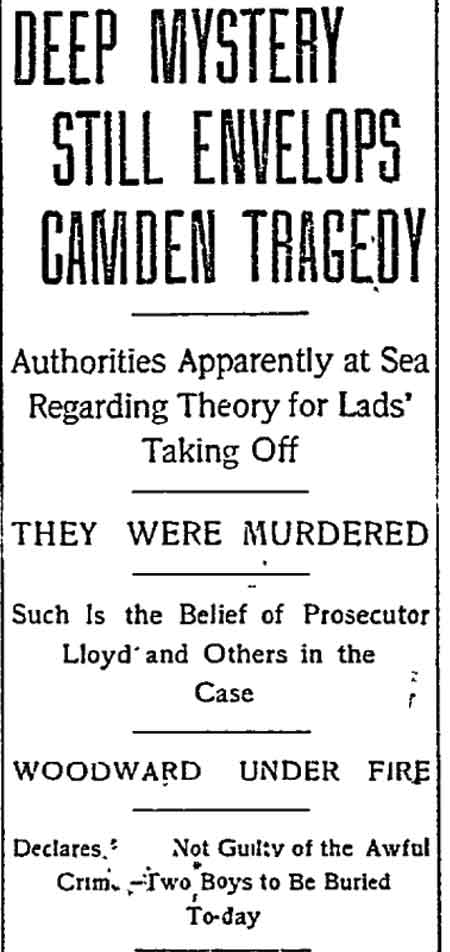
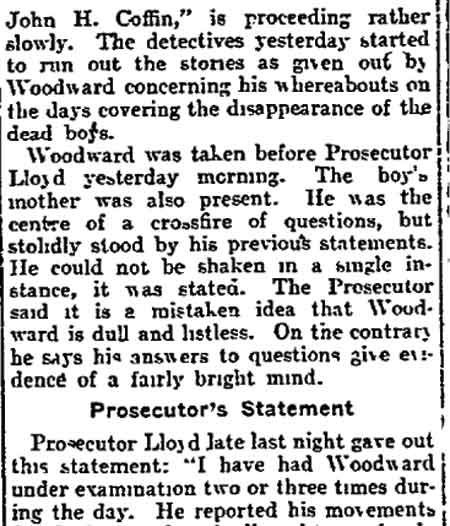
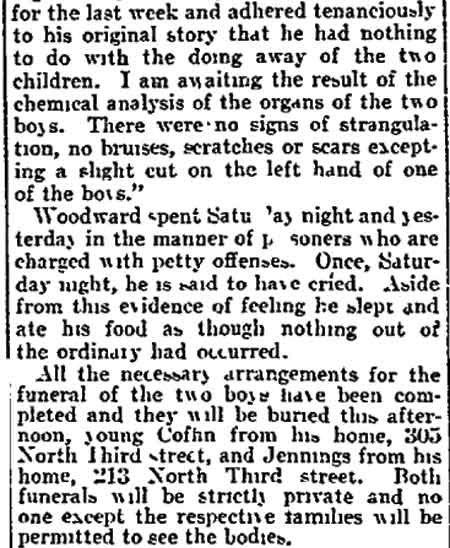
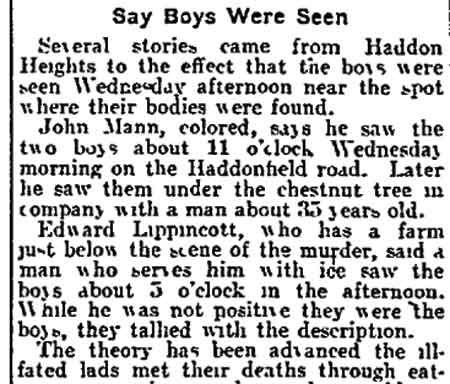
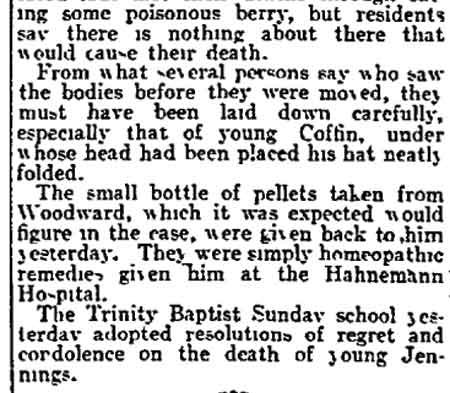
Deep Mystery Still Envelops Camden Tragedy
Authorities Apparently at Sea Regarding Theory for Lads' Taking Off
THEY WERE MURDERED
Such Is the Belief of Prosecutor Lloyd and Others in the Case
WOODWARD UNDER FIRE
Declares Not Guilty of the Awful Crime — Two Boys to Be Buried To-day
[Note: Image pwood-100602-inq-1.jpg contains only the headline block. Full article text begins in pwood-100602-inq-2.jpg through inq-8.jpg. See full transcription of Oct 6 article in context of this image set.]
Philadelphia Inquirer — October 7, 1902
Woman Involved in Camden Mystery
After Being Questioned by the Prosecutor She Is Committed to the County Jail—Believed to Be an Important Arrest
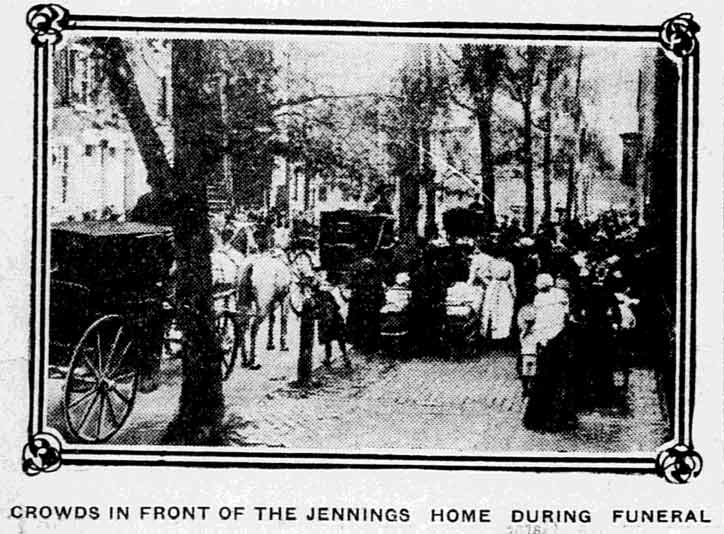
[Photo caption: Crowds in Front of the Jennings Home During Funeral]
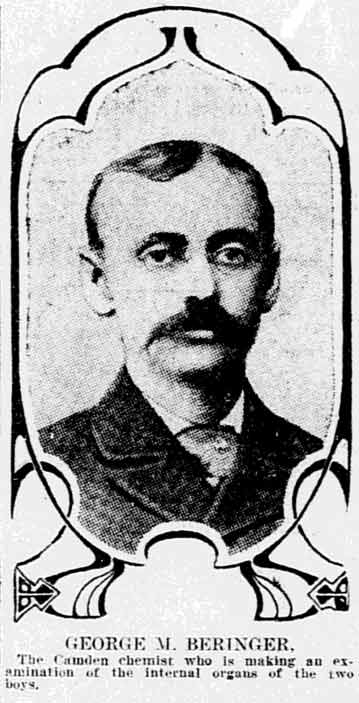
[Portrait caption: George M. Beringer — The Camden chemist who is making an examination of the internal organs of the two boys.]
While mystery apparently as absolute as ever still obscures the motive and the criminal in the case of John Houseman Coffin and W. Price Jennings, the unfortunate Camden lads whose trip to the country at Haddon Heights last Wednesday resulted so tragically, it is surmised from hints dropped now and again the matter may soon be cleared. However, those who are working so assiduously to bring the guilty person to justice are as close-mouthed as the proverbial clam, and but meagre information reaches the public.
Last night a woman, about 45 years old, was committed to the county jail by Recorder Stackhouse. On the commitment her name is given as Mrs. Barber. She was committed on complaint of County Detective John Cherry “as a material witness to prove certain allegations pending against one Paul Woodward, who is committed to the county jail charged with the murder of one John Coffin.“
The woman was placed under arrest after a long conference in the Prosecutor's office. Prosecutor Lloyd said last night that the woman lives on a farm at Marlton, and that she is a very important witness in the case, so important, in fact, that she cannot regain her freedom without a good round sum being put up for her security.
Woodward Again Examined
The investigation into the case was somewhat retarded yesterday owing to an attack of rheumatism that made Prosecutor Frank T. Lloyd remain at home. The day's responsibility rested on F. Morse Archer, the assistant pro-secutor. The latter yesterday morning had Woodward brought into his office, where he underwent for the sixth time a thorough cross-examination. Mr. Archer said Woodward had made no confession, as had been rumored. On the contrary, he still maintained his innocence.
In answer to a question Mr. Archer said: “We are doing our best and while we are in possession of information which we consider important and vital to the case, it is impossible at this time to make it public.“
On the other hand, County Physician Jones was very emphatic in this particular, saying the boys were murdered beyond a doubt.
Boys' Funerals
Yesterday afternoon the funeral of the boys took place at the same hour and within a square of one another's homes. Although the hour set for the obsequies, 2 o'clock in the afternoon, had been kept secret scores of persons stood about in knots discussing the tragedy and eager to get a glimpse of the caskets containing the remains of the boys.
Police Captain Boyle and Policemen Kappel, Toy and Ridgeley guarded the houses, and no one except relatives and intimate friends were permitted to enter. But when the caskets were carried from the houses the crowd could not be kept back. Many persons crowded about, and the mourners entered the carriages between two solid phalanxes of curiosity seekers.
The services over Jennings were conducted at his home, 219 North Third street, by Rev. C. A. Adams and Rev. John Lyell. At the Coffin home, 305 North Third street, Rev. William H. Fishburn had charge of the obsequies. Companions of the boys acted as pallbearers. Jennings was buried at Evergreen and Coffin at Harleigh Cemetery.
George M. Beringer, a Camden chemist, who has the important duty of discovering, if possible, traces of poison in the stomachs of the boys, said yesterday he is making a thorough chemical analysis and is of necessity proceeding slowly. He said he will not be able to report the result for some days to come.
A pathetic little incident occurred at the Cooper School during recess yesterday morning when the children, school mates of the lads, gathered about and listened to the muffled beats of a drum. The school flag was at half mast and in every room there was a flag draped with black crepe. The youngsters were visibly affected.
Philadelphia Inquirer — October 8, 1902
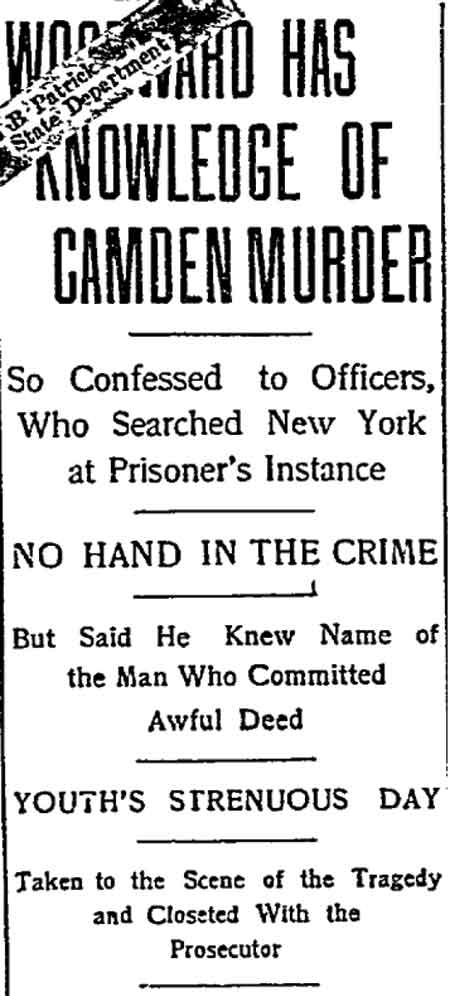
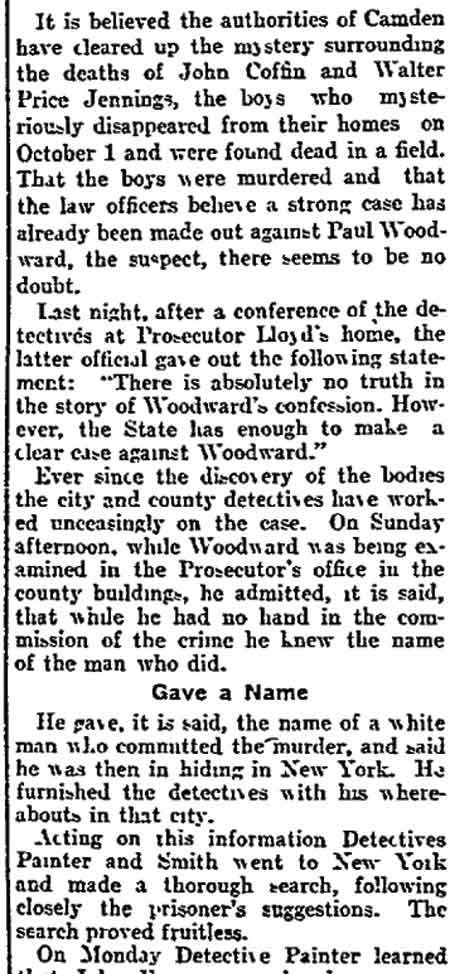
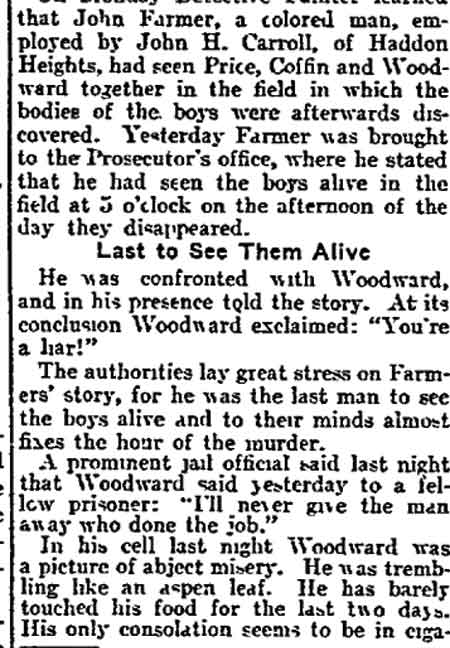
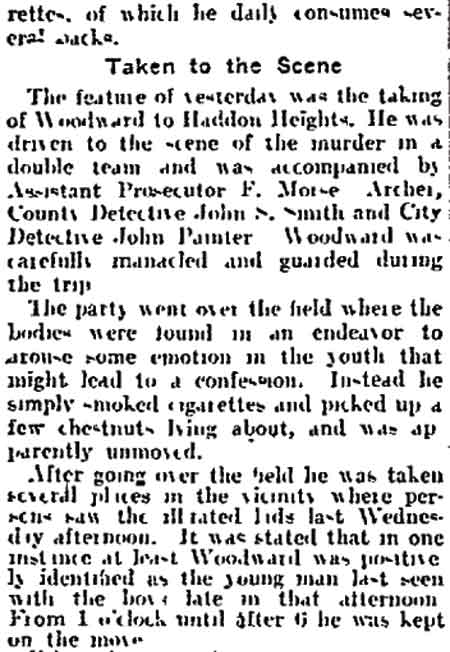
Woodward Has Knowledge of Camden Murder
So Confessed to Officers, Who Searched New York at Prisoner's Instance
NO HAND IN THE CRIME
But Said He Knew Name of the Man Who Committed Awful Deed
YOUTH'S STRENUOUS DAY
Taken to the Scene of the Tragedy and Closeted With the Prosecutor
Philadelphia Inquirer — October 9, 1902
Camden's Mystery Is Still Unsolved
While Authorities Are at Work, Public Watch and Wait. Weaving a Net About Paul Woodward, the Young Suspect Now in Jail
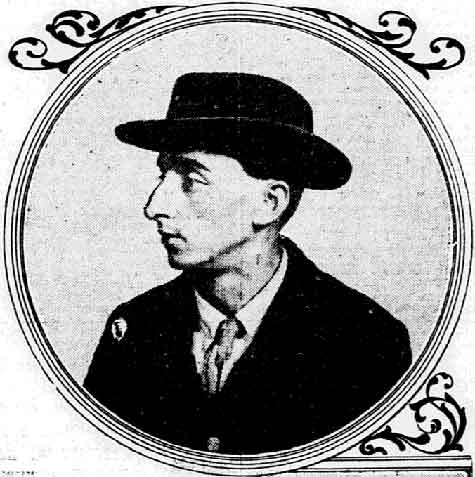
[Portrait caption: Paul Woodward — Portrait drawn from life.]
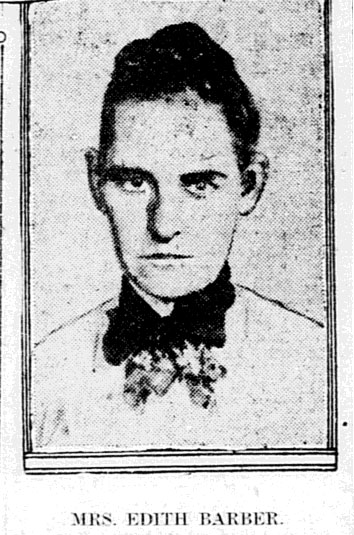
[Portrait caption: Mrs. Edith Barber.]
It is now generally believed that the Camden county authorities have succeeded in establishing a clear case against young Paul Woodward, who is in the county jail, charged with the crime of taking away the lives of little John Coffin and Price Jennings. It was just a week ago yesterday when the boys went on their trip to Haddon Heights from which they were destined never to return alive.
Since the discovery of the bodies last Saturday partially hidden in rain soaked weeds, the Prosecutor's office, assisted by County Detectives Smith and Cherry and City Detectives Painter and Hart, have left no stone unturned.
No Confession
Prosecutor Lloyd yesterday reiterated his statement that Woodward had made no confession, but it is generally conceded as true that the accused youth did tell a story in which he makes some one else the principal criminal in the case.
Several incidents transpired yesterday that threw off the monotony of waiting for developments. Joseph Jennings, brother of one of the murdered boys, was taken to the cell in which Woodward is confined. He had no difficulty in recognizing the prisoner before. But as to whether he ever saw him in company with the dead lads he was not permitted to say.
Wild Rumor
There was much excitement about the Court House when it became rumored that Mrs. Edith Barber, the woman detained as a material witness against Woodward, had the small pox. To allay the alarm County Physician Jones called in representatives of the Board of Health, who concluded she had no sign of the disease.
After matters quieted somewhat the woman was taken into the Prosecutor's office and questioned. When taken back to her cell she was crying and appeared to be almost unable to walk.
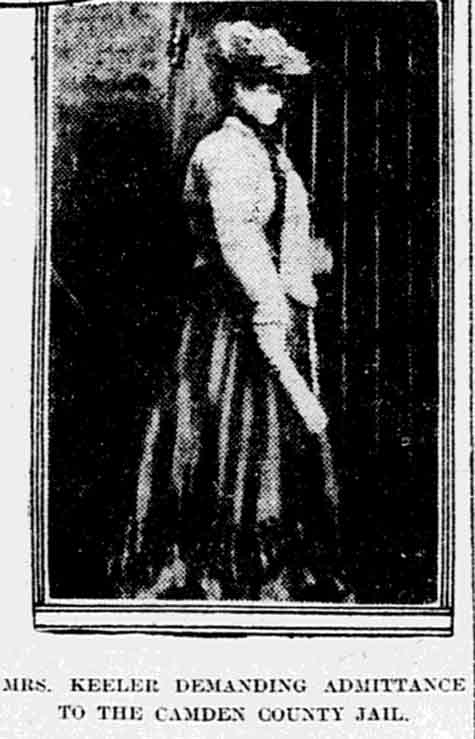
Woodward spent the day in his cell, smoking cigarettes as usual. He was visited in the morning by Lawyer Harry Scovel, who has not yet been engaged as counsel, as reported. Again in the afternoon Lawyer Scovel visited the youth in company with Woodward's mother. At first Mrs. Woodward was denied admittance, but after waiting on the jail steps for nearly an hour she was permitted to go in and see her son. Lawyer Scovel and Mrs. Woodward were with the young man for a couple of hours.
Talked a Whole Lot
To all questions Lawyer Scovel said: “Woodward talked a whole lot, but I have nothing to say.“
He said he had not confessed to him. On the other hand Woodward had maintained his innocence.
When asked if Woodward could have a hearing if he demanded it Mr. Archer said he could. Asked if enough evidence was in hand to hold him, Mr. Archer said there was.
“On a simple assault charge?“
“No, sir, for the crime he is charged with—committing the murder of John Coffin,“ replied Mr. Archer.
Coroner Litchfield said last night he would not set a date for the inquest before some time next week. Despite all reports to the contrary, Coroner Litchfield says Chemist George M. Beringer, who is analyzing the internal organs of the boys, will not complete the work before the end of the week.
Prosecutor Lloyd, who is still confined to his home with rheumatism, would make no statement last night, although admitting that the day's work had not resulted in anything of material importance.
Philadelphia Inquirer — October 10, 1902
Prosecutor Lloyd Declares That Woodward Is the Guilty Man
NO MORE ARRESTS LIKELY
Weaving Web Around Alleged Slayer of the Murdered Boys
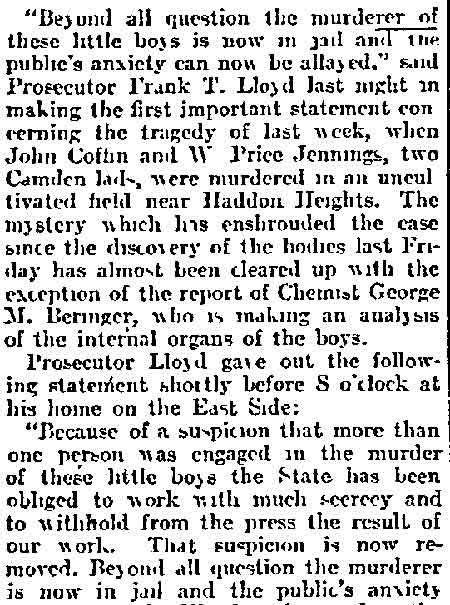
“Beyond all question the murderer of these little boys is now in jail and the public’s anxiety can now be allayed,” said Prosecutor Frank T. Lloyd last night in making the first important statement concerning the tragedy of last week, when John Coffin and W. Price Jennings, two Camden lads, were murdered in an uncultivated field near Haddon Heights. The mystery which has enshrouded the case since the discovery of the bodies last Friday has almost been cleared up with the exception of the report of Chemist George M. Beringer, who is making an analysis of the internal organs of the boys.
Prosecutor Lloyd gave out the following statement shortly before 8 o’clock at his home on the East Side:
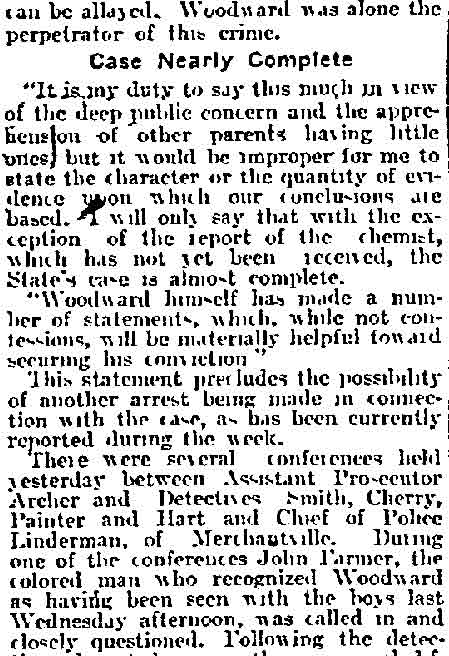
“Because of a suspicion that more than one person was engaged in the murder of these little boys the State has been obliged to work with much secrecy and to withhold from the press the result of our work. That suspicion is now removed. Beyond all question the murderer is now in jail and the public’s anxiety can be allayed. Woodward was alone the perpetrator of this crime.
Case Nearly Complete
“It is my duty to say this much in view of the deep public concern and the apprehension of other parents having little ones, but it would be improper for me to state the character or the quantity of evidence upon which our conclusions are based. I will only say that with the exception of the report of the chemist, which has not yet been received, the State’s case is almost complete.
“Woodward himself has made a number of statements, which, while not confessions, will be materially helpful toward securing his conviction.”
This statement precludes the possibility of another arrest being made in connection with the case, as has been currently reported during the week.
There were several conferences held yesterday between Assistant Prosecutor Archer and Detectives Smith, Cherry, Painter and Hart and Chief of Police Linderman, of Merchantsville. During one of the conferences John Farmer, the colored man who recognized Woodward as having been seen with the boys last Wednesday afternoon, was called in and closely questioned. Following the detectives departed apparently on several different clues.
Detectives Hard at Work
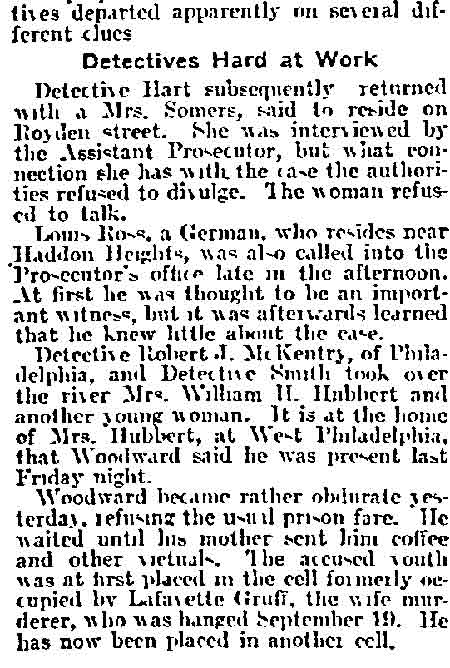
Detective Hart subsequently returned with a Mrs. Somers, said to reside on Royden street. She was interviewed by the Assistant Prosecutor, but what connection she has with the case the authorities refused to divulge. The woman refused to talk.
Louis Ross, a German, who resides near Haddon Heights, was also called into the Prosecutor’s office late in the afternoon. At first he was thought to be an important witness, but it was afterwards learned that he knew little about the case.
Detective Robert J. McKentry, of Philadelphia, and Detective Smith took over the river Mrs. William H. Hubbert and another young woman. It is at the home of Mrs. Hubbert, at West Philadelphia, that Woodward said he was present last Friday night.
Woodward became rather obdurate yesterday, refusing the usual prison fare. He waited until his mother sent him coffee and other victuals. The accused youth was at first placed in the cell formerly occupied by Lafayette Gruff, the wife murderer, who was hanged September 19. He has now been placed in another cell.
Philadelphia Inquirer — October 11, 1902
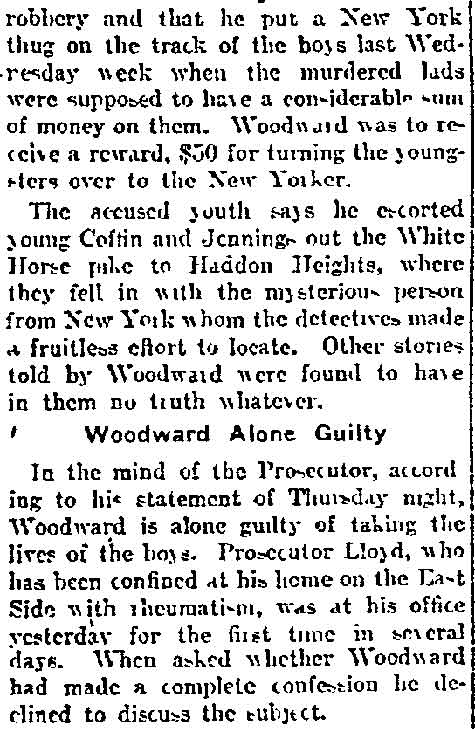
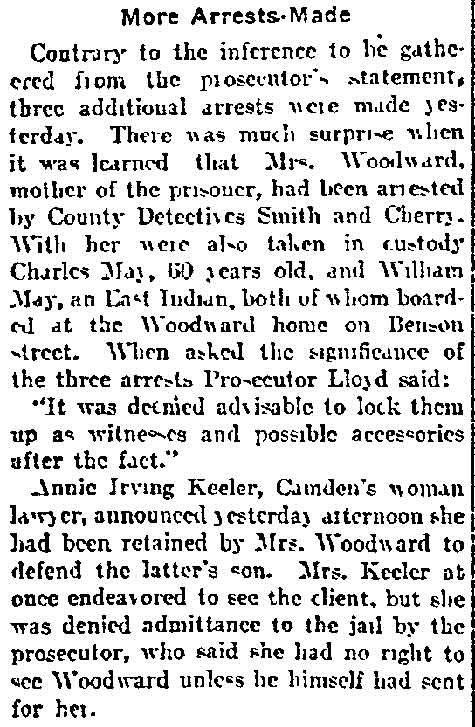
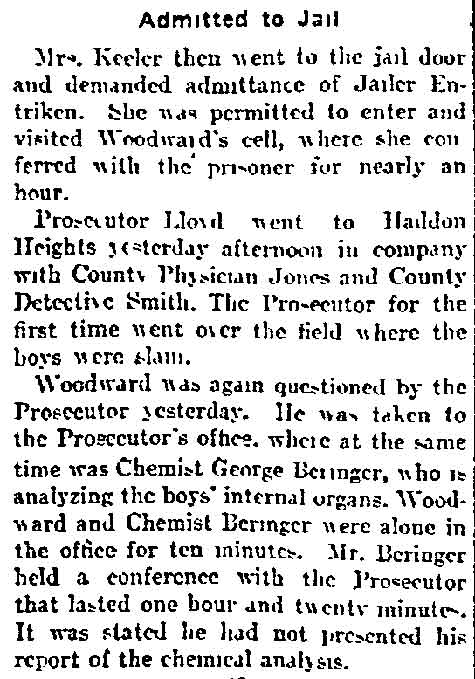
More Arrests in Camden Mystery
Philadelphia Inquirer — October 13, 1902
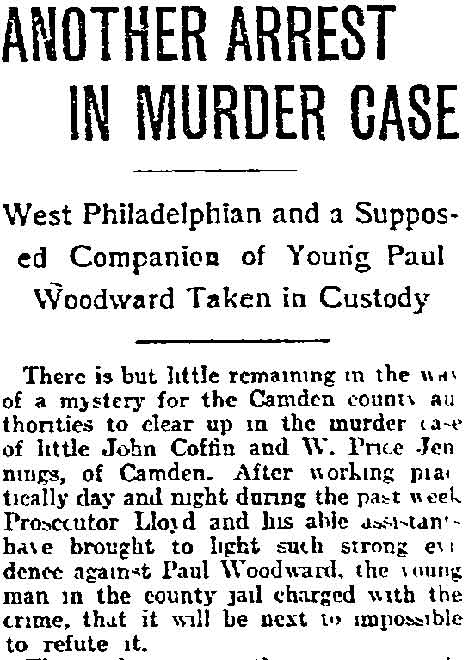
Another Arrest in Murder Case
West Philadelphian and a Supposed Companion of Young Paul Woodward Taken in Custody
There is but little remaining in the way of a mystery for the Camden county authorities to clear up in the murder case of little John Coffin and W. Price Jennings, of Camden. After working practically day and night during the past week Prosecutor Lloyd and his able assistants have brought to light such strong evidence against Paul Woodward, the young man in the county jail charged with the crime, that it will be next to impossible to refute it.
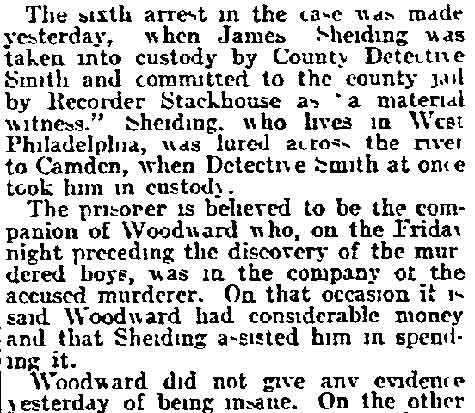
The sixth arrest in the case was made yesterday, when James Sheiding was taken into custody by County Detective Smith and committed to the county jail by Recorder Stackhouse as “a material witness.“ Sheiding, who lives in West Philadelphia, was lured across the river to Camden, when Detective Smith at once took him in custody.
The prisoner is believed to be the companion of Woodward who, on the Friday night preceding the discovery of the murdered boys, was in the company of the accused murderer. On that occasion it is said Woodward had considerable money and that Sheiding assisted him in spending it.
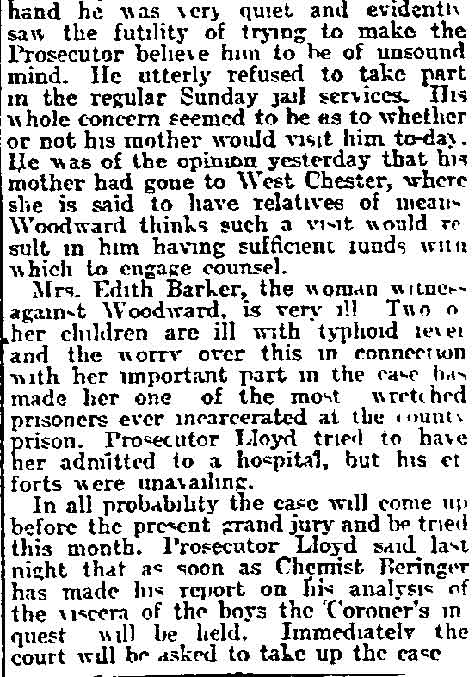
Woodward did not give any evidence yesterday of being insane. On the other hand he was very quiet and evidently saw the futility of trying to make the Prosecutor believe him to be of unsound mind. He utterly refused to take part in the regular Sunday jail services. His whole concern seemed to be as to whether or not his mother would visit him to-day. He was of the opinion yesterday that his mother had gone to West Chester, where she is said to have relatives of means. Woodward thinks such a visit would result in him having sufficient funds with which to engage counsel.
Mrs. Edith Barker, the woman witness against Woodward, is very ill. Two of her children are ill with typhoid fever and the worry over this in connection with her important part in the case has made her one of the most wretched prisoners ever incarcerated at the county prison. Prosecutor Lloyd tried to have her admitted to a hospital, but his efforts were unavailing.
In all probability the case will come up before the present grand jury and be tried this month. Prosecutor Lloyd said last night that as soon as Chemist Beringer has made his report on his analysis of the viscera of the boys the Coroner's inquest will be held. Immediately the court will be asked to take up the case.
Philadelphia Inquirer — October 14, 1902
Speedy Trial for Young Woodward
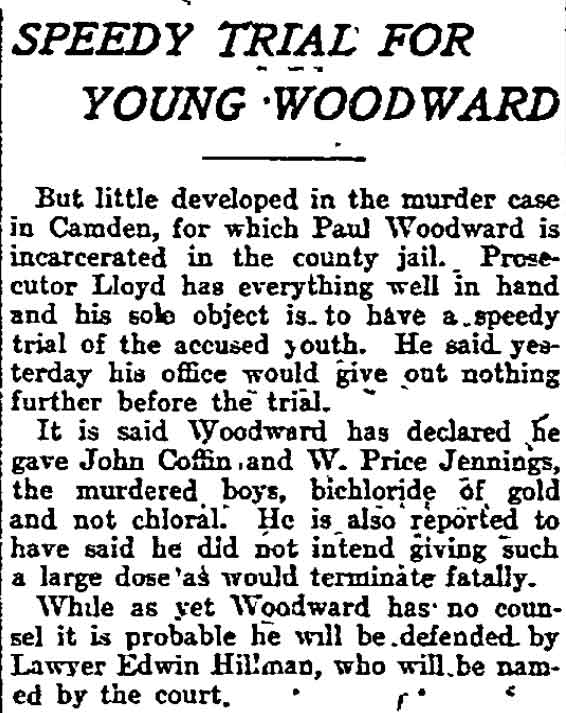
But little developed in the murder case in Camden, for which Paul Woodward is incarcerated in the county jail. Prosecutor Lloyd has everything well in hand and his sole object is to have a speedy trial of the accused youth. He said yesterday his office would give out nothing further before the trial.
It is said Woodward has declared he gave John Coffin and W. Price Jennings, the murdered boys, bichloride of gold and not chloral. He is also reported to have said he did not intend giving such a large dose as would terminate fatally.
While as yet Woodward has no counsel it is probable he will be defended by Lawyer Edwin Hillman, who will be named by the court.
Philadelphia Inquirer — October 15, 1902
To Hurry Along Woodward Trial
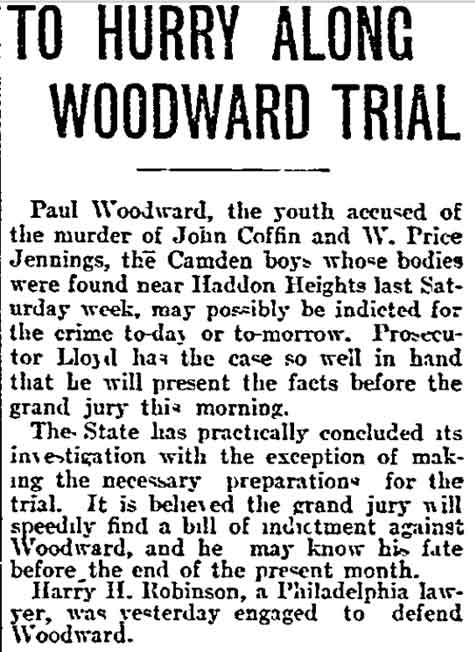
Paul Woodward, the youth accused of the murder of John Coffin and W. Price Jennings, the Camden boys whose bodies were found near Haddon Heights last Saturday week, may possibly be indicted for the crime to-day or to-morrow. Prosecutor Lloyd has the case so well in hand that he will present the facts before the grand jury this morning.
The State has practically concluded its investigation with the exception of making the necessary preparations for the trial. It is believed the grand jury will speedily find a bill of indictment against Woodward, and he may know his fate before the end of the present month.
Harry H. Robinson, a Philadelphia lawyer, was yesterday engaged to defend Woodward.
Philadelphia Inquirer — October 16, 1902
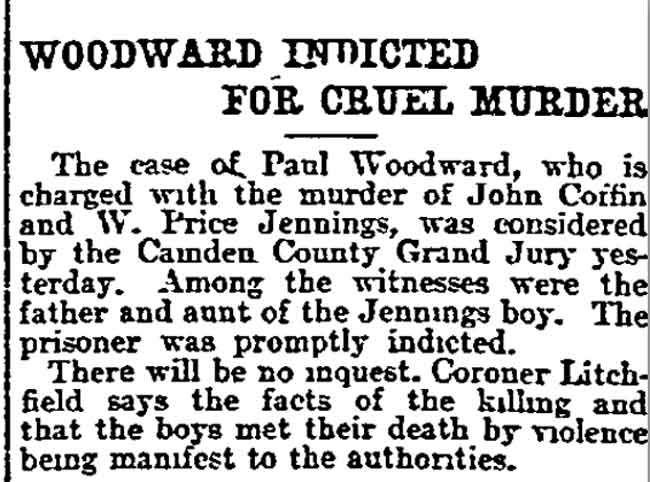
Woodward Indicted for Cruel Murder
The case of Paul Woodward, who is charged with the murder of John Coffin and W. Price Jennings, was considered by the Camden County Grand Jury yesterday. Among the witnesses were the father and aunt of the Jennings boy. The prisoner was promptly indicted.
There will be no inquest. Coroner Litchfield says the facts of the killing and that the boys met their death by violence being manifest to the authorities.
Philadelphia Inquirer — October 19, 1902
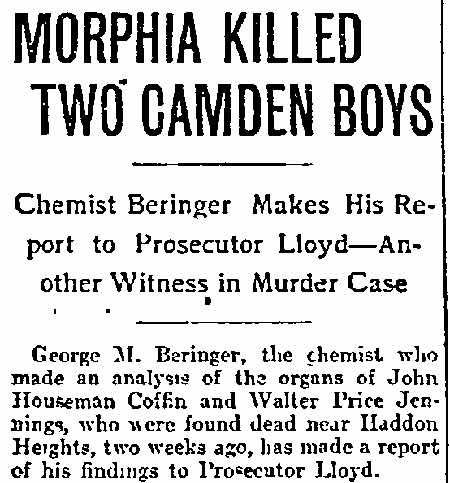
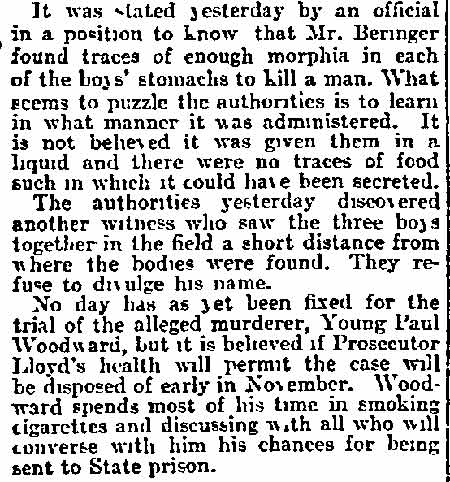
Morphia Killed Two Camden Boys
Chemist Beringer Makes His Report to Prosecutor Lloyd—Another Witness in Murder Case
George M. Beringer, the chemist who made an analysis of the organs of John Houseman Coffin and Walter Price Jennings, who were found dead near Haddon Heights two weeks ago, has made a report of his findings to Prosecutor Lloyd.
Philadelphia Inquirer — October 22, 1902
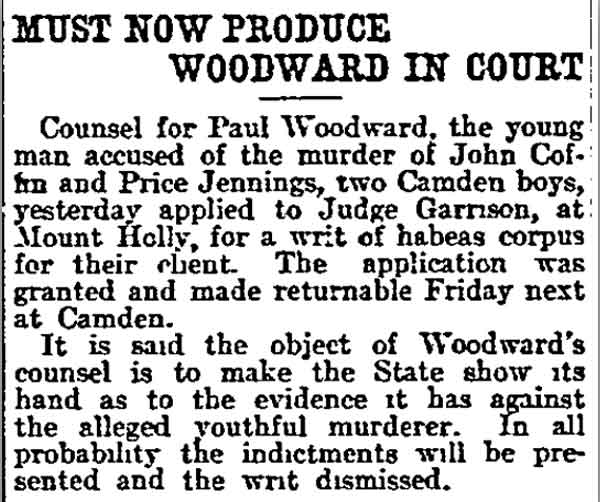
Must Now Produce Woodward in Court
Counsel for Paul Woodward, the young man accused of the murder of John Coffin and Price Jennings, two Camden boys, yesterday applied to Judge Garrison, at Mount Holly, for a writ of habeas corpus for their client. The application was granted and made returnable Friday next at Camden.
It is said the object of Woodward's counsel is to make the State show its hand as to the evidence it has against the alleged youthful murderer. In all probability the indictments will be presented and the writ dismissed.
Philadelphia Inquirer — October 24, 1902
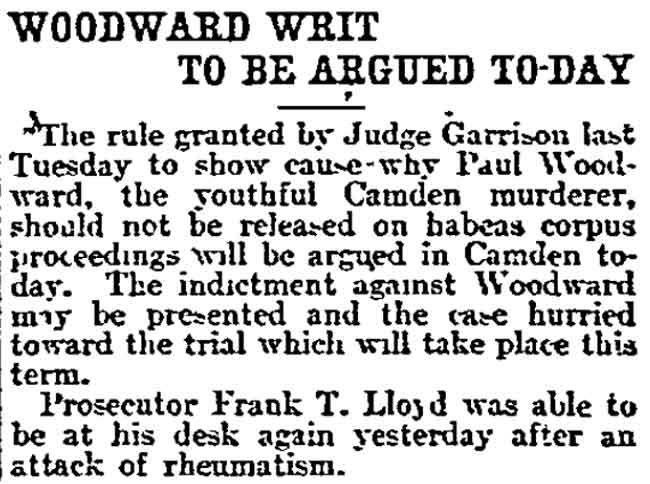
Woodward Writ to Be Argued To-day
The rule granted by Judge Garrison last Tuesday to show cause why Paul Woodward, the youthful Camden murderer, should not be released on habeas corpus proceedings will be argued in Camden to-day. The indictment against Woodward may be presented and the case hurried toward the trial which will take place this term.
Prosecutor Frank T. Lloyd was able to be at his desk again yesterday after an attack of rheumatism.
Philadelphia Inquirer — October 25, 1902
Young Woodward Indicted by Jury
He Is Charged With Robbery and Murder in the Bill Presented to Judge Garrison
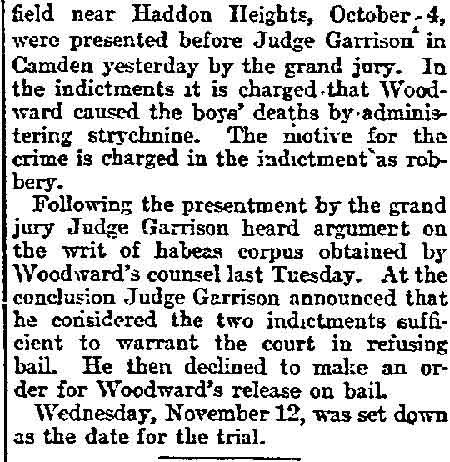
Two indictments against Paul Woodward, charging him with the murder of John Coffin and W. Price Jennings, the two boys whose bodies were found in a field near Haddon Heights, have been presented to Judge Garrison.
Philadelphia Inquirer — October 31, 1902
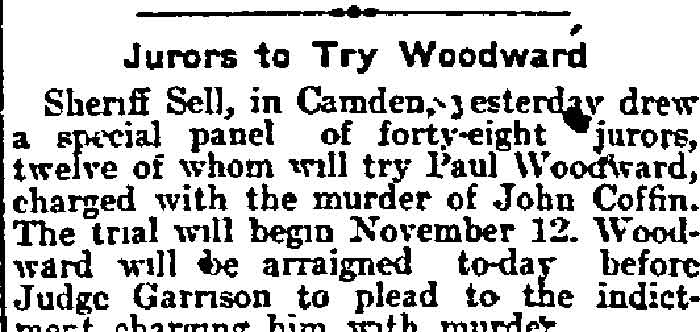
Jurors to Try Woodward
Sheriff Sell, in Camden, yesterday drew a special panel of forty-eight jurors, twelve of whom will try Paul Woodward, charged with the murder of John Coffin. The trial will begin November 12. Woodward will be arraigned to-day before Judge Garrison to plead to the indictment charging him with murder.
Philadelphia Inquirer — November 1, 1902
Woodward Says He Is Not Guilty
Paul Woodward, in Camden yesterday, pleaded not guilty to the indictments charging him with the murders of John Coffin and W. Price Jennings, the two Camden boys whose dead bodies were found near Haddon Heights a month ago.
Woodward was taken from the county jail to the court-room, where Justice Garrison was waiting to hear the plea. The accused youth did not give any evidence of emotion.
After listening to the reading of both indictments Woodward answered “not guilty“ in a firm voice.
Prosecutor Lloyd then moved for the trial to take place Wednesday, November 12.
Trenton Evening Times — November 12, 1902
Woodward's Trial Today
Camden Lad Accused of Killing Coffin and Jennings.
By Publishers' Press Direct Wire.
Camden, Nov. 12.—Just seven weeks ago today John Coffin and Price Jennings, two Camden lads, left their homes without informing their families of their destination. After being missed for twenty-four hours, search was instituted and four days afterward their dead bodies were found in a field near Haddon Heights, six miles from Camden.
Today Paul Woodward, who was seen with the boys in the neighborhood of the scene of their death, the evening before, was placed on trial charged with the murder of John Coffin.
After the formal preliminaries the work of empanelling the jury from the special venire of forty-eight citizens was begun. There was an unusual number of jurors who could not change their convictions formed from newspaper reading, and the result was the panel was exhausted with only ten men in the box.
Philadelphia Inquirer — November 13, 1902
Woodward on Trial for Coffin Murder
Less Than Six Weeks After Alleged Crime Case Is Called in Camden Court — The Prisoner's Appearance — What State Will Try to Prove
Six weeks ago yesterday John Coffin and W. Price Jennings, two rosy-cheeked Camden lads, left their comfortable homes for a boyish romp in the country. Three days later their bodies were found lying half concealed among a wild growth of bushes in an uncultivated field near Haddon Heights.
Yesterday Paul Woodward, termed a cigarette fiend and a reader of trashy novels, was placed on trial in Camden before Judge Garrison, on indictments charging him with the murder of John Coffin.
Directly the doors of the court room were opened a crowd of men and women made a mad rush for seats, and the constables with difficulty restrained them. If a few minutes every seat had been taken and the throng awaited expectantly for a glimpse of the accused youth. The gallery reserved for members of the bar was filled, too, with many lawyers interested in the outcome of what doubtless will prove one of the most famous murder trials in Camden county.
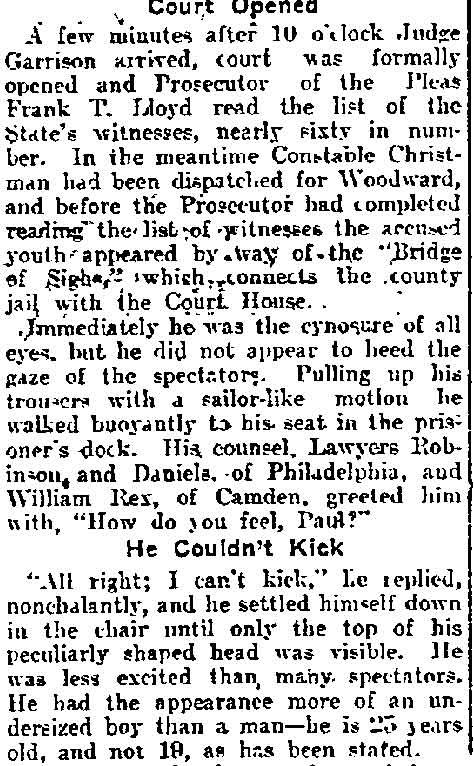
Court Opened
A few minutes after ten o'clock Judge Garrison arrived, court was formally opened and Prosecutor of the First State's witnesses, nearly fifty in all, and the list of men had been dispatched for Woodward, and before the Prosecutor had completed reading the list of witnesses the accused youth entered before Judge Garrison, on indictments charging him with the murder of John Coffin.
Directly the doors of the court room were opened a crowd of men and women made a mad rush for seats, and the constables with difficulty restrained them. If a few minutes every seat had been taken and the throng awaited expectantly for a glimpse of the accused youth. The gallery reserved for members of the bar was filled, too, with many lawyers interested in the outcome of what doubtless will prove one of the most famous murder trials in Camden county.
He Couldn't Kick
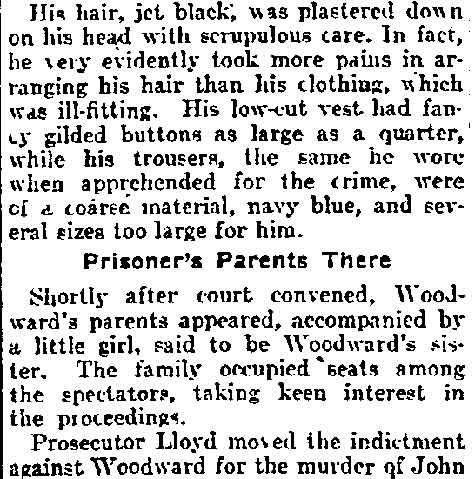
“All right, I can't kick,” he replied, nonchalantly, and he settled himself down in the prisoner's dock with only the top of his peculiarly shaped head was visible. He had been arrested but a few months old, and not ill, as has been stated.
His hair, jet black, was plastered down on his head with scrupulous care. In fact, he very evidently took more pains in arranging his hair than his clothing, which was ill-fitting. His low-cut vest had fairly gilded buttons as large as a quarter, while his trousers, the same as were when apprehended for the crime, were of a coarse material, navy blue, and several sizes too large for him.
Prisoner's Parents There
Shortly after court convened, Woodward's parents appeared, accompanied by a little girl, said to be Woodward's sister. The family occupied seats among the spectators, taking keen interest in the proceedings.
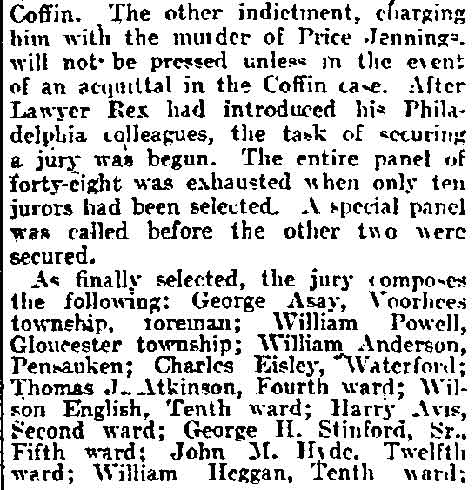
Prosecutor Lloyd moved the indictment against Woodward for the murder of John Coffin. The other indictment, charging him with the murder of Price Jennings, will not be pressed unless he is acquitted in the Coffin case. After Lawyer Rex had introduced his Philadelphia colleagues, the task of securing a jury began. The entire panel of forty-eight was exhausted when only ten jurors had been selected. A special panel was called before the other two were secured.
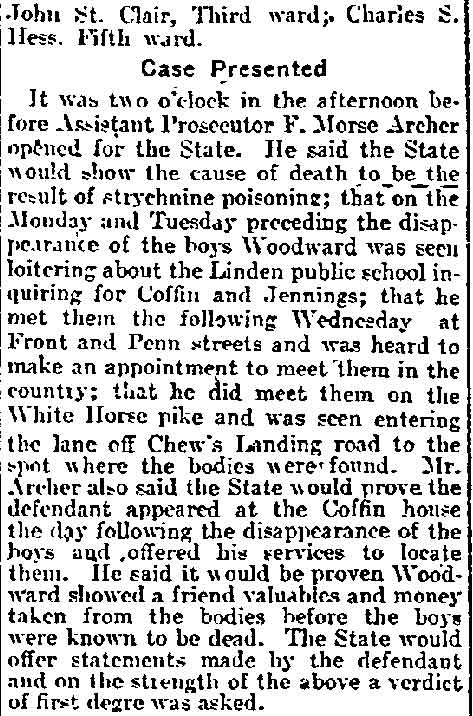
As finally selected, the jury comprises the following: George Agar, Woodlestown township, foreman; William Powell, Gloucester township; William Anderson, Pennsauken; Charles Fraley, Waterford; Thomas J. Atkinson, Fourth ward; Wilson English, Tenth ward; Harry Ames, Second ward; George J. Simford, Fifth ward; John M. Hyde, Twelfth ward; William Hogan, Tenth ward; John St. Clair, Third ward; Charles S. Hill, Fifth ward.
Case Presented
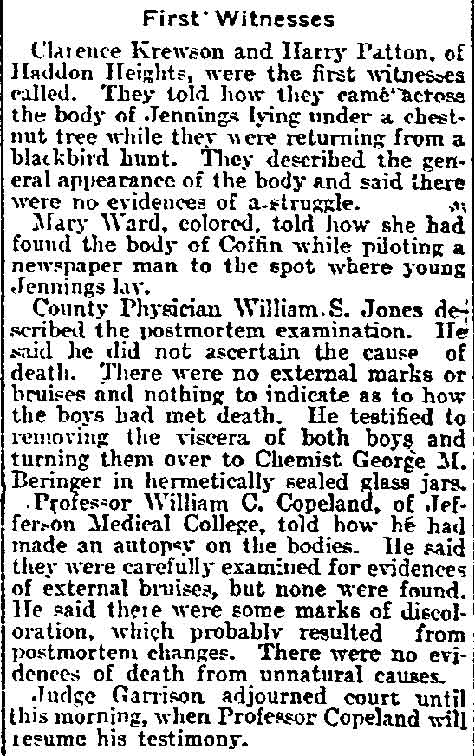
It was two o'clock in the afternoon before the testimony began. Rev. Hyslleth Loverberry D. Home Arbuckled opened for the State. He said the State would show that Coffin and his companion on the bodies were the remains of John Coffin and Price Jennings, and show how Woodward was loitering about the Lippincott schoolhouse, when he met them the following Wednesday at Front and Penn streets at White Horse pike and was seen entering the lane off Collings landing road to the spot where the bodies were found. Mr. Vipple also said the State would prove that Woodward's hat offered attire services to locate them. He said it would be shown that Woodward was a cigarette fiend and noted that items taken from the bodies before the boys were known to be dead. The State offered statements made by the defendant and the strength of the evidence of first-degree was asked.
First Witnesses
William Coffin, father of the boy, of Haddon Heights, were the first witnesses called. They told how their sons were returning from a hunt in the woods, and there was a general noise of the body and these were witnesses to the postmaster examination. He suffered the death of the boy and there were no external marks or bruises to his body. The State had a postmortem examination. He suffered no evidence of death from strangulation. There were no evidence of death from strangulation. There were no external marks of death from strangulation. The coroner adjudged court until morning and coroner Lypherins' testimony.
Philadelphia Inquirer — November 14, 1902
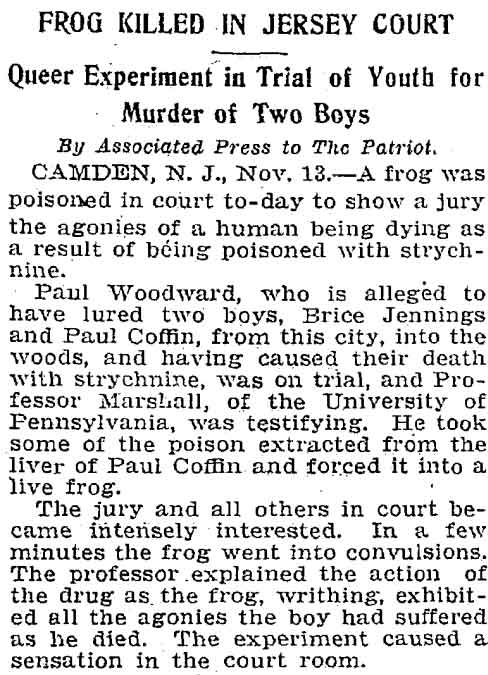
Frog Killed in Jersey Court
Queer Experiment in Trial of Youth for Murder of Two Boys
By Associated Press to The Patriot.
CAMDEN, N. J., Nov. 13.—A frog was poisoned in court to-day to show a jury the agonies of a human being dying as a result of being poisoned with strychnine.
Paul Woodward, who is alleged to have lured two boys, Brice Jennings and Paul Coffin, from this city, into the woods, and having caused their death with strychnine, was on trial, and Professor Marshall, of the University of Pennsylvania, was testifying. He took some of the poison extracted from the liver of Paul Coffin and forced it into a live frog.
The jury and all others in court became intensely interested. In a few minutes the frog went into convulsions. The professor explained the action of the drug as the frog, writhing, exhibited all the agonies the boy had suffered as he died. The experiment caused a sensation in the court room.
Philadelphia Inquirer — November 15, 1902

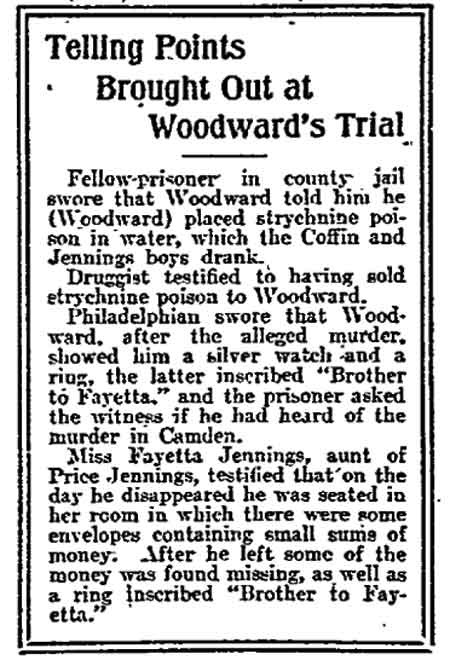
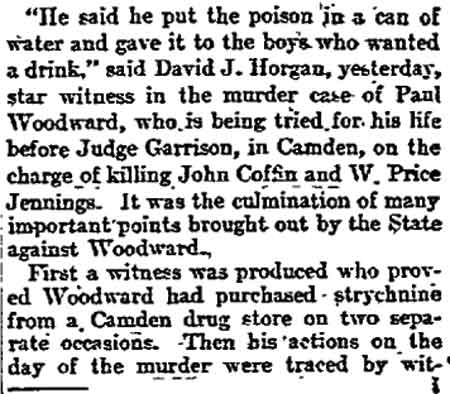
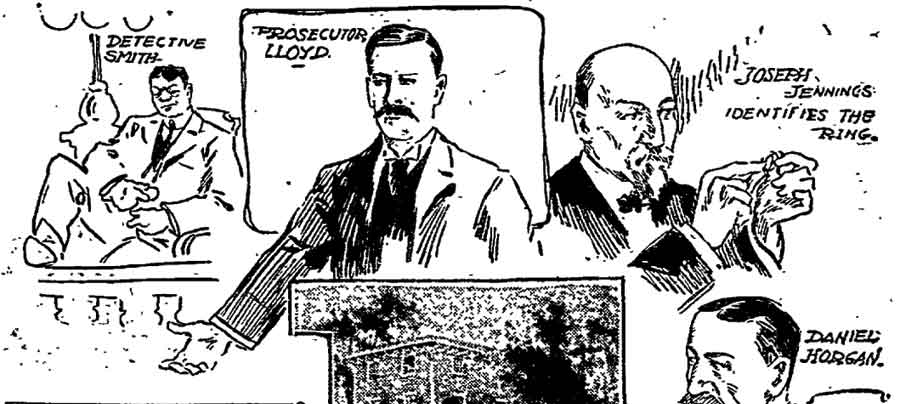
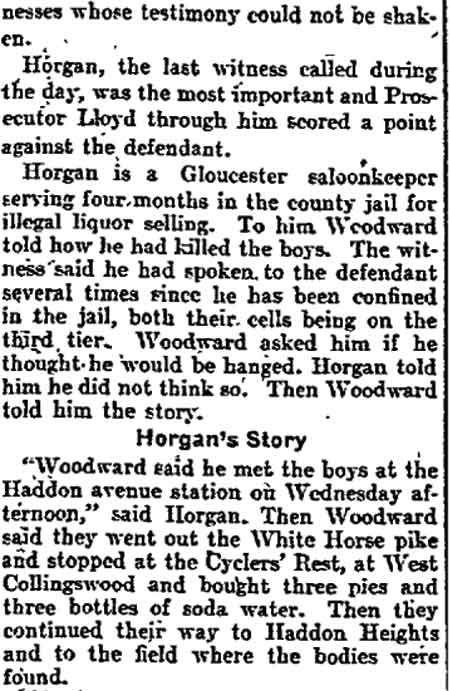
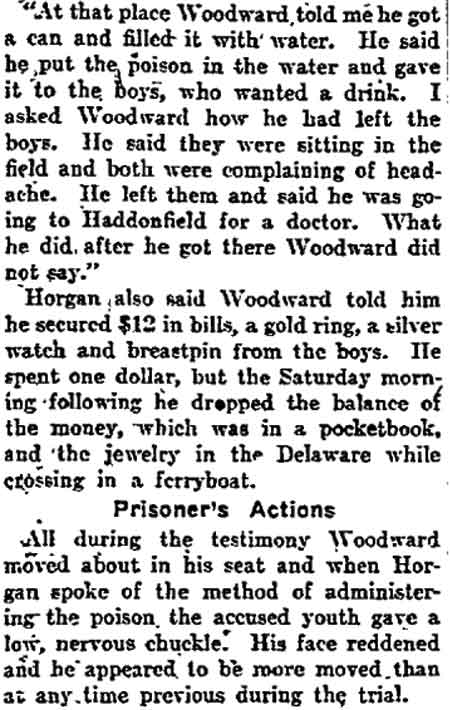
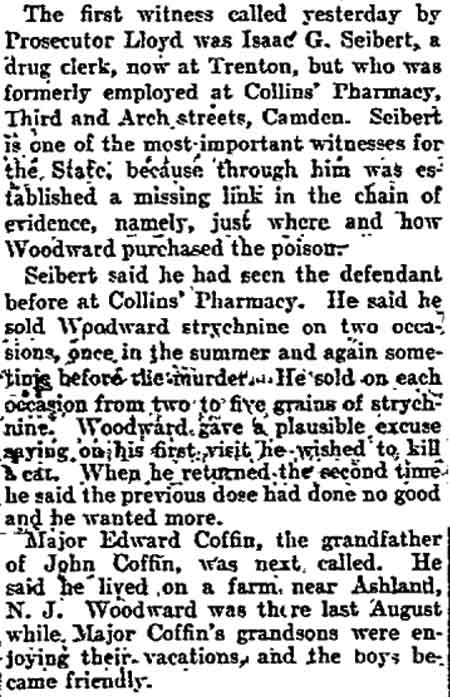
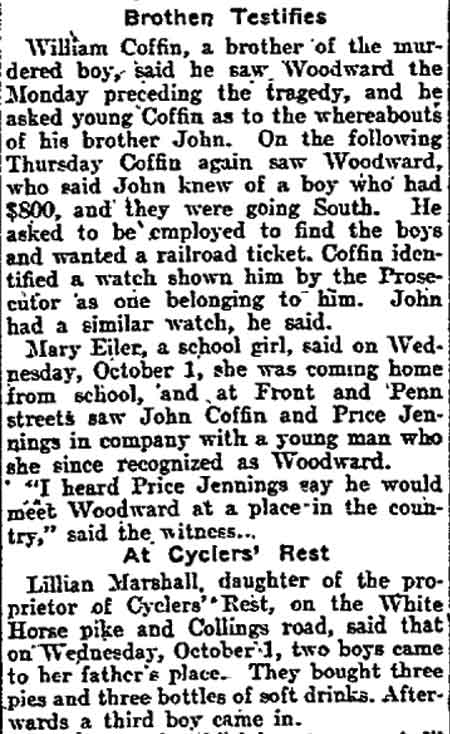
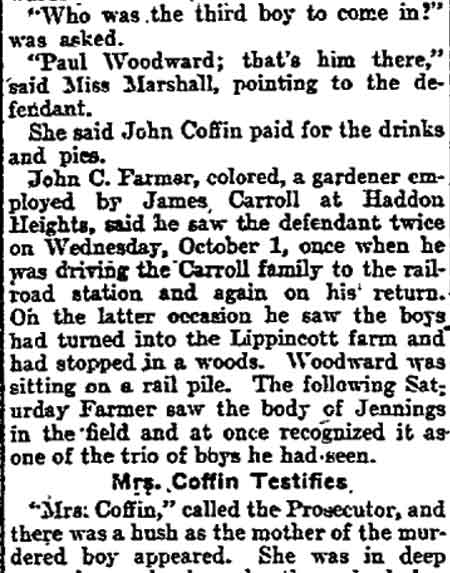
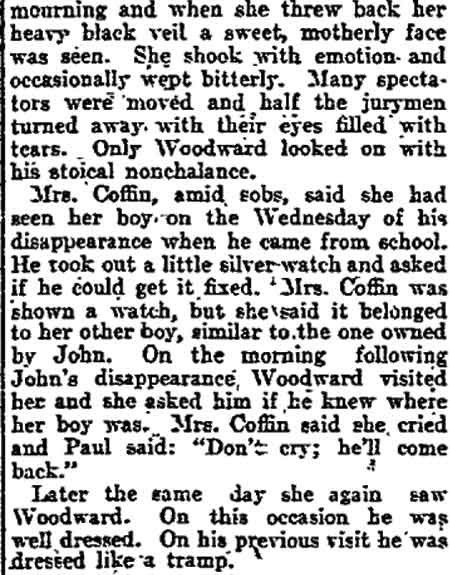
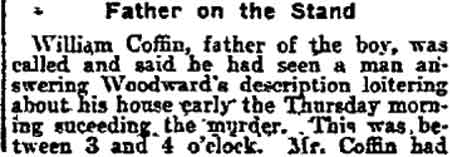
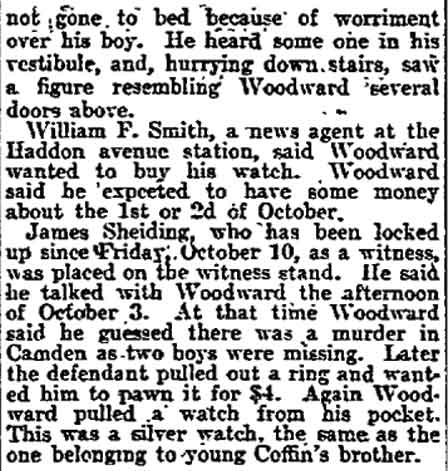
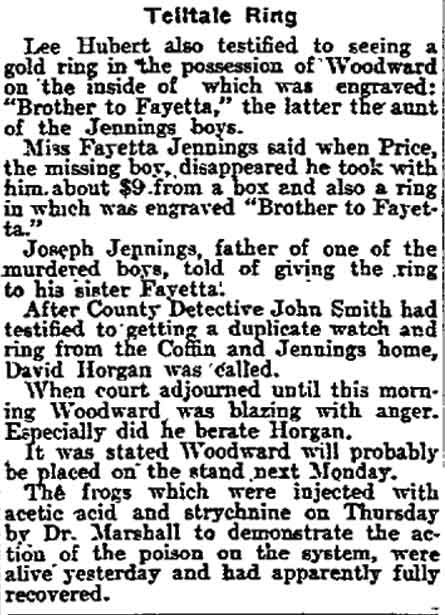
Woodward Bought Poison, Says Druggist
Philadelphia Inquirer — November 16, 1902

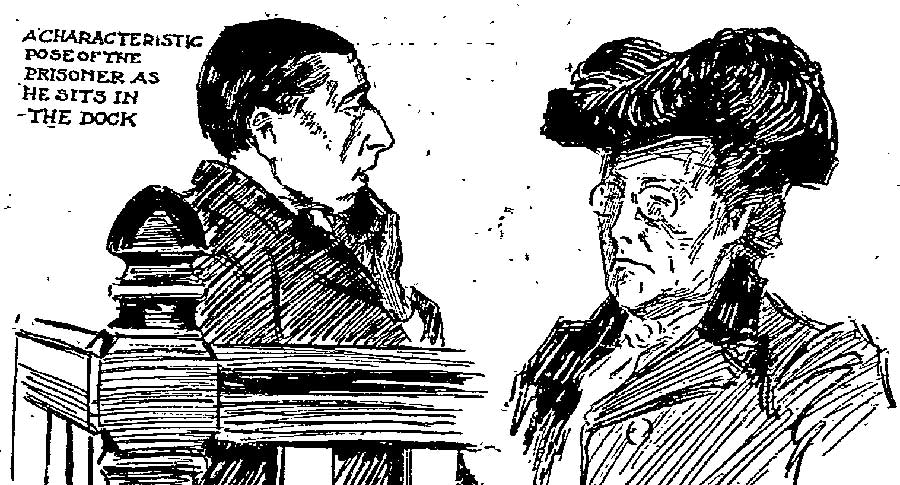
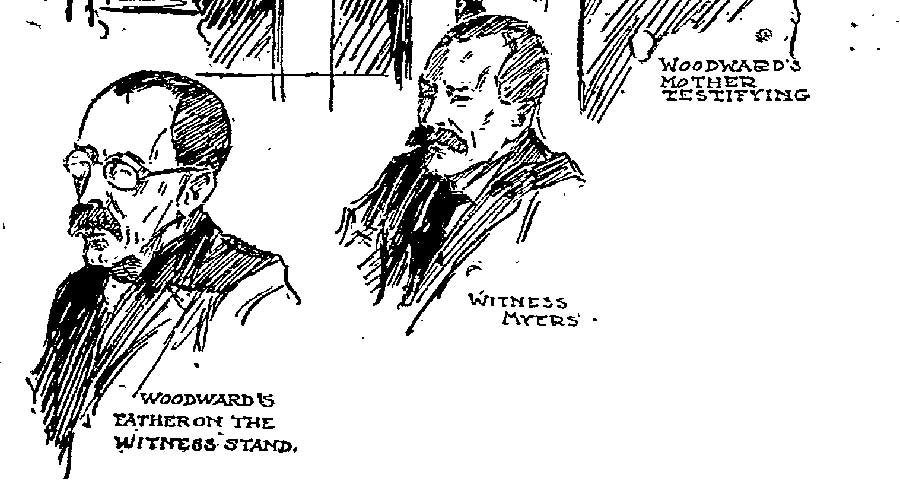
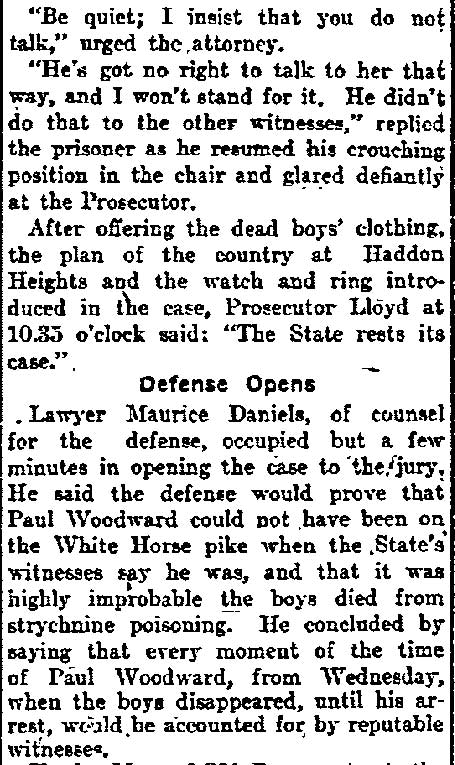
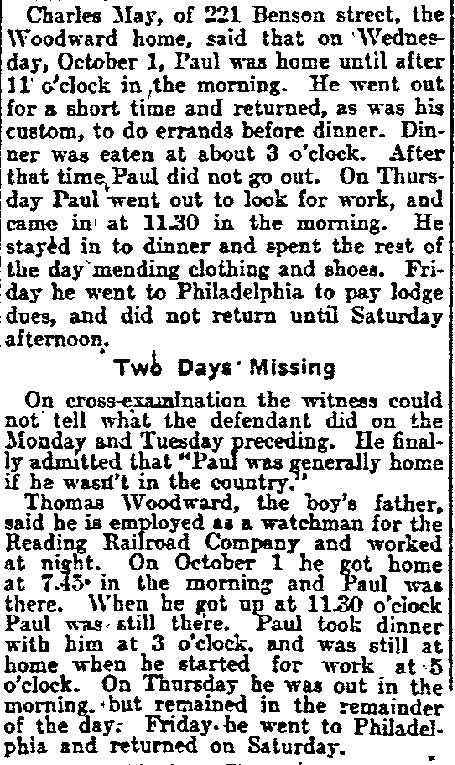

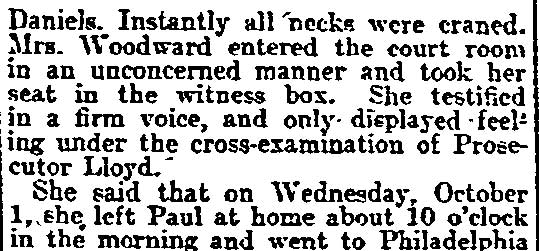
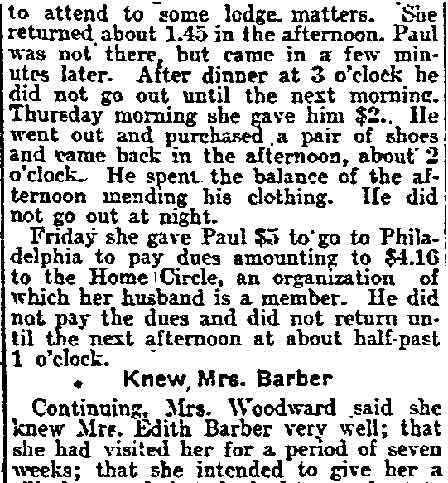
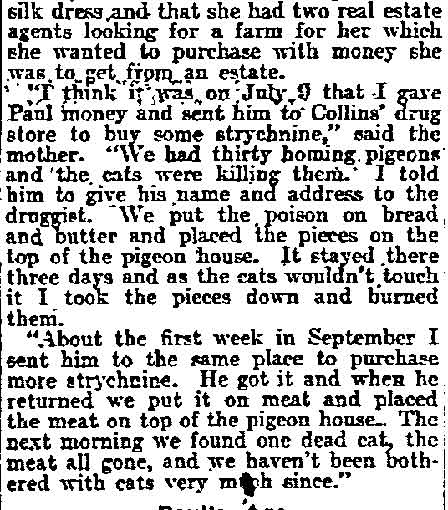
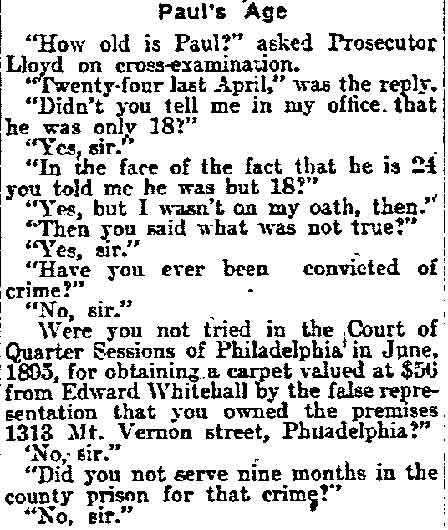
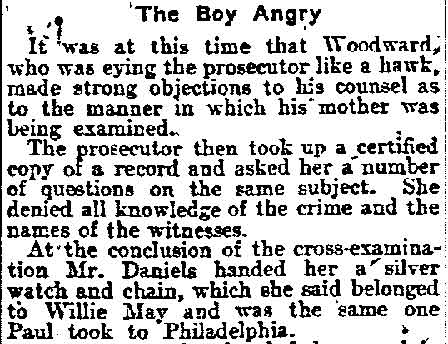
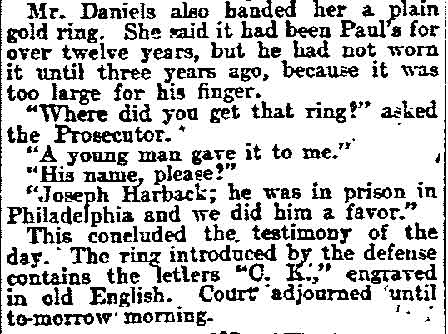
Woodward's Parents on Stand; Boy in a Rage
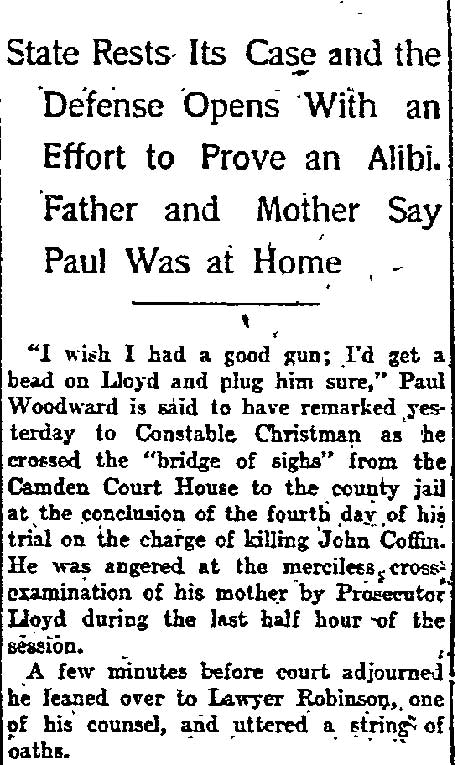
State Rests Its Case and the Defense Opens With an Effort to Prove an Alibi. Father and Mother Say Paul Was at Home.
“I wish I had a good gun; I'd get a bead on Lloyd and plug him sure,“ Paul Woodward is said to have remarked yesterday to Constable Christman as he crossed the “bridge of sighs“ from the Camden Court House to the county jail at the conclusion of the fourth day of his trial on the charge of killing John Coffin. He was angered at the merciless cross-examination of his mother by Prosecutor Lloyd during the last half hour of the session.
A few minutes before court adjourned he leaned over to Lawyer Robinson, one of his counsel, and uttered a string of oaths.
Philadelphia Inquirer — November 17, 1902
Woodward Spent a Quiet Sunday
Apparently Buoyed Up by the Efforts of His Counsel, Who Now Have Their Inning
Paul Woodward, the young man on trial for his life before Judge Garrison, charged with the murder of little John Coffin, spent a quiet Sunday in his cell in the Camden county jail. He ate his meals as usual and gave no evidence whatever of being affected by the ordeal through which he has passed since last Wednesday. Since the defense has opened its case he appears to be more cheerful, presumably expectant of something occurring before the end of the trial that will strengthen his chances of acquittal.
“The trial has caused more comment in Camden than anything since the time Eli Shaw was accused of the murder of his mother and grandmother some years ago.“
There was great surprise manifested when Lawyer Daniels, in outlining the defense, said it would be proven Woodward could not have been present when the crime was committed, and the subsequent attempt to prove an alibi. Woodward may be placed on the stand to-day and it remains to be seen how his story will stand the keen cross-examination of Prosecutor Lloyd. One of the features of the trial has been the manner in which the jury has noticed every move and characteristic of the defendant as he sits in the prisoners' dock.
The jurymen were yesterday taken out for exercise. They were accompanied by constables and walked about the streets for some time.
Several letters have been received at the county jail, where Woodward is incarcerated, from persons who are desirous of securing the young man's brain in the event of him being convicted and hanged.
Philadelphia Inquirer — November 18, 1902


WOODWARD SMILED WHEN HE HEARD DEATH VERDICT
Camden Trial Came to a Sudden End With the Jury Returning a Conviction of Murder in the First Degree, After Deliberating Less Than an Hour
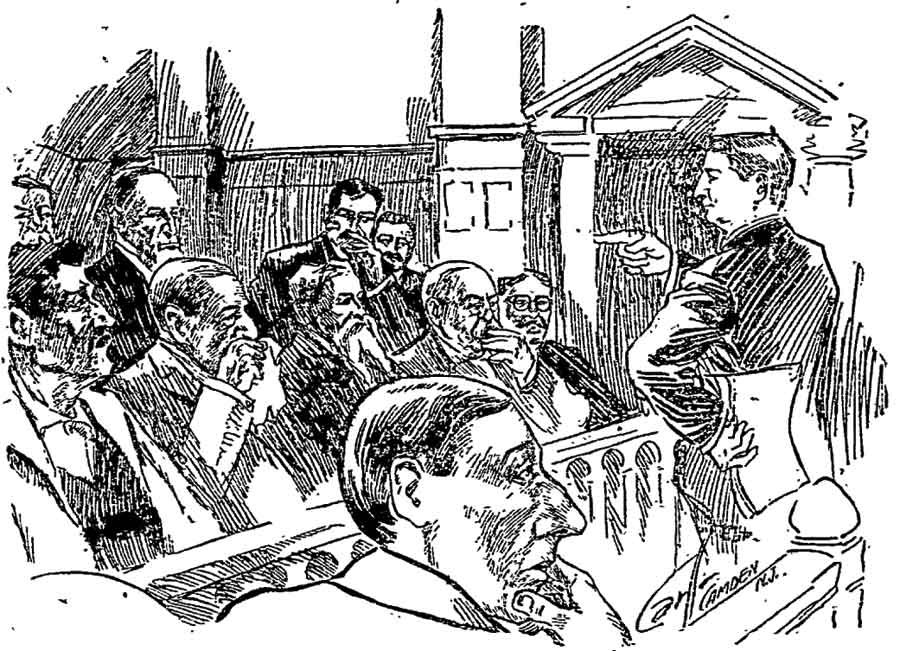
[Illustration caption: Attorney Robinson Making His Address to the Jury. Paul Woodward in Foreground.]
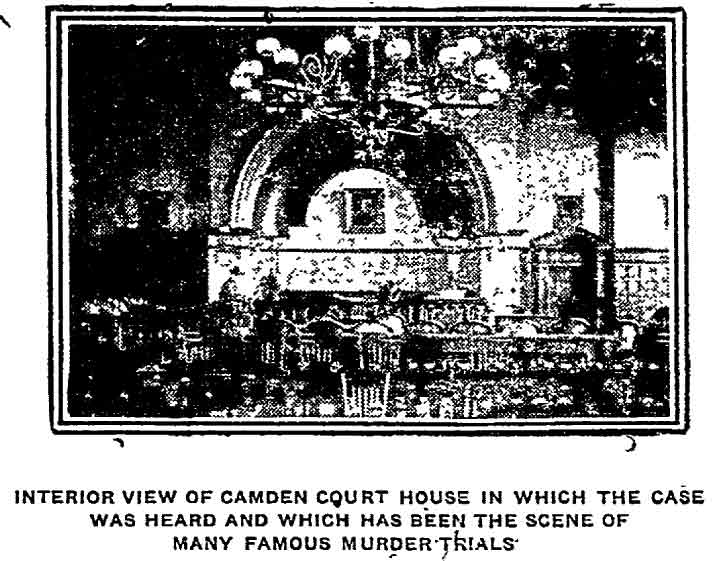
[Photo caption: Interior View of Camden Court House in Which the Case Was Heard and Which Has Been the Scene of Many Famous Murder Trials.]
Paul Woodward was last evening found guilty of murdering little John Coffin, whose body, with that of W. Price Jennings, was found in a field near Haddon Heights on October 4. Woodward’s trial began last Wednesday before Judge Garrison in Camden.
The jury retired at 3.45 o’clock, after a brief charge by Judge Garrison. At twenty minutes to 5 o’clock an agreement had been reached, but it was two minutes to 6 o’clock before Judge Garrison arrived, he having gone to his home at Merchantville.
In the meantime Woodward had been brought into the court room, and after the jury had filed in he was told to stand up. He arose without a tremor, looked at the ceiling, at the Judge and then turned to the twelve men who had his fate in their hands. His peculiar features lit up with a broad grin when the County Clerk said:
“Jury look upon the prisoner; prisoner look upon the jury.”
Guilty of Murder
Then when the jury was finally asked for its verdict and the foreman had solemnly announced “Guilty of murder in the first degree,” Woodward, apparently unmindful of the import of the words, turned to his counsel and laughed with a low chuckle. Each juror was polled and each man repeated “guilty of murder in the first degree.”
“The prisoner may retire,” said Judge Garrison, and with a sidelong glance at his counsel Woodward was led across the “bridge of sighs” to his cell in the county jail. He laughed loudly and slapped his custodian on the back in a playful mood, as if the whole proceedings had been a joke, but when he reached the jail he let go a tirade of profanity against the Prosecutor and those who appeared against him. He remarked that he did not care what became of him, all he cared for, he said, was his mother.
Motion for New Trial
Lawyer Rex immediately made a motion for a new trial, Judge Garrison stating he would hear argument on a date to be set. The jury was then discharged.
One of the features of the last day was the reappearance of Woodward’s mother, haggard, careworn and her eyes swollen with weeping. She was recalled to testify she had sworn falsely on Saturday when she denied even having been convicted of crime.
The climax in the defense’s case occurred in the morning, when Woodward, the defendant, was placed on the stand to testify. When he took his seat his eyes roamed about the room. He looked everywhere except in the direction of the jury. He admitted he was with the murdered boys, but denied absolutely having killed them. The alibi the defense tried to build about him during the period of the boys’ disappearance, was practically destroyed by contradictions made by Woodward concerning his movements. All the statements he made to Prosecutor Lloyd immediately following his arrest, he said, were false. He said he told the different stories because he was “scared.” The defense also tried to prove both boys were alive on Friday, October 3.
The defense called Dr. J. A. Leuf as an expert. He described the effects of strychnine on the human system. He said there were several other poisons that might have similar effects.
No Rebuttal Testimony
To the surprise of the assemblage no rebuttal testimony was given, Prosecutor Lloyd at once beginning his argument. He spoke for over an hour and at times was eloquent. He said the State asked for nothing but a first degree verdict, as the facts developed could have no other result consistent with the oath of the jury. It was a case of premeditation because there was first, an attempt at robbery, and second, because there was an attempt to do great bodily harm. The State, he said, had proved the crime against Woodward and followed him almost to the death bed of the boys.
Lawyer Robinson opened for the defense. He spoke for over an hour. “Paul is not guilty and if you follow the evidence you must acquit him,” concluded the defense.
Judge Garrison’s charge lasted just four minutes. He explained the law covering the case. He said anyone administering poison for robbery was guilty of murder in the first degree. If, however, it was not proven to the jury beyond a reasonable doubt that the defendant administered the poison, then he should be acquitted.
The jury then retired at 3.45.
Another postal card was received yesterday, asking for Woodward’s brain, but these seekers after the convicted man’s gray matter will be disappointed.
Philadelphia Inquirer — November 19, 1902
Thinks Woodward Is Deficient
That Paul Woodward, the Camden murderer of John Coffin and W. Price Jennings, is mentally deficient is likely to be made the basis of a plea by his counsel for commutation of the death penalty in his case before the Board of Pardons. That his conduct since conviction has been such as to furnish some ground for the appeal is believed by some of those with whom he has come in contact.
Far from being impressed by his terrible position Woodward laughs and jokes with his jailers.
He does not want ordinary prison fare. He asked a turnkey if a convicted murderer was not entitled to have his meals, including wine, brought from a restaurant. When he was jocularly told that he was, he exclaimed:
“Maybe I won’t live high! Then, I don’t care for myself; all I care for is my mother.”
During the day he saw James Bland, who is accused of the murder of James Morrisey. To Bland he said:
“Oh! don’t you get gay; you won’t eat your Christmas dinner either.”
Philadelphia Inquirer — November 21, 1902
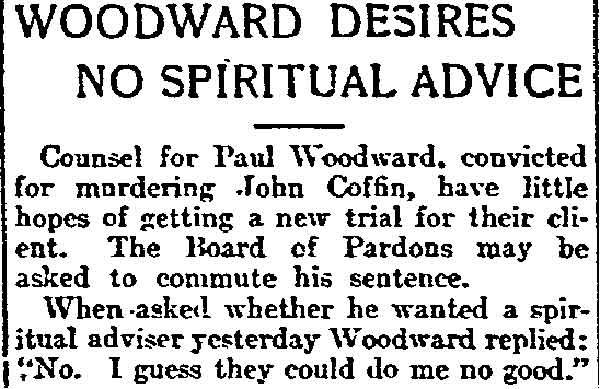
Woodward Desires No Spiritual Advice
Counsel for Paul Woodward, convicted for murdering John Coffin, have little hopes of getting a new trial for their client. The Board of Pardons may be asked to commute his sentence.
When asked whether he wanted a spiritual adviser yesterday Woodward replied: “No. I guess they could do me no good.“
Philadelphia Inquirer — November 22, 1902
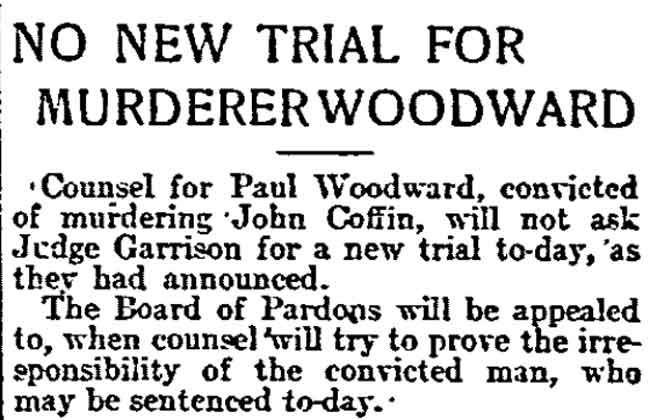
No New Trial for Murderer Woodward
Counsel for Paul Woodward, convicted of murdering John Coffin, will not ask Judge Garrison for a new trial to-day, as they had announced.
The Board of Pardons will be appealed to, when counsel will try to prove the irresponsibility of the convicted man, who may be sentenced to-day.
Philadelphia Inquirer — November 23, 1902
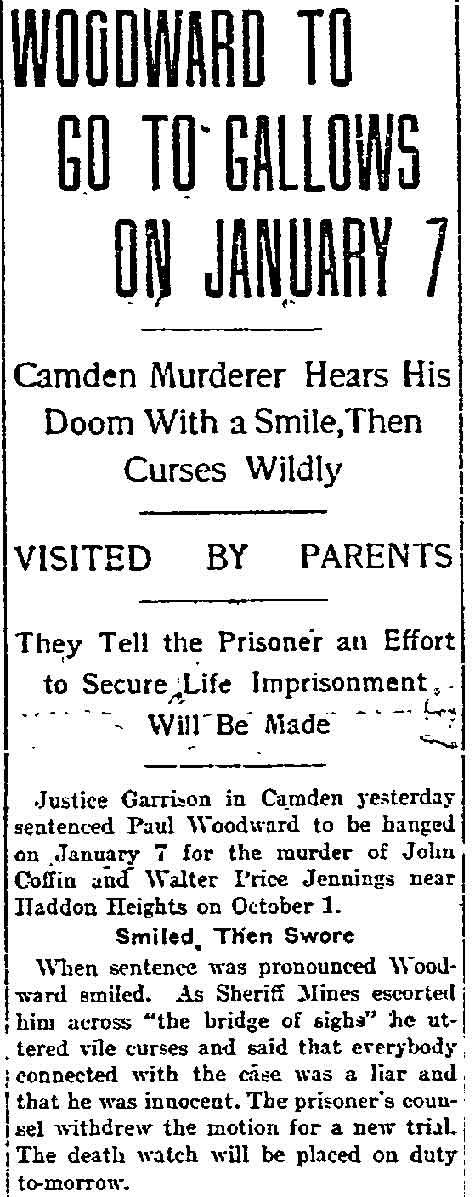
Woodward to Go to Gallows on January 7
Camden Murderer Hears His Doom With a Smile, Then Curses Wildly
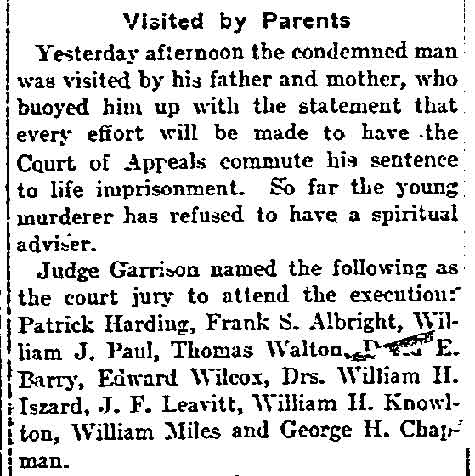
VISITED BY PARENTS
They Tell the Prisoner an Effort to Secure Life Imprisonment Will Be Made
Justice Garrison in Camden yesterday sentenced Paul Woodward to be hanged on January 7 for the murder of John Coffin and Walter Price Jennings near Haddon Heights on October 1.
Smiled, Then Swore
When sentence was pronounced Woodward smiled. As Sheriff Mines escorted him across “the bridge of sighs“ he uttered vile curses and said that everybody connected with the case was a liar and that he was innocent. The prisoner's counsel withdrew the motion for a new trial. The death watch will be placed on duty to-morrow.
Philadelphia Inquirer — November 26, 1902
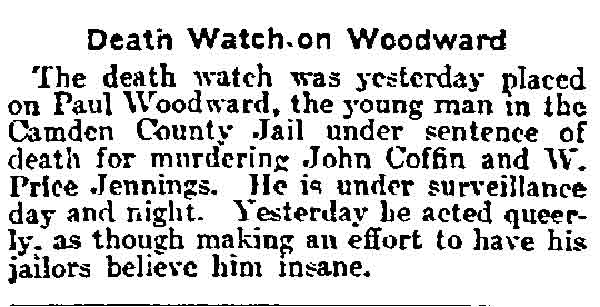
Death Watch on Woodward
The death watch was yesterday placed on Paul Woodward, the young man in the Camden County Jail under sentence of death for murdering John Coffin and W. Price Jennings. He is under surveillance day and night. Yesterday he acted queerly, as though making an effort to have his jailors believe him insane.
Philadelphia Inquirer — November 29, 1902
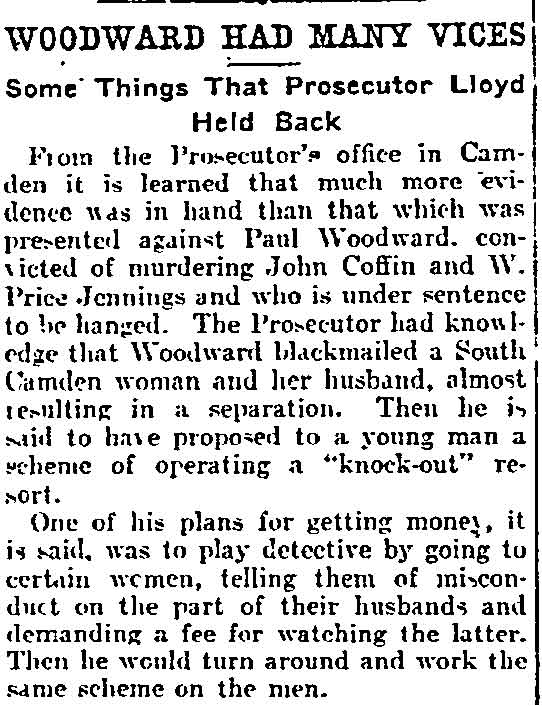
Woodward Had Many Vices
Some Things That Prosecutor Lloyd Held Back
From the Prosecutor's office in Camden it is learned that much more evidence was in hand than that which was presented against Paul Woodward, convicted of murdering John Coffin and W. Price Jennings and who is under sentence to be hanged. The Prosecutor had knowledge that Woodward blackmailed a South Camden woman and her husband, almost resulting in a separation. Then he is said to have proposed to a young man a scheme of operating a “knock-out“ resort.
One of his plans for getting money, it is said, was to play detective by going to certain women, telling them of misconduct on the part of their husbands and demanding a fee for watching the latter. Then he would turn around and work the same scheme on the men.
Kalamazoo Gazette — November 29, 1902
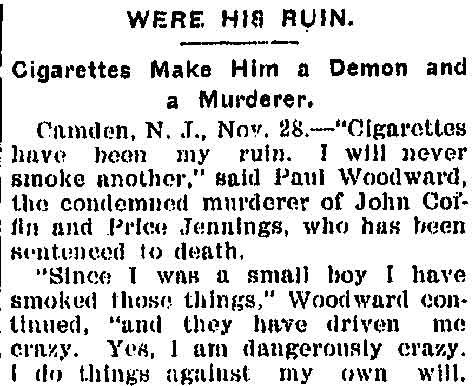
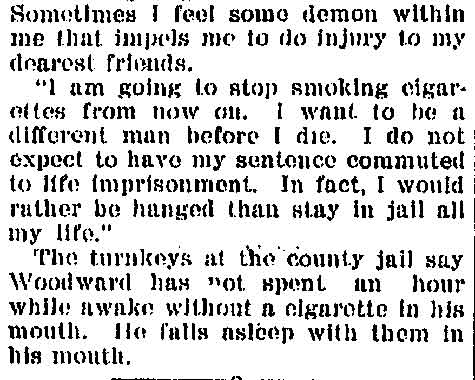
Cigarettes Make Him a Demon and a Murderer.
Camden, N. J., Nov. 28.—“Cigarettes have been my ruin. I will never smoke another,” said Paul Woodward, the condemned murderer of John Coffin and Price Jennings, who has been sentenced to death.
“Since I was a small boy I have smoked those things,” Woodward continued, “and they have driven me crazy. Yes, I am dangerously crazy. I do things against my own will.
Salt Lake Telegram — December 2, 1902
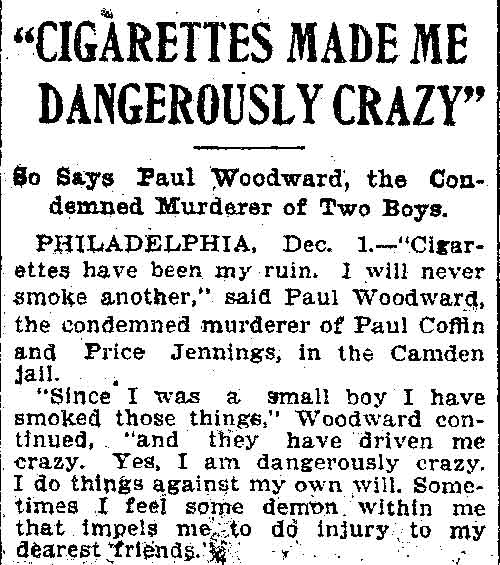
So Says Paul Woodward, the Condemned Murderer of Two Boys.
PHILADELPHIA, Dec. 1.—“Cigarettes have been my ruin. I will never smoke another,” said Paul Woodward, the condemned murderer of Paul Coffin and Price Jennings, in the Camden jail.
“Since I was a small boy I have smoked those things,” Woodward continued, “and they have driven me crazy. Yes, I am dangerously crazy. I do things against my own will. Sometimes I feel some demon within me that impels me to do injury to my dearest friends.”
Philadelphia Inquirer — December 4, 1902
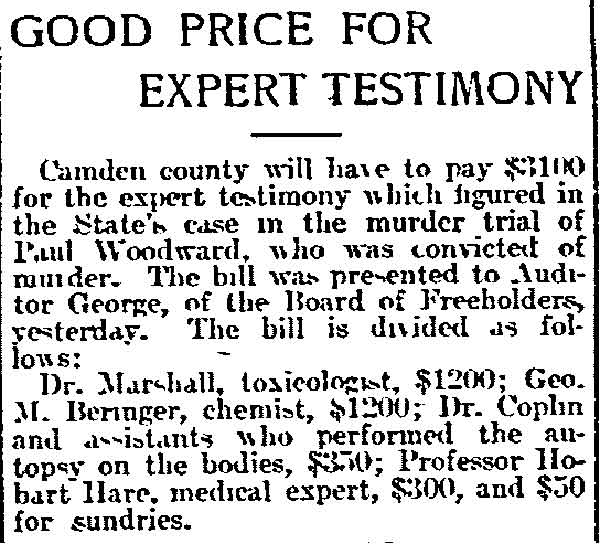
Good Price for Expert Testimony
Camden county will have to pay $3100 for the expert testimony which figured in the State's case in the murder trial of Paul Woodward, who was convicted of murder. The bill was presented to Auditor George, of the Board of Freeholders, yesterday. The bill is divided as follows:
Dr. Marshall, toxicologist, $1200; Geo. M. Beringer, chemist, $1200; Dr. Cophn and assistants who performed the autopsy on the bodies, $350; Professor Hobart Hare, medical expert, $300, and $50 for sundries.
Philadelphia Inquirer — December 7, 1902
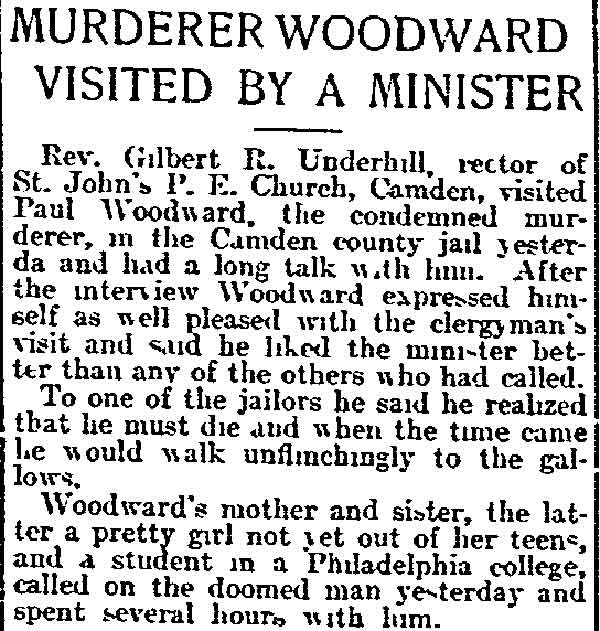
Murderer Woodward Visited by a Minister
Rev. Gilbert R. Underhill, rector of St. John's P. E. Church, Camden, visited Paul Woodward, the condemned murderer, in the Camden county jail yesterday and had a long talk with him. After the interview Woodward expressed himself as well pleased with the clergyman's visit and said he liked the minister better than any of the others who had called.
To one of the jailors he said he realized that he must die and when the time came he would walk unflinchingly to the gallows.
Woodward's mother and sister, the latter a pretty girl not yet out of her teens, and a student in a Philadelphia college, called on the doomed man yesterday and spent several hours with him.
Philadelphia Inquirer — December 9, 1902
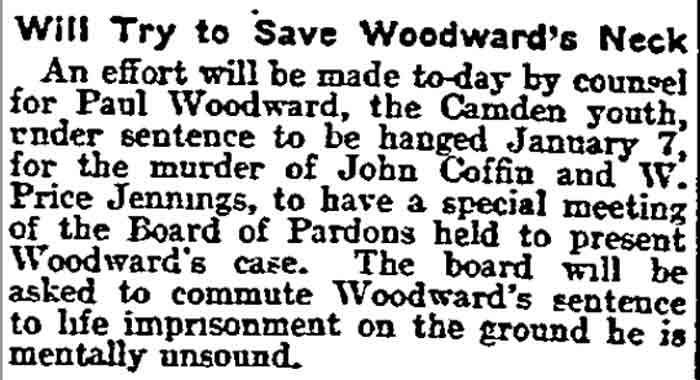
Will Try to Save Woodward's Neck
An effort will be made to-day by counsel for Paul Woodward, the Camden youth, under sentence to be hanged January 7, for the murder of John Coffin and W. Price Jennings, to have a special meeting of the Board of Pardons held to present Woodward's case. The board will be asked to commute Woodward's sentence to life imprisonment on the ground he is mentally unsound.
Philadelphia Inquirer — December 12, 1902
Annoys Prisoners With \“Music\
Annoys Prisoners With “Music“
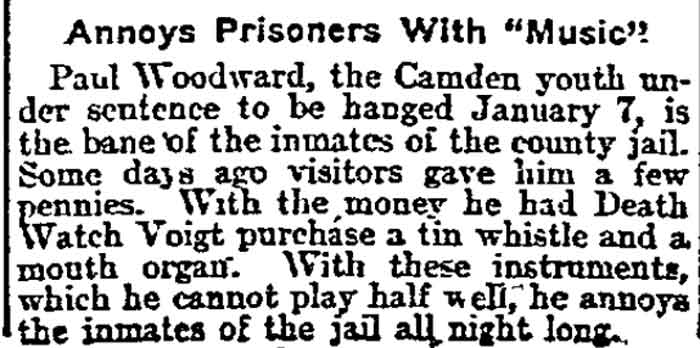
Paul Woodward, the Camden youth under sentence to be hanged January 7, is the bane of the inmates of the county jail. Some days ago visitors gave him a few pennies. With the money he had Death Watch Voigt purchase a tin whistle and a mouth organ. With these instruments, which he cannot play half well, he annoys the inmates of the jail all night long.
Philadelphia Inquirer — December 14, 1902
Murderer Given Talking Machine
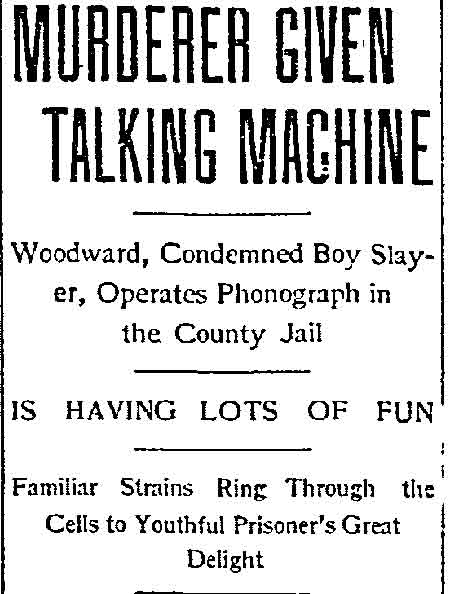
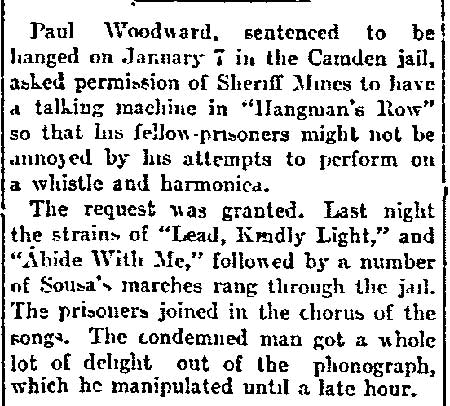
Woodward, Condemned Boy Slayer, Operates Phonograph in the County Jail
IS HAVING LOTS OF FUN
Familiar Strains Ring Through the Cells to Youthful Prisoner's Great Delight
Philadelphia Inquirer — December 15, 1902
Plenty of Amusement for Young Woodward
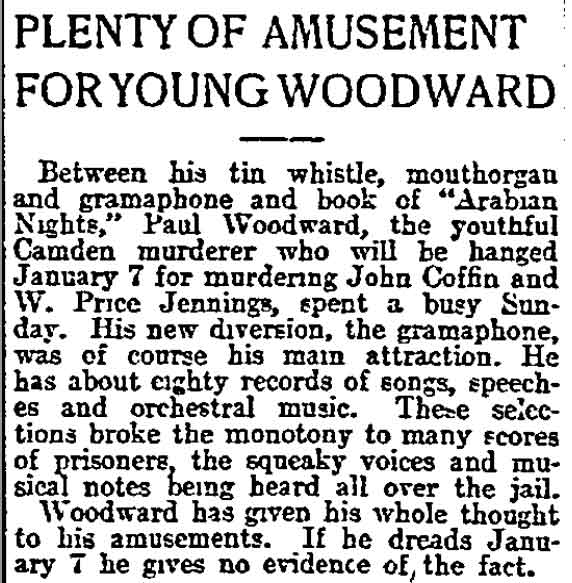
Between his tin whistle, mouthorgan and gramaphone and book of “Arabian Nights,“ Paul Woodward, the youthful Camden murderer who will be hanged January 7 for murdering John Coffin and W. Price Jennings, spent a busy Sunday. His new diversion, the gramaphone, was of course his main attraction. He has about eighty records of songs, speeches and orchestral music. These selections broke the monotony to many scores of prisoners, the squeaky voices and musical notes being heard all over the jail.
Woodward has given his whole thought to his amusements. If he dreads January 7 he gives no evidence of the fact.
Philadelphia Inquirer — December 17, 1902
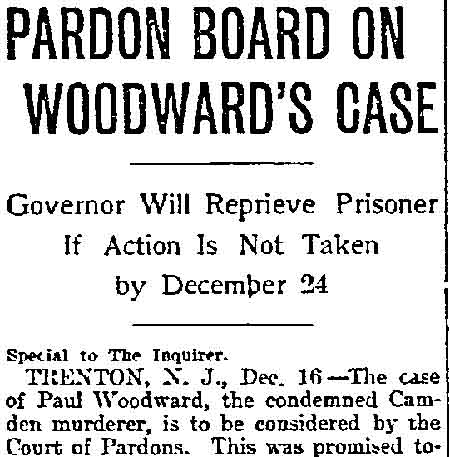
Pardon Board on Woodward's Case
Governor Will Reprieve Prisoner If Action Is Not Taken by December 24
Special to The Inquirer.
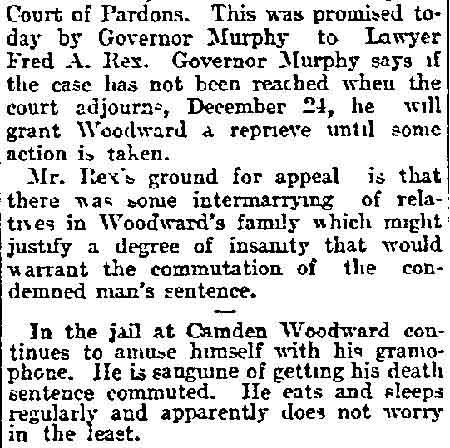
TRENTON, N. J., Dec. 16—The case of Paul Woodward, the condemned Camden murderer, is to be considered by the Court of Pardons. This was promised to-day by Governor Murphy to Lawyer Fred A. Rex. Governor Murphy says if the case has not been reached when the court adjourns, December 24, he will grant Woodward a reprieve until some action is taken.
Mr. Rex’s ground for appeal is that there was some intermarrying of relatives in Woodward’s family which might justify a degree of insanity that would warrant the commutation of the condemned man’s sentence.
In the jail at Camden Woodward continues to amuse himself with his gramophone. He is sanguine of getting his death sentence commuted. He eats and sleeps regularly and apparently does not worry in the least.
Philadelphia Inquirer — December 21, 1902
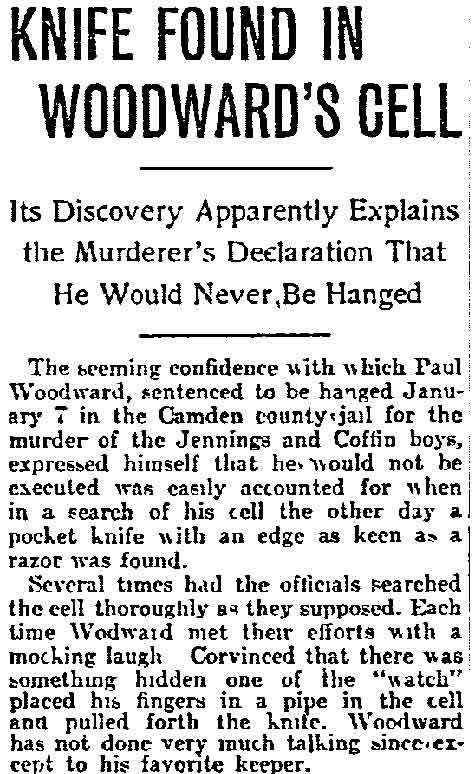
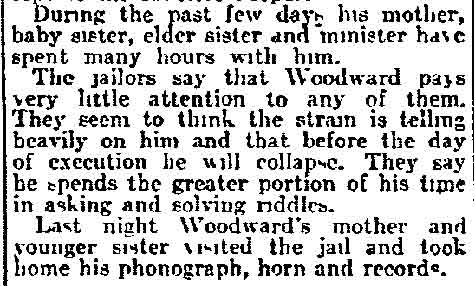
Knife Found in Woodward's Cell
Its Discovery Apparently Explains the Murderer's Declaration That He Would Never Be Hanged
The seeming confidence with which Paul Woodward, sentenced to be hanged January 7 in the Camden county jail for the murder of the Jennings and Coffin boys, expressed himself that he would not be executed was easily accounted for when in a search of his cell the other day a pocket knife with an edge as keen as a razor was found.
Several times had the officials searched the cell thoroughly as they supposed. Each time Wodward met their efforts with a mocking laugh. Convinced that there was something hidden one of the “watch“ placed his fingers in a pipe in the cell and pulled forth the knife. Woodward has not done very much talking since—except to his favorite keeper.
Philadelphia Inquirer — December 25, 1902
Trying to Save Woodward's Neck
The New Jersey Court of Pardons, in secret session, yesterday, gave a hearing to counsel for Paul Woodward, the Camden murderer, who is under sentence to be hanged on January 7. Counsel asked for a commutation of sentence on the ground of insanity.
The court postponed decision in the matter until next Tuesday, in order to give counsel an opportunity to present testimony.
Philadelphia Inquirer — December 26, 1902
Murderer Woodward Had Merry Christmas
Paul Woodward, the youthful murderer in the Camden County Jail under sentence of death for killing John Coffin and W. Price Jennings, spent a happy Christmas.
It was a happy one because he had plenty to eat—stewed chicken, mince pie, candy, etc.—and also because he has an idea he will not be hanged, at least on January 7.
Philadelphia Inquirer — December 30, 1902
Last Effort to Save Woodward
Lawyer Frederick A. Rex, counsel for Paul Woodward, the youth under sentence to be hanged January 7 for the murder of John Coffin and W. Price Jennings, will go to Trenton to-day to ask that Woodward's sentence be commuted to life imprisonment.
Woodward's counsel has little prospect of getting anything favorable from the Board of Pardons, however.
Philadelphia Inquirer — December 31, 1902
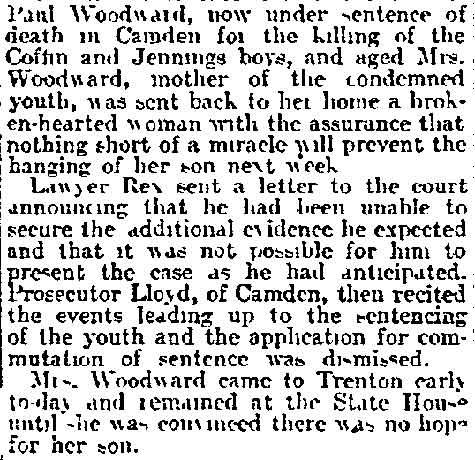
Woodward's Last Hope Vanished
Court of Pardons Refuses to Interfere in Case of Camden's Condemned Murderer
Special to The Inquirer.
TRENTON, N. J., Dec. 30—The Court of Pardons in special session this afternoon refused to interfere in the case of—
Philadelphia Inquirer — January 1, 1903
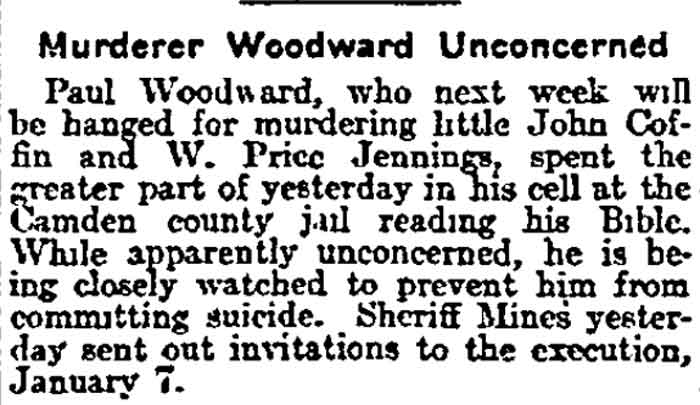
Murderer Woodward Unconcerned
Paul Woodward, who next week will be hanged for murdering little John Coffin and W. Price Jennings, spent the greater part of yesterday in his cell at the Camden county jail reading his Bible. While apparently unconcerned, he is being closely watched to prevent him from committing suicide. Sheriff Mines yesterday sent out invitations to the execution, January 7.
Philadelphia Inquirer — January 3, 1903
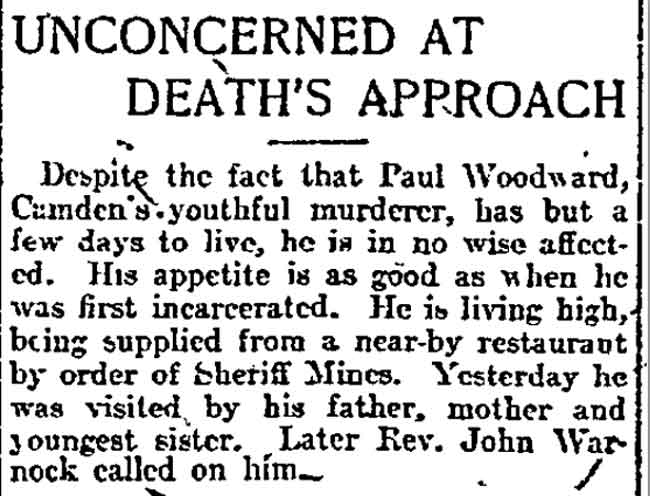
Unconcerned at Death's Approach
Despite the fact that Paul Woodward, Camden's youthful murderer, has but a few days to live, he is in no wise affected. His appetite is as good as when he was first incarcerated. He is living high, being supplied from a near-by restaurant by order of Sheriff Mines. Yesterday he was visited by his father, mother and youngest sister. Later Rev. John Warnock called on him.
Philadelphia Inquirer — January 5, 1903
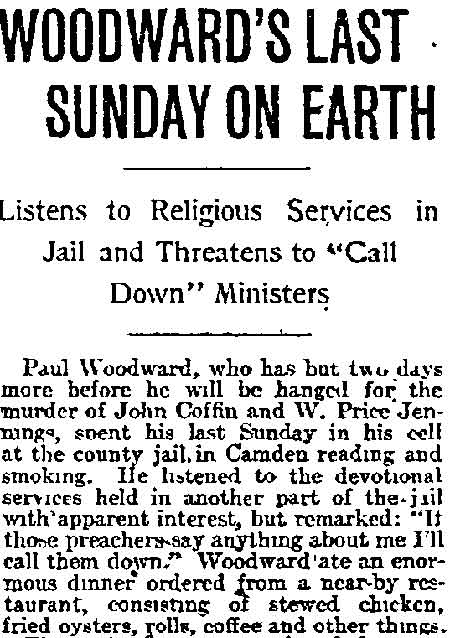
Woodward's Last Sunday on Earth
Listens to Religious Services in Jail and Threatens to “Call Down“ Ministers
Paul Woodward, who has but two days more before he will be hanged for the murder of John Coffin and W. Price Jennings, spent his last Sunday in his cell at the county jail in Camden reading and smoking. He listened to the devotional services held in another part of the jail with apparent interest, but remarked: “If those preachers say anything about me I'll call them down.“ Woodward ate an enormous dinner ordered from a near-by restaurant, consisting of stewed chicken, fried oysters, rolls, coffee and other things.
Philadelphia Inquirer — January 6, 1903
\“I'll Be a Dead One\“—Woodward
“I'LL BE A DEAD ONE“—WOODWARD
Nearing Day of Doom, Camden Murderer Facetiously Addressed a Grand Juryman Yesterday
With a little over twenty-four hours between him and eternity, Paul Woodward, the youthful Camden murderer, who will be hanged to-morrow morning for the cruel murder of two boys, continues his nonchalant manner.
After a brief visit from his father and mother yesterday Woodward took out his harmonica. A few minutes later the jail was filled with the strains of “In the Good Old Summer Time.“ Then he took a turn at several marches. These selections were a prelude to his midday meal. This consisted of roast lamb, sweet potatoes, French peas, one-half dozen raw oysters, minced onions (raw), stewed fruit.
Philadelphia Inquirer — January 7, 1903
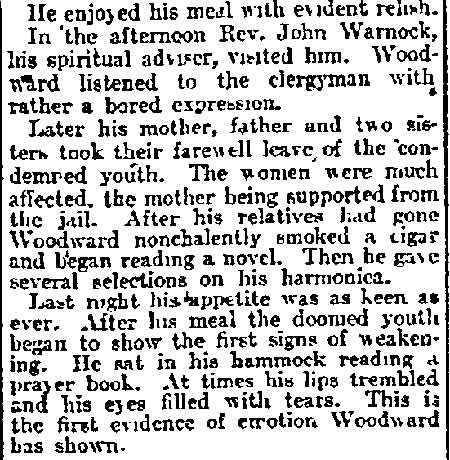
Woodward's Nerve Fast Leaving Him
Paul Woodward will be hanged at the Camden County Jail this morning, shortly after 10 o'clock, by Sheriff Mines, for the murder of two boys. Unless he regains his wonted nonchalance he will undoubtedly create a scene.
The condemned youth arose yesterday early, ate a hearty breakfast and read the newspapers. Then he whiled away the morning by playing popular airs on his harmonica.
When the dinner hour approached he said:
“Well, this will be my last dinner. It's up to me to eat and I want my favorite dish. It's rabbit.“
Wilkes-Barre Times — January 7, 1903
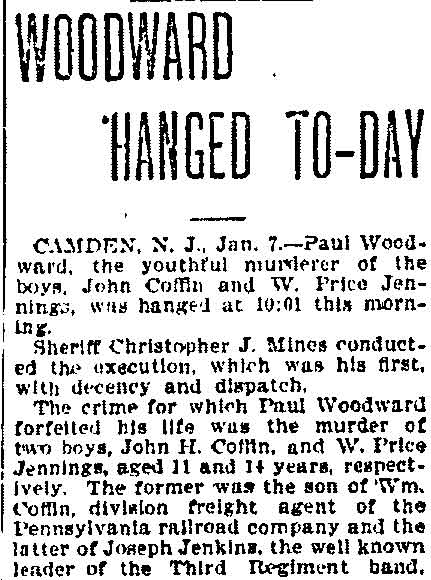
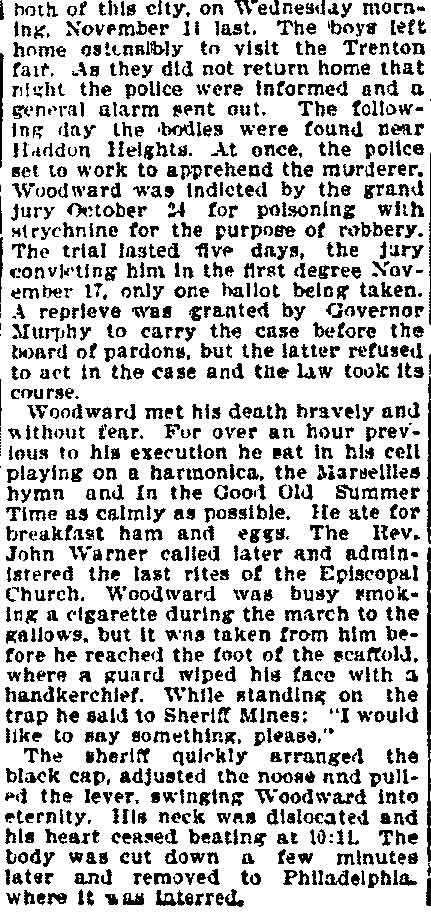
CAMDEN, N. J., Jan. 7.—Paul Woodward, the youthful murderer of the boys, John Coffin and W. Price Jennings, was hanged at 10:01 this morning.
Sheriff Christopher J. Mines conducted the execution, which was his first, with decency and dispatch.
The crime for which Paul Woodward forfeited his life was the murder of two boys, John H. Coffin and W. Price Jennings, aged 11 and 14 years, respectively. The former was the son of Wm. Coffin, division freight agent of the Pennsylvania railroad company and the latter of Joseph Jenkins, the well known leader of the Third Regiment band.
Philadelphia Inquirer — January 8, 1903
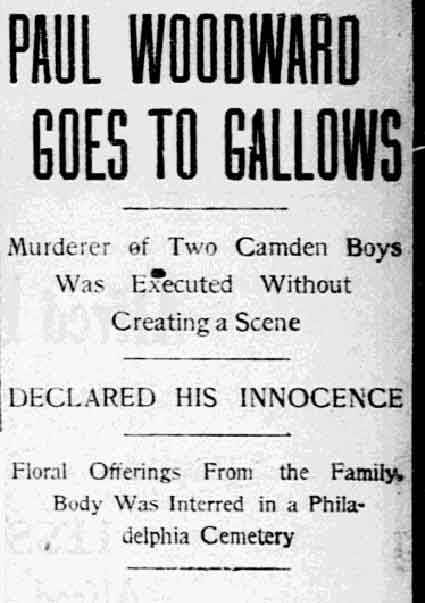
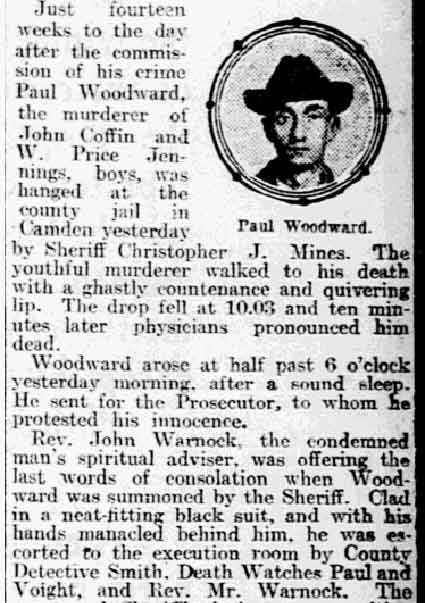
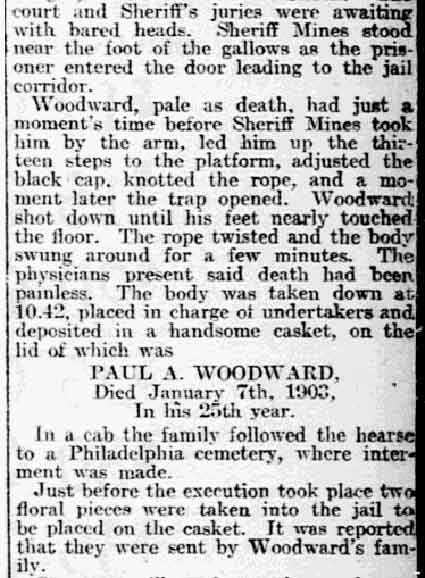
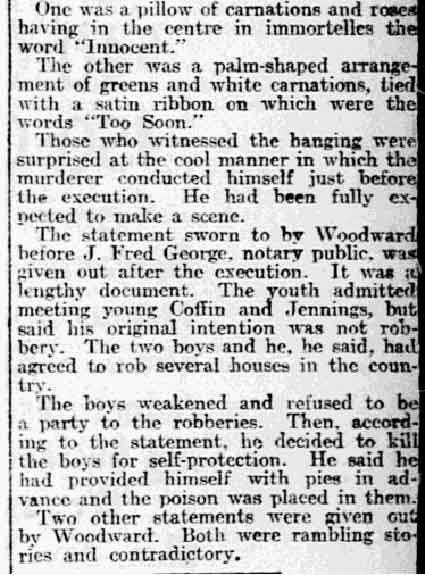
Paul Woodward Goes to Gallows
Murderer of Two Camden Boys Was Executed Without Creating a Scene
DECLARED HIS INNOCENCE
Floral Offerings From the Family, Body Was Interred in a Philadelphia Cemetery
Philadelphia Inquirer — January 17, 1903
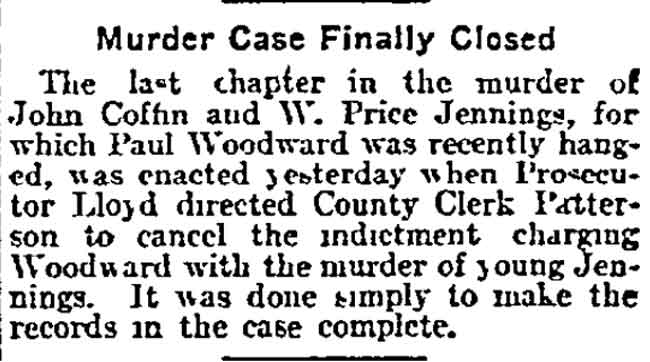
Murder Case Finally Closed
The last chapter in the murder of John Coffin and W. Price Jennings, for which Paul Woodward was recently hanged, was enacted yesterday when Prosecutor Lloyd directed County Clerk Patterson to cancel the indictment charging Woodward with the murder of young Jennings. It was done simply to make the records in the case complete.
Philadelphia Inquirer
No Clue to Bandits, But Suspects Spotted
The Camden police have not the slightest clue as to the identity of the five men who early Saturday morning created a furor on the outskirts of the city by holding up a bridge tender, blowing up a safe and doing other acts that marked them as being desperadoes. The entire police force was at work yesterday, but the description given by Till and the officers who had the encounter with the emulators of the wild and woolly West was so meagre that there was practically nothing to work on.
Chief of Police John Foster said last night to an Inquirer reporter: “We have not learned anything that might lead to
the arrest of the desperadoes. In the event of suspects being arrested it would be a difficult matter to connect them with the case, because no one seems to be in position to give a description. I am of the opinion that they are professionals from the manner in which they did their work.
Acquainted With Locality
“Another thing seems evident, and that is the robbers were acquainted with the locality in which they operated. They either were personally acquainted with East Camden or made it a point to get acquainted.
“This William Thallman, who is wanted in Burlington county, where the police believe him to be the head of a gang of thieves, may possibly know something about the Pavonia affair. From what I have learned he appears to be a desperate character, just one who would have the nerve to lead a gang of men to do the
work of Saturday morning. Of course this is mere supposition, and it is impossible to say he is one of the men we are looking for. Another thing that might possibly connect him with the case would be his knowledge of East Camden, which is an important factor.”
Early yesterday morning a dispatch was received from Elizabeth in which it was stated that three suspicious characters had been arrested. According to the dispatch the trio were found in a box car that came from Camden. City Detectives John Painter and William Hart were at once sent to Elizabeth to take a look at the suspects. When they arrived they found the prisoners were boys and a brief line of questioning soon disposed of the theory that they had anything to do with the Camden affair. The detectives, who returned last night, said the boys were Philadelphians and had jumped a freight for a ride.
Special Officer Hare, of the Pennsylvania Railroad, noticed a group of men loitering about the Pavonia Station. Their actions were suspicious, and he took one into custody. The police were of the
opinion that the prisoner might know something about the bandits, but he convinced them that he was in total ignorance of the thieves. He gave the name of D. Donovan, no home. He is still held by the police, but with no expectation of throwing any light on the identity of the men wanted so badly.
Perhaps no one had a better opportunity of giving a description of the men than Oscar Till, the bridgetender at the State street bridge, who, at the points of pistols held by two men, tied a mask over the face of a third. But even he cannot recall his midnight visitors sufficiently to furnish the police with anything to work on.
“I was too badly scared to know what they looked like,” he said. “When a couple of men are pressing cold steel to your temples, with a command to do a certain thing or die, you generally do the thing asked. I had no time to think about descriptions or anything else. The business I had to attend to was to tie the mask on the bandit, and I attended strictly to that business.”
Ralph Haines, the night operator at the tower, who was shot at repeatedly as
he poked his head out of the window inquiring as to the cause of the explosion at the Pavonia station, was commended yesterday for his cool-headedness. After dodging bullets repeatedly, one of which came within an inch of his head, he dropped to the floor, crawled over to the “ticker” and asked the main office for help. Haines could see the men in silhouette but was too distant to recognize any characteristics that might lead to identifying them.
Last night numerous reports were received at Camden police headquarters of suspicious characters being seen in various parts of the city. A trolley car conductor reported at 10 o’clock that several men with dark lanterns were observed loitering about Haddon and Kaighn avenues. Sergeant Hyde, with a squad of officers, was sent to the locality, but the men had disappeared. Another report came from Fairview street near the ship yard at the lower end of the Eighth ward that suspicious-looking persons were hanging about the neighborhood, but no one could be found there when the officers arrived.
Philadelphia Inquirer
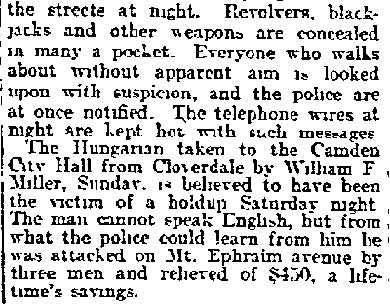
SAY BANDIT HUNT POINTS TO MARINE
Camden Police Grow More Positive, Connecting Thallman With Hold-Up
Hat Found at Scene May Prove a Clue—State Sleuths Very Busy on the Case
The Camden police are growing more positive in their belief that William Thallman, who escaped from League Island Navy Yard and whose house at Riverside was found to be stocked with plunder, could throw some light on the recent hold-up at Pavonia.
According to the police, Thallman lived in Camden for several years under an assumed name. His home is said to have been luxuriously furnished and he seemed to be well supplied with money about the time several robberies were committed in North Philadelphia. He was caught looting a bulk window of a store and was convicted and sentenced to the Eastern Penitentiary inside of forty-eight hours.
City Detectives Hart and Painter were at work all day yesterday on clues that might lead to the detection of Thallman’s whereabouts, but little or nothing had resulted up to a late hour last night.
Hat May Give Clue
Amos Fowler, a bridge tender at the State street bridge, East Side, early last evening found a derby hat in a ditch on the north side of State street near River avenue, that the authorities believe was dropped by the bandits in their hasty departure. The hat is an expensive derby and contains the letter “A.” Bridgetender Till says he has a slight recollection that one of the bandits who held a revolver at his head while he was being robbed wore a derby hat just about the style of the one found by Fowler.
Since the exploit of the bandits Camden residents have been going armed on
the streets at night. Revolvers, blackjacks and other weapons are concealed in many a pocket. Everyone who walks about without apparent aim is looked upon with suspicion, and the police are at once notified. The telephone wires at night are kept hot with such messages.
The Hungarian taken to the Camden City Hall from Cloverdale by William F. Miller, Sunday, is believed to have been the victim of a holdup Saturday night. The man cannot speak English, but from what the police could learn from him he was attacked on Mt. Ephraim avenue by three men and relieved of $450, a lifetime’s savings.
Philadelphia Inquirer
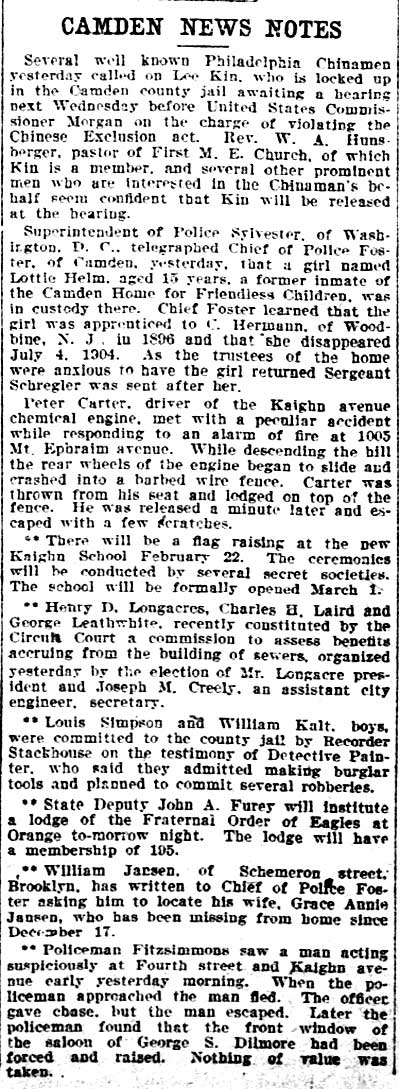
CAMDEN NEWS NOTES
Superintendent of Police Sylvester telegraphed Chief Foster that Charlotte “Lottie” Helm, aged 15 years, had been taken into custody at Washington, D. C. Sergeant Schregler was sent after her. The girl is a resident of Camden and was reported missing by her parents some time ago. She had been in the custody of the police at Washington, who say she was found there with a man.
Driver Peter Carter, of Engine Company No. 1, suffered injuries that may prove serious when the heavy engine, returning at speed from a fire early this morning, struck a trolley car at the corner of Broadway and Federal street. Carter was thrown violently from his seat against the dashboard. He was taken to the Cooper Hospital, where examination showed fracture of the ribs.
Camden Post-Telegram
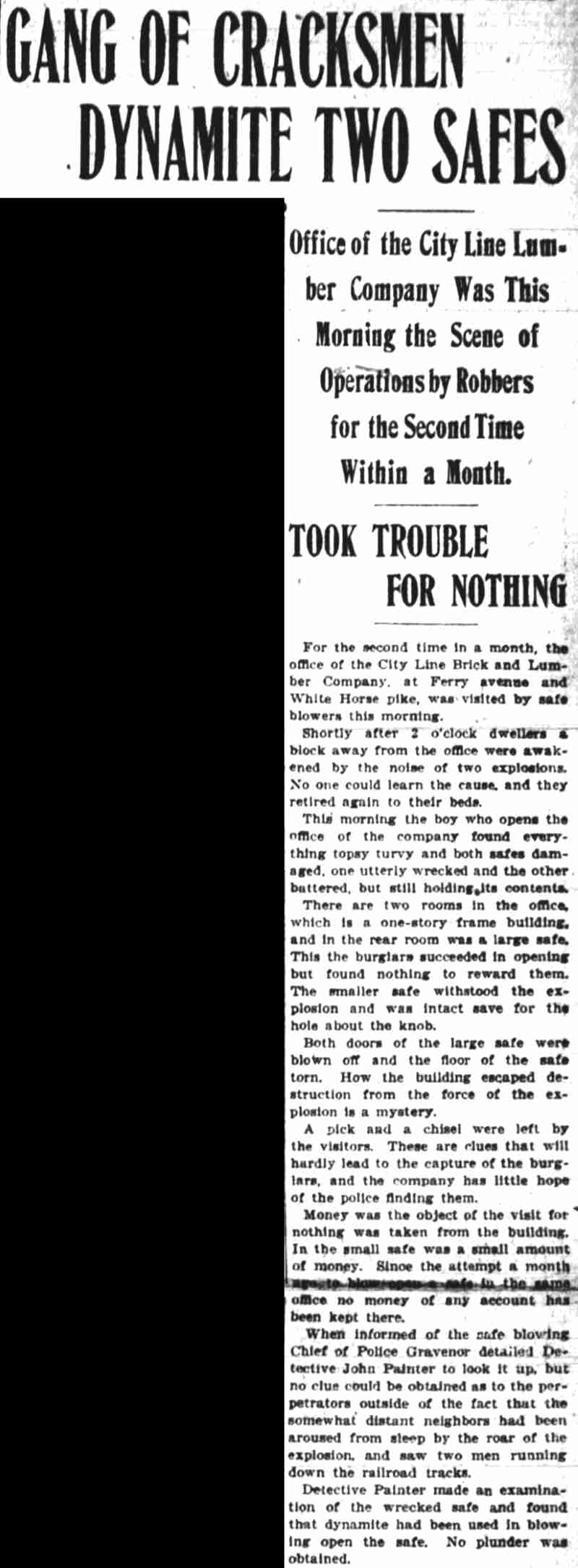
John Painter — Elisha A. Gravenor
Philadelphia Inquirer
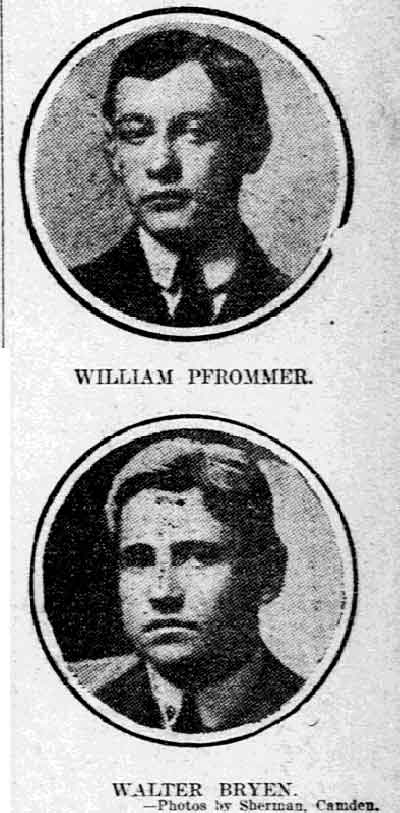
Named: William Pfrommer, Walter Bryen, Robert Beasely, James McDonald, Theodore Forgeng, Birch Street, Milton Street, Point Street, North 24th Street, North 25th Street, River Avenue, State Street, Henry C. Moffett, William D. Hart, John Painter, North 29th Street, and Garfield Avenue.
Philadelphia Inquirer
Named: Elmer Calloway, Cherrier Place, South 7th Street, John Painter, Newton Avenue, and Mrs. Margaret Lubbock.
Philadelphia Inquirer

MANY ROBBERIES KEEP POLICE BUSY
Transom Burglar Loots Another Saloon at Twentieth and Market
Men Arrested in Crowded Department Store Are Held for Trial, as Is Also Alleged Pickpocket
The “transom burglar,” who has been robbing saloons recently, gained entrance early yesterday morning to the saloon of Andrew Breslin, Twentieth and Market streets, and carried away several bottles of liquor and cigars valued at $3.50. The rubber climbed in through a transom in the usual way, and escaped with his plunder without being detected.
The residence of Peter Arne, rear of 812 North Third street, was invaded by a man who also stole a watch and $7 in cash.
A gold locket and chain, a gold bracelet and silver handbag were stolen from the residence of Sarah Miller, 555 North 4th street.
Daniel Hickey and James Brown, of Balfour avenue, were arrested on Friday on the charge of stealing raincoats from a Market street department store. They were arraigned before Magistrate Scott yesterday. At the store when discovered by an employee, who detained them until Detective Cramer arrived. Hickey, according to the detective, had a raincoat concealed beneath his clothing.
He was shopping nearby and, suspecting him of being a thief, ordered the employee to hold him. Balbirnie again felt some one at his pocket, and while detaining him, he was struck in the face by the prisoner. He seized Lacey and he was held until a warrant was sworn out. He had nothing to say in his defense.
In trying to escape arrest on Friday evening Frank Eldridge, a negro, suspected of robbery near Eighteenth and Market streets, fled to the roof of a house on Goncha street. Since the police climbed to the roof he struggled with Policemen Smith and Guthridge, of the Eighth ward, and the struggle lasted fifteen minutes, during which one of the policemen narrowly escaped falling from the housetop. He was captured in the front room on the second floor, which is occupied by Mr. Morrison and his wife. Adjoining is the store. The front room on the first floor is occupied by the renter, Mary, Celia and Maggie, and in two back rooms live his two sons and Walter Weeks, a barber, a relative. Balbirnie again felt some one at his pocket, and while detaining him, he was struck in the face.
Fred Speise, of Seventy-eighth and Lel-man streets, charged on the complaint of Dr. McLearen of stealing a horse belonging to Dr. McLearen. He was held in $500 bail by Magistrate Harris for a further hearing yesterday.
Camden Post-Telegram
COURT DISMISSES GAMBLING CHARGE
Eli Johnson and Those Caught in Raid Are Freed by Recorder.
THIRTY-ONE TAKEN IN TWO DESCENTS
It was late yesterday afternoon when the hearings in the raids in two alleged disorderly houses in South Camden, made early on Sunday morning by Captain Stanley, Sergeant Nowrey and details of police, were concluded in Police Court.
In the case of Eli Johnson, colored, charged with conducting a gambling house at 307 Spruce street, Recorder Stackhouse found him not guilty and discharged the defendant and the persons captured in the raid. Lawyer William P. Walsh represented Johnson.
Daniel Bussey, a negro, was charged with being the principal at 829 Locust street, but the testimony showed that he was but one of a colored social and beneficial club which held forth at that place.
Recorder Stackhouse therefore fined Bussey and the fourteen others caught in the raid $3 each. All paid.
An amusing attempt of a negro to escape lent a touch of merriment to the descent on the Locust street house. Hearing the pattering of shoe leather on the cellar steps, Detective Painter got a lamp and descended into the dungeon-like darkness and in a far corner of the cellar, loking as if he were trying to squeeze himself through a crack in the angle of the wall, was found hiding a terrified young negro.
“Come out of that mister corner man,” said Painter shading the lamp with his hand. “What’s you doing in there”
“I didn’t run out the back way,” explained the prisoner, “because I was scared of de dawg.”
One of the negroes caught in the raid at 829 Locust street is Walter Edgerton, now aged 52 years, a former famous prize fighter known as the “Kentucky Rosebud,” who has been living in South Camden for some time. A couple of years ago Edgerton figured in a sensational case in the Philadelphia courts in his desperate but futile efforts to retain possession of a white baby whom he had adopted and on whom he lavished the finest clothing and luxuries which money could buy.
No liquor was found at either of the places raided. In fact it was not alleged that they were speak-easies but gambling houses. No gaming paraphernalia was found at 307 Spruce street.
At 829 Locust street, the police copped a crap table and four big bloodhued bones. Captain Stanley resurrected the cubes from the depths of a coal basket in the second-story front room where they had been shoved and shuffled up when the police were heard approaching.
Boy's Brutal Murderer Collapses at Hearing
Camden Post-Telegram —
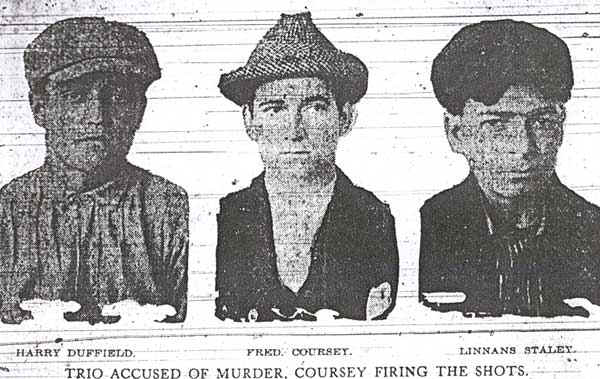
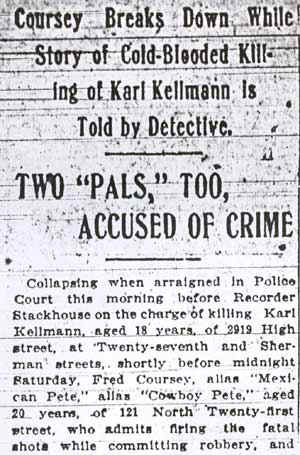
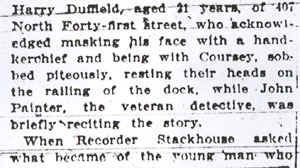
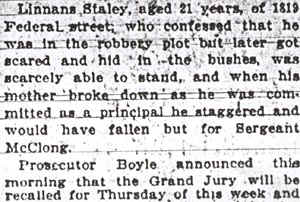
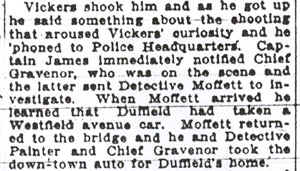
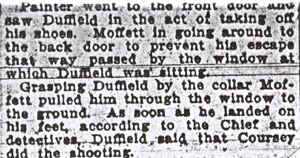
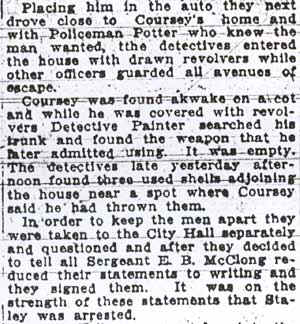
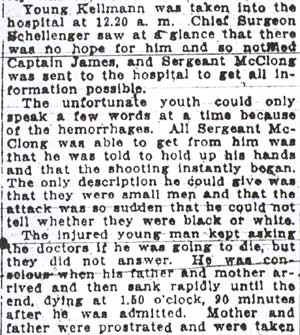
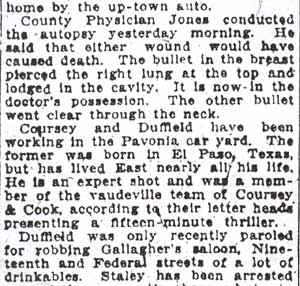
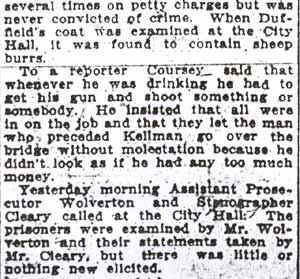
Trio Accused of Murder. Coursey Firing the Shots.
Coursey Breaks Down While Story of Cold-Blooded Killing of Karl Kellmann Is Told by Detective.
Two “Pals,” Too, Accused of Crime
Collapsing when arraigned in Police Court this morning before Recorder Stackhouse on the charge of killing Karl Kellmann, aged 18 years, of 2919 High street, at Twenty-seventh and Sherman streets, shortly before midnight Saturday, Fred Coursey, alias “Mexican Pete,” alias “Cowboy Pete,” aged 20 years, of 121 North Twenty-first street, who admits firing the fatal shots while committing robbery, and Harry Duffield, aged 21 years, of 407 North Forty-first street, who acknowledged masking his face with a handkerchief and being with Coursey, sobbed piteously, resting their heads on the railing of the dock, while John Painter, the veteran detective, was briefly reciting the story.
When Recorder Stackhouse asked what became of the young man who was shot and Painter replied that he died, Coursey and Duffield sobbed afresh, and when Recorder Stackhouse committed them without bail Policemen Frost and Kay had to help them.
Linnans Staley, aged 21 years, of 1819 Federal street, who confessed that he was in the robbery plot but later got scared and hid in the bushes, was scarcely able to stand, and when his mother broke down as he was committed as a principal he staggered and would have fallen but for Sergeant McClong.
Prosecutor Boyle announced this morning that the Grand Jury will be recalled for Thursday of this week and the case will be made the special order of the day.
Without the slightest clue to start with in the most brutal murder committed in recent years in Camden county, police and detectives under the personal direction of Chief Gravenor in two hours arrested two of the three prisoners and obtained their signatures to confessions and before sunrise the other was lodged behind the bars at the City Hall.
According to their statements to the police the prisoners while drinking on a lot near Twenty-first and Federal streets on Saturday night planned to go to a lone spot near Twenty-seventh and Sherman streets to hold someone up to get money and jewelry to buy more drink. Coursey had a 38-calibre cowboy pistol and Duffield used Coursey’s bandanna as a mask. Staley weakened before the spot selected was reached and at the time of the murder was hiding in a clump of weeds a short distance away.
The murdered boy was the son of Karl and Lulu D. Kellmann. He was a member of the Bible class of Grace Presbyterian Church, East Side, and active in church work.
Saturday night was the closing of a carnival given on High street between Twenty-seventh and Thirtieth streets. Karl was there and made several purchases. At one booth he bought a necktie, from another some ice cream and a box of candy and spent some time conversing with the young ladies connected with the church.
When it grew rather late he noticed that Misses Bertha and Bessie Skillen, of 815 North Thirty-fourth street, the latter a teacher in Grace Church Sunday-school, were without an escort and he volunteered to see them home. They accepted his invitation to be their escort. He saw them safely home and he was on his way back and had reached a point on the east side of Twenty-seventh street south of Sherman street and near the foot of the bridge that spans the Pennsylvania Railroad tracks when two men jumped out from behind a tree and as one commanded him to hold up his hands the other began to shoot.
The first shot struck him in the breast and turned him partially around. The next ploughed a hole through his neck, knocking him down, and the third went wide.
Screaming for help he tried to rise to his feet and was on his knees when Night Yardmaster Albert Ludlow and Brakeman Joseph Wittick, who were on the opposite side of the bridge, ran to his assistance. By the light of their lanterns they saw that he was seriously hurt and they took him to ‘Squire Sasse’s house nearby to await the arrival of the ambulance. As the railroaders sped across the bridge Ludlow saw a man run down the tracks in the direction of Seventeenth street.
In the signal tower at Pavonia station known as C. B. the operator, Thomas Sink, heard the shots and cries for help and ‘phoned to Captain James at Police Headquarters that a murder had been committed. Sink also saw a man run down through the weeds and bushes on the east side of the bridge toward the railroad tracks.
Policeman Hurlock and Schmid, ‘Squire and Mrs. Sasse and several others were out on the street before the railroad men reached the Sasse home and all hurried to ‘phones to notify police headquarters.
In less than five minutes by use of the red light system Captain James had every officer on duty on the East Side hurrying to the scene, officers stationed at every bridge, ferry house and railroad terminal, and the downtown auto with Detectives Schregler, Painter, Brothers and Moffett on its way to East Camden.
On information from the railroad men Sergeant Horner took all the East Side officers and the four detectives and they worked westward among the cars while Captain James started Policemen Colsey and Kelly to walk eastward from Fifteenth street until they met the main body.
The search proved fruitless and as they returned to the bridge one of the men picked up a green bandanna with yellow spots and sheep burrs embedded on it on the incline near the signal tower. Later he recalled that the man who went down the slope wore a Khaki shirt and cap.
The handkerchief was recognized as the kind used by “Indian Bill” May, and Detectives Brothers and Policeman Abbott were sent to arrest him. They found May and Eugene Cafferty asleep in a moving van in Marlton avenue. “Indian Bill” soon established an alibi.
Detective Schregler and a couple of officers who were sure that the description of the man with the khaki shirt tallied with Duffield started for his brother’s house, but failed to find him there. About this time the downtown auto turned into Twenty-seventh street to get Karl’s father, mother and sister and take them to the hospital. Councilman Finkeldey and a friend shouted to the crew that a woman was down and out on a step nearby, but the crew yelled back that they were on an emergency run and the woman would keep until they returned. Fireman J. H. Vickers walked across the street to investigate and found that the supposed woman was Duffield and that he seemed to be asleep.
Vickers shook him and as he got up he said something about the shooting that aroused Vickers’ curiosity and he ‘phoned to Police Headquarters. Captain James immediately notified Chief Gravenor, who was on the scene and the latter sent Detective Moffett to investigate. When Moffett arrived he learned that Duffield had taken a Westfield avenue car. Moffett returned to the bridge and he and Detective Painter and Chief Gravenor took the down-town auto for Duffield’s home.
Painter went to the front door and saw Duffield in the act of taking off his shoes. Moffett in going around to the back door to prevent his escape that way passed by the window at which Duffield was sitting.
Grasping Duffield by the collar Moffett pulled him through the window to the ground. As soon as he landed on his feet, according to the Chief and detectives, Duffield said that Coursey did the shooting.
Placing him in the auto they next drove close to Coursey’s home and with Policeman Potter who knew the man wanted, the detectives entered the house with drawn revolvers while other officers guarded all avenues of escape.
Coursey was found awake on a cot and while he was covered with revolvers Detective Painter searched his trunk and found the weapon that he later admitted using. It was empty. The detectives late yesterday afternoon found three used shells adjoining the house near a spot where Coursey said he had thrown them.
In order to keep the men apart they were taken to the City Hall separately and questioned and after they decided to tell all Sergeant E. B. McClong reduced their statements to writing and they signed them. It was on the strength of these statements that Staley was arrested.
Young Kellmann was taken into the hospital at 12.20 a. m. Chief Surgeon Schellenger saw at a glance that there was no hope for him and so notified Captain James, and Sergeant McClong was sent to the hospital to get all information possible.
The unfortunate youth could only speak a few words at a time because of the hemorrhages. All Sergeant McClong was able to get from him was that he was told to hold up his hands and that the shooting instantly began. The only description he could give was that they were small men and that the attack was so sudden that he could not tell whether they were black or white.
The injured young man kept asking the doctors if he was going to die, but they did not answer. He was conscious when his father and mother arrived and then sank rapidly until the end, dying at 1.50 o’clock, 90 minutes after he was admitted. Mother and father were prostrated and were taken home by the up-town auto.
County Physician Jones conducted the autopsy yesterday morning. He said that either wound would have caused death. The bullet in the breast pierced the right lung at the top and lodged in the cavity. It is now in the doctor’s possession. The other bullet went clear through the neck.
Coursey and Duffield have been working in the Pavonia car yard. The former was born in El Paso, Texas, but has lived East nearly all his life. He is an expert shot and was a member of the vaudeville team of Coursey & Cook, according to their letter heads presenting a fifteen-minute thriller.
Duffield was only recently paroled for robbing Gallagher’s saloon, Nineteenth and Federal streets of a lot of drinkables. Staley has been arrested several times on petty charges but was never convicted of crime. When Duffield’s coat was examined at the City Hall, it was found to contain sheep burrs.
To a reporter Coursey said that whenever he was drinking he had to get his gun and shoot something or somebody. He insisted that all were in on the job and that they let the man who preceded Kellman go over the bridge without molestation because he didn’t look as if he had any too much money.
Yesterday morning Assistant Prosecutor Wolverton and Stenographer Cleary called at the City Hall. The prisoners were examined by Mr. Wolverton and their statements taken by Mr. Cleary, but there was little or nothing new elicited.
Philadelphia Inquirer
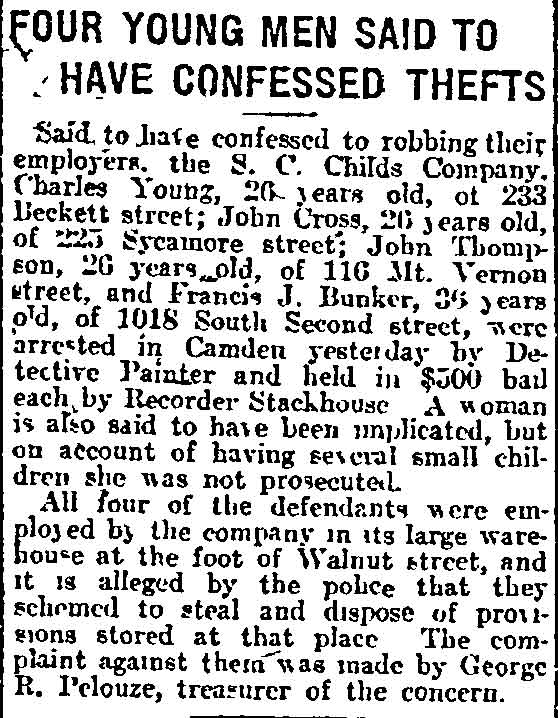
Four Young Men Said to Have Confessed Thefts
Said to have confessed to robbing their employers, the S. C. Childs Company, Charles Young, 20 years old, of 233 Beckett street; John Cross, 20 years old, of 225 Sycamore street; John Thompson, 20 years old, of 116 Mt. Vernon street, and Francis J. Bunker, 35 years old, of 1018 South Second street, were arrested in Camden yesterday by Detective Painter and held in $500 bail each by Recorder Stackhouse. A woman is also said to have been implicated, but on account of having several small children she was not prosecuted.
All four of the defendants were employed by the company in its large warehouse at the foot of Walnut street, and it is alleged by the police that they schemed to steal and dispose of provisions stored at that place. The complaint against them was made by George R. Pelouze, treasurer of the concern.
Hold Burlington Man for Larceny
Philadelphia Inquirer —
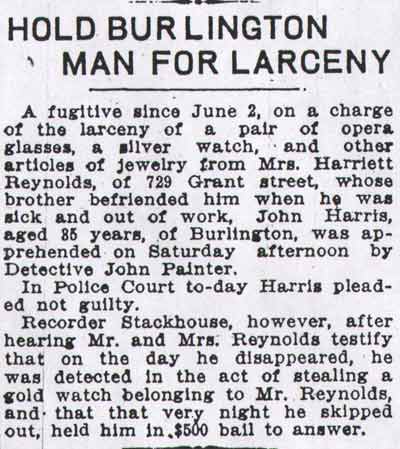
HOLD BURLINGTON MAN FOR LARCENY
A fugitive since June 2, on a charge of the larceny of a pair of opera glasses, a silver watch, and other articles of jewelry from Mrs. Harriett Reynolds, of 729 Grant street, whose brother befriended him when he was sick and out of work, John Harris, aged 35 years, of Burlington, was apprehended on Saturday afternoon by Detective John Painter.
In Police Court to-day Harris pleaded not guilty.
Recorder Stackhouse, however, after hearing Mr. and Mrs. Reynolds testify that on the day he disappeared, he was detected in the act of stealing a gold watch belonging to Mr. Reynolds, and that that very night he skipped out, held him in $500 bail to answer.
Philadelphia Inquirer
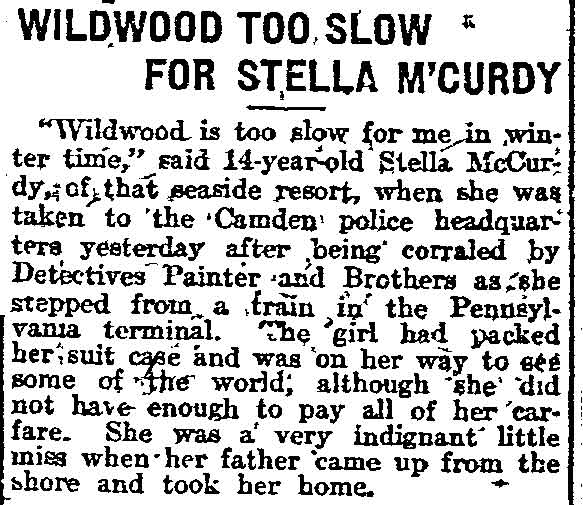
Named: John Painter, John Brothers, and Stella McCurdy.
Philadelphia Inquirer
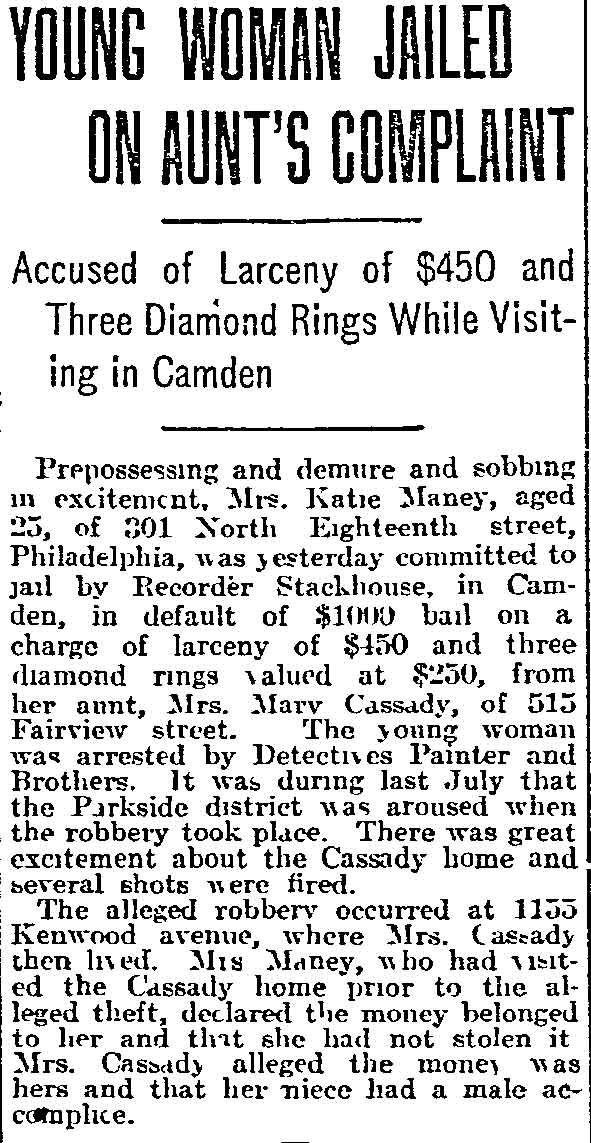
Named: Kate Maney, Mrs. Mary Cassady, John Painter, John Brothers, Fairview Street, and Kenwood Avenue.
Murderer and Forger Escape Jail After Shooting Keepers, Killing One
Camden Post-Telegram —
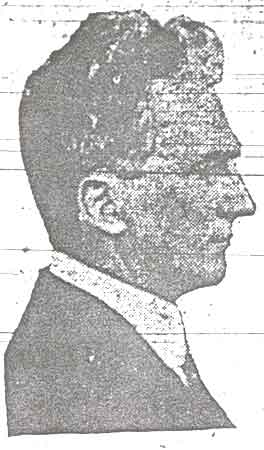
Wilson Ashbridge — George E. Thompson
Wilson Ashbridge, Who Shot and Killed Mrs. Elizabeth Dunbar and George E. Thompson, Check Swindler, Trap Jailor Hibbs by a Ruse and After Slaying Him Shoot Joe Ellis Who Intercepted Them in Flight. Used Revolver Smuggled Into Prison by Confederates and Leave Jail Wide Open in Their Flight, a General Delivery Being Averted by Police Who Were Summoned by the Wounded Men.
Murdering one jailor and wounding another with a revolver that had been smuggled into them by outside confederates, Wilson T. Ashbridge, slayer of Mrs. Elizabeth Dunbar, and Francis Murphy, alias George E. Thompson, a check forger, made their escape from the county jail a few minutes before seven o’clock last night.
Ashbridge with his wife was caught at noon in the Keystone Hotel in Chester PA where they registered at one o’clock this morning.
Thompson is still at liberty but from the confident manner of Prosecutor Kraft his early arrest seems assured.
The murdered jailor was Isaac Hibbs, aged 65 years of 913 South 8th Street. The wounded keeper is Joseph Ellis, aged 45 years, of 416 Carteret Street. Shot twice, he is in Cooper Hospital. His condition today is very satisfactory.
Thompson, who is 41 years old, forged a check for $650 which he gave to V.M. Fulton as part of the purchase price of an automobile. The forgery was discovered before the deal was completed and his arrest followed on June 8. he also passed a forged check for $15 on State Motor Vehicle Agent Kraft. He, too, was awaiting trial. In spite of the positive evidence against him Thompson had spurned all efforts to have him plead guilty and it is now believed that he was sparring for time while hatching a plan to escape. He s no doubt the master mind.
R.L. Hunter, a farmer of Bensalem Township, Bucks County PA, about four miles above Torres dale, reported to the Philadelphia police the morning that he had seen a man answering Ashbridge’s description on the Bucks Road at daylight. The man asked the way to Riegelsville.
According to Hunter, the man was dressed in a dark suit, and had no hat. His clothing was wet. Hunter did not see anything suspicious in his actions, and after giving him directions, they parted.
Upon seeing the paper with a picture of Ashbridge, the farmer was struck by its resemblance to the man with whom he had talked. He hurried to Tacony and notified the police.
The State police, who patrol that section of the county, and who have an office at Langhorne, were immediately notified as were the surrounding towns.
The shootings took place in different parts of the jail. Hibbs was murdered in the exercise room just outside the cell room on the Sixth and Arch corner of the building. Ellis was shot down in the corridor just outside the Market Street end of the building when he heroically grappled with Ashbridge after the latter had pointed a gun at his head. In spite of his wounds Ellis dragged himself to a telephone and after notifying Police Headquarters of what had happened he collapsed.
Only one of the two bullets is still in Ellis. It entered the groin on the right side and is buried in the muscles of the leg, having taken a downward course for seven or eight inches. The other bullet struck Ellis in the right breast and came out in the left breast, traversing the upper fleshy parts of the body.
Hibbs was almost instantaneously killed by a bullet that went within an inch of his heart, producing a hemorrhage. The bullet was extracted this morning from the body early this morning in an autopsy performed at the morgue by County Physician Stem. In spite of the fact that it is pretty well established that three shots were fires in the attack on Hibbs, only one of the bullets took effect.
“But it makes little difference which of the two men handled the gun” said Prosecutor Kraft this morning. “Both are equally guilty of this murder and what we are concerned about now is the recapture of the gunmen.” Mr. Kraft added that it his purpose to examine all of the prisoners in that part of the jail where Hibbs was murdered to determine fully who fired the fatal shot.
The escape had been carefully planned and timed to the minute. Of course the desperate prisoners were aided by confederates on the outside and it is the general belief that a high powered motor car was in waiting for them not far from the jail. They are known to have been in possession of money and openly boasted yesterday that it was their intention to leave the prison last night. These boasts were made to two young ladies connected with a religious organization who called on the tom men yesterday to offer spiritual reconciliation. The girls are frequent visitors to the jail and naturally their efforts at evangelization were directed in the main toward Ashbridge, because of the fact that he was accused of murder. These girls, whose identity officials will not disclose, were closeted with Prosecutor Kraft until one o’clock this morning. Both declared that on their visit yesterday they were told by Ashbridge and Thompson that it was the last day they expected to spend in jail.
“We are going to get away from here tonight and we’ve got money to help us after we are out ” said Ashbridge, who further told the girls he had considerable cash sewed up in the waistband of his trousers. The girls begged the prisoners not to do anything that would cause them more trouble and they told the Prosecutor that Ashbridge and Thompson promised them that they would not make any effort to escape. In their talks with the girls neither of the prisoners said a word that would indicate that they would kill if necessary to escape. The full force of their boast did not dawn on the religious workers and for this reason it never occurred tot hem to inform the Sheriff of what the prisoners had in said.
A general jail delivery of at least all the men confined in hat is known as the untried department, where the two were held, was only averted by the prompt arrival of the police on their beat, which was made easy by means of the keys taken from the prostrate body of Hibbs. Ashbridge and Thompson left all of the doors open and the vanguard of the inrushing police found the prisoners swarming all over the corridors on the east side of the prison. In the wild excitement following the double shooting and escape none else thought of freedom and a checking up of the inmates after they had been herded in the exercise room of the untried department accounted accounted for all but the fugitive slayers.
The department, in which the two men were confined is the same one which William Brown and Charles Berger made their sensational escape several years ago by sawing away the bars on the Federal Street front of the jail. Thrilling as it was, the former escape was insignificant in comparison with last night’s tragic event.
With the full force of the keepers out of the way— one dead and the other suffering from gunshot wounds at first supposed to have been fatal— Ashbridge and Thompson had nothing between them and freedom but the door entering from the spiral stairway leading to the narrow entrance of the Sixth and Market Streets end of the Court House, With the keys taken from Hibbs they opened the door and in a few seconds were breathing the free air. It was still daylight when the daring murderers walked from the building and although they were no doubt seen by some of the scores of persons passing it is certain that they managed to control themselves to such an extent as not to arouse any undue suspicion. The exit they used to escape is that used by the general public and therefore persons passing calmly in and out of the door would not in any manner be thought to have been connected with a jail delivery. However the shots which had laid low the keepers had been plainly heard on all four sides of the building and it is strange that no one has yet been found who can give positive information as to what course the fleeing men took and whether they were aided in their flight by an automobile.
While the police and detectives of Camden and all other cities in the East are watching railroad terminals, steamship lines, and all other avenues of travel in response t the general alarm sent out last night, Prosecutor Kraft is bending all his energies to learn who smuggled in the revolver which the fugitives used. Thus far this feature of the case is as complete a mystery as it was last night. Mr. Kraft and Sheriff Haines are satisfied, however, that only one gun was used for both shootings. It was at first thought that each man had a pistol when they left the jail; that one of them armed himself with the gun that Hibbs was supposed to have carried, but it was determined that Hibbs was not armed when he went into the jail last night. There was no occasion for him to come in contact with any of the prisoners and for that reason he left his revolver in his desk in the office. even had he carried it he would have little chance to use it, so cold-bloodedly was he slain as he unsuspectingly fell into the trap laid for him by the desperate gunmen. There is also some conflict as to how at least on of the fugitives was dressed. Alfred Williams, who witnessed the murder of Hibbs, said that Ashbridge was without coat or ha when he dashed out of the cell-room, and that Thompson carried his coat and hat under his arm. However in a description of the two men given at the Prosecutor’s office it was set forth that Ashbridge wore a bue serge suit and a checkered cap. The coat that he is supposed to have taken bore the mark of “Tull— the Tailor,” of Jacksonville, Florida. ad had been borrowed by him from another prisoner. He wore tan shoes. Ashbridge is 27 years old, 5 feet 7-1/2 inches in height and weighs 137 pounds. He has brown hair, smooth face and is of light complexion.
Thompson wore a brown suit and a Panama hat. He is 41 years old 5 feet seven inches in height, and weighs 175 pounds. He has brown bushy hair, is minus one of the fingers on his left hand, and is light complexioned.
The tan shoes worn by Ashbridge were also borrowed from one of the prisoners. He got them on Saturday and remarked that he wanted to look neat.
Keepers Ellis and Hibbs were reading in the prison office last evening when Hibbs glanced up at the clock and noticed that it was a few minutes of seven. “Joe, I’m going back and out the boys in their cells,” he said to Ellis and with his keys in his hand he started for the cell room in the untried department. A thirty foot long corridor runs from the office to the barred and grated door opening into the department in which the cells are situated. This department is about the size of three ordinary school rooms and in the southeastern corner of the jail are the cells, in two tiers.
Around the cells is a three foot corridor into which all the cells doors open and in which all the prisoners are permitted to walk when they are not allowed out in the main room. When the inmates are ordered into their cells and their doors closed the doors are locked from the outside of the steel cage by means of a lever worked by the jailor. Thus every cell door can be made secure without the keepers coming into actual contact with the prisoners. In addition to the bars around the corridor fronting on the double tier of cells there is a fine mesh heavy wire screening.
As Hibbs approached the lever which is operated to shut the cell doors after the prisoners have retired from the corridors, Ashbridge was leaning against the grating of his cell, Number 18. Thompson was lounging a few feet away.
“Daddy, open the door, I want you to see this note,” said Ashbridge to the keeper, at the same time displaying a piece of paper which he had in his hand. Never giving a thought that he was about to perform an act that which was absolutely necessary for the carrying-out of the well laid plot, or that he was going to his doom, or was even in danger, “Daddy,” as the aged keeper was known to all the prisoners, opened the door without hesitation.
As he swung wide the big steel frame, Ashbridge quickly stepped out and the next instant was pressing a gun against the abdomen of the jailor.
“Throw up your hands, you ___ ___ ___” he commanded.
“What are you up to, what’s this mean, asked the keeper, apparently not realizing he had been trapped.
For reply Thompson jumped out the door, wrenched the gun from Ashbridge’s grasp and with an oath began firing at Hibbs, who sank to the floor at the first shot. Only a few feet away and the only other person in the exercise room, although the shooting could have been seen by any other prisoners who had not retired to their cells, Alfred Williams, trusty, is emphatic in his assertion that Thompson fired the shot that killed Hibbs and that he fired three times.
“It’s a wonder they did not get me,” said Williams. “Ashbridge and I could not hit it and in his desperate mood I am surprised he didn’t kill me, too.” Williams, who has just completed a six months’ sentence for obtaining money from Italian grocers by falsely representing himself as an agent for a wholesale house in Chicago and who is wanted in the Windy City for the same offense, says the whole transaction took less than a minute and that the moves came so fast he and the other prisoners were powerless to aid.
“It was like a flash of lightning” said Williams, “and before I could fully understand what had happened Ashbridge had grabbed Daddy’s keys’ which had fallen to the floor, and was off like a deer for the barred door. Ashbridge had taken the smoking gun from Thompson, who had his hat and coat under his arm and who was right behind the other one.
“As they hurried through the door after Ashbridge had opened it with Daddy’s keys Daddy called to me to raise him. I put my arm under his head and lifted him slightly from the floor. ‘Hold my hands’ he sad to me. I took hold of his hands and the next minute he died in my arms. Then I heard two more shots and I knew they got Joe Ellis.”
Startled by the shots, and he is emphatic there were three in rapid succession, Ellis leaped to his feet and without taking the time to arm himself ran from the office and turned into the corridor just as Ashbridge, wild-eyed and gun in his hand, came running toward him. Halting three yards away Ashbridge pointed the revolver at Ellis’ head and ordered him to throw up his hands.
For reply and without fear of himself the keeper dashed at the murderer and the next instant they wee locked in each others embrace. Working loose the hand which held the gun, Ashbridge pulled the trigger. The bullet struck Ellis in the breast, but the wound was not sufficient to render him helpless. However, before he could grip the pistol arm, Ashbridge fired again and the keeper fell back with a bullet in his groin.
“The second shot got me,” said Ellis to Prosecutor Kraft and Assistant Prosecutor Butler at the hospital. “The first one wasn’t bad but my strength left me when the second bullet struck. Ashbridge was the only one I saw. I did not see Thompson.”
“Dragging himself to the office Ellis managed to reach a telephone and called up the police.
“This is Ellis at the county jail; come quick. Ashbridge has shot me” he weakly said over the phone to Captain Hyde. Then the receiver fell from his hand and he dropped to the floor, but after a minute or two managed to climb into chair.
While patrol loads of policemen where being hurried to the Court House from the First and Second District station houses, Reserve Officer Charles Hose, on duty at Broadway and Federal Street, who had heard the shots, ran to the Court House and from the office of Assistant Custodian John Lack phoned up to the jail. Ellis managed to answer and in a few word told what had happened. They ran up to the jail and were admitted by Ellis, who was rapidly growing weaker from loss of blood, the trail of which plainly showed just where the injured keeper had moved.
“I guess Ashbridge got away and the jail is all open, you had better take care of the rest of the prisoners,” said Ellis to Hose and Lack. The fugitive-murderers had left all doors open and the other occupants of the untried department were swarming through the corridors. Their curses and yells and the shrieks and cries of the female prisoners had turned the place into a perfect bedlam. With the aid of other policemen who swarmed into the Court House like bees, the prisoners were soon herded into the exercise room, where Trusty Williams checked the up and accounted for all but Ashbridge and Thompson.
With the faint hope that the missing pair had not risked leaving the building but had secreted themselves in the structure, the courthouse was searched from pit to dome, but no trace of the men were found.
Detective Doran was the first of the Prosecutor’s staff to reach the scene. Mr. Kraft and the balance of the staff soon followed. In the lower end of the county, on official business, Sheriff Haines was reached by phone and Under Sheriff Hewitt was summoned from Pitman and until an early hour this morning the officials were is conference and examining numerous prisoners.
State Detective Walter Le Torneau furnished Prosecutor Kraft with a promising “tip” this morning when he learned that Thompson gave a letter to Freeholder Howard Marshall, of the Eighth Ward, to mail on Sunday. Mr. Marshall states that the letter was addressed to a woman by the name or Mrs. Shelton, in Baltimore MD.
Marshall was attending religious service in the jail when Thompson approached him.
“Put this is your pocket and mail it it for me when you go out,” said Thompson to Mr. Marshall, who agreed to carry out the request. Dropping the letter in the mail box Marshall allowed the incident to pass without further notice.
Detective Le Torneau learned this morning that Marshall had spoken to the incident to a friend and the sleuth notified the Prosecutor, The tip will be run down the Prosecutor stated.
Funeral services for Hibbs will be held on Thursday from his late residence. The body will be taken to Langhorne PA where interment will be made in the Friends’ Cemetery under the direction of the Schroeder-Kephart Company. Services will be conducted Wednesday evening by Reverend Henry Bradway, pastor of the Eighth Street Methodist Episcopal Church.
POLICE QUICKLY AT WORK
Although the murderous prisoners made their escape, it was no fault of the local police department, which threw out a “dragnet system” that covered practically every outlet fropm the city. as soon as the call reached headquarters the red lights were flashing and every officer and detective who could be reached was sent out on the “man hunt” which was pursued with vigor.
Passing automobiles were pressed into service by the detectives and officers and all haste was made for the ferries, railroad yards, terminals, and trolley points. Citizens cooperated with the police in their efforts to run down the escaping prisoners.
Assistant Chief Hyde received the call from Jailor Ellis, who though wounded himself summoned strength enough to reach the phone.
“This is Jailor Ellis. Hibbs and me have been shot by that man Ashbridge and help quick!” was the startling message which came over the phone to Chief Hyde about one minute past seven.
It was just at the time the shifts were going on and off at the local station houses. Chief Hyde lost no time. He called to Machine Operator “Eddie” King to send the message to the station houses and flash the red lights. This was done and as fast as the men could run they covered the various points.
The auto patrols were dispatched with all hands to the Court House and the wounded men hurried to the hospital. Coroner Robert G. Schroeder reached the hospital as Hibbs and Ellis were being admitted and he tool charge of the situation and got in touch with Prosecutor Kraft and County Physician Stem.
Detective Captain Schregler was hurriedly summoned, and his men were sent in all directions. Detective Brothers boarded a waiting automobile and a record run was made for the Federal Street ferry. Sergeant Humes was picked up and in four minutes after the call was received from Ellis Detective Brothers had the ferry covered.
Detectives Troncone, Painter and Murray and Captain Schregler covered the Kaighn Avenue, Vine Street, and Cramer Hill ferry lines.
Detective Brothers got in touch with the Pennsylvania Railroad officials who put their detective force to work searching freight and passenger cars. The orders were sent out from the railroad office to stop and search every fright train. Dispatches were also sent to Trenton, Mount Holly, and Burlington and it was not long before the news of the atrocious deed had spread throughout the country and many distant places.
Trolley cars were stopped and searched by the police, but not the slightest trace could be found of the escaped prisoners. The police left nothing undone in the “man-hunt.”
When news of the affair spread through the city phone calls began to come in to headquarters. Over fifty persons called up to tell the police that they had seen the two men at various places. The “tips” were all run down but none materialized.
Officers Arthur Colsey and Theodore Guthrie, who were on their vacations. lent their aid to Chief Hyde. Policeman Colsey pressed his automobile into service and carried the police to various parts of the city.
Co-operating closely with Prosecutor Kraft’s detectives the city officials formed a combination which in nine times out of ten would have been successful, but the escaped men cleverly eluded their pursuers.
Assisted by Coroner Schroeder, County Physician Stem held a post mortem examination on Hibbs’ body. The bullet which caused the death was located in the region of the heart, It passed through the victim’s lung, causing a hemorrhage, which resulted in death. Following the examination the body was taken by the Schroeder-Kephart Company at the family’s orders to be prepared for burial.
ASHBRIDGE'S FIRST CRIME
The brutal crime for which Ashbridge stood indicted but untried was committed on the night of January 22 at Ninth and Market Streets. It developed that the murderer had followed his intended victim from the morning hours. He trailed her to the home of her sister, a Mrs. Meredith, of 911 Market Street, and laid in wait in the darkness of a building that fatal Saturday night.
Mrs. Dunbar came out of the house and stood on the northeast corner while waiting for a ferry-bound trolley car. She intended going to Sicklerville that night to visit her relatives. With her at the time was her 7-year-old daughter, Eleanor, and her father, Charles Dunbar. Ashbridge advanced toward the woman, who was startled when she saw him. She called to her father that she “didn’t want anything to do with Ashbridge.”
Before the father could interfere the young murderer whipped out a revolver and covered the father and the woman. He then struck the woman violently in the face with his fist and as she was reeling under the force of the brutal blow Ashbridge fired, the first bullet taking effect in the woman’s chest. The brutal murderer then stood over his prostrate victim and holding the revolver less than five inched from his victim’s body he pumped four more shots into her.
Policeman Howard Smith and Policeman Taylor were a square distant. Smith saw the entire proceedings and screamed at Ashbridge to stop shooting. A crowd quickly gathered and Dr. Maldeis, who lives nearby, came running to the scene to aid the stricken woman.
Officer Taylor espied Ashbridge in the crowd, The murderer made no effort to run, but stood his ground. Detecting the murderer trying to slip something up his sleeve, Taylor pounced upon him and bore him to the ground, at the same time taking the gun away from him and slipping the handcuffs over the murderer’s wrists. Policeman Taylor had to draw his revolver to keep back the large crowd that was threatening. Showing no concern whatever, Ashbridge calmly waited until the police auto arrived. In the meantime the murdered woman’s still warm body was placed in a “jitney” and with Officer Smith and Dr. Maldeis a hurry run was made for Cooper Hospital but when the institution was reached, Mrs. Dunbar was pronounced dead.
Ashbridge was taken to the hospital by Policeman Taylor in the police auto. He asked “how she is.” Informed that he had accomplished his purpose, the young murderer asked to see the woman. When the white sheet covering the still form of the murdered woman was drawn from the face Ashbridge leaned over and kissed the forehead of the woman. He was then taken to the County jail and locked up. Before Recorder Stackhouse on the following Monday Ashbridge pleaded guilty.
Ashbridge was infatuated with the woman, who was a member of the Temple Theater chorus. Because of Ashbridge’s persistent attentions she was compelled to give up her position. Mrs. Dunbar had previously accepted Ashbridge’s attentions, thinking that he was unmarried, but upon learning that he had a wife and child she informed him that it would be best for them not to see each other, but the young man refused to discontinue his attentions.
On the day of the shooting Ashbridge was seen in various places. He is said to have followed the woman to the Federal Street ferry, but lost track of her. Around noon he was seen at Front and Pearl Streets by Policeman Boyd, who ordered him to move on. Boyd was about to arrest him as a suspicious character, but Ashbridge pleaded that he was looking for a friend. All that day Ashbridge followed the woman until night, when he cruelly murdered her.
The murderer came from a respectable family. Dissipation is thought to have caused the young man to lose his sense of reasoning. Rather good-looking, Ashbridge had tender baby-like eyes and his case excited sympathy among the more tender-hearted people.
Sweetmeats, tasty sandwiches, and other small luxuries were said to have been given the young murderer while he languished in his cell. He had many visitors. Recently Ashbridge was taken violently ill after eating some crabs which were given him by a friend. He and Jailor Hibbs were very friendly.
THOMPSON A CLEVER FORGER
Thompson, or Murphy, was a self-styled lawyer and was committed by Recorder Stackhouse in June3 for forging checks to the amount of $1,055. The worthless checks were “worked” on the McClelland-Fulton Auto Company and Motor Vehicle Agent A.C. Kraft.
When a check for $150 presented to the automobile company by Thompson and drawn to the order of “G.E. Thompson” on the Harrisonburg, Virginia National Bank came back from the home office of the Studebaker Company as worthless, Mr. Fulton called in the police.
Thompson had previously presented a check for $890 as payment on an automobile. This check was drawn on Thompson’s favor on the Coatesville National Bank and was purported to have been signed by Louis L. Gibney, a hotel man of Downington PA. This check was still in the possession of Mr. Fulton when Thompson was arrested after the first check was returned marked “no funds.”
The clever swindler also presented a bad check to Agent Kraft for $15 for which he received the license to operate the automobile which he proposed buying.
Detective Troncone arrested Thompson at Fifth and Market Streets on June 2. The defendant had been living in a room at 220 North Fifth Street.
Giving his home address as Daytona, Florida, Thompson represented himself as a lawyer. well dressed and wearing nose glasses, Thompson was an intelligent appearing man, he had a bushy pompadour which was streaked with gray and talked in a persuasive manner. His forgeries on Mr. Gibney’s signature were so clever that Gibney himself could not tell the difference.
After Thompson’s arrest Detective Captain Schregler sent out notices to several southern cities. He received responses from Harrisonburg, Norfolk, and Petersburg Virginia and that Thompson was wanted in all three cities for check forgeries.
Bert Hibbs, a city fireman and a son of the slain jailor, was murdered early Sunday morning, December 25, 1910 when his throat was cut by Charles Ridgway, a negro, aged 22 years, of Seventh and Sycamore Streets. It was about 12:20 on Christmas morning that Hibbs while crossing the lots at Seventh and Sycamore was accosted by Ridgeway, who wanted to shake hands with Hibbs. The latter refused, a quarrel ensued and Ridgeway whipped out a razor and slashed Hibbs across the throat with such violence that his head was nearly severed. Hibbs died while on the way to the hospital. Ridgway was arrested after a battle by Detectives Schregler, Painter and Brothers and several officers at his home, 1207 Lilly Row.
Indicted for murder Ridgway pleaded non vult. On April 24, 1911, to a charge of murder in the second degree, he was sentenced to 25 years in state Prison at hard labor.
SECOND MURDER IN JAIL
This is the second murder and second escape from the present jail. The first murder took place in November, 1907, when George Stewart, a young negro, stabbed to death John Snell, who was awaiting trial for carrying in the business of fortune telling. Stewart was in jail on a charge of dealing in opium and cocaine. He had a complete opium layout in his cell. He and Snell had a quarrel and he stabbed Snell to death in his cell. He was tried and convicted and sentenced to be electrocuted during the week of February 8, 1908. He was electrocuted on February 4, being the first man to suffer the death penalty by electrocution.
On July 13, 1910 William T. Brown, alias Gillespie, who had been sentenced to seven years on a charge of forgery, and Charles Berger, who was under sentence for picking pockets, made their escape from jail after sawing the bars on the Federal Street front. They climbed over the balustrade to the roof, descended through a trapdoor, climbed down stairs and walked leisurely through the Court House building and out into the street unnoticed. They entered an automobile and were driven away. They crossed to Philadelphia on a North Cramer Hill Ferry boat.
Several weeks later Brown was arrested in New York City and was sentenced to Auburn Prison on an old charge. His term will expire shortly and he has also applied to the Court of Pardons of this State for a parole. A detainer has been lodged against him at the State prison where he his located and he will; be brought back and resentenced. Berger was captured in Chicago and was brought back and served a term at Trenton.
Ashbridge Caught in Chester Hotel Along With Wife
Camden Post-Telegram —
Captured at noon with his wife in the Keystone Hotel at Chester PA, Wilson Ashbridge, who escaped from the County Prison last night with George E. Thompson, a forger, after killing Jailor Hibbs and shooting Jailor Ellis, is again in the County Jail.
Ashbridge admits that he shot both men. He said the gun was given to him by Thompson.
The coupe were captured in their room at the Keystone Hotel by Captain of Detectives Schregler and Policeman David Hunt, who hurried to chester in Chief Gravenor’s automobile in receipt of a message that a man answering to the description if the published picture of Ashbridge registered there early this morning with a woman as his wife.
Ashbridge offered no resistance when the officers entered his room. He waived extradition and being handcuffed was placed in the machine with his wife and hurried to this city.
Schregler sat in the rear of the machine between Ashbridge and his wife.
They reached City Hall at 2:10 o’clock this afternoon. Ashbridge was smoking a cigarette and looked sullen.
When the murderer saw a battery of photographers getting ready to take their pictures, Ashbridge shielded his wife’s face with his hat and hid his own face as best he could in his handcuffed condition.
They were taken upstairs to the Chief’s office and later sent to the Prosecutor’s office.
Ashbridge takes blame for the double shooting, but insists that his wife did not give him the gun, saying that Thompson supplied the weapon.
The police knew last night that Mrs. Ashbridge was with her husband or intended to go with him. This information came in a letter turned over to the police by a Mrs. Dick, of East Camden, who was carting for the children. The envelope cautioned her not to open the letter until 7:00 o’clock last night.
Mrs. Ashbridge said in the note that she was going to do a rash act and might not see the children again.
In the cell occupied by Thompson the following note was found by Detective Painter.
Ashbridge has made up his mind to leave this place. I have decided to go with him.
“It may seem like suicide and if anything happens send my body to the University of Pennsylvania
—“THOMPSON
Seventeen loaded cartridges were also found in the cell.
The detectives and their prisoners were accompanied to Camden by E.S. Fry, proprietor of the Chester hotel, where the couple were caught.
There is no question but that Mrs. Ashbridge knew all bout the plan to escape. Where she met her husband has not been discovered.
A reward of $1,000— $500 for each— was today offered by the Prosecutor.
Philadelphia Inquirer
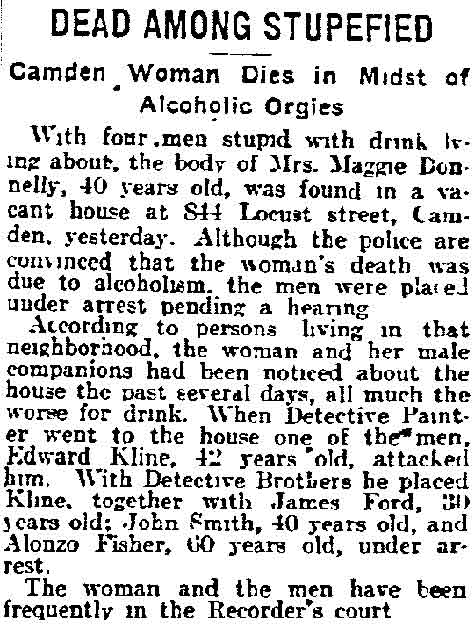
Named: Locust Street, Mrs. Maggie Donovan, Edward Kline, James Ford, John Smith, Alonzo Fisher, John Painter, and John Brothers.
Philadelphia Inquirer
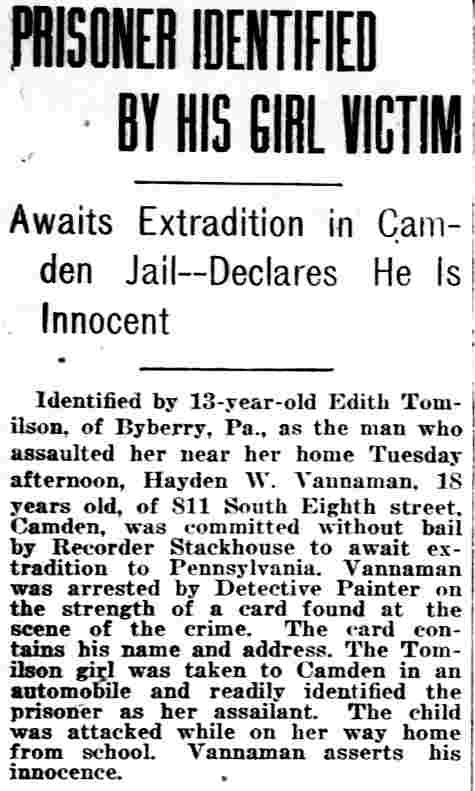
Named: South 8th Street, Edith Tomilson, Hayden W. Vannaman, O. Glen Stackhouse, and John Painter.
Philadelphia Inquirer
Named: Carl Carlin, Edward Stokes King, Charles E. Hemphill, East Camden, Alice Monroe, John Painter, Federal Street, and William Schregler.
$3000 Man's Lure to Fire Building
Camden Daily Courier —
Prisoner Confesses to Arson; Blames His Employer, Both Under Arrest
Boleslaw Ziemba, 1555 Mt. Ephraim Avenue, confessed today to Captain of Detectives Schregler that he set fire to the property at 1426 Broadway at the instigation of his employ-er, John Makel, so he could obtain $3000 he had put into the business. Makel conducted an automobile agency at the Broadway address. Both men are under arrest and will face charges of arson preferred by Fire Chief Peter D. Carter.
Ziemba told the detective chief in the presence of his aides, King and Painter, who investigated the case, that sometime ago he had loaned Makel $3000 and in turn had been given a job at the agency. He stated that he had asked Makel for his money and his employer then than said that he, Ziemba, set fire to the building and that the insurance money would provide the means to erect a new and handsome building and he could have a better job and get his money back quicker.
Firemen saved the building from destruction after the first floor had been partly consumed by flames.
On an examination of the premises, Chief Carter said he found kindling wood saturated with gasoline and oil placed in piles between joists of the second floor. He also discovered that rags soaked in oil had been placed in cracks in the flooring. Even the driveway had been liberally dosed with gasoline and oil, the chief stated. The arrests followed the examination of the arson evidence at police headquarters.
Philadelphia Inquirer
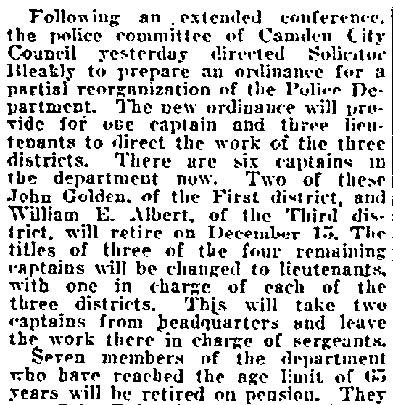
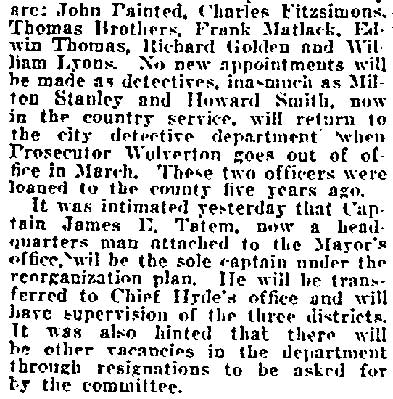
E.G.C. Bleakly — John Golden — William E. Albert — John Painter — Charles Fitzsimmons — Thomas Brothers — Edwin Thomas — Richard Golden — William Lyons — Milton Stanley — Howard Smith — Charles A. Wolverton — James E. Tatem — Edward Hyde
This story erred in reporting, as retirement at age 65 was NOT mandatory at the time. William E. Albert, Richard Golden, Frank Matlack, and Edwin Thomas did retire. John Golden, John Painter, Charles Fitzsimmons, Thomas Brothers, and William Lyons continued to work in the Police Department. John Golden was eventually promoted to Chief of Police.
Camden Courier-Post
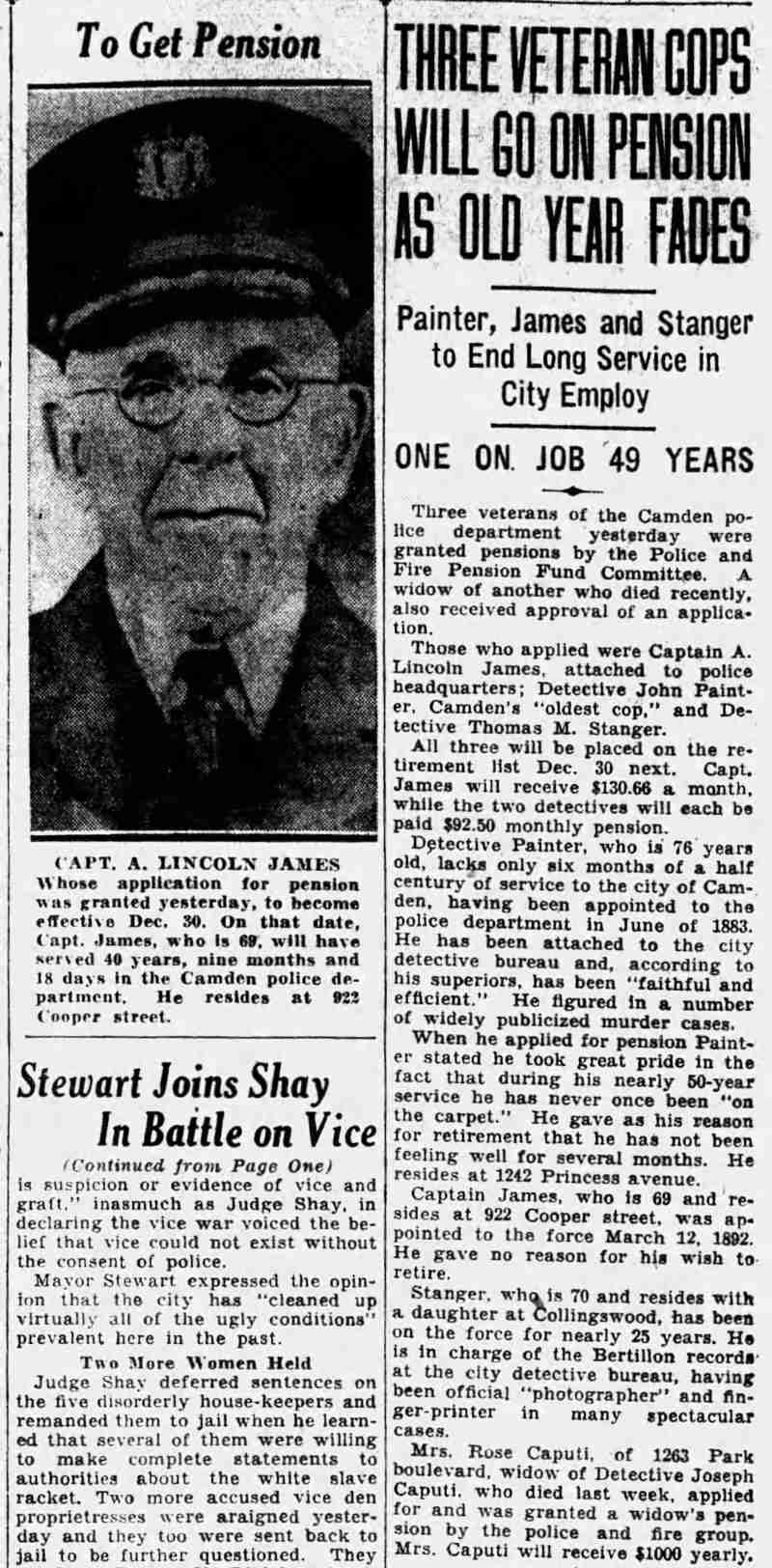
THREE VETERAN COPS WILL GO ON PENSION AS OLD YEAR FADES
Painter, James and Stanger to End Long Service in City Employ
ONE ON JOB 49 YEARS
Three veterans of the Camden police department yesterday were granted pensions by the Police and Fire Pension Fund Committee. A widow of another who died recently, also received approval of an application.
Those who applied were Captain A. Lincoln James, attached to police headquarters; Detective John Painter, Camden’s “oldest cop,” and Detective Thomas M. Stanger.
All three will be placed on the retirement list Dec. 30 next. Capt. James will receive $130.66 a month, while the two detectives will each be paid $92.50 monthly pension.
Detective Painter, who is 76 years old, lacks only six months of a half century of service to the city of Camden, having been appointed to the police department in June of 1883. He has been attached to the city detective bureau and, according to his superiors, has been “faithful and efficient.” He figured in a number of widely publicized murder cases.
When he applied for pension Painter stated he took great pride in the fact that during his nearly 50-year service he has never once been “on the carpet.” He gave as his reason for retirement that he has not been feeling well for several months. He resides at 1242 Princess avenue.
Captain James, who is 69 and resides at 922 Cooper street, was appointed to the force March 12, 1892. He gave no reason for his wish to retire.
Stanger, who is 70 and resides with a daughter at Collingswood, has been on the force for nearly 25 years. He is in charge of the Bertillon records at the city detective bureau, having been official “photographer” and finger-printer in many spectacular cases.
Mrs. Rose Caputi, of 1263 Park boulevard, widow of Detective Joseph Caputi, who died last week, applied for and was granted a widow’s pension by the police and fire group. Mrs. Caputi will receive $1000 yearly.
Stewart Joins Shay In Battle on Vice
(Continued from Page One) is suspicion or evidence of vice and graft,“ inasmuch as Judge Shay, in declaring the vice war voiced the belief that vice could not exist without the consent of police.
Mayor Stewart expressed the opinion that the city has “cleaned up virtually all of the ugly conditions” prevalent here in the past.
Two More Women Held
Judge Shay deferred sentences on the five disorderly house-keepers and remanded them to jail when he learned that several of them were willing to make complete statements to authorities about the white slave racket. Two more accused vice den proprietresses were arraigned yesterday and they too were sent back to jail to be further questioned.
Jobless Son Kills Jake Schiller Who Saves Boy's Wife From Gun
Camden Courier-Post —
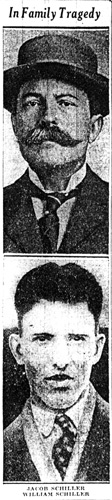
Jacob Schiller, 72, for 45 years a political figure here, is dead, shot by his own son.
The slayer, William Schillcr, 30, a former summer policeman now unemployed, was held over today to the grand jury on a charge of murder. He made no comment whatever during his police court hearing.
A few hours later, young Schiller’s wife, Augusta, whom he lad also tried to shoot, was found wandering through the city street, in all hysterical condition.
She had written a note which police believed showed intent to commit suicide, and had staggered dazedly through the streets last night. Both in her note and in her incoherent statements to detectives she declared she was to blame for the tragedy.
She said her father-in-law had tried to save her and was killed in the attempt.
The slaying occurred Saturday night at the elder Schiller’s home, 2420 Carman Street. It climaxed an estrangement between young Schiller and his wife, with “Jake” Schiller attempting to reconcile the couple.
Mrs. William Schiller, who had had her husband arrested several months ago, said she believed he had become mentally deranged, but Police Judge Pancoast was informed that an alienist had examined young Schiller in July and pronounced him sane.
Schiller was also a familiar figure at the Elks Club, where he was an ardent card player. But after the death of his wife he gave up this pastime, contenting himself with watching the games. He was also a frequent visitor among old friends at the courthouse.
“He was an enthusiastic and loyal friend with a good heart for everybody in trouble,” Congressman Wolverton said when he learned of Schiller’s death.
Camden Courier-Post
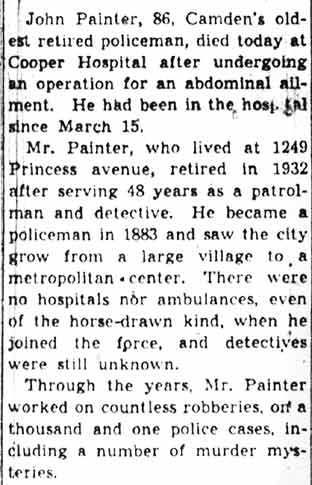
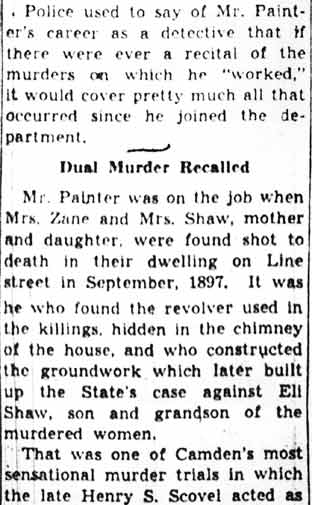
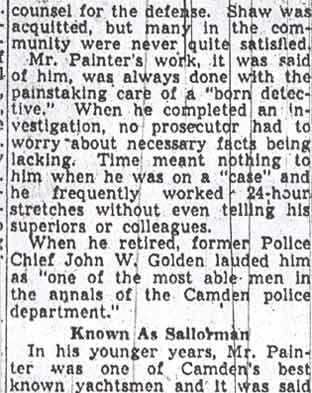
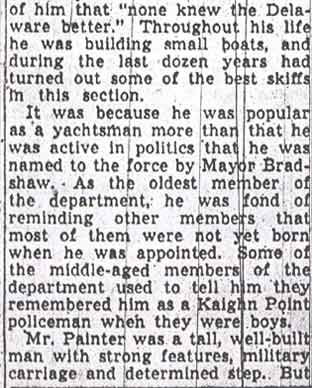
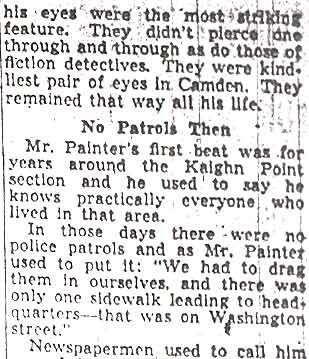
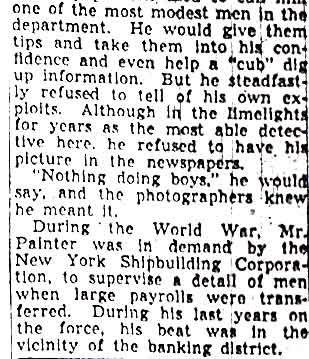
John Painter Dies; Policeman 48 Years
City's Oldest Retired Officer Succumbs After Operation at Age of 86
John Painter, 86, Camden's oldest retired policeman, died today at Cooper Hospital after undergoing an operation for an abdominal ailment. He had been in the hospital since March 15.
Mr. Painter, who lived at 1249 Princess avenue, retired in 1932 after serving 48 years as a patrolman and detective. He became a policeman in 1883 and saw the city grow from a large village to a metropolitan center. There were no hospitals nor ambulances, even of the horse-drawn kind, when he joined the force, and detectives were still unknown.
Through the years, Mr. Painter worked on countless robberies, on a thousand and one police cases, including a number of murder mysteries.
Police used to say of Mr. Painter's career as a detective that if there were ever a recital of the murders on which he “worked,“ it would cover pretty much all that occurred since he joined the department.
Dual Murder Recalled
Mr. Painter was on the job when Mrs. Zane and Mrs. Shaw, mother and daughter, were found shot to death in their dwelling on Line street in September, 1897. It was he who found the revolver used in the killings, hidden in the chimney of the house, and who constructed the groundwork which later built up the State's case against Eli Shaw, son and grandson of the murdered women.
That was one of Camden's most sensational murder trials in which the late Henry S. Scovel acted as counsel for the defense. Shaw was acquitted, but many in the community were never quite satisfied.
Mr. Painter's work, it was said of him, was always done with the painstaking care of a “born detective.“ When he completed an investigation, no prosecutor had to worry about necessary facts being lacking. Time meant nothing to him when he was on a “case“ and he frequently worked 24-hour stretches without even telling his superiors or colleagues.
When he retired, former Police Chief John W. Golden lauded him as “one of the most able men in the annals of the Camden police department.“
Known As Sailorman
In his younger years, Mr. Painter was one of Camden's best known yachtsmen and it was said of him that “none knew the Delaware better.“ Throughout his life he was building small boats, and during the last dozen years had turned out some of the best skiffs in this section.
It was because he was popular as a yachtsman more than that he was active in politics that he was named to the force by Mayor Bradshaw. As the oldest member of the department, he was fond of reminding other members that most of them were not yet born when he was appointed. Some of the middle-aged members of the department used to tell him they remembered him as a Kaighn Point policeman when they were boys.
Mr. Painter was a tall, well-built man with strong features, military carriage and determined step. But his eyes were the most striking feature. They didn't pierce one through and through as do those of fiction detectives. They were kindliest pair of eyes in Camden. They remained that way all his life.
No Patrols Then
Mr. Painter's first beat was for years around the Kaighn Point section and he used to say he knows practically everyone who lived in that area.
In those days there were no police patrols and as Mr. Painter used to put it: “We had to drag them in ourselves, and there was only one sidewalk leading to headquarters--that was on Washington street.“
Newspapermen used to call him one of the most modest men in the department. He would give them tips and take them into his confidence and even help a “cub“ dig up information. But he steadfastly refused to tell of his own exploits. Although in the limelights for years as the most able detective here, he refused to have his picture in the newspapers.
“Nothing doing boys,“ he would say, and the photographers knew he meant it.
During the World War, Mr. Painter was in demand by the New York Shipbuilding Corporation, to supervise a detail of men when large payrolls were transferred. During his last years on the force, his beat was in the vicinity of the banking district.