Introduction
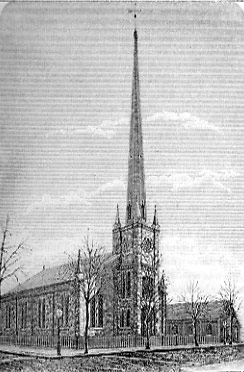
Second Presbyterian Church — Illustration published 1886.
The Second Presbyterian Church was organized on the 1st of March, 1860, and, to use the language of its first pastor, it “was launched into being under the fostering care of the First Presbyterian Church, being born, not as new churches sometimes are, out of disaffection or controversy, but out of love for the Master and for the extension of His kingdom.”
The Central Church, situated at the corner of Fourth Street and Hartman, after a short and precarious existence, had quietly succumbed to the force of circumstances and had been dissolved by the New School Presbytery of Philadelphia. For several years after its dissolution no attempt had been made to reoccupy the field in which it had stood. In 1859, however, Rev. Dr. Daniel Stewart, pastor of the First Church, urged upon his people the importance of forming another Presbyterian Church. A meeting for this purpose was called for March 23, 1859, at which a committee, composed of Isaac Van Horn, Thomas McKeen, James H. Stevens, George W. Carpenter, Sr., and Gilbert Bulson, were appointed “to seek out and secure one or more sites of church edifices in suitable location, and in the event of finding such location, to erect a temporary edifice for the purpose of worship and Sabbath-school instruction.” This committee, through the influence of Mr. Van Horn, purchased from Edward A. Stevens, of Hoboken, N. J., four lots of ground situated at the corner of Fourth Street and Washington, Mr. Stevens donating eight hundred dollars of the purchase money. These lots were afterwards exchanged for the lots upon the upper side of the same square, at Fourth Street and Benson, the site of the present church, where a chapel was built, at a cost of nineteen hundred dollars, the money having been contributed mainly by members of the First Church, who, at their next congregational meeting, upon recommendation of the committee, deeded the whole property to the “Trustees of the Second Presbyterian Church.”
The Presbytery of Burlington met in the chapel March 1, 1860, and organized the church with a membership of twenty persons, viz.: Robert Barber, Thomas F. Lambson, Isaac Van Horn, James Good, Thomas McKeen, Emily Barber, Sarah J. McKeen, Mary A. Turtelot, Mary A. Van Horn, Elizabeth Van Horn, Anne E. Clark, Nancy A. Hoxie, Margaretta Lambson, Jane Marshall, Henrietta Smith, Selina O. Turtelot and Ann E. Van Horn. Upon the same day Mr. Lewis C. Baker was called, ordained and installed as pastor of the church. Isaac Van Horn and Robert Barber were set apart to the office of the eldership, and Isaac Van Horn, Thomas McKeen, Cyrus Kellog, James Good, Thomas F. Lambson, James C. Wright and J. L. Prentiss were constituted the first board of trustees.
The wisdom of the new enterprise and the advantages of its location soon evidenced themselves in the rapid growth of the Sabbath school and congregation. The chapel was often uncomfortably crowded, and the need of better accommodation began to be more and more felt. To form the nucleus of a new building fund, Messrs. Van Horn and McKeen fenced in the square of ground lying between Washington Street and Berkley and Third and Fourth, and converted the enclosure into a skating park. From this novel expedient eighteen hundred dollars were realized, with which, as a basis, Mr. Baker, in 1864, agitated the erection of a new church. A plan was accordingly procured from Stephen D. Button, architect, and in April, 1866, it was resolved to begin the work. Isaac Van Horn and Thomas McKeen were appointed a building committee, with the pastor as an advisory member. The sudden and lamented death of Mr. Van Horn before the completion of the building necessitated the addition of his son, F. C. Van Horn, and S. L. Stimson to the committee. The building was roofed in during the summer of 1865, and upon the first Sabbath of September, 1866, was solemnly set apart to the service of Almighty God. In the dedication service the First Church united, its former pastor, Dr. Stewart, and W.C. Cattell, D.D., president of Lafayette College, taking a prominent part. The cost of the building was about nineteen thousand dollars.
The history of the Second Church has been one of constant, steady, healthy growth. Starting with but twenty persons, it reported to the last General Assembly a membership of three hundred and fifty-five. Its Sabbath school is large and flourishing. A thriving mission is sustained in the neat building recently erected at the corner of Broadway and Atlantic Avenue, and action will soon be taken looking to the erection of a new and more commodious building upon the site of the present chapel on Fourth Street.
The elders from the beginning have been Isaac Van Horn, Robert Barber, Solomon L. Stimson, Judge George S. Woodhull, William Campbell, Alexander Marcy, M.D., James Berry, Reuben F. Bancroft, John Callahan and Benjamin O. Titus; its deacons have been George W. Carpenter, Jr., George E. Howes, Alfred M. Heston, David B. Riggs, Daniel Donehoo and Francis T. Lloyd; and its Sabbath-school superintendents, Judge Woodhull, William Getty, James Berry, S. Bryan Smith, William H. Bancroft and John Callahan.
During the twenty-six years of its existence the church has had but two pastors. For more than twenty-two years it enjoyed the ministrations of Mr. Baker. His long and faithful term of service had afforded opportunities for quickening the spiritual life of the people, which he had not failed to improve. Beloved both within and beyond the bounds of his congregation, it was a matter of widespread regret that retirement from the pulpit of his church should have been accompanied by a change of residence. The relation which had subsisted between him and his first charge for nearly a quarter of a century was, at his own request, dissolved November 1, 1882. He now resides in Philadelphia, devoted to literary work, and to such opportunities of preaching the Gospel, by tongue and pen, as Providence may present.
The present pastor, Mr. William Boyd, was installed May 2, 1883. His ministry has been greatly blessed. Large accessions have been made to the membership of the church, the property has been modernized and improved and every department of religious work has been sustained with zeal and vigor.
The officers of the church as at present constituted are — Elders, Reuben F. Bancroft, Alexander Marcy, M.D., John Callahan, Benjamin O. Titus, John Warnock, David B. Riggs and Daniel Donehoo; Deacons, J. H. Troutman, S. H. Sargent, Clarence Yardley, Valentine S. Campbell and Edwin S. Titus; Trustees, Christopher Bergen (president), John Warnock, John Callahan, Benjamin O. Titus, William T. Waters, David B. Riggs, Theodore B. Culver, Lewis H. Archer, and Stephen A. Sargent (secretary.)
Source: Prowell’s History of Camden County, New Jersey, 1886. Chapter by Rev. William Boyd.
The Reverend James C. Russell was pastor in the early 1890s, before going to serve in upstate New York. The Reverend Robert C. Jenkins served as Pastor of Second Presbyterian Church in the late 1910s and early 1920s. The church was sold to the Camden Board of Education for $3,500 and reopened as the Central School Annex on November 30, 1925.
Eight Persons Killed
New York Times —
A Railway Collision Caused by Carelessness. An Excursion Party Suddenly Stopped in Its Journey—Many of the Passengers Seriously Injured.

EIGHT PERSONS KILLED
A RAILWAY COLLISION CAUSED BY CARELESSNESS.
AN EXCURSION PARTY SUDDENLY STOPPED IN ITS JOURNEY—MANY OF THE PASSENGERS SERIOUSLY INJURED.
PHILADELPHIA, Penn., June 14.—A collision occurred on the Camden and Atlantic Road at Pike’s Peak, about eight miles from Camden, this morning, which resulted in the death of seven men and one little boy. Many other persons were injured. An excursion train with five coaches left Camden at 7:40, having on board the children and teachers of the Sunday-schools of the Second Presbyterian Church of Camden and the Presbyterian Church of Wenonah, N. J., bound for Lakeside Park, a pleasure resort on the Camden and Atlantic Road. When the train was rounding a curve at a place called Pike’s Peak it came into collision with the accommodation train from Atlantic City due in Camden at 9:10 A. M. Both trains were running at a high rate of speed, and neither engineer was aware of his danger until a few seconds before the locomotives came together. The passengers were startled from their seats by the screaming of the whistles and the grating of the air-brakes and the next instant were thrown headlong by a terrific crash and the sudden stoppage of the trains. The engines and baggage cars of both trains were completely demolished and were piled up in a confused mass of wood and iron 15 feet high, and the whole so enveloped in scalding steam that for some minutes nothing could be done to rescue or recover the persons buried in the ruins. The collision was at once followed by a scene of wild excitement and confusion. Men, women, and children jumped from the cars, many coming out through the windows. Many were screaming and crying, and all were half-crazed with fright, while the cries of the wounded and those who were being scalded to death in the ruins mingled with the hissing of the escaping steam.
As soon as it was possible to approach the ruins without being scalded men went to work to get out the killed and injured. The list of the killed includes the engineers of both trains, the mail agent and fireman of the accommodation train, the Civil Engineer of the Camden and Atlantic Road, the conductor of the excursion train, a brakeman, and a Sunday-school scholar, a boy 10 years old, who, crushed and lacerated, lived until 5 o’clock this evening. The first man taken from the ruins was Express Agent John Rosenbaum, of the accommodation train. He presented a shocking appearance, being terribly cut about the head. He is still alive, but may die, as besides the cuts he is badly injured. The back fireman, Nicholas Barber, of the accommodation train, was next taken out. He was dead. His entrails protruded from his body, and he was otherwise mangled. Fireman Louis McLain was then picked up living, but badly scalded and gashed about the face and head. Mail Agent Winfield Hiles was with great difficulty gotten out. He was lying dead under the debris, and it was some time before he was discovered. Attention was attracted to him by a faint cry, “I am here.” He was terribly injured internally and died in a short time. Of the excursionists only one was fatally hurt. This was little Willie Caskey, aged 10, who has since died. His brother John, aged 12, is injured about the face, but not dangerously. Mr. Frank Fenton, the civil engineer of the road, was also the Superintendent of the Second Presbyterian School. He was taken out dead after about two hours’ work mangled in a terrible manner. His daughter was on the train. Immediately after the accident she began to search for her father, but was told that he was safe and had gone ahead to flag the trains. She then walked to Haddonfield. After she had gone her father was taken out of the ruins, his head almost flattened where it had been crushed. Conductor Albert Smith and the brakeman, Gustavus Edwards, of the Lakeside train, were taken out dead. Smith was counting his tickets in the front car. It was nearly an hour and a half after the accident before medical assistance arrived.
The dead were all brought to Camden, where the Coroner began an inquest to-night. The injured were removed to their homes. The following is the list of the dead:
GEORGE BAXTER, engineer, Lakeside train; aged 35. He leaves a widow and four children residing in Camden.
NICHOLAS BARBER, aged 34; fireman on the accommodation train.
WILLIE CASKEY, aged 10; residence, No. 415 Senate-street, Camden; head crushed; died at his home at 5 o’clock.
FRANK FENTON, surveyor of the road, aged 46, residence, No. 334 Benson-street, Camden; leaves a widow and family.
GUSTAVAS EDWARDS, aged 27, brakeman on excursion train, leaves a widow and four small children, living at Milford, N. J.
W. SCOTT HILES, mail agent of the accommodation train; aged 35, residence, No. 34 Virginia-avenue, Camden; leaves a widow.
WESLEY PALMER, engineer of the accomodation train, aged 52; leaves a widow and three children, residing in Atlantic City.
ALBERT SMITH, conductor of Lakeside train, aged 30; leaves a widow and four children, living on Vine street, Camden.
The injured are as follows:
HENRY DIETZ, special officer, residing at No. 262 Chestnut-street, Camden; scalded and hip broken.
LEONARD BAUSH, residing at No. 2,241 Germantown Road, Philadelphia; back hurt and badly scalded about face and body.
FRANK McCORMICK, No. 1,134 Cooper-street, Camden, an excursionist; left leg broken and scalded about body.
JOHN CASKEY, aged 12, of No. 415 Senate-street, Camden; injured about the face.
JOHN ROSENBAUM, express agent, badly injured about the back and head; residence, Atlantic City.
ALBERT GLENN, conductor, residence at Atlantic City; ribs broken and internally injured.
LOUIS McLAIN, fireman, severely injured about the head.
JOHN LAYRE, brakeman; injured severely.
CORA MAY LIPPINCOTT, aged 12, No. 804 Broadway, Camden, and her brother Eugene, aged 16; legs hurt.
JOSEPH A. SEFFARLEN, of the firm of Seffarlen & Fritz, at No. 240 North Third-street, Philadelphia; injured about the shoulder.
A number of others were hurt, but not seriously. Coming from the scene of the disaster in the special train the first to run over the fatal spot and resume the traffic of the road was Superintendent Bannard, of the Camden and Atlantic Road. The crushed and mangled body of Engineer Palmer lay in the baggage car covered with two crates. “The management of the road is clear of blame from this disaster,” said Mr. Bannard. “The orders dispatched by myself were plain and explicit, directing both trains to stop at Ashland and there pass each other. The Atlantic City accommodation train did not obey that order. Why it did not I cannot imagine. There is no doubt the order was given to both Conductor Glenn and Engineer Palmer. I have in my possession a receipt for that order bearing both their signatures. Palmer was the oldest engineer on the road, and was known to be trustworthy and cautious. Conductor Glenn has the same honorable record.”
Conductor Glenn, who was one of the injured, was seen by a reporter lying on a bunch of cushions. He covered his face with his hand, and spoke very reluctantly, and evidently with painful effort. “I rang the bell to stop twice,” he moaned, “I knew we had to stop off at Ashland, and so did Palmer, and when he didn’t pull up I did my best to stop the train.”
Samuel Archer, a Camden member of the wrecking crew engaged in clearing the track, was fatally injured by a singular accident late this afternoon. The wrecked engines and baggage cars were piled up on the track. In clearing it away a hawser was attached to one of the wrecked engines, while the other end was fastened to a locomotive on the track. When the word was given the locomotive moved away at a rapid rate. The slack hawser snapped and in doing so hurled into the air a great mass of broken iron. One of these flying pieces struck Archer, who was standing several feet away, in the back of the head. A boy who was standing between Archer and the wreck dodged the missile which brought Archer down as though he had been struck by a cannon ball. He was picked up, and it was found that his skull had been crushed in. His brains were oozing out. He was brought to Camden and is still alive, but will die.
Second Presbyterian Church
Philadelphia Inquirer —
Rev. J. W. Lee, at the Kaighn Avenue M. E. Church yesterday spoke on “My Young Man’s Education,” one of a series of sermons on “My Young Man.”
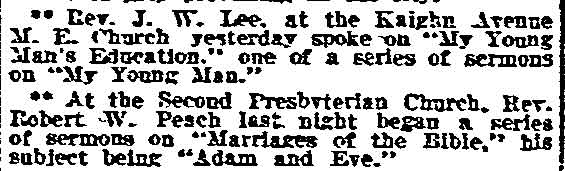
At the Second Presbyterian Church, Rev. Robert W. Peach last night began a series of sermons on “Marriages of the Bible,” his subject being “Adam and Eve.”
Camden News Notes
Philadelphia Inquirer —
Police Captain Stanley early yesterday morning raided the house at 139 Chestnut street and arrested Bessie Heisler and Emma Carll, the alleged proprietresses.
William Smith, 23 years old, of 419 Clinton street, fell on the sidewalk at Seventh and Benson streets yesterday as the result of an attack of heart disease. He was taken to the Cooper Hospital.
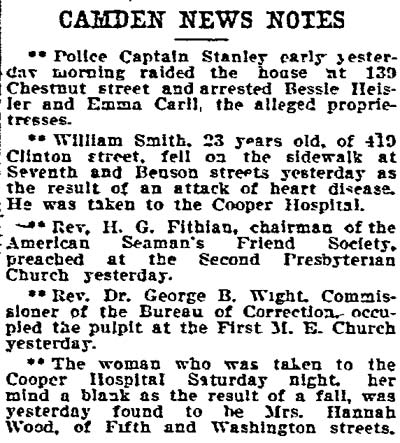
Rev. H. G. Fithian, chairman of the American Seaman’s Friend Society, preached at the Second Presbyterian Church yesterday.
Rev. Dr. George B. Wight, Commissioner of the Bureau of Correction, occupied the pulpit at the First M. E. Church yesterday.
The woman who was taken to the Cooper Hospital Saturday night, her mind a blank as the result of a fall, was yesterday found to be Mrs. Hannah Wood, of Fifth and Washington streets.
Rev. James C. Russell
Camden Courier-Post —
Announcement was made yesterday in local Presbyterian churches of the death of Rev. James C. Russell, formerly pastor of the old Second Presbyterian Church, Fourth and Benson streets, died Wednesday at his home in Oneonta, New York. He was 76. Reverend Mr. Russell served here some 40 years ago and had been pastor of the First Presbyterian Church at Oneonta since 1898. He was also a former pastor of the church at Horsehead, New York.
Photos

The New Mickle Baptist Church, formerly Second Presbyterian Church, July 2006.