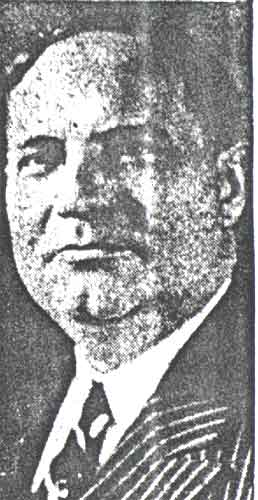
Dr. David S. Rhone
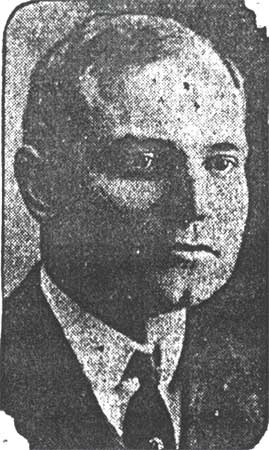
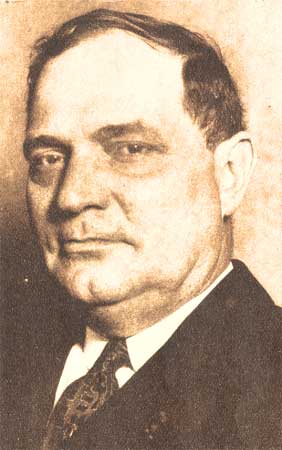
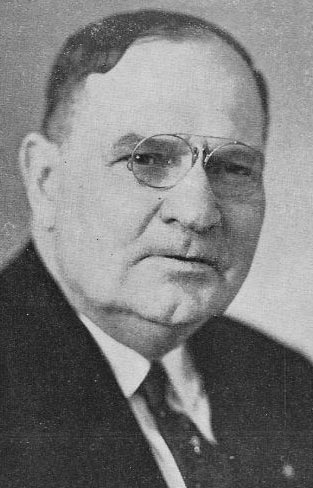
Dr. David S. Rhone, portraits from 1928, 1931, and 1943.
DR. DAVID SAMUEL RHONE was born in Pennsylvania on March 5, 1878. By 1920 he and wife Florence had moved to Camden NJ, where he had established a medical practice and a pharmacy called the Crescent Drug Company at 1202 Haddon Avenue.
A member of the Republican party, Dr. Rhone was elected on May 10, 1927 to the Camden City Commission on an all-Republican slate. He took the oath of office May 17, 1927. The other commissioners were General Winfield S. Price, Mayor; T. Yorke Smith, William D. Sayrs Jr., and Clay W. Reesman. Dr. Rhone served during the administration of Mayor Price as the Director of Public Safety. He was re-elected in 1931, then defeated in the 1935 election that resulted in Democrat control of the City Commission. A popular figure, Dr. Rhone was returned to office in 1939, and re-elected in 1943 and 1947.
Prohibition was the law of the land during his time in office, and Dr. Rhone had great difficulty in trying to control illegal gambling, bootlegging, and speakeasies within the city, and had problems controlling the police force headed first by Chief James E. Tatem and later by chief Lewis W. Stehr. George S. Tempest, a former Philadelphia police captain, was hired to assist him with running the police and fire departments. In September of 1928, Joseph “Mose” Flannery, who apparently was a prime mover in the slot machine racket in Camden, was gunned down at Front and Kaighn Avenues. His murder brought the slot machine issue to the forefront. When Assistant County Prosecutor Samuel P. Orlando and Camden County Chief of Detectives Lawrence Doran organized a series of raids to seize illegal slot machines, some of the raided sites had been tipped off. There would be problems of this nature within Camden’s police department for several more years.
Dr. Rhone became the County Physician for Camden County in January of 1938. Re-elected to the City Commission in May of 1939, he succeeded Mary Kobus as Director of Public Safety in March of 1942. In January of 1948, along with Camden’s Chief of Police George W. Frost and Police Captains Gustav A. Koerner and John T. Garrity, Dr. Rhone was indicted on charges of laxity and corruption in connection with the Van Riper probe. Charges were dropped against Koerner in 1948. In the spring of 1949 Chief Frost was exonerated and charges against Dr. Rhone and Garrity were dropped. On October 27, 1949 Dr. Rhone exchanged positions on the City Commission with E. George Aaron. Commissioner Aaron taking the post of Director of Public Safety, while Dr. Rhone became the Director of Public Affairs.
On March 27, 1951 Dr. Rhone announced that he would not seek a sixth term on Camden’s City Commission. Dr. Rhone moved to Mount Ephraim, New Jersey not long afterwards, where he set up a practice at 19 Kings Highway. He passed away in January of 1967. He apparently had remarried late in life, and his second wife, Henrietta, rests beside him at Harleigh cemetery in Camden NJ.
Preachers and Police
Camden Courier-Post —
PREACHERS AND POLICE
The year end crop of crime in the city was too big.
Within twenty-four hours, two women were attacked and robbed on the street; seven homes and stores were looted.
The Director of Public Safety “hadn’t heard about it” when the Courier rang him up to ask him what the police were going to do about it.
This attitude of indifference, of superiority to criticism, of rejection of responsibility, is as much out of place in a city government as a loved one’s hair in your soup.
It is not the fault of active police but of the city department that supervises them. Not of Chief Tatem, but of Commissioner Rohne.
* * * * *
As if made to order for the benefit if Rev. John S. Hackett, pastor of the Wiley Methodist Episcopal Church came the story “Huge Dope Ring Blasted with Four Arrests.”
The arrest of those charged with being accomplices of Anthony “Babe” Paradise, alleged head of the narcotic ring, occurred in a barbershop three blocks away from Pastor Hackett’s church.
Pastor Hackett asserted people of a neighborhood know what is going on in it, but that apparently police do not.
Commissioner Rohne invited the pastor to adopt the Commissioner’s self service plan of police work, citizens to make sworn charges.
The preacher refused naturally. He had done his part.
Then the police got busy, and three blocks away from Pastor Hackett’s church they captured the gang.
* * * * *
Such quick action points to only one conclusion; that the police knew perfectly well where to look for the dope peddlers.
If they didn’t, there were plenty of citizens who could and would have correctly given them information.
It is not the citizen’s duty to make complaints and swear out charges and prosecute the case.
The city has detectives to follow up clues given privately, and police to make the arrests.
* * * * *
Camden is a live, liberal, modern city.
Camden has no hankering for constant disturbance by VICE CRUSADES but Camden wants no drug ring headquarters conducted in it either. No peddlers of heroin and cocaine driving their illicit and ruinous traffic among its citizens.
Whether the police could or could not have made these arrests long ago, or whether this was the first opportunity, citizens will have their own opinion.
But the incident must impress the public mind vividly, as a demonstration that Preacher Hackett knew what he was talking about— and that a self service police system won’t work.
Commissioner Rohne and the police have full responsibility— and apparently an abundance of opportunity.
For the belated capture of these caterers to the appetite for life-wrecking drugs, Camden citizens are grateful.
And part of the thanks must go to Rev. Hackett.
City Rulers Abolish Job of Bandmaster
Camden Courier-Post —
The Camden police and fire department band today was without a bandmaster as the result of notice served on James Young, Collingswood, yesterday that the position he has as bandmaster has been abolished.
Notice of his dismissal was sent Young by Commissioner David Rhone. Young, who had continued in his post until yesterday, was informed that the position had been abolished January 1.
Young was appointed bandmaster about two years ago after passing the tests required by the State Civil Service Commission. The post paid $150.00 a month.
13th Ward G.O.P. Club Pays Tribute to Rhone
Camden Courier-Post —
A meeting which was described today as “a gathering in honor of David S. Rhone, director of public safety,” was held last night at the Thirteenth Ward Republican Club, Haddon Avenue and Mechanic Street.
The speakers included David Baird Jr., Mayor Winfield S. Price, Commissioner Clay W. Reesman, Sheriff Walter T. Gross, Urquhart Ward, ward committeeman, Theodore Kausel and Commissioner Rhone.
A large photograph of Commissioner Rhone was presented to the club by friends of the Commissioner, and has been placed in the clubroom. A photograph of Ward was also given the club.
Arrangements were made by the club for its annual ball to be held February 21. Plans were also discussed for the remodeling of the club’s headquarters.
150 Owners Wait as Rhone Delays Soft Drink Permits
Camden Courier-Post —
Proprietors of more than 150 soft drink establishments received another disappointment today when Commissioner David S. Rhone again failed to issue the 1928 permits after promising Saturday that he would grant them Monday.
On January 13, when an amended ordinance boosting the license fee from $50 to $100 was passed by the city commission, Rhone said he would grant the new permits ten days after it became effective or on January 23.
He was not at his office Monday, but Lewis Stehr, police inspector, said the commissioner would announce part of the list of new licenses Tuesday. Yesterday Stehr said Rhone “will positively” announce the list today that he was “still considering them.” part of the list of new licenses Tuesday.
Today Stehr said the licenses would not be granted until tomorrow. Rhone later said “a few of the permits” will be granted “sometime this afternoon.”
As the owners of the soft drink parlors await action by Commissioner Rhone they are operating on their 1927 licenses. Many of the applications for licenses have been filed with police officials since last December.
Reeve Mansion Ordered Razed by City Official
Camden Courier-Post —
Commissioner Rhone Tells Building Inspector, Fire Marshal to Investigate
DILAPIDATED STRUCTURE CALLED DEN OF THIEVES
State Street Residents Complain After Robbers Use House as Rendezvous
Termed a “rendezvous of thieves, a haven for spooners and a general nightmare,” the deserted and broken-down mansion at Third and State Streets, was ordered torn down by commissioner David S. Rhone, director of public safety.
“It’s been a public nuisance for several years and if the owners don’t raze it after they are so notified, the city will,” Commissioner Rhone said.
Residents of the neighborhood declared yesterday that the old mansion has been a den for thieves, and that complaints to the city have gone unheeded. They said three robberies in one block in one week occurred this month because of it. The thieves, they explain, watched the movements of the families from the deserted house, and robbed the dwellings after they had left for a few hours at night.
Once Palatial Home
The ramshackle building is at the northeast corner of Third and State Streets, opposite the James M. Cassady School. It was once the palatial residence of the late Augustus Reeve, brick manufacturer, but has been in a state of decay for about five years.
A “For Rent” sign has been on the property for a long period. Theater posters cover part of the exterior, its staircase has been torn away, practically all windows have been smashed by schoolboys and other marauders have removed doors, front steps and fence, and have ripped plaster from the walls.
Robberies attributed in the neighborhood to thieves, who used the dilapidated property as a “den” were those at 313 State Street, next door, on January 7, 327 State Street, January 13, and 302 State Street, January 21. Police made no report of the facts, explaining to the victims that any release of information would interfere with the arrest of “a young man under suspicion in your own neighborhood.”
Orders Not Revealed
Commissioner Rhone indicated he had given orders to George Johnson, building inspector, and Bernard Gallagher, fire marshal, relative to the dilapidated property.
Commissioner Rhone declined to explain what orders he had given the building inspector and the fire marshal relative to the old property.
Johnson had said earlier in the day that he had received no orders from Commissioner Rhone. Later Johnson said he “did not know what the orders are.”
Questioned further and told that Rhone had said that he had given him orders, Johnson said they pertained to “just see what the condition of the place was.”
“All the windows are out and the doors are off,” he said, reporting on an inspection he asserted he conducted. “If there is a health menace there, that comes under the health Department, not the building department.”
Asked what he would do about the place which was declared unsafe by the residents of the neighborhood, he said he did not know until he received “further orders” from Commissioner Rhone.
Gallagher, the fire marshal, could not be reached this morning.
Officials Invited for Military Ball
Camden Courier-Post —
Governor, Senators, Pershing May Attend Affair of Vets Here Feb. 3
Invitations have been extended to United States Senators Walter E. Edge and Edward I. Edwards, Congressman Charles A. Wolverton, Governor A. Harry Moore, General John J. Pershing and other national, state and local officials to attend the annual military ball of the Veterans of Foreign Wars here February 3.
The affair, the first of its kind in Camden since the war, will be conducted by Post No. 980 in Elks auditorium.
Among the others who have been invited are: Frank T. Strayer, commander-in-chief of the Veterans of Foreign Wars of the United States; Eugene P. Carver, Jr., senior national vice commander; Harpur M. Tobin, junior vice commander; Mayor Winfield S. Price, Commissioners Reesman, Rhone, Sayrs and Smith; Senator Joseph H. Forsyth, Commander Francis W. Hoffman, U. S. N. R.; Lt. Col. George L. Selby, N. J. N. G.; Charles Rosendahl, Commander Lakehurst Air Station; Charles V. McCarthy, state commander; George Keefe, Lt. Commander U. S. N. R.; Arthur S. Grabowsky, senior vice commander; Charles W. Gilmour, chief of staff, state department, V. F. W., and Mrs. Florence E. Stark, national president; Mrs. Grace Davis, national secretary; Mrs. Margaret Soffel, state president of the ladies’ auxiliaries.
Gold star mothers of this vicinity have been invited to attend as guests of the post as well as post commanders of all the veteran organizations in Camden county.
The bugle corps of North Penn Post No. 676, of Glenside, Pa., consisting of 40 buglers, will be one of the attractions. The Phillips Bohemian orchestra will render the dance music during the evening.
John A. Pennington, post commander, heads the general committee. The other officers are James W. Connor, vice chairman; John Rouh, secretary, and Charles P. Bozian, treasurer.
Assistant to Secretary of Bennett Appointed
Camden Courier-Post —
Mrs. Helen B. Peech, 1468 Bradley avenue, has been appointed assistant to Mrs. Mildred W. Bergey, secretary to Harold W. Bennett, city solicitor, it was announced today at City Hall. The appointment was made by Commissioner David S. Rhone.
Appointment of Mrs. Peech was made by Commissioner David S. Rhone.
Appointment of Mrs. Peech was made in view of the increasing work handled by the city legal department since abandonment of the office of city prosecutor. The department has been handling domestic and poor cases and other work formerly under the supervision of the prosecutor.
Dr. Rhone Twice Defied; 2 Murders Are Result
Camden Courier-Post —

Saloon Where Flannery Was Killed ‘Tipped Off’
Liquor Missing as Cops Arrive
Recalls Similar Disobedience in Blue Bird Cafe Shooting
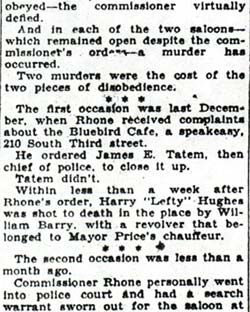
Twice, within the last nine months, Commissioner David S. Rhone, director of public safety, has ordered certain saloons closed. Both times his orders were disobeyed—the commissioner virtually defied.
And in each of the two saloons—which remained open despite the commissioner’s orders—a murder has occurred. Two murders were the cost of the two pieces of disobedience.
The first occasion was last December, when Rhone received complaints about the Bluebird Cafe, a speakeasy, 210 South Third street. He ordered James E. Tatem, then chief of police, to close it up. Tatem didn’t. Within less than a week after Rhone’s order, Harry “Lefty” Hughes was shot to death in the place by William Barry, with a revolver that belonged to Mayor Price’s chauffeur.
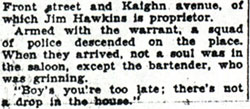
The second occasion was less than a month ago. Commissioner Rhone personally went into police court and had a search warrant sworn out for the saloon at Front street and Kaighn avenue, of which Jim Hawkins is proprietor. Armed with the warrant, a squad of police descended on the place. When they arrived, not a soul was in the saloon, except the bartender, who was grinning.
“Boy’s you’re too late; there’s not a drop in the house.”
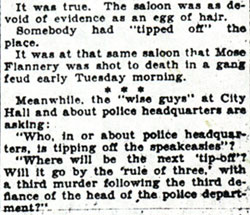
It was true. The saloon was as devoid of evidence as an egg of hair. Somebody had “tipped off” the place.
It was at that same saloon that Mose Flannery was shot to death in a gang feud early Tuesday morning.
Meanwhile, the “wise guys” at City Hall and about police headquarters are asking: “Who, in or about police headquarters, is tipping off the speakeasies?” “Where will be the next ‘tip-off’? Will it go by the ‘rule of three,’ with a third murder following the third defiance of the head of the police department?”
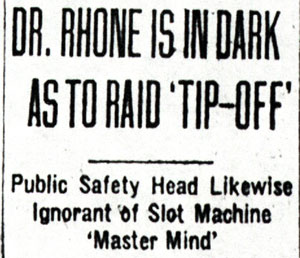
Dr. Rhone Is in Dark as to Raid ‘Tip-Off’
Public Safety Head Likewise Ignorant of Slot Machine ‘Master Mind’
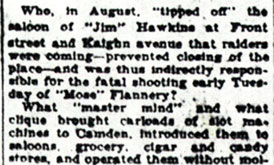
Who, in August, “tipped off” the saloon of “Jim” Hawkins at Front street and Kaighn avenue that raiders were coming—prevented closing of the place—and was thus indirectly responsible for the fatal shooting early Tuesday of “Mose” Flannery?
What “master mind” and what clique brought carloads of slot machines to Camden, introduced them to saloons, grocery, cigar and candy stores, and operated them without molestation from the police until a few weeks ago?
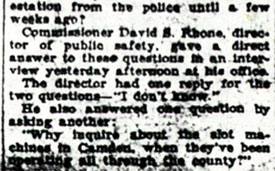
Commissioner David S. Rhone, director of public safety, gave a direct answer to these questions in an interview yesterday afternoon at his office. The director had one reply for the two questions—“I don’t know.”
He also answered one question by asking another: “Why inquire about the slot machines in Camden, when they’ve been operating all through the county?”
Not Seeking Publicity
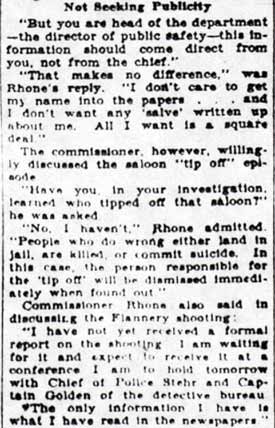
“But you are head of the department—the director of public safety—this information should come direct from you, not from the chief.”
“That makes no difference,” was Rhone’s reply. “I don’t care to get my name into the papers…and I don’t want any ‘salve’ written up about me. All I want is a square deal.”
The commissioner, however, willingly discussed the saloon “tip off” episode. “Have you, in your investigation, learned who tipped off that saloon?” he was asked.
“No, I haven’t,” Rhone admitted. “People who do wrong either land in jail, are killed, or commit suicide. In this case, the person responsible for the ‘tip off’ will be dismissed immediately when found out.”
Commissioner Rhone also said in discussing the Flannery shooting: “I have not yet received a formal report on the shooting. I am waiting for it and expect to receive it at a conference I am to hold tomorrow with Chief of Police Stehr and Captain Golden of the detective bureau. The only information I have is what I have read in the newspapers.”
Says Stehr Knew Orders
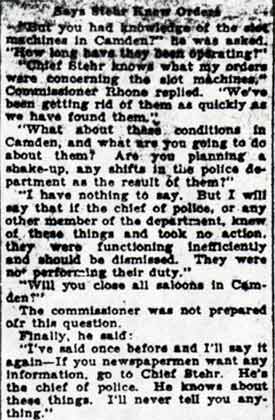
“But you had knowledge of the slot machines in Camden?” he was asked. “How long have they been operating?”
“Chief Stehr knows what my orders were concerning the slot machines,” Commissioner Rhone replied. “We’ve been getting rid of them as quickly as we have found them.”
“What about these conditions in Camden, and what are you going to do about them? Are you planning a shake-up, any shifts in the police department as the result of them?”
“I have nothing to say. But I will say that if the chief of police, or any other member of the department, knew of these things and took no action, they were functioning inefficiently and should be dismissed. They were not performing their duty.”
“Will you close all saloons in Camden?”
The commissioner was not prepared for this question. Finally, he said: “I’ve said once before and I’ll say it again—If you newspapermen want any information, go to Chief Stehr. He’s the chief of police. He knows about these things. I’ll never tell you anything.”
Popeye Turns Back Independent Umps
Camden Courier-Post — 1929–1935
Nicktern Twirls Rhone Leaguers to 8–4 Win; Hanna and Fulton Play
Fergie McGrath’s Popeye club, members of the Rhone Twilight League, easily defeated the Independent Umpires’ Association in their annual contest last evening at Civic Center by the score of 8 to 4.
At times, the game turned into a clownish affair, with both clubs attempting to excel each other in fun-making for the fans. Commissioner Frank B. Hanna, in addition to officiating, acted as a pinch-hitter for the “blindmen,” while Samuel E. Fulton, president of the Board of Education and also prexy of the Rhone Twilight circuit, officiated and pinch hit for the same outfit, getting a single in his lone trip to the plate, while Hanna walked and also scored.
Pat Heppard worked on the hill for the “umps” and was touched for 11 hits. The winners bunching these in the third inning when they scored five runs. Nicktern twirled for Popeye and gave up seven blows, two of which were made by Leo Pusey, while Vandy, Tully, Ackerman and Nicktern each collected a brace of blows for the winners.
30 Cops Shifted Today in Opening of New District
Camden Courier-Post —

Shake-Up in Camden Force is Most Drastic in History
SMITH AT CITY HALL
Drastic shifts in the Camden police department, affecting more than 30 members of the force became effective at 8 a.m. today.
The shake-up, announced yesterday by Commissioner David S. Rhone, director of public safety, is the result of creation of a fourth police district.
The outstanding changes are the promotion of Sergeant of Detectives George Ward to acting lieutenant in the First district, supplanting Sergeant Samuel Nayler, who is sent to headquarters, and the return to the city detective bureau of Acting County Detective Howard Smith.
Smith was detailed to the second district today and was assigned to a robbery investigation in the thirteenth ward.
District Captaincies Abolished
With the shifts, the rank of district captain is abolished. Instead, lieutenants will be in charge of the districts. Captains will be in charge only of the traffic and detective bureaus and headquarters, Commissioner Rhone said.
The removal of Sergeant Naylor from the First District was not unexpected, since he had been “on the carpet” last October as a result of a speakeasy shooting in his district. Naylor, though holding the rank of sergeant, was acting captain of the district.
He was threatened with dismissal by Chief Stehr and Commissioner Rhone if the vice conditions in the First District were not cleaned up. The situation came to a climax with the wounding of Charles Arini and Louis Dei Duca in a speakeasy at Third and Mickle streets in October. It was reported Naylor was to be removed from the district several times since.
Ward Again Promoted
Ward was promoted to sergeant of detectives two months ago. Under the transfer, he is promoted again, remaining as acting lieutenant for a year, until he takes an examination for a lieutenancy.
Other police officers now acting-lieutenants will become lieutenants after examination.
Naylor, who was in charge of the First district for several years, will serve as desk sergeant under Capt. A. Lincoln James.
The return of Smith to the city detective bureau was requested by Prosecutor Clifford A. Baldwin, it is understood. Smith has been a county detective for more than eleven years. He first was transferred to the prosecutor’s office at the request of Prosecutor Charles A. Wolverton. Although a Republican, he was retained there under Prosecutor Ethan P. Wescott. Although some surprise was occasioned by the announcement of Smith’s return to the city force, inasmuch as the new prosecutor is a Republican, it was said that Baldwin wished to begin his term with an entire new force.
Worked For City Also
Although Smith acted for the county and was paid by the county, he received a salary of $1 a year to retain him in the city so that he could be recalled at any time.
Through the shift, Sergeant Charles Laib, serving under Traffic Inspector Charles T. Humes, is elevated to acting captain of the traffic department. In the future all motorcycle men with the exception of George Clayton will report direct to Humes and Laib instead of to headquarters.
Ralph Bakley, who has been acting sergeant of the First District, has been named acting lieutenant of the Second District, and Thomas Cunningham, who was acting captain of the Second District, becomes acting lieutenant of the new Fourth District. William Horner, who has been acting captain of the Third District, is elevated to the rank of acting lieutenant and remains in charge of that district.
5 New Lieutenants Appointed by Rhone Await Assignments
Camden Courier-Post —

Two More Patrolmen to be Promoted Under New Ordinance
ONE MADE SERGEANT
Pending official designation of their new posts, five members of the Camden police department who were appointed lieutenants yesterday and a sixth, who was named sergeant, continued in their former capacity when they went on duty today.
Director of Public Safety David S Rhone, who announced the promotions and swore in the officers late yesterday, stated this morning that he has not yet determined where he will station them. That will be done within a few days, the commissioner averred.
Two more lieutenants remain to be appointed apropos of a recent city ordinance which stipulated that the new stations will not be designated until all seven lieutenants are named. One will be placed in charge of each of the four police districts, and one each in the traffic and motorcycle squads, and one at headquarters.
Those who were elevated to lieutenancy are:
Sergeant George W. Frost, 956 Pine street; Sergeant Walter T. Welch, 518 Benson street; Acting Lieutenant Ralph W. Bakley, 602 Clinton street; Sergeant Charles Laib, 76 South Twenty-fourth street, who has been acting captain, and Acting Lieutenant George Ward, 1437 Kaighn avenue.
Patrolman Clarence Thorn was also sworn in as sergeant of the mounted squad of the department. He succeeds Welch.
The lieutenancies pay an annual salary of $2500, and one year from this date, each of the lieutenants will be eligible to take Civil Service examination for elevation to a captaincy, which carries a yearly stipend of $3200.
The five who were made lieutenants were among ten members of the department who recently took the Civil Service examinations for lieutenancy. Welsh [sic] and Laib were among the three having the highest ranking in the tests, being second and third respectively. Under Civil Service rules, the director had to select at least one of the three first in ranking in the examination, but he could select any other six.
The ten who took the examination and their grades as unofficially announced in Trenton follow:
Sergeant John T. Potter, 298 Burwood avenue, 89.64; Sergeant Walter T. Welch, 518 Benson street, 87.75; Sergeant Charles Laib, 76 South Twenty-fourth street; Acting Lieutenant Bakley, 602 Clinton street, 87.11; Sergeant George W. Frost, 956 Pine street, 86.31; Acting Lieutenant Ward, 1437 Kaighn avenue, 85.83; Sergeant Herbert Anderson, 496 Newton avenue, 84.79; Sergeant Samuel E. Johnson, 526 North Front street, 84.71; Sergeant Harry G. Newton, 118 North Twenty-fifth street, 83.18, and Acting Lieutenant Cunningham, 1114 Kaighn avenue, 81.78.
300 Police Officials of State Meet Here
Camden Courier-Post —
78 Departments Represented at Benevolent Association Session
More than 300 state officers and delegates representing 78 New Jersey police departments were present yesterday at a meeting of the State Patrolmen’s Benevolent Association at Tenth Street and Kaighn Avenue yesterday.
All state officers were present at the afternoon meeting, including State President Dennis Byrne, of New Brunswick; First Vice President Henry Miller, of Rahway; Second Vice president, August Harasdzira, of Garfield; Recording Secretary Michael McKeever, of Trenton; Financial Secretary Thomas Higgins, of West Orange, and State Treasurer William Mallon, of West New York.
Police work used in various cities was discussed. Plans were made for the state convention in Wildwood September 14, 15 and 16. Everett Joslin, Herbert Bott and George Weber were named local delegates to represent the local union, No. 35 at the Wildwood convention.
Chief of Police Lewis H. Stehr welcomed the delegates. A telegram of welcome was read from Director of Public Safety David S. Rhone, who is in Washington.
The committee in charge of yesterday’s meeting consisted of Clifford Flenard, president of Local No. 35; Stanley Wirtz, Edward Cahill, Frank Wilmot, John McTaggart, James McTaggart and Howard Henery.
2 Police Officers Made Lieutenants
Camden Courier-Post —
Rhone Reported Ready to Make Five Patrolmen Sergeant
Reports that five members of the Camden police department will be promoted to sergeants tomorrow were circulated, today after announcement that two sergeants had been appointed lieutenant.
Those who, according to rumors, will be elevated to sergeant are Nathan Petit, of the second police district, to be assigned to the traffic squad; Gus Koerner, detective bureau; Walter Rowand, first district; Frank Truax, Second district, and Edward Hahn, third district.
The two new lieutenants who took oath of office yesterday are Samuel Johnson and Thomas Cunningham. The former was a sergeant of police attached to the detective bureau and will continue in that department, while Cunningham, while a sergeant, was acting lieutenant in day command at the fourth district. He remains in that district. The appointments were announced yesterday by Commissioner David S. Rhone, director of public safety.
Both were immediately administered oaths of office by Dr. Rhone’s secretary, Bayard M. Sullivan, at the director’s office. Lieutenant Cunningham is already eligible for retirement, having served more than 20 years on the city police force.
The two appointments complete the seven lieutenancies created by a city ordinance. Ten members of the police department passed civil service examinations for the post, which pays an annual salary of $2500. Each must serve one year as lieutenant before becoming eligible to take examination for captaincy.
The five previously appointed lieutenants are George Frost, now night commander of the fourth district; Walter Welch, third district; Charles Laib, a sub-commander of the traffic bureau under Captain Charles T. Humes, traffic Inspector; Ralph Bakley, second district; and George Ward, first district.
The other three candidates who passed the examination, Sergeants John T. Potter, Herbert Anderson and Harry I. Newton, did not receive lieutenancies, although Potter had the highest percentage in the tests.
Military System Adopted for Cops
Camden Evening Courier —
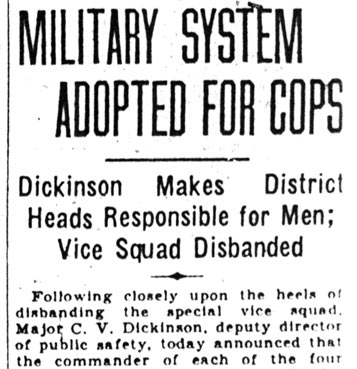
Dickinson Makes District Heads Responsible for Men; Vice Squad Disbanded
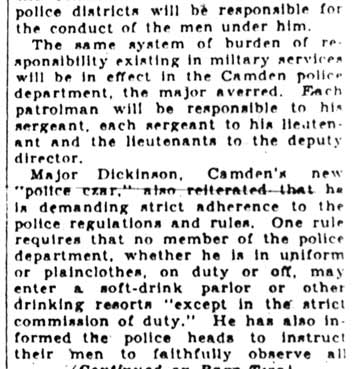
Following closely upon the heels of disbanding the special vice squad, Major C. V. Dickinson, deputy director of public safety, today announced that the commander of each of the four police districts will be responsible for the conduct of the men under him.
The same system of burden of responsibility existing in military services will be in effect in the Camden police department, the major averred. Each patrolman will be responsible to his sergeant, each sergeant to his lieutenant and the lieutenants to the deputy director.
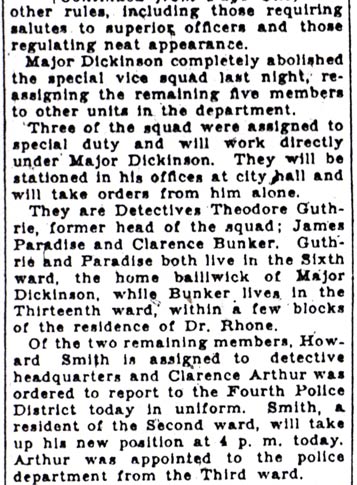
Major Dickinson, Camden’s new “police czar,” also reiterated that he is demanding strict adherence to the police regulations and rules. One rule requires that no member of the police department, whether he is in uniform or plainclothes, on duty or off, may enter a soft-drink parlor or other drinking resorts “except in the strict commission of duty.” He has also informed the police heads to instruct their men to faithfully observe all other rules, including those requiring salutes to superior officers and those regulating neat appearance.
Major Dickinson completely abolished the special vice squad last night, reassigning the remaining five members to other units in the department.
Three of the squad were assigned to special duty and will work directly under Major Dickinson. They will be stationed in his offices at city hall and will take orders from him alone.
They are Detectives Theodore Guthrie, former head of the squad; James Paradise and Clarence Bunker. Guthrie and Paradise both live in the Sixth ward, the home bailliwick of Major Dickinson, while Bunker lives in the Thirteenth ward, within a few blocks of the residence of Dr. Rhone.
Of the two remaining members, Howard Smith is assigned to detective headquarters and Clarence Arthur was ordered to report to the Fourth Police District today in uniform. Smith, a resident of the Second ward, will take up his new position at 4 p. m. today. Arthur was appointed to the police department from the Third ward.
Other Changes Made
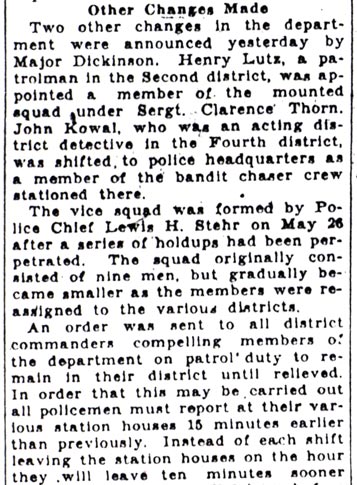
Two other changes in the department were announced yesterday by Major Dickinson. Henry Lutz, a patrolman in the Second district, was appointed a member of the mounted squad under Sergt. Clarence Thorn. John Kowal, who was an acting district detective in the Fourth district, was shifted to police headquarters as a member of the bandit chaser crew stationed there.
The vice squad was formed by Police Chief Lewis H. Stehr on May 26 after a series of holdups had been perpetrated. The squad originally consisted of nine men, but gradually became smaller as the members were reassigned to the various districts.
An order was sent to all district commanders compelling members of the department on patrol duty to remain in their district until relieved. In order that this may be carried out all policemen must report at their various station houses 15 minutes earlier than previously. Instead of each shift leaving the station houses on the hour they will leave ten minutes sooner thus reaching their districts before the man they are relieving has reported off for the day.
Police rules and regulation books have been issued to all men and they will be expected to “learn the contents by heart,” according to Major Dickinson.
New Cafe Applications
Dr. Rhone, director of Public Safety, announced yesterday that new application forms for 1931 soft drink permits will be made. A drastic change will be made in the forms.
They will delve extensively into the personal character and integrity of the applicant. He will be asked if he is naturalized, and if so when he obtained his final papers. He must tell if he has ever been arrested and the disposition made of his case. He will be asked if any place of a like nature operated by him has ever been raided or padlocked.
If the applicant can satisfactorily answer all questions on the form and his permit granted a $100 fee is charged. The permits will probably be granted the latter part of January, Director Rhone said. He will endeavor to keep the number below 100.
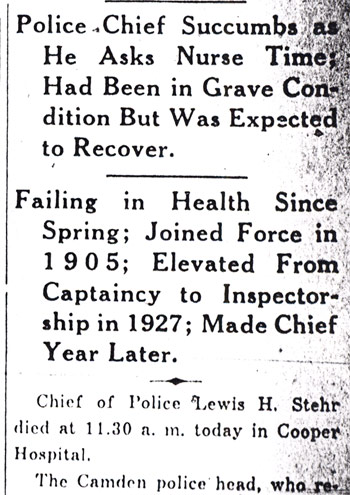
Heart Attack Kills Chief Stehr After Illness of 10 Days
Camden Evening Courier —
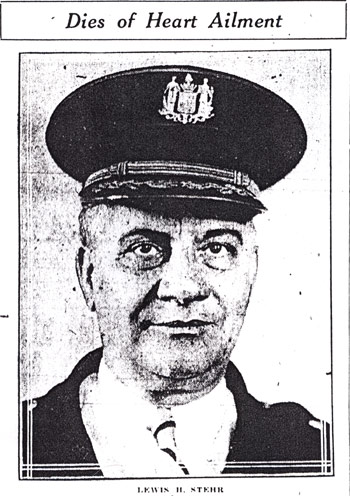
Dies of Heart Ailment
LEWIS H. STEHR
Police Chief Succumbs as He Asks Nurse Time; Had Been in Grave Condition But Was Expected to Recover.
Failing in Health Since Spring; Joined Force in 1905; Elevated From Captaincy to Inspectorship in 1927; Made Chief Year Later.
Chief of Police Lewis H. Stehr died at 11.30 a. m. today in Cooper Hospital.
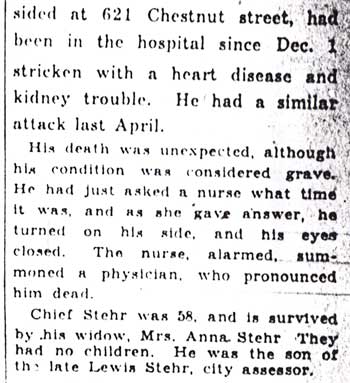
The Camden police head, who resided at 621 Chestnut street, had been in the hospital since Dec. 1 stricken with a heart disease and kidney trouble. He had a similar attack last April.
His death was unexpected, although his condition was considered grave. He had just asked a nurse what time it was, and as she gave answer, he turned on his side, and his eyes closed. The nurse, alarmed, summoned a physician, who pronounced him dead.
Chief Stehr was 58, and is survived by his widow, Mrs. Anna Stehr They had no children. He was the son of the late Lewis Stehr, city assessor.
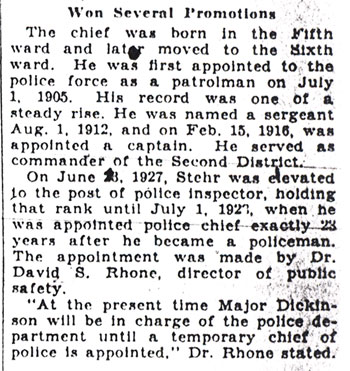
Won Several Promotions
The chief was born in the Fifth ward and later moved to the Sixth ward. He was first appointed to the police force as a patrolman on July 1, 1905. His record was one of a steady rise. He was named a sergeant Aug. 1, 1912, and on Feb. 15, 1916, was appointed a captain. He served as commander of the Second District.
On June 23, 1927, Stehr was elevated to the post of police inspector, holding that rank until July 1, 192[8], when he was appointed police chief exactly 23 years after he became a policeman. The appointment was made by Dr. David S. Rhone, director of public safety.
“At the present time Major Dickinson will be in charge of the police department until a temporary chief of police is appointed,” Dr. Rhone stated.
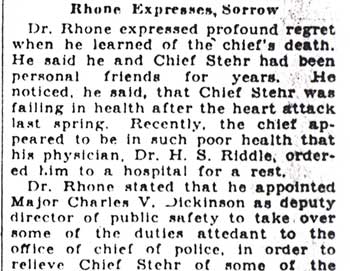
Rhone Expresses Sorrow
Dr. Rhone expressed profound regret when he learned of the chief’s death. He said he and Chief Stehr had been personal friends for years. He noticed, he said, that Chief Stehr was falling in health after the heart attack last spring. Recently, the chief appeared to be in such poor health that his physician, Dr. H. S. Riddle, ordered him to a hospital for a rest.
Dr. Rhone stated that he appointed Major Charles V. Dickinson as deputy director of public safety to take over some of the duties attendant to the office of chief of police, in order to relieve Chief Stehr of some of the pressure of his work, so that his health would not further be impaired.
The decedent was an active member of the Sixth Ward Republican Club, and was well liked not only by members of the police force but throughout the city.
Commissioner Frank B. Hanna, when apprised of the police chief’s death, said:
“The news of Chief Stehr’s death was a terrible shock. I feel a personal loss, as we were close friends. I knew him since I was a young boy, and our contacts in the past two years were most pleasant.”
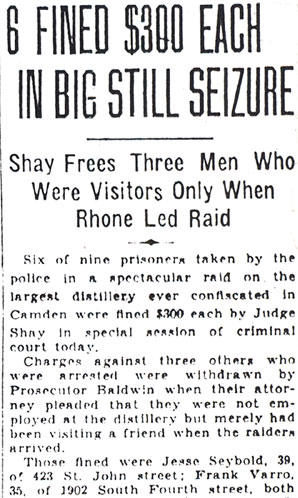
6 Fined $300 Each in Big Still Seizure
Camden Evening Courier —
Shay Frees Three Men Who Were Visitors Only When Rhone Led Raid
6 Fined $300 Each in Big Still Seizure
Shay Frees Three Men Who Were Visitors Only When Rhone Led Raid
Six of nine prisoners taken by the police in a spectacular raid on the largest distillery ever confiscated in Camden were fined $300 each by Judge Shay in special session of criminal court today.
Charges against three others who were arrested were withdrawn by Prosecutor Baldwin when their attorney pleaded that they were not employed at the distillery but merely had been visiting a friend when the raiders arrived.
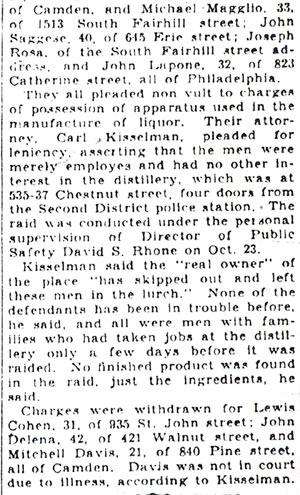
Those fined were Jesse Seybold, 39, of 423 St. John street; Frank Varro, 35, of 1902 South Fourth street, both of Camden, and Michael Magglio, 33, of 1513 South Fairhill street; John Saggese, 40, of 645 Erie street; Joseph Rosa, of the South Fairhill street address, and John Lapone, 32, of 823 Catherine street, all of Philadelphia.
They all pleaded non vult to charges of possession of apparatus used in the manufacture of liquor. Their attorney, Carl Kisselman, pleaded for leniency, asserting that the men were merely employes and had no other interest in the distillery, which was at 535-37 Chestnut street, four doors from the Second District police station. The raid was conducted under the personal supervision of Director of Public Safety David S. Rhone on Oct. 23.
Kisselman said the “real owner” of the place “has skipped out and left these men in the lurch.” None of the defendants has been in trouble before, he said, and all were men with families who had taken jobs at the distillery only a few days before it was raided. No finished product was found in the raid, just the ingredients, he said.
Charges were withdrawn for Lewis Cohen, 31, of 935 St. John street; John Delena, 42, of 421 Walnut street, and Mitchell Davis, 21, of 840 Pine street, all of Camden. Davis was not in court due to illness, according to Kisselman.
Raid Rhone Ordered Costs Barman $100
Camden Evening Courier —
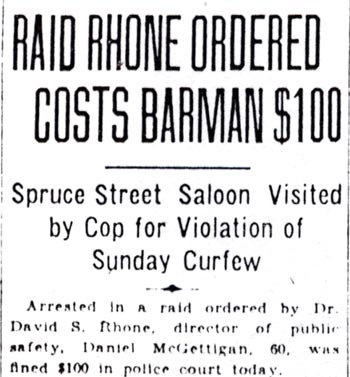
Spruce Street Saloon Visited by Cop for Violation of Sunday Curfew
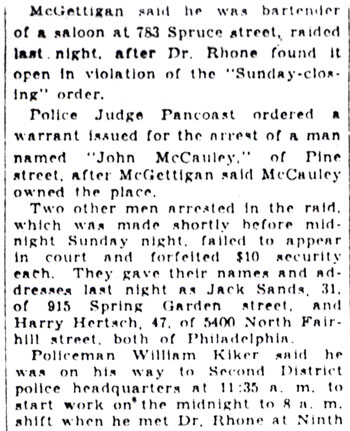
Arrested in a raid ordered by Dr. David S. Rhone, director of public safety, Daniel McGettigan, 60, was fined $100 in police court today.
McGettigan said he was bartender of a saloon at 783 Spruce street, raided last night, after Dr. Rhone found it open in violation of the “Sunday-closing” order.
Police Judge Pancoast ordered a warrant issued for the arrest of a man named “John McCauley,” of Pine street, after McGettigan said McCauley owned the place.
Two other men arrested in the raid, which was made shortly before midnight Sunday night, failed to appear in court and forfeited $10 security each. They gave their names and addresses last night as Jack Sands, 31, of 915 Spring Garden street, and Harry Hertsch, 47, of 5400 North Fairhill street, both of Philadelphia.
Policeman William Kiker said he was on his way to Second District police headquarters at 11:35 a. m. to start work on the midnight to 8 a. m. shift when he met Dr. Rhone at Ninth and Cherry streets.
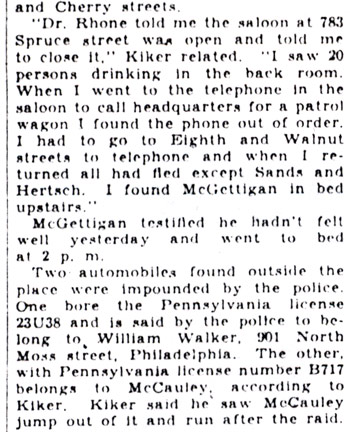
“Dr. Rhone told me the saloon at 783 Spruce street was open and told me to close it,” Kiker related. “I saw 20 persons drinking in the back room. When I went to the telephone in the saloon to call headquarters for a patrol wagon I found the phone out of order. I had to go to Eighth and Walnut streets to telephone and when I returned all had fled except Sands and Hertsch. I found McGettigan in bed upstairs.”
McGettigan testified he hadn’t felt well yesterday and went to bed at 2 p. m.
Two automobiles found outside the place were impounded by the police. One bore the Pennsylvania license 23U38 and is said by the police to belong to William Walker, 901 North Moss street, Philadelphia. The other, with Pennsylvania license number B717 belongs to McCauley, according to Kiker. Kiker said he saw McCauley jump out of it and run after the raid.
Photos – December 1930
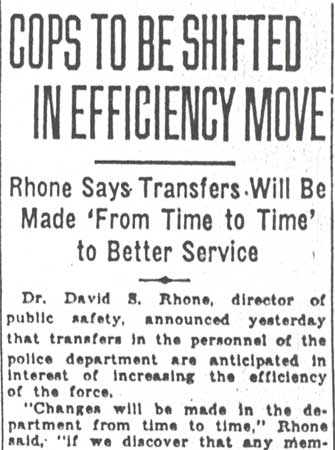
Rhone Says Transfers Will Be Made ‘From Time to Time’ to Better Service
Dr. David S. Rhone, director of public safety, announced yesterday that transfers in the personnel of the police department are anticipated in interest of increasing the efficiency of the force.
“Changes will be made in the department from time to time,” Rhone said, “if we discover that any member is better fitted for some other branch of the service than that in which he is serving. However, there is no immediate prospect of changes.”
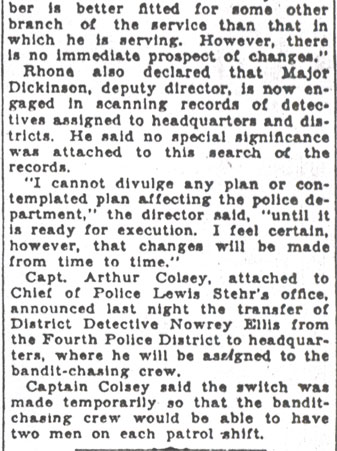
Rhone also declared that Major Dickinson, deputy director, is now engaged in scanning records of detectives assigned to headquarters and districts. He said no special significance was attached to this search of the records.
“I cannot divulge any plan or contemplated plan affecting the police department,” the director said, “until it is ready for execution. I feel certain, however, that changes will be made from time to time.”
Capt. Arthur Colsey, attached to Chief of Police Lewis Stehr’s office, announced last night the transfer of District Detective Nowrey Ellis from the Fourth Police District to headquarters, where he will be assigned to the bandit-chasing crew. Captain Colsey said the switch was made temporarily so that the bandit-chasing crew would be able to have two men on each patrol shift.
Camden Will Honor Chief Stehr Today
Camden Courier-Post —
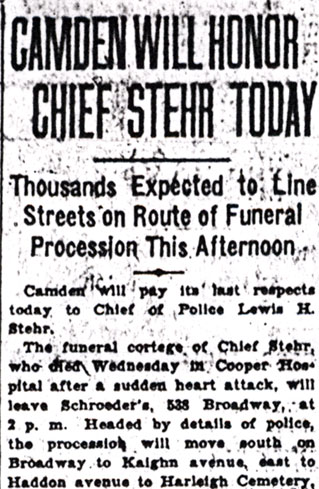
Thousands Expected to Line Streets on Route of Funeral Procession This Afternoon
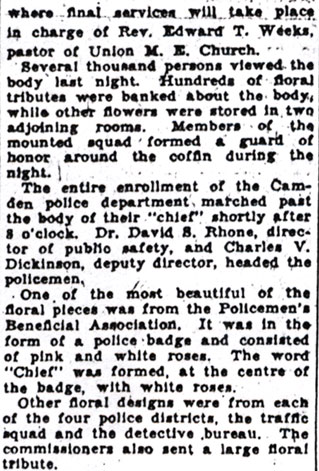
Camden will pay its last respects today to Chief of Police Lewis H. Stehr.
The funeral cortege of Chief Stehr, who died Wednesday in Cooper Hospital after a sudden heart attack, will leave Schroeder’s, 538 Broadway, at 2 p. m. Headed by details of police, the procession will move south on Broadway to Kaighn avenue, east to Haddon avenue to Harleigh Cemetery, where final services will take place in charge of Rev. Edward T. Weeks, pastor of Union M. E. Church.
Several thousand persons viewed the body last night. Hundreds of floral tributes were banked about the body, while other flowers were stored in two adjoining rooms. Members of the mounted squad formed a guard of honor around the coffin during the night.
The entire enrollment of the Camden police department marched past the body of their “chief” shortly after 8 o’clock. Dr. David S. Rhone, director of public safety, and Charles V. Dickinson, deputy director, headed the policemen.
One of the most beautiful of the floral pieces was from the Policemen’s Beneficial Association. It was in the form of a police badge and consisted of pink and white roses. The word “Chief” was formed, at the centre of the badge, with white roses.
Other floral designs were from each of the four police districts, the traffic squad and the detective bureau. The commissioners also sent a large floral tribute.
Camden Will Honor Chief Stehr Today
Camden Morning Post —
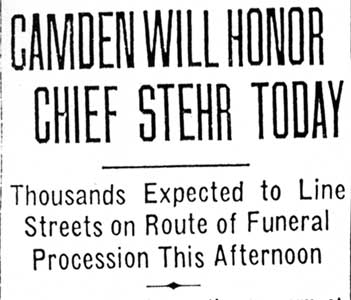
Thousands Expected to Line Streets on Route of Funeral Procession This Afternoon
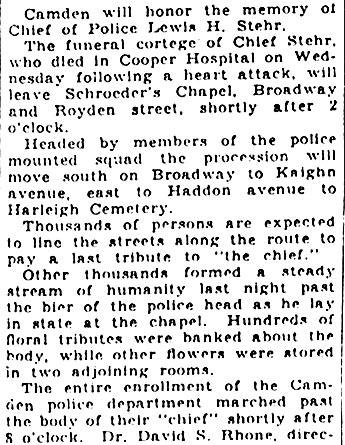
Camden will honor the memory of Chief of Police Lewis H. Stehr.
The funeral cortege of Chief Stehr, who died in Cooper Hospital on Wednesday following a heart attack, will leave Schroeder’s Chapel, Broadway and Royden street, shortly after 2 o’clock.
Headed by members of the police mounted squad the procession will move south on Broadway to Kaighn avenue, east to Haddon avenue to Harleigh Cemetery.
Thousands of persons are expected to line the streets along the route to pay a last tribute to “the chief.”
Other thousands formed a steady stream of humanity last night past the bier of the police head as he lay in state at the chapel. Hundreds of floral tributes were banked about the body, while other flowers were stored in two adjoining rooms.
The entire enrollment of the Camden police department marched past the body of their “chief” shortly after 8 o’clock. Dr. David S. Rhone, director of public safety, and Charles V. H. Dickinson, deputy director, headed the policemen.
One of the most beautiful of the floral pieces was from the Policemen’s Beneficial Association. It was in the form of a police badge and consisted of pink and white roses. The word “Chief” was formed, at the centre of the badge, with white roses.
Other floral designs were from each of the four police districts, the traffic squad and the detective bureau. The commissioners also sent a large floral tribute.
Members of the mounted squad formed a guard of honor around the coffin during the night. This same squad, under Sergeant Clarence Thorn, will act as an honorary escort during the funeral.
Final services for Chief Stehr will be held at the Harleigh Mausoleum Chapel, with Rev. Edward Weeks, pastor of Union M. E. Church, Fifth and Mt. Vernon streets, officiating.
Burial will be in the family plot.
Armistice Parade Route Is Changed
Camden Courier-Post —
Officials Announce 90 Organizations Will Be in March
A change in the route of march of the Armistice Day parade, was announced last night, at a meeting of the committee in the office of Director of Public Welfare David S. Rhone.
The proposed route is Third and Cooper Streets; to Broadway, to Kaighn Avenue, west on Kaighn Avenue to Fourth Street, thence to the city line and disband.
The parade will start promptly at 1:45 p. m. The grand marshal will be Colonel George L. Selby. The route of march is approximately two miles and shorter than any previous year.
There will be 90 organizations in the line of march. Included in these will be 18 American Legion Posts; 13 Veterans of Foreign War Posts; 18 National Guard units; five Naval Reserve units and 21 other organizations. Martial music will be provided by 15 bands.
All members of the police and fire departments who are war veterans, will be excused from duty and will participate in the parade as a unit.
Announcement was made by Jack Weinberg, chairman of the prize committee that two additional cups have been donated by the Retail Division of the Chamber of Commerce. This makes a total of 14 to be awarded. The last two will be given to veteran organizations outside the city of Camden.
More than 1700 school children from the sixth grade to the high school will take part in exercises to be held at the Convention Hall in the morning, it was announced by Dr. Leon N. Neulen, superintendent of schools.
The children will parade under the direction of their teachers.
Frank Truax Dies; Police Sergeant
Camden Courier-Post —
Second District Officer Had Been in Service Since 1917
Police Sergeant Frank Truax of the Second Police District died last night in Cooper Hospital of a complication of diseases. He was 50 and resided at 1129 Kenwood Avenue.
Sergeant Truax was admitted to the institution at 8:55 PM. Five minutes later he was dead.
He was considered one of the most efficient officers of the police department by his superiors, and his death was a shock to his friends and acquaintances.
He had been a member of the police department since April 12, 1917, having been appointed by former Mayor Charles H. Ellis. After 13 years of “pounding a beat” he was promoted to sergeant on April 9, 1930, by former Director of Public Safety David S. Rhone.
Shortly after dinner last night, Sergeant Truax complained of feeling ill. He had been in ill health for the past few weeks.
His wife, Mrs. Linda Truax summoned Dr. H. G. Stimus and Dr. Rhone. They ordered him removed to the hospital at once.
Besides his wife, Sergeant Truax is survived by a sister, Mrs. Viola Wilkinson of 701 Royden Street. Funeral arrangements have not been completed.
Dr. Rhone on High Seas
Camden Courier-Post —
Dr. David S. Rhone, commissioner of public affairs is on the high seas today bound for Germany on a vacation.
The city commissioner, who told only a few friends of his plans, sailed from New York Tuesday night.
Few city officials and friends knew of the projected trip and even Dr. Rhone’s secretary, Bayard M. Sullivan, pleaded ignorance of the commissioner’s plans. Sullivan said he did not know how long the commissioner would remain abroad. He said he believed Dr. Rhone sailed with some friends and may visit other countries in addition to Germany.
City Solicitor E. G. C. Bleakly was among those who expressed surprise at learning that Dr. Rhone had sailed.
Bleakly stated that he knew of no arrangements for a deputy commissioner to operate the public welfare department during the commissioner’s absence.
Pancoast Warns Man Not to Be ‘Too Flip’
Camden Courier-Post —
Police Judge Garfield Pancoast yesterday suspended sentence on John Carlson, 36, a salesman, of 407 Cuthbert Road, Collingswood after warning him not to be “too flip” in the future with policemen.
Carlson was arrested by Policeman Wilbur Prentiss on State Street near the circus ground when he resented the policeman’s prohibiting a friend from parking. Carlson, a former Thirteenth ward resident, told Prentiss he would let City Commissioner David S. Rhone “know about the policeman” when the commissioner returned from Europe, according to the testimony.
Boast of Political Aid Costs Driver $10 Fine
Camden Courier-Post —
His boasts that he could bring political pressure to bear if he was arrested cost Joseph Mrozowski, 49, of 1474 Kenwood Avenue, $10 in police court yesterday. He was arrested by Policeman Ivan Morris at Louis and Chestnut Streets for pulling out of a traffic line.
“If you arrest me I will get Committeeman Henry Knauer or commissioner Rhone to get me out,” Morris quoted Mrozowski as saying.
Mrozowski admitted that he told Morris he would telephone Knauer but denied mentioning Dr. Rhone’s name.
Tipsy Autoist Jailed
Camden Courier-Post —
Phila. Man Sentenced After Wrecking Car and Damaging Parked Machine of Dr. Rhone
Charged with driving while drunk, Richard Allen, 33, who crashed into the automobile of Commissioner David S. Rhone last night, was sentenced to jail for 30 days by Recorder Joseph A. Patton, of Haddon Heights today.
Allen, who lives at 2445 North Chadwick Street, Philadelphia, was unable to pay a fine and costs of $221.
Dr. Rhone had been summoned to attend Mrs. John Schlorer, 116 White Horse Pike.
His chauffeur, Edward Parker, of 1619 Norris Street, was in the car outside the Schlorer home, when Allen struck it in the rear.
Allen lost control of his car, sideswiped the parked car, and then traveled 50 feet into a tree after which the machine ran another 300 feet before stopping.
Allen and six men and women in the car escaped injury. The machine was wrecked.
David Baird Robinson, of Collingswood, a motor vehicle inspector, and brother-in-law of Schlorer, who was in the Schlorer home, heard the crash and ran out. Robinson arrested Allen.
Parker suffered a sprained back and shock and was treated by Dr. William C. Williams, who pronounced Allen intoxicated. Six months ago Dr. Rhone’s car was struck by another driver while parked in the same place.
Is Zat So!
Camden Courier-Post —
May we not at this time proffer a suggestion to Mayor Brunner, Eddie Kelleher and the other party sachems that should be a sure-fire plan to make Camden county safe for Democracy? We advise that the Democrats gather a fund of $4000, the money to be expended in giving testimonial dinners to Republican leaders, near-leaders and persons who figure themselves to be both.
Engage tables enough to accommodate about 350 persons. Invite representatives of all the various G. O. P. factions in the county, give a half dozen tickets to boisterous Democrats, so that the latter can sit back in their seats and enjoy the subsequent dogfight on a full stomach.
This idea that I am advancing to register about 5000 more Democrats in the county and paralyze the remnants of the once-powerful county G.O.P., was born when I attended the recent testimonial dinner to Louis Bantivoglio, freeholder from the Fifth ward.
Naturally my attendance was purely in a professional capacity. Speeches were made by divers and sundry spokesmen, the high-light being the sales talk for Bantivoglio and Baird by David Baird, Jr. The latter waxed wrathfully but warily in castigating the “half-breeds,” as he once sarcastically termed the Republicans of the ilk and stature and political leanings of Commissioner Mary W. Kobus.
Rarely, too, have we ever attended a banquet, either in the capacity of guest or reporter that ever awakened so many echoes of the past as did the dinner to the Fifth ward freeholder.
Mrs. Kobus Elected Louis
First came the information from friends of Commissioner Kobus that she was responsible for the election of Bantivoglio from the Fifth ward as freeholder. In view of the fact that Squire Baird seemed to feel that the freeholder’s election was a personal triumph, this appeared strange to yours truly.
We moseyed about, however, and discovered that whether the squire likes it or not Mary W. Kobus and her minions did elect Bantivoglio. The leaders of the Kobus faction who put the thing across were headed by a woman named Madeline Salvatore and a gentleman named “Bucky” Branch.
Bantivoglio was elected by something less than 40 votes. These votes could easily have been given to his opponent but there were strategic reasons why the Kobus faction didn’t want a Democrat chosen from the Fifth ward.
So Branch, who is a policeman, I believe, and who was not working on election day, it being his regular day off, went into his precinct and put over the votes that elected Bantivoglio.
And Mr. “Bucky” Branch, I have been informed, has been so sore at the fact that he did elect Louis Bantivoglio that he moans and cries and berates himself ever since the trick was turned.
Politicos who told me the story about the Kobus support for Bantivoglio gave a rather sensible reason for the step that was taken by the anti-Baird folk. The New Dealers among the Republicans sensed that the division between the Republicans and Democrats in the 1938 Board of Freeholders was going to be exceedingly close.
Too close, in fact, to take any chances. So it was decided to support Bantivoglio in the Fifth ward, because he was a regular Baird Republican and couldn’t be won to the coalition. The reasoning of the Kobusitees was clear and correct.
Had Bantivoglio been beaten by a Democrat, the board would have been divided equally. The Democrats would then have been able to deal with an individual rather than a faction. One vote would have given either side control. Thus by putting Bantivoglio across the Kobus faction made it imperative for the Democrats to deal with that clique; in fact Brunner and his minions had to do that little thing.
In view of this analysis I’m content to believe that the Kobus claim that the New Dealers elected Louis Bantivoglio is absolutely okay.
Lady “Copper” Not Trade Party
Now don’t get the information askew. Mrs. Kobus had no official or personal hand in this matter. It was the keen thought of some of her lieutenants, whose judgment appears to have been excellent, that fashioned this plan and executed it.
Meanwhile numerous politicos have been jibing Baird’s statement that he would “rather have one Louis Bantivoglio than 1000 ingrates.” These political seers and soothsayers declared that such a declaration proved that its author was all wet in his political judgment and short sighted in his political history.
These politicos ambushed Mackay the other day, crammed him into a corner and told him that if it “hadn’t been for Bantivoglio Baird would have control of the city commission today.”
These chuckling anti-Bairdites not only bearded me in my den, but dared me to disprove their statements by taking a look at the record. A stranger to politics in Camden, I didn’t know the import of this statement until I squinted at the ward returns for the 1935 city commission election.
There in black and white is the proof that Baird lost the city commission fight because of the Bantivoglio-Leo Rea alliance in the Fifth ward. Just to take a look at the record again and to refresh jaded memories, the regular Baird slate received the following votes in the Fifth ward:
Bennett, 1016; Leonard, 1001; Lummis, 962; Rhone, 963; von Nieda, 1081. The New Deal ticket, then supported by the Messrs. Bantivoglio and Rea, polled these votes: Baker, 1032; Brunner, 1022; Hartmann, 1001; Kobus, 1024, and Reesman, 930.
We would call your attention particularly to the Leonard-Hartmann vote. Louis and Leo supported candidates Brunner, Kobus and Hartmann, of the New Deal.
Leonard and Hartmann polled exactly the same vote, 1001. And the recount revealed Hartmann a winner by SEVEN votes, the box score showing Hartmann, 17,338, and Leonard, 17,331. And the Fifth ward turned the trick, for it would have been easy for Louis and Leo to have given Hartmann the same vote that Reesman received, or 71 less, and elected Leonard. There would have been no recount then.
Which scrutiny of the returns would seem to show that Bantivoglio as a friend of the squire proved his valor and vigilance in the cause by seating a New Deal commissioner and owing his seat in the Board of Freeholders to the Kobus clan.
In connection with this fund which the Democrats should raise to give testimonial dinners to G.O.P. leaders et cetera we might suggest that on each occasion they have, David Baird Jr., named for a new office. In order, that my friend, Florence Baker, can show her loyalty and friendship to the Old Guard Field Marshal by asking his election to the said office.
This suggestion to the Messrs. Brunner, Kelleher and the others is made tax-free, and no charge for usage. If that scheme doesn’t make Camden county safe for Democracy, nothing will.
Photos – January 1938

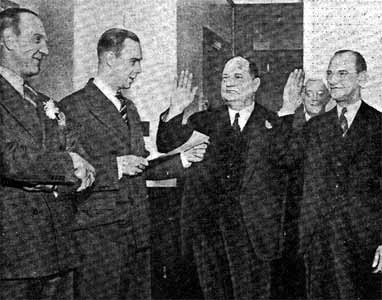
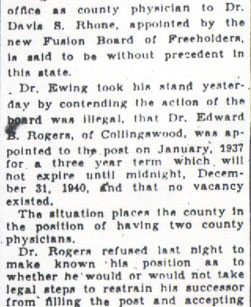
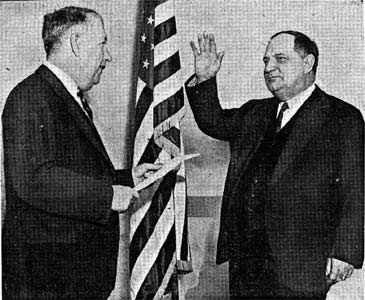
Rhone Takes Oath From Michel After Refusal by Ewing
County Clerk Asserts Dr Rogers Occupies Post of County Physician
Refusal of County Clerk Leslie H. Ewing to administer the oath of office as county physician to Dr. David S. Rhone, appointed by the new Fusion Board of Freeholders, is said to be without precedent in this state.
Dr. Ewing took his stand yesterday by contending the action of the board was illegal, that Dr. Edward B. Rogers, of Collingswood, was appointed to the post on January, 1937 for a three year term which will not expire until midnight, December 31, 1940, and that no vacancy existed.
The situation places the county in the position of having two county physicians.
Dr. Rogers refused last night to make known his position as to whether he would or would not take legal steps to restrain his successor from filling the post and accepting the salary.
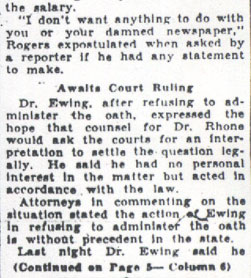
“I don’t want anything to do with you or your damned newspaper,” Rogers expostulated when asked by a reporter if he had any statement to make.
Awaits Court Ruling
Dr. Ewing, after refusing to administer the oath, expressed the hope that counsel for Dr. Rhone would ask the courts for an interpretation to settle the question legally. He said he had no personal interest in the matter but acted in accordance with the law.
Attorneys in commenting on the situation stated the action of Ewing in refusing to administer the oath is without precedent in the state. (Continued on Page 5—Column 6)

Rhone Family Plot
Harleigh Cemetery, Camden NJ


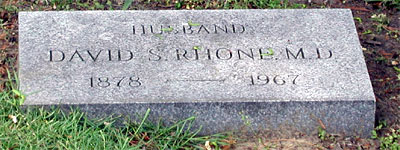
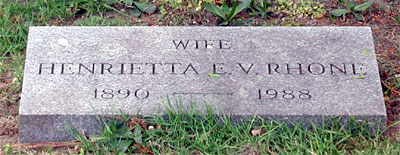
Rhone Family Plot, Harleigh Cemetery, Camden NJ.
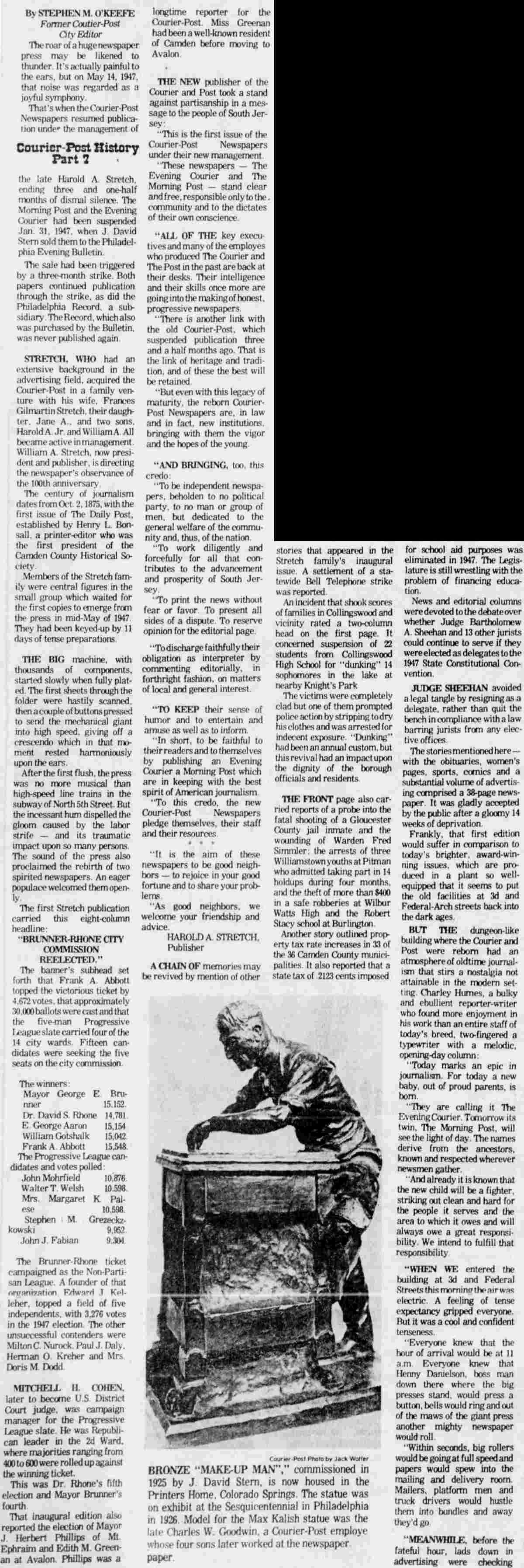
The joyful roar as Stretches took over
Camden Courier-Post —

By STEPHEN M. O’KEEFE
Former Courier-Post City Editor
The roar of a huge newspaper press may be likened to thunder. It’s actually painful to the ears, but on May 14, 1947, that noise was regarded as a joyful symphony.
That’s when the Courier-Post Newspapers resumed publication under the management of the late Harold A. Stretch, ending three and one-half months of dismal silence. The Morning Post and the Evening Courier had been suspended Jan. 31, 1947, when J. David Stern sold them to the Philadelphia Evening Bulletin.
The sale had been triggered by a three-month strike. Both papers continued publication through the strike, as did the Philadelphia Record, a subsidiary. The Record, which also was purchased by the Bulletin, was never published again.
STRETCH, WHO had an extensive background in the advertising field, acquired the Courier-Post in a family venture with his wife, Frances Gilmartin Stretch, their daughter, Jane A., and two sons, Harold A. Jr. and William A. All became active in management. William A. Stretch, now president and publisher, is directing the newspaper’s observance of the 100th anniversary.
The century of journalism dates from Oct. 2, 1875, with the first issue of The Daily Post, established by Henry L. Bonsall, a printer-editor who was the first president of the Camden County Historical Society.
Members of the Stretch family were central figures in the small group which waited for the first copies to emerge from the press in mid-May of 1947. They had been keyed-up by 11 days of tense preparations.
THE BIG machine, with thousands of components, started slowly when fully plated. The first sheets through the folder were hastily scanned, then a couple of buttons pressed to send the mechanical giant into high speed, giving off a crescendo which in that moment rested harmoniously upon the ears.
After the first flush, the press was no more musical than high-speed line trains in the subway of North 5th Street. But the incessant hum dispelled the gloom caused by the labor strife — and its traumatic impact upon so many persons. The sound of the press also proclaimed the rebirth of two spirited newspapers. An eager populace welcomed them openly.
The first Stretch publication carried this eight-column headline:
“BRUNNER-RHONE CITY COMMISSION REELECTED.”
The banner’s subhead set forth that Frank A. Abbott topped the victorious ticket by 4,672 votes, that approximately 30,000 ballots were cast and that the five-man Progressive League slate carried four of the 14 city wards. Fifteen candidates were seeking the five seats on the city commission.
The winners:
Mayor George E. Brunner 15,152.
Dr. David S. Rhone 14,781.
E. George Aaron 15,154.
William Gotshalk 15,042.
Frank A. Abbott 15,548.
The Progressive League candidates and votes polled:
John Mohrfield 10,876.
Walter T. Welsh 10,598.
Mrs. Margaret K. Palese 10,598.
Stephen M. Grezeckzkowski 9,952.
John J. Fabian 9,304.
The Brunner-Rhone ticket campaigned as the Non-Partisan League. A founder of that organization, Edward J. Kelleher, topped a field of five independents, with 3,276 votes in the 1947 election. The other unsuccessful contenders were Milton C. Nurock, Paul J. Daly, Herman O. Kreher and Mrs. Doris M. Dodd.
MITCHELL H. COHEN, later to become U.S. District Court judge, was campaign manager for the Progressive League slate. He was Republican leader in the 2d Ward, where majorities ranging from 400 to 600 were rolled up against the winning ticket.
This was Dr. Rhone’s fifth election and Mayor Brunner’s fourth.
That inaugural edition also reported the election of Mayor J. Herbert Phillips of Mt. Ephraim and Edith M. Greenan at Avalon. Phillips was a longtime reporter for the Courier-Post. Miss Greenan had been a well-known resident of Camden before moving to Avalon.
THE NEW publisher of the Courier and Post took a stand against partisanship in a message to the people of South Jersey:
“This is the first issue of the Courier-Post Newspapers under their new management.
“These newspapers — The Evening Courier and The Morning Post — stand clear and free, responsible only to the community and to the dictates of their own conscience.
“ALL OF THE key executives and many of the employees who produced The Courier and The Post in the past are back at their desks. Their intelligence and their skills once more are going into the making of honest, progressive newspapers.
“There is another link with the old Courier-Post, which suspended publication three and a half months ago. That is the link of heritage and tradition, and of these the best will be retained.
“But even with this legacy of maturity, the reborn Courier-Post Newspapers are, in law and in fact, new institutions, bringing with them the vigor and the hopes of the young.
“AND BRINGING, too, this credo:
“To be independent newspapers, beholden to no political party, to no man or group of men, but dedicated to the general welfare of the community and, thus, of the nation.
“To work diligently and forcefully for all that contributes to the advancement and prosperity of South Jersey.
“To print the news without fear or favor. To present all sides of a dispute. To reserve opinion for the editorial page.
“To discharge faithfully their obligation as interpreter by commenting editorially, in forthright fashion, on matters of local and general interest.
“TO KEEP their sense of humor and to entertain and amuse as well as to inform.
“In short, to be faithful to their readers and to themselves by publishing an Evening Courier a Morning Post which are in keeping with the best spirit of American journalism.
“To this credo, the new Courier-Post Newspapers pledge themselves, their staff and their resources.
* * *
“It is the aim of these newspapers to be good neighbors — to rejoice in your good fortune and to share your problems.
“As good neighbors, we welcome your friendship and advice.
HAROLD A. STRETCH, Publisher
A CHAIN OF memories may be revived by mention of other stories that appeared in the Stretch family’s inaugural issue. A settlement of a statewide Bell Telephone strike was reported.
An incident that shook scores of families in Collingswood and vicinity rated a two-column head on the first page. It concerned suspension of 22 students from Collingswood High School for “dunking” 14 sophomores in the lake at nearby Knight’s Park.
The victims were completely clad but one of them prompted police action by stripping to dry his clothes and was arrested for indecent exposure. “Dunking” had been an annual custom, but this revival had an impact upon the dignity of the borough officials and residents.
THE FRONT page also carried reports of a probe into the fatal shooting of a Gloucester County jail inmate and the wounding of Warden Fred Simmler; the arrests of three Williamstown youths at Pitman who admitted taking part in 14 holdups during four months, and the theft of more than $400 in a safe robberies at Wilbur Watts High and the Robert Stacy school at Burlington.
Another story outlined property tax rate increases in 33 of the 36 Camden County municipalities. It also reported that a state tax of 2123 cents imposed for school aid purposes was eliminated in 1947. The Legislature is still wrestling with the problem of financing education.
News and editorial columns were devoted to the debate over whether Judge Bartholomew A. Sheehan and 13 other jurists could continue to serve if they were elected as delegates to the 1947 State Constitutional Convention.
JUDGE SHEEHAN avoided a legal tangle by resigning as a delegate, rather than quit the bench in compliance with a law barring jurists from any elective offices.
The stories mentioned here — with the obituaries, women’s pages, sports, comics and a substantial volume of advertising comprised a 38-page newspaper. It was gladly accepted by the public after a gloomy 14 weeks of deprivation.
Frankly, that first edition would suffer in comparison to today’s brighter, award-winning issues, which are produced in a plant so well-equipped that it seems to put the old facilities at 3d and Federal-Arch streets back into the dark ages.
BUT THE dungeon-like building where the Courier and Post were reborn had an atmosphere of oldtime journalism that stirs a nostalgia not attainable in the modern setting. Charley Humes, a bulky and ebullient reporter-writer who found more enjoyment in his work than an entire staff of today’s breed, two-fingered a typewriter with a melodic, opening-day column:
“Today marks an epic in journalism. For today a new baby, out of proud parents, is born.
“They are calling it The Evening Courier. Tomorrow its twin, The Morning Post, will see the light of day. The names derive from the ancestors, known and respected wherever newsmen gather.
“And already it is known that the new child will be a fighter, striking out clean and hard for the people it serves and the area to which it owes and will always owe a great responsibility. We intend to fulfill that responsibility.
“WHEN WE entered the building at 3d and Federal Streets this morning the air was electric. A feeling of tense expectancy gripped everyone. But it was a cool and confident tenseness.
“Everyone knew that the hour of arrival would be at 11 a.m. Everyone knew that Henny Danielson, boss man down there where the big presses stand, would press a button, bells would ring and out of the maws of the giant press another mighty newspaper would roll.
“Within seconds, big rollers would be going at full speed and papers would spew into the mailing and delivery room. Mailers, platform men and truck drivers would hustle them into bundles and away they’d go.
“MEANWHILE, before the fateful hour, lads down in advertising were checking last-minute proofs to make sure everything was OK. Up in the City Room the tempo was faster. We were going to press.
“Jack Ramsay, in the copy desk slot, was shouting “Copy!” Boys were running it to the composing room.
“Charley Klein was winding up police court news. Larry Wisely was rattling the keys with a yarn from Judge Sheehan’s court. Oscar Magnuson was explaining to a couple of vets that it would be impossible to get their picture in the first edition.
“Copy Reader ‘Buck’ Elliott was chuckling as he headed a newsy bit about girls which had just arrived from Burlington beatman Jake Weiner.
“FRANK RYAN and George Chaplin (editor and managing editor) rewriting and lugging copy, answering phones. The brass and the hoi polloi part of the teamwork.
“Earl Mazo fighting time with a piece on vets’ housing.
“Comments on the night staff which will come to do the job on the Post later today. Quips about City Editor Ralph Bull, Paul Webb, Frank Mulloy, Phil Buxton, Johnny Courter, Joe Garwood, Charley Schuck, Joe Wells, Adolph Stern and the others.
“Hilda Shivers, giving with the society stuff. Tom Ryan, Harry Rasmussen, Henry Quinton back in sports. Newsmen and women on the job.
“CITY EDITOR O’KEEFE wanted a new head on a No. 4. The old one did not tell the story, he said. Copyman Dan Boone obliged, with a grin.
“Telegraph wires buzzed with news of the world. Telegraph Editor Joe Forestal was slicing copy fast and efficiently. Heads were coming down the line, passing through O’Keefe to go out back. Jimmy O’Neill was directing makeup and barking orders here and there to the staff.
“Suddenly the pace slackened. It was deadline.
“Then the presses rolled. We were off.
“Everyone of us there in that City Room, and, we are sure, everyone in every department, had a feeling, a deep-rooted feeling that went away down into the pit of the stomach and sent chills of joy up the spine, that we would be a winner.
“WE KNEW WE were off to a good start and would not tire in the stretch.
“Some of us had been out to pasture during the past six months. Others were new faces. But everyone appeared freshened for the drive. Fit and ready, they call it at the races. That’s us. Fit and ready to give South Jersey the great newspaper it so badly needs and richly deserves. Fit and ready to run as long as time allows.
“Fit and ready to give the answer to the billion dollar question that has been on everyone’s lips for many months, from here to Oshkosh and back again: ‘When will the Courier come out again?’
“Here’s your answer, Bub, and thanks for buying us.”
THE CURTAIN came down wanted a new head on a No. 4. The old one did not tell the story, he said. Copyman Dan Boone obliged, with a grin.
“Telegraph wires buzzed with news of the world. Telegraph Editor Joe Forestal was slicing copy fast and efficiently. Heads were coming down the line, passing through O’Keefe to go out back. Jimmy O’Neill was directing makeup and barking orders here and there to the staff.
“Suddenly the pace slackened. It was deadline.
“Then the presses rolled. We were off.
“Everyone of us there in that City Room, and, we are sure, everyone in every department, had a feeling, a deep-rooted feeling that went away down into the pit of the stomach and sent chills of joy up the spine, that we would be a winner.
“WE KNEW WE were off to a good start and would not tire in the stretch.
“Some of us had been out to pasture during the past six months. Others were new faces. But everyone appeared freshened for the drive. Fit and ready, they call it at the races. That’s us. Fit and ready to give South Jersey the great newspaper it so badly needs and richly deserves. Fit and ready to run as long as time allows.
“Fit and ready to give the answer to the billion dollar question that has been on everyone’s lips for many months, from here to Oshkosh and back again: ‘When will the Courier come out again?’
“Here’s your answer, Bub, and thanks for buying us.”
THE CURTAIN came down on the opening-day drama when buttons were pressed to bring the press to a gradual halt. The day staff dwindled and nightside newsmen trickled in to prepare copy for the first Monring [sic] Post under the new publisher. Workers in the mechanical departments soon would be doing the same, and the plant that so long was idle would be humming again.
From then on it would be the old daily routine of writing, editing and printing the ever-changing panorama of life in South Jersey and throughout the world.
The Stretch family had staked its resources in this venture, and entwined with their destiny was the fate of several hundred workers and the numerous commercial enterprises in this area which depended upon the services of the two newspapers.
THE NEW publisher became the heart of an energetic organization. His daughter, Jane, and sons, Harold A. Jr. and William A., began here as sparkplugs in the advertising department and each manifested interest in the more fascinating news room and staff. All were actively identified with the numerous civic undertakings directed toward progress of the community.
The family soon moved from homes in Pennsylvania and Trenton to take part in the life of the city and suburbs throughout Camden, Burlington and Gloucester counties.
Frank H. Ryan directed the news and editorial units, while Walter L. Tushingham carried on as chief aide in the business end. Scores of new faces appeared among the personnel through the entire plant and there was a steady increase in new facilities.
ALL SEEMED to mesh ideally into the operation. Extensive advances in advertising lineage, local and national, gave a bright outlook to the publications. The Stretch family took on a heavy burden in the $500,000-a-year amortization schedule, but this was disbursed in half the alloted [sic] five-year span.
Prudent management dictated a merger of the two papers in September, 1949 — the morning paper became a part of the evening paper under the title of the Courier-Post.
The smooth course of events was jolted in November, 1950, when a heart attack hospitalized Stretch. A month later he went to his winter home in Delray Beach, Fla., for a rest. He died Feb. 1, 1951, in St. Mary’s Hospital, West Palm Beach. He was mourned in newspaperdom as a man of integrity, ability, enterprise, ambition and high principle.
With Bishop Bartholomew J. Eustace presiding, a solemn requiem Mass was celebrated by a close friend of the family, the late Rev. Francis J. Hegarty, in the cathedral of the Immaculate Conception. Burial was at Newtown, Pa.
MRS. STRETCH was elected president and publisher to succeed her husband and actively directed the family corporation with Harold A. Jr. as vice president, Jane A. as secretary, and William A. treasurer and general manager.
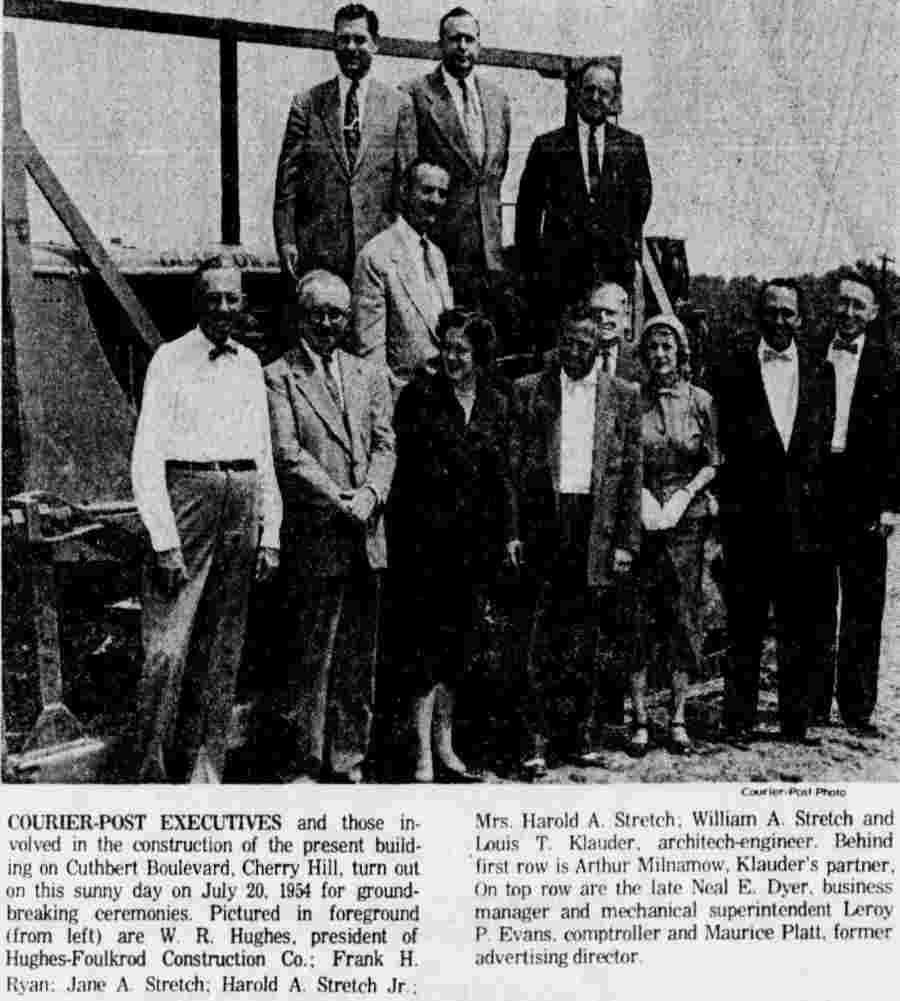
The death in November, 1954, of Frank Ryan was the next blow. This occurred during preparations for transfer of the company’s facilities to the present plant at Cuthbert Boulevard and Hampton Road in Cherry Hill, which occurred in July, 1955.
Ryan, long one of the most influential newsmen in New Jersey, had a hand in the design of the present building but its construction was not completed at the time of his death. Jane Stretch became editor in 1954 after being associated with Ryan up to that time. She retired June 1, 1963 and now resides with her mother in Carmel, Calif. Harold A. Jr. also is retired and lives in California.
WHEN WILLIAM A. STRETCH became publisher and president after his mother retired, Jane served as assistant publisher and secretary of the corporation. She became recognized as one of the most active women in American journalism.
Her series of articles under the heading “Random Thoughts,” proved popular in the early 1960s.
ONE OF THE major steps in the history of the Courier-Post took place in 1959 when negotiations led to its affiliation with the Gannett Group, based in Rochester, N.Y. William Stretch has continued to head the local organization and serves on the Gannett board of directors, as well as supervising the Suburban Newspaper Group, also a member of the Gannett system.
Courier-Post Photo by Jack Wolfer
BRONZE “MAKE-UP MAN,” commissioned in 1925 by J. David Stern, is now housed in the Printers Home, Colorado Springs. The statue was on exhibit at the Sesquicentennial in Philadelphia in 1926. Model for the Max Kalish statue was the late Charles W. Goodwin, a Courier-Post employe whose four sons later worked at the newspaper.
Courier-Post Photo
COURIER-POST EXECUTIVES and those involved in the construction of the present building on Cuthbert Boulevard, Cherry Hill, turn out on this sunny day on July 20, 1954 for groundbreaking ceremonies. Pictured in foreground (from left) are W. R. Hughes, president of Hughes-Foulkrod Construction Co.; Frank H. Ryan; Jane A. Stretch; Harold A. Stretch Jr.; Mrs. Harold A. Stretch; William A. Stretch and Louis T. Klauder, architech-engineer. Behind first row is Arthur Milnamow, Klauder’s partner. On top row are the late Neal E. Dyer, business manager and mechanical superintendent Leroy P. Evans, comptroller and Maurice Platt, former advertising director.
Camden: springboard into Philadelphia, N.Y. newspaper markets
Camden Courier-Post —
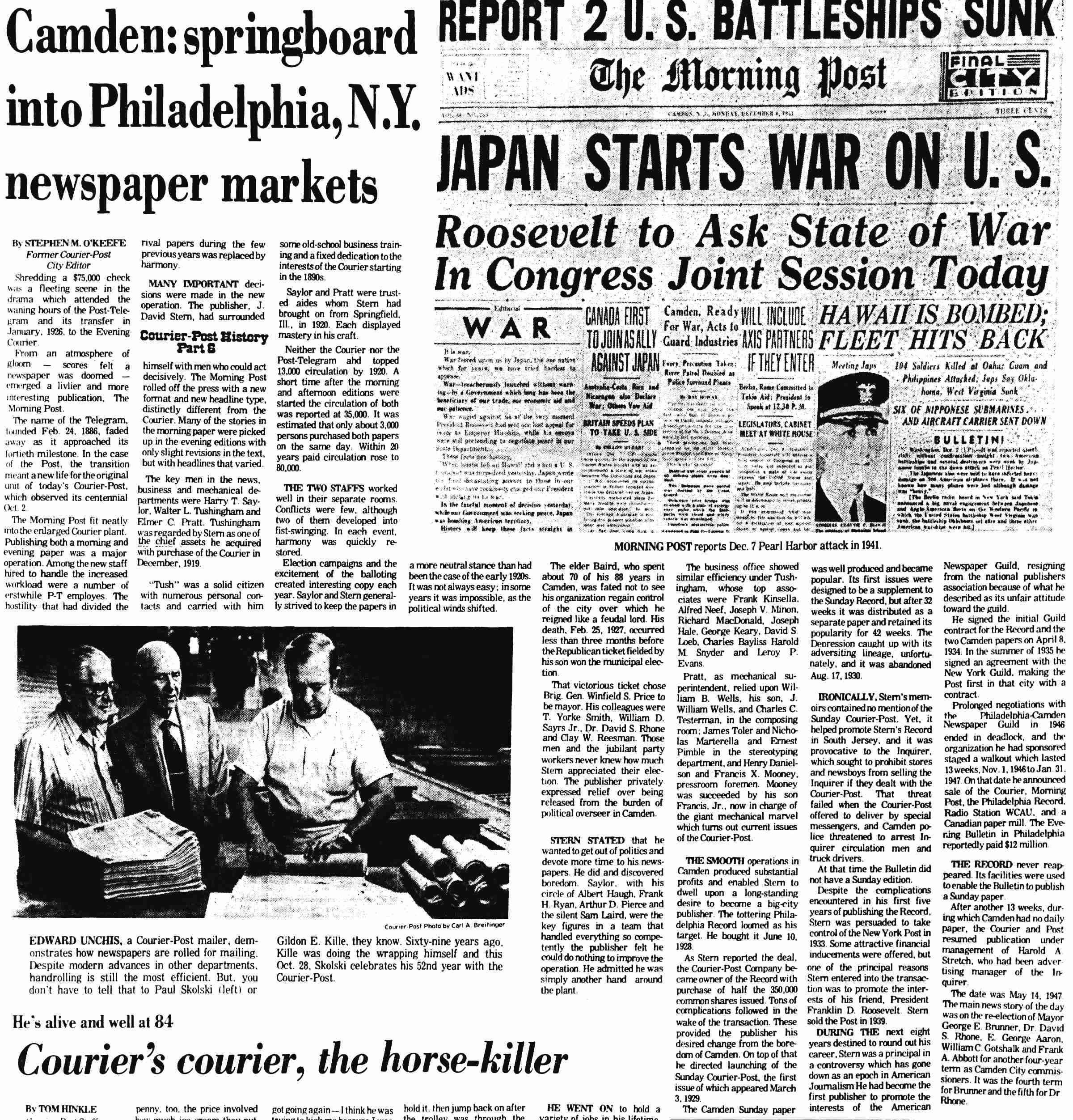
By STEPHEN M. O’KEEFE
Former Courier-Post City Editor
Shredding a $75,000 check was a fleeting scene in the drama which attended the waning hours of the Post-Telegram and its transfer in January, 1926, to the Evening Courier.
From an atmosphere of gloom — scores felt a newspaper was doomed — emerged a livlier and more interesting publication, The Morning Post.
The name of the Telegram, founded Feb. 24, 1886, faded away as it approached its fortieth milestone. In the case of the Post, the transition meant a new life for the original unit of today’s Courier-Post, which observed its centennial Oct. 2.
The Morning Post fit neatly into the enlarged Courier plant. Publishing both a morning and evening paper was a major operation. Among the new staff hired to handle the increased workload were a number of erstwhile P-T employes. The hostility that had divided the rival papers during the few previous years was replaced by harmony.
MANY IMPORTANT decisions were made in the new operation. The publisher, J. David Stern, had surrounded himself with men who could act decisively. The Morning Post rolled off the press with a new format and new headline type, distinctly different from the Courier. Many of the stories in the morning paper were picked up in the evening editions with only slight revisions in the text, but with headlines that varied.
The key men in the news, business and mechanical departments were Harry T. Saylor, Walter L. Tushingham and Elmer C. Pratt. Tushingham was regarded by Stern as one of the chief assets he acquired with purchase of the Courier in December, 1919.
“Tush” was a solid citizen with numerous personal contacts and carried with him some old-school business training and a fixed dedication to the interests of the Courier starting in the 1890s.
Saylor and Pratt were trusted aides whom Stern had brought on from Springfield, Ill., in 1920. Each displayed mastery in his craft.
Neither the Courier nor the Post-Telegram ahd [sic] topped 13,000 circulation by 1920. A short time after the morning and afternoon editions were started the circulation of both was reported at 35,000. It was estimated that only about 3,000 persons purchased both papers on the same day. Within 20 years paid circulation rose to 80,000.
THE TWO STAFFS worked well in their separate rooms. Conflicts were few, although two of them developed into fist-swinging. In each event, harmony was quickly restored.
Election campaigns and the excitement of the balloting created interesting copy each year. Saylor and Stern generally strived to keep the papers in a more neutral stance than had been the case of the early 1920s. It was not always easy; in some years it was impossible, as the political winds shifted.
The elder Baird, who spent about 70 of his 88 years in Camden, was fated not to see his organization regain control of the city over which he reigned like a feudal lord. His death, Feb. 25, 1927, occurred less than three months before the Republican ticket fielded by his son won the municipal election.
That victorious ticket chose Brig. Gen. Winfield S. Price to be mayor. His colleagues were T. Yorke Smith, William D. Sayrs Jr., Dr. David S. Rhone and Clay W. Reesman. Those men and the jubilant party workers never knew how much Stern appreciated their election. The publisher privately expressed relief over being released from the burden of political overseer in Camden.
STERN STATED that he wanted to get out of politics and devote more time to his newspapers. He did and discovered boredom. Saylor, with his circle of Albert Haugh, Frank H. Ryan, Arthur D. Pierce and the silent Sam Laird, were the key figures in a team that handled everything so competently the publisher felt he could do nothing to improve the operation. He admitted he was simply another hand around the plant.
The business office showed similar efficiency under Tushingham, whose top associates were Frank Kinsella, Alfred Neef, Joseph V. Minon, Richard MacDonald, Joseph Hale, George Keary, David S. Loeb, Charles Bayliss Harold M. Snyder and Leroy P. Evans.
Pratt, as mechanical superintendent, relied upon William B. Wells, his son, J. William Wells, and Charles C. Testerman, in the composing room; James Toler and Nicholas Marterella and Ernest Pimble in the stereotyping department, and Henry Danielson and Francis X. Mooney, pressroom foremen. Mooney was succeeded by his son Francis, Jr., now in charge of the giant mechanical marvel which turns out current issues of the Courier-Post.
THE SMOOTH operations in Camden produced substantial profits and enabled Stern to dwell upon a long-standing desire to become a big-city publisher. The tottering Philadelphia Record loomed as his target. He bought it June 10, 1928.
As Stern reported the deal, the Courier-Post Company became owner of the Record with purchase of half the 350,000 common shares issued. Tons of complications followed in the wake of the transaction. These provided the publisher his desired change from the boredom of Camden. On top of that he directed launching of the Sunday Courier-Post, the first issue of which appeared March 3, 1929.
The Camden Sunday paper was well produced and became popular. Its first issues were designed to be a supplement to the Sunday Record, but after 32 weeks it was distributed as a separate paper and retained its popularity for 42 weeks. The Depression caught up with its adversiting [sic] lineage, unfortunately, and it was abandoned Aug. 17, 1930.
IRONICALLY, Stern’s memoirs contained no mention of the Sunday Courier-Post. Yet, it helped promote Stern’s Record in South Jersey, and it was provocative to the Inquirer, which sought to prohibit stores and newsboys from selling the Inquirer if they dealt with the Courier-Post. That threat failed when the Courier-Post offered to deliver by special messengers, and Camden police threatened to arrest Inquirer circulation men and truck drivers.
At that time the Bulletin did not have a Sunday edition.
Despite the complications encountered in his first five years of publishing the Record, Stern was persuaded to take control of the New York Post in 1933. Some attractive financial inducements were offered, but one of the principal reasons Stern entered into the transaction was to promote the interests of his friend, President Franklin D. Roosevelt. Stern sold the Post in 1939.
DURING THE next eight years destined to round out his career, Stern was a principal in a controversy which has gone down as an epoch in American Journalism He had become the first publisher to promote the interests of the American Newspaper Guild, resigning from the national publishers association because of what he described as its unfair attitude toward the guild.
He signed the initial Guild contract for the Record and the two Camden papers on April 8, 1934. In the summer of 1935 he signed an agreement with the New York Guild, making the Post first in that city with a contract.
Prolonged negotiations with the Philadelphia-Camden Newspaper Guild in 1946 ended in deadlock, and the organization he had sponsored staged a walkout which lasted 13 weeks, Nov. 1, 1946 to Jan. 31, 1947. On that date he announced sale of the Courier, Morning Post, the Philadelphia Record, Radio Station WCAU, and a Canadian paper mill. The Evening Bulletin in Philadelphia reportedly paid $12 million.
THE RECORD never reappeared. Its facilities were used to enable the Bulletin to publish a Sunday paper.
After another 13 weeks, during which Camden had no daily paper, the Courier and Post resumed publication under management of Harold A. Stretch, who had been advertising manager of the Inquirer.
The date was May 14, 1947. The main news story of the day was on the re-election of Mayor George E. Brunner, Dr. David S. Rhone, E. George Aaron, William C. Gotshalk and Frank A. Abbott for another four-year term as Camden City commissioners. It was the fourth term for Brunner and the fifth for Dr Rhone.
MORNING POST reports Dec. 7 Pearl Harbor attack in 1941.
Courier-Post Photo by Carl A. Breitinger
EDWARD UNCHIS, a Courier-Post mailer, demonstrates how newspapers are rolled for mailing. Despite modern advances in other departments, handrolling is still the most efficient. But, you don’t have to tell that to Paul Skolski (left) or Gildon E. Kille, they know. Sixty-nine years ago, Kille was doing the wrapping himself and this Oct. 28, Skolski celebrates his 52nd year with the Courier-Post.
Connie’s Athletics Get 1400 Child Rooters from Camden
Camden Courier-Post —
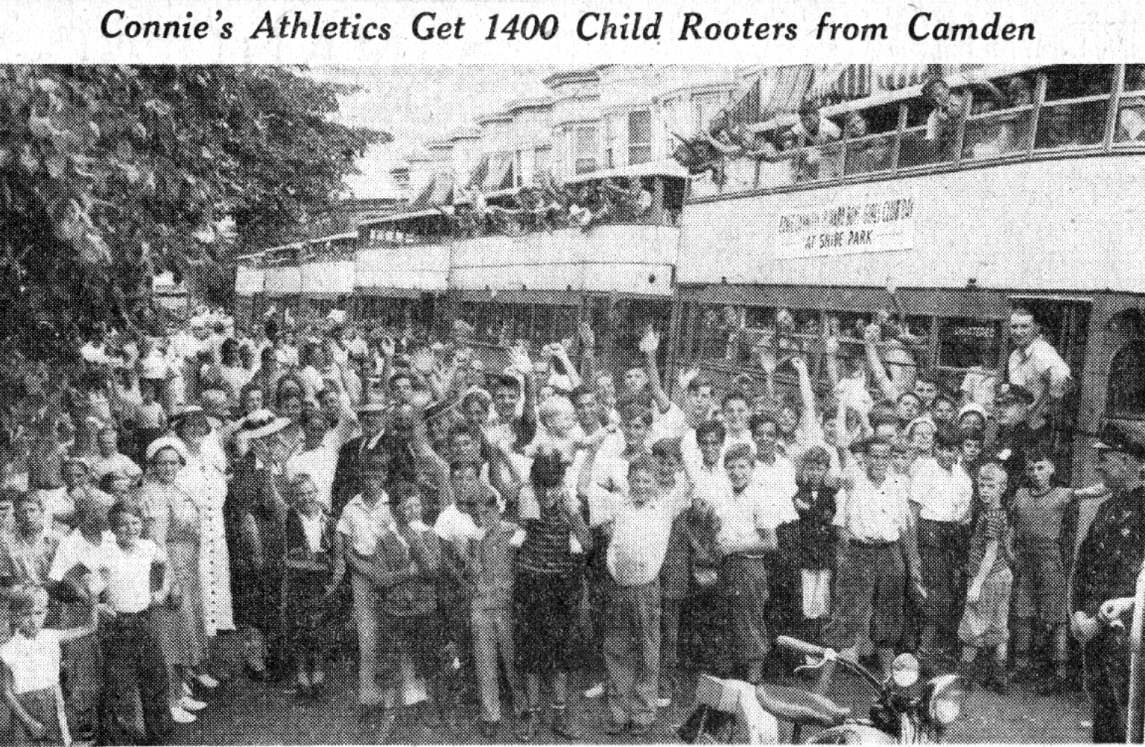
It was a big day for the juvenile population of the Thirteenth ward in Camden yesterday when Edward Garrity, Republican committeeman, conducted his annual outing at Shibe Park in Philadelphia to see the Athletics oppose the Chicago White Sox in a baseball game. Above are seen the children aboard the buses which left from Louis and Whitman avenues. Included in the party were Commissioners Mary W. Kobus and Dr. David S. Rhone, Mrs. Marion Garrity and Police Lieutenant George Frost.
Coroner’s Quiz Ordered In Holdup Victim’s Death
Camden Courier-Post —
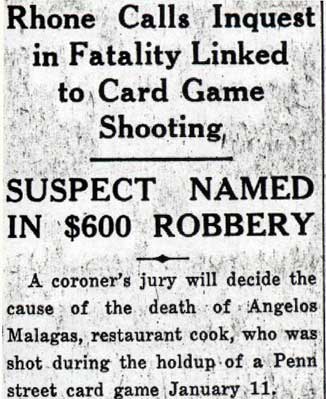
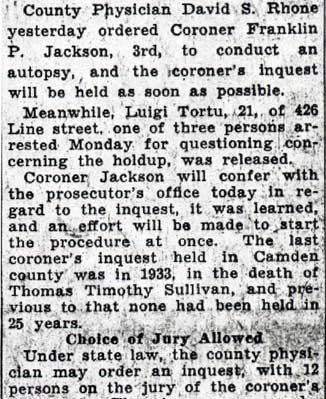
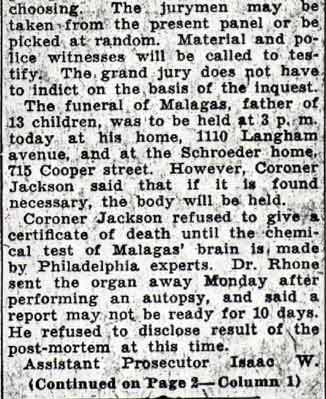
Rhone Calls Inquest in Fatality Linked to Card Game Shooting,
SUSPECT NAMED IN $600 ROBBERY
A coroner’s jury will decide the cause of the death of Angelos Malagas, restaurant cook, who was shot during the holdup of a Penn street card game January 11.
County Physician David S. Rhone yesterday ordered Coroner Franklin P. Jackson, 3rd, to conduct an autopsy, and the coroner’s inquest will be held as soon as possible.
Meanwhile, Luigi Tortu, 21, of 426 Line street, one of three persons arrested Monday for questioning concerning the holdup, was released.
Coroner Jackson will confer with the prosecutor’s office today in regard to the inquest, it was learned, and an effort will be made to start the procedure at once. The last coroner’s inquest held in Camden county was in 1933, in the death of Thomas Timothy Sullivan, and previous to that none had been held in 25 years.
Choice of Jury Allowed
Under state law, the county physician may order an inquest, with 12 persons on the jury of the coroner’s choosing. The jurymen may be taken from the present panel or be picked at random. Material and police witnesses will be called to testify. The grand jury does not have to indict on the basis of the inquest.
The funeral of Malagas, father of 13 children, was to be held at 3 p.m. today at his home, 1110 Langham avenue, and at the Schroeder home, 715 Cooper street. However, Coroner Jackson said that if it is found necessary, the body will be held.
Coroner Jackson refused to give a certificate of death until the chemical test of Malagas’ brain is made by Philadelphia experts. Dr. Rhone sent the organ away Monday after performing an autopsy, and said a report may not be ready for 10 days. He refused to disclose result of the post-mortem at this time.
Assistant Prosecutor Isaac W.
2 Girls, Youth Held in Probe of Fatal Card Game Holdup
Camden Courier-Post —
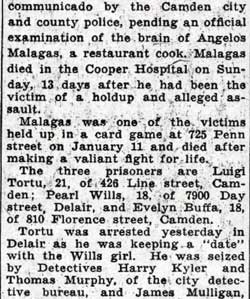
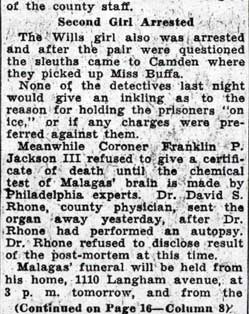
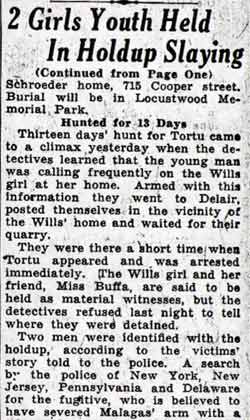
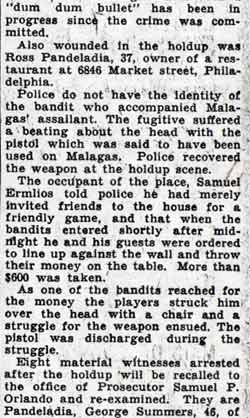
Arrests in Delair and Here Follow 14-Day Hunt for Dum-Dum Bandit
Two girls and a man are held incommunicado by the Camden city and county police, pending an official examination of the brain of Angelos Malagas, a restaurant cook. Malagas died in the Cooper Hospital on Sunday, 13 days after he had been the victim of a holdup and alleged assault.
Malagas was one of the victims held up in a card game at 725 Penn street on January 11 and died after making a valiant fight for life.
The three prisoners are Luigi Tortu, 21, of 426 Line street, Camden; Pearl Wills, 18, of 7900 Day street, Delair, and Evelyn Buffa, 18, of 810 Florence street, Camden. Tortu was arrested yesterday in Delair as he was keeping a “date” with the Wills girl. He was seized by Detectives Harry Kyler and Thomas Murphy, of the city detective bureau, and James Mulligan of the county staff.
Second Girl Arrested
The Wills girl also was arrested and after the pair were questioned the sleuths came to Camden where they picked up Miss Buffa.
None of the detectives last night would give an inkling as to the reason for holding the prisoners “on ice,” or if any charges would be preferred against them.
Meanwhile Coroner Franklin P. Jackson III refused to give a certificate of death until the chemical test of Malagas’ brain is made by Philadelphia experts. Dr. David S. Rhone, county physician, sent the organ away yesterday, after Dr. Rhone had performed an autopsy. Dr. Rhone refused to disclose result of the post-mortem at this time.
Malagas’ funeral will be held from his home, 1110 Langham avenue, at 3 p.m. tomorrow, and from the Schroeder home, 715 Cooper street. Burial will be in Locustwood Memorial Park.
Hunted for 13 Days
Thirteen days’ hunt for Tortu came to a climax yesterday when the detectives learned that the young man was calling frequently on the Wills girl at her home. Armed with this information they went to Delair, posted themselves in the vicinity of the Wills’ home and waited for their quarry.
They were there a short time when Tortu appeared and was arrested immediately. The Wills girl and her friend, Miss Buffa, are said to be held as material witnesses, but the detectives refused last night to tell where they were detained.
Two men were identified with the holdup, according to the victims’ story told to the police. A search by the police of New York, New Jersey, Pennsylvania and Delaware for the fugitive, who is believed to have severed Malagas’ arm with a “dum dum bullet” has been in progress since the crime was committed.
Also wounded in the holdup was Ross Pandeladia, 37, owner of a restaurant at 6846 Market street, Philadelphia.
Police do not have the identity of the bandit who accompanied Malagas’ assailant. The fugitive suffered a beating about the head with the pistol which was said to have been used on Malagas. Police recovered the weapon at the holdup scene.
The occupant of the place, Samuel Ermlios told police he had merely invited friends to the house for a friendly game, and that when the bandits entered shortly after midnight he and his guests were ordered to line up against the wall and throw their money on the table. More than $600 was taken.
As one of the bandits reached for the money the players struck him over the head with a chair and a struggle for the weapon ensued. The pistol was discharged during the struggle.
Eight material witnesses arrested after the holdup will be recalled to the office of Prosecutor Samuel P. Orlando and re-examined. They are Pandeladia, George Summers, 46, of 2592 Baird avenue; Samuel Bosco, proprietor of a Broadway barber shop; George Caras, 45, of 581 Mickle street; Michael Dandrea, 47, of 1667 Norris street; George Matros, and his wife, Annie, living at the Penn street address, and Mrs. Ermlios.
Tortu was arrested late in December, 1937, when detectives took four suspects whom the police sought to identify with various holdups committed in South Jersey during the latter part of last year.
Tortu then gave his address as 426 Line street. Arrested at the same time was a girl who said she was Evelyn Buffalo, and who gave the address, 322 Penn street, as her home. It was at the Penn street house that the suspects were arrested.
Others captured at the time were Frank Luggi, 21, 322 Penn street; Nicholas Dandrea, 27, of 529 Line street, and Frederick Gasperone, who gave a false address when he was booked.
Justice of the Peace George Wilkinson, of Stratford, held Luggi, Gasperone and Dandrea for the grand jury, on the charge of breaking into the garage of Albert Weston at Stratford on Thanksgiving. Tortu was discharged.
Man Shot in Holdup of Card Game Dies
Camden Courier-Post —
Chef, Father of 13, Loses Two-week Battle for Life; Slayer Hunted
Shot during a struggle with one of two bandits who held up a card game at 725 Penn street on January 11, Angelo Margolis, 38, of 1112 Langham avenue, lost a valiant fight for life yesterday.
Margolis, father of 13 children and a chef at the Lintonia Restaurant at 530 Federal street, died in Cooper Hospital at 5.55 a.m.
His death immediately brought county authorities into the case and a warrant charging murder has been issued for his assailant, who is known to police.
Police of New York, Pennsylvania, Maryland and Delaware have been searching for the suspect since the holdup occurred in the Penn street home of Samuel Ermlios, 40, chef in a Broadway restaurant.
Also wounded by the same bullet, a “soft-nose” or dum-dum bullet, which struck Margolis, was Ross Pandeladia, 37, owner of a restaurant at 6846 Market street, Philadelphia. The bullet tore several arteries in Margolis’ arm. Police do not have the identity of the bandit who accompanied Margolis’ assailant, who also escaped, but who had suffered a beating about the head with the pistol which killed Margolis. Police recovered the weapon at the holdup scene.
Ermlios told police he had merely invited friends to the house for a friendly game, and that when the bandits entered shortly after midnight he and his guests were ordered to line up against the wall and throw their money on the table. More than $600 was taken.
As one of the bandits reached for the money the players struck him over the head with a chair and a struggle for the weapon ensued. The pistol was discharged during the struggle.
Autopsy Today
Coroner Franklin P. Jackson, 3rd, has ordered an autopsy which will be performed at Cooper Hospital today by County Physician David S. Rhone. Coroner Jackson said there is no question but what Margolis died from the effects of the bullet wound, which occasioned a large loss of blood, but that the autopsy would be held to officially ascribe the cause in county records for use by the prosecutor’s office.
Eight material witnesses arrested after the holdup probably will be recalled today to the office of Prosecutor Samuel P. Orlando and reexamined. They are Pandeladia, George Summers, 46, of 2592 Baird avenue; Samuel Bosco, proprietor of a Broadway barber shop; George Caras, 45, of 581 Mickle street; Michael Dandrea, 47, of 1667 Norris street; George Matros, and his wife, Annie, living at the Penn street address, and Mrs. Ermlios.
Polish American Community Hall Opens Tonight
Camden Courier-Post —
A banquet tonight will mark the official opening of the new $130,000 community hall of the Polish American Citizens club, Warsaw and Lowell streets.
Congressman Wolverton, Mayor Brunner and the Rt. Rev. Arthur B. Strenski, pastor of St. Joseph’s R. C. Church, will be principal speakers. Stanley J. Jaskolski, president of the club, will present a check for $500 to Monsignor Strenski toward the fund being raised for erection of St. Joseph’s new high school.
The club voted to contribute $1000 toward the new school and the second payment will be made at a ball on May 13 according to Jaskolski. During the past year the club raised $101,000 toward the erection of the community hall and its members pledged $29,000 toward equipping it.
Plans for the erection of the building were launched by Jaskolski four years ago. He and more than 40 other members, who served on the campaign committee, which raised the needed money, have been honored with life memberships. A group of photographs of the group will be unveiled in the banquet room tonight.
Other speakers at tonight’s banquet include City Commissioners Rhone, Aaron, Gotshalk and Abbott, Postmaster Edward Praiss and S. Morawski, editor of the Nowy Swiant, the Polish Morning World, N. Y.
Joseph A. Dynakowski, treasurer of the club, will be toastmaster at the dinner which begins at 8.30 p.m. Watson Burdalski is chairman of the entertainment committee and Stephen Blelicki heads the banquet committee. Members of the Polish American Women’s Citizens club, of which Mrs. Jules B. Derowski is president, will be guests.
The club was formed in 1914 by seven citizens interested in aiding Polish emigrants to become American citizens. Josef Zbieratski, first president, will be among the honored guests tonight.
Classes in naturalization were established by Daniel Hoyt, of the Camden YMCA, and Edward L. Canning county president of the Patriotic Order Sons of America. Classes in this work have been continued by the club since then with all tuition free. The club met at 1559-Mt. Ephraim avenue for years before the new building was completed in December.
Tenement Owner Granted 10 Days For Cleaning Job
Camden Courier-Post —

By WILBUR MORSE JR.
The Philadelphia owner of a South Camden tenement has been given 10 days to clean up the conditions at 432 Stevens street.
Louis R. Cohen, 271 South Fifteenth street, Philadelphia, was summoned to a hearing Monday before Director of Public Affairs Rhone, to show cause why he should not be restrained from operating the rooming house.
Charges lodged against the management of the property by city health inspectors and the fire marshal were read to Rhone by Ventorino Francesconi, chief clerk of the health department.
The inspections, Francesconi said, showed the tenement consists of 23 apartments, comprised of 29 rooms, occupied by 38 adults and 22 children.
Fire hazards were said by inspectors to include improper lighting of stairways and hallways; hallways and stairways blocked; loose wood and litter scattered about the premises, and an inadequate number of exits.
“Health violations,” Francesconi reported, “were contained in the excessive number of persons occupying single, or two-room apartments; improper disposal of garbage; faulty plumbing and general unsanitary conditions.”
Cohen, in his defense, laid the blame for the conditions on his tenants.
“You can’t make people be clean, if they don’t want to,” he told Rhone.
Termed Deplorable
Deputy Director Garrity, who had accompanied Dr. David D. Helm and Francesconi, on a tour of inspection of the tenement, however, told Dr. Rhone that a single, elderly woman was responsible for the janitor service of the 23 apartments and that from a standpoint of “public welfare” more adequate management, supervision and janitorial service should be supplied. Garrity labelled the conditions as “deplorable and shocking.”
Dr. Helm added that inadequate number of garbage containers were supplied by Cohen. He reported that the yard in back of 432 Stevens had been filled with “more than a truckload of filth,” for which no containers had been provided.
“It’s the tenants’ fault,” reiterated Cohen. “They send their three and four-year-old youngsters out to dump the garbage and trash.”
Despite his protests that the health department’s objections “already have been met,” Cohen agreed to further improve conditions at the tenement within 10 days.
Dr. Rhone said he would order another inspection by health department aides within that time.
“The matter of any violation of fire regulations is between you and the fire marshal,” Rhone told Cohen.
An official report by Capt. Maurice O’Brien, acting fire marshal, to Dr. Helm had recommended a further inspection of the property by fire underwriters.
Accused Officer Studies Payroll
Camden Courier-Post —
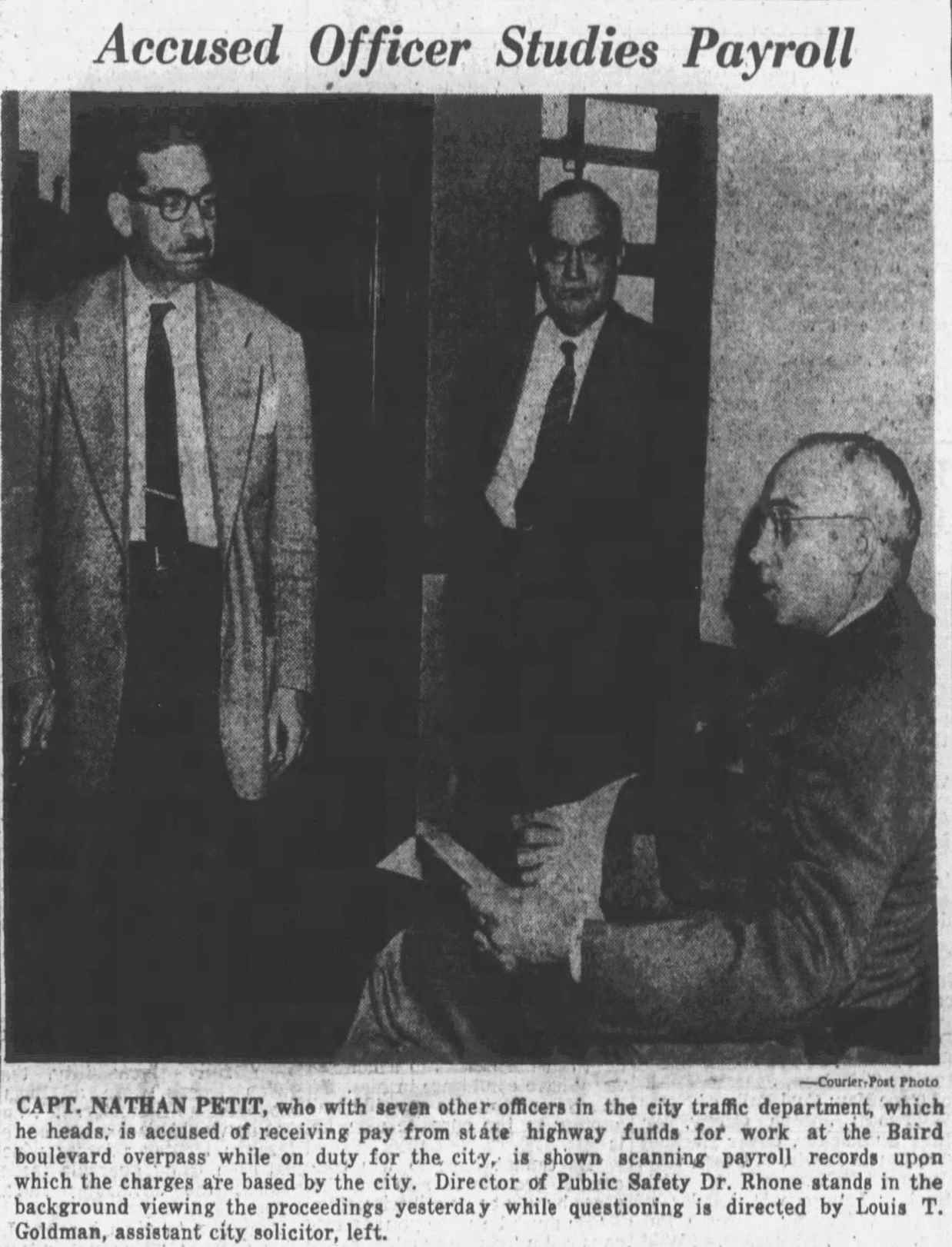
—Courier-Post Photo
CAPT. NATHAN PETIT, who with seven other officers in the city traffic department, which he heads, is accused of receiving pay from state highway funds for work at the Baird boulevard overpass while on duty for the city, is shown scanning payroll records upon which the charges are based by the city. Director of Public Safety Dr. Rhone stands in the background viewing the proceedings yesterday while questioning is directed by Louis T. Goldman, assistant city solicitor, left.
5 Accused Cops To Ask Rhone for Full Exoneration
Camden Courier-Post —

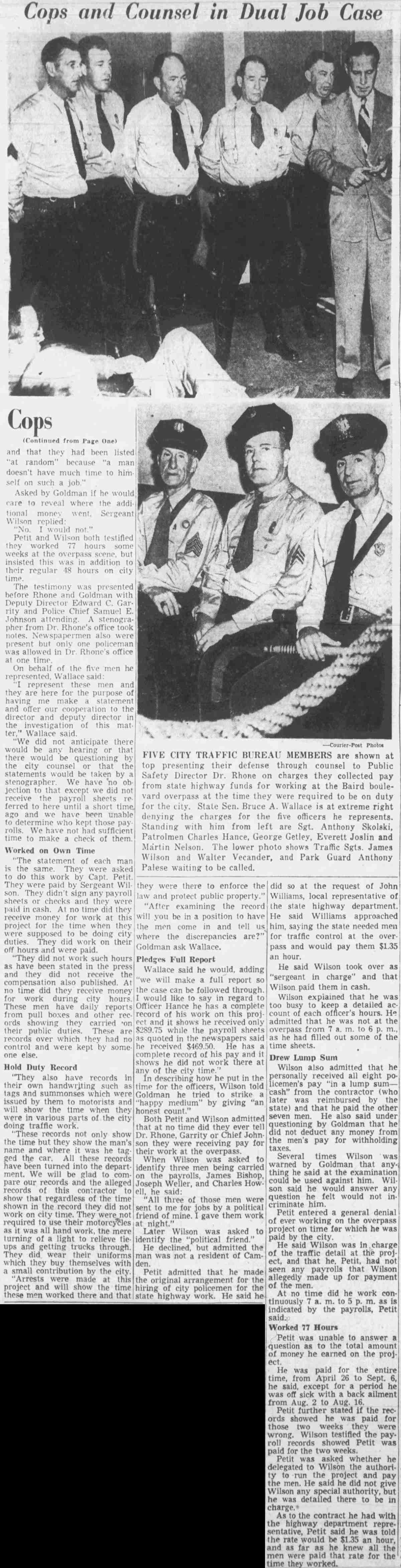
Claim Falsifications Of N. J. Work Record In Overpass Case
Director of Public Safety Rhone soon will be asked to “completely exonerate” five of eight Camden traffic officers who have been accused of accepting pay from the state for traffic duty at the Baird boulevard overpass during their regular city hours.
State Senator Wallace made that announcement today on behalf of Sgt. Anthony Skolski and Traffic Patrolmen Charles Hance, Martin Nelson, George Getley and Everett Joslin.
Wallace said he would base his appeal to Dr. Rhone on testimony produced at a preliminary hearing held yesterday on orders of Dr. Rhone for all eight men, including Captain Nathan Petit, and Sgts. James Wilson and Walter Vecander.
“There is no question that the payroll records which were the basis for the accusations against the five men I represent, were falsified,” Wallace said. “Sergeant Wilson, who kept the records admitted frequently in his testimony yesterday the records were ‘mistakes, errors and not based on actual time put in.’”
‘Charges Groundless’
“The whole hearing proved without doubt that the charges against the five men were groundless and I will ask Dr. Rhone to make a public statement that the records were falsified and these five men were blameless and not guilty of accepting state pay for work on city time.”
Wilson admitted at the hearing he did not pay the traffic men the full time recorded for them on the overpass payroll records. He was asked by Assistant City Solicitor Goldman:
“Then it comes down to the fact that the men in the traffic bureau only worked on their off hours. That the reports are mistakes. They only received the money to which they were entitled. You got more money than they were entitled to but you won’t tell us where that money went to, is that correct?”
“Yes,” Wilson answered.
Wilson said the hours marked on the payroll were a mistake and that they had been listed “at random” because “a man doesn’t have much time to himself on such a job.”
Asked by Goldman if he would care to reveal where the additional money went, Sergeant Wilson replied:
“No. I would not.”
Petit and Wilson both testified they worked 77 hours some weeks at the overpass scene, but insisted this was in addition to their regular 48 hours on city time.
The testimony was presented before Rhone and Goldman with Deputy Director Edward C. Garrity and Police Chief Samuel E. Johnson attending. A stenographer from Dr. Rhone’s office took notes. Newspapermen also were present but only one policeman was allowed in Dr. Rhone’s office at one time.
On behalf of the five men he represented, Wallace said:
“I represent these men and they are here for the purpose of having me make a statement and offer our cooperation to the director and deputy director in the investigation of this matter,” Wallace said.
“We did not anticipate there would be any hearing or that there would be questioning by the city counsel or that the statements would be taken by a stenographer. We have no objection to that except we did not receive the payroll sheets referred to here until a short time ago and we have been unable to determine who kept those payrolls. We have not had sufficient time to make a check of them.”
Worked on Own Time
“The statement of each man is the same. They were asked to do this work by Capt. Petit. They were paid by Sergeant Wilson. They didn’t sign any payroll sheets or checks and they were paid in cash. At no time did they receive money for work at this project for the time when they were supposed to be doing city duties. They did work on their off hours and were paid.
“They did not work such hours as have been stated in the press and they did not receive the compensation also published. At no time did they receive money for work during city hours. These men have daily reports from pull boxes and other records showing they carried on their public duties. These are records over which they had no control and were kept by someone else.”
Hold Duty Record
“They also have records in their own handwriting such as tags and summonses which were issued by them to motorists and will show the time when they were in various parts of the city doing traffic work.
“These records not only show the time but they show the man’s name and where it was he tagged the car. All these records have been turned into the department. We will be glad to compare our records and the alleged records of this contractor to show that regardless of the time shown in the record they did not work on city time. They were not required to use their motorcycles as it was all hand work, the mere turning of a light to relieve tie-ups and getting trucks through. They did wear their uniforms which they buy themselves with a small contribution by the city.
“Arrests were made at this project and will show the time these men worked there and that they were there to enforce the law and protect public property.”
“After examining the record will you be in a position to have the men come in and tell us where the discrepancies are?” Goldman ask [sic] Wallace.
Pledges Full Report
Wallace said he would, adding “we will make a full report so the case can be followed through. I would like to say in regard to Officer Hance he has a complete record of his work on this project and it shows he received only $289.75 while the payroll sheets as quoted in the newspapers said he received $469.50. He has a complete record of his pay and it shows he did not work there at any of the city time.”
In describing how he put in the time for the officers, Wilson told Goldman he tried to strike a “happy medium” by giving “an honest count.”
Both Petit and Wilson admitted that at no time did they ever tell Dr. Rhone, Garrity or Chief Johnson they were receiving pay for their work at the overpass.
When Wilson was asked to identify three men being carried on the payrolls, James Bishop, Joseph Weller, and Charles Howell, he said:
“All three of those men were sent to me for jobs by a political friend of mine. I gave them work at night.”
Later Wilson was asked to identify the “political friend.”
He declined, but admitted the man was not a resident of Camden.
Petit admitted that he made the original arrangement for the hiring of city policemen for the state highway work. He said he did so at the request of John Williams, local representative of the state highway department. He said Williams approached him, saying the state needed men for traffic control at the overpass and would pay them $1.35 an hour.
He said Wilson took over as “sergeant in charge” and that Wilson paid them in cash.
Wilson explained that he was too busy to keep a detailed account of each officer’s hours. He admitted that he was not at the overpass from 7 a. m. to 6 p. m., as he had filled out some of the time sheets.
Drew Lump Sum
Wilson also admitted that he personally received all eight policemen’s pay “in a lump sum—cash” from the contractor (who later was reimbursed by the state) and that he paid the other seven men. He also said under questioning by Goldman that he did not deduct any money from the men’s pay for withholding taxes.
Several times Wilson was warned by Goldman that anything he said at the examination could be used against him. Wilson said he would answer any question he felt would not incriminate him.
Petit entered a general denial of ever working on the overpass project on time for which he was paid by the city.
He said Wilson was in charge of the traffic detail at the project, and that he, Petit, had not seen any payrolls that Wilson allegedly made up for payment of the men.
At no time did he work continuously 7 a. m. to 5 p. m. as is indicated by the payrolls, Petit said.
Worked 77 Hours
Petit was unable to answer a question as to the total amount of money he earned on the project.
He was paid for the entire time, from April 26 to Sept. 6, he said, except for a period he was off sick with a back ailment from Aug. 2 to Aug. 16.
Petit further stated if the records showed he was paid for those two weeks they were wrong. Wilson testified the payroll records showed Petit was paid for the two weeks.
Petit was asked whether he delegated to Wilson the authority to run the project and pay the men. He said he did not give Wilson any special authority, but he was detailed there to be in charge.
As to the contract he had with the highway department representative, Petit said he was told the rate would be $1.35 an hour, and as far as he knew all the men were paid that rate for the time they worked.
Cops and Counsel in Dual Job Case
Camden Courier-Post —
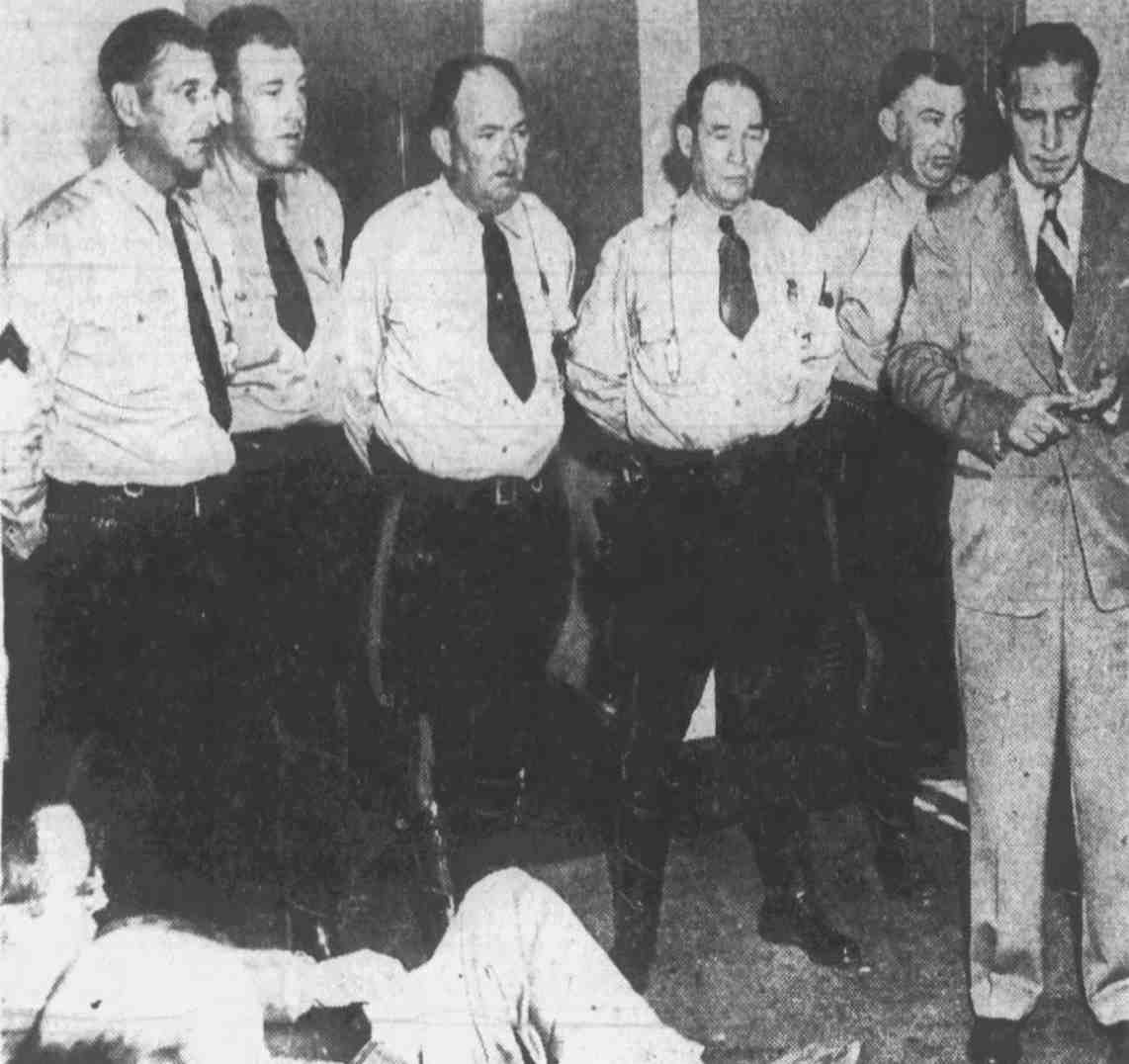
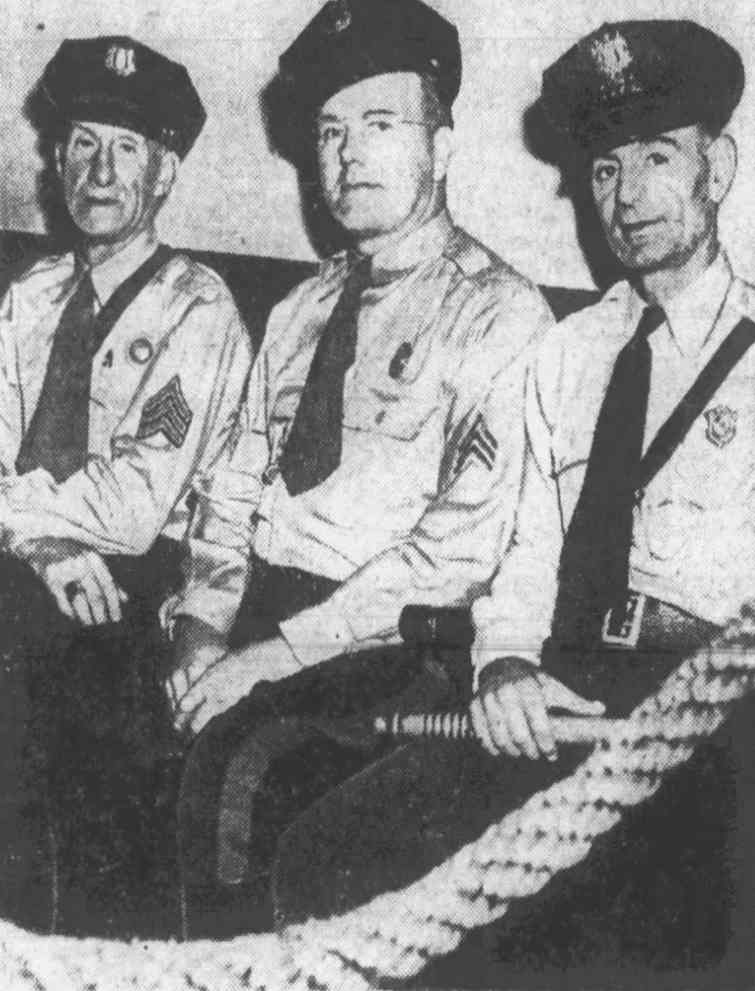
—Courier-Post Photos
FIVE CITY TRAFFIC BUREAU MEMBERS are shown at top presenting their defense through counsel to Public Safety Director Dr. Rhone on charges they collected pay from state highway funds for working at the Baird boulevard overpass at the time they were required to be on duty for the city. State Sen. Bruce A. Wallace is at extreme right denying the charges for the five officers he represents. Standing with him from left are Sgt. Anthony Skolski, Patrolmen Charles Hance, George Getley, Everett Joslin and Martin Nelson. The lower photo shows Traffic Sgts. James Wilson and Walter Vecander, and Park Guard Anthony Palese waiting to be called.
Traffic Officers Testify in Overpass Pay
Camden Courier-Post —
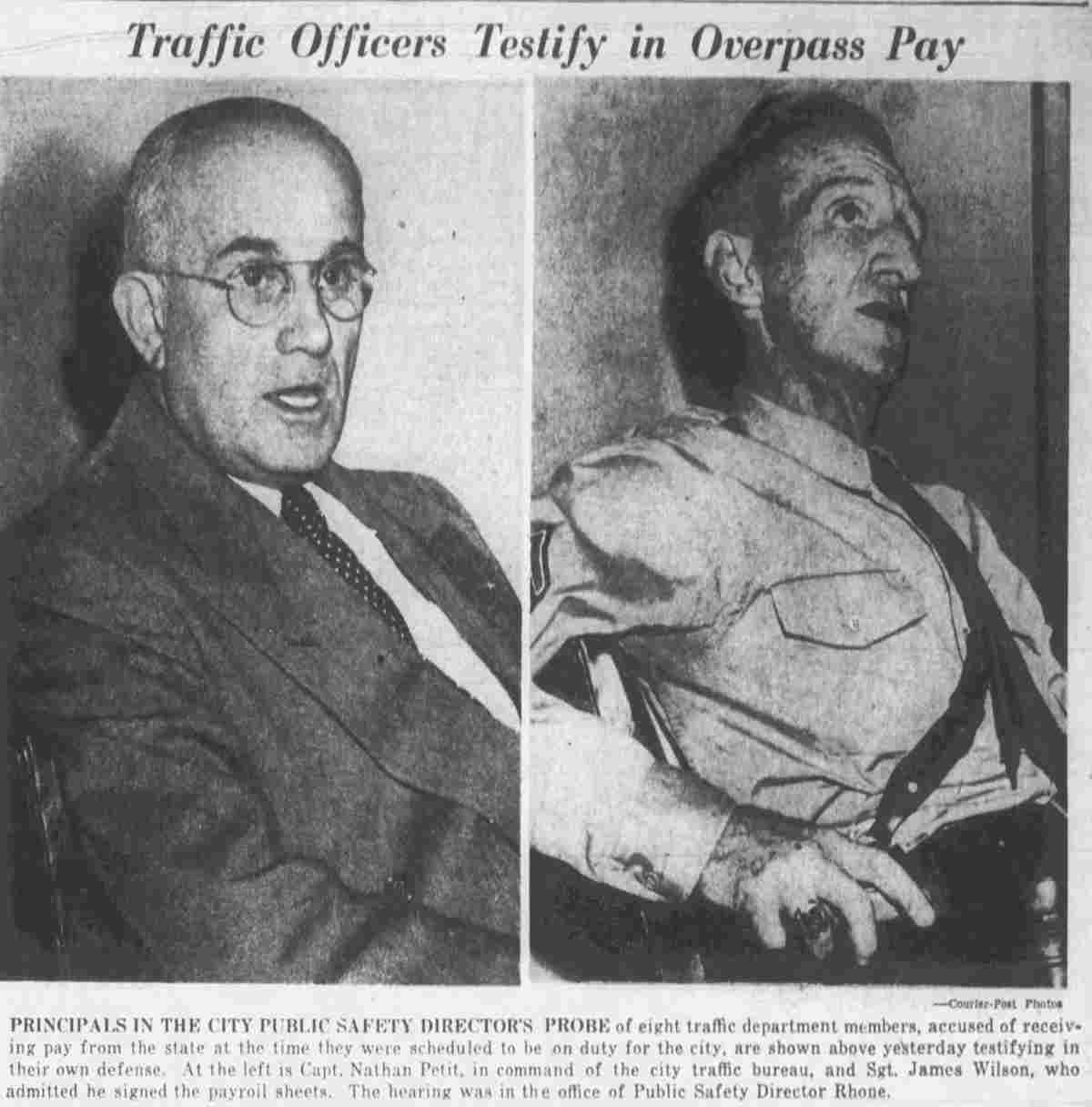
—Courier-Post Photos
PRINCIPALS IN THE CITY PUBLIC SAFETY DIRECTOR’S PROBE of eight traffic department members, accused of receiving pay from the state at the time they were scheduled to be on duty for the city, are shown above yesterday testifying in their own defense. At the left is Capt. Nathan Petit, in command of the city traffic bureau, and Sgt. James Wilson, who admitted he signed the payroll sheets. The hearing was in the office of Public Safety Director Rhone.
200 at Party Honor Air War Hero Kelly
Camden Courier-Post —
Brunner and Rhone Join in Tribute; Park May Bear His Name
Air war hero Staff Sgt. William “Bill” Kelly was honored last night by more than 200 friends and neighbors of the First ward and numerous city officials.
A party was held for “Bill” in the newly established headquarters of the First Ward Republican Club, 47 York street. Joseph Campbell, club president, was chairman of arrangements.
During the ceremonies the club went on record urging the city to purchase an unimproved area bounded by Main, York, Point and Front streets for the establishment of a soldiers’ memorial park to be known as Kelly Park.
The club pledged funds for the erection of a permanent soldiers’ honor roll and memorial would be raised by political clubs, both Democrat and Republican, of the ward. It was stated a petition urging the purchase of the ground by the city is now being circulated in the ward.
Among those who honored Kelly, holder of the Air Medal and Purple Heart, were Mayor Brunner, Commissioner Rhone, Freeholders Schneider and Quinlan, former City Prosecutor William Cahill and Charles Humes. A former city policeman, Kelly was a gunner on a Flying Fotress [sic] and participated in numerous bombing missions over Europe before being sent home after receiving his second wound.
A war bond was presented to Kelly, and his wife, Mary Theresa Kelly, received an ornamental pin. Freeholders Schneider and Quinlan presented the club with an American Flag.
Johnson Gets Ward’s Job as Kobus Orders Cop Shakeup
Camden Courier-Post —
Shaw Made Assistant in Place of Koerner
In a shakeup of Camden police officials yesterday afternoon Lieutenant Samuel E. Johnson was named acting chief of detectives by Commissioner Mary W. Kobus, director of public safety.
Lieutenant George A. Ward, who has been in charge of the detective bureau for a year, was transferred to take Johnson’s place in charge of headquarters.
Detective Louis Shaw was made assistant to Johnson, replacing Detective Sergeant Gus Koerner. Koerner was transferred to the Second District, for radio car and street duty. The new order became effective at 4:00 PM yesterday.
Police Chief Arthur Colsey announced the changes in the bureau after a two-hour conference with Commissioner Kobus yesterday afternoon.
Maurice Di Nicuolo, who has been an acting detective, was transferred to the First Police District, with former Acting Detective Clifford Del Rossi returning to his old post in the detective bureau.
In the only other transfer announced, Sergeant Harry Newton was switched from the First Police District to the Third, with Sergeant Edward Carroll going from the Third to the First.
Although no other changes were made public, it is believed yesterday’s are a forerunner of numerous shifts to be made today or early next week.
“These changes are being made for the good of the service,” Commissioner Kobus declared. “There will be other transfers of officers and men so that all the police may familiarize themselves with all the branches of the department.”
Lieutenant Johnson was appointed a policeman on January 1, 1910. After 10 years as a patrolman, he was promoted to a detective, where he made a splendid record. On November 28, 1928 he was made a sergeant, and again promoted on April 8, 1930, when he became a lieutenant.
Ward was appointed a policeman on August 2, 1917, promoted to detective January 1, 1927, sergeant November 14, 1928 and lieutenant on January 24, 1930.
Johnson was a detective sergeant when former Police Chief John W. Golden was head of that bureau, but later was transferred to police headquarters.
Ward has been in and out of the detective bureau several times. He served for a time as the commander of the First District and later was in charge of the police headquarters on the 12:00 midnight to 8:00 AM shift. He was a political lieutenant of former Public Safety Director David S. Rhone.
Golden Jubilee Year Book Committee
St. Joseph's Roman Catholic Church Golden Jubilee Year Book — 1943
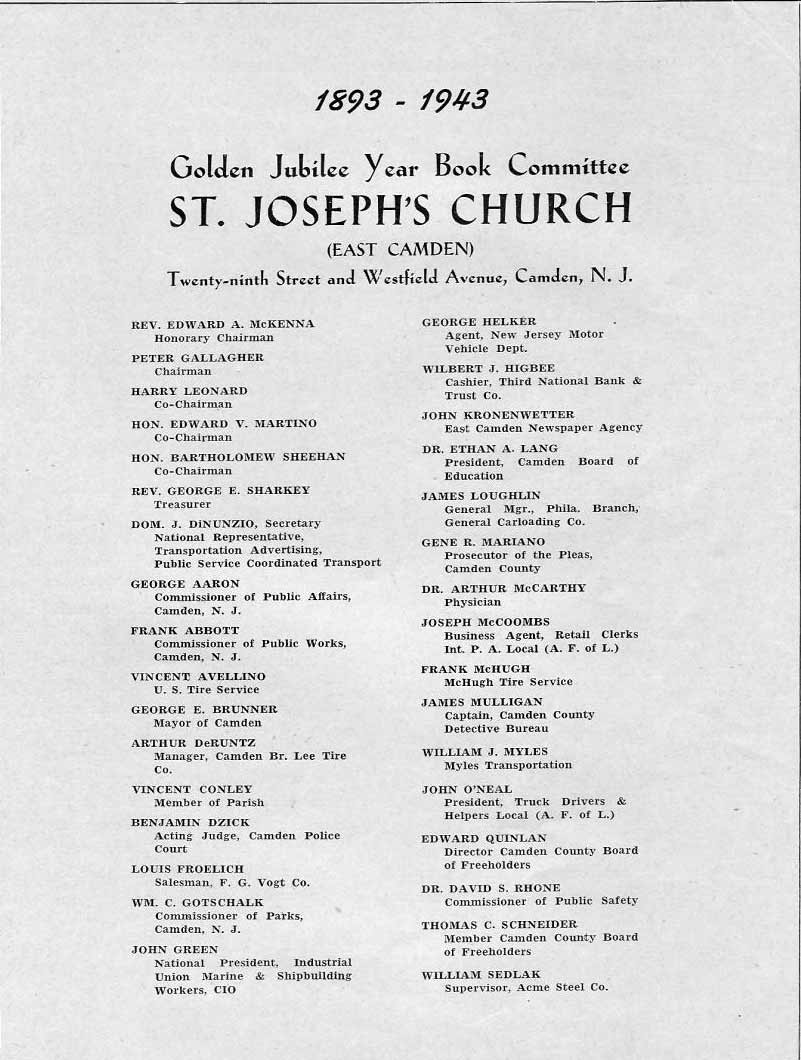
1893 - 1943
ST. JOSEPH’S CHURCH
(EAST CAMDEN)
Twenty-ninth Street and Westfield Avenue, Camden, N. J.
REV. EDWARD A. McKENNA
Honorary Chairman
PETER GALLAGHER
Chairman
HARRY LEONARD
Co-Chairman
HON. EDWARD V. MARTINO
Co-Chairman
HON. BARTHOLOMEW SHEEHAN
Co-Chairman
REV. GEORGE E. SHARKEY
Treasurer
DOM. J. DiNUNZIO, Secretary
National Representative, Transportation Advertising, Public Service Coordinated Transport
GEORGE AARON
Commissioner of Public Affairs, Camden, N. J.
FRANK ABBOTT
Commissioner of Public Works, Camden, N. J.
VINCENT AVELLINO
U. S. Tire Service
GEORGE E. BRUNNER
Mayor of Camden
ARTHUR DeRUNTZ
Manager, Camden Br. Lee Tire Co.
VINCENT CONLEY
Member of Parish
BENJAMIN DZICK
Acting Judge, Camden Police Court
LOUIS FROELICH
Salesman, F. G. Vogt Co.
WM. C. GOTSCHALK
Commissioner of Parks, Camden, N. J.
JOHN GREEN
National President, Industrial Union Marine & Shipbuilding Workers, CIO
GEORGE HELKER
Agent, New Jersey Motor Vehicle Dept.
WILBERT J. HIGBEE
Cashier, Third National Bank & Trust Co.
JOHN KRONENWETTER
East Camden Newspaper Agency
DR. ETHAN A. LANG
President, Camden Board of Education
JAMES LOUGHLIN
General Mgr., Phila. Branch, General Carloading Co.
GENE R. MARIANO
Prosecutor of the Pleas, Camden County
DR. ARTHUR McCARTHY
Physician
JOSEPH McCOOMBS
Business Agent, Retail Clerks Int. P. A. Local (A. F. of L.)
FRANK McHUGH
McHugh Tire Service
JAMES MULLIGAN
Captain, Camden County Detective Bureau
WILLIAM J. MYLES
Myles Transportation
JOHN O’NEAL
President, Truck Drivers & Helpers Local (A. F. of L.)
EDWARD QUINLAN
Director Camden County Board of Freeholders
DR. DAVID S. RHONE
Commissioner of Public Safety
THOMAS C. SCHNEIDER
Member Camden County Board of Freeholders
WILLIAM SEDLAK
Supervisor, Acme Steel Co.
History of the City of Camden
St. Joseph's Roman Catholic Church Golden Jubilee Year Book — 1943
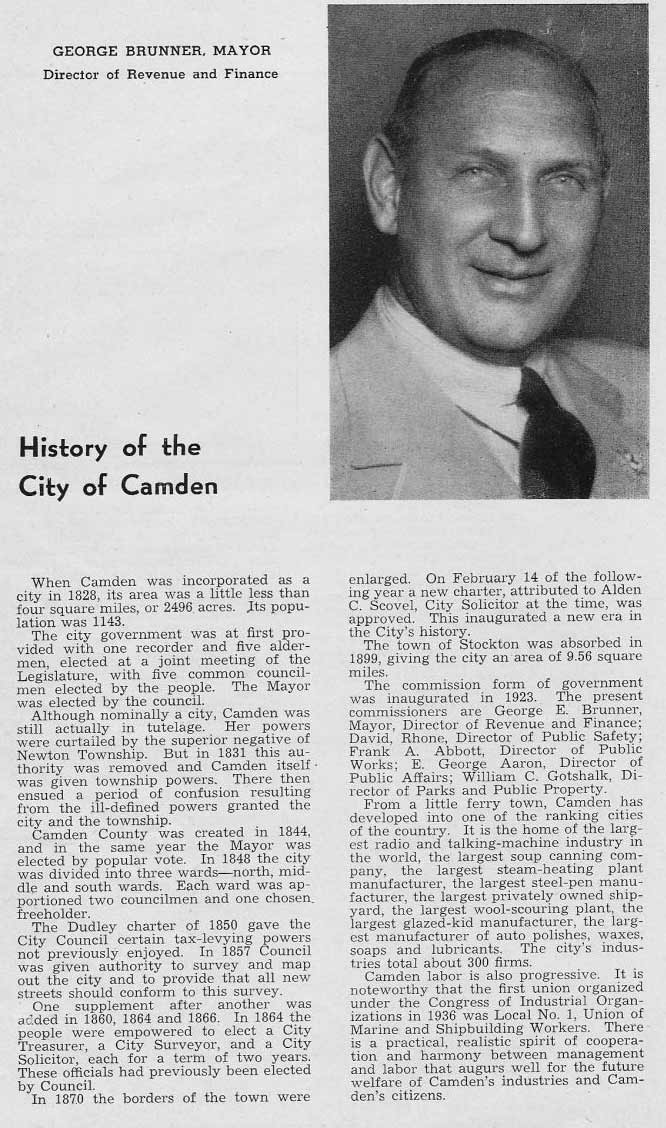
GEORGE BRUNNER, MAYOR
Director of Revenue and Finance
When Camden was incorporated as a city in 1828, its area was a little less than four square miles, or 2496 acres. Its population was 1143.
The city government was at first provided with one recorder and five aldermen, elected at a joint meeting of the Legislature, with five common councilmen elected by the people. The Mayor was elected by the council.
Although nominally a city, Camden was still actually in tutelage. Her powers were curtailed by the superior negative of Newton Township. But in 1831 this authority was removed and Camden itself was given township powers. There then ensued a period of confusion resulting from the ill-defined powers granted the city and the township.
Camden County was created in 1844, and in the same year the Mayor was elected by popular vote. In 1848 the city was divided into three wards—north, middle and south wards. Each ward was apportioned two councilmen and one chosen freeholder.
The Dudley charter of 1850 gave the City Council certain tax-levying powers not previously enjoyed. In 1857 Council was given authority to survey and map out the city and to provide that all new streets should conform to this survey.
One supplement after another was added in 1860, 1864 and 1866. In 1864 the people were empowered to elect a City Treasurer, a City Surveyor, and a City Solicitor, each for a term of two years. These officials had previously been elected by Council.
In 1870 the borders of the town were enlarged. On February 14 of the following year a new charter, attributed to Alden C. Scovel, City Solicitor at the time, was approved. This inaugurated a new era in the City’s history.
The town of Stockton was absorbed in 1899, giving the city an area of 9.56 square miles.
The commission form of government was inaugurated in 1923. The present commissioners are George E. Brunner, Mayor, Director of Revenue and Finance; David, Rhone [sic], Director of Public Safety; Frank A. Abbott, Director of Public Works; E. George Aaron, Director of Public Affairs; William C. Gotshalk, Director of Parks and Public Property.
From a little ferry town, Camden has developed into one of the ranking cities of the country. It is the home of the largest radio and talking-machine industry in the world, the largest soup canning company, the largest steam-heating plant manufacturer, the largest steel-pen manufacturer, the largest privately owned shipyard, the largest wool-scouring plant, the largest glazed-kid manufacturer, the largest manufacturer of auto polishes, waxes, soaps and lubricants. The city’s industries total about 300 firms.
Camden labor is also progressive. It is noteworthy that the first union organized under the Congress of Industrial Organizations in 1936 was Local No. 1, Union of Marine and Shipbuilding Workers. There is a practical, realistic spirit of cooperation and harmony between management and labor that augurs well for the future welfare of Camden’s industries and Camden’s citizens.
Camden City Commissioners
St. Joseph's Roman Catholic Church Golden Jubilee Year Book — 1943
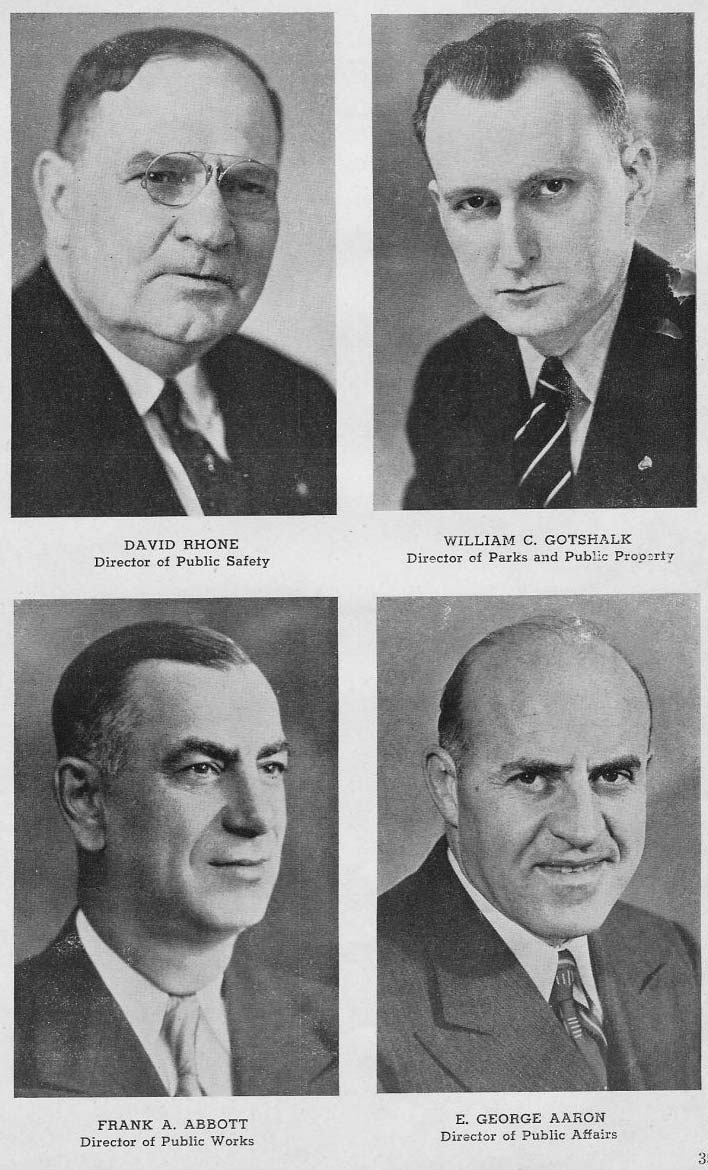
DAVID RHONE
Director of Public Safety
WILLIAM C. GOTSHALK
Director of Parks and Public Property
FRANK A. ABBOTT
Director of Public Works
E. GEORGE AARON
Director of Public Affairs
Chief Colsey Dies at 67 of Heart Attack
Camden Courier-Post —
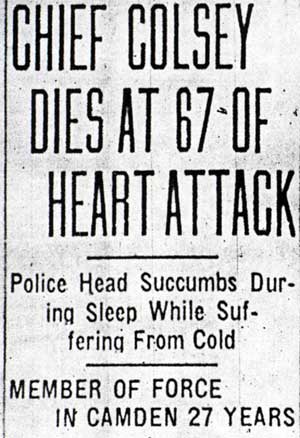
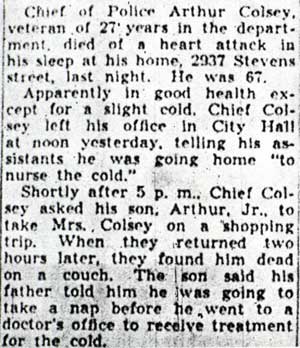
Police Head Succumbs During Sleep While Suffering From Cold
MEMBER OF FORCE IN CAMDEN 27 YEARS
Chief of Police Arthur Colsey, veteran of 27 years in the department, died of a heart attack in his sleep at his home, 2937 Stevens street, last night. He was 67.
Apparently in good health except for a slight cold, Chief Colsey left his office in City Hall at noon yesterday, telling his assistants he was going home “to nurse the cold.”
Shortly after 5 p. m., Chief Colsey asked his son, Arthur, Jr., to take Mrs. Colsey on a shopping trip. When they returned two hours later, they found him dead on a couch. The son said his father told him he was going to take a nap before he went to a doctor’s office to receive treatment for the cold.
Chief Colsey was a Camden merchant before entering the police department. For years he was active in the Republican party. He was highly respected by all men in the department. The chief was quiet in manner and the excitement pertaining to strikes in the city a few years ago found him calm in the most delicate situations.
Born in Kidderminster, England, in December, 1872, he came to this country when 17. He was in the department store business with his brothers at Ninth and Market streets for years. He served in the old City Council from 1907 to 1911 from the Second ward. At that time he lived at Eighth and Linden streets.
Joined Force in 1912
Colsey was appointed a patrolman by former Mayor Charles H. Ellis on March 13, 1912, while Elisha A. Gravenor was chief. After several months as a street patrolman he was assigned to the First District patrol wagon. Then he was made a district detective. Next he was promoted to a full ranking detective under Detective Chief William Schregler.
After being appointed a detective he was assigned as a plainclothesman and secretary to Mayor Ellis. He served in this capacity seven years. In 1923 he was appointed chief clerk of the police department with the rank of captain.
In 1924 he was made chief of the vice squad, which made 380 raids for prohibition law violations. The squad also assisted the federal authorities in 180 more liquor raids and participated in 54 raids on disorderly houses and 38 gambling places.
In 1927 the City Commission abolished the rank of captain in the department and Colsey remained as chief clerk without the title. The rank of captain was restored to him by the City Commission in 1932 by motion of Commissioner David S. Rhone.
When former Chief John W. Golden retired on a pension on June 11, 1934, Colsey was named acting chief by Mayor Roy R. Stewart. He was named permanent chief on August 30, 1934, by Mayor Stewart. At the same time John H. Lennox was named permanent chief of the fire department.
During the absence of City Commissioner Mary W. Kobus, director of public safety, Chief Colsey was acting director.
Colsey was one of the most popular men who served as chief, both in his department and in civic and political circles. After he was made a full ranking captain in 1932 a series of testimonial dinners were given by the East End Republican League, Twelfth Ward Republican Club and Eleventh Ward Republican Clubs. He was boomed for chief at each of the dinners. Another testimonial was given when he was acting chief by the Camden Police and Firemen’s Association.
In February, 1931, his appointment as chief was urged to succeed Chief Lewis H. Stehr but Golden was named.
While a resident of North Camden he served as president of the Second Ward Republican Club. He was president of the Twelfth Ward Republican Club in 1932.
Prominent Lodgeman
Chief Colsey was a thirty-second degree Mason, being a member of Trimble Lodge, No. 117, Free and Accepted Masons; Crescent Temple, Nobles of the Mystic Shrine, and Camden Forest, No. 5, Tall Cedars of Lebanon. He also was a member Camden Lodge, No. 293, Benevolent and Protective Order of Elks; Camden Lodge, No. 111, Loyal Order of Moose; Camden Aerie, No. 65, Fraternal Order of Eagles; Sons of St. George, Foresters of America, Improved Order of Red Men, Camden Local, Patrolmen’s Benevolent Association; International Police Chiefs’ Association, New Jersey State Police Chiefs’ Association, Camden Police and Fire Association, and the Camden County Republican Association.
Coroner Ernest Larossa issued the death certificate due to a heart ailment.
The funeral will be held at 2 p. m., Wednesday with burial in Arlington Cemetery. Other arrangements have not been completed. The body will be on view from 7 to 9 p. m., Tuesday at the home.
The chief is survived by his widow, Lillie; a brother, Thomas Colsey, a merchant and ranking officer of the Loyal Order of Moose; and two grandchildren, Arthur Colsey, 3rd., and Lillian Colsey. The grandson, a student at Western Maryland College, was notified last night of his grandfather’s death and left immediately for Camden.