Introduction
Albert S. Shaw was the son of former City Marshal Edmund Shaw and his second wife, the former Catherine Biddle. Edmund Shaw’s first wife, Frances, had died in 1850, leaving him with four children. Edmund Shaw and family were living in South Camden as early as 1850. The elder Shaw, who appears in records at time as (Edward, Edwin, and Edmond) was a carpenter by trade. In 1859 he was elected to a one-year term as City Marshal, the equivalent of Chief of Police. He later served as a Justice of the Peace. Albert Shaw’s half-brother, also named Edmund Shaw, was an original member of the Camden Fire Department, serving from 1872 until 1881, much of it as the driver of Engine Company 1. Camden City Directories from 1863 to 1874 show Edmund Shaw at 312 Pine Street. Edmund Shaw and his family begin appearing at 311 Division Street in Camden City Directories in 1876, and maintained a presence at that address until 1913.
Not long after the 1880 Census, Albert Shaw married Louisa Yeager. The young couple lived with Louisa’s parents, Louisa and Sophia Yeager. Three children came in short order, Alice, Louis, and Emma. Sadly, Louisa Yeager Shaw passed away on December 12, 1893. It had been a hard year, as Albert Shaw’s brother, Edmund Shaw, drowned when his boat capsized in the Delaware River off Gloucester on August 6, 1893. Albert Shaw’s children went to live with Louisa’s sister at 318 Sycamore Street. Albert Shaw moved to 311 Division Street where his brother William Shaw lived with his wife and children. He stayed at that address until 1899. One member of the Shaw family or another lived at 318 Sycamore Street or at 322 Sycamore Street until 1927.
Albert Shaw was appointed to the Camden Police Department on April 16, 1894 during the administration of John L. Westcott. His excellent record of service kept him working through the years when policemen were hired and fired according to which party was in power at the time.
Albert Shaw married Mary Ellis on October 9, 1894 at Union Methodist Episcopal Church in Camden. He was 34, she was 22. The Shaws made their home as early as 1896 at 328 Pine Street. Albert Shaw’s son Louis and daughter Alice came to live with them not long after the 1900 Census.
Albert Shaw’s marriage did not work out, as Mrs. Shaw left her husband, then sued for divorce. The divorce was not granted, but the couple does not appear to have reconciled. Albert Shaw remained at 328 Pine Street into 1904, then moved in with his brother William at 311 Division Street, his son Louis stayed at 328 Pine Street into 1906. Albert Shaw stayed at 311 Division Street as late as 1913. The 1914 City Directory lists him at 218 Mt. Vernon Street, and he is listed at 319 Mt. Vernon Street from 1915 to the fall of 1918.
Much of Albert Shaw’s career as a policeman was spent working the area around the Kaighn Avenue Ferry, not all that far from his home. Albert Shaw retired on pension on August 1, 1917.
On August 10, 1917 it was reported that Albert Shaw’s son, Louis Shaw, a member of the Camden Fire Department, had transferred over to the Police Department. Louis Shaw served until retiring in 1944, much of it as a detective, and was one of Camden’s best-known and most effective detectives in his day. Albert Shaw’s nephew, John P. Shaw, had also served with the Camden Fire Department, from 1916 to 1920 before moving to Haddon Heights where he served for 23 years with the Haddon Heights Police Department. Another nephew, Charles H. Elfreth, worked 43 years in Camden’s city government, for the most part in the tax office.
The 1920 Census shows Albert Shaw, retired, living at 864 Mt. Ephraim Avenue with his daughter, Mrs. Sadie Tenner, son-in-law George Adam Tenner, and granddaughter Alberta Tenner. George Adam Tenner was the son of former Camden Fire Department member Christian Tenner. They all were at that same address in April of 1930. Not long after the Census, Albert Shaw moved in with his son Louis Shaw at 1437 Kaighn Avenue, where he lived out his days.
Albert Shaw passed away on February 25, 1933. He had been ill for the past two months.
Albert Shaw’s great-nephew, Second Lieutenant John P. Shaw Jr., was killed in France when the plane he was co-pilot of collided with an RAF plane on July 18, 1944.
The Mayor Names
Camden Post —
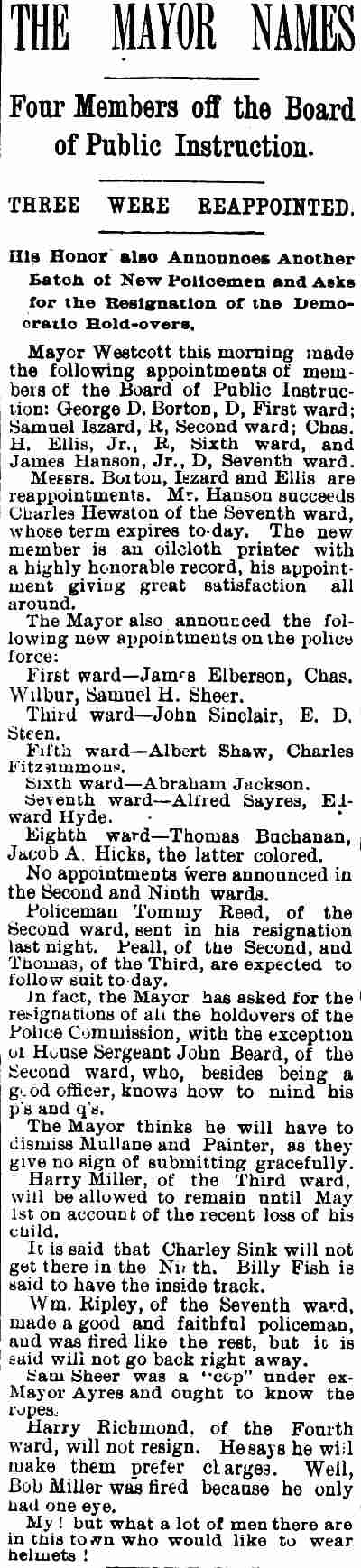
Mayor Westcott this morning made the following appointments of members of the Board of Public Instruction: George D. Borton, D, First ward; Samuel Iszard, R, Second ward; Chas. H. Ellis, Jr., R, Sixth ward, and James Hanson, Jr., D, Seventh ward.
Messrs. Borton, Iszard and Ellis are reappointments. Mr. Hanson succeeds Charles Hewston of the Seventh ward, whose term expires to-day. The new member is an oilcloth printer with a highly honorable record, his appointment giving great satisfaction all around.
The Mayor also announced the following new appointments on the police force:
First ward—James Elberson, Chas. Wilbur, Samuel H. Sheer. Third ward—John Sinclair, E. D. Steen. Fifth ward—Albert Shaw, Charles Fitzsimmons. Sixth ward—Abraham Jackson. Seventh ward—Alfred Sayres, Edward Hyde. Eighth ward—Thomas Buchanan, Jacob A. Hicks, the latter colored.
Policeman Tommy Reed, of the Second ward, sent in his resignation last night. Peall, of the Second, and Thomas, of the Third, are expected to follow suit to-day.
In fact, the Mayor has asked for the resignations of all the holdovers of the Police Commission, with the exception of House Sergeant John Beard, of the Second ward, who, besides being a good officer, knows how to mind his p’s and q’s.
The Mayor thinks he will have to dismiss Mullane and Painter, as they give no sign of submitting gracefully.
Harry Miller, of the Third ward, will be allowed to remain until May 1st on account of the recent loss of his child.
It is said that Charley Sink will not get there in the Ninth. Billy Fish is said to have the inside track.
Wm. Ripley, of the Seventh ward, made a good and faithful policeman, and was fired like the rest, but it is said will not go back right away.
Sam Sheer was a “cop” under ex-Mayor Ayres and ought to know the ropes.
Harry Richmond, of the Fourth ward, will not resign. He says he will make them prefer charges. Well, Bob Miller was fired because he only had one eye.
My! but what a lot of men there are in this town who would like to wear helmets!
The Mayor’s Appointments
Camden Daily Telegram —

COMMISSIONERS OF INSTRUCTION.
The Old Members Re-Instated With the Exception of the Member From the Seventh Ward—Police Appointments and Resignations.
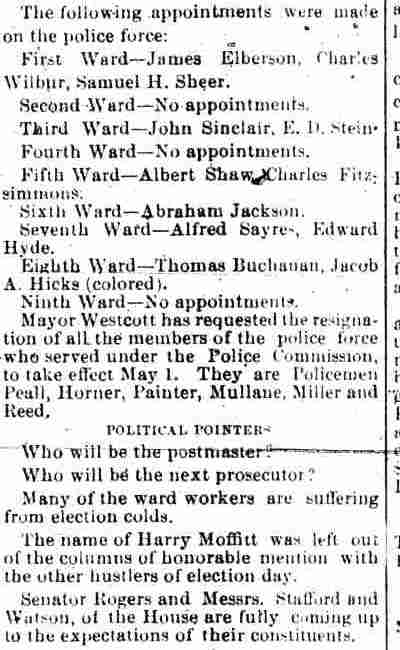
Mayor Westcott made the following appointments as Commissioners of Instruction: First Ward—George D. Borton; Sixth Ward—Chas. H. Ellis, Jr.; Seventh Ward—James Hanson, Jr.
The following appointments were made on the police force:
First Ward—James Elberson, Charles Wilbur, Samuel H. Sheer. Second Ward—No appointments. Third Ward—John Sinclair, E. D. Stein. Fourth Ward—No appointments. Fifth Ward—Albert Shaw, Charles Fitzsimmons. Sixth Ward—Abraham Jackson. Seventh Ward—Alfred Sayres, Edward Hyde. Eighth Ward—Thomas Buchanan, Jacob A. Hicks (colored). Ninth Ward—No appointments.
Mayor Westcott has requested the resignation of all the members of the police force who served under the Police Commission, to take effect May 1. They are Policemen Peall, Horner, Painter, Mullane, Miller and Reed.
POLITICAL POINTERS.
Who will be the postmaster?
Who will be the next prosecutor?
Many of the ward workers are suffering from election colds.
The name of Harry Moffitt was left out of the columns of honorable mention with the other hustlers of election day.
Senator Rogers and Messrs. Stafford and Watson, of the House, are fully coming up to the expectations of their constituents.
If the Mayor could arrange it to hold his hearings a trifle earlier it would be a great source of satisfaction to the Camden afternoon papers.
There is still great anxiety on the part of the public as to the outcome of the present session of the legislature. Thus far their public acts have been highly commendable.
The abolishment of the Police Justice act restores to office the City Recorder, Benjamin M. Braker, who would be qualified to act in place of the Mayor should the Chief Executive be taken sick.
Jos. Potter, the new member of Council from the First ward, is a man of wide business experience and will prove much advantage to the many large financial interests that will come under his care.
Owing to the satisfactory working of the present school commission in the two second-class counties up the State, the legislature made no change in the mode of placing the members as was anticipated.
Jos. B. Fox, of the Fourth ward, is what might be termed an old reliable, having had a long and varied experience in public affairs. He is always conservative in the expenditure of city money. He is always safe to trust.
Charles Sayrs, of the Seventh ward, who had a short experience in the present Council, but enough to make him feel at home among public affairs, is neck and ears in work between his real estate business and Councilmanic duties.
The colored people of the lower section of the city are anxious to see Squire Drake, the ex-Republican and ex-member of the School Board, come out of the Court House, where he holds a position under the Thompson Freeholders.
“Father” Figner is a proud sire. He was a member and president of Council in his days, and now sees his son treading in his footsteps. Mr. Figner, Jr., having been sent to Council from the Sixth ward on Tuesday by a large majority.
A special election will not be necessary for the new Board of Freeholders, as the City Council and Township Committees will appoint Freeholders who will serve until the Spring of 1895. The appointments will be made about the middle of May.
Arthur Bedell is spoken of as a candidate for the presidency of the new City Council. He is a stalwart and is never afraid to define his position on all public questions. He is one of those men who makes strong, warm friends and also creates an opposition of like force.
William D. Brown, the Secretary of the Board of Education, and Fred A. Rex, Treasurer, are quite pleased over the report of the committee on accounts and Expert O’Shaughnessy, they having examined the books of Messrs. Rex and Brown and found them correctly kept.
The library of the Camden public schools is one to be highly appreciated and much is due to the care with which Miss Blowe the librarian has attended to her duties. She will hold over another year and should be allowed to retain the office as long as she merits it, and she surely does now.
J. R. Carson, the retiring member of Council from the First ward, is highly spoken of by his associates on committees and by Clerk Varney for the mature judgment displayed in the management of city affairs. It is with a general expression of regret that the city is to lose his service.
The reform in the Board of Freeholders can’t come too soon. If the public is to judge of the care of property given by the Democrats in the county, by the “hog combine” in this city, an inventory of the public property when turned over will make interesting reading. Ex-officials guarantee to save enough in the Board, if returned to their offices, to pay the expense of a special election, if one was necessary.
W. J. Bradley has been asked if he was a candidate for president of the new City Council. His reply was that he had not sought it in the first place, and would not seek it now, but whether he became president or remained merely a member on the floor, he would endeavor to discharge his duties in the interests of the city. He is commended by all who came in contact with him during the past year as one who had a new Camden at heart.
Costly Shots in a Cemetery
Philadelphia Inquirer —
Three men were shooting game at Harleigh Cemetery, Camden, yesterday, when Police Lieutenant Foster and Policeman Shaw pounced upon them. They resisted, but were subdued by the officers’ revolvers. Their game bags contained thirty-seven birds and a gray squirrel.
The prisoners gave the names of Joseph and Philip Demarko and Nicholas Walpa, and said they were Philadelphia peddlers. Game Warden James Hunt made a charge against them of killing nine robbins and a gray squirrel out of season. Joseph Demarko was fined $60 and costs and Philip Demarko and Nicholas Walpa were each fined $40 and costs.
The Rule Dismissed
Camden Post —

To Cause Pensauken Saloon Keepers to Show Cause.
THE CHEMICAL CASE GOES OVER
On Representation Made of Efforts to Abate the Nuisance. More Time Wanted on Policy Cases.
Judge Wescott in a liquor case over a rule to show cause why certain liquor licenses will be revoked. He immediately dismissed the rule to show cause in the case of William Townsman. Fred A. Rex representing all the liquor companies filed a bill in Quarter Sessions Court. Judge Wescott ruled that the court had no jurisdiction in the matter and did not adopt a certain course to pursue. He moved that the rule be put off for the affidavit to take into consideration and allowed no less than thirty days for an opportunity to counsel regarding the motion to abide the nuisance.
Judge Wescott, who has recently assumed his place on the bench, took the affidavits under consideration and allowed no less than thirty days for an opportunity to give a firm which gave ample opportunity to counsel regarding the motion.
The jury in the case of Washington Kettline charged with writing policy, last evening returned a verdict of guilty.
Charles Gilbert was placed on trial on a similar charge. Policeman Shaut testified that on May 3 last, he arrested Gilbert on a warrant in a house in Locust street, between Spruce and Division streets. A rubber stamp and some other policy paraphernalia were on a table, but he did not know to whom it belonged.
The jury after several hours’ deliberation, returned a verdict of not guilty.
The Rule Dismissed
Camden Daily Telegram —
Ketline Convicted Again But Gilbert Escapes.
JUDGES DID NOT SEEM TO AGREE
Members of the Court Held an Animated Whispered Discussion on the Bench and Then Re-opened the Case.
A trial of the policy cases in the Criminal Court yesterday afternoon was not without exciting incidents. When the case of Washington Ketline was called, Charles Stell, who was employed by the Woman’s Christian Temperance Union to secure evidence, testified that he bought a slip from the defendant on August 22, 1895, in a room over McKenna’s saloon on North Front street.
The witness was shown a slip, which he identified as the one he purchased from Ketline on that day. The identification was made, he said, by the words “white dog row, ten cents,” written on it. Stell said he had bought slips from Ketline several times.
On the stand Ketline said he had not engaged in policy dealing since convicted in April, 1895. He said he had been convicted twice. Once he was fined $100 and another time the case was taken to the Supreme Court, where it is now pending. Ex-Judge Wescott, counsel for Ketline, scored the prosecuting witnesses in summing up the case. “If there ever was a person plastered all over with crime and dishonor,” said ex-Judge Wescott, “it is that man. He should be tarred and feathered and sent to the North Pole or some other place capable of producing such a scamp.”
The ex-Judge accused Stell of writing the slip himself.
Ketline was promptly convicted.
The most interesting case was that next tried. Charles Gilbert, who was indicted under the new act of 1894, known as the “Storrs Law,” which makes it a felony, punishable by imprisonment of not less than one or more than five years, to have in one’s possession any of the paraphernalia of the game of lottery policy. Gilbert’s base of operation was an alleged cigar store in Locust street. Policeman Shaw was the only witness.
Shaw had forced his way into a rear room of the shop and found Gilbert hustling into the drawer of a table at which he sat a lot of the paraphernalia of the game, which was produced in evidence. The State brought no testimony to show that these articles really constituted a policy layout, and Law Judge Vroom said if that was all the evidence there was in the case it would have to be dismissed.
There was instant hubbub. Counselor Wescott smiled his broadest smile. Lay Judge Burdsall’s face looked like a thundergust as he leaned over to Law Judge Vroom. Lay Judge McDowell whispered excitedly, and all three got into an animated discussion which seemed to reach no satisfactory conclusion. Lay Judge Burdsall’s displeasure was so apparent as he drew away and elevated his head in the air that no spectator was in doubt as to the purport of the heated discussion. At length Law Judge Vroom said the State might reopen its case. Counselor Wescott demurred. Assistant Prosecutor Carson hurriedly conferred with Lay Judge Burdsall and then ran down to Policeman Shaw, who sat in the bar inclosure. Then Shaw got on the stand and said he had arrested Gilbert on a warrant, and that when he entered the place a colored man was quarrelling with Gilbert over the latter’s failure to pay a “hit.” Counselor Wescott objected and got an exception. Then Prosecutor Jenkins made a speech; Counselor Wescott made another, and Assistant Prosecutor Carson had his say.
Law Judge Vroom explained the law and told a jury who asked “if a man had to be ketched” in the act of selling that under the law it was only necessary to prove that the defendant had the paraphernalia in his possession. The jury was apparently ignorant of the game and were unwilling to believe that the mass of slips, numbers, carbon sheets and other articles were policy articles, for about supper time they returned a verdict of not guilty.
Ex-Judge Wescott this morning asked for a postponement of the other policy cases until later in the term so that counsel might have time to prepare their defense. He presented a sworn affidavit made by himself stating that last night he received information which he believes to be true that the written evidence, or policy slips which the State proposes to introduce against Mrs. Harriett Smith, Mrs. Susan Kinsey, Willoughby Fields, Archie Clark, Edward Bassett and Harry Drake are forgeries. The affidavit further states that he has examined these slips and that they bear evidence of being forgeries, but that he desires to have them examined by experts.
The cases were adjourned until next Thursday. The slips will be examined in the County Clerk’s office in the presence of representatives of both the State and the defendants.
Ex-Judge Wescott was also granted a rule to show cause why a new trial should not be granted in the case of Washington Ketline.
Probing Camden Tragedies
Philadelphia Inquirer —
Probing Camden Tragedies
PROBING CAMDEN TRAGEDIES
Grand Jury Investigating the Zane-Shaw Murders.
The Camden grand jury yesterday took up the charge against Eli Shaw of murdering his mother and grandmother. Among the witnesses examined were County Physician Jones, Dr. Marcus Mines, Police Lieutenants Foster and Pettit, Policemen Steen, Shaw, Sinclair and Painter, Charles and Alonzo Lane and Coroner Lippincott. The case will be continued to-day, as over a dozen witnesses are yet to be heard.
George Mordecai, who keeps a cigar store in Camden, was arraigned in the Camden Court yesterday. He pleaded not guilty and said he would not want counsel.
Swinging the Ax on Camden Police
Philadelphia Inquirer —
SWINGING THE AX ON CAMDEN POLICE
SWINGING THE AX ON CAMDEN POLICE
Charges Preferred Against Chief Dodd and Fifteen of His Men
REFORMERS AGRESSIVE
Experts to Be Put on Accounts of Commission of Public Instruction
The official heads of Camden policemen will begin to fall in a few days. Charges have been made against sixteen members of the force, including Chief Dodd. The accused officers will be given hearings this evening and to-morrow afternoon.
A copy of the charges against Chief Dodd was served on that official last night. It is charged that he neglected to raid a "speak-easy" at 108 South Second street. Michael Flemming makes the charge.
The officers accused are William Comley, First ward; Edward Powell and Richard Golden, Second ward; John Sinclair, William Selby, Edward Hartman and Albert Meyers, Third ward; Ralph Bond, Jules Bosch and Caleb Williams, Fourth ward; Alfred Shaw, Fifth ward, and Jacob A. Hicks, Eighth ward.
Sinclair and Bosch are charged with working for the Republican ticket on last election day, Hartman and Meyers are accused of assaulting a man named Shears, and Caleb Williams is charged with insubordination.
The charges against Bond are brought by ex-Policeman Isaac Shreve, who accuses him of deserting his beat and sleeping in the postoffice. Selby is accused of using profane language.
The hearings of Chief Dodd and Policeman Hartman will be held to-morrow afternoon. The others will be given a hearing this evening.
The policemen cannot be discharged without a vote of a majority of City Council.
The official heads of Camden policemen will begin to fall in a few days. Charges have been made against sixteen members of the force, including Chief Dodd. The accused officers will be given hearings this evening and to-morrow afternoon.
A copy of the charges against Chief Dodd was served on that official last night. It is charged that he neglected to raid a “speak-easy” at 108 South Second street. Michael Flemming makes the charge.
The officers accused are William Comley, First ward; Edward Powell and Richard Golden, Second ward; John Sinclair, William Selby, Edward Hartman and Albert Meyers, Third ward; Ralph Bond, Jules Bosch and Caleb Williams, Fourth ward; Alfred Shaw, Fifth ward, and Jacob A. Hicks, Eighth ward.
Sinclair and Bosch are charged with working for the Republican ticket on last election day, Hartman and Meyers are accused of assaulting a man named Shears, and Caleb Williams is charged with insubordination.
The policemen cannot be discharged without a vote of a majority of City Council.
Monday Round Up in Police Court
Camden Daily Telegram —
Variety of Prisoners Before Recorder Nowrey’s Bar.
PRIVATE HEARING FOR “DE CLUB”
Eight Blacks and One White Landed in a Sunday Morning Raid—Cries of “Murder” in Joint Alley Led to an Arrest.
Early yesterday morning Police Sergeant Bentley, with a squad of officers, including Matlack, Roach, Weaver, Shaw, Harvey and Moore, raided an alleged speak-easy and gambling resort on Division street, near Locust. When the officers entered the room they found tacked up on the wall in a conspicuous place a charter for the “Independent Athletic Club.” The charter was issued some time ago to a party of white men, and how it came into possession of the eight colored and one white man arrested in the raid the police are endeavoring to find out. In addition to the charter the police found a deck of cards, some poker chips, cards of admission to the alleged club, four boxes of beer, two bottles of whiskey and a supposed “kitty” containing 48 cents.
The men arrested were Abraham Briscoe, colored, the alleged proprietor, Walter H. Chase, Edward Lewis, John Miller, Ben Bunston, Edward Fortie, and Jacob Granger, colored, and Herbert Weaver, white. All were examined in the Mayor’s private office, by the Recorder this morning, and as a result Briscoe was held for a further hearing on a charge of selling liquor without a license, while the others were held as witnesses in their own recognizance.
Camden Patrolman Hart Killed By Freight Car
Philadelphia Inquirer —
In Police Dragnet
IN POLICE DRAGNET
Successful Raid on an Alleged Pool Room in Camden
SEVEN MEN CAPTURED
Keefer, Who Says He Spent His Employers’ Money in the Place, Identifies the Prisoners
The Camden police yesterday raided the alleged poolroom at 25 South Third street, where Walter H. Keefer, former manager of the Merchantville Light and Power Company, claims he lost $254 belonging to his employers. Seven men were captured in the raid, including W. Harry Getty and Charles Metz, who were committed in default of $1500 bail each as principals. The others were James Boone, of Fourth and Benson streets; George Armstrong, Charles Loriaux, George Smith and Victor Thompson.
The police for months past have been trying to get evidence against this alleged poolroom. The place was so closely guarded that the officers could not get direct evidence that the law was being violated. Mayor Hatch, City Counsel Bleakly and Councilman Silvers, of the Third ward, were interested spectators.
City Detective Hart was the first witness. He said he swore out the warrant for the raid from information obtained from Keefer. Keefer, the star witness, was next called. He pointed out Metz as the man who operated the “ticker,” collected the bets and paid the winnings. W. Harry Getty guarded the door and scrutinized every one who applied for admission.
Police Captain Boyle testified that he made the raid, assisted by City Detective Hart and Officers Painter, Shaw, Robert Miller and George Anderson. When they knocked Getty opened the front door just enough to peer out at them. A chair prevented the door from being opened wide. The warrant was read, but Getty refused to admit them. They then broke the chair and forced an entrance.
Rushing up stairs they found the door to the third-story back room barred. They forced the door and found themselves in what appeared to be a furnished bedroom. Wires ran through a rear window, but there was no telegraph instrument or other evidence of a poolroom. A locked box was found on the mantelpiece in the front room. The “jewelry” consisted of the missing telegraph “ticker.”
Policeman Shaw said that Loriaux told him the wires were cut and the “ticker” carried over into the front room while the police were coming up the stairs. Officers Painter and Anderson gave corroborative testimony.
Charles Loriaux swore that he had been in the place only eight minutes when the police swooped down on it. He admitted telling Officer Shaw that the “ticker” was hustled out of the room when they heard the police trying to get in. George Armstrong admitted having been in the pool room before. James Boone claimed he went there to hear the result of a handicap race at Lexington.
George Smith swore that he went there to hear the results of horse races. He admitted that he had bought pools there before.
Chief of Police Foster stated last evening that one of the reasons for the dismissal of Police Captain H. Frank Pettitt was that Getty’s place on South Third street was in his district and he failed to suppress it or secure evidence on which a raid could be made. That there is war to the death between the police and the policy dealers was shown yesterday by a bold retaliatory move of Washington Ketline, who brought suit for damages against Policemen Henry Miller and Isaac Brown.
Early yesterday morning Police Sergeant Bentley, with a squad of officers, including Matlack, Roach, Weaver, Shaw, Harvey and Moore, raided an alleged speak-easy and gambling resort on Division street, near Locust. When the officers entered the room they found tacked up on the wall in a conspicuous place a charter for the “Independent Athletic Club.” The charter was issued some time ago to a party of white men, and how it came into possession of the eight colored and one white man arrested in the raid the police are endeavoring to find out. In addition to the charter the police found a deck of cards, some poker chips, cards of admission to the alleged club, four boxes of beer, two bottles of whiskey and a supposed “kitty” containing 48 cents.
The men arrested were Abraham Briscoe, colored, the alleged proprietor, Walter H. Chase, Edward Lewis, John Miller, Ren Bunaton, Edward Fortie, and Jacob Granger, colored, and Herbert Weaver, white. All were examined in the Mayor’s private office, by the Recorder this morning, and as a result Briscoe was held for a further hearing on a charge of selling liquor without a license, while the others were held as witnesses in their own recognisance.
Evil Doers Quake
Philadelphia Inquirer —

Evil Doers Quake
EVIL DOERS QUAKE
Mayor Hatch, of Camden, Starts in to Wipe Out Speak-Easies
FIRST RAID A SUCCESS
Fines Imposed by Recorder Nowrey for Operating Gambling Machines. Sunday Sellers Hope to Escape
Mayor Cooper B. Hatch is making life miserable for evil doers in Camden. After waging relentless warfare on Sunday liquor sellers and seizing all the gambling machines in saloons and cigar stores, he is now clearing out speak-easies. The first raid was made yesterday afternoon, when Captain Stanley, Sergeant Hyde, Detective Painter and Policeman Shaw swooped down on Mrs. Mary Mahan's house, at 1062 South Front street. They found nearly enough liquor there to stock a saloon. There were two cases of bottled beer, five gallons of whisky, a large quantity of California wines, and other "wet" goods. This was all confiscated and was sent to the City Hall, together with Mrs. Mahan and a young girl.
For some time past Mayor Hatch's private detectives have been gathering evidence against speak-easies and disorderly houses in different parts of the city, and several more arrests will be made.
The saloonkeepers arrested about ten days ago for operating slot machines in their places were arraigned yesterday before Recorder Nowrey. Maurice Hertz, of Locust street and Kaighn avenue, was the first to be tried. He was represented by former Judge Howard Carrow. The complaints against Hertz charged him with operating nickel-in-the-slot gambling machines on July 2 and 9.
Harry Williams, one of Secretary Gibboney's detectives, who was employed in the recent Sunday liquor crusade, testified that he played "The Owl" in Hertz's saloon on July 9. He lost five cents on the red but hit the black and quit even. On cross-examination Williams refused to tell by whom he was employed, and Recorder Nowrey would not compel him to answer. Detective Fields swore that he was with Williams in Hertz's place, and also played the slot machine. Police Captain Stanley said he found four of the slot machines in Hertz's place when he made the raid.
At this point Judge Carrow moved to dismiss the complaint, as it was dated in the year "189." Decision was reserved, and the other complaint was taken up. Judge Carrow wanted this set aside on the ground that it did not specify the premises where the law was alleged to have been violated. Recorder Nowrey overruled the motion.
Detective Graper said he played the slot machine at Hertz's saloon on Sunday, July 2. On cross-examination he refused to give his address, but said he worked for Mayor Hatch. He didn't know, he said, whether he was on the city pay roll.
David B. Kaighn and other Kaighn avenue residents testified that they never saw slot machines in operation in Hertz's place, but had seen them standing in the office.
Hertz, in his own defense, said he was agent for the slot machines, and those found in his office were samples to be examined by prospective purchasers.
Recorder Nowrey sentenced Hertz to pay a fine of $50 and costs. Judge Carrow gave notice that he would appeal the case, but the Recorder refused to permit Hertz to depart without paying the fine.
Peter Kelly, of Eighth street and Ferry avenue, was also convicted and paid his fine.
John Keefe, of Haddon avenue and Carman street, and Marshall Hutchinson, of Ninth and Walnut streets, pleaded guilty and were fined $50 and costs each. There were about seven more cases, which Recorder Nowrey adjourned until next Wednesday.
The 130 saloonkeepers rounded up in the recent crusade against Sunday liquor selling were in high glee yesterday over the discovery of a law that they hoped would save them from punishment for their alleged misdoings. This law was passed in 1874, and makes it unlawful to prosecute any person by indictment for violations of the liquor laws in municipalities where city ordinances provide punishment for such offenses. As the Supreme Court has set aside the Camden excise ordinance, the saloonkeepers hoped to escape further prosecution.
City Counsel Bleakly, after looking up the matter yesterday, said: "A house in which the unlawful sale of liquors is habitually made is an indictable nuisance, although there is a city ordinance prescribing penalty for such sales. Such traffic is not only a breach of the city law, but is also forbidden by the State law." This decision was made by Judge Van Syckel in 1880, in the Court of Errors and Appeals, and was reaffirmed in 1888. It is now a State law.
The Excise Commission, at its regular meeting next Wednesday evening, will probably adopt a substitute ordinance against Sunday liquor selling to conform to the city charter, under the Supreme Court's decision setting aside the old ordinance.
Mayor Cooper B. Hatch is making life miserable for evil doers in Camden. After waging relentless warfare on Sunday liquor sellers and seizing all the gambling machines in saloons and cigar stores, he is now clearing out speak-easies. The first raid was made yesterday afternoon, when Captain Stanley, Sergeant Hyde, Detective Painter and Policeman Shaw swooped down on Mrs. Mary Mahan’s house, at 1062 South Front street. They found nearly enough liquor there to stock a saloon.
For some time past Mayor Hatch’s private detectives have been gathering evidence against speak-easies and disorderly houses in different parts of the city, and several more arrests will be made.
The saloonkeepers arrested about ten days ago for operating slot machines in their places were arraigned yesterday before Recorder Nowrey. Maurice Hertz, of Locust street and Kaighn avenue, was the first to be tried. He was represented by former Judge Howard Carrow. The complaints against Hertz charged him with operating nickel-in-the-slot gambling machines on July 2 and 9.
Harry Williams, one of Secretary Gibboney’s detectives, testified that he played “The Owl” in Hertz’s saloon on July 9. He lost five cents on the red but hit the black and quit even. On cross-examination Williams refused to tell by whom he was employed. Police Captain Stanley said he found four slot machines in Hertz’s place when he made the raid.
At this point Judge Carrow moved to dismiss the complaint, as it was dated in the year “189.” Decision was reserved, and the other complaint was taken up. Judge Carrow wanted this set aside on the ground that it did not specify the premises where the law was alleged to have been violated. Recorder Nowrey overruled the motion.
Hertz, in his own defense, said he was agent for the slot machines, and those found in his office were samples to be examined by prospective purchasers. Recorder Nowrey sentenced Hertz to pay a fine of $50 and costs. Judge Carrow gave notice that he would appeal the case, but the Recorder refused to permit Hertz to depart without paying the fine.
Peter Kelly, of Eighth street and Ferry avenue, was also convicted and paid his fine. John Keefe, of Haddon avenue and Carman street, and Marshall Hutchinson, of Ninth and Walnut streets, pleaded guilty and were fined $50 and costs each. There were about seven more cases, which Recorder Nowrey adjourned until next Wednesday.
The 130 saloonkeepers rounded up in the recent crusade against Sunday liquor selling were in high glee yesterday over the discovery of a law that would save them from punishment for their alleged misdeeds. This law was passed in 1874, and makes it unlawful to prosecute any person by indictment for violations of the liquor laws in municipalities where city ordinances provide punishment for such offenses.
Mayor Cooper B. Hatch is making life miserable for evil doers in Camden. After waging relentless warfare on Sunday liquor sellers and seizing all the gambling machines in saloons and cigar stores, he is now clearing out speak-easies. The first raid was made yesterday afternoon, when Captain Stanley, Sergeant Hyde, Detective Painter and Policeman Shaw swooped down on Mrs. Mary Mahan’s house, at 1062 South Front street. They found nearly enough liquor there to stock a saloon. There were two cases of bottled beer, five gallons of whisky, a large quantity of California wines, and other “wet” goods. This was all confiscated and was sent to the City Hall, together with Mrs. Mahan and a young girl.
For some time past Mayor Hatch’s private detectives have been gathering evidence against speak-easies and disorderly houses in different parts of the city, and several more arrests will be made.
Two Camden Women Were Refused Divorces
Camden Post-Telegram —
The Court of Chancery yesterday filed a decree in the divorce case of Mary E. Shaw vs. Policeman Albert Shaw. The complainant in her bill asked for counsel fees, alimony and separation on the ground of desertion. In filing the decree, the Court, said that they found from the evidence that the desertion if any was on the part of the complainant and her bill was dismissed. Lawyer W. T. Boyle represented Policeman Shaw.
Another Case in Third Ward Riot
Camden Daily Courier —

ANOTHER CASE IN THIRD WARD RIOT
ANOTHER CASE IN THIRD WARD RIOT
Policeman Keaser and Ex-Policeman "Bob" Miller on Trial for Assault.
WAGNER JURY COULD NOT AGREE
In the Criminal Court this morning George V. Tucker, who was convicted of a charge of assault and battery, was sentenced by Judge Joline to pay a fine of $50 and costs and stand committed until the money is paid.
Henry J. Shuster pleaded guilty to a charge of embezzling $260.16 from King David Lodge, No. 155, of which he was treasurer. Shuster served three months in the County Jail last spring on a similar charge. At that time he said he used the money to care for his wife, who was ill. It appears that he did use part of the money for this purpose, but that he squandered a large sum in poker playing.
Rev. Q. C. Davis, pastor of the Emmanuel Baptist church, testified that since Shuster has been out of jail he has led a correct life, and at the present time has a good position.
Prosecutor Lloyd made an appeal for clemency.
Judge Joline announced that he was not ready to decide the case and it went over.
POLICEMEN ON TRIAL.
The indictment against Policeman Albert Keaser and ex-Policeman Robert Miller, on charges of assault and battery on George Murray, was then called. This is the second case to be tried as the outcome of the election riot at the Third Ward polling during the primary election last July. Considerable time was occupied in securing a jury.
At the afternoon session Assistant Prosecutor Archer outlined the case, in which he said the two defendants "lined with a polling system" and the alleged assault took place at the polling place at Third and Beckett streets, and during the row, Robert Miller, struck George Murray several times with a blackjack, and Keaser, it is alleged, assisted Miller in the assault.
The first witness called was George Murray, the alleged victim, who testified that while standing near the polling place with several other "Bob" Miller, without any provocation, beat him with a blackjack. He said that Policeman Keaser was present and came to Miller's assistance. During the row, Policemen Hartman and Harry Miller came to his aid.
BEATEN WITH A BLACKJACK.
On cross-examination witness said he had no pistol or blackjack, but that three days before the election Miller had struck witness with a blackjack. He further said that he had been told at the Third Ward Republican Club, in the presence of John Rodan, that if a certain man would come along, he would kill him.
William Laws, who testified next, gave further and corroborative testimony as to the blackjacking. He said that Murray did nothing to provoke the assault.
Spencer Moore, also gave corroborating testimony.
Policeman Harry Miller testified to seeing "Bob" Miller beating Murray while Policeman Keaser stood at the side of Beckett street. The witness said that he was not allowed to see Policeman Keaser at the same time explaining.
What are you trying to do, kill this man.
The witness said he was thrown down, and was pushed over by Keaser, and Miller grappled with him. He heard three or four pistol shots.
The witness identified the blackjack, in the possession of Lawyer Rex, which he used on the night of the primaries.
Edward Roberts, formerly Assembly man Roberts, also gave corroborative testimony.
DEFENSE OPENS.
At the afternoon session of the court the defense opened. Counsel said that the defendants were officers of the law, force to put the riot into subjection.
Policeman Toy testified that he saw two opponents quarreling, that Robert Miller, was acting as a peacemaker. He saw Murray shoot off a revolver.
Policeman Cunningham was also at the riot and heard Murray say that he would get some one before the night was over. He found the gunshot off a revolver under a tree.
On cross-examination Miller admitted that he struck Murray while attempting to arrest him. He also testified that he had a conversation with Murray; that some person had attempted to stab him. He exhibited his clothing which was cut with a knife.
Policeman Shaw testified that on July 23, visited George Murray's residence and found George Murray in his home, where he was under arrest by Detective Burke, who also found a revolver from the wife of Murray.
Mrs. Widener, who was a witness in the trial yesterday, is not the same piece of evidence in this case.
CHEESEMAN SENTENCED.
At the noon recess Judge Joline imposed sentence on O. U. Cheeseman, the former secretary of Thomas Jefferson Council, No. 155, Jr. O. U. A. M., who was convicted of a charge of false pretenses on Thursday last. Rev. Samuel Ellesworth, Rev. R. A. M. Mason, pastor of the Kaighn Avenue M. E. church, and Rev. Robert Wesley Johnson, pastor of the Second Presbyterian church, made appeals to the court for clemency in his case. Judge Joline sentenced Cheeseman to four months in the County Jail and a fine of $50 and costs.
After being out for seven hours without being able to agree on a verdict the jury in the case of Policeman Harry Miller tried yesterday on a charge of stabbing Policeman Harry Miller, at the time of the election riot last, were discharged at 10 o'clock last night.
Henry J. Shuster pleaded guilty to a charge of embezzling $260.16 from King David Lodge, I. O. O. F., of which he was treasurer. Shuster served three months in the County Jail last spring on a similar charge. At that time he said he used the money to care for his wife, who was ill. It appears that he did use part of the money for this purpose, but that he squandered a large sum in poker playing.
The indictment against Policeman Albert Keaser and ex-Policeman Robert Miller, on charges of assault and battery on George Murray, was then moved. This is the second case to be tried as the outcome of the election riot in the Third ward during the primary election last July.
After the jury was sworn Assistant Prosecutor Archer outlined the case, in which he said the two defendants at that time were policemen and the alleged assault took place at the polling place at Third and Beckett streets, and during the row, Robert Miller struck George Murray several times with a blackjack. Keaser, it is alleged, assisted Miller in the assault.
The first witness called was George Murray, the complainant, who testified that while standing near the polling booth with some tickets “Bob” Miller, without any provocation, beat him with a blackjack. Policemen Hartman and Harry Miller came to his aid.
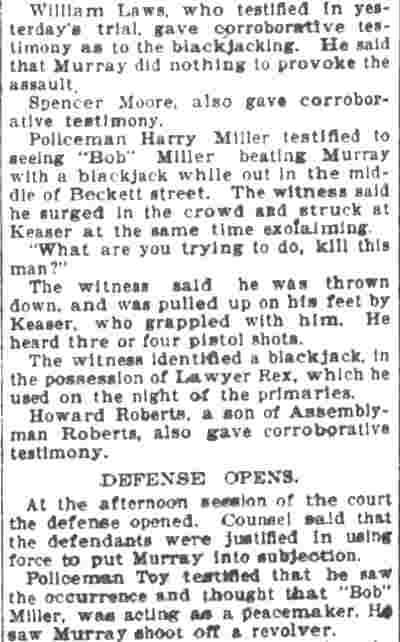
William Laws, who testified in yesterday’s trial, gave corroborative testimony as to the blackjacking. He said that Murray did nothing to provoke the assault. Spencer Moore also gave corroborative testimony.
Policeman Harry Miller testified to seeing “Bob” Miller beating Murray with a blackjack while out in the middle of Beckett street. The witness said he surged in the crowd and struck at Keaser at the same time exclaiming, “What are you trying to do, kill this man?” The witness said he was thrown down, and was pulled up on his feet by Keaser, who grappled with him. He heard three or four pistol shots.
Daniel Ayres testified to seeing the riot and heard Murray say that he would get some one before the night was over. He saw Murray shoot off a revolver under a tree.
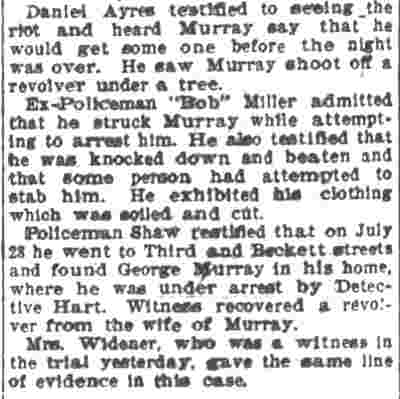
Ex-Policeman “Bob” Miller admitted that he struck Murray while attempting to arrest him. He also testified that he was knocked down and beaten and that some person had attempted to stab him. He exhibited his clothing which was soiled and cut.
Policeman Shaw testified that on July 28 he went to Third and Beckett streets and found George Murray in his home, where he was under arrest by Detective Hart. Witness recovered a revolver from the wife of Murray. Mrs. Widener, who was a witness in the trial yesterday, gave the same line of evidence in this case.
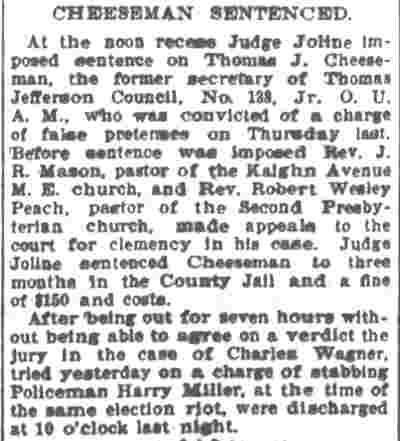
The indictment against Policeman Albert Keaser and ex-Policeman Robert F. Miller, on a charge of assault and battery on George Murray, was then moved. This is the second case to be tried as the outcome of the election riot in the Third ward during the primary election.
Policeman Shaw testified that on July 28 he went to Third and Beckett streets where he found Murray in his home, where he was under arrest by Detective Hart. Wilson recovered a revolver from the wife of Murray.
Constable Was Slashed
Philadelphia Inquirer —
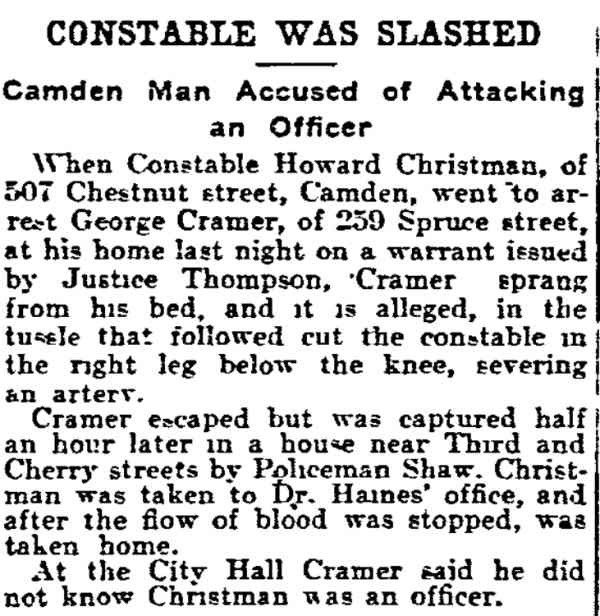
When Constable Howard Christman, of 507 Chestnut street, Camden, went to arrest George Cramer, of 259 Spruce street, at his home last night on a warrant issued by Justice Thompson, Cramer sprang from his bed, and it is alleged, in the tussle that followed cut the constable in the right leg below the knee, severing an artery.
Cramer escaped but was captured half an hour later in a house near Third and Cherry streets by Policeman Shaw. Christman was taken to Dr. Haines’ office, and after the flow of blood was stopped, was taken home.
Tenner–Shaw
Camden Post-Telegram —
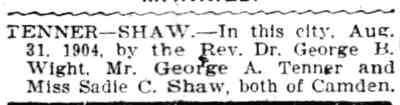
In this city, Aug. 31, 1904, by the Rev. Dr. George B. Wight, Mr. George A. Tenner and Miss Sadie C. Shaw, both of Camden.
Great Throngs at the Funeral of Chief Foster
Philadelphia Inquirer —

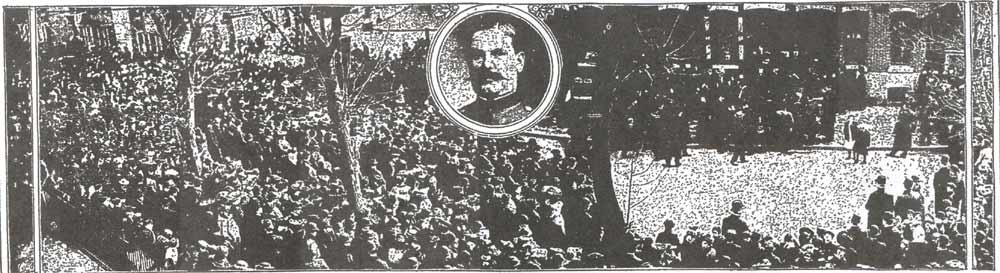
Camden Witnessed Greatest Demonstration of Its Kind Since Gen. Sewell’s Burial
THOUSANDS PAID TRIBUTE TO DEAD
CROWD ABOUT THE FOSTER HOME AND PICTURE OF THE DEAD CHIEF
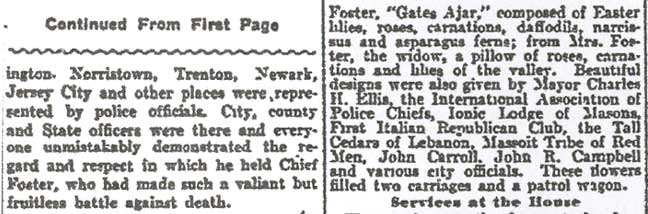
Not since the memorial funeral of United States Senator William J. Sewell has Camden witnessed such an expression of regret and sorrow as was evidenced at the obsequies of Chief of Police John Foster, which took place from his home, 292 Mt. Vernon street, yesterday afternoon. Practically all Camden paid lasting tribute to the stricken chief, who had been one of the most popular officials of the city. From other places, too, came many who swelled the throng about the house until the streets were literally packed with those anxious to give evidence of the high esteem in which they held the man.
From Philadelphia came Superintendent of Police John B. Taylor, a personal friend of Chief Foster; Captain James Hamm, Captain Dungan, Captain Campbell, Captain Callahan and thirty-four lieutenants, all in uniform. Baltimore, Washington, Norristown, Trenton, Newark, Jersey City and other places were represented by police officials. City, county and State officers were there and everyone unmistakably demonstrated the regard and respect in which he held Chief Foster, who had made such a valiant but fruitless battle against death.
Thousands Viewed Remains
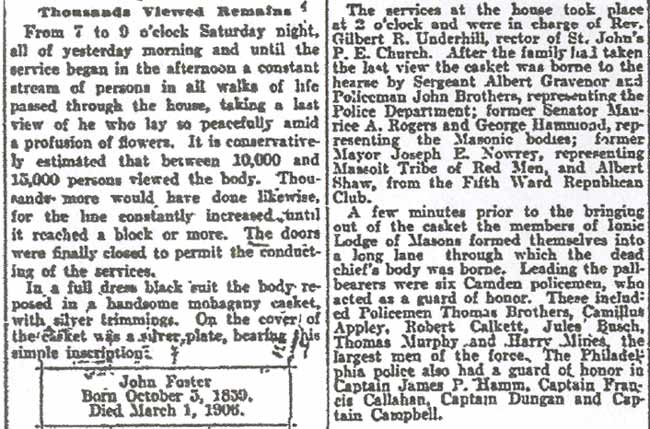
From 7 to 9 o’clock Saturday night, all of yesterday morning and until the service began in the afternoon a constant stream of persons in all walks of life passed through the house, taking a last view of he who lay so peacefully amid a profusion of flowers. It is conservatively estimated that between 10,000 and 15,000 persons viewed the body. Thousands more would have done likewise, for the line constantly increased, until it reached a block or more. The doors were finally closed to permit the conducting of the services.
In a full dress black suit the body reposed in a handsome mahogany casket, with silver trimmings. On the cover of the casket was a silver plate, bearing this simple inscription:
John Foster
Born October 5, 1839.
Died March 1, 1906.
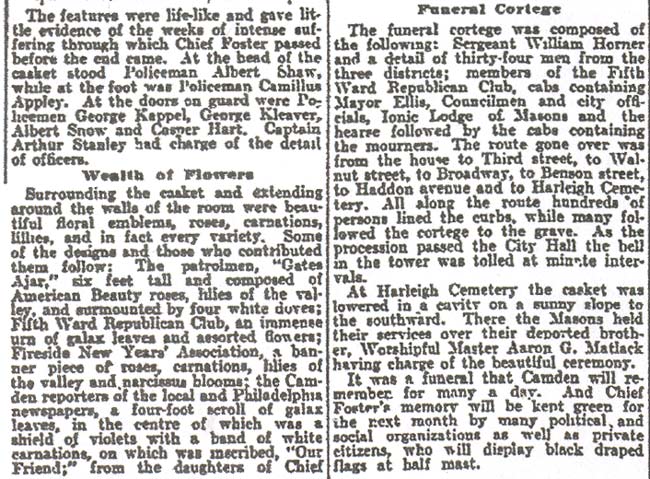
The features were life-like and gave little evidence of the weeks of intense suffering through which Chief Foster passed before the end came. At the head of the casket stood Policeman Albert Shaw, while at the foot was Policeman Camillus Appley. At the doors on guard were Policemen George Kappel, George Kleaver, Albert Snow and Casper Hart. Captain Arthur Stanley had charge of the detail of officers.
Wealth of Flowers
Surrounding the casket and extending around the walls of the room were beautiful floral emblems, roses, carnations, lillies, and in fact every variety. Some of the designs and those who contributed them follow: The patrolmen, “Gates Ajar,” six feet tall and composed of American Beauty roses, lilies of the valley, and surmounted by four white doves; Fifth Ward Republican Club, an immense urn of galax leaves and assorted flowers; Fireside New Years’ Association, a banner piece of roses, carnations, lilies of the valley and narcissus blooms; the Camden reporters of the local and Philadelphia newspapers, a four-foot scroll of galax leaves, in the centre of which was a shield of violets with a band of white carnations, on which was inscribed, “Our Friend;” from the daughters of Chief Foster, “Gates Ajar,” composed of Easter lilies, roses, carnations, daffodils, narcissus and asparagus ferns; from Mrs. Foster, the widow, a pillow of roses, carnations and lilies of the valley. Beautiful designs were also given by Mayor Charles H. Ellis, the International Association of Police Chiefs, Ionic Lodge of Masons, First Italian Republican Club, the Tall Cedars of Lebanon, Massoit Tribe of Red Men, John Carroll, John R. Campbell and various city officials. These flowers filled two carriages and a patrol wagon.
Services at the House
The services at the house took place at 2 o’clock and were in charge of Rev. Gilbert R. Underhill, rector of St. John’s P. E. Church. After the family had taken the last view the casket was borne to the hearse by Sergeant Albert Gravenor and Policeman John Brothers, representing the Police Department; former Senator Maurice A. Rogers and George Hammond, representing the Masonic bodies; former Mayor Joseph E. Nowrey, representing Massoit Tribe of Red Men, and Albert Shaw, from the Fifth Ward Republican Club.
A few minutes prior to the bringing out of the casket the members of Ionic Lodge of Masons formed themselves into a long lane through which the dead chief’s body was borne. Leading the pallbearers were six Camden policemen, who acted as a guard of honor. These included Policemen Thomas Brothers, Camillus Appley, Robert Calkett, Jules Busch, Thomas Murphy and Harry Mines, the largest men of the force. The Philadelphia police also had a guard of honor in Captain James P. Hamm, Captain Francis Callahan, Captain Dungan and Captain Campbell.
Funeral Cortege
The funeral cortege was composed of the following: Sergeant William Horner and a detail of thirty-four men from the three districts; members of the Fifth Ward Republican Club, cabs containing Mayor Ellis, Councilmen and city officials, Ionic Lodge of Masons and the hearse followed by the cabs containing the mourners. The route gone over was from the house to Third street, to Walnut street, to Broadway, to Benson street, to Haddon avenue and to Harleigh Cemetery. All along the route hundreds of persons lined the curbs, while many followed the cortege to the grave. As the procession passed the City Hall the bell in the tower was tolled at minute intervals.
At Harleigh Cemetery the casket was lowered in a cavity on a sunny slope to the southward. There the Masons held their services over their departed brother, Worshipful Master Aaron G. Matlack having charge of the beautiful ceremony.
It was a funeral that Camden will remember for many a day. And Chief Foster’s memory will be kept green for the next month by many political and social organizations as well as private citizens, who will display black draped flags at half mast.
Funeral of “Ike” Toy
Bridgeton Evening News —
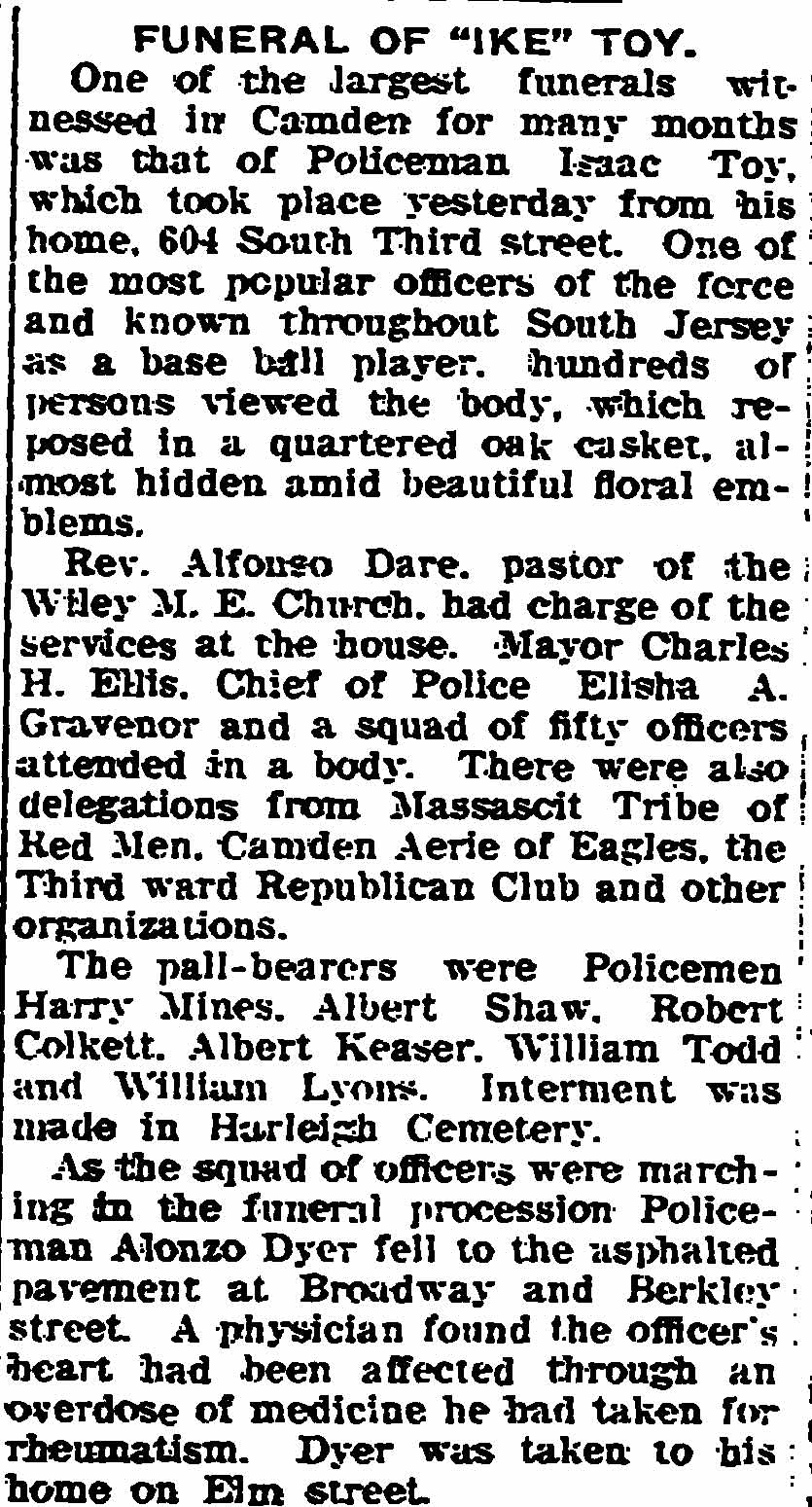
FUNERAL OF “IKE” TOY.
One of the largest funerals witnessed in Camden for many months was that of Policeman Isaac Toy, which took place yesterday from his home, 604 South Third street. One of the most popular officers of the force and known throughout South Jersey as a base ball player, hundreds of persons viewed the body, which reposed in a quartered oak casket, almost hidden amid beautiful floral emblems.
Rev. Alfonso Dare, pastor of the Wiley M. E. Church, had charge of the services at the house. Mayor Charles H. Ellis, Chief of Police Elisha A. Gravenor and a squad of fifty officers attended in a body. There were also delegations from Massascit Tribe of Red Men, Camden Aerie of Eagles, the Third ward Republican Club and other organizations.
The pall-bearers were Policemen Harry Mines, Albert Shaw, Robert Colkett, Albert Keaser, William Todd and William Lyons. Interment was made in Harleigh Cemetery.
As the squad of officers were marching in the funeral procession Policeman Alonzo Dyer fell to the asphalted pavement at Broadway and Berkley street. A physician found the officer’s heart had been affected through an overdose of medicine he had taken for rheumatism. Dyer was taken to his home on Elm street.
One of the largest funerals witnessed in Camden for many months was that of Policeman Isaac Toy, which took place yesterday from his home, 604 South Third street. One of the most popular officers of the force and known throughout South Jersey as a base ball player, hundreds of persons viewed the body, which reposed in a quartered oak casket, almost hidden amid beautiful floral emblems.
Rev. Alfonso Dare, pastor of the Wiley M. E. Church, had charge of the services at the house. Mayor Charles H. Ellis, Chief of Police Elisha A. Gravenor and a squad of fifty officers attended in a body.
The pall-bearers were Policemen Harry Mines, Albert Shaw, Robert Colkett, Albert Keaser, William Todd and William Lyons. Interment was made in Harleigh Cemetery.
Second Ward Had a Fine Pinochle
Camden Daily Courier —
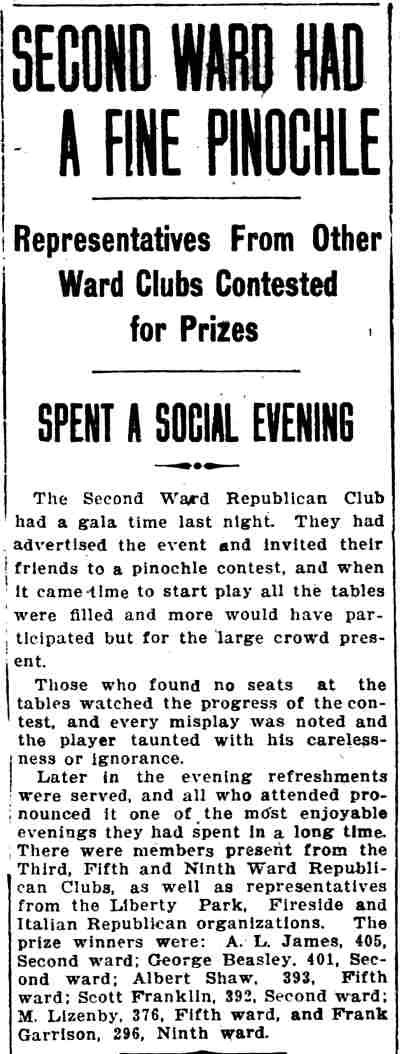
Second Ward Had a Fine Pinochle
Second Ward Had a Fine Pinochle
Representatives From Other Ward Clubs Contested for Prizes
SPENT A SOCIAL EVENING
The Second Ward Republican Club had a gala time last night. They had advertised the event and invited their friends to a pinochle contest, and when it came time to start play all the tables were filled and more would have participated but for the large crowd present.
Those who found no seats at the tables watched the progress of the contest, and every misplay was noted and the player taunted with his carelessness or ignorance.
Later in the evening refreshments were served, and all who attended pronounced it one of the most enjoyable evenings they had spent in a long time. There were members present from the Third, Fifth and Ninth Ward Republican Clubs, as well as representatives from the Liberty Park, Fireside and Italian Republican organizations. The prize winners were: A. L. James, 405, Second ward; George Beasley, 401, Second ward; Albert Shaw, 393, Fifth ward; Scott Franklin, 392, Second ward; M. Lizenby, 376, Fifth ward, and Frank Garrison, 296, Ninth ward.
The Second Ward Republican Club had a gala time last night. They had advertised the event and invited their friends to a pinochle contest, and when it came time to start play all the tables were filled and more would have participated but for the large crowd present.
The prize winners were: A. L. James, 405, Second ward; George Beasley, 401, Second ward; Albert Shaw, 393, Fifth ward; Scott Franklin, 392, Second ward; M. Lizenby, 376, Fifth ward, and Frank Garrison, 296, Ninth ward.
Handing Out Gunning Licenses in Camden
Philadelphia Inquirer —
Handing Out Gunning Licenses in Camden
HANDING OUT GUNNING LICENSES IN CAMDEN
County Clerk Patterson and His Office Force Work Overtime to Meet Gunners' Demands
From the time County Clerk Frank Patterson opened his office in Camden yesterday until last night there was a constant coming and going of sportsmen anxious to get gunning licenses for the opening of the season tomorrow. The entire clerical force was kept busy, and, while usually the office closes at noon on Saturday, it was kept open until 5 o'clock to accommodate the sportsmen. Ofttimes they had their dogs with them and the occasional baying made the office sound like a field where cotton tails are skurrying to secure cover.
In all, it is estimated that at least three thousand licenses have been issued by Clerk Patterson, and it seems likely that the fields in and about Camden county will have a small army of gunners by the peep of day tomorrow morning. Not only have resident but non-resident licenses as well have been issued by the score, mostly to Philadelphians. While there has been some grumbling over the fact that it is necessary for the gunners to put up $1.50 for the privilege of hunting rabbits, as a rule, they look upon the matter as being beneficial to real sportsmen, as it has a tendency to eliminate the small pot hunters.
Those who have been over the haunts of the rabbits say they are exceedingly plentiful, especially in the lower end of Camden county, and farther south in Gloucester and Cumberland counties.
That the cotton tails will have to keep on the move is evident from the fact that Camden's Police Department is to send to the woods such a squad of able sportsmen as Policemen James Clay, George Cooper, Fiore Troncone, Edward Pike, Walter Stanton, Oscar Weaver, Albert Shaw and Sergeants William Schregler, James Tatem and Edward Hartman.
In all, it is estimated that at least three thousand licenses have been issued by Clerk Patterson, and it seems likely that the fields in and about Camden county will have a small army of gunners by the peep of day tomorrow morning. Not only have resident but non-resident licenses as well have been issued by the score, mostly to Philadelphians.
Those who have been over the haunts of the rabbits say they are exceedingly plentiful, especially in the lower end of Camden county, and farther south in Gloucester and Cumberland counties. That the cotton tails will have to keep on the move is evident from the fact that Camden’s Police Department is to send to the woods such a squad of able sportsmen as Policemen James Clay, George Cooper, Fiore Troncone, Edward Pike, Walter Stanton, Oscar Weaver, Albert Shaw and Sergeants William Schregler, James Tatem and Edward Hartman.
Camden Policeman Shot By Insane Italian
Philadelphia Inquirer —
Many Accused of Election Frauds
MANY ACCUSED OF ELECTION FRAUDS
Camden County Grand Jury Returns Fifty-five True Bills of Indictment
Most of Them Are Impounded by Order of Court, While Constables Get Busy
In a partial presentment made before Supreme Court Justice Garrison, in Camden, yesterday, the grand jury returned fifty-five true bills as a result of its probe into alleged election irregularities. Judge Garrison at once ordered County Clerk Patterson to impound most of the true bills until the defendants are apprehended and held in sufficient security to guarantee their appearance at court for trial. Bench warrants were issued and the force of constables was busy last night trying to locate those indicted.
As an evidence of how grave the accusations are in the eyes of the law, Common Pleas Court Judge Joline demanded $6000 bail when Policeman Samuel Flick, of the Twelfth ward, was arrested by County Detective Doran in the court room. Flick is under six indictments, two for perjury and four for false registration. He was at once taken before Judge Joline when security was furnished by Isaac Shreeve, a fellow policeman of the accused officer.
Other Indictments
Among those indicted was Francis J. McAdams, a Democrat and secretary of the County Board of Elections. He is specifically accused of larceny. His offense involved the removal from the county clerk's office of the poll book of the Sixth precinct, Fifth ward, over which there was more or less trouble. Its whereabouts was not known until McAdams was summoned before the jurors.
Most of the others are indicted under the general offense of "violating the election law." The most important of those whose names were made public is John Broome, a Republican Councilman from the Second ward. With James Smith, Thomas Noland and A. L. James, the latter a police captain. Councilman Broome is supposed to know something about a missing bail bond which was given for Noland's appearance at court. He was charged with repeating, and Broome went his bail.
Indicted on Five Counts
Martin Carrigan, a fireman, and Albert Shaw and James Lewis, policemen, are indicted for violations. Police Sergeant John Golden has five counts against him, while William C. Parker, an election officer, has two. Other defendants include Daniel Woods and Joseph Sparks, who, with Carrigan, are charged with conspiracy. John H. Carroll, Charles B. Crane and Harris D. Stow are accused of violations also.
There are about forty additional indictments against persons whose names were not divulged. It was stated, however, that in most instances these include alleged "phantoms," whose names appear on the registry list as living in places occupied by other persons. They are charged with false registration, but the chances are that but comparatively few arrests will be made in this phase of the matter.
Probe Still Deeper
The fact that it was announced that the presentment was but partial indicates that the probe is not ended. It is asserted that it has just begun and that the finding of indictments presented yesterday is merely the opening wedge for even more searching investigation. When the jurors will be summoned again is not known, Prosecutor Scovel desiring to clean up the calendar, which is greatly overburdened at present, before conducting any further investigation.
Many men prominent in professional and political life were in the court room when the presentment was made, quite a few being on the anxious bench themselves.
Among the seventy-eight true bills found by the grand jury yesterday in connection with the ordinary Criminal Court business and aside from the election cases were indictments against the officers of the Young Republican Club of the Second ward and the Camden Aerie, No. 65, Fraternal Order of Eagles. They are specifically charged with giving indecent exhibitions, and in addition the organizations are accused of keeping disorderly houses.
These cases resulted from reports made by the Law and Order League, whose agents attended "innocent amusements" given by the organizations. The class of entertainment is declared to have had the Seeley dinner and other such events beaten a mile. Not only the officers are indicated, but also Lottie Fayette, of Philadelphia, and a male companion, who assisted materially in the festivities.
Many Accused of Election Frauds (continued)
[Continuation — see martincarrigan-012411-inq-1.md]
In a partial presentment made before Supreme Court Justice Garrison, in Camden, yesterday, the grand jury returned fifty-five true bills as a result of its probe into alleged election irregularities. Judge Garrison at once ordered County Clerk Patterson to impound most of the true bills until the defendants are apprehended and held in sufficient security to guarantee their appearance at court for trial. Bench warrants were issued and the force of constables was busy last night trying to locate those indicted.
As an evidence of how grave the accusations are in the eyes of the law, Common Pleas Court Judge Joline demanded $6000 bail when Policeman Samuel Flick, of the Twelfth ward, was arrested by County Detective Doran in the court room. Flick is under six indictments, two for perjury and four for false registration. He was at once taken before Judge Joline when security was furnished by Isaac Shreeve, a fellow policeman of the accused officer.
Other Indictments
Among those indicted was Francis J. McAdams, a Democrat and secretary of the County Board of Elections. He is specifically accused of larceny. His offense involved the removal from the county clerk's office of the poll book of the Sixth precinct, Fifth ward, over which there was more or less trouble. Its whereabouts was not known until McAdams was summoned before the jurors.
Most of the others are indicted under the general offense of "violating the election law." The most important of those whose names were made public is John Broome, a Republican Councilman from the Second ward. With James Smith, Thomas Noland and A. L. James, the latter a police captain. Councilman Broome is supposed to know something about a missing bail bond which was given for Noland's appearance at court. He was charged with repeating, and Broome went his bail.
Indicted on Five Counts
Martin Carrigan, a fireman, and Albert Shaw and James Lewis, policemen, are indicted for violations. Police Sergeant John Golden has five counts against him, while William C. Parker, an election officer, has two. Other defendants include Daniel Woods and Joseph Sparks, who, with Carrigan, are charged with conspiracy. John H. Carroll, Charles B. Crane and Harris D. Stow are accused of violations also.
There are about forty additional indictments against persons whose names were not divulged. It was stated, however, that in most instances these include alleged "phantoms," whose names appear on the registry list as living in places occupied by other persons. They are charged with false registration, but the chances are that but comparatively few arrests will be made in this phase of the matter.
Probe Still Deeper
The fact that it was announced that the presentment was but partial indicates that the probe is not ended. It is asserted that it has just begun and that the finding of indictments presented yesterday is merely the opening wedge for even more searching investigation. When the jurors will be summoned again is not known, Prosecutor Scovel desiring to clean up the calendar, which is greatly overburdened at present, before conducting any further investigation.
Many men prominent in professional and political life were in the court room when the presentment was made, quite a few being on the anxious bench themselves.
Among the seventy-eight true bills found by the grand jury yesterday in connection with the ordinary Criminal Court business and aside from the election cases were indictments against the officers of the Young Republican Club of the Second ward and the Camden Aerie, No. 65, Fraternal Order of Eagles. They are specifically charged with giving indecent exhibitions, and in addition the organizations are accused of keeping disorderly houses.
These cases resulted from reports made by the Law and Order League, whose agents attended "innocent amusements" given by the organizations. The class of entertainment is declared to have had the Seeley dinner and other such events beaten a mile. Not only the officers are indicated, but also Lottie Fayette, of Philadelphia, and a male companion, who assisted materially in the festivities.
Many Accused of Election Frauds
McAdams, a Democrat and secretary of the County Board of Elections. He is specifically accused of larceny. His offense involved the removal from the county clerk’s office of the poll book of the Sixth precinct, Fifth ward, over which there was more or less trouble. Its whereabouts was not known until McAdams was summoned before the jurors.
Most of the others are indicted under the general offense of “violating the election law.” The most important of those whose names were made public is John Broome, a Republican Councilman from the Second ward. With James Smith, Thomas Noland and A. L. James, the latter a police captain. Councilman Broome is supposed to know something about a missing bail bond which was given for Noland’s appearance at court. He was charged with repeating, and Broome went his bail.
Indicted on Five Counts
Indicted on Five Counts
Martin Carrigan, a fireman, and Albert Shaw and James Lewis, policemen, are indicted for violations. Police Sergeant John Golden has five counts against him, while William C. Parker, an election officer, has two. Other defendants include Daniel Woods and Joseph Sparks, who, with Carrigan, are charged with conspiracy. John H. Carroll, Charles B. Crane and Harris D. Stow are accused of violations also.
There are about forty additional indictments against persons whose names were not divulged. It was stated, however, that in most instances these include alleged “phantoms,” whose names appear on the registry list as living in places occupied by other persons. They are charged with false registration, but the chances are that but comparatively few arrests will be made in this phase
Probe Still Deeper
of the matter.
Probe Still Deeper
The fact that it was announced that the presentment was but partial indicates that the probe is not ended. It is asserted that it has just begun and that the finding of indictments presented yesterday is merely the opening wedge for even more searching investigation. When the jurors will be summoned again is not known, Prosecutor Scovel desiring to clean up the calender, which is greatly overburdened at present, before conducting any further investigation.
Many men prominent in professional and political life were in the court room when the presentment was made, quite a few being on the anxious bench themselves.
Among the seventy-eight true bills found by the grand jury yesterday in con-
From the time County Clerk Frank Patterson opened his office in Camden yesterday until last night there was a constant coming and going of sportsmen anxious to get gunning licenses for the opening of the season tomorrow. In all, it is estimated that at least three thousand licenses have been issued by Clerk Patterson.
That the cotton tails will have to keep on the move is evident from the fact that Camden’s Police Department is to send to the woods such a squad of able sportsmen as Policemen James Clay, George Cooper, Fiore Troncone, Edward Pike, Walter Stanton, Oscar Weaver, Albert Shaw and Sergeants William Schregler, James Tatem and Edward Hartman.
Police Pension Fund Election
Philadelphia Inquirer —
There was a spirited contest at the annual election of officers of the Camden Police Pension Fund yesterday. J. Oscar Weaver won out for the presidency of the fund over George Anderson. The other officers elected follow: Vice president, James Clay; recording secretary, Edward Hyde; financial secretary, James E. Tatem; treasurer, E. B. McClong; trustees, Charles Whaland, Howard Smith, George Cooper, Albert Shaw and Harry Mines.
Policeman Hart Is Laid to Rest
Philadelphia Inquirer —
Policeman Hart Is Laid to Rest
POLICEMAN HART IS LAID TO REST
Many Members of Camden Department Pay Last Respects to One Who Was Killed
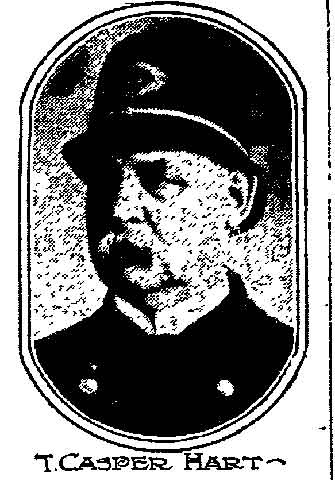
Headed by Chief Gravenor, a hundred members of the Camden police department yesterday paid their last respects to their fellow policeman, Thomas Casper Hart, who died as a result of injuries received when a patrol wagon was struck by a trolley car. The funeral took place at his home, 278 Mt. Vernon street, the services being in charge of Rev. N. C. Lassiter, formerly pastor of the Emmanuel Baptist Church, now of West Philadelphia.
Many beautiful floral designs came from the police, Sioux Tribe of Red Men, the Fifth Ward Republican Club and other organizations. The pall bearers were Policemen Albert Shaw, Lewis Stehr, Oscar Weaver and Harry Mines. Interment was made in Harleigh Cemetery.
Police Carnival Was a Gigantic Success
Philadelphia Inquirer —
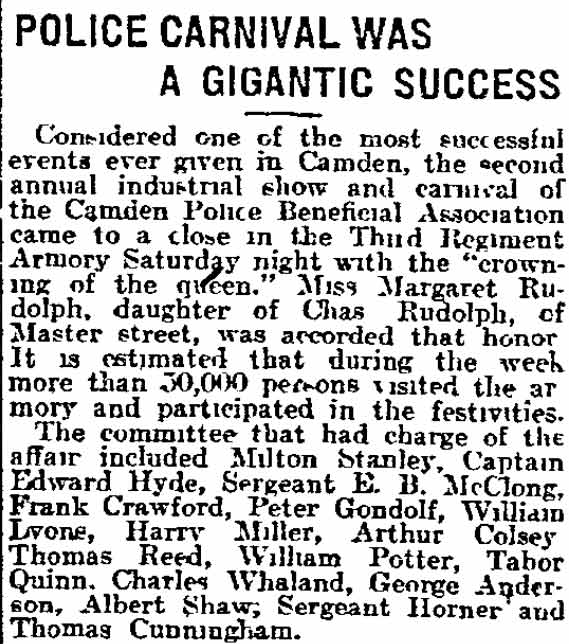
Considered one of the most successful events ever given in Camden, the second annual industrial show and carnival of the Camden Police Beneficial Association came to a close in the Third Regiment Armory Saturday night with the “crowning of the queen.” Miss Margaret Rudolph, daughter of Chas. Rudolph, of Master street, was accorded that honor. It is estimated that during the week more than 50,000 persons visited the armory and participated in the festivities.
The committee that had charge of the affair included Milton Stanley, Captain Edward Hyde, Sergeant E. B. McClong, Frank Crawford, Peter Gondolf, William Lyons, Harry Miller, Arthur Colsey, Thomas Reed, William Potter, Tabor Quinn, Charles Whaland, George Anderson, Albert Shaw, Sergeant Horner and Thomas Cunningham.
Three Policemen Quit Their Jobs
Camden Post-Telegram —
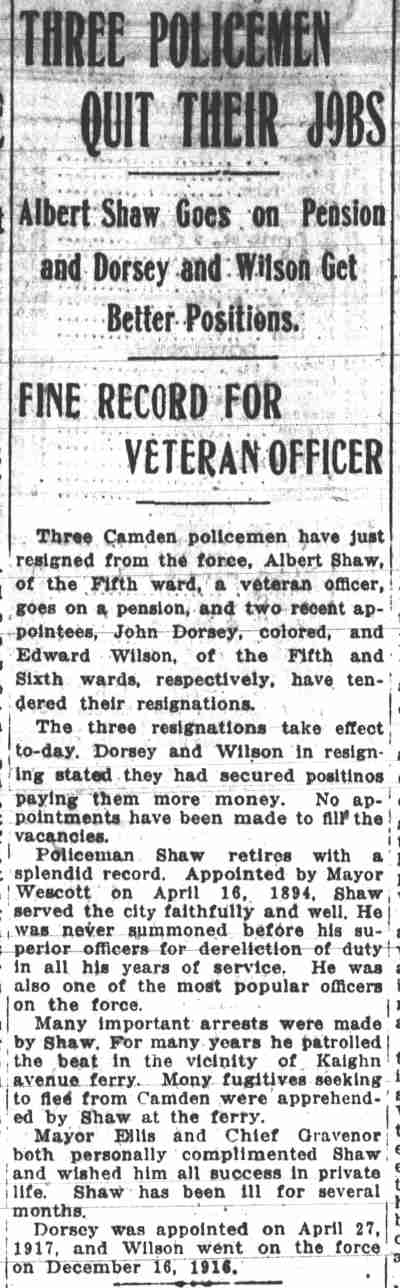
Three Policemen Quit Their Jobs
THREE POLICEMEN QUIT THEIR JOBS
Albert Shaw Goes on Pension and Dorsey and Wilson Get Better Positions.
FINE RECORD FOR VETERAN OFFICER
Three Camden policemen have just resigned from the force, Albert Shaw, of the Fifth ward, a veteran officer, goes on a pension, and two recent appointees, John Dorsey, colored, and Edward Wilson, of the Fifth and Sixth wards, respectively, have tendered their resignations. The three resignations take effect to-day.
Policeman Shaw retires with a splendid record. Appointed by Mayor Wescott on April 16, 1894, Shaw served the city faithfully and well. He was never summoned before his superior officers for dereliction of duty in all his years of service. He was also one of the most popular officers on the force. Many important arrests were made by Shaw. For many years he patrolled the beat in the vicinity of Kaighn avenue ferry. Many fugitives seeking to flee from Camden were apprehended by Shaw at the ferry.
Mayor Ellis and Chief Gravenor both personally complimented Shaw and wished him all success in private life. Shaw has been ill for several months. Dorsey was appointed on April 27, 1917, and Wilson went on the force on December 16, 1916.
Three Camden policemen have just resigned from the force, Albert Shaw, of the Fifth ward, a veteran officer, goes on a pension, and two recent appointees, John Dorsey, colored, and Edward Wilson, of the Fifth and Sixth wards, respectively, have tendered their resignations.
The three resignations take effect to-day. Dorsey and Wilson in resigning stated they had secured positions paying them more money. No appointments have been made to fill the vacancies.
Policeman Shaw retires with a splendid record. Appointed by Mayor Wescott on April 16, 1894, Shaw served the city faithfully and well. He was never summoned before his superior officers for dereliction of duty in all his years of service. He was also one of the most popular officers on the force.
Many important arrests were made by Shaw. For many years he patrolled the beat in the vicinity of Kaighn avenue ferry. Many fugitives seeking to flee from Camden were apprehended by Shaw at the ferry.
Mayor Ellis and Chief Gravenor both personally complimented Shaw and wished him all success in private life. Shaw has been ill for several months.
Succeeds Dad As Policeman
Camden Post-Telegram —
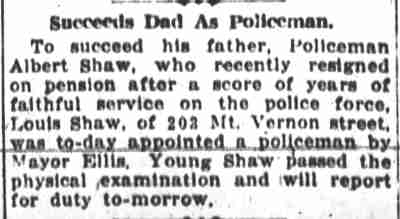
To succeed his father, Policeman Albert Shaw, who recently resigned on pension after a score of years of faithful service on the police force, Louis Shaw, of 203 Mt. Vernon street, was to-day appointed a policeman by Mayor Ellis. Young Shaw passed the physical examination and will report for duty to-morrow.
Shaw–Shearman
Camden Daily Courier —
The name of Shaw is very familiar in the Fifth Ward. Away back in the 1870s, the father of pensioned policeman “Al” Shaw, and grandfather of District Detective Lew Shaw of today, was an old time night watchman. Old “Bill” Shearman, who as a Civil War soldier marched with Sherman from Atlanta to the sea, died at his home in one of the houses that stand back from the streets at 35 Hadden avenue, was one of the contractors who helped build City Hall and construct the Soldiers’ Monument across the way. In ’76 he was residing at 535 Arch street, next door to his old partner, Webster Krips.
Camden Police, circa 1898
Camden Courier-Post —
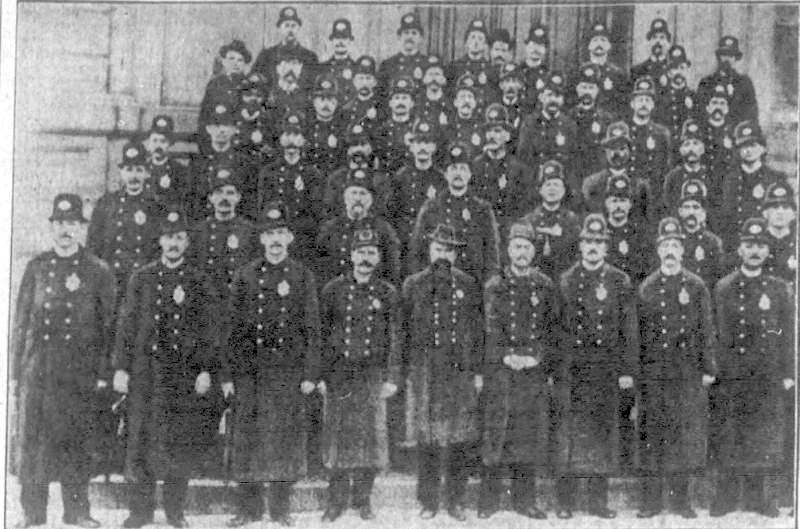
Camden police officers, circa 1898.
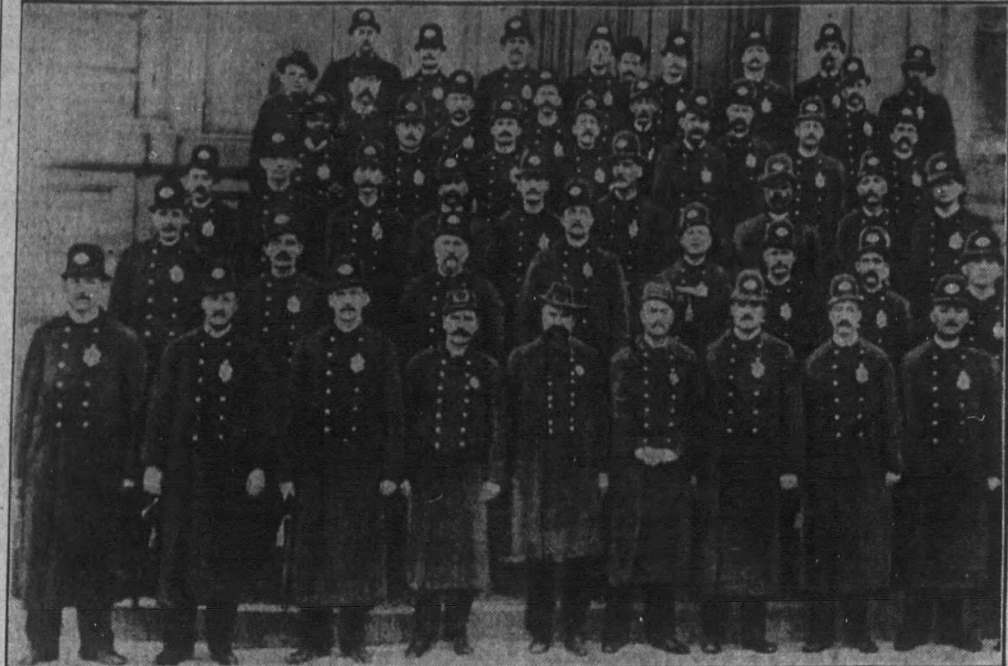
Camden police officers, circa 1898.
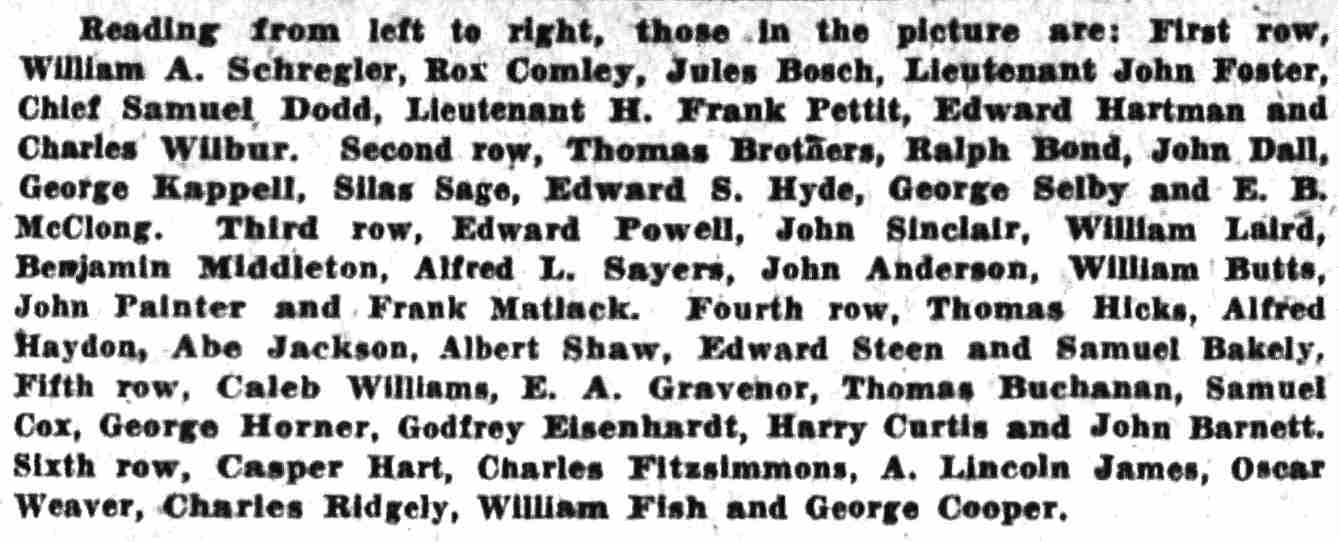
Reading from left to right, those in the picture are: First row, William A. Schregler, Rox Comley, Jules Bosch, Lieutenant John Foster, Chief Samuel Dodd, Lieutenant H. Frank Pettit, Edward Hartman and Charles Wilbur. Second row, Thomas Brothers, Ralph Bond, John Dall, George Kappell, Silas Sage, Edward S. Hyde, George Selby and E. B. McClong. Third row, Edward Powell, John Sinclair, William Laird, Benjamin Middleton, Alfred L. Sayers, John Anderson, William Butts, John Painter and Frank Matlack. Fourth row, Thomas Hicks, Alfred Haydon, Abe Jackson, Albert Shaw, Edward Steen and Samuel Bakely. Fifth row, Caleb Williams, E. A. Gravenor, Thomas Buchanan, Samuel Cox, George Horner, Godfrey Eisenhardt, Harry Curtis and John Barnett. Sixth row, Casper Hart, Charles Fitzsimmons, A. Lincoln James, Oscar Weaver, Charles Ridgely, William Fish and George Cooper.
Middle Ward Marshal
Camden Courier-Post —
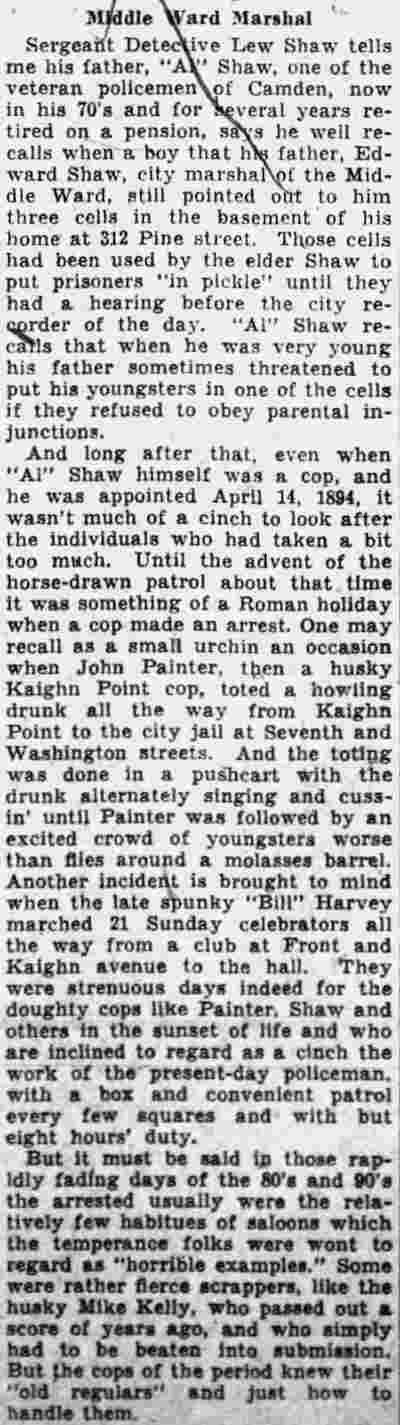
Middle Ward Marshal
Middle Ward Marshal
Sergeant Detective Lew Shaw tells me his father, “Al” Shaw, one of the veteran policemen of Camden, now in his 70’s and for several years retired on a pension, says he well recalls when a boy that his father, Edward Shaw, city marshal of the Middle Ward, still pointed out to him three cells in the basement of his home at 312 Pine street. Those cells had been used by the elder Shaw to put prisoners “in pickle” until they had a hearing before the city recorder of the day. “Al” Shaw recalls that when he was very young his father sometimes threatened to put his youngsters in one of the cells if they refused to obey parental injunctions.
And long after that, even when “Al” Shaw himself was a cop, and he was appointed April 14, 1894, it wasn’t much of a cinch to look after the individuals who had taken a bit too much. Until the advent of the horse-drawn patrol about that time it was something of a Roman holiday when a cop made an arrest. One may recall as a small urchin an occasion when John Painter, then a husky Kaighn Point cop, toted a howling drunk all the way from Kaighn Point to the city jail at Seventh and Washington streets. And the toting was done in a pushcart with the drunk alternately singing and cussin’ until Painter was followed by an excited crowd of youngsters worse than flies around a molasses barrel. Another incident is brought to mind when the late spunky “Bill” Harvey marched 21 Sunday celebrators all the way from a club at Front and Kaighn avenue to the hall. They were strenuous days indeed for the doughty cops like Painter, Shaw and others in the sunset of life and who are inclined to regard as a cinch the work of the present-day policeman, with a box and convenient patrol every few squares and with but eight hours’ duty.
But it must be said in those rapidly fading days of the 80’s and 90’s the arrested usually were the relatively few habitues of saloons which the temperance folks were wont to regard as “horrible examples.” Some were rather fierce scrappers, like the husky Mike Kelly, who passed out a score of years ago, and who simply had to be beaten into submission. But the cops of the period knew their “old regulars” and just how to handle them.
Sergeant Detective Lew Shaw tells me his father, “Al” Shaw, one of the veteran policemen of Camden, now in his 70’s and for several years retired on a pension, says he well recalls when a boy that his father, Edward Shaw, city marshal of the Middle Ward, still pointed out to him three cells in the basement of his home at 312 Pine street. Those cells had been used by the elder Shaw to put prisoners “in pickle” until they had a hearing before the city recorder of the day. “Al” Shaw recalls that when he was very young his father sometimes threatened to put his youngsters in one of the cells if they refused to obey parental injunctions.
And long after that, even when “Al” Shaw himself was a cop, and he was appointed April 14, 1894, it wasn’t much of a cinch to look after the individuals who had taken a bit too much. Until the advent of the horse-drawn patrol about that time it was something of a Roman holiday when a cop made an arrest. One may recall as a small urchin an occasion when John Painter, then a husky Kaighn Point cop, toted a howling drunk all the way from Kaighn Point to the city jail at Seventh and Washington streets. And the toting was done in a pushcart with the drunk alternately singing and cussin’ until Painter was followed by an excited crowd of youngsters worse than flies around a molasses barrel. Another incident is brought to mind when the late spunky “Bill” Harvey marched 21 Sunday celebrators all the way from a club at Front and Kaighn avenue to the hall. They were strenuous days indeed for the doughty cops like Painter, Shaw and others in the sunset of life and who are inclined to regard as a cinch the work of the present-day policeman, with a box and convenient patrol every few squares and with but eight hours’ duty.
But it must be said in those rapidly fading days of the 80’s and 90’s the arrested usually were the relatively few habitues of saloons which the temperance folks were wont to regard as “horrible examples.” Some were rather fierce scrappers, like the husky Mike Kelly, who passed out a score of years ago, and who simply had to be beaten into submission. But the cops of the period knew their “old regulars” and just how to handle them.
Albert S. Shaw Dies; Retired Policeman
Camden Courier-Post —
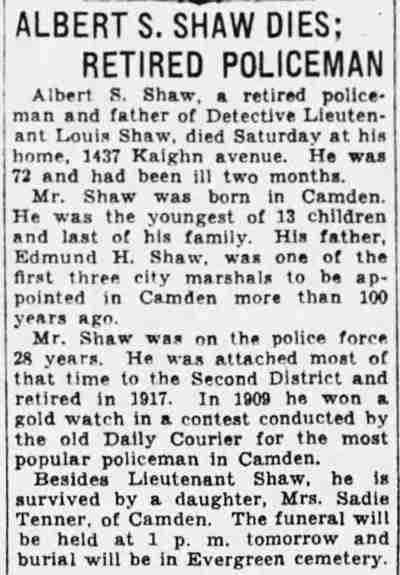
Albert S. Shaw, a retired policeman and father of Detective Lieutenant Louis Shaw, died Saturday at his home, 1437 Kaighn avenue. He was 72 and had been ill two months.
Mr. Shaw was born in Camden. He was the youngest of 13 children and last of his family. His father, Edmund H. Shaw, was one of the first three city marshals to be appointed in Camden more than 100 years ago.
Mr. Shaw was on the police force 28 years. He was attached most of that time to the Second District and retired in 1917. In 1909 he won a gold watch in a contest conducted by the old Daily Courier for the most popular policeman in Camden.
Besides Lieutenant Shaw, he is survived by a daughter, Mrs. Sadie Tenner, of Camden. The funeral will be held at 1 p. m. tomorrow and burial will be in Evergreen cemetery.
Death Notice
Camden Courier-Post —
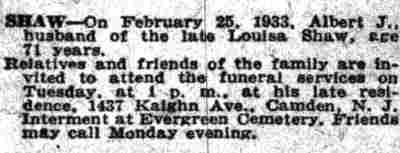
SHAW—On February 25, 1933, Albert J., husband of the late Louisa Shaw, age 71 years. Relatives and friends of the family are invited to attend the funeral services on Tuesday, at 1 p. m. at his late residence, 1437 Kaighn Ave., Camden, N. J. Interment at Evergreen Cemetery. Friends may call Monday evening.