Introduction
THOMAS STEWART REED was born in Pennsylvania in July of 1857, the only child born to Martha and John H. Reed. His father was a brushmaker. The Reeds were living at 1136 Charles Street in Philadelphia when the Census was taken in 1880. Thomas Reed was also working as a brushmaker at this time.
Thomas Reed married Jennie Lovett in the 1880s. Three children came of this marriage, Esther, born in Pennsylvania in September of 1883; Martha, born in August of 1890; and Thomas L., born in November of 1893.
Thomas Reed and family first appear in Camden City Directories in 1887, living at 531 Cedar Street and working as a brushmaker. The 1890 and 1891 Directories list him at 525 Cedar Street. Thomas Reed became involved in local politics and secured a position as a special officer in the 1890. The 1892 edition has him as a police officer at 610 North 6th Street, and the 1893 edition shows him at 626 North 5th Street, working in the same capacity.
By the time the 1895 City Directory was compiled, the Reeds had moved to 518 Cedar Street. On May 3, 1895 Thomas Reed’s wife Jennie died at the age of 35, leaving him to raise their three young children. From 1895 through the summer of 1899 he was back in private industry, working as a brushmaker and for a time as a machinist in Gloucester City. From 1895 through 1897 he is listed in directories at 518 Cedar Street. During these years he also worked in the revenue service and for the Camden, Gloucester and Woodbury Railroad. In September of 1899 Thomas S. Reed was appointed to the Camden police department. On January 6, 1914 he was promoted to Sergeant.
City Directories beginning in 1898 give an address of 613 Vine Street for Thomas Reed. The 1900 Census shows Thomas Reed living with his parents and children at 613 Vine Street in North Camden. Tragedy struck again in June of 1904 when young son Thomas L. Reed died from a heart condition at the age of 11.
When the Census was taken in 1910 Thomas Reed was still living at 613 Vine Street with his parents. His daughters were no longer at home. On April 2, 1912 the Reed’s home at 613 Vine Street was wrecked when a tornado (called a cyclone in those times) tore through North Camden. Repairs were made to the home, and Thomas Reed and his parents lived there into 1916.
By the time the 1917 City Directory was compiled Thomas Reed had remarried and was living with his wife, the former Mrs. Fannie D. Smith Bryen, at 828 North 2nd Street. There were four children, ranging in age from the late teens to the late 20s, Walter, Gladys, Edith, and Helen. Sadly, Helen Yearsley Bryen, a talented actress, died while on tour in the South in 1918. Step-son Walter served during World War I and afterwards in the United States Navy. He died in January of 1930, about a year after his discharge. Edith Bryen was well known in Camden and elsewhere as a long-distance swimmer in the 1910s and 1920s.
When the census was taken in January of 1920 Thomas Reed, his wife, parents, and step-children were living at 828 North 2nd Street. Step-son Walter Bryen, still in the Navy, was working as a recruiting officer, and two of his aides were boarding with the Reed family. Thomas Reed retired from the Camden Police Department on May 15, 1920.
Thomas and Fannie Reed are last listed in Camden City Directories in 1926. They are not listed in the 1927 Directory and the house at 828 South 2nd Street was vacant when the 1928 edition was compiled. On March 12, 1926 Thomas S. Reed passed away. His wife, Fannie, died on December 31, 1946 and was buried at New Camden Cemetery.
Philadelphia Inquirer
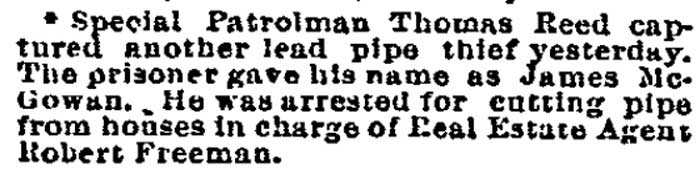
• Special Patrolman Thomas Reed captured another lead pipe thief yesterday. The prisoner gave his name as James McGowan. He was arrested for cutting pipe from houses in charge of Real Estate Agent Robert Freeman.
The Mayor Names
Camden Post –
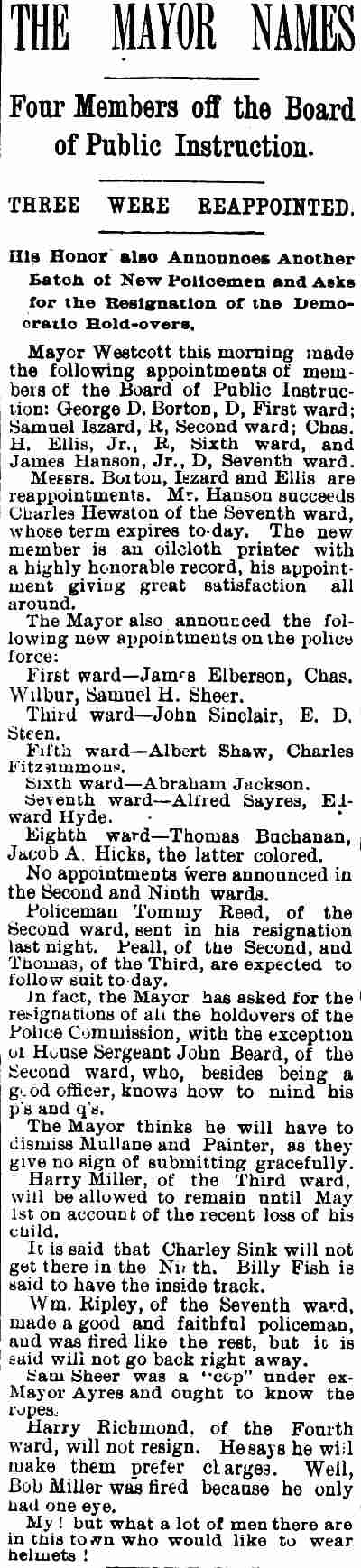
Four Members off the Board of Public Instruction.
THREE WERE REAPPOINTED.
His Honor also Announces Another Batch of New Policemen and Asks for the Resignation of the Democratic Hold-overs.
Mayor Westcott this morning made the following appointments of members of the Board of Public Instruction: George D. Borton, D, First ward; Samuel Iszard, R, Second ward; Chas. H. Ellis, Jr., R, Sixth ward, and James Hanson, Jr., D, Seventh ward. Messrs. Borton, Iezard and Ellis are reappointments. Mr. Hanson succeeds Charles Hewston of the Seventh ward, whose term expires to-day. The new member is an oilcloth printer with a highly honorable record, his appointment giving great satisfaction all around.
The Mayor also announced the following new appointments on the police force:
First ward—James Elberson, Chas. Wilbur, Samuel H. Sheer.
Third ward—John Sinclair, E. D. Steen.
Fifth ward—Albert Shaw, Charles Fitzsimmons.
Sixth ward—Abraham Jackson.
Seventh ward—Alfred Sayres, Edward Hyde.
Eighth ward—Thomas Buchanan, Jacob A. Hicks, the latter colored.
No appointments were announced in the Second and Ninth wards.
Policeman Tommy Reed, of the Second ward, sent in his resignation last night. Peall, of the Second, and Thomas, of the Third, are expected to follow suit to-day.
In fact, the Mayor has asked for the resignations of all the holdovers of the Police Commission, with the exception of House Sergeant John Beard, of the Second ward, who, besides being a good officer, knows how to mind his p’s and q’s.
The Mayor thinks he will have to dismiss Mullane and Painter, as they give no sign of submitting gracefully.
Harry Miller, of the Third ward, will be allowed to remain until May 1st on account of the recent loss of his child.
It is said that Charley Sink will not get there in the Ninth. Billy Fish is said to have the inside track.
Wm. Ripley, of the Seventh ward, made a good and faithful policeman, and was fired like the rest, but it is said will not go back right away.
Sam Sheer was a “cop” under ex-Mayor Ayres and ought to know the ropes.
Harry Richmond, of the Fourth ward, will not resign. He says he will make them prefer charges. Well, Bob Miller was fired because he only had one eye.
My! but what a lot of men there are in this town who would like to wear helmets!
The Mayor’s Appointments
Camden Daily Telegram –

He Announced Several This Week.
COMMISSIONERS OF INSTRUCTION.
The Old Members Re-Instated With the Exception of the Member From the Seventh Ward—Police Appointments and Resignations.
Mayor Wood made the following appointments as Commissioners of Instruction:
The following appointments were made: First Ward—George D. Borton, of the First Ward; Charles H. Ellis, Jr., of the Sixth ward, and John L. Westcott, of the Third ward.
The following appointments were made on the police force:
First Ward—James Elberson, Charles Wilbur, Samuel H. Sheer.
Second Ward—No appointments.
Third Ward—John Sinclair, E. D. Stein.
Fourth Ward—No appointments.
Fifth Ward—Albert Shaw, Charles Fitzsimmons.
Sixth Ward—Abraham Jackson.
Seventh Ward—Alfred Sayres, Edward Hyde.
Eighth Ward—Thomas Buchanan, Jacob A. Hicks (colored).
Ninth Ward—No appointments.
Mayor Westcott has requested the resignation of all the members of the police force who served under the Police Commission, to take effect May 1. They are Policemen Peall, Horner, Painter, Mullane, Miller and Reed.
POLITICAL POINTERS.
Who will be the postmaster?
Who will be the next prosecutor?
Many of the ward workers are suffering from election colds.
The name of Harry Moffitt was left out of the columns of honorable mention with the other hustlers of election day.
Senator Rogers and Messrs. Stafford and Watson, of the House are fully coming up to the expectations of their constituents.
If the Mayor could arrange it to hold his hearings a trifle earlier it would be a great source of satisfaction to the Camden afternoon papers.
There is still great anxiety on the part of the public as to the outcome of the present session of the legislature. Thus far their public acts have been highly commendable.
The abolishment of the Police Justice act restores to office the City Recorder, Benjamin M. Braker, who would be qualified to act in place of the Mayor should the Chief Executive be taken sick.
Jos. Potter, the new member of Council from the First ward is a man of wide business experience and will prove much advantage to the many large financial interests that will come under his care.
Owing to the satisfactory working of the present school commission in the two second-class counties up the State, the legislature made no change in the mode of placing the members as was anticipated.
Jos. B. Fox, of the Fourth ward, is what might be termed an old reliable, having had a long and varied experience in public affairs. He is always conservative in the expenditure of city money. He is always safe to trust.
Charles Sayrs, of the Seventh ward, who had a short experience in the present Council, but enough to make him feel at home among public affairs, is neck and ears in work between his real estate business and Councilmanic duties.
The colored people of the lower section of the city are anxious to see Squire Drake, the ex-Republican and ex-member of the School Board, come out of the Court House, where he holds a position under the Thompson Freeholders.
“Father” Figner is a proud sire. He was a member and president of Council in his days, and now sees his son treading in his footsteps. Mr. Figner, Jr., having been sent to Council from the Sixth ward on Tuesday by a large majority.
A special election will not be necessary for the new Board of Freeholders, as the City Council and Township Committees will appoint Freeholders who will serve until the Spring of 1895. The appointments will be made about the middle of May.
Arthur Bedell is spoken of as a candidate for the presidency of the new City Council. He is a stalwart and is never afraid to define his position on all public questions. He is one of those men who makes strong, warm friends and also creates an opposition of like force.
William D. Brown, the Secretary of the Board of Education, and Fred A. Rex, Treasurer, are quite pleased over the report of the committee on accounts and Expert O’Shaughnessy, they having examined the books of Messrs. Rex and Brown and found them correctly kept.
The library of the Camden public schools is one to be highly appreciated and much is due to the care with which Miss Blowe the librarian has attended to her duties. She will hold over another year and should be allowed to retain the office as long as she merits it, and she surely does now.
J. R. Carson, the retiring member of Council from the First ward, is highly spoken of by his associates on committees and by Clerk Varney for the mature judgment displayed in the management of city affairs. It is with a general expression of regret that the city is to lose his service.
The reform in the Board of Freeholders can’t come too soon. If the public is to judge of the care of property given by the Democrats in the county, by the “hog combine” in this city, an inventory of the public property when turned over will make interesting reading. Ex-officials guarantee to save enough in the Board, if returned to their offices, to pay the expense of a special election, if one was necessary.
W. J. Bradley has been asked if he was a candidate for president of the new City Council. His reply was that he had not sought it in the first place, and would not seek it now, but whether he became president or remained merely a member on the floor, he would endeavor to discharge his duties in the interests of the city. He is commended by all who came in contact with him during the past year as one who had a new Camden at heart.
Philadelphia Inquirer
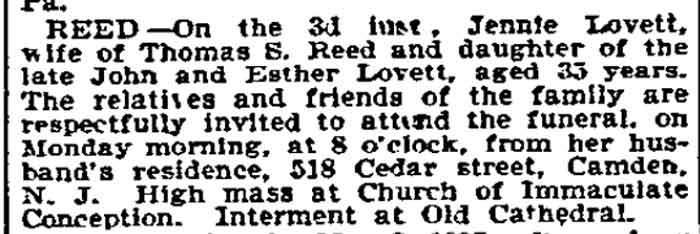
REED—On the 3d inst., Jennie Lovett, wife of Thomas S. Reed and daughter of the late John and Esther Lovett, aged 35 years. The relatives and friends of the family are respectfully invited to attend the funeral, on Monday morning, at 8 o’clock, from her husband’s residence, 518 Cedar street, Camden, N. J. High mass at Church of Immaculate Conception. Interment at Old Cathedral.
Added to the “Finest”
Camden Daily Courier –
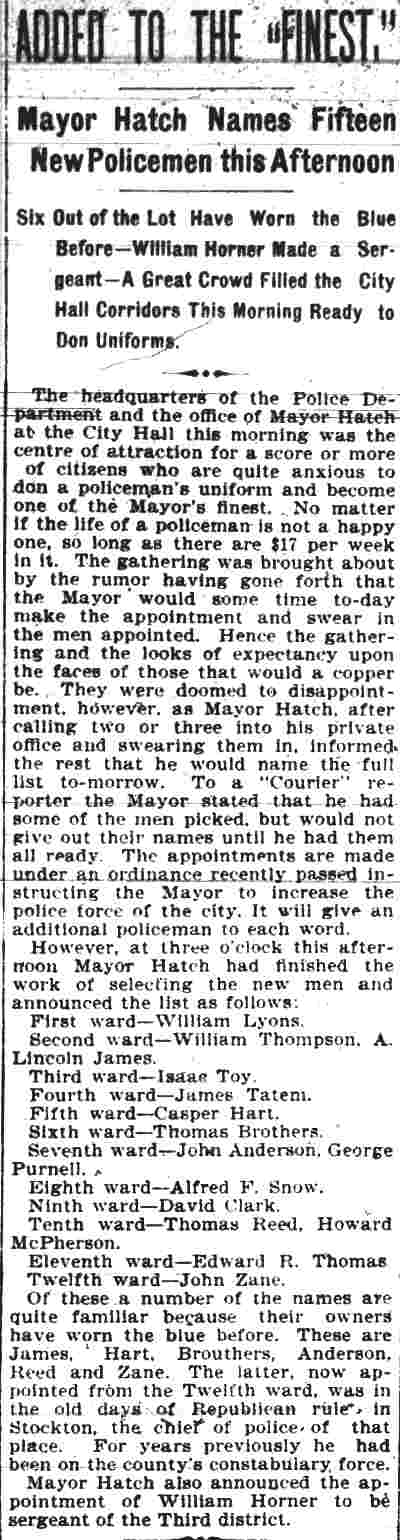
Mayor Hatch Names Fifteen New Policemen this Afternoon
The headquarters of the Police Department and the office of Mayor Hatch at the City Hall this morning was the centre of attraction for a score or more of citizens who are quite anxious to don a policeman’s uniform and become one of the Mayor’s finest. No matter if the life of a policeman is not a happy one, so long as there are $17 per week in it. The gathering was brought about by the rumor having gone forth that the Mayor would some time to-day make the appointment and swear in the men appointed. Hence the gathering and the looks of expectancy upon the faces of those that would a copper be. They were doomed to disappointment, however, as Mayor Hatch, after calling two or three into his private office and swearing them in, informed the rest that he would name the full list to-morrow. To a “Courier” reporter the Mayor stated that he had some of the men picked, but would not give out their names until he had them all ready. The appointments are made under an ordinance recently passed instructing the Mayor to increase the police force of the city. It will give an additional policeman to each ward.
However, at three o’clock this afternoon Mayor Hatch had finished the work of selecting the new men and announced the list as follows:
First ward—William Lyons.
Second ward—William Thompson. A. Lincoln James.
Third ward—Isaac Toy.
Fourth ward—James Tatem.
Fifth ward—Casper Hart.
Sixth ward—Thomas Brothers.
Seventh ward—John Anderson. George Purnell.
Eighth ward—Alfred F. Snow.
Ninth ward—David Clark.
Tenth ward—Thomas Reed. Howard McPherson.
Eleventh ward—Edward R. Thomas
Twelfth ward—John Zane.
Of these a number of the names are quite familiar because their owners have worn the blue before. These are James, Hart, Brouthers, Anderson, Reed and Zane. The latter, now appointed from the Twelfth ward, was in the old days of Republican rule, in Stockton, the chief of police of that place. For years previously he had been on the county’s constabulary force.
Mayor Hatch also announced the appointment of William Horner to be sergeant of the Third district.
Camden’s Police Force Increased
Philadelphia Inquirer –
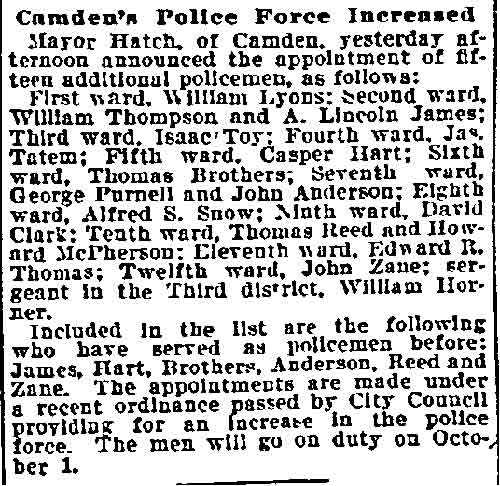
Mayor Hatch, of Camden, yesterday afternoon announced the appointment of fifteen additional policemen, as follows:
First ward, William Lyons; Second ward, William Thompson and A. Lincoln James; Third ward, Isaac Toy; Fourth ward, Jas. Tatem; Fifth ward, Casper Hart; Sixth ward, Thomas Brothers; Seventh ward, George Purnell and John Anderson; Eighth ward, Alfred S. Snow; Ninth ward, David Clark; Tenth ward, Thomas Reed and Howard McPherson; Eleventh ward, Edward R. Thomas; Twelfth ward, John Zane; sergeant in the Third district, William Horner.
Included in the list are the following who have served as policemen before: James, Hart, Brothers, Anderson, Reed and Zane. The appointments are made under a recent ordinance passed by City Council providing for an increase in the police force. The men will go on duty on October 1.
Armed Desperadoes Swoop Down on East Camden
Philadelphia Inquirer –

ARMED DESPERADOES SWOOP DOWN ON EAST CAMDEN
First Hold Up Bridge Watchman, Compelling Him to Place Mask on Face of One of the Bandits
Battle With Policeman After Blowing Up Safe in Pavonia Station—Shoot at Tower Operator Who Telegraphs for Help
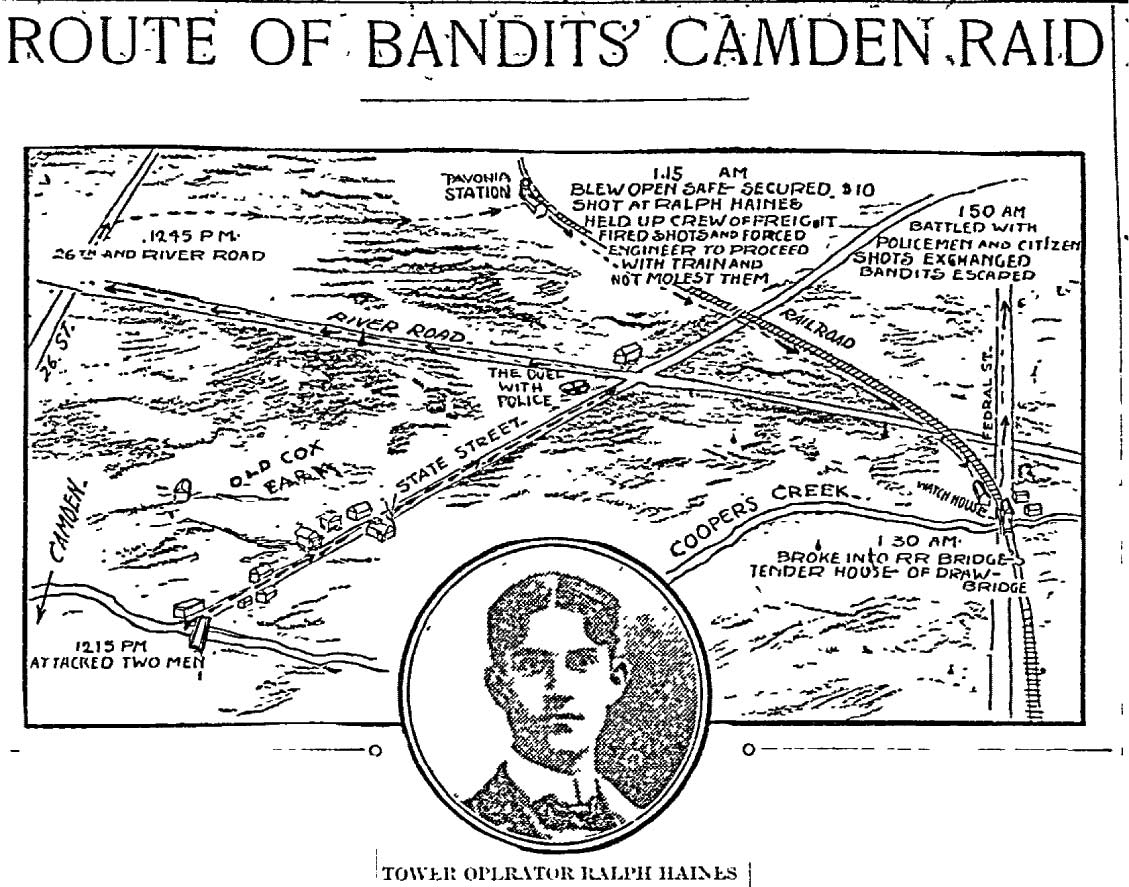
In true Wild West fashion five heavily armed desperadoes swooped down upon East Camden yesterday morning, and within two hours they had emptied their revolvers several times over, held up a bridge tender, cut telephone wires, blew up a safe, ordered a train crew to move on, perforated a tower house with bullets and finally made their escape. It was all done between 12.15 o’clock, when the bandits began operations at the State street bridge over Cooper Creek, and 1.50, when they gave final battle to policemen and citizens out Federal street, and disappeared in the darkness.
Never in Camden county’s history was there such a bold intrusion. The bandits are supposed to be a part of the gang which murdered Operator Clendenen, near Jersey Shore, Pa., and which has been terrorizing railroad operators and tower men in all parts of Pennsylvania and New Jersey recently.
First Appearance
It was shortly after 12 o’clock when the bandits appeared at the State street bridge at Cooper’s Creek. David Loughead and Oscar Till, bridge tenders, had just prepared to retire for the night. Loughead left Till to go to a boat house nearby. He had been gone but a short time when Till heard voices in the rear of the bridge house.
Bridgeman Till observed several men standing at the end of the bridge, and believing that they anticipated attacking him he locked the doors and laid his revolver on the bunk. Suddenly the door was forced open and in tumbled five men. Four of the bandits were masked. Instantly the frightened bridge tender was looking into the barrels of five revolvers.
“I surrender,” said Till.
“That’s all right, old pal,” replied one of the robbers, “but we want your money. You see we are a little short of funds, and it’s getting along about Christmas time.”
Masked by Their Victim
The men were about to go through Till’s pockets when the unmasked bandit said: “Hold up, I want my face covered and I want Mr. Bridgetender to do it.” Till complied. While a revolver was held at each temple Till took out his handkerchief and attempted to tie it about the robber’s face. He got the handkerchief over the fellow’s eyes. When ordered to try again he adjusted it to the satisfaction of the bandit, who expressed regret that the visit was causing the bridgetender so much trouble. The man Till masked went through his pockets. He failed to find any money, as Till had hidden what bills he had early in the night.
Ordered to Bed
Till was ordered to bed, and after he lay down on his back the bandits covered him over completely and cautioned him not to move under penalty of death. The desperadoes then disappeared. Fearing that one of the gang had remained behind to keep him from sounding an alarm, Till remained in bed until he heard a car approaching. Then he ventured out and summoned his partner, David Loughead, from the boat house.
When an effort was made to use the telephone the bridgetenders found that the bandits had cut the wires.
The men hurried on State street, passed around the old Cox farm, struck into the river road, then headed for Pavonia.
Blew Up Safe
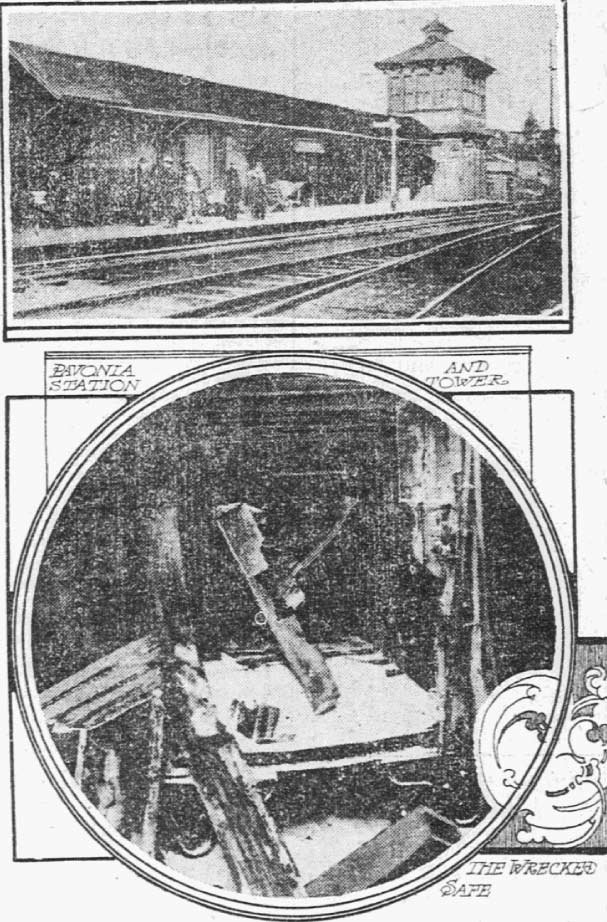
After passing guardedly through the freight yards of the Pennsylvania Railroad the bandits came up to the Pavonia Station. The thieves entered the little office by removing a heavy wire screen from a window in the rear of the ticket compartment, which is a room 8x10 feet in size. Three men had just about entered the station when two, who were left on guard, saw a train approaching. When Engineer Truax stopped the drill engine near the tower house the two men who were watching on the outside approached Engineer Truax and his fireman, Allen Stewart, with drawn revolvers and commanded them to uncouple the engine and proceed on up the road.
Truax lost no time in obeying. He opened the throttle of his locomotive and did not stop until he reached Fish House.
In the meantime the trio in the station had inserted a charge of nitro-glycerine in the safe, attached a fuse and climbed out the window to await the explosion. It came in a few minutes.
Shot at Operator
Operator Ralph Haines, of Eighth and Line streets, Camden, heard the noise and raised the window of the tower house. He had hardly placed his head out when, with an oath, he was ordered to put his head in. The operator hesitated, until several shots were fired, followed by a general bombardment on the tower. One bullet whizzed by Haines’ head and buried itself in the window frame. Another lodged in the overhanging roof of the station waiting room.
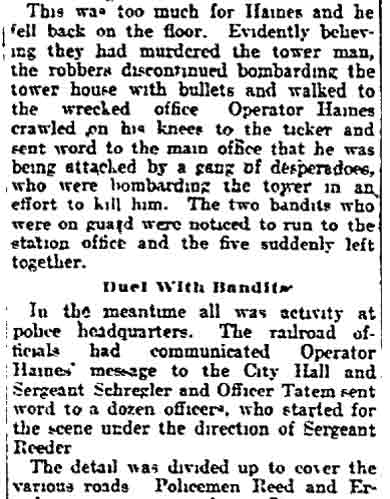
This was too much for Haines and he fell back on the floor. Evidently believing they had murdered the tower man, the robbers discontinued bombarding the tower house with bullets and walked to the wrecked office. Operator Haines crawled on his knees to the ticker and sent word to the main office that he was being attacked by a gang of desperadoes, who were bombarding the tower in an effort to kill him. The two bandits who were on guard were noticed to run to the station office and the five suddenly left together.
Duel With Bandits
In the meantime all was activity at police headquarters. The railroad officials had communicated Operator Haines’ message to the City Hall and Sergeant Schregler and Officer Tatem sent word to a dozen officers, who started for the scene under the direction of Sergeant Reeder.
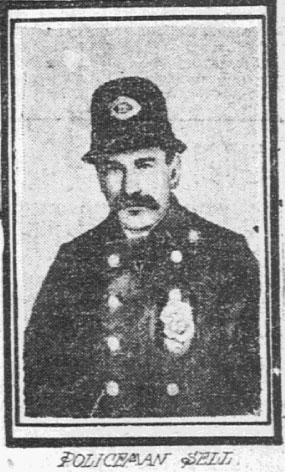
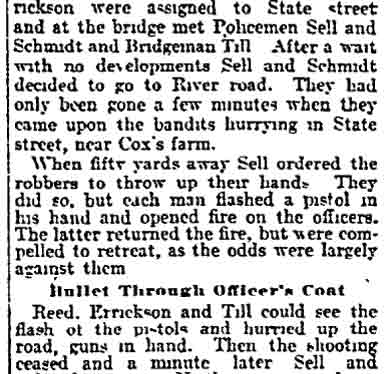
The detail was divided up to cover the various roads. Policemen Thomas Reed and Errickson were assigned to State street and at the bridge met Policemen Sell and Schmidt and Bridgeman Till. After a wait with no developments Sell and Schmidt decided to go to River road. They had only been gone a few minutes when they came upon the bandits hurrying in State street, near Cox’s farm.
When fifty yards away Sell ordered the robbers to throw up their hands. They did so, but each man flashed a pistol in his hand and opened fire on the officers. The latter returned the fire, but were compelled to retreat, as the odds were largely against them.
Bullet Through Officer’s Coat
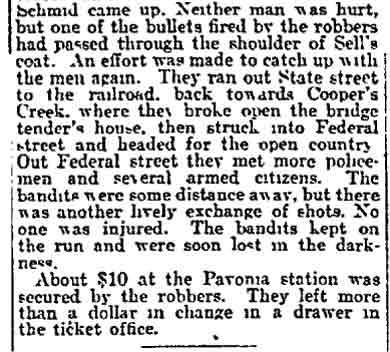
Reed, Errickson and Till could see the flash of the pistols and hurried up the road, guns in hand. Then the shooting ceased and a minute later Sell and Schmidt came up. Neither man was hurt, but one of the bullets fired by the robbers had passed through the shoulder of Sell’s coat. An effort was made to catch up with the men again. They ran out State street to the railroad, back towards Cooper’s Creek, where they broke open the bridge tender’s house, then struck into Federal street and headed for the open country. Out Federal street they met more policemen and several armed citizens. The bandits were some distance away, but there was another lively exchange of shots. No one was injured. The bandits kept on the run and were soon lost in the darkness.
About $10 at the Pavonia station was secured by the robbers. They left more than a dollar in change in a drawer in the ticket office.
Camden News Notes
Philadelphia Inquirer –
•• Thomas L. Reed, the 11 year-old son of Policeman Thomas Reed, died at his home, 613 Vine street, yesterday morning from valvular disease of the heart.
Philadelphia Inquirer
REED.—On the morning of June 22, 1904. THOMAS L, son of Thomas S and the late Jennie Reed (nee Lovett), aged 11 years 2 months. The relatives and friends of the family are respectfully invited to attend the funeral, on Friday afternoon, June 24, at 2 o’clock, from his father’s residence, 613 Vine st, Camden, N J. Interment at Arlington Cemetery.
Police Almost Got Cool Bath
Camden Daily Courier –
Someone Pulled Plug Out of a Chute-the-Chute Boat
FEARED A DUCKING IN LAGOON
Policemen “Al” Snow, “Jack” Brothers, “Tommie” Reed, “Tommie” Murphy and “Jeff” Kay, who acted as an escort to the youngsters of this city on their annual outing as guests of William J. Thompson, at Washington Park, yesterday, had rather an exciting experience. Snow and Brothers especially were for a time in a fair way of taking an involuntary plunge into the lagoon at the foot of the chute-the-chute affair.
After the children had been carefully looked after the bluecoats concluded to have a little pleasure on their own hook.
“Let’s try the chutes,” suggested Reed.
“Agreed,” said the other four in unison.
In a short time the quartet of coppers were being taken up on the elevator to the top of the tower. Then down the slide they went in the usual hurried manner. As soon as the water in the lagoon was encountered “Jack” Brothers felt something on his back. A hasty glance revealed the fact that there was a small sized geyser issuing from a hole in the flat bottomed scow. The plug had been removed and through the two inch aperture the water was rushing in at a great rate. In fact the ungainly craft began filling. The chap at the end who acted as sculler went toward shore, when Kay, Reed and Murphy jumped out onto the wharf.
Then, with Snow and Brothers still aboard, the scow drifted toward the middle of the place. All the time the water was entering and when it had reached the seats the sculler jumped overboard, leaving “Jack” and “Al” in the lurch.
“No, you don’t; you come back here,” commanded “Jack” to the oarsman.
The latter, thinking the officer was going to shoot, climbed back into the scow and then sculled to the wharf, when the two hopped ashore.
They are wondering as to who was responsible for the removal of the plug.
Camden News Notes
Philadelphia Inquirer –
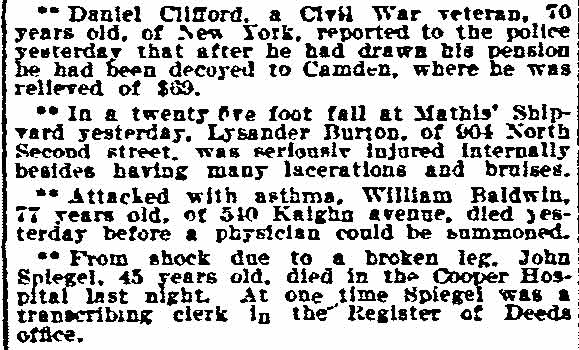
•• The annual sham battle and dance under the auspices of Battery B, N. G. N. J., will be held in the Camden Armory tomorrow evening.
•• Dr. H. H. Sherk will give an illustrated lecture on the Yellowstone Park in the East Camden Library tomorrow night.
•• One of the largest funerals that has taken place in Camden for some time was that of George Bird, who was buried from his home, 801 Haddon avenue. The services were in charge of Rev. Isaac Bagley and interment was made in the Evergreen Cemetery.
•• These officers have been nominated by the Camden Police Pension Fund: President, Robert Colkett; vice president, Albert Snow; financial secretary, James Tatem; recording secretary, Edward Hyde; treasurer, E. B. McClong; trustees, James Ware, George Anderson, George Cooper, Allan Palmer and Thomas Reed.
•• Daniel Clifford, a Civil War veteran, 70 years old, of New York, reported to the police yesterday that after he had drawn his pension he had been decoyed to Camden, where he was relieved of $69.
•• In a twenty five foot fall at Mathis’ Shipyard yesterday, Lysander Burton, of 904 North Second street, was seriously injured internally besides having many lacerations and bruises.
•• Attacked with asthma, William Baldwin, 77 years old, of 510 Kaighn avenue, died yesterday before a physician could be summoned.
•• From shock due to a broken leg, John Spiegel, 45 years old, died in the Cooper Hospital last night. At one time Spiegel was a transcribing clerk in the Register of Deeds office.
Philadelphia Inquirer
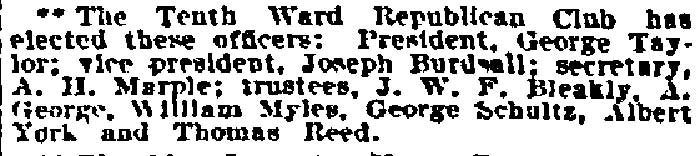
•• The Tenth Ward Republican Club has elected these officers: President, George Taylor; vice president, Joseph Burdsall; secretary, A. H. Marple; trustees, J. W. F. Bleakly, A. George, William Myles, George Schultz, Albert York and Thomas Reed.
Philadelphia Inquirer

• Policeman Thomas Reed yesterday found about a dozen .38-calibre cartridges on the trolley tracks at North Fifth street. They had evidently been placed there by boys.
North Camden Hit by a Great Cyclone; Homes Wrecked
Philadelphia Inquirer –
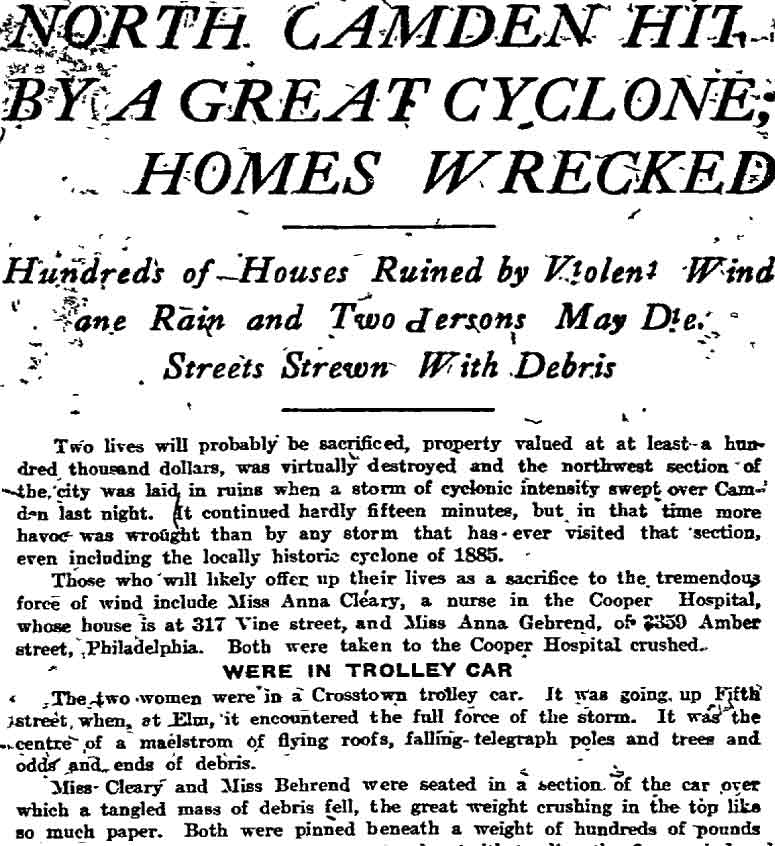
Hundreds of Houses Ruined by Violent Wind and Rain and Two Persons May Die. Streets Strewn With Debris
Two lives will probably be sacrificed, property valued at at least a hundred thousand dollars, was virtually destroyed and the northwest section of the city was laid in ruins when a storm of cyclonic intensity swept over Camden last night. It continued hardly fifteen minutes, but in that time more havoc was wrought than by any storm that has ever visited that section, even including the locally historic cyclone of 1885.
Those who will likely offer up their lives as a sacrifice to the tremendous force of wind include Miss Anna Cleary, a nurse in the Cooper Hospital, whose house is at 317 Vine street, and Miss Anna Gebrend, of 2359 Amber street, Philadelphia. Both were taken to the Cooper Hospital crushed.
WERE IN TROLLEY CAR
The two women were in a Crosstown trolley car. It was going up Fifth street, when, at Elm, it encountered the full force of the storm. It was the centre of a maelstrom of flying roofs, falling telegraph poles and trees and odds and ends of debris.
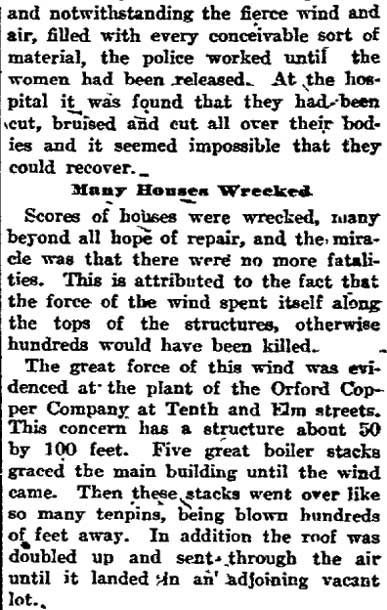
Miss Cleary and Miss Behrend were seated in a section of the car over which a tangled mass of debris fell, the great weight crushing in the top like so much paper. Both were pinned beneath a weight of hundreds of pounds and notwithstanding the fierce wind and air, filled with every conceivable sort of material, the police worked until the women had been released. At the hospital it was found that they had been cut, bruised and cut all over their bodies and it seemed impossible that they could recover.
Many Houses Wrecked
Scores of houses were wrecked, many beyond all hope of repair, and the miracle was that there were no more fatalities. This is attributed to the fact that the force of the wind spent itself along the tops of the structures, otherwise hundreds would have been killed.
The great force of this wind was evidenced at the plant of the Orford Copper Company at Tenth and Elm streets. This concern has a structure about 50 by 100 feet. Five great boiler stacks graced the main building until the wind came. Then these stacks went over like so many tenpins, being blown hundreds of feet away. In addition the roof was doubled up and sent through the air until it landed in an adjoining vacant lot.
Got the Full Force
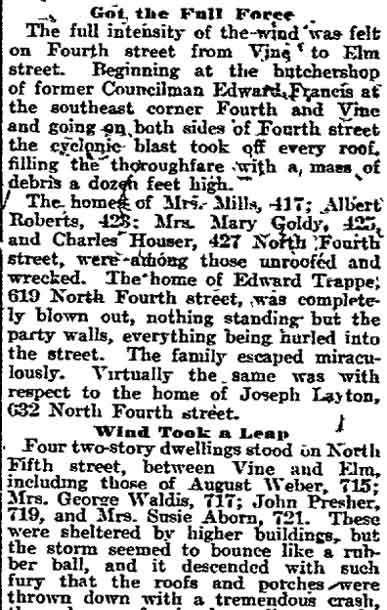
The full intensity of the wind was felt on Fourth street from Vine to Elm street. Beginning at the butchershop of former Councilman Edward Francis at the southeast corner Fourth and Vine and going on both sides of Fourth street the cyclonic blast took off every roof, filling the thoroughfare with a mass of debris a dozen feet high.
The homes of Mrs. Mills, 417; Albert Roberts, 423; Mrs. Mary Goldy, 425, and Charles Houser, 427 North Fourth street, were among those unroofed and wrecked. The home of Edward Trappe, 619 North Fourth street, was completely blown out, nothing standing but the party walls, everything being hurled into the street. The family escaped miraculously. Virtually the same was with respect to the home of Joseph Layton, 632 North Fourth street.
Wind Took a Leap
Four two-story dwellings stood on North Fifth street, between Vine and Elm, including those of August Weber, 715; Mrs. George Waldis, 717; John Presher, 719, and Mrs. Susie Aborn, 721. These were sheltered by higher buildings, but the storm seemed to bounce like a rubber ball, and it descended with such fury that the roofs and porches were thrown down with a tremendous crash, the volumes of rain descending and destroying the furniture.
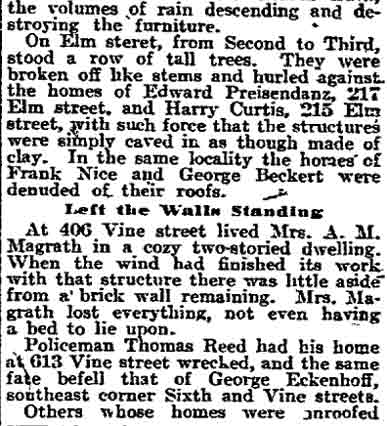
On Elm street, from Second to Third, stood a row of tall trees. They were broken off like stems and hurled against the homes of Edward Preisendanz, 217 Elm street, and Harry Curtis, 215 Elm street, with such force that the structures were simply caved in as though made of clay. In the same locality the homes of Frank Nice and George Beckert were denuded of their roofs.
Left the Walls Standing
At 406 Vine street lived Mrs. A. M. Magrath in a cozy two-storied dwelling. When the wind had finished its work with that structure there was little aside from a brick wall remaining. Mrs. Magrath lost everything, not even having a bed to lie upon.
Policeman Thomas Reed had his home at 613 Vine street wrecked, and the same fate befell that of George Eckenhoff, southeast corner Sixth and Vine streets.
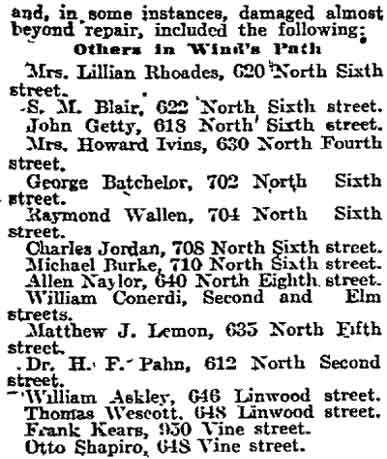
Others whose homes were unroofed and, in some instances, damaged almost beyond repair, included the following:
Others in Wind’s Path
Mrs. Lillian Rhoades, 620 North Sixth street.
S. M. Blair, 622 North Sixth street.
John Getty, 618 North Sixth street.
Mrs. Howard Ivins, 630 North Fourth street.
George Batchelor, 702 North Sixth street.
Raymond Wallen, 704 North Sixth street.
Charles Jordan, 708 North Sixth street.
Michael Burke, 710 North Sixth street.
Allen Naylor, 640 North Eighth street.
William Conerdi, Second and Elm streets.
Matthew J. Lemon, 635 North Fifth street.
Dr. H. F. Palm, 612 North Second street.
William Askley, 646 Linwood street.
Thomas Wescott, 648 Linwood street.
Frank Kears, 950 Vine street.
Otto Shapiro, 648 Vine street.
Two Hundred Houses Hit
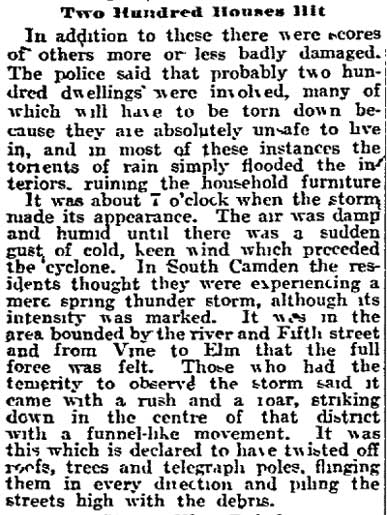
In addition to these there were scores of others more or less badly damaged. The police said that probably two hundred dwellings were involved, many of which will have to be torn down because they are absolutely unsafe to live in, and in most of these instances the torrents of rain simply flooded the interiors, ruining the household furniture.
It was about 7 o’clock when the storm made its appearance. The air was damp and humid until there was a sudden gust of cold, keen wind which preceded the cyclone. In South Camden the residents thought they were experiencing a mere spring thunder storm, although its intensity was marked. It was in the area bounded by the river and Fifth street and from Vine to Elm that the full force was felt. Those who had the temerity to observe the storm said it came with a rush and a roar, striking down in the centre of that district with a funnel-like movement. It was this which is declared to have twisted off roofs, trees and telegraph poles, flinging them in every direction and piling the streets high with the debris.
Storm Was Brief
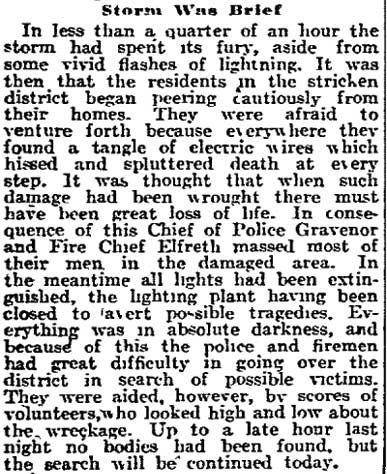
In less than a quarter of an hour the storm had spent its fury, aside from some vivid flashes of lightning. It was then that the residents in the stricken district began peering cautiously from their homes. They were afraid to venture forth because everywhere they found a tangle of electric wires which hissed and sputtered death at every step. It was thought that when such damage had been wrought there must have been great loss of life. In consequence of this Chief of Police Gravenor and Fire Chief Elfreth massed most of their men in the damaged area. In the meantime all lights had been extinguished, the lighting plant having been closed to avert possible tragedies. Everything was in absolute darkness, and because of this the police and firemen had great difficulty in going over the district in search of possible victims. They were aided, however, by scores of volunteers, who looked high and low about the wreckage. Up to a late hour last night no bodies had been found, but the search will be continued today.
Thousands on the Scene
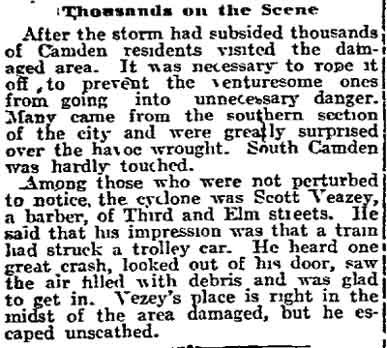
After the storm had subsided thousands of Camden residents visited the damaged area. It was necessary to rope it off to prevent the venturesome ones from going into unnecessary danger. Many came from the southern section of the city and were greatly surprised over the havoc wrought. South Camden was hardly touched.
Among those who were not perturbed to notice, the cyclone was Scott Veazey, a barber, of Third and Elm streets. He said that his impression was that a train had struck a trolley car. He heard one great crash, looked out of his door, saw the air filled with debris and was glad to get in. Vezey’s place is right in the midst of the area damaged, but he escaped unscathed.
Police Carnival Was a Gigantic Success
Philadelphia Inquirer –
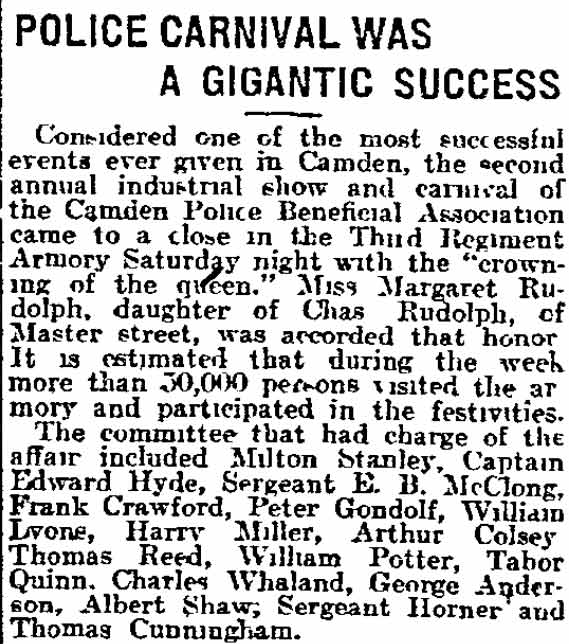
Considered one of the most successful events ever given in Camden, the second annual industrial show and carnival of the Camden Police Beneficial Association came to a close in the Third Regiment Armory Saturday night with the “crowning of the queen.” Miss Margaret Rudolph, daughter of Chas. Rudolph, of Master street, was accorded that honor. It is estimated that during the week more than 50,000 persons visited the armory and participated in the festivities.
The committee that had charge of the affair included Milton Stanley, Captain Edward Hyde, Sergeant E. B. McClong, Frank Crawford, Peter Gondolf, William Lyons, Harry Miller, Arthur Colsey, Thomas Reed, John T. Potter, Tabor Quinn, Charles Whaland, George Anderson, Albert Shaw, Sergeant Horner and Thomas Cunningham.
Held as Fugitive
Philadelphia Inquirer –
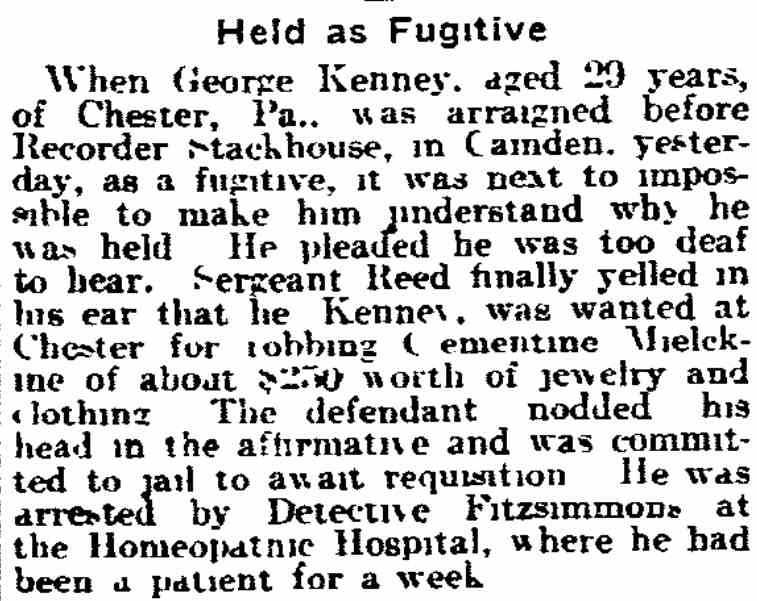
When George Kenney, aged 29 years, of Chester, Pa., was arraigned before Recorder Stackhouse, in Camden, yesterday, as a fugitive, it was next to impossible to make him understand why he was held. He pleaded he was too deaf to hear. Sergeant Reed finally yelled in his ear that Kenney was wanted at Chester for robbing Clementine Mielckine of about $250 worth of jewelry and clothing. The defendant nodded his head in the affirmative and was committed to jail to await requisition. He was arrested by Detective Fitzsimmons at the Homeopathic Hospital, where he had been a patient for a week.
Murderer’s Wife Supplied Revolver, Smuggling It In Covered by Fruit
Camden Post Telegram –
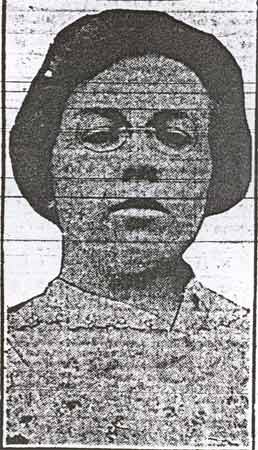
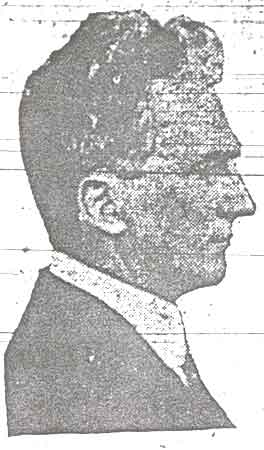
Confessing Supplying Pistol, in Spite of Husband’s Denial That She Was Guiltless, Mrs. Ashbridge Is Held Without Bail on Charge of Conspiracy in Aiding and Abetting Escape From Jail
Slayer’s Wife — Mrs. Marion Ashbridge Look For This Man — George E. Thompson
With Wilson T. Ashbridge under guard in a cell in what was formerly known as Murderer’s Row, the police and county detectives today redoubled their energies towards the capture of George E. Thompson, the forger who escaped with Ashbridge from the County Jail on Monday night after murdering one keeper and wounding another. Stirring the police of all cities in the East to renewed activity, another circular was sent out today by the authorities giving notice of the reward of $500 offered for Thompson’s capture. Attention was strongly directed in the circular due to the fact that one of the fingers of Thompson’s left hand is missing.
The gun with which Ashbridge murdered jailor Isaac Hibbs and wounded Jailor Ellis was smuggled into the jail by Mrs. Ashbridge on Saturday morning. With it went a box of cartridges. The weapon and bullets were passed to Ashbridge in a basket of fruit, being at the bottom of the basket. The jailors were busy at the time she called and as she frequently had brought her husband fruit they did not take precaution to search the basket. Mrs. Ashbridge bought the gun and cartridges on the written request of her husband.
Her confession as to the very grave part she played in the escape and murder was made to the Prosecutor late yesterday afternoon after she had first insisted she had no knowledge of how the gun got into the jail and after her husband had repeatedly declared that the revolver was supplied by Thompson. The revolver, fully loaded, was still carried by Ashbridge when he was captured in the Keystone Hotel…
… by Recorder Stackhouse without bail for conspiracy in aiding and abetting the escape of her husband and George E. Thompson from the County Jail on Monday night.
The court room was packed to suffocation by a morbidly curious crowd, composed primarily of women. A strange silence spread through the court room when the little woman was led into the court room by Captain Schregler. The regular formality of placing prisoners in the dock was dispensed with in the woman’s case.
Prosecutor De Unger pointed to the high witness chair and Mrs. Ashbridge sat in it. She evaded the gaze of the crowd, looking intently at the floor and through a window on the Washington Street side. She wore a blue skirt and a white waist. She was without her hat. Her hair was carefully arranged and she wore nose glasses.
Resting her chin on her right hand her arm and hand were seen to tremble slightly. So quiet was the room that a pin dropping could have been heard.
“Mrs. Marian Ashbridge,” called the Recorder.
“Yes, Sir” was the faint reply of the woman, who did not even look up at the call of her name.
“This complaint charges you with delivering to Wilson Ashbridge and George E. Thompson a pistol and aiding and abetting them in escaping from the County Jail, where they had been lawfully committed. Do you plead guilty or not guilty,” said the Recorder as he read the complaint.
The woman said nothing. Detective Schregler was then called as the complainant. He told of the confession made by the woman and produced the revolver which the woman purchased and which Ashbridge used in his daring escape. The gun, Captain Schregler said, was purchased in a pawnshop at Eleventh and Arch Streets, Philadelphia, on Friday of last week and was delivered to Ashbridge on Saturday morning along with a box of cartridges. “Marian, I will hold you without bail,” said the Recorder.
As the woman was being led from the court room by Captain Schregler and Sergeant Reed the crowd made a rush for the door leading from the court room, whereupon orders were given by the police to the crowd and many were prevented from rushing out. Everybody seemed anxious to secure a closer look at the unfortunate woman.
Visitors were denied Mrs. Ashbridge. Not even her children were permitted to be brought before her, although the broken-hearted mother asked for them.
“Oh, God, I don’t know why I did this; why I left the little ones to go with Wilson,” tearfully expostulated Mrs. Ashbridge to the kind-hearted matron, who spent the best part of last night with the distraught woman.
“If I could only see little Marian,” sobbed the woman in the arms of Mrs. Kirkpatrick, who informed her that perhaps she could see them today.
Last evening the only support Mrs. Ashbridge had was a cup of tea. The morning she sipped a portion of a cup of coffee. She told Matron Kirkpatrick that she was not hungry.
“Everybody hounded me, I had no friends, and that’s why I went with my husband, because he was the only friend I had left,” said Mrs. Ashbridge. “He was a good boy, but was easily led.” The wife said even before her marriage that Ashbridge would run around with other girls, but he always returned to her and she forgave him. She said he seemed to have a spell over her and she couldn’t leave him.
“I love my husband, still and will stand by him to the end,” sobbed the little woman to Mrs. Kirkpatrick. She told how her relatives disowned her and how after her father’s death she went to live with strangers. When her husband fostered the plan to escape she willingly consented to aid him. She drew $100 out of the bank and purchased clothes and the gun and bullets. She never faltered in her plan.
“My heart aches for that woman,” said Matron Kirkpatrick this morning to a Post-Telegram reporter. “She’s a good girl, but was easily led into her present predicament. It only goes to show what a woman will do for the man she loves, no matter how base a wretch he may be. Mrs. Ashbridge is more to be pitied than scorned.
Recorder Stackhouse this morning produced a copy of the marriage of the couple, performed by him on July 28, 1914. The marriage was performed at the instance of Assistant Prosecutor Butler after Ashbridge wronged the girl. Constable William E. Headley and William C. Ashbridge, the latter father of the murderer, were witnesses.
As told in yesterday’s Post-Telegram, Ashbridge and his wife and their captors arrived at the City Hall from Chester shortly after 2:00 o’clock. After a brief stay they were taken to the Court House and turned over to Prosecutor Kraft, Ashbridge being taken into the Prosecutor’s private office and Mrs. Ashbridge being placed under guard in the ante room.
Taking full blame for the murder of Hibbs and the wounding of Ellis, Ashbridge declared that none of the shots were fired by Thompson.
“I shot both men,” he declared, “but Thompson gave me the gun. He had it since Saturday.” He repeated this assertion several times in the course of his examination, adding each time that his wife had no part in supplying the firearm. His voluntary insistence in …
… exercise corridor of their cells in response to his request that he wanted to show him a note that had been left for him, he asked the aged keeper to step inside the corridor. Evidently suspecting something was wrong Hibbs refused to enter the corridor. When Ashbridge repeated his request that Hibbs step inside, Thompson, who was immediately behind Ashbridge, said something to the murderer. Ashbridge could not exactly recall what the expression was. At any rate it was then that he fired and Hibbs fell to the floor with his death wound. To take Hibbs keys and open the door leading from the exercise room to the corridor was the work of but an instant. It was then that Ellis confronted Ashbridge at the other end of the corridor. He refused to throw up his hands when the murderer so ordered. Instead, the plucky jailor grappled with the slayer, who again brought the gun into play, twice wounding the remaining jailor.
Ashbridge did not say why he wanted Hibbs to step inside the corridor. One surmise is that the pair had planned to get the old man into the corridor, overpower him, take his keys and after gagging him place him in a cell, depending on the gun to awe any prisoners who might make an outcry. But whatever their plan was in this respect it miscarried. Hibbs would not enter the corridor and was shot down where he stood.
Thompson carried both his own and Ashbridge’s coats when they fled. As Ashbridge had decided to do the talking with Hibbs when the jailor came to lock them in their cells it was agreed that it would not be wise for the murderer to be wearing a coat. This might look suspicious to Hibbs and in all likelihood he would refuse to open the door. Hence it was decided that Thompson should take both coats. He also carried Ashbridge’s cap and his own Panama.
The coats and hats were adjusted as they ran down the spiral stairway leading to the street. They walked slowly into Sixth Street; increasing their pace up Sixth Street after crossing Market and after turning into Cooper walked very rapidly. They turned north on Third Street to Main and thence to the Vine Street ferry, where they caught the boat leaving at 7:15 for Philadelphia. Landing on the other side the fugitives exchanged hats. They walked rapidly to Broad Street Station, where Mrs. Ashbridge was in waiting, this arrangement having been made when she smuggled the gun in to her husband on Saturday morning.
Accompanied by Thompson the Ashbridges walked out Market Street to Thirty-second Street. Here Thompson left them and after walking the street for a brief while longer the slayer and his wife boarded a trolley car for Chester, where a few hours later the murderer’s short-lived liberty was so dramatically terminated.
Although jailor Ellis still insists that three shots were fired before he was attacked and in spite of the positive declaration of Alfred Williams, the trusty, that three shots were fired at Hibbs, Ashbridge claims that Hibbs was shot only once and that two bullets were used on Ellis. He said that the three empty shells which the detectives found in his pocket contained the only bullets fired in the jail. The post mortem examination made yesterday by County Physician Stem bears out his contention as to the number of shots fired. Only one bullet was found and that had penetrated the jailor’s heart.
“That’s the truth about the shooting,” declared Ashbridge. “I fired the shots—three of them in all—and the gun was given me by Thompson. My wife had nothing to do with it. Don’t blame her.”
Enroute back to the prison from which he had made his tragic getaway on Monday night, Ashbridge passed through the ante room where his wife was under guard. He stopped, kissed her, gently caressed her cheek, told her not to worry and passed on to the jail, from whence his next exit will be to the electric chair.
Haggard and very weak Mrs. Ashbridge was at once taken before the Prosecutor. With due regard for her condition Mrs. Ashbridge was handled very gently. At first she insisted that she had no part in getting the gun, but under skillful handling she finally broke down and confessed that she had supplied the revolver.
She stated that on Friday night she received a letter from her husband telling her that he planned to escape from the jail on Monday night and that he needed a revolver to make certain that his scheme would not fail. He requested that she procure the pistol and cartridges and personally deliver them on Saturday. Being anxious to aid her husband in every way possible she readily decided to do as he requested.
Accordingly she purchased the needed articles in a Philadelphia pawnshop on Friday afternoon, paying $3.00 for the pistol and 67 cents for the cartridges. She kept them over night and on Saturday safely delivered the weapon and bullets to her husband in the bottom of a basket of fruit. At the same time Ashbridge asked her to go with him and when she agreed to share his fate he told her to meet him in Broad Street Station, Philadelphia, shortly after seven o’clock on Monday night. He further told her that he had carefully studied the situation and did not see how it was possible for his plan to miscarry. On Monday morning she sent her children to the home of Mrs. Anna Dick and later in the day sent the letter to Mrs. Dick telling of her “rash deed” and enclosing $10 for the children.
As Mrs. Ashbridge told her story she spoke in a very low tone. Most of the time her eyes were cast down and as she concluded her brief narrative she sobbed convulsively and was in a state of utter collapse. Reviving somewhat when given cold water Mrs. Ashbridge was turned over to the police and taken back to City Hall to await her hearing this morning.
The prison key stolen by Ashbridge from Hibbs’ murdered body was recovered this morning by Detective Doran in the yard of Dr. Frank, 2025 Chestnut Street, Philadelphia. The recovery of the key was due to information given by Ashbridge, after he had been locked up in jail yesterday afternoon. Ashbridge, when questioned as to the whereabouts of the key, said that Thompson had it and that he had seen him toss it over a wall of a residence near Twenty-third and Chestnut Streets on Monday night while he and his wife and Thompson were walking to Thirty-second Street.
Detective Doran and Constable Voight went to Philadelphia late yesterday afternoon and searched in vain for the key in the vicinity of Twenty-third and Chestnut Streets until darkness came on. Detective Doran renewed the search early this morning. There is a high wall fronting the yard at the home of Dr. Frank, and a search of the grounds resulted in the finding of the key, which was returned to Sheriff Haines.
Ashbridge is confined in a large cell in what is known as Section E. As cellmates he has two persons who are being held as witnesses to the crime. Sheriff Haines has assigned three constables, Gardner, Ford, and Addison. They will work on eight-hour shifts and will see that Ashbridge does not attempt any further escape or try to end his life.
Sergeant Detective Kane of the Chicago Police Department today took to Chicago Alfred Williams, who was an eyewitness to the murder of Hibbs. Williams, an Italian, served six months here on a charge of false pretence in obtaining money from a number of Italian grocers under the pretence that he represented the Roma Grocery Company. After his arrest and sentence here the police of Chicago lodged a detainer against Williams who is wanted in the West for a like crime.
The body of Jailor Hibbs will be exposed to view tonight at his home, 913 South 8th Street. Services will be conducted by Reverend Harry Bradway, pastor of Eighth Street Methodist Episcopal Church. Members of the Seventh Ward Republican Club, Mutual Aid and the Liberty Beneficial Society will attend in a body.
Tomorrow morning the body will be taken to Langhorne, where services will be held in the Friends Meeting House, after which interment will be made in the burial ground by the Schroeder-Kephart Company. Friends may call this evening to pay their respects.
Ashbridge will not be tried until December. On the day he was listed for trial of murdering Mrs. Dunbar his lawyer, Assemblyman Wolverton, was ill. In the interim the entire panel of jurors for the April term of court was discharged following a case of alleged tampering. This makes it necessary that he be held until September for trial unless the Court should otherwise decree, which is hardly likely.
Ashbridge is 22 years old and not 27, as previously stated. His real age was disclosed by the certificate of his marriage. He was 20 when he wedded two years ago.
The Howard Marshall who mailed a letter to a woman in Baltimore is not Freeholder Howard Marshall of the Eighth Ward, as was reported to the Prosecutor yesterday. Mr. Kraft’s investigation disclosed that Freeholder Marshall does not know either Ashbridge or Thompson and that as a matter of fact the Marshall in question is an East Sider and no relative to the freeholder, who was naturally much upset at being mistakenly dragged into the case.
E. S. Fry, proprietor of the Keystone Hotel, Chester, where the couple were caught, told the story of the capture both to the city police and Prosecutor Kraft.
“Late on Monday night I received a call from another hotel, requesting that I take care of a man and his wife for the evening,” said Mr. Fry. “I waited until a little before midnight when the couple arrived. He seemed nervous and registered in a shaky hand, and I was suspicious that there was something wrong.”
“I did not pay much attention to the way he registered until the next morning when I examined the register and saw that he had neglected to register his wife. He signed ‘Mr. Smythe, Washington, D.C.’ I communicated my suspicions to my wife and told her to go observe the couple, too. Then I went out on the porch and picked up a morning newspaper. On the front page were the pictures of the two men who escaped.”
“I instantly recognized Ashbridge, but was not just sure of my identity of the man, so I decided to get a better look at him. At the breakfast table I observed him more closely and feeling sure of my ground I called Captain Schregler, afterward securing the service of two negro policemen, whom I placed on guard outside the hotel, giving them orders not to allow the couple to leave. The officers, William Padgett and William Robinson, took their positions outside the hotel, ready for the signal to enter when I gave it.”
“Ashbridge arose.”
“What’s the matter,” he exclaimed. “You know what’s the matter,” replied Mr. Fry, who brought in Captain Schregler and Detective Hunt. Schregler and Hunt instantly recognized the fugitive.
Before Ashbridge had a chance to move his arms were pinioned by his sides and Policeman Hunt had extracted the murder gun from his right hip pocket. It was fully loaded. In the same pocket were seventeen additional cartridges and in a suitcase in his room, Number 9, was a fresh box of cartridges.
“The little wife was crying bitterly,” said Mr. Fry. “She leaned her head upon his shoulder and the husband tried to console her.”
Captain Schregler sent a telegram to Chiefs Gravenor and Hyde with the startling news that Ashbridge had been caught.
On the way back to Camden Mrs. Ashbridge began to cry. She was sitting beside Captain Schregler, and he tried to console her. Her sobs increased, and Ashbridge called to her to “take it easy.”
This seemed to quiet her a bit, and Schregler spoke to her kindly, saying that she would not be blamed very much for her part in the escape. “That’s not worrying me” she answered. “I am worried about ‘Wil’.”
“Well, you women beat me” was Schregler’s comment. “What did you want to help him escape for, anyhow? He had beaten you, deserted you for another woman and when she turned him down, he killed her. Yet you make up with him, leave your kids and risk everything to help him escape. Seems to me the worse men treat you women, the more you will do for them.”
“Lots of truth in what you say,” remarked Mrs. Ashbridge, with a sigh.
Mr. Fry was the center of attention. Everybody seemed anxious to hear his story.
“I’m not going back until I collect that $500 either,” he was heard to say. The capturer was formerly coroner of Delaware County.
Scenes of excitement were prevalent when the automobile of Chief Gravenor with Detective-chauffeur David Hunt at the wheel, Captain Schregler and the prisoners in the rear and Chief Dodd, of the Pennsylvania Railroad police force in the front seat came from the Federal Street Ferry. E. S. Fry, the hotel proprietor who caught the Ashbridges, was also in the car.
Ashbridge and his wife were instantly recognized. The news spread like wildfire and was passed along the route of the machine to police headquarters.
Thinking that the prisoners would be brought to the Prosecutor’s office, a battery of newspapermen and photographers were camped on the Court House plaza. When someone cried in bellowed tones “There they go,” the scribes and photographers started in hot pursuit behind the automobile.
The officers upon reaching the City Hall had to fight their way through the dense crowd which had gathered outside Police Headquarters. Many stood tiptoed to get a good glance at the prisoners who were abashed at their predicament.
Pulling her black straw hat over her face, Mrs. Ashbridge leaned on her husband’s arm. To hide his face the murderer pulled the Panama hat, which he had secured from Thompson, over his countenance.
Preliminary questioning was done by Captain A. L. James, after which the officers and prisoners were escorted upstairs to the office of Chief Gravenor.
Still clenching the stump of a cheap cigarette in the corner of his mouth, Ashbridge had a pitiful look on his face. He was much thinner than he was when he was arrested for the murder of the Dunbar girl. On his upper lip was a small mustache, which he raised during the last week.
His beautiful and baby-like eyes still retained their piercing stare. The murderer looked wild-eyed at persons in the room. He seemed to take delight in singling out persons in the room and “staring them out.” None seemed courageous enough to return Ashbridge’s strange stare. He looked distressed but the only betraying sign of nervousness was his incessant twitching of his fingers. Seated on the couch in the chief’s room, Ashbridge talked freely.
His wife dried away the tears as they trickled down her reddened face but after regaining her composure she seemed quite calm. She intently watched Captain Schregler and Detective Hunt as they searched through her husband’s clothes.
When the trip for the Court House was being arranged the two prisoners, still handcuffed together, walked in the outer room of the chief’s office. It was then that the wife broke down slightly. She choked back a sob and leaned her head on her husband’s shoulder. Ashbridge did likewise and patted her on the back, at the same time, saying something in a suppressed tone of voice. The only persons in the room at the time were Assistant Chief Hyde and a Post-Telegram reporter. Neither was able to catch the words uttered. Captain Schregler, Chief Gravenor, and Detective Hunt later entered the room and the start for the Court House was made.
The crowd below which was camped about the entrance to the building awaited with patient expectancy, when the news was spread that the prisoners were leaving the building.
Camera men took their positions, ready to snap the couple, but the Ashbridges fooled them. Before the door leading to the street was opened Ashbridge drew his wife to him and with their free hands pulled their hats over their faces, thus eluding the photographers, who resorted to every means to secure a photograph.
Once inside the automobile the prisoners seemed content until the Court House was reached when another large crowd was on hand to greet them. Both repeated the trick of hiding their faces.
After Ashbridge was taken to his cell his wife was ordered taken to the detention department in the City Hall. Captain Schregler and Detective Hunt half-carrying the sobbing and broken-hearted woman, who has aroused some sympathy for her courageousness in taking such a desperate chance for the man she loved, the father of her children and a cruel murderer.
“What other woman would do as much as she has for her husband,” was the query advanced by one of the spectators in the Court House corridor as Mrs. Ashbridge passed through on her way to the waiting automobile.
Young Actress Dies
Philadelphia Inquirer –
Stricken ill while playing in the South. Miss Helen Yearsley Bryen, aged 17 years, died yesterday at her home, 828 South Second street, Camden. She was a member of “What’s the Idea” company and had also played with “Seven Little Darlings” and “Tit-Bits.” Miss Bryen was a step-daughter of Police Sergeant Thomas Redd [sic], and has a brother, Walter, in the navy. The funeral takes place Monday afternoon.
Policemen Retire on Pension Fund
Camden Daily Courier –
George Johnson Has Unique Record Of Not Having An Arrest In 20 Years
PENSION SERGEANT REED
Thomas S. Reed, police sergeant at headquarters, went on the pension list today after 21 years’ continuous service. Policeman George Johnson, of the Third District, will be pensioned on May 15. Johnson had the record of never having made an arrest in 20 years.
It was announced at headquarters today that some general changes will be made as a result of the retirement of the two bluecoats. Traffic Policeman Edmund Pike has been promoted to sergeant by Mayor Ellis and placed at headquarters to succeed Sergeant Reed. Mounted Policeman Walter Walsh has been promoted sergeant.
Reed Appointed Twice.
Sergeant Reed was first appointed on the force by Mayor Pratt on January 6, 1896. He resigned and was a special officer for the Camden, Gloucester and Woodbury Railway. Later he was in the revenue service. He was appointed again on the force by Mayor Hatch in 1899. On January 8, 1914, he was promoted street sergeant by Mayor Ellis. Two years later he was placed at police headquarters.
Johnson Without an Arrest.
Patrolman Johnson has always had a beat in the North and South Rosedale sections, where he was held in the highest esteem. He was always on the job, residents of that section say. The fact he never made an arrest failed to mar his record. He was appointed on the force by Mayor Hatch.
In announcing his plans for the future Johnson said today he will make his home in the future with his brother Samuel, a contractor, at Rio Grande Bridge.