Introduction
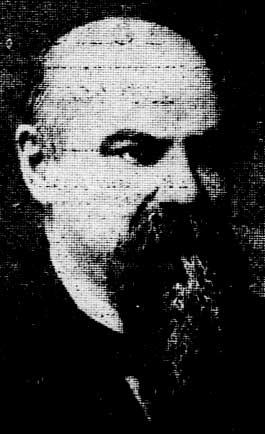
Samuel Dodd Jr.
SAMUEL DODD JR. was born near Moorestown NJ on June 25, 1841, one of seven sons of Samuel and Mary Dodd. His father was a shoemaker, and Samuel Dodd followed him into this trade. He settled in Camden in 1874. He made his home at 510 Vine Street in North Camden.
Samuel Dodd was appointed Chief of Police in 1887, and was appointed Chief every year thereafter save from March of 1893 to March 31, 1894 when the Democrat controlled Police Commission gave the job to William H. Davis, until 1898. He was succeeded by John Foster in July of 1898.
Chief Dodd passed away on February 10, 1901 after a two-week illness.
The Day in Camden.
Philadelphia Inquirer —
Decorations in the City and Vicinity by Posts of the Grand Army.
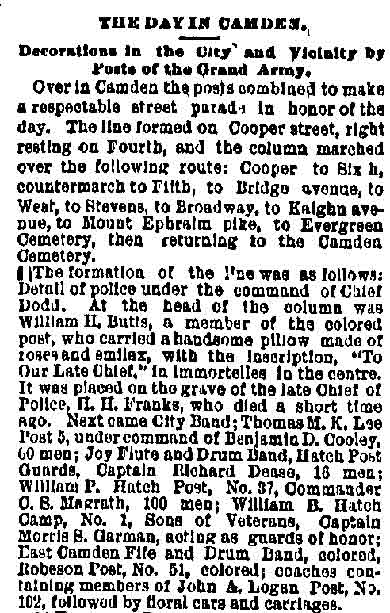
Over in Camden the posts combined to make a respectable street parade in honor of the day. The line formed on Cooper street, right resting on Fourth, and the column marched over the following route: Cooper to Sixth, countermarch to Fifth, to Bridge avenue, to West, to Stevens, to Broadway, to Kaighn avenue, to Mount Ephraim pike, to Evergreen Cemetery, then returning to the Camden Cemetery.
The formation of the line was as follows: Detail of police under the command of Chief Dodd. At the head of the column was William H. Butts, a member of the colored post, who carried a handsome pillow made of roses and smilax, with the inscription, “To Our Late Chief,” in immortelles in the centre. It was placed on the grave of the late Chief of Police, H. H. Franks, who died a short time ago. Next came City Band; Thomas M. K. Lee Post 5, under command of Benjamin D. Cooley, 60 men; Joy Flute and Drum Band, Hatch Post Guards, Captain Richard Dease, 16 men; William P. Hatch Post, No. 37, Commander C. S. Magrath, 100 men; William B. Hatch Camp, No. 1, Sons of Veterans, Captain Morris S. Garman, acting as guards of honor; East Camden Fife and Drum Band, colored, Robeson Post, No. 51, colored; coaches containing members of John A. Logan Post, No. 102, followed by floral cars and carriages.
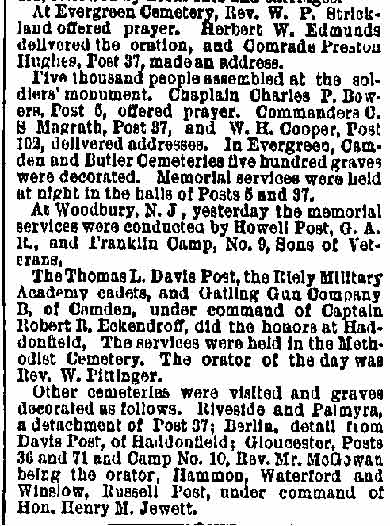
At Evergreen Cemetery, Rev. W. P. Strickland offered prayer. Herbert W. Edmunds delivered the oration, and Comrade Preston Hughes, Post 37, made an address.
Five thousand people assembled at the soldiers’ monument. Chaplain Charles P. Bowers, Post 6, offered prayer. Commanders C. S. Magrath, Post 37, and W. H. Cooper, Post 102, delivered addresses. In Evergreen, Camden and Butler Cemeteries five hundred graves were decorated. Memorial services were held at night in the halls of Posts 5 and 37.
At Woodbury, N. J., yesterday the memorial services were conducted by Howell Post, G. A. R., and Franklin Camp, No. 9, Sons of Veterans.
The Thomas L. Davis Post, the Riely Military Academy cadets, and Gatling Gun Company B, of Camden, under command of Captain Robert R. Eckendroff, did the honors at Haddonfield. The services were held in the Methodist Cemetery. The orator of the day was Rev. W. Pittinger.
Other cemeteries were visited and graves decorated as follows. Riverside and Palmyra, a detachment of Post 37; Berlin, detail from Davis Post, of Haddonfield; Gloucester, Posts 36 and 71 and Camp No. 10, Rev. Mr. McGowan being the orator; Hammon, Waterford and Winslow, Russell Post, under command of Hon. Henry M. Jewett.
Trenton Evening Times — January 17, 1888
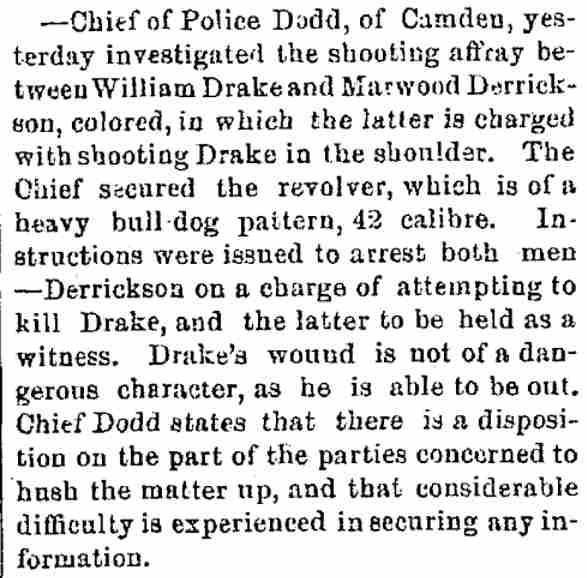
Named: William Drake, Marwood Derrickson, and Samuel Dodd.
Logue’s Assailants Captured
Camden Daily Telegram —
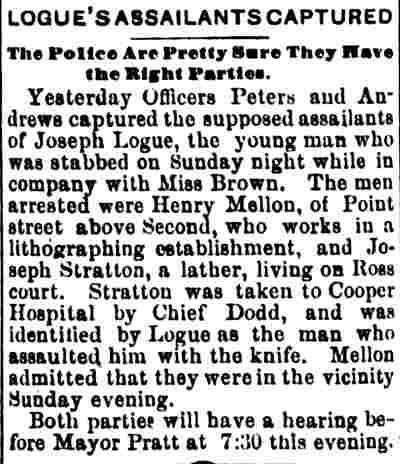
The Police Are Pretty Sure They Have the Right Parties.
Yesterday Officers Peters and Andrews [sic] captured the supposed assailants of Joseph Logue, the young man who was stabbed on Sunday night while in company with Miss Brown. The men arrested were Henry Mellon, of Point street above Second, who works in a lithographing establishment, and Joseph Stratton, a lather, living on Ross court. Stratton was taken to Cooper Hospital by Chief Dodd, and was identified by Logue as the man who assaulted him with the knife. Mellon admitted that they were in the vicinity Sunday evening.
Both parties will have a hearing before Mayor Pratt at 7:30 this evening.
Lodged in Camden’s Jail
Philadelphia Inquirer —
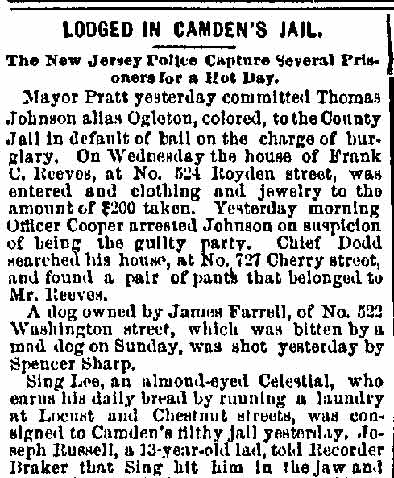
LODGED IN CAMDEN'S JAIL.
The New Jersey Police Capture Several Prisoners for a Hot Day.
Mayor Pratt yesterday committed Thomas Johnson alias Ogleton, colored, to the County Jail in default of bail on the charge of burglary. On Wednesday the house of Frank C. Reeves, at No. 524 Royden street, was entered and clothing and jewelry to the amount of $200 taken. Yesterday morning Officer Cooper arrested Johnson on suspicion of being the guilty party. Chief Dodd searched his house, at No. 727 Cherry street, and found a pair of pants that belonged to Mr. Reeves.
A dog owned by James Farrell, of No. 522 Washington street, which was bitten by a mad dog on Sunday, was shot yesterday by Spencer Sharp.
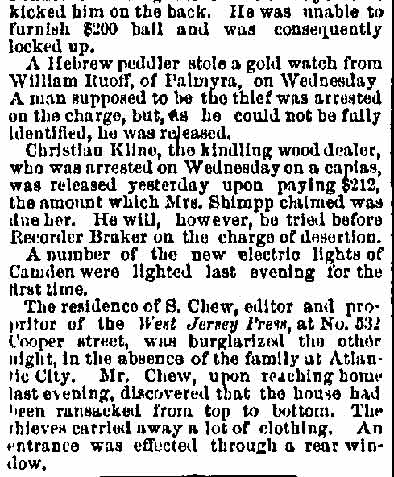
Sing Lee, an almond-eyed Celestial, who earns his daily bread by running a laundry at Locust and Chestnut streets, was consigned to Camden's filthy jail yesterday. Joseph Russell, a 13-year-old lad, told Recorder Braker that Sing hit him in the jaw and kicked him on the back. He was unable to furnish $200 ball [sic] and was consequently locked up.
A Hebrew peddler stole a gold watch from William Ruoff, of Palmyra, on Wednesday. A man supposed to be the thief was arrested on the charge, but, as he could not be fully identified, he was released.
Christian Kline, the kindling wood dealer, who was arrested on Wednesday on a capias, was released yesterday upon paying $212, the amount which Mrs. Shimpp claimed was due her. He will, however, be tried before Recorder Braker on the charge of desertion.
A number of the new electric lights of Camden were lighted last evening for the first time.
The residence of S. Chew, editor and proprietor of the West Jersey Press, at No. 532 Cooper street, was burglarized the other night, in the absence of the family at Atlantic City. Mr. Chew, upon reaching home last evening, discovered that the house had been ransacked from top to bottom. The thieves carried away a lot of clothing. An entrance was effected through a rear window.
Assaulting the Nurse
New York Times —


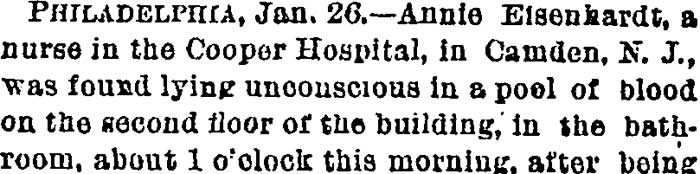
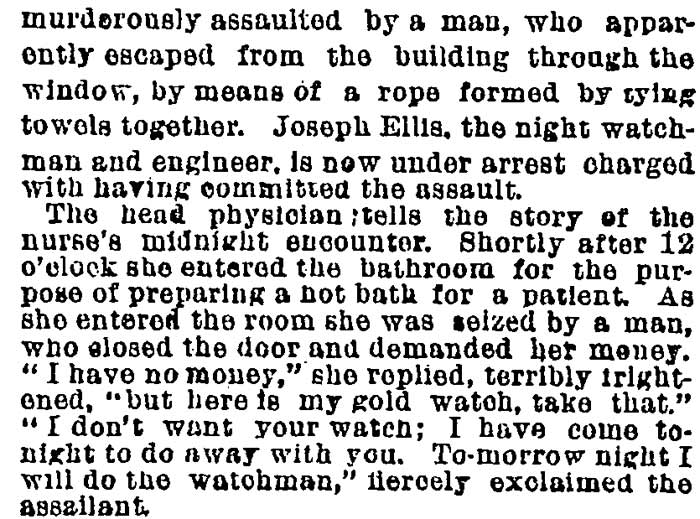
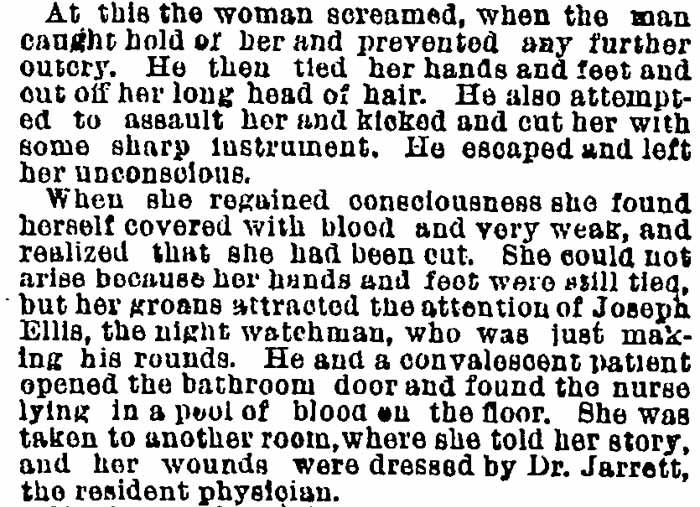
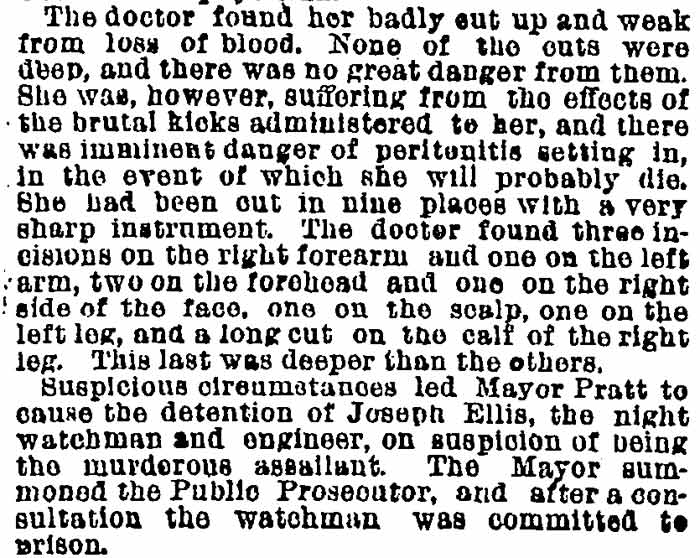
Named: Annie Eisenhardt, Joseph Ellis, Dr. Harry Jarrett, Jesse Pratt, Samuel Dodd, and Wilson H. Jenkins.
The Camden Mystery
Philadelphia Inquirer —
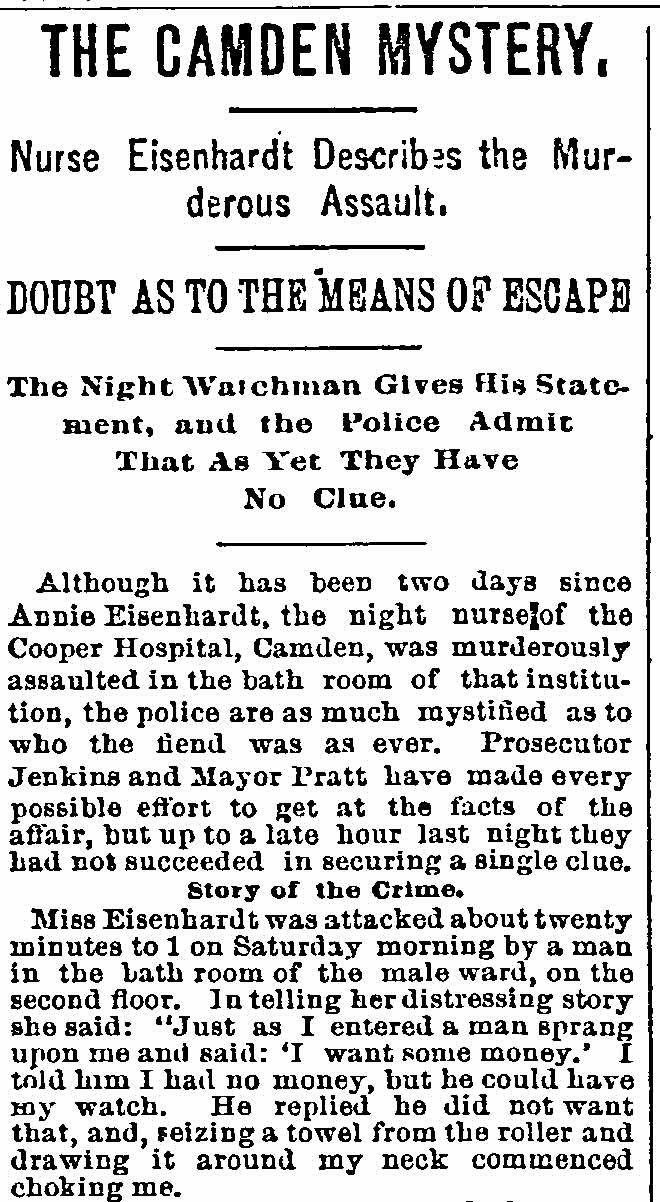
Nurse Eisenhardt Describes the Murderous Assault.
Doubt as to the Means of Escape
The Night Watchman Gives His Statement, and the Police Admit That As Yet They Have No Clue.
Although it has been two days since Annie Eisenhardt, the night nurse of the Cooper Hospital, Camden, was murderously assaulted in the bath room of that institution, the police are as much mystified as to who the fiend was as ever. Prosecutor Jenkins and Mayor Pratt have made every possible effort to get at the facts of the affair, but up to a late hour last night they had not succeeded in securing a single clue.
Story of the Crime.
Miss Eisenhardt was attacked about twenty minutes to 1 on Saturday morning by a man in the bath room of the male ward, on the second floor. In telling her distressing story she said: “Just as I entered a man sprang upon me and said: ‘I want some money.’ I told him I had no money, but he could have my watch. He replied he did not want that, and, seizing a towel from the roller and drawing it around my neck commenced choking me.
“I screamed, and he pulled the towel tighter. He then threw me down on the floor and tied my wrists and ankles with a piece of twine, after which he attempted to assault me, but I frustrated his fiendish design by struggling. The stranger then pulled a sharp instrument from his pocket and cut my hair off, and then commenced to slash at me with the instrument he had pulled from his pocket.
“He also tried to throw me out of the window, but was prevented from doing so by my struggling with him. He then snatched my jewelry and as he went out of the bath room window I became unconscious.”
Did He Escape from the Window?
The only window in the institution that was found unfastened was the window in the room where the assault occurred. This was up, and a rope made of strips of toweling was found dangling from the window sill.
Here is where the mysterious part of the crime commences. Officer Williams upon arriving on the scene, tested the strength of this rope, and says that he hardly attached to it the weight of twenty-five pounds before it parted. This he thought proved conclusively that no one ever made his escape by sliding down the knotted towels.
Another strange part of the story is the fact that the ground beneath the bath-room window was soft and smooth, and had any one slid down the toweling or jumped from the window foot prints would certainly have been discovered on the ground. No foot prints, however, were to be seen.
What the Watchman Says.
Early on Saturday morning Joseph Ellis, the engineer and night watchman, was summoned to the City Hall and in the presence of Mayor Pratt, Prosecutor Jenkins and the Chief of Police made this statement:
“About twenty-five minutes of 1 o’clock this morning (Saturday) I met Miss Eisenhardt on my rounds in the ward on the second floor. I then went into the convalescing room and commenced talking to a patient named Buchanan about seeing a strange man about the building the night before.
“My conversation was interrupted by the patient, who said there must be a new arrival, as he had heard groans. I next started down into the engine room, but my progress down stairs was arrested by groans coming from the bath room. Going in, I found Miss Eisenhardt lying upon the floor bleeding. I was only twenty-five feet away from where the assault occurred, and had there been any altercation or outcry I must have heard it.”
The watchman concluded his statement by giving it as his opinion that some one in the institution committed the assault or Miss Eisenhardt’s wounds were inflicted by her own hand.
Miss Eisenhardt is 30 years of age. She came to the Cooper Hospital about three months ago from the Jewish Hospital, this city. She described her assailant as being about 150 pounds in weight, and even in the hurry and confusion of the struggle she noted that he had a black moustache and wore a black cap and black overcoat.
What the Officials Say.
Mayor Pratt said to an INQUIRER reporter yesterday that the crime was still as much of a mystery to the police as when first reported. “I have made every available effort,” he said, “to get at the bottom of the affair, but thus far have failed. My opinion is that Miss Eisenhardt knows more than she tells.”
Chief of Police Dodd, when asked yesterday if the police were working on any clue, replied: “Sunday is a day of rest, so we will rest to-day and go to work on the case again to-morrow.”
Prosecutor Jenkins and Dr. Jarrett, the resident physician of the hospital, were closeted with the injured nurse for nearly an hour yesterday. Both said that she gave no further details, but merely reiterated her former statement.
Miss Eisenhardt says that she has no friends in this country, but that while she was at the Jewish Hospital a man, whose name she refused to divulge, had wanted her to marry him.
Camden News
Philadelphia Inquirer —
Gertie Houseworth, a colored domestic, who was charged with breaking and entering, was sent to the Industrial School for Girls by Judge Hugg.
Articles of incorporation of the Gas Improvement Company of North America, with a capital stock of $60,000, were filed in the Camden County Clerk’s office yesterday.
Camden had its heaviest rain storm of the season yesterday. The only damage reported was to some stock in the cellars of one or two business houses on Federal street.
Young Brooks, who attacked Frank Beatt with a knife a short time ago and then skipped the town, surrendered himself at the City Hall last night. He furnished bail for his appearance at court.
Charles P. Herfurth, of Second and [?] streets, Camden, who attempted to end his life on Saturday by taking a dose of poison, was held to bail by Mayor Pratt yesterday for assault and battery on his wife.
Postmaster Browning, of Camden, yesterday requested the resignation of lettercarriers David Paul, Daniel Cahill, Daniel Leach and Harry Bagge. All but Bagge immediately acceded to Mr. Browning’s request and sent in their resignations at once. Bagge has until the 15th inst. to resign.
Charles C. A. Baldi, who took out letters of testamentary on the estate of Michael D. Naple[?] the Italian who was murdered at Waterford, applied at the City Hall yesterday and secured the effects of the dead man from Chief of Police Dodd. They consisted of $3.85 in United States money and $500 Brazilian note, which is worth about $300 in United States currency.
Camden’s News Budget
Philadelphia Inquirer —
A Would-Be Suicide Who Spent His Wife’s Money for Rum.
Adolph Meyers, of 1109 Emma street, who attempted to kill himself late Saturday night, is locked up at the City Hall. He is rapidly improving and will be released to-day or to-morrow. To Chief of Police Dodd he said he had become down-hearted and had decided to kill his wife and then end his own existence. He changed his mind and shot himself.
Mrs. Meyers says that on Saturday evening she gave her husband $1 to purchase groceries with and instead he bought whisky. When he came home he was under the influence of liquor and was only in the house a few minutes when he attempted to shoot himself. Lieutenant Stehr says that when he called at the house Meyers asked him for his revolver, saying it was better than his and would do the work.
Fight at a Christening.
The baby of John Flerker, who resides at Mount Ephraim and Kaighn avenues, was christened yesterday, and as a result a half a dozen of the participants are now locked up in jail. After the water had been sprinkled on the child’s head, those who had assembled to witness the ceremony started in drinking beer.
Toward dark, by which time the entire party was under the influence of liquor, a free fight ensued. Officer Peters was summoned and arrested Fred Collett, Frank Dasky, Henry Raskoska, Jacob Schiecht and his son. They were locked up for a hearing to-day.
An Appropriate Song.
About 150 persons from Philadelphia visited Camden yesterday to witness the baptism of a man and woman, who accompanied them. About 1,000 boys who had heard of the coming of the pair to be baptised were at Vaneman’s wharf waiting for them. The pair were led out into the stream, and just as the minister dipped them into the water the boys commenced to sing “Down Went McGinty to the Bottom of the Sea.”
Notes.
The octogenarian services of the Methodist churches were concluded yesterday. The principal speaker of the day was Bishop Cyrus D. Foss.
The spectators who were captured in the prize fight raid on Friday night will have a hearing before Mayor Pratt to-day.
Rev. J. L. Sooy, of the Tabernacle Baptist Church, conducted the services yesterday for the first time since his illness.
William Haines and Herman Shaffer are locked up at the City Hall for stealing lumber from the yard of Volney G. Bennett.
Harry Daniels is locked up for stealing $175 worth of shoes from the Philadelphia Shoe House.
NOTES.
Philadelphia Inquirer —
William Carrigan, Democrat of the Second ward, has sent his resignation to Postmaster Browning to take effect on the 15th instant.
J. W Stow is locked up in the City Hall awaiting a hearing on the charge of assault and battery on Annie Genther.
Mayor Pratt is confined to his home suffering from grippe. Chief of Police Dodd is in style and also has the disease. Two of his sons are confined to their beds. Charles R. Bacon, of the Record, is one of the latest victims to succumb.
Policeman H Wheaten, of the Second ward, has resigned as a patrolman. He will be succeeded by Ed Powell, an engineer in the Water Department. John Killmartin has been appointed to fill the latter’s piece.
Philip Harris and wife have been held in bail, charged with keeping a disorderly house at Front and Elm streets.
Over in Camden
Philadelphia Inquirer —
Grand Army Men and School Children Join in the Services.
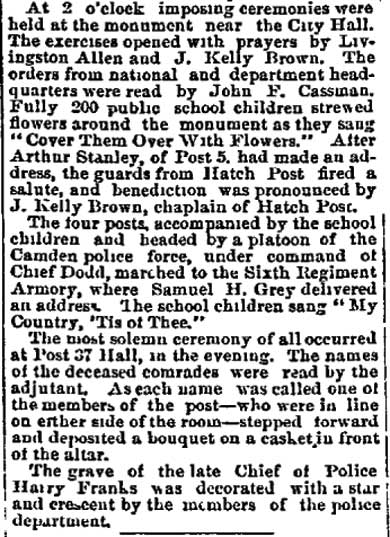
Decoration day in Camden was observed by all of the four posts: William B. Hatch, No. 37; Thomas M. K. Lee, No. 5; General William P. Robeson, No. 51, and General John A. Logan, No. 102. There was a joint committee from various posts with ex-Mayor Samuel M. Gaul, of Post 37, as chairman, to look after the details. At seven o’clock in the morning the four posts assembled at headquarters and took carriages for the cemeteries.
Post 37 cared for the graves in Camden Cemetery, Lee Post looked after the Harleigh and Catholic Cemeteries, and Robeson Post decorated the graves of the colored comrades in the Johnson and Butler Cemeteries. A detail from all of the posts visited Palmyra and decorated the graves of the soldiers buried at that place.
At 2 o’clock imposing ceremonies were held at the monument near the City Hall. The exercises opened with prayers by Livingston Allen and J. Kelly Brown. The orders from national and department headquarters were read by John F. Cassman. Fully 200 public school children strewed flowers around the monument as they sang “Cover Them Over With Flowers.” After Arthur Stanley, of Post 5, had made an address, the guards from Hatch Post fired a salute, and benediction was pronounced by J. Kelly Brown, chaplain of Hatch Post.
The four posts, accompanied by the school children and headed by a platoon of the Camden police force, under command of Chief Dodd, marched to the Sixth Regiment Armory, where Samuel H. Grey delivered an address. The school children sang “My Country, ‘Tis of Thee.”
The most solemn ceremony of all occurred at Post 37 Hall, in the evening. The names of the deceased comrades were read by the adjutant. As each name was called one of the members of the post—who were in line on either side of the room—stepped forward and deposited a bouquet on a casket in front of the altar.
The grave of the late Chief of Police Harry Franks was decorated with a star and crescent by the members of the police department.
Camden’s Fire Laddies Parade
Philadelphia Inquirer —
AN EVENT WHICH ENTHUSED THE QUIET CITY ACROSS THE RIVER.
The City Profusely Decorated in Honor of the Event and an Immense Crowd in Attendance—Brief Notes of Interest.
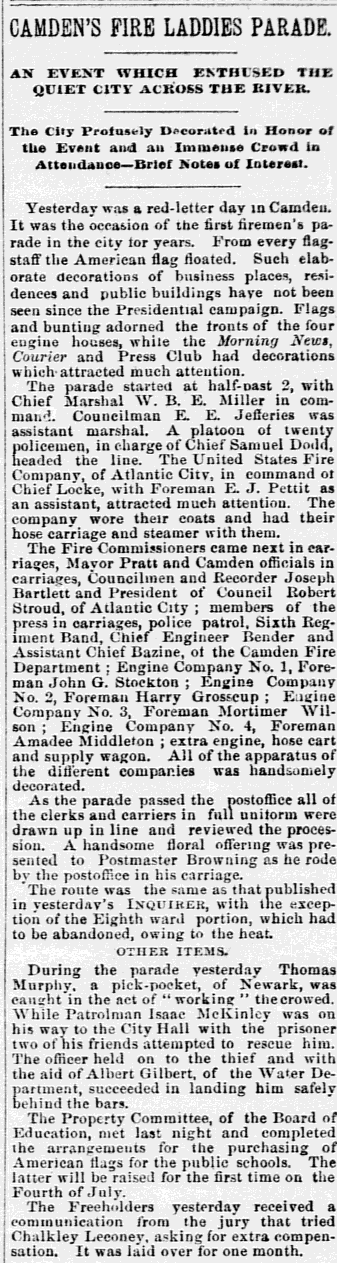
Yesterday was a red-letter day in Camden. It was the occasion of the first firemen’s parade in the city for years. From every flagstaff the American flag floated. Such elaborate decorations of business places, residences and public buildings have not been seen since the Presidential campaign. Flags and bunting adorned the fronts of the four engine houses, while the Morning News, Courier and Press Club had decorations which attracted much attention.
The parade started at half-past 2, with Chief Marshal W. B. E. Miller in command. Councilman E. E. Jefferies was assistant marshal. A platoon of twenty policemen, in charge of Chief Samuel Dodd, headed the line. The United States Fire Company, of Atlantic City, in command of Chief Locke, with Foreman E. J. Pettit as an assistant, attracted much attention. The company wore their coats and had their hose carriage and steamer with them.
The Fire Commissioners came next in carriages, Mayor Pratt and Camden officials in carriages, Councilmen and Recorder Joseph Bartlett and President of Council Robert Stroud, of Atlantic City; members of the press in carriages, police patrol, Sixth Regiment Band, Chief Engineer Bender and Assistant Chief Bazine, of the Camden Fire Department; Engine Company No. 1, Foreman John G. Stockton; Engine Company No. 2, Foreman Harry Grosscup; Engine Company No. 3, Foreman Mortimer Wilson; Engine Company No. 4, Foreman Amadee Middleton; extra engine, hose cart and supply wagon. All of the apparatus of the different companies was handsomely decorated.
As the parade passed the postoffice all of the clerks and carriers in full uniform were drawn up in line and reviewed the procession. A handsome floral offering was presented to Postmaster Browning as he rode by the postoffice in his carriage.
The route was the same as that published in yesterday’s Inquirer, with the exception of the Eighth ward portion, which had to be abandoned, owing to the heat.
OTHER ITEMS.
During the parade yesterday Thomas Murphy, a pick-pocket, of Newark, was caught in the act of “working” the crowd. While Patrolman Isaac McKinley was on his way to the City Hall with the prisoner two of his friends attempted to rescue him. The officer held on to the thief and with the aid of Albert Gilbert, of the Water Department, succeeded in landing him safely behind the bars.
The Property Committee, of the Board of Education, met last night and completed the arrangements for the purchasing of American flags for the public schools. The latter will be raised for the first time on the Fourth of July.
The Freeholders yesterday received a communication from the jury that tried Chalkley Leconey, asking for extra compensation. It was laid over for one month.
A Camden Den Raided
Philadelphia Inquirer —

PLENTY OF LIQUOR AND A FARO LAY-OUT SECURED BY THE POLICE.
A Murderous Negro Creates a Commotion—Incendiaries at Work—Other News Across the Delaware.
The Camden police made another raid early yesterday morning. About 1 o’clock a detail consisting of Officers Pederick, Lee, Anderson, Horner, Baker and Chief Dodd raided a “speak-easy” and gambling den in a boathouse at the end of North Second street. When the policemen arrived a quiet little game of faro was in progress in the second story.
The proprietor, William Parker, Maurice Hinchman, Charles Mead and Mabel Gray were captured and taken to the City Hall. Sixteen boxes of beer, three gallons of whisky and a home-made faro lay-out were also captured. All of the men arrested were released yesterday but Parker, who was held on the charge of keeping a disorderly house and selling liquor without a license.
A funny incident occurred after the raid had been made. While the patrol was making its first trip to the City Hall previous to the removal of the liquor and gambling implements, Officer Pederick was detailed to watch the place. The policeman had only been in charge a few moments when a gang of men came in and called for a drink. “I can’t sell you anything,” said Pederick. “Why?” asked one of the thirsty men. “I got no license,” answered the officer. “That’s all right; Billy had no license, but we got the ‘booz’ just the same,” said one of the would-be purchasers. Pederick pulled back the flap of his coat and showed them his star. The thirsty men made a hasty retreat.
A Negro on the Warpath
William Thomas, alias King, is known among all of the tough colored element of the Fifth ward. Late on Saturday he started out to “do up” every person who ventured to come within the vicinity of Third and Spruce streets. His first move was to draw a revolver and tell Mary Blee, an old female companion, that he was going to kill her. Mary succeeded in escaping.
He then went into the saloon of John Jennings and called for a drink. The saloonkeeper refused him, whereupon he picked up glasses and bottles and flung them at his head and finally compelled him to rush into the street for safety. Policeman Streeper was summoned and was about to take the prisoner to the patrol box when he picked up a cobble stone and hit the officer a terrible blow in the back. He was sent to jail by the Mayor yesterday in default of $1,500 bail.
Tried to Burn the Building
While Policeman Harvey was patrolling his beat about twenty minutes of 4 o’clock yesterday morning, he noticed a man coming out of the butcher establishment of Samuel K. Hires, on Kaighn avenue above Third street. He paid little attention to the man, as it is usual for men to work there all night. A few minutes later the entire building was discovered enveloped in a mass of flames. The mysterious man, who had only a few minutes previous left, had been an incendiary and had smeared lard over the floors and then set it on fire. The Fire Department saved the building.
Brief ‘Cross River Notes
Eva Butts, alias “Siss,” Mary Dingle, Emma Adams and Anna Brady were arrested by Officer Butts early yesterday morning on the charge of keeping a disorderly house on Mount Ephraim avenue, between Chestnut and Sycamore streets. They are held for a further hearing.
Jacob Welsh, aged 17 years, living in South Camden, got into an altercation with his brother yesterday, when he nearly bit his finger off. He is locked up at the City Hall.
While intoxicated Frank Wilson, a Philadelphian, got into a fight at Haddonfield yesterday morning. During the fracas he was cut in the face and eye with a razor.
Thirty-six arrests were made in Camden during Saturday night and yesterday.
Contractor Aaron Ward yesterday completed the big sewer on Sixth street, when he built the last part under the Pennsylvania Railroad tracks.
Kate Manning, of Stockton township, was committed in default of ball [sic] for a further hearing by Justice Hope yesterday, for assault on Andrew Mullin. Mullin states that the woman had been drinking, and threw a stick of wood at him, and when he remonstrated with her she drew a knife from under her dress, and cut him in the head with it. The woman denied having a knife in her possession, and stated that she only pushed the man for having made an insulting remark to her.
Camden Police Baseball Challenge
Camden Post —
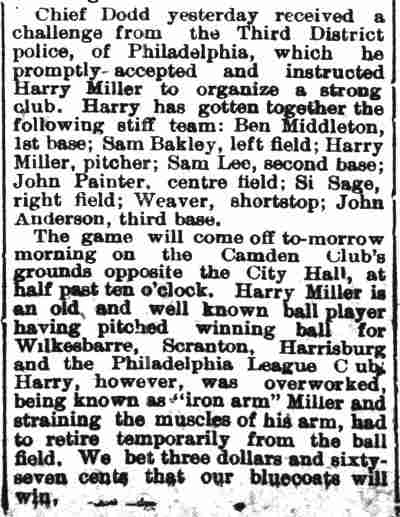
Chief Dodd yesterday received a challenge from the Third District police, of Philadelphia, which he promptly accepted and instructed Harry Miller to organize a strong club. Harry has gotten together the following stiff team: Ben Middleton, 1st base; Sam Bakley, left field; Harry Miller, pitcher; Sam Lee, second base; John Painter, centre field; Si Sage, right field; Weaver, shortstop; John Anderson, third base.
The game will come off to-morrow morning on the Camden Club’s grounds opposite the City Hall, at half past ten o’clock. Harry Miller is an old and well known ball player having pitched winning ball for Wilkesbarre, Scranton, Harrisburg and the Philadelphia League Club. Harry, however, was overworked, being known as “iron arm” Miller and straining the muscles of his arm, had to retire temporarily from the ball field. We bet three dollars and sixty-seven cents that our bluecoats will win.
Camden News
Philadelphia Inquirer —
(news brief — no column header visible)
Chief of Police Dodd yesterday received a pathetic letter from R. R. Bevilla, of Willimantic, Conn., formerly City Marshal of Beverly, requesting him to locate Mrs. Julia Pine, whom he believes to be living in Camden, and whom he has not seen for twelve years, when domestic discord broke up his home.
Liedertafel Ball
Camden Post —
The Rain Somewhat Marred a Heretofore Lively Occasion.
Rain shooting at a slant from a leaden sky is enough to dissipate the hopes of any one anticipating a good time.
Such was the state of the weather last evening when the hands of every clock in kitchen and parlor pointed to the hour when the merry makers of the city assembled to while away the hours tripping the light fantastic.
It was the night of the Liedertafel ball at Armory Hall. Anton Oberst’s orchestra supplied the music, and from 9 o’clock in the evening until 6 o’clock Tuesday morning, March 1st, their instruments were kept busy furnishing the musical accompaniment for tripping toes.
Everybody who could dance did so; those who couldn’t looked on and laughed with delight.
Mr. John Lock and his stately daughter Lizzie led the grand march, numbering about one hundred couples.
Twenty-two dances were tripped through, beginning with the Leidertafel [sic] waltz and ending with a galop. At midnight there was a general unmasking, which revealed the identity of faces hidden by gauze and muslin.
Joseph Schaeffer and Leon Streisman, the former made up as a German comedian and the latter as a rosy cheeked female of the same nationality, made a big hit. Both spin silk in an up town mill.
The members of the Mænnerchor marched into the ball with South street noses and kazoo instruments. They serenaded everybody in the line of march and sang patriotic songs around the tables in the refreshment rooms.
Chief Dodd and six policemen were on hand to preserve order.
Everything passed of [sic] auspiciously. Charles Schultz was Master of Ceremonies; August Weber, Conductor; John Lock, Wm. Maier, Anton Oberst, Jacob Seibert and August Hiller, Assistant Conductors.
J. Vissel, President; A. Weber, Secretary; John Heileman, Treasurer; Anton Oberst, J. Lock, Wm. Maier and Jacob Seibert constituted the Committee of Arrangements.
Freeholder Richard Mason furnished the piano, which acted in concert with the other musical instruments.
Murdered and Her Body Buried
Philadelphia Inquirer —
A Woman's Corpse Dug Up in a Camden Cellar.
Her Murderes [sic] Escaped Across the Delaware.
The Victim's Skull Beaten in With a Hammer—A Search by Neighbors Which Led to the Discovery of the Body—Witnesses Arrested.
Ella Ford, a twenty-two-year-old colored woman, of 809 Locust street, Camden, was found murdered at 3:20 o'clock last evening. Her skull was badly fractured about two inches over the nose, and five ghastly, gaping hammer wounds were found about the head.
The supposed murderer is George Morris, a 65-year-old colored man, for whom the dead girl has kept house for three months. He has not yet been arrested.
Charles Wesley Law, of 807 Locust street; Rebecca Price, of 108 Pine street; Ella Price, a sister of Rebecca, doing housework in Philadelphia, and William Johnson are all under arrest as witnesses and possible accessories to the crime. All the prisoners are colored.
The Search for the Body.
Officer Casper Hart was notified on Cherry street at 9 o'clock by one of the Price girls, who was accompanied by several neighbors, that Ella Ford was missing. Ella Price said she had come over from Philadelphia to visit Miss Ford, and finding the house shut up, she, with others, forced the door. In the cellar-way a small hammer, shaped like a blacksmith's sledge, and the handle of a tin bucket were found, both smeared in blood.
Officer Hart at once went to the house. In the corner of the back kitchen he found some bloody skirts. Charles Law led the way down into the cellar, where there was evidence that the earth had been disturbed in one corner.
After digging with a shovel only a few inches beneath the surface the officer came upon the torn portion of a dress, and a few seconds later excavated the dead body of the missing girl.
Officials at the Scene.
Coroner Jeffries, Chief of Police Dodd, Lieutenant Foster, Assistant Prosecutor Ridgway and County Physician Iszard were soon on the scene. Their questioning led to the arrest of the witnesses. But little could be learned of the whereabouts of the murderer or of the history of his victim. The Price girls and Law seemed to know more about the crime than they cared to tell. They claimed that the house had been shut up since Wednesday, and that Morris had been seen leaving the place yesterday.
Escaped Across the River.
William Johnson, one of the witnesses under arrest at the City Hall, says he wheeled a trunk down to the Federal street ferry in a push-cart for George Morris yesterday afternoon, and Morris took it across the river. The Philadelphia authorities were notified, but only a meagre description of the murderer could be furnished.
After the body had been excavated it was carried up stairs and examined by County Physician Iszard. Death was evidently due to the hammer wounds on the head. There were no other marks of violence on the body, which was removed to the Morgue.
The theory of the police is that Morris killed the woman in a quarrel prompted, probably, by jealousy. The county detectives were hunting for him last night in this city.
He Announces the Names
Camden Daily Telegram —
The Mayor Appoints the New Force To-day.
MANY OLD OFFICERS TAKEN BACK.
Some Surprise Manifested at the Mayor’s Appointment of Dodd Instead of Jones—This Afternoon All the Names Will be Announced.
The Mayor stated this morning to the newspaper fraternity that he would not announce his nominations for the police department until four o’clock this afternoon. It was expected that these would be announced this morning and in consequence there were a number of applicants for appointment on the force early this morning at the City Hall, hoping that the lightning would strike them.
Yesterday afternoon the mayor in addition to his nomination of Chief Dodd and Lieutenants Foster and Pettit appointed Frank Matlack, Jacob Woodsides, Alfred Hayden and John Dall, all of the Sixth Ward. The above were policemen under Mayor Westcott, before the Democratic Police Commission took charge of the Department.
Patrolman Griffin, Democrat, tendered his resignation yesterday to Mayor Westcott, to take effect to-day.
The appointment of Chief Dodd was quite a surprise to the public in general, as it was thought that Captain Jones would be named for the position. Many believed such an appointment would be in very good form, as Captain Jones’ knowledge of men and his military training would have made him a chief par excellence. The Mayor, however, probably thought that as Mr. Dodd had been so unceremoniously kicked out by the Democrats, it was nothing more than justice to again offer him the position which he had filled in a creditable manner for a number of years.
APPOINTED ON THE FORCE.
Mayor Westcott this afternoon made the following appointments:
First Ward—William E Cromly, George Cable, Henry R. Curtis, O. Glen Stackhouse.
Second Ward—Lincoln James, John Pratt, Samuel Bakley, Benj Middleton.
Third Ward—William Selby, Albert Myers, Edward Hartman.
Fourth Ward—Caleb Williams, Richard Golden, William Schregler, Ralph Bond.
Fifth Ward—William Harvey, Harry Mines and Oscar Weaver.
Sixth Ward—Jacob Woodsides, Frank Matlack, Albert Hayden and John Dall.
Seventh Ward—Josiah Sage, Henry Peters, Charles Lederman, Wm. Butts.
Eighth Ward—Alexander Alcorn, Chas. Leightenberg, Ferdinand Laird
There was no appointments made for the Ninth ward.
Camden
Philadelphia Inquirer —
General Sewell, wife and daughter, are now in Rome.
Harrison H. Voorhees, of this city, has been appointed solicitor for Holly Beach, Cape May county.
The Grocers’ Association sent James R. Carson delegate to the convention of the National Grocers’ Association, which met in New York on Wednesday.
After half century of long and faithful service as superintendent of the Camden and Philadelphia Ferry Company, Captain Andrew B. Frazee will retire May 1 to a well-deserved and richly earned rest.
William C. Dayton and family will spend the summer at Cape May.
Martin J. O’Brien was married on Wednesday by Father O’Brien, of Kellyville, Pa., to Miss Maggie Longworth, of Third and Royden streets. Nuptian [sic] mass was celebrated at the Church of the Immaculate Conception. Andrew Lyons was best man and Miss Cecelia O’Brien, a sister of the groom, bridesmaid. The ushers were Messrs. Martin Coyne, Secretary John M. Kelly, Francis Xavier O’Brien and ex-Assemblyman O’Brien.
Charles Livingstone, of Ferry avenue and Fillmore streets, entertained a number of friends at his home Tuesday evening.
Lieutenant John Foster has been acting as Chief of Police during the time that Chief Dodd was attending the Grand Lodge of the Legion of the Red Cross.
Postmaster Paul is able to attend to business after a protracted illness.
Howland Croft, senior member of the firm of Howland Croft Sons & Co., started on Thursday for California.
Oliver M. Smith and Mary A. Gregory were united in marriage at the home of the bride’s parents, Third and Mickle streets, by Rev. J. B. Graw, Wednesday night.
Drink-Sellers Arraigned
Philadelphia Inquirer —
Efforts to Stop Violations of the Sunday Law in Camden.
The Camden police are keeping up their efforts to suppress Sunday liquor selling. The following saloon keepers appeared before Mayor Westcott, of Camden, yesterday, and pleaded not guilty: F. A. Shuster, of Front street and Kaighn avenue; Tim. Clayton, of Third and Mechanic streets; James Croker, of Fourth and Jasper streets; F. Joseph Rouk, of Eighth street and Ferry avenue; John Murschell, of Broadway and Jefferson street, and Gottlieb Jung, of Ferry avenue and Jackson street.
Warrants have also been issued for Adam T. Davis, Jr., of Second street and Kaighn avenue, and Mary [?]ang, of Fillmore and Jackson streets, on similar charges. Davis is seriously ill and was unable to be present yesterday.
Chief of Police Dodd is the complainant in all the cases. The saloon keepers will be given a hearing next Friday.
"Over in Camden"
Philadelphia Inquirer —
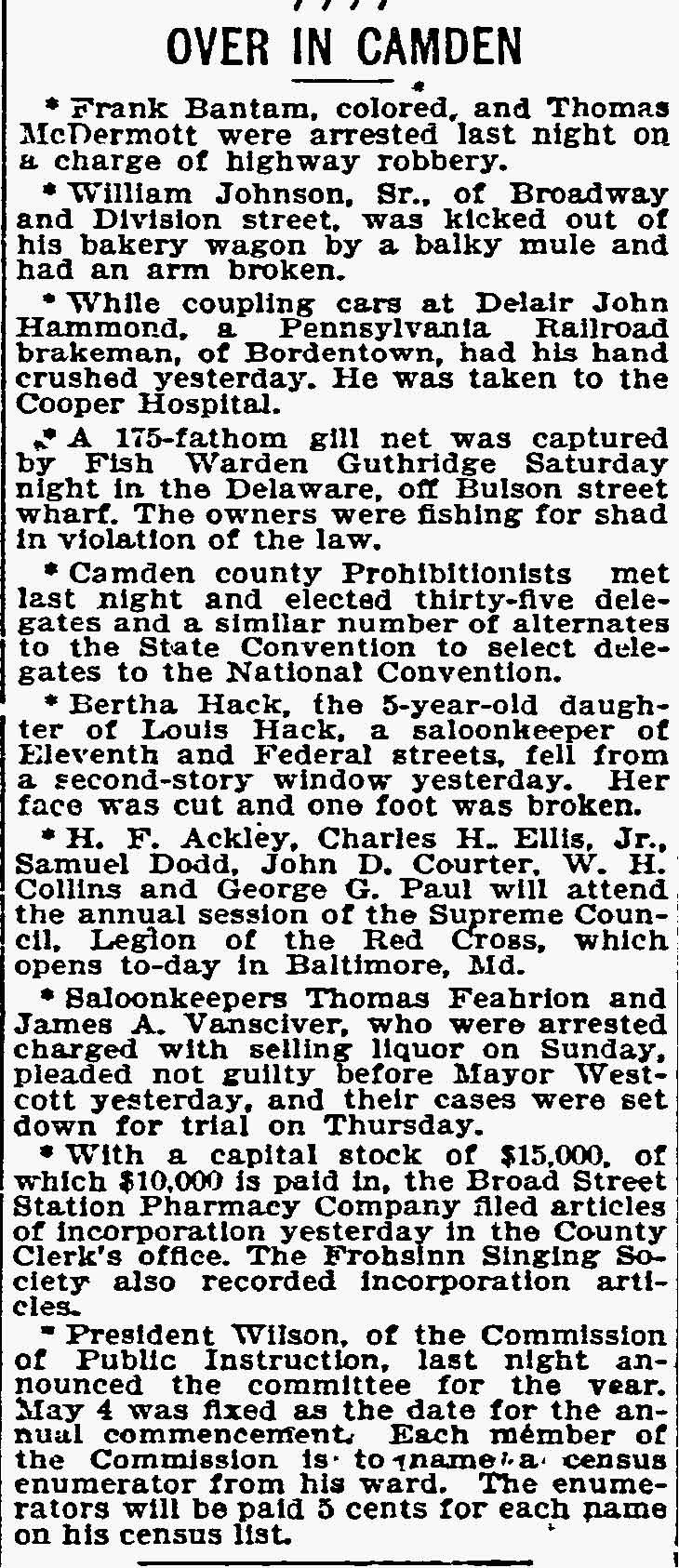
Over in Camden
Frank Bantam, colored, and Thomas McDermott were arrested last night on a charge of highway robbery.
William Johnson, Sr., of Broadway and Division street, was kicked out of his bakery wagon by a balky mule and had an arm broken.
While coupling cars at Delair, John Hammond, a Pennsylvania Railroad brakeman, of Bordentown, had his hand crushed yesterday. He was taken to the Cooper Hospital.
A 175-fathom gill net was captured by Fish Warden Guthridge Saturday night in the Delaware, off Bulson street wharf. The owners were fishing for shad in violation of the law.
Camden county Prohibitionists met last night and elected thirty-five delegates and a similar number of alternates to the State Convention to select delegates to the National Convention.
Bertha Hack, the 5-year-old daughter of Louis Hack, a saloonkeeper of Eleventh and Federal streets, fell from a second-story window yesterday. Her face was cut and one foot was broken.
H. F. Ackley, Charles H. Ellis, Jr., Samuel Dodd, John D. Courter, W. H. Collins and George G. Paul will attend the annual session of the Supreme Council, Legion of the Red Cross, which opens to-day in Baltimore, Md.
Saloonkeepers Thomas Feahrion and James A. Vansciver, who were arrested charged with selling liquor on Sunday, pleaded not guilty before Mayor Westcott yesterday, and their cases were set down for trial on Thursday.
With a capital stock of $15,000, of which $10,000 is paid in, the Broad Street Station Pharmacy Company filed articles of incorporation yesterday in the County Clerk's office. The Frohsinn Singing Society also recorded incorporation articles.
President Wilson, of the Commission of Public Instruction, last night announced the committee for the year. May 4 was fixed as the date for the annual commencement. Each member of the Commission is to name a census enumerator from his ward. The enumerators will be paid 5 cents for each name on his census list.
Camden’s Police Shake-Up
Philadelphia Inquirer —
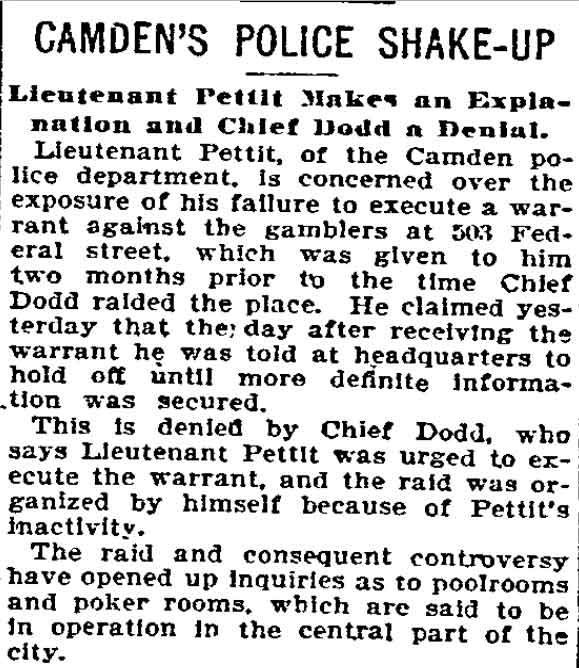
Lieutenant Pettit Makes an Explanation and Chief Dodd a Denial.
Lieutenant Pettit, of the Camden police department, is concerned over the exposure of his failure to execute a warrant against the gamblers at 503 Federal street, which was given to him two months prior to the time Chief Dodd raided the place. He claimed yesterday that the day after receiving the warrant he was told at headquarters to hold off until more definite information was secured.
This is denied by Chief Dodd, who says Lieutenant Pettit was urged to execute the warrant, and the raid was organized by himself because of Pettit’s inactivity.
The raid and consequent controversy have opened up inquiries as to poolrooms and poker rooms, which are said to be in operation in the central part of the city.
Over in Camden
Philadelphia Inquirer —
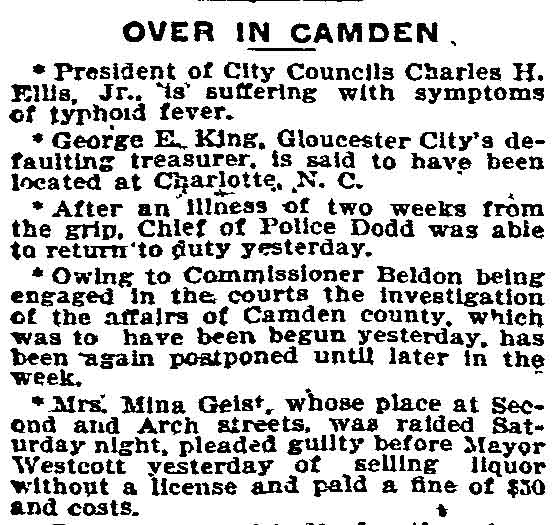
President of City Councils Charles H. Ellis, Jr., is suffering with symptoms of typhoid fever.
George E. King, Gloucester City’s defaulting treasurer, is said to have been located at Charlotte, N. C.
After an illness of two weeks from the grip, Chief of Police Dodd was able to return to duty yesterday.
Owing to Commissioner Beldon being engaged in the courts the investigation of the affairs of Camden county, which was to have been begun yesterday, has been again postponed until later in the week.
Mrs. Mina Geist, whose place at Second and Arch streets, was raided Saturday night, pleaded guilty before Mayor Westcott yesterday of selling liquor without a license and paid a fine of $50 and costs.
Camden’s Tragedy Still a Mystery
Philadelphia Inquirer —
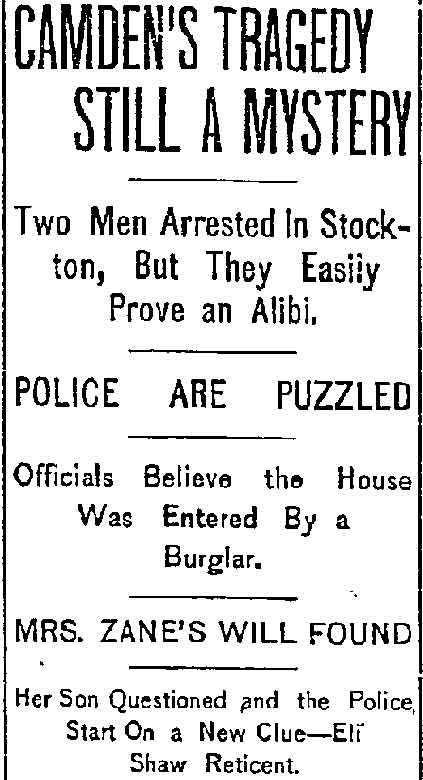
Camden's Tragedy Still a Mystery
Two Men Arrested In Stockton, But They Easily Prove an Alibi.
POLICE ARE PUZZLED
Officials Believe the House Was Entered By a Burglar.
MRS. ZANE’S WILL FOUND
Her Son Questioned and the Police Start On a New Clue—Eli Shaw Reticent.
Camden's double murder mystery remains unsolved. The assassin who shot down Mrs. Emma Zane and her daughter, Mrs. Sarah M. Shaw, at their home, No. 242 Line street, just before dawn Tuesday morning, is still at large. There is apparently no clue to his identity. Two arrests were made by the Stockton police yesterday, but the suspects can account for their whereabouts on the morning of the murder, and they will probably be released to-day. The rewards for the apprehension of the murderer now amount to $1000.
Public interest in the terrible crime grew keener yesterday. All day long the street in front of the house on Line street from which two black streamers fluttered was blocked by curious throng. People gathered in groups on the streets throughout Camden and discussed the details of the mysterious murders. The air was filled with rumors of arrests and with theories of the wildest sort, but at nightfall when the police and the county officials compared notes they were forced to admit that no ray of light had penetrated the mystery.
Prosecutor Wilson H. Jenkins and the Camden police officials got together yesterday and practically agreed to push their investigation along the lines of a theory that the murder was committed by some one who entered the house for the purpose of robbery.
A MYSTERIOUS LETTER.
Later in the afternoon Chief Dodd received a mysterious letter from Philadelphia, and he immediately dispatched Lieutenant Foster and Detective Sergeant Sergeant Beard to Philadelphia to run out what appeared to be a new and important clue. The chief stated that he did not expect his two assistants to return until a late hour. He would not admit that suspicion had been directed to any one by the examination of Edward Zane, but it was learned from other sources that such was the case. Edward Zane, it is stated, was asked to account for his whereabouts on Monday night, and he did so, but the police officials decline to tell what he said.
Soon after the officials separated a telephone message was received from Stockton that two men were under arrest there on suspicion of being concerned in the murder. The suspects were “a tall man and a short man,” answering to the description of the mysterious couple who have been blamed with crimes in all parts of the country. The police jumped to the conclusion that these were the two suspicious looking characters that had been seen in the neighborhood of the Zane house a few minutes before the shooting.
The men under arrest gave the names of Harry O. Geesey, of 3032 Market street, and John J. Doonan, of 661 North Thirty-eighth street, Philadelphia. They had visited several saloons in Stockton during the morning and Geesey had handed a 32 calibre revolver to Proprietor Klecmann of the Stockton Park Hotel, with the remark:
“Take this revolver. I’ve got into trouble with it and don’t want it.”
The hotel proprietor notified Chief Johnson, who took the men into custody.
They said they are steam fitters employed at the Pennsylvania Railroad shops at Thirty-second and Market streets. They were paid on Monday and while carousing together they drifted over into Camden.
PROVED AN ALIBI.
They said they went to the West Jersey Hotel and registered about midnight Monday night and slept there until 6 o’clock Tuesday morning.
Donan admitted that he got the revolver from the house of a colored man named John Polk, who lives in East Camden.
Chief Johnson last night visited Polk’s residence and corroborated this statement. An Inquirer representative visited the West Jersey Hotel and found Geesey’s and Doonan’s names on the register. They occupied room No. 39 together and registered after midnight. The police officials said the men would be released this morning.
Young Eli Shaw, who is still staying at the home of his mother’s cousin, Foster S. Zane, at 321 Beckett street, made a brief visit to his home yesterday about 11 o’clock. It was his first appearance there since the morning of the tragedy. He did not enter the darkened front parlor, where the bodies of his murdered grandmother and mother lay, but passed on to the sitting room, where a group of mourning relatives and sympathetic neighbors were gathered.
Some one began to refer to the tragedy, and the young man, with a look of anguish on his pale face, raised his hands and cried:
“Oh, don’t speak of that; I can’t bear it; I’ve suffered so much already.”
YOUNG SHAW RETICENT.
After remaining in the house a few minutes young Shaw, in company with a friend, went to a Federal street tailor to be measured for a mourning suit. This gave the newspaper men their first opportunity to question him, but he had apparently been instructed not to talk about the murders. He said:
“I have made my statement to both lieutenants of police, and would prefer that you go to them for any information.”
“Has any evidence been found of anything having been stolen from the house?”
“I don’t know,” was his reply.
“Are any of the possessions of your grandmother missing?”
“I can’t tell. The police have been there and can tell you if anything was stolen.”
“You are the only person that knew what was in the house and could tell if anything is missing, are you not?”
“I have not been in the house since yesterday morning and cannot tell anything about it.”
“Is Charles Higgins, whose name has been connected with the case, a relative of yours or of the Zane family?”
“He is a distant relative of the family,” was Shaw’s non-committal reply.
“There are conflicting reports about two men having been seen in the house by you. Did you see any one when you came down stairs?”
“As I stated before, I have made a statement to the police lieutenants, and would prefer that you go to them for any information,” he replied and walked away.
AIDING THE POLICE.
The police have obtained some additional information in regard to two men who were seen in the neighborhood of the Zane house shortly before the murders were committed. Howard Ross, an engineer, living at Third and Pine, says he left his home Tuesday morning at a quarter past 4 o’clock. He had just reached Third street when two men came dashing almost into him. They had run diagonally across Pine street. He says one was rather tall, say five feet ten inches high, wore a derby hat and dark clothes. The other was shorter and stouter than the first described. When Ross reached Line street he heard some one calling murder, was unable to locate the cries and went on to his work.
O. B. Blizzard, of 249 Line street, adds to this that he saw the elder woman, Mrs. Zane, at 10 o’clock Monday morning, the day before the murder, talking to a tall man. They appeared to be quarreling. He thinks he could identify the man.
James C. Carey [sic], of 225 Pine street, while on his way home, about 1 o’clock Tuesday morning, saw two men as described above sitting on a doorstep at Liberty alley and Pine. They disappeared soon after he saw them.
REWARDS AMOUNT TO $1000.
The Camden County Board of Freeholders at its regular monthly meeting yesterday unanimously voted to offer a reward of $500 for information that would lead to the arrest and conviction of the murderer or murderers. This is in addition to the $500 reward offered by the city of Camden.
The rewards have started a number of amateur Sherlock Holmeses at work on the case. Among the professional sleuths seen in the neighborhood yesterday was Detective Garrison, “the Jersey Hawkshaw.”
Coroner Lippincott last evening empaneled the following jury: William A. Husted, foreman; Thomas Binker, M. J. O’Brien, William Anderson, Chas. Folwell and John Irwin. The jury will view the bodies at 10.30 o’clock this morning. The inquest will not be held before Monday or Tuesday of next week.
The funerals of the two murdered women will be held at 2 o’clock Saturday afternoon. They will be buried in the same plot in Harleigh Cemetery. The services will be conducted by Rev. John W. Marshall, pastor of the Broadway M. E. Church, and Rev. William A. Massey, pastor of the Wiley M. E. Church.
James Hough, who was arrested as a suspect by Policeman Myers on Tuesday afternoon, was released yesterday. There was no evidence to connect him with the crime.
“Persons Unknown” Held Responsible
Philadelphia Inquirer —
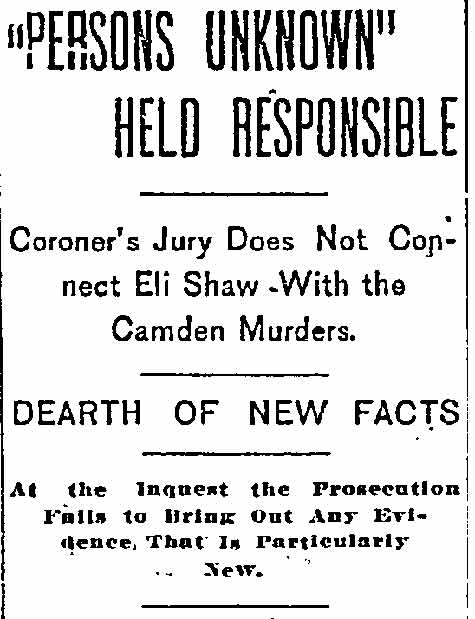
Coroner’s Jury Does Not Connect Eli Shaw With the Camden Murders.
DEARTH OF NEW FACTS
At the Inquest the Prosecution Fails to Bring Out Any Evidence, That Is Particularly New.
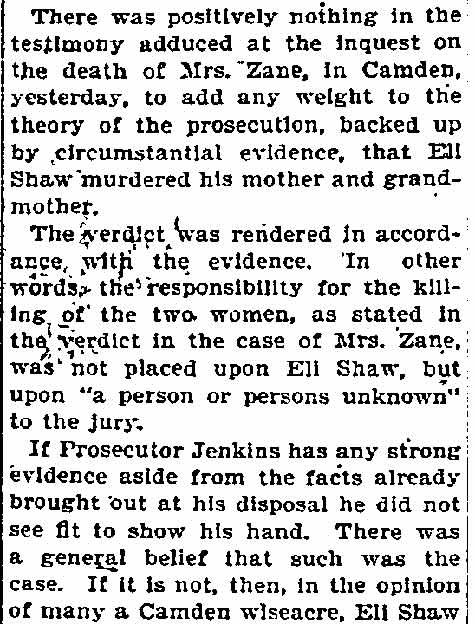
There was positively nothing in the testimony adduced at the inquest on the death of Mrs. Zane, in Camden, yesterday, to add any weight to the theory of the prosecution, backed up by circumstantial evidence, that Eli Shaw murdered his mother and grandmother.
The verdict was rendered in accordance with the evidence. In other words, the responsibility for the killing of the two women, as stated in the verdict in the case of Mrs. Zane, was not placed upon Eli Shaw, but upon “a person or persons unknown” to the jury.
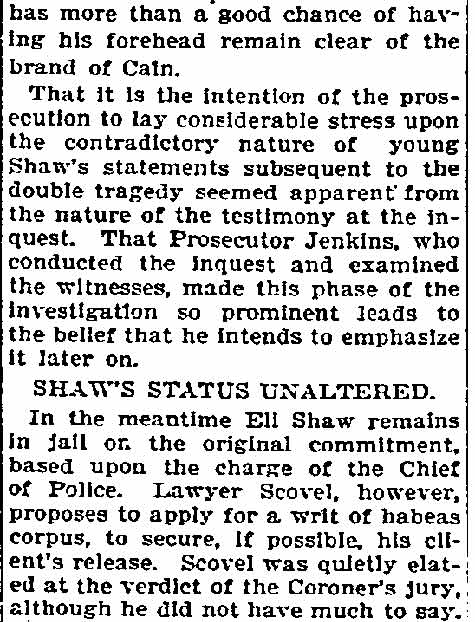
If Prosecutor Jenkins has any strong evidence aside from the facts already brought out at his disposal he did not see fit to show his hand. There was a general belief that such was the case. If it is not, then, in the opinion of many a Camden wiseacre, Eli Shaw has more than a good chance of having his forehead remain clear of the brand of Cain.
That it is the intention of the prosecution to lay considerable stress upon the contradictory nature of young Shaw’s statements subsequent to the double tragedy seemed apparent from the nature of the testimony at the inquest. That Prosecutor Jenkins, who conducted the inquest and examined the witnesses, made this phase of the investigation so prominent leads to the belief that he intends to emphasize it later on.
SHAW’S STATUS UNALTERED.
In the meantime Eli Shaw remains in jail on the original commitment, based upon the charge of the Chief of Police. Lawyer Scovel, however, proposes to apply for a writ of habeas corpus, to secure, if possible, his client’s release. Scovel was quietly elated at the verdict of the Coroner’s jury, although he did not have much to say.
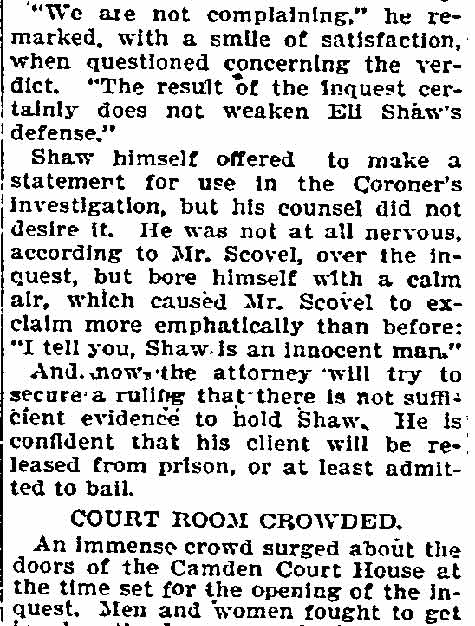
“We are not complaining,” he remarked, with a smile of satisfaction, when questioned concerning the verdict. “The result of the inquest certainly does not weaken Eli Shaw’s defense.”
Shaw himself offered to make a statement for use in the Coroner’s investigation, but his counsel did not desire it. He was not at all nervous, according to Mr. Scovel, over the inquest, but bore himself with a calm air, which caused Mr. Scovel to exclaim more emphatically than before: “I tell you, Shaw is an innocent man.”
And now the attorney will try to secure a ruling that there is not sufficient evidence to hold Shaw. He is confident that his client will be released from prison, or at least admitted to bail.
COURT ROOM CROWDED.
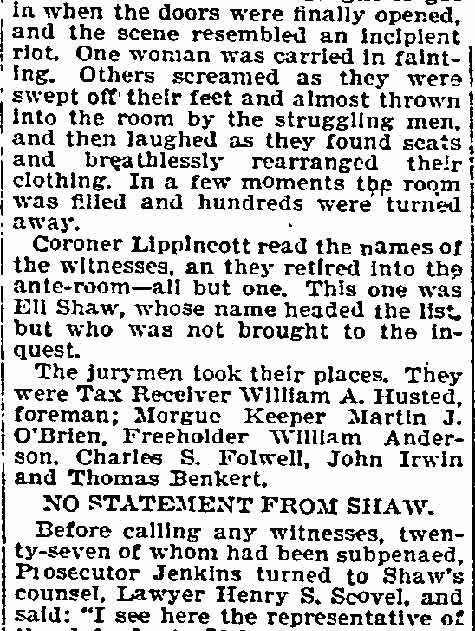
An immense crowd surged about the doors of the Camden Court House at the time set for the opening of the inquest. Men and women fought to get in when the doors were finally opened, and the scene resembled an incipient riot. One woman was carried in fainting. Others screamed as they were swept off their feet and almost thrown into the room by the struggling men, and then laughed as they found seats and breathlessly rearranged their clothing. In a few moments the room was filled and hundreds were turned away.
Coroner Lippincott read the names of the witnesses, an [sic] they retired into the ante-room—all but one. This one was Eli Shaw, whose name headed the list, but who was not brought to the inquest.
The jurymen took their places. They were Tax Receiver William A. Husted, foreman; Morgue Keeper Martin J. O’Brien, Freeholder William Anderson, Charles S. Folwell, John Irwin and Thomas Benkert.
NO STATEMENT FROM SHAW.
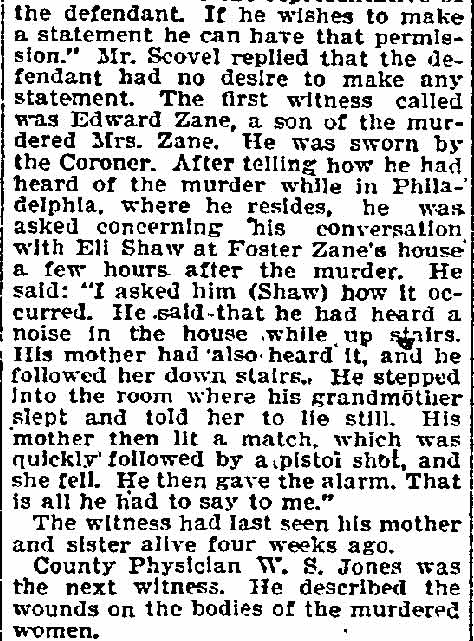
Before calling any witnesses, twenty-seven of whom had been subpenaed, Prosecutor Jenkins turned to Shaw’s counsel, Lawyer Henry S. Scovel, and said: “I see here the representative of the defendant. If he wishes to make a statement he can have that permission.” Mr. Scovel replied that the defendant had no desire to make any statement. The first witness called was Edward Zane, a son of the murdered Mrs. Zane. He was sworn by the Coroner. After telling how he had heard of the murder while in Philadelphia, where he resides, he was asked concerning his conversation with Eli Shaw at Foster Zane’s house a few hours after the murder. He said: “I asked him (Shaw) how it occurred. He said that he had heard a noise in the house while up stairs. His mother had also heard it, and he followed her down stairs. He stepped into the room where his grandmother slept and told her to lie still. His mother then lit a match, which was quickly followed by a pistol shot, and she fell. He then gave the alarm. That is all he had to say to me.”
The witness had last seen his mother and sister alive four weeks ago.
County Physician W. S. Jones was the next witness. He described the wounds on the bodies of the murdered women.
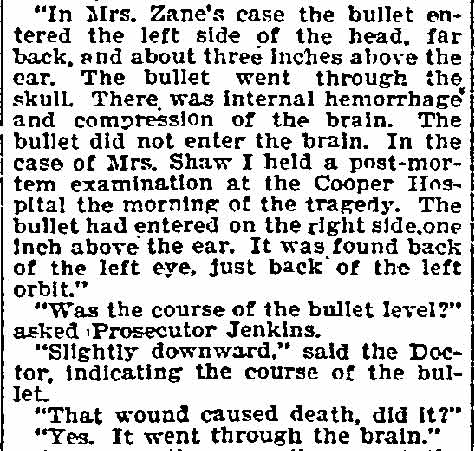
“In Mrs. Zane’s case the bullet entered the left side of the head, far back, and about three inches above the ear. The bullet went through the skull. There was internal hemorrhage and compression of the brain. The bullet did not enter the brain. In the case of Mrs. Shaw I held a post-mortem examination at the Cooper Hospital the morning of the tragedy. The bullet had entered on the right side, one inch above the ear. It was found back of the left eye, just back of the left orbit.”
“Was the course of the bullet level?” asked Prosecutor Jenkins.
“Slightly downward,” said the Doctor, indicating the course of the bullet.
“That wound caused death, did it?”
“Yes. It went through the brain.”
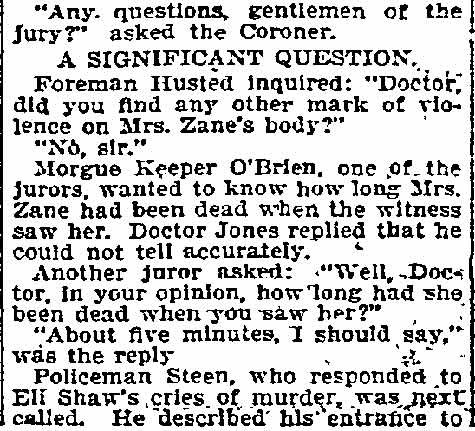
“Any questions, gentlemen of the jury?” asked the Coroner.
A SIGNIFICANT QUESTION.
Foreman Husted inquired: “Doctor, did you find any other mark of violence on Mrs. Zane’s body?”
“No, sir.”
Morgue Keeper O’Brien, one of the jurors, wanted to know how long Mrs. Zane had been dead when the witness saw her. Doctor Jones replied that he could not tell accurately.
Another juror asked: “Well, Doctor, in your opinion, how long had she been dead when you saw her?”
“About five minutes, I should say,” was the reply
Policeman Steen, who responded to Eli Shaw’s cries of murder, was next called. He described his entrance to the Line street house. Eli was standing in the sitting room with his night shirt on. The witness told of finding the bodies and searching the house. The place did not seem to have been broken into by burglars.
“Did you examine Mrs. Zane’s bed for blood?” he was asked.
“No, sir. The lieutenant did.”
“Did you see any blood in Mrs. Zane’s room?”
“Yes, on the window sill; it looked like a hand print.”
“Didn’t you see any on Mrs. Zane’s bed?”
“No, sir. I didn’t look.”
“Do you know what time it was when you got to the house?”
“No. I didn’t look. It wasn’t yet daylight.”
“When you went up to the third story did you use matches?” asked the prosecutor.
“I can’t say. We all had matches. The gas in the third story must have been lit, because we could see. Perhaps Mr. Lane lit it.”
“Did you see any blood in the third story?”
“No. All the time I was there I didn’t have a chance to look. I was looking after the people who were shot.”
NO SMOKE APPARENT.
Morgue Keeper O’Brien put the important question:
“You say you got to the house immediately after Shaw cried for help. Did you notice any smoke in the house such as would come from the discharge of firearms?”
“No, sir. There was nothing like that.”
One of the jurors wanted to know if Steen heard moans when he went up the stairs. The witness said he did, but couldn’t tell where they came from. He went into Mrs. Zane’s room first, and it was light enough to see in there. The light came from the street electric lamp.
Juror Benkert wanted to know about Mrs. Zane’s position in the chair where the policeman found her. The witness said she looked as if she had been shot while in the chair. The wound was next to the window.
“Then,” said Juror Benkert, “some one must have put his arm behind her or around in front of her to reach back and shoot her on that side?”
“It would seem so,” said the witness. “It looked to me as if Mrs. Zane had put her hand to the wound, and then rested her bloody hand on the window sill.”
An important witness came next. This was Harry Delamater, of No. 30[?] Line street, a personal friend of Eli Shaw, who was held in $1000 bail by ‘Squire Stackhouse some time ago because he refused to make any statement to Prosecutor Jenkins at the time of the preliminary examination of witnesses. His statement follows:
“Eli told me about the shooting, as nearly as I can remember, as follows, in the presence of several other people: He said that he was up, and hearing a noise, he hurriedly put on his pants. His mother was also up at the time, and they went down stairs together. Eli was first and his mother was right behind him. His mother pushed open the door of the back room, which was slightly ajar; they went in, and Mrs. Shaw pointed to some clothing on the floor, just as she struck a light. The match had no sooner been ignited before a shot was fired. He ran down stairs and gave the alarm.
GRANDMOTHER’S REPLY.
“He made practically the same statements to Lieutenants Foster and Pettit while I was there. He also said that he looked into the front room, saw his grandmother in bed, and asked his mother not to disturb her, as she was asleep. He ran up stairs, got a pistol, and rushed down and tried to fire it to attract attention, but it would not go off. He also said that when he heard the shot fired he ran into his grandmother’s room and said, ‘My God, some one is in the house and is shooting.’ He got a sort of sleepy groan, as some one awakening, for a reply.”
As Mrs. Zane was dead or dying by the time Eli said he called her and received a reply, this statement was received with particular interest.
James E. Tatem, of 619 South Fifth street; Frank B. Haines, of 561 Washington street, and Albert Fogg, of 615 South Fifth street, who were also in Foster Zane’s house on the evening after the tragedy when Eli Shaw told his story of the tragedy, were next called in rapid succession. Their testimony was for the most part a repetition of Delamater’s statement.
Albert Fogg testified that Shaw said he rushed into his grandmother’s room immediately after his mother was shot and cried:
“Get up, grandma; for God’s sake, get up; ther’s [sic] some one in the house.”
“Did he say his grandmother made any response?” asked the Prosecutor.
“No, sir.”
Albert Hollingshead was called, but had nothing to testify to.
Policeman John Painter, who found the revolver in the chimney, gave his testimony concerning his find. The revolver was brought in and, after wrestling with it for a few minutes, to the consternation of everyone else in the court room, Hall Officer Beard succeeded in unloading it. Painter identified the weapon. He also said:
“We made an examination of the chimneys. We found that there was a stove hole in Mrs. Zane’s room, but it was not opened. We found one in Eli’s room on the third floor, which was or had been recently opened. We also found a spot of blood on the door leading into Eli’s room, which looked as though it had been a large drop.”
Police Lieutenant Pettit was called to corroborate Painter’s story. He examined the pistol thoroughly when it was found. It looked as though it had been discharged recently. There was fresh oil about the hammer, some burnt powder could be seen at the muzzle, and it had an odor of burnt powder about it.
NO TRACE OF BURGLARS.
Lieutenant Pettit said he examined Mrs. Zane’s bed. There was no blood on the pillows or bolsters. The only blood he saw was one little spot on the under sheet, near the foot. In the third story he saw one spot of blood on the doorsill of Eli Shaw’s room. The Lieutenant said he found a hammer in Mrs. Shaw’s room in the third story. There were stains on it that might have been blood stains. An examination was made for traces of a burglar’s work. The witness described the position of the windows and said that in his opinion no burglar had ever gone through those windows.
Policeman Shaw identified the hammer, and Officer Beard told how he tried to get the weapon identified in Philadelphia pawnshops. It exploded while being examined in one of those establishments.
William Stein, a gunsmith, told that the bullets found in the bodies of the women were 32-calibre, the same as those used in the revolver found in the house. Guy Viskinski corroborated the story of the accidental discharge of the weapon in a pawnshop.
LANE TESTIFIES.
One of the most important witnesses was Charles Lane, who lives at 646 South Third street, and who was next called. He is the neighbor who first heard Eli Shaw’s cries for help and responded. He was in bed when he heard cries of “Help! Help! Murder!” The cries were repeated three or four times. He got up and dressed hurriedly. He ran around and found Eli Shaw in his night shirt on the front step. Shaw cried:
“Oh, Mr. Lane, mom and grandmom are shot!”
Just at this moment the witness’ son came running up, and they went in the hallway.
“My son asked for a light,” said the witness. “Shaw brought us two matches. He said: ‘Don’t go upstairs yet; they may be up there yet.’ Then Officer Stein came in. I said to Shaw: ‘Haven’t you got anything to defend yourself with?’ and Shaw handed me a revolver. I cocked it and he said: ‘There’s nothing in it.’ Then we struck some matches and went upstairs.”
“Was Eli Shaw’s night shirt outside his pantaloons when you first saw him on the steps?” asked the Prosecutor.
“Yes; it hung down almost to his feet.”
Continuing his story of the search, Mr. Lane said they went first to the second story front, and there found Mrs. Zane sitting in a chair near the window.
She was in her night clothes, her head was sunk on her chest, her eyes were closed, and blood trickled down her face. She was gasping for breath, “just like this,” said the witness, drawing in his cheeks like a person almost suffocated. He was describing Mrs. Zane’s dying agonies.
Mr. Lane said he called to Mrs. Zane. “Em! Em!” but she made no response. “I had known her for forty years,” said the witness to the jury in explanation of his familiar manner of addressing the woman. Then he said they went into the next room and found Mrs. Shaw on the floor moaning and weltering in her own gore. He spoke to her, but she could not answer. He described the position in which Mrs. Shaw lay. Then, he said, the searchers went up to the third floor. The Prosecutor asked if they found any lights. The witness said no; they had to light the gas in the third story front room. They found the gas lit in the dining room on the first floor when they first entered the house.
NIGHT SHIRT EXHIBITED.
Coroner Lippincott took the stand next and showed the jury Shaw’s night shirt, on which there were many spots of blood. Some were very small, others approached the size of a pea. When he had finished making this gruesome exhibit, he returned to the stand and detailed what he had heard of the conversation between Eli Shaw and Prosecutor Jenkins.
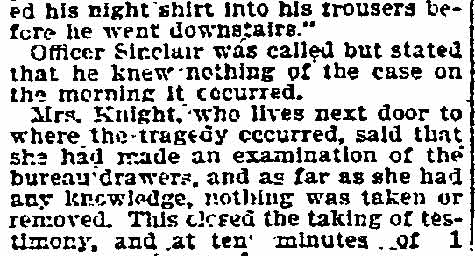
“He said that he did not see any one when his mother was shot, did not see her fall, and did not see the flash of the pistol. He also said that he had tucked his night shirt into his trousers before he went downstairs.”
Officer Sinclair was called but stated that he knew nothing of the case on the morning it occurred.
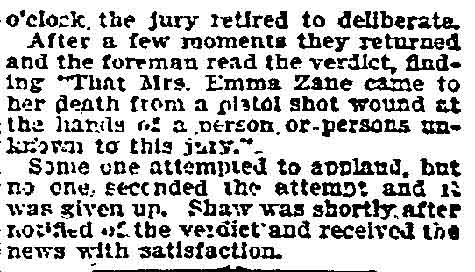
Mrs. Knight, who lives next door to where the tragedy occurred, said that she had made an examination of the bureau drawers, and as far as she had any knowledge, nothing was taken or removed. This closed the taking of testimony, and at ten minutes of 1 o’clock, the jury retired to deliberate.
After a few moments they returned and the foreman read the verdict, finding “That Mrs. Emma Zane came to her death from a pistol shot wound at the hands of a person or persons unknown to this jury.”
Some one attempted to applaud, but no one seconded the attempt and it was given up. Shaw was shortly after notified of the verdict and received the news with satisfaction.
Shot Her Husband.
Camden Post —
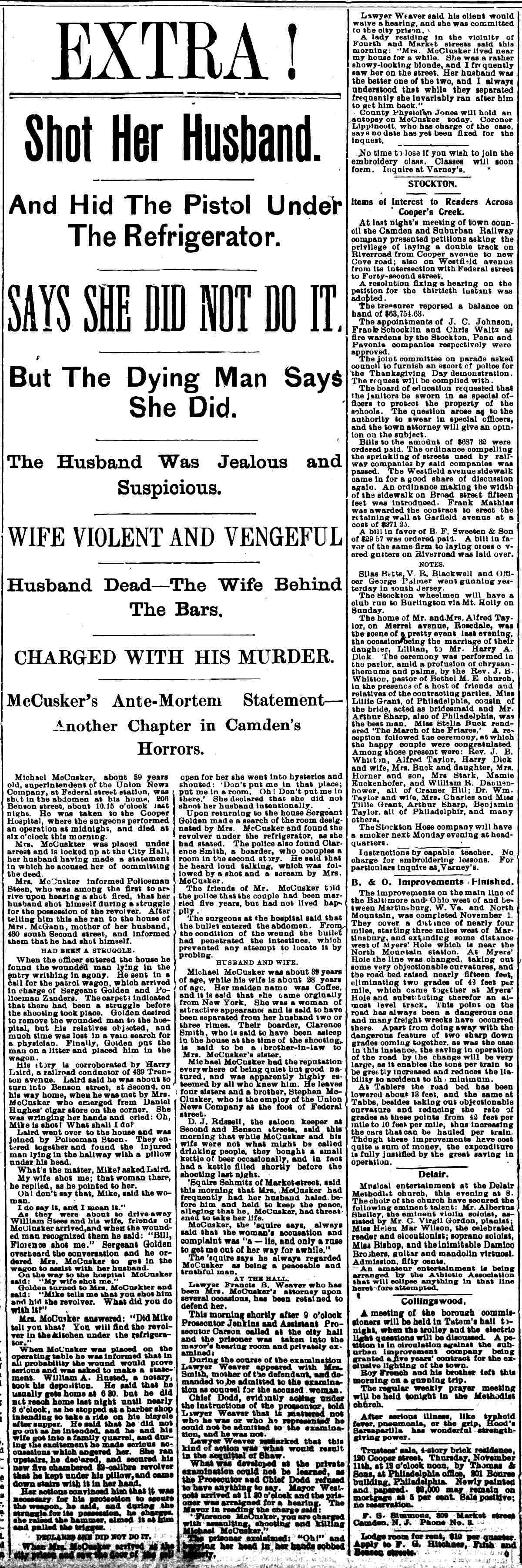
EXTRA!
And Hid The Pistol Under The Refrigerator.
SAYS SHE DID NOT DO IT.
But The Dying Man Says She Did.
The Husband Was Jealous and Suspicious.
WIFE VIOLENT AND VENGEFUL
Husband Dead—The Wife Behind The Bars.
CHARGED WITH HIS MURDER.
McCusker’s Ante-Mortem Statement—Another Chapter in Camden’s Horrors.
Michael McCusker, about 3[?] years old, superintendent of the Union News Company, at Federal street station, was shot in the abdomen at his home, 206 Benson street, about 10.15 o’clock last night. He was taken to the Cooper Hospital, where the surgeons performed an operation at midnight, and died at six o’clock this morning.
Mrs. McCuskter [sic] was placed under arrest and is locked up at the City Hall, her husband having made a statement in which he accused her of committing the deed.
Mrs. McCusker informed Policeman Steen, who was among the first to arrive upon hearing a shot fired, that her husband shot himself during a struggle for the possession of the revolver. After telling him this she ran to the house of Mrs. McGann, mother of her husband, 430 south Second street, and informed them that he had shot himself.
HAD BEEN A STRUGGLE.
When the officer entered the house he found the wounded man lying in the entry writhing in agony. He sent in a call for the patrol wagon, which arrived in charge of Sergeant Golden and Policeman Zanders. The carpets indicated that there had been a struggle before the shooting took place. Golden desired to remove the wounded man to the hospital, but his relatives objected, and much time was lost in a vain search for a physician. Finally, Golden put the man on a litter and placed him in the wagon.
His story is corroborated by Harry Laird, a railroad conductor of 439 Trenton avenue. Laird said he was about to turn into Benson street, at Second, on his way home, when he was met by Mrs. McCusker who emerged from Daniel Hughes’ cigar store on the corner. She was wringing her hands and cried: Oh, Mike is shot! What shall I do?
Laird went over to the house and was joined by Policeman Steen. They entered together and found the injured man lying in the hallway with a pillow under his head.
What’s the matter, Mike? asked Laird.
My wife shot me; that woman there, he replied, as he pointed to her.
Oh! don’t say that, Mike, said the woman.
I do say it, and I mean it.”
As they were about to drive away William Stees and his wife, friends of McCusker arrived, and when the wounded man recognized them he said: “Bill, Florence shot me.” Sergeant Golden overheard the conversation and he ordered Mrs. McCusker to get in the wagon to assist with her husband.
On the way to the hospital McCusker said: “My wife shot me.”
Golden turned to Mrs. McCuskter [sic] and said: “Mike tells me that you shot him and hid the revolver. What did you do with it?”
Mrs. McCusker answered: “Did Mike tell you that? You will find the revolver in the kitchen under the refrigerator.”
When McCusker was placed on the operating table he was informed that in all probability the wound would prove serious and was asked to make a statement. William A. Husted, a notary, took his deposition. He said that he usually gets home at 6.30 but he did not reach home last night until nearly 8 o’clock, as he stopped at a barber shop intending to take a ride on his bicycle after supper. He said that he did not go out as he intended, and he and his wife got into a family quarrel, and during the excitement he made serious accusations which angered her. She ran upstairs, he declared, and secured his new five chambered [?]2-calibre revolver that he kept under his pillow, and came down stairs with it in her hand.
Her actions convinced him that it was necessary for his protection to secure the weapon, he said, and during the struggle for its possession, he charges, she raised the hammer, aimed it at him and pulled the trigger.
DECLARES SHE DID NOT DO IT.
When Mrs. McCusker arrived at the city prison and saw the door of the cell open for her she went into hysterics and shouted: ‘Don’t put me in that place; put me in a room. Oh! Don’t put me in there.’ She declared that she did not shoot her husband intentionally.
Upon returning to the house Sergeant Golden made a search of the room designated by Mrs. McCusker and found the revolver under the refrigerator, as she had stated. The police also found Clarence Smith, a boarder, who occupies a room in the second story. He said that he heard loud talking, which was followed by a shot and a scream by Mrs. McCusker.
The friends of Mr. McCusker told the police that the couple had been married five years, but had not lived happily.
The surgeons at the hospital said that the bullet entered the abdomen. From the condition of the wound the bullet had penetrated the intestines, which prevented any attempt to locate it by probing.
HUSBAND AND WIFE.
Michael McCusker was about 3[?] years of age, while his wife is about 28 years of age. Her maiden name was Coffee, and it is said that she came orginally [sic] from New York. She was a woman of attractive appearance and is said to have been separated from her husband two or three times. Their boarder, Clarence Smith, who is said to have been asleep in the house at the time of the shooting, is said to be a brother-in-law to Mrs. McCusker’s sister.
Michael McCusker had the reputation everywhere of being quiet but good natured, and was apparently highly esteemed by all who knew him. He leaves four sisters and a brother, Stephen McCusker, who is the employ of the Union News Company at the foot of Federal street.
D. J. Russell, the saloon keeper at Second and Benson streets, said this morning that while McCusker and his wife were not what might be called drinking people, they bought a small kettle of beer occasionally, and in fact had a kettle filled shortly before the shooting last night.
‘Squire Schmitz of Market-street, said this morning that Mrs. McCusker had frequently had her husband haled before him and held to keep the peace, alleging that he, McCusker, had threatened to take her life.
McCusker, the ‘squire says, always said that the woman’s accusation and complaint was “a — lie, and only a ruse to get me out of her way for awhile.”
The ‘squire says he always regarded McCusker as being a peaceable and truthful man.
AT THE HALL.
Lawyer Francis B. Weaver who has been Mrs. McCusker’s attorney upon several occasions, has been retained to defend her.
This morning shortly after 9 o’clock Prosecutor Jenkins and Assistant Prosecutor Carson called at the city hall and the prisoner was taken into the mayor’s hearing room and privately examined.
During the course of the examination Lawyer Weaver appeared with Mrs. Smith, mother of the defendant, and demanded to be admitted to the examination as counsel for the accused woman.
Chief Dodd, evidently acting under the instructions of the prosecutor, told Lawyer Weaver that it mattered not who he was or who he represented he could not be admitted to the examination, and he was not.
Lawyer Weaver remarked that this kind of action was what would result in the acquittal of Shaw.
What was developed at the private examination could not be learned, as the Prosecutor and Chief Dodd refused to have anything to say. Mayor Westcott arrived at 11.30 o’clock and the prisoner was arraigned for a hearing. The Mayor in reading the charge said:
‘Florence McCusker, you are charged with assaulting, shooting and killing Michael McCusker.’
The prisoner exclaimed: “Oh!” and burying her head in her hands sobbed bitterly.
Lawyer Weaver said his client would waive a hearing, and she was committed to the city prison.
A lady residing in the vicinity of Fourth and Market streets said this morning: “Mrs. McClusker lived near my house for a while. She was a rather showy-looking blonde, and I frequently saw her on the street. Her husband was the better one of the two, and I always understood that while they separated frequently she invariably ran after him to get him back.”
County Physician Jones will hold an autopsy on McCusker today. Coroner Lippincott, who has charge of the case, says no date has yet been fixed for the inquest.
No time to lose if you wish to join the embroidery class. Classes will soon form. Inquire at Varney’s.
STOCKTON.
Items of Interest to Readers Across Cooper’s Creek.
At last night’s meeting of town council the Camden and Suburban Railway company presented petitions asking the privilege of laying a double track on Riverroad from Cooper avenue to new Cove road; also on Westfield avenue from its intersection with Federal street to Forty-second street.
A resolution fixing a hearing on the petition for the thirtieth instant was adopted.
The treasurer reported a balance on hand of $63,754.63.
The appointments of J. C. Johnson, Frank Schocklin and Chris Waltz as fire wardens by the Stockton, Penn and Pavonia companies respectively were approved.
The joint committee on parade asked council to furnish an escort of police for the Thanksgiving Day demonstration. The request will be complied with.
The board of education requested that the janitors be sworn in as special officers to protect the property of the schools. The question arose as to the authority to swear in special officers, and the town attorney will give an opinion on the subject.
Bills to the amount of $687.32 were ordered paid. The ordinance compelling the sprinkling of streets used by railway companies by said companies was passed. The Westfield avenue sidewalk came in for a good share of discussion again. An ordinance making the width of the sidewalk on Broad street fifteen feet was introduced. Frank Mathias was awarded the contract to erect the retaining wall at Garfield avenue at a cost of $271.25.
A bill in favor of B. F. Sweeten & Son of $29.57 was ordered paid. A bill in favor of the same firm to laying cross covered gutters on Riverroad was laid over.
NOTES.
Silas Betts, V. R. Blackwell and Officer George Palmer went gunning yesterday in south Jersey.
The Stockton wheelmen will have a club run to Burlington via Mt. Holly on Sunday.
The home of Mr. and Mrs. Alfred Taylor, on Merrel avenue, Rosedale, was the scene of a pretty event last evening, the occasion being the marriage of their daughter, Lillian, to Mr. Harry A. Dick. The ceremony was performed in the parlor, amid a profusion of chrysanthemums and palms, by the Rev. J. B. Whitton, pastor of Bethel M. E church, in the presence of a host of friends and relatives of the contracting parties. Miss Lillie Grant, of Philadelphia, cousin of the bride, acted as bridesmaid and Mr. Arthur Sharp, also of Philadelphia, was the best man. Miss Stella Buck rendered ‘The March of the Friares,’ A reception followed the ceremony, at which the happy couple were congratulated Among those present were: Rev. J. B. Whitton, Alfred Taylor, Harry Dick and wife, Mrs. Buck and daughter, Mrs. Horner and son, Mrs Stark, Mamie Euckenhofer, and William R. Dauuenhower, all of Cramer Hill; Dr. Wm. Taylor and wife, Mrs. Charles and Miss Tillie Grant, Arthur Sharp, Benjamin Taylor. all of Philadelphir, and many others.
The Stockton Hose company will have a smoker next Monday evening at headquarters.
Instructions by capable teacher. No charge for embroidering lessons. For particulars inquire at Varney’s.
B. & O. Improvements Finished.
The improvements on the main line of the Baltimore and Ohio west of and between Martinsburg, W. Va. and North Mountain, was completed November 1. They cover a distance of nearly four miles, starting three miles west of Martinsburg, and extending some distance west of Myers’ Hole which is near the North Mountain station. At Myers’ Hole the line was changed, taking out some very objectionable curvatures, and the road bed raised nearly fifteen feet, eliminating two grades of 43 feet per mile, which came together at Myers’ Hole and substituting therefor an almost level track. This point on the road has always been a dangerous one and many freight wrecks have occurred there. Apart from doing away with the dangerous feature of two sharp down grades coming together, as was the case in this instance, the saving in operation of the road by the change will be very large, as it enables the tons per train to be greatly increased and reduces the liability to accident to the minimum.
At Tablers the road bed has been lowered about 13 feet, and the same at Tabbs, besides taking out objectionable curvature and reducing the rate of grades at these points from 42 feet per mile to 10 feet per mile, thus increasing the cars that can be hauled per train. Though these improvements have cost quite a sum of money, the expenditure is fully justified by the great saving in operation.
Delair.
Musical entertainment at the Delair Methodist church, this evening at 8. The choir of the church have secured the following eminent talent: Mr. Albertus Shelley, the eminent violin soloist, assisted by Mr. C. Virgil Gordon, pianist; Miss Helen Mar Wilson, the celebrated reader and elocutionist; soprano soloist, Miss Bishop, and the inimitable Damico Brothers, guitar and mandolin virtuosi. Admission, fifty cents.
An amateur entertainment is being arranged by the Athletic Association that will eclipse anything in that line heretofore attempted.
Collingswood.
A meeting of the borough commissioners will be held in Tatem’s hall tonight, when the trolley and the electric light questions will be discussed. A petition is in circulation against the suburban improvement company being granted a five years’ contract for the exclusive lighting of the town.
Roy French and his brother left this morning on a gunning trip.
The regular weekly prayer meeting will be held tonight in the Methodist church.
After serious illness, like typhoid fever, pneumonia, or the grip, Hood’s Sarsaparilla has wonderful strength-giving power.
Trustees’ sale, 4-story brick residence, 190 Cooper street, Thursday, November 11th, at 12 o’clock noon, by Thomas & Sons, at Philadelphia office, 201 Bourse building, Philadelphia. Newly painted and papered. $2,000 may remain on mortgage at 5 per cent. Sale positive; no reservation.
F. S. Simmons, 309 Market street Camden, N. J. Phone No. 9.
Lodge room for rent, $10 per quarter. Apply to F. G. Hitchner, Fifth and Benson streets.
Camden Police Methods
Philadelphia Inquirer —
Samuel Dodd – Jake Moulton aka Jake Morton
Camden’s Council Guarded by Police
Philadelphia Inquirer —
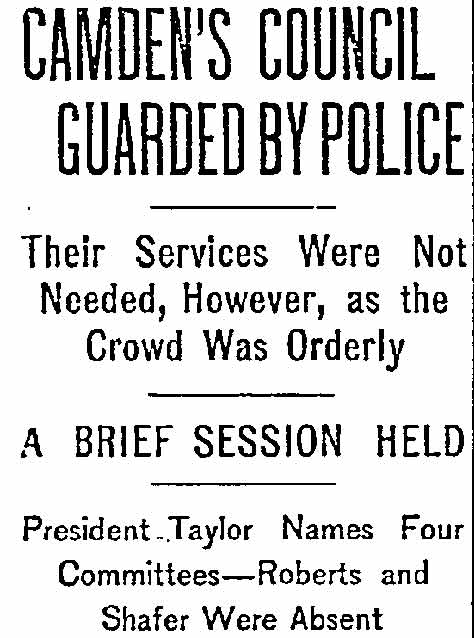
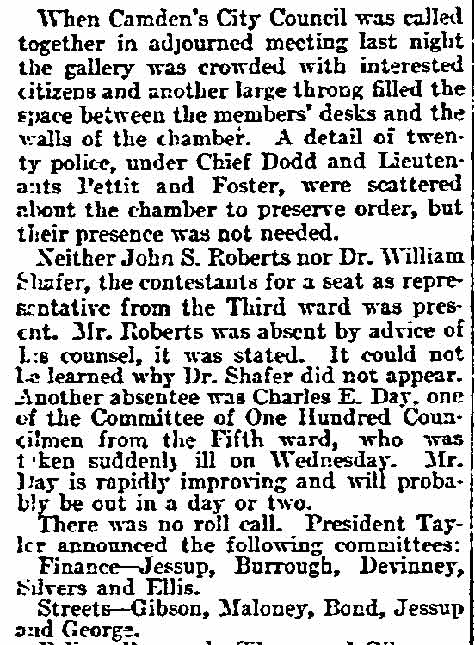
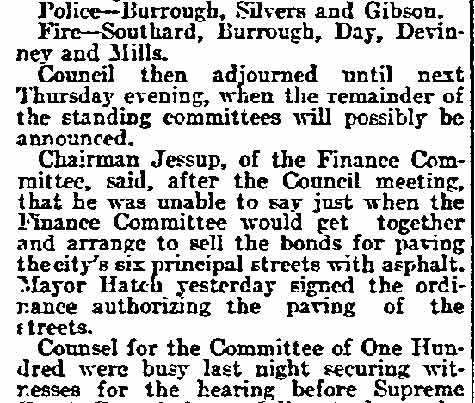
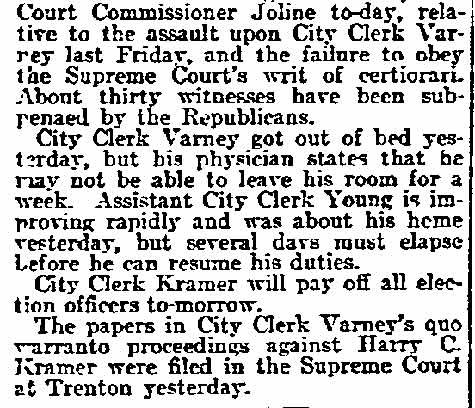
Their Services Were Not Needed, However, as the Crowd Was Orderly
A BRIEF SESSION HELD
President Taylor Names Four Committees—Roberts and Shafer Were Absent
When Camden’s City Council was called together in adjourned meeting last night the gallery was crowded with interested citizens and another large throng filled the space between the members’ desks and the walls of the chamber. A detail of twenty police, under Chief Dodd and Lieutenants Pettit and Foster, were scattered about the chamber to preserve order, but their presence was not needed.
Neither John S. Roberts nor Dr. William Shafer, the contestants for a seat as representative from the Third ward was present. Mr. Roberts was absent by advice of his counsel, it was stated. It could not be learned why Dr. Shafer did not appear. Another absentee was Charles E. Day, one of the Committee of One Hundred Councilmen from the Fifth ward, who was taken suddenly ill on Wednesday. Mr. Day is rapidly improving and will probably be out in a day or two.
There was no roll call. President Taylor announced the following committees:
Finance—Jessup, Burrough, Devinney, Silvers and Ellis.
Streets—Gibson, Maloney, Bond, Jessup and George.
Police—Burrough, Silvers and Gibson.
Fire—Southard, Burrough, Day, Devinney and Mills.
Council then adjourned until next Thursday evening, when the remainder of the standing committees will possibly be announced.
Chairman Jessup, of the Finance Committee, said, after the Council meeting, that he was unable to say just when the Finance Committee would get together and arrange to sell the bonds for paving the city’s six principal streets with asphalt. Mayor Hatch yesterday signed the ordinance authorizing the paving of the streets.
Counsel for the Committee of One Hundred were busy last night securing witnesses for the hearing before Supreme Court Commissioner Joline to-day, relative to the assault upon City Clerk Varrey [sic] last Friday, and the failure to obey the Supreme Court’s writ of certiorari. About thirty witnesses have been subpenaed by the Republicans.
City Clerk Varney got out of bed yesterday, but his physician states that he may not be able to leave his room for a week. Assistant City Clerk Young is improving rapidly and was about his home yesterday, but several days must elapse before he can resume his duties.
City Clerk Kramer will pay off all election officers to-morrow.
The papers in City Clerk Varney’s quo warranto proceedings against Harry C. Kramer were filed in the Supreme Court at Trenton yesterday.
Swinging the Ax on Camden Police
Philadelphia Inquirer —
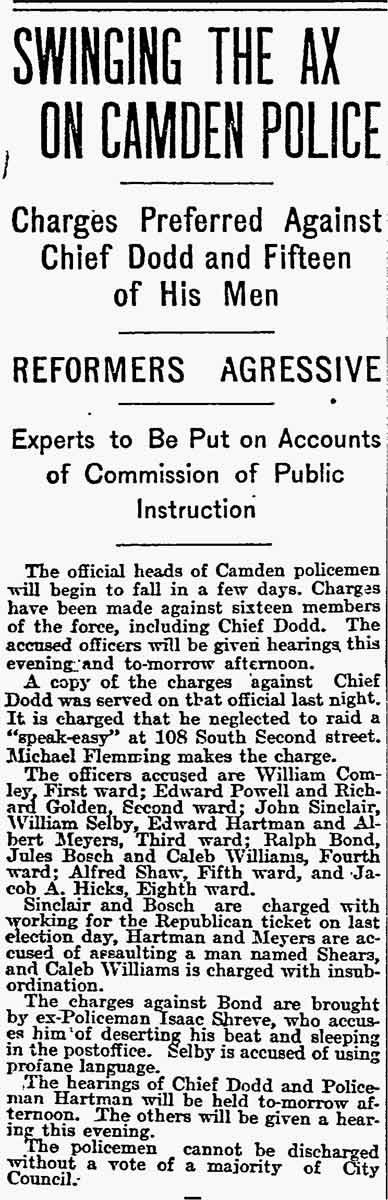
Charges Preferred Against Chief Dodd and Fifteen of His Men
REFORMERS AGRESSIVE [sic]
Experts to Be Put on Accounts of Commission of Public Instruction
The official heads of Camden policemen will begin to fall in a few days. Charges have been made against sixteen members of the force, including Chief Dodd. The accused officers will be given hearings this evening and to-morrow afternoon.
A copy of the charges against Chief Dodd was served on that official last night. It is charged that he neglected to raid a “speak-easy” at 108 South Second street. Michael Flemming makes the charge.
The officers accused are William Comley, First ward; Edward Powell and Richard Golden, Second ward; John Sinclair, William Selby, Edward Hartman and Albert Meyers, Third ward; Ralph Bond, Jules Bosch and Caleb Williams, Fourth ward; Alfred Shaw, Fifth ward, and Jacob A. Hicks, Eighth ward.
Sinclair and Bosch are charged with working for the Republican ticket on last election day, Hartman and Meyers are accused of assaulting a man named Shears, and Caleb Williams is charged with insubordination.
The charges against Bond are brought by ex-Policeman Isaac Shreve, who accuses him of deserting his beat and sleeping in the postoffice. Selby is accused of using profane language.
The hearings of Chief Dodd and Policeman Hartman will be held to-morrow afternoon. The others will be given a hearing this evening.
The policemen cannot be discharged without a vote of a majority of City Council.
Side-Splitting Farce Goes On
Camden Daily Telegram —
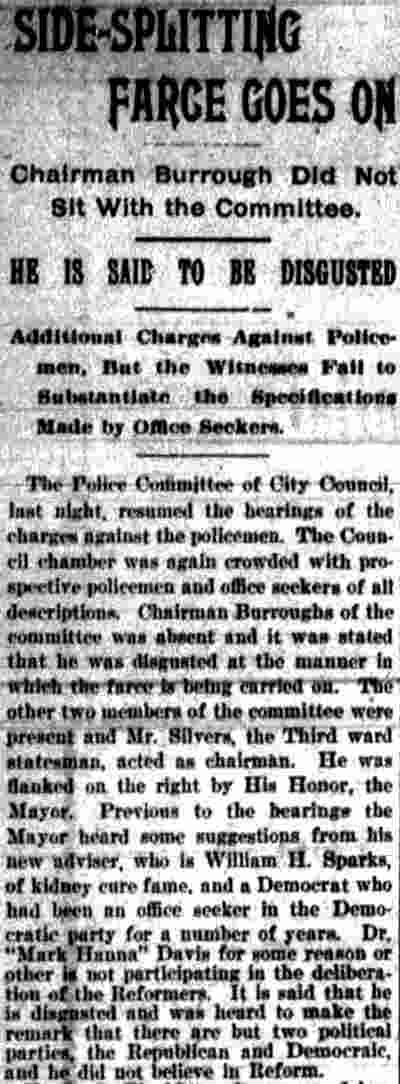
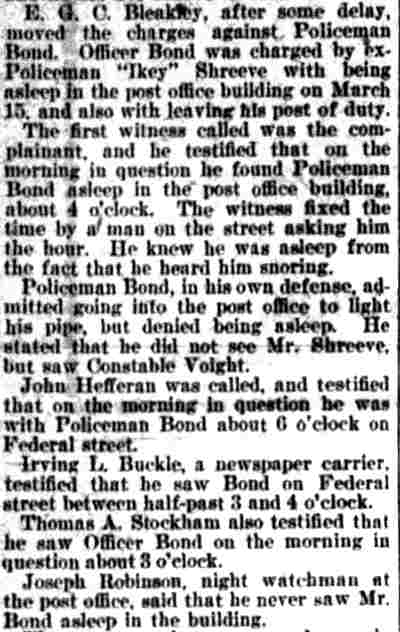
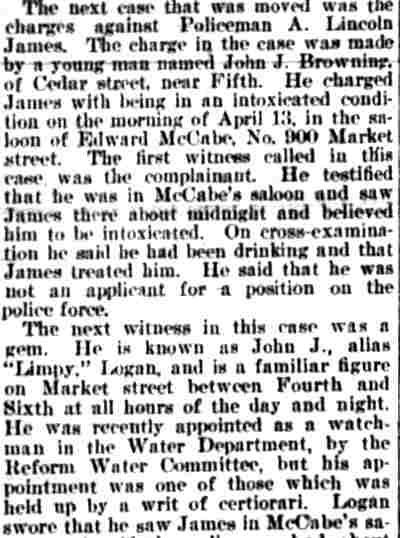
Chairman Burrough Did Not Sit With the Committee.
HE IS SAID TO BE DISGUSTED
Additional Charges Against Policemen, But the Witnesses Fail to Substantiate the Specifications Made by Office Seekers.
The Police Committee of City Council, last night, resumed the hearings of the charges against the policemen. The Council chamber was again crowded with prospective policemen and office seekers of all descriptions. Chairman Burroughs of the committee was absent and it was stated that he was disgusted at the manner in which the farce is being carried on. The other two members of the committee were present and Mr. Silvers, the Third ward statesman, acted as chairman. He was flanked on the right by His Honor, the Mayor. Previous to the hearings the Mayor heard some suggestions from his new adviser, who is William H. Sparks, of kidney cure fame, and a Democrat who had been an office seeker in the Democratic party for a number of years. Dr. “Mark Hanna” Davis for some reason or other is not participating in the deliberation of the Reformers. It is said that he is disgusted and was heard to make the remark that there are but two political parties, the Republican and Democratic, and he did not believe in Reform.
E. G. C. Bleakley, after some delay, moved the charges against Policeman Bond. Officer Bond was charged by ex-Policeman “Ikey” Shreeve with being asleep in the post office building on March 15, and also with leaving his post of duty.
The first witness called was the complainant, and he testified that on the morning in question he found Policeman Bond asleep in the post office building, about 4 o’clock. The witness fixed the time by a man on the street asking him the hour. He knew he was asleep from the fact that he heard him snoring.
Policeman Bond, in his own defense, admitted going into the post office to light his pipe, but denied being asleep. He stated that he did not see Mr. Shreeve, but saw Constable Voight.
John Hefferan was called, and testified that on the morning in question he was with Policeman Bond about 6 o’clock on Federal street.
Irving L. Buckle, a newspaper carrier, testified that he saw Bond on Federal street between half-past 3 and 4 o’clock.
Thomas A. Stockham also testified that he saw Officer Bond on the morning in question about 3 o’clock.
Joseph Robinson, night watchman at the post office, said that he never saw Mr. Bond asleep in the building.
The next case that was moved was the charges against Policeman A. Lincoln James. The charge in the case was made by a young man named John J. Browning, of Cedar street, near Fifth. He charged James with being in an intoxicated condition on the morning of April 13, in the saloon of Edward McCabe, No. 900 Market street. The first witness called in this case was the complainant. He testified that he was in McCabe’s saloon and saw James there about midnight and believed him to be intoxicated. On cross-examination he said he had been drinking and that James treated him. He said that he was not an applicant for a position on the police force.
The next witness in this case was a gem. He is known as John J., alias “Limpy,” Logan, and is a familiar figure on Market street between Fourth and Sixth at all hours of the day and night. He was recently appointed as a watchman in the Water Department, by the Reform Water Committee, but his appointment was one of those which was held up by a writ of certiorari. Logan swore that he saw James in McCabe’s saloon and said the policeman had about nine drinks. He felt certain that James was intoxicated and that he was half drunk when he came into the saloon. The witness on cross examination admitted that he had plenty of beer and that they were coming at a good gait.
John Dorsey, a companion of Logan, corroborated the testimony of his bosom friend and became very indignant when asked if James did not treat him. He said that he had been drinking and paid for all he got.
Policeman James admitted that he was in McCabe’s saloon on the date mentioned. He said he had been in Stockton and arrived at McCabe’s about midnight and while there he had four glasses of beer.
Edward McCabe, the proprietor of the saloon, testified that James was in his place about midnight, but denied that he was intoxicated.
I. Newton Hillman and Hilton Taylor also testified to seeing James and were positive that he was not in an intoxicated condition.
The charges against Policemen Elwyn Steen and William Comley were then taken up. Both of the men were charged with the same offense and were placed on trial together. Lawyer Grey opposed to going to trial without Comley being present as he said he had been informed that he was sick.
Mr. Bleakley opposed his motion and said that Comley was seen in the corridor of the hall early in the evening.
The committee decided to go on with the hearing.
The charge in this case was made by Thomas Neville who swore that both of the policemen were seen to enter the office of Messrs. Shivers & Moffett, on the morning of May 6, at 12.15, and that they remained there until 1.30 a. m.
Counsel for Policeman Steen admitted that his client was in the office of Shivers & Moffett on the date specified, but denied that he remained as long as was charged.
Policeman Steen was put on the stand and testified that on the morning of May 6 he met Policeman Comley, who informed him that he believed there was some person in the office of Shivers & Moffett and Comley asked him to go with him. He said that when they reached the office they found a window open. They then made a search of the premises and also the lumber yard. He testified that the place had been frequently robbed and that Messrs. Shivers & Moffett had furnished Policeman Comley with a key, for the purpose of going through the place.
Henry Moffett, a member of the firm of Shivers & Moffett, testified that the firm had furnished a key to Policeman Comley.
At this juncture Mr. Bleakley went through the crowd and finally landed ex-Excise Commissioner Jacob Gnang on the stand. He said that he knew Policeman Comley and saw him standing in the corridor of the Hall early in the evening.
After considerable delay, occasioned by a conference, between the committee, Mayor Hatch, Acting City Clerk Kramer and Lawyer Bleakley, the committee decided not to take up any more charges and adjourned the hearings until to-morrow night.
As soon as Mayor Hatch reached the Police Department he ordered Chief Dodd to suspend Policeman Comley.
No decisions were given in the other cases.
Hatch Will Rule With a Firm Hand
Philadelphia Inquirer —
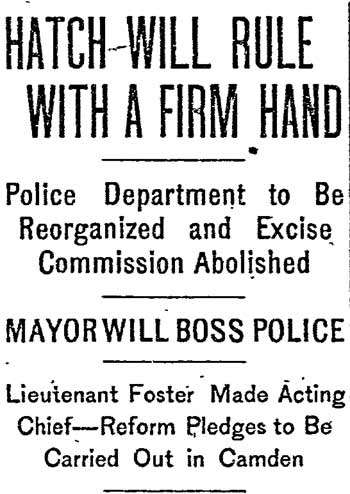
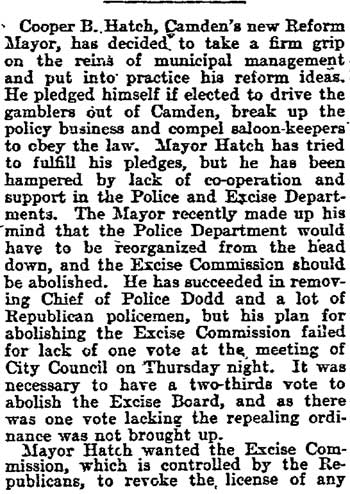
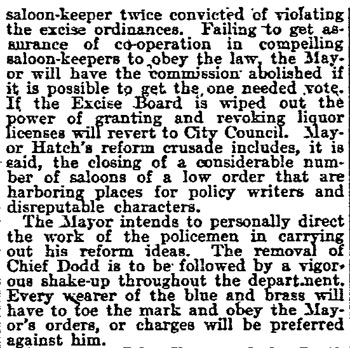
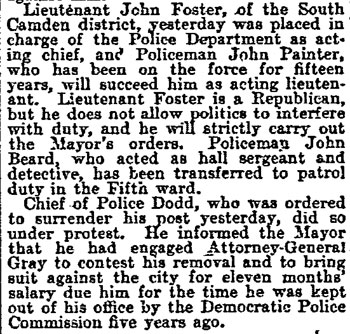
Police Department to Be Reorganized and Excise Commission Abolished
MAYOR WILL BOSS POLICE
Lieutenant Foster Made Acting Chief—Reform Pledges to Be Carried Out in Camden
Cooper B. Hatch, Camden’s new Reform Mayor, has decided to take a firm grip on the reins of municipal management and put into practice his reform ideas. He pledged himself if elected to drive the gamblers out of Camden, break up the policy business and compel saloon-keepers to obey the law. Mayor Hatch has tried to fulfill his pledges, but he has been hampered by lack of co-operation and support in the Police and Excise Departments. The Mayor recently made up his mind that the Police Department would have to be reorganized from the head down, and the Excise Commission should be abolished. He has succeeded in removing Chief of Police Dodd and a lot of Republican policemen, but his plan for abolishing the Excise Commission failed for lack of one vote at the meeting of City Council on Thursday night. It was necessary to have a two-thirds vote to abolish the Excise Board, and as there was one vote lacking the repealing ordinance was not brought up.
Mayor Hatch wanted the Excise Commission, which is controlled by the Republicans, to revoke the license of any saloon-keeper twice convicted of violating the excise ordinances. Failing to get assurance of co-operation in compelling saloon-keepers to obey the law, the Mayor will have the commission abolished if it is possible to get the one needed vote. If the Excise Board is wiped out the power of granting and revoking liquor licenses will revert to City Council. Mayor Hatch’s reform crusade includes, it is said, the closing of a considerable number of saloons of a low order that are harboring places for policy writers and disreputable characters.
The Mayor intends to personally direct the work of the policemen in carrying out his reform ideas. The removal of Chief Dodd is to be followed by a vigorous shake-up throughout the department. Every wearer of the blue and brass will have to toe the mark and obey the Mayor’s orders, or charges will be preferred against him.
Lieutenant John Foster, of the South Camden district, yesterday was placed in charge of the Police Department as acting chief, and Policeman John Painter, who has been on the force for fifteen years, will succeed him as acting lieutenant. Lieutenant Foster is a Republican, but he does not allow politics to interfere with duty, and he will strictly carry out the Mayor’s orders. Policeman John Beard, who acted as hall sergeant and detective, has been transferred to patrol duty in the Fifth ward.
Chief of Police Dodd, who was ordered to surrender his post yesterday, did so under protest. He informed the Mayor that he had engaged Attorney-General Gray to contest his removal and to bring suit against the city for eleven months’ salary due him for the time he was kept out of his office by the Democratic Police Commission five years ago.
Reformers Lop Off Chief Dodd’s Head
Philadelphia Inquirer —
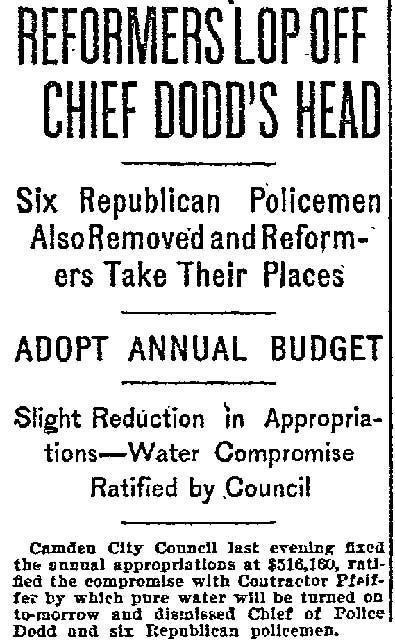
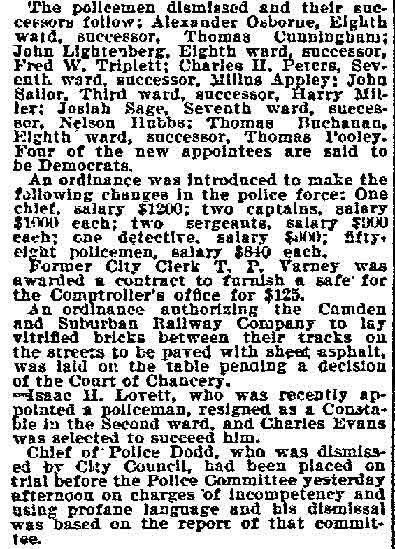
Six Republican Policemen Also Removed and Reformers Take Their Places
ADOPT ANNUAL BUDGET
Slight Reduction in Appropriations—Water Compromise Ratified by Council
Camden City Council last evening fixed the annual appropriations at $516,160, ratified the compromise with Contractor Pfeiffer by which pure water will be turned on to-morrow and dismissed Chief of Police Dodd and six Republican policemen. The appropriations as compared with last year are as follows:
| 1897. | 1898. | |
|---|---|---|
| Police . . . | $60,000 | $68,000 |
| Lighting . . . | 71,000 | 72,000 |
| Salaries . . . | 35,000 | 38,964 |
| Streets . . . | 42,000 | 38,000 |
| Culverts . . . | 12,000 | 12,000 |
| Water . . . | 56,000 | 60,000 |
| Liquidating Indebtedness . . . | 25,000 | 12,500 |
| Excise . . . | 2,500 | 2,500 |
| Dispensaries . . . | 4,000 | 4,000 |
| Parks . . . | 1,400 | 4,000 |
| Interest . . . | 115,000 | 105,946 |
| Building Commission . . . | 100 | 50 |
| Fire . . . | 47,000 | 44,000 |
| Property . . . | 8,000 | 6,500 |
| Elections . . . | 8,000 | 6,000 |
| District Court . . . | 4,000 | 4,000 |
| Printing . . . | 7,000 | 7,500 |
| Contingent . . . | 6,600 | 3,500 |
| Board of Health . . . | 4,000 | 3,500 |
| Poor . . . | 2,000 | 2,000 |
| G. A. R. . . . | 200 | 200 |
| Park Special Bonds . . . | 3,000 | |
| Sinking Fund . . . | 10,000 | 21,000 |
| Deficiency . . . | 10,000 | |
| Total . . . | $533,700 | $516,160 |
The policemen dismissed and their successors follow: Alexander Osborne, Eighth ward, successor, Thomas Cunningham; John Lightenberg, Eighth ward, successor, Fred W. Triplett; Charles H. Peters, Seventh ward, successor, Milins Appley; John Sailor, Third ward, successor, Harry Miller; Josiah Sage, Seventh ward, successor, Nelson Hubbs; Thomas Buchanan, Eighth ward, successor, Thomas Pooley. Four of the new appointees are said to be Democrats.
An ordinance was introduced to make the following changes in the police force: One chief, salary $1200; two captains, salary $1[?]00 each; two sergeants, salary $900 each; one detective, salary $[?]00; fifty-eight policemen, salary $840 each.
Former City Clerk T. P. Varney was awarded a contract to furnish a safe for the Comptroller’s office for $125.
An ordinance authorizing the Camden and Suburban Railway Company to lay vitrified bricks between their tracks on the streets to be paved with sheet asphalt, was laid on the table pending a decision of the Court of Chancery.
Isaac H. Lovett, who was recently appointed a policeman, resigned as a Constable in the Second ward, and Charles Evans was selected to succeed him.
Chief of Police Dodd, who was dismissed by City Council, had been placed on trial before the Police Committee yesterday afternoon on charges of incompetency and using profane language and his dismissal was based on the report of that committee.
Mayor Will Be Chief
Camden Post —
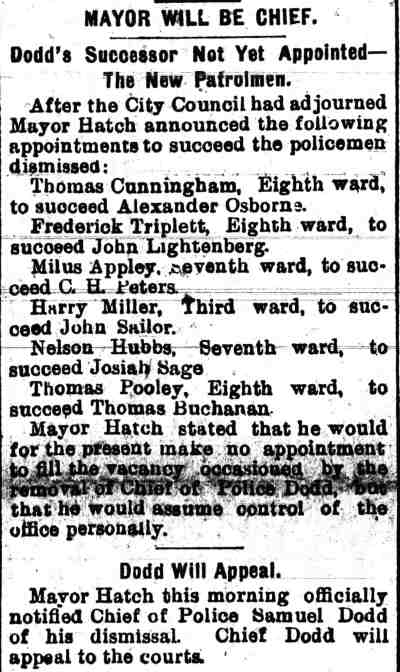
Dodd’s Successor Not Yet Appointed—The New Patrolmen.
After the City Council had adjourned Mayor Hatch announced the following appointments to succeed the policemen dismissed:
Thomas Cunningham, Eighth ward, to succeed Alexander Osborne.
Frederick Triplett, Eighth ward, to succeed John Lightenberg.
Milus Appley, Seventh ward, to succeed C. H. Peters.
Harry Miller, Third ward, to succeed John Sailor.
Nelson Hubbs, Seventh ward, to succeed Josiah Sage
Thomas Pooley, Eighth ward, to succeed Thomas Buchanan.
Mayor Hatch stated that he would for the present make no appointment to fill the vacancy occasioned by the removal of Chief of Police Dodd, but that he would assume control of the office personally.
Dodd Will Appeal.
Mayor Hatch this morning officially notified Chief of Police Samuel Dodd of his dismissal. Chief Dodd will appeal to the courts.
Camden’s New Chief of Police
Philadelphia Inquirer —
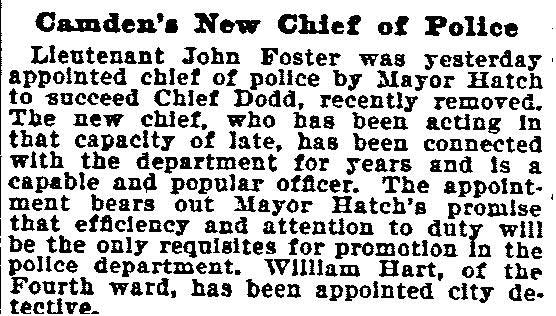
Lieutenant John Foster was yesterday appointed chief of police by Mayor Hatch to succeed Chief Dodd, recently removed. The new chief, who has been acting in that capacity of late, has been connected with the department for years and is a capable and popular officer. The appointment bears out Mayor Hatch’s promise that efficiency and attention to duty will be the only requisites for promotion in the police department. William Hart, of the Fourth ward, has been appointed city detective.
The Love Affairs of the Official Shiner
Camden Daily Courier —
Ernest Waples Gets One Year and His Troubles Get an Airing.
Ernest Waples was the centre of a comedy in the Criminal Court late yesterday afternoon, which suddenly turned to a tragedy for him. Ernest bore the rather dubious title of “Official bootblack to the City Hall.” He came to Camden ten years ago, a “kid” in short pants and chocolate hued face. Rather an “innocent kid” was he, but the allurements of crap and Baxter street sassiety led him from the strict and narrow path. He had been driving for a doctor but that must have made him sick for he threw up the reins and became a bootblack. Humble as the occupation was, honors fell on him thick and fast. It was not long before he was known as the “official bootblack.” The police also knew Ernest as a boy who hung around ex-Chief Dodd’s office listening for tips relative to raids on policy and crap shooters. Forthwith he was banished and his descent to degradation was rapid. He became a frequenter of Baxter street dives and a character known to the police. Time and again he was arrested for scrapping and stealing. The last time previous to yesterday Judge Armstrong warned him that if he came before him again he would surely go to State prison. Yesterday the dark form of Ernest loomed up again in the dock, this time charged with three assaults on divers persons. The divers persons were Mary Douglass, a reluctant “cullud leddy,” whose head Waples split open at a sociable gathering on Baxter street, Policeman Donovan, a colored cop with an Irish name, whom Ernest found no easy mark, and John Mason, a black beauty, whose face bore the dent of a brick fired by the self-same tough young gent in the dock.
Waples was in love with Julia. He denied being married to her but admitted he paid her board. Or rather she paid his. Shortly after his arrest Julia herself was jugged and the two used to send each other dime novels. In the novels they also used to send each other the most tender love messages which the jailers capped and which Assistant Prosecutor Archer produced in court yesterday, while Julia glared and Earnest [sic] snickered.
“Who gave you that mark?” asked Mr. Archer.
“Which one?” asked Julia, “dis or dat or dem dere?”
She evidently had them all labeled.
“I mean the one on your face,” said Mr. Archer.
“Oh, I got dat drinking beer.”
“What! do you bleed every time you drink beer?”
“Not ‘less some one bangs me.”
Judge Armstrong acquitted Waples of the assaults on Mary Douglass and Policeman Donovan, but convicted him on the assault on Julia Mason.
“You’re a tough, bad man, your actions and appearance denote that,” Judge Armstrong.
“Nothin’ bad ‘bout me,” protested Waples.
“Silence!” roared a constable with a cavernous voice.
Judge Armstrong then sentenced Waples to one year in the State prison.
“When I get out I’ll do you up,” he said to Turnkey Entriken who had testified against him as he was taken back to jail. He got off lucky. Spectators expected to see him get five years.
Julia Mason’s trial on the charge of assault was postponed on account of the illness of the man whom she slugged.
Dodd Seeks Recorder’s Nomination
Philadelphia Inquirer —

(news brief — no column header visible)
Former Chief of Police Samuel Dodd has announced his candidacy for the Republican nomination for City Recorder next spring.
Gathered Again at Liberty Bell
Philadelphia Inquirer —
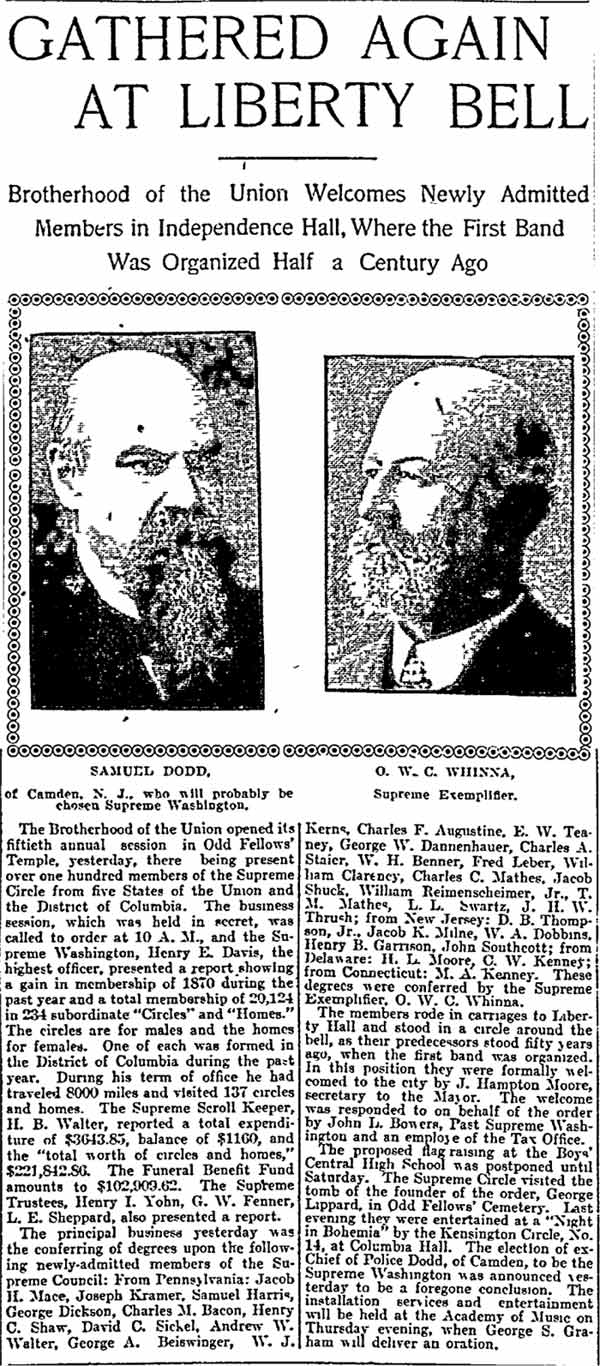
Ex-Chief Dodd Has Passed Away
Philadelphia Inquirer —
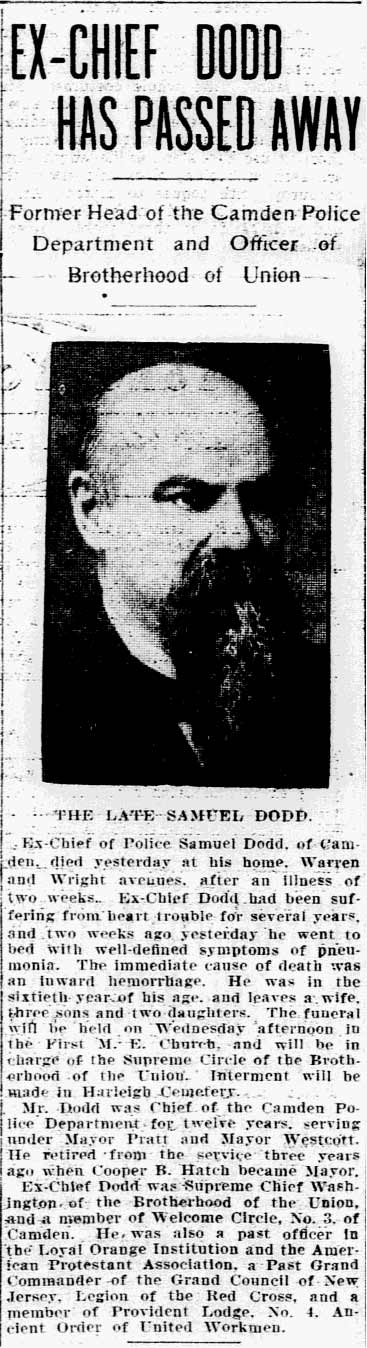
Named: Samuel Dodd, Warren Avenue, Wright Avenue, First Methodist Episcopal Church, Jesse Pratt, John L. Westcott, Cooper B. Hatch, Brotherhood of the Union, Loyal Orange Institution, Ancient Order of United Workmen, and Legion of the Red Cross.
Camden’s Police Chief Dead.
New York Times —

Police Shakeups of Today Mild Compared to Years Ago
Camden Courier-Post —
Force Changed Every Time Political Regime of City Shifted; Larry Doran Fired for Crossing Street to Get Cinnamon Bun; Old Patrol Recalled
By BEN COURTER
(Another in a series of articles on municipal affairs and personalities of yesteryear.)
Ben Courter
In “the good old days” when Camden’s police department was just about getting under way in accordance with the amended charter of 1872, the men in the ranks were the football of politics. Even if the phrase “to the victor belongs the spoils” had not yet been coined, it was in active force. A change of administration always meant a violent shakeup in the personnel of the department.
It has been so many years since Camden has had a real political shakeup, aside from the nonpartisan movement of seven years ago, that the younger element can have no personal recollection of upheavals marking the aftermath of Democrats succeeding Republicans or vice versa. Many of the men resigned on principle, but others stood their ground and with the faithful hungry for place on the police force it was necessary to take drastic measures.
Sometimes it did not require a party turnover, for bitter factional scraps resulted in reprisals. It then fell the lot of the police committee of city council to conduct hearings. They were usually acrimonious affairs with partisans of the G. O. P. often showing more spleen than in a strict party fight. These hearings were as a rule public, attracting big crowds of opponents and advocates of the accused. The charges ranged from conduct unbecoming an officer to neglect of duty and everything between.
Sometimes the charges were altogether ridiculous, as for instance when Larry Doran, now chief of the county detectives, was accused of going out of his beat to buy a cinnamon bun. He happened to be an appointee of Mayor Joseph E. Mowrey and no one questioned Doran’s ability as a cop or of his sincerity in patrolling his beat. But the Republicans had come back into the fold some 25 years ago and it was determined Larry should get out. Thus came the charge based on someone’s discovery he had crossed the street early one morning to get a bun. No one imagined it a very heinous offense at best, but it was all in the game of politics and the finding of the police committee was a foregone conclusion.
Findings, Usually Sustained
In some instances appeals were made to higher courts, but very little came of it since the committee was considered within its power to dismiss an officer if it saw fit. All necessary was to have the report accepted by council and since that was overwhelmingly Republican the work of the committee was a mere formality. Politics continues to play an important part in the appointments of cops or firemen, but for the past six years they have been under civil service, thus affording at least a measure of protection unless there actually has been some dereliction of duty.
Even though there were the changes wrought by political and factional wars, many men withstood the storms through the years. As a matter of fact it is evident that most of the men who have been accepted as representative of the force have had little difficulty in holding down their beats.
Mention has occasionally been made of one of Camden’s most spectacular police chiefs, Samuel Dodd. When he was first appointed by Mayor Pratt in the 80’s he was in the prime of life and certainly not inclined to give quarter to anyone. But he met with his first difficulties in the race track regime with the dual police departments, when the Democratic commission appointed William A. Davis in his stead. He was reinstated in 1893 after the Republicans had gained control of the state and had abolished the commissions.
Dodd then went along without further trouble until the advent of Hatch who appointed John Foster in 1898. Dodd was born in Burlington in 1841, but came to Camden as a young shoemaker and made himself vitally important to his fellow workers. In the 80’s Camden was a shoemaking and leather center. There were over 100 factories and hundreds of persons were employed. Thus it became an important factor in politics. Dodd loomed as a mayoralty candidate. Everything was cut and dried for him to enter the field when Pratt ran in 1885, but Dodd was prevailed upon to get out of the fight with the promise of being made police chief. That was later carried into effect.
Many years Chief Dodd has been dead, but old-timers around the city hall still have a very vivid recollection of him and his long coal black whiskers, which he had a habit of yanking when under some excitement.
First Patrol Wagon
It was during Dodd’s regime Camden sported its first patrol wagon, in May of 1893. It was something of an epochal event for Camden. Men nearing middle life who then were boys vividly recall the sensation created by the appearance of the little red wagon with “Camden Patrol” painted in gold on the red sides, not forgetting the big gong near the driver’s seat. And as the high steppers speeded through the city streets with a drunk or victim of an accident that gong was everlastingly sounded until the whole populace was brought to the doors. Chief Stehr’s father, Lewis H. Stehr; Oscar Weaver, “Si” Sage and “Nitchie” Golden were the first in the department who operated that famous wagon. It was the forerunner of the automobile police patrol and ambulance put in service July 14, 19[?].
When the first patrol went into service Camden’s streets were veritable “rocky roads to Dublin.” They were paved with cobble, even Broadway, Federal street and Kaighn avenue. Only Cooper street and a part of Benson sported asphalt blocks. Hence it was the object of the driver to pick out the best route possible by using horse car or trolley tracks if possible.
It certainly was no pleasure trip to the hall for a drunk and a road of torture to any unfortunate being toted to the hospital. But even at that it was an improvement over the archaic method of taking prisoners to jail by way of a pushcart. I have already mentioned in these annals the Roman holiday such an incident furnished the kids of the generation. If John Painter or Charlie Fitzsimmons pushed a cussin’ drunk from Kaighn Point to the hall they were sure to have a yelling mob of kids at their heels. Unfortunates who were ill or injured were usually taken to the hospital in horse-drawn cabs. But of course the conveniences of today were not even dreamed about.
Lieutenant Tommie Cunningham is among the veterans on the force who recalls those days of long ago, for last Tuesday marked the thirty-sixth anniversary of his appointment to the department. Tommie has seen the department grow from less than half a hundred men to five times that number. In all that time he has pounded a beat in South Camden or had charge of a detail of men or a district as at present.
“Jake” Woodside
In recalling some of the old-timers mention must also be made of Jacob Woodside, who was appointed October 1, 1898. He hailed from the Sixth ward and was among the valiant crew who sported luxurious mustaches. He was in his later years a sergeant in the Third district. Woodside, who had many staunch friends throughout the city, died several years ago.
Then there is “Cul” Errickson who was made a cop September 15, 1898, by Mayor Hatch. He was for many years sergeant at headquarters; a big, good-natured cop, too. He has been enjoying life these several years as a pensioner up around New Egypt.
Certainly one of the most substantial members of the force was Capt. Arthur A. Stanley, who was in charge of the downtown district for many years. He was appointed by Mayor Hatch July 15, 1898. Captain Stanley was a Civil war veteran and prominently identified with the G. A. R. He has been dead for many years. His son, Milton Stanley, was a detective in the department and also at the prosecutor’s office, but for several years has been living on a farm in South Jersey.
There is another veteran of the force still in harness, George Nowrey, brother of former Mayor Nowrey, appointed by Mayor Hatch August 1, 1898. He has been a sergeant in the department for many years.
On the same day Nowrey was appointed, John Reader was made a member of the force. He, too, was a sergeant when he died several years ago. He was father of Dr. A. B. Reader and Attorney Lawrence Reader, the latter one of the most prominent young men of the city when he died during the flu epidemic in 1918. “Larry” also was a member of council from the Thirteenth ward.
Here’s Camden’s Finest, With Whiskers, in 1898
Camden Courier-Post —
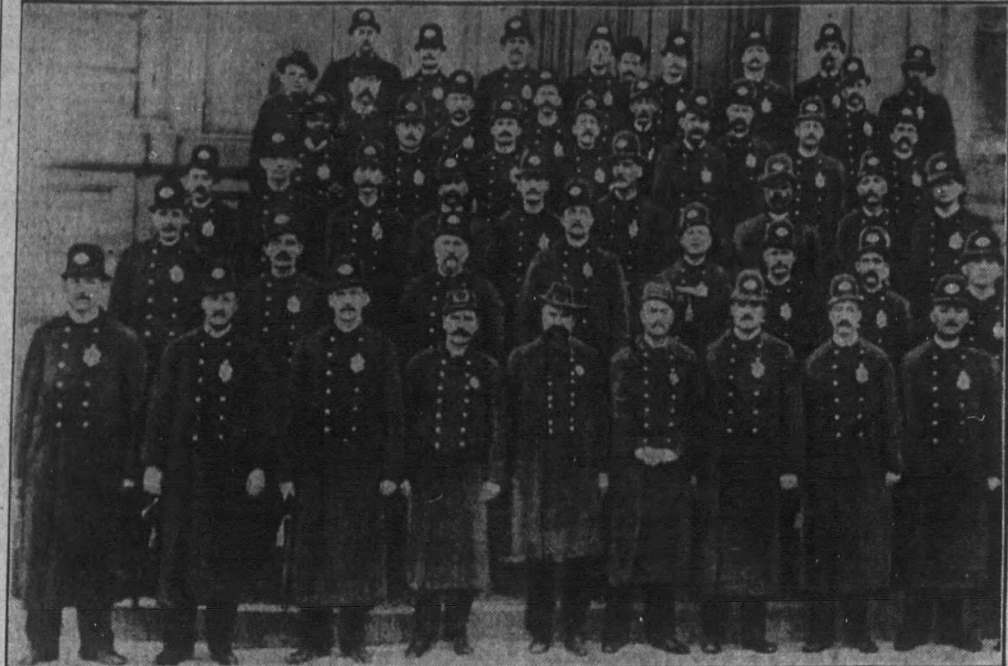
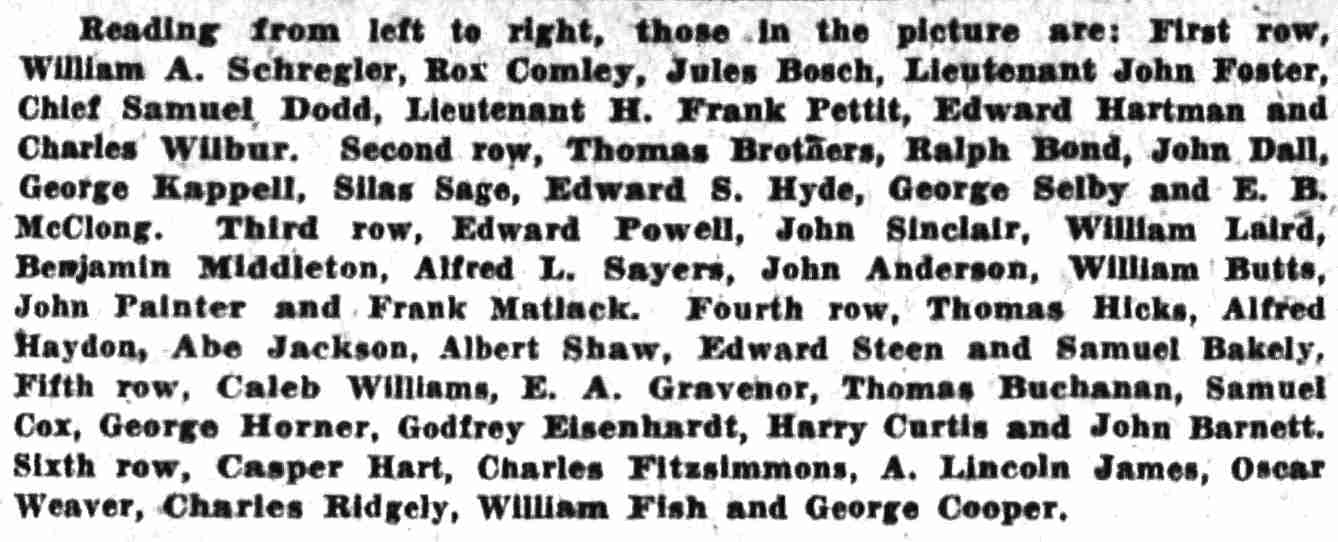
Reading from left to right, those in the picture are: First row, William A. Schregler, Rox Comley, Jules Bosch, Lieutenant John Foster, Chief Samuel Dodd, Lieutenant H. Frank Pettit, Edward Hartman and Charles Wilbur. Second row, Thomas Brothers, Ralph Bond, John Dall, George Kappell, Silas Sage, Edward S. Hyde, George Selby and E. B. McClong. Third row, Edward Powell, John Sinclair, William Laird, Benjamin Middleton, Alfred L. Sayers, John Anderson, William Butts, John Painter and Frank Matlack. Fourth row, Thomas Hicks, Alfred Haydon, Abe Jackson, Albert Shaw, Edward Steen and Samuel Bakely. Fifth row, Caleb Williams, E. A. Gravenor, Thomas Buchanan, Samuel Cox, George Horner, Godfrey Eisenhardt, Harry Curtis and John Barnett. Sixth row, Casper Hart, Charles Fitzsimmons, A. Lincoln James, Oscar Weaver, Charles Ridgely, William Fish and George Cooper.
Camden Cops of 32 Years Ago Valiant Crew Under ‘Sam’ Dodd
Camden Courier-Post —
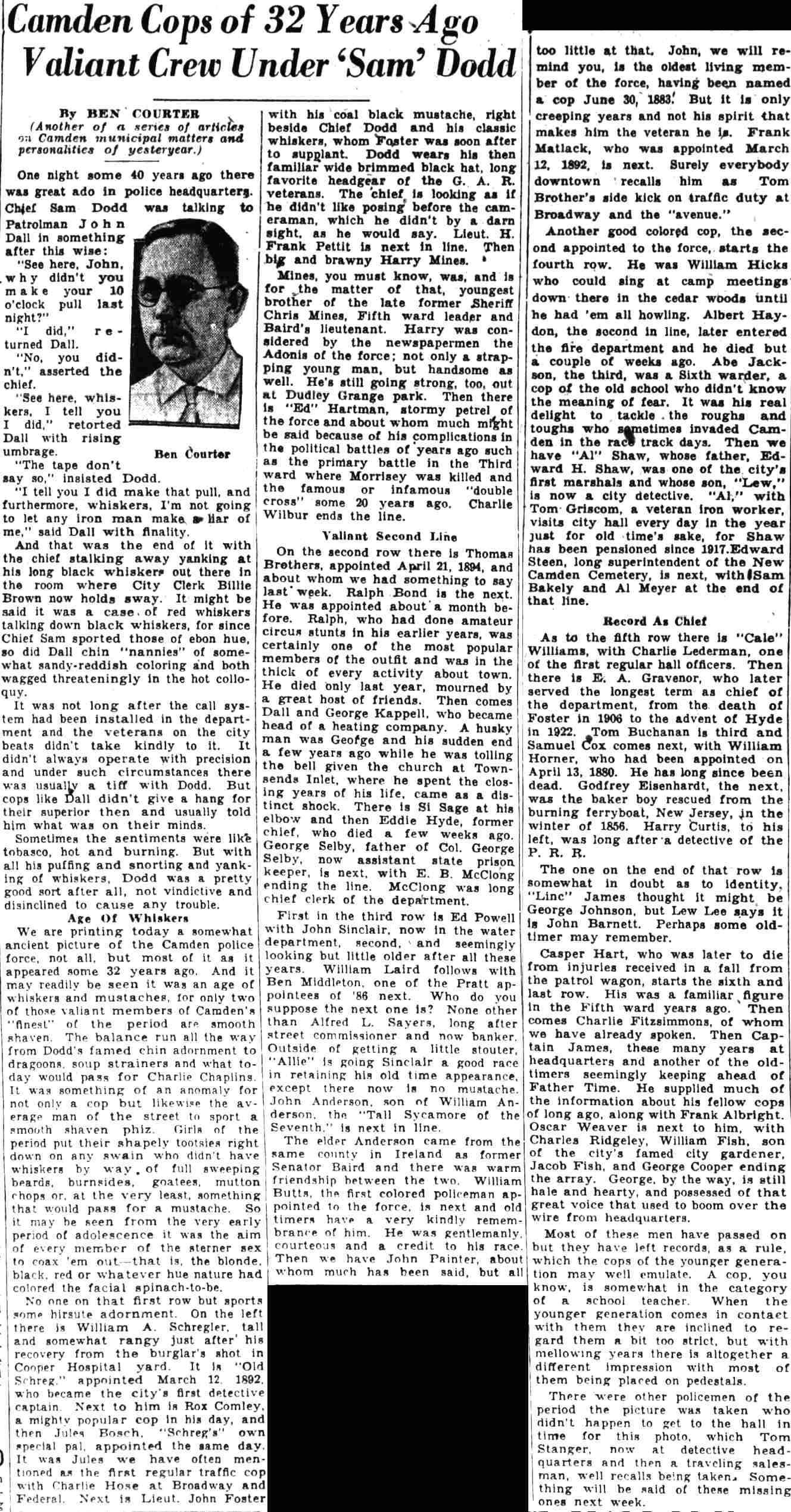
A False Alarm of Long Ago
Camden Courier-Post —
Spectacular Run of Firemen and Steeds in ‘79 When First Alarm System Was Given Try-out
By Ben Courter
THERE were two alarms of fire Saturday evening, one at Fourth and Hamilton streets at 8:29 o’clock, and another at the West Jersey Ferry, an hour later. People in the vicinity of the first-named place turned out to look at the machines propelled at lightning speed by snorting equines, and wondered what it was all about; and some of them thought the wide-awake fire boys were beside themselves, as they asked, for the particular house, in the neighborhood of box 24 upon which, with steam up, their apparatus was able to put on, the water. The firemen and people were quietly informed by a party that drove away in a barouche that it was a designed deception.
Under date of October 6, 1879, that was the introduction to a two-column story under a display headline. But, it was, a single line—“False Alarms.” Readers of the period must have been as much mystified as were the firemen and citizens mentioned in the article, for it was not until more than half a column had been devoted to that incident that the public was let into the great secret. It was a test of the first fire alarm system introduced into Camden.
Interest in that incident is revived by the city commissioners last week entering into a contract with that same concern to install in the new City Hall a system for somewhat more than $51,000. That first “system” cost the city $2000 but it was a big sum then and just about 10 times more space was devoted to it in the old Post than in the Courier-Post last Thursday week.
Paid Department 10 Years Old
Camden’s paid fire department in 1879 was just 10 years old. It already was winning approval of even the recalcitrants, who had asserted back in 1869, that the old volunteer companies would certainly be missed; that the “professionals” would not have as much interest in putting out a fire as the boys who ran with the Perseverance, the Weccacoe and other organizations, usually bitter rivals. Not infrequently the volunteers battled over hooking up their hose while the fire burned, a event by no means outgrown since that occasionally happens even now, as files of the newspapers prove.
But on that Saturday night 54 years ago, it developed that those who drove away in the mysterious barouche were J. W. Morgan, Crawford Miller and F. P. Pfeiffer; fire commissioners of city council, along with R. S. Bender and Thomas Beatty. They were but carrying out orders to see that the system worked and it was John T. Bottomley who issued those orders. He was Camden’s big mill owner but more to the purpose in that particular incident, president of city Council. He had approved the fire alarm system but did not intend putting his O. K. on that $2000 bill until he had seen it in practical operation.
So unknown to the firemen, and the citizens as well, it was determined to test that system by way of turning in the alarms. So an alarm was pulled at 8.29 and “Bart” Bonsall, son of Henry L. Bonsall, publisher of the Post, narrates, in just 15 seconds flat the bell was sounded at No.1 Engine House at Fourth and Pine Street. In two minutes hose cart No. 1 went bounding out with Driver George Hunt at the reins, followed by Ben Cavanaugh and his faithful nag “Jim” with cart No. 2. Then came Jake Kellum and William Davies with the engine no. 2 drawn by “Dolly” in 2.45. After that was engine No.1 driven by Edmund Shaw and the horse “Alec,” coming along in 3 minutes and 5 seconds. It was explained Shaw was held up by the sandy roadway at Fourth and Line.
Spectacular Sight
Anyhow, it must have been a great sight for the old-time families who then resided along the Middle Ward Streets as the racing steeds bounded over Fourth Street, then into Third over a mighty bumpy roadway.
But they arrived and vainly sought the blaze. It was while they were hunting that the barouche came along and the commissioners let them into the great secret. “Bart” doesn’t relate what the firemen said about the false alarm, but, like as not the heat of their expressions was a good substitution for the fire they failed to find.
The system was one of those nine-day wonders that had the town on its toes. Everybody listened for the alarms in those days, for when they were sent in the bells in the fire houses pealed the number of the box. The strokes could be heard surprisingly far. Since there were but 11 boxes it was not long before many knew just where the fire was located and made a bee line for the scene. Old volunteers, particularly, never quite lost their interest in fires and, whenever they heard the alarm, hot footed it to the scene of excitement.
That was all right when Camden was little more than a village, but as the community grew it became a serious proposition, since the racing citizens often interfered with the firemen. Thus about 30 years ago the fire bells were silenced. Now none know of an alarm coming in save the various houses and the Courier-Post which has a wire attached from headquarters bringing in the alarms so that reporters and cameramen may get on the scene quickly as possible.
Ordinarily, little thought is given to the need for instant and accurate sounding of an alarm made possible through the expert work of City Electrician Jim Howell and his aides. If it were not for that perfection and the speed with which friend reach the scene the losses would be large. And the insurance companies would be around with a “pink slip” as they were some 20 years ago. That meant a 25 percent addition to fire rates. Camden’s motorized department plus the work of City Electrician John W. Kelly soon rid the city of that “slip.”
That system of long ago didn’t include the cops. Now it takes in both departments, as it has done since the days of Chief Samuel Dodd, back in the early 90’s.
Janitor Moffett’s Sudden Death.
Camden Daily Courier —
Friends in Camden Surprised and Shocked By the News.
The numerous friends of Charles C. Moffett, janitor of the City Hall for nearly a decade, were pained and shocked to learn that he had dropped dead on the farm of his son-in-law, William Keyes, at Brandywine Hundred, Delaware, just as the village church bells were ringing for morning service yesterday. Heart disease was the cause of death.
Mr. Moffett left the City Hall on Saturday to visit his son-in-law apparently in good health and spirits.
“Keep my end up until I get back, Charley,” he said cheerily to Hall Officer Lederman, who bade him good by and assured him that he would. Officer Lederman was at the hall when Chief Dodd was notified by telephone yesterday of Mr. Moffett’s death, and the remembrance of their parting chat brought tears to his eyes.
Mr. Moffett was beloved by all who knew him and the officials and attaches at the hall will no doubt sadly miss his cheery presence. He was true-hearted, loyal, generous, kindly, jovial, with an inflexible hatred of hypocrisy and deceit; always open, honorable, above-board, and without a known enemy in the world. About a year ago his wife died and shortly afterwards he was stricken with paralysis, from the effect of which he never wholly recovered.
The deceased was sixty-five years of age. Previous to settling in this city he conducted a restaurant at Second and Arch streets, Philadelphia. Years ago he was a prominent Republican in the old South ward, Camden, and served several terms in City Council. In 1871, while a member of Council, he was appointed a member of the commission which erected the new City Hall, another member of which died several months ago, Frederick Bourquin. Last January Mr. Moffett was unanimously re-elected janitor of the City Hall buildings for the fourth consecutive term.
This morning the remains were removed from Delaware to the residence of his son, Harry C. Moffett, at Broadway and Line streets. Two sons, ex-Councilman Henry C. Moffett, of the lumber firm of Shivers & Moffett, and Walter Moffett, and three daughters survive him.