Thomas J. Nicholas
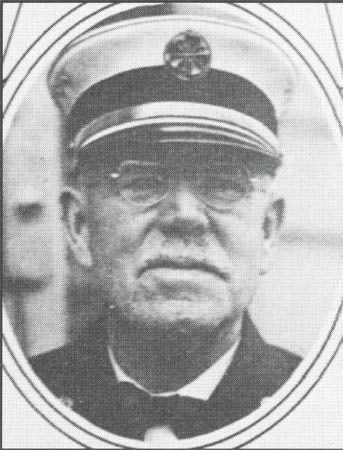
Fire Chief Thomas J. Nicholas
THOMAS J. NICHOLAS JR. was born in March of 1866 in Pennsylvania. He moved to New Jersey with his wife Mary sometime after the birth of their daughter Margaret in 1885, to work as a wools sorter at the Howland Croft Sons & Company textile mill. The family lived at 1835 South 4th Street when the 1890–1891 Camden City directory was compiled. Their son Joseph was born in Camden New Jersey on February 3, 1890. The 1900 Census shows that Thomas Nicholas and his family were living at 1703 South 4th Street. He was then still working as a wool sorter at Howland Croft.
The 1906 Camden City Directory shows that Thomas Nicholas had joined the Camden Fire Department. He was still living at 1703 South 4th Street. The 1910 Census lists Thomas Nicholas and family at 413 Van Hook Street. By 1914 he had been promoted to Captain. The City Directory for that year shows the Nicholas family at 1713 Broadway. He was assigned to Engine Company 3 located in the 1800 Block of Broadway.
Son Joseph’s draft card indicates that he was living at 137 Chestnut Street in Woodlynne, New Jersey. The 1920 Census shows Thomas Nicholas, his wife and son Joseph living at 133 Chestnut Street in Woodlynne. By this time Thomas Nicholas had been promoted to Battalion Chief. By 1924 he had been promoted to Deputy Chief, and in 1926 he succeeded Peter B. Carter as Chief of Department. Thomas Nicholas was the first Chief to be appointed by the merit system of the newly established Civil Service authority.
On June 1, 1926, the City began construction of the Fourteenth Street Viaduct on Federal Street, connecting center city with East Camden. Previously, the section of Federal Street from Newton Avenue to River Avenue intersected Bridge Boulevard (the Admiral Wilson) and other streets at grade level. The apron in front of the quarters of Engine Company 5 adjoined the curbline on Federal Street. The construction of the viaduct elevated the Federal Street roadbed to second story level, providing an overpass for both the Cooper River and Bridge Boulevard, but effectively obstructing the fire station. On November 3, 1925, the building was closed and Engine Company 5 was permanently relocated to East Camden to share quarters with Engine Company 9 and Ladder Company 3. The garage door opening at the rear of Engine 9’s firehouse on the Federal Street side was made to accommodate the apparatus of Engine Company 5.
On July 1, 1926, the Camden Bridge, renamed the Delaware River Bridge and later the Benjamin Franklin, was opened to traffic. Four days later on Monday, July 5th, President Calvin Coolidge inaugurated the grand structure at its formal dedication. Spanning the Delaware River between the State of New Jersey and the Commonwealth of Pennsylvania, the structure joined the Cities of Camden and Philadelphia over a 9,750 foot roadway with a central span of 1,750 feet. At a cost of nearly $40 million dollars, the span when completed was the longest suspension bridge in the world predating such engineering marvels as the Golden Gate of California and the Verrazano in New York. Prior to the bridge’s construction, all traffic between Pennsylvania and New Jersey had to rely on river ferries for transportation.
The opening of the Camden Bridge was heralded by officials as the Gateway to the Garden State. But to many North Camden residents, the opening of the bridge was long regarded as the catalyst in the decline of many North Camden neighborhoods. As a barrier of both physical and psychological comportment, the bridge with its broad approaches was said to isolate much of North Camden from the rest of the City and from center city in particular. In 1928, no one of course could imagine the degree of urban blight that would inflict North Camden in just little more than thirty years.
Also on July 5, 1926, the Department organized a temporary fire company at the South Jersey Exposition grounds located off Haddon Avenue near Mickle Street and what is now the Route 676 expressway. This unit operated as a one-piece engine company with an apparatus assigned from Engine Company 8. Known as the South Jersey Exposition Company, the independent unit occupied a pre-fabricated firehouse and functioned as the Department’s twelfth engine company through the end of summer when it was disbanded with the closing of the exposition on September 9, 1926.
Organized on January 1, 1928, the Box 315 Association was chartered for the mutual benefit of Camden Firemen, its principal purpose being to fund a commemorative badge for all members of the Department retiring at twenty or more years of service. In the event that an active member died before achieving retirement status, a death benefit in the sum of $20.00 would be paid to the member’s estate. Its title, 315, was arbitrarily chosen as the number of the first Box transmitted over the circuits, following the organization’s formation. A cabinet of Officers; a By-Laws Committee; Auditing Committee; and a Board of Trustees comprised of one representative from each fire company in the City, were designated by election and appointment.
All active members of the Department were expected to join the organization. An initiation fee of $1.00 and regular dues assessed at ten cents per month funded operations. Any member of the Department that failed to join the organization within three months after completing his probationary period in the Uniformed Force was required to pay an initiation fee of $5.00, plus the average of all dues and assessments incurred from the time he was eligible to join. The association met on the first Wednesday of each month.
Charter members of the By-Laws Committee were Chester Andrus, Chairman; Harry Wagner, Henry Zook, Harrison Pike, William Spencer and Nelson Andrews. The association is believed to have actively functioned until sometime during the 1940s.
The South Camden neighborhood near Haddon Avenue and the White Horse Pike was predominantly a light industrial area located near the city limits. Comprised largely of warehouses, small factories and lumber yards, the occurrence of major fires in this area was quite infrequent over the years, despite the potential fire load. The exception occurred on June 27, 1929, at the George D. Wetherill Varnish Company. A fire broke out in the thinning room of the production facility and the plant fire brigade failed in its attempt to control the hot, volatile blaze. The flames quickly spread to involve an adjacent building. The Box was transmitted for the White Horse Pike and Ferry Avenue at 11:59 A.M. Engine Company 10 responding second due could see the looming column of smoke and fire nearly a mile away, as they rounded the bend at Morgan and Fairview Streets.
Fire fighters were inundated with nearly one explosion every minute during the first hour of operations. Around 1 P.M., some five hundred barrels of benzine exploded shooting columns of flame 200–300 feet in the air. Moments later, a sixty gallon tank was blown above the dense cloud of smoke. The rocketing missile burst into flaming shrapnel, scattering firemen, employees and spectators in every direction.
Third Alarm companies arrived at a scene of pandemonium as flaming oil and chemicals rained down on the area surrounding the plant. Several members and other persons were burned, some severely. Fireman Irving Bishop of Engine Company 8 was overcome by dense smoke. By 1:30 P.M., the plant was a raging inferno. Four railroad tank cars filled with gasoline were burning furiously, as were five freight cars on an elevated siding that adjoined the rear of the complex. The fire threatened three 6,000 gallon naptha tanks on the adjoining property of the Haddon Motor Company as well as several other nearby businesses. Under conditions of extreme heat and noxious fumes, fire fighters fought bravely to contain the firestorm. By the time an army of firemen gained the upper hand on their enemy, five of eight buildings at the plant had been destroyed. Twenty people were reported injured and damages exceeded $200,000.
Over many decades, more than just a few of the City’s long established industries sustained recurring fires, several of which were especially notable. Industries containing highly combustible stock or inflammable materials processing were ripe for recurring fire incidents — many of spectacular proportion. Along much of the City’s waterfront, from North Camden southward to the far regions of South Camden, were the sites of many industrial facilities that posed serious fire problems. Lumber yards, rag factories, leather tanning, and paper manufacturing were just a few of a great many and diverse industries that posed formidable and ever present challenges for fire fighters. The West Jersey Paper Manufacturing Company was one particular firm involved in numerous fires over the years, many of which were quite arduous for the Department. As a long established industry, West Jersey Paper held several production and warehouse facilities throughout various parts of the City.
Shortly before 8 A.M. on July 11, 1929, a twelve year old boy walking along Front Street near Elm saw smoke coming from the West Jersey Paper Company. The factory building, a large structure, was heavily fortified with reinforced doors and steel mesh window screens. The Box at Point and Pearl Streets was transmitted and Engines 6, 4 and 2 with Ladder 1 and Battalion 1 turned out. As the alarm was received shortly before Roll Call, several units responded with the manpower of double strength companies. The building’s fortifications posed serious forcible entry and ventilation problems for arriving fire fighters. By the time companies got water on the blaze, the entire paper and lime stock was ruined. The factory erupted into huge clouds of dense, acrid smoke as the fire extended to roll after roll of paper stock. Armed with pike poles and axes, Truckies wore themselves out forcing entry to countless windows and doors along the perimeter of the building.
As handlines were advanced to the interior of the structure, Hosemen Harry Layton and George Kirby became lost inside the factory under worsening smoke conditions. Fortunately, Kirby located a doorway and guided Layton to the outside where both men collapsed in the street. The new mascot of Engine Company 2, Jack the Airedale, belonged to Fireman Artie Batten. This blaze was the dog’s first major fire and he caused considerable comment among the men. Dashing into the heavily charged building, accompanying Fireman Batten and braving the dense smoke for twenty minutes at a time, the mascot would only return to the street when Engine 2 would withdraw for a blow of fresh air. For many years to come, Jack would attend hundreds of fires with Engine Company 2, and would later be killed in the line of duty. In all, seven fire fighters were overcome in the dense smoke of the paper factory. The blaze resulted in a $65,000 property loss and was the third serious fire to occur at that location in twenty-five years.
The Schulte-United Store occupied a five-story building at #23 Broadway between Federal and Carman Streets, center city. Around 2:30 A.M. on December 30, 1929, a fire of suspicious origin was discovered by two men who pulled Box 94 at Broadway and Federal Streets. Heavy smoke produced punishing conditions which prevented firemen from entering the basement. The second alarm was ordered as engine companies dropped lines to the basement level through elevator shafts in an attempt to darken the blaze.
This effort proved unsuccessful as the fire raced upward in the shafts from the basement to the roof. Greater Alarms were transmitted to develop additional master streams on the upper floors. By 6 A.M., the first floor collapsed into the basement in a thundering roar. It was another two hours before Chief Thomas Nicholas declared the fire under control. Police questioned two janitors after discovering cans of coal oil on the roof of an adjoining building. The men were later released.
All cities have long held certain sections or districts that pose extraordinary potential for serious fires. When firemen were heard to say “that’s a bad Box,” they meant that the area from which an alarm was received often contained special hazards associated with certain types of buildings or occupancies. The City of Camden was certainly no exception.
Three fifty-one Box at Fillmore Street and Chelton Avenue served a heavy industrial area of lower Broadway in South Camden. While Camden Fire Fighters throughout the fifties, sixties and seventies might only remember the infrequent alarm for dumpsters in the project, or an occasional freight car in the nearby rail yards, this neighborhood held special meaning for generations of fire fighters during the earlier decades of the century.
Bulson Street was a macadam service road that ran east to west from Fourth to Eleventh Streets, adjoining the South Camden rail yards. Along Bulson Street between Sixth and Master stood a complex of towering grain elevators, some as large as eight stories in height. These structures held hundreds of metric tons of grain, for both the nearby Brewery and as interim storage for rail transportation. Dust explosions and fires associated with spontaneous combustion produced frequent and spectacular blazes. It was said that as soon as Box 351 tapped in for Fillmore Street and Chelton Avenue, second alarm units would be putting their boots on in the firehouses even before the first due company had arrived.
At 4 A.M. on Good Friday, April 18, 1930, Box 351 went for three alarms at Sixth and Bulson Streets, South Camden. As Engine Company 8 turned into Broadway, responding first due on the second alarm, they could see a heavily involved grain elevator looming many distant blocks away.
At 7 P.M. on Monday, May 5, 1930, Engine Company 10 responded over twenty-five miles on mutual aid to the Colony of Medford Lakes, New Jersey. A fast moving blaze in the Pine Barrens threatened numerous buildings in the village. Over twenty-five fire companies and an estimated two thousand fire fighters worked throughout the night to contain the fire.
Engine 10 drafted from several lakes as the blaze burned to the edge of the colony before being stopped. Engine Company 10 operated for nearly eleven hours, returning to the City around 7 A.M. the following morning.
On March 1, 1932, units of the Department responded on mutual aid to the City of Pennsgrove for a conflagration involving fifty-seven buildings, mostly frame dwellings in the residential district. Serious water supply problems overwhelmed Salem County fire companies and caused the fire to rapidly spread from building to building, jumping across streets. Camden Fire Fighters placed apparatus on nearby wharfs and bulkheads along the Delaware River and drafted to control the blaze. Engine Companies 2 and 10 under the direction of Chief Thomas Nicholas positioned themselves directly in the path of the advancing inferno to cutoff the rapidly spreading fire. They worked with companies from Salem and were credited with halting the flames before they reached the business district.
During the years of the Great Depression, the Federal Government formed the W.P.A. (Works Progress Administration) which provided thousands of jobs, predominantly among public works projects. The re-building of roads, bridges and infrastructure provided temporary employment of a highly constructive nature. In the City of Camden, the Fire Department endeavored to acquire a high-pressure fire hydrant system. The proposed project would install a high-pressure pumping station at the Delaware River with a large diameter grid supplying a separate network of hydrants. The network would service the entire center city area from the Delaware River to the Cooper River. Such high-pressure hydrants would operate at 120 PSI without the benefit of fire apparatus. The W.P.A. would provide the labor force and equipment necessary to erect the system at no cost to local government. The City would furnish all of the required material. As a result of other fiscal priorities in municipal government, the City declined this valuable opportunity to acquire high-pressure service.
In 1932, following a seven year tenure, Chief of Department Thomas Nicholas retired. Chief John Lennox was appointed as his successor. Chief Nicholas and his wife and son were still living at 133 Chestnut Street in Woodlynne when he passed away on October 3, 1935. Tragically, son Joseph died only 18 days later.
Philadelphia Inquirer — November 2, 1903
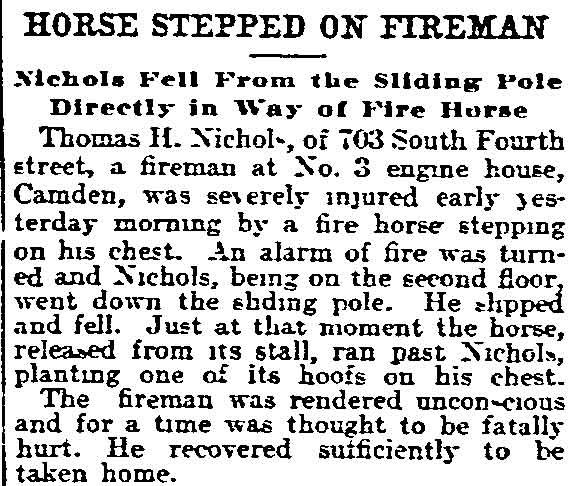
Camden Daily Courier — June 14, 1910
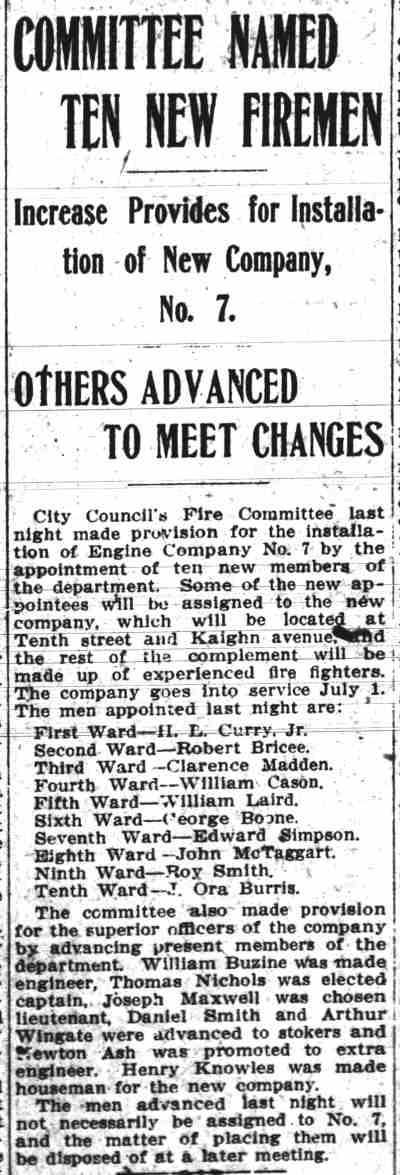
Howard L. Currie — Robert Brice — Clarence Madden — William Cason — William Laird — George Boone — Edward Simpson — John McTaggart — Roy A. Smith — James Ora Burris — William Buzine — Thomas J. Nicholas — Joseph Maxwell — Daniel Smith — Arthur Wingate — Newton Ash — Henry Knowles — Engine Company 7
Camden Post-Telegram — June 24, 1910
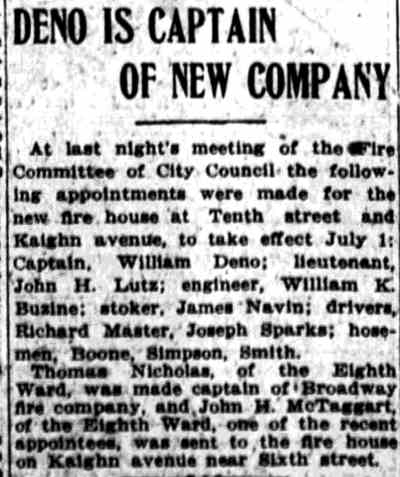
Engine Company 7 — William Deno — John Lutts — William K. Buzine — James Navin — Richard Marter — Joseph Sparks — George Boone — Roy Smith — Edward Simpson — Thomas Nicholas — John McTaggart
Last Honors to Fireman Buzine
Camden Post-Telegram —
Veteran Who Was Fatally Stricken on Engine Borne to Grave Today
Unique Offering Sent By Comrades
Great crowds last night and today viewed the remains of Fireman Lewis Buzine who was fatally stricken with paralysis last Thursday while driving No. 3 engine. The body was exposed to view at his late home, 1606 Broadway, where services were held this afternoon.
Last night nearly one hundred members of the Eighth Ward Republican Club were in attendance and paid their last respects. This afternoon the services were conducted by Reverend William Grum, pastor of the Trinity M. E. Church.
Assistant Chief George Cox was in charge of the detail of firemen, numbering nearly fifty, every company being represented by one or more members, which acted as an escort to the body as it passed through the streets to New Camden Cemetery. The pallbearers were members of No. 3 Engine Company in charge of Captain Nicholas.
The room was filled with choice floral designs. The Eighth Ward Republican Club sent a large star and crescent. The design from the Firemen’s Mutual Benevolent Association was a large circle with a big “5” in the center, being the number of the local lodge. Members of No. 3 Engine Company of which Mr. Buzine was driver, sent a three-foot circle of white chrysanthemums and asters designed as a clock and bearing the inscription “The Last Alarm.” The big figures “83” designated the number of the box from which the alarm came and in the center was the dial of a clock with the hands pointing to 1:32, the time the company left on what proved to be Buzine’s last run.
There were also many floral tributes from the family. The funeral arrangements were in charge of George Blake.
Camden Post-Telegram — December 11, 1914
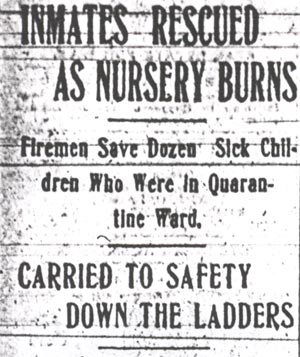
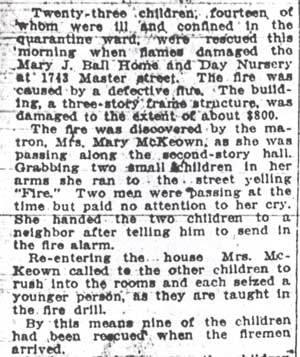
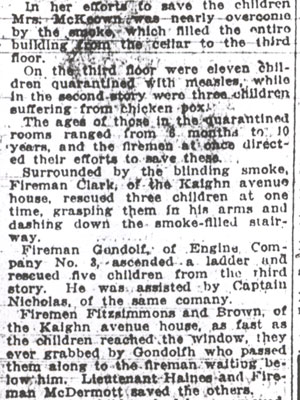
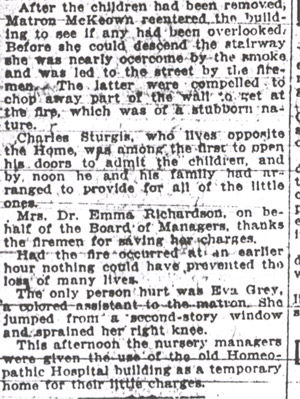
Master Street — Mary J. Ball Home & Day Nursery — Thomas Nicholas — Dr. Emma Richardson — Frank Gondolf — Charles H. Fitzsimmons IV — James H. McDermott — Mortica Clark — Harry A. Haines Sr. — Charles Sturgis — Eva Grey — Mary McKeown — “Brown” is George C. Boone — Engine Company 7 — Engine Company 3
Camden Daily Courier — July 30, 1915
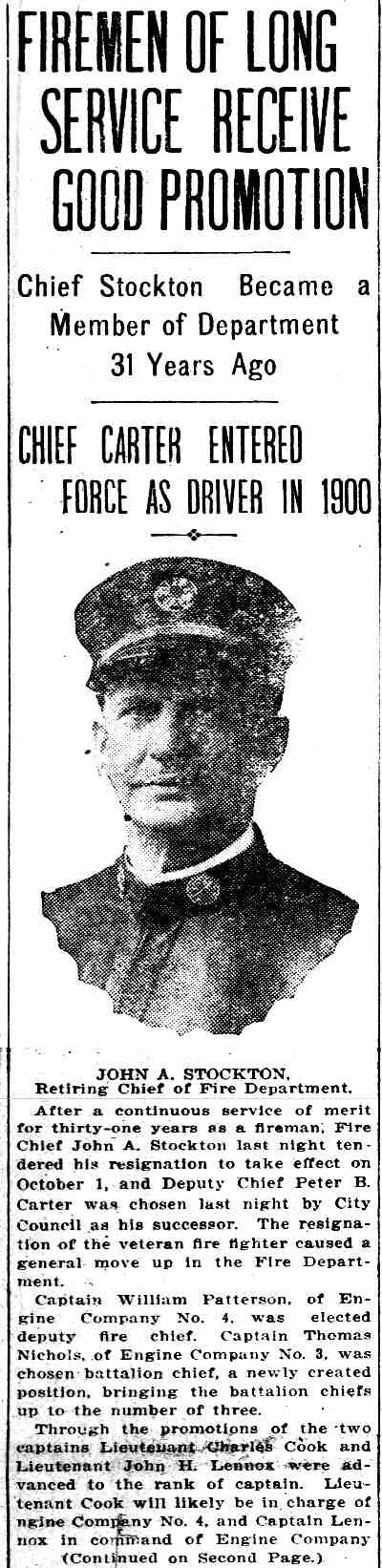
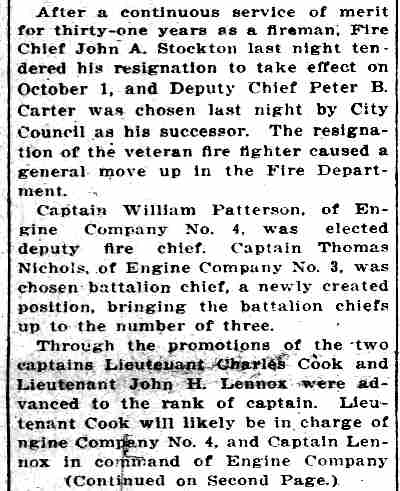
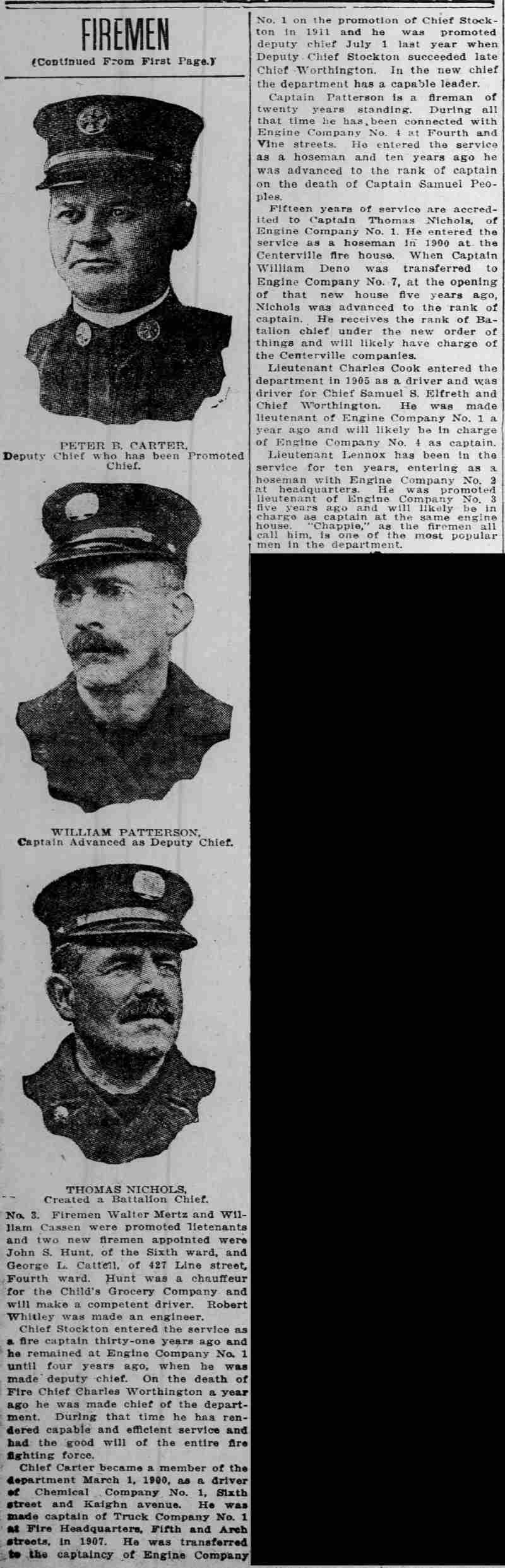
John Stockton — Peter B. Carter — Thomas J. Nicholas — William Patterson — Charles Cook — Walter Mertz — William Cason — Robert Whitley — T. Grant Middleton — John H. Lennox — John A.S. Hunt — George Cattell — Walter W. Johnson — Walter W. Lee — Clarence Baker — Walter Wolverton — Albert Denise — William Barr
Camden Daily Courier — July 30, 1915 (Portraits)
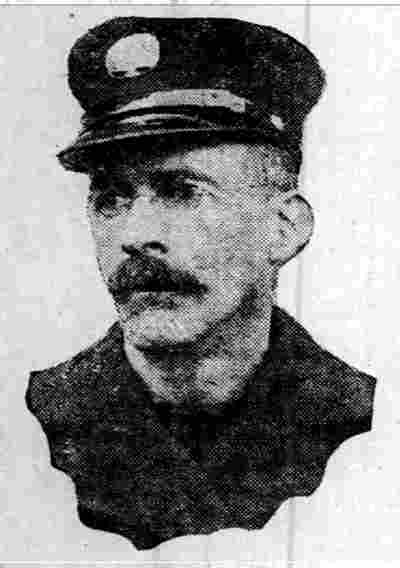
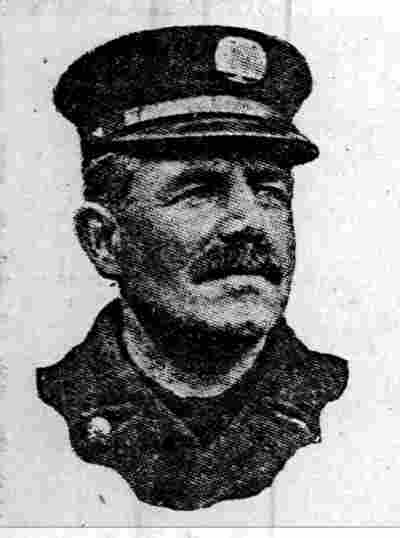
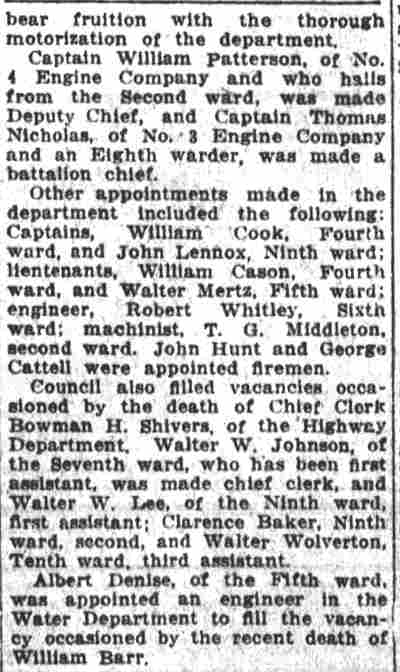
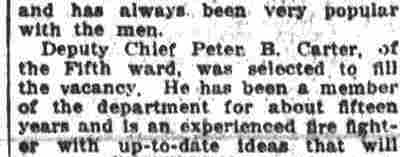
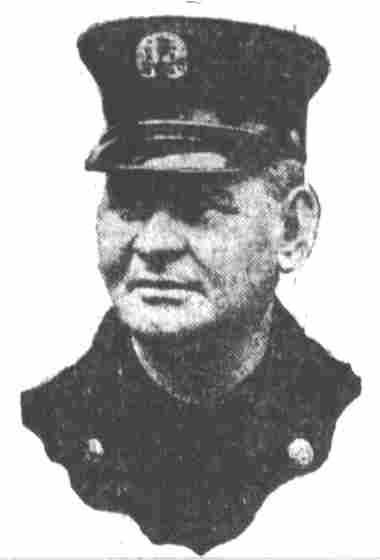
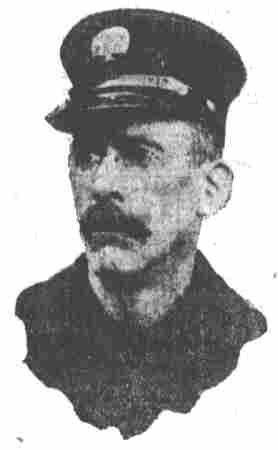
John Stockton — Peter B. Carter — William Patterson — Thomas J. Nicholas
Camden Post-Telegram — July 30, 1915
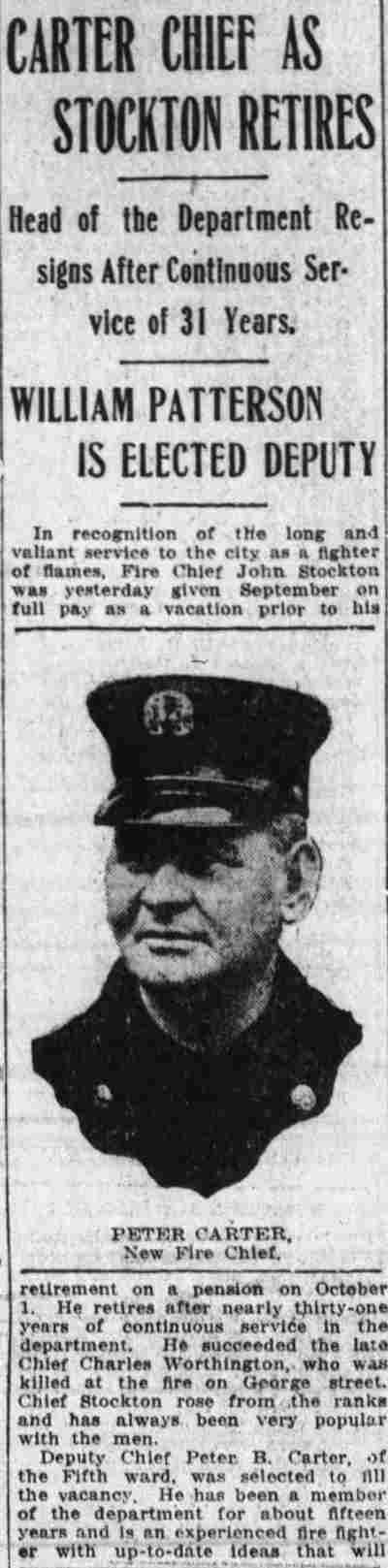
Charles Cook — Walter Mertz — William Cason — Robert Whitley — John H. Lennox — T. Grant Middleton — John A.S. Hunt — George Cattell — Walter Wolverton — Walter W. Johnson — Walter W. Lee — Clarence Baker — Albert Denise — William Barr — Peter B. Carter — William Patterson
Philadelphia Inquirer — July 30, 1915
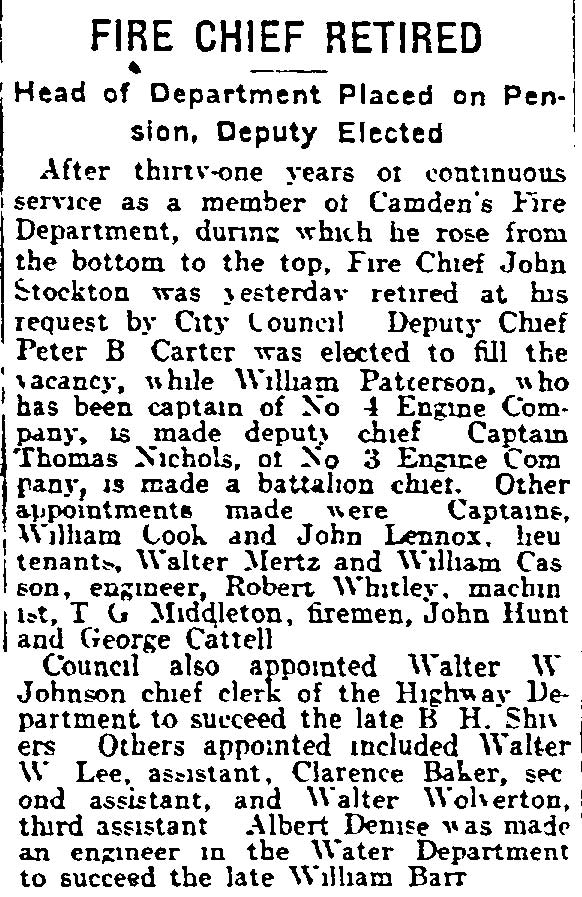
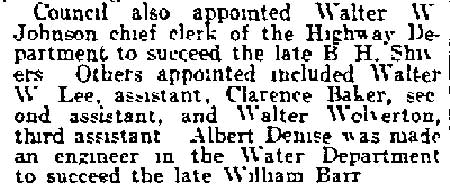
John Stockton — Peter B. Carter — Thomas J. Nicholas — William Patterson — Charles Cook — Walter Mertz — William Cason — Robert Whitley — T.G. Middleton — John H. Lennox — John A.S. Hunt — George Cattell — Engine Company 3 — Engine Company 4 — Walter W. Johnson — Walter W. Lee — Clarence Baker — Walter Wolverton — Albert Denise — William Barr — Bowman H. Shivers
Camden Fire Chief Retires
Philadelphia Inquirer —
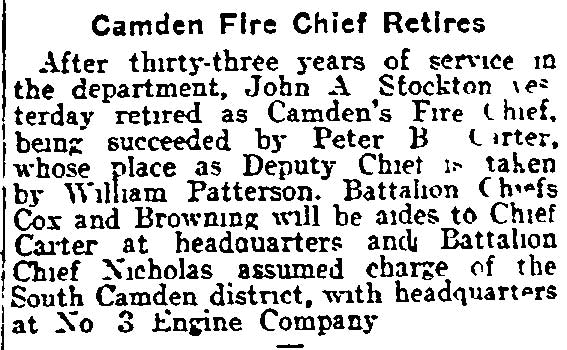
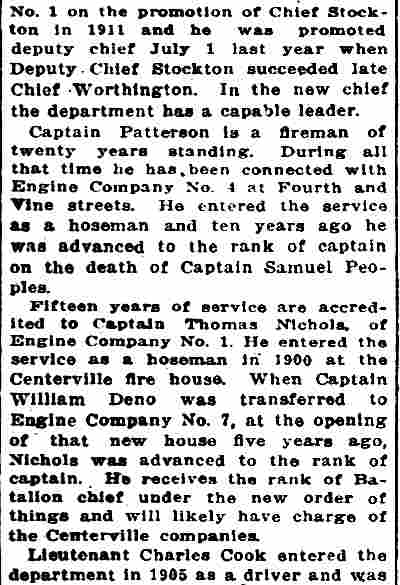
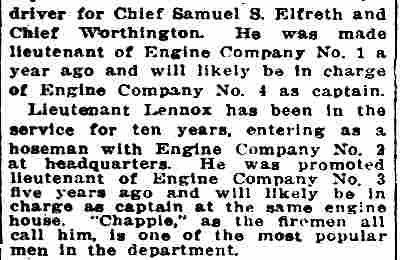
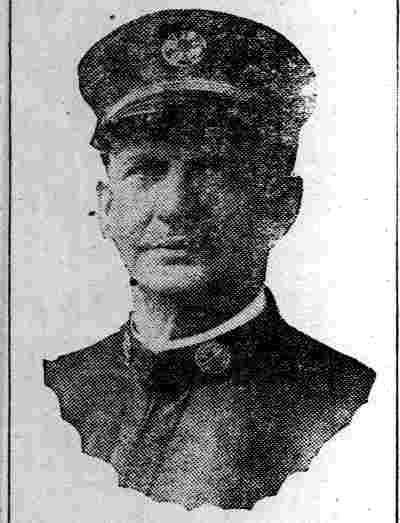
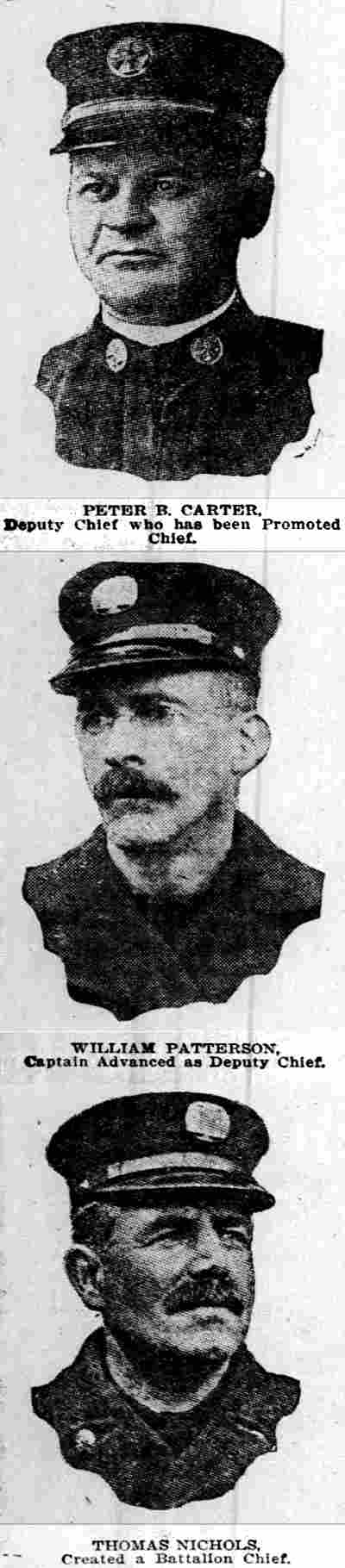
After thirty-three years of service in the department, John A. Stockton yesterday retired as Camden’s Fire Chief, being succeeded by Peter B. Carter, whose place as Deputy Chief is taken by William Patterson. Battalion Chiefs Cox and Browning will be aides to Chief Carter at headquarters and Battalion Chief Nicholas assumed charge of the South Camden district, with headquarters at No. 3 Engine Company.
John Stockton — Peter B. Carter — Thomas J. Nicholas — William Patterson — Walter W. Browning — George P. Cox — Engine Company 3
Camden Post-Telegram — February 25, 1918
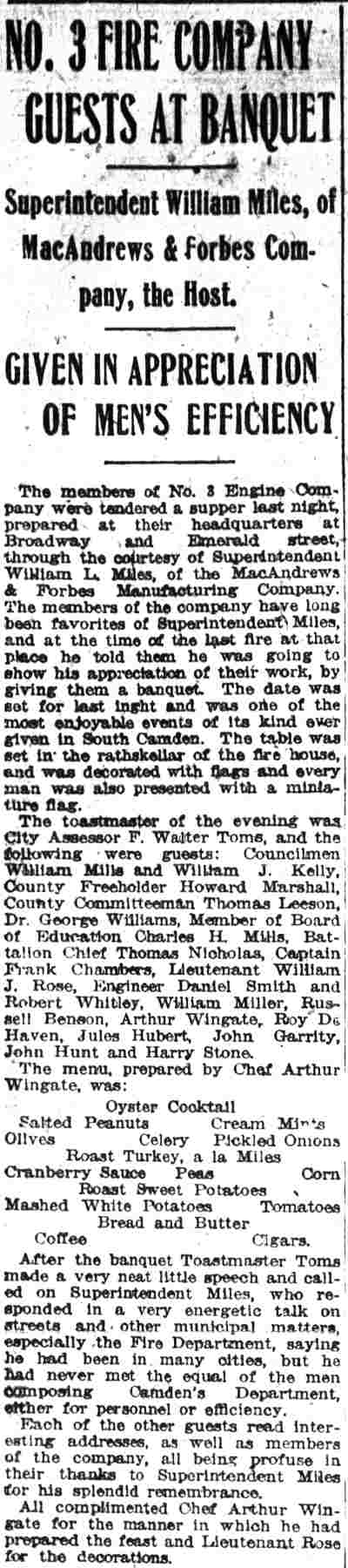
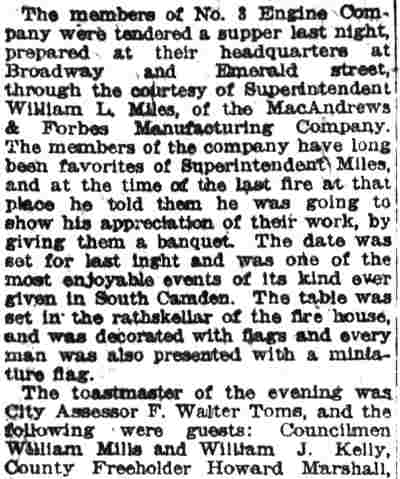
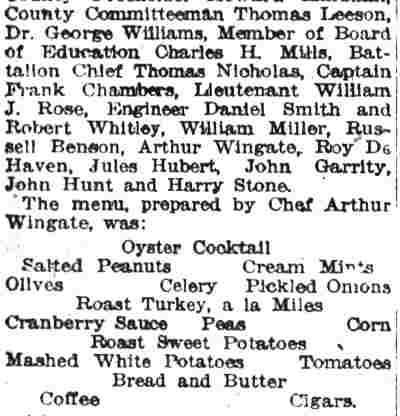
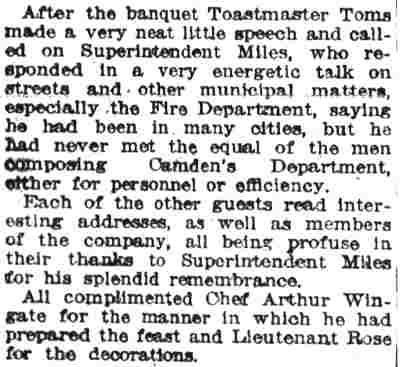
MacAndrews & Forbes — William L. Miles — Engine Company 3 — F. Walter Toms — William Mills — William J. Kelly — Howard Marshall — Thomas Leeson — Charles H. Mills — Thomas Nicholas — Frank Chambers — William J. Rose — Daniel Smith — Robert Whitley — William Miller — Russell Benson — Arthur Wingate — Roy De Haven — Jules Hubert — John T. Garrity — John A.S. Hunt — Harry Stone
Camden Post-Telegram — August 2, 1920
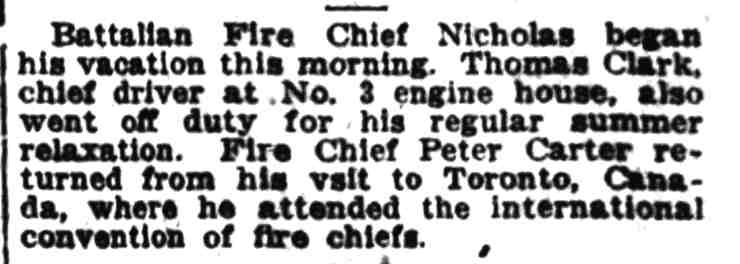
Battalion Fire Chief Nicholas began his vacation this morning. Thomas Clark, chief driver at No. 3 engine house, also went off duty for his regular summer relaxation. Fire Chief Peter Carter returned from his visit to Toronto, Canada, where he attended the international convention of fire chiefs.
Thomas Nicholas — Peter B. Carter — Thomas Clark — Mortica Clark
Camden Post-Telegram — December 30, 1920
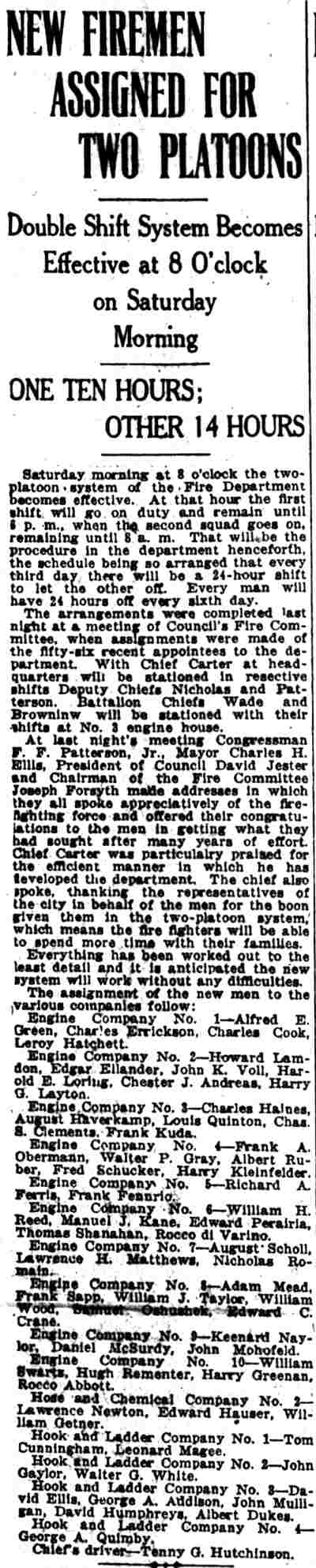
NEW FIREMEN ASSIGNED FOR TWO PLATOONS
Double Shift System Becomes Effective at 8 O’clock on Saturday Morning
One Ten Hours; Other 14 Hours
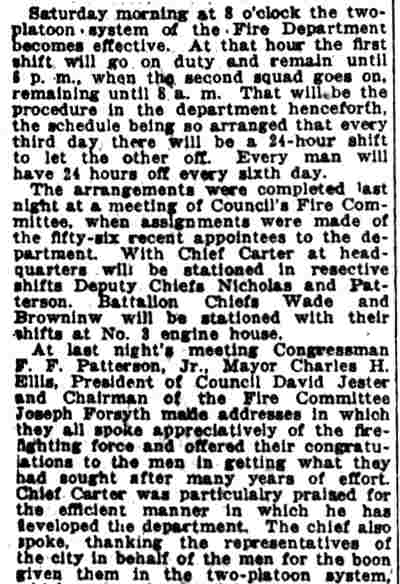
Saturday morning at 8 o’clock the two-platoon system of the Fire Department becomes effective. At that hour the first shift will go on duty and remain until 6 p. m., when the second squad goes on, remaining until 8 a. m. That will be the procedure in the department henceforth, the schedule being so arranged that every third day there will be a 24-hour shift to let the other off. Every man will have 24 hours off every sixth day.
The arrangements were completed last night at a meeting of Council’s Fire Committee, when assignments were made of the fifty-six recent appointees to the department. With Chief Carter at headquarters will be stationed in reserve shifts Deputy Chiefs Nicholas and Patterson. Battalion Chiefs Wade and Browning will be stationed with their shifts at No. 3 engine house.
At last night’s meeting Congressman F. F. Patterson, Jr., Mayor Charles H. Ellis, President of Council David Jester and Chairman of the Fire Committee Joseph Forsyth made addresses in which they all spoke appreciatively of the fire-fighting force and offered their congratulations to the men in getting what they had sought after many years of effort. Chief Carter was particularly praised for the efficient manner in which he has developed the department. The chief also spoke, thanking the representatives of the city in behalf of the men for the boon given them in the two-platoon system, which means the fire fighters will be able to spend more time with their families.
Everything has been worked out to the least detail and it is anticipated the new system will work without any difficulties.
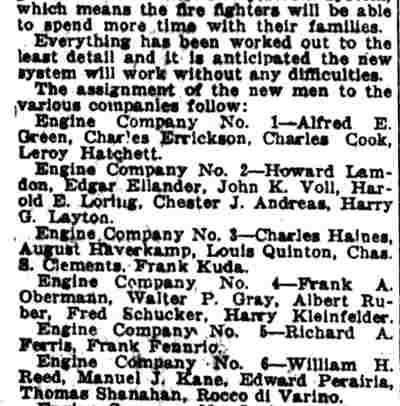
The assignment of the new men to the various companies follow:
Engine Company No. 1—Alfred E. Green, Charles Errickson, Charles Cook, Leroy Hatchett.
Engine Company No. 2—Howard Lamdon, Edgar Ellander, John K. Voll, Harold E. Lorang, Chester J. Andreas, Harry G. Layton.
Engine Company No. 3—Charles Haines, August Haverkamp, Louis Quinton, Chas. S. Clements, Frank Kuda.
Engine Company No. 4—Frank A. Obermann, Walter P. Gray, Albert Ruber, Fred Schucker, Harry Kleinfelder.
Engine Company No. 5—Richard A. Ferris, Frank Fennrio.
Engine Company No. 6—William H. Reed, Manuel J. Kane, Edward Perairia, Thomas Shanahan, Rocco di Varino.
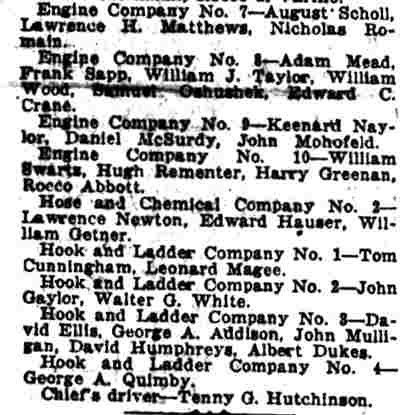
Engine Company No. 7—August Scholl, Lawrence H. Matthews, Nicholas Romain.
Engine Company No. 8—Adam Mead, Frank Sapp, William J. Taylor, William Wood, Samuel Oshushek, Edward C. Crane.
Engine Company No. 9—Keenard Naylor, Daniel McSurdy, John Mohofeld.
Engine Company No. 10—William Swarts, Hugh Rementer, Harry Greenan, Rocco Abbott.
Hose and Chemical Company No. 2—Lawrence Newton, Edward Hauser, William Getner.
Hook and Ladder Company No. 1—Tom Cunningham, Leonard Magee.
Hook and Ladder Company No. 2—John Gaylor, Walter G. White.
Hook and Ladder Company No. 3—David Ellis, George A. Addison, John Mulligan, David Humphreys, Albert Dukes.
Hook and Ladder Company No. 4—George A. Quimby.
Chief’s driver—Tenny G. Hutchinson.
Engine Company 6 — c. 1921–1922
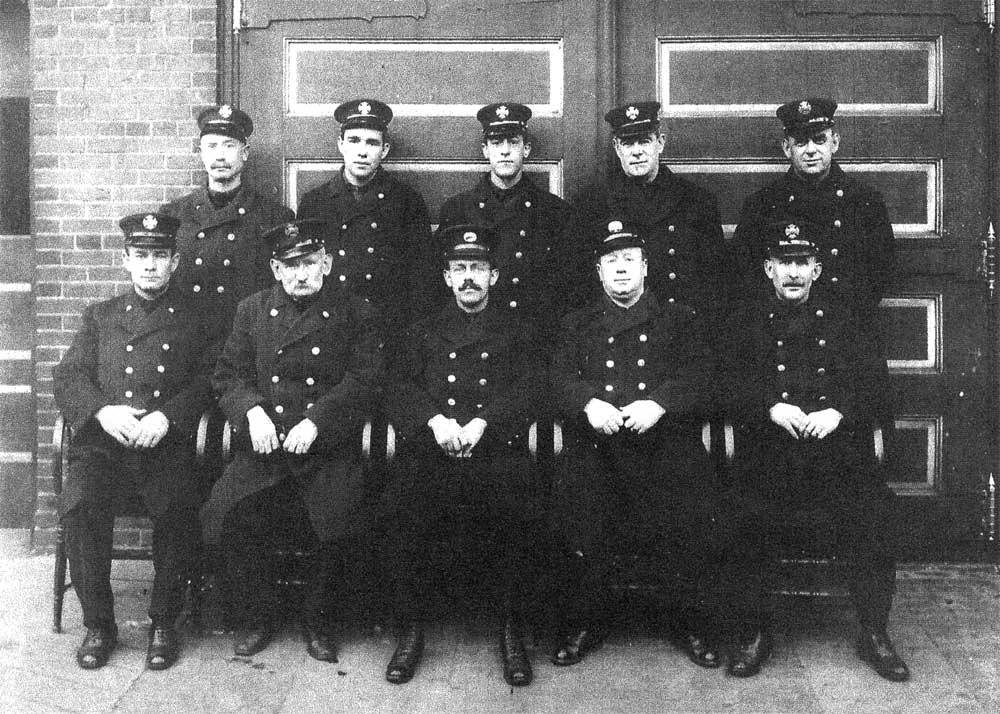
Photo taken between January of 1921 and July of 1922.
Standing: Unknown — Thomas “Tim” Shanahan — Unknown — Unknown — Unknown
Seated: Unknown — James McDade — Thomas Nicholas — John Lutts — Unknown
Philadelphia Inquirer — October 21, 1922
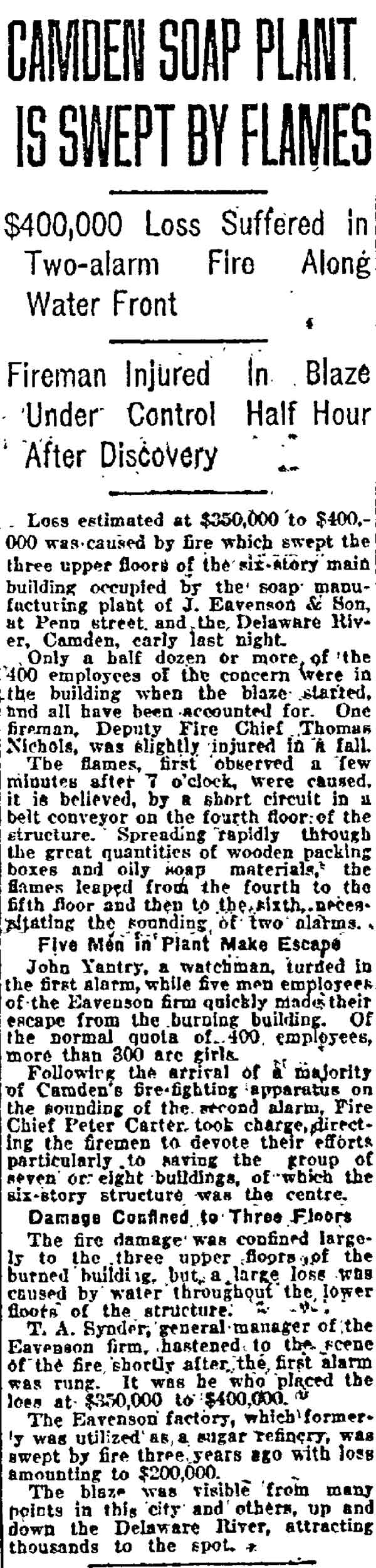
Peter B. Carter — Thomas J. Nicholas — John Yantry — J. Eavenson & Son — Penn Street
Camden Courier — May 22, 1925
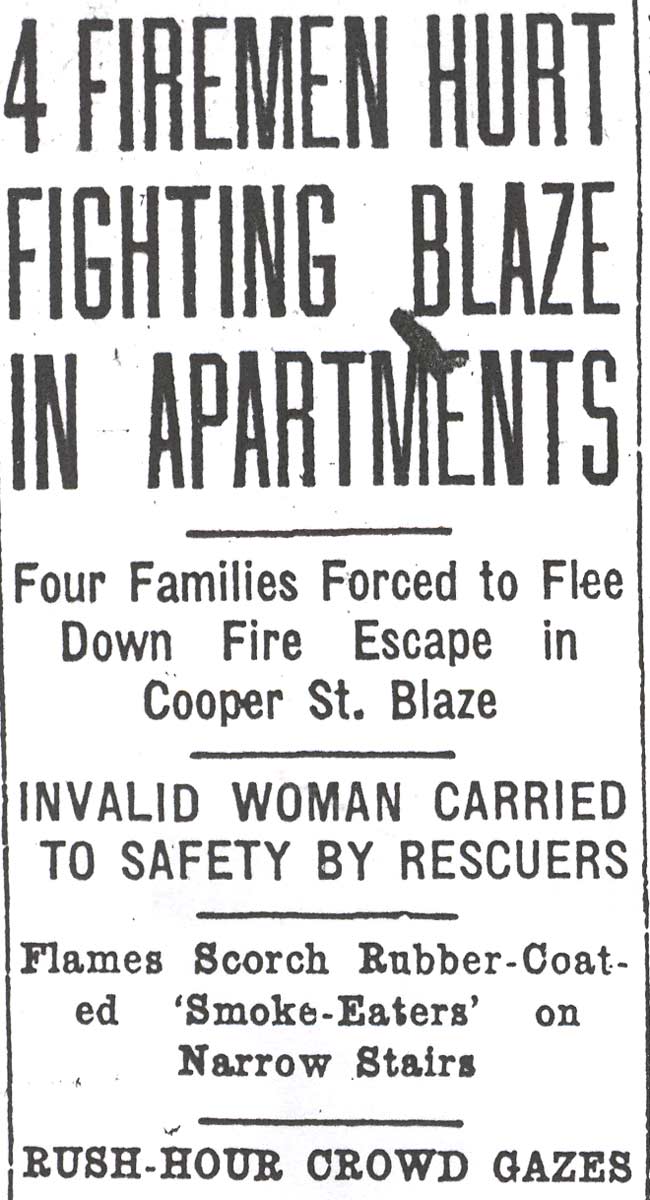
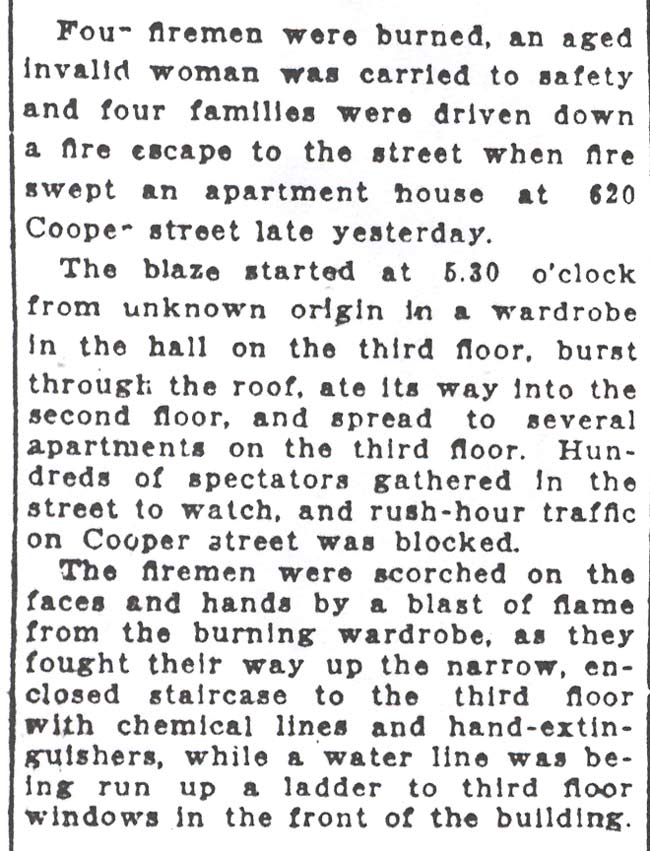
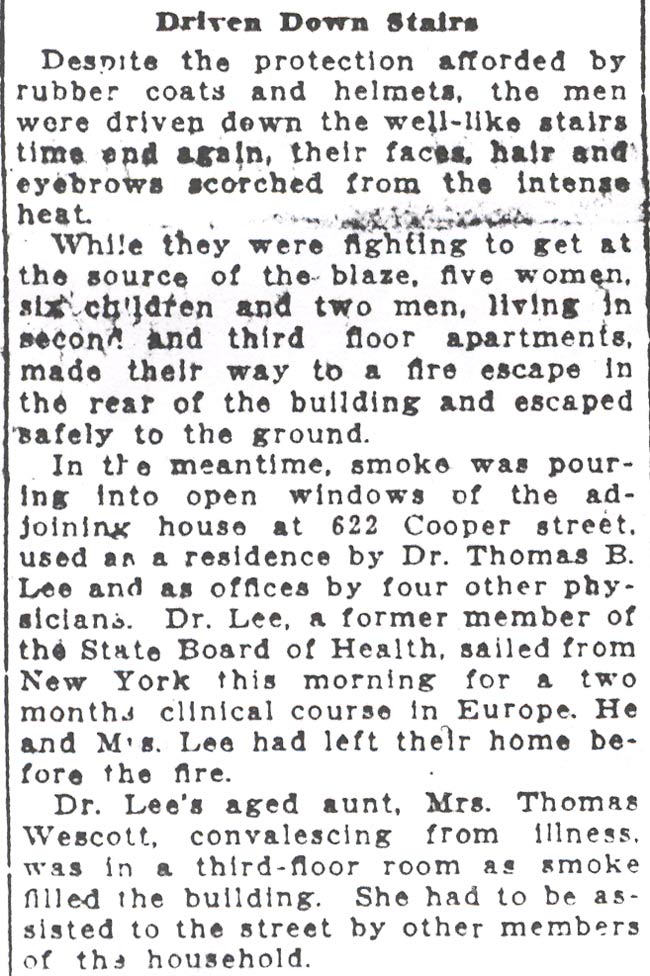
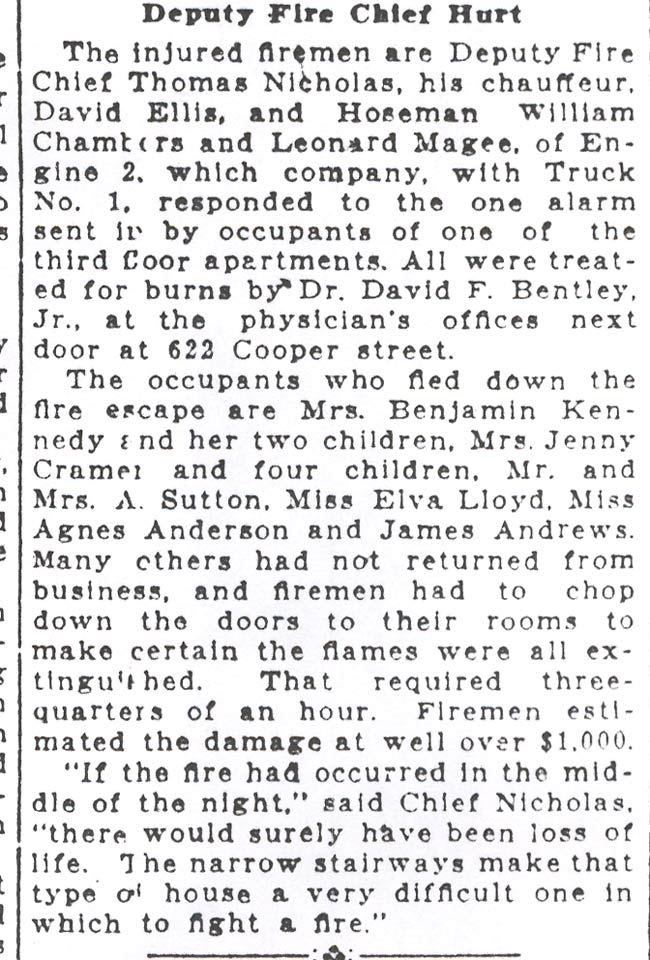
William Chambers — Leonard Megee — Thomas J. Nicholas — David Ellis — Dr. Thomas B. Lee — Dr. David F. Bentley — Engine Company 2 — Ladder Company 1
Tags to Be Sold in City, Suburbs to Aid Hospital
Camden Courier-Post —
Members of the Woman’s Board to the West Jersey Homeopathic Hospital have gathered their forces and are in readiness for their annual Tag Day tomorrow.
The assistance of all the city and suburban auxiliaries as well as the aid of the Camden City Firemen have been enlisted. The city and suburbs will be covered by the various groups selling the small cardboards while food and flower sales will be conducted at various points. In Camden, the City Auxiliary will conduct a food sale at 407 Broadway, and the board members under the direction of Mrs. Charles Lacy will hold another at 540 Federal Street.
General arrangements for Tag Day are under the direction of Mrs. William B. Scott, president of the Women’s Board. The members of the board include: Mrs. Harvey Cannon, Mrs. John Danenhower, Mrs. William Clifton, Mrs. Benjamin Wrobleski, Mrs. Ruth Blessing, Mrs. Isadore Green, Mrs. Meyers Baker, Mrs. Lee Griscom, Mrs. George Woodward, Mrs. Joseph Kobus, Mrs. James J. Scott, Mrs. Edith Kerbaugh, Mrs. A. K. Eynon, Mrs. Richard Connor, Mrs. Abe Fuhrman, Mrs. Clarence Fisher, Mrs. Kenneth Athey, Mrs. Robert Warwick and Mrs. F. T. Garrison.
Assistance of the fire department of the city has been arranged through the courtesy of Chief Thomas Nicholas. Sales being conducted by the auxiliaries are under the direction of the following chairmen: Audubon, Mrs. Henry R. Tatem, Jr.; Camden, Mrs. Harry Hackman; Collingswood, Mrs. Milton M. Bitter; East Camden Juniors, Miss Martha Stone; Delair, Mrs. William Morrow; Gloucester, Miss Elizabeth Felbs; Gloucester Heights, Mrs. Mary Gormerley; Haddonfield, Mrs. William F. Clement; Haddonfield Juniors, Mrs. Hartje Riddel; Council of Jewish Women, Mrs. Henry Cooperson; Pennsauken and Merchantville, Mrs. J. Perry Long; Haddon Heights, Mrs. Frank Underkuffier; Italian Branch, Mrs. F. Puleo; Polish Branch, Mrs. Edward Praiss; Stratford, Mrs. Charles Jaggard; Woodlynne, Mrs. Charles Harrison.
Members of the Women’s Board of West Jersey Homeopathic Hospital are planning an outing to Washington’s Crossing on Monday, June 20. Mrs. William B. Scott, president, is chairman on arrangements for the trip which will be made by bus. The party will leave the Hotel Walt Whitman at 10 o’clock that Monday morning and luncheon will follow at The Olde Tavern Inn.
$225,000 Fire Ruins 5 Uptown Plants
Camden Courier-Post —
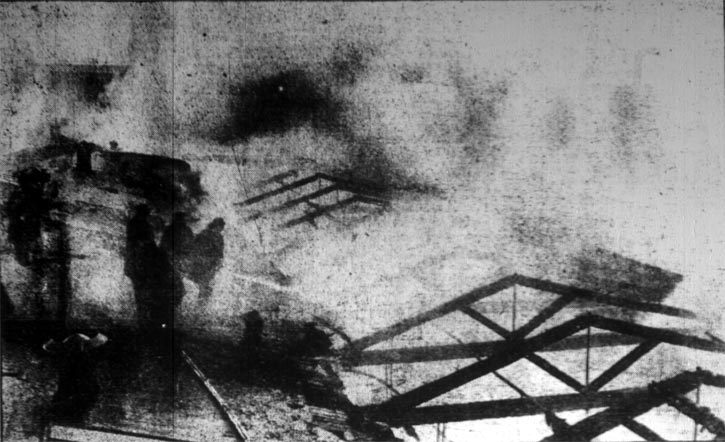

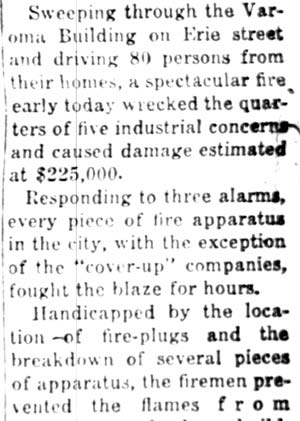
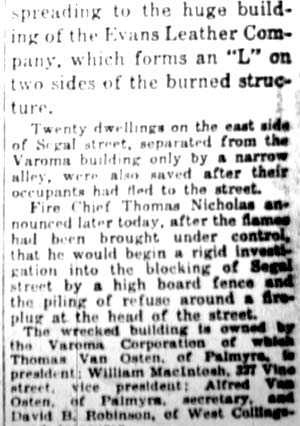
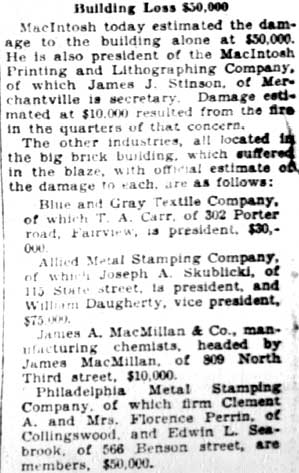
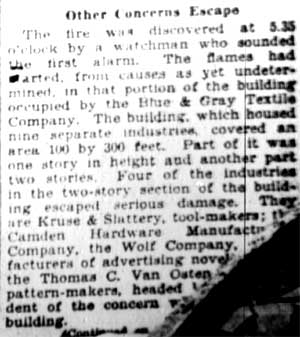
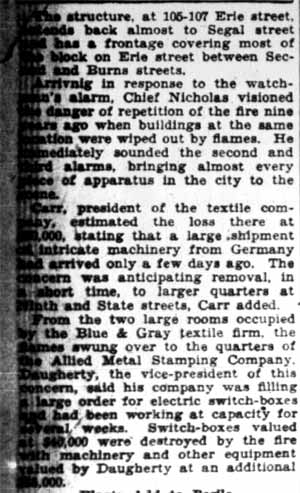
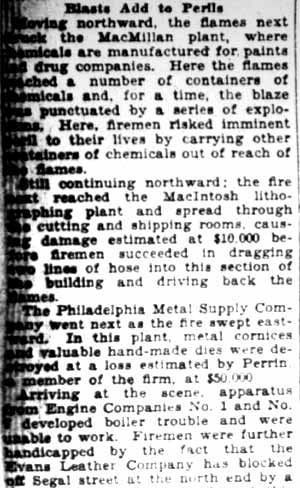
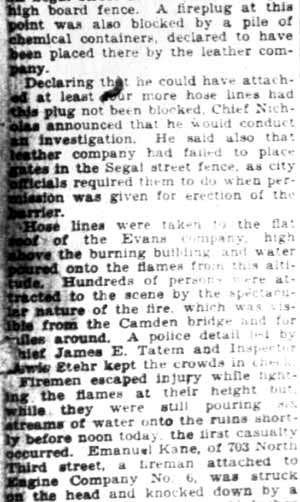
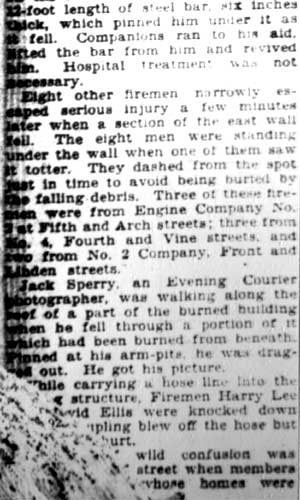
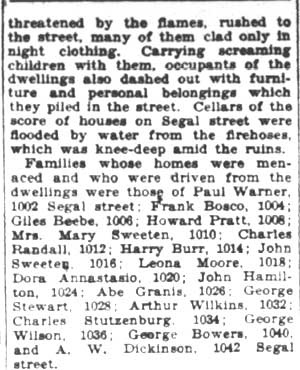
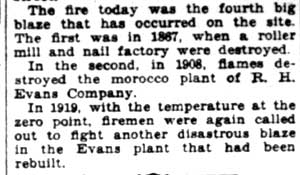
Thomas Nicholas — James Tatem — Manuel Kane — Harry M. Leigh — David Ellis — Engine Company 2 — Engine Company 4 — Engine Company 5 — Engine Company 6 — Segal Street
Promoted Firemen Take Posts Today
Camden Courier-Post —
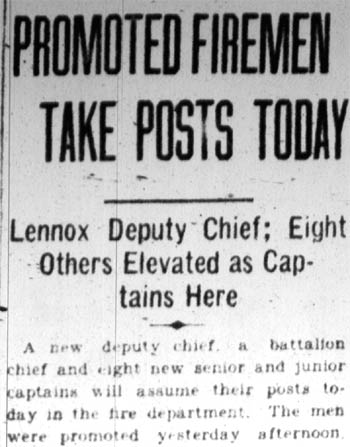
Thomas Nicholas — John H. Lennox — Rollo Jones — William Harring — Clarence Madden — George B. Wade — William W. Patterson — George Hunt — David Ellis — George Saunders — Eli Hunt — William Van Pfefferle — William H. Toy — Leo Tomkins — Horace T. Molan — Laurence Boulton — George W. Garner — Felix E. Bendzyn — Harry H. Hess — Charles Jones — Thomas F. Gibbons — Byron Davis — John S. Anderson — Ladder Company 1 — Engine Company 3 — Engine Company 6 — Engine Company 7 — Engine Company 9 — 27th Street — Arch Street — Broadway — Clinton Street — Federal Street — Ferry Avenue — York Street
Camden Courier-Post — April 17, 1928
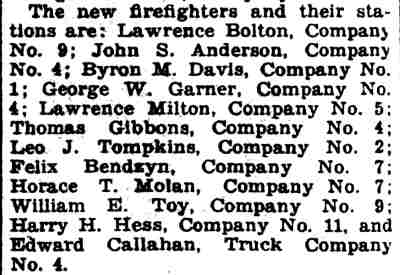
12 Rookies and 10 Promoted Men Go to Posts
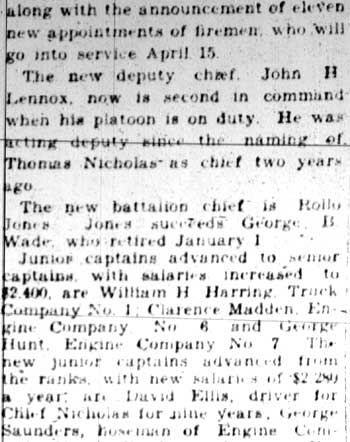
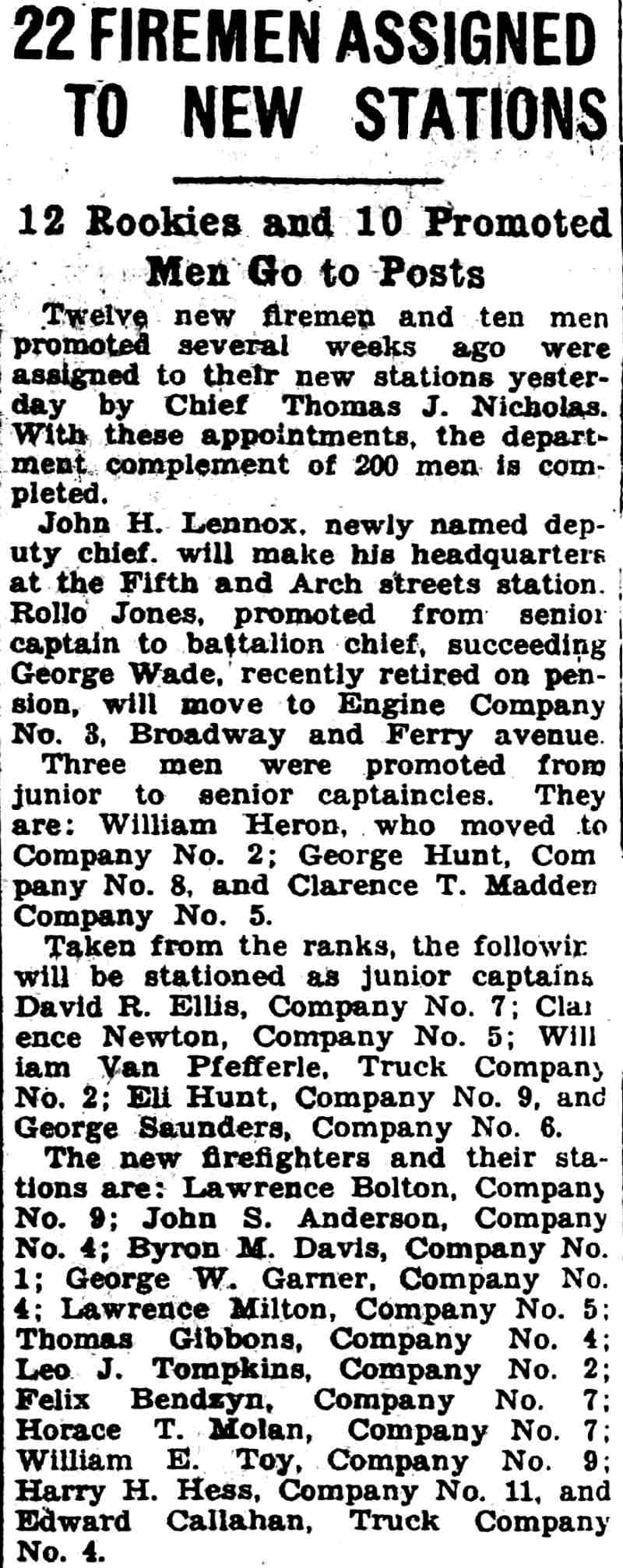
Twelve new firemen and ten men promoted several weeks ago were assigned to their new stations yesterday by Chief Thomas J. Nicholas. With these appointments, the department complement of 200 men is completed.
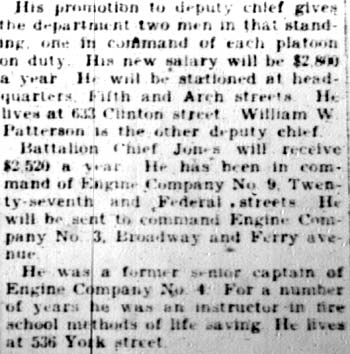
John H. Lennox, newly named deputy chief, will make his headquarters at the Fifth and Arch streets station. Rollo Jones, promoted from senior captain to battalion chief, succeeding George Wade, recently retired on pension, will move to Engine Company No. 3, Broadway and Ferry avenue.
Three men were promoted from junior to senior captaincies. They are: William Heron, who moved to Company No. 2; George Hunt, Company No. 8, and Clarence T. Madden [sic] Company No. 5.
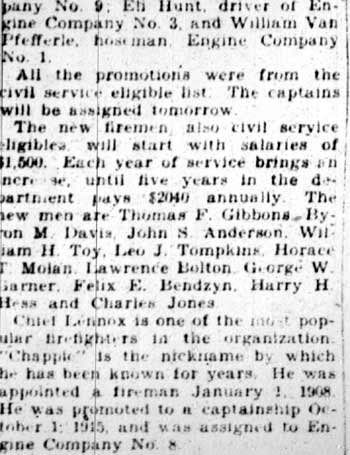
Taken from the ranks, the following will be stationed as junior captains: David R. Ellis, Company No. 7; Clarence Newton, Company No. 5; William Van Pfefferle, Truck Company No. 2; Eli Hunt, Company No. 9, and George Saunders, Company No. 6.
The new firefighters and their stations are: Lawrence Bolton, Company No. 9; John S. Anderson, Company No. 4; Byron M. Davis, Company No. 1; George W. Garner, Company No. 4; Lawrence Milton, Company No. 5; Thomas Gibbons, Company No. 4; Leo J. Tompkins, Company No. 2; Felix Bendzyn, Company No. 7; Horace T. Molan, Company No. 7; William E. Toy, Company No. 9; Harry H. Hess, Company No. 11, and Edward Callahan, Truck Company No. 4.
3 Youths Held as Blaze Razes Grain Plant of Sitley and Son
Camden Courier-Post —
Damage in Fire at Sixth and Bulson Streets Estimated at $45,000
Four Men Risk Lives to Save Two Horses
Boys Believed by Police Probers to Have Been Smoking, in Building
Three boys are being held and two others are sought in the investigation of the $45,000 fire which today destroyed the warehouse of Sitley & Son, wholesale hardware, roofing material and grain dealers at Sixth and Bulson Streets.
The three boys were ordered held by Police Judge Pancoast after authorities expressed belief that the three alarm fire was caused either by thieves or boys smoking cigarettes on the premises.
Two of the youths admitted they stole coal from the plant’s siding last night, while the third confessed that he, and two other boys were in the plant last evening. He said his two companions, who are expected to be arrested this afternoon, were smoking.
One fireman was slightly hurt when he ran a nail into his foot, while other firefighters narrowly escaped injury when the roof of the blazing building collapsed.
A dense fog, rain, great clouds of thick smoke and intense heat all hampered the firemen, and rendered them practically helpless for more than three hours. When the blaze was finally under control at 8:00 a.m., only the blackened and buckled walls remained standing.
Practically the entire stock was lost, but through the courage of four men including two policemen, a team of terrified horses and three trucks were saved from the blazing stable.
Twenty employees were temporarily deprived of work.
Discovery of three rolls of wire fencing on nearby railroad tracks and the presence of two men near the premises when the blaze was discovered led Fire Chief Thomas Nicholas to believe thieves had thrown a cigarette near some flammable material.
The arrested boy is John Brodzik, 1927 Fillmore Street.
Two other youths, John Hadyniak, 16, of 685 Ferry Avenue, and Anthony Parraine [Piraino], 11, of 2026 South Seventh Street, arrested on a charge of stealing coal from the Sitley siding last night are also being held. They declare they were not in the plant.
In addition to the smoke and heat firemen were further hampered by the fact that two railroads pass the building. Many of the hose lines had to be stretched over the tracks, so that in order to prevent passing trains, from which thousands of commuters saw the fire, from cutting the lines, holes were dug under the tracks and the lines run through the excavations.
Captain David Ellis, of No. 7 fire company at Mt. Ephraim and Kaighn Avenues, ran a nail in his foot, and after being given first aid treatment at the scene was taken to the West Jersey Homeopathic Hospital.
The first alarm was sounded at 4:18 a.m. from a box at Fillmore Street and Chelton Avenue. The fire was discovered by Paul N. Naurath, 1727 Master Street, an engineer at the Camden brewery, which is in the immediate vicinity of the Sitley plant.
Naurath ran to a gasoline filling station at Broadway and Chelton Street from where he telephoned to fire headquarters. He later told Police Lieutenant George Frost that when he noticed the smoke and flames he saw two men running around the Sitley stable, which is attached to the main plant. However, he paid no attention to them, being intent upon turning in an alarm.
While fire apparatus sped to the scene, Naurath, Frederick Baum, 431 Winslow Street; Patrolman Frank Del Rossi and Police Sergeant Edward Carroll heard the shrill screams of horses in the stable, which had quickly become an inferno.
Horses Rescued
The four rushed into the stable, broke down the door, and led out the two horses, which several times attempted to run back into the flames. The men also drove three trucks out of the place before they were driven away by the dense smoke.
The building occupies a plot about 300 feet square and comprises several one and two-story sections. There was formerly a grain elevator on the site belonging to the Sitleys, but it was destroyed by fire more than a decade ago and never rebuilt. On the south side of the plant are the Atlantic City Railroad tracks, and on the east side the West Jersey and Seashore Railroad lines.
Flames Spread Rapidly
Believed to have started either in the stable or at the extreme northern end of the plant, the fire quickly swept through the entire building. Rolls of tarred paper and bins of grain were quickly consumed, throwing out huge clouds of smoke.
Two more alarms were sounded for additional apparatus, but it was not until 7:30 a.m. that firemen could enter the building. Meanwhile, about 50 hose lines were stretched to the building and water continually played on the fire. Commissioner Frank B. Hanna arrived and increased the water pressure five points at the pumping stations to keep a water supply to feed the hose lines. Chief of Police Lewis H. Stehr also sped to the fire.
A touch of tragedy was added when Thomas Mills, 70, of 431 Viola Street, employed by the Sitleys for 40 years as a packer, arrived. The elderly workman burst into tears when he saw the flames, and sobbed that he was now out of work and had a family to support.
Finally, about 8 a.m., firemen had the blaze under control, after the roof had caved in. Only the walls stood, but several times they threatened to collapse.
The owners, Frank B. Sitley, Sr., of Woodbury, and his son, Frank B. Sitley, Jr., arrived, but declined to estimate their loss. However, police and firemen fixed an approximate damage of $25,000 to the building and $20,000 to the stock.
Lieutenant Frost found three rolls of wire fencing which had been taken from the building. They were lying on the Reading Railroad tracks, apparently dropped by thieves when police arrived.
Young Brodzik was arrested at 8:00 p.m. yesterday by Special Officer John Stevenson, who turned him over to Patrolmen Smith and Rieh. The youth was charged with suspicion of having broken into the place, and is alleged to have first denied being in the building, but later admitted that he and two other boys crawled through a basement window.
The boy declared that he neither smoked nor stole anything, but said that other boys had smoked. He refused to divulge their names.
Hadyniak and Perraine were arrested last night and charged with theft of coal from the siding. Brodzik declared those two were not the boys who were with him last night.
All three were arraigned before Judge Pancoast in police court this morning and held without bail pending investigation.
Camden Courier-Post — December 3, 1930
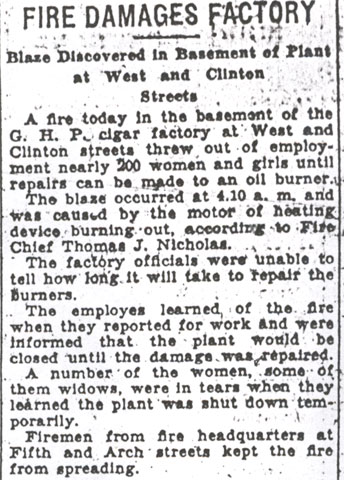
G.H.P. Cigar Company — West Street — Clinton Street — 5th Street — Arch Street
Thomas Nicholas — John H. Lennox — Rollo Jones — William Harring — Clarence Madden — George B. Wade — William W. Patterson — George Hunt — David Ellis — Eli Hunt — William Van Pfefferle — William H. Toy — Leo J. Tomkins — Horace T. Molan — Laurence Boulton — George W. Garner — Felix E. Bendzyn — Harry H. Hess — Charles Jones — Ladder Company 1 — Engine Company 3 — Engine Company 6 — Engine Company 7 — Engine Company 9
P.S. Purifier Detonates in South Camden
Camden Courier-Post —
Explosion at Locust and Cherry Traps Workers in Structure; Victims Mostly Temporary Employees Cleaning Metal Tank
Four Others Injured, One May Die; Poisonous Fumes Hamper Rescue
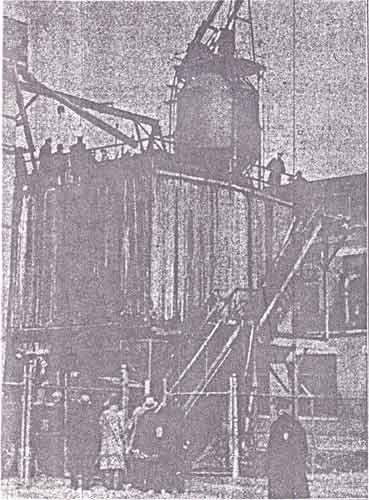
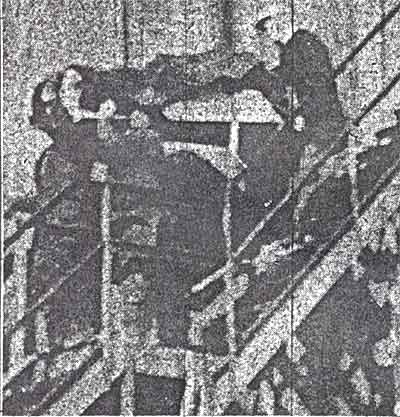
A terrific explosion in the purifying plant of the Public Service Gas and Electric Company at the Southeast corner of Locust and Cherry Streets killed 14 men today and injured four others, one of whom may die.
All the dead were trapped in a huge box-like tank about 25 feet square. Most of them were neighborhood unemployed who had been given a day’s work scraping off a caked substance which forms during the process of purifying illuminating gas.
Poisonous sulfur fumes hampered firemen in the effort to extinguish a blaze which followed the explosion. Two hours were required before the first body could be removed.
The explosion occurred at 7:15 AM. By 11:00 AM two charred and horribly mangled bodies had been taken out by use of a block and tackle. Firemen were digging out the third body buried under smoldering debris.
Six of the known dead were regularly employed by Public Service. They were: John Albert, of 275 Walnut Street; Domonick Piggutiello, of 1005 South 4th Street; Pasquale Curiale, of 338 Walnut Street; Frank Deluggi, of 324 South 5th Street; Nicholas Tulini, of 208 Benson Street; Nunzio Farrao, of 1131 South 4th Street.
The other known dead, who were employed only temporarily were: E. Anderson, colored; George Williams, colored; Tony Bilank; F. Kralich; T. Watson, colored; J. Pollard, colored; T. Coleman, colored; and L. Carcione.
The police and officials of the company were unable to determine the cause of the tragedy but one of the workmen who escaped said that he saw a “little fire” burning in one corner of the tank minutes before the explosion.
The injured, all of whom were taken to Cooper Hospital were: Spiro Cecich, 37, of 1815 Salem Street, burned over his entire body, condition so critical he may die; Hillman Bryant, 29, colored, of 109 Chestnut Street, burned over face, head, eyes; Harry Read, 27, of 111 Chestnut Street, burned on head and face; Harry Hall, 37, colored, of 718 South 2nd Street, burned on head and face. Read and Hall were permitted to return to their homes after being treated.
While racing to the hospital with the injured, the patrol car of the Second District collided with a truck at Broadway and Pine and was delayed several minutes.
Rudolph Walker, 40, colored, of 1060 South Front Street, was the only worker to escape unhurt. “We went in the tank about 7:00 o’clock,” he said. “About 15 minutes later I noticed a little fire burning in one corner. I said ‘Come on fellows, let’s get out of here.’ I climbed out and just as I reached the ground I heard an awful explosion.”
Workmen who described the purifying box said that a substance consisting of sawdust, sulfur, and noxious chemicals was used to clean gas which was pumped into the tank from storage tanks across the street. This substance caked upon the sides and girders about halfway down the box, they said, and had to be scraped off with pitchforks about every three or four weeks. There are, they declared, two tanks in the box, each about 15 feet wide and 20 feet deep. The blast was in the west tank. According to officials, the tanks are used in a process that has been in operation for only two years. Access is gained through removal of a large hatch-like lid at top of the box. There is no other entrance or exit.
Walker and the four injured were working on top of the girders. The others were trapped at the bottom without a chance to escape. They probably died instantly.
The entire neighborhood was aroused and more than 1,000 persons gathered around the plant. The police roped off Locust Street between Cherry and Walnut. No windows were broken or other damage caused to private property in the vicinity.
Benjamin Plevinsky, a grocer at Locust and Spruce Street, said that he was opening his store when he heard the detonation. “I looked up and saw a man running down a stairway leading to the top of the tank,” he said. “He was on fire from his feet to his head and looked like a human torch.”
Coroner Benjamin Denny, Prosecutor Clifford A. Baldwin, Director of Public Safety Charles V. Dickinson and Fire Chief Thomas Nicholas arrived at the scene before the bodies were taken out. They described the sight as “ghastly.”
Coroner Denny announced that he will open an investigation after today in which he will summon officials of the Public Service Company, firemen, workers, and other witnesses. County Prosecutor Edward B. Rodgers also will attend he said.
Camden Courier-Post — October 8, 1932
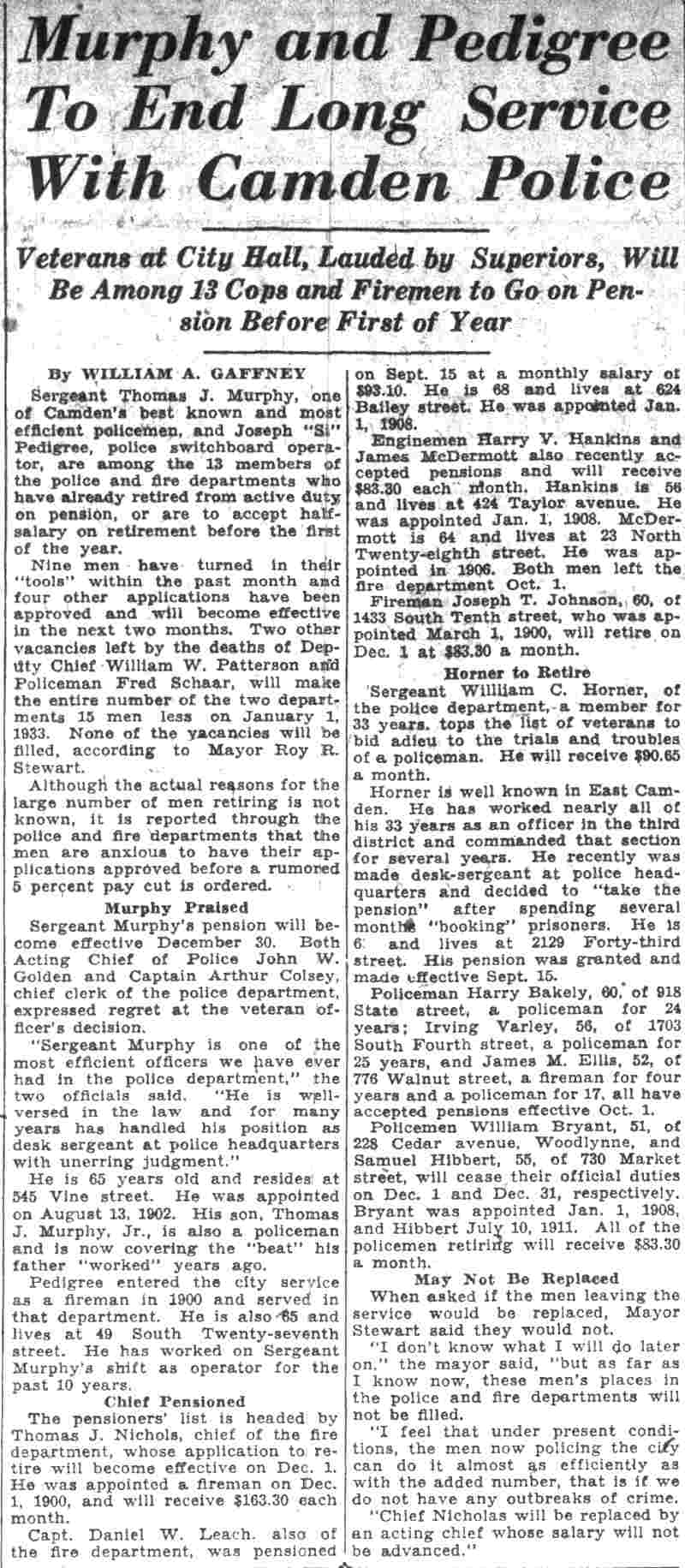
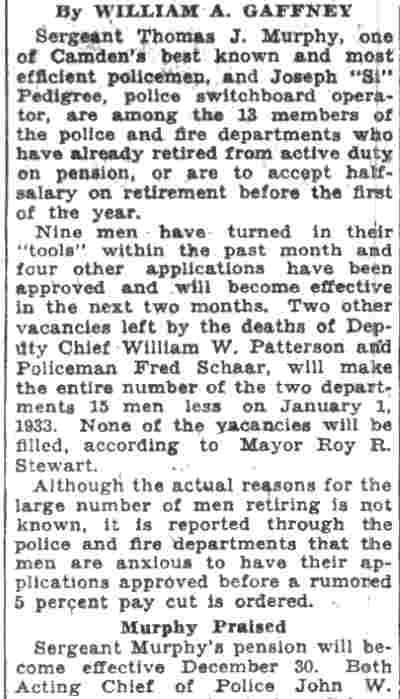
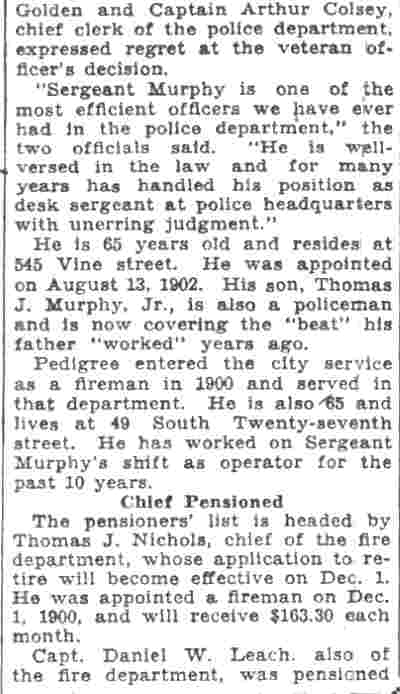
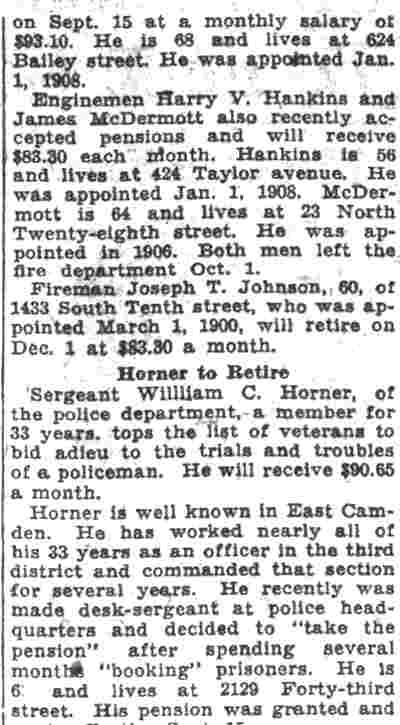
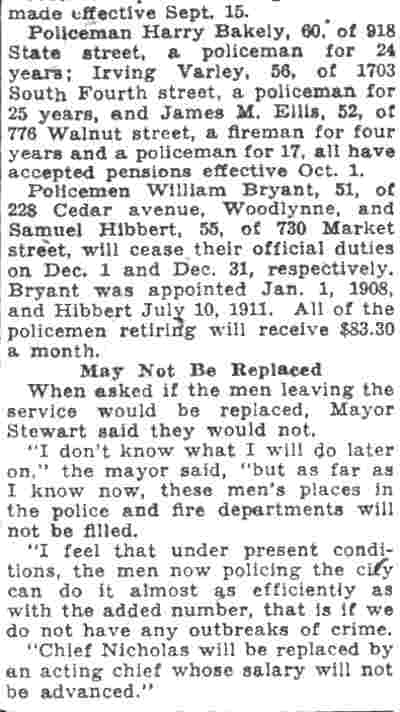
Thomas J. Murphy — Josiah Pedigree — William W. Patterson — Fred Schaar — Roy R. Stewart — David S. Rhone — John W. Golden — Arthur Colsey — Thomas P. Murphy — Thomas J. Nicholas — Daniel W. Leach — Harry Hankins — James McDermott — Joseph T. Johnson — Harry Bakley — Irving Varley — James M. Ellis — William Bryant — Samuel Hibbert — William C. Horner
Philadelphia Public Ledger — February 12, 1920
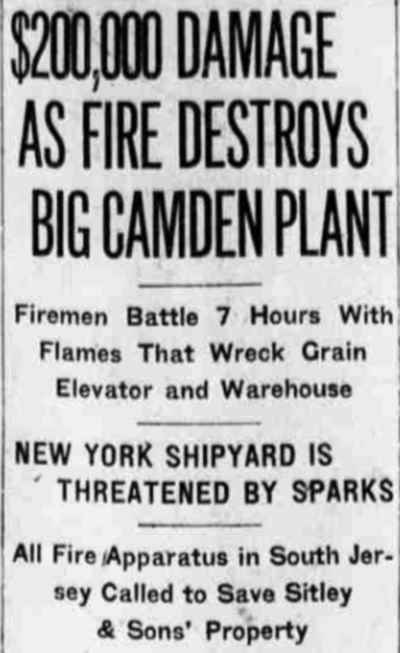
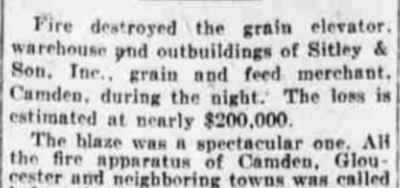
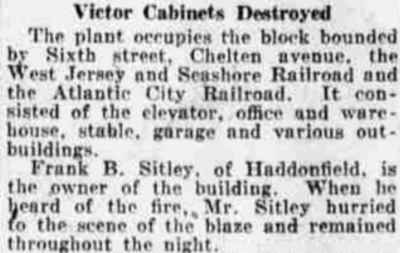
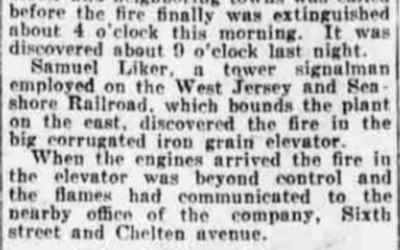
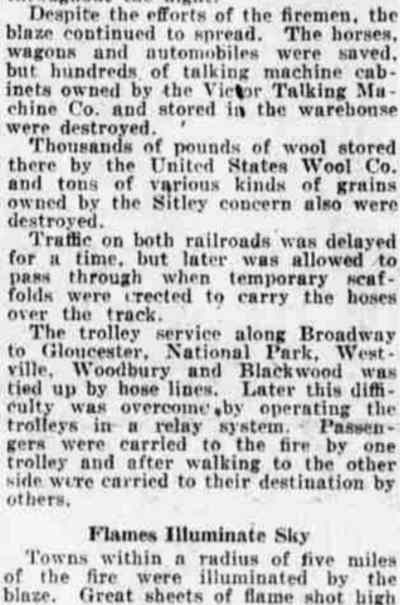
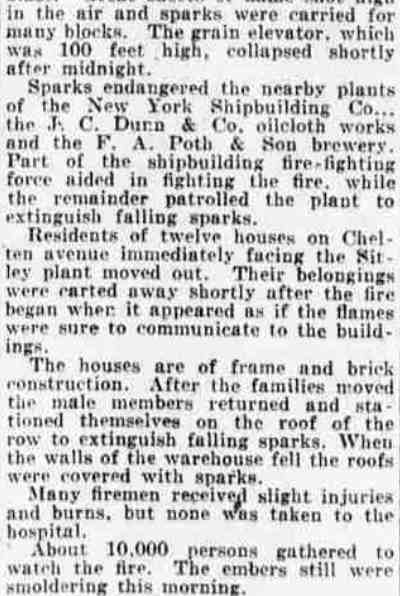
Samuel Liker — J.C. Dunn & Co. oilcloth works — F.A. Poth & Sons Brewery
Philadelphia Inquirer — February 12, 1920
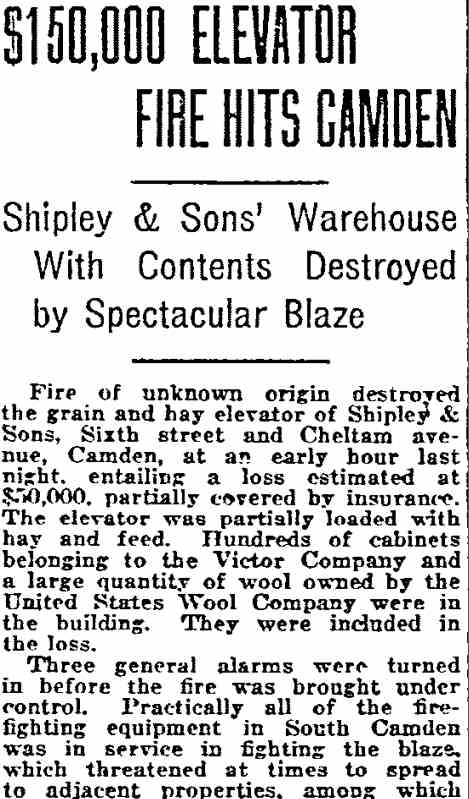
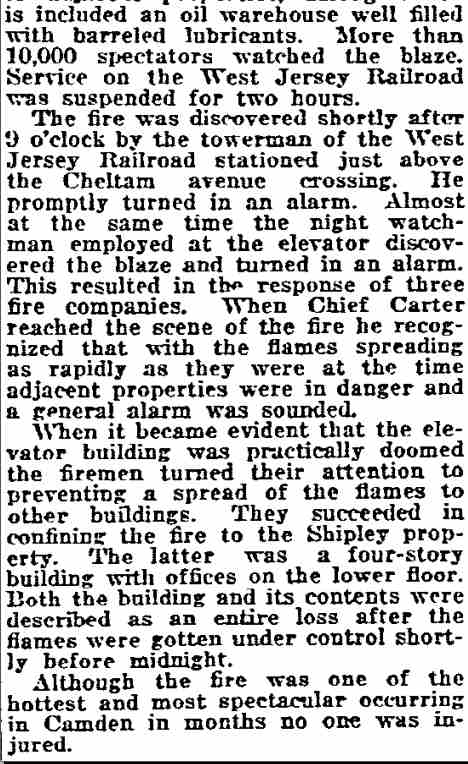
Peter B. Carter — Sitley & Son — I. Asbell — Chelton Avenue — South 6th Street — United States Wool Company
Philadelphia Inquirer — February 13, 1920
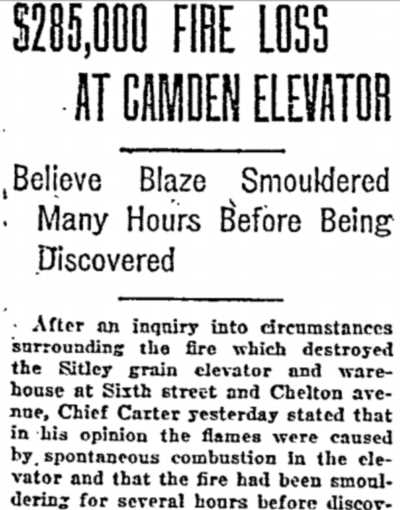
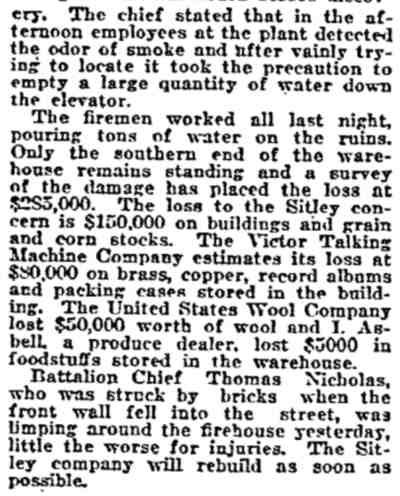
Peter B. Carter — Thomas J. Nicholas — Sitley & Son — I. Asbell — Chelton Avenue — South 6th Street — United States Wool Company