Dr. A. Haines Lippincott
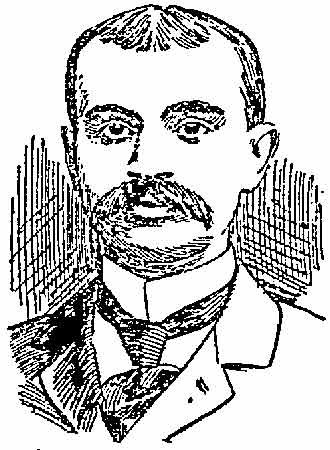
Dr. A. Haines Lippincott
DR. AHAB HAINES LIPPINCOTT JR. was born in Evesham Township NJ on July 12, 1867 to A. Haines Lippincott and his wife, the former Maria Louisa Jones.
A. Haines Lippincott Jr. graduated from the Philadelphia College of Pharmacy and Science and in 1892 received his M.D. from Jefferson Medical College. Dr. Lippincott interned at Jefferson Hospital, and did post-graduate work in Urology in New York.
In 1903 Dr. Lippincott married Ellen Alberta Langendorf on June 23, 1903. He made his home and office at 21 Broadway. Sadly, Ellen Lippincott passed away prior to April of 1910. He married Miriam Lee Early sometime after the 1910 Census. Mrs. Lippincott was became deeply involved with many civic activities once coming to Camden.
After establishing himself in Camden, Dr. Lippincott was appointed Chief urologist at Cooper Hospital. He was a consulting urologist at Jeannes Memorial Hospital, Newcomb Memorial Hospital and the Camden County General Hospital, and retained an affiliation with Jefferson Hospital.
Dr. Lippincott was elected president of the Camden County Medical society in 1911 and the New Jersey Medical Society in 1932. He served one-year terms for both organizations. He also was a president of the Camden City Medical Society, and served as Camden County Coroner.
Dr. Lippincott was also a charter member of the Camden Lodge 293 of the Elks. Other members included Frank A. Ward, Charles L. Bowman, Dr. J. F. Leavitt, Fred W. George, T. L. Bear, William M. Fithian, Everett Ackley, Fithian S. Simmons, Philip Wilson, Paul E. Quinn, John N. Kadel, William G. Maguire, Frank B. Sweeten and Maurice Hertz. He was also friendly with Charles S. Boyer, who was quite instrumental in the founding and success of the Camden County Historical Society.
By 1914 Dr. and Mrs. Miriam Lippincott had moved to 406 Cooper Street. Dr. Lippincott passed away in 1937.
Mrs. Lippincott continued to live at the Cooper Street address as late as 1947. She was a member of Centenary-Tabernacle Methodist Episcopal Church, at 5th and Cooper Streets.
Camden's Conventions
Philadelphia Inquirer —
Republicans Nominate Candidates for Three Offices.
The Republicans of Camden county yesterday launched their ticket in the field for the coming election. The nominations were as follows: County Clerk, Robert L. Barber; Register of Deeds, Jacob Sickler; Coroner, Dr. A. H. Lippincott. All the candidates were chosen unanimously.
The County Clerk's convention was held at the City Hall. William D. Brown was elected permanent chairman and William B. Doyle secretary. Robert L. Barber was nominated for a second term by acclamation, as there was no opposition.
The Register of Deeds' convention was held in the town hall at Merchantville. Edward Delacroix was elected permanent chairman and William A. Husted secretary. There was but one name presented and Jacob Sickler received a renomination by acclamation.
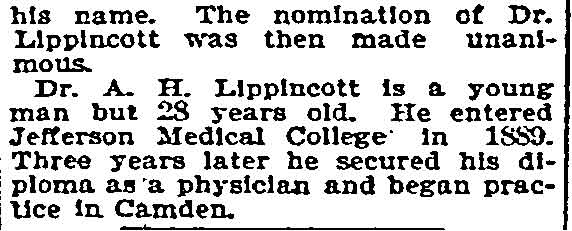
At the Coroner's convention, which was held at the Court House, Lawyer Charles Ira Wooster wanted the delegates to nominate a candidate for County Judge, but the chairman promptly sat down on any such movement in view of the decision of the Supreme Court knocking out the elective judiciary act. James McCormick was made permanent chairman of the convention and James Haney secretary. The names of Dr. A. H. Lippincott, Dr. William B. Christine and Charles N. Robinson, colored, were presented for the nomination for Coroner. Dr. Lippincott received 56 votes and Robinson got the balance, 13 votes. Before the result could be announced a letter was presented from Robinson withdrawing his name. The nomination of Dr. Lippincott was then made unanimous.
Dr. A. H. Lippincott is a young man but 28 years old. He entered Jefferson Medical College in 1889. Three years later he secured his diploma as a physician and began practice in Camden.
Camden Primaries
Philadelphia Inquirer —
Republicans Elect Delegates to the State Convention.
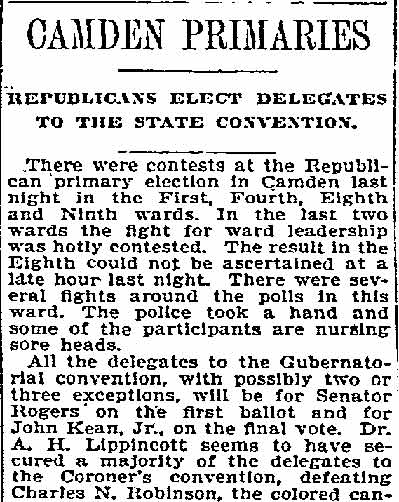
There were contests at the Republican primary election in Camden last night in the First, Fourth, Eighth and Ninth wards. In the last two wards the fight for ward leadership was hotly contested. The result in the Eighth could not be ascertained at a late hour last night. There were several fights around the polls in this ward. The police took a hand and some of the participants are nursing sore heads.
All the delegates to the Gubernatorial convention, with possibly two or three exceptions, will be for Senator Rogers on the first ballot and for John Kean, Jr., on the final vote. Dr. A. H. Lippincott seems to have secured a majority of the delegates to the Coroner’s convention, defeating Charles N. Robinson, the colored candidate.
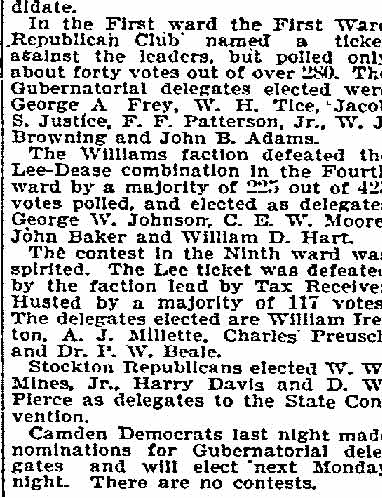
In the First ward the First Ward Republican Club named a ticket against the leaders, but polled only about forty votes out of over 280. The Gubernatorial delegates elected were George A Frey, W. H. Tice, Jacob S. Justice, F. F. Patterson, Jr., W. J. Browning and John B. Adams.
The Williams faction defeated the Lee-Dease combination in the Fourth ward by a majority of 225 out of 425 votes polled, and elected as delegates George W. Johnson, C. E. W. Moore, John Baker and William D. Hart.
The contest in the Ninth ward was spirited. The Lee ticket was defeated by the faction lead [sic] by Tax Receiver Husted by a majority of 117 votes. The delegates elected are William Ireton, A. J. Millette, Charles Preusch and Dr. P. W. Beale.
Stockton Republicans elected W. W. Mines, Jr., Harry Davis and D. W. Pierce as delegates to the State Convention.
Camden Democrats last night made nominations for Gubernatorial delegates and will elect next Monday night. There are no contests.
Dr. A. H. Lippincott Sworn In as Coroner
Philadelphia Inquirer —

Dr. A. B. Lippincott was sworn in as Coroner on Thursday.
Shot Her Husband.
Camden Post —
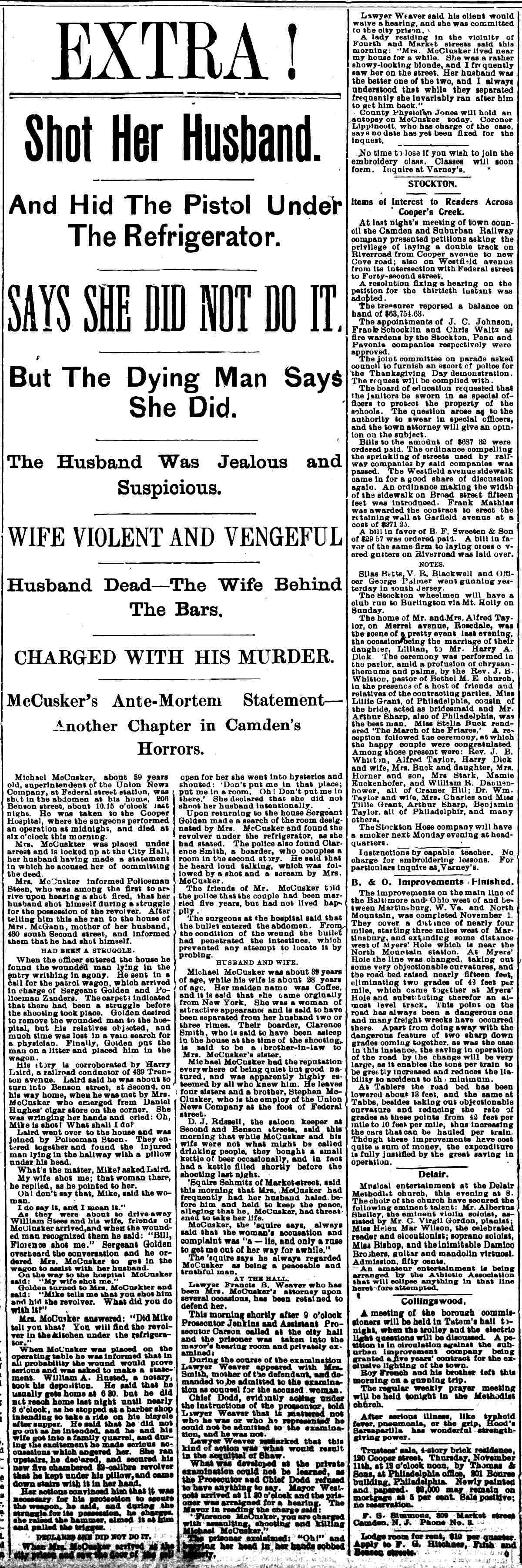
EXTRA!
And Hid The Pistol Under The Refrigerator.
SAYS SHE DID NOT DO IT.
But The Dying Man Says She Did.
The Husband Was Jealous and Suspicious.
WIFE VIOLENT AND VENGEFUL
Husband Dead—The Wife Behind The Bars.
CHARGED WITH HIS MURDER.
McCusker’s Ante-Mortem Statement—Another Chapter in Camden’s Horrors.
Michael McCusker, about 3[?] years old, superintendent of the Union News Company, at Federal street station, was shot in the abdomen at his home, 206 Benson street, about 10.15 o’clock last night. He was taken to the Cooper Hospital, where the surgeons performed an operation at midnight, and died at six o’clock this morning.
Mrs. McCuskter [sic] was placed under arrest and is locked up at the City Hall, her husband having made a statement in which he accused her of committing the deed.
Mrs. McCusker informed Policeman Steen, who was among the first to arrive upon hearing a shot fired, that her husband shot himself during a struggle for the possession of the revolver. After telling him this she ran to the house of Mrs. McGann, mother of her husband, 430 south Second street, and informed them that he had shot himself.
HAD BEEN A STRUGGLE.
When the officer entered the house he found the wounded man lying in the entry writhing in agony. He sent in a call for the patrol wagon, which arrived in charge of Sergeant Golden and Policeman Zanders. The carpets indicated that there had been a struggle before the shooting took place. Golden desired to remove the wounded man to the hospital, but his relatives objected, and much time was lost in a vain search for a physician. Finally, Golden put the man on a litter and placed him in the wagon.
His story is corroborated by Harry Laird, a railroad conductor of 439 Trenton avenue. Laird said he was about to turn into Benson street, at Second, on his way home, when he was met by Mrs. McCusker who emerged from Daniel Hughes’ cigar store on the corner. She was wringing her hands and cried: Oh, Mike is shot! What shall I do?
Laird went over to the house and was joined by Policeman Steen. They entered together and found the injured man lying in the hallway with a pillow under his head.
What’s the matter, Mike? asked Laird.
My wife shot me; that woman there, he replied, as he pointed to her.
Oh! don’t say that, Mike, said the woman.
I do say it, and I mean it.”
As they were about to drive away William Stees and his wife, friends of McCusker arrived, and when the wounded man recognized them he said: “Bill, Florence shot me.” Sergeant Golden overheard the conversation and he ordered Mrs. McCusker to get in the wagon to assist with her husband.
On the way to the hospital McCusker said: “My wife shot me.”
Golden turned to Mrs. McCuskter [sic] and said: “Mike tells me that you shot him and hid the revolver. What did you do with it?”
Mrs. McCusker answered: “Did Mike tell you that? You will find the revolver in the kitchen under the refrigerator.”
When McCusker was placed on the operating table he was informed that in all probability the wound would prove serious and was asked to make a statement. William A. Husted, a notary, took his deposition. He said that he usually gets home at 6.30 but he did not reach home last night until nearly 8 o’clock, as he stopped at a barber shop intending to take a ride on his bicycle after supper. He said that he did not go out as he intended, and he and his wife got into a family quarrel, and during the excitement he made serious accusations which angered her. She ran upstairs, he declared, and secured his new five chambered [?]2-calibre revolver that he kept under his pillow, and came down stairs with it in her hand.
Her actions convinced him that it was necessary for his protection to secure the weapon, he said, and during the struggle for its possession, he charges, she raised the hammer, aimed it at him and pulled the trigger.
DECLARES SHE DID NOT DO IT.
When Mrs. McCusker arrived at the city prison and saw the door of the cell open for her she went into hysterics and shouted: ‘Don’t put me in that place; put me in a room. Oh! Don’t put me in there.’ She declared that she did not shoot her husband intentionally.
Upon returning to the house Sergeant Golden made a search of the room designated by Mrs. McCusker and found the revolver under the refrigerator, as she had stated. The police also found Clarence Smith, a boarder, who occupies a room in the second story. He said that he heard loud talking, which was followed by a shot and a scream by Mrs. McCusker.
The friends of Mr. McCusker told the police that the couple had been married five years, but had not lived happily.
The surgeons at the hospital said that the bullet entered the abdomen. From the condition of the wound the bullet had penetrated the intestines, which prevented any attempt to locate it by probing.
HUSBAND AND WIFE.
Michael McCusker was about 3[?] years of age, while his wife is about 28 years of age. Her maiden name was Coffee, and it is said that she came orginally [sic] from New York. She was a woman of attractive appearance and is said to have been separated from her husband two or three times. Their boarder, Clarence Smith, who is said to have been asleep in the house at the time of the shooting, is said to be a brother-in-law to Mrs. McCusker’s sister.
Michael McCusker had the reputation everywhere of being quiet but good natured, and was apparently highly esteemed by all who knew him. He leaves four sisters and a brother, Stephen McCusker, who is the employ of the Union News Company at the foot of Federal street.
D. J. Russell, the saloon keeper at Second and Benson streets, said this morning that while McCusker and his wife were not what might be called drinking people, they bought a small kettle of beer occasionally, and in fact had a kettle filled shortly before the shooting last night.
‘Squire Schmitz of Market-street, said this morning that Mrs. McCusker had frequently had her husband haled before him and held to keep the peace, alleging that he, McCusker, had threatened to take her life.
McCusker, the ‘squire says, always said that the woman’s accusation and complaint was “a — lie, and only a ruse to get me out of her way for awhile.”
The ‘squire says he always regarded McCusker as being a peaceable and truthful man.
AT THE HALL.
Lawyer Francis B. Weaver who has been Mrs. McCusker’s attorney upon several occasions, has been retained to defend her.
This morning shortly after 9 o’clock Prosecutor Jenkins and Assistant Prosecutor Carson called at the city hall and the prisoner was taken into the mayor’s hearing room and privately examined.
During the course of the examination Lawyer Weaver appeared with Mrs. Smith, mother of the defendant, and demanded to be admitted to the examination as counsel for the accused woman.
Chief Dodd, evidently acting under the instructions of the prosecutor, told Lawyer Weaver that it mattered not who he was or who he represented he could not be admitted to the examination, and he was not.
Lawyer Weaver remarked that this kind of action was what would result in the acquittal of Shaw.
What was developed at the private examination could not be learned, as the Prosecutor and Chief Dodd refused to have anything to say. Mayor Westcott arrived at 11.30 o’clock and the prisoner was arraigned for a hearing. The Mayor in reading the charge said:
‘Florence McCusker, you are charged with assaulting, shooting and killing Michael McCusker.’
The prisoner exclaimed: “Oh!” and burying her head in her hands sobbed bitterly.
Lawyer Weaver said his client would waive a hearing, and she was committed to the city prison.
A lady residing in the vicinity of Fourth and Market streets said this morning: “Mrs. McClusker lived near my house for a while. She was a rather showy-looking blonde, and I frequently saw her on the street. Her husband was the better one of the two, and I always understood that while they separated frequently she invariably ran after him to get him back.”
County Physician Jones will hold an autopsy on McCusker today. Coroner Lippincott, who has charge of the case, says no date has yet been fixed for the inquest.
No time to lose if you wish to join the embroidery class. Classes will soon form. Inquire at Varney’s.
STOCKTON.
Items of Interest to Readers Across Cooper’s Creek.
At last night’s meeting of town council the Camden and Suburban Railway company presented petitions asking the privilege of laying a double track on Riverroad from Cooper avenue to new Cove road; also on Westfield avenue from its intersection with Federal street to Forty-second street.
A resolution fixing a hearing on the petition for the thirtieth instant was adopted.
The treasurer reported a balance on hand of $63,754.63.
The appointments of J. C. Johnson, Frank Schocklin and Chris Waltz as fire wardens by the Stockton, Penn and Pavonia companies respectively were approved.
The joint committee on parade asked council to furnish an escort of police for the Thanksgiving Day demonstration. The request will be complied with.
The board of education requested that the janitors be sworn in as special officers to protect the property of the schools. The question arose as to the authority to swear in special officers, and the town attorney will give an opinion on the subject.
Bills to the amount of $687.32 were ordered paid. The ordinance compelling the sprinkling of streets used by railway companies by said companies was passed. The Westfield avenue sidewalk came in for a good share of discussion again. An ordinance making the width of the sidewalk on Broad street fifteen feet was introduced. Frank Mathias was awarded the contract to erect the retaining wall at Garfield avenue at a cost of $271.25.
A bill in favor of B. F. Sweeten & Son of $29.57 was ordered paid. A bill in favor of the same firm to laying cross covered gutters on Riverroad was laid over.
NOTES.
Silas Betts, V. R. Blackwell and Officer George Palmer went gunning yesterday in south Jersey.
The Stockton wheelmen will have a club run to Burlington via Mt. Holly on Sunday.
The home of Mr. and Mrs. Alfred Taylor, on Merrel avenue, Rosedale, was the scene of a pretty event last evening, the occasion being the marriage of their daughter, Lillian, to Mr. Harry A. Dick. The ceremony was performed in the parlor, amid a profusion of chrysanthemums and palms, by the Rev. J. B. Whitton, pastor of Bethel M. E church, in the presence of a host of friends and relatives of the contracting parties. Miss Lillie Grant, of Philadelphia, cousin of the bride, acted as bridesmaid and Mr. Arthur Sharp, also of Philadelphia, was the best man. Miss Stella Buck rendered ‘The March of the Friares,’ A reception followed the ceremony, at which the happy couple were congratulated Among those present were: Rev. J. B. Whitton, Alfred Taylor, Harry Dick and wife, Mrs. Buck and daughter, Mrs. Horner and son, Mrs Stark, Mamie Euckenhofer, and William R. Dauuenhower, all of Cramer Hill; Dr. Wm. Taylor and wife, Mrs. Charles and Miss Tillie Grant, Arthur Sharp, Benjamin Taylor. all of Philadelphir, and many others.
The Stockton Hose company will have a smoker next Monday evening at headquarters.
Instructions by capable teacher. No charge for embroidering lessons. For particulars inquire at Varney’s.
B. & O. Improvements Finished.
The improvements on the main line of the Baltimore and Ohio west of and between Martinsburg, W. Va. and North Mountain, was completed November 1. They cover a distance of nearly four miles, starting three miles west of Martinsburg, and extending some distance west of Myers’ Hole which is near the North Mountain station. At Myers’ Hole the line was changed, taking out some very objectionable curvatures, and the road bed raised nearly fifteen feet, eliminating two grades of 43 feet per mile, which came together at Myers’ Hole and substituting therefor an almost level track. This point on the road has always been a dangerous one and many freight wrecks have occurred there. Apart from doing away with the dangerous feature of two sharp down grades coming together, as was the case in this instance, the saving in operation of the road by the change will be very large, as it enables the tons per train to be greatly increased and reduces the liability to accident to the minimum.
At Tablers the road bed has been lowered about 13 feet, and the same at Tabbs, besides taking out objectionable curvature and reducing the rate of grades at these points from 42 feet per mile to 10 feet per mile, thus increasing the cars that can be hauled per train. Though these improvements have cost quite a sum of money, the expenditure is fully justified by the great saving in operation.
Delair.
Musical entertainment at the Delair Methodist church, this evening at 8. The choir of the church have secured the following eminent talent: Mr. Albertus Shelley, the eminent violin soloist, assisted by Mr. C. Virgil Gordon, pianist; Miss Helen Mar Wilson, the celebrated reader and elocutionist; soprano soloist, Miss Bishop, and the inimitable Damico Brothers, guitar and mandolin virtuosi. Admission, fifty cents.
An amateur entertainment is being arranged by the Athletic Association that will eclipse anything in that line heretofore attempted.
Collingswood.
A meeting of the borough commissioners will be held in Tatem’s hall tonight, when the trolley and the electric light questions will be discussed. A petition is in circulation against the suburban improvement company being granted a five years’ contract for the exclusive lighting of the town.
Roy French and his brother left this morning on a gunning trip.
The regular weekly prayer meeting will be held tonight in the Methodist church.
After serious illness, like typhoid fever, pneumonia, or the grip, Hood’s Sarsaparilla has wonderful strength-giving power.
Trustees’ sale, 4-story brick residence, 190 Cooper street, Thursday, November 11th, at 12 o’clock noon, by Thomas & Sons, at Philadelphia office, 201 Bourse building, Philadelphia. Newly painted and papered. $2,000 may remain on mortgage at 5 per cent. Sale positive; no reservation.
F. S. Simmons, 309 Market street Camden, N. J. Phone No. 9.
Lodge room for rent, $10 per quarter. Apply to F. G. Hitchner, Fifth and Benson streets.
Mrs. James Found Dead in Bed.
Camden Post —
Mrs. William James, mother of Fireman Albert James, of No. 3 Engine House, was found dead in bed this morning at her home on Ferry avenue near Fillmore street. Mrs. James was about as usual yesterday and seemed bright and cheerful. This morning she failed to come down stairs and upon going to her room her husband found her lying on the bed dead. Coroner Lippincott gave a certificate of death due to heart failure.
Camden’s Tragedy Still a Mystery
Philadelphia Inquirer —
Camden's Tragedy Still a Mystery
Two Men Arrested In Stockton, But They Easily Prove an Alibi.
POLICE ARE PUZZLED
Officials Believe the House Was Entered By a Burglar.
MRS. ZANE’S WILL FOUND
Her Son Questioned and the Police Start On a New Clue—Eli Shaw Reticent.
Camden's double murder mystery remains unsolved. The assassin who shot down Mrs. Emma Zane and her daughter, Mrs. Sarah M. Shaw, at their home, No. 242 Line street, just before dawn Tuesday morning, is still at large. There is apparently no clue to his identity. Two arrests were made by the Stockton police yesterday, but the suspects can account for their whereabouts on the morning of the murder, and they will probably be released to-day. The rewards for the apprehension of the murderer now amount to $1000.
Public interest in the terrible crime grew keener yesterday. All day long the street in front of the house on Line street from which two black streamers fluttered was blocked by curious throng. People gathered in groups on the streets throughout Camden and discussed the details of the mysterious murders. The air was filled with rumors of arrests and with theories of the wildest sort, but at nightfall when the police and the county officials compared notes they were forced to admit that no ray of light had penetrated the mystery.
Prosecutor Wilson H. Jenkins and the Camden police officials got together yesterday and practically agreed to push their investigation along the lines of a theory that the murder was committed by some one who entered the house for the purpose of robbery.
A MYSTERIOUS LETTER.
Later in the afternoon Chief Dodd received a mysterious letter from Philadelphia, and he immediately dispatched Lieutenant Foster and Detective Sergeant Sergeant Beard to Philadelphia to run out what appeared to be a new and important clue. The chief stated that he did not expect his two assistants to return until a late hour. He would not admit that suspicion had been directed to any one by the examination of Edward Zane, but it was learned from other sources that such was the case. Edward Zane, it is stated, was asked to account for his whereabouts on Monday night, and he did so, but the police officials decline to tell what he said.
Soon after the officials separated a telephone message was received from Stockton that two men were under arrest there on suspicion of being concerned in the murder. The suspects were “a tall man and a short man,” answering to the description of the mysterious couple who have been blamed with crimes in all parts of the country. The police jumped to the conclusion that these were the two suspicious looking characters that had been seen in the neighborhood of the Zane house a few minutes before the shooting.
The men under arrest gave the names of Harry O. Geesey, of 3032 Market street, and John J. Doonan, of 661 North Thirty-eighth street, Philadelphia. They had visited several saloons in Stockton during the morning and Geesey had handed a 32 calibre revolver to Proprietor Klecmann of the Stockton Park Hotel, with the remark:
“Take this revolver. I’ve got into trouble with it and don’t want it.”
The hotel proprietor notified Chief Johnson, who took the men into custody.
They said they are steam fitters employed at the Pennsylvania Railroad shops at Thirty-second and Market streets. They were paid on Monday and while carousing together they drifted over into Camden.
PROVED AN ALIBI.
They said they went to the West Jersey Hotel and registered about midnight Monday night and slept there until 6 o’clock Tuesday morning.
Donan admitted that he got the revolver from the house of a colored man named John Polk, who lives in East Camden.
Chief Johnson last night visited Polk’s residence and corroborated this statement. An Inquirer representative visited the West Jersey Hotel and found Geesey’s and Doonan’s names on the register. They occupied room No. 39 together and registered after midnight. The police officials said the men would be released this morning.
Young Eli Shaw, who is still staying at the home of his mother’s cousin, Foster S. Zane, at 321 Beckett street, made a brief visit to his home yesterday about 11 o’clock. It was his first appearance there since the morning of the tragedy. He did not enter the darkened front parlor, where the bodies of his murdered grandmother and mother lay, but passed on to the sitting room, where a group of mourning relatives and sympathetic neighbors were gathered.
Some one began to refer to the tragedy, and the young man, with a look of anguish on his pale face, raised his hands and cried:
“Oh, don’t speak of that; I can’t bear it; I’ve suffered so much already.”
YOUNG SHAW RETICENT.
After remaining in the house a few minutes young Shaw, in company with a friend, went to a Federal street tailor to be measured for a mourning suit. This gave the newspaper men their first opportunity to question him, but he had apparently been instructed not to talk about the murders. He said:
“I have made my statement to both lieutenants of police, and would prefer that you go to them for any information.”
“Has any evidence been found of anything having been stolen from the house?”
“I don’t know,” was his reply.
“Are any of the possessions of your grandmother missing?”
“I can’t tell. The police have been there and can tell you if anything was stolen.”
“You are the only person that knew what was in the house and could tell if anything is missing, are you not?”
“I have not been in the house since yesterday morning and cannot tell anything about it.”
“Is Charles Higgins, whose name has been connected with the case, a relative of yours or of the Zane family?”
“He is a distant relative of the family,” was Shaw’s non-committal reply.
“There are conflicting reports about two men having been seen in the house by you. Did you see any one when you came down stairs?”
“As I stated before, I have made a statement to the police lieutenants, and would prefer that you go to them for any information,” he replied and walked away.
AIDING THE POLICE.
The police have obtained some additional information in regard to two men who were seen in the neighborhood of the Zane house shortly before the murders were committed. Howard Ross, an engineer, living at Third and Pine, says he left his home Tuesday morning at a quarter past 4 o’clock. He had just reached Third street when two men came dashing almost into him. They had run diagonally across Pine street. He says one was rather tall, say five feet ten inches high, wore a derby hat and dark clothes. The other was shorter and stouter than the first described. When Ross reached Line street he heard some one calling murder, was unable to locate the cries and went on to his work.
O. B. Blizzard, of 249 Line street, adds to this that he saw the elder woman, Mrs. Zane, at 10 o’clock Monday morning, the day before the murder, talking to a tall man. They appeared to be quarreling. He thinks he could identify the man.
James C. Carey [sic], of 225 Pine street, while on his way home, about 1 o’clock Tuesday morning, saw two men as described above sitting on a doorstep at Liberty alley and Pine. They disappeared soon after he saw them.
REWARDS AMOUNT TO $1000.
The Camden County Board of Freeholders at its regular monthly meeting yesterday unanimously voted to offer a reward of $500 for information that would lead to the arrest and conviction of the murderer or murderers. This is in addition to the $500 reward offered by the city of Camden.
The rewards have started a number of amateur Sherlock Holmeses at work on the case. Among the professional sleuths seen in the neighborhood yesterday was Detective Garrison, “the Jersey Hawkshaw.”
Coroner Lippincott last evening empaneled the following jury: William A. Husted, foreman; Thomas Binker, M. J. O’Brien, William Anderson, Chas. Folwell and John Irwin. The jury will view the bodies at 10.30 o’clock this morning. The inquest will not be held before Monday or Tuesday of next week.
The funerals of the two murdered women will be held at 2 o’clock Saturday afternoon. They will be buried in the same plot in Harleigh Cemetery. The services will be conducted by Rev. John W. Marshall, pastor of the Broadway M. E. Church, and Rev. William A. Massey, pastor of the Wiley M. E. Church.
James Hough, who was arrested as a suspect by Policeman Myers on Tuesday afternoon, was released yesterday. There was no evidence to connect him with the crime.
“Persons Unknown” Held Responsible
Philadelphia Inquirer —
Coroner’s Jury Does Not Connect Eli Shaw With the Camden Murders.
DEARTH OF NEW FACTS
At the Inquest the Prosecution Fails to Bring Out Any Evidence, That Is Particularly New.
There was positively nothing in the testimony adduced at the inquest on the death of Mrs. Zane, in Camden, yesterday, to add any weight to the theory of the prosecution, backed up by circumstantial evidence, that Eli Shaw murdered his mother and grandmother.
The verdict was rendered in accordance with the evidence. In other words, the responsibility for the killing of the two women, as stated in the verdict in the case of Mrs. Zane, was not placed upon Eli Shaw, but upon “a person or persons unknown” to the jury.
If Prosecutor Jenkins has any strong evidence aside from the facts already brought out at his disposal he did not see fit to show his hand. There was a general belief that such was the case. If it is not, then, in the opinion of many a Camden wiseacre, Eli Shaw has more than a good chance of having his forehead remain clear of the brand of Cain.
That it is the intention of the prosecution to lay considerable stress upon the contradictory nature of young Shaw’s statements subsequent to the double tragedy seemed apparent from the nature of the testimony at the inquest. That Prosecutor Jenkins, who conducted the inquest and examined the witnesses, made this phase of the investigation so prominent leads to the belief that he intends to emphasize it later on.
SHAW’S STATUS UNALTERED.
In the meantime Eli Shaw remains in jail on the original commitment, based upon the charge of the Chief of Police. Lawyer Scovel, however, proposes to apply for a writ of habeas corpus, to secure, if possible, his client’s release. Scovel was quietly elated at the verdict of the Coroner’s jury, although he did not have much to say.
“We are not complaining,” he remarked, with a smile of satisfaction, when questioned concerning the verdict. “The result of the inquest certainly does not weaken Eli Shaw’s defense.”
Shaw himself offered to make a statement for use in the Coroner’s investigation, but his counsel did not desire it. He was not at all nervous, according to Mr. Scovel, over the inquest, but bore himself with a calm air, which caused Mr. Scovel to exclaim more emphatically than before: “I tell you, Shaw is an innocent man.”
And now the attorney will try to secure a ruling that there is not sufficient evidence to hold Shaw. He is confident that his client will be released from prison, or at least admitted to bail.
COURT ROOM CROWDED.
An immense crowd surged about the doors of the Camden Court House at the time set for the opening of the inquest. Men and women fought to get in when the doors were finally opened, and the scene resembled an incipient riot. One woman was carried in fainting. Others screamed as they were swept off their feet and almost thrown into the room by the struggling men, and then laughed as they found seats and breathlessly rearranged their clothing. In a few moments the room was filled and hundreds were turned away.
Coroner Lippincott read the names of the witnesses, an [sic] they retired into the ante-room—all but one. This one was Eli Shaw, whose name headed the list, but who was not brought to the inquest.
The jurymen took their places. They were Tax Receiver William A. Husted, foreman; Morgue Keeper Martin J. O’Brien, Freeholder William Anderson, Charles S. Folwell, John Irwin and Thomas Benkert.
NO STATEMENT FROM SHAW.
Before calling any witnesses, twenty-seven of whom had been subpenaed, Prosecutor Jenkins turned to Shaw’s counsel, Lawyer Henry S. Scovel, and said: “I see here the representative of the defendant. If he wishes to make a statement he can have that permission.” Mr. Scovel replied that the defendant had no desire to make any statement. The first witness called was Edward Zane, a son of the murdered Mrs. Zane. He was sworn by the Coroner. After telling how he had heard of the murder while in Philadelphia, where he resides, he was asked concerning his conversation with Eli Shaw at Foster Zane’s house a few hours after the murder. He said: “I asked him (Shaw) how it occurred. He said that he had heard a noise in the house while up stairs. His mother had also heard it, and he followed her down stairs. He stepped into the room where his grandmother slept and told her to lie still. His mother then lit a match, which was quickly followed by a pistol shot, and she fell. He then gave the alarm. That is all he had to say to me.”
The witness had last seen his mother and sister alive four weeks ago.
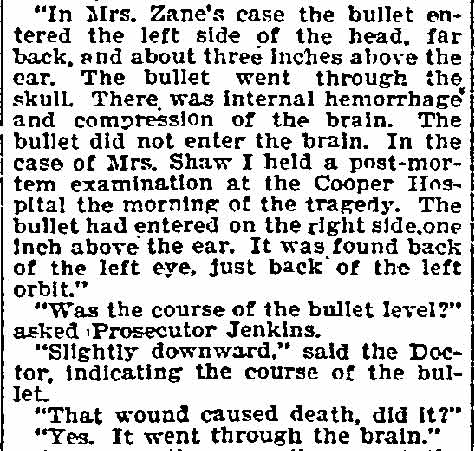
County Physician W. S. Jones was the next witness. He described the wounds on the bodies of the murdered women.
“In Mrs. Zane’s case the bullet entered the left side of the head, far back, and about three inches above the ear. The bullet went through the skull. There was internal hemorrhage and compression of the brain. The bullet did not enter the brain. In the case of Mrs. Shaw I held a post-mortem examination at the Cooper Hospital the morning of the tragedy. The bullet had entered on the right side, one inch above the ear. It was found back of the left eye, just back of the left orbit.”
“Was the course of the bullet level?” asked Prosecutor Jenkins.
“Slightly downward,” said the Doctor, indicating the course of the bullet.
“That wound caused death, did it?”
“Yes. It went through the brain.”
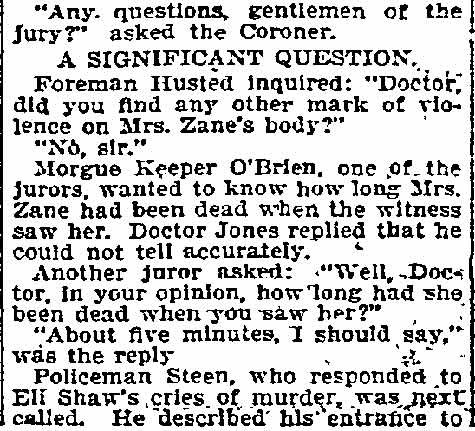
“Any questions, gentlemen of the jury?” asked the Coroner.
A SIGNIFICANT QUESTION.
Foreman Husted inquired: “Doctor, did you find any other mark of violence on Mrs. Zane’s body?”
“No, sir.”
Morgue Keeper O’Brien, one of the jurors, wanted to know how long Mrs. Zane had been dead when the witness saw her. Doctor Jones replied that he could not tell accurately.
Another juror asked: “Well, Doctor, in your opinion, how long had she been dead when you saw her?”
“About five minutes, I should say,” was the reply
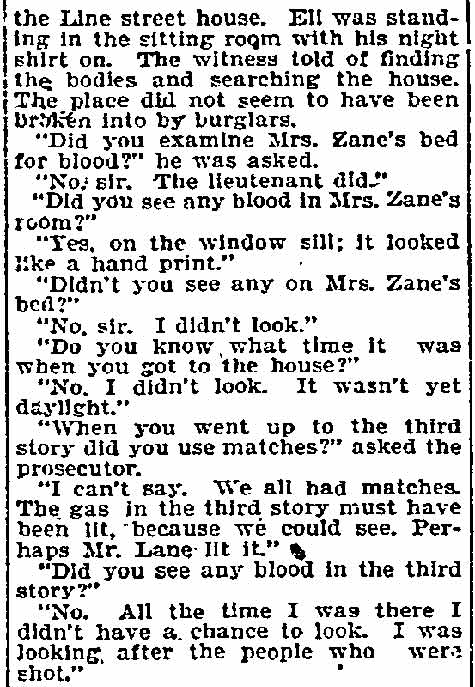
Policeman Steen, who responded to Eli Shaw’s cries of murder, was next called. He described his entrance to the Line street house. Eli was standing in the sitting room with his night shirt on. The witness told of finding the bodies and searching the house. The place did not seem to have been broken into by burglars.
“Did you examine Mrs. Zane’s bed for blood?” he was asked.
“No, sir. The lieutenant did.”
“Did you see any blood in Mrs. Zane’s room?”
“Yes, on the window sill; it looked like a hand print.”
“Didn’t you see any on Mrs. Zane’s bed?”
“No, sir. I didn’t look.”
“Do you know what time it was when you got to the house?”
“No. I didn’t look. It wasn’t yet daylight.”
“When you went up to the third story did you use matches?” asked the prosecutor.
“I can’t say. We all had matches. The gas in the third story must have been lit, because we could see. Perhaps Mr. Lane lit it.”
“Did you see any blood in the third story?”
“No. All the time I was there I didn’t have a chance to look. I was looking after the people who were shot.”
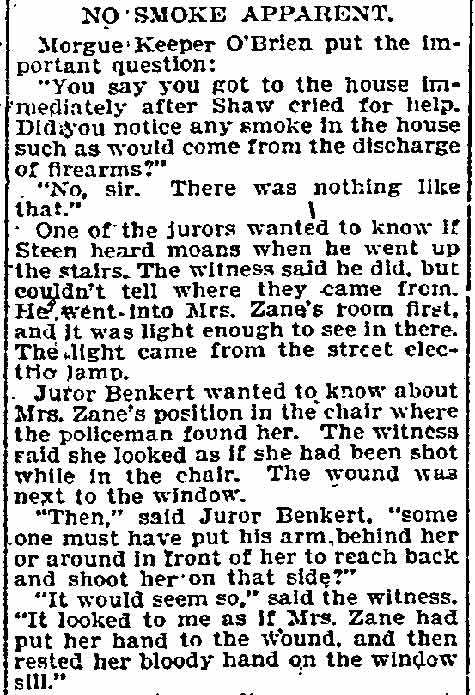
NO SMOKE APPARENT.
Morgue Keeper O’Brien put the important question:
“You say you got to the house immediately after Shaw cried for help. Did you notice any smoke in the house such as would come from the discharge of firearms?”
“No, sir. There was nothing like that.”
One of the jurors wanted to know if Steen heard moans when he went up the stairs. The witness said he did, but couldn’t tell where they came from. He went into Mrs. Zane’s room first, and it was light enough to see in there. The light came from the street electric lamp.
Juror Benkert wanted to know about Mrs. Zane’s position in the chair where the policeman found her. The witness said she looked as if she had been shot while in the chair. The wound was next to the window.
“Then,” said Juror Benkert, “some one must have put his arm behind her or around in front of her to reach back and shoot her on that side?”
“It would seem so,” said the witness. “It looked to me as if Mrs. Zane had put her hand to the wound, and then rested her bloody hand on the window sill.”
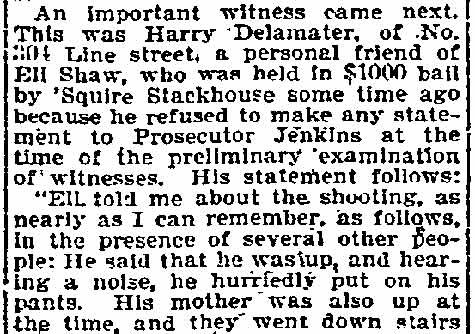
An important witness came next. This was Harry Delamater, of No. 30[?] Line street, a personal friend of Eli Shaw, who was held in $1000 bail by ‘Squire Stackhouse some time ago because he refused to make any statement to Prosecutor Jenkins at the time of the preliminary examination of witnesses. His statement follows:
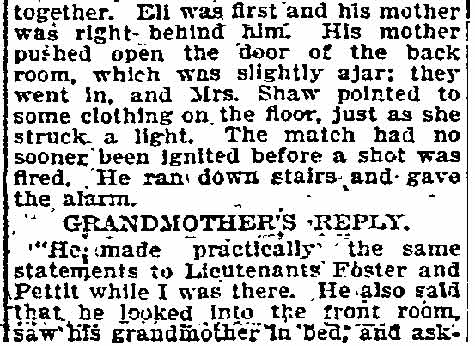
“Eli told me about the shooting, as nearly as I can remember, as follows, in the presence of several other people: He said that he was up, and hearing a noise, he hurriedly put on his pants. His mother was also up at the time, and they went down stairs together. Eli was first and his mother was right behind him. His mother pushed open the door of the back room, which was slightly ajar; they went in, and Mrs. Shaw pointed to some clothing on the floor, just as she struck a light. The match had no sooner been ignited before a shot was fired. He ran down stairs and gave the alarm.
GRANDMOTHER’S REPLY.
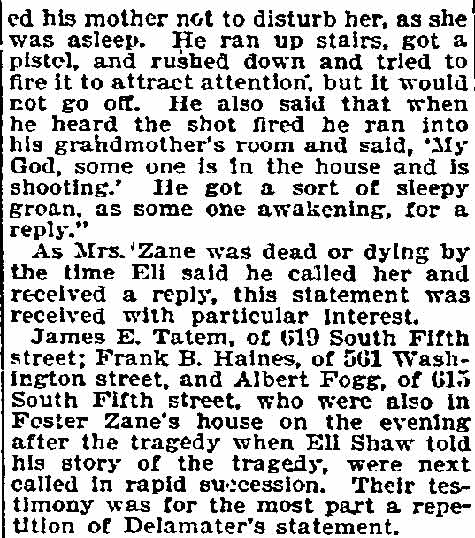
“He made practically the same statements to Lieutenants Foster and Pettit while I was there. He also said that he looked into the front room, saw his grandmother in bed, and asked his mother not to disturb her, as she was asleep. He ran up stairs, got a pistol, and rushed down and tried to fire it to attract attention, but it would not go off. He also said that when he heard the shot fired he ran into his grandmother’s room and said, ‘My God, some one is in the house and is shooting.’ He got a sort of sleepy groan, as some one awakening, for a reply.”
As Mrs. Zane was dead or dying by the time Eli said he called her and received a reply, this statement was received with particular interest.
James E. Tatem, of 619 South Fifth street; Frank B. Haines, of 561 Washington street, and Albert Fogg, of 615 South Fifth street, who were also in Foster Zane’s house on the evening after the tragedy when Eli Shaw told his story of the tragedy, were next called in rapid succession. Their testimony was for the most part a repetition of Delamater’s statement.
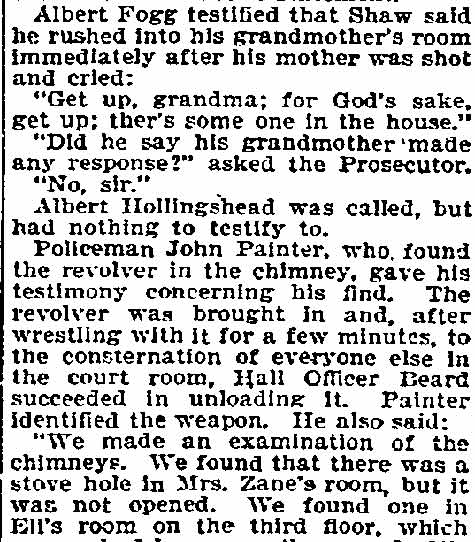
Albert Fogg testified that Shaw said he rushed into his grandmother’s room immediately after his mother was shot and cried:
“Get up, grandma; for God’s sake, get up; ther’s [sic] some one in the house.”
“Did he say his grandmother made any response?” asked the Prosecutor.
“No, sir.”
Albert Hollingshead was called, but had nothing to testify to.
Policeman John Painter, who found the revolver in the chimney, gave his testimony concerning his find. The revolver was brought in and, after wrestling with it for a few minutes, to the consternation of everyone else in the court room, Hall Officer Beard succeeded in unloading it. Painter identified the weapon. He also said:
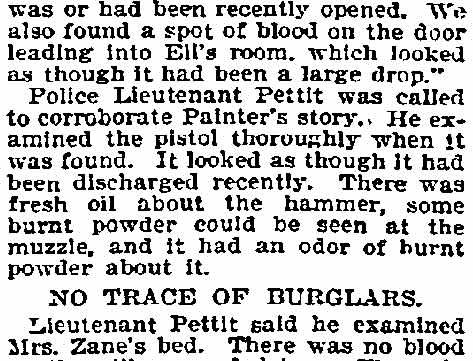
“We made an examination of the chimneys. We found that there was a stove hole in Mrs. Zane’s room, but it was not opened. We found one in Eli’s room on the third floor, which was or had been recently opened. We also found a spot of blood on the door leading into Eli’s room, which looked as though it had been a large drop.”
Police Lieutenant Pettit was called to corroborate Painter’s story. He examined the pistol thoroughly when it was found. It looked as though it had been discharged recently. There was fresh oil about the hammer, some burnt powder could be seen at the muzzle, and it had an odor of burnt powder about it.
NO TRACE OF BURGLARS.
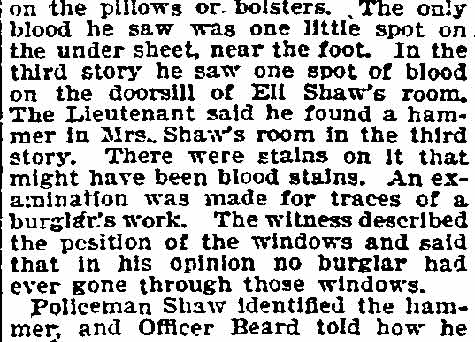
Lieutenant Pettit said he examined Mrs. Zane’s bed. There was no blood on the pillows or bolsters. The only blood he saw was one little spot on the under sheet, near the foot. In the third story he saw one spot of blood on the doorsill of Eli Shaw’s room. The Lieutenant said he found a hammer in Mrs. Shaw’s room in the third story. There were stains on it that might have been blood stains. An examination was made for traces of a burglar’s work. The witness described the position of the windows and said that in his opinion no burglar had ever gone through those windows.
Policeman Shaw identified the hammer, and Officer Beard told how he tried to get the weapon identified in Philadelphia pawnshops. It exploded while being examined in one of those establishments.
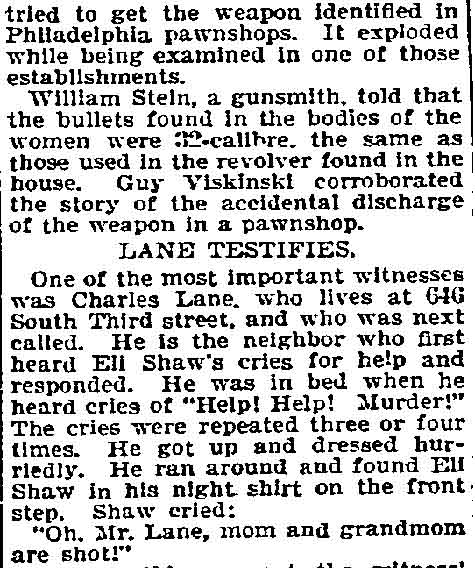
William Stein, a gunsmith, told that the bullets found in the bodies of the women were 32-calibre, the same as those used in the revolver found in the house. Guy Viskinski corroborated the story of the accidental discharge of the weapon in a pawnshop.
LANE TESTIFIES.
One of the most important witnesses was Charles Lane, who lives at 646 South Third street, and who was next called. He is the neighbor who first heard Eli Shaw’s cries for help and responded. He was in bed when he heard cries of “Help! Help! Murder!” The cries were repeated three or four times. He got up and dressed hurriedly. He ran around and found Eli Shaw in his night shirt on the front step. Shaw cried:
“Oh, Mr. Lane, mom and grandmom are shot!”
Just at this moment the witness’ son came running up, and they went in the hallway.
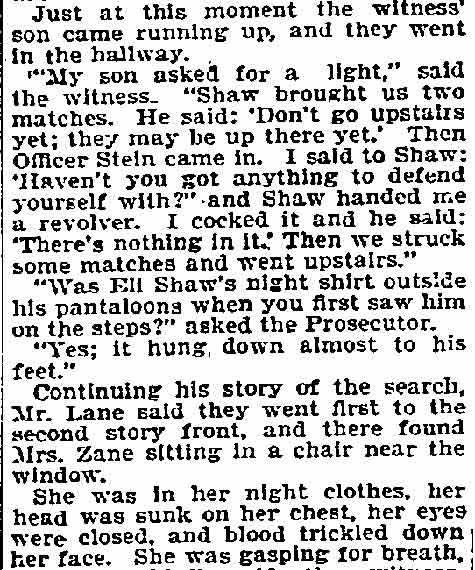
“My son asked for a light,” said the witness. “Shaw brought us two matches. He said: ‘Don’t go upstairs yet; they may be up there yet.’ Then Officer Stein came in. I said to Shaw: ‘Haven’t you got anything to defend yourself with?’ and Shaw handed me a revolver. I cocked it and he said: ‘There’s nothing in it.’ Then we struck some matches and went upstairs.”
“Was Eli Shaw’s night shirt outside his pantaloons when you first saw him on the steps?” asked the Prosecutor.
“Yes; it hung down almost to his feet.”
Continuing his story of the search, Mr. Lane said they went first to the second story front, and there found Mrs. Zane sitting in a chair near the window.
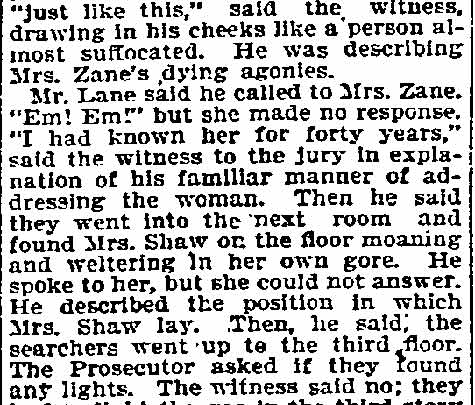
She was in her night clothes, her head was sunk on her chest, her eyes were closed, and blood trickled down her face. She was gasping for breath, “just like this,” said the witness, drawing in his cheeks like a person almost suffocated. He was describing Mrs. Zane’s dying agonies.
Mr. Lane said he called to Mrs. Zane. “Em! Em!” but she made no response. “I had known her for forty years,” said the witness to the jury in explanation of his familiar manner of addressing the woman. Then he said they went into the next room and found Mrs. Shaw on the floor moaning and weltering in her own gore. He spoke to her, but she could not answer. He described the position in which Mrs. Shaw lay. Then, he said, the searchers went up to the third floor. The Prosecutor asked if they found any lights. The witness said no; they had to light the gas in the third story front room. They found the gas lit in the dining room on the first floor when they first entered the house.
NIGHT SHIRT EXHIBITED.
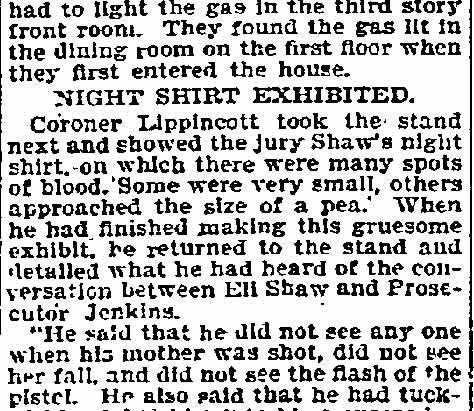
Coroner Lippincott took the stand next and showed the jury Shaw’s night shirt, on which there were many spots of blood. Some were very small, others approached the size of a pea. When he had finished making this gruesome exhibit, he returned to the stand and detailed what he had heard of the conversation between Eli Shaw and Prosecutor Jenkins.
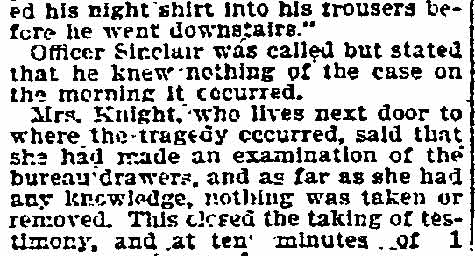
“He said that he did not see any one when his mother was shot, did not see her fall, and did not see the flash of the pistol. He also said that he had tucked his night shirt into his trousers before he went downstairs.”
Officer Sinclair was called but stated that he knew nothing of the case on the morning it occurred.
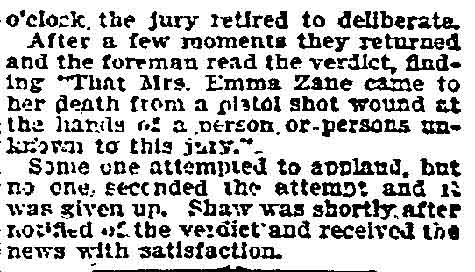
Mrs. Knight, who lives next door to where the tragedy occurred, said that she had made an examination of the bureau drawers, and as far as she had any knowledge, nothing was taken or removed. This closed the taking of testimony, and at ten minutes of 1 o’clock, the jury retired to deliberate.
After a few moments they returned and the foreman read the verdict, finding “That Mrs. Emma Zane came to her death from a pistol shot wound at the hands of a person or persons unknown to this jury.”
Some one attempted to applaud, but no one seconded the attempt and it was given up. Shaw was shortly after notified of the verdict and received the news with satisfaction.
Probing Camden Tragedies
Philadelphia Inquirer —
PROBING CAMDEN TRAGEDIES
Grand Jury Investigating the Zane-Shaw Murders.
The Camden grand jury yesterday took up the charge against Eli Shaw of murdering his mother and grandmother. Among the witnesses examined were County Physician Jones, Dr. Marcus Mines, Police Lieutenants Foster and Pettit, Policemen Steen, Shaw, Sinclair and Painter, Charles and Alonzo Lane and Coroner Lippincott. The case will be continued to-day, as over a dozen witnesses are yet to be heard.
George Mordorf, who shot Cigar Dealer Mather in his store in Camden, was arraigned in the Camden Court yesterday. He pleaded not guilty and said he did not want counsel.
Sleighing in Camden
Philadelphia Inquirer —
Horsemen Across the Delaware Crowd White Horse and Mt. Ephraim Pikes
With an excellent snow and a holiday Camden county horsemen enjoyed an ideal sleighing carnival. There wasn’t a piece of a street nor a road that scraped a runner and by 3 o’clock nearly every available vehicle on runners was pressed into service and the shabby old basket affairs drawn by mules, “skates” or any old beast vied with the elaborate, shining runners of the well-to-do horse owner wrapped in furs and guided by a liveried coachman. Cooper street, Camden, which first became popular with sleighers years ago when it was as wide as Broad street, Philadelphia, and had not yet known a paving stone, was, as usual, the attraction of those who had a display of fine bred horseflesh to make. In the morning a few came out and hardened the course, and in the afternoon the thoroughfare presented one grand pageant of fleeting hoofs, to which the tinkling bells of the sleighs provided accompaniment.
The White Horse and Mt. Ephraim pikes, where there are numerous hotels where hands can be warmed and attacks of grip driven away, were the popular roads for those who demanded more variety than Cooper street afforded, and these roads were also in excellent condition. On Cooper street and on the country roads could be seen the following well-known lovers of sleighing and judges of good horse flesh: Joseph Shinn, with a bright yellow sleigh and plumes, drove Baltzimer; Eugene Ingle was behind the high-stepping Prince Arthur. William C. Dayton drove a roan cob. Dr. Kitchener brushed all competitors with a fast black mare. E. Stockham Woodward, accompanied by his wife and daughter, were drawn by the crack team, His Excellency, with a record of 2.18¼, and Fleetwood, 2.23¼, in a Bailey sleigh; Ephraim Hiers [sic] drove Van, 2.20¼; Dr. William H. Iszard held the reins over the brown gelding Logan. From South Camden came Harry Davis with the favorite Out of Sight, and Phil Burch worried him with Reader. Representing far North Camden were John Matthis, driving Harry, a fast bay; Dr. H. Robinson with his black gelding, Frank, and James Baird behind Harry, one of the best of his stables. Some others who joined the tinkling whirl before nightfall were John O. Munter with Purk, Stokes Burroughs behind Cheap John, John Clements with Uncle Sam, Dr. Gunter looking for trouble with his pride, Delaware; William H. Clements with Annie Roney, W. K. Heston with Harry Wilkes, Jack Van Sciver and his bay Smoky, Samuel Kilpatrick with Pawnee Bill, H. W. Davis behind a fast gray mare, Edward Roberts with a team of pretty bays, Chris and Lewis; Joseph Burrough with a bay mare, Asa Roberts with his sorrel Frank, and Dr. A. H. Lippincott behind Bob.
The country roads were better than horsemen have seen them for years because there were no drifts. Friend passed friend on the road with surprise that they should have driven so far from home. Men from Mt. Holly exchanged greetings with Camdenites in the vicinity of Merchantville and Main street. Moorestown was the course for some interesting trial heats between horsemen from all directions. Among them were noticed William Pancoast, of Merchantville, driving Sante Fe; Charles Coles, Moorestown, with a team of bays; Morgan Butterworth behind a gray mare, Morgan Hatch, Delair, with a pair of bays; Benjamin Zelly, Mt. Holly, behind Ella Free; Frank Haines, of Rancocas, with William Sanders and mate. Among the turnouts, probably the most interesting was that of Joseph Burrough, of Merchantville, who drove a pair to a sleigh which is more than one hundred years old. On the front of the vehicle is painted its history and the names of those who have owned it. Another sleigh said to have been built in the eighteenth century was driven by Joseph Hinchman, of Merchantville.
H. A. Barritt Company Incorporated
Philadelphia Inquirer —

The H. A. Barritt Company, with $25,000 capital stock, was incorporated yesterday to deal in real and artificial hair. Thomas P. Curley, A. H. Lippincott, M. D., and William Barnard, all of Camden, are the incorporators.
Abbatto Hanged in Camden Jail
Philadelphia Inquirer —
Quick Work by Sheriff Sell in Executing the Murderer of Genaro De Feo
Condemned Man Died Without a Struggle, and Was Buried in Potters’ Field
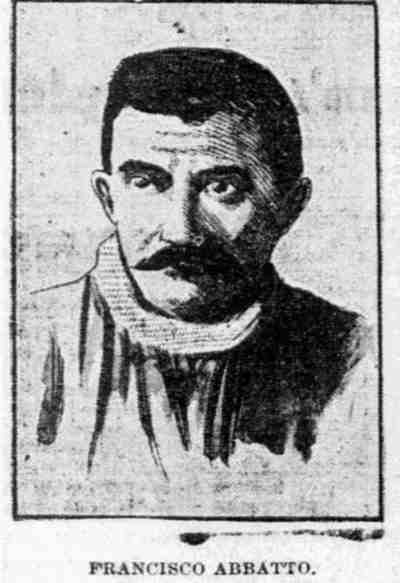
FRANCISCO ABBATTO.
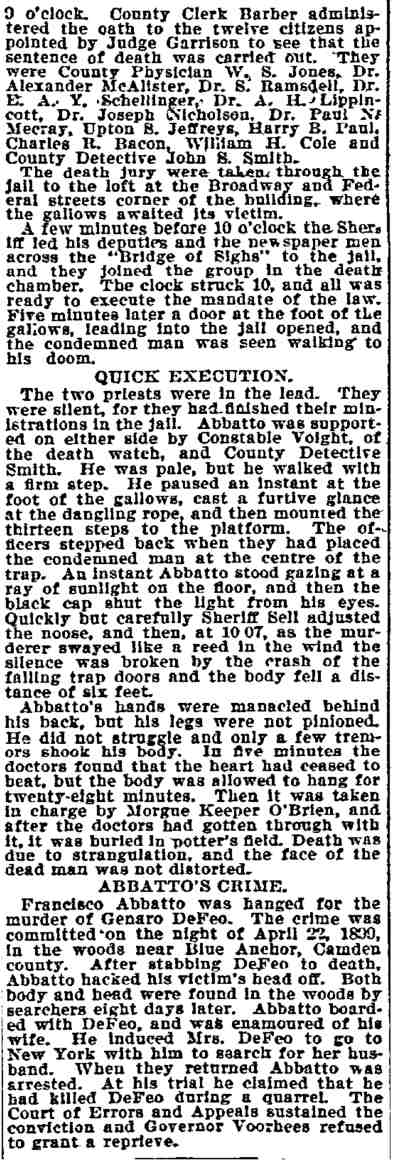
John Wesley Sell, Sheriff of Camden county, had his first hanging yesterday, and he made a record for celerity in launching Francisco Abbatto into eternity. The earliest moment that the hanging could take place, under the order of the court, was 10 o’clock. Within 6 minutes after the hour struck Abbatto was standing on the gallows. A minute later the trap was sprung, and five minutes later the man was dead.
Abbatto slept soundly during his last night on earth. He was up betimes yesterday morning, and dressed himself in the black suit of clothes which he knew would be his death garments. He declined to eat any breakfast, but drank a cup of coffee. At 8 o’clock the priests came to prepare the condemned man for the end. They were Father Pozzi, of East Vineland, and Father Caruso, of the Church of Our Lady of Good Counsel, of Philadelphia.
FINAL PREPARATIONS.
The persons authorized by law to witness the execution, about forty in number, gathered in the Sheriff’s office by half past 9 o’clock. County Clerk Barber administered the oath to the twelve citizens appointed by Judge Garrison to see that the sentence of death was carried out. They were County Physician W. S. Jones, Dr. Alexander McAlister, Dr. S. Ramsdell, Dr. E. A. Y. Schellinger, Dr. A. H. Lippincott, Dr. Joseph Nicholson, Dr. Paul N. Mecray, Upton S. Jeffreys, Harry B. Paul, Charles R. Bacon, William H. Cole and County Detective John S. Smith.
The death jury were taken through the jail to the loft at the Broadway and Federal streets corner of the building, where the gallows awaited its victim.
A few minutes before 10 o’clock the Sheriff led his deputies and the newspaper men across the “Bridge of Sighs” to the jail, and they joined the group in the death chamber. The clock struck 10, and all was ready to execute the mandate of the law. Five minutes later a door at the foot of the gallows, leading into the jail opened, and the condemned man was seen walking to his doom.
QUICK EXECUTION.
The two priests were in the lead. They were silent, for they had finished their ministrations in the jail. Abbatto was supported on either side by Constable Voight, of the death watch, and County Detective Smith. He was pale, but he walked with a firm step. He paused an instant at the foot of the gallows, cast a furtive glance at the dangling rope, and then mounted the thirteen steps to the platform. The officers stepped back when they had placed the condemned man at the centre of the trap. An instant Abbatto stood gazing at a ray of sunlight on the floor, and then the black cap shut the light from his eyes. Quickly but carefully Sheriff Sell adjusted the noose, and then, at 10 07, as the murderer swayed like a reed in the wind the silence was broken by the crash of the falling trap doors and the body fell a distance of six feet.
Abbatto’s hands were manacled behind his back, but his legs were not pinioned. He did not struggle and only a few tremors shook his body. In five minutes the doctors found that the heart had ceased to beat, but the body was allowed to hang for twenty-eight minutes. Then it was taken in charge by Morgue Keeper O’Brien, and after the doctors had gotten through with it, it was buried in potter’s field. Death was due to strangulation, and the face of the dead man was not distorted.
ABBATTO’S CRIME.
Francisco Abbatto was hanged for the murder of Genaro DeFeo. The crime was committed on the night of April 22, 1899, in the woods near Blue Anchor, Camden county. After stabbing DeFeo to death, Abbatto hacked his victim’s head off. Both body and head were found in the woods by searchers eight days later. Abbatto boarded with DeFeo, and was enamoured of his wife. He induced Mrs. DeFeo to go to New York with him to search for her husband. When they returned Abbatto was arrested. At his trial he claimed that he had killed DeFeo during a quarrel. The Court of Errors and Appeals sustained the conviction and Governor Voorhees refused to grant a reprieve.
News of Camden
Philadelphia Inquirer —
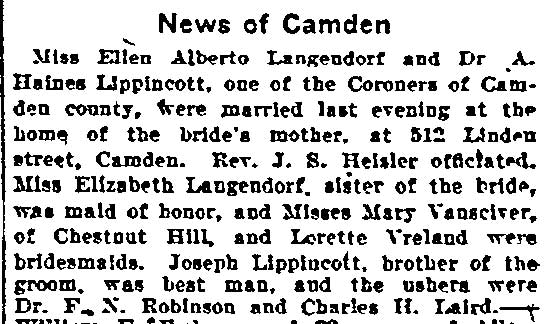
Miss Ellen Alberto Langendorf and Dr. A. Haines Lippincott, one of the Coroners of Camden county, were married last evening at the home of the bride’s mother, at 512 Linden street, Camden. Rev. J. S. Heisler officiated. Miss Elizabeth Langendorf, sister of the bride, was maid of honor, and Misses Mary Vansciver, of Chestnut Hill, and Lorette Vreland were bridesmaids. Joseph Lippincott, brother of the groom, was best man, and the ushers were Dr. F. N. Robinson and Charles H. Laird.
Camden News Notes
Philadelphia Inquirer —
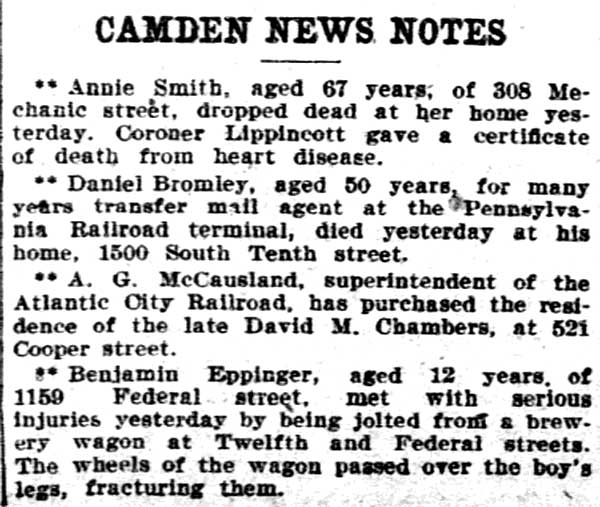
Annie Smith, aged 67 years; of 308 Mechanic street, dropped dead at her home yesterday. Coroner Lippincott gave a certificate of death from heart disease.
Daniel Bromley, aged 50 years, for many years transfer mail agent at the Pennsylvania Railroad terminal, died yesterday at his home, 1500 South Tenth street.
A. G. McCausland, superintendent of the Atlantic City Railroad, has purchased the residence of the late David M. Chambers, at 521 Cooper street.
Benjamin Eppinger, aged 12 years, of 1159 Federal street, met with serious injuries yesterday by being jolted from a brewery wagon at Twelfth and Federal streets. The wheels of the wagon passed over the boy’s legs, fracturing them.
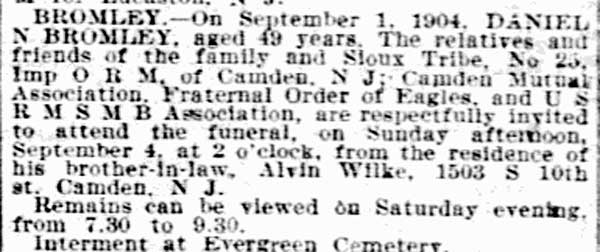
BROMLEY.—On September 1, 1904, DANIEL N BROMLEY, aged 49 years. The relatives and friends of the family and Sioux Tribe, No. 25, Imp O R M, of Camden, N J; Camden Mutual Association, Fraternal Order of Eagles, and U S R M S M B Association, are respectfully invited to attend the funeral, on Sunday afternoon, September 4, at 2 o’clock, from the residence of his brother-in-law, Alvin Wilke, 1503 S 10th st, Camden, N J.
Remains can be viewed on Saturday evening, from 7.30 to 9.30.
Interment at Evergreen Cemetery.
Philadelphia Inquirer — February 15, 1905
Named: George D. Borton, Rev. George Hemingway, York Street, North 2nd Street, First Presbyterian Church, Camden Lodge No. 293, Benevolent Protective Order of Elks, John Henry Fort, Samuel A. Kilpatrick, Alexander Milliette, Francis Warren, J. Henry Switzer, and Dr. A. Haines Lippincott.
Philadelphia Inquirer — March 24, 1905
John Johnson, aged 34 years, of 538 Central avenue, and Howard Truitt, aged 4 years, of 613 Sycamore street, Camden, were found dead in their beds yesterday morning. In the first instance the man was suffering from consumption and Coroner Kirk gave a certificate accordingly. Coroner Lippincott found death due to diphtheria in the second case.
Camden Post-Telegram — September 17, 1905
Named: Hudson Street, Charles M. Wells, and Dr. A. Haines Lippincott.
Fire and Police Forces Increased
Philadelphia Inquirer —
New Men to Be Added to Each Department in Camden—Move Against the “Pennsy”
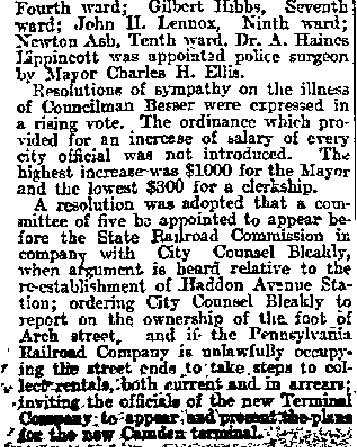
At last night’s meeting of Camden City Council the police force was increased to 130 men, as follows: 1 chief, 3 captains, 2 house captains, 9 sergeants, 4 detectives, 10 patrol crew, 101 policemen, an increase of 25 men. By ordinance the following new firemen were appointed: Ephraim T. Hires, First ward; Charles Schultz, Second ward; Gardner Corson, Fourth ward; Gilbert Hibbs, Seventh ward; John H. Lennox, Ninth ward; Newton Ash, Tenth ward. Dr. A. Haines Lippincott was appointed police surgeon by Mayor Charles H. Ellis.
Resolutions of sympathy on the illness of Councilman Besser were expressed in a rising vote. The ordinance which provided for an increase of salary of every city official was not introduced. The highest increase was $1000 for the Mayor and the lowest $300 for a clerkship.
A resolution was adopted that a committee of five be appointed to appear before the State Railroad Commission in company with City Counsel Bleakly, when argument is heard relative to the re-establishment of Haddon Avenue Station; ordering City Counsel Bleakly to report on the ownership of the foot of Arch street, and if the Pennsylvania Railroad Company is unlawfully occupying the street ends to take steps to collect rentals, both current and in arrears; inviting the officials of the new Terminal Company to appear and present the plans for the new Camden terminal.
Camden Increases Its Police Force
Philadelphia Inquirer —
Mayor Ellis Adds Twenty-five New Officers to Growing City’s Department
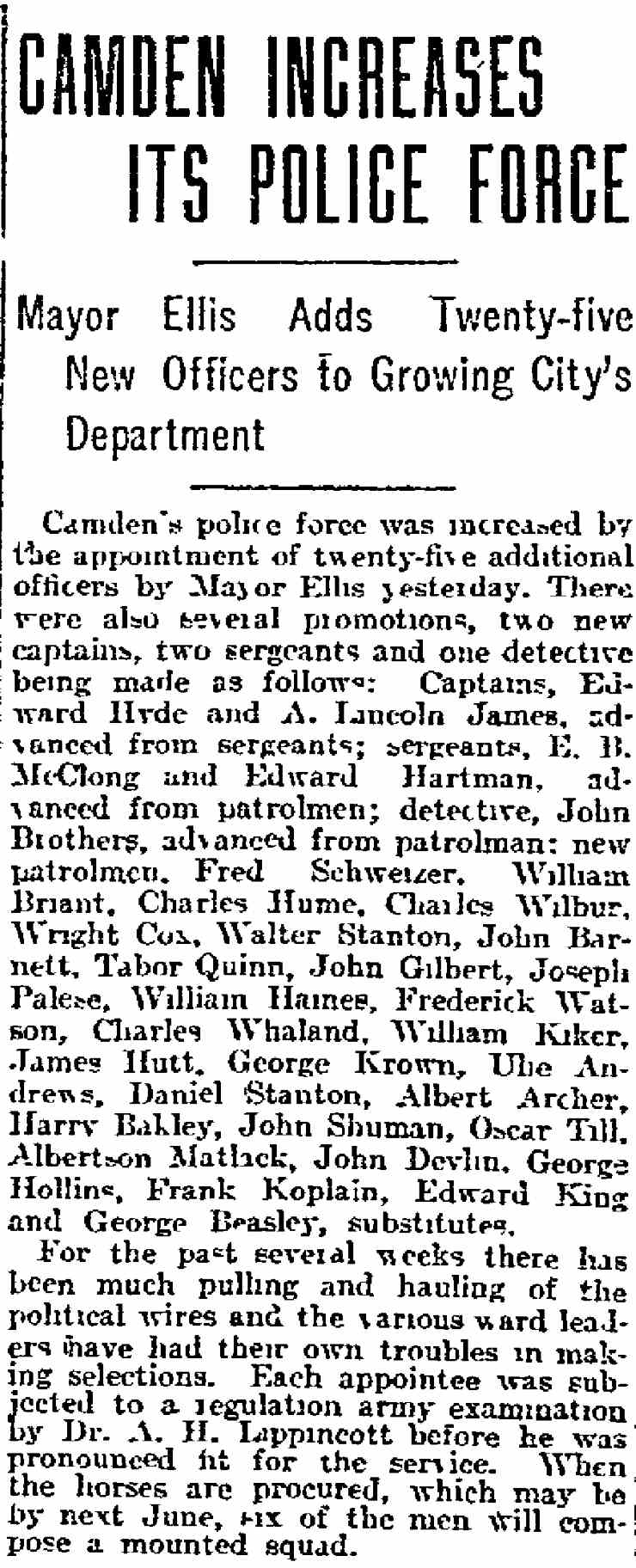
Camden’s police force was increased by the appointment of twenty-five additional officers by Mayor Ellis yesterday. There were also several promotions, two new captains, two sergeants and one detective being made as follows: Captains, Edward Hyde and A. Lincoln James, advanced from sergeants; sergeants, E. B. McClong and Edward Hartman, advanced from patrolmen; detective, John Brothers, advanced from patrolman: new patrolmen. Fred Schweizer, William Briant, Charles Hume, Charles Wilbur, Wright Cox, Walter Stanton, John Barnett, Tabor Quinn, John Gilbert, Joseph Palese, William Haines, Frederick Watson, Charles Whaland, William Kiker, James Hutt, George Krown, Ube Andrews, Daniel Stanton, Albert Archer, Harry Bakley, John Shuman, Oscar Till, Albertson Matlack, John Devlin, George Hollins, Frank Koplain, Edward King and George Beasley, substitutes.
For the past several weeks there has been much pulling and hauling of the political wires and the various ward leaders have had their own troubles in making selections. Each appointee was subjected to a regulation army examination by Dr. A. H. Lappincott [sic] before he was pronounced fit for the service. When the horses are procured, which may be by next June, six of the men will compose a mounted squad.
George D. Borton Funeral
Philadelphia Inquirer —
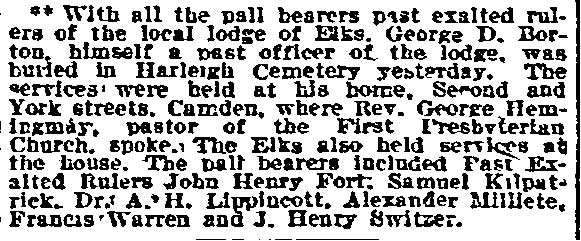
With all the pall bearers past exalted rulers of the local lodge of Elks, George D. Borton, himself a past officer of the lodge, was buried in Harleigh Cemetery yesterday. The services were held at his home, Second and York streets, Camden, where Rev. George Hemingway, pastor of the First Presbyterian Church, spoke. The Elks also held services at the house. The pall bearers included Past Exalted Rulers John Henry Fort, Samuel Kilpatrick, Dr. A. H. Lippincott, Alexander Millete [sic], Francis Warren and J. Henry Switzer.
Flames Wrecked Autos in Camden
Philadelphia Inquirer —
Over Score of Machines Destroyed by Fire in Garage, Which Badly Damaged Church
Twenty-three Camden business and professional men mourn the loss of their automobiles as a result of a fire which yesterday morning destroyed the garage of J. G. Reeves, on North Seventh street just above Market. Evangelical Luthern [sic] Church, immediately adjoining, was badly damaged, and altogether the monetary loss amounts to about $100,000. Most of the machines were insured.
Just what caused the fire is not known. It was discovered by Albert Hildreth, a watchman, who no sooner saw the flames than he went to the fire headquarters in an automobile at topmost speed. When the fireman arrived they had not been in service many minutes before there was a terrific explosion that sent the walls down. Three of them were hurled across the street and severely bruised. They included Peter Carter, John Lennox and John Lutz, all connected with headquarters.
The explosion came presumably from stored gasoline.
Such headway did the blaze gain that it was necessary to call out the entire city department. For a time a number of dwellings nearby were threatened and the occupants began moving their household effects. The good work of the fire fighters prevented a serious conflagration, however. The force of the explosion blew a twenty-foot hole in the wall of the Lutheran Church.
The automobiles were valued at about $75,000, the balance of the loss being on the building and church. Some of those who lost their autos include: Lawyer Ephraim Tomlinson, Charles K. Parry, Mrs. Mary Baird Fox, Mrs. B. C. Reeves, Dr. Wm. Knowlton, Dr. Oscar Grumbrecht, Dr. A. H. Lippincott, Dr. Paul Mecray, Dr. Marvin Street, C. H. Haddon, Dr. Frank Horning, John T. Bottomley, John Croft, Dr. Daniel Strock, Joseph Deacon and J. S. Reeves.
Mrs. Nellie Lippincott Buried
Philadelphia Inquirer —

The funeral of Mrs. Nellie Lippincott, wife of Dr. A. H. Lippincott, took place yesterday from her home, 21 Broadway, the services being in charge of Rev. Percy Perinchief, pastor of the Centenary M. E. Church.
Draft Queries Sent Through Mails
Philadelphia Inquirer —
The various draft boards in Camden yesterday sent out in the mails the new questionaire [sic] to five per cent. of the registrants who have not yet been called. Each day a like percentage will receive them until all have been supplied. Each contingent will have seven days in which to send their replies. The Legal Advisory Board has organized and designated the time and place where the registrants may obtain the necessary information with respect to filling out the blanks. In the city the boards will sit every night excepting Sunday.
The following Camden physicians have been named as the Medical Advisory Board by Governor Edge: Drs. Thomas B. Lee, John H. Markley, George D. Woodward, A. Haines Lippincott, J. Anson Smith, Levi B. Hirst, Alfred C. Cramer, Joseph E. Duffield, Joseph E. Nicholson, Joseph E. Roberts and F. B. Lynch.
Camden Mayor Advises Saving in City Budget
Philadelphia Inquirer —
Only Expenditures for Actual Needs of Municipality Recommended to Council
Mayor Ellis, of Camden, in presenting his annual message to City Council yesterday at its reorganization for the ensuing year, stated that in accordance with the government’s plea for the conservation of our resources, he refrained from offering suggestions that would mean the expenditure of large sums of money. His recommendations were therefore along lines of what he termed the city’s actual needs.
Pointing out that labor scarcity and war restrictions on materials had hampered street construction by the Highway Department, the Mayor stated since the establishment of the city-owned plant 161,[?] square yards of asphalt have been laid, in addition to an almost equal amount of resurfacing and patching, at a cost of much less than charged by private contract. He advocated the purchase of a boat to patrol the river front during the war, and called attention to the need of more men in both the Police and Fire Departments.
In discussing the proposed bridge connecting Camden and Philadelphia, Mayor Ellis stated New Jersey is in readiness to enact the need [sic] legislation, and that all that is necessary to give the project the impetus that will mean its construction is the taking of the necessary steps by the Pennsylvania Legislature.
Mayor Ellis spoke of the wisdom of the establishing of the auxiliary pumping station of the municipal water plant, and stated that during the year it is planned to bore more artesian wells. He urged that a special committee be appointed to supervise and lend financial aid to the summer war gardens. In connection with the library, the Mayor advocated the purchase of such books as will fit the youth of the city for the changed conditions brought about by the war.
Council confirmed a number of appointments recommended by Mayor Ellis. William H. Davis was reappointed a member of the City Board of Assessors, and Howard M. Cooper and Thomas French were made members of the Board of Library Trustees, the first succeeding himself, and the latter Wilbur F. Rose, resigned. Dr. A. Haines Lippincott was appointed police and fire surgeon, succeeding the late Dr. E. A. Y. Schellenger. Herbert A. Munger was reappointed a member of the Sinking Fund Commission for three years.
A City Plan Commission for one year was appointed as follows: T. Gordon Coulter, F. A. Finkeldey, George Kappell, William C. Davis, Theodore T. Kausel, Allen Jarvis, Frank S. Vanhart, Frederick von Nieda and Joseph Forsyth, the last three being members of City Council. Dr. Charles P. Tuttle, Dr. H. F. Bushey, Chief of Police Gravenor and Policeman Charles Whaland were appointed the Police Pension Fund Commission.
There are but two new members of City Council, William J. Kelly, of the Eighth ward, and Clifford K. Deacon, of the Tenth ward.
3 Firemen Hurt in $75,000 Fire at Leather Plant
Camden Post-Telegram —

3 FIREMEN HURT IN $75,000 FIRE AT LEATHER PLANT
Flames of Unknown Origin Wreck Upper Story of Keystone Factory
SMOKE BLOCKS BATTLE
Firm Loses Stock of Hides Valued at $50,000, One Fireman in Hospital
Three firemen were overcome with smoke when flames gutted the upper stories of the drying building of the Keystone Leather Company, Seventeenth and Carman streets, last night. The loss is estimated today at $75,000. The origin is unknown.
Captain J. J. Vickers, of the East Camden Company, was overcome by smoke, and revived by City Physician Lippincott. Fireman George Addison, of the same company, was dragged from the building by other firemen, and revived by the physician.
Nelson Andrews, fireman, of Engine Company No. 9, was in a serious condition when taken from the building. He was prostrated by smoke, and was rushed to Cooper Hospital, where he was reported as much improved today.
Smoke Blocks Traffic
Smoke was so dense that vehicular traffic on Federal street, two squares away, was blocked for nearly an hour.
The flames had gained a great deal of headway when discovered by a watchman. When the firemen arrived on the scene, they faced a hard task because of great volumes of smoke pouring from the building, in which was stored a large stock of hides.
It was one of the most stubborn fires the department has faced in years. The firemen were unable to locate the flames at first because of the smoke. Chief Carter sent in two more alarms after arriving on the scene.
After thirty minutes of battle the flames suddenly shot skyward, illuminating the heavens for miles. They leaped to the fourth floor, and through the roof. In a short time the roof collapsed, sending a great shower of sparks in all directions.
It was three hours before the first fire companies were able to leave the scene.
It was estimated today that the damage to the building will reach $25,000. The company lost about $50,000 in stock. A large stock of hides on the first two floors were ruined by tons of water.
The building is one of the first built by the company, and directly adjoins the main concrete plant at Seventeenth and Mickle streets.
Lieutenant W. Scott Franklin, of Engine Company, No. 1, fell from a one-story roof of an adjoining building while pulling up hose but fortunately escaped injury.
Camden to Improve 2 City Departments
Philadelphia Inquirer —
Surgeon Lippincott’s Recommendations for Police and Fire Approved
Woman Hurt When She Walks From Rear of One Train Into Another
In connection with the plan of the Police and Fire Committees of Camden City Council to make departments under their supervision modern in every particular, Dr. A. Haines Lippincott, surgeon to both departments, has submitted recommendations, which have received the approbation of the Councilmen.
Among the suggestions are schools for firemen and policemen, complete medical survey for both departments, intensive physical culture training, first aid training, instructions in the use of firearms by the police, annual athletic meets for both departments, and intelligence and educational tests. He also recommends three assistant police and fire surgeons.
“I will say that the Camden policemen and firemen on an average are in fine physical condition,” he said, “but there probably are many men whose physical ailments can be corrected and the efficiency of both departments bettered by medical examinations.”
In addition to the seven men to retire on pension because they have reached the age limit of 65 years, nine others probably will retire because of disability. They are Detective Harry Brothers, Sergeant Harry Stowe, Traffic Officers Norris Steelman and Raymond Stark, and Policemen Adrian Bateman, Samuel Bakley, John Schuman, Camillus Appley and Frank Carle.
Patrons, Patronesses Announced for First Military Ball
Camden Courier-Post —
Patrons and patronesses for the first military ball of the Camden Post No. 960, Veterans of Foreign Wars, to be held on Friday evening February 3 in the Elks auditorium, Seventh and Cooper Streets, are announced today.
The following prominent men and women are listed: Mrs. J.W. Connor, Miss C.M. Day, Mrs. J.H. Forsyth, Mrs. H.J. Goodyear, Miss B. Graham, Mrs. R.E. Green, Mrs. E.F. Haines, Mrs. J. Hood Jr., Mrs. W. Hurley, Mrs. J. Jarrell, Mrs. T. Keefe, Mrs. J.F. Kobus, Mrs. L. Liberman, Mrs. F.L. Lloyd, Mrs. M.A. Logan, Mrs. T.P. McConaghy, Mrs. F.F. Neutze, Mrs. L.K. Marr, Mrs. J.A. Pennington, Mrs. M.E. Ramsey, Mrs. E. Truax, Mrs. S.M. Shay, Mrs. W.J. Staats, Mrs. B.G. Tarburton, Mrs. R.W. Waddell, Mrs. E. Watson, Mrs. E.P. Wescott, Mrs. C.A. Wolverton.
David Baird Jr., William T. Boyle, Isaac Ferris, William Hurley, John Hood Jr., John Jarrell, Victor King, William J. Kraft, Thomas Keefe, Joseph F. Kobus, Hon. Edmund B. Leaming, Dr. A. Haines Lippincott, James H. Long, L.K. Marr, Dr. Thomas P. McConaghy, Hon. Frank F. Neutze, Samuel P. Orlando, Albert E. Simmons, Edwin Watson, Ethan P. Wescott.
Camden Man Named to Head Physicians
Camden Courier-Post —
Dr. A. Haines Lippincott Elected President of N. J. Medical Society at Shore
Atlantic City, June 17.—Dr. A. Haines Lippincott, of 406 Cooper street, Camden, today was elected president of the New Jersey Medical Society with closing of its 166th annual convention here at Chalfonte-Haddon Hall. He succeeds Dr. John F. Haggerty, of Newark.
Other officers elected are Dr. Frederick J. Quigley, of Union City; Dr. Lancelot Ely, of Somerville, and Dr. Marcus Newcomb, of Browns Mills, vice-presidents; Dr. John Bennett Morrison, of Newark, re-elected secretary, and Dr. Elias J. Marsh, of Paterson, treasurer; Dr. H. W. Mafey, of New Brunswick; Dr. James S. Green, of Elizabeth, and Dr. Blase Bole, of Newton, trustees. Mrs. Charles Franklin Adams was named president of the Women's Auxiliary.
Dr. J. Lynn Mahaffey, of Camden, state health director, speaking before the convention again today, urged New Jersey physicians to make greater use of the facilities of the State Department of Health.
Dr. Mahaffey declared that “a fuller utilization of the services and facilities of the State Department of Health is not only desired, but welcomed in the promotion of public health.”
“By reason of closer contact with the medical profession, the incipiency of disease can be detected better and known corrective arrestive measures promptly applied,” he said.
“Proud of its accomplishments in the field of public health, the department points to the operating cost of 13.3 cents per capita for a population of 4,041,334. The state’s general death rate of 10.6 for 1930 and again for 1931 was the lowest since the department was established 54 years ago. For 1931 the death rates for typhoid fever, diphtheria and tuberculosis were the lowest ever reached in New Jersey. Infant mortality for 1931 was next to the lowest since rates were established in 1906.”
“Capacities of the department have not been exhausted in the ever-increasing field of its work. For the fiscal year ending June 30, 1931, the department appropriation was $428,990.50. For 1921 it was $358,906.22.”
Camden Elks to Honor Past Exalted Rulers
Camden Courier-Post —
Past exalted rulers will be honored tonight by Camden Lodge of Elks with a dinner, ceremonial and entertainment.
The program will be nation-wide. A dinner will be served at 6:00 PM, followed by a business session. Harry G. Robinson, present exalted ruler, will open the ceremonial and turn the lodge over to the past officers.
The past exalted rulers expected are Samuel Kilpatrick, who served in 1900 and 1921; Dr. A. Haines Lippincott, Alexander J. Milliette, J. Harry Switzer, James H. Long, Marian Moriarity, Allen Jarvis, Albert Austermuhl, William L. Sauerhoff, former Mayor Frank S. Van Hart, D. Trueman Stackhouse, Harry Ellis, William G. Ferat, Judge Garfield Pancoast, Rudolph Preisendanz, Jr., Theodore T. Kausel, Edward J. Kelley, Mayor Roy R. Stewart, William H. Iszard, William S. Lehman and J. Harry Todd.
Camden Elks Hope to Get Convention
Camden Courier-Post —
Advisory Committee Will Present Formal Invitation for State Meet
The twenty-first annual reunion and the convention of the New Jersey State Elks Association will be held in Camden next June if efforts of the advisory board of Camden Lodge of Elks are successful at the state meeting in Newark on June 15, 16 and 17.
Members of the advisory board for the local lodge, who are past exalted rulers of the Camden lodge, will present the invitation to hold the 1934 meeting in Camden, at the twentieth reunion and convention in Newark.
Members of the lodge have adopted a resolution confirming the action of the advisory board and plans were made to set the necessary machinery in motion to bring the 1934 convention to Camden. It was pointed out that Camden Elks have the largest home in the state.
Samuel Kilpatrick, the oldest past exalted ruler of the lodge, is head of the advisory board, and Harry G. Robinson, youngest past exalted ruler, is delegate to the state association, which is composed of past exalted rulers of all Elks lodges in New Jersey.
Although the state association was formed in Camden, there has never been a reunion or convention of the association held here, it was pointed out.
The outstanding feature of each annual convention is the mammoth sessions, with thousands of Elks in line. It is estimated the parade would draw more than 50,000 persons to Camden, if the local lodge’s invitation is accepted.
The Camden lodge is sending the band and patrol to Newark for the parade, which will start at 7 p. m. on June 17. Arrangements are being made to have the largest delegation in the parade represent Camden.
Past exalted rulers who comprise the advisory board, and the year they took office, follow: Samuel Kirkpatrick, 1900; Dr. A. Haines Lippincott, 1901; Alex J. Milliette, 1906; J. Harry Switzer, 1908; James H. Long, 1911; Marion Moriarty, 1913; Allen Jarvis, 1914; Albert Austermuhl, 1915; William L. Sauerhoff, 1917; Theodore T. Kausel, 1918; Garfield Pancoast, 1919; William G. Ferat, 1920; Harry Ellis, 1921; Samuel A. Dobbins, 1923; D. Trueman Stackhouse, 1924; Frank S. Van Hart, 1925; Edward J. Kelly, 1926; Rudolph Preisendanz, Jr., 1927; Roy R. Stewart, 1928; William H. Iszard, 1929; William Lehman, 1930; J. Harry Todd, 1931, and Harry G. Robinson, 1932.
Deceased past exalted rulers and the year they took office are: John H. Foster, 1895; W. E. B. Miller, 1896; Philip Burch, 1897; D. Harry Condit, 1898; H. L. Hartshorn, 1891; George D. Borton, 1902; Maurice Rogers, 1904; Francis Warren, 1907; E. Wilmer Collins, 1909; Lewis H. Leigh, 1910; Morris Odell, 1912, and W. Wallace Balcom, 1922.
Dr. Lippincott Denounces 'Quack' Medical Broadcasts
Camden Courier-Post —
N. J. Society Elects Quigley
Camden Man Retires as President at Shore Convention
SUGGESTS CENSOR FOR RADIO TALKS
New York Man Discusses Economic Problems of Profession
Atlantic City, June 7.— An assault on “quack” medical advice broadcast by radio was made today by Dr. A. Haines Lippincott, of Camden, who retired as president of the Medical Society of New Jersey. The society is holding its 167th annual meeting at the Chalfonte-Haddon Hall.
He was succeeded by Dr. Frederick J. Quigley, of Union City. Other officers elected were; Dr. Marcus W. Newcomb, of Browns Mills, and Dr. Francis R. Haussling, of Newark, vice presidents; Dr. J. Bennett Morrison, of Newark, secretary, and Dr. Edward J. Marsh, of Paterson, treasurer.
Calls Code Their Guide
“The code of the profession has been our guide during the past year and the road is strewn with the corpses of men who have given their lives for the further advancement and protection of the professions,” said Dr. Lippincott.
“Medical advancement has been greater in the last quarter-century than in any other field of endeavor. When things crash about our heads and calamities in business reach tragic proportions, the profession has gone on its way unmindful of material things.
“Medicine gives a sense of security unequaled by any other profession. Despite opposition, we have fought to safeguard the health of the state. I recommend that we censor ‘quack’ medical radio programs so that the nauseating after effects could be curtailed. I request the society to take action to meet this challenge.”
In speaking of the work done by the legislative committee, he told of the attempt to put through the Legislature laws in reference to control for those desiring to specialize in certain branches.
“It is not for the politicians to decide but for the profession,” he said in lauding the committee for defeating the bills which, he declared, were inadequate.
The committee on education, he recalled, drew up plans for satisfactory substitute legislation.
New Yorker Speaks
The principal address tonight was made by Dr. William H. Ross, former president of the New York State Medical Society, who discussed the profession’s economic problems.
“Medicine has a product the world needs and part of the world cannot get enough of it because they cannot pay for it,” he said.
“The whirl of theory of how to correct the economic depression of commerce and industry and the efforts of the government to get out of the grip of post-war forces influence payment of medical service. But of all problems facing the profession, we have only to deal with the problems of caring for the indigent and the large group of people near the relief class.
“The social function of medicine is more closely related to the social state of the people than ever before. The relation of medicine have come into bold relief in recent years, because of the growing health consciousness of the public and the changing attitude of society towards its responsibility for medical service and care for people who cannot afford to obtain it.
“The conservatism of medicine has kept the profession from fully grasping the tremendous effect of what is going on, and, their effect upon the service of the most vital necessity in the whole world. Medicine is faced by a great problem and the mass of us do not know it.
Public Is Confident
“Medicine still has the confidence of the public. If we can hold it through this crisis, the profession will be the most supreme social influence in the whole world.
“The services of medicine must be distributed by methods under the control of the profession itself. The public has awakened to the cost of medical care. It has passed beyond placing the responsibility on the physician, but is looking to them for a plan to meet the problem.
“Change the professional principals of earlier days into a scheme for paying the physician, which is in accord with the modern conditions under which he has to work. When the swirl of speculation and theory subsides, we will again remain the great social factor and will influence civilization as it has always done.”
Elks Add 130 Members to Rolls At Record Initiation Tonight
Camden Courier-Post —
Camden Lodge to Mark 40th Anniversary With Rally
PARADE AND SHOW BILLED FOR EVENT
Celebrating its 40th anniversary, Camden Lodge of Elks tonight will shatter all initiation records of recent years.
In addition to 50 new members to be received, 80 former members are to be reinstated.
Carlton W. Rowand, exalted ruler, who with other officers will conduct the initiation ceremonies in the junior ballroom of the Hotel Walt Whitman, hailed this unprecedented increase in the membership rolls as indicating “the dawn of progress and achievement.”
The Elks Band will lead a parade from the lodge home, Seventh and Penn streets to the hotel. The parade is scheduled to start at 8.15 p.m.
Preceding this, there will be a dinner in the home, in honor of the surviving charter members and all the past exalted rulers.
Charter members, who 40 years ago aided in the organization of the lodge, are Frank A. Ward, Charles L. Bowman, Dr. A. H. Lippincott, Dr. J. F. Leavitt, Fred W. George, T. L. Bear, William M. Fithian, Everett Ackley, Fithian S. Simmons, Philip Wilson, Paul E. Quinn, John N. Kadel, William G. Maguire and Maurice Hertz.
Following the initiation ceremonies there will be a floor show by a cast of entertainers from Frankie Palumbo’s Philadelphia Cafe.
Besides Rowand, officers of the lodge are Ernest E. Lindner, esteemed leading knight; William F. Huff, esteemed loyal knight; Lawrence V. White, esteemed lecturing knight; Albert Austermuhl, secretary; Homer H. Lotier, treasurer; C. Frederick Petry, esquire; Samuel A. Dobbins, tiler; D. Trueman Stackhouse, chaplain; William A. Davis, inner guard; Ralph Wiley, Jr., organist; Frank M. Travaline, Jr., delegate to state association; George B. Shaner, Theodore C. Roller and John Emmel, trustees.
Camden Lodge No. 293 was instituted January 24, 1895, with a membership including judges, lawyers, physicians, merchants, manufacturers, artisans and city and county officials. The organization meeting was held on the third floor of the Temple Building, Market Street near Fourth. John H. Fort was elected first exalted ruler. Since then many men prominent in the professional, political and business life of the city have filled the post.