Introduction
William Henry Lorigan was the son of William J. Lorigan, a well-known individual in Camden in the 1890s and 1900s. William J. Lorigan was born in Ireland around 1850; at the time of the 1870 Census he was living in Castleton, Rutland County, VT with his older brother John and sisters Ann, Susannah, and Margaret. The two Lorigan brothers were then working at a sawmill.
William J. Lorigan wed in the 1870s. Son William H. Lorigan was born around 1875, followed by John two years later and Joseph in early 1880. July of 1880 found the family living in Newburgh NY, where William J. Lorigan worked as a painter. The family moved to Camden soon afterwards.
The 1887–1888 and 1888–1889 Camden City Directories show William J. Lorigan working as a “slate marbleizer,” then as a “superintendent.” In both years the family resided at 812 Linden Street in North Camden. The 1890–1891 Directory shows them at 409 Elm Street, near Elm and Main Street in North Camden. He was very active in the Church of the Immaculate Conception. His son, William Henry Lorigan, served as organist and choir director at the church in the early 1900s.
By 1902 William J. Lorigan had partnered with department store executive William Leonard Hurley. The 1906 Camden City Directory shows William H. Lorigan working as secretary at Gately & Hurley, and that the Lorigans were involved in a construction business. By 1906 William J. Lorigan had also established a shoe store at 426 Federal Street. He made his home at 502 North 4th Street.
With headquarters at 502 North 4th Street, the Lorigan family home, Lorigan & Hurley built the Princeton Avenue Houses, a block of homes on the one-block street of that name, between Pine and Division Streets east of South 7th Street.
William J. Lorigan passed away before the census was enumerated on April 25, 1910. His family, which then consisted of his widow Margaret and eight children, William H., John B., Joseph P., Kathryn P., Anna, Agnes, Charles, and Walter, still resided at 502 North 4th Street in North Camden.
William H. Lorigan remained in the home building business for many years. The 1914 City Directory shows the business at 315 State Street. He later moved to Merchantville, where he was living in February 1938. By 1947 William H. Lorigan had passed away. His widow and children resided at 10 North 27th Street when the 1947 Camden City Directory was compiled. William H. Lorigan Jr., last a resident of Cherry Hill, passed away in 2005.
Princeton Avenue Houses
Camden Daily Courier — 1902
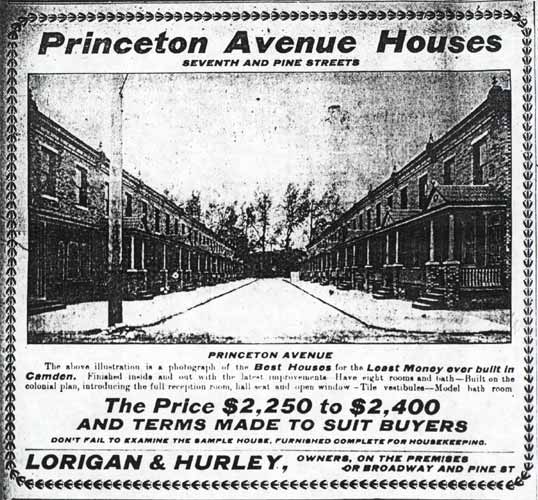
Princeton Avenue Houses – Seventh and Pine Streets – William Leonard Hurley – Princeton Avenue
Princeton Avenue Houses – Seventh and Pine Streets – Princeton Avenue
The above illustration is a photograph of the Best Houses for the Least Money ever built in Camden. Finished inside and out with the latest improvements. Have eight rooms and bath — Built on the colonial plan, introducing the full reception room, hall-seat and open window — Tile vestibules — Model bath room
The Price $2,250 to $2,400 — And Terms Made to Suit Buyers
Don’t Fail to Examine the Sample House, Furnished Complete for Housekeeping.
Lorigan & Hurley, Owners, on the Premises – or Broadway and Pine St
(news brief)
Philadelphia Inquirer —

William Leonard Hurley – North 8th Street – South 9th Street – Mechanic Street
Lorigan & Hurley yesterday took out a permit for the erection of a row of nine houses from 310 to 335 North Eighth street. A permit for nine dwellings on Ninth street south of Mechanic street, was also issued.
Reception for Admiral Henry B. Wilson
Philadelphia Inquirer —
Battle Flags Wave in Triumph O’er Parade Reviewed by Admiral
Gray Veterans of G. A. R. and Wounded Ride; Centopath Passes in Reverential Hush
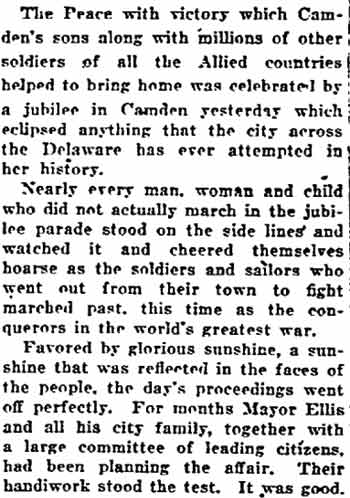
The Peace with victory which Camden’s sons along with millions of other soldiers of all the Allied countries helped to bring home was celebrated by a jubilee in Camden yesterday which eclipsed anything that the city across the Delaware has ever attempted in her history.
Nearly every man, woman and child who did not actually march in the jubilee parade stood on the side lines and watched it and cheered themselves hoarse as the soldiers and sailors who went out from their town to fight marched past, this time as the conquerors in the world’s greatest war.
Favored by glorious sunshine, a sunshine that was reflected in the faces of the people, the day’s proceedings went off perfectly. For months Mayor Ellis and all his city family, together with a large committee of leading citizens, had been planning the affair. Their handiwork stood the test. It was good.
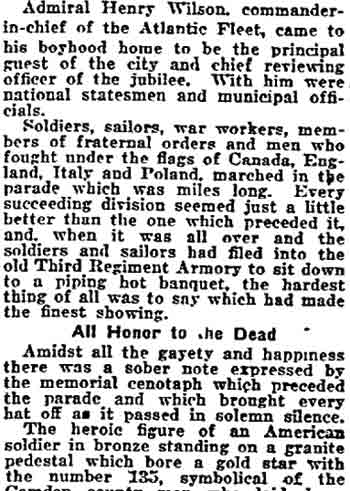
Admiral Henry Wilson, commander-in-chief of the Atlantic Fleet, came to his boyhood home to be the principal guest of the city and chief reviewing officer of the jubilee. With him were national statesmen and municipal officials.
Soldiers, sailors, war workers, members of fraternal orders and men who fought under the flags of Canada, England, Italy and Poland, marched in the parade which was miles long. Every succeeding division seemed just a little better than the one which preceded it, and, when it was all over and the soldiers and sailors had filed into the old Third Regiment Armory to sit down to a piping hot banquet, the hardest thing of all was to say which had made the finest showing.
All Honor to the Dead
Amidst all the gayety and happiness there was a sober note expressed by the memorial cenotaph which preceded the parade and which brought every hat off as it passed in solemn silence.
The heroic figure of an American soldier in bronze standing on a granite pedestal which bore a gold star with the number 135, symbolical of the Camden county men who laid down their lives in their country’s cause, was carried along the route ten minutes before the parade commenced. Encircler [sic] by flowers and palms, it moved through the reverential hush which had fallen over the throngs.
While every organization in the county of Philadelphia was represented in the parade, to the thousands who lined the sidewalks, there was really only one great big important factor—the service men. And when those self-same service men, many of whom bearing the Distinguished Service Cross of their own United States, others wearing the Croix de Guerre, bestowed on them by the sister republic of France, and still others carrying on their breasts the Italian and British War Crosses, given them by grateful countries, marched down the streets and avenues, all the pent up emotion in thousands of hearts was let loose.
It mattered not whether the men were officers or enlisted men, black or white, neat or untidy, they were all soldiers and they had done all that was asked of them. Their home town honored them. The men in blue and the women in blue, too, received a welcome not one whit less feeling than their brothers in khaki.
They had a certain advantage over the doughboys, for they put half a dozen of the prettiest and smartest yoemanettes that ever wore Uncle Sam’s uniform at the head of their division. The crowd simply had to be with them.
Canada and England, too, had a detachment of men in line. About two dozen of these veterans, half of whom wore the ribbon of the Mons Star, showing that they were in service in France in 1914, were in line, and they marched snappily and smartly and drew their full modicum of pleasurable comments.
Red Cross women, some of them grandmothers, others young girls still in their teens, marched in their snowy white uniforms with their crosses of red emblazoned on headcover and breast. Salvation Army lassies who had cooked doughnuts right up under the muzzles of the guns were there with Y. M. C. A. and Knights of Columbus workers.
Elks, Masons, Knights Templar, Red Men, Moose and scores of other fraternal organizations turned out in all their glorious trappings and regalia.
The delegation of Elks, startling in their spic and span white uniforms, marched behind their own band like squads of veterans. A foretaste of what Philadelphia will see during the coming week was given when more than 100 Knights Templar, resplendent in their uniforms and swords and cocked hats with white ostrich feathers, marched in the second division of the parade. As the formation reached the reviewing stand near the Ninth Ward Republican Association they deployed into the formation of a cross, the symbol of their order, and marched past in this formation.
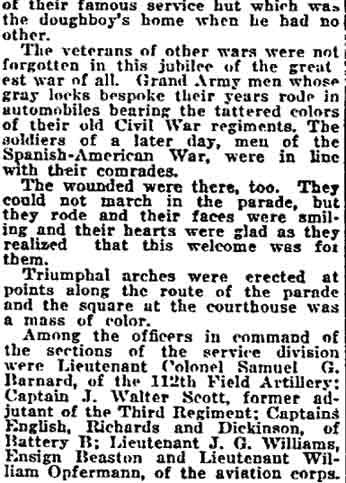
Many gorgeous floats were in line, th Ninth Ward Republican Association having no less than five. All were artistic. The first was bedecked with growing flowers, while a beautiful young woman reprsenting “Peace” stood flanked by a soldier and sailor. The one following had a replica of the Liberty Bell with the inscription, “Peace on Earth, Good Will Towards men.” Two soldiers rang the bell. Behind them marched a band playing “Onward Christian Soldiers” as the men marched on. Floats symbolical of every war activity were there. The Knights of Columbus showed a replica of their famous service hut which was the doughboy’s home when he had no other.
The veterans of other wars were not forgotten in this jubilee of the greatest war of all. Grand Army men whose gray locks bespoke their years rode in automobiles bearing the tattered colors of their old Civil War regiments. The soldiers of a later day, men of the Spanish-American War, were in line with their comrades.
The wounded were there, too. They could not march in the parade, but they rode and their faces were smiling and their hearts were glad as they realized that this welcome was for them.
Triumphal arches were erected at points along the route of the parade and the square at the courthouse was a mass of color.
Among the officers in command of the sections of the service division were Lieutenant Colonel Samuel G. Barnard, of the 112th Field Artillery; Captain J. Walter Scott, former adjutant of the Third Regiment; Captains English, Richards and Dickinson, of Battery B; Lieutenant J. G. Williams, Ensign Beaston and Lieutenant William Opfermann, of the aviation corps.
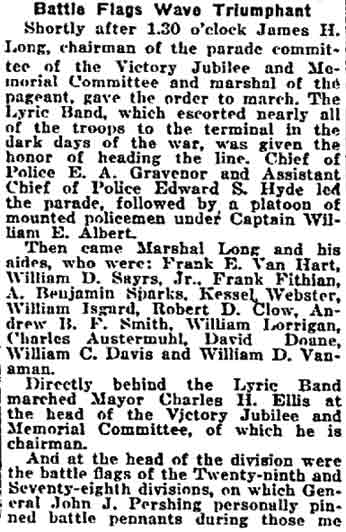
Battle Flags Wave Triumphant
Shortly after 1.30 o’clock James H. Long, chairman of the parade committee of the Victory Jubilee and Memorial Committee and marshal of the pageant, gave the order to march. The Lyric Band, which escorted nearly all of the troops to the terminal in the dark days of the war, was given the honor of heading the line. Chief of Police E. A. Gravenor and Assistant Chief of Police Edward S. Hyde led the parade, followed by a platoon of mounted policemen under Captain William E. Albert.
Then came Marshal Long and his aides, who were: Frank E. Van Hart, William D. Sayrs, Jr., Frank Fithian, A. Benjamin Sparks, Kessel Webster, William Isgard, Robert D. Clow, Andrew B. F. Smith, William Lorrigan, Charles Austermuhl, David Doane, William C. Davis and William D. Vanaman.
Directly behind the Lyric Band marched Mayor Charles H. Ellis at the head of the Victory Jubilee and Memorial Committee, of which he is chairman.
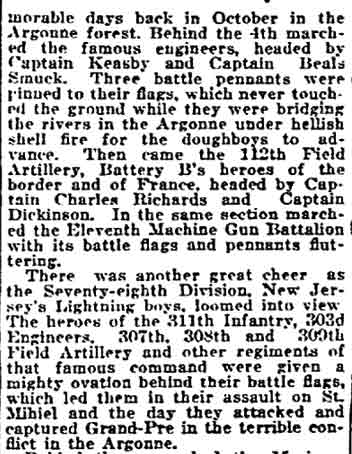
And at the head of the division were the battle flags of the Twenty-ninth and Seventy-eighth divisions, on which General John J. Pershing personally pinned battle pennants during those memorable days back in October in the Argonne forest. Behind the 4th marched the famous engineers, headed by Captain Keasby and Captain Beals Smuck. Three battle pennants were pinned to their flags, which never touched the ground while they were bridging the rivers in the Argonne under hellish shell fire for the doughboys to advance. Then came the 112th Field Artillery, Battery B’s heroes of the border and of France, headed by Captain Charles Richards and Captain Dickinson. In the same section marched the Eleventh Machine Gun Battalion with its battle flags and pennants fluttering.
There was another great cheer as the Seventy-eighth Division, New Jersey’s Lightning boys, loomed into view. The heroes of the 311th Infantry, 303d Engineers, 307th, 308th and 309th Field Artillery and other regiments of that famous command were given a mighty ovation behind their battle flags, which led them in their assault on St. Mihiel and the day they attacked and captured Grand-Pre in the terrible conflict in the Argonne.
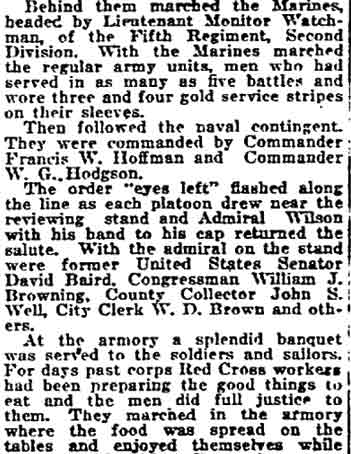
Behind them marched the Marines, headed by Lieutenant Monitor Watchman, of the Fifth Regiment, Second Division. With the Marines marched the regular army units, men who had served in as many as five battles and wore three and four gold service stripes on their sleeves.
Then followed the naval contingent. They were commanded by Commander Francis W. Hoffman and Commander W. G. Hodgson.
The order “eyes left” flashed along the line as each platoon drew near the reviewing stand and Admiral Wilson with his band to his cap returned the salute. With the admiral on the stand were former United States Senator David Baird, Congressman William J. Browning, County Collector John S. Well, City Clerk W. D. Brown and others.
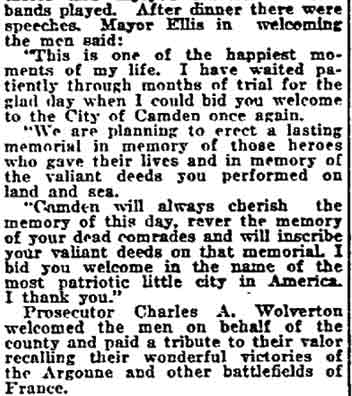
At the armory a splendid banquet was served to the soldiers and sailors. For days past corps Red Cross workers had been preparing the good things to eat and the men did full justice to them. They marched in the armory where the food was spread on the tables and enjoyed themselves while bands played. After dinner there were speeches. Mayor Ellis in welcoming the men said:
“This is one of the happiest moments of my life. I have waited patiently through months of trial for the glad day when I could bid you welcome to the City of Camden once again.
“We are planning to erect a lasting memorial in memory of those heroes who gave their lives and in memory of the valiant deeds you performed on land and sea.
“Camden will always cherish the memory of this day, rever the memory of your dead comrades and will inscribe your valiant deeds on that memorial. I bid you welcome in the name of the most patriotic little city in America. I thank you.”
Prosecutor Charles A. Wolverton welcomed the men on behalf of the county and paid a tribute to their valor recalling their wonderful victories of the Argonne and other battlefields of France.
Events at the Church of the Immaculate Conception
Camden Post-Telegram —
Story by Mr. Daniel P. McConnell, of the Camden Post Telegram, for Wednesday, March 18, 1920
Echoes
Camden last night gave a splendid welcome to the Very Rev. Dean William J. Fitzgerald, J. c. D., M. R. V. F., the new pastor of the Church of the Immaculate Conception and Dean of the South Jersey Catholic parishes.
Citizens of other faiths, judges, doctors, lawyers and those in more humble stations of life, rubbed elbows in the vast audience that packed to capacity the Catholic Lyceum. All were present for a common purpose— to honor the new prelate, who comes to Camden with a splendid reputation as a Christian gentleman, patriot and ambassador of the Catholic Church.
At the reception in the Lyceum, former Judge William T. Boyle presided. He in turn introduced Rev. Francis J. McCallion, who was acting pastor of the parish. Father McCallion was given a wonderful reception after Judge Boyle extolled his oratorical and executive ability. In a splendid speech Father McCallion paid a glowing tribute to Dean Fitzgerald, the subject of the evening’s testimonial.
James F. Lennon was the principal speaker for the occasion. Already famed for his ability as an orator, Mr. Lennon probably gave his best talk last night. It was a tribute to the new Dean and the members of the Catholic clergy and Sisters of Mercy.
In his remarks Mr. Lennon told of the duties of a priest, of his mission and his value to the community. To the good sisters a glowing tribute was also paid by the speaker. Mr. Lennon also lauded the public school system and explained the principles of the parochial school. His reference to the 312 Immaculate Conception members who fought in the war for Democracy evoked a storm of applause. To the late and lamented Monsignor Mulligan Mr. Lennon offered a deserved tribute. In the course of his address the speaker told of the early struggles of the founders of the Immaculate parish. His description of the good old Irish mothers and fathers who erected a monument to Catholicism at Broadway and Market street struck a happy chord.
Turning to Dean Fitzgerald Mr. Lennon extended to him a warm welcome after which he presented the pastor with a large basket of beautiful flowers, a gift of the ladies of the parish.
Mayor Charles H. Ellis was warmly received and in a splendid talk the city’s chief executive turned over the keys of the city. The Mayor’s talk was punctuated with witty remarks concerning the “suburb of Philadelphia.”
The Mayor said that the great day had arrived when religious strife was no more and creeds were united for one common cause.
With much feeling Dean Fitzgerald told of his appreciation of the great honor. He was visibly affected by the testimonial, but modestly stated that he considered it not only a reception to him, but to the members of the Catholic clergy.
Dean Fitzgerald assured all that he was glad to come to Camden and he asked the hearty co-operation of his parishioners. He turned and gazed over the members of the reception committee seated on the stage and told how happy he was that men like former Senator Baird, County Clerk Patterson, Mayor Ellis and other big men of the city and county were present to do him honor.
After the reception in the Lyceum Dean Fitzgerald adjourned to the parlor of the Lyceum where he met members of the parish and other friends. He stood under a canopy of flowers and colored electric lights.
The guard of honor was comprised of fifty-fourth degree Knights of Columbus. Three hundred members of the parish formed the honorary escort from the train terminal to the rectory.
Unable to be present, because of previous engagements, Rev. Leon K. Willman, pastor of the Broadway M. E. Church, and Rev. Edwin F. Hann, of First M. E. Church, sent letters of regret in which they wished the new pastor success in his new fields of labor.
Success of last night’s eventful occasion can be attributed to Rev. Francis J. McCallion, who directed the affair. He was ably assisted by Edward Clare, George Slake, George Burke, Cornelius J. Healy, James McGowan, Hugh Pattie, Michael Quinn, Robert A. Stack and James Wren.
This morning the church reception was held with a solemn high mass, which was sung by Dean Fitzgerald. Father Whelan was deacon, Father Hennig, sub-deacon, and Father Shay, master of ceremonies. Father McCallion delivered a splendid sermon for the occasion and the singing of the altar boys was very fine. William J. Lorigan presided at the organ.
Children of the parish this afternoon tendered a reception to the new pastor. The altar boys will present Dean Fitzgerald with an enlarged and framed likeness of himself.
Inquest Set Today in Gambling Death
Camden Courier-Post —
Jury List Prepared for Coroner’s Action in Holdup Fatality
The coroner’s inquest to decide the cause of death to Angelos Magalas, Greek chef, who was shot during a card game holdup at 725 Penn Street on January 11, will be held today at 10 a. m.
Coroner Franklin P. Jackson III, of Collingswood, will conduct the inquest and will select his jury of 12 from a list of 15 persons prepared by the office of County Prosecutor Samuel P. Orlando.
Detectives already have subpoenaed 20 witnesses for questioning at the inquest, including players who were the victims in the holdup and three Camden physicians who attended Magalas prior to his death.
The witnesses will include Samuel and Mabel Ermilios, tenants of the Penn Street house where the holdup occurred; George and Annette Mastros, who room at the house; Samuel Bosco, Broadway barber; George Summers, Ross Pantel, Michael D’Andrea, and William Caras, who according to police were participants in the card game.
All of the men were held as material witnesses in the shooting when arraigned today before Police Judge Gene R. Mariano.
Doctors to Testify
Other witnesses will include Dr. Paul Mecray, Dr. A. S. Ross and Dr. Edwin R. Ristine and Miss Sophia MacAfee, a Cooper Hospital nurse. Police who will testify include Detectives Thomas Murphy, Harry Kyler and William Boettcher and Patrolmen Richard Powers, Frank Clements, George Nicktern and Sergeant Jack Deith.
The jury will be selected from Guy Clokey, Collingswood; Lawrence Ball, Haddonfield; Howard Friant, Collingswood; Harry Chew, Collingswood; Sig Schoenagle, Camden merchant; Raymond Hanly, real estate broker; Benjamin Brest, Raymond Worrel, John Eby, all of Camden; William H. Lorigan, Merchantville; David B. Robinson, Collingswood; Rev. James Pemberton and John McGowan, of Camden, Earl Jackson, of Collingswood and Morris B. Clark, of Haddonfield.
Coroner Jackson refused to give a certificate of death until the chemical test of Magalas’ brain was made by Philadelphia experts. The result will not be revealed until the inquest.
Assistant Prosecutor Isaac Eason and County Physician David S. Rhone gave it as their opinion that Malagas died of natural causes rather than the bullet wound. Coroner Jackson then ordered an inquest to be held.
Police are searching for Frank Luggi, 21, of 322 Penn Street, who they say was one of the holdup bandits and the one who fired the bullet that struck Magalas.
The last coroner’s inquest held in Camden county was in 1933, in the death of Thomas Timothy Sullivan, and previous to that none had been held here in 25 years.
Sullivan was 57 years old and lived at 401 State Street. He was employed as a detective by the Pennsylvania Railroad. He was found shot to death in a shack in the rail road yards on August 28, 1933.
At that time, County Physician Edward B. Rogers issued a certificate of death that Sullivan had committed suicide. The decision of the county physician enraged members of Sullivan’s family and they demanded an inquest.
The inquest was ordered by then Coroner Arthur H. Holl, who presided. All the evidence in the case was presented to the jury of 12 men, and after deliberating for less than an hour, they returned a verdict that Sullivan had been murdered by persons unknown.
Under state law, the county physician may order an inquest; with 12 persons on the jury of the coroner’s choosing. The jurymen may be taken from the present panel of the petit jury or be picked at random. The Grand Jury does not have to indict on the basis of the inquest. At the inquest Coroner Jackson will be assisted by attaches of the prosecutor’s office.
Malagas, the father of three children, lived at 1110 Langham Avenue. He was shot when several armed bandits held up a card game and he died several days later.