George Horner
GEORGE W. HORNER was born in New Jersey in November of 1847 to Thomas and Lizzie Horner. The date, derived from the 1900 Census, is in question; other censuses have him younger, the 1920 Census has him being three years older.
The 1860 Census shows the Horner family, which included a younger sister, Laura, living in Camden’s Middle Ward. The family lived three doors away from tobacconist Abner B. Sparks, whose son David Sparks was the same age as George Horner. The two would be appointed to the Camden Fire Department within a month of each other in 1872 and would serve side-by-side as extra men with the Hook and Ladder Company, known more recently as Ladder Company 1, for several years.
The 1870 Census shows that George Horner and his family were living in Camden’s North Ward. George Horner was single and working selling lightning rods, a business he would return to in the late 1870s.
George Horner was living at 731 Federal Street and working as a packer, when, on May 8, 1872 he was appointed to the Camden Fire Department, as a Driver with the Hook and Ladder Company, known more recently as Ladder Company 1, replacing Charles Elfreth, who had been discharged. In October of 1872 he was made an extra man with the same Company, and continued in that capacity until the April of 1877. He had started a lightning rod business.
George Horner was still living at 731 Federal Street, with his parents, sister Laura, brother-in-law Daniel A. Carter and their children Mabel and Frank when the census was taken in 1880. Daniel A. Carter was elected Chief of the Camden Fire Department in 1882. George Horner, however, did not return to the Fire Department. Instead, he was made a policeman, a career he followed well into the 1910s.
The 1887 and 1888 Camden City Directories both show George W. Horner at 733 Federal Street. By 1894 he had moved to 737 Federal Street. The 1900 Census shows George Horner still at 737 Federal Street with widowed mother, sister Laura and her husband Daniel A. Carter and their children. Laura and Daniel Carter separated in the early 1900s. George Horner and his sister and her children were still at 737 Federal Street as late as 1906. By 1910 George Horner had moved to 109 North 8th Street, with his sister Laura and niece Laura V. Carter. He was still a policeman.
On February 26, 1912 veteran police officers George Horner, William Harvey, and Benjamin Middleton retired from active service with the Camden Police Department.
The 1914 Camden City Directory states that George Horner was now a “Special Officer,” although, as stated above, he had long since retired as a regular member of the Camden Police Department. He was living at 432 Lawrence Street, and apparently had finally married. The 1920 Census shows George and Amanda A. Horner at 432 Lawrence Street with Amanda’s son from a previous marriage, William L.S. Allen. George Horner appears to have finally retired. He passed away on September 24, 1920. His widow was still at the Lawrence Street address in 1924.
Camden and Vicinity
Philadelphia Inquirer —
TOKEN OF ESTEEM.
Yesterday afternoon Robert S. Bender, the retiring chief marshal of the Camden Paid Fire Department, and William Shearman, assistant marshal, were made the recipients of handsome presents by E. J. Dodamead, B. L. Kellum, H. Grosscup, William Davis, A. Doughty and George Horner, the regular members. Mr. Bender received a large and elaborately arranged cake and Mr. Shearman a fine frame, containing photographs of all those belonging to and the names of all the men held for them while under their direction.
CAMDEN AND VICINITY.
HOUSE OF CORRECTION.
Whereas, It has been made manifest to the grand jurors of Camden county that there is a defect in our present system of imprisoning persons convicted of petty offences, and that it is a grievance to fall upon the tax-payers without any adequate good being gained in the reformation of such persons. Therefore, it is the recommendation of this grand inquest, in view of such reformation and to lessen the present extraordinary expense of maintaining the jail, that a workhouse be established, into which all persons convicted of such petty offences shall be detained, under proper board or department, and compelled to labor during their term of imprisonment, the proceeds of such labor to be paid into the treasury of the county. We believe that besides proper amusement, such an institution would be conducive to the future benefit of such persons, as well as to the entire community.
THE COURTS.
In the Camden Quarter Sessions yesterday quite an important civil case came up, which will probably be appealed to a higher court. It is an action brought by the city of Camden against the bondmen of C. Sloan, who, some five years ago, was collector of taxes for North Ward. The defendants in this suit, Henry Fredericks, Caleb Roberts, and others, became sureties on Mr. Sloan's bond, and, while he was Sloan was collector, there occurred a deficit in his accounts, making him debtor to the city in a sum reaching nearly $1000. The city holds that these gentlemen are bound to pay the deficit; but the defendants allege that after the irregularity was discovered they took the necessary steps to relieve them from any responsibility in the matter. The case is attracting much interest, as it is thought to be a test for others that may be commenced.
TOKEN OF ESTEEM.
Yesterday afternoon Robert S. Bender, the retiring chief marshal of the Camden Paid Fire Department, and William Shearman, assistant marshal, were made the recipients of handsome presents by E. J. Dodamead, B. L. Kellum, H. Grosscup, William Davis, A. Doughty and George Horner, the regular members. Mr. Bender received a large and elaborately arranged cake and Mr. Shearman a fine frame, containing photographs of all those belonging to and the names of all the men held for them while under their direction.
ROBBERY ON A VESSEL.
Some time during Sunday night two colored men on board a vessel lying at the wharf, near Kaighn's Point, were robbed, while asleep, of all their clothing, their watches and other articles. Two other men employed on the vessel, and who are now missing, are suspected.
RESIGNED.
Yesterday all the regular members of Engine No. 2, belonging to the Paid Fire Department, of Camden, resigned. Their places will be supplied by appointments from the Board of Fire Commissioners.
SLUNG SHOTS.
The police officers have been instructed to arrest all boys found shooting stones in the streets of Camden with slung shots, in consequence of the numerous windows broken by them. Several persons have also been quite severely hurt by them.
(Camden and Vicinity)
Philadelphia Inquirer —
As the police of Camden were leaving the city prison last evening for night duty, word was telephoned for a detail to meet the Atlantic City Express. The entire upper squad immediately repaired to the station at Haddon avenue, where they were instructed by the conductor to arrest a passenger who had refused to pay his fare. Four officers took charge of the young man, two of them placing “nippers” on his wrists, while the other two went behind “to push.” The quartette were soon joined by three brother “cops,” who also helped to push the prisoner along. Officer Horner, who held the young man’s left hand, objected to the pushing process, but without avail. When the party got within forty feet of the prison door the prisoner showed signs of resistance. Then one of the officers in the rear raised his loaded cane and struck the unfortunate young man. Another officer, in striking at the prisoner, missed his aim and brought the blackjack down on the head of the officer, Winfield Kelley, who held the prisoner’s right arm, making that officer see more stars than adorned the lappels of his brethren. When the prisoner reached the jail and was placed in a cell his clothes were saturated with blood and a stream was trickling down the left side of his face. He gave his name as William Hurley, and stated that he accompanied an excursion to Atlantic City from Baltimore and Washington, his residence being at the latter place. He had a return ticket from Atlantic City to Washington, D.C., but chanced to get on the express, which left a few minutes before the excursion. The conductor charged that he had assaulted Brakeman Lewallen on the train.
(Camden and Vicinity)
As the police of Camden were leaving the city prison last evening for night duty, word was telephoned for a detail to meet the Atlantic City Express. The entire upper squad immediately repaired to the station at Haddon avenue, where they were instructed by the conductor to arrest a passenger who had refused to pay his fare. Four officers took charge of the young man, two of them placing "nippers" on his wrists, while the other two went behind "to push." The quartette were soon joined by three brother "cops," who also helped to push the prisoner along. Officer Horner, who held the young man's left hand, objected to the pushing process, but without avail. When the party got within forty feet of the prison door the prisoner showed signs of resistance. Then one of the officers in the rear raised his loaded cane and struck the unfortunate young man. Another officer, in striking at the prisoner, missed his aim and brought the blackjack down on the head of the officer, Winfield Kelley, who held the prisoner's right arm, making that officer see more stars than adorned the lappels of his brethren. When the prisoner reached the jail and was placed in a cell his clothes were saturated with blood and a stream was trickling down the left side of his face. He gave his name as William Hurley, and stated that he accompanied an excursion to Atlantic City from Baltimore and Washington, his residence being at the latter place. He had a return ticket from Atlantic City to Washington, D.C., but chanced to get on the express, which left a few minutes before the excursion. The conductor charged that he had assaulted Brakeman Lewallen on the train.
Both Found Guilty
Camden Post —
Stratton and Mellon Convicted as Charged.
Bare Escape from Murder.
The Dastardly Assault on Joseph Logue and His Female Companion—The Defendants’ Injurious Admissions.
John H. Stratton and Henry Mellon were last night found guilty of the dastardly attack upon Joseph Logue and his female companion, in which Logue came near being the victim of a murderer. At the close of The Post’s report yesterday afternoon Stratton was on the stand in his own behalf. He denied seeing Logue and the young woman. He denied that he attacked any one. He denied having a black jack or a knife. He denied, in fact, pretty much everything that came his way. He said he had a wife and four children, and was 27 years old yesterday.
Under cross-examination Stratton admitted that he had frequently met Mellon at Starr’s crossing in the evening. On Saturday night previous to the assault they were together on the lots. “When I got there,” he went on, “Mrs. Hyatt, who was there, said to me, ‘You will put a mark on the wall because I had come in so early.’”
“What time did Mellon come there?” asked Mr. Jenkins.
“About half past nine.”
“And you had left him at Broadway and Pine, at about eight fifteen?”
“Yes, sir.”
“What did he come for?”
“I don’t know.”
“Didn’t he ask for you?”
“Yes, sir.”
“What did he say?”
“When he saw that I had my shoes off he said, ‘O, never mind.’”
Mr. Jenkins thought it necessary to indict by Stratton a note sent him by Mellon while the two were in jail, but Stratton refused to look at it.
Mellon, when called, said he was at Starr’s crossing on the night of Sunday, May 6th. He went there merely to take a walk. He told the same story as Stratton, without deviation.
The copy of a note written to Stratton by Mellon, in which the latter tells Stratton how he remembers a note (referring to the sewer watchman) was ten feet away when I handed you the knife, was then declared by the court to be a copy and not the original, and therefore could not be admitted in evidence because it was not properly proved. Mellon denied writing the note.
John Wagner testified that he left the Catholic church at 8:20 on the night of the assault and walked to his house on Going street, ten minutes and that one of the defense witnesses was there at that time.
Mrs. Stratton, the wife of one of the defendants, said on her husband’s behalf that on that Sunday night at about 8:30. “When he went out,” she said, “he said he would not be back long.” He was gone about three hours. Mrs. Hyatt said, “Why, John, it’s only half-past eight; you’re in early,” and she put a mark on the wall.
Hyatt, who jointly occupies the house with Stratton, testified that he came home at 8:20.
“Did you look at the clock?” asked Mr. Jenkins.
“A three dollar and a half clock.”
“Is it an alarm clock?”
“Yes.”
“How often do you set it?”
“Every night.”
“What; every night?”
“Oh, I don’t mean set it; I mean wind it.”
“Has it ever run down?”
“No.”
“What did you do when you moved, let it run on?”
“Yes, sir; it runs laying down or setting up.”
“What a wonderful clock; I think I’ll have to get one.”
This closed the case for the defense and Policeman Jacob Danks was called to rebut a statement by Mellon that he had never worn what looked like a policeman’s star. After some spirited sparring Officer Hone swore that he saw Mellon wear a star in Diamond Cottage Grove last summer.
William Mellon, a brother of Henry Mellon on the lots opposite the city hall, one night last summer about 8:30. “I was taking a walk with a young lady out there. Mellon came up to me and touched me and said he was going to take me to the city hall. He also took hold of the lady.” He was not cross-examined.
Harry Danks, a pimply faced young man, who acts as “runner” about the jail, was called to rebut Mellon, who denied having written a note to Stratton.
“Mellon gave me a note this morning to deliver to Stratton,” said Danks. “I don’t know what it contained.” The note shown by Prosecutor Jenkins was the one in question but it was not in an envelope.
Jailor David Logue, a brother of the injured man, testified that he received the note from Danks, as keeper of the jail. He told to copy it. Swindell testified that the copy shown by Prosecutor Jenkins was the one he had made of it. All of the testimony for the defense was then in.
Argument of counsel were begun at 4:30 and the jury did not retire until after 6. At nine o'clock the jury returned with a verdict of guilty as charged in the indictment.
During the progress of the trial counsel for the defense made a total of a hundred exceptions to Judge Hugg’s rulings and they will probably carry the case to the Supreme Court.

BOTH FOUND GUILTY
Stratton and Mellon Convicted as Charged.
BARE ESCAPE FROM MURDER.
The Dastardly Assault on Joseph Logue and His Female Companion—The Defendants’ Injurious Admissions.
John H. Stratton and Henry Mellon were last night found guilty of the dastardly attack upon Joseph Logue and his female companion, in which Logue came near being the victim of a murderer. At the close of The Post’s report yesterday afternoon Stratton was on the stand in his own behalf. He denied seeing Logue and the young woman. He denied that he attacked any one. He denied having a black jack or a knife. He denied, in fact, pretty much everything that came his way. He said he had a wife and four children, and was 27 years old yesterday.
Under cross-examination Stratton admitted that he had frequently met Mellon at Starr’s crossing in the evening. On Saturday night previous to the assault they were together on the lots. “When I got there,” he went on, “Mrs. Hyatt, who was there, said to me, ’You will put a mark on the wall because I had come in so early.’”
“What time did Mellon come there?” asked Mr. Jenkins.
“About half past nine.”
“And you had left him at Broadway and Pine, at about eight fifteen?”
“Yes, sir.”
“What did he come for?”
“I don’t know.”
“Didn’t he ask for you?”
“Yes, sir.”
“What did he say?”
“When he saw that I had my shoes off he said, ’O, never mind.’”
Mr. Jenkins thought it necessary to indict by Stratton a note sent him by Mellon while the two were in jail, but Stratton refused to look at it.
Mellon, when called, said he was at Starr’s crossing on the night of Sunday, May 6th. He went there merely to take a walk. He told the same story as Stratton, without deviation.
The copy of a note written to Stratton by Mellon, in which the latter tells Stratton how he remembers a note (referring to the sewer watchman) was ten feet away when I handed you the knife, was then declared by the court to be a copy and not the original, and therefore could not be admitted in evidence because it was not properly proved. Mellon denied writing the note.
John Wagner testified that he left the Catholic church at 8:20 on the night of the assault and walked to his house on Going street, ten minutes and that one of the defense witnesses was there at that time.
Mrs. Stratton, the wife of one of the defendants, said on her husband’s behalf that on that Sunday night at about 8:30. “When he went out,” she said, “he said he would not be back long.” He was gone about three hours. Mrs. Hyatt said, “Why, John, it’s only half-past eight; you’re in early,” and she put a mark on the wall.
Hyatt, who jointly occupies the house with Stratton, testified that he came home at 8:20.
“Did you look at the clock?” asked Mr. Jenkins.
“A three dollar and a half clock.”
“Is it an alarm clock?”
“Yes.”
“How often do you set it?”
“Every night.”
“What; every night?”
“Oh, I don’t mean set it; I mean wind it.”
“Has it ever run down?”
“No.”
“What did you do when you moved, let it run on?”
“Yes, sir; it runs laying down or setting up.”
“What a wonderful clock; I think I’ll have to get one.”
This closed the case for the defense and Policeman Jacob Danks was called to rebut a statement by Mellon that he had never worn what looked like a policeman’s star. After some spirited sparring Officer Hone swore that he saw Mellon wear a star in Diamond Cottage Grove last summer.
William Mellon, a brother of Henry Mellon on the lots opposite the city hall, one night last summer about 8:30. “I was taking a walk with a young lady out there. Mellon came up to me and touched me and said he was going to take me to the city hall. He also took hold of the lady.” He was not cross-examined.
Harry Danks, a pimply faced young man, who acts as “runner” about the jail, was called to rebut Mellon, who denied having written a note to Stratton.
“Mellon gave me a note this morning to deliver to Stratton,” said Danks. “I don’t know what it contained.” The note shown by Prosecutor Jenkins was the one in question but it was not in an envelope.
Jailor David Logue, a brother of the injured man, testified that he received the note from Danks, as keeper of the jail. He told to copy it. Swindell testified that the copy shown by Prosecutor Jenkins was the one he had made of it. All of the testimony for the defense was then in.
Argument of counsel were begun at 4:30 and the jury did not retire until after 6. At nine o’clock the jury returned with a verdict of guilty as charged in the indictment.
During the progress of the trial counsel for the defense made a total of a hundred exceptions to Judge Hugg’s rulings and they will probably carry the case to the Supreme Court.
A Camden Den Raided
Philadelphia Inquirer —
Plenty of Liquor and a Faro Lay-Out Secured by the Police.
A Murderous Negro Creates a Commotion—Incendiaries at Work—Other News Across the Delaware.
The Camden police made another raid early yesterday morning. About 1 o’clock a detail consisting of Officers Pederick, Lee, Anderson, Horner, Baker and Chief Dodd raided a “speakeasy” and gambling den in a boathouse at the end of North Second street. When the policemen arrived a quiet game of faro was in progress in the second story.
The proprietor, William Parker, Maurice Hinchman, Charles Mead and Mabel Gray were captured inside and placed under arrest. Sixteen boxes of beer, three gallons of whisky and a home-made faro lay-out were also secured. All of those interested were released yesterday but Parker, who was held on the charge of keeping a disorderly house and selling liquor without a license.
A funny incident occurred after the raid had been made while the patrol wagon was making its first trip to the City Hall previous to the removal of the liquor and gambling implements. Officer Pederick was left behind to watch the place. The policeman had only been on guard about ten minutes when a gang of men came in and called for a drink. “I can’t sell you anything,” said Pederick. “Why, I always get a drink here.” “I got no license,” answered the officer. “Well never mind,” said the man. “I guess we got the ‘boss’ just the same,” said one of the would-be purchasers. Pederick took back the last remark and showed them his star. The thirsty men made hasty retreat.

Plenty of Liquor and a Faro Lay-Out Secured by the Police.
A Murderous Negro Creates a Commotion—Incendiaries at Work—Other News Across the Delaware.
The Camden police made another raid early yesterday morning. About 1 o'clock a detail consisting of Officers Pederick, Lee, Anderson, Horner, Baker and Chief Dodd raided a "speakeasy" and gambling den in a boathouse at the end of North Second street. When the policemen arrived a quiet game of faro was in progress in the second story.
The proprietor, William Parker, Maurice Hinchman, Charles Mead and Mabel Gray were captured and taken to the City Hall. Sixteen boxes of beer, three gallons of whisky and a home-made faro lay-out were also captured. All of the men arrested were released yesterday but Parker, who was held on the charge of keeping a disorderly house and selling liquor without a license.
A funny incident occurred after the raid had been made while the patrol wagon was making its first trip to the City Hall previous to the removal of the liquor and gambling implements. Officer Pederick was left behind to watch the place. The policeman had only been on guard a few moments when a gang of men came in and called for a drink. "I can't sell you anything," said Pederick. "Why?" asked one of the thirsty men. "I got no license," answered the officer. "That's all right; Billy had no license, but we got the 'booz' just the same," said one of the would-be purchasers. Pederick pulled back the flap of his coat and showed them his star. The thirsty men made a hasty retreat.
Rained Blows on Her Rival's Face
Philadelphia Inquirer —
Mrs. Shields Wielded a Cowhide in a Vigorous Manner.
Then She Read a Letter and the Crowd Cheered.
Explanations Were Made in the Police Court—Hill, the Youthful Murderer, Will Now Surely Be Hanged—Other News of the State.
Pedestrians in the vicinity of Tenth and Penn streets, Camden, yesterday might say saw a woman who was raining blows with a cowhide over the head and face of another woman, who made frantic efforts to ward off the punishment.
THE CROWD CHEERED.
A crowd collected and cheered the whip wielder when she explained that she had been deserted by her husband, who went to live with the woman she whipped. She lushed from her pocket and read a letter which opened with “My dearest Clara,” and filled with dearing words how much the writer loved him.
Policeman George Horner put an end to the scene by sending both women to the City Hall.
The whip wielder gave her name as Mrs. Mary Shields, of 1035 Frankford street, Philadelphia. She was charged with assault by Mrs. Eliza Clark, who lives at 320 Chester street, Camden, and who tearfully exhibited several welts across her face, where the whip had stung her.
SHE SOUGHT REVENGE.
Mrs. Shields said her husband had deserted her and gone to live with Mrs. Clark. She had come to Camden a day or so later last Friday and warned her not to harbor the deserter Benedict. Yesterday she went to Camden, armed with a whip and made good use of the weapon when she met Mrs. Clark.
Mrs. Shields held in her hand two photographs of her husband and a letter written by Mrs. Clark arranging to meet him at Sixth and Race streets, Philadelphia.
Mrs. Clark said her assailant’s husband was merely a boarder and there was no occasion for the assault. Justice Paul held Mrs. Shields in $200 bail.
Rained Blows on Her Rival's Face
NEW JERSEY NEWS
RAINED BLOWS ON HER RIVAL'S FACE
Mrs. Shields Wielded a Cowhide in a Vigorous Manner.
Then She Read a Letter and the Crowd Cheered.
Explanations Were Made in the Police Court—Hill, the Youthful Murderer, Will Now Surely Be Hanged—Other News of the State.
Pedestrians in the vicinity of Tenth and Penn streets, Camden, yesterday might say saw a woman who was raining blows with a cowhide over the head and face of another woman, who made frantic efforts to ward off the punishment—Other News of the State.
THE CROWD CHEERED.
A crowd collected and cheered the whip wielder when she explained that she had been deserted by her husband, who went to live with the woman she whipped. She lushed from her pocket and read a letter which opened with "My dearest Clara," and filled with dearing words how much the writer loved him.
Policeman George Horner put an end to the scene by sending both women to the City Hall.
The whip wielder gave her name as Mrs. Mary Shields, of 1035 Frankford street, Philadelphia. She was charged with assault by Mrs. Eliza Clark, who lives at 320 Chester street, Camden, and who tearfully exhibited several welts across her face, where the whip had stung her.
SHE SOUGHT REVENGE.
Mrs. Shields said her husband had deserted her and gone to live with Mrs. Clark. She had come to Camden a day or so later last Friday and warned her not to harbor the deserter Benedict. Yesterday she went to Camden, armed with a whip and made good use of the weapon when she met Mrs. Clark.
Mrs. Shields held in her hand two photographs of her husband and a letter written by Mrs. Clark arranging to meet him at Sixth and Race streets, Philadelphia.
Mrs. Clark said her assailant's husband was merely a boarder and there was no occasion for the assault. Justice Paul held Mrs. Shields in $200 bail.
The Mayor's Appointments
Camden Daily Telegram —
He Announced Several This Week.
Commissioners of Instruction.
The Old Members Re-Instated With the Exception of the Member From the Seventh Ward—Police Appointments and Resignations.
Mayor Wood made the following appointments as Commissioners of Instruction:
The following appointments were made: First Ward—George D. Borton, of the First Ward; Charles H. Ellis, Jr., of the Sixth ward, and John L. Westcott, of the Third ward.
The following appointments were made on the police force:
First Ward—James Elberson, Charles Wilbur, Samuel H. Sheer.
Second Ward—No appointments.
Third Ward—John Sinclair, E. D. Stein.
Fourth Ward—No appointments.
Fifth Ward—Albert Shaw, Charles Fitzsimmons.
Sixth Ward—Abraham Jackson.
Seventh Ward—Alfred Sayres, Edward Hyde.
Eighth Ward—Thomas Buchanan, Jacob A. Hicks (colored).
Ninth Ward—No appointments.
Mayor Westcott has requested the resignation of all the members of the police force who served under the Police Commission, to take effect May 1. They are Policemen Peall, Horner, Painter, Mullane, Miller and Reed.
POLITICAL POINTERS.
Who will be the postmaster?
Who will be the next prosecutor?
Many of the ward workers are suffering from election colds.
The name of Harry Moffitt was left out of the columns of honorable mention with the other hustlers of election day.
Senator Rogers and Messrs. Stafford and Watson, of the House are fully coming up to the expectations of their constituents.
If the Mayor could arrange it to hold his hearings a trifle earlier it would be a great source of satisfaction to the Camden afternoon papers.
There is still great anxiety on the part of the public as to the outcome of the present session of the legislature. Thus far their public acts have been highly commendable.
The abolishment of the Police Justice act restores to office the City Recorder, Benjamin M. Braker, who would be qualified to act in place of the Mayor should the Chief Executive be taken sick.
Jos. Potter, the new member of Council from the First ward is a man of wide business experience and will prove much advantage to the many large financial interests that will come under his care.
Owing to the satisfactory working of the present school commission in the two second-class counties up the State, the legislature made no change in the mode of placing the members as was anticipated.
Jos. B. Fox, of the Fourth ward, is what might be termed an old reliable, having had a long and varied experience in public affairs. He is always conservative in the expenditure of city money. He is always safe to trust.
Charles Sayrs, of the Seventh ward, who had a short experience in the present Council, but enough to make him feel at home among public affairs, is neck and ears in work between his real estate business and Councilmanic duties.
The colored people of the lower section of the city are anxious to see Squire Drake, the ex-Republican and ex-member of the School Board, come out of the Court House, where he holds a position under the Thompson Freeholders.
“Father” Figner is a proud sire. He was a member and president of Council in his days, and now sees his son treading in his footsteps. Mr. Figner, Jr., having been sent to Council from the Sixth ward on Tuesday by a large majority.
A special election will not be necessary for the new Board of Freeholders, as the City Council and Township Committees will appoint Freeholders who will serve until the Spring of 1895. The appointments will be made about the middle of May.
Arthur Bedell is spoken of as a candidate for the presidency of the new City Council. He is a stalwart and is never afraid to define his position on all public questions. He is one of those men who makes strong, warm friends and also creates an opposition of like force.
William D. Brown, the Secretary of the Board of Education, and Fred A. Rex, Treasurer, are quite pleased over the report of the committee on accounts and Expert O’Shaughnessy, they having examined the books of Messrs. Rex and Brown and found them correctly kept.
The library of the Camden public schools is one to be highly appreciated and much is due to the care with Miss Blowe the librarian has attended to her duties. She will hold over another year and should be allowed to retain the office as long as she merits it, and she surely does now.
J. R. Carson, the retiring member of Council from the First ward, is highly spoken of by his associates on committees and by Clerk Varney for the mature judgment displayed in the management of city affairs. It is with a general expression of regret that the city is to lose his service.
The reform in the Board of Freeholders can’t come too soon. If the public is to judge of the care of property given by the Democrats in the county, by the “hog combine” in this city, an inventory of the public property when turned over will make interesting reading. Ex-officials guarantee to save enough in the Board, if returned to their offices, to pay the expense of a special election, if one was necessary.
W. J. Bradley has been asked if he was a candidate for president of the new City Council. His reply was that he had not sought it in the first place, and would not seek it now, but whether he became president or remained merely a member on the floor, he would endeavor to discharge his duties in the interests of the city. He is commended by all who came in contact with him during the past year as one who had a new Camden at heart.

THE MAYOR’S APPOINTMENTS
He Announced Several This Week.
COMMISSIONERS OF INSTRUCTION.
The Old Members Re-Instated With the Exception of the Member From the Seventh Ward—Police Appointments and Resignations.
Mayor Wood made the following appointments as Commissioners of Instruction:
The following appointments were made: First Ward—George D. Borton, of the First Ward; Charles H. Ellis, Jr., of the Sixth ward, and John L. Westcott, of the Third ward.
The following appointments were made on the police force:
First Ward—James Elberson, Charles Wilbur, Samuel H. Sheer.
Second Ward—No appointments.
Third Ward—John Sinclair, E. D. Stein.
Fourth Ward—No appointments.
Fifth Ward—Albert Shaw, Charles Fitzsimmons.
Sixth Ward—Abraham Jackson.
Seventh Ward—Alfred Sayres, Edward Hyde.
Eighth Ward—Thomas Buchanan, Jacob A. Hicks (colored).
Ninth Ward—No appointments.
Mayor Westcott has requested the resignation of all the members of the police force who served under the Police Commission, to take effect May 1. They are Policemen Peall, Horner, Painter, Mullane, Miller and Reed.
POLITICAL POINTERS.
Who will be the postmaster?
Who will be the next prosecutor?
Many of the ward workers are suffering from election colds.
The name of Harry Moffitt was left out of the columns of honorable mention with the other hustlers of election day.
Senator Rogers and Messrs. Stafford and Watson, of the House are fully coming up to the expectations of their constituents.
If the Mayor could arrange it to hold his hearings a trifle earlier it would be a great source of satisfaction to the Camden afternoon papers.
There is still great anxiety on the part of the public as to the outcome of the present session of the legislature. Thus far their public acts have been highly commendable.
The abolishment of the Police Justice act restores to office the City Recorder, Benjamin M. Braker, who would be qualified to act in place of the Mayor should the Chief Executive be taken sick.
Jos. Potter, the new member of Council from the First ward is a man of wide business experience and will prove much advantage to the many large financial interests that will come under his care.
Owing to the satisfactory working of the present school commission in the two second-class counties up the State, the legislature made no change in the mode of placing the members as was anticipated.
Jos. B. Fox, of the Fourth ward, is what might be termed an old reliable, having had a long and varied experience in public affairs. He is always conservative in the expenditure of city money. He is always safe to trust.
Charles Sayrs, of the Seventh ward, who had a short experience in the present Council, but enough to make him feel at home among public affairs, is neck and ears in work between his real estate business and Councilmanic duties.
The colored people of the lower section of the city are anxious to see Squire Drake, the ex-Republican and ex-member of the School Board, come out of the Court House, where he holds a position under the Thompson Freeholders.
“Father” Figner is a proud sire. He was a member and president of Council in his days, and now sees his son treading in his footsteps. Mr. Figner, Jr., having been sent to Council from the Sixth ward on Tuesday by a large majority.
A special election will not be necessary for the new Board of Freeholders, as the City Council and Township Committees will appoint Freeholders who will serve until the Spring of 1895. The appointments will be made about the middle of May.
Arthur Bedell is spoken of as a candidate for the presidency of the new City Council. He is a stalwart and is never afraid to define his position on all public questions. He is one of those men who makes strong, warm friends and also creates an opposition of like force.
William D. Brown, the Secretary of the Board of Education, and Fred A. Rex, Treasurer, are quite pleased over the report of the committee on accounts and Expert O’Shaughnessy, they having examined the books of Messrs. Rex and Brown and found them correctly kept.
The library of the Camden public schools is one to be highly appreciated and much is due to the care with Miss Blowe the librarian has attended to her duties. She will hold over another year and should be allowed to retain the office as long as she merits it, and she surely does now.
J. R. Carson, the retiring member of Council from the First ward, is highly spoken of by his associates on committees and by Clerk Varney for the mature judgment displayed in the management of city affairs. It is with a general expression of regret that the city is to lose his service.
The reform in the Board of Freeholders can’t come too soon. If the public is to judge of the care of property given by the Democrats in the county, by the “hog combine” in this city, an inventory of the public property when turned over will make interesting reading. Ex-officials guarantee to save enough in the Board, if returned to their offices, to pay the expense of a special election, if one was necessary.
W. J. Bradley has been asked if he was a candidate for president of the new City Council. His reply was that he had not sought it in the first place, and would not seek it now, but whether he became president or remained merely a member on the floor, he would endeavor to discharge his duties in the interests of the city. He is commended by all who came in contact with him during the past year as one who had a new Camden at heart.
Here's Camden's Finest, With Whiskers, in 1898
Camden Courier-Post —
Reading from left to right, those in the picture are: First row, William A. Schregler, Rox Comley, Jules Bosch, Lieutenant John Foster, Chief Samuel Dodd, Lieutenant H. Frank Pettit, Edward Hartman and Charles Wilbur. Second row, Thomas Brothers, Ralph Bond, John Dall, George Kappell, Silas Sage, Edward S. Hyde, George Selby and E. B. McClong. Third row, Edward Powell, John Sinclair, William Laird, Benjamin Middleton, Alfred L. Sayers, John Anderson, William Butts, John Painter and Frank Matlack. Fourth row, Thomas Hicks, Alfred Haydon, Abe Jackson, Albert Shaw, Edward Steen and Samuel Bakely. Fifth row, Caleb Williams, E. A. Gravenor, Thomas Buchanan, Samuel Cox, George Horner, Godfrey Eisenhardt, Harry Curtis and John Barnett. Sixth row, Casper Hart, Charles Fitzsimmons, A. Lincoln James, Oscar Weaver, Charles Ridgely, William Fish and George Cooper.
Harry Mines, not named above, is in the first row between H. Frank Petttit and Edward Hartman. In the fifth row, at the far right, “John Barnett” was a guess on the part of A. Lincoln James. Another person guessed George Johnson. Both were wrong and it is not known who that policeman is.
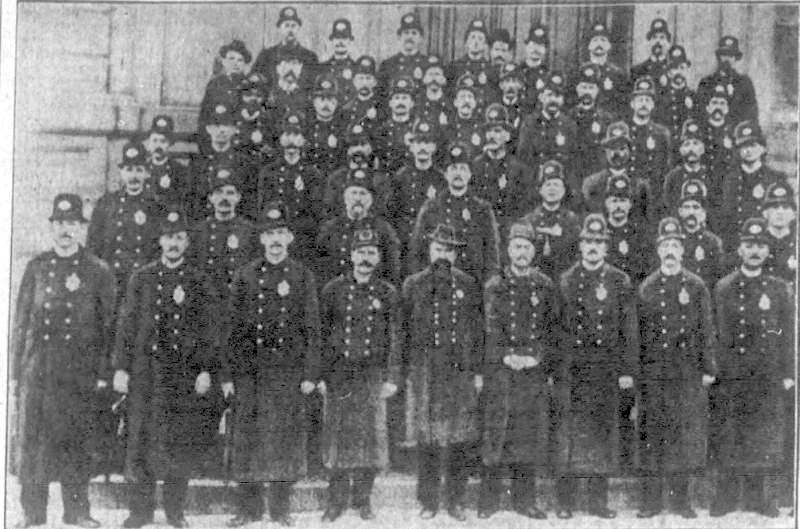
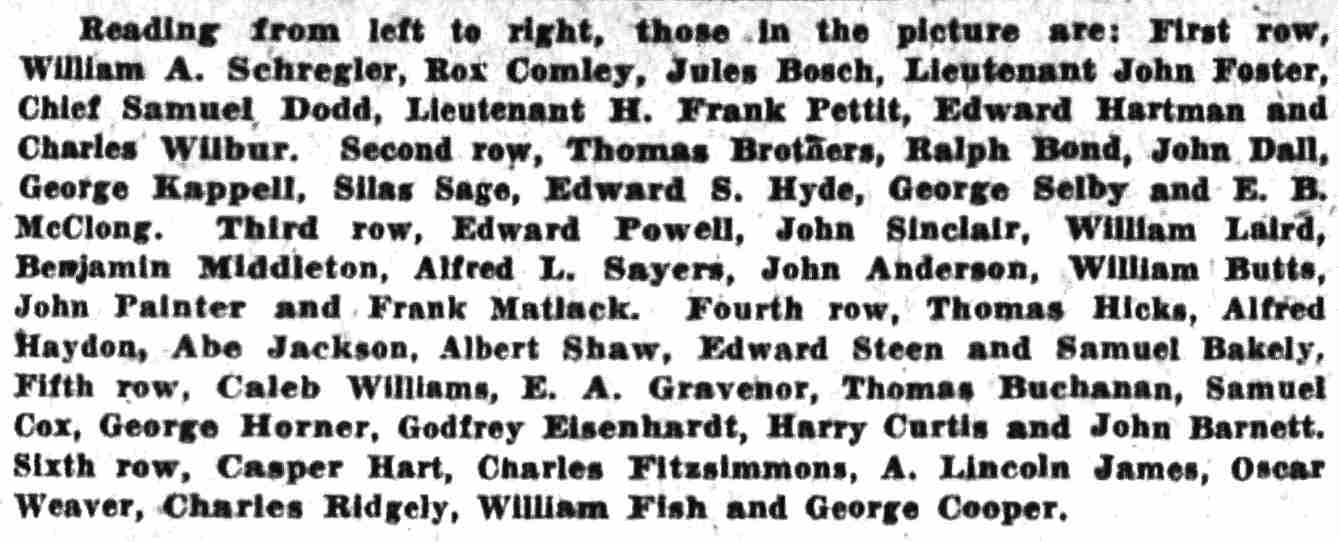
Named: Camden Courier-Post, July 15, 1930, Camden Police Department, 1898, and also mentions William A. Schregler, John Foster, Samuel Dodd, H. Franklin Pettit, Harry Mines, Edward Hartman, John Dall, George Kappell, Josiah Sage, Edward S. Hyde, Elbridge B. McClong, Benjamin Middleton, Alfred L. Sayers, John Anderson, William Butts, John Painter, Alfred Hayden, Albert Shaw, Elisha A. Gravenor, Harry Curtis, George B. Johnson, Casper Hart, Charles Fitzsimmons, and A. Lincoln James.
Mystery of a Swamp
Harrisburg Patriot —
Empty Carriage. Cries of Murder and a Negro’s Arrest.
Philadelphia, July 16.—Walter S. Jones, colored, is locked up in Camden jail under a chain of weird circumstances. On Friday night a horse and empty wagon were found standing in a clump of bushes near Seventeenth and Mickle streets, a sparsely settled part of Camden’s annexed district. Almost simultaneous with its discovery wild cries of “Murder!” and “Help!” were heard from the vicinity of Cooper’s creek. The team was taken in charge and Police Captain Albert, with Policemen Flick, Abbott and Horner, began an investigation.
A few minutes later Jones, the colored man, appeared, coming from the direction of the swamp, near Stockton park. As soon as he saw Officer Flick the man showed fight, but Flick quickly brought him to bay with his revolver. He told a very unsatisfactory story of what his business was in that locality at that hour of the night.
The cries of “murder” and the conflicting statements made by the colored man satisfied the police that there was something wrong. The spot was an ideal one for a crime, and the surrounding neighborhood afforded the best means of disposing of any evidence, the Stockton lake being near at hand, and thereabouts being swampy and infested with a high growth of weeds. Jones was taken to the town hall while the officers waded knee deep in the swamp to see what they could discover. The search was continued until midnight, an was renewed again this morning [sic], but nothing startling came to light.
To add to the suspicion already fastened to the man, during the night, he had burned a letter in the cell he occupied. When searched an old-fashioned pistol was found secreted in a little pocket in one of his boots. All the chambers were filled.
Jones has just been released from a thirty days’ sentence for, it is said, beating his father. He claims the team belonged to him.
Camden
Philadelphia Inquirer —
Former Councilman John W. Coleman, of the East Side, is enjoying a two weeks’ vacation from his duties as assistant cashier of the Southwark National Bank, of Philadelphia. He has been having great sport the past week on the weakfish grounds, at South Atlantic City.
George Horner will spend his vacation at Beach Haven.
Albert Kemble and family are sojourning at the seashore.
Jersey Beaston is at Portland, Me., on a business trip.
George Blake and family are enjoying sea breezes at Atlantic City.
Councilman Theodore Leas enjoyed an ocean sail at Atlantic City on Wednesday.
Carrow Du Bosq has been spending the past ten days at South Atlantic City with his family. He is an enthusiastic fisherman, and has made large catches of weakfish during his vacation.
V. L. Cavanna and family have gone to Atlantic City for a month’s sojourn.
The Misses Kemmerer, of Eleventh and Federal streets, left yesterday for an extended visit among relatives at Lebanon, Pa.
Druggist George J. Pechin has his family located in his cottage at National Park, for the summer.
James McCormick and wife are sojourning at Atlantic City.
Miss Lillian Bernhart is at Long Branch.
Prosecutor Jenkins and family are enjoying the sea breezes at Atlantic City.
Councilman Arthur Abele spent Wednesday at Atlantic City.
Miss Malinda Mansfield is visiting Mr. and Mrs. Fletcher, of Langhorne, Pa.
Camden
CAMDEN
Former Councilman John W. Coleman, of the East Side, is enjoying a two weeks' vacation from his duties as assistant cashier of the Southwark National Bank, of Philadelphia. He has been having great sport the past week on the weakfish grounds, at South Atlantic City.
George Horner will spend his vacation at Beach Haven.
Albert Kemble and family are sojourning at the seashore.
Jersey Beaston is at Portland, Me., on a business trip.
George Blake and family are enjoying sea breezes at Atlantic City.
Councilman Theodore Leas enjoyed an ocean sail at Atlantic City on Wednesday.
Carrow Du Bosq has been spending the past ten days at South Atlantic City with his family. He is an enthusiastic fisherman, and has made large catches of weakfish during his vacation.
V. L. Cavanna and family have gone to Atlantic City for a month's sojourn.
The Misses Kemmerer, of Eleventh and Federal streets, left yesterday for an extended visit among relatives at Lebanon, Pa.
Druggist George J. Pechin has his family located in his cottage at National Park, for the summer.
James McCormick and wife are sojourning at Atlantic City.
Miss Lillian Bernhart is at Long Branch.
Prosecutor Jenkins and family are enjoying the sea breezes at Atlantic City.
Councilman Arthur Abele spent Wednesday at Atlantic City.
Miss Malinda Mansfield is visiting Mr. and Mrs. Fletcher, of Langhorne, Pa.
Camden's Pride Parades Before City's People
Philadelphia Inquirer —
Policemen and Firemen Make Their Initial Turnout and Present a Creditable Appearance—Reviewed by Officials—How the Departments Have Grown
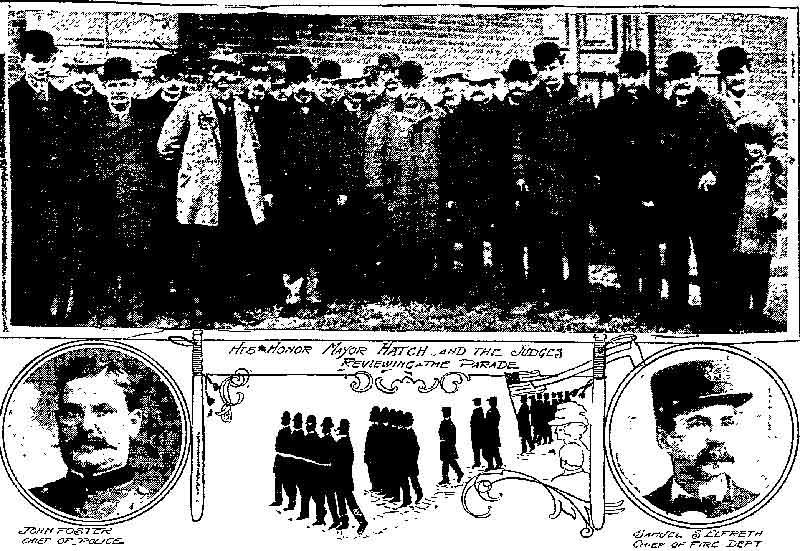
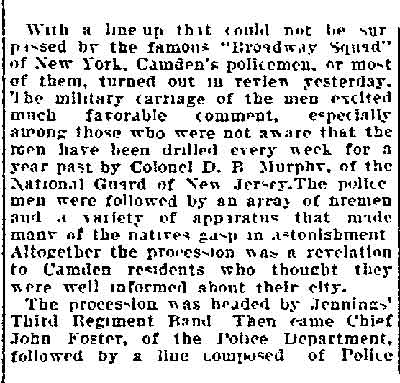
With a line up that could not be surpassed by the famous “Broadway Squad” of New York, Camden’s policemen, or most of them, turned out in review yesterday. The military carriage of the men excited much favorable comment, especially among those who were not aware that the men have been drilled every week for a year past by Colonel D. B. Murphy, of the National Guard of New Jersey. The policemen were followed by an array of firemen and a variety of apparatus that made many of the natives gasp in astonishment. Altogether the procession was a revelation to Camden residents who thought they were well informed about their city.
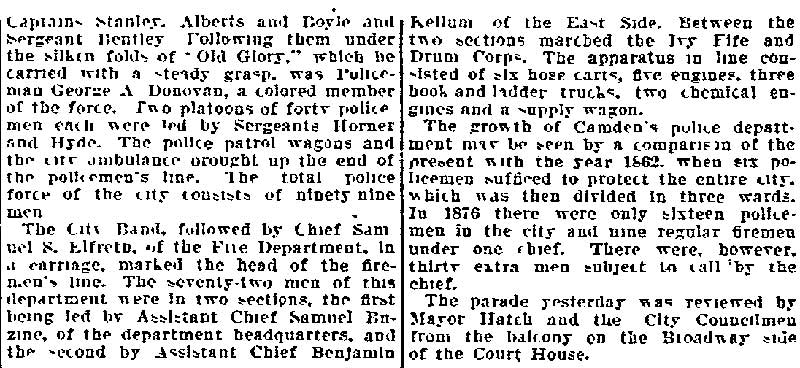
The procession was headed by Jennings’ Third Regiment Band. Then came Chief John Foster, of the Police Department, followed by a line composed of Police Captains Stanley, Alberts and Doyle and Sergeant Bentley. Following them under the silken folds of “Old Glory,” which he carried with a steady grasp, was Policeman George A. Donovan, a colored member of the force. Two platoons of forty policemen each were led by Sergeants Horner and Hyde. The police patrol wagons and the city ambulance brought up the end of the policemen’s line. The total police force of the city consists of ninety nine men.
The City Band, followed by Chief Samuel S. Elfreth, of the Fire Department, in a carriage, marked the head of the firemen’s line. The seventy-two men of this department were in two sections, the first being led by Assistant Chief Samuel Buzine, of the department headquarters, and the second by Assistant Chief Benjamin Kellum of the East Side. Between the two sections marched the Ivy Fife and Drum Corps. The apparatus in line consisted of six hose carts, five engines, three hook and ladder trucks, two chemical engines and a supply wagon.
The growth of Camden’s police department may be seen by a comparison of the present with the year 1862, when six policemen sufficed to protect the entire city, which was then divided in three wards. In 1876 there were only sixteen policemen in the city and nine regular firemen under one chief. There were, however, thirty extra men subject to call by the chief.
The parade yesterday was reviewed by Mayor Hatch and the City Councilmen from the balcony on the Broadway side of the Court House.
CAMDEN’S PRIDE PARADES BEFORE CITY’S PEOPLE
Policemen and Firemen Make Their Initial Turnout and Present a Creditable Appearance—Reviewed by Officials—How the Departments Have Grown
With a line up that could not be surpassed by the famous “Broadway Squad” of New York, Camden’s policemen, or most of them, turned out in review yesterday. The military carriage of the men excited much favorable comment, especially among those who were not aware that the men have been drilled every week for a year past by Colonel D. B. Murphy, of the National Guard of New Jersey. The policemen were followed by an array of firemen and a variety of apparatus that made many of the natives gasp in astonishment. Altogether the procession was a revelation to Camden residents who thought they were well informed about their city.
The procession was headed by Jennings’ Third Regiment Band. Then came Chief John Foster, of the Police Department, followed by a line composed of Police Captains Stanley, Alberts and Doyle and Sergeant Bentley. Following them under the silken folds of “Old Glory,” which he carried with a steady grasp, was Policeman George A. Donovan, a colored member of the force. Two platoons of forty policemen each were led by Sergeants Horner and Hyde. The police patrol wagons and the city ambulance brought up the end of the policemen’s line. The total police force of the city consists of ninety nine men.
The City Band, followed by Chief Samuel S. Elfreth, of the Fire Department, in a carriage, marked the head of the firemen’s line. The seventy-two men of this department were in two sections, the first being led by Assistant Chief Samuel Buzine, of the department headquarters, and the second by Assistant Chief Benjamin Kellum of the East Side. Between the two sections marched the Ivy Fife and Drum Corps. The apparatus in line consisted of six hose carts, five engines, three hook and ladder trucks, two chemical engines and a supply wagon.
The growth of Camden’s police department may be seen by a comparison of the present with the year 1862, when six policemen sufficed to protect the entire city, which was then divided in three wards. In 1876 there were only sixteen policemen in the city and nine regular firemen under one chief. There were, however, thirty extra men subject to call by the chief.
The parade yesterday was reviewed by Mayor Hatch and the City Councilmen from the balcony on the Broadway side of the Court House.
CAMDEN’S PRIDE PARADES BEFORE CITY’S PEOPLE
Policemen and Firemen Make Their Initial Turnout and Present a Creditable Appearance—Reviewed by Officials—How the Departments Have Grown
With a line up that could not be surpassed by the famous “Broadway Squad” of New York, Camden’s policemen, or most of them, turned out in review yesterday. The military carriage of the men excited much favorable comment, especially among those who were not aware that the men have been drilled every week for a year past by Colonel D. B. Murphy, of the National Guard of New Jersey. The policemen were followed by an array of firemen and a variety of apparatus that made many of the natives gasp in astonishment. Altogether the procession was a revelation to Camden residents who thought they were well informed about their city.
The procession was headed by Jennings’ Third Regiment Band. Then came Chief John Foster, of the Police Department, followed by a line composed of Police Captains Stanley, Alberts and Doyle and Sergeant Bentley.
Captains Stanley, Alberts and Doyle and Sergeant Bentley. Following them under the silken folds of “Old Glory,” which he carried with a steady grasp, was Policeman George A. Donovan, a colored member of the force. Two platoons of forty policemen each were led by Sergeants Horner and Hyde. The police patrol wagons and the city ambulance brought up the end of the policemen’s line. The total police force of the city consists of ninety nine men.
The City Band, followed by Chief Samuel S. Elfreth, of the Fire Department, in a carriage, marked the head of the firemen’s line. The seventy-two men of this department were in two sections, the first being led by Assistant Chief Samuel Buzine, of the department headquarters, and the second by Assistant Chief Benjamin Kellum of the East Side. Between the two sections marched the Ivy Fife and Drum Corps. The apparatus in line consisted of six hose carts, five engines, three hook and ladder trucks, two chemical engines and a supply wagon.
The growth of Camden’s police department may be seen by a comparison of the present with the year 1862, when six policemen sufficed to protect the entire city, which was then divided in three wards. In 1876 there were only sixteen policemen in the city and nine regular firemen under one chief. There were, however, thirty extra men subject to call by the chief.
The parade yesterday was reviewed by Mayor Hatch and the City Councilmen from the balcony on the Broadway side of the Court House.
Burglar Hunt at Early Hour
Camden Post-Telegram —
Policeman George Horner, the ever vigilant, shortly after 1 o’clock this morning, saw a suspicious looking character lurking around the vicinity of Fourth and Cooper streets. Policeman Horner saw him dodge into a yard at the old Hatch property, on Cooper street near Fourth. The officer was soon joined in the hunt by Policeman Lyons and Special officer Robert Miller and the three of them made a careful examination of all the premises from Fourth street to the Centenary M. E. church. They searched the side street, the yards and alleys in the vicinity, but the suspicious character had disappeared. After this they made an examination of three of the properties on Cooper street and found everything all right and nothing disturbed.
From the description furnished the same man was seen in the vicinity of Broadway and Carman street, shortly after 12 o’clock.
Burglar Hunt at Early Hour
BURGLAR HUNT AT EARLY HOUR
Policeman George Horner, the ever vigilant, shortly after 1 o'clock this morning, saw a suspicious looking character lurking around the vicinity of Fourth and Cooper streets. Policeman Horner saw him dodge into a yard at the old Hatch property, on Cooper street near Fourth. The officer was soon joined in the hunt by Policeman Lyons and Special officer Robert Miller and the three of them made a careful examination of all the premises from Fourth street to the Centenary M. E. church. They searched the side street, the yards and alleys in the vicinity, but the suspicious character had disappeared. After this they made an examination of three of the properties on Cooper street and found everything all right and nothing disturbed.
From the description furnished the same man was seen in the vicinity of Broadway and Carman street, shortly after 12 o'clock.
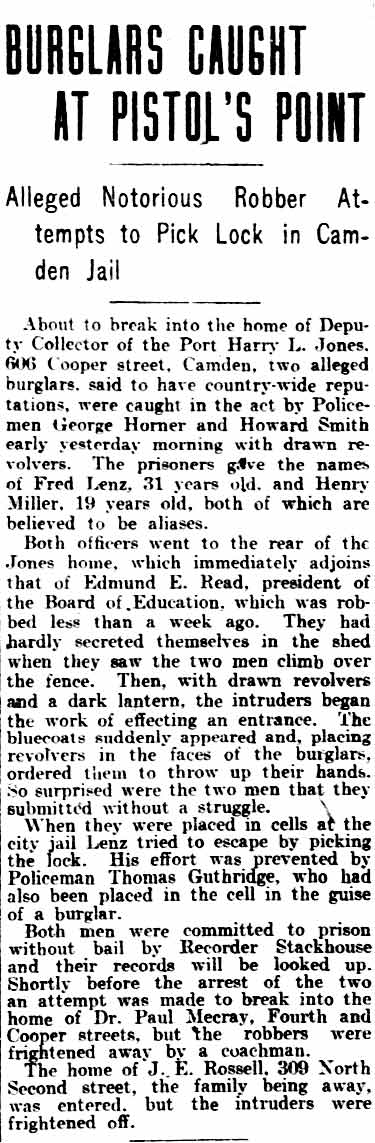
Burglars Caught at Pistol's Point
Philadelphia Inquirer —
Alleged Notorious Robber Attempts to Pick Lock in Camden Jail
About to break into the home of Deputy Collector of the Port Harry L. Jones, 606 Cooper street, Camden, two alleged burglars, said to have country-wide reputations, were caught in the act by Policemen George Horner and Howard Smith early yesterday morning with drawn revolvers. The prisoners gave the names of Fred Lenz, 31 years old, and Henry Miller, 19 years old, both of which are believed to be aliases.
Both officers went to the rear of the Jones home, which immediately adjoins that of Edmund E. Read, president of the Board of Education, which was robbed less than a week ago. They had hardly secreted themselves in the shed when they saw the two men climb over the fence. Then, with drawn revolvers and a dark lantern, the intruders began the work of effecting an entrance. The bluecoats suddenly appeared and, placing revolvers in the faces of the burglars, ordered them to throw up their hands. So surprised were the two men that they submitted without a struggle.
When they were placed in cells at the city jail Lenz tried to escape by picking the lock. His effort was prevented by Policeman Thomas Guthridge, who had also been placed in the cell in the guise of a burglar.
Both men were committed to prison without bail by Recorder Stackhouse and their records will be looked up. Shortly before the arrest of the two an attempt was made to break into the home of Dr. Paul Mecray, Fourth and Cooper streets, but the robbers were frightened away by a coachman.
The home of J. E. Rossell, 309 North Second street, the family being away, was entered, but the intruders were frightened off.
Burglars Caught at Pistol's Point
BURGLARS CAUGHT AT PISTOL'S POINT
Alleged Notorious Robber Attempts to Pick Lock in Camden Jail
About to break into the home of Deputy Collector of the Port Harry L. Jones, 606 Cooper street, Camden, two alleged burglars, said to have country-wide reputations, were caught in the act by Policemen George Horner and Howard Smith early yesterday morning with drawn revolvers. The prisoners gave the names of Fred Lenz, 31 years old, and Henry Miller, 19 years old, both of which are believed to be aliases.
Both officers went to the rear of the Jones home, which immediately adjoins that of Edmund E. Read, president of the Board of Education, which was robbed less than a week ago. They had hardly secreted themselves in the shed when they saw the two men climb over the fence. Then, with drawn revolvers and a dark lantern, the intruders began the work of effecting an entrance. The bluecoats suddenly appeared and, placing revolvers in the faces of the burglars, ordered them to throw up their hands. So surprised were the two men that they submitted without a struggle.
When they were placed in cells at the city jail Lenz tried to escape by picking the lock. His effort was prevented by Policeman Thomas Guthridge, who had also been placed in the cell in the guise of a burglar.
Both men were committed to prison without bail by Recorder Stackhouse and their records will be looked up. Shortly before the arrest of the two an attempt was made to break into the home of Dr. Paul Mecray, Fourth and Cooper streets, but the robbers were frightened away by a coachman.
The home of J. E. Rossell, 309 North Second street, the family being away, was entered, but the intruders were frightened off.
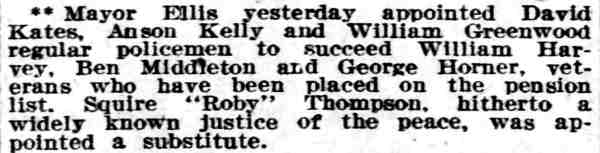
Mayor Ellis Appoints New Policemen
Philadelphia Inquirer —
Mayor Ellis yesterday appointed David Kates, Anson Kelly and William Greenwood regular policemen to succeed William Harvey, Ben Middleton and George Horner, veterans who have been placed on the pension list. Squire “Roby” Thompson, hitherto a widely known justice of the peace, was appointed a substitute.
Mayor Ellis Appoints New Policemen
Mayor Ellis yesterday appointed David Kates, Anson Kelly and William Greenwood regular policemen to succeed William Harvey, Ben Middleton and George Horner, veterans who have been placed on the pension list. Squire “Roby” Thompson, hitherto a widely known justice of the peace, was appointed a substitute.