Introduction
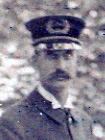
William E. Albert
WILLIAM E. ALBERT was born in New Jersey around 1870. He was the son of Ernest and Hannah Albert. Ernest Albert had emigrated to America from Wurttemburg in what is now Germany. He arrived in Philadelphia in 1860, married there, and came to Camden around 1865. When the Census was taken in 1870, Ernest Albert was keeping a hotel, a term then also to refer to a bar or saloon, at 619 North Front Street in North Camden. By 1880 the family also included older siblings Charles, Pauline, and Yetta, and younger siblings Harry, Louis, and Louis. Ernest Albert was still in business according to the 1888–1889 Camden City Directory, oldest son Charles Albert by then working as a bartender. William E. Albert appears in the City Directory for that year, living on North Front Street, and working for William McDonnell, who was operating a butcher shop at 628 North Front Street.
Ernst Albert passed away shortly afterwards, as the 1890–1891 City Directory shows that Hannah Albert was then a widow. The Albert family was then living at 328 State Street. William E. Albert is also named in this directory, his occupation listed as butcher. The Albert’s saloon was acquired by John F. Hoelzle, who operated it under the name Mechanic’s Hotel.
William McDonnell resided in the Pavonia section of Stockton Township, what is commonly known today as Cramer Hill. William E. Albert soon followed his employer, and eventually bought a home at 2923 Westfield Avenue in what is known today as East Camden.
By 1910 William E. Albert had been appointed as a Captain on the Camden Police department. Legend has it that Albert, who had not served on Stockton Township’s police force, was appointed to the captaincy when the township merged with Camden in 1899, because he owned a horse and had a thorough knowledge of the streets in the new Eleventh and Twelfth wards. He had married his wife Louise around 1903, and a daughter, also named Louise, was born on March 24, 1904. When the next Census was taken, in January of 1920, the Albert family had purchased a home around the corner, at 2947 Cramer Street, the corner of North 30th and Cramer Street. William E. Albert was still working as captain on Camden’s police department at that time.
William Albert left the police department during the 1920s. Still living on Cramer Street, he worked as a night watchman at a clubhouse according to the 1930 census. During World War II he served as an air raid warden, and was still living at 2947 Cramer Street as late as 1946. His daughter, Louise Albert, remained in residence at 2947 Cramer Street into the late 1980s, passing away on June 8, 1989.
Captain William E. Albert on Patrol, Dudley Grange
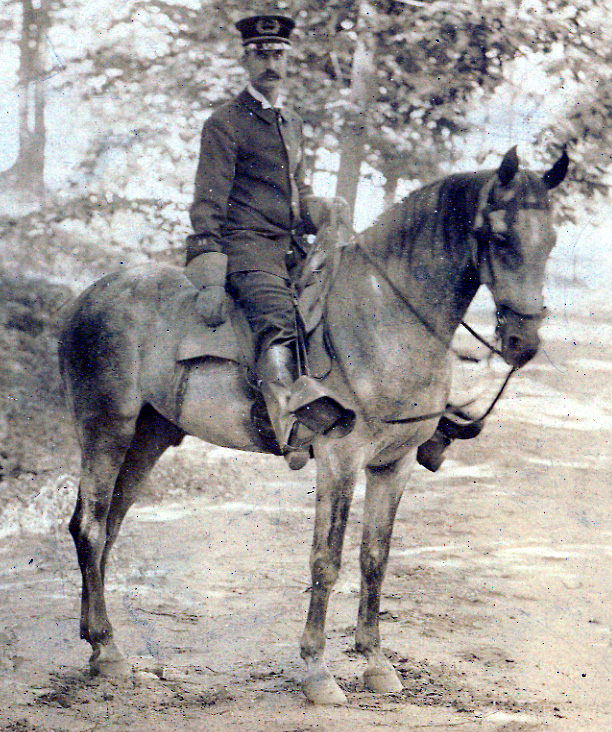
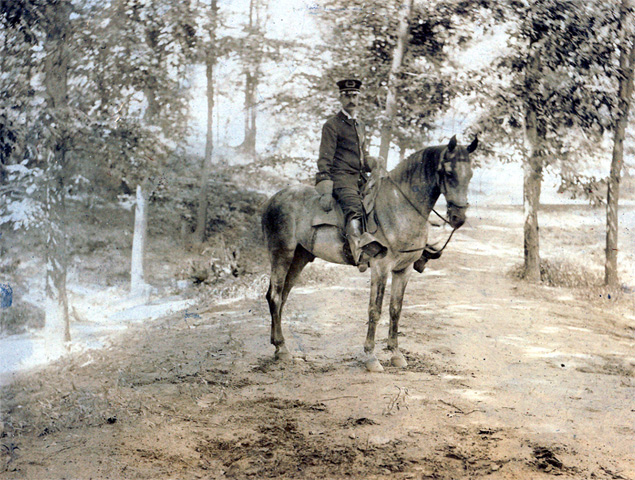
Captain William E. Albert on patrol in Dudley Grange, early 1900s
Painting of Captain William E. Albert on Patrol, Dudley Grange
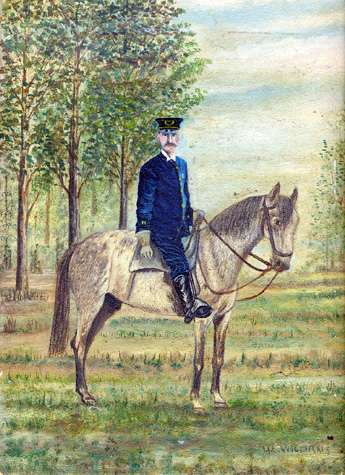
Painting by M.E. Williams of Captain William E. Albert on patrol in Dudley Grange, early 1900s. Derived from photograph above.
Drunks Were Scarce
Camden Daily Telegram —
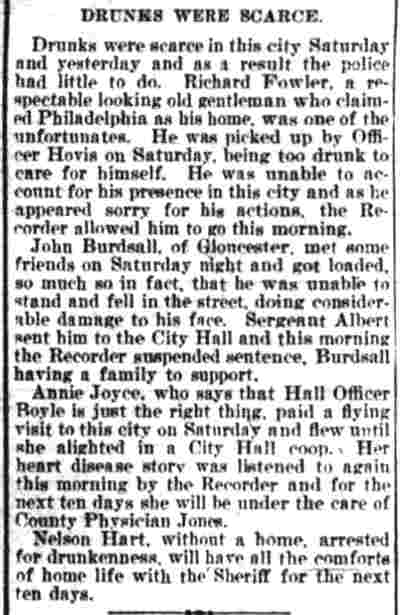
Drunks were scarce in this city Saturday and yesterday and as a result the police had little to do. Richard Fowler, a respectable looking old gentleman who claimed Philadelphia as his home, was one of the unfortunates. He was picked up by Officer Hovis on Saturday, being too drunk to care for himself. He was unable to account for his presence in this city and as he appeared sorry for his actions, the Recorder allowed him to go this morning.
John Burdsall, of Gloucester, met some friends on Saturday night and got loaded, so much so in fact, that he was unable to stand and fell in the street, doing considerable damage to his face. Sergeant Albert sent him to the City Hall and this morning the Recorder suspended sentence, Burdsall having a family to support.
Annie Joyce, who says that Hall Officer Boyle is just the right thing, paid a flying visit to this city on Saturday and flew until she alighted in a City Hall coop. Her heart disease story was listened to again this morning by the Recorder and for the next ten days she will be under the care of County Physician Jones.
Nelson Hart, without a home, arrested for drunkenness, will have all the comforts of home life with the Sheriff for the next ten days.
Bluecoats for East End
Camden Daily Courier —
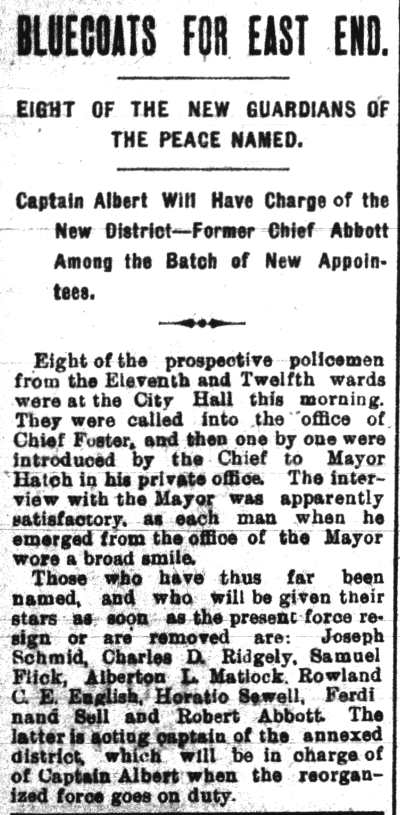
Eight of the New Guardians of the Peace Named.
Captain Albert Will Have Charge of the New District—Former Chief Abbott Among the Batch of New Appointees.
Eight of the prospective policemen from the Eleventh and Twelfth wards were at the City Hall this morning. They were called into the office of Chief Foster, and then one by one were introduced by the Chief to Mayor Hatch in his private office. The interview with the Mayor was apparently satisfactory, as each man when he emerged from the office of the Mayor wore a broad smile.
Those who have thus far been named, and who will be given their stars as soon as the present force resign or are removed are: Joseph Schmid, Charles D. Ridgely, Samuel Flick, Alberton L. Matlock, Rowland C. E. English, Horatio Sewell, Ferdinand Sell and Robert Abbott. The latter is acting captain of the annexed district, which will be in charge of Captain Albert when the reorganized force goes on duty.
Mystery of a Swamp
Harrisburg Patriot —
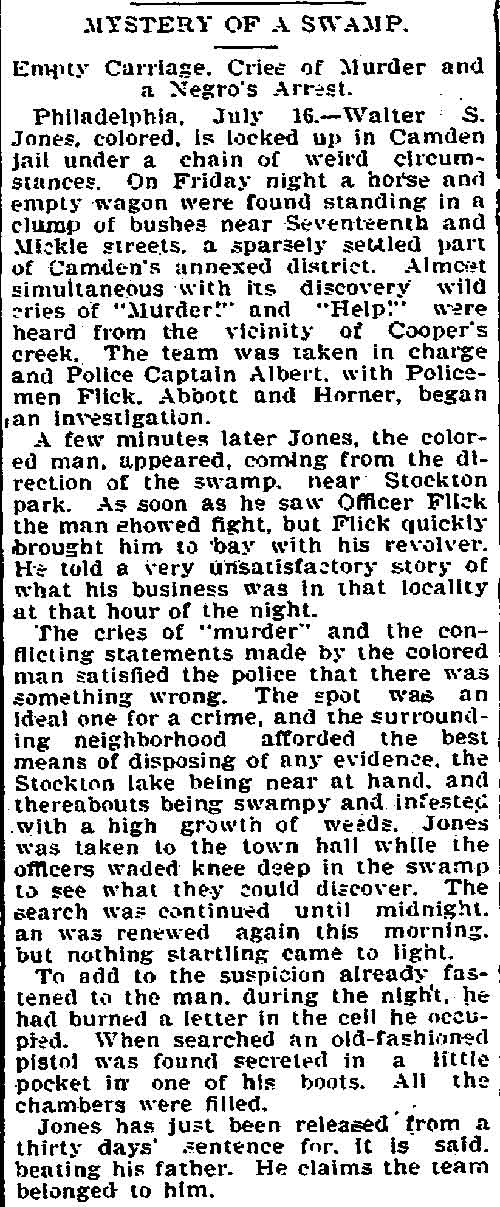
Empty Carriage. Cries of Murder and a Negro’s Arrest.
Philadelphia, July 16.—Walter S. Jones, colored, is locked up in Camden jail under a chain of weird circumstances. On Friday night a horse and empty wagon were found standing in a clump of bushes near Seventeenth and Mickle streets, a sparsely settled part of Camden’s annexed district. Almost simultaneous with its discovery wild cries of “Murder!” and “Help!” were heard from the vicinity of Cooper’s creek. The team was taken in charge and Police Captain Albert, with Policemen Flick, Abbott and Horner, began an investigation.
A few minutes later Jones, the colored man, appeared, coming from the direction of the swamp, near Stockton park. As soon as he saw Officer Flick the man showed fight, but Flick quickly brought him to bay with his revolver. He told a very unsatisfactory story of what his business was in that locality at that hour of the night.
The cries of “murder” and the conflicting statements made by the colored man satisfied the police that there was something wrong. The spot was an ideal one for a crime, and the surrounding neighborhood afforded the best means of disposing of any evidence, the Stockton lake being near at hand, and thereabouts being swampy and infested with a high growth of weeds. Jones was taken to the town hall while the officers waded knee deep in the swamp to see what they could discover. The search was continued until midnight, an was renewed again this morning [sic], but nothing startling came to light.
To add to the suspicion already fastened to the man, during the night, he had burned a letter in the cell he occupied. When searched an old-fashioned pistol was found secreted in a little pocket in one of his boots. All the chambers were filled.
Jones has just been released from a thirty days’ sentence for, it is said, beating his father. He claims the team belonged to him.
Police in a Church
Philadelphia Inquirer —
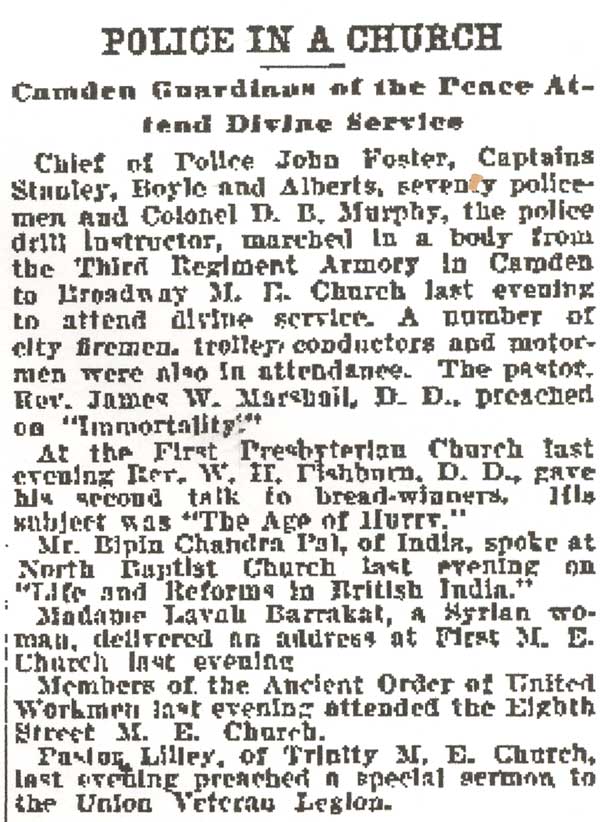
Camden Guardians of the Peace Attend Divine Service
Chief of Police John Foster, Captains Stanley, Boyle and Alberts, seventy policemen and Colonel D. B. Murphy, the police drill instructor, marched in a body from the Third Regiment Armory in Camden to Broadway M. E. Church last evening to attend divine service. A number of city firemen, trolley conductors and motormen were also in attendance. The pastor, Rev. James W. Marshall, D. D., preached on “Immortality.”
At the First Presbyterian Church last evening Rev. W. H. Fishburn, D. D., gave his second talk to bread-winners. His subject was “The Age of Hurry.”
Mr. Bipin Chandra Pal, of India, spoke at North Baptist Church last evening on “Life and Reforms in British India.”
Madame Lavah Barrakat, a Syrian woman, delivered an address at First M. E. Church last evening.
Members of the Ancient Order of United Workmen last evening attended the Eighth Street M. E. Church.
Pastor Lilley, of Trinity M. E. Church, last evening preached a special sermon to the Union Veteran Legion.
Camden’s Pride Parades Before City’s People
Philadelphia Inquirer —
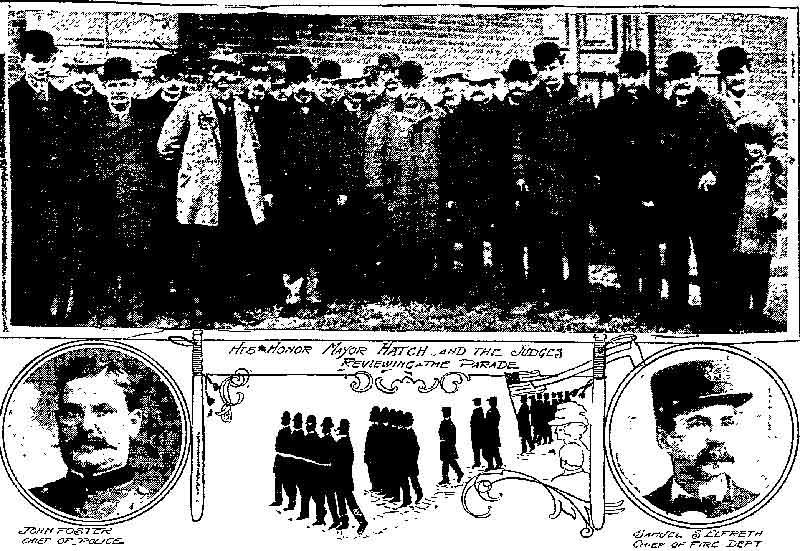
Policemen and Firemen Make Their Initial Turnout and Present a Creditable Appearance—Reviewed by Officials—How the Departments Have Grown
With a line up that could not be surpassed by the famous “Broadway Squad” of New York, Camden’s policemen, or most of them, turned out in review yesterday. The military carriage of the men excited much favorable comment, especially among those who were not aware that the men have been drilled every week for a year past by Colonel D. B. Murphy, of the National Guard of New Jersey. The policemen were followed by an array of firemen and a variety of apparatus that made many of the natives gasp in astonishment. Altogether the procession was a revelation to Camden residents who thought they were well informed about their city.
The procession was headed by Jennings’ Third Regiment Band. Then came Chief John Foster, of the Police Department, followed by a line composed of Police Captains Stanley, Alberts and Doyle and Sergeant Bentley. Following them under the silken folds of “Old Glory,” which he carried with a steady grasp, was Policeman George A. Donovan, a colored member of the force. Two platoons of forty policemen each were led by Sergeants Horner and Hyde. The police patrol wagons and the city ambulance brought up the end of the policemen’s line. The total police force of the city consists of ninety nine men.
The City Band, followed by Chief Samuel S. Elfreth, of the Fire Department, in a carriage, marked the head of the firemen’s line. The seventy-two men of this department were in two sections, the first being led by Assistant Chief Samuel Buzine, of the department headquarters, and the second by Assistant Chief Benjamin Kellum of the East Side. Between the two sections marched the Ivy Fife and Drum Corps. The apparatus in line consisted of six hose carts, five engines, three hook and ladder trucks, two chemical engines and a supply wagon.
The growth of Camden’s police department may be seen by a comparison of the present with the year 1862, when six policemen sufficed to protect the entire city, which was then divided in three wards. In 1876 there were only sixteen policemen in the city and nine regular firemen under one chief. There were, however, thirty extra men subject to call by the chief.
The parade yesterday was reviewed by Mayor Hatch and the City Councilmen from the balcony on the Broadway side of the Court House.
Police Stopped Sunday Amusements
Philadelphia Inquirer —
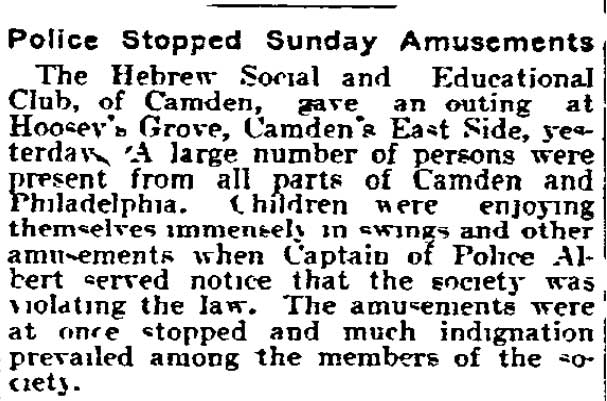
The Hebrew Social and Educational Club, of Camden, gave an outing at Hoosey’s Grove, Camden’s East Side, yesterday. A large number of persons were present from all parts of Camden and Philadelphia. Children were enjoying themselves immensely in swings and other amusements when Captain of Police Albert served notice that the society was violating the law. The amusements were at once stopped and much indignation prevailed among the members of the society.
First Ward Club Had a Jolly Time
Camden Daily Courier —
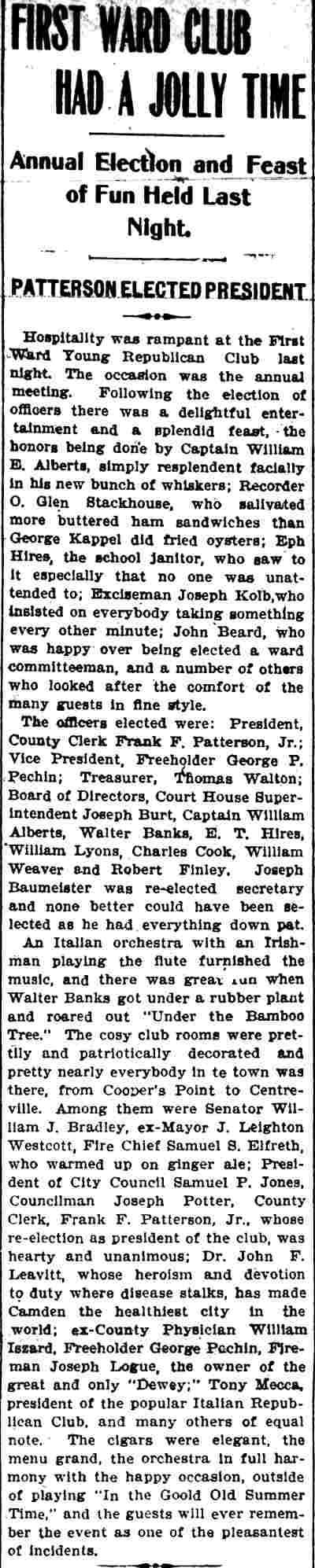
Annual Election and Feast of Fun Held Last Night.
Patterson Elected President
Hospitality was rampant at the First Ward Young Republican Club last night. The occasion was the annual meeting. Following the election of officers there was a delightful entertainment and a splendid feast, the honors being done by Captain William E. Alberts, simply resplendent facially in his new bunch of whiskers; Recorder O. Glen Stackhouse, who salivated more buttered ham sandwiches than George Kappel did fried oysters; Eph Hires, the school janitor, who saw to it especially that no one was unattended to; Exciseman Joseph Kolb, who insisted on everybody taking something every other minute; John Beard, who was happy over being elected a ward committeeman, and a number of others who looked after the comfort of the many guests in fine style.
The officers elected were: President, County Clerk Frank F. Patterson, Jr.; Vice President, Freeholder George P. Pechin; Treasurer, Thomas Walton; Board of Directors, Court House Superintendent Joseph Burt, Captain William E. Alberts, Walter Banks, E. T. Hires, William Lyons, Charles Cook, William Weaver and Robert Finley. Joseph Baumeister was re-elected secretary and none better could have been selected as he had everything down pat.
An Italian orchestra with an Irishman playing the flute furnished the music, and there was great fun when Walter Banks got under a rubber plant and roared out “Under the Bamboo Tree.” The cosy club rooms were prettily and patriotically decorated and pretty nearly everybody in the town was there, from Cooper’s Point to Centreville. Among them were Senator William J. Bradley, ex-Mayor J. Leighton Westcott, Fire Chief Samuel S. Elfreth, who warmed up on ginger ale; President of City Council Samuel P. Jones, Councilman Joseph Potter, County Clerk Frank F. Patterson, Jr., whose re-election as president of the club was hearty and unanimous; Dr. John F. Leavitt, whose heroism and devotion to duty where disease stalks, has made Camden the healthiest city in the world; ex-County Physician William Iszard, Freeholder George Pechin, Fireman Joseph Logue, the owner of the great and only “Dewey;” Tony Mecca, president of the popular Italian Republican Club, and many others of equal note. The cigars were elegant, the menu grand, the orchestra in full harmony with the happy occasion, outside of playing “In the Good Old Summer Time,” and the guests will ever remember the event as one of the pleasantest of incidents.
Fireman in a Mix-Up
Philadelphia Inquirer —
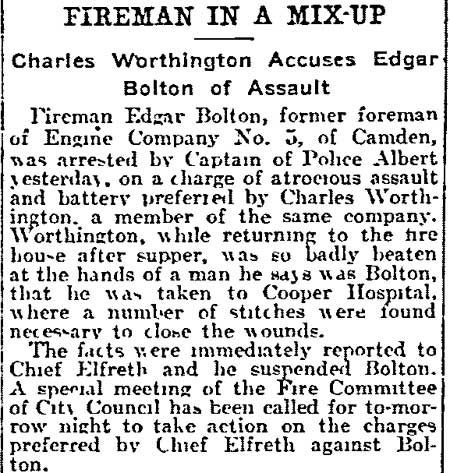
Charles Worthington Accuses Edgar Bolton of Assault
Fireman Edgar Bolton, former foreman of Engine Company No. 5, of Camden, was arrested by Captain of Police Albert yesterday, on a charge of atrocious assault and battery preferred by Charles Worthington, a member of the same company. Worthington, while returning to the fire house after supper, was so badly beaten at the hands of a man he says was Bolton, that he was taken to Cooper Hospital, where a number of stitches were found necessary to close the wounds.
The facts were immediately reported to Chief Elfreth and he suspended Bolton. A special meeting of the Fire Committee of City Council has been called for tomorrow night to take action on the charges preferred by Chief Elfreth against Bolton.
Heroic Chum Near Dies As Boy Drowns
Camden Post-Telegram —
Young Son of Police Sergeant Loses His Life in the River as He Steps Into Hole.
Body Found After All-Night Search
Russell Horner, aged 14 years, son of Sergeant of Police William Horner, of 808 North Thirty-sixth street, was drowned in the Delaware off the old Red Mill, Pea Shore, yesterday afternoon. The body was recovered this morning by Anson Nicholson, a grocer, of Thirty-sixth and Trinity streets. Coroner Fithian gave a certificate in accordance with the facts.
Russell, a bright and active boy, able to swim only a few strokes, went bathing yesterday afternoon near the old mill with a boy named MacBurney and another companion. Some years ago a channel was dug to the wharf so that a small steamboat could make a landing there. While the boys were paddling about in the water Russell stepped into a hole on the edge of the channel and was soon beyond his depth. He sank from sight and as he rose he appealed for help. Young MacBurney, who can swim went to his assistance, and Russell caught him by the throat, both going to the bottom where MacBurney managed to free himself.
MacBurney managed to reach shore in a greatly exhausted condition and gave the alarm. A number of persons dived for the body, but without success. In the meantime the police were notified and Captain Albert and Policemen Abbott, Palmer and Johnson went to the scene.
The officers and a number of friends of Sergeant Horner grappled all through the night and early morning at one time six boat crews being at work. Believing that the constant stirring up of the water would send the body shoreward on the early morning tide Mr. Nicholson grappled accordingly and he found it in very shallow water.
During this morning hundreds of friends of Sergeant Horner lined the shore and watched the men at work. Sergeant Horner is suffering terribly, while Mrs. Horner is on the verge of collapse.
The funeral arrangements have not been completed.
Probing Camden’s Saloons
Jersey Journal —
Inquisitor Backes Threatened to Jump on a Flippant Inspector
President Fisk Grills City Officials
Camden, Aug. 11.—How the excise inspector fails to inspect, how the police close their eyes when laws are being violated, how the saloons pay political tribute and dives flourish under the eyes of the police, were parts of the revelations produced before Gov. Fort’s excise investigators yesterday. Most of the questions were fired by Peter Backes, member of the State Board, and who was counsel for the Church Union which stood sponsor for the famous Bishops’ bill.
President Fisk also asked some questions and the grilling which some of the city officials got was enough to keep them shaking for a month. Excise Inspector Jacob Schiller was disposed to be flippant and defiant of the probers, but Mr. Backes said: “Answer my questions properly or I will jump all over you in a minute.” Asked what his duties consisted of, Schiller replied: “To see that every saloon in the city has a license.” He seemed to enjoy the laughter that followed this bit of wit.
He was sure the saloons of the city were obeying the law, but when told that others had discovered many rank violations such as Sunday selling, selling to minors and intoxicated people and from back rooms, contrary to the Bishops’ law, the inspector was duly shocked. He had not seen it he said. Mr. Backes advised him to get a pair of glasses, although he claimed that his eyesight was good.
When Captain of Police Boyle was asked by Mr. Backes whether there were any violations of the Bishops’ law in his district, he said that as far as he knew the saloonkeepers were abiding by the law.
Captain of Police Albert told the probers that there was little lawlessness in East Camden; that the saloonkeepers, as far as he knew, respected the law.
County Detective John S. Smith emphatically denied that it was he who made a round of the county “tipping off” the license holders against Sunday sales for awhile. He knew nothing about it, he declared. The Commission will take up the presumably “dry” town of Millville to-day.
Police Captain Visited by “Devil”
Camden Daily Courier —
Tracks in the Snow Found in Rear Yards of Many Homes
Happenings on the East Side
It would be a strange thing indeed if the “Jersey Devil,” or two-legged animal, which has spread terror throughout all South Jersey should slight the East Side. But he did not and hundreds are willing to testify that the strange thing paid them a visit. Its tracks in the snow were plainly visible yesterday in the back yards of Captain of Police William Alberts, Westfield avenue near Twenty-ninth street; Postmaster Thomas Adams, on Westfield avenue near Twenty-sixth street; at Frank Stones, Twenty-seventh and High streets; William Godfreys, 2710 High street; Mr. Schaeffer, on Twenty-seventh street near High; Richard Smith & Sons’ lumber yard at Cooper’s Creek and Federal streets; Frank Adams, on Church street; Espin Ashton, on Twenty-sixth street; J. M. Pennock, Twenty-sixth and Federal; Fred. Spuhler, Twenty-ninth and High streets, and many other places. As described by those who have seen the tracks of the freak animal in other towns the marks are very similar to those of a donkey’s hoof. Last evening a party of Missourites, who wanted to be shown, had congregated in Jonas Shaw’s cigar store, 2611 Westfield avenue, when Frank Adams, son of the postmaster, appeared. “Where are those tracks?” said one of the party. Procuring a candle, Adams marshaled the party next door to his father’s rear yard where he convinced the entire bunch in about two seconds that he was not dreaming, for the prints were still plainly visible in the snow, notwithstanding yesterday’s sun beat heavily upon it which has partly obliterated the marks in many places.
The strange animal did many freakish stunts on the East Side. In Schaeffer’s yard there is an old gate leaning against the back fence. There is a space of less than a foot between the gate and the fence yet the Animal strutted right between, leaving his footprints very plainly. He seems to have visited back yards in this section. No one reports having seen the prints in the front yard and it must be some animal in search of something to eat.
Already a party of East Siders are waiting up at night to catch the “Devil,” and will open a nickel show, with his “nibs” on exhibition if they succeed in catching him.
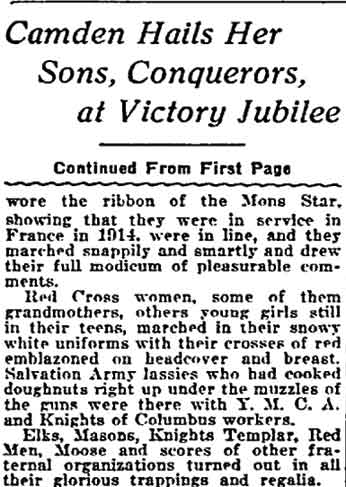
Camden Hails Her Sons, Conquerors, at Victory Jubilee
Philadelphia Inquirer —
Battle Flags Wave in Triumph O’er Parade Reviewed by Admiral
Gray Veterans of G. A. R. and Wounded Ride; Centopath Passes in Reverential Hush
The Peace with victory which Camden’s sons along with millions of other soldiers of all the Allied countries helped to bring home was celebrated by a jubilee in Camden yesterday which eclipsed anything that the city across the Delaware has ever attempted in her history.
Nearly every man, woman and child who did not actually march in the jubilee parade stood on the side lines and watched it and cheered themselves hoarse as the soldiers and sailors who went out from their town to fight marched past, this time as the conquerors in the world’s greatest war.
Favored by glorious sunshine, a sunshine that was reflected in the faces of the people, the day’s proceedings went off perfectly. For months Mayor Ellis and all his city family, together with a large committee of leading citizens, had been planning the affair. Their handiwork stood the test. It was good.
Admiral Henry Wilson, commander-in-chief of the Atlantic Fleet, came to his boyhood home to be the principal guest of the city and chief reviewing officer of the jubilee. With him were national statesmen and municipal officials.
Soldiers, sailors, war workers, members of fraternal orders and men who fought under the flags of Canada, England, Italy and Poland, marched in the parade which was miles long. Every succeeding division seemed just a little better than the one which preceded it, and, when it was all over and the soldiers and sailors had filed into the old Third Regiment Armory to sit down to a piping hot banquet, the hardest thing of all was to say which had made the finest showing.
All Honor to the Dead
Amidst all the gayety and happiness there was a sober note expressed by the memorial cenotaph which preceded the parade and which brought every hat off as it passed in solemn silence.
The heroic figure of an American soldier in bronze standing on a granite pedestal which bore a gold star with the number 135, symbolical of the Camden county men who laid down their lives in their country’s cause, was carried along the route ten minutes before the parade commenced. Encircler [sic] by flowers and palms, it moved through the reverential hush which had fallen over the throngs.
While every organization in the county of Philadelphia was represented in the parade, to the thousands who lined the sidewalks, there was really only one great big important factor—the service men. And when those self-same service men, many of whom bearing the Distinguished Service Cross of their own United States, others wearing the Croix de Guerre, bestowed on them by the sister republic of France, and still others carrying on their breasts the Italian and British War Crosses, given them by grateful countries, marched down the streets and avenues, all the pent up emotion in thousands of hearts was let loose.
It mattered not whether the men were officers or enlisted men, black or white, neat or untidy, they were all soldiers and they had done all that was asked of them. Their home town honored them. The men in blue and the women in blue, too, received a welcome not one whit less feeling than their brothers in khaki.
They had a certain advantage over the doughboys, for they put half a dozen of the prettiest and smartest yoemanettes that ever wore Uncle Sam’s uniform at the head of their division. The crowd simply had to be with them.
Canada and England, too, had a detachment of men in line. About two dozen of these veterans, half of whom wore the ribbon of the Mons Star, showing that they were in service in France in 1914, were in line, and they marched snappily and smartly and drew their full modicum of pleasurable comments.
Red Cross women, some of them grandmothers, others young girls still in their teens, marched in their snowy white uniforms with their crosses of red emblazoned on headcover and breast. Salvation Army lassies who had cooked doughnuts right up under the muzzles of the guns were there with Y. M. C. A. and Knights of Columbus workers.
Elks, Masons, Knights Templar, Red Men, Moose and scores of other fraternal organizations turned out in all their glorious trappings and regalia.
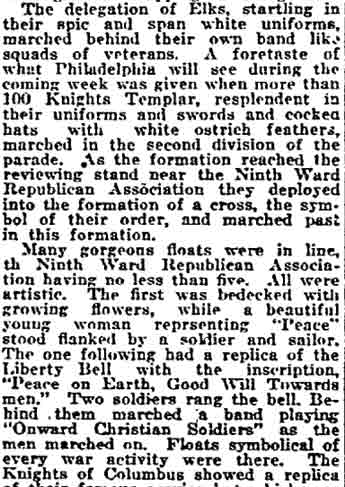
The delegation of Elks, startling in their spic and span white uniforms, marched behind their own band like squads of veterans. A foretaste of what Philadelphia will see during the coming week was given when more than 100 Knights Templar, resplendent in their uniforms and swords and cocked hats with white ostrich feathers, marched in the second division of the parade. As the formation reached the reviewing stand near the Ninth Ward Republican Association they deployed into the formation of a cross, the symbol of their order, and marched past in this formation.
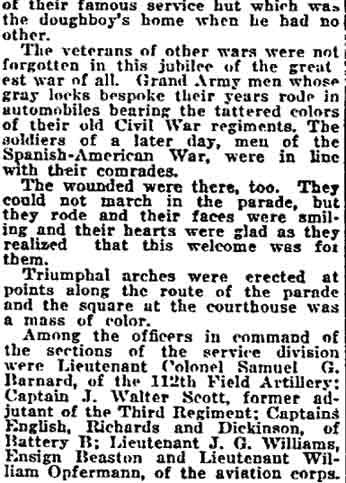
Many gorgeous floats were in line, th Ninth Ward Republican Association having no less than five. All were artistic. The first was bedecked with growing flowers, while a beautiful young woman reprsenting “Peace” stood flanked by a soldier and sailor. The one following had a replica of the Liberty Bell with the inscription, “Peace on Earth, Good Will Towards men.” Two soldiers rang the bell. Behind them marched a band playing “Onward Christian Soldiers” as the men marched on. Floats symbolical of every war activity were there. The Knights of Columbus showed a replica of their famous service hut which was the doughboy’s home when he had no other.
The veterans of other wars were not forgotten in this jubilee of the greatest war of all. Grand Army men whose gray locks bespoke their years rode in automobiles bearing the tattered colors of their old Civil War regiments. The soldiers of a later day, men of the Spanish-American War, were in line with their comrades.
The wounded were there, too. They could not march in the parade, but they rode and their faces were smiling and their hearts were glad as they realized that this welcome was for them.
Triumphal arches were erected at points along the route of the parade and the square at the courthouse was a mass of color.
Among the officers in command of the sections of the service division were Lieutenant Colonel Samuel G. Barnard, of the 112th Field Artillery; Captain J. Walter Scott, former adjutant of the Third Regiment; Captains English, Richards and Dickinson, of Battery B; Lieutenant J. G. Williams, Ensign Beaston and Lieutenant William Opfermann, of the aviation corps.
Battle Flags Wave Triumphant
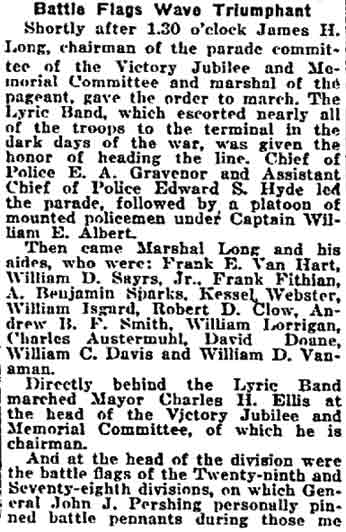
Shortly after 1.30 o’clock James H. Long, chairman of the parade committee of the Victory Jubilee and Memorial Committee and marshal of the pageant, gave the order to march. The Lyric Band, which escorted nearly all of the troops to the terminal in the dark days of the war, was given the honor of heading the line. Chief of Police E. A. Gravenor and Assistant Chief of Police Edward S. Hyde led the parade, followed by a platoon of mounted policemen under Captain William E. Albert.
Then came Marshal Long and his aides, who were: Frank E. Van Hart, William D. Sayrs, Jr., Frank Fithian, A. Benjamin Sparks, Kessel Webster, William Isgard, Robert D. Clow, Andrew B. F. Smith, William Lorrigan, Charles Austermuhl, David Doane, William C. Davis and William D. Vanaman.
Directly behind the Lyric Band marched Mayor Charles H. Ellis at the head of the Victory Jubilee and Memorial Committee, of which he is chairman.
And at the head of the division were the battle flags of the Twenty-ninth and Seventy-eighth divisions, on which General John J. Pershing personally pinned battle pennants during those memorable days back in October in the Argonne forest. Behind the 4th marched the famous engineers, headed by Captain Keasby and Captain Beals Smuck. Three battle pennants were pinned to their flags, which never touched the ground while they were bridging the rivers in the Argonne under hellish shell fire for the doughboys to advance. Then came the 112th Field Artillery, Battery B’s heroes of the border and of France, headed by Captain Charles Richards and Captain Dickinson. In the same section marched the Eleventh Machine Gun Battalion with its battle flags and pennants fluttering.
There was another great cheer as the Seventy-eighth Division, New Jersey’s Lightning boys, loomed into view. The heroes of the 311th Infantry, 303d Engineers, 307th, 308th and 309th Field Artillery and other regiments of that famous command were given a mighty ovation behind their battle flags, which led them in their assault on St. Mihiel and the day they attacked and captured Grand-Pre in the terrible conflict in the Argonne.
Behind them marched the Marines, headed by Lieutenant Monitor Watchman, of the Fifth Regiment, Second Division. With the Marines marched the regular army units, men who had served in as many as five battles and wore three and four gold service stripes on their sleeves.
Then followed the naval contingent. They were commanded by Commander Francis W. Hoffman and Commander W. G. Hodgson.
The order “eyes left” flashed along the line as each platoon drew near the reviewing stand and Admiral Wilson with his band to his cap returned the salute. With the admiral on the stand were former United States Senator David Baird, Congressman William J. Browning, County Collector John S. Well, City Clerk W. D. Brown and others.
At the armory a splendid banquet was served to the soldiers and sailors. For days past corps Red Cross workers had been preparing the good things to eat and the men did full justice to them. They marched in the armory where the food was spread on the tables and enjoyed themselves while bands played. After dinner there were speeches. Mayor Ellis in welcoming the men said:
“This is one of the happiest moments of my life. I have waited patiently through months of trial for the glad day when I could bid you welcome to the City of Camden once again.
“We are planning to erect a lasting memorial in memory of those heroes who gave their lives and in memory of the valiant deeds you performed on land and sea.
“Camden will always cherish the memory of this day, rever the memory of your dead comrades and will inscribe your valiant deeds on that memorial. I bid you welcome in the name of the most patriotic little city in America. I thank you.”
Prosecutor Charles A. Wolverton welcomed the men on behalf of the county and paid a tribute to their valor recalling their wonderful victories of the Argonne and other battlefields of France.
Changes Ordered in Camden Police
Philadelphia Inquirer —
Council Body Directs Solicitor Bleakly to Plan Re-organization of Department
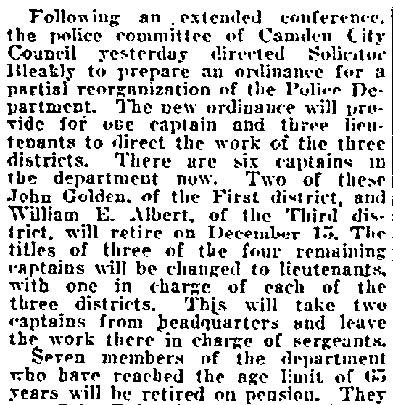
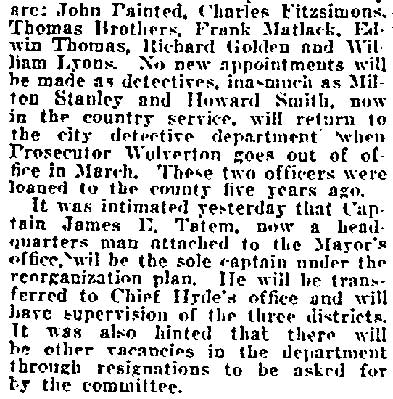
Following an extended conference, the police committee of Camden City Council yesterday directed Solicitor Bleakly to prepare an ordinance for a partial reorganization of the Police Department. The new ordinance will provide for one captain and three lieutenants to direct the work of the three districts. There are six captains in the department now. Two of these John Golden, of the First district, and William E. Albert, of the Third district, will retire on December 15. The titles of three of the four remaining captains will be changed to lieutenants, with one in charge of each of the three districts. This will take two captains from headquarters and leave the work there in charge of sergeants. Seven members of the department who have reached the age limit of 65 years will be retired on pension. They are: John Painted, Charles Fitzsimmons, Thomas Brothers, Frank Matlack, Edwin Thomas, Richard Golden and William Lyons. No new appointments will be made as detectives, inasmuch as Milton Stanley and Howard Smith, now in the country service, will return to the city detective department when Prosecutor Wolverton goes out of office in March. These two officers were loaned to the county five years ago. It was intimated yesterday that Captain James E. Tatem, now a headquarters man attached to the Mayor’s office, will be the sole captain under the reorganization plan. He will be transferred to Chief Hyde’s office and will have supervision of the three districts. It was also hinted that there will be other vacancies in the department through resignations to be asked for by the committee.
This story erred in reporting, as retirement at age 65 was NOT mandatory at the time. William E. Albert, Richard Golden, Frank Matlack, and Edwin Thomas did retire. John Golden, John Painter, Charles Fitzsimmons, Thomas Brothers, and William Lyons continued to work in the Police Department. John Golden was eventually promoted to Chief of Police.