William Leonard Hurley
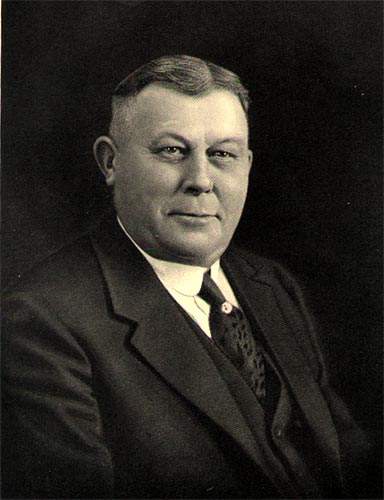
William Leonard Hurley
WILLIAM LEONARD HURLEY is best remembered as the owner of Hurley's, a department store chain whose home store was at Broadway and Pine Street in Camden for well over 50 years.
William Leonard Hurley was born in Atglen PA on October 24, 1862 to William and Ellen Hurley, both of whom were Irish-born immigrants. After receiving his education at Atglen and working on his father's farm, he moved to Camden at the age of 19, finding work at the Hussong Dye Works. In 1882 he took a position with the Singer Sewing Machine Company in Philadelphia as a collector, where he worked for two years. After working from 1884 to 1887 as a brakeman on the Pennsylvania Railroad, he found work with E. Gately & Co, of Philadelphia. He was then living at 210 Channing Terrace, which was off Mickle Street, near the site of the present Mickle Tower apartment building.
William Leonard Hurley became a partner in the concern in 1890. The new company, Gately and Hurley, opened a store at the old Wildey Hall, at 804–806 South 5th Street, the corner of South 5th and Pine Streets, in 1890. He was then living at 505 Pine Street. Within a few years a new building at Broadway and Pine was erected, a location that would become a Camden landmark for six decades, and is still well-remembered in 2009.
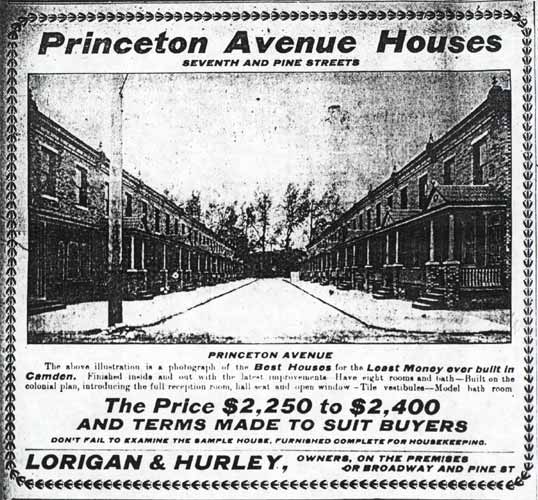
1902 saw William Leonard Hurley partnered with William J. Lorigan and his son, William H. Lorigan, who worked as the secretary of the Gately & Hurley store, in a real estate and home building venture. Their firm, Lorigan & Hurley, had its offices in the store building. That year the partners built Princeton Avenue, a block of homes between Pine and Division Streets, east of South 7th Street. They later built houses similar in appearance to those on Princeton Street on 27th Street north and south of Federal street.
In 1904 William L. Hurley bought out his partner. The sign on the store simply read Hurley's, and until the stores closed, that was simply enough. During the 1900s and until the early 1910s The Hurley family lived at 708 Broadway. Oddly enough, by 1947 this building had become a tavern, and still is used as such in 2004, having been known over the years as the Towers Bar, Dale's Tavern, and most recently Nefertiti's. By 1914 he had built a mansion on the White Horse Pike at McGill Avenue in Collingswood NJ.
William Leonard Hurley developed his business into one of the first modern department store chains, with satellite stores throughout South Jersey, and in Pennsylvania and Delaware as well. He advertised extensively, and sold on credit. He hired well, and many of his top staff spent decades working at Hurley's. Brothers James V. and Harry A. Moran worked there for over four decades. Experienced in credit and collections, he was among the first merchants to introduce credit at his stores, and sending salesmen into the country with vanloads of merchandise to sell to women who didn’t have transportation to get to town.
William Leonard Hurley was a Republican, but never aspired to public office. He was an alternate delegate to the 1912 Republican National Convention. He was on the Board of Directors of the Central Trust, and was involved in the fund-raising drive that culminated in the erection of the Walt Whitman Hotel. He also was active in the affairs of the Church of the Immaculate Conception, of which he was a member. He was among the first officers of the Church of the Immaculate Conception’s Lyceum Association along with John J. Burleigh, president; Michael Byrne, vice president; John M. Kelly, recording secretary; James Clark, financial secretary; and the Very Rev. Dean Mulligan. William L. Hurley served as treasurer.
After a long illness, William Leonard Hurley passed away at Hilton Head, South Carolina on April 23, 1928. His close friend, city planner Charles Wellford Leavitt, passed away the same day at Hartsdale, New York. His son Jerome Hurley succeeded him in the business, along with the Moran brothers.
Hurley's remained popular until its closing in 1956, brought in part by the economic downturn in Camden, but more so from the lack of a succession plan in the family.
Gately & Hurley, 1890s
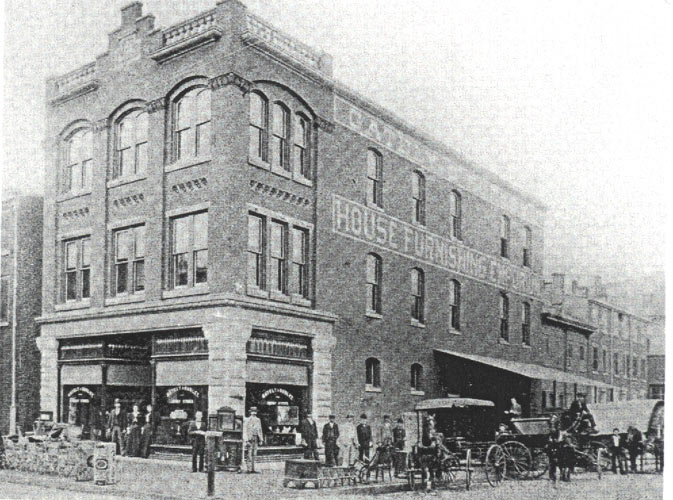
Gately & Hurley, 1890s
Business Men in Line
Philadelphia Inquirer —
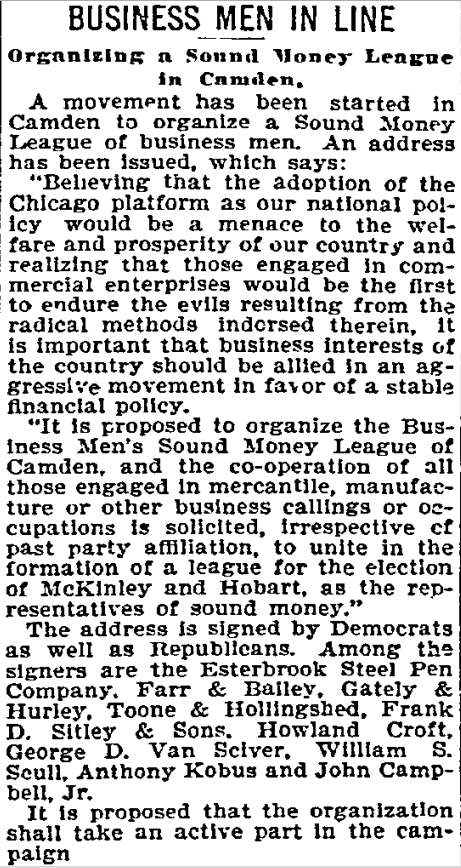
Organizing a Sound Money League in Camden.
A movement has been started in Camden to organize a Sound Money League of business men. An address has been issued, which says:
“Believing that the adoption of the Chicago platform as our national policy would be a menace to the welfare and prosperity of our country and realizing that those engaged in commercial enterprises would be the first to endure the evils resulting from the radical methods indorsed therein, it is important that business interests of the country should be allied in an aggressive movement in favor of a stable financial policy.
“It is proposed to organize the Business Men’s Sound Money League of Camden, and the co-operation of all those engaged in mercantile, manufacture or other business callings or occupations is solicited, irrespective of past party affiliation, to unite in the formation of a league for the election of McKinley and Hobart, as the representatives of sound money.”
The address is signed by Democrats as well as Republicans. Among the signers are the Esterbrook Steel Pen Company, Farr & Bailey, Gately & Hurley, Toone & Hollingshed, Frank D. Sitley & Sons, Howland Croft, George D. Van Sciver, William S. Scull, Anthony Kobus and John Campbell, Jr.
It is proposed that the organization shall take an active part in the campaign
Swinging the Official Ax
Philadelphia Inquirer —
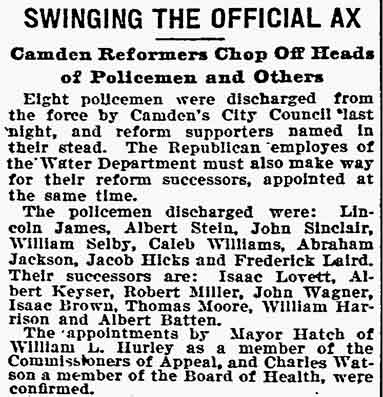
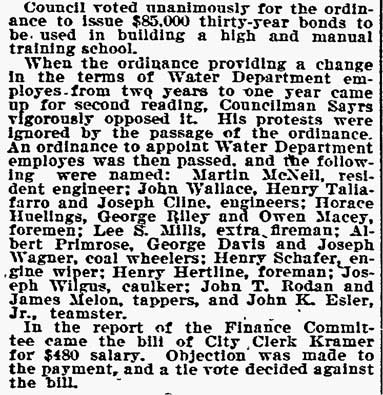
SWINGING THE OFFICIAL AX
Camden Reformers Chop Off Heads of Policemen and Others
Eight policemen were discharged from the force by Camden’s City Council last night, and reform supporters named in their stead. The Republican employes of the Water Department must also make way for their reform successors, appointed at the same time.
The policemen discharged were: Lincoln James, Albert Stein, John Sinclair, William Selby, Caleb Williams, Abraham Jackson, Jacob Hicks and Frederick Laird. Their successors are: Isaac Lovett, Albert Keyser, Robert Miller, John Wagner, Isaac Brown, Thomas Moore, William Harrison and Albert Batten.
The appointments by Mayor Hatch of William L. Hurley as a member of the Commissioners of Appeal, and Charles Watson a member of the Board of Health, were confirmed.
Council voted unanimously for the ordinance to issue $85,000 thirty-year bonds to be used in building a high and manual training school.
When the ordinance providing a change in the terms of Water Department employes from two years to one year came up for second reading, Councilman Sayrs vigorously opposed it. His protests were ignored by the passage of the ordinance. An ordinance to appoint Water Department employes was then passed, and the following were named: Martin McNeil, resident engineer; John Wallace, Henry Taliafarro and Joseph Cline, engineers; Horace Huelings, George Riley and Owen Macey, foremen; Lee S. Mills, extra fireman; Albert Primrose, George Davis and Joseph Wagner, coal wheelers; Henry Schafer, engine wiper; Henry Hertline, foreman; Joseph Wilgus, caulker; John T. Rodan and James Melon, tappers, and John K. Esler, Jr., teamster.
In the report of the Finance Committee came the bill of City Clerk Kramer for $480 salary. Objection was made to the payment, and a tie vote decided against the bill.
Commissioners of Appeals Organize
Philadelphia Inquirer —

The Commissioners of Appeals have organized by the election of William L. Hurley as chairman and W. Penn Corson as clerk.
Princeton Avenue, 1902
Camden Daily Courier — 1902
Recital at Catholic Lyceum
Philadelphia Inquirer —
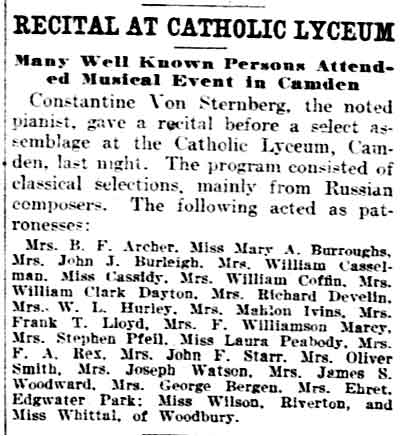
RECITAL AT CATHOLIC LYCEUM
Many Well Known Persons Attended Musical Event in Camden
Constantine Von Sternberg, the noted pianist, gave a recital before a select assemblage at the Catholic Lyceum, Camden, last night. The program consisted of classical selections, mainly from Russian composers. The following acted as patronesses:
Mrs. B. F. Archer, Miss Mary A. Burroughs, Mrs. John J. Burleigh, Mrs. William Casselman, Miss Cassidy, Mrs. William Coffin, Mrs. William Clark Dayton, Mrs. Richard Develin, Mrs. W. L. Hurley, Mrs. Mahlon Ivins, Mrs. Frank T. Lloyd, Mrs. F. Williamson Marcy, Mrs. Stephen Pfeil, Miss Laura Peabody, Mrs. F. A. Rex, Mrs. John F. Starr, Mrs. Oliver Smith, Mrs. Joseph Watson, Mrs. James S. Woodward, Mrs. George Bergen, Mrs. Ehret, Edgewater Park; Miss Wilson, Riverton, and Miss Whittal, of Woodbury.
Greater Camden the Slogan at Board of Trade Banquet
Philadelphia Inquirer —
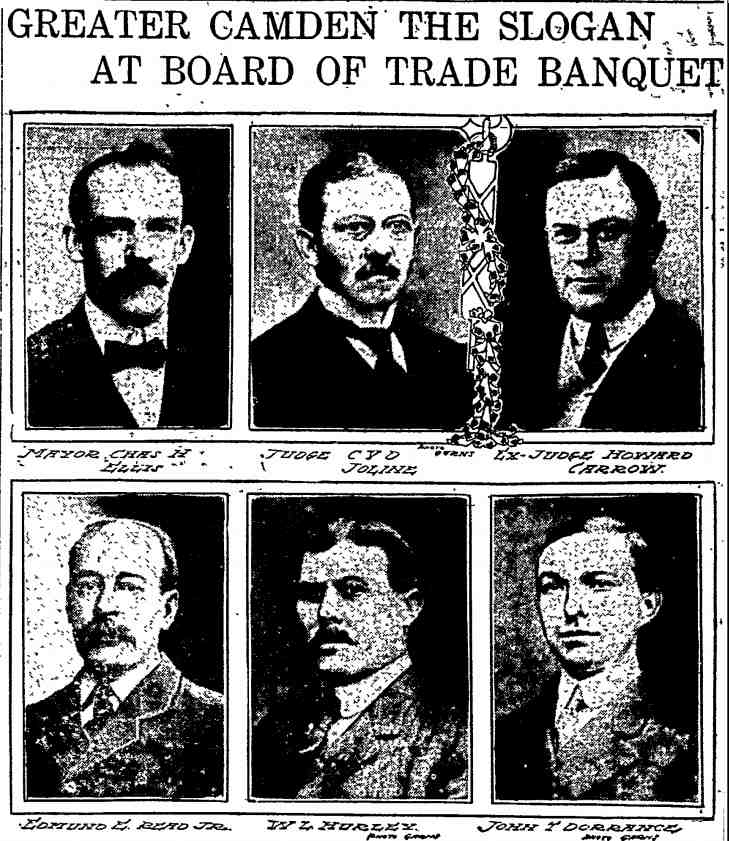
GREATER CAMDEN THE SLOGAN AT BOARD OF TRADE BANQUET
Men Prominent in Business Affairs Sound Praises of Growing City at Annual Feast
A greater, more progressive Camden was the watchword at he [sic] annual banquet given by Camden’s Board of Trade last night. And that this means something is evident from the fact that it came from the city’s “Captains of Industry” to the number of two hundred.
It was Camden’s rejuvenated Board of Trade that gave the banquet and the interest taken was manifested by the presence of representatives from every business concern of any prominence in the city.
All Represented
There were bankers besides just ordinary business men, professional men of every character, and all were imbued with the spirit to make of Camden a place that will be known on the map throughout the country. William L. Hurley, president of the board, presided at the banquet.
“Generally speaking, we are satisfied with our city,” said Mayor Charles H. Ellis in responding to the toast, “Camden as it is,” “but, of course, there is room for improvement in many respects, and it rests with you gentlemen, you members of the Board of Trade to largely aid in solving our municipal problems.”
Former Judge Howard Carrow acted as toastmaster and, beside Mayor Ellis, those who responded to toasts were Congressman James H. Davidson, of Wisconsin, who spoke on “Boards of Trades;” Judge of the Court of Common Pleas C. V. D. Joline, “Camden’s Eighty Years;” Lawyer Edmund E. Read, president of the Board of Education, “Camden’s Future.”
One of the features of the occasion was the presentation of a life-size oil painting of President William Leonard Hurley. [sic] to the board, by Lawyer Harry C. Kramer. This came as a complete surprise to President Hurley, but he expressed his thorough appreciation of the honor.
Senator Philander C. Knox, of Pennsylvania, was among the specially invited guests and a warm welcome awaited him, but he was unavoidably detained.. [sic]
Some good points to Camden’s credit were enumerated in the menu cards as follows:
“Camden has within its borders a population of nearly 100,000 and shipbuilding firms that can either supply a launch or the greatest battleship; the largest lace curtain manufacturers in America; a talking machine that speaks every known language; iron works that make enough pipe to girdle the earth; leather manufacturers who tan skins from all parts of the globe; the largest furniture house, whose products reach the Philippines; banks and trust companies whose resources are not affected by panics; artesian water that can be taken without adding anything.”
The committee in charge of the occasion included John T. Dorrance, chairman; Edwin G. C. Bleakly, Harry C. Kramer, David A. Henderson and Samuel W. Sparks.
Among the Guests
Among the participants were Congressman Harry C. Loudenslager, Francis Howell, Walter Wood, Elmer E. Long, George W. Jessup, former Judge Joseph Gaskill, Volney G. Bennett, Wilbur F. Rose, Alexander C. Wood, George A. Frey, Charles A. Reynolds, Vice Chancellor E. B. Leaming, Heulings Lippincott, Charles K. Haddon, Fithian S. Simmons, Joseph B. Van Sciver, David Jester, Frank B. Sitley, Alpheus McCracken, Thomas S. Nekervis, DeCourcy May, Watson Depuy, Lionel C. Simpson, John M. Kelly, G. George Browning, William J. Browning, Isaac Ferris, John C. Danenhower, John R. McFeeley, Elias Davis, Anthony Kobus, Captain John B. Adams.
Central Trust Company, 1906 Officers & Directors
Central Trust Company
1906 Officers & Directors
From an 1906 City Directory Ad
A. McCRACKEN, President
C. T. SHARPLESS, Vice-President
T. S. NEKERVIS, Treasurer
C. CHESTER CRAIG, Trust Officer
WILLIAM C. JONES, Solicitor.
====== D I R E C T O R S ======
A. McCRACKEN
T. S. NEKERVIS
CASPER T. SHARPLESS
CHARLES HELM
CHARLES BOSCH
FITHIAN S. SIMMONS
A. J. FULLMER
GEORGE A. MUNGER
MAHLON F. IVINS
JESSE W. STARR III
RICHARD F. SMITH
CONRAD SCHWOERER
W. LEONARD HURLEY
WILLIAM C. JONES
KILLIAM E. BENNETT
Alpheus McCracken and W. Leonard Hurley
Philadelphia Inquirer —

Alpheus McCracken and W. Leonard Hurley, of the Central Trust Company, are on their way home from Europe.
Phil Kearney Brigade Reunion Committee
Philadelphia Inquirer —

Mayor Ellis in Camden yesterday appointed the following committee of citizens to act in conjunction with the veterans in making a success of the annual reunion of the comrades of General Phil Kearney’s Brigade, which will be held on September 14: William Hurley, Walter Tushingham, M. W. Taylor, William Fox, Colonel John Mather, Frank W. Tussey, Charles Laird, George Blake, Dr. Wallace McGeorge, Dr. William Martindale, Henry C. Dole and William Sangtinette.
Lorigan & Hurley Building Permits
Philadelphia Inquirer —

Lorigan & Hurley yesterday took out a permit for the erection of a row of nine houses from 310 to 335 North Eighth street. A permit for nine dwellings on Ninth street south of Mechanic street, was also issued.
Camden News Notes
Philadelphia Inquirer —
Camden News Notes
•• The Board of Education has appointed Drs. Marcus K. Mines, Frederick Jones Jr., W. P. Wingender and W. K. Browning as assistant medical inspectors at salaries of $400 each. This is in compliance with a recent law of the State.
•• In a fall from a scaffold at the New York Shipbuilding plant yesterday John Wagner, 24 years old, of 1038 Mechanic street, received a bad shaking up beside a sprained back. He was taken to the Cooper Hospital.
•• It is reported that a number of industrial concerns where girls are employed are not adequately protected by fire escapes, a subject that will probably be investigated.
•• Members of the class of 1908 have been given the privilege of placing a memorial marble in the High School, a custom that is likely to be followed by other classes.
•• The fact that Supreme Court Justice Garrison has taken such a decided stand in the election fraud probe has caused considerable uneasiness in certain quarters.
•• Policeman Lewis Hamel, who was suspended from the force pending a trial on charges of dereliction of duty, yesterday resigned. Policeman George West, who is accused of conduct unbecoming an officer, was suspended by Mayor Ellis yesterday.
•• Because he knocked out several of his wife’s teeth in a domestic row, Clarence Governs, of 817 Clare street, was committed to jail by the Recorder yesterday for action by the grand jury.
•• After a lingering illness, Michael Kirby, father of Mrs. W. Leonard Hurley, died yesterday at his son in-law’s country home, “Dungarven,” West Collingswood. He was 70 years old and a native of Woodstown.
•• Archer D. Norris was badly burned in a fire at Broadway and Ferry avenue.
•• The Tammany Club has elected the following officers: William Black, president; Redmond Pierson, vice president; Charles Redmond, secretary; Joseph Ryrie, treasurer; James Croker, sergeant-at-arms.
•• The Women’s Home Missionaries of State Street Methodist Episcopal Church elected officers.
Hurley's, 1915
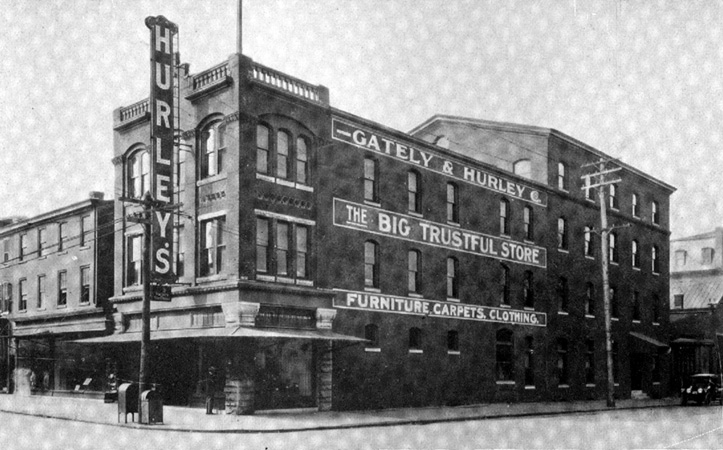
Hurley’s, 1915
Hurley's, 1915
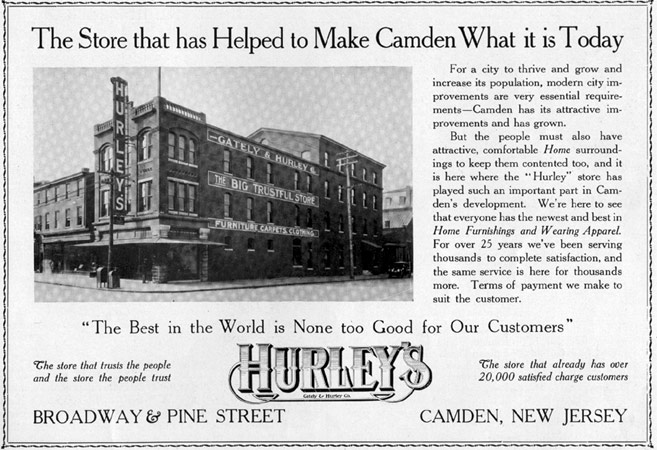
Hurley’s, 1915
War Work Director Named
Philadelphia Inquirer —
F. Morse Archer, president of the National State Bank, is to direct the Camden drive for the war work fund. Former Judge William T. Boyle and William J. Strandwitz are the vice chairmen; Walter J. Staats is the treasurer and E. A. Stoll and David S. Rush, Jr., are the directors. The work in Camden city is to be done in six districts and the captains are E. G. C. Bleakly, James H. Long, William L. Hurley, F. B. Wallen, Wilbert Pike and Volney Bennett. Camden county’s quota is $227,500.
Hurley Store Nears 38th Anniversary
Camden Courier-Post —
HURLEY STORE NEARS 38TH ANNIVERSARY
Wednesday to Mark Birthday of Successful Enterprise of Merchant
One of Camden’s largest retail business’ enterprises will observe its thirty-eighth anniversary Wednesday.
The Hurley store, Broadway and Pine street, has played a conspicuous part in the city’s history for almost half its first 100 years that will come to a close February 18.
It was on February 1, 1890, that William Leonard Hurley opened his first store in practically the same location where the present modern store stands. The original store had a frontage of 20 feet, a depth of 30…
Associated with him at the start and continuously since was James V. Moran, who is also now the supervising director of the five other Hurley stores located in Trenton, Atlantic City, Bridgeton, Wilmington, and Wilkes-Barre. A few years later Harry A. Moran came into the organization and is now the general manager of the Camden store.
Meanwhile, men who helped Hurley pioneer what is now a big business, have become partners in the stores of other cities. Tobin, of Hurley-Tobin, Trenton; Jones, of Hurley-Jones, Atlantic City; Powell, of Hurley-Powell, Wilmington, and Loughran, of Hurley-Loughran, Wilkes-Barre.
Hurley has not only figured in a big way in retail business development locally, but his entire local organization has contributed materially to all civic activities. While the business of the Camden store for years centered mainly in Camden, they now have thousands of customers throughout all South Jersey. The main store in Camden and warehouses adjoining, occupy most of the block from Fifth to Broadway and Pine to Division streets.
Hurley Store 50th Anniversary Dinner
Walt Whitman Hotel —
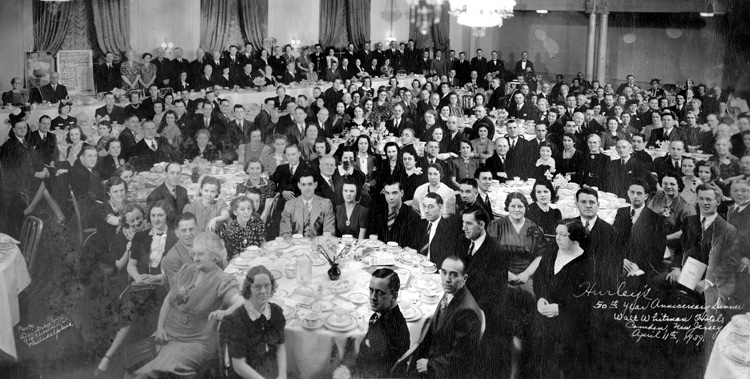
Hurley Store 50th Anniversary Dinner — Walt Whitman Hotel, April 11, 1939
Hurley's, 1952
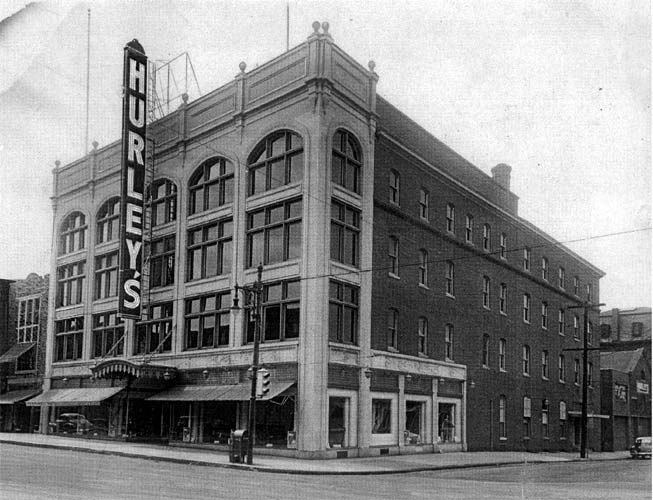
Hurley’s, 1952
South Jersey: A History 1624–1924
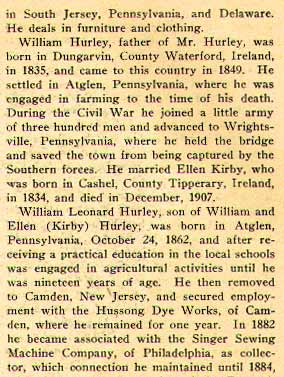
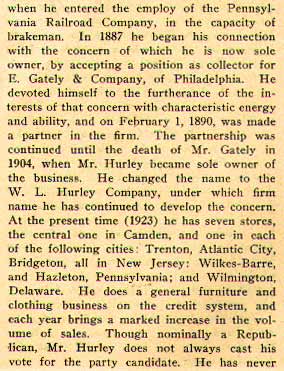
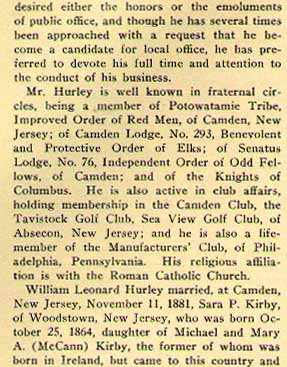
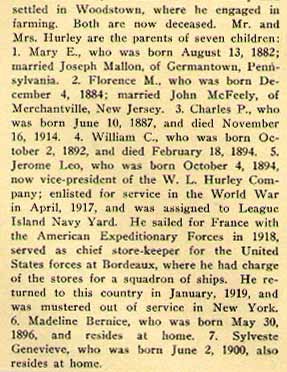
William Leonard Hurley, biography from South Jersey: A History 1624–1924
The Hurley Mansion, Collingswood
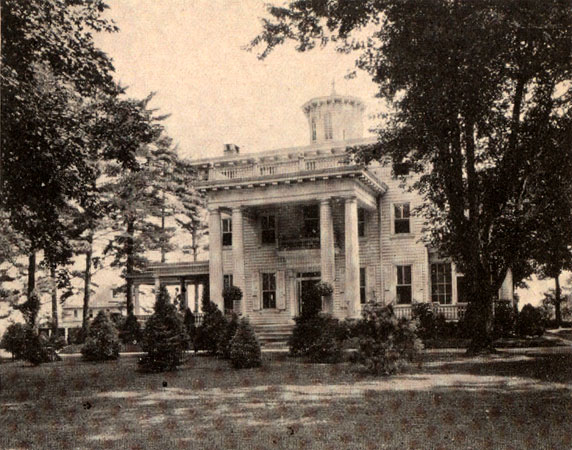
William Leonard Hurley had built this home in Collingswood NJ by 1914
This house is on the White Horse Pike in Collingswood NJ at the intersection of the White Horse Pike (Route 30) and McGill Avenue. The Hurley family gave what was known as their Camden suburban home and grounds to a Masonic organization, the Excelsior Scottish Rite around 1930. The building is still here. In 1931 the Rite built an auditorium to the building. In 2003 they entered into an agreement with Collingswood Borough to develop the property into a community arts theater and a ballroom. Tours are available with a member. Also of note on the property is an oak tree that is dated to be about 230 years old.
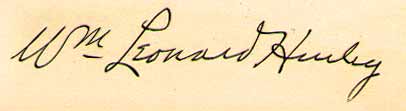
Signature of William Leonard Hurley
East Camden Notes
Camden Post-Telegram —
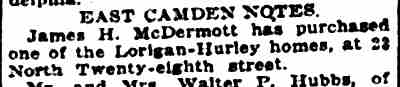
East Camden Notes — James H. McDermott has purchased one of the Lorigan-Hurley homes, at 23 North Twenty-eighth street.
Patrons and Patronesses for First Military Ball
Camden Courier-Post —
Patrons and patronesses for the first military ball of the Camden Post No. 960, Veterans of Foreign Wars, to be held on Friday evening February 3 in the Elks auditorium, Seventh and Cooper Streets, are announced today.
The following prominent men and women are listed: Mrs. J.W. Connor, Miss C.M. Day, Mrs. J.H. Forsyth, Mrs. H.J. Goodyear, Miss B. Graham, Mrs. R.E. Green, Mrs. E.F. Haines, Mrs. J. Hood Jr., Mrs. W. Hurley, Mrs. J. Jarrell, Mrs. T. Keefe, Mrs. J.F. Kobus, Mrs. L. Liberman, Mrs. F.L. Lloyd, Mrs. M.A. Logan, Mrs. T.P. McConaghy, Mrs. F.F. Neutze, Mrs. L.K. Marr, Mrs. J.A. Pennington, Mrs. M.E. Ramsey, Mrs. E. Truax, Mrs. S.M. Shay, Mrs. W.J. Staats, Mrs. B.G. Tarburton, Mrs. R.W. Waddell, Mrs. E. Watson, Mrs. E.P. Wescott, Mrs. C.A. Wolverton.
David Baird Jr., William T. Boyle, Isaac Ferris, William Hurley, John Hood Jr., John Jarrell, Victor King, William J. Kraft, Thomas Keefe, Joseph F. Kobus, Hon. Edmund B. Leaming, Dr. A. Haines Lippincott, James H. Long, L.K. Marr, Dr. Thomas P. McConaghy, Hon. Frank F. Neutze, Samuel P. Orlando, Albert E. Simmons, Edwin Watson, Ethan P. Wescott.
William L. Hurley on Hilton Head Island, 1920s
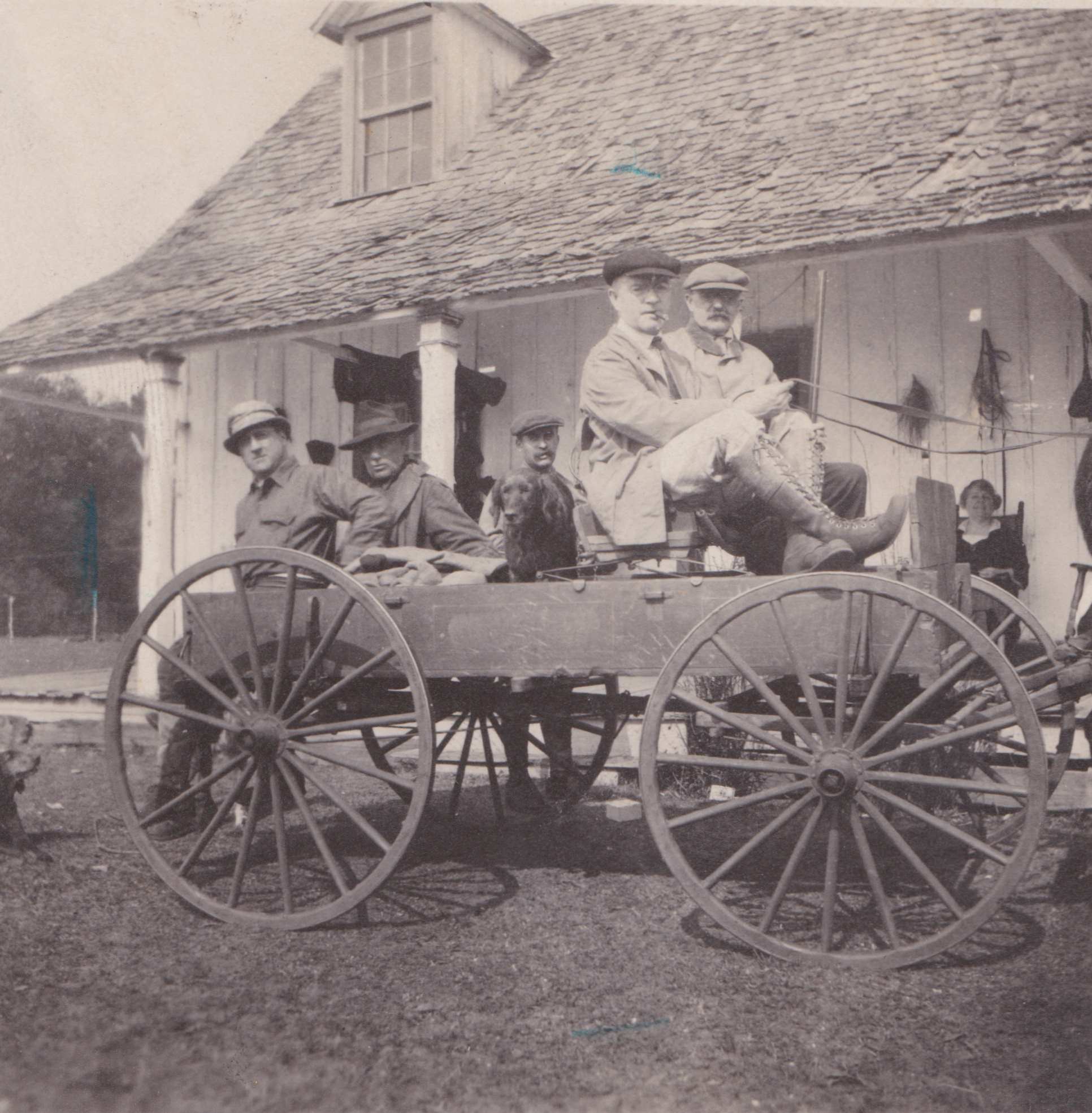
William L. Hurley on Hilton Head Island, South Carolina, 1920s
William L. Hurley Dies on So. Carolina Estate; Charles W. Leavitt Dead
Camden Courier-Post —
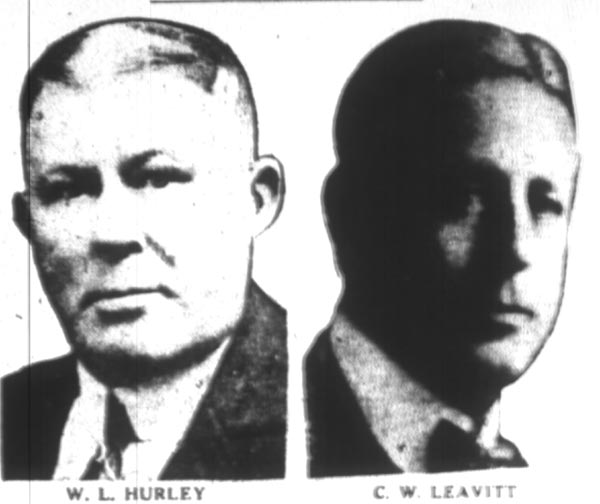
W. L. HURLEY — C. W. LEAVITT
William Leonard Hurley, who died this morning in Hilton Head, S. C., and Charles Wellford Leavitt, who died yesterday morning, at Hartsdale, N. Y., were firm friends.
In life, they were drawn closely together by their common interest in the upbuilding of Camden and South Jersey. It was a tragic coincidence that they died within a few hours of each other.
The widely known merchant and the famous city planner frequently met at luncheons and conferences. On his stays in Camden, Mr. Leavitt was frequently entertained at Mr. Hurley’s beautiful home in West Collingswood on the White Horse Pike.
When Leavitt first proposed the Cooper valley parkway project, Hurley offered to donate a large portion of his extensive holdings in that district to make Leavitt’s dream come true.
DEATH STRIKES MERCHANT AT ISLAND HOME
Succumbs to Complications After Long Illness
BODY DUE TO ARRIVE IN CAMDEN WEDNESDAY
Collingswood Priest First to Receive Word; Hurley Had Colorful Career
William Leonard Hurley, head of the Hurley Stores, died this morning at 2.30 o’clock at Hilton Head, S. C., his island estate off Savannah. He had been ill many weeks with a complication of maladies.
Rev. John J. O’Farrell, pastor of St. John’s Catholic Church, Collingswood, of which the Hurley family are parishioners, received word to that effect this morning from Rev. Father Murphy, of Beaufort, S. C., who had been spiritual advisor to Mr. Hurley in the last days of his long illness.
Father Murphy said the body had been sent to Beaufort and that it will arrive in Camden on Wednesday for funeral services. In the brief message the priest also stated all the members of the Hurley family were about the death bed except two daughters, Mrs. Florence Hurley McFeeley, Merchantville, and Mrs. Bernice H. Doyle, Haddonfield.
With Mr. Hurley were his wife, Mrs. Sarah P. Hurley; his son, Jerome, and his daughters, Mrs. Mary Hurley Mallon, and Genevieve Hurley, who makes her home with her parents.
Hilton Head is so out of the beaten path of travel that it is difficult to reach it except by private yacht. Three times a week a steamship touches the island and goes to Beaufort. Monday morning is one of the days, and the body of Mr. Hurley was placed aboard today for the long trip north.
Mr. Hurley went to Hilton Head January 11 to recuperate. He was then in ill health and it was thought a stay at his island home might result in his recovery. Instead his condition gradually became worse and less than three weeks ago, when it was found he had dilation of the heart, close friends realized the end was not far away. He seemed to rally, however, until he was stricken with paralysis.
It had been hoped to remove him to a hospital at Savannah. He had apparently recovered sufficiently to make such a trip possible, but a second stroke again made his condition grave. All last week he remained in a semi-conscious state. On Saturday a telegram to James V. Moran, treasurer and general manager of the Hurley stores, indicated he had rallied.
His condition was declared to have improved. At that time the merchant seemed to recognize members of his family but was unable to speak. It was then hoped he might rally to the extent that his removal north would be possible. Nothing further was heard until Father Murphy’s message to Father O’Farrell this morning.
During his illness Mr. Hurley had the constant attention of skilled physicians and nurses who were taken to Hilton Head. Previous to this last illness he had been in comparative good health. Some fifteen years ago he underwent a serious operation in the famous Mayo hospital at Rochester, Minnesota and only occasionally felt the effects of that ordeal.
On receipt of the announcement of Mr. Hurley’s death, the Camden and other Hurley stores were closed until after the funeral. They include the stores at Wilkes Barre, Trenton, Wilmington, Atlantic City, and Bridgeton.
Moran stated it is not known what day the funeral will be held. That will be determined by the family on arrival at their West Collingswood home.
William Leonard Hurley Dies at Hilton Head, S.C., Winter Estate
Camden Courier-Post —

HURLEY BASED SUCCESS IN LIFE AND IN BUSINESS ON SQUARE DEAL TO ALL
By BEN COURTER
Nearly two score years ago an earnest young man called together a handful of employees in a small store at Fifth and Pine streets.
“Boys, see that door?” he said to them.
“Well, if by any chance I should be called upon to resort to unscrupulous methods in the conduct of this business that door will be closed and this enterprise will end. Square dealing is to be the principle on which we will do business, square dealing to everybody.”
That young man was William Leonard Hurley, then but 27 years old and virile, visioning a great business which he purposed to develop. It was the pronouncement of what then was nothing less than an ideal, for it was in a period when there was a tendency to take advantage of the unscrupulous methods in the conduct of this business by selling inferior goods at exorbitant prices. Many operated under what was known in the trade as the “borax system,” which resulted in the public looking askance at installment buying for the home.
Based on that determination to cultivate public confidence in his own business, Hurley built slowly but securely, his small enterprise into “the big trustful store,” with branches in half a dozen cities.
It was a determination that made him a kindred spirit, in later years, with Theodore Roosevelt whose guest the Rough Rider was to become in the midst of a political campaign that stirred the country from coast to coast. It was the straight-forward characteristic that likewise prompted his subsequent activities in the interest of Camden, that was to be a factor in throwing off the provincial spirit and entering the civic stride so pronounced in the advent of the Camden bridge and the extension of Broadway. In both these he was a strenuous advocate of civic expansion, scientifically planned.
Hurley Not Born With a ‘Silver Spoon’
When Hurley was born in Chester county, Pa., 65 years ago, it was not with a “silver spoon in his mouth.” His father, William Hurley, was a railroad man, an honest, hard-working father, who, in times which were hard enough for the bread-winner, struggled to keep his family in the necessities of life.
The son, William, obtained the rudiments of education under great difficulties, for schools were scarce and far between in the sparse settlement where his boyhood was spent. It was a school of hard knocks, an environment that evidenced the difficult problem the poorer class had in obtaining the bare necessities of life. It was the experience of those early years that William L. Hurley never forgot, for afterward, when success had come, he never was deaf to an appeal from those “pulling hard against the stream.”
At the age of 12 he obtained his first job on a farm in his native Chester county. Farming in those days was hard, strenuous work, seemingly never ending labor to the boy, even then strong and possessing much of the splendid physique of later years.
“I worked from four in the morning until after dark,” Hurley once said, in a reminiscent way. “The farmer usually woke me in the morning by pounding his cane on the floor.
“My duties? Well, they included milking ten cows, feeding chickens and pigs, cleaning the horses, husking corn and doing odd chores. The farmer paid me $4 a month and board.
“In those days boys worked just as hard as grown folks. It was no cinch and when darkness came I couldn’t run fast enough to the farmhouse and to bed. I was dead tired and the bed brought supreme happiness to me. Sleeping was about the only fun I had.”
So the years went on with the hard work on the farm. The future held no great promise. The railroad was more alluring. Since his father was a railroader, young Hurley decided to try that field.
Railroading in 80’s No ‘Automatic’ Job
Back in the 80’s railroading was a far different proposition than it is now. There was none of the automatic brakes and couplings and numberless other inventions that have made it comparatively a safe job today. The old-fashioned coupling pin, for instance, was the abomination of the brakeman. What it did to Hurley he carried to his dying day in the loss of the end of one of his middle fingers.
Not only did he act as brakeman but also as fireman. As he stoked the pulsing engine he dreamed of the day when he might take the throttle. It seemed a wonderful career then, but fate had other things in store for him. He sensed it when he concluded to better his wage of $1.50 a day and get “something on the side.” That was by selling sewing machines at night, often after he had worked hard on drilling freights or stoking the engine through the day.
But this selling of sewing machines impressed young Hurley, that perhaps after all there was something else in life other than guiding a great locomotive over the rails. At any rate he concluded to try it out and this in 1888, the year of the great Blizzard, in this section, he obtained a job with Edward Gately & Co. in Philadelphia as canvasser. It was not long before he had two assistants who acted as collectors, one of whom, Harry F. Jones, was to become his partner in the Atlantic City store many years later.
Gately was a wealthy man who had made his money mostly in the installment business, one who ever had an eye open for the promising young men in his organization. It was his custom to give them a chance and take them into partnership, opening stores in various cities. Young Hurley was one of these promising young men. In 1890 the business of Gately & Hurley was started. To be exact it was on February 1 of that year that a small store was opened, the corner store under old Wildey Hall at Fifth and Pine streets. It was there that he was inspired to tell his then small force of his square dealing policy.
Worked Long Hours to Make Store Success
Young Hurley worked like a Trojan. None in the ranks put in longer hours than he, sometimes 18 or 20 before he was willing to call it a day.
Not only did he direct his force in canvassing business, but he went out on the street, often with rugs across his shoulders, to obtain patronage. Many recall the stalwart, earnest young man and his breezy manner seldom failed to bring result.
Nor was Hurley, in the flush of subsequent success, averse to recalling those strenuous days, usually with a chuckle and remembrance of old timers who had stood staunch and strong with his organization through the intervening years.
Four years later the business had grown to such proportions that he concluded another location was needed. That was after all the stores under Wildey Hall had been occupied. In 1894 the Gately & Hurley store was opened at Broadway and Pine streets. It was then 33 by 90 feet.
When Hurley impressed Gately with the necessity for expanding and having a real store, he prepared plans for a four-story structure. Camden then was filled with the “can’t be dones.” Toone & Hollinshed at Broadway and Kaighn avenue was the biggest place on that thoroughfare. Mrs. Varney’s place was on Kaighn avenue, the store of E. V. Story at Sycamore street, Hughes Brothers at Walnut street, Fuhrman Brothers at Chestnut and a few notion places here and there. But the Hurley enterprise seemed so outlandish that one day as George Leathwhite, then Camden’s leading plumber, was looking over the building operation, a prominent business man of the period asked.
“Who is the damn fool building this place?”
Nor was he mollified in the least when informed it was “Bill” Hurley. It was regarded altogether a foolhardy undertaking, one that would spell certain disaster. It was pointed out there was nothing just like it on Broadway and that there was nothing to warrant such an outlay.
As a matter of fact that pessimistic note eventually reached Gately. He had some misgivings and Hurley’s four-story building was kept down to three. Just two months after the store had been finished it was necessary to find warehousing room by renting the old bakery of William Kairer at Line and West streets. Incidentally, it may be of interest to recall it was Kairer the baker, who had been shot and killed by a burglar in 1893. Theodore Lambert was hanged in the old county jail for that murder.
In 1900 Hurley bought the Gately interests, giving him exclusive ownership, and the business continued to grow making more additions necessary. The old Field properties, two and a half story bricks, were bought, torn down and the store extended.
In 1903 a store was established at Wilkes-Barre with Daniel Loughran as Hurley’s partner. Three years later Henry J. Tobin was made his partner in another store at Trenton. Then in 1912 John J. Powell was commissioned to open the Hurley-Powell store at Wilmington. Harry F. Jones, Hurley’s collector in the very early days, opened the Hurley-Jones store at Atlantic City in 1915. Five years later another Hurley store started business at Bridgeton. And in 1923 the home store was remodeled and in the meantime, old Turner Hall, where many a gay night was had by the old timers in masquerades and other festivities, was converted into a warehouse with other structures doing like service. Hurley having since been recognized as one of South Jersey’s merchant princes.
Roosevelt Given Support in Bull Moose Campaign
Although he never consented to leave the helm of his great business enterprises, save later in life when he spent part of the winters at Hilton Head or occasionally went abroad, Mr. Hurley found time to take an active interest in the affairs of Camden. He did not seek political preferment but for more than 30 years he sought the best that might come with progressive government. He ever desired to see Camden forge ahead in business in a civic way. Frequently he chafed over a tendency on the part of the political powers to let things drift along. He had no particular objection to the Republican organization as it was constituted under the late Senator David Baird, but he did believe with all possible sincerity, that if the progressive spirit could be injected into it much would be accomplished, things that were left to very, very slow evolution.
It was therefore quite in keeping with that tendency that he aligned himself with the late Cooper B. Hatch at the time when the Committee of 100 was born with the Courier as city editor, being a factor in the movement. Hurley gave financial and moral support and more and again in the movement with Harry B. Kramer and others; many of whom have long since passed.
When Colonel Roosevelt formed the Bull Moose party and became the Presidential candidate in 1912 with William H. Taft and Woodrow Wilson in the field, Mr. Hurley was an earnest advocate of the Rough Rider. In fact he was one of the delegates to the Bull Moose convention, the most ardent Roosevelt.
In the midst of that truly hectic campaign when Taft and Roosevelt visited Camden, Wilson, a Taft meeting was called, was enthusiastic enough to please any Democrat. Taft was a front and hardly more than a fringe, mostly office holders greeted him, but Roosevelt’s was what the Colonel himself called a “rip snorter.”
Teddy Was Guest at Home of Hurley During Visit Here
Hurley was his host on that occasion, a hot summer night, itself suggestive of the extremely hot campaign. These meetings were held at the Third Regiment Armory, no other building then being available. One may yet recall very vividly the entrance of the Colonel. Mr. Hurley and the Camden Bull Moose leaders. The great drill hall was literally jammed, with yelling enthusiasts even hanging from the top girders. Just as he arrived a terrific thunder storm broke loose, the reverberation, the vivid flashes lost in the roar of the crowd.
“Where’s your hat, Teddy?” someone yelled.
And the Colonel tossed his old black slouch hat in the ring while Hurley led the cheer that followed, a cheer that seemingly tested the strength of the expansive roof. Roosevelt had been a guest at the Hurley home at West Collingswood where the leaders, the rank and file of the Bull Moosers met him. It was one gala night and Mr. Hurley was in the zenith of his glory.
No one was more disappointed when Colonel Roosevelt failed at the November election, for Mr. Hurley felt that the country needed the hero of San Juan Hill particularly at that time. He sincerely mourned the Colonel’s passing, but to the very last cherished his memory, regarding him as the Great American.
Backed Non-Partisan Move, Aided Opening of Broadway
As has been indicated, Mr. Hurley had no particular feeling against the Republican organization, but he was certain that Camden was on the threshhold of big things and that there should be an awakening. There appeared to be no intention of getting out of the rut so far as the political powers were concerned and with the assurance of the bridge he regarded it necessary to be alive to the opportunities certain to come. There had been talk of certain outlets from the bridge which did not meet the situation, in his judgment. For one thing, he was impressed with the extension of Broadway.
For more years than one might recall, Broadway had been Camden’s principal street. Many regarded it as the city’s most important business thoroughfare. Mr. Hurley early realized that to extend it to where the bridge plaza would eventually be located was a real civic essential, but the city administration did not consider the financial outlay that would be involved justified in the extension.
That was one of the factors that resulted in the Non-Partisan movement of 1922, of Mr. Hurley’s advocacy of its cause, of his financial and moral support. He was one of the leaders in the civic revolution that first brought the victory for commission form of government and later that ushered the Non-Partisan candidates into office.
It was the realization of a cherished dream when the new administration brought prosperity that assured Broadway’s extension to the bridge plaza. It justified his prediction that it would be like giving a new blood stream to the city for the Walt Whitman Hotel, the Wilson Building and others rapping about Broadway and Cooper streets prove it beyond all doubt.
Camden Bridge Proposition Given Approval by Hurley
Mr. Hurley not only gave his every influence toward the Camden bridge proposition in the days when it was regarded more or less a joke, but he worked assiduously to crystallize sentiment so that the century-old dream would be a dream no longer. New Jersey did its part when Walter Edge was governor, but there was plenty of backing and filling on the part of Philadelphia and Pennsylvania. There were many discouraging epochs, even after a joint commission had been created, but Mr. Hurley was among those who refused to give up hope. What was subsequently accomplished was due mainly to men of his faith, of his courage, of his energy.
After its completion the necessity for a second span was impressed upon him. Shortly after the Camden bridge was opened to the public he advocated another from Market street, Gloucester to Pattison avenue, Philadelphia. Since other sites have been suggested a joint commission has been named to make preliminary surveys, but has been at loggerheads over a proposal to build a span from Red Bank to League Island. Mr. Hurley regarded his suggestion as far more feasible and he supported it by arguments that were hard to answer.
Throughout his career Mr. Hurley had been an earnest advocate of co-operation among business interests of the city. For many years there was the Board of Trade rather an innocuous organization, usually attended by half a dozen men and voiceless so far as influence went. He concluded a rejuvenation was necessary, consented to act as president and speeded it up with the late Louis T. Derousse as secretary. Later Charles M. Curry held that position and until the present Chamber of Commerce was formed under a campaign directed by the American City Bureau. Mr. Hurley or his subordinates had given it every possible aid to make it a factor in the community.
Assessment Commissioner Was Only Political Post
Aside from his principal business, Mr. Hurley was associated for many years with the late William J. Lorigan in building homes. Their first extensive operation was the construction of two rows of dwellings in Princeton avenue. Others were constructed in various parts of Camden and the development of the district about Twenty-seventh and Federal streets was largely due to the firm. After the elder Lorigan’s death he was succeeded by his son, William H. Lorigan, who has been associated with Mr. Hurley.
While he sought no political honors, Mr. Hurley did once accept for a few years a position. It was during the Committee of 100 regime when he became a commissioner of assessment. He served for many years as a delegate to the Atlantic Deeper Waterways Convention. He took a keen interest in that organization and in the work of a canal having an inland waterway along the eastern seaboard. It was slowly developing with the possibility of becoming an actuality a few years hence, mainly through the effort of men of Mr. Hurley’s character.
When he came to Camden Mr. Hurley first resided on Stevens street, then at his Pine and from 1894 to 1909 at 708 Broadway. In the latter year he bought the estate on White Horse pike at West Collingswood that had formerly been used as a sanitarium. The building was virtually reconstructed, the grounds were laid out in beautiful shrubbery, and there were already long nut trees which made it a show place. He called it Dungarvan, after the county in Ireland where his father was born.
It was there at his palatial home, with the beautiful surroundings that Mr. Hurley delighted in acting the role of host, of gathering about him old friends and harking back to the times that were.
Unspoiled Good Will Befriended All in Need
Old friends cherish the memory of one outstanding characteristic of “Bill” Hurley. Increasing fortune never “spoiled” him. He remained democratic until the end, and those who had known him through the years called him “Bill” just as they had done in the days when he was forging ahead in spite of the “can’t-be-dones.”
Nor did he ever forget an old customer. It might be an old, old woman upon whom fortune had consistently refused to shine but who made her little purchases at his store. None was too lowly for him to give his personal attention under such circumstances. There was ever a real grip of the hand that spoke sincerity.
It was quite natural that he enjoyed hunting and fishing. For many years his summer home was at Sea Isle City, where his family went through the vacation period each year. There he never failed to go out to sea or to try his luck off the pier, usually with an old friend. Catching the piscatorial beauties, particularly a channel bass or a drum, was regarded with almost the same satisfaction as putting over a big business deal.
Over a dozen years ago he bought the island at Hilton Head, off the coast of South Carolina and 30 miles from Savannah. While he enjoyed all the comforts of civilization, the surroundings were kept in their primitive simplicity. Nothing delighted him more than taking an old friend along to the island estate and showing the guest the time of his life.
Men like Hurley do much that is unheralded to alleviate the suffering of the world. Creed or color meant nothing to him if aid were needed. What he gave in that respect no one knows. Those long associated with him declare it was sufficient to make happy a small army in adversity.
Aided Worthy Causes Regardless of Creeds
Charitable organizations, religious or otherwise, enjoyed his bounty. No one was aware of such aid unless it happened to be in a “campaign” to raise a specified sum. It was Hurley very often who started things going by way of a liberal contribution. It mattered not whether the cause was for Protestant, Catholic or Jew—just so it was worth while. When the vicious pogroms were sweeping Russia he was one of the most generous contributors to the Camden funds for the sufferers. In the flu epidemic of 1918 he was among the leaders who aided the stricken, who gave many a family a lift over rough places.
During the war he was active in every Liberty Loan drive, in every movement that aided ultimate victory. He was chairman of the Knights of Columbus drive, he was a potent factor in the United War Workers’ campaign, in the Red Cross and kindred movements. He took great interest in the boys who “went over there” for his own son, Jerome, was in the service.
Surely in glancing over Camden’s history in the past two-score years not an instance conducive to the city’s development may be cited without finding William L. Hurley’s name connected with it some way, some how. He was so much a part of its warp and woof that the civic fabric bears indelibly the impress of his personality.
Respect for ‘Hunches’ Hurley’s Success Recipe
Camden Courier-Post —
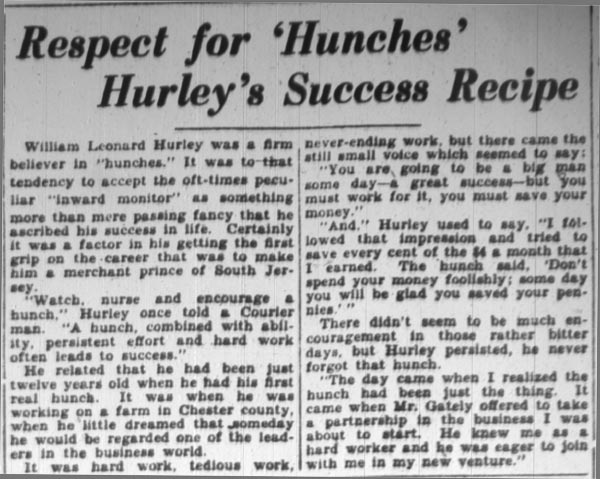
Respect for ‘Hunches’ Hurley’s Success Recipe
William Leonard Hurley was a firm believer in “hunches.” It was to that tendency to accept the oft-times peculiar “inward monitor” as something more than mere passing fancy that he ascribed his success in life. Certainly it was a factor in his getting the first grip on the career that was to make him a merchant prince of South Jersey.
“Watch, nurse and encourage a hunch,” Hurley once told a Courier man. “A hunch, combined with ability, persistent effort and hard work often leads to success.”
He related that he had been just twelve years old when he had his first real hunch. It was when he was working on a farm in Chester county, when he little dreamed that someday he would be regarded one of the leaders in the business world.
It was hard work, tedious work, never-ending work, but there came the still small voice which seemed to say: “You are going to be a big man some day—a great success—but you must work for it, you must save your money.”
“And,” Hurley used to say, “I followed that impression and tried to save every cent of the $4 a month that I earned. The hunch said, ‘Don’t spend your money foolishly; some day you will be glad you saved your pennies.’”
There didn’t seem to be much encouragement in those rather bitter days, but Hurley persisted, he never forgot that hunch.
“The day came when I realized the hunch had been just the thing. It came when Mr. Gately offered to take a partnership in the business I was about to start. He knew me as a hard worker and he was eager to join with me in my new venture.”
Hurley Arranged Business So Aides Could ‘Carry On’
Camden Courier-Post —
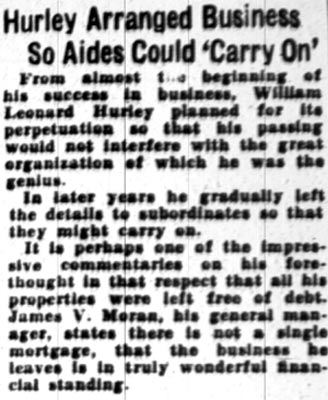
Hurley Arranged Business So Aides Could ‘Carry On’
From almost the beginning of his success in business, William Leonard Hurley planned for its perpetuation so that his passing would not interfere with the great organization of which he was the genius.
In later years he gradually left the details to subordinates so that they might carry on.
It is perhaps one of the impressive commentaries on his forethought in that respect that all his properties were left free of debt. James V. Moran, his general manager, states there is not a single mortgage, that the business he leaves is in truly wonderful financial standing.
Hurley’s Life Milestones Blazed Trail to Success
Camden Courier-Post —
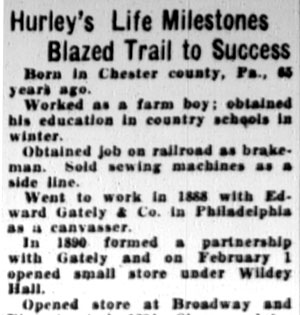
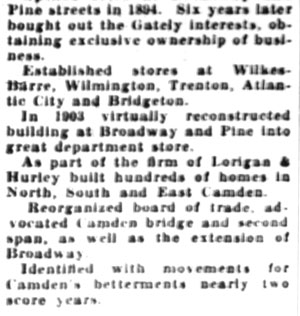
Hurley’s Life Milestones Blazed Trail to Success
Born in Chester county, Pa., 65 years ago.
Worked as a farm boy; obtained his education in country schools in winter.
Obtained job on railroad as brakeman. Sold sewing machines as a side line.
Went to work in 1888 with Edward Gately & Co. in Philadelphia as a canvasser.
In 1890 formed a partnership with Gately and on February 1 opened small store under Wildey Hall.
Opened store at Broadway and Pine streets in 1894. Six years later bought out the Gately interests, obtaining exclusive ownership of business.
Established stores at Wilkes-Barre, Wilmington, Trenton, Atlantic City and Bridgeton.
In 1903 virtually reconstructed building at Broadway and Pine into great department store.
As part of the firm of Lorigan & Hurley built hundreds of homes in North, South and East Camden.
Reorganized board of trade, advocated Camden bridge and second span, as well as the extension of Broadway.
Identified with movements for Camden’s betterments nearly two score years.
Hurley Funeral Is Thursday at Collingswood
Camden Courier-Post —
HURLEY FUNERAL IS THURSDAY AT COLLINGSWOOD
Solemn Requiem Mass to be Sung at St. John’s Catholic Church
INTERMENT TO BE MADE IN CALVARY CEMETERY
Final Rites Held in New York Today for City Planner Leavitt
Accompanied by the family, the body of William Leonard Hurley, Camden merchant who died early yesterday at Hilton Head, S. C., arrived here this morning at 8 o’clock. It was taken to the Hurley home, “Dungarvan,” at West Collingswood, to await burial.
The body of the merchant was placed on the steamer touching the Hurley island estate early yesterday morning. From there it was taken to Beaufort, placed on a train and the long trip north was begun. Mrs. Hurley, her son, Jerome, and two daughters, Mrs. Mary Mallon and Miss Genevieve Hurley, brought the body north to Broad street where it was met by a funeral director who conveyed it to West Collingswood.
Arrangements for the funeral were completed today. It will take place Thursday morning at 8 o’clock from his late home with high mass of requiem at 9.30 at St. John’s Church, Collingswood. Rev. J. O’Farrell, pastor of the church and good friend for many a year of the Hurley family, will be celebrant. Interment will be in the Hurley mausoleum at Calvary Cemetery, in charge of George Blake, funeral director and old friend of the Hurley family. Friends may view the body at the Collingswood home Wednesday night.
In addition to the clubs and organizations mentioned in the Hurley obituary yesterday, he was also a member of the Manufacturers’ Club, Seaview Golf Club, Friendly Sons of St. Patrick, Clover Club and Laymen’s Retreat at Malvern, Pa.
The funeral of Charles Wellford Leavitt, expert city planner and friend of Hurley’s, who died Sunday, took place today at the Church of Saint James the Less at Scarsdale, N. Y. Interment was private. Leavitt, who planned and visioned Camden’s future development, died from pneumonia. He had been briefly ill.
In memory of the deceased merchant, who was president of the Camden Board of Trade in 1910 and later as a member of the Board of Directors of the Camden Chamber of Commerce, the chamber today passed the following resolution:
“Resolved, that the following expression of respect admiration and love of the Camden Chamber of Commerce for W. L. Hurley be spread upon the minutes and that copies thereof be sent to his wife and to J. V. Moran, manager of the Hurley stores, in Camden.
“A great man has passed: a builder. Camden has sought his eternal home leaving behind a monument to his integrity and industry. No word can express the contribution he has made Camden’s growth and progress. A former president of the Board of Trade—a former director in the Chamber of Commerce, which succeeded it—the president and founder of a great mercantile institution and the prime mover of innumerable projects for Camden’s betterment, W. L. Hurley was a leader in his city, his state and country. His life will ever be an inspiration to the young men of Camden whose ideals are service to their fellow men. We send this resolution forth as our memorial to the life of a noble man—W. L. Hurley.”
Big Hearted Bill Hurley
Camden Courier-Post —
BIG HEARTED BILL HURLEY
“Big hearted Bill Hurley!”
That is the way Theodore Roosevelt spoke of him.
That is the way we shall remember him.
He achieved great success in business, took the lead in civic affairs, gave generously to charities of every creed,—but above all he was kindly,—not just to his family, or to those who worked for him, or to his friends, but to every man, woman and child he had the opportunity to help.
It was this kindliness that marked him as unique among his fellows, that made his life a great success. Most selfmade men, who struggle hard, become hard. Prosperity makes severer test of a man’s character than adversity. The men who have won their way to fortune usually show the scars of the battle in egotism and selfishness.
Bill Hurley’s spirit was bigger than his material success. He remained always the same sincere, unaffected person as he had been at the start of life.
And it was hard for him to believe anything but the best of his fellow men. In the heat of a political campaign, when he heard rumors of an enemy’s duplicity he would always say “I can’t believe it of that chap. He is really a very good fellow. I can’t understand it.”
But we must not give the impression that his big heart was soft. It was a stout heart in any battle. Hurley was the first Camden business man to declare himself for the Non Partisan movement in 1922. He was one of the leaders of that political upheaval which achieved so much for the progress of the city, just as he had been one of the leaders of the Committee of One Hundred, twenty years before. His intense interest in the prosperity and progress of his adopted city impelled him into both movements.
So big hearted, stout hearted Bill Hurley passes on.
The editor of the Courier pays this faltering tribute to a really great, good man. The Courier owes much to the inspiration and encouragement of his hearty friendship.
It may be some solace to his family to know that their grief is shared by a multitude, who loved big hearted “Bill” Hurley.
National Notables Mourn Hurley Death
Camden Courier-Post —
NATIONAL NOTABLES MOURN HURLEY DEATH
Edge, Edwards Send Lamenting Loss of ‘Adviser and Friend’
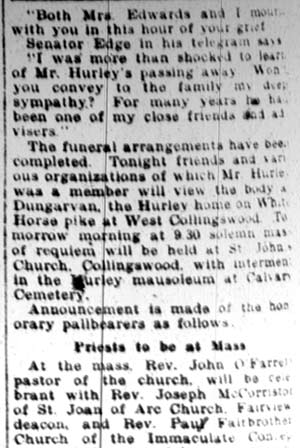
Telegrams and letters continue to pour into the Hurley home and office from persons in all walks of life who mourn the death of William Leonard Hurley. Many have been received from men of national prominence who frequently were closely associated with Mr. Hurley in civic and other enterprises. Senators Edge and Edwards, Congressman Wolverton and others at the national capital have sent their regrets.
Senator Edwards sent the following telegram to Mrs. Hurley:
“Today I learned with profound regret of the death of your husband who in life was a sincere and devoted friend of mine. His passing takes from Camden and South Jersey one of its leading industrial and commercial figures.
“Mr. Hurley and I had been close friends for many years and I always admired his true Americanism and his continued support of every movement looking to the betterment of Camden and her environments.
“Born in a lowly but honest environment, Mr. Hurley rapidly rose in the business world through his own individual sticktotiveness. Both Mrs. Edwards and I mourn with you in this hour of your grief.”
Senator Edge in his telegram says:
“I was more than shocked to learn of Mr. Hurley’s passing away. Won you convey to the family my deep sympathy? For many years he has been one of my close friends and advisers.”
The funeral arrangements have been completed. Tonight friends and various organizations of which Mr. Hurley was a member will view the body at Dungarvan, the Hurley home on White Horse pike at West Collingswood. Tomorrow morning at 9.30 solemn mass of requiem will be held at St. John’s Church, Collingswood, with interment in the Hurley mausoleum at Calvary Cemetery.
Priests to be at Mass
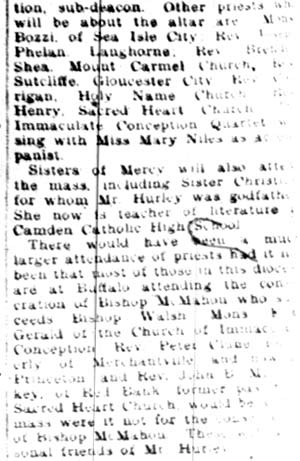
At the mass, Rev. John O’Farrell, pastor of the church will be celebrant, with Rev. Joseph McCorriston of St. Joan of Arc Church, Fairview, deacon, and Rev. Paul Fairbrother, Church of the Immaculate Conception, sub-deacon. Other priests who will be about the altar are Msgr. Bozzi of Sea Isle City, Rev. Leo Phelan, Langhorne, Rev. Father Shea, Mount Carmel Church, Rev. Sutcliffe, Gloucester City, Rev. Rigan, Holy Name Church, Rev. Father Henry, Sacred Heart.
Sisters of Mercy will also attend the mass, including Sister Christine, for whom Mr. Hurley had been godfather years ago. She now is teacher of literature at Camden Catholic High School.
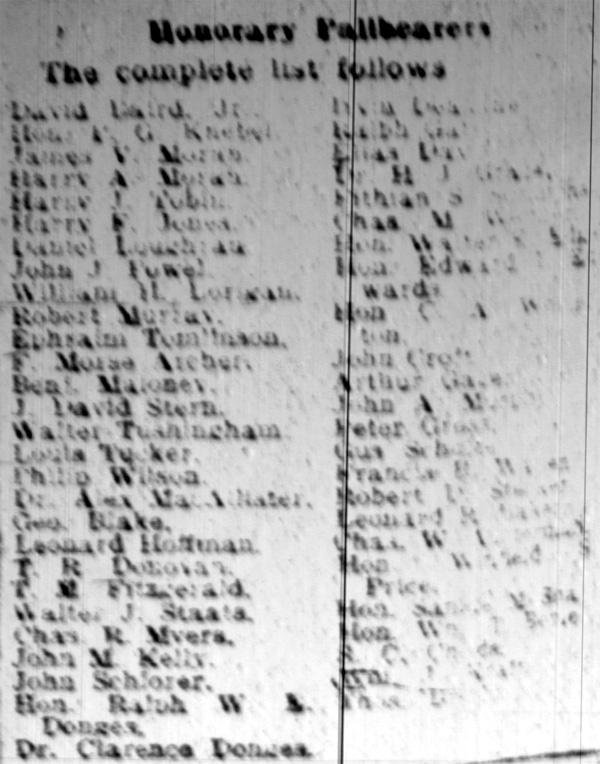
Honorary Pallbearers
The complete list follows:
David Baird Jr., James V. Moran, Harry A. Moran, Harry J. Tobin, Harry F. Jones, Daniel Loughran, John J. Powell, William H. Lorigan, Robert Murray, Ephraim Tomlinson, F. Morse Archer, Benj. Maloney, J. David Stern, Walter Tushingham, Louis Tucker, Philip Wilson, Dr. Alex MacAlister, Geo. Blake, Leonard Hoffman, T. R. Donovan, T. M. Fitzgerald, Walter J. Staats, Chas. R. Myers, John M. Kelly, John Schlorer, Hon. Ralph W. A. Donges, Dr. Clarence Donges, Hon. Edward J. Edwards, John Croft, Francis H. Wilson, Robert D. Stuart, Judge and Mrs. Ralph W. E. Donges, George W. Bradley.
Along Memory Lane
Camden Courier-Post —
ALONG MEMORY LANE
By Ben Courter
Waning of the old bike days came with the advent of the “gas buggy,” even though many wedded to the silent steed refused to call quits with that invigorating, healthy sport.
Just who sported the first auto hereabouts I do not recall, since several were mentioned by the late Charles Leo McKeone who “ran” The Courier’s Peppery Pot for several years. I do remember Dr. Roland I. Haines and Dr. Wilson G. Bailey, so far as the downtown area is concerned, as among the first, with William Leonard Hurley, who died Monday, in the running.
These first cars were small red runabouts which clattered along with enough noise to make every horse within a mile rear and plunge. Thick volumes of blue smoke came from the exhaust and when Doc Bailey or Doc Haines went along Broadway the street was filled with a cloud. The runabouts were dubbed “devil wagons” and considered by the old timers as nothing less than an abomination.
But it was Hurley who recognized the gas buggy had come to stay, as he had visioned many other things, in a civic and business way, that his contemporaries often regarded as passing crazes or whims. Asphalted streets were slowly developing as a method of paving over the cobble and asphalt block paving, but there was little to offer the autoist of that day, far as the outlets to the city were concerned, the lower section remains pretty much as “Allie” Sayers paved it nearly a score of years ago. From that little gathering a quarter of a century ago has grown the street improvement program which is even today being extended through the Centerville section.
When comparatively smooth streets were laid there bobbed up the problem of curbing the “speed fiends.” For many a year the limit had been fixed at 12 miles an hour. It was the limit when John and Mary took a sulky ride in the ‘80s; it was the same with the biking days, although the scorchers paid little heed to it. Many who had the temerity to go 20 miles an hour were heavily fined as public menaces.
That 12-mile limit seemed good enough for several years after the small buzz wagons made their advent and is even yet conspicuously displayed in country towns who warn the driver to “go slow and see our town or go fast and see our jail.” But the speed boys came along and 20 miles an hour was nothing at all.
I recall a story I wrote for The Courier of a “young couple ‘speeding’” to their death over the “s” bridge at Atco by plunging through the railing and falling on the track below. It was charged the young driver was a speed fiend, that he was going fully 30 miles an hour when the accident occurred. A demand was made to curb such recklessness, and constables were assigned along the White Horse to shoot the tires of those who thus took fate in their hands.
It was Hurley, just twenty-five years ago next month, who called together the comparatively few auto owners at a conference in his office at the Broadway store to discuss that question of developing needed arteries leading out of the city. It didn’t cut any great figure in the news of the day, but from it eventually grew the movement that crystallized into the street and road building that has meant the expenditure of vast sums.
Federal street was paved and so was Haddon avenue, while Mt. Ephraim avenue was laid in Belgian blocks on a foundation that even yet defies the heavy traffic. Part of that has been covered with arsenite, but the lower section remains pretty much as “Allie” Sayers paved it nearly a score of years ago.
By the time Hurley had developed his beautiful property, “Dungarvan” along the White Horse, the 20-mile-an-hour drivers were becoming somewhat of a nuisance and when the concrete roadway was finished in 1922 the real speed fiends were going a mile a minute and were thick as fleas. It was indeed a far, far cry from that little gathering in his office so long ago, marking the development of the auto from the very crude one-cylinder affairs to the truly wondrous cars of today.
Throngs Mourn as W.L. Hurley Is Laid to Rest
Camden Courier-Post —
THRONGS MOURN AS W.L. HURLEY IS LAID TO REST
Thousands Pay Tribute To Merchant Prince at Home In Collingswood
SOLEMN REQUIEM MASS AT ST. JOHN’S CHURCH
Many Follow Funeral Cortege to Mausoleum in Calvary Cemetery
By BEN COURTER
William Leonard Hurley, merchant prince, was buried today in the family mausoleum at Calvary Cemetery, beside the son whom he cherished, now gone these many years.
Camden paid honor to its distinguished merchant son for out of the tall tower of city hall the bell tolled rhythmically from 10.30 to 10.00 this morning. That is a tribute seldom paid, only to the most distinguished of Camden’s citizenry, only to those whom it holds in highest regard.
In addition Mayor Price ordered all city flags lowered half mast while the funeral was under way, itself a high mark indicating municipal regard and sorrow in the passing of an eminent man.
The burial came after tribute that seldom comes to any man. There was no pomp with the glitter and glare that usually comes to the military great. There was none of the evidence of the peculiar fealty that comes with the close of a great political leader’s career.
But there was in evidence, last night and again today, something suggestive of a community paying full and really heart felt tribute to one who had lived with lasting benefit to his fellow-man. “Dungarvan,” the home of the merchant prince, last night was the scene of an outpouring of the friends gained through the years who took farewell of one whom they had held in highest regard. Nor was it merely a formal viewing of one who had passed on, nor idle curiosity, nor a perfunctory performance of mere duty.
One passing through that great throng as it wound its way along the paths beneath the great pines and oaks, up to the immaculately white entrance guarded by the Hurley retainers, found evidence of the sincerity of it all. It came by way of expression from men and women who had driven to the palatial home on White Horse pike and again by those who had perhaps walked several miles. A great social gulf between, but with one commonality of sorrow, of regret in the passing, of satisfaction in having known “Big-hearted Bill Hurley.” That expression was heard repeatedly—“Big hearted Bill Hurley”—and some of those who thus alluded to the one lying so quietly within the south parlor of the Hurley home evidently knew the full force of it, knew it from experience.
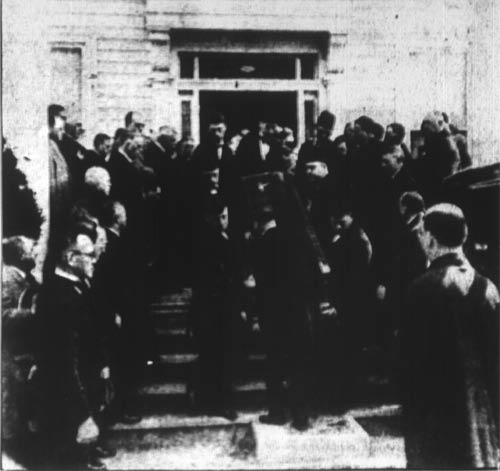
As Casket Was Carried From Hurley Home at Collingswood
Honorary Pallbearers, men prominent in the industrial, the commercial, the professional world were ranged down the steps of Dungarven this morning as the casket carrying the body of William L. Hurley, Camden’s merchant prince, was carried to the waiting hearse. Later the cortege wended its way to St. John’s Church, where solemn high mass was sung.
Cortege Under Way
George Blake, funeral director and long personal friend of Mr. Hurley, aided by Frank Leonard, had some difficulty in getting the cortege under way, even though state and Collingswood police had closed White Horse pike from the Crescent boulevard roundpoint to Collings avenue to traffic. Eventually it was accomplished and the merchant whom everyone seemed to recall with something worth while had gone forever from the portals he loved.
With a guard of motorcycle policemen, the funeral stretching squares wound its way along Knights Park just giving promise of the glory of young spring verdure. It reached the little brown church, St. John’s Catholic, all but hidden by the evergreens, all but covered by ivy. There a vast crowd awaited. A rush would certainly have been made into the church before the arrival of the mourners, but the doors were locked. It was necessary for St. John’s church accommodates but 600. Certainly a thousand would have tried to force an entrance.
But with the arrival of the family the doors were opened. The honorary pallbearers once more formed a lane through which the honored dead was carried up the steps, into the sanctuary, drawn to the altar where candles flickered in the filtered light from the stained glass windows. Then came the rites.
A solemn high mass of requiem was sung. Rev. John O’Farrell, pastor of the church and good friend for many a year of the Hurley family, was celebrant. Rev. Joseph M. Corriston of St. Joan of Arc Church, Fairview, was deacon, and Rev. Paul Fairbrother, Church of the Immaculate Conception, was sub-deacon.
Priests at Altar
There were gathered about the altar Msgr. Bozzi, Sea Isle City, Rev. Joseph Phelan, Langhorne, Rev. Father Brendon Shea, Church of Our Lady of Mt. Carmel, Rev. Father Sutcliffe, Gloucester City, Rev. Father Corrigan, Holy Name Church, Rev. Father Henry, Sacred Heart. Sisters of Mercy were in the pews. Among them was Sister Christine, for whom Mr. Hurley had been godfather years ago. She now is teacher of literature at Camden Catholic High school.
During the solemn service for the dead, the Immaculate Conception quartet sang. That is composed of Harry Weiss, tenor; E. Ehrman, bass; Miss Marie Archer, soprano, and Mrs. Katherine Maloney, contralto, with Miss Mary Niles, accompanist.
Funeral Reaches Cemetery
The solemn ritual over the cortege bearing the dead proceeded to Calvary Cemetery. Long before its arrival hundreds had gathered along Marlton pike—hundreds who were undismayed by a keen, cutting north wind, even though the majority were elderly women. It was apparent they were, as a rule, the old, old patrons of the Hurley store, those whom the founder ever served. They braved the wind and the discomfort to pay their tribute to the dead.
Whether it was by coincidence or otherwise, two airplanes circled over the cemetery when the cortege arrived and continued until the mourners had left. They seemed like two great birds on guard. Some thought it a symbol significant to the occasion.
Headed by motorcycle policemen from the state, Camden, Collingswood and Delaware township, the funeral arrived, passed the guarded entrance.
Thousands Pass Bier
Last night they paid tribute to an old friend and chieftain—the hearts of them. Seemingly there was a never-ending stream of notables, of the lowly, those in every walk of life. They came in limousines, in trotters and many walked, but all were imbued with one object, to take parting of “Big-hearted Bill Hurley,” whom they had known through the years, to increase their regard with memories.
There was a long, long line of Hurley employees who wailed a path leading to the home, awed by the bier while the son of the family, Jerome, and Harry and James Moran, executives, stood by the door. There were plain Mr. and Mrs. John Smith and their more exalted neighbors, too, who passed through the room holding the honored dead.
Elks Hold Services
And there was Camden Lodge of Elks there to hold the memorial service for one who exemplified the principles of that great American order in an exalted degree. They were there, these Elks, to write the fables on the sands, the virtues on the tablets of loving memory.
There was Phil Wilson for many a year close associate of Mr. Hurley, who had known him all through the years that brought success. And William J. Lorigan whose father had long been associated with Mr. Hurley in building enterprises, and former Prosecutor William J. Kraft, nephew and good friend of the family.
Organizations Send Blossoms
There was a great wreath of acanthus leaves from the Chamber of Commerce, a cross from the Broadway Business Men’s Association, a desk of flowers from Camden Lodge of Elks, snapdragons from the banks with which he had been affiliated, a basket from the Cities Corporation Company, which controls the Hotel Walt Whitman, a basket from Wyoming Tribe of Red Men.
Others who sent their tribute of beauteous blossoms were Mr. and Mrs. J. Walter Staats, white lilies and lilacs; John Schlorer, calla lilies; A. J. Henderson, “spring garden flowers”; Mr. and Mrs. J. David Stern, roses, lilies and snapdragons; John Croft and family, spring flowers; Mrs. Gertrude McNichol, Jerome Hurley’s fiancée, a great basket of lilies, roses and white lilacs, her father, Daniel Dever, basket of flowers; Col. T. R. Donovan, a four-foot pillow of flowers.
Mr. and Mrs. Walter L. Tushingham, a spray of white lilies; Mr. and Mrs. Philip Wilson, lilies and roses; Mr. and Mrs. S. Canning Childs, spray of lilies and lilies of the valley; Dr. Harris, Savannah, Ga., spray of American beauty roses; J. B. Van Sciver, basket of flowers; Howard E. Hemphill, basket; Robert Stecker, spray.
Flowers, Still More Flowers
Mr. and Mrs. Charles W. Austermahl, spray of lilies; Camden Lions Club; Theodore Tiedeken and Brother, basket; Arthur Moffett, spray; J. C. Ramer, basket; H. Black, of the Taren Upholstering Company, basket; de Beau & Company, spray; Endowment B. & L., basket; Argonne B. & L., basket; St. John’s Men’s Club, Collingswood, basket; Charles Cramer, basket; Harry Pinsky, basket; Home Furniture Association, basket; Mr. and Mrs. J. A. Murphy; Mrs. Edward Mallon, Philadelphia.
Mr. and Mrs. J. Thompson of Hotel Atlantic City, pillow of American beauty roses; Mr. and Mrs. David Baird, basket; Miss Bessie Hunterman, former stenographer, spray; Mrs. Margaret Lorigan, widow of his former partner in the building of homes, spray of liliums; Richard M. Alister, a great basket of flowers; Judge and Mrs. Ralph W. E. Donges, basket; James Deaurey of Newark, spray of American Beauties; George Gibson, spray; Charles T. Busch, basket; William H. Schlorer, spray; Edward J. Mulligan, spray.
Old Friends Send Tokens
Mrs. Margaret Ludwick, spray; J. S. Haskell, wreath; Mr. and Mrs. George Lockerman, spray; Mr. and Mrs. Elmer E. Thomas, wreath; Mr. and Mrs. Arthur Benson, basket; Dr. and Mrs. Alexander MacAlister, basket; Mrs. Nellie Cavata, basket; Dr. Clarence Donges; Ben Maloney and John Donahue, old friends; Theodore L. Kausel, spray of American Beauties; Mr. and Mrs. Carl Dellmuth, spray; Mr. and Mrs. Charles Star, spray; Mr. and Mrs. Edward Windust, basket; Mr. and Mrs. Arthur Garet, spray; Mr. and Mrs. J. J. McArthur, basket; Mr. and Mrs. George W. Bradley, basket; Mr. and Mrs. J. J. Loughry, basket; Mr. and Mrs. Joseph Hoover, basket; L. M. Nelson; John Weber; basket; Mr. and Mrs. W. N. Marrow.
Mrs. William Leonard Hurley
Camden Courier-Post —
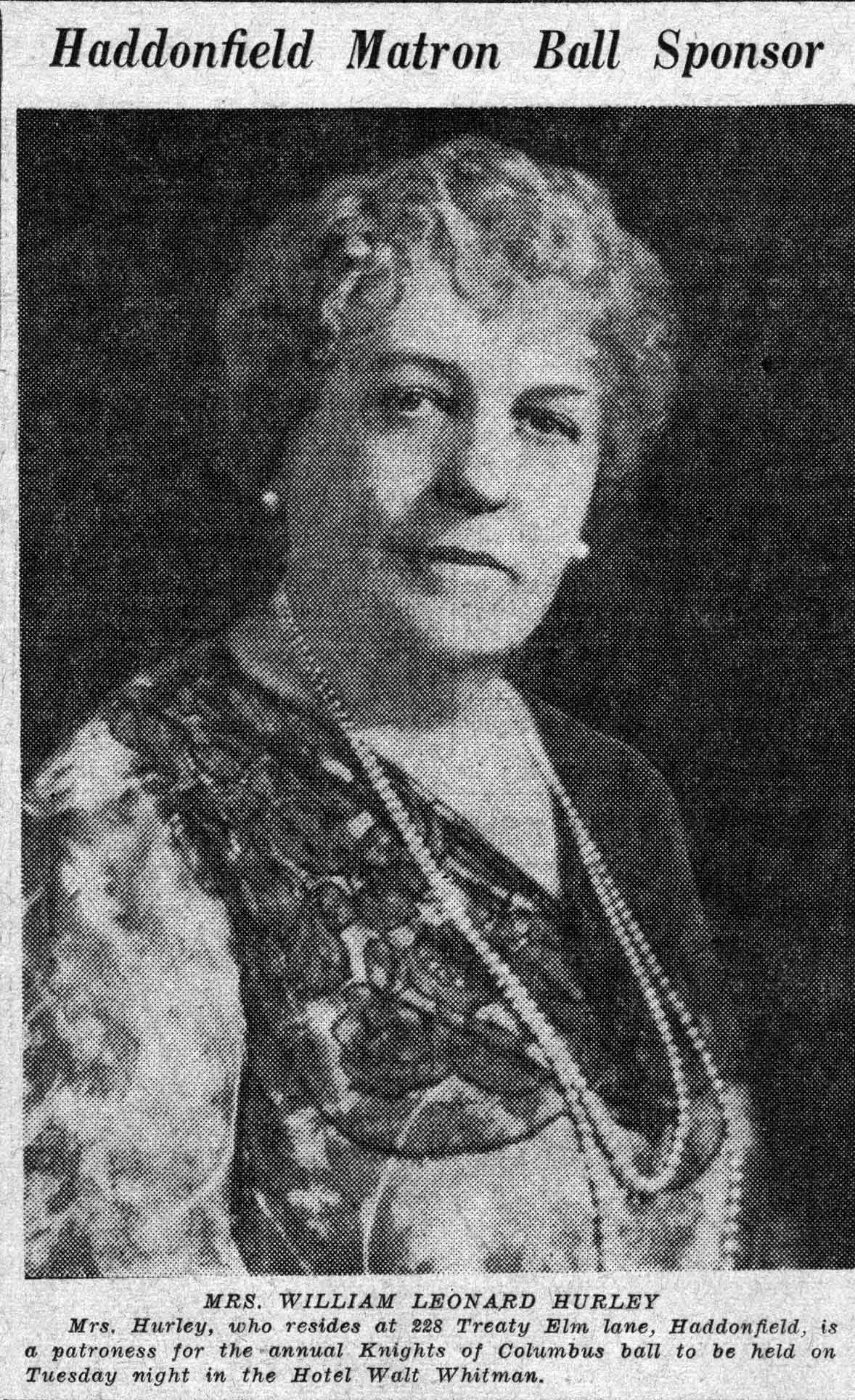
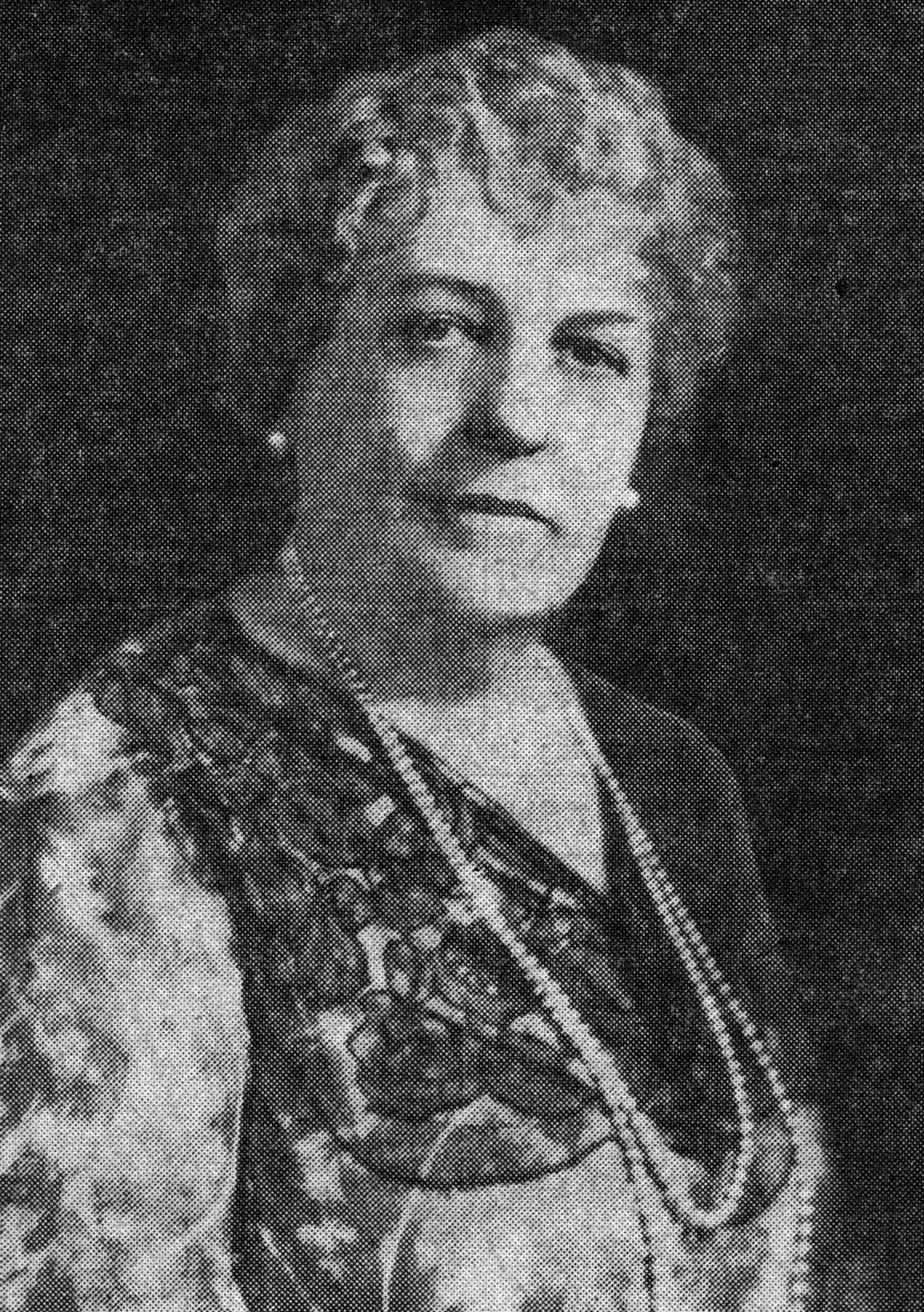

MRS. WILLIAM LEONARD HURLEY
Mrs. Hurley, who resides at 228 Treaty Elm lane, Haddonfield, is a patroness for the annual Knights of Columbus ball to be held on Tuesday night in the Hotel Walt Whitman.
Thanks to Ray Garrison for providing information about the former Hurley estate in Collingswood.