Introduction
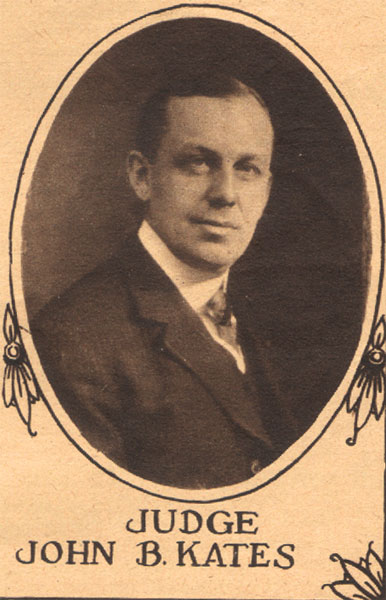
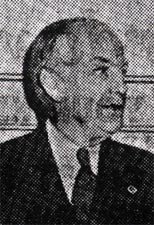
John B. Kates
JOHN B. KATES was born in Camden, New Jersey in 1876 to Robert and Hannah Kates. His father conducted a retail grocery. At the time of the 1880 Census, the Kates family, which included older sister Margaret, lived at 800 Broadway. Neighbors included shipbuilder John Dialogue Sr. and lawyer Thomas Harned. Another grocer’s son, Frank Van Hart, a year older than young John Kates, lived at 818 Broadway. Frank Van Hart went on to serve as Camden’s Mayor, succeeding Charles H. Ellis in 1922. The Kates family were members of Broadway Methodist Episcopal Church; John B. Kates was a member of the church Ushers’ Union in the 1900s and 1910s.
John B. Kates was practicing law at the time of the 1920 Census, at which time he was living with his wife Linda, son Emory, and daughter Mary in Collingswood NJ. Besides his law practice he was serving as a member of the Board of Directors of the Broadway Trust Company bank in March of 1916, and would later be named president of that institution.
Active in politics, he had served as a member of the New Jersey State Senate in 1917. John Kates also served as a judge in the 1920s. John B. Kates was, on March 22, 1922 elected Vice Chairman of the recently created New Jersey Interstate Bridge and Tunnel Commission. After stepping down from the bench he returned to the practice of law and also involved himself in banking. In April of 1930, when the census was taken, John, Linda, and Emory Kates lived at 430 Collings Avenue in Collingswood. By this time Emory Kates had also become a lawyer.
John B. Kates remained active in Republican politics in the 1920s and 1930s. He also served for over twenty years on the Delaware River Bridge Joint Commission, the predecessor of the modern-day Delaware River Port Authority, and was a member when it shepherded through construction of what today is known as the Ben Franklin Bridge.
John B. Kates died on April 29, 1947.
Six Hurt, One May Die as Result of Collingswood Fire
Philadelphia Inquirer —
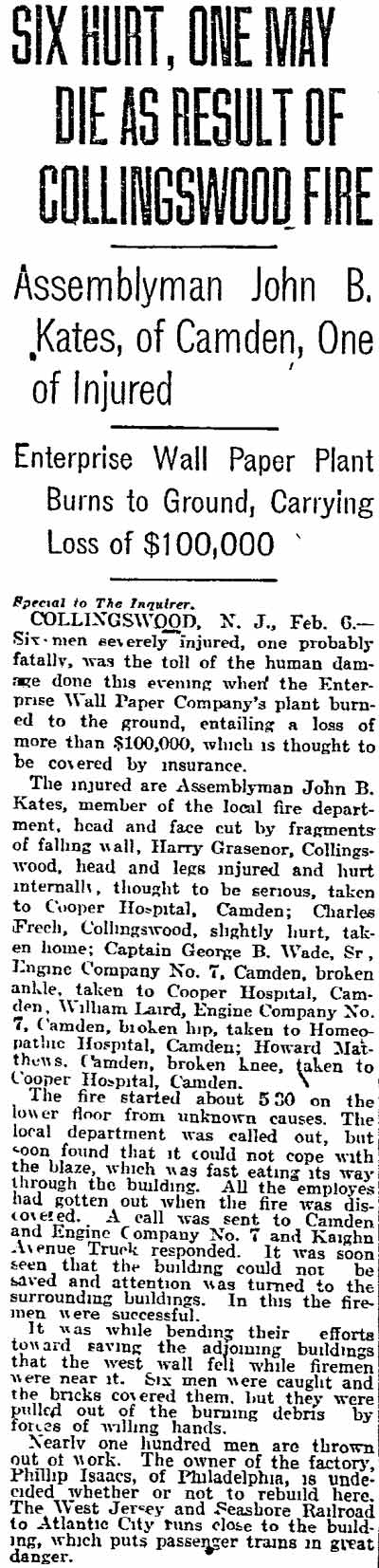
SIX HURT, ONE MAY DIE AS RESULT OF COLLINGSWOOD FIRE
Assemblyman John B. Kates, of Camden, One of Injured
Enterprise Wall Paper Plant Burns to Ground, Carrying Loss of $100,000
Special to The Inquirer. COLLINGSWOOD, N. J., Feb. 6.—Six men severely injured, one probably fatally, was the toll of the human damage done this evening when the Enterprise Wall Paper Company’s plant burned to the ground, entailing a loss of more than $100,000, which is thought to be covered by insurance.
The injured are Assemblyman John B. Kates, member of the local fire department, head and face cut by fragments of falling wall, Harry Grasenor, Collingswood, head and legs injured and hurt internally, thought to be serious, taken to Cooper Hospital, Camden; Charles Frech, Collingswood, slightly hurt, taken home; Captain George B. Wade, Sr., Engine Company No. 7, Camden, broken ankle, taken to Cooper Hospital, Camden; William Laird, Engine Company No. 7, Camden, broken hip, taken to Homeopathic Hospital, Camden; Howard Matthews, Camden, broken knee, taken to Cooper Hospital, Camden.
The fire started about 5:30 on the lower floor from unknown causes. The local department was called out, but soon found that it could not cope with the blaze, which was fast eating its way through the building. All the employes had gotten out when the fire was discovered. A call was sent to Camden and Engine Company No. 7 and Kaighn Avenue Truck responded. It was soon seen that the building could not be saved and attention was turned to the surrounding buildings. In this the firemen were successful.
It was while bending their efforts toward saving the adjoining buildings that the west wall fell while firemen were near it. Six men were caught and the bricks covered them, but they were pulled out of the burning debris by forces of willing hands.
Nearly one hundred men are thrown out of work. The owner of the factory, Phillip Isaacs, of Philadelphia, is undecided whether or not to rebuild here. The West Jersey and Seashore Railroad to Atlantic City runs close to the building, which puts passenger trains in great danger.
Injured Firemen on Road to Recovery
Philadelphia Inquirer —
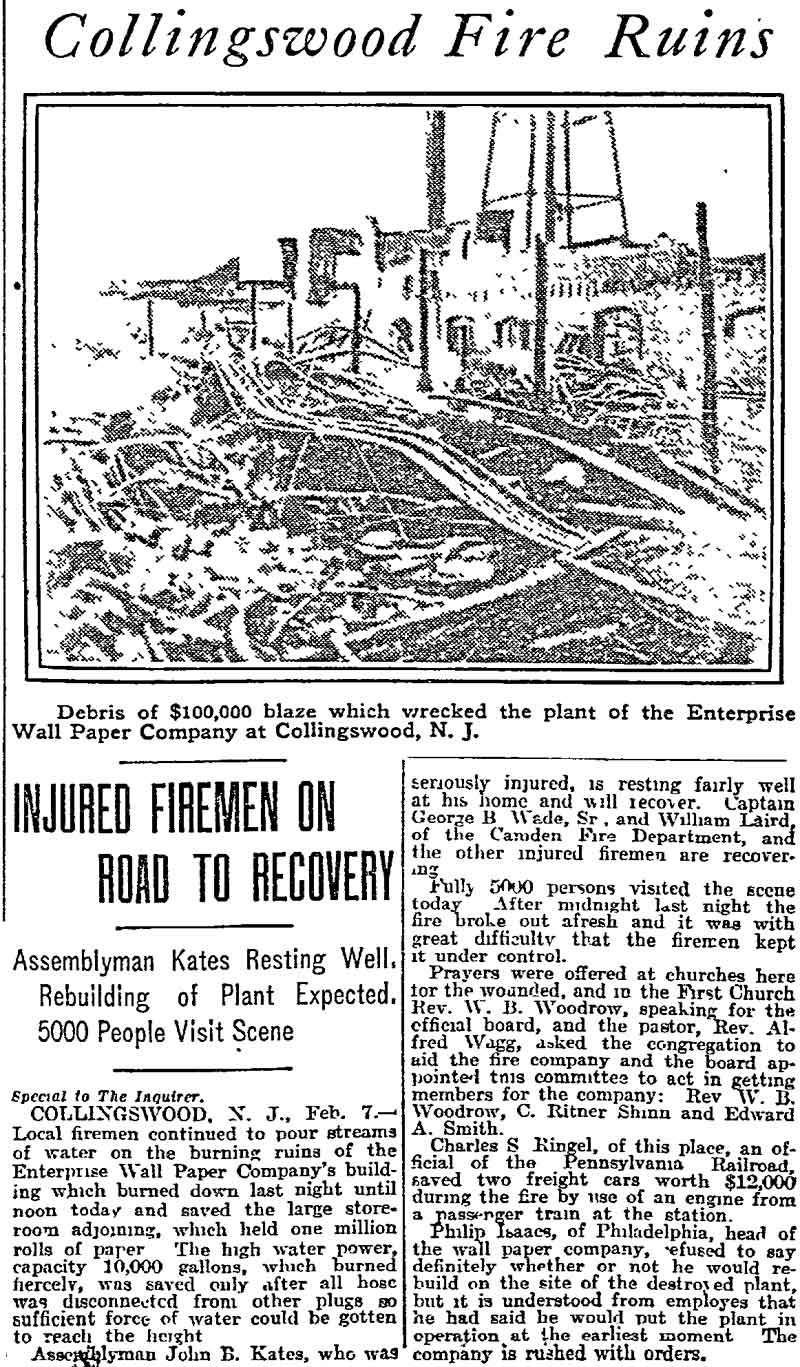
Collingswood Fire Ruins
INJURED FIREMEN ON ROAD TO RECOVERY
Assemblyman Kates Resting Well; Rebuilding of Plant Expected; 5000 People Visit Scene
Special to The Inquirer. COLLINGSWOOD, N. J., Feb. 7.—Local firemen continued to pour streams of water on the burning ruins of the Enterprise Wall Paper Company’s building which burned down last night until noon today and saved the large storeroom adjoining, which held one million rolls of paper. The high water power, capacity 10,000 gallons, which burned fiercely, was saved only after all hose was disconnected from other plugs so sufficient force of water could be gotten to reach the height.
Assemblyman John B. Kates, who was seriously injured, is resting fairly well at his home and will recover. Captain George B. Wade, Sr., and William Laird, of the Camden Fire Department, and the other injured firemen are recovering.
Only 5000 persons visited the scene today. After midnight last night the fire broke out afresh and it was with great difficulty that the firemen kept it under control.
Prayers were offered at churches here for the wounded, and in the First Church Rev. W. B. Woodrow, speaking for the official board, and the pastor, Rev. Alfred Wagg, asked the congregation to aid the fire company and the board appointed this committee to act in getting members for the company: Rev. W. B. Woodrow, H. Ritter Reann and Edward A. Smith.
Charles S. Ringel, of this place, an official of the Pennsylvania Railroad, saved two freight cars worth $12,000 during the fire by use of an engine to a passenger train at the station.
Philip Isaacs, of Philadelphia, head of the wall paper company, refused to say definitely whether or not he would rebuild the line of the burned plant, but it is understood from employes that he had said he would put the plant in operation at the earliest moment the company is rushed with orders.
Fire Victims Are Recovering
Philadelphia Inquirer —
Fire Victims Are Recovering
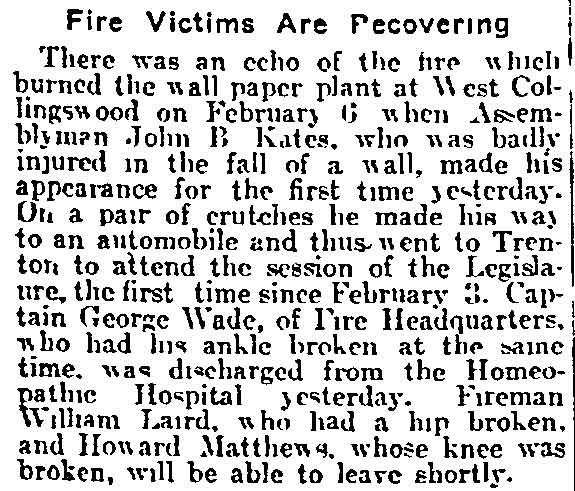
There was an echo of the fire which burned the wall paper plant at West Collingswood on February 6 when Assemblyman John B. Kates, who was badly injured in the fall of a wall, made his appearance for the first time yesterday. On a pair of crutches he made his way to an automobile and thus went to Trenton to attend the session of the Legislature, the first time since February 3. Captain George Wade, of Fire Headquarters, who had his ankle broken at the same time, was discharged from the Homeopathic Hospital yesterday. Fireman William Laird, who had a hip broken, and Howard Matthews, whose knee was broken, will be able to leave shortly.
Camden at a Glance
Philadelphia Inquirer —
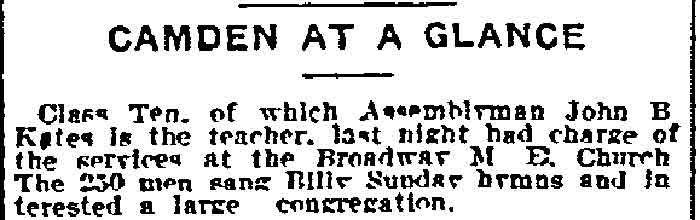
CAMDEN AT A GLANCE — Class Ten, of which Assemblyman John B. Kates is the teacher, last night had charge of the services at the Broadway M. E. Church. The 230 men sang Billy Sunday hymns and interested a large congregation.
Broadway Trust Company — Board of Directors, March 1, 1916
| Director | Director |
|---|---|
| John J. Burleigh | William Mills |
| Dr. S. G. Bushey | Anthony J. Oberst |
| Ralph D. Childrey | John Wesley Sell |
| Robert H. Comey | Dr. Marvin A. Street |
| William J. Cooper | Wilbert L. Sweeten |
| George A. Frey | Edward B. Stone |
| Albert Fogg | Adam Schlorer |
| Frederick Grant | Bernhard F. Schroeder |
| John B. Kates | Edward Schuster Jr. |
| Dr. Grant E. Kirk | John O. Wilson |
| Anthony Kobus |
Ignores Court Order, Charge
Philadelphia Inquirer —
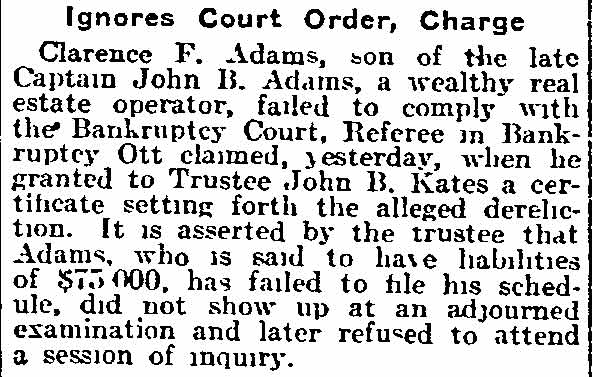
Ignores Court Order, Charge — Clarence F. Adams, son of the late Captain John B. Adams, a wealthy real estate operator, failed to comply with the Bankruptcy Court. Referee in Bankruptcy Ott claimed, yesterday, when he granted to Trustee John B. Kates a certificate setting forth the alleged dereliction. It is asserted by the trustee that Adams, who is said to have liabilities of $75,000, has failed to file his schedule, did not show up at an adjourned examination and later refused to attend a session of inquiry.
From Judge Kates’ Court
Philadelphia Inquirer —
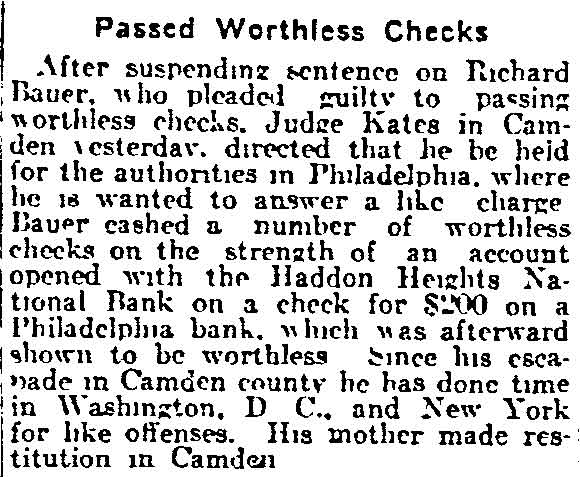
Passed Worthless Checks — After suspending sentence on Richard Bauer, who pleaded guilty to passing worthless checks, Judge Kates in Camden yesterday, directed that he be held for the authorities in Philadelphia, where he is wanted to answer a like charge. Bauer cashed a number of worthless checks on the strength of an account opened with the Haddon Heights National Bank on a check for $200 on a Philadelphia bank, which was afterward shown to be worthless. Since his escapade in Camden county he has done time in Washington, D. C., and New York for like offenses. His mother made restitution in Camden.
Sues for Settlement — Civil War transactions yesterday figured in Judge Kates’ court, when testimony was taken on the claim of V. G. Edwards, a Washington attorney, against the estate of James Millinger, which is now in process of settlement. A hotel and sawmill owned by Mr. Millinger in Tennessee were seized by the Union troops in the Civil War. One of his claims for damages hung fire in Congress until after his death in 1890. Acting for some of the heirs, Edwards collected $1,770, for which he was not compensated, and now that the estate is to be closed up he puts in a claim.
Negroes Commend Action
Philadelphia Inquirer —
Negroes Commend Action — Representative negroes of Camden county have commended the action of Common Pleas Court Judge Kates and Prosecutor Kraft for the swift and severe sentences meted out lately to negroes who have been terrorizing the communities by hold-ups. Deploring the acts of these members of the race, who hail in every instance from the South, J. Ryland Fortune, a school principal, and Rev. W. H. Boone, pastor of the Mt. Olivet Baptist Church, Haddonfield, in a letter state that they hope others who have failed to imbibe the true principles of morality, citizenship and Christianity, will at least take a lesson from “those unfortunate wretches who have gone before, and profit by their mistakes.”
Wife Deserters Put Under Bonds
Philadelphia Inquirer —
Wife Deserters Put Under Bonds — In the Camden Domestic Relations Court yesterday Judge Kates had four wife deserters before him, whose word he refused to take and on whom he imposed the necessity of furnishing bonds to provide certain sums to their families. The most flagrant case involved William Rowan, who is alleged to have left his wife, Hattie, and two small children and espoused a woman at Shenandoah, Pa. An order for $7.50 a week was made on Rowan.
Robert Drummond, of Barrington, who was charged with deserting his wife and four children, the youngest but three weeks old, gave as his excuse that the “love had gone out.” His case was held over until he can furnish some guarantee he will give his family aid. John W. Guthridge, on the desertion charge, was ordered to pay $6 a week, and Arthur Murphy, accused of leaving his second wife for his first wife, from whom he obtained a divorce, was ordered to pay $5 weekly.
Two Sailors Convicted of Assault in Camden
Philadelphia Inquirer —
TWO SAILORS CONVICTED OF ASSAULT IN CAMDEN
Four Other Bluejackets Acquitted on Charge of Attacking Patrolman Louis Shaw
Two of six sailors, who have been in the Camden prison since November 20, were convicted yesterday by Judge Kates at a special session of Criminal Court on a charge of assault and battery on Policeman Louis Shaw. Those found guilty are Joseph A. Grainer and Thos. J. Percival. Elmer R. Rahan, Roy Smith, Harold Cummings and Harold Norstedt, acquitted, were remanded to the custody of an officer from League Island.
Shaw was attacked by a group of sailors at Second and Walnut streets when he warned a negro against buying liquor for the bluejackets. He was knocked down and repeatedly kicked about the face and head, his nose being broken and his scalp badly torn.
Shaw was positive that Grainer led in the attack. Detective Moffett testified that after being arrested Percival admitted that he punched the officer. Denying the assault, Grainer said he was drunk when he came to Camden. Percival said the only knowledge he had of the fight was when he was struck on the head by Shaw’s blackjack.
In deferring sentence until next Monday, Judge Kates told Grainer and Percival that they need not expect persons to respect their uniforms if they did not respect themselves.
From Judge Kates’ Court
Philadelphia Inquirer —
Sailors Fined for Assault — As a sequel to the attack made on Lewis Shaw, a policeman, at Second and Mt. Vernon streets, Camden, early one morning last week, two sailors, F. G. Percival and John Grainer, were yesterday fined $100 by Judge Kates in the Camden Criminal Court. They were ordered committed until the fines are forthcoming. It was shown that Grainer had served Uncle Sam for the past fifteen years with not a mark against him. In fact it was declared the ones who had really done the most damage had escaped. The policeman was trying to arrest a negro, who was said to be giving the sailors a drink when he was attacked.
Changes Mind About Marriage — Escaping from the Glen Mills Reformatory some weeks ago with the intention of marrying Antonio Coray, a Camden junk man, Anna Marcella, a pretty Italian miss, told Judge Kates, in the Camden Criminal Court yesterday, she had changed her mind. She concluded it would be more advantageous to return to the institution than to enter the doubtful marital contract. She was accordingly returned to Glen Mills, while Coray had sentence suspended on him after pleading non vult to a misdemeanor charge.
Jurors Drawn — Grand and petit jurors were drawn yesterday by Judge Kates and the Jury Commission in Camden for the December term of the courts, which begin a week from today. There were thirty-five grand and sixty petit jury names drawn from the box. In connection with the former twenty-three will be selected for actual service, although there is nothing of very great importance to be considered.
Aliens Who Buy Bonds Promised Citizenship
Philadelphia Inquirer —
ALIENS WHO BUY BONDS PROMISED CITIZENSHIP
Camden Judge Tells Foreigners, Otherwise Qualified, to Aid Loan
Aliens whose financial condition will permit them to buy Liberty Bonds and War Stamps need not expect to be naturalized in Camden unless they have made investments in the country’s war securities. Judge Kates so decreed yesterday in continuing until the next term of court several applications for citizenship. The court’s attitude was backed up by James Glazer, who represented the Department of Justice at the hearing and who said that no better evidence of patriotism and love of country could be shown than in the purchase of bonds and stamps. In all thirty-seven cases were laid over, many of them being for insufficiency of witnesses. Favorable action was taken on thirty applications.
License Applications — Many applications for inn and tavern licenses in Camden county were filed yesterday and Judge Kates fixed Friday as the date to pass on the petitions. The applications filed are as follows: John W. Chamberlain, W. S. R. Buckingham, C. R. Cleaver, Centre township; John A. White, John Pfrommer, Berlin township; Charles F. Rouh, E. B. Davis, Frederick Ribaut, Clementon township; Margaret L. Wentz, Gloucester township; Benjamin Forrest, Conrad D. Ritter, Pennsauken township; George S. Kelly, Voorhees township; Charles Camarato, Harry Schusler, Antonio Sarnese, Anna S. Beam, Antonio Munzo, Winslow township; Fritz Frederick, Magnolia.
Veteran Court Clerk Honored
Philadelphia Inquirer —
Veteran Court Clerk Honored — Immediately after the April term of the Camden county court’s opened yesterday, Circuit Court Judge Lloyd, who presided with Common Pleas Judge Kates in the absence of Supreme Court Justice Garrison, called attention to the fact that Court Crier Charles MacCready had been associated with the administration of justice in the county for an even half century. At the suggestion of Judge Lloyd a minute was adopted setting forth the appreciation of “the faithful, continuous and efficient service he has rendered in a full half century of devotion to public duty.” The court attaches presented Mr. MacCready with a bouquet of flowers.
The court designated Charles H. Laird, Jr., a banker, of Merchantville, as foreman of the new grand jury, which body at its initial session adopted a suggestion of Prosecutor Wolverton to change its time of sitting from morning to afternoon. The change becomes effective today.
The court appointed W. J. Kraft, Lewis A. Starr and C. V. D. Joline as a committee to prepare a minute on the life of the late Judge John G. Horner.
Jewish Draftees Given Send-Off at Camden
Philadelphia Inquirer —
JEWISH DRAFTEES GIVEN SEND-OFF AT CAMDEN
State Treasurer Read Lauds Patriotism of Hebrews All Over the Country
One of the features of a dinner given at the Towers, Broadway and Pine street, Camden, last night, to the Jewish draftees, was the appearance of forty boys who came from Camp Dix at a special order issued by General Scott, the commandant. The dinner was given under the direction of the Young Men’s Hebrew Association and the Jewish Board of Welfare Work, which does the same character of work in the cantonments as the Y. M. C. A. and the Knights of Columbus.
On account of a previous engagement, Governor Edge was unable to be present and he was represented by State Treasurer William T. Read. Treasurer Read delivered a short address, in which he predicted that the Allies would win the war and praised the work being done by the Jewish boys throughout the country. Mayor Charles E. Ellis also lauded the patriotism of the Camden boys and declared that the war would be won by the Allies through the work of the United States. Cyrus J. Janover, representative of the Jewish welfare at Camp Dix, and Chaplain Henry S. Davidson, also of Dix; Joseph Hagendorn, a Philadelphia Jewish orator; State Senator Haines, Judges Kates and Pancoast and Assemblyman Kellum also spoke. Benjamin Natal, a Camden attorney, conceived the idea of giving the boys a reception and he had associated with him on the committee Abe Fuhrman, Samuel Mackler, Morris Berman and Mark Obus.
Sellers of Dope in Keen Rivalry Slashed Prices
Camden Daily Courier —
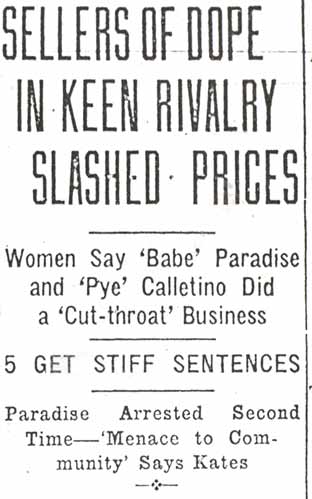
SELLERS OF DOPE IN KEEN RIVALRY SLASHED PRICES
Women Say ‘Babe’ Paradise and ‘Pye’ Calletino Did a ‘Cut-throat’ Business
5 GET STIFF SENTENCES
Paradise Arrested Second Time — ‘Menace to Community’ Says Kates
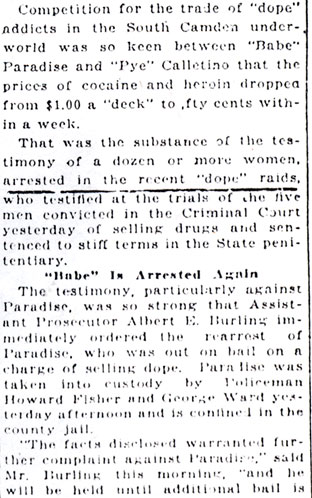
Competition for the trade of “dope” addicts in the South Camden underworld was so keen between “Babe” Paradise and “Pye” Calletino that the prices of cocaine and heroin dropped from $1.00 a “deck” to fifty cents within a week. That was the substance of the testimony of a dozen or more women, arrested in the recent “dope” raids, who testified at the trials of the five men convicted in the Criminal Court yesterday of selling drugs and sentenced to stiff terms in the State penitentiary.
“Babe” Paradise Is Arrested Again — The testimony, particularly against Paradise, was so strong that Assistant Prosecutor Albert E. Burling immediately ordered the rearrest of Paradise, who was out on bail on a charge of selling dope. Paradise was taken into custody by Policeman Howard Fisher and George Ward yesterday afternoon and is confined in the county jail. “The facts disclosed warranted further complaint against Paradise,” said Mr. Burling this morning, “and he will be held until additional bail is furnished to guarantee his appearance when he is called for trial.”
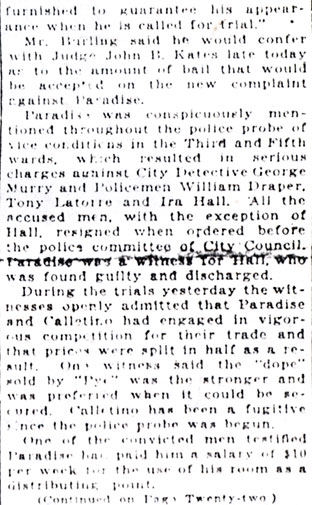
Mr. Burling said he would confer with Judge John B. Kates late today as to the amount of bail that would be accepted on the new complaint against Paradise.
Paradise was conspicuously mentioned throughout the police probe of vice conditions in the Third and Fifth wards, which resulted in serious charges against City Detective George Murry and Policemen William Draper, Tony Latorre and Ira Hall. All the accused men, with the exception of Hall, resigned when ordered before the police committee of City Council. Paradise was a witness for Hall, who was found guilty and discharged.
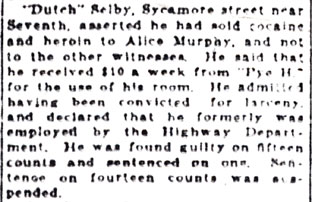
During the trials yesterday the witnesses openly admitted that Paradise and Calletino had engaged in vigorous competition for their trade and that prices were split in half as a result. One witness said the “dope” sold by “Pye” was the stronger and was preferred when it could be secured. Calletino has been a fugitive since the police probe was begun. One of the convicted men testified Paradise had paid him a salary of $10 per week for the use of his room as a distributing point.
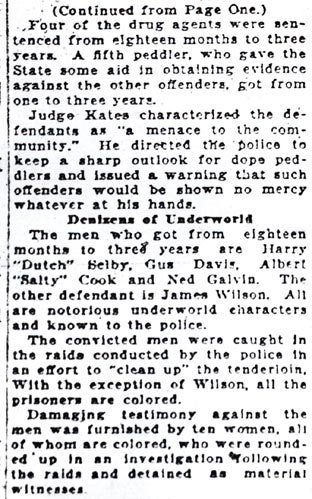
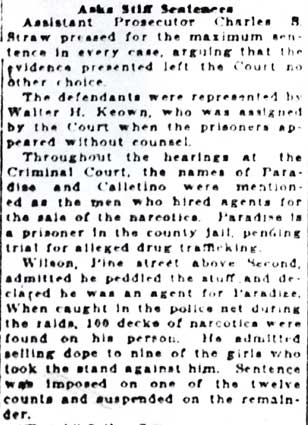
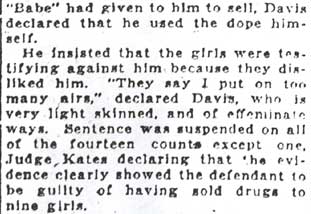
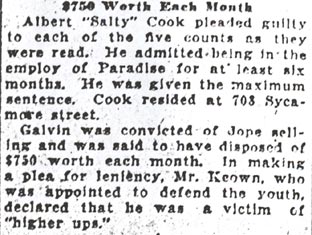
Four of the drug agents were sentenced from eighteen months to three years. A fifth peddler, who gave the State some aid in obtaining evidence against the other offenders, got from one to three years. Judge Kates characterized the defendants as “a menace to the community.” He directed the police to keep a sharp outlook for dope peddlers and issued a warning that such offenders would be shown no mercy whatever at his hands.
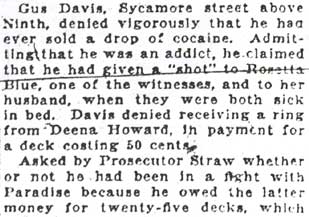
The men who got from eighteen months to three years are Harry “Dutch” Selby, Gus Davis, Albert “Salty” Cook and Ned Galvin. The other defendant is James Wilson. All are notorious underworld characters and known to the police. The convicted men were caught in the raids conducted by the police in an effort to “clean up” the tenderloin. With the exception of Wilson, all the prisoners are colored.
Damaging testimony against the men was furnished by ten women, all of whom are colored, who were rounded up in an investigation following the raids and detained as material witnesses. Assistant Prosecutor Charles S. Straw pressed for the maximum sentence in every case, arguing that the evidence presented left the Court no other choice. The defendants were represented by Walter H. Keown, who was assigned by the Court when the prisoners appeared without counsel.
Throughout the hearings at the Criminal Court, the names of Paradise and Calletino were mentioned as the men who hired agents for the sale of the narcotics. Paradise is a prisoner in the county jail, pending trial for alleged drug trafficking. Wilson, Pine street above Second, admitted he peddled the stuff and declared he was an agent for Paradise. When caught in the police net during the raids, 100 decks of narcotics were found on his person. He admitted selling dope to nine of the girls who took the stand against him.
Warrant Issued for Dr. Emma Richardson
Camden Daily Courier —
EXTRA!
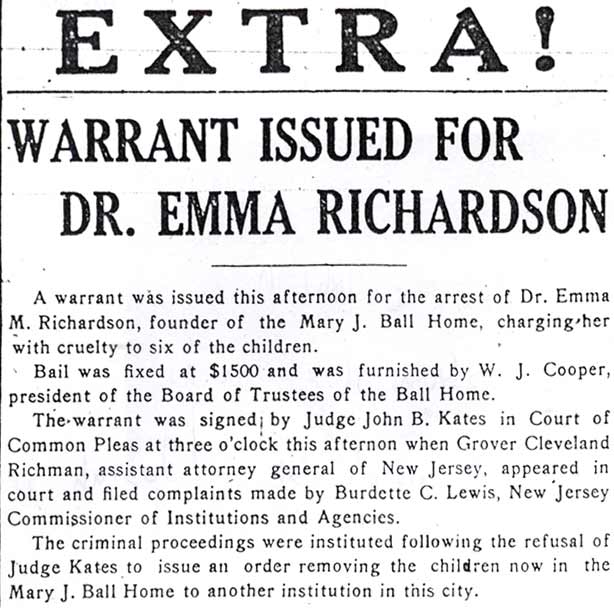
WARRANT ISSUED FOR DR. EMMA RICHARDSON
A warrant was issued this afternoon for the arrest of Dr. Emma M. Richardson, founder of the Mary J. Ball Home, charging her with cruelty to six of the children. Bail was fixed at $1500 and was furnished by W. J. Cooper, president of the Board of Trustees of the Ball Home.
The warrant was signed by Judge John B. Kates in Court of Common Pleas at three o’clock this afternoon when Grover Cleveland Richman, assistant attorney general of New Jersey, appeared in court and filed complaints made by Burdette C. Lewis, New Jersey Commissioner of Institutions and Agencies. The criminal proceedings were instituted following the refusal of Judge Kates to issue an order removing the children now in the Mary J. Ball Home to another institution in this city.
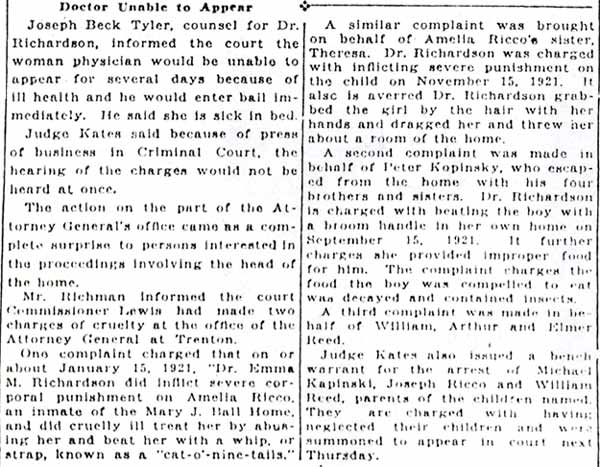
Doctor Unable to Appear — Joseph Beck Tyler, counsel for Dr. Richardson, informed the court the woman physician would be unable to appear for several days because of ill health and he would enter bail immediately. He said she is sick in bed. Judge Kates said because of press of business in Criminal Court, the hearing of the charges would not be heard at once.
The action on the part of the Attorney General’s office came as a complete surprise to persons interested in the proceedings involving the head of the home. Mr. Richman informed the court Commissioner Lewis had made two charges of cruelty at the office of the Attorney General at Trenton. One complaint charged that on or about January 15, 1921, “Dr. Emma M. Richardson did inflict severe corporal punishment on Amelia Ricco, an inmate of the Mary J. Ball Home, and did cruelly ill treat her by abusing her and beat her with a whip, or strap, known as a ‘cat-o’-nine-tails.’”
Samuel M. Shay Sworn as Judge
Philadelphia Inquirer —
SAMUEL M. SHAY SWORN AS JUDGE
New Jurist Is Youngest Man Ever Named to the Bench in Camden
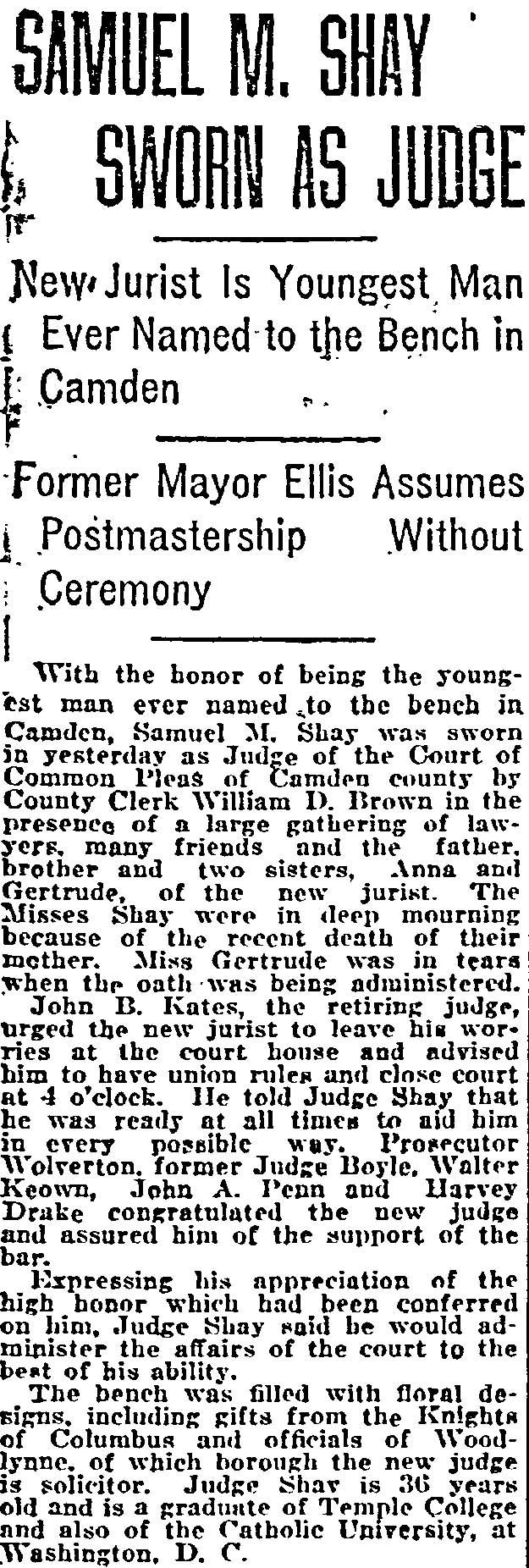
With the honor of being the youngest man ever named to the bench in Camden, Samuel M. Shay was sworn in yesterday as Judge of the Court of Common Pleas of Camden county by County Clerk William D. Brown in the presence of a large gathering of lawyers, many friends and the father, brother and two sisters, Anna and Gertrude, of the new jurist. The Misses Shay were in deep mourning because of the recent death of their mother. Miss Gertrude was in tears when the oath was being administered.
John B. Kates, the retiring judge, urged the new jurist to leave his worries at the court house and advised him to have union rules and close court at 4 o’clock. He told Judge Shay that he was ready at all times to aid him in every possible way. Prosecutor Wolverton, former Judge Boyle, Walter Keown, John A. Penn and Harvey Drake congratulated the new judge and assured him of the support of the bar.
Expressing his appreciation of the high honor which had been conferred on him, Judge Shay said he would administer the affairs of the court to the best of his ability. The bench was filled with floral designs, including gifts from the Knights of Columbus and officials of Woodlynne, of which borough the new judge is solicitor. Judge Shay is 36 years old and is a graduate of Temple College and also of the Catholic University, at Washington, D. C.
An award of $1500 made by a Camden jury to 11-year-old Edward Billick against Isaac Benus, a butcher, was set aside in an opinion filed by Judge Kates yesterday. Benus’ store at 1039 Lewis street was robbed by persons who broke the display window. Anticipating a return of the thieves the next night, Benus lay in wait and when the Billick boy thrust his arm in the hole the butcher chopped it with a cleaver. Suit for damages was brought and a jury gave the boy a verdict of six cents. An appeal was made by the lad’s counsel and a new trial ordered. At the second trial the jury gave the boy $1500 damages. The butcher took an appeal and the findings are now reversed on the ground that the verdict was not warranted by the facts. The injured boy denied that he intended theft when he put his arm in the window.
County Is Lauded in Aid to Cripples
Camden Courier-Post —
Camden county educators in providing special training for crippled children, leads the state in the movement to rehabilitate youths suffering from physical defects. That opinion was expressed by Joseph G. Buch, of Trenton, chairman of the New Jersey State Crippled Children’s Commission, speaking before the Camden Kiwanis Club at Hotel Walt Whitman yesterday.
“Through the efforts of the state organization and the Elks Crippled Kiddies committee,” Buch said, “every crippled child in New Jersey is now offered the chance for medical attention, training and vocational guidance. More than 13,000 children between the ages of one and 18 years are registered with the state organization at Trenton, and 364 of those able to attend some special training class are being rehabilitated.”
Buch urged the service clubs to aid the organization in placing youths in positions in the working world. A delegation of Kiwanianians from Brooklyn attended the meeting, headed by the club president, John Kay. The visitors were welcomed by former Judge John B. Kates.
Dr. Martin H. Collier, president of the Camden club, made a report on the annual state convention of Kiwanis held at the hotel last week. During the meeting musical entertainment was provided by Gene Stroud, singing banjoist and Harry M. Taylor, pianist.
Palese Peddles Tickets For His Own Testimonial
Camden Courier-Post —
Selling tickets for his own testimonial dinner is a distinction enjoyed by Assistant Prosecutor Rocco Palese. The dinner, arranged as a testimonial to “the Polish Ambassador,” proved a surprise to Palese last night when 28 friends, members of the “Srelsihc Club,” let him share the secret in Hotel Walt Whitman. The dinner, among other reasons, was tendered him because he was the only member of the club to put together a Courier-Post “Hi-Ho” puzzle. For a week prior to the affair he sold tickets to friends, not knowing the affair was in his honor.
With former Judge John B. Kates as toastmaster, wit and repartee passed the festive board, while entertainment was furnished by Bobby Heath and Billy James, famous writers of popular songs. Those who did honor to Palese are: Judge Kates, Prosecutor Clifford A. Baldwin, Chief of County Detectives Lawrence T. Doran, John R. DiMona, Carl Kisselman, Herbert H. Blizzard, Robert Brest, Charles F. Knapp, Edward V. Martino, William Freeman, William Duby, Louis J. Gale, Edward Gorman, John J. Fitzgerald, City Commissioner Clay W. Reesman, Anthony Maltesta, F. J. Haws, Edward Neuman, Clifford Stratton, Jules Derowski, Bronislaw Derowski, Richard Troncone, T. Harry Rowland, William F. Lehman, William McDonald, Judge Frank F. Neutze and Robert W. Saeger.
Baird Asks Clubs to Aid Span Rails
Camden Courier-Post —
All Camden service clubs were urged yesterday by David Baird, Jr., to enlist the aid of their fellow organizations in Philadelphia in removing obstacles to the Camden Bridge high speed line. Baird, addressing the Camden Kiwanis Club at its luncheon in the Hotel Walt Whitman, praised the Delaware River Joint Commission’s plan for a tie-up between the bridge line and a terminal at Haddon Avenue and Carman Street as superior to other proposals.
After reviewing briefly the status of the high-speed lines, the speaker stressed the importance of immediate action on construction of the lines so as to furnish employment to 1900 or more men. He averred that work could begin within 60 days after funds are made available. During his address Baird declared “there was no mystery about the building of the new city hall-court house.”
“It was estimated,” said Baird, “that the building would cost between $5,000,000 and $6,000,000. That was during times when people looked on millions the way they do dollars today. The new building actually cost between $8,000,000 and $9,000,000, including the land and everything.”
Attending the luncheon were John B. Kates, vice chairman of the Delaware River Joint Commission, and New Jersey Commissioners Frank L. Suplee, Lucius E. Hires, Arthur C. King and Barton F. Sharp.
Baird stated that the revenues from the lines would carry the new indebtedness and the benefits accrued would be of advantage to both Camden and Philadelphia and the surrounding territory. While Baird was speaking here the Philadelphia Chamber of Commerce was urging Philadelphia mayor and council to take immediate action to construct a connecting link between the proposed high-speed line and the Eighth street subway.
Senator Barbour Brings Campaign to Camden
Camden Courier-Post —

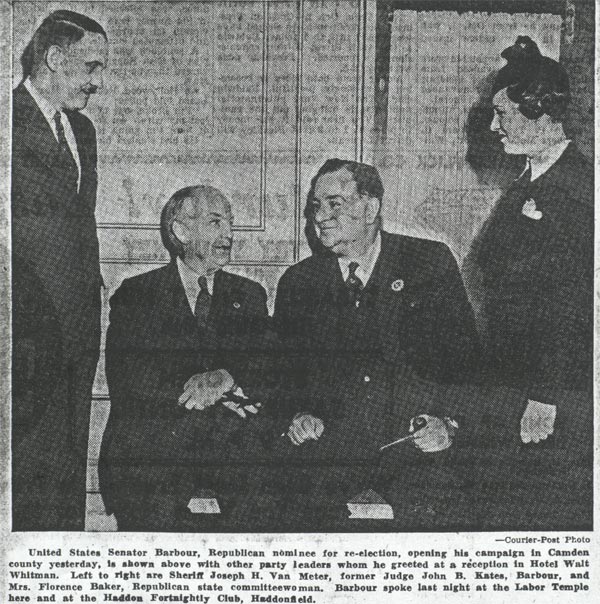
United States Senator Barbour, Republican nominee for re-election, opening his campaign in Camden county yesterday, is shown above with other party leaders whom he greeted at a reception in Hotel Walt Whitman. Left to right are Sheriff Joseph H. Van Meter, former Judge John B. Kates, Barbour, and Mrs. Florence Baker, Republican state committeewoman. Barbour spoke last night at the Labor Temple here and at the Haddon Fortnightly Club, Haddonfield.
Is Zat So!
Camden Courier-Post — — By Gordon Mackay
TALK about the long arm of coincidence, wait until you read this. Some years ago there was a senator from Camden county named Albert S. Woodruff. A lawyer of recognized ability throughout the state, he was also a political figure of prominence in the councils of the state government and the G. O. P.
During his tenure at Trenton a measure was adopted which called for codification of the state laws, or something of that nature whereby a good part of the statute law of New Jersey was rewritten. One of the laws that came into revision was the law that created the Delaware River Joint Commission, the group that has control of the vested interests of the state in Camden Bridge.
And one of the committee that revised those laws was Senator Albert S. Woodruff of Camden county. From this prelude we’ll give the floor to Br’er Woodruff and let him give an interesting revelation as to the reason why the law governing appointments to the bridge commission from New Jersey was rewritten.
“I was fearful,” the former solon told me yesterday, “that we might come to the time when New Jersey would have a Democratic governor who would have the appointment of the bridge commission in his control. I didn’t want the Republican party thus to be stripped of membership on the commission so I wrote, deliberately and with premeditation the clause in the bill that provides for ad interim appointments only until ‘the Legislature meets.’
“I figured that it was rational to assume that in the majority of elections the Legislature would be under Republican control. In fact, my belief is borne out by the complexion of the two branches since revision.”
SEE WHAT FUTURE HAS DEVELOPED
“The intention of that law,” continued the ex-senator, “was to have no ad interim appointment last longer than the date when the Legislature organized. Thus we would always be assured of G. O. P. membership in control of the bridge on the Jersey side because the Legislature would always remain in our hands, I felt.
“I’m certain that an opinion from the attorney general will bear out this legal contention that ad interim appointments exist only when the Legislature is out of session and those ad interim appointments expire the instant the Legislature resumes sittings.”
This opinion of the man who rewrote the law is interesting for several obvious reasons. It also reveals how the long arm of coincidence has reached out to take hold of a vexing situation for legislators, bridge counsel and other interested parties.
For David Baird, Jr., recently was given the ad interim appointment by the retiring Governor Hoffman. The Legislature has since been in session but no action has been taken on filling the vacancy caused by the resignation of Treasurer John B. Kates.
Strangely enough the obstacle to the path of electing Baird to the full term, for which he now occupies the ad interim appointment, is Albert S. Woodruff, who has been boomed for the Kates vacancy. Meanwhile David Baird, Jr., sits as a bridge commissioner and the whole kettle of trouble woe and travail boils merrily ever.
The next move in this legislative puzzle must come from some source, while the Democrats have the opportunity to sit back and let the various Republican factions stew in their own juice.
SEEM TO BE SHIFT IN WHISTLE STOP
You solons in the State Legislature want to get a load of THIS information. Some time ago we protested as a resident of Camden about misrepresentation on the various commissions affecting Camden city and county by whistle stop commissioners.
This is Chapter Two about the same situation as regards the Camden bridge. Perhaps you men at Trenton are unaware that the whistle stop commissioner from Atlantic county only represents that bailiwick in absentia.
I might inform you gentlemen at Trenton that the bridge commission held a meeting yesterday, in executive session. I understand, the commissioners from South Jersey took yours truly over the coals. They proceeded to slam the portly scribe about with both vim and vigor.
That’s okeh with me. We’ve been socked by experts. It doesn’t destroy the fact, however, that we did a little investigation on our own account. The result of that inquiry is that we would like you solons to ask the whistle stop commissioner from Atlantic county if he receives communications to himself at Boonton, N. J. If so why?
Boonton is in Morris county and either the whistle stop commissioner lives in Morris county or he dwells in Atlantic county. If he lives in Morris county, votes there and has his legal residence there, what right has he to sit on the bridge commission as a whistle stop commissioner from Atlantic county? So much for the whistle stop commissioner from Atlantic City, who probably represents the seaside via Morris county. How about the other whistle stop commissioners? Where do they really live?
Strandwitz to Outline Scandinavian Position
Camden Courier-Post —
STRANDWITZ TO OUTLINE SCANDINAVIAN POSITION
The precarious position of the Scandinavian countries in the European War will be analyzed by William J. Strandwitz, a Norwegian by birth and American by adoption, at tomorrow’s weekly luncheon meeting of the Camden Kiwanis Club. Sharing the spotlight with this serious discussion will be a belated “April Fool’s” program under the direction of C. A. Lotz and J. Frank Hanly.
A delegation of Camden Kiwanians headed by John B. Kates will make a visitation to the Atlantic City club next Thursday, leaving the Walt Whitman Hotel at 10:30 a.m. The occasion is the appearance at the shore of Bennet O. Knudson, president of Kiwanis International.